Cambridge A Level Islamic Studies 9488 — 2021 Oct/Nov Paper 3 · Variant 2
9488/32/O/N/21 · 4 questions · 50 marks · ≈56 min
The question paper and its mark scheme, free to read here and free to download. This is Cambridge’s own paper, exactly as it was sat.
Question paper4 pages
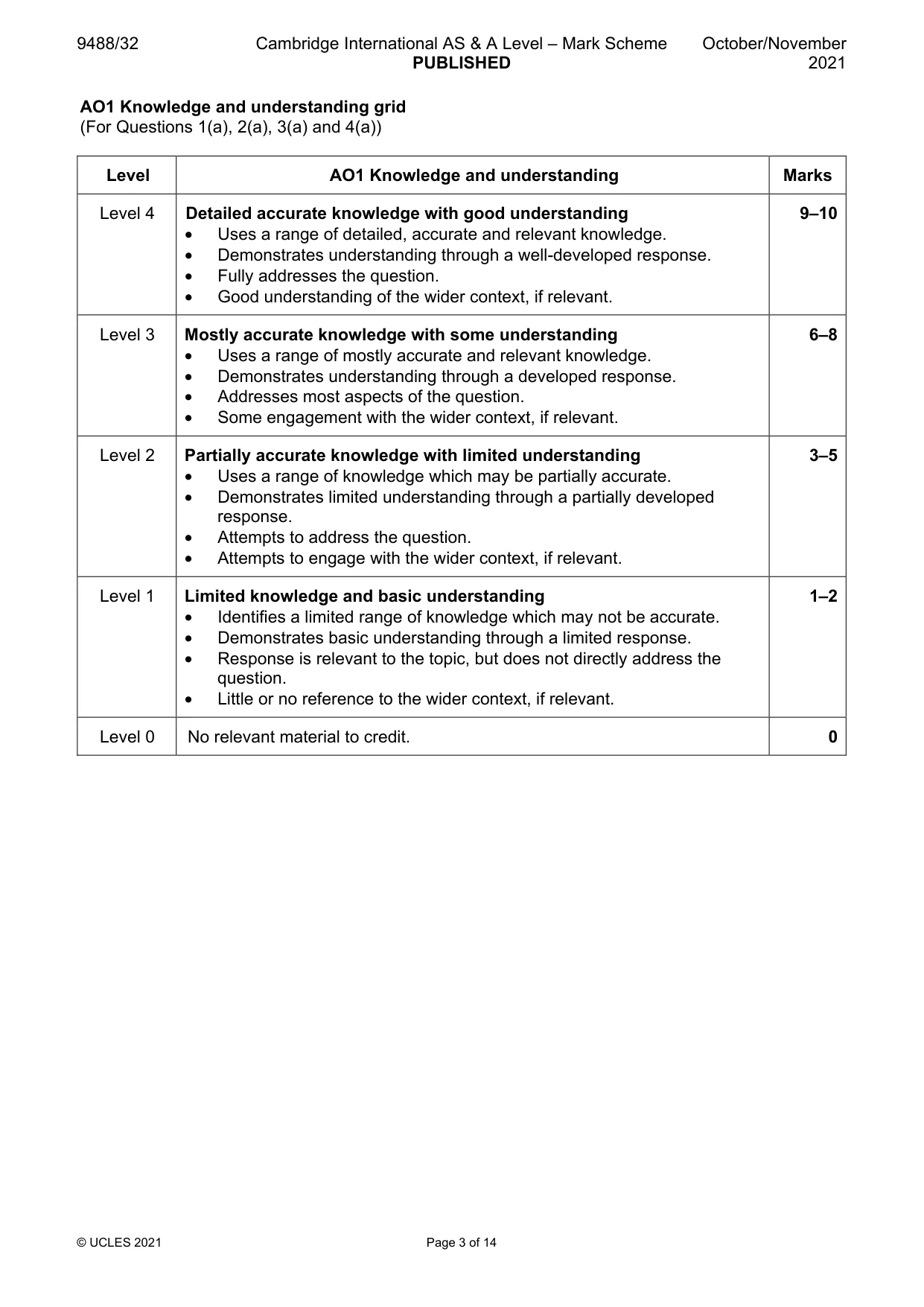
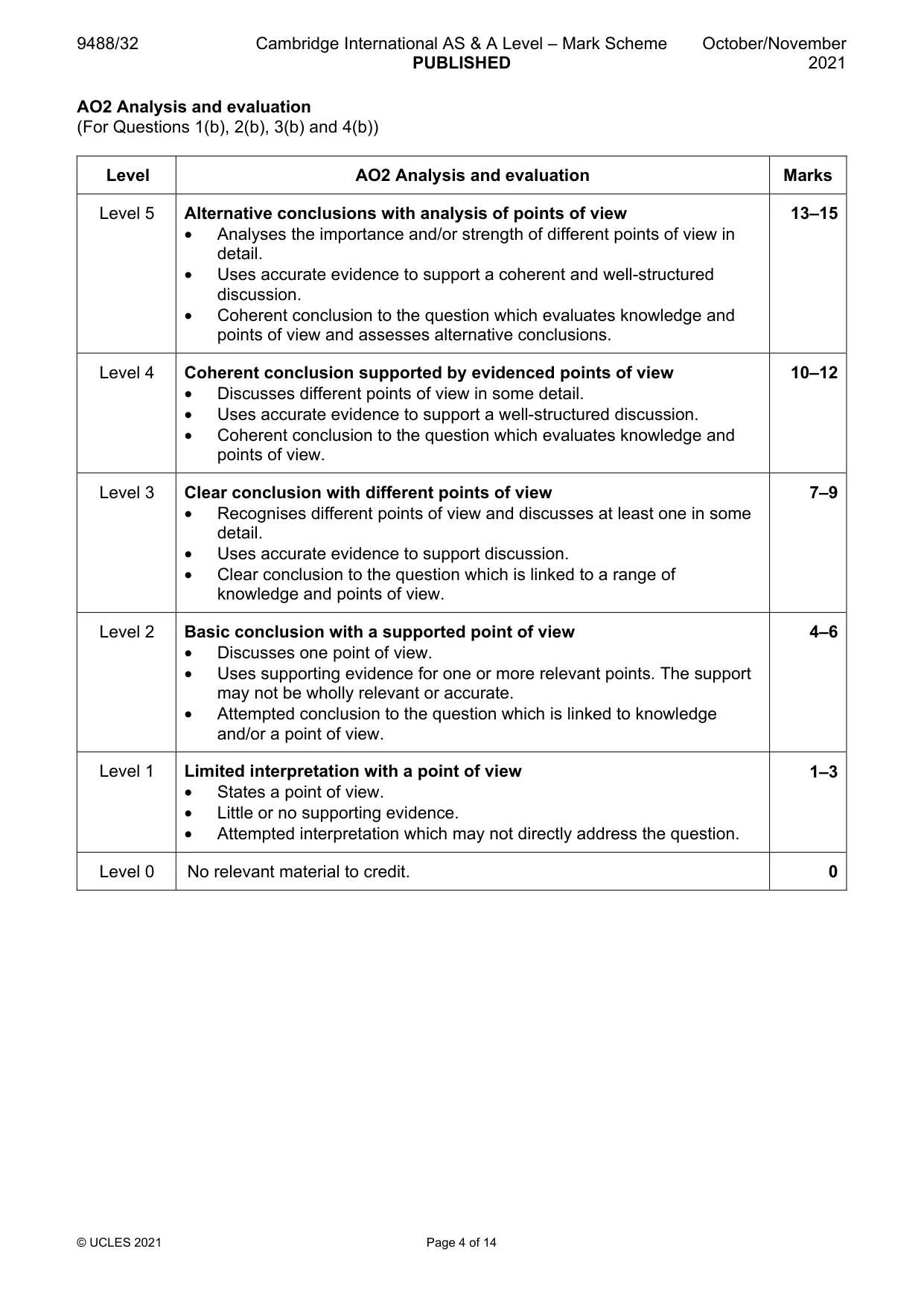
Mark scheme14 pages
Answers below. Sit the paper first if you are practising.
Questions as text
Question 1
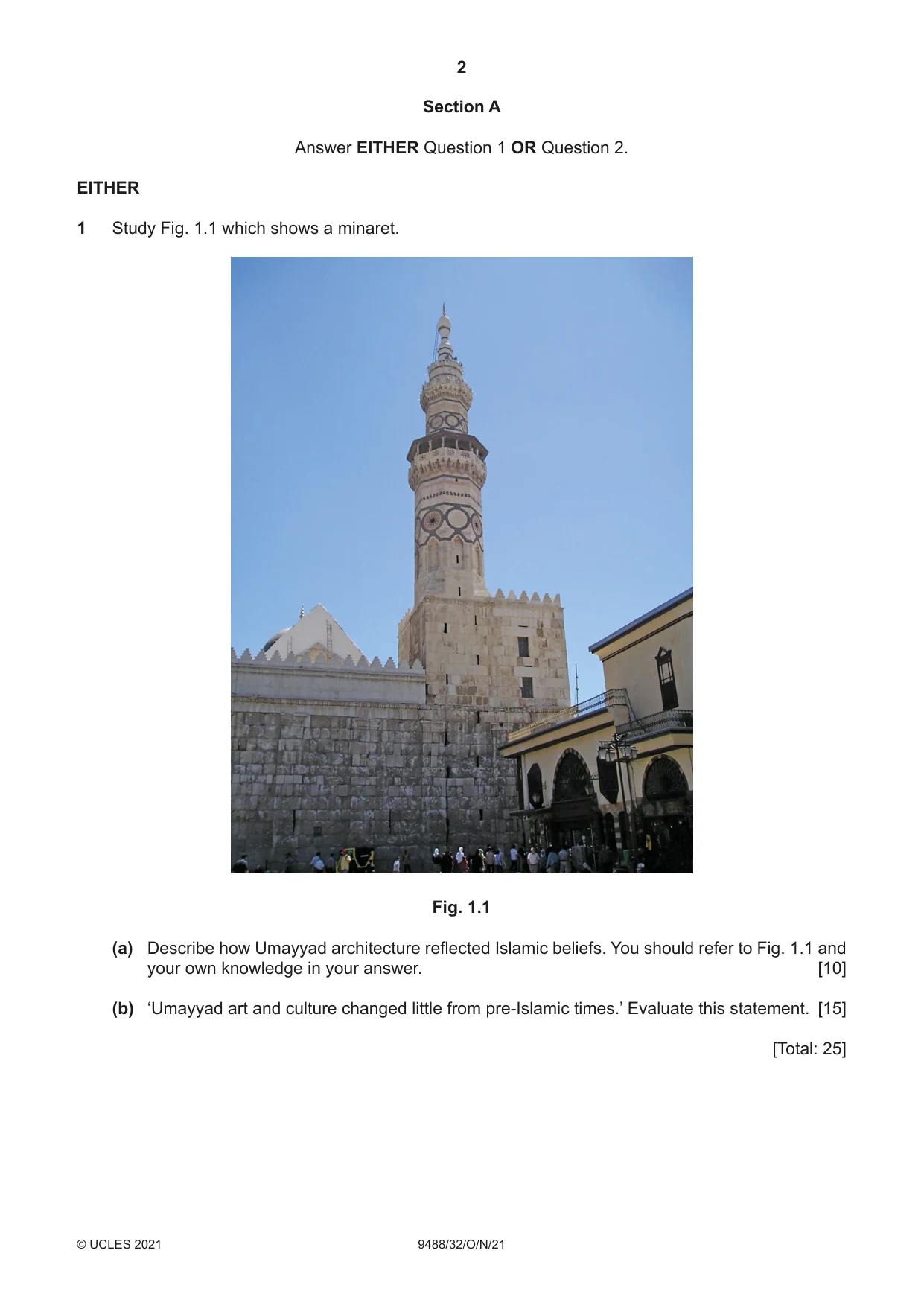
1 Study Fig. 1.1 which shows a minaret. Fig. 1.1 (a) Describe how Umayyad architecture reflected Islamic beliefs. You should refer to Fig. 1.1 and your own knowledge in your answer. [10] (b) ‘Umayyad art and culture changed little from pre‑Islamic times.’ Evaluate this statement. [15] [Total: 25] OR
Mark scheme: Question Answer Marks 1 Study Fig. 1.1 which shows a minaret. 1(a) Describe how Umayyad architecture reflected Islamic beliefs. You 10 should refer to Fig. 1.1 and your own knowledge in your answer. Mark according to the AO1 – 10-mark levels of response marking grid for knowledge and understanding. Answers may include some of the following ideas, but all valid material must be credited. • The source shows the minaret from the south west corner of the Grand Mosque of Damascus, centre of the Umayyad Caliphate. The mosque was commissioned by Caliph al-Walid I. He also rebuilt the mosque of Medina and added a niche (mihrab) to indicate the direction of prayer towards Mecca. • Churches and shrines in Syria had candlestick shaped towers at the time, and the idea may have been adapted by the Umayyads, who made Damascus their capital, and introduced mosques. • Caliph Mu’awiya was said to have ordered the construction of a minaret at the mosque at Fustat in Egypt, one of the first Islamic minarets. Muhammad (pbuh) had asked Bilal to give the call to prayer (adhan) from high places in Medina, so the Umayyads may be seen as adapting the minaret as providing a high place for this purpose. • Mosques, such as the Grand Mosques in Damascus and Cordoba, were built on the courtyard plan, resembling Muhammad’s house in Medina where the mosque was constructed. Many Umayyad mosques were large with enclosed walls as they were used as garrisons for Muslim armies of conquest to expand the Caliphate and spread Islam far and wide, following the commands of Muhammad (pbuh). • The style of the mosque resembled some of the Umayyad palaces. A dome above the niche (mihrab) emphasised the royal position of the Caliph, who prayed in this area, and often personally led the prayers. • The Dome of the Rock (Masjid al-Aqsa) in Jerusalem is known for many features including some of the earliest Qur’anic inscriptions about the oneness of God (tawhid) and was modelled on earlier Syrian Christian churches. • Wall mosaics provided beautiful decoration to mosques. Whilst Umayyad palaces included statues and figures, the mosques observed the ban on pictures and statues, lest they be considered idols and worshipped. • The beautiful mosaics such as those which decorate Masjid al-Aqsa, might be said to reflect the beauty of the creation and the patterns the order deriving from a world created in harmony by a single, all-powerful Lord. • The trees, rivers and patterns on the Great Mosque of Damascus might be considered a vision of paradise and the afterlife, reflecting this important Islamic belief, or might possibly be a representation of the prosperity of the Umayyad city itself. 1(b) ‘Umayyad art and culture changed little from pre-Islamic times.’ 15 Evaluate this statement. Mark according to the AO2 – 15-mark levels of response marking grid for analysis and evaluation. Answers may refer to any religious theory or teaching. Students may propose, analyse and evaluate some of the following arguments. All relevant arguments must be credited. Definitions • Introductions might attempt to define Umayyad and pre-Islamic times and what might be included in the scope of a discussion about their art and culture. Disagree • It could be argued that Muhammad’s clearance of idols from the Ka’bah was revolutionary and mosques since have followed this tradition. The Umayyads constructed mosques and did not include representations of humans or animal figures, showing a great change from pre-Islamic times. • The change in function might be considered significant, representative of an all-embracing way of life which constituted a fundamental change in culture with the coming of Islam. • Umayyad culture varied from Caliph to Caliph, and all of the Caliphs respected the removal of idols in their building of mosques. Many Caliphs were committed to Islam and prayed five times a day, leading the prayers. This religious lifestyle and Islamic culture were very different from the previous Roman/Byzantine and other ways. • Many aspects of Islam, including facilities for pilgrims, mosques, poor due and public works were improved by the Umayyads which may have gone some way towards building a sense of equality. Agree • Minarets continued the style of Syrian churches at the time. The use of the niche (mihrab) was also a feature of churches and adapted by Caliph Walid I for mosques. Therefore, it could be argued that little changed. • Roman columns were re-used; floral decoration continued; and the sites of earlier places of worship rebuilt. The Great Mosque of Damascus was built on the site of the Roman Temple of Jupiter. The mosque itself contained a shrine to John the Baptist. • The Umayyads built lavish palaces, some including statues, and luxurious lifestyle. Some were said to drink wine. This might be considered a continuation from the pre-Islamic practices and out of step with the teachings of good character from Muhammad (pbuh). • Umayyad culture flourished but was increasingly criticised by non-Arabs for the unfavourable treatment they endured. Umayyad favouritism of Arabs might be said to replicate the days of pre-Islamic tribalism which Muhammad (pbuh) preached against. Conclusions • Conclusions might draw together the discussion and make a personal judgement of how far the Umayyads overall changed art and culture and how significant this was.
Question 2
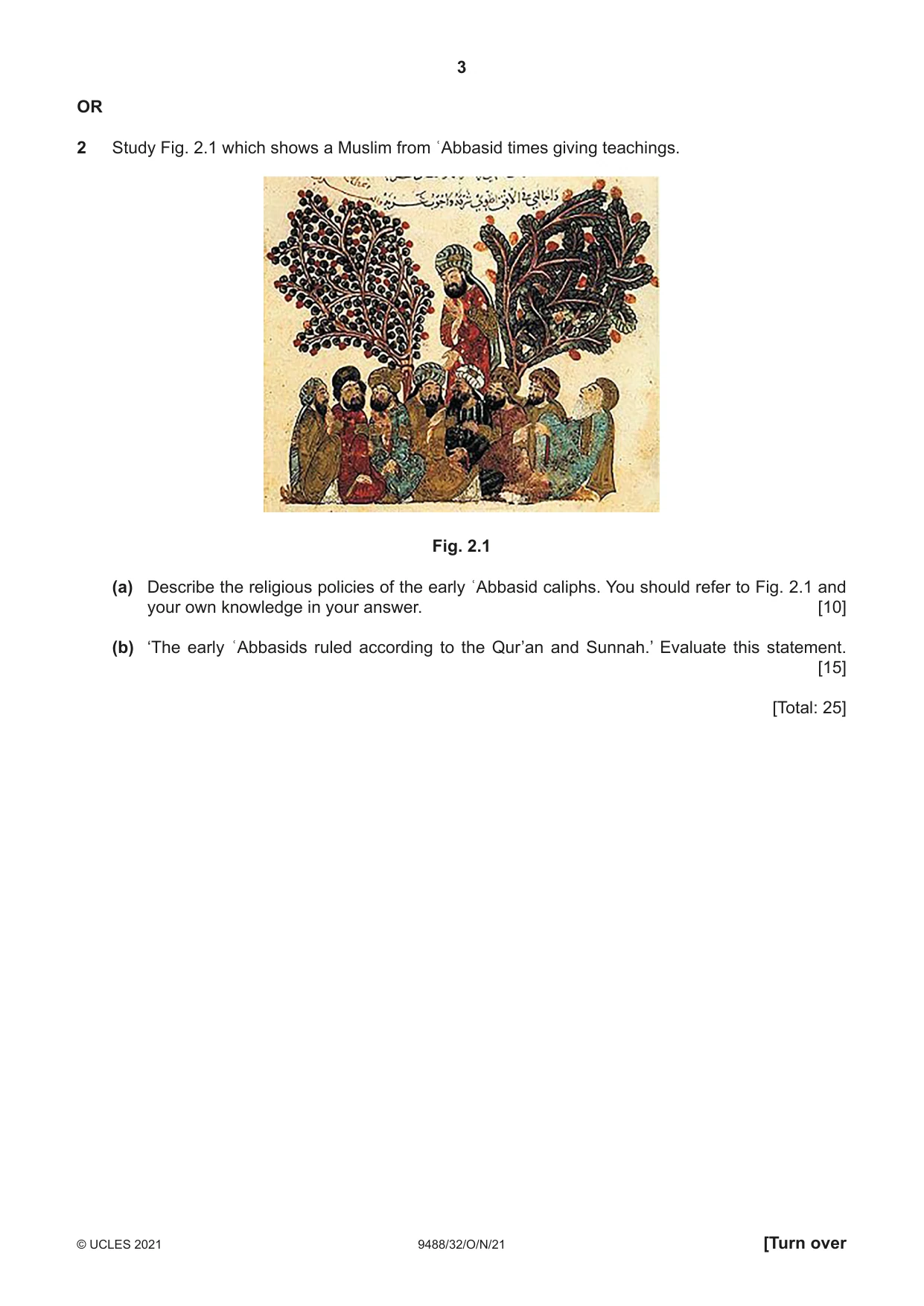
2 Study Fig. 2.1 which shows a Muslim from ʿAbbasid times giving teachings. Fig. 2.1 (a) Describe the religious policies of the early ʿAbbasid caliphs. You should refer to Fig. 2.1 and your own knowledge in your answer. [10] (b) ‘The early ʿAbbasids ruled according to the Qur’an and Sunnah.’ Evaluate this statement. [15] [Total: 25]
Mark scheme: 2 Study Fig. 2.1 which shows a Muslim from 'Abbasid times giving teachings. 2(a) Describe the religious policies of the early ʿAbbasid caliphs. You 10 should refer to Fig. 2.1 and your own knowledge in your answer. Mark according to the AO1 – 10-mark levels of response marking grid for knowledge and understanding. Answers may include some of the following ideas, but all valid material must be credited. • The ‘Abbasids portrayed themselves as legitimate rulers by emphasising their lineage from Muhammad’s uncle Abbas, and by criticising the luxurious lifestyle of the Umayyads. • The ‘Abbasids were open to different Islamic traditions, and employed many non-Arabs, especially Persians and some Shi'i Muslims in their administration, helping to overcome this and gain support from a wider area. • As shown by teaching or preaching in the source, during the ‘Abbasid period, many more people across the Caliphate learned more about Islam and took on more Islamic practices. The number of people who became Muslim greatly increased. • The Caliphs used the title ‘Caliph’ to mean God’s representative to lead the Muslims and this was respected as an institution which unified the Islamic world, even when local rulers differed. • The ‘Abbasids ruled for a long period and it would not be accurate to say they ruled with a coherent set of religious policies throughout. Indeed, as the Caliphs employed Persian bureaucrats, it was the Ministers (viziers) who more often organised these policies. • Third ‘Abbasid Caliph al-Mahdi reached out to Shi'i Muslims and employed them and improved relations with others through interfaith dialogue with the leader of the Nestorian church. He persecuted the atheists, enlarged and beautified mosques in the holy cities and enforced the main Islamic practices. • The pursuit of knowledge was emphasised as a religious duty and learning, translation and philosophy flourished in ‘Abbasid Baghdad, particularly under al-Ma’mun. • Under the ‘Abbasids, the schools of jurisprudence (madhhabs) had the freedom to develop. Also, the Hadith collectors did much of their work and produced the authoritative collections of Hadith. Some Caliphs encouraged this. • However, some Caliphs tried to impose their views on religious policy, such as Al-Ma’mun with the inquisition (minhah) and enforcement of some Mu’tazilite doctrines. Credit details of these events. • Caliph al-Mu'tasim had scholar Ahmad ibn Hanbal questioned then flogged. But the people of Baghdad protested, and he was released. After that, Caliph al-Mutawakkil rejected Mu’tazilah doctrines and promoted traditional views. • Some might conclude that there was, to some extent, a division between religious policy and state under the ‘Abbasids, with certain matters dealt with by religious scholars, others by judges and political matters by the Caliph, who held a ceremonial religious role. 2(b) ‘The early 'Abbasids ruled according to the Qur’an and Sunnah.’ 15 Evaluate this statement. Mark according to the AO2 – 15-mark levels of response marking grid for analysis and evaluation. Answers may refer to any religious theory or teaching. Students may propose, analyse and evaluate some of the following arguments. All relevant arguments must be credited. Definitions • Candidates might approach this by defining the extent and scope of ‘Abbasid rule, and mentioning some of the Caliphs. They might compare some of the Caliph’s policies and recognise that different Caliphs ruled in different ways. Agree • Prayer, the Five Pillars and particularly Hajj, were a major feature of the ‘Abbasids. The Caliph usually led a grand procession to encourage lots of Muslims to perform the Hajj pilgrimage each year. This was a visual sign that the ‘Abbasids were following the Sunnah. • By encouraging the Golden Age of learning, the ‘Abbasids followed the Islamic duty of promoting education, found in the Qur’an and Sunnah. This included research, investigation and openness to knowledge. • The Qur’an and Sunnah encourage unity amongst the Muslim community (ummah): Muhammad (pbuh) said that there should be no difference between an Arab and a non-Arab. It could be argued that the ‘Abbasids ruled in accordance with this by encouraging Persians and others to take up positions in their administration. Disagree • Others might argue that the focus on philosophy and translation from Greek works drew on pre-Islamic influences and that revelation should always establish truth, so the ‘Abbasid rulers’ interest in this might be said to be questionable in that regard. • Different Caliphs had their own way of leading and some followed the Qur’an and Sunnah more literally than others. Credit examples where given. • Al-Ma’mun’s inquisition (mihnah) against Ibn Hanbal and others pitted two different interpretations against each other. It could be argued that the attempt to enforce the Caliph’s religious views went against the revelations received by Muhammad (pbuh) and ignored the practice of consultation (shura) loosely followed at times by Muhammad (pbuh) and the Four Rightly Guided Caliphs. Conclusions • In conclusion, the actions of some of the many ‘Abbasid Caliphs might be judged overall as to how far they were consistent with, or consciously aiming to follow, the Qur’an and Sunnah.
Q3 · Explain how Islamic philosophers used reasoning in their writings
3 (a) Explain how Islamic philosophers used reasoning in their writings. [10] (b) ‘Islamic philosophy has little in common with ancient Greek philosophy.’ Evaluate this statement. [15] [Total: 25] OR
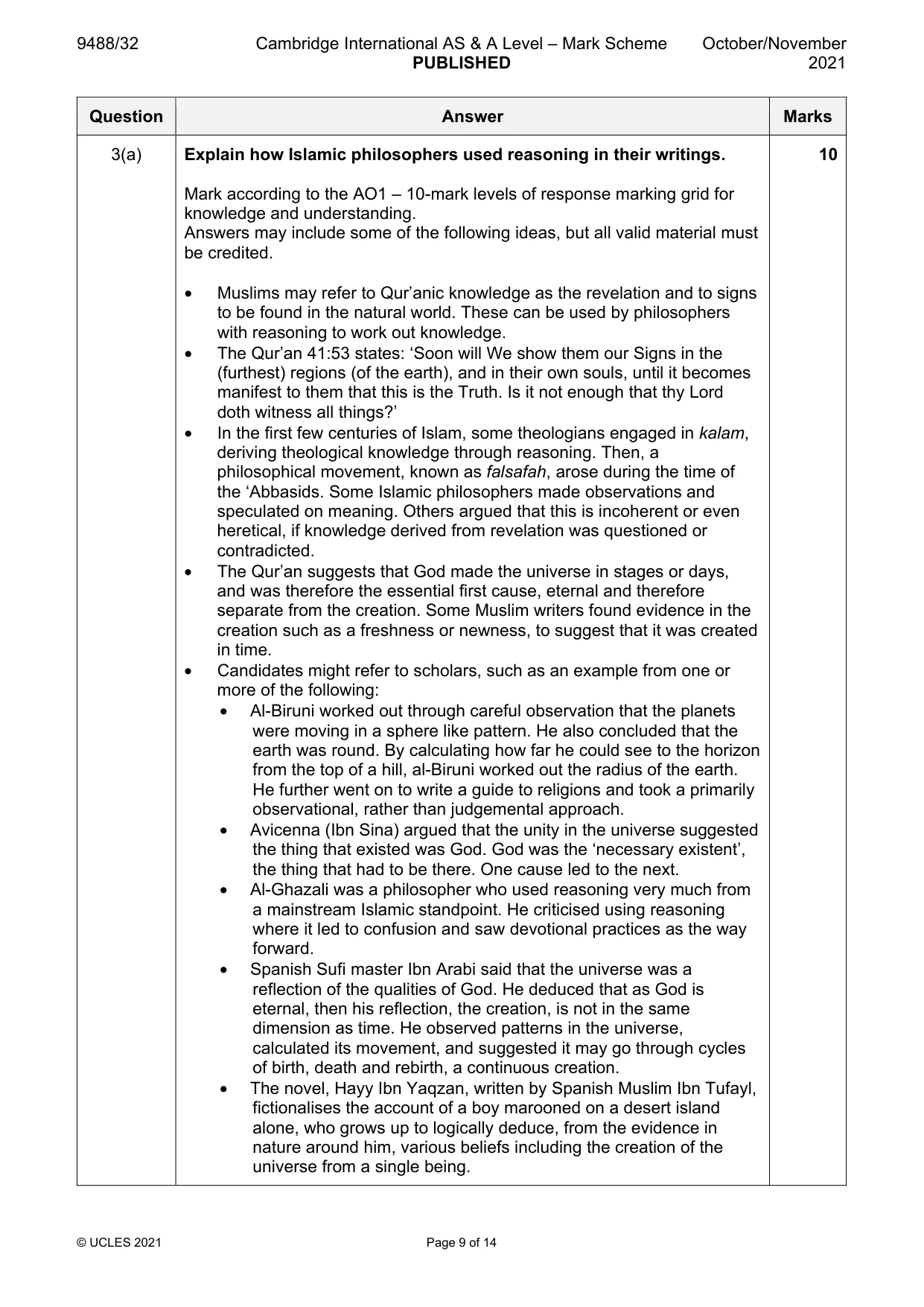
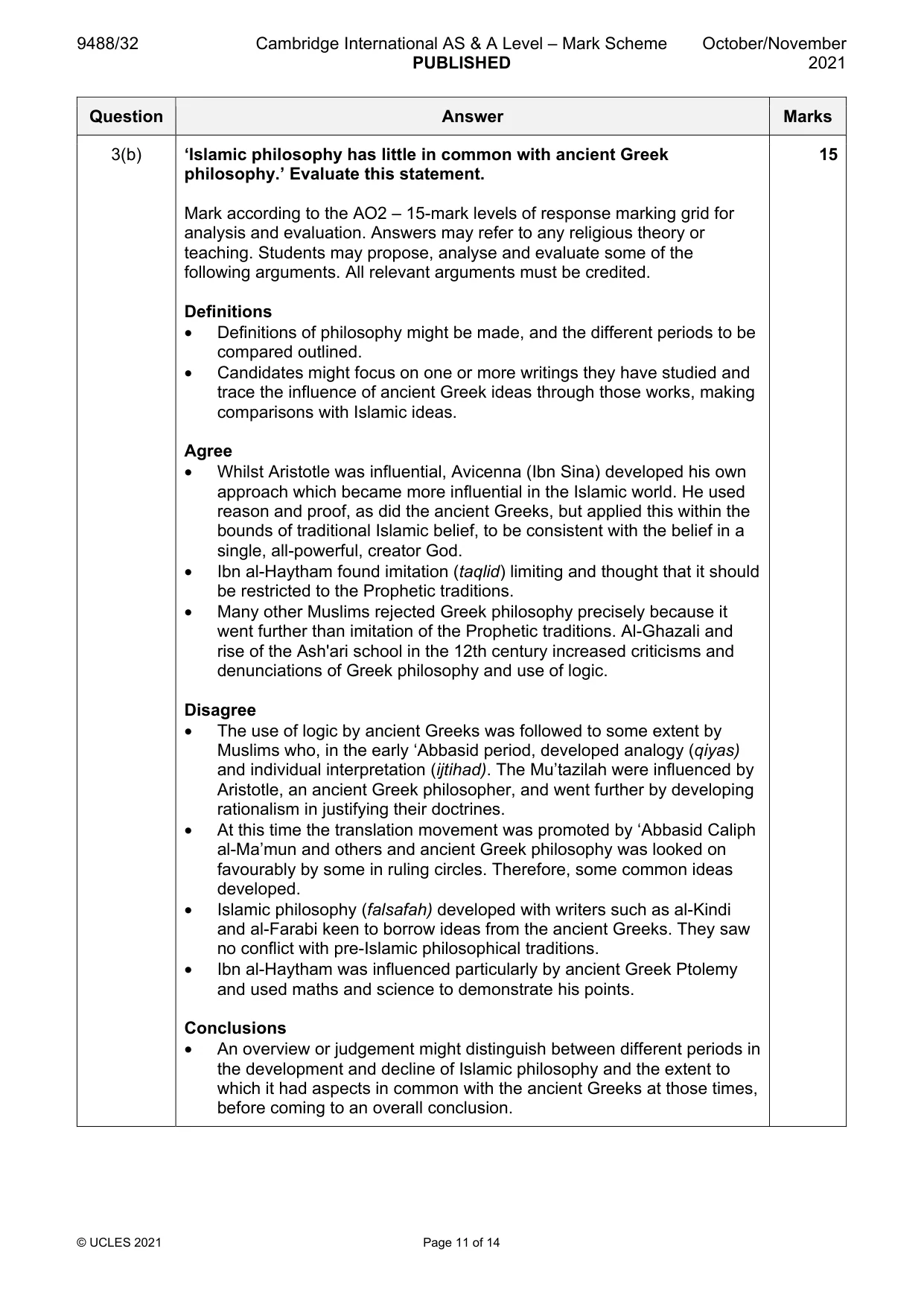
Mark scheme: 3(a) Explain how Islamic philosophers used reasoning in their writings. 10 Mark according to the AO1 – 10-mark levels of response marking grid for knowledge and understanding. Answers may include some of the following ideas, but all valid material must be credited. • Muslims may refer to Qur’anic knowledge as the revelation and to signs to be found in the natural world. These can be used by philosophers with reasoning to work out knowledge. • The Qur’an 41:53 states: ‘Soon will We show them our Signs in the (furthest) regions (of the earth), and in their own souls, until it becomes manifest to them that this is the Truth. Is it not enough that thy Lord doth witness all things?’ • In the first few centuries of Islam, some theologians engaged in kalam, deriving theological knowledge through reasoning. Then, a philosophical movement, known as falsafah, arose during the time of the ‘Abbasids. Some Islamic philosophers made observations and speculated on meaning. Others argued that this is incoherent or even heretical, if knowledge derived from revelation was questioned or contradicted. • The Qur’an suggests that God made the universe in stages or days, and was therefore the essential first cause, eternal and therefore separate from the creation. Some Muslim writers found evidence in the creation such as a freshness or newness, to suggest that it was created in time. • Candidates might refer to scholars, such as an example from one or more of the following: • Al-Biruni worked out through careful observation that the planets were moving in a sphere like pattern. He also concluded that the earth was round. By calculating how far he could see to the horizon from the top of a hill, al-Biruni worked out the radius of the earth. He further went on to write a guide to religions and took a primarily observational, rather than judgemental approach. • Avicenna (Ibn Sina) argued that the unity in the universe suggested the thing that existed was God. God was the ‘necessary existent’, the thing that had to be there. One cause led to the next. • Al-Ghazali was a philosopher who used reasoning very much from a mainstream Islamic standpoint. He criticised using reasoning where it led to confusion and saw devotional practices as the way forward. • Spanish Sufi master Ibn Arabi said that the universe was a reflection of the qualities of God. He deduced that as God is eternal, then his reflection, the creation, is not in the same dimension as time. He observed patterns in the universe, calculated its movement, and suggested it may go through cycles of birth, death and rebirth, a continuous creation. • The novel, Hayy Ibn Yaqzan, written by Spanish Muslim Ibn Tufayl, fictionalises the account of a boy marooned on a desert island alone, who grows up to logically deduce, from the evidence in nature around him, various beliefs including the creation of the universe from a single being. 3(a) • Some Muslims, such as al-Jahiz and later Ibn Khaldun, even concluded from their observations that plants and animals may have evolved in some ways. • It could be argued that Islamic observers did little to add to ancient Greek ideas, and their thoughts were limited by arguments with those who condemned speculation as un-Islamic. This mean that observations developed little into theory. 3(b) ‘Islamic philosophy has little in common with ancient Greek 15 philosophy.’ Evaluate this statement. Mark according to the AO2 – 15-mark levels of response marking grid for analysis and evaluation. Answers may refer to any religious theory or teaching. Students may propose, analyse and evaluate some of the following arguments. All relevant arguments must be credited. Definitions • Definitions of philosophy might be made, and the different periods to be compared outlined. • Candidates might focus on one or more writings they have studied and trace the influence of ancient Greek ideas through those works, making comparisons with Islamic ideas. Agree • Whilst Aristotle was influential, Avicenna (Ibn Sina) developed his own approach which became more influential in the Islamic world. He used reason and proof, as did the ancient Greeks, but applied this within the bounds of traditional Islamic belief, to be consistent with the belief in a single, all-powerful, creator God. • Ibn al-Haytham found imitation (taqlid) limiting and thought that it should be restricted to the Prophetic traditions. • Many other Muslims rejected Greek philosophy precisely because it went further than imitation of the Prophetic traditions. Al-Ghazali and rise of the Ash'ari school in the 12th century increased criticisms and denunciations of Greek philosophy and use of logic. Disagree • The use of logic by ancient Greeks was followed to some extent by Muslims who, in the early ‘Abbasid period, developed analogy (qiyas) and individual interpretation (ijtihad). The Mu’tazilah were influenced by Aristotle, an ancient Greek philosopher, and went further by developing rationalism in justifying their doctrines. • At this time the translation movement was promoted by ‘Abbasid Caliph al-Ma’mun and others and ancient Greek philosophy was looked on favourably by some in ruling circles. Therefore, some common ideas developed. • Islamic philosophy (falsafah) developed with writers such as al-Kindi and al-Farabi keen to borrow ideas from the ancient Greeks. They saw no conflict with pre-Islamic philosophical traditions. • Ibn al-Haytham was influenced particularly by ancient Greek Ptolemy and used maths and science to demonstrate his points. Conclusions • An overview or judgement might distinguish between different periods in the development and decline of Islamic philosophy and the extent to which it had aspects in common with the ancient Greeks at those times, before coming to an overall conclusion.
Q4 · Examine how geometrical patterns on Islamic buildings reflect the Islamic belief in God…
4 (a) Examine how geometrical patterns on Islamic buildings reflect the Islamic belief in God as Creator. [10] (b) ‘The oneness of God (tawhid) is more easily understood through architecture than writings.’ Evaluate this statement. [15] [Total: 25]
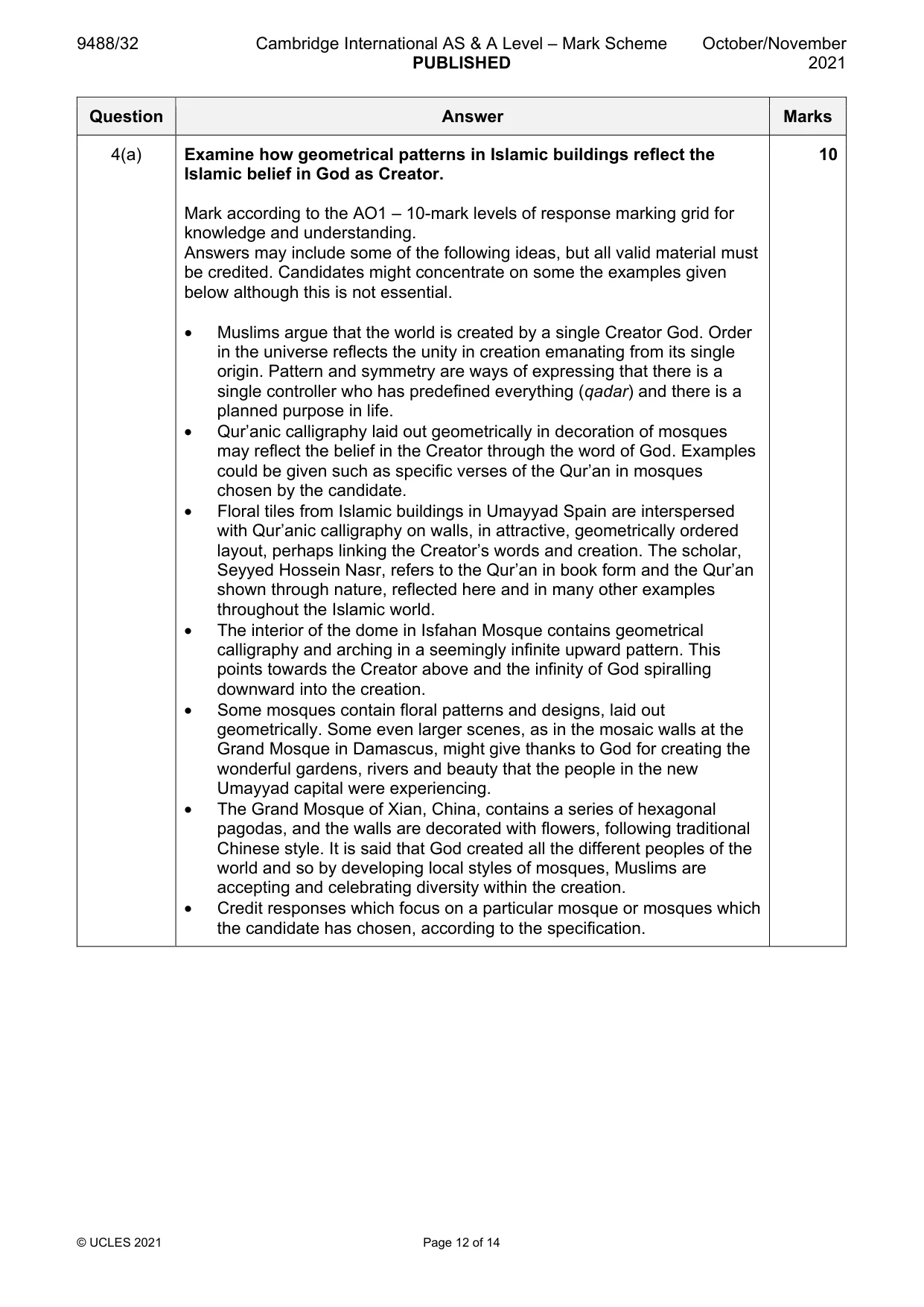
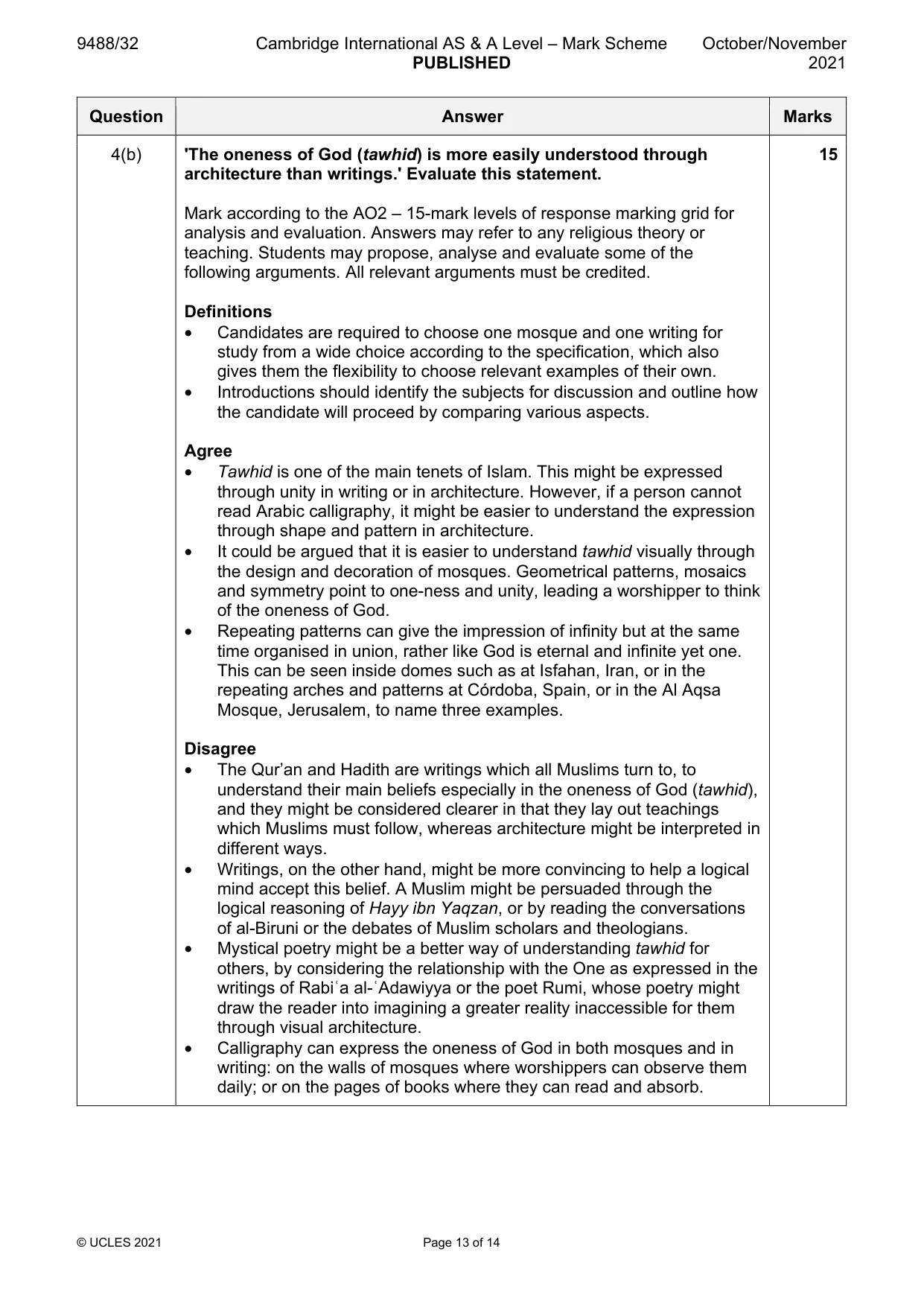
Mark scheme: 4(a) Examine how geometrical patterns in Islamic buildings reflect the 10 Islamic belief in God as Creator. Mark according to the AO1 – 10-mark levels of response marking grid for knowledge and understanding. Answers may include some of the following ideas, but all valid material must be credited. Candidates might concentrate on some the examples given below although this is not essential. • Muslims argue that the world is created by a single Creator God. Order in the universe reflects the unity in creation emanating from its single origin. Pattern and symmetry are ways of expressing that there is a single controller who has predefined everything (qadar) and there is a planned purpose in life. • Qur’anic calligraphy laid out geometrically in decoration of mosques may reflect the belief in the Creator through the word of God. Examples could be given such as specific verses of the Qur’an in mosques chosen by the candidate. • Floral tiles from Islamic buildings in Umayyad Spain are interspersed with Qur’anic calligraphy on walls, in attractive, geometrically ordered layout, perhaps linking the Creator’s words and creation. The scholar, Seyyed Hossein Nasr, refers to the Qur’an in book form and the Qur’an shown through nature, reflected here and in many other examples throughout the Islamic world. • The interior of the dome in Isfahan Mosque contains geometrical calligraphy and arching in a seemingly infinite upward pattern. This points towards the Creator above and the infinity of God spiralling downward into the creation. • Some mosques contain floral patterns and designs, laid out geometrically. Some even larger scenes, as in the mosaic walls at the Grand Mosque in Damascus, might give thanks to God for creating the wonderful gardens, rivers and beauty that the people in the new Umayyad capital were experiencing. • The Grand Mosque of Xian, China, contains a series of hexagonal pagodas, and the walls are decorated with flowers, following traditional Chinese style. It is said that God created all the different peoples of the world and so by developing local styles of mosques, Muslims are accepting and celebrating diversity within the creation. • Credit responses which focus on a particular mosque or mosques which the candidate has chosen, according to the specification. 4(b) 'The oneness of God (tawhid) is more easily understood through 15 architecture than writings.' Evaluate this statement. Mark according to the AO2 – 15-mark levels of response marking grid for analysis and evaluation. Answers may refer to any religious theory or teaching. Students may propose, analyse and evaluate some of the following arguments. All relevant arguments must be credited. Definitions • Candidates are required to choose one mosque and one writing for study from a wide choice according to the specification, which also gives them the flexibility to choose relevant examples of their own. • Introductions should identify the subjects for discussion and outline how the candidate will proceed by comparing various aspects. Agree • Tawhid is one of the main tenets of Islam. This might be expressed through unity in writing or in architecture. However, if a person cannot read Arabic calligraphy, it might be easier to understand the expression through shape and pattern in architecture. • It could be argued that it is easier to understand tawhid visually through the design and decoration of mosques. Geometrical patterns, mosaics and symmetry point to one-ness and unity, leading a worshipper to think of the oneness of God. • Repeating patterns can give the impression of infinity but at the same time organised in union, rather like God is eternal and infinite yet one. This can be seen inside domes such as at Isfahan, Iran, or in the repeating arches and patterns at Córdoba, Spain, or in the Al Aqsa Mosque, Jerusalem, to name three examples. Disagree • The Qur’an and Hadith are writings which all Muslims turn to, to understand their main beliefs especially in the oneness of God (tawhid), and they might be considered clearer in that they lay out teachings which Muslims must follow, whereas architecture might be interpreted in different ways. • Writings, on the other hand, might be more convincing to help a logical mind accept this belief. A Muslim might be persuaded through the logical reasoning of Hayy ibn Yaqzan, or by reading the conversations of al-Biruni or the debates of Muslim scholars and theologians. • Mystical poetry might be a better way of understanding tawhid for others, by considering the relationship with the One as expressed in the writings of Rabiʿa al-ʿAdawiyya or the poet Rumi, whose poetry might draw the reader into imagining a greater reality inaccessible for them through visual architecture. • Calligraphy can express the oneness of God in both mosques and in writing: on the walls of mosques where worshippers can observe them daily; or on the pages of books where they can read and absorb. 4(b) Conclusions • It could be argued that different Muslims might respond differently to the stimulus of architecture or writings, so it is difficult to say which of the two enable a Muslim to more easily understand tawhid. Perhaps it is a matter of personal preference. Conclusions might draw together the discussion and make a personal judgement.
What was in this paper
The subtopics covered by these 4 questions, and how many questions each got. Open one in a new tab to see every Cambridge question on it.
What you needed in this session
Cambridge’s own grade thresholds for 2021 Oct/Nov, Paper 3 · Variant 2. A higher threshold means an easier paper — the bar moves with how the cohort did.