Cambridge A Level Islamic Studies 9488 — 2021 Oct/Nov Paper 2 · Variant 2
9488/22/O/N/21 · 4 questions · 50 marks · ≈56 min
The question paper and its mark scheme, free to read here and free to download. This is Cambridge’s own paper, exactly as it was sat.
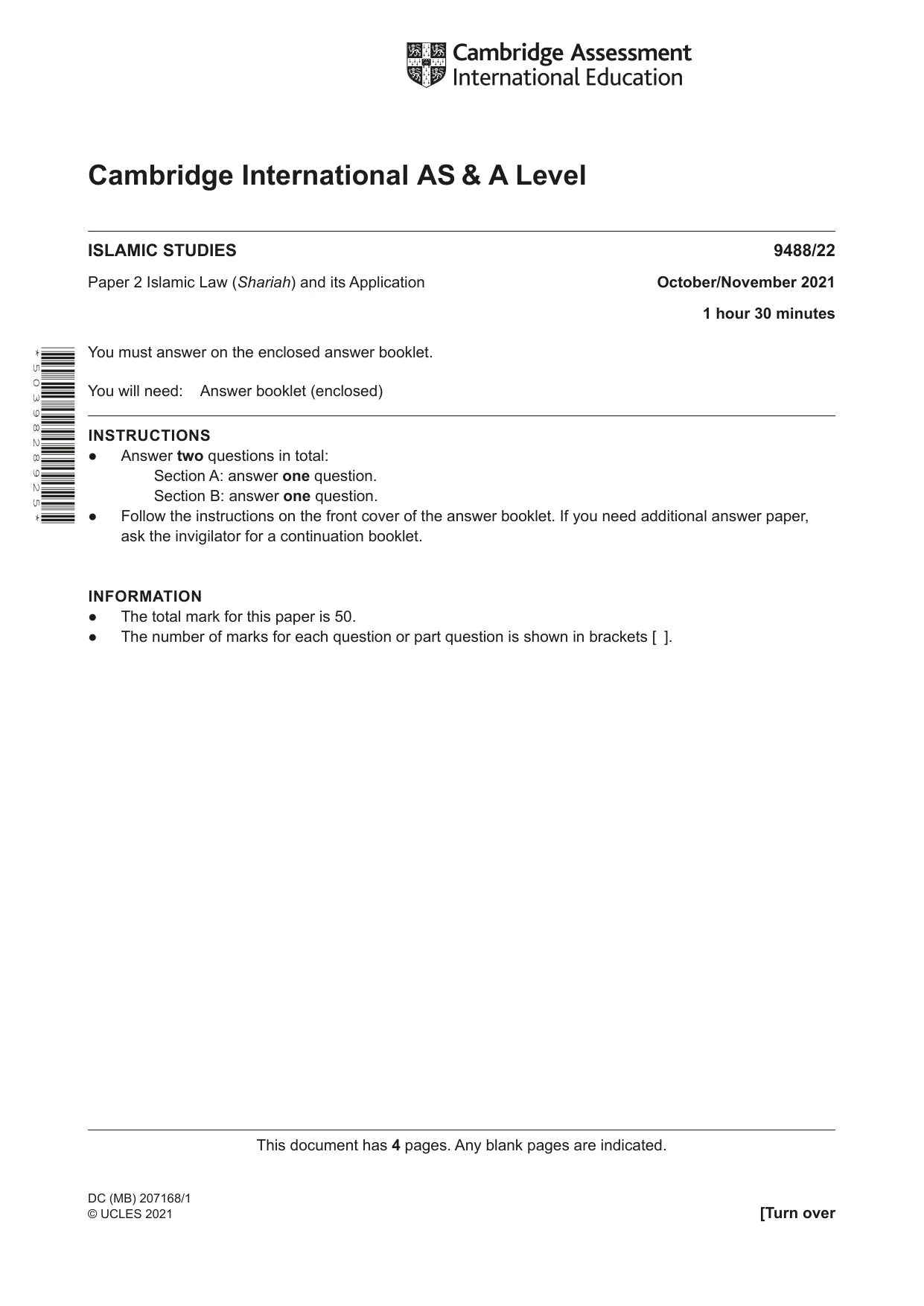
Question paper4 pages
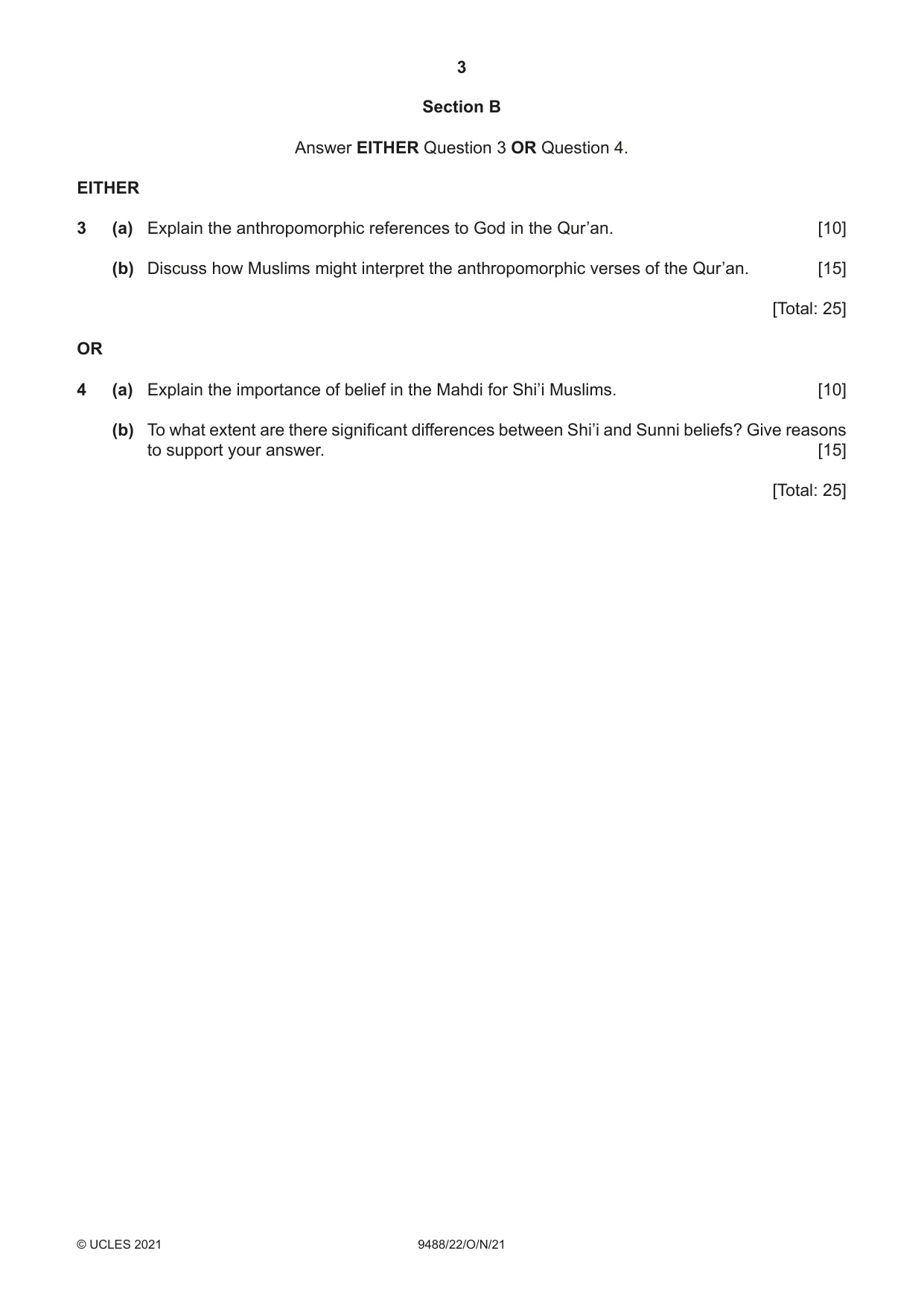

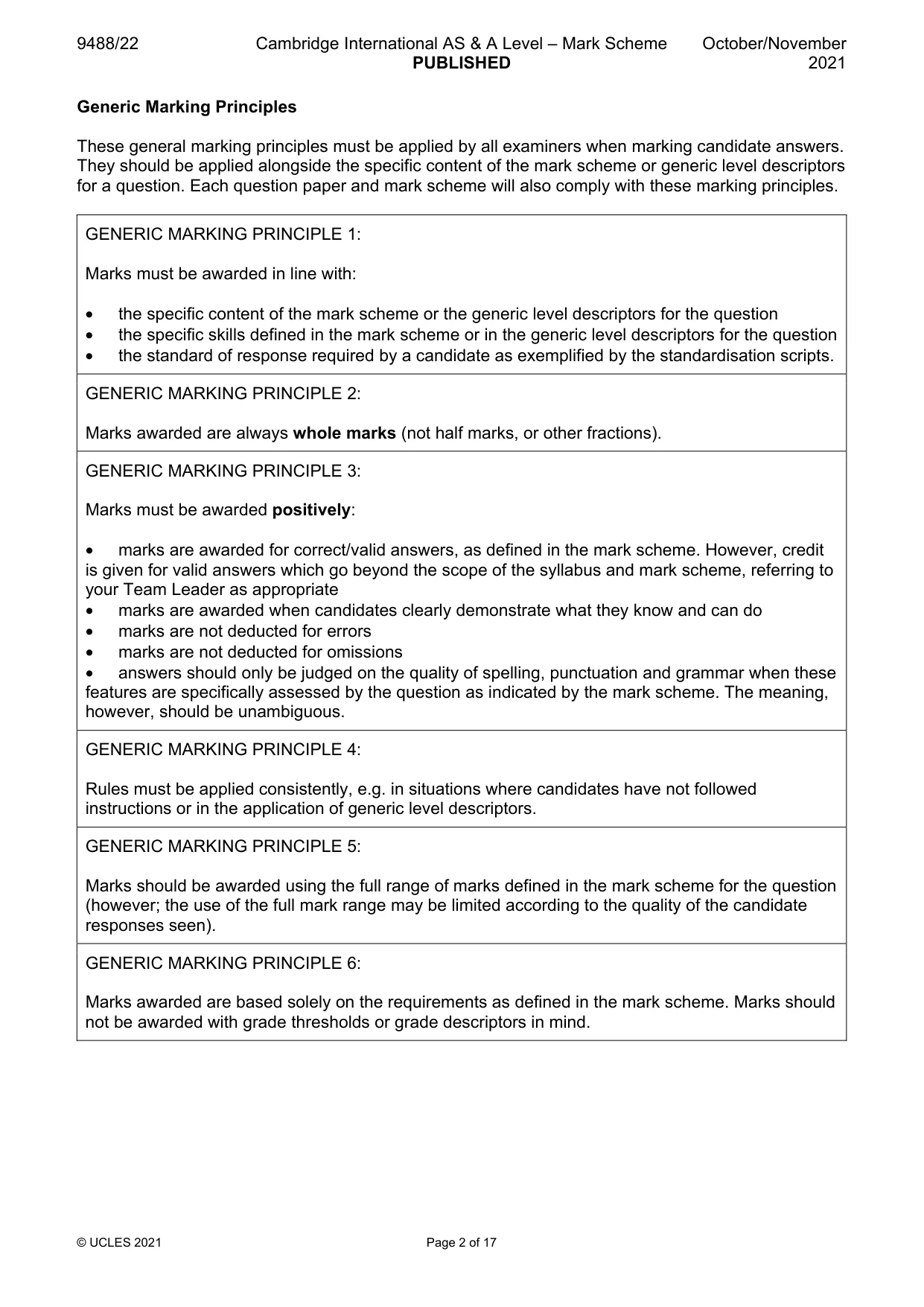
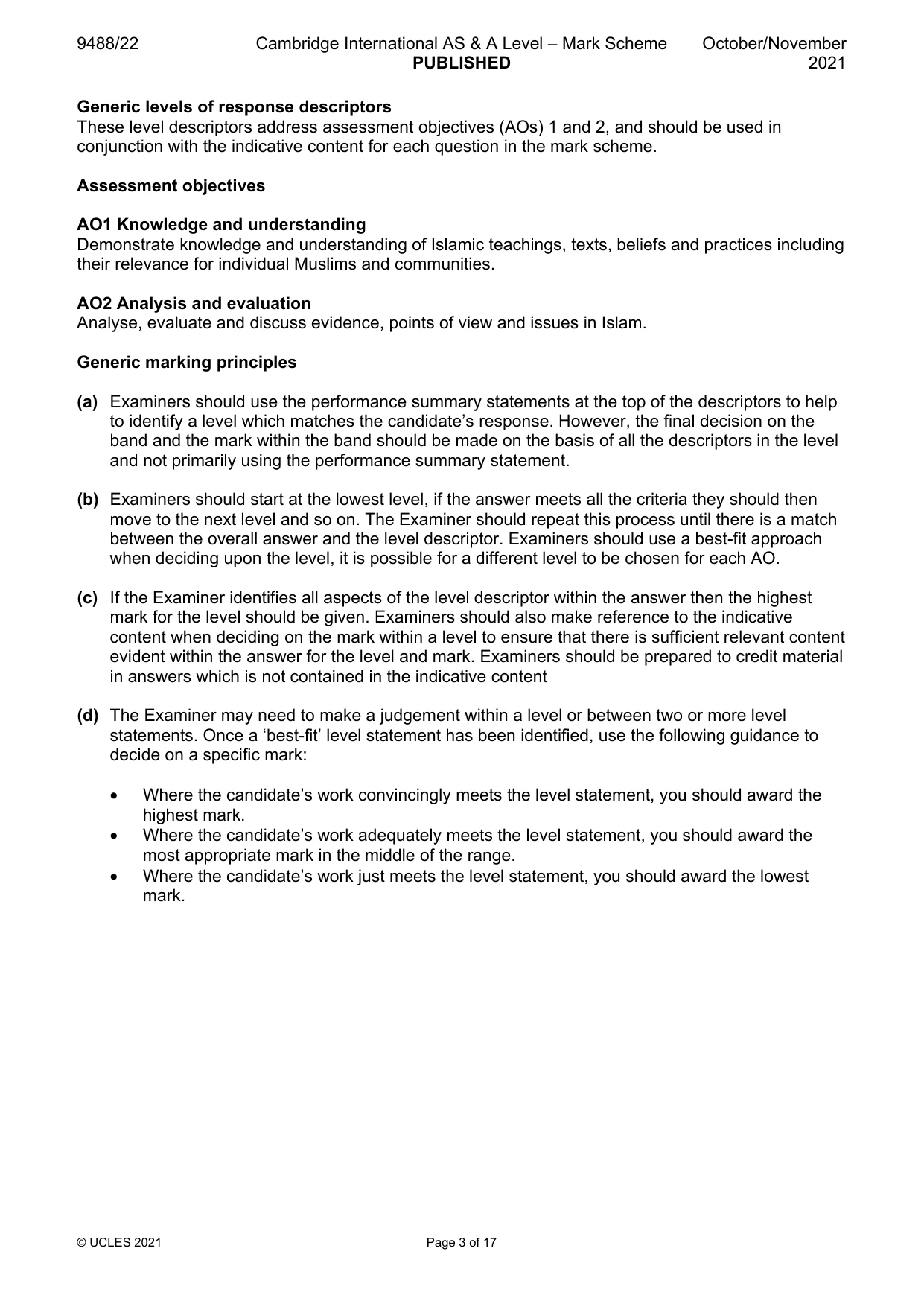
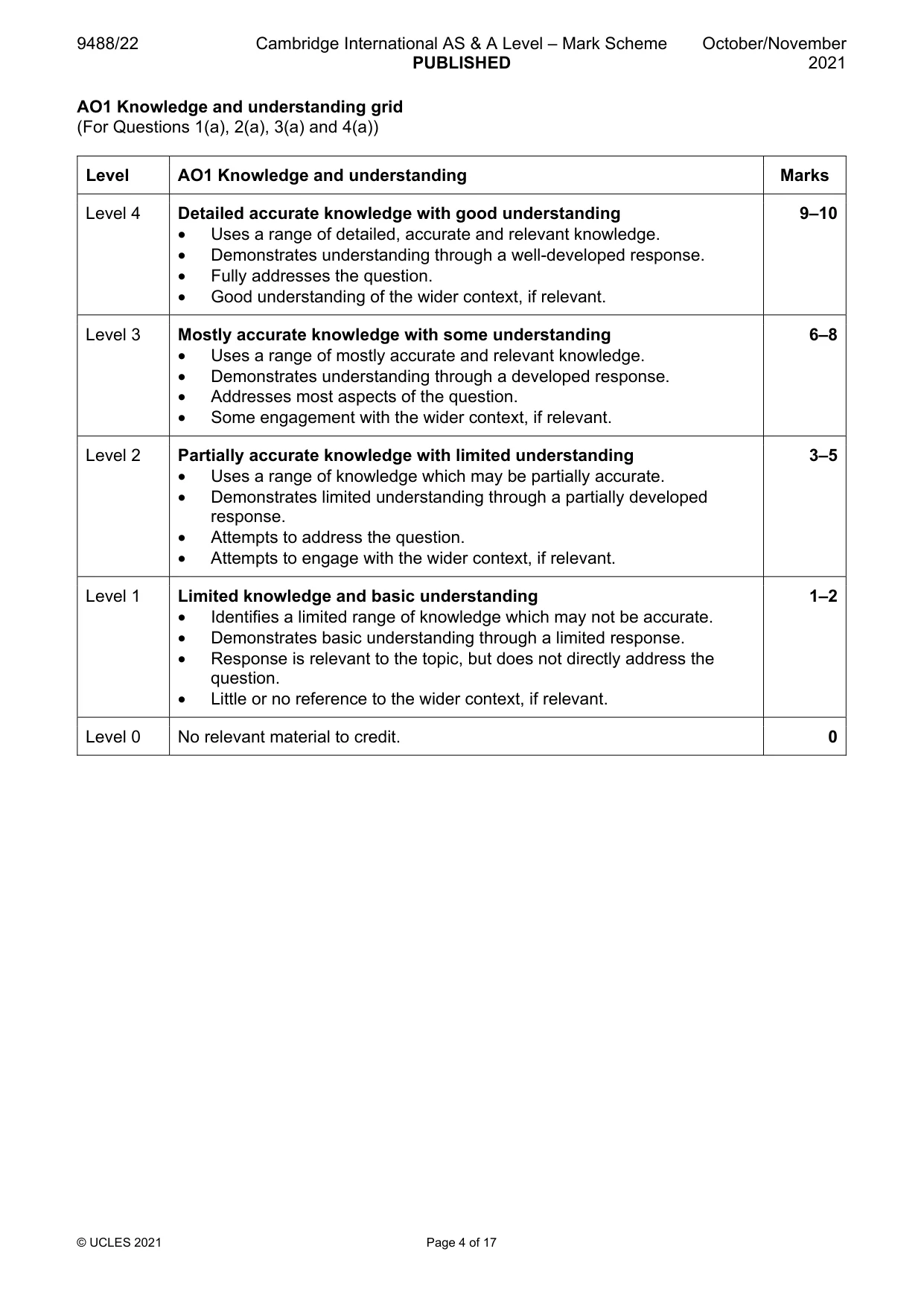
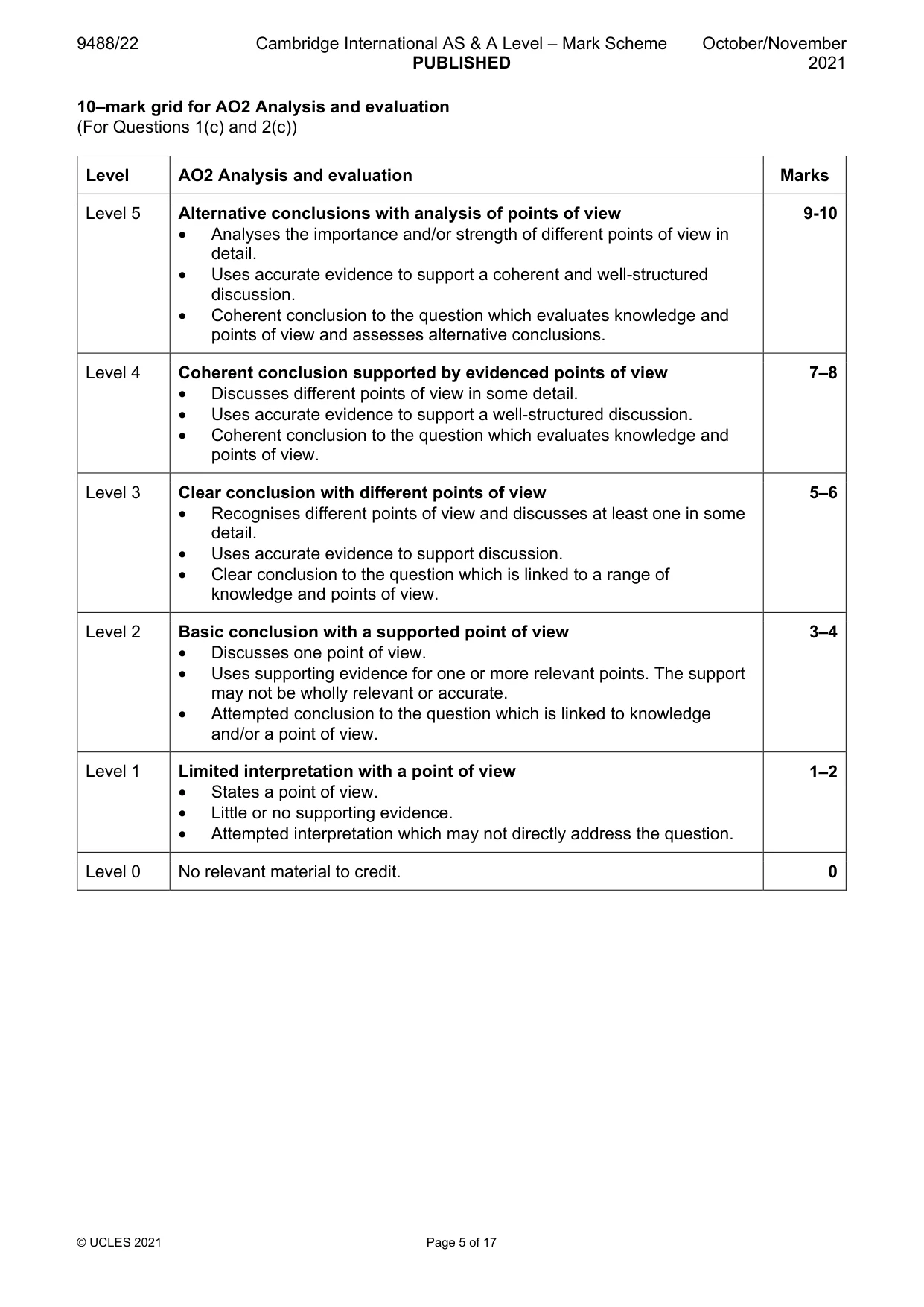
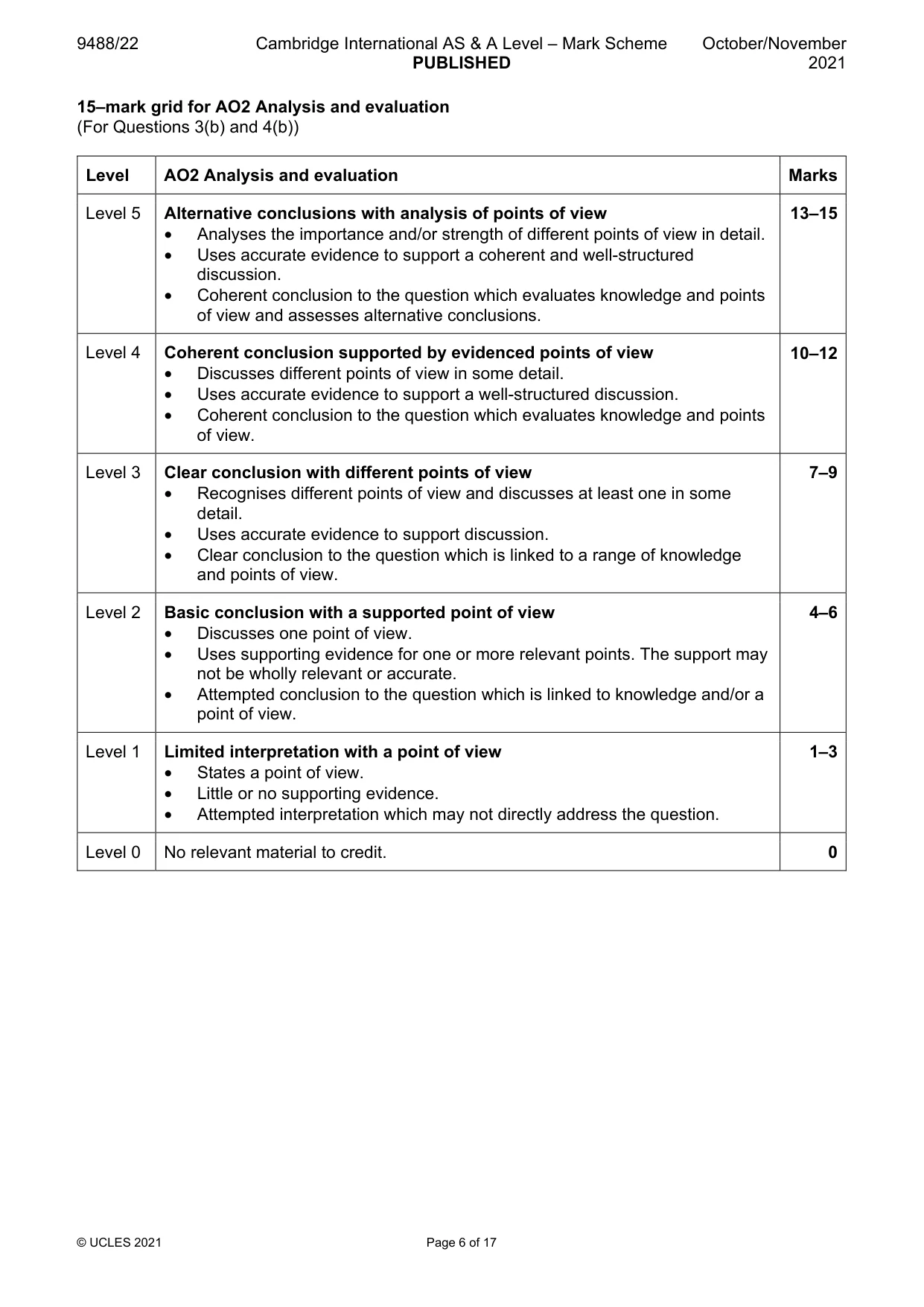
Mark scheme17 pages
Answers below. Sit the paper first if you are practising.
Questions as text
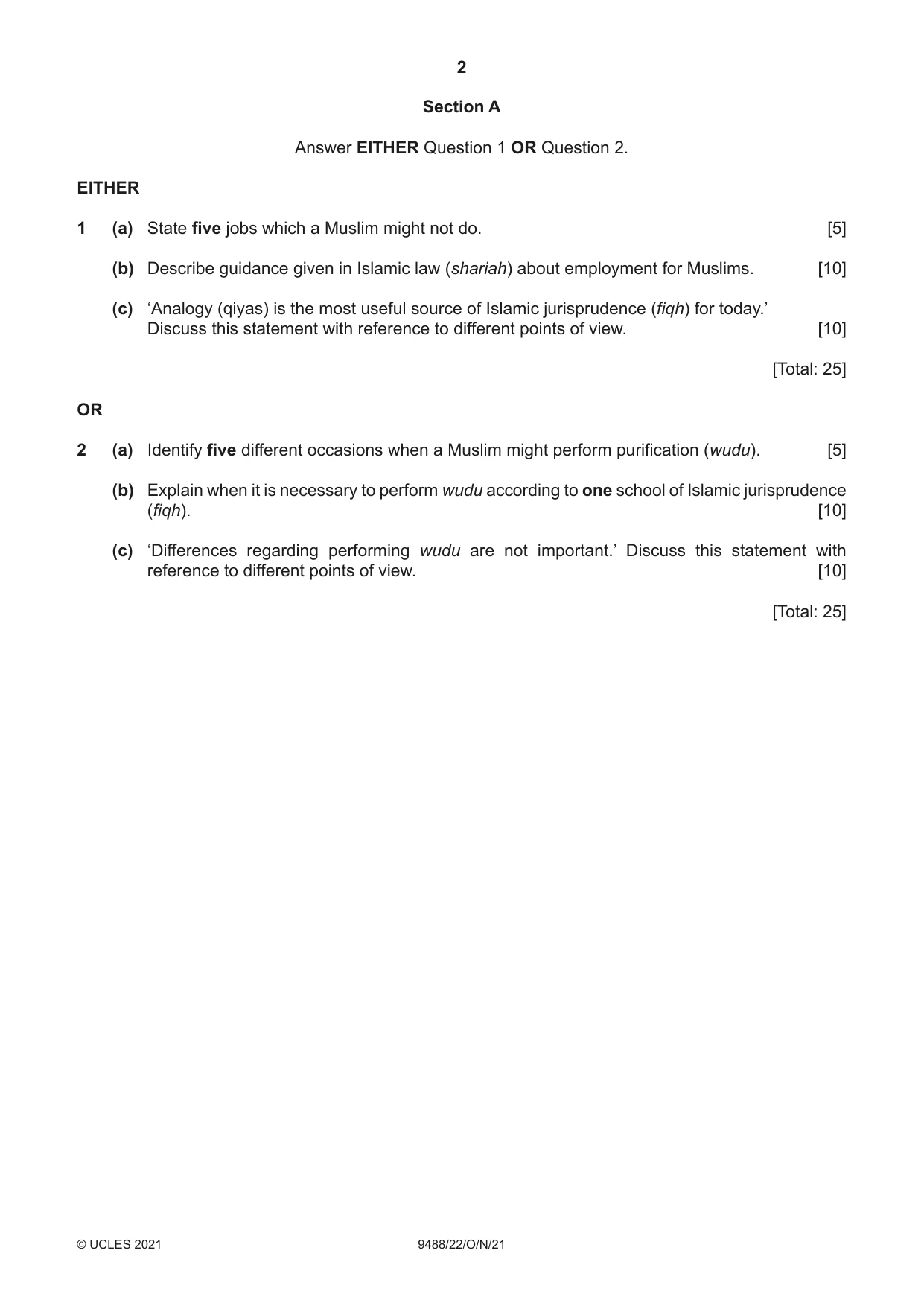
Q1 · State five jobs which a Muslim might not do
1 (a) State five jobs which a Muslim might not do. [5] (b) Describe guidance given in Islamic law (shariah) about employment for Muslims. [10] (c) ‘Analogy (qiyas) is the most useful source of Islamic jurisprudence (fiqh) for today.’ Discuss this statement with reference to different points of view. [10] [Total: 25] OR
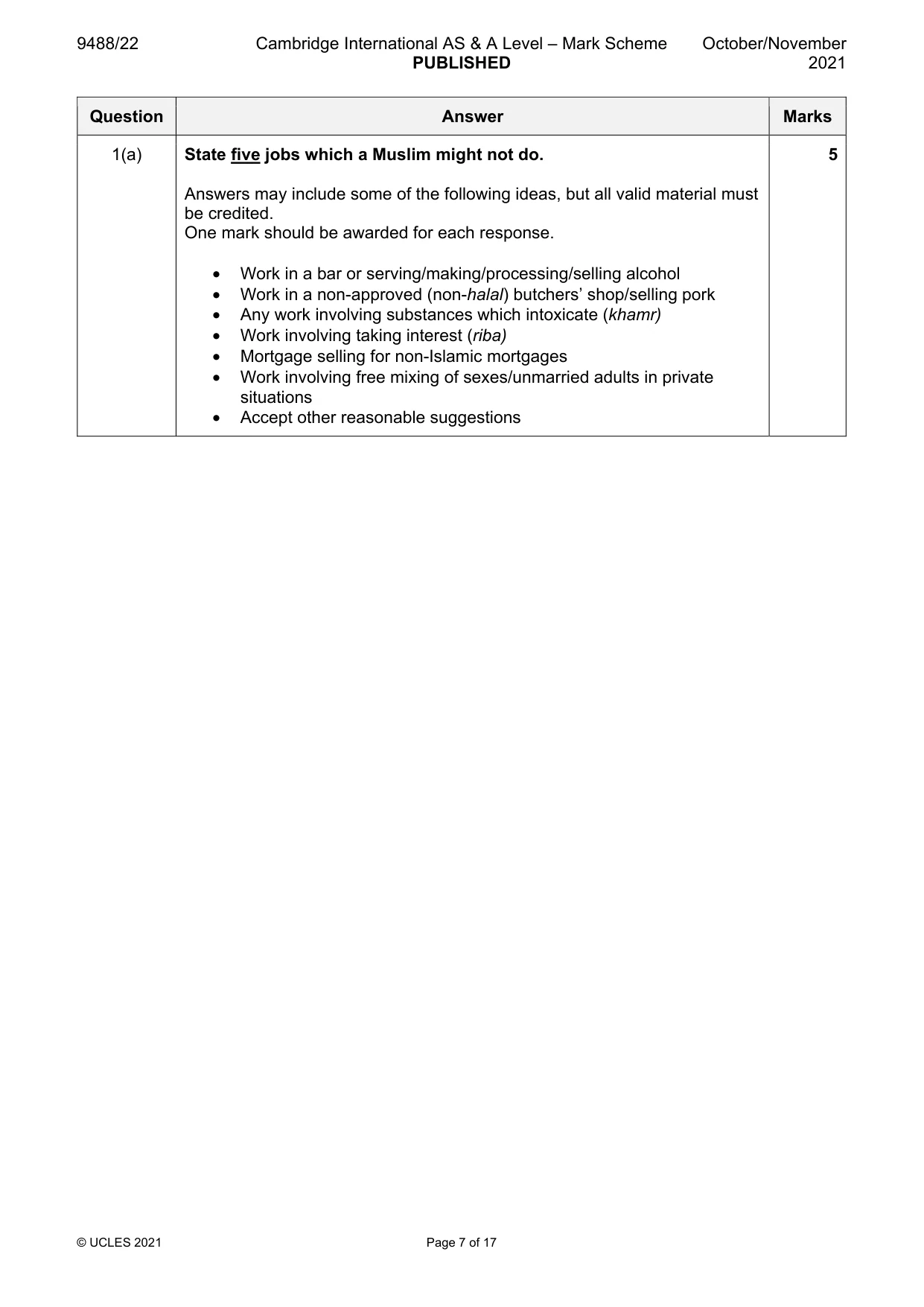
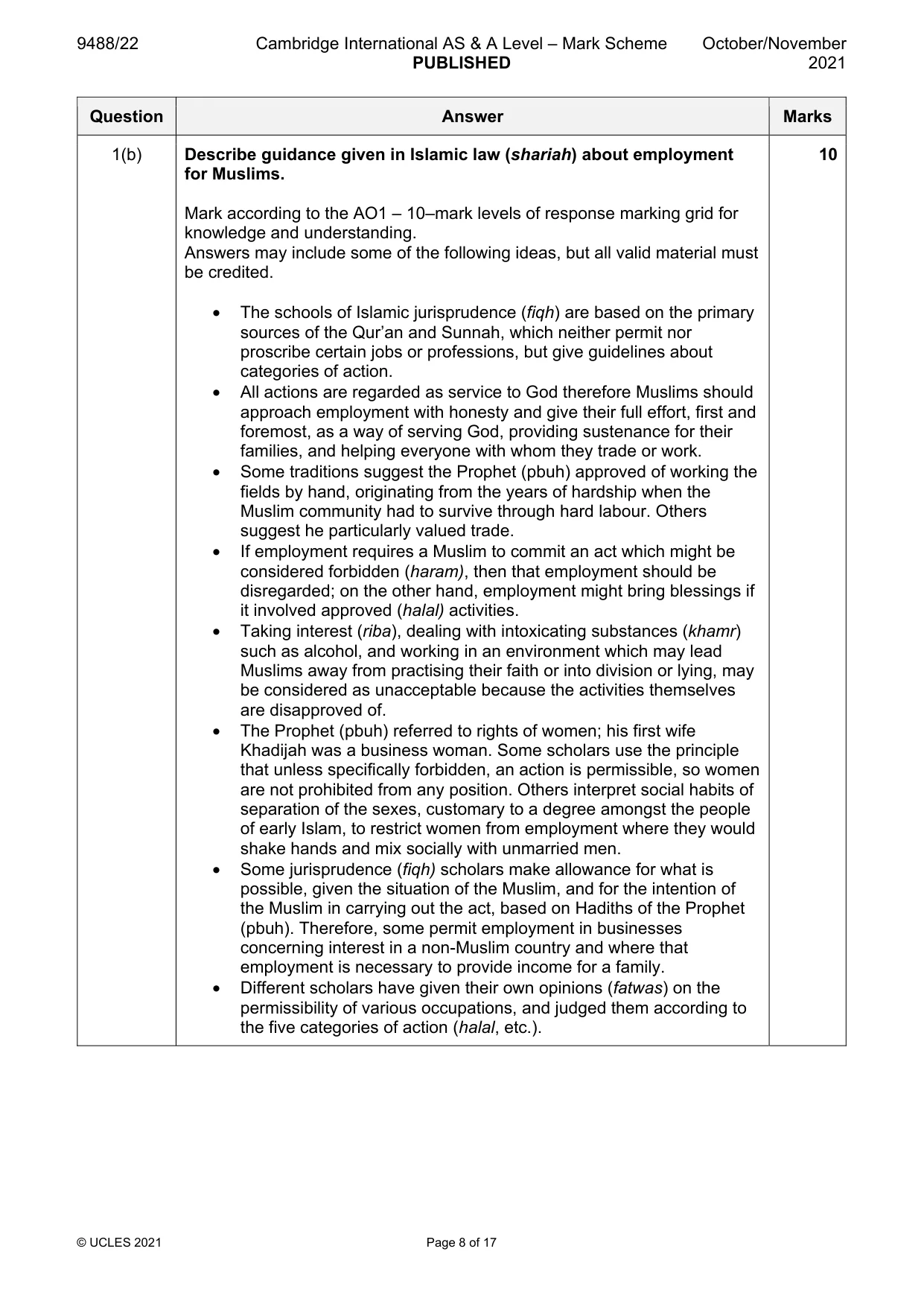
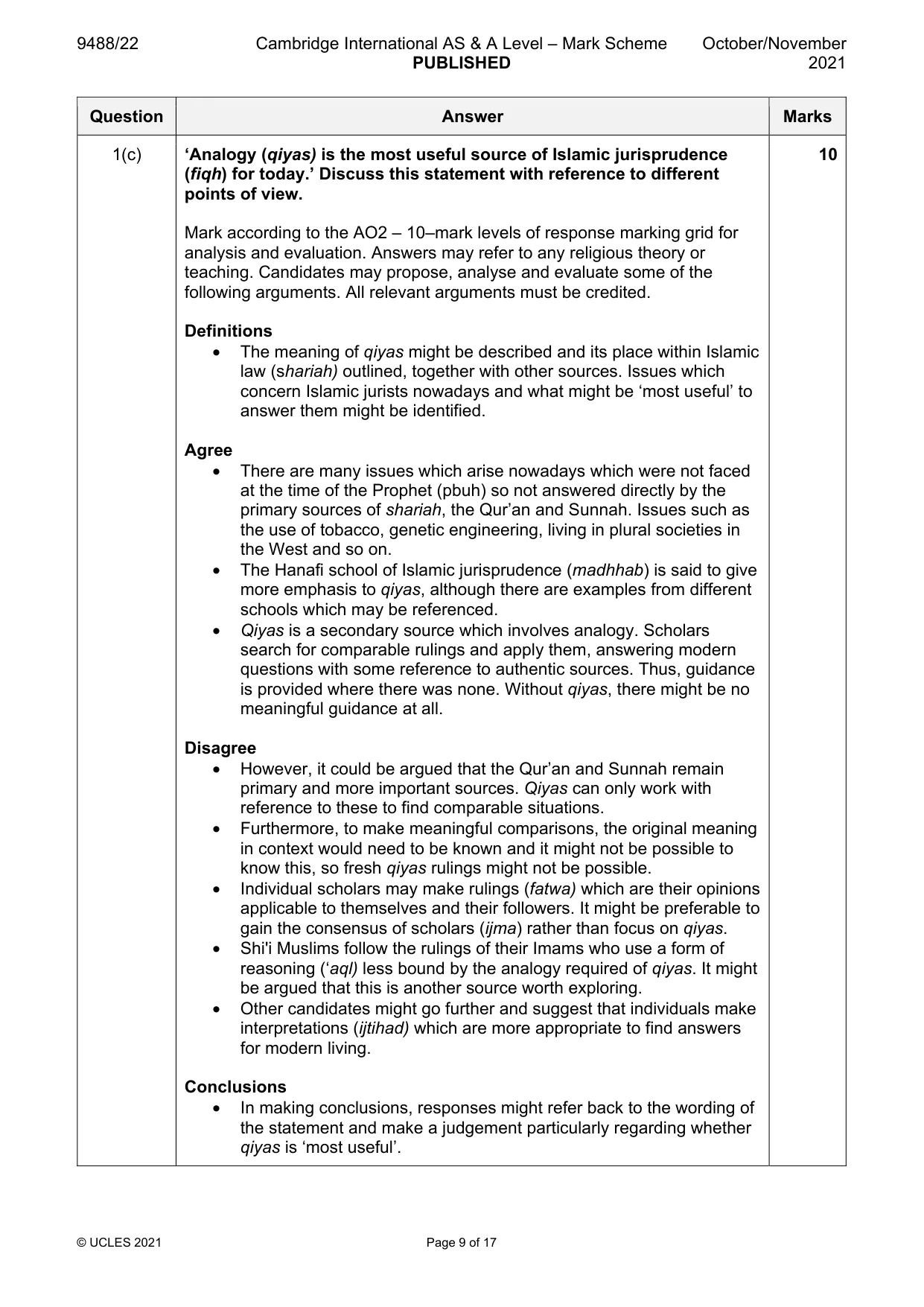
Mark scheme: Question Answer Marks 1(a) State five jobs which a Muslim might not do. 5 Answers may include some of the following ideas, but all valid material must be credited. One mark should be awarded for each response. • Work in a bar or serving/making/processing/selling alcohol • Work in a non-approved (non-halal) butchers’ shop/selling pork • Any work involving substances which intoxicate (khamr) • Work involving taking interest (riba) • Mortgage selling for non-Islamic mortgages • Work involving free mixing of sexes/unmarried adults in private situations • Accept other reasonable suggestions 1(b) Describe guidance given in Islamic law (shariah) about employment 10 for Muslims. Mark according to the AO1 – 10–mark levels of response marking grid for knowledge and understanding. Answers may include some of the following ideas, but all valid material must be credited. • The schools of Islamic jurisprudence (fiqh) are based on the primary sources of the Qur’an and Sunnah, which neither permit nor proscribe certain jobs or professions, but give guidelines about categories of action. • All actions are regarded as service to God therefore Muslims should approach employment with honesty and give their full effort, first and foremost, as a way of serving God, providing sustenance for their families, and helping everyone with whom they trade or work. • Some traditions suggest the Prophet (pbuh) approved of working the fields by hand, originating from the years of hardship when the Muslim community had to survive through hard labour. Others suggest he particularly valued trade. • If employment requires a Muslim to commit an act which might be considered forbidden (haram), then that employment should be disregarded; on the other hand, employment might bring blessings if it involved approved (halal) activities. • Taking interest (riba), dealing with intoxicating substances (khamr) such as alcohol, and working in an environment which may lead Muslims away from practising their faith or into division or lying, may be considered as unacceptable because the activities themselves are disapproved of. • The Prophet (pbuh) referred to rights of women; his first wife Khadijah was a business woman. Some scholars use the principle that unless specifically forbidden, an action is permissible, so women are not prohibited from any position. Others interpret social habits of separation of the sexes, customary to a degree amongst the people of early Islam, to restrict women from employment where they would shake hands and mix socially with unmarried men. • Some jurisprudence (fiqh) scholars make allowance for what is possible, given the situation of the Muslim, and for the intention of the Muslim in carrying out the act, based on Hadiths of the Prophet (pbuh). Therefore, some permit employment in businesses concerning interest in a non-Muslim country and where that employment is necessary to provide income for a family. • Different scholars have given their own opinions (fatwas) on the permissibility of various occupations, and judged them according to the five categories of action (halal, etc.). 1(c) ‘Analogy (qiyas) is the most useful source of Islamic jurisprudence 10 (fiqh) for today.’ Discuss this statement with reference to different points of view. Mark according to the AO2 – 10–mark levels of response marking grid for analysis and evaluation. Answers may refer to any religious theory or teaching. Candidates may propose, analyse and evaluate some of the following arguments. All relevant arguments must be credited. Definitions • The meaning of qiyas might be described and its place within Islamic law (shariah) outlined, together with other sources. Issues which concern Islamic jurists nowadays and what might be ‘most useful’ to answer them might be identified. Agree • There are many issues which arise nowadays which were not faced at the time of the Prophet (pbuh) so not answered directly by the primary sources of shariah, the Qur’an and Sunnah. Issues such as the use of tobacco, genetic engineering, living in plural societies in the West and so on. • The Hanafi school of Islamic jurisprudence (madhhab) is said to give more emphasis to qiyas, although there are examples from different schools which may be referenced. • Qiyas is a secondary source which involves analogy. Scholars search for comparable rulings and apply them, answering modern questions with some reference to authentic sources. Thus, guidance is provided where there was none. Without qiyas, there might be no meaningful guidance at all. Disagree • However, it could be argued that the Qur’an and Sunnah remain primary and more important sources. Qiyas can only work with reference to these to find comparable situations. • Furthermore, to make meaningful comparisons, the original meaning in context would need to be known and it might not be possible to know this, so fresh qiyas rulings might not be possible. • Individual scholars may make rulings (fatwa) which are their opinions applicable to themselves and their followers. It might be preferable to gain the consensus of scholars (ijma) rather than focus on qiyas. • Shi'i Muslims follow the rulings of their Imams who use a form of reasoning (‘aql) less bound by the analogy required of qiyas. It might be argued that this is another source worth exploring. • Other candidates might go further and suggest that individuals make interpretations (ijtihad) which are more appropriate to find answers for modern living. Conclusions • In making conclusions, responses might refer back to the wording of the statement and make a judgement particularly regarding whether qiyas is ‘most useful’.
Q2 · Identify five different occasions when a Muslim might perform purification (wudu)
2 (a) Identify five different occasions when a Muslim might perform purification (wudu). [5] (b) Explain when it is necessary to perform wudu according to one school of Islamic jurisprudence (fiqh). [10] (c) ‘Differences regarding performing wudu are not important.’ Discuss this statement with reference to different points of view. [10] [Total: 25]
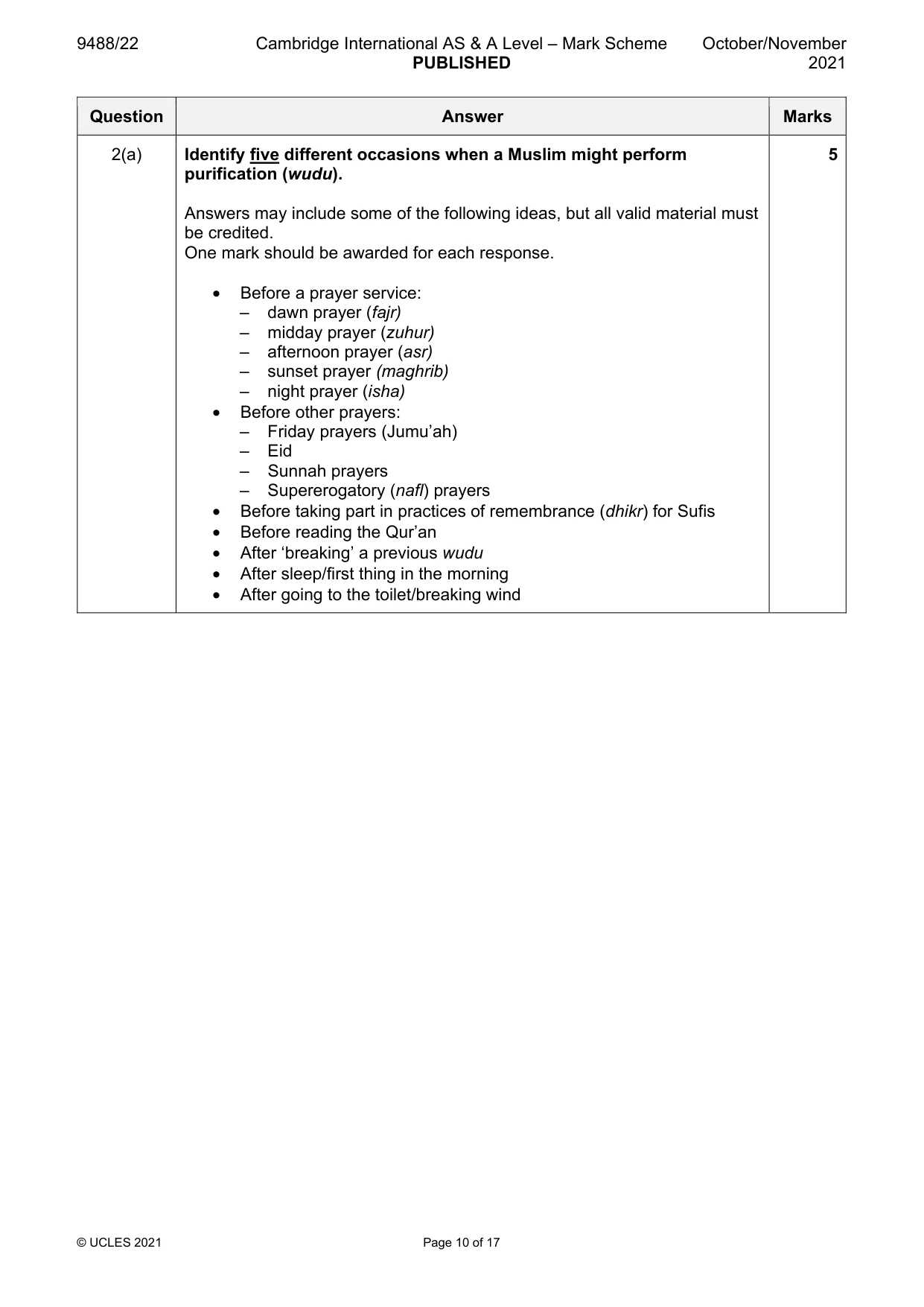
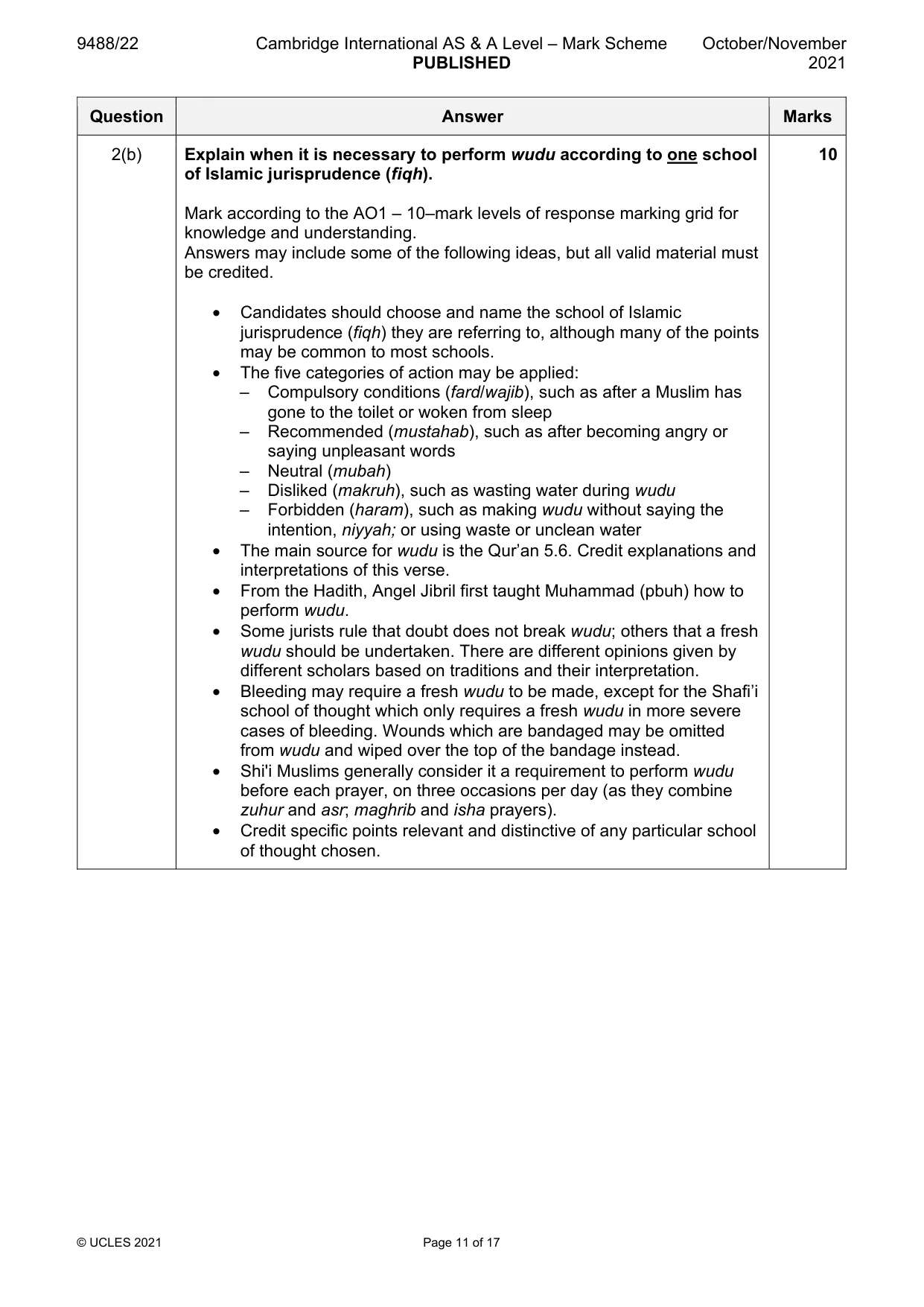
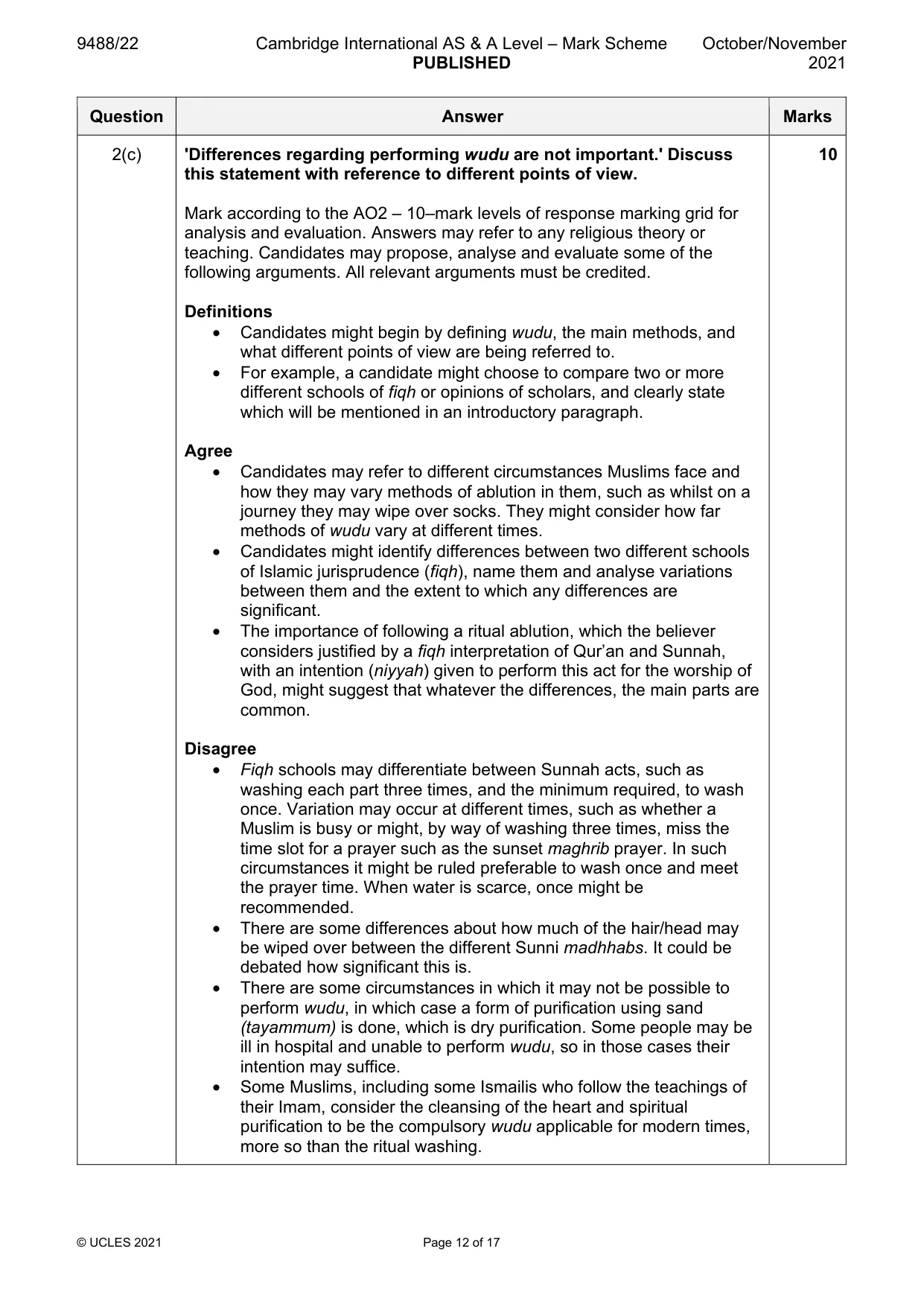
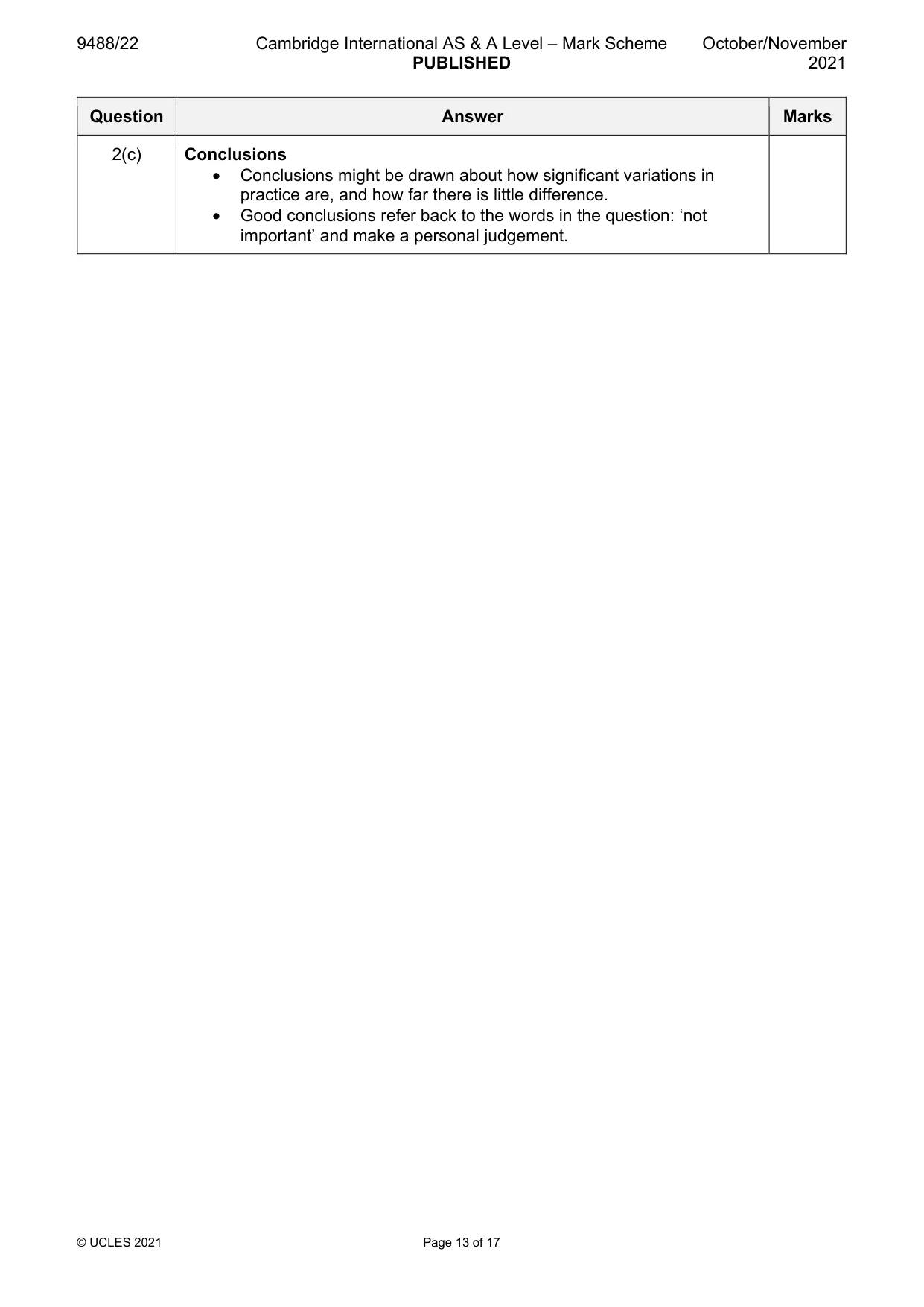
Mark scheme: 2(a) Identify five different occasions when a Muslim might perform 5 purification (wudu). Answers may include some of the following ideas, but all valid material must be credited. One mark should be awarded for each response. • Before a prayer service: – dawn prayer (fajr) – midday prayer (zuhur) – afternoon prayer (asr) – sunset prayer (maghrib) – night prayer (isha) • Before other prayers: – Friday prayers (Jumu’ah) – Eid – Sunnah prayers – Supererogatory (nafl) prayers • Before taking part in practices of remembrance (dhikr) for Sufis • Before reading the Qur’an • After ‘breaking’ a previous wudu • After sleep/first thing in the morning • After going to the toilet/breaking wind 2(b) Explain when it is necessary to perform wudu according to one school 10 of Islamic jurisprudence (fiqh). Mark according to the AO1 – 10–mark levels of response marking grid for knowledge and understanding. Answers may include some of the following ideas, but all valid material must be credited. • Candidates should choose and name the school of Islamic jurisprudence (fiqh) they are referring to, although many of the points may be common to most schools. • The five categories of action may be applied: – Compulsory conditions (fard/wajib), such as after a Muslim has gone to the toilet or woken from sleep – Recommended (mustahab), such as after becoming angry or saying unpleasant words – Neutral (mubah) – Disliked (makruh), such as wasting water during wudu – Forbidden (haram), such as making wudu without saying the intention, niyyah; or using waste or unclean water • The main source for wudu is the Qur’an 5.6. Credit explanations and interpretations of this verse. • From the Hadith, Angel Jibril first taught Muhammad (pbuh) how to perform wudu. • Some jurists rule that doubt does not break wudu; others that a fresh wudu should be undertaken. There are different opinions given by different scholars based on traditions and their interpretation. • Bleeding may require a fresh wudu to be made, except for the Shafi’i school of thought which only requires a fresh wudu in more severe cases of bleeding. Wounds which are bandaged may be omitted from wudu and wiped over the top of the bandage instead. • Shi'i Muslims generally consider it a requirement to perform wudu before each prayer, on three occasions per day (as they combine zuhur and asr; maghrib and isha prayers). • Credit specific points relevant and distinctive of any particular school of thought chosen. 2(c) 'Differences regarding performing wudu are not important.' Discuss 10 this statement with reference to different points of view. Mark according to the AO2 – 10–mark levels of response marking grid for analysis and evaluation. Answers may refer to any religious theory or teaching. Candidates may propose, analyse and evaluate some of the following arguments. All relevant arguments must be credited. Definitions • Candidates might begin by defining wudu, the main methods, and what different points of view are being referred to. • For example, a candidate might choose to compare two or more different schools of fiqh or opinions of scholars, and clearly state which will be mentioned in an introductory paragraph. Agree • Candidates may refer to different circumstances Muslims face and how they may vary methods of ablution in them, such as whilst on a journey they may wipe over socks. They might consider how far methods of wudu vary at different times. • Candidates might identify differences between two different schools of Islamic jurisprudence (fiqh), name them and analyse variations between them and the extent to which any differences are significant. • The importance of following a ritual ablution, which the believer considers justified by a fiqh interpretation of Qur’an and Sunnah, with an intention (niyyah) given to perform this act for the worship of God, might suggest that whatever the differences, the main parts are common. Disagree • Fiqh schools may differentiate between Sunnah acts, such as washing each part three times, and the minimum required, to wash once. Variation may occur at different times, such as whether a Muslim is busy or might, by way of washing three times, miss the time slot for a prayer such as the sunset maghrib prayer. In such circumstances it might be ruled preferable to wash once and meet the prayer time. When water is scarce, once might be recommended. • There are some differences about how much of the hair/head may be wiped over between the different Sunni madhhabs. It could be debated how significant this is. • There are some circumstances in which it may not be possible to perform wudu, in which case a form of purification using sand (tayammum) is done, which is dry purification. Some people may be ill in hospital and unable to perform wudu, so in those cases their intention may suffice. • Some Muslims, including some Ismailis who follow the teachings of their Imam, consider the cleansing of the heart and spiritual purification to be the compulsory wudu applicable for modern times, more so than the ritual washing. 2(c) Conclusions • Conclusions might be drawn about how significant variations in practice are, and how far there is little difference. • Good conclusions refer back to the words in the question: ‘not important’ and make a personal judgement.
Q3 · Explain the anthropomorphic references to God in the Qur’an
3 (a) Explain the anthropomorphic references to God in the Qur’an. [10] (b) Discuss how Muslims might interpret the anthropomorphic verses of the Qur’an. [15] [Total: 25] OR
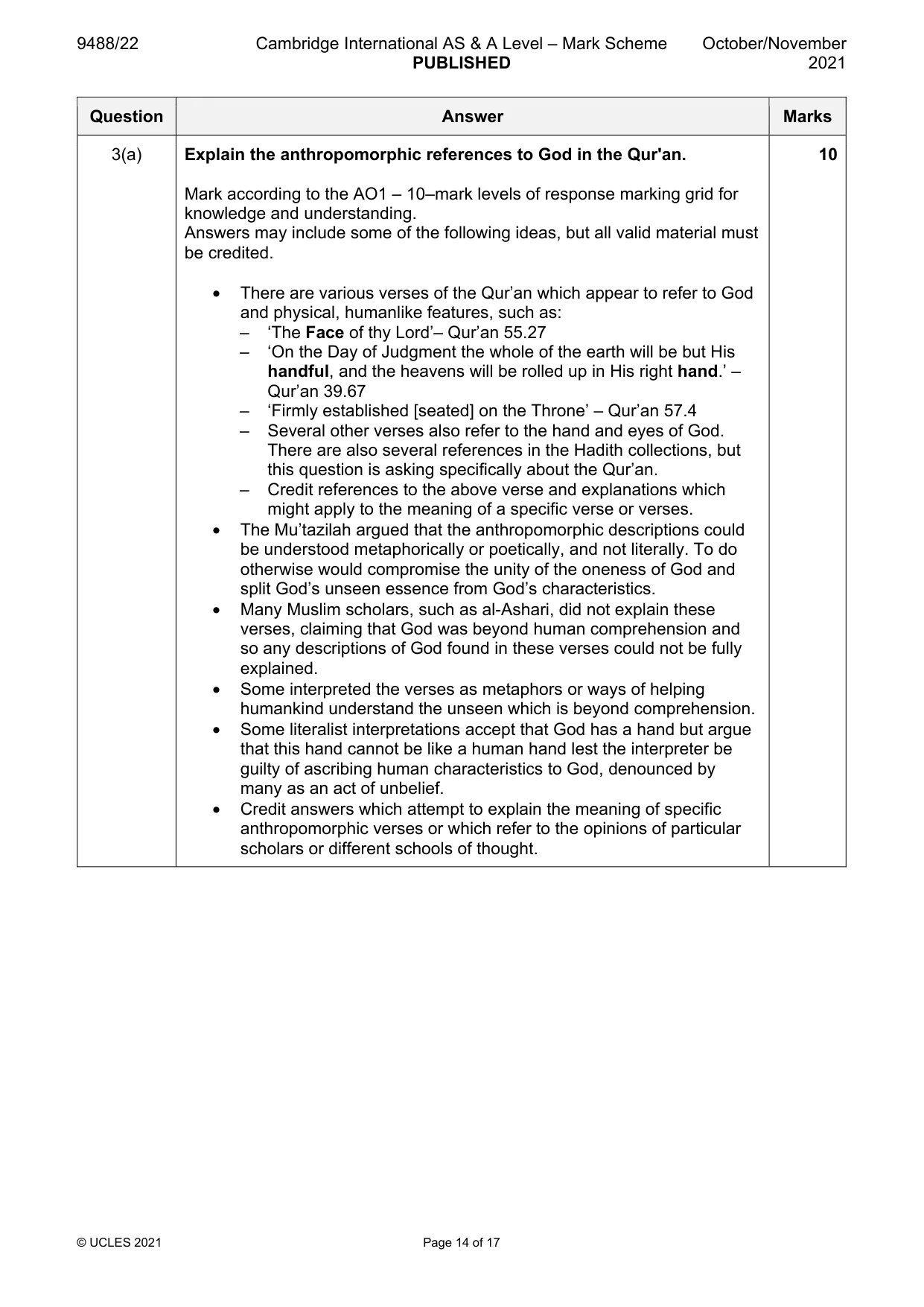
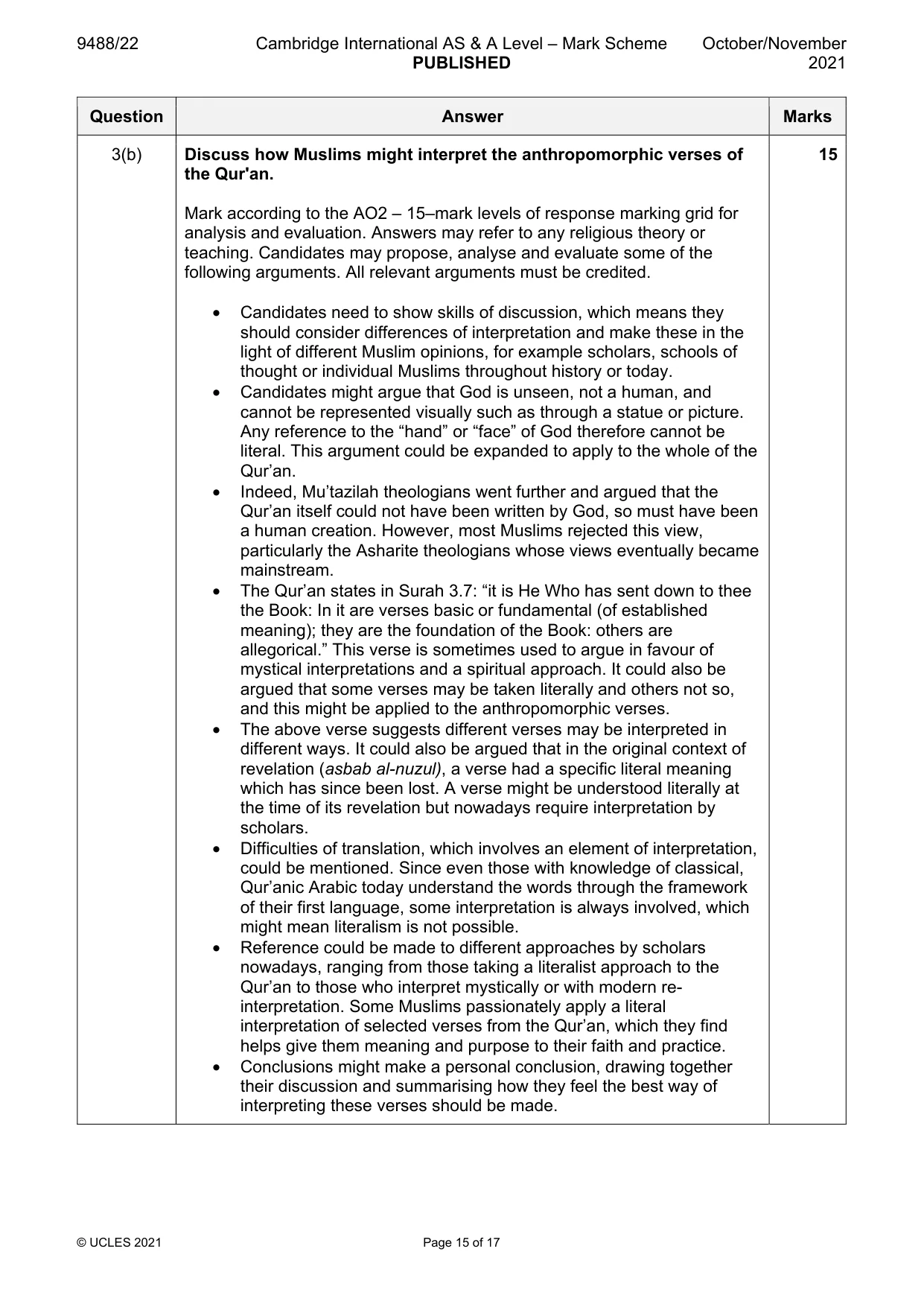
Mark scheme: 3(a) Explain the anthropomorphic references to God in the Qur'an. 10 Mark according to the AO1 – 10–mark levels of response marking grid for knowledge and understanding. Answers may include some of the following ideas, but all valid material must be credited. • There are various verses of the Qur’an which appear to refer to God and physical, humanlike features, such as: – ‘The Face of thy Lord’– Qur’an 55.27 – ‘On the Day of Judgment the whole of the earth will be but His handful, and the heavens will be rolled up in His right hand.’ – Qur’an 39.67 – ‘Firmly established [seated] on the Throne’ – Qur’an 57.4 – Several other verses also refer to the hand and eyes of God. There are also several references in the Hadith collections, but this question is asking specifically about the Qur’an. – Credit references to the above verse and explanations which might apply to the meaning of a specific verse or verses. • The Mu’tazilah argued that the anthropomorphic descriptions could be understood metaphorically or poetically, and not literally. To do otherwise would compromise the unity of the oneness of God and split God’s unseen essence from God’s characteristics. • Many Muslim scholars, such as al-Ashari, did not explain these verses, claiming that God was beyond human comprehension and so any descriptions of God found in these verses could not be fully explained. • Some interpreted the verses as metaphors or ways of helping humankind understand the unseen which is beyond comprehension. • Some literalist interpretations accept that God has a hand but argue that this hand cannot be like a human hand lest the interpreter be guilty of ascribing human characteristics to God, denounced by many as an act of unbelief. • Credit answers which attempt to explain the meaning of specific anthropomorphic verses or which refer to the opinions of particular scholars or different schools of thought. 3(b) Discuss how Muslims might interpret the anthropomorphic verses of 15 the Qur'an. Mark according to the AO2 – 15–mark levels of response marking grid for analysis and evaluation. Answers may refer to any religious theory or teaching. Candidates may propose, analyse and evaluate some of the following arguments. All relevant arguments must be credited. • Candidates need to show skills of discussion, which means they should consider differences of interpretation and make these in the light of different Muslim opinions, for example scholars, schools of thought or individual Muslims throughout history or today. • Candidates might argue that God is unseen, not a human, and cannot be represented visually such as through a statue or picture. Any reference to the “hand” or “face” of God therefore cannot be literal. This argument could be expanded to apply to the whole of the Qur’an. • Indeed, Mu’tazilah theologians went further and argued that the Qur’an itself could not have been written by God, so must have been a human creation. However, most Muslims rejected this view, particularly the Asharite theologians whose views eventually became mainstream. • The Qur’an states in Surah 3.7: “it is He Who has sent down to thee the Book: In it are verses basic or fundamental (of established meaning); they are the foundation of the Book: others are allegorical.” This verse is sometimes used to argue in favour of mystical interpretations and a spiritual approach. It could also be argued that some verses may be taken literally and others not so, and this might be applied to the anthropomorphic verses. • The above verse suggests different verses may be interpreted in different ways. It could also be argued that in the original context of revelation (asbab al-nuzul), a verse had a specific literal meaning which has since been lost. A verse might be understood literally at the time of its revelation but nowadays require interpretation by scholars. • Difficulties of translation, which involves an element of interpretation, could be mentioned. Since even those with knowledge of classical, Qur’anic Arabic today understand the words through the framework of their first language, some interpretation is always involved, which might mean literalism is not possible. • Reference could be made to different approaches by scholars nowadays, ranging from those taking a literalist approach to the Qur’an to those who interpret mystically or with modern re- interpretation. Some Muslims passionately apply a literal interpretation of selected verses from the Qur’an, which they find helps give them meaning and purpose to their faith and practice. • Conclusions might make a personal conclusion, drawing together their discussion and summarising how they feel the best way of interpreting these verses should be made.
Q4 · Explain the importance of belief in the Mahdi for Shi’i Muslims
4 (a) Explain the importance of belief in the Mahdi for Shi’i Muslims. [10] (b) To what extent are there significant differences between Shi’i and Sunni beliefs? Give reasons to support your answer. [15] [Total: 25]
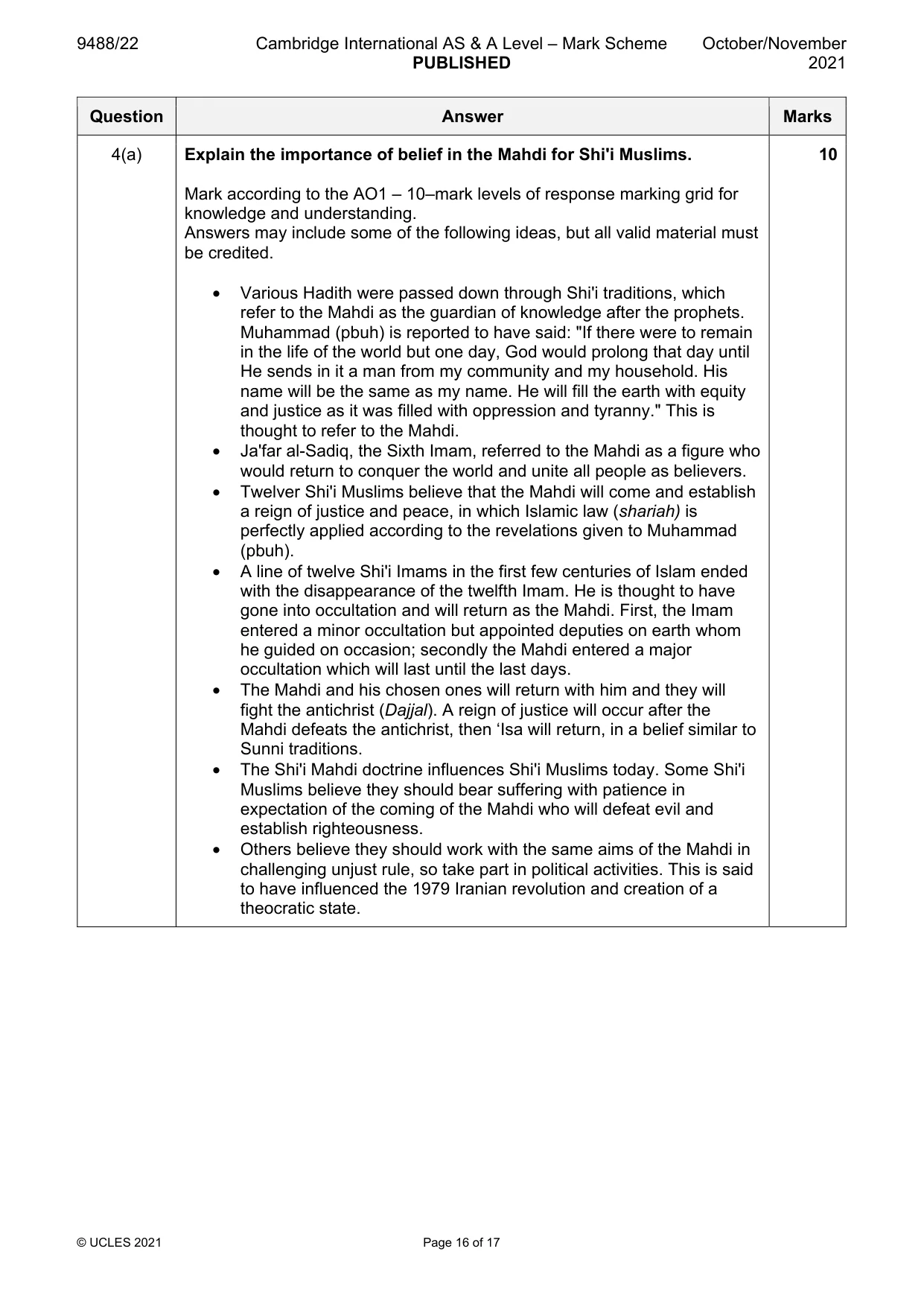
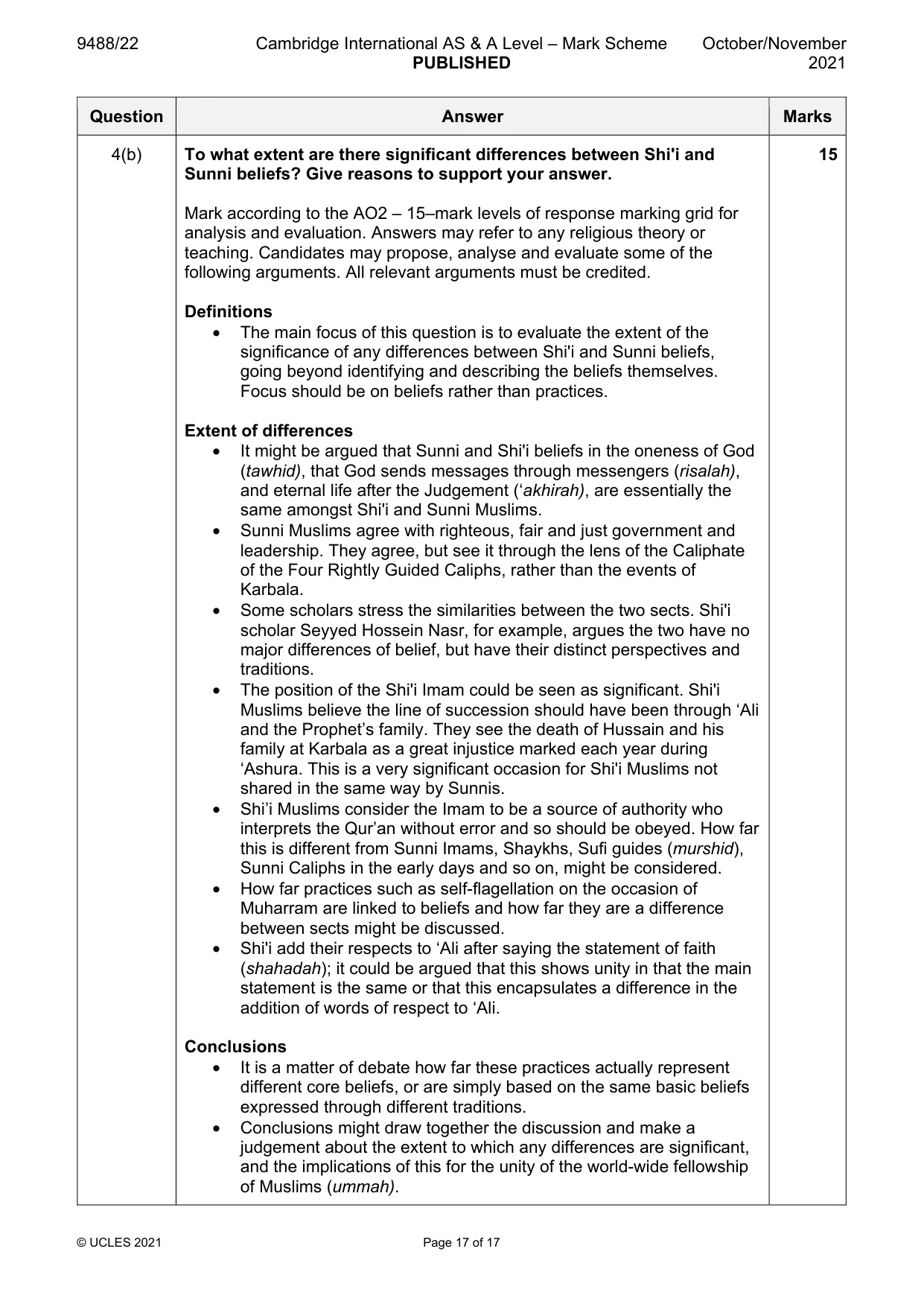
Mark scheme: 4(a) Explain the importance of belief in the Mahdi for Shi'i Muslims. 10 Mark according to the AO1 – 10–mark levels of response marking grid for knowledge and understanding. Answers may include some of the following ideas, but all valid material must be credited. • Various Hadith were passed down through Shi'i traditions, which refer to the Mahdi as the guardian of knowledge after the prophets. Muhammad (pbuh) is reported to have said: "If there were to remain in the life of the world but one day, God would prolong that day until He sends in it a man from my community and my household. His name will be the same as my name. He will fill the earth with equity and justice as it was filled with oppression and tyranny." This is thought to refer to the Mahdi. • Ja'far al-Sadiq, the Sixth Imam, referred to the Mahdi as a figure who would return to conquer the world and unite all people as believers. • Twelver Shi'i Muslims believe that the Mahdi will come and establish a reign of justice and peace, in which Islamic law (shariah) is perfectly applied according to the revelations given to Muhammad (pbuh). • A line of twelve Shi'i Imams in the first few centuries of Islam ended with the disappearance of the twelfth Imam. He is thought to have gone into occultation and will return as the Mahdi. First, the Imam entered a minor occultation but appointed deputies on earth whom he guided on occasion; secondly the Mahdi entered a major occultation which will last until the last days. • The Mahdi and his chosen ones will return with him and they will fight the antichrist (Dajjal). A reign of justice will occur after the Mahdi defeats the antichrist, then ‘Isa will return, in a belief similar to Sunni traditions. • The Shi'i Mahdi doctrine influences Shi'i Muslims today. Some Shi'i Muslims believe they should bear suffering with patience in expectation of the coming of the Mahdi who will defeat evil and establish righteousness. • Others believe they should work with the same aims of the Mahdi in challenging unjust rule, so take part in political activities. This is said to have influenced the 1979 Iranian revolution and creation of a theocratic state. 4(b) To what extent are there significant differences between Shi'i and 15 Sunni beliefs? Give reasons to support your answer. Mark according to the AO2 – 15–mark levels of response marking grid for analysis and evaluation. Answers may refer to any religious theory or teaching. Candidates may propose, analyse and evaluate some of the following arguments. All relevant arguments must be credited. Definitions • The main focus of this question is to evaluate the extent of the significance of any differences between Shi'i and Sunni beliefs, going beyond identifying and describing the beliefs themselves. Focus should be on beliefs rather than practices. Extent of differences • It might be argued that Sunni and Shi'i beliefs in the oneness of God (tawhid), that God sends messages through messengers (risalah), and eternal life after the Judgement (‘akhirah), are essentially the same amongst Shi'i and Sunni Muslims. • Sunni Muslims agree with righteous, fair and just government and leadership. They agree, but see it through the lens of the Caliphate of the Four Rightly Guided Caliphs, rather than the events of Karbala. • Some scholars stress the similarities between the two sects. Shi'i scholar Seyyed Hossein Nasr, for example, argues the two have no major differences of belief, but have their distinct perspectives and traditions. • The position of the Shi'i Imam could be seen as significant. Shi'i Muslims believe the line of succession should have been through ‘Ali and the Prophet’s family. They see the death of Hussain and his family at Karbala as a great injustice marked each year during ‘Ashura. This is a very significant occasion for Shi'i Muslims not shared in the same way by Sunnis. • Shi’i Muslims consider the Imam to be a source of authority who interprets the Qur’an without error and so should be obeyed. How far this is different from Sunni Imams, Shaykhs, Sufi guides (murshid), Sunni Caliphs in the early days and so on, might be considered. • How far practices such as self-flagellation on the occasion of Muharram are linked to beliefs and how far they are a difference between sects might be discussed. • Shi'i add their respects to ‘Ali after saying the statement of faith (shahadah); it could be argued that this shows unity in that the main statement is the same or that this encapsulates a difference in the addition of words of respect to ‘Ali. Conclusions • It is a matter of debate how far these practices actually represent different core beliefs, or are simply based on the same basic beliefs expressed through different traditions. • Conclusions might draw together the discussion and make a judgement about the extent to which any differences are significant, and the implications of this for the unity of the world-wide fellowship of Muslims (ummah).
What was in this paper
The subtopics covered by these 4 questions, and how many questions each got. Open one in a new tab to see every Cambridge question on it.
What you needed in this session
Cambridge’s own grade thresholds for 2021 Oct/Nov, Paper 2 · Variant 2. A higher threshold means an easier paper — the bar moves with how the cohort did.