Cambridge A Level Islamic Studies 9488 — 2021 Oct/Nov Paper 1 · Variant 2
9488/12/O/N/21 · 50 marks · ≈56 min
The question paper and its mark scheme, free to read here and free to download. This is Cambridge’s own paper, exactly as it was sat.
Question paper4 pages

Mark scheme15 pages
Answers below. Sit the paper first if you are practising.
Paper as text
Question paper, page 1
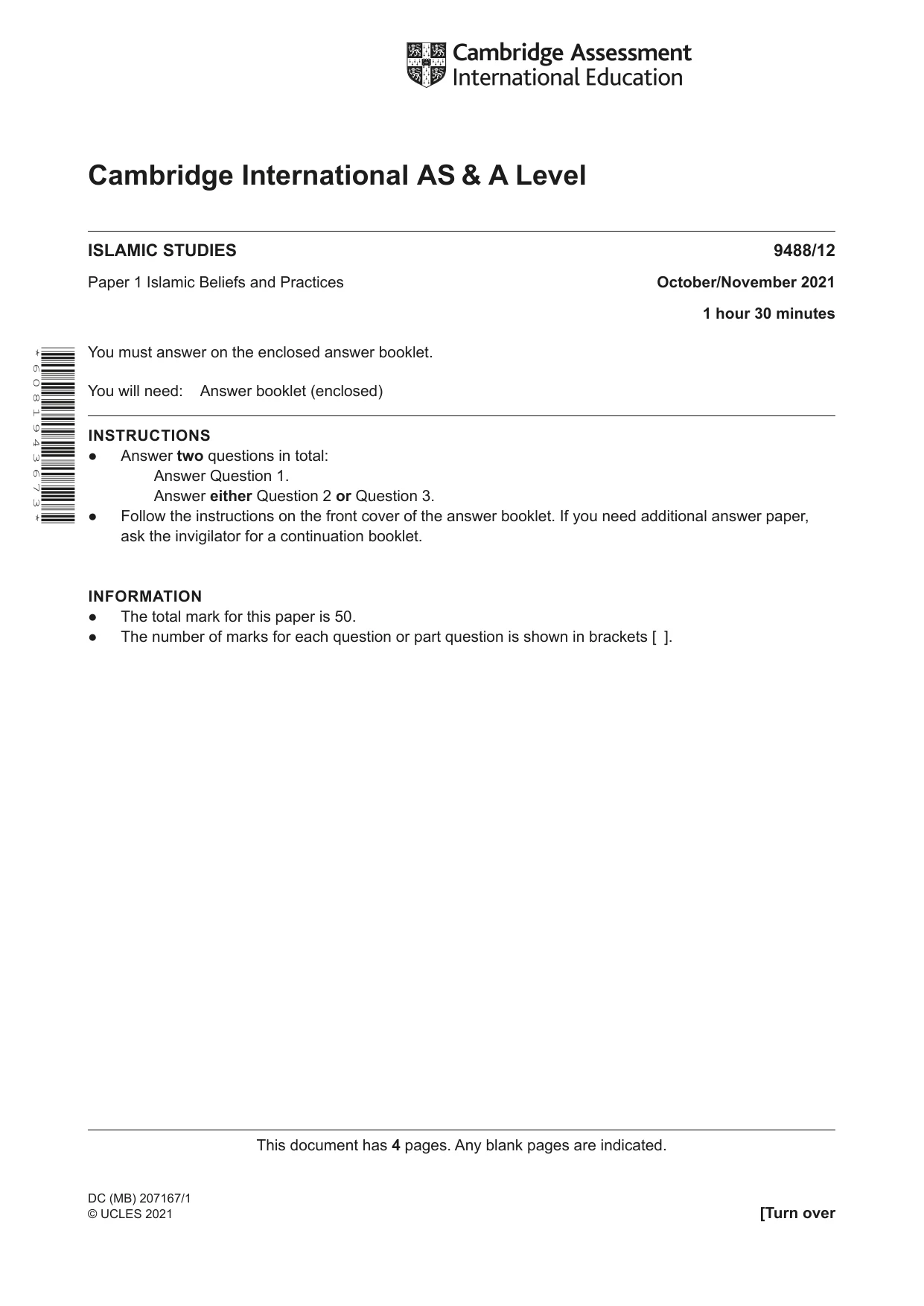
This document has 4 pages. Any blank pages are indicated. Cambridge International AS & A Level ISLAMIC STUDIES 9488/12 Paper 1 Islamic Beliefs and Practices October/November 2021 1 hour 30 minutes You must answer on the enclosed answer booklet. You will need: Answer booklet (enclosed) INSTRUCTIONS ● Answer two questions in total: Answer Question 1. Answer either Question 2 or Question 3. ● Follow the instructions on the front cover of the answer booklet. If you need additional answer paper, ask the invigilator for a continuation booklet. INFORMATION ● The total mark for this paper is 50. ● The number of marks for each question or part question is shown in brackets [ ]. DC (MB) 207167/1 © UCLES 2021 [Turn over * 6 0 8 1 9 4 3 6 7 3 *
Question paper, page 2
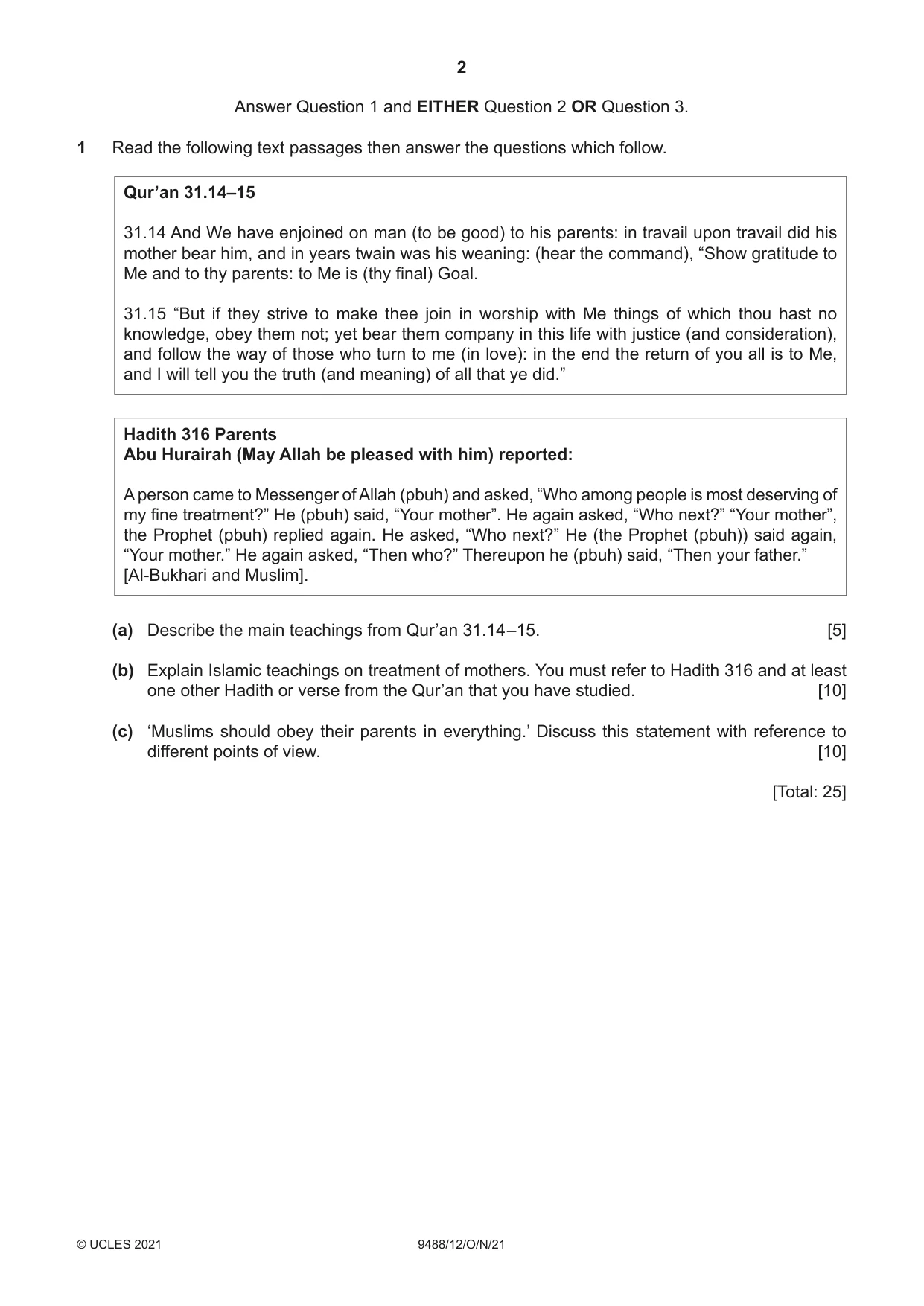
2 9488/12/O/N/21 © UCLES 2021 Answer Question 1 and EITHER Question 2 OR Question 3. 1 Read the following text passages then answer the questions which follow. Qur’an 31.14–15 31.14 And We have enjoined on man (to be good) to his parents: in travail upon travail did his mother bear him, and in years twain was his weaning: (hear the command), “Show gratitude to Me and to thy parents: to Me is (thy final) Goal. 31.15 “But if they strive to make thee join in worship with Me things of which thou hast no knowledge, obey them not; yet bear them company in this life with justice (and consideration), and follow the way of those who turn to me (in love): in the end the return of you all is to Me, and I will tell you the truth (and meaning) of all that ye did.” Hadith 316 Parents Abu Hurairah (May Allah be pleased with him) reported: A person came to Messenger of Allah (pbuh) and asked, “Who among people is most deserving of my fine treatment?” He (pbuh) said, “Your mother”. He again asked, “Who next?” “Your mother”, the Prophet (pbuh) replied again. He asked, “Who next?” He (the Prophet (pbuh)) said again, “Your mother.” He again asked, “Then who?” Thereupon he (pbuh) said, “Then your father.” [Al-Bukhari and Muslim]. (a) Describe the main teachings from Qur’an 31.14 –15. [5] (b) Explain Islamic teachings on treatment of mothers. You must refer to Hadith 316 and at least one other Hadith or verse from the Qur’an that you have studied. [10] (c) ‘Muslims should obey their parents in everything.’ Discuss this statement with reference to different points of view. [10] [Total: 25]
Question paper, page 3
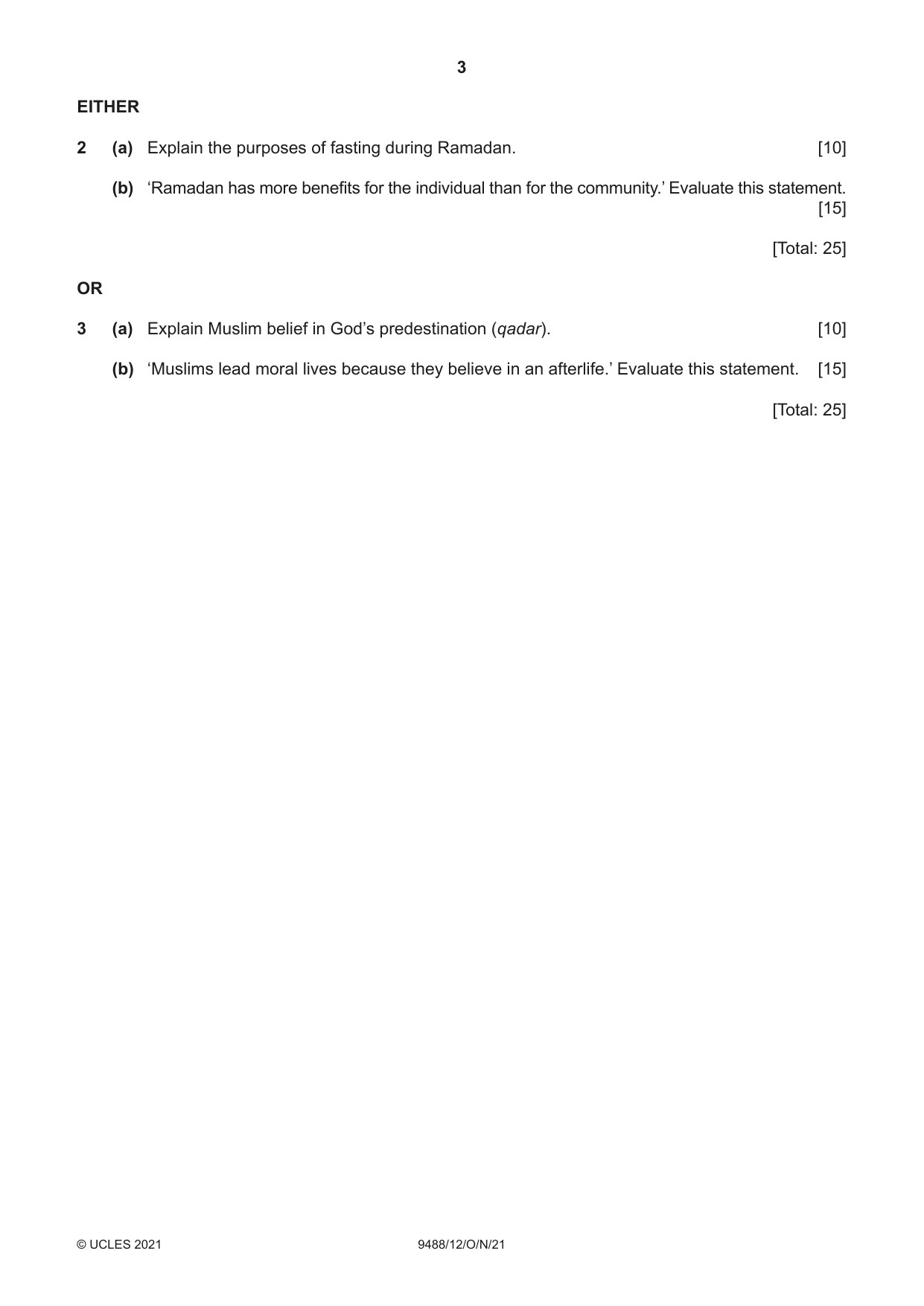
3 9488/12/O/N/21 © UCLES 2021 EITHER 2 (a) Explain the purposes of fasting during Ramadan. [10] (b) ‘Ramadan has more benefits for the individual than for the community.’ Evaluate this statement. [15] [Total: 25] OR 3 (a) Explain Muslim belief in God’s predestination (qadar). [10] (b) ‘Muslims lead moral lives because they believe in an afterlife.’ Evaluate this statement. [15] [Total: 25]
Question paper, page 4
4 9488/12/O/N/21 © UCLES 2021 Permission to reproduce items where third-party owned material protected by copyright is included has been sought and cleared where possible. Every reasonable effort has been made by the publisher (UCLES) to trace copyright holders, but if any items requiring clearance have unwittingly been included, the publisher will be pleased to make amends at the earliest possible opportunity. To avoid the issue of disclosure of answer-related information to candidates, all copyright acknowledgements are reproduced online in the Cambridge Assessment International Education Copyright Acknowledgements Booklet. This is produced for each series of examinations and is freely available to download at www.cambridgeinternational.org after the live examination series. Cambridge Assessment International Education is part of the Cambridge Assessment Group. Cambridge Assessment is the brand name of the University of Cambridge Local Examinations Syndicate (UCLES), which itself is a department of the University of Cambridge. BLANK PAGE
Mark scheme, page 1
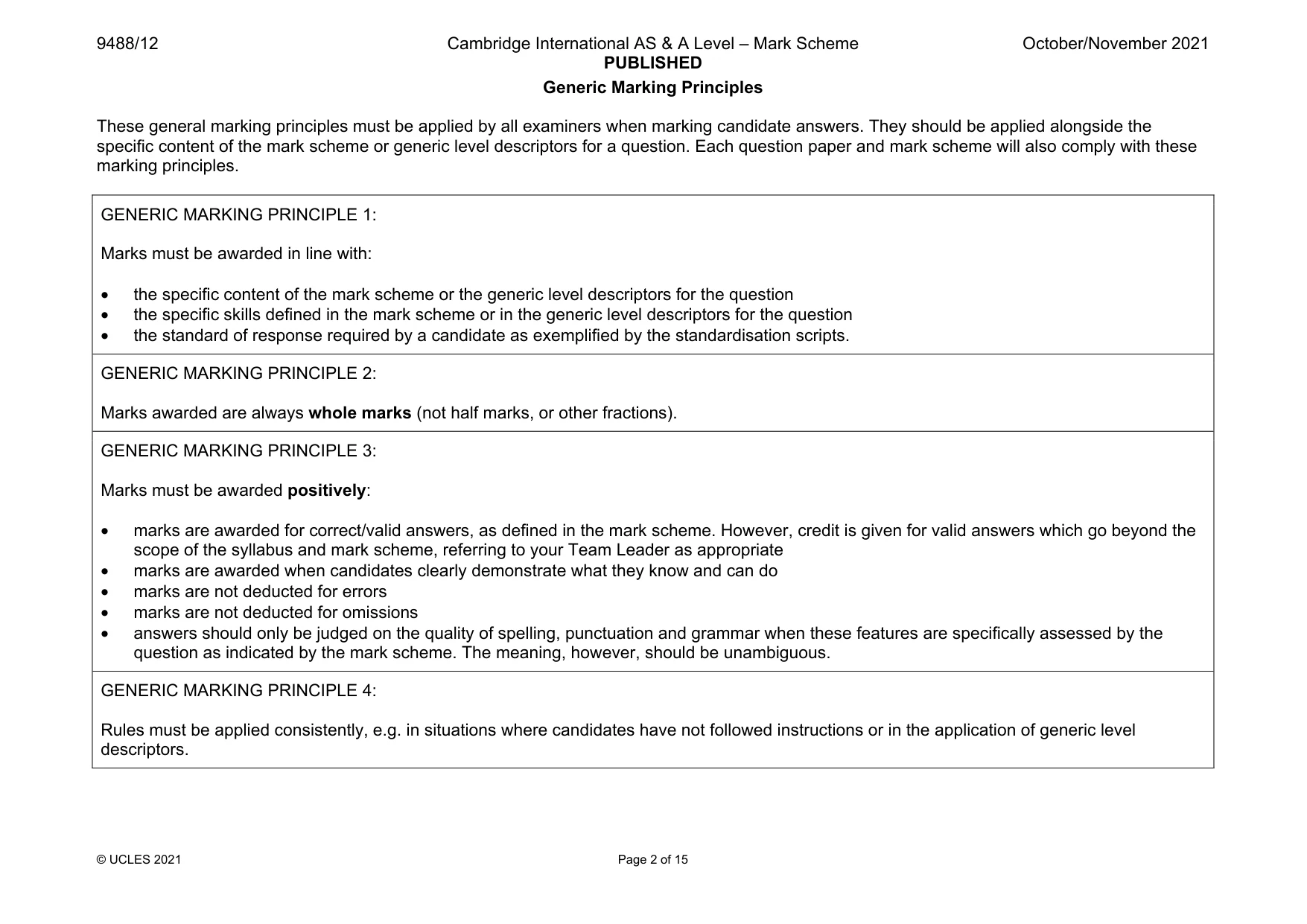
This document consists of 15 printed pages. © UCLES 2021 [Turn over Cambridge International AS & A Level ISLAMIC STUDIES 9488/12 Paper 1 Islamic Beliefs and Practices October/November 2021 MARK SCHEME Maximum Mark: 50 Published This mark scheme is published as an aid to teachers and candidates, to indicate the requirements of the examination. It shows the basis on which Examiners were instructed to award marks. It does not indicate the details of the discussions that took place at an Examiners’ meeting before marking began, which would have considered the acceptability of alternative answers. Mark schemes should be read in conjunction with the question paper and the Principal Examiner Report for Teachers. Cambridge International will not enter into discussions about these mark schemes. Cambridge International is publishing the mark schemes for the October/November 2021 series for most Cambridge IGCSE™, Cambridge International A and AS Level components and some Cambridge O Level components.
Mark scheme, page 2
9488/12 Cambridge International AS & A Level – Mark Scheme PUBLISHED October/November 2021 © UCLES 2021 Page 2 of 15 Generic Marking Principles These general marking principles must be applied by all examiners when marking candidate answers. They should be applied alongside the specific content of the mark scheme or generic level descriptors for a question. Each question paper and mark scheme will also comply with these marking principles. GENERIC MARKING PRINCIPLE 1: Marks must be awarded in line with: • the specific content of the mark scheme or the generic level descriptors for the question • the specific skills defined in the mark scheme or in the generic level descriptors for the question • the standard of response required by a candidate as exemplified by the standardisation scripts. GENERIC MARKING PRINCIPLE 2: Marks awarded are always whole marks (not half marks, or other fractions). GENERIC MARKING PRINCIPLE 3: Marks must be awarded positively: • marks are awarded for correct/valid answers, as defined in the mark scheme. However, credit is given for valid answers which go beyond the scope of the syllabus and mark scheme, referring to your Team Leader as appropriate • marks are awarded when candidates clearly demonstrate what they know and can do • marks are not deducted for errors • marks are not deducted for omissions • answers should only be judged on the quality of spelling, punctuation and grammar when these features are specifically assessed by the question as indicated by the mark scheme. The meaning, however, should be unambiguous. GENERIC MARKING PRINCIPLE 4: Rules must be applied consistently, e.g. in situations where candidates have not followed instructions or in the application of generic level descriptors.
Mark scheme, page 3
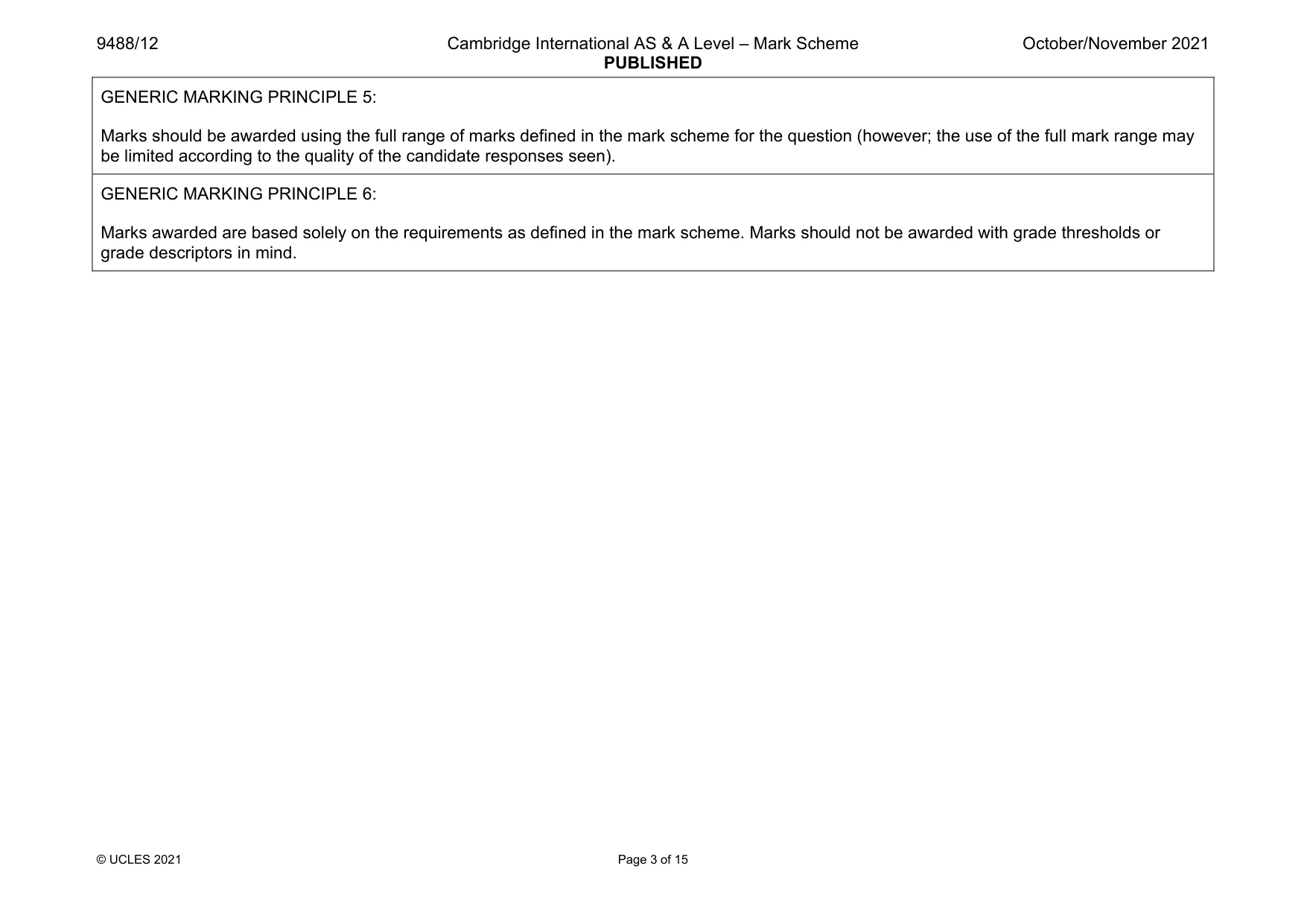
9488/12 Cambridge International AS & A Level – Mark Scheme PUBLISHED October/November 2021 © UCLES 2021 Page 3 of 15 GENERIC MARKING PRINCIPLE 5: Marks should be awarded using the full range of marks defined in the mark scheme for the question (however; the use of the full mark range may be limited according to the quality of the candidate responses seen). GENERIC MARKING PRINCIPLE 6: Marks awarded are based solely on the requirements as defined in the mark scheme. Marks should not be awarded with grade thresholds or grade descriptors in mind.
Mark scheme, page 4
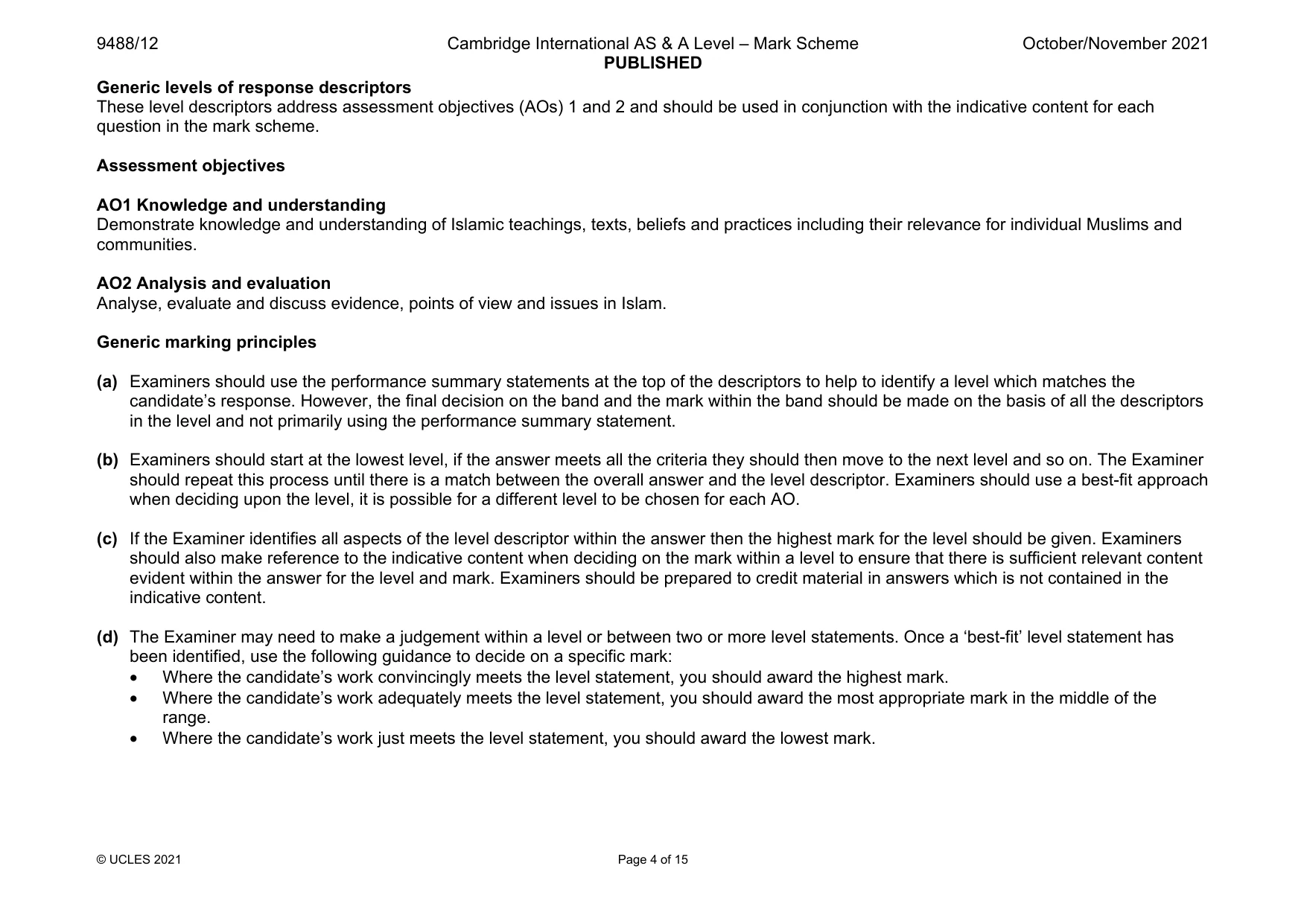
9488/12 Cambridge International AS & A Level – Mark Scheme PUBLISHED October/November 2021 © UCLES 2021 Page 4 of 15 Generic levels of response descriptors These level descriptors address assessment objectives (AOs) 1 and 2 and should be used in conjunction with the indicative content for each question in the mark scheme. Assessment objectives AO1 Knowledge and understanding Demonstrate knowledge and understanding of Islamic teachings, texts, beliefs and practices including their relevance for individual Muslims and communities. AO2 Analysis and evaluation Analyse, evaluate and discuss evidence, points of view and issues in Islam. Generic marking principles (a) Examiners should use the performance summary statements at the top of the descriptors to help to identify a level which matches the candidate’s response. However, the final decision on the band and the mark within the band should be made on the basis of all the descriptors in the level and not primarily using the performance summary statement. (b) Examiners should start at the lowest level, if the answer meets all the criteria they should then move to the next level and so on. The Examiner should repeat this process until there is a match between the overall answer and the level descriptor. Examiners should use a best-fit approach when deciding upon the level, it is possible for a different level to be chosen for each AO. (c) If the Examiner identifies all aspects of the level descriptor within the answer then the highest mark for the level should be given. Examiners should also make reference to the indicative content when deciding on the mark within a level to ensure that there is sufficient relevant content evident within the answer for the level and mark. Examiners should be prepared to credit material in answers which is not contained in the indicative content. (d) The Examiner may need to make a judgement within a level or between two or more level statements. Once a ‘best-fit’ level statement has been identified, use the following guidance to decide on a specific mark: • Where the candidate’s work convincingly meets the level statement, you should award the highest mark. • Where the candidate’s work adequately meets the level statement, you should award the most appropriate mark in the middle of the range. • Where the candidate’s work just meets the level statement, you should award the lowest mark.
Mark scheme, page 5
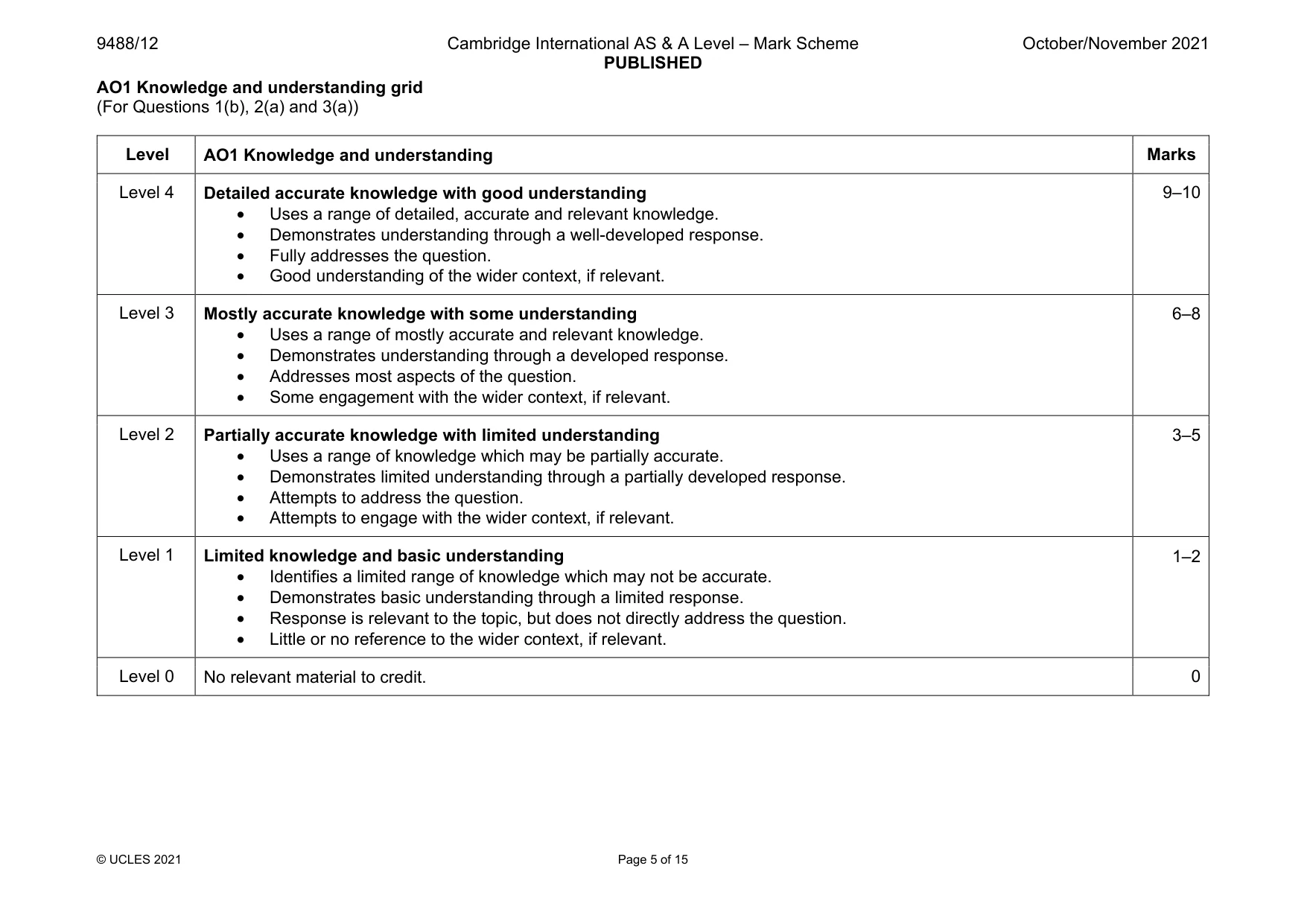
9488/12 Cambridge International AS & A Level – Mark Scheme PUBLISHED October/November 2021 © UCLES 2021 Page 5 of 15 AO1 Knowledge and understanding grid (For Questions 1(b), 2(a) and 3(a)) Level AO1 Knowledge and understanding Marks Level 4 Detailed accurate knowledge with good understanding • Uses a range of detailed, accurate and relevant knowledge. • Demonstrates understanding through a well-developed response. • Fully addresses the question. • Good understanding of the wider context, if relevant. 9–10 Level 3 Mostly accurate knowledge with some understanding • Uses a range of mostly accurate and relevant knowledge. • Demonstrates understanding through a developed response. • Addresses most aspects of the question. • Some engagement with the wider context, if relevant. 6–8 Level 2 Partially accurate knowledge with limited understanding • Uses a range of knowledge which may be partially accurate. • Demonstrates limited understanding through a partially developed response. • Attempts to address the question. • Attempts to engage with the wider context, if relevant. 3–5 Level 1 Limited knowledge and basic understanding • Identifies a limited range of knowledge which may not be accurate. • Demonstrates basic understanding through a limited response. • Response is relevant to the topic, but does not directly address the question. • Little or no reference to the wider context, if relevant. 1–2 Level 0 No relevant material to credit. 0
Mark scheme, page 6
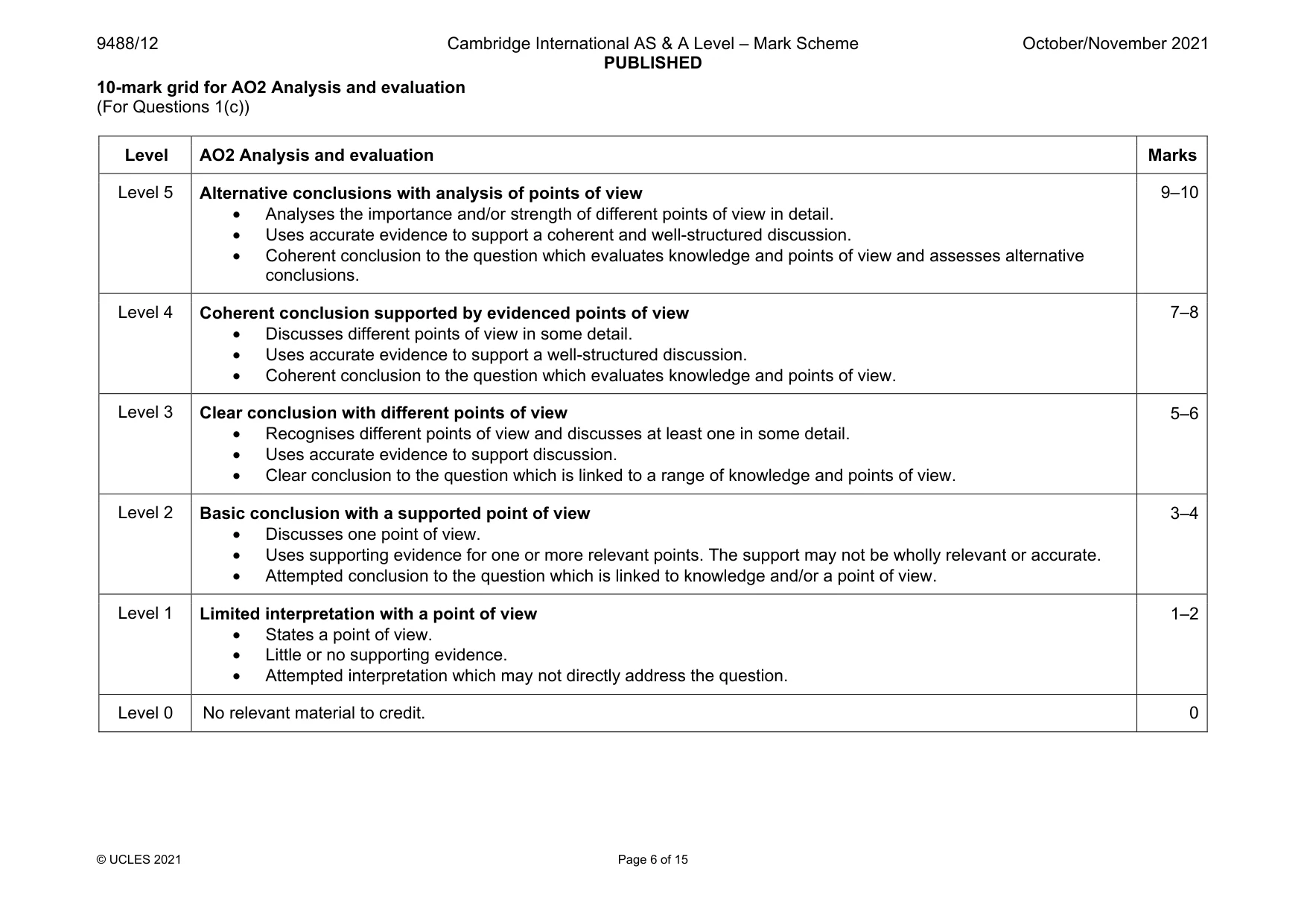
9488/12 Cambridge International AS & A Level – Mark Scheme PUBLISHED October/November 2021 © UCLES 2021 Page 6 of 15 10-mark grid for AO2 Analysis and evaluation (For Questions 1(c)) Level AO2 Analysis and evaluation Marks Level 5 Alternative conclusions with analysis of points of view • Analyses the importance and/or strength of different points of view in detail. • Uses accurate evidence to support a coherent and well-structured discussion. • Coherent conclusion to the question which evaluates knowledge and points of view and assesses alternative conclusions. 9–10 Level 4 Coherent conclusion supported by evidenced points of view • Discusses different points of view in some detail. • Uses accurate evidence to support a well-structured discussion. • Coherent conclusion to the question which evaluates knowledge and points of view. 7–8 Level 3 Clear conclusion with different points of view • Recognises different points of view and discusses at least one in some detail. • Uses accurate evidence to support discussion. • Clear conclusion to the question which is linked to a range of knowledge and points of view. 5–6 Level 2 Basic conclusion with a supported point of view • Discusses one point of view. • Uses supporting evidence for one or more relevant points. The support may not be wholly relevant or accurate. • Attempted conclusion to the question which is linked to knowledge and/or a point of view. 3–4 Level 1 Limited interpretation with a point of view • States a point of view. • Little or no supporting evidence. • Attempted interpretation which may not directly address the question. 1–2 Level 0 No relevant material to credit. 0
Mark scheme, page 7
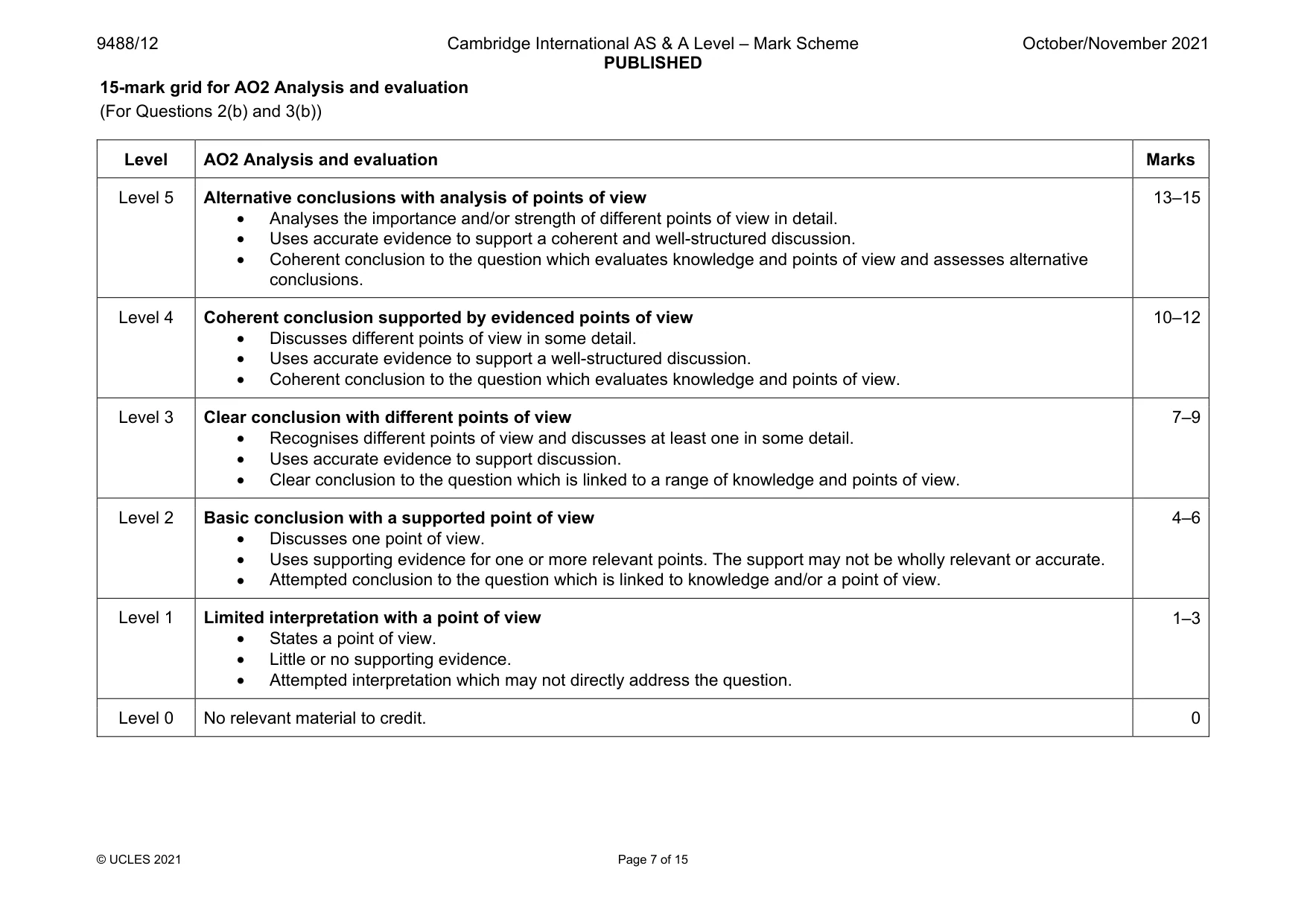
9488/12 Cambridge International AS & A Level – Mark Scheme PUBLISHED October/November 2021 © UCLES 2021 Page 7 of 15 15-mark grid for AO2 Analysis and evaluation (For Questions 2(b) and 3(b)) Level AO2 Analysis and evaluation Marks Level 5 Alternative conclusions with analysis of points of view • Analyses the importance and/or strength of different points of view in detail. • Uses accurate evidence to support a coherent and well-structured discussion. • Coherent conclusion to the question which evaluates knowledge and points of view and assesses alternative conclusions. 13–15 Level 4 Coherent conclusion supported by evidenced points of view • Discusses different points of view in some detail. • Uses accurate evidence to support a well-structured discussion. • Coherent conclusion to the question which evaluates knowledge and points of view. 10–12 Level 3 Clear conclusion with different points of view • Recognises different points of view and discusses at least one in some detail. • Uses accurate evidence to support discussion. • Clear conclusion to the question which is linked to a range of knowledge and points of view. 7–9 Level 2 Basic conclusion with a supported point of view • Discusses one point of view. • Uses supporting evidence for one or more relevant points. The support may not be wholly relevant or accurate. • Attempted conclusion to the question which is linked to knowledge and/or a point of view. 4–6 Level 1 Limited interpretation with a point of view • States a point of view. • Little or no supporting evidence. • Attempted interpretation which may not directly address the question. 1–3 Level 0 No relevant material to credit. 0
Mark scheme, page 8
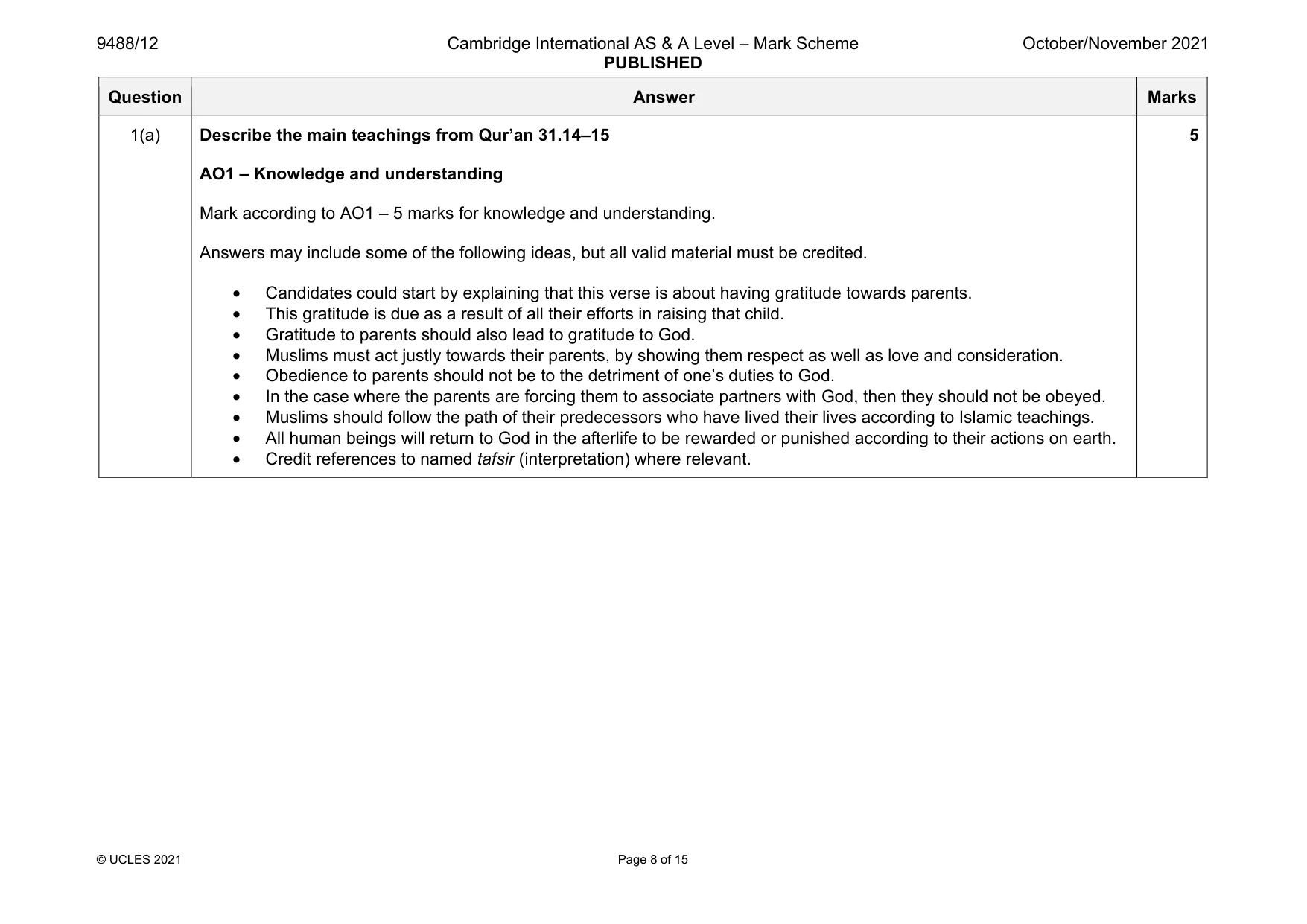
9488/12 Cambridge International AS & A Level – Mark Scheme PUBLISHED October/November 2021 © UCLES 2021 Page 8 of 15 Question Answer Marks 1(a) Describe the main teachings from Qur’an 31.14–15 AO1 – Knowledge and understanding Mark according to AO1 – 5 marks for knowledge and understanding. Answers may include some of the following ideas, but all valid material must be credited. • Candidates could start by explaining that this verse is about having gratitude towards parents. • This gratitude is due as a result of all their efforts in raising that child. • Gratitude to parents should also lead to gratitude to God. • Muslims must act justly towards their parents, by showing them respect as well as love and consideration. • Obedience to parents should not be to the detriment of one’s duties to God. • In the case where the parents are forcing them to associate partners with God, then they should not be obeyed. • Muslims should follow the path of their predecessors who have lived their lives according to Islamic teachings. • All human beings will return to God in the afterlife to be rewarded or punished according to their actions on earth. • Credit references to named tafsir (interpretation) where relevant. 5
Mark scheme, page 9
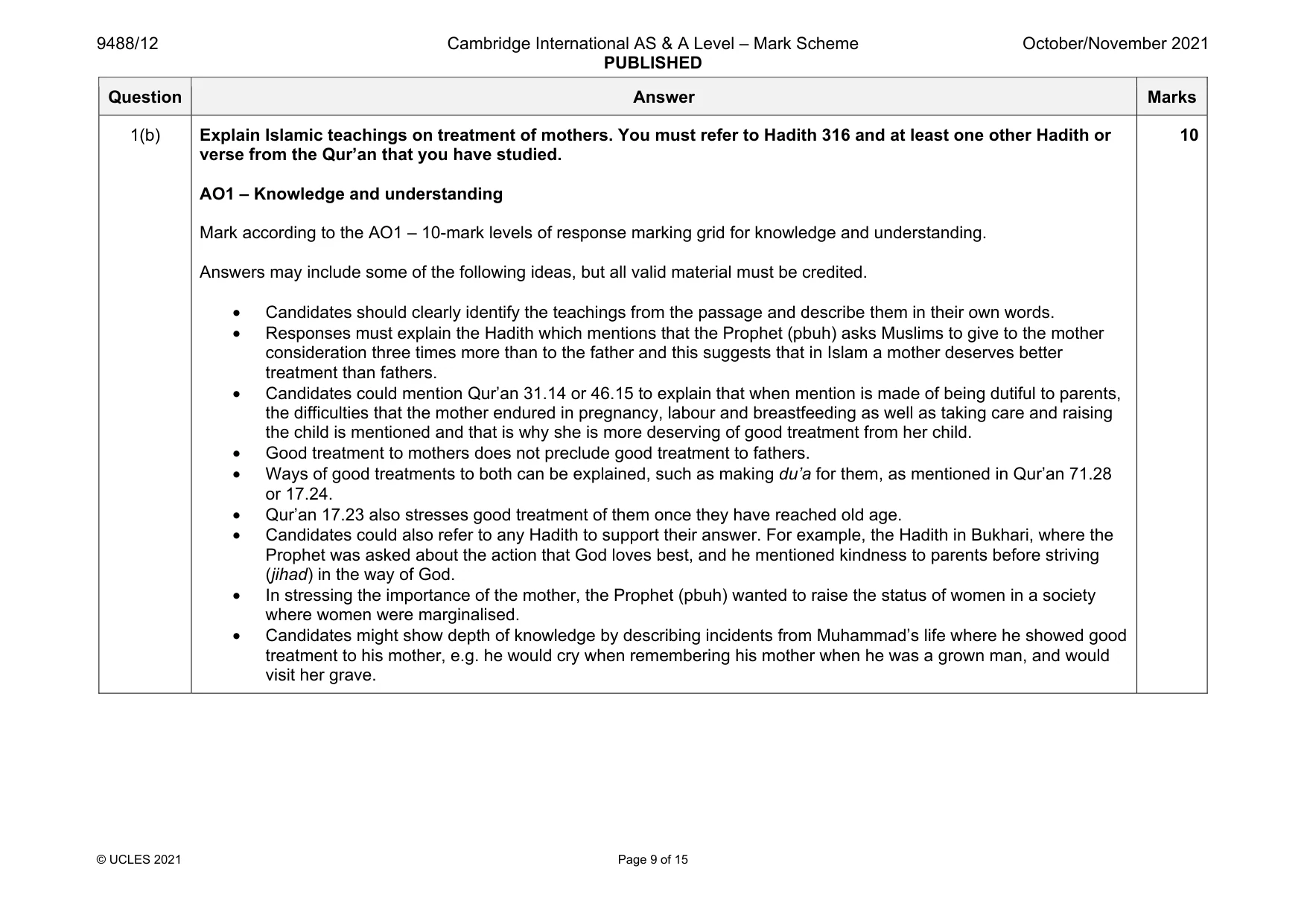
9488/12 Cambridge International AS & A Level – Mark Scheme PUBLISHED October/November 2021 © UCLES 2021 Page 9 of 15 Question Answer Marks 1(b) Explain Islamic teachings on treatment of mothers. You must refer to Hadith 316 and at least one other Hadith or verse from the Qur’an that you have studied. AO1 – Knowledge and understanding Mark according to the AO1 – 10-mark levels of response marking grid for knowledge and understanding. Answers may include some of the following ideas, but all valid material must be credited. • Candidates should clearly identify the teachings from the passage and describe them in their own words. • Responses must explain the Hadith which mentions that the Prophet (pbuh) asks Muslims to give to the mother consideration three times more than to the father and this suggests that in Islam a mother deserves better treatment than fathers. • Candidates could mention Qur’an 31.14 or 46.15 to explain that when mention is made of being dutiful to parents, the difficulties that the mother endured in pregnancy, labour and breastfeeding as well as taking care and raising the child is mentioned and that is why she is more deserving of good treatment from her child. • Good treatment to mothers does not preclude good treatment to fathers. • Ways of good treatments to both can be explained, such as making du’a for them, as mentioned in Qur’an 71.28 or 17.24. • Qur’an 17.23 also stresses good treatment of them once they have reached old age. • Candidates could also refer to any Hadith to support their answer. For example, the Hadith in Bukhari, where the Prophet was asked about the action that God loves best, and he mentioned kindness to parents before striving (jihad) in the way of God. • In stressing the importance of the mother, the Prophet (pbuh) wanted to raise the status of women in a society where women were marginalised. • Candidates might show depth of knowledge by describing incidents from Muhammad’s life where he showed good treatment to his mother, e.g. he would cry when remembering his mother when he was a grown man, and would visit her grave. 10
Mark scheme, page 10
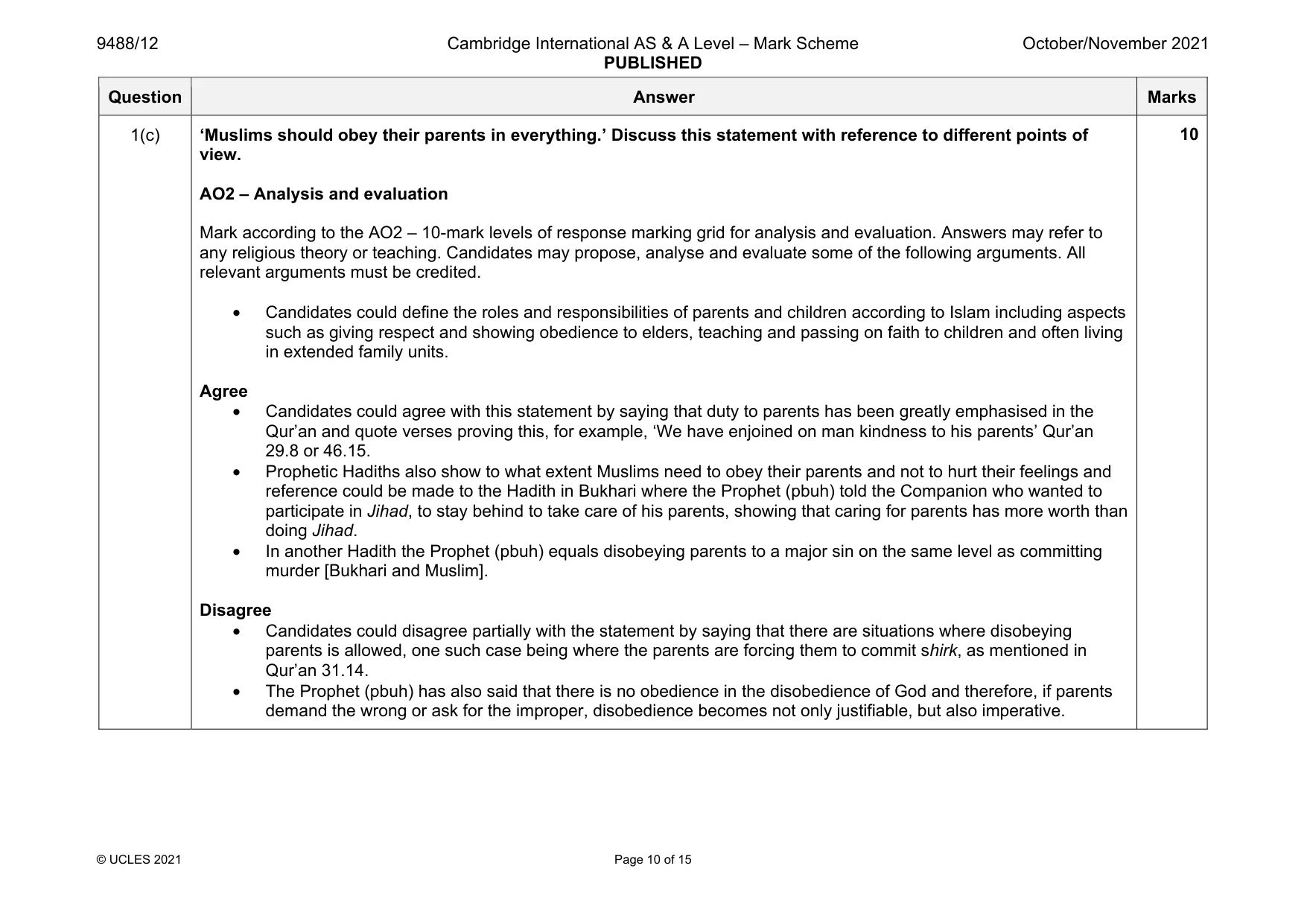
9488/12 Cambridge International AS & A Level – Mark Scheme PUBLISHED October/November 2021 © UCLES 2021 Page 10 of 15 Question Answer Marks 1(c) ‘Muslims should obey their parents in everything.’ Discuss this statement with reference to different points of view. AO2 – Analysis and evaluation Mark according to the AO2 – 10-mark levels of response marking grid for analysis and evaluation. Answers may refer to any religious theory or teaching. Candidates may propose, analyse and evaluate some of the following arguments. All relevant arguments must be credited. • Candidates could define the roles and responsibilities of parents and children according to Islam including aspects such as giving respect and showing obedience to elders, teaching and passing on faith to children and often living in extended family units. Agree • Candidates could agree with this statement by saying that duty to parents has been greatly emphasised in the Qur’an and quote verses proving this, for example, ‘We have enjoined on man kindness to his parents’ Qur’an 29.8 or 46.15. • Prophetic Hadiths also show to what extent Muslims need to obey their parents and not to hurt their feelings and reference could be made to the Hadith in Bukhari where the Prophet (pbuh) told the Companion who wanted to participate in Jihad, to stay behind to take care of his parents, showing that caring for parents has more worth than doing Jihad. • In another Hadith the Prophet (pbuh) equals disobeying parents to a major sin on the same level as committing murder [Bukhari and Muslim]. Disagree • Candidates could disagree partially with the statement by saying that there are situations where disobeying parents is allowed, one such case being where the parents are forcing them to commit shirk, as mentioned in Qur’an 31.14. • The Prophet (pbuh) has also said that there is no obedience in the disobedience of God and therefore, if parents demand the wrong or ask for the improper, disobedience becomes not only justifiable, but also imperative. 10
Mark scheme, page 11
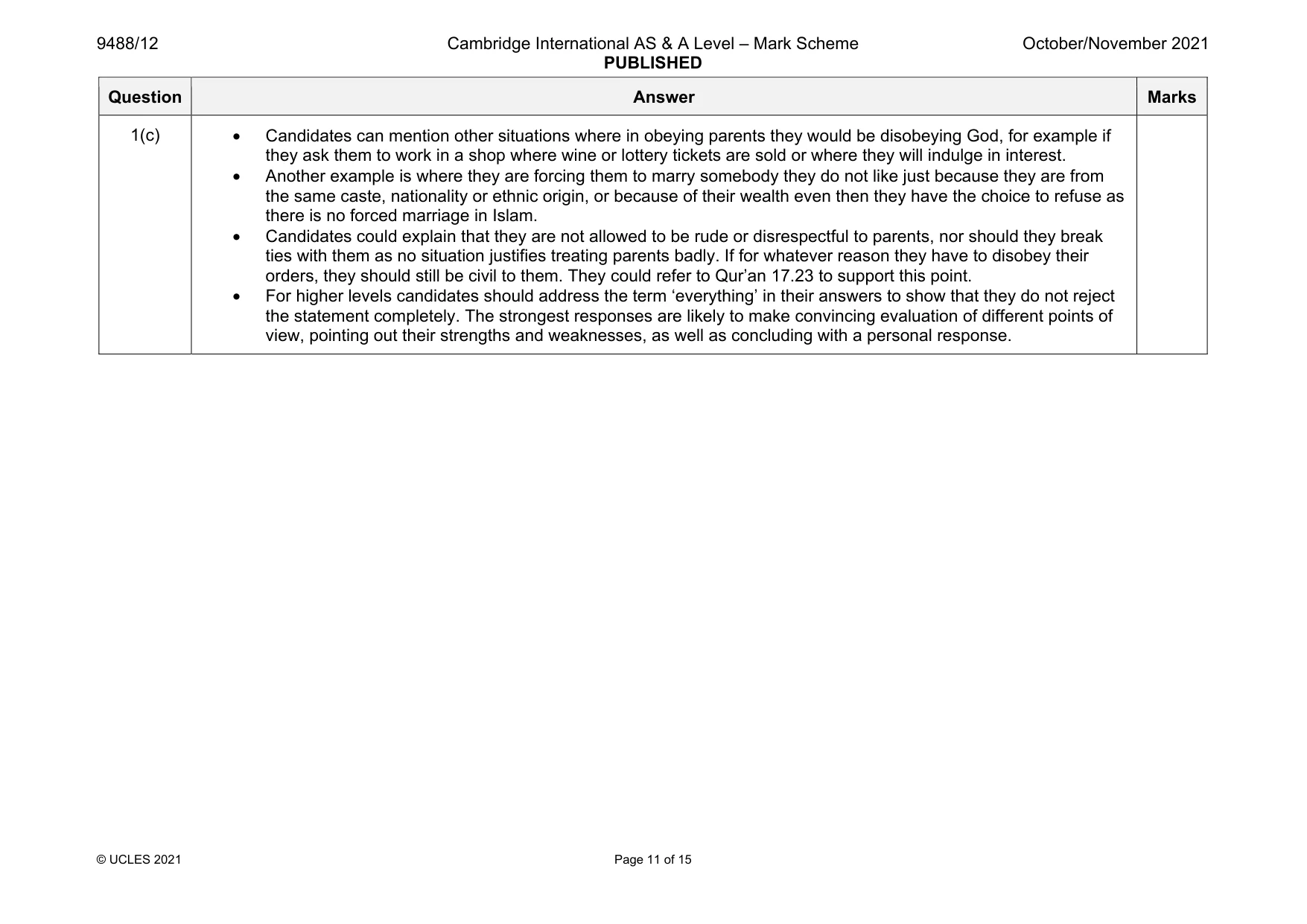
9488/12 Cambridge International AS & A Level – Mark Scheme PUBLISHED October/November 2021 © UCLES 2021 Page 11 of 15 Question Answer Marks 1(c) • Candidates can mention other situations where in obeying parents they would be disobeying God, for example if they ask them to work in a shop where wine or lottery tickets are sold or where they will indulge in interest. • Another example is where they are forcing them to marry somebody they do not like just because they are from the same caste, nationality or ethnic origin, or because of their wealth even then they have the choice to refuse as there is no forced marriage in Islam. • Candidates could explain that they are not allowed to be rude or disrespectful to parents, nor should they break ties with them as no situation justifies treating parents badly. If for whatever reason they have to disobey their orders, they should still be civil to them. They could refer to Qur’an 17.23 to support this point. • For higher levels candidates should address the term ‘everything’ in their answers to show that they do not reject the statement completely. The strongest responses are likely to make convincing evaluation of different points of view, pointing out their strengths and weaknesses, as well as concluding with a personal response.
Mark scheme, page 12
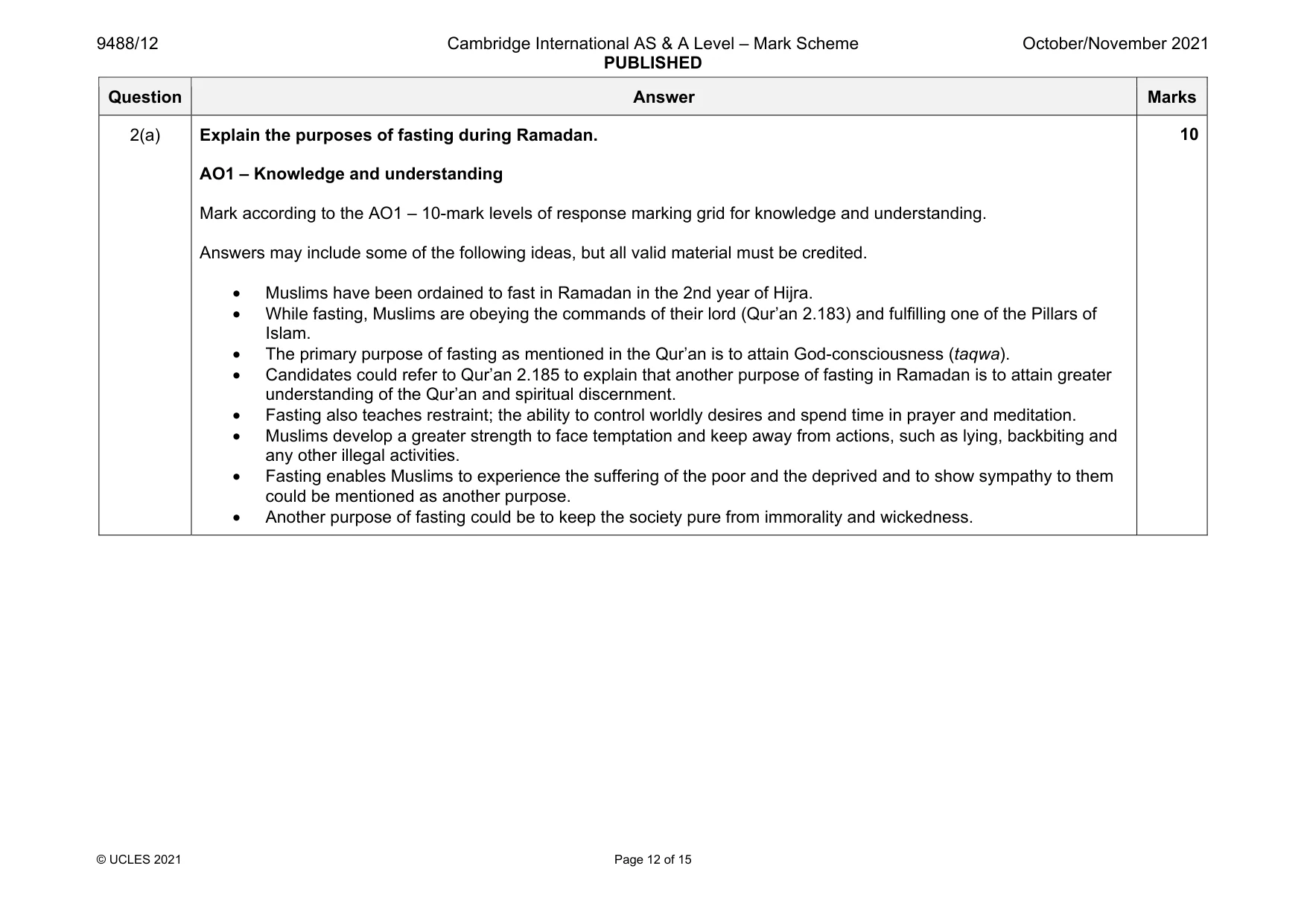
9488/12 Cambridge International AS & A Level – Mark Scheme PUBLISHED October/November 2021 © UCLES 2021 Page 12 of 15 Question Answer Marks 2(a) Explain the purposes of fasting during Ramadan. AO1 – Knowledge and understanding Mark according to the AO1 – 10-mark levels of response marking grid for knowledge and understanding. Answers may include some of the following ideas, but all valid material must be credited. • Muslims have been ordained to fast in Ramadan in the 2nd year of Hijra. • While fasting, Muslims are obeying the commands of their lord (Qur’an 2.183) and fulfilling one of the Pillars of Islam. • The primary purpose of fasting as mentioned in the Qur’an is to attain God-consciousness (taqwa). • Candidates could refer to Qur’an 2.185 to explain that another purpose of fasting in Ramadan is to attain greater understanding of the Qur’an and spiritual discernment. • Fasting also teaches restraint; the ability to control worldly desires and spend time in prayer and meditation. • Muslims develop a greater strength to face temptation and keep away from actions, such as lying, backbiting and any other illegal activities. • Fasting enables Muslims to experience the suffering of the poor and the deprived and to show sympathy to them could be mentioned as another purpose. • Another purpose of fasting could be to keep the society pure from immorality and wickedness. 10
Mark scheme, page 13
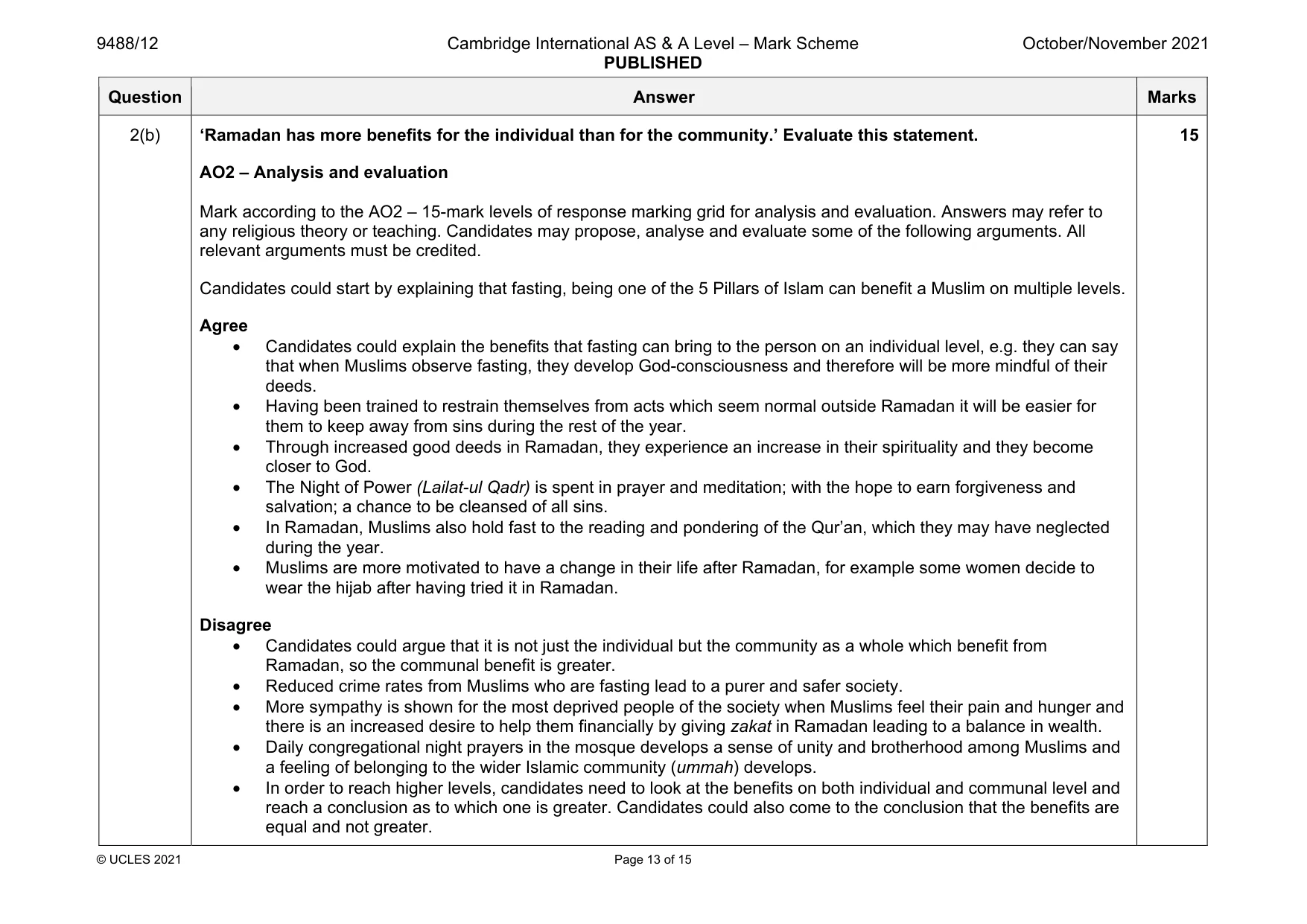
9488/12 Cambridge International AS & A Level – Mark Scheme PUBLISHED October/November 2021 © UCLES 2021 Page 13 of 15 Question Answer Marks 2(b) ‘Ramadan has more benefits for the individual than for the community.’ Evaluate this statement. AO2 – Analysis and evaluation Mark according to the AO2 – 15-mark levels of response marking grid for analysis and evaluation. Answers may refer to any religious theory or teaching. Candidates may propose, analyse and evaluate some of the following arguments. All relevant arguments must be credited. Candidates could start by explaining that fasting, being one of the 5 Pillars of Islam can benefit a Muslim on multiple levels. Agree • Candidates could explain the benefits that fasting can bring to the person on an individual level, e.g. they can say that when Muslims observe fasting, they develop God-consciousness and therefore will be more mindful of their deeds. • Having been trained to restrain themselves from acts which seem normal outside Ramadan it will be easier for them to keep away from sins during the rest of the year. • Through increased good deeds in Ramadan, they experience an increase in their spirituality and they become closer to God. • The Night of Power (Lailat-ul Qadr) is spent in prayer and meditation; with the hope to earn forgiveness and salvation; a chance to be cleansed of all sins. • In Ramadan, Muslims also hold fast to the reading and pondering of the Qur’an, which they may have neglected during the year. • Muslims are more motivated to have a change in their life after Ramadan, for example some women decide to wear the hijab after having tried it in Ramadan. Disagree • Candidates could argue that it is not just the individual but the community as a whole which benefit from Ramadan, so the communal benefit is greater. • Reduced crime rates from Muslims who are fasting lead to a purer and safer society. • More sympathy is shown for the most deprived people of the society when Muslims feel their pain and hunger and there is an increased desire to help them financially by giving zakat in Ramadan leading to a balance in wealth. • Daily congregational night prayers in the mosque develops a sense of unity and brotherhood among Muslims and a feeling of belonging to the wider Islamic community (ummah) develops. • In order to reach higher levels, candidates need to look at the benefits on both individual and communal level and reach a conclusion as to which one is greater. Candidates could also come to the conclusion that the benefits are equal and not greater. 15
Mark scheme, page 14
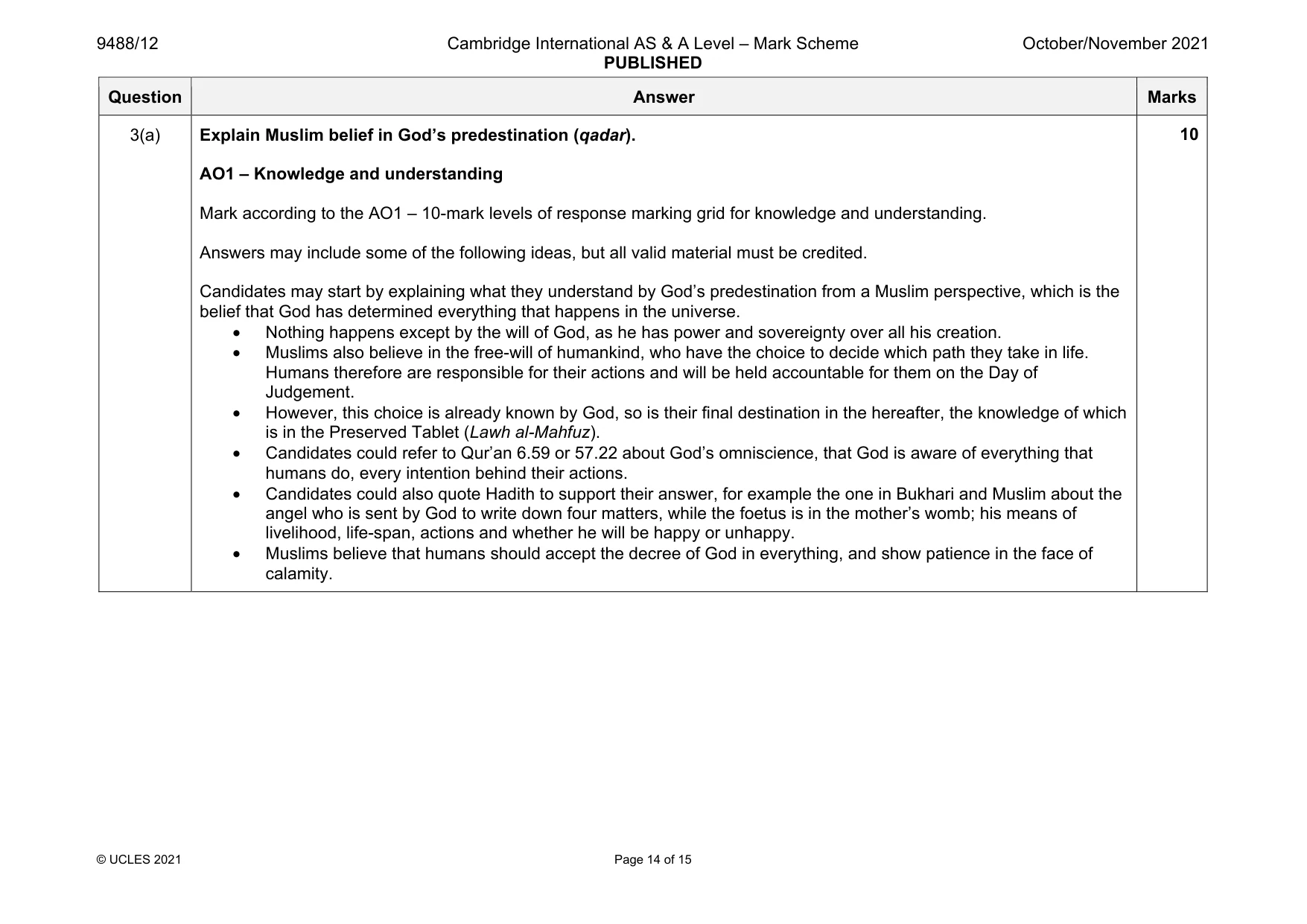
9488/12 Cambridge International AS & A Level – Mark Scheme PUBLISHED October/November 2021 © UCLES 2021 Page 14 of 15 Question Answer Marks 3(a) Explain Muslim belief in God’s predestination (qadar). AO1 – Knowledge and understanding Mark according to the AO1 – 10-mark levels of response marking grid for knowledge and understanding. Answers may include some of the following ideas, but all valid material must be credited. Candidates may start by explaining what they understand by God’s predestination from a Muslim perspective, which is the belief that God has determined everything that happens in the universe. • Nothing happens except by the will of God, as he has power and sovereignty over all his creation. • Muslims also believe in the free-will of humankind, who have the choice to decide which path they take in life. Humans therefore are responsible for their actions and will be held accountable for them on the Day of Judgement. • However, this choice is already known by God, so is their final destination in the hereafter, the knowledge of which is in the Preserved Tablet (Lawh al-Mahfuz). • Candidates could refer to Qur’an 6.59 or 57.22 about God’s omniscience, that God is aware of everything that humans do, every intention behind their actions. • Candidates could also quote Hadith to support their answer, for example the one in Bukhari and Muslim about the angel who is sent by God to write down four matters, while the foetus is in the mother’s womb; his means of livelihood, life-span, actions and whether he will be happy or unhappy. • Muslims believe that humans should accept the decree of God in everything, and show patience in the face of calamity. 10
Mark scheme, page 15
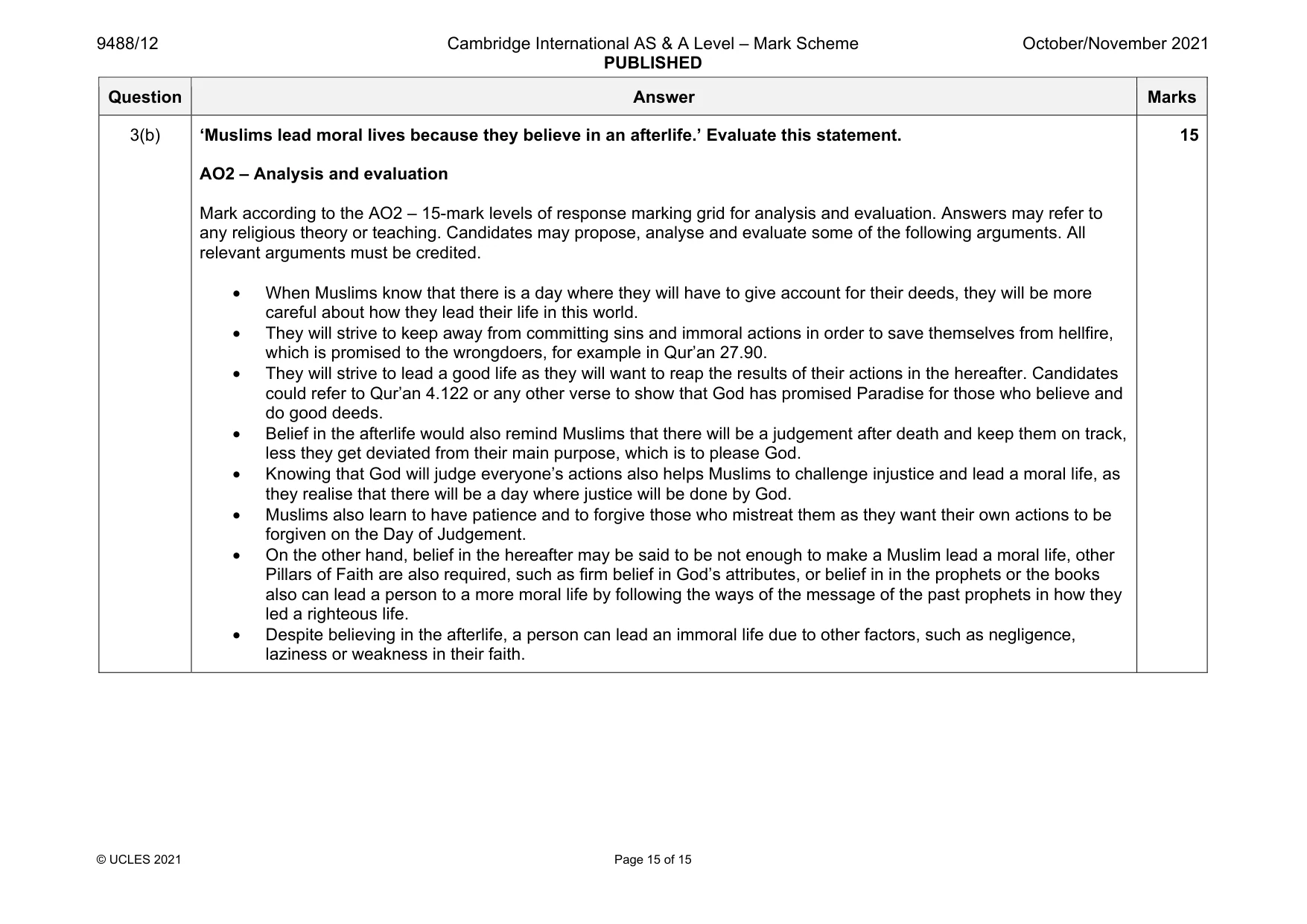
9488/12 Cambridge International AS & A Level – Mark Scheme PUBLISHED October/November 2021 © UCLES 2021 Page 15 of 15 Question Answer Marks 3(b) ‘Muslims lead moral lives because they believe in an afterlife.’ Evaluate this statement. AO2 – Analysis and evaluation Mark according to the AO2 – 15-mark levels of response marking grid for analysis and evaluation. Answers may refer to any religious theory or teaching. Candidates may propose, analyse and evaluate some of the following arguments. All relevant arguments must be credited. • When Muslims know that there is a day where they will have to give account for their deeds, they will be more careful about how they lead their life in this world. • They will strive to keep away from committing sins and immoral actions in order to save themselves from hellfire, which is promised to the wrongdoers, for example in Qur’an 27.90. • They will strive to lead a good life as they will want to reap the results of their actions in the hereafter. Candidates could refer to Qur’an 4.122 or any other verse to show that God has promised Paradise for those who believe and do good deeds. • Belief in the afterlife would also remind Muslims that there will be a judgement after death and keep them on track, less they get deviated from their main purpose, which is to please God. • Knowing that God will judge everyone’s actions also helps Muslims to challenge injustice and lead a moral life, as they realise that there will be a day where justice will be done by God. • Muslims also learn to have patience and to forgive those who mistreat them as they want their own actions to be forgiven on the Day of Judgement. • On the other hand, belief in the hereafter may be said to be not enough to make a Muslim lead a moral life, other Pillars of Faith are also required, such as firm belief in God’s attributes, or belief in in the prophets or the books also can lead a person to a more moral life by following the ways of the message of the past prophets in how they led a righteous life. • Despite believing in the afterlife, a person can lead an immoral life due to other factors, such as negligence, laziness or weakness in their faith. 15
What you needed in this session
Cambridge’s own grade thresholds for 2021 Oct/Nov, Paper 1 · Variant 2. A higher threshold means an easier paper — the bar moves with how the cohort did.