Cambridge A Level History 9489 — 2024 Feb/March Paper 1 · Variant 2
9489/12/F/M/24 · 40 marks · ≈45 min
The question paper and its mark scheme, free to read here and free to download. This is Cambridge’s own paper, exactly as it was sat.
Question paper8 pages
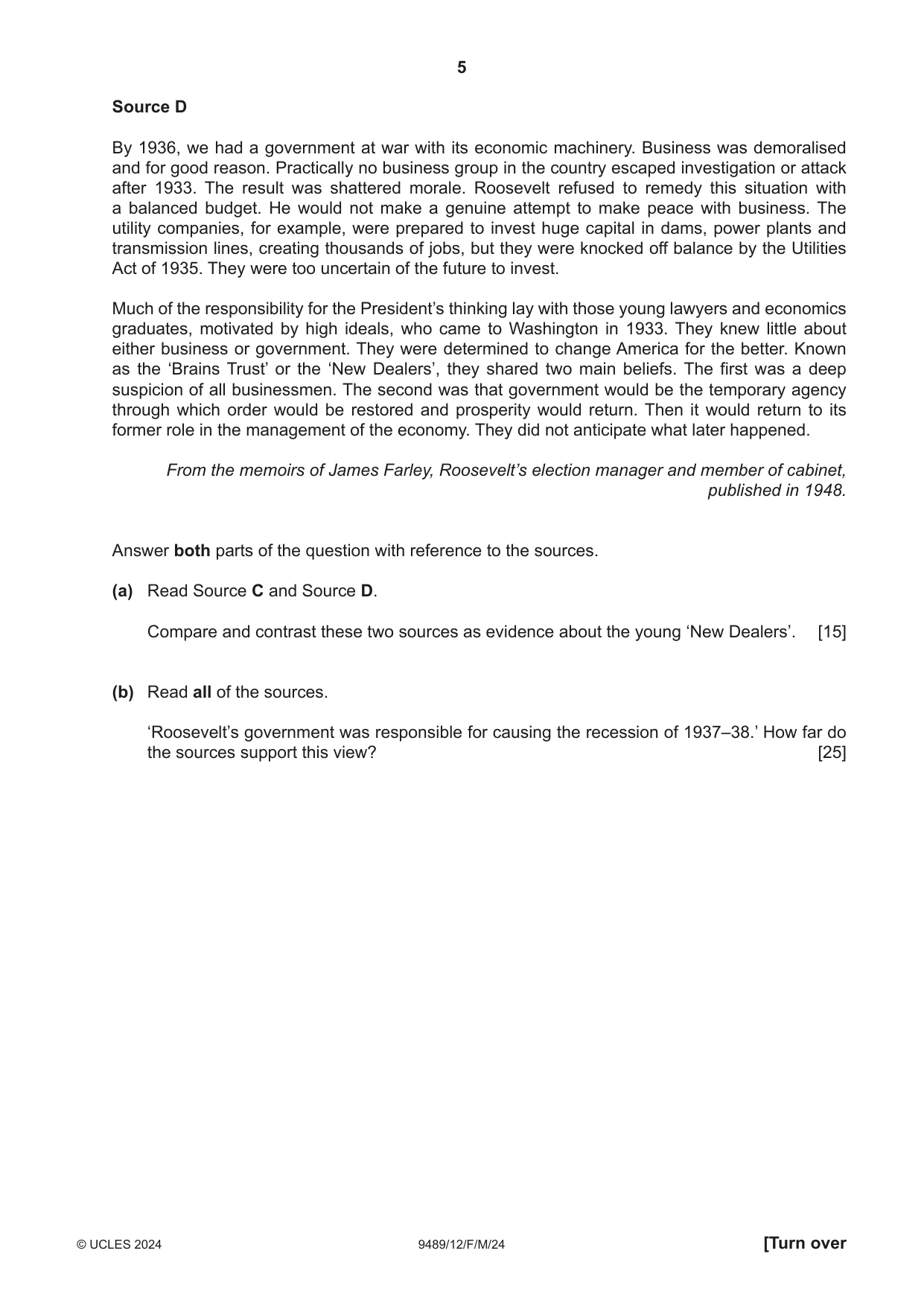
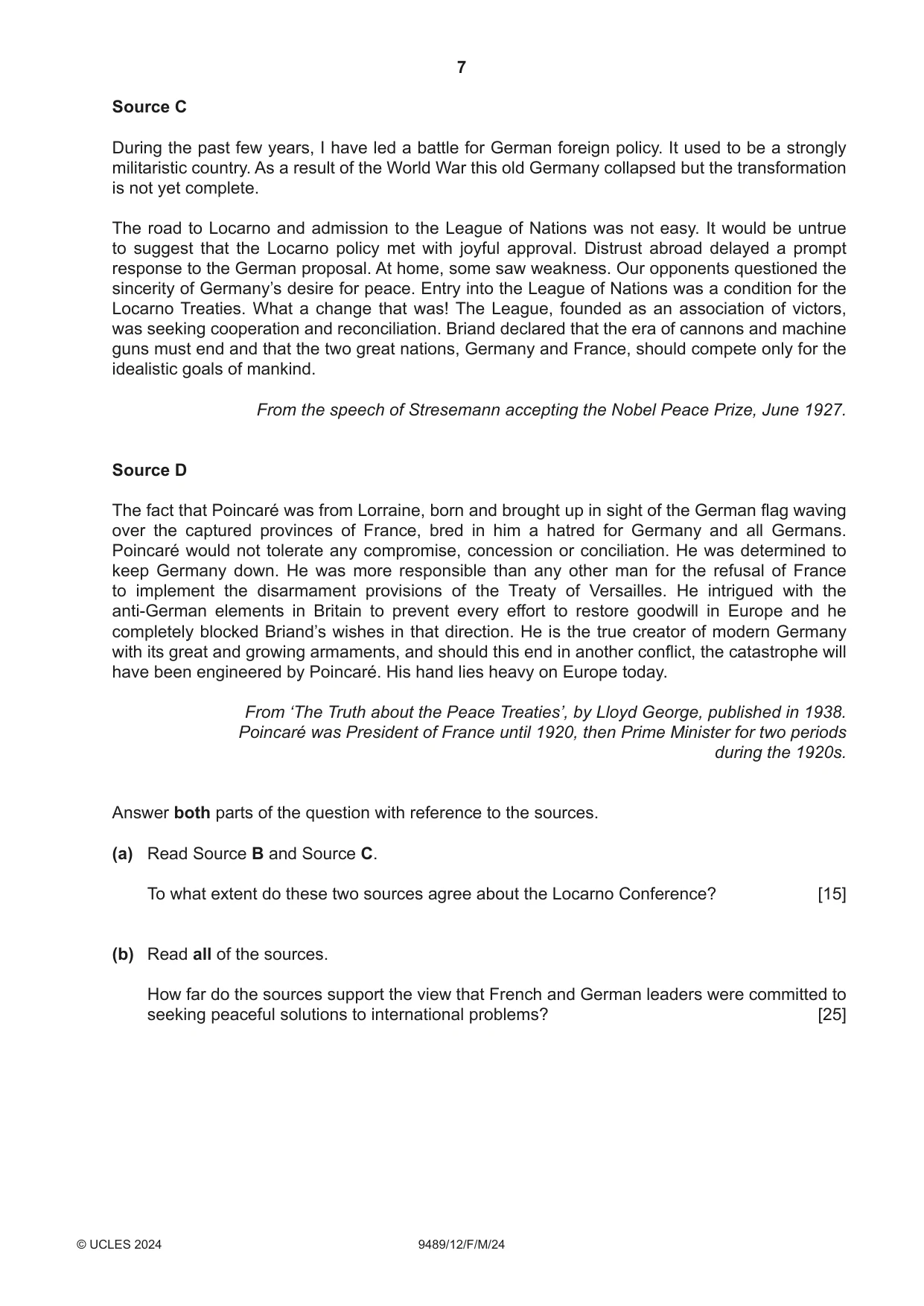

Mark scheme13 pages
Answers below. Sit the paper first if you are practising.
Paper as text
Question paper, page 1
This document has 8 pages. Any blank pages are indicated. [Turn over Cambridge International AS & A Level HISTORY 9489/12 Paper 1 Document Question February/March 2024 1 hour 15 minutes You must answer on the enclosed answer booklet. You will need: Answer booklet (enclosed) INSTRUCTIONS ● Answer one question from one section only. Section A: European option Section B: American option Section C: International option ● Follow the instructions on the front cover of the answer booklet. If you need additional answer paper, ask the invigilator for a continuation booklet. INFORMATION ● The total mark for this paper is 40. ● The number of marks for each question or part question is shown in brackets [ ]. * 2 9 0 1 8 4 4 8 7 3 * DC (SL/CGW) 330447/1 © UCLES 2024
Question paper, page 2
2 9489/12/F/M/24 © UCLES 2024 Answer one question from one section only. Section A: European option The Industrial Revolution in Britain, 1750–1850 1 Read the sources and then answer both parts of the question. Source A The importance to a commercial nation of a safe and cheap mode of transit for merchandise from one part of the country to another will be readily acknowledged. From the start, this was the justification for canals. It was for the public advantage. Although canals interfered with existing modes of transport and were opposed to the feelings and prejudices of the landowners, the principle of public good prevailed and experience has justified the decision. The public may not understand how the owners of a railroad, which requires substantial investment, can afford to carry goods so much cheaper than by canal. The canal companies could have carried goods on more reasonable terms but given their monopoly, have not thought it necessary to do so. The public have had no protection against the most arbitrary pricing – it is competition that is wanted. But it is not altogether on account of the excessive charges of the canal companies that a railroad is desirable. The present canals are inadequate to the great aim, namely the regular and punctual transport of goods in all seasons. In summer there is frequently a deficiency of water, obliging boats to go only half loaded, causing great inconvenience and delay. In winter canals are sometimes frozen for weeks to the hindrance of business. From the prospectus for the Liverpool and Manchester Railway Company, 1824. This was written to attract potential investors. Source B We have had sad work with Lord Derby, Lord Sefton and Bradshaw the canal owner, whose land we go through with the projected railway. Their land is blockaded on every side to prevent us getting on with the survey. Bradshaw fires guns in the night to prevent the surveyors coming through the dark. Matters will come to a head next week. The Liverpool Railway Company is determined to force a survey through if possible. Lord Sefton says he will have 100 men to stop us. The Company thinks those great men have no right to stop us. It is only the farmers who have a right to complain and charging damages for trespass is all they do. From a letter written by George Stephenson, surveyor for the proposed Liverpool to Manchester railway, 1824.
Question paper, page 3
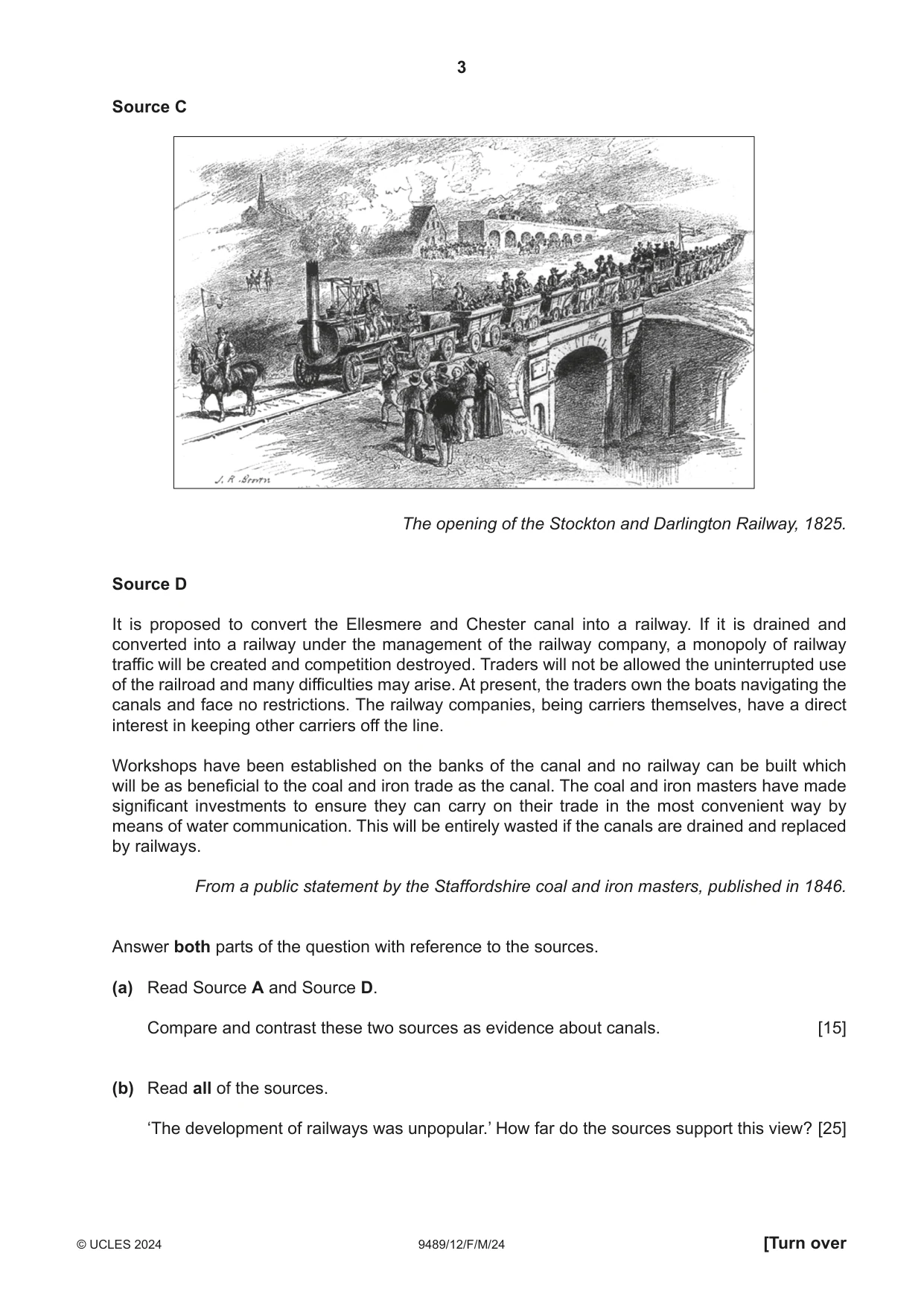
3 9489/12/F/M/24 © UCLES 2024 [Turn over Source C The opening of the Stockton and Darlington Railway, 1825. Source D It is proposed to convert the Ellesmere and Chester canal into a railway. If it is drained and converted into a railway under the management of the railway company, a monopoly of railway traffic will be created and competition destroyed. Traders will not be allowed the uninterrupted use of the railroad and many difficulties may arise. At present, the traders own the boats navigating the canals and face no restrictions. The railway companies, being carriers themselves, have a direct interest in keeping other carriers off the line. Workshops have been established on the banks of the canal and no railway can be built which will be as beneficial to the coal and iron trade as the canal. The coal and iron masters have made significant investments to ensure they can carry on their trade in the most convenient way by means of water communication. This will be entirely wasted if the canals are drained and replaced by railways. From a public statement by the Staffordshire coal and iron masters, published in 1846. Answer both parts of the question with reference to the sources. (a) Read Source A and Source D. Compare and contrast these two sources as evidence about canals. [15] (b) Read all of the sources. ‘The development of railways was unpopular.’ How far do the sources support this view? [25]
Question paper, page 4
4 9489/12/F/M/24 © UCLES 2024 Section B: American option The Great Crash, the Great Depression and the New Deal policies, 1920–41 2 Read the sources and then answer both parts of the question. Source A The flood of legislation since 1933 is at the root of all our current problems. We are not investing, and we are not creating jobs. Uncertainty rules the tax situation, the labour situation and the monetary situation. The laws affecting all the conditions under which every industry and business must operate are constantly being changed by this government. Are taxes to go higher or lower or stay where they are? Are we to have inflation or deflation? More government spending or less? Are new restrictions to be placed on capital, business and profits? We cannot guess the answers. This government has caused both this uncertainty and this recession and it must end it. Then we will invest. The Chief Executive of a major corporation, writing to shareholders, January 1937. Source B The economic downturn and the slump in private investment are not caused by economic factors. It is part of a political conspiracy against the President. It is an attack by the owners of capital designed to destroy the New Deal and lead to another economic breakdown. Sixty families who make up the industrial oligarchy which dominates the United States are leading this assault. This current recession, as well as the Depression itself, was caused by these monopolists. The courts have not helped either by striking down acts such as the National Industrial Recovery Act (NIRA). This has further damaged our recovery. From a speech by Harold Ickes, a member of Roosevelt’s cabinet, March 1937. Source C Much of the current economic downturn is caused by misunderstanding between government and the business community. Government does not understand how business works and what conditions are needed to encourage new investment. Business does not understand the great expectations that have been placed on government to restore prosperity and end the despair which existed in the years after the crisis of 1929. It could well have been more supportive in the current downturn. The President can rightly be accused of being poorly advised and hostile to business. Those young men, the so-called ‘New Dealers’, who flocked to join his administration in 1933, must take responsibility for much of this. Although claiming to be motivated by high ideals, they sought power and jobs for themselves. They had no experience of either business or government, but they advocated and achieved radical change in both. They wish to give government the dominant role in the management of the economy. From an article in a leading New York financial newspaper, June 1937.
Question paper, page 5
5 9489/12/F/M/24 © UCLES 2024 [Turn over Source D By 1936, we had a government at war with its economic machinery. Business was demoralised and for good reason. Practically no business group in the country escaped investigation or attack after 1933. The result was shattered morale. Roosevelt refused to remedy this situation with a balanced budget. He would not make a genuine attempt to make peace with business. The utility companies, for example, were prepared to invest huge capital in dams, power plants and transmission lines, creating thousands of jobs, but they were knocked off balance by the Utilities Act of 1935. They were too uncertain of the future to invest. Much of the responsibility for the President’s thinking lay with those young lawyers and economics graduates, motivated by high ideals, who came to Washington in 1933. They knew little about either business or government. They were determined to change America for the better. Known as the ‘Brains Trust’ or the ‘New Dealers’, they shared two main beliefs. The first was a deep suspicion of all businessmen. The second was that government would be the temporary agency through which order would be restored and prosperity would return. Then it would return to its former role in the management of the economy. They did not anticipate what later happened. From the memoirs of James Farley, Roosevelt’s election manager and member of cabinet, published in 1948. Answer both parts of the question with reference to the sources. (a) Read Source C and Source D. Compare and contrast these two sources as evidence about the young ‘New Dealers’. [15] (b) Read all of the sources. ‘Roosevelt’s government was responsible for causing the recession of 1937–38.’ How far do the sources support this view? [25]
Question paper, page 6
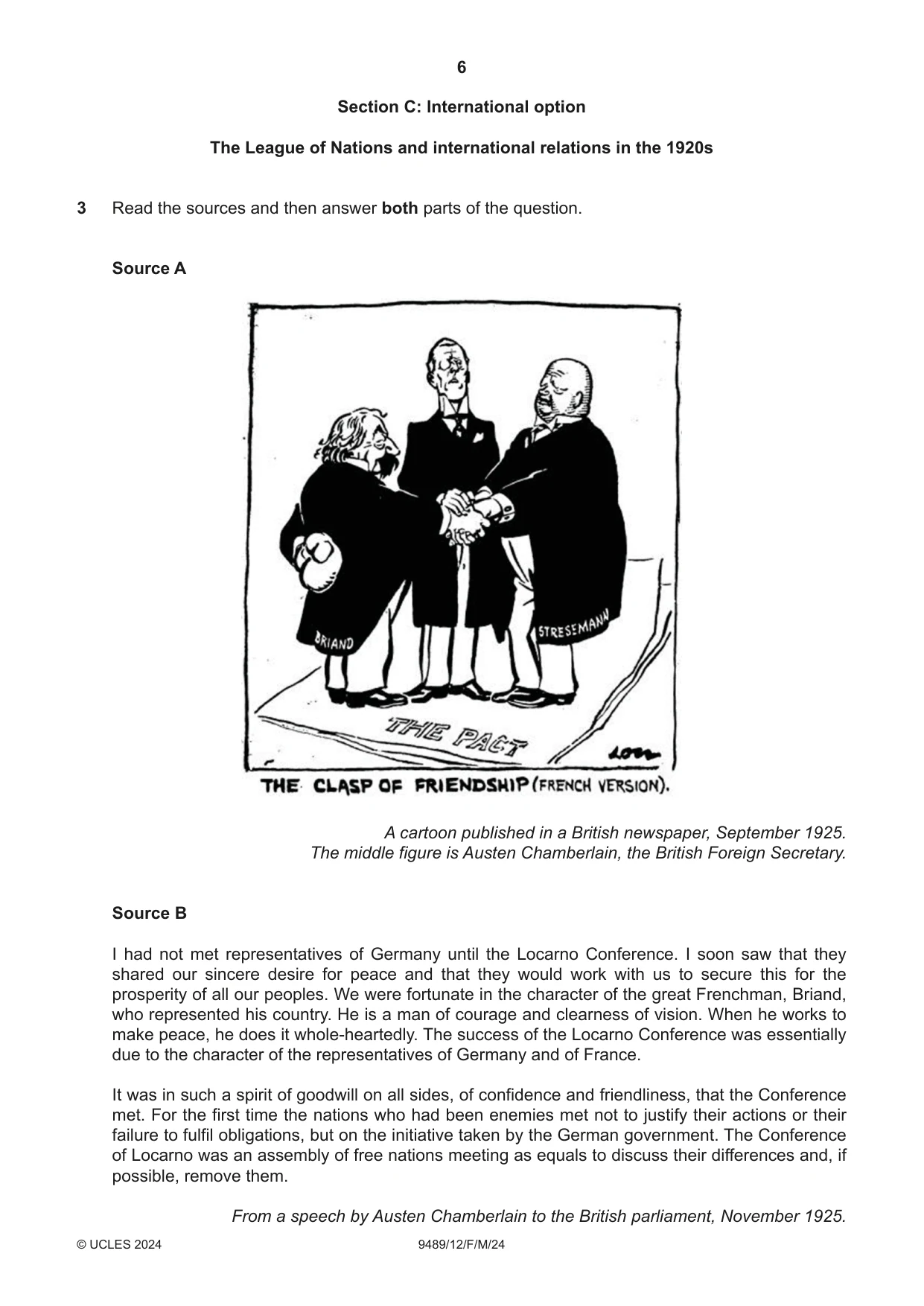
6 9489/12/F/M/24 © UCLES 2024 Section C: International option The League of Nations and international relations in the 1920s 3 Read the sources and then answer both parts of the question. Source A A cartoon published in a British newspaper, September 1925. The middle figure is Austen Chamberlain, the British Foreign Secretary. Source B I had not met representatives of Germany until the Locarno Conference. I soon saw that they shared our sincere desire for peace and that they would work with us to secure this for the prosperity of all our peoples. We were fortunate in the character of the great Frenchman, Briand, who represented his country. He is a man of courage and clearness of vision. When he works to make peace, he does it whole-heartedly. The success of the Locarno Conference was essentially due to the character of the representatives of Germany and of France. It was in such a spirit of goodwill on all sides, of confidence and friendliness, that the Conference met. For the first time the nations who had been enemies met not to justify their actions or their failure to fulfil obligations, but on the initiative taken by the German government. The Conference of Locarno was an assembly of free nations meeting as equals to discuss their differences and, if possible, remove them. From a speech by Austen Chamberlain to the British parliament, November 1925.
Question paper, page 7
7 9489/12/F/M/24 © UCLES 2024 Source C During the past few years, I have led a battle for German foreign policy. It used to be a strongly militaristic country. As a result of the World War this old Germany collapsed but the transformation is not yet complete. The road to Locarno and admission to the League of Nations was not easy. It would be untrue to suggest that the Locarno policy met with joyful approval. Distrust abroad delayed a prompt response to the German proposal. At home, some saw weakness. Our opponents questioned the sincerity of Germany’s desire for peace. Entry into the League of Nations was a condition for the Locarno Treaties. What a change that was! The League, founded as an association of victors, was seeking cooperation and reconciliation. Briand declared that the era of cannons and machine guns must end and that the two great nations, Germany and France, should compete only for the idealistic goals of mankind. From the speech of Stresemann accepting the Nobel Peace Prize, June 1927. Source D The fact that Poincaré was from Lorraine, born and brought up in sight of the German flag waving over the captured provinces of France, bred in him a hatred for Germany and all Germans. Poincaré would not tolerate any compromise, concession or conciliation. He was determined to keep Germany down. He was more responsible than any other man for the refusal of France to implement the disarmament provisions of the Treaty of Versailles. He intrigued with the anti-German elements in Britain to prevent every effort to restore goodwill in Europe and he completely blocked Briand’s wishes in that direction. He is the true creator of modern Germany with its great and growing armaments, and should this end in another conflict, the catastrophe will have been engineered by Poincaré. His hand lies heavy on Europe today. From ‘The Truth about the Peace Treaties’, by Lloyd George, published in 1938. Poincaré was President of France until 1920, then Prime Minister for two periods during the 1920s. Answer both parts of the question with reference to the sources. (a) Read Source B and Source C. To what extent do these two sources agree about the Locarno Conference? [15] (b) Read all of the sources. How far do the sources support the view that French and German leaders were committed to seeking peaceful solutions to international problems? [25]
Question paper, page 8
8 9489/12/F/M/24 © UCLES 2024 Permission to reproduce items where third-party owned material protected by copyright is included has been sought and cleared where possible. Every reasonable effort has been made by the publisher (UCLES) to trace copyright holders, but if any items requiring clearance have unwittingly been included, the publisher will be pleased to make amends at the earliest possible opportunity. To avoid the issue of disclosure of answer-related information to candidates, all copyright acknowledgements are reproduced online in the Cambridge Assessment International Education Copyright Acknowledgements Booklet. This is produced for each series of examinations and is freely available to download at www.cambridgeinternational.org after the live examination series. Cambridge Assessment International Education is part of Cambridge Assessment. Cambridge Assessment is the brand name of the University of Cambridge Local Examinations Syndicate (UCLES), which is a department of the University of Cambridge. BLANK PAGE
Mark scheme, page 1
This document consists of 13 printed pages. © Cambridge University Press & Assessment 2024 [Turn over Cambridge International AS & A Level HISTORY 9489/12 Paper 1 Document Question February/March 2024 MARK SCHEME Maximum Mark: 40 Published This mark scheme is published as an aid to teachers and candidates, to indicate the requirements of the examination. It shows the basis on which Examiners were instructed to award marks. It does not indicate the details of the discussions that took place at an Examiners’ meeting before marking began, which would have considered the acceptability of alternative answers. Mark schemes should be read in conjunction with the question paper and the Principal Examiner Report for Teachers. Cambridge International will not enter into discussions about these mark schemes. Cambridge International is publishing the mark schemes for the February/March 2024 series for most Cambridge IGCSE, Cambridge International A and AS Level components, and some Cambridge O Level components.
Mark scheme, page 2
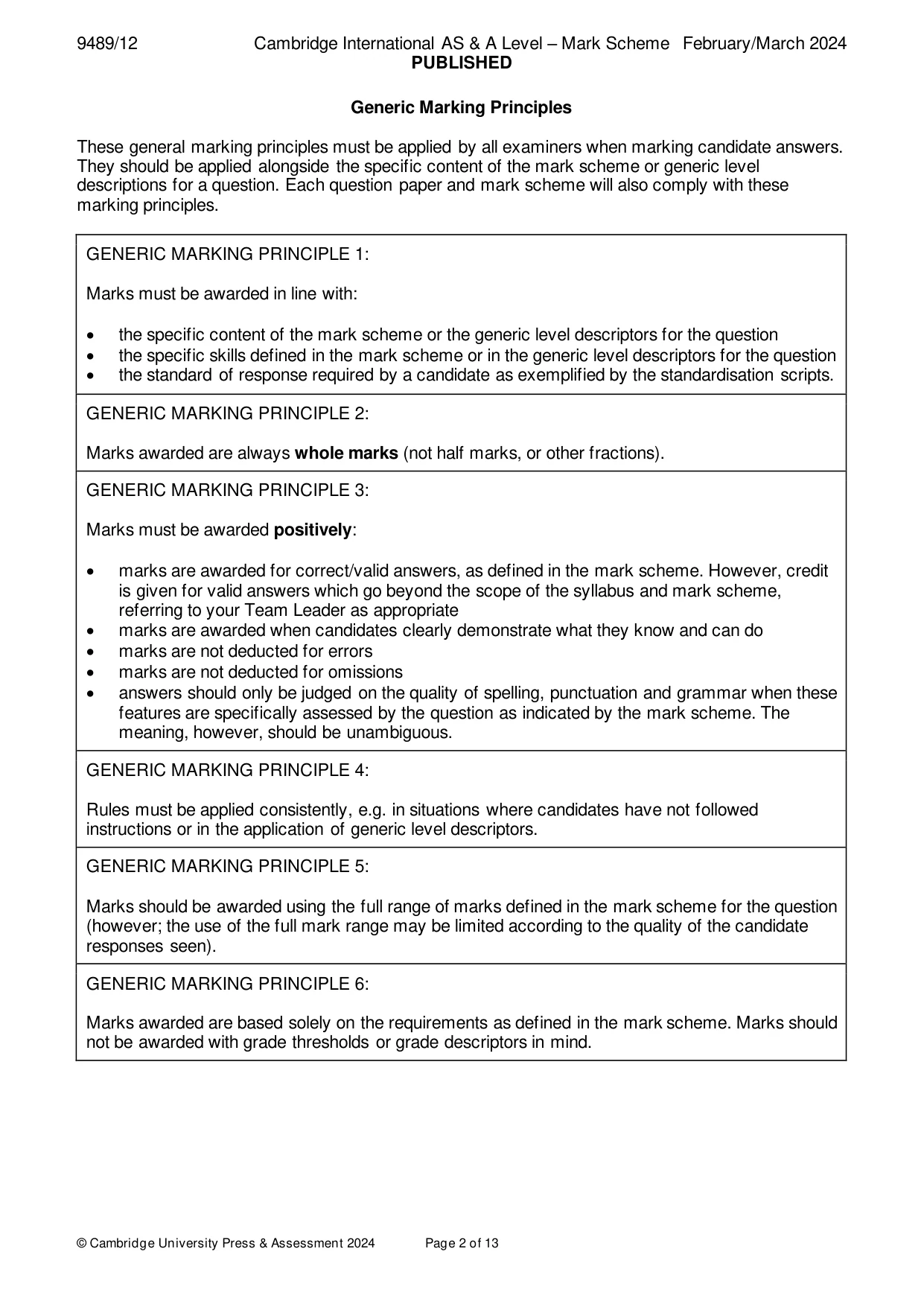
9489/12 Cambridge International AS & A Level – Mark Scheme PUBLISHED February/March 2024 © Cambridge University Press & Assessment 2024 Page 2 of 13 Generic Marking Principles These general marking principles must be applied by all examiners when marking candidate answers. They should be applied alongside the specific content of the mark scheme or generic level descriptions for a question. Each question paper and mark scheme will also comply with these marking principles. GENERIC MARKING PRINCIPLE 1: Marks must be awarded in line with: • the specific content of the mark scheme or the generic level descriptors for the question • the specific skills defined in the mark scheme or in the generic level descriptors for the question • the standard of response required by a candidate as exemplified by the standardisation scripts. GENERIC MARKING PRINCIPLE 2: Marks awarded are always whole marks (not half marks, or other fractions). GENERIC MARKING PRINCIPLE 3: Marks must be awarded positively: • marks are awarded for correct/valid answers, as defined in the mark scheme. However, credit is given for valid answers which go beyond the scope of the syllabus and mark scheme, referring to your Team Leader as appropriate • marks are awarded when candidates clearly demonstrate what they know and can do • marks are not deducted for errors • marks are not deducted for omissions • answers should only be judged on the quality of spelling, punctuation and grammar when these features are specifically assessed by the question as indicated by the mark scheme. The meaning, however, should be unambiguous. GENERIC MARKING PRINCIPLE 4: Rules must be applied consistently, e.g. in situations where candidates have not followed instructions or in the application of generic level descriptors. GENERIC MARKING PRINCIPLE 5: Marks should be awarded using the full range of marks defined in the mark scheme for the question (however; the use of the full mark range may be limited according to the quality of the candidate responses seen). GENERIC MARKING PRINCIPLE 6: Marks awarded are based solely on the requirements as defined in the mark scheme. Marks should not be awarded with grade thresholds or grade descriptors in mind.
Mark scheme, page 3
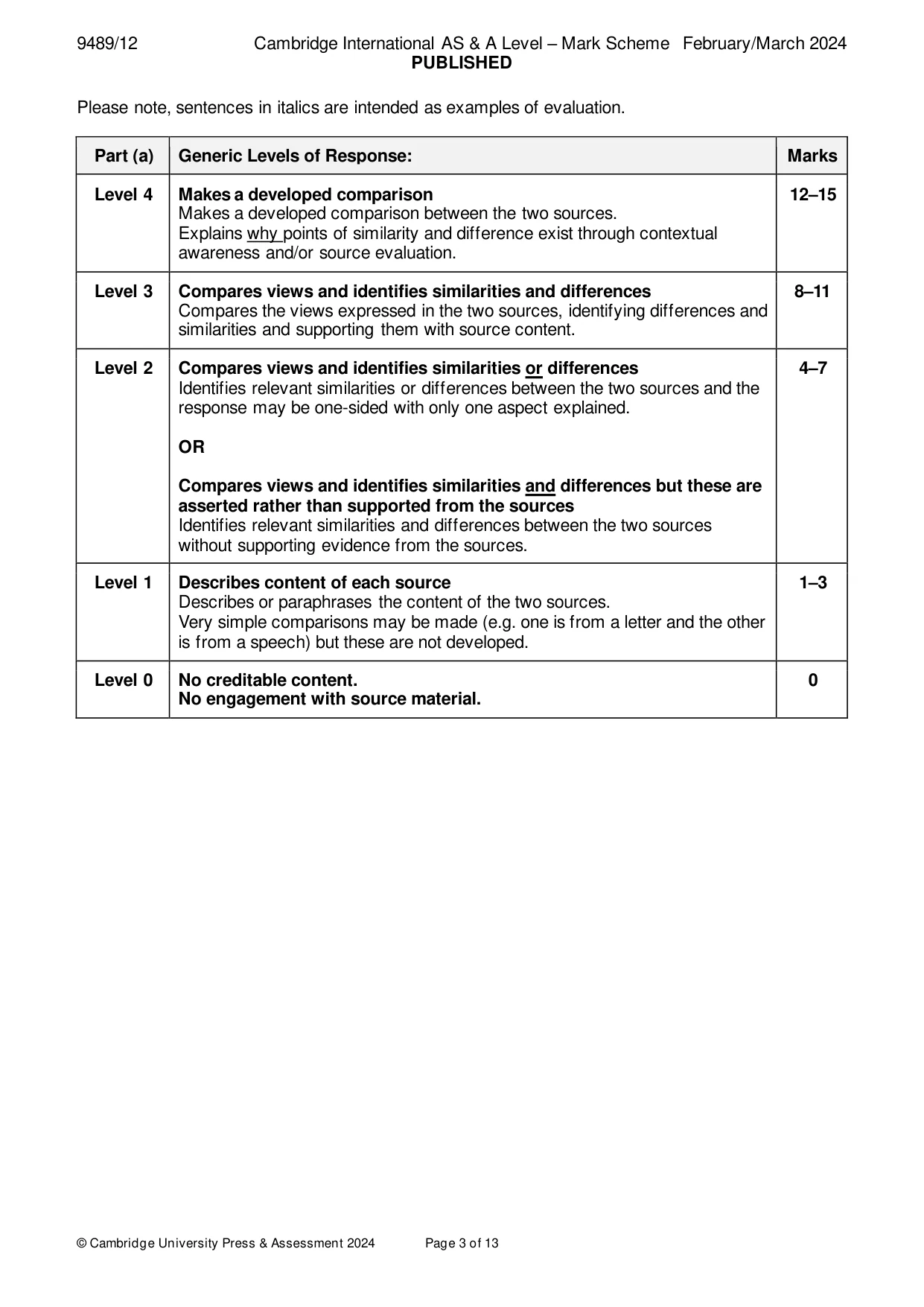
9489/12 Cambridge International AS & A Level – Mark Scheme PUBLISHED February/March 2024 © Cambridge University Press & Assessment 2024 Page 3 of 13 Please note, sentences in italics are intended as examples of evaluation. Part (a) Generic Levels of Response: Marks Level 4 Makes a developed comparison Makes a developed comparison between the two sources. Explains why points of similarity and difference exist through contextual awareness and/or source evaluation. 12–15 Level 3 Compares views and identifies similarities and differences Compares the views expressed in the two sources, identifying differences and similarities and supporting them with source content. 8–11 Level 2 Compares views and identifies similarities or differences Identifies relevant similarities or differences between the two sources and the response may be one-sided with only one aspect explained. OR Compares views and identifies similarities and differences but these are asserted rather than supported from the sources Identifies relevant similarities and differences between the two sources without supporting evidence from the sources. 4–7 Level 1 Describes content of each source Describes or paraphrases the content of the two sources. Very simple comparisons may be made (e.g. one is from a letter and the other is from a speech) but these are not developed. 1–3 Level 0 No creditable content. No engagement with source material. 0
Mark scheme, page 4
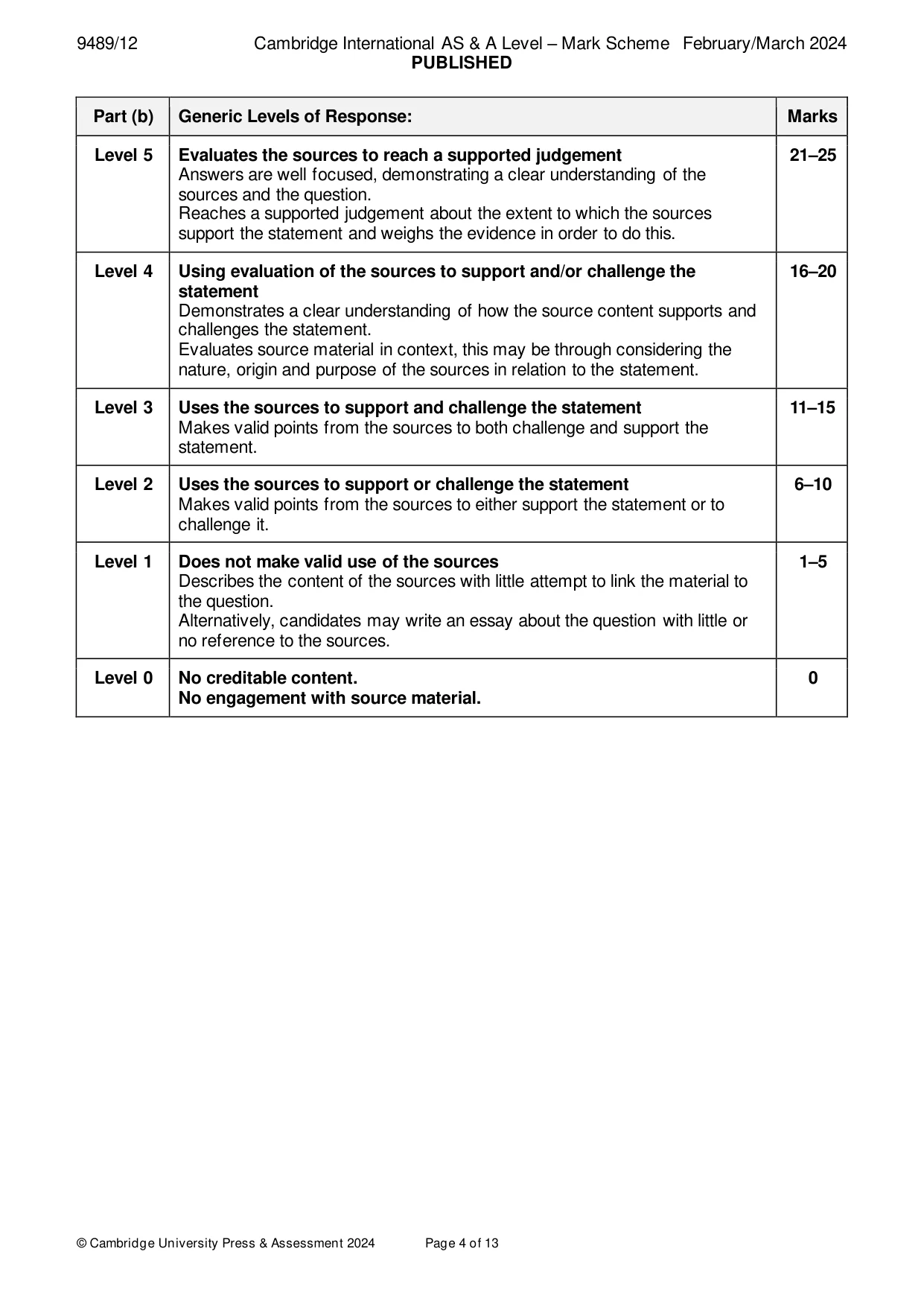
9489/12 Cambridge International AS & A Level – Mark Scheme PUBLISHED February/March 2024 © Cambridge University Press & Assessment 2024 Page 4 of 13 Part (b) Generic Levels of Response: Marks Level 5 Evaluates the sources to reach a supported judgement Answers are well focused, demonstrating a clear understanding of the sources and the question. Reaches a supported judgement about the extent to which the sources support the statement and weighs the evidence in order to do this. 21–25 Level 4 Using evaluation of the sources to support and/or challenge the statement Demonstrates a clear understanding of how the source content supports and challenges the statement. Evaluates source material in context, this may be through considering the nature, origin and purpose of the sources in relation to the statement. 16–20 Level 3 Uses the sources to support and challenge the statement Makes valid points from the sources to both challenge and support the statement. 11–15 Level 2 Uses the sources to support or challenge the statement Makes valid points from the sources to either support the statement or to challenge it. 6–10 Level 1 Does not make valid use of the sources Describes the content of the sources with little attempt to link the material to the question. Alternatively, candidates may write an essay about the question with little or no reference to the sources. 1–5 Level 0 No creditable content. No engagement with source material. 0
Mark scheme, page 5
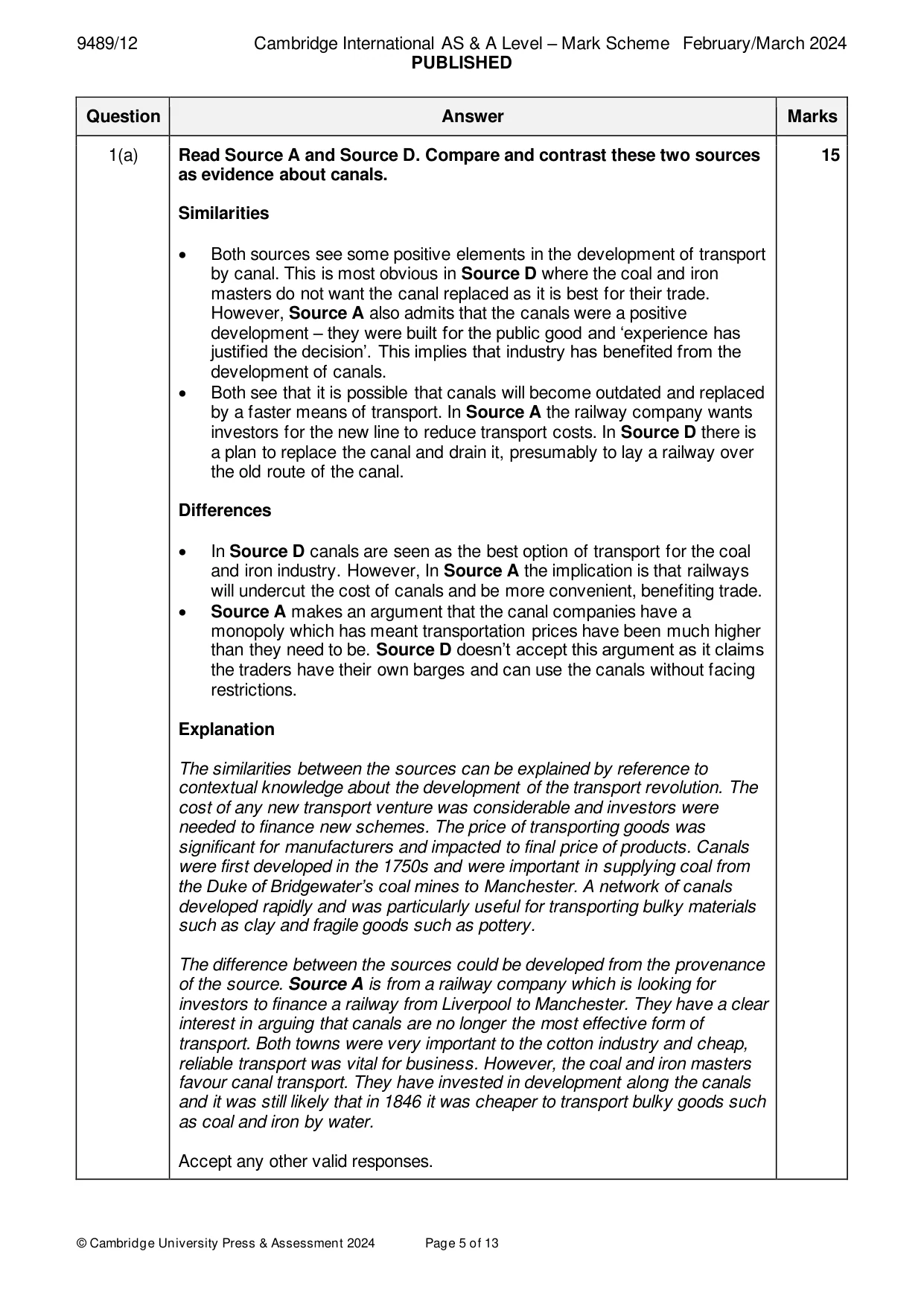
9489/12 Cambridge International AS & A Level – Mark Scheme PUBLISHED February/March 2024 © Cambridge University Press & Assessment 2024 Page 5 of 13 Question Answer Marks 1(a) Read Source A and Source D. Compare and contrast these two sources as evidence about canals. Similarities • Both sources see some positive elements in the development of transport by canal. This is most obvious in Source D where the coal and iron masters do not want the canal replaced as it is best for their trade. However, Source A also admits that the canals were a positive development – they were built for the public good and ‘experience has justified the decision’. This implies that industry has benefited from the development of canals. • Both see that it is possible that canals will become outdated and replaced by a faster means of transport. In Source A the railway company wants investors for the new line to reduce transport costs. In Source D there is a plan to replace the canal and drain it, presumably to lay a railway over the old route of the canal. Differences • In Source D canals are seen as the best option of transport for the coal and iron industry. However, In Source A the implication is that railways will undercut the cost of canals and be more convenient, benefiting trade. • Source A makes an argument that the canal companies have a monopoly which has meant transportation prices have been much higher than they need to be. Source D doesn’t accept this argument as it claims the traders have their own barges and can use the canals without facing restrictions. Explanation The similarities between the sources can be explained by reference to contextual knowledge about the development of the transport revolution. The cost of any new transport venture was considerable and investors were needed to finance new schemes. The price of transporting goods was significant for manufacturers and impacted to final price of products. Canals were first developed in the 1750s and were important in supplying coal from the Duke of Bridgewater’s coal mines to Manchester. A network of canals developed rapidly and was particularly useful for transporting bulky materials such as clay and fragile goods such as pottery. The difference between the sources could be developed from the provenance of the source. Source A is from a railway company which is looking for investors to finance a railway from Liverpool to Manchester. They have a clear interest in arguing that canals are no longer the most effective form of transport. Both towns were very important to the cotton industry and cheap, reliable transport was vital for business. However, the coal and iron masters favour canal transport. They have invested in development along the canals and it was still likely that in 1846 it was cheaper to transport bulky goods such as coal and iron by water. Accept any other valid responses. 15
Mark scheme, page 6
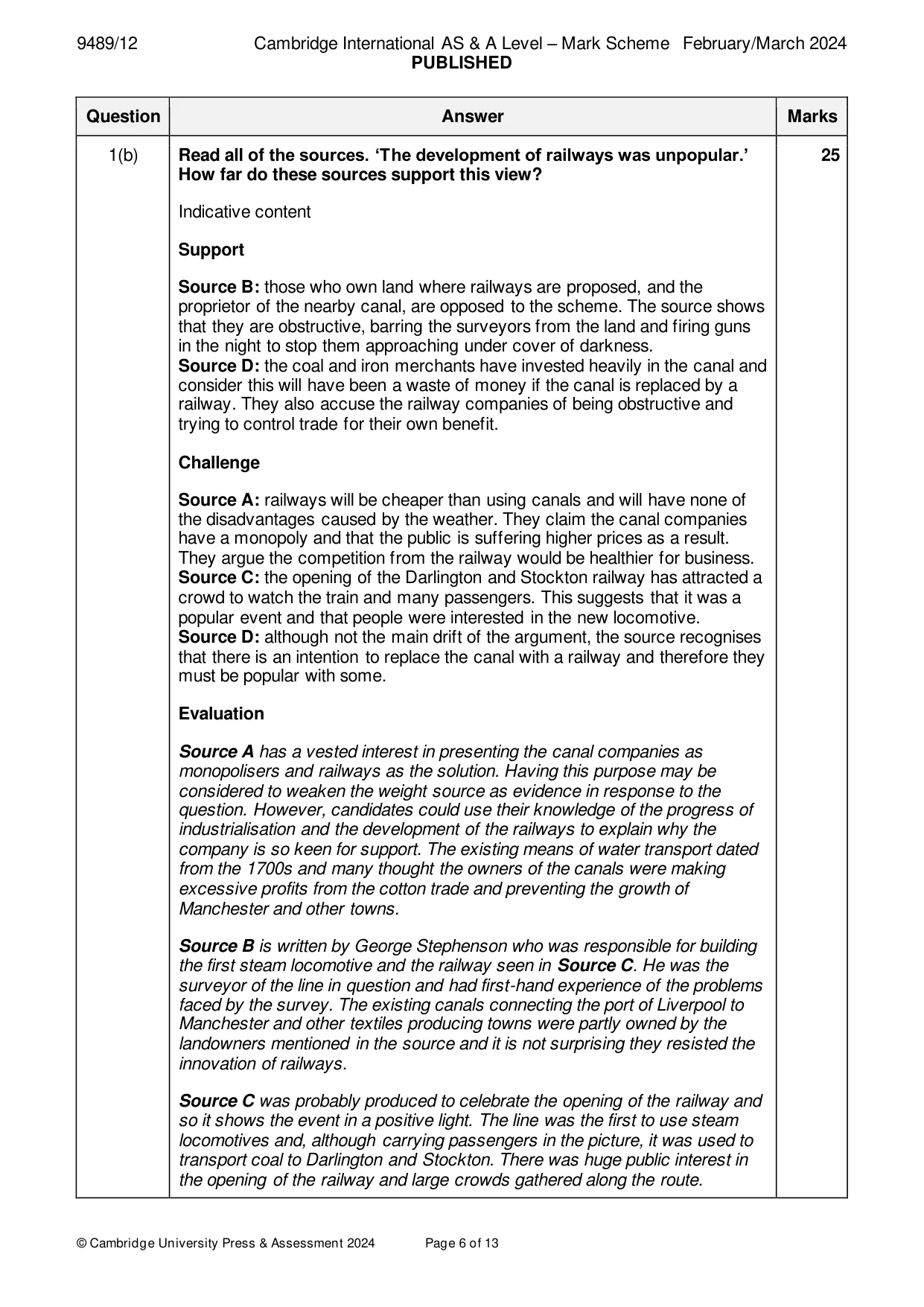
9489/12 Cambridge International AS & A Level – Mark Scheme PUBLISHED February/March 2024 © Cambridge University Press & Assessment 2024 Page 6 of 13 Question Answer Marks 1(b) Read all of the sources. ‘The development of railways was unpopular.’ How far do these sources support this view? Indicative content Support Source B: those who own land where railways are proposed, and the proprietor of the nearby canal, are opposed to the scheme. The source shows that they are obstructive, barring the surveyors from the land and firing guns in the night to stop them approaching under cover of darkness. Source D: the coal and iron merchants have invested heavily in the canal and consider this will have been a waste of money if the canal is replaced by a railway. They also accuse the railway companies of being obstructive and trying to control trade for their own benefit. Challenge Source A: railways will be cheaper than using canals and will have none of the disadvantages caused by the weather. They claim the canal companies have a monopoly and that the public is suffering higher prices as a result. They argue the competition from the railway would be healthier for business. Source C: the opening of the Darlington and Stockton railway has attracted a crowd to watch the train and many passengers. This suggests that it was a popular event and that people were interested in the new locomotive. Source D: although not the main drift of the argument, the source recognises that there is an intention to replace the canal with a railway and therefore they must be popular with some. Evaluation Source A has a vested interest in presenting the canal companies as monopolisers and railways as the solution. Having this purpose may be considered to weaken the weight source as evidence in response to the question. However, candidates could use their knowledge of the progress of industrialisation and the development of the railways to explain why the company is so keen for support. The existing means of water transport dated from the 1700s and many thought the owners of the canals were making excessive profits from the cotton trade and preventing the growth of Manchester and other towns. Source B is written by George Stephenson who was responsible for building the first steam locomotive and the railway seen in Source C. He was the surveyor of the line in question and had first-hand experience of the problems faced by the survey. The existing canals connecting the port of Liverpool to Manchester and other textiles producing towns were partly owned by the landowners mentioned in the source and it is not surprising they resisted the innovation of railways. Source C was probably produced to celebrate the opening of the railway and so it shows the event in a positive light. The line was the first to use steam locomotives and, although carrying passengers in the picture, it was used to transport coal to Darlington and Stockton. There was huge public interest in the opening of the railway and large crowds gathered along the route. 25
Mark scheme, page 7
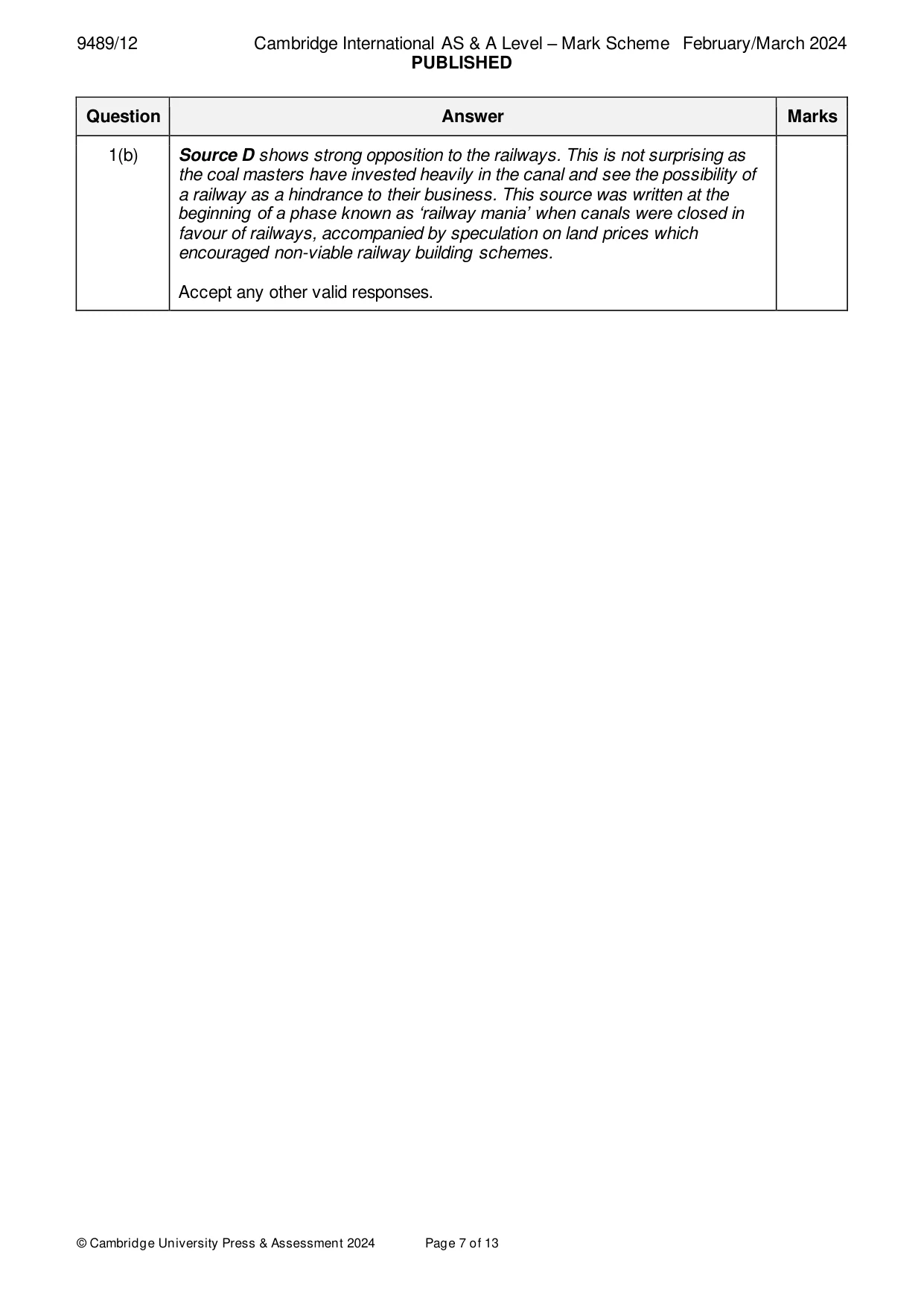
9489/12 Cambridge International AS & A Level – Mark Scheme PUBLISHED February/March 2024 © Cambridge University Press & Assessment 2024 Page 7 of 13 Question Answer Marks 1(b) Source D shows strong opposition to the railways. This is not surprising as the coal masters have invested heavily in the canal and see the possibility of a railway as a hindrance to their business. This source was written at the beginning of a phase known as ‘railway mania’ when canals were closed in favour of railways, accompanied by speculation on land prices which encouraged non-viable railway building schemes. Accept any other valid responses.
Mark scheme, page 8
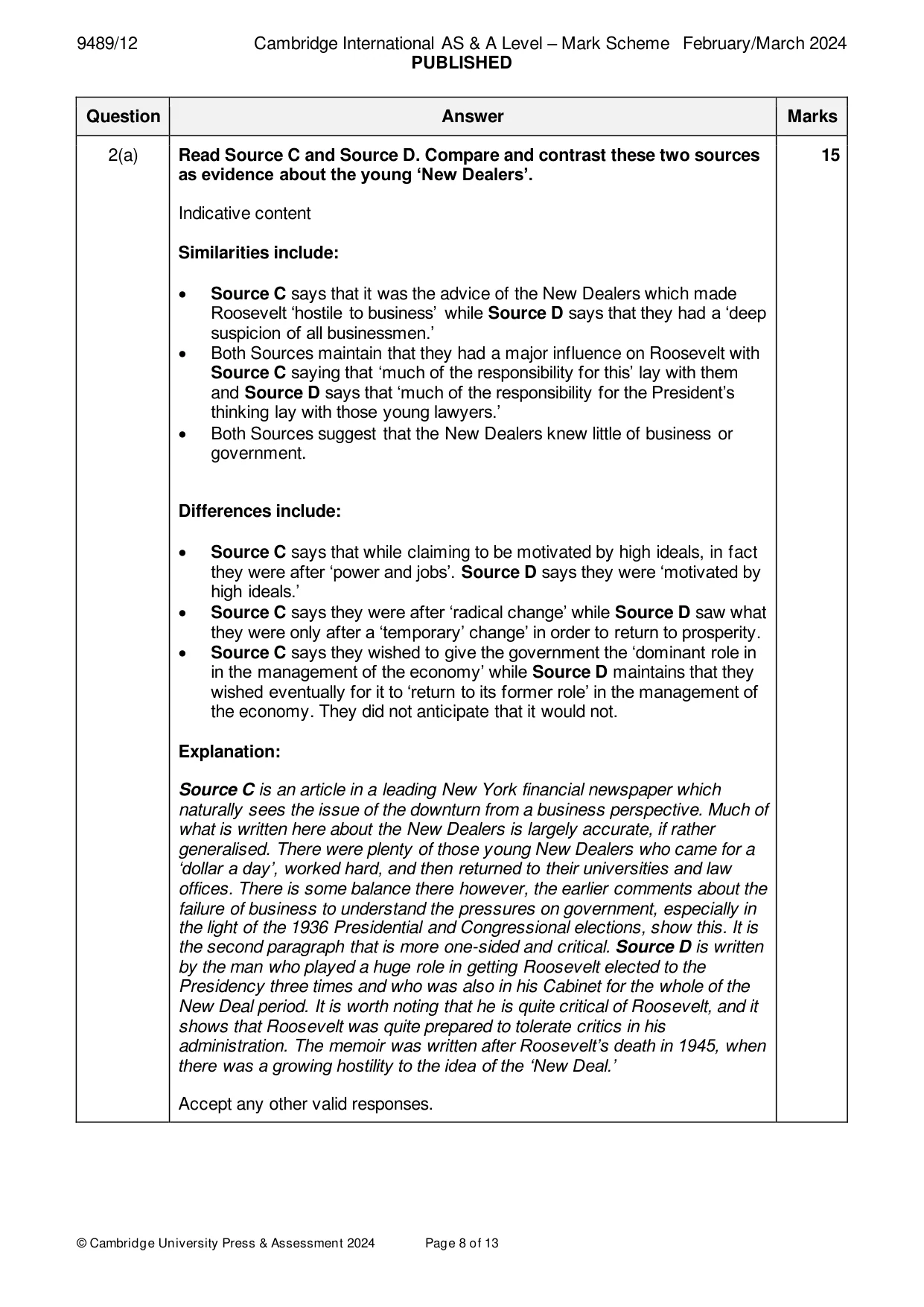
9489/12 Cambridge International AS & A Level – Mark Scheme PUBLISHED February/March 2024 © Cambridge University Press & Assessment 2024 Page 8 of 13 Question Answer Marks 2(a) Read Source C and Source D. Compare and contrast these two sources as evidence about the young ‘New Dealers’. Indicative content Similarities include: • Source C says that it was the advice of the New Dealers which made Roosevelt ‘hostile to business’ while Source D says that they had a ‘deep suspicion of all businessmen.’ • Both Sources maintain that they had a major influence on Roosevelt with Source C saying that ‘much of the responsibility for this’ lay with them and Source D says that ‘much of the responsibility for the President’s thinking lay with those young lawyers.’ • Both Sources suggest that the New Dealers knew little of business or government. Differences include: • Source C says that while claiming to be motivated by high ideals, in fact they were after ‘power and jobs’. Source D says they were ‘motivated by high ideals.’ • Source C says they were after ‘radical change’ while Source D saw what they were only after a ‘temporary’ change’ in order to return to prosperity. • Source C says they wished to give the government the ‘dominant role in in the management of the economy’ while Source D maintains that they wished eventually for it to ‘return to its former role’ in the management of the economy. They did not anticipate that it would not. Explanation: Source C is an article in a leading New York financial newspaper which naturally sees the issue of the downturn from a business perspective. Much of what is written here about the New Dealers is largely accurate, if rather generalised. There were plenty of those young New Dealers who came for a ‘dollar a day’, worked hard, and then returned to their universities and law offices. There is some balance there however, the earlier comments about the failure of business to understand the pressures on government, especially in the light of the 1936 Presidential and Congressional elections, show this. It is the second paragraph that is more one-sided and critical. Source D is written by the man who played a huge role in getting Roosevelt elected to the Presidency three times and who was also in his Cabinet for the whole of the New Deal period. It is worth noting that he is quite critical of Roosevelt, and it shows that Roosevelt was quite prepared to tolerate critics in his administration. The memoir was written after Roosevelt’s death in 1945, when there was a growing hostility to the idea of the ‘New Deal.’ Accept any other valid responses. 15
Mark scheme, page 9
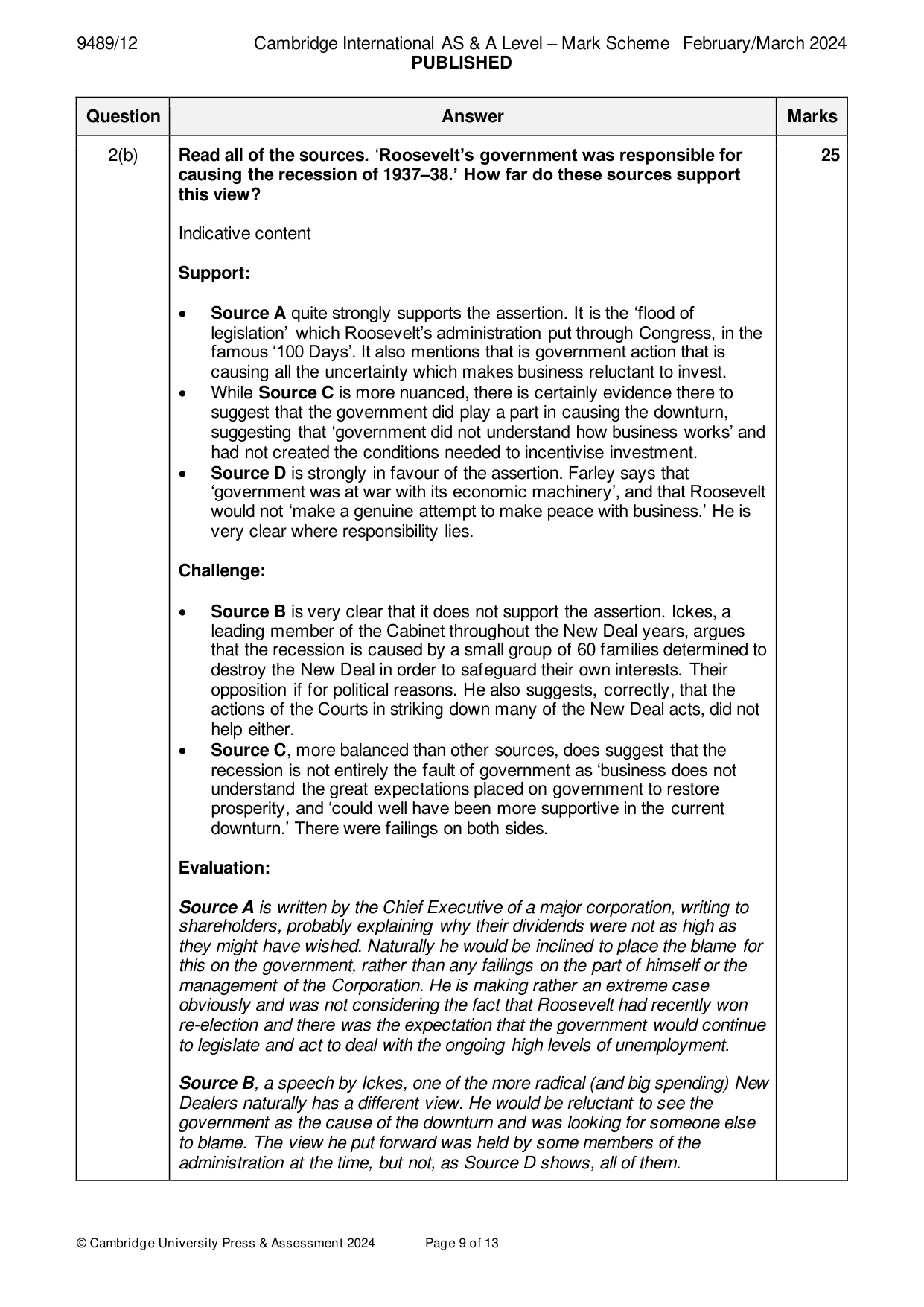
9489/12 Cambridge International AS & A Level – Mark Scheme PUBLISHED February/March 2024 © Cambridge University Press & Assessment 2024 Page 9 of 13 Question Answer Marks 2(b) Read all of the sources. ‘Roosevelt’s government was responsible for causing the recession of 1937–38.’ How far do these sources support this view? Indicative content Support: • Source A quite strongly supports the assertion. It is the ‘flood of legislation’ which Roosevelt’s administration put through Congress, in the famous ‘100 Days’. It also mentions that is government action that is causing all the uncertainty which makes business reluctant to invest. • While Source C is more nuanced, there is certainly evidence there to suggest that the government did play a part in causing the downturn, suggesting that ‘government did not understand how business works’ and had not created the conditions needed to incentivise investment. • Source D is strongly in favour of the assertion. Farley says that ‘government was at war with its economic machinery’, and that Roosevelt would not ‘make a genuine attempt to make peace with business.’ He is very clear where responsibility lies. Challenge: • Source B is very clear that it does not support the assertion. Ickes, a leading member of the Cabinet throughout the New Deal years, argues that the recession is caused by a small group of 60 families determined to destroy the New Deal in order to safeguard their own interests. Their opposition if for political reasons. He also suggests, correctly, that the actions of the Courts in striking down many of the New Deal acts, did not help either. • Source C, more balanced than other sources, does suggest that the recession is not entirely the fault of government as ‘business does not understand the great expectations placed on government to restore prosperity, and ‘could well have been more supportive in the current downturn.’ There were failings on both sides. Evaluation: Source A is written by the Chief Executive of a major corporation, writing to shareholders, probably explaining why their dividends were not as high as they might have wished. Naturally he would be inclined to place the blame for this on the government, rather than any failings on the part of himself or the management of the Corporation. He is making rather an extreme case obviously and was not considering the fact that Roosevelt had recently won re-election and there was the expectation that the government would continue to legislate and act to deal with the ongoing high levels of unemployment. Source B, a speech by Ickes, one of the more radical (and big spending) New Dealers naturally has a different view. He would be reluctant to see the government as the cause of the downturn and was looking for someone else to blame. The view he put forward was held by some members of the administration at the time, but not, as Source D shows, all of them. 25
Mark scheme, page 10
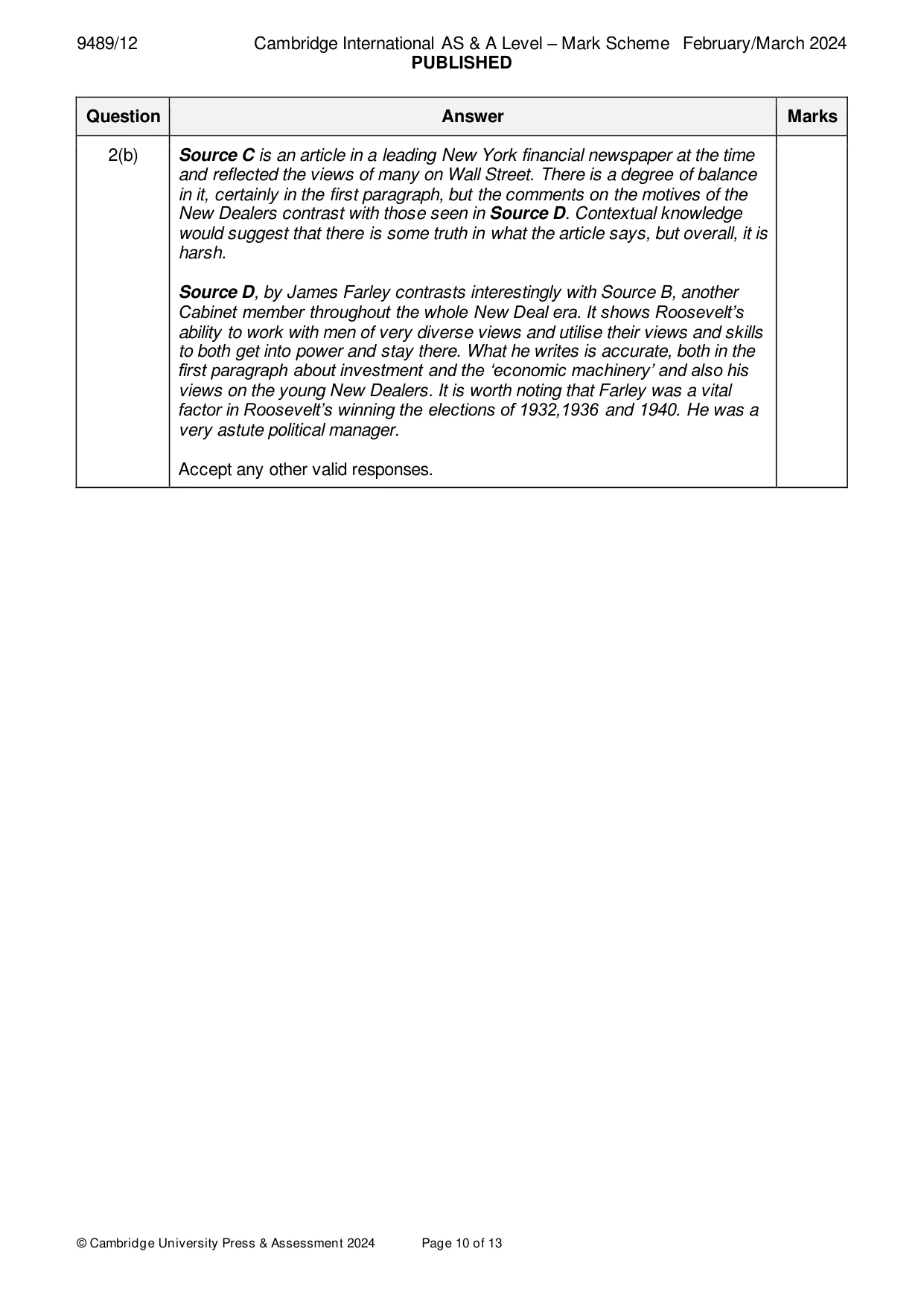
9489/12 Cambridge International AS & A Level – Mark Scheme PUBLISHED February/March 2024 © Cambridge University Press & Assessment 2024 Page 10 of 13 Question Answer Marks 2(b) Source C is an article in a leading New York financial newspaper at the time and reflected the views of many on Wall Street. There is a degree of balance in it, certainly in the first paragraph, but the comments on the motives of the New Dealers contrast with those seen in Source D. Contextual knowledge would suggest that there is some truth in what the article says, but overall, it is harsh. Source D, by James Farley contrasts interestingly with Source B, another Cabinet member throughout the whole New Deal era. It shows Roosevelt’s ability to work with men of very diverse views and utilise their views and skills to both get into power and stay there. What he writes is accurate, both in the first paragraph about investment and the ‘economic machinery’ and also his views on the young New Dealers. It is worth noting that Farley was a vital factor in Roosevelt’s winning the elections of 1932,1936 and 1940. He was a very astute political manager. Accept any other valid responses.
Mark scheme, page 11
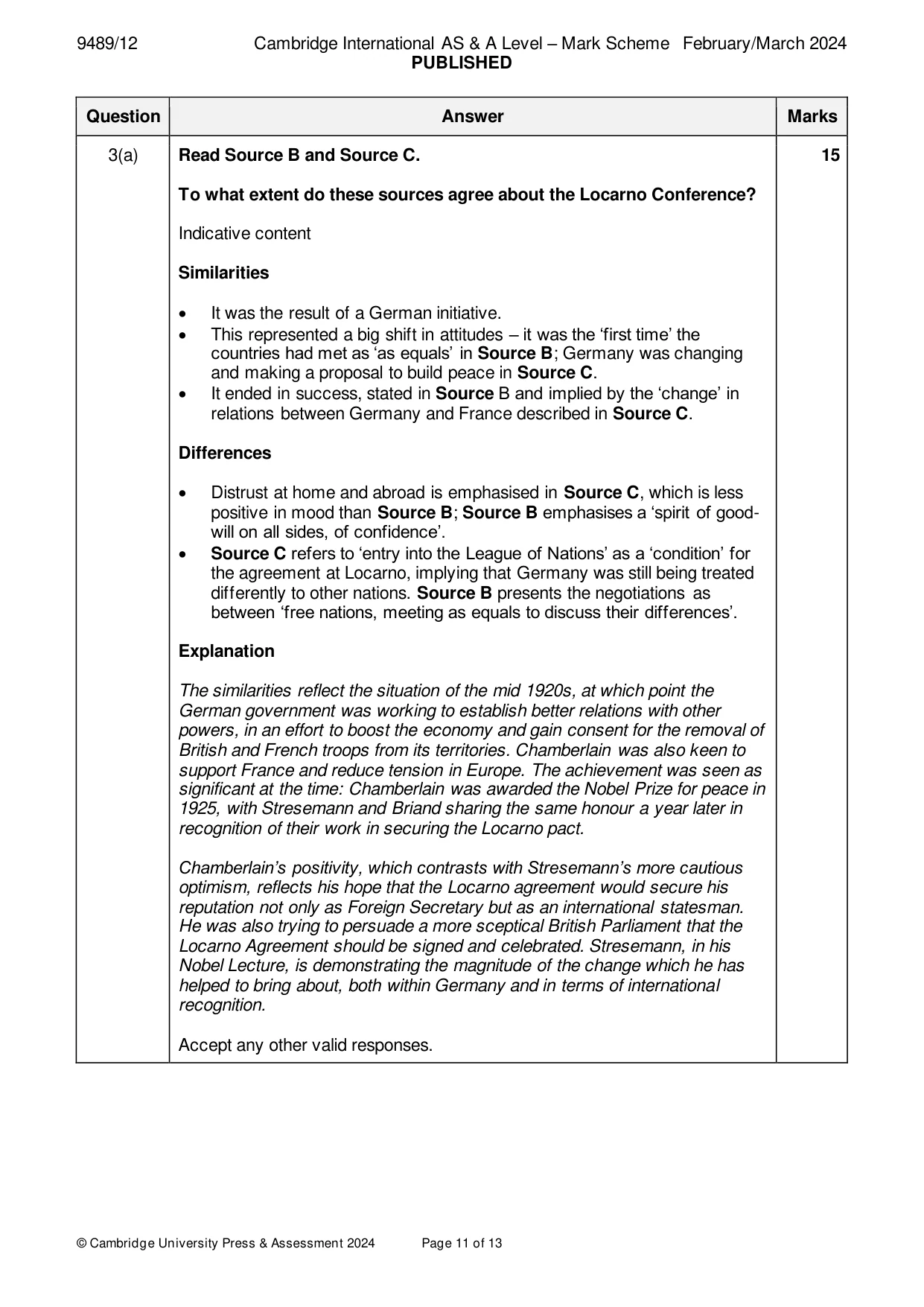
9489/12 Cambridge International AS & A Level – Mark Scheme PUBLISHED February/March 2024 © Cambridge University Press & Assessment 2024 Page 11 of 13 Question Answer Marks 3(a) Read Source B and Source C. To what extent do these sources agree about the Locarno Conference? Indicative content Similarities • It was the result of a German initiative. • This represented a big shift in attitudes – it was the ‘first time’ the countries had met as ‘as equals’ in Source B; Germany was changing and making a proposal to build peace in Source C. • It ended in success, stated in Source B and implied by the ‘change’ in relations between Germany and France described in Source C. Differences • Distrust at home and abroad is emphasised in Source C, which is less positive in mood than Source B; Source B emphasises a ‘spirit of good- will on all sides, of confidence’. • Source C refers to ‘entry into the League of Nations’ as a ‘condition’ for the agreement at Locarno, implying that Germany was still being treated differently to other nations. Source B presents the negotiations as between ‘free nations, meeting as equals to discuss their differences’. Explanation The similarities reflect the situation of the mid 1920s, at which point the German government was working to establish better relations with other powers, in an effort to boost the economy and gain consent for the removal of British and French troops from its territories. Chamberlain was also keen to support France and reduce tension in Europe. The achievement was seen as significant at the time: Chamberlain was awarded the Nobel Prize for peace in 1925, with Stresemann and Briand sharing the same honour a year later in recognition of their work in securing the Locarno pact. Chamberlain’s positivity, which contrasts with Stresemann’s more cautious optimism, reflects his hope that the Locarno agreement would secure his reputation not only as Foreign Secretary but as an international statesman. He was also trying to persuade a more sceptical British Parliament that the Locarno Agreement should be signed and celebrated. Stresemann, in his Nobel Lecture, is demonstrating the magnitude of the change which he has helped to bring about, both within Germany and in terms of international recognition. Accept any other valid responses. 15
Mark scheme, page 12
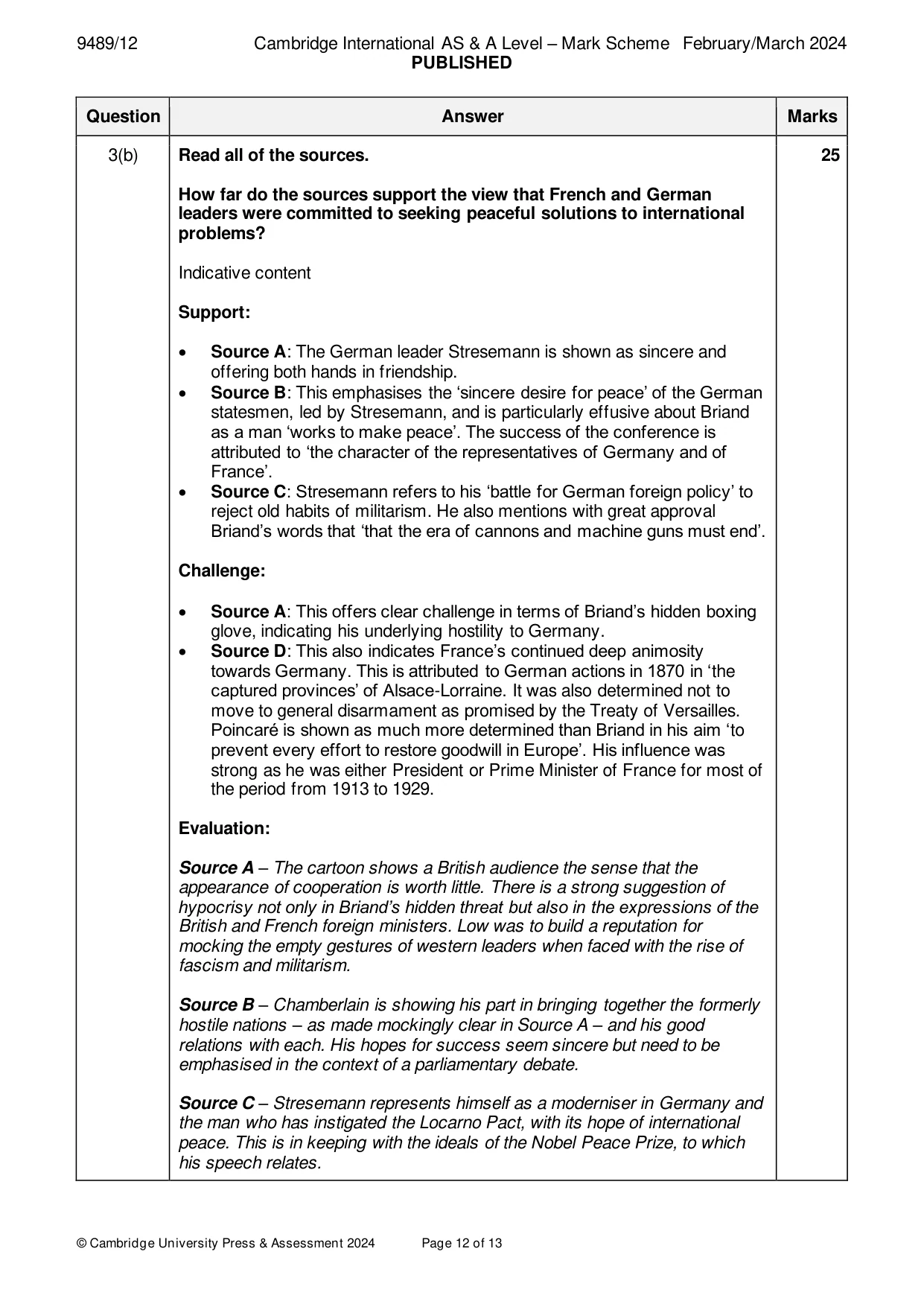
9489/12 Cambridge International AS & A Level – Mark Scheme PUBLISHED February/March 2024 © Cambridge University Press & Assessment 2024 Page 12 of 13 Question Answer Marks 3(b) Read all of the sources. How far do the sources support the view that French and German leaders were committed to seeking peaceful solutions to international problems? Indicative content Support: • Source A: The German leader Stresemann is shown as sincere and offering both hands in friendship. • Source B: This emphasises the ‘sincere desire for peace’ of the German statesmen, led by Stresemann, and is particularly effusive about Briand as a man ‘works to make peace’. The success of the conference is attributed to ‘the character of the representatives of Germany and of France’. • Source C: Stresemann refers to his ‘battle for German foreign policy’ to reject old habits of militarism. He also mentions with great approval Briand’s words that ‘that the era of cannons and machine guns must end’. Challenge: • Source A: This offers clear challenge in terms of Briand’s hidden boxing glove, indicating his underlying hostility to Germany. • Source D: This also indicates France’s continued deep animosity towards Germany. This is attributed to German actions in 1870 in ‘the captured provinces’ of Alsace-Lorraine. It was also determined not to move to general disarmament as promised by the Treaty of Versailles. Poincaré is shown as much more determined than Briand in his aim ‘to prevent every effort to restore goodwill in Europe’. His influence was strong as he was either President or Prime Minister of France for most of the period from 1913 to 1929. Evaluation: Source A – The cartoon shows a British audience the sense that the appearance of cooperation is worth little. There is a strong suggestion of hypocrisy not only in Briand’s hidden threat but also in the expressions of the British and French foreign ministers. Low was to build a reputation for mocking the empty gestures of western leaders when faced with the rise of fascism and militarism. Source B – Chamberlain is showing his part in bringing together the formerly hostile nations – as made mockingly clear in Source A – and his good relations with each. His hopes for success seem sincere but need to be emphasised in the context of a parliamentary debate. Source C – Stresemann represents himself as a moderniser in Germany and the man who has instigated the Locarno Pact, with its hope of international peace. This is in keeping with the ideals of the Nobel Peace Prize, to which his speech relates. 25
Mark scheme, page 13
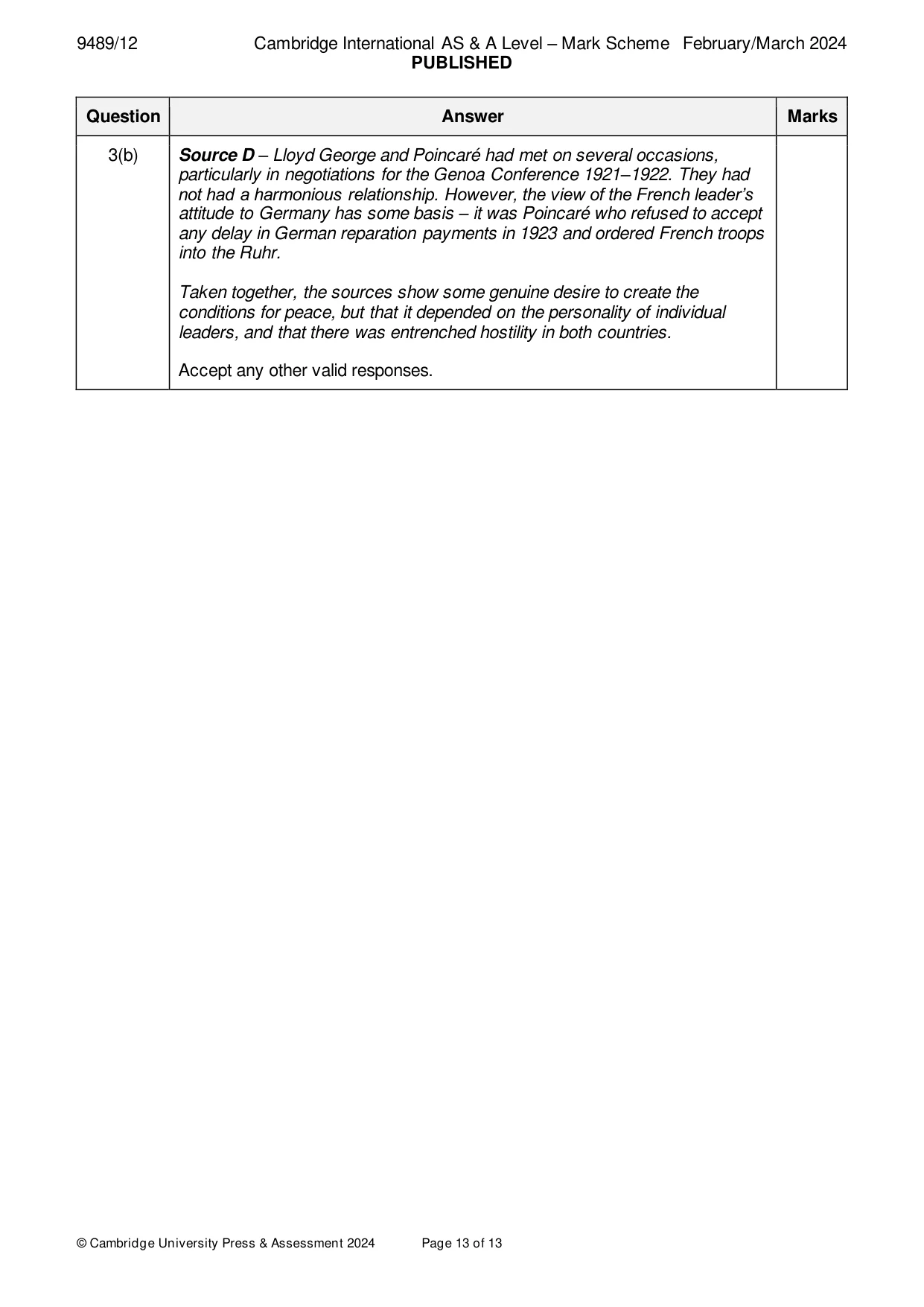
9489/12 Cambridge International AS & A Level – Mark Scheme PUBLISHED February/March 2024 © Cambridge University Press & Assessment 2024 Page 13 of 13 Question Answer Marks 3(b) Source D – Lloyd George and Poincaré had met on several occasions, particularly in negotiations for the Genoa Conference 1921–1922. They had not had a harmonious relationship. However, the view of the French leader’s attitude to Germany has some basis – it was Poincaré who refused to accept any delay in German reparation payments in 1923 and ordered French troops into the Ruhr. Taken together, the sources show some genuine desire to create the conditions for peace, but that it depended on the personality of individual leaders, and that there was entrenched hostility in both countries. Accept any other valid responses.
What you needed in this session
Cambridge’s own grade thresholds for 2024 Feb/March, Paper 1 · Variant 2. A higher threshold means an easier paper — the bar moves with how the cohort did.