Cambridge A Level History 9489 — 2025 Feb/March Paper 1 · Variant 2
9489/12/F/M/25 · 40 marks · ≈45 min
The question paper and its mark scheme, free to read here and free to download. This is Cambridge’s own paper, exactly as it was sat.
Question paper8 pages

Mark scheme14 pages
Answers below. Sit the paper first if you are practising.
Paper as text
Question paper, page 1
[Turn over Cambridge International AS & A Level DC (WW/FC) 342784/2 © UCLES 2025 This document has 8 pages. Any blank pages are indicated. * 8 0 7 9 8 3 7 6 8 6 * HISTORY 9489/12 Paper 1 Document Question February/March 2025 1 hour 15 minutes You must answer on the enclosed answer booklet. You will need: Answer booklet (enclosed) INSTRUCTIONS ● Answer one question from one section only. Section A: European option Section B: American option Section C: International option ● Follow the instructions on the front cover of the answer booklet. If you need additional answer paper, ask the invigilator for a continuation booklet. INFORMATION ● The total mark for this paper is 40. ● The number of marks for each question or part question is shown in brackets [ ].
Question paper, page 2
2 9489/12/F/M/25 © UCLES 2025 Answer one question from one section only. Section A: European option Liberalism and nationalism in Germany, 1815–71 1 Read the sources and then answer both parts of the question. Source A His Majesty observed that the threatening attitude of Prussia raises the question of whether Austria should make warlike preparations. His Majesty concluded that he should leave warlike preparations aside for the time being and continue to seek to maintain the honour and dignity of the country by diplomatic means. From an account of a meeting between the Austrian Emperor and senior government officials, February 1866. Source B As a political question, the probability or inevitability of war against Austria lies outside the scope of my judgement. Success or failure in this war depends on our reaching a decision about it sooner than the Austrians, and, if possible, right now. For Prussia, everything depends on defeating Austria, and to this end we have to bring together all our forces. One advantage for us, which cannot be overstated, is that we can advance our army on five railroad lines and thereby have it concentrated on the Saxon–Bohemian border within 25 days. Austria has just one railway leading toward Bohemia. Assuming that its cavalry is already on the march, it requires 45 days to assemble 200 000 men. If Bavaria joins Austria, the Regensburg‑Pilsen‑Prague railway line will be disadvantageous for us since it shortens the time Austria needs to be ready by about 15 days. If the mobilisation of the Prussian army is ordered right now, then Bavaria, so ill‑prepared in terms of arms and mobilisation, will probably not be ready until after the first battle between Austria and Prussia has been fought. From a memorandum by Moltke, Chief of the Prussian General Staff, April 1866. Content removed due to copyright restrictions.
Question paper, page 3
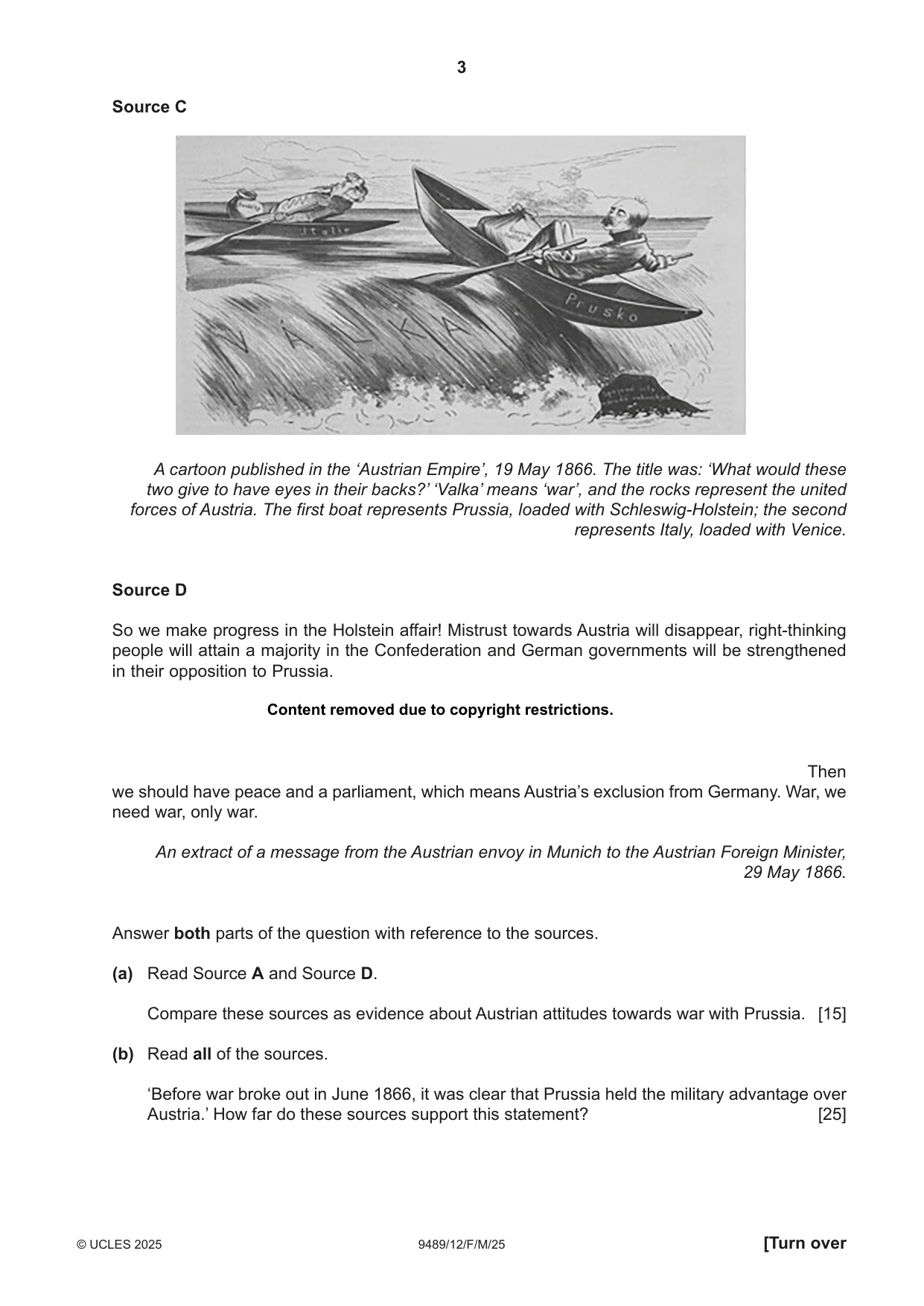
3 9489/12/F/M/25 © UCLES 2025 [Turn over Source C A cartoon published in the ‘Austrian Empire’, 19 May 1866. The title was: ‘What would these two give to have eyes in their backs?’ ‘Valka’ means ‘war’, and the rocks represent the united forces of Austria. The first boat represents Prussia, loaded with Schleswig‑Holstein; the second represents Italy, loaded with Venice. Source D So we make progress in the Holstein affair! Mistrust towards Austria will disappear, right‑thinking people will attain a majority in the Confederation and German governments will be strengthened in their opposition to Prussia. Then we should have peace and a parliament, which means Austria’s exclusion from Germany. War, we need war, only war. An extract of a message from the Austrian envoy in Munich to the Austrian Foreign Minister, 29 May 1866. Answer both parts of the question with reference to the sources. (a) Read Source A and Source D. Compare these sources as evidence about Austrian attitudes towards war with Prussia. [15] (b) Read all of the sources. ‘Before war broke out in June 1866, it was clear that Prussia held the military advantage over Austria.’ How far do these sources support this statement? [25] Content removed due to copyright restrictions.
Question paper, page 4
4 9489/12/F/M/25 © UCLES 2025 Section B: American option The origins of the Civil War, 1820–61 2 Read the sources and then answer both parts of the question. Source A The speeches of Mr Clay may have calmed the passions of the South but it is doubtful whether any of his speeches changed a single vote. Their real service was to gain time for others to work out the details of the Compromise in secret. Mr Clay will still go down in history as the great compromiser, but with this Compromise he did not provide the leadership he has done in the past. His proposals to settle the territorial question and to place all the questions in one comprehensive measure were rejected. The Administration hated him as did some Democrats as they feared the success of his bill would make him president. However, he fought a glorious and patriotic battle. No man was ever governed by higher or purer motives. This Compromise is the work of Mr Douglas. He convinced many Whigs of the need to co‑operate. The initial idea was his suggestion. He drew up the California, Utah, and New Mexico bills and collaborated with Pierce and the Whigs in drawing up the Texas bill. All were carried under his leadership. His ability to persuade many to forget their partisan divisions was remarkable. I echo the remark of Mr Jefferson Davis, ‘If any man has a right to be proud of the success of these measures, it is the Senator from Illinois’. From a speech by the Democrat Senator for Virginia in the Senate, 16 September 1850. Source B This Compromise has finally passed because Congress responded to the great popular feeling that the Union needed to be protected. The public demanded that the extreme views of the secessionists and the abolitionists be rejected. Mindful of the coming autumn elections, members of Congress voted accordingly. Those who desired compromise were also fortunate that President Taylor died when he did, as President Fillmore was prepared to sign the bills which his predecessor may well have vetoed. From the ‘New‑York Daily Tribune’, 19 October 1850. Source C In 1850 Mr Clay left the peace and quiet of his home to restore peace to our troubled Union. We Democrats all welcomed him as did the whole nation. He was regarded as having been preserved by God for this moment. He became our leader in the great fight, and we rallied round him. His great, and many say his finest, speeches led many away from the road to disunion. While some of the measures he advocated did not pass, the presence of such a man of principle, with his wish for compromise rather than conflict, was vital to the final outcome. We Democrats joined with the Whigs and forgot our old fights as the Union was in danger. We managed to oppose the Abolitionists successfully and united together over the Compromise measures. These measures passed because of the joint actions of our two parties. Stephen Douglas, speaking in one of the Lincoln–Douglas debates, 15 October 1858.
Question paper, page 5
5 9489/12/F/M/25 © UCLES 2025 [Turn over Source D The driving force behind the Compromise, pushed through Congress against the original convictions of the majority of its members, was revealed in the bill dealing with Texas. This specified that largely worthless bonds which formed the public debt of Texas would be repaid and thus greatly increase in value. Many of those holding the bonds were members of Congress and their supporters. This was probably the first time in our history when a vital measure was passed in Congress because of the financial benefit to members. Congress also knew that the people wanted peace and prosperity. They were reluctant to lose those in a quarrel (as they saw it) over slavery. From ‘The American Conflict’, a history written by a Northern newspaper publisher and journalist, published in 1864. Answer both parts of the question with reference to the sources. (a) Read Source A and Source C. Compare and contrast the sources as evidence of Clay’s role in the Compromise of 1850. [15] (b) Read all of the sources. How far do these sources support the view that the Compromise passed principally as a result of the cooperation between the Whig and the Democratic parties? [25]
Question paper, page 6
6 9489/12/F/M/25 © UCLES 2025 Section C: International option The League of Nations and international relations in the 1930s 3 Read the sources and then answer both parts of the question. Source A It is my unalterable decision to smash Czechoslovakia by military action soon. I will wait for, or create, the most suitable moment from a political and military point of view. To this end, preparations are to be made immediately. The following are necessary for the intended attack: a) An apparent excuse; b) Adequate political justification; c) Action not expected by the enemy which will find it unprepared. Most favourable would be action as the result of provocation which, in the eyes of at least some international opinion, gives the moral justification for military measures. It is important to increase the total economic war effort so sparing, as far as military operations permit, Czech industrial and engineering establishments may be of decisive importance. Hitler’s secret directive for the invasion of Czechoslovakia, 30 May 1938. Source B The creation of Czechoslovakia after the war was complete insanity. This Czech illness must be dealt with. It is like a cancer which will infect international relations until they finally break down. As an ally of the Soviet Union, Czechoslovakia points like a dagger at the heart of Germany. It has reinforced my determination to create a mighty German Luftwaffe. If we fail to resolve the crisis now, Göring would soon be asking me to double the Luftwaffe’s forces once again, then Britain and France would double theirs as well, and so the insane race would go on. Seven million Czechs oppress eight million minority peoples. It was a deed of insanity and ignorance to have a handful of obviously inferior Czechs rule over minorities. Sudeten Germans have absolutely no respect for the Czechs and will not submit to their rule. Hitler speaking in an interview with a British journalist, 17 September 1938.
Question paper, page 7
7 9489/12/F/M/25 © UCLES 2025 Source C The problem of relations between races in the territory now called Czechoslovakia has existed for many centuries with periods of fierce struggle and periods of relative calm. Sudeten extremists provoked the riots after Hitler’s speech; they were responsible for the breakdown of negotiations between Czechoslovakia and Germany, encouraged by their followers at home and abroad. However, I have great sympathy for the Sudetenland cause. It is hard to be ruled by a foreign race. My impression is that the Czechoslovak government, although not actually oppressive, was marked by tactlessness and discrimination that has led to the resentment of the German population. Czech officials and policemen who did not speak German were appointed to German districts, and many believe that the state provided work and aid to the Czechs much more willingly than to the Germans. I think these complaints are largely justified. The rise of Nazi Germany gave the Sudeten Germans new hope and a very large majority of their population wishes to merge with Germany. Lord Runciman to Prime Minister Chamberlain, 21 September 1938. A mission of British diplomats led by Lord Runciman was sent to Prague on 3 August 1938. Source D Prague was accused of systematically mistreating the Germans of Sudetenland, much like the Vienna government had been accused of mistreating the German part of the population. The German press echoed the complaints and exposed at length and indignantly the injustices they suffered; it called for a speedy end to this intolerable abuse, which incidentally had never been mentioned before Hitler gained power. The German newspapers recalled with suspicious perseverance the atrocities committed in the distant past by the ancestors of the Czechs. The entire policy reeked of evil intent which the Nazi chiefs did not even trouble to conceal. One evening at dinner at the French Embassy, when champagne had disposed him to be indiscreet, Göring tackled the subject squarely. ‘Consider the shape of Czechoslovakia on the map,’ he told me. ‘Isn’t this a challenge to common sense? We shall have to eliminate it.’ From the memoirs of the French Ambassador in Berlin from 1931 to 1938, published in 1949. Answer both parts of the question with reference to the sources. (a) Read Source C and Source D. To what extent do Sources C and D agree about the treatment of the Sudeten Germans by the Czech authorities? [15] (b) Read all of the sources. How far do the sources support the view that the reason for German hostility towards Czechoslovakia was the issue of the Sudeten Germans? [25]
Question paper, page 8
8 9489/12/F/M/25 © UCLES 2025 Permission to reproduce items where third‑party owned material protected by copyright is included has been sought and cleared where possible. Every reasonable effort has been made by the publisher (UCLES) to trace copyright holders, but if any items requiring clearance have unwittingly been included, the publisher will be pleased to make amends at the earliest possible opportunity. To avoid the issue of disclosure of answer‑related information to candidates, all copyright acknowledgements are reproduced online in the Cambridge Assessment International Education Copyright Acknowledgements Booklet. This is produced for each series of examinations and is freely available to download at www.cambridgeinternational.org after the live examination series. Cambridge Assessment International Education is part of Cambridge Assessment. Cambridge Assessment is the brand name of the University of Cambridge Local Examinations Syndicate (UCLES), which is a department of the University of Cambridge. BLANK PAGE
Mark scheme, page 1
This document consists of 14 printed pages. © Cambridge University Press & Assessment 2025 [Turn over Cambridge International AS & A Level HISTORY 9489/12 Paper 1 Document Question February/March 2025 MARK SCHEME Maximum Mark: 40 Published This mark scheme is published as an aid to teachers and candidates, to indicate the requirements of the examination. It shows the basis on which Examiners were instructed to award marks. It does not indicate the details of the discussions that took place at an Examiners’ meeting before marking began, which would have considered the acceptability of alternative answers. Mark schemes should be read in conjunction with the question paper and the Principal Examiner Report for Teachers. Cambridge International will not enter into discussions about these mark schemes. Cambridge International is publishing the mark schemes for the February/March 2025 series for most Cambridge IGCSE, Cambridge International A and AS Level components, and some Cambridge O Level components.
Mark scheme, page 2
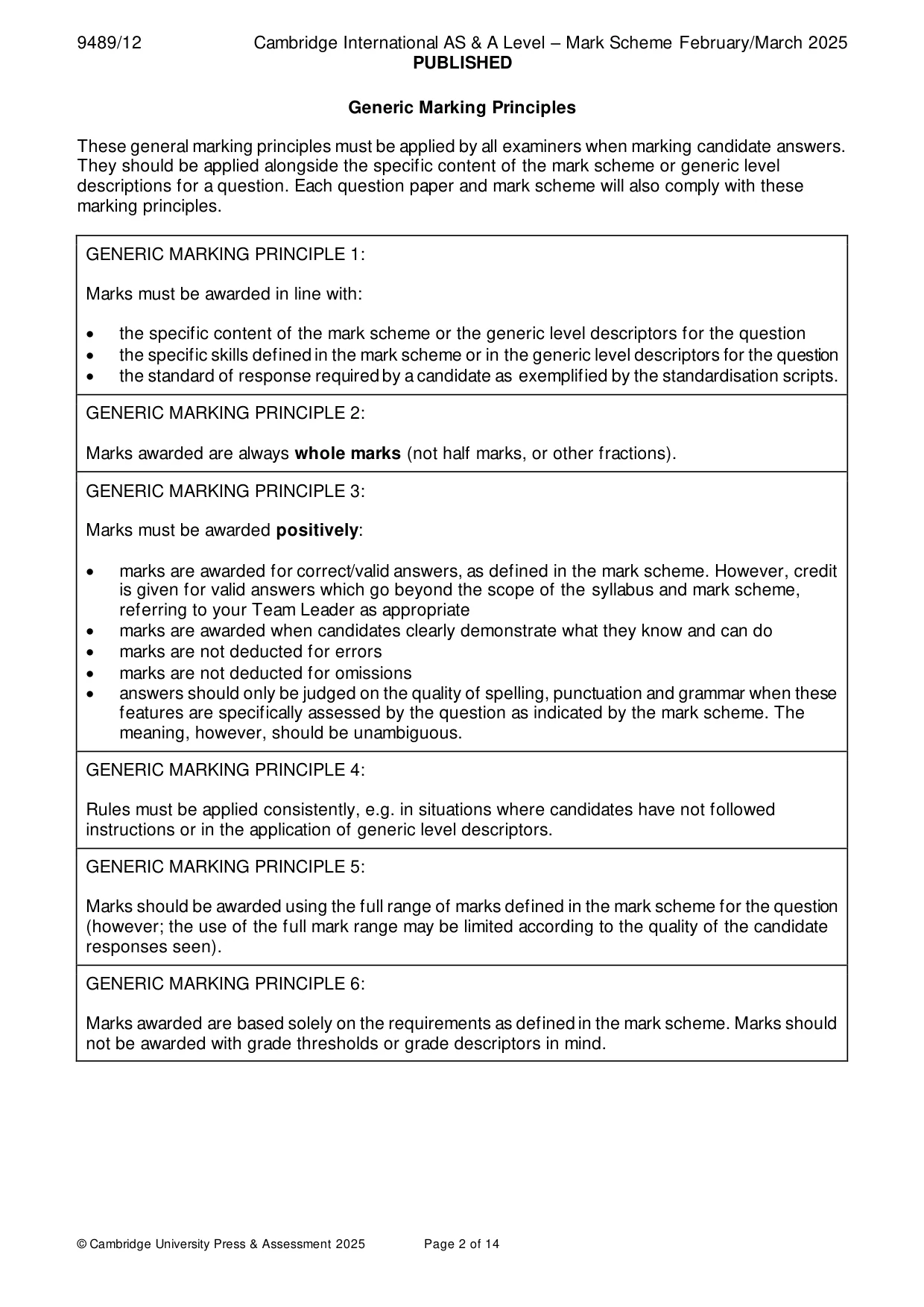
9489/12 Cambridge International AS & A Level – Mark Scheme PUBLISHED February/March 2025 © Cambridge University Press & Assessment 2025 Page 2 of 14 Generic Marking Principles These general marking principles must be applied by all examiners when marking candidate answers. They should be applied alongside the specific content of the mark scheme or generic level descriptions for a question. Each question paper and mark scheme will also comply with these marking principles. GENERIC MARKING PRINCIPLE 1: Marks must be awarded in line with: • the specific content of the mark scheme or the generic level descriptors for the question • the specific skills defined in the mark scheme or in the generic level descriptors for the question • the standard of response required by a candidate as exemplified by the standardisation scripts. GENERIC MARKING PRINCIPLE 2: Marks awarded are always whole marks (not half marks, or other fractions). GENERIC MARKING PRINCIPLE 3: Marks must be awarded positively: • marks are awarded for correct/valid answers, as defined in the mark scheme. However, credit is given for valid answers which go beyond the scope of the syllabus and mark scheme, referring to your Team Leader as appropriate • marks are awarded when candidates clearly demonstrate what they know and can do • marks are not deducted for errors • marks are not deducted for omissions • answers should only be judged on the quality of spelling, punctuation and grammar when these features are specifically assessed by the question as indicated by the mark scheme. The meaning, however, should be unambiguous. GENERIC MARKING PRINCIPLE 4: Rules must be applied consistently, e.g. in situations where candidates have not followed instructions or in the application of generic level descriptors. GENERIC MARKING PRINCIPLE 5: Marks should be awarded using the full range of marks defined in the mark scheme for the question (however; the use of the full mark range may be limited according to the quality of the candidate responses seen). GENERIC MARKING PRINCIPLE 6: Marks awarded are based solely on the requirements as defined in the mark scheme. Marks should not be awarded with grade thresholds or grade descriptors in mind.
Mark scheme, page 3
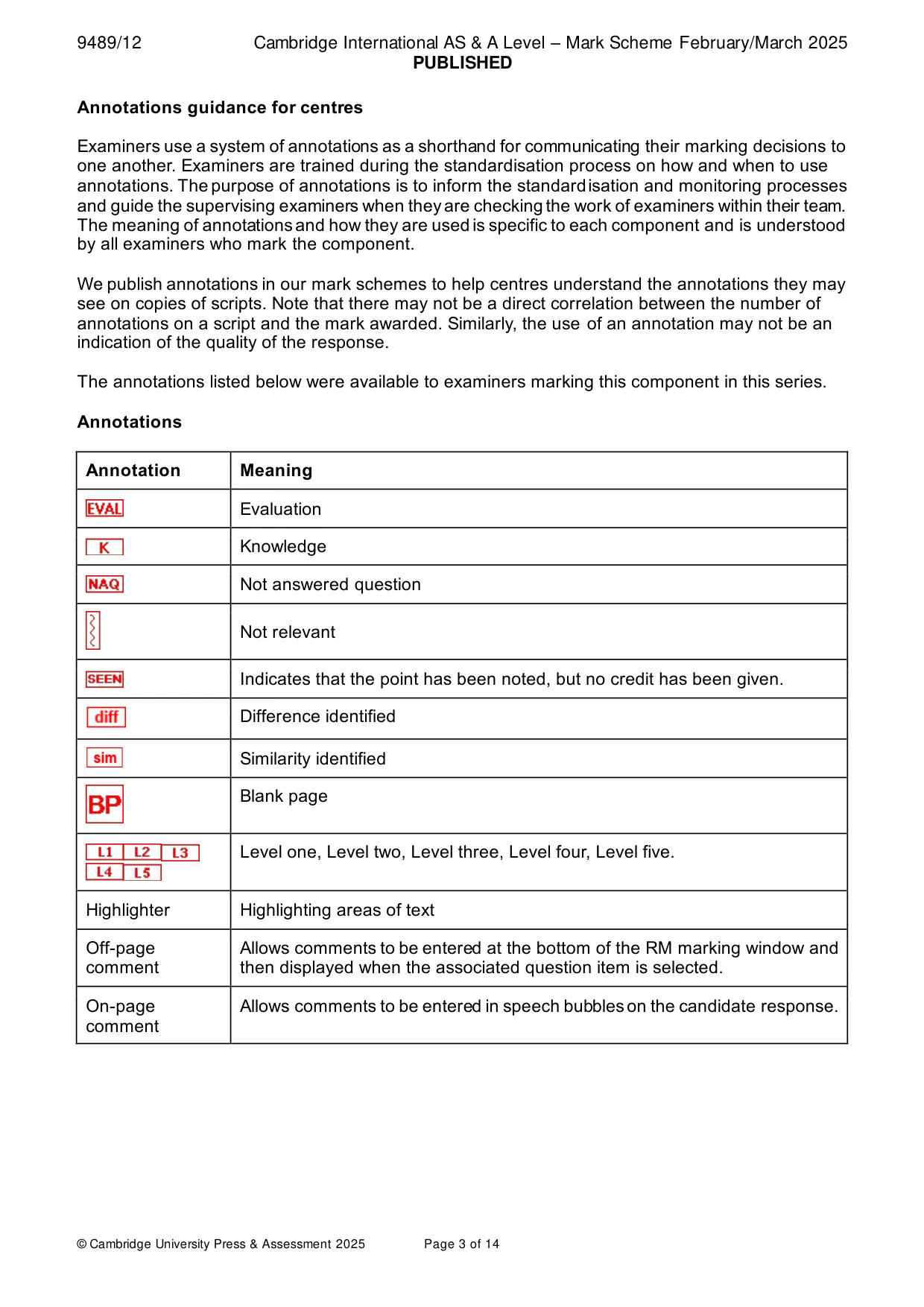
9489/12 Cambridge International AS & A Level – Mark Scheme PUBLISHED February/March 2025 © Cambridge University Press & Assessment 2025 Page 3 of 14 Annotations guidance for centres Examiners use a system of annotations as a shorthand for communicating their marking decisions to one another. Examiners are trained during the standardisation process on how and when to use annotations. The purpose of annotations is to inform the standardisation and monitoring processes and guide the supervising examiners when they are checking the work of examiners within their team. The meaning of annotations and how they are used is specific to each component and is understood by all examiners who mark the component. We publish annotations in our mark schemes to help centres understand the annotations they may see on copies of scripts. Note that there may not be a direct correlation between the number of annotations on a script and the mark awarded. Similarly, the use of an annotation may not be an indication of the quality of the response. The annotations listed below were available to examiners marking this component in this series. Annotations Annotation Meaning Evaluation Knowledge Not answered question Not relevant Indicates that the point has been noted, but no credit has been given. Difference identified Similarity identified Blank page Level one, Level two, Level three, Level four, Level five. Highlighter Highlighting areas of text Off-page comment Allows comments to be entered at the bottom of the RM marking window and then displayed when the associated question item is selected. On-page comment Allows comments to be entered in speech bubbles on the candidate response.
Mark scheme, page 4
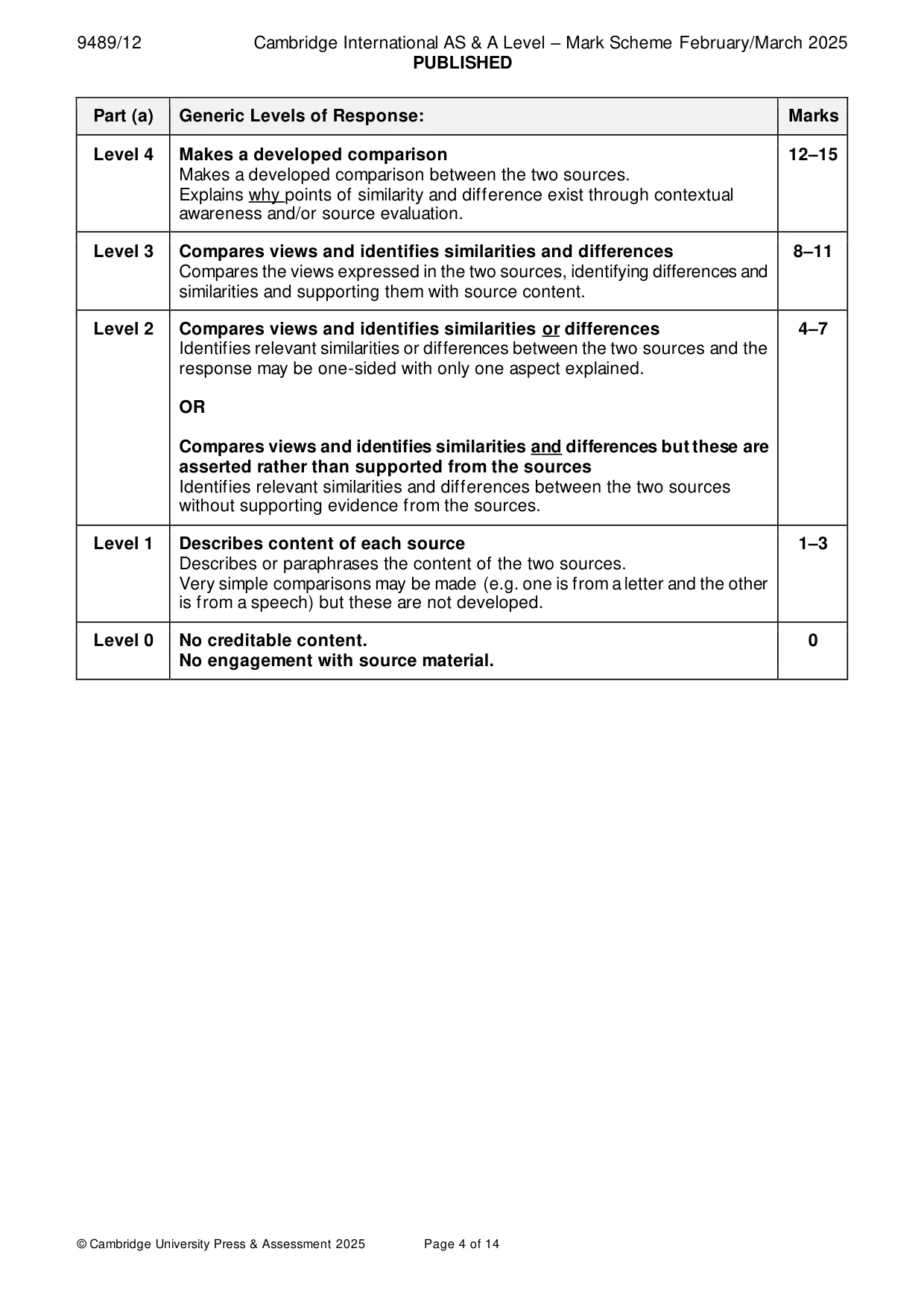
9489/12 Cambridge International AS & A Level – Mark Scheme PUBLISHED February/March 2025 © Cambridge University Press & Assessment 2025 Page 4 of 14 Part (a) Generic Levels of Response: Marks Level 4 Makes a developed comparison Makes a developed comparison between the two sources. Explains why points of similarity and difference exist through contextual awareness and/or source evaluation. 12–15 Level 3 Compares views and identifies similarities and differences Compares the views expressed in the two sources, identifying differences and similarities and supporting them with source content. 8–11 Level 2 Compares views and identifies similarities or differences Identifies relevant similarities or differences between the two sources and the response may be one-sided with only one aspect explained. OR Compares views and identifies similarities and differences but these are asserted rather than supported from the sources Identifies relevant similarities and differences between the two sources without supporting evidence from the sources. 4–7 Level 1 Describes content of each source Describes or paraphrases the content of the two sources. Very simple comparisons may be made (e.g. one is from a letter and the other is from a speech) but these are not developed. 1–3 Level 0 No creditable content. No engagement with source material. 0
Mark scheme, page 5
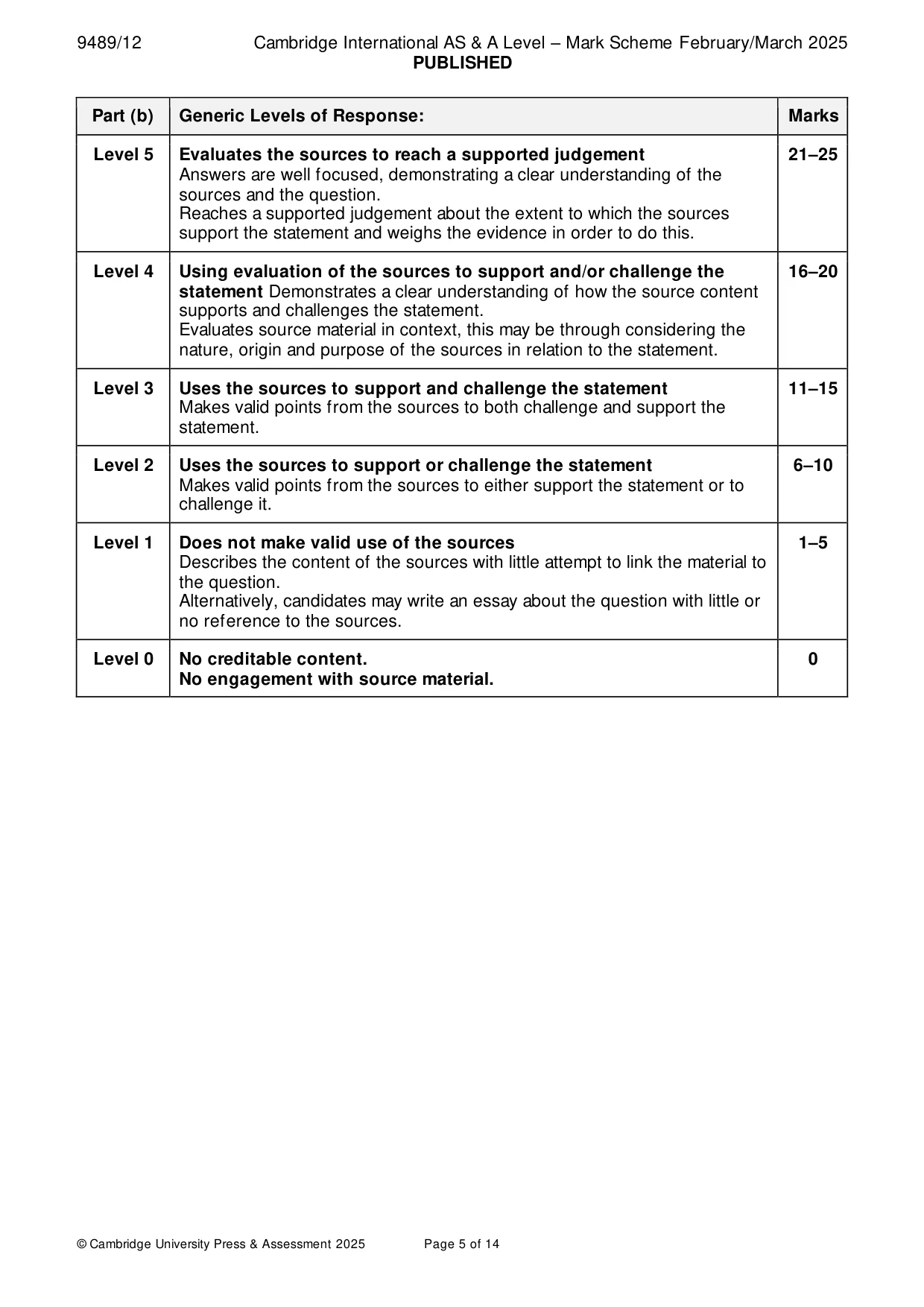
9489/12 Cambridge International AS & A Level – Mark Scheme PUBLISHED February/March 2025 © Cambridge University Press & Assessment 2025 Page 5 of 14 Part (b) Generic Levels of Response: Marks Level 5 Evaluates the sources to reach a supported judgement Answers are well focused, demonstrating a clear understanding of the sources and the question. Reaches a supported judgement about the extent to which the sources support the statement and weighs the evidence in order to do this. 21–25 Level 4 Using evaluation of the sources to support and/or challenge the statement Demonstrates a clear understanding of how the source content supports and challenges the statement. Evaluates source material in context, this may be through considering the nature, origin and purpose of the sources in relation to the statement. 16–20 Level 3 Uses the sources to support and challenge the statement Makes valid points from the sources to both challenge and support the statement. 11–15 Level 2 Uses the sources to support or challenge the statement Makes valid points from the sources to either support the statement or to challenge it. 6–10 Level 1 Does not make valid use of the sources Describes the content of the sources with little attempt to link the material to the question. Alternatively, candidates may write an essay about the question with little or no reference to the sources. 1–5 Level 0 No creditable content. No engagement with source material. 0
Mark scheme, page 6
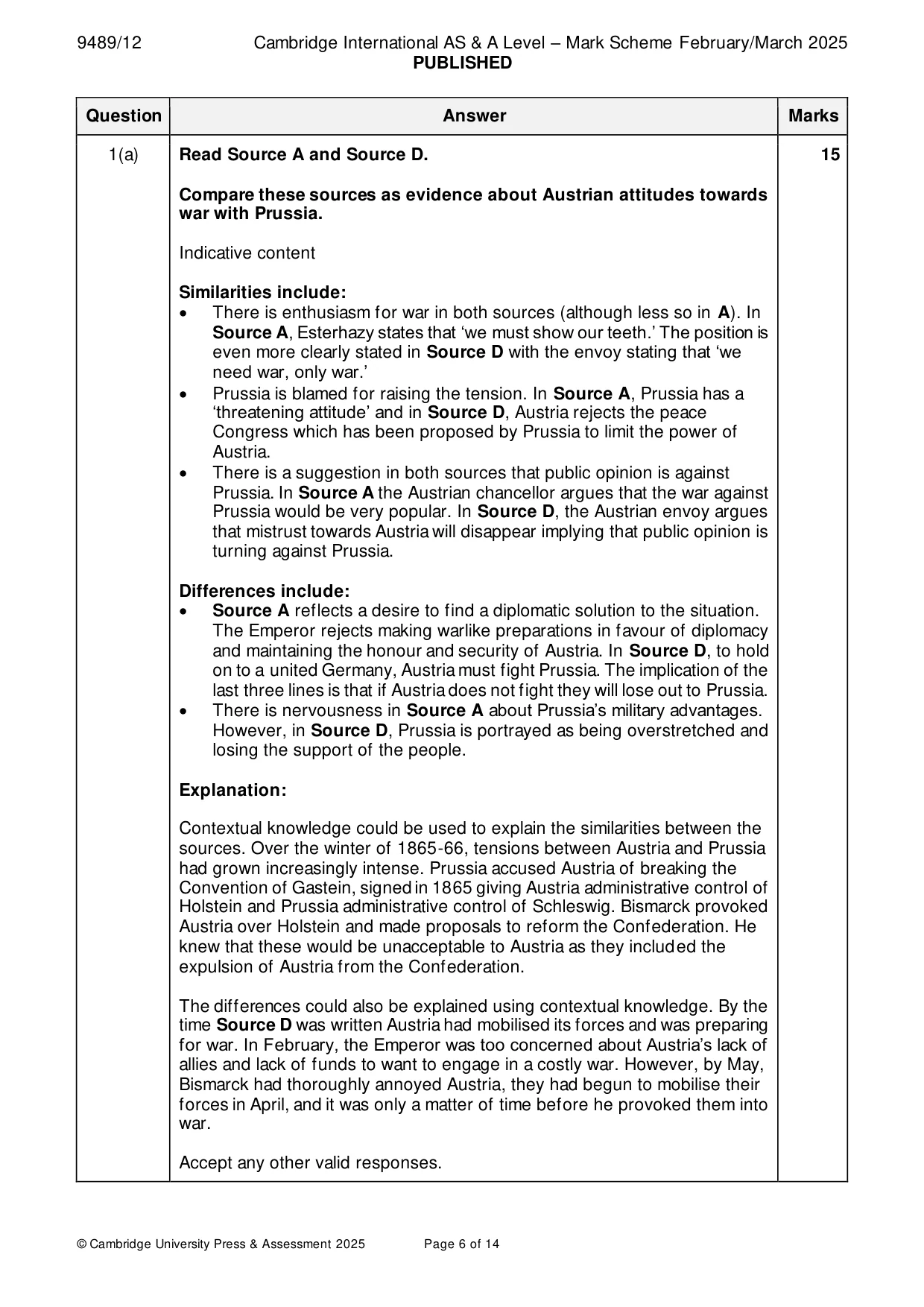
9489/12 Cambridge International AS & A Level – Mark Scheme PUBLISHED February/March 2025 © Cambridge University Press & Assessment 2025 Page 6 of 14 Question Answer Marks 1(a) Read Source A and Source D. Compare these sources as evidence about Austrian attitudes towards war with Prussia. Indicative content Similarities include: • There is enthusiasm for war in both sources (although less so in A). In Source A, Esterhazy states that ‘we must show our teeth.’ The position is even more clearly stated in Source D with the envoy stating that ‘we need war, only war.’ • Prussia is blamed for raising the tension. In Source A, Prussia has a ‘threatening attitude’ and in Source D, Austria rejects the peace Congress which has been proposed by Prussia to limit the power of Austria. • There is a suggestion in both sources that public opinion is against Prussia. In Source A the Austrian chancellor argues that the war against Prussia would be very popular. In Source D, the Austrian envoy argues that mistrust towards Austria will disappear implying that public opinion is turning against Prussia. Differences include: • Source A reflects a desire to find a diplomatic solution to the situation. The Emperor rejects making warlike preparations in favour of diplomacy and maintaining the honour and security of Austria. In Source D, to hold on to a united Germany, Austria must fight Prussia. The implication of the last three lines is that if Austria does not fight they will lose out to Prussia. • There is nervousness in Source A about Prussia’s military advantages. However, in Source D, Prussia is portrayed as being overstretched and losing the support of the people. Explanation: Contextual knowledge could be used to explain the similarities between the sources. Over the winter of 1865-66, tensions between Austria and Prussia had grown increasingly intense. Prussia accused Austria of breaking the Convention of Gastein, signed in 1865 giving Austria administrative control of Holstein and Prussia administrative control of Schleswig. Bismarck provoked Austria over Holstein and made proposals to reform the Confederation. He knew that these would be unacceptable to Austria as they included the expulsion of Austria from the Confederation. The differences could also be explained using contextual knowledge. By the time Source D was written Austria had mobilised its forces and was preparing for war. In February, the Emperor was too concerned about Austria’s lack of allies and lack of funds to want to engage in a costly war. However, by May, Bismarck had thoroughly annoyed Austria, they had begun to mobilise their forces in April, and it was only a matter of time before he provoked them into war. Accept any other valid responses. 15
Mark scheme, page 7
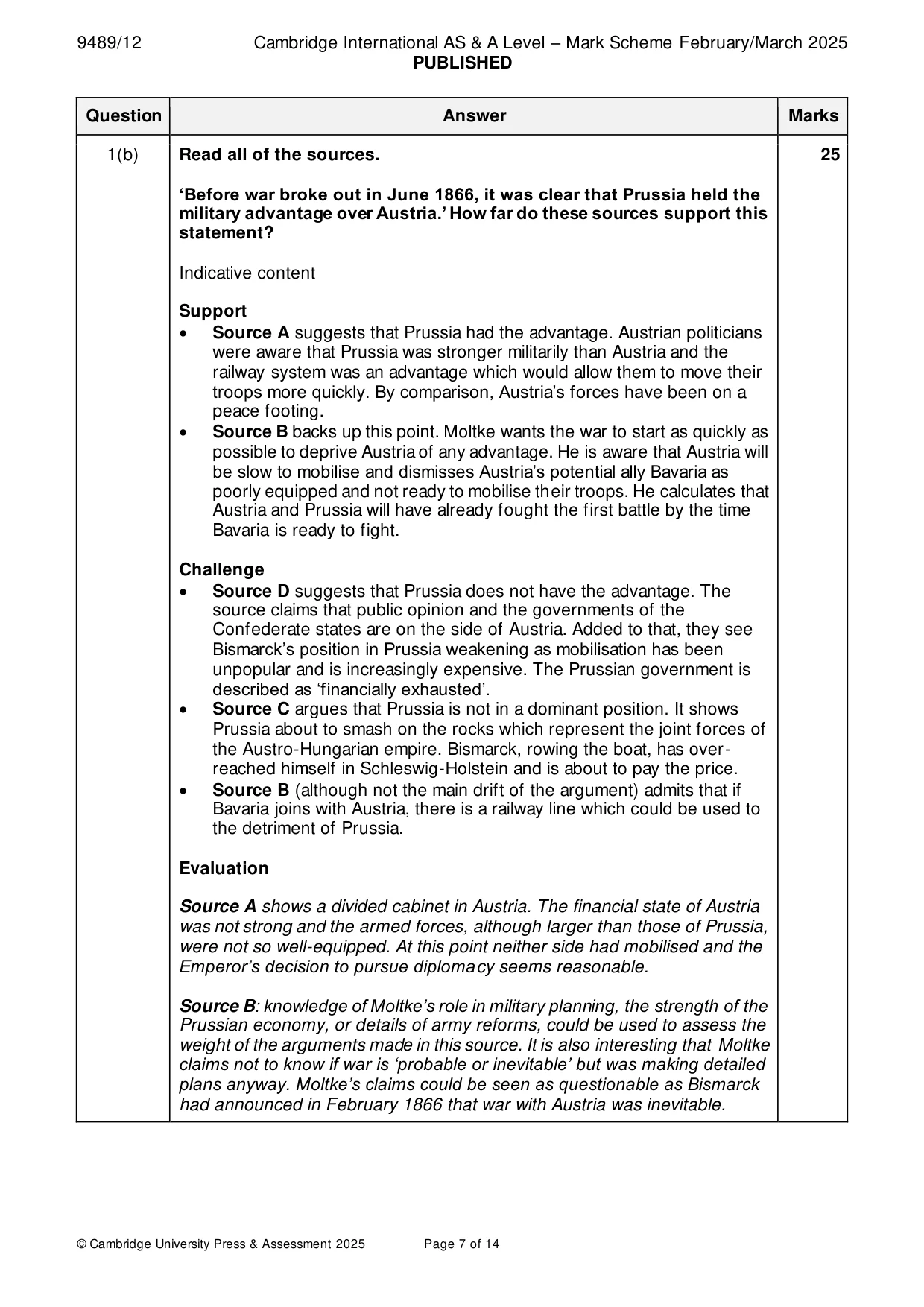
9489/12 Cambridge International AS & A Level – Mark Scheme PUBLISHED February/March 2025 © Cambridge University Press & Assessment 2025 Page 7 of 14 Question Answer Marks 1(b) Read all of the sources. ‘Before war broke out in June 1866, it was clear that Prussia held the military advantage over Austria.’ How far do these sources support this statement? Indicative content Support • Source A suggests that Prussia had the advantage. Austrian politicians were aware that Prussia was stronger militarily than Austria and the railway system was an advantage which would allow them to move their troops more quickly. By comparison, Austria’s forces have been on a peace footing. • Source B backs up this point. Moltke wants the war to start as quickly as possible to deprive Austria of any advantage. He is aware that Austria will be slow to mobilise and dismisses Austria’s potential ally Bavaria as poorly equipped and not ready to mobilise their troops. He calculates that Austria and Prussia will have already fought the first battle by the time Bavaria is ready to fight. Challenge • Source D suggests that Prussia does not have the advantage. The source claims that public opinion and the governments of the Confederate states are on the side of Austria. Added to that, they see Bismarck’s position in Prussia weakening as mobilisation has been unpopular and is increasingly expensive. The Prussian government is described as ‘financially exhausted’. • Source C argues that Prussia is not in a dominant position. It shows Prussia about to smash on the rocks which represent the joint forces of the Austro-Hungarian empire. Bismarck, rowing the boat, has over- reached himself in Schleswig-Holstein and is about to pay the price. • Source B (although not the main drift of the argument) admits that if Bavaria joins with Austria, there is a railway line which could be used to the detriment of Prussia. Evaluation Source A shows a divided cabinet in Austria. The financial state of Austria was not strong and the armed forces, although larger than those of Prussia, were not so well-equipped. At this point neither side had mobilised and the Emperor’s decision to pursue diplomacy seems reasonable. Source B: knowledge of Moltke’s role in military planning, the strength of the Prussian economy, or details of army reforms, could be used to assess the weight of the arguments made in this source. It is also interesting that Moltke claims not to know if war is ‘probable or inevitable’ but was making detailed plans anyway. Moltke’s claims could be seen as questionable as Bismarck had announced in February 1866 that war with Austria was inevitable. 25
Mark scheme, page 8
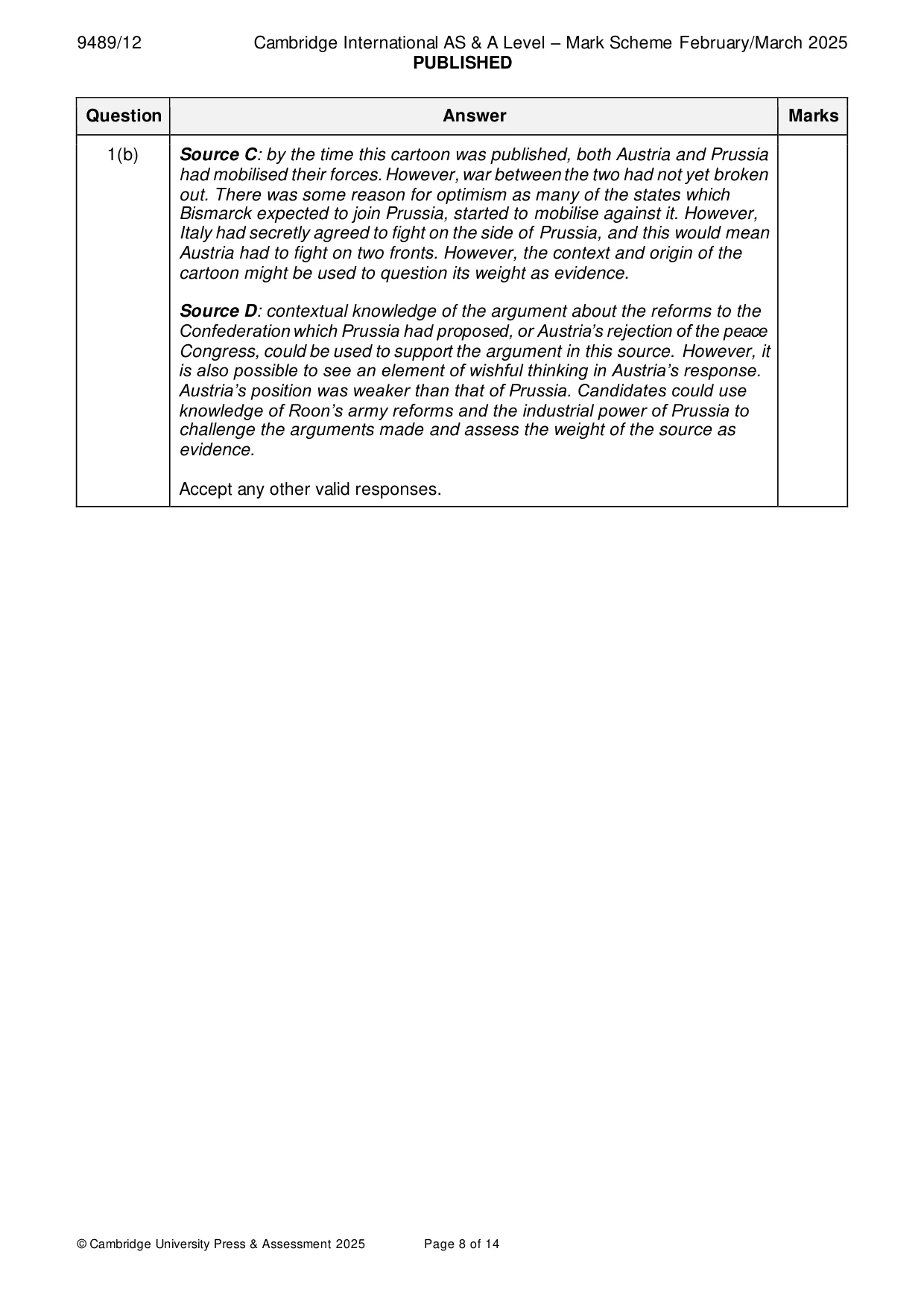
9489/12 Cambridge International AS & A Level – Mark Scheme PUBLISHED February/March 2025 © Cambridge University Press & Assessment 2025 Page 8 of 14 Question Answer Marks 1(b) Source C: by the time this cartoon was published, both Austria and Prussia had mobilised their forces. However, war between the two had not yet broken out. There was some reason for optimism as many of the states which Bismarck expected to join Prussia, started to mobilise against it. However, Italy had secretly agreed to fight on the side of Prussia, and this would mean Austria had to fight on two fronts. However, the context and origin of the cartoon might be used to question its weight as evidence. Source D: contextual knowledge of the argument about the reforms to the Confederation which Prussia had proposed, or Austria’s rejection of the peace Congress, could be used to support the argument in this source. However, it is also possible to see an element of wishful thinking in Austria’s response. Austria’s position was weaker than that of Prussia. Candidates could use knowledge of Roon’s army reforms and the industrial power of Prussia to challenge the arguments made and assess the weight of the source as evidence. Accept any other valid responses.
Mark scheme, page 9
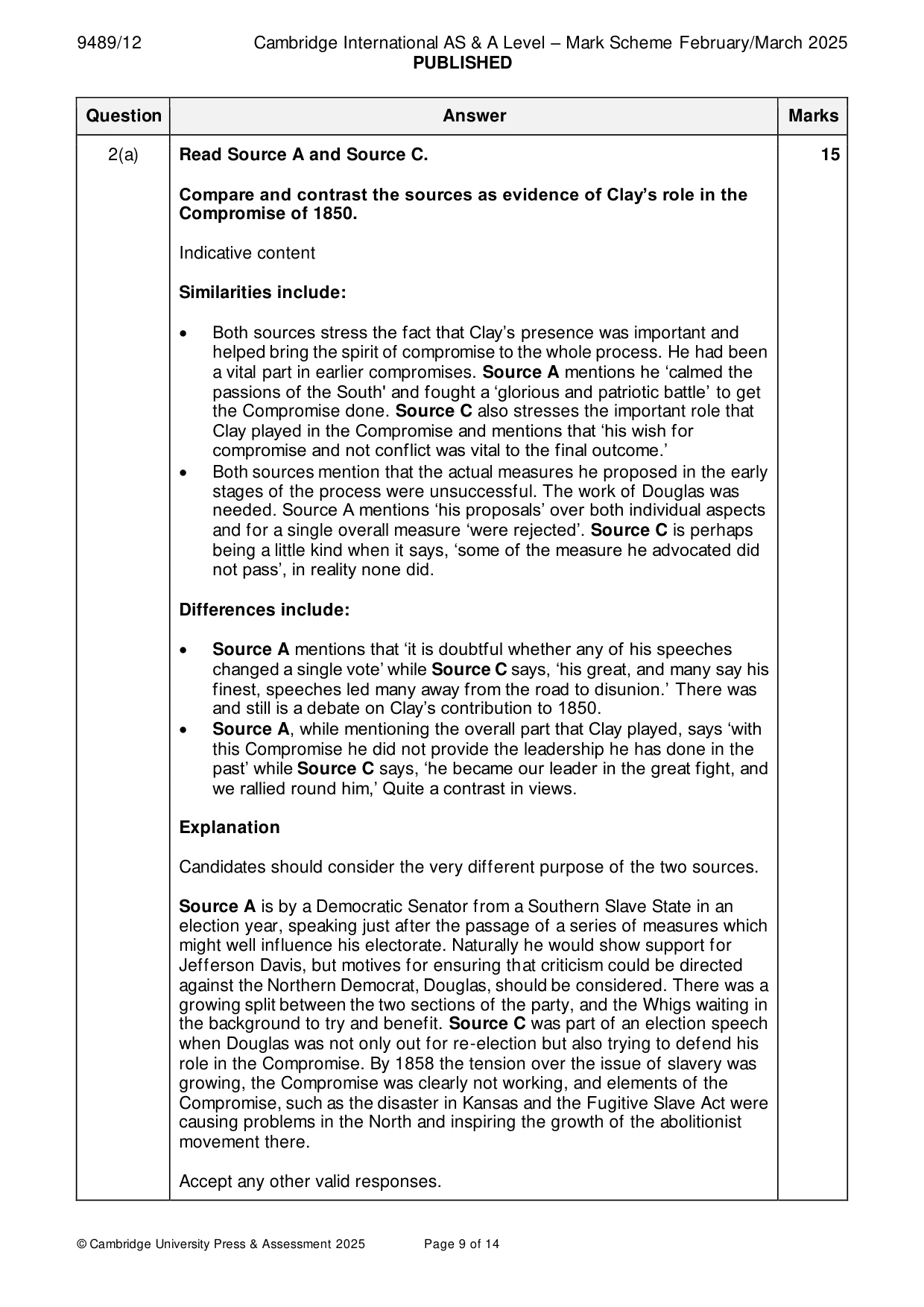
9489/12 Cambridge International AS & A Level – Mark Scheme PUBLISHED February/March 2025 © Cambridge University Press & Assessment 2025 Page 9 of 14 Question Answer Marks 2(a) Read Source A and Source C. Compare and contrast the sources as evidence of Clay’s role in the Compromise of 1850. Indicative content Similarities include: • Both sources stress the fact that Clay’s presence was important and helped bring the spirit of compromise to the whole process. He had been a vital part in earlier compromises. Source A mentions he ‘calmed the passions of the South' and fought a ‘glorious and patriotic battle’ to get the Compromise done. Source C also stresses the important role that Clay played in the Compromise and mentions that ‘his wish for compromise and not conflict was vital to the final outcome.’ • Both sources mention that the actual measures he proposed in the early stages of the process were unsuccessful. The work of Douglas was needed. Source A mentions ‘his proposals’ over both individual aspects and for a single overall measure ‘were rejected’. Source C is perhaps being a little kind when it says, ‘some of the measure he advocated did not pass’, in reality none did. Differences include: • Source A mentions that ‘it is doubtful whether any of his speeches changed a single vote’ while Source C says, ‘his great, and many say his finest, speeches led many away from the road to disunion.’ There was and still is a debate on Clay’s contribution to 1850. • Source A, while mentioning the overall part that Clay played, says ‘with this Compromise he did not provide the leadership he has done in the past’ while Source C says, ‘he became our leader in the great fight, and we rallied round him,’ Quite a contrast in views. Explanation Candidates should consider the very different purpose of the two sources. Source A is by a Democratic Senator from a Southern Slave State in an election year, speaking just after the passage of a series of measures which might well influence his electorate. Naturally he would show support for Jefferson Davis, but motives for ensuring that criticism could be directed against the Northern Democrat, Douglas, should be considered. There was a growing split between the two sections of the party, and the Whigs waiting in the background to try and benefit. Source C was part of an election speech when Douglas was not only out for re-election but also trying to defend his role in the Compromise. By 1858 the tension over the issue of slavery was growing, the Compromise was clearly not working, and elements of the Compromise, such as the disaster in Kansas and the Fugitive Slave Act were causing problems in the North and inspiring the growth of the abolitionist movement there. Accept any other valid responses. 15
Mark scheme, page 10
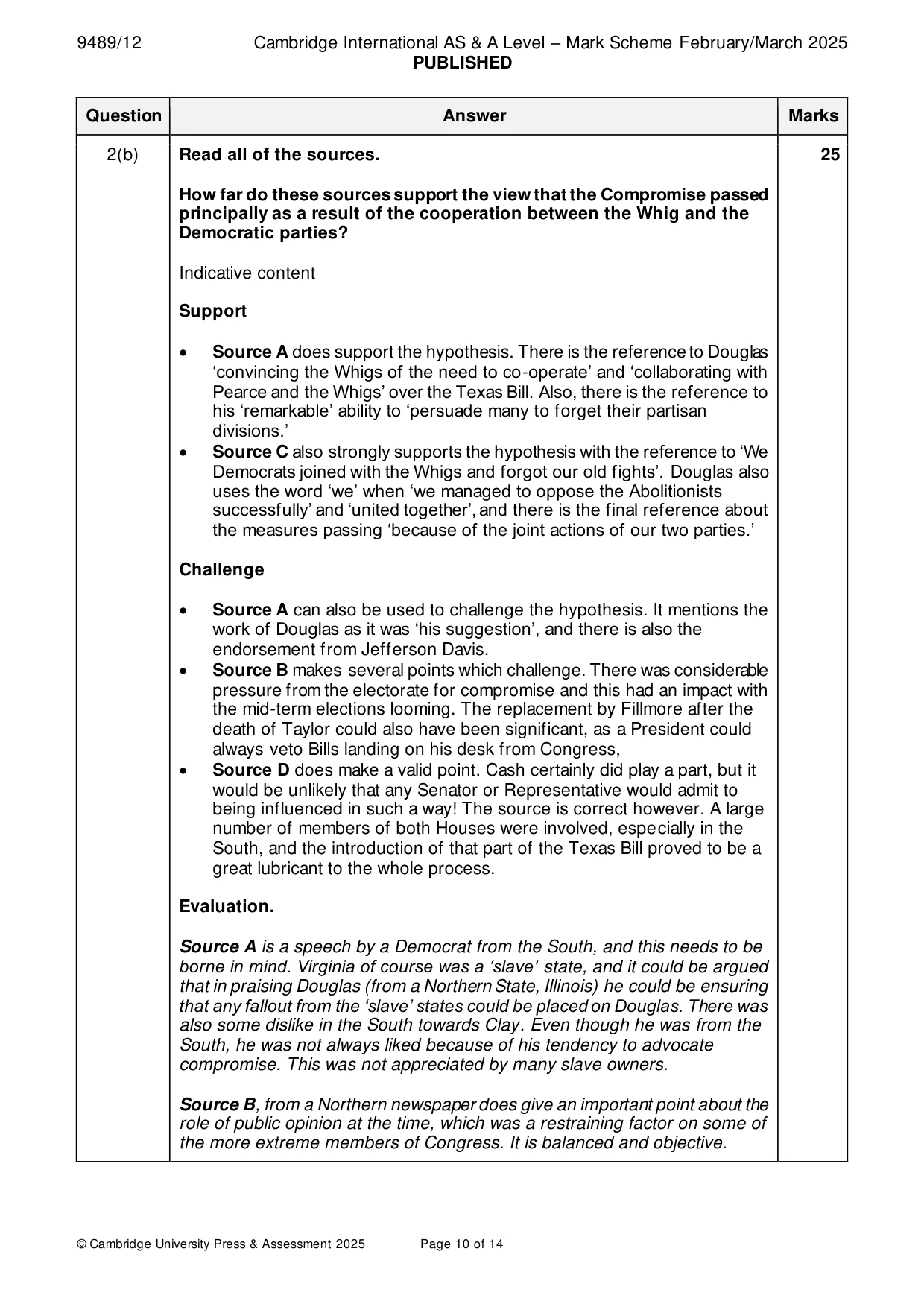
9489/12 Cambridge International AS & A Level – Mark Scheme PUBLISHED February/March 2025 © Cambridge University Press & Assessment 2025 Page 10 of 14 Question Answer Marks 2(b) Read all of the sources. How far do these sources support the view that the Compromise passed principally as a result of the cooperation between the Whig and the Democratic parties? Indicative content Support • Source A does support the hypothesis. There is the reference to Douglas ‘convincing the Whigs of the need to co-operate’ and ‘collaborating with Pearce and the Whigs’ over the Texas Bill. Also, there is the reference to his ‘remarkable’ ability to ‘persuade many to forget their partisan divisions.’ • Source C also strongly supports the hypothesis with the reference to ‘We Democrats joined with the Whigs and forgot our old fights’. Douglas also uses the word ‘we’ when ‘we managed to oppose the Abolitionists successfully’ and ‘united together’, and there is the final reference about the measures passing ‘because of the joint actions of our two parties.’ Challenge • Source A can also be used to challenge the hypothesis. It mentions the work of Douglas as it was ‘his suggestion’, and there is also the endorsement from Jefferson Davis. • Source B makes several points which challenge. There was considerable pressure from the electorate for compromise and this had an impact with the mid-term elections looming. The replacement by Fillmore after the death of Taylor could also have been significant, as a President could always veto Bills landing on his desk from Congress, • Source D does make a valid point. Cash certainly did play a part, but it would be unlikely that any Senator or Representative would admit to being influenced in such a way! The source is correct however. A large number of members of both Houses were involved, especially in the South, and the introduction of that part of the Texas Bill proved to be a great lubricant to the whole process. Evaluation. Source A is a speech by a Democrat from the South, and this needs to be borne in mind. Virginia of course was a ‘slave’ state, and it could be argued that in praising Douglas (from a Northern State, Illinois) he could be ensuring that any fallout from the ‘slave’ states could be placed on Douglas. There was also some dislike in the South towards Clay. Even though he was from the South, he was not always liked because of his tendency to advocate compromise. This was not appreciated by many slave owners. Source B, from a Northern newspaper does give an important point about the role of public opinion at the time, which was a restraining factor on some of the more extreme members of Congress. It is balanced and objective. 25
Mark scheme, page 11
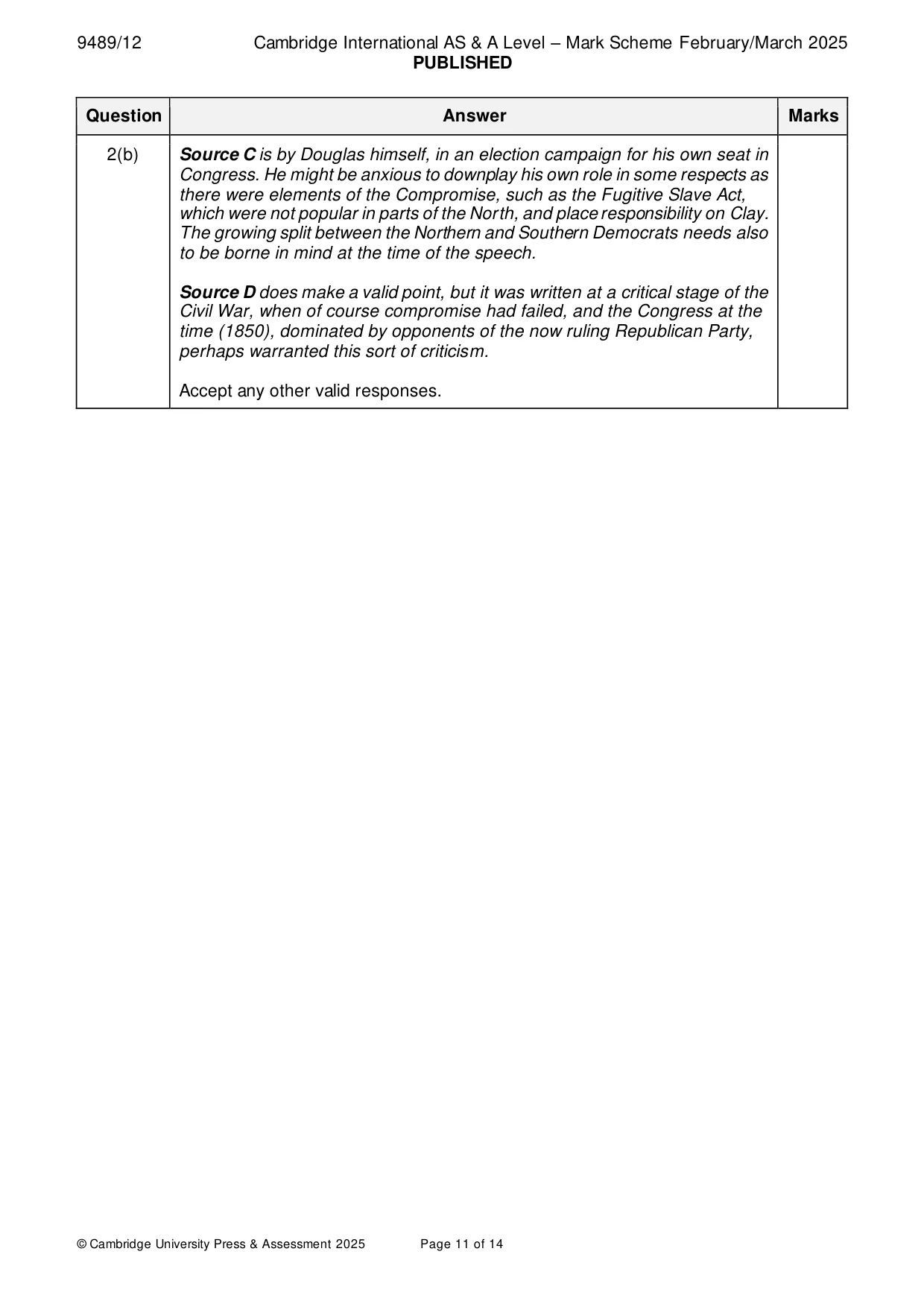
9489/12 Cambridge International AS & A Level – Mark Scheme PUBLISHED February/March 2025 © Cambridge University Press & Assessment 2025 Page 11 of 14 Question Answer Marks 2(b) Source C is by Douglas himself, in an election campaign for his own seat in Congress. He might be anxious to downplay his own role in some respects as there were elements of the Compromise, such as the Fugitive Slave Act, which were not popular in parts of the North, and place responsibility on Clay. The growing split between the Northern and Southern Democrats needs also to be borne in mind at the time of the speech. Source D does make a valid point, but it was written at a critical stage of the Civil War, when of course compromise had failed, and the Congress at the time (1850), dominated by opponents of the now ruling Republican Party, perhaps warranted this sort of criticism. Accept any other valid responses.
Mark scheme, page 12
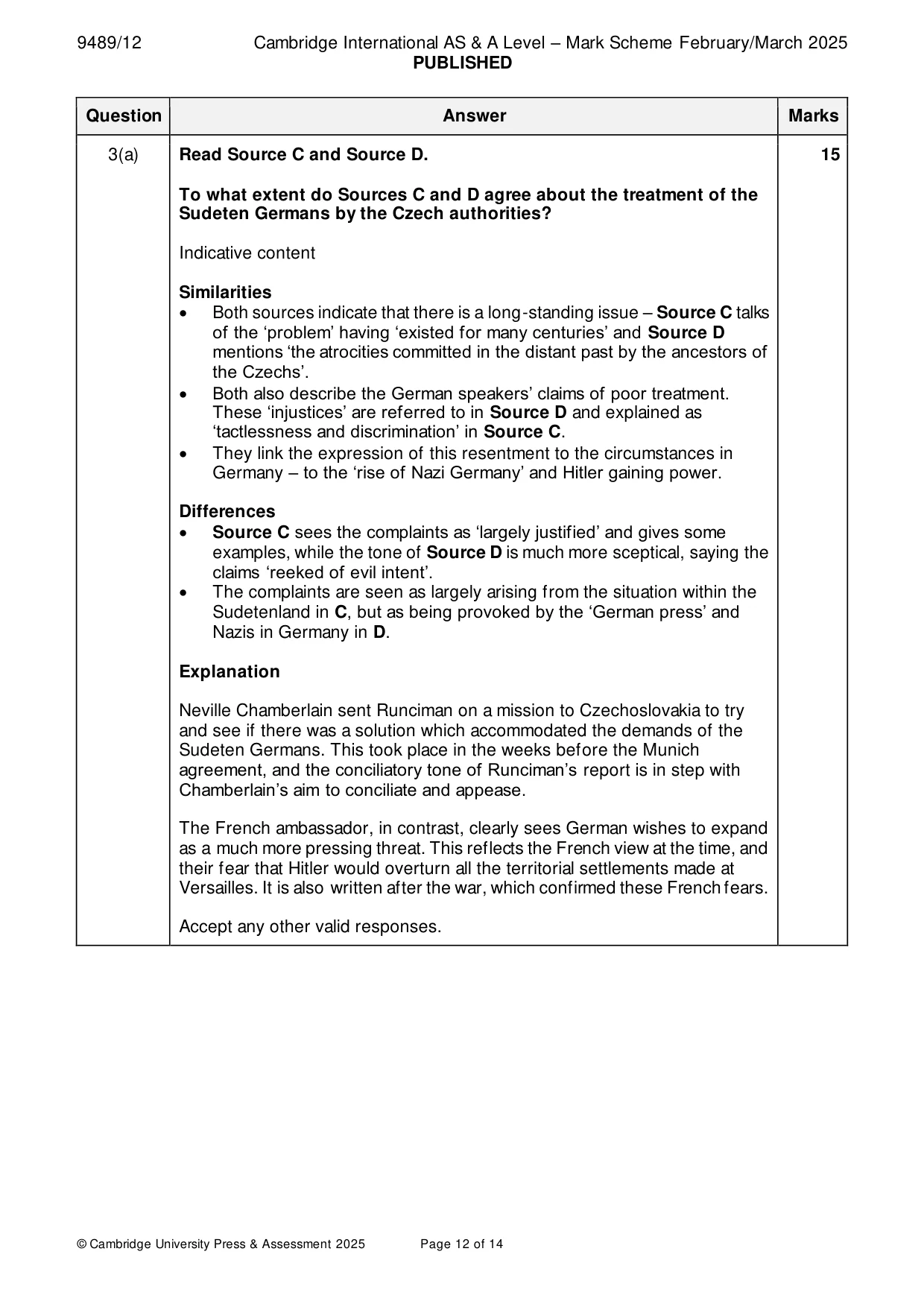
9489/12 Cambridge International AS & A Level – Mark Scheme PUBLISHED February/March 2025 © Cambridge University Press & Assessment 2025 Page 12 of 14 Question Answer Marks 3(a) Read Source C and Source D. To what extent do Sources C and D agree about the treatment of the Sudeten Germans by the Czech authorities? Indicative content Similarities • Both sources indicate that there is a long-standing issue – Source C talks of the ‘problem’ having ‘existed for many centuries’ and Source D mentions ‘the atrocities committed in the distant past by the ancestors of the Czechs’. • Both also describe the German speakers’ claims of poor treatment. These ‘injustices’ are referred to in Source D and explained as ‘tactlessness and discrimination’ in Source C. • They link the expression of this resentment to the circumstances in Germany – to the ‘rise of Nazi Germany’ and Hitler gaining power. Differences • Source C sees the complaints as ‘largely justified’ and gives some examples, while the tone of Source D is much more sceptical, saying the claims ‘reeked of evil intent’. • The complaints are seen as largely arising from the situation within the Sudetenland in C, but as being provoked by the ‘German press’ and Nazis in Germany in D. Explanation Neville Chamberlain sent Runciman on a mission to Czechoslovakia to try and see if there was a solution which accommodated the demands of the Sudeten Germans. This took place in the weeks before the Munich agreement, and the conciliatory tone of Runciman’s report is in step with Chamberlain’s aim to conciliate and appease. The French ambassador, in contrast, clearly sees German wishes to expand as a much more pressing threat. This reflects the French view at the time, and their fear that Hitler would overturn all the territorial settlements made at Versailles. It is also written after the war, which confirmed these French fears. Accept any other valid responses. 15
Mark scheme, page 13
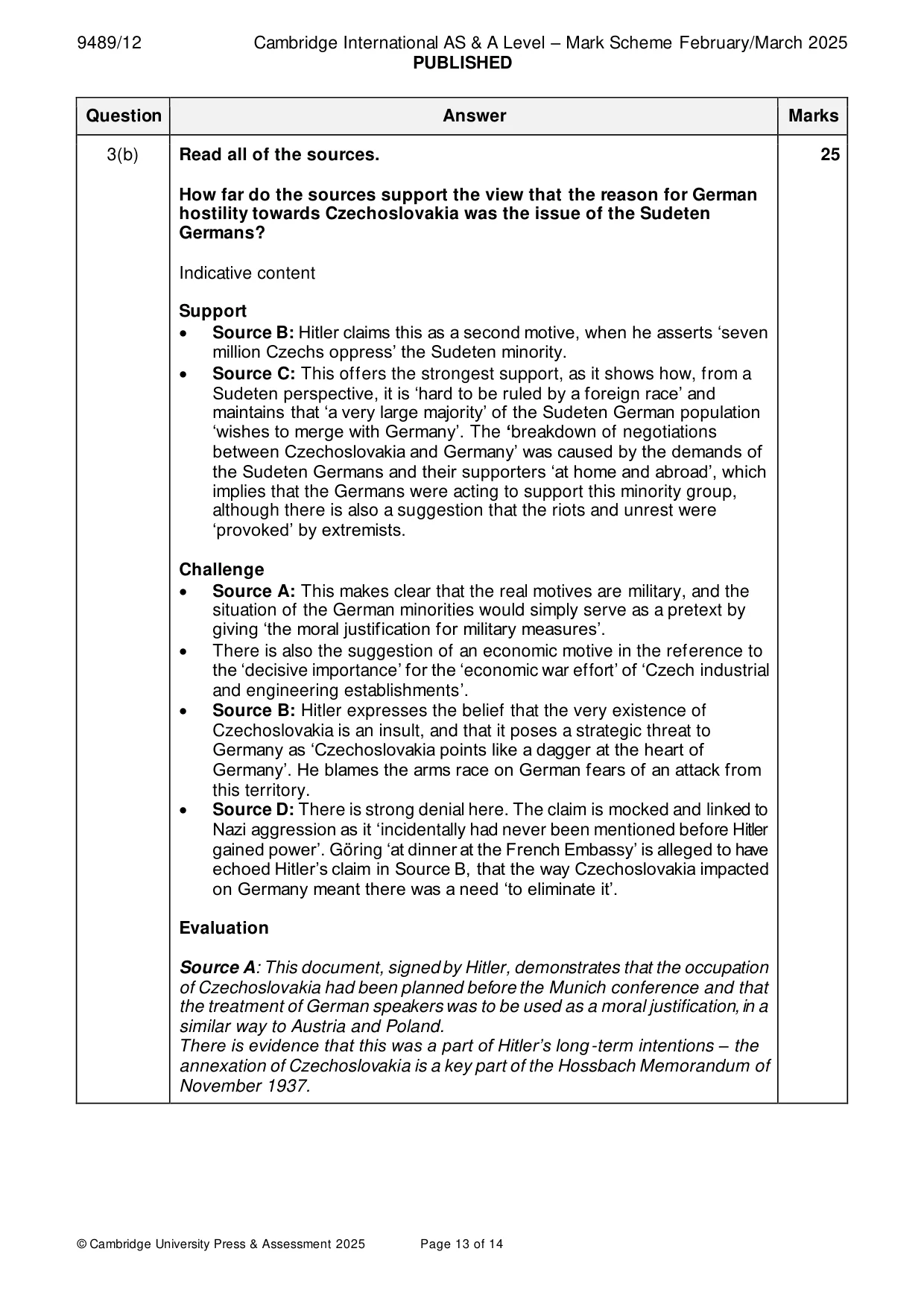
9489/12 Cambridge International AS & A Level – Mark Scheme PUBLISHED February/March 2025 © Cambridge University Press & Assessment 2025 Page 13 of 14 Question Answer Marks 3(b) Read all of the sources. How far do the sources support the view that the reason for German hostility towards Czechoslovakia was the issue of the Sudeten Germans? Indicative content Support • Source B: Hitler claims this as a second motive, when he asserts ‘seven million Czechs oppress’ the Sudeten minority. • Source C: This offers the strongest support, as it shows how, from a Sudeten perspective, it is ‘hard to be ruled by a foreign race’ and maintains that ‘a very large majority’ of the Sudeten German population ‘wishes to merge with Germany’. The ‘breakdown of negotiations between Czechoslovakia and Germany’ was caused by the demands of the Sudeten Germans and their supporters ‘at home and abroad’, which implies that the Germans were acting to support this minority group, although there is also a suggestion that the riots and unrest were ‘provoked’ by extremists. Challenge • Source A: This makes clear that the real motives are military, and the situation of the German minorities would simply serve as a pretext by giving ‘the moral justification for military measures’. • There is also the suggestion of an economic motive in the reference to the ‘decisive importance’ for the ‘economic war effort’ of ‘Czech industrial and engineering establishments’. • Source B: Hitler expresses the belief that the very existence of Czechoslovakia is an insult, and that it poses a strategic threat to Germany as ‘Czechoslovakia points like a dagger at the heart of Germany’. He blames the arms race on German fears of an attack from this territory. • Source D: There is strong denial here. The claim is mocked and linked to Nazi aggression as it ‘incidentally had never been mentioned before Hitler gained power’. Göring ‘at dinner at the French Embassy’ is alleged to have echoed Hitler’s claim in Source B, that the way Czechoslovakia impacted on Germany meant there was a need ‘to eliminate it’. Evaluation Source A: This document, signed by Hitler, demonstrates that the occupation of Czechoslovakia had been planned before the Munich conference and that the treatment of German speakers was to be used as a moral justification, in a similar way to Austria and Poland. There is evidence that this was a part of Hitler’s long-term intentions – the annexation of Czechoslovakia is a key part of the Hossbach Memorandum of November 1937. 25
Mark scheme, page 14
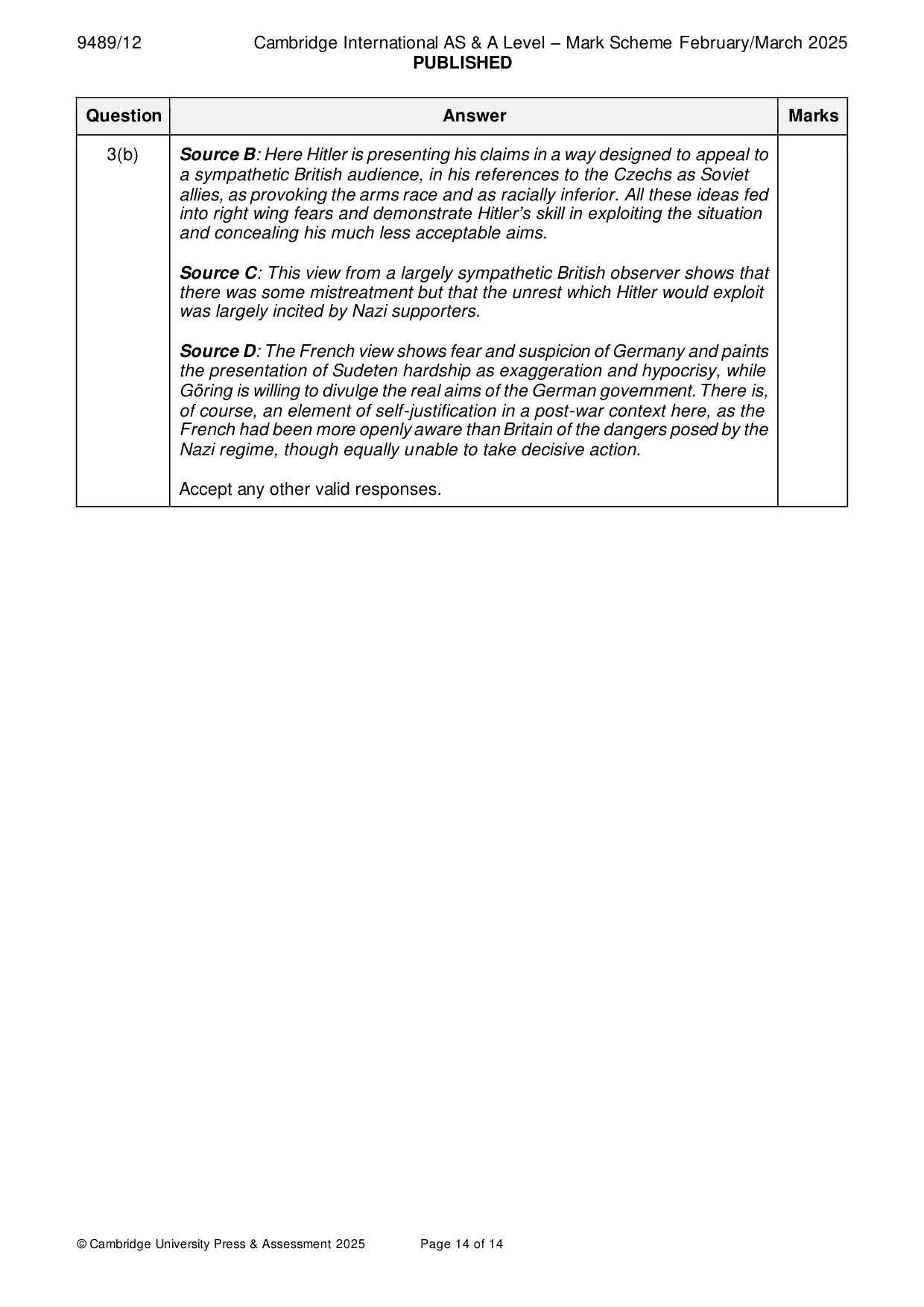
9489/12 Cambridge International AS & A Level – Mark Scheme PUBLISHED February/March 2025 © Cambridge University Press & Assessment 2025 Page 14 of 14 Question Answer Marks 3(b) Source B: Here Hitler is presenting his claims in a way designed to appeal to a sympathetic British audience, in his references to the Czechs as Soviet allies, as provoking the arms race and as racially inferior. All these ideas fed into right wing fears and demonstrate Hitler’s skill in exploiting the situation and concealing his much less acceptable aims. Source C: This view from a largely sympathetic British observer shows that there was some mistreatment but that the unrest which Hitler would exploit was largely incited by Nazi supporters. Source D: The French view shows fear and suspicion of Germany and paints the presentation of Sudeten hardship as exaggeration and hypocrisy, while Göring is willing to divulge the real aims of the German government. There is, of course, an element of self-justification in a post-war context here, as the French had been more openly aware than Britain of the dangers posed by the Nazi regime, though equally unable to take decisive action. Accept any other valid responses.
What you needed in this session
Cambridge’s own grade thresholds for 2025 Feb/March, Paper 1 · Variant 2. A higher threshold means an easier paper — the bar moves with how the cohort did.