Cambridge A Level History 9489 — 2024 Oct/Nov Paper 4 · Variant 3
9489/43/O/N/24 · 60 marks · ≈68 min
The question paper and its mark scheme, free to read here and free to download. This is Cambridge’s own paper, exactly as it was sat.
Question paper4 pages

Mark scheme18 pages
Answers below. Sit the paper first if you are practising.


Paper as text
Question paper, page 1
This document has 4 pages. Any blank pages are indicated. [Turn over Cambridge International AS & A Level HISTORY 9489/43 Paper 4 Depth Study October/November 2024 1 hour 45 minutes You must answer on the enclosed answer booklet. You will need: Answer booklet (enclosed) INSTRUCTIONS ● Answer two questions from one section only. Section A: European option Section B: American option Section C: International option ● Follow the instructions on the front cover of the answer booklet. If you need additional answer paper, ask the invigilator for a continuation booklet. INFORMATION ● The total mark for this paper is 60. ● The number of marks for each question or part question is shown in brackets [ ]. * 7 8 8 0 7 0 9 7 7 9 * DC (SL) 337514/2 © UCLES 2024
Question paper, page 2
2 9489/43/O/N/24 © UCLES 2024 Answer two questions from one section only. Section A: European history in the interwar years, 1919–41 1 Assess how far the Corporate State achieved Mussolini’s aims. [30] 2 Assess how far Stalin’s rise to power by 1928 was due to his role and position within the Communist Party. [30] 3 Evaluate the extent to which Nazi industrial and agricultural policies were successful. [30] 4 Evaluate the reasons for the changing fortunes of the Liberal Party in Britain in the period 1919 –39. [30] Section B: The USA, 1944–92 5 ‘Consumerism had limited impact on US economic growth in the late 1940s and 1950s.’ Discuss this view. [30] 6 ‘Johnson’s domestic reforms were highly successful.’ Assess this claim. [30] 7 Evaluate the role of Reagan’s personality in his electoral successes. [30] 8 Assess the reasons for the creation of the Marshall Plan. [30]
Question paper, page 3
3 9489/43/O/N/24 © UCLES 2024 Section C: International history, 1945–92 9 ‘The Prague Spring brought an end to peaceful co‑existence.’ Discuss this view in relation to the period 1968–80. [30] 10 ‘Military failure was the main reason why the US withdrew from Vietnam.’ Analyse this view. [30] 11 Evaluate the extent to which superpower rivalry affected UN involvement in the Congo. [30] 12 Evaluate the importance of the Camp David Accords (1978) in stabilising the Middle East. [30]
Question paper, page 4
4 9489/43/O/N/24 © UCLES 2024 Permission to reproduce items where third‑party owned material protected by copyright is included has been sought and cleared where possible. Every reasonable effort has been made by the publisher (UCLES) to trace copyright holders, but if any items requiring clearance have unwittingly been included, the publisher will be pleased to make amends at the earliest possible opportunity. To avoid the issue of disclosure of answer‑related information to candidates, all copyright acknowledgements are reproduced online in the Cambridge Assessment International Education Copyright Acknowledgements Booklet. This is produced for each series of examinations and is freely available to download at www.cambridgeinternational.org after the live examination series. Cambridge Assessment International Education is part of Cambridge Assessment. Cambridge Assessment is the brand name of the University of Cambridge Local Examinations Syndicate (UCLES), which is a department of the University of Cambridge. BLANK PAGE
Mark scheme, page 1
This document consists of 18 printed pages. © Cambridge University Press & Assessment 2024 [Turn over Cambridge International AS & A Level HISTORY 9489/43 Paper 4 Depth Study October/November 2024 MARK SCHEME Maximum Mark: 60 Published This mark scheme is published as an aid to teachers and candidates, to indicate the requirements of the examination. It shows the basis on which Examiners were instructed to award marks. It does not indicate the details of the discussions that took place at an Examiners’ meeting before marking began, which would have considered the acceptability of alternative answers. Mark schemes should be read in conjunction with the question paper and the Principal Examiner Report for Teachers. Cambridge International will not enter into discussions about these mark schemes. Cambridge International is publishing the mark schemes for the October/November 2024 series for most Cambridge IGCSE, Cambridge International A and AS Level components, and some Cambridge O Level components.
Mark scheme, page 2
9489/43 Cambridge International AS & A Level – Mark Scheme PUBLISHED October/November 2024 © Cambridge University Press & Assessment 2024 Page 2 of 18 Generic Marking Principles These general marking principles must be applied by all examiners when marking candidate answers. They should be applied alongside the specific content of the mark scheme or generic level descriptions for a question. Each question paper and mark scheme will also comply with these marking principles. GENERIC MARKING PRINCIPLE 1: Marks must be awarded in line with: • the specific content of the mark scheme or the generic level descriptors for the question • the specific skills defined in the mark scheme or in the generic level descriptors for the question • the standard of response required by a candidate as exemplified by the standardisation scripts. GENERIC MARKING PRINCIPLE 2: Marks awarded are always whole marks (not half marks, or other fractions). GENERIC MARKING PRINCIPLE 3: Marks must be awarded positively: • marks are awarded for correct/valid answers, as defined in the mark scheme. However, credit is given for valid answers which go beyond the scope of the syllabus and mark scheme, referring to your Team Leader as appropriate • marks are awarded when candidates clearly demonstrate what they know and can do • marks are not deducted for errors • marks are not deducted for omissions • answers should only be judged on the quality of spelling, punctuation and grammar when these features are specifically assessed by the question as indicated by the mark scheme. The meaning, however, should be unambiguous. GENERIC MARKING PRINCIPLE 4: Rules must be applied consistently, e.g. in situations where candidates have not followed instructions or in the application of generic level descriptors. GENERIC MARKING PRINCIPLE 5: Marks should be awarded using the full range of marks defined in the mark scheme for the question (however; the use of the full mark range may be limited according to the quality of the candidate responses seen). GENERIC MARKING PRINCIPLE 6: Marks awarded are based solely on the requirements as defined in the mark scheme. Marks should not be awarded with grade thresholds or grade descriptors in mind.
Mark scheme, page 3
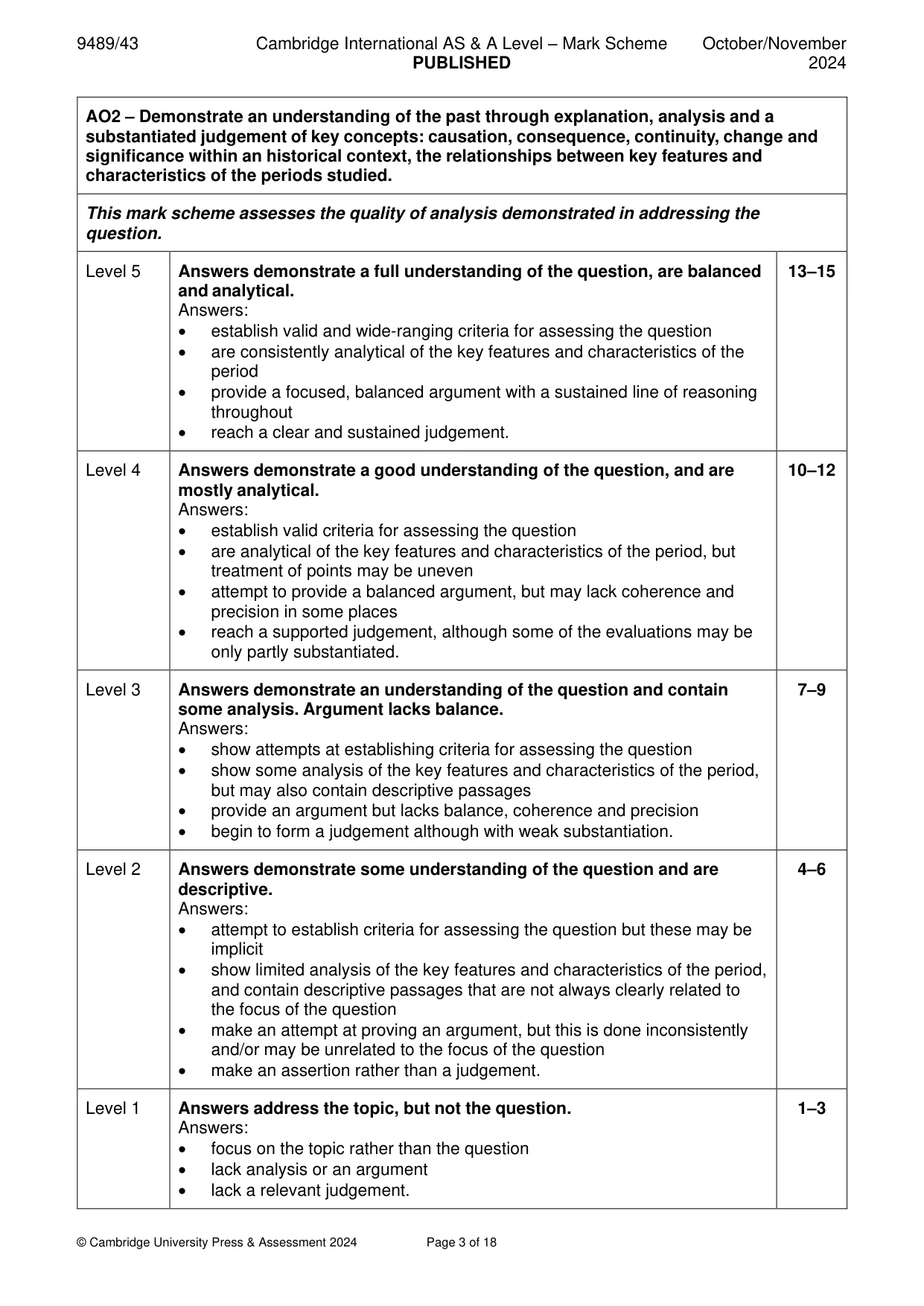
9489/43 Cambridge International AS & A Level – Mark Scheme PUBLISHED October/November 2024 © Cambridge University Press & Assessment 2024 Page 3 of 18 AO2 – Demonstrate an understanding of the past through explanation, analysis and a substantiated judgement of key concepts: causation, consequence, continuity, change and significance within an historical context, the relationships between key features and characteristics of the periods studied. This mark scheme assesses the quality of analysis demonstrated in addressing the question. Level 5 Answers demonstrate a full understanding of the question, are balanced and analytical. Answers: • establish valid and wide-ranging criteria for assessing the question • are consistently analytical of the key features and characteristics of the period • provide a focused, balanced argument with a sustained line of reasoning throughout • reach a clear and sustained judgement. 13–15 Level 4 Answers demonstrate a good understanding of the question, and are mostly analytical. Answers: • establish valid criteria for assessing the question • are analytical of the key features and characteristics of the period, but treatment of points may be uneven • attempt to provide a balanced argument, but may lack coherence and precision in some places • reach a supported judgement, although some of the evaluations may be only partly substantiated. 10–12 Level 3 Answers demonstrate an understanding of the question and contain some analysis. Argument lacks balance. Answers: • show attempts at establishing criteria for assessing the question • show some analysis of the key features and characteristics of the period, but may also contain descriptive passages • provide an argument but lacks balance, coherence and precision • begin to form a judgement although with weak substantiation. 7–9 Level 2 Answers demonstrate some understanding of the question and are descriptive. Answers: • attempt to establish criteria for assessing the question but these may be implicit • show limited analysis of the key features and characteristics of the period, and contain descriptive passages that are not always clearly related to the focus of the question • make an attempt at proving an argument, but this is done inconsistently and/or may be unrelated to the focus of the question • make an assertion rather than a judgement. 4–6 Level 1 Answers address the topic, but not the question. Answers: • focus on the topic rather than the question • lack analysis or an argument • lack a relevant judgement. 1–3
Mark scheme, page 4
9489/43 Cambridge International AS & A Level – Mark Scheme PUBLISHED October/November 2024 © Cambridge University Press & Assessment 2024 Page 4 of 18 Level 0 No creditable content. 0
Mark scheme, page 5
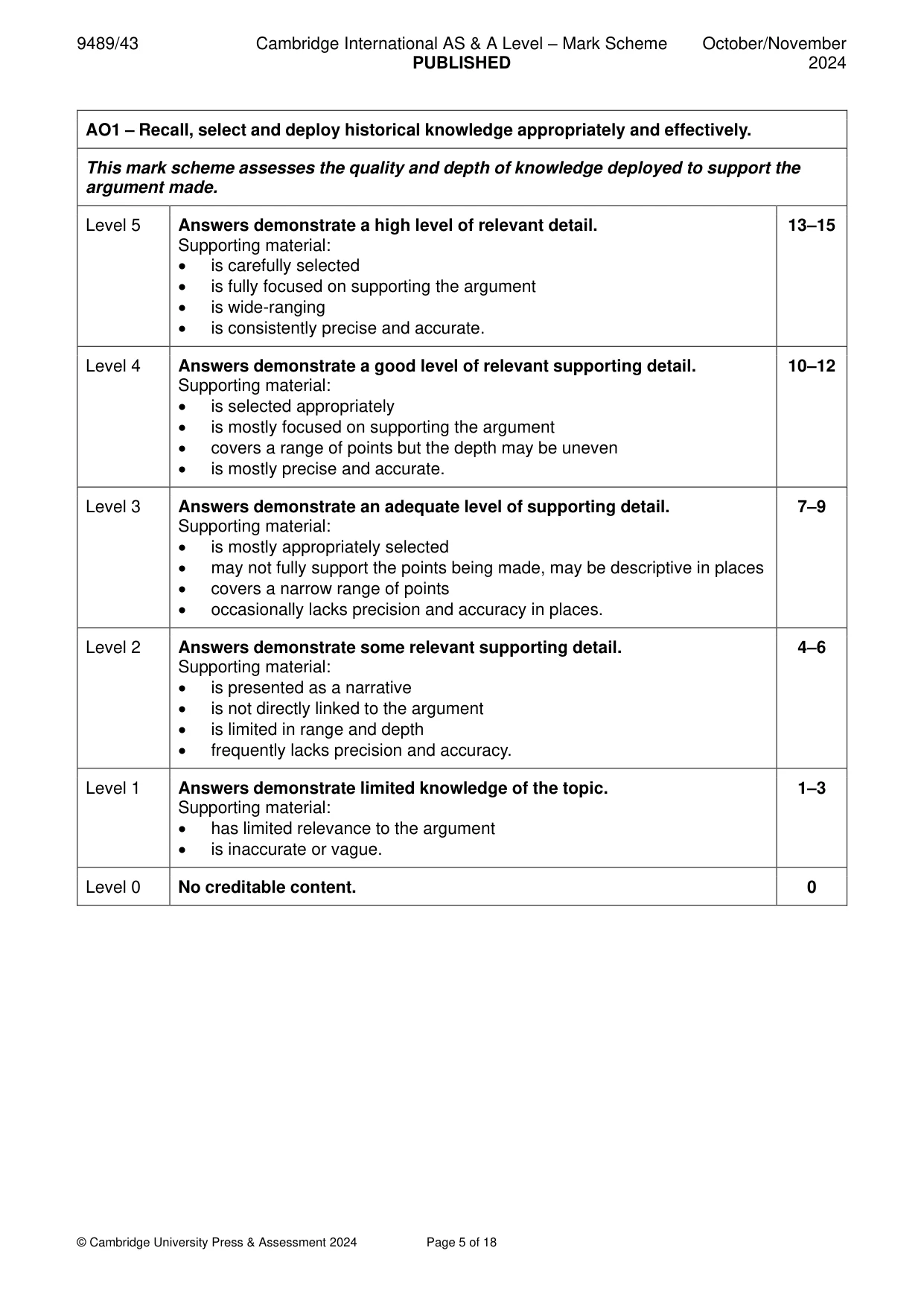
9489/43 Cambridge International AS & A Level – Mark Scheme PUBLISHED October/November 2024 © Cambridge University Press & Assessment 2024 Page 5 of 18 AO1 – Recall, select and deploy historical knowledge appropriately and effectively. This mark scheme assesses the quality and depth of knowledge deployed to support the argument made. Level 5 Answers demonstrate a high level of relevant detail. Supporting material: • is carefully selected • is fully focused on supporting the argument • is wide-ranging • is consistently precise and accurate. 13–15 Level 4 Answers demonstrate a good level of relevant supporting detail. Supporting material: • is selected appropriately • is mostly focused on supporting the argument • covers a range of points but the depth may be uneven • is mostly precise and accurate. 10–12 Level 3 Answers demonstrate an adequate level of supporting detail. Supporting material: • is mostly appropriately selected • may not fully support the points being made, may be descriptive in places • covers a narrow range of points • occasionally lacks precision and accuracy in places. 7–9 Level 2 Answers demonstrate some relevant supporting detail. Supporting material: • is presented as a narrative • is not directly linked to the argument • is limited in range and depth • frequently lacks precision and accuracy. 4–6 Level 1 Answers demonstrate limited knowledge of the topic. Supporting material: • has limited relevance to the argument • is inaccurate or vague. 1–3 Level 0 No creditable content. 0
Mark scheme, page 6
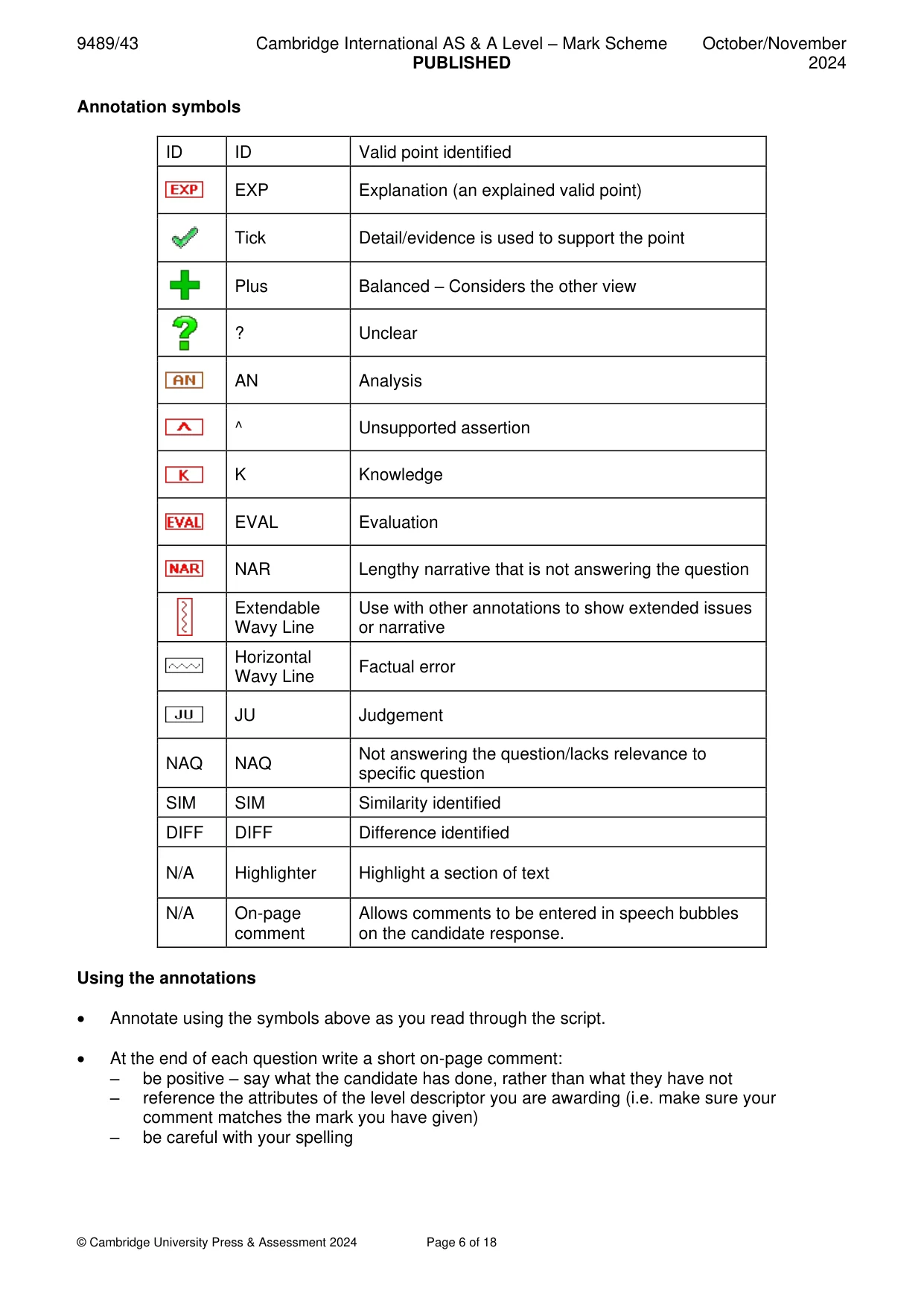
9489/43 Cambridge International AS & A Level – Mark Scheme PUBLISHED October/November 2024 © Cambridge University Press & Assessment 2024 Page 6 of 18 Annotation symbols ID ID Valid point identified EXP Explanation (an explained valid point) Tick Detail/evidence is used to support the point Plus Balanced – Considers the other view ? Unclear AN Analysis ^ Unsupported assertion K Knowledge EVAL Evaluation NAR Lengthy narrative that is not answering the question Extendable Wavy Line Use with other annotations to show extended issues or narrative Horizontal Wavy Line Factual error JU Judgement NAQ NAQ Not answering the question/lacks relevance to specific question SIM SIM Similarity identified DIFF DIFF Difference identified N/A Highlighter Highlight a section of text N/A On-page comment Allows comments to be entered in speech bubbles on the candidate response. Using the annotations • Annotate using the symbols above as you read through the script. • At the end of each question write a short on-page comment: – be positive – say what the candidate has done, rather than what they have not – reference the attributes of the level descriptor you are awarding (i.e. make sure your comment matches the mark you have given) – be careful with your spelling
Mark scheme, page 7
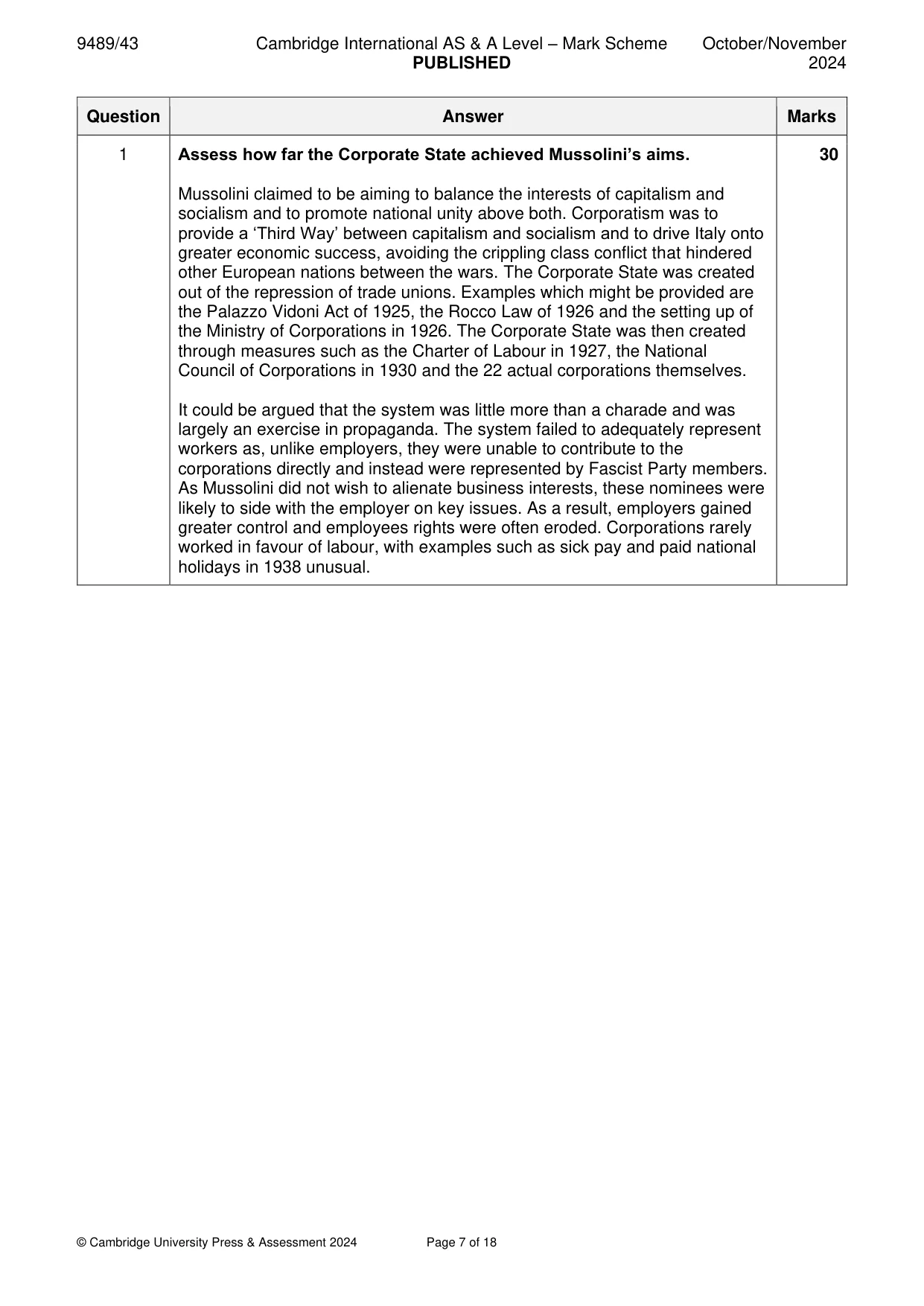
9489/43 Cambridge International AS & A Level – Mark Scheme PUBLISHED October/November 2024 © Cambridge University Press & Assessment 2024 Page 7 of 18 Question Answer Marks 1 Assess how far the Corporate State achieved Mussolini’s aims. Mussolini claimed to be aiming to balance the interests of capitalism and socialism and to promote national unity above both. Corporatism was to provide a ‘Third Way’ between capitalism and socialism and to drive Italy onto greater economic success, avoiding the crippling class conflict that hindered other European nations between the wars. The Corporate State was created out of the repression of trade unions. Examples which might be provided are the Palazzo Vidoni Act of 1925, the Rocco Law of 1926 and the setting up of the Ministry of Corporations in 1926. The Corporate State was then created through measures such as the Charter of Labour in 1927, the National Council of Corporations in 1930 and the 22 actual corporations themselves. It could be argued that the system was little more than a charade and was largely an exercise in propaganda. The system failed to adequately represent workers as, unlike employers, they were unable to contribute to the corporations directly and instead were represented by Fascist Party members. As Mussolini did not wish to alienate business interests, these nominees were likely to side with the employer on key issues. As a result, employers gained greater control and employees rights were often eroded. Corporations rarely worked in favour of labour, with examples such as sick pay and paid national holidays in 1938 unusual. 30
Mark scheme, page 8
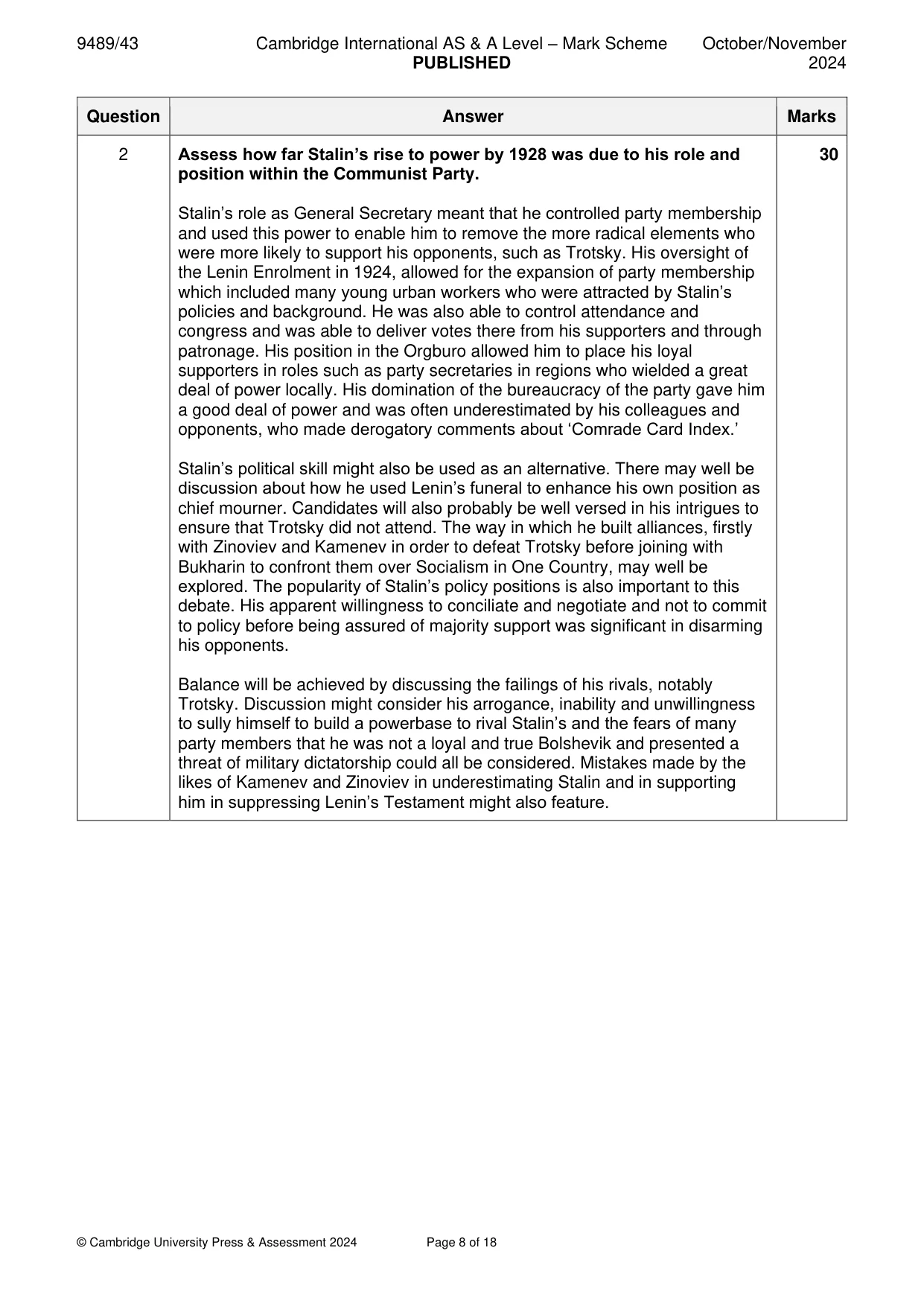
9489/43 Cambridge International AS & A Level – Mark Scheme PUBLISHED October/November 2024 © Cambridge University Press & Assessment 2024 Page 8 of 18 Question Answer Marks 2 Assess how far Stalin’s rise to power by 1928 was due to his role and position within the Communist Party. Stalin’s role as General Secretary meant that he controlled party membership and used this power to enable him to remove the more radical elements who were more likely to support his opponents, such as Trotsky. His oversight of the Lenin Enrolment in 1924, allowed for the expansion of party membership which included many young urban workers who were attracted by Stalin’s policies and background. He was also able to control attendance and congress and was able to deliver votes there from his supporters and through patronage. His position in the Orgburo allowed him to place his loyal supporters in roles such as party secretaries in regions who wielded a great deal of power locally. His domination of the bureaucracy of the party gave him a good deal of power and was often underestimated by his colleagues and opponents, who made derogatory comments about ‘Comrade Card Index.’ Stalin’s political skill might also be used as an alternative. There may well be discussion about how he used Lenin’s funeral to enhance his own position as chief mourner. Candidates will also probably be well versed in his intrigues to ensure that Trotsky did not attend. The way in which he built alliances, firstly with Zinoviev and Kamenev in order to defeat Trotsky before joining with Bukharin to confront them over Socialism in One Country, may well be explored. The popularity of Stalin’s policy positions is also important to this debate. His apparent willingness to conciliate and negotiate and not to commit to policy before being assured of majority support was significant in disarming his opponents. Balance will be achieved by discussing the failings of his rivals, notably Trotsky. Discussion might consider his arrogance, inability and unwillingness to sully himself to build a powerbase to rival Stalin’s and the fears of many party members that he was not a loyal and true Bolshevik and presented a threat of military dictatorship could all be considered. Mistakes made by the likes of Kamenev and Zinoviev in underestimating Stalin and in supporting him in suppressing Lenin’s Testament might also feature. 30
Mark scheme, page 9
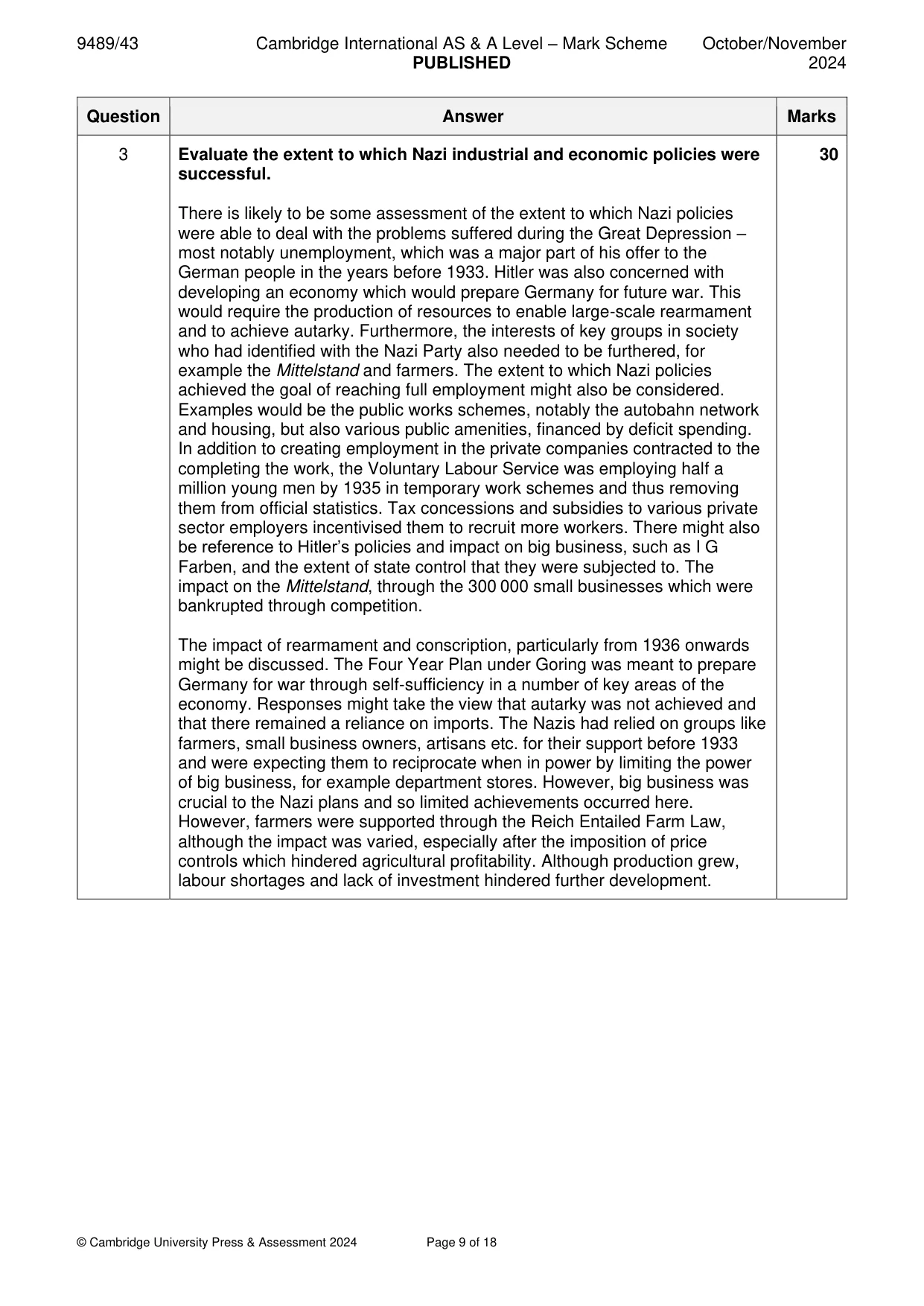
9489/43 Cambridge International AS & A Level – Mark Scheme PUBLISHED October/November 2024 © Cambridge University Press & Assessment 2024 Page 9 of 18 Question Answer Marks 3 Evaluate the extent to which Nazi industrial and economic policies were successful. There is likely to be some assessment of the extent to which Nazi policies were able to deal with the problems suffered during the Great Depression – most notably unemployment, which was a major part of his offer to the German people in the years before 1933. Hitler was also concerned with developing an economy which would prepare Germany for future war. This would require the production of resources to enable large-scale rearmament and to achieve autarky. Furthermore, the interests of key groups in society who had identified with the Nazi Party also needed to be furthered, for example the Mittelstand and farmers. The extent to which Nazi policies achieved the goal of reaching full employment might also be considered. Examples would be the public works schemes, notably the autobahn network and housing, but also various public amenities, financed by deficit spending. In addition to creating employment in the private companies contracted to the completing the work, the Voluntary Labour Service was employing half a million young men by 1935 in temporary work schemes and thus removing them from official statistics. Tax concessions and subsidies to various private sector employers incentivised them to recruit more workers. There might also be reference to Hitler’s policies and impact on big business, such as I G Farben, and the extent of state control that they were subjected to. The impact on the Mittelstand, through the 300 000 small businesses which were bankrupted through competition. The impact of rearmament and conscription, particularly from 1936 onwards might be discussed. The Four Year Plan under Goring was meant to prepare Germany for war through self-sufficiency in a number of key areas of the economy. Responses might take the view that autarky was not achieved and that there remained a reliance on imports. The Nazis had relied on groups like farmers, small business owners, artisans etc. for their support before 1933 and were expecting them to reciprocate when in power by limiting the power of big business, for example department stores. However, big business was crucial to the Nazi plans and so limited achievements occurred here. However, farmers were supported through the Reich Entailed Farm Law, although the impact was varied, especially after the imposition of price controls which hindered agricultural profitability. Although production grew, labour shortages and lack of investment hindered further development. 30
Mark scheme, page 10
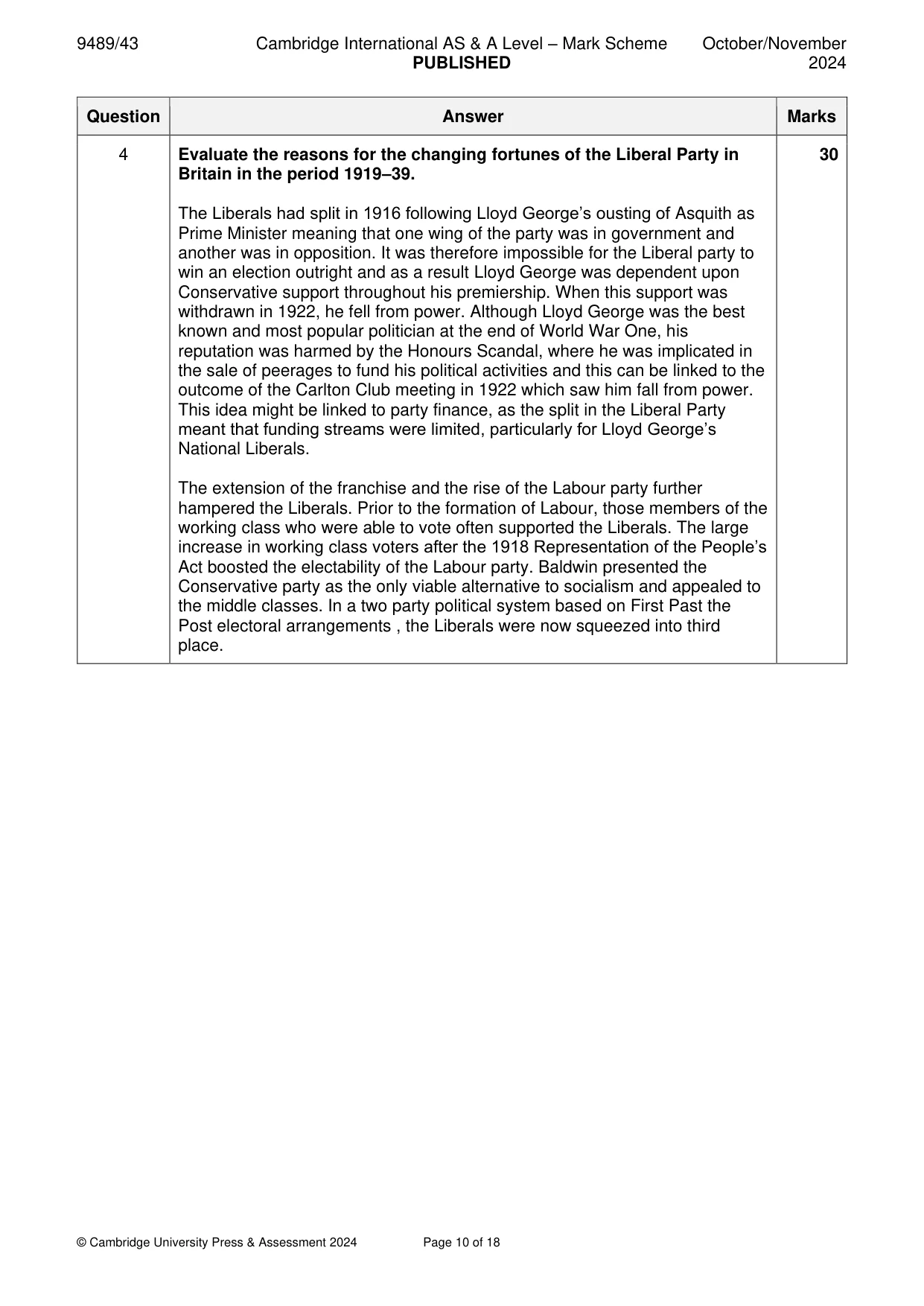
9489/43 Cambridge International AS & A Level – Mark Scheme PUBLISHED October/November 2024 © Cambridge University Press & Assessment 2024 Page 10 of 18 Question Answer Marks 4 Evaluate the reasons for the changing fortunes of the Liberal Party in Britain in the period 1919–39. The Liberals had split in 1916 following Lloyd George’s ousting of Asquith as Prime Minister meaning that one wing of the party was in government and another was in opposition. It was therefore impossible for the Liberal party to win an election outright and as a result Lloyd George was dependent upon Conservative support throughout his premiership. When this support was withdrawn in 1922, he fell from power. Although Lloyd George was the best known and most popular politician at the end of World War One, his reputation was harmed by the Honours Scandal, where he was implicated in the sale of peerages to fund his political activities and this can be linked to the outcome of the Carlton Club meeting in 1922 which saw him fall from power. This idea might be linked to party finance, as the split in the Liberal Party meant that funding streams were limited, particularly for Lloyd George’s National Liberals. The extension of the franchise and the rise of the Labour party further hampered the Liberals. Prior to the formation of Labour, those members of the working class who were able to vote often supported the Liberals. The large increase in working class voters after the 1918 Representation of the People’s Act boosted the electability of the Labour party. Baldwin presented the Conservative party as the only viable alternative to socialism and appealed to the middle classes. In a two party political system based on First Past the Post electoral arrangements , the Liberals were now squeezed into third place. 30
Mark scheme, page 11
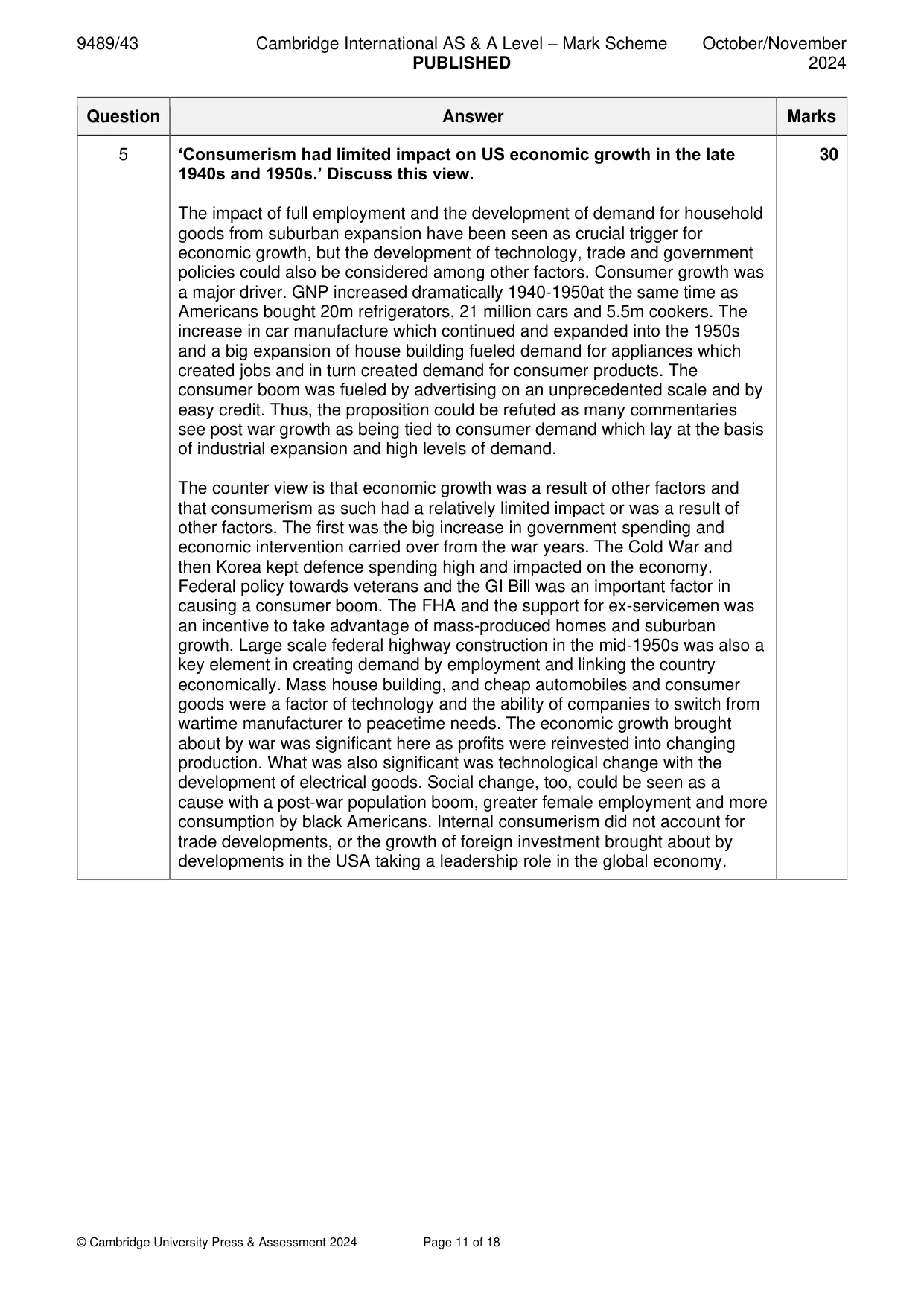
9489/43 Cambridge International AS & A Level – Mark Scheme PUBLISHED October/November 2024 © Cambridge University Press & Assessment 2024 Page 11 of 18 Question Answer Marks 5 ‘Consumerism had limited impact on US economic growth in the late 1940s and 1950s.’ Discuss this view. The impact of full employment and the development of demand for household goods from suburban expansion have been seen as crucial trigger for economic growth, but the development of technology, trade and government policies could also be considered among other factors. Consumer growth was a major driver. GNP increased dramatically 1940-1950at the same time as Americans bought 20m refrigerators, 21 million cars and 5.5m cookers. The increase in car manufacture which continued and expanded into the 1950s and a big expansion of house building fueled demand for appliances which created jobs and in turn created demand for consumer products. The consumer boom was fueled by advertising on an unprecedented scale and by easy credit. Thus, the proposition could be refuted as many commentaries see post war growth as being tied to consumer demand which lay at the basis of industrial expansion and high levels of demand. The counter view is that economic growth was a result of other factors and that consumerism as such had a relatively limited impact or was a result of other factors. The first was the big increase in government spending and economic intervention carried over from the war years. The Cold War and then Korea kept defence spending high and impacted on the economy. Federal policy towards veterans and the GI Bill was an important factor in causing a consumer boom. The FHA and the support for ex-servicemen was an incentive to take advantage of mass-produced homes and suburban growth. Large scale federal highway construction in the mid-1950s was also a key element in creating demand by employment and linking the country economically. Mass house building, and cheap automobiles and consumer goods were a factor of technology and the ability of companies to switch from wartime manufacturer to peacetime needs. The economic growth brought about by war was significant here as profits were reinvested into changing production. What was also significant was technological change with the development of electrical goods. Social change, too, could be seen as a cause with a post-war population boom, greater female employment and more consumption by black Americans. Internal consumerism did not account for trade developments, or the growth of foreign investment brought about by developments in the USA taking a leadership role in the global economy. 30
Mark scheme, page 12
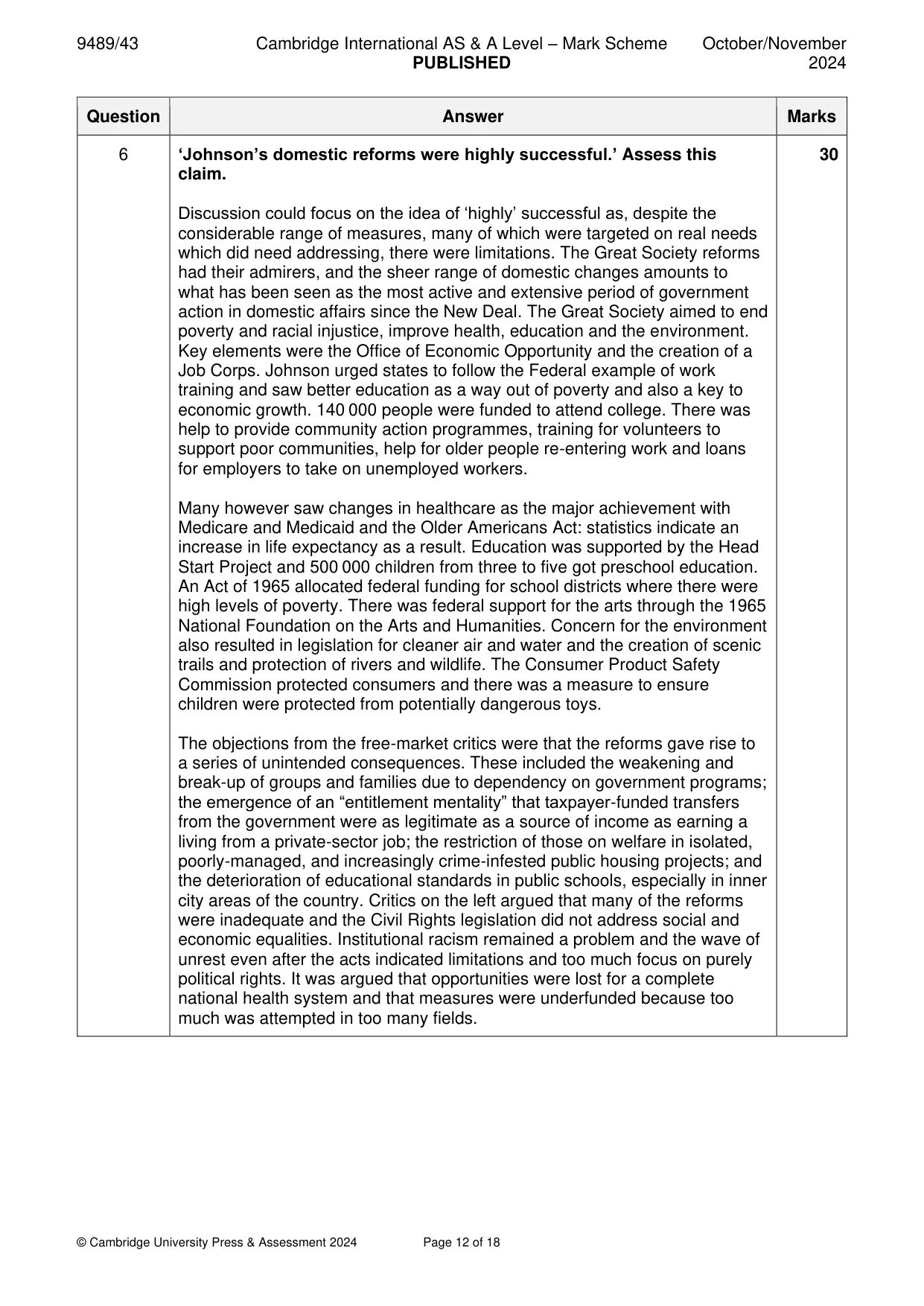
9489/43 Cambridge International AS & A Level – Mark Scheme PUBLISHED October/November 2024 © Cambridge University Press & Assessment 2024 Page 12 of 18 Question Answer Marks 6 ‘Johnson’s domestic reforms were highly successful.’ Assess this claim. Discussion could focus on the idea of ‘highly’ successful as, despite the considerable range of measures, many of which were targeted on real needs which did need addressing, there were limitations. The Great Society reforms had their admirers, and the sheer range of domestic changes amounts to what has been seen as the most active and extensive period of government action in domestic affairs since the New Deal. The Great Society aimed to end poverty and racial injustice, improve health, education and the environment. Key elements were the Office of Economic Opportunity and the creation of a Job Corps. Johnson urged states to follow the Federal example of work training and saw better education as a way out of poverty and also a key to economic growth. 140 000 people were funded to attend college. There was help to provide community action programmes, training for volunteers to support poor communities, help for older people re-entering work and loans for employers to take on unemployed workers. Many however saw changes in healthcare as the major achievement with Medicare and Medicaid and the Older Americans Act: statistics indicate an increase in life expectancy as a result. Education was supported by the Head Start Project and 500 000 children from three to five got preschool education. An Act of 1965 allocated federal funding for school districts where there were high levels of poverty. There was federal support for the arts through the 1965 National Foundation on the Arts and Humanities. Concern for the environment also resulted in legislation for cleaner air and water and the creation of scenic trails and protection of rivers and wildlife. The Consumer Product Safety Commission protected consumers and there was a measure to ensure children were protected from potentially dangerous toys. The objections from the free-market critics were that the reforms gave rise to a series of unintended consequences. These included the weakening and break-up of groups and families due to dependency on government programs; the emergence of an “entitlement mentality” that taxpayer-funded transfers from the government were as legitimate as a source of income as earning a living from a private-sector job; the restriction of those on welfare in isolated, poorly-managed, and increasingly crime-infested public housing projects; and the deterioration of educational standards in public schools, especially in inner city areas of the country. Critics on the left argued that many of the reforms were inadequate and the Civil Rights legislation did not address social and economic equalities. Institutional racism remained a problem and the wave of unrest even after the acts indicated limitations and too much focus on purely political rights. It was argued that opportunities were lost for a complete national health system and that measures were underfunded because too much was attempted in too many fields. 30
Mark scheme, page 13
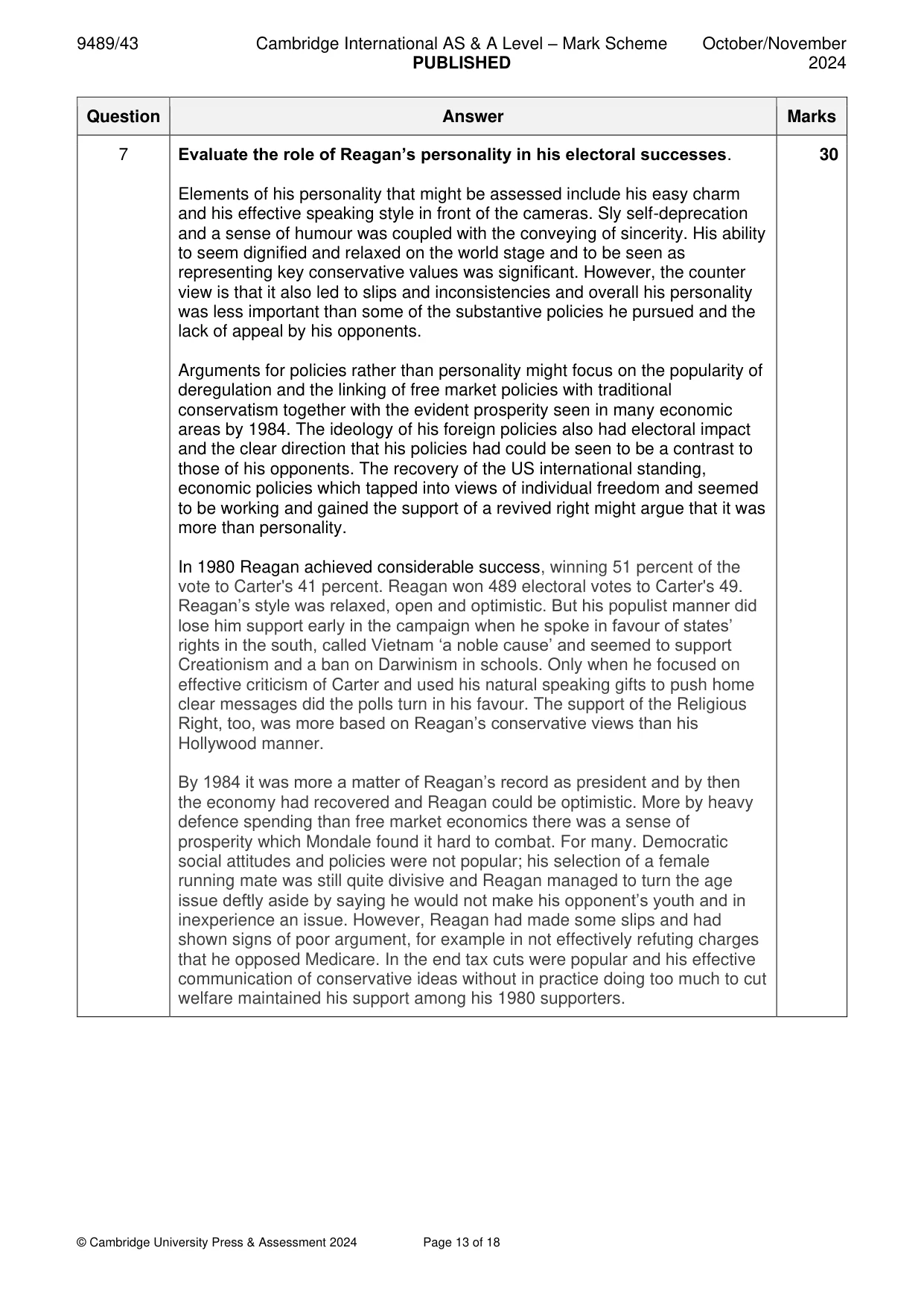
9489/43 Cambridge International AS & A Level – Mark Scheme PUBLISHED October/November 2024 © Cambridge University Press & Assessment 2024 Page 13 of 18 Question Answer Marks 7 Evaluate the role of Reagan’s personality in his electoral successes. Elements of his personality that might be assessed include his easy charm and his effective speaking style in front of the cameras. Sly self-deprecation and a sense of humour was coupled with the conveying of sincerity. His ability to seem dignified and relaxed on the world stage and to be seen as representing key conservative values was significant. However, the counter view is that it also led to slips and inconsistencies and overall his personality was less important than some of the substantive policies he pursued and the lack of appeal by his opponents. Arguments for policies rather than personality might focus on the popularity of deregulation and the linking of free market policies with traditional conservatism together with the evident prosperity seen in many economic areas by 1984. The ideology of his foreign policies also had electoral impact and the clear direction that his policies had could be seen to be a contrast to those of his opponents. The recovery of the US international standing, economic policies which tapped into views of individual freedom and seemed to be working and gained the support of a revived right might argue that it was more than personality. In 1980 Reagan achieved considerable success, winning 51 percent of the vote to Carter's 41 percent. Reagan won 489 electoral votes to Carter's 49. Reagan’s style was relaxed, open and optimistic. But his populist manner did lose him support early in the campaign when he spoke in favour of states’ rights in the south, called Vietnam ‘a noble cause’ and seemed to support Creationism and a ban on Darwinism in schools. Only when he focused on effective criticism of Carter and used his natural speaking gifts to push home clear messages did the polls turn in his favour. The support of the Religious Right, too, was more based on Reagan’s conservative views than his Hollywood manner. By 1984 it was more a matter of Reagan’s record as president and by then the economy had recovered and Reagan could be optimistic. More by heavy defence spending than free market economics there was a sense of prosperity which Mondale found it hard to combat. For many. Democratic social attitudes and policies were not popular; his selection of a female running mate was still quite divisive and Reagan managed to turn the age issue deftly aside by saying he would not make his opponent’s youth and in inexperience an issue. However, Reagan had made some slips and had shown signs of poor argument, for example in not effectively refuting charges that he opposed Medicare. In the end tax cuts were popular and his effective communication of conservative ideas without in practice doing too much to cut welfare maintained his support among his 1980 supporters. 30
Mark scheme, page 14
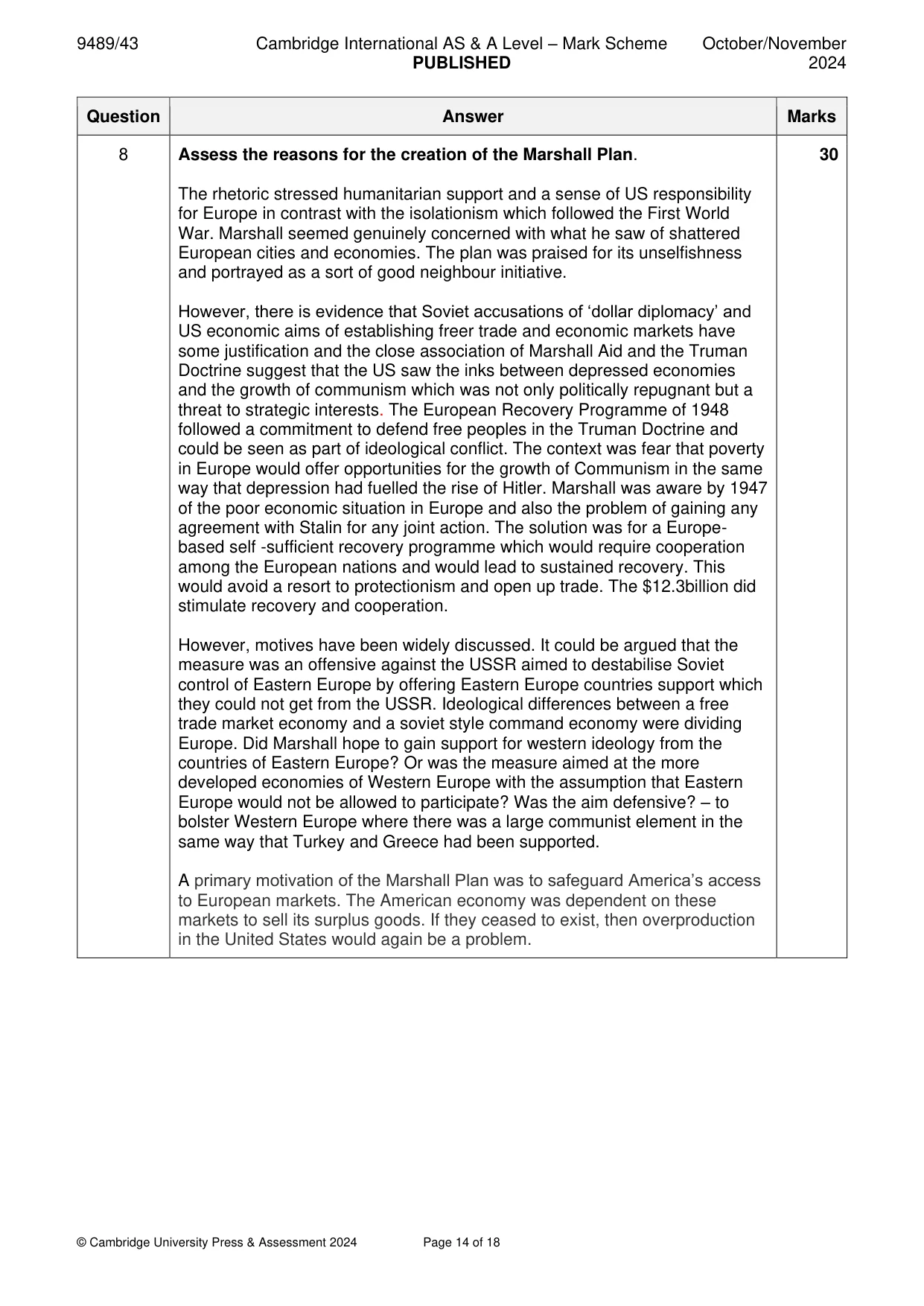
9489/43 Cambridge International AS & A Level – Mark Scheme PUBLISHED October/November 2024 © Cambridge University Press & Assessment 2024 Page 14 of 18 Question Answer Marks 8 Assess the reasons for the creation of the Marshall Plan. The rhetoric stressed humanitarian support and a sense of US responsibility for Europe in contrast with the isolationism which followed the First World War. Marshall seemed genuinely concerned with what he saw of shattered European cities and economies. The plan was praised for its unselfishness and portrayed as a sort of good neighbour initiative. However, there is evidence that Soviet accusations of ‘dollar diplomacy’ and US economic aims of establishing freer trade and economic markets have some justification and the close association of Marshall Aid and the Truman Doctrine suggest that the US saw the inks between depressed economies and the growth of communism which was not only politically repugnant but a threat to strategic interests. The European Recovery Programme of 1948 followed a commitment to defend free peoples in the Truman Doctrine and could be seen as part of ideological conflict. The context was fear that poverty in Europe would offer opportunities for the growth of Communism in the same way that depression had fuelled the rise of Hitler. Marshall was aware by 1947 of the poor economic situation in Europe and also the problem of gaining any agreement with Stalin for any joint action. The solution was for a Europe- based self -sufficient recovery programme which would require cooperation among the European nations and would lead to sustained recovery. This would avoid a resort to protectionism and open up trade. The $12.3billion did stimulate recovery and cooperation. However, motives have been widely discussed. It could be argued that the measure was an offensive against the USSR aimed to destabilise Soviet control of Eastern Europe by offering Eastern Europe countries support which they could not get from the USSR. Ideological differences between a free trade market economy and a soviet style command economy were dividing Europe. Did Marshall hope to gain support for western ideology from the countries of Eastern Europe? Or was the measure aimed at the more developed economies of Western Europe with the assumption that Eastern Europe would not be allowed to participate? Was the aim defensive? – to bolster Western Europe where there was a large communist element in the same way that Turkey and Greece had been supported. A primary motivation of the Marshall Plan was to safeguard America’s access to European markets. The American economy was dependent on these markets to sell its surplus goods. If they ceased to exist, then overproduction in the United States would again be a problem. 30
Mark scheme, page 15
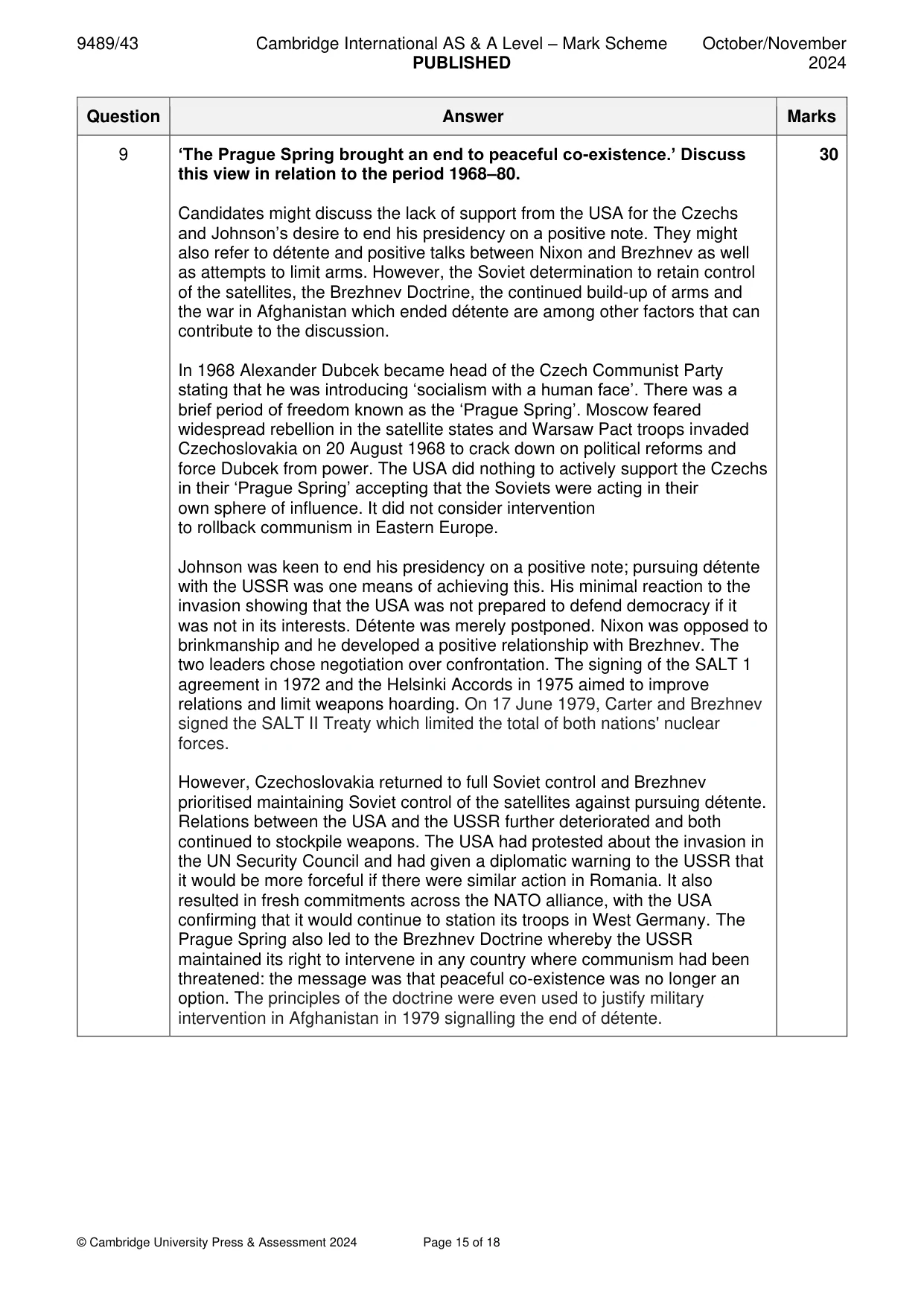
9489/43 Cambridge International AS & A Level – Mark Scheme PUBLISHED October/November 2024 © Cambridge University Press & Assessment 2024 Page 15 of 18 Question Answer Marks 9 ‘The Prague Spring brought an end to peaceful co-existence.’ Discuss this view in relation to the period 1968–80. Candidates might discuss the lack of support from the USA for the Czechs and Johnson’s desire to end his presidency on a positive note. They might also refer to détente and positive talks between Nixon and Brezhnev as well as attempts to limit arms. However, the Soviet determination to retain control of the satellites, the Brezhnev Doctrine, the continued build-up of arms and the war in Afghanistan which ended détente are among other factors that can contribute to the discussion. In 1968 Alexander Dubcek became head of the Czech Communist Party stating that he was introducing ‘socialism with a human face’. There was a brief period of freedom known as the ‘Prague Spring’. Moscow feared widespread rebellion in the satellite states and Warsaw Pact troops invaded Czechoslovakia on 20 August 1968 to crack down on political reforms and force Dubcek from power. The USA did nothing to actively support the Czechs in their ‘Prague Spring’ accepting that the Soviets were acting in their own sphere of influence. It did not consider intervention to rollback communism in Eastern Europe. Johnson was keen to end his presidency on a positive note; pursuing détente with the USSR was one means of achieving this. His minimal reaction to the invasion showing that the USA was not prepared to defend democracy if it was not in its interests. Détente was merely postponed. Nixon was opposed to brinkmanship and he developed a positive relationship with Brezhnev. The two leaders chose negotiation over confrontation. The signing of the SALT 1 agreement in 1972 and the Helsinki Accords in 1975 aimed to improve relations and limit weapons hoarding. On 17 June 1979, Carter and Brezhnev signed the SALT II Treaty which limited the total of both nations' nuclear forces. However, Czechoslovakia returned to full Soviet control and Brezhnev prioritised maintaining Soviet control of the satellites against pursuing détente. Relations between the USA and the USSR further deteriorated and both continued to stockpile weapons. The USA had protested about the invasion in the UN Security Council and had given a diplomatic warning to the USSR that it would be more forceful if there were similar action in Romania. It also resulted in fresh commitments across the NATO alliance, with the USA confirming that it would continue to station its troops in West Germany. The Prague Spring also led to the Brezhnev Doctrine whereby the USSR maintained its right to intervene in any country where communism had been threatened: the message was that peaceful co-existence was no longer an option. The principles of the doctrine were even used to justify military intervention in Afghanistan in 1979 signalling the end of détente. 30
Mark scheme, page 16
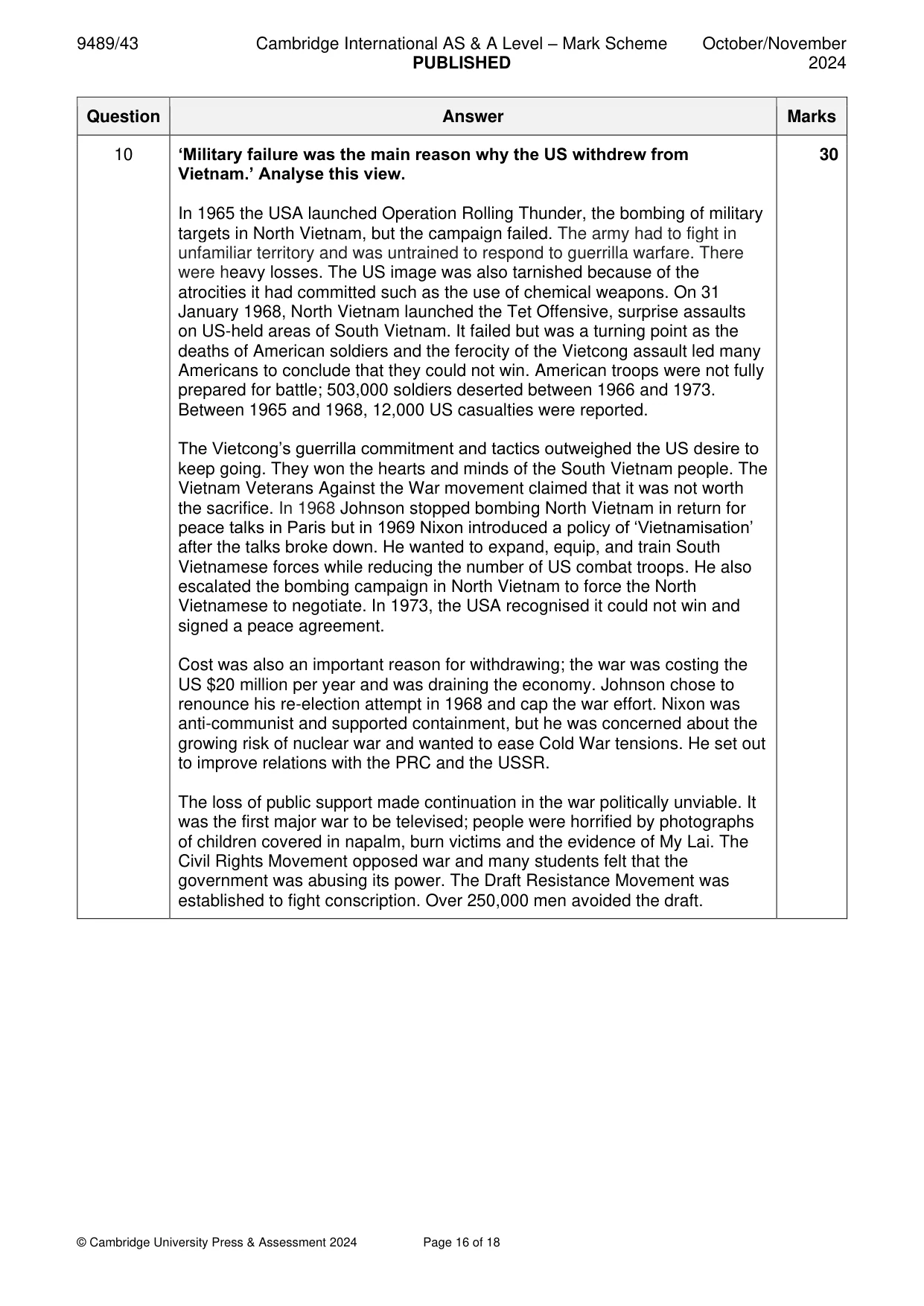
9489/43 Cambridge International AS & A Level – Mark Scheme PUBLISHED October/November 2024 © Cambridge University Press & Assessment 2024 Page 16 of 18 Question Answer Marks 10 ‘Military failure was the main reason why the US withdrew from Vietnam.’ Analyse this view. In 1965 the USA launched Operation Rolling Thunder, the bombing of military targets in North Vietnam, but the campaign failed. The army had to fight in unfamiliar territory and was untrained to respond to guerrilla warfare. There were heavy losses. The US image was also tarnished because of the atrocities it had committed such as the use of chemical weapons. On 31 January 1968, North Vietnam launched the Tet Offensive, surprise assaults on US-held areas of South Vietnam. It failed but was a turning point as the deaths of American soldiers and the ferocity of the Vietcong assault led many Americans to conclude that they could not win. American troops were not fully prepared for battle; 503,000 soldiers deserted between 1966 and 1973. Between 1965 and 1968, 12,000 US casualties were reported. The Vietcong’s guerrilla commitment and tactics outweighed the US desire to keep going. They won the hearts and minds of the South Vietnam people. The Vietnam Veterans Against the War movement claimed that it was not worth the sacrifice. In 1968 Johnson stopped bombing North Vietnam in return for peace talks in Paris but in 1969 Nixon introduced a policy of ‘Vietnamisation’ after the talks broke down. He wanted to expand, equip, and train South Vietnamese forces while reducing the number of US combat troops. He also escalated the bombing campaign in North Vietnam to force the North Vietnamese to negotiate. In 1973, the USA recognised it could not win and signed a peace agreement. Cost was also an important reason for withdrawing; the war was costing the US $20 million per year and was draining the economy. Johnson chose to renounce his re-election attempt in 1968 and cap the war effort. Nixon was anti-communist and supported containment, but he was concerned about the growing risk of nuclear war and wanted to ease Cold War tensions. He set out to improve relations with the PRC and the USSR. The loss of public support made continuation in the war politically unviable. It was the first major war to be televised; people were horrified by photographs of children covered in napalm, burn victims and the evidence of My Lai. The Civil Rights Movement opposed war and many students felt that the government was abusing its power. The Draft Resistance Movement was established to fight conscription. Over 250,000 men avoided the draft. 30
Mark scheme, page 17
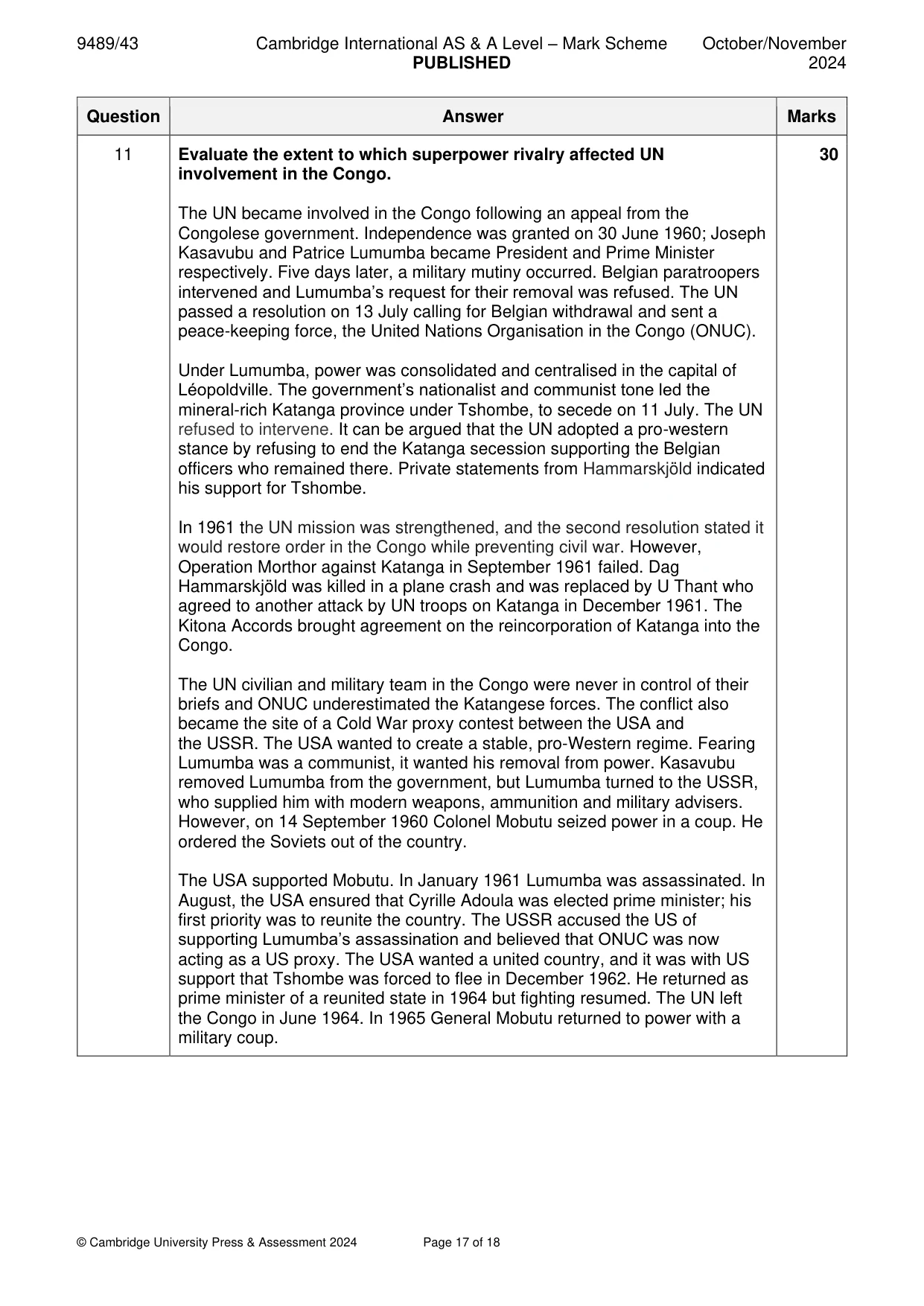
9489/43 Cambridge International AS & A Level – Mark Scheme PUBLISHED October/November 2024 © Cambridge University Press & Assessment 2024 Page 17 of 18 Question Answer Marks 11 Evaluate the extent to which superpower rivalry affected UN involvement in the Congo. The UN became involved in the Congo following an appeal from the Congolese government. Independence was granted on 30 June 1960; Joseph Kasavubu and Patrice Lumumba became President and Prime Minister respectively. Five days later, a military mutiny occurred. Belgian paratroopers intervened and Lumumba’s request for their removal was refused. The UN passed a resolution on 13 July calling for Belgian withdrawal and sent a peace-keeping force, the United Nations Organisation in the Congo (ONUC). Under Lumumba, power was consolidated and centralised in the capital of Léopoldville. The government’s nationalist and communist tone led the mineral-rich Katanga province under Tshombe, to secede on 11 July. The UN refused to intervene. It can be argued that the UN adopted a pro-western stance by refusing to end the Katanga secession supporting the Belgian officers who remained there. Private statements from Hammarskjöld indicated his support for Tshombe. In 1961 the UN mission was strengthened, and the second resolution stated it would restore order in the Congo while preventing civil war. However, Operation Morthor against Katanga in September 1961 failed. Dag Hammarskjöld was killed in a plane crash and was replaced by U Thant who agreed to another attack by UN troops on Katanga in December 1961. The Kitona Accords brought agreement on the reincorporation of Katanga into the Congo. The UN civilian and military team in the Congo were never in control of their briefs and ONUC underestimated the Katangese forces. The conflict also became the site of a Cold War proxy contest between the USA and the USSR. The USA wanted to create a stable, pro-Western regime. Fearing Lumumba was a communist, it wanted his removal from power. Kasavubu removed Lumumba from the government, but Lumumba turned to the USSR, who supplied him with modern weapons, ammunition and military advisers. However, on 14 September 1960 Colonel Mobutu seized power in a coup. He ordered the Soviets out of the country. The USA supported Mobutu. In January 1961 Lumumba was assassinated. In August, the USA ensured that Cyrille Adoula was elected prime minister; his first priority was to reunite the country. The USSR accused the US of supporting Lumumba’s assassination and believed that ONUC was now acting as a US proxy. The USA wanted a united country, and it was with US support that Tshombe was forced to flee in December 1962. He returned as prime minister of a reunited state in 1964 but fighting resumed. The UN left the Congo in June 1964. In 1965 General Mobutu returned to power with a military coup. 30
Mark scheme, page 18
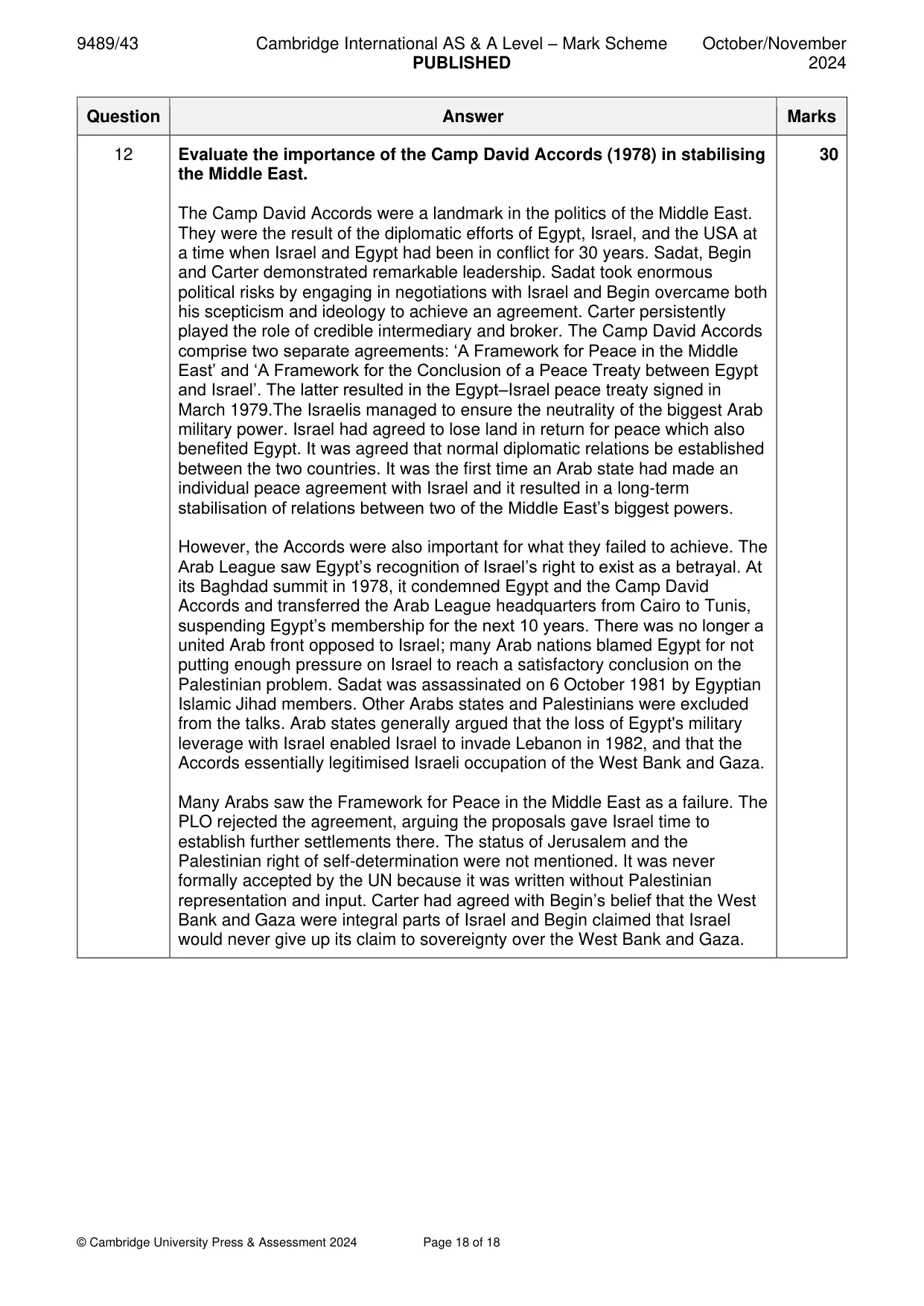
9489/43 Cambridge International AS & A Level – Mark Scheme PUBLISHED October/November 2024 © Cambridge University Press & Assessment 2024 Page 18 of 18 Question Answer Marks 12 Evaluate the importance of the Camp David Accords (1978) in stabilising the Middle East. The Camp David Accords were a landmark in the politics of the Middle East. They were the result of the diplomatic efforts of Egypt, Israel, and the USA at a time when Israel and Egypt had been in conflict for 30 years. Sadat, Begin and Carter demonstrated remarkable leadership. Sadat took enormous political risks by engaging in negotiations with Israel and Begin overcame both his scepticism and ideology to achieve an agreement. Carter persistently played the role of credible intermediary and broker. The Camp David Accords comprise two separate agreements: ‘A Framework for Peace in the Middle East’ and ‘A Framework for the Conclusion of a Peace Treaty between Egypt and Israel’. The latter resulted in the Egypt–Israel peace treaty signed in March 1979.The Israelis managed to ensure the neutrality of the biggest Arab military power. Israel had agreed to lose land in return for peace which also benefited Egypt. It was agreed that normal diplomatic relations be established between the two countries. It was the first time an Arab state had made an individual peace agreement with Israel and it resulted in a long-term stabilisation of relations between two of the Middle East’s biggest powers. However, the Accords were also important for what they failed to achieve. The Arab League saw Egypt’s recognition of Israel’s right to exist as a betrayal. At its Baghdad summit in 1978, it condemned Egypt and the Camp David Accords and transferred the Arab League headquarters from Cairo to Tunis, suspending Egypt’s membership for the next 10 years. There was no longer a united Arab front opposed to Israel; many Arab nations blamed Egypt for not putting enough pressure on Israel to reach a satisfactory conclusion on the Palestinian problem. Sadat was assassinated on 6 October 1981 by Egyptian Islamic Jihad members. Other Arabs states and Palestinians were excluded from the talks. Arab states generally argued that the loss of Egypt's military leverage with Israel enabled Israel to invade Lebanon in 1982, and that the Accords essentially legitimised Israeli occupation of the West Bank and Gaza. Many Arabs saw the Framework for Peace in the Middle East as a failure. The PLO rejected the agreement, arguing the proposals gave Israel time to establish further settlements there. The status of Jerusalem and the Palestinian right of self-determination were not mentioned. It was never formally accepted by the UN because it was written without Palestinian representation and input. Carter had agreed with Begin’s belief that the West Bank and Gaza were integral parts of Israel and Begin claimed that Israel would never give up its claim to sovereignty over the West Bank and Gaza. 30
What you needed in this session
Cambridge’s own grade thresholds for 2024 Oct/Nov, Paper 4 · Variant 3. A higher threshold means an easier paper — the bar moves with how the cohort did.