Cambridge A Level History 9489 — 2024 Feb/March Paper 4 · Variant 2
9489/42/F/M/24 · 60 marks · ≈68 min
The question paper and its mark scheme, free to read here and free to download. This is Cambridge’s own paper, exactly as it was sat.
Question paper4 pages
Mark scheme16 pages
Answers below. Sit the paper first if you are practising.

Paper as text
Question paper, page 1
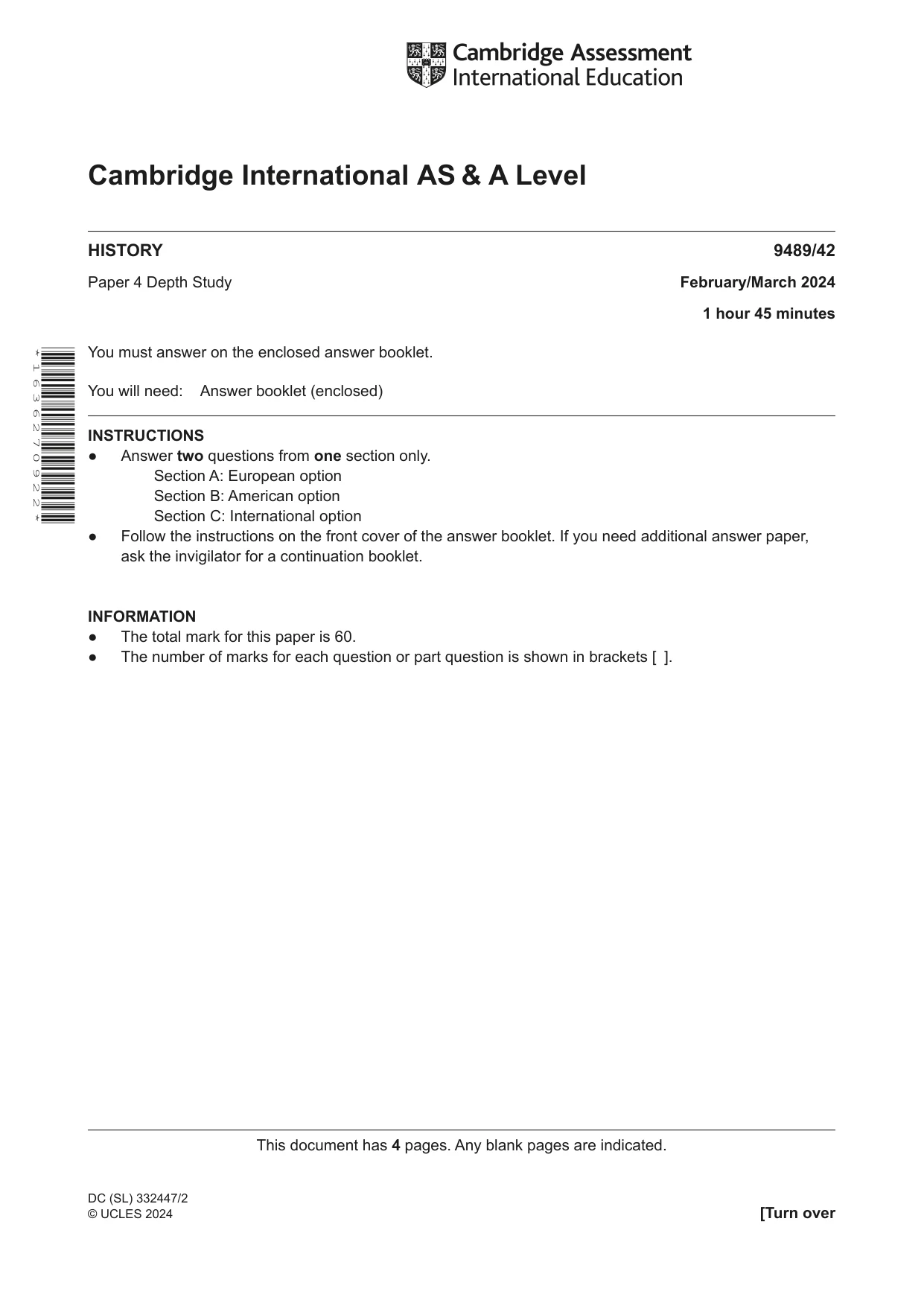
This document has 4 pages. Any blank pages are indicated. [Turn over Cambridge International AS & A Level HISTORY 9489/42 Paper 4 Depth Study February/March 2024 1 hour 45 minutes You must answer on the enclosed answer booklet. You will need: Answer booklet (enclosed) INSTRUCTIONS ● Answer two questions from one section only. Section A: European option Section B: American option Section C: International option ● Follow the instructions on the front cover of the answer booklet. If you need additional answer paper, ask the invigilator for a continuation booklet. INFORMATION ● The total mark for this paper is 60. ● The number of marks for each question or part question is shown in brackets [ ]. * 1 6 3 6 2 7 0 9 2 2 * DC (SL) 332447/2 © UCLES 2024
Question paper, page 2
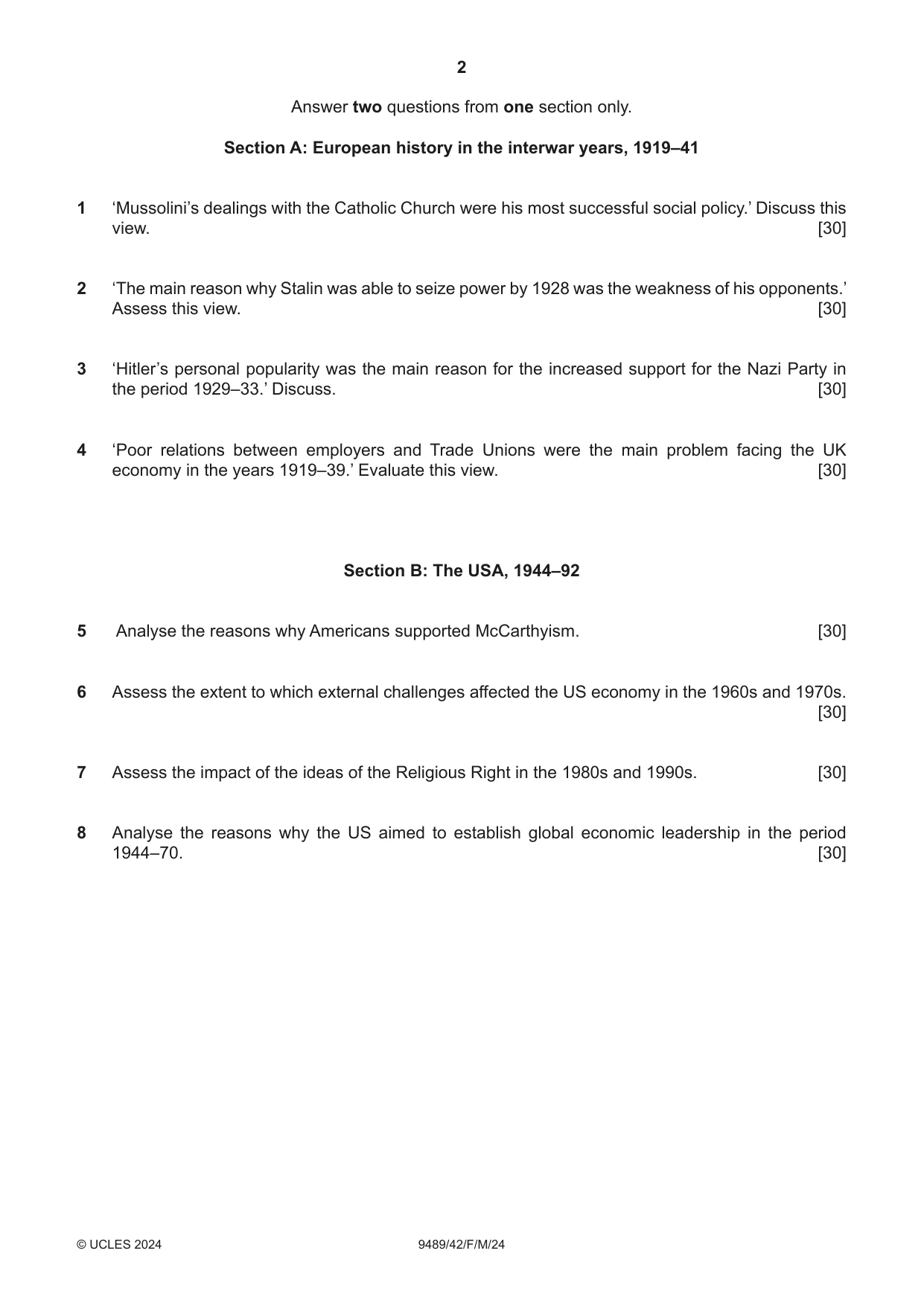
2 9489/42/F/M/24 © UCLES 2024 Answer two questions from one section only. Section A: European history in the interwar years, 1919–41 1 ‘Mussolini’s dealings with the Catholic Church were his most successful social policy.’ Discuss this view. [30] 2 ‘The main reason why Stalin was able to seize power by 1928 was the weakness of his opponents.’ Assess this view. [30] 3 ‘Hitler’s personal popularity was the main reason for the increased support for the Nazi Party in the period 1929–33.’ Discuss. [30] 4 ‘Poor relations between employers and Trade Unions were the main problem facing the UK economy in the years 1919–39.’ Evaluate this view. [30] Section B: The USA, 1944–92 5 Analyse the reasons why Americans supported McCarthyism. [30] 6 Assess the extent to which external challenges affected the US economy in the 1960s and 1970s. [30] 7 Assess the impact of the ideas of the Religious Right in the 1980s and 1990s. [30] 8 Analyse the reasons why the US aimed to establish global economic leadership in the period 1944–70. [30]
Question paper, page 3
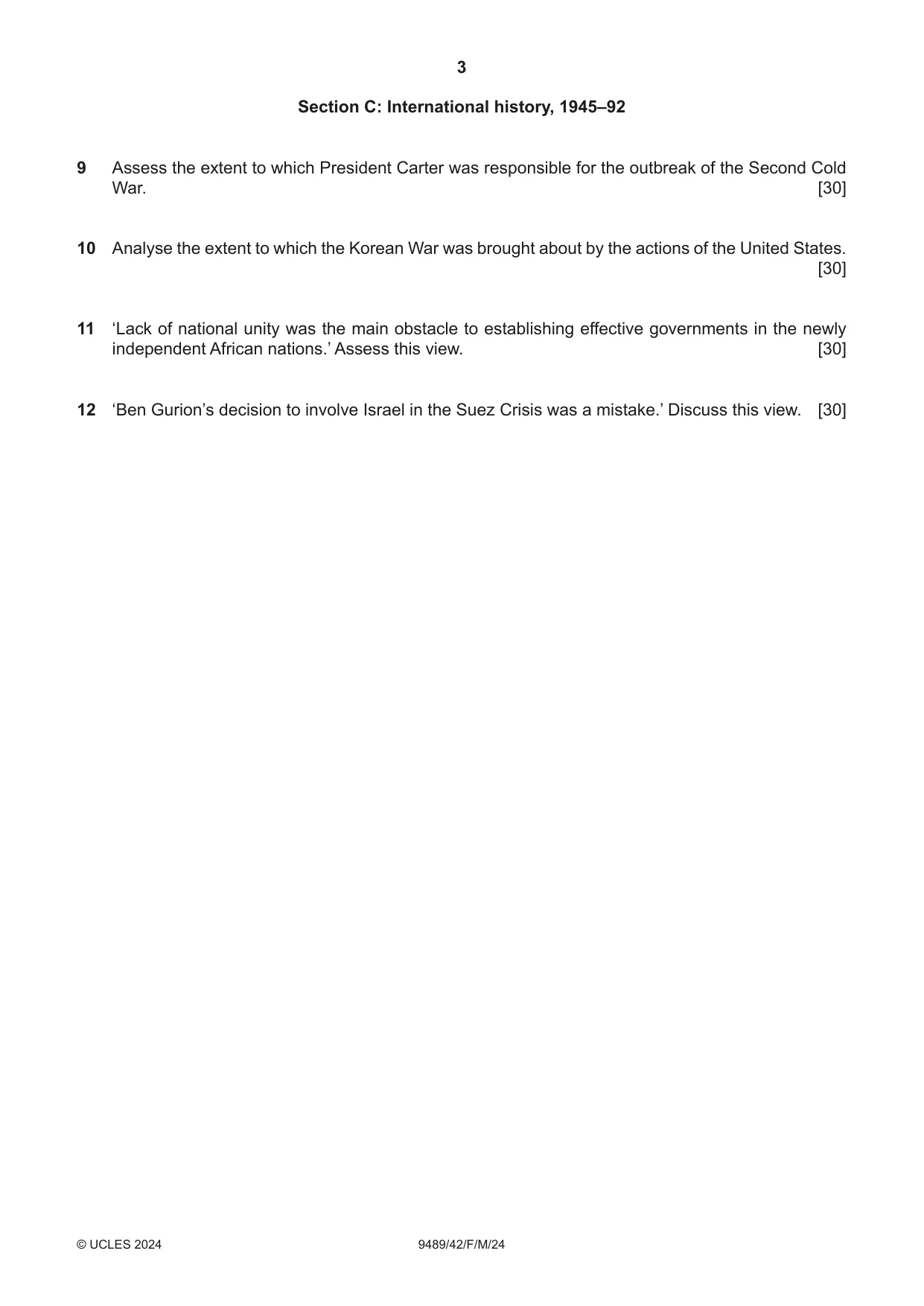
3 9489/42/F/M/24 © UCLES 2024 Section C: International history, 1945–92 9 Assess the extent to which President Carter was responsible for the outbreak of the Second Cold War. [30] 10 Analyse the extent to which the Korean War was brought about by the actions of the United States. [30] 11 ‘Lack of national unity was the main obstacle to establishing effective governments in the newly independent African nations.’ Assess this view. [30] 12 ‘Ben Gurion’s decision to involve Israel in the Suez Crisis was a mistake.’ Discuss this view. [30]
Question paper, page 4
4 9489/42/F/M/24 © UCLES 2024 Permission to reproduce items where third-party owned material protected by copyright is included has been sought and cleared where possible. Every reasonable effort has been made by the publisher (UCLES) to trace copyright holders, but if any items requiring clearance have unwittingly been included, the publisher will be pleased to make amends at the earliest possible opportunity. To avoid the issue of disclosure of answer-related information to candidates, all copyright acknowledgements are reproduced online in the Cambridge Assessment International Education Copyright Acknowledgements Booklet. This is produced for each series of examinations and is freely available to download at www.cambridgeinternational.org after the live examination series. Cambridge Assessment International Education is part of Cambridge Assessment. Cambridge Assessment is the brand name of the University of Cambridge Local Examinations Syndicate (UCLES), which is a department of the University of Cambridge. BLANK PAGE
Mark scheme, page 1
This document consists of 16 printed pages. © Cambridge University Press & Assessment 2024 [Turn over Cambridge International AS & A Level HISTORY 9489/42 Paper 4 Depth Study February/March 2024 MARK SCHEME Maximum Mark: 60 Published This mark scheme is published as an aid to teachers and candidates, to indicate the requirements of the examination. It shows the basis on which Examiners were instructed to award marks. It does not indicate the details of the discussions that took place at an Examiners’ meeting before marking began, which would have considered the acceptability of alternative answers. Mark schemes should be read in conjunction with the question paper and the Principal Examiner Report for Teachers. Cambridge International will not enter into discussions about these mark schemes. Cambridge International is publishing the mark schemes for the February/March 2024 series for most Cambridge IGCSE, Cambridge International A and AS Level components, and some Cambridge O Level components.
Mark scheme, page 2
9489/42 Cambridge International AS & A Level – Mark Scheme PUBLISHED February/March 2024 © Cambridge University Press & Assessment 2024 Page 2 of 16 Generic Marking Principles These general marking principles must be applied by all examiners when marking candidate answers. They should be applied alongside the specific content of the mark scheme or generic level descriptions for a question. Each question paper and mark scheme will also comply with these marking principles. GENERIC MARKING PRINCIPLE 1: Marks must be awarded in line with: • the specific content of the mark scheme or the generic level descriptors for the question • the specific skills defined in the mark scheme or in the generic level descriptors for the question • the standard of response required by a candidate as exemplified by the standardisation scripts. GENERIC MARKING PRINCIPLE 2: Marks awarded are always whole marks (not half marks, or other fractions). GENERIC MARKING PRINCIPLE 3: Marks must be awarded positively: • marks are awarded for correct/valid answers, as defined in the mark scheme. However, credit is given for valid answers which go beyond the scope of the syllabus and mark scheme, referring to your Team Leader as appropriate • marks are awarded when candidates clearly demonstrate what they know and can do • marks are not deducted for errors • marks are not deducted for omissions • answers should only be judged on the quality of spelling, punctuation and grammar when these features are specifically assessed by the question as indicated by the mark scheme. The meaning, however, should be unambiguous. GENERIC MARKING PRINCIPLE 4: Rules must be applied consistently, e.g. in situations where candidates have not followed instructions or in the application of generic level descriptors. GENERIC MARKING PRINCIPLE 5: Marks should be awarded using the full range of marks defined in the mark scheme for the question (however; the use of the full mark range may be limited according to the quality of the candidate responses seen). GENERIC MARKING PRINCIPLE 6: Marks awarded are based solely on the requirements as defined in the mark scheme. Marks should not be awarded with grade thresholds or grade descriptors in mind.
Mark scheme, page 3
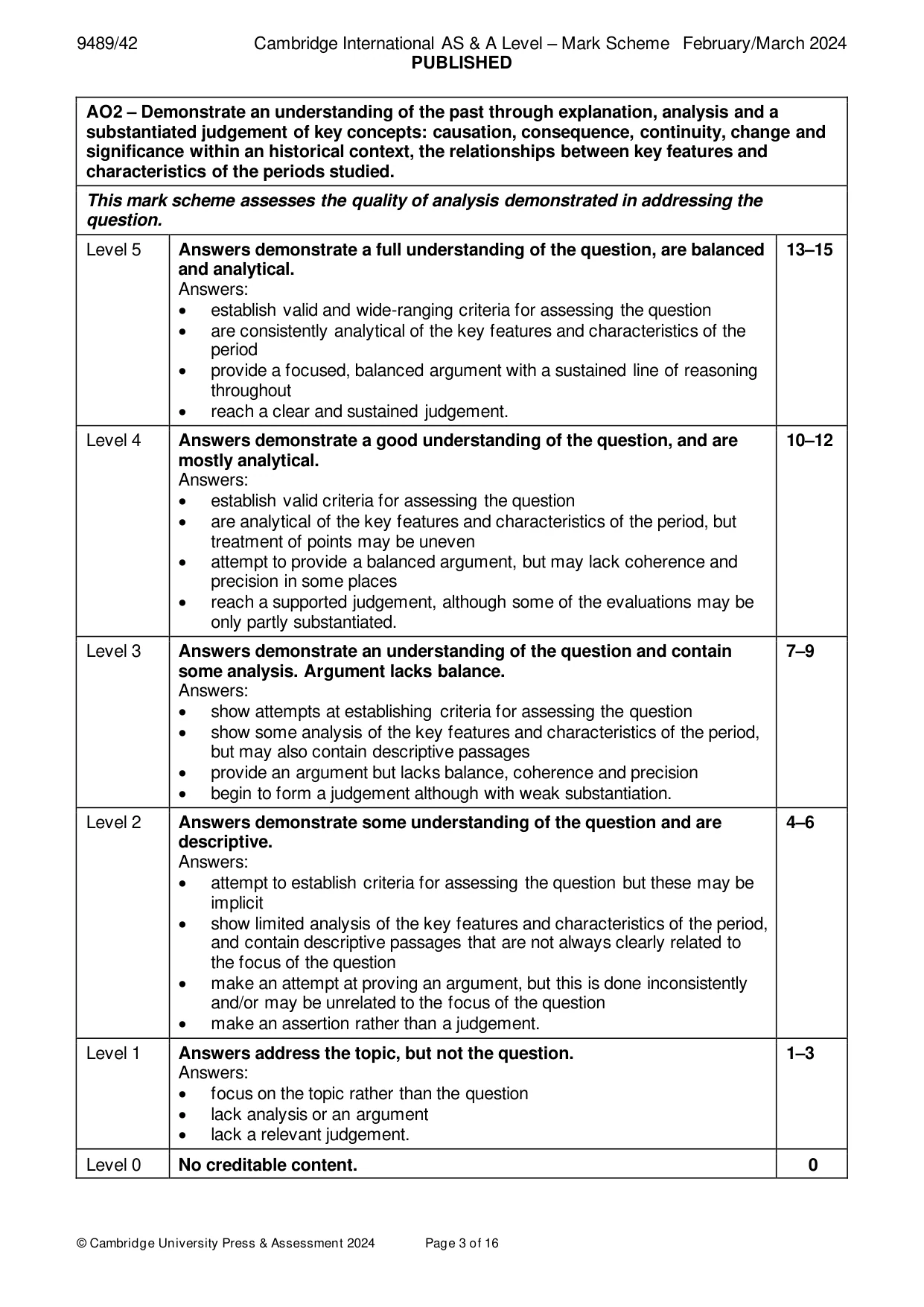
9489/42 Cambridge International AS & A Level – Mark Scheme PUBLISHED February/March 2024 © Cambridge University Press & Assessment 2024 Page 3 of 16 AO2 – Demonstrate an understanding of the past through explanation, analysis and a substantiated judgement of key concepts: causation, consequence, continuity, change and significance within an historical context, the relationships between key features and characteristics of the periods studied. This mark scheme assesses the quality of analysis demonstrated in addressing the question. Level 5 Answers demonstrate a full understanding of the question, are balanced and analytical. Answers: • establish valid and wide-ranging criteria for assessing the question • are consistently analytical of the key features and characteristics of the period • provide a focused, balanced argument with a sustained line of reasoning throughout • reach a clear and sustained judgement. 13–15 Level 4 Answers demonstrate a good understanding of the question, and are mostly analytical. Answers: • establish valid criteria for assessing the question • are analytical of the key features and characteristics of the period, but treatment of points may be uneven • attempt to provide a balanced argument, but may lack coherence and precision in some places • reach a supported judgement, although some of the evaluations may be only partly substantiated. 10–12 Level 3 Answers demonstrate an understanding of the question and contain some analysis. Argument lacks balance. Answers: • show attempts at establishing criteria for assessing the question • show some analysis of the key features and characteristics of the period, but may also contain descriptive passages • provide an argument but lacks balance, coherence and precision • begin to form a judgement although with weak substantiation. 7–9 Level 2 Answers demonstrate some understanding of the question and are descriptive. Answers: • attempt to establish criteria for assessing the question but these may be implicit • show limited analysis of the key features and characteristics of the period, and contain descriptive passages that are not always clearly related to the focus of the question • make an attempt at proving an argument, but this is done inconsistently and/or may be unrelated to the focus of the question • make an assertion rather than a judgement. 4–6 Level 1 Answers address the topic, but not the question. Answers: • focus on the topic rather than the question • lack analysis or an argument • lack a relevant judgement. 1–3 Level 0 No creditable content. 0
Mark scheme, page 4
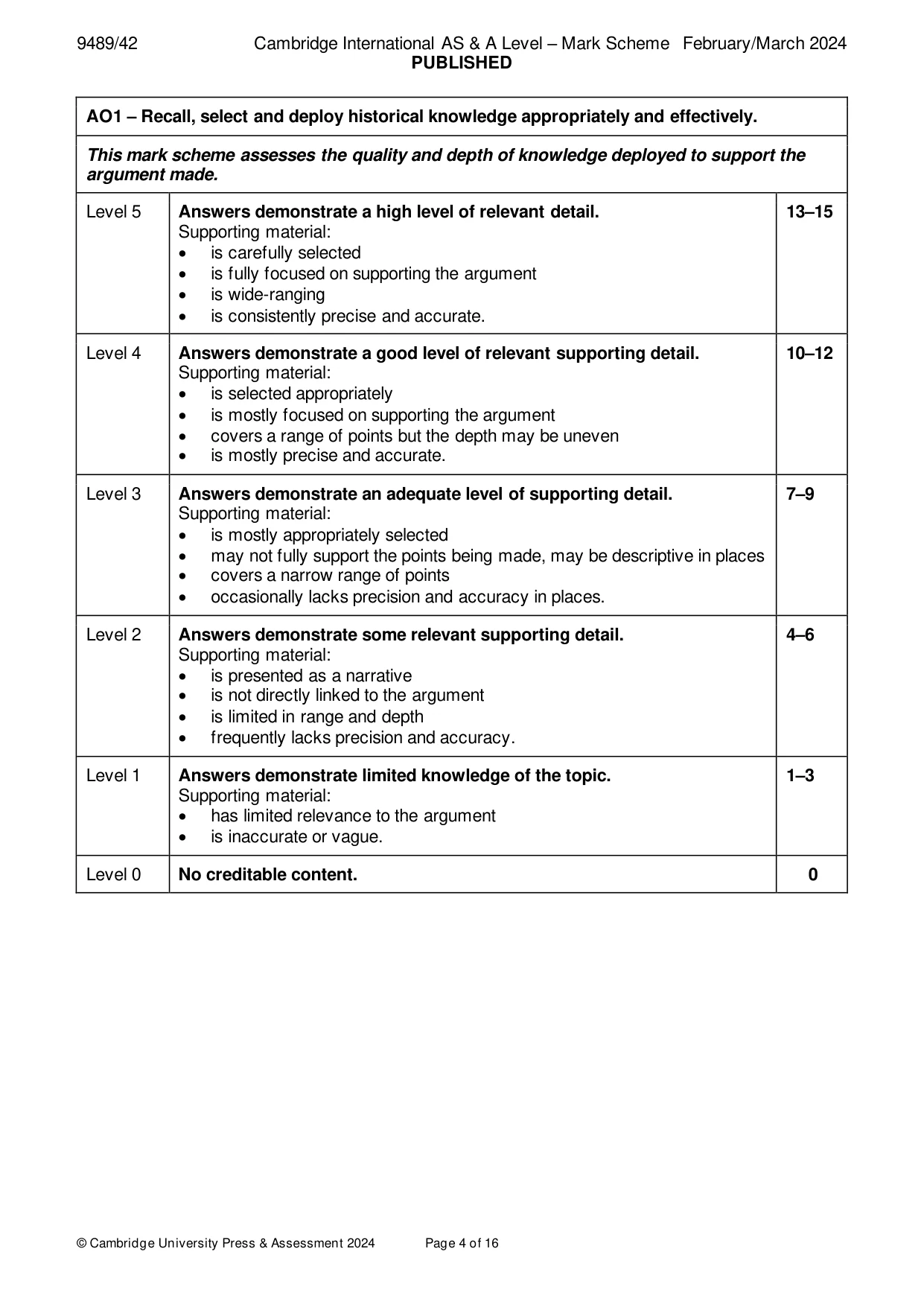
9489/42 Cambridge International AS & A Level – Mark Scheme PUBLISHED February/March 2024 © Cambridge University Press & Assessment 2024 Page 4 of 16 AO1 – Recall, select and deploy historical knowledge appropriately and effectively. This mark scheme assesses the quality and depth of knowledge deployed to support the argument made. Level 5 Answers demonstrate a high level of relevant detail. Supporting material: • is carefully selected • is fully focused on supporting the argument • is wide-ranging • is consistently precise and accurate. 13–15 Level 4 Answers demonstrate a good level of relevant supporting detail. Supporting material: • is selected appropriately • is mostly focused on supporting the argument • covers a range of points but the depth may be uneven • is mostly precise and accurate. 10–12 Level 3 Answers demonstrate an adequate level of supporting detail. Supporting material: • is mostly appropriately selected • may not fully support the points being made, may be descriptive in places • covers a narrow range of points • occasionally lacks precision and accuracy in places. 7–9 Level 2 Answers demonstrate some relevant supporting detail. Supporting material: • is presented as a narrative • is not directly linked to the argument • is limited in range and depth • frequently lacks precision and accuracy. 4–6 Level 1 Answers demonstrate limited knowledge of the topic. Supporting material: • has limited relevance to the argument • is inaccurate or vague. 1–3 Level 0 No creditable content. 0
Mark scheme, page 5
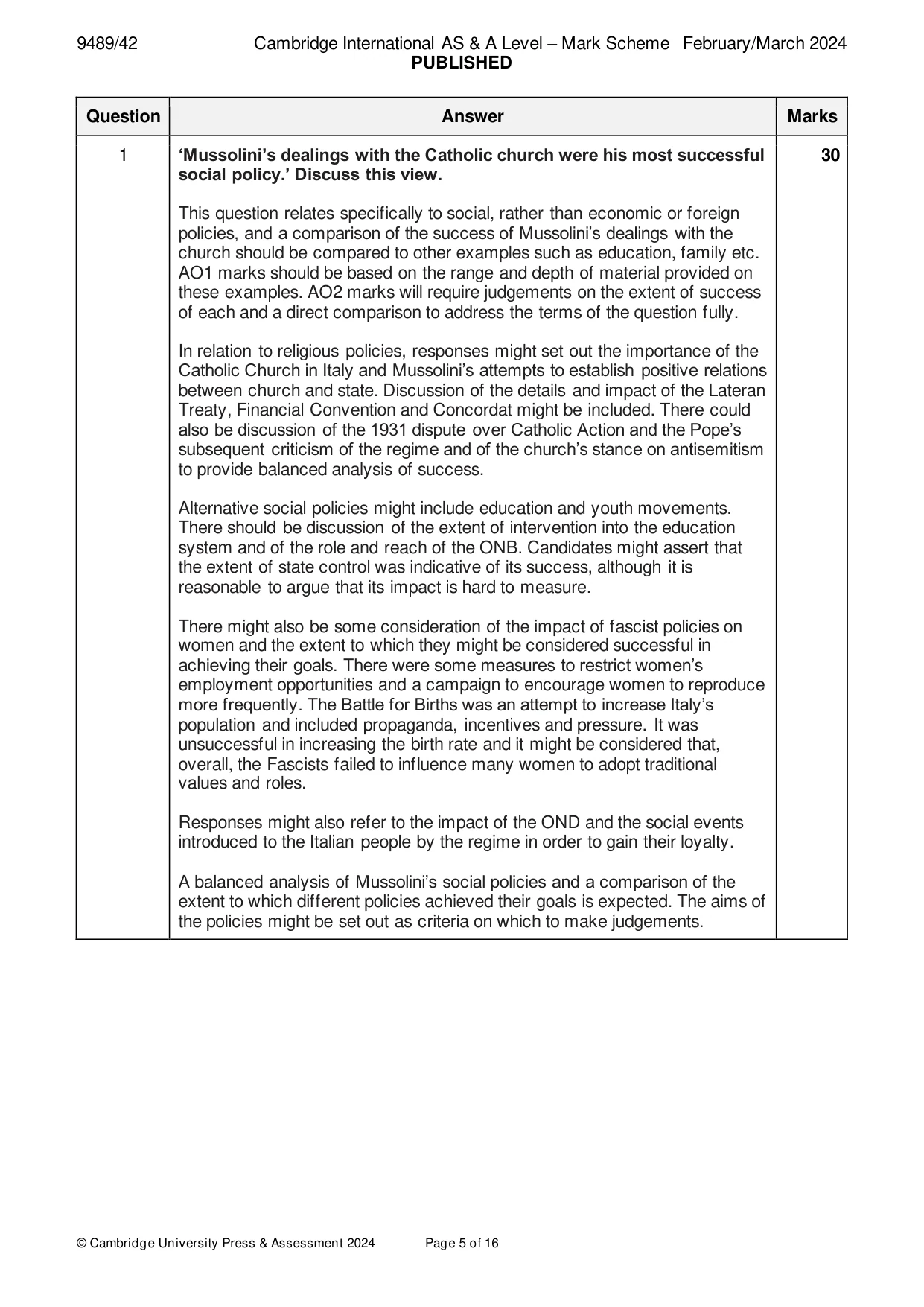
9489/42 Cambridge International AS & A Level – Mark Scheme PUBLISHED February/March 2024 © Cambridge University Press & Assessment 2024 Page 5 of 16 Question Answer Marks 1 ‘Mussolini’s dealings with the Catholic church were his most successful social policy.’ Discuss this view. This question relates specifically to social, rather than economic or foreign policies, and a comparison of the success of Mussolini’s dealings with the church should be compared to other examples such as education, family etc. AO1 marks should be based on the range and depth of material provided on these examples. AO2 marks will require judgements on the extent of success of each and a direct comparison to address the terms of the question fully. In relation to religious policies, responses might set out the importance of the Catholic Church in Italy and Mussolini’s attempts to establish positive relations between church and state. Discussion of the details and impact of the Lateran Treaty, Financial Convention and Concordat might be included. There could also be discussion of the 1931 dispute over Catholic Action and the Pope’s subsequent criticism of the regime and of the church’s stance on antisemitism to provide balanced analysis of success. Alternative social policies might include education and youth movements. There should be discussion of the extent of intervention into the education system and of the role and reach of the ONB. Candidates might assert that the extent of state control was indicative of its success, although it is reasonable to argue that its impact is hard to measure. There might also be some consideration of the impact of fascist policies on women and the extent to which they might be considered successful in achieving their goals. There were some measures to restrict women’s employment opportunities and a campaign to encourage women to reproduce more frequently. The Battle for Births was an attempt to increase Italy’s population and included propaganda, incentives and pressure. It was unsuccessful in increasing the birth rate and it might be considered that, overall, the Fascists failed to influence many women to adopt traditional values and roles. Responses might also refer to the impact of the OND and the social events introduced to the Italian people by the regime in order to gain their loyalty. A balanced analysis of Mussolini’s social policies and a comparison of the extent to which different policies achieved their goals is expected. The aims of the policies might be set out as criteria on which to make judgements. 30
Mark scheme, page 6
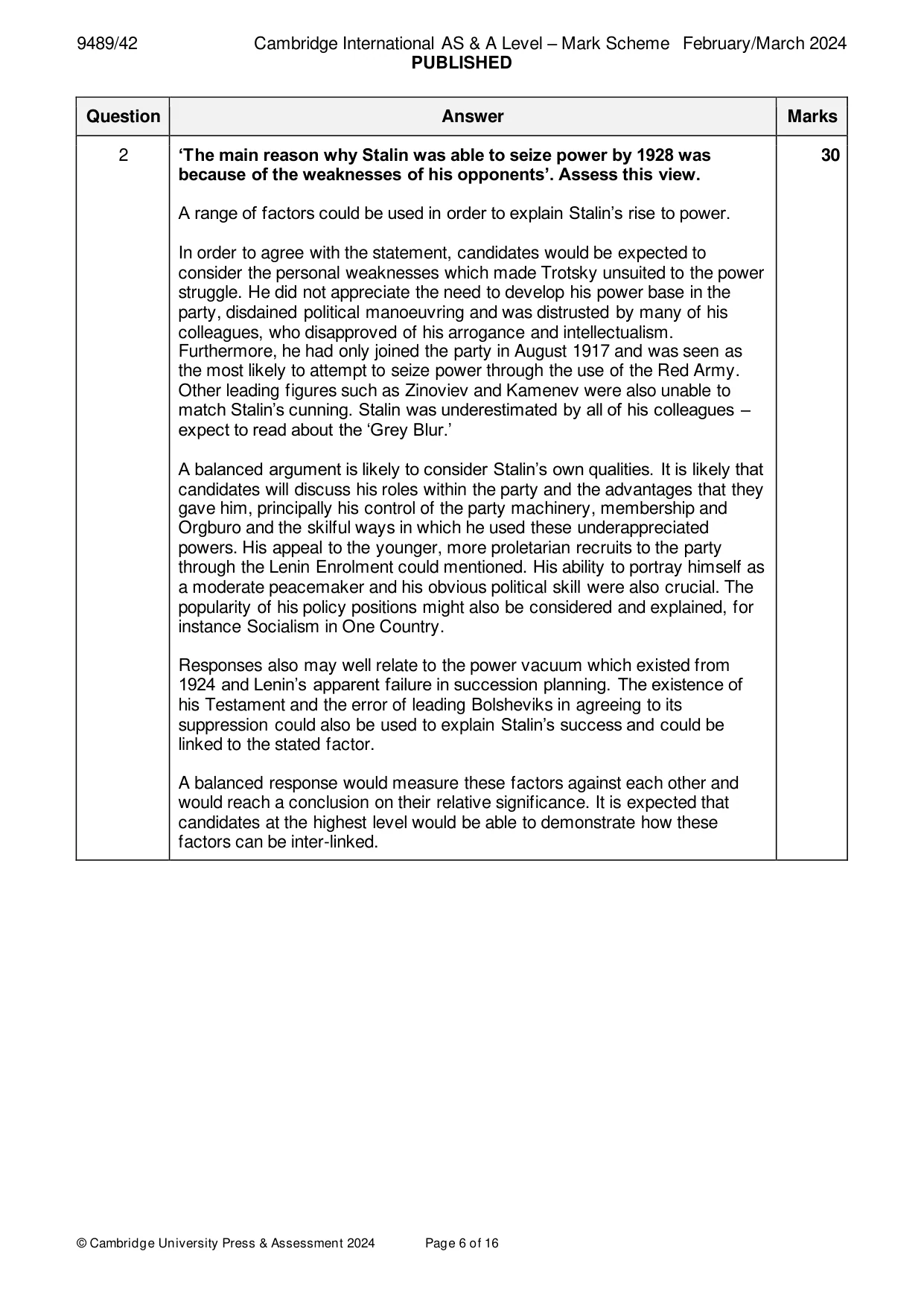
9489/42 Cambridge International AS & A Level – Mark Scheme PUBLISHED February/March 2024 © Cambridge University Press & Assessment 2024 Page 6 of 16 Question Answer Marks 2 ‘The main reason why Stalin was able to seize power by 1928 was because of the weaknesses of his opponents’. Assess this view. A range of factors could be used in order to explain Stalin’s rise to power. In order to agree with the statement, candidates would be expected to consider the personal weaknesses which made Trotsky unsuited to the power struggle. He did not appreciate the need to develop his power base in the party, disdained political manoeuvring and was distrusted by many of his colleagues, who disapproved of his arrogance and intellectualism. Furthermore, he had only joined the party in August 1917 and was seen as the most likely to attempt to seize power through the use of the Red Army. Other leading figures such as Zinoviev and Kamenev were also unable to match Stalin’s cunning. Stalin was underestimated by all of his colleagues – expect to read about the ‘Grey Blur.’ A balanced argument is likely to consider Stalin’s own qualities. It is likely that candidates will discuss his roles within the party and the advantages that they gave him, principally his control of the party machinery, membership and Orgburo and the skilful ways in which he used these underappreciated powers. His appeal to the younger, more proletarian recruits to the party through the Lenin Enrolment could mentioned. His ability to portray himself as a moderate peacemaker and his obvious political skill were also crucial. The popularity of his policy positions might also be considered and explained, for instance Socialism in One Country. Responses also may well relate to the power vacuum which existed from 1924 and Lenin’s apparent failure in succession planning. The existence of his Testament and the error of leading Bolsheviks in agreeing to its suppression could also be used to explain Stalin’s success and could be linked to the stated factor. A balanced response would measure these factors against each other and would reach a conclusion on their relative significance. It is expected that candidates at the highest level would be able to demonstrate how these factors can be inter-linked. 30
Mark scheme, page 7
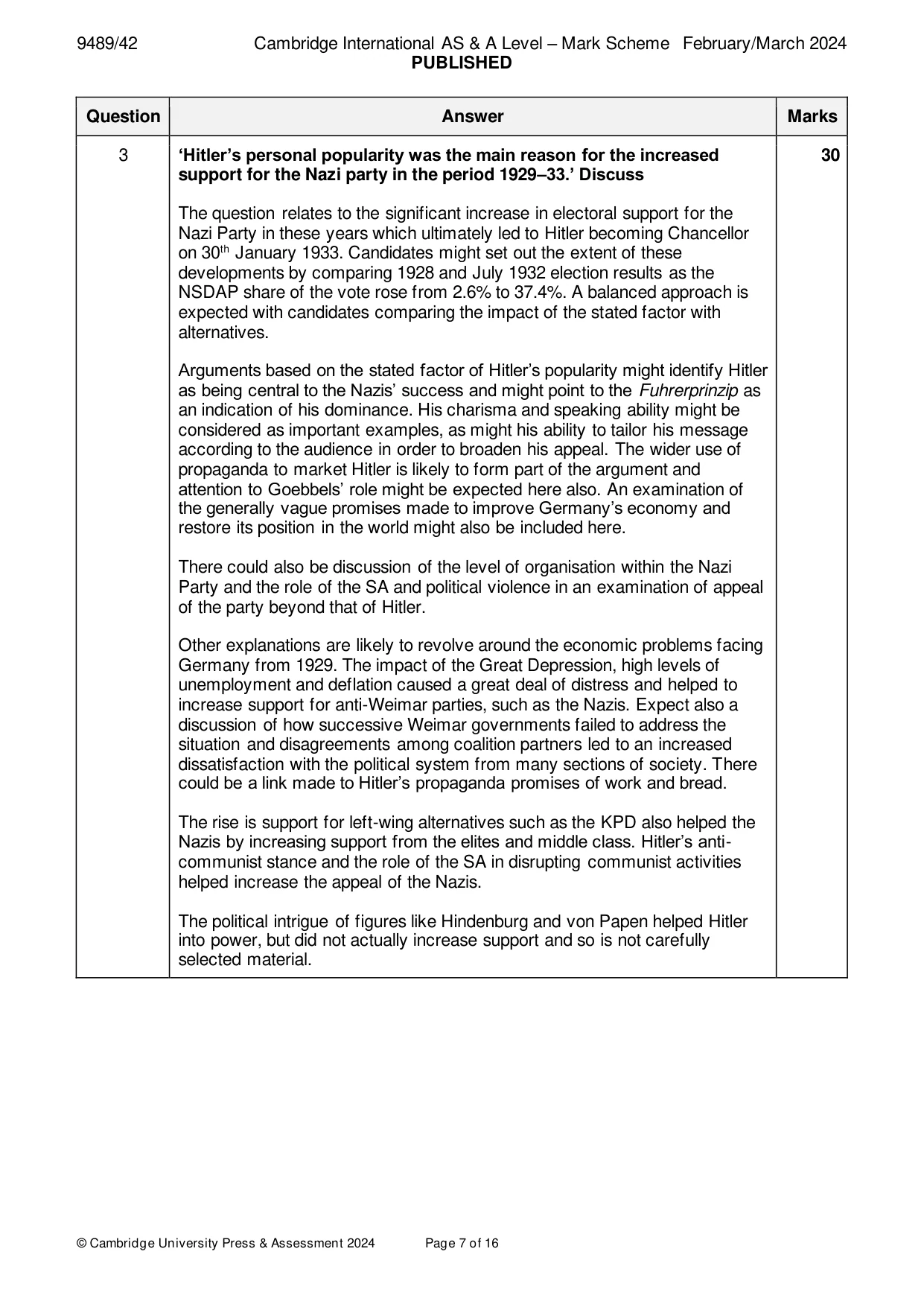
9489/42 Cambridge International AS & A Level – Mark Scheme PUBLISHED February/March 2024 © Cambridge University Press & Assessment 2024 Page 7 of 16 Question Answer Marks 3 ‘Hitler’s personal popularity was the main reason for the increased support for the Nazi party in the period 1929–33.’ Discuss The question relates to the significant increase in electoral support for the Nazi Party in these years which ultimately led to Hitler becoming Chancellor on 30th January 1933. Candidates might set out the extent of these developments by comparing 1928 and July 1932 election results as the NSDAP share of the vote rose from 2.6% to 37.4%. A balanced approach is expected with candidates comparing the impact of the stated factor with alternatives. Arguments based on the stated factor of Hitler’s popularity might identify Hitler as being central to the Nazis’ success and might point to the Fuhrerprinzip as an indication of his dominance. His charisma and speaking ability might be considered as important examples, as might his ability to tailor his message according to the audience in order to broaden his appeal. The wider use of propaganda to market Hitler is likely to form part of the argument and attention to Goebbels’ role might be expected here also. An examination of the generally vague promises made to improve Germany’s economy and restore its position in the world might also be included here. There could also be discussion of the level of organisation within the Nazi Party and the role of the SA and political violence in an examination of appeal of the party beyond that of Hitler. Other explanations are likely to revolve around the economic problems facing Germany from 1929. The impact of the Great Depression, high levels of unemployment and deflation caused a great deal of distress and helped to increase support for anti-Weimar parties, such as the Nazis. Expect also a discussion of how successive Weimar governments failed to address the situation and disagreements among coalition partners led to an increased dissatisfaction with the political system from many sections of society. There could be a link made to Hitler’s propaganda promises of work and bread. The rise is support for left-wing alternatives such as the KPD also helped the Nazis by increasing support from the elites and middle class. Hitler’s anti- communist stance and the role of the SA in disrupting communist activities helped increase the appeal of the Nazis. The political intrigue of figures like Hindenburg and von Papen helped Hitler into power, but did not actually increase support and so is not carefully selected material. 30
Mark scheme, page 8
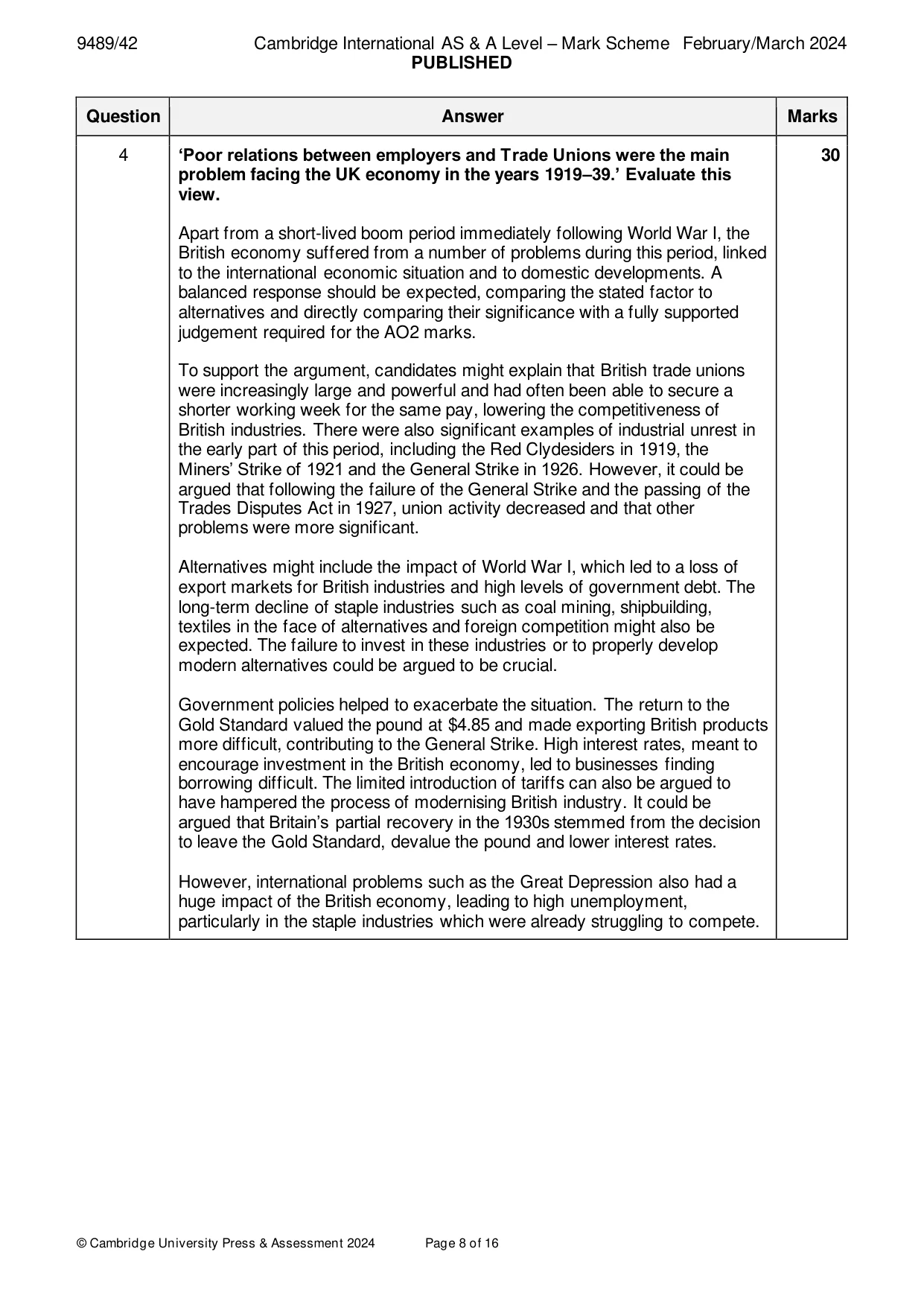
9489/42 Cambridge International AS & A Level – Mark Scheme PUBLISHED February/March 2024 © Cambridge University Press & Assessment 2024 Page 8 of 16 Question Answer Marks 4 ‘Poor relations between employers and Trade Unions were the main problem facing the UK economy in the years 1919–39.’ Evaluate this view. Apart from a short-lived boom period immediately following World War I, the British economy suffered from a number of problems during this period, linked to the international economic situation and to domestic developments. A balanced response should be expected, comparing the stated factor to alternatives and directly comparing their significance with a fully supported judgement required for the AO2 marks. To support the argument, candidates might explain that British trade unions were increasingly large and powerful and had often been able to secure a shorter working week for the same pay, lowering the competitiveness of British industries. There were also significant examples of industrial unrest in the early part of this period, including the Red Clydesiders in 1919, the Miners’ Strike of 1921 and the General Strike in 1926. However, it could be argued that following the failure of the General Strike and the passing of the Trades Disputes Act in 1927, union activity decreased and that other problems were more significant. Alternatives might include the impact of World War I, which led to a loss of export markets for British industries and high levels of government debt. The long-term decline of staple industries such as coal mining, shipbuilding, textiles in the face of alternatives and foreign competition might also be expected. The failure to invest in these industries or to properly develop modern alternatives could be argued to be crucial. Government policies helped to exacerbate the situation. The return to the Gold Standard valued the pound at $4.85 and made exporting British products more difficult, contributing to the General Strike. High interest rates, meant to encourage investment in the British economy, led to businesses finding borrowing difficult. The limited introduction of tariffs can also be argued to have hampered the process of modernising British industry. It could be argued that Britain’s partial recovery in the 1930s stemmed from the decision to leave the Gold Standard, devalue the pound and lower interest rates. However, international problems such as the Great Depression also had a huge impact of the British economy, leading to high unemployment, particularly in the staple industries which were already struggling to compete. 30
Mark scheme, page 9
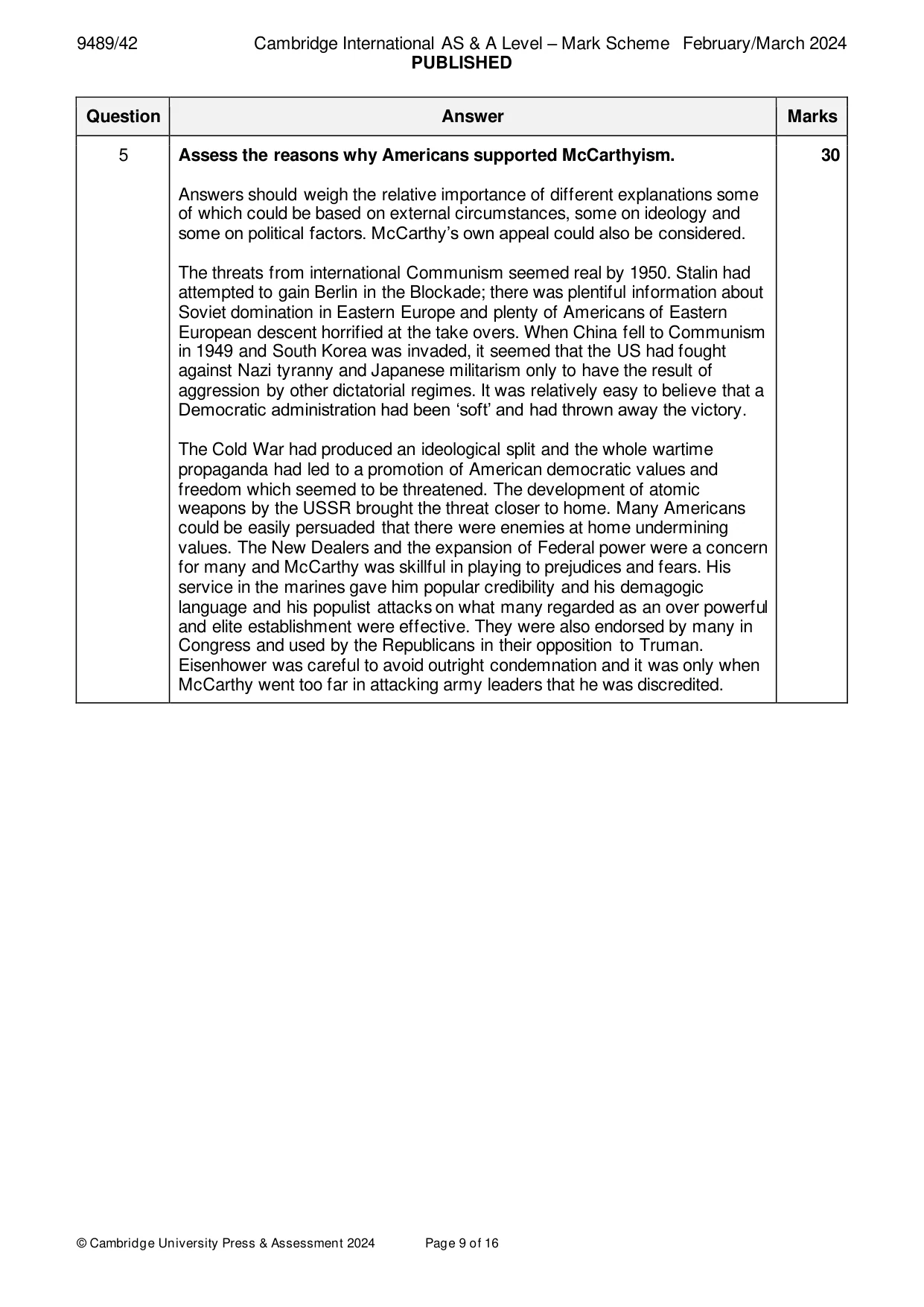
9489/42 Cambridge International AS & A Level – Mark Scheme PUBLISHED February/March 2024 © Cambridge University Press & Assessment 2024 Page 9 of 16 Question Answer Marks 5 Assess the reasons why Americans supported McCarthyism. Answers should weigh the relative importance of different explanations some of which could be based on external circumstances, some on ideology and some on political factors. McCarthy’s own appeal could also be considered. The threats from international Communism seemed real by 1950. Stalin had attempted to gain Berlin in the Blockade; there was plentiful information about Soviet domination in Eastern Europe and plenty of Americans of Eastern European descent horrified at the take overs. When China fell to Communism in 1949 and South Korea was invaded, it seemed that the US had fought against Nazi tyranny and Japanese militarism only to have the result of aggression by other dictatorial regimes. It was relatively easy to believe that a Democratic administration had been ‘soft’ and had thrown away the victory. The Cold War had produced an ideological split and the whole wartime propaganda had led to a promotion of American democratic values and freedom which seemed to be threatened. The development of atomic weapons by the USSR brought the threat closer to home. Many Americans could be easily persuaded that there were enemies at home undermining values. The New Dealers and the expansion of Federal power were a concern for many and McCarthy was skillful in playing to prejudices and fears. His service in the marines gave him popular credibility and his demagogic language and his populist attacks on what many regarded as an over powerful and elite establishment were effective. They were also endorsed by many in Congress and used by the Republicans in their opposition to Truman. Eisenhower was careful to avoid outright condemnation and it was only when McCarthy went too far in attacking army leaders that he was discredited. 30
Mark scheme, page 10
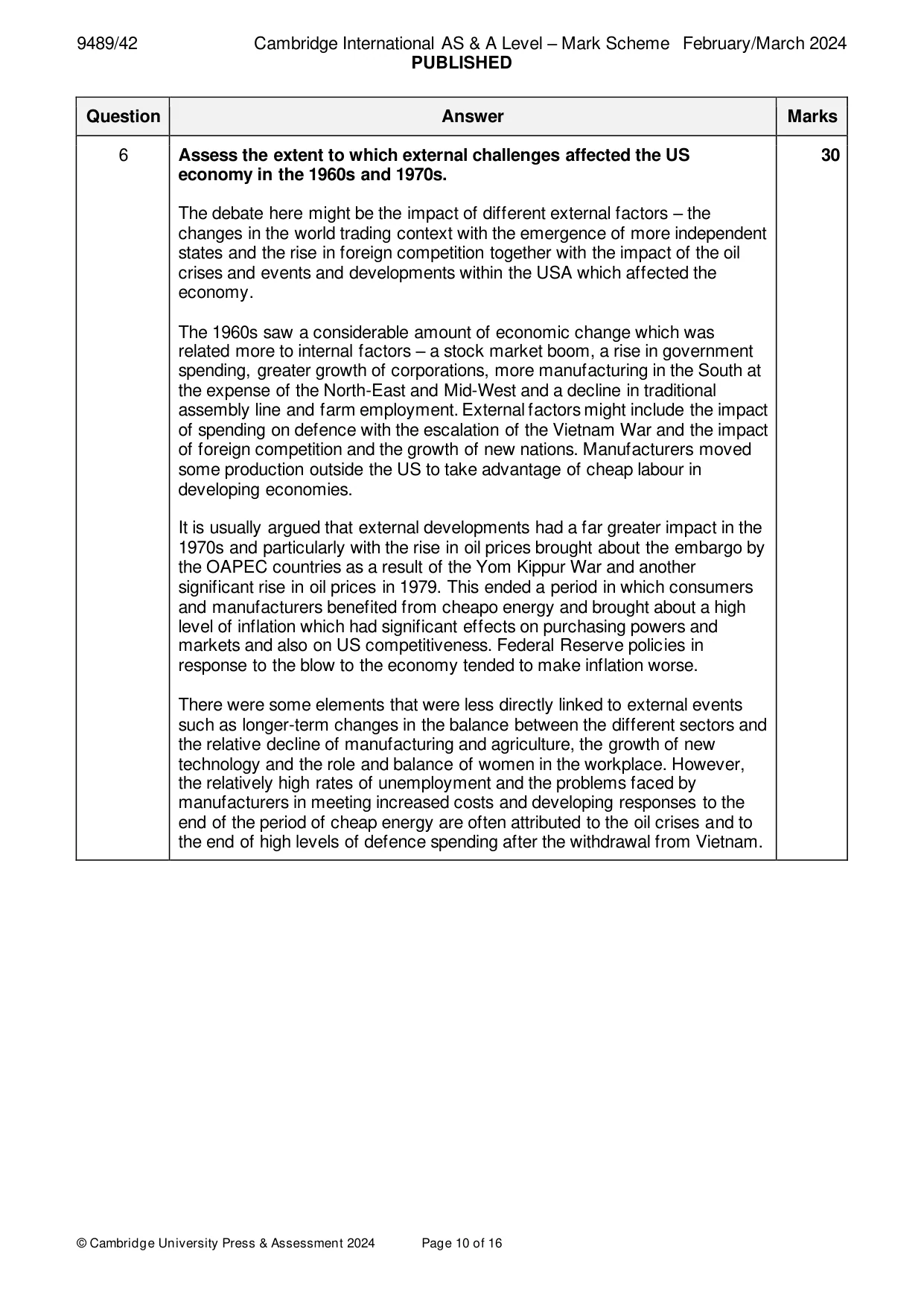
9489/42 Cambridge International AS & A Level – Mark Scheme PUBLISHED February/March 2024 © Cambridge University Press & Assessment 2024 Page 10 of 16 Question Answer Marks 6 Assess the extent to which external challenges affected the US economy in the 1960s and 1970s. The debate here might be the impact of different external factors – the changes in the world trading context with the emergence of more independent states and the rise in foreign competition together with the impact of the oil crises and events and developments within the USA which affected the economy. The 1960s saw a considerable amount of economic change which was related more to internal factors – a stock market boom, a rise in government spending, greater growth of corporations, more manufacturing in the South at the expense of the North-East and Mid-West and a decline in traditional assembly line and farm employment. External factors might include the impact of spending on defence with the escalation of the Vietnam War and the impact of foreign competition and the growth of new nations. Manufacturers moved some production outside the US to take advantage of cheap labour in developing economies. It is usually argued that external developments had a far greater impact in the 1970s and particularly with the rise in oil prices brought about the embargo by the OAPEC countries as a result of the Yom Kippur War and another significant rise in oil prices in 1979. This ended a period in which consumers and manufacturers benefited from cheapo energy and brought about a high level of inflation which had significant effects on purchasing powers and markets and also on US competitiveness. Federal Reserve policies in response to the blow to the economy tended to make inflation worse. There were some elements that were less directly linked to external events such as longer-term changes in the balance between the different sectors and the relative decline of manufacturing and agriculture, the growth of new technology and the role and balance of women in the workplace. However, the relatively high rates of unemployment and the problems faced by manufacturers in meeting increased costs and developing responses to the end of the period of cheap energy are often attributed to the oil crises and to the end of high levels of defence spending after the withdrawal from Vietnam. 30
Mark scheme, page 11
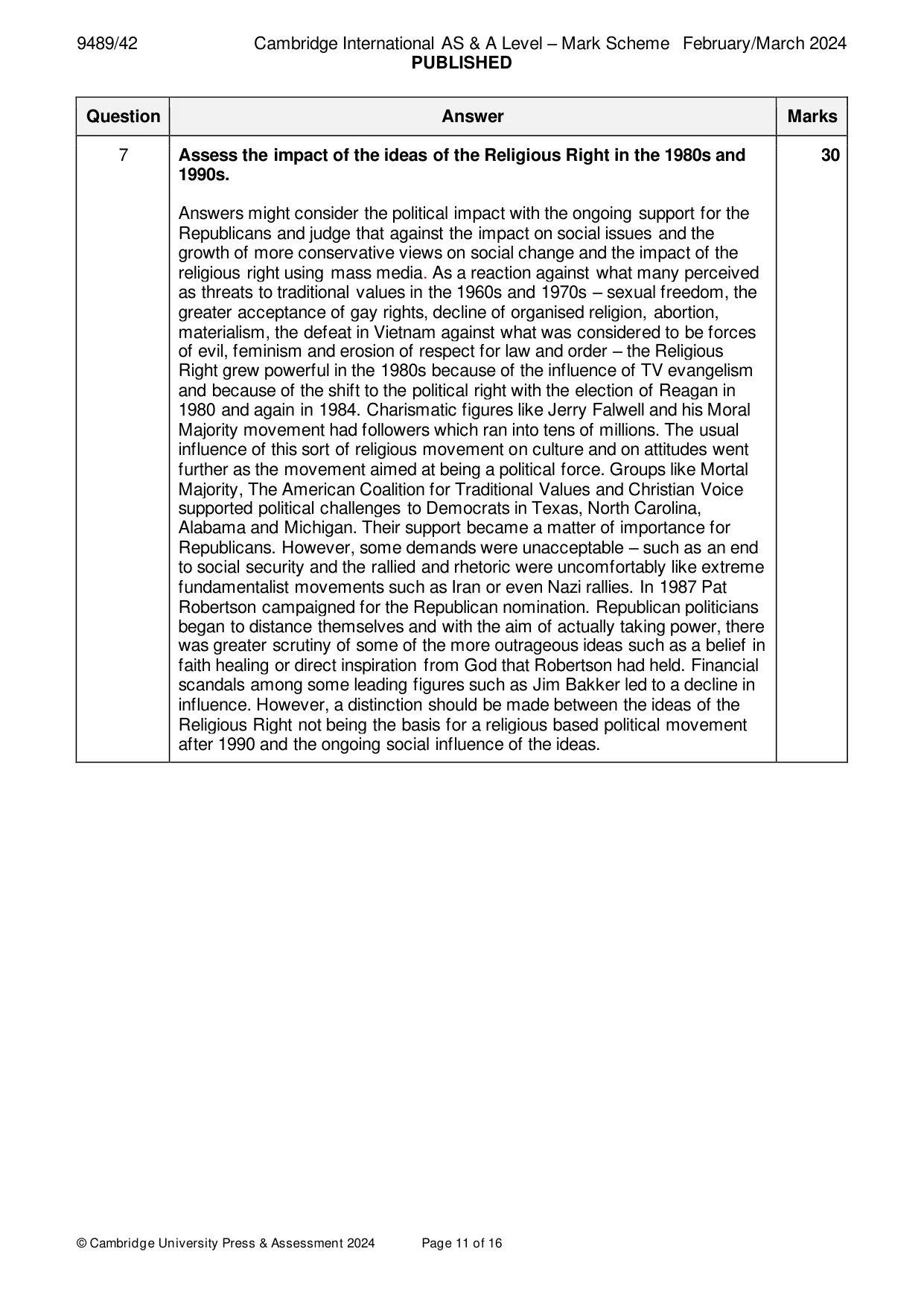
9489/42 Cambridge International AS & A Level – Mark Scheme PUBLISHED February/March 2024 © Cambridge University Press & Assessment 2024 Page 11 of 16 Question Answer Marks 7 Assess the impact of the ideas of the Religious Right in the 1980s and 1990s. Answers might consider the political impact with the ongoing support for the Republicans and judge that against the impact on social issues and the growth of more conservative views on social change and the impact of the religious right using mass media. As a reaction against what many perceived as threats to traditional values in the 1960s and 1970s – sexual freedom, the greater acceptance of gay rights, decline of organised religion, abortion, materialism, the defeat in Vietnam against what was considered to be forces of evil, feminism and erosion of respect for law and order – the Religious Right grew powerful in the 1980s because of the influence of TV evangelism and because of the shift to the political right with the election of Reagan in 1980 and again in 1984. Charismatic figures like Jerry Falwell and his Moral Majority movement had followers which ran into tens of millions. The usual influence of this sort of religious movement on culture and on attitudes went further as the movement aimed at being a political force. Groups like Mortal Majority, The American Coalition for Traditional Values and Christian Voice supported political challenges to Democrats in Texas, North Carolina, Alabama and Michigan. Their support became a matter of importance for Republicans. However, some demands were unacceptable – such as an end to social security and the rallied and rhetoric were uncomfortably like extreme fundamentalist movements such as Iran or even Nazi rallies. In 1987 Pat Robertson campaigned for the Republican nomination. Republican politicians began to distance themselves and with the aim of actually taking power, there was greater scrutiny of some of the more outrageous ideas such as a belief in faith healing or direct inspiration from God that Robertson had held. Financial scandals among some leading figures such as Jim Bakker led to a decline in influence. However, a distinction should be made between the ideas of the Religious Right not being the basis for a religious based political movement after 1990 and the ongoing social influence of the ideas. 30
Mark scheme, page 12
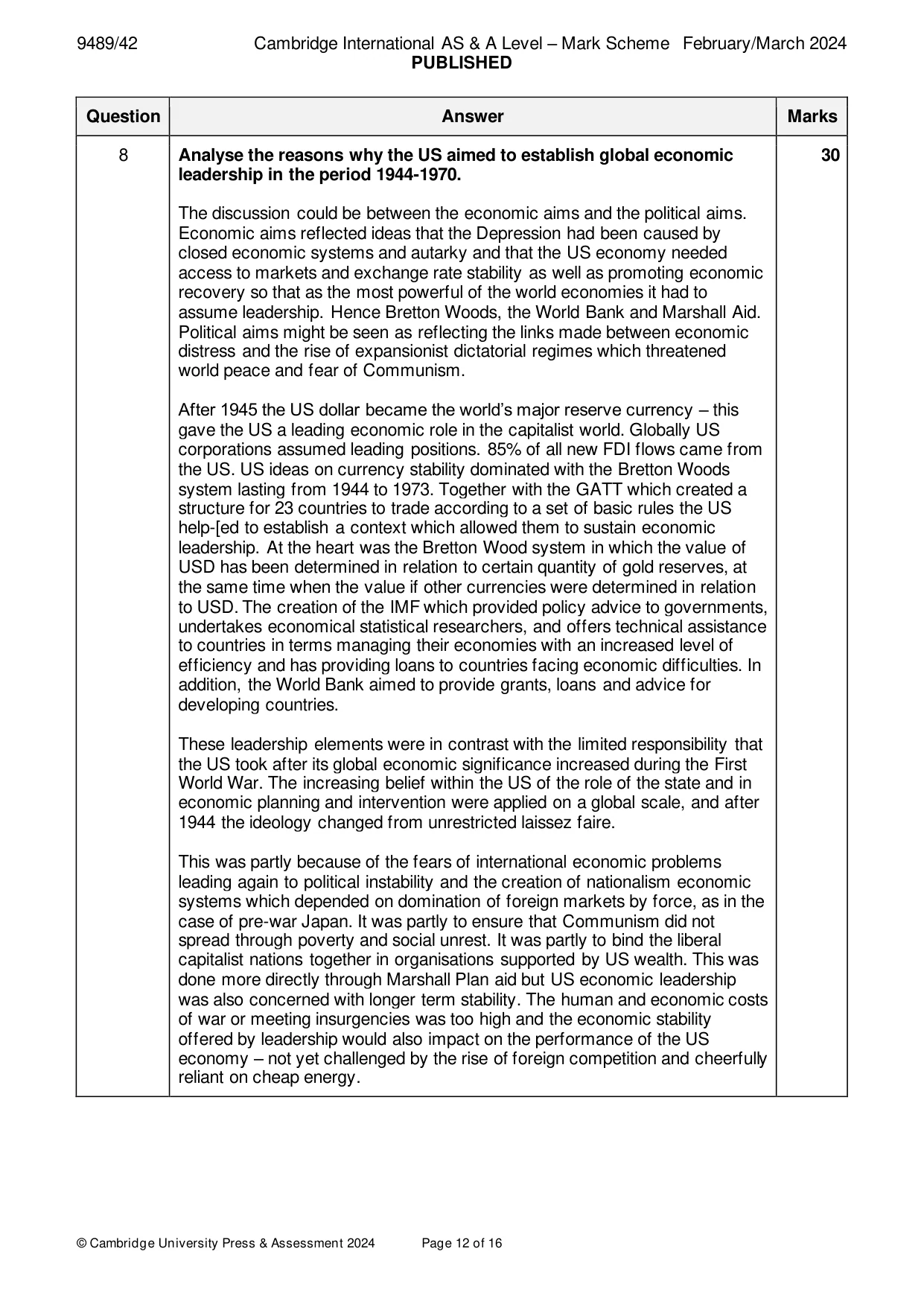
9489/42 Cambridge International AS & A Level – Mark Scheme PUBLISHED February/March 2024 © Cambridge University Press & Assessment 2024 Page 12 of 16 Question Answer Marks 8 Analyse the reasons why the US aimed to establish global economic leadership in the period 1944-1970. The discussion could be between the economic aims and the political aims. Economic aims reflected ideas that the Depression had been caused by closed economic systems and autarky and that the US economy needed access to markets and exchange rate stability as well as promoting economic recovery so that as the most powerful of the world economies it had to assume leadership. Hence Bretton Woods, the World Bank and Marshall Aid. Political aims might be seen as reflecting the links made between economic distress and the rise of expansionist dictatorial regimes which threatened world peace and fear of Communism. After 1945 the US dollar became the world’s major reserve currency – this gave the US a leading economic role in the capitalist world. Globally US corporations assumed leading positions. 85% of all new FDI flows came from the US. US ideas on currency stability dominated with the Bretton Woods system lasting from 1944 to 1973. Together with the GATT which created a structure for 23 countries to trade according to a set of basic rules the US help-[ed to establish a context which allowed them to sustain economic leadership. At the heart was the Bretton Wood system in which the value of USD has been determined in relation to certain quantity of gold reserves, at the same time when the value if other currencies were determined in relation to USD. The creation of the IMF which provided policy advice to governments, undertakes economical statistical researchers, and offers technical assistance to countries in terms managing their economies with an increased level of efficiency and has providing loans to countries facing economic difficulties. In addition, the World Bank aimed to provide grants, loans and advice for developing countries. These leadership elements were in contrast with the limited responsibility that the US took after its global economic significance increased during the First World War. The increasing belief within the US of the role of the state and in economic planning and intervention were applied on a global scale, and after 1944 the ideology changed from unrestricted laissez faire. This was partly because of the fears of international economic problems leading again to political instability and the creation of nationalism economic systems which depended on domination of foreign markets by force, as in the case of pre-war Japan. It was partly to ensure that Communism did not spread through poverty and social unrest. It was partly to bind the liberal capitalist nations together in organisations supported by US wealth. This was done more directly through Marshall Plan aid but US economic leadership was also concerned with longer term stability. The human and economic costs of war or meeting insurgencies was too high and the economic stability offered by leadership would also impact on the performance of the US economy – not yet challenged by the rise of foreign competition and cheerfully reliant on cheap energy. 30
Mark scheme, page 13
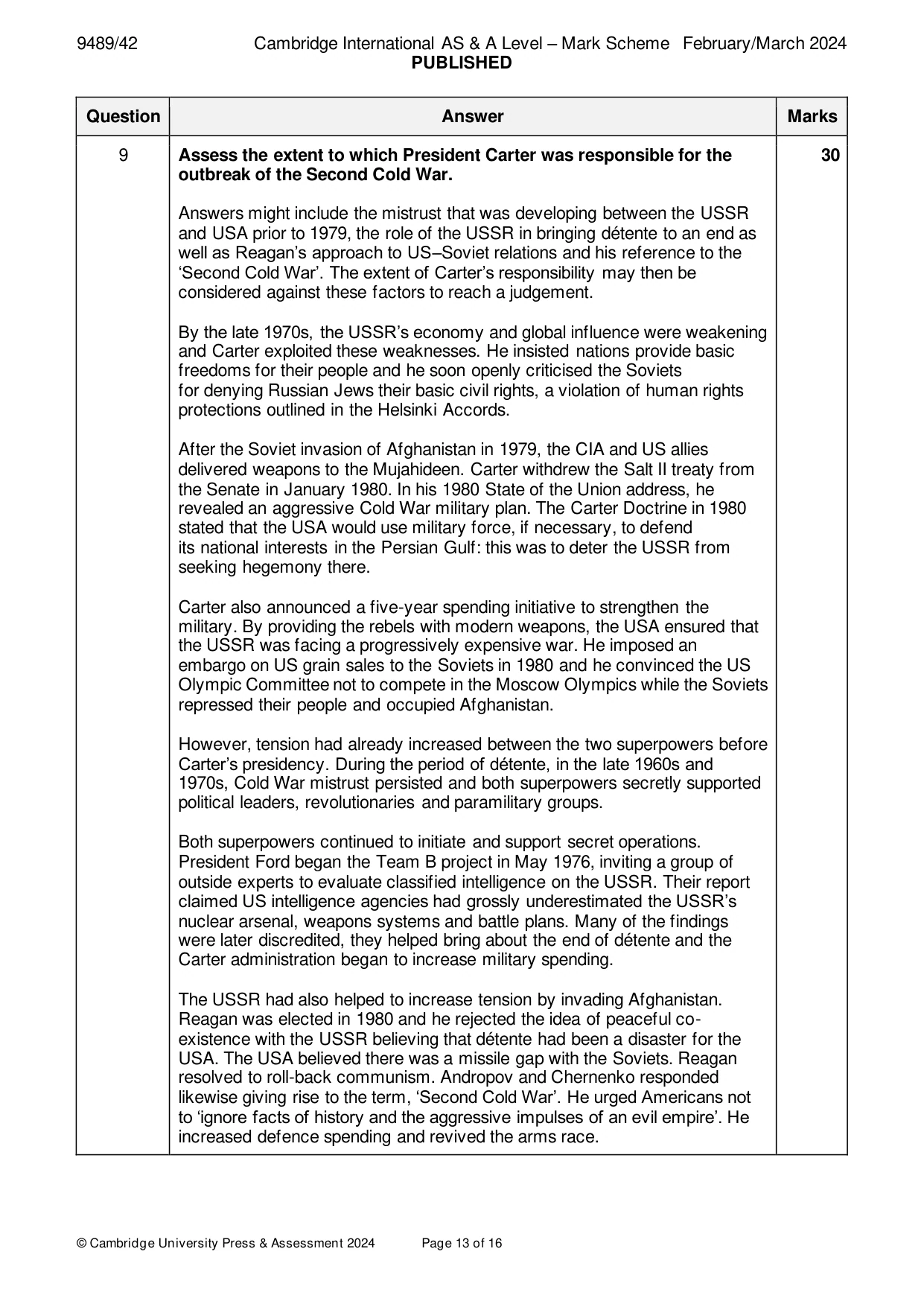
9489/42 Cambridge International AS & A Level – Mark Scheme PUBLISHED February/March 2024 © Cambridge University Press & Assessment 2024 Page 13 of 16 Question Answer Marks 9 Assess the extent to which President Carter was responsible for the outbreak of the Second Cold War. Answers might include the mistrust that was developing between the USSR and USA prior to 1979, the role of the USSR in bringing détente to an end as well as Reagan’s approach to US–Soviet relations and his reference to the ‘Second Cold War’. The extent of Carter’s responsibility may then be considered against these factors to reach a judgement. By the late 1970s, the USSR’s economy and global influence were weakening and Carter exploited these weaknesses. He insisted nations provide basic freedoms for their people and he soon openly criticised the Soviets for denying Russian Jews their basic civil rights, a violation of human rights protections outlined in the Helsinki Accords. After the Soviet invasion of Afghanistan in 1979, the CIA and US allies delivered weapons to the Mujahideen. Carter withdrew the Salt II treaty from the Senate in January 1980. In his 1980 State of the Union address, he revealed an aggressive Cold War military plan. The Carter Doctrine in 1980 stated that the USA would use military force, if necessary, to defend its national interests in the Persian Gulf: this was to deter the USSR from seeking hegemony there. Carter also announced a five-year spending initiative to strengthen the military. By providing the rebels with modern weapons, the USA ensured that the USSR was facing a progressively expensive war. He imposed an embargo on US grain sales to the Soviets in 1980 and he convinced the US Olympic Committee not to compete in the Moscow Olympics while the Soviets repressed their people and occupied Afghanistan. However, tension had already increased between the two superpowers before Carter’s presidency. During the period of détente, in the late 1960s and 1970s, Cold War mistrust persisted and both superpowers secretly supported political leaders, revolutionaries and paramilitary groups. Both superpowers continued to initiate and support secret operations. President Ford began the Team B project in May 1976, inviting a group of outside experts to evaluate classified intelligence on the USSR. Their report claimed US intelligence agencies had grossly underestimated the USSR’s nuclear arsenal, weapons systems and battle plans. Many of the findings were later discredited, they helped bring about the end of détente and the Carter administration began to increase military spending. The USSR had also helped to increase tension by invading Afghanistan. Reagan was elected in 1980 and he rejected the idea of peaceful co- existence with the USSR believing that détente had been a disaster for the USA. The USA believed there was a missile gap with the Soviets. Reagan resolved to roll-back communism. Andropov and Chernenko responded likewise giving rise to the term, ‘Second Cold War’. He urged Americans not to ‘ignore facts of history and the aggressive impulses of an evil empire’. He increased defence spending and revived the arms race. 30
Mark scheme, page 14
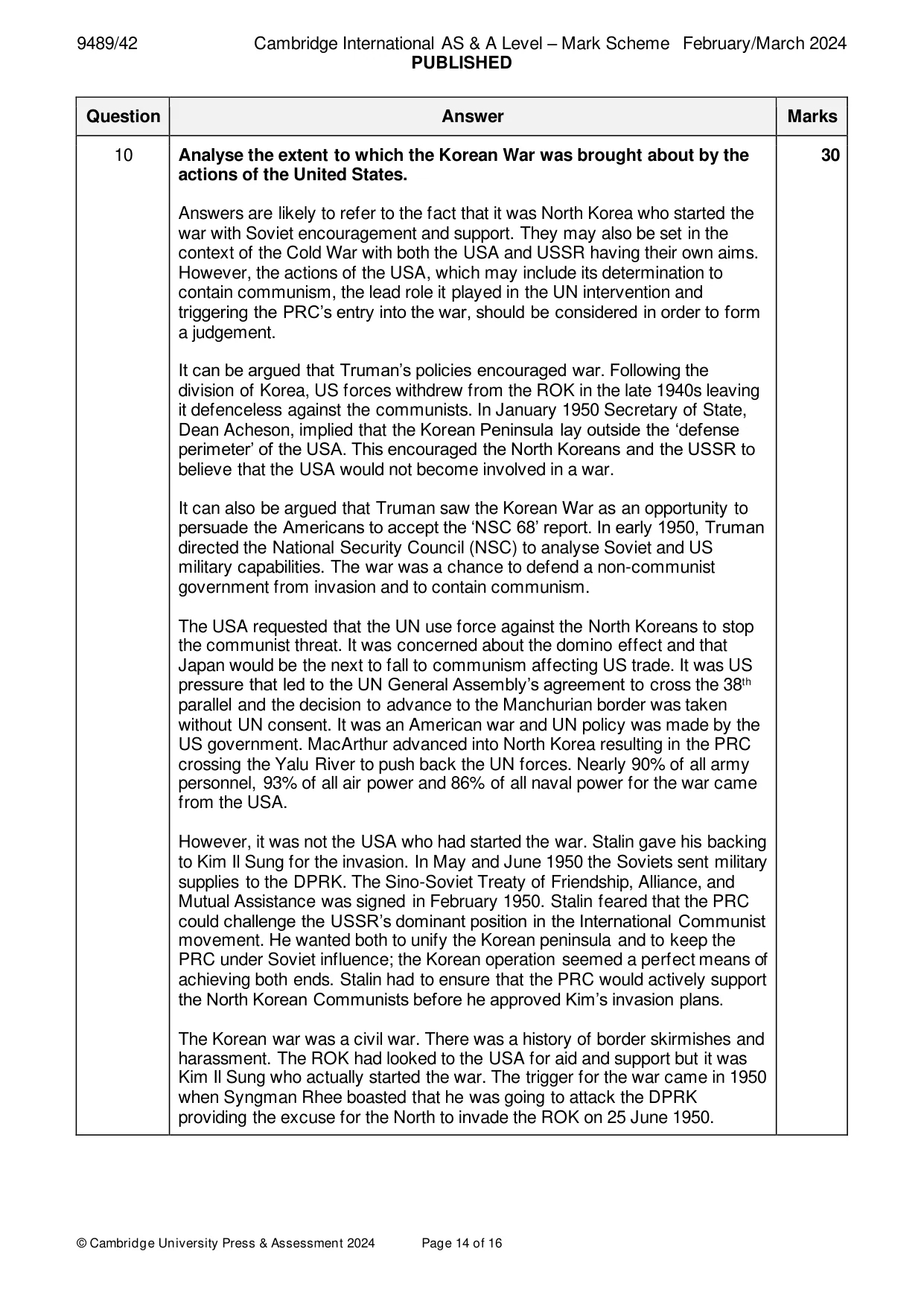
9489/42 Cambridge International AS & A Level – Mark Scheme PUBLISHED February/March 2024 © Cambridge University Press & Assessment 2024 Page 14 of 16 Question Answer Marks 10 Analyse the extent to which the Korean War was brought about by the actions of the United States. Answers are likely to refer to the fact that it was North Korea who started the war with Soviet encouragement and support. They may also be set in the context of the Cold War with both the USA and USSR having their own aims. However, the actions of the USA, which may include its determination to contain communism, the lead role it played in the UN intervention and triggering the PRC’s entry into the war, should be considered in order to form a judgement. It can be argued that Truman’s policies encouraged war. Following the division of Korea, US forces withdrew from the ROK in the late 1940s leaving it defenceless against the communists. In January 1950 Secretary of State, Dean Acheson, implied that the Korean Peninsula lay outside the ‘defense perimeter’ of the USA. This encouraged the North Koreans and the USSR to believe that the USA would not become involved in a war. It can also be argued that Truman saw the Korean War as an opportunity to persuade the Americans to accept the ‘NSC 68’ report. In early 1950, Truman directed the National Security Council (NSC) to analyse Soviet and US military capabilities. The war was a chance to defend a non-communist government from invasion and to contain communism. The USA requested that the UN use force against the North Koreans to stop the communist threat. It was concerned about the domino effect and that Japan would be the next to fall to communism affecting US trade. It was US pressure that led to the UN General Assembly’s agreement to cross the 38th parallel and the decision to advance to the Manchurian border was taken without UN consent. It was an American war and UN policy was made by the US government. MacArthur advanced into North Korea resulting in the PRC crossing the Yalu River to push back the UN forces. Nearly 90% of all army personnel, 93% of all air power and 86% of all naval power for the war came from the USA. However, it was not the USA who had started the war. Stalin gave his backing to Kim Il Sung for the invasion. In May and June 1950 the Soviets sent military supplies to the DPRK. The Sino-Soviet Treaty of Friendship, Alliance, and Mutual Assistance was signed in February 1950. Stalin feared that the PRC could challenge the USSR’s dominant position in the International Communist movement. He wanted both to unify the Korean peninsula and to keep the PRC under Soviet influence; the Korean operation seemed a perfect means of achieving both ends. Stalin had to ensure that the PRC would actively support the North Korean Communists before he approved Kim’s invasion plans. The Korean war was a civil war. There was a history of border skirmishes and harassment. The ROK had looked to the USA for aid and support but it was Kim Il Sung who actually started the war. The trigger for the war came in 1950 when Syngman Rhee boasted that he was going to attack the DPRK providing the excuse for the North to invade the ROK on 25 June 1950. 30
Mark scheme, page 15
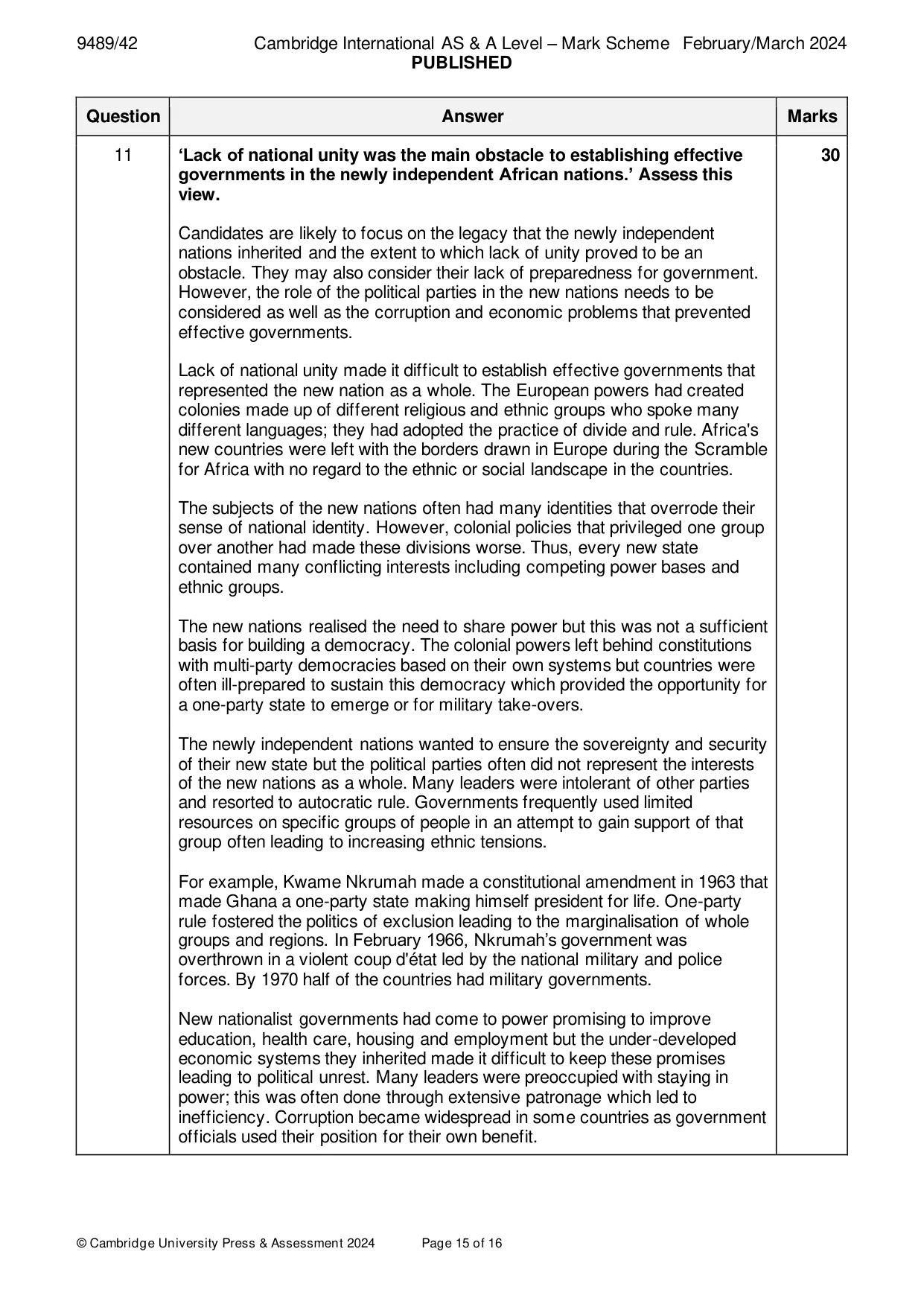
9489/42 Cambridge International AS & A Level – Mark Scheme PUBLISHED February/March 2024 © Cambridge University Press & Assessment 2024 Page 15 of 16 Question Answer Marks 11 ‘Lack of national unity was the main obstacle to establishing effective governments in the newly independent African nations.’ Assess this view. Candidates are likely to focus on the legacy that the newly independent nations inherited and the extent to which lack of unity proved to be an obstacle. They may also consider their lack of preparedness for government. However, the role of the political parties in the new nations needs to be considered as well as the corruption and economic problems that prevented effective governments. Lack of national unity made it difficult to establish effective governments that represented the new nation as a whole. The European powers had created colonies made up of different religious and ethnic groups who spoke many different languages; they had adopted the practice of divide and rule. Africa's new countries were left with the borders drawn in Europe during the Scramble for Africa with no regard to the ethnic or social landscape in the countries. The subjects of the new nations often had many identities that overrode their sense of national identity. However, colonial policies that privileged one group over another had made these divisions worse. Thus, every new state contained many conflicting interests including competing power bases and ethnic groups. The new nations realised the need to share power but this was not a sufficient basis for building a democracy. The colonial powers left behind constitutions with multi-party democracies based on their own systems but countries were often ill-prepared to sustain this democracy which provided the opportunity for a one-party state to emerge or for military take-overs. The newly independent nations wanted to ensure the sovereignty and security of their new state but the political parties often did not represent the interests of the new nations as a whole. Many leaders were intolerant of other parties and resorted to autocratic rule. Governments frequently used limited resources on specific groups of people in an attempt to gain support of that group often leading to increasing ethnic tensions. For example, Kwame Nkrumah made a constitutional amendment in 1963 that made Ghana a one-party state making himself president for life. One-party rule fostered the politics of exclusion leading to the marginalisation of whole groups and regions. In February 1966, Nkrumah’s government was overthrown in a violent coup d'état led by the national military and police forces. By 1970 half of the countries had military governments. New nationalist governments had come to power promising to improve education, health care, housing and employment but the under-developed economic systems they inherited made it difficult to keep these promises leading to political unrest. Many leaders were preoccupied with staying in power; this was often done through extensive patronage which led to inefficiency. Corruption became widespread in some countries as government officials used their position for their own benefit. 30
Mark scheme, page 16
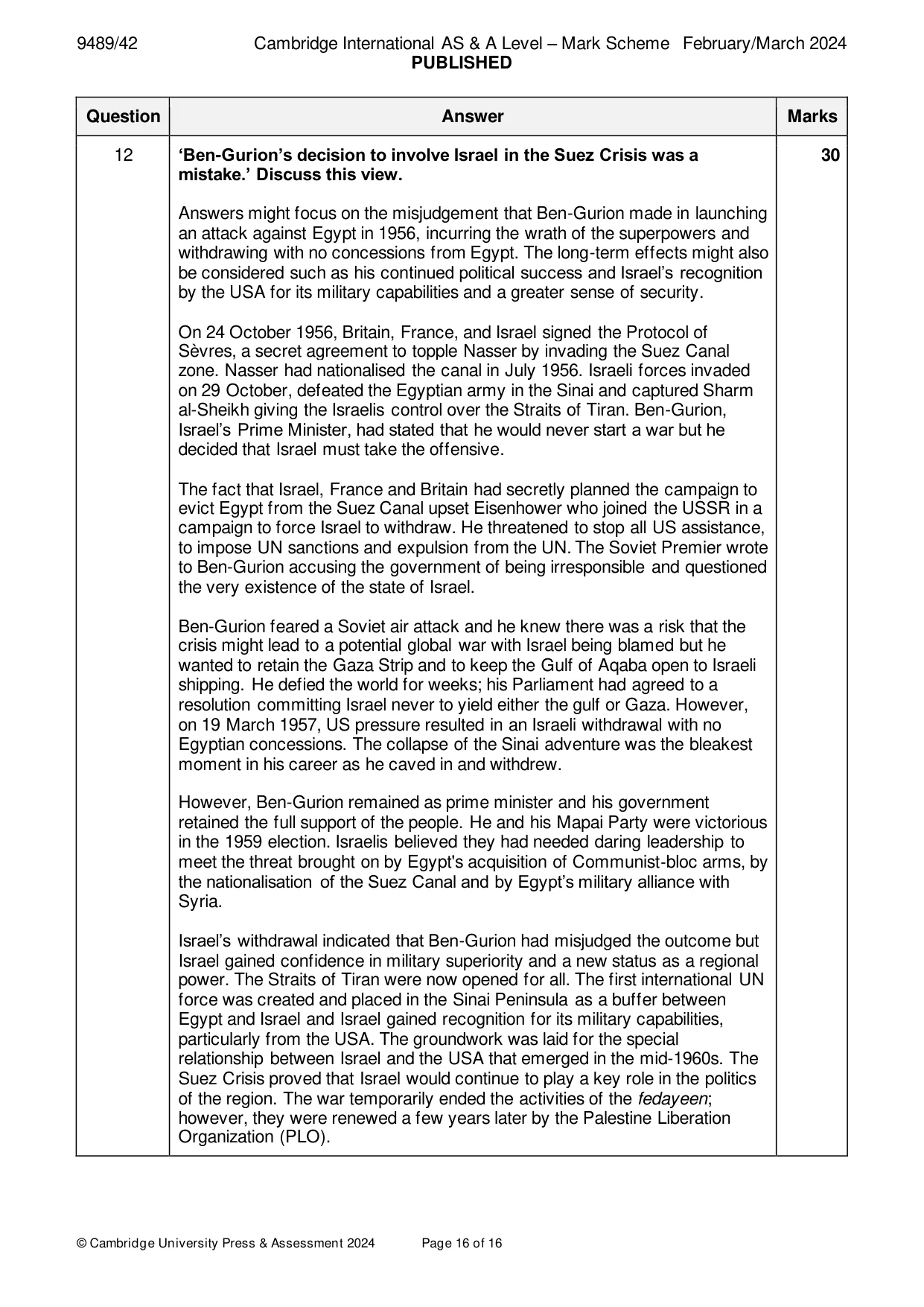
9489/42 Cambridge International AS & A Level – Mark Scheme PUBLISHED February/March 2024 © Cambridge University Press & Assessment 2024 Page 16 of 16 Question Answer Marks 12 ‘Ben-Gurion’s decision to involve Israel in the Suez Crisis was a mistake.’ Discuss this view. Answers might focus on the misjudgement that Ben-Gurion made in launching an attack against Egypt in 1956, incurring the wrath of the superpowers and withdrawing with no concessions from Egypt. The long-term effects might also be considered such as his continued political success and Israel’s recognition by the USA for its military capabilities and a greater sense of security. On 24 October 1956, Britain, France, and Israel signed the Protocol of Sèvres, a secret agreement to topple Nasser by invading the Suez Canal zone. Nasser had nationalised the canal in July 1956. Israeli forces invaded on 29 October, defeated the Egyptian army in the Sinai and captured Sharm al-Sheikh giving the Israelis control over the Straits of Tiran. Ben-Gurion, Israel’s Prime Minister, had stated that he would never start a war but he decided that Israel must take the offensive. The fact that Israel, France and Britain had secretly planned the campaign to evict Egypt from the Suez Canal upset Eisenhower who joined the USSR in a campaign to force Israel to withdraw. He threatened to stop all US assistance, to impose UN sanctions and expulsion from the UN. The Soviet Premier wrote to Ben-Gurion accusing the government of being irresponsible and questioned the very existence of the state of Israel. Ben-Gurion feared a Soviet air attack and he knew there was a risk that the crisis might lead to a potential global war with Israel being blamed but he wanted to retain the Gaza Strip and to keep the Gulf of Aqaba open to Israeli shipping. He defied the world for weeks; his Parliament had agreed to a resolution committing Israel never to yield either the gulf or Gaza. However, on 19 March 1957, US pressure resulted in an Israeli withdrawal with no Egyptian concessions. The collapse of the Sinai adventure was the bleakest moment in his career as he caved in and withdrew. However, Ben-Gurion remained as prime minister and his government retained the full support of the people. He and his Mapai Party were victorious in the 1959 election. Israelis believed they had needed daring leadership to meet the threat brought on by Egypt's acquisition of Communist‐bloc arms, by the nationalisation of the Suez Canal and by Egypt’s military alliance with Syria. Israel’s withdrawal indicated that Ben-Gurion had misjudged the outcome but Israel gained confidence in military superiority and a new status as a regional power. The Straits of Tiran were now opened for all. The first international UN force was created and placed in the Sinai Peninsula as a buffer between Egypt and Israel and Israel gained recognition for its military capabilities, particularly from the USA. The groundwork was laid for the special relationship between Israel and the USA that emerged in the mid-1960s. The Suez Crisis proved that Israel would continue to play a key role in the politics of the region. The war temporarily ended the activities of the fedayeen; however, they were renewed a few years later by the Palestine Liberation Organization (PLO). 30
What you needed in this session
Cambridge’s own grade thresholds for 2024 Feb/March, Paper 4 · Variant 2. A higher threshold means an easier paper — the bar moves with how the cohort did.