Cambridge A Level History 9389 — 2019 May/June Paper 4 · Variant 1
9389/41/M/J/19 · 60 marks · ≈68 min
The question paper and its mark scheme, free to read here and free to download. This is Cambridge’s own paper, exactly as it was sat.
Question paper4 pages
Mark scheme15 pages
Answers below. Sit the paper first if you are practising.
Paper as text
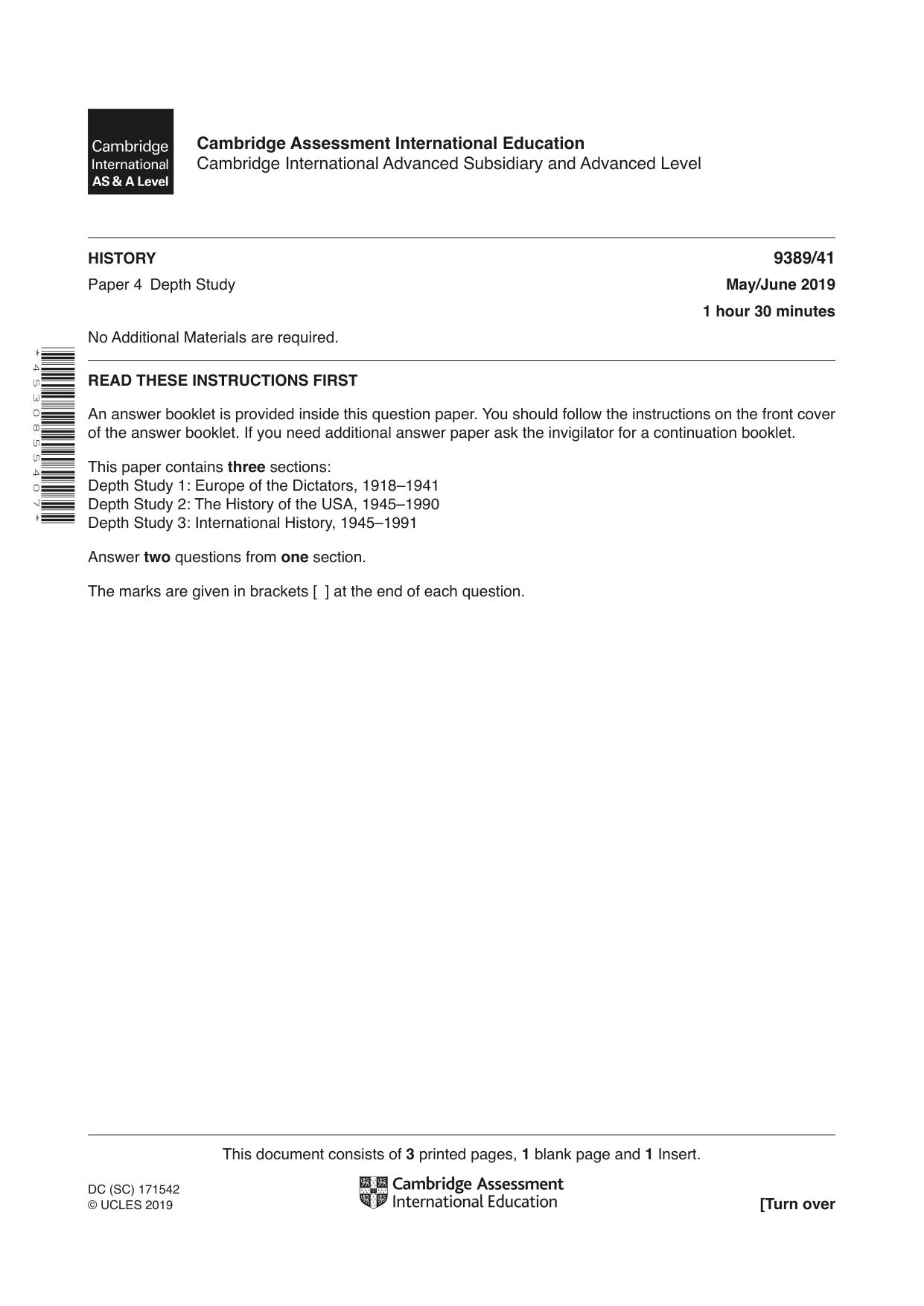
Question paper, page 1
This document consists of 3 printed pages, 1 blank page and 1 Insert. DC (SC) 171542 © UCLES 2019 [Turn over Cambridge Assessment International Education Cambridge International Advanced Subsidiary and Advanced Level * 4 5 3 0 8 5 5 4 0 7 * HISTORY 9389/41 Paper 4 Depth Study May/June 2019 1 hour 30 minutes No Additional Materials are required. READ THESE INSTRUCTIONS FIRST An answer booklet is provided inside this question paper. You should follow the instructions on the front cover of the answer booklet. If you need additional answer paper ask the invigilator for a continuation booklet. This paper contains three sections: Depth Study 1: Europe of the Dictators, 1918–1941 Depth Study 2: The History of the USA, 1945–1990 Depth Study 3: International History, 1945–1991 Answer two questions from one section. The marks are given in brackets [ ] at the end of each question.
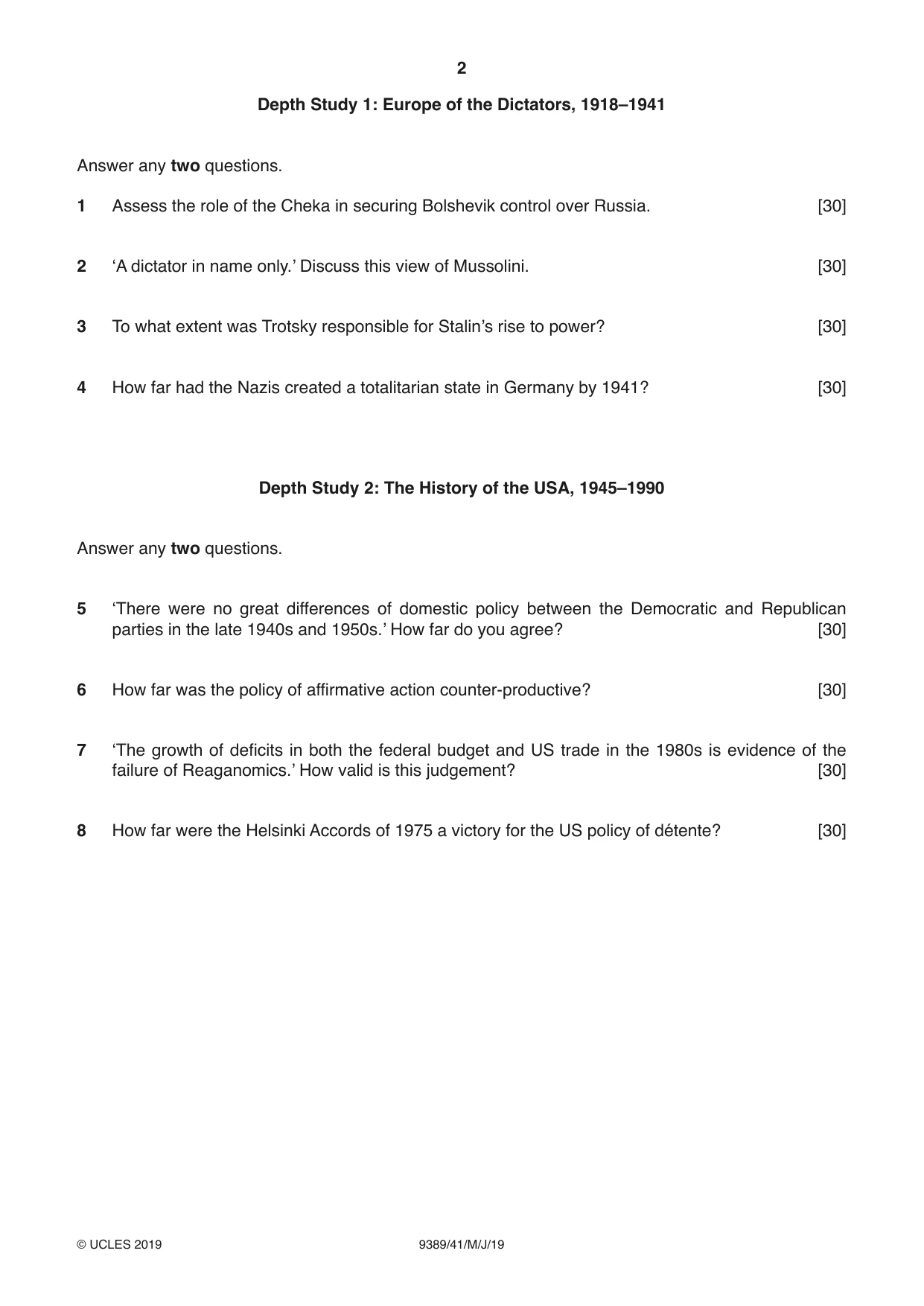
Question paper, page 2
2 9389/41/M/J/19 © UCLES 2019 Depth Study 1: Europe of the Dictators, 1918–1941 Answer any two questions. 1 Assess the role of the Cheka in securing Bolshevik control over Russia. [30] 2 ‘A dictator in name only.’ Discuss this view of Mussolini. [30] 3 To what extent was Trotsky responsible for Stalin’s rise to power? [30] 4 How far had the Nazis created a totalitarian state in Germany by 1941? [30] Depth Study 2: The History of the USA, 1945–1990 Answer any two questions. 5 ‘There were no great differences of domestic policy between the Democratic and Republican parties in the late 1940s and 1950s.’ How far do you agree? [30] 6 How far was the policy of affirmative action counter-productive? [30] 7 ‘The growth of deficits in both the federal budget and US trade in the 1980s is evidence of the failure of Reaganomics.’ How valid is this judgement? [30] 8 How far were the Helsinki Accords of 1975 a victory for the US policy of détente? [30]
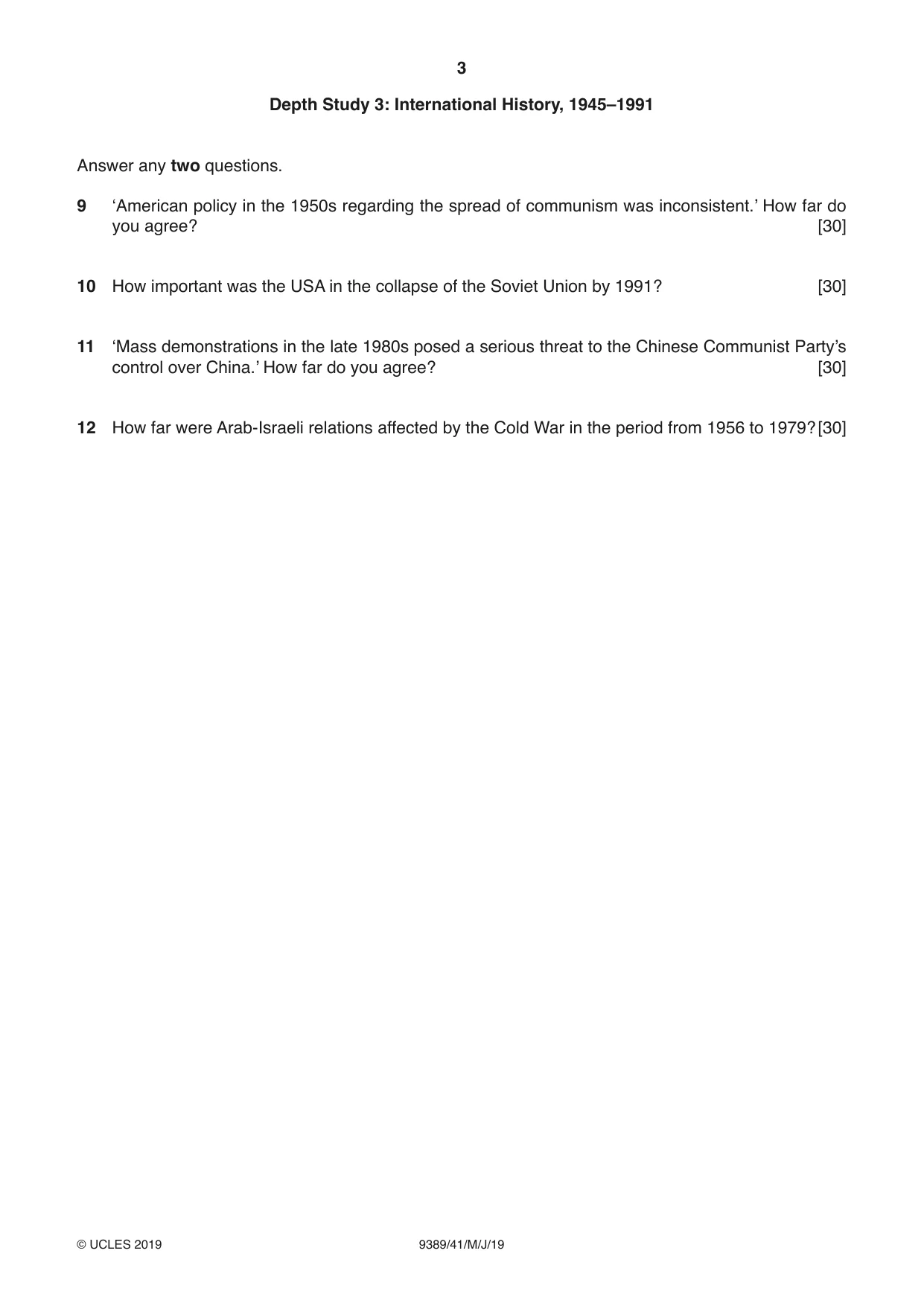
Question paper, page 3
3 9389/41/M/J/19 © UCLES 2019 Depth Study 3: International History, 1945–1991 Answer any two questions. 9 ‘American policy in the 1950s regarding the spread of communism was inconsistent.’ How far do you agree? [30] 10 How important was the USA in the collapse of the Soviet Union by 1991? [30] 11 ‘Mass demonstrations in the late 1980s posed a serious threat to the Chinese Communist Party’s control over China.’ How far do you agree? [30] 12 How far were Arab-Israeli relations affected by the Cold War in the period from 1956 to 1979? [30]
Question paper, page 4
4 9389/41/M/J/19 © UCLES 2019 Permission to reproduce items where third-party owned material protected by copyright is included has been sought and cleared where possible. Every reasonable effort has been made by the publisher (UCLES) to trace copyright holders, but if any items requiring clearance have unwittingly been included, the publisher will be pleased to make amends at the earliest possible opportunity. To avoid the issue of disclosure of answer-related information to candidates, all copyright acknowledgements are reproduced online in the Cambridge Assessment International Education Copyright Acknowledgements Booklet. This is produced for each series of examinations and is freely available to download at www.cambridgeinternational.org after the live examination series. Cambridge Assessment International Education is part of the Cambridge Assessment Group. Cambridge Assessment is the brand name of the University of Cambridge Local Examinations Syndicate (UCLES), which itself is a department of the University of Cambridge. BLANK PAGE
Mark scheme, page 1
This document consists of 15 printed pages. © UCLES 2019 [Turn over Cambridge Assessment International Education Cambridge International General Certificate of Secondary Education HISTORY 9389/41 Paper 4 Depth Study 41 May/June 2019 MARK SCHEME Maximum Mark: 60 Published This mark scheme is published as an aid to teachers and candidates, to indicate the requirements of the examination. It shows the basis on which Examiners were instructed to award marks. It does not indicate the details of the discussions that took place at an Examiners’ meeting before marking began, which would have considered the acceptability of alternative answers. Mark schemes should be read in conjunction with the question paper and the Principal Examiner Report for Teachers. Cambridge International will not enter into discussions about these mark schemes. Cambridge International is publishing the mark schemes for the May/June 2019 series for most Cambridge IGCSE™, Cambridge International A and AS Level and Cambridge Pre-U components, and some Cambridge O Level components.
Mark scheme, page 2
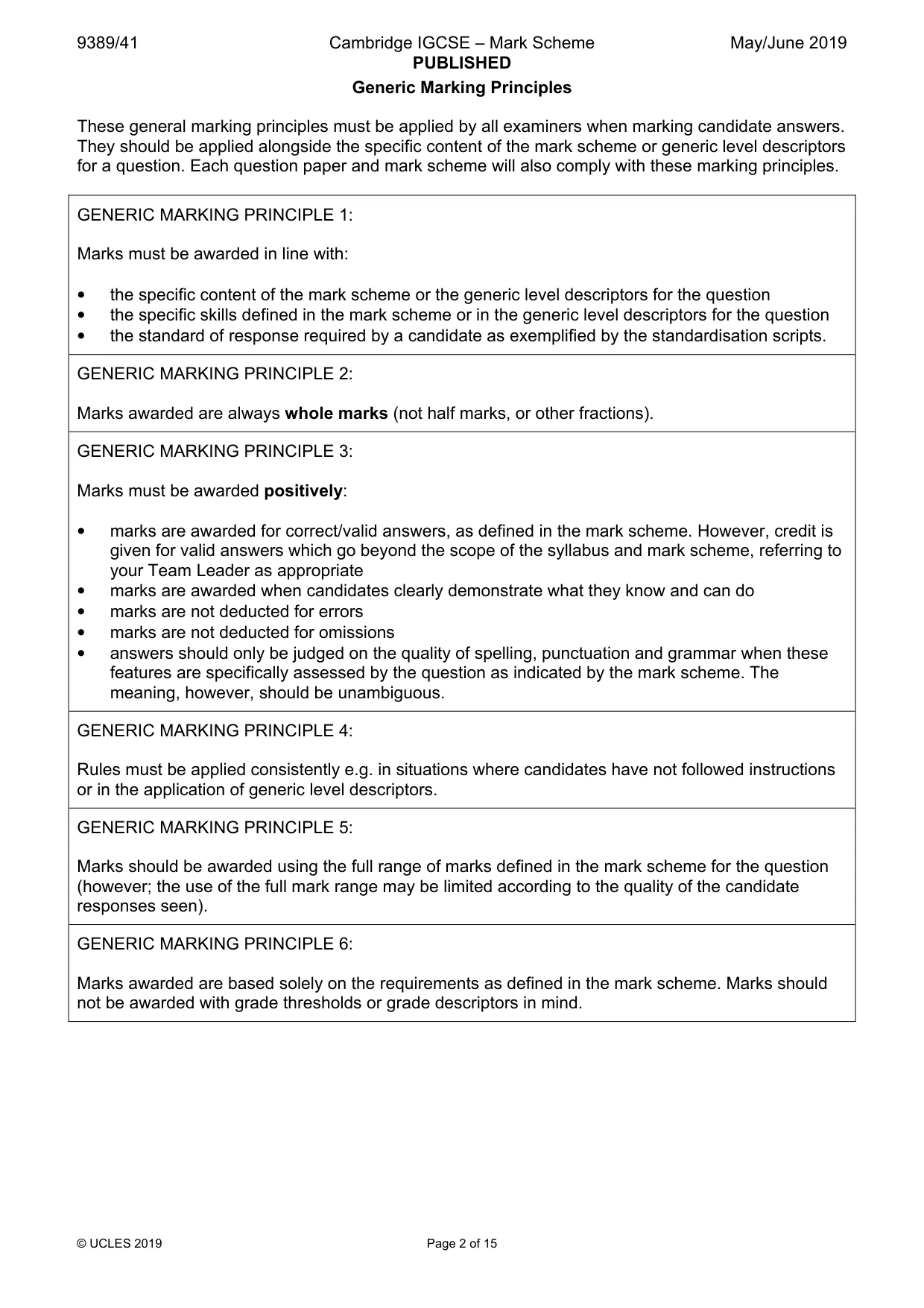
9389/41 Cambridge IGCSE – Mark Scheme PUBLISHED May/June 2019 © UCLES 2019 Page 2 of 15 Generic Marking Principles These general marking principles must be applied by all examiners when marking candidate answers. They should be applied alongside the specific content of the mark scheme or generic level descriptors for a question. Each question paper and mark scheme will also comply with these marking principles. GENERIC MARKING PRINCIPLE 1: Marks must be awarded in line with: • the specific content of the mark scheme or the generic level descriptors for the question • the specific skills defined in the mark scheme or in the generic level descriptors for the question • the standard of response required by a candidate as exemplified by the standardisation scripts. GENERIC MARKING PRINCIPLE 2: Marks awarded are always whole marks (not half marks, or other fractions). GENERIC MARKING PRINCIPLE 3: Marks must be awarded positively: • marks are awarded for correct/valid answers, as defined in the mark scheme. However, credit is given for valid answers which go beyond the scope of the syllabus and mark scheme, referring to your Team Leader as appropriate • marks are awarded when candidates clearly demonstrate what they know and can do • marks are not deducted for errors • marks are not deducted for omissions • answers should only be judged on the quality of spelling, punctuation and grammar when these features are specifically assessed by the question as indicated by the mark scheme. The meaning, however, should be unambiguous. GENERIC MARKING PRINCIPLE 4: Rules must be applied consistently e.g. in situations where candidates have not followed instructions or in the application of generic level descriptors. GENERIC MARKING PRINCIPLE 5: Marks should be awarded using the full range of marks defined in the mark scheme for the question (however; the use of the full mark range may be limited according to the quality of the candidate responses seen). GENERIC MARKING PRINCIPLE 6: Marks awarded are based solely on the requirements as defined in the mark scheme. Marks should not be awarded with grade thresholds or grade descriptors in mind.
Mark scheme, page 3
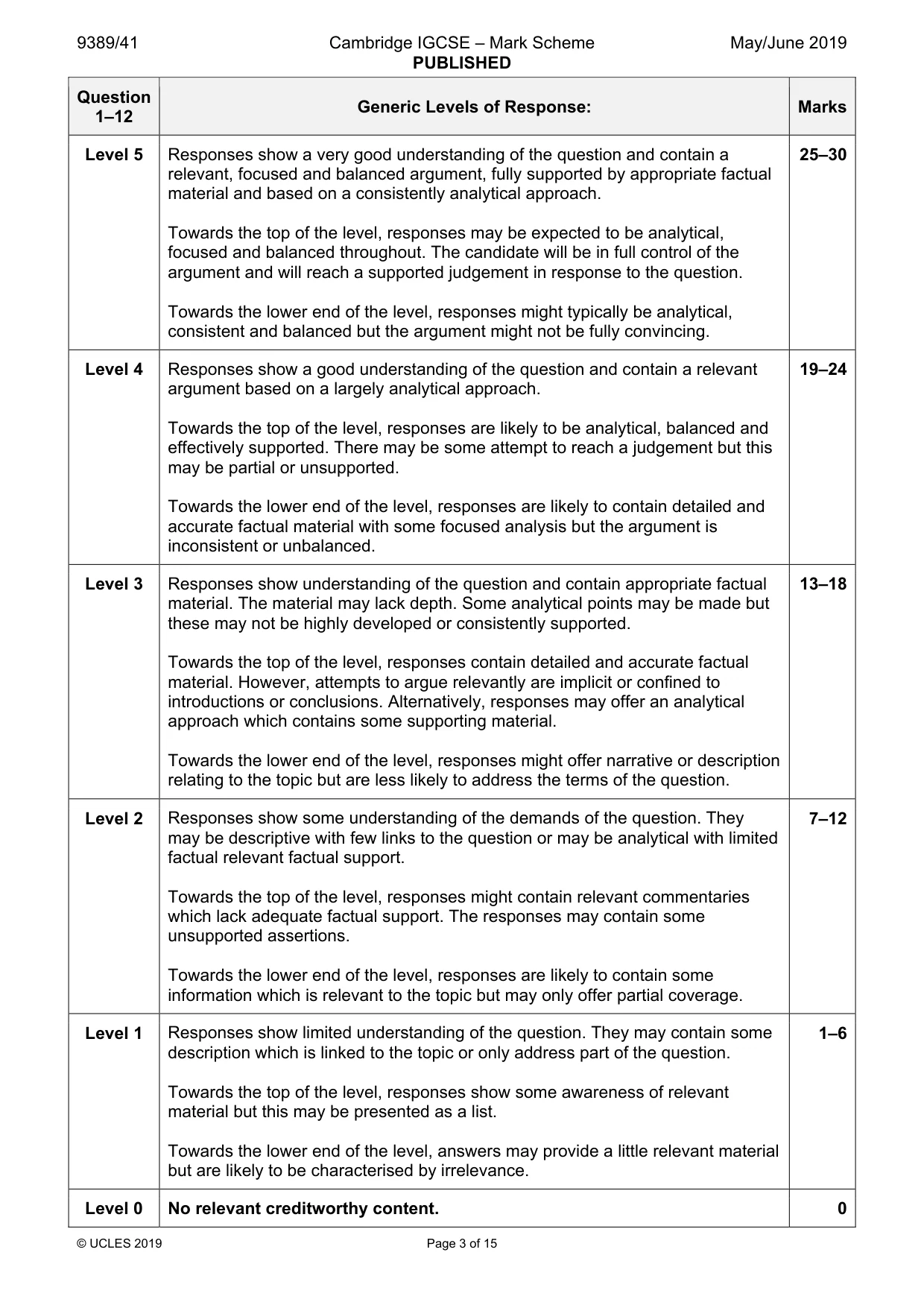
9389/41 Cambridge IGCSE – Mark Scheme PUBLISHED May/June 2019 © UCLES 2019 Page 3 of 15 Question 1–12 Generic Levels of Response: Marks Level 5 Responses show a very good understanding of the question and contain a relevant, focused and balanced argument, fully supported by appropriate factual material and based on a consistently analytical approach. Towards the top of the level, responses may be expected to be analytical, focused and balanced throughout. The candidate will be in full control of the argument and will reach a supported judgement in response to the question. Towards the lower end of the level, responses might typically be analytical, consistent and balanced but the argument might not be fully convincing. 25–30 Level 4 Responses show a good understanding of the question and contain a relevant argument based on a largely analytical approach. Towards the top of the level, responses are likely to be analytical, balanced and effectively supported. There may be some attempt to reach a judgement but this may be partial or unsupported. Towards the lower end of the level, responses are likely to contain detailed and accurate factual material with some focused analysis but the argument is inconsistent or unbalanced. 19–24 Level 3 Responses show understanding of the question and contain appropriate factual material. The material may lack depth. Some analytical points may be made but these may not be highly developed or consistently supported. Towards the top of the level, responses contain detailed and accurate factual material. However, attempts to argue relevantly are implicit or confined to introductions or conclusions. Alternatively, responses may offer an analytical approach which contains some supporting material. Towards the lower end of the level, responses might offer narrative or description relating to the topic but are less likely to address the terms of the question. 13–18 Level 2 Responses show some understanding of the demands of the question. They may be descriptive with few links to the question or may be analytical with limited factual relevant factual support. Towards the top of the level, responses might contain relevant commentaries which lack adequate factual support. The responses may contain some unsupported assertions. Towards the lower end of the level, responses are likely to contain some information which is relevant to the topic but may only offer partial coverage. 7–12 Level 1 Responses show limited understanding of the question. They may contain some description which is linked to the topic or only address part of the question. Towards the top of the level, responses show some awareness of relevant material but this may be presented as a list. Towards the lower end of the level, answers may provide a little relevant material but are likely to be characterised by irrelevance. 1–6 Level 0 No relevant creditworthy content. 0
Mark scheme, page 4
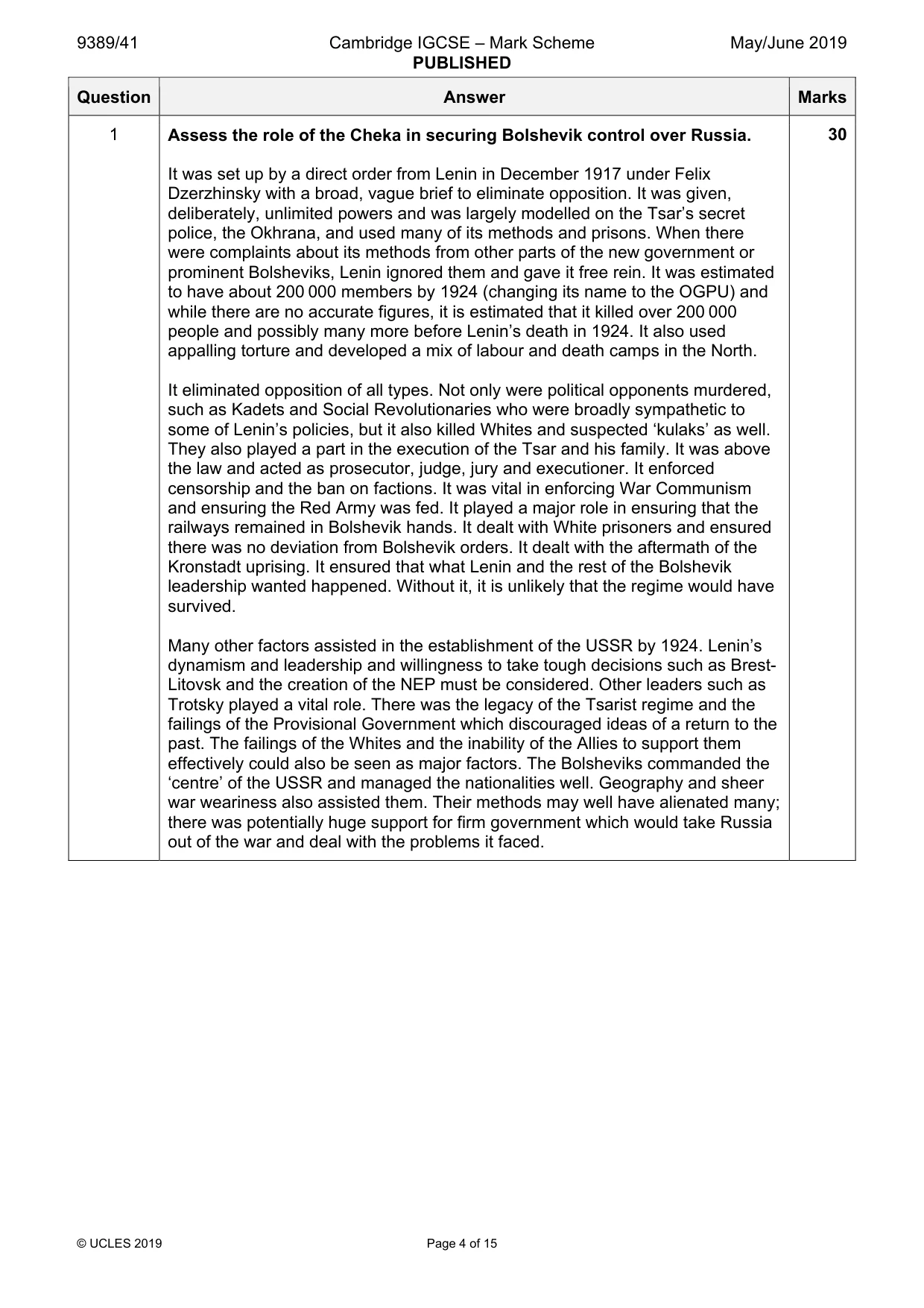
9389/41 Cambridge IGCSE – Mark Scheme PUBLISHED May/June 2019 © UCLES 2019 Page 4 of 15 Question Answer Marks 1 Assess the role of the Cheka in securing Bolshevik control over Russia. It was set up by a direct order from Lenin in December 1917 under Felix Dzerzhinsky with a broad, vague brief to eliminate opposition. It was given, deliberately, unlimited powers and was largely modelled on the Tsar’s secret police, the Okhrana, and used many of its methods and prisons. When there were complaints about its methods from other parts of the new government or prominent Bolsheviks, Lenin ignored them and gave it free rein. It was estimated to have about 200 000 members by 1924 (changing its name to the OGPU) and while there are no accurate figures, it is estimated that it killed over 200 000 people and possibly many more before Lenin’s death in 1924. It also used appalling torture and developed a mix of labour and death camps in the North. It eliminated opposition of all types. Not only were political opponents murdered, such as Kadets and Social Revolutionaries who were broadly sympathetic to some of Lenin’s policies, but it also killed Whites and suspected ‘kulaks’ as well. They also played a part in the execution of the Tsar and his family. It was above the law and acted as prosecutor, judge, jury and executioner. It enforced censorship and the ban on factions. It was vital in enforcing War Communism and ensuring the Red Army was fed. It played a major role in ensuring that the railways remained in Bolshevik hands. It dealt with White prisoners and ensured there was no deviation from Bolshevik orders. It dealt with the aftermath of the Kronstadt uprising. It ensured that what Lenin and the rest of the Bolshevik leadership wanted happened. Without it, it is unlikely that the regime would have survived. Many other factors assisted in the establishment of the USSR by 1924. Lenin’s dynamism and leadership and willingness to take tough decisions such as Brest- Litovsk and the creation of the NEP must be considered. Other leaders such as Trotsky played a vital role. There was the legacy of the Tsarist regime and the failings of the Provisional Government which discouraged ideas of a return to the past. The failings of the Whites and the inability of the Allies to support them effectively could also be seen as major factors. The Bolsheviks commanded the ‘centre’ of the USSR and managed the nationalities well. Geography and sheer war weariness also assisted them. Their methods may well have alienated many; there was potentially huge support for firm government which would take Russia out of the war and deal with the problems it faced. 30
Mark scheme, page 5
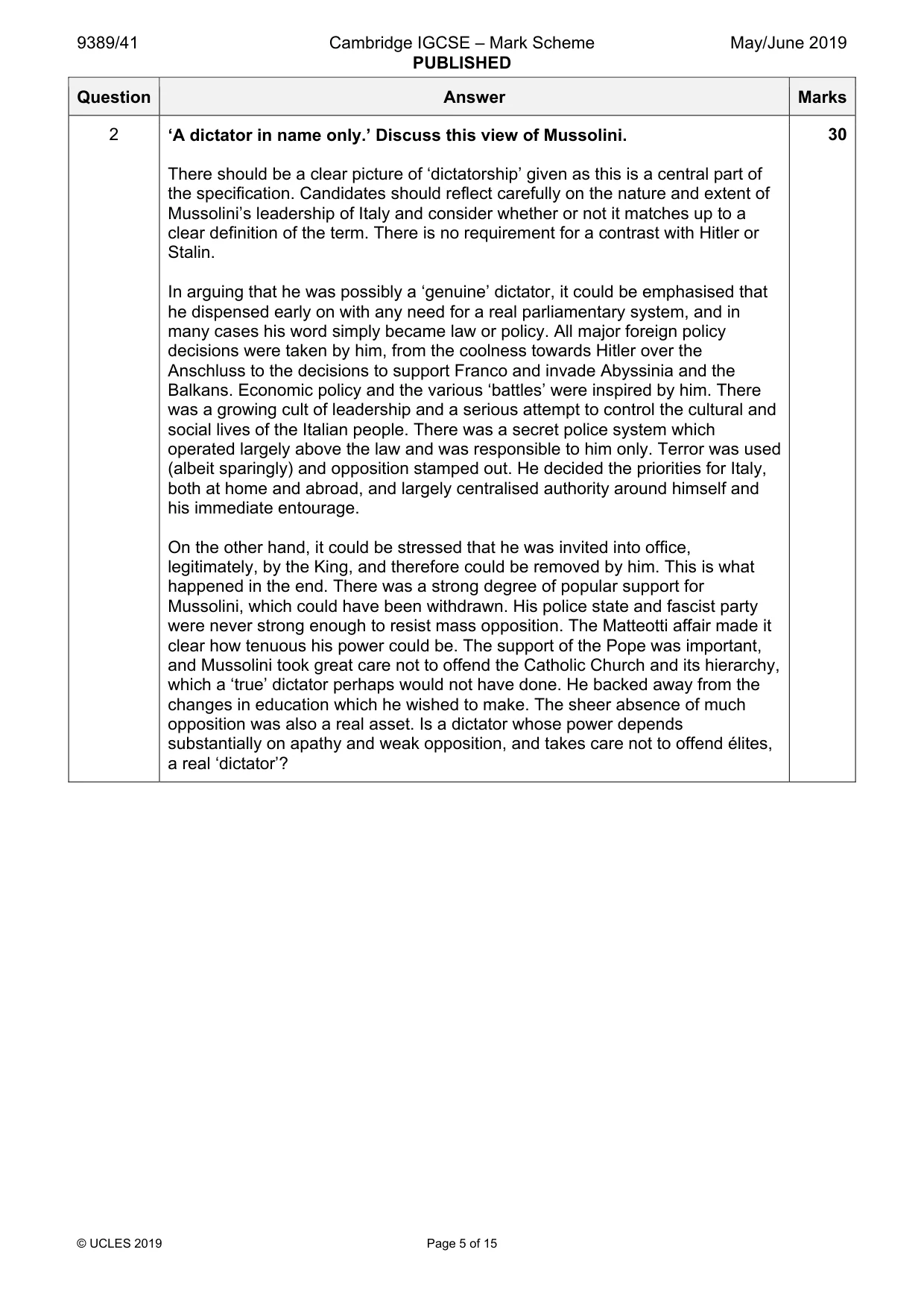
9389/41 Cambridge IGCSE – Mark Scheme PUBLISHED May/June 2019 © UCLES 2019 Page 5 of 15 Question Answer Marks 2 ‘A dictator in name only.’ Discuss this view of Mussolini. There should be a clear picture of ‘dictatorship’ given as this is a central part of the specification. Candidates should reflect carefully on the nature and extent of Mussolini’s leadership of Italy and consider whether or not it matches up to a clear definition of the term. There is no requirement for a contrast with Hitler or Stalin. In arguing that he was possibly a ‘genuine’ dictator, it could be emphasised that he dispensed early on with any need for a real parliamentary system, and in many cases his word simply became law or policy. All major foreign policy decisions were taken by him, from the coolness towards Hitler over the Anschluss to the decisions to support Franco and invade Abyssinia and the Balkans. Economic policy and the various ‘battles’ were inspired by him. There was a growing cult of leadership and a serious attempt to control the cultural and social lives of the Italian people. There was a secret police system which operated largely above the law and was responsible to him only. Terror was used (albeit sparingly) and opposition stamped out. He decided the priorities for Italy, both at home and abroad, and largely centralised authority around himself and his immediate entourage. On the other hand, it could be stressed that he was invited into office, legitimately, by the King, and therefore could be removed by him. This is what happened in the end. There was a strong degree of popular support for Mussolini, which could have been withdrawn. His police state and fascist party were never strong enough to resist mass opposition. The Matteotti affair made it clear how tenuous his power could be. The support of the Pope was important, and Mussolini took great care not to offend the Catholic Church and its hierarchy, which a ‘true’ dictator perhaps would not have done. He backed away from the changes in education which he wished to make. The sheer absence of much opposition was also a real asset. Is a dictator whose power depends substantially on apathy and weak opposition, and takes care not to offend élites, a real ‘dictator’? 30
Mark scheme, page 6
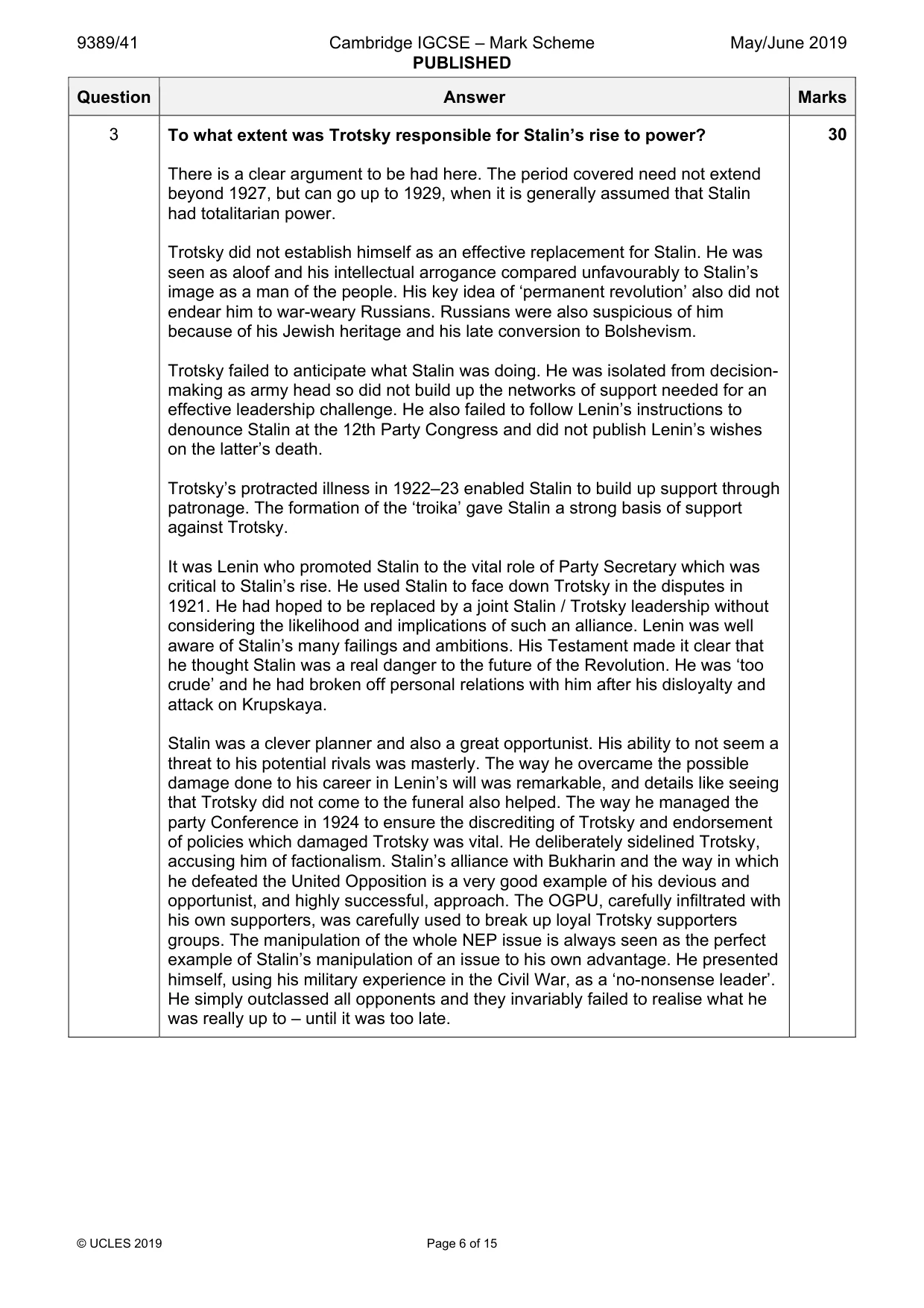
9389/41 Cambridge IGCSE – Mark Scheme PUBLISHED May/June 2019 © UCLES 2019 Page 6 of 15 Question Answer Marks 3 To what extent was Trotsky responsible for Stalin’s rise to power? There is a clear argument to be had here. The period covered need not extend beyond 1927, but can go up to 1929, when it is generally assumed that Stalin had totalitarian power. Trotsky did not establish himself as an effective replacement for Stalin. He was seen as aloof and his intellectual arrogance compared unfavourably to Stalin’s image as a man of the people. His key idea of ‘permanent revolution’ also did not endear him to war-weary Russians. Russians were also suspicious of him because of his Jewish heritage and his late conversion to Bolshevism. Trotsky failed to anticipate what Stalin was doing. He was isolated from decision- making as army head so did not build up the networks of support needed for an effective leadership challenge. He also failed to follow Lenin’s instructions to denounce Stalin at the 12th Party Congress and did not publish Lenin’s wishes on the latter’s death. Trotsky’s protracted illness in 1922–23 enabled Stalin to build up support through patronage. The formation of the ‘troika’ gave Stalin a strong basis of support against Trotsky. It was Lenin who promoted Stalin to the vital role of Party Secretary which was critical to Stalin’s rise. He used Stalin to face down Trotsky in the disputes in 1921. He had hoped to be replaced by a joint Stalin / Trotsky leadership without considering the likelihood and implications of such an alliance. Lenin was well aware of Stalin’s many failings and ambitions. His Testament made it clear that he thought Stalin was a real danger to the future of the Revolution. He was ‘too crude’ and he had broken off personal relations with him after his disloyalty and attack on Krupskaya. Stalin was a clever planner and also a great opportunist. His ability to not seem a threat to his potential rivals was masterly. The way he overcame the possible damage done to his career in Lenin’s will was remarkable, and details like seeing that Trotsky did not come to the funeral also helped. The way he managed the party Conference in 1924 to ensure the discrediting of Trotsky and endorsement of policies which damaged Trotsky was vital. He deliberately sidelined Trotsky, accusing him of factionalism. Stalin’s alliance with Bukharin and the way in which he defeated the United Opposition is a very good example of his devious and opportunist, and highly successful, approach. The OGPU, carefully infiltrated with his own supporters, was carefully used to break up loyal Trotsky supporters groups. The manipulation of the whole NEP issue is always seen as the perfect example of Stalin’s manipulation of an issue to his own advantage. He presented himself, using his military experience in the Civil War, as a ‘no-nonsense leader’. He simply outclassed all opponents and they invariably failed to realise what he was really up to – until it was too late. 30
Mark scheme, page 7
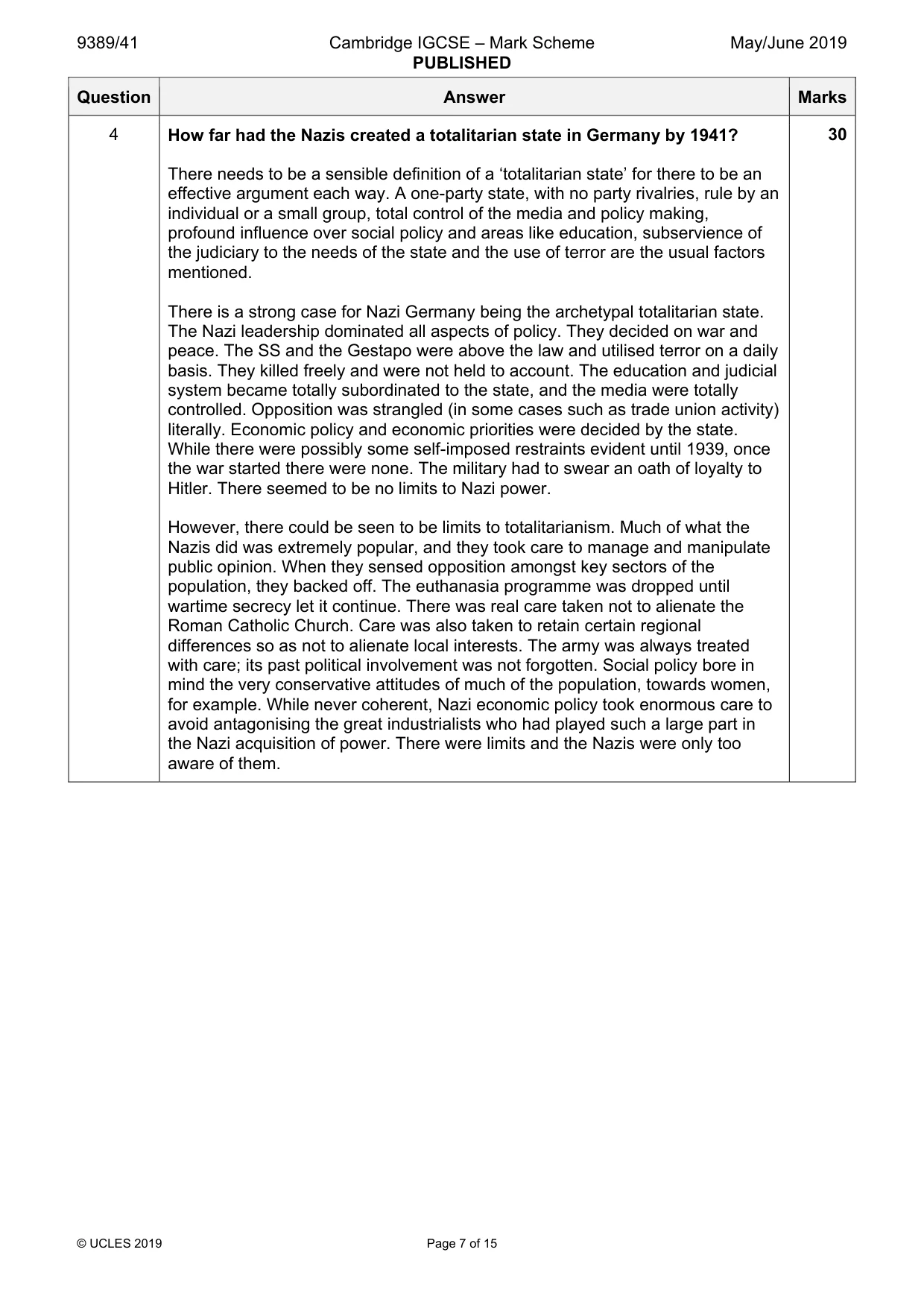
9389/41 Cambridge IGCSE – Mark Scheme PUBLISHED May/June 2019 © UCLES 2019 Page 7 of 15 Question Answer Marks 4 How far had the Nazis created a totalitarian state in Germany by 1941? There needs to be a sensible definition of a ‘totalitarian state’ for there to be an effective argument each way. A one-party state, with no party rivalries, rule by an individual or a small group, total control of the media and policy making, profound influence over social policy and areas like education, subservience of the judiciary to the needs of the state and the use of terror are the usual factors mentioned. There is a strong case for Nazi Germany being the archetypal totalitarian state. The Nazi leadership dominated all aspects of policy. They decided on war and peace. The SS and the Gestapo were above the law and utilised terror on a daily basis. They killed freely and were not held to account. The education and judicial system became totally subordinated to the state, and the media were totally controlled. Opposition was strangled (in some cases such as trade union activity) literally. Economic policy and economic priorities were decided by the state. While there were possibly some self-imposed restraints evident until 1939, once the war started there were none. The military had to swear an oath of loyalty to Hitler. There seemed to be no limits to Nazi power. However, there could be seen to be limits to totalitarianism. Much of what the Nazis did was extremely popular, and they took care to manage and manipulate public opinion. When they sensed opposition amongst key sectors of the population, they backed off. The euthanasia programme was dropped until wartime secrecy let it continue. There was real care taken not to alienate the Roman Catholic Church. Care was also taken to retain certain regional differences so as not to alienate local interests. The army was always treated with care; its past political involvement was not forgotten. Social policy bore in mind the very conservative attitudes of much of the population, towards women, for example. While never coherent, Nazi economic policy took enormous care to avoid antagonising the great industrialists who had played such a large part in the Nazi acquisition of power. There were limits and the Nazis were only too aware of them. 30
Mark scheme, page 8
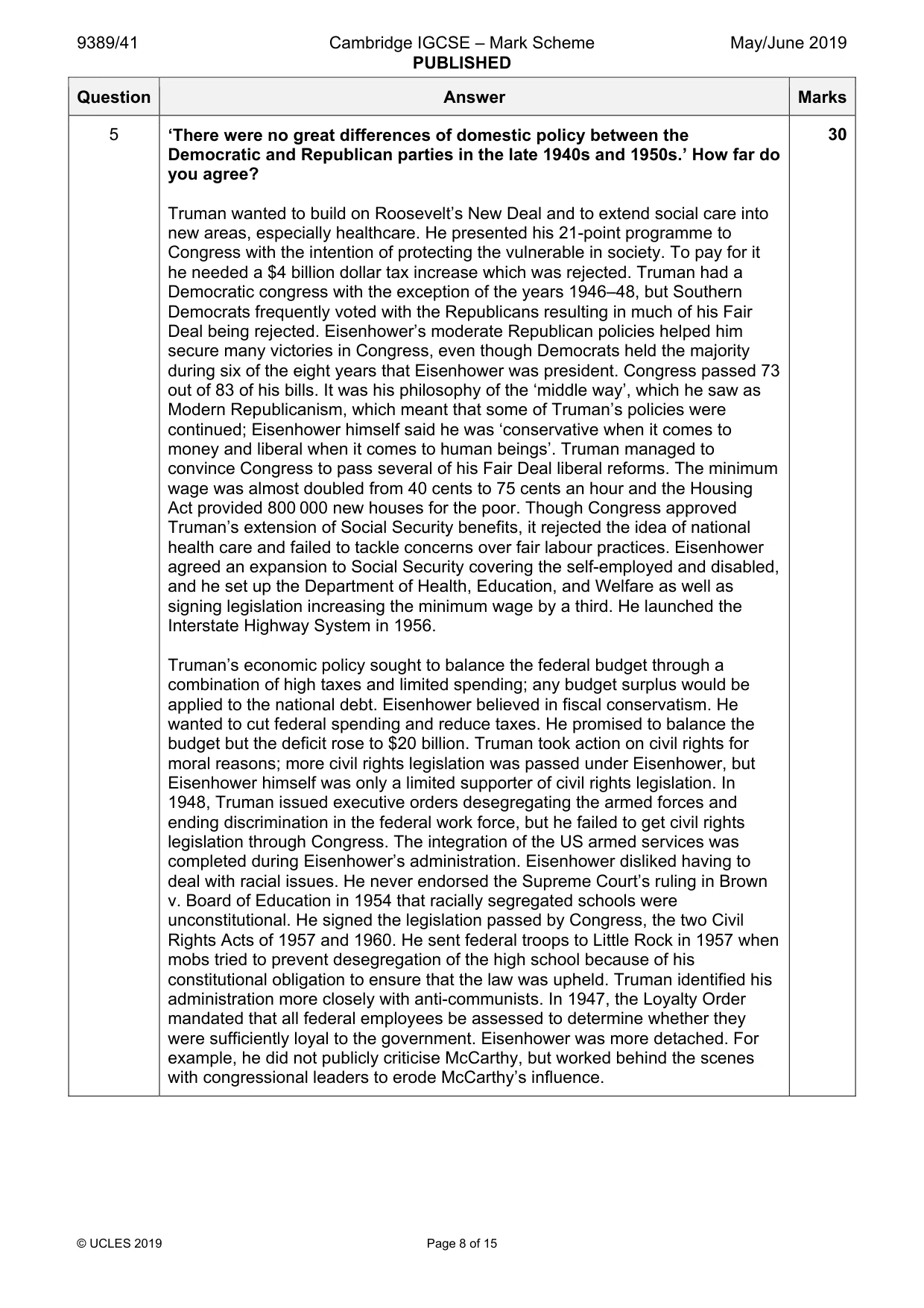
9389/41 Cambridge IGCSE – Mark Scheme PUBLISHED May/June 2019 © UCLES 2019 Page 8 of 15 Question Answer Marks 5 ‘There were no great differences of domestic policy between the Democratic and Republican parties in the late 1940s and 1950s.’ How far do you agree? Truman wanted to build on Roosevelt’s New Deal and to extend social care into new areas, especially healthcare. He presented his 21-point programme to Congress with the intention of protecting the vulnerable in society. To pay for it he needed a $4 billion dollar tax increase which was rejected. Truman had a Democratic congress with the exception of the years 1946–48, but Southern Democrats frequently voted with the Republicans resulting in much of his Fair Deal being rejected. Eisenhower’s moderate Republican policies helped him secure many victories in Congress, even though Democrats held the majority during six of the eight years that Eisenhower was president. Congress passed 73 out of 83 of his bills. It was his philosophy of the ‘middle way’, which he saw as Modern Republicanism, which meant that some of Truman’s policies were continued; Eisenhower himself said he was ‘conservative when it comes to money and liberal when it comes to human beings’. Truman managed to convince Congress to pass several of his Fair Deal liberal reforms. The minimum wage was almost doubled from 40 cents to 75 cents an hour and the Housing Act provided 800 000 new houses for the poor. Though Congress approved Truman’s extension of Social Security benefits, it rejected the idea of national health care and failed to tackle concerns over fair labour practices. Eisenhower agreed an expansion to Social Security covering the self-employed and disabled, and he set up the Department of Health, Education, and Welfare as well as signing legislation increasing the minimum wage by a third. He launched the Interstate Highway System in 1956. Truman’s economic policy sought to balance the federal budget through a combination of high taxes and limited spending; any budget surplus would be applied to the national debt. Eisenhower believed in fiscal conservatism. He wanted to cut federal spending and reduce taxes. He promised to balance the budget but the deficit rose to $20 billion. Truman took action on civil rights for moral reasons; more civil rights legislation was passed under Eisenhower, but Eisenhower himself was only a limited supporter of civil rights legislation. In 1948, Truman issued executive orders desegregating the armed forces and ending discrimination in the federal work force, but he failed to get civil rights legislation through Congress. The integration of the US armed services was completed during Eisenhower’s administration. Eisenhower disliked having to deal with racial issues. He never endorsed the Supreme Court’s ruling in Brown v. Board of Education in 1954 that racially segregated schools were unconstitutional. He signed the legislation passed by Congress, the two Civil Rights Acts of 1957 and 1960. He sent federal troops to Little Rock in 1957 when mobs tried to prevent desegregation of the high school because of his constitutional obligation to ensure that the law was upheld. Truman identified his administration more closely with anti-communists. In 1947, the Loyalty Order mandated that all federal employees be assessed to determine whether they were sufficiently loyal to the government. Eisenhower was more detached. For example, he did not publicly criticise McCarthy, but worked behind the scenes with congressional leaders to erode McCarthy’s influence. 30
Mark scheme, page 9
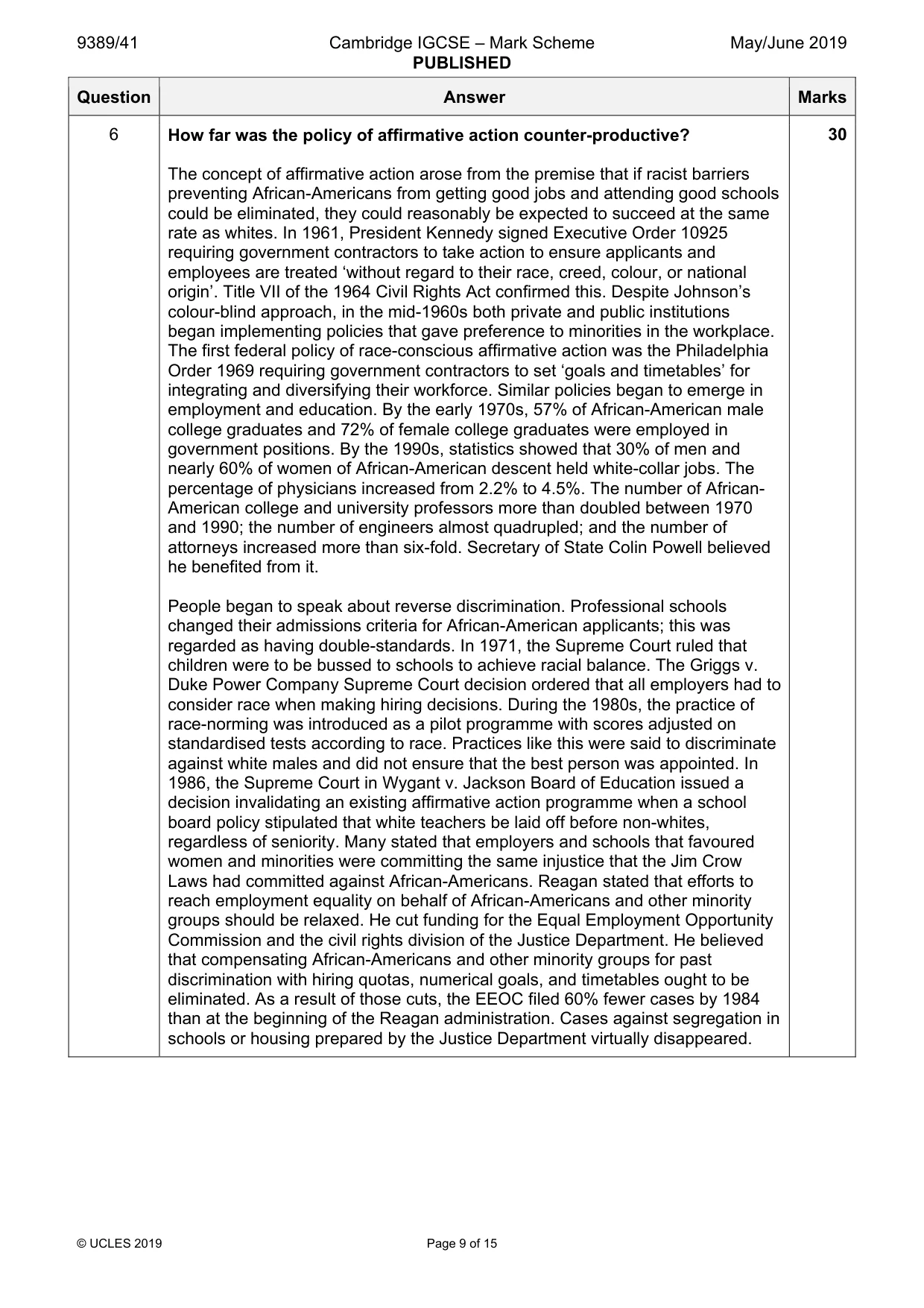
9389/41 Cambridge IGCSE – Mark Scheme PUBLISHED May/June 2019 © UCLES 2019 Page 9 of 15 Question Answer Marks 6 How far was the policy of affirmative action counter-productive? The concept of affirmative action arose from the premise that if racist barriers preventing African-Americans from getting good jobs and attending good schools could be eliminated, they could reasonably be expected to succeed at the same rate as whites. In 1961, President Kennedy signed Executive Order 10925 requiring government contractors to take action to ensure applicants and employees are treated ‘without regard to their race, creed, colour, or national origin’. Title VII of the 1964 Civil Rights Act confirmed this. Despite Johnson’s colour-blind approach, in the mid-1960s both private and public institutions began implementing policies that gave preference to minorities in the workplace. The first federal policy of race-conscious affirmative action was the Philadelphia Order 1969 requiring government contractors to set ‘goals and timetables’ for integrating and diversifying their workforce. Similar policies began to emerge in employment and education. By the early 1970s, 57% of African-American male college graduates and 72% of female college graduates were employed in government positions. By the 1990s, statistics showed that 30% of men and nearly 60% of women of African-American descent held white-collar jobs. The percentage of physicians increased from 2.2% to 4.5%. The number of African- American college and university professors more than doubled between 1970 and 1990; the number of engineers almost quadrupled; and the number of attorneys increased more than six-fold. Secretary of State Colin Powell believed he benefited from it. People began to speak about reverse discrimination. Professional schools changed their admissions criteria for African-American applicants; this was regarded as having double-standards. In 1971, the Supreme Court ruled that children were to be bussed to schools to achieve racial balance. The Griggs v. Duke Power Company Supreme Court decision ordered that all employers had to consider race when making hiring decisions. During the 1980s, the practice of race-norming was introduced as a pilot programme with scores adjusted on standardised tests according to race. Practices like this were said to discriminate against white males and did not ensure that the best person was appointed. In 1986, the Supreme Court in Wygant v. Jackson Board of Education issued a decision invalidating an existing affirmative action programme when a school board policy stipulated that white teachers be laid off before non-whites, regardless of seniority. Many stated that employers and schools that favoured women and minorities were committing the same injustice that the Jim Crow Laws had committed against African-Americans. Reagan stated that efforts to reach employment equality on behalf of African-Americans and other minority groups should be relaxed. He cut funding for the Equal Employment Opportunity Commission and the civil rights division of the Justice Department. He believed that compensating African-Americans and other minority groups for past discrimination with hiring quotas, numerical goals, and timetables ought to be eliminated. As a result of those cuts, the EEOC filed 60% fewer cases by 1984 than at the beginning of the Reagan administration. Cases against segregation in schools or housing prepared by the Justice Department virtually disappeared. 30
Mark scheme, page 10
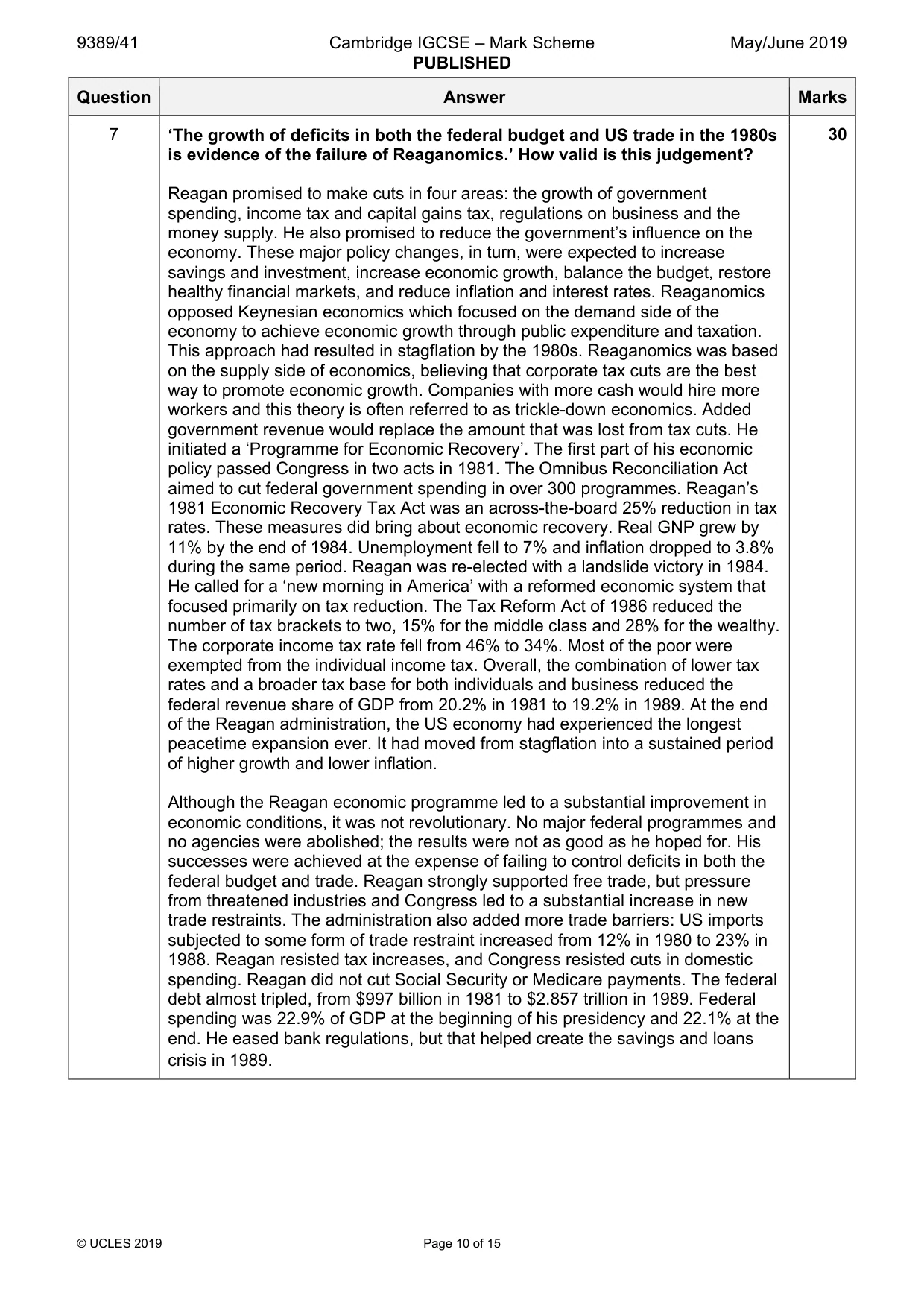
9389/41 Cambridge IGCSE – Mark Scheme PUBLISHED May/June 2019 © UCLES 2019 Page 10 of 15 Question Answer Marks 7 ‘The growth of deficits in both the federal budget and US trade in the 1980s is evidence of the failure of Reaganomics.’ How valid is this judgement? Reagan promised to make cuts in four areas: the growth of government spending, income tax and capital gains tax, regulations on business and the money supply. He also promised to reduce the government’s influence on the economy. These major policy changes, in turn, were expected to increase savings and investment, increase economic growth, balance the budget, restore healthy financial markets, and reduce inflation and interest rates. Reaganomics opposed Keynesian economics which focused on the demand side of the economy to achieve economic growth through public expenditure and taxation. This approach had resulted in stagflation by the 1980s. Reaganomics was based on the supply side of economics, believing that corporate tax cuts are the best way to promote economic growth. Companies with more cash would hire more workers and this theory is often referred to as trickle-down economics. Added government revenue would replace the amount that was lost from tax cuts. He initiated a ‘Programme for Economic Recovery’. The first part of his economic policy passed Congress in two acts in 1981. The Omnibus Reconciliation Act aimed to cut federal government spending in over 300 programmes. Reagan’s 1981 Economic Recovery Tax Act was an across-the-board 25% reduction in tax rates. These measures did bring about economic recovery. Real GNP grew by 11% by the end of 1984. Unemployment fell to 7% and inflation dropped to 3.8% during the same period. Reagan was re-elected with a landslide victory in 1984. He called for a ‘new morning in America’ with a reformed economic system that focused primarily on tax reduction. The Tax Reform Act of 1986 reduced the number of tax brackets to two, 15% for the middle class and 28% for the wealthy. The corporate income tax rate fell from 46% to 34%. Most of the poor were exempted from the individual income tax. Overall, the combination of lower tax rates and a broader tax base for both individuals and business reduced the federal revenue share of GDP from 20.2% in 1981 to 19.2% in 1989. At the end of the Reagan administration, the US economy had experienced the longest peacetime expansion ever. It had moved from stagflation into a sustained period of higher growth and lower inflation. Although the Reagan economic programme led to a substantial improvement in economic conditions, it was not revolutionary. No major federal programmes and no agencies were abolished; the results were not as good as he hoped for. His successes were achieved at the expense of failing to control deficits in both the federal budget and trade. Reagan strongly supported free trade, but pressure from threatened industries and Congress led to a substantial increase in new trade restraints. The administration also added more trade barriers: US imports subjected to some form of trade restraint increased from 12% in 1980 to 23% in 1988. Reagan resisted tax increases, and Congress resisted cuts in domestic spending. Reagan did not cut Social Security or Medicare payments. The federal debt almost tripled, from $997 billion in 1981 to $2.857 trillion in 1989. Federal spending was 22.9% of GDP at the beginning of his presidency and 22.1% at the end. He eased bank regulations, but that helped create the savings and loans crisis in 1989. 30
Mark scheme, page 11
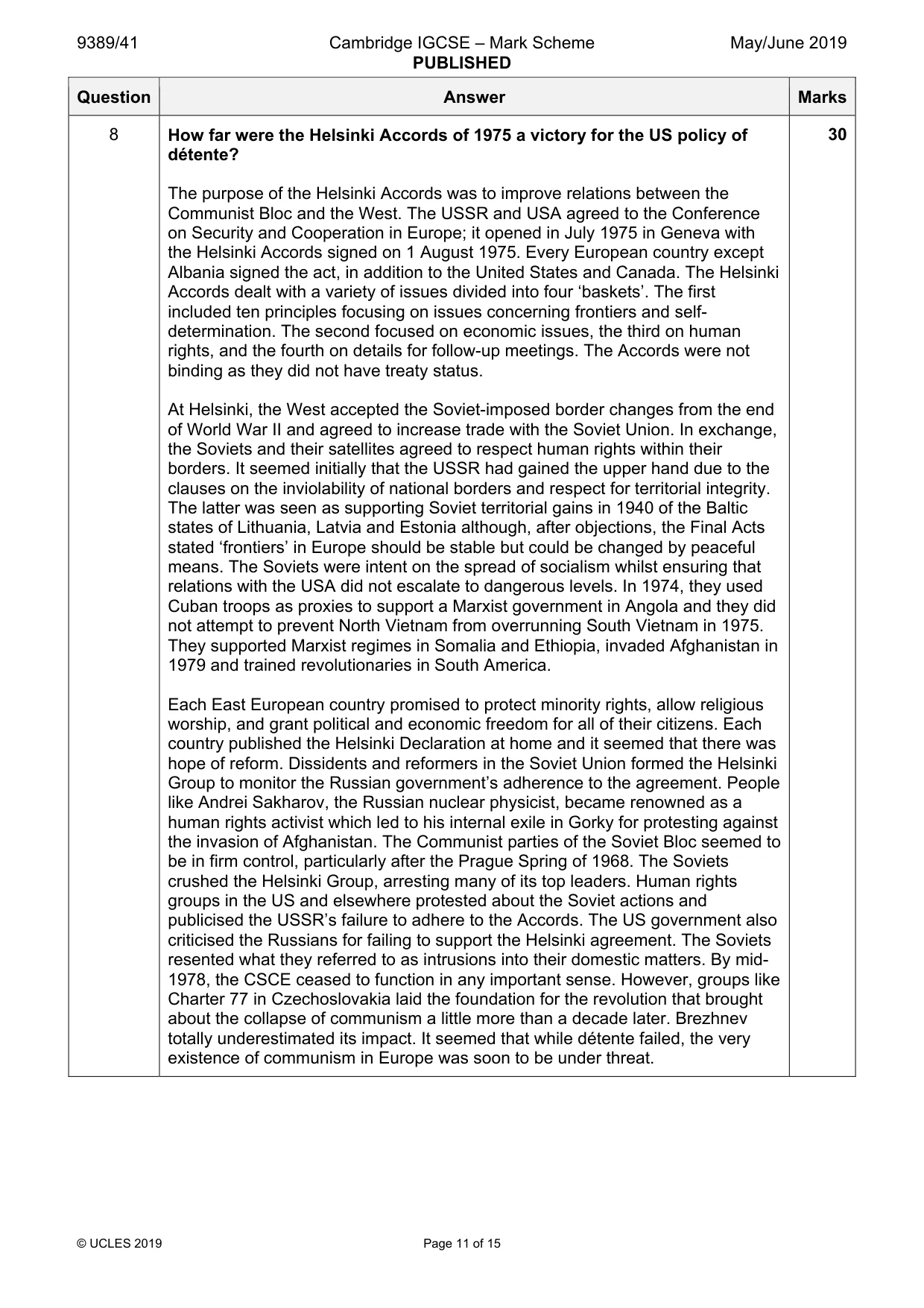
9389/41 Cambridge IGCSE – Mark Scheme PUBLISHED May/June 2019 © UCLES 2019 Page 11 of 15 Question Answer Marks 8 How far were the Helsinki Accords of 1975 a victory for the US policy of détente? The purpose of the Helsinki Accords was to improve relations between the Communist Bloc and the West. The USSR and USA agreed to the Conference on Security and Cooperation in Europe; it opened in July 1975 in Geneva with the Helsinki Accords signed on 1 August 1975. Every European country except Albania signed the act, in addition to the United States and Canada. The Helsinki Accords dealt with a variety of issues divided into four ‘baskets’. The first included ten principles focusing on issues concerning frontiers and self- determination. The second focused on economic issues, the third on human rights, and the fourth on details for follow-up meetings. The Accords were not binding as they did not have treaty status. At Helsinki, the West accepted the Soviet-imposed border changes from the end of World War II and agreed to increase trade with the Soviet Union. In exchange, the Soviets and their satellites agreed to respect human rights within their borders. It seemed initially that the USSR had gained the upper hand due to the clauses on the inviolability of national borders and respect for territorial integrity. The latter was seen as supporting Soviet territorial gains in 1940 of the Baltic states of Lithuania, Latvia and Estonia although, after objections, the Final Acts stated ‘frontiers’ in Europe should be stable but could be changed by peaceful means. The Soviets were intent on the spread of socialism whilst ensuring that relations with the USA did not escalate to dangerous levels. In 1974, they used Cuban troops as proxies to support a Marxist government in Angola and they did not attempt to prevent North Vietnam from overrunning South Vietnam in 1975. They supported Marxist regimes in Somalia and Ethiopia, invaded Afghanistan in 1979 and trained revolutionaries in South America. Each East European country promised to protect minority rights, allow religious worship, and grant political and economic freedom for all of their citizens. Each country published the Helsinki Declaration at home and it seemed that there was hope of reform. Dissidents and reformers in the Soviet Union formed the Helsinki Group to monitor the Russian government’s adherence to the agreement. People like Andrei Sakharov, the Russian nuclear physicist, became renowned as a human rights activist which led to his internal exile in Gorky for protesting against the invasion of Afghanistan. The Communist parties of the Soviet Bloc seemed to be in firm control, particularly after the Prague Spring of 1968. The Soviets crushed the Helsinki Group, arresting many of its top leaders. Human rights groups in the US and elsewhere protested about the Soviet actions and publicised the USSR’s failure to adhere to the Accords. The US government also criticised the Russians for failing to support the Helsinki agreement. The Soviets resented what they referred to as intrusions into their domestic matters. By mid- 1978, the CSCE ceased to function in any important sense. However, groups like Charter 77 in Czechoslovakia laid the foundation for the revolution that brought about the collapse of communism a little more than a decade later. Brezhnev totally underestimated its impact. It seemed that while détente failed, the very existence of communism in Europe was soon to be under threat. 30
Mark scheme, page 12
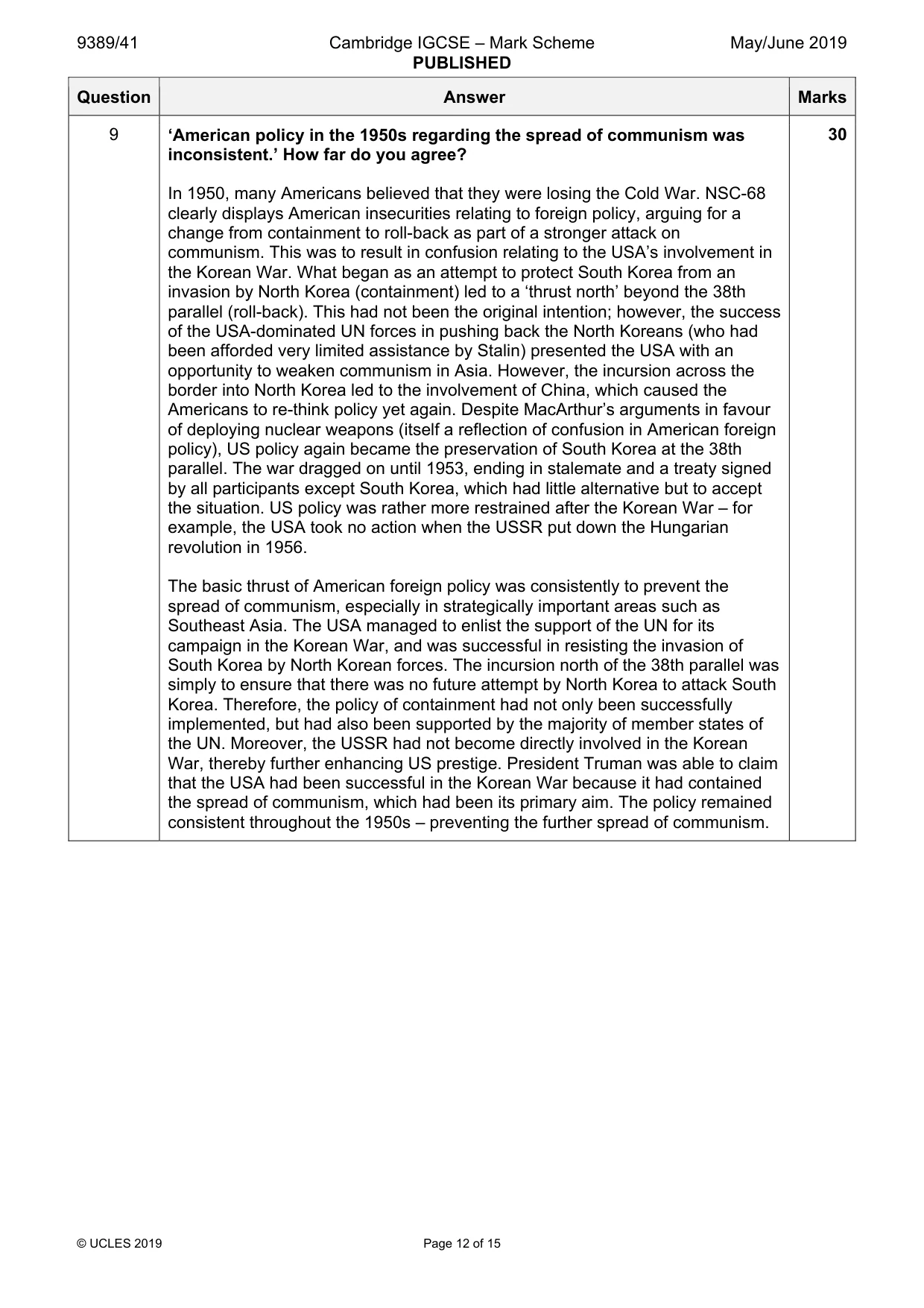
9389/41 Cambridge IGCSE – Mark Scheme PUBLISHED May/June 2019 © UCLES 2019 Page 12 of 15 Question Answer Marks 9 ‘American policy in the 1950s regarding the spread of communism was inconsistent.’ How far do you agree? In 1950, many Americans believed that they were losing the Cold War. NSC-68 clearly displays American insecurities relating to foreign policy, arguing for a change from containment to roll-back as part of a stronger attack on communism. This was to result in confusion relating to the USA’s involvement in the Korean War. What began as an attempt to protect South Korea from an invasion by North Korea (containment) led to a ‘thrust north’ beyond the 38th parallel (roll-back). This had not been the original intention; however, the success of the USA-dominated UN forces in pushing back the North Koreans (who had been afforded very limited assistance by Stalin) presented the USA with an opportunity to weaken communism in Asia. However, the incursion across the border into North Korea led to the involvement of China, which caused the Americans to re-think policy yet again. Despite MacArthur’s arguments in favour of deploying nuclear weapons (itself a reflection of confusion in American foreign policy), US policy again became the preservation of South Korea at the 38th parallel. The war dragged on until 1953, ending in stalemate and a treaty signed by all participants except South Korea, which had little alternative but to accept the situation. US policy was rather more restrained after the Korean War – for example, the USA took no action when the USSR put down the Hungarian revolution in 1956. The basic thrust of American foreign policy was consistently to prevent the spread of communism, especially in strategically important areas such as Southeast Asia. The USA managed to enlist the support of the UN for its campaign in the Korean War, and was successful in resisting the invasion of South Korea by North Korean forces. The incursion north of the 38th parallel was simply to ensure that there was no future attempt by North Korea to attack South Korea. Therefore, the policy of containment had not only been successfully implemented, but had also been supported by the majority of member states of the UN. Moreover, the USSR had not become directly involved in the Korean War, thereby further enhancing US prestige. President Truman was able to claim that the USA had been successful in the Korean War because it had contained the spread of communism, which had been its primary aim. The policy remained consistent throughout the 1950s – preventing the further spread of communism. 30
Mark scheme, page 13
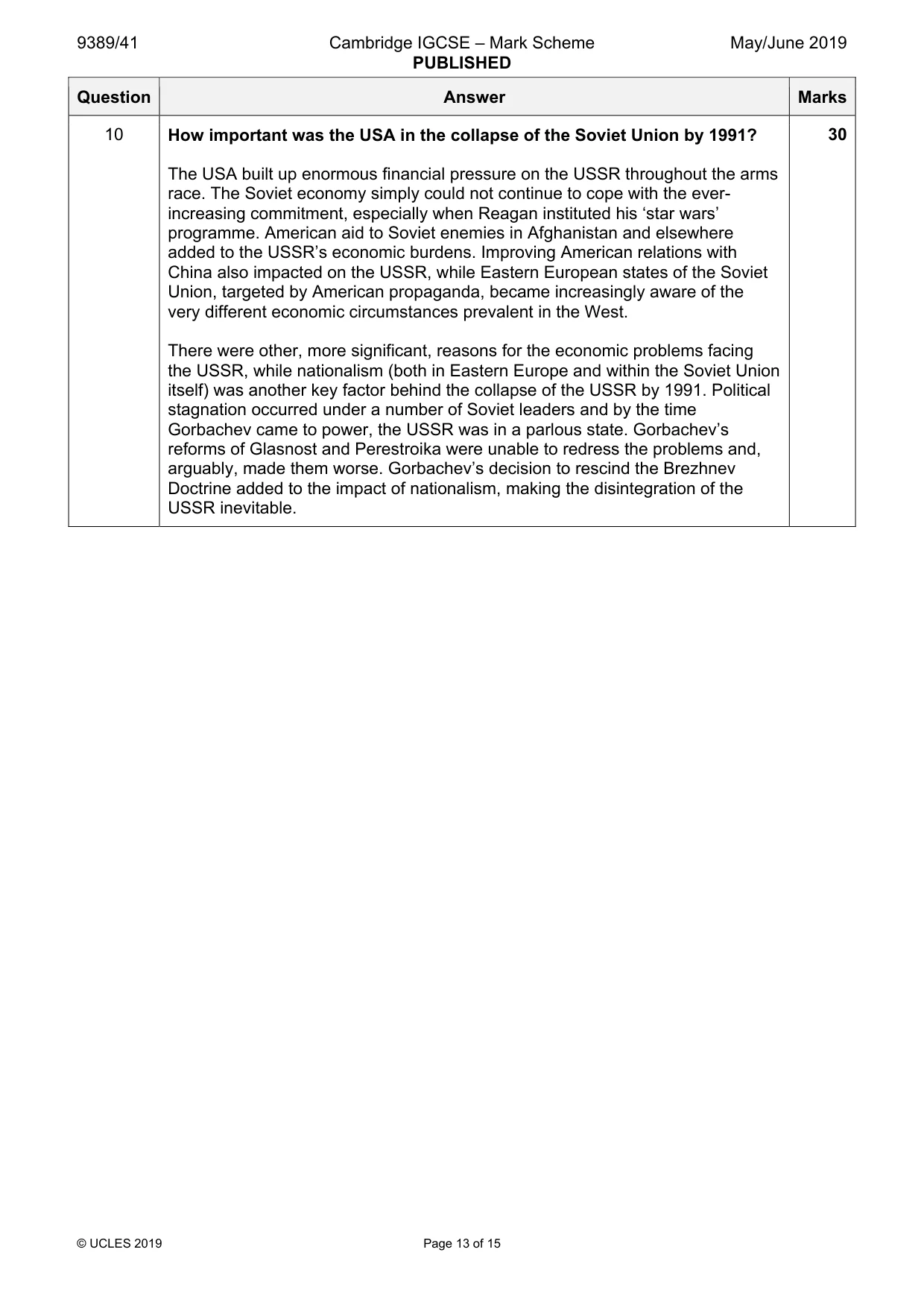
9389/41 Cambridge IGCSE – Mark Scheme PUBLISHED May/June 2019 © UCLES 2019 Page 13 of 15 Question Answer Marks 10 How important was the USA in the collapse of the Soviet Union by 1991? The USA built up enormous financial pressure on the USSR throughout the arms race. The Soviet economy simply could not continue to cope with the ever- increasing commitment, especially when Reagan instituted his ‘star wars’ programme. American aid to Soviet enemies in Afghanistan and elsewhere added to the USSR’s economic burdens. Improving American relations with China also impacted on the USSR, while Eastern European states of the Soviet Union, targeted by American propaganda, became increasingly aware of the very different economic circumstances prevalent in the West. There were other, more significant, reasons for the economic problems facing the USSR, while nationalism (both in Eastern Europe and within the Soviet Union itself) was another key factor behind the collapse of the USSR by 1991. Political stagnation occurred under a number of Soviet leaders and by the time Gorbachev came to power, the USSR was in a parlous state. Gorbachev’s reforms of Glasnost and Perestroika were unable to redress the problems and, arguably, made them worse. Gorbachev’s decision to rescind the Brezhnev Doctrine added to the impact of nationalism, making the disintegration of the USSR inevitable. 30
Mark scheme, page 14
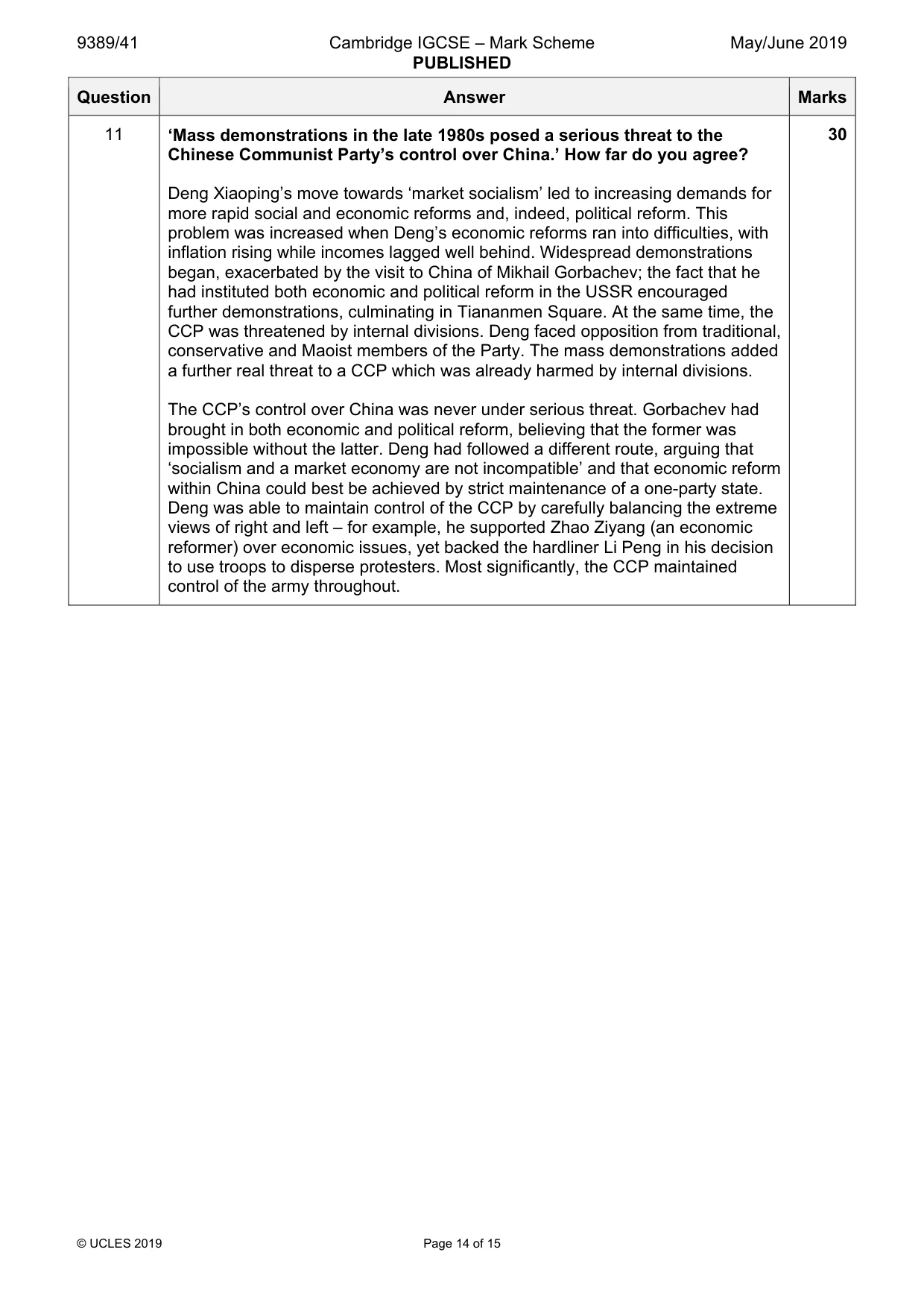
9389/41 Cambridge IGCSE – Mark Scheme PUBLISHED May/June 2019 © UCLES 2019 Page 14 of 15 Question Answer Marks 11 ‘Mass demonstrations in the late 1980s posed a serious threat to the Chinese Communist Party’s control over China.’ How far do you agree? Deng Xiaoping’s move towards ‘market socialism’ led to increasing demands for more rapid social and economic reforms and, indeed, political reform. This problem was increased when Deng’s economic reforms ran into difficulties, with inflation rising while incomes lagged well behind. Widespread demonstrations began, exacerbated by the visit to China of Mikhail Gorbachev; the fact that he had instituted both economic and political reform in the USSR encouraged further demonstrations, culminating in Tiananmen Square. At the same time, the CCP was threatened by internal divisions. Deng faced opposition from traditional, conservative and Maoist members of the Party. The mass demonstrations added a further real threat to a CCP which was already harmed by internal divisions. The CCP’s control over China was never under serious threat. Gorbachev had brought in both economic and political reform, believing that the former was impossible without the latter. Deng had followed a different route, arguing that ‘socialism and a market economy are not incompatible’ and that economic reform within China could best be achieved by strict maintenance of a one-party state. Deng was able to maintain control of the CCP by carefully balancing the extreme views of right and left – for example, he supported Zhao Ziyang (an economic reformer) over economic issues, yet backed the hardliner Li Peng in his decision to use troops to disperse protesters. Most significantly, the CCP maintained control of the army throughout. 30
Mark scheme, page 15
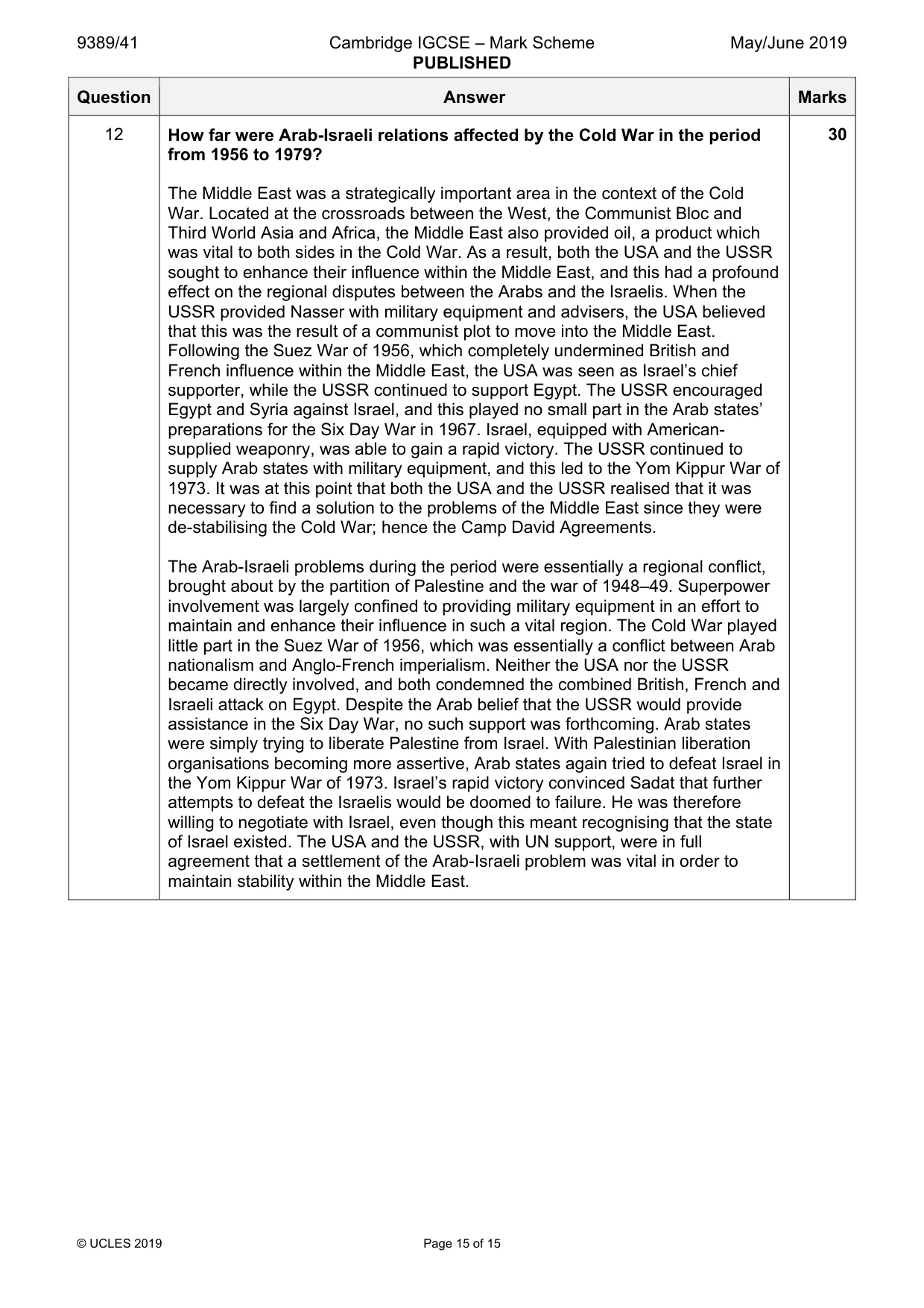
9389/41 Cambridge IGCSE – Mark Scheme PUBLISHED May/June 2019 © UCLES 2019 Page 15 of 15 Question Answer Marks 12 How far were Arab-Israeli relations affected by the Cold War in the period from 1956 to 1979? The Middle East was a strategically important area in the context of the Cold War. Located at the crossroads between the West, the Communist Bloc and Third World Asia and Africa, the Middle East also provided oil, a product which was vital to both sides in the Cold War. As a result, both the USA and the USSR sought to enhance their influence within the Middle East, and this had a profound effect on the regional disputes between the Arabs and the Israelis. When the USSR provided Nasser with military equipment and advisers, the USA believed that this was the result of a communist plot to move into the Middle East. Following the Suez War of 1956, which completely undermined British and French influence within the Middle East, the USA was seen as Israel’s chief supporter, while the USSR continued to support Egypt. The USSR encouraged Egypt and Syria against Israel, and this played no small part in the Arab states’ preparations for the Six Day War in 1967. Israel, equipped with American- supplied weaponry, was able to gain a rapid victory. The USSR continued to supply Arab states with military equipment, and this led to the Yom Kippur War of 1973. It was at this point that both the USA and the USSR realised that it was necessary to find a solution to the problems of the Middle East since they were de-stabilising the Cold War; hence the Camp David Agreements. The Arab-Israeli problems during the period were essentially a regional conflict, brought about by the partition of Palestine and the war of 1948–49. Superpower involvement was largely confined to providing military equipment in an effort to maintain and enhance their influence in such a vital region. The Cold War played little part in the Suez War of 1956, which was essentially a conflict between Arab nationalism and Anglo-French imperialism. Neither the USA nor the USSR became directly involved, and both condemned the combined British, French and Israeli attack on Egypt. Despite the Arab belief that the USSR would provide assistance in the Six Day War, no such support was forthcoming. Arab states were simply trying to liberate Palestine from Israel. With Palestinian liberation organisations becoming more assertive, Arab states again tried to defeat Israel in the Yom Kippur War of 1973. Israel’s rapid victory convinced Sadat that further attempts to defeat the Israelis would be doomed to failure. He was therefore willing to negotiate with Israel, even though this meant recognising that the state of Israel existed. The USA and the USSR, with UN support, were in full agreement that a settlement of the Arab-Israeli problem was vital in order to maintain stability within the Middle East. 30
What you needed in this session
Cambridge’s own grade thresholds for 2019 May/June, Paper 4 · Variant 1. A higher threshold means an easier paper — the bar moves with how the cohort did.