Cambridge A Level History 9389 — 2018 Oct/Nov Paper 4 · Variant 1
9389/41/O/N/18 · 20 questions · 60 marks · ≈68 min
The question paper and its mark scheme, free to read here and free to download. This is Cambridge’s own paper, exactly as it was sat.
Question paper4 pages
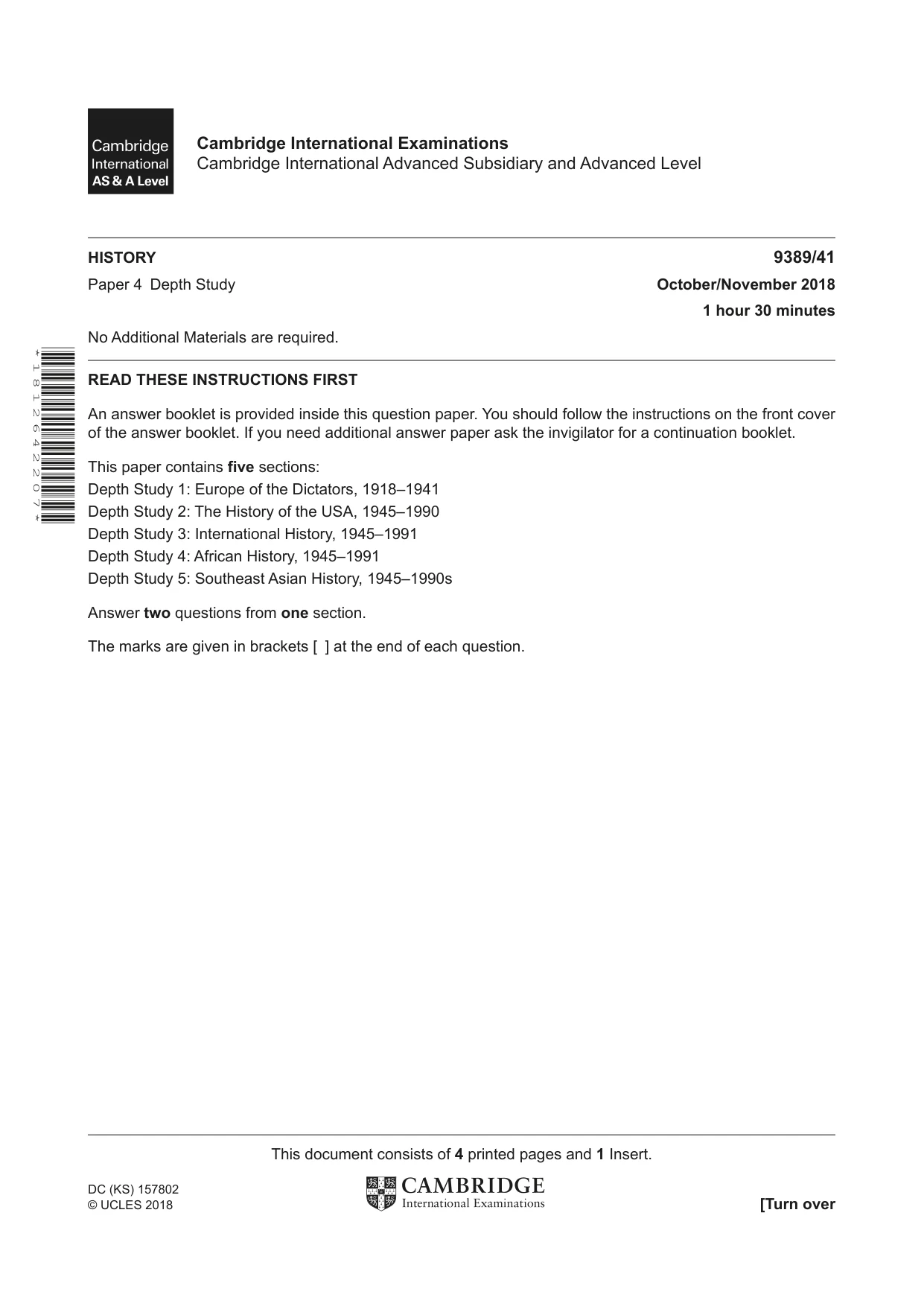
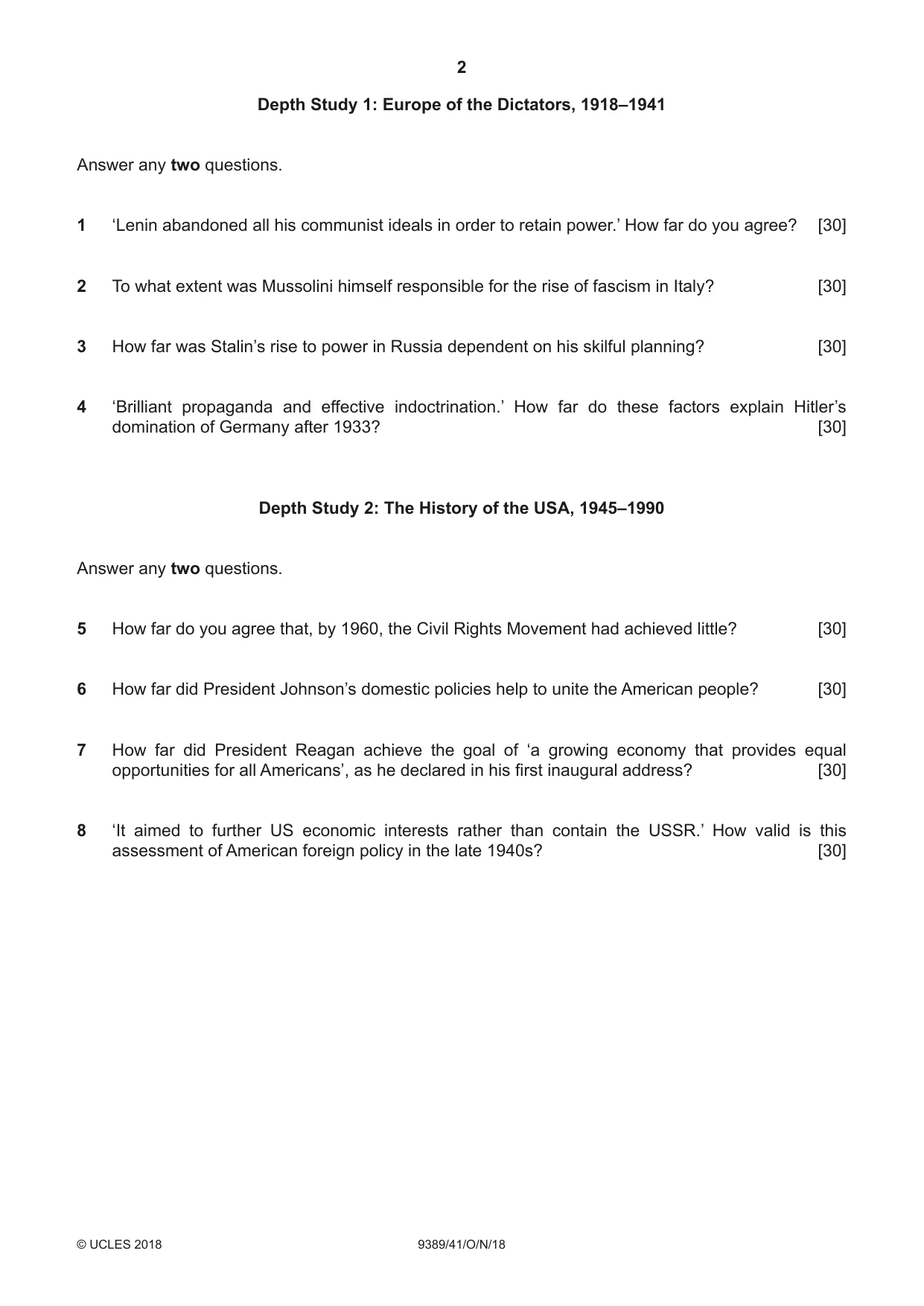
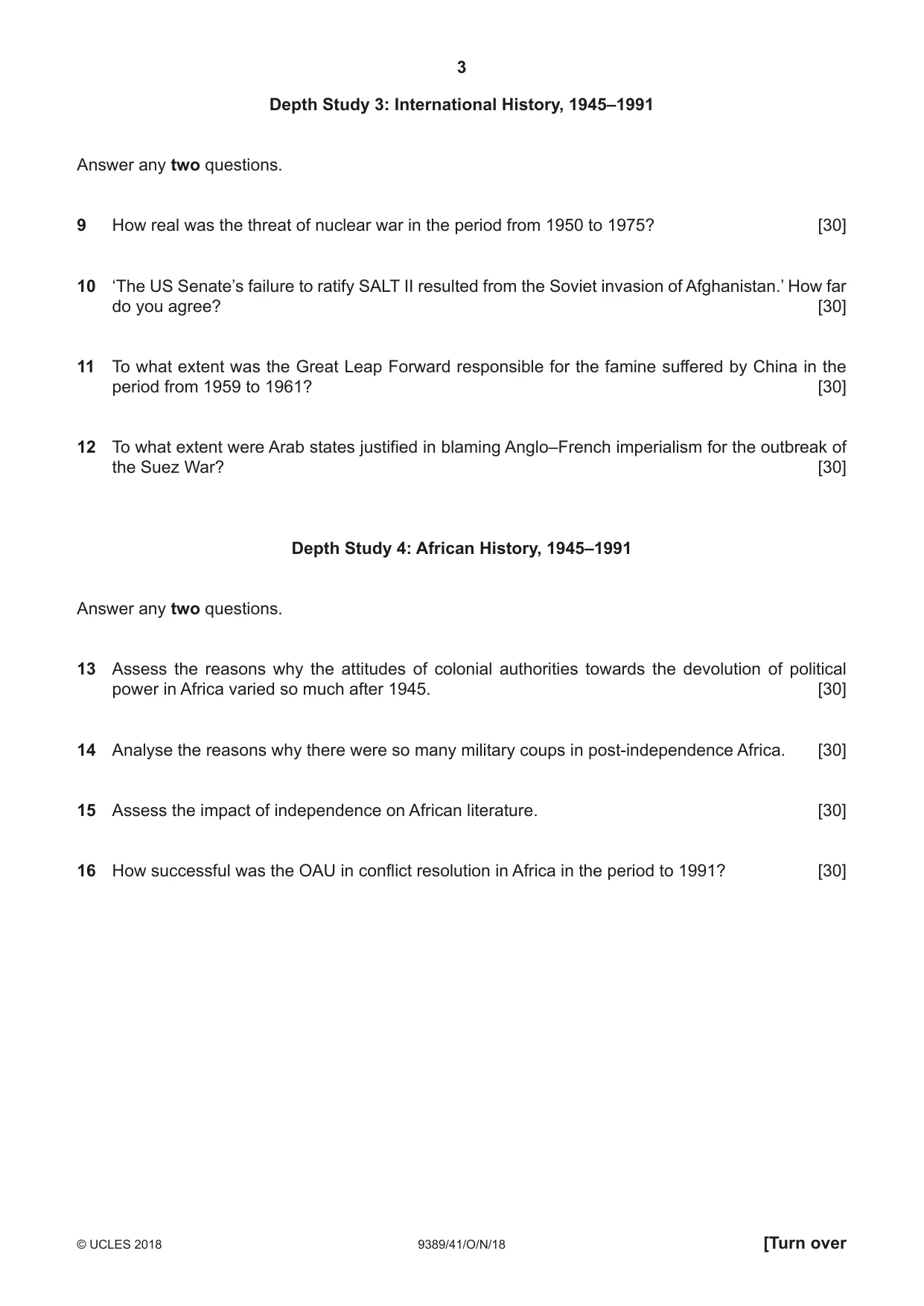
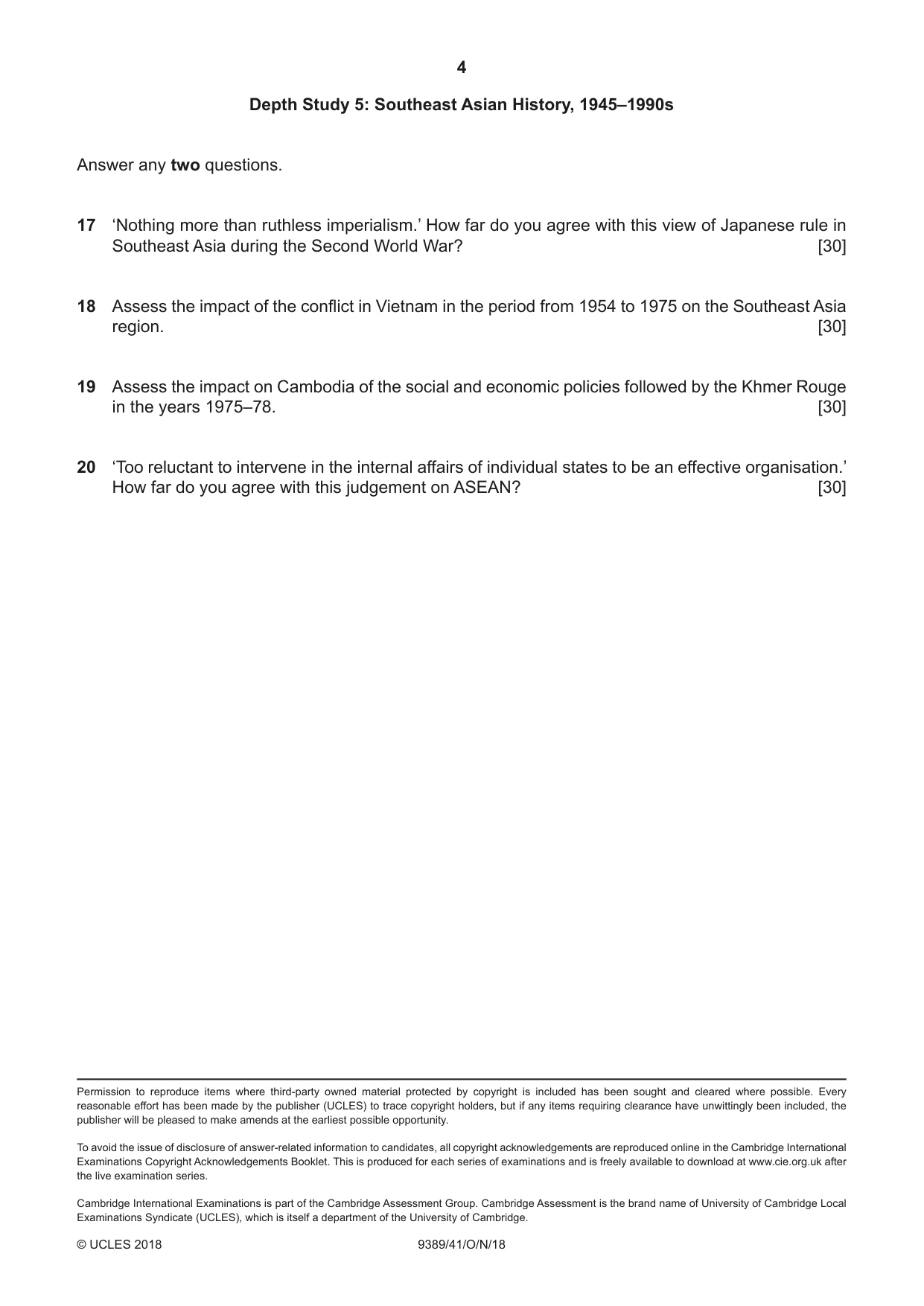
Mark scheme24 pages
Answers below. Sit the paper first if you are practising.
Questions as text
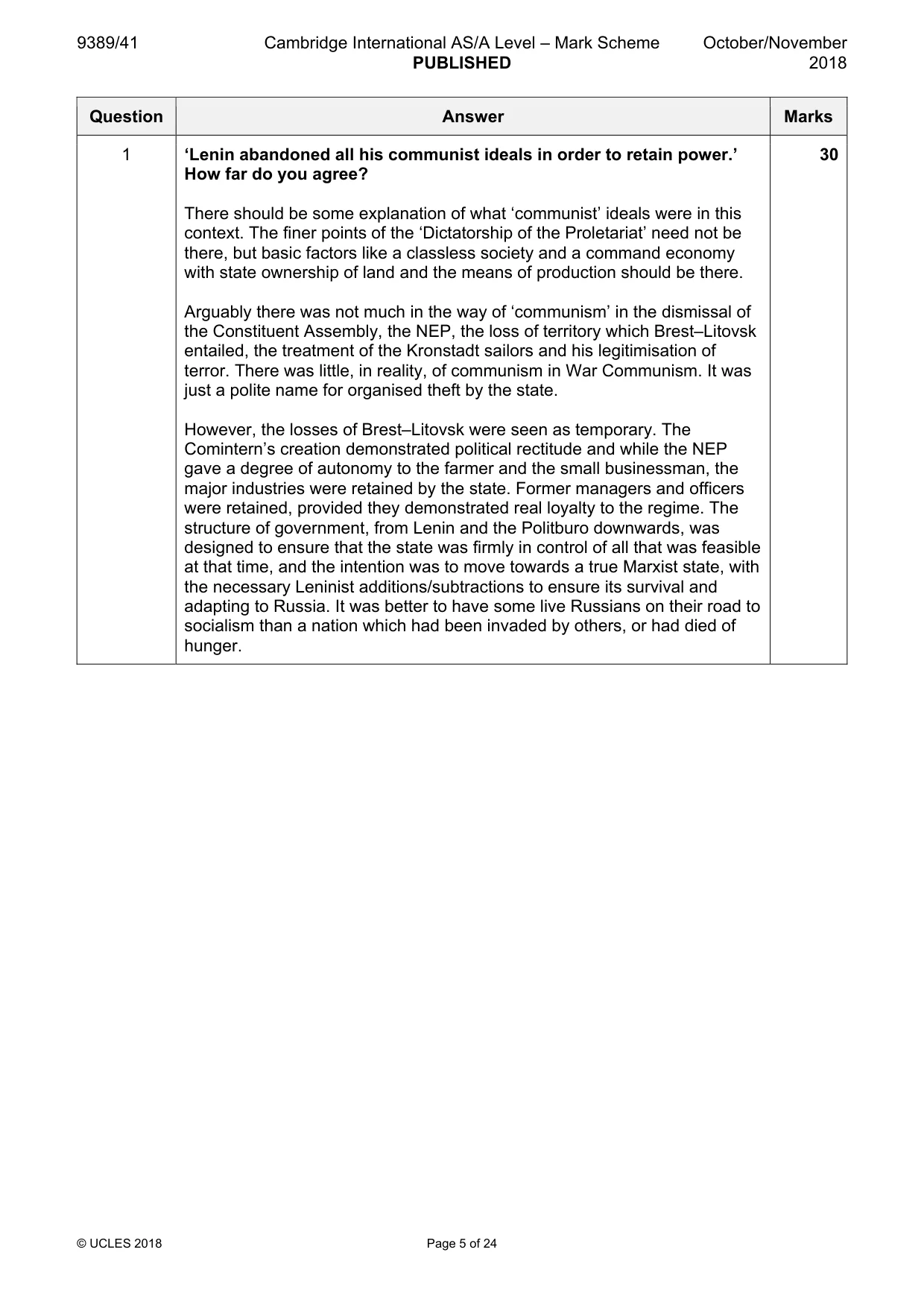
Q1 · ‘Lenin abandoned all his communist ideals in order to retain power.’ How far do you agree?
1 ‘Lenin abandoned all his communist ideals in order to retain power.’ How far do you agree? [30]
Mark scheme: Question Answer Marks 1 ‘Lenin abandoned all his communist ideals in order to retain power.’ 30 How far do you agree? There should be some explanation of what ‘communist’ ideals were in this context. The finer points of the ‘Dictatorship of the Proletariat’ need not be there, but basic factors like a classless society and a command economy with state ownership of land and the means of production should be there. Arguably there was not much in the way of ‘communism’ in the dismissal of the Constituent Assembly, the NEP, the loss of territory which Brest–Litovsk entailed, the treatment of the Kronstadt sailors and his legitimisation of terror. There was little, in reality, of communism in War Communism. It was just a polite name for organised theft by the state. However, the losses of Brest–Litovsk were seen as temporary. The Comintern’s creation demonstrated political rectitude and while the NEP gave a degree of autonomy to the farmer and the small businessman, the major industries were retained by the state. Former managers and officers were retained, provided they demonstrated real loyalty to the regime. The structure of government, from Lenin and the Politburo downwards, was designed to ensure that the state was firmly in control of all that was feasible at that time, and the intention was to move towards a true Marxist state, with the necessary Leninist additions/subtractions to ensure its survival and adapting to Russia. It was better to have some live Russians on their road to socialism than a nation which had been invaded by others, or had died of hunger.
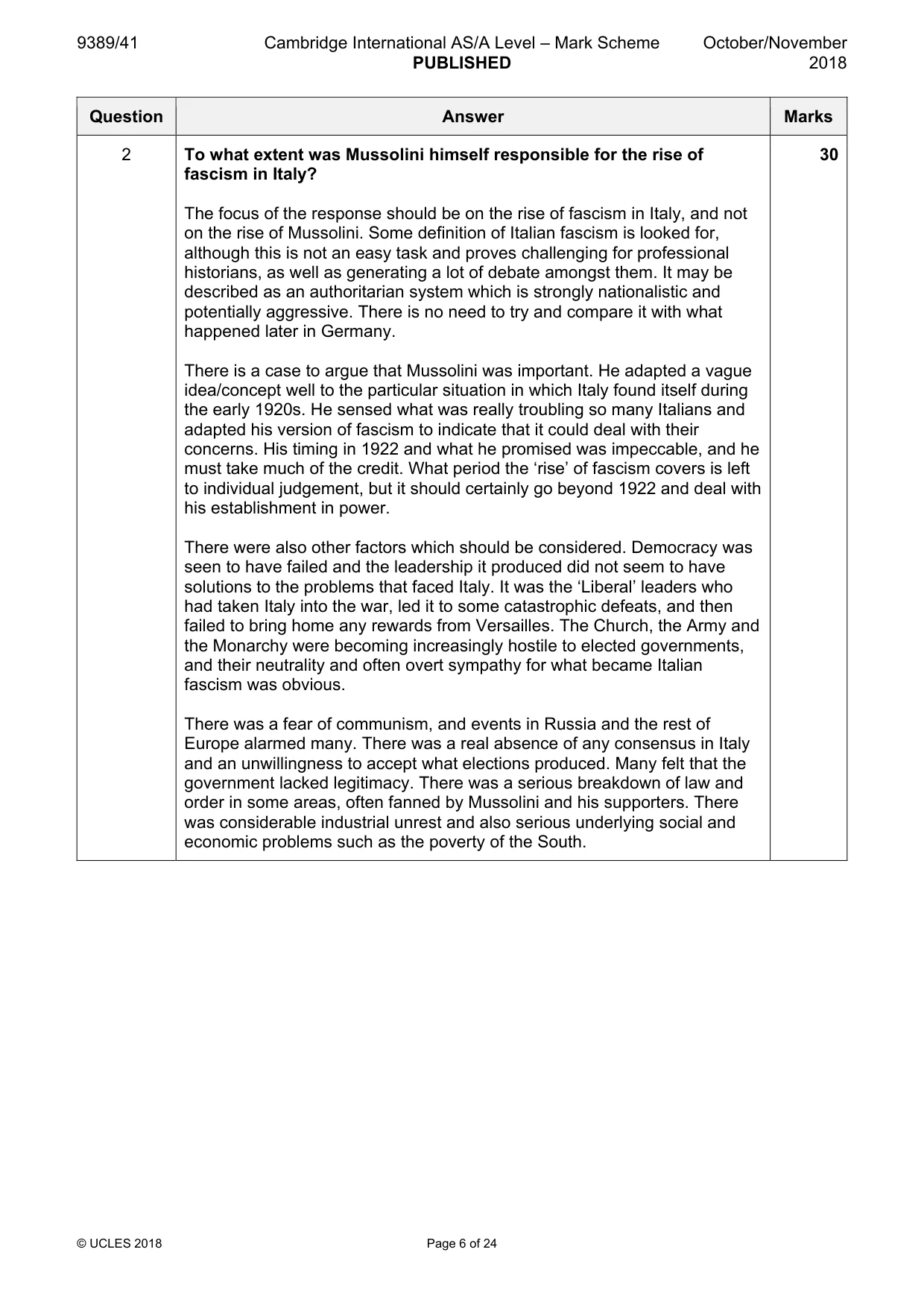
Q2 · To what extent was Mussolini himself responsible for the rise of fascism in Italy?
2 To what extent was Mussolini himself responsible for the rise of fascism in Italy? [30]
Mark scheme: 2 To what extent was Mussolini himself responsible for the rise of 30 fascism in Italy? The focus of the response should be on the rise of fascism in Italy, and not on the rise of Mussolini. Some definition of Italian fascism is looked for, although this is not an easy task and proves challenging for professional historians, as well as generating a lot of debate amongst them. It may be described as an authoritarian system which is strongly nationalistic and potentially aggressive. There is no need to try and compare it with what happened later in Germany. There is a case to argue that Mussolini was important. He adapted a vague idea/concept well to the particular situation in which Italy found itself during the early 1920s. He sensed what was really troubling so many Italians and adapted his version of fascism to indicate that it could deal with their concerns. His timing in 1922 and what he promised was impeccable, and he must take much of the credit. What period the ‘rise’ of fascism covers is left to individual judgement, but it should certainly go beyond 1922 and deal with his establishment in power. There were also other factors which should be considered. Democracy was seen to have failed and the leadership it produced did not seem to have solutions to the problems that faced Italy. It was the ‘Liberal’ leaders who had taken Italy into the war, led it to some catastrophic defeats, and then failed to bring home any rewards from Versailles. The Church, the Army and the Monarchy were becoming increasingly hostile to elected governments, and their neutrality and often overt sympathy for what became Italian fascism was obvious. There was a fear of communism, and events in Russia and the rest of Europe alarmed many. There was a real absence of any consensus in Italy and an unwillingness to accept what elections produced. Many felt that the government lacked legitimacy. There was a serious breakdown of law and order in some areas, often fanned by Mussolini and his supporters. There was considerable industrial unrest and also serious underlying social and economic problems such as the poverty of the South.
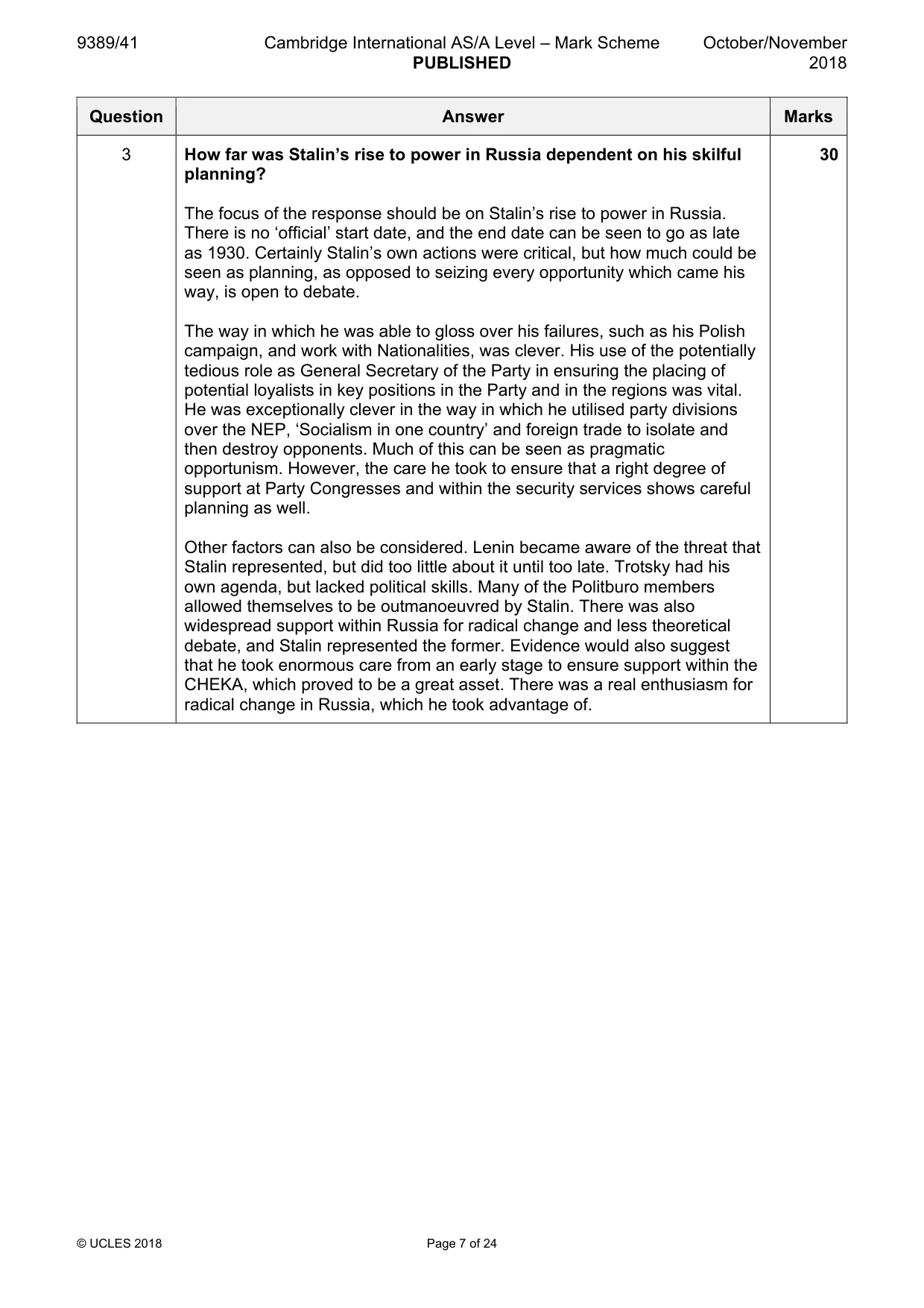
Q3 · How far was Stalin’s rise to power in Russia dependent on his skilful planning?
3 How far was Stalin’s rise to power in Russia dependent on his skilful planning? [30]
Mark scheme: 3 How far was Stalin’s rise to power in Russia dependent on his skilful 30 planning? The focus of the response should be on Stalin’s rise to power in Russia. There is no ‘official’ start date, and the end date can be seen to go as late as 1930. Certainly Stalin’s own actions were critical, but how much could be seen as planning, as opposed to seizing every opportunity which came his way, is open to debate. The way in which he was able to gloss over his failures, such as his Polish campaign, and work with Nationalities, was clever. His use of the potentially tedious role as General Secretary of the Party in ensuring the placing of potential loyalists in key positions in the Party and in the regions was vital. He was exceptionally clever in the way in which he utilised party divisions over the NEP, ‘Socialism in one country’ and foreign trade to isolate and then destroy opponents. Much of this can be seen as pragmatic opportunism. However, the care he took to ensure that a right degree of support at Party Congresses and within the security services shows careful planning as well. Other factors can also be considered. Lenin became aware of the threat that Stalin represented, but did too little about it until too late. Trotsky had his own agenda, but lacked political skills. Many of the Politburo members allowed themselves to be outmanoeuvred by Stalin. There was also widespread support within Russia for radical change and less theoretical debate, and Stalin represented the former. Evidence would also suggest that he took enormous care from an early stage to ensure support within the CHEKA, which proved to be a great asset. There was a real enthusiasm for radical change in Russia, which he took advantage of.
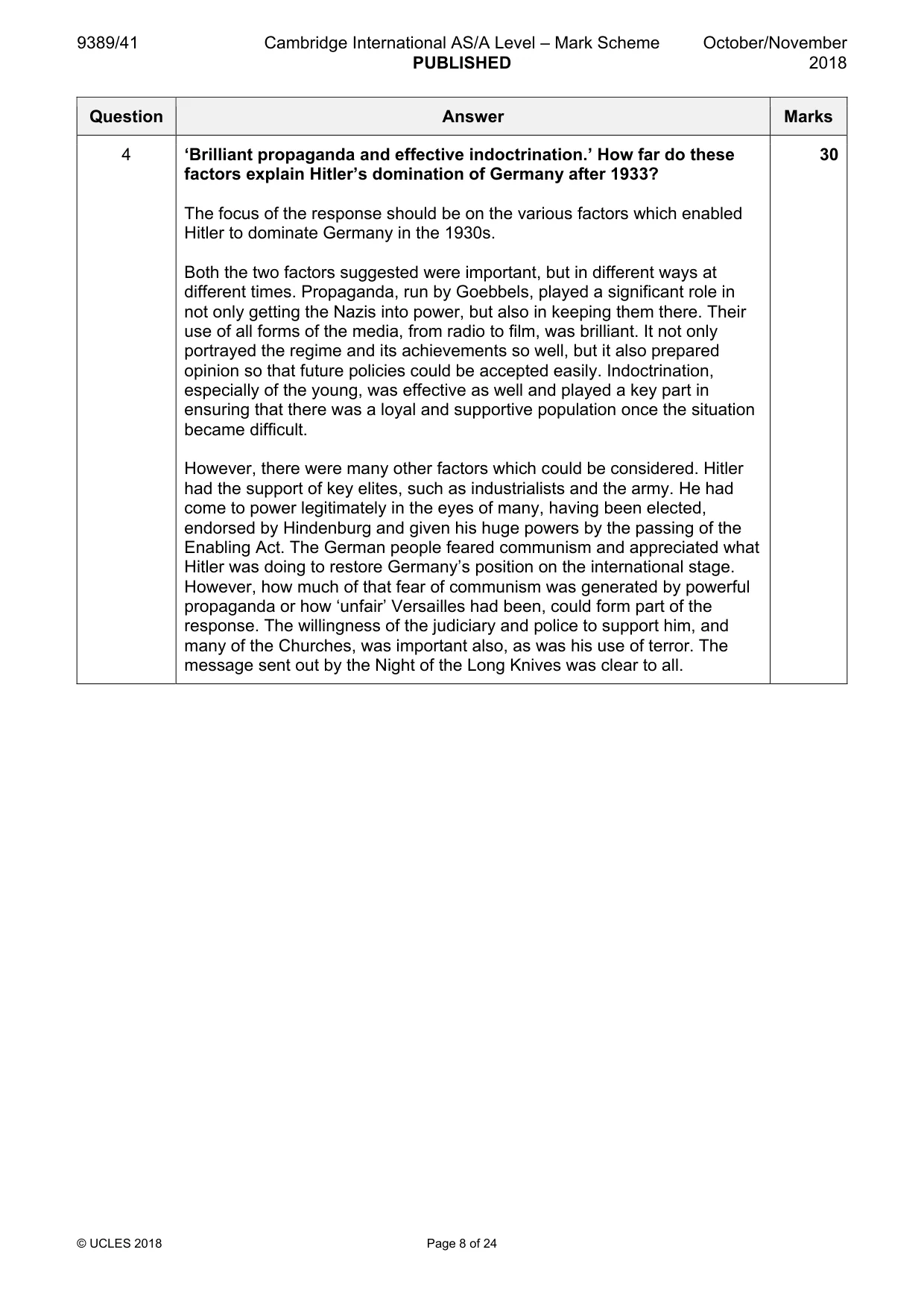
Q4 · ‘Brilliant propaganda and effective indoctrination.’ How far do these factors explain…
4 ‘Brilliant propaganda and effective indoctrination.’ How far do these factors explain Hitler’s domination of Germany after 1933? [30] Depth Study 2: The History of the USA, 1945–1990 Answer any two questions.
Mark scheme: 4 ‘Brilliant propaganda and effective indoctrination.’ How far do these 30 factors explain Hitler’s domination of Germany after 1933? The focus of the response should be on the various factors which enabled Hitler to dominate Germany in the 1930s. Both the two factors suggested were important, but in different ways at different times. Propaganda, run by Goebbels, played a significant role in not only getting the Nazis into power, but also in keeping them there. Their use of all forms of the media, from radio to film, was brilliant. It not only portrayed the regime and its achievements so well, but it also prepared opinion so that future policies could be accepted easily. Indoctrination, especially of the young, was effective as well and played a key part in ensuring that there was a loyal and supportive population once the situation became difficult. However, there were many other factors which could be considered. Hitler had the support of key elites, such as industrialists and the army. He had come to power legitimately in the eyes of many, having been elected, endorsed by Hindenburg and given his huge powers by the passing of the Enabling Act. The German people feared communism and appreciated what Hitler was doing to restore Germany’s position on the international stage. However, how much of that fear of communism was generated by powerful propaganda or how ‘unfair’ Versailles had been, could form part of the response. The willingness of the judiciary and police to support him, and many of the Churches, was important also, as was his use of terror. The message sent out by the Night of the Long Knives was clear to all.
Q5 · How far do you agree that, by 1960, the Civil Rights Movement had achieved little?
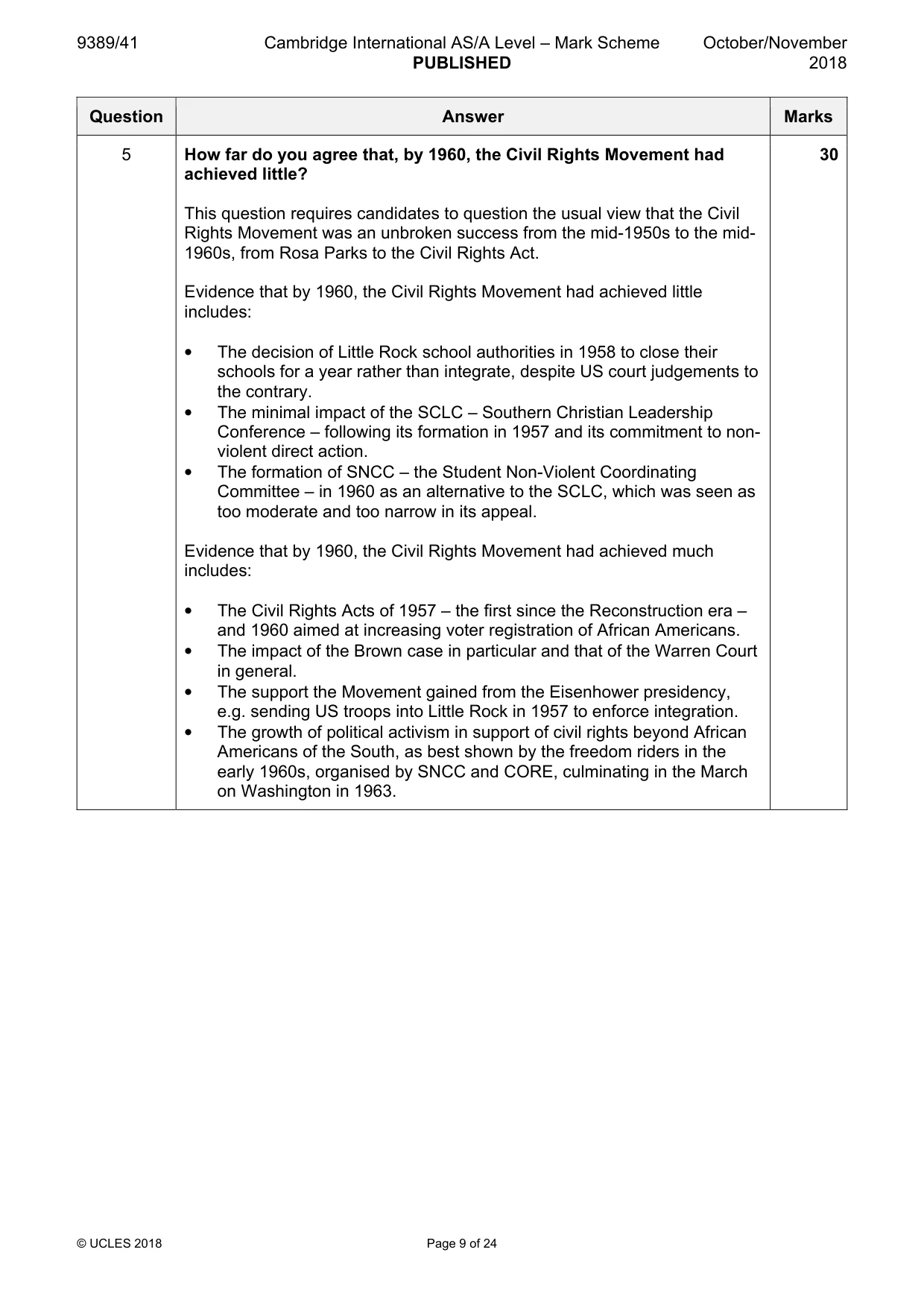
5 How far do you agree that, by 1960, the Civil Rights Movement had achieved little? [30]
Mark scheme: 5 How far do you agree that, by 1960, the Civil Rights Movement had 30 achieved little? This question requires candidates to question the usual view that the Civil Rights Movement was an unbroken success from the mid-1950s to the mid- 1960s, from Rosa Parks to the Civil Rights Act. Evidence that by 1960, the Civil Rights Movement had achieved little includes: • The decision of Little Rock school authorities in 1958 to close their schools for a year rather than integrate, despite US court judgements to the contrary. • The minimal impact of the SCLC – Southern Christian Leadership Conference – following its formation in 1957 and its commitment to non- violent direct action. • The formation of SNCC – the Student Non-Violent Coordinating Committee – in 1960 as an alternative to the SCLC, which was seen as too moderate and too narrow in its appeal. Evidence that by 1960, the Civil Rights Movement had achieved much includes: • The Civil Rights Acts of 1957 – the first since the Reconstruction era – and 1960 aimed at increasing voter registration of African Americans. • The impact of the Brown case in particular and that of the Warren Court in general. • The support the Movement gained from the Eisenhower presidency, e.g. sending US troops into Little Rock in 1957 to enforce integration. • The growth of political activism in support of civil rights beyond African Americans of the South, as best shown by the freedom riders in the early 1960s, organised by SNCC and CORE, culminating in the March on Washington in 1963.
Q6 · How far did President Johnson’s domestic policies help to unite the American people?
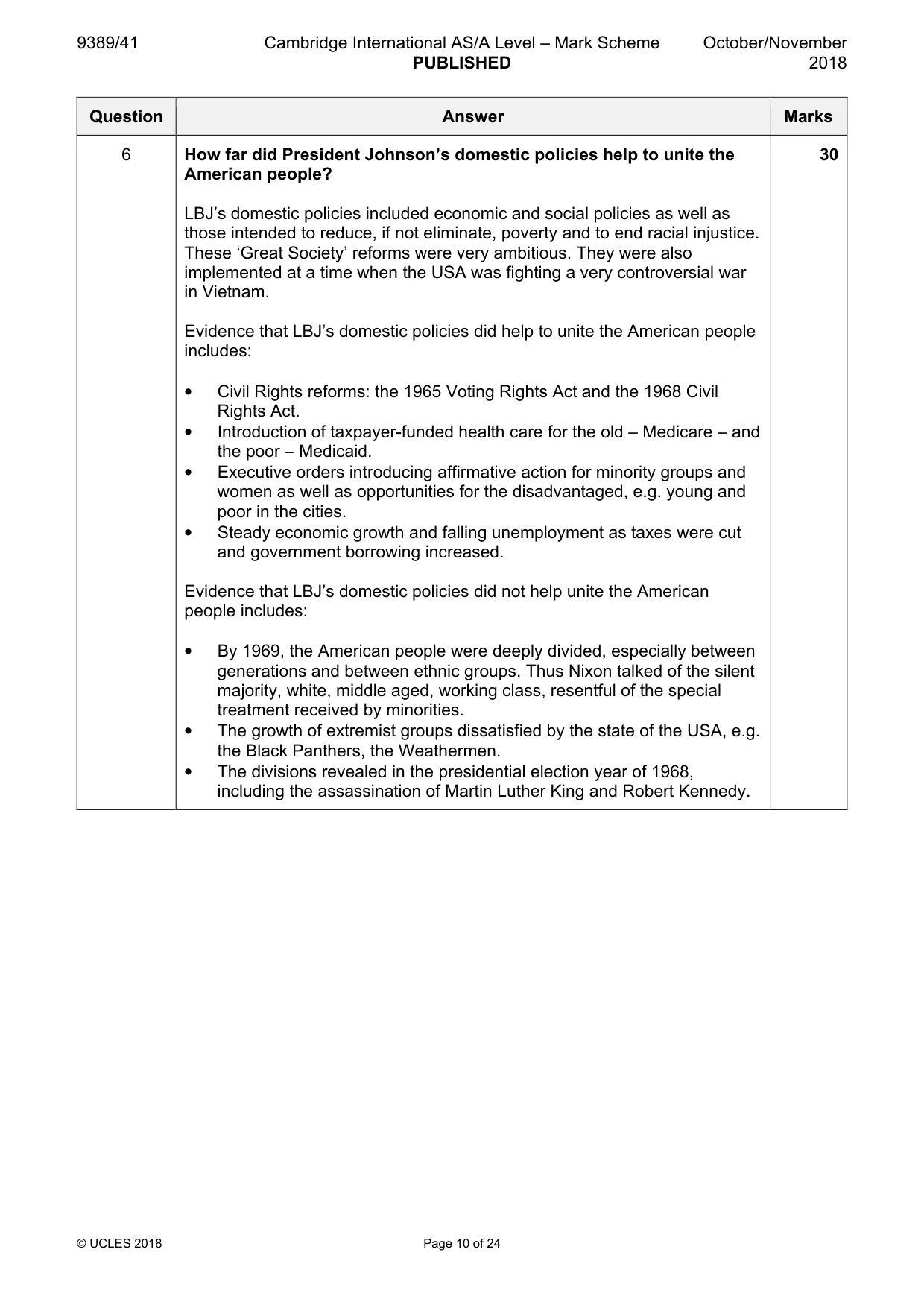
6 How far did President Johnson’s domestic policies help to unite the American people? [30]
Mark scheme: 6 How far did President Johnson’s domestic policies help to unite the 30 American people? LBJ’s domestic policies included economic and social policies as well as those intended to reduce, if not eliminate, poverty and to end racial injustice. These ‘Great Society’ reforms were very ambitious. They were also implemented at a time when the USA was fighting a very controversial war in Vietnam. Evidence that LBJ’s domestic policies did help to unite the American people includes: • Civil Rights reforms: the 1965 Voting Rights Act and the 1968 Civil Rights Act. • Introduction of taxpayer-funded health care for the old – Medicare – and the poor – Medicaid. • Executive orders introducing affirmative action for minority groups and women as well as opportunities for the disadvantaged, e.g. young and poor in the cities. • Steady economic growth and falling unemployment as taxes were cut and government borrowing increased. Evidence that LBJ’s domestic policies did not help unite the American people includes: • By 1969, the American people were deeply divided, especially between generations and between ethnic groups. Thus Nixon talked of the silent majority, white, middle aged, working class, resentful of the special treatment received by minorities. • The growth of extremist groups dissatisfied by the state of the USA, e.g. the Black Panthers, the Weathermen. • The divisions revealed in the presidential election year of 1968, including the assassination of Martin Luther King and Robert Kennedy.
Q7 · How far did President Reagan achieve the goal of ‘a growing economy that provides equal…
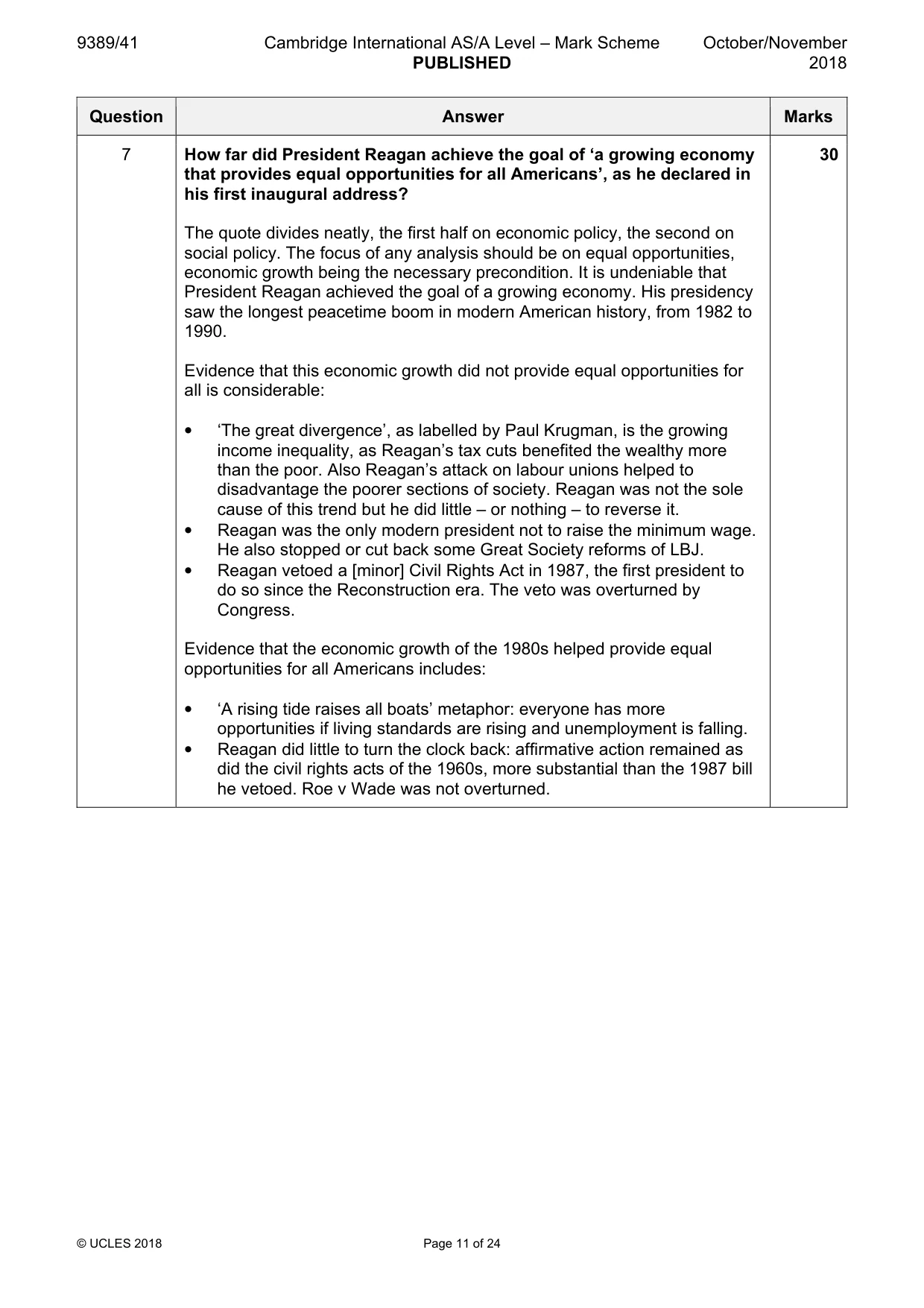
7 How far did President Reagan achieve the goal of ‘a growing economy that provides equal opportunities for all Americans’, as he declared in his first inaugural address? [30]
Mark scheme: 7 How far did President Reagan achieve the goal of ‘a growing economy 30 that provides equal opportunities for all Americans’, as he declared in his first inaugural address? The quote divides neatly, the first half on economic policy, the second on social policy. The focus of any analysis should be on equal opportunities, economic growth being the necessary precondition. It is undeniable that President Reagan achieved the goal of a growing economy. His presidency saw the longest peacetime boom in modern American history, from 1982 to 1990. Evidence that this economic growth did not provide equal opportunities for all is considerable: • ‘The great divergence’, as labelled by Paul Krugman, is the growing income inequality, as Reagan’s tax cuts benefited the wealthy more than the poor. Also Reagan’s attack on labour unions helped to disadvantage the poorer sections of society. Reagan was not the sole cause of this trend but he did little – or nothing – to reverse it. • Reagan was the only modern president not to raise the minimum wage. He also stopped or cut back some Great Society reforms of LBJ. • Reagan vetoed a [minor] Civil Rights Act in 1987, the first president to do so since the Reconstruction era. The veto was overturned by Congress. Evidence that the economic growth of the 1980s helped provide equal opportunities for all Americans includes: • ‘A rising tide raises all boats’ metaphor: everyone has more opportunities if living standards are rising and unemployment is falling. • Reagan did little to turn the clock back: affirmative action remained as did the civil rights acts of the 1960s, more substantial than the 1987 bill he vetoed. Roe v Wade was not overturned.
Q8 · ‘It aimed to further US economic interests rather than contain the USSR.’ How valid is…
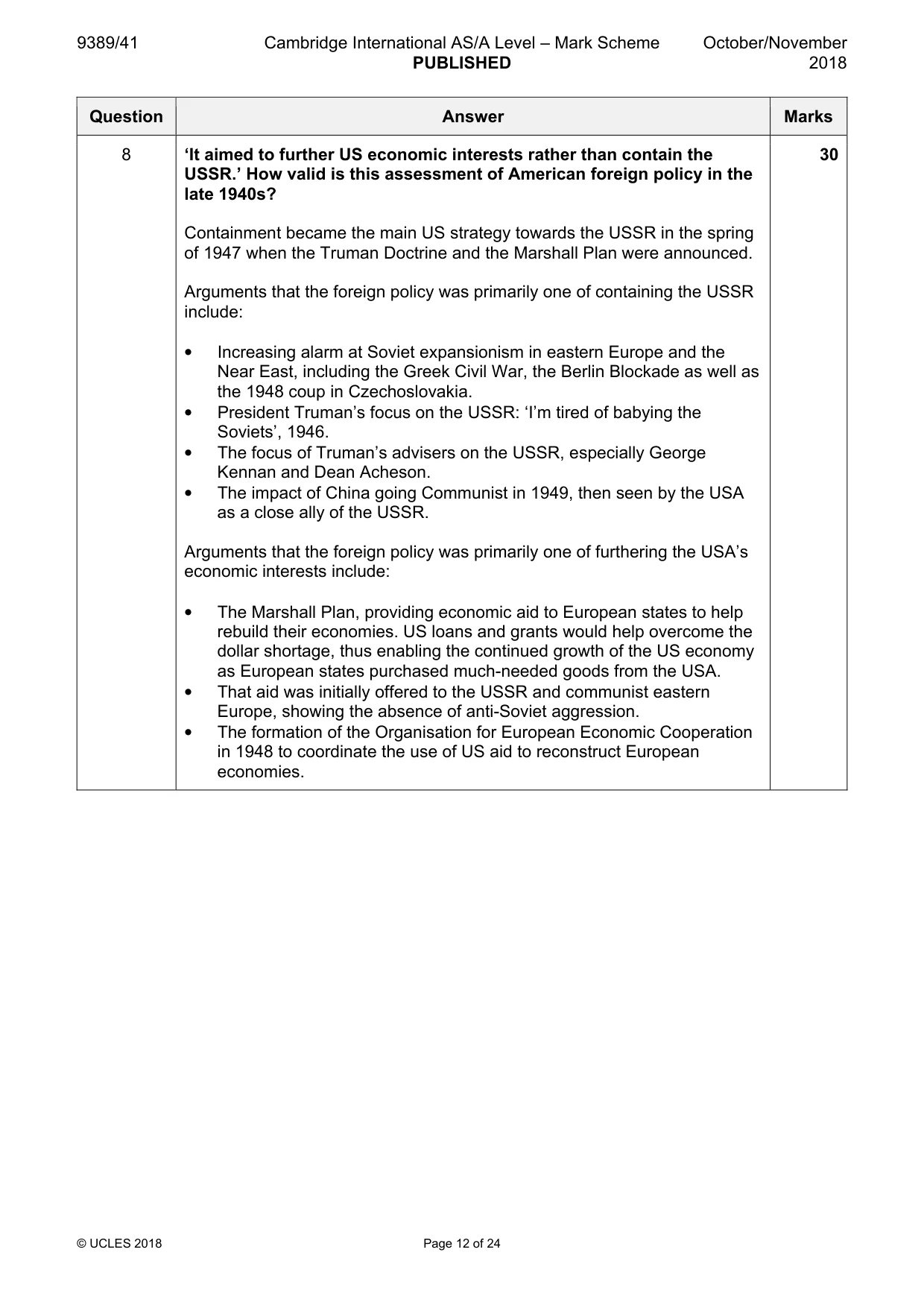
8 ‘It aimed to further US economic interests rather than contain the USSR.’ How valid is this assessment of American foreign policy in the late 1940s? [30] Depth Study 3: International History, 1945–1991 Answer any two questions.
Mark scheme: 8 ‘It aimed to further US economic interests rather than contain the 30 USSR.’ How valid is this assessment of American foreign policy in the late 1940s? Containment became the main US strategy towards the USSR in the spring of 1947 when the Truman Doctrine and the Marshall Plan were announced. Arguments that the foreign policy was primarily one of containing the USSR include: • Increasing alarm at Soviet expansionism in eastern Europe and the Near East, including the Greek Civil War, the Berlin Blockade as well as the 1948 coup in Czechoslovakia. • President Truman’s focus on the USSR: ‘I’m tired of babying the Soviets’, 1946. • The focus of Truman’s advisers on the USSR, especially George Kennan and Dean Acheson. • The impact of China going Communist in 1949, then seen by the USA as a close ally of the USSR. Arguments that the foreign policy was primarily one of furthering the USA’s economic interests include: • The Marshall Plan, providing economic aid to European states to help rebuild their economies. US loans and grants would help overcome the dollar shortage, thus enabling the continued growth of the US economy as European states purchased much-needed goods from the USA. • That aid was initially offered to the USSR and communist eastern Europe, showing the absence of anti-Soviet aggression. • The formation of the Organisation for European Economic Cooperation in 1948 to coordinate the use of US aid to reconstruct European economies.
Q9 · How real was the threat of nuclear war in the period from 1950 to 1975?
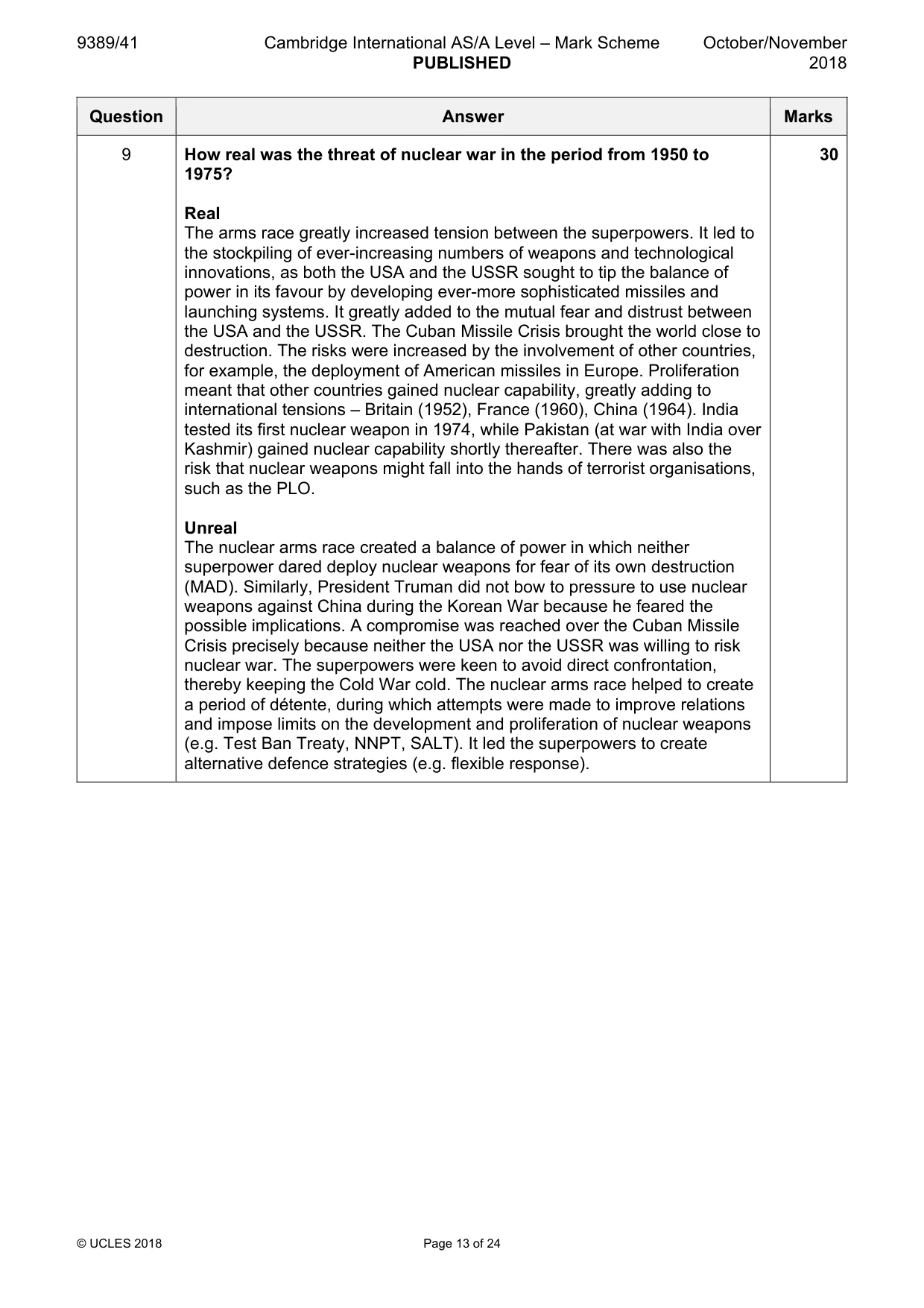
9 How real was the threat of nuclear war in the period from 1950 to 1975? [30]
Mark scheme: 9 How real was the threat of nuclear war in the period from 1950 to 30 1975? Real The arms race greatly increased tension between the superpowers. It led to the stockpiling of ever-increasing numbers of weapons and technological innovations, as both the USA and the USSR sought to tip the balance of power in its favour by developing ever-more sophisticated missiles and launching systems. It greatly added to the mutual fear and distrust between the USA and the USSR. The Cuban Missile Crisis brought the world close to destruction. The risks were increased by the involvement of other countries, for example, the deployment of American missiles in Europe. Proliferation meant that other countries gained nuclear capability, greatly adding to international tensions – Britain (1952), France (1960), China (1964). India tested its first nuclear weapon in 1974, while Pakistan (at war with India over Kashmir) gained nuclear capability shortly thereafter. There was also the risk that nuclear weapons might fall into the hands of terrorist organisations, such as the PLO. Unreal The nuclear arms race created a balance of power in which neither superpower dared deploy nuclear weapons for fear of its own destruction (MAD). Similarly, President Truman did not bow to pressure to use nuclear weapons against China during the Korean War because he feared the possible implications. A compromise was reached over the Cuban Missile Crisis precisely because neither the USA nor the USSR was willing to risk nuclear war. The superpowers were keen to avoid direct confrontation, thereby keeping the Cold War cold. The nuclear arms race helped to create a period of détente, during which attempts were made to improve relations and impose limits on the development and proliferation of nuclear weapons (e.g. Test Ban Treaty, NNPT, SALT). It led the superpowers to create alternative defence strategies (e.g. flexible response).
Q10 · ‘The US Senate’s failure to ratify SALT II resulted from the Soviet invasion of…
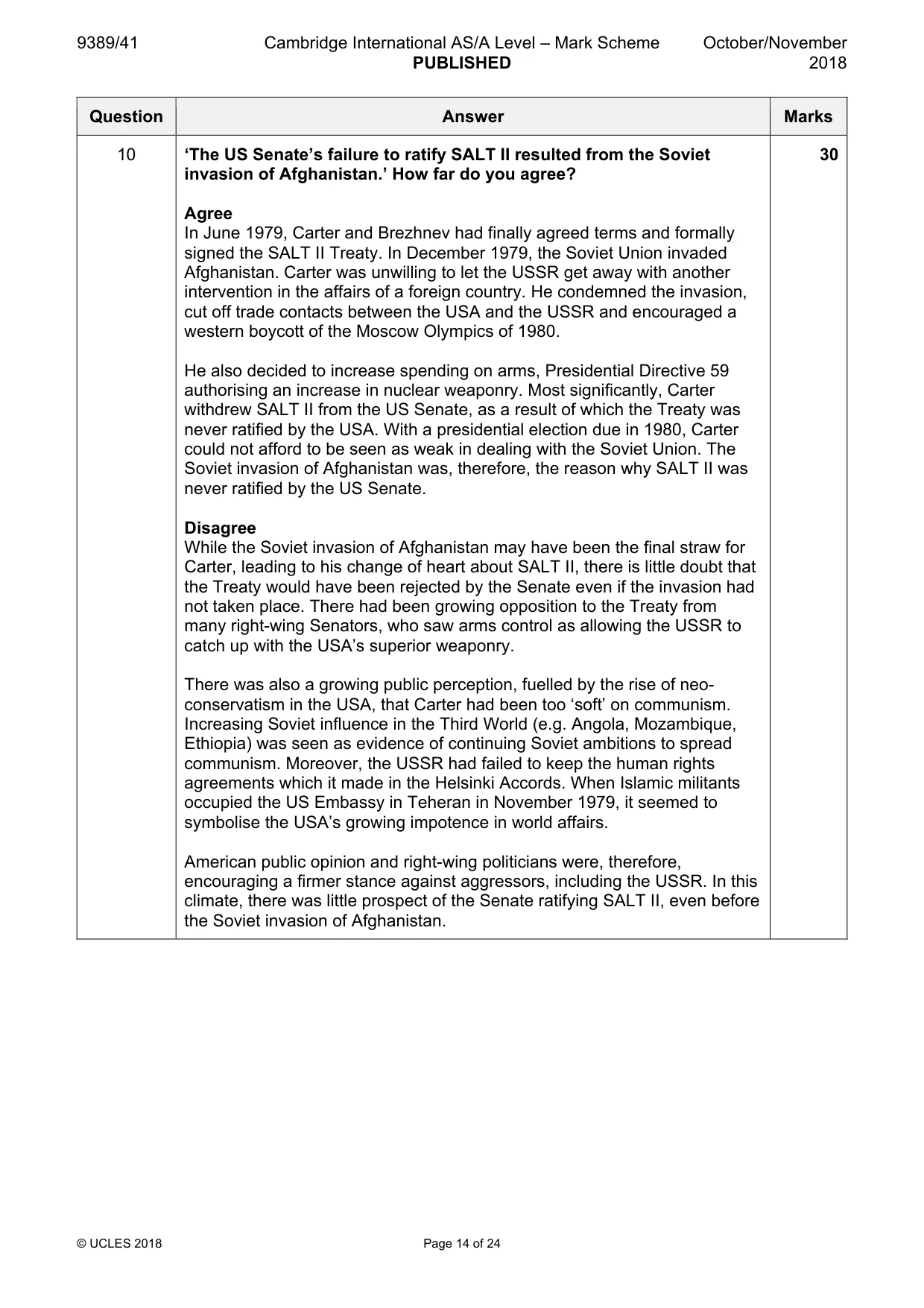
10 ‘The US Senate’s failure to ratify SALT II resulted from the Soviet invasion of Afghanistan.’ How far do you agree? [30]
Mark scheme: 10 ‘The US Senate’s failure to ratify SALT II resulted from the Soviet 30 invasion of Afghanistan.’ How far do you agree? Agree In June 1979, Carter and Brezhnev had finally agreed terms and formally signed the SALT II Treaty. In December 1979, the Soviet Union invaded Afghanistan. Carter was unwilling to let the USSR get away with another intervention in the affairs of a foreign country. He condemned the invasion, cut off trade contacts between the USA and the USSR and encouraged a western boycott of the Moscow Olympics of 1980. He also decided to increase spending on arms, Presidential Directive 59 authorising an increase in nuclear weaponry. Most significantly, Carter withdrew SALT II from the US Senate, as a result of which the Treaty was never ratified by the USA. With a presidential election due in 1980, Carter could not afford to be seen as weak in dealing with the Soviet Union. The Soviet invasion of Afghanistan was, therefore, the reason why SALT II was never ratified by the US Senate. Disagree While the Soviet invasion of Afghanistan may have been the final straw for Carter, leading to his change of heart about SALT II, there is little doubt that the Treaty would have been rejected by the Senate even if the invasion had not taken place. There had been growing opposition to the Treaty from many right-wing Senators, who saw arms control as allowing the USSR to catch up with the USA’s superior weaponry. There was also a growing public perception, fuelled by the rise of neo- conservatism in the USA, that Carter had been too ‘soft’ on communism. Increasing Soviet influence in the Third World (e.g. Angola, Mozambique, Ethiopia) was seen as evidence of continuing Soviet ambitions to spread communism. Moreover, the USSR had failed to keep the human rights agreements which it made in the Helsinki Accords. When Islamic militants occupied the US Embassy in Teheran in November 1979, it seemed to symbolise the USA’s growing impotence in world affairs. American public opinion and right-wing politicians were, therefore, encouraging a firmer stance against aggressors, including the USSR. In this climate, there was little prospect of the Senate ratifying SALT II, even before the Soviet invasion of Afghanistan.
Q11 · To what extent was the Great Leap Forward responsible for the famine suffered by China in…
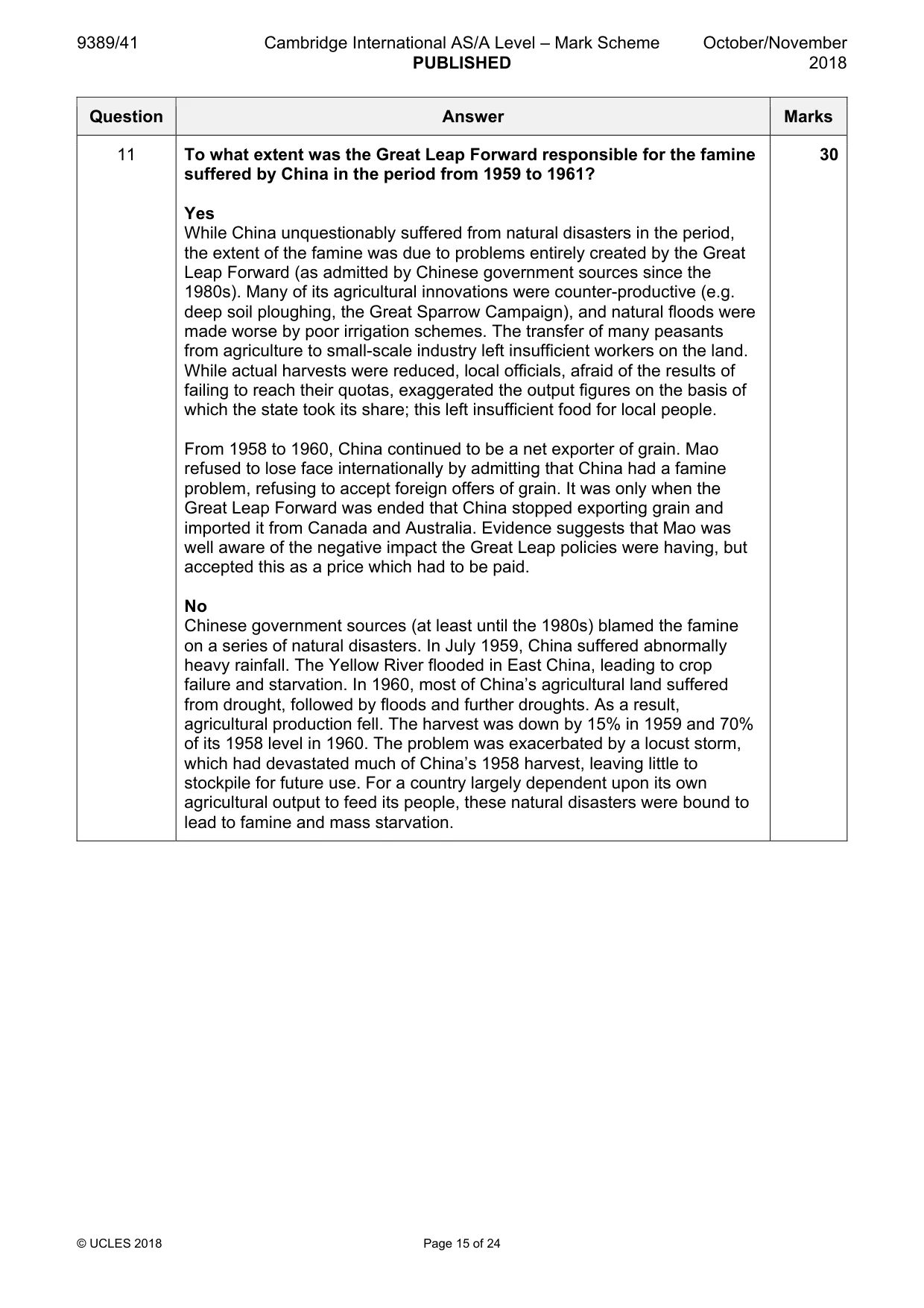
11 To what extent was the Great Leap Forward responsible for the famine suffered by China in the period from 1959 to 1961? [30]
Mark scheme: 11 To what extent was the Great Leap Forward responsible for the famine 30 suffered by China in the period from 1959 to 1961? Yes While China unquestionably suffered from natural disasters in the period, the extent of the famine was due to problems entirely created by the Great Leap Forward (as admitted by Chinese government sources since the 1980s). Many of its agricultural innovations were counter-productive (e.g. deep soil ploughing, the Great Sparrow Campaign), and natural floods were made worse by poor irrigation schemes. The transfer of many peasants from agriculture to small-scale industry left insufficient workers on the land. While actual harvests were reduced, local officials, afraid of the results of failing to reach their quotas, exaggerated the output figures on the basis of which the state took its share; this left insufficient food for local people. From 1958 to 1960, China continued to be a net exporter of grain. Mao refused to lose face internationally by admitting that China had a famine problem, refusing to accept foreign offers of grain. It was only when the Great Leap Forward was ended that China stopped exporting grain and imported it from Canada and Australia. Evidence suggests that Mao was well aware of the negative impact the Great Leap policies were having, but accepted this as a price which had to be paid. No Chinese government sources (at least until the 1980s) blamed the famine on a series of natural disasters. In July 1959, China suffered abnormally heavy rainfall. The Yellow River flooded in East China, leading to crop failure and starvation. In 1960, most of China’s agricultural land suffered from drought, followed by floods and further droughts. As a result, agricultural production fell. The harvest was down by 15% in 1959 and 70% of its 1958 level in 1960. The problem was exacerbated by a locust storm, which had devastated much of China’s 1958 harvest, leaving little to stockpile for future use. For a country largely dependent upon its own agricultural output to feed its people, these natural disasters were bound to lead to famine and mass starvation.
Q12 · To what extent were Arab states justified in blaming Anglo–French imperialism for the…
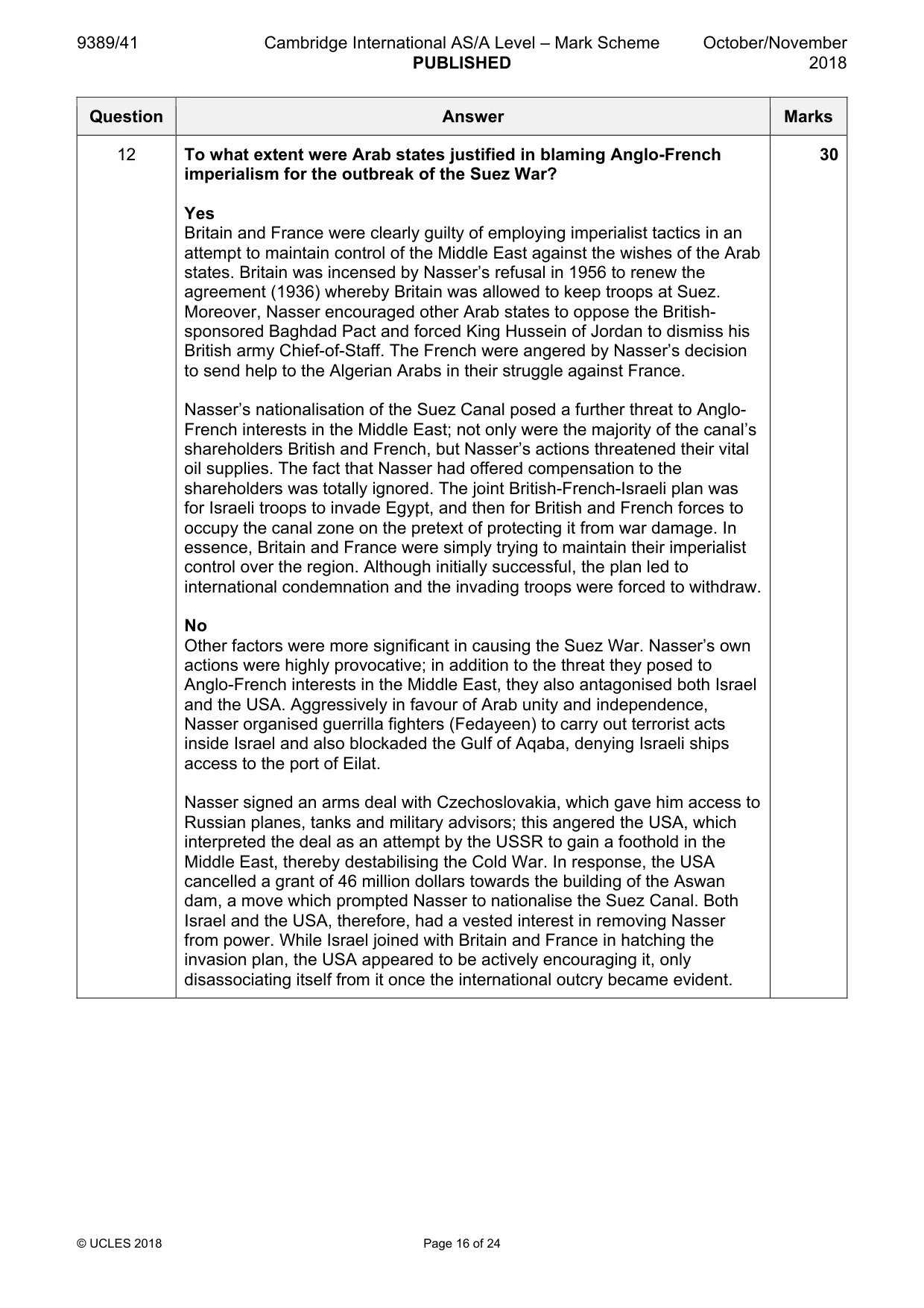
12 To what extent were Arab states justified in blaming Anglo–French imperialism for the outbreak of the Suez War? [30] Depth Study 4: African History, 1945–1991 Answer any two questions.
Mark scheme: 12 To what extent were Arab states justified in blaming Anglo-French 30 imperialism for the outbreak of the Suez War? Yes Britain and France were clearly guilty of employing imperialist tactics in an attempt to maintain control of the Middle East against the wishes of the Arab states. Britain was incensed by Nasser’s refusal in 1956 to renew the agreement (1936) whereby Britain was allowed to keep troops at Suez. Moreover, Nasser encouraged other Arab states to oppose the British- sponsored Baghdad Pact and forced King Hussein of Jordan to dismiss his British army Chief-of-Staff. The French were angered by Nasser’s decision to send help to the Algerian Arabs in their struggle against France. Nasser’s nationalisation of the Suez Canal posed a further threat to Anglo- French interests in the Middle East; not only were the majority of the canal’s shareholders British and French, but Nasser’s actions threatened their vital oil supplies. The fact that Nasser had offered compensation to the shareholders was totally ignored. The joint British-French-Israeli plan was for Israeli troops to invade Egypt, and then for British and French forces to occupy the canal zone on the pretext of protecting it from war damage. In essence, Britain and France were simply trying to maintain their imperialist control over the region. Although initially successful, the plan led to international condemnation and the invading troops were forced to withdraw. No Other factors were more significant in causing the Suez War. Nasser’s own actions were highly provocative; in addition to the threat they posed to Anglo-French interests in the Middle East, they also antagonised both Israel and the USA. Aggressively in favour of Arab unity and independence, Nasser organised guerrilla fighters (Fedayeen) to carry out terrorist acts inside Israel and also blockaded the Gulf of Aqaba, denying Israeli ships access to the port of Eilat. Nasser signed an arms deal with Czechoslovakia, which gave him access to Russian planes, tanks and military advisors; this angered the USA, which interpreted the deal as an attempt by the USSR to gain a foothold in the Middle East, thereby destabilising the Cold War. In response, the USA cancelled a grant of 46 million dollars towards the building of the Aswan dam, a move which prompted Nasser to nationalise the Suez Canal. Both Israel and the USA, therefore, had a vested interest in removing Nasser from power. While Israel joined with Britain and France in hatching the invasion plan, the USA appeared to be actively encouraging it, only disassociating itself from it once the international outcry became evident.
Q13 · Assess the reasons why the attitudes of colonial authorities towards the devolution of…
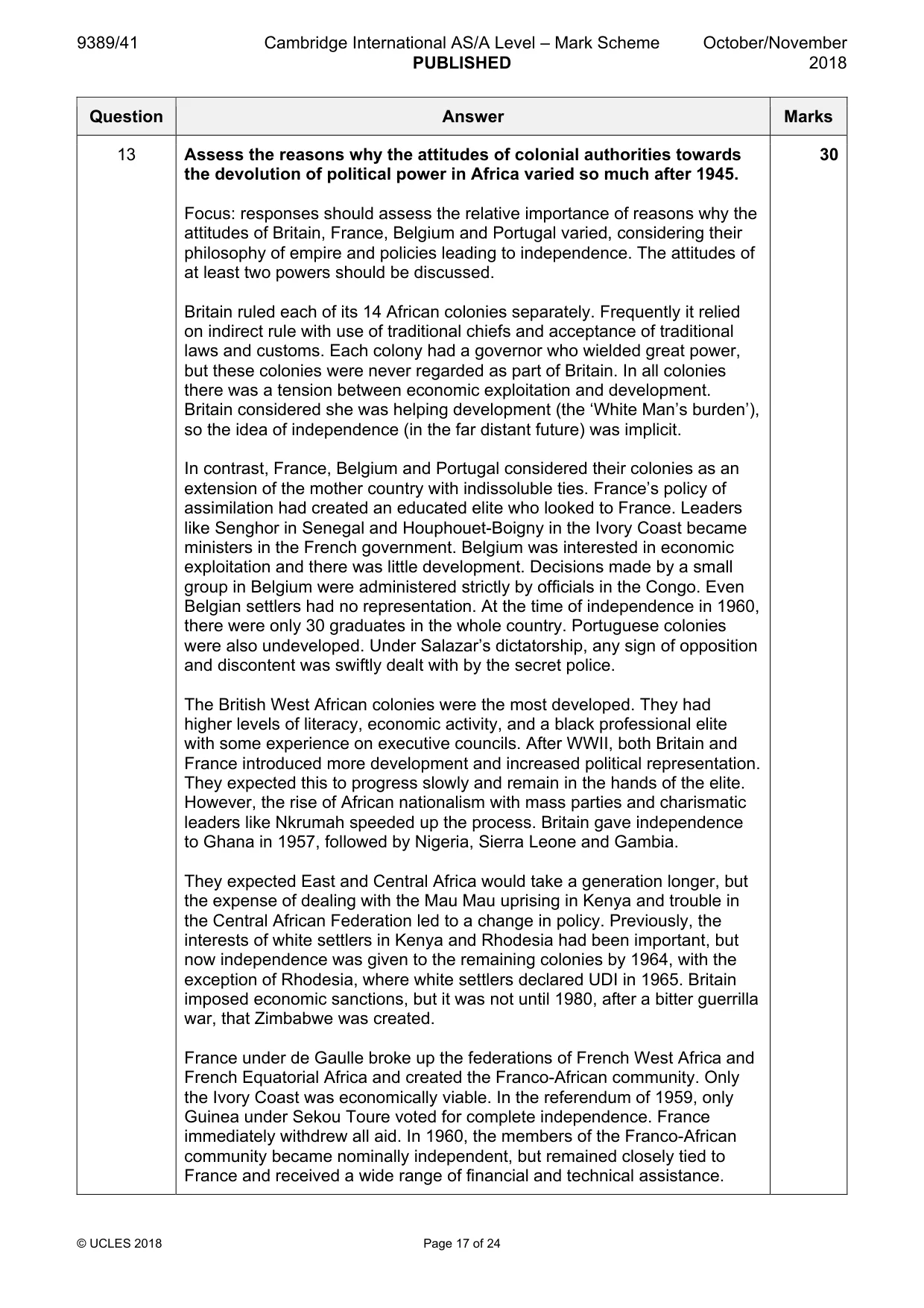
13 Assess the reasons why the attitudes of colonial authorities towards the devolution of political power in Africa varied so much after 1945. [30]
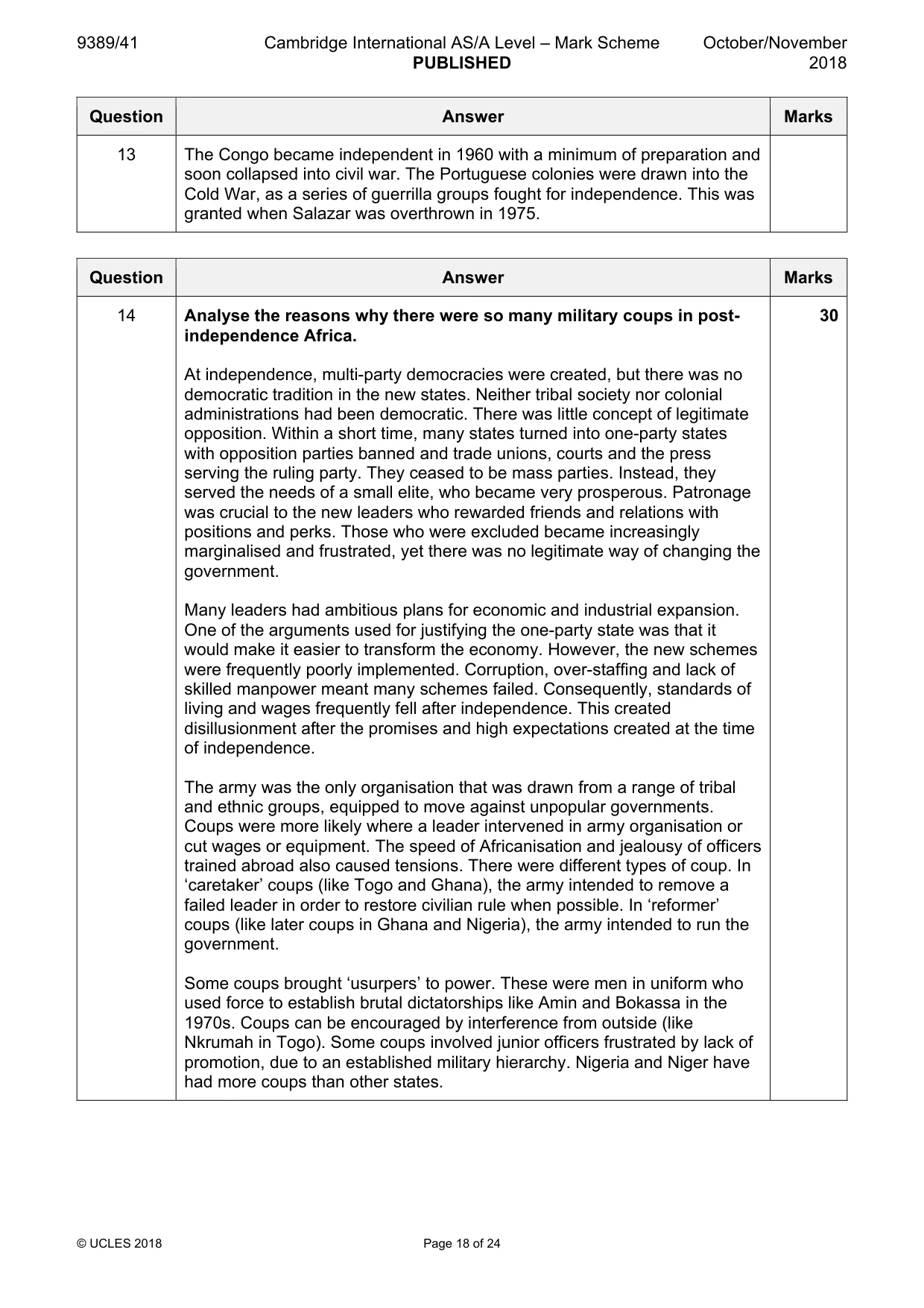
Mark scheme: 13 Assess the reasons why the attitudes of colonial authorities towards 30 the devolution of political power in Africa varied so much after 1945. Focus: responses should assess the relative importance of reasons why the attitudes of Britain, France, Belgium and Portugal varied, considering their philosophy of empire and policies leading to independence. The attitudes of at least two powers should be discussed. Britain ruled each of its 14 African colonies separately. Frequently it relied on indirect rule with use of traditional chiefs and acceptance of traditional laws and customs. Each colony had a governor who wielded great power, but these colonies were never regarded as part of Britain. In all colonies there was a tension between economic exploitation and development. Britain considered she was helping development (the ‘White Man’s burden’), so the idea of independence (in the far distant future) was implicit. In contrast, France, Belgium and Portugal considered their colonies as an extension of the mother country with indissoluble ties. France’s policy of assimilation had created an educated elite who looked to France. Leaders like Senghor in Senegal and Houphouet-Boigny in the Ivory Coast became ministers in the French government. Belgium was interested in economic exploitation and there was little development. Decisions made by a small group in Belgium were administered strictly by officials in the Congo. Even Belgian settlers had no representation. At the time of independence in 1960, there were only 30 graduates in the whole country. Portuguese colonies were also undeveloped. Under Salazar’s dictatorship, any sign of opposition and discontent was swiftly dealt with by the secret police. The British West African colonies were the most developed. They had higher levels of literacy, economic activity, and a black professional elite with some experience on executive councils. After WWII, both Britain and France introduced more development and increased political representation. They expected this to progress slowly and remain in the hands of the elite. However, the rise of African nationalism with mass parties and charismatic leaders like Nkrumah speeded up the process. Britain gave independence to Ghana in 1957, followed by Nigeria, Sierra Leone and Gambia. They expected East and Central Africa would take a generation longer, but the expense of dealing with the Mau Mau uprising in Kenya and trouble in the Central African Federation led to a change in policy. Previously, the interests of white settlers in Kenya and Rhodesia had been important, but now independence was given to the remaining colonies by 1964, with the exception of Rhodesia, where white settlers declared UDI in 1965. Britain imposed economic sanctions, but it was not until 1980, after a bitter guerrilla war, that Zimbabwe was created. France under de Gaulle broke up the federations of French West Africa and French Equatorial Africa and created the Franco-African community. Only the Ivory Coast was economically viable. In the referendum of 1959, only Guinea under Sekou Toure voted for complete independence. France immediately withdrew all aid. In 1960, the members of the Franco-African community became nominally independent, but remained closely tied to France and received a wide range of financial and technical assistance.
Q14 · Analyse the reasons why there were so many military coups in post-independence Africa
14 Analyse the reasons why there were so many military coups in post-independence Africa. [30]
Mark scheme: 14 Analyse the reasons why there were so many military coups in post- 30 independence Africa. At independence, multi-party democracies were created, but there was no democratic tradition in the new states. Neither tribal society nor colonial administrations had been democratic. There was little concept of legitimate opposition. Within a short time, many states turned into one-party states with opposition parties banned and trade unions, courts and the press serving the ruling party. They ceased to be mass parties. Instead, they served the needs of a small elite, who became very prosperous. Patronage was crucial to the new leaders who rewarded friends and relations with positions and perks. Those who were excluded became increasingly marginalised and frustrated, yet there was no legitimate way of changing the government. Many leaders had ambitious plans for economic and industrial expansion. One of the arguments used for justifying the one-party state was that it would make it easier to transform the economy. However, the new schemes were frequently poorly implemented. Corruption, over-staffing and lack of skilled manpower meant many schemes failed. Consequently, standards of living and wages frequently fell after independence. This created disillusionment after the promises and high expectations created at the time of independence. The army was the only organisation that was drawn from a range of tribal and ethnic groups, equipped to move against unpopular governments. Coups were more likely where a leader intervened in army organisation or cut wages or equipment. The speed of Africanisation and jealousy of officers trained abroad also caused tensions. There were different types of coup. In ‘caretaker’ coups (like Togo and Ghana), the army intended to remove a failed leader in order to restore civilian rule when possible. In ‘reformer’ coups (like later coups in Ghana and Nigeria), the army intended to run the government. Some coups brought ‘usurpers’ to power. These were men in uniform who used force to establish brutal dictatorships like Amin and Bokassa in the 1970s. Coups can be encouraged by interference from outside (like Nkrumah in Togo). Some coups involved junior officers frustrated by lack of promotion, due to an established military hierarchy. Nigeria and Niger have had more coups than other states.
Q15 · Assess the impact of independence on African literature
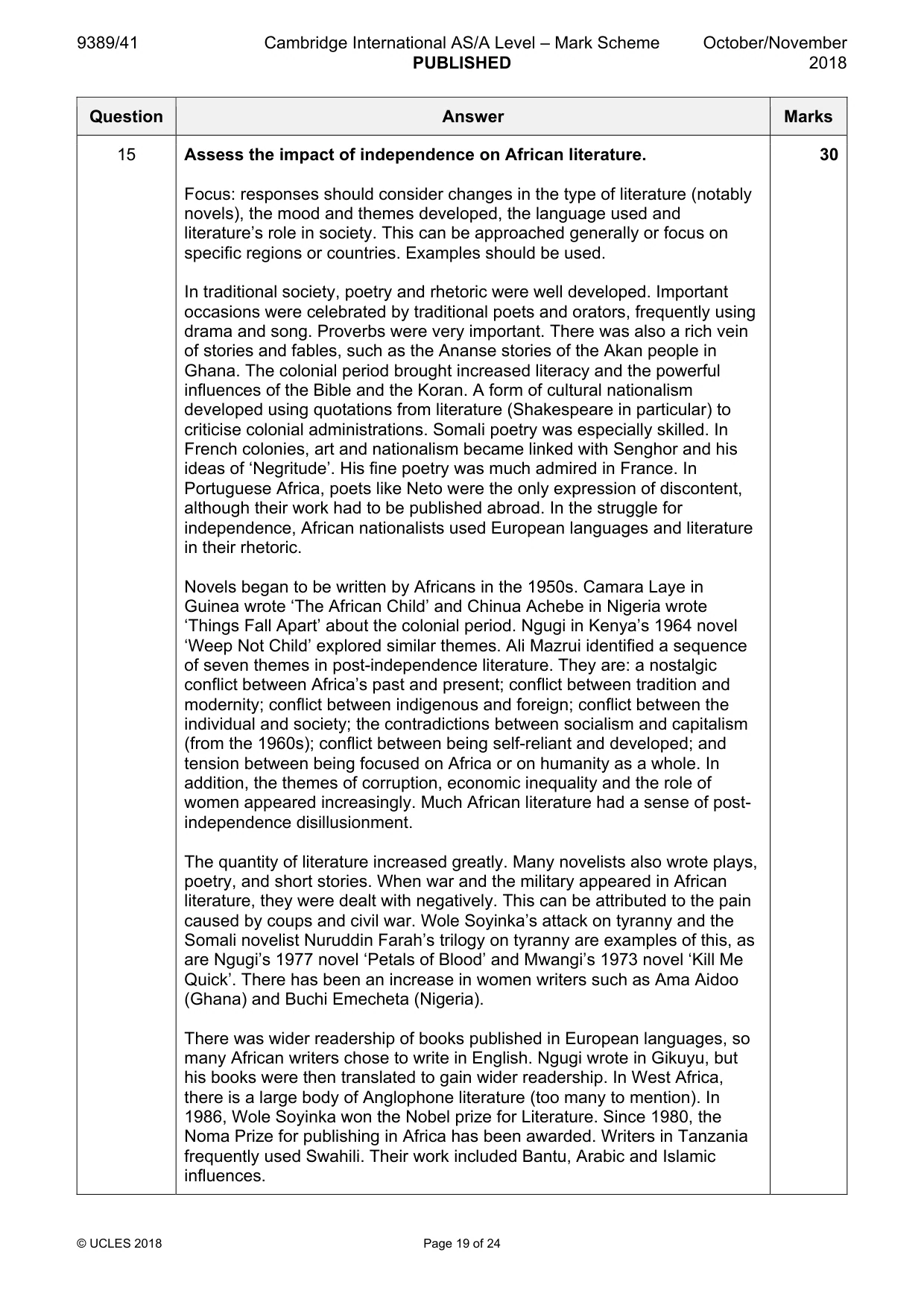
15 Assess the impact of independence on African literature. [30]
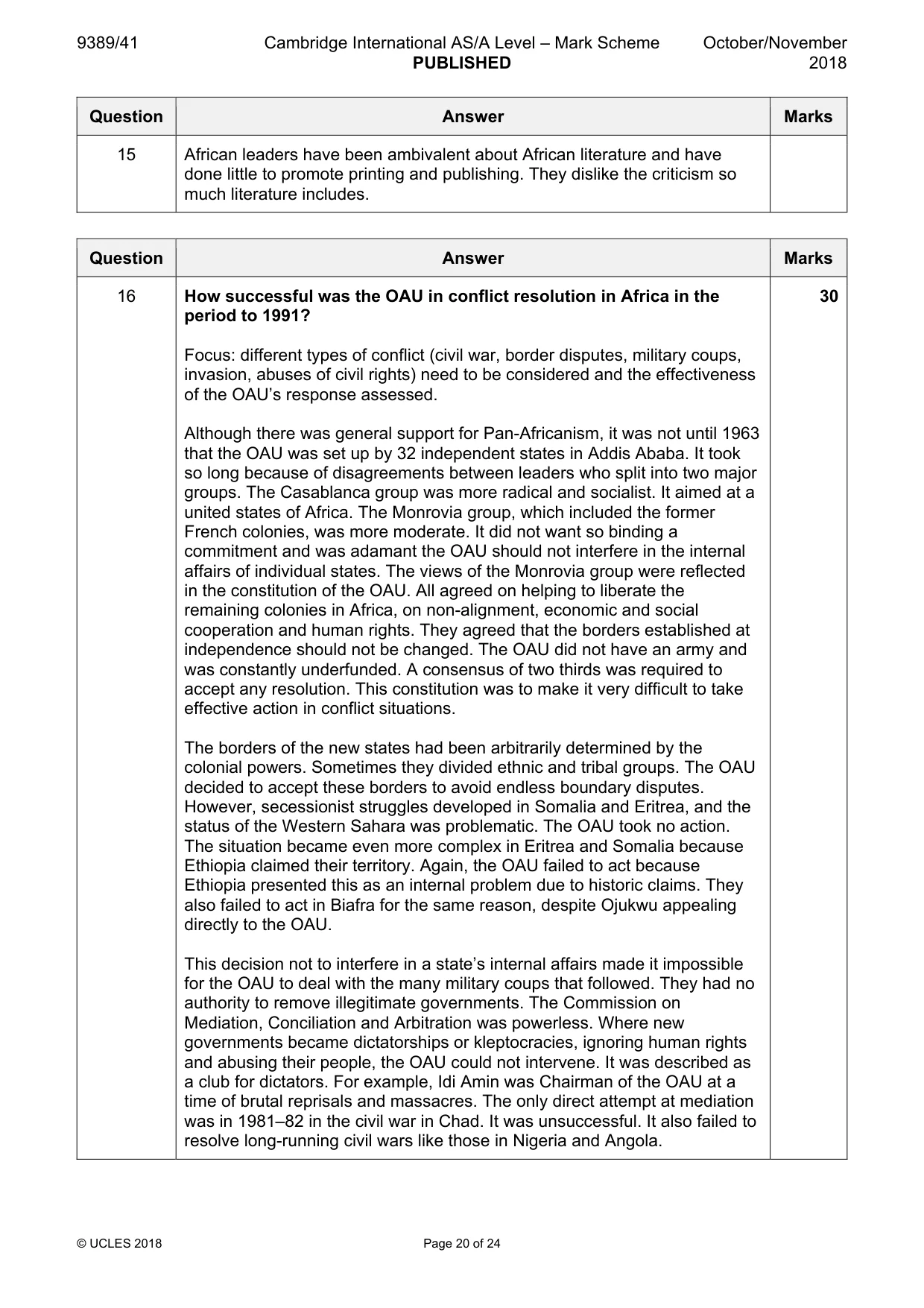
Mark scheme: 15 Assess the impact of independence on African literature. 30 Focus: responses should consider changes in the type of literature (notably novels), the mood and themes developed, the language used and literature’s role in society. This can be approached generally or focus on specific regions or countries. Examples should be used. In traditional society, poetry and rhetoric were well developed. Important occasions were celebrated by traditional poets and orators, frequently using drama and song. Proverbs were very important. There was also a rich vein of stories and fables, such as the Ananse stories of the Akan people in Ghana. The colonial period brought increased literacy and the powerful influences of the Bible and the Koran. A form of cultural nationalism developed using quotations from literature (Shakespeare in particular) to criticise colonial administrations. Somali poetry was especially skilled. In French colonies, art and nationalism became linked with Senghor and his ideas of ‘Negritude’. His fine poetry was much admired in France. In Portuguese Africa, poets like Neto were the only expression of discontent, although their work had to be published abroad. In the struggle for independence, African nationalists used European languages and literature in their rhetoric. Novels began to be written by Africans in the 1950s. Camara Laye in Guinea wrote ‘The African Child’ and Chinua Achebe in Nigeria wrote ‘Things Fall Apart’ about the colonial period. Ngugi in Kenya’s 1964 novel ‘Weep Not Child’ explored similar themes. Ali Mazrui identified a sequence of seven themes in post-independence literature. They are: a nostalgic conflict between Africa’s past and present; conflict between tradition and modernity; conflict between indigenous and foreign; conflict between the individual and society; the contradictions between socialism and capitalism (from the 1960s); conflict between being self-reliant and developed; and tension between being focused on Africa or on humanity as a whole. In addition, the themes of corruption, economic inequality and the role of women appeared increasingly. Much African literature had a sense of post- independence disillusionment. The quantity of literature increased greatly. Many novelists also wrote plays, poetry, and short stories. When war and the military appeared in African literature, they were dealt with negatively. This can be attributed to the pain caused by coups and civil war. Wole Soyinka’s attack on tyranny and the Somali novelist Nuruddin Farah’s trilogy on tyranny are examples of this, as are Ngugi’s 1977 novel ‘Petals of Blood’ and Mwangi’s 1973 novel ‘Kill Me Quick’. There has been an increase in women writers such as Ama Aidoo (Ghana) and Buchi Emecheta (Nigeria). There was wider readership of books published in European languages, so many African writers chose to write in English. Ngugi wrote in Gikuyu, but his books were then translated to gain wider readership. In West Africa, there is a large body of Anglophone literature (too many to mention). In 1986, Wole Soyinka won the Nobel prize for Literature. Since 1980, the Noma Prize for publishing in Africa has been awarded. Writers in Tanzania frequently used Swahili. Their work included Bantu, Arabic and Islamic influences.
Q16 · Depth Study 5: Southeast Asian History, 1945–1990s Answer any two questions
Depth Study 5: Southeast Asian History, 1945–1990s Answer any two questions.
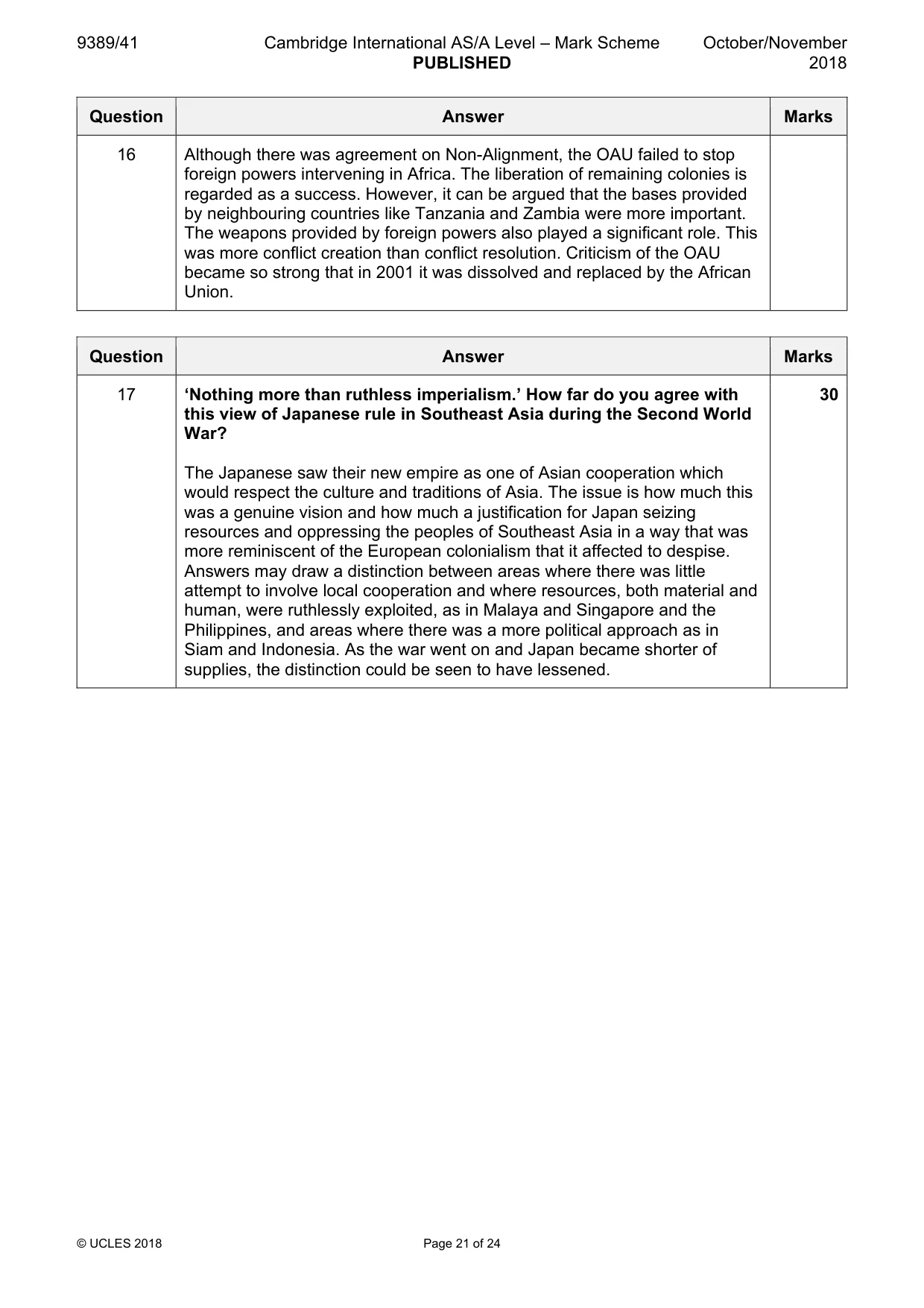
Mark scheme: 16 How successful was the OAU in conflict resolution in Africa in the 30 period to 1991? Focus: different types of conflict (civil war, border disputes, military coups, invasion, abuses of civil rights) need to be considered and the effectiveness of the OAU’s response assessed. Although there was general support for Pan-Africanism, it was not until 1963 that the OAU was set up by 32 independent states in Addis Ababa. It took so long because of disagreements between leaders who split into two major groups. The Casablanca group was more radical and socialist. It aimed at a united states of Africa. The Monrovia group, which included the former French colonies, was more moderate. It did not want so binding a commitment and was adamant the OAU should not interfere in the internal affairs of individual states. The views of the Monrovia group were reflected in the constitution of the OAU. All agreed on helping to liberate the remaining colonies in Africa, on non-alignment, economic and social cooperation and human rights. They agreed that the borders established at independence should not be changed. The OAU did not have an army and was constantly underfunded. A consensus of two thirds was required to accept any resolution. This constitution was to make it very difficult to take effective action in conflict situations. The borders of the new states had been arbitrarily determined by the colonial powers. Sometimes they divided ethnic and tribal groups. The OAU decided to accept these borders to avoid endless boundary disputes. However, secessionist struggles developed in Somalia and Eritrea, and the status of the Western Sahara was problematic. The OAU took no action. The situation became even more complex in Eritrea and Somalia because Ethiopia claimed their territory. Again, the OAU failed to act because Ethiopia presented this as an internal problem due to historic claims. They also failed to act in Biafra for the same reason, despite Ojukwu appealing directly to the OAU. This decision not to interfere in a state’s internal affairs made it impossible for the OAU to deal with the many military coups that followed. They had no authority to remove illegitimate governments. The Commission on Mediation, Conciliation and Arbitration was powerless. Where new governments became dictatorships or kleptocracies, ignoring human rights and abusing their people, the OAU could not intervene. It was described as a club for dictators. For example, Idi Amin was Chairman of the OAU at a time of brutal reprisals and massacres. The only direct attempt at mediation was in 1981–82 in the civil war in Chad. It was unsuccessful. It also failed to resolve long-running civil wars like those in Nigeria and Angola.
Q17 · ‘Nothing more than ruthless imperialism.’ How far do you agree with this view of Japanese…
17 ‘Nothing more than ruthless imperialism.’ How far do you agree with this view of Japanese rule in Southeast Asia during the Second World War? [30]
Mark scheme: 17 ‘Nothing more than ruthless imperialism.’ How far do you agree with 30 this view of Japanese rule in Southeast Asia during the Second World War? The Japanese saw their new empire as one of Asian cooperation which would respect the culture and traditions of Asia. The issue is how much this was a genuine vision and how much a justification for Japan seizing resources and oppressing the peoples of Southeast Asia in a way that was more reminiscent of the European colonialism that it affected to despise. Answers may draw a distinction between areas where there was little attempt to involve local cooperation and where resources, both material and human, were ruthlessly exploited, as in Malaya and Singapore and the Philippines, and areas where there was a more political approach as in Siam and Indonesia. As the war went on and Japan became shorter of supplies, the distinction could be seen to have lessened.
Q18 · Assess the impact of the conflict in Vietnam in the period from 1954 to 1975 on the…
18 Assess the impact of the conflict in Vietnam in the period from 1954 to 1975 on the Southeast Asia region. [30]
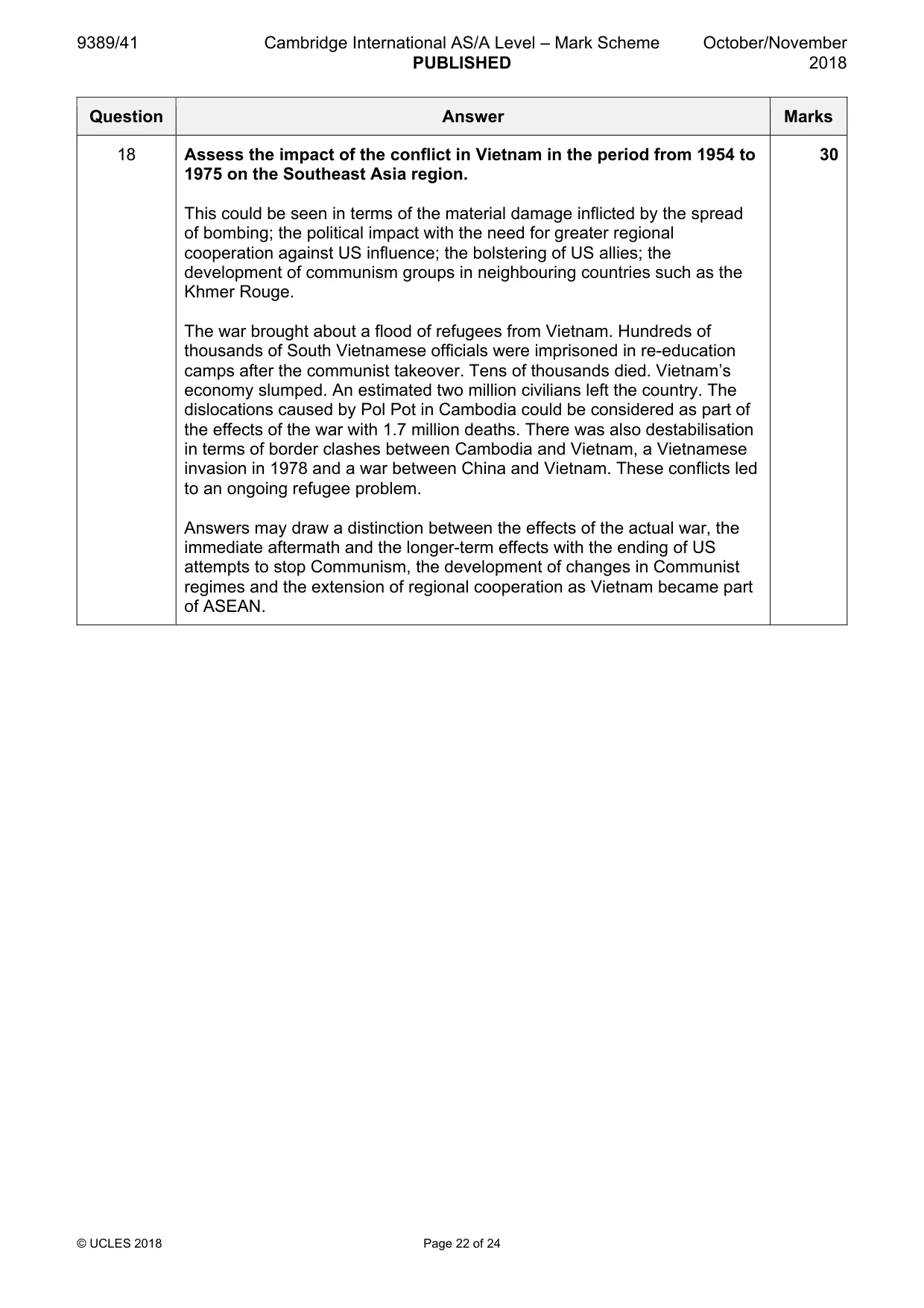
Mark scheme: 18 Assess the impact of the conflict in Vietnam in the period from 1954 to 30 1975 on the Southeast Asia region. This could be seen in terms of the material damage inflicted by the spread of bombing; the political impact with the need for greater regional cooperation against US influence; the bolstering of US allies; the development of communism groups in neighbouring countries such as the Khmer Rouge. The war brought about a flood of refugees from Vietnam. Hundreds of thousands of South Vietnamese officials were imprisoned in re-education camps after the communist takeover. Tens of thousands died. Vietnam’s economy slumped. An estimated two million civilians left the country. The dislocations caused by Pol Pot in Cambodia could be considered as part of the effects of the war with 1.7 million deaths. There was also destabilisation in terms of border clashes between Cambodia and Vietnam, a Vietnamese invasion in 1978 and a war between China and Vietnam. These conflicts led to an ongoing refugee problem. Answers may draw a distinction between the effects of the actual war, the immediate aftermath and the longer-term effects with the ending of US attempts to stop Communism, the development of changes in Communist regimes and the extension of regional cooperation as Vietnam became part of ASEAN.
Q19 · Assess the impact on Cambodia of the social and economic policies followed by the Khmer…
19 Assess the impact on Cambodia of the social and economic policies followed by the Khmer Rouge in the years 1975–78. [30]
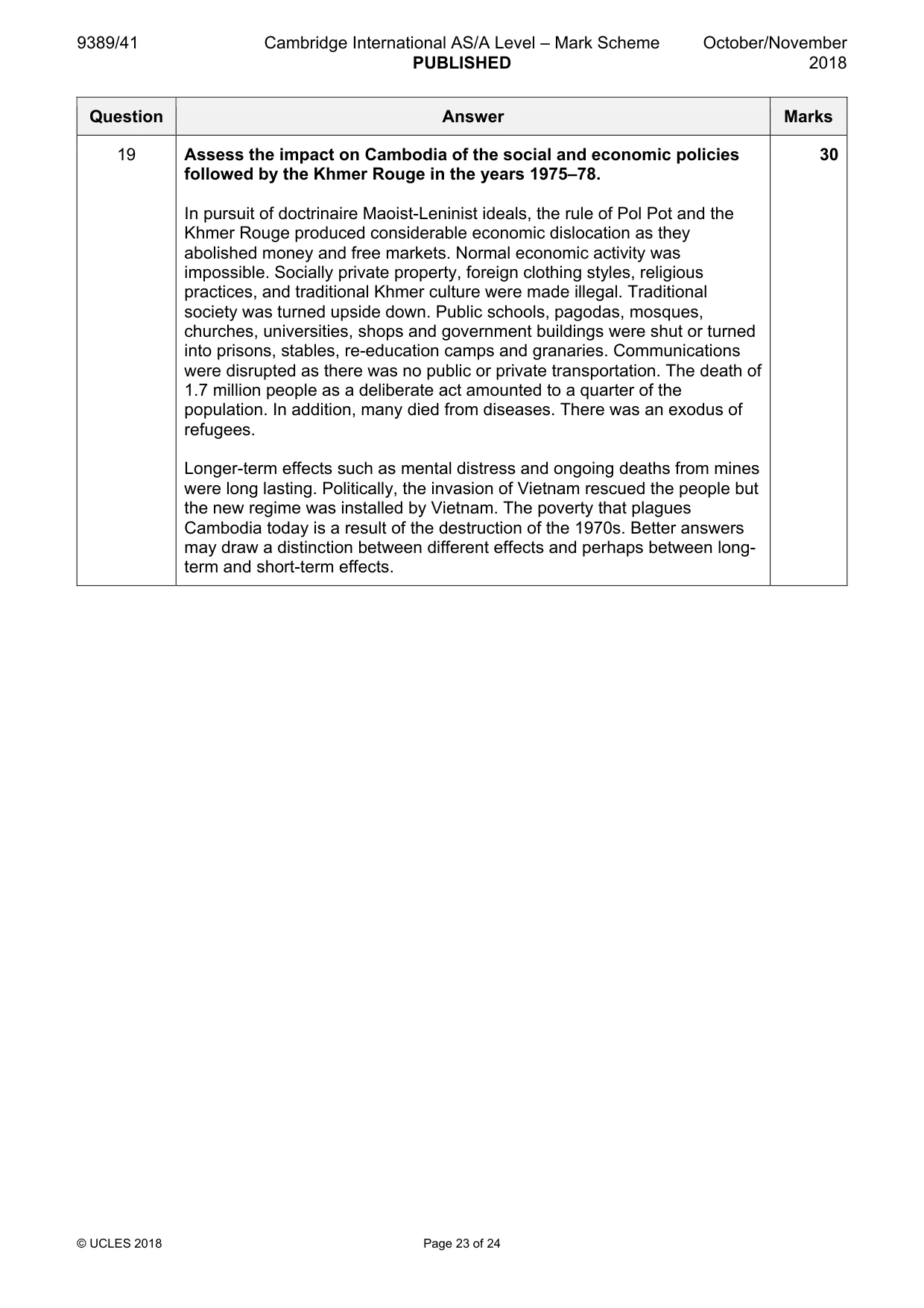
Mark scheme: 19 Assess the impact on Cambodia of the social and economic policies 30 followed by the Khmer Rouge in the years 1975–78. In pursuit of doctrinaire Maoist-Leninist ideals, the rule of Pol Pot and the Khmer Rouge produced considerable economic dislocation as they abolished money and free markets. Normal economic activity was impossible. Socially private property, foreign clothing styles, religious practices, and traditional Khmer culture were made illegal. Traditional society was turned upside down. Public schools, pagodas, mosques, churches, universities, shops and government buildings were shut or turned into prisons, stables, re-education camps and granaries. Communications were disrupted as there was no public or private transportation. The death of 1.7 million people as a deliberate act amounted to a quarter of the population. In addition, many died from diseases. There was an exodus of refugees. Longer-term effects such as mental distress and ongoing deaths from mines were long lasting. Politically, the invasion of Vietnam rescued the people but the new regime was installed by Vietnam. The poverty that plagues Cambodia today is a result of the destruction of the 1970s. Better answers may draw a distinction between different effects and perhaps between long- term and short-term effects.
Q20 · ‘Too reluctant to intervene in the internal affairs of individual states to be an…
20 ‘Too reluctant to intervene in the internal affairs of individual states to be an effective organisation.’ How far do you agree with this judgement on ASEAN? [30]
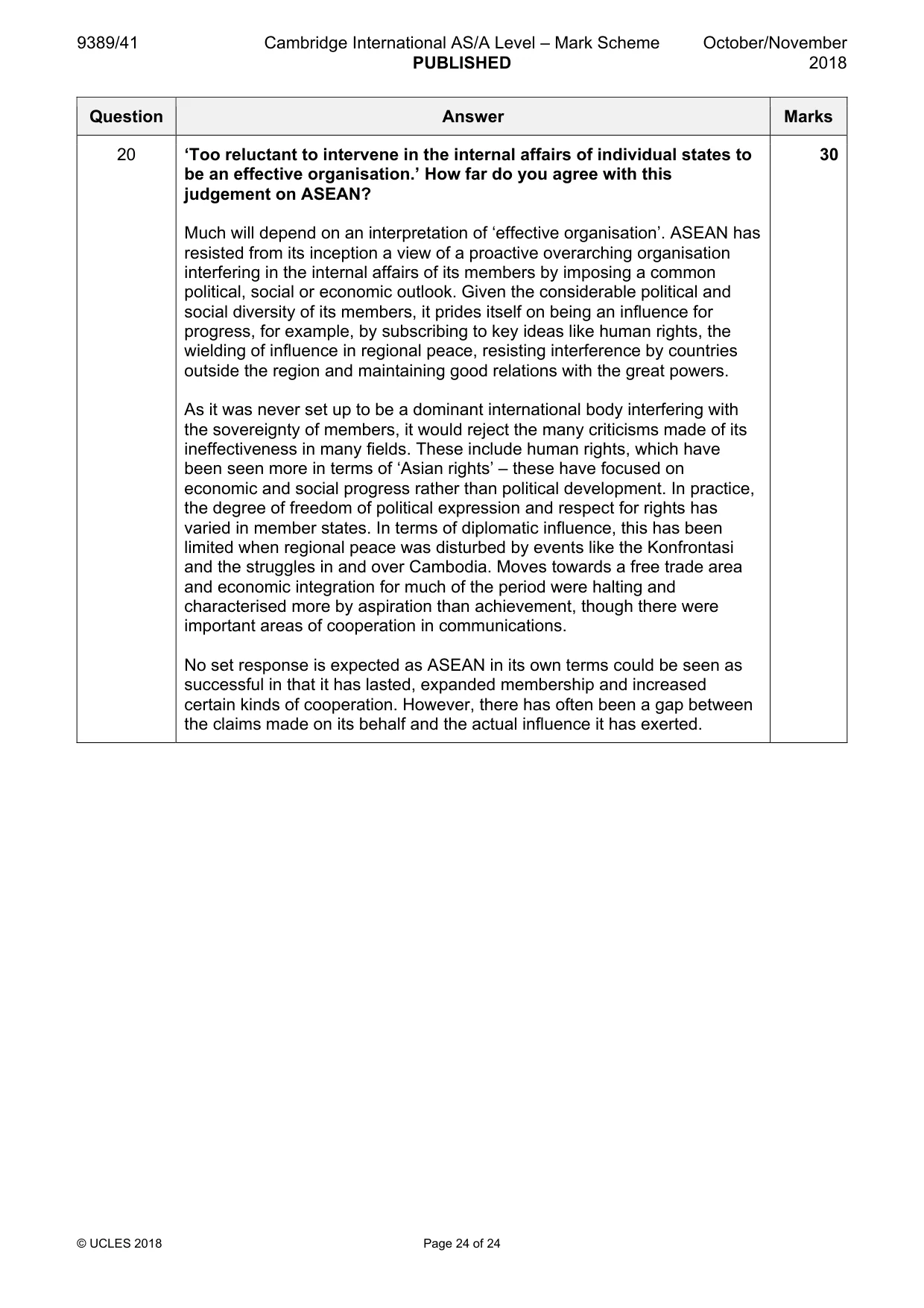
Mark scheme: 20 ‘Too reluctant to intervene in the internal affairs of individual states to 30 be an effective organisation.’ How far do you agree with this judgement on ASEAN? Much will depend on an interpretation of ‘effective organisation’. ASEAN has resisted from its inception a view of a proactive overarching organisation interfering in the internal affairs of its members by imposing a common political, social or economic outlook. Given the considerable political and social diversity of its members, it prides itself on being an influence for progress, for example, by subscribing to key ideas like human rights, the wielding of influence in regional peace, resisting interference by countries outside the region and maintaining good relations with the great powers. As it was never set up to be a dominant international body interfering with the sovereignty of members, it would reject the many criticisms made of its ineffectiveness in many fields. These include human rights, which have been seen more in terms of ‘Asian rights’ – these have focused on economic and social progress rather than political development. In practice, the degree of freedom of political expression and respect for rights has varied in member states. In terms of diplomatic influence, this has been limited when regional peace was disturbed by events like the Konfrontasi and the struggles in and over Cambodia. Moves towards a free trade area and economic integration for much of the period were halting and characterised more by aspiration than achievement, though there were important areas of cooperation in communications. No set response is expected as ASEAN in its own terms could be seen as successful in that it has lasted, expanded membership and increased certain kinds of cooperation. However, there has often been a gap between the claims made on its behalf and the actual influence it has exerted.
What you needed in this session
Cambridge’s own grade thresholds for 2018 Oct/Nov, Paper 4 · Variant 1. A higher threshold means an easier paper — the bar moves with how the cohort did.