Cambridge A Level History 9389 — 2020 May/June Paper 3 · Variant 2
9389/32/M/J/20 · 3 questions · 120 marks · ≈135 min
The question paper and its mark scheme, free to read here and free to download. This is Cambridge’s own paper, exactly as it was sat.
Question paper4 pages
Mark scheme7 pages
Answers below. Sit the paper first if you are practising.
Questions as text
Q1 · Read the extract and then answer the question
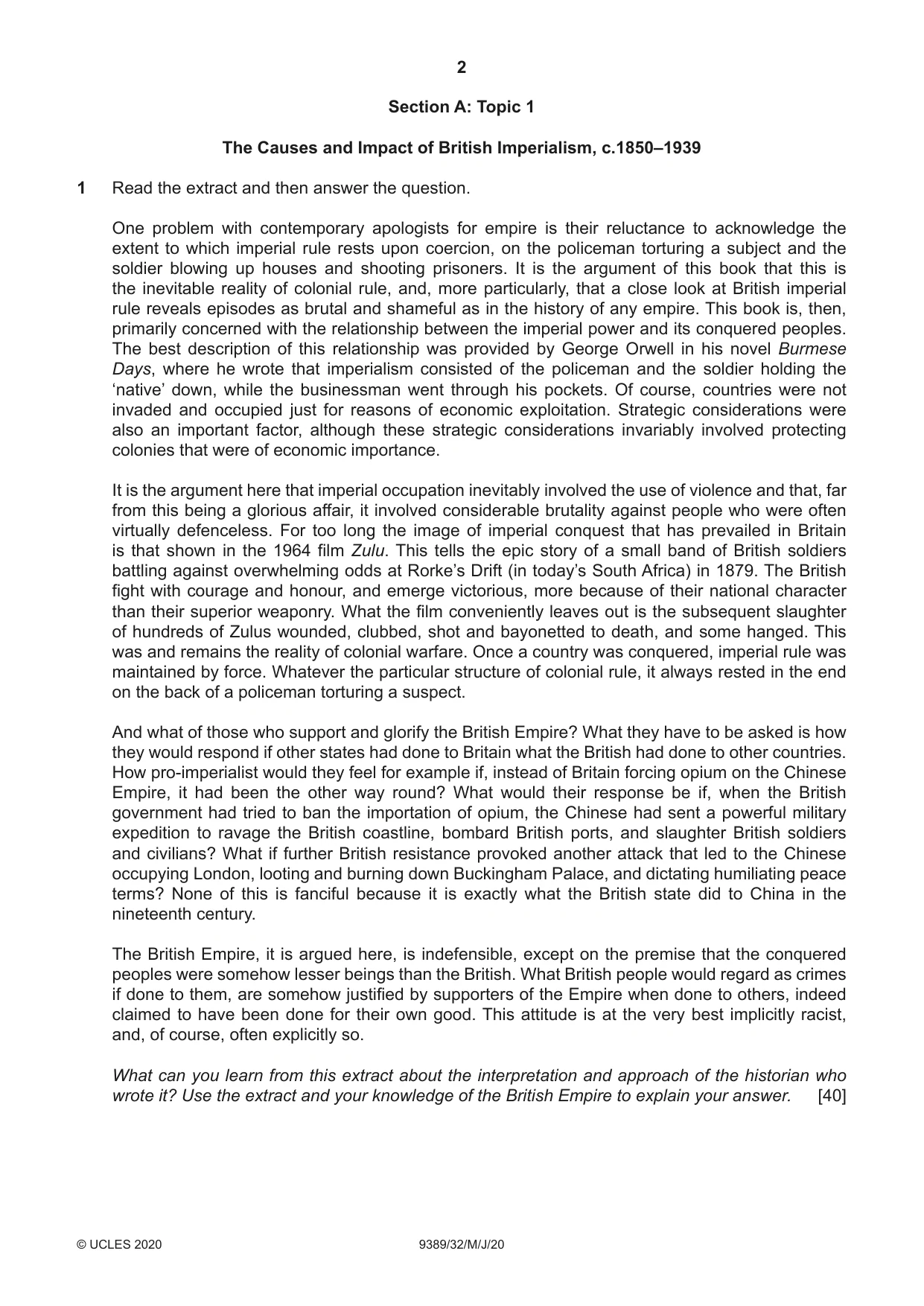
1 Read the extract and then answer the question. One problem with contemporary apologists for empire is their reluctance to acknowledge the extent to which imperial rule rests upon coercion, on the policeman torturing a subject and the soldier blowing up houses and shooting prisoners. It is the argument of this book that this is the inevitable reality of colonial rule, and, more particularly, that a close look at British imperial rule reveals episodes as brutal and shameful as in the history of any empire. This book is, then, primarily concerned with the relationship between the imperial power and its conquered peoples. The best description of this relationship was provided by George Orwell in his novel Burmese Days, where he wrote that imperialism consisted of the policeman and the soldier holding the ‘native’ down, while the businessman went through his pockets. Of course, countries were not invaded and occupied just for reasons of economic exploitation. Strategic considerations were also an important factor, although these strategic considerations invariably involved protecting colonies that were of economic importance. It is the argument here that imperial occupation inevitably involved the use of violence and that, far from this being a glorious affair, it involved considerable brutality against people who were often virtually defenceless. For too long the image of imperial conquest that has prevailed in Britain is that shown in the 1964 film Zulu. This tells the epic story of a small band of British soldiers battling against overwhelming odds at Rorke’s Drift (in today’s South Africa) in 1879. The British fight with courage and honour, and emerge victorious, more because of their national character than their superior weaponry. What the film conveniently leaves out is the subsequent slaughter of hundreds of Zulus wounded, clubbed, shot and bayonetted to death, and some hanged. This was and remains the reality of colonial warfare. Once a country was conquered, imperial rule was maintained by force. Whatever the particular structure of colonial rule, it always rested in the end on the back of a policeman torturing a suspect. And what of those who support and glorify the British Empire? What they have to be asked is how they would respond if other states had done to Britain what the British had done to other countries. How pro-imperialist would they feel for example if, instead of Britain forcing opium on the Chinese Empire, it had been the other way round? What would their response be if, when the British government had tried to ban the importation of opium, the Chinese had sent a powerful military expedition to ravage the British coastline, bombard British ports, and slaughter British soldiers and civilians? What if further British resistance provoked another attack that led to the Chinese occupying London, looting and burning down Buckingham Palace, and dictating humiliating peace terms? None of this is fanciful because it is exactly what the British state did to China in the nineteenth century. The British Empire, it is argued here, is indefensible, except on the premise that the conquered peoples were somehow lesser beings than the British. What British people would regard as crimes if done to them, are somehow justified by supporters of the Empire when done to others, indeed claimed to have been done for their own good. This attitude is at the very best implicitly racist, and, of course, often explicitly so. What can you learn from this extract about the interpretation and approach of the historian who wrote it? Use the extract and your knowledge of the British Empire to explain your answer. [40]
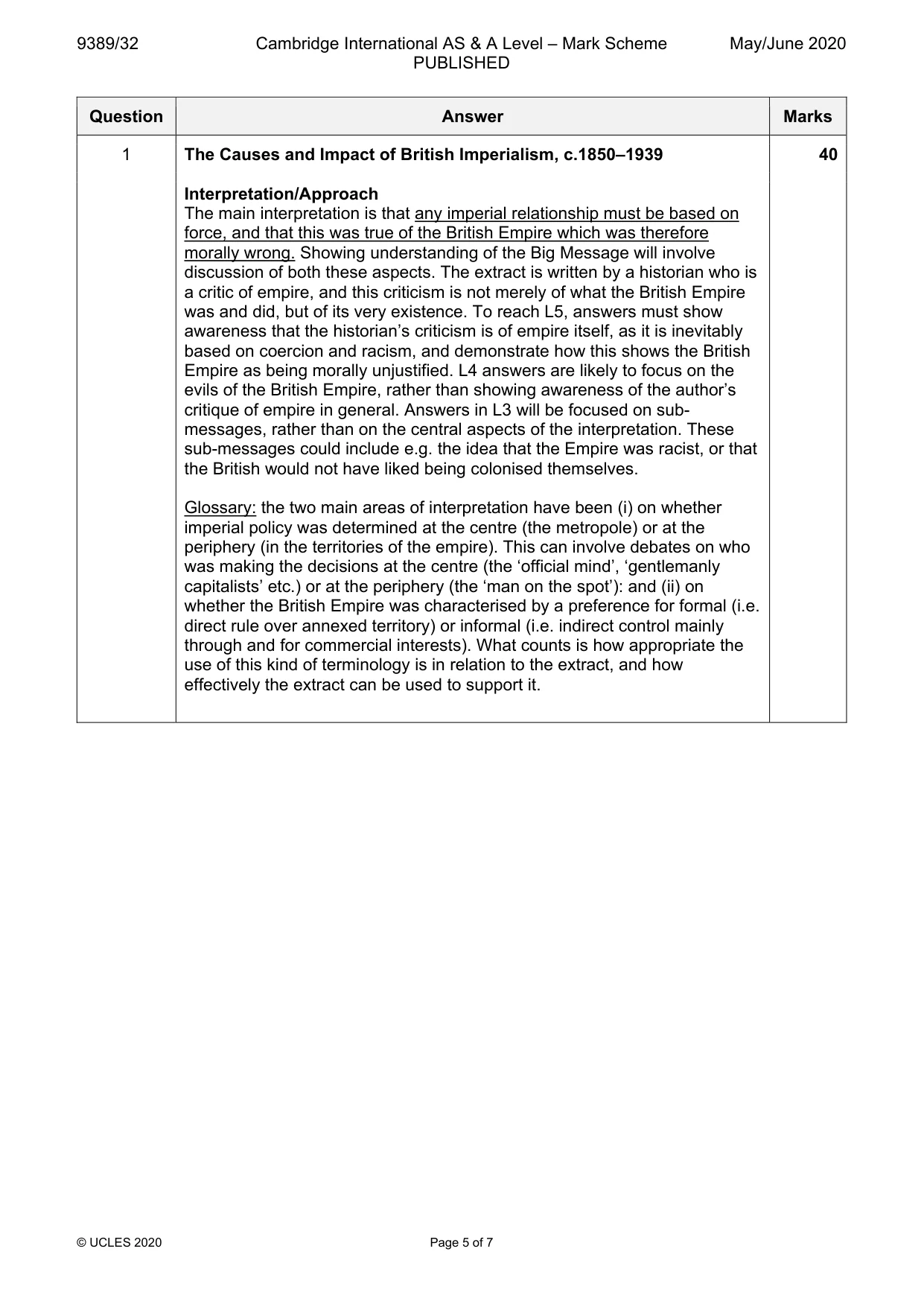
Mark scheme: Question Answer Marks 1 The Causes and Impact of British Imperialism, c.1850–1939 40 Interpretation/Approach The main interpretation is that any imperial relationship must be based on force, and that this was true of the British Empire which was therefore morally wrong. Showing understanding of the Big Message will involve discussion of both these aspects. The extract is written by a historian who is a critic of empire, and this criticism is not merely of what the British Empire was and did, but of its very existence. To reach L5, answers must show awareness that the historian’s criticism is of empire itself, as it is inevitably based on coercion and racism, and demonstrate how this shows the British Empire as being morally unjustified. L4 answers are likely to focus on the evils of the British Empire, rather than showing awareness of the author’s critique of empire in general. Answers in L3 will be focused on sub- messages, rather than on the central aspects of the interpretation. These sub-messages could include e.g. the idea that the Empire was racist, or that the British would not have liked being colonised themselves. Glossary: the two main areas of interpretation have been (i) on whether imperial policy was determined at the centre (the metropole) or at the periphery (in the territories of the empire). This can involve debates on who was making the decisions at the centre (the ‘official mind’, ‘gentlemanly capitalists’ etc.) or at the periphery (the ‘man on the spot’): and (ii) on whether the British Empire was characterised by a preference for formal (i.e. direct rule over annexed territory) or informal (i.e. indirect control mainly through and for commercial interests). What counts is how appropriate the use of this kind of terminology is in relation to the extract, and how effectively the extract can be used to support it.
Q2 · Read the extract and then answer the question
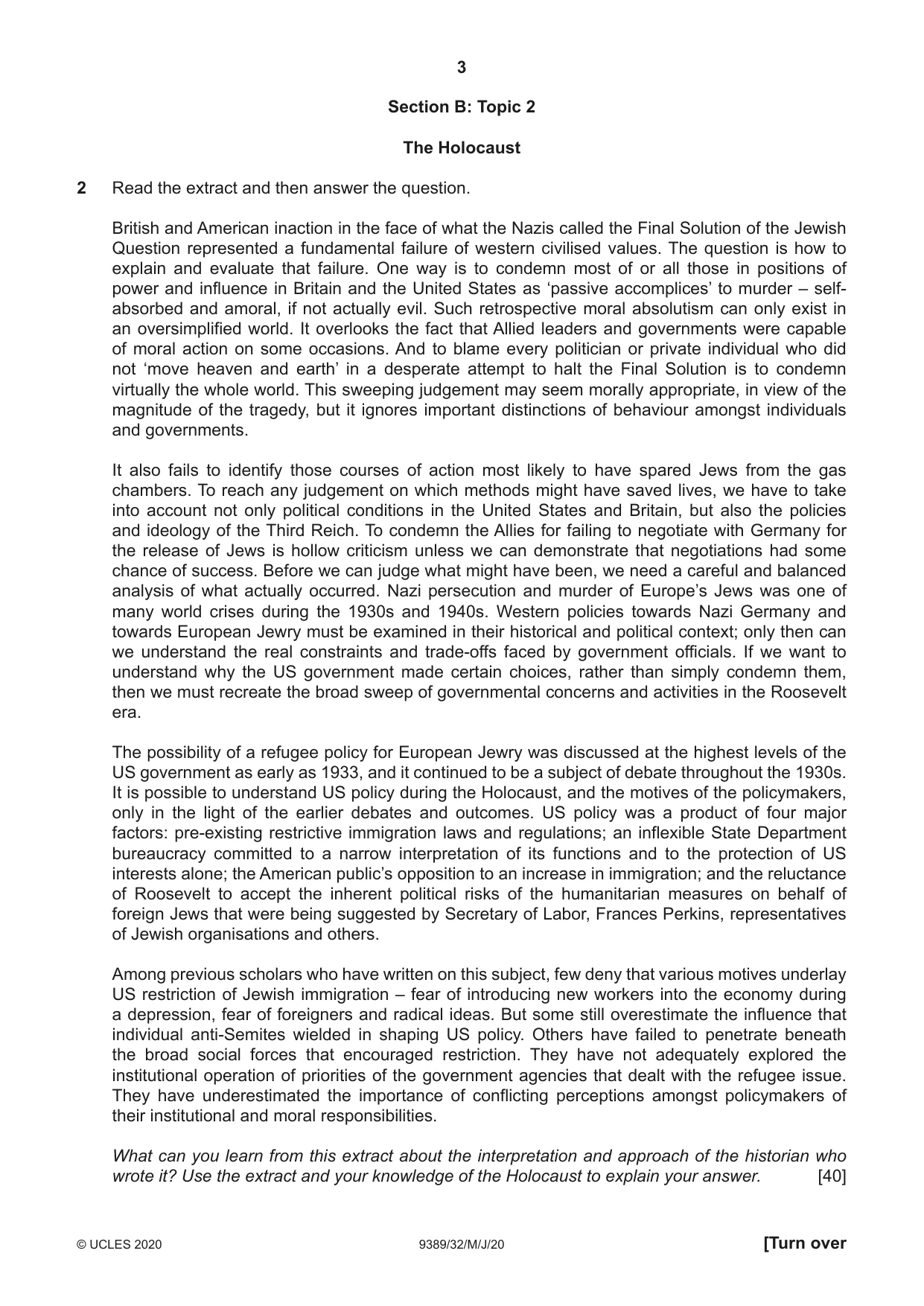
2 Read the extract and then answer the question. British and American inaction in the face of what the Nazis called the Final Solution of the Jewish Question represented a fundamental failure of western civilised values. The question is how to explain and evaluate that failure. One way is to condemn most of or all those in positions of power and influence in Britain and the United States as ‘passive accomplices’ to murder – self- absorbed and amoral, if not actually evil. Such retrospective moral absolutism can only exist in an oversimplified world. It overlooks the fact that Allied leaders and governments were capable of moral action on some occasions. And to blame every politician or private individual who did not ‘move heaven and earth’ in a desperate attempt to halt the Final Solution is to condemn virtually the whole world. This sweeping judgement may seem morally appropriate, in view of the magnitude of the tragedy, but it ignores important distinctions of behaviour amongst individuals and governments. It also fails to identify those courses of action most likely to have spared Jews from the gas chambers. To reach any judgement on which methods might have saved lives, we have to take into account not only political conditions in the United States and Britain, but also the policies and ideology of the Third Reich. To condemn the Allies for failing to negotiate with Germany for the release of Jews is hollow criticism unless we can demonstrate that negotiations had some chance of success. Before we can judge what might have been, we need a careful and balanced analysis of what actually occurred. Nazi persecution and murder of Europe’s Jews was one of many world crises during the 1930s and 1940s. Western policies towards Nazi Germany and towards European Jewry must be examined in their historical and political context; only then can we understand the real constraints and trade-offs faced by government officials. If we want to understand why the US government made certain choices, rather than simply condemn them, then we must recreate the broad sweep of governmental concerns and activities in the Roosevelt era. The possibility of a refugee policy for European Jewry was discussed at the highest levels of the US government as early as 1933, and it continued to be a subject of debate throughout the 1930s. It is possible to understand US policy during the Holocaust, and the motives of the policymakers, only in the light of the earlier debates and outcomes. US policy was a product of four major factors: pre-existing restrictive immigration laws and regulations; an inflexible State Department bureaucracy committed to a narrow interpretation of its functions and to the protection of US interests alone; the American public’s opposition to an increase in immigration; and the reluctance of Roosevelt to accept the inherent political risks of the humanitarian measures on behalf of foreign Jews that were being suggested by Secretary of Labor, Frances Perkins, representatives of Jewish organisations and others. Among previous scholars who have written on this subject, few deny that various motives underlay US restriction of Jewish immigration – fear of introducing new workers into the economy during a depression, fear of foreigners and radical ideas. But some still overestimate the influence that individual anti-Semites wielded in shaping US policy. Others have failed to penetrate beneath the broad social forces that encouraged restriction. They have not adequately explored the institutional operation of priorities of the government agencies that dealt with the refugee issue. They have underestimated the importance of conflicting perceptions amongst policymakers of their institutional and moral responsibilities. What can you learn from this extract about the interpretation and approach of the historian who wrote it? Use the extract and your knowledge of the Holocaust to explain your answer. [40] Section C: Topic 3 The Origins and Development of the Cold War, 1941–1950
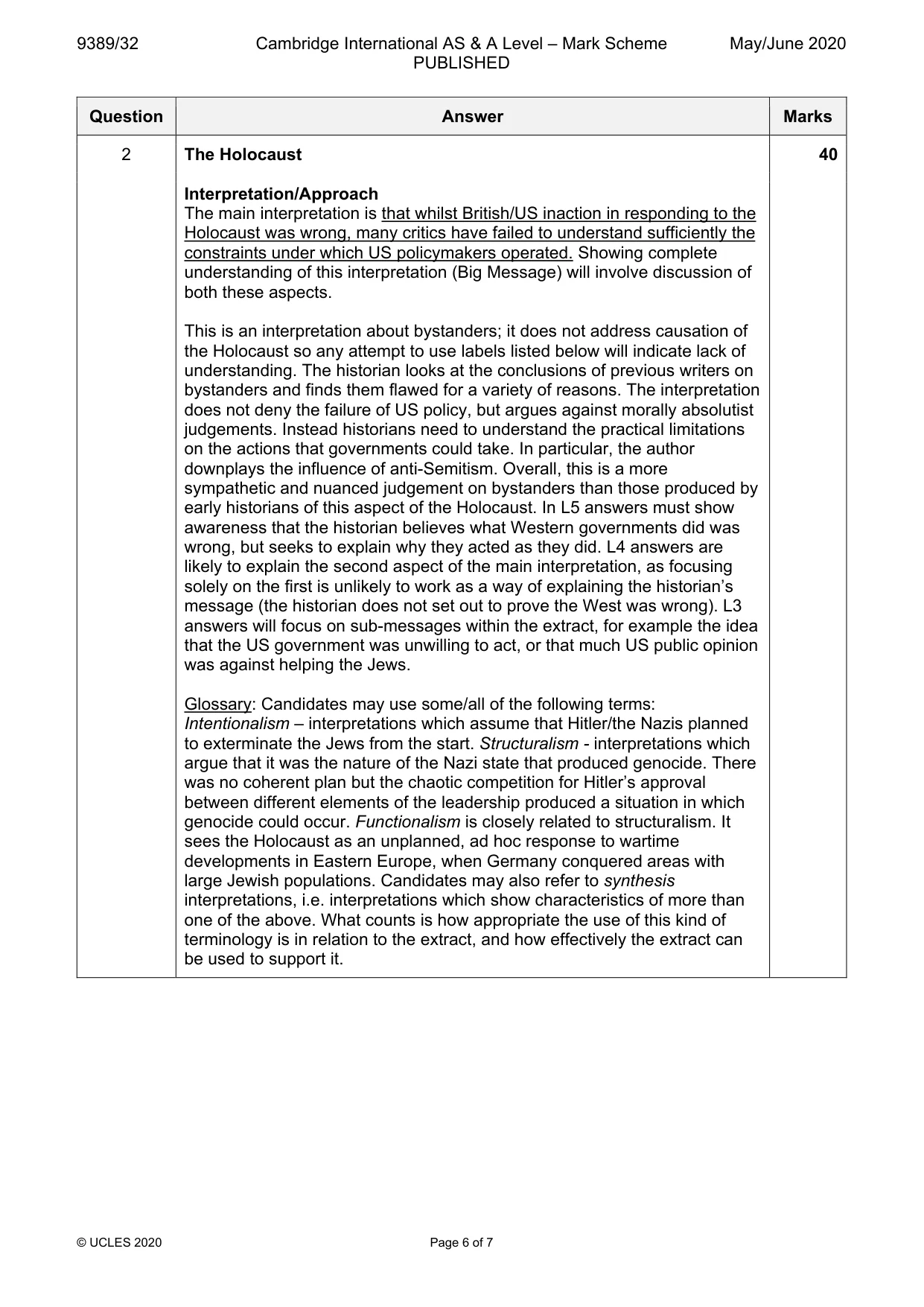
Mark scheme: 2 The Holocaust 40 Interpretation/Approach The main interpretation is that whilst British/US inaction in responding to the Holocaust was wrong, many critics have failed to understand sufficiently the constraints under which US policymakers operated. Showing complete understanding of this interpretation (Big Message) will involve discussion of both these aspects. This is an interpretation about bystanders; it does not address causation of the Holocaust so any attempt to use labels listed below will indicate lack of understanding. The historian looks at the conclusions of previous writers on bystanders and finds them flawed for a variety of reasons. The interpretation does not deny the failure of US policy, but argues against morally absolutist judgements. Instead historians need to understand the practical limitations on the actions that governments could take. In particular, the author downplays the influence of anti-Semitism. Overall, this is a more sympathetic and nuanced judgement on bystanders than those produced by early historians of this aspect of the Holocaust. In L5 answers must show awareness that the historian believes what Western governments did was wrong, but seeks to explain why they acted as they did. L4 answers are likely to explain the second aspect of the main interpretation, as focusing solely on the first is unlikely to work as a way of explaining the historian’s message (the historian does not set out to prove the West was wrong). L3 answers will focus on sub-messages within the extract, for example the idea that the US government was unwilling to act, or that much US public opinion was against helping the Jews. Glossary: Candidates may use some/all of the following terms: Intentionalism – interpretations which assume that Hitler/the Nazis planned to exterminate the Jews from the start. Structuralism - interpretations which argue that it was the nature of the Nazi state that produced genocide. There was no coherent plan but the chaotic competition for Hitler’s approval between different elements of the leadership produced a situation in which genocide could occur. Functionalism is closely related to structuralism. It sees the Holocaust as an unplanned, ad hoc response to wartime developments in Eastern Europe, when Germany conquered areas with large Jewish populations. Candidates may also refer to synthesis interpretations, i.e. interpretations which show characteristics of more than one of the above. What counts is how appropriate the use of this kind of terminology is in relation to the extract, and how effectively the extract can be used to support it.
Q3 · Read the extract and then answer the question
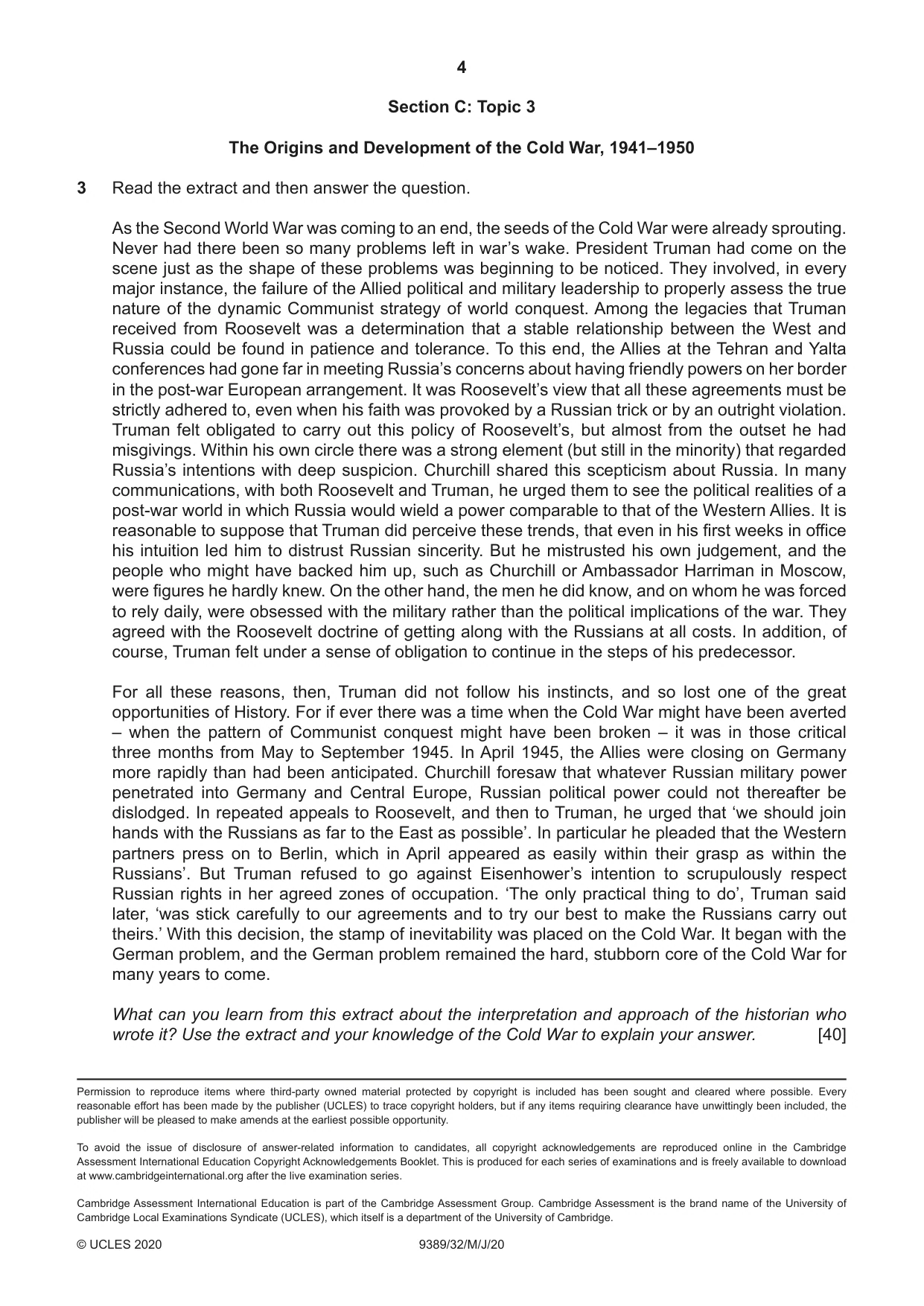
3 Read the extract and then answer the question. As the Second World War was coming to an end, the seeds of the Cold War were already sprouting. Never had there been so many problems left in war’s wake. President Truman had come on the scene just as the shape of these problems was beginning to be noticed. They involved, in every major instance, the failure of the Allied political and military leadership to properly assess the true nature of the dynamic Communist strategy of world conquest. Among the legacies that Truman received from Roosevelt was a determination that a stable relationship between the West and Russia could be found in patience and tolerance. To this end, the Allies at the Tehran and Yalta conferences had gone far in meeting Russia’s concerns about having friendly powers on her border in the post-war European arrangement. It was Roosevelt’s view that all these agreements must be strictly adhered to, even when his faith was provoked by a Russian trick or by an outright violation. Truman felt obligated to carry out this policy of Roosevelt’s, but almost from the outset he had misgivings. Within his own circle there was a strong element (but still in the minority) that regarded Russia’s intentions with deep suspicion. Churchill shared this scepticism about Russia. In many communications, with both Roosevelt and Truman, he urged them to see the political realities of a post-war world in which Russia would wield a power comparable to that of the Western Allies. It is reasonable to suppose that Truman did perceive these trends, that even in his first weeks in office his intuition led him to distrust Russian sincerity. But he mistrusted his own judgement, and the people who might have backed him up, such as Churchill or Ambassador Harriman in Moscow, were figures he hardly knew. On the other hand, the men he did know, and on whom he was forced to rely daily, were obsessed with the military rather than the political implications of the war. They agreed with the Roosevelt doctrine of getting along with the Russians at all costs. In addition, of course, Truman felt under a sense of obligation to continue in the steps of his predecessor. For all these reasons, then, Truman did not follow his instincts, and so lost one of the great opportunities of History. For if ever there was a time when the Cold War might have been averted – when the pattern of Communist conquest might have been broken – it was in those critical three months from May to September 1945. In April 1945, the Allies were closing on Germany more rapidly than had been anticipated. Churchill foresaw that whatever Russian military power penetrated into Germany and Central Europe, Russian political power could not thereafter be dislodged. In repeated appeals to Roosevelt, and then to Truman, he urged that ‘we should join hands with the Russians as far to the East as possible’. In particular he pleaded that the Western partners press on to Berlin, which in April appeared as easily within their grasp as within the Russians’. But Truman refused to go against Eisenhower’s intention to scrupulously respect Russian rights in her agreed zones of occupation. ‘The only practical thing to do’, Truman said later, ‘was stick carefully to our agreements and to try our best to make the Russians carry out theirs.’ With this decision, the stamp of inevitability was placed on the Cold War. It began with the German problem, and the German problem remained the hard, stubborn core of the Cold War for many years to come. What can you learn from this extract about the interpretation and approach of the historian who wrote it? Use the extract and your knowledge of the Cold War to explain your answer. [40]
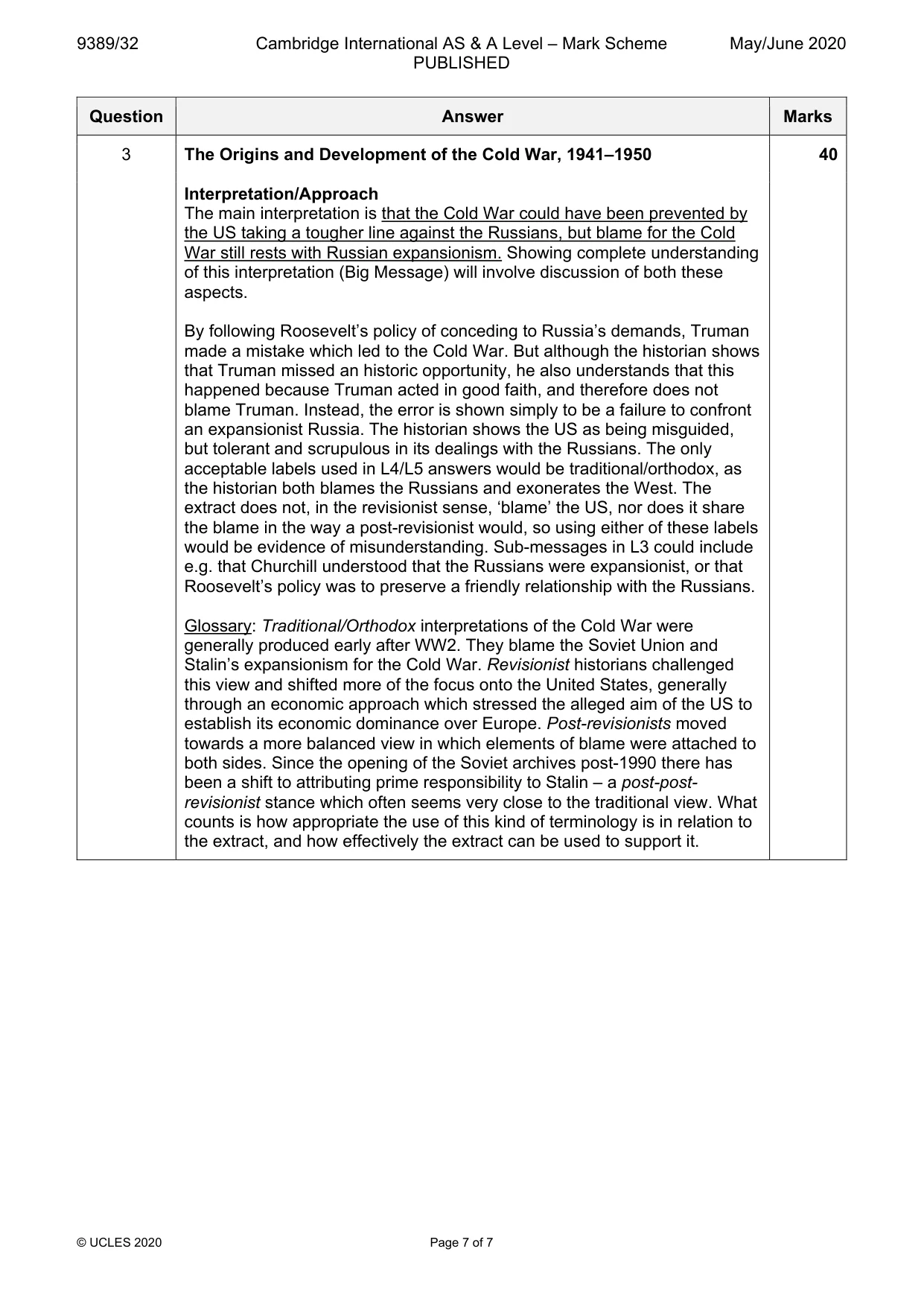
Mark scheme: 3 The Origins and Development of the Cold War, 1941–1950 40 Interpretation/Approach The main interpretation is that the Cold War could have been prevented by the US taking a tougher line against the Russians, but blame for the Cold War still rests with Russian expansionism. Showing complete understanding of this interpretation (Big Message) will involve discussion of both these aspects. By following Roosevelt’s policy of conceding to Russia’s demands, Truman made a mistake which led to the Cold War. But although the historian shows that Truman missed an historic opportunity, he also understands that this happened because Truman acted in good faith, and therefore does not blame Truman. Instead, the error is shown simply to be a failure to confront an expansionist Russia. The historian shows the US as being misguided, but tolerant and scrupulous in its dealings with the Russians. The only acceptable labels used in L4/L5 answers would be traditional/orthodox, as the historian both blames the Russians and exonerates the West. The extract does not, in the revisionist sense, ‘blame’ the US, nor does it share the blame in the way a post-revisionist would, so using either of these labels would be evidence of misunderstanding. Sub-messages in L3 could include e.g. that Churchill understood that the Russians were expansionist, or that Roosevelt’s policy was to preserve a friendly relationship with the Russians. Glossary: Traditional/Orthodox interpretations of the Cold War were generally produced early after WW2. They blame the Soviet Union and Stalin’s expansionism for the Cold War. Revisionist historians challenged this view and shifted more of the focus onto the United States, generally through an economic approach which stressed the alleged aim of the US to establish its economic dominance over Europe. Post-revisionists moved towards a more balanced view in which elements of blame were attached to both sides. Since the opening of the Soviet archives post-1990 there has been a shift to attributing prime responsibility to Stalin – a post-post- revisionist stance which often seems very close to the traditional view. What counts is how appropriate the use of this kind of terminology is in relation to the extract, and how effectively the extract can be used to support it.