Cambridge A Level History 9389 — 2019 Oct/Nov Paper 3 · Variant 2
9389/32/O/N/19 · 3 questions · 40 marks · ≈45 min
The question paper and its mark scheme, free to read here and free to download. This is Cambridge’s own paper, exactly as it was sat.
Question paper4 pages
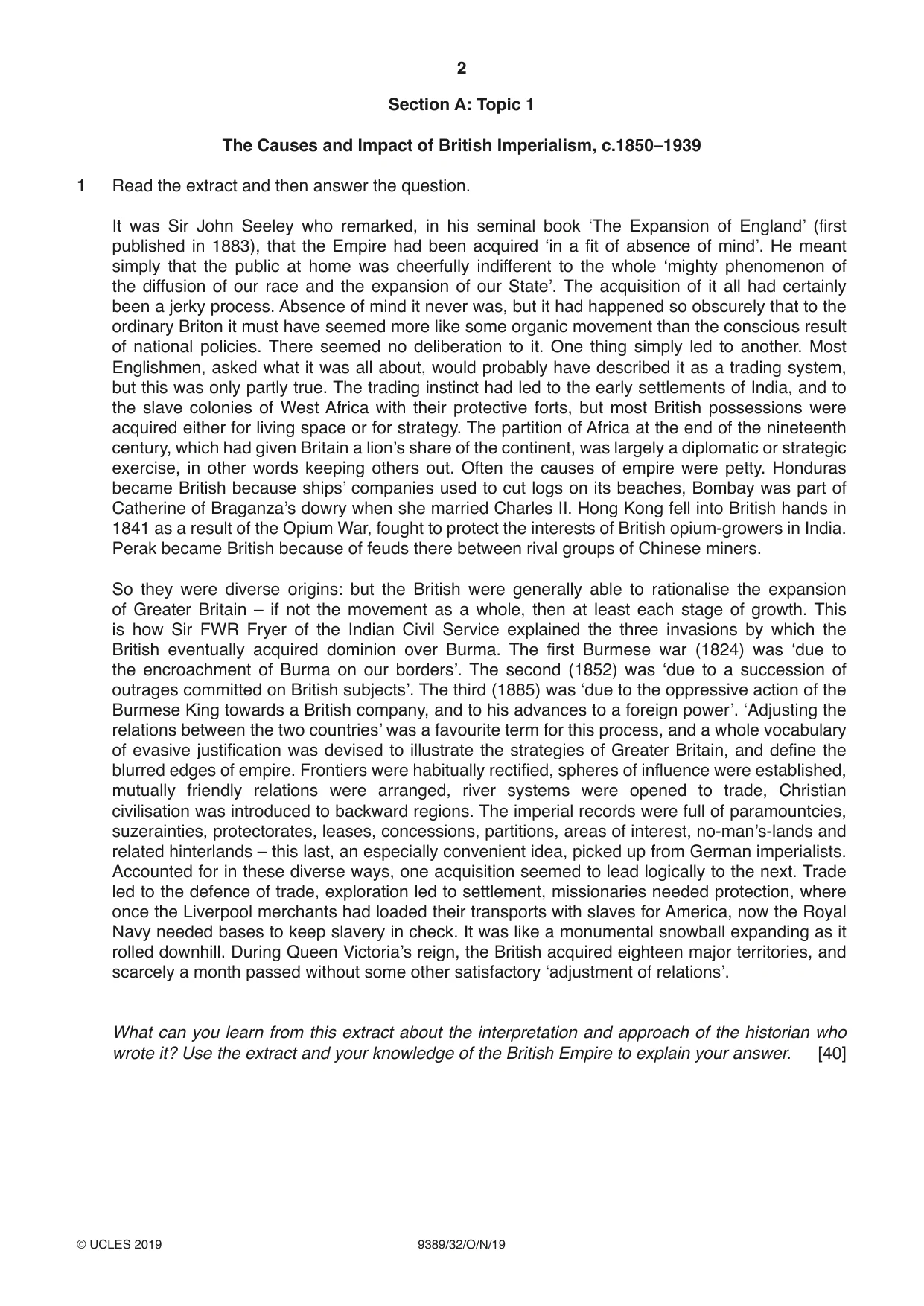
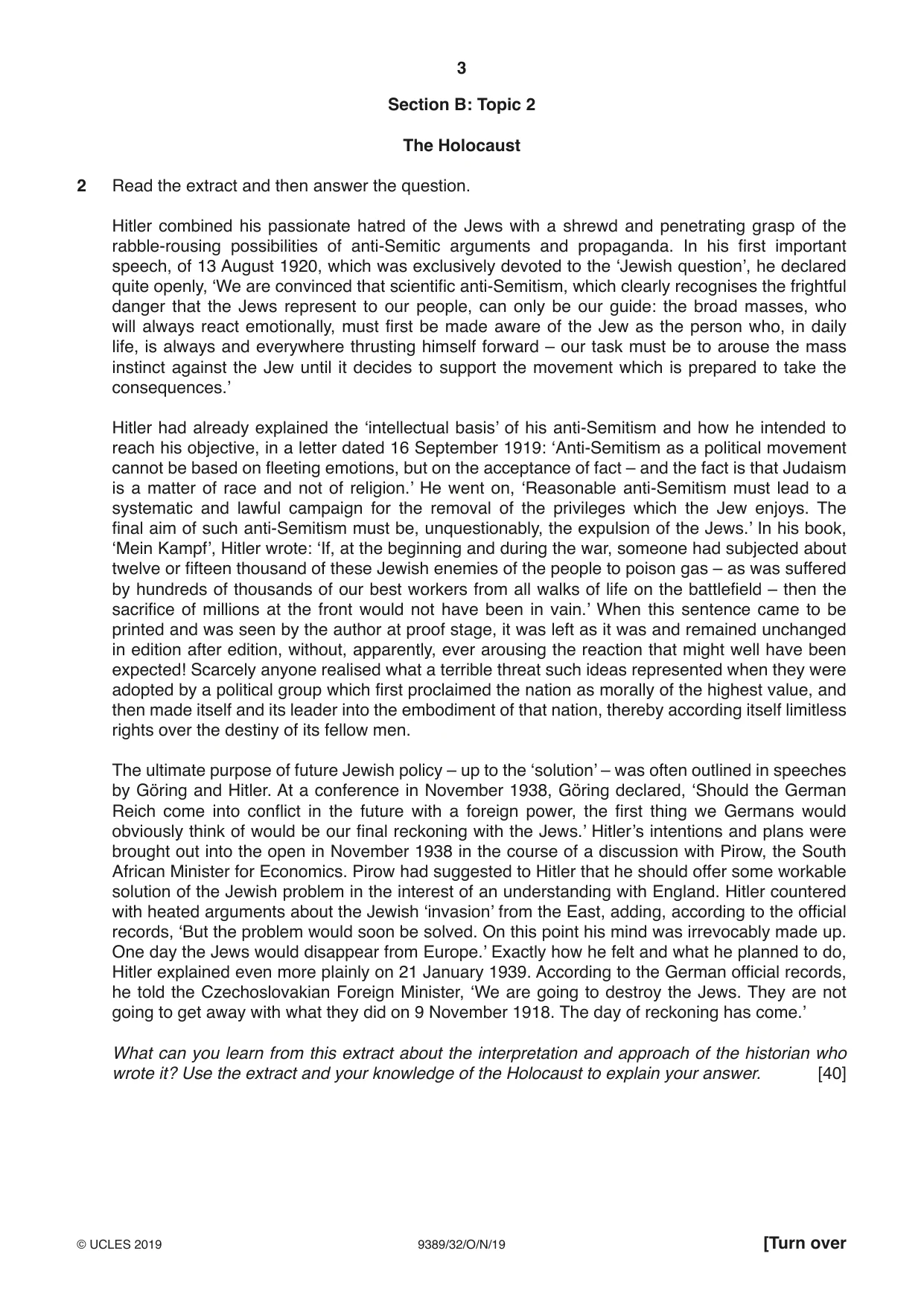
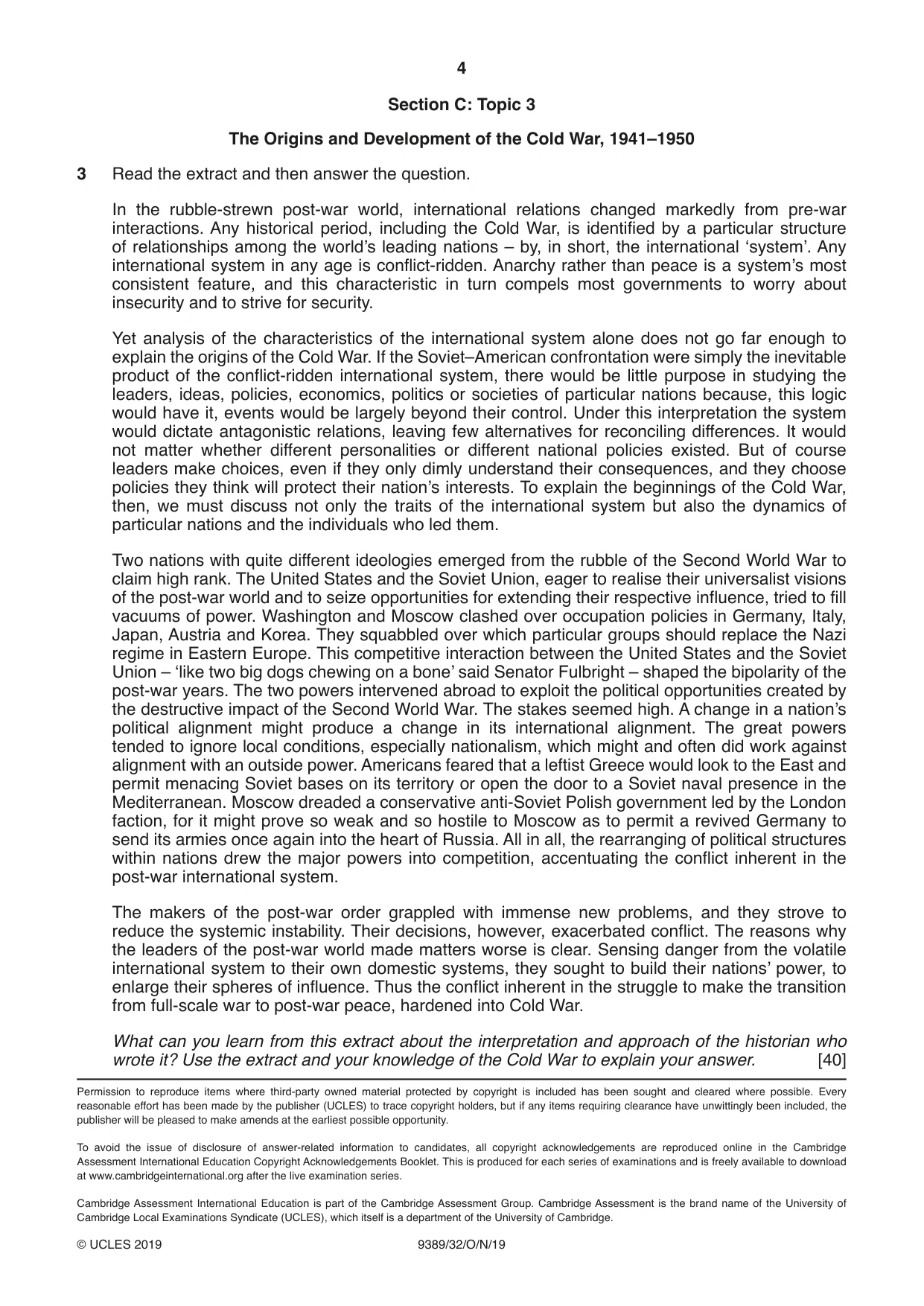
Mark scheme7 pages
Answers below. Sit the paper first if you are practising.
Questions as text
Q1 · Read the extract and then answer the question
1 Read the extract and then answer the question. It was Sir John Seeley who remarked, in his seminal book ‘The Expansion of England’ (first published in 1883), that the Empire had been acquired ‘in a fit of absence of mind’. He meant simply that the public at home was cheerfully indifferent to the whole ‘mighty phenomenon of the diffusion of our race and the expansion of our State’. The acquisition of it all had certainly been a jerky process. Absence of mind it never was, but it had happened so obscurely that to the ordinary Briton it must have seemed more like some organic movement than the conscious result of national policies. There seemed no deliberation to it. One thing simply led to another. Most Englishmen, asked what it was all about, would probably have described it as a trading system, but this was only partly true. The trading instinct had led to the early settlements of India, and to the slave colonies of West Africa with their protective forts, but most British possessions were acquired either for living space or for strategy. The partition of Africa at the end of the nineteenth century, which had given Britain a lion’s share of the continent, was largely a diplomatic or strategic exercise, in other words keeping others out. Often the causes of empire were petty. Honduras became British because ships’ companies used to cut logs on its beaches, Bombay was part of Catherine of Braganza’s dowry when she married Charles II. Hong Kong fell into British hands in 1841 as a result of the Opium War, fought to protect the interests of British opium-growers in India. Perak became British because of feuds there between rival groups of Chinese miners. So they were diverse origins: but the British were generally able to rationalise the expansion of Greater Britain – if not the movement as a whole, then at least each stage of growth. This is how Sir FWR Fryer of the Indian Civil Service explained the three invasions by which the British eventually acquired dominion over Burma. The first Burmese war (1824) was ‘due to the encroachment of Burma on our borders’. The second (1852) was ‘due to a succession of outrages committed on British subjects’. The third (1885) was ‘due to the oppressive action of the Burmese King towards a British company, and to his advances to a foreign power’. ‘Adjusting the relations between the two countries’ was a favourite term for this process, and a whole vocabulary of evasive justification was devised to illustrate the strategies of Greater Britain, and define the blurred edges of empire. Frontiers were habitually rectified, spheres of influence were established, mutually friendly relations were arranged, river systems were opened to trade, Christian civilisation was introduced to backward regions. The imperial records were full of paramountcies, suzerainties, protectorates, leases, concessions, partitions, areas of interest, no-man’s-lands and related hinterlands – this last, an especially convenient idea, picked up from German imperialists. Accounted for in these diverse ways, one acquisition seemed to lead logically to the next. Trade led to the defence of trade, exploration led to settlement, missionaries needed protection, where once the Liverpool merchants had loaded their transports with slaves for America, now the Royal Navy needed bases to keep slavery in check. It was like a monumental snowball expanding as it rolled downhill. During Queen Victoria’s reign, the British acquired eighteen major territories, and scarcely a month passed without some other satisfactory ‘adjustment of relations’. What can you learn from this extract about the interpretation and approach of the historian who wrote it? Use the extract and your knowledge of the British Empire to explain your answer. [40]
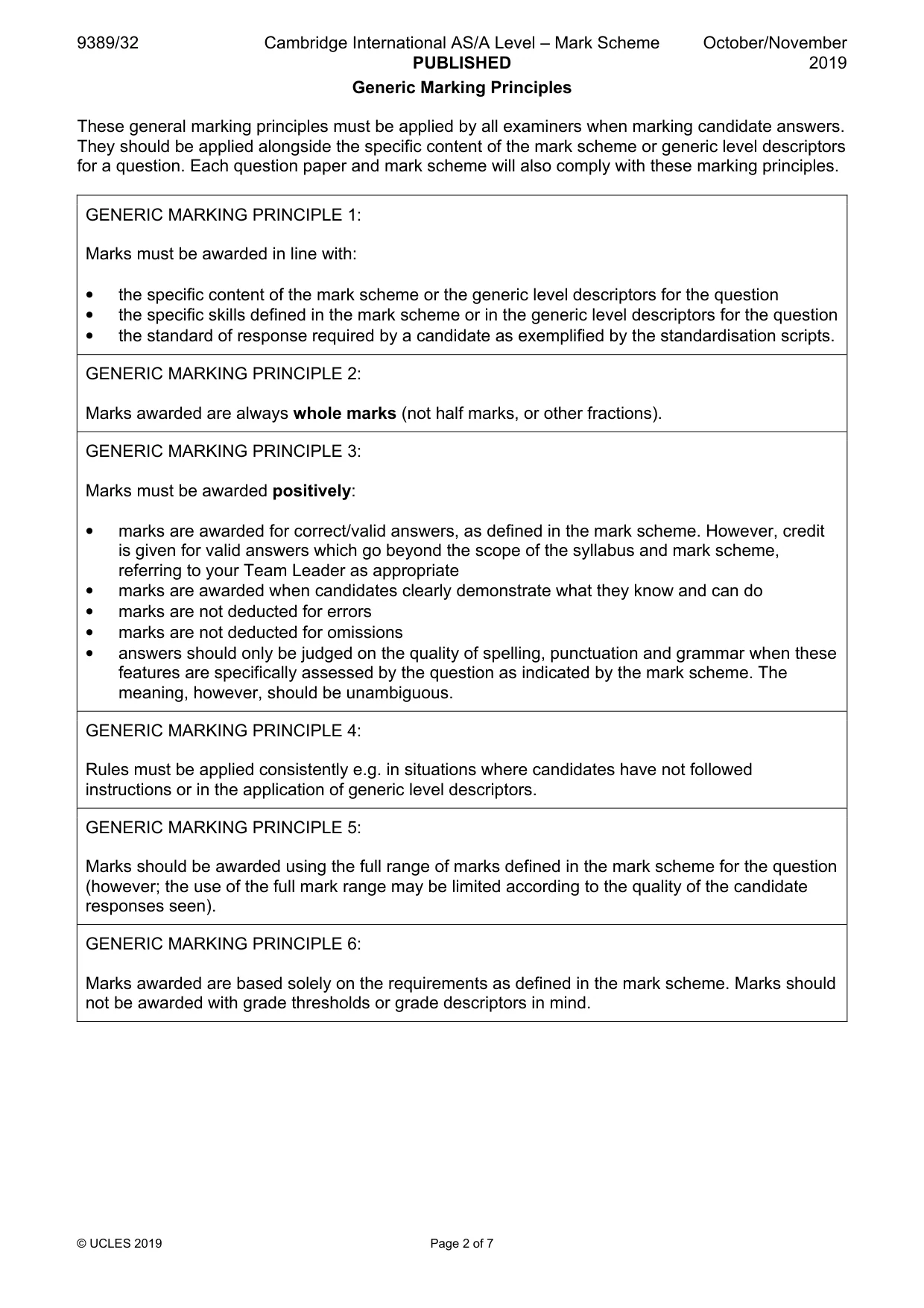
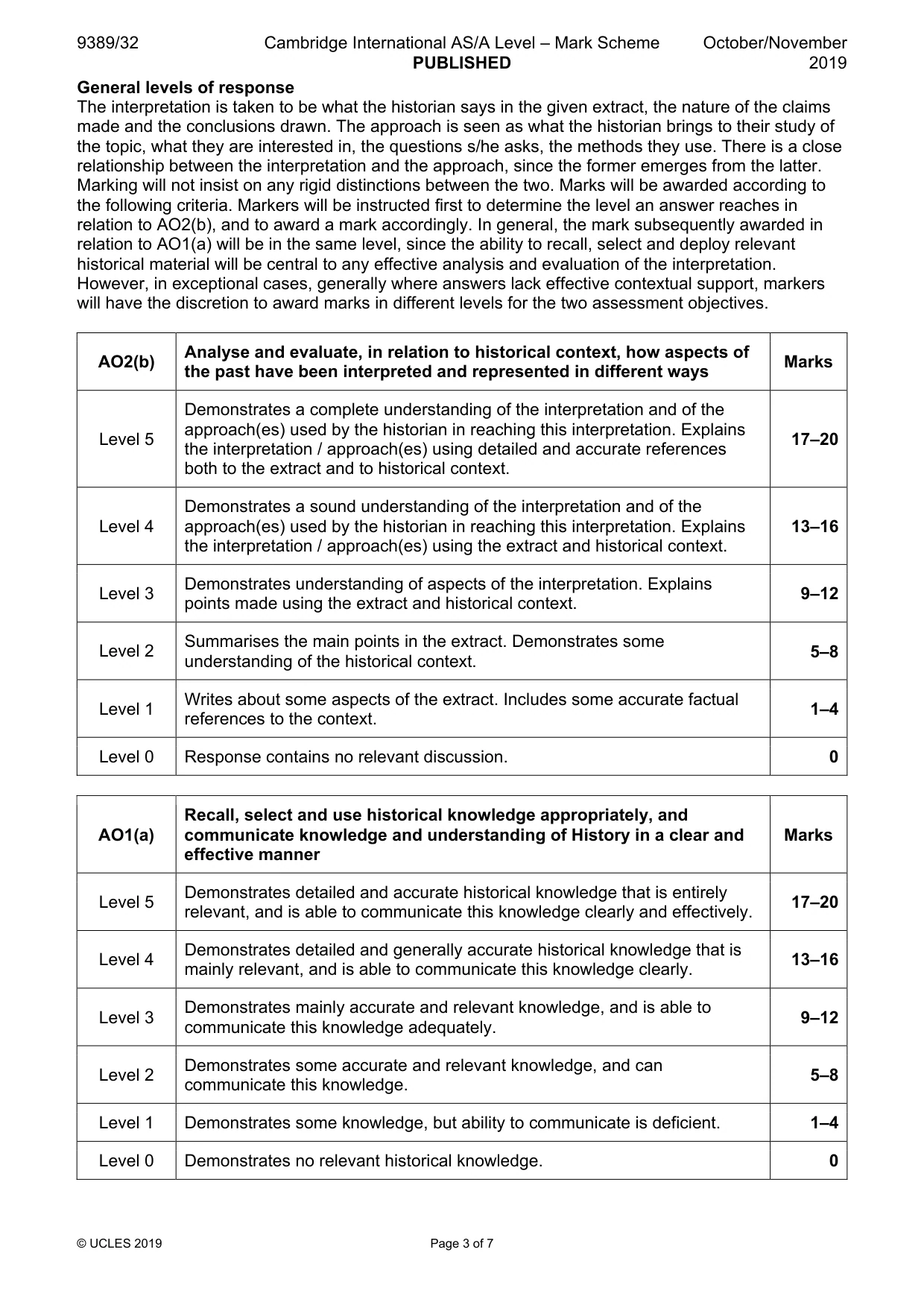
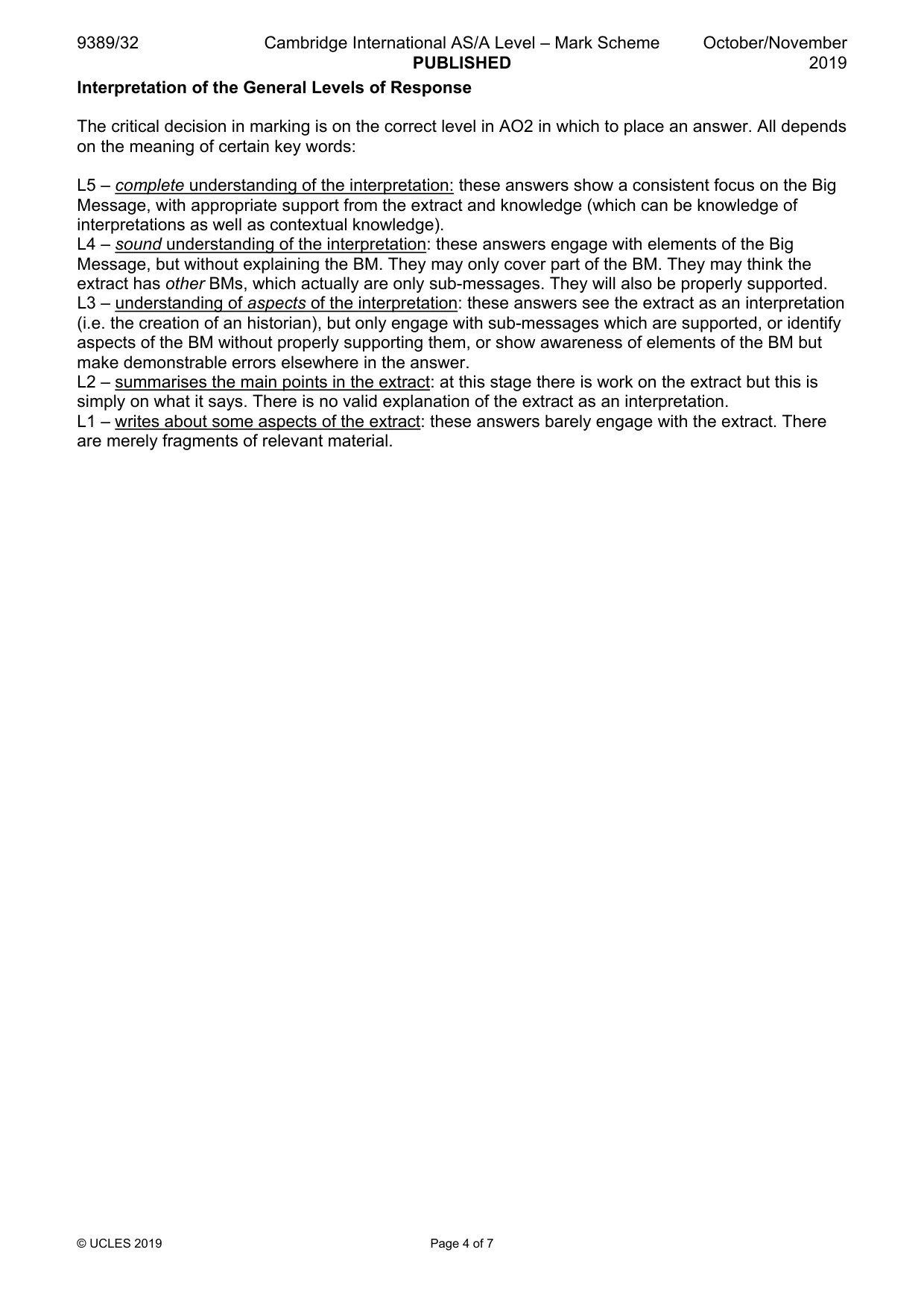
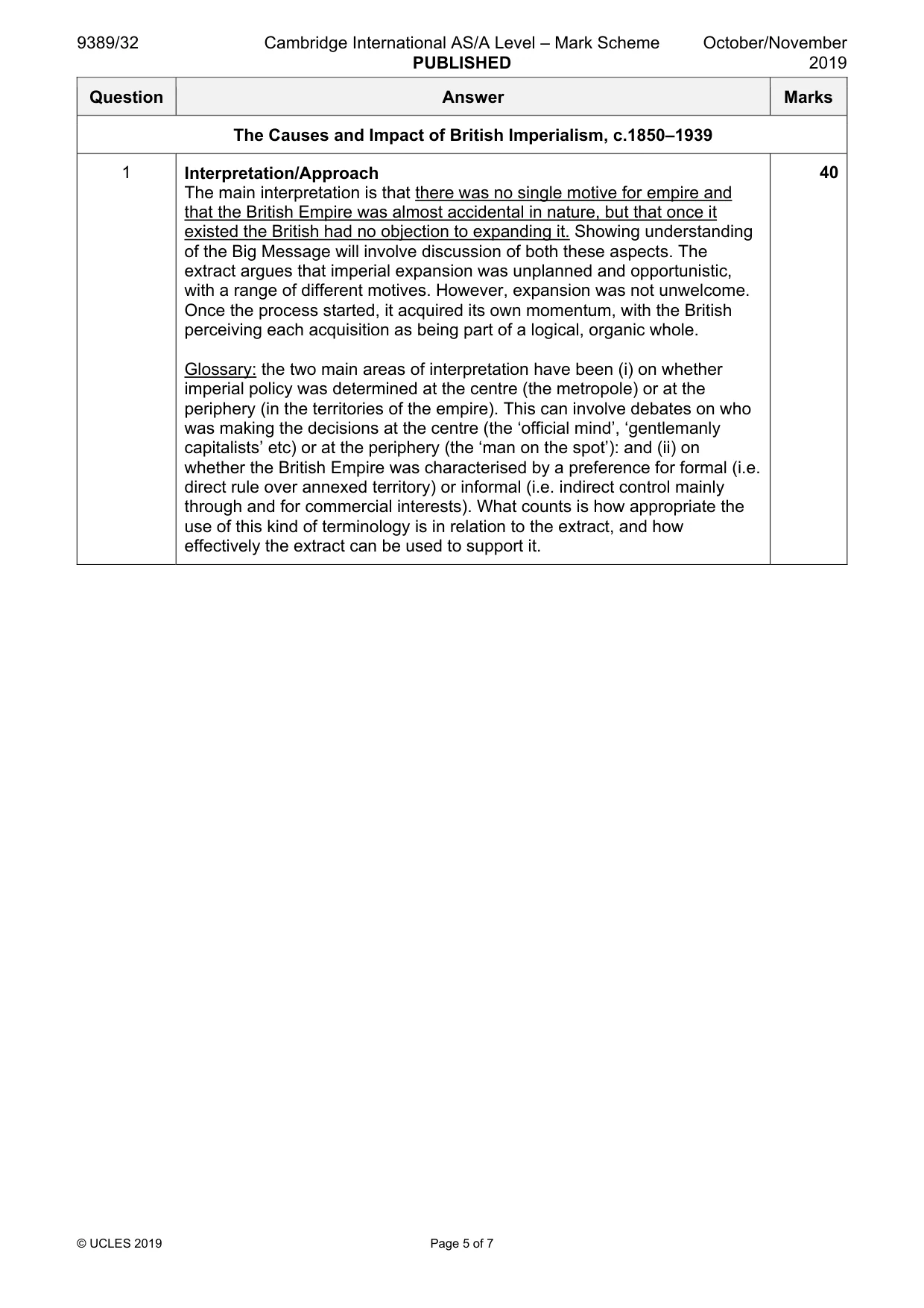
Mark scheme: Question Answer Marks The Causes and Impact of British Imperialism, c.1850–1939 1 Interpretation/Approach 40 The main interpretation is that there was no single motive for empire and that the British Empire was almost accidental in nature, but that once it existed the British had no objection to expanding it. Showing understanding of the Big Message will involve discussion of both these aspects. The extract argues that imperial expansion was unplanned and opportunistic, with a range of different motives. However, expansion was not unwelcome. Once the process started, it acquired its own momentum, with the British perceiving each acquisition as being part of a logical, organic whole. Glossary: the two main areas of interpretation have been (i) on whether imperial policy was determined at the centre (the metropole) or at the periphery (in the territories of the empire). This can involve debates on who was making the decisions at the centre (the ‘official mind’, ‘gentlemanly capitalists’ etc) or at the periphery (the ‘man on the spot’): and (ii) on whether the British Empire was characterised by a preference for formal (i.e. direct rule over annexed territory) or informal (i.e. indirect control mainly through and for commercial interests). What counts is how appropriate the use of this kind of terminology is in relation to the extract, and how effectively the extract can be used to support it.
Q2 · Read the extract and then answer the question
2 Read the extract and then answer the question. Hitler combined his passionate hatred of the Jews with a shrewd and penetrating grasp of the rabble-rousing possibilities of anti-Semitic arguments and propaganda. In his first important speech, of 13 August 1920, which was exclusively devoted to the ‘Jewish question’, he declared quite openly, ‘We are convinced that scientific anti-Semitism, which clearly recognises the frightful danger that the Jews represent to our people, can only be our guide: the broad masses, who will always react emotionally, must first be made aware of the Jew as the person who, in daily life, is always and everywhere thrusting himself forward – our task must be to arouse the mass instinct against the Jew until it decides to support the movement which is prepared to take the consequences.’ Hitler had already explained the ‘intellectual basis’ of his anti-Semitism and how he intended to reach his objective, in a letter dated 16 September 1919: ‘Anti-Semitism as a political movement cannot be based on fleeting emotions, but on the acceptance of fact – and the fact is that Judaism is a matter of race and not of religion.’ He went on, ‘Reasonable anti-Semitism must lead to a systematic and lawful campaign for the removal of the privileges which the Jew enjoys. The final aim of such anti-Semitism must be, unquestionably, the expulsion of the Jews.’ In his book, ‘Mein Kampf’, Hitler wrote: ‘If, at the beginning and during the war, someone had subjected about twelve or fifteen thousand of these Jewish enemies of the people to poison gas – as was suffered by hundreds of thousands of our best workers from all walks of life on the battlefield – then the sacrifice of millions at the front would not have been in vain.’ When this sentence came to be printed and was seen by the author at proof stage, it was left as it was and remained unchanged in edition after edition, without, apparently, ever arousing the reaction that might well have been expected! Scarcely anyone realised what a terrible threat such ideas represented when they were adopted by a political group which first proclaimed the nation as morally of the highest value, and then made itself and its leader into the embodiment of that nation, thereby according itself limitless rights over the destiny of its fellow men. The ultimate purpose of future Jewish policy – up to the ‘solution’ – was often outlined in speeches by Göring and Hitler. At a conference in November 1938, Göring declared, ‘Should the German Reich come into conflict in the future with a foreign power, the first thing we Germans would obviously think of would be our final reckoning with the Jews.’ Hitler’s intentions and plans were brought out into the open in November 1938 in the course of a discussion with Pirow, the South African Minister for Economics. Pirow had suggested to Hitler that he should offer some workable solution of the Jewish problem in the interest of an understanding with England. Hitler countered with heated arguments about the Jewish ‘invasion’ from the East, adding, according to the official records, ‘But the problem would soon be solved. On this point his mind was irrevocably made up. One day the Jews would disappear from Europe.’ Exactly how he felt and what he planned to do, Hitler explained even more plainly on 21 January 1939. According to the German official records, he told the Czechoslovakian Foreign Minister, ‘We are going to destroy the Jews. They are not going to get away with what they did on 9 November 1918. The day of reckoning has come.’ What can you learn from this extract about the interpretation and approach of the historian who wrote it? Use the extract and your knowledge of the Holocaust to explain your answer. [40] Section C: Topic 3 The Origins and Development of the Cold War, 1941–1950
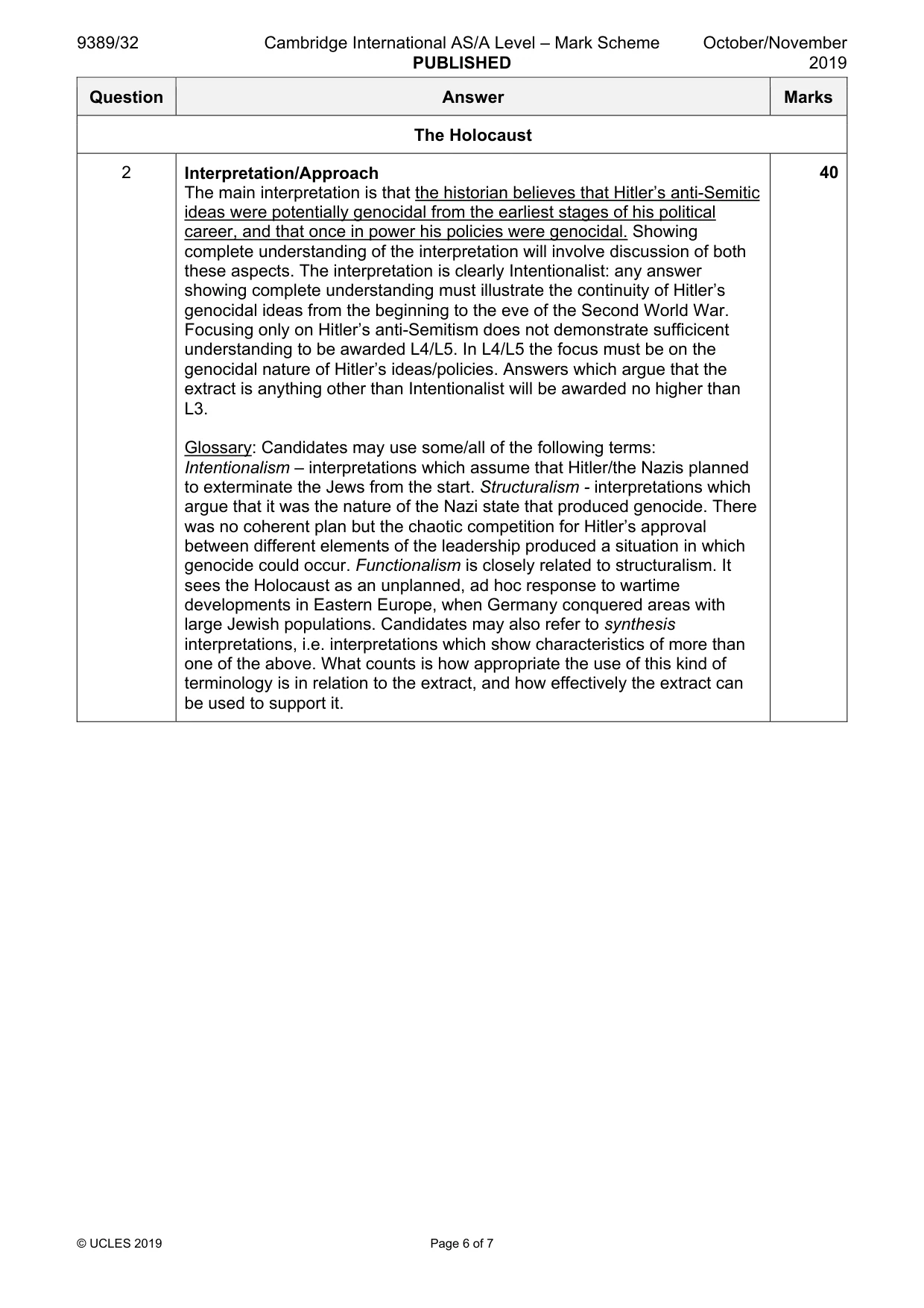
Mark scheme: 2 Interpretation/Approach 40 The main interpretation is that the historian believes that Hitler’s anti-Semitic ideas were potentially genocidal from the earliest stages of his political career, and that once in power his policies were genocidal. Showing complete understanding of the interpretation will involve discussion of both these aspects. The interpretation is clearly Intentionalist: any answer showing complete understanding must illustrate the continuity of Hitler’s genocidal ideas from the beginning to the eve of the Second World War. Focusing only on Hitler’s anti-Semitism does not demonstrate sufficicent understanding to be awarded L4/L5. In L4/L5 the focus must be on the genocidal nature of Hitler’s ideas/policies. Answers which argue that the extract is anything other than Intentionalist will be awarded no higher than L3. Glossary: Candidates may use some/all of the following terms: Intentionalism – interpretations which assume that Hitler/the Nazis planned to exterminate the Jews from the start. Structuralism - interpretations which argue that it was the nature of the Nazi state that produced genocide. There was no coherent plan but the chaotic competition for Hitler’s approval between different elements of the leadership produced a situation in which genocide could occur. Functionalism is closely related to structuralism. It sees the Holocaust as an unplanned, ad hoc response to wartime developments in Eastern Europe, when Germany conquered areas with large Jewish populations. Candidates may also refer to synthesis interpretations, i.e. interpretations which show characteristics of more than one of the above. What counts is how appropriate the use of this kind of terminology is in relation to the extract, and how effectively the extract can be used to support it.
Q3 · Read the extract and then answer the question
3 Read the extract and then answer the question. In the rubble-strewn post-war world, international relations changed markedly from pre-war interactions. Any historical period, including the Cold War, is identified by a particular structure of relationships among the world’s leading nations – by, in short, the international ‘system’. Any international system in any age is conflict-ridden. Anarchy rather than peace is a system’s most consistent feature, and this characteristic in turn compels most governments to worry about insecurity and to strive for security. Yet analysis of the characteristics of the international system alone does not go far enough to explain the origins of the Cold War. If the Soviet–American confrontation were simply the inevitable product of the conflict-ridden international system, there would be little purpose in studying the leaders, ideas, policies, economics, politics or societies of particular nations because, this logic would have it, events would be largely beyond their control. Under this interpretation the system would dictate antagonistic relations, leaving few alternatives for reconciling differences. It would not matter whether different personalities or different national policies existed. But of course leaders make choices, even if they only dimly understand their consequences, and they choose policies they think will protect their nation’s interests. To explain the beginnings of the Cold War, then, we must discuss not only the traits of the international system but also the dynamics of particular nations and the individuals who led them. Two nations with quite different ideologies emerged from the rubble of the Second World War to claim high rank. The United States and the Soviet Union, eager to realise their universalist visions of the post-war world and to seize opportunities for extending their respective influence, tried to fill vacuums of power. Washington and Moscow clashed over occupation policies in Germany, Italy, Japan, Austria and Korea. They squabbled over which particular groups should replace the Nazi regime in Eastern Europe. This competitive interaction between the United States and the Soviet Union – ‘like two big dogs chewing on a bone’ said Senator Fulbright – shaped the bipolarity of the post-war years. The two powers intervened abroad to exploit the political opportunities created by the destructive impact of the Second World War. The stakes seemed high. A change in a nation’s political alignment might produce a change in its international alignment. The great powers tended to ignore local conditions, especially nationalism, which might and often did work against alignment with an outside power. Americans feared that a leftist Greece would look to the East and permit menacing Soviet bases on its territory or open the door to a Soviet naval presence in the Mediterranean. Moscow dreaded a conservative anti-Soviet Polish government led by the London faction, for it might prove so weak and so hostile to Moscow as to permit a revived Germany to send its armies once again into the heart of Russia. All in all, the rearranging of political structures within nations drew the major powers into competition, accentuating the conflict inherent in the post-war international system. The makers of the post-war order grappled with immense new problems, and they strove to reduce the systemic instability. Their decisions, however, exacerbated conflict. The reasons why the leaders of the post-war world made matters worse is clear. Sensing danger from the volatile international system to their own domestic systems, they sought to build their nations’ power, to enlarge their spheres of influence. Thus the conflict inherent in the struggle to make the transition from full-scale war to post-war peace, hardened into Cold War. What can you learn from this extract about the interpretation and approach of the historian who wrote it? Use the extract and your knowledge of the Cold War to explain your answer. [40]
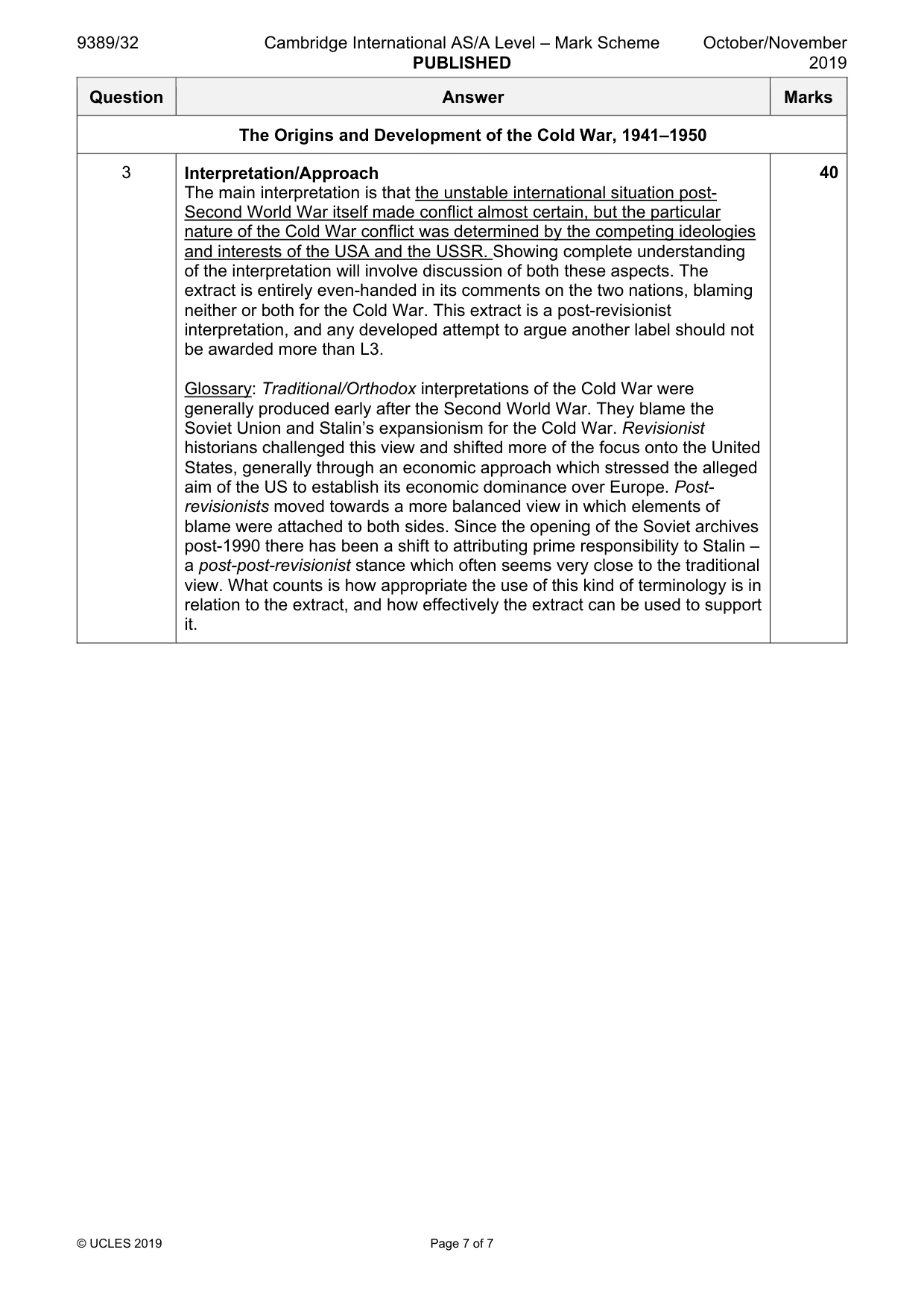
Mark scheme: 3 Interpretation/Approach 40 The main interpretation is that the unstable international situation post- Second World War itself made conflict almost certain, but the particular nature of the Cold War conflict was determined by the competing ideologies and interests of the USA and the USSR. Showing complete understanding of the interpretation will involve discussion of both these aspects. The extract is entirely even-handed in its comments on the two nations, blaming neither or both for the Cold War. This extract is a post-revisionist interpretation, and any developed attempt to argue another label should not be awarded more than L3. Glossary: Traditional/Orthodox interpretations of the Cold War were generally produced early after the Second World War. They blame the Soviet Union and Stalin’s expansionism for the Cold War. Revisionist historians challenged this view and shifted more of the focus onto the United States, generally through an economic approach which stressed the alleged aim of the US to establish its economic dominance over Europe. Post- revisionists moved towards a more balanced view in which elements of blame were attached to both sides. Since the opening of the Soviet archives post-1990 there has been a shift to attributing prime responsibility to Stalin – a post-post-revisionist stance which often seems very close to the traditional view. What counts is how appropriate the use of this kind of terminology is in relation to the extract, and how effectively the extract can be used to support it.
What you needed in this session
Cambridge’s own grade thresholds for 2019 Oct/Nov, Paper 3 · Variant 2. A higher threshold means an easier paper — the bar moves with how the cohort did.