Cambridge A Level History 9389 — 2021 May/June Paper 3 · Variant 1
9389/31/M/J/21 · 3 questions · 40 marks · ≈45 min
The question paper and its mark scheme, free to read here and free to download. This is Cambridge’s own paper, exactly as it was sat.
Question paper8 pages
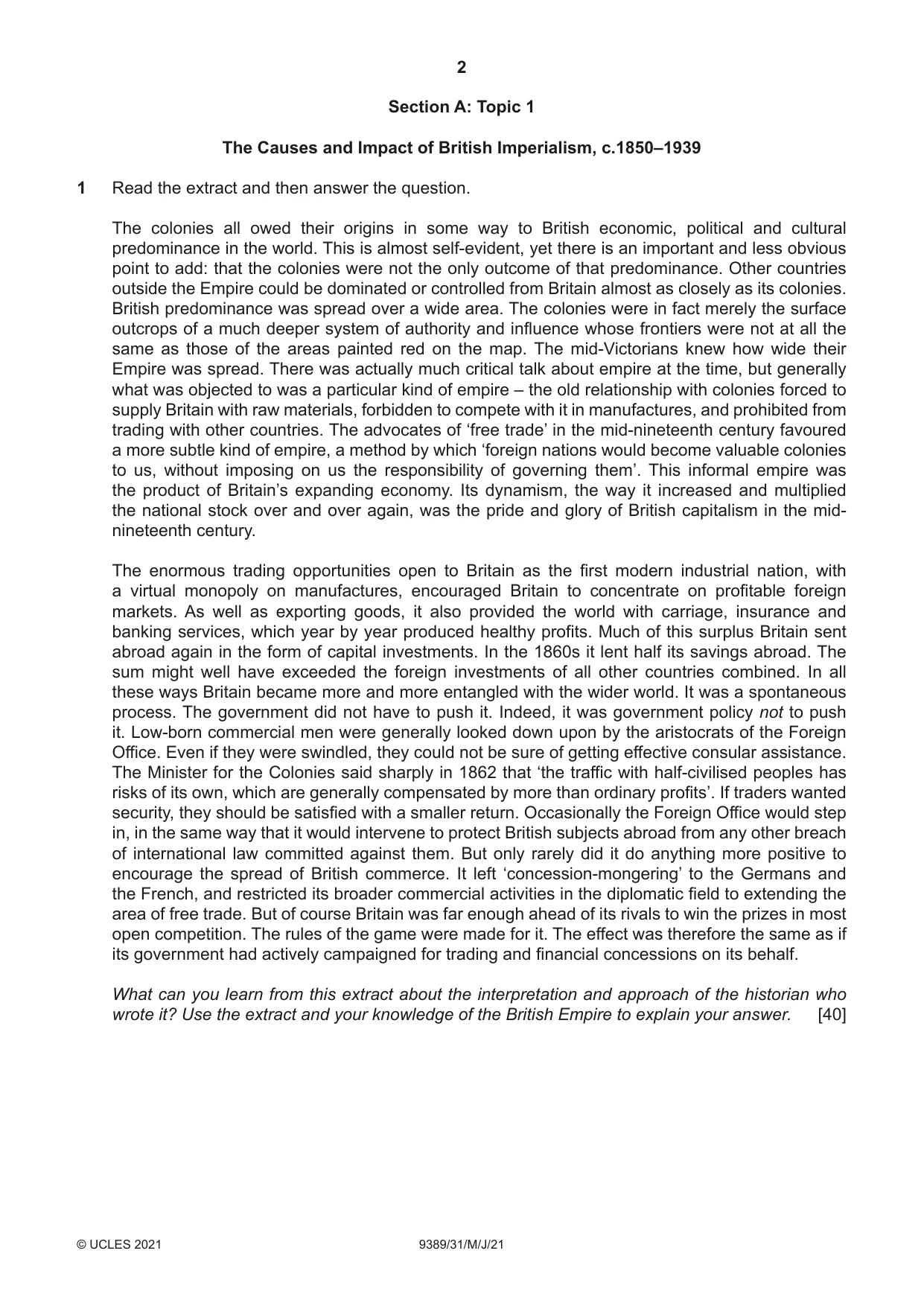
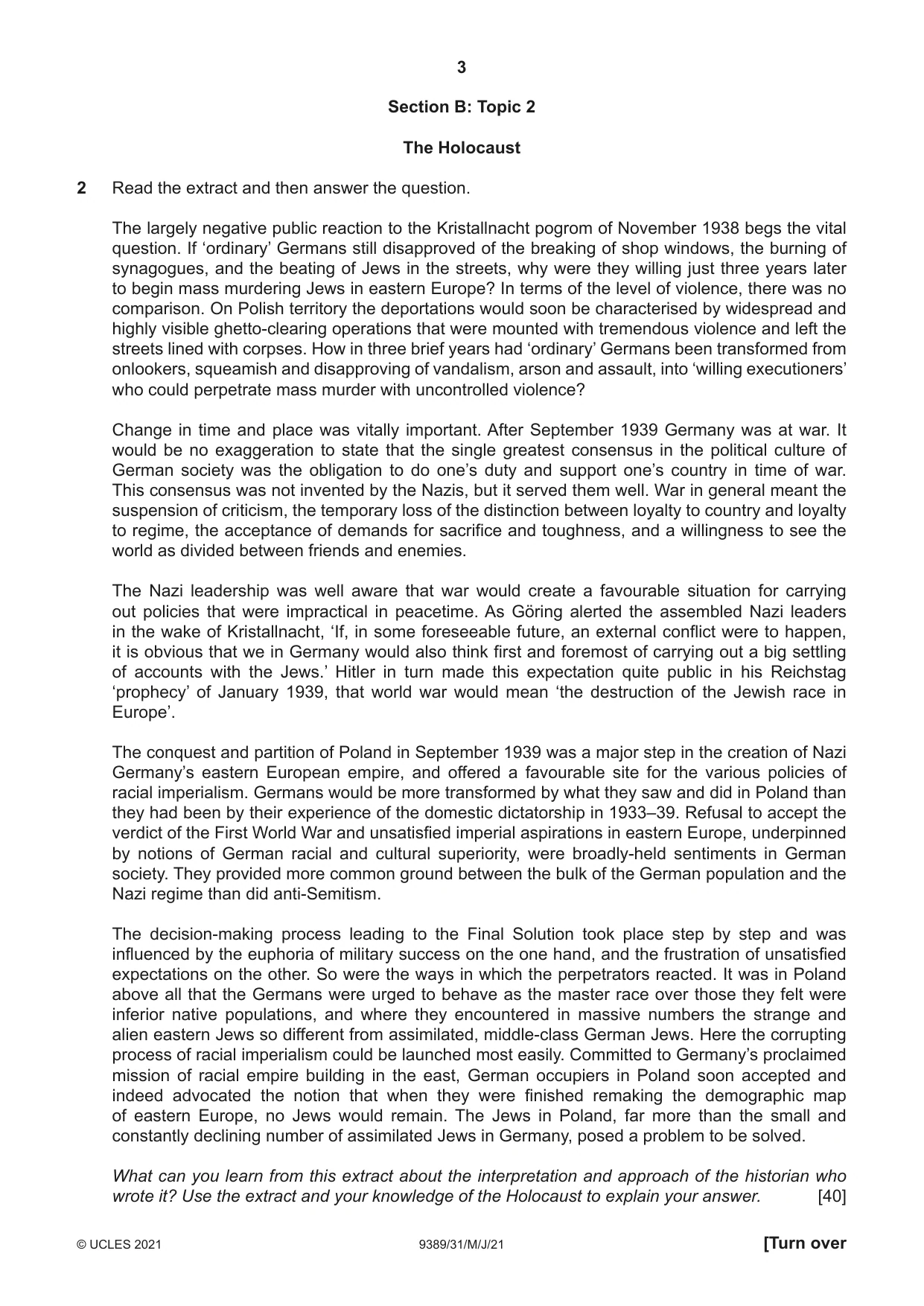
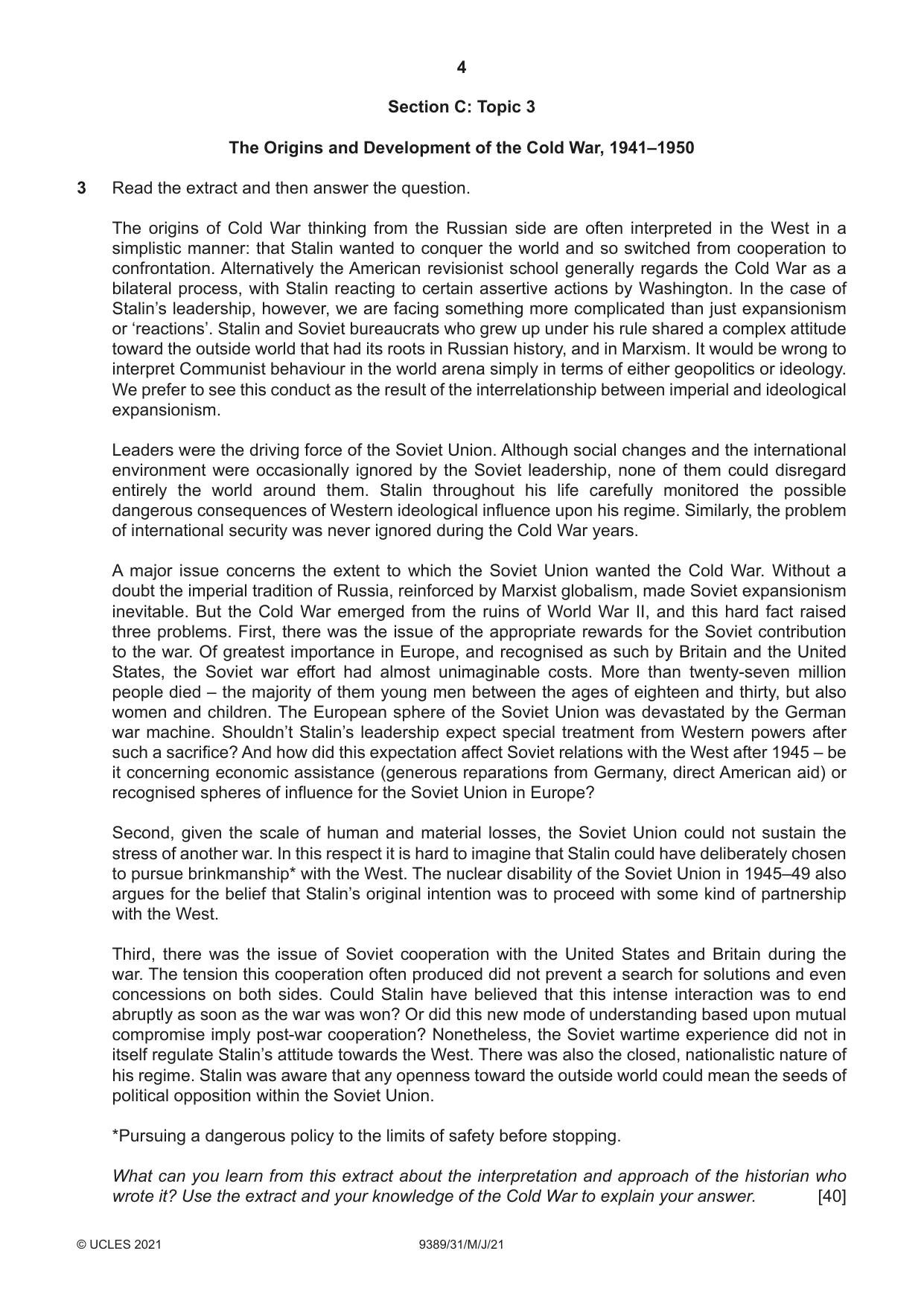



Mark scheme7 pages
Answers below. Sit the paper first if you are practising.
Questions as text
Q1 · Read the extract and then answer the question
1 Read the extract and then answer the question. The colonies all owed their origins in some way to British economic, political and cultural predominance in the world. This is almost self-evident, yet there is an important and less obvious point to add: that the colonies were not the only outcome of that predominance. Other countries outside the Empire could be dominated or controlled from Britain almost as closely as its colonies. British predominance was spread over a wide area. The colonies were in fact merely the surface outcrops of a much deeper system of authority and influence whose frontiers were not at all the same as those of the areas painted red on the map. The mid-Victorians knew how wide their Empire was spread. There was actually much critical talk about empire at the time, but generally what was objected to was a particular kind of empire – the old relationship with colonies forced to supply Britain with raw materials, forbidden to compete with it in manufactures, and prohibited from trading with other countries. The advocates of ‘free trade’ in the mid-nineteenth century favoured a more subtle kind of empire, a method by which ‘foreign nations would become valuable colonies to us, without imposing on us the responsibility of governing them’. This informal empire was the product of Britain’s expanding economy. Its dynamism, the way it increased and multiplied the national stock over and over again, was the pride and glory of British capitalism in the mid- nineteenth century. The enormous trading opportunities open to Britain as the first modern industrial nation, with a virtual monopoly on manufactures, encouraged Britain to concentrate on profitable foreign markets. As well as exporting goods, it also provided the world with carriage, insurance and banking services, which year by year produced healthy profits. Much of this surplus Britain sent abroad again in the form of capital investments. In the 1860s it lent half its savings abroad. The sum might well have exceeded the foreign investments of all other countries combined. In all these ways Britain became more and more entangled with the wider world. It was a spontaneous process. The government did not have to push it. Indeed, it was government policy not to push it. Low-born commercial men were generally looked down upon by the aristocrats of the Foreign Office. Even if they were swindled, they could not be sure of getting effective consular assistance. The Minister for the Colonies said sharply in 1862 that ‘the traffic with half-civilised peoples has risks of its own, which are generally compensated by more than ordinary profits’. If traders wanted security, they should be satisfied with a smaller return. Occasionally the Foreign Office would step in, in the same way that it would intervene to protect British subjects abroad from any other breach of international law committed against them. But only rarely did it do anything more positive to encourage the spread of British commerce. It left ‘concession-mongering’ to the Germans and the French, and restricted its broader commercial activities in the diplomatic field to extending the area of free trade. But of course Britain was far enough ahead of its rivals to win the prizes in most open competition. The rules of the game were made for it. The effect was therefore the same as if its government had actively campaigned for trading and financial concessions on its behalf. What can you learn from this extract about the interpretation and approach of the historian who wrote it? Use the extract and your knowledge of the British Empire to explain your answer. [40]
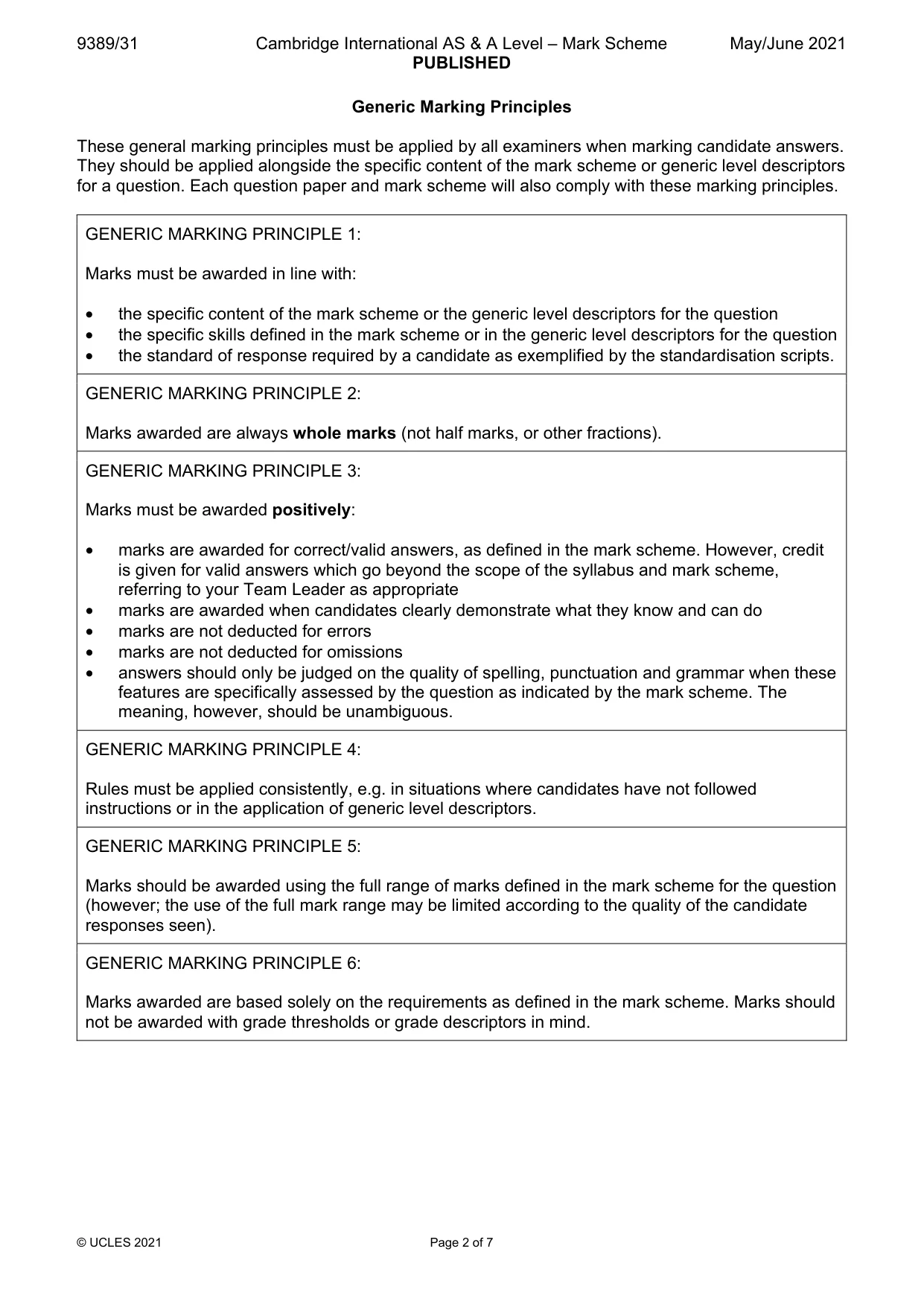
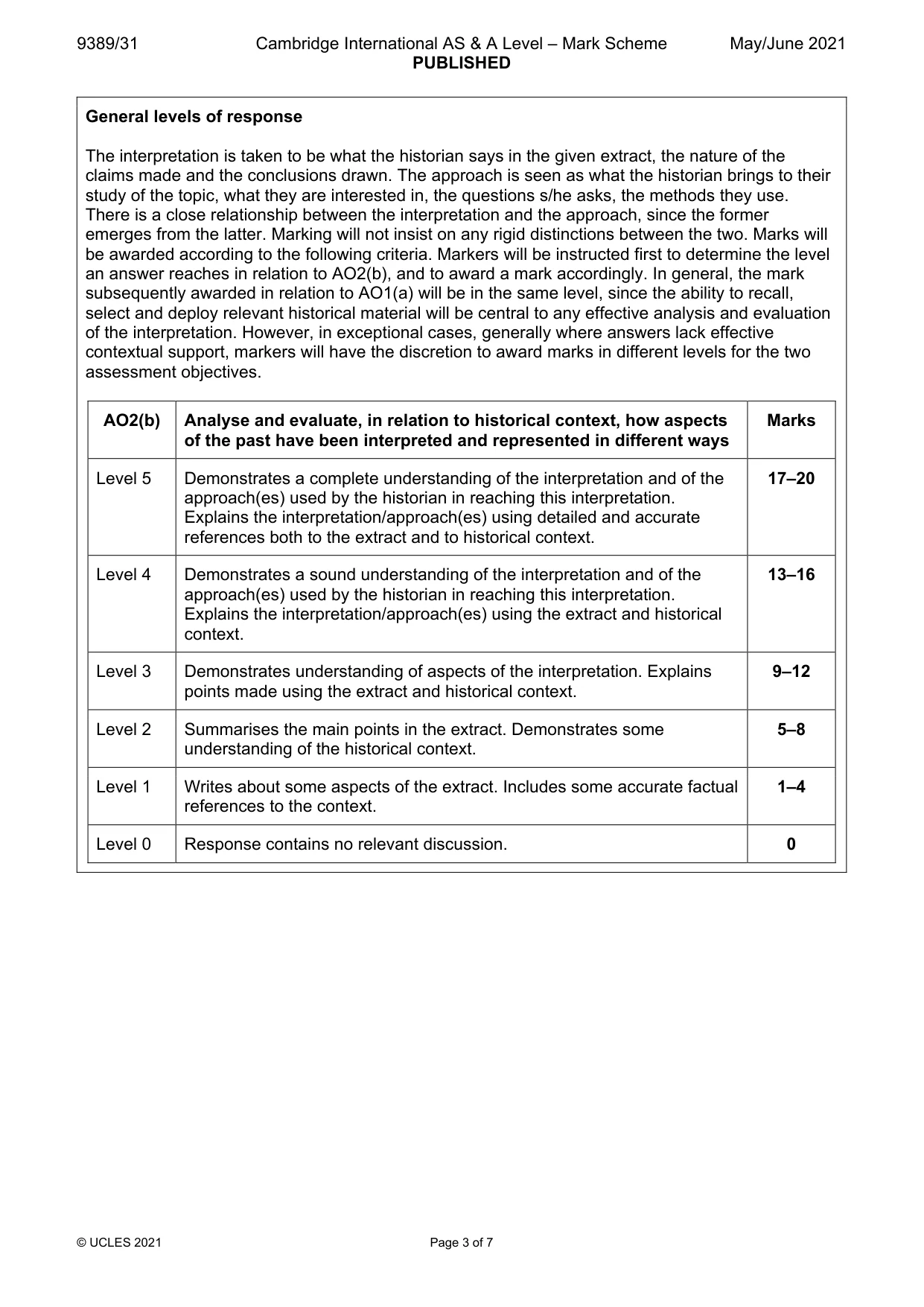
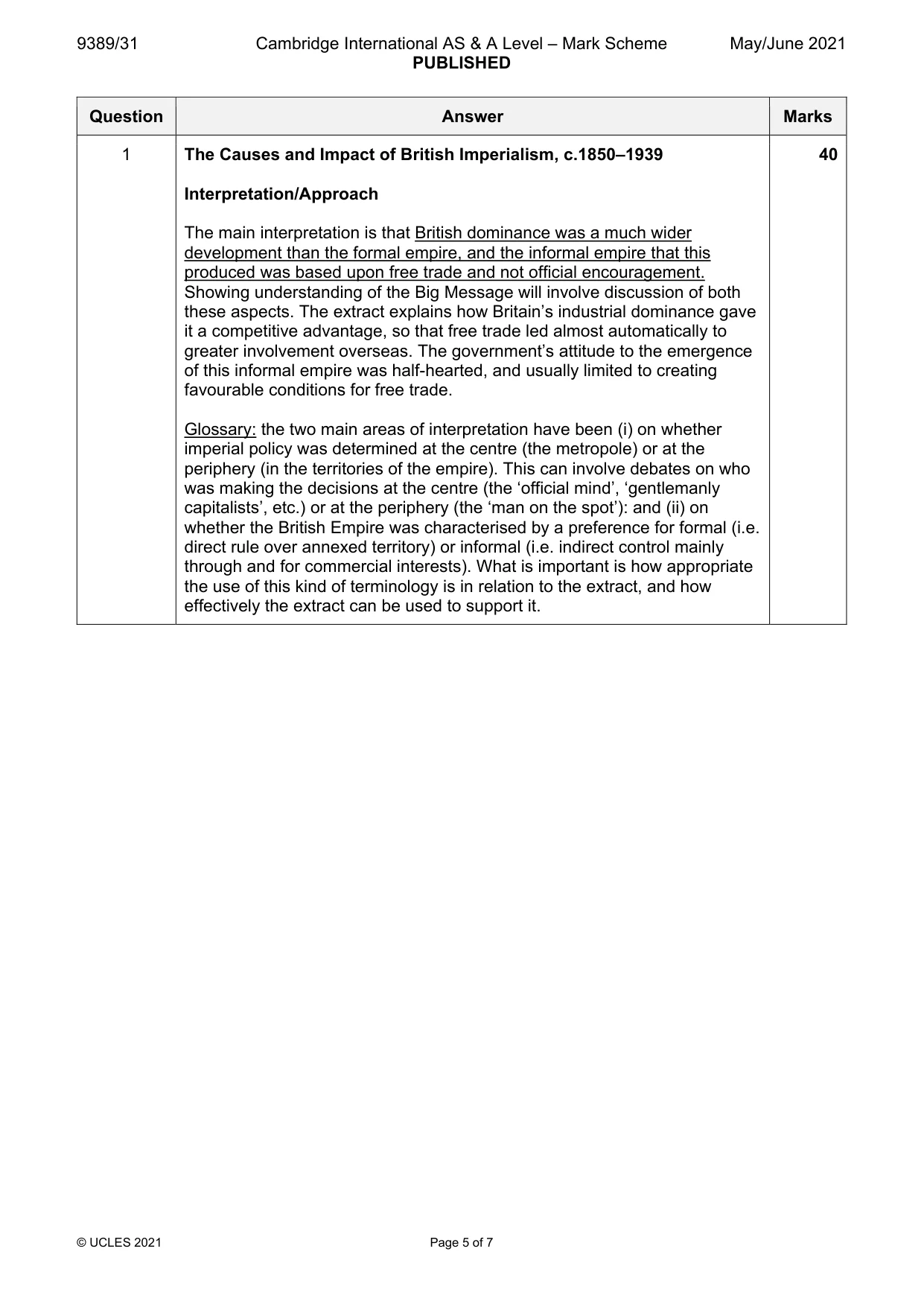
Mark scheme: Question Answer Marks 1 The Causes and Impact of British Imperialism, c.1850–1939 40 Interpretation/Approach The main interpretation is that British dominance was a much wider development than the formal empire, and the informal empire that this produced was based upon free trade and not official encouragement. Showing understanding of the Big Message will involve discussion of both these aspects. The extract explains how Britain’s industrial dominance gave it a competitive advantage, so that free trade led almost automatically to greater involvement overseas. The government’s attitude to the emergence of this informal empire was half-hearted, and usually limited to creating favourable conditions for free trade. Glossary: the two main areas of interpretation have been (i) on whether imperial policy was determined at the centre (the metropole) or at the periphery (in the territories of the empire). This can involve debates on who was making the decisions at the centre (the ‘official mind’, ‘gentlemanly capitalists’, etc.) or at the periphery (the ‘man on the spot’): and (ii) on whether the British Empire was characterised by a preference for formal (i.e. direct rule over annexed territory) or informal (i.e. indirect control mainly through and for commercial interests). What is important is how appropriate the use of this kind of terminology is in relation to the extract, and how effectively the extract can be used to support it.
Q2 · Read the extract and then answer the question
2 Read the extract and then answer the question. The largely negative public reaction to the Kristallnacht pogrom of November 1938 begs the vital question. If ‘ordinary’ Germans still disapproved of the breaking of shop windows, the burning of synagogues, and the beating of Jews in the streets, why were they willing just three years later to begin mass murdering Jews in eastern Europe? In terms of the level of violence, there was no comparison. On Polish territory the deportations would soon be characterised by widespread and highly visible ghetto-clearing operations that were mounted with tremendous violence and left the streets lined with corpses. How in three brief years had ‘ordinary’ Germans been transformed from onlookers, squeamish and disapproving of vandalism, arson and assault, into ‘willing executioners’ who could perpetrate mass murder with uncontrolled violence? Change in time and place was vitally important. After September 1939 Germany was at war. It would be no exaggeration to state that the single greatest consensus in the political culture of German society was the obligation to do one’s duty and support one’s country in time of war. This consensus was not invented by the Nazis, but it served them well. War in general meant the suspension of criticism, the temporary loss of the distinction between loyalty to country and loyalty to regime, the acceptance of demands for sacrifice and toughness, and a willingness to see the world as divided between friends and enemies. The Nazi leadership was well aware that war would create a favourable situation for carrying out policies that were impractical in peacetime. As Göring alerted the assembled Nazi leaders in the wake of Kristallnacht, ‘If, in some foreseeable future, an external conflict were to happen, it is obvious that we in Germany would also think first and foremost of carrying out a big settling of accounts with the Jews.’ Hitler in turn made this expectation quite public in his Reichstag ‘prophecy’ of January 1939, that world war would mean ‘the destruction of the Jewish race in Europe’. The conquest and partition of Poland in September 1939 was a major step in the creation of Nazi Germany’s eastern European empire, and offered a favourable site for the various policies of racial imperialism. Germans would be more transformed by what they saw and did in Poland than they had been by their experience of the domestic dictatorship in 1933–39. Refusal to accept the verdict of the First World War and unsatisfied imperial aspirations in eastern Europe, underpinned by notions of German racial and cultural superiority, were broadly-held sentiments in German society. They provided more common ground between the bulk of the German population and the Nazi regime than did anti-Semitism. The decision-making process leading to the Final Solution took place step by step and was influenced by the euphoria of military success on the one hand, and the frustration of unsatisfied expectations on the other. So were the ways in which the perpetrators reacted. It was in Poland above all that the Germans were urged to behave as the master race over those they felt were inferior native populations, and where they encountered in massive numbers the strange and alien eastern Jews so different from assimilated, middle-class German Jews. Here the corrupting process of racial imperialism could be launched most easily. Committed to Germany’s proclaimed mission of racial empire building in the east, German occupiers in Poland soon accepted and indeed advocated the notion that when they were finished remaking the demographic map of eastern Europe, no Jews would remain. The Jews in Poland, far more than the small and constantly declining number of assimilated Jews in Germany, posed a problem to be solved. What can you learn from this extract about the interpretation and approach of the historian who wrote it? Use the extract and your knowledge of the Holocaust to explain your answer. [40] Section C: Topic 3 The Origins and Development of the Cold War, 1941–1950
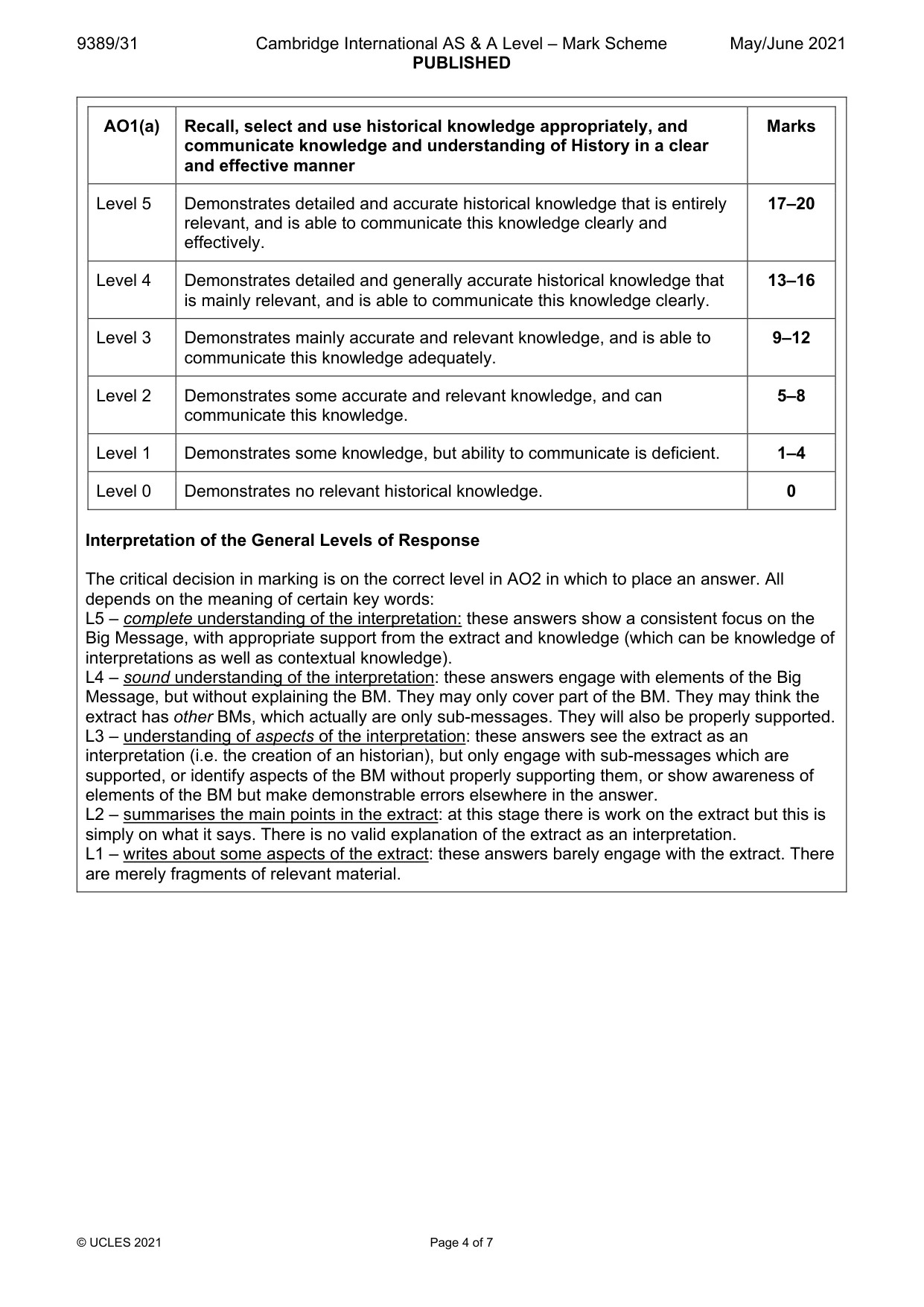
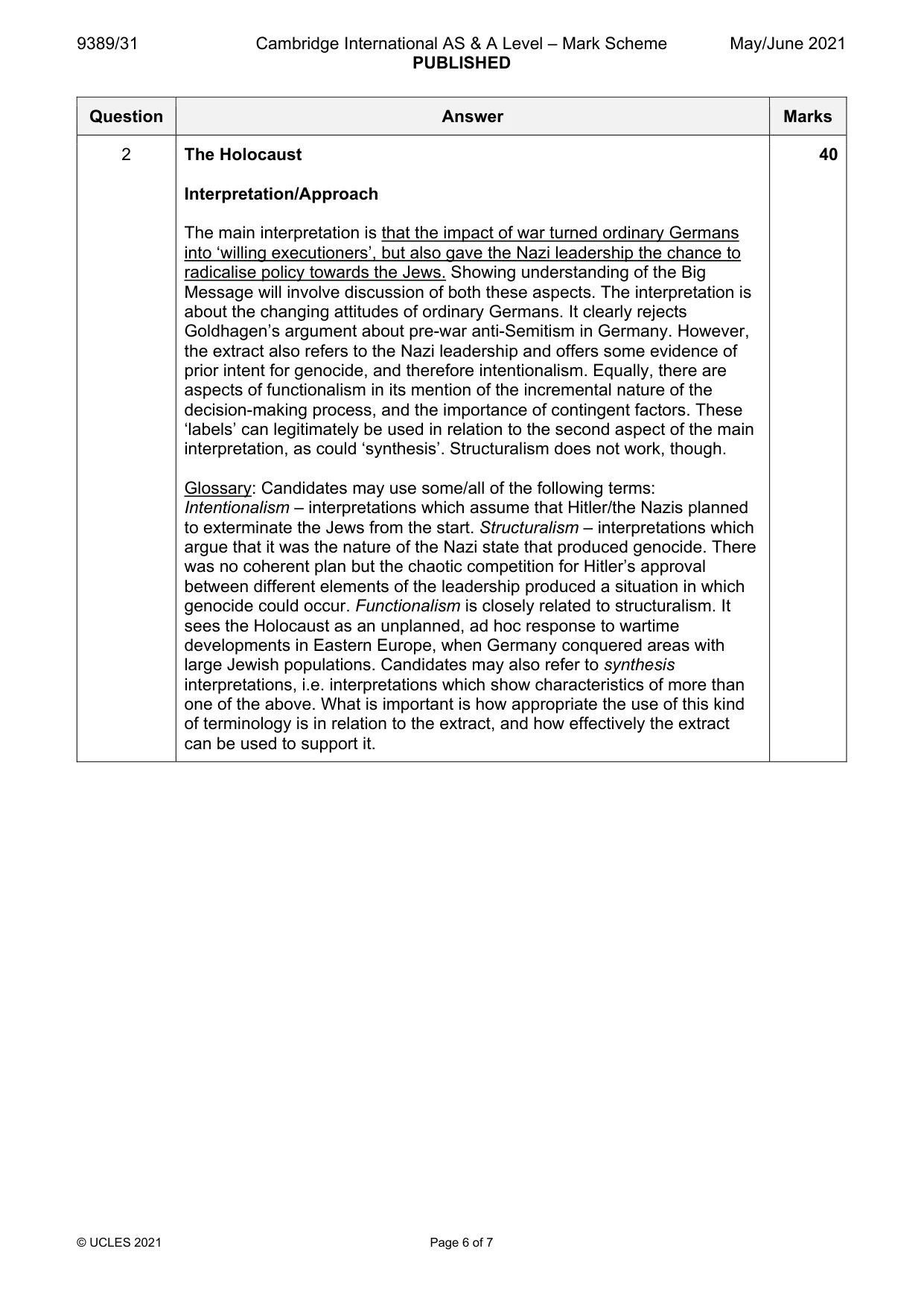
Mark scheme: 2 The Holocaust 40 Interpretation/Approach The main interpretation is that the impact of war turned ordinary Germans into ‘willing executioners’, but also gave the Nazi leadership the chance to radicalise policy towards the Jews. Showing understanding of the Big Message will involve discussion of both these aspects. The interpretation is about the changing attitudes of ordinary Germans. It clearly rejects Goldhagen’s argument about pre-war anti-Semitism in Germany. However, the extract also refers to the Nazi leadership and offers some evidence of prior intent for genocide, and therefore intentionalism. Equally, there are aspects of functionalism in its mention of the incremental nature of the decision-making process, and the importance of contingent factors. These ‘labels’ can legitimately be used in relation to the second aspect of the main interpretation, as could ‘synthesis’. Structuralism does not work, though. Glossary: Candidates may use some/all of the following terms: Intentionalism – interpretations which assume that Hitler/the Nazis planned to exterminate the Jews from the start. Structuralism – interpretations which argue that it was the nature of the Nazi state that produced genocide. There was no coherent plan but the chaotic competition for Hitler’s approval between different elements of the leadership produced a situation in which genocide could occur. Functionalism is closely related to structuralism. It sees the Holocaust as an unplanned, ad hoc response to wartime developments in Eastern Europe, when Germany conquered areas with large Jewish populations. Candidates may also refer to synthesis interpretations, i.e. interpretations which show characteristics of more than one of the above. What is important is how appropriate the use of this kind of terminology is in relation to the extract, and how effectively the extract can be used to support it.
Q3 · Read the extract and then answer the question
3 Read the extract and then answer the question. The origins of Cold War thinking from the Russian side are often interpreted in the West in a simplistic manner: that Stalin wanted to conquer the world and so switched from cooperation to confrontation. Alternatively the American revisionist school generally regards the Cold War as a bilateral process, with Stalin reacting to certain assertive actions by Washington. In the case of Stalin’s leadership, however, we are facing something more complicated than just expansionism or ‘reactions’. Stalin and Soviet bureaucrats who grew up under his rule shared a complex attitude toward the outside world that had its roots in Russian history, and in Marxism. It would be wrong to interpret Communist behaviour in the world arena simply in terms of either geopolitics or ideology. We prefer to see this conduct as the result of the interrelationship between imperial and ideological expansionism. Leaders were the driving force of the Soviet Union. Although social changes and the international environment were occasionally ignored by the Soviet leadership, none of them could disregard entirely the world around them. Stalin throughout his life carefully monitored the possible dangerous consequences of Western ideological influence upon his regime. Similarly, the problem of international security was never ignored during the Cold War years. A major issue concerns the extent to which the Soviet Union wanted the Cold War. Without a doubt the imperial tradition of Russia, reinforced by Marxist globalism, made Soviet expansionism inevitable. But the Cold War emerged from the ruins of World War II, and this hard fact raised three problems. First, there was the issue of the appropriate rewards for the Soviet contribution to the war. Of greatest importance in Europe, and recognised as such by Britain and the United States, the Soviet war effort had almost unimaginable costs. More than twenty-seven million people died – the majority of them young men between the ages of eighteen and thirty, but also women and children. The European sphere of the Soviet Union was devastated by the German war machine. Shouldn’t Stalin’s leadership expect special treatment from Western powers after such a sacrifice? And how did this expectation affect Soviet relations with the West after 1945 – be it concerning economic assistance (generous reparations from Germany, direct American aid) or recognised spheres of influence for the Soviet Union in Europe? Second, given the scale of human and material losses, the Soviet Union could not sustain the stress of another war. In this respect it is hard to imagine that Stalin could have deliberately chosen to pursue brinkmanship* with the West. The nuclear disability of the Soviet Union in 1945–49 also argues for the belief that Stalin’s original intention was to proceed with some kind of partnership with the West. Third, there was the issue of Soviet cooperation with the United States and Britain during the war. The tension this cooperation often produced did not prevent a search for solutions and even concessions on both sides. Could Stalin have believed that this intense interaction was to end abruptly as soon as the war was won? Or did this new mode of understanding based upon mutual compromise imply post-war cooperation? Nonetheless, the Soviet wartime experience did not in itself regulate Stalin’s attitude towards the West. There was also the closed, nationalistic nature of his regime. Stalin was aware that any openness toward the outside world could mean the seeds of political opposition within the Soviet Union. *Pursuing a dangerous policy to the limits of safety before stopping. What can you learn from this extract about the interpretation and approach of the historian who wrote it? Use the extract and your knowledge of the Cold War to explain your answer. [40]
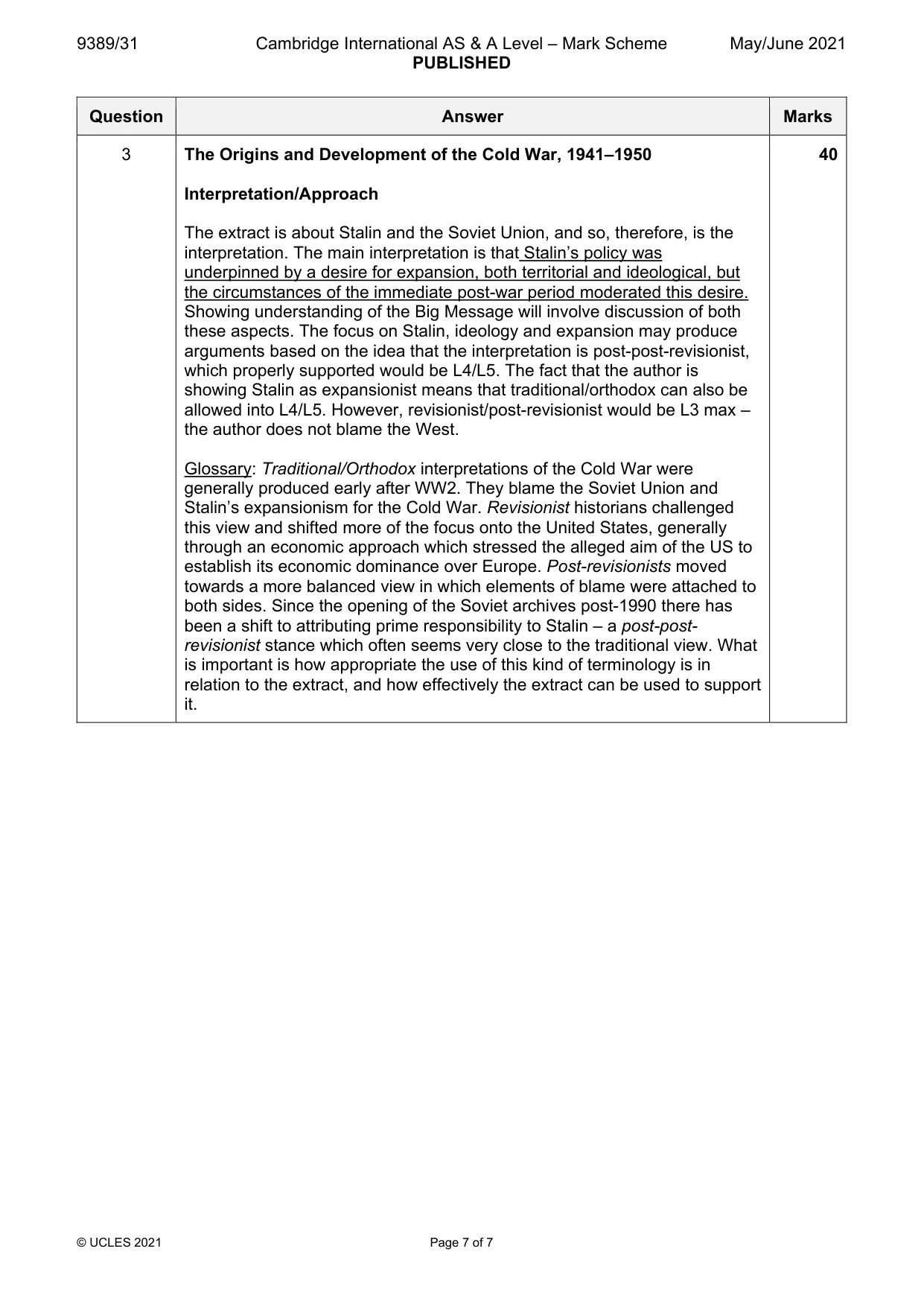
Mark scheme: 3 The Origins and Development of the Cold War, 1941–1950 40 Interpretation/Approach The extract is about Stalin and the Soviet Union, and so, therefore, is the interpretation. The main interpretation is that Stalin’s policy was underpinned by a desire for expansion, both territorial and ideological, but the circumstances of the immediate post-war period moderated this desire. Showing understanding of the Big Message will involve discussion of both these aspects. The focus on Stalin, ideology and expansion may produce arguments based on the idea that the interpretation is post-post-revisionist, which properly supported would be L4/L5. The fact that the author is showing Stalin as expansionist means that traditional/orthodox can also be allowed into L4/L5. However, revisionist/post-revisionist would be L3 max – the author does not blame the West. Glossary: Traditional/Orthodox interpretations of the Cold War were generally produced early after WW2. They blame the Soviet Union and Stalin’s expansionism for the Cold War. Revisionist historians challenged this view and shifted more of the focus onto the United States, generally through an economic approach which stressed the alleged aim of the US to establish its economic dominance over Europe. Post-revisionists moved towards a more balanced view in which elements of blame were attached to both sides. Since the opening of the Soviet archives post-1990 there has been a shift to attributing prime responsibility to Stalin – a post-post- revisionist stance which often seems very close to the traditional view. What is important is how appropriate the use of this kind of terminology is in relation to the extract, and how effectively the extract can be used to support it.
What you needed in this session
Cambridge’s own grade thresholds for 2021 May/June, Paper 3 · Variant 1. A higher threshold means an easier paper — the bar moves with how the cohort did.