Cambridge A Level History 9389 — 2020 May/June Paper 3 · Variant 1
9389/31/M/J/20 · 3 questions · 120 marks · ≈135 min
The question paper and its mark scheme, free to read here and free to download. This is Cambridge’s own paper, exactly as it was sat.
Question paper4 pages
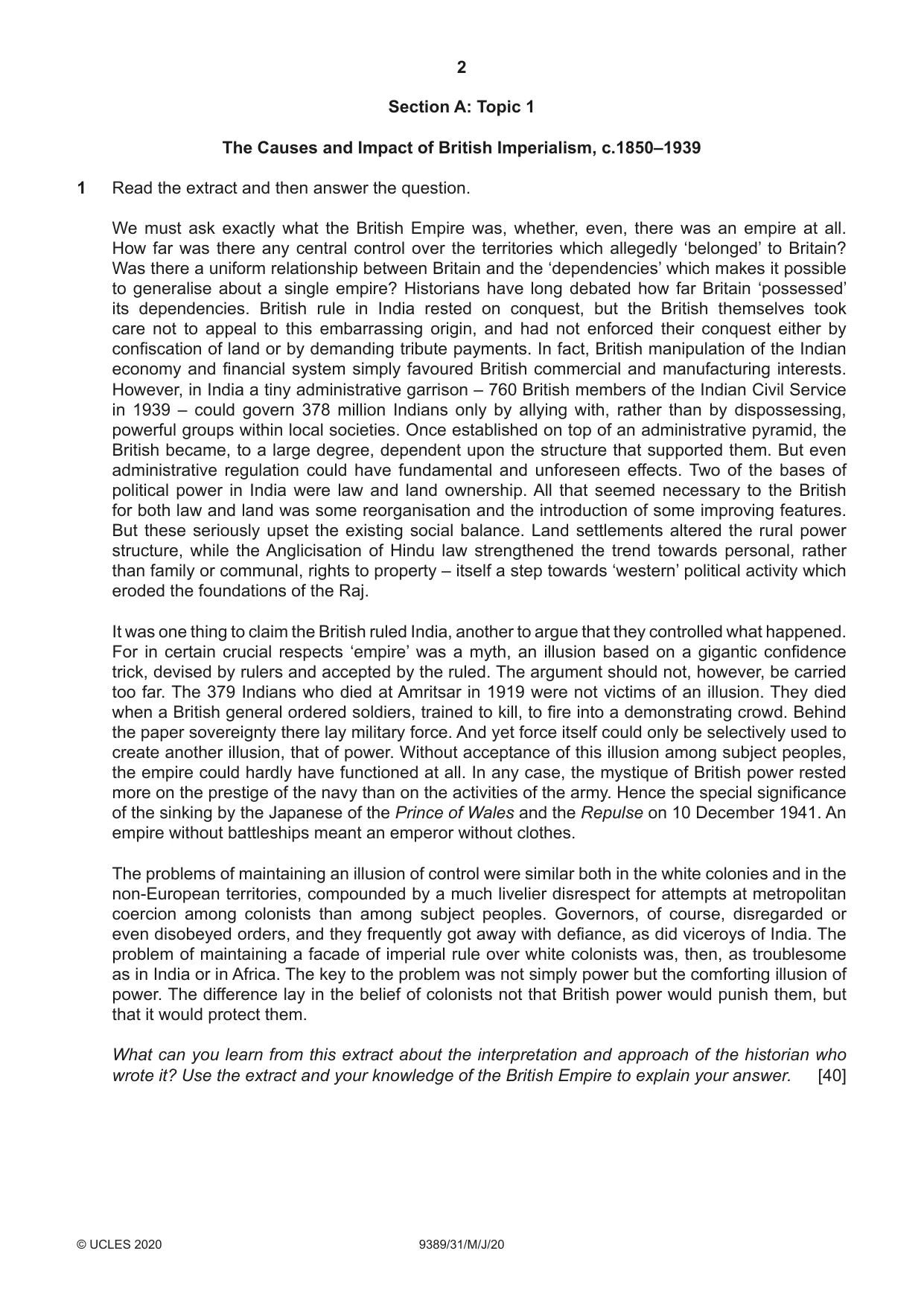
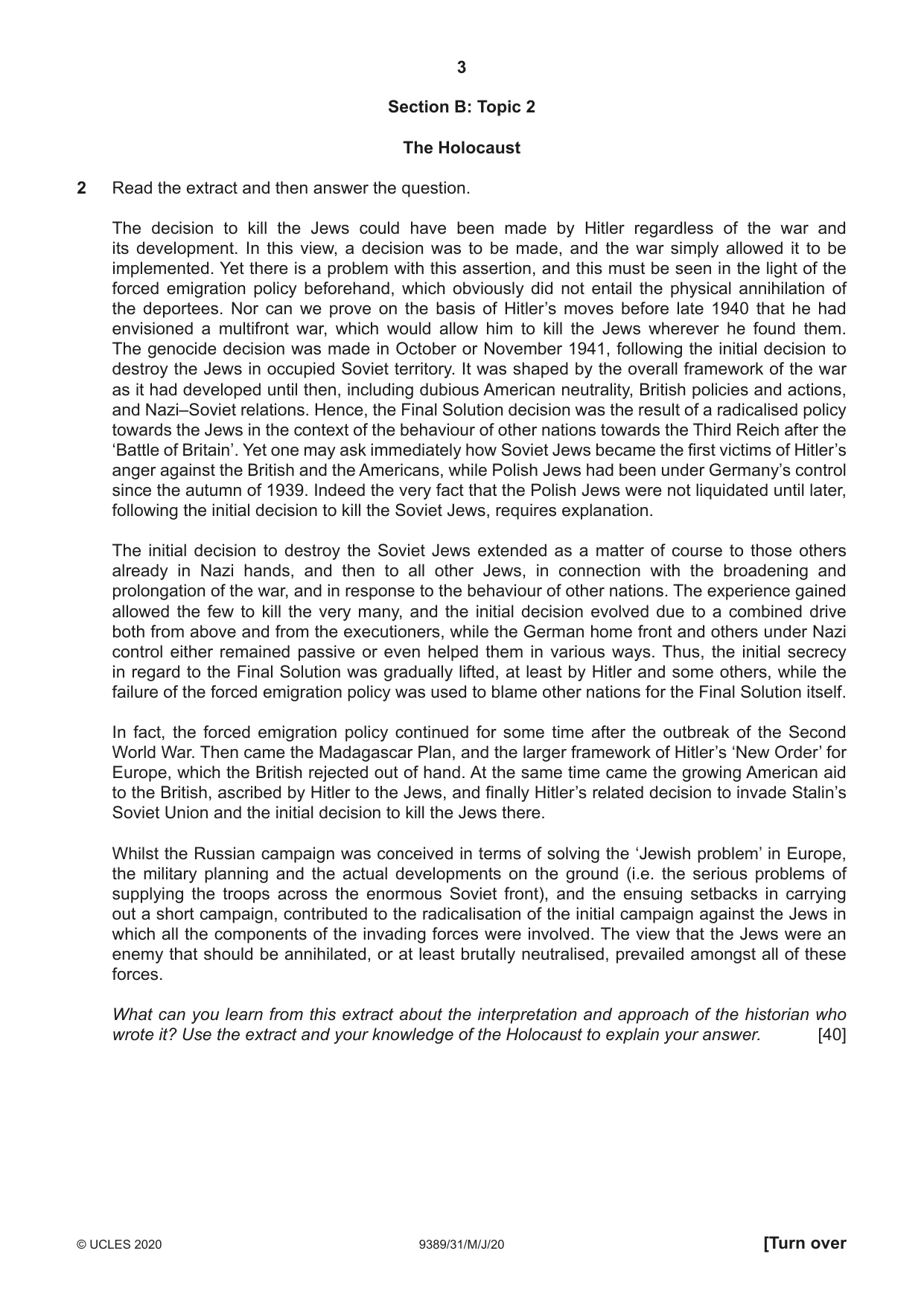
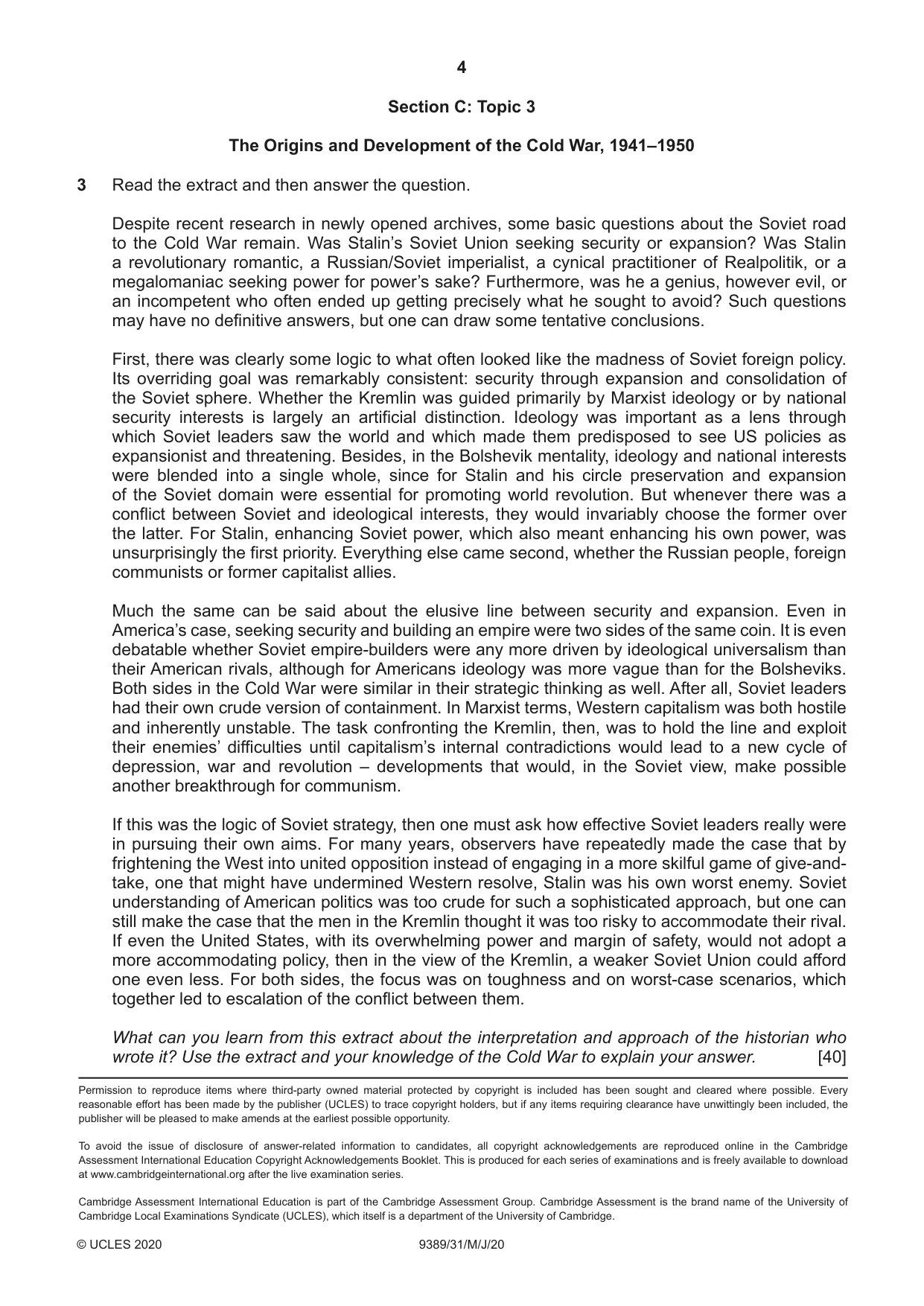
Mark scheme7 pages
Answers below. Sit the paper first if you are practising.
Questions as text
Q1 · Read the extract and then answer the question
1 Read the extract and then answer the question. We must ask exactly what the British Empire was, whether, even, there was an empire at all. How far was there any central control over the territories which allegedly ‘belonged’ to Britain? Was there a uniform relationship between Britain and the ‘dependencies’ which makes it possible to generalise about a single empire? Historians have long debated how far Britain ‘possessed’ its dependencies. British rule in India rested on conquest, but the British themselves took care not to appeal to this embarrassing origin, and had not enforced their conquest either by confiscation of land or by demanding tribute payments. In fact, British manipulation of the Indian economy and financial system simply favoured British commercial and manufacturing interests. However, in India a tiny administrative garrison – 760 British members of the Indian Civil Service in 1939 – could govern 378 million Indians only by allying with, rather than by dispossessing, powerful groups within local societies. Once established on top of an administrative pyramid, the British became, to a large degree, dependent upon the structure that supported them. But even administrative regulation could have fundamental and unforeseen effects. Two of the bases of political power in India were law and land ownership. All that seemed necessary to the British for both law and land was some reorganisation and the introduction of some improving features. But these seriously upset the existing social balance. Land settlements altered the rural power structure, while the Anglicisation of Hindu law strengthened the trend towards personal, rather than family or communal, rights to property – itself a step towards ‘western’ political activity which eroded the foundations of the Raj. It was one thing to claim the British ruled India, another to argue that they controlled what happened. For in certain crucial respects ‘empire’ was a myth, an illusion based on a gigantic confidence trick, devised by rulers and accepted by the ruled. The argument should not, however, be carried too far. The 379 Indians who died at Amritsar in 1919 were not victims of an illusion. They died when a British general ordered soldiers, trained to kill, to fire into a demonstrating crowd. Behind the paper sovereignty there lay military force. And yet force itself could only be selectively used to create another illusion, that of power. Without acceptance of this illusion among subject peoples, the empire could hardly have functioned at all. In any case, the mystique of British power rested more on the prestige of the navy than on the activities of the army. Hence the special significance of the sinking by the Japanese of the Prince of Wales and the Repulse on 10 December 1941. An empire without battleships meant an emperor without clothes. The problems of maintaining an illusion of control were similar both in the white colonies and in the non-European territories, compounded by a much livelier disrespect for attempts at metropolitan coercion among colonists than among subject peoples. Governors, of course, disregarded or even disobeyed orders, and they frequently got away with defiance, as did viceroys of India. The problem of maintaining a facade of imperial rule over white colonists was, then, as troublesome as in India or in Africa. The key to the problem was not simply power but the comforting illusion of power. The difference lay in the belief of colonists not that British power would punish them, but that it would protect them. What can you learn from this extract about the interpretation and approach of the historian who wrote it? Use the extract and your knowledge of the British Empire to explain your answer. [40]
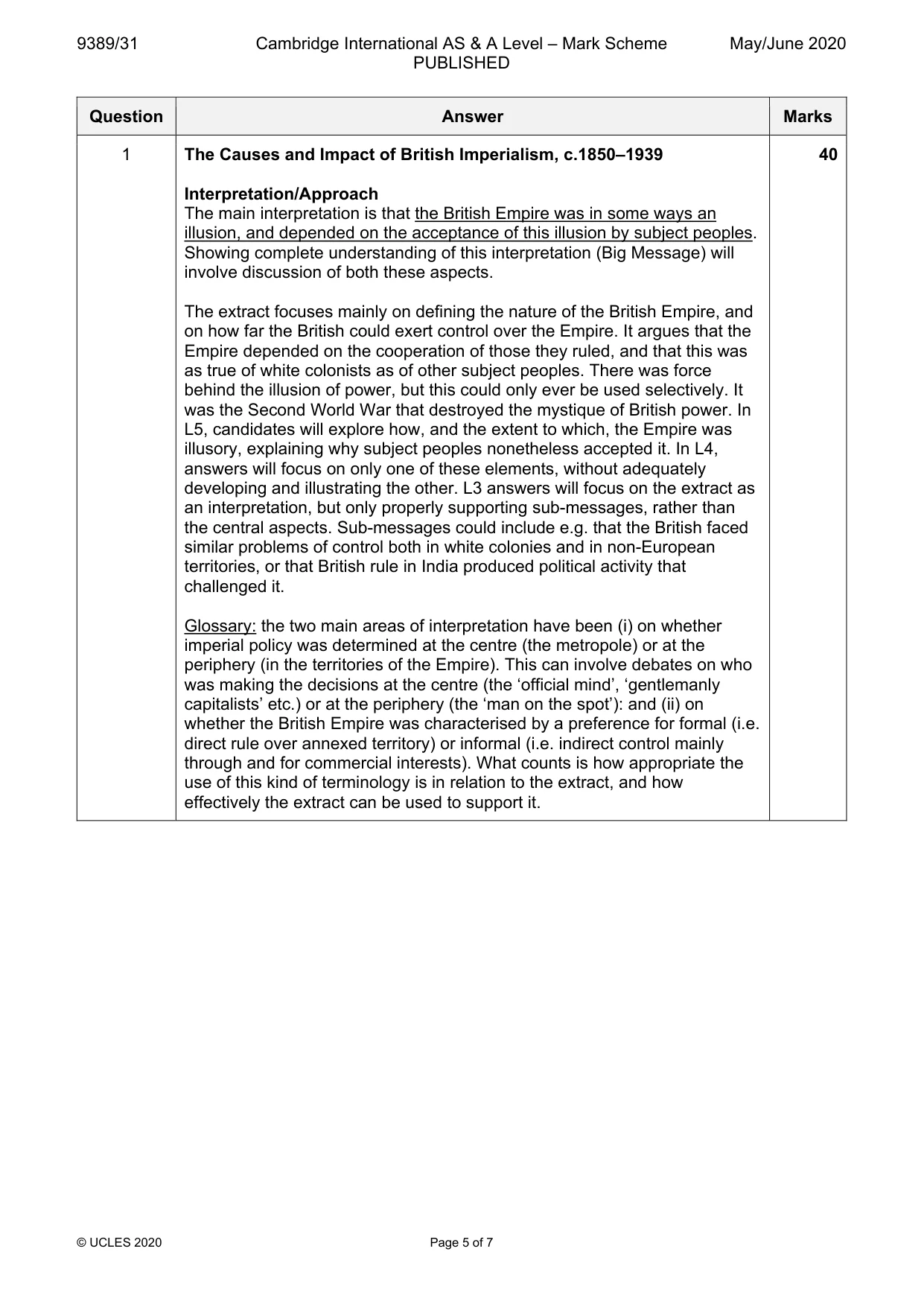
Mark scheme: Question Answer Marks 1 The Causes and Impact of British Imperialism, c.1850–1939 40 Interpretation/Approach The main interpretation is that the British Empire was in some ways an illusion, and depended on the acceptance of this illusion by subject peoples. Showing complete understanding of this interpretation (Big Message) will involve discussion of both these aspects. The extract focuses mainly on defining the nature of the British Empire, and on how far the British could exert control over the Empire. It argues that the Empire depended on the cooperation of those they ruled, and that this was as true of white colonists as of other subject peoples. There was force behind the illusion of power, but this could only ever be used selectively. It was the Second World War that destroyed the mystique of British power. In L5, candidates will explore how, and the extent to which, the Empire was illusory, explaining why subject peoples nonetheless accepted it. In L4, answers will focus on only one of these elements, without adequately developing and illustrating the other. L3 answers will focus on the extract as an interpretation, but only properly supporting sub-messages, rather than the central aspects. Sub-messages could include e.g. that the British faced similar problems of control both in white colonies and in non-European territories, or that British rule in India produced political activity that challenged it. Glossary: the two main areas of interpretation have been (i) on whether imperial policy was determined at the centre (the metropole) or at the periphery (in the territories of the Empire). This can involve debates on who was making the decisions at the centre (the ‘official mind’, ‘gentlemanly capitalists’ etc.) or at the periphery (the ‘man on the spot’): and (ii) on whether the British Empire was characterised by a preference for formal (i.e. direct rule over annexed territory) or informal (i.e. indirect control mainly through and for commercial interests). What counts is how appropriate the use of this kind of terminology is in relation to the extract, and how effectively the extract can be used to support it.
Q2 · Read the extract and then answer the question
2 Read the extract and then answer the question. The decision to kill the Jews could have been made by Hitler regardless of the war and its development. In this view, a decision was to be made, and the war simply allowed it to be implemented. Yet there is a problem with this assertion, and this must be seen in the light of the forced emigration policy beforehand, which obviously did not entail the physical annihilation of the deportees. Nor can we prove on the basis of Hitler’s moves before late 1940 that he had envisioned a multifront war, which would allow him to kill the Jews wherever he found them. The genocide decision was made in October or November 1941, following the initial decision to destroy the Jews in occupied Soviet territory. It was shaped by the overall framework of the war as it had developed until then, including dubious American neutrality, British policies and actions, and Nazi–Soviet relations. Hence, the Final Solution decision was the result of a radicalised policy towards the Jews in the context of the behaviour of other nations towards the Third Reich after the ‘Battle of Britain’. Yet one may ask immediately how Soviet Jews became the first victims of Hitler’s anger against the British and the Americans, while Polish Jews had been under Germany’s control since the autumn of 1939. Indeed the very fact that the Polish Jews were not liquidated until later, following the initial decision to kill the Soviet Jews, requires explanation. The initial decision to destroy the Soviet Jews extended as a matter of course to those others already in Nazi hands, and then to all other Jews, in connection with the broadening and prolongation of the war, and in response to the behaviour of other nations. The experience gained allowed the few to kill the very many, and the initial decision evolved due to a combined drive both from above and from the executioners, while the German home front and others under Nazi control either remained passive or even helped them in various ways. Thus, the initial secrecy in regard to the Final Solution was gradually lifted, at least by Hitler and some others, while the failure of the forced emigration policy was used to blame other nations for the Final Solution itself. In fact, the forced emigration policy continued for some time after the outbreak of the Second World War. Then came the Madagascar Plan, and the larger framework of Hitler’s ‘New Order’ for Europe, which the British rejected out of hand. At the same time came the growing American aid to the British, ascribed by Hitler to the Jews, and finally Hitler’s related decision to invade Stalin’s Soviet Union and the initial decision to kill the Jews there. Whilst the Russian campaign was conceived in terms of solving the ‘Jewish problem’ in Europe, the military planning and the actual developments on the ground (i.e. the serious problems of supplying the troops across the enormous Soviet front), and the ensuing setbacks in carrying out a short campaign, contributed to the radicalisation of the initial campaign against the Jews in which all the components of the invading forces were involved. The view that the Jews were an enemy that should be annihilated, or at least brutally neutralised, prevailed amongst all of these forces. What can you learn from this extract about the interpretation and approach of the historian who wrote it? Use the extract and your knowledge of the Holocaust to explain your answer. [40] Section C: Topic 3 The Origins and Development of the Cold War, 1941–1950
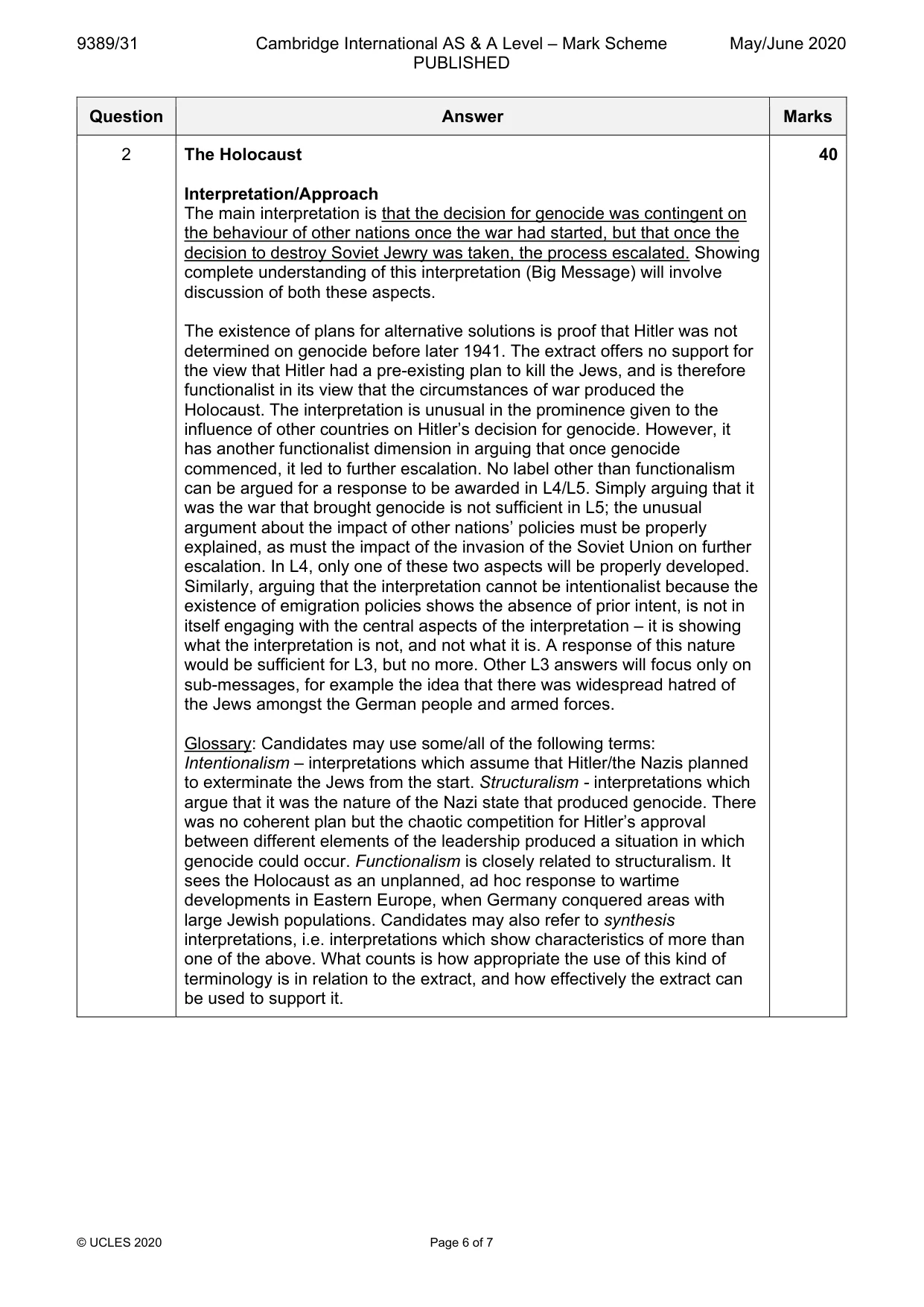
Mark scheme: 2 The Holocaust 40 Interpretation/Approach The main interpretation is that the decision for genocide was contingent on the behaviour of other nations once the war had started, but that once the decision to destroy Soviet Jewry was taken, the process escalated. Showing complete understanding of this interpretation (Big Message) will involve discussion of both these aspects. The existence of plans for alternative solutions is proof that Hitler was not determined on genocide before later 1941. The extract offers no support for the view that Hitler had a pre-existing plan to kill the Jews, and is therefore functionalist in its view that the circumstances of war produced the Holocaust. The interpretation is unusual in the prominence given to the influence of other countries on Hitler’s decision for genocide. However, it has another functionalist dimension in arguing that once genocide commenced, it led to further escalation. No label other than functionalism can be argued for a response to be awarded in L4/L5. Simply arguing that it was the war that brought genocide is not sufficient in L5; the unusual argument about the impact of other nations’ policies must be properly explained, as must the impact of the invasion of the Soviet Union on further escalation. In L4, only one of these two aspects will be properly developed. Similarly, arguing that the interpretation cannot be intentionalist because the existence of emigration policies shows the absence of prior intent, is not in itself engaging with the central aspects of the interpretation – it is showing what the interpretation is not, and not what it is. A response of this nature would be sufficient for L3, but no more. Other L3 answers will focus only on sub-messages, for example the idea that there was widespread hatred of the Jews amongst the German people and armed forces. Glossary: Candidates may use some/all of the following terms: Intentionalism – interpretations which assume that Hitler/the Nazis planned to exterminate the Jews from the start. Structuralism - interpretations which argue that it was the nature of the Nazi state that produced genocide. There was no coherent plan but the chaotic competition for Hitler’s approval between different elements of the leadership produced a situation in which genocide could occur. Functionalism is closely related to structuralism. It sees the Holocaust as an unplanned, ad hoc response to wartime developments in Eastern Europe, when Germany conquered areas with large Jewish populations. Candidates may also refer to synthesis interpretations, i.e. interpretations which show characteristics of more than one of the above. What counts is how appropriate the use of this kind of terminology is in relation to the extract, and how effectively the extract can be used to support it.
Q3 · Read the extract and then answer the question
3 Read the extract and then answer the question. Despite recent research in newly opened archives, some basic questions about the Soviet road to the Cold War remain. Was Stalin’s Soviet Union seeking security or expansion? Was Stalin a revolutionary romantic, a Russian/Soviet imperialist, a cynical practitioner of Realpolitik, or a megalomaniac seeking power for power’s sake? Furthermore, was he a genius, however evil, or an incompetent who often ended up getting precisely what he sought to avoid? Such questions may have no definitive answers, but one can draw some tentative conclusions. First, there was clearly some logic to what often looked like the madness of Soviet foreign policy. Its overriding goal was remarkably consistent: security through expansion and consolidation of the Soviet sphere. Whether the Kremlin was guided primarily by Marxist ideology or by national security interests is largely an artificial distinction. Ideology was important as a lens through which Soviet leaders saw the world and which made them predisposed to see US policies as expansionist and threatening. Besides, in the Bolshevik mentality, ideology and national interests were blended into a single whole, since for Stalin and his circle preservation and expansion of the Soviet domain were essential for promoting world revolution. But whenever there was a conflict between Soviet and ideological interests, they would invariably choose the former over the latter. For Stalin, enhancing Soviet power, which also meant enhancing his own power, was unsurprisingly the first priority. Everything else came second, whether the Russian people, foreign communists or former capitalist allies. Much the same can be said about the elusive line between security and expansion. Even in America’s case, seeking security and building an empire were two sides of the same coin. It is even debatable whether Soviet empire-builders were any more driven by ideological universalism than their American rivals, although for Americans ideology was more vague than for the Bolsheviks. Both sides in the Cold War were similar in their strategic thinking as well. After all, Soviet leaders had their own crude version of containment. In Marxist terms, Western capitalism was both hostile and inherently unstable. The task confronting the Kremlin, then, was to hold the line and exploit their enemies’ difficulties until capitalism’s internal contradictions would lead to a new cycle of depression, war and revolution – developments that would, in the Soviet view, make possible another breakthrough for communism. If this was the logic of Soviet strategy, then one must ask how effective Soviet leaders really were in pursuing their own aims. For many years, observers have repeatedly made the case that by frightening the West into united opposition instead of engaging in a more skilful game of give-and- take, one that might have undermined Western resolve, Stalin was his own worst enemy. Soviet understanding of American politics was too crude for such a sophisticated approach, but one can still make the case that the men in the Kremlin thought it was too risky to accommodate their rival. If even the United States, with its overwhelming power and margin of safety, would not adopt a more accommodating policy, then in the view of the Kremlin, a weaker Soviet Union could afford one even less. For both sides, the focus was on toughness and on worst-case scenarios, which together led to escalation of the conflict between them. What can you learn from this extract about the interpretation and approach of the historian who wrote it? Use the extract and your knowledge of the Cold War to explain your answer. [40]
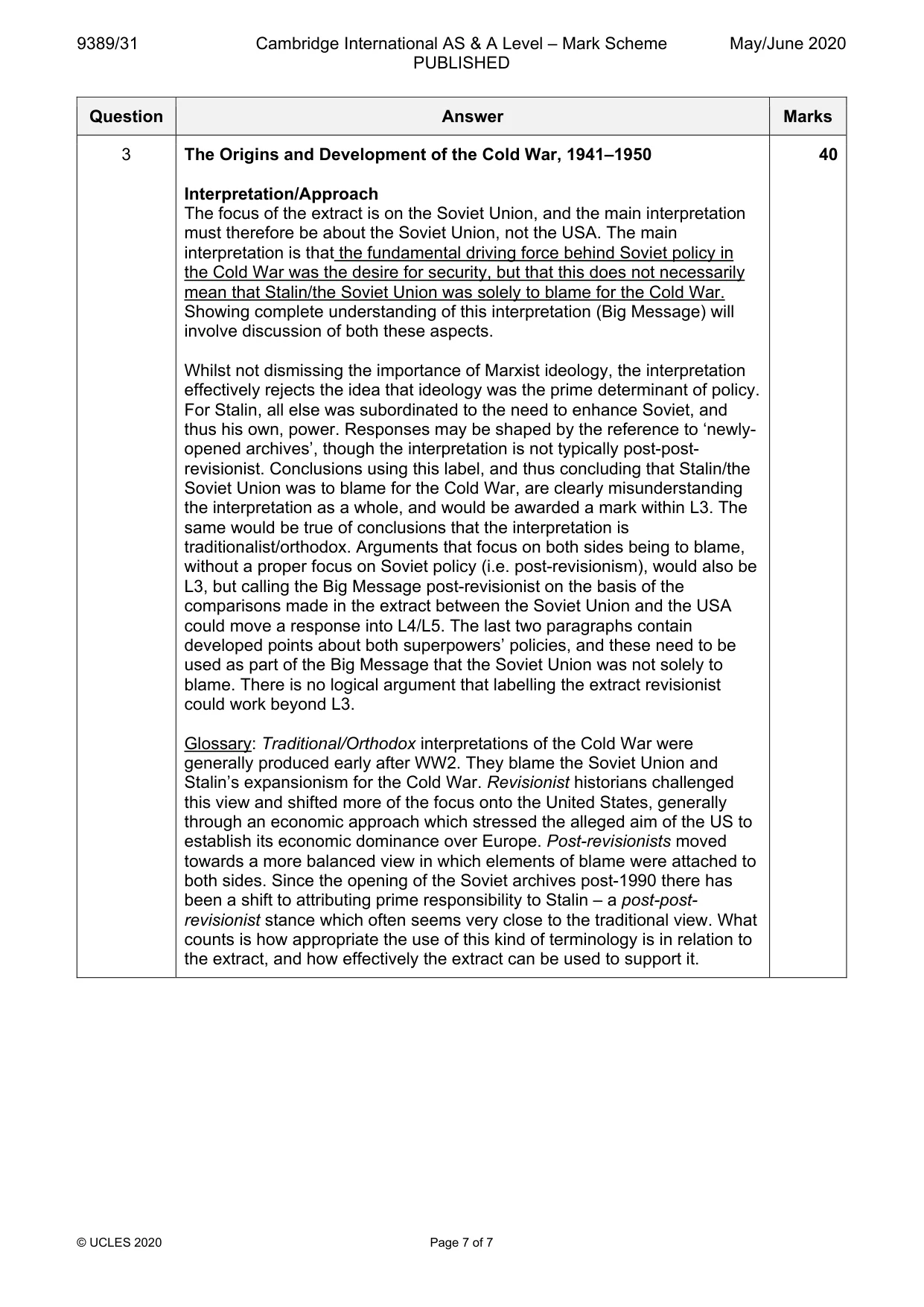
Mark scheme: 3 The Origins and Development of the Cold War, 1941–1950 40 Interpretation/Approach The focus of the extract is on the Soviet Union, and the main interpretation must therefore be about the Soviet Union, not the USA. The main interpretation is that the fundamental driving force behind Soviet policy in the Cold War was the desire for security, but that this does not necessarily mean that Stalin/the Soviet Union was solely to blame for the Cold War. Showing complete understanding of this interpretation (Big Message) will involve discussion of both these aspects. Whilst not dismissing the importance of Marxist ideology, the interpretation effectively rejects the idea that ideology was the prime determinant of policy. For Stalin, all else was subordinated to the need to enhance Soviet, and thus his own, power. Responses may be shaped by the reference to ‘newly- opened archives’, though the interpretation is not typically post-post- revisionist. Conclusions using this label, and thus concluding that Stalin/the Soviet Union was to blame for the Cold War, are clearly misunderstanding the interpretation as a whole, and would be awarded a mark within L3. The same would be true of conclusions that the interpretation is traditionalist/orthodox. Arguments that focus on both sides being to blame, without a proper focus on Soviet policy (i.e. post-revisionism), would also be L3, but calling the Big Message post-revisionist on the basis of the comparisons made in the extract between the Soviet Union and the USA could move a response into L4/L5. The last two paragraphs contain developed points about both superpowers’ policies, and these need to be used as part of the Big Message that the Soviet Union was not solely to blame. There is no logical argument that labelling the extract revisionist could work beyond L3. Glossary: Traditional/Orthodox interpretations of the Cold War were generally produced early after WW2. They blame the Soviet Union and Stalin’s expansionism for the Cold War. Revisionist historians challenged this view and shifted more of the focus onto the United States, generally through an economic approach which stressed the alleged aim of the US to establish its economic dominance over Europe. Post-revisionists moved towards a more balanced view in which elements of blame were attached to both sides. Since the opening of the Soviet archives post-1990 there has been a shift to attributing prime responsibility to Stalin – a post-post- revisionist stance which often seems very close to the traditional view. What counts is how appropriate the use of this kind of terminology is in relation to the extract, and how effectively the extract can be used to support it.