Cambridge A Level History 9389 — 2019 May/June Paper 2 · Variant 1
9389/21/M/J/19 · 12 questions · 60 marks · ≈68 min
The question paper and its mark scheme, free to read here and free to download. This is Cambridge’s own paper, exactly as it was sat.
Question paper4 pages
Mark scheme28 pages
Answers below. Sit the paper first if you are practising.
Questions as text
Q1 · France, 1789–1814 (a) Why was the Tennis Court Oath taken?
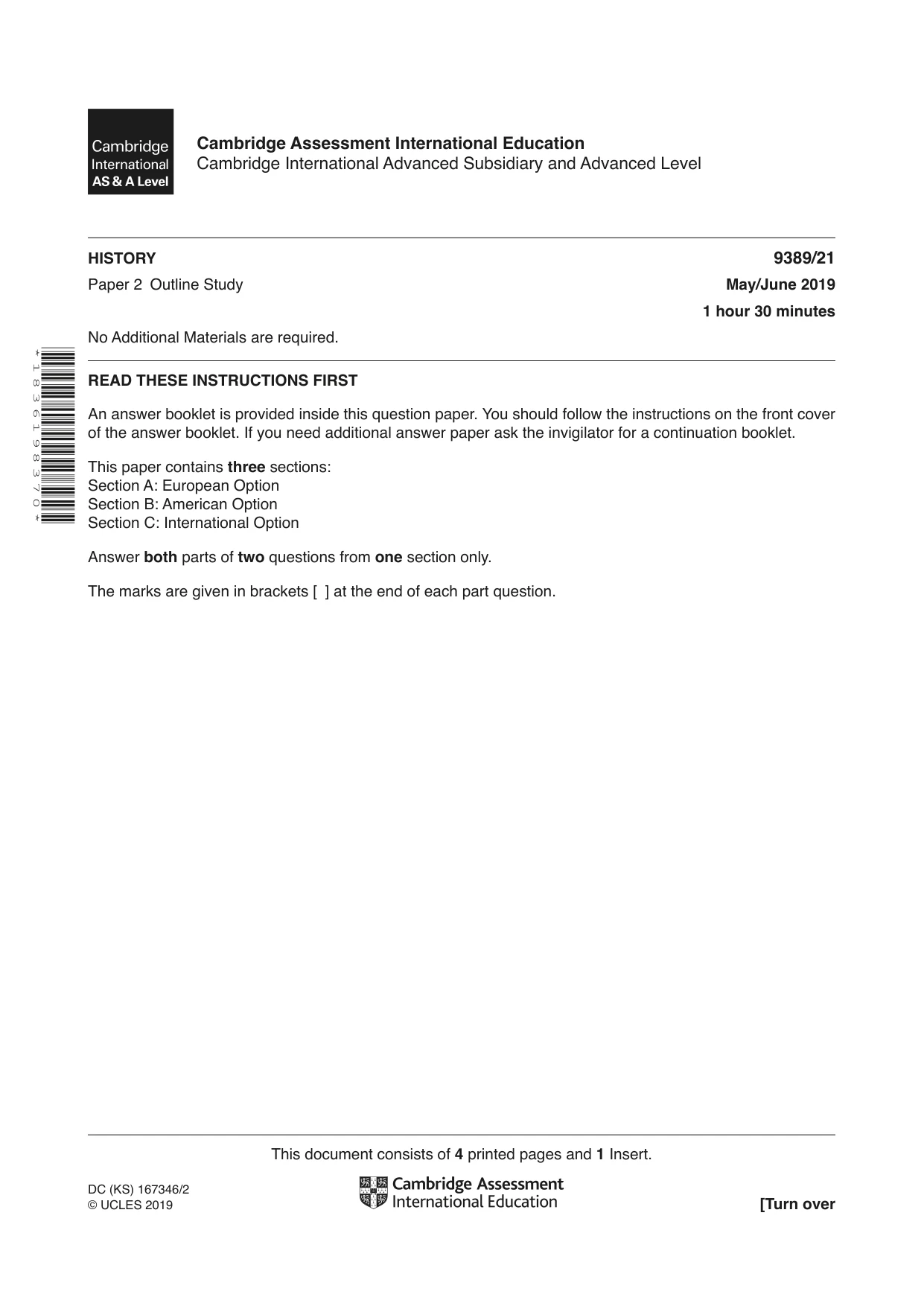
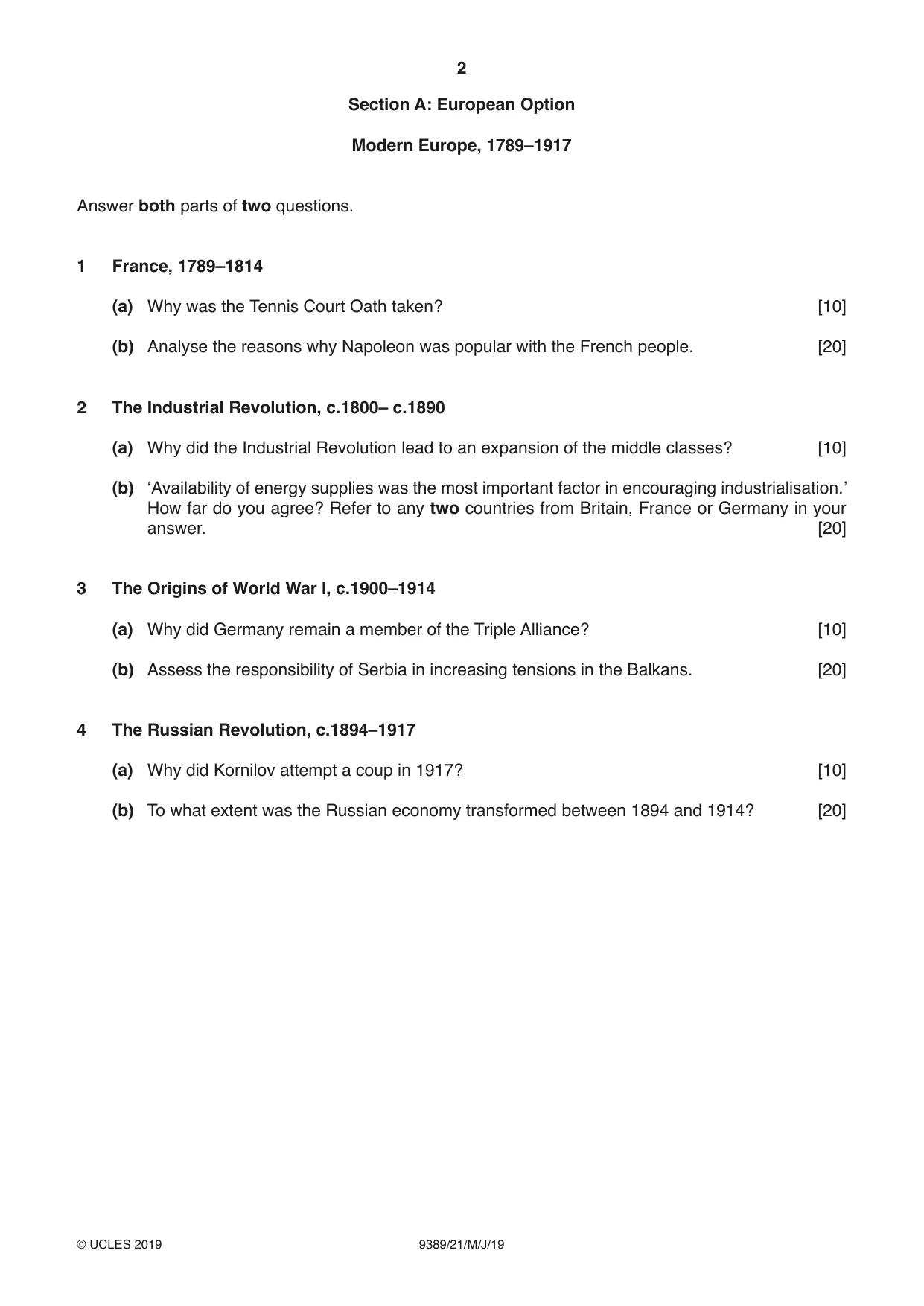
1 France, 1789–1814 (a) Why was the Tennis Court Oath taken? [10] (b) Analyse the reasons why Napoleon was popular with the French people. [20]
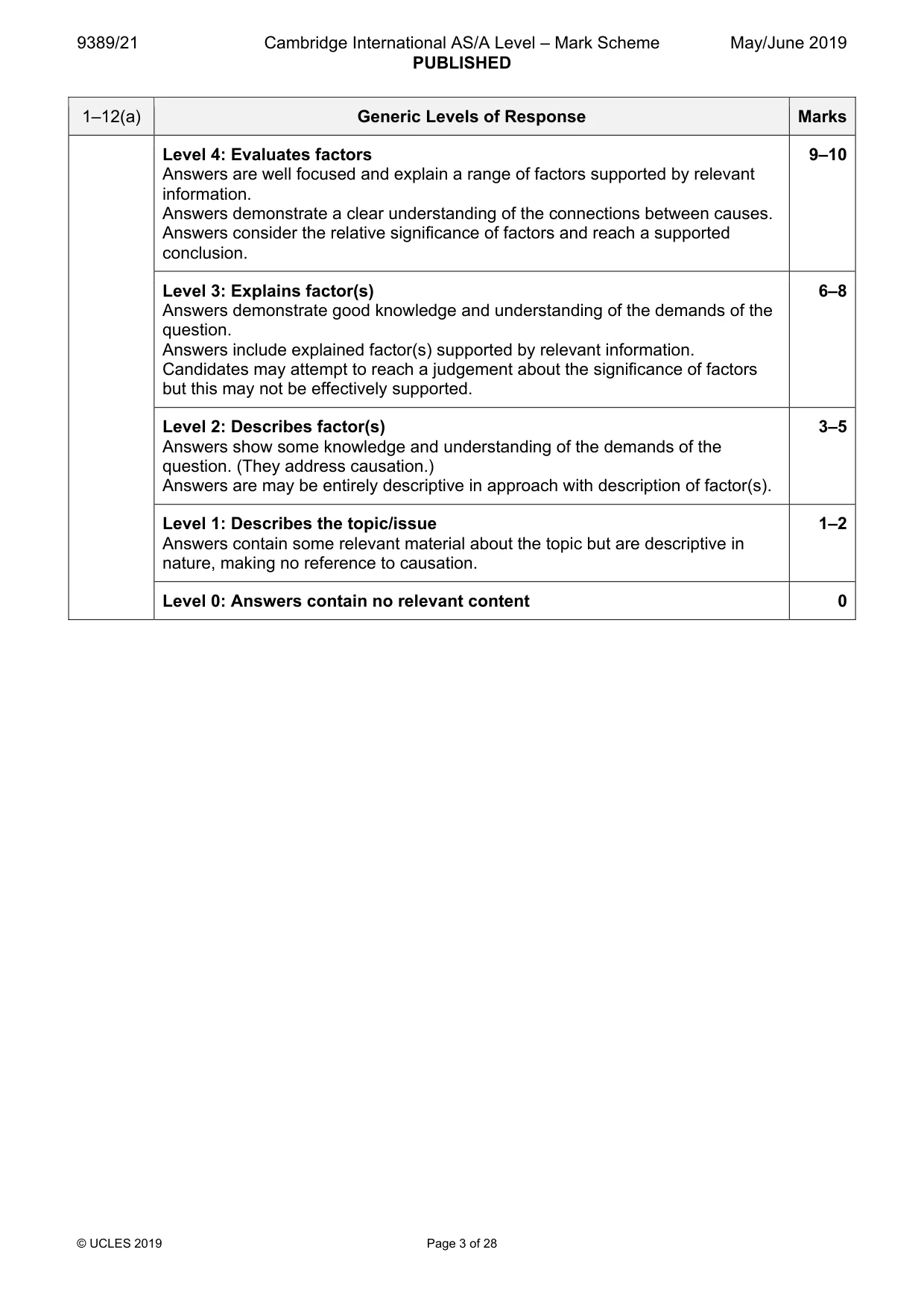
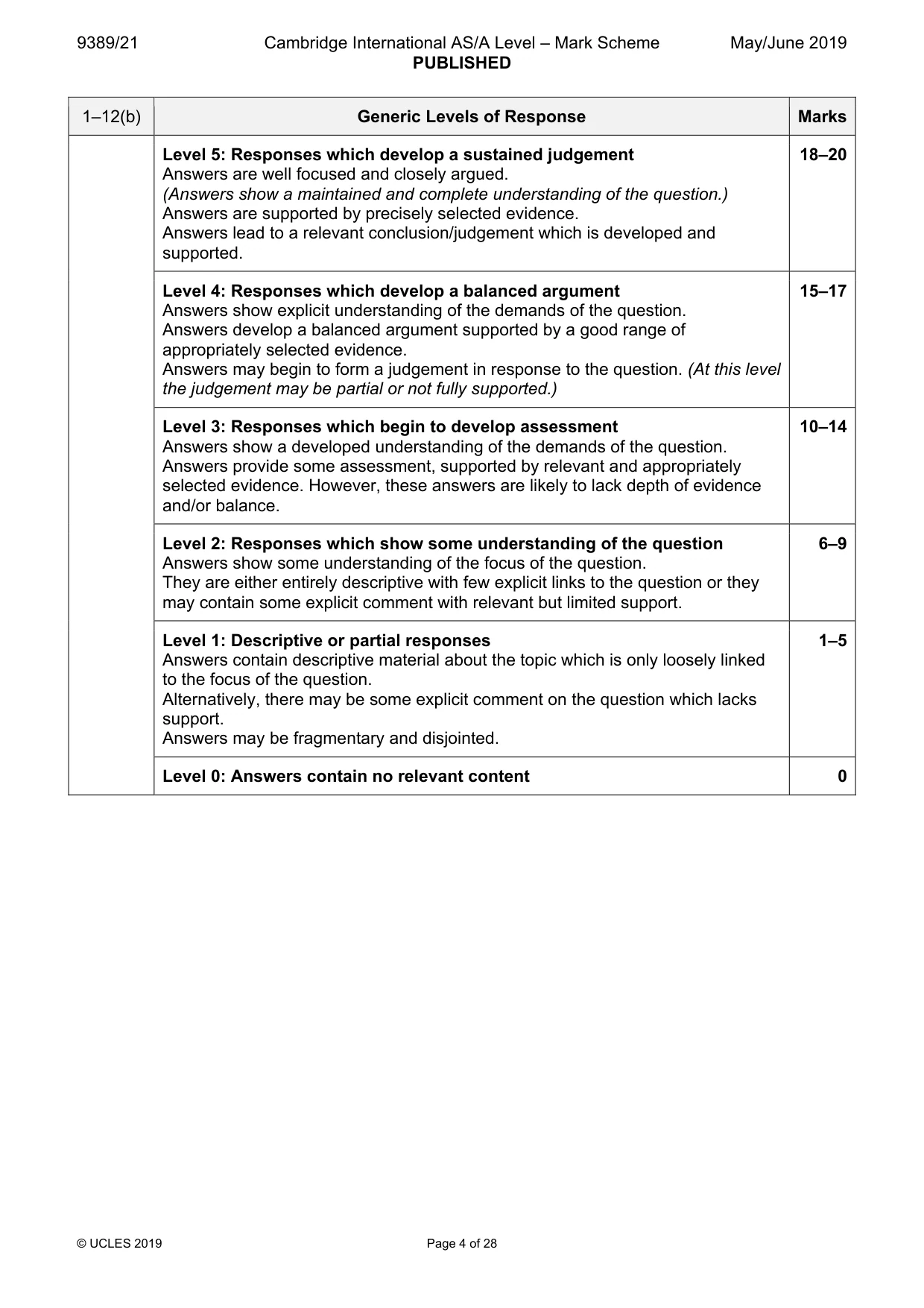
Mark scheme: Question Answer Marks 1(a) Why was the Tennis Court Oath taken? 10 • Louis XVI was experiencing financial problems. He called a meeting of the Estates-General in May 1789 which represented the three Estates (the Clergy, the Nobles and the Third Estate). • The Estates-General had not been called since 1614 and the deputies called for social, economic and political reform and drew up a long list of grievances. However, they argued about whether they would vote by head or order. The third estate would outnumber the other two if they voted by head. This produced a deadlock as the King offered only weak support to the First and Second Estates but did not make any decisions or enforce his own will. • On 17 June 1789, the Third Estate, joined by some clergy and nobles, began to call themselves the National Assembly, but on 20 June they discovered that they had been locked out of the Chamber and, fearing a royal attack, the deputies adjourned to the nearest building, a tennis court. Here they took the Tennis Court Oath and vowed that they would not separate and continue to meet until ‘the constitution of the kingdom is established’. • The Tennis Court Oath was taken by the Third Estate to show their solidarity and determination that the King should make concessions. It was a sign of their protest. • The oath can be seen as a revolutionary act and an assertion that political authority derived from the people and their representatives rather than the monarch himself. 1(b) Analyse the reasons why Napoleon was popular with the French people. 20 He was a successful general with a great capacity for self-promotion which appealed to many. That was important in getting him noticed initially, and it was also important to an extent in his retention of power. The great victories at Austerlitz (1805) and Jena (1806) also helped to confirm his position. However, even after France started losing battles in Spain, Russia, Saxony (battle of Leipzig, 1813) and then nearer home at Toulouse (1814), Napoleon still managed to arouse tremendous admiration and retain great support in France. Reaction against the failings of the Directory and the many excesses of the revolutionary period also played a part. He represented stability (after a while) but also a degree of continuity. He cleverly adopted the ‘best’ of the French Revolution while discarding the unpopular extremes such as the Terror and the Dechristianisation programme. He dealt with the hostility of the Catholics by making a Concordat with the Pope in 1801. The Roman Catholic Church was the majority church of France, again with civil status. He selected the bishops and supervised the church’s finances, which pacified the revolutionaries. He was an effective propagandist and in 1802, he instituted the Legion of Honour to encourage civilian and military achievements. He instituted the French Civil Code in 1804. This code forbade privileges based on birth, allowed freedom of religion and stated that the most qualified must be given government jobs. It gave legal sanction to some of the important legal developments of the 1790s – confirming the abolition of feudalism and giving fixed legal title to those who had earlier purchased confiscated church, crown and émigré property. He was a proponent of equality before the law, property rights, education and sound finances. He also set up efficient local administration and infrastructure was improved, and the price and availability of bread helped to keep peasant support. He sought to ensure that the grievances which had been felt by so many before 1789 did not return. Arguably it was his version of ‘enlightened despotism’ which really worked.
Q2 · The Industrial Revolution, c.1800– c.1890 (a) Why did the Industrial Revolution lead to…
2 The Industrial Revolution, c.1800– c.1890 (a) Why did the Industrial Revolution lead to an expansion of the middle classes? [10] (b) ‘Availability of energy supplies was the most important factor in encouraging industrialisation.’ How far do you agree? Refer to any two countries from Britain, France or Germany in your answer. [20]
Mark scheme: 2(a) Why did the Industrial Revolution lead to an expansion of the middle 10 classes? • A primarily agricultural/subsistence economy had little need of what have come to be seen as the usual middle-class occupations. There were the landowners and the peasants who worked the land. • Once industrialisation grew rapidly, then scope for those ‘middle class’ professions grew exponentially. Factories needed managers. Canals and railroads needed engineers, lawyers, as well as managers to run them. • The expansion of industry and overseas trade led to the growth of banks and financial institutions which required managers and professional people to run them. • Greater emphasis was placed on education which encouraged a growth in the number of teachers and academics. • The huge growth in commerce led to a growing number of those involved in shipping and retail, both areas dominated at the top by members of the new ‘middle class’. 2(b) ‘Availability of energy supplies was the most important factor in 20 encouraging industrialisation.’ How far do you agree? Refer to any two countries from Britain, France or Germany in your answer. The availability of energy, usually in the form of coal or water, was important. Without it, little could happen. In the UK, it was supplies of water initially, to drive the mills in the North West, which were important for mass production to start. With large amounts of coal readily available in the UK, and transporting it becoming increasingly easy, the industrialisation process accelerated rapidly and the vast majority of all industrial plants by 1790 were coal fired. The availability of cheap coal was also vital for the evolution of the iron and steel industries as well as railroads in the UK. Much the same occurred in both France and Germany. The French had substantial coal and iron ore reserves in the North and that is where industrialisation took place. The German heavy industry development of the later 19th century took place in the Ruhr, again where much of its coal and iron ore came from. Almost every major innovation in the period, from the spinning jenny, through the steam engine to the innovations of Bessemer, depended on a good supply of cheap energy. However, a large number of other causative factors need to be considered. A continuing rise in population size, in part a product of the Agricultural Revolution, created demand. A willingness to innovate and reward the entrepreneur was also important. There had to be the availability of capital and an effective banking system and a government at least sympathetic to the growth of industry and capitalism. Without good transport to import and export and satisfy a growing demand, little could happen. Therefore, while energy supplies were vital, without the demand, the entrepreneurs, a good workforce and transport, industrialisation would not have happened on such a large scale.
Q3 · The Origins of World War I, c.1900–1914 (a) Why did Germany remain a member of the Triple…
3 The Origins of World War I, c.1900–1914 (a) Why did Germany remain a member of the Triple Alliance? [10] (b) Assess the responsibility of Serbia in increasing tensions in the Balkans. [20]
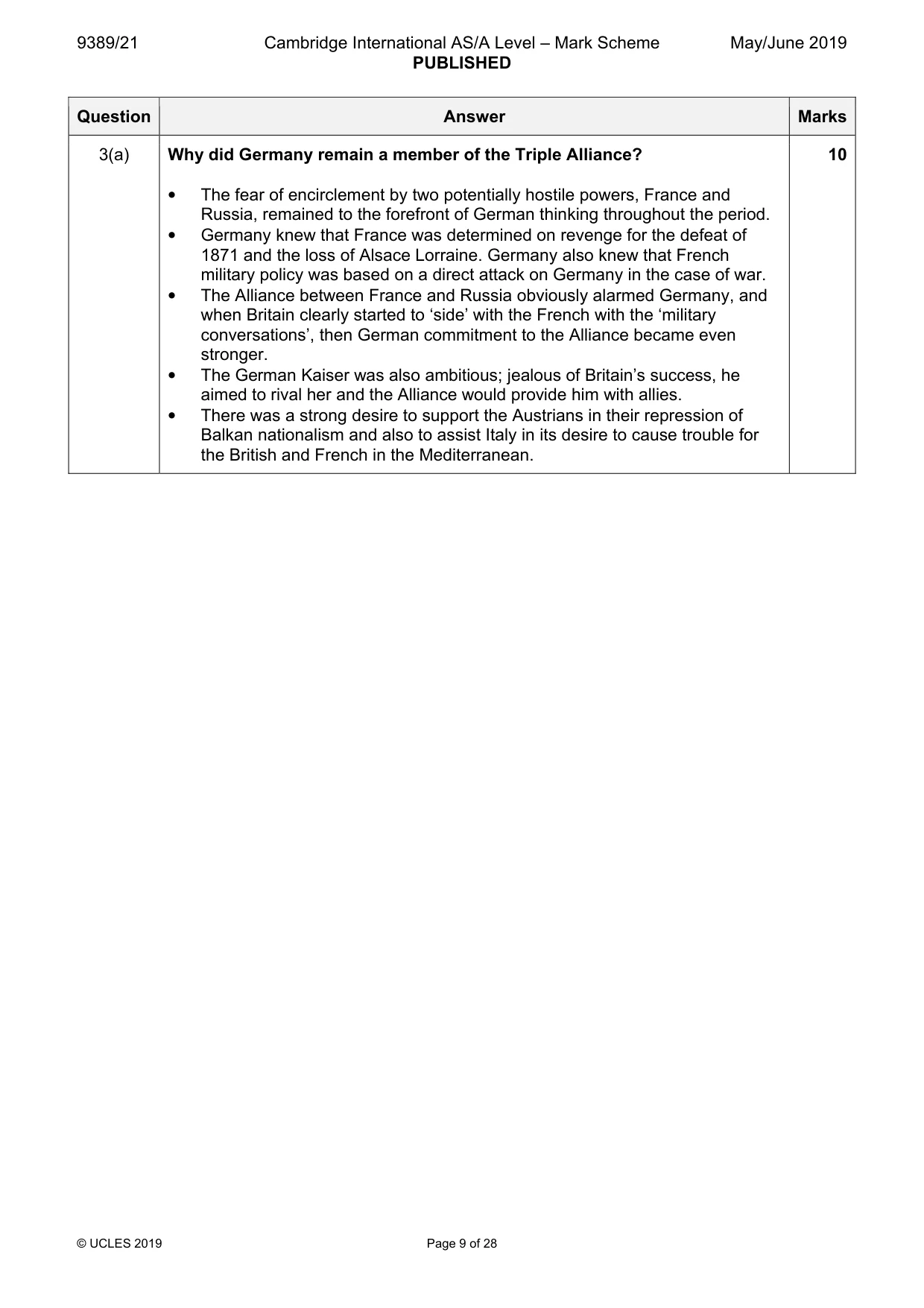
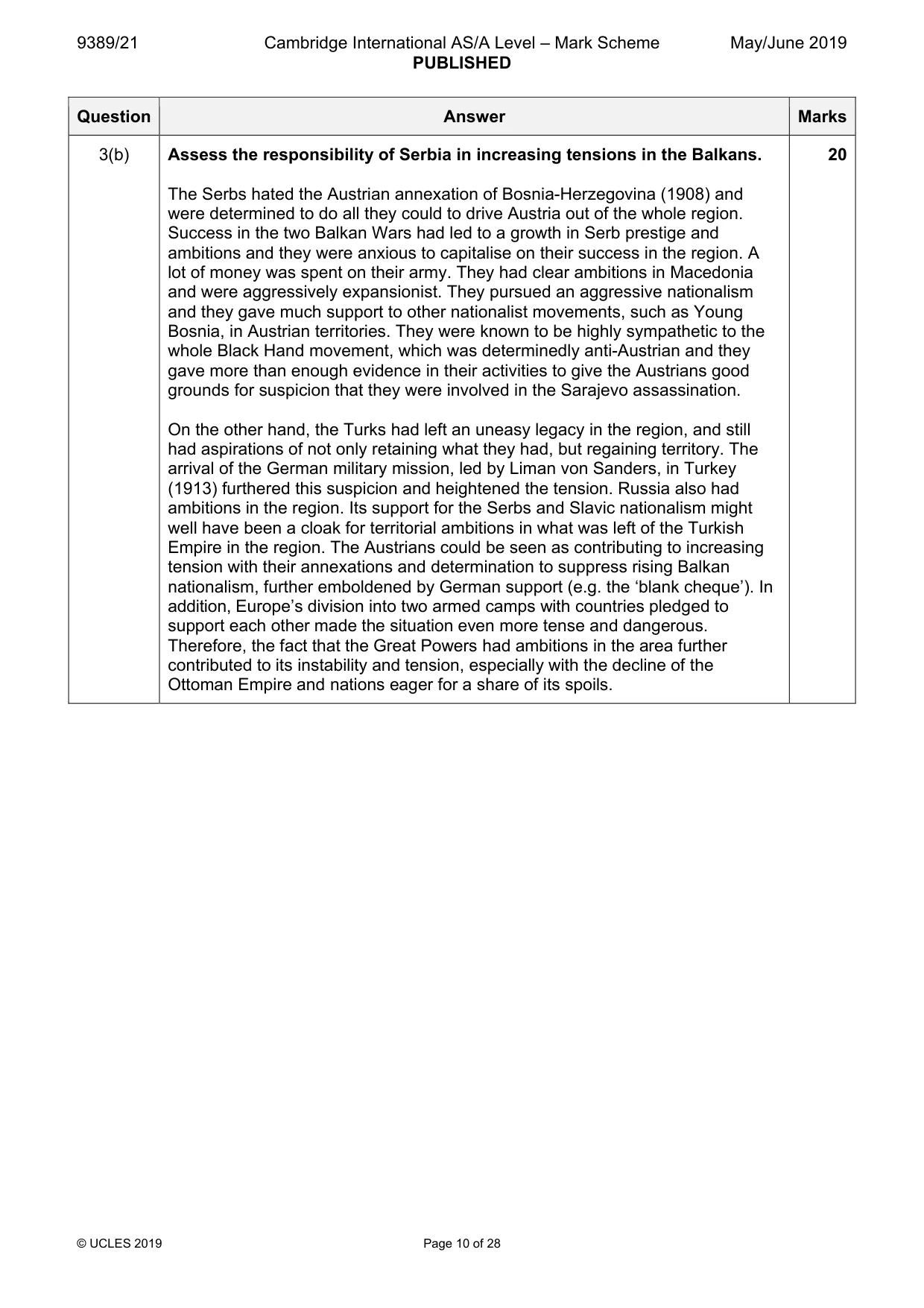
Mark scheme: 3(a) Why did Germany remain a member of the Triple Alliance? 10 • The fear of encirclement by two potentially hostile powers, France and Russia, remained to the forefront of German thinking throughout the period. • Germany knew that France was determined on revenge for the defeat of 1871 and the loss of Alsace Lorraine. Germany also knew that French military policy was based on a direct attack on Germany in the case of war. • The Alliance between France and Russia obviously alarmed Germany, and when Britain clearly started to ‘side’ with the French with the ‘military conversations’, then German commitment to the Alliance became even stronger. • The German Kaiser was also ambitious; jealous of Britain’s success, he aimed to rival her and the Alliance would provide him with allies. • There was a strong desire to support the Austrians in their repression of Balkan nationalism and also to assist Italy in its desire to cause trouble for the British and French in the Mediterranean. 3(b) Assess the responsibility of Serbia in increasing tensions in the Balkans. 20 The Serbs hated the Austrian annexation of Bosnia-Herzegovina (1908) and were determined to do all they could to drive Austria out of the whole region. Success in the two Balkan Wars had led to a growth in Serb prestige and ambitions and they were anxious to capitalise on their success in the region. A lot of money was spent on their army. They had clear ambitions in Macedonia and were aggressively expansionist. They pursued an aggressive nationalism and they gave much support to other nationalist movements, such as Young Bosnia, in Austrian territories. They were known to be highly sympathetic to the whole Black Hand movement, which was determinedly anti-Austrian and they gave more than enough evidence in their activities to give the Austrians good grounds for suspicion that they were involved in the Sarajevo assassination. On the other hand, the Turks had left an uneasy legacy in the region, and still had aspirations of not only retaining what they had, but regaining territory. The arrival of the German military mission, led by Liman von Sanders, in Turkey (1913) furthered this suspicion and heightened the tension. Russia also had ambitions in the region. Its support for the Serbs and Slavic nationalism might well have been a cloak for territorial ambitions in what was left of the Turkish Empire in the region. The Austrians could be seen as contributing to increasing tension with their annexations and determination to suppress rising Balkan nationalism, further emboldened by German support (e.g. the ‘blank cheque’). In addition, Europe’s division into two armed camps with countries pledged to support each other made the situation even more tense and dangerous. Therefore, the fact that the Great Powers had ambitions in the area further contributed to its instability and tension, especially with the decline of the Ottoman Empire and nations eager for a share of its spoils.
Q4 · The Russian Revolution, c.1894–1917 (a) Why did Kornilov attempt a coup in 1917?
4 The Russian Revolution, c.1894–1917 (a) Why did Kornilov attempt a coup in 1917? [10] (b) To what extent was the Russian economy transformed between 1894 and 1914? [20]
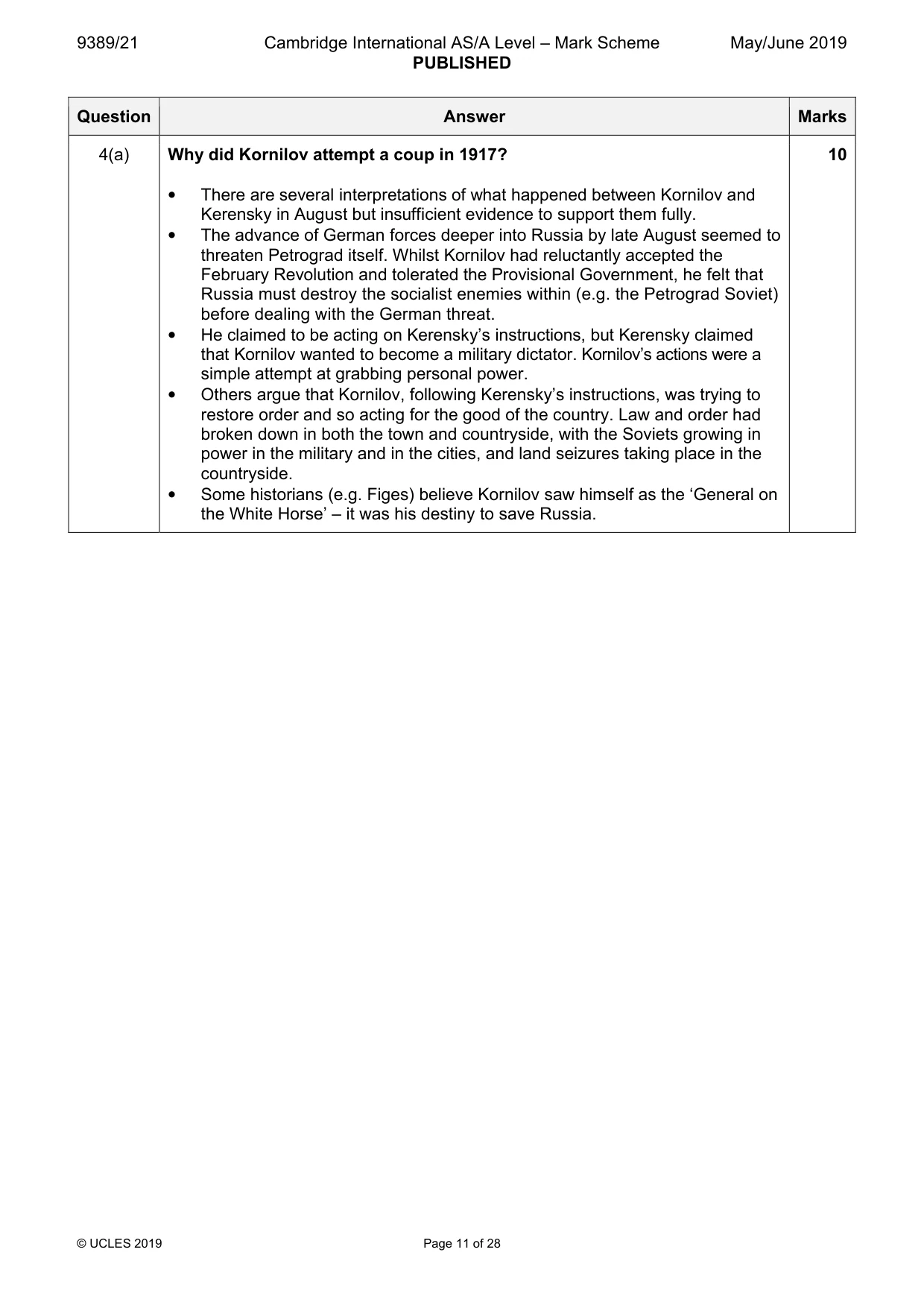
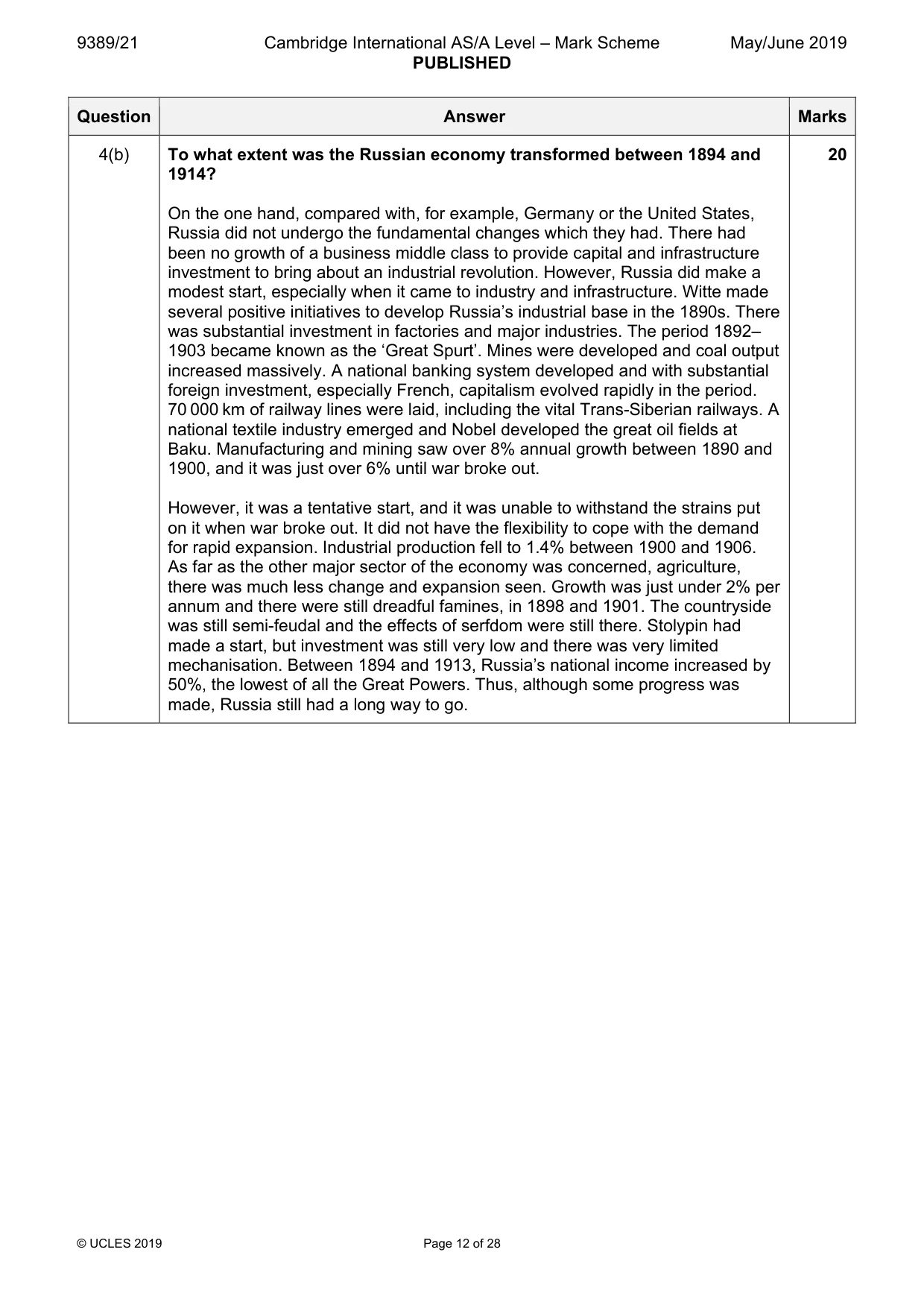
Mark scheme: 4(a) Why did Kornilov attempt a coup in 1917? 10 • There are several interpretations of what happened between Kornilov and Kerensky in August but insufficient evidence to support them fully. • The advance of German forces deeper into Russia by late August seemed to threaten Petrograd itself. Whilst Kornilov had reluctantly accepted the February Revolution and tolerated the Provisional Government, he felt that Russia must destroy the socialist enemies within (e.g. the Petrograd Soviet) before dealing with the German threat. • He claimed to be acting on Kerensky’s instructions, but Kerensky claimed that Kornilov wanted to become a military dictator. Kornilov’s actions were a simple attempt at grabbing personal power. • Others argue that Kornilov, following Kerensky’s instructions, was trying to restore order and so acting for the good of the country. Law and order had broken down in both the town and countryside, with the Soviets growing in power in the military and in the cities, and land seizures taking place in the countryside. • Some historians (e.g. Figes) believe Kornilov saw himself as the ‘General on the White Horse’ – it was his destiny to save Russia. 4(b) To what extent was the Russian economy transformed between 1894 and 20 1914? On the one hand, compared with, for example, Germany or the United States, Russia did not undergo the fundamental changes which they had. There had been no growth of a business middle class to provide capital and infrastructure investment to bring about an industrial revolution. However, Russia did make a modest start, especially when it came to industry and infrastructure. Witte made several positive initiatives to develop Russia’s industrial base in the 1890s. There was substantial investment in factories and major industries. The period 1892– 1903 became known as the ‘Great Spurt’. Mines were developed and coal output increased massively. A national banking system developed and with substantial foreign investment, especially French, capitalism evolved rapidly in the period. 70 000 km of railway lines were laid, including the vital Trans-Siberian railways. A national textile industry emerged and Nobel developed the great oil fields at Baku. Manufacturing and mining saw over 8% annual growth between 1890 and 1900, and it was just over 6% until war broke out. However, it was a tentative start, and it was unable to withstand the strains put on it when war broke out. It did not have the flexibility to cope with the demand for rapid expansion. Industrial production fell to 1.4% between 1900 and 1906. As far as the other major sector of the economy was concerned, agriculture, there was much less change and expansion seen. Growth was just under 2% per annum and there were still dreadful famines, in 1898 and 1901. The countryside was still semi-feudal and the effects of serfdom were still there. Stolypin had made a start, but investment was still very low and there was very limited mechanisation. Between 1894 and 1913, Russia’s national income increased by 50%, the lowest of all the Great Powers. Thus, although some progress was made, Russia still had a long way to go. Section B: American Option The History of the USA, 1840–1941
Q5 · The Expansion of US Power from the 1840s to the 1930s (a) Why was the concept of Manifest…
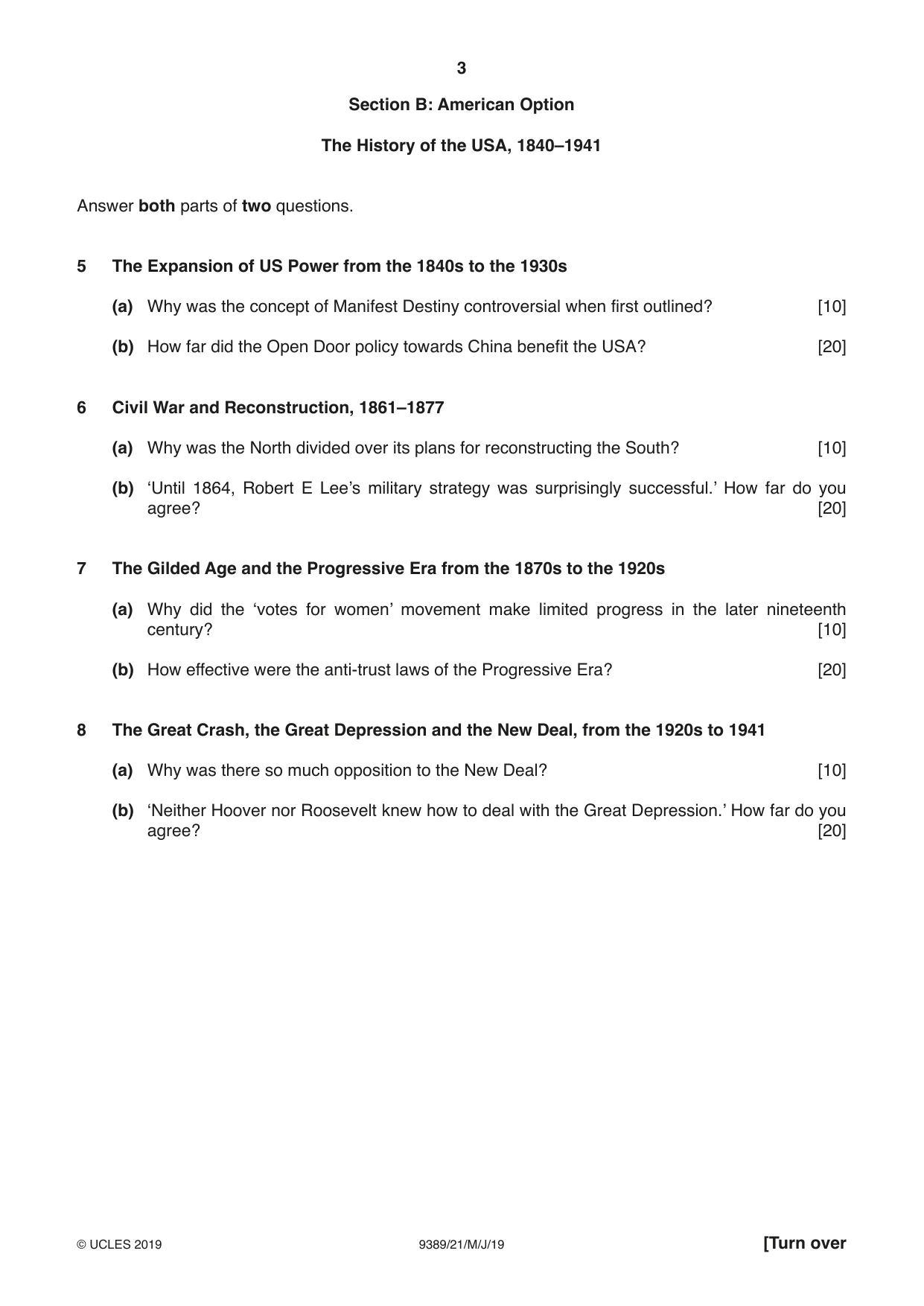
5 The Expansion of US Power from the 1840s to the 1930s (a) Why was the concept of Manifest Destiny controversial when first outlined? [10] (b) How far did the Open Door policy towards China benefit the USA? [20]
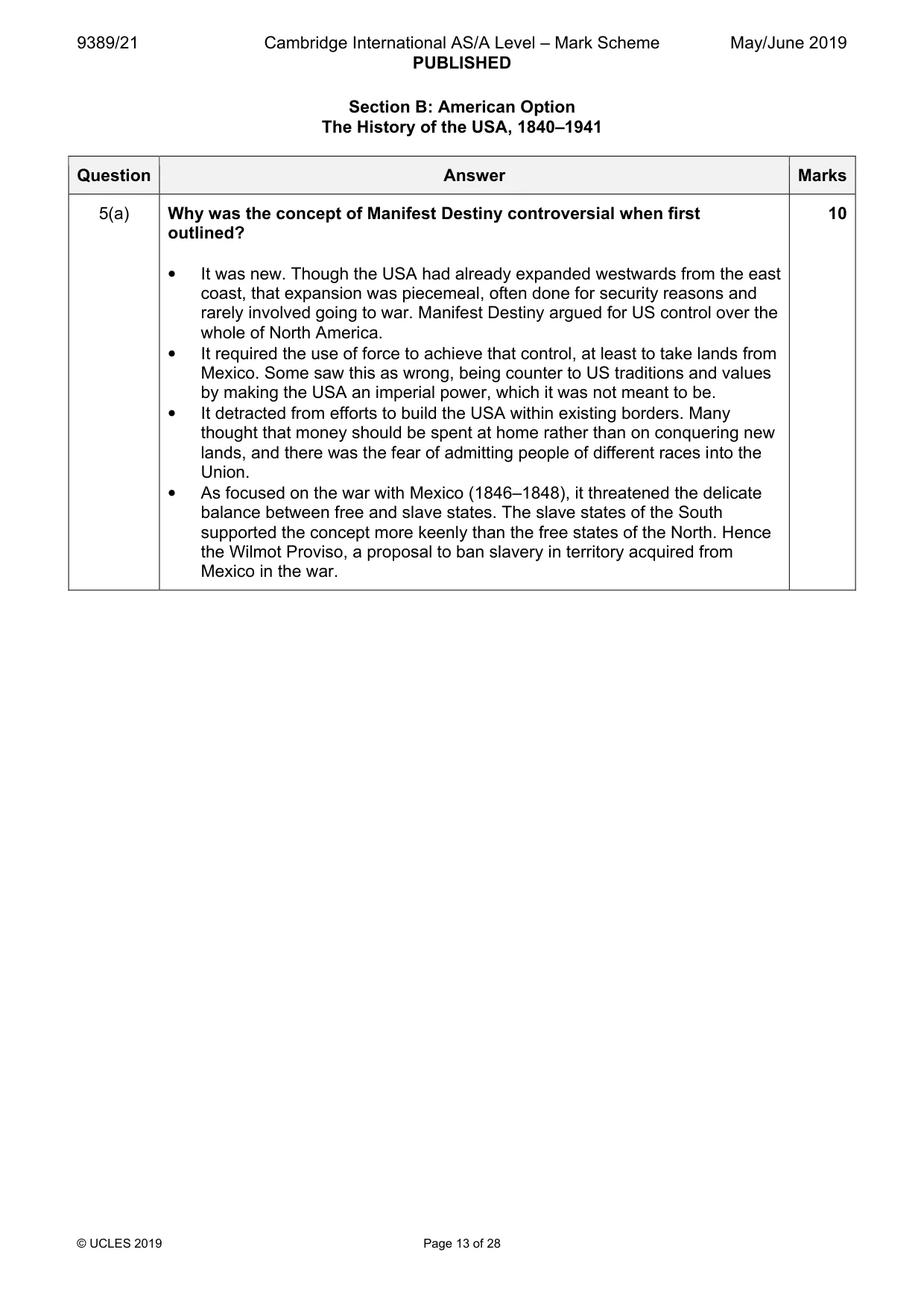
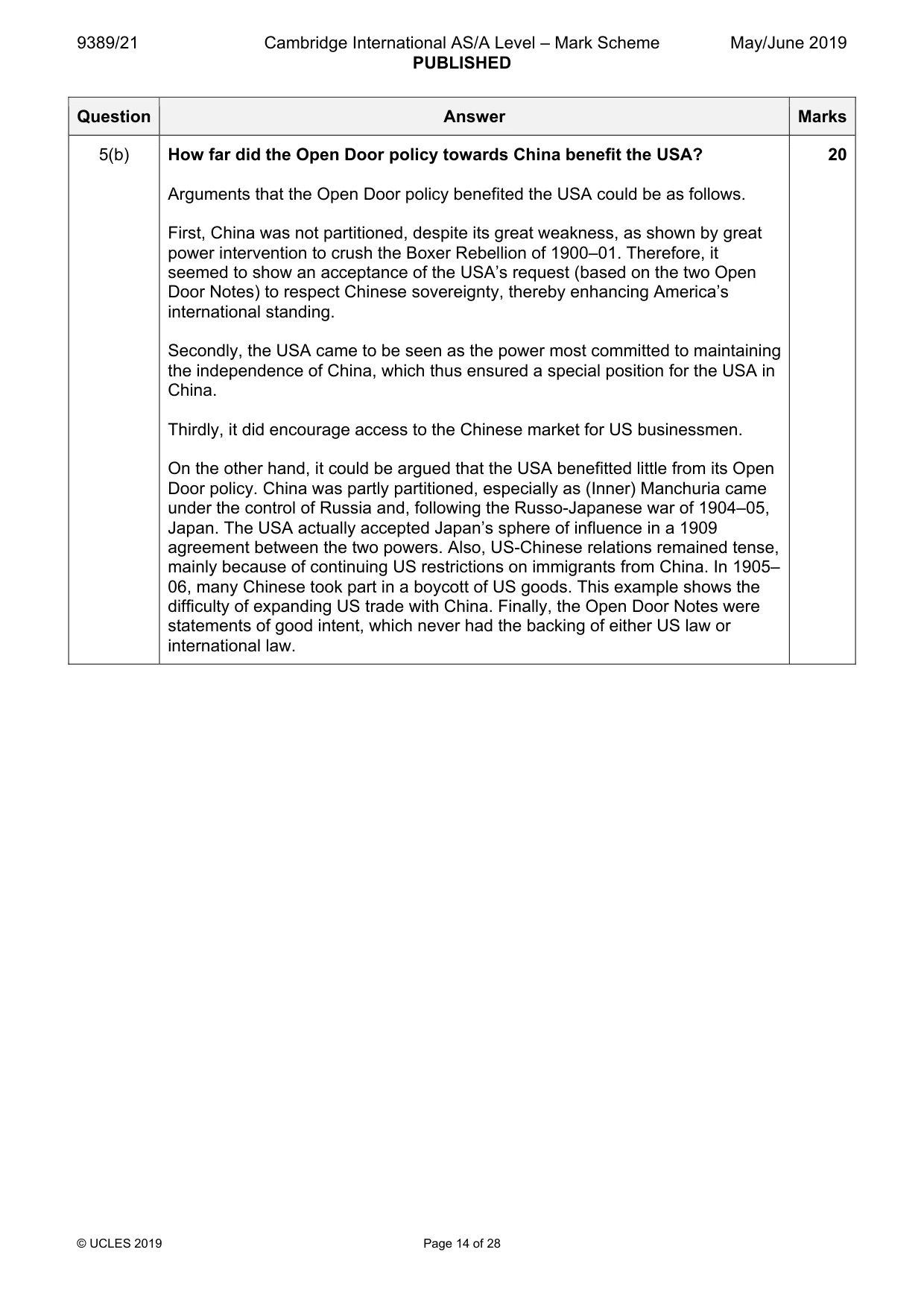
Mark scheme: 5(a) Why was the concept of Manifest Destiny controversial when first 10 outlined? • It was new. Though the USA had already expanded westwards from the east coast, that expansion was piecemeal, often done for security reasons and rarely involved going to war. Manifest Destiny argued for US control over the whole of North America. • It required the use of force to achieve that control, at least to take lands from Mexico. Some saw this as wrong, being counter to US traditions and values by making the USA an imperial power, which it was not meant to be. • It detracted from efforts to build the USA within existing borders. Many thought that money should be spent at home rather than on conquering new lands, and there was the fear of admitting people of different races into the Union. • As focused on the war with Mexico (1846–1848), it threatened the delicate balance between free and slave states. The slave states of the South supported the concept more keenly than the free states of the North. Hence the Wilmot Proviso, a proposal to ban slavery in territory acquired from Mexico in the war. 5(b) How far did the Open Door policy towards China benefit the USA? 20 Arguments that the Open Door policy benefited the USA could be as follows. First, China was not partitioned, despite its great weakness, as shown by great power intervention to crush the Boxer Rebellion of 1900–01. Therefore, it seemed to show an acceptance of the USA’s request (based on the two Open Door Notes) to respect Chinese sovereignty, thereby enhancing America’s international standing. Secondly, the USA came to be seen as the power most committed to maintaining the independence of China, which thus ensured a special position for the USA in China. Thirdly, it did encourage access to the Chinese market for US businessmen. On the other hand, it could be argued that the USA benefitted little from its Open Door policy. China was partly partitioned, especially as (Inner) Manchuria came under the control of Russia and, following the Russo-Japanese war of 1904–05, Japan. The USA actually accepted Japan’s sphere of influence in a 1909 agreement between the two powers. Also, US-Chinese relations remained tense, mainly because of continuing US restrictions on immigrants from China. In 1905– 06, many Chinese took part in a boycott of US goods. This example shows the difficulty of expanding US trade with China. Finally, the Open Door Notes were statements of good intent, which never had the backing of either US law or international law.
Q6 · Civil War and Reconstruction, 1861–1877 (a) Why was the North divided over its plans for…
6 Civil War and Reconstruction, 1861–1877 (a) Why was the North divided over its plans for reconstructing the South? [10] (b) ‘Until 1864, Robert E Lee’s military strategy was surprisingly successful.’ How far do you agree? [20]
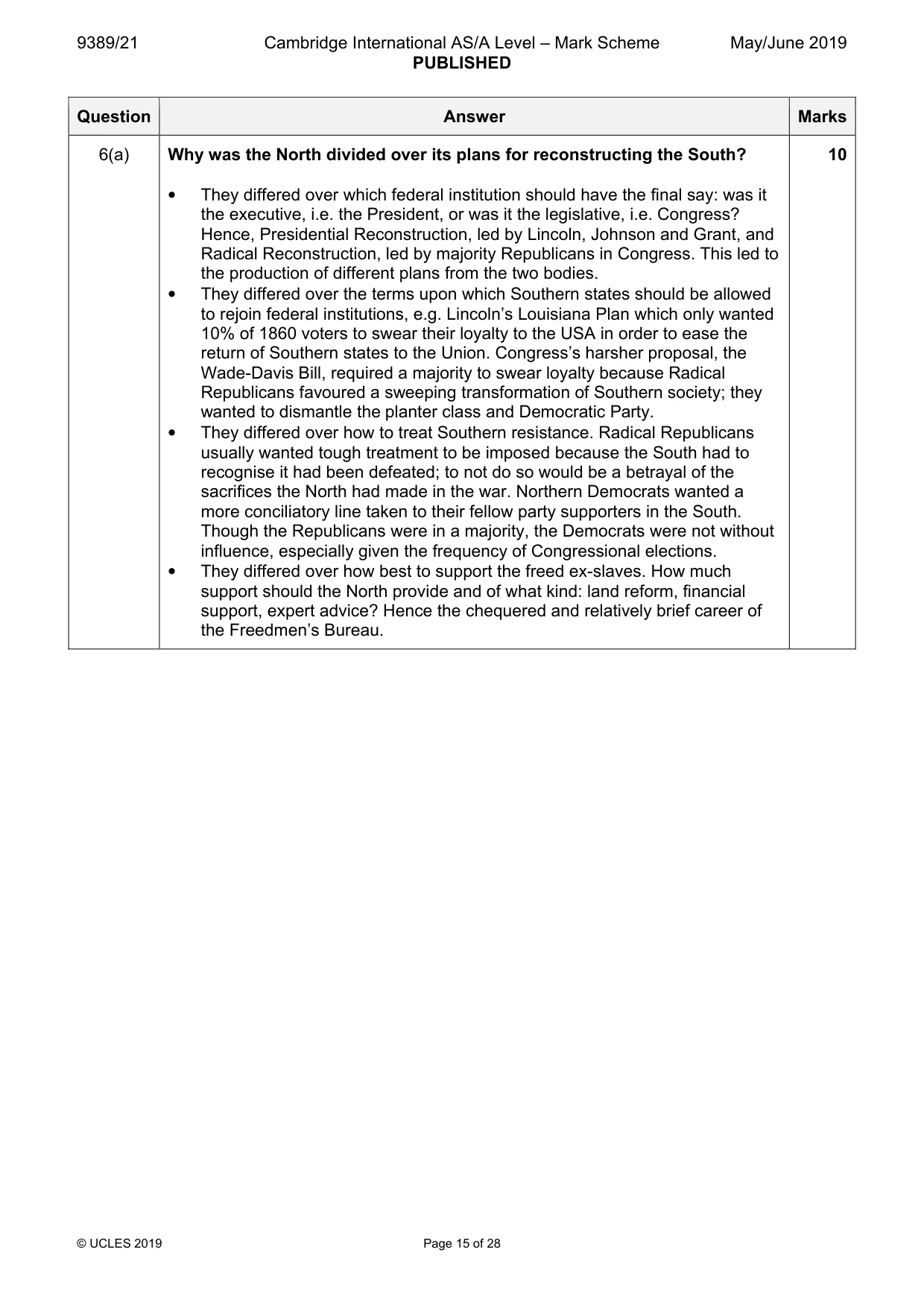
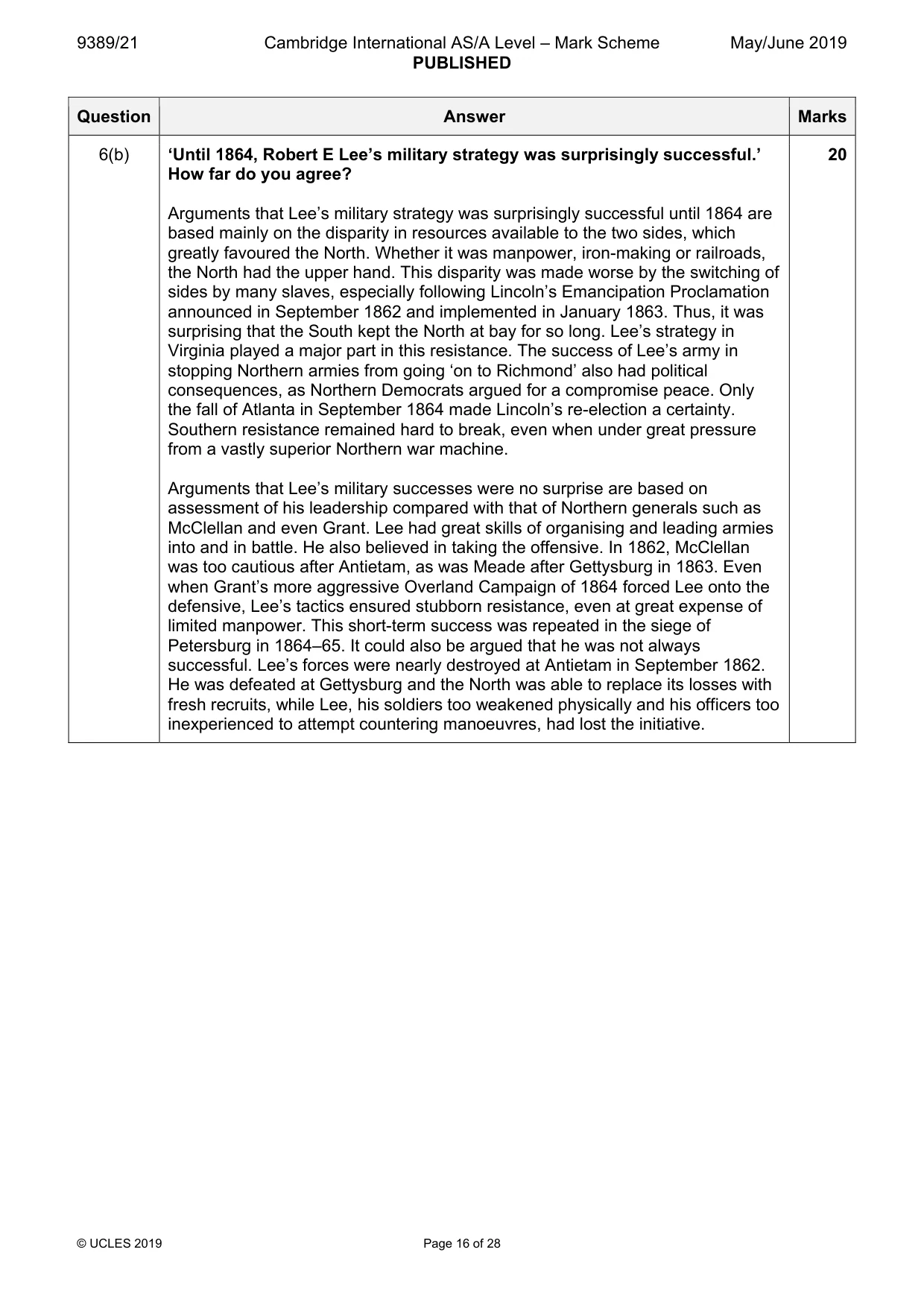
Mark scheme: 6(a) Why was the North divided over its plans for reconstructing the South? 10 • They differed over which federal institution should have the final say: was it the executive, i.e. the President, or was it the legislative, i.e. Congress? Hence, Presidential Reconstruction, led by Lincoln, Johnson and Grant, and Radical Reconstruction, led by majority Republicans in Congress. This led to the production of different plans from the two bodies. • They differed over the terms upon which Southern states should be allowed to rejoin federal institutions, e.g. Lincoln’s Louisiana Plan which only wanted 10% of 1860 voters to swear their loyalty to the USA in order to ease the return of Southern states to the Union. Congress’s harsher proposal, the Wade-Davis Bill, required a majority to swear loyalty because Radical Republicans favoured a sweeping transformation of Southern society; they wanted to dismantle the planter class and Democratic Party. • They differed over how to treat Southern resistance. Radical Republicans usually wanted tough treatment to be imposed because the South had to recognise it had been defeated; to not do so would be a betrayal of the sacrifices the North had made in the war. Northern Democrats wanted a more conciliatory line taken to their fellow party supporters in the South. Though the Republicans were in a majority, the Democrats were not without influence, especially given the frequency of Congressional elections. • They differed over how best to support the freed ex-slaves. How much support should the North provide and of what kind: land reform, financial support, expert advice? Hence the chequered and relatively brief career of the Freedmen’s Bureau. 6(b) ‘Until 1864, Robert E Lee’s military strategy was surprisingly successful.’ 20 How far do you agree? Arguments that Lee’s military strategy was surprisingly successful until 1864 are based mainly on the disparity in resources available to the two sides, which greatly favoured the North. Whether it was manpower, iron-making or railroads, the North had the upper hand. This disparity was made worse by the switching of sides by many slaves, especially following Lincoln’s Emancipation Proclamation announced in September 1862 and implemented in January 1863. Thus, it was surprising that the South kept the North at bay for so long. Lee’s strategy in Virginia played a major part in this resistance. The success of Lee’s army in stopping Northern armies from going ‘on to Richmond’ also had political consequences, as Northern Democrats argued for a compromise peace. Only the fall of Atlanta in September 1864 made Lincoln’s re-election a certainty. Southern resistance remained hard to break, even when under great pressure from a vastly superior Northern war machine. Arguments that Lee’s military successes were no surprise are based on assessment of his leadership compared with that of Northern generals such as McClellan and even Grant. Lee had great skills of organising and leading armies into and in battle. He also believed in taking the offensive. In 1862, McClellan was too cautious after Antietam, as was Meade after Gettysburg in 1863. Even when Grant’s more aggressive Overland Campaign of 1864 forced Lee onto the defensive, Lee’s tactics ensured stubborn resistance, even at great expense of limited manpower. This short-term success was repeated in the siege of Petersburg in 1864–65. It could also be argued that he was not always successful. Lee’s forces were nearly destroyed at Antietam in September 1862. He was defeated at Gettysburg and the North was able to replace its losses with fresh recruits, while Lee, his soldiers too weakened physically and his officers too inexperienced to attempt countering manoeuvres, had lost the initiative.
Q7 · The Gilded Age and the Progressive Era from the 1870s to the 1920s (a) Why did the ‘votes…
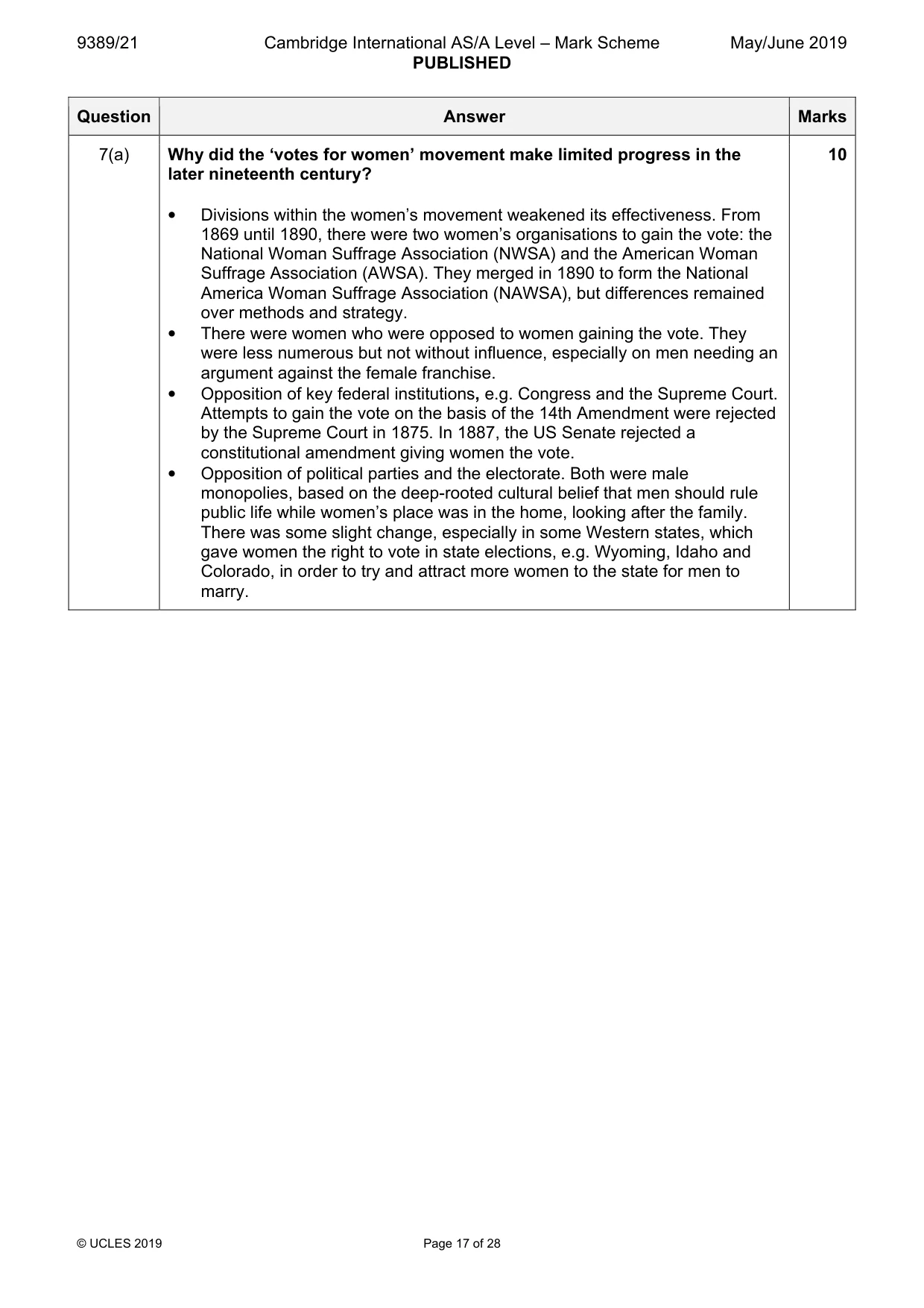
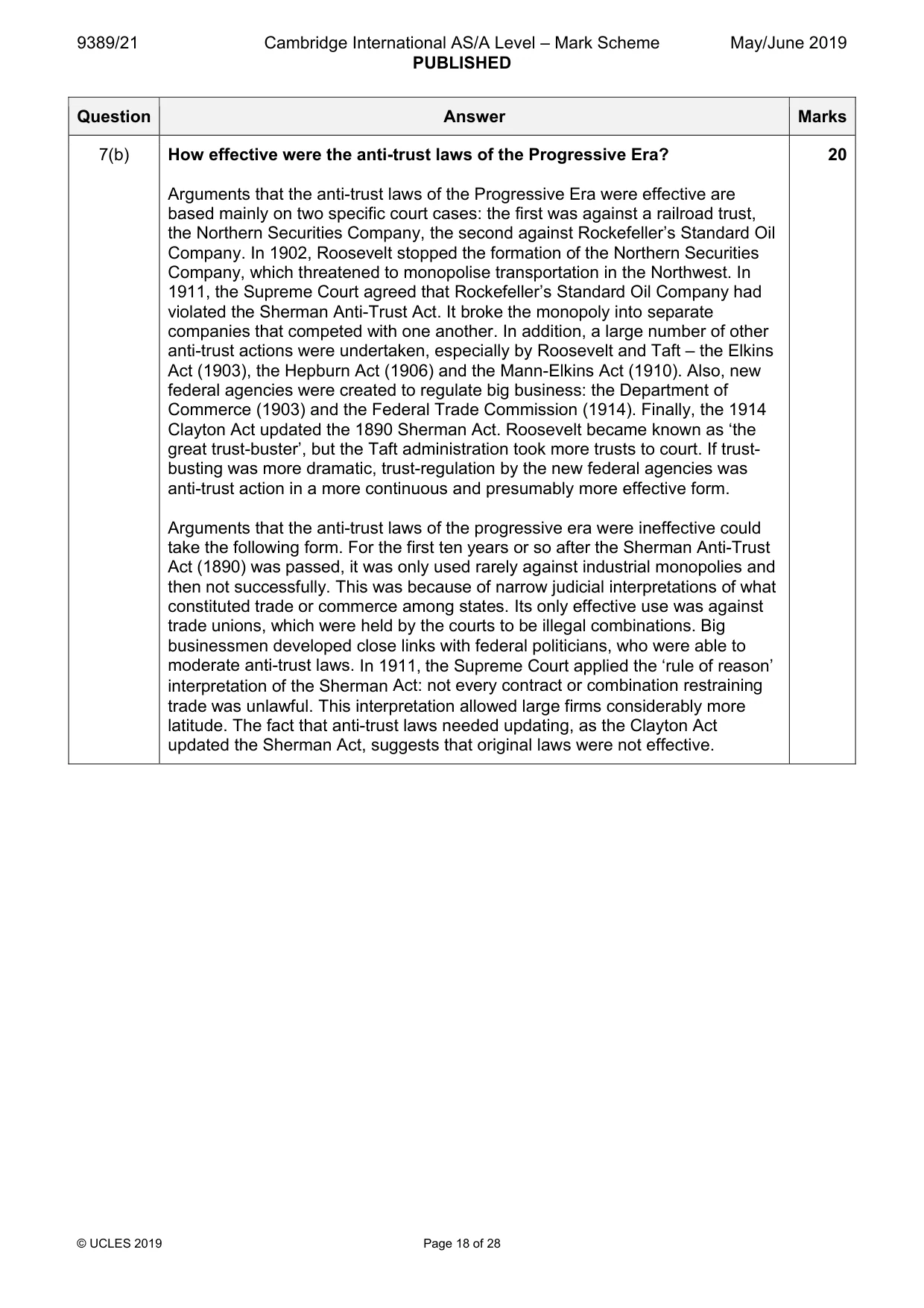
7 The Gilded Age and the Progressive Era from the 1870s to the 1920s (a) Why did the ‘votes for women’ movement make limited progress in the later nineteenth century? [10] (b) How effective were the anti-trust laws of the Progressive Era? [20]
Mark scheme: 7(a) Why did the ‘votes for women’ movement make limited progress in the 10 later nineteenth century? • Divisions within the women’s movement weakened its effectiveness. From 1869 until 1890, there were two women’s organisations to gain the vote: the National Woman Suffrage Association (NWSA) and the American Woman Suffrage Association (AWSA). They merged in 1890 to form the National America Woman Suffrage Association (NAWSA), but differences remained over methods and strategy. • There were women who were opposed to women gaining the vote. They were less numerous but not without influence, especially on men needing an argument against the female franchise. • Opposition of key federal institutions, e.g. Congress and the Supreme Court. Attempts to gain the vote on the basis of the 14th Amendment were rejected by the Supreme Court in 1875. In 1887, the US Senate rejected a constitutional amendment giving women the vote. • Opposition of political parties and the electorate. Both were male monopolies, based on the deep-rooted cultural belief that men should rule public life while women’s place was in the home, looking after the family. There was some slight change, especially in some Western states, which gave women the right to vote in state elections, e.g. Wyoming, Idaho and Colorado, in order to try and attract more women to the state for men to marry. 7(b) How effective were the anti-trust laws of the Progressive Era? 20 Arguments that the anti-trust laws of the Progressive Era were effective are based mainly on two specific court cases: the first was against a railroad trust, the Northern Securities Company, the second against Rockefeller’s Standard Oil Company. In 1902, Roosevelt stopped the formation of the Northern Securities Company, which threatened to monopolise transportation in the Northwest. In 1911, the Supreme Court agreed that Rockefeller’s Standard Oil Company had violated the Sherman Anti-Trust Act. It broke the monopoly into separate companies that competed with one another. In addition, a large number of other anti-trust actions were undertaken, especially by Roosevelt and Taft – the Elkins Act (1903), the Hepburn Act (1906) and the Mann-Elkins Act (1910). Also, new federal agencies were created to regulate big business: the Department of Commerce (1903) and the Federal Trade Commission (1914). Finally, the 1914 Clayton Act updated the 1890 Sherman Act. Roosevelt became known as ‘the great trust-buster’, but the Taft administration took more trusts to court. If trust- busting was more dramatic, trust-regulation by the new federal agencies was anti-trust action in a more continuous and presumably more effective form. Arguments that the anti-trust laws of the progressive era were ineffective could take the following form. For the first ten years or so after the Sherman Anti-Trust Act (1890) was passed, it was only used rarely against industrial monopolies and then not successfully. This was because of narrow judicial interpretations of what constituted trade or commerce among states. Its only effective use was against trade unions, which were held by the courts to be illegal combinations. Big businessmen developed close links with federal politicians, who were able to moderate anti-trust laws. In 1911, the Supreme Court applied the ‘rule of reason’ interpretation of the Sherman Act: not every contract or combination restraining trade was unlawful. This interpretation allowed large firms considerably more latitude. The fact that anti-trust laws needed updating, as the Clayton Act updated the Sherman Act, suggests that original laws were not effective.
Q8 · The Great Crash, the Great Depression and the New Deal, from the 1920s to 1941 (a) Why…
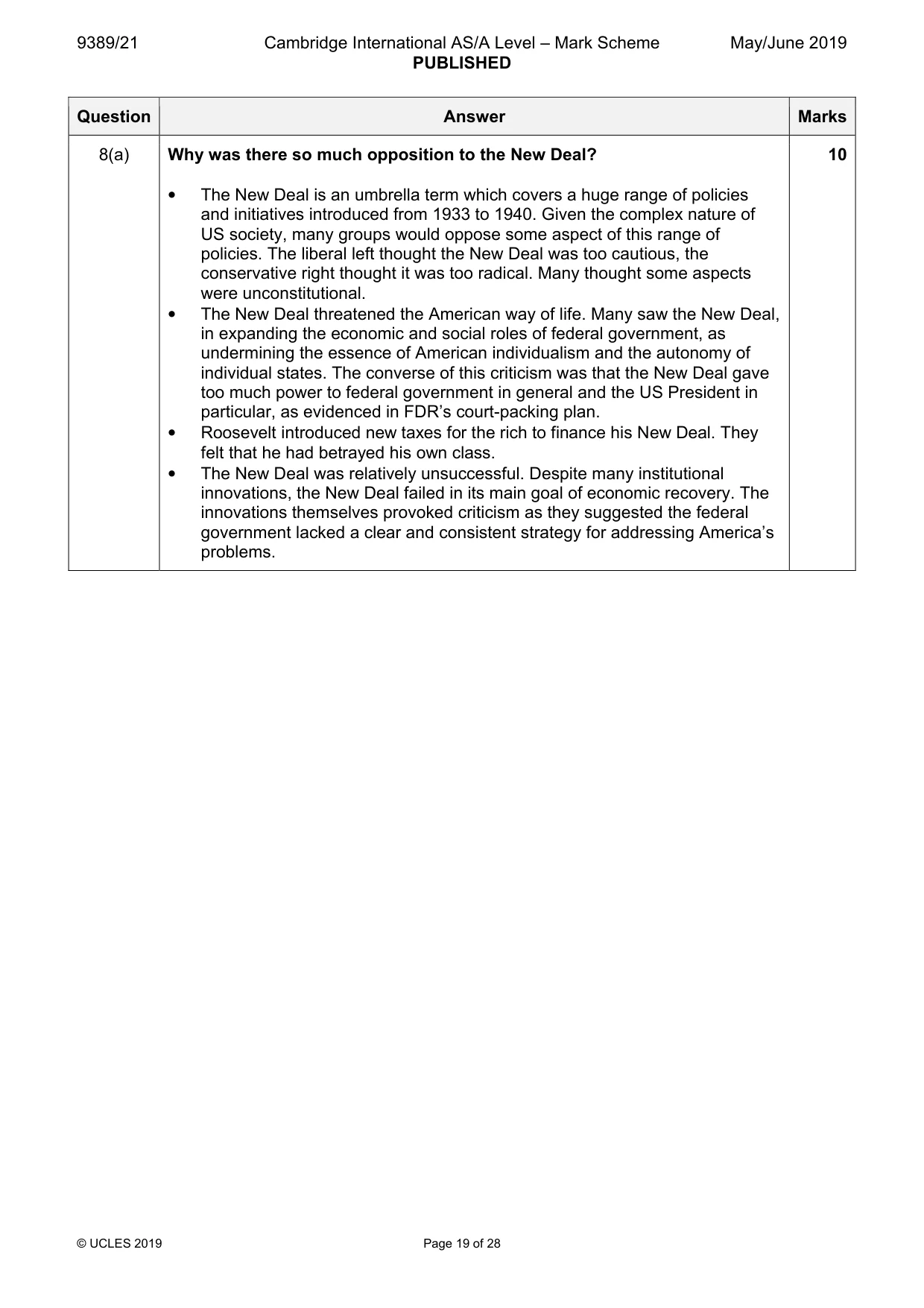
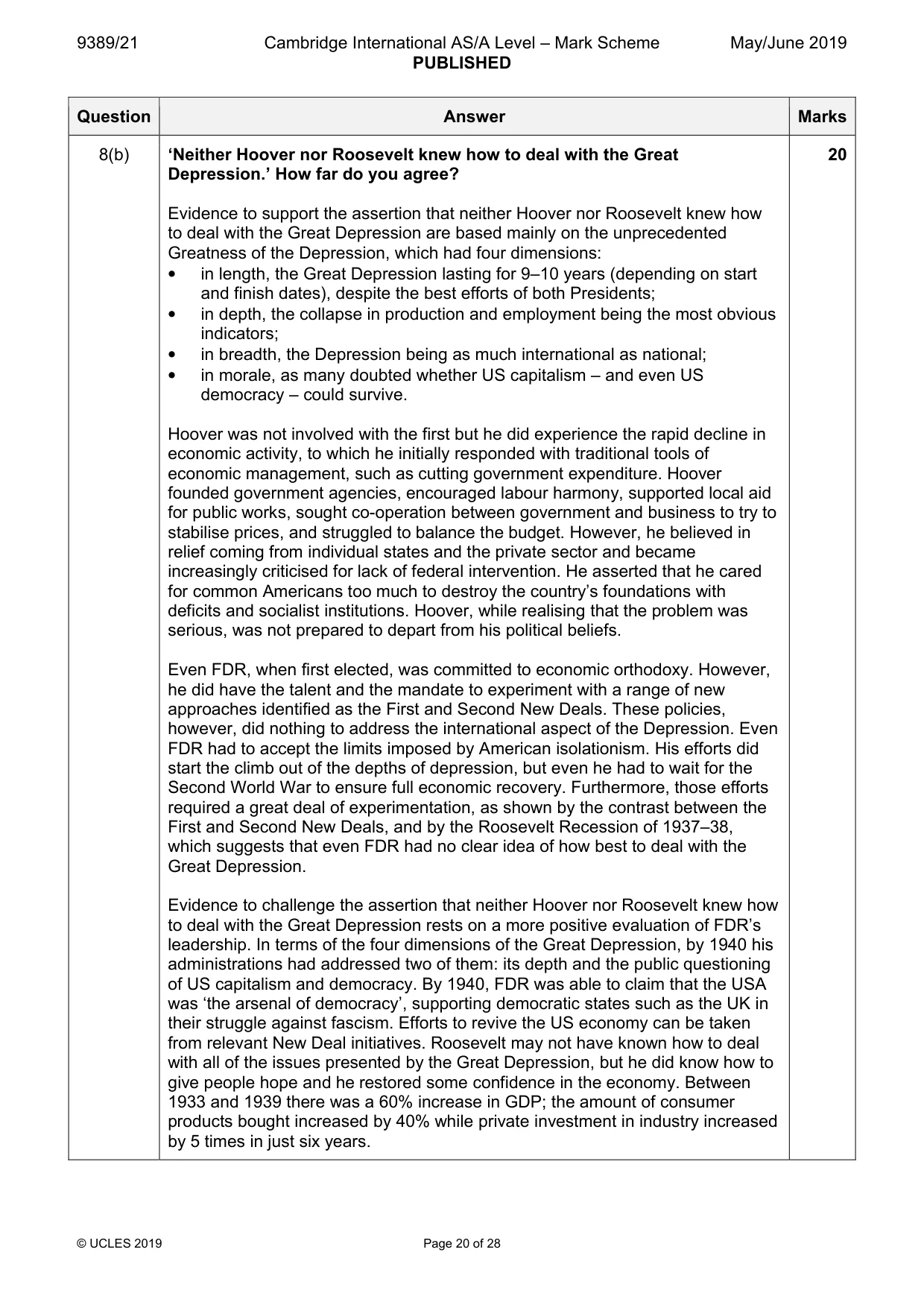
8 The Great Crash, the Great Depression and the New Deal, from the 1920s to 1941 (a) Why was there so much opposition to the New Deal? [10] (b) ‘Neither Hoover nor Roosevelt knew how to deal with the Great Depression.’ How far do you agree? [20] Section C: International Option International Relations, 1871–1945 Answer both parts of two questions.
Mark scheme: 8(a) Why was there so much opposition to the New Deal? 10 • The New Deal is an umbrella term which covers a huge range of policies and initiatives introduced from 1933 to 1940. Given the complex nature of US society, many groups would oppose some aspect of this range of policies. The liberal left thought the New Deal was too cautious, the conservative right thought it was too radical. Many thought some aspects were unconstitutional. • The New Deal threatened the American way of life. Many saw the New Deal, in expanding the economic and social roles of federal government, as undermining the essence of American individualism and the autonomy of individual states. The converse of this criticism was that the New Deal gave too much power to federal government in general and the US President in particular, as evidenced in FDR’s court-packing plan. • Roosevelt introduced new taxes for the rich to finance his New Deal. They felt that he had betrayed his own class. • The New Deal was relatively unsuccessful. Despite many institutional innovations, the New Deal failed in its main goal of economic recovery. The innovations themselves provoked criticism as they suggested the federal government lacked a clear and consistent strategy for addressing America’s problems. 8(b) ‘Neither Hoover nor Roosevelt knew how to deal with the Great 20 Depression.’ How far do you agree? Evidence to support the assertion that neither Hoover nor Roosevelt knew how to deal with the Great Depression are based mainly on the unprecedented Greatness of the Depression, which had four dimensions: • in length, the Great Depression lasting for 9–10 years (depending on start and finish dates), despite the best efforts of both Presidents; • in depth, the collapse in production and employment being the most obvious indicators; • in breadth, the Depression being as much international as national; • in morale, as many doubted whether US capitalism – and even US democracy – could survive. Hoover was not involved with the first but he did experience the rapid decline in economic activity, to which he initially responded with traditional tools of economic management, such as cutting government expenditure. Hoover founded government agencies, encouraged labour harmony, supported local aid for public works, sought co-operation between government and business to try to stabilise prices, and struggled to balance the budget. However, he believed in relief coming from individual states and the private sector and became increasingly criticised for lack of federal intervention. He asserted that he cared for common Americans too much to destroy the country’s foundations with deficits and socialist institutions. Hoover, while realising that the problem was serious, was not prepared to depart from his political beliefs. Even FDR, when first elected, was committed to economic orthodoxy. However, he did have the talent and the mandate to experiment with a range of new approaches identified as the First and Second New Deals. These policies, however, did nothing to address the international aspect of the Depression. Even FDR had to accept the limits imposed by American isolationism. His efforts did start the climb out of the depths of depression, but even he had to wait for the Second World War to ensure full economic recovery. Furthermore, those efforts required a great deal of experimentation, as shown by the contrast between the First and Second New Deals, and by the Roosevelt Recession of 1937–38, which suggests that even FDR had no clear idea of how best to deal with the Great Depression. Evidence to challenge the assertion that neither Hoover nor Roosevelt knew how to deal with the Great Depression rests on a more positive evaluation of FDR’s leadership. In terms of the four dimensions of the Great Depression, by 1940 his administrations had addressed two of them: its depth and the public questioning of US capitalism and democracy. By 1940, FDR was able to claim that the USA was ‘the arsenal of democracy’, supporting democratic states such as the UK in their struggle against fascism. Efforts to revive the US economy can be taken from relevant New Deal initiatives. Roosevelt may not have known how to deal with all of the issues presented by the Great Depression, but he did know how to give people hope and he restored some confidence in the economy. Between 1933 and 1939 there was a 60% increase in GDP; the amount of consumer products bought increased by 40% while private investment in industry increased by 5 times in just six years. Section C: International Option International Relations, 1871–1945
Q9 · International Relations, 1871–1918 (a) Why did Britain go to war in 1914?
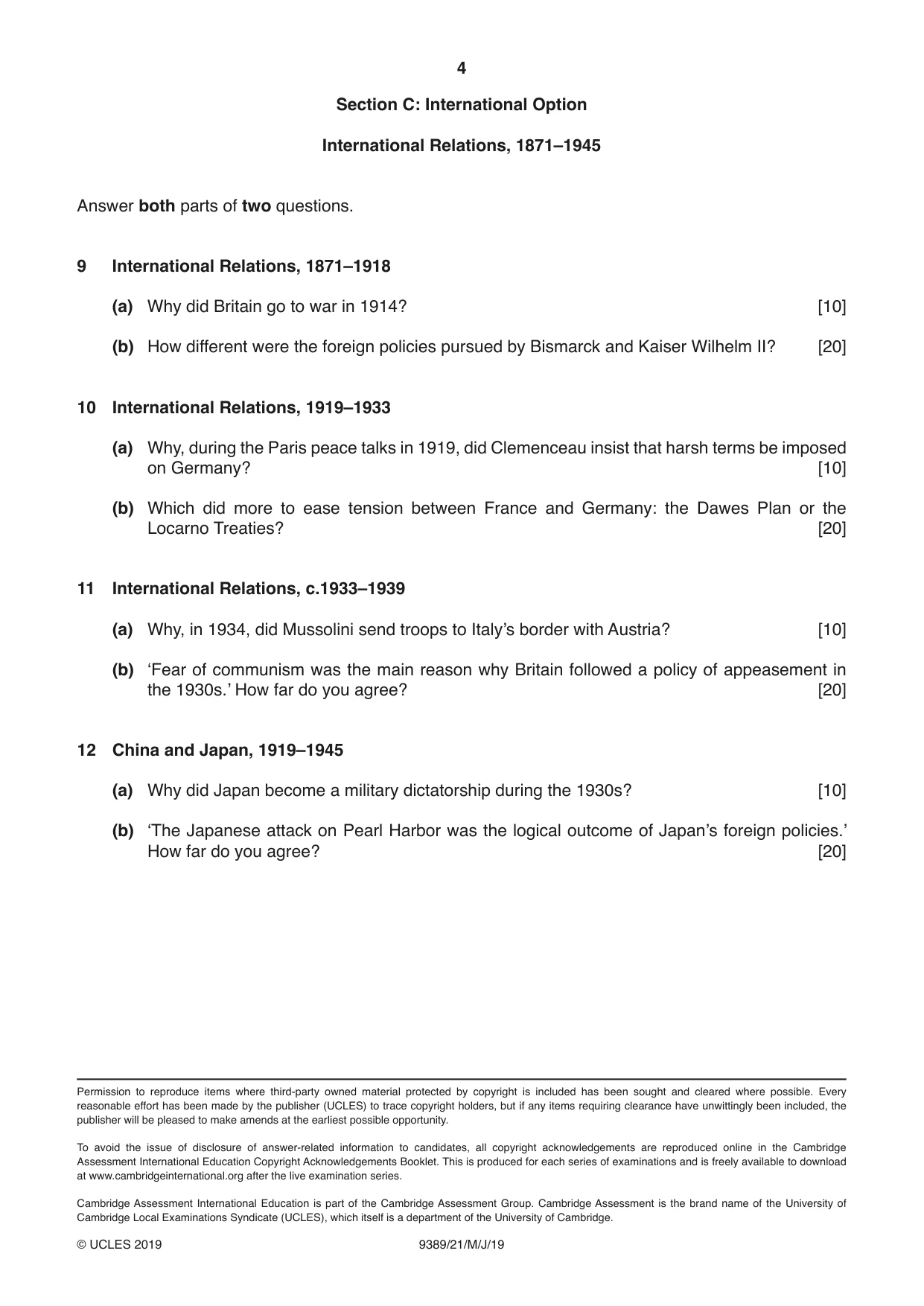
9 International Relations, 1871–1918 (a) Why did Britain go to war in 1914? [10] (b) How different were the foreign policies pursued by Bismarck and Kaiser Wilhelm II? [20]
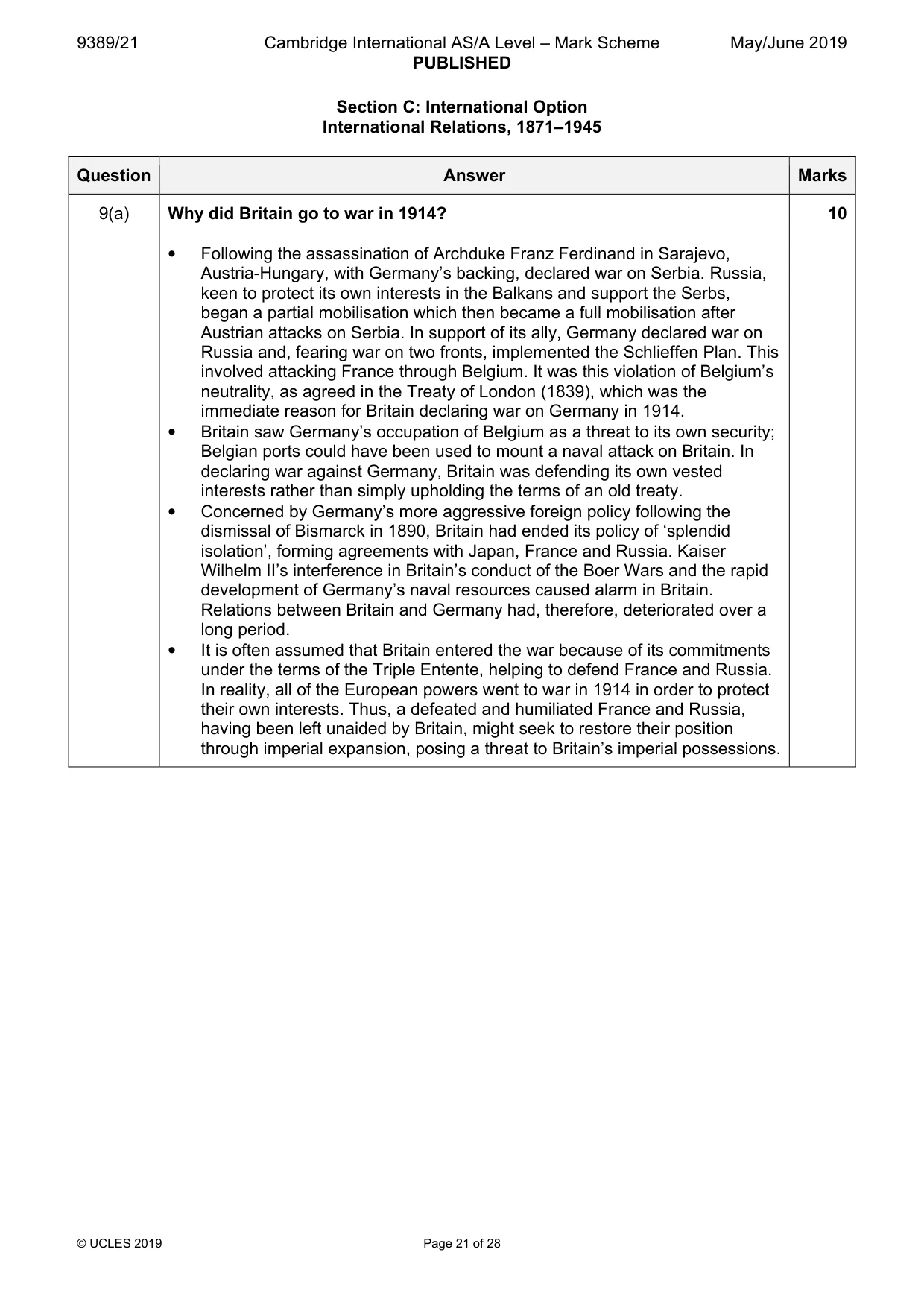
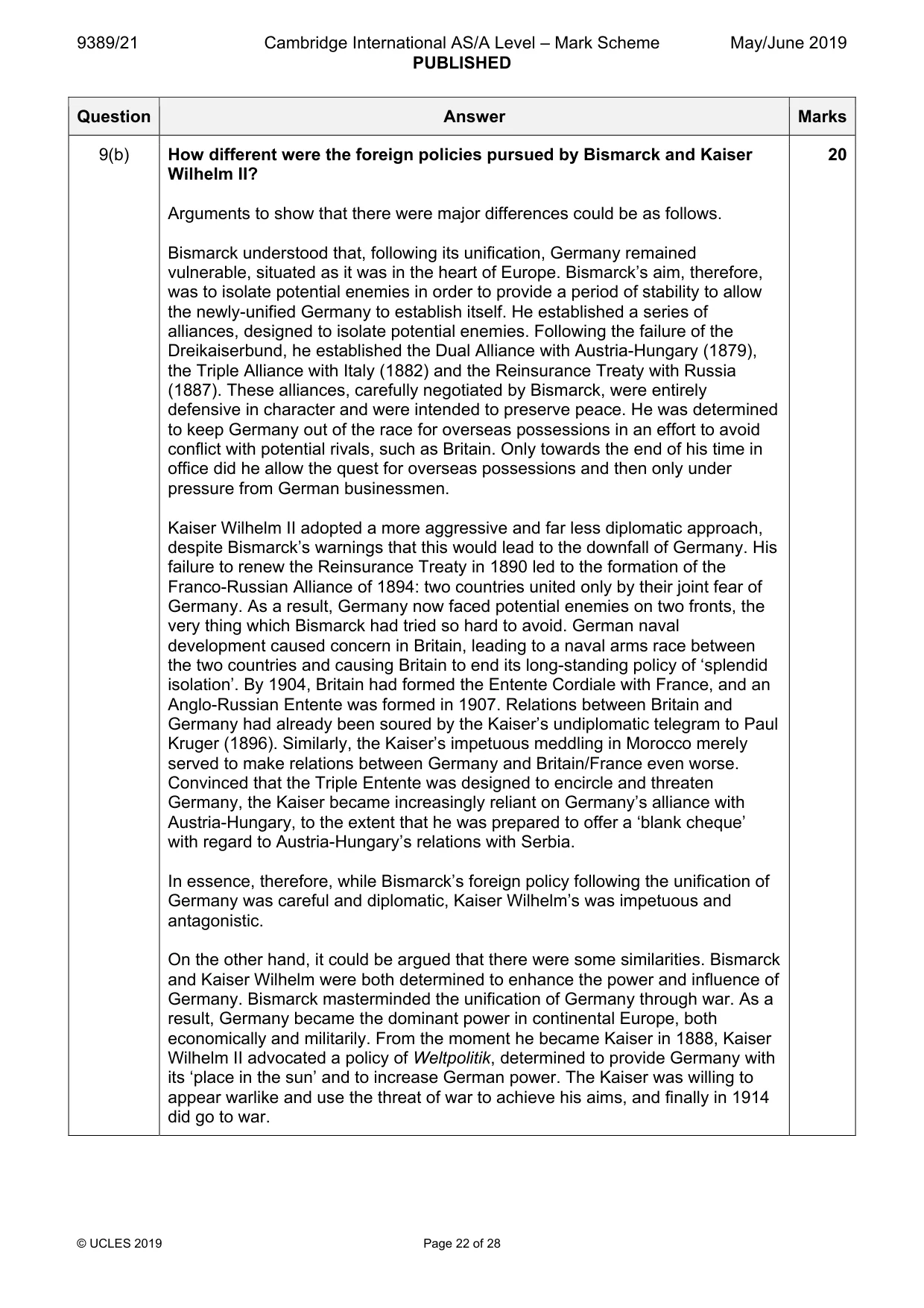
Mark scheme: 9(a) Why did Britain go to war in 1914? 10 • Following the assassination of Archduke Franz Ferdinand in Sarajevo, Austria-Hungary, with Germany’s backing, declared war on Serbia. Russia, keen to protect its own interests in the Balkans and support the Serbs, began a partial mobilisation which then became a full mobilisation after Austrian attacks on Serbia. In support of its ally, Germany declared war on Russia and, fearing war on two fronts, implemented the Schlieffen Plan. This involved attacking France through Belgium. It was this violation of Belgium’s neutrality, as agreed in the Treaty of London (1839), which was the immediate reason for Britain declaring war on Germany in 1914. • Britain saw Germany’s occupation of Belgium as a threat to its own security; Belgian ports could have been used to mount a naval attack on Britain. In declaring war against Germany, Britain was defending its own vested interests rather than simply upholding the terms of an old treaty. • Concerned by Germany’s more aggressive foreign policy following the dismissal of Bismarck in 1890, Britain had ended its policy of ‘splendid isolation’, forming agreements with Japan, France and Russia. Kaiser Wilhelm II’s interference in Britain’s conduct of the Boer Wars and the rapid development of Germany’s naval resources caused alarm in Britain. Relations between Britain and Germany had, therefore, deteriorated over a long period. • It is often assumed that Britain entered the war because of its commitments under the terms of the Triple Entente, helping to defend France and Russia. In reality, all of the European powers went to war in 1914 in order to protect their own interests. Thus, a defeated and humiliated France and Russia, having been left unaided by Britain, might seek to restore their position through imperial expansion, posing a threat to Britain’s imperial possessions. 9(b) How different were the foreign policies pursued by Bismarck and Kaiser 20 Wilhelm II? Arguments to show that there were major differences could be as follows. Bismarck understood that, following its unification, Germany remained vulnerable, situated as it was in the heart of Europe. Bismarck’s aim, therefore, was to isolate potential enemies in order to provide a period of stability to allow the newly-unified Germany to establish itself. He established a series of alliances, designed to isolate potential enemies. Following the failure of the Dreikaiserbund, he established the Dual Alliance with Austria-Hungary (1879), the Triple Alliance with Italy (1882) and the Reinsurance Treaty with Russia (1887). These alliances, carefully negotiated by Bismarck, were entirely defensive in character and were intended to preserve peace. He was determined to keep Germany out of the race for overseas possessions in an effort to avoid conflict with potential rivals, such as Britain. Only towards the end of his time in office did he allow the quest for overseas possessions and then only under pressure from German businessmen. Kaiser Wilhelm II adopted a more aggressive and far less diplomatic approach, despite Bismarck’s warnings that this would lead to the downfall of Germany. His failure to renew the Reinsurance Treaty in 1890 led to the formation of the Franco-Russian Alliance of 1894: two countries united only by their joint fear of Germany. As a result, Germany now faced potential enemies on two fronts, the very thing which Bismarck had tried so hard to avoid. German naval development caused concern in Britain, leading to a naval arms race between the two countries and causing Britain to end its long-standing policy of ‘splendid isolation’. By 1904, Britain had formed the Entente Cordiale with France, and an Anglo-Russian Entente was formed in 1907. Relations between Britain and Germany had already been soured by the Kaiser’s undiplomatic telegram to Paul Kruger (1896). Similarly, the Kaiser’s impetuous meddling in Morocco merely served to make relations between Germany and Britain/France even worse. Convinced that the Triple Entente was designed to encircle and threaten Germany, the Kaiser became increasingly reliant on Germany’s alliance with Austria-Hungary, to the extent that he was prepared to offer a ‘blank cheque’ with regard to Austria-Hungary’s relations with Serbia. In essence, therefore, while Bismarck’s foreign policy following the unification of Germany was careful and diplomatic, Kaiser Wilhelm’s was impetuous and antagonistic. On the other hand, it could be argued that there were some similarities. Bismarck and Kaiser Wilhelm were both determined to enhance the power and influence of Germany. Bismarck masterminded the unification of Germany through war. As a result, Germany became the dominant power in continental Europe, both economically and militarily. From the moment he became Kaiser in 1888, Kaiser Wilhelm II advocated a policy of Weltpolitik, determined to provide Germany with its ‘place in the sun’ and to increase German power. The Kaiser was willing to appear warlike and use the threat of war to achieve his aims, and finally in 1914 did go to war.
Q10 · International Relations, 1919–1933 (a) Why, during the Paris peace talks in 1919, did…
10 International Relations, 1919–1933 (a) Why, during the Paris peace talks in 1919, did Clemenceau insist that harsh terms be imposed on Germany? [10] (b) Which did more to ease tension between France and Germany: the Dawes Plan or the Locarno Treaties? [20]
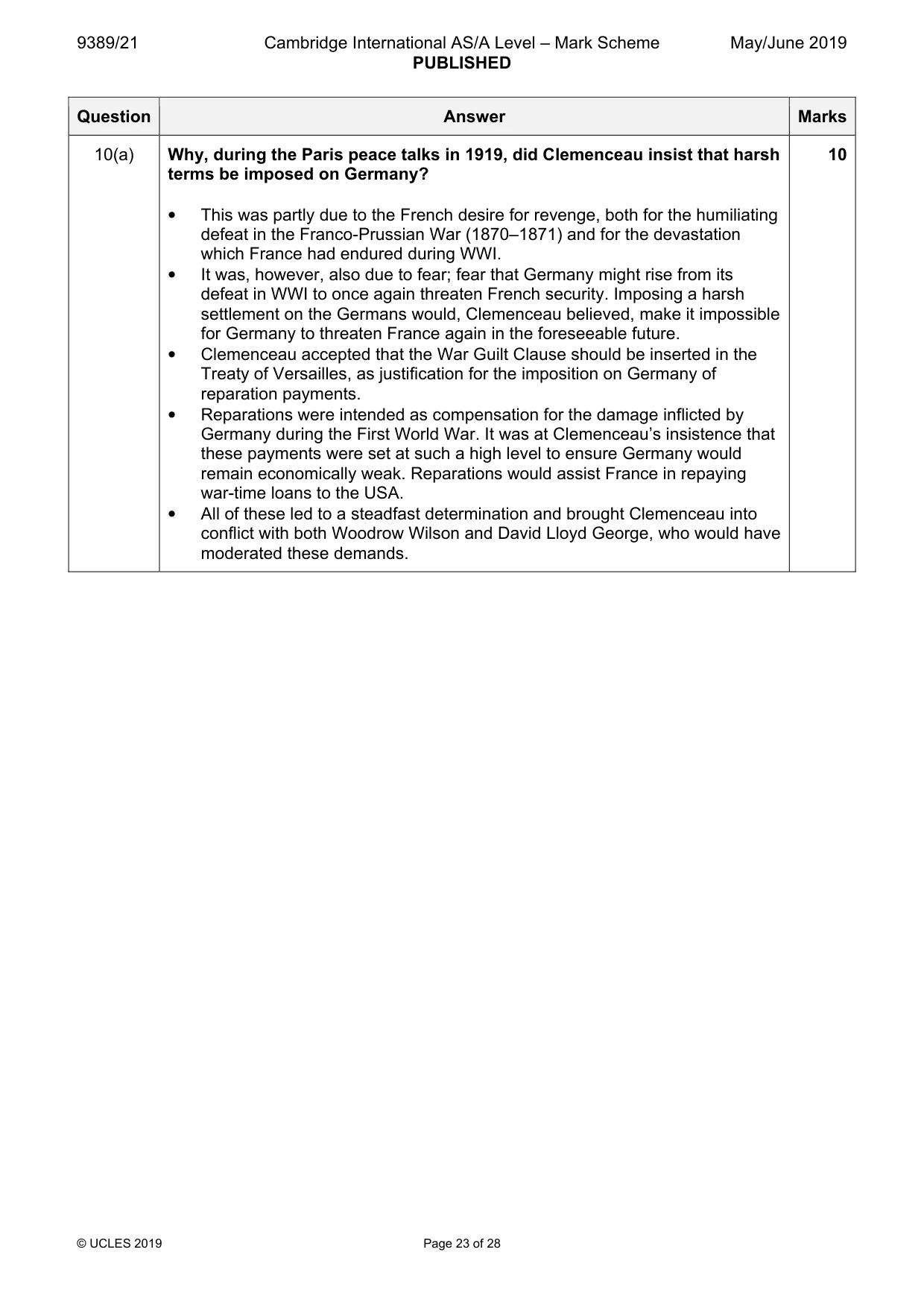
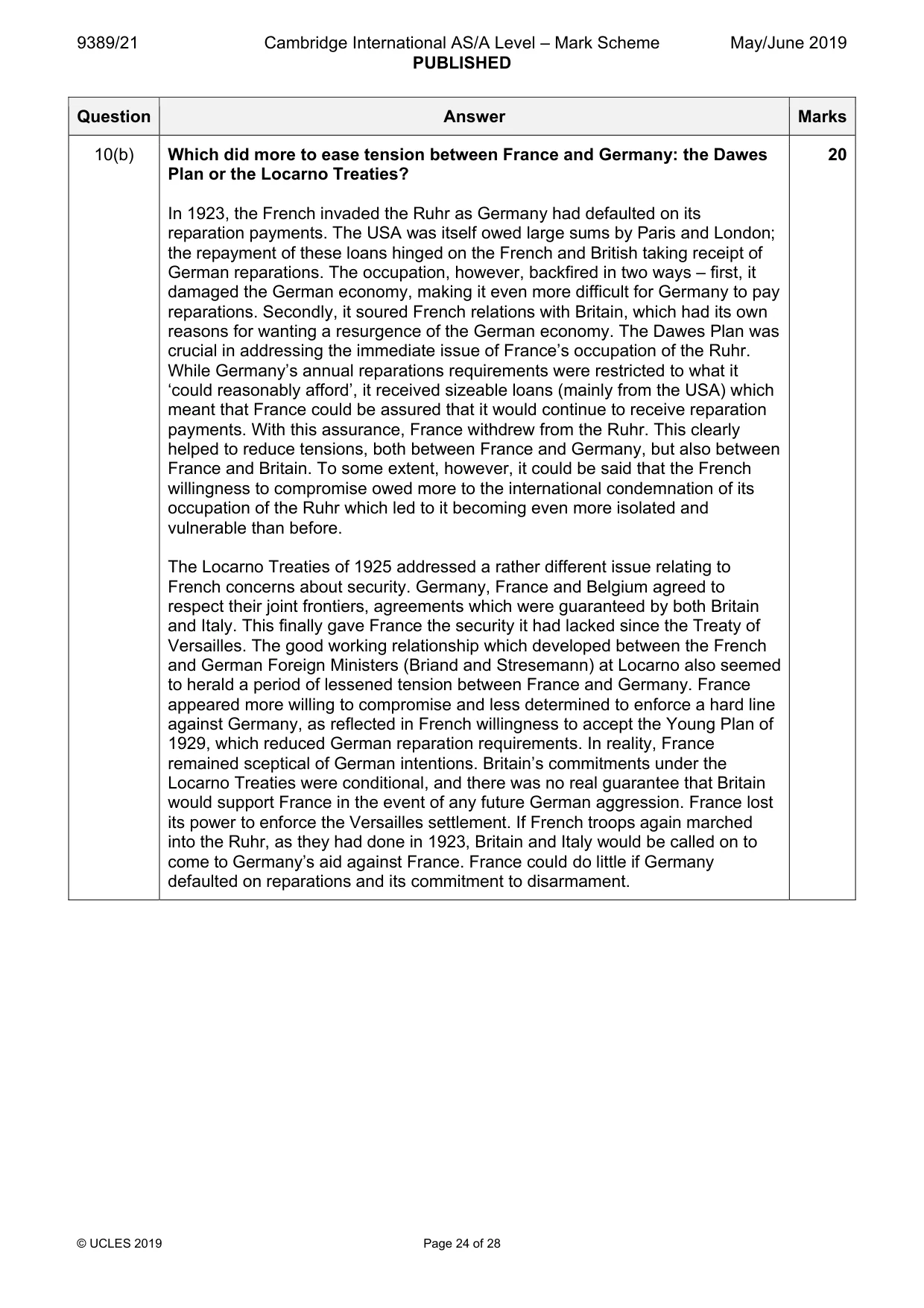
Mark scheme: 10(a) Why, during the Paris peace talks in 1919, did Clemenceau insist that harsh 10 terms be imposed on Germany? • This was partly due to the French desire for revenge, both for the humiliating defeat in the Franco-Prussian War (1870–1871) and for the devastation which France had endured during WWI. • It was, however, also due to fear; fear that Germany might rise from its defeat in WWI to once again threaten French security. Imposing a harsh settlement on the Germans would, Clemenceau believed, make it impossible for Germany to threaten France again in the foreseeable future. • Clemenceau accepted that the War Guilt Clause should be inserted in the Treaty of Versailles, as justification for the imposition on Germany of reparation payments. • Reparations were intended as compensation for the damage inflicted by Germany during the First World War. It was at Clemenceau’s insistence that these payments were set at such a high level to ensure Germany would remain economically weak. Reparations would assist France in repaying war-time loans to the USA. • All of these led to a steadfast determination and brought Clemenceau into conflict with both Woodrow Wilson and David Lloyd George, who would have moderated these demands. 10(b) Which did more to ease tension between France and Germany: the Dawes 20 Plan or the Locarno Treaties? In 1923, the French invaded the Ruhr as Germany had defaulted on its reparation payments. The USA was itself owed large sums by Paris and London; the repayment of these loans hinged on the French and British taking receipt of German reparations. The occupation, however, backfired in two ways – first, it damaged the German economy, making it even more difficult for Germany to pay reparations. Secondly, it soured French relations with Britain, which had its own reasons for wanting a resurgence of the German economy. The Dawes Plan was crucial in addressing the immediate issue of France’s occupation of the Ruhr. While Germany’s annual reparations requirements were restricted to what it ‘could reasonably afford’, it received sizeable loans (mainly from the USA) which meant that France could be assured that it would continue to receive reparation payments. With this assurance, France withdrew from the Ruhr. This clearly helped to reduce tensions, both between France and Germany, but also between France and Britain. To some extent, however, it could be said that the French willingness to compromise owed more to the international condemnation of its occupation of the Ruhr which led to it becoming even more isolated and vulnerable than before. The Locarno Treaties of 1925 addressed a rather different issue relating to French concerns about security. Germany, France and Belgium agreed to respect their joint frontiers, agreements which were guaranteed by both Britain and Italy. This finally gave France the security it had lacked since the Treaty of Versailles. The good working relationship which developed between the French and German Foreign Ministers (Briand and Stresemann) at Locarno also seemed to herald a period of lessened tension between France and Germany. France appeared more willing to compromise and less determined to enforce a hard line against Germany, as reflected in French willingness to accept the Young Plan of 1929, which reduced German reparation requirements. In reality, France remained sceptical of German intentions. Britain’s commitments under the Locarno Treaties were conditional, and there was no real guarantee that Britain would support France in the event of any future German aggression. France lost its power to enforce the Versailles settlement. If French troops again marched into the Ruhr, as they had done in 1923, Britain and Italy would be called on to come to Germany’s aid against France. France could do little if Germany defaulted on reparations and its commitment to disarmament.
Q11 · International Relations, c.1933–1939 (a) Why, in 1934, did Mussolini send troops to…
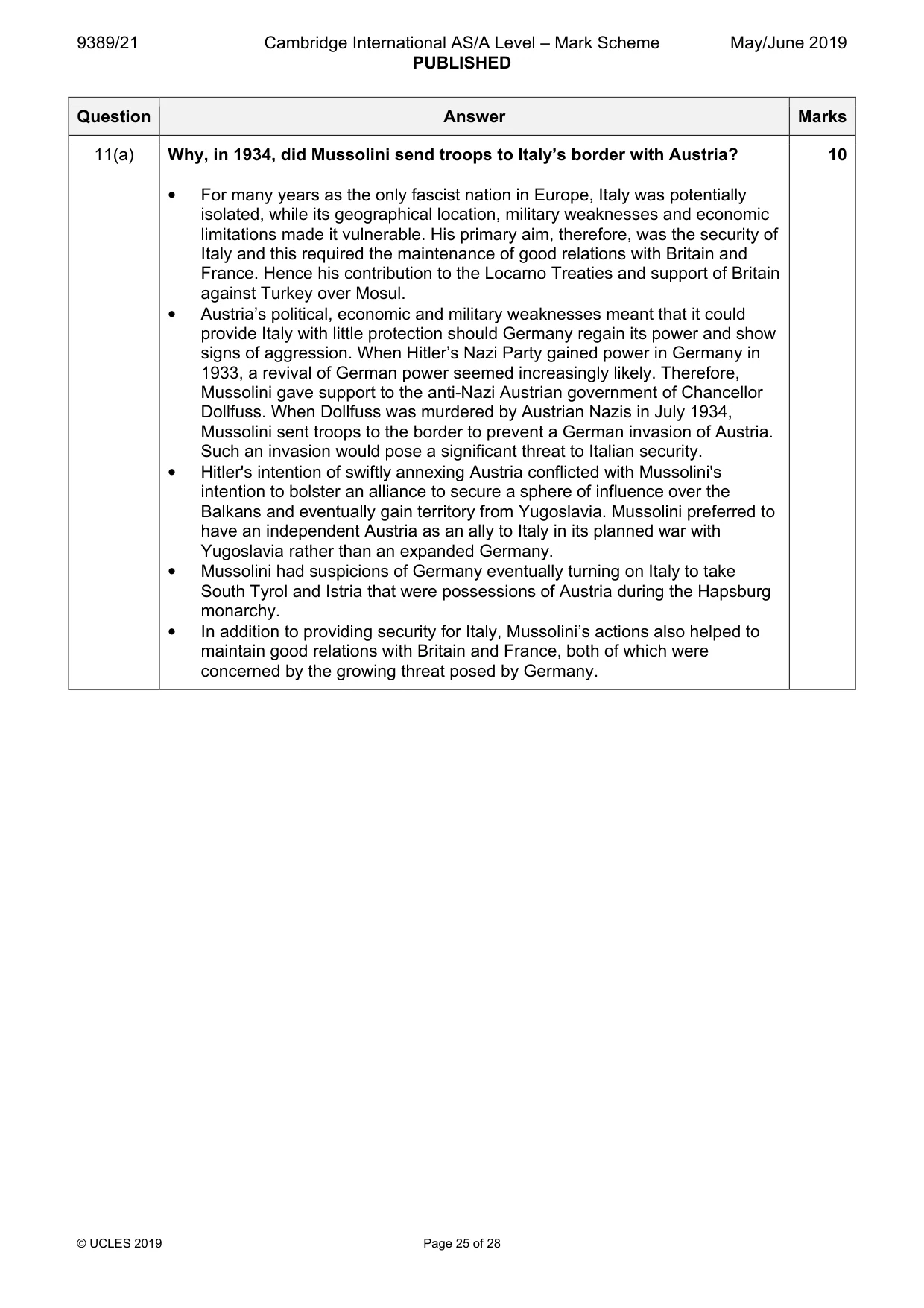
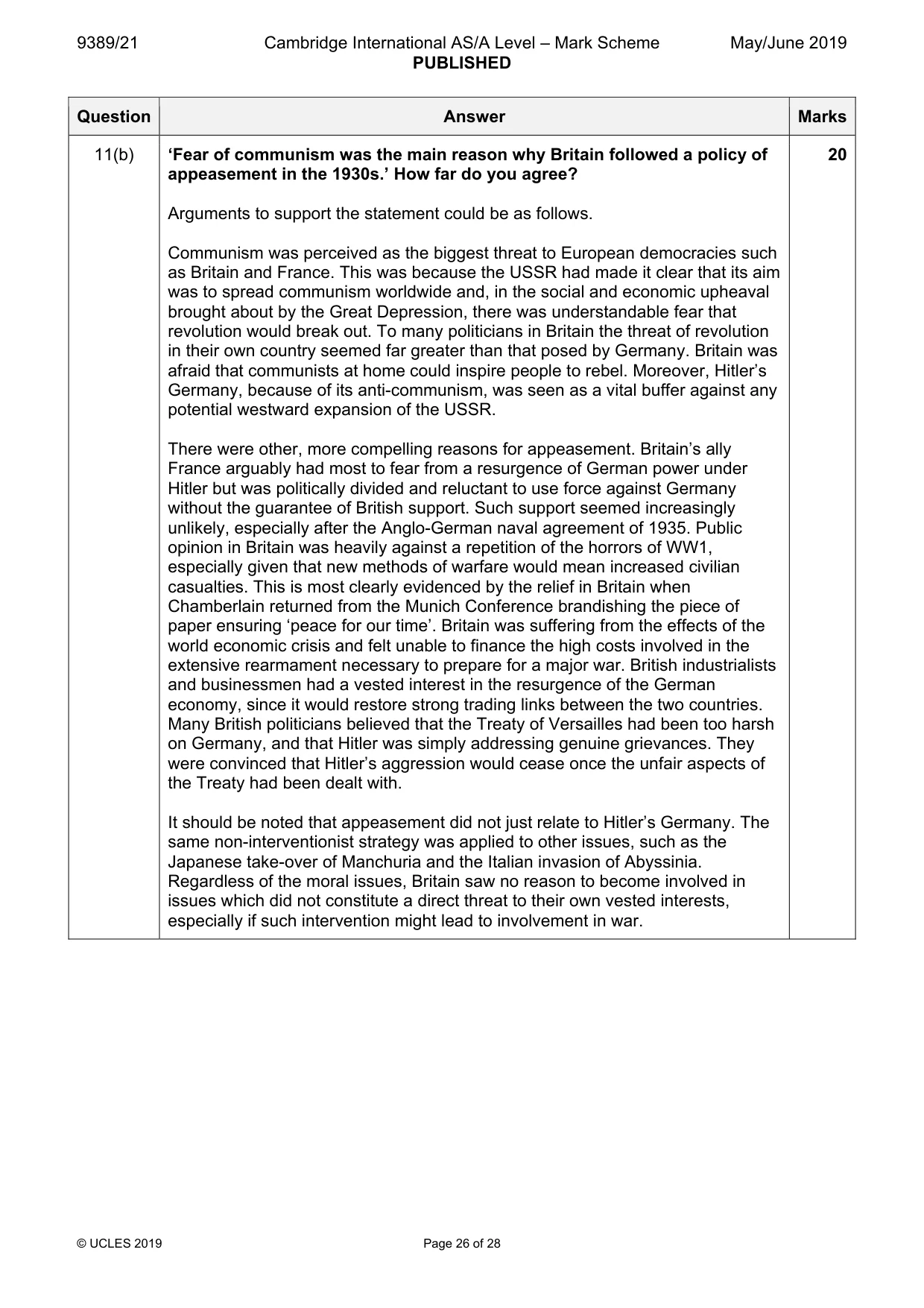
11 International Relations, c.1933–1939 (a) Why, in 1934, did Mussolini send troops to Italy’s border with Austria? [10] (b) ‘Fear of communism was the main reason why Britain followed a policy of appeasement in the 1930s.’ How far do you agree? [20]
Mark scheme: 11(a) Why, in 1934, did Mussolini send troops to Italy’s border with Austria? 10 • For many years as the only fascist nation in Europe, Italy was potentially isolated, while its geographical location, military weaknesses and economic limitations made it vulnerable. His primary aim, therefore, was the security of Italy and this required the maintenance of good relations with Britain and France. Hence his contribution to the Locarno Treaties and support of Britain against Turkey over Mosul. • Austria’s political, economic and military weaknesses meant that it could provide Italy with little protection should Germany regain its power and show signs of aggression. When Hitler’s Nazi Party gained power in Germany in 1933, a revival of German power seemed increasingly likely. Therefore, Mussolini gave support to the anti-Nazi Austrian government of Chancellor Dollfuss. When Dollfuss was murdered by Austrian Nazis in July 1934, Mussolini sent troops to the border to prevent a German invasion of Austria. Such an invasion would pose a significant threat to Italian security. • Hitler's intention of swiftly annexing Austria conflicted with Mussolini's intention to bolster an alliance to secure a sphere of influence over the Balkans and eventually gain territory from Yugoslavia. Mussolini preferred to have an independent Austria as an ally to Italy in its planned war with Yugoslavia rather than an expanded Germany. • Mussolini had suspicions of Germany eventually turning on Italy to take South Tyrol and Istria that were possessions of Austria during the Hapsburg monarchy. • In addition to providing security for Italy, Mussolini’s actions also helped to maintain good relations with Britain and France, both of which were concerned by the growing threat posed by Germany. 11(b) ‘Fear of communism was the main reason why Britain followed a policy of 20 appeasement in the 1930s.’ How far do you agree? Arguments to support the statement could be as follows. Communism was perceived as the biggest threat to European democracies such as Britain and France. This was because the USSR had made it clear that its aim was to spread communism worldwide and, in the social and economic upheaval brought about by the Great Depression, there was understandable fear that revolution would break out. To many politicians in Britain the threat of revolution in their own country seemed far greater than that posed by Germany. Britain was afraid that communists at home could inspire people to rebel. Moreover, Hitler’s Germany, because of its anti-communism, was seen as a vital buffer against any potential westward expansion of the USSR. There were other, more compelling reasons for appeasement. Britain’s ally France arguably had most to fear from a resurgence of German power under Hitler but was politically divided and reluctant to use force against Germany without the guarantee of British support. Such support seemed increasingly unlikely, especially after the Anglo-German naval agreement of 1935. Public opinion in Britain was heavily against a repetition of the horrors of WW1, especially given that new methods of warfare would mean increased civilian casualties. This is most clearly evidenced by the relief in Britain when Chamberlain returned from the Munich Conference brandishing the piece of paper ensuring ‘peace for our time’. Britain was suffering from the effects of the world economic crisis and felt unable to finance the high costs involved in the extensive rearmament necessary to prepare for a major war. British industrialists and businessmen had a vested interest in the resurgence of the German economy, since it would restore strong trading links between the two countries. Many British politicians believed that the Treaty of Versailles had been too harsh on Germany, and that Hitler was simply addressing genuine grievances. They were convinced that Hitler’s aggression would cease once the unfair aspects of the Treaty had been dealt with. It should be noted that appeasement did not just relate to Hitler’s Germany. The same non-interventionist strategy was applied to other issues, such as the Japanese take-over of Manchuria and the Italian invasion of Abyssinia. Regardless of the moral issues, Britain saw no reason to become involved in issues which did not constitute a direct threat to their own vested interests, especially if such intervention might lead to involvement in war.
Q12 · China and Japan, 1919–1945 (a) Why did Japan become a military dictatorship during the…
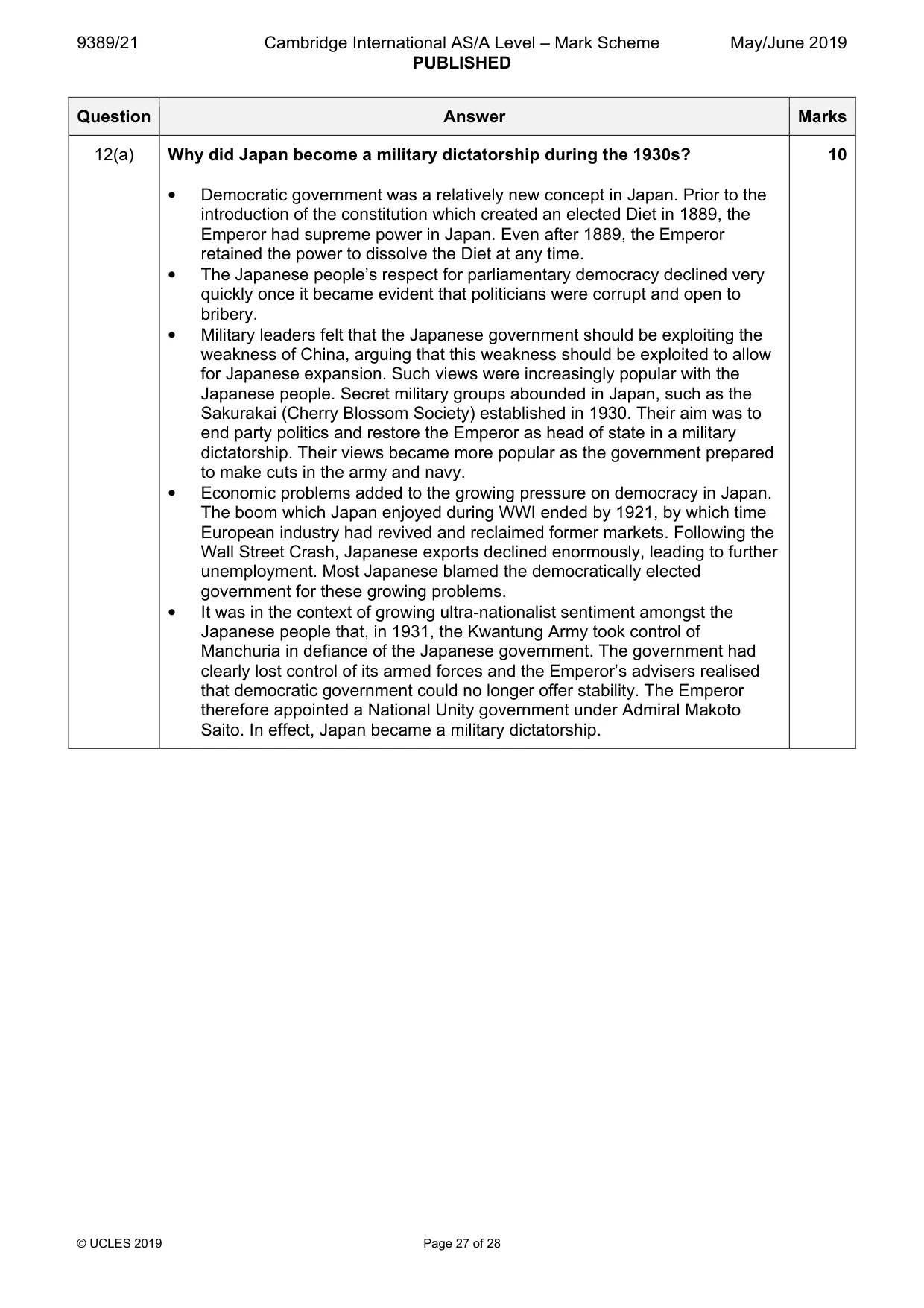
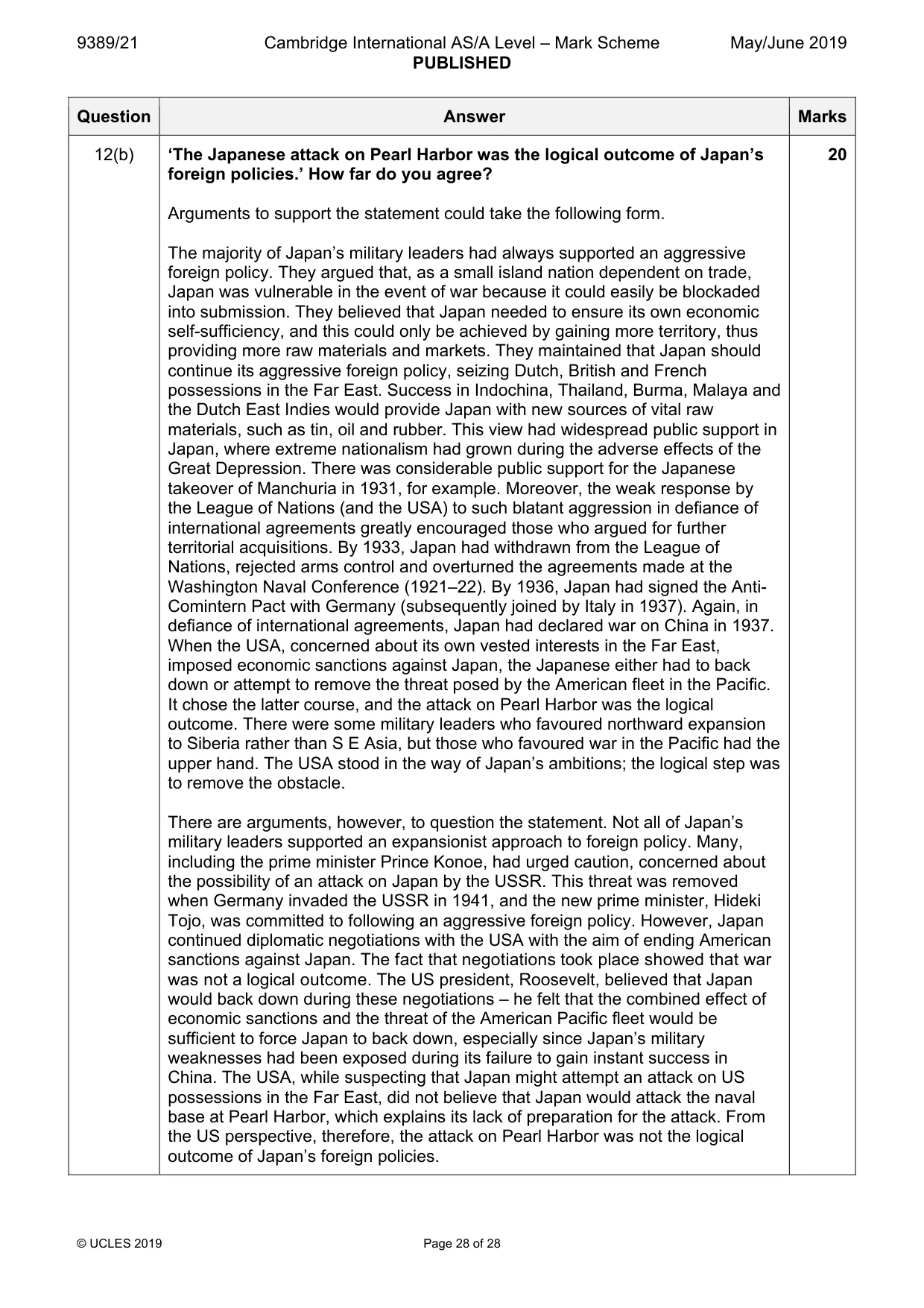
12 China and Japan, 1919–1945 (a) Why did Japan become a military dictatorship during the 1930s? [10] (b) ‘The Japanese attack on Pearl Harbor was the logical outcome of Japan’s foreign policies.’ How far do you agree? [20]
Mark scheme: 12(a) Why did Japan become a military dictatorship during the 1930s? 10 • Democratic government was a relatively new concept in Japan. Prior to the introduction of the constitution which created an elected Diet in 1889, the Emperor had supreme power in Japan. Even after 1889, the Emperor retained the power to dissolve the Diet at any time. • The Japanese people’s respect for parliamentary democracy declined very quickly once it became evident that politicians were corrupt and open to bribery. • Military leaders felt that the Japanese government should be exploiting the weakness of China, arguing that this weakness should be exploited to allow for Japanese expansion. Such views were increasingly popular with the Japanese people. Secret military groups abounded in Japan, such as the Sakurakai (Cherry Blossom Society) established in 1930. Their aim was to end party politics and restore the Emperor as head of state in a military dictatorship. Their views became more popular as the government prepared to make cuts in the army and navy. • Economic problems added to the growing pressure on democracy in Japan. The boom which Japan enjoyed during WWI ended by 1921, by which time European industry had revived and reclaimed former markets. Following the Wall Street Crash, Japanese exports declined enormously, leading to further unemployment. Most Japanese blamed the democratically elected government for these growing problems. • It was in the context of growing ultra-nationalist sentiment amongst the Japanese people that, in 1931, the Kwantung Army took control of Manchuria in defiance of the Japanese government. The government had clearly lost control of its armed forces and the Emperor’s advisers realised that democratic government could no longer offer stability. The Emperor therefore appointed a National Unity government under Admiral Makoto Saito. In effect, Japan became a military dictatorship. 12(b) ‘The Japanese attack on Pearl Harbor was the logical outcome of Japan’s 20 foreign policies.’ How far do you agree? Arguments to support the statement could take the following form. The majority of Japan’s military leaders had always supported an aggressive foreign policy. They argued that, as a small island nation dependent on trade, Japan was vulnerable in the event of war because it could easily be blockaded into submission. They believed that Japan needed to ensure its own economic self-sufficiency, and this could only be achieved by gaining more territory, thus providing more raw materials and markets. They maintained that Japan should continue its aggressive foreign policy, seizing Dutch, British and French possessions in the Far East. Success in Indochina, Thailand, Burma, Malaya and the Dutch East Indies would provide Japan with new sources of vital raw materials, such as tin, oil and rubber. This view had widespread public support in Japan, where extreme nationalism had grown during the adverse effects of the Great Depression. There was considerable public support for the Japanese takeover of Manchuria in 1931, for example. Moreover, the weak response by the League of Nations (and the USA) to such blatant aggression in defiance of international agreements greatly encouraged those who argued for further territorial acquisitions. By 1933, Japan had withdrawn from the League of Nations, rejected arms control and overturned the agreements made at the Washington Naval Conference (1921–22). By 1936, Japan had signed the Anti- Comintern Pact with Germany (subsequently joined by Italy in 1937). Again, in defiance of international agreements, Japan had declared war on China in 1937. When the USA, concerned about its own vested interests in the Far East, imposed economic sanctions against Japan, the Japanese either had to back down or attempt to remove the threat posed by the American fleet in the Pacific. It chose the latter course, and the attack on Pearl Harbor was the logical outcome. There were some military leaders who favoured northward expansion to Siberia rather than S E Asia, but those who favoured war in the Pacific had the upper hand. The USA stood in the way of Japan’s ambitions; the logical step was to remove the obstacle. There are arguments, however, to question the statement. Not all of Japan’s military leaders supported an expansionist approach to foreign policy. Many, including the prime minister Prince Konoe, had urged caution, concerned about the possibility of an attack on Japan by the USSR. This threat was removed when Germany invaded the USSR in 1941, and the new prime minister, Hideki Tojo, was committed to following an aggressive foreign policy. However, Japan continued diplomatic negotiations with the USA with the aim of ending American sanctions against Japan. The fact that negotiations took place showed that war was not a logical outcome. The US president, Roosevelt, believed that Japan would back down during these negotiations – he felt that the combined effect of economic sanctions and the threat of the American Pacific fleet would be sufficient to force Japan to back down, especially since Japan’s military weaknesses had been exposed during its failure to gain instant success in China. The USA, while suspecting that Japan might attempt an attack on US possessions in the Far East, did not believe that Japan would attack the naval base at Pearl Harbor, which explains its lack of preparation for the attack. From the US perspective, therefore, the attack on Pearl Harbor was not the logical outcome of Japan’s foreign policies.
What you needed in this session
Cambridge’s own grade thresholds for 2019 May/June, Paper 2 · Variant 1. A higher threshold means an easier paper — the bar moves with how the cohort did.