Cambridge A Level History 9389 — 2018 Oct/Nov Paper 2 · Variant 1
9389/21/O/N/18 · 12 questions · 60 marks · ≈68 min
The question paper and its mark scheme, free to read here and free to download. This is Cambridge’s own paper, exactly as it was sat.
Question paper4 pages
Mark scheme20 pages
Answers below. Sit the paper first if you are practising.
Questions as text
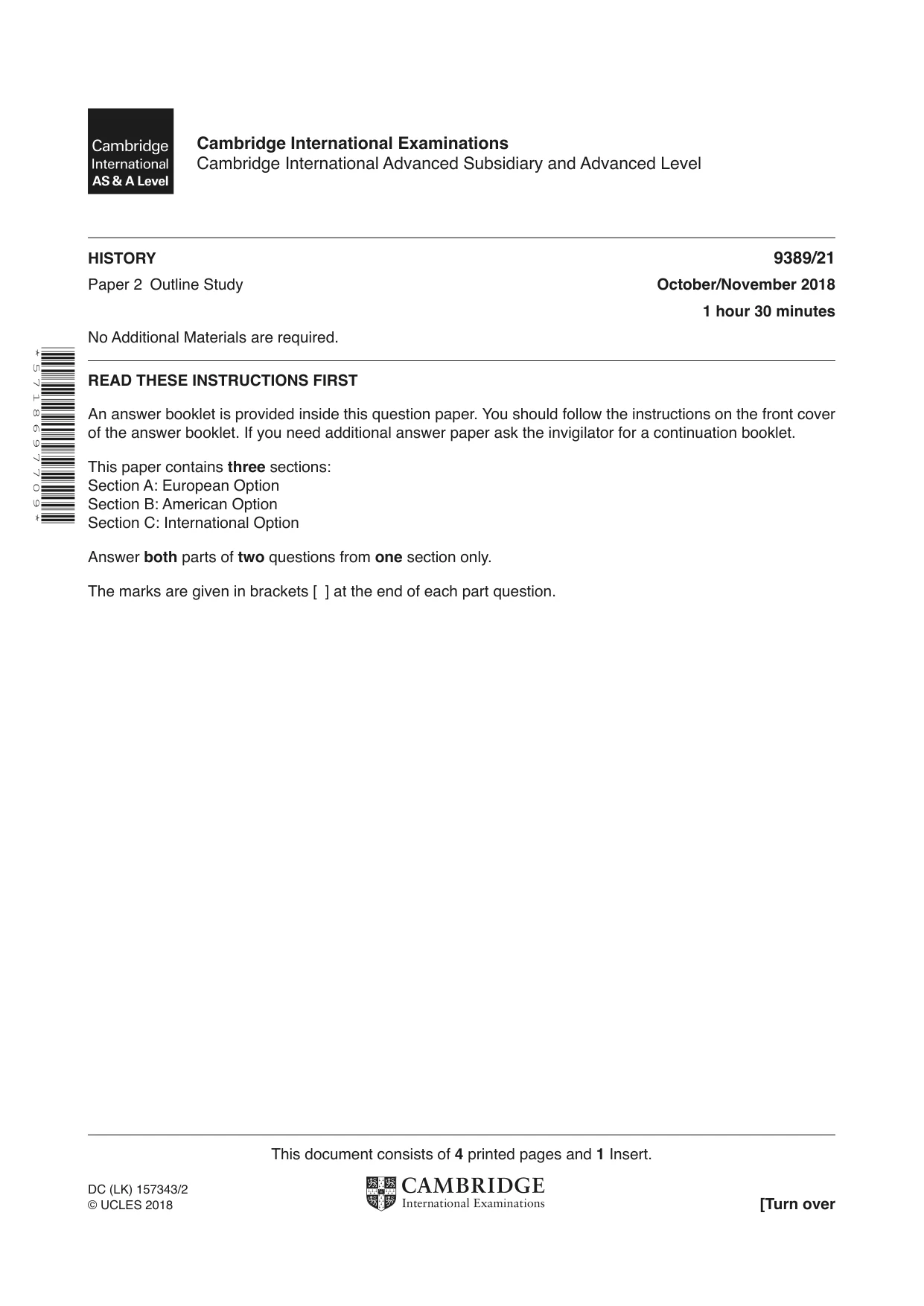
Q1 · France, 1789–1814 (a) Why did the Terror come to an end in 1794?
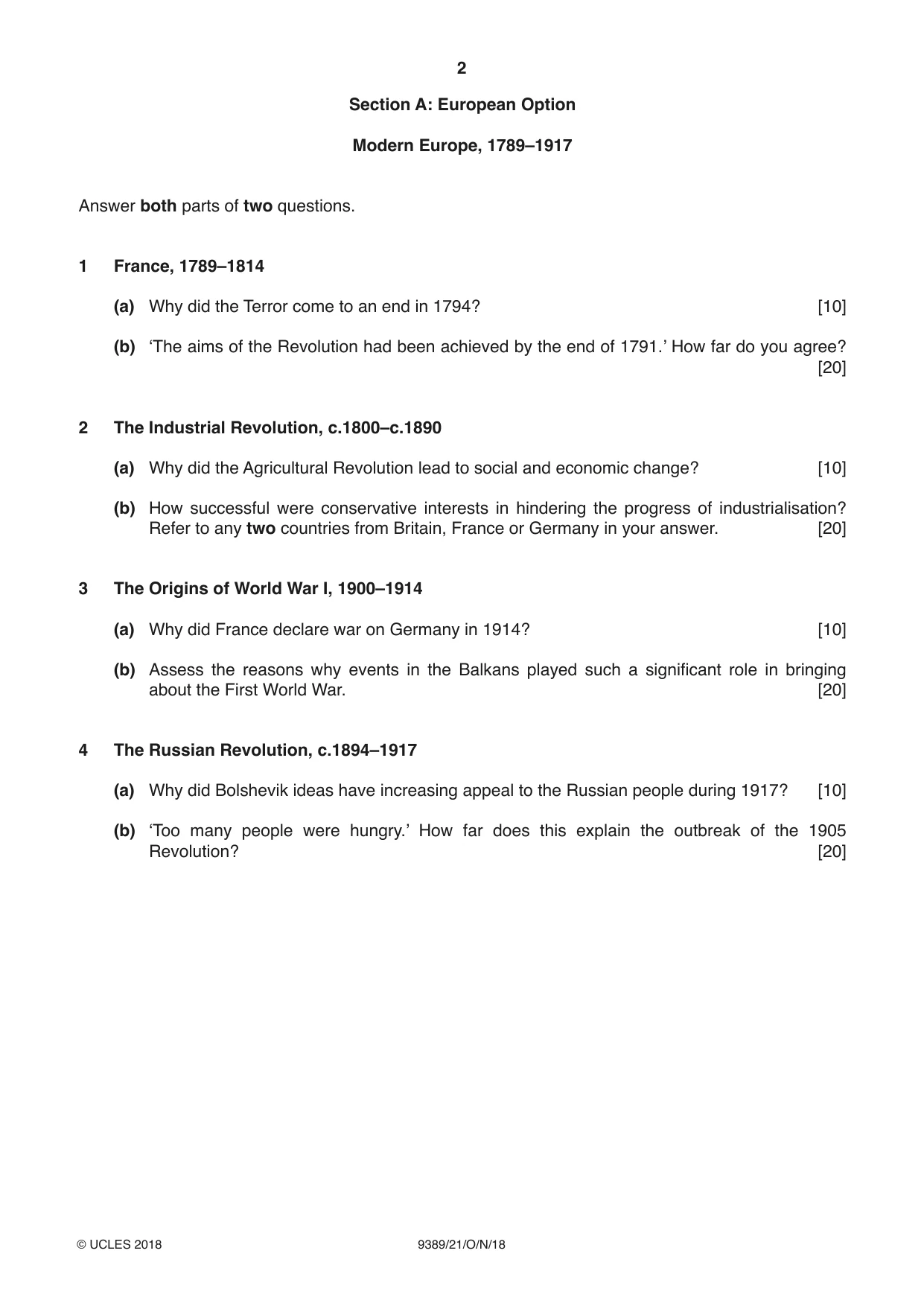
1 France, 1789–1814 (a) Why did the Terror come to an end in 1794? [10] (b) ‘The aims of the Revolution had been achieved by the end of 1791.’ How far do you agree? [20]
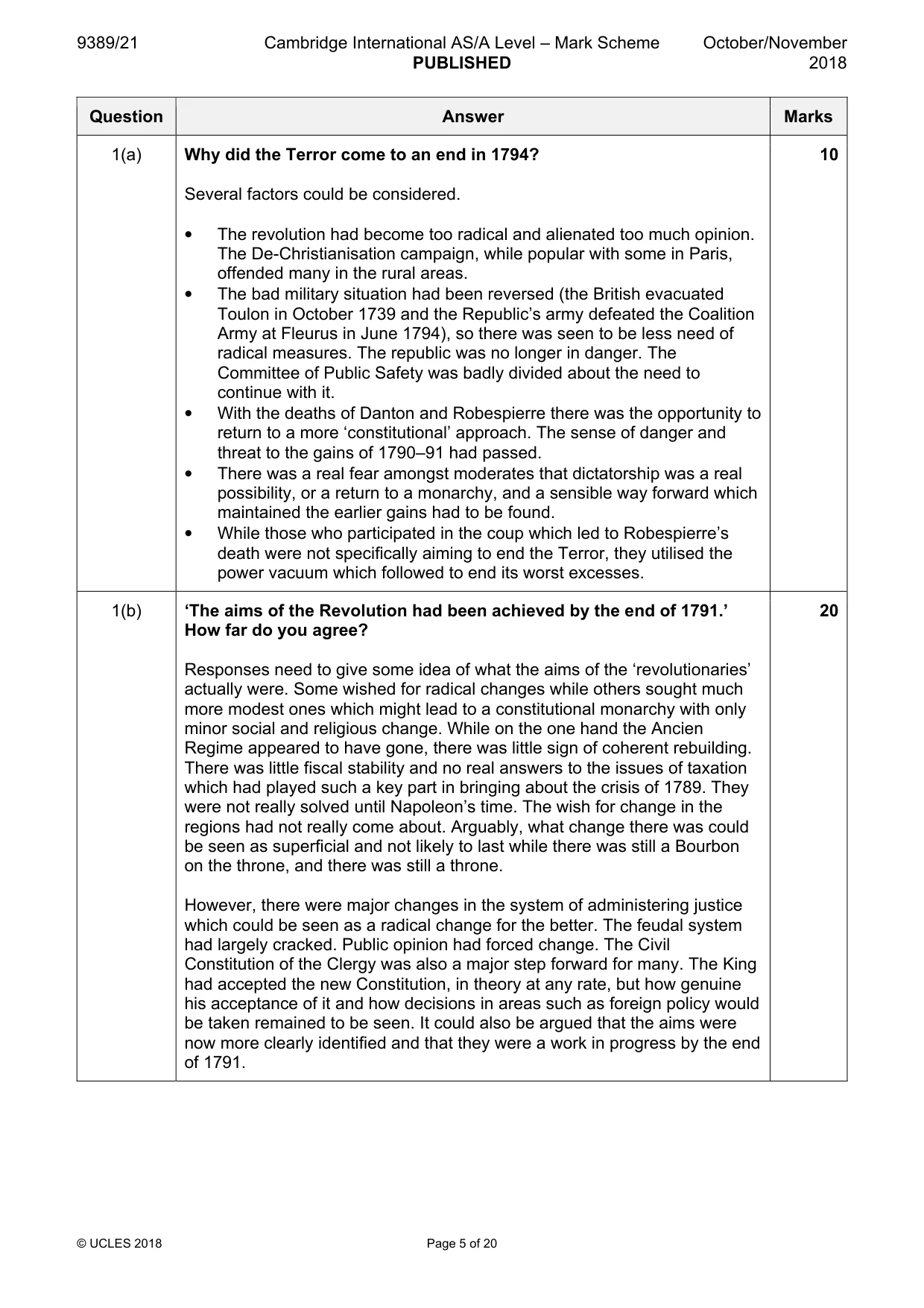
Mark scheme: Question Answer Marks 1(a) Why did the Terror come to an end in 1794? 10 Several factors could be considered. • The revolution had become too radical and alienated too much opinion. The De-Christianisation campaign, while popular with some in Paris, offended many in the rural areas. • The bad military situation had been reversed (the British evacuated Toulon in October 1739 and the Republic’s army defeated the Coalition Army at Fleurus in June 1794), so there was seen to be less need of radical measures. The republic was no longer in danger. The Committee of Public Safety was badly divided about the need to continue with it. • With the deaths of Danton and Robespierre there was the opportunity to return to a more ‘constitutional’ approach. The sense of danger and threat to the gains of 1790–91 had passed. • There was a real fear amongst moderates that dictatorship was a real possibility, or a return to a monarchy, and a sensible way forward which maintained the earlier gains had to be found. • While those who participated in the coup which led to Robespierre’s death were not specifically aiming to end the Terror, they utilised the power vacuum which followed to end its worst excesses. 1(b) ‘The aims of the Revolution had been achieved by the end of 1791.’ 20 How far do you agree? Responses need to give some idea of what the aims of the ‘revolutionaries’ actually were. Some wished for radical changes while others sought much more modest ones which might lead to a constitutional monarchy with only minor social and religious change. While on the one hand the Ancien Regime appeared to have gone, there was little sign of coherent rebuilding. There was little fiscal stability and no real answers to the issues of taxation which had played such a key part in bringing about the crisis of 1789. They were not really solved until Napoleon’s time. The wish for change in the regions had not really come about. Arguably, what change there was could be seen as superficial and not likely to last while there was still a Bourbon on the throne, and there was still a throne. However, there were major changes in the system of administering justice which could be seen as a radical change for the better. The feudal system had largely cracked. Public opinion had forced change. The Civil Constitution of the Clergy was also a major step forward for many. The King had accepted the new Constitution, in theory at any rate, but how genuine his acceptance of it and how decisions in areas such as foreign policy would be taken remained to be seen. It could also be argued that the aims were now more clearly identified and that they were a work in progress by the end of 1791.
Q2 · The Industrial Revolution, c.1800–c.1890 (a) Why did the Agricultural Revolution lead to…
2 The Industrial Revolution, c.1800–c.1890 (a) Why did the Agricultural Revolution lead to social and economic change? [10] (b) How successful were conservative interests in hindering the progress of industrialisation? Refer to any two countries from Britain, France or Germany in your answer. [20]
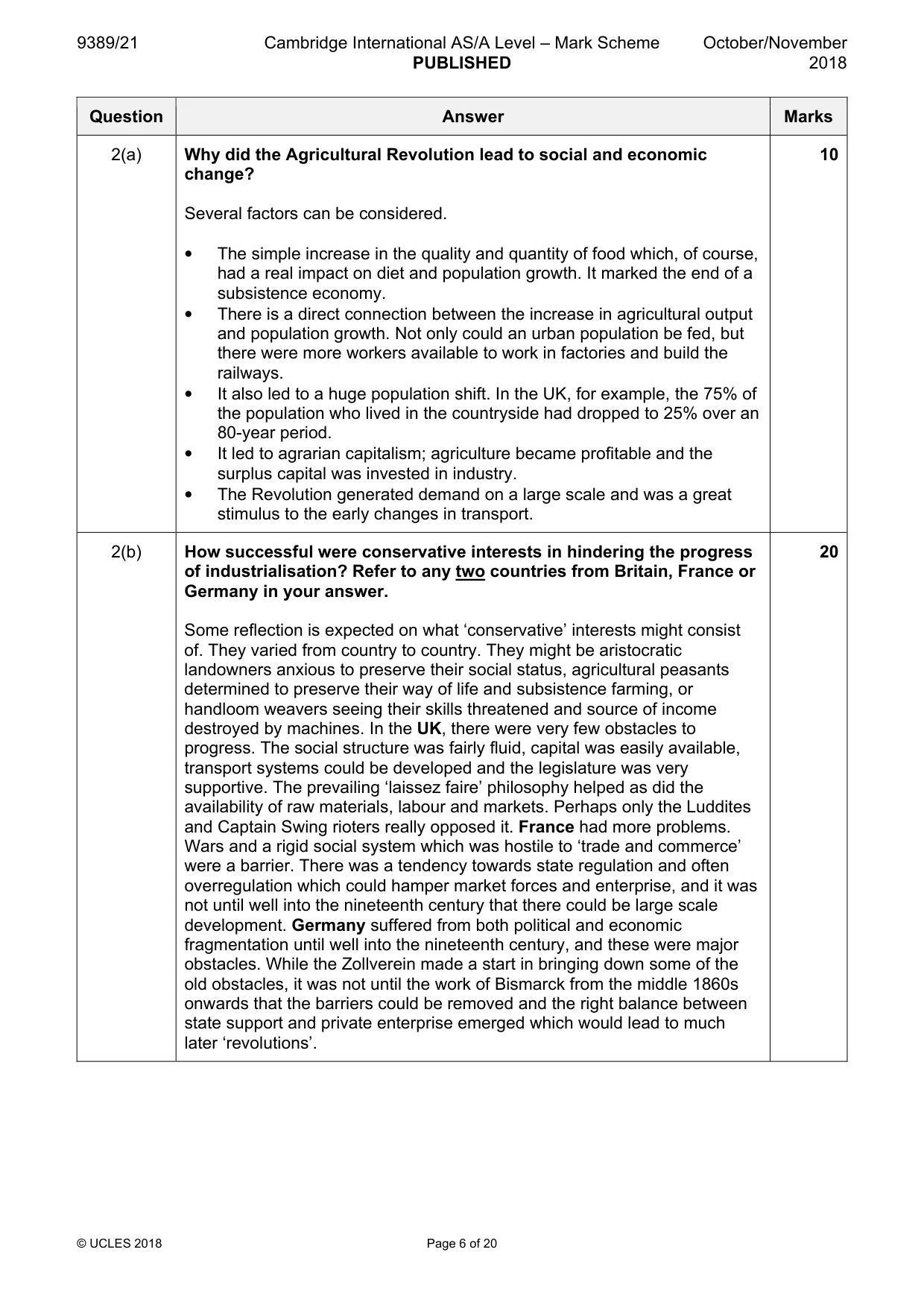
Mark scheme: 2(a) Why did the Agricultural Revolution lead to social and economic 10 change? Several factors can be considered. • The simple increase in the quality and quantity of food which, of course, had a real impact on diet and population growth. It marked the end of a subsistence economy. • There is a direct connection between the increase in agricultural output and population growth. Not only could an urban population be fed, but there were more workers available to work in factories and build the railways. • It also led to a huge population shift. In the UK, for example, the 75% of the population who lived in the countryside had dropped to 25% over an 80-year period. • It led to agrarian capitalism; agriculture became profitable and the surplus capital was invested in industry. • The Revolution generated demand on a large scale and was a great stimulus to the early changes in transport. 2(b) How successful were conservative interests in hindering the progress 20 of industrialisation? Refer to any two countries from Britain, France or Germany in your answer. Some reflection is expected on what ‘conservative’ interests might consist of. They varied from country to country. They might be aristocratic landowners anxious to preserve their social status, agricultural peasants determined to preserve their way of life and subsistence farming, or handloom weavers seeing their skills threatened and source of income destroyed by machines. In the UK, there were very few obstacles to progress. The social structure was fairly fluid, capital was easily available, transport systems could be developed and the legislature was very supportive. The prevailing ‘laissez faire’ philosophy helped as did the availability of raw materials, labour and markets. Perhaps only the Luddites and Captain Swing rioters really opposed it. France had more problems. Wars and a rigid social system which was hostile to ‘trade and commerce’ were a barrier. There was a tendency towards state regulation and often overregulation which could hamper market forces and enterprise, and it was not until well into the nineteenth century that there could be large scale development. Germany suffered from both political and economic fragmentation until well into the nineteenth century, and these were major obstacles. While the Zollverein made a start in bringing down some of the old obstacles, it was not until the work of Bismarck from the middle 1860s onwards that the barriers could be removed and the right balance between state support and private enterprise emerged which would lead to much later ‘revolutions’.
Q3 · The Origins of World War I, 1900–1914 (a) Why did France declare war on Germany in 1914?
3 The Origins of World War I, 1900–1914 (a) Why did France declare war on Germany in 1914? [10] (b) Assess the reasons why events in the Balkans played such a significant role in bringing about the First World War. [20]
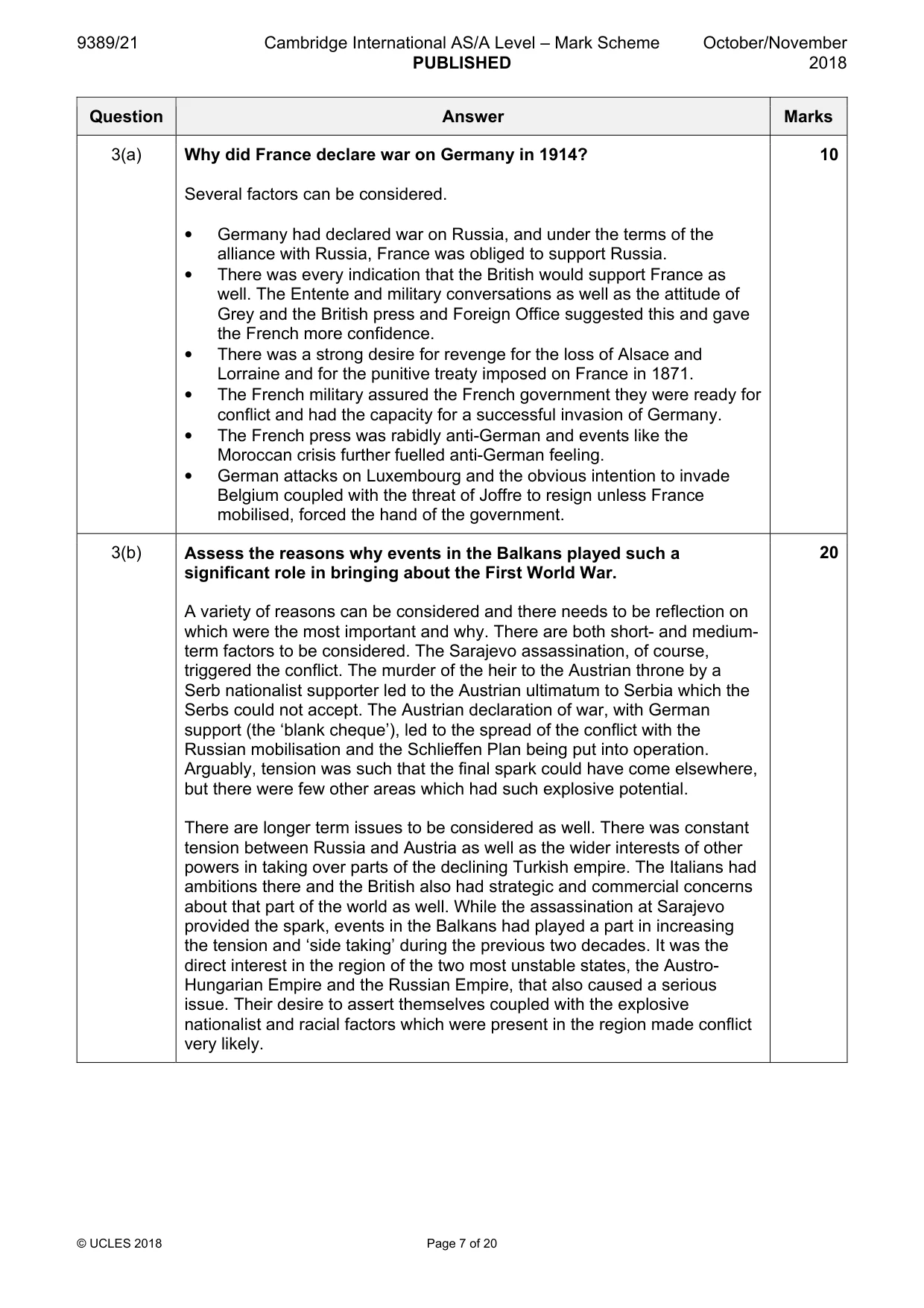
Mark scheme: 3(a) Why did France declare war on Germany in 1914? 10 Several factors can be considered. • Germany had declared war on Russia, and under the terms of the alliance with Russia, France was obliged to support Russia. • There was every indication that the British would support France as well. The Entente and military conversations as well as the attitude of Grey and the British press and Foreign Office suggested this and gave the French more confidence. • There was a strong desire for revenge for the loss of Alsace and Lorraine and for the punitive treaty imposed on France in 1871. • The French military assured the French government they were ready for conflict and had the capacity for a successful invasion of Germany. • The French press was rabidly anti-German and events like the Moroccan crisis further fuelled anti-German feeling. • German attacks on Luxembourg and the obvious intention to invade Belgium coupled with the threat of Joffre to resign unless France mobilised, forced the hand of the government. 3(b) Assess the reasons why events in the Balkans played such a 20 significant role in bringing about the First World War. A variety of reasons can be considered and there needs to be reflection on which were the most important and why. There are both short- and medium- term factors to be considered. The Sarajevo assassination, of course, triggered the conflict. The murder of the heir to the Austrian throne by a Serb nationalist supporter led to the Austrian ultimatum to Serbia which the Serbs could not accept. The Austrian declaration of war, with German support (the ‘blank cheque’), led to the spread of the conflict with the Russian mobilisation and the Schlieffen Plan being put into operation. Arguably, tension was such that the final spark could have come elsewhere, but there were few other areas which had such explosive potential. There are longer term issues to be considered as well. There was constant tension between Russia and Austria as well as the wider interests of other powers in taking over parts of the declining Turkish empire. The Italians had ambitions there and the British also had strategic and commercial concerns about that part of the world as well. While the assassination at Sarajevo provided the spark, events in the Balkans had played a part in increasing the tension and ‘side taking’ during the previous two decades. It was the direct interest in the region of the two most unstable states, the Austro- Hungarian Empire and the Russian Empire, that also caused a serious issue. Their desire to assert themselves coupled with the explosive nationalist and racial factors which were present in the region made conflict very likely.
Q4 · The Russian Revolution, c.1894–1917 (a) Why did Bolshevik ideas have increasing appeal to…
4 The Russian Revolution, c.1894–1917 (a) Why did Bolshevik ideas have increasing appeal to the Russian people during 1917? [10] (b) ‘Too many people were hungry.’ How far does this explain the outbreak of the 1905 Revolution? [20]
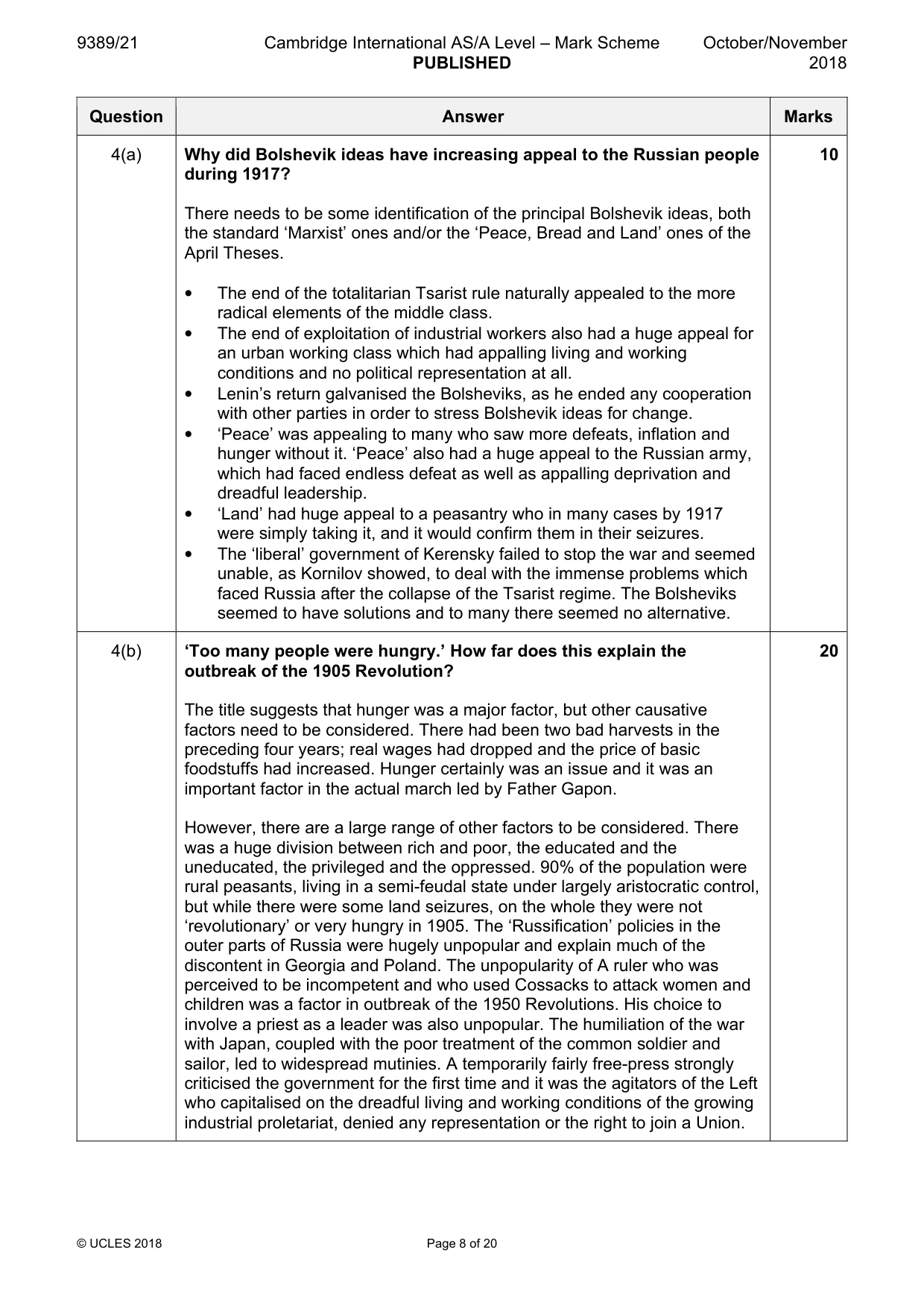
Mark scheme: 4(a) Why did Bolshevik ideas have increasing appeal to the Russian people 10 during 1917? There needs to be some identification of the principal Bolshevik ideas, both the standard ‘Marxist’ ones and/or the ‘Peace, Bread and Land’ ones of the April Theses. • The end of the totalitarian Tsarist rule naturally appealed to the more radical elements of the middle class. • The end of exploitation of industrial workers also had a huge appeal for an urban working class which had appalling living and working conditions and no political representation at all. • Lenin’s return galvanised the Bolsheviks, as he ended any cooperation with other parties in order to stress Bolshevik ideas for change. • ‘Peace’ was appealing to many who saw more defeats, inflation and hunger without it. ‘Peace’ also had a huge appeal to the Russian army, which had faced endless defeat as well as appalling deprivation and dreadful leadership. • ‘Land’ had huge appeal to a peasantry who in many cases by 1917 were simply taking it, and it would confirm them in their seizures. • The ‘liberal’ government of Kerensky failed to stop the war and seemed unable, as Kornilov showed, to deal with the immense problems which faced Russia after the collapse of the Tsarist regime. The Bolsheviks seemed to have solutions and to many there seemed no alternative. 4(b) ‘Too many people were hungry.’ How far does this explain the 20 outbreak of the 1905 Revolution? The title suggests that hunger was a major factor, but other causative factors need to be considered. There had been two bad harvests in the preceding four years; real wages had dropped and the price of basic foodstuffs had increased. Hunger certainly was an issue and it was an important factor in the actual march led by Father Gapon. However, there are a large range of other factors to be considered. There was a huge division between rich and poor, the educated and the uneducated, the privileged and the oppressed. 90% of the population were rural peasants, living in a semi-feudal state under largely aristocratic control, but while there were some land seizures, on the whole they were not ‘revolutionary’ or very hungry in 1905. The ‘Russification’ policies in the outer parts of Russia were hugely unpopular and explain much of the discontent in Georgia and Poland. The unpopularity of A ruler who was perceived to be incompetent and who used Cossacks to attack women and children was a factor in outbreak of the 1950 Revolutions. His choice to involve a priest as a leader was also unpopular. The humiliation of the war with Japan, coupled with the poor treatment of the common soldier and sailor, led to widespread mutinies. A temporarily fairly free-press strongly criticised the government for the first time and it was the agitators of the Left who capitalised on the dreadful living and working conditions of the growing industrial proletariat, denied any representation or the right to join a Union.
Q5 · The expansion of US power from the 1840s to the 1930s (a) Why, in 1848, did the USA sign…
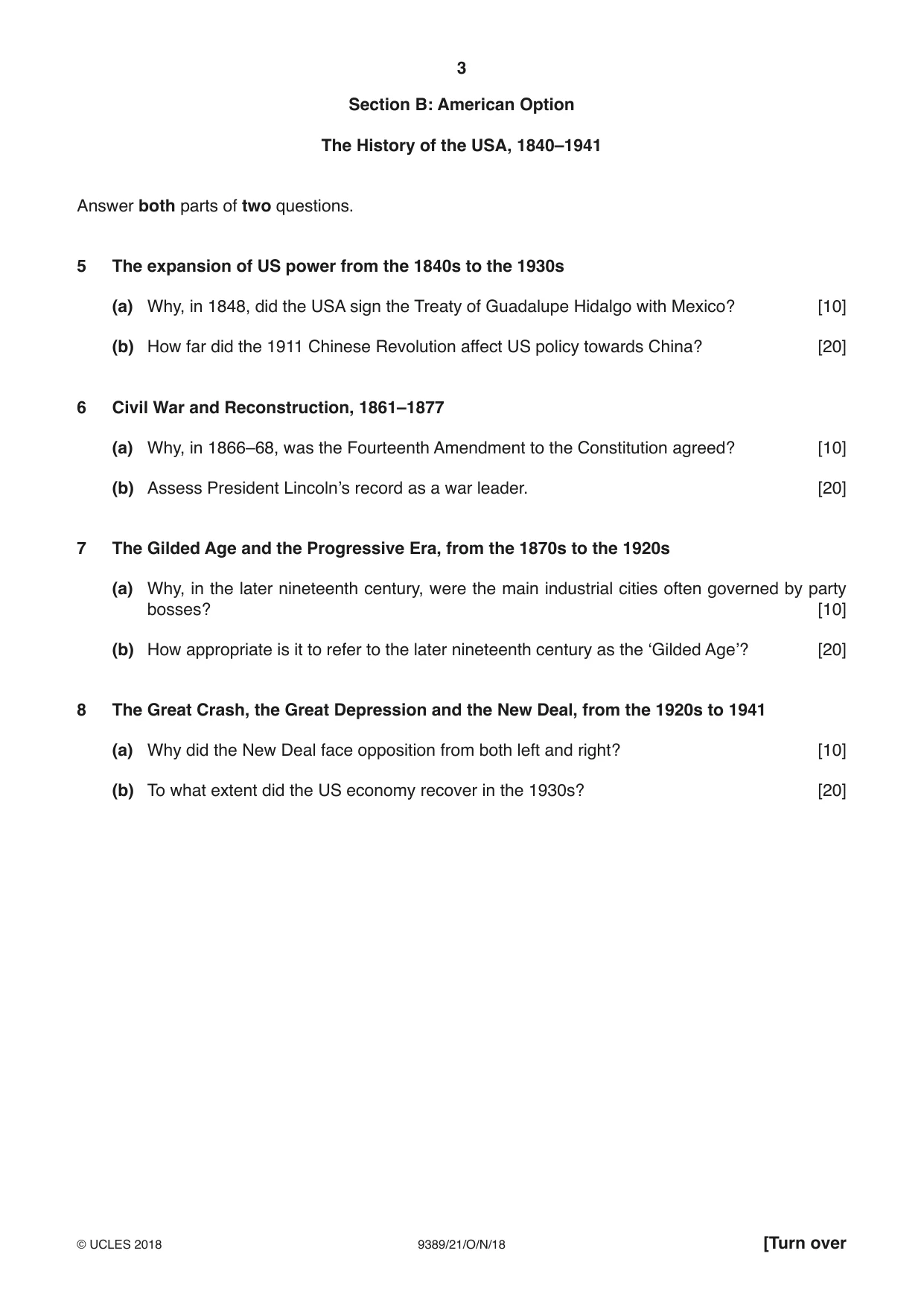
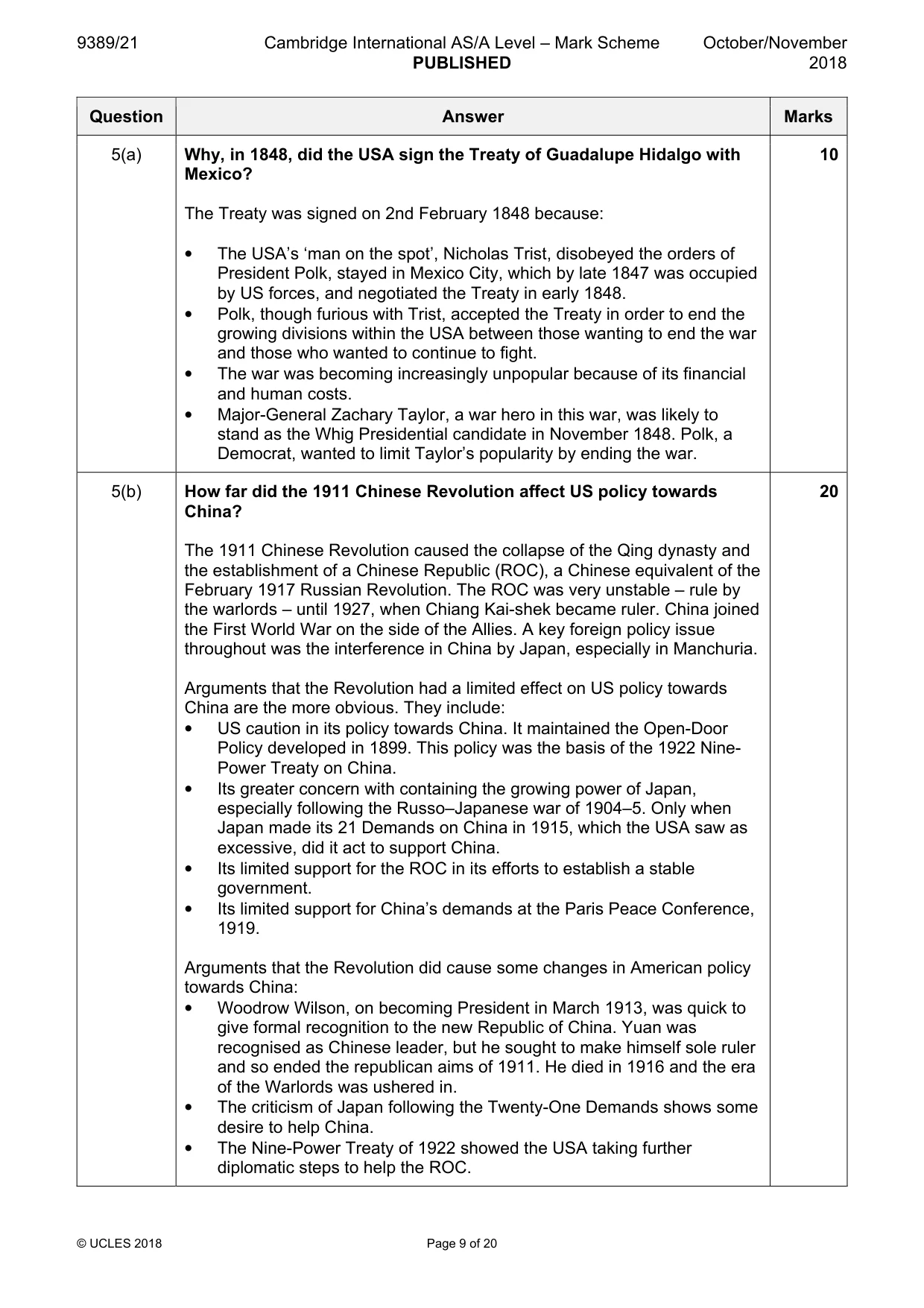
5 The expansion of US power from the 1840s to the 1930s (a) Why, in 1848, did the USA sign the Treaty of Guadalupe Hidalgo with Mexico? [10] (b) How far did the 1911 Chinese Revolution affect US policy towards China? [20]
Mark scheme: 5(a) Why, in 1848, did the USA sign the Treaty of Guadalupe Hidalgo with 10 Mexico? The Treaty was signed on 2nd February 1848 because: • The USA’s ‘man on the spot’, Nicholas Trist, disobeyed the orders of President Polk, stayed in Mexico City, which by late 1847 was occupied by US forces, and negotiated the Treaty in early 1848. • Polk, though furious with Trist, accepted the Treaty in order to end the growing divisions within the USA between those wanting to end the war and those who wanted to continue to fight. • The war was becoming increasingly unpopular because of its financial and human costs. • Major-General Zachary Taylor, a war hero in this war, was likely to stand as the Whig Presidential candidate in November 1848. Polk, a Democrat, wanted to limit Taylor’s popularity by ending the war. 5(b) How far did the 1911 Chinese Revolution affect US policy towards 20 China? The 1911 Chinese Revolution caused the collapse of the Qing dynasty and the establishment of a Chinese Republic (ROC), a Chinese equivalent of the February 1917 Russian Revolution. The ROC was very unstable – rule by the warlords – until 1927, when Chiang Kai-shek became ruler. China joined the First World War on the side of the Allies. A key foreign policy issue throughout was the interference in China by Japan, especially in Manchuria. Arguments that the Revolution had a limited effect on US policy towards China are the more obvious. They include: • US caution in its policy towards China. It maintained the Open-Door Policy developed in 1899. This policy was the basis of the 1922 Nine- Power Treaty on China. • Its greater concern with containing the growing power of Japan, especially following the Russo–Japanese war of 1904–5. Only when Japan made its 21 Demands on China in 1915, which the USA saw as excessive, did it act to support China. • Its limited support for the ROC in its efforts to establish a stable government. • Its limited support for China’s demands at the Paris Peace Conference, 1919. Arguments that the Revolution did cause some changes in American policy towards China: • Woodrow Wilson, on becoming President in March 1913, was quick to give formal recognition to the new Republic of China. Yuan was recognised as Chinese leader, but he sought to make himself sole ruler and so ended the republican aims of 1911. He died in 1916 and the era of the Warlords was ushered in. • The criticism of Japan following the Twenty-One Demands shows some desire to help China. • The Nine-Power Treaty of 1922 showed the USA taking further diplomatic steps to help the ROC.
Q6 · Civil War and Reconstruction, 1861–1877 (a) Why, in 1866–68, was the Fourteenth Amendment…
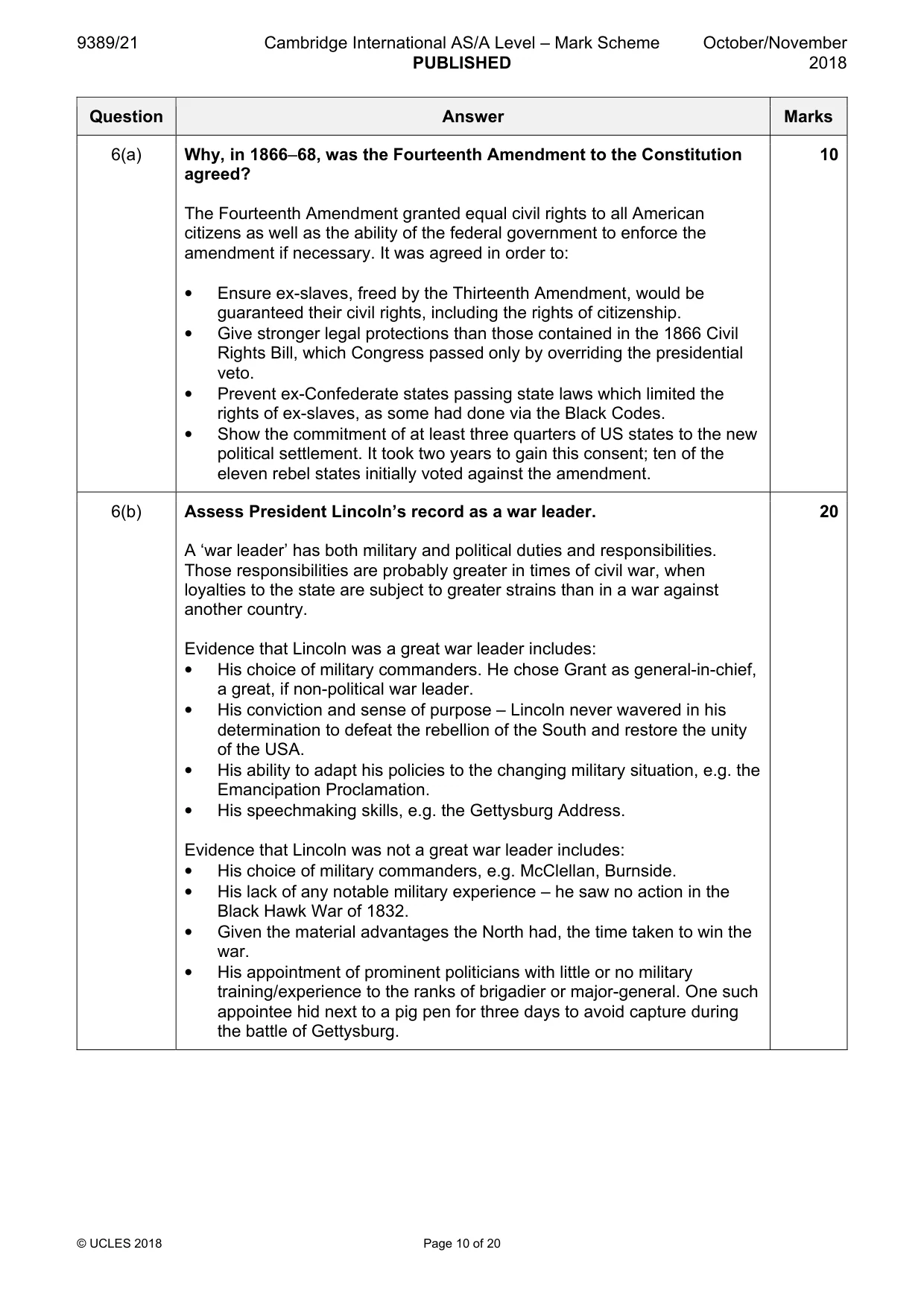
6 Civil War and Reconstruction, 1861–1877 (a) Why, in 1866–68, was the Fourteenth Amendment to the Constitution agreed? [10] (b) Assess President Lincoln’s record as a war leader. [20]
Mark scheme: 6(a) Why, in 1866–68, was the Fourteenth Amendment to the Constitution 10 agreed? The Fourteenth Amendment granted equal civil rights to all American citizens as well as the ability of the federal government to enforce the amendment if necessary. It was agreed in order to: • Ensure ex-slaves, freed by the Thirteenth Amendment, would be guaranteed their civil rights, including the rights of citizenship. • Give stronger legal protections than those contained in the 1866 Civil Rights Bill, which Congress passed only by overriding the presidential veto. • Prevent ex-Confederate states passing state laws which limited the rights of ex-slaves, as some had done via the Black Codes. • Show the commitment of at least three quarters of US states to the new political settlement. It took two years to gain this consent; ten of the eleven rebel states initially voted against the amendment. 6(b) Assess President Lincoln’s record as a war leader. 20 A ‘war leader’ has both military and political duties and responsibilities. Those responsibilities are probably greater in times of civil war, when loyalties to the state are subject to greater strains than in a war against another country. Evidence that Lincoln was a great war leader includes: • His choice of military commanders. He chose Grant as general-in-chief, a great, if non-political war leader. • His conviction and sense of purpose – Lincoln never wavered in his determination to defeat the rebellion of the South and restore the unity of the USA. • His ability to adapt his policies to the changing military situation, e.g. the Emancipation Proclamation. • His speechmaking skills, e.g. the Gettysburg Address. Evidence that Lincoln was not a great war leader includes: • His choice of military commanders, e.g. McClellan, Burnside. • His lack of any notable military experience – he saw no action in the Black Hawk War of 1832. • Given the material advantages the North had, the time taken to win the war. • His appointment of prominent politicians with little or no military training/experience to the ranks of brigadier or major-general. One such appointee hid next to a pig pen for three days to avoid capture during the battle of Gettysburg.
Q7 · The Gilded Age and the Progressive Era, from the 1870s to the 1920s (a) Why, in the later…
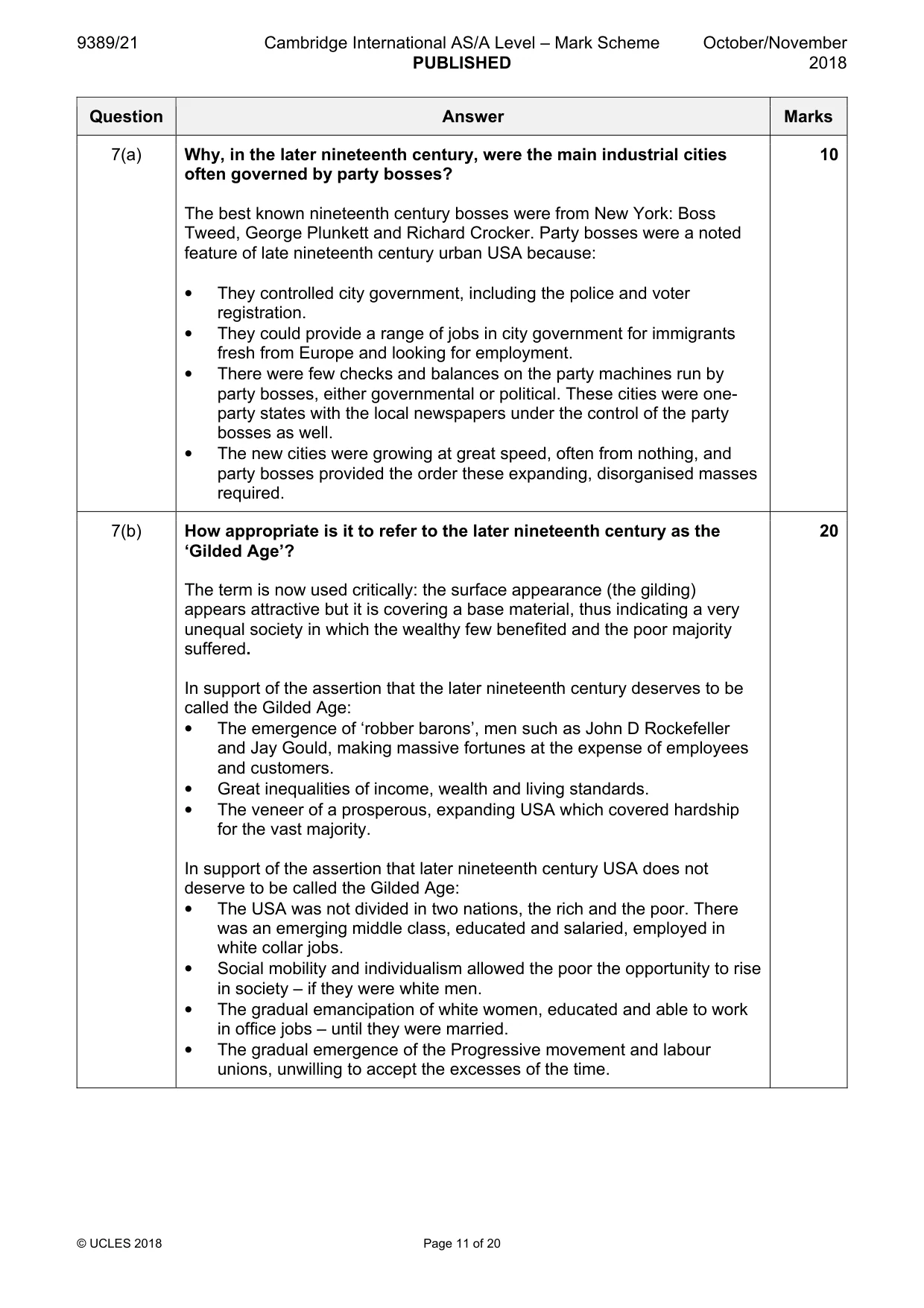
7 The Gilded Age and the Progressive Era, from the 1870s to the 1920s (a) Why, in the later nineteenth century, were the main industrial cities often governed by party bosses? [10] (b) How appropriate is it to refer to the later nineteenth century as the ‘Gilded Age’? [20]
Mark scheme: 7(a) Why, in the later nineteenth century, were the main industrial cities 10 often governed by party bosses? The best known nineteenth century bosses were from New York: Boss Tweed, George Plunkett and Richard Crocker. Party bosses were a noted feature of late nineteenth century urban USA because: • They controlled city government, including the police and voter registration. • They could provide a range of jobs in city government for immigrants fresh from Europe and looking for employment. • There were few checks and balances on the party machines run by party bosses, either governmental or political. These cities were one- party states with the local newspapers under the control of the party bosses as well. • The new cities were growing at great speed, often from nothing, and party bosses provided the order these expanding, disorganised masses required. 7(b) How appropriate is it to refer to the later nineteenth century as the 20 ‘Gilded Age’? The term is now used critically: the surface appearance (the gilding) appears attractive but it is covering a base material, thus indicating a very unequal society in which the wealthy few benefited and the poor majority suffered. In support of the assertion that the later nineteenth century deserves to be called the Gilded Age: • The emergence of ‘robber barons’, men such as John D Rockefeller and Jay Gould, making massive fortunes at the expense of employees and customers. • Great inequalities of income, wealth and living standards. • The veneer of a prosperous, expanding USA which covered hardship for the vast majority. In support of the assertion that later nineteenth century USA does not deserve to be called the Gilded Age: • The USA was not divided in two nations, the rich and the poor. There was an emerging middle class, educated and salaried, employed in white collar jobs. • Social mobility and individualism allowed the poor the opportunity to rise in society – if they were white men. • The gradual emancipation of white women, educated and able to work in office jobs – until they were married. • The gradual emergence of the Progressive movement and labour unions, unwilling to accept the excesses of the time.
Q8 · The Great Crash, the Great Depression and the New Deal, from the 1920s to 1941 (a) Why…
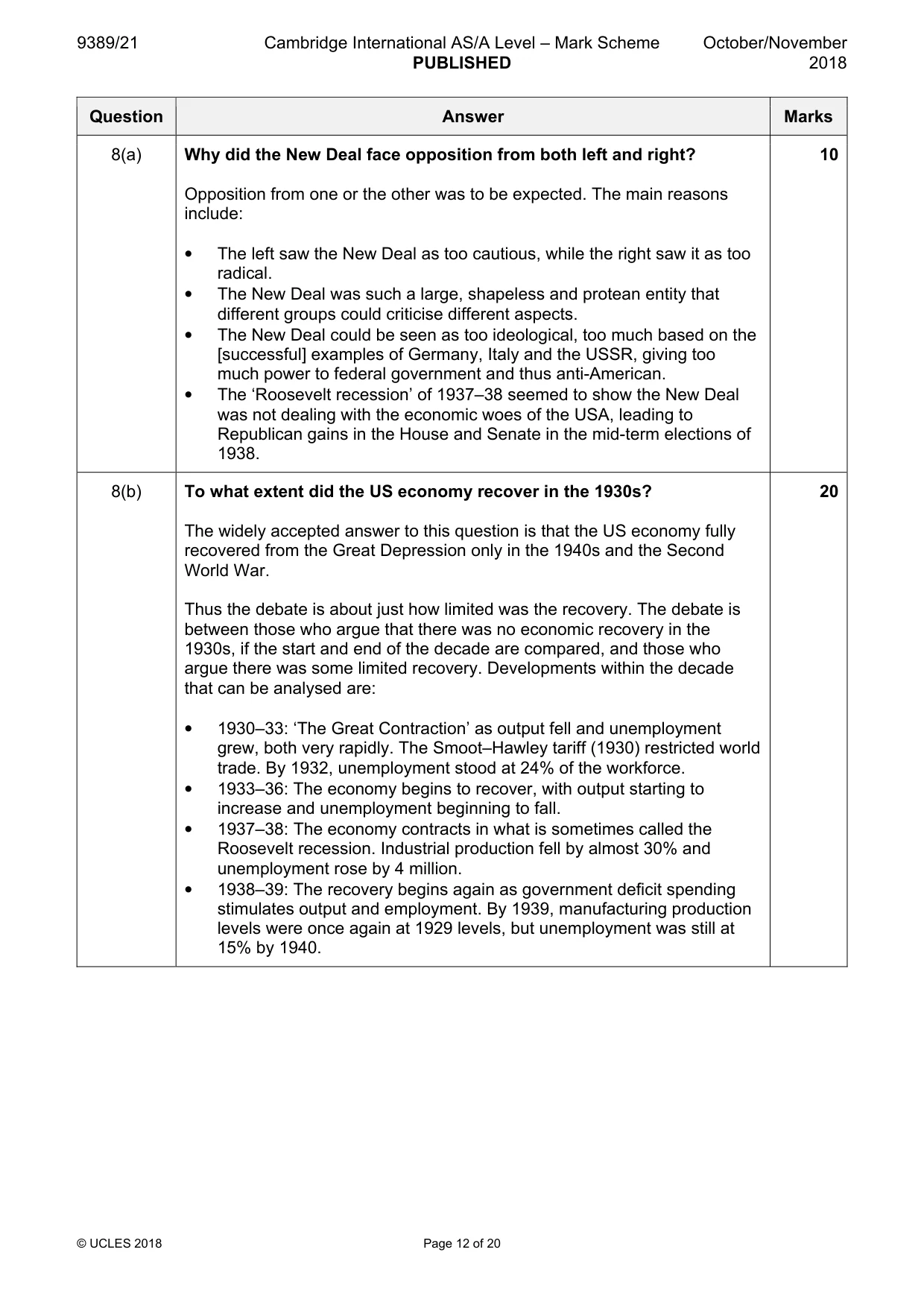
8 The Great Crash, the Great Depression and the New Deal, from the 1920s to 1941 (a) Why did the New Deal face opposition from both left and right? [10] (b) To what extent did the US economy recover in the 1930s? [20] Section C: International Option International Relations, 1871–1945 Answer both parts of two questions.
Mark scheme: 8(a) Why did the New Deal face opposition from both left and right? 10 Opposition from one or the other was to be expected. The main reasons include: • The left saw the New Deal as too cautious, while the right saw it as too radical. • The New Deal was such a large, shapeless and protean entity that different groups could criticise different aspects. • The New Deal could be seen as too ideological, too much based on the [successful] examples of Germany, Italy and the USSR, giving too much power to federal government and thus anti-American. • The ‘Roosevelt recession’ of 1937–38 seemed to show the New Deal was not dealing with the economic woes of the USA, leading to Republican gains in the House and Senate in the mid-term elections of 1938. 8(b) To what extent did the US economy recover in the 1930s? 20 The widely accepted answer to this question is that the US economy fully recovered from the Great Depression only in the 1940s and the Second World War. Thus the debate is about just how limited was the recovery. The debate is between those who argue that there was no economic recovery in the 1930s, if the start and end of the decade are compared, and those who argue there was some limited recovery. Developments within the decade that can be analysed are: • 1930–33: ‘The Great Contraction’ as output fell and unemployment grew, both very rapidly. The Smoot–Hawley tariff (1930) restricted world trade. By 1932, unemployment stood at 24% of the workforce. • 1933–36: The economy begins to recover, with output starting to increase and unemployment beginning to fall. • 1937–38: The economy contracts in what is sometimes called the Roosevelt recession. Industrial production fell by almost 30% and unemployment rose by 4 million. • 1938–39: The recovery begins again as government deficit spending stimulates output and employment. By 1939, manufacturing production levels were once again at 1929 levels, but unemployment was still at 15% by 1940.
Q9 · International Relations, 1871–1918 (a) Why did the USA declare war against Germany in…
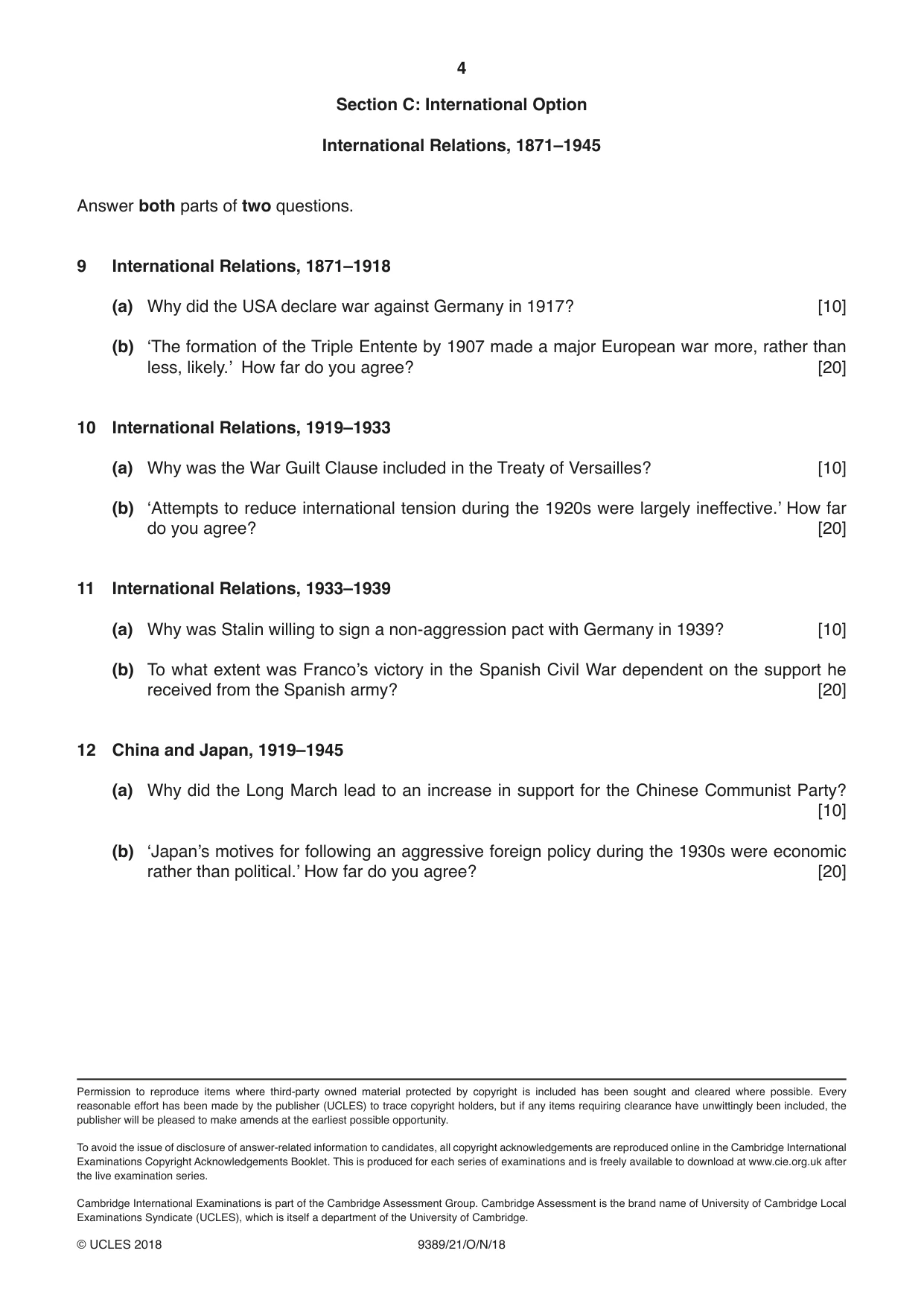
9 International Relations, 1871–1918 (a) Why did the USA declare war against Germany in 1917? [10] (b) ‘The formation of the Triple Entente by 1907 made a major European war more, rather than less, likely.’ How far do you agree? [20]
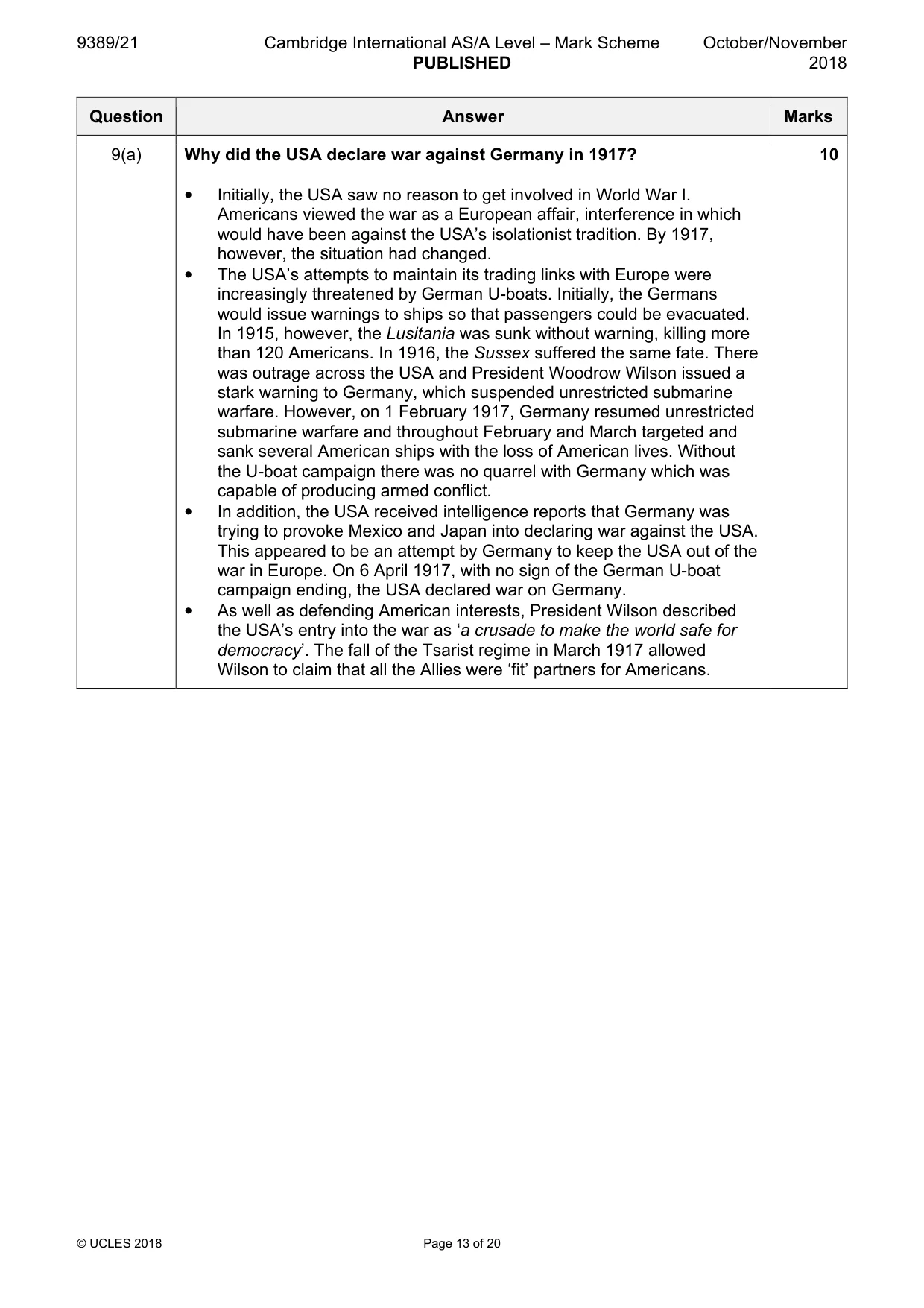
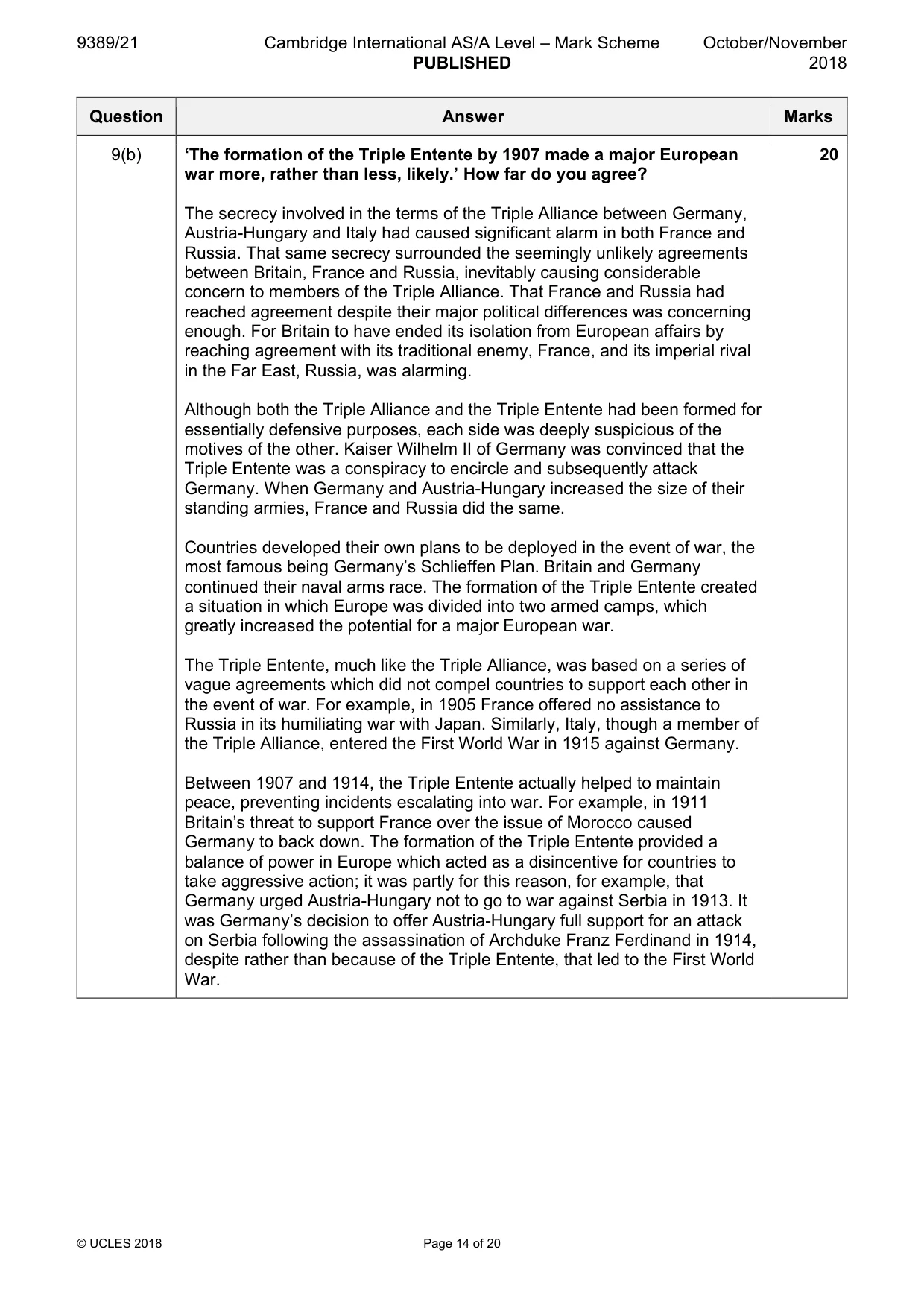
Mark scheme: 9(a) Why did the USA declare war against Germany in 1917? 10 • Initially, the USA saw no reason to get involved in World War I. Americans viewed the war as a European affair, interference in which would have been against the USA’s isolationist tradition. By 1917, however, the situation had changed. • The USA’s attempts to maintain its trading links with Europe were increasingly threatened by German U-boats. Initially, the Germans would issue warnings to ships so that passengers could be evacuated. In 1915, however, the Lusitania was sunk without warning, killing more than 120 Americans. In 1916, the Sussex suffered the same fate. There was outrage across the USA and President Woodrow Wilson issued a stark warning to Germany, which suspended unrestricted submarine warfare. However, on 1 February 1917, Germany resumed unrestricted submarine warfare and throughout February and March targeted and sank several American ships with the loss of American lives. Without the U-boat campaign there was no quarrel with Germany which was capable of producing armed conflict. • In addition, the USA received intelligence reports that Germany was trying to provoke Mexico and Japan into declaring war against the USA. This appeared to be an attempt by Germany to keep the USA out of the war in Europe. On 6 April 1917, with no sign of the German U-boat campaign ending, the USA declared war on Germany. • As well as defending American interests, President Wilson described the USA’s entry into the war as ‘a crusade to make the world safe for democracy’. The fall of the Tsarist regime in March 1917 allowed Wilson to claim that all the Allies were ‘fit’ partners for Americans. 9(b) ‘The formation of the Triple Entente by 1907 made a major European 20 war more, rather than less, likely.’ How far do you agree? The secrecy involved in the terms of the Triple Alliance between Germany, Austria-Hungary and Italy had caused significant alarm in both France and Russia. That same secrecy surrounded the seemingly unlikely agreements between Britain, France and Russia, inevitably causing considerable concern to members of the Triple Alliance. That France and Russia had reached agreement despite their major political differences was concerning enough. For Britain to have ended its isolation from European affairs by reaching agreement with its traditional enemy, France, and its imperial rival in the Far East, Russia, was alarming. Although both the Triple Alliance and the Triple Entente had been formed for essentially defensive purposes, each side was deeply suspicious of the motives of the other. Kaiser Wilhelm II of Germany was convinced that the Triple Entente was a conspiracy to encircle and subsequently attack Germany. When Germany and Austria-Hungary increased the size of their standing armies, France and Russia did the same. Countries developed their own plans to be deployed in the event of war, the most famous being Germany’s Schlieffen Plan. Britain and Germany continued their naval arms race. The formation of the Triple Entente created a situation in which Europe was divided into two armed camps, which greatly increased the potential for a major European war. The Triple Entente, much like the Triple Alliance, was based on a series of vague agreements which did not compel countries to support each other in the event of war. For example, in 1905 France offered no assistance to Russia in its humiliating war with Japan. Similarly, Italy, though a member of the Triple Alliance, entered the First World War in 1915 against Germany. Between 1907 and 1914, the Triple Entente actually helped to maintain peace, preventing incidents escalating into war. For example, in 1911 Britain’s threat to support France over the issue of Morocco caused Germany to back down. The formation of the Triple Entente provided a balance of power in Europe which acted as a disincentive for countries to take aggressive action; it was partly for this reason, for example, that Germany urged Austria-Hungary not to go to war against Serbia in 1913. It was Germany’s decision to offer Austria-Hungary full support for an attack on Serbia following the assassination of Archduke Franz Ferdinand in 1914, despite rather than because of the Triple Entente, that led to the First World War.
Q10 · International Relations, 1919–1933 (a) Why was the War Guilt Clause included in the…
10 International Relations, 1919–1933 (a) Why was the War Guilt Clause included in the Treaty of Versailles? [10] (b) ‘Attempts to reduce international tension during the 1920s were largely ineffective.’ How far do you agree? [20]
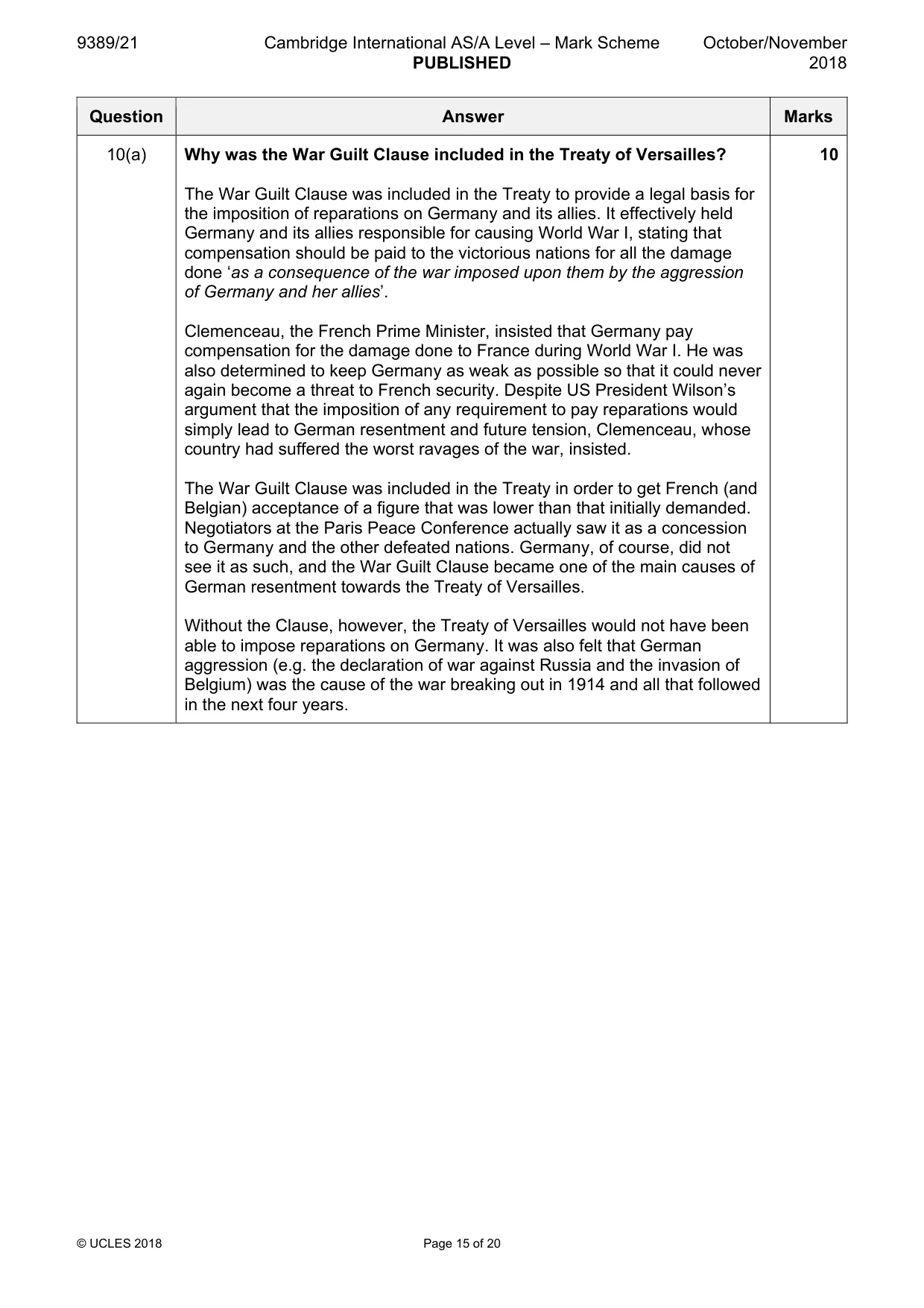
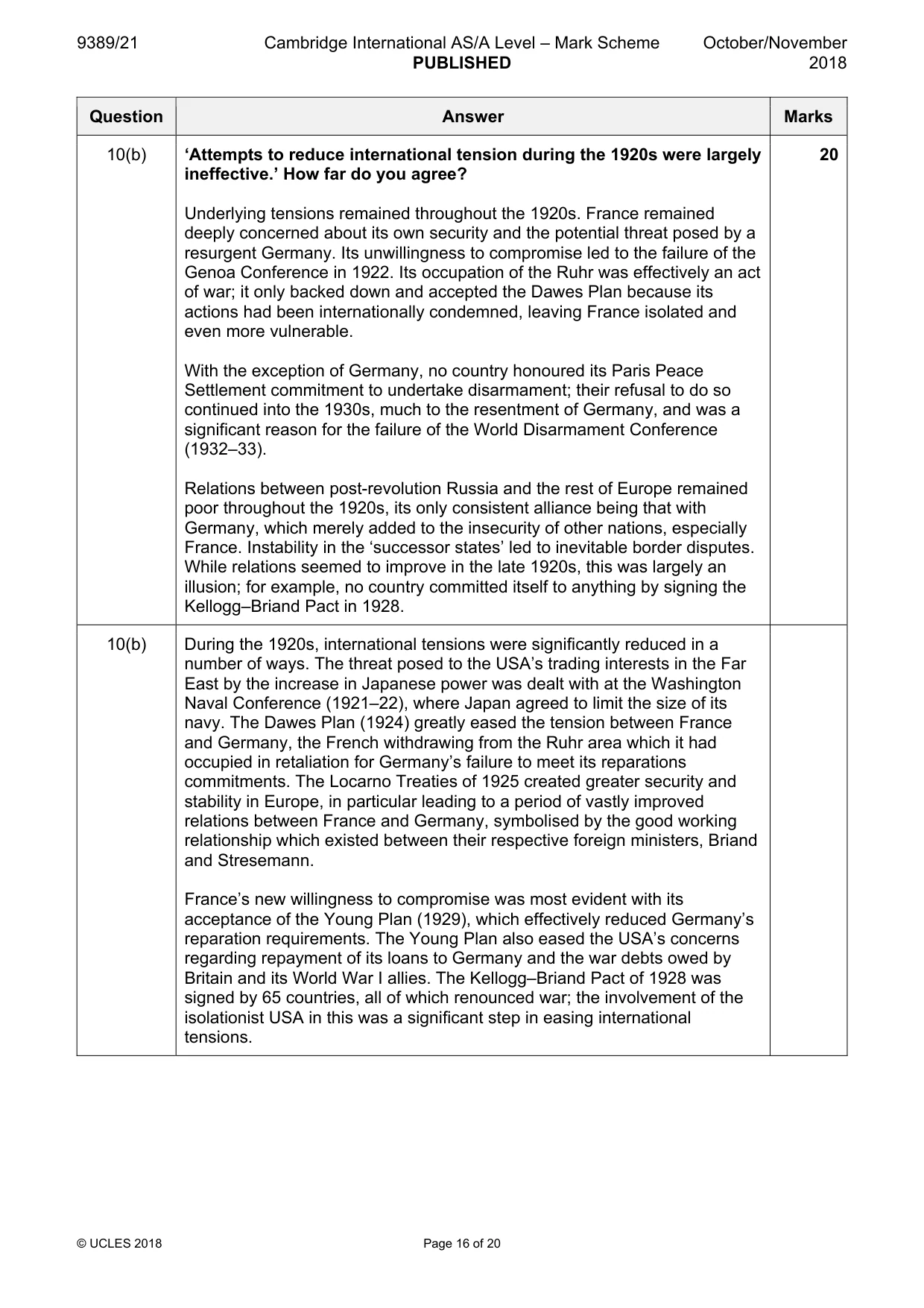
Mark scheme: 10(a) Why was the War Guilt Clause included in the Treaty of Versailles? 10 The War Guilt Clause was included in the Treaty to provide a legal basis for the imposition of reparations on Germany and its allies. It effectively held Germany and its allies responsible for causing World War I, stating that compensation should be paid to the victorious nations for all the damage done ‘as a consequence of the war imposed upon them by the aggression of Germany and her allies’. Clemenceau, the French Prime Minister, insisted that Germany pay compensation for the damage done to France during World War I. He was also determined to keep Germany as weak as possible so that it could never again become a threat to French security. Despite US President Wilson’s argument that the imposition of any requirement to pay reparations would simply lead to German resentment and future tension, Clemenceau, whose country had suffered the worst ravages of the war, insisted. The War Guilt Clause was included in the Treaty in order to get French (and Belgian) acceptance of a figure that was lower than that initially demanded. Negotiators at the Paris Peace Conference actually saw it as a concession to Germany and the other defeated nations. Germany, of course, did not see it as such, and the War Guilt Clause became one of the main causes of German resentment towards the Treaty of Versailles. Without the Clause, however, the Treaty of Versailles would not have been able to impose reparations on Germany. It was also felt that German aggression (e.g. the declaration of war against Russia and the invasion of Belgium) was the cause of the war breaking out in 1914 and all that followed in the next four years. 10(b) ‘Attempts to reduce international tension during the 1920s were largely 20 ineffective.’ How far do you agree? Underlying tensions remained throughout the 1920s. France remained deeply concerned about its own security and the potential threat posed by a resurgent Germany. Its unwillingness to compromise led to the failure of the Genoa Conference in 1922. Its occupation of the Ruhr was effectively an act of war; it only backed down and accepted the Dawes Plan because its actions had been internationally condemned, leaving France isolated and even more vulnerable. With the exception of Germany, no country honoured its Paris Peace Settlement commitment to undertake disarmament; their refusal to do so continued into the 1930s, much to the resentment of Germany, and was a significant reason for the failure of the World Disarmament Conference (1932–33). Relations between post-revolution Russia and the rest of Europe remained poor throughout the 1920s, its only consistent alliance being that with Germany, which merely added to the insecurity of other nations, especially France. Instability in the ‘successor states’ led to inevitable border disputes. While relations seemed to improve in the late 1920s, this was largely an illusion; for example, no country committed itself to anything by signing the Kellogg–Briand Pact in 1928. 10(b) During the 1920s, international tensions were significantly reduced in a number of ways. The threat posed to the USA’s trading interests in the Far East by the increase in Japanese power was dealt with at the Washington Naval Conference (1921–22), where Japan agreed to limit the size of its navy. The Dawes Plan (1924) greatly eased the tension between France and Germany, the French withdrawing from the Ruhr area which it had occupied in retaliation for Germany’s failure to meet its reparations commitments. The Locarno Treaties of 1925 created greater security and stability in Europe, in particular leading to a period of vastly improved relations between France and Germany, symbolised by the good working relationship which existed between their respective foreign ministers, Briand and Stresemann. France’s new willingness to compromise was most evident with its acceptance of the Young Plan (1929), which effectively reduced Germany’s reparation requirements. The Young Plan also eased the USA’s concerns regarding repayment of its loans to Germany and the war debts owed by Britain and its World War I allies. The Kellogg–Briand Pact of 1928 was signed by 65 countries, all of which renounced war; the involvement of the isolationist USA in this was a significant step in easing international tensions.
Q11 · International Relations, 1933–1939 (a) Why was Stalin willing to sign a non-aggression…
11 International Relations, 1933–1939 (a) Why was Stalin willing to sign a non-aggression pact with Germany in 1939? [10] (b) To what extent was Franco’s victory in the Spanish Civil War dependent on the support he received from the Spanish army? [20]
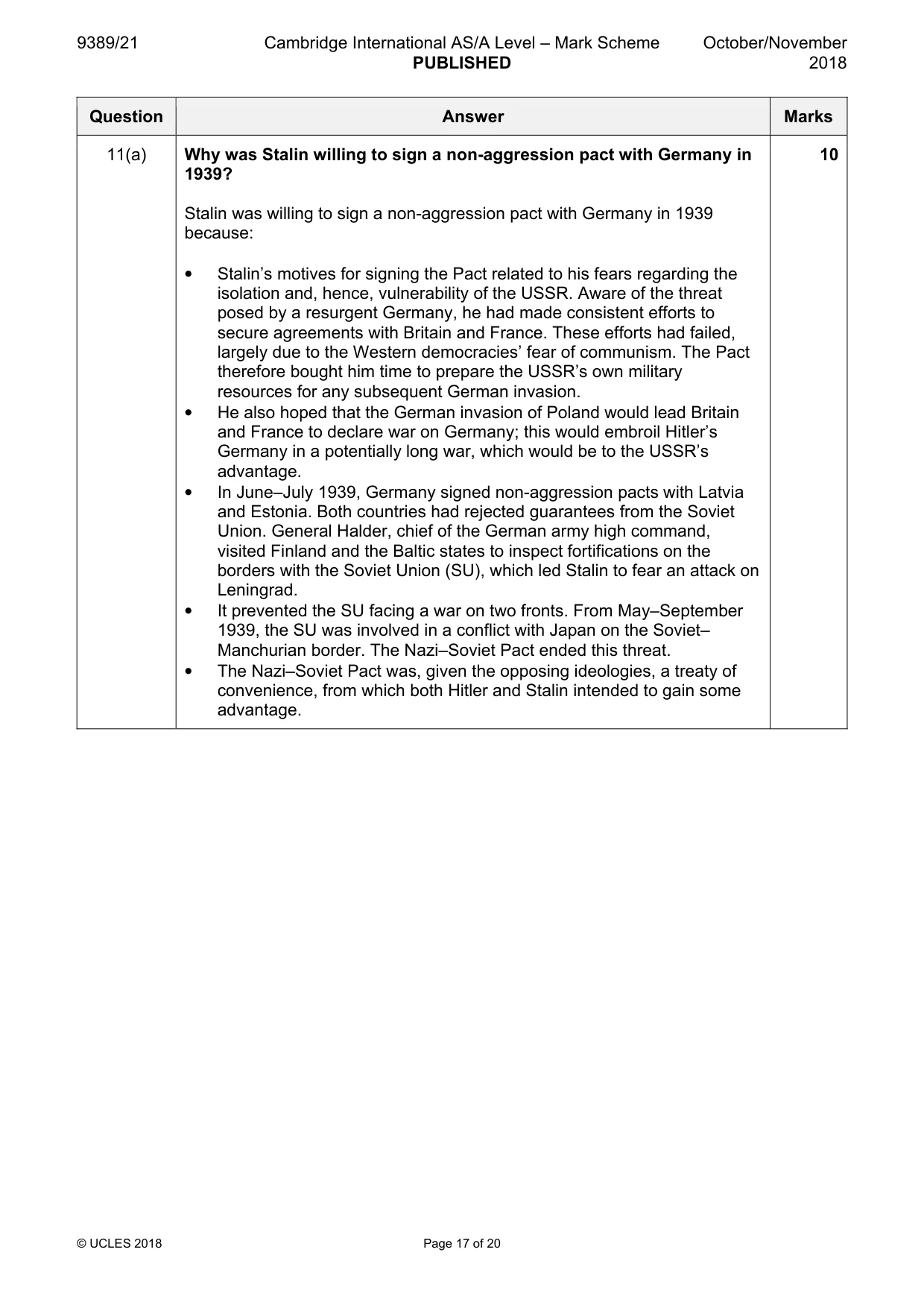
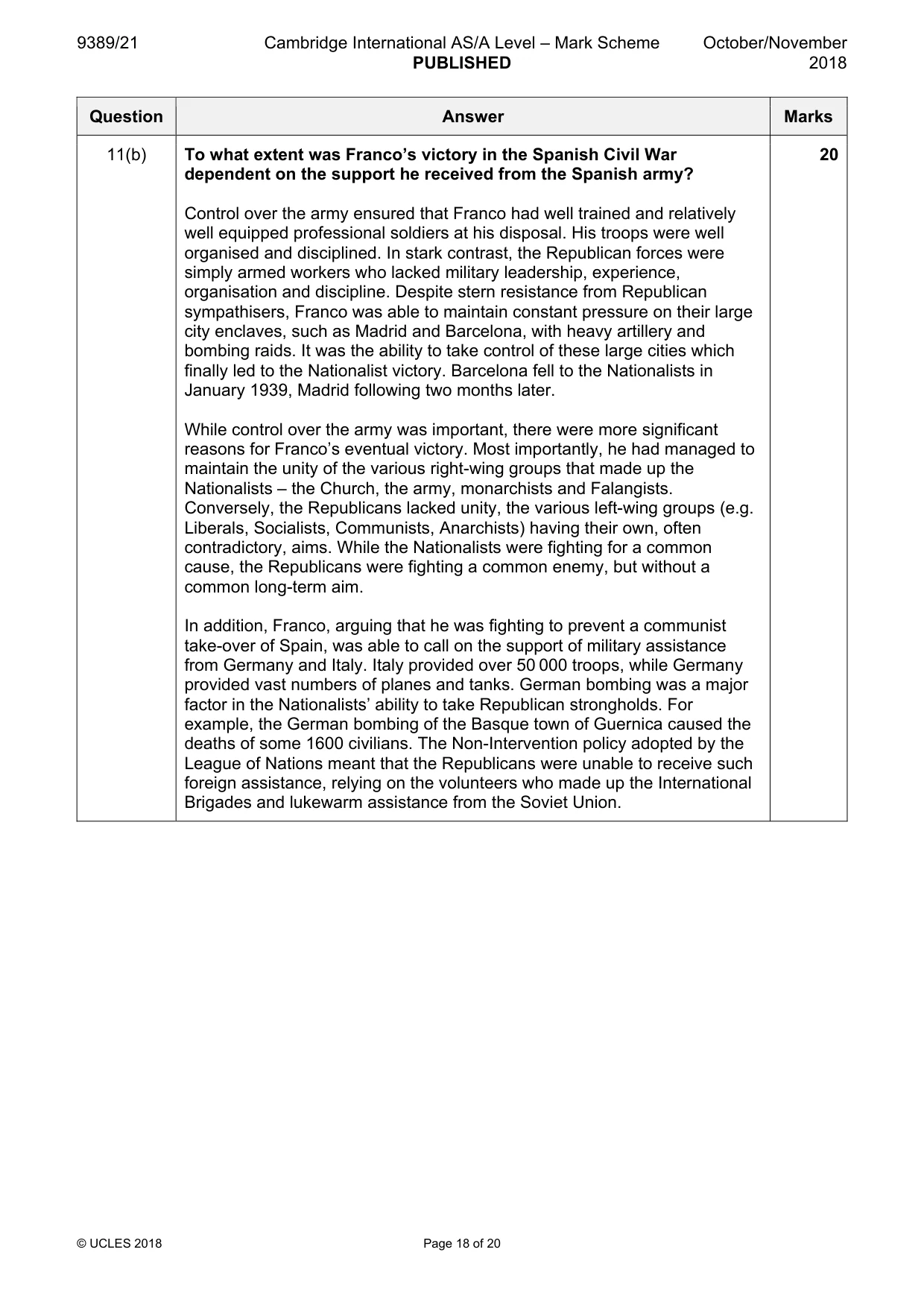
Mark scheme: 11(a) Why was Stalin willing to sign a non-aggression pact with Germany in 10 1939? Stalin was willing to sign a non-aggression pact with Germany in 1939 because: • Stalin’s motives for signing the Pact related to his fears regarding the isolation and, hence, vulnerability of the USSR. Aware of the threat posed by a resurgent Germany, he had made consistent efforts to secure agreements with Britain and France. These efforts had failed, largely due to the Western democracies’ fear of communism. The Pact therefore bought him time to prepare the USSR’s own military resources for any subsequent German invasion. • He also hoped that the German invasion of Poland would lead Britain and France to declare war on Germany; this would embroil Hitler’s Germany in a potentially long war, which would be to the USSR’s advantage. • In June–July 1939, Germany signed non-aggression pacts with Latvia and Estonia. Both countries had rejected guarantees from the Soviet Union. General Halder, chief of the German army high command, visited Finland and the Baltic states to inspect fortifications on the borders with the Soviet Union (SU), which led Stalin to fear an attack on Leningrad. • It prevented the SU facing a war on two fronts. From May–September 1939, the SU was involved in a conflict with Japan on the Soviet– Manchurian border. The Nazi–Soviet Pact ended this threat. • The Nazi–Soviet Pact was, given the opposing ideologies, a treaty of convenience, from which both Hitler and Stalin intended to gain some advantage. 11(b) To what extent was Franco’s victory in the Spanish Civil War 20 dependent on the support he received from the Spanish army? Control over the army ensured that Franco had well trained and relatively well equipped professional soldiers at his disposal. His troops were well organised and disciplined. In stark contrast, the Republican forces were simply armed workers who lacked military leadership, experience, organisation and discipline. Despite stern resistance from Republican sympathisers, Franco was able to maintain constant pressure on their large city enclaves, such as Madrid and Barcelona, with heavy artillery and bombing raids. It was the ability to take control of these large cities which finally led to the Nationalist victory. Barcelona fell to the Nationalists in January 1939, Madrid following two months later. While control over the army was important, there were more significant reasons for Franco’s eventual victory. Most importantly, he had managed to maintain the unity of the various right-wing groups that made up the Nationalists – the Church, the army, monarchists and Falangists. Conversely, the Republicans lacked unity, the various left-wing groups (e.g. Liberals, Socialists, Communists, Anarchists) having their own, often contradictory, aims. While the Nationalists were fighting for a common cause, the Republicans were fighting a common enemy, but without a common long-term aim. In addition, Franco, arguing that he was fighting to prevent a communist take-over of Spain, was able to call on the support of military assistance from Germany and Italy. Italy provided over 50 000 troops, while Germany provided vast numbers of planes and tanks. German bombing was a major factor in the Nationalists’ ability to take Republican strongholds. For example, the German bombing of the Basque town of Guernica caused the deaths of some 1600 civilians. The Non-Intervention policy adopted by the League of Nations meant that the Republicans were unable to receive such foreign assistance, relying on the volunteers who made up the International Brigades and lukewarm assistance from the Soviet Union.
Q12 · China and Japan, 1919–1945 (a) Why did the Long March lead to an increase in support for…
12 China and Japan, 1919–1945 (a) Why did the Long March lead to an increase in support for the Chinese Communist Party? [10] (b) ‘Japan’s motives for following an aggressive foreign policy during the 1930s were economic rather than political.’ How far do you agree? [20]
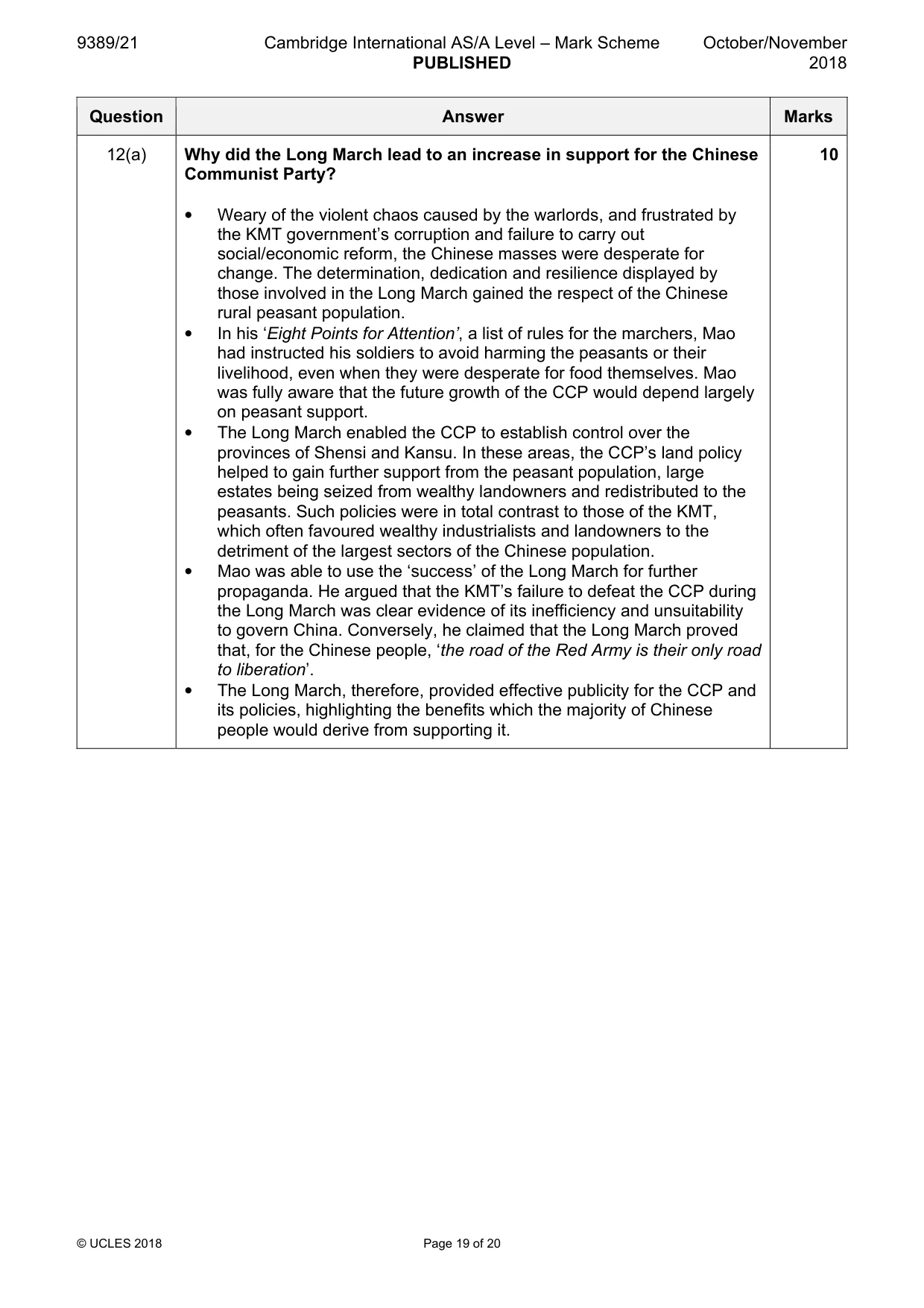
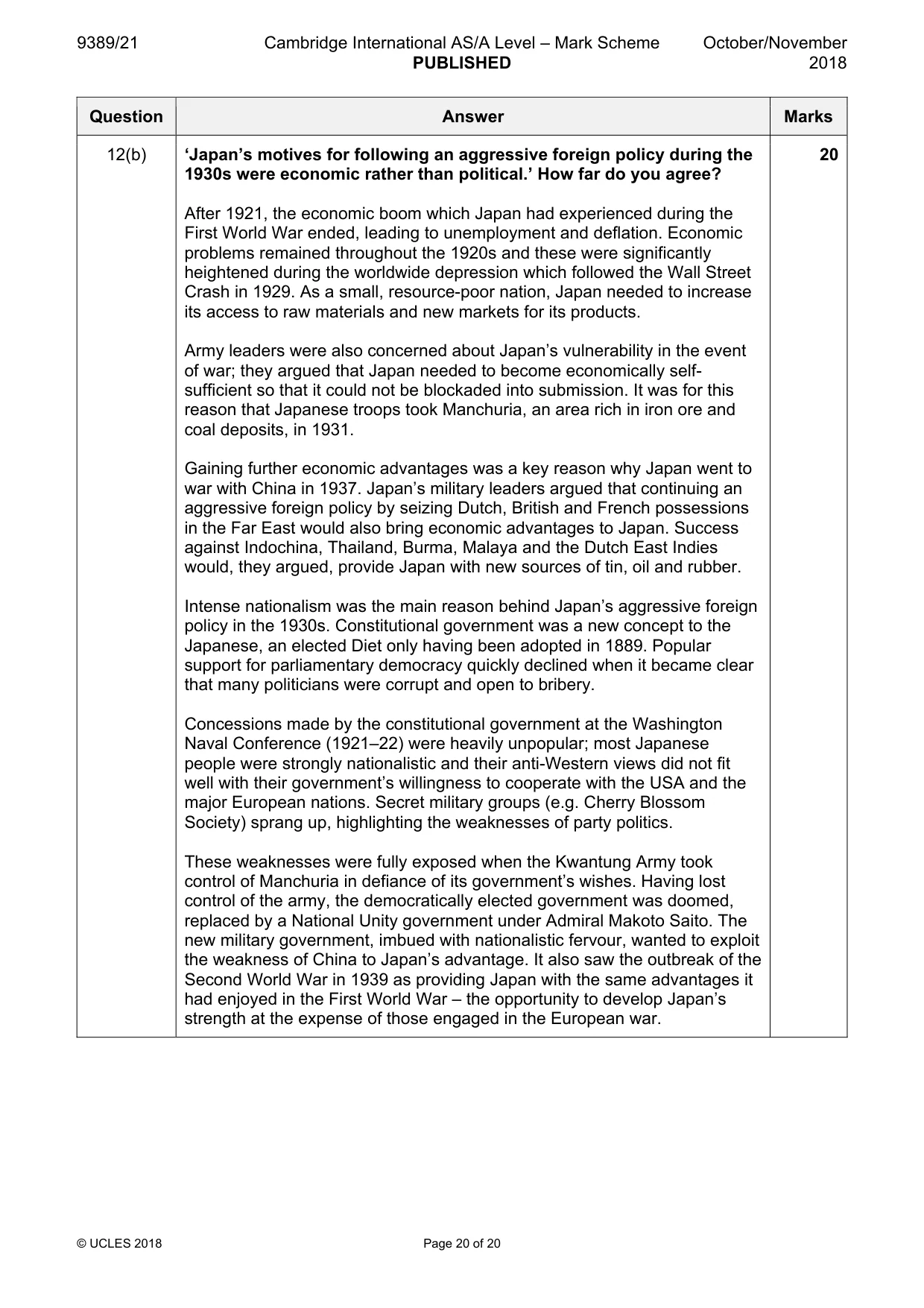
Mark scheme: 12(a) Why did the Long March lead to an increase in support for the Chinese 10 Communist Party? • Weary of the violent chaos caused by the warlords, and frustrated by the KMT government’s corruption and failure to carry out social/economic reform, the Chinese masses were desperate for change. The determination, dedication and resilience displayed by those involved in the Long March gained the respect of the Chinese rural peasant population. • In his ‘Eight Points for Attention’, a list of rules for the marchers, Mao had instructed his soldiers to avoid harming the peasants or their livelihood, even when they were desperate for food themselves. Mao was fully aware that the future growth of the CCP would depend largely on peasant support. • The Long March enabled the CCP to establish control over the provinces of Shensi and Kansu. In these areas, the CCP’s land policy helped to gain further support from the peasant population, large estates being seized from wealthy landowners and redistributed to the peasants. Such policies were in total contrast to those of the KMT, which often favoured wealthy industrialists and landowners to the detriment of the largest sectors of the Chinese population. • Mao was able to use the ‘success’ of the Long March for further propaganda. He argued that the KMT’s failure to defeat the CCP during the Long March was clear evidence of its inefficiency and unsuitability to govern China. Conversely, he claimed that the Long March proved that, for the Chinese people, ‘the road of the Red Army is their only road to liberation’. • The Long March, therefore, provided effective publicity for the CCP and its policies, highlighting the benefits which the majority of Chinese people would derive from supporting it. 12(b) ‘Japan’s motives for following an aggressive foreign policy during the 20 1930s were economic rather than political.’ How far do you agree? After 1921, the economic boom which Japan had experienced during the First World War ended, leading to unemployment and deflation. Economic problems remained throughout the 1920s and these were significantly heightened during the worldwide depression which followed the Wall Street Crash in 1929. As a small, resource-poor nation, Japan needed to increase its access to raw materials and new markets for its products. Army leaders were also concerned about Japan’s vulnerability in the event of war; they argued that Japan needed to become economically self- sufficient so that it could not be blockaded into submission. It was for this reason that Japanese troops took Manchuria, an area rich in iron ore and coal deposits, in 1931. Gaining further economic advantages was a key reason why Japan went to war with China in 1937. Japan’s military leaders argued that continuing an aggressive foreign policy by seizing Dutch, British and French possessions in the Far East would also bring economic advantages to Japan. Success against Indochina, Thailand, Burma, Malaya and the Dutch East Indies would, they argued, provide Japan with new sources of tin, oil and rubber. Intense nationalism was the main reason behind Japan’s aggressive foreign policy in the 1930s. Constitutional government was a new concept to the Japanese, an elected Diet only having been adopted in 1889. Popular support for parliamentary democracy quickly declined when it became clear that many politicians were corrupt and open to bribery. Concessions made by the constitutional government at the Washington Naval Conference (1921–22) were heavily unpopular; most Japanese people were strongly nationalistic and their anti-Western views did not fit well with their government’s willingness to cooperate with the USA and the major European nations. Secret military groups (e.g. Cherry Blossom Society) sprang up, highlighting the weaknesses of party politics. These weaknesses were fully exposed when the Kwantung Army took control of Manchuria in defiance of its government’s wishes. Having lost control of the army, the democratically elected government was doomed, replaced by a National Unity government under Admiral Makoto Saito. The new military government, imbued with nationalistic fervour, wanted to exploit the weakness of China to Japan’s advantage. It also saw the outbreak of the Second World War in 1939 as providing Japan with the same advantages it had enjoyed in the First World War – the opportunity to develop Japan’s strength at the expense of those engaged in the European war.
What you needed in this session
Cambridge’s own grade thresholds for 2018 Oct/Nov, Paper 2 · Variant 1. A higher threshold means an easier paper — the bar moves with how the cohort did.