Cambridge A Level History 9389 — 2019 Oct/Nov Paper 2 · Variant 3
9389/23/O/N/19 · 12 questions · 60 marks · ≈68 min
The question paper and its mark scheme, free to read here and free to download. This is Cambridge’s own paper, exactly as it was sat.
Question paper4 pages
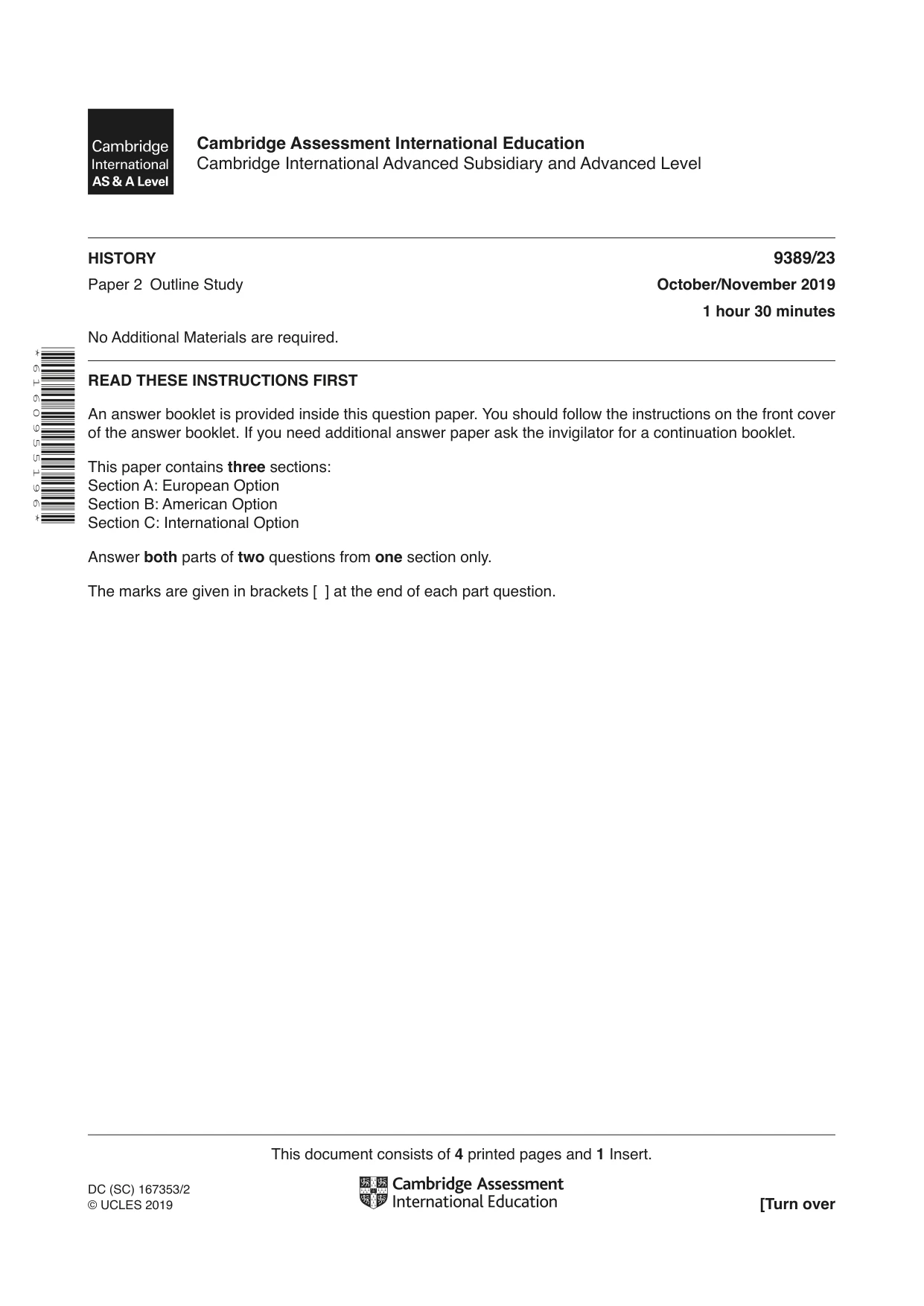
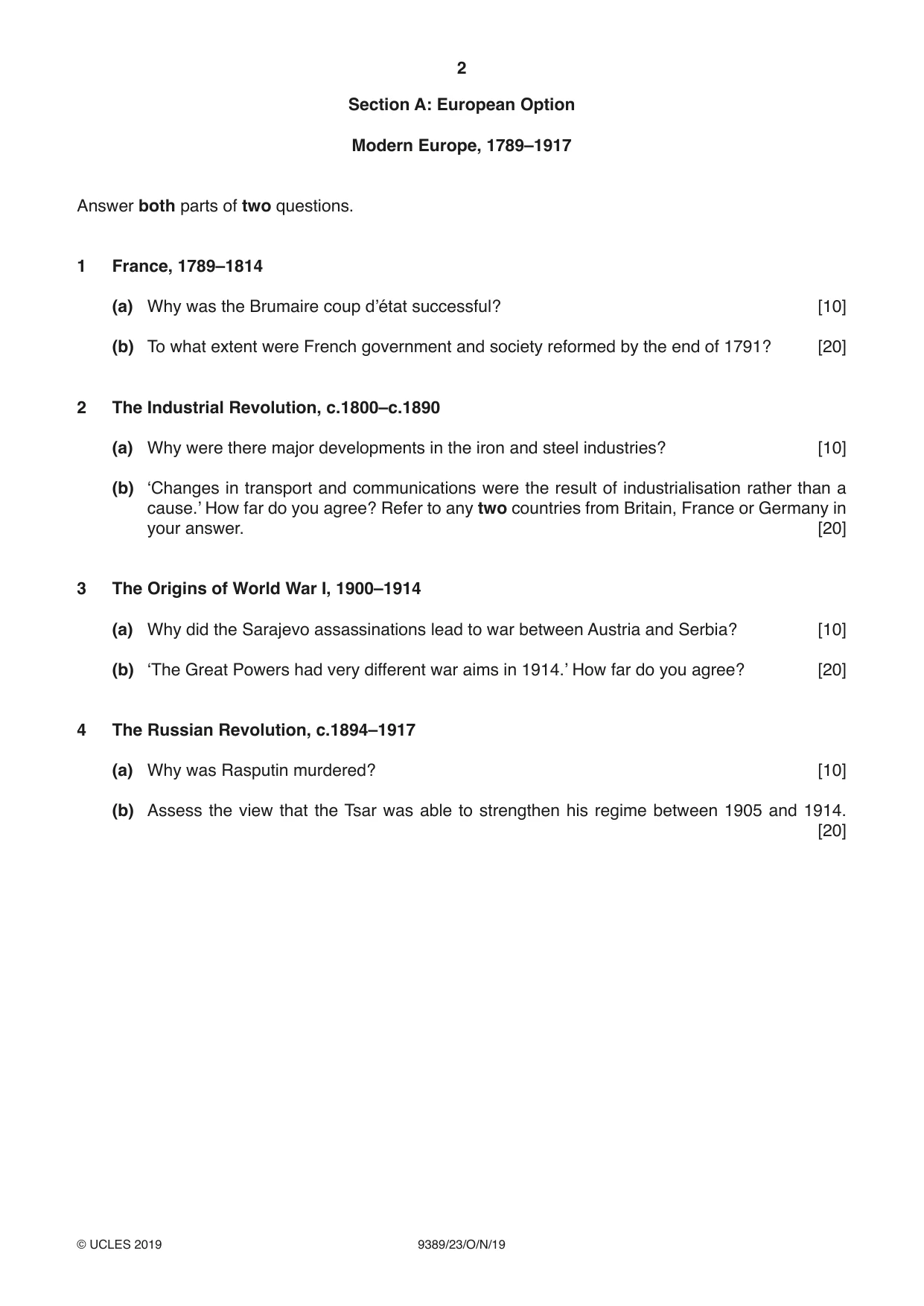
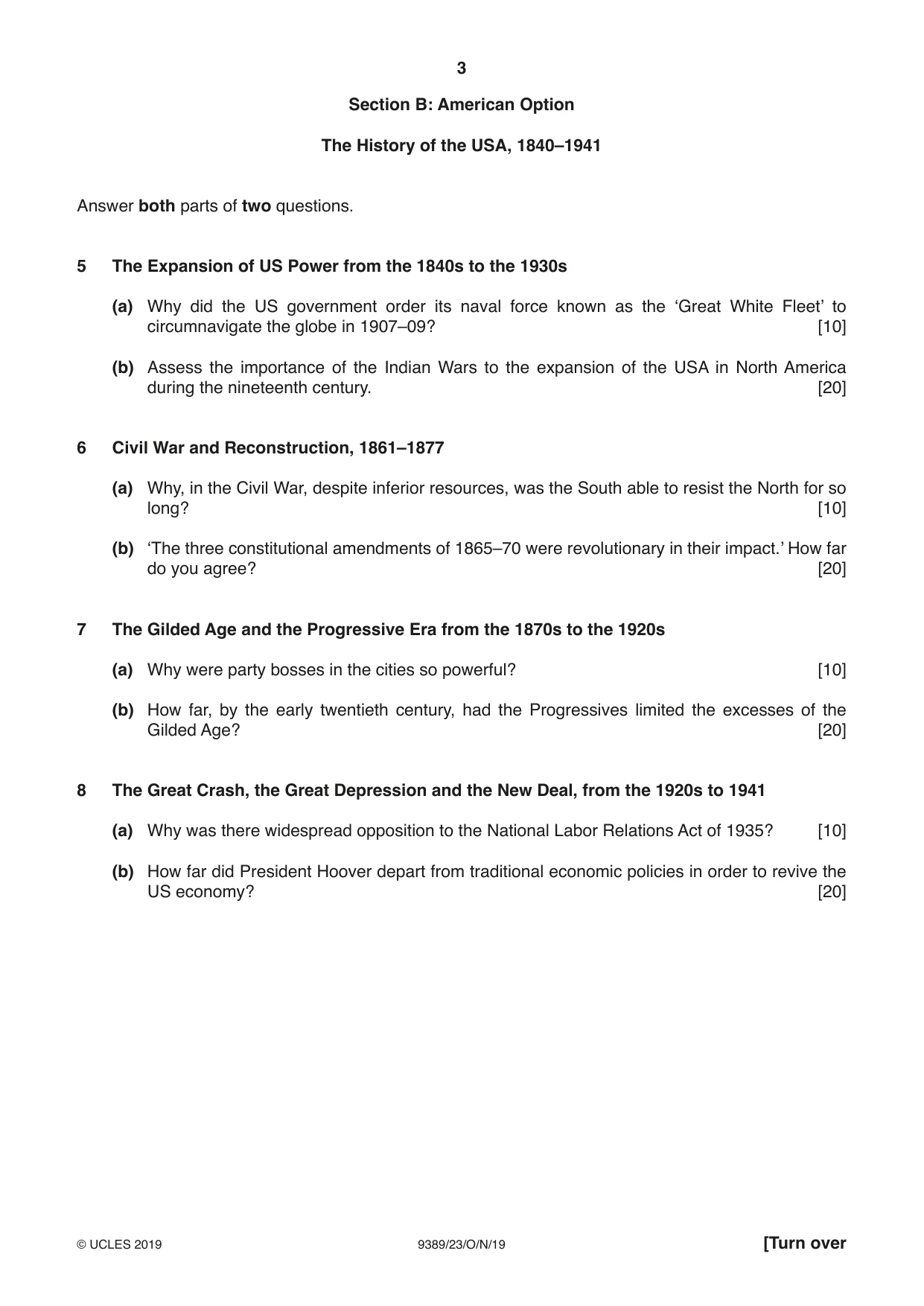
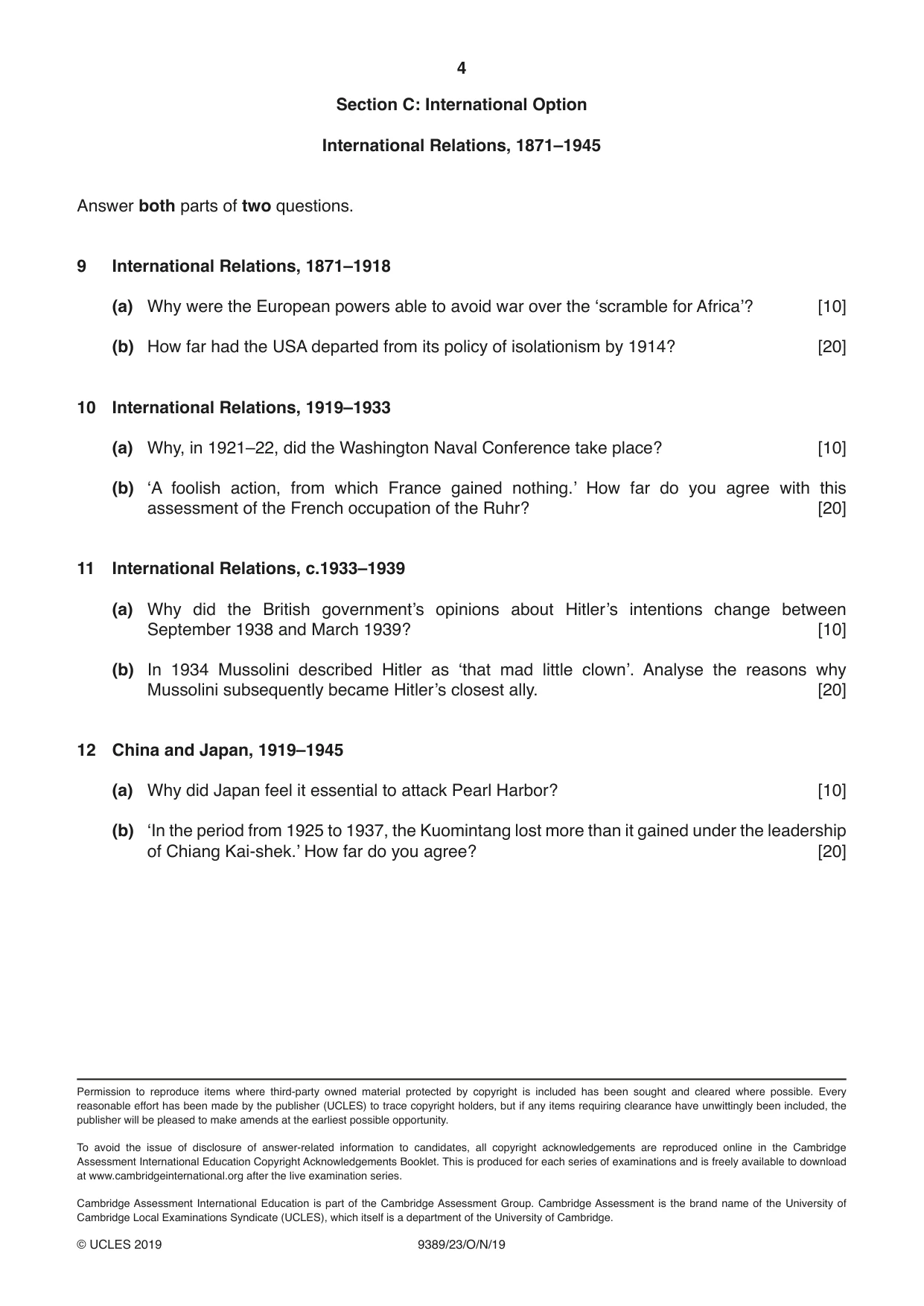
Mark scheme28 pages
Answers below. Sit the paper first if you are practising.
Questions as text
Q1 · France, 1789–1814 (a) Why was the Brumaire coup d’état successful?
1 France, 1789–1814 (a) Why was the Brumaire coup d’état successful? [10] (b) To what extent were French government and society reformed by the end of 1791? [20]
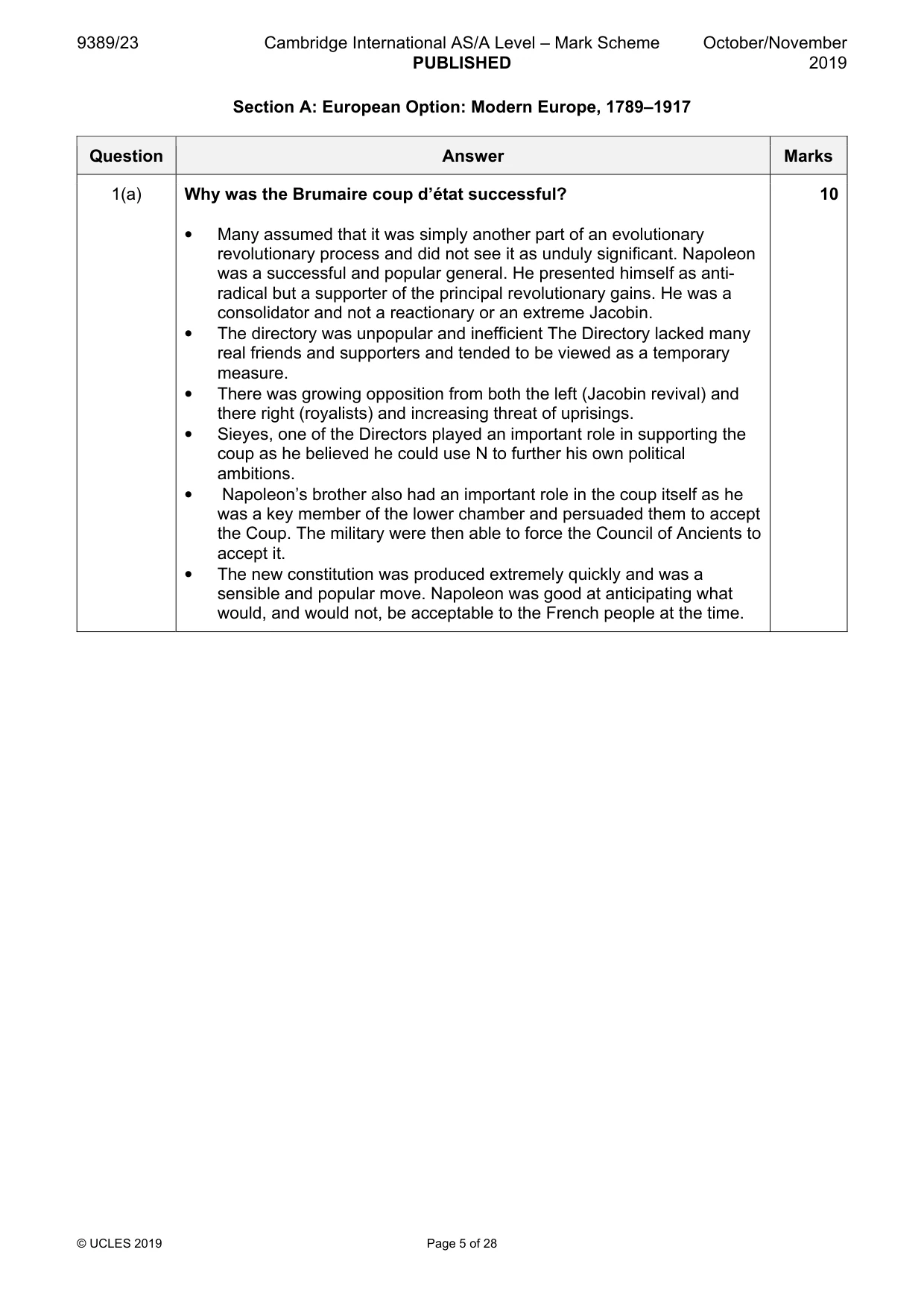
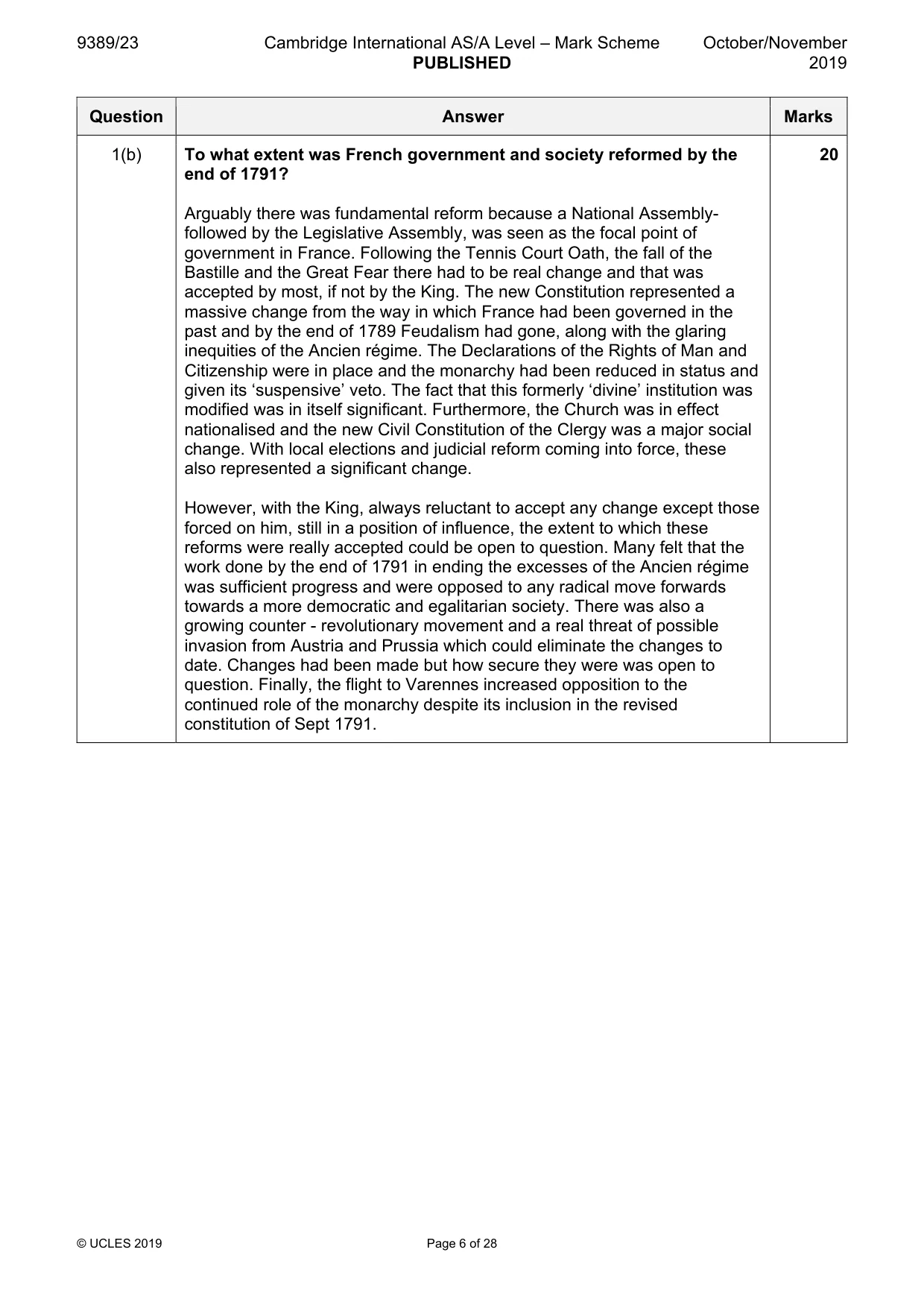
Mark scheme: Question Answer Marks 1(a) Why was the Brumaire coup d’état successful? 10 • Many assumed that it was simply another part of an evolutionary revolutionary process and did not see it as unduly significant. Napoleon was a successful and popular general. He presented himself as anti- radical but a supporter of the principal revolutionary gains. He was a consolidator and not a reactionary or an extreme Jacobin. • The directory was unpopular and inefficient The Directory lacked many real friends and supporters and tended to be viewed as a temporary measure. • There was growing opposition from both the left (Jacobin revival) and there right (royalists) and increasing threat of uprisings. • Sieyes, one of the Directors played an important role in supporting the coup as he believed he could use N to further his own political ambitions. • Napoleon’s brother also had an important role in the coup itself as he was a key member of the lower chamber and persuaded them to accept the Coup. The military were then able to force the Council of Ancients to accept it. • The new constitution was produced extremely quickly and was a sensible and popular move. Napoleon was good at anticipating what would, and would not, be acceptable to the French people at the time. 1(b) To what extent was French government and society reformed by the 20 end of 1791? Arguably there was fundamental reform because a National Assembly- followed by the Legislative Assembly, was seen as the focal point of government in France. Following the Tennis Court Oath, the fall of the Bastille and the Great Fear there had to be real change and that was accepted by most, if not by the King. The new Constitution represented a massive change from the way in which France had been governed in the past and by the end of 1789 Feudalism had gone, along with the glaring inequities of the Ancien régime. The Declarations of the Rights of Man and Citizenship were in place and the monarchy had been reduced in status and given its ‘suspensive’ veto. The fact that this formerly ‘divine’ institution was modified was in itself significant. Furthermore, the Church was in effect nationalised and the new Civil Constitution of the Clergy was a major social change. With local elections and judicial reform coming into force, these also represented a significant change. However, with the King, always reluctant to accept any change except those forced on him, still in a position of influence, the extent to which these reforms were really accepted could be open to question. Many felt that the work done by the end of 1791 in ending the excesses of the Ancien régime was sufficient progress and were opposed to any radical move forwards towards a more democratic and egalitarian society. There was also a growing counter - revolutionary movement and a real threat of possible invasion from Austria and Prussia which could eliminate the changes to date. Changes had been made but how secure they were was open to question. Finally, the flight to Varennes increased opposition to the continued role of the monarchy despite its inclusion in the revised constitution of Sept 1791.
Q2 · The Industrial Revolution, c.1800–c.1890 (a) Why were there major developments in the…
2 The Industrial Revolution, c.1800–c.1890 (a) Why were there major developments in the iron and steel industries? [10] (b) ‘Changes in transport and communications were the result of industrialisation rather than a cause.’ How far do you agree? Refer to any two countries from Britain, France or Germany in your answer. [20]
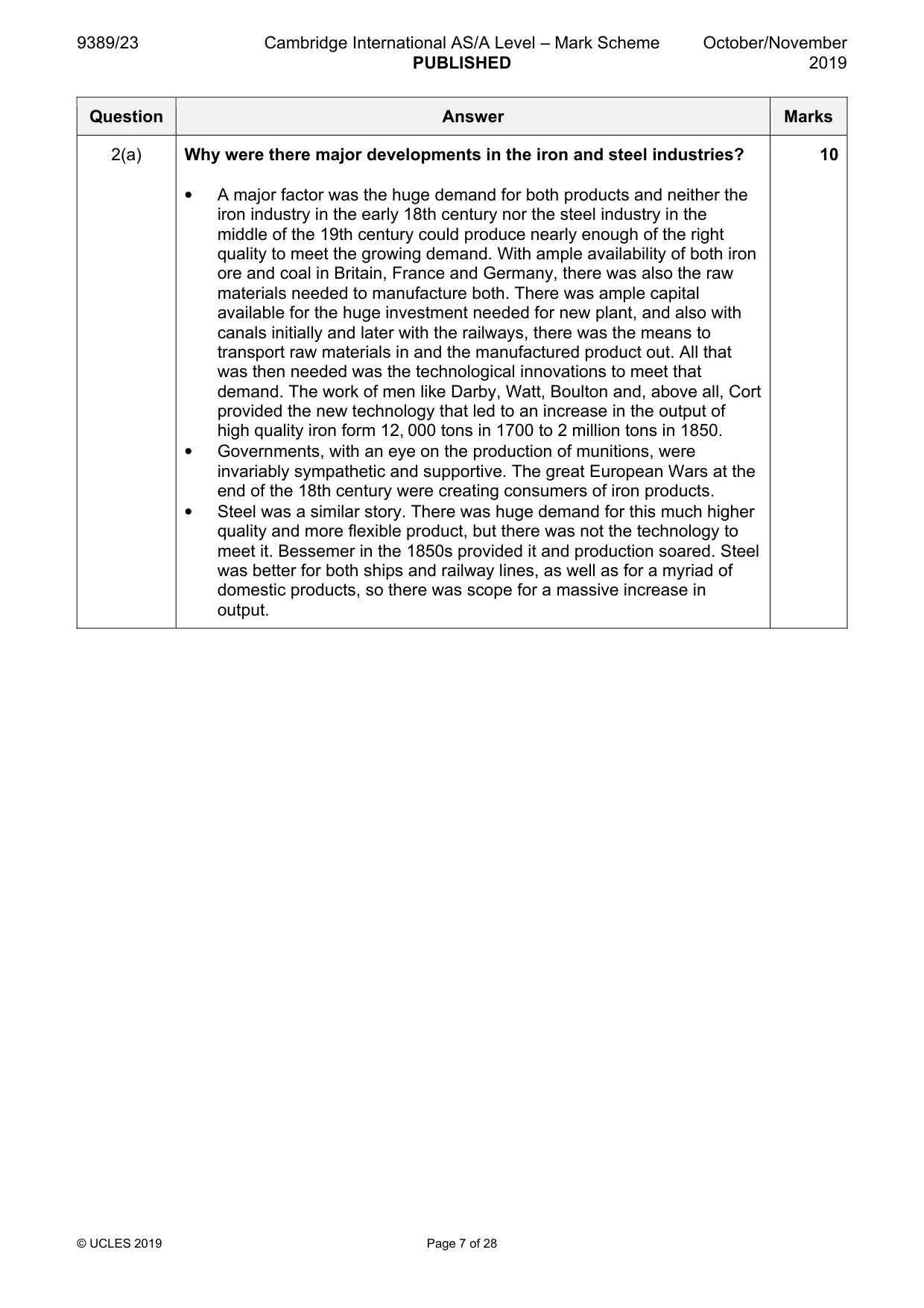
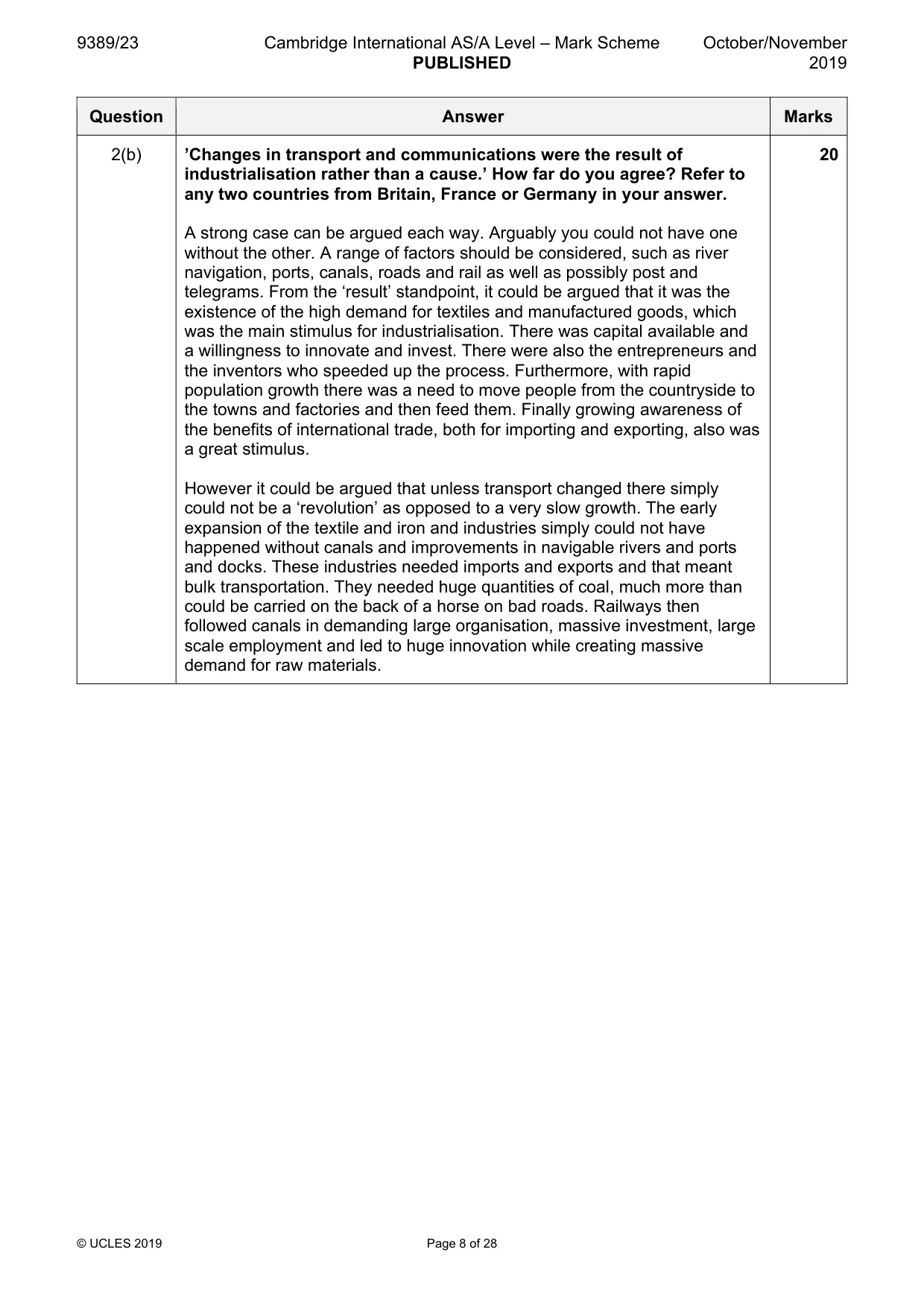
Mark scheme: 2(a) Why were there major developments in the iron and steel industries? 10 • A major factor was the huge demand for both products and neither the iron industry in the early 18th century nor the steel industry in the middle of the 19th century could produce nearly enough of the right quality to meet the growing demand. With ample availability of both iron ore and coal in Britain, France and Germany, there was also the raw materials needed to manufacture both. There was ample capital available for the huge investment needed for new plant, and also with canals initially and later with the railways, there was the means to transport raw materials in and the manufactured product out. All that was then needed was the technological innovations to meet that demand. The work of men like Darby, Watt, Boulton and, above all, Cort provided the new technology that led to an increase in the output of high quality iron form 12, 000 tons in 1700 to 2 million tons in 1850. • Governments, with an eye on the production of munitions, were invariably sympathetic and supportive. The great European Wars at the end of the 18th century were creating consumers of iron products. • Steel was a similar story. There was huge demand for this much higher quality and more flexible product, but there was not the technology to meet it. Bessemer in the 1850s provided it and production soared. Steel was better for both ships and railway lines, as well as for a myriad of domestic products, so there was scope for a massive increase in output. 2(b) ’Changes in transport and communications were the result of 20 industrialisation rather than a cause.’ How far do you agree? Refer to any two countries from Britain, France or Germany in your answer. A strong case can be argued each way. Arguably you could not have one without the other. A range of factors should be considered, such as river navigation, ports, canals, roads and rail as well as possibly post and telegrams. From the ‘result’ standpoint, it could be argued that it was the existence of the high demand for textiles and manufactured goods, which was the main stimulus for industrialisation. There was capital available and a willingness to innovate and invest. There were also the entrepreneurs and the inventors who speeded up the process. Furthermore, with rapid population growth there was a need to move people from the countryside to the towns and factories and then feed them. Finally growing awareness of the benefits of international trade, both for importing and exporting, also was a great stimulus. However it could be argued that unless transport changed there simply could not be a ‘revolution’ as opposed to a very slow growth. The early expansion of the textile and iron and industries simply could not have happened without canals and improvements in navigable rivers and ports and docks. These industries needed imports and exports and that meant bulk transportation. They needed huge quantities of coal, much more than could be carried on the back of a horse on bad roads. Railways then followed canals in demanding large organisation, massive investment, large scale employment and led to huge innovation while creating massive demand for raw materials.
Q3 · The Origins of World War I, 1900–1914 (a) Why did the Sarajevo assassinations lead to war…
3 The Origins of World War I, 1900–1914 (a) Why did the Sarajevo assassinations lead to war between Austria and Serbia? [10] (b) ‘The Great Powers had very different war aims in 1914.’ How far do you agree? [20]
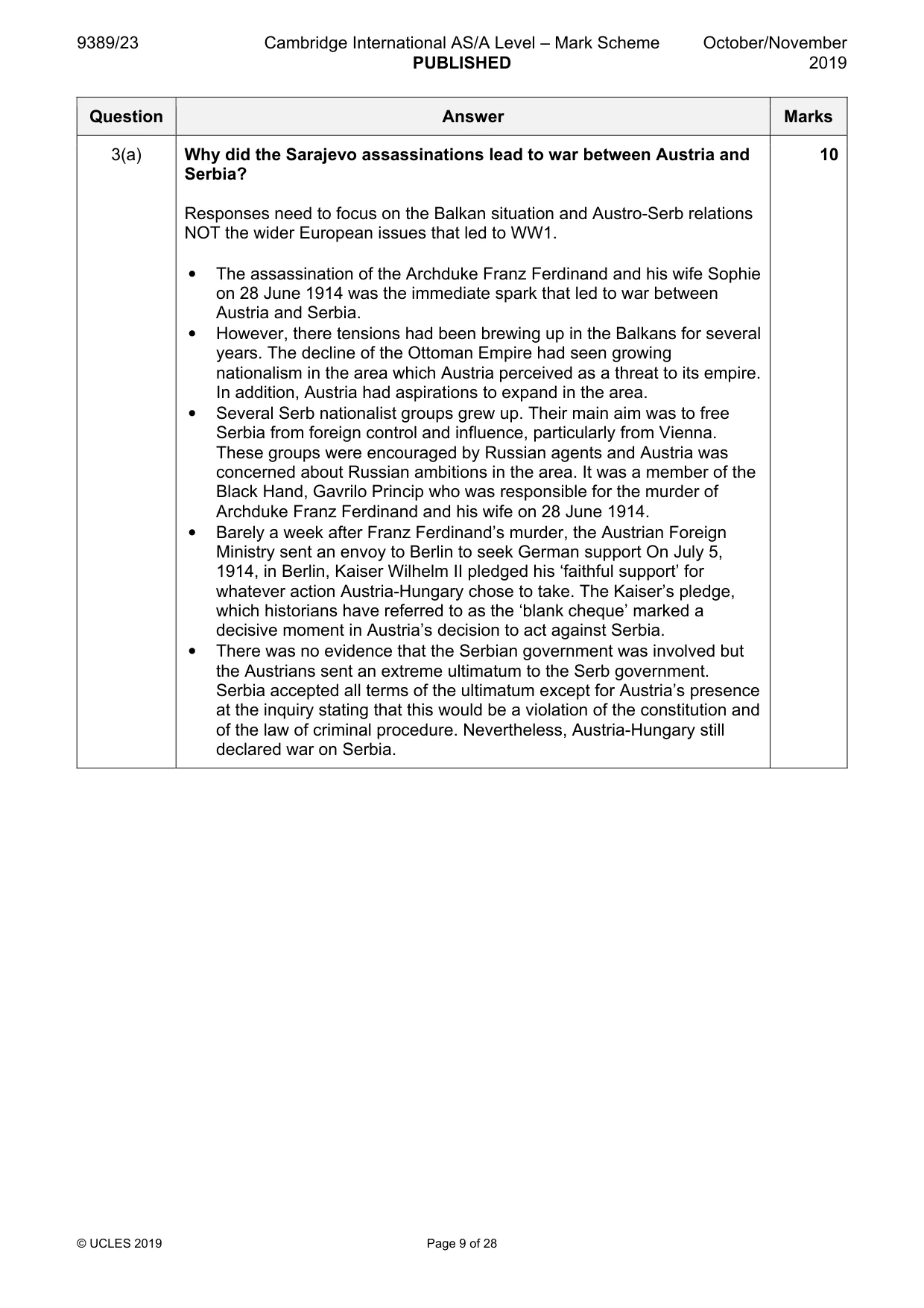
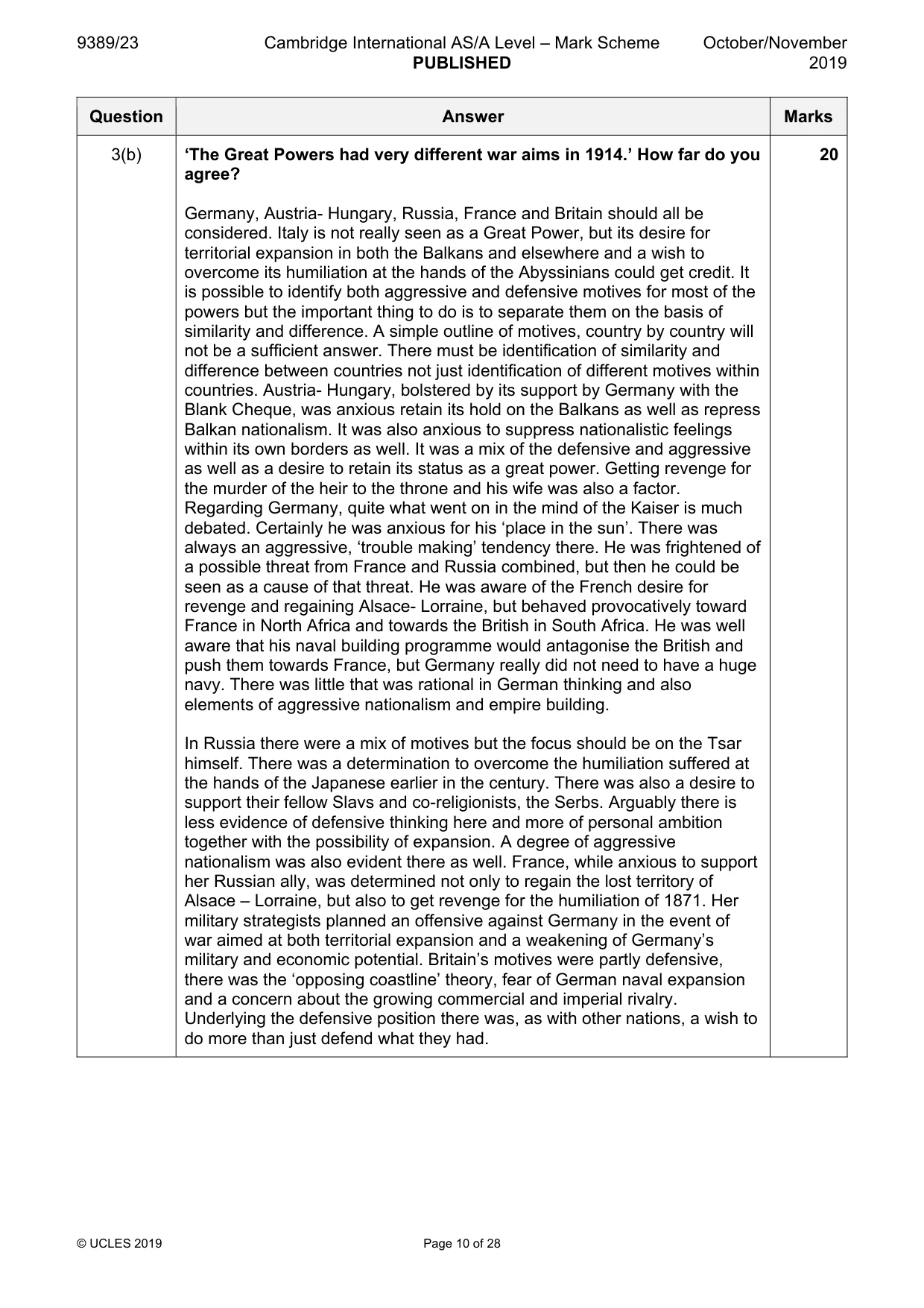
Mark scheme: 3(a) Why did the Sarajevo assassinations lead to war between Austria and 10 Serbia? Responses need to focus on the Balkan situation and Austro-Serb relations NOT the wider European issues that led to WW1. • The assassination of the Archduke Franz Ferdinand and his wife Sophie on 28 June 1914 was the immediate spark that led to war between Austria and Serbia. • However, there tensions had been brewing up in the Balkans for several years. The decline of the Ottoman Empire had seen growing nationalism in the area which Austria perceived as a threat to its empire. In addition, Austria had aspirations to expand in the area. • Several Serb nationalist groups grew up. Their main aim was to free Serbia from foreign control and influence, particularly from Vienna. These groups were encouraged by Russian agents and Austria was concerned about Russian ambitions in the area. It was a member of the Black Hand, Gavrilo Princip who was responsible for the murder of Archduke Franz Ferdinand and his wife on 28 June 1914. • Barely a week after Franz Ferdinand’s murder, the Austrian Foreign Ministry sent an envoy to Berlin to seek German support On July 5, 1914, in Berlin, Kaiser Wilhelm II pledged his ‘faithful support’ for whatever action Austria-Hungary chose to take. The Kaiser’s pledge, which historians have referred to as the ‘blank cheque’ marked a decisive moment in Austria’s decision to act against Serbia. • There was no evidence that the Serbian government was involved but the Austrians sent an extreme ultimatum to the Serb government. Serbia accepted all terms of the ultimatum except for Austria’s presence at the inquiry stating that this would be a violation of the constitution and of the law of criminal procedure. Nevertheless, Austria-Hungary still declared war on Serbia. 3(b) ‘The Great Powers had very different war aims in 1914.’ How far do you 20 agree? Germany, Austria- Hungary, Russia, France and Britain should all be considered. Italy is not really seen as a Great Power, but its desire for territorial expansion in both the Balkans and elsewhere and a wish to overcome its humiliation at the hands of the Abyssinians could get credit. It is possible to identify both aggressive and defensive motives for most of the powers but the important thing to do is to separate them on the basis of similarity and difference. A simple outline of motives, country by country will not be a sufficient answer. There must be identification of similarity and difference between countries not just identification of different motives within countries. Austria- Hungary, bolstered by its support by Germany with the Blank Cheque, was anxious retain its hold on the Balkans as well as repress Balkan nationalism. It was also anxious to suppress nationalistic feelings within its own borders as well. It was a mix of the defensive and aggressive as well as a desire to retain its status as a great power. Getting revenge for the murder of the heir to the throne and his wife was also a factor. Regarding Germany, quite what went on in the mind of the Kaiser is much debated. Certainly he was anxious for his ‘place in the sun’. There was always an aggressive, ‘trouble making’ tendency there. He was frightened of a possible threat from France and Russia combined, but then he could be seen as a cause of that threat. He was aware of the French desire for revenge and regaining Alsace- Lorraine, but behaved provocatively toward France in North Africa and towards the British in South Africa. He was well aware that his naval building programme would antagonise the British and push them towards France, but Germany really did not need to have a huge navy. There was little that was rational in German thinking and also elements of aggressive nationalism and empire building. In Russia there were a mix of motives but the focus should be on the Tsar himself. There was a determination to overcome the humiliation suffered at the hands of the Japanese earlier in the century. There was also a desire to support their fellow Slavs and co-religionists, the Serbs. Arguably there is less evidence of defensive thinking here and more of personal ambition together with the possibility of expansion. A degree of aggressive nationalism was also evident there as well. France, while anxious to support her Russian ally, was determined not only to regain the lost territory of Alsace – Lorraine, but also to get revenge for the humiliation of 1871. Her military strategists planned an offensive against Germany in the event of war aimed at both territorial expansion and a weakening of Germany’s military and economic potential. Britain’s motives were partly defensive, there was the ‘opposing coastline’ theory, fear of German naval expansion and a concern about the growing commercial and imperial rivalry. Underlying the defensive position there was, as with other nations, a wish to do more than just defend what they had.
Q4 · The Russian Revolution, c.1894–1917 (a) Why was Rasputin murdered?
4 The Russian Revolution, c.1894–1917 (a) Why was Rasputin murdered? [10] (b) Assess the view that the Tsar was able to strengthen his regime between 1905 and 1914. [20]
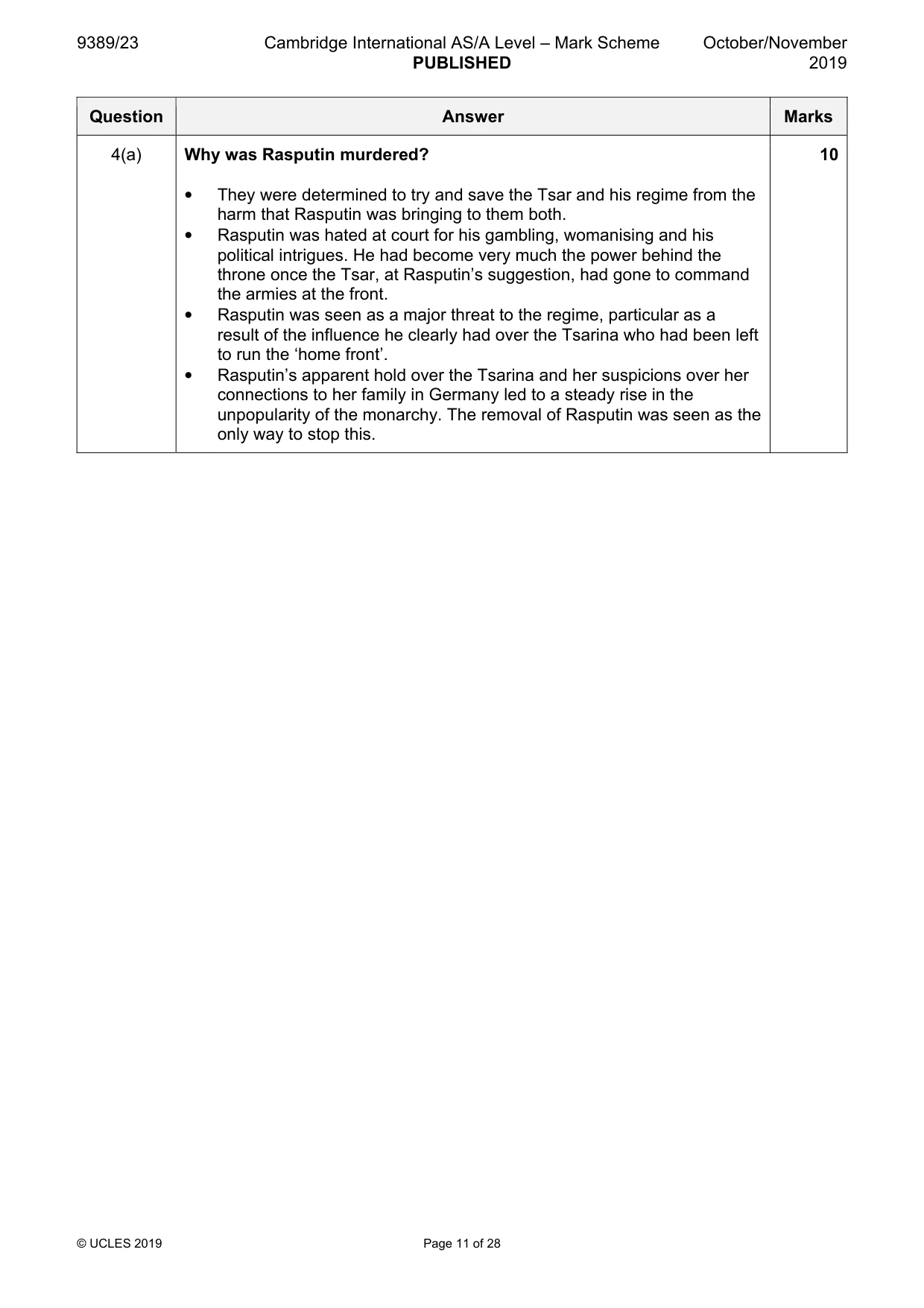
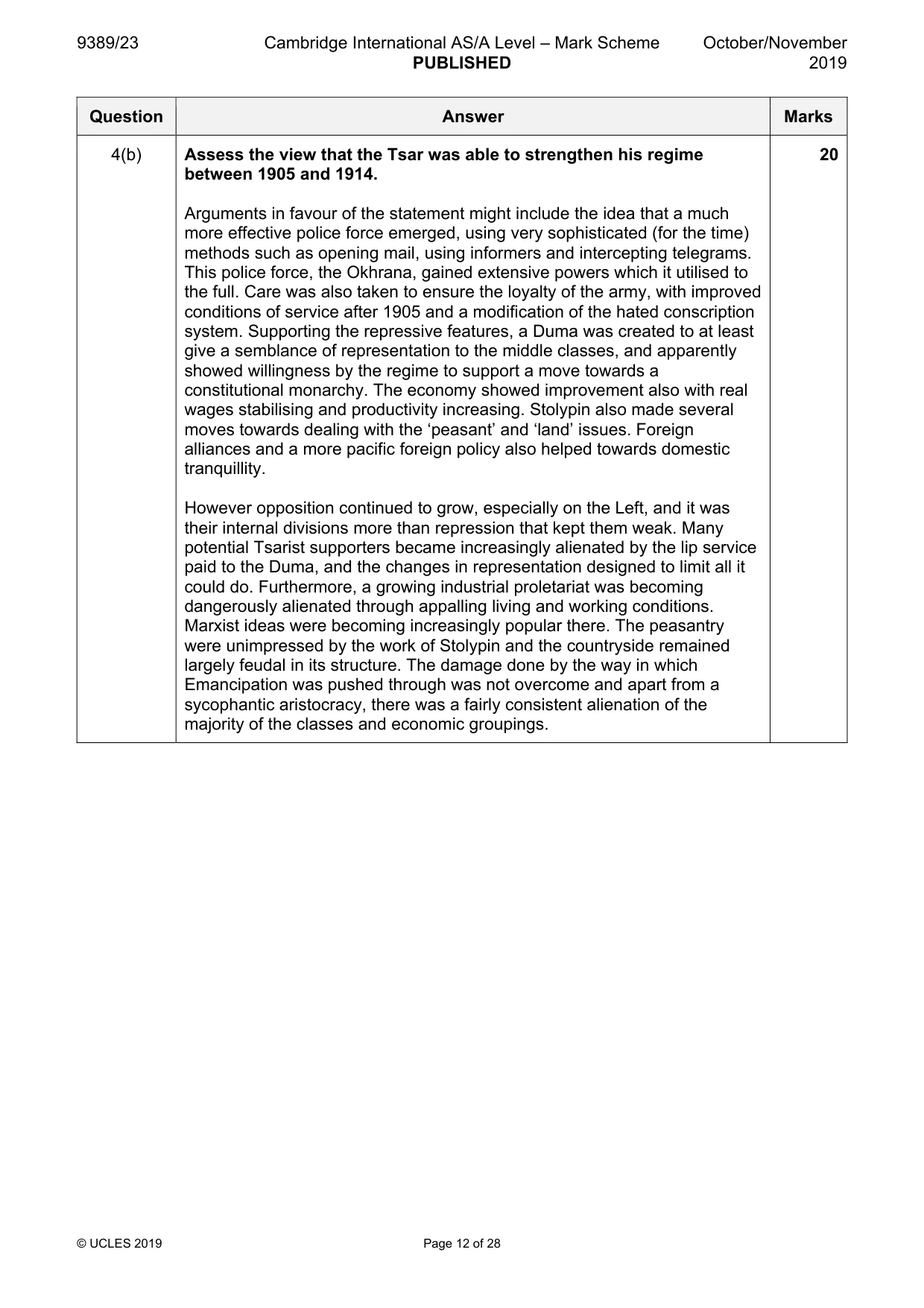
Mark scheme: 4(a) Why was Rasputin murdered? 10 • They were determined to try and save the Tsar and his regime from the harm that Rasputin was bringing to them both. • Rasputin was hated at court for his gambling, womanising and his political intrigues. He had become very much the power behind the throne once the Tsar, at Rasputin’s suggestion, had gone to command the armies at the front. • Rasputin was seen as a major threat to the regime, particular as a result of the influence he clearly had over the Tsarina who had been left to run the ‘home front’. • Rasputin’s apparent hold over the Tsarina and her suspicions over her connections to her family in Germany led to a steady rise in the unpopularity of the monarchy. The removal of Rasputin was seen as the only way to stop this. 4(b) Assess the view that the Tsar was able to strengthen his regime 20 between 1905 and 1914. Arguments in favour of the statement might include the idea that a much more effective police force emerged, using very sophisticated (for the time) methods such as opening mail, using informers and intercepting telegrams. This police force, the Okhrana, gained extensive powers which it utilised to the full. Care was also taken to ensure the loyalty of the army, with improved conditions of service after 1905 and a modification of the hated conscription system. Supporting the repressive features, a Duma was created to at least give a semblance of representation to the middle classes, and apparently showed willingness by the regime to support a move towards a constitutional monarchy. The economy showed improvement also with real wages stabilising and productivity increasing. Stolypin also made several moves towards dealing with the ‘peasant’ and ‘land’ issues. Foreign alliances and a more pacific foreign policy also helped towards domestic tranquillity. However opposition continued to grow, especially on the Left, and it was their internal divisions more than repression that kept them weak. Many potential Tsarist supporters became increasingly alienated by the lip service paid to the Duma, and the changes in representation designed to limit all it could do. Furthermore, a growing industrial proletariat was becoming dangerously alienated through appalling living and working conditions. Marxist ideas were becoming increasingly popular there. The peasantry were unimpressed by the work of Stolypin and the countryside remained largely feudal in its structure. The damage done by the way in which Emancipation was pushed through was not overcome and apart from a sycophantic aristocracy, there was a fairly consistent alienation of the majority of the classes and economic groupings. Section B: American Option: The History of the USA, 1840–1941
Q5 · The Expansion of US Power from the 1840s to the 1930s (a) Why did the US government order…
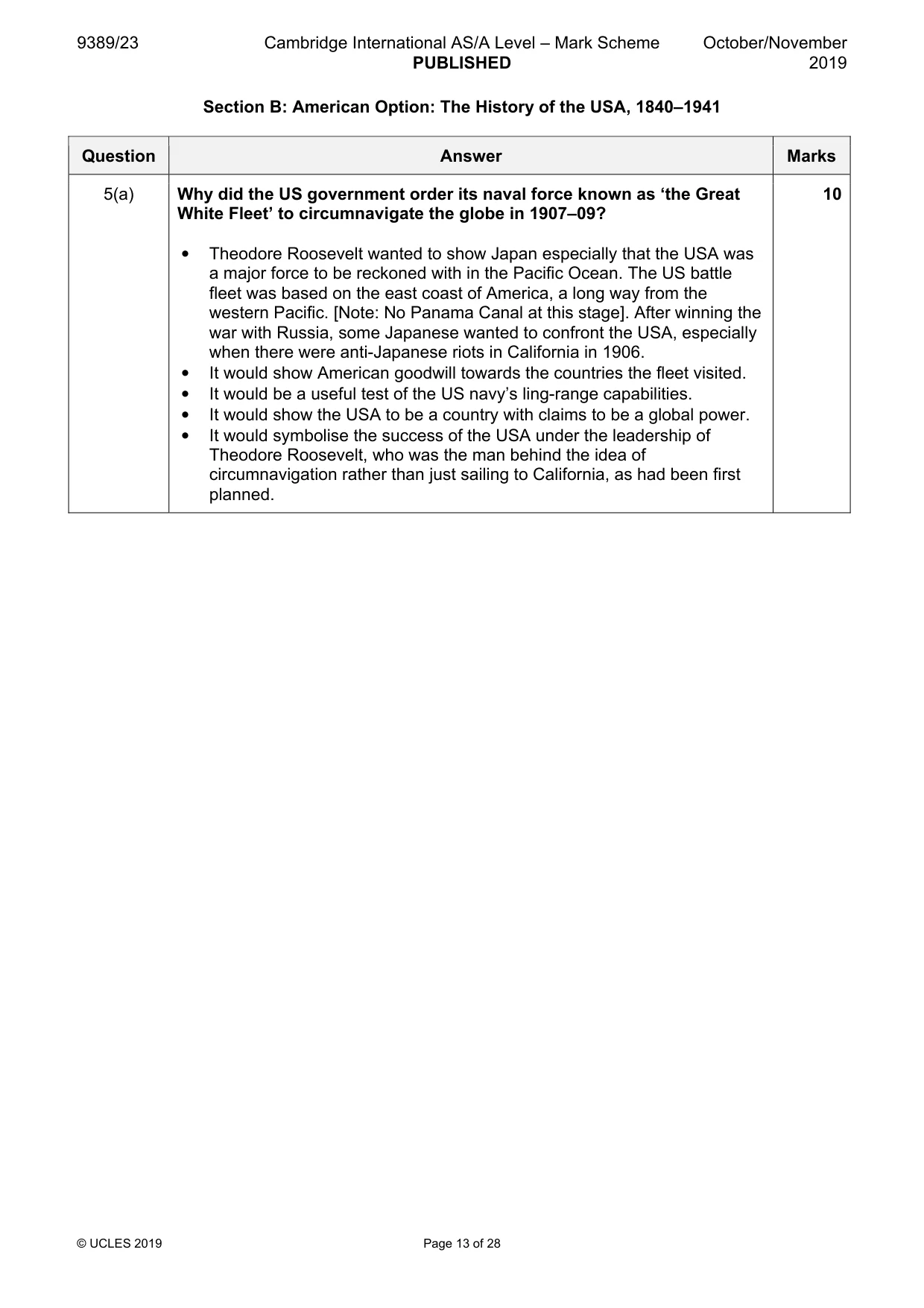
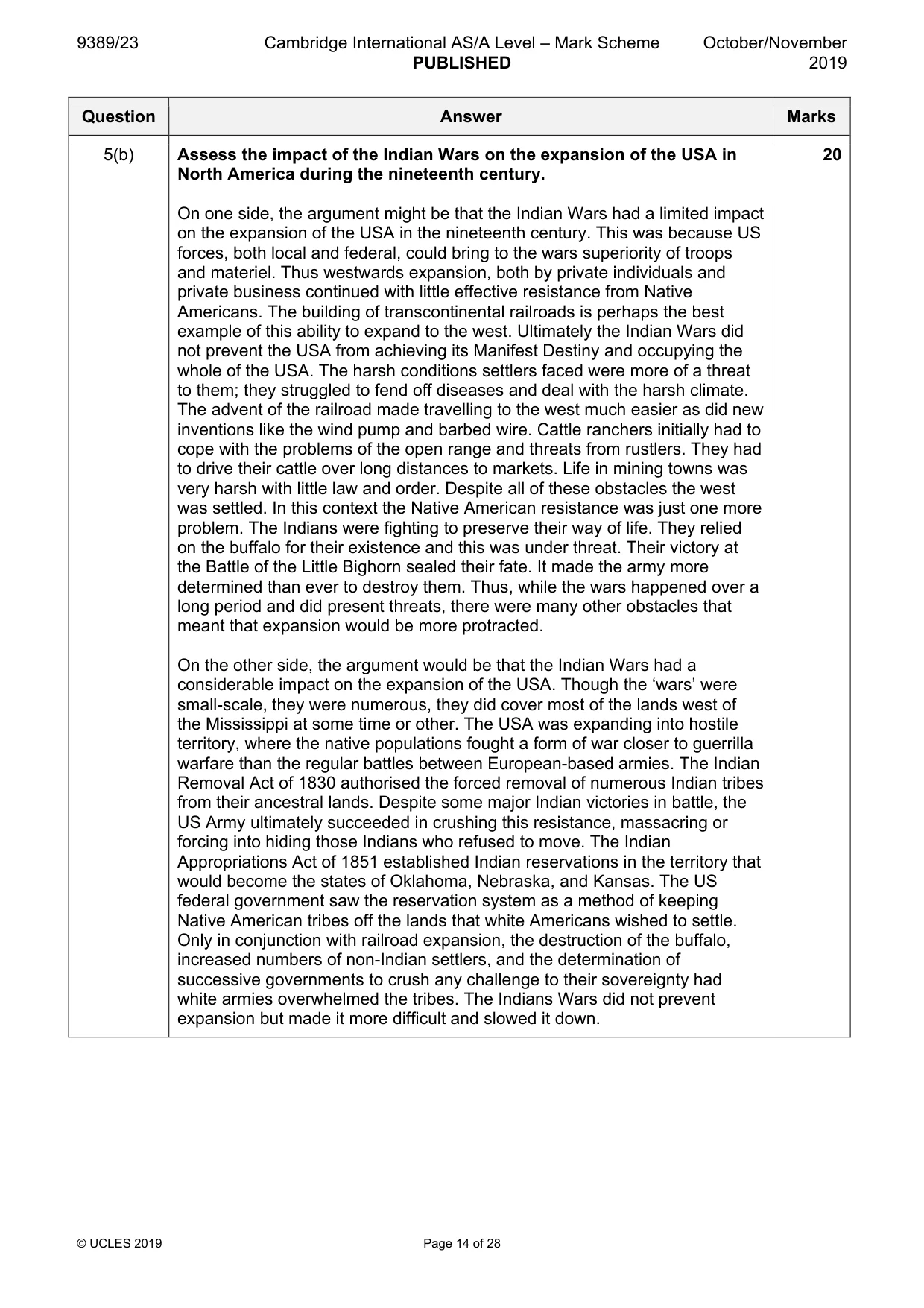
5 The Expansion of US Power from the 1840s to the 1930s (a) Why did the US government order its naval force known as the ‘Great White Fleet’ to circumnavigate the globe in 1907–09? [10] (b) Assess the importance of the Indian Wars to the expansion of the USA in North America during the nineteenth century. [20]
Mark scheme: 5(a) Why did the US government order its naval force known as ‘the Great 10 White Fleet’ to circumnavigate the globe in 1907–09? • Theodore Roosevelt wanted to show Japan especially that the USA was a major force to be reckoned with in the Pacific Ocean. The US battle fleet was based on the east coast of America, a long way from the western Pacific. [Note: No Panama Canal at this stage]. After winning the war with Russia, some Japanese wanted to confront the USA, especially when there were anti-Japanese riots in California in 1906. • It would show American goodwill towards the countries the fleet visited. • It would be a useful test of the US navy’s ling-range capabilities. • It would show the USA to be a country with claims to be a global power. • It would symbolise the success of the USA under the leadership of Theodore Roosevelt, who was the man behind the idea of circumnavigation rather than just sailing to California, as had been first planned. 5(b) Assess the impact of the Indian Wars on the expansion of the USA in 20 North America during the nineteenth century. On one side, the argument might be that the Indian Wars had a limited impact on the expansion of the USA in the nineteenth century. This was because US forces, both local and federal, could bring to the wars superiority of troops and materiel. Thus westwards expansion, both by private individuals and private business continued with little effective resistance from Native Americans. The building of transcontinental railroads is perhaps the best example of this ability to expand to the west. Ultimately the Indian Wars did not prevent the USA from achieving its Manifest Destiny and occupying the whole of the USA. The harsh conditions settlers faced were more of a threat to them; they struggled to fend off diseases and deal with the harsh climate. The advent of the railroad made travelling to the west much easier as did new inventions like the wind pump and barbed wire. Cattle ranchers initially had to cope with the problems of the open range and threats from rustlers. They had to drive their cattle over long distances to markets. Life in mining towns was very harsh with little law and order. Despite all of these obstacles the west was settled. In this context the Native American resistance was just one more problem. The Indians were fighting to preserve their way of life. They relied on the buffalo for their existence and this was under threat. Their victory at the Battle of the Little Bighorn sealed their fate. It made the army more determined than ever to destroy them. Thus, while the wars happened over a long period and did present threats, there were many other obstacles that meant that expansion would be more protracted. On the other side, the argument would be that the Indian Wars had a considerable impact on the expansion of the USA. Though the ‘wars’ were small-scale, they were numerous, they did cover most of the lands west of the Mississippi at some time or other. The USA was expanding into hostile territory, where the native populations fought a form of war closer to guerrilla warfare than the regular battles between European-based armies. The Indian Removal Act of 1830 authorised the forced removal of numerous Indian tribes from their ancestral lands. Despite some major Indian victories in battle, the US Army ultimately succeeded in crushing this resistance, massacring or forcing into hiding those Indians who refused to move. The Indian Appropriations Act of 1851 established Indian reservations in the territory that would become the states of Oklahoma, Nebraska, and Kansas. The US federal government saw the reservation system as a method of keeping Native American tribes off the lands that white Americans wished to settle. Only in conjunction with railroad expansion, the destruction of the buffalo, increased numbers of non-Indian settlers, and the determination of successive governments to crush any challenge to their sovereignty had white armies overwhelmed the tribes. The Indians Wars did not prevent expansion but made it more difficult and slowed it down.
Q6 · Civil War and Reconstruction, 1861–1877 (a) Why, in the Civil War, despite inferior…
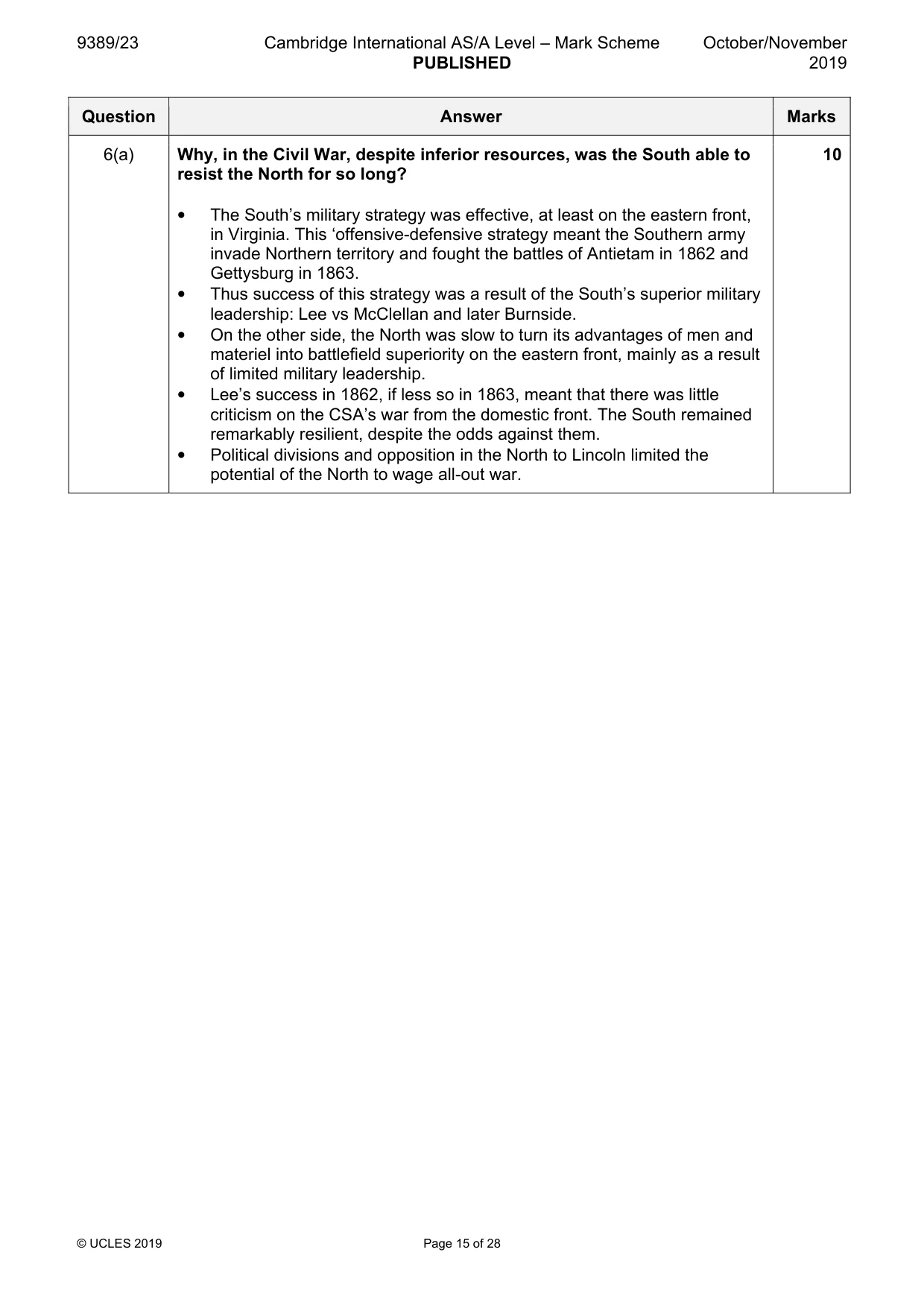
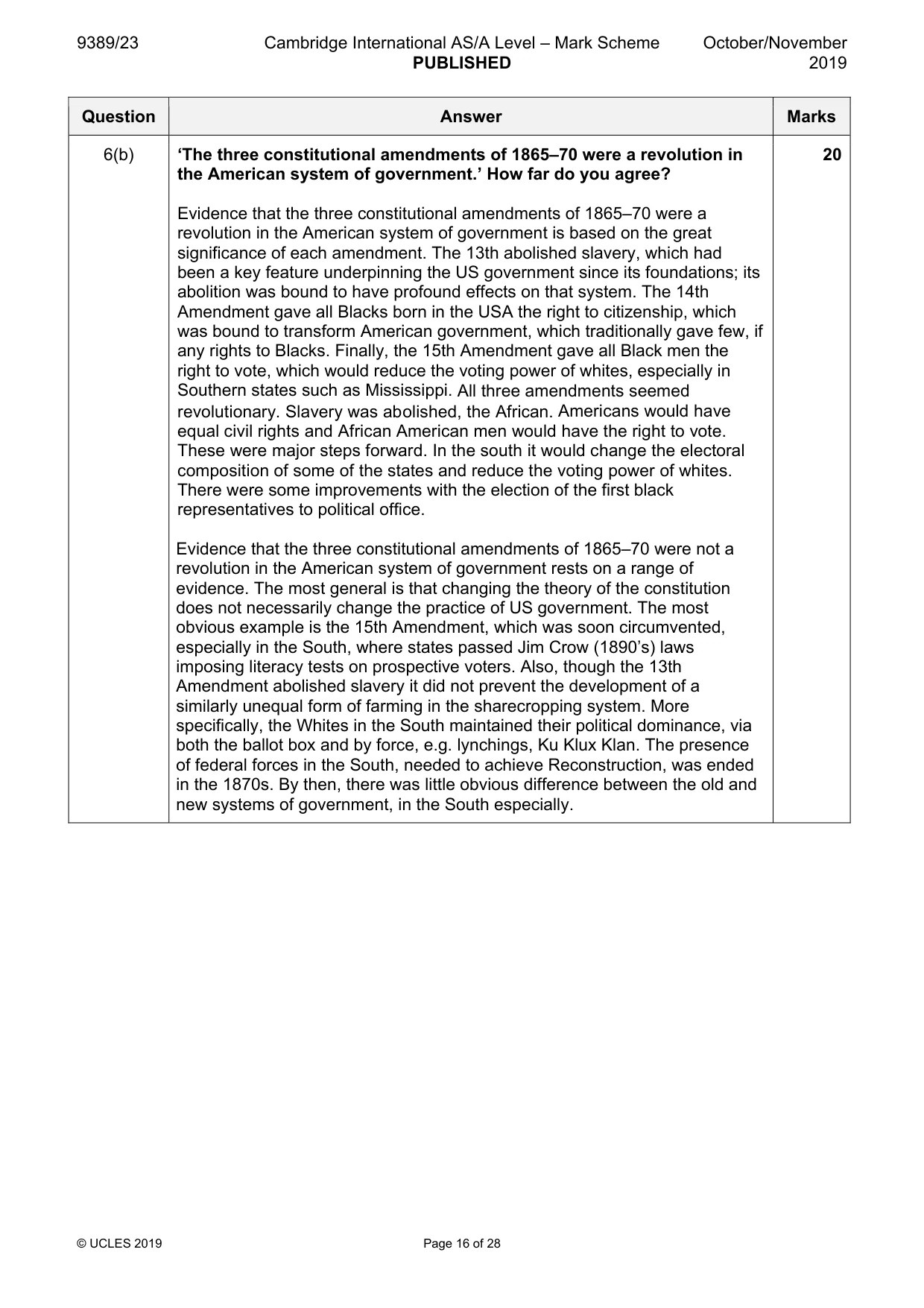
6 Civil War and Reconstruction, 1861–1877 (a) Why, in the Civil War, despite inferior resources, was the South able to resist the North for so long? [10] (b) ‘The three constitutional amendments of 1865–70 were revolutionary in their impact.’ How far do you agree? [20]
Mark scheme: 6(a) Why, in the Civil War, despite inferior resources, was the South able to 10 resist the North for so long? • The South’s military strategy was effective, at least on the eastern front, in Virginia. This ‘offensive-defensive strategy meant the Southern army invade Northern territory and fought the battles of Antietam in 1862 and Gettysburg in 1863. • Thus success of this strategy was a result of the South’s superior military leadership: Lee vs McClellan and later Burnside. • On the other side, the North was slow to turn its advantages of men and materiel into battlefield superiority on the eastern front, mainly as a result of limited military leadership. • Lee’s success in 1862, if less so in 1863, meant that there was little criticism on the CSA’s war from the domestic front. The South remained remarkably resilient, despite the odds against them. • Political divisions and opposition in the North to Lincoln limited the potential of the North to wage all-out war. 6(b) ‘The three constitutional amendments of 1865–70 were a revolution in 20 the American system of government.’ How far do you agree? Evidence that the three constitutional amendments of 1865–70 were a revolution in the American system of government is based on the great significance of each amendment. The 13th abolished slavery, which had been a key feature underpinning the US government since its foundations; its abolition was bound to have profound effects on that system. The 14th Amendment gave all Blacks born in the USA the right to citizenship, which was bound to transform American government, which traditionally gave few, if any rights to Blacks. Finally, the 15th Amendment gave all Black men the right to vote, which would reduce the voting power of whites, especially in Southern states such as Mississippi. All three amendments seemed revolutionary. Slavery was abolished, the African. Americans would have equal civil rights and African American men would have the right to vote. These were major steps forward. In the south it would change the electoral composition of some of the states and reduce the voting power of whites. There were some improvements with the election of the first black representatives to political office. Evidence that the three constitutional amendments of 1865–70 were not a revolution in the American system of government rests on a range of evidence. The most general is that changing the theory of the constitution does not necessarily change the practice of US government. The most obvious example is the 15th Amendment, which was soon circumvented, especially in the South, where states passed Jim Crow (1890’s) laws imposing literacy tests on prospective voters. Also, though the 13th Amendment abolished slavery it did not prevent the development of a similarly unequal form of farming in the sharecropping system. More specifically, the Whites in the South maintained their political dominance, via both the ballot box and by force, e.g. lynchings, Ku Klux Klan. The presence of federal forces in the South, needed to achieve Reconstruction, was ended in the 1870s. By then, there was little obvious difference between the old and new systems of government, in the South especially.
Q7 · The Gilded Age and the Progressive Era from the 1870s to the 1920s (a) Why were party…
7 The Gilded Age and the Progressive Era from the 1870s to the 1920s (a) Why were party bosses in the cities so powerful? [10] (b) How far, by the early twentieth century, had the Progressives limited the excesses of the Gilded Age? [20]
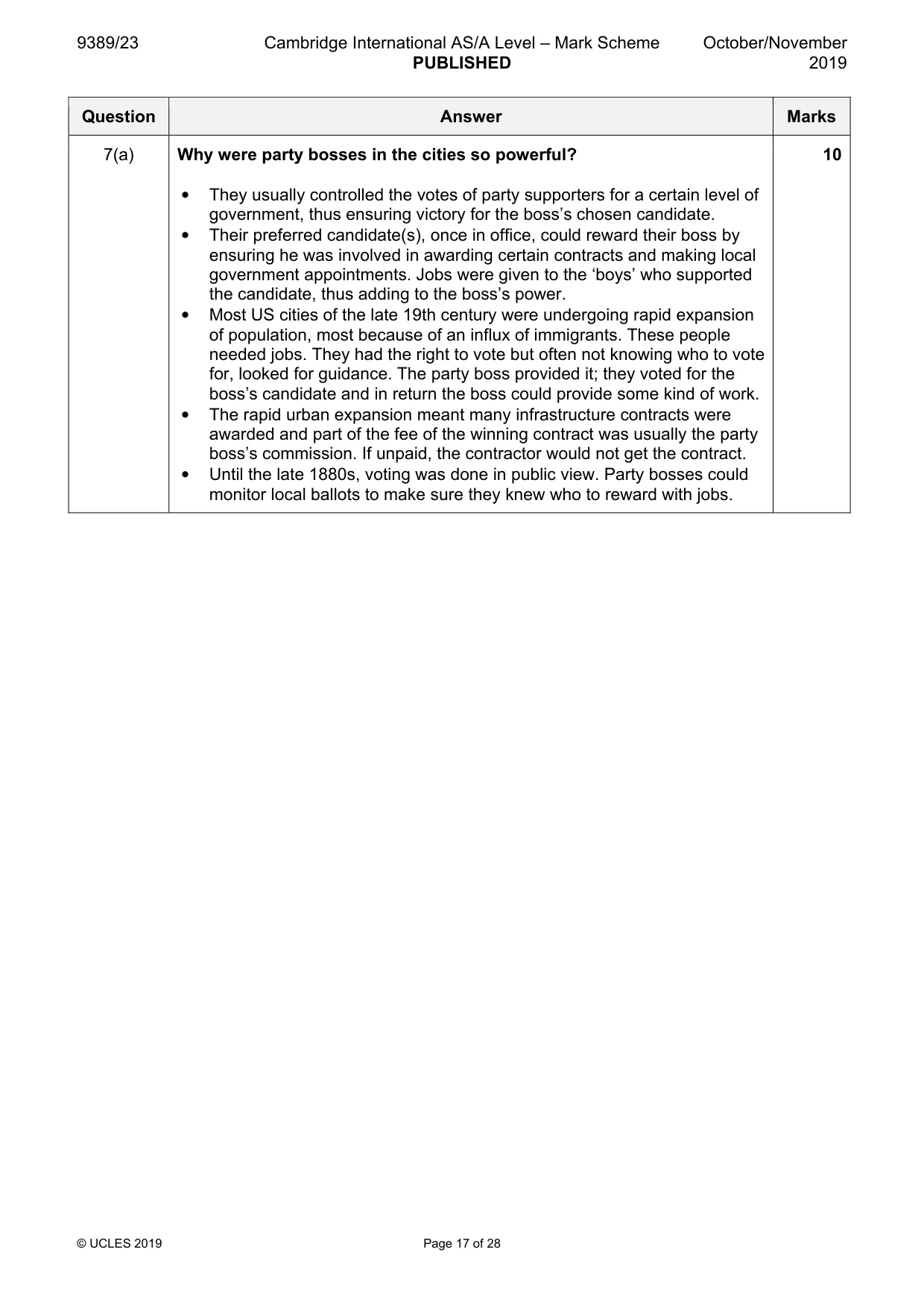
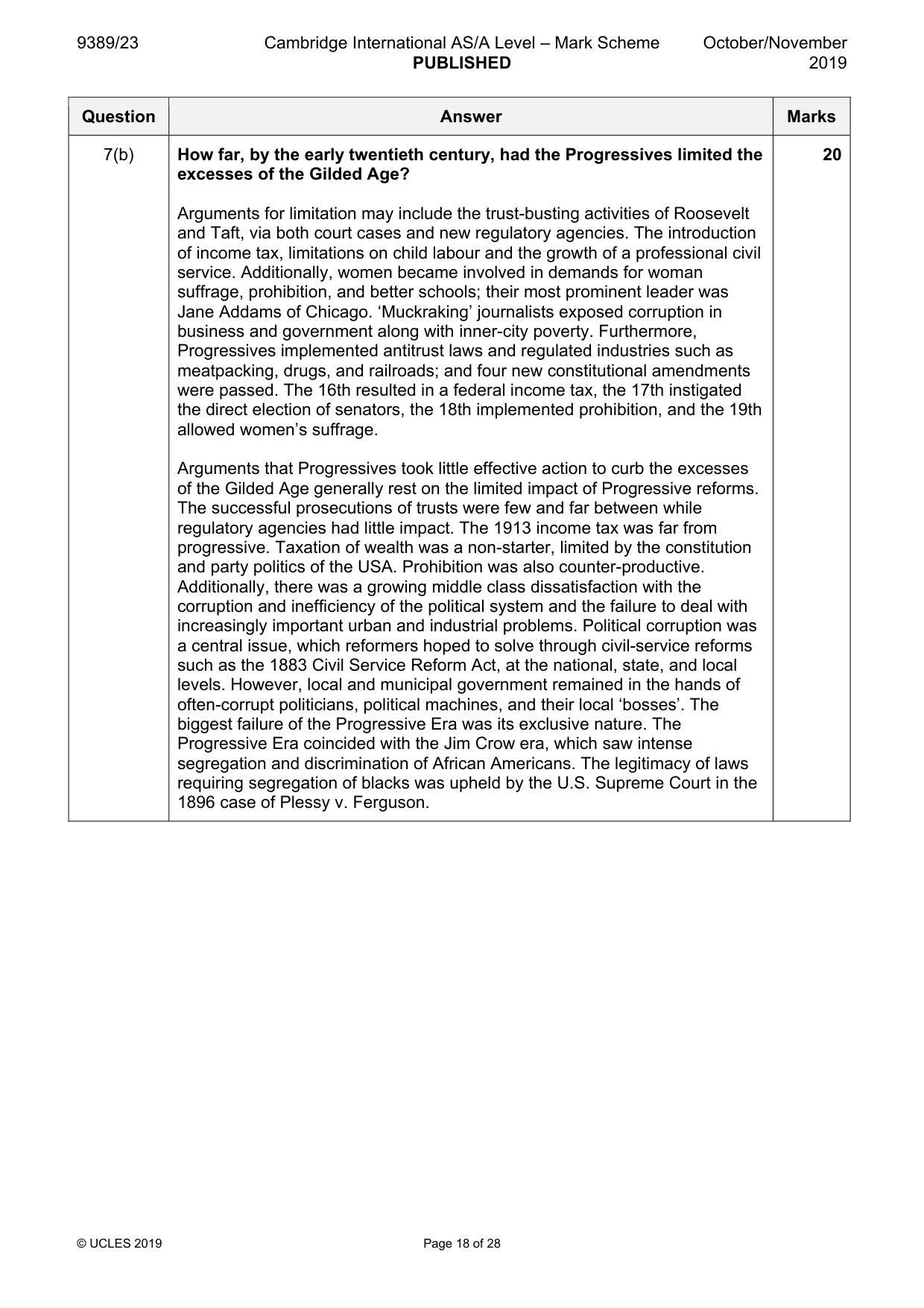
Mark scheme: 7(a) Why were party bosses in the cities so powerful? 10 • They usually controlled the votes of party supporters for a certain level of government, thus ensuring victory for the boss’s chosen candidate. • Their preferred candidate(s), once in office, could reward their boss by ensuring he was involved in awarding certain contracts and making local government appointments. Jobs were given to the ‘boys’ who supported the candidate, thus adding to the boss’s power. • Most US cities of the late 19th century were undergoing rapid expansion of population, most because of an influx of immigrants. These people needed jobs. They had the right to vote but often not knowing who to vote for, looked for guidance. The party boss provided it; they voted for the boss’s candidate and in return the boss could provide some kind of work. • The rapid urban expansion meant many infrastructure contracts were awarded and part of the fee of the winning contract was usually the party boss’s commission. If unpaid, the contractor would not get the contract. • Until the late 1880s, voting was done in public view. Party bosses could monitor local ballots to make sure they knew who to reward with jobs. 7(b) How far, by the early twentieth century, had the Progressives limited the 20 excesses of the Gilded Age? Arguments for limitation may include the trust-busting activities of Roosevelt and Taft, via both court cases and new regulatory agencies. The introduction of income tax, limitations on child labour and the growth of a professional civil service. Additionally, women became involved in demands for woman suffrage, prohibition, and better schools; their most prominent leader was Jane Addams of Chicago. ‘Muckraking’ journalists exposed corruption in business and government along with inner-city poverty. Furthermore, Progressives implemented antitrust laws and regulated industries such as meatpacking, drugs, and railroads; and four new constitutional amendments were passed. The 16th resulted in a federal income tax, the 17th instigated the direct election of senators, the 18th implemented prohibition, and the 19th allowed women’s suffrage. Arguments that Progressives took little effective action to curb the excesses of the Gilded Age generally rest on the limited impact of Progressive reforms. The successful prosecutions of trusts were few and far between while regulatory agencies had little impact. The 1913 income tax was far from progressive. Taxation of wealth was a non-starter, limited by the constitution and party politics of the USA. Prohibition was also counter-productive. Additionally, there was a growing middle class dissatisfaction with the corruption and inefficiency of the political system and the failure to deal with increasingly important urban and industrial problems. Political corruption was a central issue, which reformers hoped to solve through civil-service reforms such as the 1883 Civil Service Reform Act, at the national, state, and local levels. However, local and municipal government remained in the hands of often-corrupt politicians, political machines, and their local ‘bosses’. The biggest failure of the Progressive Era was its exclusive nature. The Progressive Era coincided with the Jim Crow era, which saw intense segregation and discrimination of African Americans. The legitimacy of laws requiring segregation of blacks was upheld by the U.S. Supreme Court in the 1896 case of Plessy v. Ferguson.
Q8 · The Great Crash, the Great Depression and the New Deal, from the 1920s to 1941 (a) Why…
8 The Great Crash, the Great Depression and the New Deal, from the 1920s to 1941 (a) Why was there widespread opposition to the National Labor Relations Act of 1935? [10] (b) How far did President Hoover depart from traditional economic policies in order to revive the US economy? [20] Section C: International Option International Relations, 1871–1945 Answer both parts of two questions.
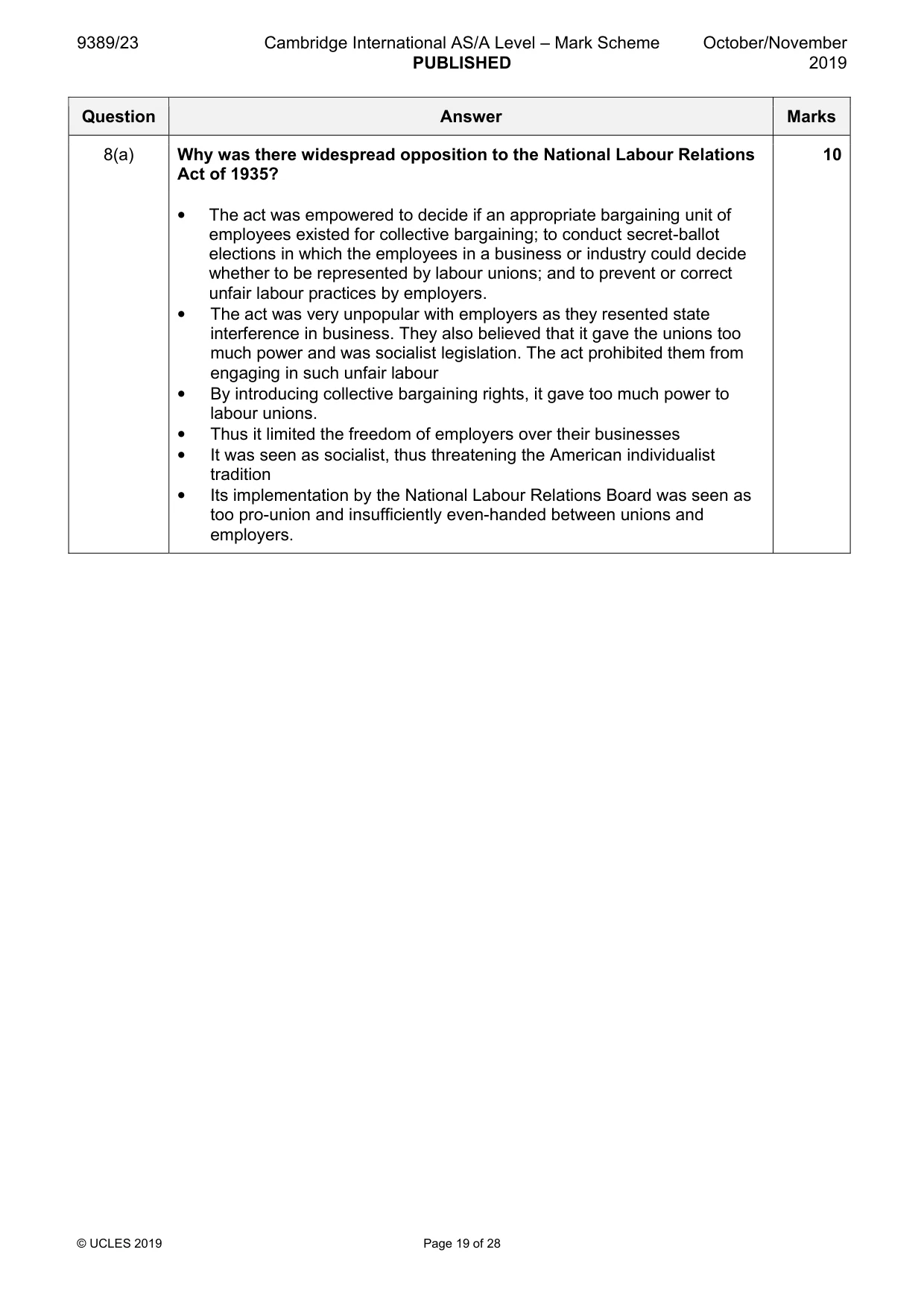
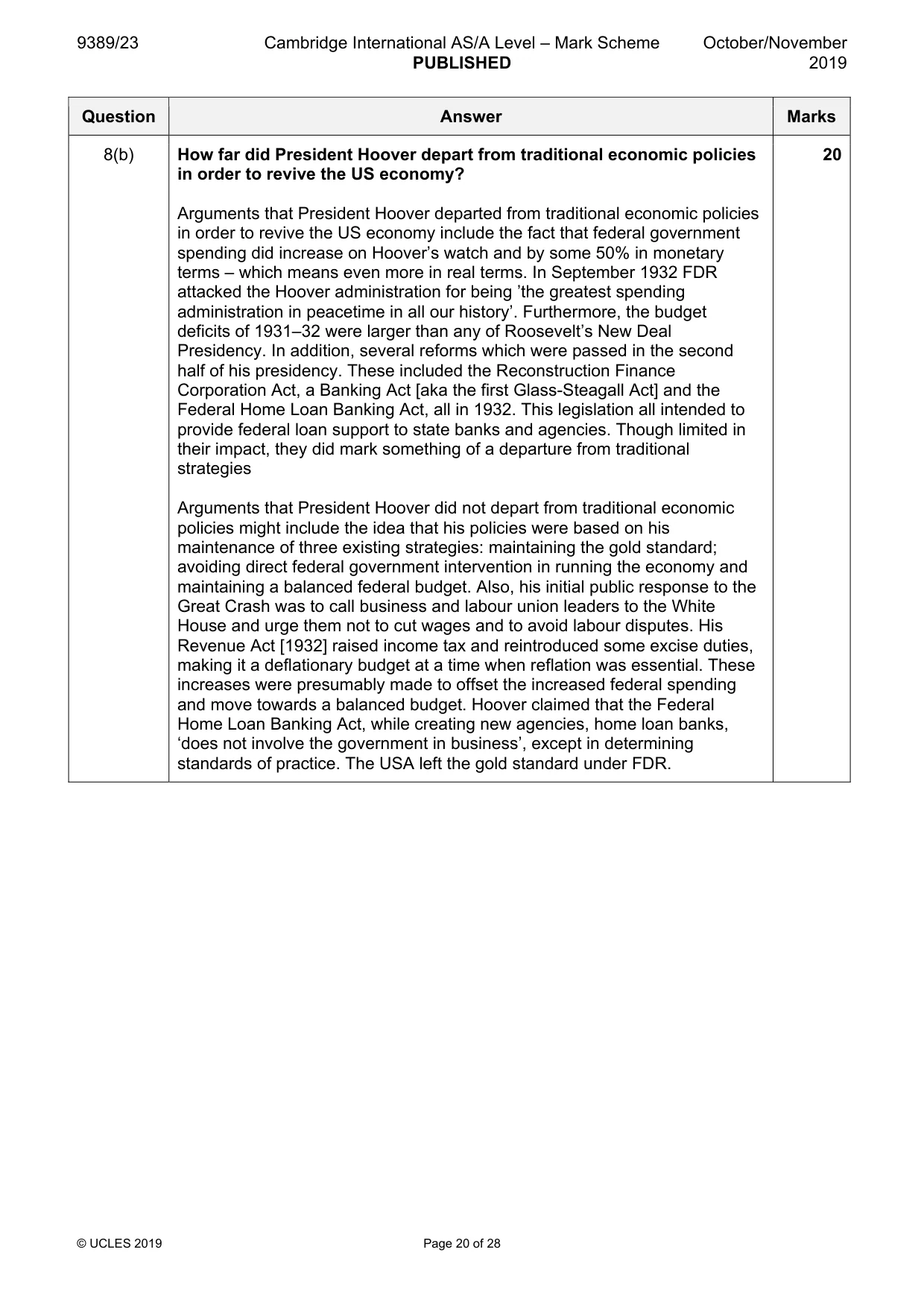
Mark scheme: 8(a) Why was there widespread opposition to the National Labour Relations 10 Act of 1935? • The act was empowered to decide if an appropriate bargaining unit of employees existed for collective bargaining; to conduct secret-ballot elections in which the employees in a business or industry could decide whether to be represented by labour unions; and to prevent or correct unfair labour practices by employers. • The act was very unpopular with employers as they resented state interference in business. They also believed that it gave the unions too much power and was socialist legislation. The act prohibited them from engaging in such unfair labour • By introducing collective bargaining rights, it gave too much power to labour unions. • Thus it limited the freedom of employers over their businesses • It was seen as socialist, thus threatening the American individualist tradition • Its implementation by the National Labour Relations Board was seen as too pro-union and insufficiently even-handed between unions and employers. 8(b) How far did President Hoover depart from traditional economic policies 20 in order to revive the US economy? Arguments that President Hoover departed from traditional economic policies in order to revive the US economy include the fact that federal government spending did increase on Hoover’s watch and by some 50% in monetary terms – which means even more in real terms. In September 1932 FDR attacked the Hoover administration for being ’the greatest spending administration in peacetime in all our history’. Furthermore, the budget deficits of 1931–32 were larger than any of Roosevelt’s New Deal Presidency. In addition, several reforms which were passed in the second half of his presidency. These included the Reconstruction Finance Corporation Act, a Banking Act [aka the first Glass-Steagall Act] and the Federal Home Loan Banking Act, all in 1932. This legislation all intended to provide federal loan support to state banks and agencies. Though limited in their impact, they did mark something of a departure from traditional strategies Arguments that President Hoover did not depart from traditional economic policies might include the idea that his policies were based on his maintenance of three existing strategies: maintaining the gold standard; avoiding direct federal government intervention in running the economy and maintaining a balanced federal budget. Also, his initial public response to the Great Crash was to call business and labour union leaders to the White House and urge them not to cut wages and to avoid labour disputes. His Revenue Act [1932] raised income tax and reintroduced some excise duties, making it a deflationary budget at a time when reflation was essential. These increases were presumably made to offset the increased federal spending and move towards a balanced budget. Hoover claimed that the Federal Home Loan Banking Act, while creating new agencies, home loan banks, ‘does not involve the government in business’, except in determining standards of practice. The USA left the gold standard under FDR.
Q9 · International Relations, 1871–1918 (a) Why were the European powers able to avoid war…
9 International Relations, 1871–1918 (a) Why were the European powers able to avoid war over the ‘scramble for Africa’? [10] (b) How far had the USA departed from its policy of isolationism by 1914? [20]
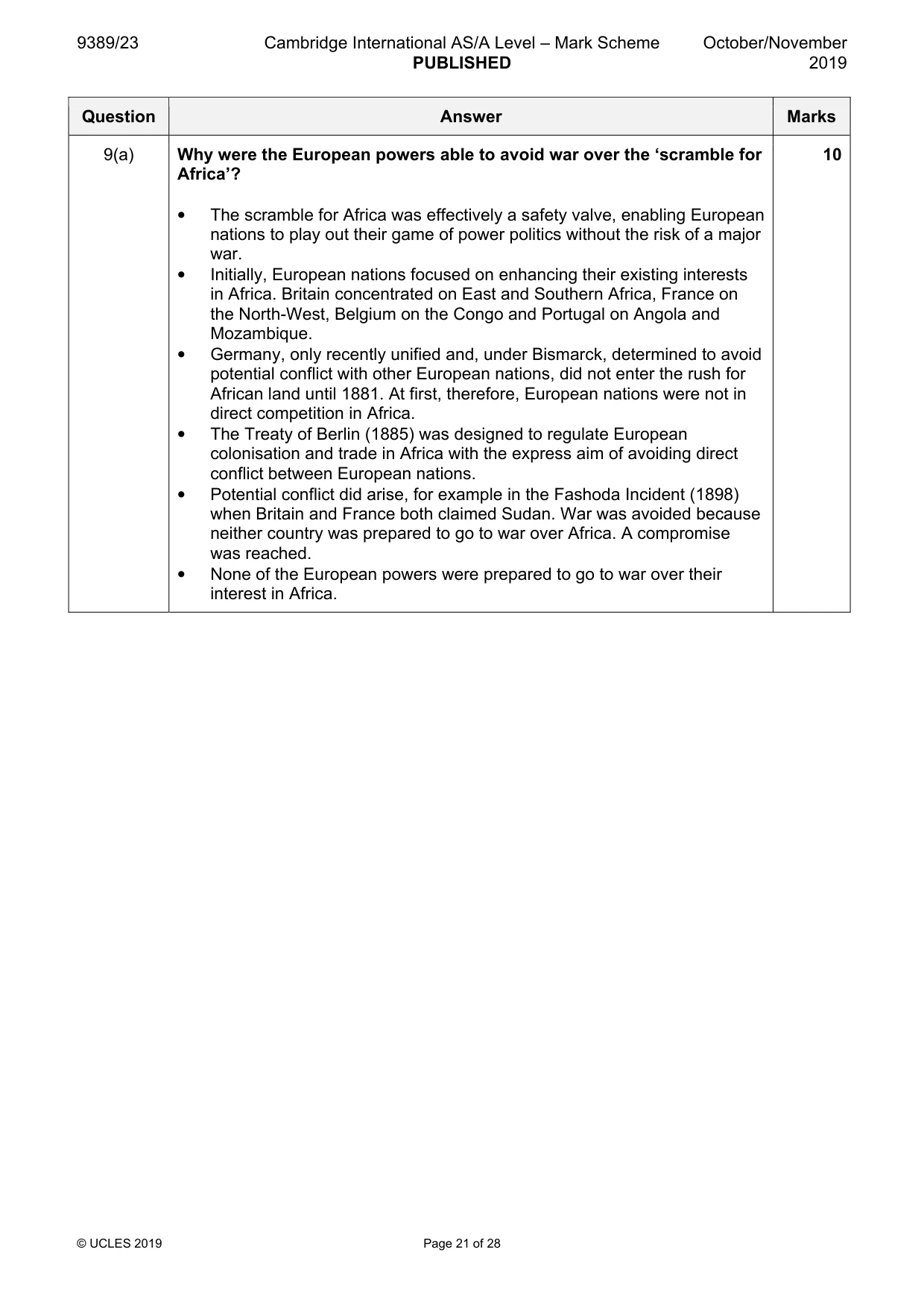
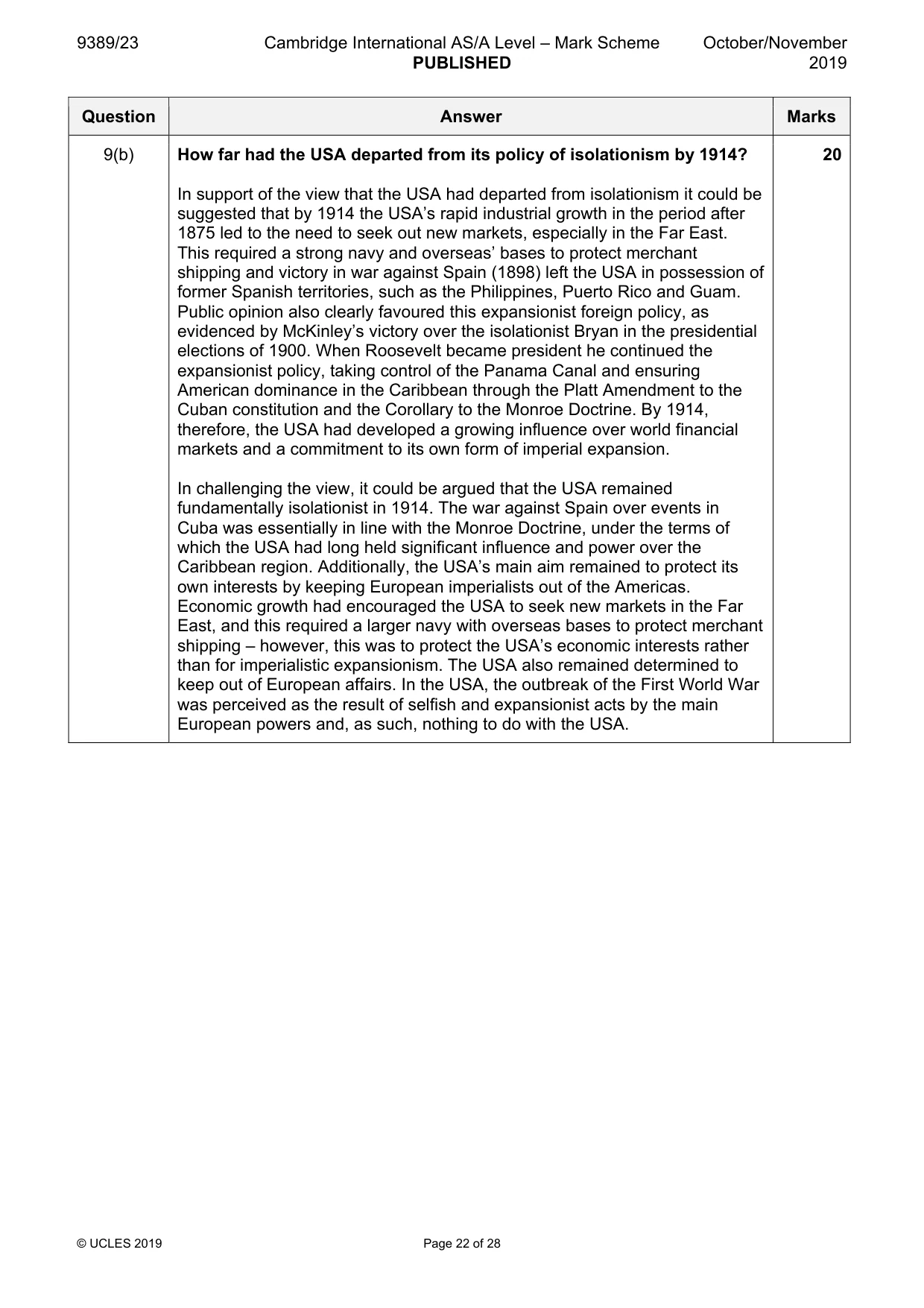
Mark scheme: 9(a) Why were the European powers able to avoid war over the ‘scramble for 10 Africa’? • The scramble for Africa was effectively a safety valve, enabling European nations to play out their game of power politics without the risk of a major war. • Initially, European nations focused on enhancing their existing interests in Africa. Britain concentrated on East and Southern Africa, France on the North-West, Belgium on the Congo and Portugal on Angola and Mozambique. • Germany, only recently unified and, under Bismarck, determined to avoid potential conflict with other European nations, did not enter the rush for African land until 1881. At first, therefore, European nations were not in direct competition in Africa. • The Treaty of Berlin (1885) was designed to regulate European colonisation and trade in Africa with the express aim of avoiding direct conflict between European nations. • Potential conflict did arise, for example in the Fashoda Incident (1898) when Britain and France both claimed Sudan. War was avoided because neither country was prepared to go to war over Africa. A compromise was reached. • None of the European powers were prepared to go to war over their interest in Africa. 9(b) How far had the USA departed from its policy of isolationism by 1914? 20 In support of the view that the USA had departed from isolationism it could be suggested that by 1914 the USA’s rapid industrial growth in the period after 1875 led to the need to seek out new markets, especially in the Far East. This required a strong navy and overseas’ bases to protect merchant shipping and victory in war against Spain (1898) left the USA in possession of former Spanish territories, such as the Philippines, Puerto Rico and Guam. Public opinion also clearly favoured this expansionist foreign policy, as evidenced by McKinley’s victory over the isolationist Bryan in the presidential elections of 1900. When Roosevelt became president he continued the expansionist policy, taking control of the Panama Canal and ensuring American dominance in the Caribbean through the Platt Amendment to the Cuban constitution and the Corollary to the Monroe Doctrine. By 1914, therefore, the USA had developed a growing influence over world financial markets and a commitment to its own form of imperial expansion. In challenging the view, it could be argued that the USA remained fundamentally isolationist in 1914. The war against Spain over events in Cuba was essentially in line with the Monroe Doctrine, under the terms of which the USA had long held significant influence and power over the Caribbean region. Additionally, the USA’s main aim remained to protect its own interests by keeping European imperialists out of the Americas. Economic growth had encouraged the USA to seek new markets in the Far East, and this required a larger navy with overseas bases to protect merchant shipping – however, this was to protect the USA’s economic interests rather than for imperialistic expansionism. The USA also remained determined to keep out of European affairs. In the USA, the outbreak of the First World War was perceived as the result of selfish and expansionist acts by the main European powers and, as such, nothing to do with the USA.
Q10 · International Relations, 1919–1933 (a) Why, in 1921–22, did the Washington Naval…
10 International Relations, 1919–1933 (a) Why, in 1921–22, did the Washington Naval Conference take place? [10] (b) ‘A foolish action, from which France gained nothing.’ How far do you agree with this assessment of the French occupation of the Ruhr? [20]
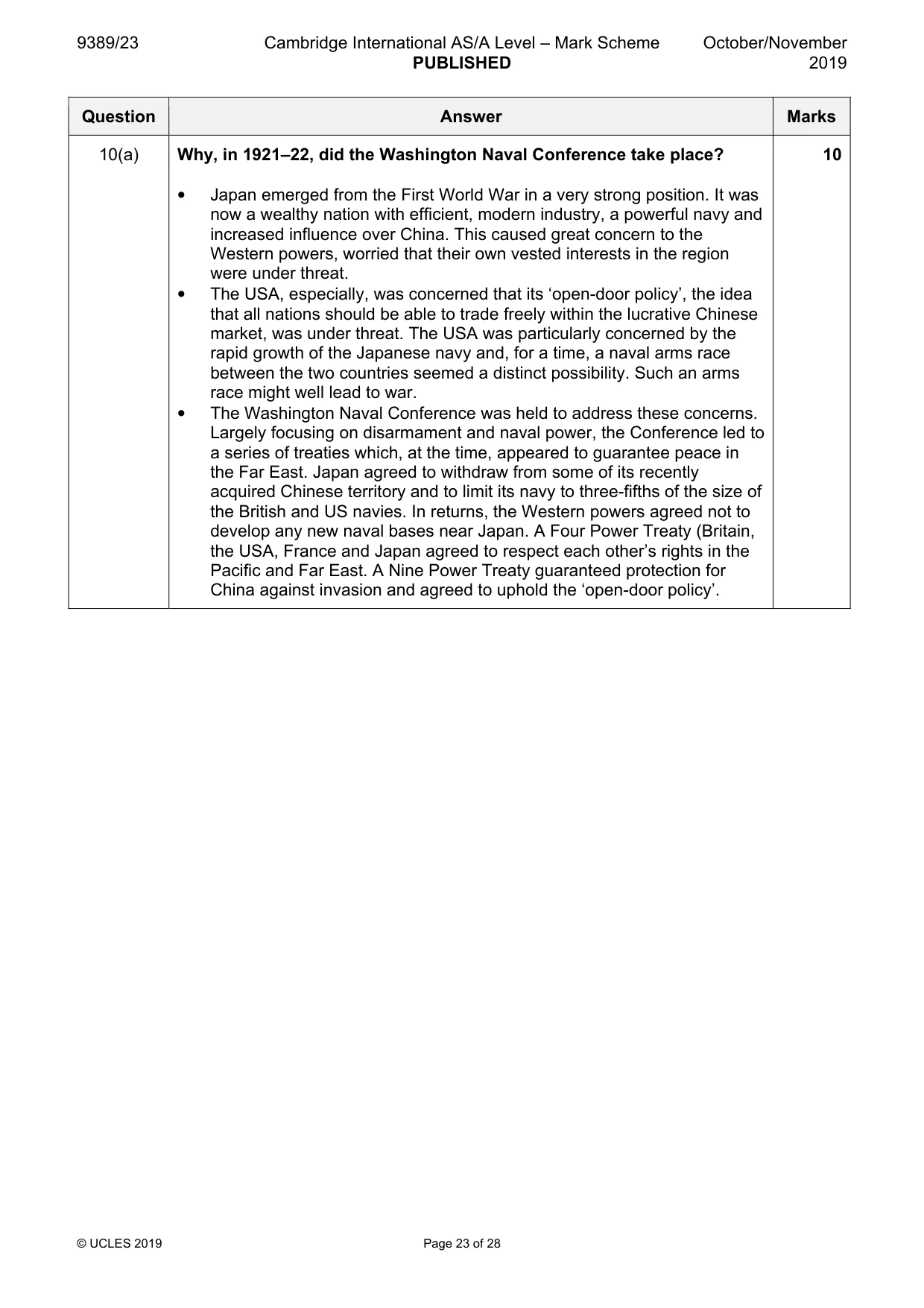
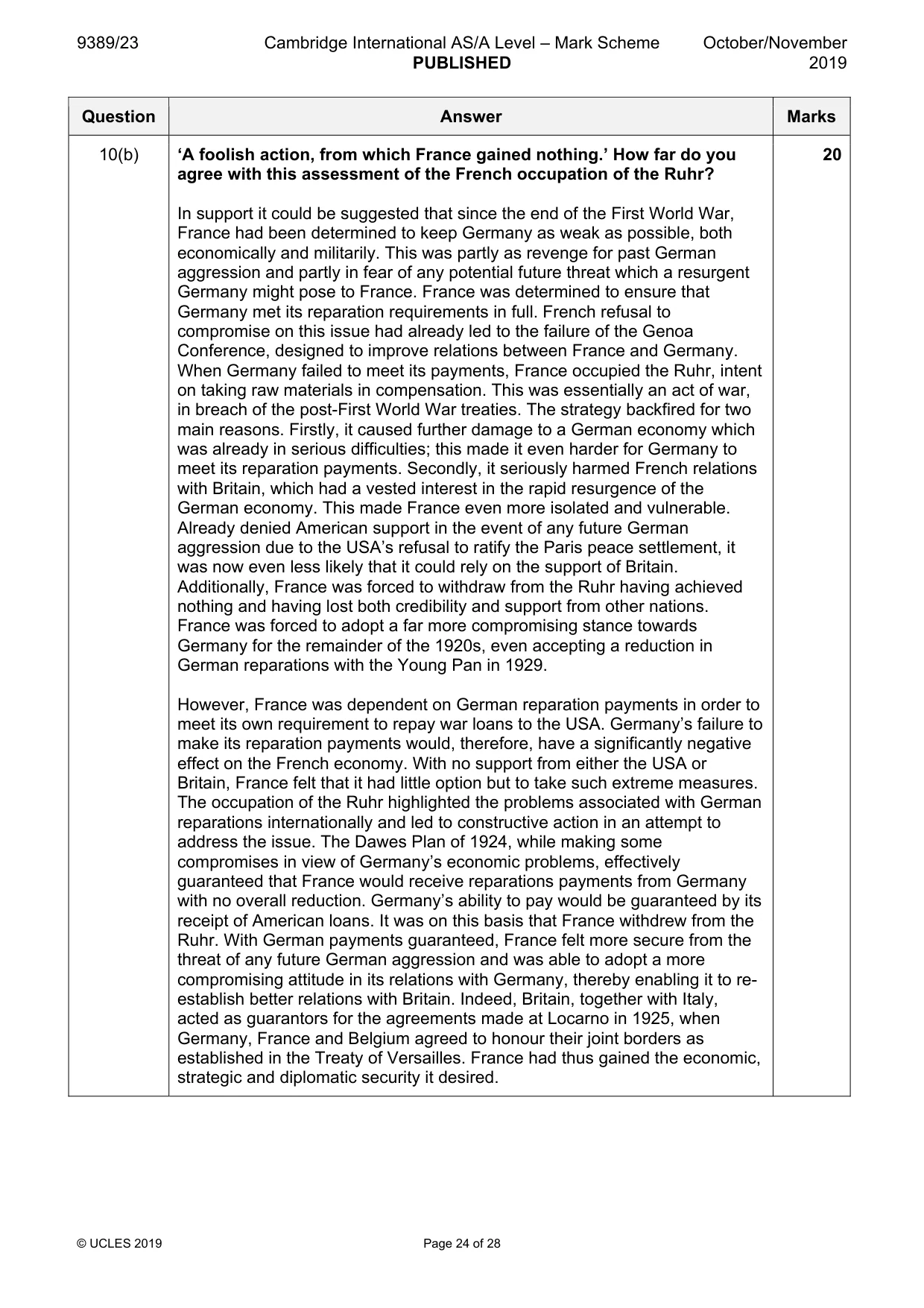
Mark scheme: 10(a) Why, in 1921–22, did the Washington Naval Conference take place? 10 • Japan emerged from the First World War in a very strong position. It was now a wealthy nation with efficient, modern industry, a powerful navy and increased influence over China. This caused great concern to the Western powers, worried that their own vested interests in the region were under threat. • The USA, especially, was concerned that its ‘open-door policy’, the idea that all nations should be able to trade freely within the lucrative Chinese market, was under threat. The USA was particularly concerned by the rapid growth of the Japanese navy and, for a time, a naval arms race between the two countries seemed a distinct possibility. Such an arms race might well lead to war. • The Washington Naval Conference was held to address these concerns. Largely focusing on disarmament and naval power, the Conference led to a series of treaties which, at the time, appeared to guarantee peace in the Far East. Japan agreed to withdraw from some of its recently acquired Chinese territory and to limit its navy to three-fifths of the size of the British and US navies. In returns, the Western powers agreed not to develop any new naval bases near Japan. A Four Power Treaty (Britain, the USA, France and Japan agreed to respect each other’s rights in the Pacific and Far East. A Nine Power Treaty guaranteed protection for China against invasion and agreed to uphold the ‘open-door policy’. 10(b) ‘A foolish action, from which France gained nothing.’ How far do you 20 agree with this assessment of the French occupation of the Ruhr? In support it could be suggested that since the end of the First World War, France had been determined to keep Germany as weak as possible, both economically and militarily. This was partly as revenge for past German aggression and partly in fear of any potential future threat which a resurgent Germany might pose to France. France was determined to ensure that Germany met its reparation requirements in full. French refusal to compromise on this issue had already led to the failure of the Genoa Conference, designed to improve relations between France and Germany. When Germany failed to meet its payments, France occupied the Ruhr, intent on taking raw materials in compensation. This was essentially an act of war, in breach of the post-First World War treaties. The strategy backfired for two main reasons. Firstly, it caused further damage to a German economy which was already in serious difficulties; this made it even harder for Germany to meet its reparation payments. Secondly, it seriously harmed French relations with Britain, which had a vested interest in the rapid resurgence of the German economy. This made France even more isolated and vulnerable. Already denied American support in the event of any future German aggression due to the USA’s refusal to ratify the Paris peace settlement, it was now even less likely that it could rely on the support of Britain. Additionally, France was forced to withdraw from the Ruhr having achieved nothing and having lost both credibility and support from other nations. France was forced to adopt a far more compromising stance towards Germany for the remainder of the 1920s, even accepting a reduction in German reparations with the Young Pan in 1929. However, France was dependent on German reparation payments in order to meet its own requirement to repay war loans to the USA. Germany’s failure to make its reparation payments would, therefore, have a significantly negative effect on the French economy. With no support from either the USA or Britain, France felt that it had little option but to take such extreme measures. The occupation of the Ruhr highlighted the problems associated with German reparations internationally and led to constructive action in an attempt to address the issue. The Dawes Plan of 1924, while making some compromises in view of Germany’s economic problems, effectively guaranteed that France would receive reparations payments from Germany with no overall reduction. Germany’s ability to pay would be guaranteed by its receipt of American loans. It was on this basis that France withdrew from the Ruhr. With German payments guaranteed, France felt more secure from the threat of any future German aggression and was able to adopt a more compromising attitude in its relations with Germany, thereby enabling it to re- establish better relations with Britain. Indeed, Britain, together with Italy, acted as guarantors for the agreements made at Locarno in 1925, when Germany, France and Belgium agreed to honour their joint borders as established in the Treaty of Versailles. France had thus gained the economic, strategic and diplomatic security it desired.
Q11 · International Relations, c.1933–1939 (a) Why did the British government’s opinions about…
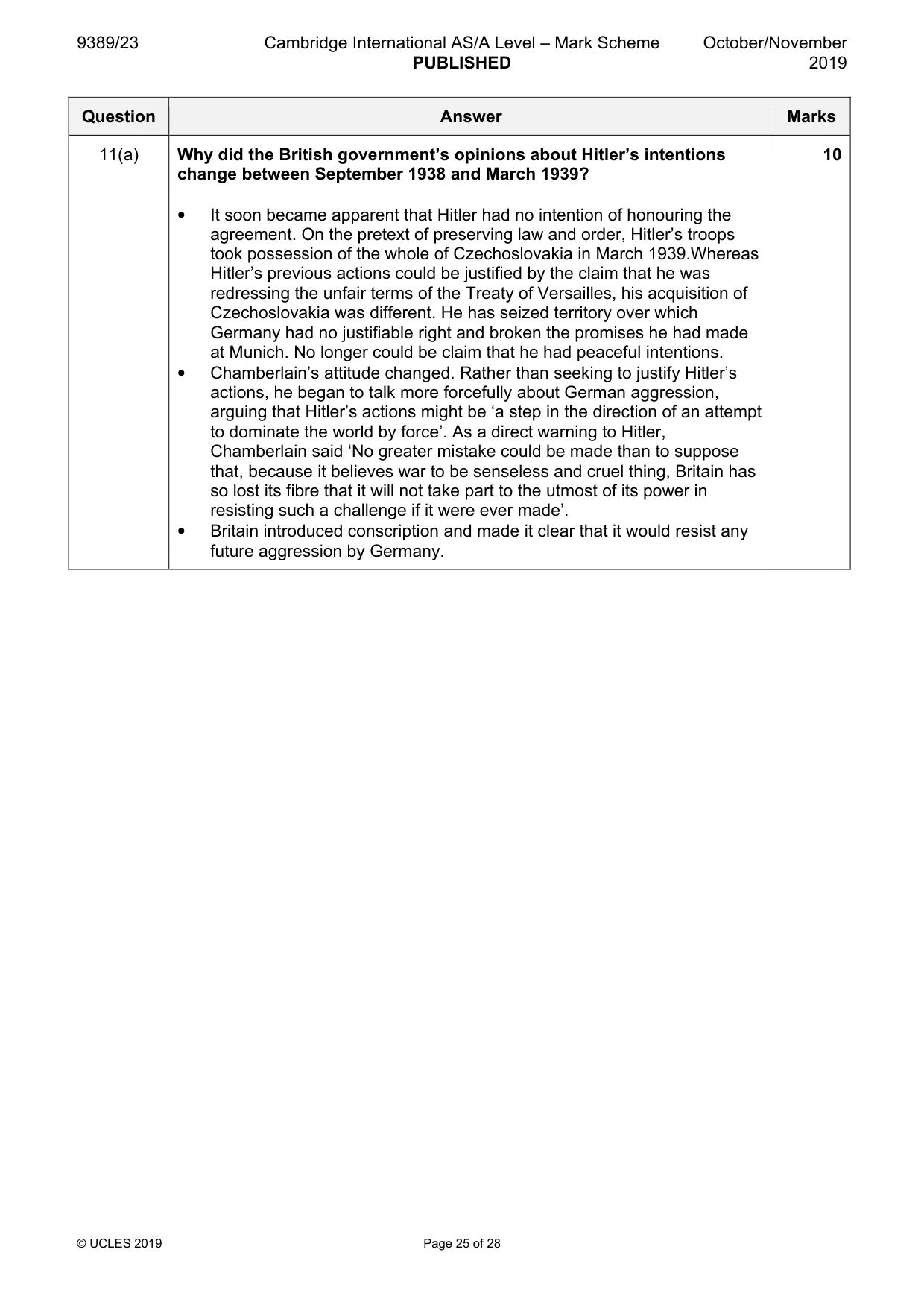
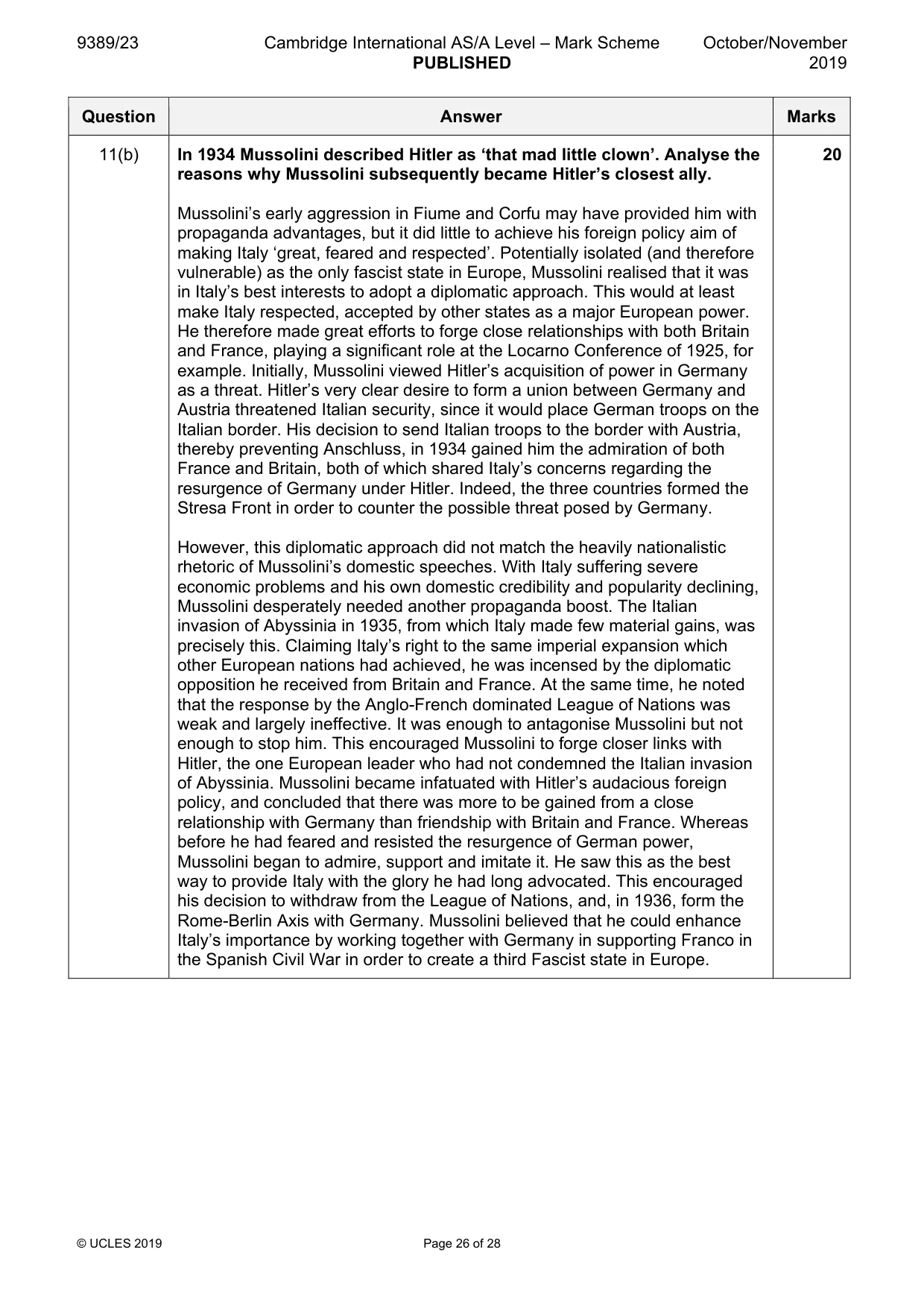
11 International Relations, c.1933–1939 (a) Why did the British government’s opinions about Hitler’s intentions change between September 1938 and March 1939? [10] (b) In 1934 Mussolini described Hitler as ‘that mad little clown’. Analyse the reasons why Mussolini subsequently became Hitler’s closest ally. [20]
Mark scheme: 11(a) Why did the British government’s opinions about Hitler’s intentions 10 change between September 1938 and March 1939? • It soon became apparent that Hitler had no intention of honouring the agreement. On the pretext of preserving law and order, Hitler’s troops took possession of the whole of Czechoslovakia in March 1939.Whereas Hitler’s previous actions could be justified by the claim that he was redressing the unfair terms of the Treaty of Versailles, his acquisition of Czechoslovakia was different. He has seized territory over which Germany had no justifiable right and broken the promises he had made at Munich. No longer could be claim that he had peaceful intentions. • Chamberlain’s attitude changed. Rather than seeking to justify Hitler’s actions, he began to talk more forcefully about German aggression, arguing that Hitler’s actions might be ‘a step in the direction of an attempt to dominate the world by force’. As a direct warning to Hitler, Chamberlain said ‘No greater mistake could be made than to suppose that, because it believes war to be senseless and cruel thing, Britain has so lost its fibre that it will not take part to the utmost of its power in resisting such a challenge if it were ever made’. • Britain introduced conscription and made it clear that it would resist any future aggression by Germany. 11(b) In 1934 Mussolini described Hitler as ‘that mad little clown’. Analyse the 20 reasons why Mussolini subsequently became Hitler’s closest ally. Mussolini’s early aggression in Fiume and Corfu may have provided him with propaganda advantages, but it did little to achieve his foreign policy aim of making Italy ‘great, feared and respected’. Potentially isolated (and therefore vulnerable) as the only fascist state in Europe, Mussolini realised that it was in Italy’s best interests to adopt a diplomatic approach. This would at least make Italy respected, accepted by other states as a major European power. He therefore made great efforts to forge close relationships with both Britain and France, playing a significant role at the Locarno Conference of 1925, for example. Initially, Mussolini viewed Hitler’s acquisition of power in Germany as a threat. Hitler’s very clear desire to form a union between Germany and Austria threatened Italian security, since it would place German troops on the Italian border. His decision to send Italian troops to the border with Austria, thereby preventing Anschluss, in 1934 gained him the admiration of both France and Britain, both of which shared Italy’s concerns regarding the resurgence of Germany under Hitler. Indeed, the three countries formed the Stresa Front in order to counter the possible threat posed by Germany. However, this diplomatic approach did not match the heavily nationalistic rhetoric of Mussolini’s domestic speeches. With Italy suffering severe economic problems and his own domestic credibility and popularity declining, Mussolini desperately needed another propaganda boost. The Italian invasion of Abyssinia in 1935, from which Italy made few material gains, was precisely this. Claiming Italy’s right to the same imperial expansion which other European nations had achieved, he was incensed by the diplomatic opposition he received from Britain and France. At the same time, he noted that the response by the Anglo-French dominated League of Nations was weak and largely ineffective. It was enough to antagonise Mussolini but not enough to stop him. This encouraged Mussolini to forge closer links with Hitler, the one European leader who had not condemned the Italian invasion of Abyssinia. Mussolini became infatuated with Hitler’s audacious foreign policy, and concluded that there was more to be gained from a close relationship with Germany than friendship with Britain and France. Whereas before he had feared and resisted the resurgence of German power, Mussolini began to admire, support and imitate it. He saw this as the best way to provide Italy with the glory he had long advocated. This encouraged his decision to withdraw from the League of Nations, and, in 1936, form the Rome-Berlin Axis with Germany. Mussolini believed that he could enhance Italy’s importance by working together with Germany in supporting Franco in the Spanish Civil War in order to create a third Fascist state in Europe.
Q12 · China and Japan, 1919–1945 (a) Why did Japan feel it essential to attack Pearl Harbor?
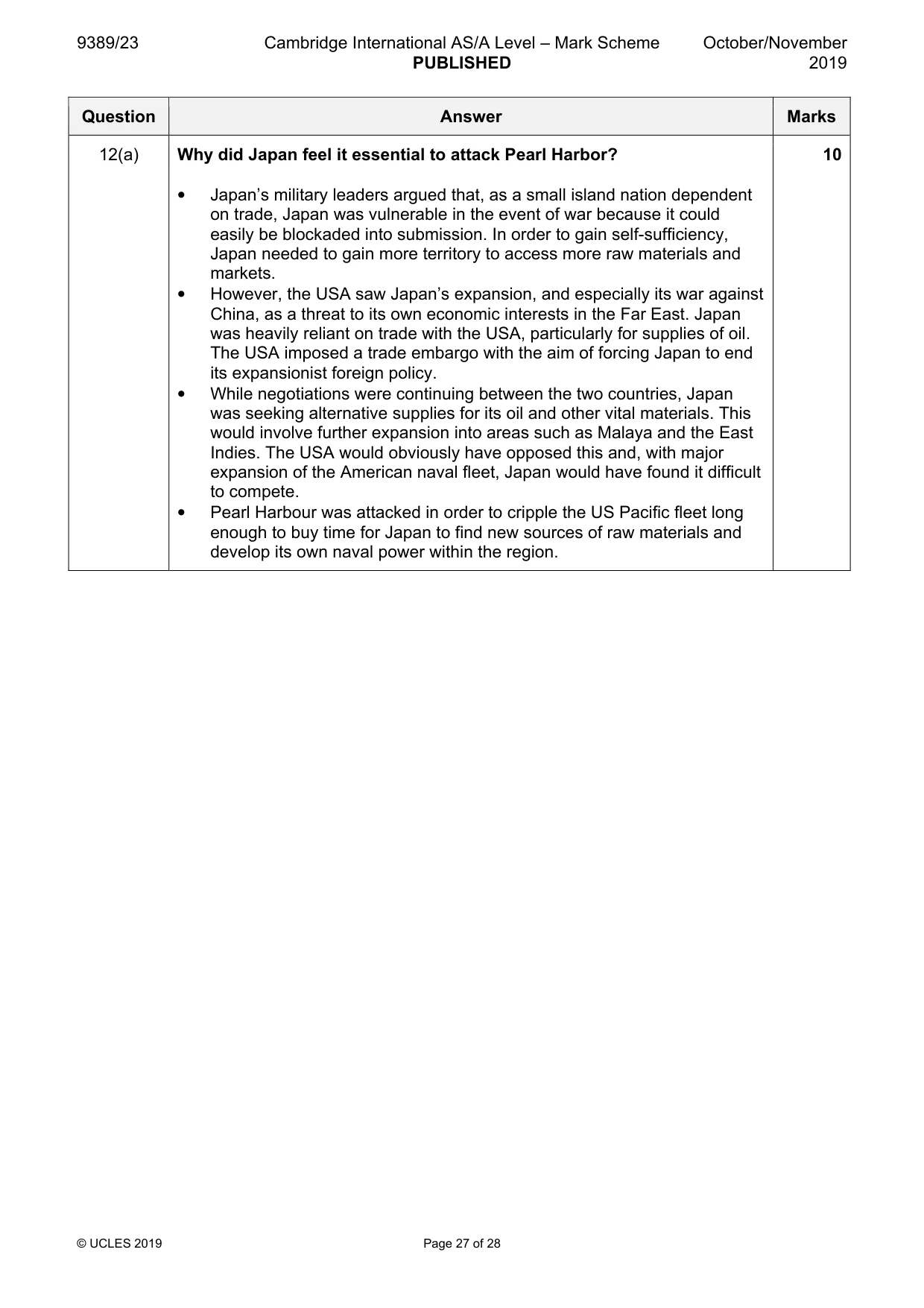
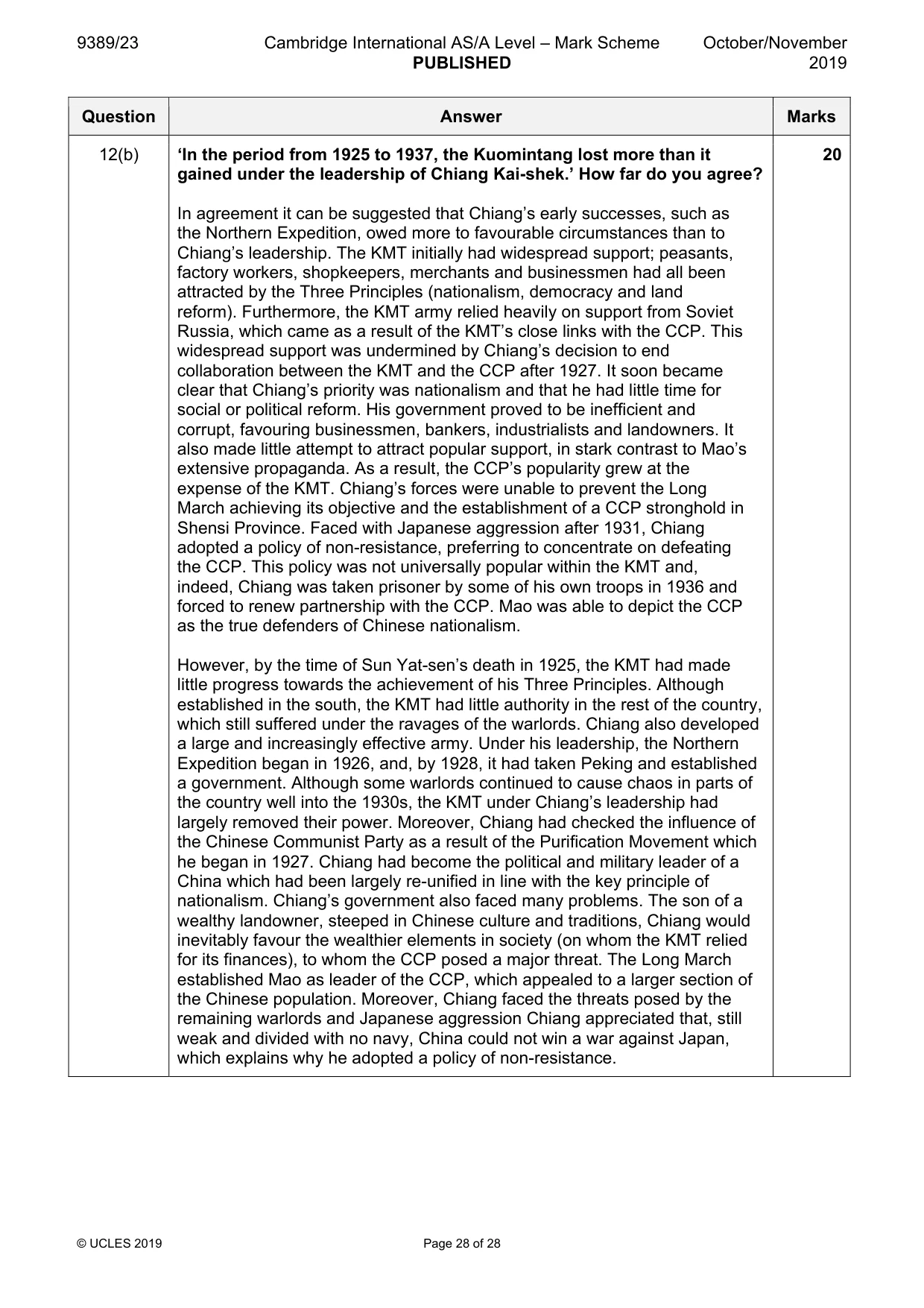
12 China and Japan, 1919–1945 (a) Why did Japan feel it essential to attack Pearl Harbor? [10] (b) ‘In the period from 1925 to 1937, the Kuomintang lost more than it gained under the leadership of Chiang Kai-shek.’ How far do you agree? [20]
Mark scheme: 12(a) Why did Japan feel it essential to attack Pearl Harbor? 10 • Japan’s military leaders argued that, as a small island nation dependent on trade, Japan was vulnerable in the event of war because it could easily be blockaded into submission. In order to gain self-sufficiency, Japan needed to gain more territory to access more raw materials and markets. • However, the USA saw Japan’s expansion, and especially its war against China, as a threat to its own economic interests in the Far East. Japan was heavily reliant on trade with the USA, particularly for supplies of oil. The USA imposed a trade embargo with the aim of forcing Japan to end its expansionist foreign policy. • While negotiations were continuing between the two countries, Japan was seeking alternative supplies for its oil and other vital materials. This would involve further expansion into areas such as Malaya and the East Indies. The USA would obviously have opposed this and, with major expansion of the American naval fleet, Japan would have found it difficult to compete. • Pearl Harbour was attacked in order to cripple the US Pacific fleet long enough to buy time for Japan to find new sources of raw materials and develop its own naval power within the region. 12(b) ‘In the period from 1925 to 1937, the Kuomintang lost more than it 20 gained under the leadership of Chiang Kai-shek.’ How far do you agree? In agreement it can be suggested that Chiang’s early successes, such as the Northern Expedition, owed more to favourable circumstances than to Chiang’s leadership. The KMT initially had widespread support; peasants, factory workers, shopkeepers, merchants and businessmen had all been attracted by the Three Principles (nationalism, democracy and land reform). Furthermore, the KMT army relied heavily on support from Soviet Russia, which came as a result of the KMT’s close links with the CCP. This widespread support was undermined by Chiang’s decision to end collaboration between the KMT and the CCP after 1927. It soon became clear that Chiang’s priority was nationalism and that he had little time for social or political reform. His government proved to be inefficient and corrupt, favouring businessmen, bankers, industrialists and landowners. It also made little attempt to attract popular support, in stark contrast to Mao’s extensive propaganda. As a result, the CCP’s popularity grew at the expense of the KMT. Chiang’s forces were unable to prevent the Long March achieving its objective and the establishment of a CCP stronghold in Shensi Province. Faced with Japanese aggression after 1931, Chiang adopted a policy of non-resistance, preferring to concentrate on defeating the CCP. This policy was not universally popular within the KMT and, indeed, Chiang was taken prisoner by some of his own troops in 1936 and forced to renew partnership with the CCP. Mao was able to depict the CCP as the true defenders of Chinese nationalism. However, by the time of Sun Yat-sen’s death in 1925, the KMT had made little progress towards the achievement of his Three Principles. Although established in the south, the KMT had little authority in the rest of the country, which still suffered under the ravages of the warlords. Chiang also developed a large and increasingly effective army. Under his leadership, the Northern Expedition began in 1926, and, by 1928, it had taken Peking and established a government. Although some warlords continued to cause chaos in parts of the country well into the 1930s, the KMT under Chiang’s leadership had largely removed their power. Moreover, Chiang had checked the influence of the Chinese Communist Party as a result of the Purification Movement which he began in 1927. Chiang had become the political and military leader of a China which had been largely re-unified in line with the key principle of nationalism. Chiang’s government also faced many problems. The son of a wealthy landowner, steeped in Chinese culture and traditions, Chiang would inevitably favour the wealthier elements in society (on whom the KMT relied for its finances), to whom the CCP posed a major threat. The Long March established Mao as leader of the CCP, which appealed to a larger section of the Chinese population. Moreover, Chiang faced the threats posed by the remaining warlords and Japanese aggression Chiang appreciated that, still weak and divided with no navy, China could not win a war against Japan, which explains why he adopted a policy of non-resistance.
What you needed in this session
Cambridge’s own grade thresholds for 2019 Oct/Nov, Paper 2 · Variant 3. A higher threshold means an easier paper — the bar moves with how the cohort did.