Cambridge A Level History 9389 — 2017 May/June Paper 3 · Variant 3
9389/33/M/J/17 · 3 questions · 40 marks · ≈45 min
The question paper and its mark scheme, free to read here and free to download. This is Cambridge’s own paper, exactly as it was sat.
Question paper4 pages
Mark scheme6 pages
Answers below. Sit the paper first if you are practising.
Questions as text
Q1 · Read the extract and then answer the question
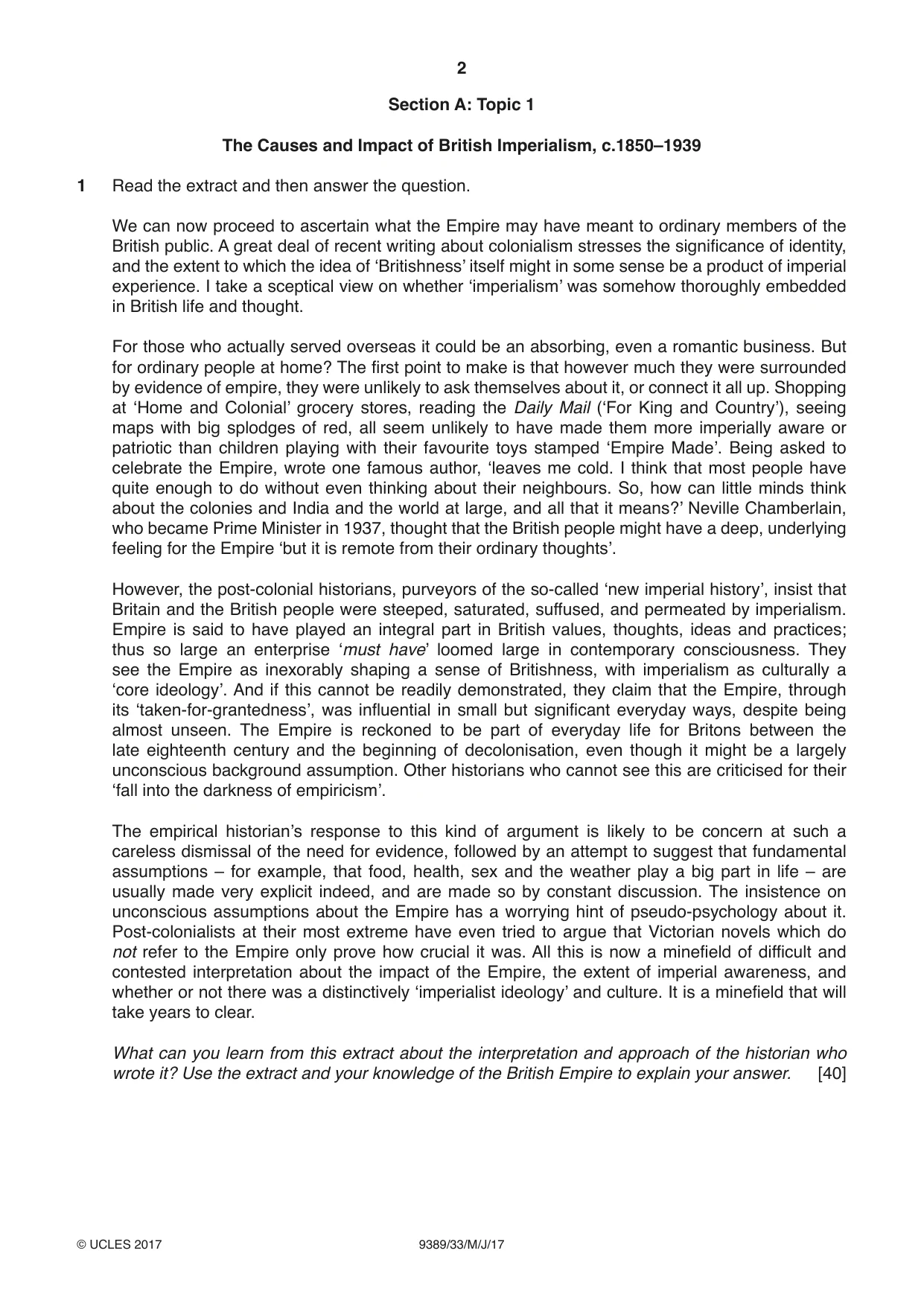
1 Read the extract and then answer the question. We can now proceed to ascertain what the Empire may have meant to ordinary members of the British public. A great deal of recent writing about colonialism stresses the significance of identity, and the extent to which the idea of ‘Britishness’ itself might in some sense be a product of imperial experience. I take a sceptical view on whether ‘imperialism’ was somehow thoroughly embedded in British life and thought. For those who actually served overseas it could be an absorbing, even a romantic business. But for ordinary people at home? The first point to make is that however much they were surrounded by evidence of empire, they were unlikely to ask themselves about it, or connect it all up. Shopping at ‘Home and Colonial’ grocery stores, reading the Daily Mail (‘For King and Country’), seeing maps with big splodges of red, all seem unlikely to have made them more imperially aware or patriotic than children playing with their favourite toys stamped ‘Empire Made’. Being asked to celebrate the Empire, wrote one famous author, ‘leaves me cold. I think that most people have quite enough to do without even thinking about their neighbours. So, how can little minds think about the colonies and India and the world at large, and all that it means?’ Neville Chamberlain, who became Prime Minister in 1937, thought that the British people might have a deep, underlying feeling for the Empire ‘but it is remote from their ordinary thoughts’. However, the post-colonial historians, purveyors of the so-called ‘new imperial history’, insist that Britain and the British people were steeped, saturated, suffused, and permeated by imperialism. Empire is said to have played an integral part in British values, thoughts, ideas and practices; thus so large an enterprise ‘must have’ loomed large in contemporary consciousness. They see the Empire as inexorably shaping a sense of Britishness, with imperialism as culturally a ‘core ideology’. And if this cannot be readily demonstrated, they claim that the Empire, through its ‘taken-for-grantedness’, was influential in small but significant everyday ways, despite being almost unseen. The Empire is reckoned to be part of everyday life for Britons between the late eighteenth century and the beginning of decolonisation, even though it might be a largely unconscious background assumption. Other historians who cannot see this are criticised for their ‘fall into the darkness of empiricism’. The empirical historian’s response to this kind of argument is likely to be concern at such a careless dismissal of the need for evidence, followed by an attempt to suggest that fundamental assumptions – for example, that food, health, sex and the weather play a big part in life – are usually made very explicit indeed, and are made so by constant discussion. The insistence on unconscious assumptions about the Empire has a worrying hint of pseudo-psychology about it. Post-colonialists at their most extreme have even tried to argue that Victorian novels which do not refer to the Empire only prove how crucial it was. All this is now a minefield of difficult and contested interpretation about the impact of the Empire, the extent of imperial awareness, and whether or not there was a distinctively ‘imperialist ideology’ and culture. It is a minefield that will take years to clear. What can you learn from this extract about the interpretation and approach of the historian who wrote it? Use the extract and your knowledge of the British Empire to explain your answer. [40]
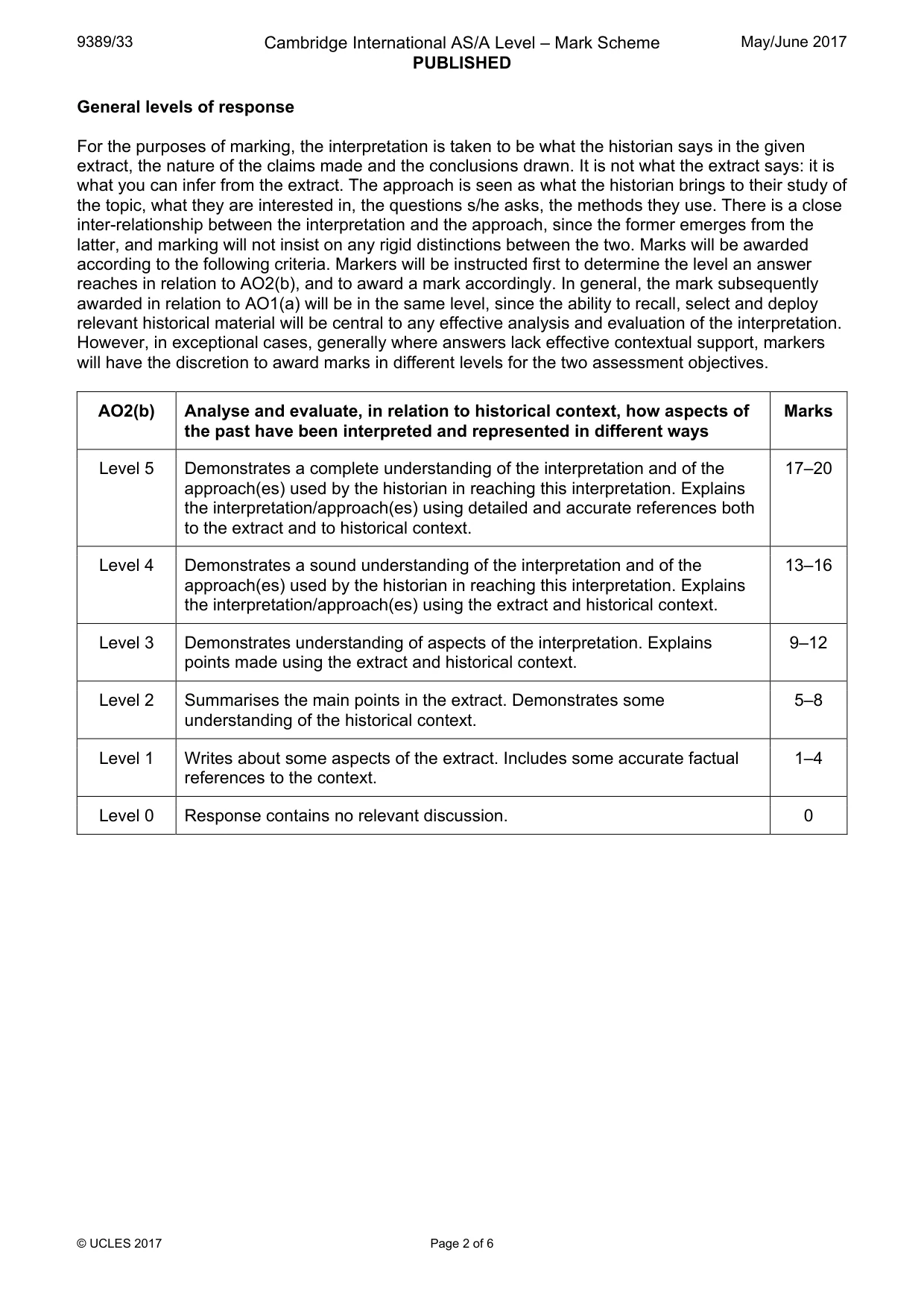
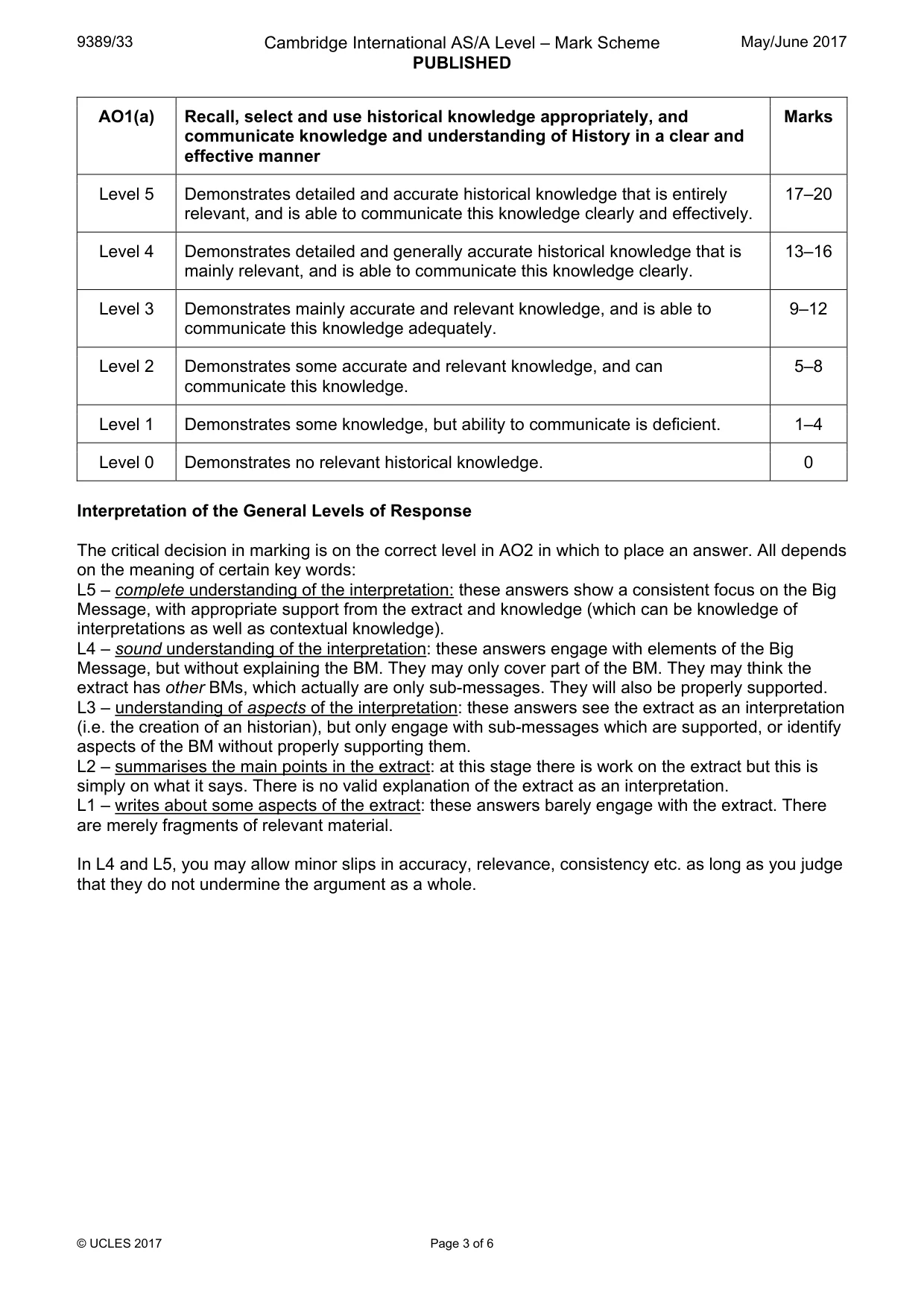
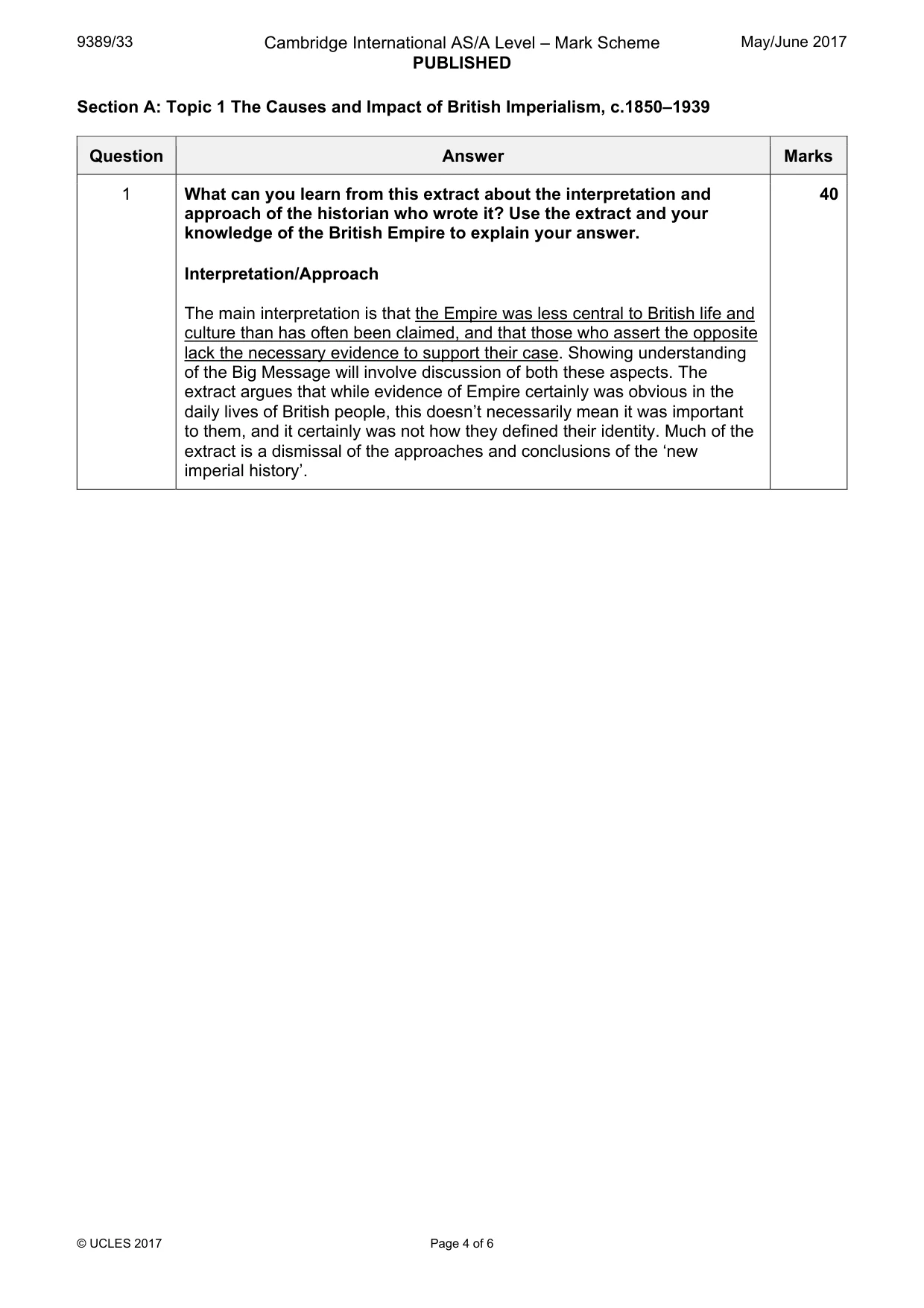
Mark scheme: Question Answer Marks 1 What can you learn from this extract about the interpretation and 40 approach of the historian who wrote it? Use the extract and your knowledge of the British Empire to explain your answer. Interpretation/Approach The main interpretation is that the Empire was less central to British life and culture than has often been claimed, and that those who assert the opposite lack the necessary evidence to support their case. Showing understanding of the Big Message will involve discussion of both these aspects. The extract argues that while evidence of Empire certainly was obvious in the daily lives of British people, this doesn’t necessarily mean it was important to them, and it certainly was not how they defined their identity. Much of the extract is a dismissal of the approaches and conclusions of the ‘new imperial history’. Section B: Topic 2 The Holocaust
Q2 · Read the extract and then answer the question
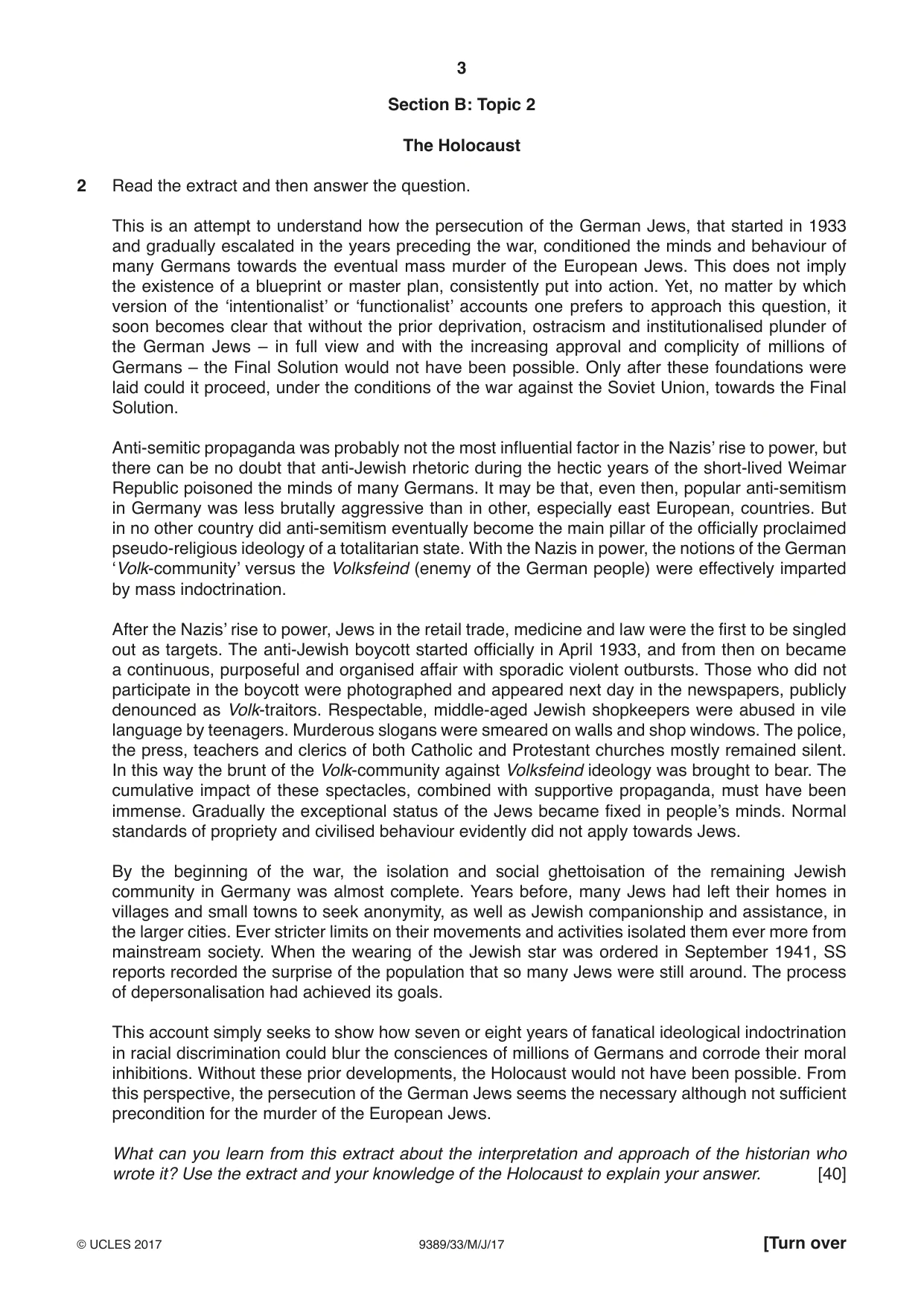
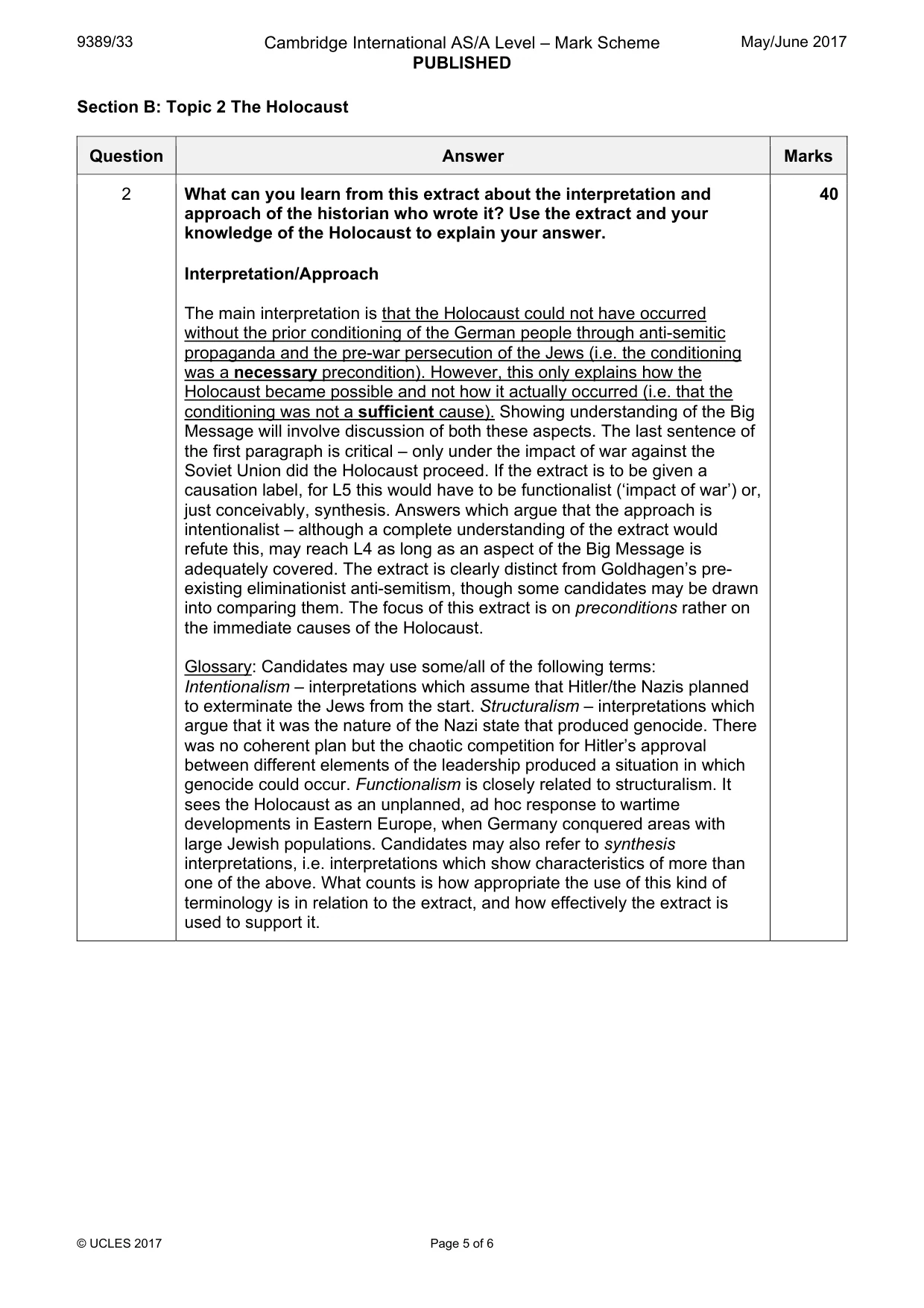
2 Read the extract and then answer the question. This is an attempt to understand how the persecution of the German Jews, that started in 1933 and gradually escalated in the years preceding the war, conditioned the minds and behaviour of many Germans towards the eventual mass murder of the European Jews. This does not imply the existence of a blueprint or master plan, consistently put into action. Yet, no matter by which version of the ‘intentionalist’ or ‘functionalist’ accounts one prefers to approach this question, it soon becomes clear that without the prior deprivation, ostracism and institutionalised plunder of the German Jews – in full view and with the increasing approval and complicity of millions of Germans – the Final Solution would not have been possible. Only after these foundations were laid could it proceed, under the conditions of the war against the Soviet Union, towards the Final Solution. Anti-semitic propaganda was probably not the most influential factor in the Nazis’ rise to power, but there can be no doubt that anti-Jewish rhetoric during the hectic years of the short-lived Weimar Republic poisoned the minds of many Germans. It may be that, even then, popular anti-semitism in Germany was less brutally aggressive than in other, especially east European, countries. But in no other country did anti-semitism eventually become the main pillar of the officially proclaimed pseudo-religious ideology of a totalitarian state. With the Nazis in power, the notions of the German ‘Volk-community’ versus the Volksfeind (enemy of the German people) were effectively imparted by mass indoctrination. After the Nazis’ rise to power, Jews in the retail trade, medicine and law were the first to be singled out as targets. The anti-Jewish boycott started officially in April 1933, and from then on became a continuous, purposeful and organised affair with sporadic violent outbursts. Those who did not participate in the boycott were photographed and appeared next day in the newspapers, publicly denounced as Volk-traitors. Respectable, middle-aged Jewish shopkeepers were abused in vile language by teenagers. Murderous slogans were smeared on walls and shop windows. The police, the press, teachers and clerics of both Catholic and Protestant churches mostly remained silent. In this way the brunt of the Volk-community against Volksfeind ideology was brought to bear. The cumulative impact of these spectacles, combined with supportive propaganda, must have been immense. Gradually the exceptional status of the Jews became fixed in people’s minds. Normal standards of propriety and civilised behaviour evidently did not apply towards Jews. By the beginning of the war, the isolation and social ghettoisation of the remaining Jewish community in Germany was almost complete. Years before, many Jews had left their homes in villages and small towns to seek anonymity, as well as Jewish companionship and assistance, in the larger cities. Ever stricter limits on their movements and activities isolated them ever more from mainstream society. When the wearing of the Jewish star was ordered in September 1941, SS reports recorded the surprise of the population that so many Jews were still around. The process of depersonalisation had achieved its goals. This account simply seeks to show how seven or eight years of fanatical ideological indoctrination in racial discrimination could blur the consciences of millions of Germans and corrode their moral inhibitions. Without these prior developments, the Holocaust would not have been possible. From this perspective, the persecution of the German Jews seems the necessary although not sufficient precondition for the murder of the European Jews. What can you learn from this extract about the interpretation and approach of the historian who wrote it? Use the extract and your knowledge of the Holocaust to explain your answer. [40] Section C: Topic 3 The Origins and Development of the Cold War, 1941–1950
Mark scheme: 2 What can you learn from this extract about the interpretation and 40 approach of the historian who wrote it? Use the extract and your knowledge of the Holocaust to explain your answer. Interpretation/Approach The main interpretation is that the Holocaust could not have occurred without the prior conditioning of the German people through anti-semitic propaganda and the pre-war persecution of the Jews (i.e. the conditioning was a necessary precondition). However, this only explains how the Holocaust became possible and not how it actually occurred (i.e. that the conditioning was not a sufficient cause). Showing understanding of the Big Message will involve discussion of both these aspects. The last sentence of the first paragraph is critical – only under the impact of war against the Soviet Union did the Holocaust proceed. If the extract is to be given a causation label, for L5 this would have to be functionalist (‘impact of war’) or, just conceivably, synthesis. Answers which argue that the approach is intentionalist – although a complete understanding of the extract would refute this, may reach L4 as long as an aspect of the Big Message is adequately covered. The extract is clearly distinct from Goldhagen’s pre- existing eliminationist anti-semitism, though some candidates may be drawn into comparing them. The focus of this extract is on preconditions rather on the immediate causes of the Holocaust. Glossary: Candidates may use some/all of the following terms: Intentionalism – interpretations which assume that Hitler/the Nazis planned to exterminate the Jews from the start. Structuralism – interpretations which argue that it was the nature of the Nazi state that produced genocide. There was no coherent plan but the chaotic competition for Hitler’s approval between different elements of the leadership produced a situation in which genocide could occur. Functionalism is closely related to structuralism. It sees the Holocaust as an unplanned, ad hoc response to wartime developments in Eastern Europe, when Germany conquered areas with large Jewish populations. Candidates may also refer to synthesis interpretations, i.e. interpretations which show characteristics of more than one of the above. What counts is how appropriate the use of this kind of terminology is in relation to the extract, and how effectively the extract is used to support it. Section C: Topic 3 The Origins and Development of the Cold War, 1941–1950
Q3 · Read the extract and then answer the question
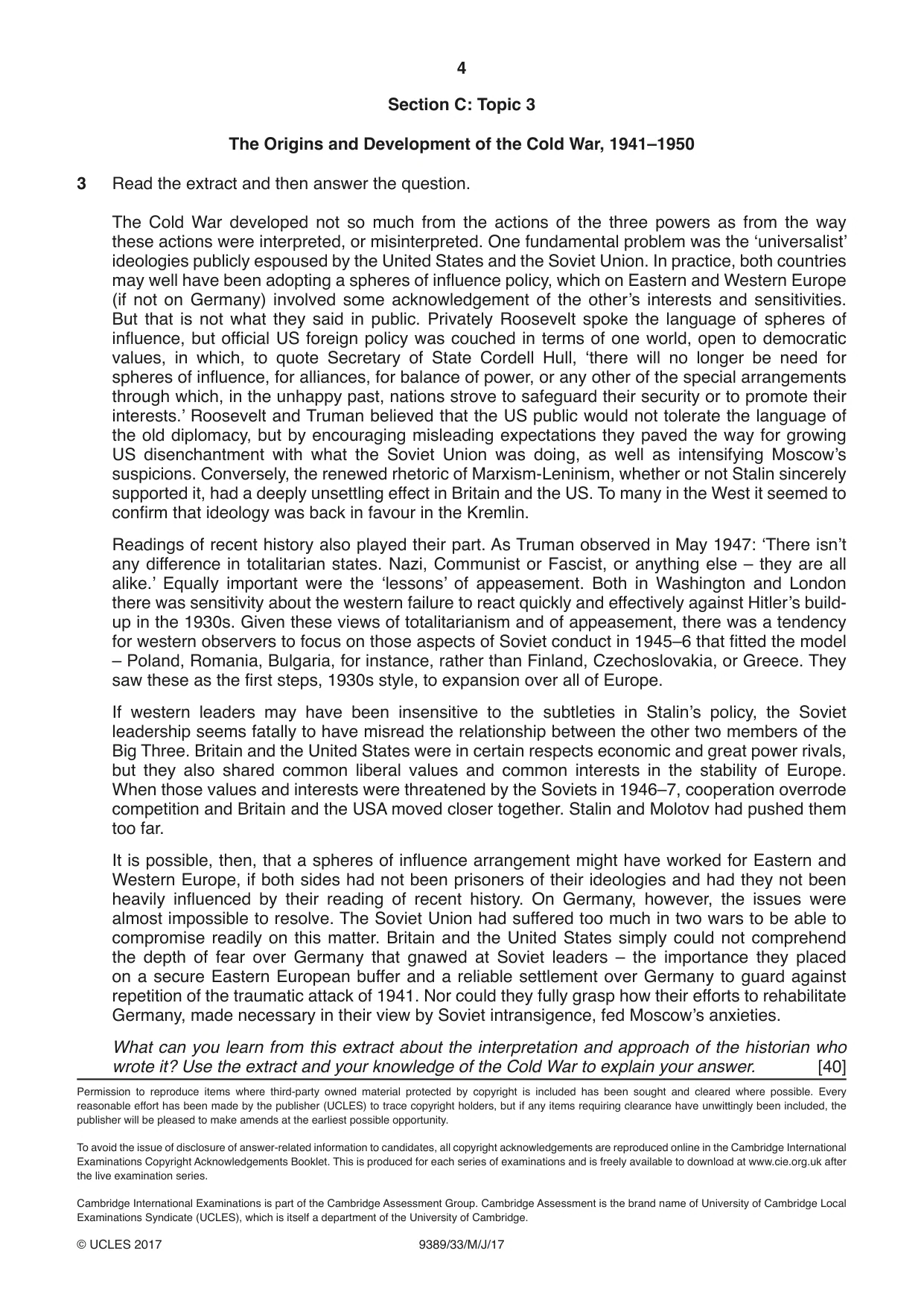
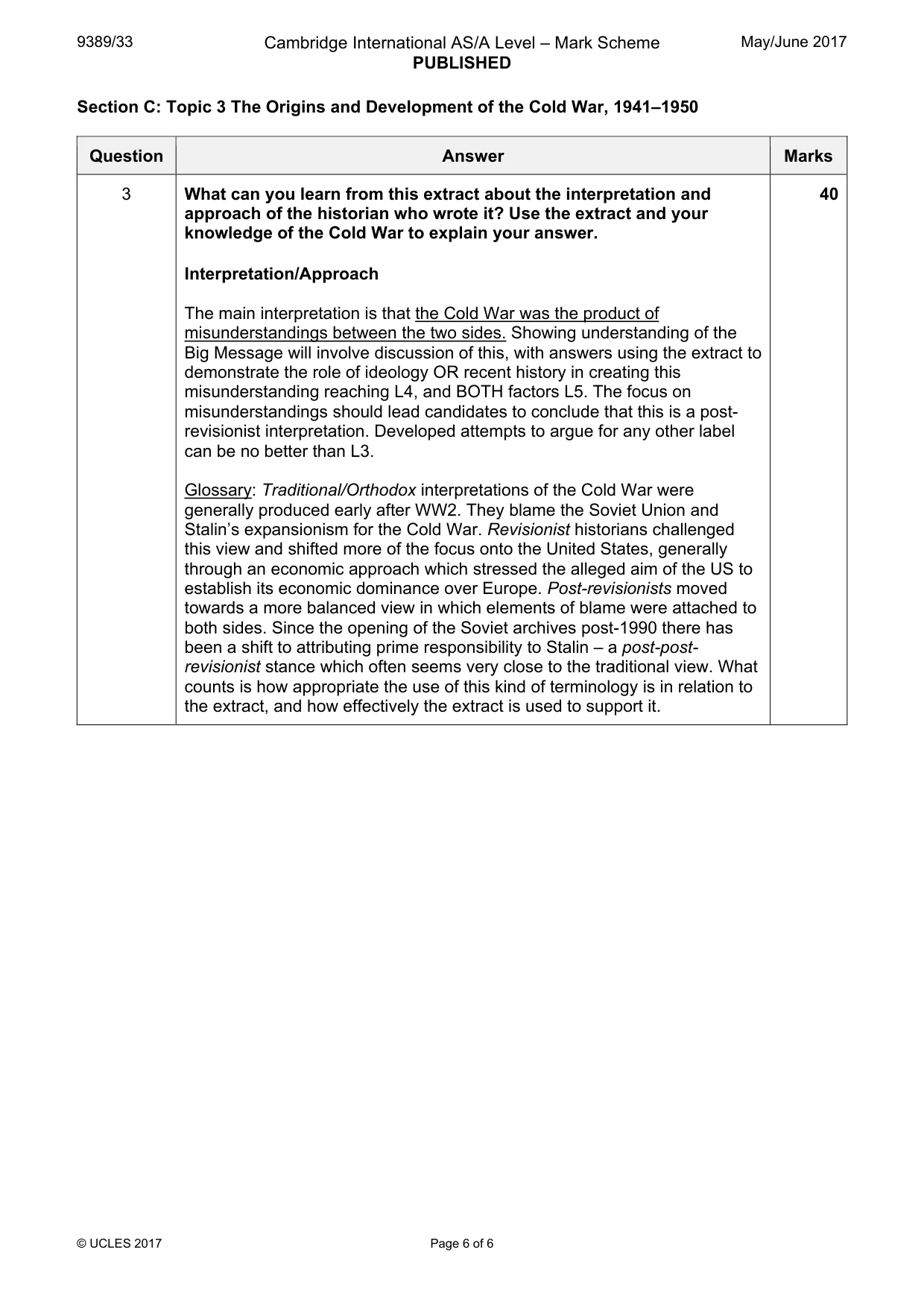
3 Read the extract and then answer the question. The Cold War developed not so much from the actions of the three powers as from the way these actions were interpreted, or misinterpreted. One fundamental problem was the ‘universalist’ ideologies publicly espoused by the United States and the Soviet Union. In practice, both countries may well have been adopting a spheres of influence policy, which on Eastern and Western Europe (if not on Germany) involved some acknowledgement of the other’s interests and sensitivities. But that is not what they said in public. Privately Roosevelt spoke the language of spheres of influence, but official US foreign policy was couched in terms of one world, open to democratic values, in which, to quote Secretary of State Cordell Hull, ‘there will no longer be need for spheres of influence, for alliances, for balance of power, or any other of the special arrangements through which, in the unhappy past, nations strove to safeguard their security or to promote their interests.’ Roosevelt and Truman believed that the US public would not tolerate the language of the old diplomacy, but by encouraging misleading expectations they paved the way for growing US disenchantment with what the Soviet Union was doing, as well as intensifying Moscow’s suspicions. Conversely, the renewed rhetoric of Marxism-Leninism, whether or not Stalin sincerely supported it, had a deeply unsettling effect in Britain and the US. To many in the West it seemed to confirm that ideology was back in favour in the Kremlin. Readings of recent history also played their part. As Truman observed in May 1947: ‘There isn’t any difference in totalitarian states. Nazi, Communist or Fascist, or anything else – they are all alike.’ Equally important were the ‘lessons’ of appeasement. Both in Washington and London there was sensitivity about the western failure to react quickly and effectively against Hitler’s build- up in the 1930s. Given these views of totalitarianism and of appeasement, there was a tendency for western observers to focus on those aspects of Soviet conduct in 1945–6 that fitted the model – Poland, Romania, Bulgaria, for instance, rather than Finland, Czechoslovakia, or Greece. They saw these as the first steps, 1930s style, to expansion over all of Europe. If western leaders may have been insensitive to the subtleties in Stalin’s policy, the Soviet leadership seems fatally to have misread the relationship between the other two members of the Big Three. Britain and the United States were in certain respects economic and great power rivals, but they also shared common liberal values and common interests in the stability of Europe. When those values and interests were threatened by the Soviets in 1946–7, cooperation overrode competition and Britain and the USA moved closer together. Stalin and Molotov had pushed them too far. It is possible, then, that a spheres of influence arrangement might have worked for Eastern and Western Europe, if both sides had not been prisoners of their ideologies and had they not been heavily influenced by their reading of recent history. On Germany, however, the issues were almost impossible to resolve. The Soviet Union had suffered too much in two wars to be able to compromise readily on this matter. Britain and the United States simply could not comprehend the depth of fear over Germany that gnawed at Soviet leaders – the importance they placed on a secure Eastern European buffer and a reliable settlement over Germany to guard against repetition of the traumatic attack of 1941. Nor could they fully grasp how their efforts to rehabilitate Germany, made necessary in their view by Soviet intransigence, fed Moscow’s anxieties. What can you learn from this extract about the interpretation and approach of the historian who wrote it? Use the extract and your knowledge of the Cold War to explain your answer. [40]
Mark scheme: 3 What can you learn from this extract about the interpretation and 40 approach of the historian who wrote it? Use the extract and your knowledge of the Cold War to explain your answer. Interpretation/Approach The main interpretation is that the Cold War was the product of misunderstandings between the two sides. Showing understanding of the Big Message will involve discussion of this, with answers using the extract to demonstrate the role of ideology OR recent history in creating this misunderstanding reaching L4, and BOTH factors L5. The focus on misunderstandings should lead candidates to conclude that this is a post- revisionist interpretation. Developed attempts to argue for any other label can be no better than L3. Glossary: Traditional/Orthodox interpretations of the Cold War were generally produced early after WW2. They blame the Soviet Union and Stalin’s expansionism for the Cold War. Revisionist historians challenged this view and shifted more of the focus onto the United States, generally through an economic approach which stressed the alleged aim of the US to establish its economic dominance over Europe. Post-revisionists moved towards a more balanced view in which elements of blame were attached to both sides. Since the opening of the Soviet archives post-1990 there has been a shift to attributing prime responsibility to Stalin – a post-post- revisionist stance which often seems very close to the traditional view. What counts is how appropriate the use of this kind of terminology is in relation to the extract, and how effectively the extract is used to support it.
What you needed in this session
Cambridge’s own grade thresholds for 2017 May/June, Paper 3 · Variant 3. A higher threshold means an easier paper — the bar moves with how the cohort did.