Cambridge A Level History 9389 — 2017 May/June Paper 3 · Variant 2
9389/32/M/J/17 · 3 questions · 40 marks · ≈45 min
The question paper and its mark scheme, free to read here and free to download. This is Cambridge’s own paper, exactly as it was sat.
Question paper4 pages
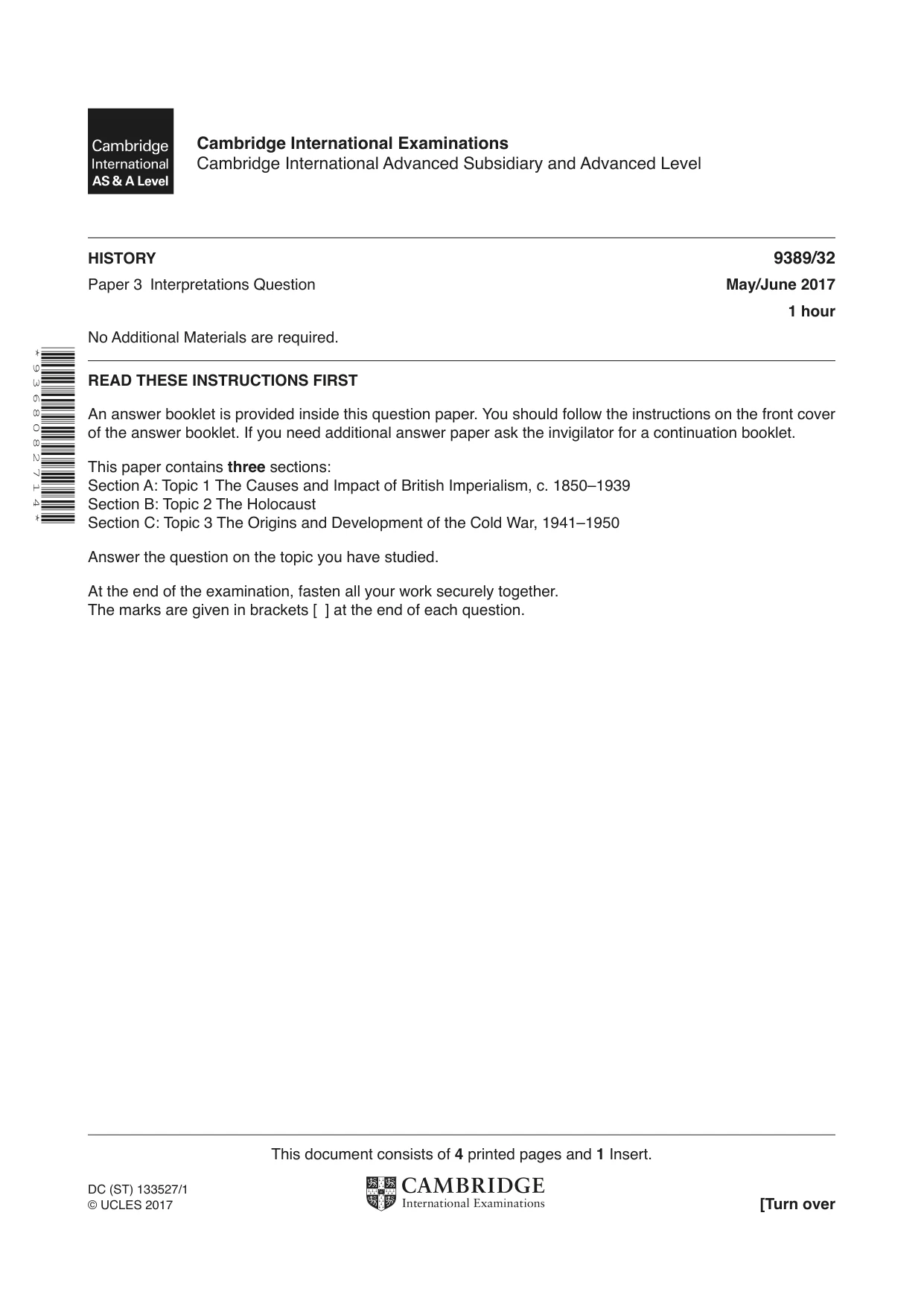
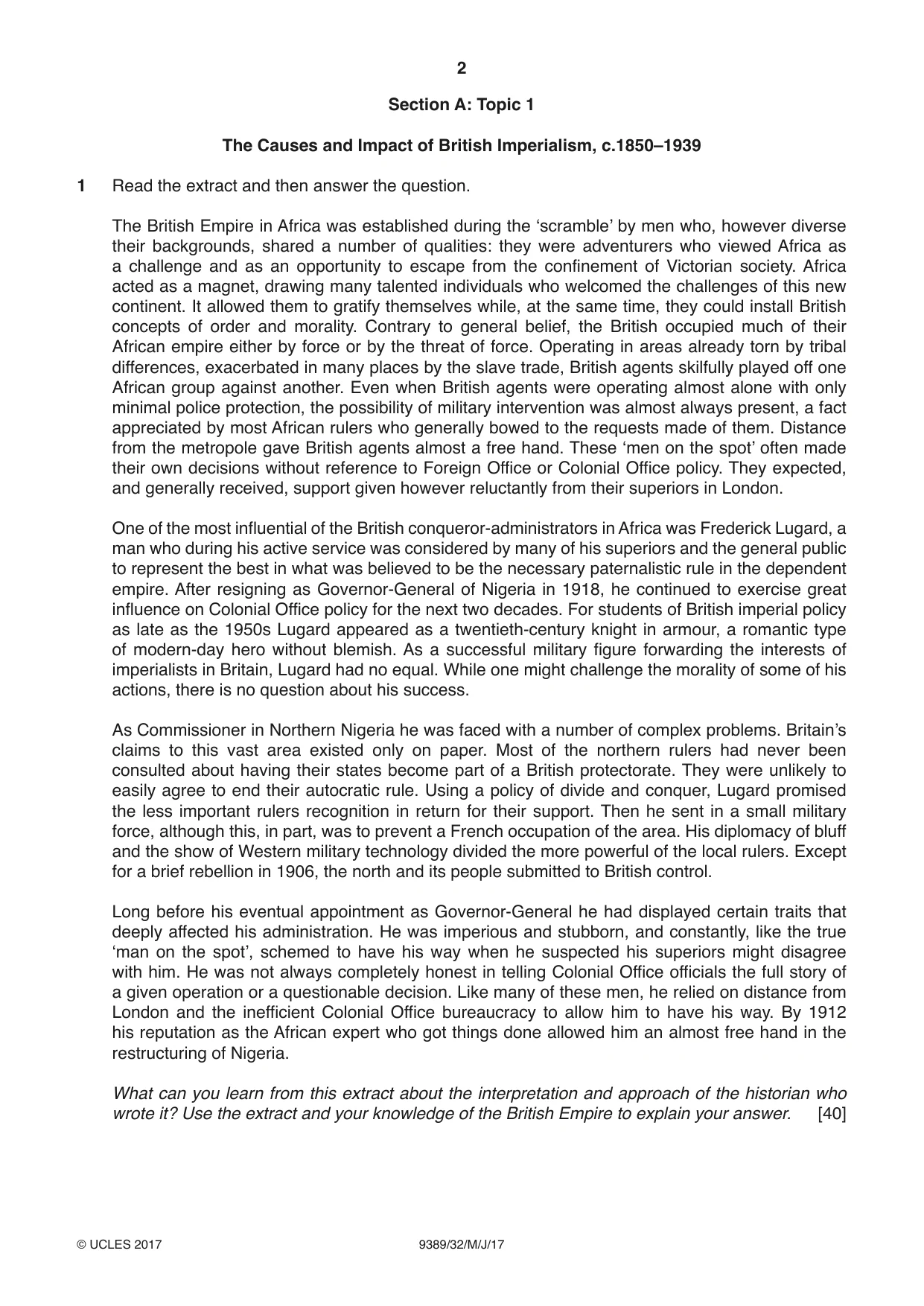
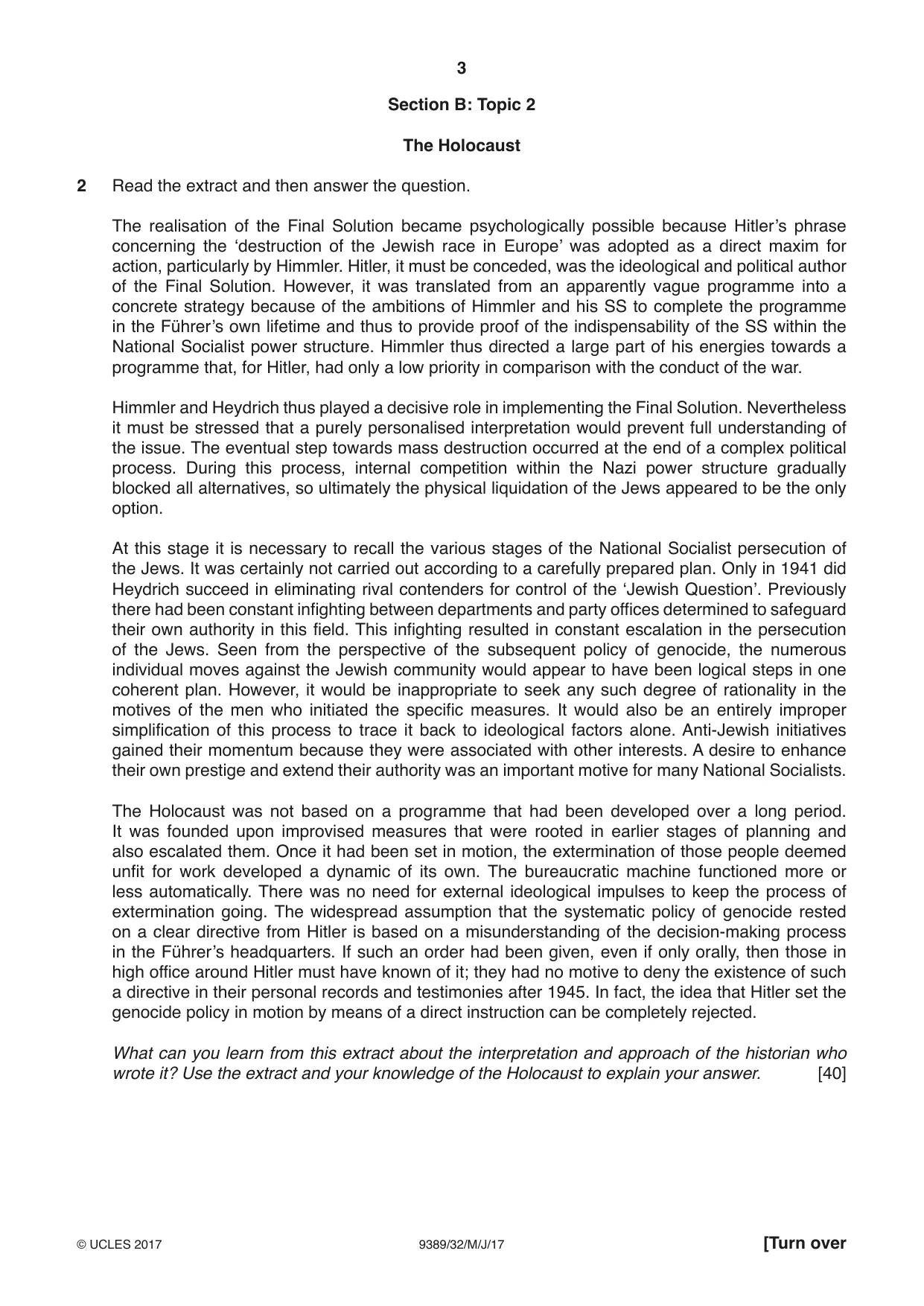
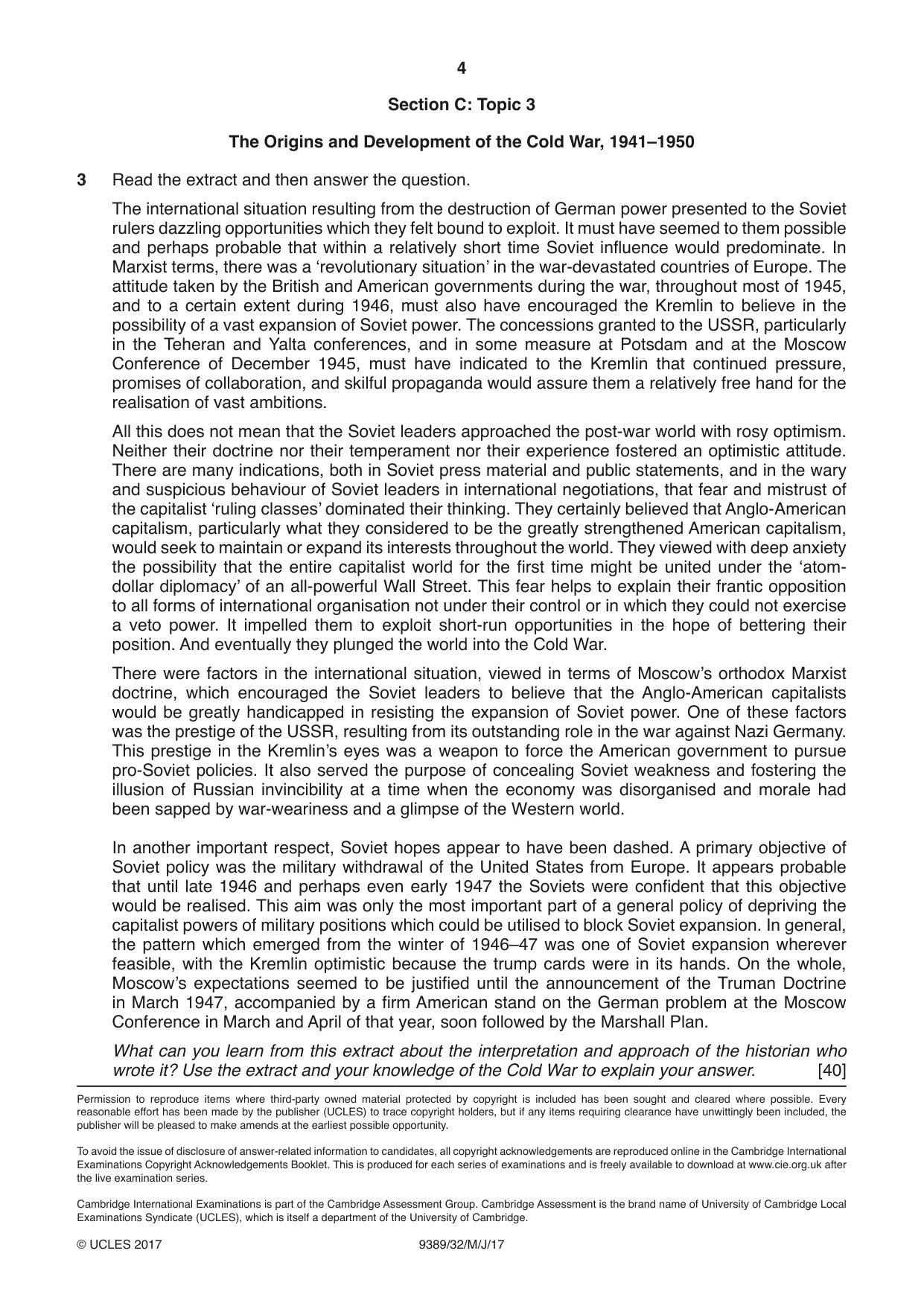
Mark scheme6 pages
Answers below. Sit the paper first if you are practising.
Questions as text
Q1 · Read the extract and then answer the question
1 Read the extract and then answer the question. The British Empire in Africa was established during the ‘scramble’ by men who, however diverse their backgrounds, shared a number of qualities: they were adventurers who viewed Africa as a challenge and as an opportunity to escape from the confinement of Victorian society. Africa acted as a magnet, drawing many talented individuals who welcomed the challenges of this new continent. It allowed them to gratify themselves while, at the same time, they could install British concepts of order and morality. Contrary to general belief, the British occupied much of their African empire either by force or by the threat of force. Operating in areas already torn by tribal differences, exacerbated in many places by the slave trade, British agents skilfully played off one African group against another. Even when British agents were operating almost alone with only minimal police protection, the possibility of military intervention was almost always present, a fact appreciated by most African rulers who generally bowed to the requests made of them. Distance from the metropole gave British agents almost a free hand. These ‘men on the spot’ often made their own decisions without reference to Foreign Office or Colonial Office policy. They expected, and generally received, support given however reluctantly from their superiors in London. One of the most influential of the British conqueror-administrators in Africa was Frederick Lugard, a man who during his active service was considered by many of his superiors and the general public to represent the best in what was believed to be the necessary paternalistic rule in the dependent empire. After resigning as Governor-General of Nigeria in 1918, he continued to exercise great influence on Colonial Office policy for the next two decades. For students of British imperial policy as late as the 1950s Lugard appeared as a twentieth-century knight in armour, a romantic type of modern-day hero without blemish. As a successful military figure forwarding the interests of imperialists in Britain, Lugard had no equal. While one might challenge the morality of some of his actions, there is no question about his success. As Commissioner in Northern Nigeria he was faced with a number of complex problems. Britain’s claims to this vast area existed only on paper. Most of the northern rulers had never been consulted about having their states become part of a British protectorate. They were unlikely to easily agree to end their autocratic rule. Using a policy of divide and conquer, Lugard promised the less important rulers recognition in return for their support. Then he sent in a small military force, although this, in part, was to prevent a French occupation of the area. His diplomacy of bluff and the show of Western military technology divided the more powerful of the local rulers. Except for a brief rebellion in 1906, the north and its people submitted to British control. Long before his eventual appointment as Governor-General he had displayed certain traits that deeply affected his administration. He was imperious and stubborn, and constantly, like the true ‘man on the spot’, schemed to have his way when he suspected his superiors might disagree with him. He was not always completely honest in telling Colonial Office officials the full story of a given operation or a questionable decision. Like many of these men, he relied on distance from London and the inefficient Colonial Office bureaucracy to allow him to have his way. By 1912 his reputation as the African expert who got things done allowed him an almost free hand in the restructuring of Nigeria. What can you learn from this extract about the interpretation and approach of the historian who wrote it? Use the extract and your knowledge of the British Empire to explain your answer. [40]
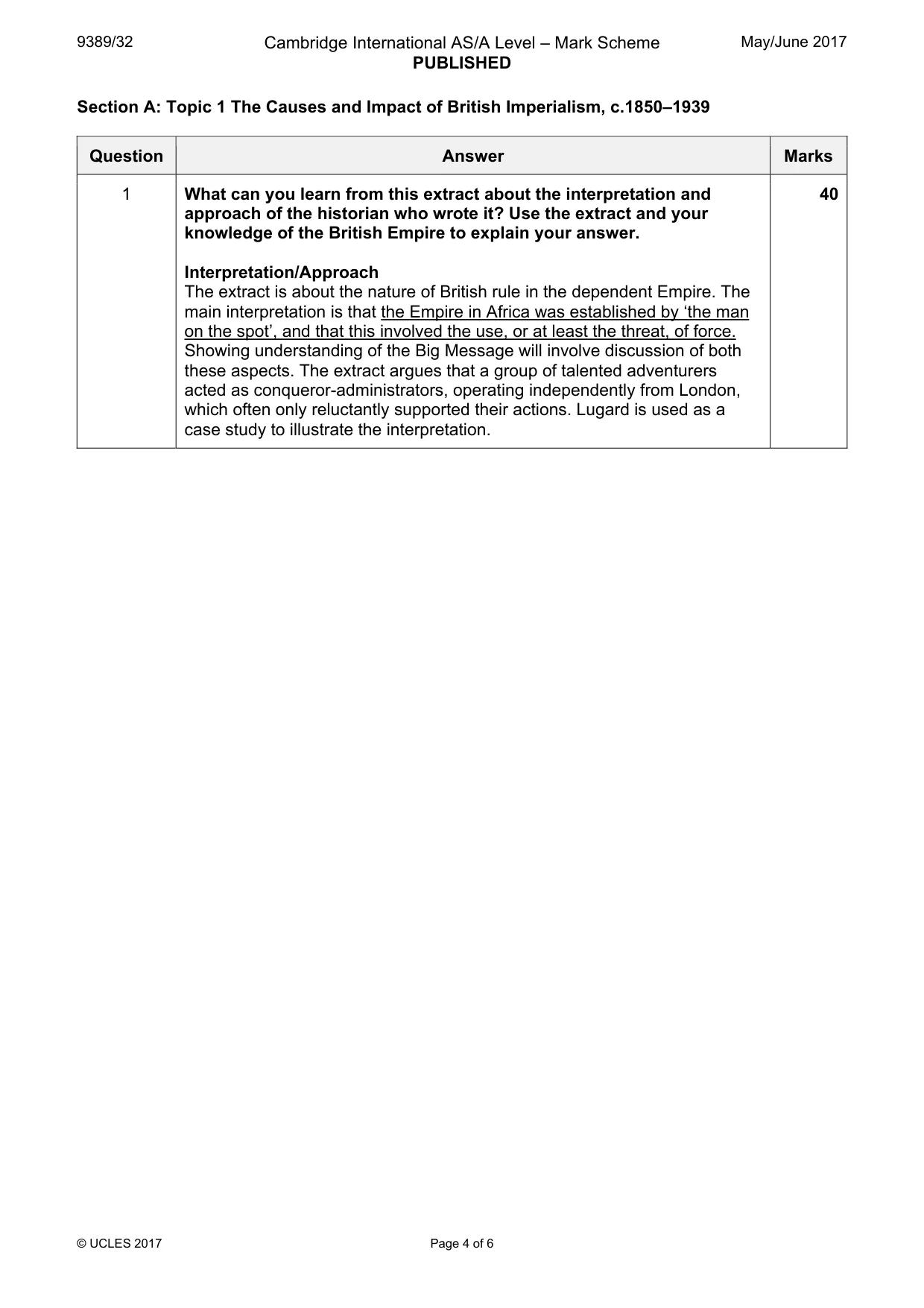
Mark scheme: Question Answer Marks 1 What can you learn from this extract about the interpretation and 40 approach of the historian who wrote it? Use the extract and your knowledge of the British Empire to explain your answer. Interpretation/Approach The extract is about the nature of British rule in the dependent Empire. The main interpretation is that the Empire in Africa was established by ‘the man on the spot’, and that this involved the use, or at least the threat, of force. Showing understanding of the Big Message will involve discussion of both these aspects. The extract argues that a group of talented adventurers acted as conqueror-administrators, operating independently from London, which often only reluctantly supported their actions. Lugard is used as a case study to illustrate the interpretation. Section B: Topic 2 The Holocaust
Q2 · Read the extract and then answer the question
2 Read the extract and then answer the question. The realisation of the Final Solution became psychologically possible because Hitler’s phrase concerning the ‘destruction of the Jewish race in Europe’ was adopted as a direct maxim for action, particularly by Himmler. Hitler, it must be conceded, was the ideological and political author of the Final Solution. However, it was translated from an apparently vague programme into a concrete strategy because of the ambitions of Himmler and his SS to complete the programme in the Führer’s own lifetime and thus to provide proof of the indispensability of the SS within the National Socialist power structure. Himmler thus directed a large part of his energies towards a programme that, for Hitler, had only a low priority in comparison with the conduct of the war. Himmler and Heydrich thus played a decisive role in implementing the Final Solution. Nevertheless it must be stressed that a purely personalised interpretation would prevent full understanding of the issue. The eventual step towards mass destruction occurred at the end of a complex political process. During this process, internal competition within the Nazi power structure gradually blocked all alternatives, so ultimately the physical liquidation of the Jews appeared to be the only option. At this stage it is necessary to recall the various stages of the National Socialist persecution of the Jews. It was certainly not carried out according to a carefully prepared plan. Only in 1941 did Heydrich succeed in eliminating rival contenders for control of the ‘Jewish Question’. Previously there had been constant infighting between departments and party offices determined to safeguard their own authority in this field. This infighting resulted in constant escalation in the persecution of the Jews. Seen from the perspective of the subsequent policy of genocide, the numerous individual moves against the Jewish community would appear to have been logical steps in one coherent plan. However, it would be inappropriate to seek any such degree of rationality in the motives of the men who initiated the specific measures. It would also be an entirely improper simplification of this process to trace it back to ideological factors alone. Anti-Jewish initiatives gained their momentum because they were associated with other interests. A desire to enhance their own prestige and extend their authority was an important motive for many National Socialists. The Holocaust was not based on a programme that had been developed over a long period. It was founded upon improvised measures that were rooted in earlier stages of planning and also escalated them. Once it had been set in motion, the extermination of those people deemed unfit for work developed a dynamic of its own. The bureaucratic machine functioned more or less automatically. There was no need for external ideological impulses to keep the process of extermination going. The widespread assumption that the systematic policy of genocide rested on a clear directive from Hitler is based on a misunderstanding of the decision-making process in the Führer’s headquarters. If such an order had been given, even if only orally, then those in high office around Hitler must have known of it; they had no motive to deny the existence of such a directive in their personal records and testimonies after 1945. In fact, the idea that Hitler set the genocide policy in motion by means of a direct instruction can be completely rejected. What can you learn from this extract about the interpretation and approach of the historian who wrote it? Use the extract and your knowledge of the Holocaust to explain your answer. [40] Section C: Topic 3 The Origins and Development of the Cold War, 1941–1950
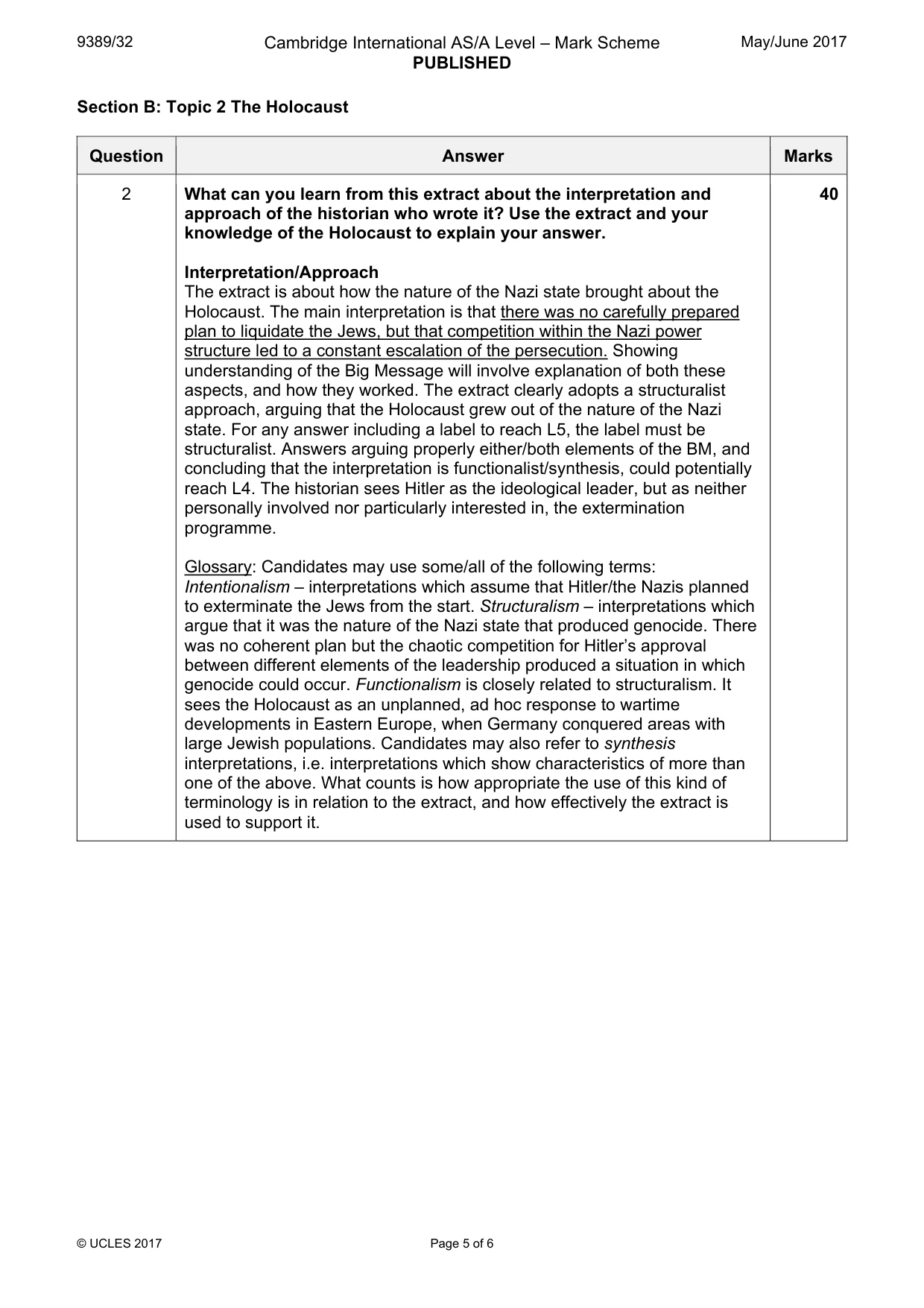
Mark scheme: 2 What can you learn from this extract about the interpretation and 40 approach of the historian who wrote it? Use the extract and your knowledge of the Holocaust to explain your answer. Interpretation/Approach The extract is about how the nature of the Nazi state brought about the Holocaust. The main interpretation is that there was no carefully prepared plan to liquidate the Jews, but that competition within the Nazi power structure led to a constant escalation of the persecution. Showing understanding of the Big Message will involve explanation of both these aspects, and how they worked. The extract clearly adopts a structuralist approach, arguing that the Holocaust grew out of the nature of the Nazi state. For any answer including a label to reach L5, the label must be structuralist. Answers arguing properly either/both elements of the BM, and concluding that the interpretation is functionalist/synthesis, could potentially reach L4. The historian sees Hitler as the ideological leader, but as neither personally involved nor particularly interested in, the extermination programme. Glossary: Candidates may use some/all of the following terms: Intentionalism – interpretations which assume that Hitler/the Nazis planned to exterminate the Jews from the start. Structuralism – interpretations which argue that it was the nature of the Nazi state that produced genocide. There was no coherent plan but the chaotic competition for Hitler’s approval between different elements of the leadership produced a situation in which genocide could occur. Functionalism is closely related to structuralism. It sees the Holocaust as an unplanned, ad hoc response to wartime developments in Eastern Europe, when Germany conquered areas with large Jewish populations. Candidates may also refer to synthesis interpretations, i.e. interpretations which show characteristics of more than one of the above. What counts is how appropriate the use of this kind of terminology is in relation to the extract, and how effectively the extract is used to support it. Section C: Topic 3 The Origins and Development of the Cold War, 1941–1950
Q3 · Read the extract and then answer the question
3 Read the extract and then answer the question. The international situation resulting from the destruction of German power presented to the Soviet rulers dazzling opportunities which they felt bound to exploit. It must have seemed to them possible and perhaps probable that within a relatively short time Soviet influence would predominate. In Marxist terms, there was a ‘revolutionary situation’ in the war-devastated countries of Europe. The attitude taken by the British and American governments during the war, throughout most of 1945, and to a certain extent during 1946, must also have encouraged the Kremlin to believe in the possibility of a vast expansion of Soviet power. The concessions granted to the USSR, particularly in the Teheran and Yalta conferences, and in some measure at Potsdam and at the Moscow Conference of December 1945, must have indicated to the Kremlin that continued pressure, promises of collaboration, and skilful propaganda would assure them a relatively free hand for the realisation of vast ambitions. All this does not mean that the Soviet leaders approached the post-war world with rosy optimism. Neither their doctrine nor their temperament nor their experience fostered an optimistic attitude. There are many indications, both in Soviet press material and public statements, and in the wary and suspicious behaviour of Soviet leaders in international negotiations, that fear and mistrust of the capitalist ‘ruling classes’ dominated their thinking. They certainly believed that Anglo-American capitalism, particularly what they considered to be the greatly strengthened American capitalism, would seek to maintain or expand its interests throughout the world. They viewed with deep anxiety the possibility that the entire capitalist world for the first time might be united under the ‘atom- dollar diplomacy’ of an all-powerful Wall Street. This fear helps to explain their frantic opposition to all forms of international organisation not under their control or in which they could not exercise a veto power. It impelled them to exploit short-run opportunities in the hope of bettering their position. And eventually they plunged the world into the Cold War. There were factors in the international situation, viewed in terms of Moscow’s orthodox Marxist doctrine, which encouraged the Soviet leaders to believe that the Anglo-American capitalists would be greatly handicapped in resisting the expansion of Soviet power. One of these factors was the prestige of the USSR, resulting from its outstanding role in the war against Nazi Germany. This prestige in the Kremlin’s eyes was a weapon to force the American government to pursue pro-Soviet policies. It also served the purpose of concealing Soviet weakness and fostering the illusion of Russian invincibility at a time when the economy was disorganised and morale had been sapped by war-weariness and a glimpse of the Western world. In another important respect, Soviet hopes appear to have been dashed. A primary objective of Soviet policy was the military withdrawal of the United States from Europe. It appears probable that until late 1946 and perhaps even early 1947 the Soviets were confident that this objective would be realised. This aim was only the most important part of a general policy of depriving the capitalist powers of military positions which could be utilised to block Soviet expansion. In general, the pattern which emerged from the winter of 1946–47 was one of Soviet expansion wherever feasible, with the Kremlin optimistic because the trump cards were in its hands. On the whole, Moscow’s expectations seemed to be justified until the announcement of the Truman Doctrine in March 1947, accompanied by a firm American stand on the German problem at the Moscow Conference in March and April of that year, soon followed by the Marshall Plan. What can you learn from this extract about the interpretation and approach of the historian who wrote it? Use the extract and your knowledge of the Cold War to explain your answer. [40]
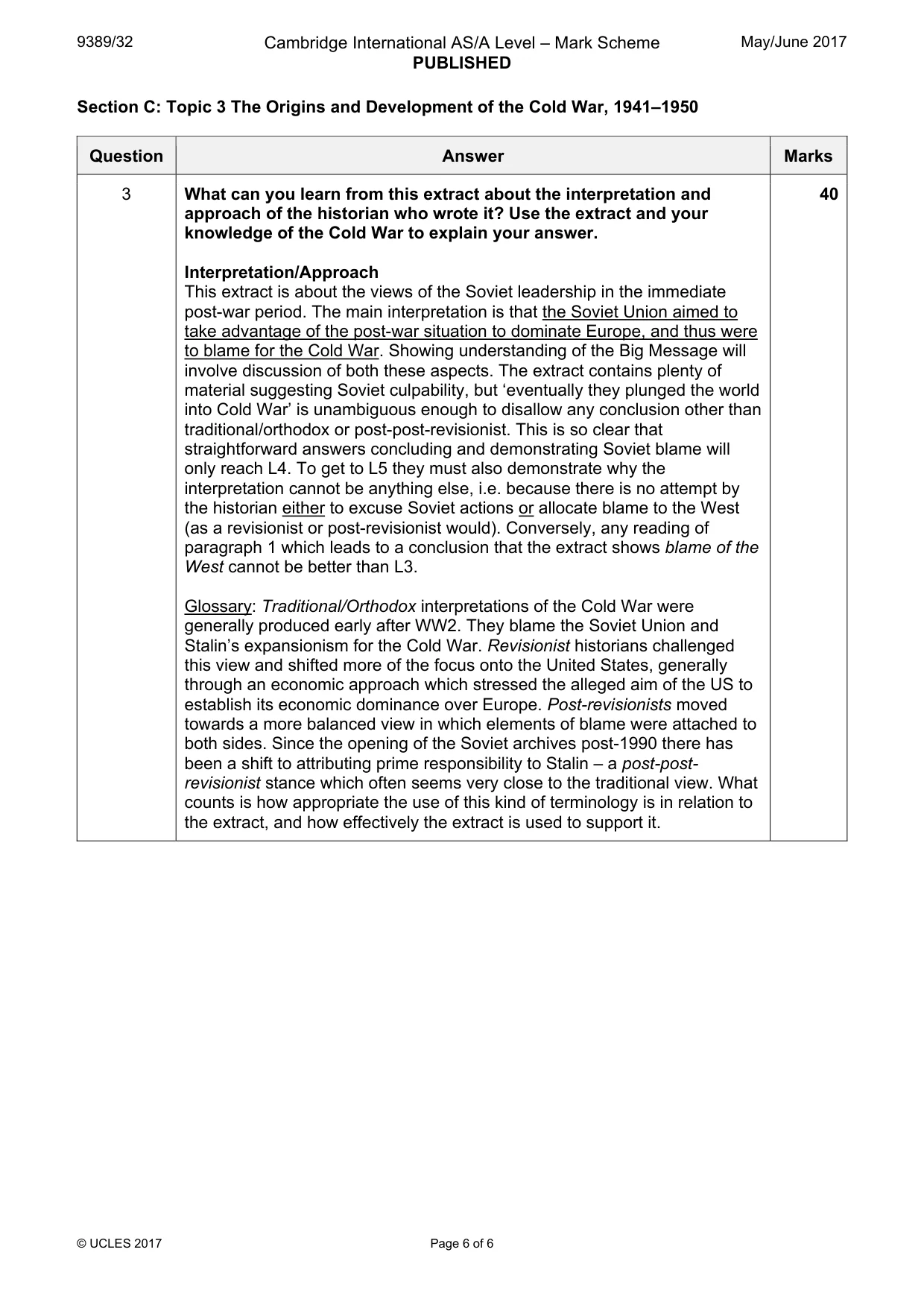
Mark scheme: 3 What can you learn from this extract about the interpretation and 40 approach of the historian who wrote it? Use the extract and your knowledge of the Cold War to explain your answer. Interpretation/Approach This extract is about the views of the Soviet leadership in the immediate post-war period. The main interpretation is that the Soviet Union aimed to take advantage of the post-war situation to dominate Europe, and thus were to blame for the Cold War. Showing understanding of the Big Message will involve discussion of both these aspects. The extract contains plenty of material suggesting Soviet culpability, but ‘eventually they plunged the world into Cold War’ is unambiguous enough to disallow any conclusion other than traditional/orthodox or post-post-revisionist. This is so clear that straightforward answers concluding and demonstrating Soviet blame will only reach L4. To get to L5 they must also demonstrate why the interpretation cannot be anything else, i.e. because there is no attempt by the historian either to excuse Soviet actions or allocate blame to the West (as a revisionist or post-revisionist would). Conversely, any reading of paragraph 1 which leads to a conclusion that the extract shows blame of the West cannot be better than L3. Glossary: Traditional/Orthodox interpretations of the Cold War were generally produced early after WW2. They blame the Soviet Union and Stalin’s expansionism for the Cold War. Revisionist historians challenged this view and shifted more of the focus onto the United States, generally through an economic approach which stressed the alleged aim of the US to establish its economic dominance over Europe. Post-revisionists moved towards a more balanced view in which elements of blame were attached to both sides. Since the opening of the Soviet archives post-1990 there has been a shift to attributing prime responsibility to Stalin – a post-post- revisionist stance which often seems very close to the traditional view. What counts is how appropriate the use of this kind of terminology is in relation to the extract, and how effectively the extract is used to support it.
What you needed in this session
Cambridge’s own grade thresholds for 2017 May/June, Paper 3 · Variant 2. A higher threshold means an easier paper — the bar moves with how the cohort did.