Cambridge A Level History 9389 — 2016 Oct/Nov Paper 4 · Variant 2
9389/42/O/N/16 · 60 marks · ≈68 min
The question paper and its mark scheme, free to read here and free to download. This is Cambridge’s own paper, exactly as it was sat.
Question paper4 pages
Mark scheme15 pages
Answers below. Sit the paper first if you are practising.
Paper as text
Question paper, page 1
* 3 9 8 0 0 0 8 7 7 1 * This document consists of 4 printed pages. DC (LM) 120112/2 © UCLES 2016 [Turn over Cambridge International Examinations Cambridge International Advanced Subsidiary and Advanced Level HISTORY 9389/42 Paper 4 Depth Study October/November 2016 1 hour 30 minutes Additional Materials: Answer Booklet/Paper READ THESE INSTRUCTIONS FIRST If you have been given an Answer Booklet, follow the instructions on the front cover of the Booklet. Write your Centre number, candidate number and name on the work you hand in. Write in dark blue or black pen. Do not use staples, paper clips, glue or correction fluid. DO NOT WRITE IN ANY BARCODES. This paper contains five sections: Depth Study 1: Europe of the Dictators, 1918–1941 Depth Study 2: The History of the USA, 1945–1990 Depth Study 3: International History, 1945–1991 Depth Study 4: African History, 1945–1991 Depth Study 5: Southeast Asian History, 1945–1990s Answer two questions from one section. At the end of the examination, fasten all your work securely together. The marks are given in brackets [ ] at the end of each question.
Question paper, page 2
2 9389/42/O/N/16 © UCLES 2016 Depth Study 1: Europe of the Dictators, 1918–1941 Answer any two questions. 1 Assess the effectiveness of Lenin’s economic policies. [30] 2 To what extent did Mussolini create a totalitarian state in Italy? [30] 3 ‘Brilliant opportunism rather than careful planning.’ To what extent does this explain Stalin’s rise to power? [30] 4 How popular were Hitler’s policies with the German people? [30] Depth Study 2: The History of the USA, 1945–1990 Answer any two questions. 5 How successful were President Eisenhower’s domestic policies? [30] 6 How far did the social status of Hispanics and Native Americans improve in the 1960s and 1970s? [30] 7 Assess the impact of competition from countries such as Japan and West Germany upon the US economy in the 1980s. [30] 8 Evaluate the reasons why George Kennan’s Long Telegram made such an impact on US foreign policy in the late 1940s. [30]
Question paper, page 3
3 9389/42/O/N/16 © UCLES 2016 [Turn over Depth Study 3: International History, 1945–1991 Answer any two questions. 9 To what extent was the globalisation of the Cold War in the period from 1950 to 1975 caused by the expansionist ambitions of the Soviet Union? [30] 10 ‘The collapse of the Soviet Union was caused by external rather than internal factors.’ How far do you agree? [30] 11 To what extent did Mao Zedong’s policies benefit China? [30] 12 To what extent did the Iran-Iraq War (1980–88) destabilise the Middle East? [30] Depth Study 4: African History, 1945–1991 Answer any two questions. 13 ‘Armed resistance delayed rather than hastened the achievement of independence.’ How far do you agree? [30] 14 Evaluate the reasons why some African countries became one-party states. [30] 15 How successfully did newly independent African states manage their economic resources? [30] 16 How effectively did independent African states work together to achieve their aims? [30]
Question paper, page 4
4 9389/42/O/N/16 © UCLES 2016 Permission to reproduce items where third-party owned material protected by copyright is included has been sought and cleared where possible. Every reasonable effort has been made by the publisher (UCLES) to trace copyright holders, but if any items requiring clearance have unwittingly been included, the publisher will be pleased to make amends at the earliest possible opportunity. To avoid the issue of disclosure of answer-related information to candidates, all copyright acknowledgements are reproduced online in the Cambridge International Examinations Copyright Acknowledgements Booklet. This is produced for each series of examinations and is freely available to download at www.cie.org.uk after the live examination series. Cambridge International Examinations is part of the Cambridge Assessment Group. Cambridge Assessment is the brand name of University of Cambridge Local Examinations Syndicate (UCLES), which is itself a department of the University of Cambridge. Depth Study 5: Southeast Asian History, 1945–1990s Answer any two questions. 17 Analyse the reasons why colonial rule lasted longer in Malaya and Indo-China than in other regions of Southeast Asia after 1945. [30] 18 How well did Sukarno deal with the problems of Indonesia after independence? [30] 19 Assess the reasons why Pol Pot was able to establish a dictatorship in Cambodia. [30] 20 To what extent were governments in Southeast Asia to blame for the Financial Crash of 1997? [30]
Mark scheme, page 1
® IGCSE is the registered trademark of Cambridge International Examinations. This document consists of 15 printed pages. © UCLES 2016 [Turn over Cambridge International Examinations Cambridge International Advanced Subsidiary and Advanced Level HISTORY 9389/42 Paper 4 Depth Study October/November 2016 MARK SCHEME Maximum Mark: 60 Published This mark scheme is published as an aid to teachers and candidates, to indicate the requirements of the examination. It shows the basis on which Examiners were instructed to award marks. It does not indicate the details of the discussions that took place at an Examiners’ meeting before marking began, which would have considered the acceptability of alternative answers. Mark schemes should be read in conjunction with the question paper and the Principal Examiner Report for Teachers. Cambridge will not enter into discussions about these mark schemes. Cambridge is publishing the mark schemes for the October/November 2016 series for most Cambridge IGCSE®, Cambridge International A and AS Level components and some Cambridge O Level components.
Mark scheme, page 2
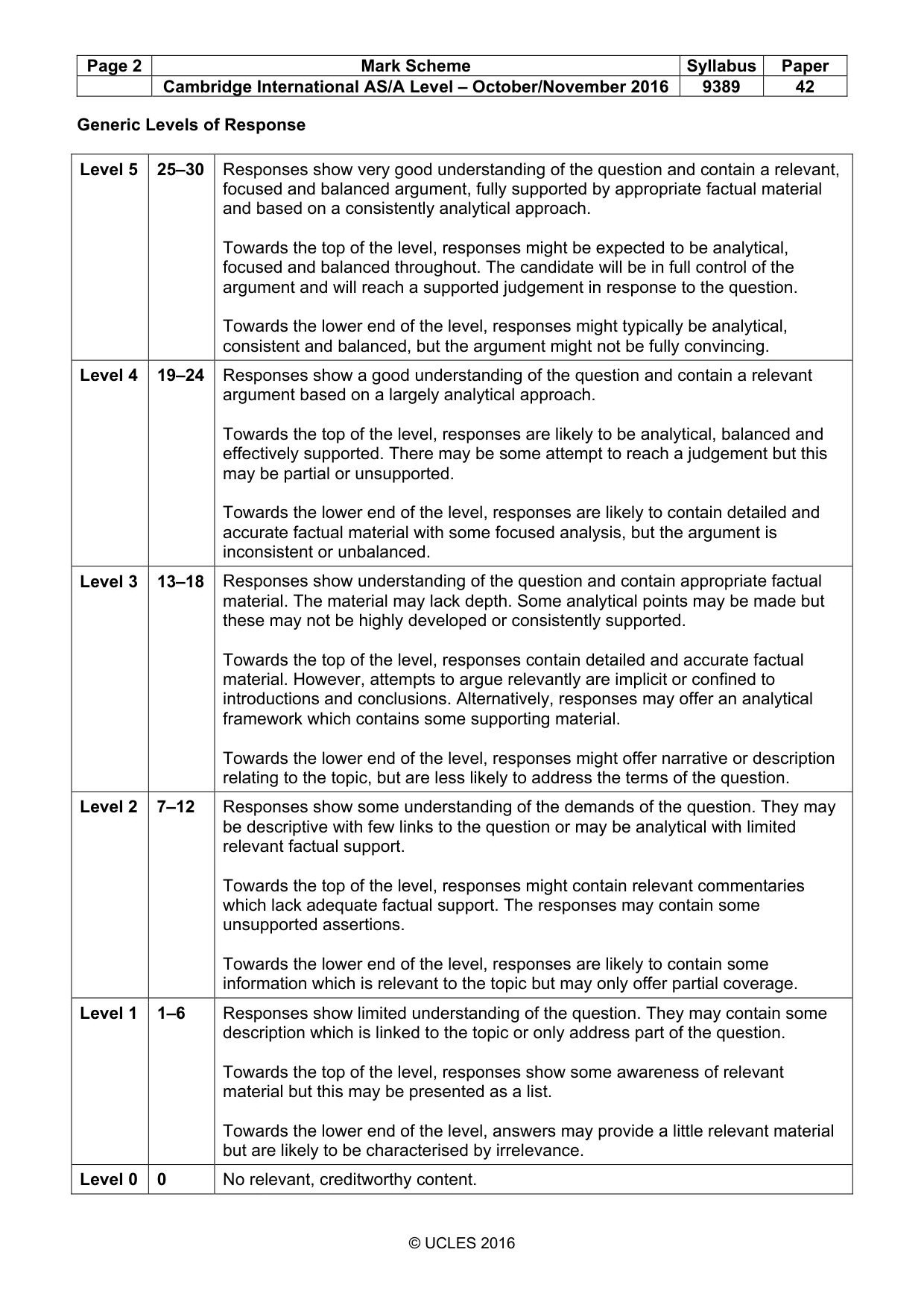
Page 2 Mark Scheme Syllabus Paper Cambridge International AS/A Level – October/November 2016 9389 42 © UCLES 2016 Generic Levels of Response Level 5 25–30 Responses show very good understanding of the question and contain a relevant, focused and balanced argument, fully supported by appropriate factual material and based on a consistently analytical approach. Towards the top of the level, responses might be expected to be analytical, focused and balanced throughout. The candidate will be in full control of the argument and will reach a supported judgement in response to the question. Towards the lower end of the level, responses might typically be analytical, consistent and balanced, but the argument might not be fully convincing. Level 4 19–24 Responses show a good understanding of the question and contain a relevant argument based on a largely analytical approach. Towards the top of the level, responses are likely to be analytical, balanced and effectively supported. There may be some attempt to reach a judgement but this may be partial or unsupported. Towards the lower end of the level, responses are likely to contain detailed and accurate factual material with some focused analysis, but the argument is inconsistent or unbalanced. Level 3 13–18 Responses show understanding of the question and contain appropriate factual material. The material may lack depth. Some analytical points may be made but these may not be highly developed or consistently supported. Towards the top of the level, responses contain detailed and accurate factual material. However, attempts to argue relevantly are implicit or confined to introductions and conclusions. Alternatively, responses may offer an analytical framework which contains some supporting material. Towards the lower end of the level, responses might offer narrative or description relating to the topic, but are less likely to address the terms of the question. Level 2 7–12 Responses show some understanding of the demands of the question. They may be descriptive with few links to the question or may be analytical with limited relevant factual support. Towards the top of the level, responses might contain relevant commentaries which lack adequate factual support. The responses may contain some unsupported assertions. Towards the lower end of the level, responses are likely to contain some information which is relevant to the topic but may only offer partial coverage. Level 1 1–6 Responses show limited understanding of the question. They may contain some description which is linked to the topic or only address part of the question. Towards the top of the level, responses show some awareness of relevant material but this may be presented as a list. Towards the lower end of the level, answers may provide a little relevant material but are likely to be characterised by irrelevance. Level 0 0 No relevant, creditworthy content.
Mark scheme, page 3
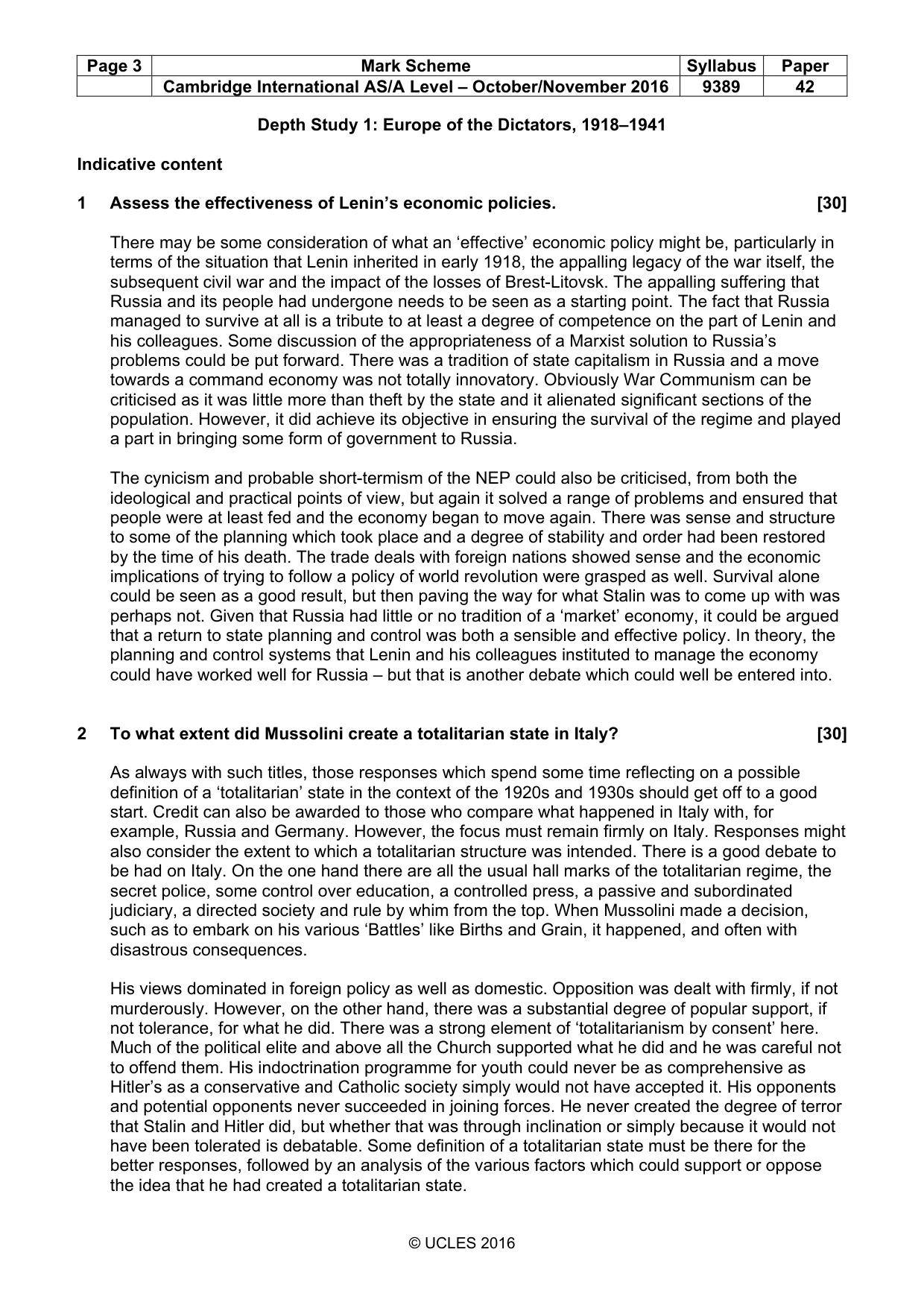
Page 3 Mark Scheme Syllabus Paper Cambridge International AS/A Level – October/November 2016 9389 42 © UCLES 2016 Depth Study 1: Europe of the Dictators, 1918–1941 Indicative content 1 Assess the effectiveness of Lenin’s economic policies. [30] There may be some consideration of what an ‘effective’ economic policy might be, particularly in terms of the situation that Lenin inherited in early 1918, the appalling legacy of the war itself, the subsequent civil war and the impact of the losses of Brest-Litovsk. The appalling suffering that Russia and its people had undergone needs to be seen as a starting point. The fact that Russia managed to survive at all is a tribute to at least a degree of competence on the part of Lenin and his colleagues. Some discussion of the appropriateness of a Marxist solution to Russia’s problems could be put forward. There was a tradition of state capitalism in Russia and a move towards a command economy was not totally innovatory. Obviously War Communism can be criticised as it was little more than theft by the state and it alienated significant sections of the population. However, it did achieve its objective in ensuring the survival of the regime and played a part in bringing some form of government to Russia. The cynicism and probable short-termism of the NEP could also be criticised, from both the ideological and practical points of view, but again it solved a range of problems and ensured that people were at least fed and the economy began to move again. There was sense and structure to some of the planning which took place and a degree of stability and order had been restored by the time of his death. The trade deals with foreign nations showed sense and the economic implications of trying to follow a policy of world revolution were grasped as well. Survival alone could be seen as a good result, but then paving the way for what Stalin was to come up with was perhaps not. Given that Russia had little or no tradition of a ‘market’ economy, it could be argued that a return to state planning and control was both a sensible and effective policy. In theory, the planning and control systems that Lenin and his colleagues instituted to manage the economy could have worked well for Russia – but that is another debate which could well be entered into. 2 To what extent did Mussolini create a totalitarian state in Italy? [30] As always with such titles, those responses which spend some time reflecting on a possible definition of a ‘totalitarian’ state in the context of the 1920s and 1930s should get off to a good start. Credit can also be awarded to those who compare what happened in Italy with, for example, Russia and Germany. However, the focus must remain firmly on Italy. Responses might also consider the extent to which a totalitarian structure was intended. There is a good debate to be had on Italy. On the one hand there are all the usual hall marks of the totalitarian regime, the secret police, some control over education, a controlled press, a passive and subordinated judiciary, a directed society and rule by whim from the top. When Mussolini made a decision, such as to embark on his various ‘Battles’ like Births and Grain, it happened, and often with disastrous consequences. His views dominated in foreign policy as well as domestic. Opposition was dealt with firmly, if not murderously. However, on the other hand, there was a substantial degree of popular support, if not tolerance, for what he did. There was a strong element of ‘totalitarianism by consent’ here. Much of the political elite and above all the Church supported what he did and he was careful not to offend them. His indoctrination programme for youth could never be as comprehensive as Hitler’s as a conservative and Catholic society simply would not have accepted it. His opponents and potential opponents never succeeded in joining forces. He never created the degree of terror that Stalin and Hitler did, but whether that was through inclination or simply because it would not have been tolerated is debatable. Some definition of a totalitarian state must be there for the better responses, followed by an analysis of the various factors which could support or oppose the idea that he had created a totalitarian state.
Mark scheme, page 4
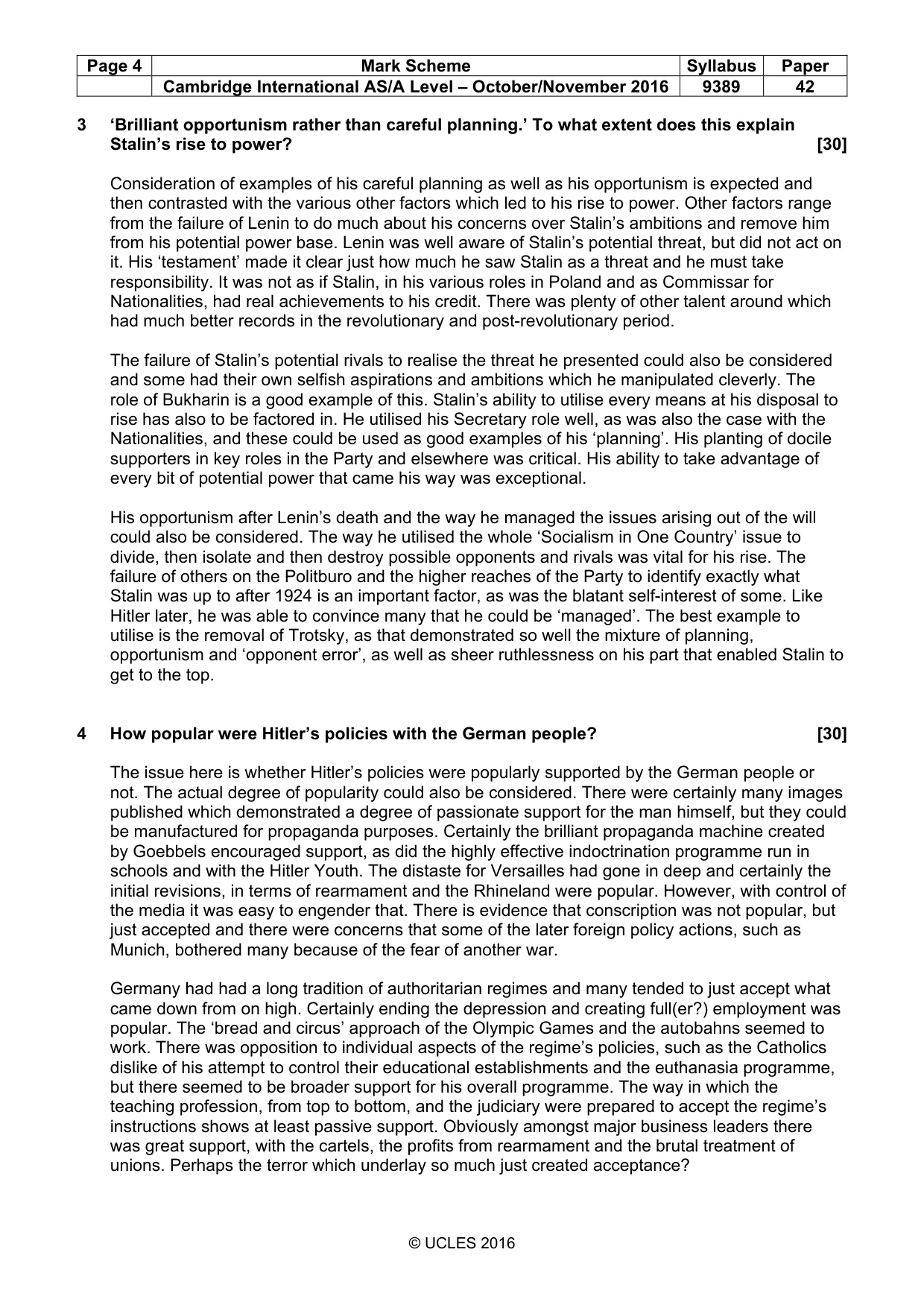
Page 4 Mark Scheme Syllabus Paper Cambridge International AS/A Level – October/November 2016 9389 42 © UCLES 2016 3 ‘Brilliant opportunism rather than careful planning.’ To what extent does this explain Stalin’s rise to power? [30] Consideration of examples of his careful planning as well as his opportunism is expected and then contrasted with the various other factors which led to his rise to power. Other factors range from the failure of Lenin to do much about his concerns over Stalin’s ambitions and remove him from his potential power base. Lenin was well aware of Stalin’s potential threat, but did not act on it. His ‘testament’ made it clear just how much he saw Stalin as a threat and he must take responsibility. It was not as if Stalin, in his various roles in Poland and as Commissar for Nationalities, had real achievements to his credit. There was plenty of other talent around which had much better records in the revolutionary and post-revolutionary period. The failure of Stalin’s potential rivals to realise the threat he presented could also be considered and some had their own selfish aspirations and ambitions which he manipulated cleverly. The role of Bukharin is a good example of this. Stalin’s ability to utilise every means at his disposal to rise has also to be factored in. He utilised his Secretary role well, as was also the case with the Nationalities, and these could be used as good examples of his ‘planning’. His planting of docile supporters in key roles in the Party and elsewhere was critical. His ability to take advantage of every bit of potential power that came his way was exceptional. His opportunism after Lenin’s death and the way he managed the issues arising out of the will could also be considered. The way he utilised the whole ‘Socialism in One Country’ issue to divide, then isolate and then destroy possible opponents and rivals was vital for his rise. The failure of others on the Politburo and the higher reaches of the Party to identify exactly what Stalin was up to after 1924 is an important factor, as was the blatant self-interest of some. Like Hitler later, he was able to convince many that he could be ‘managed’. The best example to utilise is the removal of Trotsky, as that demonstrated so well the mixture of planning, opportunism and ‘opponent error’, as well as sheer ruthlessness on his part that enabled Stalin to get to the top. 4 How popular were Hitler’s policies with the German people? [30] The issue here is whether Hitler’s policies were popularly supported by the German people or not. The actual degree of popularity could also be considered. There were certainly many images published which demonstrated a degree of passionate support for the man himself, but they could be manufactured for propaganda purposes. Certainly the brilliant propaganda machine created by Goebbels encouraged support, as did the highly effective indoctrination programme run in schools and with the Hitler Youth. The distaste for Versailles had gone in deep and certainly the initial revisions, in terms of rearmament and the Rhineland were popular. However, with control of the media it was easy to engender that. There is evidence that conscription was not popular, but just accepted and there were concerns that some of the later foreign policy actions, such as Munich, bothered many because of the fear of another war. Germany had had a long tradition of authoritarian regimes and many tended to just accept what came down from on high. Certainly ending the depression and creating full(er?) employment was popular. The ‘bread and circus’ approach of the Olympic Games and the autobahns seemed to work. There was opposition to individual aspects of the regime’s policies, such as the Catholics dislike of his attempt to control their educational establishments and the euthanasia programme, but there seemed to be broader support for his overall programme. The way in which the teaching profession, from top to bottom, and the judiciary were prepared to accept the regime’s instructions shows at least passive support. Obviously amongst major business leaders there was great support, with the cartels, the profits from rearmament and the brutal treatment of unions. Perhaps the terror which underlay so much just created acceptance?
Mark scheme, page 5
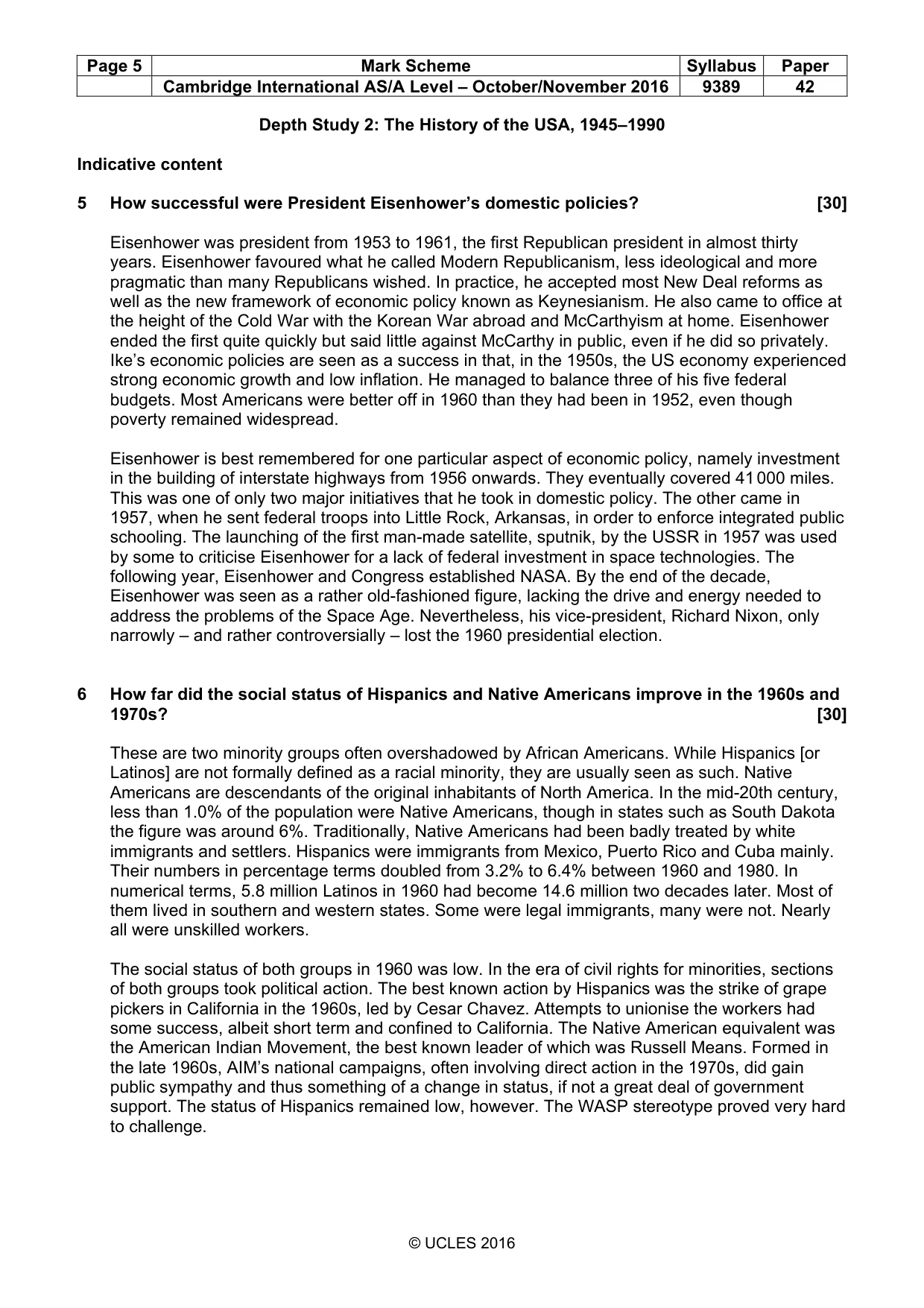
Page 5 Mark Scheme Syllabus Paper Cambridge International AS/A Level – October/November 2016 9389 42 © UCLES 2016 Depth Study 2: The History of the USA, 1945–1990 Indicative content 5 How successful were President Eisenhower’s domestic policies? [30] Eisenhower was president from 1953 to 1961, the first Republican president in almost thirty years. Eisenhower favoured what he called Modern Republicanism, less ideological and more pragmatic than many Republicans wished. In practice, he accepted most New Deal reforms as well as the new framework of economic policy known as Keynesianism. He also came to office at the height of the Cold War with the Korean War abroad and McCarthyism at home. Eisenhower ended the first quite quickly but said little against McCarthy in public, even if he did so privately. Ike’s economic policies are seen as a success in that, in the 1950s, the US economy experienced strong economic growth and low inflation. He managed to balance three of his five federal budgets. Most Americans were better off in 1960 than they had been in 1952, even though poverty remained widespread. Eisenhower is best remembered for one particular aspect of economic policy, namely investment in the building of interstate highways from 1956 onwards. They eventually covered 41 000 miles. This was one of only two major initiatives that he took in domestic policy. The other came in 1957, when he sent federal troops into Little Rock, Arkansas, in order to enforce integrated public schooling. The launching of the first man-made satellite, sputnik, by the USSR in 1957 was used by some to criticise Eisenhower for a lack of federal investment in space technologies. The following year, Eisenhower and Congress established NASA. By the end of the decade, Eisenhower was seen as a rather old-fashioned figure, lacking the drive and energy needed to address the problems of the Space Age. Nevertheless, his vice-president, Richard Nixon, only narrowly – and rather controversially – lost the 1960 presidential election. 6 How far did the social status of Hispanics and Native Americans improve in the 1960s and 1970s? [30] These are two minority groups often overshadowed by African Americans. While Hispanics [or Latinos] are not formally defined as a racial minority, they are usually seen as such. Native Americans are descendants of the original inhabitants of North America. In the mid-20th century, less than 1.0% of the population were Native Americans, though in states such as South Dakota the figure was around 6%. Traditionally, Native Americans had been badly treated by white immigrants and settlers. Hispanics were immigrants from Mexico, Puerto Rico and Cuba mainly. Their numbers in percentage terms doubled from 3.2% to 6.4% between 1960 and 1980. In numerical terms, 5.8 million Latinos in 1960 had become 14.6 million two decades later. Most of them lived in southern and western states. Some were legal immigrants, many were not. Nearly all were unskilled workers. The social status of both groups in 1960 was low. In the era of civil rights for minorities, sections of both groups took political action. The best known action by Hispanics was the strike of grape pickers in California in the 1960s, led by Cesar Chavez. Attempts to unionise the workers had some success, albeit short term and confined to California. The Native American equivalent was the American Indian Movement, the best known leader of which was Russell Means. Formed in the late 1960s, AIM’s national campaigns, often involving direct action in the 1970s, did gain public sympathy and thus something of a change in status, if not a great deal of government support. The status of Hispanics remained low, however. The WASP stereotype proved very hard to challenge.
Mark scheme, page 6
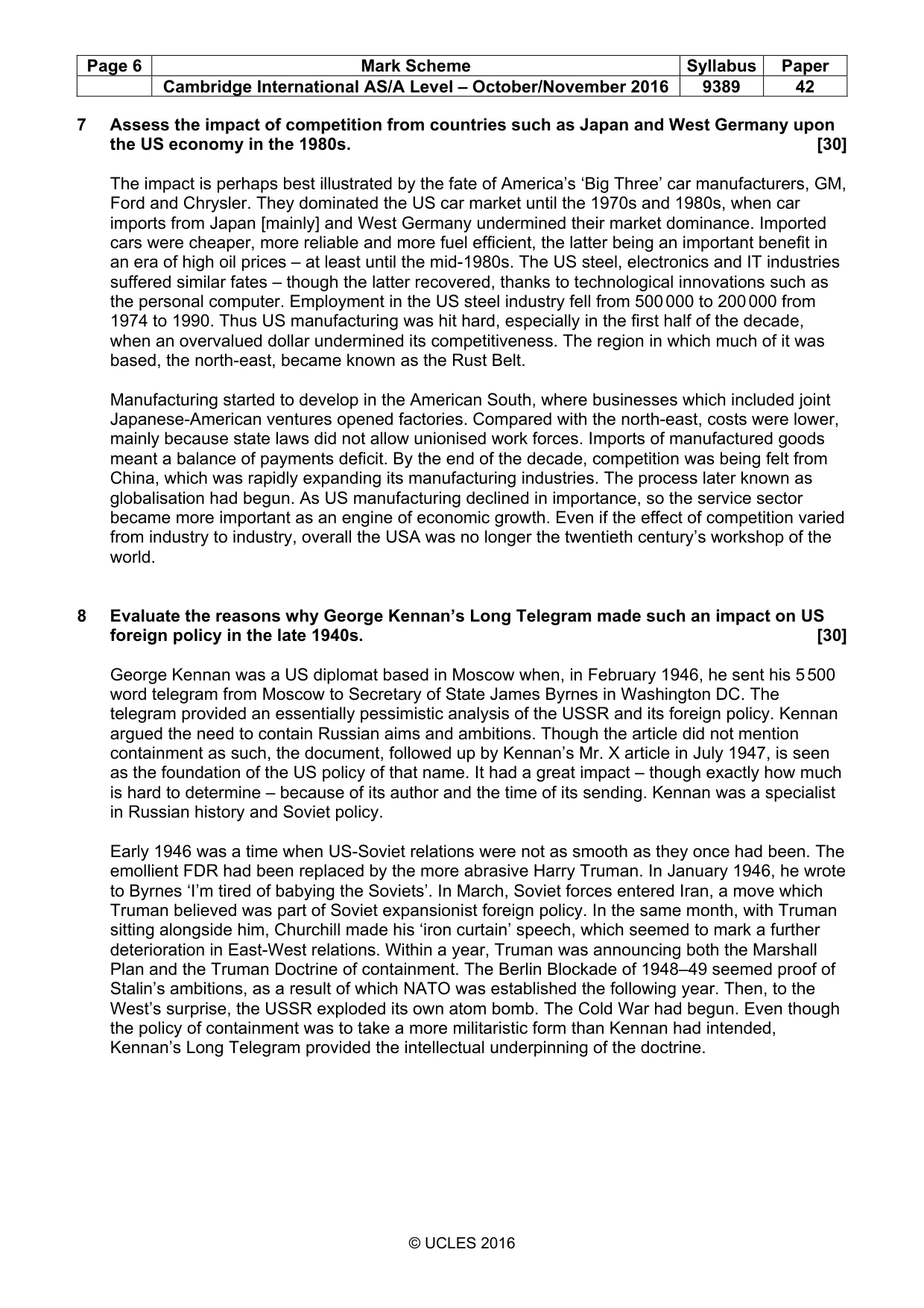
Page 6 Mark Scheme Syllabus Paper Cambridge International AS/A Level – October/November 2016 9389 42 © UCLES 2016 7 Assess the impact of competition from countries such as Japan and West Germany upon the US economy in the 1980s. [30] The impact is perhaps best illustrated by the fate of America’s ‘Big Three’ car manufacturers, GM, Ford and Chrysler. They dominated the US car market until the 1970s and 1980s, when car imports from Japan [mainly] and West Germany undermined their market dominance. Imported cars were cheaper, more reliable and more fuel efficient, the latter being an important benefit in an era of high oil prices – at least until the mid-1980s. The US steel, electronics and IT industries suffered similar fates – though the latter recovered, thanks to technological innovations such as the personal computer. Employment in the US steel industry fell from 500 000 to 200 000 from 1974 to 1990. Thus US manufacturing was hit hard, especially in the first half of the decade, when an overvalued dollar undermined its competitiveness. The region in which much of it was based, the north-east, became known as the Rust Belt. Manufacturing started to develop in the American South, where businesses which included joint Japanese-American ventures opened factories. Compared with the north-east, costs were lower, mainly because state laws did not allow unionised work forces. Imports of manufactured goods meant a balance of payments deficit. By the end of the decade, competition was being felt from China, which was rapidly expanding its manufacturing industries. The process later known as globalisation had begun. As US manufacturing declined in importance, so the service sector became more important as an engine of economic growth. Even if the effect of competition varied from industry to industry, overall the USA was no longer the twentieth century’s workshop of the world. 8 Evaluate the reasons why George Kennan’s Long Telegram made such an impact on US foreign policy in the late 1940s. [30] George Kennan was a US diplomat based in Moscow when, in February 1946, he sent his 5 500 word telegram from Moscow to Secretary of State James Byrnes in Washington DC. The telegram provided an essentially pessimistic analysis of the USSR and its foreign policy. Kennan argued the need to contain Russian aims and ambitions. Though the article did not mention containment as such, the document, followed up by Kennan’s Mr. X article in July 1947, is seen as the foundation of the US policy of that name. It had a great impact – though exactly how much is hard to determine – because of its author and the time of its sending. Kennan was a specialist in Russian history and Soviet policy. Early 1946 was a time when US-Soviet relations were not as smooth as they once had been. The emollient FDR had been replaced by the more abrasive Harry Truman. In January 1946, he wrote to Byrnes ‘I’m tired of babying the Soviets’. In March, Soviet forces entered Iran, a move which Truman believed was part of Soviet expansionist foreign policy. In the same month, with Truman sitting alongside him, Churchill made his ‘iron curtain’ speech, which seemed to mark a further deterioration in East-West relations. Within a year, Truman was announcing both the Marshall Plan and the Truman Doctrine of containment. The Berlin Blockade of 1948–49 seemed proof of Stalin’s ambitions, as a result of which NATO was established the following year. Then, to the West’s surprise, the USSR exploded its own atom bomb. The Cold War had begun. Even though the policy of containment was to take a more militaristic form than Kennan had intended, Kennan’s Long Telegram provided the intellectual underpinning of the doctrine.
Mark scheme, page 7
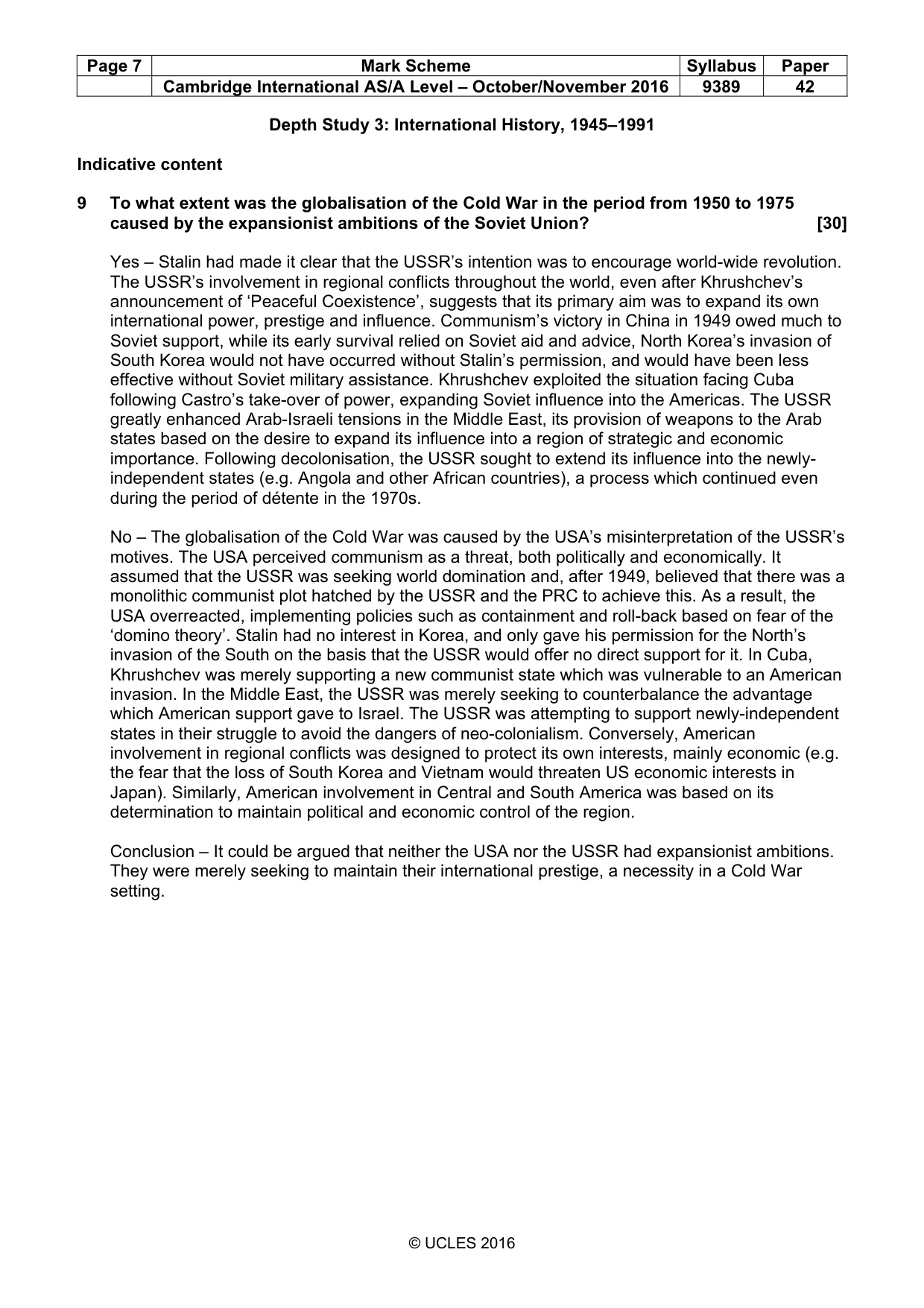
Page 7 Mark Scheme Syllabus Paper Cambridge International AS/A Level – October/November 2016 9389 42 © UCLES 2016 Depth Study 3: International History, 1945–1991 Indicative content 9 To what extent was the globalisation of the Cold War in the period from 1950 to 1975 caused by the expansionist ambitions of the Soviet Union? [30] Yes – Stalin had made it clear that the USSR’s intention was to encourage world-wide revolution. The USSR’s involvement in regional conflicts throughout the world, even after Khrushchev’s announcement of ‘Peaceful Coexistence’, suggests that its primary aim was to expand its own international power, prestige and influence. Communism’s victory in China in 1949 owed much to Soviet support, while its early survival relied on Soviet aid and advice, North Korea’s invasion of South Korea would not have occurred without Stalin’s permission, and would have been less effective without Soviet military assistance. Khrushchev exploited the situation facing Cuba following Castro’s take-over of power, expanding Soviet influence into the Americas. The USSR greatly enhanced Arab-Israeli tensions in the Middle East, its provision of weapons to the Arab states based on the desire to expand its influence into a region of strategic and economic importance. Following decolonisation, the USSR sought to extend its influence into the newly- independent states (e.g. Angola and other African countries), a process which continued even during the period of détente in the 1970s. No – The globalisation of the Cold War was caused by the USA’s misinterpretation of the USSR’s motives. The USA perceived communism as a threat, both politically and economically. It assumed that the USSR was seeking world domination and, after 1949, believed that there was a monolithic communist plot hatched by the USSR and the PRC to achieve this. As a result, the USA overreacted, implementing policies such as containment and roll-back based on fear of the ‘domino theory’. Stalin had no interest in Korea, and only gave his permission for the North’s invasion of the South on the basis that the USSR would offer no direct support for it. In Cuba, Khrushchev was merely supporting a new communist state which was vulnerable to an American invasion. In the Middle East, the USSR was merely seeking to counterbalance the advantage which American support gave to Israel. The USSR was attempting to support newly-independent states in their struggle to avoid the dangers of neo-colonialism. Conversely, American involvement in regional conflicts was designed to protect its own interests, mainly economic (e.g. the fear that the loss of South Korea and Vietnam would threaten US economic interests in Japan). Similarly, American involvement in Central and South America was based on its determination to maintain political and economic control of the region. Conclusion – It could be argued that neither the USA nor the USSR had expansionist ambitions. They were merely seeking to maintain their international prestige, a necessity in a Cold War setting.
Mark scheme, page 8
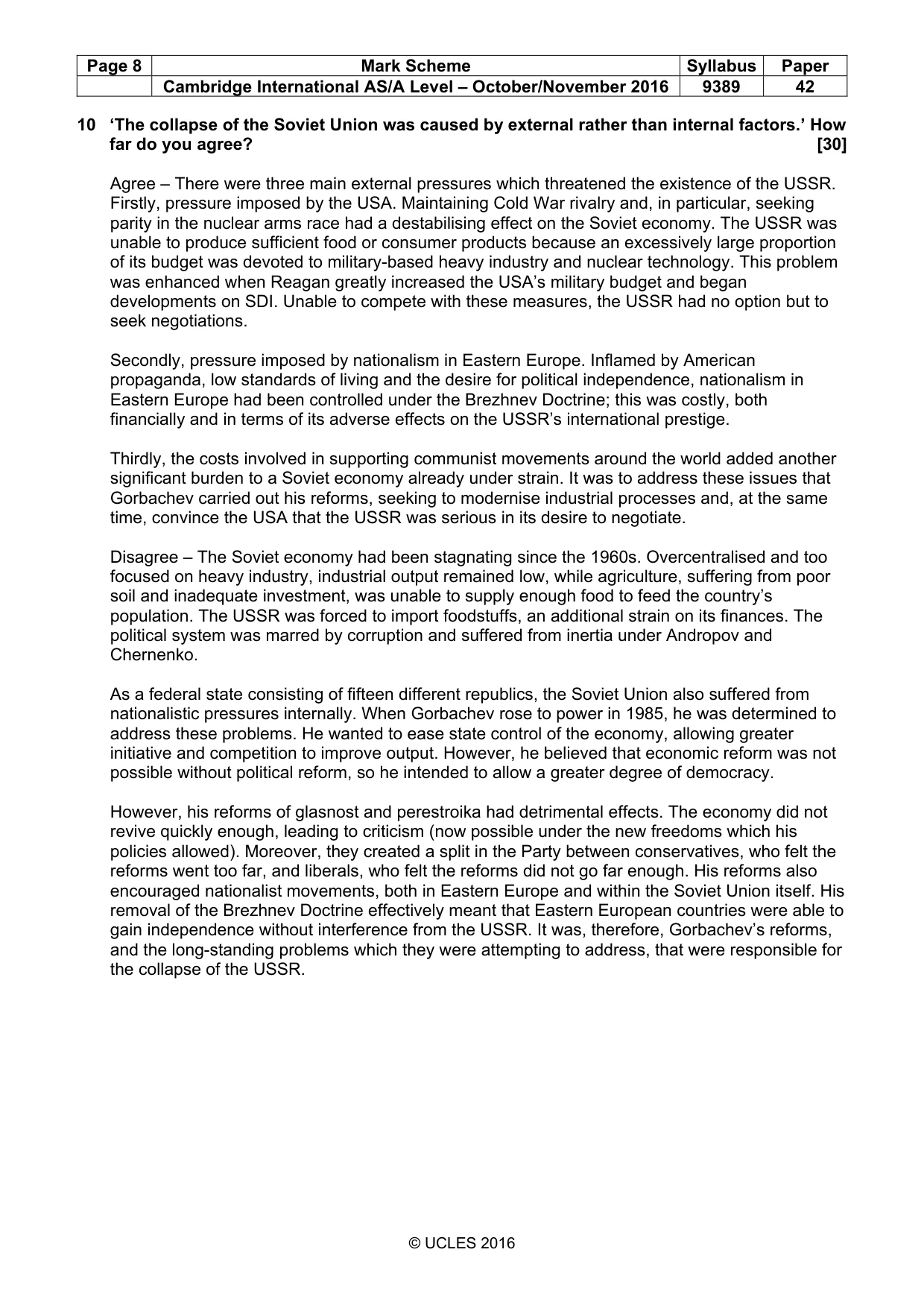
Page 8 Mark Scheme Syllabus Paper Cambridge International AS/A Level – October/November 2016 9389 42 © UCLES 2016 10 ‘The collapse of the Soviet Union was caused by external rather than internal factors.’ How far do you agree? [30] Agree – There were three main external pressures which threatened the existence of the USSR. Firstly, pressure imposed by the USA. Maintaining Cold War rivalry and, in particular, seeking parity in the nuclear arms race had a destabilising effect on the Soviet economy. The USSR was unable to produce sufficient food or consumer products because an excessively large proportion of its budget was devoted to military-based heavy industry and nuclear technology. This problem was enhanced when Reagan greatly increased the USA’s military budget and began developments on SDI. Unable to compete with these measures, the USSR had no option but to seek negotiations. Secondly, pressure imposed by nationalism in Eastern Europe. Inflamed by American propaganda, low standards of living and the desire for political independence, nationalism in Eastern Europe had been controlled under the Brezhnev Doctrine; this was costly, both financially and in terms of its adverse effects on the USSR’s international prestige. Thirdly, the costs involved in supporting communist movements around the world added another significant burden to a Soviet economy already under strain. It was to address these issues that Gorbachev carried out his reforms, seeking to modernise industrial processes and, at the same time, convince the USA that the USSR was serious in its desire to negotiate. Disagree – The Soviet economy had been stagnating since the 1960s. Overcentralised and too focused on heavy industry, industrial output remained low, while agriculture, suffering from poor soil and inadequate investment, was unable to supply enough food to feed the country’s population. The USSR was forced to import foodstuffs, an additional strain on its finances. The political system was marred by corruption and suffered from inertia under Andropov and Chernenko. As a federal state consisting of fifteen different republics, the Soviet Union also suffered from nationalistic pressures internally. When Gorbachev rose to power in 1985, he was determined to address these problems. He wanted to ease state control of the economy, allowing greater initiative and competition to improve output. However, he believed that economic reform was not possible without political reform, so he intended to allow a greater degree of democracy. However, his reforms of glasnost and perestroika had detrimental effects. The economy did not revive quickly enough, leading to criticism (now possible under the new freedoms which his policies allowed). Moreover, they created a split in the Party between conservatives, who felt the reforms went too far, and liberals, who felt the reforms did not go far enough. His reforms also encouraged nationalist movements, both in Eastern Europe and within the Soviet Union itself. His removal of the Brezhnev Doctrine effectively meant that Eastern European countries were able to gain independence without interference from the USSR. It was, therefore, Gorbachev’s reforms, and the long-standing problems which they were attempting to address, that were responsible for the collapse of the USSR.
Mark scheme, page 9
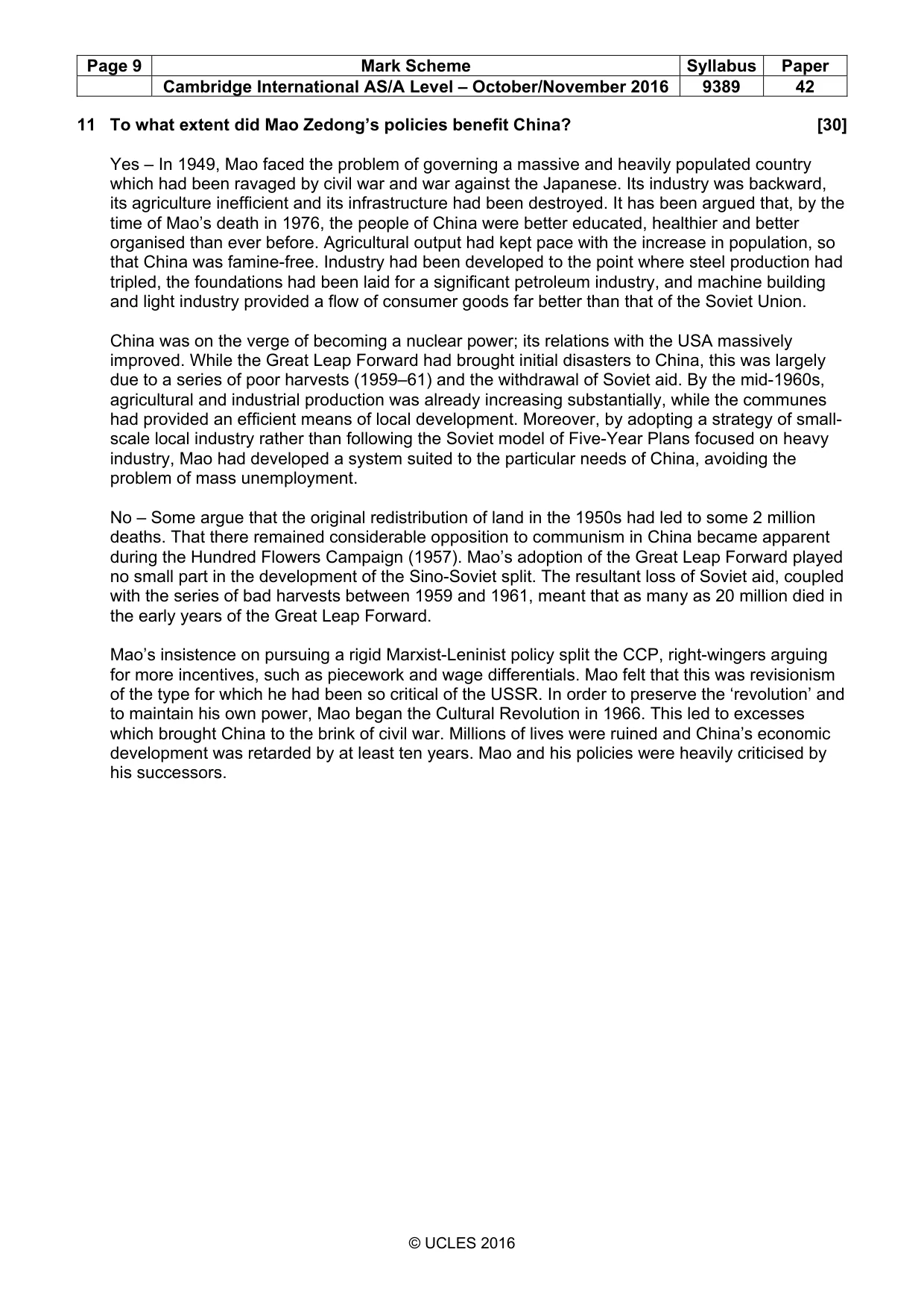
Page 9 Mark Scheme Syllabus Paper Cambridge International AS/A Level – October/November 2016 9389 42 © UCLES 2016 11 To what extent did Mao Zedong’s policies benefit China? [30] Yes – In 1949, Mao faced the problem of governing a massive and heavily populated country which had been ravaged by civil war and war against the Japanese. Its industry was backward, its agriculture inefficient and its infrastructure had been destroyed. It has been argued that, by the time of Mao’s death in 1976, the people of China were better educated, healthier and better organised than ever before. Agricultural output had kept pace with the increase in population, so that China was famine-free. Industry had been developed to the point where steel production had tripled, the foundations had been laid for a significant petroleum industry, and machine building and light industry provided a flow of consumer goods far better than that of the Soviet Union. China was on the verge of becoming a nuclear power; its relations with the USA massively improved. While the Great Leap Forward had brought initial disasters to China, this was largely due to a series of poor harvests (1959–61) and the withdrawal of Soviet aid. By the mid-1960s, agricultural and industrial production was already increasing substantially, while the communes had provided an efficient means of local development. Moreover, by adopting a strategy of small- scale local industry rather than following the Soviet model of Five-Year Plans focused on heavy industry, Mao had developed a system suited to the particular needs of China, avoiding the problem of mass unemployment. No – Some argue that the original redistribution of land in the 1950s had led to some 2 million deaths. That there remained considerable opposition to communism in China became apparent during the Hundred Flowers Campaign (1957). Mao’s adoption of the Great Leap Forward played no small part in the development of the Sino-Soviet split. The resultant loss of Soviet aid, coupled with the series of bad harvests between 1959 and 1961, meant that as many as 20 million died in the early years of the Great Leap Forward. Mao’s insistence on pursuing a rigid Marxist-Leninist policy split the CCP, right-wingers arguing for more incentives, such as piecework and wage differentials. Mao felt that this was revisionism of the type for which he had been so critical of the USSR. In order to preserve the ‘revolution’ and to maintain his own power, Mao began the Cultural Revolution in 1966. This led to excesses which brought China to the brink of civil war. Millions of lives were ruined and China’s economic development was retarded by at least ten years. Mao and his policies were heavily criticised by his successors.
Mark scheme, page 10
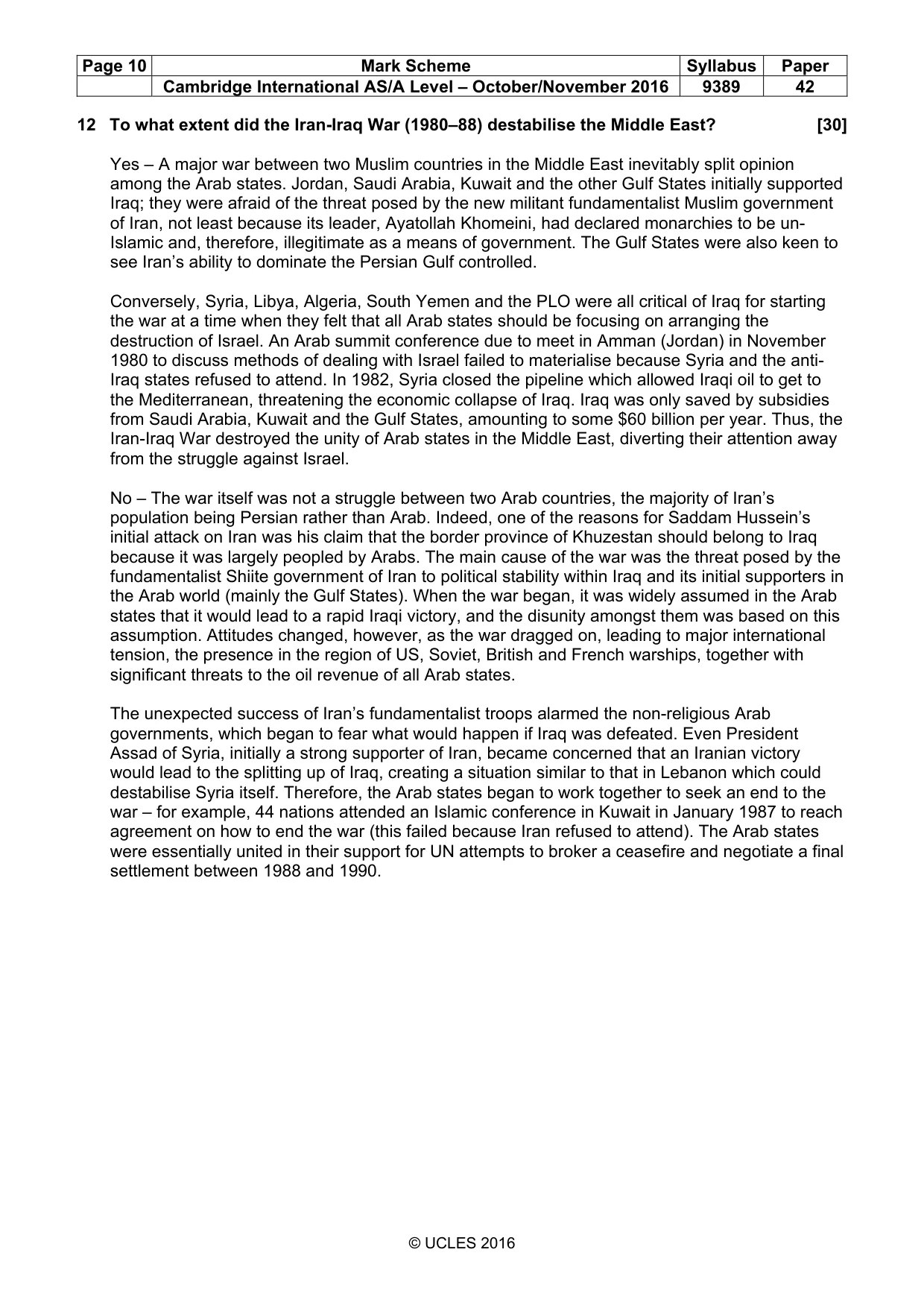
Page 10 Mark Scheme Syllabus Paper Cambridge International AS/A Level – October/November 2016 9389 42 © UCLES 2016 12 To what extent did the Iran-Iraq War (1980–88) destabilise the Middle East? [30] Yes – A major war between two Muslim countries in the Middle East inevitably split opinion among the Arab states. Jordan, Saudi Arabia, Kuwait and the other Gulf States initially supported Iraq; they were afraid of the threat posed by the new militant fundamentalist Muslim government of Iran, not least because its leader, Ayatollah Khomeini, had declared monarchies to be un- Islamic and, therefore, illegitimate as a means of government. The Gulf States were also keen to see Iran’s ability to dominate the Persian Gulf controlled. Conversely, Syria, Libya, Algeria, South Yemen and the PLO were all critical of Iraq for starting the war at a time when they felt that all Arab states should be focusing on arranging the destruction of Israel. An Arab summit conference due to meet in Amman (Jordan) in November 1980 to discuss methods of dealing with Israel failed to materialise because Syria and the anti- Iraq states refused to attend. In 1982, Syria closed the pipeline which allowed Iraqi oil to get to the Mediterranean, threatening the economic collapse of Iraq. Iraq was only saved by subsidies from Saudi Arabia, Kuwait and the Gulf States, amounting to some $60 billion per year. Thus, the Iran-Iraq War destroyed the unity of Arab states in the Middle East, diverting their attention away from the struggle against Israel. No – The war itself was not a struggle between two Arab countries, the majority of Iran’s population being Persian rather than Arab. Indeed, one of the reasons for Saddam Hussein’s initial attack on Iran was his claim that the border province of Khuzestan should belong to Iraq because it was largely peopled by Arabs. The main cause of the war was the threat posed by the fundamentalist Shiite government of Iran to political stability within Iraq and its initial supporters in the Arab world (mainly the Gulf States). When the war began, it was widely assumed in the Arab states that it would lead to a rapid Iraqi victory, and the disunity amongst them was based on this assumption. Attitudes changed, however, as the war dragged on, leading to major international tension, the presence in the region of US, Soviet, British and French warships, together with significant threats to the oil revenue of all Arab states. The unexpected success of Iran’s fundamentalist troops alarmed the non-religious Arab governments, which began to fear what would happen if Iraq was defeated. Even President Assad of Syria, initially a strong supporter of Iran, became concerned that an Iranian victory would lead to the splitting up of Iraq, creating a situation similar to that in Lebanon which could destabilise Syria itself. Therefore, the Arab states began to work together to seek an end to the war – for example, 44 nations attended an Islamic conference in Kuwait in January 1987 to reach agreement on how to end the war (this failed because Iran refused to attend). The Arab states were essentially united in their support for UN attempts to broker a ceasefire and negotiate a final settlement between 1988 and 1990.
Mark scheme, page 11
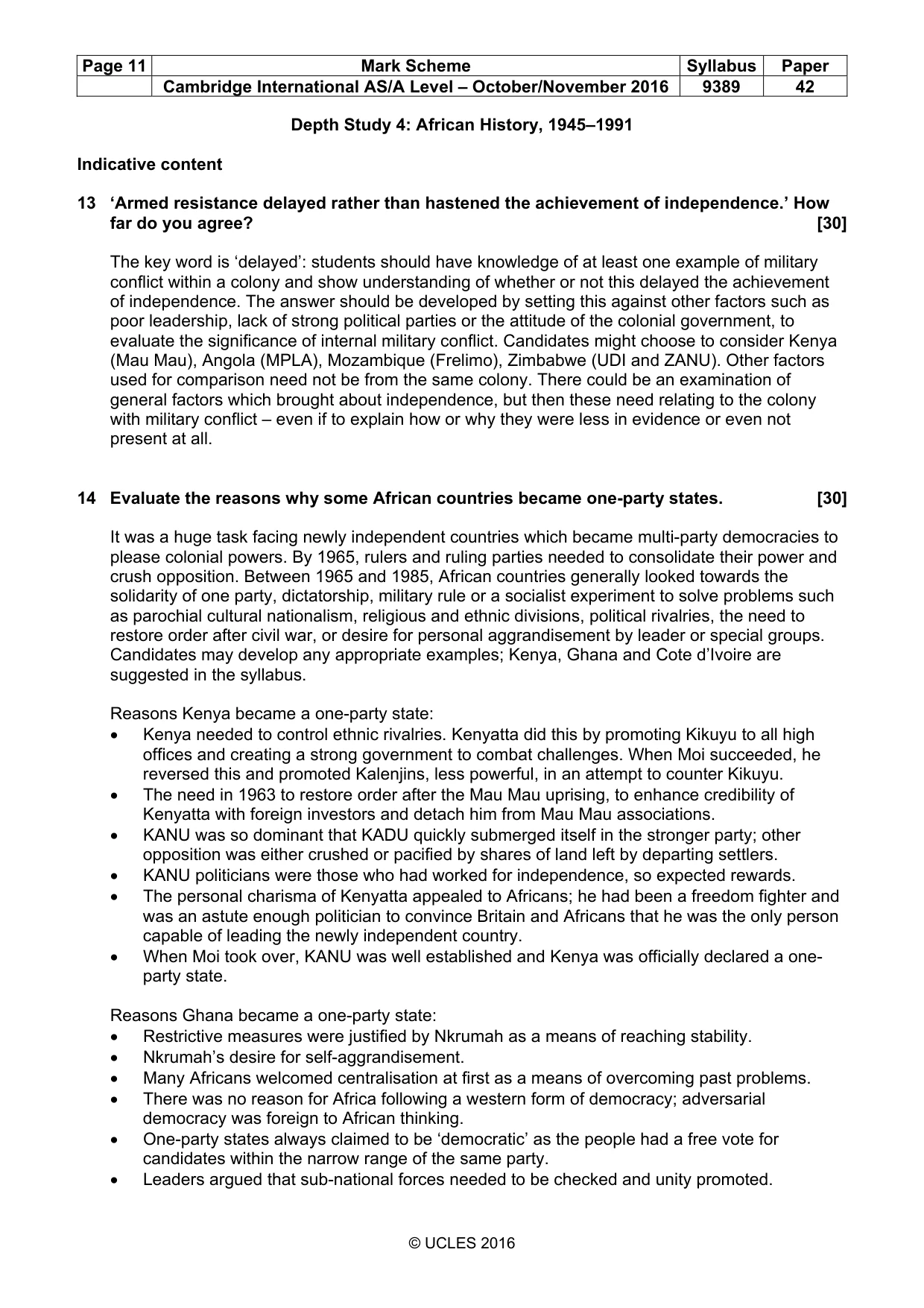
Page 11 Mark Scheme Syllabus Paper Cambridge International AS/A Level – October/November 2016 9389 42 © UCLES 2016 Depth Study 4: African History, 1945–1991 Indicative content 13 ‘Armed resistance delayed rather than hastened the achievement of independence.’ How far do you agree? [30] The key word is ‘delayed’: students should have knowledge of at least one example of military conflict within a colony and show understanding of whether or not this delayed the achievement of independence. The answer should be developed by setting this against other factors such as poor leadership, lack of strong political parties or the attitude of the colonial government, to evaluate the significance of internal military conflict. Candidates might choose to consider Kenya (Mau Mau), Angola (MPLA), Mozambique (Frelimo), Zimbabwe (UDI and ZANU). Other factors used for comparison need not be from the same colony. There could be an examination of general factors which brought about independence, but then these need relating to the colony with military conflict – even if to explain how or why they were less in evidence or even not present at all. 14 Evaluate the reasons why some African countries became one-party states. [30] It was a huge task facing newly independent countries which became multi-party democracies to please colonial powers. By 1965, rulers and ruling parties needed to consolidate their power and crush opposition. Between 1965 and 1985, African countries generally looked towards the solidarity of one party, dictatorship, military rule or a socialist experiment to solve problems such as parochial cultural nationalism, religious and ethnic divisions, political rivalries, the need to restore order after civil war, or desire for personal aggrandisement by leader or special groups. Candidates may develop any appropriate examples; Kenya, Ghana and Cote d’Ivoire are suggested in the syllabus. Reasons Kenya became a one-party state: • Kenya needed to control ethnic rivalries. Kenyatta did this by promoting Kikuyu to all high offices and creating a strong government to combat challenges. When Moi succeeded, he reversed this and promoted Kalenjins, less powerful, in an attempt to counter Kikuyu. • The need in 1963 to restore order after the Mau Mau uprising, to enhance credibility of Kenyatta with foreign investors and detach him from Mau Mau associations. • KANU was so dominant that KADU quickly submerged itself in the stronger party; other opposition was either crushed or pacified by shares of land left by departing settlers. • KANU politicians were those who had worked for independence, so expected rewards. • The personal charisma of Kenyatta appealed to Africans; he had been a freedom fighter and was an astute enough politician to convince Britain and Africans that he was the only person capable of leading the newly independent country. • When Moi took over, KANU was well established and Kenya was officially declared a one- party state. Reasons Ghana became a one-party state: • Restrictive measures were justified by Nkrumah as a means of reaching stability. • Nkrumah’s desire for self-aggrandisement. • Many Africans welcomed centralisation at first as a means of overcoming past problems. • There was no reason for Africa following a western form of democracy; adversarial democracy was foreign to African thinking. • One-party states always claimed to be ‘democratic’ as the people had a free vote for candidates within the narrow range of the same party. • Leaders argued that sub-national forces needed to be checked and unity promoted.
Mark scheme, page 12
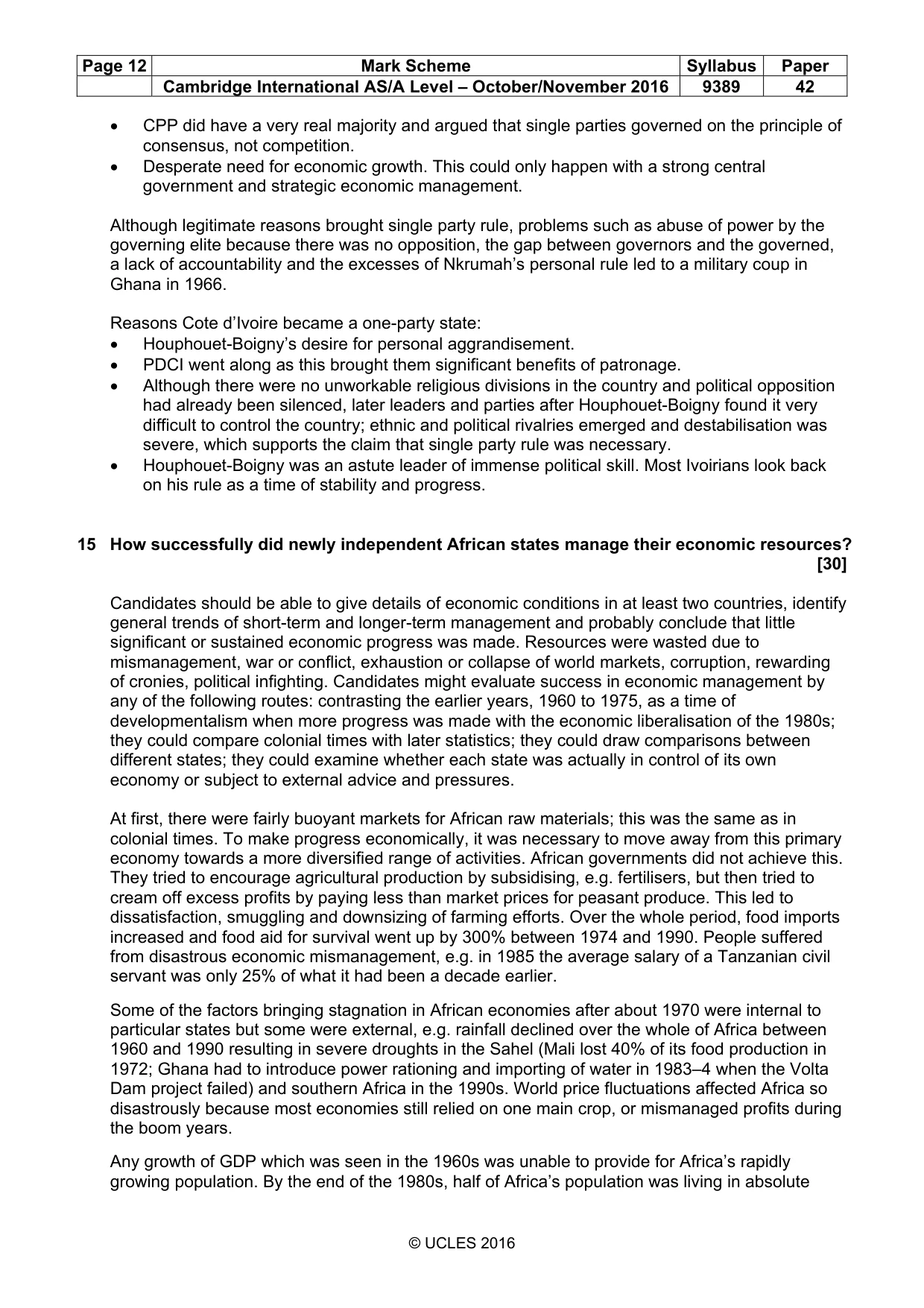
Page 12 Mark Scheme Syllabus Paper Cambridge International AS/A Level – October/November 2016 9389 42 © UCLES 2016 • CPP did have a very real majority and argued that single parties governed on the principle of consensus, not competition. • Desperate need for economic growth. This could only happen with a strong central government and strategic economic management. Although legitimate reasons brought single party rule, problems such as abuse of power by the governing elite because there was no opposition, the gap between governors and the governed, a lack of accountability and the excesses of Nkrumah’s personal rule led to a military coup in Ghana in 1966. Reasons Cote d’Ivoire became a one-party state: • Houphouet-Boigny’s desire for personal aggrandisement. • PDCI went along as this brought them significant benefits of patronage. • Although there were no unworkable religious divisions in the country and political opposition had already been silenced, later leaders and parties after Houphouet-Boigny found it very difficult to control the country; ethnic and political rivalries emerged and destabilisation was severe, which supports the claim that single party rule was necessary. • Houphouet-Boigny was an astute leader of immense political skill. Most Ivoirians look back on his rule as a time of stability and progress. 15 How successfully did newly independent African states manage their economic resources? [30] Candidates should be able to give details of economic conditions in at least two countries, identify general trends of short-term and longer-term management and probably conclude that little significant or sustained economic progress was made. Resources were wasted due to mismanagement, war or conflict, exhaustion or collapse of world markets, corruption, rewarding of cronies, political infighting. Candidates might evaluate success in economic management by any of the following routes: contrasting the earlier years, 1960 to 1975, as a time of developmentalism when more progress was made with the economic liberalisation of the 1980s; they could compare colonial times with later statistics; they could draw comparisons between different states; they could examine whether each state was actually in control of its own economy or subject to external advice and pressures. At first, there were fairly buoyant markets for African raw materials; this was the same as in colonial times. To make progress economically, it was necessary to move away from this primary economy towards a more diversified range of activities. African governments did not achieve this. They tried to encourage agricultural production by subsidising, e.g. fertilisers, but then tried to cream off excess profits by paying less than market prices for peasant produce. This led to dissatisfaction, smuggling and downsizing of farming efforts. Over the whole period, food imports increased and food aid for survival went up by 300% between 1974 and 1990. People suffered from disastrous economic mismanagement, e.g. in 1985 the average salary of a Tanzanian civil servant was only 25% of what it had been a decade earlier. Some of the factors bringing stagnation in African economies after about 1970 were internal to particular states but some were external, e.g. rainfall declined over the whole of Africa between 1960 and 1990 resulting in severe droughts in the Sahel (Mali lost 40% of its food production in 1972; Ghana had to introduce power rationing and importing of water in 1983–4 when the Volta Dam project failed) and southern Africa in the 1990s. World price fluctuations affected Africa so disastrously because most economies still relied on one main crop, or mismanaged profits during the boom years. Any growth of GDP which was seen in the 1960s was unable to provide for Africa’s rapidly growing population. By the end of the 1980s, half of Africa’s population was living in absolute
Mark scheme, page 13
Page 13 Mark Scheme Syllabus Paper Cambridge International AS/A Level – October/November 2016 9389 42 © UCLES 2016 poverty and most Africans were no better off than they had been at independence. To a great extent, African countries must have mismanaged their economies. They have not diversified, introduced ISI projects or worked out a clear long-term strategy for economic development. 16 How effectively did independent African states work together to achieve their aims? [30] Candidates should show knowledge and understanding of Pan-Africanism and the work of the OAU in both regional and continental co-operation initiatives. In 1958, Nkrumah hosted the first All- African People’s Conference in Accra; the Second Conference of African Independent States was held in Monrovia in 1959; and the Third in Addis Ababa in 1960. Although symbolic and aspirational, none of their aims were achieved. African states needed the co-operation of others to fight against the colonial powers, but once states became independent they were too busy building up national consciousness, securing borders and restricting opposition parties and minority groups to sacrifice any aspect of their own sovereignty. One of the problems of African countries working together has been the tendency to splinter once an organisation has been formed. Very quickly, the division into pro-East and pro-West blocs became evident (some countries changing sides). In addition, the vertical divisions into revolutionaries, progressives, reactionaries, capitalists, socialists, traditionalists and moderates within countries made long-lasting co-operation difficult. Throughout this period, there was united African support for freedom from colonial rule and self-determination. PAFMECSA (Pan-African Freedom Movement for E/C/S Africa) and the RDA were practical applications of these ideas. There was also some success in achieving economic co-operation after the 1970s. In the earlier period, schemes such as the British West African Currency Board, the West African Cocoa Research Institute, the ex-French colonies’ attempts at a customs union and the East African Co- operation Treaty of 1967 all failed. The Lagos Plan of Action for the Economic Development of Africa (1980) had the aims of regional integration and collective self-reliance. The regional schemes of ECOWAS (English-speaking West African States) and CEDEAO (French-speaking states), the ECCAS (economic community for Central African States) and SADDC (for Southern Africa co-operation) are also based on regional solidarity.
Mark scheme, page 14
Page 14 Mark Scheme Syllabus Paper Cambridge International AS/A Level – October/November 2016 9389 42 © UCLES 2016 Depth Study 5: Southeast Asian History, 1945–1990s Indicative content 17 Analyse the reasons why colonial rule lasted longer in Malaya and Indo-China than in other regions of Southeast Asia after 1945. [30] Answers might point to the greater determination of the colonising powers to hold on to their possessions in Malaya and Indo-China for different reasons. This is in contrast to the Philippines which already had enjoyed a measure of self-government before the war. Despite its economic importance, politically the USA did not want to restore any colonial status there. The decision to grant India independence obviously impacted on Burma. The agitation that led to this decision was greater than in Malaya and there was not the fear of Communism that was a factor in both Malaya and Vietnam. The Dutch did not want to relinquish Indonesia but the strength of nationalist movements there and the reduced ability of the Netherlands to maintain a colonial campaign without US help must be considered. Reasons will weigh the amount of opposition offered, the motives of the British and the French, the resources available for resistance and the political impact, especially for France, of a surrender. 18 How well did Sukarno deal with the problems of Indonesia after independence? [30] The last part of Indonesia became independent under Sukarno’s leadership in August 1950. Some of the problems included: religious divisions; clashes between ethnic groups; divisions and unrest in the army; establishing a sense of nationhood; making the transition from the colonial economy; and repairing wartime disruptions. Answers will consider the solution of ‘guided democracy’ of 1956, the establishment of martial law in 1957, and overcoming internal opposition. Policies which nationalised property held by the Dutch will be considered and also actions against the economic domination of ethnic Chinese. The campaigns against rebel governments in Sumatra and Salwesi could be assessed. The increasing reliance on autocracy with the reinstatement of the 1945 Constitution in 1959, his appointment of half the members of the parliament in 1960, his use of military force against opposition and the implications of these policies could be considered. As hyperinflation increased, Sukarno’s alliance with Communist elements culminating in the deaths of major army leaders in October 1965 and the creation of a revolutionary council led to a bloody revolt by Suharto and the transfer of power in 1966. Under Sukarno, the Indonesian Communist party had swelled to 10 million and Sukarno, in opposition to the Federation of Malaysia, had launched the Konfrontasi in Borneo. On the one hand, there was greater stability; Djakarta was developed as a modern city; Indonesian prestige increased internationally; Sukarno was able to secure foreign aid and was influential in the non-aligned movement. However, the downside may well be seen as opportunism in using the army and then by alliance with the Communists. He also pursued an aggressive foreign policy, though he did gain control of West Irian/West Papua. The advantages of non-alignment and Western aid were foregone in the 1960s and opposition to his autocracy led to internal political violence. High levels of inflation as a result of spending to finance military activity had disastrous economic and social consequences, and ideals of self- sufficiency were impractical as a response to the weakening of export trade.
Mark scheme, page 15
Page 15 Mark Scheme Syllabus Paper Cambridge International AS/A Level – October/November 2016 9389 42 © UCLES 2016 19 Assess the reasons why Pol Pot was able to establish a dictatorship in Cambodia. [30] Pol Pot’s bizarre dictatorship from 1975 to 1979 saw the deaths of perhaps 1.5 million out of a total population of 8 million in Cambodia. From a support base in the north-east in a remote and sparsely populated country area, Pol Pot and the Khmer Rouge established a power base. By 1973, despite US bombing, they had control of 75% of Cambodia. The principal reason for Pol Pot’s accession may well be the economic and political destabilisation that resulted from the overspill of the Vietnam War into Cambodia with over 150 000 Cambodians being killed and refugees fleeing into Phnom Penh. The alliance with Sihanouk offered more credibility to the Khmer Rouge, but the war increased support and led to an atmosphere of the acceptance of radical change. The government in Cambodia lost US support by 1975 and the existence of large numbers of teenage peasant guerrilla fighters gave valuable support to Pol Pot and encouraged his radical social and political policies. The association of the West with the bombing made extreme anti-Western policies more acceptable and Cambodia’s isolation helped in allowing the dictatorship to be established. Ethnic hatreds contributed with the bulk of violence falling on Vietnamese Chinese and Chan Muslims – ethnic divisions were a major factor in explaining the establishment of this dictatorship. Pol Pot’s own political abilities and his ability to gain support and establish clear ‘out groups’ might be set against the disturbed context of Cambodia by 1975 and the effects of war. 20 To what extent were governments in Southeast Asia to blame for the Financial Crash of 1997? [30] The collapse of the Thai baht in 1997 triggered a financial crisis. Some of the factors have included the high performance of some economies which led to an influx of capital investment, creating some financial vulnerability in case of loss of confidence. Other views are more critical of the role of governments and financial institutions. Regulation could be said to have been deficient in financial institutions being allowed to incur external liquid liabilities not sufficiently backed by liquid assets. Regulation deficiencies could be said to have led to irresponsibility, with financial intermediaries not applying sound business criteria when making loans and sometimes having guarantees from governments so that they did not have to consider the risks of loans adequately. Governments could be said to have allowed foreign debt to GDP ratios to rise to dangerous levels. Thailand in particular experienced growth based on ‘hot money’. Links between governments and capital, sometimes characterised as corruption or ‘crony’ capitalism, made regulation more difficult. However, some elements were outside government control such as the revaluation of the Chinese currency, the raising of US interest rates and the slowing of Southeast Asia’s exports in 1996. There is a debate about the role of real economic factors and the activities of the market, so depending on what emphasis is put on the different causes, the role of governments will be assessed differently.
What you needed in this session
Cambridge’s own grade thresholds for 2016 Oct/Nov, Paper 4 · Variant 2. A higher threshold means an easier paper — the bar moves with how the cohort did.