Cambridge A Level History 9389 — 2016 Oct/Nov Paper 4 · Variant 1
9389/41/O/N/16 · 60 marks · ≈68 min
The question paper and its mark scheme, free to read here and free to download. This is Cambridge’s own paper, exactly as it was sat.
Question paper4 pages
Mark scheme15 pages
Answers below. Sit the paper first if you are practising.
Paper as text
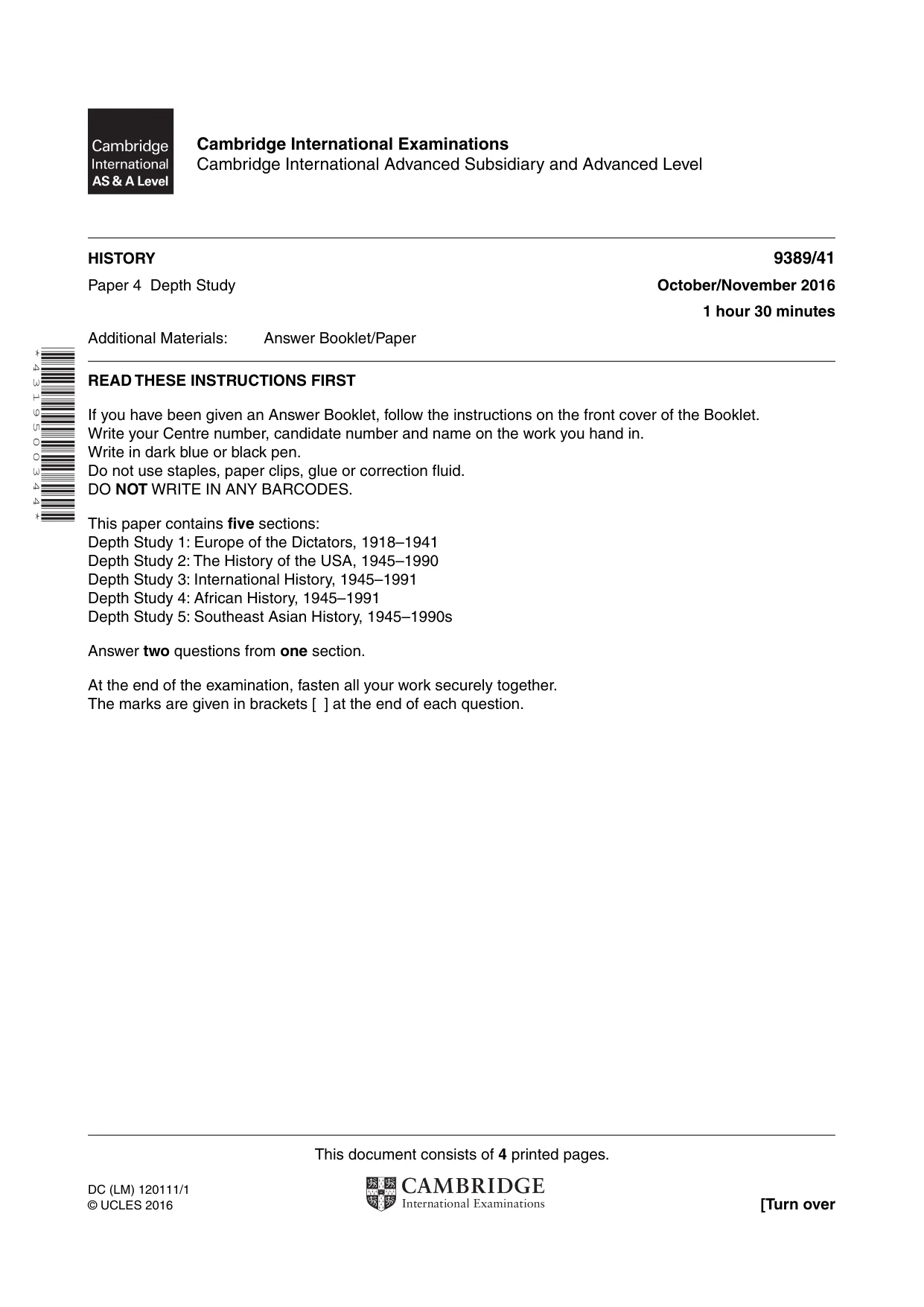
Question paper, page 1
* 4 3 1 9 5 0 0 3 4 4 * This document consists of 4 printed pages. DC (LM) 120111/1 © UCLES 2016 [Turn over Cambridge International Examinations Cambridge International Advanced Subsidiary and Advanced Level HISTORY 9389/41 Paper 4 Depth Study October/November 2016 1 hour 30 minutes Additional Materials: Answer Booklet/Paper READ THESE INSTRUCTIONS FIRST If you have been given an Answer Booklet, follow the instructions on the front cover of the Booklet. Write your Centre number, candidate number and name on the work you hand in. Write in dark blue or black pen. Do not use staples, paper clips, glue or correction fluid. DO NOT WRITE IN ANY BARCODES. This paper contains five sections: Depth Study 1: Europe of the Dictators, 1918–1941 Depth Study 2: The History of the USA, 1945–1990 Depth Study 3: International History, 1945–1991 Depth Study 4: African History, 1945–1991 Depth Study 5: Southeast Asian History, 1945–1990s Answer two questions from one section. At the end of the examination, fasten all your work securely together. The marks are given in brackets [ ] at the end of each question.
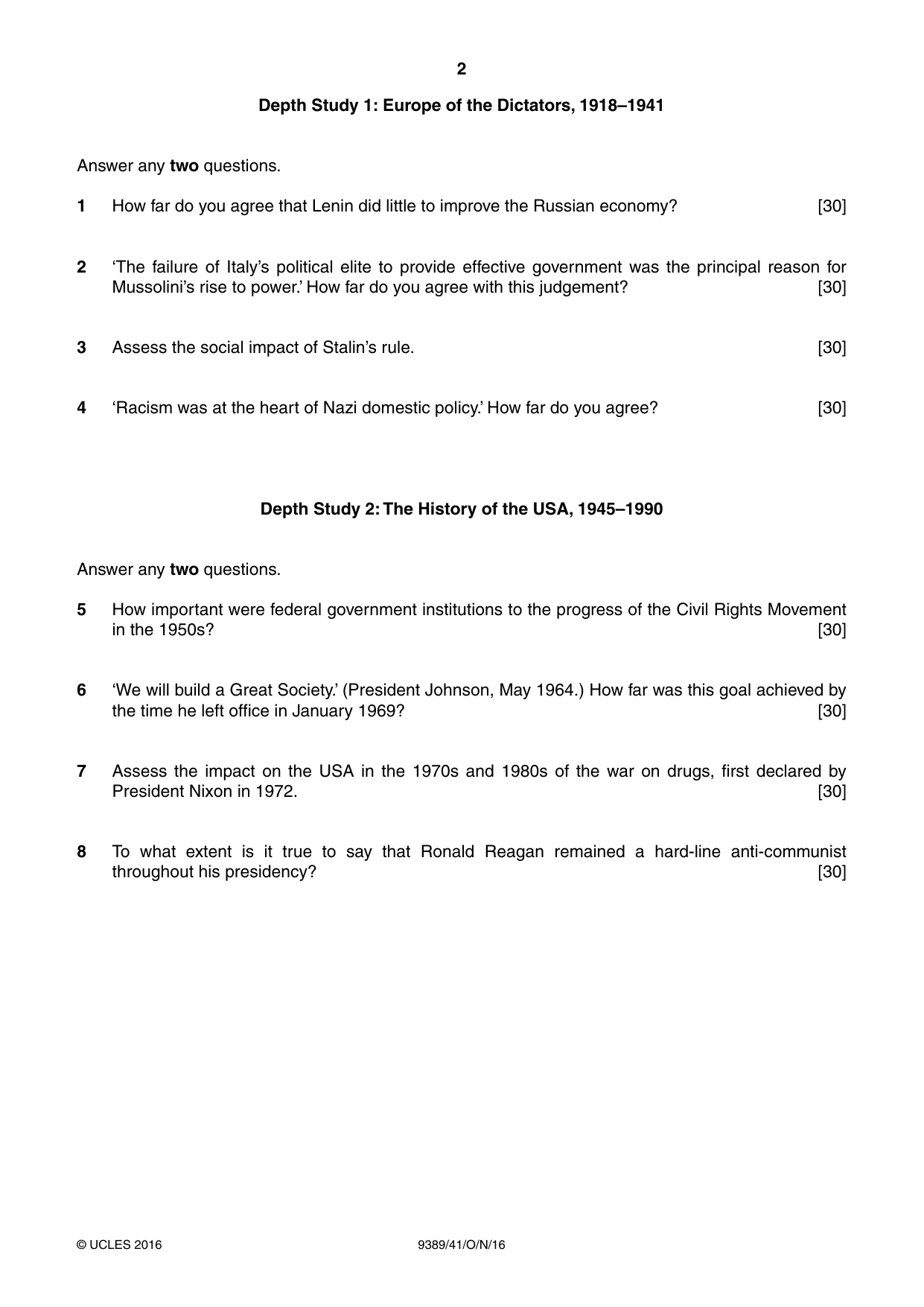
Question paper, page 2
2 9389/41/O/N/16 © UCLES 2016 Depth Study 1: Europe of the Dictators, 1918–1941 Answer any two questions. 1 How far do you agree that Lenin did little to improve the Russian economy? [30] 2 ‘The failure of Italy’s political elite to provide effective government was the principal reason for Mussolini’s rise to power.’ How far do you agree with this judgement? [30] 3 Assess the social impact of Stalin’s rule. [30] 4 ‘Racism was at the heart of Nazi domestic policy.’ How far do you agree? [30] Depth Study 2: The History of the USA, 1945–1990 Answer any two questions. 5 How important were federal government institutions to the progress of the Civil Rights Movement in the 1950s? [30] 6 ‘We will build a Great Society.’ (President Johnson, May 1964.) How far was this goal achieved by the time he left office in January 1969? [30] 7 Assess the impact on the USA in the 1970s and 1980s of the war on drugs, first declared by President Nixon in 1972. [30] 8 To what extent is it true to say that Ronald Reagan remained a hard-line anti-communist throughout his presidency? [30]
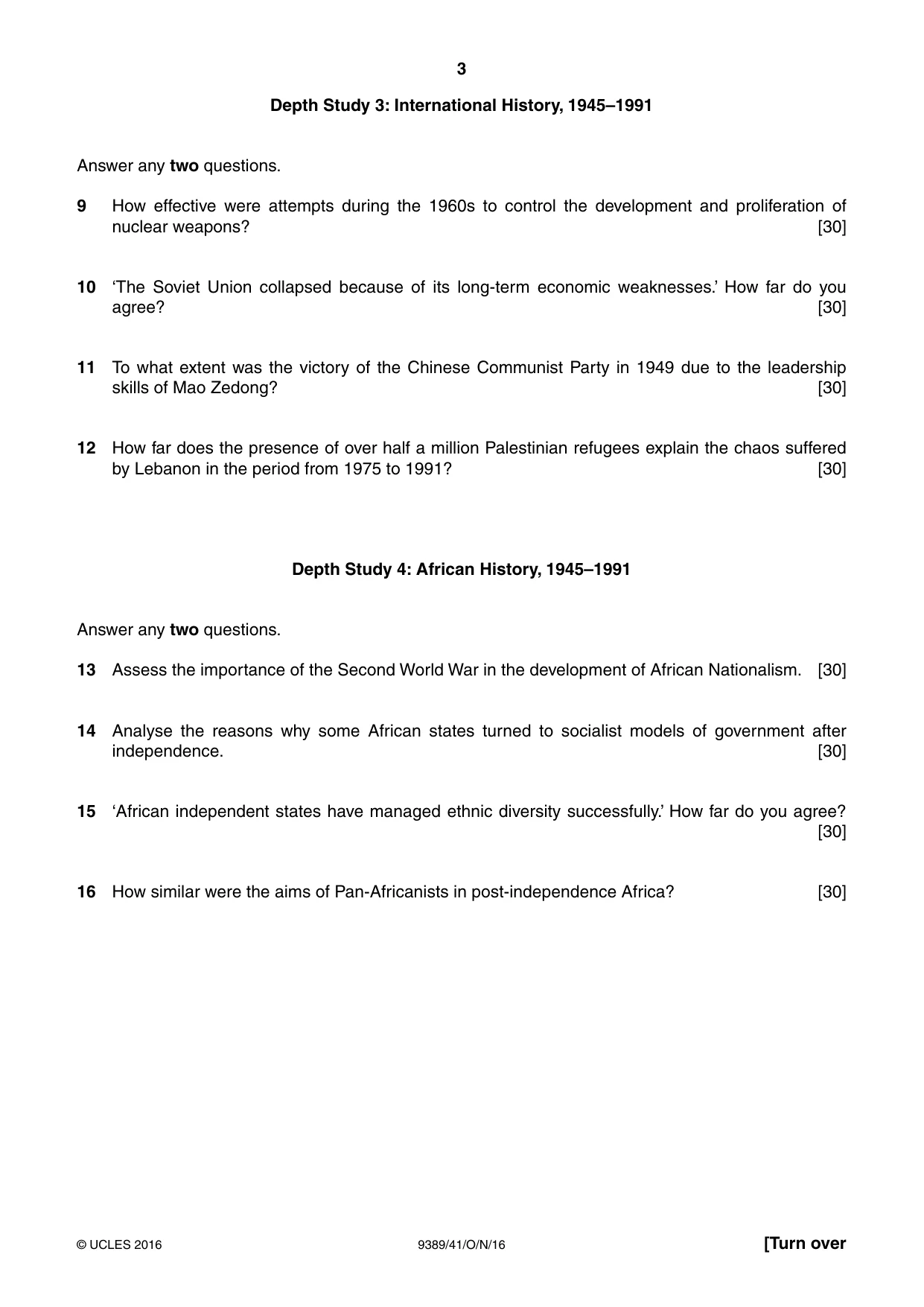
Question paper, page 3
3 9389/41/O/N/16 © UCLES 2016 [Turn over Depth Study 3: International History, 1945–1991 Answer any two questions. 9 How effective were attempts during the 1960s to control the development and proliferation of nuclear weapons? [30] 10 ‘The Soviet Union collapsed because of its long-term economic weaknesses.’ How far do you agree? [30] 11 To what extent was the victory of the Chinese Communist Party in 1949 due to the leadership skills of Mao Zedong? [30] 12 How far does the presence of over half a million Palestinian refugees explain the chaos suffered by Lebanon in the period from 1975 to 1991? [30] Depth Study 4: African History, 1945–1991 Answer any two questions. 13 Assess the importance of the Second World War in the development of African Nationalism. [30] 14 Analyse the reasons why some African states turned to socialist models of government after independence. [30] 15 ‘African independent states have managed ethnic diversity successfully.’ How far do you agree? [30] 16 How similar were the aims of Pan-Africanists in post-independence Africa? [30]
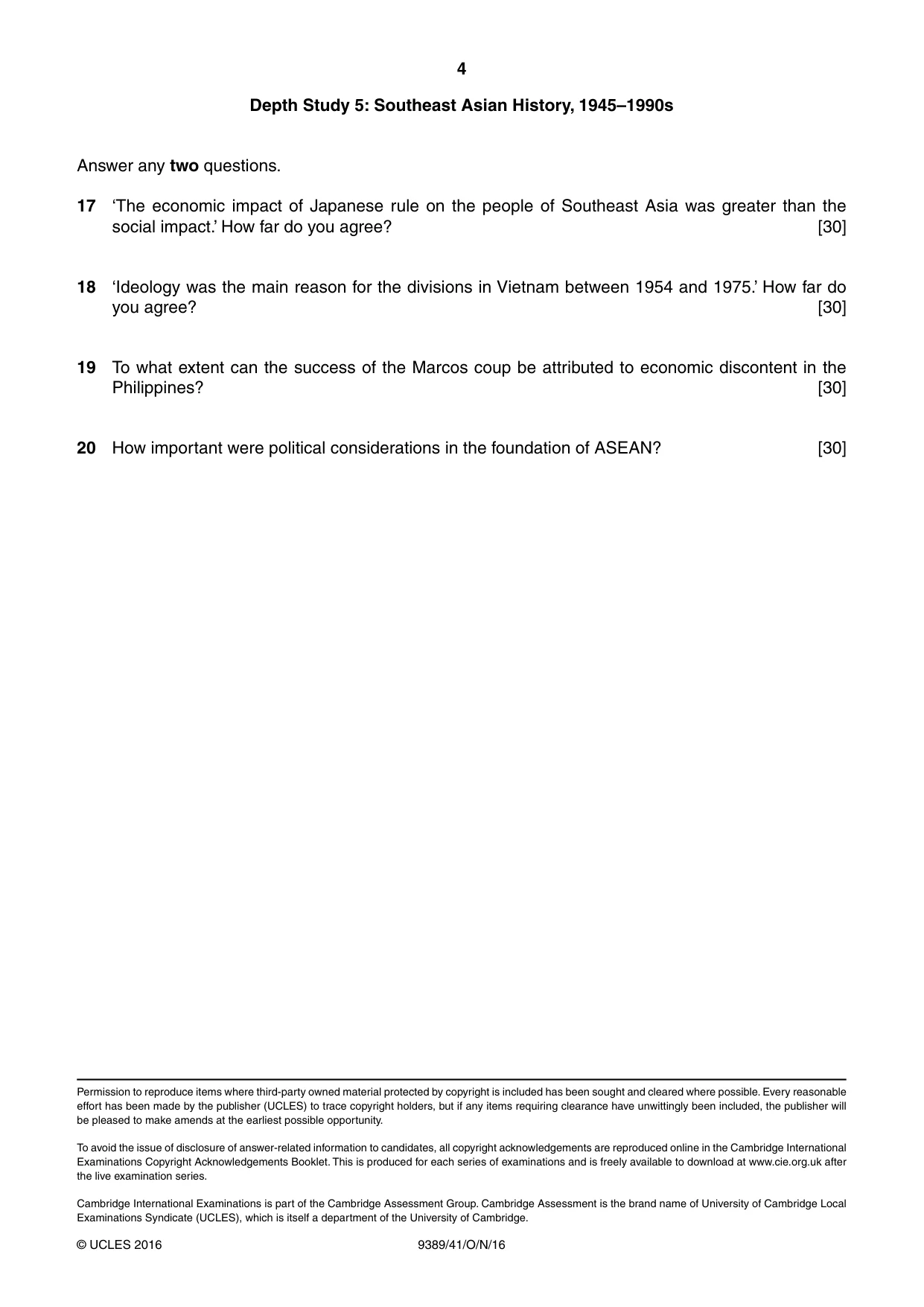
Question paper, page 4
4 9389/41/O/N/16 © UCLES 2016 Permission to reproduce items where third-party owned material protected by copyright is included has been sought and cleared where possible. Every reasonable effort has been made by the publisher (UCLES) to trace copyright holders, but if any items requiring clearance have unwittingly been included, the publisher will be pleased to make amends at the earliest possible opportunity. To avoid the issue of disclosure of answer-related information to candidates, all copyright acknowledgements are reproduced online in the Cambridge International Examinations Copyright Acknowledgements Booklet. This is produced for each series of examinations and is freely available to download at www.cie.org.uk after the live examination series. Cambridge International Examinations is part of the Cambridge Assessment Group. Cambridge Assessment is the brand name of University of Cambridge Local Examinations Syndicate (UCLES), which is itself a department of the University of Cambridge. Depth Study 5: Southeast Asian History, 1945–1990s Answer any two questions. 17 ‘The economic impact of Japanese rule on the people of Southeast Asia was greater than the social impact.’ How far do you agree? [30] 18 ‘Ideology was the main reason for the divisions in Vietnam between 1954 and 1975.’ How far do you agree? [30] 19 To what extent can the success of the Marcos coup be attributed to economic discontent in the Philippines? [30] 20 How important were political considerations in the foundation of ASEAN? [30]
Mark scheme, page 1
® IGCSE is the registered trademark of Cambridge International Examinations. This document consists of 15 printed pages. © UCLES 2016 [Turn over Cambridge International Examinations Cambridge International Advanced Subsidiary and Advanced Level HISTORY 9389/41 Paper 4 Depth Study October/November 2016 MARK SCHEME Maximum Mark: 60 Published This mark scheme is published as an aid to teachers and candidates, to indicate the requirements of the examination. It shows the basis on which Examiners were instructed to award marks. It does not indicate the details of the discussions that took place at an Examiners’ meeting before marking began, which would have considered the acceptability of alternative answers. Mark schemes should be read in conjunction with the question paper and the Principal Examiner Report for Teachers. Cambridge will not enter into discussions about these mark schemes. Cambridge is publishing the mark schemes for the October/November 2016 series for most Cambridge IGCSE®, Cambridge International A and AS Level components and some Cambridge O Level components.
Mark scheme, page 2
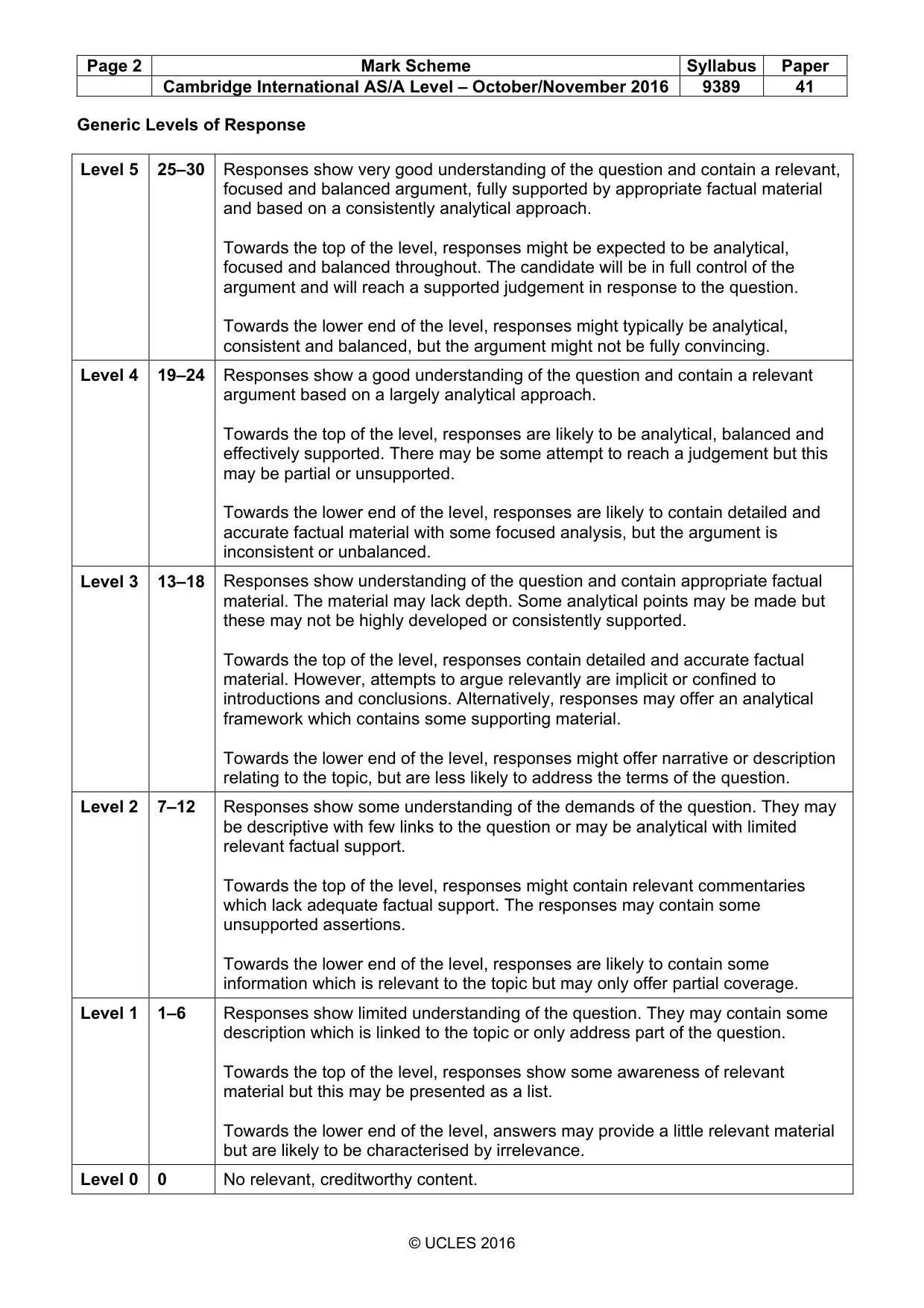
Page 2 Mark Scheme Syllabus Paper Cambridge International AS/A Level – October/November 2016 9389 41 © UCLES 2016 Generic Levels of Response Level 5 25–30 Responses show very good understanding of the question and contain a relevant, focused and balanced argument, fully supported by appropriate factual material and based on a consistently analytical approach. Towards the top of the level, responses might be expected to be analytical, focused and balanced throughout. The candidate will be in full control of the argument and will reach a supported judgement in response to the question. Towards the lower end of the level, responses might typically be analytical, consistent and balanced, but the argument might not be fully convincing. Level 4 19–24 Responses show a good understanding of the question and contain a relevant argument based on a largely analytical approach. Towards the top of the level, responses are likely to be analytical, balanced and effectively supported. There may be some attempt to reach a judgement but this may be partial or unsupported. Towards the lower end of the level, responses are likely to contain detailed and accurate factual material with some focused analysis, but the argument is inconsistent or unbalanced. Level 3 13–18 Responses show understanding of the question and contain appropriate factual material. The material may lack depth. Some analytical points may be made but these may not be highly developed or consistently supported. Towards the top of the level, responses contain detailed and accurate factual material. However, attempts to argue relevantly are implicit or confined to introductions and conclusions. Alternatively, responses may offer an analytical framework which contains some supporting material. Towards the lower end of the level, responses might offer narrative or description relating to the topic, but are less likely to address the terms of the question. Level 2 7–12 Responses show some understanding of the demands of the question. They may be descriptive with few links to the question or may be analytical with limited relevant factual support. Towards the top of the level, responses might contain relevant commentaries which lack adequate factual support. The responses may contain some unsupported assertions. Towards the lower end of the level, responses are likely to contain some information which is relevant to the topic but may only offer partial coverage. Level 1 1–6 Responses show limited understanding of the question. They may contain some description which is linked to the topic or only address part of the question. Towards the top of the level, responses show some awareness of relevant material but this may be presented as a list. Towards the lower end of the level, answers may provide a little relevant material but are likely to be characterised by irrelevance. Level 0 0 No relevant, creditworthy content.
Mark scheme, page 3
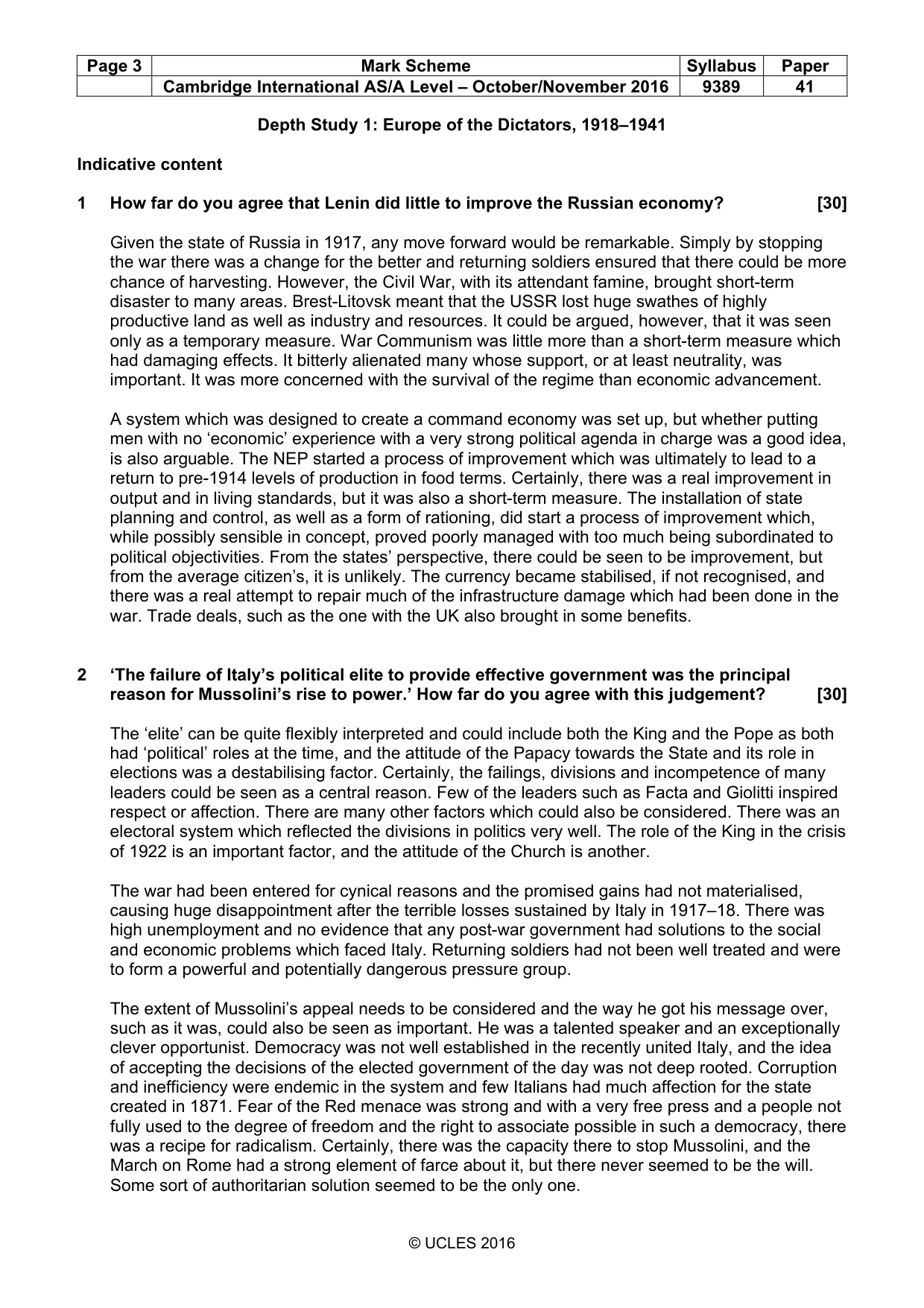
Page 3 Mark Scheme Syllabus Paper Cambridge International AS/A Level – October/November 2016 9389 41 © UCLES 2016 Depth Study 1: Europe of the Dictators, 1918–1941 Indicative content 1 How far do you agree that Lenin did little to improve the Russian economy? [30] Given the state of Russia in 1917, any move forward would be remarkable. Simply by stopping the war there was a change for the better and returning soldiers ensured that there could be more chance of harvesting. However, the Civil War, with its attendant famine, brought short-term disaster to many areas. Brest-Litovsk meant that the USSR lost huge swathes of highly productive land as well as industry and resources. It could be argued, however, that it was seen only as a temporary measure. War Communism was little more than a short-term measure which had damaging effects. It bitterly alienated many whose support, or at least neutrality, was important. It was more concerned with the survival of the regime than economic advancement. A system which was designed to create a command economy was set up, but whether putting men with no ‘economic’ experience with a very strong political agenda in charge was a good idea, is also arguable. The NEP started a process of improvement which was ultimately to lead to a return to pre-1914 levels of production in food terms. Certainly, there was a real improvement in output and in living standards, but it was also a short-term measure. The installation of state planning and control, as well as a form of rationing, did start a process of improvement which, while possibly sensible in concept, proved poorly managed with too much being subordinated to political objectivities. From the states’ perspective, there could be seen to be improvement, but from the average citizen’s, it is unlikely. The currency became stabilised, if not recognised, and there was a real attempt to repair much of the infrastructure damage which had been done in the war. Trade deals, such as the one with the UK also brought in some benefits. 2 ‘The failure of Italy’s political elite to provide effective government was the principal reason for Mussolini’s rise to power.’ How far do you agree with this judgement? [30] The ‘elite’ can be quite flexibly interpreted and could include both the King and the Pope as both had ‘political’ roles at the time, and the attitude of the Papacy towards the State and its role in elections was a destabilising factor. Certainly, the failings, divisions and incompetence of many leaders could be seen as a central reason. Few of the leaders such as Facta and Giolitti inspired respect or affection. There are many other factors which could also be considered. There was an electoral system which reflected the divisions in politics very well. The role of the King in the crisis of 1922 is an important factor, and the attitude of the Church is another. The war had been entered for cynical reasons and the promised gains had not materialised, causing huge disappointment after the terrible losses sustained by Italy in 1917–18. There was high unemployment and no evidence that any post-war government had solutions to the social and economic problems which faced Italy. Returning soldiers had not been well treated and were to form a powerful and potentially dangerous pressure group. The extent of Mussolini’s appeal needs to be considered and the way he got his message over, such as it was, could also be seen as important. He was a talented speaker and an exceptionally clever opportunist. Democracy was not well established in the recently united Italy, and the idea of accepting the decisions of the elected government of the day was not deep rooted. Corruption and inefficiency were endemic in the system and few Italians had much affection for the state created in 1871. Fear of the Red menace was strong and with a very free press and a people not fully used to the degree of freedom and the right to associate possible in such a democracy, there was a recipe for radicalism. Certainly, there was the capacity there to stop Mussolini, and the March on Rome had a strong element of farce about it, but there never seemed to be the will. Some sort of authoritarian solution seemed to be the only one.
Mark scheme, page 4
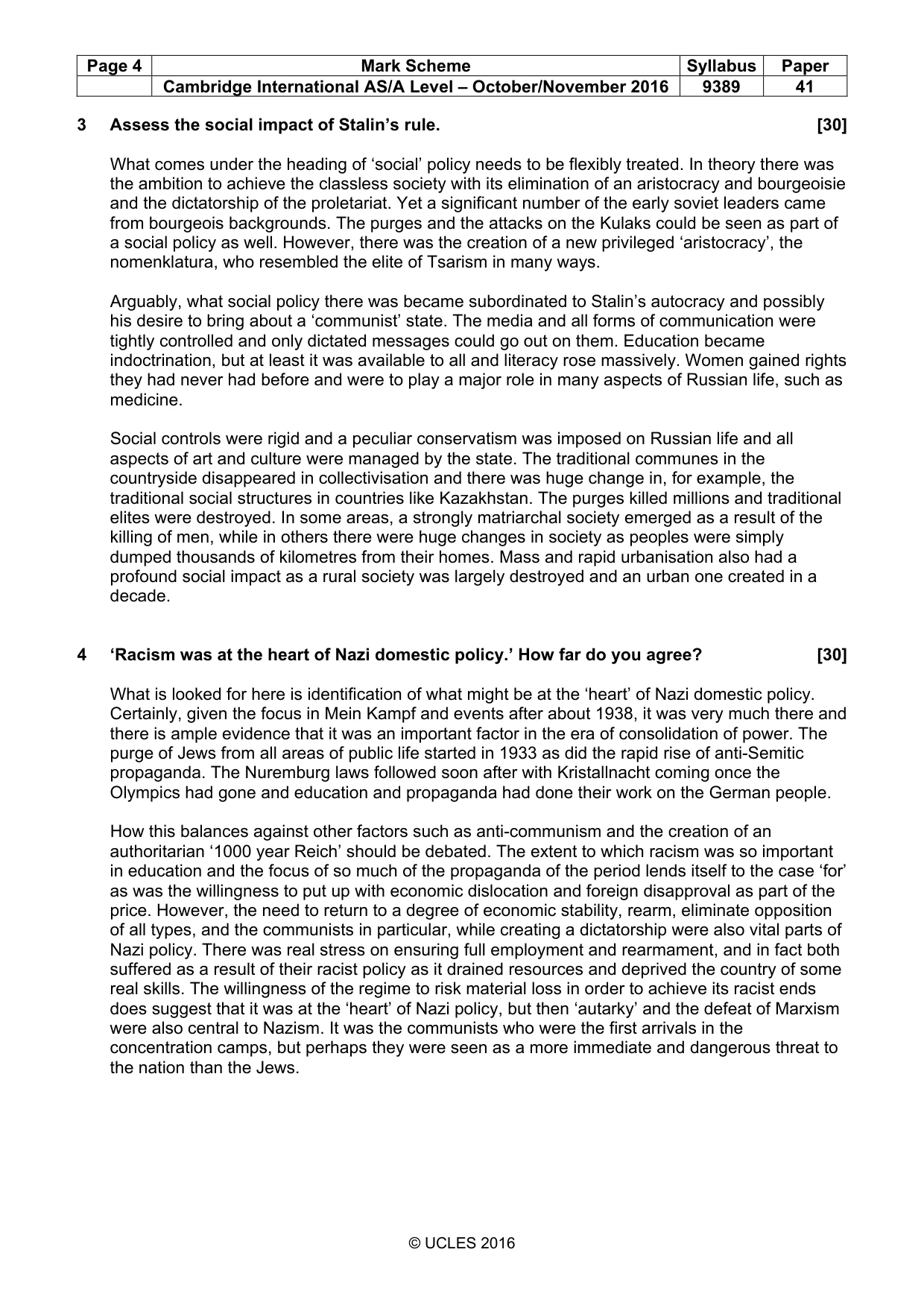
Page 4 Mark Scheme Syllabus Paper Cambridge International AS/A Level – October/November 2016 9389 41 © UCLES 2016 3 Assess the social impact of Stalin’s rule. [30] What comes under the heading of ‘social’ policy needs to be flexibly treated. In theory there was the ambition to achieve the classless society with its elimination of an aristocracy and bourgeoisie and the dictatorship of the proletariat. Yet a significant number of the early soviet leaders came from bourgeois backgrounds. The purges and the attacks on the Kulaks could be seen as part of a social policy as well. However, there was the creation of a new privileged ‘aristocracy’, the nomenklatura, who resembled the elite of Tsarism in many ways. Arguably, what social policy there was became subordinated to Stalin’s autocracy and possibly his desire to bring about a ‘communist’ state. The media and all forms of communication were tightly controlled and only dictated messages could go out on them. Education became indoctrination, but at least it was available to all and literacy rose massively. Women gained rights they had never had before and were to play a major role in many aspects of Russian life, such as medicine. Social controls were rigid and a peculiar conservatism was imposed on Russian life and all aspects of art and culture were managed by the state. The traditional communes in the countryside disappeared in collectivisation and there was huge change in, for example, the traditional social structures in countries like Kazakhstan. The purges killed millions and traditional elites were destroyed. In some areas, a strongly matriarchal society emerged as a result of the killing of men, while in others there were huge changes in society as peoples were simply dumped thousands of kilometres from their homes. Mass and rapid urbanisation also had a profound social impact as a rural society was largely destroyed and an urban one created in a decade. 4 ‘Racism was at the heart of Nazi domestic policy.’ How far do you agree? [30] What is looked for here is identification of what might be at the ‘heart’ of Nazi domestic policy. Certainly, given the focus in Mein Kampf and events after about 1938, it was very much there and there is ample evidence that it was an important factor in the era of consolidation of power. The purge of Jews from all areas of public life started in 1933 as did the rapid rise of anti-Semitic propaganda. The Nuremburg laws followed soon after with Kristallnacht coming once the Olympics had gone and education and propaganda had done their work on the German people. How this balances against other factors such as anti-communism and the creation of an authoritarian ‘1000 year Reich’ should be debated. The extent to which racism was so important in education and the focus of so much of the propaganda of the period lends itself to the case ‘for’ as was the willingness to put up with economic dislocation and foreign disapproval as part of the price. However, the need to return to a degree of economic stability, rearm, eliminate opposition of all types, and the communists in particular, while creating a dictatorship were also vital parts of Nazi policy. There was real stress on ensuring full employment and rearmament, and in fact both suffered as a result of their racist policy as it drained resources and deprived the country of some real skills. The willingness of the regime to risk material loss in order to achieve its racist ends does suggest that it was at the ‘heart’ of Nazi policy, but then ‘autarky’ and the defeat of Marxism were also central to Nazism. It was the communists who were the first arrivals in the concentration camps, but perhaps they were seen as a more immediate and dangerous threat to the nation than the Jews.
Mark scheme, page 5
Page 5 Mark Scheme Syllabus Paper Cambridge International AS/A Level – October/November 2016 9389 41 © UCLES 2016 Depth Study 2: The History of the USA, 1945–1990 Indicative content 5 How important were federal government institutions to the progress of the Civil Rights Movement in the 1950s? [30] Federal government institutions include all three branches of government: Congress, the Presidency and the US Supreme Court. Many candidates might equate government institutions only with the government, i.e. the presidency, which limits them to the presidency of Eisenhower and, arguably, Truman. [Truman’s executive order integrating the armed forces, an important reform, came in 1948.] If they do, they are likely to mention Eisenhower’s 1956 decision to send federal troops to Little Rock, Arkansas, in order to enforce the end of school segregation. They are less likely to mention the two Civil Rights Acts of the era, in 1957 and 1960. Both aimed to uphold the 15th Amendment giving African Americans the right to vote. Eisenhower led the way in both cases. They ought to mention Eisenhower’s appointment of five Supreme Court judges, including Chief Justice Warren. None were from the South. Warren was the key figure in the most famous Supreme Court judgement concerning civil rights at the time: Brown vs. the Board of Education of Topeka in 1954. Under Chief Justice Warren, the Supreme Court made a series of judgements which improved the position of African Americans, e.g. Browder vs. Gayle 1956, which ruled that Alabama’s state laws segregating buses were unconstitutional. The third branch of government, Congress, did less than the other two. The dominance of white Southern Democrats, especially in the Senate, meant that Ike’s civil rights legislation was watered down. The leader of the US Senate was a Texan, Lyndon Johnson, a hero of civil rights reforms in the 1960s but less so in the 1950s. 6 ‘We will build a Great Society.’ (President Johnson, May 1964.) How far was this goal achieved by the time he left office in January 1969? [30] LBJ went on to say ‘It is a society where no child will go uneducated and no youngster will go unschooled. Where no man who wants work will fail to find it’. He was addressing an audience of college staff and students in Ohio. His speech showed the confidence and optimism of a progressive politician who had witnessed the success of the New Deal in the 1930s and wanted something equally – or even more – ambitious in the 1960s and 1970s. In his Ohio speech, LBJ did say that achieving these goals was the project of a generation. He believed in the ability of the federal government to achieve such goals, which also included a ‘war on poverty’ announced in LBJ’s first State of the Union address in January 1965. The Democratic Party’s control of Congress enabled much Great Society legislation to be passed in 1964–65. The best known include Medicare and Medicaid. Among many other reforms were the 1964 Economic Opportunity Act, which aimed to help poor children go to college [university], and the 1965 Omnibus Housing Act, which provided $7.5 billion to help provide housing for the poor. LBJ’s reforms did have some positive effects, especially in reducing poverty, which had fallen from 19% of the population in the early 1960s to 12% at the end of the decade. The number of poor African Americans was halved during the same time. Medicaid, which provided free medical care for the poor, was also effective in ensuring more poor people had medical assistance. Expenditure on the Vietnam War limited the amount which could be spent on federal social expenditure. In later years, the Great Society reforms were seen as expensive, excessively
Mark scheme, page 6
Page 6 Mark Scheme Syllabus Paper Cambridge International AS/A Level – October/November 2016 9389 41 © UCLES 2016 bureaucratic and a relative failure, especially by the New Right, which came to power with the Reagan presidency. 7 Assess the impact on the USA in the 1970s and 1980s of the war on drugs, first declared by President Nixon in 1972. [30] The war had two aspects: foreign, trying to control the supply of illegal drugs into the USA, usually from Central America, and domestic. The latter had two elements: prevention, trying to discourage use, or punishment, taking tough action against drug users. The focus of the question is intended to be domestic policies. Though Nixon declared war on drug taking in 1972, relatively little action followed in the 1970s. In the 1980s, both prevention and punishment policies were used. The First Lady, Nancy Reagan, led the first with her ‘Just Say No’ campaign from 1982 onwards. The centrepiece of the second was the 1986 Anti-Drug Abuse Act. This was a response to the crack cocaine epidemic of the time. Crack was cheaper than powder cocaine. Thus it found a ready market among the poorer sections of society, especially young African Americans. The 1986 Act, a federal law, introduced minimum mandatory sentences of five years for possessing either 5 grams of crack cocaine or 500 grams of powder cocaine. Many states followed suit. The numbers in prisons for drug-related offences soared. New prisons had to be built. Most prisoners were African American. Some commentators saw the war on drugs as essentially racist, as doing nothing to improve race relations. [In 2010, the Fair Sentencing Act scrapped minimum mandatory sentences and reduced the powder/crack ratio from 100/1 to 18/1.] Use of illegal drugs by college students in the 1980s did fall, however, if social surveys are to be believed. The reasons for this are hard to identify. The domestic campaigns of the war on drugs might be one reason. Others argue that the war has been lost, that other reasons explain the decline in drug use, not least children being put off by their drug-taking parents. 8 To what extent is it true to say that Ronald Reagan remained a hard-line anti-communist throughout his presidency? [30] The contrast between the first -term Ronald Reagan, who called the USSR an evil empire, and the second-term version, who agreed several nuclear disarmament treaties with the USSR, is well known. This difference appears to make it hard to maintain the argument that Reagan was a hard-line anti-communist from start to finish. Reagan’s foreign policy, however, was much more wide-ranging than US relations with the USSR. It was intended to roll back communism rather than contain it. Some call this strategy the Reagan Doctrine. Thus Reagan was willing to supply arms to Contra rebels opposed to the left-wing Sandinista government in Nicaragua, and to the Mujahedeen attacking the Soviet regime in Afghanistan. These policies were part of his second term as well as his first. When it came to the USSR, however, there was a notable thawing of relations from 1986 onwards. In part, this was a consequence of a new man in the Kremlin, Gorbachev, who was anxious to address the USSR’s deep-seated domestic problems and wanted no foreign adventures. In part, the thaw resulted from Reagan’s deep-seated fears of a nuclear war, fears which had grown as a result of the so-called Second Cold War of the early 1980s. Even then, Reagan refused to concede to Soviet demands to scrap the Strategic Defence Initiative [aka Star Wars], which would provide a shield against nuclear attack. Relations with China, starting to modernise under Deng Xiaoping’s leadership, were also viewed through anti-communist glasses. Reagan’s preference was to support capitalist Taiwan against communist China, though a compromise of sorts was eventually agreed. Thus, across the spectrum of foreign affairs, there were some differences of emphasis.
Mark scheme, page 7
Page 7 Mark Scheme Syllabus Paper Cambridge International AS/A Level – October/November 2016 9389 41 © UCLES 2016 Depth Study 3: International History, 1945–1991 Indicative content 9 How effective were attempts during the 1960s to control the development and proliferation of nuclear weapons? [30] Effective – The Cuban missile crisis had exposed the dangers involved in massive retaliation and brinkmanship, and clearly demonstrated the need for greater communication and understanding between the superpowers and, indeed, other states which possessed (or had the potential to possess) nuclear capability. The Test Ban Treaty of 1963 was initially signed by the USA, the USSR and Britain, other countries following thereafter. It banned the testing of nuclear weapons above ground and below water, clearly aiming to inhibit the development of new weapons. Testing could only be carried out underground and within the confines of the country concerned. The Nuclear Non-Proliferation Treaty of 1968 was designed to prevent the spread of nuclear weapons to non-nuclear states. Its effectiveness can be gauged by the fact that it is still in existence today and the number of states with nuclear weapons remains relatively small. Moreover, the 1960s saw the beginning of the process of negotiation to reduce the threat posed by nuclear weapons, these treaties being vital precursors to subsequent agreements. Not effective – The Test Ban Treaty of 1963 was only a partial or limited treaty. Testing underground was still permitted, and both the USA and the USSR undertook ‘cratering tests’ – these complied with the Treaty since they were underground, but they were designed to break the surface, therefore causing radioactive fallout. The Test Ban Treaty, therefore, did not prevent the development of new weapons. The Non-Proliferation Treaty had major limitations and it did not inhibit the development of new and more powerful weapons by the superpowers. Some countries refused to sign the Treaty (e.g. India, Pakistan and Israel), others (e.g. North Korea) have subsequently withdrawn their support for it and some are believed to have been in breach of it (e.g. Iran). The Treaty is extremely difficult to monitor and enforce. Moreover, it did not prevent the superpowers planting their own nuclear weapons in non-nuclear states. The concept of MAD (mutually assured destruction), which emerged during the 1960s, was based on the assumption that both the USA and the USSR had sufficient weapons to act as a deterrent; any development by one side therefore necessitated a similar or improved development by the other. For example, in its attempt to close the missile gap with the USA, the USSR increased its development of ICBMs and SLBMs.
Mark scheme, page 8
Page 8 Mark Scheme Syllabus Paper Cambridge International AS/A Level – October/November 2016 9389 41 © UCLES 2016 10 ‘The Soviet Union collapsed because of its long-term economic weaknesses.’ How far do you agree? [30] Agree – With poor quality land and the financial inability to use fertilisers, Soviet agriculture had long found it difficult to increase production; as early as the 1960s, the USSR needed to import grain (often from the USA). By the 1970s, Russian industry was outdated and inefficient; over- centralised, too focused on heavy industry and lacking investment in new technology. Brezhnev refused to allow any reduction in state control of the economy, fearing that this would lead to independence of thought in the satellite states. Under Andropov and Chernenko, the Soviet economy suffered further from inertia. The biggest strain on the Soviet economy was defence spending, both to maintain control of the satellite states (Brezhnev Doctrine) and to keep pace with the USA in the arms race. When he came to power in 1985, Gorbachev’s main priority was economic reform. He argued that the economy was too centralised, too focused on defence and heavy industry and failing to produce consumer goods. However, Gorbachev believed that economic reform could not happen without political reform and without a massive reduction in defence spending. His reforms (glasnost, perestroika, ending the Brezhnev Doctrine) were designed to encourage the USA to negotiate and, thus, to facilitate economic reform. His attempt to reduce state control of the economy was not popular with right-wing members of the Party, while those who supported Yeltsin criticised Gorbachev for not going far enough. Moreover, his reforms did not produce results quickly enough, basic goods (e.g. soap and food) remaining in short supply. This enhanced nationalist sentiment both inside the USSR itself and in Eastern Europe. As a result, the USSR collapsed. Disagree – Triumphalists argue that the USSR collapsed because of the pressure imposed upon it by the USA. A constant stream of Western propaganda encouraged nationalist fervour in Eastern Europe, while Reagan’s massive increase in arms spending (including SDI) was something which the USSR simply could not match. Others blame Gorbachev for the collapse of the USSR, arguing that it would have been possible to reform the economy without the political reforms which undermined the control of the Communist Party (just as Deng did with his move towards ‘market socialism’ in China). By allowing greater democracy and free speech, Gorbachev’s policies led to splits within the Party and encouraged the independence of thought within the satellite states which Brezhnev had been so determined to suppress. Gorbachev’s decision to end the Brezhnev Doctrine effectively guaranteed that the Eastern European states would seek and gain independence, which, in turn, enflamed nationalist feelings within the USSR itself (e.g. Lithuania, Latvia, Estonia). Conclusion – the best answers will show evidence of understanding how the various causal factors interlink. For example, Gorbachev’s desire to reform the economy required a reduction in defence spending; this meant entering negotiations with the USA; this would not have been possible without showing signs that the USSR was willing to allow more human rights and freedoms (so that Reagan and Thatcher would perceive Gorbachev as a man they ‘could do business with’).
Mark scheme, page 9
Page 9 Mark Scheme Syllabus Paper Cambridge International AS/A Level – October/November 2016 9389 41 © UCLES 2016 11 To what extent was the victory of the Chinese Communist Party in 1949 due to the leadership skills of Mao Zedong? [30] Yes – Mao was an excellent exponent of the art of propaganda, using it effectively to gain popular support for the CCP. He had cultivated the support of the vast majority of the Chinese population, the peasants. Even during the traumas of the Long March, Mao had insisted that his followers show the utmost respect to peasants, while his land redistribution policies offered them hope for an end to poverty and famine. In the areas under CCP control, Mao continued to win popular support with his restrained land policy, which varied according to the needs of each particular area. He successfully portrayed the CCP as the true party of Chinese nationalism, in particular by fighting a guerrilla war against the Japanese. This gained him the support of the middle classes, who resented the threat which the Japanese posed to their livelihoods. As a result, the CCP continued to gain more territory in China; in 1937, the CCP had 5 bases controlling 12 million people; by 1945, it controlled 100 million people from 19 bases. CCP forces gained a reputation for good discipline, while the CCP was increasingly perceived as both honest and fair. Mao ensured that the CCP armies were well trained and well led. He appointed generals who were tactically competent and utterly loyal to the cause (e.g. Lin Biao, Ch-en Yi, Chu Teh). By 1949, the CCP had gained sufficient strength to challenge the KMT directly, taking Beijing and forcing Chiang to flee to the island of Taiwan. No – The CCP victory was largely the result of weaknesses within the KMT. Chiang made little use of propaganda and made no real attempt to gain popular support for the KMT. Chiang’s government carried out very little social reform and clearly favoured the wealthier elements in Chinese society (landowners, businessmen, factory owners). Chiang believed that fighting against the Japanese invaders was a hopeless task and, instead, concentrated on fighting against the CCP which he believed posed the biggest threat to the KMT government. This added to the growing unpopularity of the KMT and led to divisions within his own armies (some of his troops even took him prisoner and forced him to restore cooperation with the CCP in order to fight the Japanese). The KMT government was widely seen as inefficient and corrupt; it was alleged that much of the aid received from the USA (which wanted the KMT to win the war because of its fear of communism) went into the pockets of KMT officials. In order to sustain its war against the CCP, the KMT printed more money, leading to inflation and hardship for peasants and middle classes alike. The KMT armies were poorly paid and poorly trained; unlike the CCP armies, they regularly looted the countryside. Faced with well trained CCP troops, many KMT soldiers simply deserted or changed sides. Although the USA helped the KMT gain control of land formerly taken by the Japanese, the CCP was able to gain control of Manchuria (where the USSR obstructed the KMT). This gave the CCP a major base from which to continue its guerrilla war against the KMT.
Mark scheme, page 10
Page 10 Mark Scheme Syllabus Paper Cambridge International AS/A Level – October/November 2016 9389 41 © UCLES 2016 12 How far does the presence of over half a million Palestinian refugees explain the chaos suffered by Lebanon in the period from 1975 to 1991? [30] Yes – The presence of Palestinian refugees destabilised Lebanon in three main ways. Firstly, it upset the fragile balance which existed between Christian and Muslim groups; the most conservative Christian group (the Maronites) in particular saw the left-wing and Muslim Palestinians as a threat. Secondly, the Palestinians were continually involved in frontier incidents with Israel, leading the Israelis to hit back in southern Lebanon. Thirdly, the presence of so many Palestinian refugees meant that, by 1975, Lebanon had become the headquarters of the PLO; this not only caused further concern in Israel, but also meant that Syria, the main supporter of the PLO, was constantly interfering in Lebanon. The chaos began with a minor dispute between Christians and Muslims over fishing rights in 1975. Right-wing Christians saw this as the opportunity to expel Palestinians, who had sided with the Muslims, from Lebanon, while the PLO was determined to protect the Palestinians. Fearing that the Muslims might win the civil war which ensued, Israel threatened to invade Lebanon. To prevent this, Syria sent troops into Lebanon to keep the PLO under control (1976). When further fighting broke out between Christians and Palestinians in southern Lebanon, Israel sent troops to support the Christians. It required UN forces to maintain a fragile peace in the region. In 1982, in response to a Palestinian attack on Israel, Israeli troops invaded Lebanon, temporarily expelling Palestinians from Beirut and forcing the PLO leaders out of the country. No – The potential for problems in Lebanon existed independently of the presence of Palestinian refugees. Although there was a carefully framed constitution giving fair representation to all political and religious groups, this could not disguise the long-term hatred which existed, both between Muslims and Christians and between different Muslim and Christian factions. The escalation of a minor dispute over fishing rights in 1975 was due to ongoing hatred between Christians and Muslims. From 1980, Lebanon was hit by a struggle between rival Christian groups. In 1984, rival Muslim groups (Shia and Druze) fought for control of West Beirut; this was repeated in 1987, when a number of European and American hostages were seized. Facing the total disintegration of the country, the Lebanese government appealed to President Assad of Syria; he sent troops to restore order. The restoration of calm and the introduction of a new constitution were entirely due to the presence of Syrian troops. In 1991, Lebanon and Syria signed a treaty of ‘brotherhood and co-ordination’; this was criticised by Israel as being Lebanon’s annexation by Syria. The chaotic state of Lebanon was, therefore, due to two main factors. Firstly, the long-term divisions within the country itself. Secondly, tensions which had existed in the Middle East following the creation of the state of Israel.
Mark scheme, page 11
Page 11 Mark Scheme Syllabus Paper Cambridge International AS/A Level – October/November 2016 9389 41 © UCLES 2016 Depth Study 4: African History, 1945–1991 Indicative content 13 Assess the importance of the Second World War in the development of African Nationalism. [30] WWII was significant because it brought about a fundamental shift in attitudes: • Disillusionment when colonial powers failed to keep promises of pensions and other benefits in exchange for enlistment. • Colonies not only provided troops during the war but also supplies of food and raw materials. For this, Africans expected rewards. • Britain encouraged immigration to the Rhodesias in particular, thus increasing white domination. • It was realised that political change was necessary – the Allies had proclaimed a war against racism and for democracy, e.g. in the Atlantic Charter. • Ex-soldiers gained political awareness and experience of new areas of the world. • War led to the greater exploitation of African resources which increased economic importance of some African economies and greater confidence in demanding independence. • War weakened colonial powers and showed vulnerability to Asian nationalism. • War accelerated move from colonies, e.g. British in India and influence of USSR/USA anti- colonialism. • War led to creation of UN and encouraged support for independence of trustee territories like Tanganyika, Ghana, Rwanda, Burundi, etc. • Wartime propaganda important. • The war restored the independence of Ethiopia which was a model of an independent African state. Against this was pressure brought about by post-war exploitation of African resources; existing nationalist movements and leaders; rise of Welfare and Cooperative unions; growth of communications and education. The war often accelerated pre-war trends. Better answers will balance the direct and indirect results of war and also distinguish between continuity of nationalist development before 1939 and change accelerated or brought about by war. 14 Analyse the reasons why some African states turned to socialist models of government after independence. [30] Candidates could show understanding of different types of socialism in Africa and the appeal of each to African countries. Answers may choose Tanzania and the ujamaa policy of Nyerere; also Guinea and Ghana. Mozambique and Angola are examples of Marxist-Leninist scientific socialism. Nyerere’s policy of ‘African Socialism’ was to build upon Marxism but deviate where necessary to suit the African situation and character. It emphasised African traditions of community, classlessness and co-operation. It hoped to use modern technology and production methods but not be dependent upon a proletariat. In Guinea, Sekou Toure committed to ‘scientific socialism’ after expulsion from the French community in 1958. Nkrumah’s socialism was economic and utilitarian. He saw tribalism and African tradition as backward, while a socialist society was modern, technological and productive. He wanted to catch up with the western world fast. He saw richer bourgeoisie as reactionary, siding with the West; Africa could only beat its imperialist past by uniting as a continent with socialist policies of production. In Mozambique, FRELIMO followed Marxist-Leninist tradition which seemed to
Mark scheme, page 12
Page 12 Mark Scheme Syllabus Paper Cambridge International AS/A Level – October/November 2016 9389 41 © UCLES 2016 promise modernity in contrast to the Portuguese stagnation of the past. Candidates might consider the ideological motives; socialism as an expression of anti-colonialism; the example of peasant-based communism in China; the need for direct state development of the economy; the ability of socialism to chime with established cultural traditions. Better answers will analyse and consider relative importance and not just list causes. 15 ‘African independent states have managed ethnic diversity successfully.’ How far do you agree? [30] This question could be addressed by taking a broad-brush approach, surveying diversity in several different states, or by concentrating on particular aspects. General considerations: • Social cleavages of ethnicity can be found in all African countries. Only occasionally does this result in violence. • Ethnic diversity is the natural result of ethnic groups being bound together in a new nation with boundaries defined during colonial times and for colonial convenience. Tribal links often cross national boundaries or create strong regional identity within a country. • Differences might have developed into a struggle for political power or for economic advantage by different groups. Candidates could produce a strong answer by analysing the reasons for, and results of, particular ethnic clashes (e.g. Nigeria or Uganda) or focus on positive or negative uses of ethnic diversity. Positive use of ethnic diversity: • Ethnic or regional leaders included in the government. • Ethnic quotas applied when promoting to office or increasing the bureaucracy. • Ethnic groups pacified while negotiations take place and so hope kept alive and pressure on negotiators to reach successful compromise (e.g. in Kenya or Cote d’Ivoire). • Promotion of composite ‘African’ identity in order to enhance a forward-looking state, e.g. Senghor’s ‘Negritude’. • From the early 1960s, African language study and research centres were created in universities as a way of attracting outside funding and attracting academic or media attention; Africanists promoted awareness of heritage and culture from these new bases. • UNESCO began drafting a General History of Africa, linguistic conferences and plans for recording oral traditions. • Regional pressure groups, educated special interest groups, students’ or women’s organisations have sporadically been at the forefront of campaigns to promote African languages or gain recognition for writers, musicians and dancers. • Occasionally African leaders have given cultural activities strong support, e.g. Kenyatta’s great love of African dance. Negative use of ethnic diversity: • Encouragement of deliberate ethnic imbalance, with political motive (e.g. Uganda), or resulting in violent clashes when the situation mismanaged (e.g. Nigeria, Zaire, Zimbabwe). • Suppression of regional or tribal identity in order to consolidate new nation, even though freedom of expression enshrined in constitution. (Promotion of language or culture then left to international agencies or interested foreign countries.)
Mark scheme, page 13
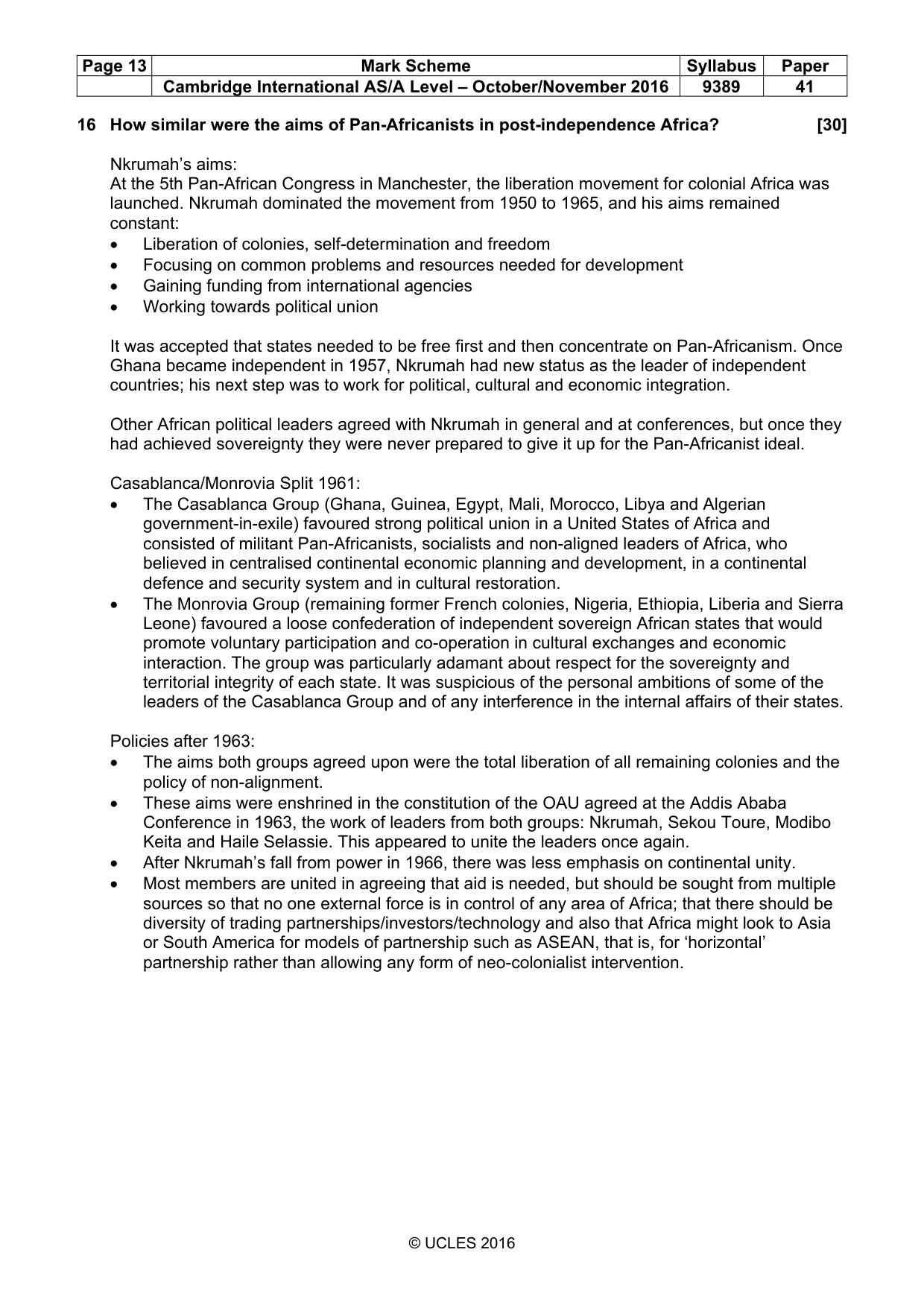
Page 13 Mark Scheme Syllabus Paper Cambridge International AS/A Level – October/November 2016 9389 41 © UCLES 2016 16 How similar were the aims of Pan-Africanists in post-independence Africa? [30] Nkrumah’s aims: At the 5th Pan-African Congress in Manchester, the liberation movement for colonial Africa was launched. Nkrumah dominated the movement from 1950 to 1965, and his aims remained constant: • Liberation of colonies, self-determination and freedom • Focusing on common problems and resources needed for development • Gaining funding from international agencies • Working towards political union It was accepted that states needed to be free first and then concentrate on Pan-Africanism. Once Ghana became independent in 1957, Nkrumah had new status as the leader of independent countries; his next step was to work for political, cultural and economic integration. Other African political leaders agreed with Nkrumah in general and at conferences, but once they had achieved sovereignty they were never prepared to give it up for the Pan-Africanist ideal. Casablanca/Monrovia Split 1961: • The Casablanca Group (Ghana, Guinea, Egypt, Mali, Morocco, Libya and Algerian government-in-exile) favoured strong political union in a United States of Africa and consisted of militant Pan-Africanists, socialists and non-aligned leaders of Africa, who believed in centralised continental economic planning and development, in a continental defence and security system and in cultural restoration. • The Monrovia Group (remaining former French colonies, Nigeria, Ethiopia, Liberia and Sierra Leone) favoured a loose confederation of independent sovereign African states that would promote voluntary participation and co-operation in cultural exchanges and economic interaction. The group was particularly adamant about respect for the sovereignty and territorial integrity of each state. It was suspicious of the personal ambitions of some of the leaders of the Casablanca Group and of any interference in the internal affairs of their states. Policies after 1963: • The aims both groups agreed upon were the total liberation of all remaining colonies and the policy of non-alignment. • These aims were enshrined in the constitution of the OAU agreed at the Addis Ababa Conference in 1963, the work of leaders from both groups: Nkrumah, Sekou Toure, Modibo Keita and Haile Selassie. This appeared to unite the leaders once again. • After Nkrumah’s fall from power in 1966, there was less emphasis on continental unity. • Most members are united in agreeing that aid is needed, but should be sought from multiple sources so that no one external force is in control of any area of Africa; that there should be diversity of trading partnerships/investors/technology and also that Africa might look to Asia or South America for models of partnership such as ASEAN, that is, for ‘horizontal’ partnership rather than allowing any form of neo-colonialist intervention.
Mark scheme, page 14
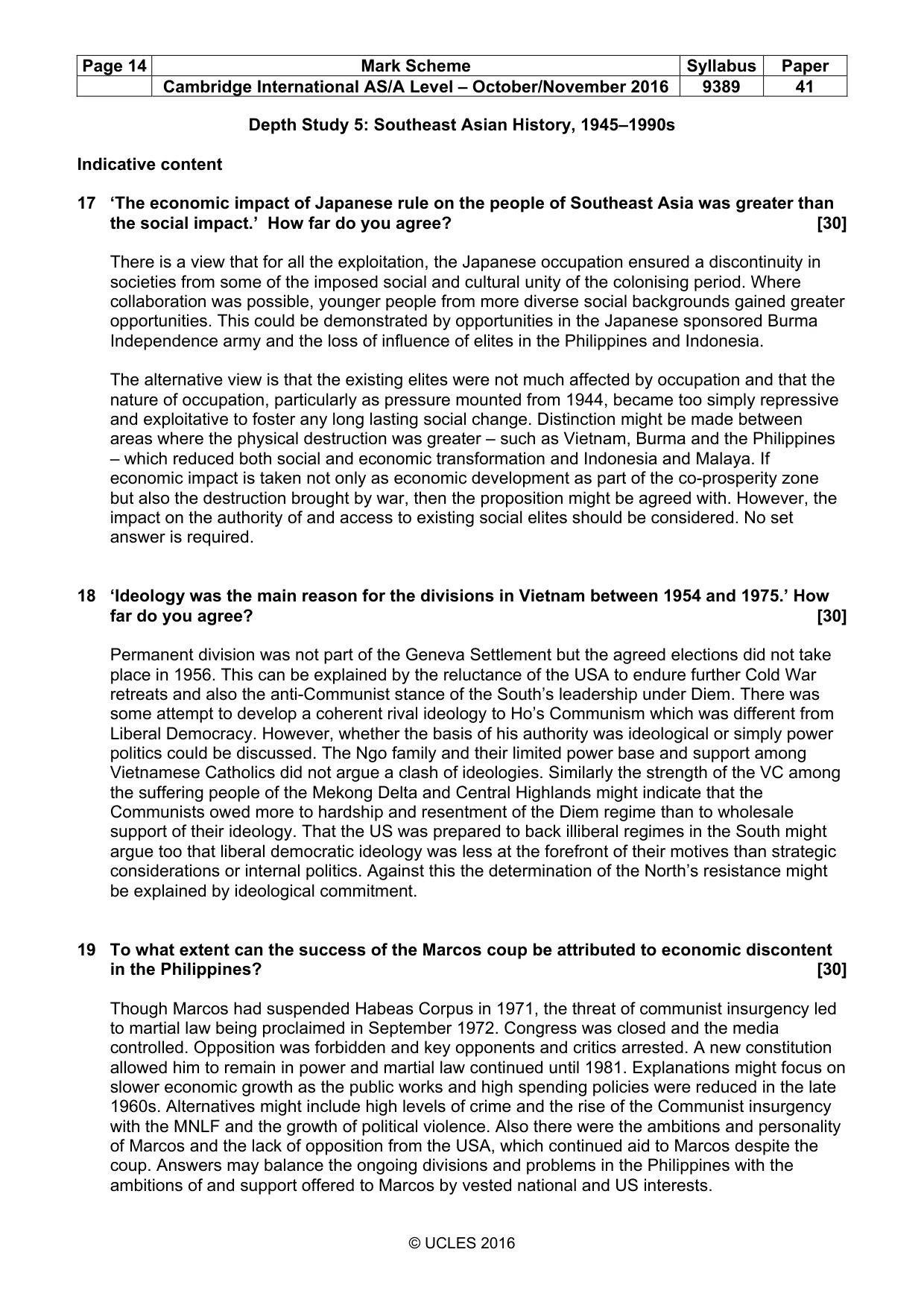
Page 14 Mark Scheme Syllabus Paper Cambridge International AS/A Level – October/November 2016 9389 41 © UCLES 2016 Depth Study 5: Southeast Asian History, 1945–1990s Indicative content 17 ‘The economic impact of Japanese rule on the people of Southeast Asia was greater than the social impact.’ How far do you agree? [30] There is a view that for all the exploitation, the Japanese occupation ensured a discontinuity in societies from some of the imposed social and cultural unity of the colonising period. Where collaboration was possible, younger people from more diverse social backgrounds gained greater opportunities. This could be demonstrated by opportunities in the Japanese sponsored Burma Independence army and the loss of influence of elites in the Philippines and Indonesia. The alternative view is that the existing elites were not much affected by occupation and that the nature of occupation, particularly as pressure mounted from 1944, became too simply repressive and exploitative to foster any long lasting social change. Distinction might be made between areas where the physical destruction was greater – such as Vietnam, Burma and the Philippines – which reduced both social and economic transformation and Indonesia and Malaya. If economic impact is taken not only as economic development as part of the co-prosperity zone but also the destruction brought by war, then the proposition might be agreed with. However, the impact on the authority of and access to existing social elites should be considered. No set answer is required. 18 ‘Ideology was the main reason for the divisions in Vietnam between 1954 and 1975.’ How far do you agree? [30] Permanent division was not part of the Geneva Settlement but the agreed elections did not take place in 1956. This can be explained by the reluctance of the USA to endure further Cold War retreats and also the anti-Communist stance of the South’s leadership under Diem. There was some attempt to develop a coherent rival ideology to Ho’s Communism which was different from Liberal Democracy. However, whether the basis of his authority was ideological or simply power politics could be discussed. The Ngo family and their limited power base and support among Vietnamese Catholics did not argue a clash of ideologies. Similarly the strength of the VC among the suffering people of the Mekong Delta and Central Highlands might indicate that the Communists owed more to hardship and resentment of the Diem regime than to wholesale support of their ideology. That the US was prepared to back illiberal regimes in the South might argue too that liberal democratic ideology was less at the forefront of their motives than strategic considerations or internal politics. Against this the determination of the North’s resistance might be explained by ideological commitment. 19 To what extent can the success of the Marcos coup be attributed to economic discontent in the Philippines? [30] Though Marcos had suspended Habeas Corpus in 1971, the threat of communist insurgency led to martial law being proclaimed in September 1972. Congress was closed and the media controlled. Opposition was forbidden and key opponents and critics arrested. A new constitution allowed him to remain in power and martial law continued until 1981. Explanations might focus on slower economic growth as the public works and high spending policies were reduced in the late 1960s. Alternatives might include high levels of crime and the rise of the Communist insurgency with the MNLF and the growth of political violence. Also there were the ambitions and personality of Marcos and the lack of opposition from the USA, which continued aid to Marcos despite the coup. Answers may balance the ongoing divisions and problems in the Philippines with the ambitions of and support offered to Marcos by vested national and US interests.
Mark scheme, page 15
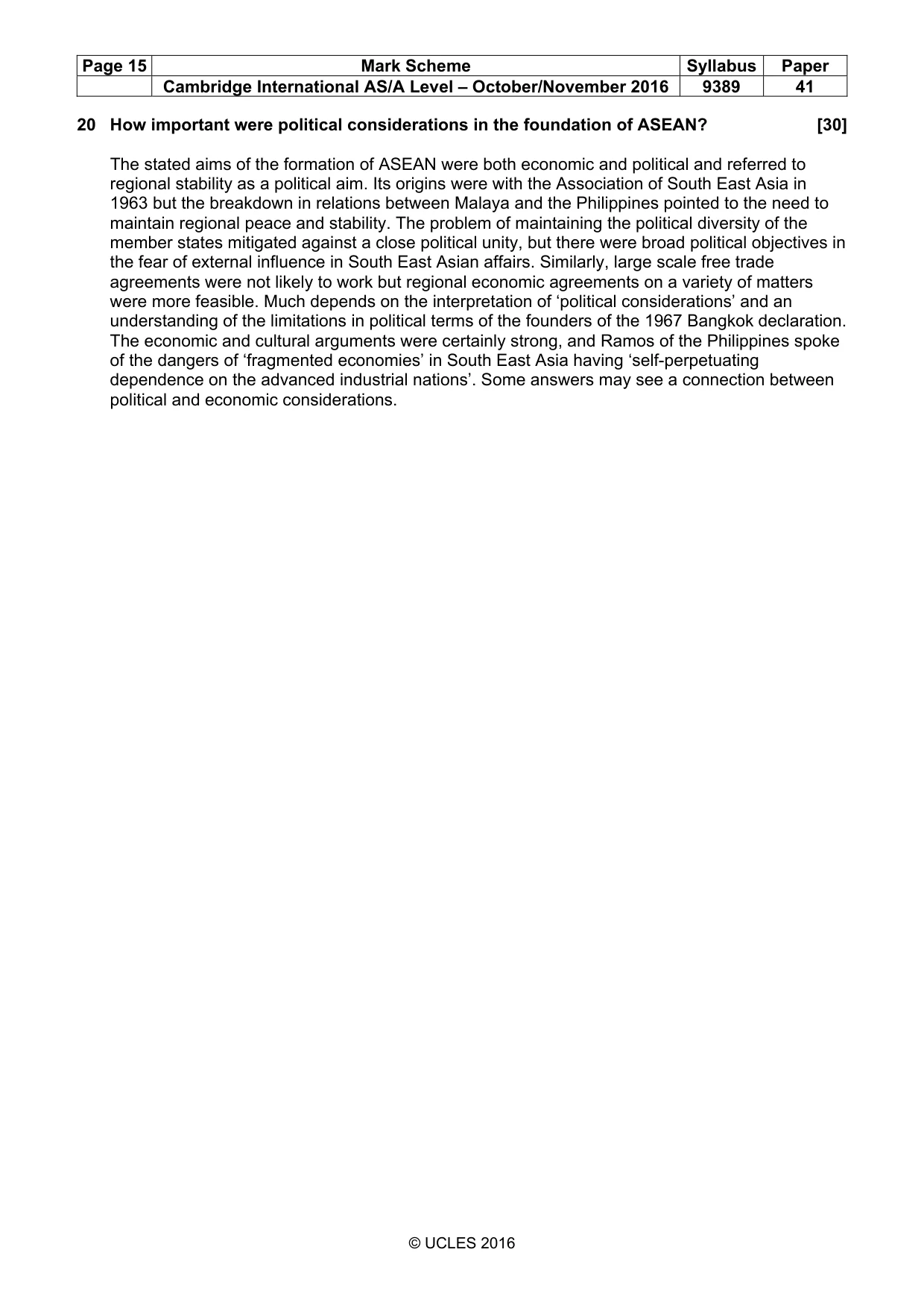
Page 15 Mark Scheme Syllabus Paper Cambridge International AS/A Level – October/November 2016 9389 41 © UCLES 2016 20 How important were political considerations in the foundation of ASEAN? [30] The stated aims of the formation of ASEAN were both economic and political and referred to regional stability as a political aim. Its origins were with the Association of South East Asia in 1963 but the breakdown in relations between Malaya and the Philippines pointed to the need to maintain regional peace and stability. The problem of maintaining the political diversity of the member states mitigated against a close political unity, but there were broad political objectives in the fear of external influence in South East Asian affairs. Similarly, large scale free trade agreements were not likely to work but regional economic agreements on a variety of matters were more feasible. Much depends on the interpretation of ‘political considerations’ and an understanding of the limitations in political terms of the founders of the 1967 Bangkok declaration. The economic and cultural arguments were certainly strong, and Ramos of the Philippines spoke of the dangers of ‘fragmented economies’ in South East Asia having ‘self-perpetuating dependence on the advanced industrial nations’. Some answers may see a connection between political and economic considerations.
What you needed in this session
Cambridge’s own grade thresholds for 2016 Oct/Nov, Paper 4 · Variant 1. A higher threshold means an easier paper — the bar moves with how the cohort did.