Cambridge A Level History 9389 — 2016 Oct/Nov Paper 3 · Variant 3
9389/33/O/N/16 · 40 marks · ≈45 min
The question paper and its mark scheme, free to read here and free to download. This is Cambridge’s own paper, exactly as it was sat.
Question paper4 pages
Mark scheme6 pages
Answers below. Sit the paper first if you are practising.
Paper as text
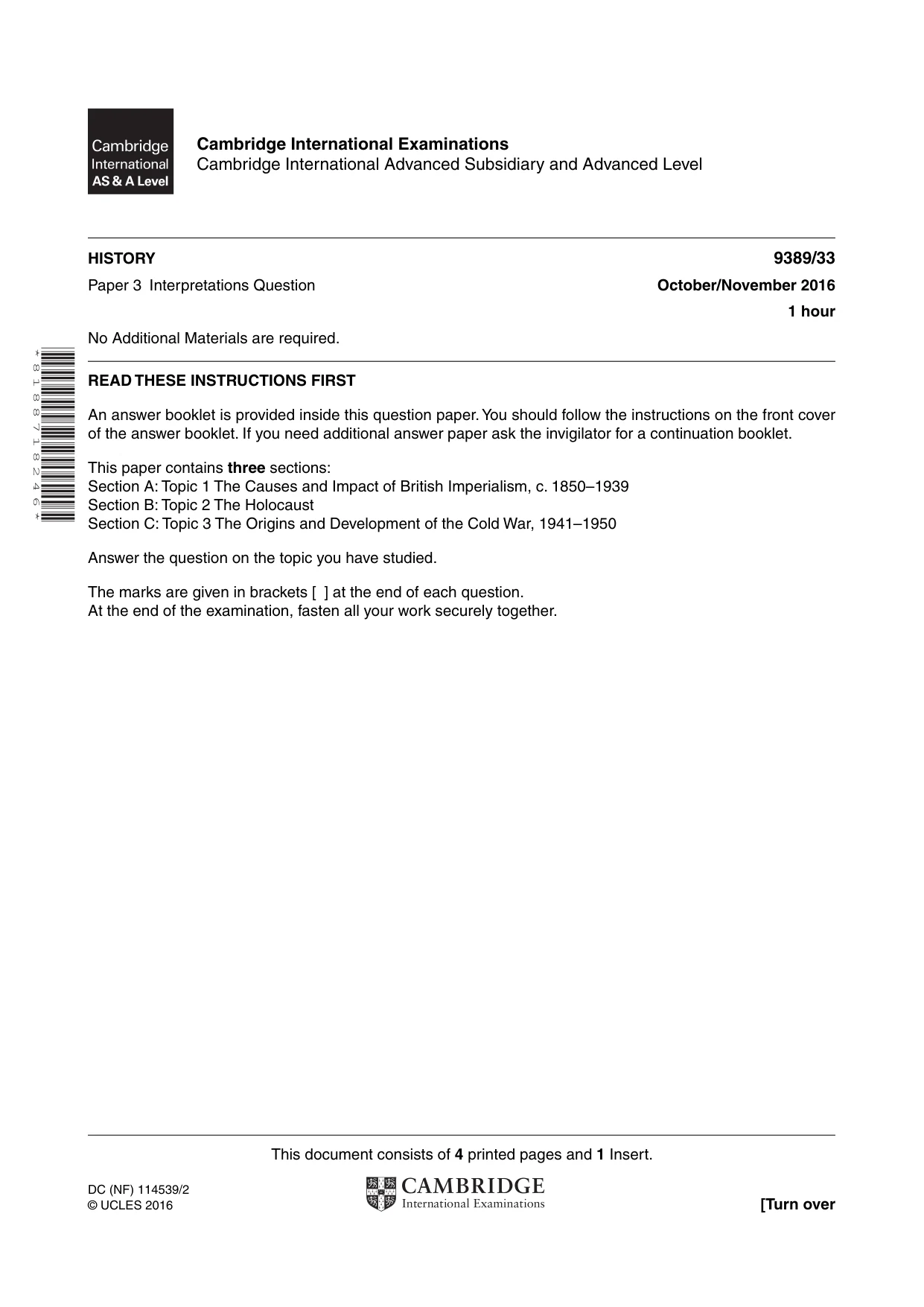
Question paper, page 1
This document consists of 4 printed pages and 1 Insert. DC (NF) 114539/2 © UCLES 2016 [Turn over Cambridge International Examinations Cambridge International Advanced Subsidiary and Advanced Level * 8 1 8 8 7 1 8 2 4 6 * HISTORY 9389/33 Paper 3 Interpretations Question October/November 2016 1 hour No Additional Materials are required. READ THESE INSTRUCTIONS FIRST An answer booklet is provided inside this question paper. You should follow the instructions on the front cover of the answer booklet. If you need additional answer paper ask the invigilator for a continuation booklet. This paper contains three sections: Section A: Topic 1 The Causes and Impact of British Imperialism, c. 1850–1939 Section B: Topic 2 The Holocaust Section C: Topic 3 The Origins and Development of the Cold War, 1941–1950 Answer the question on the topic you have studied. The marks are given in brackets [ ] at the end of each question. At the end of the examination, fasten all your work securely together.
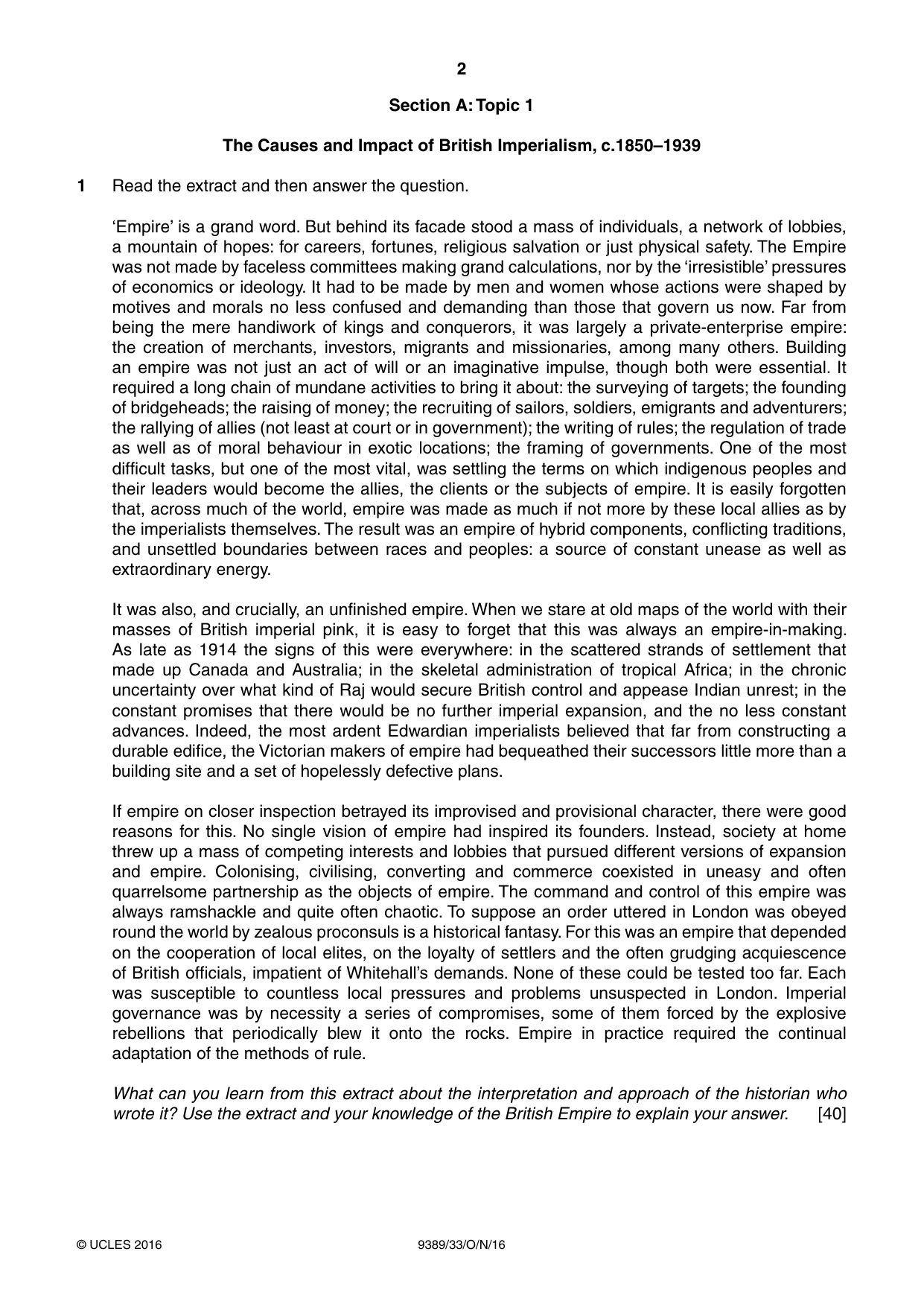
Question paper, page 2
2 9389/33/O/N/16 © UCLES 2016 Section A: Topic 1 The Causes and Impact of British Imperialism, c.1850–1939 1 Read the extract and then answer the question. ‘Empire’ is a grand word. But behind its facade stood a mass of individuals, a network of lobbies, a mountain of hopes: for careers, fortunes, religious salvation or just physical safety. The Empire was not made by faceless committees making grand calculations, nor by the ‘irresistible’ pressures of economics or ideology. It had to be made by men and women whose actions were shaped by motives and morals no less confused and demanding than those that govern us now. Far from being the mere handiwork of kings and conquerors, it was largely a private-enterprise empire: the creation of merchants, investors, migrants and missionaries, among many others. Building an empire was not just an act of will or an imaginative impulse, though both were essential. It required a long chain of mundane activities to bring it about: the surveying of targets; the founding of bridgeheads; the raising of money; the recruiting of sailors, soldiers, emigrants and adventurers; the rallying of allies (not least at court or in government); the writing of rules; the regulation of trade as well as of moral behaviour in exotic locations; the framing of governments. One of the most difficult tasks, but one of the most vital, was settling the terms on which indigenous peoples and their leaders would become the allies, the clients or the subjects of empire. It is easily forgotten that, across much of the world, empire was made as much if not more by these local allies as by the imperialists themselves. The result was an empire of hybrid components, conflicting traditions, and unsettled boundaries between races and peoples: a source of constant unease as well as extraordinary energy. It was also, and crucially, an unfinished empire. When we stare at old maps of the world with their masses of British imperial pink, it is easy to forget that this was always an empire-in-making. As late as 1914 the signs of this were everywhere: in the scattered strands of settlement that made up Canada and Australia; in the skeletal administration of tropical Africa; in the chronic uncertainty over what kind of Raj would secure British control and appease Indian unrest; in the constant promises that there would be no further imperial expansion, and the no less constant advances. Indeed, the most ardent Edwardian imperialists believed that far from constructing a durable edifice, the Victorian makers of empire had bequeathed their successors little more than a building site and a set of hopelessly defective plans. If empire on closer inspection betrayed its improvised and provisional character, there were good reasons for this. No single vision of empire had inspired its founders. Instead, society at home threw up a mass of competing interests and lobbies that pursued different versions of expansion and empire. Colonising, civilising, converting and commerce coexisted in uneasy and often quarrelsome partnership as the objects of empire. The command and control of this empire was always ramshackle and quite often chaotic. To suppose an order uttered in London was obeyed round the world by zealous proconsuls is a historical fantasy. For this was an empire that depended on the cooperation of local elites, on the loyalty of settlers and the often grudging acquiescence of British officials, impatient of Whitehall’s demands. None of these could be tested too far. Each was susceptible to countless local pressures and problems unsuspected in London. Imperial governance was by necessity a series of compromises, some of them forced by the explosive rebellions that periodically blew it onto the rocks. Empire in practice required the continual adaptation of the methods of rule. What can you learn from this extract about the interpretation and approach of the historian who wrote it? Use the extract and your knowledge of the British Empire to explain your answer. [40]
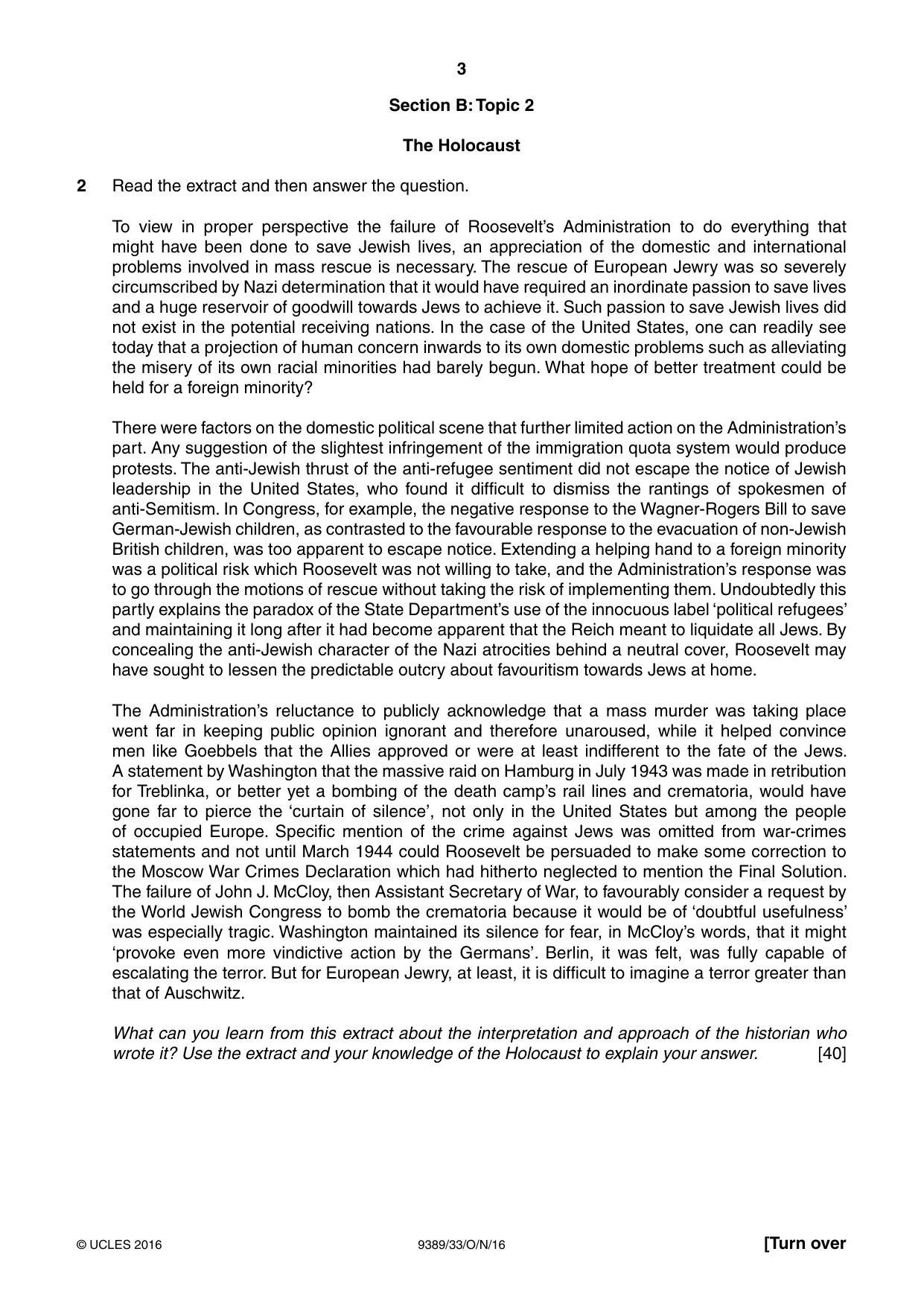
Question paper, page 3
3 9389/33/O/N/16 © UCLES 2016 [Turn over Section B: Topic 2 The Holocaust 2 Read the extract and then answer the question. To view in proper perspective the failure of Roosevelt’s Administration to do everything that might have been done to save Jewish lives, an appreciation of the domestic and international problems involved in mass rescue is necessary. The rescue of European Jewry was so severely circumscribed by Nazi determination that it would have required an inordinate passion to save lives and a huge reservoir of goodwill towards Jews to achieve it. Such passion to save Jewish lives did not exist in the potential receiving nations. In the case of the United States, one can readily see today that a projection of human concern inwards to its own domestic problems such as alleviating the misery of its own racial minorities had barely begun. What hope of better treatment could be held for a foreign minority? There were factors on the domestic political scene that further limited action on the Administration’s part. Any suggestion of the slightest infringement of the immigration quota system would produce protests. The anti-Jewish thrust of the anti-refugee sentiment did not escape the notice of Jewish leadership in the United States, who found it difficult to dismiss the rantings of spokesmen of anti-Semitism. In Congress, for example, the negative response to the Wagner-Rogers Bill to save German-Jewish children, as contrasted to the favourable response to the evacuation of non-Jewish British children, was too apparent to escape notice. Extending a helping hand to a foreign minority was a political risk which Roosevelt was not willing to take, and the Administration’s response was to go through the motions of rescue without taking the risk of implementing them. Undoubtedly this partly explains the paradox of the State Department’s use of the innocuous label ‘political refugees’ and maintaining it long after it had become apparent that the Reich meant to liquidate all Jews. By concealing the anti-Jewish character of the Nazi atrocities behind a neutral cover, Roosevelt may have sought to lessen the predictable outcry about favouritism towards Jews at home. The Administration’s reluctance to publicly acknowledge that a mass murder was taking place went far in keeping public opinion ignorant and therefore unaroused, while it helped convince men like Goebbels that the Allies approved or were at least indifferent to the fate of the Jews. A statement by Washington that the massive raid on Hamburg in July 1943 was made in retribution for Treblinka, or better yet a bombing of the death camp’s rail lines and crematoria, would have gone far to pierce the ‘curtain of silence’, not only in the United States but among the people of occupied Europe. Specific mention of the crime against Jews was omitted from war-crimes statements and not until March 1944 could Roosevelt be persuaded to make some correction to the Moscow War Crimes Declaration which had hitherto neglected to mention the Final Solution. The failure of John J. McCloy, then Assistant Secretary of War, to favourably consider a request by the World Jewish Congress to bomb the crematoria because it would be of ‘doubtful usefulness’ was especially tragic. Washington maintained its silence for fear, in McCloy’s words, that it might ‘provoke even more vindictive action by the Germans’. Berlin, it was felt, was fully capable of escalating the terror. But for European Jewry, at least, it is difficult to imagine a terror greater than that of Auschwitz. What can you learn from this extract about the interpretation and approach of the historian who wrote it? Use the extract and your knowledge of the Holocaust to explain your answer. [40]
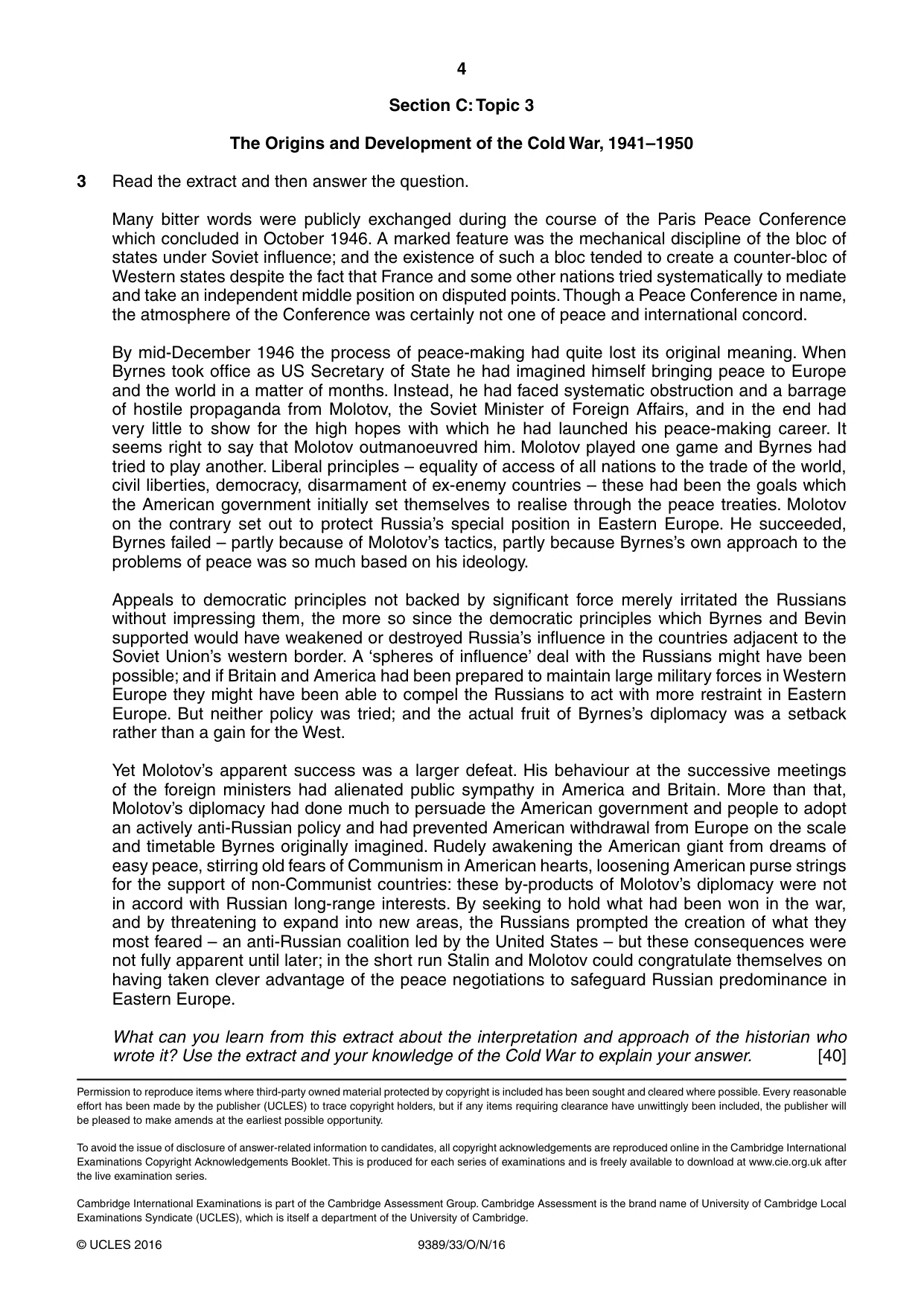
Question paper, page 4
4 9389/33/O/N/16 © UCLES 2016 Section C: Topic 3 The Origins and Development of the Cold War, 1941–1950 3 Read the extract and then answer the question. Many bitter words were publicly exchanged during the course of the Paris Peace Conference which concluded in October 1946. A marked feature was the mechanical discipline of the bloc of states under Soviet influence; and the existence of such a bloc tended to create a counter-bloc of Western states despite the fact that France and some other nations tried systematically to mediate and take an independent middle position on disputed points. Though a Peace Conference in name, the atmosphere of the Conference was certainly not one of peace and international concord. By mid-December 1946 the process of peace-making had quite lost its original meaning. When Byrnes took office as US Secretary of State he had imagined himself bringing peace to Europe and the world in a matter of months. Instead, he had faced systematic obstruction and a barrage of hostile propaganda from Molotov, the Soviet Minister of Foreign Affairs, and in the end had very little to show for the high hopes with which he had launched his peace-making career. It seems right to say that Molotov outmanoeuvred him. Molotov played one game and Byrnes had tried to play another. Liberal principles – equality of access of all nations to the trade of the world, civil liberties, democracy, disarmament of ex-enemy countries – these had been the goals which the American government initially set themselves to realise through the peace treaties. Molotov on the contrary set out to protect Russia’s special position in Eastern Europe. He succeeded, Byrnes failed – partly because of Molotov’s tactics, partly because Byrnes’s own approach to the problems of peace was so much based on his ideology. Appeals to democratic principles not backed by significant force merely irritated the Russians without impressing them, the more so since the democratic principles which Byrnes and Bevin supported would have weakened or destroyed Russia’s influence in the countries adjacent to the Soviet Union’s western border. A ‘spheres of influence’ deal with the Russians might have been possible; and if Britain and America had been prepared to maintain large military forces in Western Europe they might have been able to compel the Russians to act with more restraint in Eastern Europe. But neither policy was tried; and the actual fruit of Byrnes’s diplomacy was a setback rather than a gain for the West. Yet Molotov’s apparent success was a larger defeat. His behaviour at the successive meetings of the foreign ministers had alienated public sympathy in America and Britain. More than that, Molotov’s diplomacy had done much to persuade the American government and people to adopt an actively anti-Russian policy and had prevented American withdrawal from Europe on the scale and timetable Byrnes originally imagined. Rudely awakening the American giant from dreams of easy peace, stirring old fears of Communism in American hearts, loosening American purse strings for the support of non-Communist countries: these by-products of Molotov’s diplomacy were not in accord with Russian long-range interests. By seeking to hold what had been won in the war, and by threatening to expand into new areas, the Russians prompted the creation of what they most feared – an anti-Russian coalition led by the United States – but these consequences were not fully apparent until later; in the short run Stalin and Molotov could congratulate themselves on having taken clever advantage of the peace negotiations to safeguard Russian predominance in Eastern Europe. What can you learn from this extract about the interpretation and approach of the historian who wrote it? Use the extract and your knowledge of the Cold War to explain your answer. [40] Permission to reproduce items where third-party owned material protected by copyright is included has been sought and cleared where possible. Every reasonable effort has been made by the publisher (UCLES) to trace copyright holders, but if any items requiring clearance have unwittingly been included, the publisher will be pleased to make amends at the earliest possible opportunity. To avoid the issue of disclosure of answer-related information to candidates, all copyright acknowledgements are reproduced online in the Cambridge International Examinations Copyright Acknowledgements Booklet. This is produced for each series of examinations and is freely available to download at www.cie.org.uk after the live examination series. Cambridge International Examinations is part of the Cambridge Assessment Group. Cambridge Assessment is the brand name of University of Cambridge Local Examinations Syndicate (UCLES), which is itself a department of the University of Cambridge.
Mark scheme, page 1
® IGCSE is the registered trademark of Cambridge International Examinations. This document consists of 6 printed pages. © UCLES 2016 [Turn over Cambridge International Examinations Cambridge International Advanced Subsidiary and Advanced Level HISTORY 9389/33 Paper 3 Interpretations Question October/November 2016 MARK SCHEME Maximum Mark: 40 Published This mark scheme is published as an aid to teachers and candidates, to indicate the requirements of the examination. It shows the basis on which Examiners were instructed to award marks. It does not indicate the details of the discussions that took place at an Examiners’ meeting before marking began, which would have considered the acceptability of alternative answers. Mark schemes should be read in conjunction with the question paper and the Principal Examiner Report for Teachers. Cambridge will not enter into discussions about these mark schemes. Cambridge is publishing the mark schemes for the October/November 2016 series for most Cambridge IGCSE®, Cambridge International A and AS Level components and some Cambridge O Level components.
Mark scheme, page 2
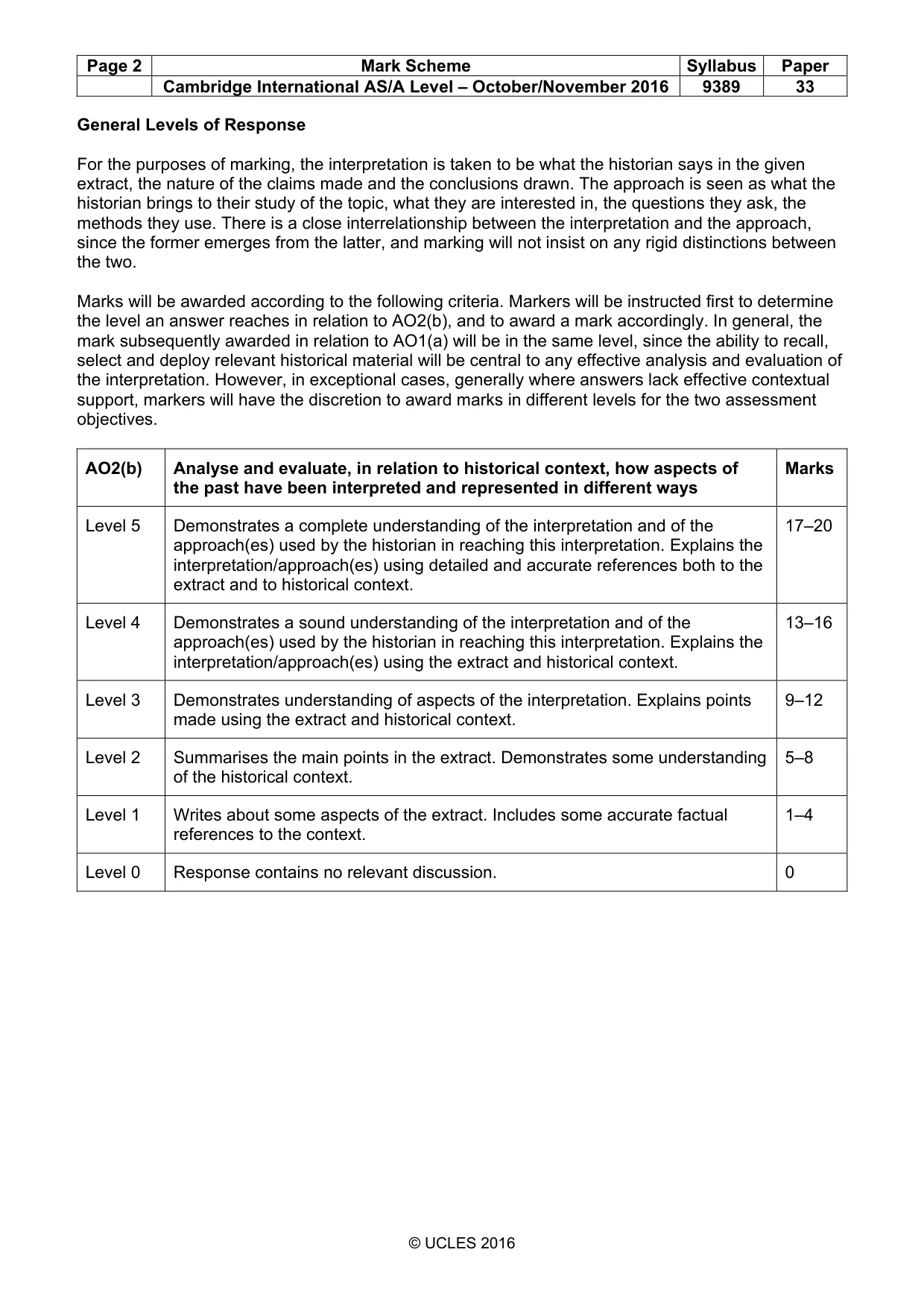
Page 2 Mark Scheme Syllabus Paper Cambridge International AS/A Level – October/November 2016 9389 33 © UCLES 2016 General Levels of Response For the purposes of marking, the interpretation is taken to be what the historian says in the given extract, the nature of the claims made and the conclusions drawn. The approach is seen as what the historian brings to their study of the topic, what they are interested in, the questions they ask, the methods they use. There is a close interrelationship between the interpretation and the approach, since the former emerges from the latter, and marking will not insist on any rigid distinctions between the two. Marks will be awarded according to the following criteria. Markers will be instructed first to determine the level an answer reaches in relation to AO2(b), and to award a mark accordingly. In general, the mark subsequently awarded in relation to AO1(a) will be in the same level, since the ability to recall, select and deploy relevant historical material will be central to any effective analysis and evaluation of the interpretation. However, in exceptional cases, generally where answers lack effective contextual support, markers will have the discretion to award marks in different levels for the two assessment objectives. AO2(b) Analyse and evaluate, in relation to historical context, how aspects of the past have been interpreted and represented in different ways Marks Level 5 Demonstrates a complete understanding of the interpretation and of the approach(es) used by the historian in reaching this interpretation. Explains the interpretation/approach(es) using detailed and accurate references both to the extract and to historical context. 17–20 Level 4 Demonstrates a sound understanding of the interpretation and of the approach(es) used by the historian in reaching this interpretation. Explains the interpretation/approach(es) using the extract and historical context. 13–16 Level 3 Demonstrates understanding of aspects of the interpretation. Explains points made using the extract and historical context. 9–12 Level 2 Summarises the main points in the extract. Demonstrates some understanding of the historical context. 5–8 Level 1 Writes about some aspects of the extract. Includes some accurate factual references to the context. 1–4 Level 0 Response contains no relevant discussion. 0
Mark scheme, page 3
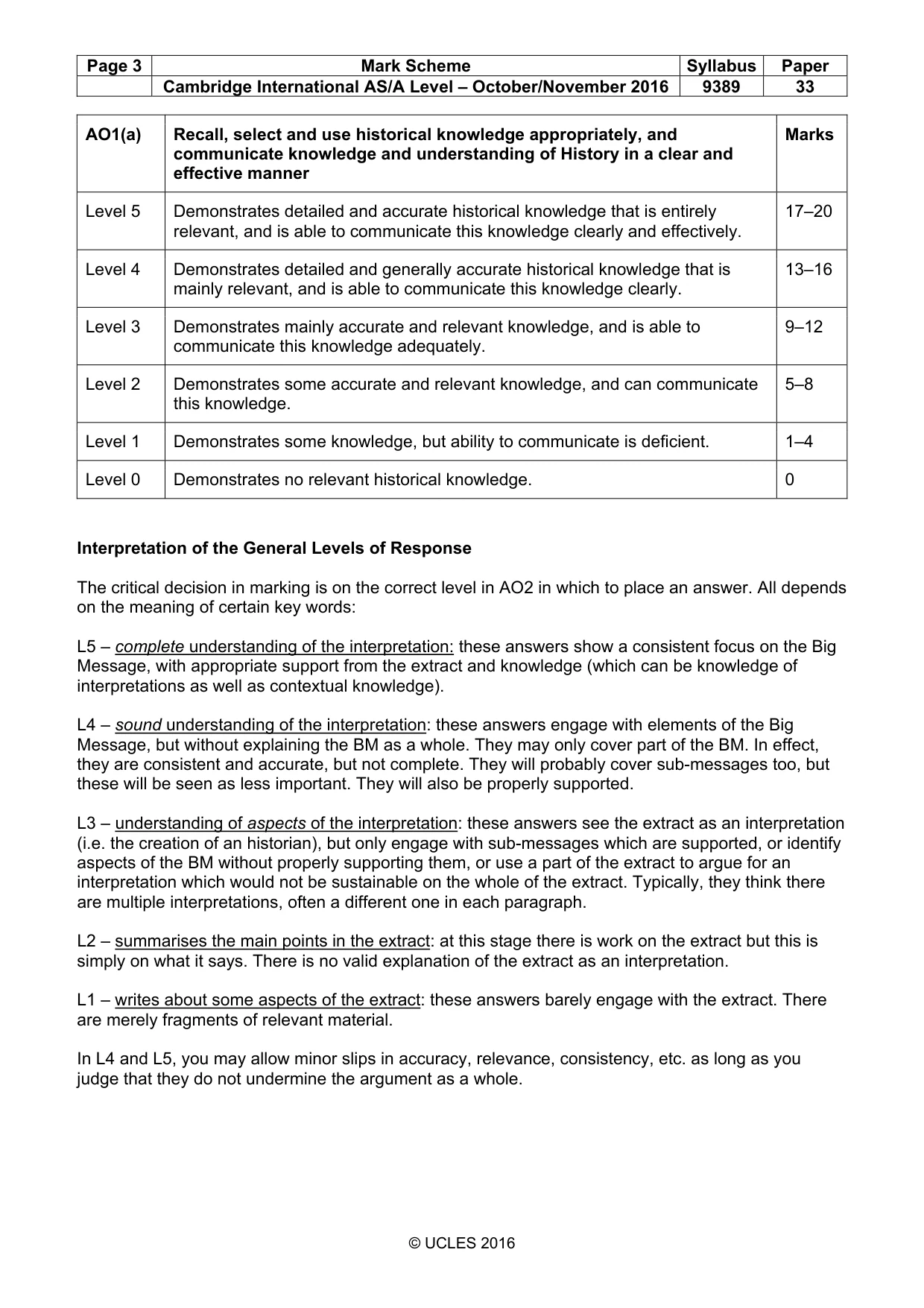
Page 3 Mark Scheme Syllabus Paper Cambridge International AS/A Level – October/November 2016 9389 33 © UCLES 2016 AO1(a) Recall, select and use historical knowledge appropriately, and communicate knowledge and understanding of History in a clear and effective manner Marks Level 5 Demonstrates detailed and accurate historical knowledge that is entirely relevant, and is able to communicate this knowledge clearly and effectively. 17–20 Level 4 Demonstrates detailed and generally accurate historical knowledge that is mainly relevant, and is able to communicate this knowledge clearly. 13–16 Level 3 Demonstrates mainly accurate and relevant knowledge, and is able to communicate this knowledge adequately. 9–12 Level 2 Demonstrates some accurate and relevant knowledge, and can communicate this knowledge. 5–8 Level 1 Demonstrates some knowledge, but ability to communicate is deficient. 1–4 Level 0 Demonstrates no relevant historical knowledge. 0 Interpretation of the General Levels of Response The critical decision in marking is on the correct level in AO2 in which to place an answer. All depends on the meaning of certain key words: L5 – complete understanding of the interpretation: these answers show a consistent focus on the Big Message, with appropriate support from the extract and knowledge (which can be knowledge of interpretations as well as contextual knowledge). L4 – sound understanding of the interpretation: these answers engage with elements of the Big Message, but without explaining the BM as a whole. They may only cover part of the BM. In effect, they are consistent and accurate, but not complete. They will probably cover sub-messages too, but these will be seen as less important. They will also be properly supported. L3 – understanding of aspects of the interpretation: these answers see the extract as an interpretation (i.e. the creation of an historian), but only engage with sub-messages which are supported, or identify aspects of the BM without properly supporting them, or use a part of the extract to argue for an interpretation which would not be sustainable on the whole of the extract. Typically, they think there are multiple interpretations, often a different one in each paragraph. L2 – summarises the main points in the extract: at this stage there is work on the extract but this is simply on what it says. There is no valid explanation of the extract as an interpretation. L1 – writes about some aspects of the extract: these answers barely engage with the extract. There are merely fragments of relevant material. In L4 and L5, you may allow minor slips in accuracy, relevance, consistency, etc. as long as you judge that they do not undermine the argument as a whole.
Mark scheme, page 4
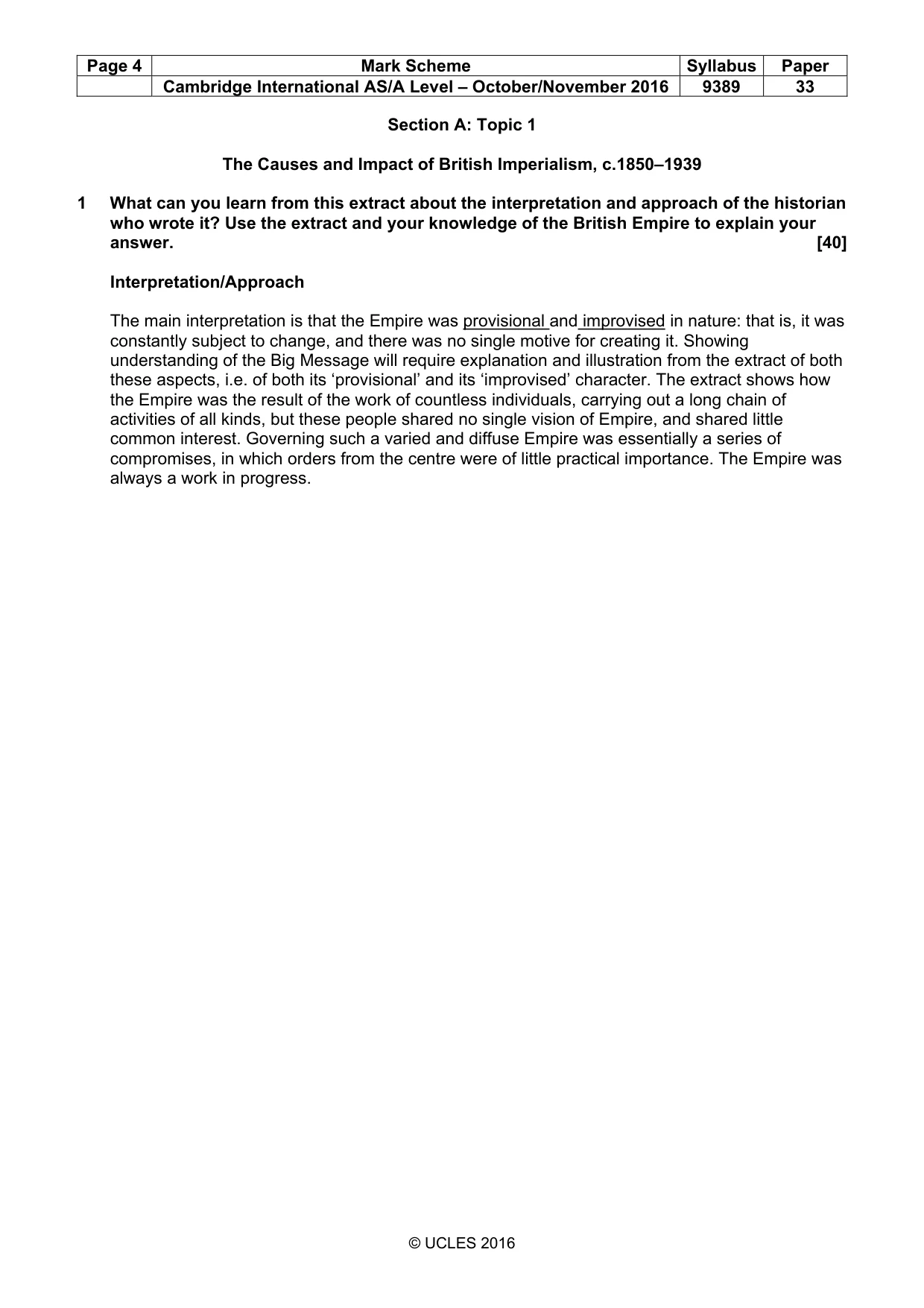
Page 4 Mark Scheme Syllabus Paper Cambridge International AS/A Level – October/November 2016 9389 33 © UCLES 2016 Section A: Topic 1 The Causes and Impact of British Imperialism, c.1850–1939 1 What can you learn from this extract about the interpretation and approach of the historian who wrote it? Use the extract and your knowledge of the British Empire to explain your answer. [40] Interpretation/Approach The main interpretation is that the Empire was provisional and improvised in nature: that is, it was constantly subject to change, and there was no single motive for creating it. Showing understanding of the Big Message will require explanation and illustration from the extract of both these aspects, i.e. of both its ‘provisional’ and its ‘improvised’ character. The extract shows how the Empire was the result of the work of countless individuals, carrying out a long chain of activities of all kinds, but these people shared no single vision of Empire, and shared little common interest. Governing such a varied and diffuse Empire was essentially a series of compromises, in which orders from the centre were of little practical importance. The Empire was always a work in progress.
Mark scheme, page 5
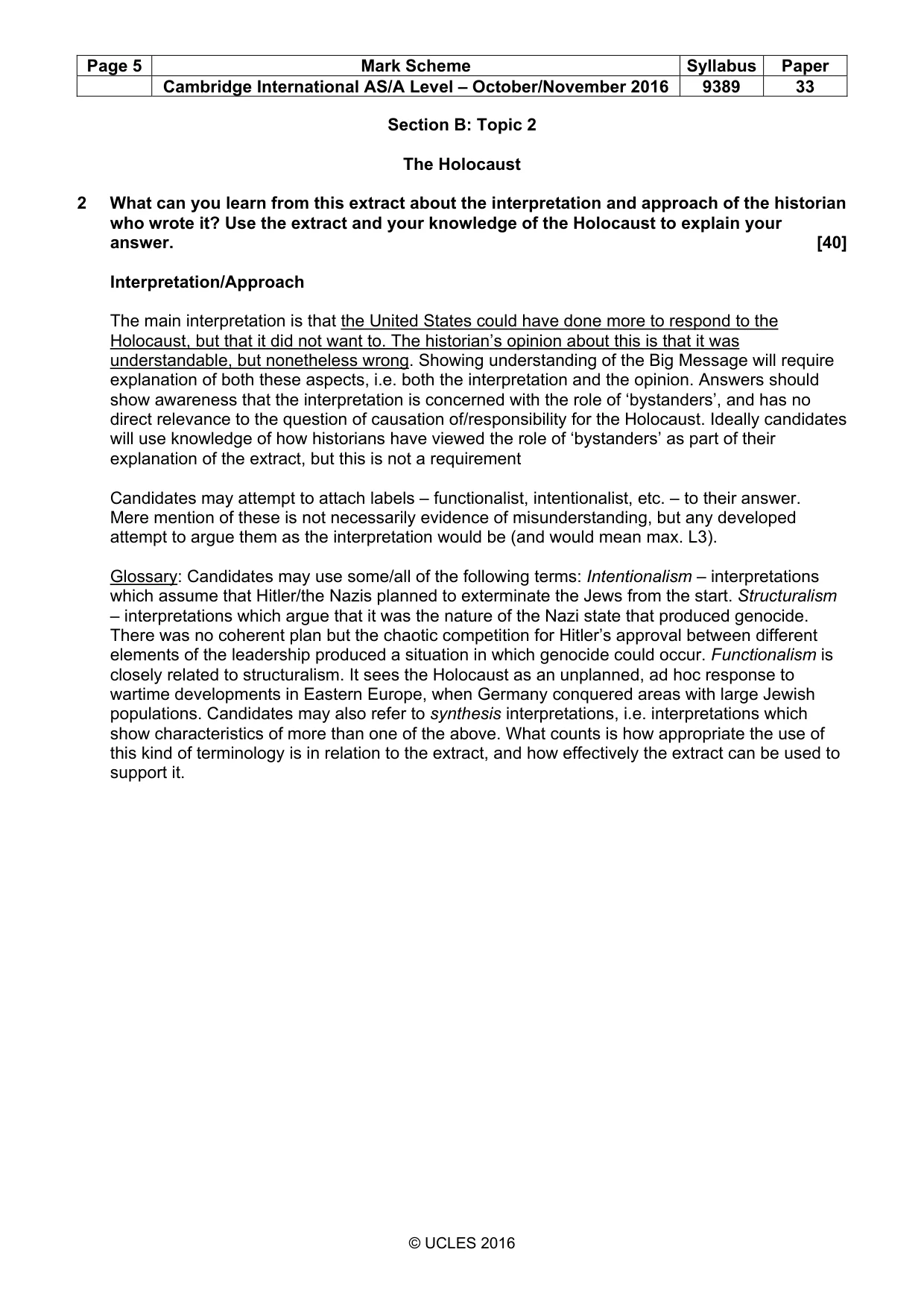
Page 5 Mark Scheme Syllabus Paper Cambridge International AS/A Level – October/November 2016 9389 33 © UCLES 2016 Section B: Topic 2 The Holocaust 2 What can you learn from this extract about the interpretation and approach of the historian who wrote it? Use the extract and your knowledge of the Holocaust to explain your answer. [40] Interpretation/Approach The main interpretation is that the United States could have done more to respond to the Holocaust, but that it did not want to. The historian’s opinion about this is that it was understandable, but nonetheless wrong. Showing understanding of the Big Message will require explanation of both these aspects, i.e. both the interpretation and the opinion. Answers should show awareness that the interpretation is concerned with the role of ‘bystanders’, and has no direct relevance to the question of causation of/responsibility for the Holocaust. Ideally candidates will use knowledge of how historians have viewed the role of ‘bystanders’ as part of their explanation of the extract, but this is not a requirement Candidates may attempt to attach labels – functionalist, intentionalist, etc. – to their answer. Mere mention of these is not necessarily evidence of misunderstanding, but any developed attempt to argue them as the interpretation would be (and would mean max. L3). Glossary: Candidates may use some/all of the following terms: Intentionalism – interpretations which assume that Hitler/the Nazis planned to exterminate the Jews from the start. Structuralism – interpretations which argue that it was the nature of the Nazi state that produced genocide. There was no coherent plan but the chaotic competition for Hitler’s approval between different elements of the leadership produced a situation in which genocide could occur. Functionalism is closely related to structuralism. It sees the Holocaust as an unplanned, ad hoc response to wartime developments in Eastern Europe, when Germany conquered areas with large Jewish populations. Candidates may also refer to synthesis interpretations, i.e. interpretations which show characteristics of more than one of the above. What counts is how appropriate the use of this kind of terminology is in relation to the extract, and how effectively the extract can be used to support it.
Mark scheme, page 6
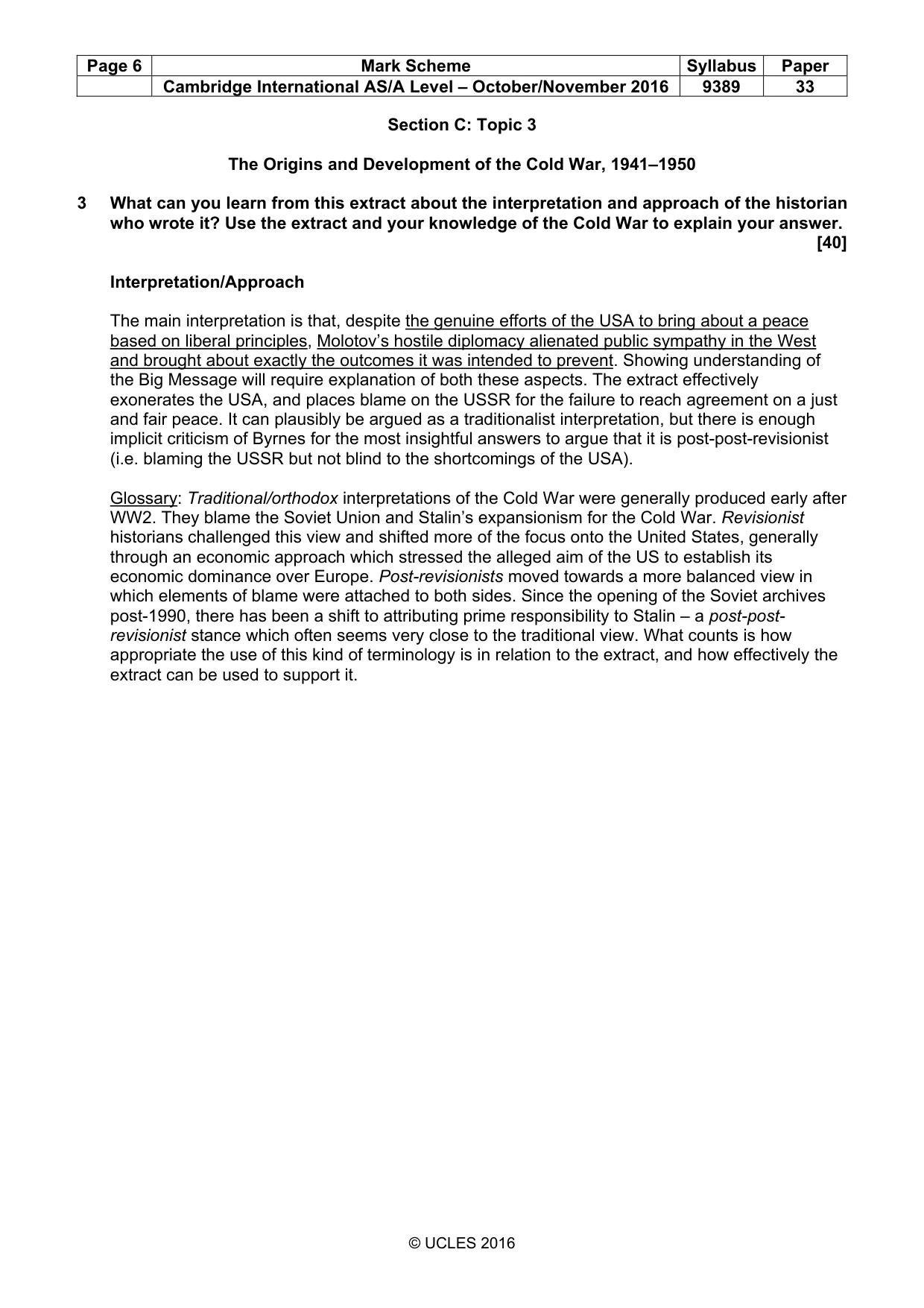
Page 6 Mark Scheme Syllabus Paper Cambridge International AS/A Level – October/November 2016 9389 33 © UCLES 2016 Section C: Topic 3 The Origins and Development of the Cold War, 1941–1950 3 What can you learn from this extract about the interpretation and approach of the historian who wrote it? Use the extract and your knowledge of the Cold War to explain your answer. [40] Interpretation/Approach The main interpretation is that, despite the genuine efforts of the USA to bring about a peace based on liberal principles, Molotov’s hostile diplomacy alienated public sympathy in the West and brought about exactly the outcomes it was intended to prevent. Showing understanding of the Big Message will require explanation of both these aspects. The extract effectively exonerates the USA, and places blame on the USSR for the failure to reach agreement on a just and fair peace. It can plausibly be argued as a traditionalist interpretation, but there is enough implicit criticism of Byrnes for the most insightful answers to argue that it is post-post-revisionist (i.e. blaming the USSR but not blind to the shortcomings of the USA). Glossary: Traditional/orthodox interpretations of the Cold War were generally produced early after WW2. They blame the Soviet Union and Stalin’s expansionism for the Cold War. Revisionist historians challenged this view and shifted more of the focus onto the United States, generally through an economic approach which stressed the alleged aim of the US to establish its economic dominance over Europe. Post-revisionists moved towards a more balanced view in which elements of blame were attached to both sides. Since the opening of the Soviet archives post-1990, there has been a shift to attributing prime responsibility to Stalin – a post-post- revisionist stance which often seems very close to the traditional view. What counts is how appropriate the use of this kind of terminology is in relation to the extract, and how effectively the extract can be used to support it.
What you needed in this session
Cambridge’s own grade thresholds for 2016 Oct/Nov, Paper 3 · Variant 3. A higher threshold means an easier paper — the bar moves with how the cohort did.