Cambridge A Level History 9389 — 2016 Oct/Nov Paper 3 · Variant 2
9389/32/O/N/16 · 40 marks · ≈45 min
The question paper and its mark scheme, free to read here and free to download. This is Cambridge’s own paper, exactly as it was sat.
Question paper4 pages
Mark scheme6 pages
Answers below. Sit the paper first if you are practising.
Paper as text
Question paper, page 1
This document consists of 4 printed pages and 1 Insert. DC (NF) 114541/1 © UCLES 2016 [Turn over Cambridge International Examinations Cambridge International Advanced Subsidiary and Advanced Level * 3 1 0 0 3 9 2 3 7 8 * HISTORY 9389/32 Paper 3 Interpretations Question October/November 2016 1 hour No Additional Materials are required. READ THESE INSTRUCTIONS FIRST An answer booklet is provided inside this question paper. You should follow the instructions on the front cover of the answer booklet. If you need additional answer paper ask the invigilator for a continuation booklet. This paper contains three sections: Section A: Topic 1 The Causes and Impact of British Imperialism, c. 1850–1939 Section B: Topic 2 The Holocaust Section C: Topic 3 The Origins and Development of the Cold War, 1941–1950 Answer the question on the topic you have studied. The marks are given in brackets [ ] at the end of each question. At the end of the examination, fasten all your work securely together.
Question paper, page 2
2 9389/32/O/N/16 © UCLES 2016 Section A: Topic 1 The Causes and Impact of British Imperialism, c.1850–1939 1 Read the extract and then answer the question. Muslims had been the biggest losers as the British East India Company became the major military power in the sub-continent. The great Muslim-majority lands of the Punjab were finally subdued in 1848. All through the first half of the nineteenth century, Muslim ruling classes in north India were either scornfully deposed by the British or enfeebled by restrictions on their authority. The most shameful of these annexations occurred in 1856 in the province of Awadh, which since the late eighteenth century had been subordinate to British commercial and political interests, and had been seen, as the British governor-general put it, as a ‘cherry which will drop into our mouths some day, as it has long been ripening’. Successive Muslim kings had made Lucknow the capital city of Awadh. It was famous for its distinctive architecture, and for its culturally rich court which attracted some of north India’s best poets, artists, musicians and scholars. Wajid Ali Shah, Lucknow’s last king, sang, danced and wrote poetry to a high standard, but to the British these accomplishments were just another sign of his unfitness to rule. Awadh’s landowning aristocracy had long been apprehensive about British intentions before, no longer willing to wait for it to drop, the British finally plucked the cherry. Exiling the popular king to Calcutta, the British moved quickly to extract the steepest possible land revenues from landlords and peasants. Passing through Delhi in 1838 the English diarist Emily Eden lamented the city’s steady incorporation into a profit-minded empire. ‘Such impressive remains of power and wealth that have passed and are passing away – and somehow I feel that we horrid English have just merchandised it, revenued it and spoilt it all.’ As education and judicial institutions were taken out of religious control, the Muslim clergy found it difficult to find a livelihood for itself. The replacement of Persian by English as the official language also undermined the traditional cultural world of Indian Muslims. The Muslims’ former subjects – Hindus – seemed to be favoured by the new rulers, and were quick to educate themselves in western-style institutions and assume the lowly administrative positions assigned to them. The British were beginning to replace their economic and political regime of pure plunder as had existed in Bengal, with monopoly interests in shipping, banking, insurance and trade, and administrative structures. They enlisted native collaborators, such as the middlemen who expedited the lucrative export of opium to China, but these tended to be Hindu, Sikh or Parsi rather than Muslim. The former British indifference to Indian society and culture was being replaced by increased cultural and racial aggression. Lord Macaulay dismissed Indian learning as laughably worthless, urging the British in India to create ‘a class of persons, Indian in blood and colour, but English in taste, in opinion, in morals, and in intellect’. Convinced of their superiority, the British sought to entrench it with profound social and cultural reforms wherever they could. Often run by Christian missionaries, British-style schools, colleges and universities in India were soon churning out the ‘fake’ Englishmen of the kind Macaulay had hoped for. Many Muslims spurned this modern education for fear of losing their roots. They watched helplessly as the British set up plantations, dug canals and laid roads, and turned India into a supplier of raw materials to, and exclusive market for, British industries. Craftsmen communities in north Indian towns, which tended to be Muslim, were pauperised as British manufactured goods flooded Indian bazaars. What can you learn from this extract about the interpretation and approach of the historian who wrote it? Use the extract and your knowledge of the British Empire to explain your answer. [40]
Question paper, page 3
3 9389/32/O/N/16 © UCLES 2016 [Turn over Section B: Topic 2 The Holocaust 2 Read the extract and then answer the question. After at least four decades of focusing on the structural determinants of the ‘Final Solution’, historians have once again recognised that the distinguishing characteristic of Nazi Germany was its obsession with race. In the last decade or so, historians have dramatically increased our understanding of Nazi racialism, which was until recently regarded as nothing more than racial anti-Semitism. The new cast of victims includes the so-called ‘anti-social’, Arab or Afro-Germans, foreign forced labour, homosexuals, the mentally and physically handicapped, Sinti and Roma (‘gypsies’) and Soviet prisoners of war, none of whose horrible fates detracts from the singularity of the Nazi murder of 6 million European Jews. Understanding of the process of persecution now includes greater awareness of how much various sections of the professional intelligentsia, such as anthropologists, doctors, economists, historians, lawyers and psychiatrists, were to blame in the formation and implementation of Nazi policies, as well as of the interaction between the general population a nd the police agencies which enforced racial policy in both Germany and Austria. Nazi racialism had both long-term and international origins, even though its most murderous phase was towards the Jews between 1941 and 1945, an outcome that was neither a chance occurrence nor absolutely predetermined. Adolf Hitler, without discussion of whom any consideration of Nazi racialism is meaningless, drew upon many different existing strands of racism. In line with other racists elsewhere and in other times, Hitler and the National Socialists believed that intellectual and physical differences between people were indicative of their relative value in the human scale. In Germany an aggressive form of chauvinism emphasised German cultural superiority over, for example, the Slavs, as well as the need to ‘purify’ the German race of Jews and ‘gypsies’, who were frequently associated in nineteenth-century racist discourse as being criminous, foreign, dark-skinned, short of stature and inclined to such activities as kidnapping children. Like the Jews, the Sinti and Roma were deemed to be racially ‘alien’, although they were often also persecuted on the grounds of anti-social behaviour. Discrimination against Sinti and Roma had a long history, and like anti-Semitism was a prejudice by no means local to Germany. Inheriting existing legislation whose effect was permanent harassment, the Nazis centralised the apparatus of persecution in the Reich Central Office for the Fight against the Gypsy Nuisance established in 1936. Sinti and Roma were also effectively subjected to the Nuremberg racial laws which prohibited marriages between racial ‘aliens’ and Germans. Local authorities frequently took the initiative in corralling Roma into temporary camps, often as a means of shedding any obligation towards them by way of health care, schooling or basic utilities. These initiatives were frequently a response to popular complaints about the behaviour of Sinti and Roma. Although final formal legislative convergence regarding Jews and Sinti and Roma only took place in 1942, long before then wagons of Sinti and Roma were regularly added to those trains deporting Jews to Poland, while from 1941 onwards the Einsatzgrüppen, SS and police killing units in the occupied Soviet Union repeatedly referred in their reports to massacres of ‘gypsies’ (as well as the mentally ill) in addition to Jewish people. What can you learn from this extract about the interpretation and approach of the historian who wrote it? Use the extract and your knowledge of the Holocaust to explain your answer. [40]
Question paper, page 4
4 9389/32/O/N/16 © UCLES 2016 Section C: Topic 3 The Origins and Development of the Cold War, 1941–1950 3 Read the extract and then answer the question. With the defeat of the Fascist aggressors and the disappearance of the common enemy, the chief bonds holding together the anti-Hitler coalition began to disintegrate. Radical differences in social and political structure, value-system and ideology of the Soviet Union on the one hand, and the West, especially the USA, on the other, became powerful factors for breaking up the victors’ alliance. Far-reaching changes in the distribution of roles between the great powers and in the relations of strength between them marked a transition to antagonism between the USSR and the western powers. This was obviously bound to happen in one way or another. It is another question, however, whether the form that this antagonism took – the Cold War, meaning acute military and political confrontations, with constant crises and conflicts – was inevitable. I think we have to answer this question affirmatively if we take account of the modes of thought and systems of ideas of the leaders and the ruling circles of the principal victor powers. It seems to me that on neither side (meaning mainly the USSR and the USA) was willingness shown to recognise and accept the reality of the post-war world and adapt its political line accordingly. The wartime experience caused the leaders of the great victor powers to over-emphasise military strength as the instrument for deciding socio-political, territorial and other international problems. On their part, the leaders of the USA provided evidence enough of their endeavour to pursue a policy from a position of strength, and unwillingness to seek consistently for mutually acceptable decisions at the conference table: the actual relation of strength in the first post-war years was plainly favourable to the USA. At the end of the war the USA was the biggest industrial power in the world (responsible for about half of the world’s total industrial production) and it had a monopoly on the atomic bomb. America’s rulers appreciated perfectly well the weakness of the huge Red Army. Under conditions of an unfavourable relation of strength, Stalin and his circle considered that time would work for the Soviet Union. The Soviet leaders proceeded from confidence that there would inevitably come a new economic crisis in the West, and particularly in the USA. Stalin showed mistrust, suspicion and profound hostility towards the West. As early as January 1945, in a conversation with the Bulgarian communist leader, Dimitrov, he contemplated the possibility of a future conflict with his allies in the anti-Hitler coalition. The most important aim of Stalinist leadership was to strengthen the position of the USSR in international politics, and, in the first place, to consolidate its control over the Soviet sphere of influence. This was required for the performance of several tasks: ensuring the USSR’s security; increasing its weight in international affairs; not allowing the positions of Britain and the USA to grow too strong. It was from the standpoint of struggle for its sphere of influence that the Stalinist leadership approached the joint decisions of the Allies on post-war reconstruction. In a conversation with Dimitrov in August 1945, Molotov summed up the decisions of the Potsdam Conference, with particular reference to the Balkans: ‘Basically these decisions are good for us. To all intents and purposes this has been recognised as our sphere of influence.’ What can you learn from this extract about the interpretation and approach of the historian who wrote it? Use the extract and your knowledge of the Cold War to explain your answer. [40] Permission to reproduce items where third-party owned material protected by copyright is included has been sought and cleared where possible. Every reasonable effort has been made by the publisher (UCLES) to trace copyright holders, but if any items requiring clearance have unwittingly been included, the publisher will be pleased to make amends at the earliest possible opportunity. To avoid the issue of disclosure of answer-related information to candidates, all copyright acknowledgements are reproduced online in the Cambridge International Examinations Copyright Acknowledgements Booklet. This is produced for each series of examinations and is freely available to download at www.cie.org.uk after the live examination series. Cambridge International Examinations is part of the Cambridge Assessment Group. Cambridge Assessment is the brand name of University of Cambridge Local Examinations Syndicate (UCLES), which is itself a department of the University of Cambridge.
Mark scheme, page 1
® IGCSE is the registered trademark of Cambridge International Examinations. This document consists of 6 printed pages. © UCLES 2016 [Turn over Cambridge International Examinations Cambridge International Advanced Subsidiary and Advanced Level HISTORY 9389/32 Paper 3 Interpretations Question October/November 2016 MARK SCHEME Maximum Mark: 40 Published This mark scheme is published as an aid to teachers and candidates, to indicate the requirements of the examination. It shows the basis on which Examiners were instructed to award marks. It does not indicate the details of the discussions that took place at an Examiners’ meeting before marking began, which would have considered the acceptability of alternative answers. Mark schemes should be read in conjunction with the question paper and the Principal Examiner Report for Teachers. Cambridge will not enter into discussions about these mark schemes. Cambridge is publishing the mark schemes for the October/November 2016 series for most Cambridge IGCSE®, Cambridge International A and AS Level components and some Cambridge O Level components.
Mark scheme, page 2
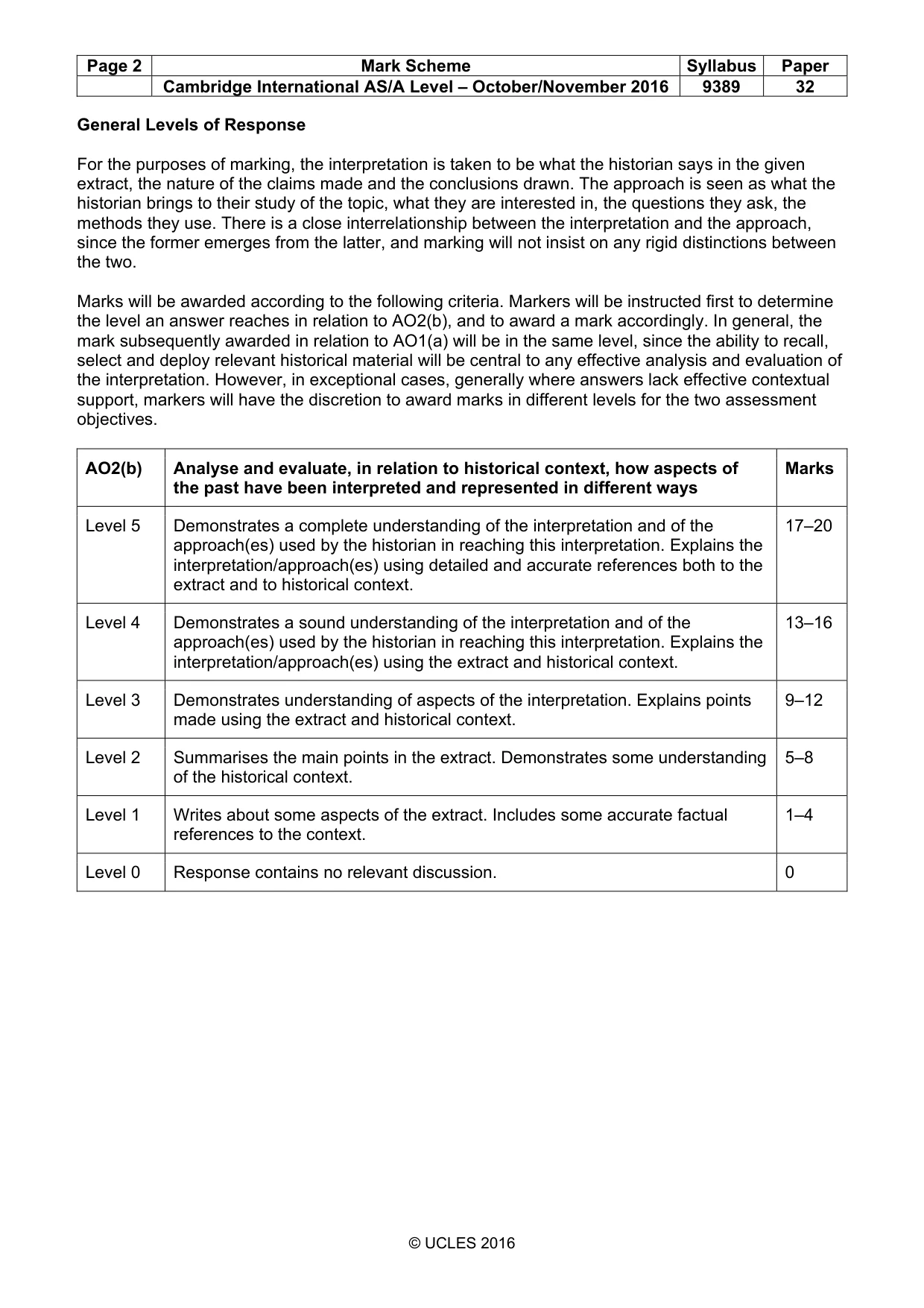
Page 2 Mark Scheme Syllabus Paper Cambridge International AS/A Level – October/November 2016 9389 32 © UCLES 2016 General Levels of Response For the purposes of marking, the interpretation is taken to be what the historian says in the given extract, the nature of the claims made and the conclusions drawn. The approach is seen as what the historian brings to their study of the topic, what they are interested in, the questions they ask, the methods they use. There is a close interrelationship between the interpretation and the approach, since the former emerges from the latter, and marking will not insist on any rigid distinctions between the two. Marks will be awarded according to the following criteria. Markers will be instructed first to determine the level an answer reaches in relation to AO2(b), and to award a mark accordingly. In general, the mark subsequently awarded in relation to AO1(a) will be in the same level, since the ability to recall, select and deploy relevant historical material will be central to any effective analysis and evaluation of the interpretation. However, in exceptional cases, generally where answers lack effective contextual support, markers will have the discretion to award marks in different levels for the two assessment objectives. AO2(b) Analyse and evaluate, in relation to historical context, how aspects of the past have been interpreted and represented in different ways Marks Level 5 Demonstrates a complete understanding of the interpretation and of the approach(es) used by the historian in reaching this interpretation. Explains the interpretation/approach(es) using detailed and accurate references both to the extract and to historical context. 17–20 Level 4 Demonstrates a sound understanding of the interpretation and of the approach(es) used by the historian in reaching this interpretation. Explains the interpretation/approach(es) using the extract and historical context. 13–16 Level 3 Demonstrates understanding of aspects of the interpretation. Explains points made using the extract and historical context. 9–12 Level 2 Summarises the main points in the extract. Demonstrates some understanding of the historical context. 5–8 Level 1 Writes about some aspects of the extract. Includes some accurate factual references to the context. 1–4 Level 0 Response contains no relevant discussion. 0
Mark scheme, page 3
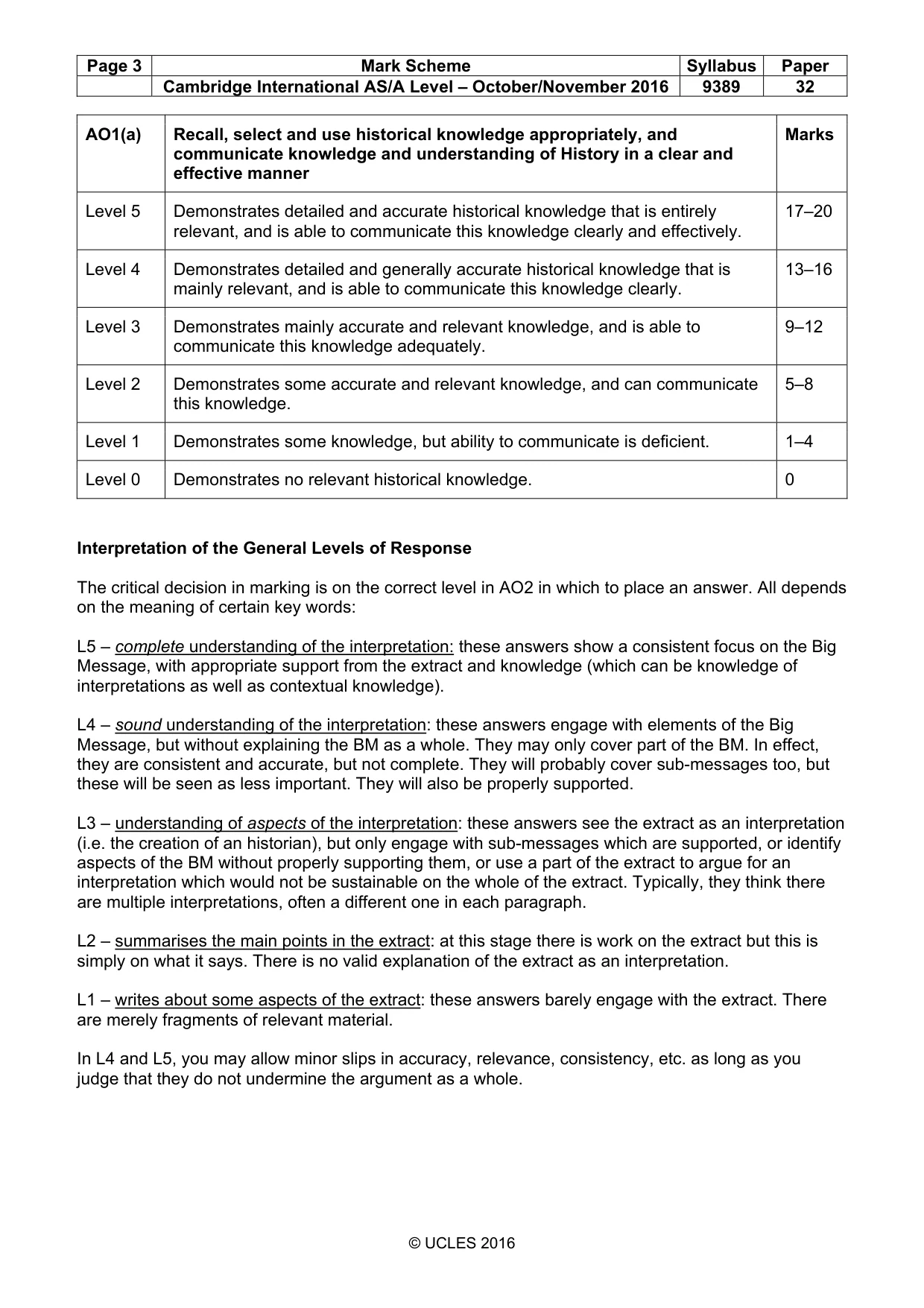
Page 3 Mark Scheme Syllabus Paper Cambridge International AS/A Level – October/November 2016 9389 32 © UCLES 2016 AO1(a) Recall, select and use historical knowledge appropriately, and communicate knowledge and understanding of History in a clear and effective manner Marks Level 5 Demonstrates detailed and accurate historical knowledge that is entirely relevant, and is able to communicate this knowledge clearly and effectively. 17–20 Level 4 Demonstrates detailed and generally accurate historical knowledge that is mainly relevant, and is able to communicate this knowledge clearly. 13–16 Level 3 Demonstrates mainly accurate and relevant knowledge, and is able to communicate this knowledge adequately. 9–12 Level 2 Demonstrates some accurate and relevant knowledge, and can communicate this knowledge. 5–8 Level 1 Demonstrates some knowledge, but ability to communicate is deficient. 1–4 Level 0 Demonstrates no relevant historical knowledge. 0 Interpretation of the General Levels of Response The critical decision in marking is on the correct level in AO2 in which to place an answer. All depends on the meaning of certain key words: L5 – complete understanding of the interpretation: these answers show a consistent focus on the Big Message, with appropriate support from the extract and knowledge (which can be knowledge of interpretations as well as contextual knowledge). L4 – sound understanding of the interpretation: these answers engage with elements of the Big Message, but without explaining the BM as a whole. They may only cover part of the BM. In effect, they are consistent and accurate, but not complete. They will probably cover sub-messages too, but these will be seen as less important. They will also be properly supported. L3 – understanding of aspects of the interpretation: these answers see the extract as an interpretation (i.e. the creation of an historian), but only engage with sub-messages which are supported, or identify aspects of the BM without properly supporting them, or use a part of the extract to argue for an interpretation which would not be sustainable on the whole of the extract. Typically, they think there are multiple interpretations, often a different one in each paragraph. L2 – summarises the main points in the extract: at this stage there is work on the extract but this is simply on what it says. There is no valid explanation of the extract as an interpretation. L1 – writes about some aspects of the extract: these answers barely engage with the extract. There are merely fragments of relevant material. In L4 and L5, you may allow minor slips in accuracy, relevance, consistency, etc. as long as you judge that they do not undermine the argument as a whole.
Mark scheme, page 4
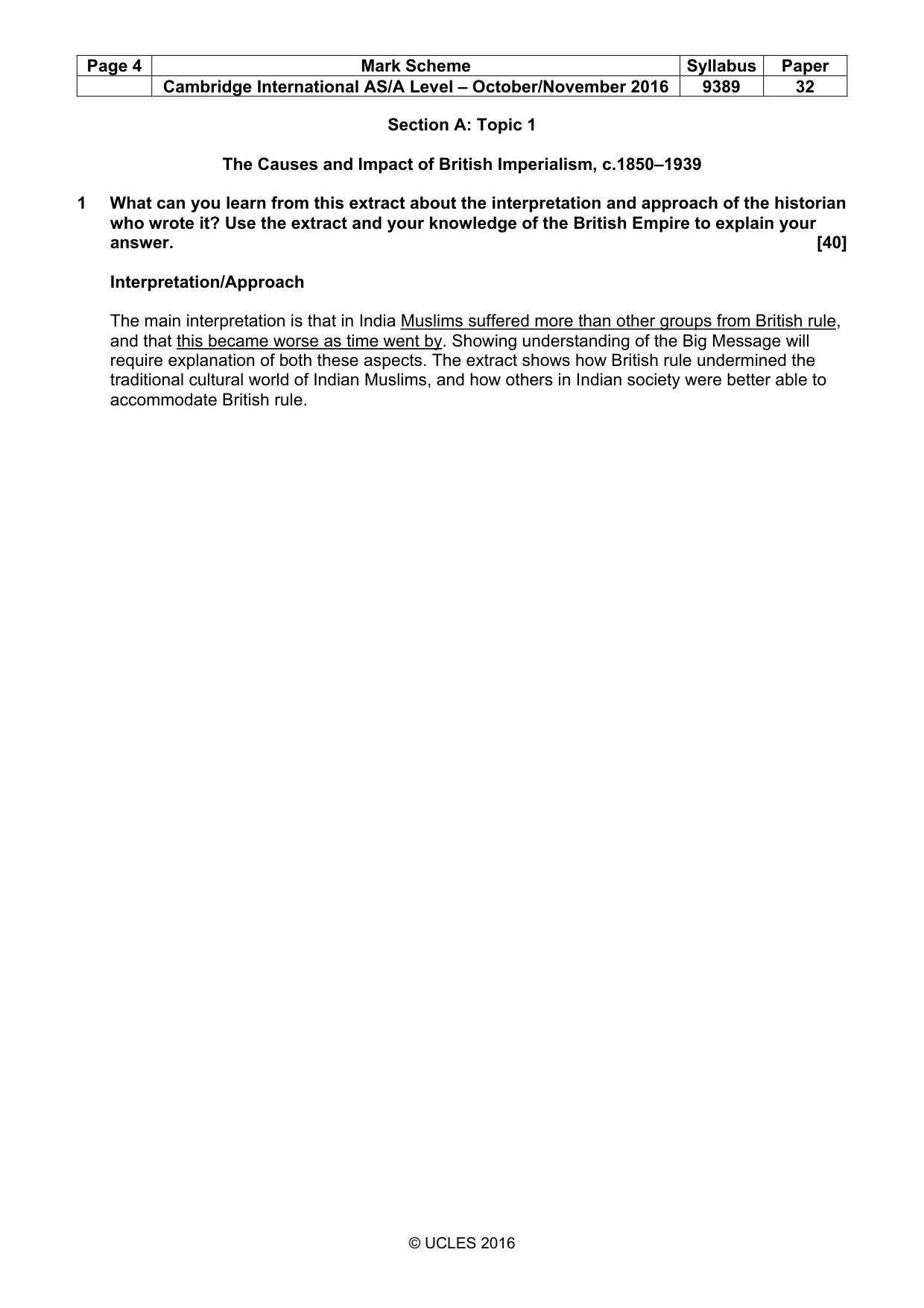
Page 4 Mark Scheme Syllabus Paper Cambridge International AS/A Level – October/November 2016 9389 32 © UCLES 2016 Section A: Topic 1 The Causes and Impact of British Imperialism, c.1850–1939 1 What can you learn from this extract about the interpretation and approach of the historian who wrote it? Use the extract and your knowledge of the British Empire to explain your answer. [40] Interpretation/Approach The main interpretation is that in India Muslims suffered more than other groups from British rule, and that this became worse as time went by. Showing understanding of the Big Message will require explanation of both these aspects. The extract shows how British rule undermined the traditional cultural world of Indian Muslims, and how others in Indian society were better able to accommodate British rule.
Mark scheme, page 5
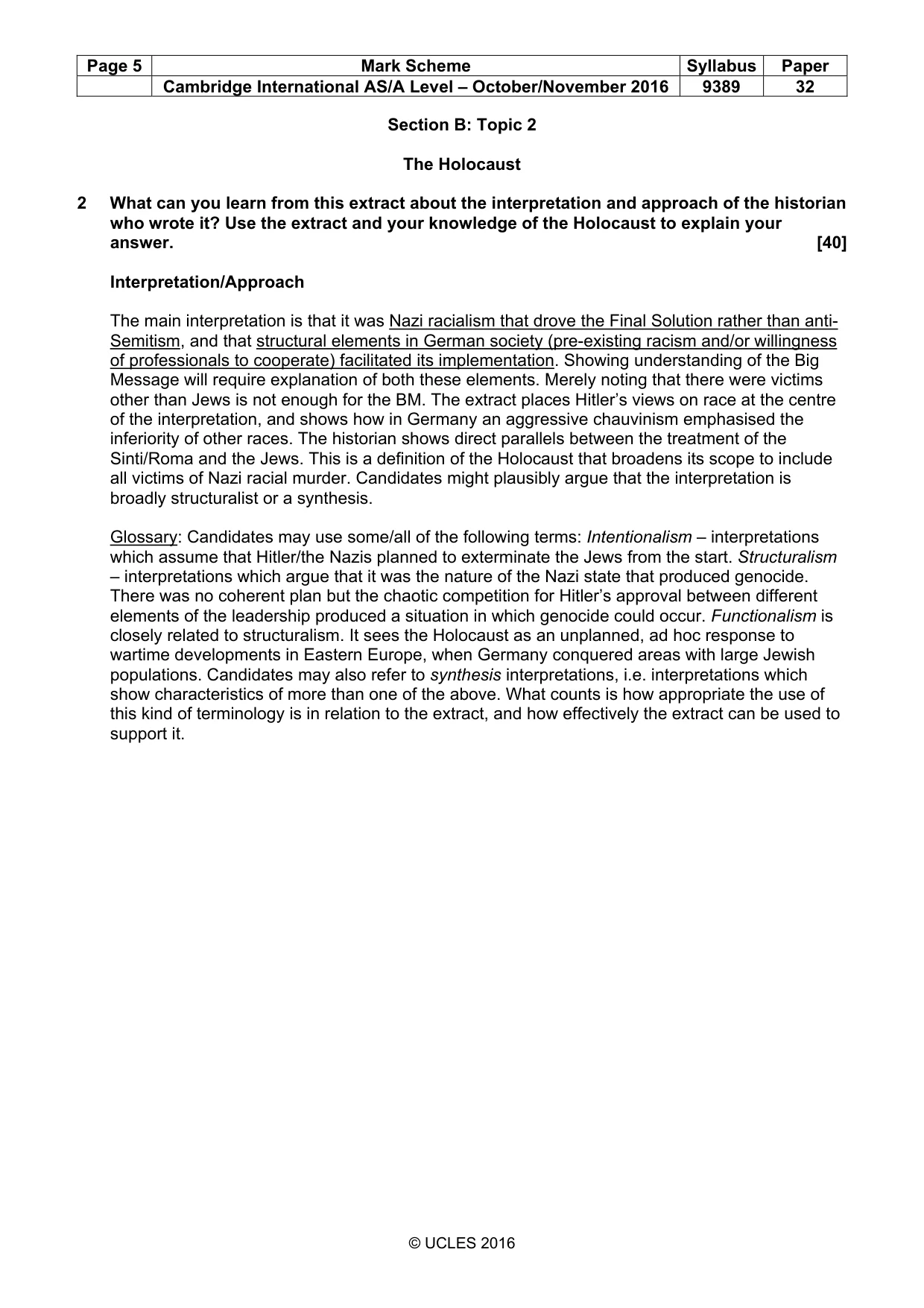
Page 5 Mark Scheme Syllabus Paper Cambridge International AS/A Level – October/November 2016 9389 32 © UCLES 2016 Section B: Topic 2 The Holocaust 2 What can you learn from this extract about the interpretation and approach of the historian who wrote it? Use the extract and your knowledge of the Holocaust to explain your answer. [40] Interpretation/Approach The main interpretation is that it was Nazi racialism that drove the Final Solution rather than anti- Semitism, and that structural elements in German society (pre-existing racism and/or willingness of professionals to cooperate) facilitated its implementation. Showing understanding of the Big Message will require explanation of both these elements. Merely noting that there were victims other than Jews is not enough for the BM. The extract places Hitler’s views on race at the centre of the interpretation, and shows how in Germany an aggressive chauvinism emphasised the inferiority of other races. The historian shows direct parallels between the treatment of the Sinti/Roma and the Jews. This is a definition of the Holocaust that broadens its scope to include all victims of Nazi racial murder. Candidates might plausibly argue that the interpretation is broadly structuralist or a synthesis. Glossary: Candidates may use some/all of the following terms: Intentionalism – interpretations which assume that Hitler/the Nazis planned to exterminate the Jews from the start. Structuralism – interpretations which argue that it was the nature of the Nazi state that produced genocide. There was no coherent plan but the chaotic competition for Hitler’s approval between different elements of the leadership produced a situation in which genocide could occur. Functionalism is closely related to structuralism. It sees the Holocaust as an unplanned, ad hoc response to wartime developments in Eastern Europe, when Germany conquered areas with large Jewish populations. Candidates may also refer to synthesis interpretations, i.e. interpretations which show characteristics of more than one of the above. What counts is how appropriate the use of this kind of terminology is in relation to the extract, and how effectively the extract can be used to support it.
Mark scheme, page 6
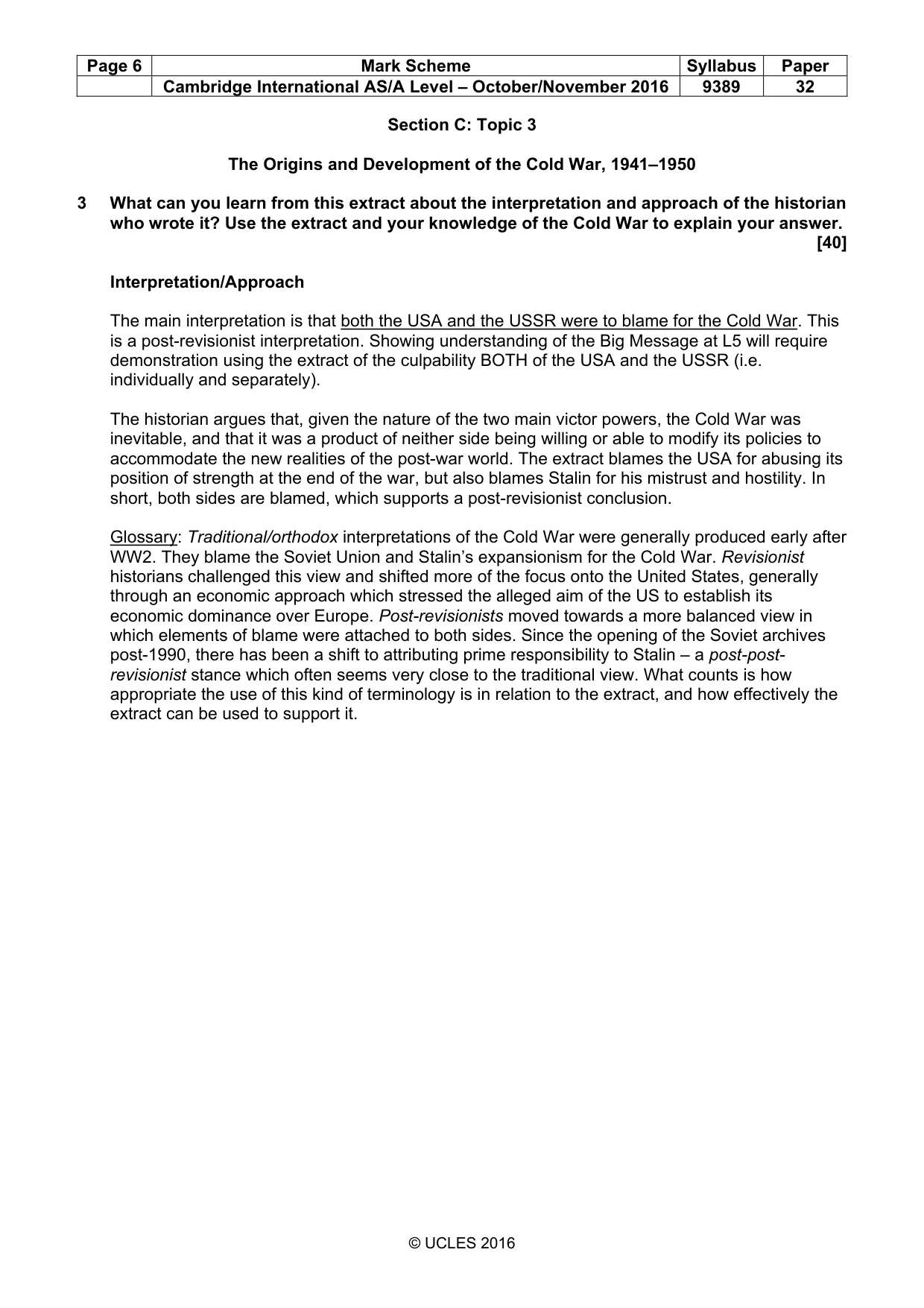
Page 6 Mark Scheme Syllabus Paper Cambridge International AS/A Level – October/November 2016 9389 32 © UCLES 2016 Section C: Topic 3 The Origins and Development of the Cold War, 1941–1950 3 What can you learn from this extract about the interpretation and approach of the historian who wrote it? Use the extract and your knowledge of the Cold War to explain your answer. [40] Interpretation/Approach The main interpretation is that both the USA and the USSR were to blame for the Cold War. This is a post-revisionist interpretation. Showing understanding of the Big Message at L5 will require demonstration using the extract of the culpability BOTH of the USA and the USSR (i.e. individually and separately). The historian argues that, given the nature of the two main victor powers, the Cold War was inevitable, and that it was a product of neither side being willing or able to modify its policies to accommodate the new realities of the post-war world. The extract blames the USA for abusing its position of strength at the end of the war, but also blames Stalin for his mistrust and hostility. In short, both sides are blamed, which supports a post-revisionist conclusion. Glossary: Traditional/orthodox interpretations of the Cold War were generally produced early after WW2. They blame the Soviet Union and Stalin’s expansionism for the Cold War. Revisionist historians challenged this view and shifted more of the focus onto the United States, generally through an economic approach which stressed the alleged aim of the US to establish its economic dominance over Europe. Post-revisionists moved towards a more balanced view in which elements of blame were attached to both sides. Since the opening of the Soviet archives post-1990, there has been a shift to attributing prime responsibility to Stalin – a post-post- revisionist stance which often seems very close to the traditional view. What counts is how appropriate the use of this kind of terminology is in relation to the extract, and how effectively the extract can be used to support it.
What you needed in this session
Cambridge’s own grade thresholds for 2016 Oct/Nov, Paper 3 · Variant 2. A higher threshold means an easier paper — the bar moves with how the cohort did.