Cambridge A Level History 9389 — 2015 Oct/Nov Paper 3 · Variant 3
9389/33/O/N/15 · 40 marks · ≈45 min
The question paper and its mark scheme, free to read here and free to download. This is Cambridge’s own paper, exactly as it was sat.
Question paper4 pages
Mark scheme5 pages
Answers below. Sit the paper first if you are practising.
Paper as text
Question paper, page 1
This document consists of 4 printed pages. DC (ST) 96755/2 © UCLES 2015 [Turn over Cambridge International Examinations Cambridge International Advanced Subsidiary and Advanced Level * 8 5 8 5 7 0 0 7 9 1 * HISTORY 9389/33 Paper 3 Interpretations Question October/November 2015 1 hour Additional Materials: Answer Booklet/Paper READ THESE INSTRUCTIONS FIRST If you have been given an Answer Booklet, follow the instructions on the front cover of the Booklet. Write your Centre number, candidate number and name on the work you hand in. Write in dark blue or black pen. Do not use staples, paper clips, glue or correction fluid. DO NOT WRITE IN ANY BARCODES. This paper contains three sections: Section A: Topic 1 The Causes and Impact of British Imperialism, c. 1850–1939 Section B: Topic 2 The Holocaust Section C: Topic 3 The Origins and Development of the Cold War, 1941–50 Answer the question on the topic you have studied. At the end of the examination, fasten all your work securely together. The marks are given in brackets [ ] at the end of each question.
Question paper, page 2
2 9389/33/O/N/15 © UCLES 2015 Section A: Topic 1 The Causes and Impact of British Imperialism, c.1850–1939 1 Read the extract and then answer the question. It is certainly from 1867 that the historian can identify outbursts of public interest in foreign and imperial matters. Bouts of popular excitement and agitation accompanied a succession of events from the early seventies: the disappearance and death of David Livingstone; the Ashanti campaign of 1874; the purchase of the Suez Canal shares; the Afghanistan and Zulu disasters of 1879; Egyptian and Sudanese crises; the anxieties surrounding the possible imperial retreat of Gladstone’s Fourth Ministry; the Jameson Raid; the Boer War; and so on. It would be a mistake, however, to concentrate too much on these imperial highlights. These were merely the surface ripples, occasionally whipped up into storms, of a much deeper intellectual and social current which had been set up in the second half of the nineteenth century. In the emergence of the new nationalism, state, nation and society converged, and the elite which promoted this convergence created new rituals, a whole range of invented traditions and cults through which it could be communicated to the public. Architecture, statues, public ceremonies, parades, displays and all manner of publications were bent to these ends. The new traditions of Christian militarism, militarist athleticism in the public schools, and a recreated and perverted medieval chivalry contributed readily to the national rituals and political progresses which were part of the British imperial cult. The Queen was swiftly transformed from petulant widow to imperial matriarch. The army lost its old unpopularity and became a central element in national life. Cults of heroes from both the distant and more recent past were assiduously promoted through children’s literature. Social Darwinism provided an ideological justification for colonial war and conquest which swiftly found its way into popular literature and school textbooks. Historians of the theatre have pointed to the remarkable topicality of the nineteenth-century stage and the excitements of the music hall. There is a good deal of evidence from working-class autobiographies, other memoirs and oral evidence on the power of imperialism not only in the late nineteenth century but also in Edwardian times. Indeed, the most significant working-class testimony comes from the latter period. Anyone who expressed unpatriotic socialist tendencies in Alfred Williams’ railway factory was mocked. Fred Willis recounted the imperial and racial content of geography lessons in his late-Victorian schooling. Robert Roberts described the pervasive nature of imperial and patriotic ideas, and the pageantry, publications and advertising through which they were expressed in his Edwardian Salford slum. Further up the social scale, any amount of evidence can be produced. When Earl Attlee, the retired Labour Prime Minister, was asked to give lectures at Oxford University in 1960, he chose the subject ‘Empire and Commonwealth’. In his first lecture, he described the excitements of youthful imperialism. When the news of the Jameson Raid broke, his father, a Gladstonian Liberal, was shocked, ‘but to us Dr Jameson was a hero. On the wall at school hung a great map with large portions of it – our Empire – coloured red. It was an intoxicating vision for a small boy. We believed in our great imperial mission.’ What can you learn from this extract about the interpretation and approach of the historian who wrote it? Use the extract and your knowledge of the British Empire to explain your answer. [40]
Question paper, page 3
3 9389/33/O/N/15 © UCLES 2015 [Turn over Section B: Topic 2 The Holocaust 2 Read the extract and then answer the question. In the five weeks between 18 September and 25 October 1941, events had moved rapidly. Hitler had reversed his earlier decision not to permit the deportation of Jews from the Third Reich until after the war and instead sought the unrealisable goal of a Jew-free Germany by the end of the year. The sites of the first extermination camps were selected. The testing of various methods of killing by poison gas were conducted. Jewish emigration from the Third Reich was forbidden. And the first 11 Jewish transports had departed for Lodz as a temporary holding station. The vision of the Final Solution – a programme aimed at murdering every last Jew in the German grasp – had crystalised in the minds of the Nazi leadership and was henceforth being turned into reality. If the last pieces in the decision-making process came together quickly in the end, this fateful cluster of decisions itself was the climax of a long process stretching over a period of twenty-five months from September 1939 to October 1941. The commitment to some kind of final solution to the Jewish question had been inherent in Nazi ideology from the beginning. Thus Nazi Jewish policy had evolved through a series of final solutions, which first envisaged a Jew-free Germany through emigration and then a Jew-free Europe through expulsion. This process of radicalisation culminated in 1941 in the ultimate Final Solution of systematic mass murder. Jewish policy could evolve no further in concept. It remained only to be implemented through action. What was Hitler’s role in this fateful evolution? As the ultimate embodiment of Nazi ideology as well as the constant inciter and mobiliser of the party faithful, Hitler had certainly legitimised and prodded the ongoing search for final solutions. His obsession with the Jewish question ensured that the Nazi commitment would not slacken, that the search for a solution one way or another to this self-imposed problem would not fade away into obscurity or be indefinitely postponed. No leading Nazi could prosper who did not appear to take the Jewish question as seriously as Hitler did himself. Thus Hitler, simply by his existence, exerted a continuing pressure on the political system, which induced a competition among the faithful and ambitious to advance ever more radical proposals and to carry out Jewish policy in an ever more brutal and comprehensive manner. For many – the ‘true believers’ – this commitment to the Final Solution was a deeply felt conviction. For the unquestioning loyalists, it was a matter of completely identifying with Hitler. For eugenicists and planning experts, it was the opportunity to realise an agenda of their own that overlapped with that of Hitler. For technicians of many sorts, it was a chance to display their skills. And for countless others, it was a cynical exercise in political careerism, opportunism and accommodation. In the end the results were the same. The commitment to some kind of final solution permeated the entire regime, and acceptance of such a priority on the part of the regime characterised much of the German population at large. What can you learn from this extract about the interpretation and approach of the historian who wrote it? Use the extract and your knowledge of the Holocaust to explain your answer. [40]
Question paper, page 4
4 9389/33/O/N/15 © UCLES 2015 Section C: Topic 3 The Origins and Development of the Cold War, 1941–1950 3 Read the extract and then answer the question. It is tempting to lay total blame for the Cold War on the delusions of Stalin and his lieutenants. A closer look at the Cold War from the Soviet side reveals, however, that they were not the only culprits in the conflict. We cannot disregard other, complex factors, such as the crass nature of power politics, choices of US and British policy-makers, and the deeper causes of hostility and mistrust between dictatorship and democracy in an uncertain world. Stalin, notwithstanding his reputation as a ruthless tyrant, was not prepared to take a course of unbridled unilateral expansionism after World War II. He wanted to avoid confrontation with the West. He was even ready to see cooperation with the Western powers as a preferable way of building his influence and solving contentious international issues. Thus, the Cold War was not his choice or his brainchild. The arrangements at Yalta for Eastern Europe, and the critical victories of the Red Army in the Allies’ ultimate triumph over the Axis powers, led Stalin to expect that the cooperative regulation of international relations would be possible. For this, by 1945, Stalin was ready to diminish the role of ideology in his post-war diplomacy with the West to a minimal level. He was ready to observe the limits on Soviet spheres of influence in Europe and Asia, and he was prepared to keep in power ‘transitional’ regimes in Eastern Europe that would be acceptable to the West. That did not mean that Stalin would cease to be the dreadful dictator and spiritual leader of the Communist world. It did mean, however, that the Kremlin leader believed he needed years of peace in order to bring the USSR from its wartime destruction, when six out of the fifteen Soviet republics were occupied and devastated by the Germans, to the status of an economic and military superpower. After the death of Roosevelt, which signalled the end of the wartime bonds of friendship between Stalin and the Western leaders, and particularly after the atomic bomb was dropped on Hiroshima, Stalin began to have increasing doubts about post-war cooperation. Step by step, the revolutionary- imperial aspect of Stalin’s thought and actions began to resurface. Stalin’s foreign and domestic priorities were limited in nature, and yet they led to tension with the West. Stalin wanted not only to restore order and strength to a country torn apart by war, but also to maximise the fruits of victory. He refrained from flying red flags all over the Soviet spheres of domination, yet he was determined to exploit Central Europe for his rearmament programme. The brutality of the Soviet regime and Stalin’s cruel, scheming, and maniacally suspicious nature, which served these ends, looked first unacceptable and then sinister to the West. Stalin’s road to the Cold War, in the years from 1946 to 1950, was strewn with miscalculations. He did not want to provoke American and British ‘imperialism’, yet he overreacted to any perceived threat of it in Germany and in Eastern Europe. In response to the Marshall Plan, Stalin began to consolidate a Soviet security zone in Eastern Europe by ruthless police methods and intensive Communist propaganda. Trying to stop Western separatist policies in Germany, he triggered the Berlin blockade crisis. In short, Stalin’s post-war foreign policy was more defensive, reactive, and prudent than it was the fulfilment of a master plan. Instead of postponing a confrontation with the United States and gaining a much-needed respite for recovery, he managed to bring it closer with every step. What can you learn from this extract about the interpretation and approach of the historian who wrote it? Use the extract and your knowledge of the Cold War to explain your answer. [40] Permission to reproduce items where third-party owned material protected by copyright is included has been sought and cleared where possible. Every reasonable effort has been made by the publisher (UCLES) to trace copyright holders, but if any items requiring clearance have unwittingly been included, the publisher will be pleased to make amends at the earliest possible opportunity. To avoid the issue of disclosure of answer-related information to candidates, all copyright acknowledgements are reproduced online in the Cambridge International Examinations Copyright Acknowledgements Booklet. This is produced for each series of examinations and is freely available to download at www.cie.org.uk after the live examination series. Cambridge International Examinations is part of the Cambridge Assessment Group. Cambridge Assessment is the brand name of University of Cambridge Local Examinations Syndicate (UCLES), which is itself a department of the University of Cambridge.
Mark scheme, page 1
® IGCSE is the registered trademark of Cambridge International Examinations. CAMBRIDGE INTERNATIONAL EXAMINATIONS Cambridge International Advanced Subsidiary and Advanced Level MARK SCHEME for the October/November 2015 series 9389 HISTORY 9389/33 Paper 3 (Interpretations Question), maximum raw mark 40 This mark scheme is published as an aid to teachers and candidates, to indicate the requirements of the examination. It shows the basis on which Examiners were instructed to award marks. It does not indicate the details of the discussions that took place at an Examiners’ meeting before marking began, which would have considered the acceptability of alternative answers. Mark schemes should be read in conjunction with the question paper and the Principal Examiner Report for Teachers. Cambridge will not enter into discussions about these mark schemes. Cambridge is publishing the mark schemes for the October/November 2015 series for most Cambridge IGCSE®, Cambridge International A and AS Level components and some Cambridge O Level components.
Mark scheme, page 2
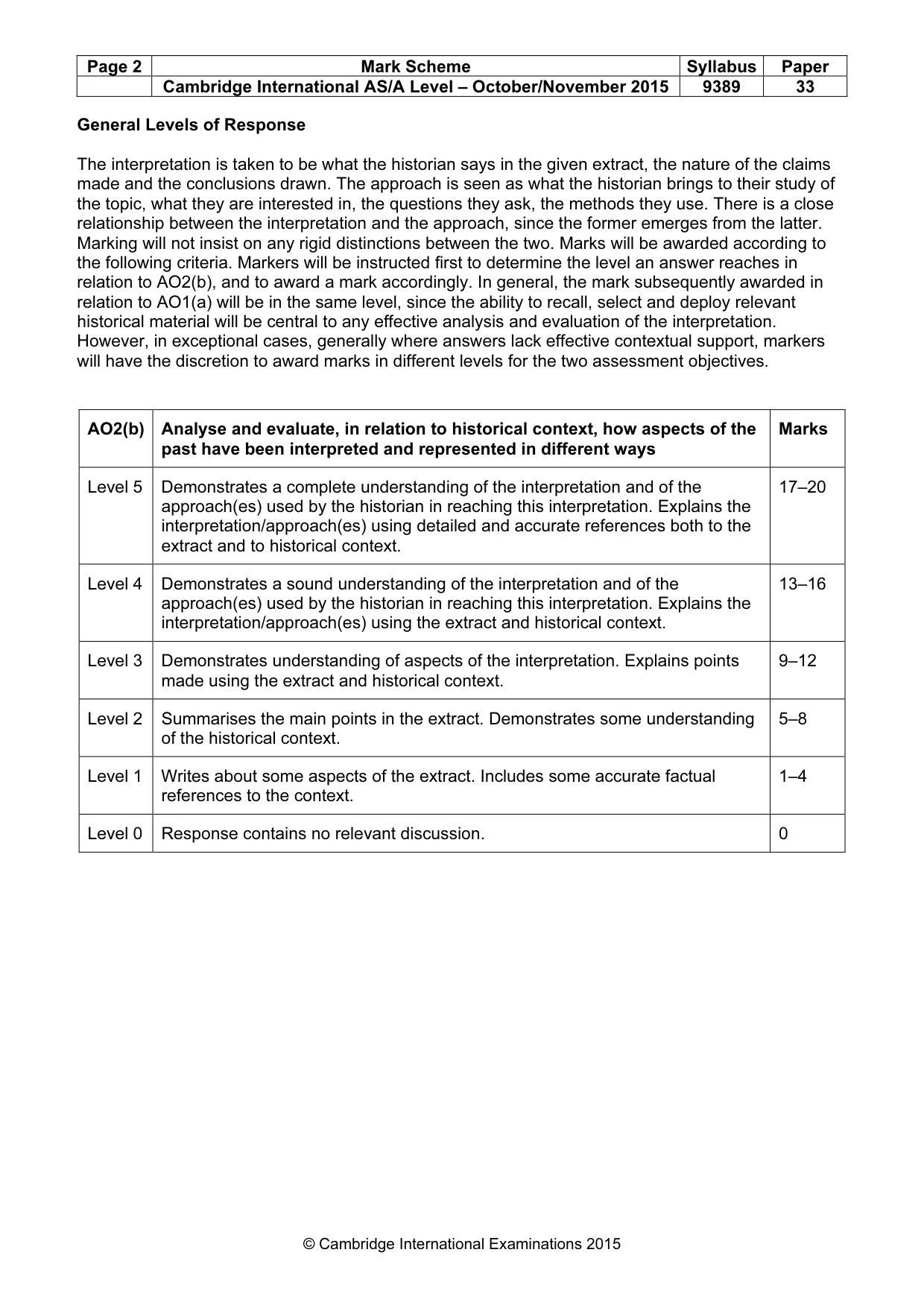
Page 2 Mark Scheme Syllabus Paper Cambridge International AS/A Level – October/November 2015 9389 33 © Cambridge International Examinations 2015 General Levels of Response The interpretation is taken to be what the historian says in the given extract, the nature of the claims made and the conclusions drawn. The approach is seen as what the historian brings to their study of the topic, what they are interested in, the questions they ask, the methods they use. There is a close relationship between the interpretation and the approach, since the former emerges from the latter. Marking will not insist on any rigid distinctions between the two. Marks will be awarded according to the following criteria. Markers will be instructed first to determine the level an answer reaches in relation to AO2(b), and to award a mark accordingly. In general, the mark subsequently awarded in relation to AO1(a) will be in the same level, since the ability to recall, select and deploy relevant historical material will be central to any effective analysis and evaluation of the interpretation. However, in exceptional cases, generally where answers lack effective contextual support, markers will have the discretion to award marks in different levels for the two assessment objectives. AO2(b) Analyse and evaluate, in relation to historical context, how aspects of the past have been interpreted and represented in different ways Marks Level 5 Demonstrates a complete understanding of the interpretation and of the approach(es) used by the historian in reaching this interpretation. Explains the interpretation/approach(es) using detailed and accurate references both to the extract and to historical context. 17–20 Level 4 Demonstrates a sound understanding of the interpretation and of the approach(es) used by the historian in reaching this interpretation. Explains the interpretation/approach(es) using the extract and historical context. 13–16 Level 3 Demonstrates understanding of aspects of the interpretation. Explains points made using the extract and historical context. 9–12 Level 2 Summarises the main points in the extract. Demonstrates some understanding of the historical context. 5–8 Level 1 Writes about some aspects of the extract. Includes some accurate factual references to the context. 1–4 Level 0 Response contains no relevant discussion. 0
Mark scheme, page 3
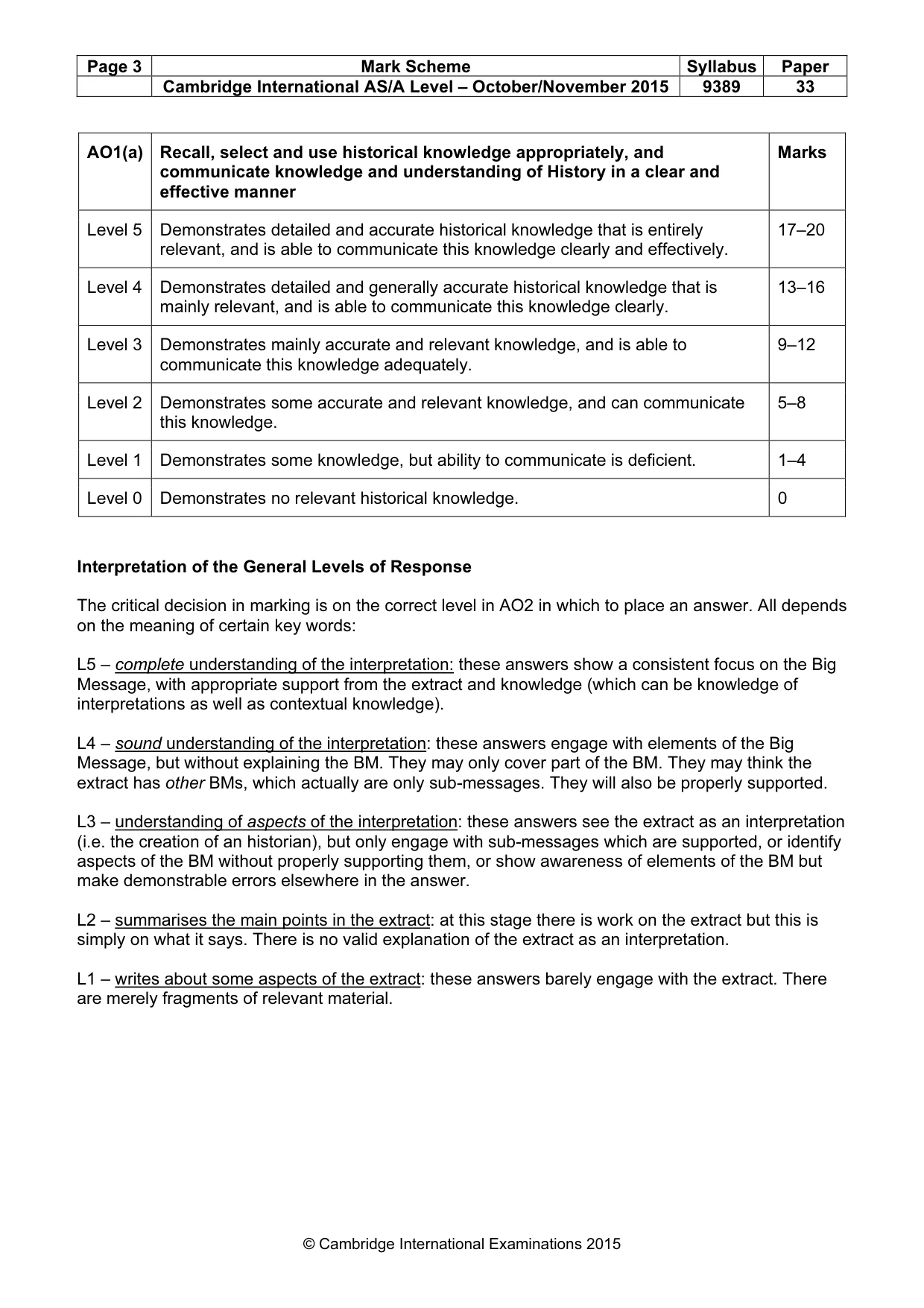
Page 3 Mark Scheme Syllabus Paper Cambridge International AS/A Level – October/November 2015 9389 33 © Cambridge International Examinations 2015 AO1(a) Recall, select and use historical knowledge appropriately, and communicate knowledge and understanding of History in a clear and effective manner Marks Level 5 Demonstrates detailed and accurate historical knowledge that is entirely relevant, and is able to communicate this knowledge clearly and effectively. 17–20 Level 4 Demonstrates detailed and generally accurate historical knowledge that is mainly relevant, and is able to communicate this knowledge clearly. 13–16 Level 3 Demonstrates mainly accurate and relevant knowledge, and is able to communicate this knowledge adequately. 9–12 Level 2 Demonstrates some accurate and relevant knowledge, and can communicate this knowledge. 5–8 Level 1 Demonstrates some knowledge, but ability to communicate is deficient. 1–4 Level 0 Demonstrates no relevant historical knowledge. 0 Interpretation of the General Levels of Response The critical decision in marking is on the correct level in AO2 in which to place an answer. All depends on the meaning of certain key words: L5 – complete understanding of the interpretation: these answers show a consistent focus on the Big Message, with appropriate support from the extract and knowledge (which can be knowledge of interpretations as well as contextual knowledge). L4 – sound understanding of the interpretation: these answers engage with elements of the Big Message, but without explaining the BM. They may only cover part of the BM. They may think the extract has other BMs, which actually are only sub-messages. They will also be properly supported. L3 – understanding of aspects of the interpretation: these answers see the extract as an interpretation (i.e. the creation of an historian), but only engage with sub-messages which are supported, or identify aspects of the BM without properly supporting them, or show awareness of elements of the BM but make demonstrable errors elsewhere in the answer. L2 – summarises the main points in the extract: at this stage there is work on the extract but this is simply on what it says. There is no valid explanation of the extract as an interpretation. L1 – writes about some aspects of the extract: these answers barely engage with the extract. There are merely fragments of relevant material.
Mark scheme, page 4
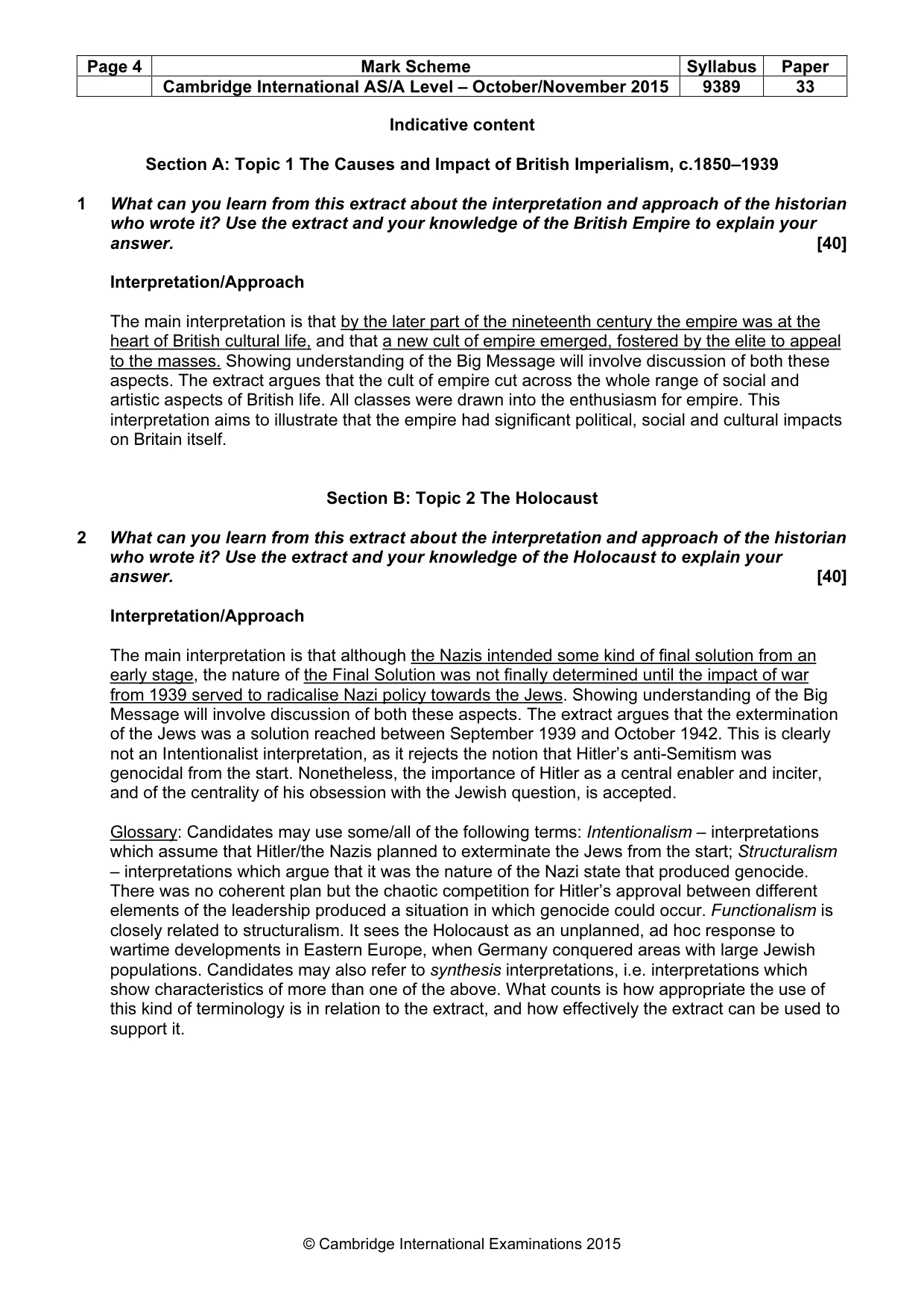
Page 4 Mark Scheme Syllabus Paper Cambridge International AS/A Level – October/November 2015 9389 33 © Cambridge International Examinations 2015 Indicative content Section A: Topic 1 The Causes and Impact of British Imperialism, c.1850–1939 1 What can you learn from this extract about the interpretation and approach of the historian who wrote it? Use the extract and your knowledge of the British Empire to explain your answer. [40] Interpretation/Approach The main interpretation is that by the later part of the nineteenth century the empire was at the heart of British cultural life, and that a new cult of empire emerged, fostered by the elite to appeal to the masses. Showing understanding of the Big Message will involve discussion of both these aspects. The extract argues that the cult of empire cut across the whole range of social and artistic aspects of British life. All classes were drawn into the enthusiasm for empire. This interpretation aims to illustrate that the empire had significant political, social and cultural impacts on Britain itself. Section B: Topic 2 The Holocaust 2 What can you learn from this extract about the interpretation and approach of the historian who wrote it? Use the extract and your knowledge of the Holocaust to explain your answer. [40] Interpretation/Approach The main interpretation is that although the Nazis intended some kind of final solution from an early stage, the nature of the Final Solution was not finally determined until the impact of war from 1939 served to radicalise Nazi policy towards the Jews. Showing understanding of the Big Message will involve discussion of both these aspects. The extract argues that the extermination of the Jews was a solution reached between September 1939 and October 1942. This is clearly not an Intentionalist interpretation, as it rejects the notion that Hitler’s anti-Semitism was genocidal from the start. Nonetheless, the importance of Hitler as a central enabler and inciter, and of the centrality of his obsession with the Jewish question, is accepted. Glossary: Candidates may use some/all of the following terms: Intentionalism – interpretations which assume that Hitler/the Nazis planned to exterminate the Jews from the start; Structuralism – interpretations which argue that it was the nature of the Nazi state that produced genocide. There was no coherent plan but the chaotic competition for Hitler’s approval between different elements of the leadership produced a situation in which genocide could occur. Functionalism is closely related to structuralism. It sees the Holocaust as an unplanned, ad hoc response to wartime developments in Eastern Europe, when Germany conquered areas with large Jewish populations. Candidates may also refer to synthesis interpretations, i.e. interpretations which show characteristics of more than one of the above. What counts is how appropriate the use of this kind of terminology is in relation to the extract, and how effectively the extract can be used to support it.
Mark scheme, page 5
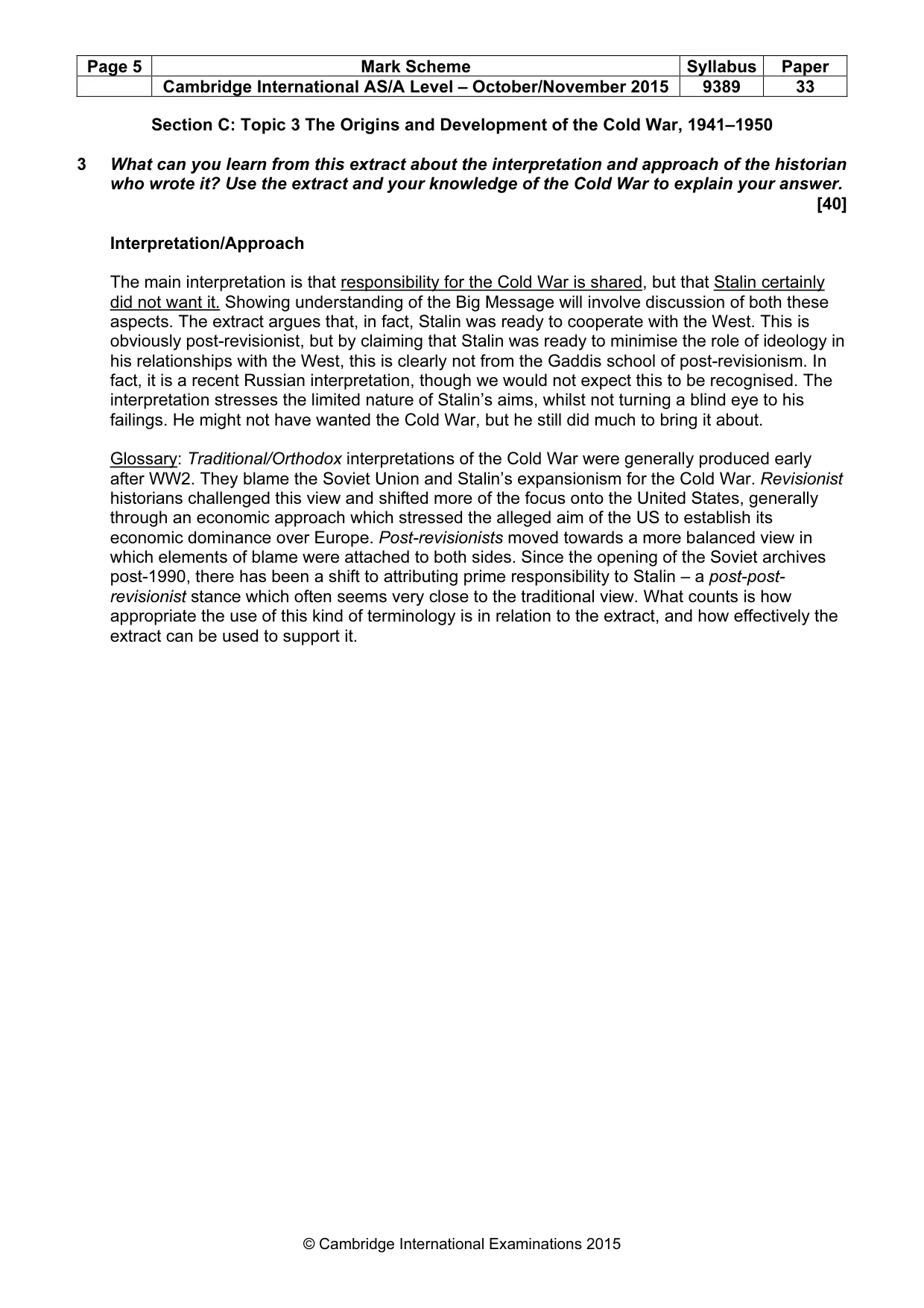
Page 5 Mark Scheme Syllabus Paper Cambridge International AS/A Level – October/November 2015 9389 33 © Cambridge International Examinations 2015 Section C: Topic 3 The Origins and Development of the Cold War, 1941–1950 3 What can you learn from this extract about the interpretation and approach of the historian who wrote it? Use the extract and your knowledge of the Cold War to explain your answer. [40] Interpretation/Approach The main interpretation is that responsibility for the Cold War is shared, but that Stalin certainly did not want it. Showing understanding of the Big Message will involve discussion of both these aspects. The extract argues that, in fact, Stalin was ready to cooperate with the West. This is obviously post-revisionist, but by claiming that Stalin was ready to minimise the role of ideology in his relationships with the West, this is clearly not from the Gaddis school of post-revisionism. In fact, it is a recent Russian interpretation, though we would not expect this to be recognised. The interpretation stresses the limited nature of Stalin’s aims, whilst not turning a blind eye to his failings. He might not have wanted the Cold War, but he still did much to bring it about. Glossary: Traditional/Orthodox interpretations of the Cold War were generally produced early after WW2. They blame the Soviet Union and Stalin’s expansionism for the Cold War. Revisionist historians challenged this view and shifted more of the focus onto the United States, generally through an economic approach which stressed the alleged aim of the US to establish its economic dominance over Europe. Post-revisionists moved towards a more balanced view in which elements of blame were attached to both sides. Since the opening of the Soviet archives post-1990, there has been a shift to attributing prime responsibility to Stalin – a post-post- revisionist stance which often seems very close to the traditional view. What counts is how appropriate the use of this kind of terminology is in relation to the extract, and how effectively the extract can be used to support it.
What you needed in this session
Cambridge’s own grade thresholds for 2015 Oct/Nov, Paper 3 · Variant 3. A higher threshold means an easier paper — the bar moves with how the cohort did.