Cambridge A Level History 9389 — 2015 Oct/Nov Paper 3 · Variant 2
9389/32/O/N/15 · 40 marks · ≈45 min
The question paper and its mark scheme, free to read here and free to download. This is Cambridge’s own paper, exactly as it was sat.
Question paper8 pages



Mark scheme5 pages
Answers below. Sit the paper first if you are practising.
Paper as text
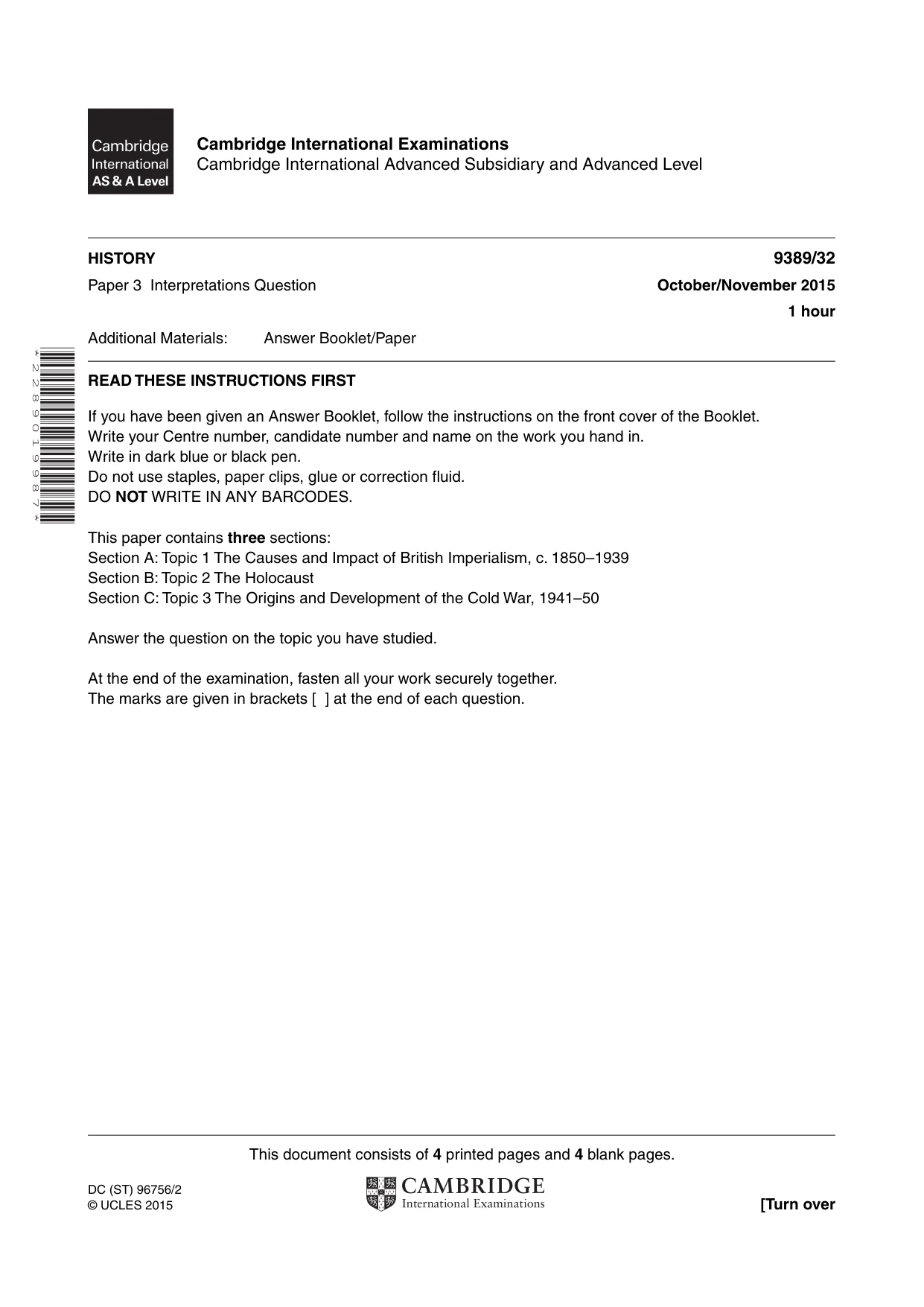
Question paper, page 1
This document consists of 4 printed pages and 4 blank pages. DC (ST) 96756/2 © UCLES 2015 [Turn over Cambridge International Examinations Cambridge International Advanced Subsidiary and Advanced Level * 2 2 8 9 0 1 9 9 8 7 * HISTORY 9389/32 Paper 3 Interpretations Question October/November 2015 1 hour Additional Materials: Answer Booklet/Paper READ THESE INSTRUCTIONS FIRST If you have been given an Answer Booklet, follow the instructions on the front cover of the Booklet. Write your Centre number, candidate number and name on the work you hand in. Write in dark blue or black pen. Do not use staples, paper clips, glue or correction fluid. DO NOT WRITE IN ANY BARCODES. This paper contains three sections: Section A: Topic 1 The Causes and Impact of British Imperialism, c. 1850–1939 Section B: Topic 2 The Holocaust Section C: Topic 3 The Origins and Development of the Cold War, 1941–50 Answer the question on the topic you have studied. At the end of the examination, fasten all your work securely together. The marks are given in brackets [ ] at the end of each question.
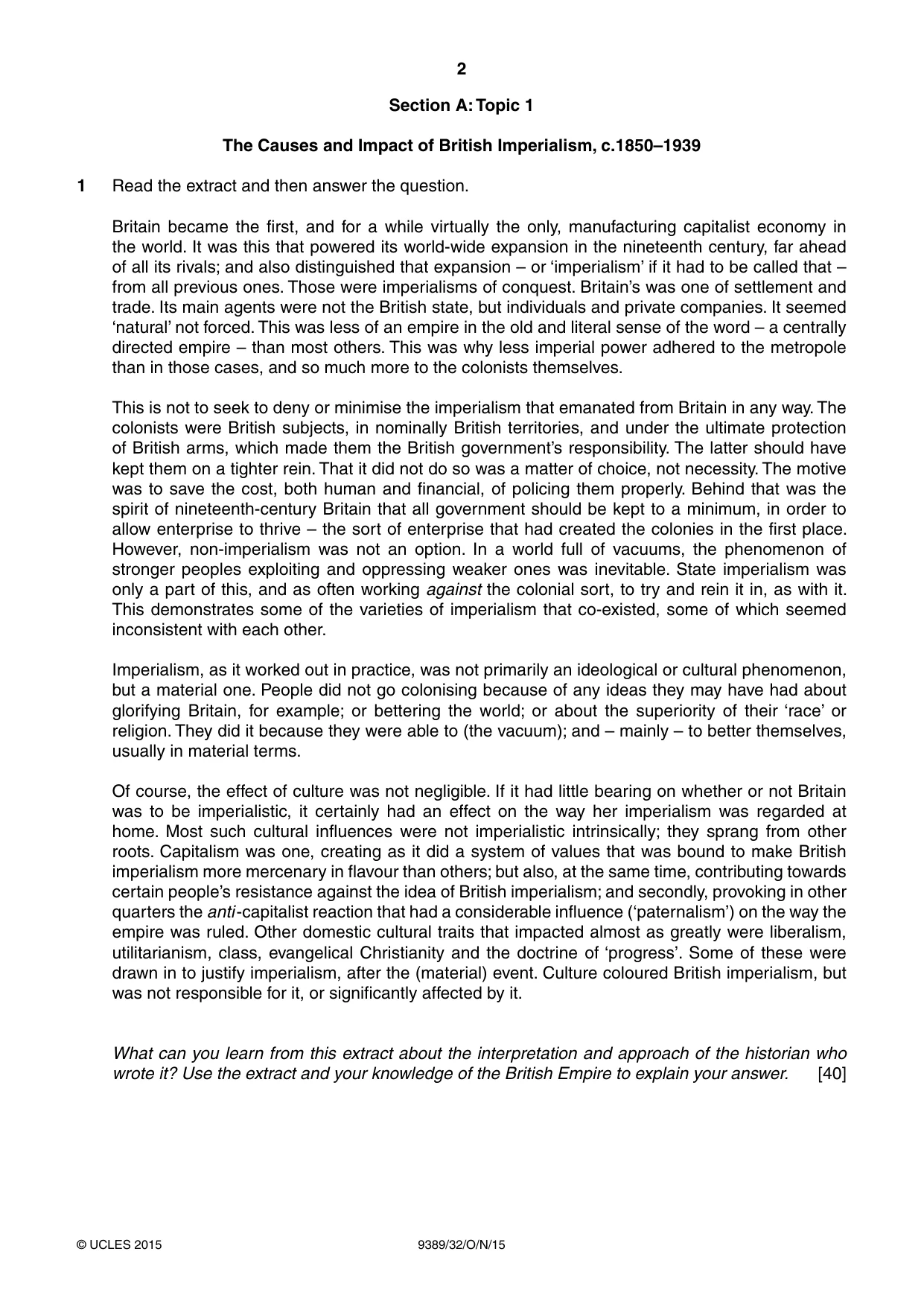
Question paper, page 2
2 9389/32/O/N/15 © UCLES 2015 Section A: Topic 1 The Causes and Impact of British Imperialism, c.1850–1939 1 Read the extract and then answer the question. Britain became the first, and for a while virtually the only, manufacturing capitalist economy in the world. It was this that powered its world-wide expansion in the nineteenth century, far ahead of all its rivals; and also distinguished that expansion – or ‘imperialism’ if it had to be called that – from all previous ones. Those were imperialisms of conquest. Britain’s was one of settlement and trade. Its main agents were not the British state, but individuals and private companies. It seemed ‘natural’ not forced. This was less of an empire in the old and literal sense of the word – a centrally directed empire – than most others. This was why less imperial power adhered to the metropole than in those cases, and so much more to the colonists themselves. This is not to seek to deny or minimise the imperialism that emanated from Britain in any way. The colonists were British subjects, in nominally British territories, and under the ultimate protection of British arms, which made them the British government’s responsibility. The latter should have kept them on a tighter rein. That it did not do so was a matter of choice, not necessity. The motive was to save the cost, both human and financial, of policing them properly. Behind that was the spirit of nineteenth-century Britain that all government should be kept to a minimum, in order to allow enterprise to thrive – the sort of enterprise that had created the colonies in the first place. However, non-imperialism was not an option. In a world full of vacuums, the phenomenon of stronger peoples exploiting and oppressing weaker ones was inevitable. State imperialism was only a part of this, and as often working against the colonial sort, to try and rein it in, as with it. This demonstrates some of the varieties of imperialism that co-existed, some of which seemed inconsistent with each other. Imperialism, as it worked out in practice, was not primarily an ideological or cultural phenomenon, but a material one. People did not go colonising because of any ideas they may have had about glorifying Britain, for example; or bettering the world; or about the superiority of their ‘race’ or religion. They did it because they were able to (the vacuum); and – mainly – to better themselves, usually in material terms. Of course, the effect of culture was not negligible. If it had little bearing on whether or not Britain was to be imperialistic, it certainly had an effect on the way her imperialism was regarded at home. Most such cultural influences were not imperialistic intrinsically; they sprang from other roots. Capitalism was one, creating as it did a system of values that was bound to make British imperialism more mercenary in flavour than others; but also, at the same time, contributing towards certain people’s resistance against the idea of British imperialism; and secondly, provoking in other quarters the anti -capitalist reaction that had a considerable influence (‘paternalism’) on the way the empire was ruled. Other domestic cultural traits that impacted almost as greatly were liberalism, utilitarianism, class, evangelical Christianity and the doctrine of ‘progress’. Some of these were drawn in to justify imperialism, after the (material) event. Culture coloured British imperialism, but was not responsible for it, or significantly affected by it. What can you learn from this extract about the interpretation and approach of the historian who wrote it? Use the extract and your knowledge of the British Empire to explain your answer. [40]
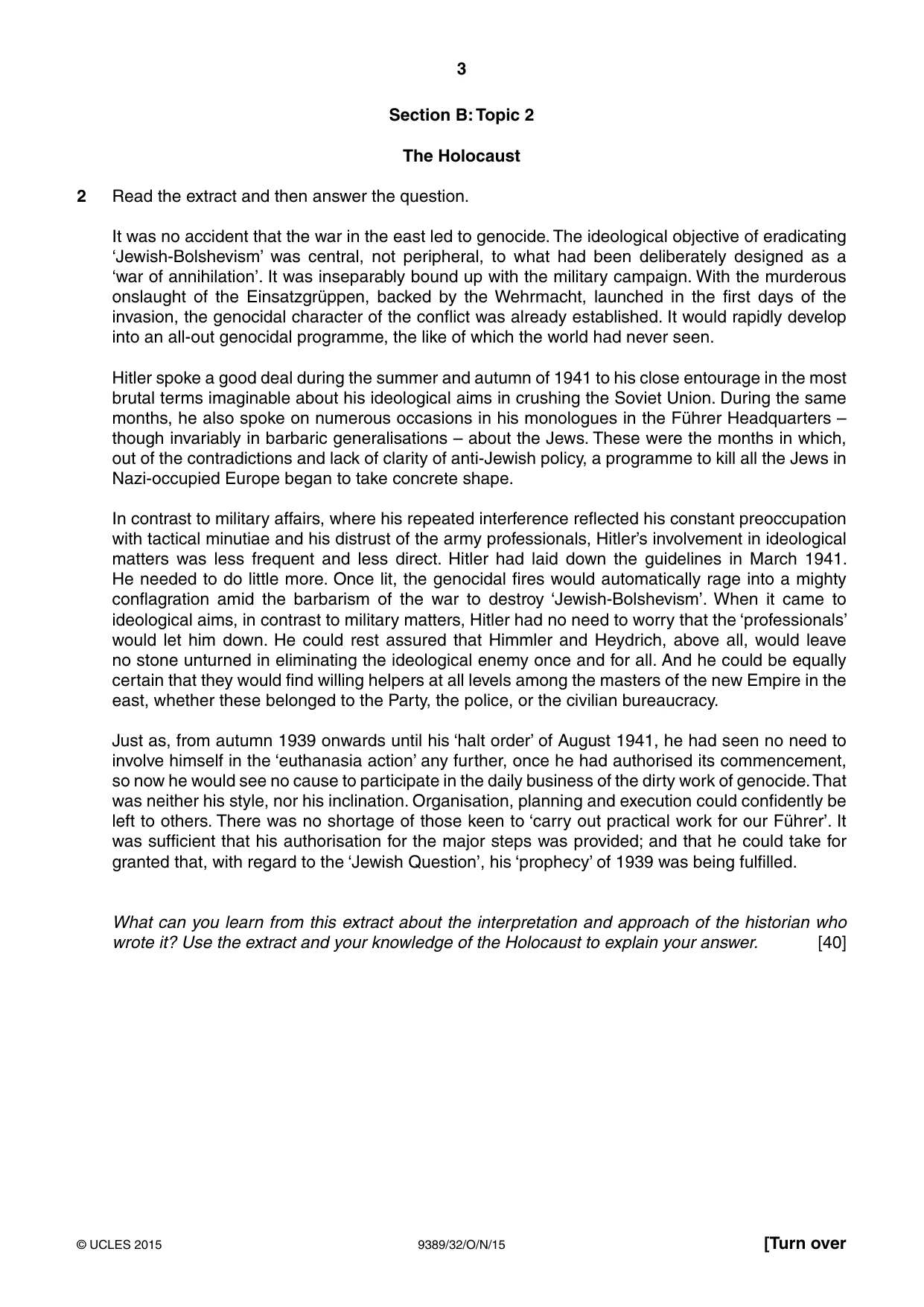
Question paper, page 3
3 9389/32/O/N/15 © UCLES 2015 [Turn over Section B: Topic 2 The Holocaust 2 Read the extract and then answer the question. It was no accident that the war in the east led to genocide. The ideological objective of eradicating ‘Jewish-Bolshevism’ was central, not peripheral, to what had been deliberately designed as a ‘war of annihilation’. It was inseparably bound up with the military campaign. With the murderous onslaught of the Einsatzgrüppen, backed by the Wehrmacht, launched in the first days of the invasion, the genocidal character of the conflict was already established. It would rapidly develop into an all-out genocidal programme, the like of which the world had never seen. Hitler spoke a good deal during the summer and autumn of 1941 to his close entourage in the most brutal terms imaginable about his ideological aims in crushing the Soviet Union. During the same months, he also spoke on numerous occasions in his monologues in the Führer Headquarters – though invariably in barbaric generalisations – about the Jews. These were the months in which, out of the contradictions and lack of clarity of anti-Jewish policy, a programme to kill all the Jews in Nazi-occupied Europe began to take concrete shape. In contrast to military affairs, where his repeated interference reflected his constant preoccupation with tactical minutiae and his distrust of the army professionals, Hitler’s involvement in ideological matters was less frequent and less direct. Hitler had laid down the guidelines in March 1941. He needed to do little more. Once lit, the genocidal fires would automatically rage into a mighty conflagration amid the barbarism of the war to destroy ‘Jewish-Bolshevism’. When it came to ideological aims, in contrast to military matters, Hitler had no need to worry that the ‘professionals’ would let him down. He could rest assured that Himmler and Heydrich, above all, would leave no stone unturned in eliminating the ideological enemy once and for all. And he could be equally certain that they would find willing helpers at all levels among the masters of the new Empire in the east, whether these belonged to the Party, the police, or the civilian bureaucracy. Just as, from autumn 1939 onwards until his ‘halt order’ of August 1941, he had seen no need to involve himself in the ‘euthanasia action’ any further, once he had authorised its commencement, so now he would see no cause to participate in the daily business of the dirty work of genocide. That was neither his style, nor his inclination. Organisation, planning and execution could confidently be left to others. There was no shortage of those keen to ‘carry out practical work for our Führer’. It was sufficient that his authorisation for the major steps was provided; and that he could take for granted that, with regard to the ‘Jewish Question’, his ‘prophecy’ of 1939 was being fulfilled. What can you learn from this extract about the interpretation and approach of the historian who wrote it? Use the extract and your knowledge of the Holocaust to explain your answer. [40]
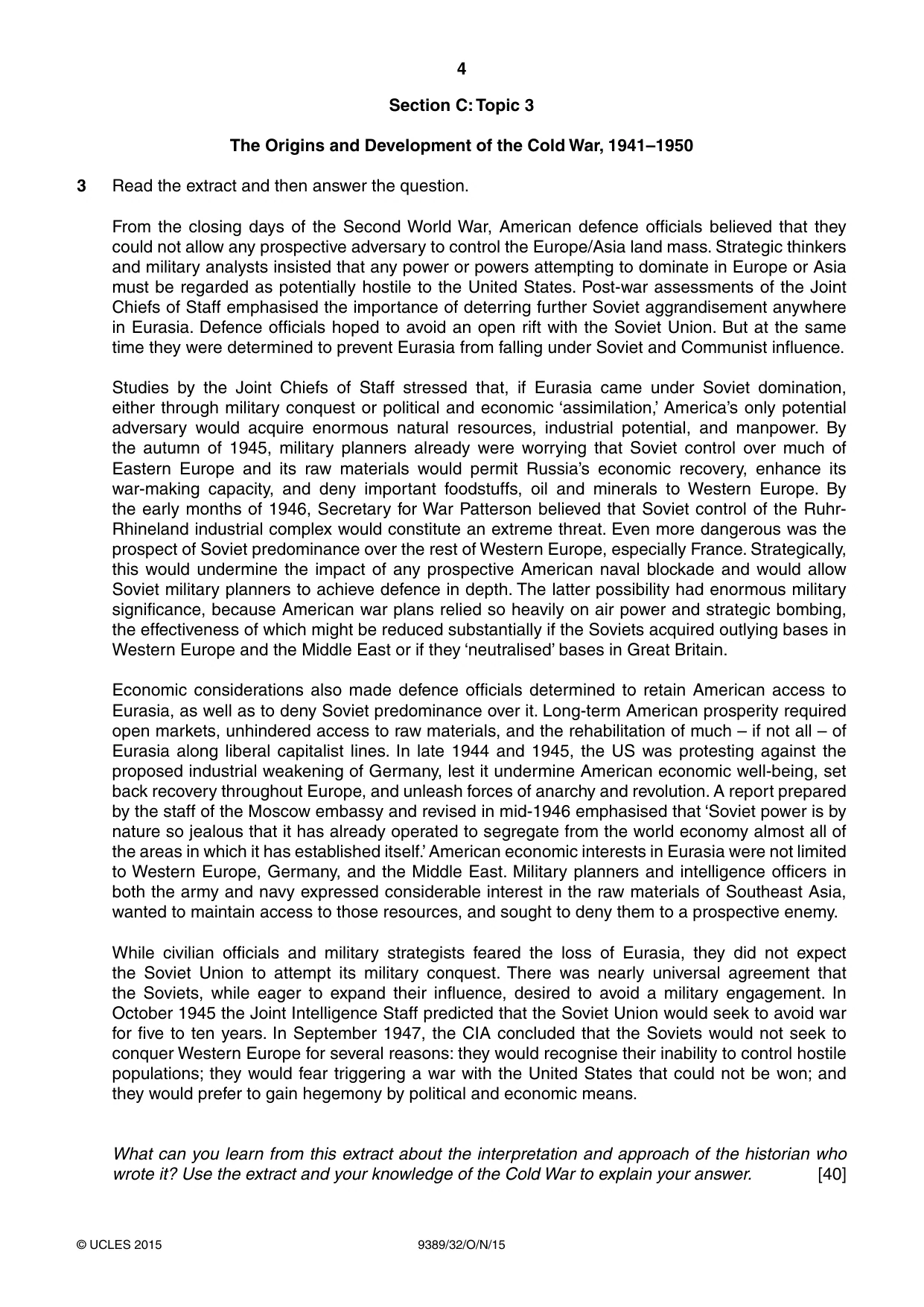
Question paper, page 4
4 9389/32/O/N/15 © UCLES 2015 Section C: Topic 3 The Origins and Development of the Cold War, 1941–1950 3 Read the extract and then answer the question. From the closing days of the Second World War, American defence officials believed that they could not allow any prospective adversary to control the Europe/Asia land mass. Strategic thinkers and military analysts insisted that any power or powers attempting to dominate in Europe or Asia must be regarded as potentially hostile to the United States. Post-war assessments of the Joint Chiefs of Staff emphasised the importance of deterring further Soviet aggrandisement anywhere in Eurasia. Defence officials hoped to avoid an open rift with the Soviet Union. But at the same time they were determined to prevent Eurasia from falling under Soviet and Communist influence. Studies by the Joint Chiefs of Staff stressed that, if Eurasia came under Soviet domination, either through military conquest or political and economic ‘assimilation,’ America’s only potential adversary would acquire enormous natural resources, industrial potential, and manpower. By the autumn of 1945, military planners already were worrying that Soviet control over much of Eastern Europe and its raw materials would permit Russia’s economic recovery, enhance its war-making capacity, and deny important foodstuffs, oil and minerals to Western Europe. By the early months of 1946, Secretary for War Patterson believed that Soviet control of the Ruhr- Rhineland industrial complex would constitute an extreme threat. Even more dangerous was the prospect of Soviet predominance over the rest of Western Europe, especially France. Strategically, this would undermine the impact of any prospective American naval blockade and would allow Soviet military planners to achieve defence in depth. The latter possibility had enormous military significance, because American war plans relied so heavily on air power and strategic bombing, the effectiveness of which might be reduced substantially if the Soviets acquired outlying bases in Western Europe and the Middle East or if they ‘neutralised’ bases in Great Britain. Economic considerations also made defence officials determined to retain American access to Eurasia, as well as to deny Soviet predominance over it. Long-term American prosperity required open markets, unhindered access to raw materials, and the rehabilitation of much – if not all – of Eurasia along liberal capitalist lines. In late 1944 and 1945, the US was protesting against the proposed industrial weakening of Germany, lest it undermine American economic well-being, set back recovery throughout Europe, and unleash forces of anarchy and revolution. A report prepared by the staff of the Moscow embassy and revised in mid-1946 emphasised that ‘Soviet power is by nature so jealous that it has already operated to segregate from the world economy almost all of the areas in which it has established itself.’ American economic interests in Eurasia were not limited to Western Europe, Germany, and the Middle East. Military planners and intelligence officers in both the army and navy expressed considerable interest in the raw materials of Southeast Asia, wanted to maintain access to those resources, and sought to deny them to a prospective enemy. While civilian officials and military strategists feared the loss of Eurasia, they did not expect the Soviet Union to attempt its military conquest. There was nearly universal agreement that the Soviets, while eager to expand their influence, desired to avoid a military engagement. In October 1945 the Joint Intelligence Staff predicted that the Soviet Union would seek to avoid war for five to ten years. In September 1947, the CIA concluded that the Soviets would not seek to conquer Western Europe for several reasons: they would recognise their inability to control hostile populations; they would fear triggering a war with the United States that could not be won; and they would prefer to gain hegemony by political and economic means. What can you learn from this extract about the interpretation and approach of the historian who wrote it? Use the extract and your knowledge of the Cold War to explain your answer. [40]
Question paper, page 5
5 9389/32/O/N/15 © UCLES 2015 BLANK PAGE
Question paper, page 6
6 9389/32/O/N/15 © UCLES 2015 BLANK PAGE
Question paper, page 7
7 9389/32/O/N/15 © UCLES 2015 BLANK PAGE
Question paper, page 8
8 9389/32/O/N/15 © UCLES 2015 BLANK PAGE Permission to reproduce items where third-party owned material protected by copyright is included has been sought and cleared where possible. Every reasonable effort has been made by the publisher (UCLES) to trace copyright holders, but if any items requiring clearance have unwittingly been included, the publisher will be pleased to make amends at the earliest possible opportunity. To avoid the issue of disclosure of answer-related information to candidates, all copyright acknowledgements are reproduced online in the Cambridge International Examinations Copyright Acknowledgements Booklet. This is produced for each series of examinations and is freely available to download at www.cie.org.uk after the live examination series. Cambridge International Examinations is part of the Cambridge Assessment Group. Cambridge Assessment is the brand name of University of Cambridge Local Examinations Syndicate (UCLES), which is itself a department of the University of Cambridge.
Mark scheme, page 1
® IGCSE is the registered trademark of Cambridge International Examinations. CAMBRIDGE INTERNATIONAL EXAMINATIONS Cambridge International Advanced Subsidiary and Advanced Level MARK SCHEME for the October/November 2015 series 9389 HISTORY 9389/32 Paper 3 (Interpretations Question), maximum raw mark 40 This mark scheme is published as an aid to teachers and candidates, to indicate the requirements of the examination. It shows the basis on which Examiners were instructed to award marks. It does not indicate the details of the discussions that took place at an Examiners’ meeting before marking began, which would have considered the acceptability of alternative answers. Mark schemes should be read in conjunction with the question paper and the Principal Examiner Report for Teachers. Cambridge will not enter into discussions about these mark schemes. Cambridge is publishing the mark schemes for the October/November 2015 series for most Cambridge IGCSE®, Cambridge International A and AS Level components and some Cambridge O Level components.
Mark scheme, page 2
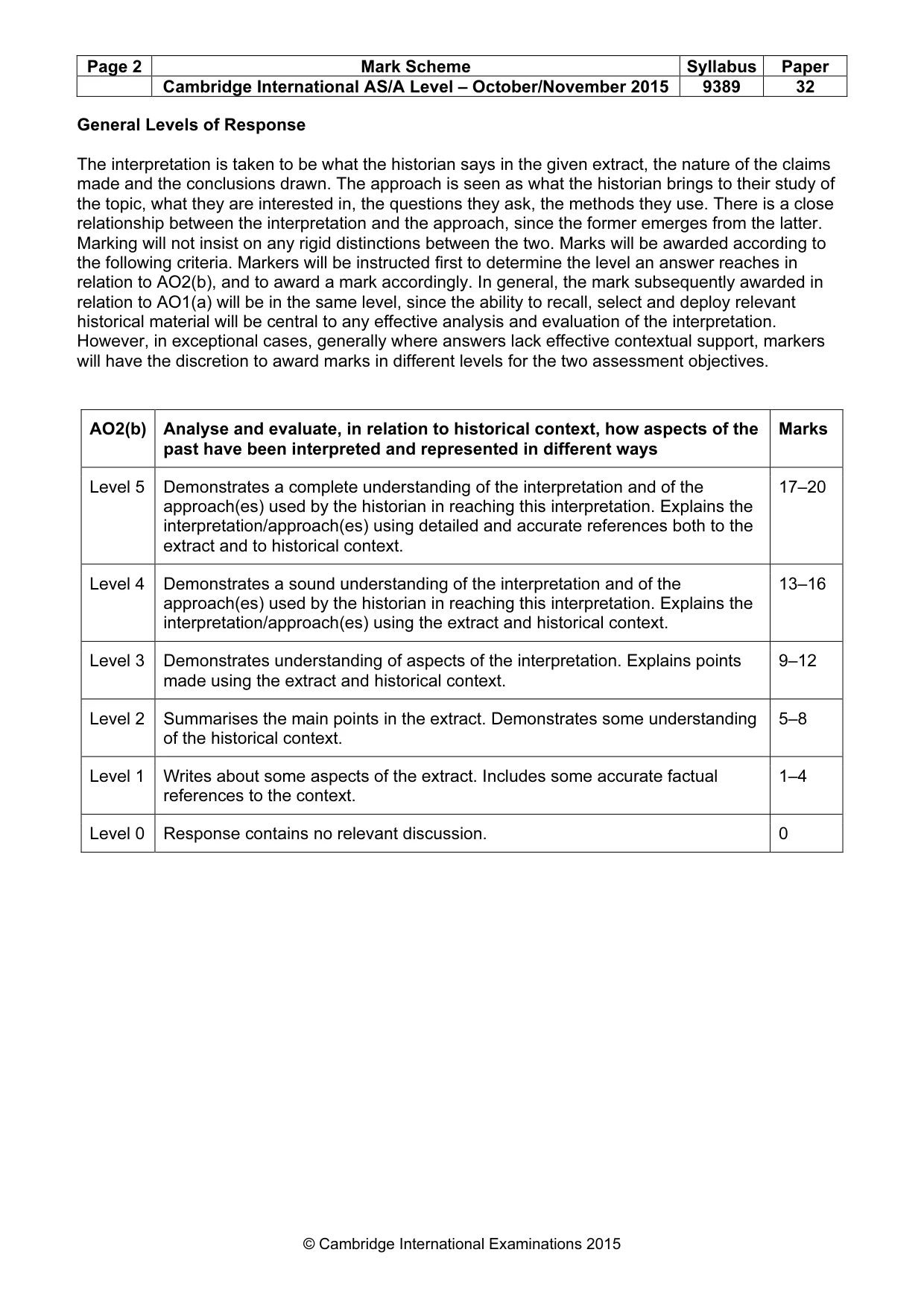
Page 2 Mark Scheme Syllabus Paper Cambridge International AS/A Level – October/November 2015 9389 32 © Cambridge International Examinations 2015 General Levels of Response The interpretation is taken to be what the historian says in the given extract, the nature of the claims made and the conclusions drawn. The approach is seen as what the historian brings to their study of the topic, what they are interested in, the questions they ask, the methods they use. There is a close relationship between the interpretation and the approach, since the former emerges from the latter. Marking will not insist on any rigid distinctions between the two. Marks will be awarded according to the following criteria. Markers will be instructed first to determine the level an answer reaches in relation to AO2(b), and to award a mark accordingly. In general, the mark subsequently awarded in relation to AO1(a) will be in the same level, since the ability to recall, select and deploy relevant historical material will be central to any effective analysis and evaluation of the interpretation. However, in exceptional cases, generally where answers lack effective contextual support, markers will have the discretion to award marks in different levels for the two assessment objectives. AO2(b) Analyse and evaluate, in relation to historical context, how aspects of the past have been interpreted and represented in different ways Marks Level 5 Demonstrates a complete understanding of the interpretation and of the approach(es) used by the historian in reaching this interpretation. Explains the interpretation/approach(es) using detailed and accurate references both to the extract and to historical context. 17–20 Level 4 Demonstrates a sound understanding of the interpretation and of the approach(es) used by the historian in reaching this interpretation. Explains the interpretation/approach(es) using the extract and historical context. 13–16 Level 3 Demonstrates understanding of aspects of the interpretation. Explains points made using the extract and historical context. 9–12 Level 2 Summarises the main points in the extract. Demonstrates some understanding of the historical context. 5–8 Level 1 Writes about some aspects of the extract. Includes some accurate factual references to the context. 1–4 Level 0 Response contains no relevant discussion. 0
Mark scheme, page 3
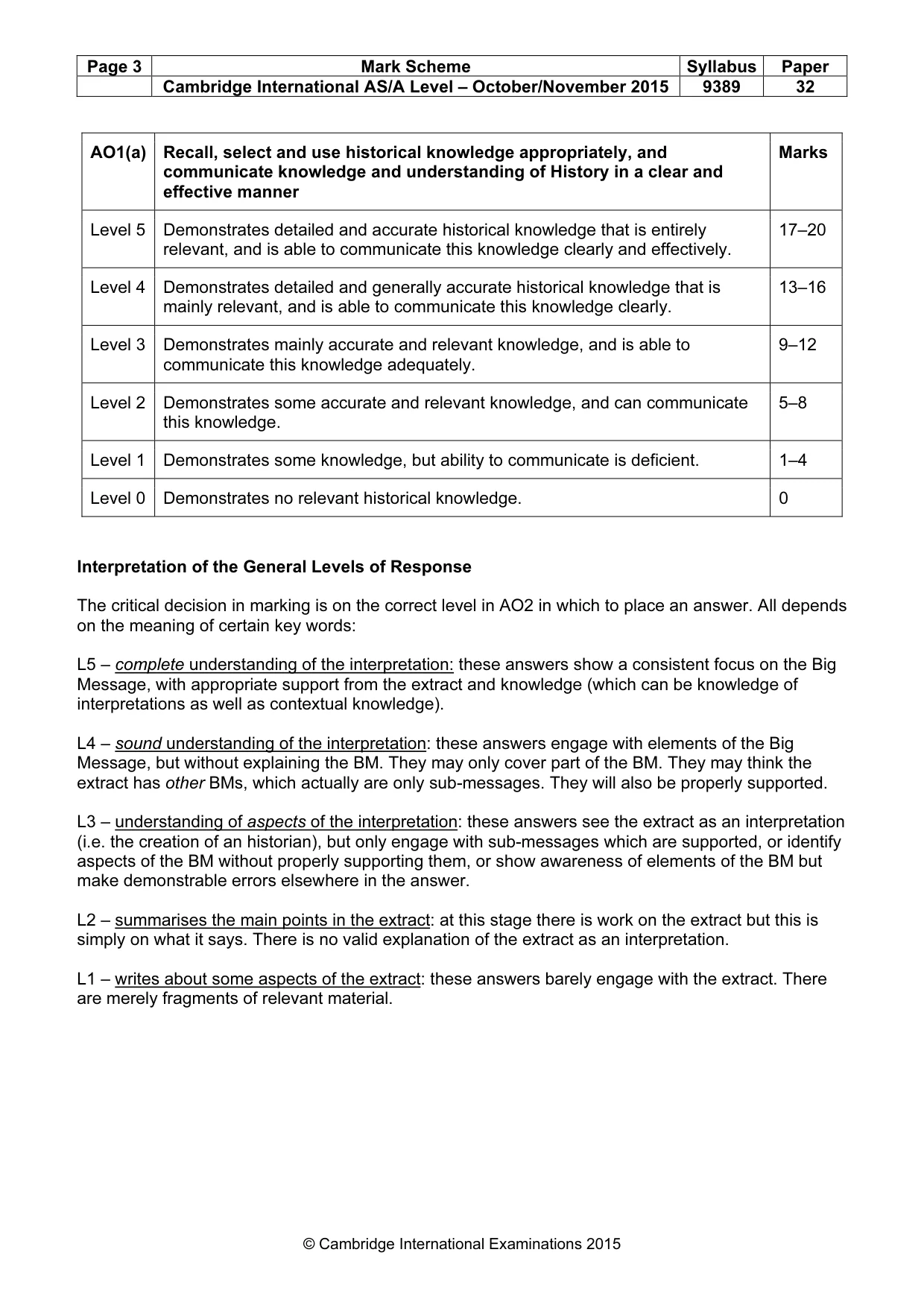
Page 3 Mark Scheme Syllabus Paper Cambridge International AS/A Level – October/November 2015 9389 32 © Cambridge International Examinations 2015 AO1(a) Recall, select and use historical knowledge appropriately, and communicate knowledge and understanding of History in a clear and effective manner Marks Level 5 Demonstrates detailed and accurate historical knowledge that is entirely relevant, and is able to communicate this knowledge clearly and effectively. 17–20 Level 4 Demonstrates detailed and generally accurate historical knowledge that is mainly relevant, and is able to communicate this knowledge clearly. 13–16 Level 3 Demonstrates mainly accurate and relevant knowledge, and is able to communicate this knowledge adequately. 9–12 Level 2 Demonstrates some accurate and relevant knowledge, and can communicate this knowledge. 5–8 Level 1 Demonstrates some knowledge, but ability to communicate is deficient. 1–4 Level 0 Demonstrates no relevant historical knowledge. 0 Interpretation of the General Levels of Response The critical decision in marking is on the correct level in AO2 in which to place an answer. All depends on the meaning of certain key words: L5 – complete understanding of the interpretation: these answers show a consistent focus on the Big Message, with appropriate support from the extract and knowledge (which can be knowledge of interpretations as well as contextual knowledge). L4 – sound understanding of the interpretation: these answers engage with elements of the Big Message, but without explaining the BM. They may only cover part of the BM. They may think the extract has other BMs, which actually are only sub-messages. They will also be properly supported. L3 – understanding of aspects of the interpretation: these answers see the extract as an interpretation (i.e. the creation of an historian), but only engage with sub-messages which are supported, or identify aspects of the BM without properly supporting them, or show awareness of elements of the BM but make demonstrable errors elsewhere in the answer. L2 – summarises the main points in the extract: at this stage there is work on the extract but this is simply on what it says. There is no valid explanation of the extract as an interpretation. L1 – writes about some aspects of the extract: these answers barely engage with the extract. There are merely fragments of relevant material.
Mark scheme, page 4
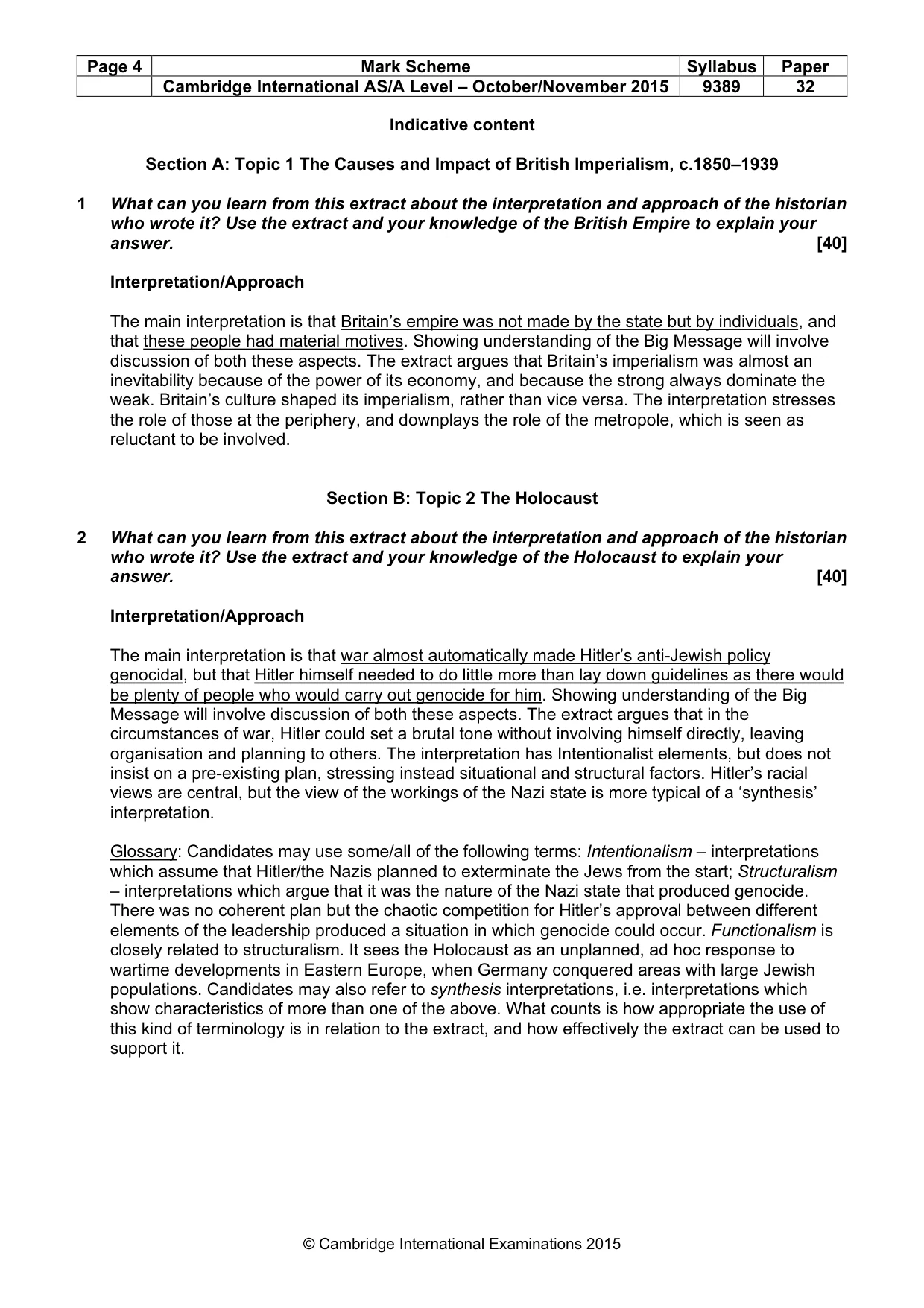
Page 4 Mark Scheme Syllabus Paper Cambridge International AS/A Level – October/November 2015 9389 32 © Cambridge International Examinations 2015 Indicative content Section A: Topic 1 The Causes and Impact of British Imperialism, c.1850–1939 1 What can you learn from this extract about the interpretation and approach of the historian who wrote it? Use the extract and your knowledge of the British Empire to explain your answer. [40] Interpretation/Approach The main interpretation is that Britain’s empire was not made by the state but by individuals, and that these people had material motives. Showing understanding of the Big Message will involve discussion of both these aspects. The extract argues that Britain’s imperialism was almost an inevitability because of the power of its economy, and because the strong always dominate the weak. Britain’s culture shaped its imperialism, rather than vice versa. The interpretation stresses the role of those at the periphery, and downplays the role of the metropole, which is seen as reluctant to be involved. Section B: Topic 2 The Holocaust 2 What can you learn from this extract about the interpretation and approach of the historian who wrote it? Use the extract and your knowledge of the Holocaust to explain your answer. [40] Interpretation/Approach The main interpretation is that war almost automatically made Hitler’s anti-Jewish policy genocidal, but that Hitler himself needed to do little more than lay down guidelines as there would be plenty of people who would carry out genocide for him. Showing understanding of the Big Message will involve discussion of both these aspects. The extract argues that in the circumstances of war, Hitler could set a brutal tone without involving himself directly, leaving organisation and planning to others. The interpretation has Intentionalist elements, but does not insist on a pre-existing plan, stressing instead situational and structural factors. Hitler’s racial views are central, but the view of the workings of the Nazi state is more typical of a ‘synthesis’ interpretation. Glossary: Candidates may use some/all of the following terms: Intentionalism – interpretations which assume that Hitler/the Nazis planned to exterminate the Jews from the start; Structuralism – interpretations which argue that it was the nature of the Nazi state that produced genocide. There was no coherent plan but the chaotic competition for Hitler’s approval between different elements of the leadership produced a situation in which genocide could occur. Functionalism is closely related to structuralism. It sees the Holocaust as an unplanned, ad hoc response to wartime developments in Eastern Europe, when Germany conquered areas with large Jewish populations. Candidates may also refer to synthesis interpretations, i.e. interpretations which show characteristics of more than one of the above. What counts is how appropriate the use of this kind of terminology is in relation to the extract, and how effectively the extract can be used to support it.
Mark scheme, page 5
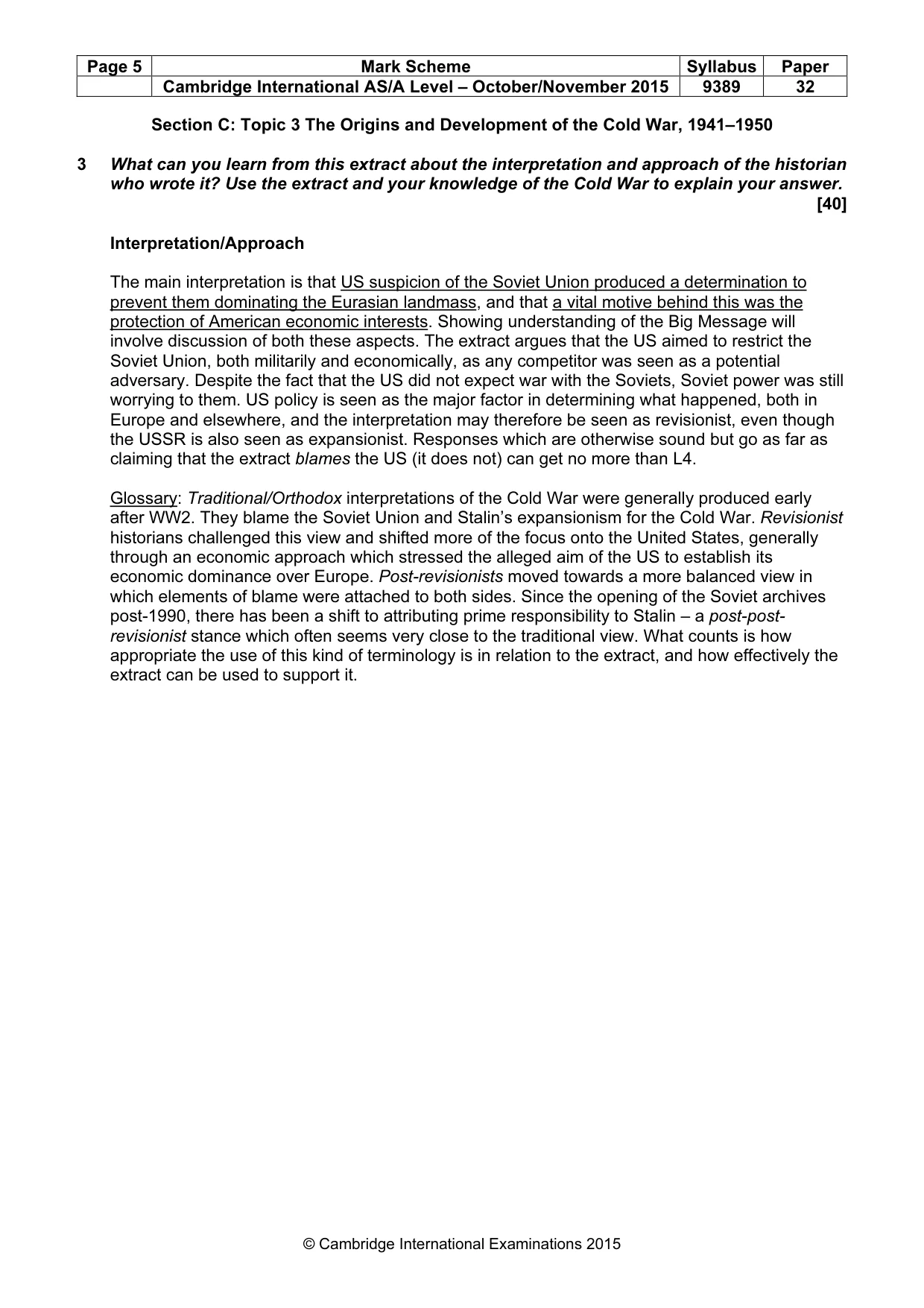
Page 5 Mark Scheme Syllabus Paper Cambridge International AS/A Level – October/November 2015 9389 32 © Cambridge International Examinations 2015 Section C: Topic 3 The Origins and Development of the Cold War, 1941–1950 3 What can you learn from this extract about the interpretation and approach of the historian who wrote it? Use the extract and your knowledge of the Cold War to explain your answer. [40] Interpretation/Approach The main interpretation is that US suspicion of the Soviet Union produced a determination to prevent them dominating the Eurasian landmass, and that a vital motive behind this was the protection of American economic interests. Showing understanding of the Big Message will involve discussion of both these aspects. The extract argues that the US aimed to restrict the Soviet Union, both militarily and economically, as any competitor was seen as a potential adversary. Despite the fact that the US did not expect war with the Soviets, Soviet power was still worrying to them. US policy is seen as the major factor in determining what happened, both in Europe and elsewhere, and the interpretation may therefore be seen as revisionist, even though the USSR is also seen as expansionist. Responses which are otherwise sound but go as far as claiming that the extract blames the US (it does not) can get no more than L4. Glossary: Traditional/Orthodox interpretations of the Cold War were generally produced early after WW2. They blame the Soviet Union and Stalin’s expansionism for the Cold War. Revisionist historians challenged this view and shifted more of the focus onto the United States, generally through an economic approach which stressed the alleged aim of the US to establish its economic dominance over Europe. Post-revisionists moved towards a more balanced view in which elements of blame were attached to both sides. Since the opening of the Soviet archives post-1990, there has been a shift to attributing prime responsibility to Stalin – a post-post- revisionist stance which often seems very close to the traditional view. What counts is how appropriate the use of this kind of terminology is in relation to the extract, and how effectively the extract can be used to support it.
What you needed in this session
Cambridge’s own grade thresholds for 2015 Oct/Nov, Paper 3 · Variant 2. A higher threshold means an easier paper — the bar moves with how the cohort did.