Cambridge A Level Geography 9696 — 2025 Oct/Nov Paper 4 · Variant 3
9696/43/O/N/25 · 11 questions · 60 marks · ≈68 min
The question paper and its mark scheme, free to read here and free to download. This is Cambridge’s own paper, exactly as it was sat.
Question paper4 pages

Mark scheme27 pages
Answers below. Sit the paper first if you are practising.


Questions as text
Q1 · A photograph which shows a tea plantation in The Azores, an autonomous region of…
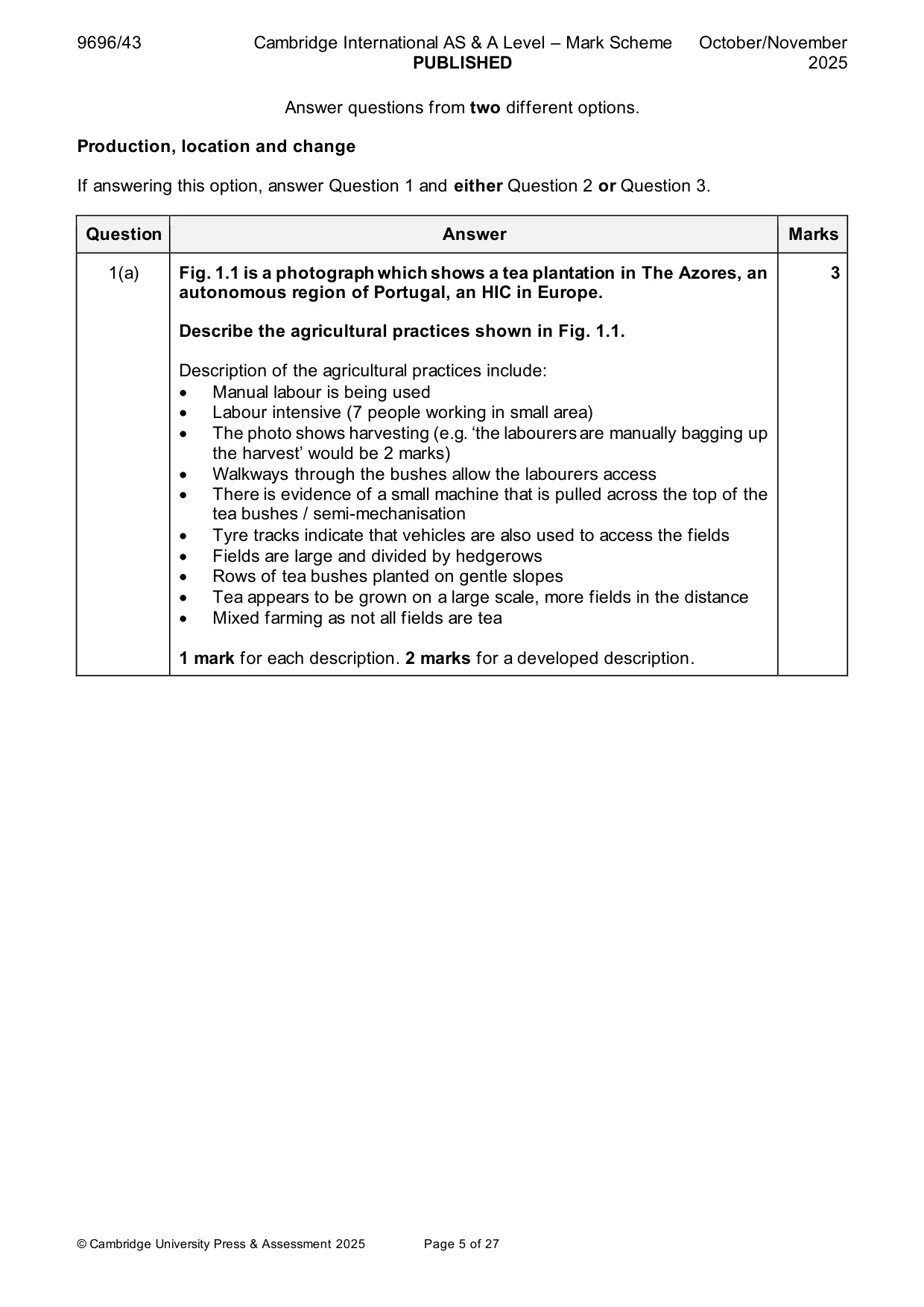
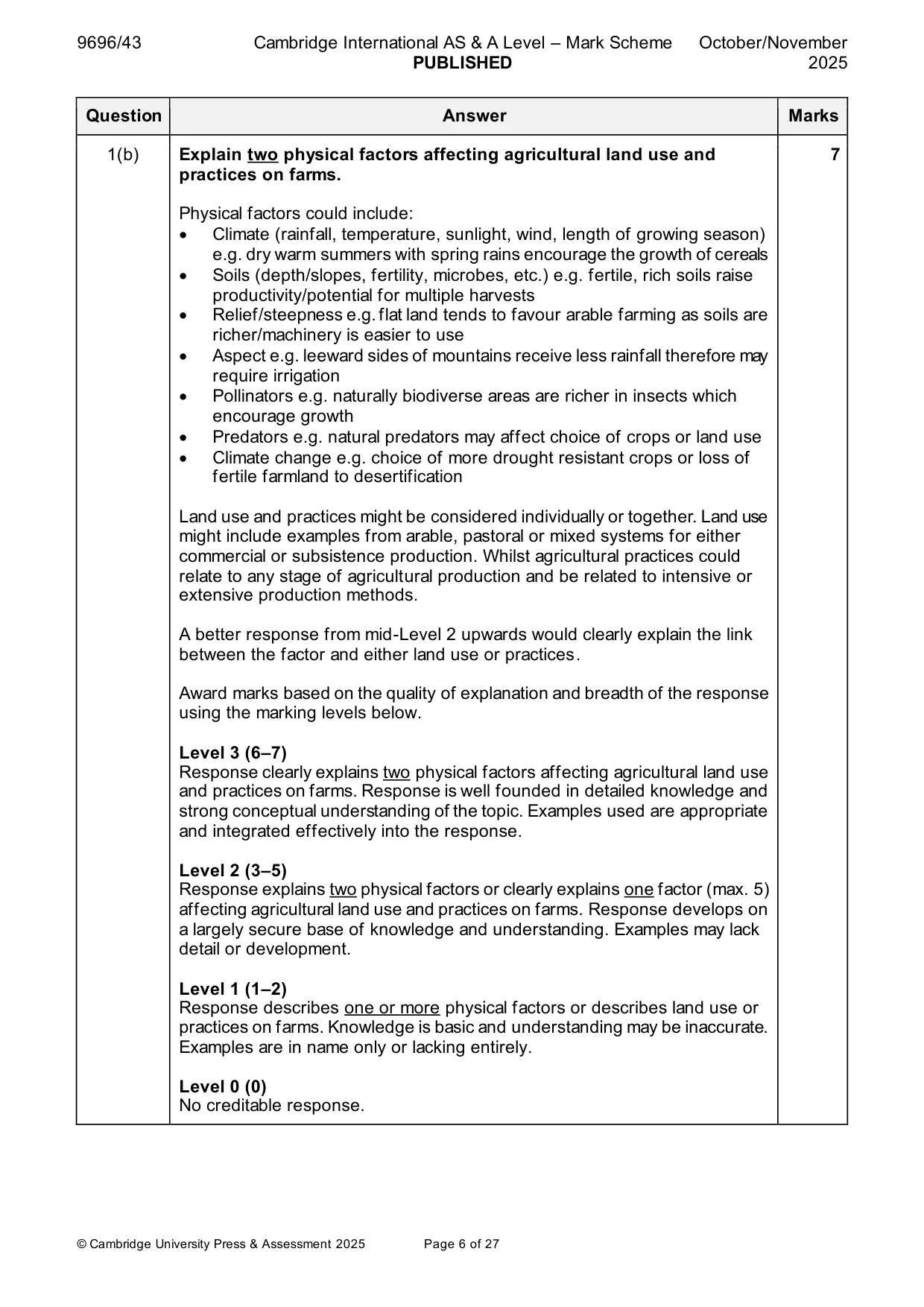
1 Fig. 1.1 is a photograph which shows a tea plantation in The Azores, an autonomous region of Portugal, an HIC in Europe. (a) Describe the agricultural practices shown in Fig. 1.1. [3] (b) Explain two physical factors affecting agricultural land use and practices on farms. [7]
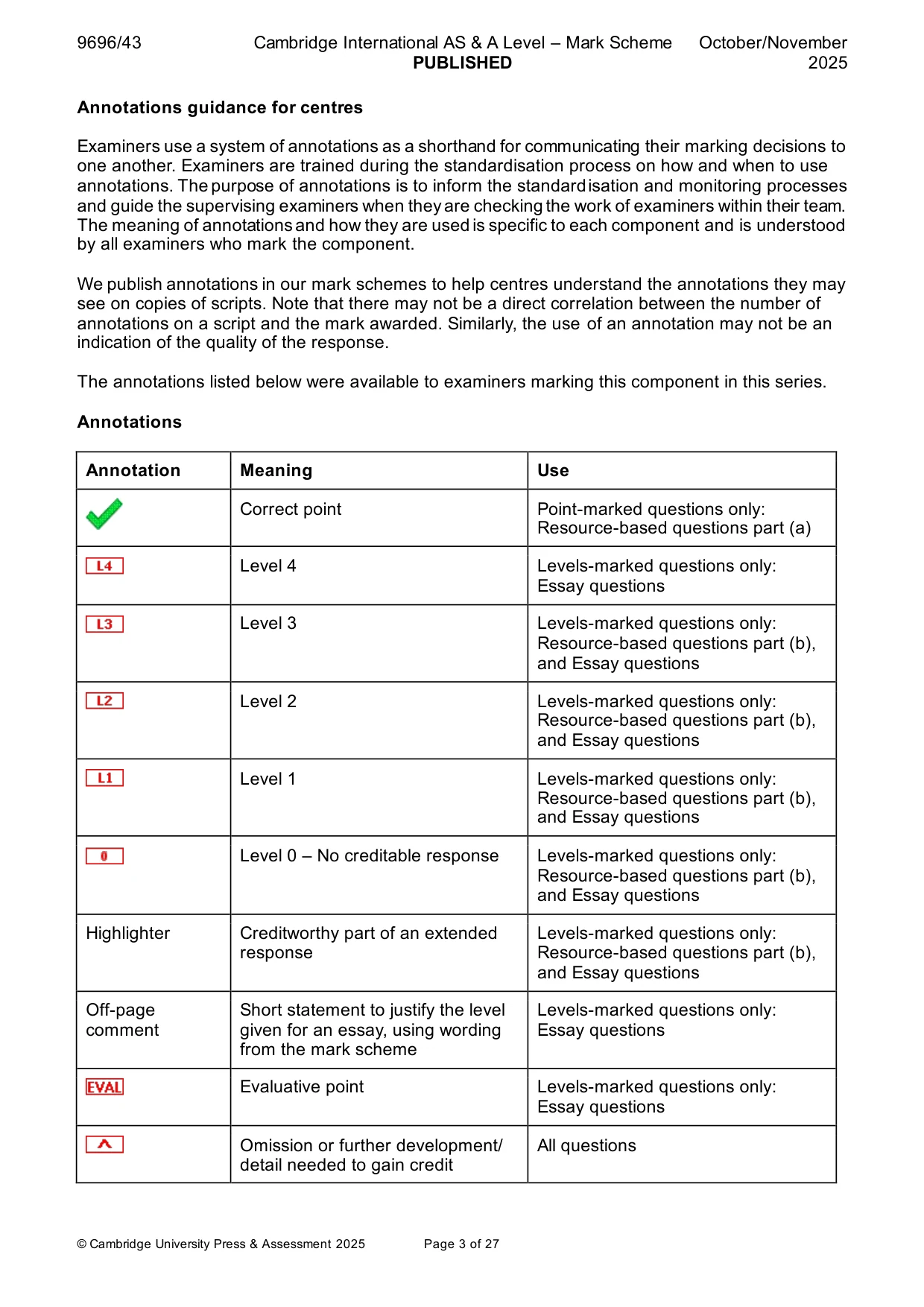
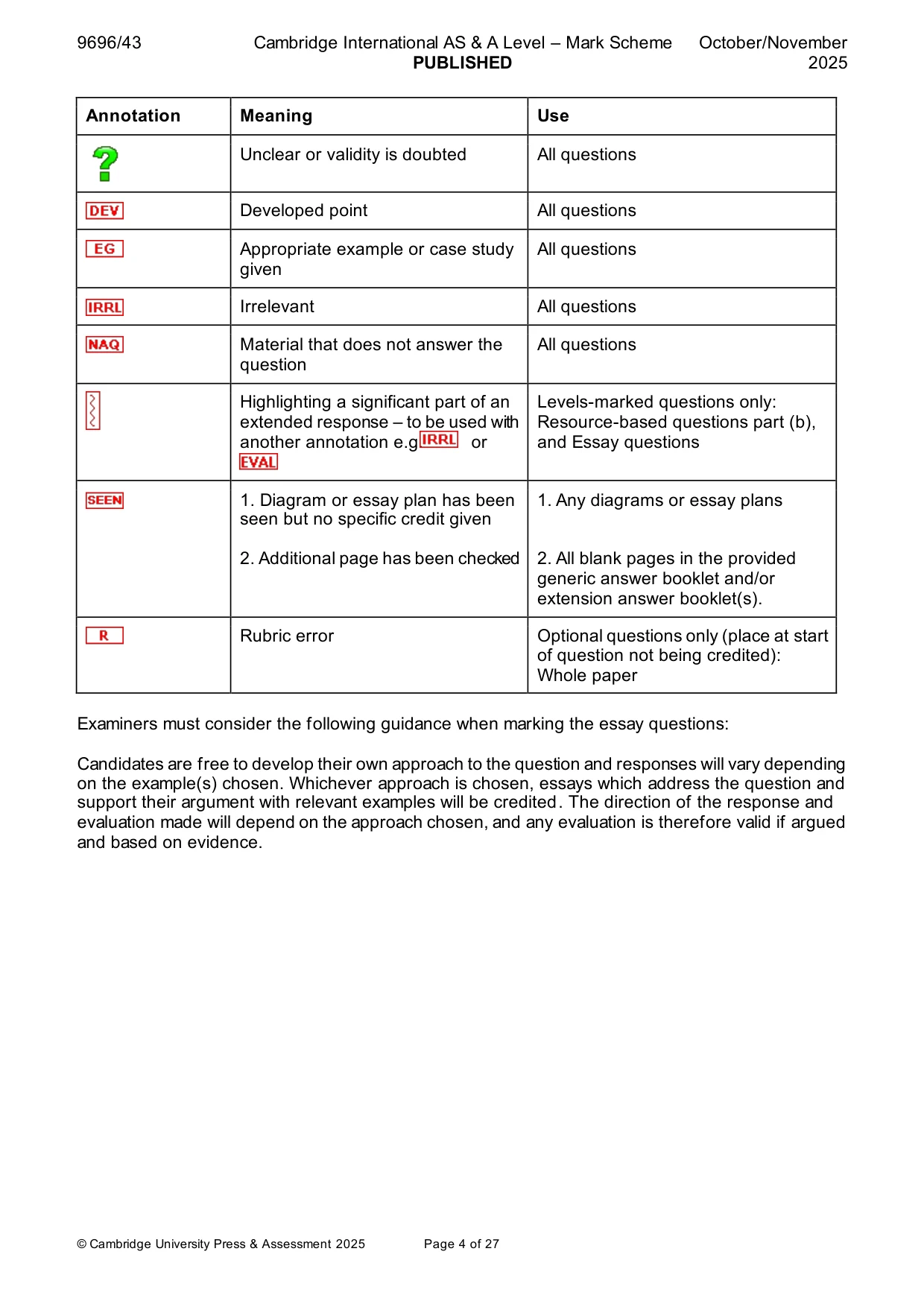
Mark scheme: Question Answer Marks 1(a) Fig. 1.1 is a photograph which shows a tea plantation in The Azores, an 3 autonomous region of Portugal, an HIC in Europe. Describe the agricultural practices shown in Fig. 1.1. Description of the agricultural practices include: • Manual labour is being used • Labour intensive (7 people working in small area) • The photo shows harvesting (e.g. ‘the labourers are manually bagging up the harvest’ would be 2 marks) • Walkways through the bushes allow the labourers access • There is evidence of a small machine that is pulled across the top of the tea bushes / semi-mechanisation • Tyre tracks indicate that vehicles are also used to access the fields • Fields are large and divided by hedgerows • Rows of tea bushes planted on gentle slopes • Tea appears to be grown on a large scale, more fields in the distance • Mixed farming as not all fields are tea 1 mark for each description. 2 marks for a developed description. 1(b) Explain two physical factors affecting agricultural land use and 7 practices on farms. Physical factors could include: • Climate (rainfall, temperature, sunlight, wind, length of growing season) e.g. dry warm summers with spring rains encourage the growth of cereals • Soils (depth/slopes, fertility, microbes, etc.) e.g. fertile, rich soils raise productivity/potential for multiple harvests • Relief/steepness e.g. flat land tends to favour arable farming as soils are richer/machinery is easier to use • Aspect e.g. leeward sides of mountains receive less rainfall therefore may require irrigation • Pollinators e.g. naturally biodiverse areas are richer in insects which encourage growth • Predators e.g. natural predators may affect choice of crops or land use • Climate change e.g. choice of more drought resistant crops or loss of fertile farmland to desertification Land use and practices might be considered individually or together. Land use might include examples from arable, pastoral or mixed systems for either commercial or subsistence production. Whilst agricultural practices could relate to any stage of agricultural production and be related to intensive or extensive production methods. A better response from mid-Level 2 upwards would clearly explain the link between the factor and either land use or practices. Award marks based on the quality of explanation and breadth of the response using the marking levels below. Level 3 (6–7) Response clearly explains two physical factors affecting agricultural land use and practices on farms. Response is well founded in detailed knowledge and strong conceptual understanding of the topic. Examples used are appropriate and integrated effectively into the response. Level 2 (3–5) Response explains two physical factors or clearly explains one factor (max. 5) affecting agricultural land use and practices on farms. Response develops on a largely secure base of knowledge and understanding. Examples may lack detail or development. Level 1 (1–2) Response describes one or more physical factors or describes land use or practices on farms. Knowledge is basic and understanding may be inaccurate. Examples are in name only or lacking entirely. Level 0 (0) No creditable response.
Q2 · ‘Difficulties in the management of agricultural change are best solved at the local…
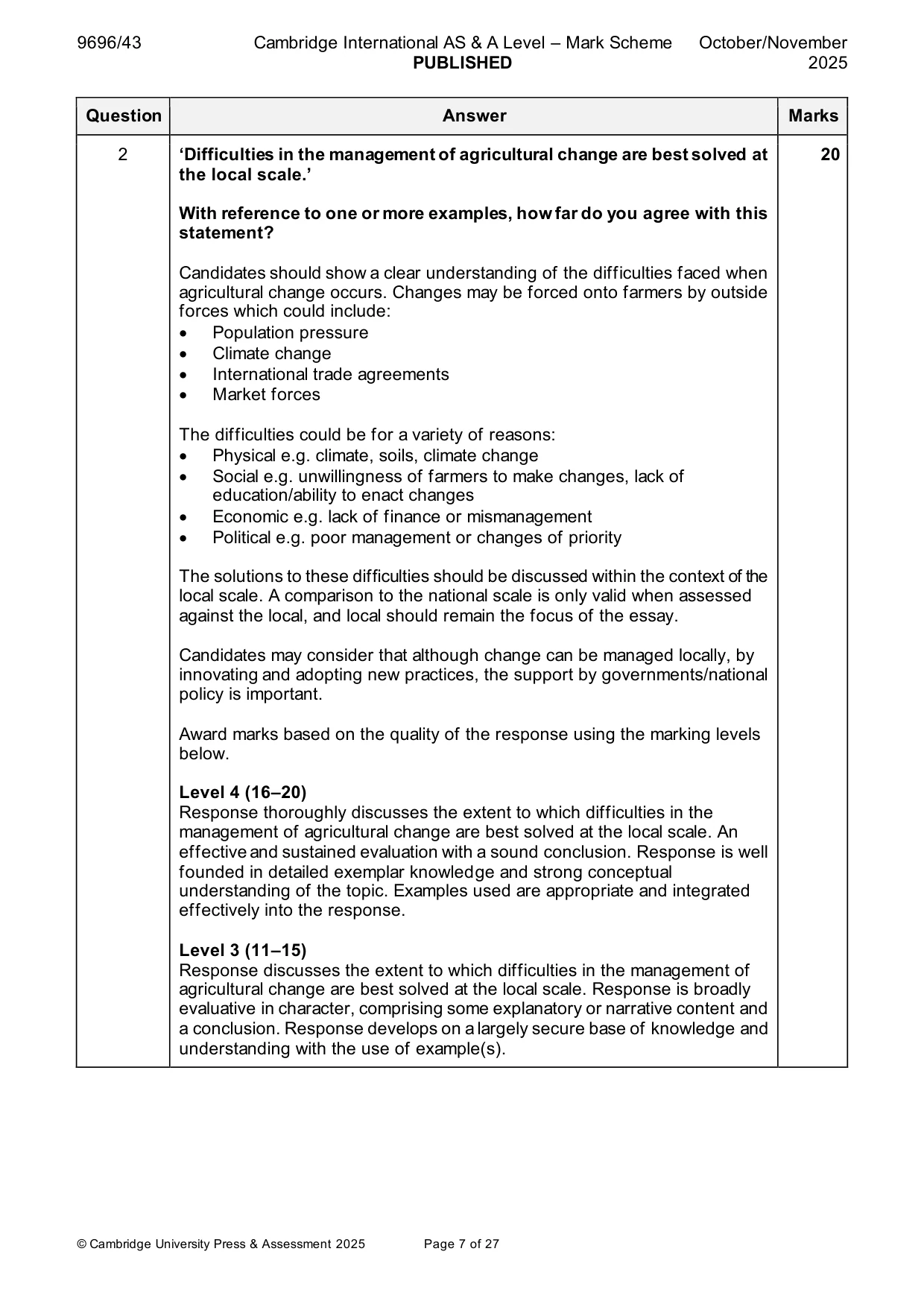
2 ‘Difficulties in the management of agricultural change are best solved at the local scale.’ With reference to one or more examples, how far do you agree with this statement? [20]
Mark scheme: 2 ‘Difficulties in the management of agricultural change are best solved at 20 the local scale.’ With reference to one or more examples, how far do you agree with this statement? Candidates should show a clear understanding of the difficulties faced when agricultural change occurs. Changes may be forced onto farmers by outside forces which could include: • Population pressure • Climate change • International trade agreements • Market forces The difficulties could be for a variety of reasons: • Physical e.g. climate, soils, climate change • Social e.g. unwillingness of farmers to make changes, lack of education/ability to enact changes • Economic e.g. lack of finance or mismanagement • Political e.g. poor management or changes of priority The solutions to these difficulties should be discussed within the context of the local scale. A comparison to the national scale is only valid when assessed against the local, and local should remain the focus of the essay. Candidates may consider that although change can be managed locally, by innovating and adopting new practices, the support by governments/national policy is important. Award marks based on the quality of the response using the marking levels below. Level 4 (16–20) Response thoroughly discusses the extent to which difficulties in the management of agricultural change are best solved at the local scale. An effective and sustained evaluation with a sound conclusion. Response is well founded in detailed exemplar knowledge and strong conceptual understanding of the topic. Examples used are appropriate and integrated effectively into the response. Level 3 (11–15) Response discusses the extent to which difficulties in the management of agricultural change are best solved at the local scale. Response is broadly evaluative in character, comprising some explanatory or narrative content and a conclusion. Response develops on a largely secure base of knowledge and understanding with the use of example(s). 2 Level 2 (6–10) Response demonstrates some knowledge and understanding of the extent to which difficulties in the management of agricultural change are best solved at the local scale. Response is mainly descriptive or explanatory in approach and contains a brief or thinly supported evaluation. Responses without the use of example(s) to support the response will not get above the middle of Level 2 (8 marks). Level 1 (1–5) Response makes a few general points about difficulties in the management of agricultural change at the local scale. A descriptive response comprising a few simple points. Knowledge is basic and understanding may be poor and lack relevance to the question set. Level 0 (0) No creditable response.
Q3 · ‘Labour is the most important factor affecting the location of manufacturing and related…
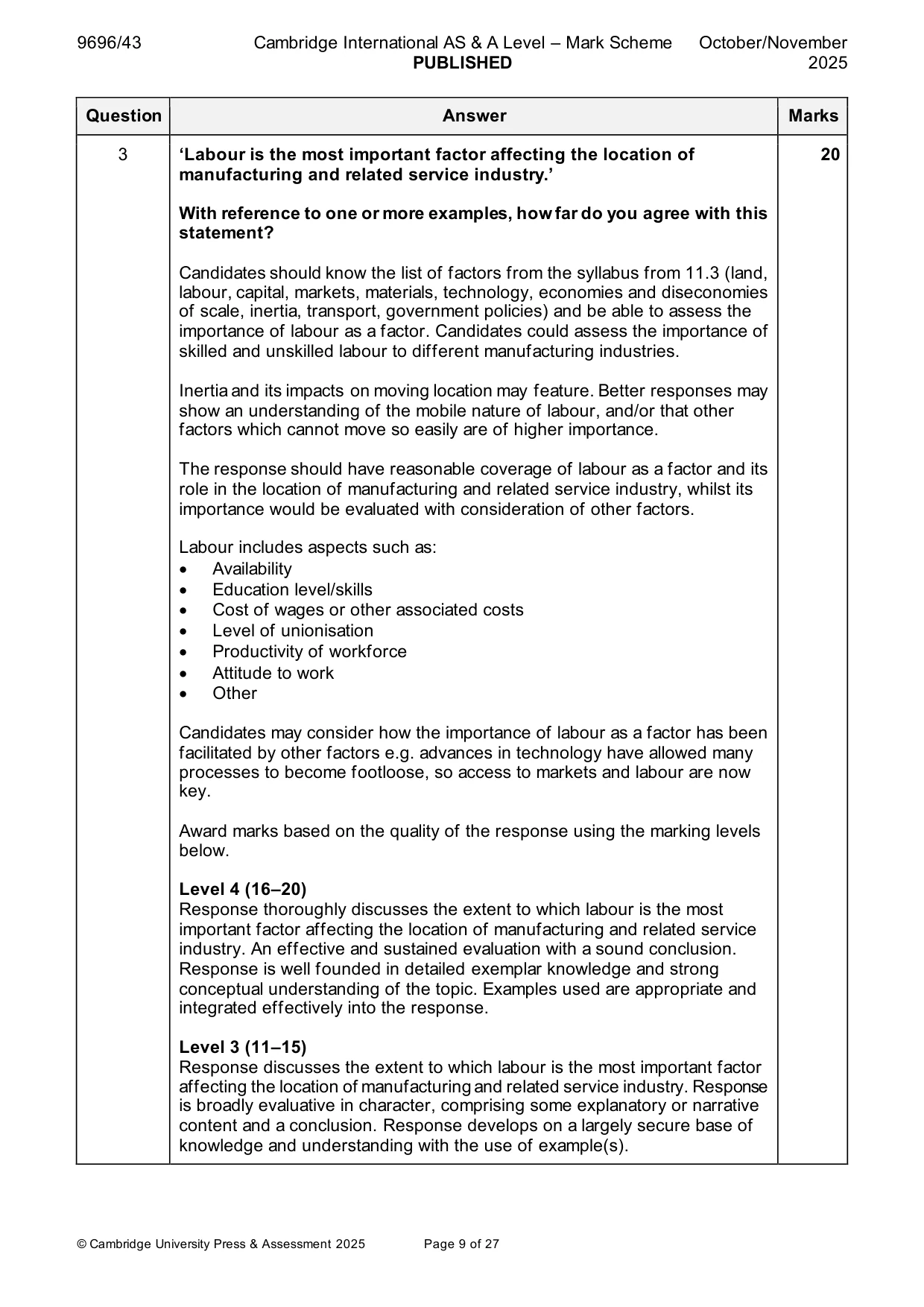
3 ‘Labour is the most important factor affecting the location of manufacturing and related service industry.’ With reference to one or more examples, how far do you agree with this statement? [20] Environmental management If answering this option, answer Question 4 and either Question 5 or Question 6.
Mark scheme: 3 ‘Labour is the most important factor affecting the location of 20 manufacturing and related service industry.’ With reference to one or more examples, how far do you agree with this statement? Candidates should know the list of factors from the syllabus from 11.3 (land, labour, capital, markets, materials, technology, economies and diseconomies of scale, inertia, transport, government policies) and be able to assess the importance of labour as a factor. Candidates could assess the importance of skilled and unskilled labour to different manufacturing industries. Inertia and its impacts on moving location may feature. Better responses may show an understanding of the mobile nature of labour, and/or that other factors which cannot move so easily are of higher importance. The response should have reasonable coverage of labour as a factor and its role in the location of manufacturing and related service industry, whilst its importance would be evaluated with consideration of other factors. Labour includes aspects such as: • Availability • Education level/skills • Cost of wages or other associated costs • Level of unionisation • Productivity of workforce • Attitude to work • Other Candidates may consider how the importance of labour as a factor has been facilitated by other factors e.g. advances in technology have allowed many processes to become footloose, so access to markets and labour are now key. Award marks based on the quality of the response using the marking levels below. Level 4 (16–20) Response thoroughly discusses the extent to which labour is the most important factor affecting the location of manufacturing and related service industry. An effective and sustained evaluation with a sound conclusion. Response is well founded in detailed exemplar knowledge and strong conceptual understanding of the topic. Examples used are appropriate and integrated effectively into the response. Level 3 (11–15) Response discusses the extent to which labour is the most important factor affecting the location of manufacturing and related service industry. Response is broadly evaluative in character, comprising some explanatory or narrative content and a conclusion. Response develops on a largely secure base of knowledge and understanding with the use of example(s). 3 Level 2 (6–10) Response demonstrates some knowledge and understanding of the extent to which labour is the most important factor affecting the location of manufacturing and related service industry. Response is mainly descriptive or explanatory in approach and contains a brief or thinly supported evaluation. Responses without the use of example(s) to support the response will not get above the middle of Level 2 (8 marks). Level 1 (1–5) Response makes a few general points about labour or other factors affecting the location of manufacturing and related service industry. A descriptive response comprising a few simple points. Knowledge is basic and understanding may be poor and lack relevance to the question set. Level 0 (0) No creditable response. Environmental management If answering this option, answer Question 4 and either Question 5 or Question 6.
Q4 · Projected biofuel production growth for selected countries, 2021–27
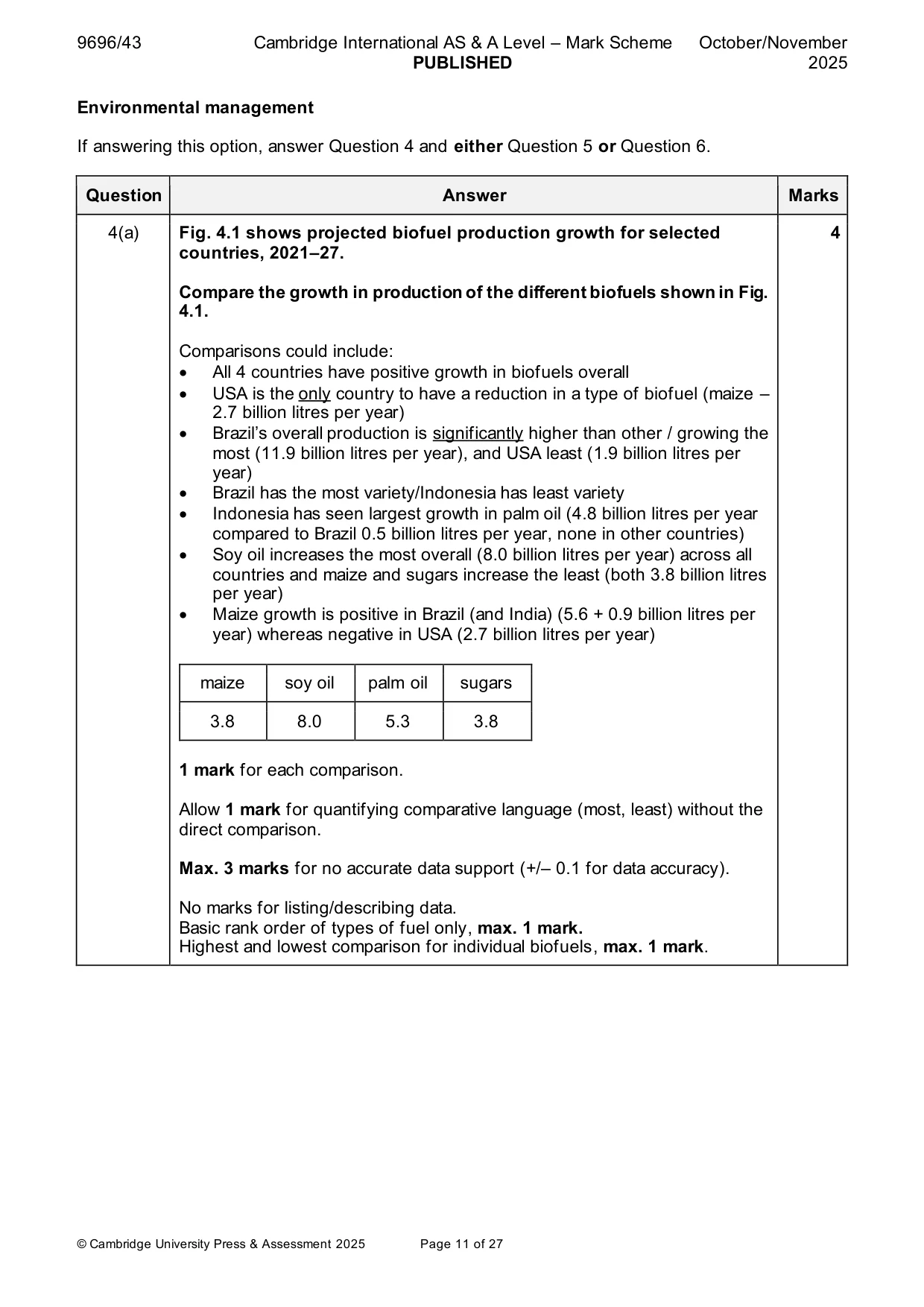
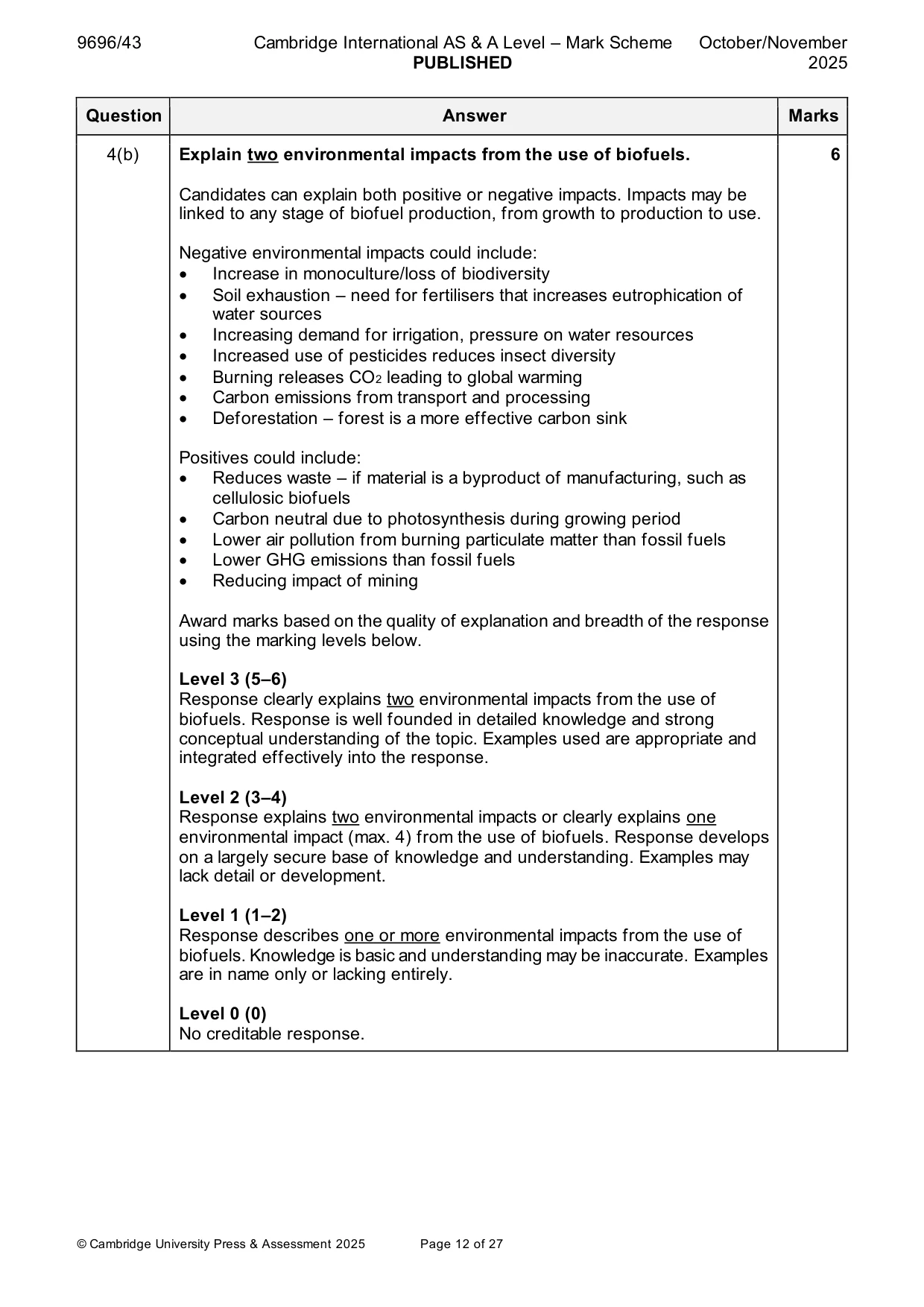
4 Fig. 4.1 shows projected biofuel production growth for selected countries, 2021–27. (a) Compare the growth in production of the different biofuels shown in Fig. 4.1. [4] (b) Explain two environmental impacts from the use of biofuels. [6]
Mark scheme: 4(a) Fig. 4.1 shows projected biofuel production growth for selected 4 countries, 2021–27. Compare the growth in production of the different biofuels shown in Fig. 4.1. Comparisons could include: • All 4 countries have positive growth in biofuels overall • USA is the only country to have a reduction in a type of biofuel (maize – 2.7 billion litres per year) • Brazil’s overall production is significantly higher than other / growing the most (11.9 billion litres per year), and USA least (1.9 billion litres per year) • Brazil has the most variety/Indonesia has least variety • Indonesia has seen largest growth in palm oil (4.8 billion litres per year compared to Brazil 0.5 billion litres per year, none in other countries) • Soy oil increases the most overall (8.0 billion litres per year) across all countries and maize and sugars increase the least (both 3.8 billion litres per year) • Maize growth is positive in Brazil (and India) (5.6 + 0.9 billion litres per year) whereas negative in USA (2.7 billion litres per year) maize soy oil palm oil sugars 3.8 8.0 5.3 3.8 1 mark for each comparison. Allow 1 mark for quantifying comparative language (most, least) without the direct comparison. Max. 3 marks for no accurate data support (+/– 0.1 for data accuracy). No marks for listing/describing data. Basic rank order of types of fuel only, max. 1 mark. Highest and lowest comparison for individual biofuels, max. 1 mark. 4(b) Explain two environmental impacts from the use of biofuels. 6 Candidates can explain both positive or negative impacts. Impacts may be linked to any stage of biofuel production, from growth to production to use. Negative environmental impacts could include: • Increase in monoculture/loss of biodiversity • Soil exhaustion – need for fertilisers that increases eutrophication of water sources • Increasing demand for irrigation, pressure on water resources • Increased use of pesticides reduces insect diversity • Burning releases CO2 leading to global warming • Carbon emissions from transport and processing • Deforestation – forest is a more effective carbon sink Positives could include: • Reduces waste – if material is a byproduct of manufacturing, such as cellulosic biofuels • Carbon neutral due to photosynthesis during growing period • Lower air pollution from burning particulate matter than fossil fuels • Lower GHG emissions than fossil fuels • Reducing impact of mining Award marks based on the quality of explanation and breadth of the response using the marking levels below. Level 3 (5–6) Response clearly explains two environmental impacts from the use of biofuels. Response is well founded in detailed knowledge and strong conceptual understanding of the topic. Examples used are appropriate and integrated effectively into the response. Level 2 (3–4) Response explains two environmental impacts or clearly explains one environmental impact (max. 4) from the use of biofuels. Response develops on a largely secure base of knowledge and understanding. Examples may lack detail or development. Level 1 (1–2) Response describes one or more environmental impacts from the use of biofuels. Knowledge is basic and understanding may be inaccurate. Examples are in name only or lacking entirely. Level 0 (0) No creditable response.
Q5 · ‘Nuclear power offers a sustainable solution for issues in energy production.’ With…
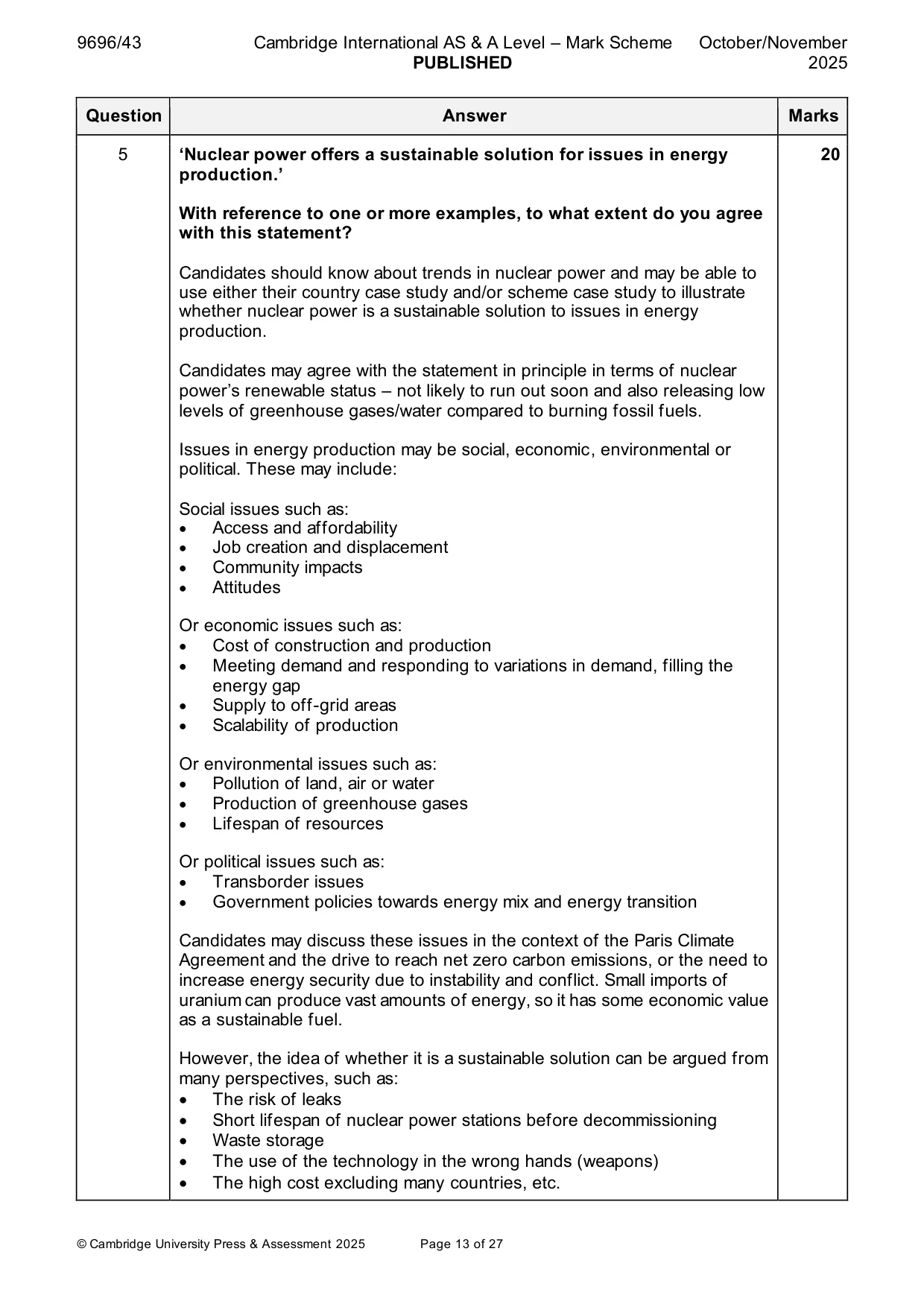
5 ‘Nuclear power offers a sustainable solution for issues in energy production.’ With reference to one or more examples, to what extent do you agree with this statement? [20]
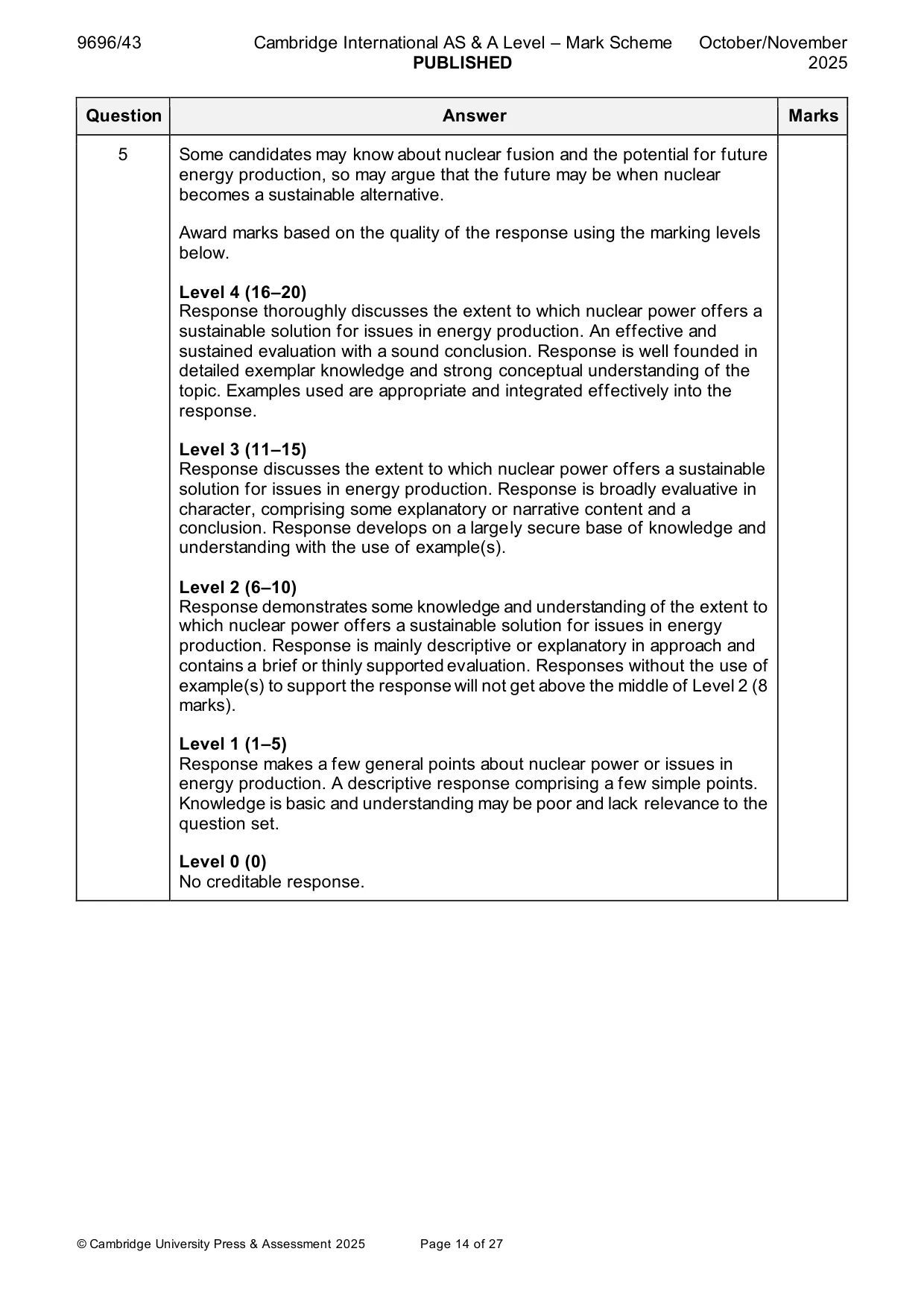
Mark scheme: 5 ‘Nuclear power offers a sustainable solution for issues in energy 20 production.’ With reference to one or more examples, to what extent do you agree with this statement? Candidates should know about trends in nuclear power and may be able to use either their country case study and/or scheme case study to illustrate whether nuclear power is a sustainable solution to issues in energy production. Candidates may agree with the statement in principle in terms of nuclear power’s renewable status – not likely to run out soon and also releasing low levels of greenhouse gases/water compared to burning fossil fuels. Issues in energy production may be social, economic, environmental or political. These may include: Social issues such as: • Access and affordability • Job creation and displacement • Community impacts • Attitudes Or economic issues such as: • Cost of construction and production • Meeting demand and responding to variations in demand, filling the energy gap • Supply to off-grid areas • Scalability of production Or environmental issues such as: • Pollution of land, air or water • Production of greenhouse gases • Lifespan of resources Or political issues such as: • Transborder issues • Government policies towards energy mix and energy transition Candidates may discuss these issues in the context of the Paris Climate Agreement and the drive to reach net zero carbon emissions, or the need to increase energy security due to instability and conflict. Small imports of uranium can produce vast amounts of energy, so it has some economic value as a sustainable fuel. However, the idea of whether it is a sustainable solution can be argued from many perspectives, such as: • The risk of leaks • Short lifespan of nuclear power stations before decommissioning • Waste storage • The use of the technology in the wrong hands (weapons) • The high cost excluding many countries, etc. 5 Some candidates may know about nuclear fusion and the potential for future energy production, so may argue that the future may be when nuclear becomes a sustainable alternative. Award marks based on the quality of the response using the marking levels below. Level 4 (16–20) Response thoroughly discusses the extent to which nuclear power offers a sustainable solution for issues in energy production. An effective and sustained evaluation with a sound conclusion. Response is well founded in detailed exemplar knowledge and strong conceptual understanding of the topic. Examples used are appropriate and integrated effectively into the response. Level 3 (11–15) Response discusses the extent to which nuclear power offers a sustainable solution for issues in energy production. Response is broadly evaluative in character, comprising some explanatory or narrative content and a conclusion. Response develops on a largely secure base of knowledge and understanding with the use of example(s). Level 2 (6–10) Response demonstrates some knowledge and understanding of the extent to which nuclear power offers a sustainable solution for issues in energy production. Response is mainly descriptive or explanatory in approach and contains a brief or thinly supported evaluation. Responses without the use of example(s) to support the response will not get above the middle of Level 2 (8 marks). Level 1 (1–5) Response makes a few general points about nuclear power or issues in energy production. A descriptive response comprising a few simple points. Knowledge is basic and understanding may be poor and lack relevance to the question set. Level 0 (0) No creditable response.
Q6 · Global interdependence If answering this option, answer Question 7 and either Question 8…
Global interdependence If answering this option, answer Question 7 and either Question 8 or Question 9.
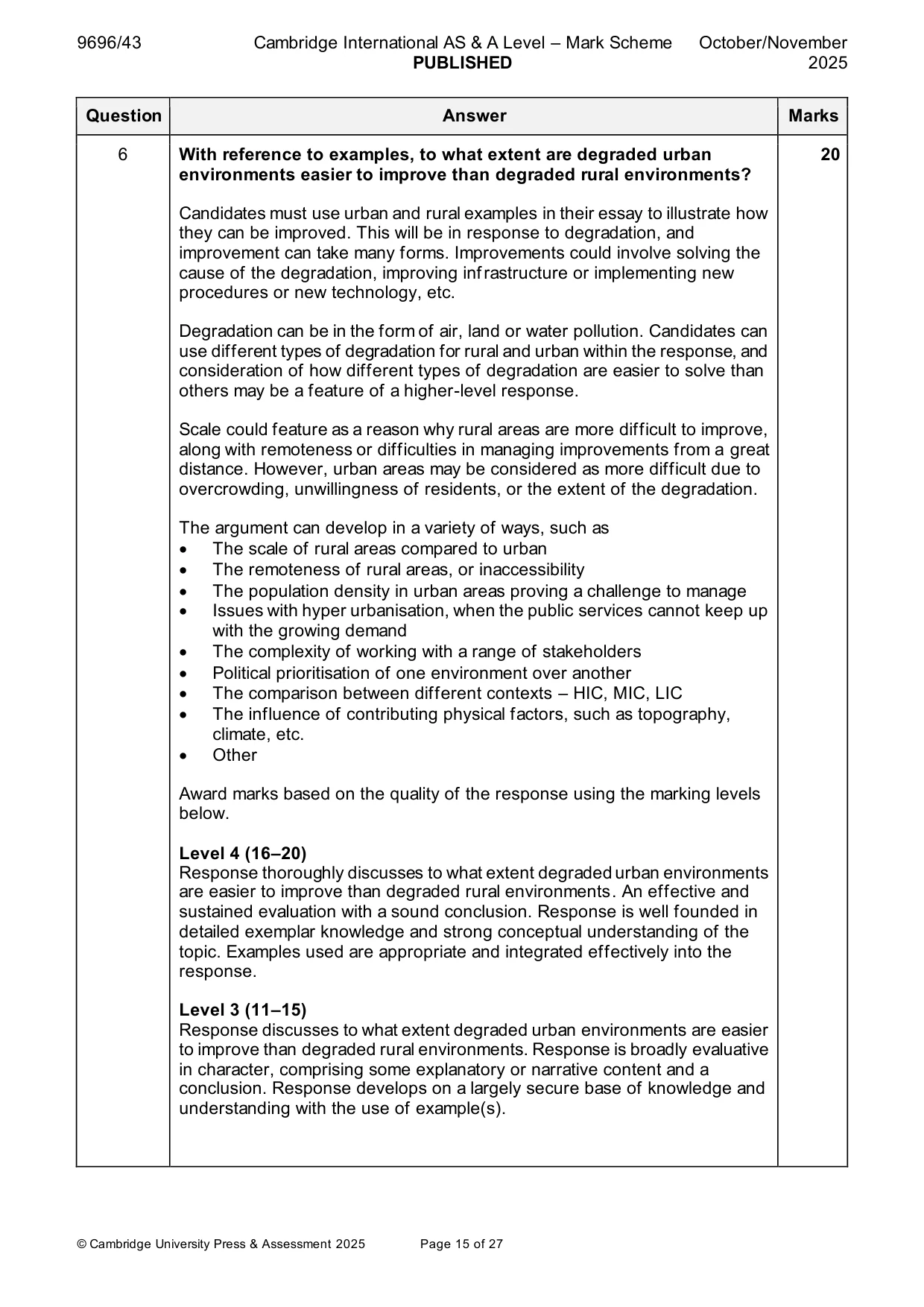
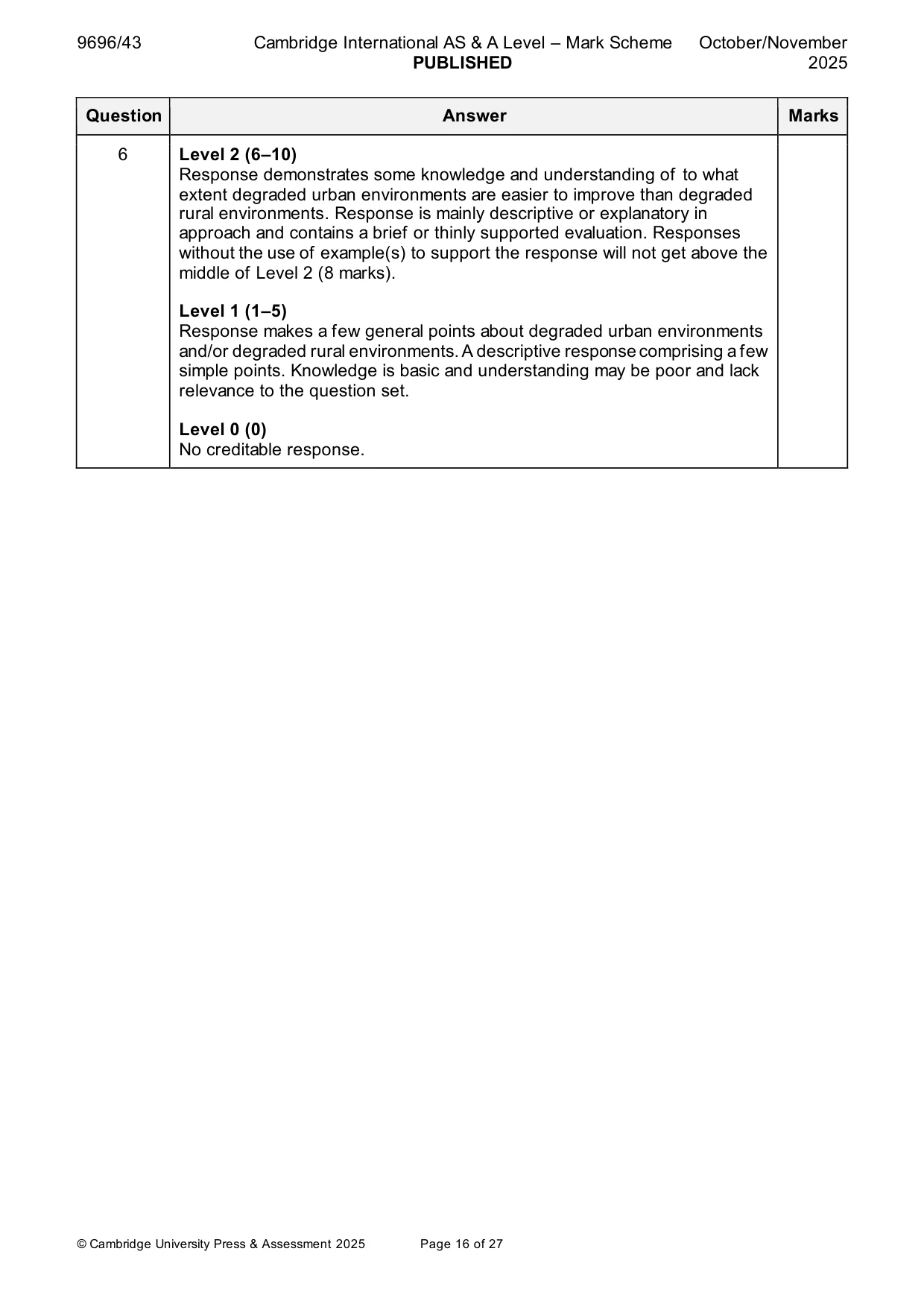
Mark scheme: 6 With reference to examples, to what extent are degraded urban 20 environments easier to improve than degraded rural environments? Candidates must use urban and rural examples in their essay to illustrate how they can be improved. This will be in response to degradation, and improvement can take many forms. Improvements could involve solving the cause of the degradation, improving infrastructure or implementing new procedures or new technology, etc. Degradation can be in the form of air, land or water pollution. Candidates can use different types of degradation for rural and urban within the response, and consideration of how different types of degradation are easier to solve than others may be a feature of a higher-level response. Scale could feature as a reason why rural areas are more difficult to improve, along with remoteness or difficulties in managing improvements from a great distance. However, urban areas may be considered as more difficult due to overcrowding, unwillingness of residents, or the extent of the degradation. The argument can develop in a variety of ways, such as • The scale of rural areas compared to urban • The remoteness of rural areas, or inaccessibility • The population density in urban areas proving a challenge to manage • Issues with hyper urbanisation, when the public services cannot keep up with the growing demand • The complexity of working with a range of stakeholders • Political prioritisation of one environment over another • The comparison between different contexts – HIC, MIC, LIC • The influence of contributing physical factors, such as topography, climate, etc. • Other Award marks based on the quality of the response using the marking levels below. Level 4 (16–20) Response thoroughly discusses to what extent degraded urban environments are easier to improve than degraded rural environments. An effective and sustained evaluation with a sound conclusion. Response is well founded in detailed exemplar knowledge and strong conceptual understanding of the topic. Examples used are appropriate and integrated effectively into the response. Level 3 (11–15) Response discusses to what extent degraded urban environments are easier to improve than degraded rural environments. Response is broadly evaluative in character, comprising some explanatory or narrative content and a conclusion. Response develops on a largely secure base of knowledge and understanding with the use of example(s). 6 Level 2 (6–10) Response demonstrates some knowledge and understanding of to what extent degraded urban environments are easier to improve than degraded rural environments. Response is mainly descriptive or explanatory in approach and contains a brief or thinly supported evaluation. Responses without the use of example(s) to support the response will not get above the middle of Level 2 (8 marks). Level 1 (1–5) Response makes a few general points about degraded urban environments and/or degraded rural environments. A descriptive response comprising a few simple points. Knowledge is basic and understanding may be poor and lack relevance to the question set. Level 0 (0) No creditable response. Global interdependence If answering this option, answer Question 7 and either Question 8 or Question 9.
Q7 · Exports per capita for countries in the Asia-Pacific region, 2016–18
7 Fig. 7.1 shows exports per capita for countries in the Asia-Pacific region, 2016–18. (a) Compare the exports per capita for the countries shown in Fig. 7.1. [4] (b) Explain two recent developments in different types of tourism. [6]
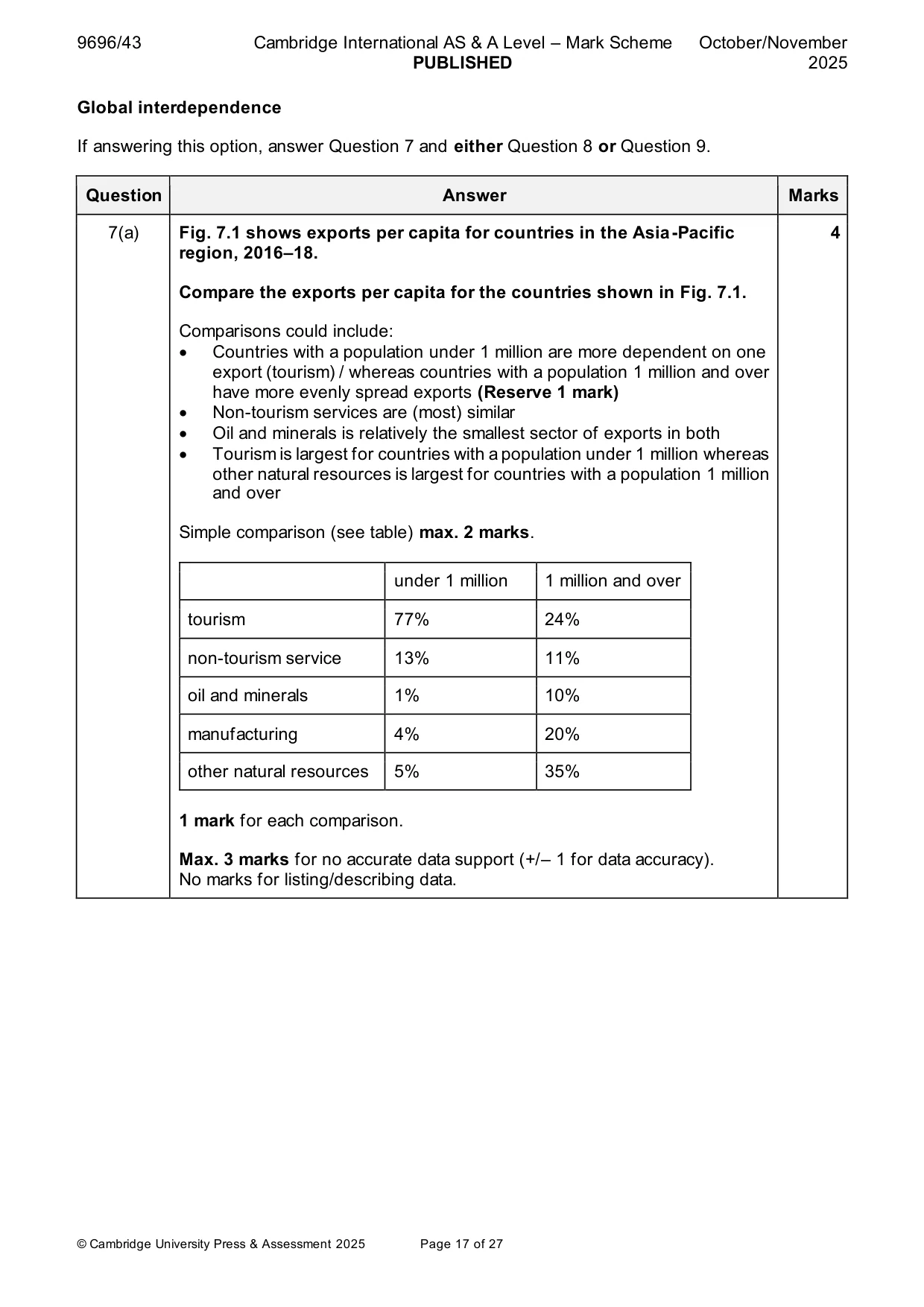
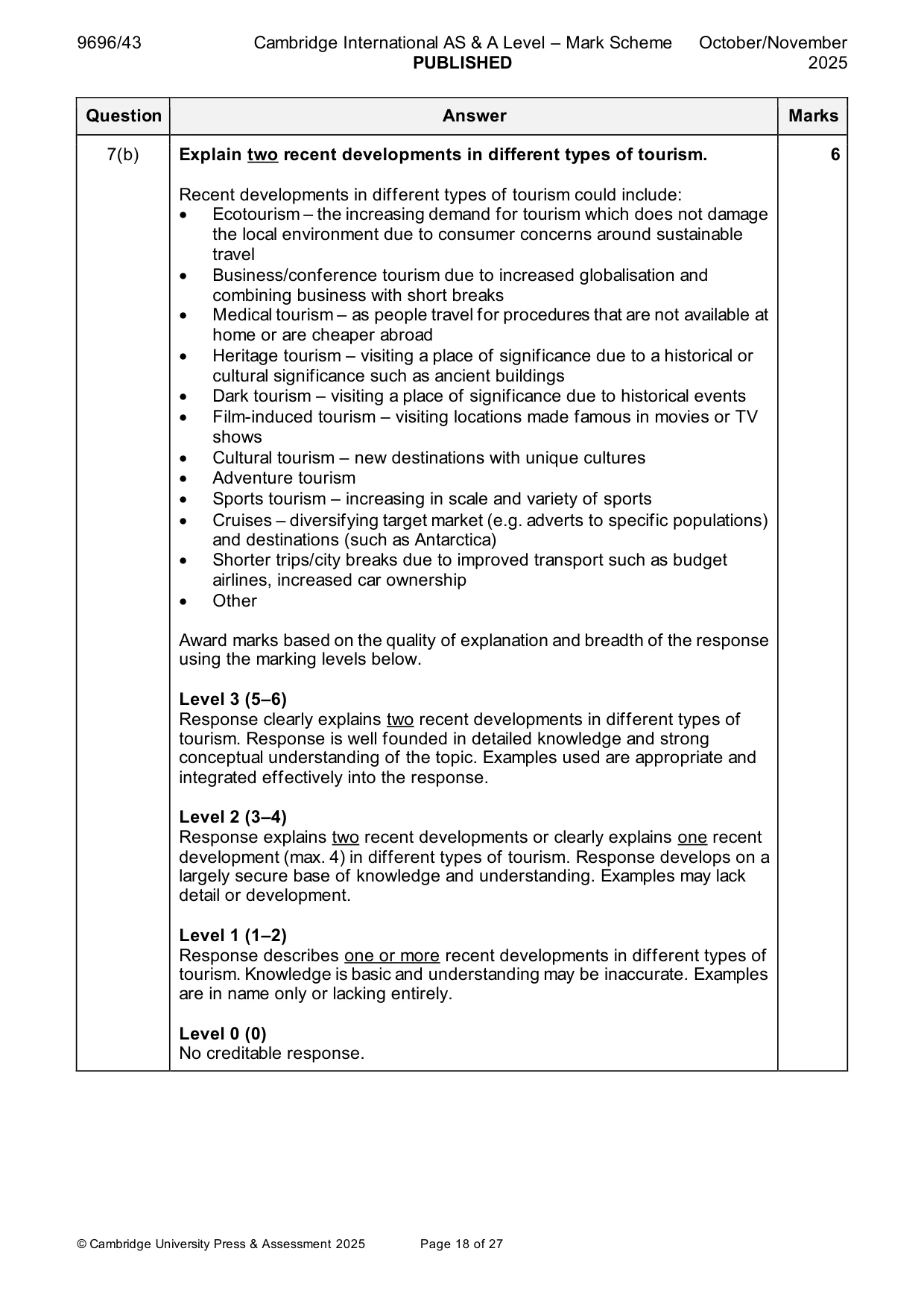
Mark scheme: 7(a) Fig. 7.1 shows exports per capita for countries in the Asia-Pacific 4 region, 2016–18. Compare the exports per capita for the countries shown in Fig. 7.1. Comparisons could include: • Countries with a population under 1 million are more dependent on one export (tourism) / whereas countries with a population 1 million and over have more evenly spread exports (Reserve 1 mark) • Non-tourism services are (most) similar • Oil and minerals is relatively the smallest sector of exports in both • Tourism is largest for countries with a population under 1 million whereas other natural resources is largest for countries with a population 1 million and over Simple comparison (see table) max. 2 marks. under 1 million 1 million and over tourism 77% 24% non-tourism service 13% 11% oil and minerals 1% 10% manufacturing 4% 20% other natural resources 5% 35% 1 mark for each comparison. Max. 3 marks for no accurate data support (+/– 1 for data accuracy). No marks for listing/describing data. 7(b) Explain two recent developments in different types of tourism. 6 Recent developments in different types of tourism could include: • Ecotourism – the increasing demand for tourism which does not damage the local environment due to consumer concerns around sustainable travel • Business/conference tourism due to increased globalisation and combining business with short breaks • Medical tourism – as people travel for procedures that are not available at home or are cheaper abroad • Heritage tourism – visiting a place of significance due to a historical or cultural significance such as ancient buildings • Dark tourism – visiting a place of significance due to historical events • Film-induced tourism – visiting locations made famous in movies or TV shows • Cultural tourism – new destinations with unique cultures • Adventure tourism • Sports tourism – increasing in scale and variety of sports • Cruises – diversifying target market (e.g. adverts to specific populations) and destinations (such as Antarctica) • Shorter trips/city breaks due to improved transport such as budget airlines, increased car ownership • Other Award marks based on the quality of explanation and breadth of the response using the marking levels below. Level 3 (5–6) Response clearly explains two recent developments in different types of tourism. Response is well founded in detailed knowledge and strong conceptual understanding of the topic. Examples used are appropriate and integrated effectively into the response. Level 2 (3–4) Response explains two recent developments or clearly explains one recent development (max. 4) in different types of tourism. Response develops on a largely secure base of knowledge and understanding. Examples may lack detail or development. Level 1 (1–2) Response describes one or more recent developments in different types of tourism. Knowledge is basic and understanding may be inaccurate. Examples are in name only or lacking entirely. Level 0 (0) No creditable response.
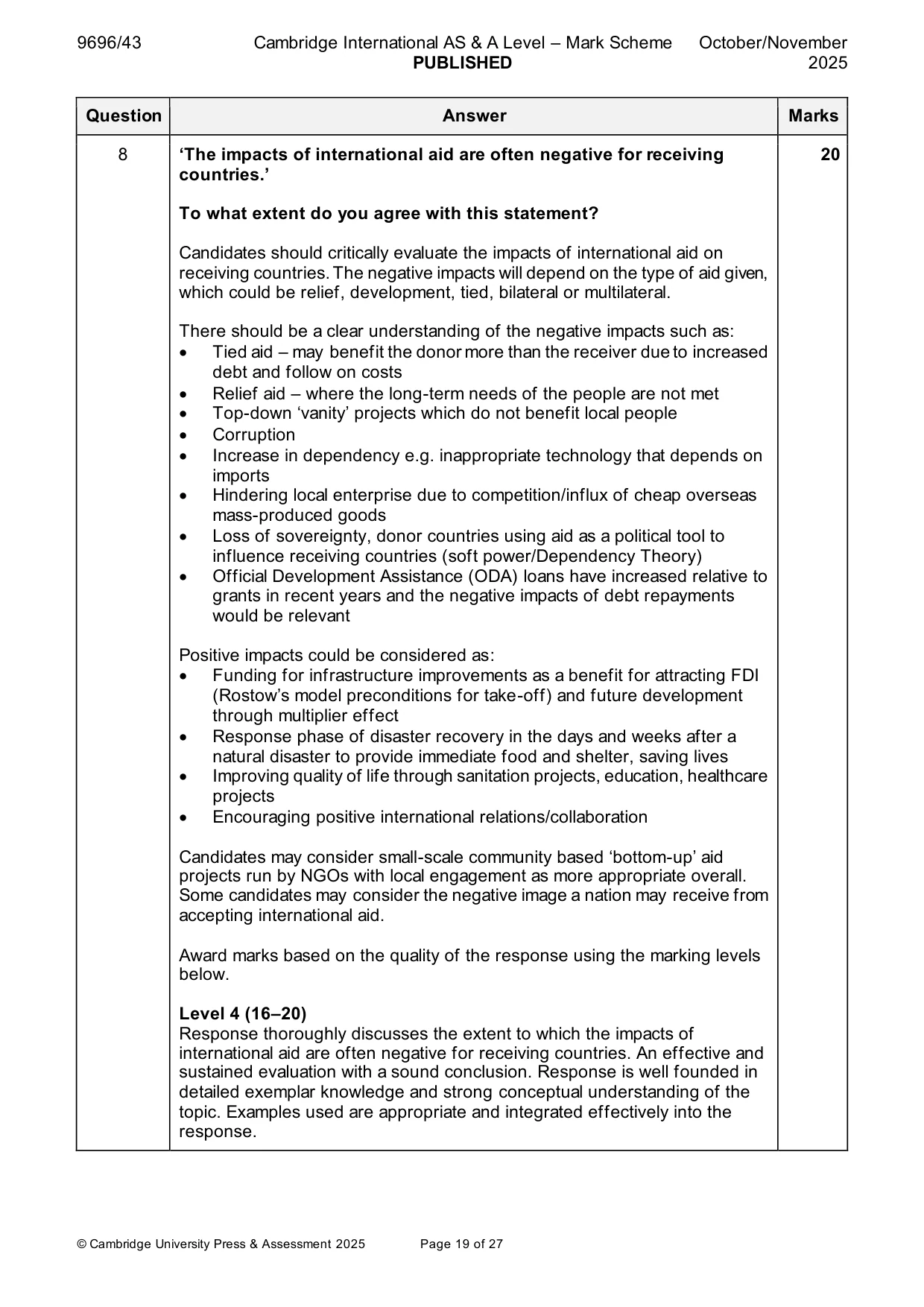
Q8 · ‘The impacts of international aid are often negative for receiving countries.’ To what…
8 ‘The impacts of international aid are often negative for receiving countries.’ To what extent do you agree with this statement? [20]
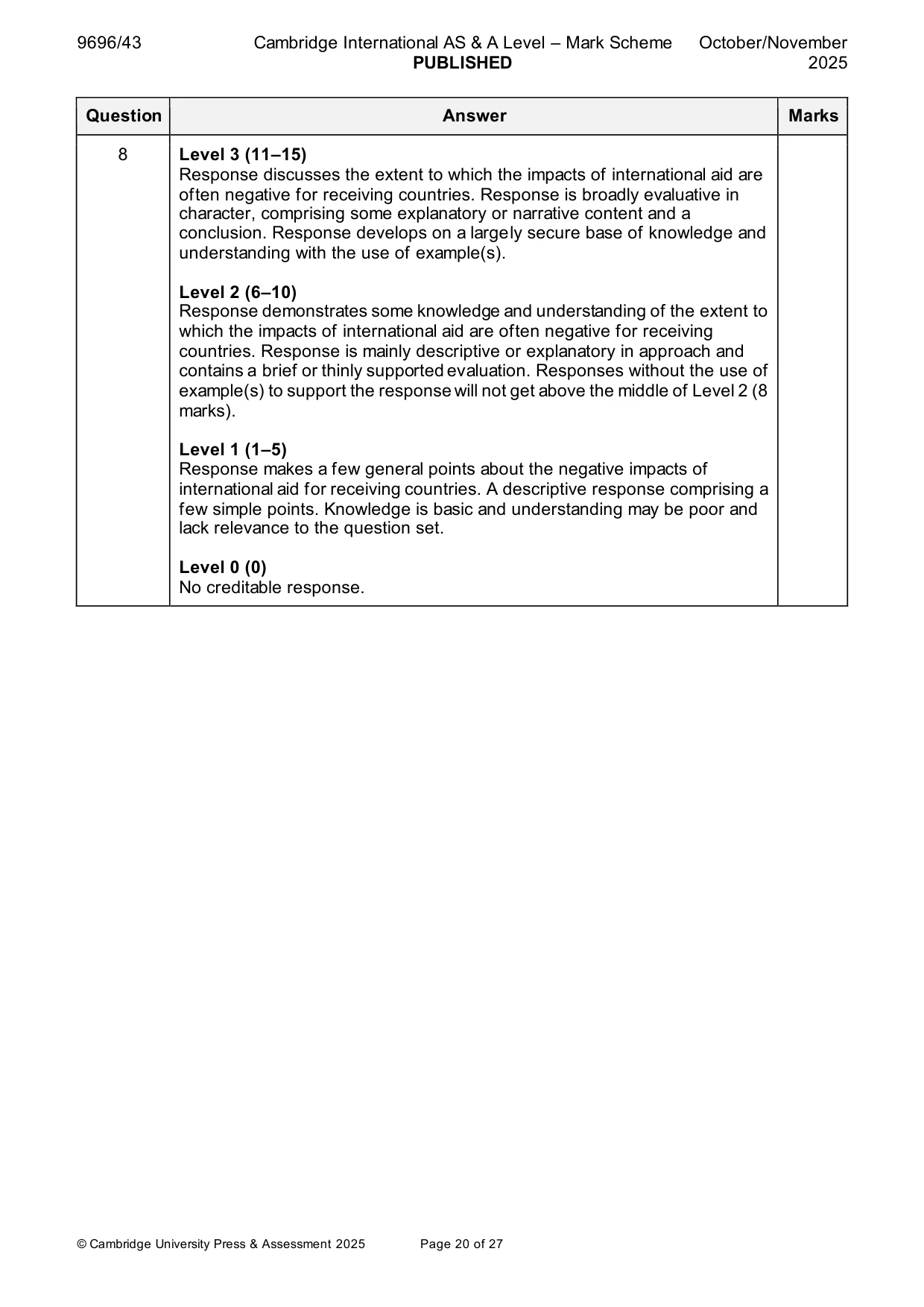
Mark scheme: 8 ‘The impacts of international aid are often negative for receiving 20 countries.’ To what extent do you agree with this statement? Candidates should critically evaluate the impacts of international aid on receiving countries. The negative impacts will depend on the type of aid given, which could be relief, development, tied, bilateral or multilateral. There should be a clear understanding of the negative impacts such as: • Tied aid – may benefit the donor more than the receiver due to increased debt and follow on costs • Relief aid – where the long-term needs of the people are not met • Top-down ‘vanity’ projects which do not benefit local people • Corruption • Increase in dependency e.g. inappropriate technology that depends on imports • Hindering local enterprise due to competition/influx of cheap overseas mass-produced goods • Loss of sovereignty, donor countries using aid as a political tool to influence receiving countries (soft power/Dependency Theory) • Official Development Assistance (ODA) loans have increased relative to grants in recent years and the negative impacts of debt repayments would be relevant Positive impacts could be considered as: • Funding for infrastructure improvements as a benefit for attracting FDI (Rostow’s model preconditions for take-off) and future development through multiplier effect • Response phase of disaster recovery in the days and weeks after a natural disaster to provide immediate food and shelter, saving lives • Improving quality of life through sanitation projects, education, healthcare projects • Encouraging positive international relations/collaboration Candidates may consider small-scale community based ‘bottom-up’ aid projects run by NGOs with local engagement as more appropriate overall. Some candidates may consider the negative image a nation may receive from accepting international aid. Award marks based on the quality of the response using the marking levels below. Level 4 (16–20) Response thoroughly discusses the extent to which the impacts of international aid are often negative for receiving countries. An effective and sustained evaluation with a sound conclusion. Response is well founded in detailed exemplar knowledge and strong conceptual understanding of the topic. Examples used are appropriate and integrated effectively into the response. 8 Level 3 (11–15) Response discusses the extent to which the impacts of international aid are often negative for receiving countries. Response is broadly evaluative in character, comprising some explanatory or narrative content and a conclusion. Response develops on a largely secure base of knowledge and understanding with the use of example(s). Level 2 (6–10) Response demonstrates some knowledge and understanding of the extent to which the impacts of international aid are often negative for receiving countries. Response is mainly descriptive or explanatory in approach and contains a brief or thinly supported evaluation. Responses without the use of example(s) to support the response will not get above the middle of Level 2 (8 marks). Level 1 (1–5) Response makes a few general points about the negative impacts of international aid for receiving countries. A descriptive response comprising a few simple points. Knowledge is basic and understanding may be poor and lack relevance to the question set. Level 0 (0) No creditable response.
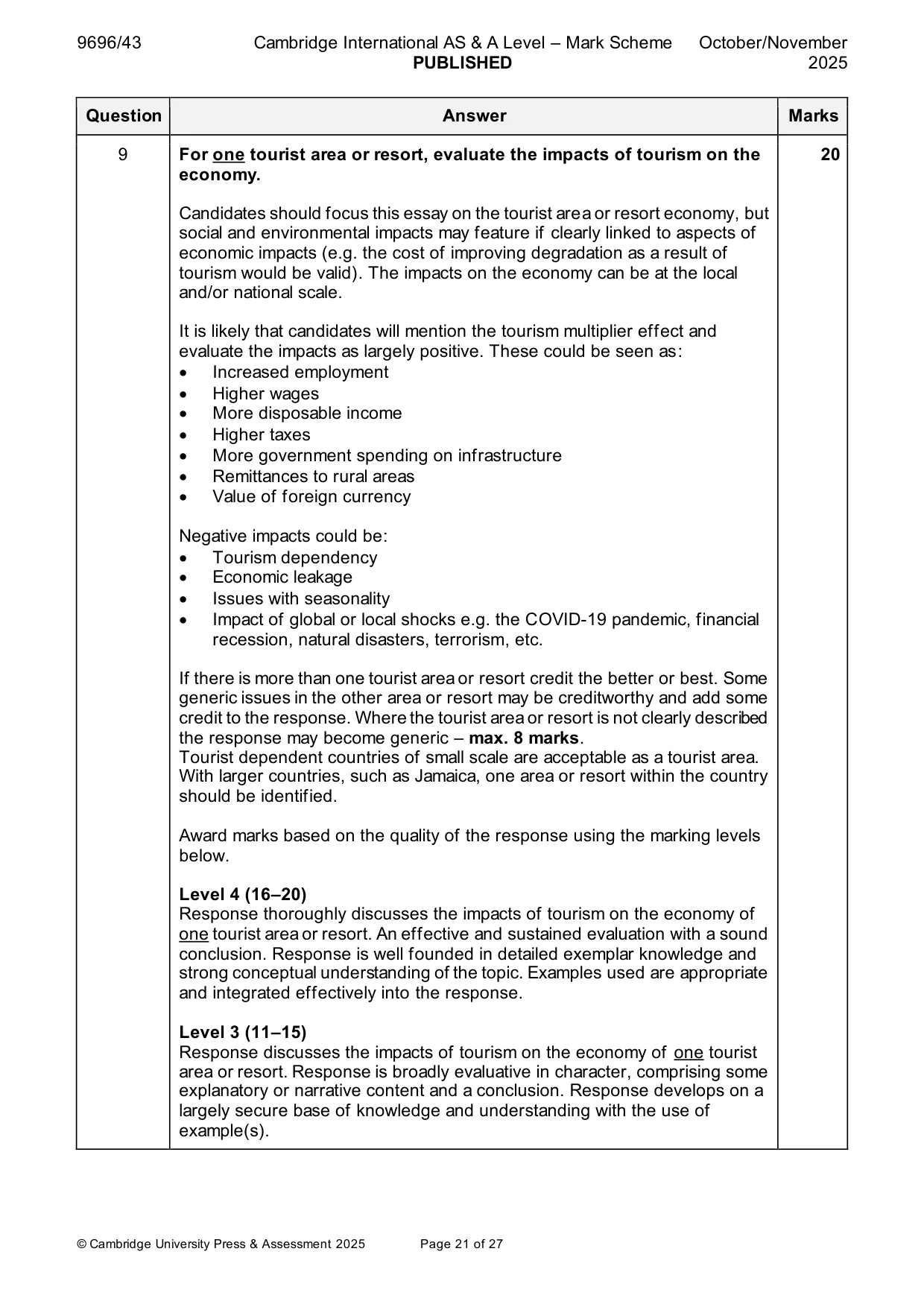
Q9 · For one tourist area or resort, evaluate the impacts of tourism on the economy
9 For one tourist area or resort, evaluate the impacts of tourism on the economy. [20] Economic transition If answering this option, answer Question 10 and either Question 11 or Question 12.
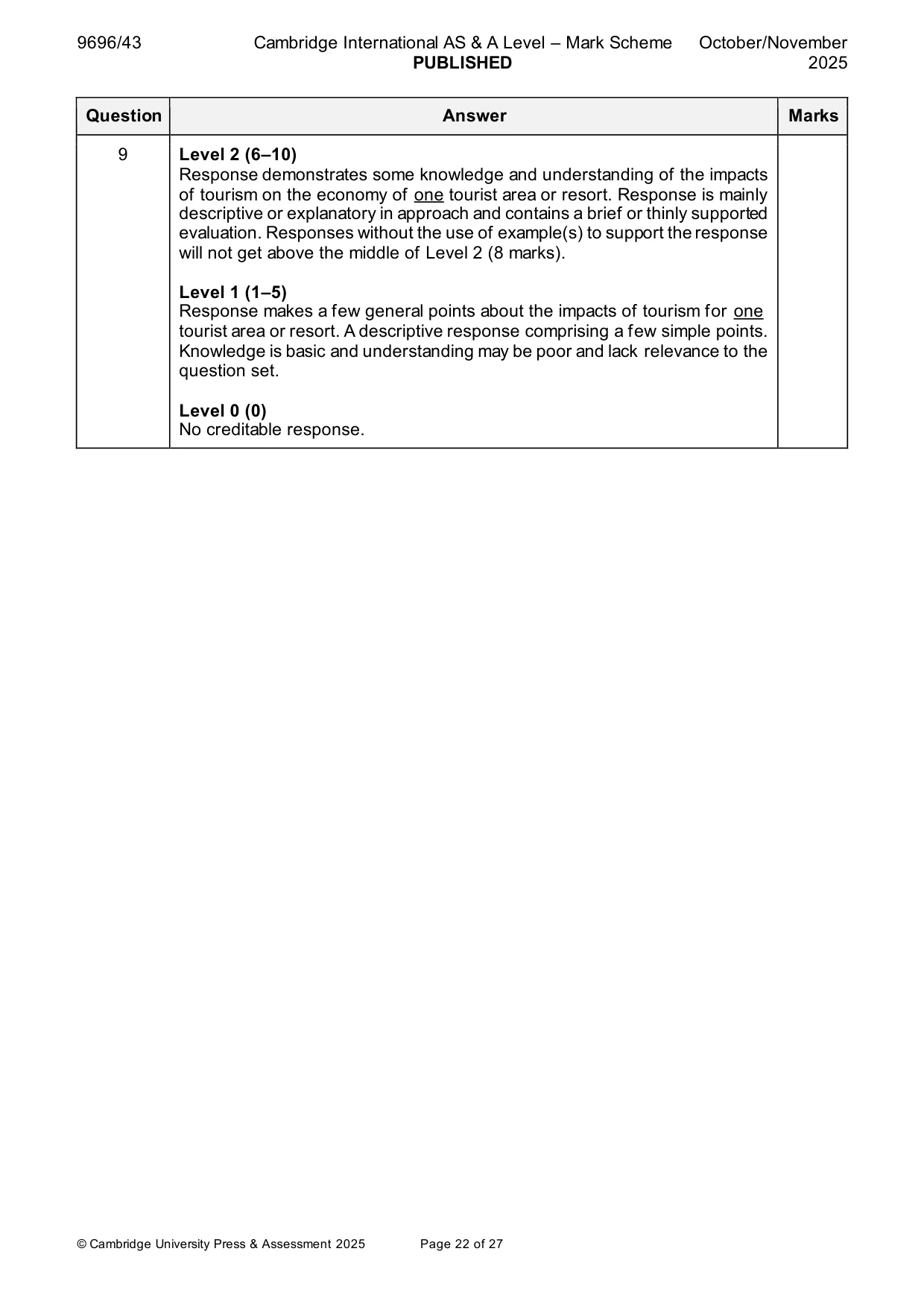
Mark scheme: 9 For one tourist area or resort, evaluate the impacts of tourism on the 20 economy. Candidates should focus this essay on the tourist area or resort economy, but social and environmental impacts may feature if clearly linked to aspects of economic impacts (e.g. the cost of improving degradation as a result of tourism would be valid). The impacts on the economy can be at the local and/or national scale. It is likely that candidates will mention the tourism multiplier effect and evaluate the impacts as largely positive. These could be seen as: • Increased employment • Higher wages • More disposable income • Higher taxes • More government spending on infrastructure • Remittances to rural areas • Value of foreign currency Negative impacts could be: • Tourism dependency • Economic leakage • Issues with seasonality • Impact of global or local shocks e.g. the COVID-19 pandemic, financial recession, natural disasters, terrorism, etc. If there is more than one tourist area or resort credit the better or best. Some generic issues in the other area or resort may be creditworthy and add some credit to the response. Where the tourist area or resort is not clearly described the response may become generic – max. 8 marks. Tourist dependent countries of small scale are acceptable as a tourist area. With larger countries, such as Jamaica, one area or resort within the country should be identified. Award marks based on the quality of the response using the marking levels below. Level 4 (16–20) Response thoroughly discusses the impacts of tourism on the economy of one tourist area or resort. An effective and sustained evaluation with a sound conclusion. Response is well founded in detailed exemplar knowledge and strong conceptual understanding of the topic. Examples used are appropriate and integrated effectively into the response. Level 3 (11–15) Response discusses the impacts of tourism on the economy of one tourist area or resort. Response is broadly evaluative in character, comprising some explanatory or narrative content and a conclusion. Response develops on a largely secure base of knowledge and understanding with the use of example(s). 9 Level 2 (6–10) Response demonstrates some knowledge and understanding of the impacts of tourism on the economy of one tourist area or resort. Response is mainly descriptive or explanatory in approach and contains a brief or thinly supported evaluation. Responses without the use of example(s) to support the response will not get above the middle of Level 2 (8 marks). Level 1 (1–5) Response makes a few general points about the impacts of tourism for one tourist area or resort. A descriptive response comprising a few simple points. Knowledge is basic and understanding may be poor and lack relevance to the question set. Level 0 (0) No creditable response. Economic transition If answering this option, answer Question 10 and either Question 11 or Question 12.
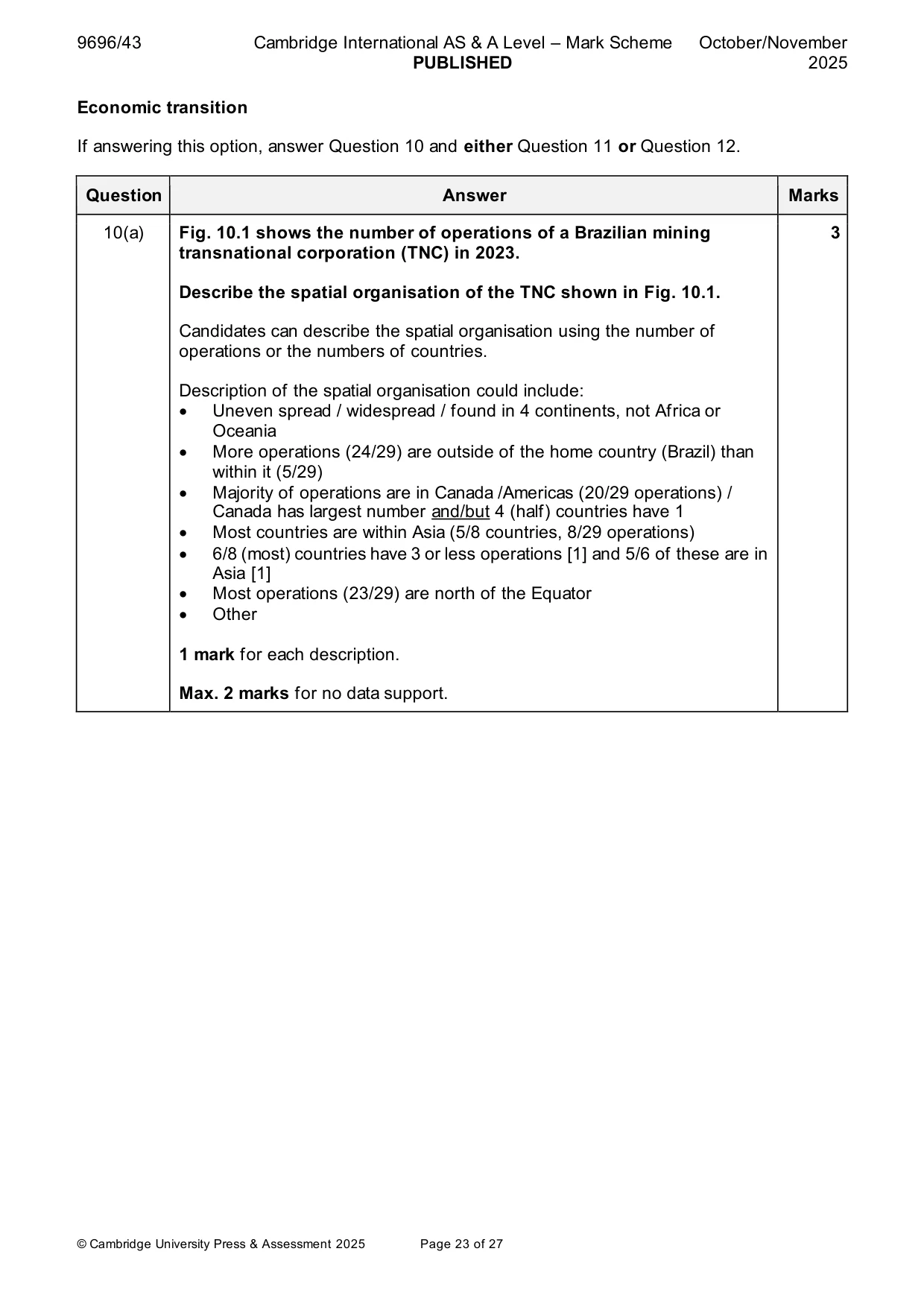
Q10 · The number of operations of a Brazilian mining transnational corporation (TNC) in 2023
10 Fig. 10.1 shows the number of operations of a Brazilian mining transnational corporation (TNC) in 2023. (a) Describe the spatial organisation of the TNC shown in Fig. 10.1. [3] (b) Explain two benefits to transnational corporations (TNCs) of offshoring of services. [7]
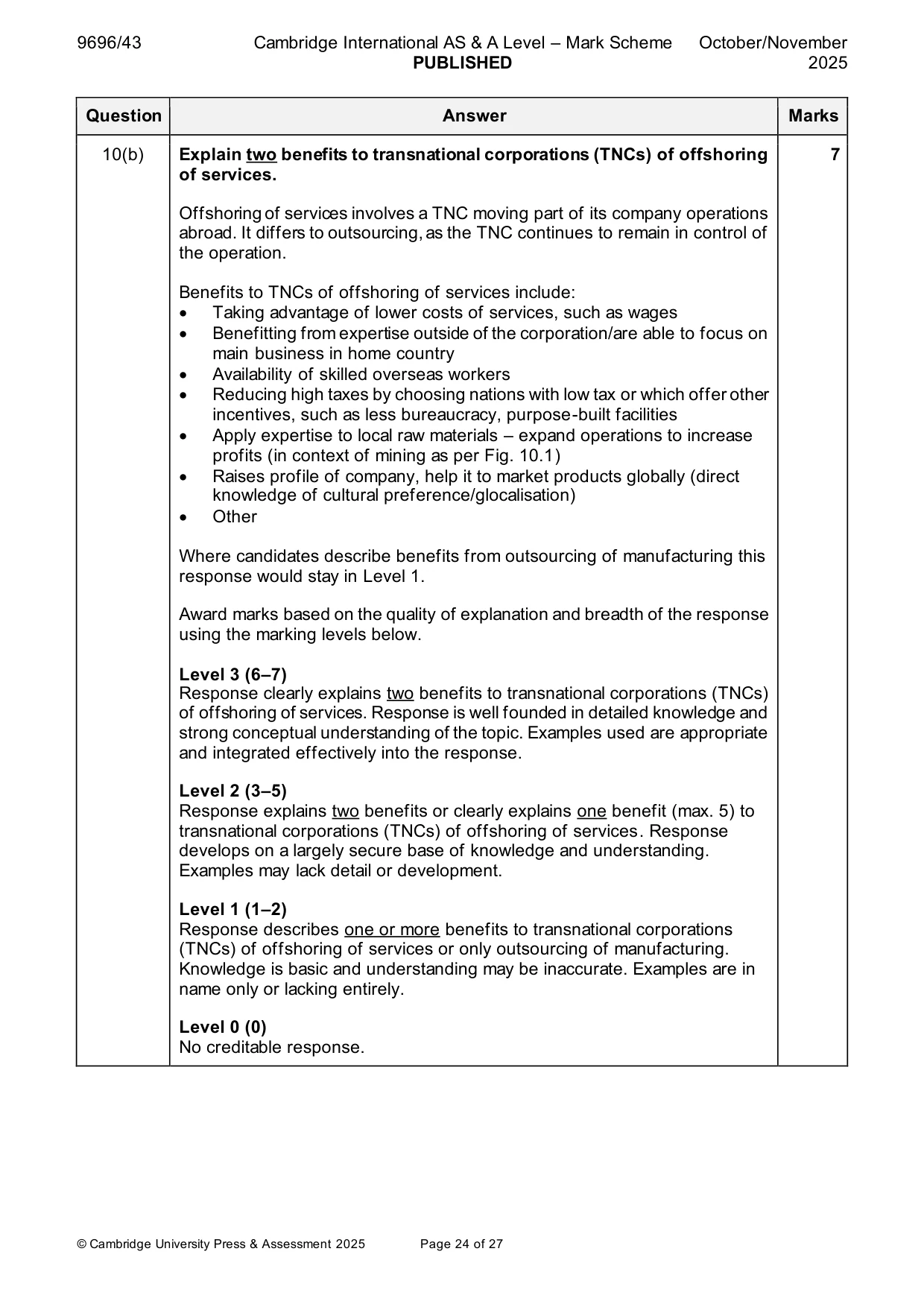
Mark scheme: 10(a) Fig. 10.1 shows the number of operations of a Brazilian mining 3 transnational corporation (TNC) in 2023. Describe the spatial organisation of the TNC shown in Fig. 10.1. Candidates can describe the spatial organisation using the number of operations or the numbers of countries. Description of the spatial organisation could include: • Uneven spread / widespread / found in 4 continents, not Africa or Oceania • More operations (24/29) are outside of the home country (Brazil) than within it (5/29) • Majority of operations are in Canada /Americas (20/29 operations) / Canada has largest number and/but 4 (half) countries have 1 • Most countries are within Asia (5/8 countries, 8/29 operations) • 6/8 (most) countries have 3 or less operations [1] and 5/6 of these are in Asia [1] • Most operations (23/29) are north of the Equator • Other 1 mark for each description. Max. 2 marks for no data support. 10(b) Explain two benefits to transnational corporations (TNCs) of offshoring 7 of services. Offshoring of services involves a TNC moving part of its company operations abroad. It differs to outsourcing, as the TNC continues to remain in control of the operation. Benefits to TNCs of offshoring of services include: • Taking advantage of lower costs of services, such as wages • Benefitting from expertise outside of the corporation/are able to focus on main business in home country • Availability of skilled overseas workers • Reducing high taxes by choosing nations with low tax or which offer other incentives, such as less bureaucracy, purpose-built facilities • Apply expertise to local raw materials – expand operations to increase profits (in context of mining as per Fig. 10.1) • Raises profile of company, help it to market products globally (direct knowledge of cultural preference/glocalisation) • Other Where candidates describe benefits from outsourcing of manufacturing this response would stay in Level 1. Award marks based on the quality of explanation and breadth of the response using the marking levels below. Level 3 (6–7) Response clearly explains two benefits to transnational corporations (TNCs) of offshoring of services. Response is well founded in detailed knowledge and strong conceptual understanding of the topic. Examples used are appropriate and integrated effectively into the response. Level 2 (3–5) Response explains two benefits or clearly explains one benefit (max. 5) to transnational corporations (TNCs) of offshoring of services. Response develops on a largely secure base of knowledge and understanding. Examples may lack detail or development. Level 1 (1–2) Response describes one or more benefits to transnational corporations (TNCs) of offshoring of services or only outsourcing of manufacturing. Knowledge is basic and understanding may be inaccurate. Examples are in name only or lacking entirely. Level 0 (0) No creditable response.
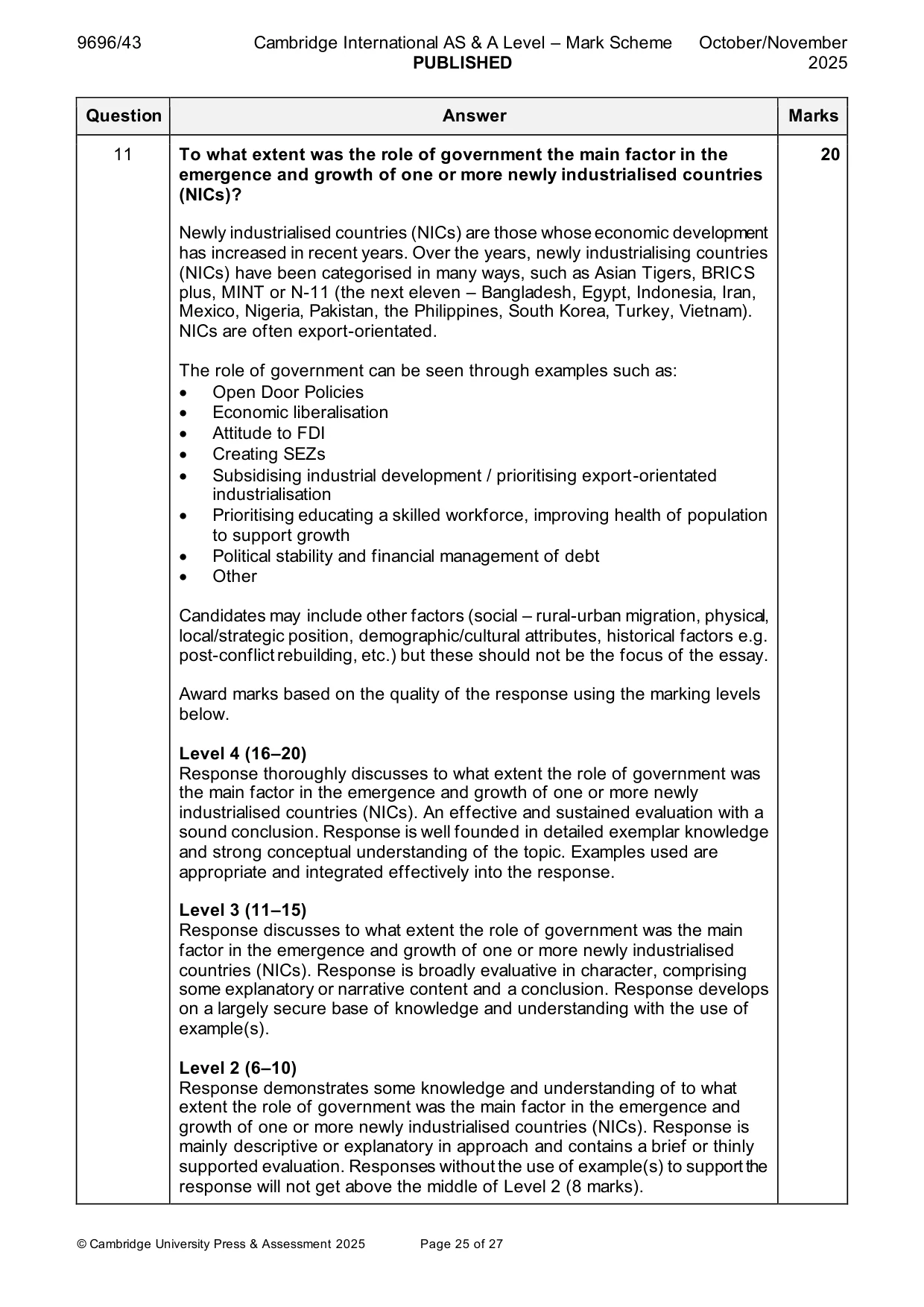
Q11 · To what extent was the role of government the main factor in the emergence and growth of…
11 To what extent was the role of government the main factor in the emergence and growth of one or more newly industrialised countries (NICs)? [20]
Mark scheme: 11 To what extent was the role of government the main factor in the 20 emergence and growth of one or more newly industrialised countries (NICs)? Newly industrialised countries (NICs) are those whose economic development has increased in recent years. Over the years, newly industrialising countries (NICs) have been categorised in many ways, such as Asian Tigers, BRICS plus, MINT or N-11 (the next eleven – Bangladesh, Egypt, Indonesia, Iran, Mexico, Nigeria, Pakistan, the Philippines, South Korea, Turkey, Vietnam). NICs are often export-orientated. The role of government can be seen through examples such as: • Open Door Policies • Economic liberalisation • Attitude to FDI • Creating SEZs • Subsidising industrial development / prioritising export-orientated industrialisation • Prioritising educating a skilled workforce, improving health of population to support growth • Political stability and financial management of debt • Other Candidates may include other factors (social – rural-urban migration, physical, local/strategic position, demographic/cultural attributes, historical factors e.g. post-conflict rebuilding, etc.) but these should not be the focus of the essay. Award marks based on the quality of the response using the marking levels below. Level 4 (16–20) Response thoroughly discusses to what extent the role of government was the main factor in the emergence and growth of one or more newly industrialised countries (NICs). An effective and sustained evaluation with a sound conclusion. Response is well founded in detailed exemplar knowledge and strong conceptual understanding of the topic. Examples used are appropriate and integrated effectively into the response. Level 3 (11–15) Response discusses to what extent the role of government was the main factor in the emergence and growth of one or more newly industrialised countries (NICs). Response is broadly evaluative in character, comprising some explanatory or narrative content and a conclusion. Response develops on a largely secure base of knowledge and understanding with the use of example(s). Level 2 (6–10) Response demonstrates some knowledge and understanding of to what extent the role of government was the main factor in the emergence and growth of one or more newly industrialised countries (NICs). Response is mainly descriptive or explanatory in approach and contains a brief or thinly supported evaluation. Responses without the use of example(s) to support the response will not get above the middle of Level 2 (8 marks). 11 Level 1 (1–5) Response makes a few general points about the role of government and/or the emergence and growth of one or more newly industrialised countries (NICs). A descriptive response comprising a few simple points. Knowledge is basic and understanding may be poor and lack relevance to the question set. Level 0 (0) No creditable response.
What was in this paper
The subtopics covered by these 11 questions, and how many questions each got. Open one in a new tab to see every Cambridge question on it.
2Agricultural systems and food production1Environmental degradation1International debt and international aid1Manufacturing and related service industry1National development1Sustainable energy supplies1The globalisation of economic activity1The management of agricultural change1Trade flows and trading patterns1What you needed in this session
Cambridge’s own grade thresholds for 2025 Oct/Nov, Paper 4 · Variant 3. A higher threshold means an easier paper — the bar moves with how the cohort did.