Cambridge A Level Geography 9696 — 2025 May/June Paper 4 · Variant 1
9696/41/M/J/25 · 12 questions · 60 marks · ≈68 min
The question paper and its mark scheme, free to read here and free to download. This is Cambridge’s own paper, exactly as it was sat.
Question paper4 pages


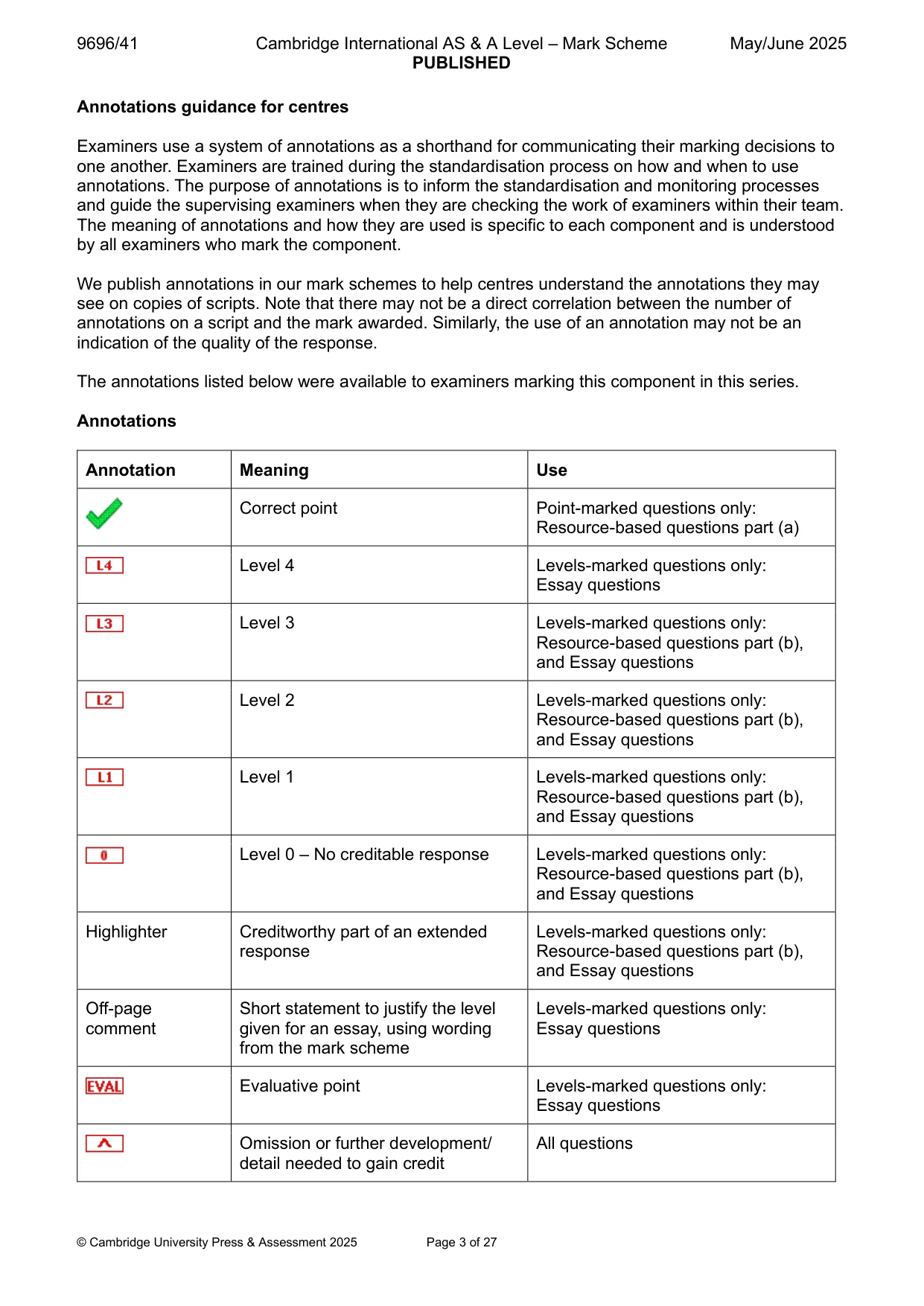
Mark scheme27 pages
Answers below. Sit the paper first if you are practising.





Questions as text
Q1 · A photograph which shows intensive food production on a farm in Thailand, an MIC in Asia
1 Fig. 1.1 is a photograph which shows intensive food production on a farm in Thailand, an MIC in Asia. (a) Using evidence from Fig. 1.1, describe how technology is used to intensify food production. [4] (b) Explain two disadvantages of the intensification of agriculture. [6]
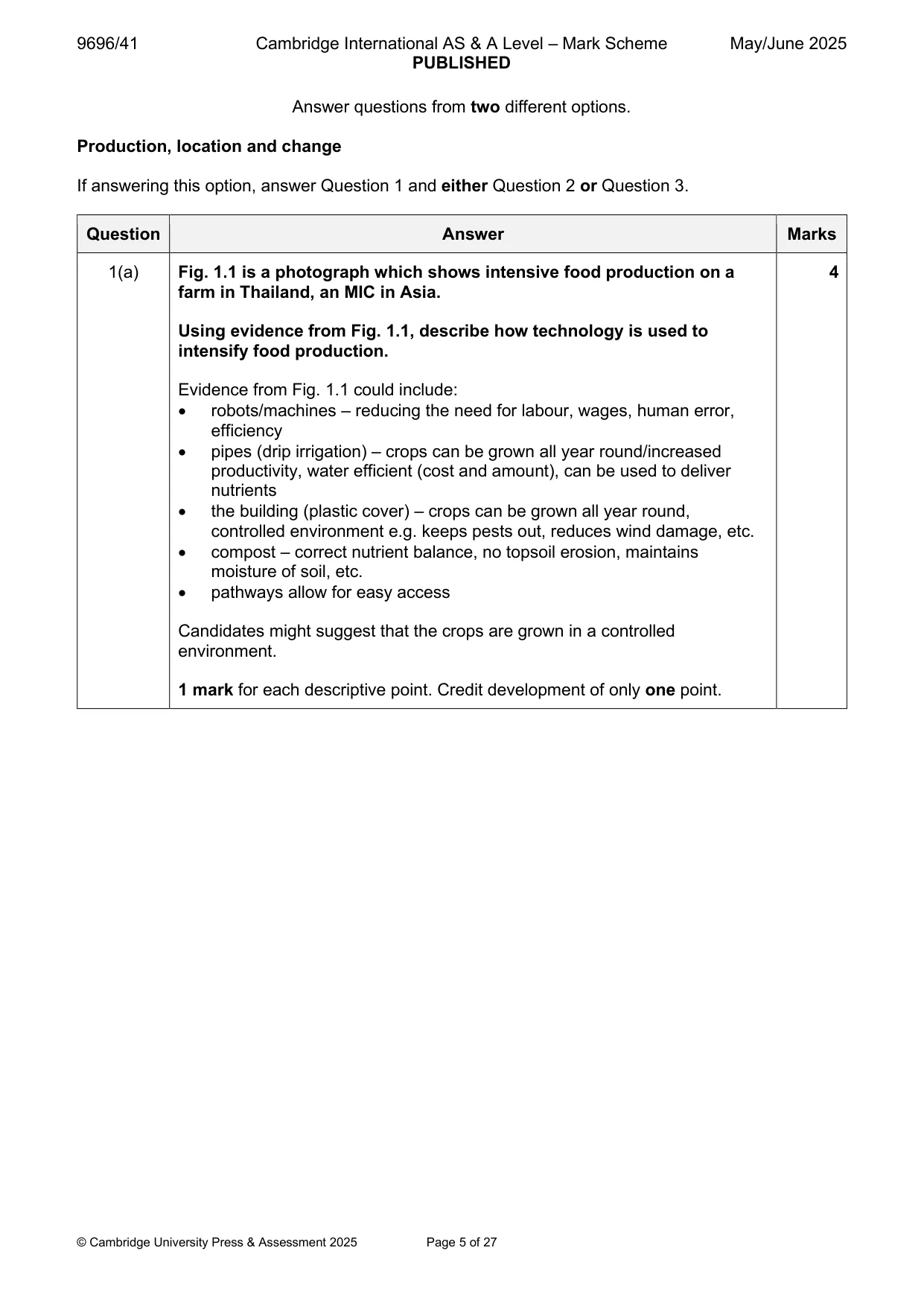
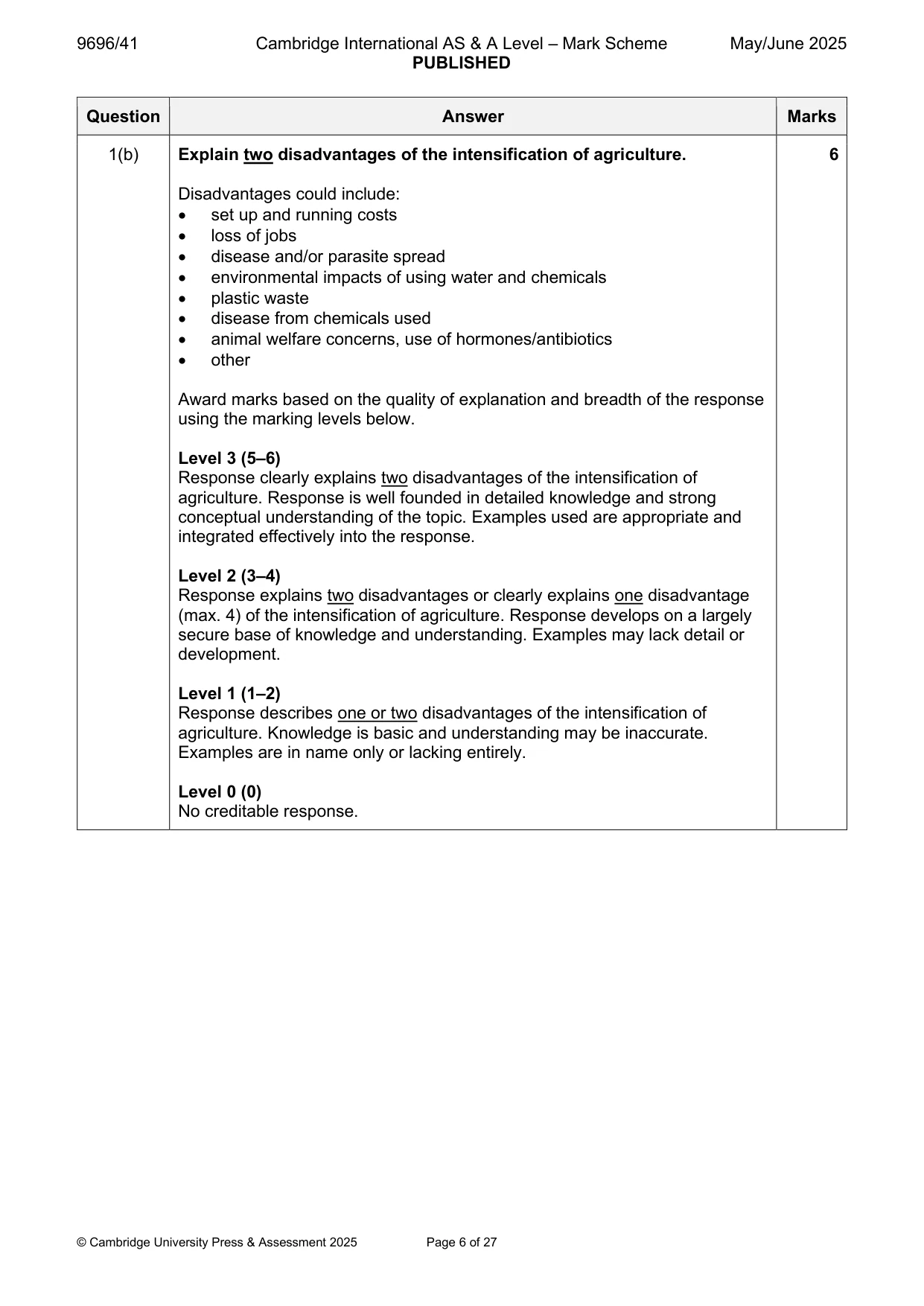
Mark scheme: Question Answer Marks 1(a) Fig. 1.1 is a photograph which shows intensive food production on a 4 farm in Thailand, an MIC in Asia. Using evidence from Fig. 1.1, describe how technology is used to intensify food production. Evidence from Fig. 1.1 could include: • robots/machines – reducing the need for labour, wages, human error, efficiency • pipes (drip irrigation) – crops can be grown all year round/increased productivity, water efficient (cost and amount), can be used to deliver nutrients • the building (plastic cover) – crops can be grown all year round, controlled environment e.g. keeps pests out, reduces wind damage, etc. • compost – correct nutrient balance, no topsoil erosion, maintains moisture of soil, etc. • pathways allow for easy access Candidates might suggest that the crops are grown in a controlled environment. 1 mark for each descriptive point. Credit development of only one point. 1(b) Explain two disadvantages of the intensification of agriculture. 6 Disadvantages could include: • set up and running costs • loss of jobs • disease and/or parasite spread • environmental impacts of using water and chemicals • plastic waste • disease from chemicals used • animal welfare concerns, use of hormones/antibiotics • other Award marks based on the quality of explanation and breadth of the response using the marking levels below. Level 3 (5–6) Response clearly explains two disadvantages of the intensification of agriculture. Response is well founded in detailed knowledge and strong conceptual understanding of the topic. Examples used are appropriate and integrated effectively into the response. Level 2 (3–4) Response explains two disadvantages or clearly explains one disadvantage (max. 4) of the intensification of agriculture. Response develops on a largely secure base of knowledge and understanding. Examples may lack detail or development. Level 1 (1–2) Response describes one or two disadvantages of the intensification of agriculture. Knowledge is basic and understanding may be inaccurate. Examples are in name only or lacking entirely. Level 0 (0) No creditable response.
Q2 · Assess the extent to which demand and distance from markets affect agricultural land use…
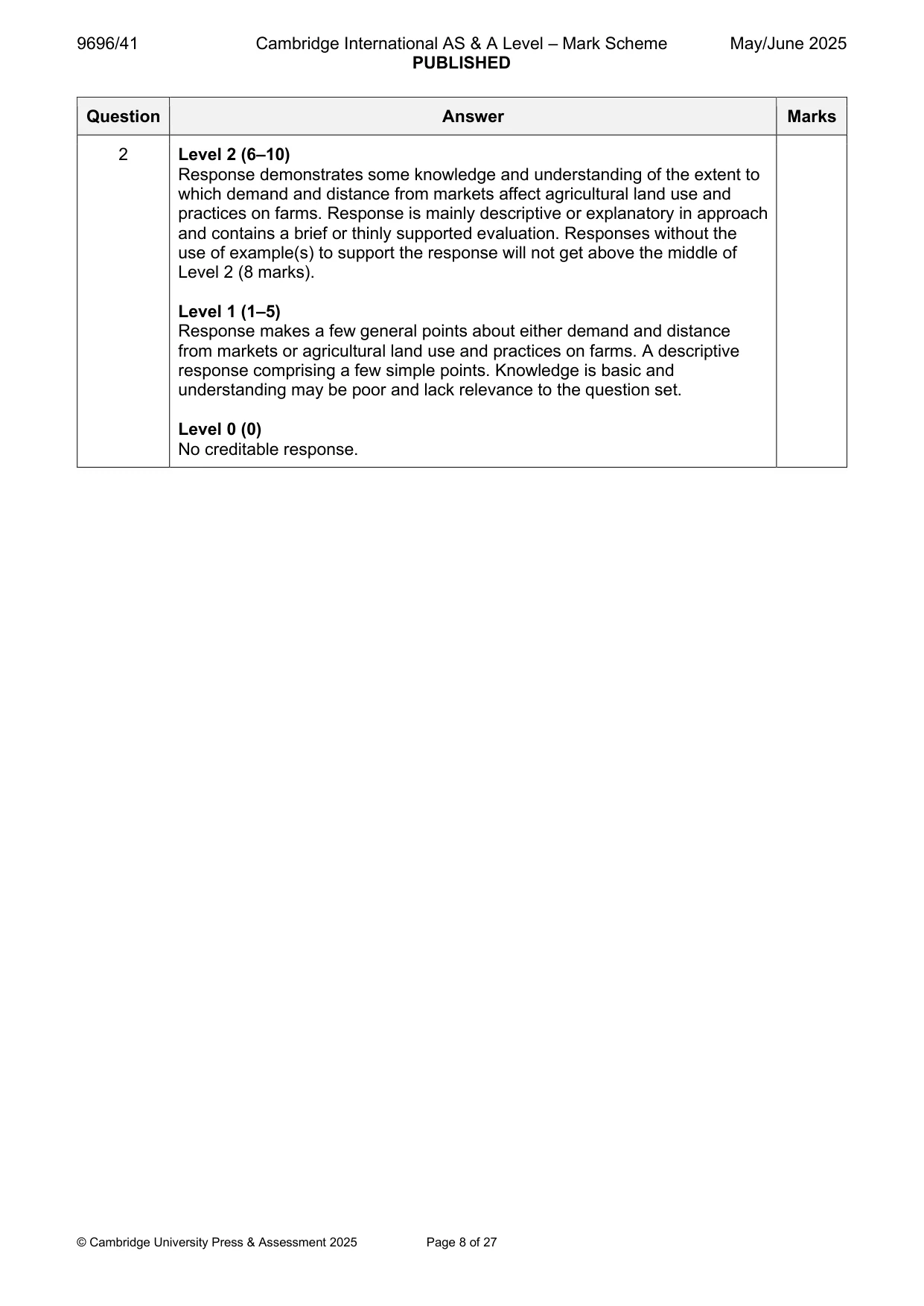
2 Assess the extent to which demand and distance from markets affect agricultural land use and practices on farms. [20]
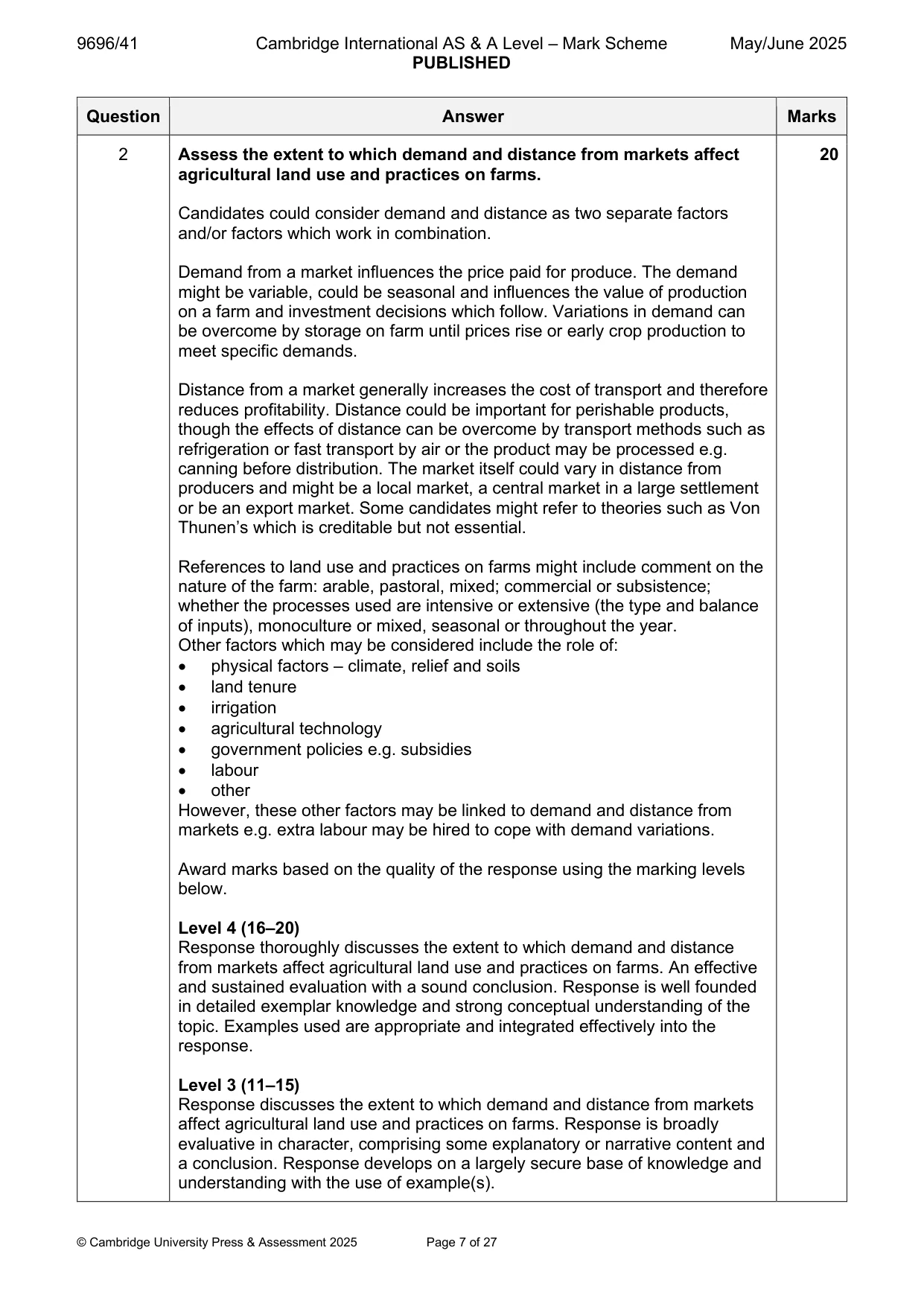
Mark scheme: 2 Assess the extent to which demand and distance from markets affect 20 agricultural land use and practices on farms. Candidates could consider demand and distance as two separate factors and/or factors which work in combination. Demand from a market influences the price paid for produce. The demand might be variable, could be seasonal and influences the value of production on a farm and investment decisions which follow. Variations in demand can be overcome by storage on farm until prices rise or early crop production to meet specific demands. Distance from a market generally increases the cost of transport and therefore reduces profitability. Distance could be important for perishable products, though the effects of distance can be overcome by transport methods such as refrigeration or fast transport by air or the product may be processed e.g. canning before distribution. The market itself could vary in distance from producers and might be a local market, a central market in a large settlement or be an export market. Some candidates might refer to theories such as Von Thunen’s which is creditable but not essential. References to land use and practices on farms might include comment on the nature of the farm: arable, pastoral, mixed; commercial or subsistence; whether the processes used are intensive or extensive (the type and balance of inputs), monoculture or mixed, seasonal or throughout the year. Other factors which may be considered include the role of: • physical factors – climate, relief and soils • land tenure • irrigation • agricultural technology • government policies e.g. subsidies • labour • other However, these other factors may be linked to demand and distance from markets e.g. extra labour may be hired to cope with demand variations. Award marks based on the quality of the response using the marking levels below. Level 4 (16–20) Response thoroughly discusses the extent to which demand and distance from markets affect agricultural land use and practices on farms. An effective and sustained evaluation with a sound conclusion. Response is well founded in detailed exemplar knowledge and strong conceptual understanding of the topic. Examples used are appropriate and integrated effectively into the response. Level 3 (11–15) Response discusses the extent to which demand and distance from markets affect agricultural land use and practices on farms. Response is broadly evaluative in character, comprising some explanatory or narrative content and a conclusion. Response develops on a largely secure base of knowledge and understanding with the use of example(s). 2 Level 2 (6–10) Response demonstrates some knowledge and understanding of the extent to which demand and distance from markets affect agricultural land use and practices on farms. Response is mainly descriptive or explanatory in approach and contains a brief or thinly supported evaluation. Responses without the use of example(s) to support the response will not get above the middle of Level 2 (8 marks). Level 1 (1–5) Response makes a few general points about either demand and distance from markets or agricultural land use and practices on farms. A descriptive response comprising a few simple points. Knowledge is basic and understanding may be poor and lack relevance to the question set. Level 0 (0) No creditable response.
Q3 · ‘The advantages of industrial agglomeration are greater than the disadvantages.’ How far…
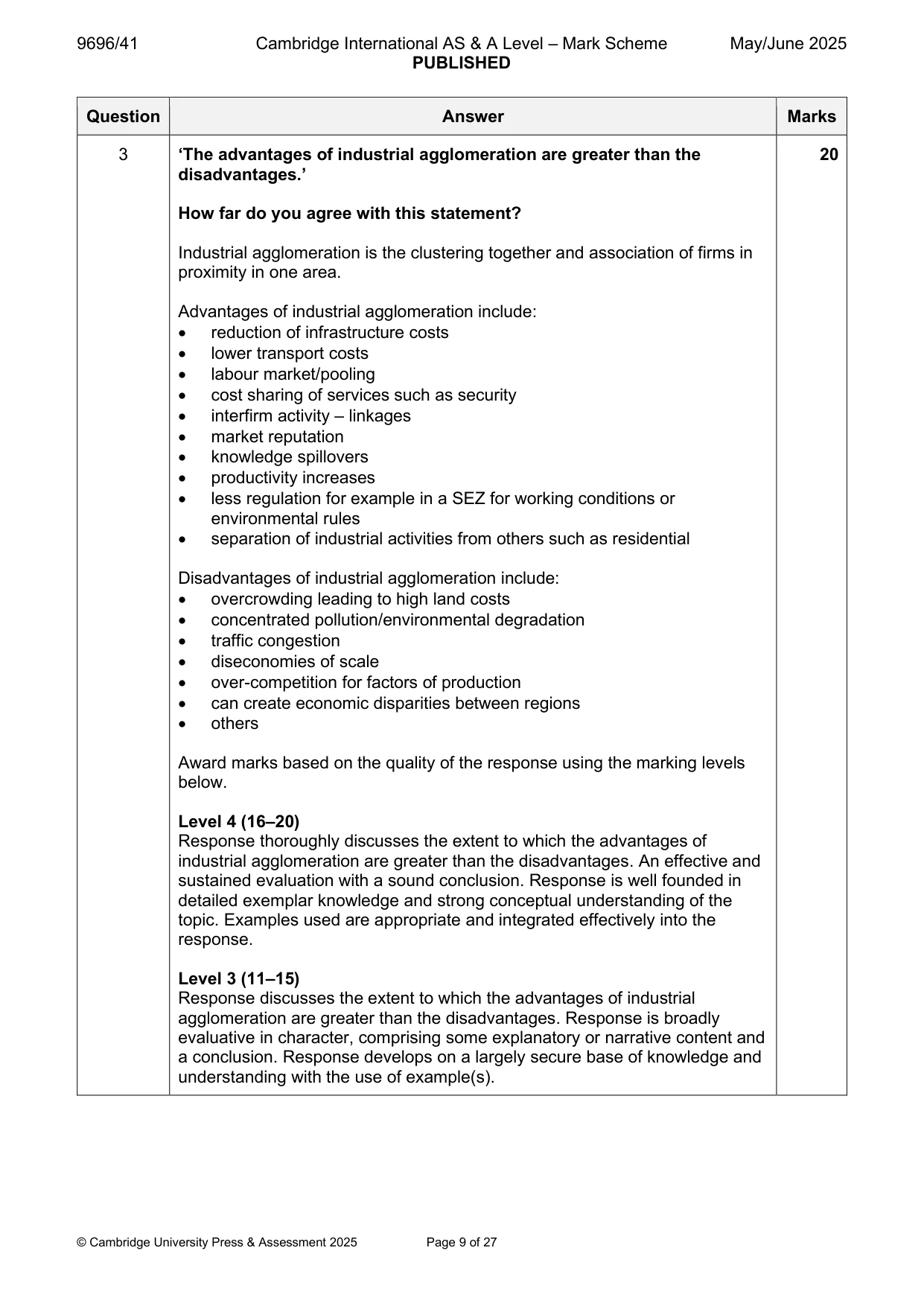
3 ‘The advantages of industrial agglomeration are greater than the disadvantages.’ How far do you agree with this statement? [20] Environmental management If answering this option, answer Question 4 and either Question 5 or Question 6.
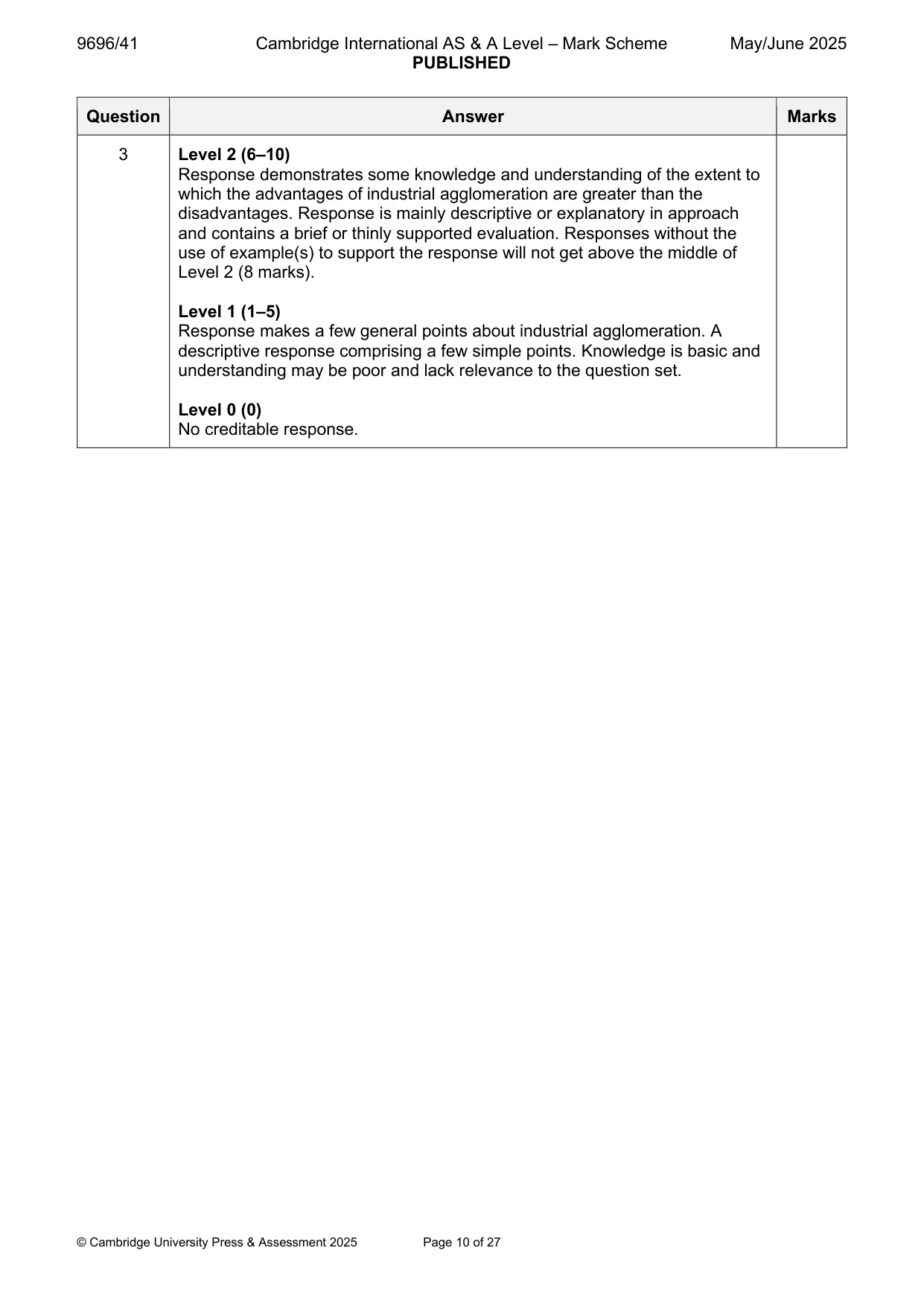
Mark scheme: 3 ‘The advantages of industrial agglomeration are greater than the 20 disadvantages.’ How far do you agree with this statement? Industrial agglomeration is the clustering together and association of firms in proximity in one area. Advantages of industrial agglomeration include: • reduction of infrastructure costs • lower transport costs • labour market/pooling • cost sharing of services such as security • interfirm activity – linkages • market reputation • knowledge spillovers • productivity increases • less regulation for example in a SEZ for working conditions or environmental rules • separation of industrial activities from others such as residential Disadvantages of industrial agglomeration include: • overcrowding leading to high land costs • concentrated pollution/environmental degradation • traffic congestion • diseconomies of scale • over-competition for factors of production • can create economic disparities between regions • others Award marks based on the quality of the response using the marking levels below. Level 4 (16–20) Response thoroughly discusses the extent to which the advantages of industrial agglomeration are greater than the disadvantages. An effective and sustained evaluation with a sound conclusion. Response is well founded in detailed exemplar knowledge and strong conceptual understanding of the topic. Examples used are appropriate and integrated effectively into the response. Level 3 (11–15) Response discusses the extent to which the advantages of industrial agglomeration are greater than the disadvantages. Response is broadly evaluative in character, comprising some explanatory or narrative content and a conclusion. Response develops on a largely secure base of knowledge and understanding with the use of example(s). 3 Level 2 (6–10) Response demonstrates some knowledge and understanding of the extent to which the advantages of industrial agglomeration are greater than the disadvantages. Response is mainly descriptive or explanatory in approach and contains a brief or thinly supported evaluation. Responses without the use of example(s) to support the response will not get above the middle of Level 2 (8 marks). Level 1 (1–5) Response makes a few general points about industrial agglomeration. A descriptive response comprising a few simple points. Knowledge is basic and understanding may be poor and lack relevance to the question set. Level 0 (0) No creditable response. Environmental management If answering this option, answer Question 4 and either Question 5 or Question 6.
Q4 · Electricity generated from solar power, by country, in 2022
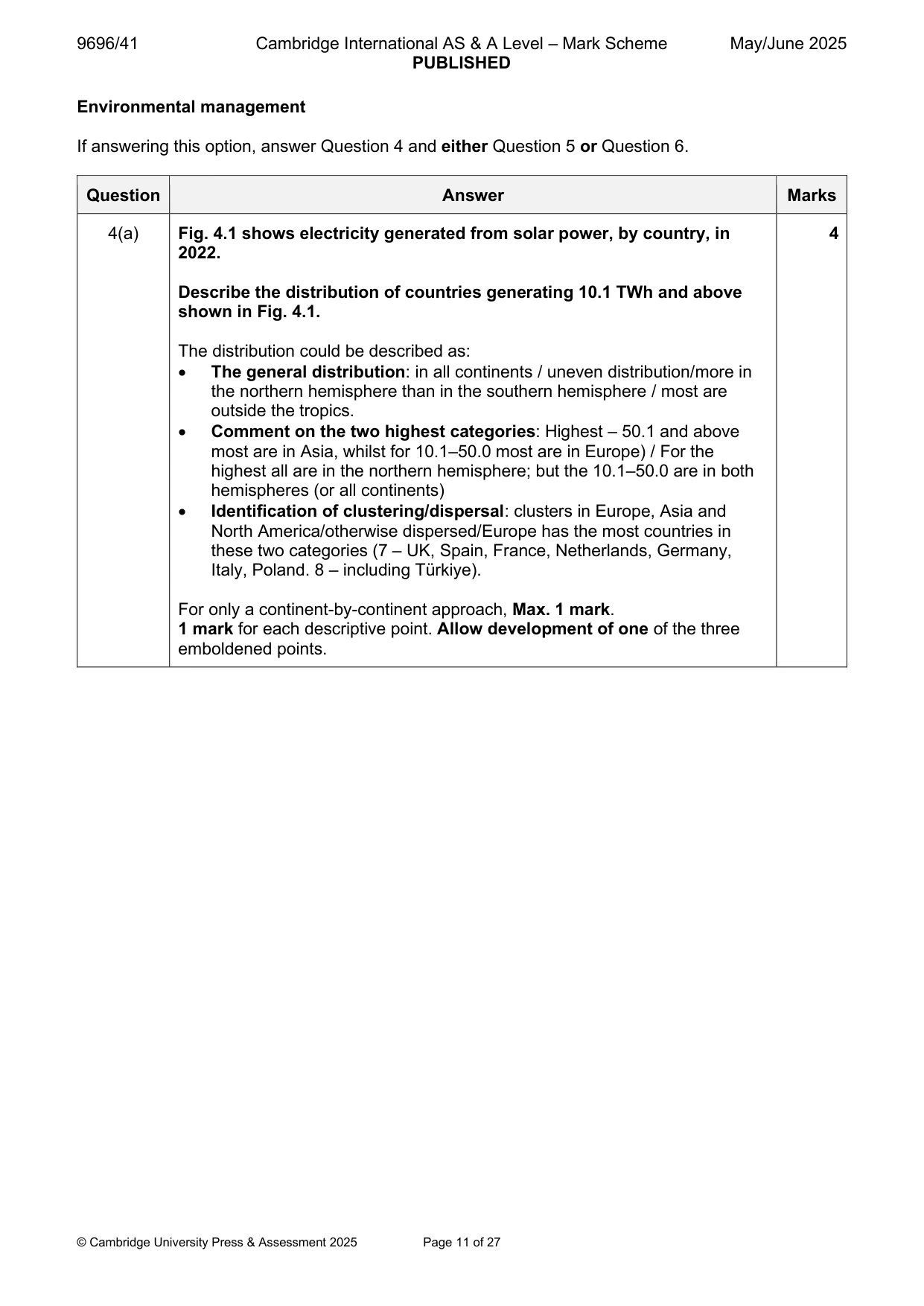
4 Fig. 4.1 shows electricity generated from solar power, by country, in 2022. (a) Describe the distribution of countries generating 10.1 TWh and above shown in Fig. 4.1. [4] (b) Explain two reasons for high rates of electrical energy production from renewable sources in some countries. [6]
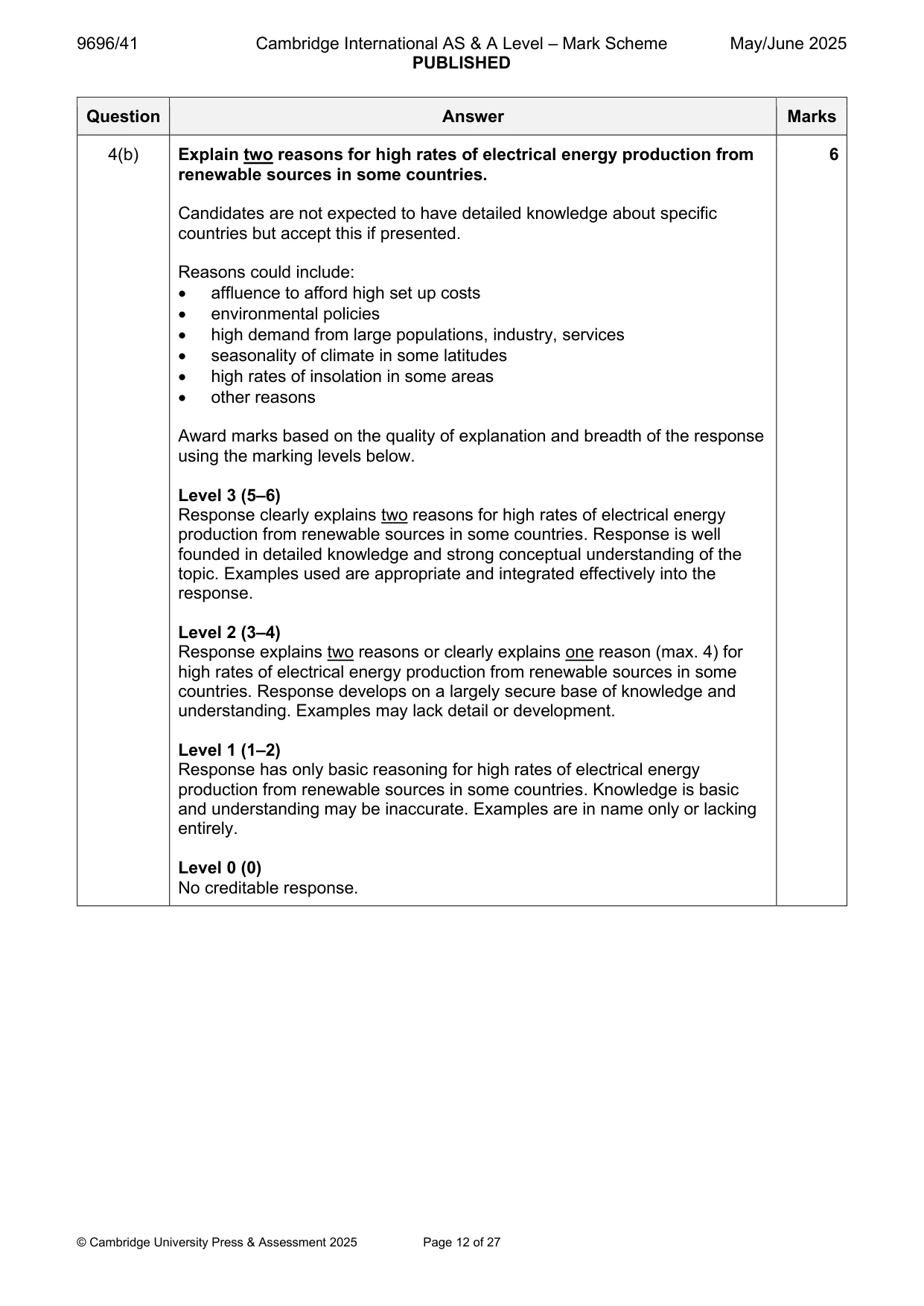
Mark scheme: 4(a) Fig. 4.1 shows electricity generated from solar power, by country, in 4 2022. Describe the distribution of countries generating 10.1 TWh and above shown in Fig. 4.1. The distribution could be described as: • The general distribution: in all continents / uneven distribution/more in the northern hemisphere than in the southern hemisphere / most are outside the tropics. • Comment on the two highest categories: Highest – 50.1 and above most are in Asia, whilst for 10.1–50.0 most are in Europe) / For the highest all are in the northern hemisphere; but the 10.1–50.0 are in both hemispheres (or all continents) • Identification of clustering/dispersal: clusters in Europe, Asia and North America/otherwise dispersed/Europe has the most countries in these two categories (7 – UK, Spain, France, Netherlands, Germany, Italy, Poland. 8 – including Türkiye). For only a continent-by-continent approach, Max. 1 mark. 1 mark for each descriptive point. Allow development of one of the three emboldened points. 4(b) Explain two reasons for high rates of electrical energy production from 6 renewable sources in some countries. Candidates are not expected to have detailed knowledge about specific countries but accept this if presented. Reasons could include: • affluence to afford high set up costs • environmental policies • high demand from large populations, industry, services • seasonality of climate in some latitudes • high rates of insolation in some areas • other reasons Award marks based on the quality of explanation and breadth of the response using the marking levels below. Level 3 (5–6) Response clearly explains two reasons for high rates of electrical energy production from renewable sources in some countries. Response is well founded in detailed knowledge and strong conceptual understanding of the topic. Examples used are appropriate and integrated effectively into the response. Level 2 (3–4) Response explains two reasons or clearly explains one reason (max. 4) for high rates of electrical energy production from renewable sources in some countries. Response develops on a largely secure base of knowledge and understanding. Examples may lack detail or development. Level 1 (1–2) Response has only basic reasoning for high rates of electrical energy production from renewable sources in some countries. Knowledge is basic and understanding may be inaccurate. Examples are in name only or lacking entirely. Level 0 (0) No creditable response.
Q5 · Evaluate why fossil fuels continue to be important in the production of electrical energy…
5 Evaluate why fossil fuels continue to be important in the production of electrical energy for some countries. [20]
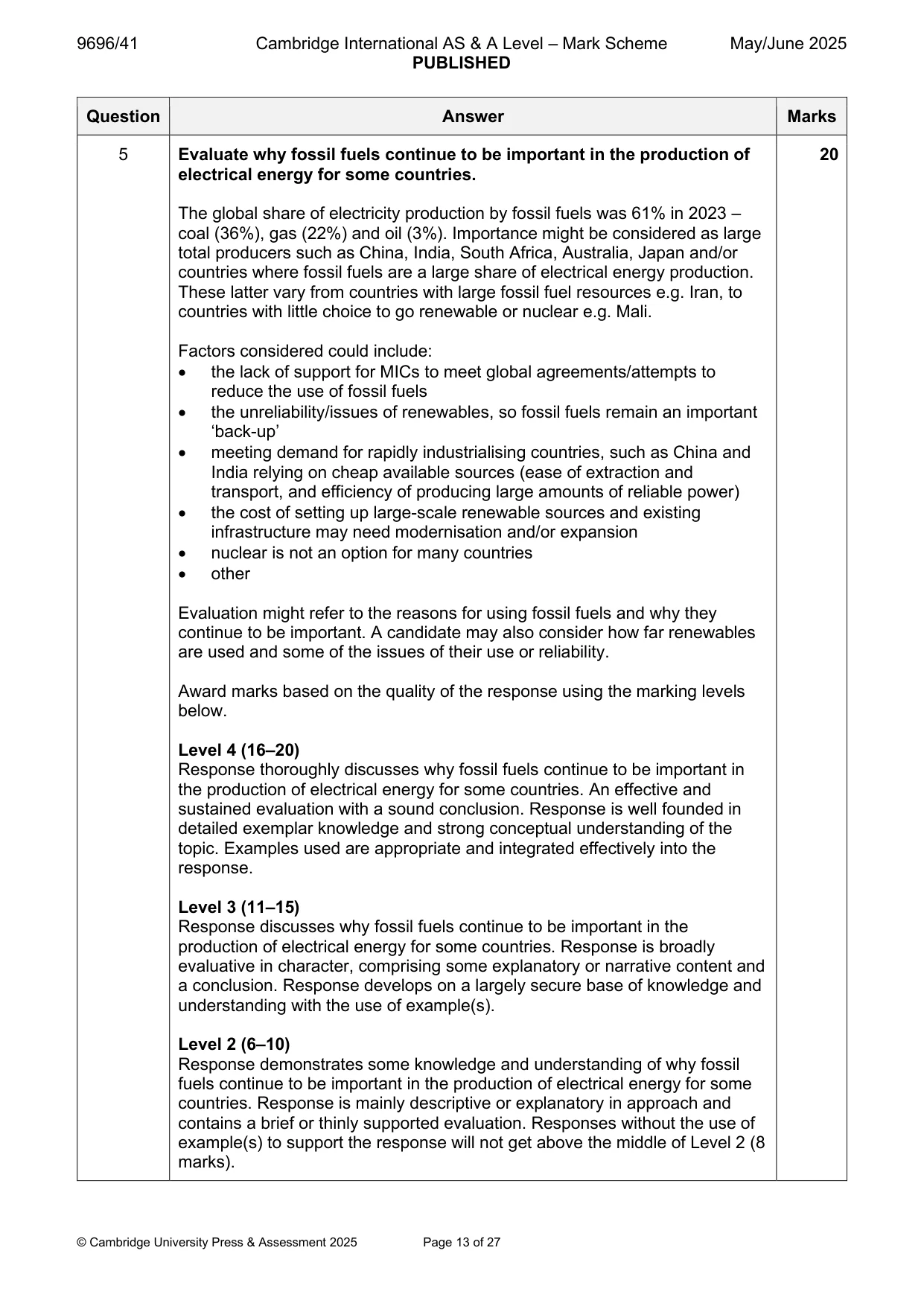
Mark scheme: 5 Evaluate why fossil fuels continue to be important in the production of 20 electrical energy for some countries. The global share of electricity production by fossil fuels was 61% in 2023 – coal (36%), gas (22%) and oil (3%). Importance might be considered as large total producers such as China, India, South Africa, Australia, Japan and/or countries where fossil fuels are a large share of electrical energy production. These latter vary from countries with large fossil fuel resources e.g. Iran, to countries with little choice to go renewable or nuclear e.g. Mali. Factors considered could include: • the lack of support for MICs to meet global agreements/attempts to reduce the use of fossil fuels • the unreliability/issues of renewables, so fossil fuels remain an important ‘back-up’ • meeting demand for rapidly industrialising countries, such as China and India relying on cheap available sources (ease of extraction and transport, and efficiency of producing large amounts of reliable power) • the cost of setting up large-scale renewable sources and existing infrastructure may need modernisation and/or expansion • nuclear is not an option for many countries • other Evaluation might refer to the reasons for using fossil fuels and why they continue to be important. A candidate may also consider how far renewables are used and some of the issues of their use or reliability. Award marks based on the quality of the response using the marking levels below. Level 4 (16–20) Response thoroughly discusses why fossil fuels continue to be important in the production of electrical energy for some countries. An effective and sustained evaluation with a sound conclusion. Response is well founded in detailed exemplar knowledge and strong conceptual understanding of the topic. Examples used are appropriate and integrated effectively into the response. Level 3 (11–15) Response discusses why fossil fuels continue to be important in the production of electrical energy for some countries. Response is broadly evaluative in character, comprising some explanatory or narrative content and a conclusion. Response develops on a largely secure base of knowledge and understanding with the use of example(s). Level 2 (6–10) Response demonstrates some knowledge and understanding of why fossil fuels continue to be important in the production of electrical energy for some countries. Response is mainly descriptive or explanatory in approach and contains a brief or thinly supported evaluation. Responses without the use of example(s) to support the response will not get above the middle of Level 2 (8 marks). 5 Level 1 (1–5) Response makes a few general points about fossil fuels and the production of electrical energy. A descriptive response comprising a few simple points. Knowledge is basic and understanding may be poor and lack relevance to the question set. Level 0 (0) No creditable response.
Q6 · Assess the extent to which it is possible to provide safe and affordable drinking water…
6 Assess the extent to which it is possible to provide safe and affordable drinking water for all people. [20] Global interdependence If answering this option, answer Question 7 and either Question 8 or Question 9.
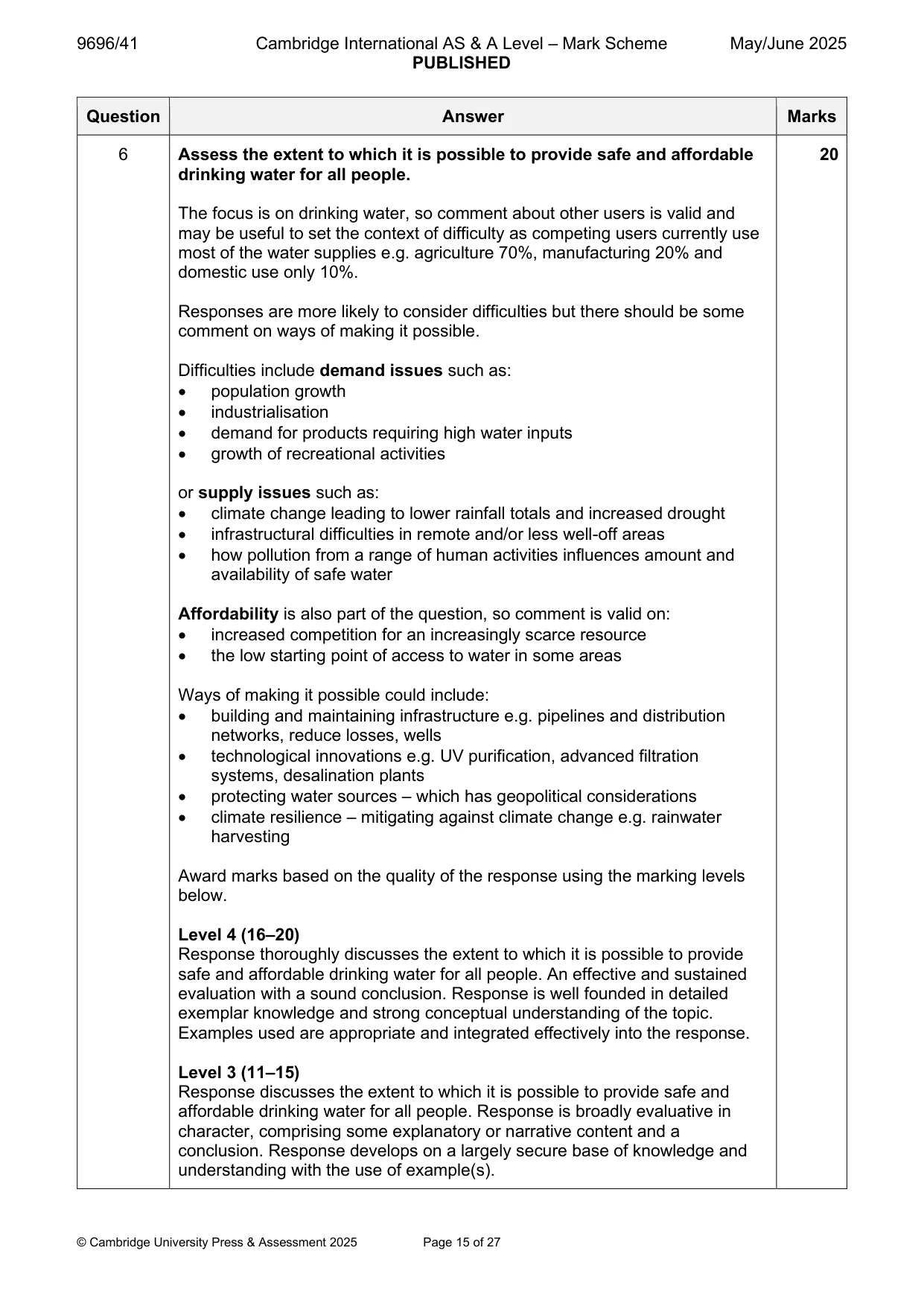
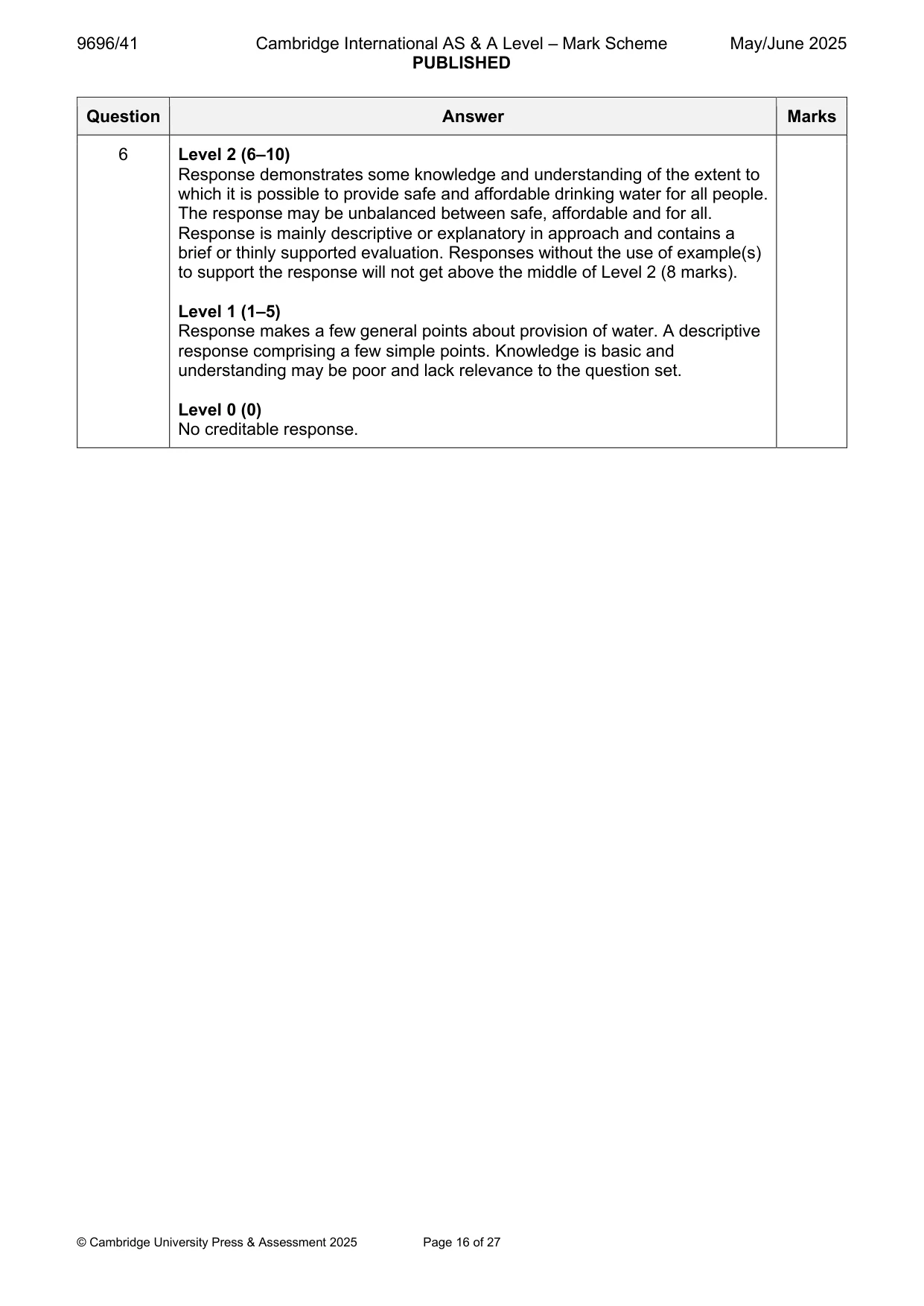
Mark scheme: 6 Assess the extent to which it is possible to provide safe and affordable 20 drinking water for all people. The focus is on drinking water, so comment about other users is valid and may be useful to set the context of difficulty as competing users currently use most of the water supplies e.g. agriculture 70%, manufacturing 20% and domestic use only 10%. Responses are more likely to consider difficulties but there should be some comment on ways of making it possible. Difficulties include demand issues such as: • population growth • industrialisation • demand for products requiring high water inputs • growth of recreational activities or supply issues such as: • climate change leading to lower rainfall totals and increased drought • infrastructural difficulties in remote and/or less well-off areas • how pollution from a range of human activities influences amount and availability of safe water Affordability is also part of the question, so comment is valid on: • increased competition for an increasingly scarce resource • the low starting point of access to water in some areas Ways of making it possible could include: • building and maintaining infrastructure e.g. pipelines and distribution networks, reduce losses, wells • technological innovations e.g. UV purification, advanced filtration systems, desalination plants • protecting water sources – which has geopolitical considerations • climate resilience – mitigating against climate change e.g. rainwater harvesting Award marks based on the quality of the response using the marking levels below. Level 4 (16–20) Response thoroughly discusses the extent to which it is possible to provide safe and affordable drinking water for all people. An effective and sustained evaluation with a sound conclusion. Response is well founded in detailed exemplar knowledge and strong conceptual understanding of the topic. Examples used are appropriate and integrated effectively into the response. Level 3 (11–15) Response discusses the extent to which it is possible to provide safe and affordable drinking water for all people. Response is broadly evaluative in character, comprising some explanatory or narrative content and a conclusion. Response develops on a largely secure base of knowledge and understanding with the use of example(s). 6 Level 2 (6–10) Response demonstrates some knowledge and understanding of the extent to which it is possible to provide safe and affordable drinking water for all people. The response may be unbalanced between safe, affordable and for all. Response is mainly descriptive or explanatory in approach and contains a brief or thinly supported evaluation. Responses without the use of example(s) to support the response will not get above the middle of Level 2 (8 marks). Level 1 (1–5) Response makes a few general points about provision of water. A descriptive response comprising a few simple points. Knowledge is basic and understanding may be poor and lack relevance to the question set. Level 0 (0) No creditable response. Global interdependence If answering this option, answer Question 7 and either Question 8 or Question 9.
Q7 · The percentage share of world trade for LICs/MICs and HICs, 2000–18
7 Fig. 7.1 shows the percentage share of world trade for LICs/MICs and HICs, 2000–18. (a) Compare the trends in the share of world trade shown in Fig. 7.1. [3] (b) Explain how trade agreements affect patterns of trade. [7]
Mark scheme: 7(a) Fig. 7.1 shows the percentage share of world trade for LICs/MICs and 3 HICs, 2000–18. Compare the trends in the share of world trade shown in Fig. 7.1. Reserve 1 mark for: a mirror of each other / indirect/negative relationship. Award further marks for: • overall, a rising trend for LICs/MICs and a falling trend for HICs or the gap overall narrows (1) • recognition that the trends are not constant e.g. from 2010 to 2018 both change at a lower rate/plateau (relatively stable with some fluctuations of 1–2%)/ description of the changes from 2017 to 2018 for both (1) Max. 1 mark for two separate accounts or comment on only one of HIC or LIC/MIC. 7(b) Explain how trade agreements affect patterns of trade. 7 Trade agreements take a variety of forms: bilateral, multi-lateral e.g. trade blocs and those agreed by the World Trade Organization as foundations for trade relationships between countries. Bilateral agreements increase the flow of trade between the two countries, usually for specific goods or services; trade blocs increase trade within the region but make access for non-member countries difficult. In trade agreements tariffs, quotas and minimum standards may be set which also influence how and what trade takes place. Patterns of trade include content, volume, value and direction. Trade in services is valid. Fair trade is a form of trade agreement between companies and producers but candidates using this should focus on patterns of trade. Award marks based on the quality of explanation and breadth of the response using the marking levels below. Level 3 (6–7) Response clearly explains how trade agreements affect patterns of trade. Response is well founded in detailed knowledge and strong conceptual understanding of the topic. Examples used are appropriate and integrated effectively into the response. Level 2 (3–5) Response explains how trade agreements affect patterns of trade. Response develops on a largely secure base of knowledge and understanding. Examples may lack detail or development. Level 1 (1–2) Response has only basic reasoning about trade agreements and patterns of trade. Knowledge is basic and understanding may be inaccurate. Examples are in name only or lacking entirely. Level 0 (0) No creditable response.
Q8 · ‘International debt has advantages as well as disadvantages for countries.’ With…
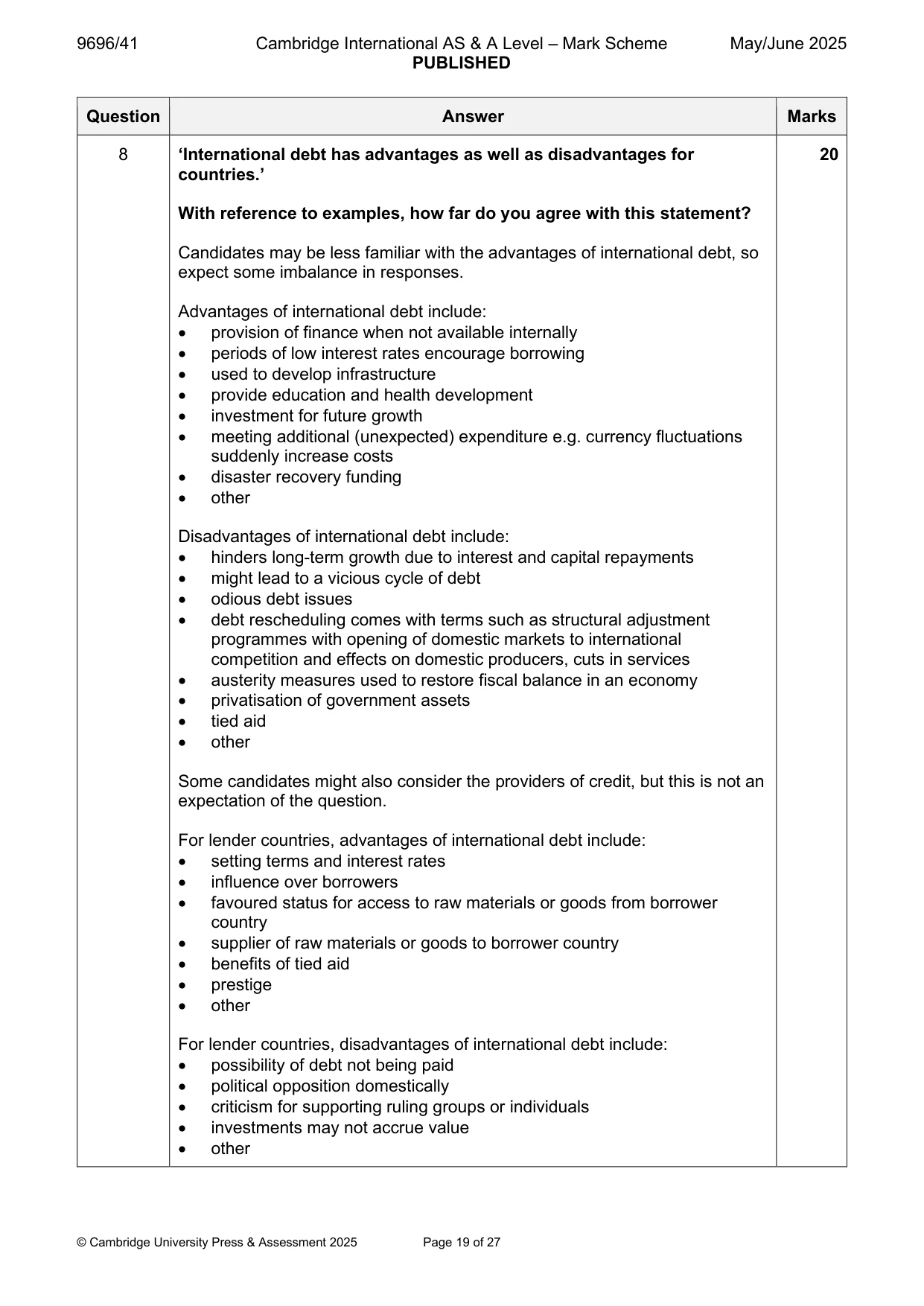
8 ‘International debt has advantages as well as disadvantages for countries.’ With reference to examples, how far do you agree with this statement? [20]
Mark scheme: 8 ‘International debt has advantages as well as disadvantages for 20 countries.’ With reference to examples, how far do you agree with this statement? Candidates may be less familiar with the advantages of international debt, so expect some imbalance in responses. Advantages of international debt include: • provision of finance when not available internally • periods of low interest rates encourage borrowing • used to develop infrastructure • provide education and health development • investment for future growth • meeting additional (unexpected) expenditure e.g. currency fluctuations suddenly increase costs • disaster recovery funding • other Disadvantages of international debt include: • hinders long-term growth due to interest and capital repayments • might lead to a vicious cycle of debt • odious debt issues • debt rescheduling comes with terms such as structural adjustment programmes with opening of domestic markets to international competition and effects on domestic producers, cuts in services • austerity measures used to restore fiscal balance in an economy • privatisation of government assets • tied aid • other Some candidates might also consider the providers of credit, but this is not an expectation of the question. For lender countries, advantages of international debt include: • setting terms and interest rates • influence over borrowers • favoured status for access to raw materials or goods from borrower country • supplier of raw materials or goods to borrower country • benefits of tied aid • prestige • other For lender countries, disadvantages of international debt include: • possibility of debt not being paid • political opposition domestically • criticism for supporting ruling groups or individuals • investments may not accrue value • other 8 Award marks based on the quality of the response using the marking levels below. Level 4 (16–20) Response thoroughly discusses the extent to which international debt has advantages as well as disadvantages for countries. An effective and sustained evaluation with a sound conclusion. Response is well founded in detailed exemplar knowledge and strong conceptual understanding of the topic. Examples used are appropriate and integrated effectively into the response. Level 3 (11–15) Response discusses the extent to which international debt has advantages as well as disadvantages for countries. Response is broadly evaluative in character, comprising some explanatory or narrative content and a conclusion. Response develops on a largely secure base of knowledge and understanding with the use of example(s). Level 2 (6–10) Response demonstrates some knowledge and understanding of the extent to which international debt has advantages as well as disadvantages for countries. Response is mainly descriptive or explanatory in approach and contains a brief or thinly supported evaluation. Responses without the use of example(s) to support the response will not get above the middle of Level 2 (8 marks). Level 1 (1–5) Response makes a few general points about international debt. A descriptive response comprising a few simple points. Knowledge is basic and understanding may be poor and lack relevance to the question set. Level 0 (0) No creditable response.
Q9 · Assess the extent to which the sustainability of tourism is influenced by global events
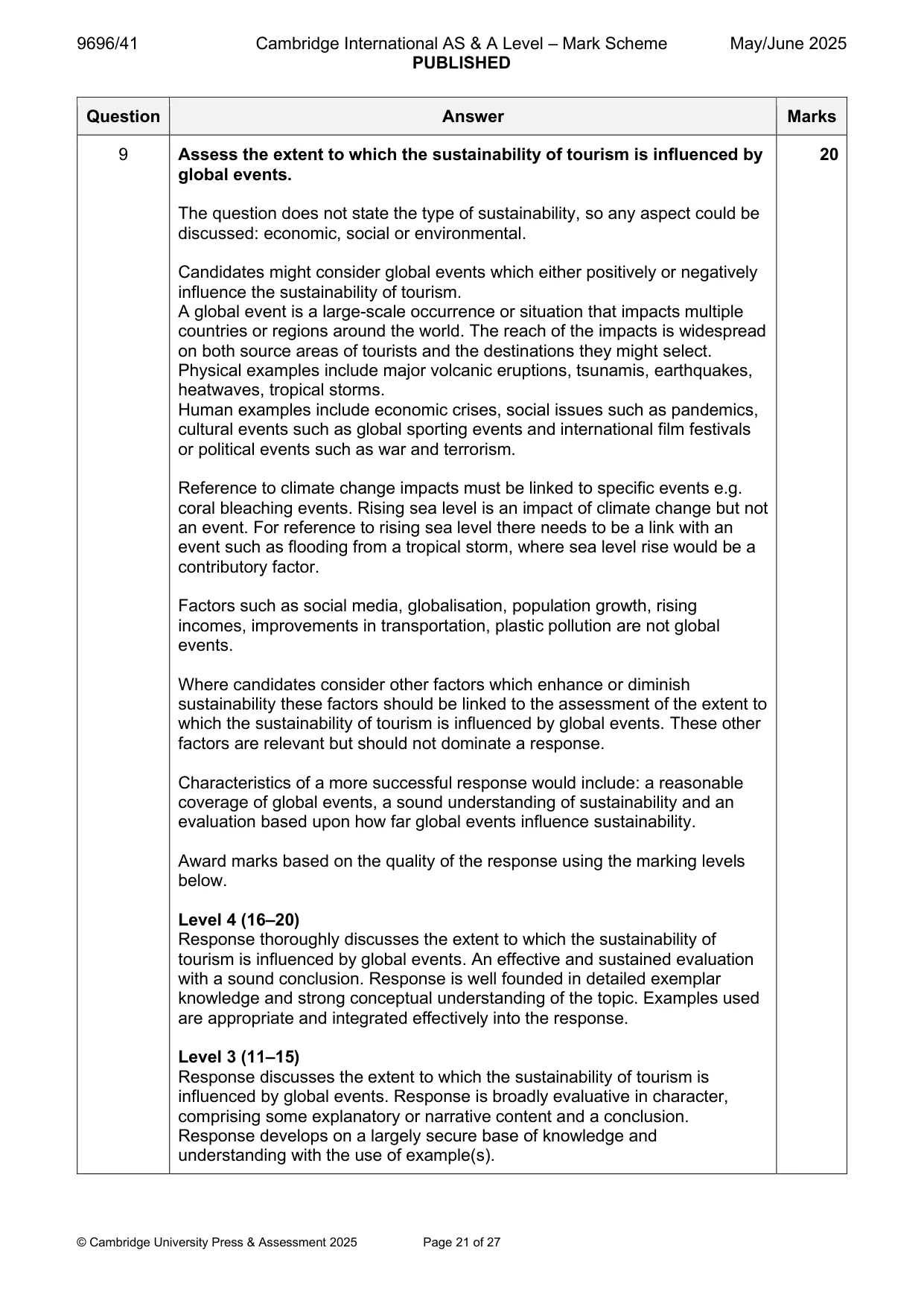
9 Assess the extent to which the sustainability of tourism is influenced by global events. [20] Economic transition If answering this option, answer Question 10 and either Question 11 or Question 12.
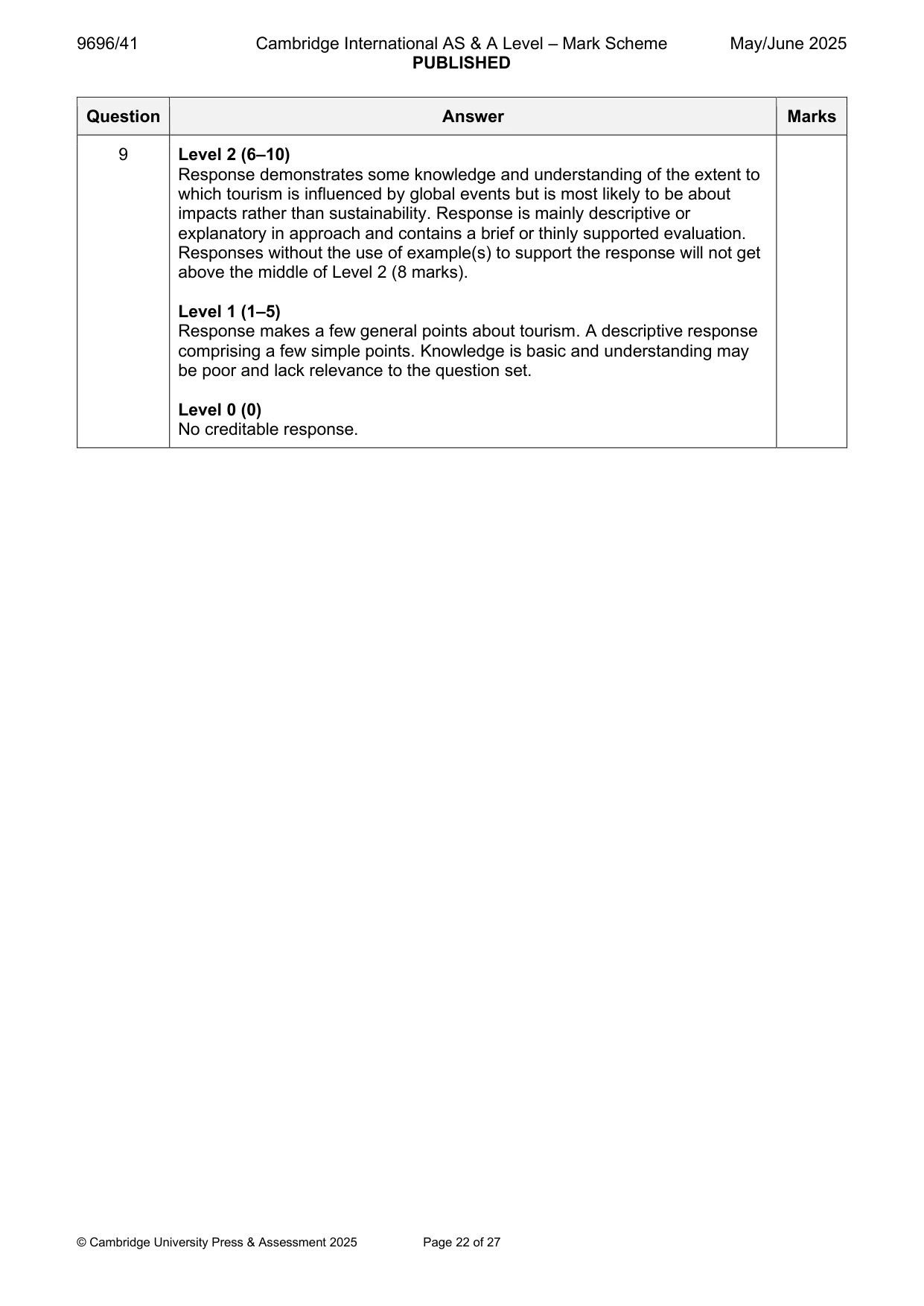
Mark scheme: 9 Assess the extent to which the sustainability of tourism is influenced by 20 global events. The question does not state the type of sustainability, so any aspect could be discussed: economic, social or environmental. Candidates might consider global events which either positively or negatively influence the sustainability of tourism. A global event is a large-scale occurrence or situation that impacts multiple countries or regions around the world. The reach of the impacts is widespread on both source areas of tourists and the destinations they might select. Physical examples include major volcanic eruptions, tsunamis, earthquakes, heatwaves, tropical storms. Human examples include economic crises, social issues such as pandemics, cultural events such as global sporting events and international film festivals or political events such as war and terrorism. Reference to climate change impacts must be linked to specific events e.g. coral bleaching events. Rising sea level is an impact of climate change but not an event. For reference to rising sea level there needs to be a link with an event such as flooding from a tropical storm, where sea level rise would be a contributory factor. Factors such as social media, globalisation, population growth, rising incomes, improvements in transportation, plastic pollution are not global events. Where candidates consider other factors which enhance or diminish sustainability these factors should be linked to the assessment of the extent to which the sustainability of tourism is influenced by global events. These other factors are relevant but should not dominate a response. Characteristics of a more successful response would include: a reasonable coverage of global events, a sound understanding of sustainability and an evaluation based upon how far global events influence sustainability. Award marks based on the quality of the response using the marking levels below. Level 4 (16–20) Response thoroughly discusses the extent to which the sustainability of tourism is influenced by global events. An effective and sustained evaluation with a sound conclusion. Response is well founded in detailed exemplar knowledge and strong conceptual understanding of the topic. Examples used are appropriate and integrated effectively into the response. Level 3 (11–15) Response discusses the extent to which the sustainability of tourism is influenced by global events. Response is broadly evaluative in character, comprising some explanatory or narrative content and a conclusion. Response develops on a largely secure base of knowledge and understanding with the use of example(s). 9 Level 2 (6–10) Response demonstrates some knowledge and understanding of the extent to which tourism is influenced by global events but is most likely to be about impacts rather than sustainability. Response is mainly descriptive or explanatory in approach and contains a brief or thinly supported evaluation. Responses without the use of example(s) to support the response will not get above the middle of Level 2 (8 marks). Level 1 (1–5) Response makes a few general points about tourism. A descriptive response comprising a few simple points. Knowledge is basic and understanding may be poor and lack relevance to the question set. Level 0 (0) No creditable response. Economic transition If answering this option, answer Question 10 and either Question 11 or Question 12.
Q10 · World Bank country classifications, by income level, for 2022
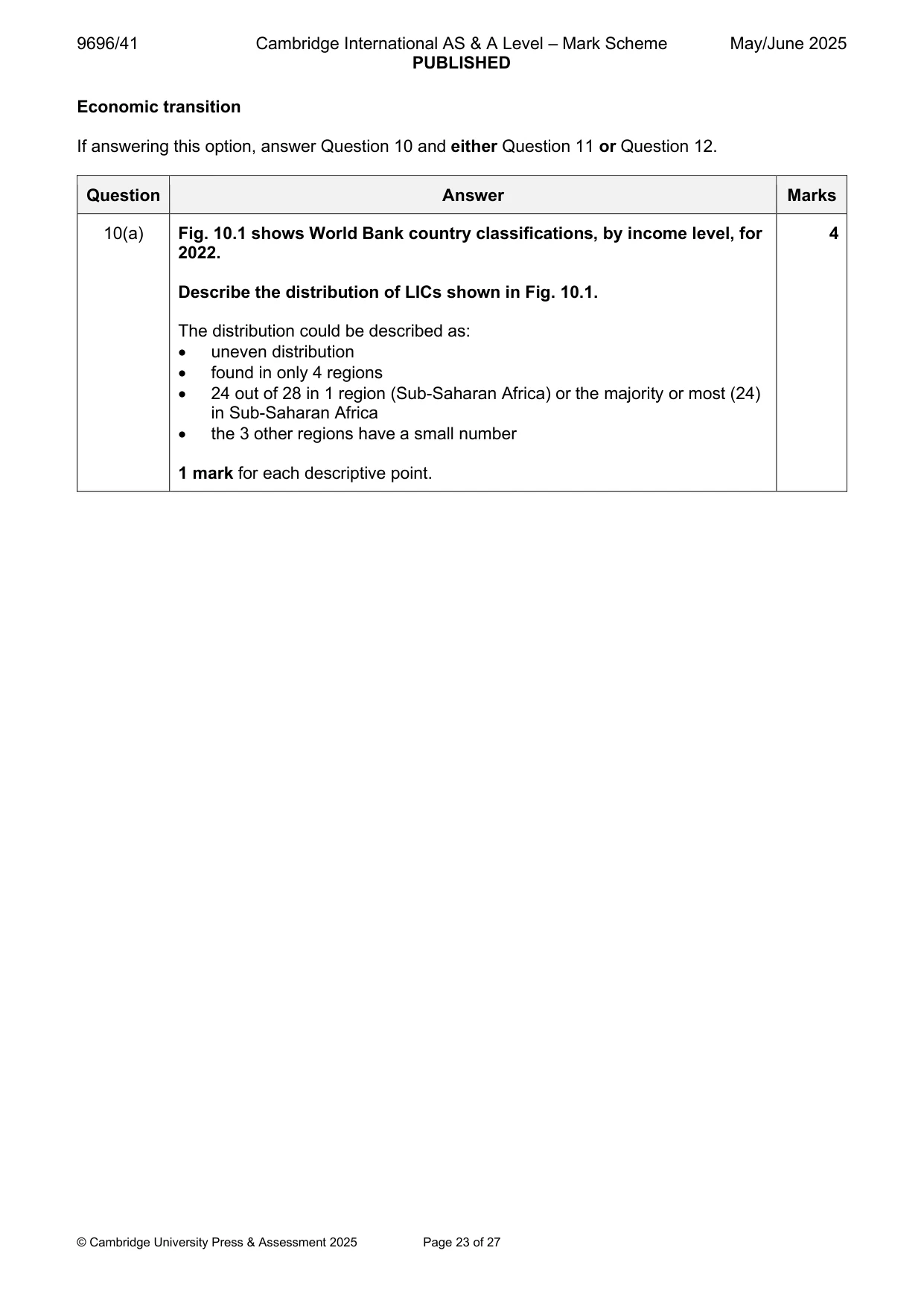
10 Fig. 10.1 shows World Bank country classifications, by income level, for 2022. (a) Describe the distribution of LICs shown in Fig. 10.1. [4] (b) Explain two disadvantages of using economic measures and indices of inequality. [6]
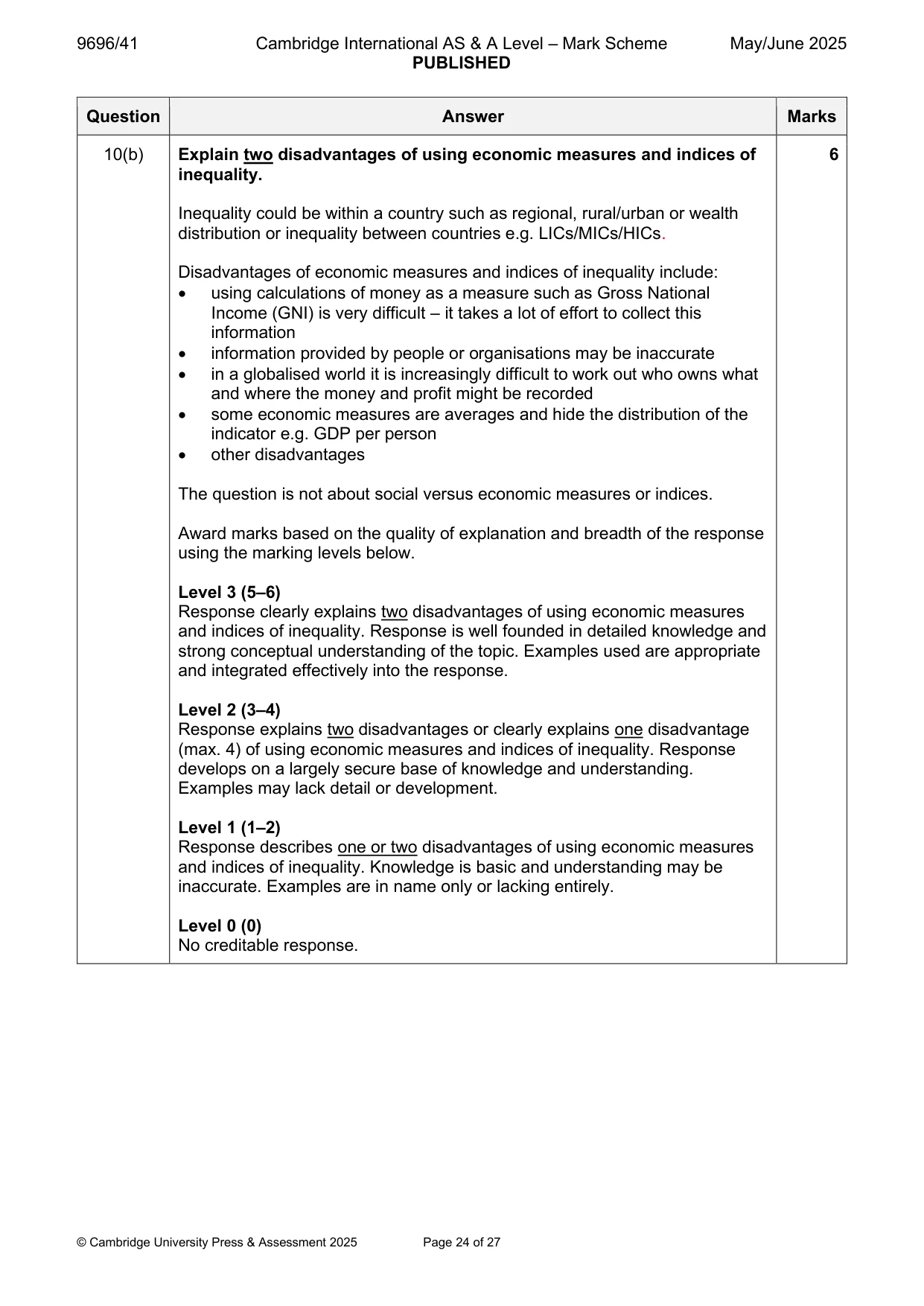
Mark scheme: 10(a) Fig. 10.1 shows World Bank country classifications, by income level, for 4 2022. Describe the distribution of LICs shown in Fig. 10.1. The distribution could be described as: • uneven distribution • found in only 4 regions • 24 out of 28 in 1 region (Sub-Saharan Africa) or the majority or most (24) in Sub-Saharan Africa • the 3 other regions have a small number 1 mark for each descriptive point. 10(b) Explain two disadvantages of using economic measures and indices of 6 inequality. Inequality could be within a country such as regional, rural/urban or wealth distribution or inequality between countries e.g. LICs/MICs/HICs. Disadvantages of economic measures and indices of inequality include: • using calculations of money as a measure such as Gross National Income (GNI) is very difficult – it takes a lot of effort to collect this information • information provided by people or organisations may be inaccurate • in a globalised world it is increasingly difficult to work out who owns what and where the money and profit might be recorded • some economic measures are averages and hide the distribution of the indicator e.g. GDP per person • other disadvantages The question is not about social versus economic measures or indices. Award marks based on the quality of explanation and breadth of the response using the marking levels below. Level 3 (5–6) Response clearly explains two disadvantages of using economic measures and indices of inequality. Response is well founded in detailed knowledge and strong conceptual understanding of the topic. Examples used are appropriate and integrated effectively into the response. Level 2 (3–4) Response explains two disadvantages or clearly explains one disadvantage (max. 4) of using economic measures and indices of inequality. Response develops on a largely secure base of knowledge and understanding. Examples may lack detail or development. Level 1 (1–2) Response describes one or two disadvantages of using economic measures and indices of inequality. Knowledge is basic and understanding may be inaccurate. Examples are in name only or lacking entirely. Level 0 (0) No creditable response.
Q11 · With reference to one or more examples, evaluate the relative importance of factors…
11 With reference to one or more examples, evaluate the relative importance of factors affecting the spatial organisation of transnational corporations (TNCs). [20]
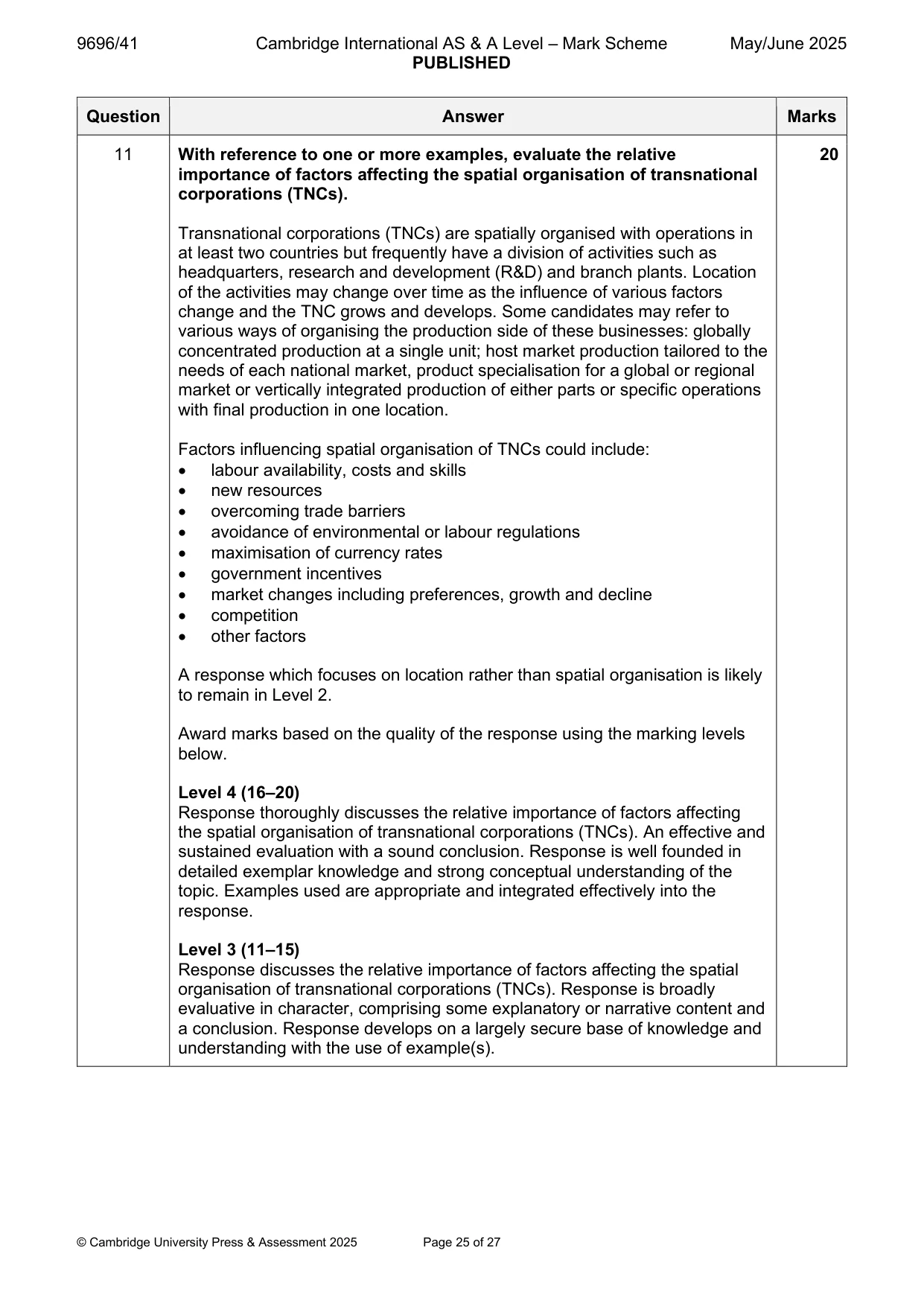
Mark scheme: 11 With reference to one or more examples, evaluate the relative 20 importance of factors affecting the spatial organisation of transnational corporations (TNCs). Transnational corporations (TNCs) are spatially organised with operations in at least two countries but frequently have a division of activities such as headquarters, research and development (R&D) and branch plants. Location of the activities may change over time as the influence of various factors change and the TNC grows and develops. Some candidates may refer to various ways of organising the production side of these businesses: globally concentrated production at a single unit; host market production tailored to the needs of each national market, product specialisation for a global or regional market or vertically integrated production of either parts or specific operations with final production in one location. Factors influencing spatial organisation of TNCs could include: • labour availability, costs and skills • new resources • overcoming trade barriers • avoidance of environmental or labour regulations • maximisation of currency rates • government incentives • market changes including preferences, growth and decline • competition • other factors A response which focuses on location rather than spatial organisation is likely to remain in Level 2. Award marks based on the quality of the response using the marking levels below. Level 4 (16–20) Response thoroughly discusses the relative importance of factors affecting the spatial organisation of transnational corporations (TNCs). An effective and sustained evaluation with a sound conclusion. Response is well founded in detailed exemplar knowledge and strong conceptual understanding of the topic. Examples used are appropriate and integrated effectively into the response. Level 3 (11–15) Response discusses the relative importance of factors affecting the spatial organisation of transnational corporations (TNCs). Response is broadly evaluative in character, comprising some explanatory or narrative content and a conclusion. Response develops on a largely secure base of knowledge and understanding with the use of example(s). 11 Level 2 (6–10) Response demonstrates some knowledge and understanding of the relative importance of factors affecting the spatial organisation of transnational corporations (TNCs). Response is mainly descriptive or explanatory in approach and contains a brief or thinly supported evaluation. Responses without the use of example(s) to support the response will not get above the middle of Level 2 (8 marks). Level 1 (1–5) Response makes a few general points about transnational corporations (TNCs). A descriptive response comprising a few simple points. Knowledge is basic and understanding may be poor and lack relevance to the question set. Level 0 (0) No creditable response.
Q12 · With reference to one country, evaluate the relative importance of the difficulties of…
12 With reference to one country, evaluate the relative importance of the difficulties of overcoming regional disparities. [20]
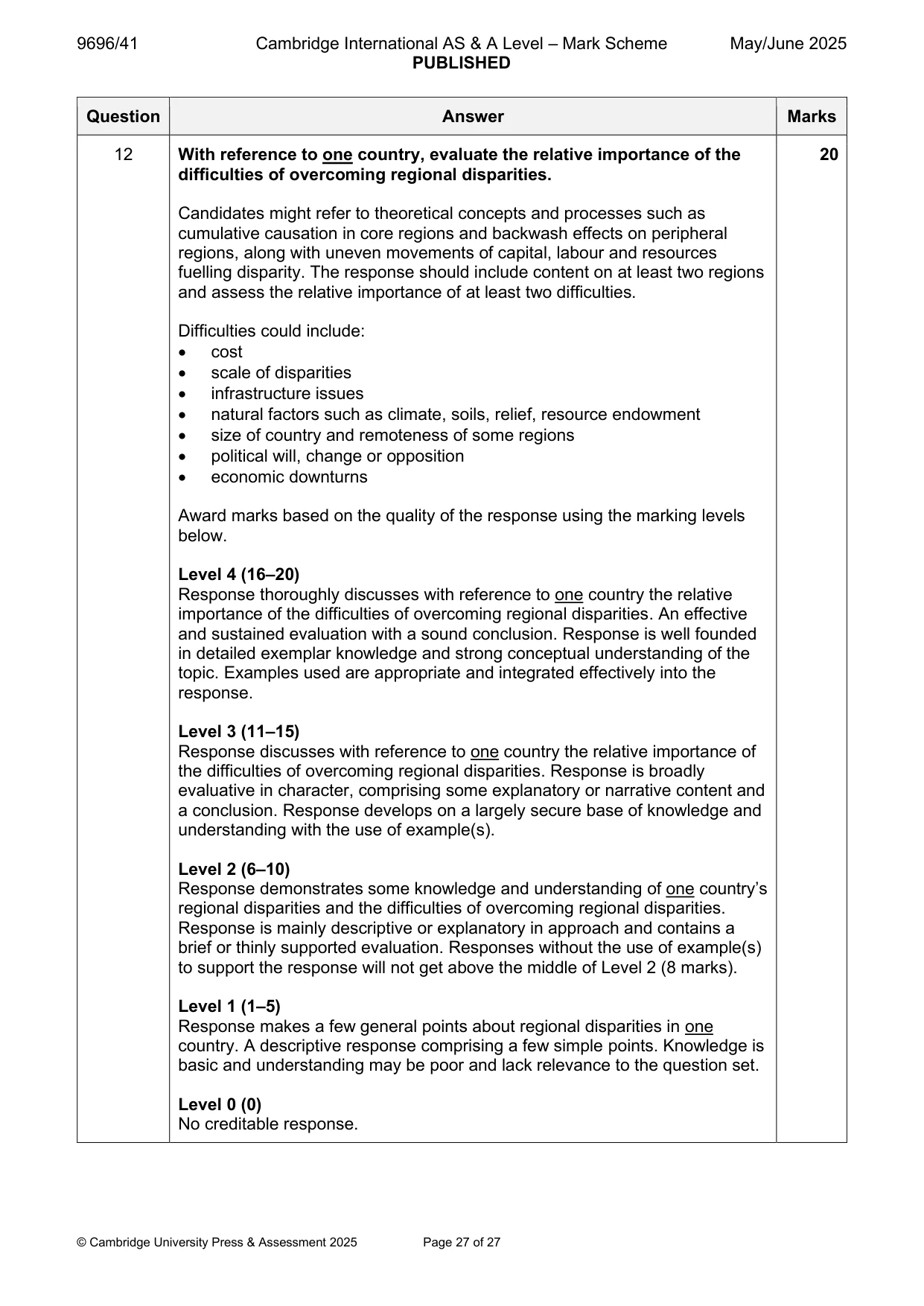
Mark scheme: 12 With reference to one country, evaluate the relative importance of the 20 difficulties of overcoming regional disparities. Candidates might refer to theoretical concepts and processes such as cumulative causation in core regions and backwash effects on peripheral regions, along with uneven movements of capital, labour and resources fuelling disparity. The response should include content on at least two regions and assess the relative importance of at least two difficulties. Difficulties could include: • cost • scale of disparities • infrastructure issues • natural factors such as climate, soils, relief, resource endowment • size of country and remoteness of some regions • political will, change or opposition • economic downturns Award marks based on the quality of the response using the marking levels below. Level 4 (16–20) Response thoroughly discusses with reference to one country the relative importance of the difficulties of overcoming regional disparities. An effective and sustained evaluation with a sound conclusion. Response is well founded in detailed exemplar knowledge and strong conceptual understanding of the topic. Examples used are appropriate and integrated effectively into the response. Level 3 (11–15) Response discusses with reference to one country the relative importance of the difficulties of overcoming regional disparities. Response is broadly evaluative in character, comprising some explanatory or narrative content and a conclusion. Response develops on a largely secure base of knowledge and understanding with the use of example(s). Level 2 (6–10) Response demonstrates some knowledge and understanding of one country’s regional disparities and the difficulties of overcoming regional disparities. Response is mainly descriptive or explanatory in approach and contains a brief or thinly supported evaluation. Responses without the use of example(s) to support the response will not get above the middle of Level 2 (8 marks). Level 1 (1–5) Response makes a few general points about regional disparities in one country. A descriptive response comprising a few simple points. Knowledge is basic and understanding may be poor and lack relevance to the question set. Level 0 (0) No creditable response.
What was in this paper
The subtopics covered by these 12 questions, and how many questions each got. Open one in a new tab to see every Cambridge question on it.
1International debt and international aid1Manufacturing and related service industry1National development1Population–resource relationships1Sustainable energy supplies1The globalisation of economic activity1The management of a tourist destination1The management of agricultural change1The management of energy supply1The management of regional development1Trade flows and trading patterns1What you needed in this session
Cambridge’s own grade thresholds for 2025 May/June, Paper 4 · Variant 1. A higher threshold means an easier paper — the bar moves with how the cohort did.