Cambridge A Level Geography 9696 — 2021 May/June Paper 4 · Variant 1
9696/41/M/J/21 · 12 questions · 60 marks · ≈68 min
The question paper and its mark scheme, free to read here and free to download. This is Cambridge’s own paper, exactly as it was sat.
Question paper4 pages

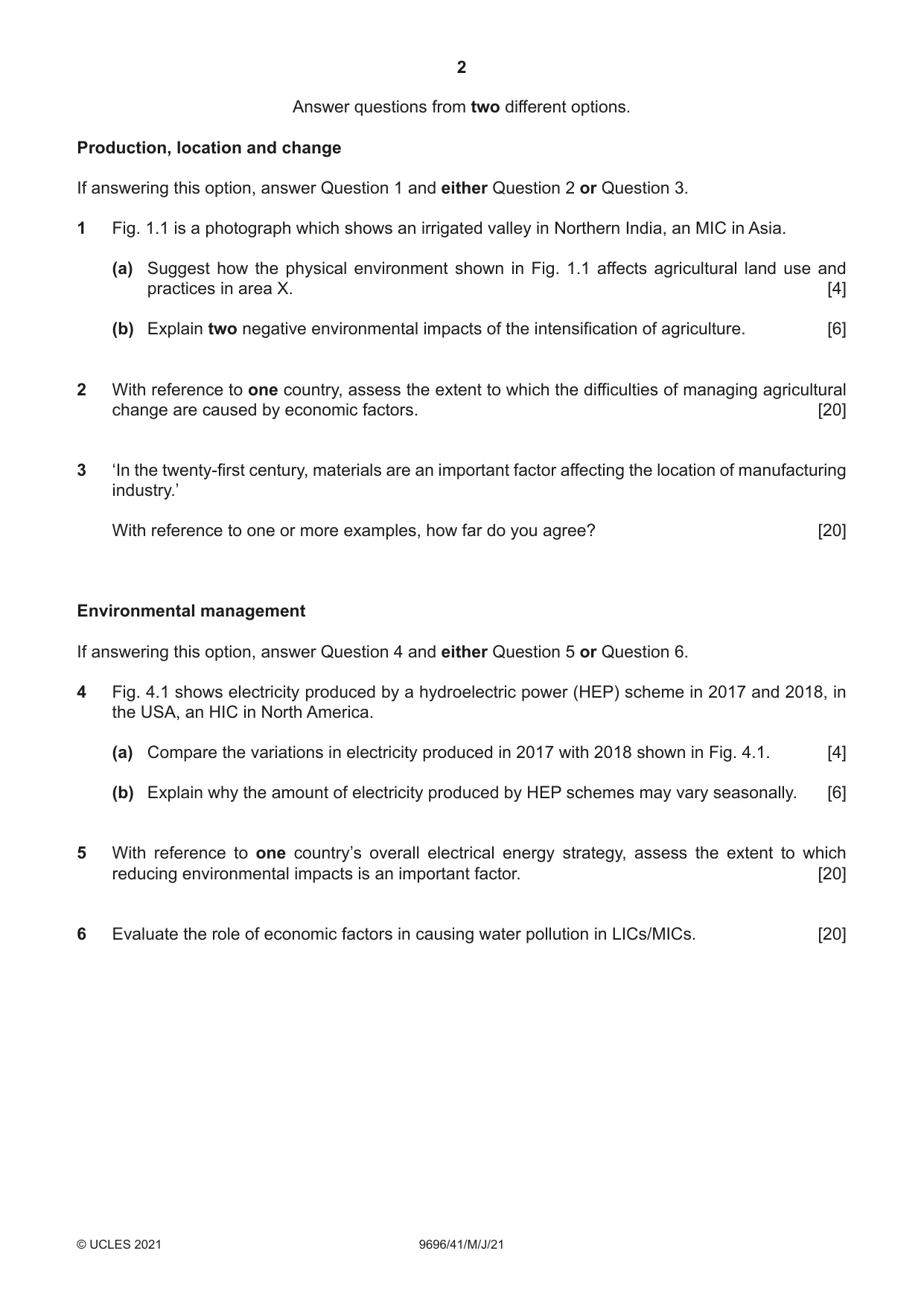
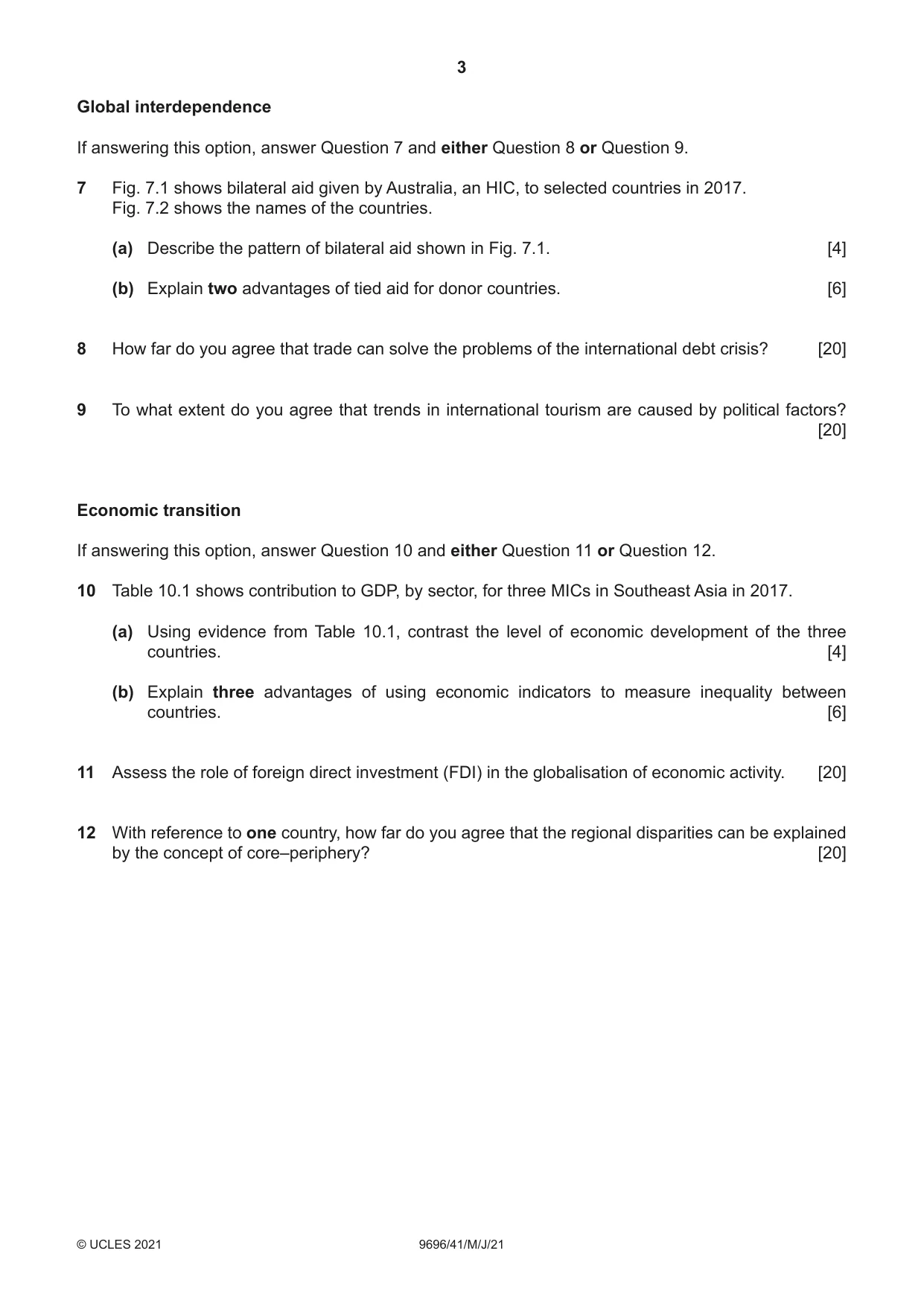

Mark scheme26 pages
Answers below. Sit the paper first if you are practising.













Questions as text
Q1 · A photograph which shows an irrigated valley in Northern India, an MIC in Asia
1 Fig. 1.1 is a photograph which shows an irrigated valley in Northern India, an MIC in Asia. (a) Suggest how the physical environment shown in Fig. 1.1 affects agricultural land use and practices in area X. [4] (b) Explain two negative environmental impacts of the intensification of agriculture. [6]
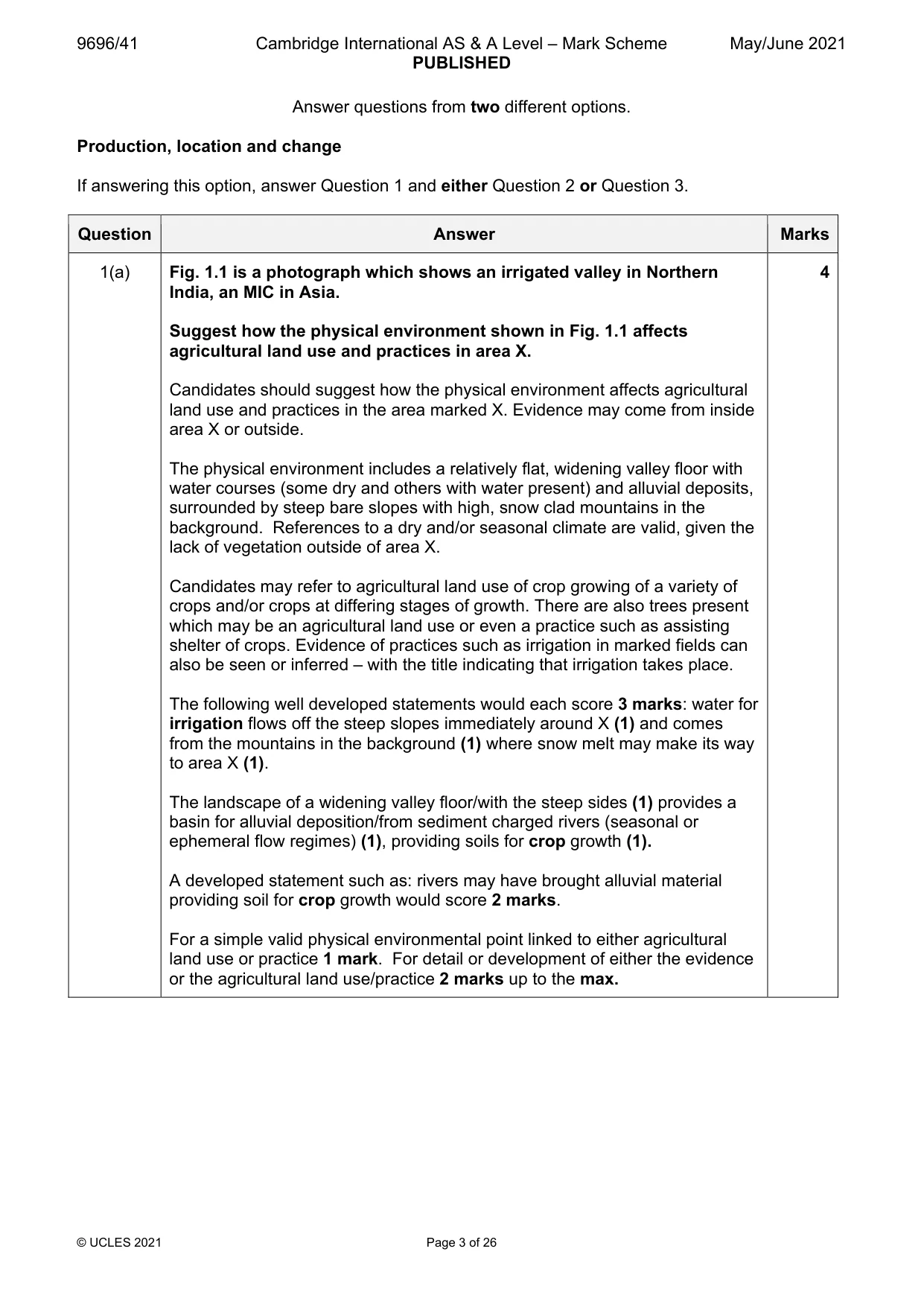
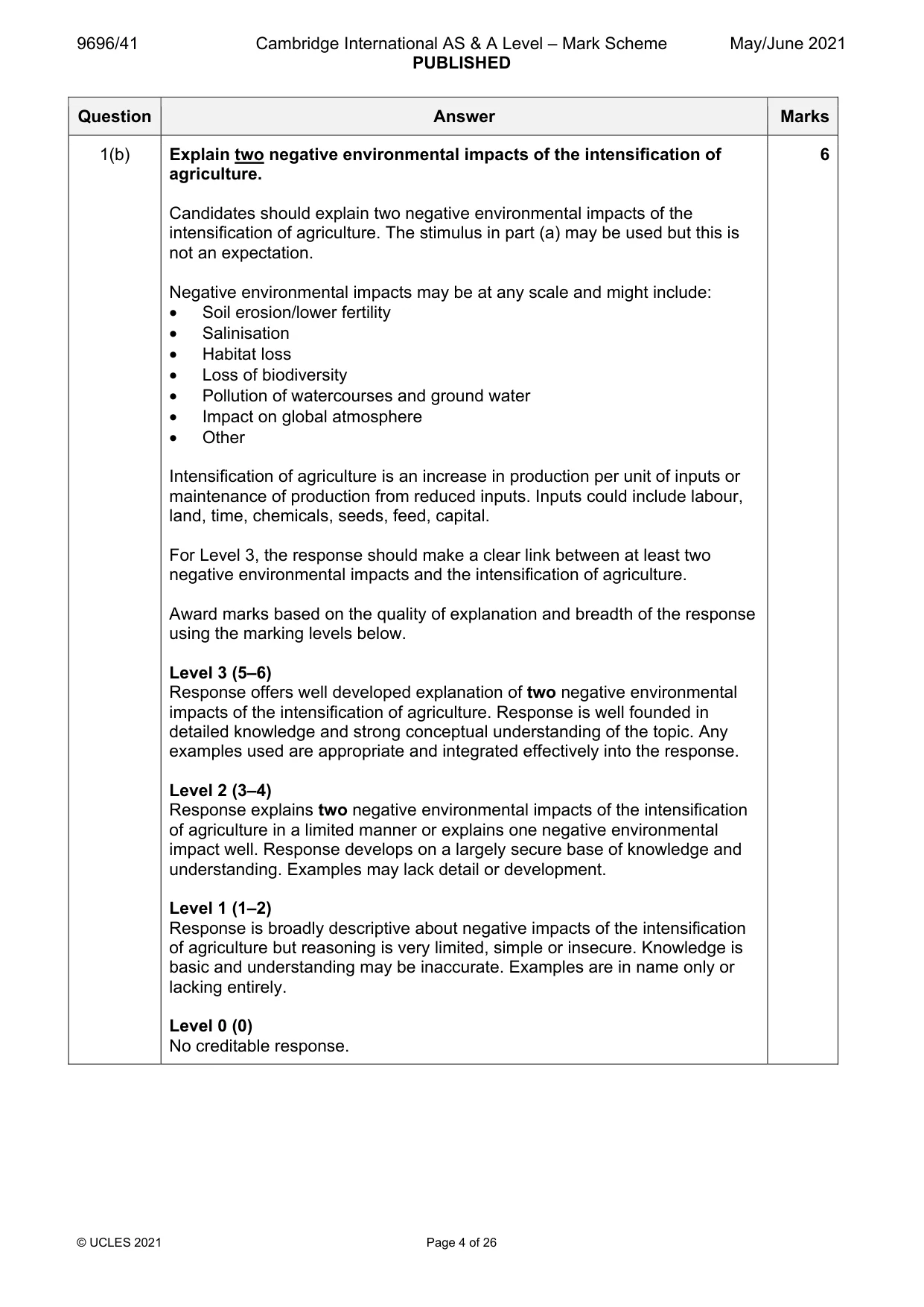
Mark scheme: Question Answer Marks 1(a) Fig. 1.1 is a photograph which shows an irrigated valley in Northern 4 India, an MIC in Asia. Suggest how the physical environment shown in Fig. 1.1 affects agricultural land use and practices in area X. Candidates should suggest how the physical environment affects agricultural land use and practices in the area marked X. Evidence may come from inside area X or outside. The physical environment includes a relatively flat, widening valley floor with water courses (some dry and others with water present) and alluvial deposits, surrounded by steep bare slopes with high, snow clad mountains in the background. References to a dry and/or seasonal climate are valid, given the lack of vegetation outside of area X. Candidates may refer to agricultural land use of crop growing of a variety of crops and/or crops at differing stages of growth. There are also trees present which may be an agricultural land use or even a practice such as assisting shelter of crops. Evidence of practices such as irrigation in marked fields can also be seen or inferred – with the title indicating that irrigation takes place. The following well developed statements would each score 3 marks: water for irrigation flows off the steep slopes immediately around X (1) and comes from the mountains in the background (1) where snow melt may make its way to area X (1). The landscape of a widening valley floor/with the steep sides (1) provides a basin for alluvial deposition/from sediment charged rivers (seasonal or ephemeral flow regimes) (1), providing soils for crop growth (1). A developed statement such as: rivers may have brought alluvial material providing soil for crop growth would score 2 marks. For a simple valid physical environmental point linked to either agricultural land use or practice 1 mark. For detail or development of either the evidence or the agricultural land use/practice 2 marks up to the max. 1(b) Explain two negative environmental impacts of the intensification of 6 agriculture. Candidates should explain two negative environmental impacts of the intensification of agriculture. The stimulus in part (a) may be used but this is not an expectation. Negative environmental impacts may be at any scale and might include: • Soil erosion/lower fertility • Salinisation • Habitat loss • Loss of biodiversity • Pollution of watercourses and ground water • Impact on global atmosphere • Other Intensification of agriculture is an increase in production per unit of inputs or maintenance of production from reduced inputs. Inputs could include labour, land, time, chemicals, seeds, feed, capital. For Level 3, the response should make a clear link between at least two negative environmental impacts and the intensification of agriculture. Award marks based on the quality of explanation and breadth of the response using the marking levels below. Level 3 (5–6) Response offers well developed explanation of two negative environmental impacts of the intensification of agriculture. Response is well founded in detailed knowledge and strong conceptual understanding of the topic. Any examples used are appropriate and integrated effectively into the response. Level 2 (3–4) Response explains two negative environmental impacts of the intensification of agriculture in a limited manner or explains one negative environmental impact well. Response develops on a largely secure base of knowledge and understanding. Examples may lack detail or development. Level 1 (1–2) Response is broadly descriptive about negative impacts of the intensification of agriculture but reasoning is very limited, simple or insecure. Knowledge is basic and understanding may be inaccurate. Examples are in name only or lacking entirely. Level 0 (0) No creditable response.
Q2 · With reference to one country, assess the extent to which the difficulties of managing…
2 With reference to one country, assess the extent to which the difficulties of managing agricultural change are caused by economic factors. [20]
Mark scheme: 2 With reference to one country, assess the extent to which the difficulties 20 of managing agricultural change are caused by economic factors. Candidates are free to develop their own approach to the question and responses will vary depending on the example(s) chosen. Whichever approach is chosen, essays which address the question and support their argument with relevant examples will be credited. The direction of the response and evaluation made will depend on the approach chosen, and any evaluation is therefore valid if argued and based on evidence. There must be an attempt to assess the extent to which the difficulties of managing agricultural change are caused by economic factors with the consideration of other factors as an indicator of quality, though the essay does not need to be fully balanced between the two. A further indicator of quality may come from an appreciation that factors do not apply in isolation and/or that some aspects of agricultural change are more difficult to manage than others. The factors and/or difficulties of managing agricultural change may be applied at any scale, with two scales specified in the syllabus: the local scale (the farm, holding or producer) and at the national scale. Economic factors may include demand and distance from markets, transport, labour, capital; whilst other factors may include physical, e.g. remoteness or inaccessibility, climate, soil, relief, natural hazards, pests and disease; social, e.g. land tenure, inheritance laws; political, such as government policies on land ownership, subsidies, loans, marketing, education, international trade, taxation, and any other valid factor. If more than one country, mark all and credit the best or better. Award marks based on the quality of the response using the marking levels below. Level 4 (16–20) Response thoroughly discusses the extent to which the difficulties of managing agricultural change in one country are caused by economic factors. An effective and sustained evaluation with a sound conclusion. Response is well founded in detailed exemplar knowledge and strong conceptual understanding of the topic. Examples used are appropriate and integrated effectively into the response. Level 3 (11–15) Response discusses the extent to which the difficulties of managing agricultural change in one country are caused by economic factors. Response is broadly evaluative in character, comprising some explanatory or narrative content and a conclusion. Response develops on a largely secure base of knowledge and understanding with the use of example(s). 2 Level 2 (6–10) Response demonstrates some knowledge and understanding of the extent to which the difficulties of managing agricultural change in one country are caused by economic factors. Response is mainly descriptive or explanatory in approach and contains a brief or thinly supported evaluation. Responses without the use of example(s) to support the response will not get above the middle of Level 2 (8 marks). Level 1 (1–5) Response makes a few general points about agriculture or agricultural change in a country. A descriptive response comprising a few simple points. Knowledge is basic and understanding may be poor and lack relevance to the question set. Level 0 (0) No creditable response.
Q3 · ‘In the twenty-first century, materials are an important factor affecting the location of…
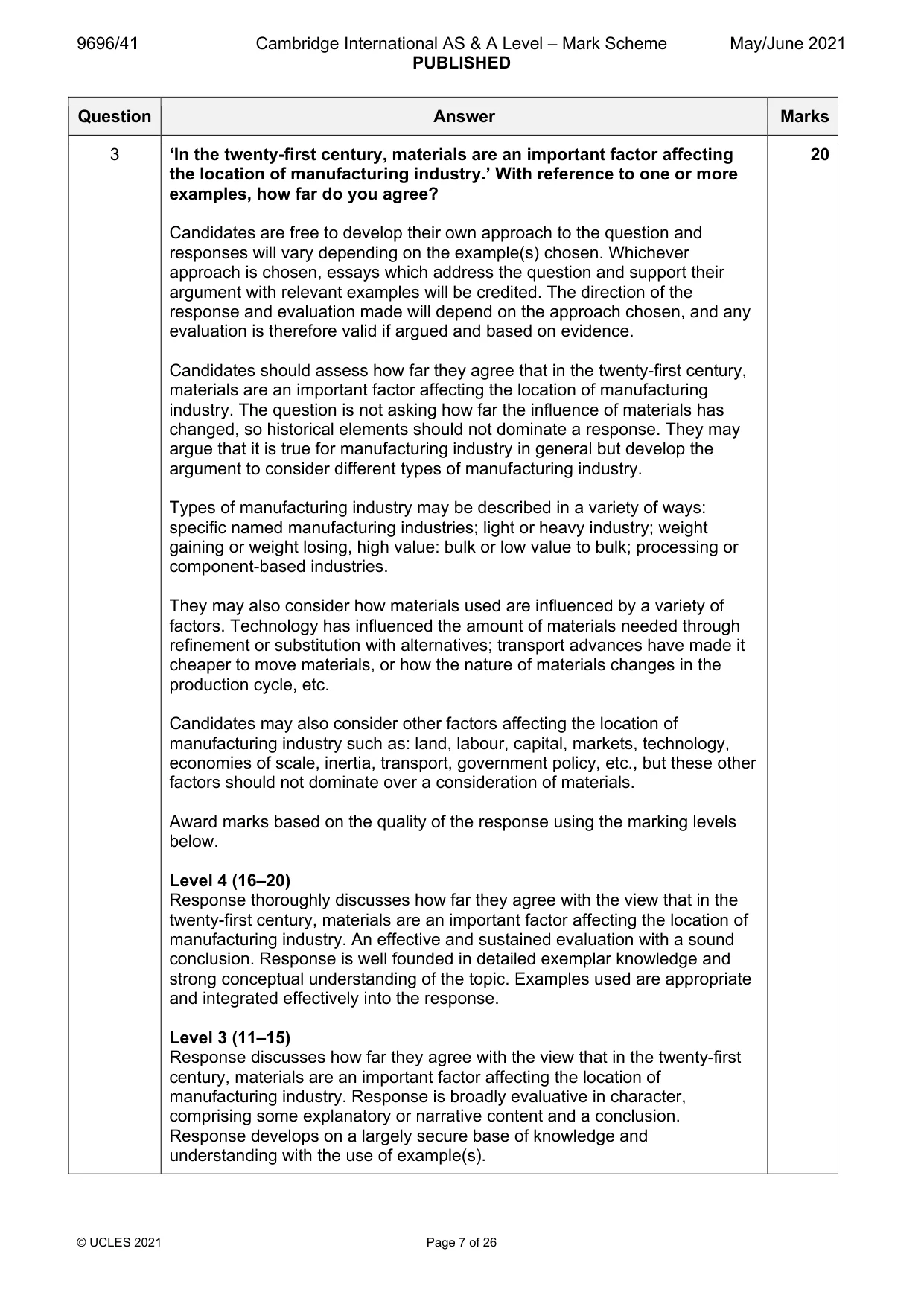
3 ‘In the twenty-first century, materials are an important factor affecting the location of manufacturing industry.’ With reference to one or more examples, how far do you agree? [20] Environmental management If answering this option, answer Question 4 and either Question 5 or Question 6.
Mark scheme: 3 ‘In the twenty-first century, materials are an important factor affecting 20 the location of manufacturing industry.’ With reference to one or more examples, how far do you agree? Candidates are free to develop their own approach to the question and responses will vary depending on the example(s) chosen. Whichever approach is chosen, essays which address the question and support their argument with relevant examples will be credited. The direction of the response and evaluation made will depend on the approach chosen, and any evaluation is therefore valid if argued and based on evidence. Candidates should assess how far they agree that in the twenty-first century, materials are an important factor affecting the location of manufacturing industry. The question is not asking how far the influence of materials has changed, so historical elements should not dominate a response. They may argue that it is true for manufacturing industry in general but develop the argument to consider different types of manufacturing industry. Types of manufacturing industry may be described in a variety of ways: specific named manufacturing industries; light or heavy industry; weight gaining or weight losing, high value: bulk or low value to bulk; processing or component-based industries. They may also consider how materials used are influenced by a variety of factors. Technology has influenced the amount of materials needed through refinement or substitution with alternatives; transport advances have made it cheaper to move materials, or how the nature of materials changes in the production cycle, etc. Candidates may also consider other factors affecting the location of manufacturing industry such as: land, labour, capital, markets, technology, economies of scale, inertia, transport, government policy, etc., but these other factors should not dominate over a consideration of materials. Award marks based on the quality of the response using the marking levels below. Level 4 (16–20) Response thoroughly discusses how far they agree with the view that in the twenty-first century, materials are an important factor affecting the location of manufacturing industry. An effective and sustained evaluation with a sound conclusion. Response is well founded in detailed exemplar knowledge and strong conceptual understanding of the topic. Examples used are appropriate and integrated effectively into the response. Level 3 (11–15) Response discusses how far they agree with the view that in the twenty-first century, materials are an important factor affecting the location of manufacturing industry. Response is broadly evaluative in character, comprising some explanatory or narrative content and a conclusion. Response develops on a largely secure base of knowledge and understanding with the use of example(s). 3 Level 2 (6–10) Response demonstrates some knowledge and understanding of how materials are a factor affecting the location of manufacturing industry. Response is mainly descriptive or explanatory in approach and contains a brief or thinly supported evaluation. Responses without the use of example(s) to support the response will not get above the middle of Level 2 (8 marks). Level 1 (1–5) Response makes a few general points about the location of manufacturing industry. A descriptive response comprising a few simple points. Knowledge is basic and understanding may be poor and lack relevance to the question set. Level 0 (0) No creditable response. Environmental management If answering this option, answer Question 4 and either Question 5 or Question 6.
Q4 · Electricity produced by a hydroelectric power (HEP) scheme in 2017 and 2018, in the USA…
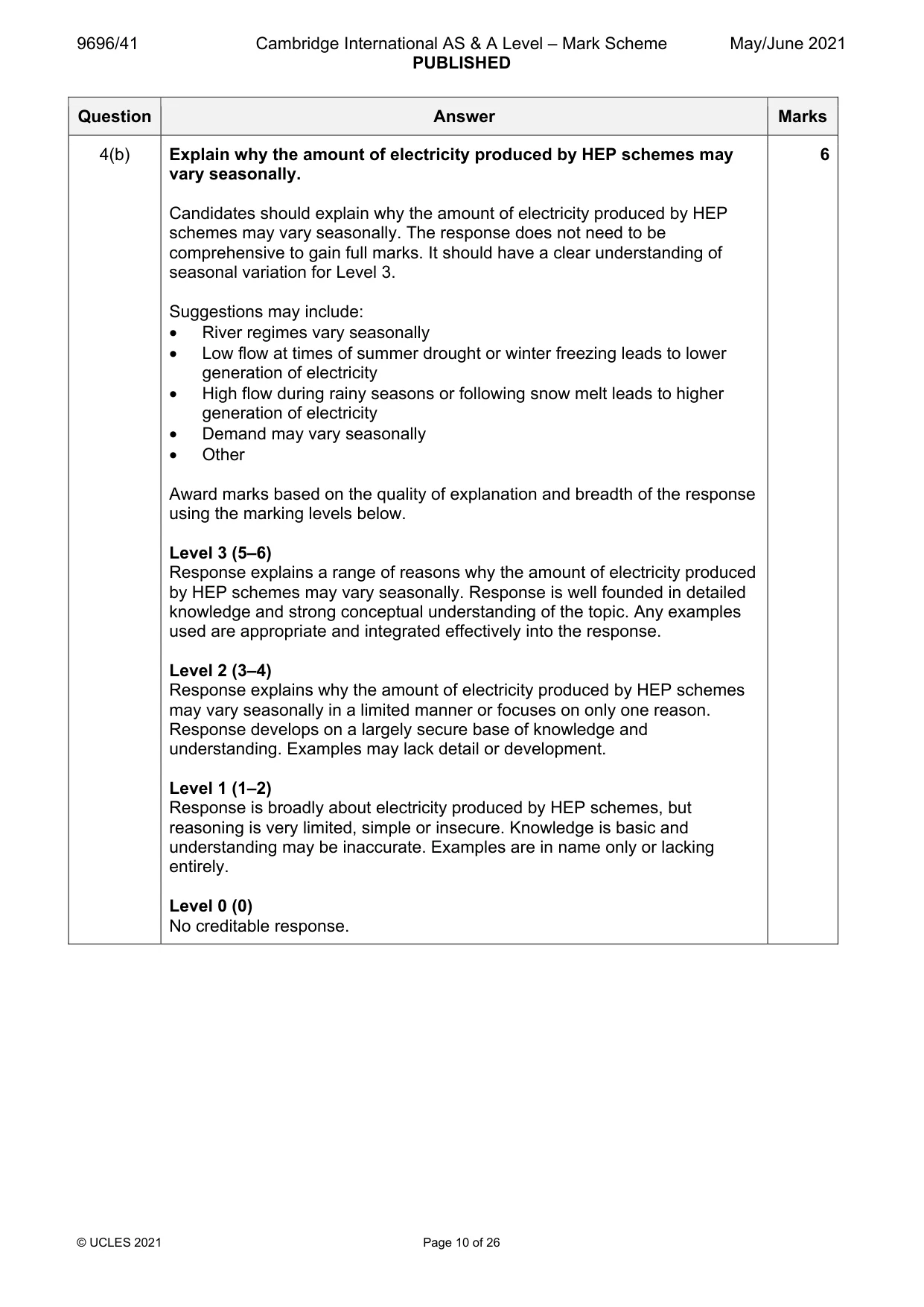
4 Fig. 4.1 shows electricity produced by a hydroelectric power (HEP) scheme in 2017 and 2018, in the USA, an HIC in North America. (a) Compare the variations in electricity produced in 2017 with 2018 shown in Fig. 4.1. [4] (b) Explain why the amount of electricity produced by HEP schemes may vary seasonally. [6]
Mark scheme: 4(a) Fig. 4.1 shows electricity produced by a hydroelectric power (HEP) 4 scheme in 2017 and 2018, in the USA, an HIC in North America. Compare the variations in electricity produced in 2017 with 2018 shown in Fig. 4.1. Comparisons include: • 2018 has a higher peak of 870 GWh compared to 790 GWh. • Timing of the peak is different with February for 2018 and March for 2017 • Lowest value for both is in August • Lowest value for 2017 is marginally lower than 2018 (320 GWh) • 2018 has a larger range between peak and lowest generation • 2017 has more fluctuations between January and June • Similar overall shape/pattern • Overall, more electricity produced in 2018 than in 2017 Other comparisons may be valid. 1 mark for each valid comparison. Max. 2 for no data. 4(b) Explain why the amount of electricity produced by HEP schemes may 6 vary seasonally. Candidates should explain why the amount of electricity produced by HEP schemes may vary seasonally. The response does not need to be comprehensive to gain full marks. It should have a clear understanding of seasonal variation for Level 3. Suggestions may include: • River regimes vary seasonally • Low flow at times of summer drought or winter freezing leads to lower generation of electricity • High flow during rainy seasons or following snow melt leads to higher generation of electricity • Demand may vary seasonally • Other Award marks based on the quality of explanation and breadth of the response using the marking levels below. Level 3 (5–6) Response explains a range of reasons why the amount of electricity produced by HEP schemes may vary seasonally. Response is well founded in detailed knowledge and strong conceptual understanding of the topic. Any examples used are appropriate and integrated effectively into the response. Level 2 (3–4) Response explains why the amount of electricity produced by HEP schemes may vary seasonally in a limited manner or focuses on only one reason. Response develops on a largely secure base of knowledge and understanding. Examples may lack detail or development. Level 1 (1–2) Response is broadly about electricity produced by HEP schemes, but reasoning is very limited, simple or insecure. Knowledge is basic and understanding may be inaccurate. Examples are in name only or lacking entirely. Level 0 (0) No creditable response.
Q5 · With reference to one country’s overall electrical energy strategy, assess the extent to…
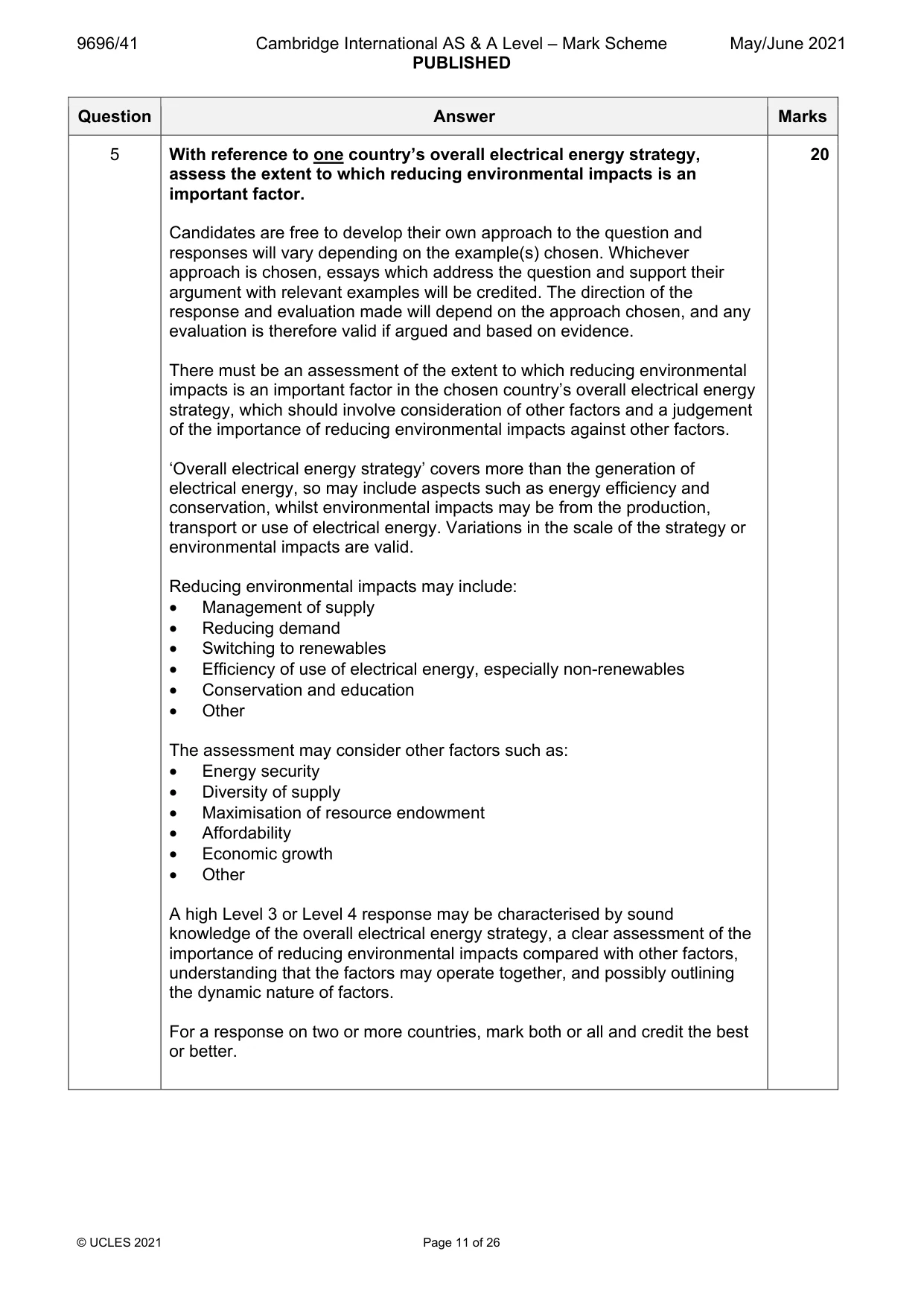
5 With reference to one country’s overall electrical energy strategy, assess the extent to which reducing environmental impacts is an important factor. [20]
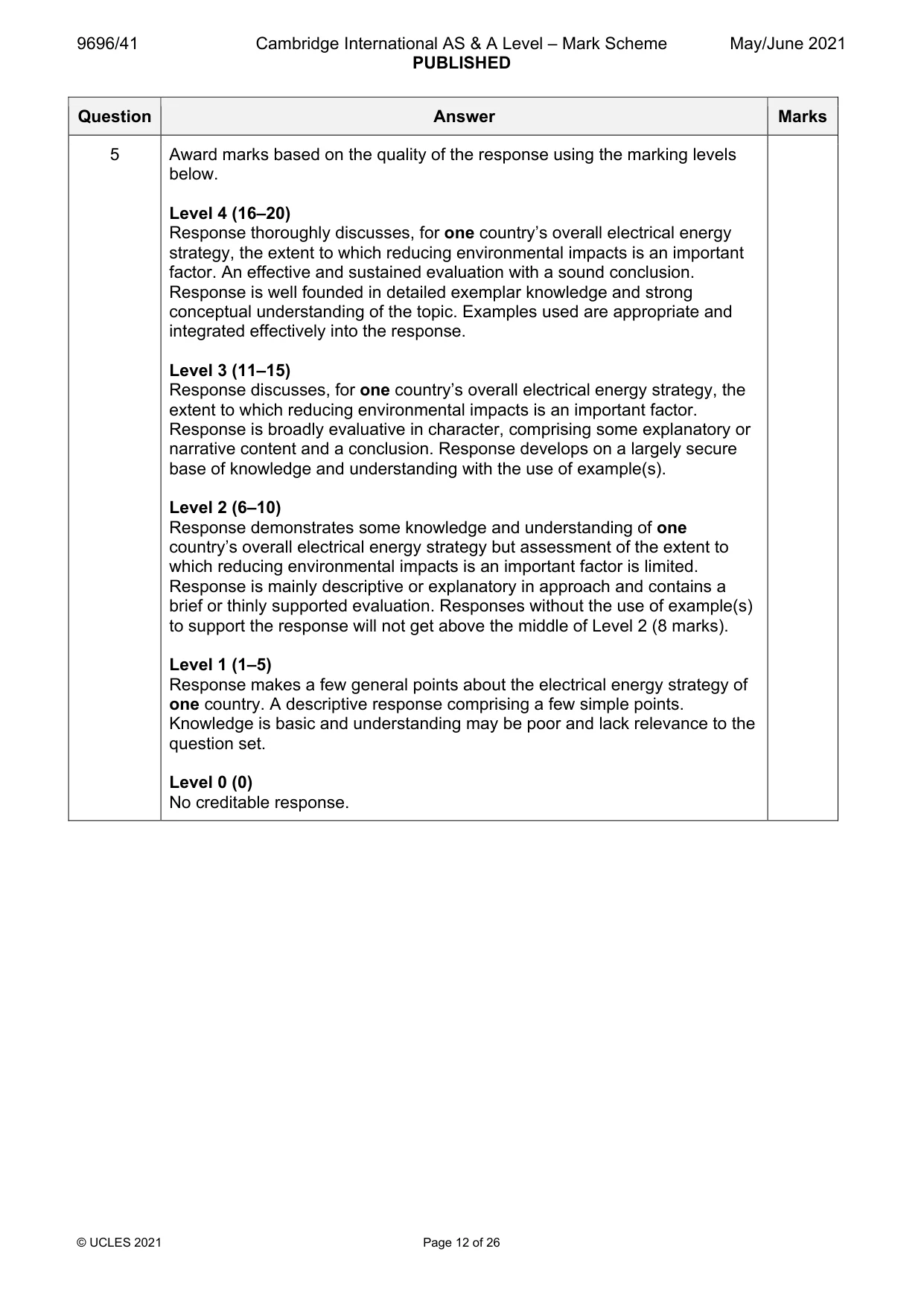
Mark scheme: 5 With reference to one country’s overall electrical energy strategy, 20 assess the extent to which reducing environmental impacts is an important factor. Candidates are free to develop their own approach to the question and responses will vary depending on the example(s) chosen. Whichever approach is chosen, essays which address the question and support their argument with relevant examples will be credited. The direction of the response and evaluation made will depend on the approach chosen, and any evaluation is therefore valid if argued and based on evidence. There must be an assessment of the extent to which reducing environmental impacts is an important factor in the chosen country’s overall electrical energy strategy, which should involve consideration of other factors and a judgement of the importance of reducing environmental impacts against other factors. ‘Overall electrical energy strategy’ covers more than the generation of electrical energy, so may include aspects such as energy efficiency and conservation, whilst environmental impacts may be from the production, transport or use of electrical energy. Variations in the scale of the strategy or environmental impacts are valid. Reducing environmental impacts may include: • Management of supply • Reducing demand • Switching to renewables • Efficiency of use of electrical energy, especially non-renewables • Conservation and education • Other The assessment may consider other factors such as: • Energy security • Diversity of supply • Maximisation of resource endowment • Affordability • Economic growth • Other A high Level 3 or Level 4 response may be characterised by sound knowledge of the overall electrical energy strategy, a clear assessment of the importance of reducing environmental impacts compared with other factors, understanding that the factors may operate together, and possibly outlining the dynamic nature of factors. For a response on two or more countries, mark both or all and credit the best or better. 5 Award marks based on the quality of the response using the marking levels below. Level 4 (16–20) Response thoroughly discusses, for one country’s overall electrical energy strategy, the extent to which reducing environmental impacts is an important factor. An effective and sustained evaluation with a sound conclusion. Response is well founded in detailed exemplar knowledge and strong conceptual understanding of the topic. Examples used are appropriate and integrated effectively into the response. Level 3 (11–15) Response discusses, for one country’s overall electrical energy strategy, the extent to which reducing environmental impacts is an important factor. Response is broadly evaluative in character, comprising some explanatory or narrative content and a conclusion. Response develops on a largely secure base of knowledge and understanding with the use of example(s). Level 2 (6–10) Response demonstrates some knowledge and understanding of one country’s overall electrical energy strategy but assessment of the extent to which reducing environmental impacts is an important factor is limited. Response is mainly descriptive or explanatory in approach and contains a brief or thinly supported evaluation. Responses without the use of example(s) to support the response will not get above the middle of Level 2 (8 marks). Level 1 (1–5) Response makes a few general points about the electrical energy strategy of one country. A descriptive response comprising a few simple points. Knowledge is basic and understanding may be poor and lack relevance to the question set. Level 0 (0) No creditable response.
Q6 · Global interdependence If answering this option, answer Question 7 and either Question 8…
Global interdependence If answering this option, answer Question 7 and either Question 8 or Question 9.
Mark scheme: 6 Evaluate the role of economic factors in causing water pollution in 20 LICs/MICs. Candidates are free to develop their own approach to the question and responses will vary depending on the example(s) chosen. Whichever approach is chosen, essays which address the question and support their argument with relevant examples will be credited. The direction of the response and evaluation made will depend on the approach chosen, and any evaluation is therefore valid if argued and based on evidence. There must be an assessment of the role of economic factors in causing water pollution in LICs/MICs. Evaluative comment should be about the role of different economic factors with further comment on how economic factors compare with others such as: social/cultural, political or environmental. Comment on other factors should not dominate over a consideration of the role of economic factors. The syllabus refers to environmental degradation of rural and urban environments, so reference to either or both is acceptable. Candidates might consider causes of water pollution such as: overpopulation, poor agricultural practices, deforestation, urbanisation, industrial development or inadequate waste management, but any other cause may be considered. Consideration of the positive influence of economic factors in improving degraded environments is valid as the syllabus refers to protecting environments at risk. Candidates may differentiate between LICs and MICs but this is not an expectation of the question. Economic factors might include: • Cost, e.g. of technology to clean used water • Profit maximisation • Resource exploitation • Drive for productivity in industry or agriculture • Economic development • Demand, e.g. over-abstraction of water • Other A characteristic of a higher level response – Level 3 to Level 4 – might consider the complexity of factors and/or links between factors. Award marks based on the quality of the response using the marking levels below. Level 4 (16–20) Response thoroughly discusses the role of economic factors in causing water pollution in LICs/MICs. An effective and sustained evaluation with a sound conclusion. Response is well founded in detailed exemplar knowledge and strong conceptual understanding of the topic. Examples used are appropriate and integrated effectively into the response. 6 Level 3 (11–15) Response discusses the role of economic factors in causing water pollution in LICs/MICs. Response is broadly evaluative in character, comprising some explanatory or narrative content and a conclusion. Response develops on a largely secure base of knowledge and understanding with the use of example(s). Level 2 (6–10) Response demonstrates some knowledge and understanding of the causes/sources of water pollution with some reference to factors. Response is mainly descriptive or explanatory in approach and contains a brief or thinly supported evaluation. Responses without the use of example(s) to support the response will not get above the middle of Level 2 (8 marks). Level 1 (1–5) Response makes a few general points about the causes/sources of water pollution. A descriptive response comprising a few simple points. Knowledge is basic and understanding may be poor and lack relevance to the question set. Level 0 (0) No creditable response. Global interdependence If answering this option, answer Question 7 and either Question 8 or Question 9.
Q7 · Bilateral aid given by Australia, an HIC, to selected countries in 2017
7 Fig. 7.1 shows bilateral aid given by Australia, an HIC, to selected countries in 2017. Fig. 7.2 shows the names of the countries. (a) Describe the pattern of bilateral aid shown in Fig. 7.1. [4] (b) Explain two advantages of tied aid for donor countries. [6]
Mark scheme: 7(a) Fig. 7.1 shows bilateral aid given by Australia, an HIC, to selected 4 countries in 2017. Fig. 7.2 shows the names of the countries. Describe the pattern of bilateral aid shown in Fig. 7.1. Candidates should describe the pattern of bilateral aid using reference points such as: the Equator, distance, direction, or names of countries. Candidates might describe a pattern of higher levels of bilateral aid closer to Australia and a general decline with distance (1), with a southeast to northwest element to this pattern (1). There are anomalies to this pattern such as lower values, e.g. Malaysia/Thailand (1) or higher values, e.g. Pakistan/Afghanistan (1). Accept other valid descriptions of pattern, including an argument that there is no clear pattern. Reserve 1 mark for a valid statement of the general pattern or that there is no pattern. 1 mark for each valid description of pattern aided by qualifying statements such as: highest, lowest, lower, higher, decline, rise, anomaly/exception. 7(b) Explain two advantages of tied aid for donor countries. 6 Candidates should explain two advantages of tied aid for donor countries. Advantages may include: • Reduces the risk of default by receiving country • Donor has more control over aid projects • Generates benefits for the donor economy such as: increased employment or revenue from the supply of varying aspects of the aid project(s) • Helps to secure or expand export markets • Helps to secure or increase import sources • Satisfies political demands domestically to justify donation of aid • Other For Level 3, there should be a clear understanding of tied aid as opposed to aid donation in general. Award marks based on the quality of explanation and breadth of the response using the marking levels below. Level 3 (5–6) Response offers a well developed explanation of two advantages of tied aid for donor countries. Response is well founded in detailed knowledge and strong conceptual understanding of the topic. Any examples used are appropriate and integrated effectively into the response. Level 2 (3–4) Response explains the advantages of tied aid for donor countries in a limited manner or focuses on only one advantage. Response develops on a largely secure base of knowledge and understanding. Examples may lack detail or development. Level 1 (1–2) Response consists of one or more descriptive statements about tied aid. Knowledge is basic and understanding may be inaccurate. Examples are in name only or lacking entirely. Level 0 (0) No creditable response.
Q8 · How far do you agree that trade can solve the problems of the international debt crisis?
8 How far do you agree that trade can solve the problems of the international debt crisis? [20]
Mark scheme: 8 How far do you agree that trade can solve the problems of the 20 international debt crisis? Candidates are free to develop their own approach to the question and responses will vary depending on the example(s) chosen. Whichever approach is chosen, essays which address the question and support their argument with relevant examples will be credited. The direction of the response and evaluation made will depend on the approach chosen, and any evaluation is therefore valid if argued and based on evidence. The response needs to display knowledge and understanding of some problems of the international debt crisis and the role of trade in solving these problems or not. Problems of the international debt crisis could be for any country: LIC/MIC or HIC and may include: • Interest repayment issues • Debt service ratio • Creditworthiness • Odious debt • Reduction of funds for improvement of the domestic economy and/or services • Default on loans • Currency issues • Inflation • Civil strife • Other There must be some balance to the response with an argument about how far trade can solve the problems of the international debt crisis. There may be argument that it can or cannot solve the problems, whilst a characteristic of a high quality response may differentiate between the problems or the scale at which the problems affect countries or people and/or consider the dynamic nature of this complicated issue. Consideration of more than one problem rather than the general problem of debt repayment may be a discriminator in Level 3 and a characteristic of Level 4. There may be consideration of how the debt crisis has been managed or not by considering the role of trade in structural adjustment programs, the highly indebted poor countries initiative, the multilateral debt relief initiative and poverty reduction strategy papers. Equally, the general role and issues of trade such as: export and primary product dependency, competition, global economic issues, e.g. inflation and recession, etc., may be used to develop an argument. Award marks based on the quality of the response using the marking levels below. 8 Level 4 (16–20) Response thoroughly discusses how far the candidate agrees that trade can solve the problems of the international debt crisis. An effective and sustained evaluation with a sound conclusion. Response is well founded in detailed exemplar knowledge and strong conceptual understanding of the topic. Examples used are appropriate and integrated effectively into the response. Level 3 (11–15) Response discusses how far the candidate agrees that trade can solve the problems of the international debt crisis. Response is broadly evaluative in character, comprising some explanatory or narrative content and a conclusion. Response develops on a largely secure base of knowledge and understanding with the use of example(s). Level 2 (6–10) Response demonstrates some knowledge and understanding of trade and the problems of international debt with an unbalanced approach to links between the two aspects. Response is mainly descriptive or explanatory in approach and contains a brief or thinly supported evaluation. Responses without the use of example(s) to support the response will not get above the middle of Level 2 (8 marks). Level 1 (1–5) Response makes a few general points about the problems of international debt or trade. A descriptive response comprising a few simple points. Knowledge is basic and understanding may be poor and lack relevance to the question set. Level 0 (0) No creditable response.
Q9 · To what extent do you agree that trends in international tourism are caused by political…
9 To what extent do you agree that trends in international tourism are caused by political factors? [20] Economic transition If answering this option, answer Question 10 and either Question 11 or Question 12.
Mark scheme: 9 To what extent do you agree that trends in international tourism are 20 caused by political factors? Candidates are free to develop their own approach to the question and responses will vary depending on the example(s) chosen. Whichever approach is chosen, essays which address the question and support their argument with relevant examples will be credited. The direction of the response and evaluation made will depend on the approach chosen, and any evaluation is therefore valid if argued and based on evidence. Content should be related to international tourism, which is tourism that crosses international boundaries. The assessment should consider how far trends in international tourism are caused by political factors, whilst bringing other factors such as social and/or economic into the assessment, though political factors should be central in the response. Trends in international tourism might include spatial or temporal change in numbers, seasonal pattern of visitors, increase in types of tourism or tourists, new destinations, role of internet and social media in the booking and marketing process, etc. Some political factors, e.g. terrorism, may lead to short-term disruption of a longer term trend. A quality of a higher level response might be differentiation of how far a particular trend may be caused by a political factor or not and/or how political factors may have aspects which cross over with social or economic factors. Reference to Covid-19 is perfectly acceptable and its link with other factors such as political, economic and social along with its immediacy and to some extent unpredictability on trends may form part of a high level response. Political factors could include: • Use of visas to encourage or control numbers • Restrictions on travel into or out of countries • War, internal conflict, terrorism • Government investment in the tourist industry for facilities, education and skills training, marketing and advertising • Government backing to fund bids for major international events • Promotion by the UN as part of achieving millennium development goals and/or sustainable development goals • Other Economic factors may include: • Increased affluence and increased disposable income • Increased leisure time due to holiday entitlement and pay • Reduced relative cost of air travel • Globalisation and increased business travel • TNC involvement • Package holidays • Marketing and advertising • Other 9 Social factors may include: • Increased life expectancy • Early retirement • Media/use of internet • Desire for travel and new experiences • International migration (visiting relatives) • Covid-19 • Other Award marks based on the quality of the response using the marking levels below. Level 4 (16–20) Response thoroughly discusses to what extent the candidate agrees that trends in international tourism are caused by political factors. An effective and sustained evaluation with a sound conclusion. Response is well founded in detailed exemplar knowledge and strong conceptual understanding of the topic. Examples used are appropriate and integrated effectively into the response. Level 3 (11–15) Response discusses to what extent the candidate agrees that trends in international tourism are caused by political factors. Response is broadly evaluative in character, comprising some explanatory or narrative content and a conclusion. Response develops on a largely secure base of knowledge and understanding with the use of example(s). Level 2 (6–10) Response demonstrates some knowledge and understanding of trends in international tourism, but the causes are thinly developed. Response is mainly descriptive or explanatory in approach and contains a brief or thinly supported evaluation. Responses without the use of example(s) to support the response will not get above the middle of Level 2 (8 marks). Level 1 (1–5) Response makes a few general points about tourism and/or choices tourists make about destinations. A descriptive response comprising a few simple points. Knowledge is basic and understanding may be poor and lack relevance to the question set. Level 0 (0) No creditable response. Economic transition If answering this option, answer Question 10 and either Question 11 or Question 12.
Q10 · Contribution to GDP, by sector, for three MICs in Southeast Asia in 2017
10 Table 10.1 shows contribution to GDP, by sector, for three MICs in Southeast Asia in 2017. (a) Using evidence from Table 10.1, contrast the level of economic development of the three countries. [4] (b) Explain three advantages of using economic indicators to measure inequality between countries. [6]
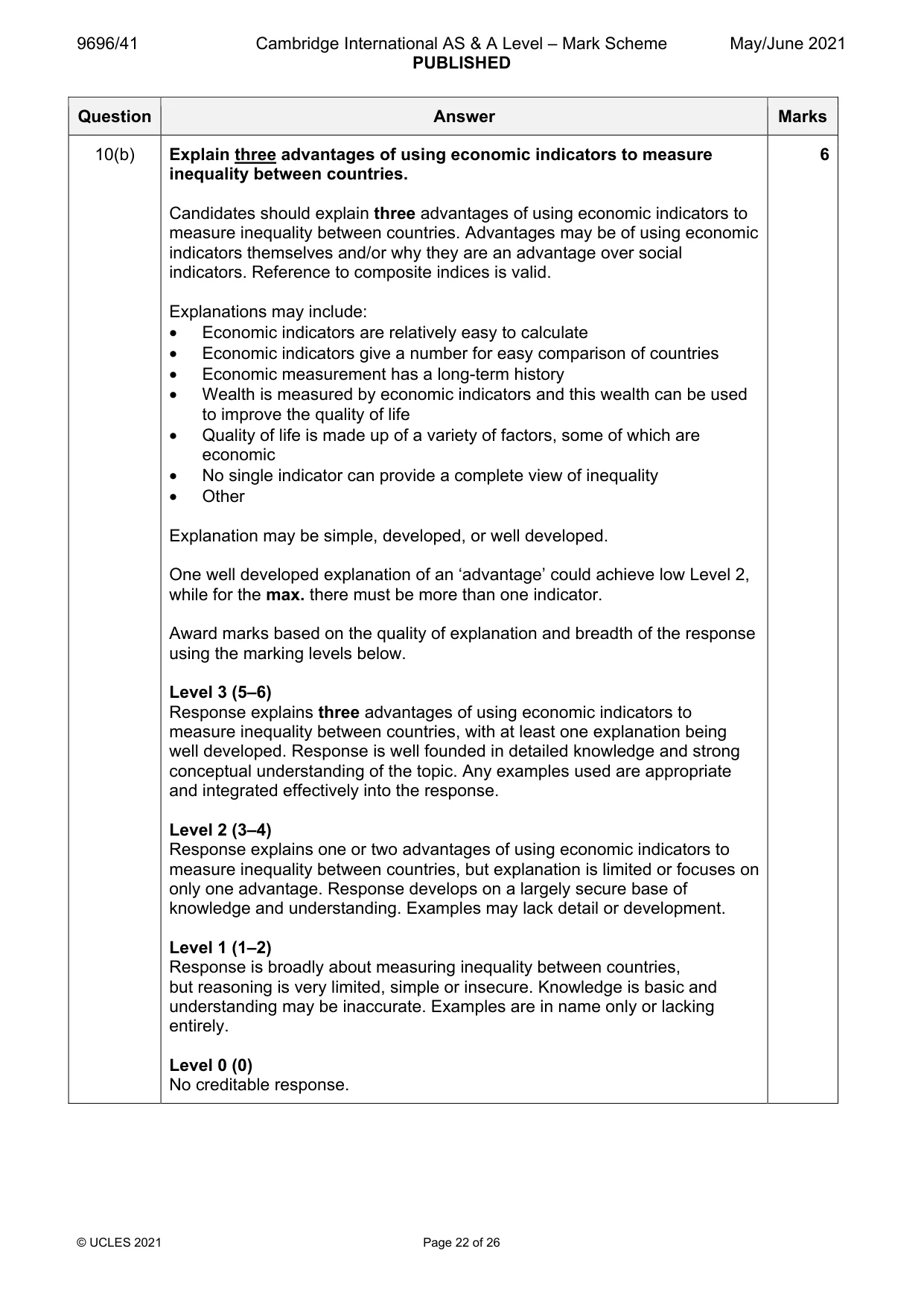
Mark scheme: 10(a) Table 10.1 shows contribution to GDP, by sector, for three MICs in 4 Southeast Asia in 2017. Using evidence from Table 10.1, contrast the level of economic development of the three countries. Candidates should use evidence from Table 10.1 to contrast the level of economic development of the three countries. This involves understanding of how variations in the contribution to GDP from each economic sector shown are linked to level of economic development, along with the skill of supporting a judgement with data. They might describe the level of economic development by suggesting a rank order: Thailand is the most developed because it has the highest tertiary percentage but the lowest in agriculture, whilst Cambodia is the least developed since it has the highest percentage from agriculture but the lowest from tertiary. They might also consider each sector as an indicator of economic development, e.g. agriculture suggests that Thailand is the most developed because it is significantly lower than the other two. Comment that all three countries have a relatively high contribution from industry, indicating economic development has taken place supporting the fact that they are MICs, is valid. For full marks there must be clear reference to all three countries. 10(b) Explain three advantages of using economic indicators to measure 6 inequality between countries. Candidates should explain three advantages of using economic indicators to measure inequality between countries. Advantages may be of using economic indicators themselves and/or why they are an advantage over social indicators. Reference to composite indices is valid. Explanations may include: • Economic indicators are relatively easy to calculate • Economic indicators give a number for easy comparison of countries • Economic measurement has a long-term history • Wealth is measured by economic indicators and this wealth can be used to improve the quality of life • Quality of life is made up of a variety of factors, some of which are economic • No single indicator can provide a complete view of inequality • Other Explanation may be simple, developed, or well developed. One well developed explanation of an ‘advantage’ could achieve low Level 2, while for the max. there must be more than one indicator. Award marks based on the quality of explanation and breadth of the response using the marking levels below. Level 3 (5–6) Response explains three advantages of using economic indicators to measure inequality between countries, with at least one explanation being well developed. Response is well founded in detailed knowledge and strong conceptual understanding of the topic. Any examples used are appropriate and integrated effectively into the response. Level 2 (3–4) Response explains one or two advantages of using economic indicators to measure inequality between countries, but explanation is limited or focuses on only one advantage. Response develops on a largely secure base of knowledge and understanding. Examples may lack detail or development. Level 1 (1–2) Response is broadly about measuring inequality between countries, but reasoning is very limited, simple or insecure. Knowledge is basic and understanding may be inaccurate. Examples are in name only or lacking entirely. Level 0 (0) No creditable response.
Q11 · Assess the role of foreign direct investment (FDI) in the globalisation of economic…
11 Assess the role of foreign direct investment (FDI) in the globalisation of economic activity. [20]
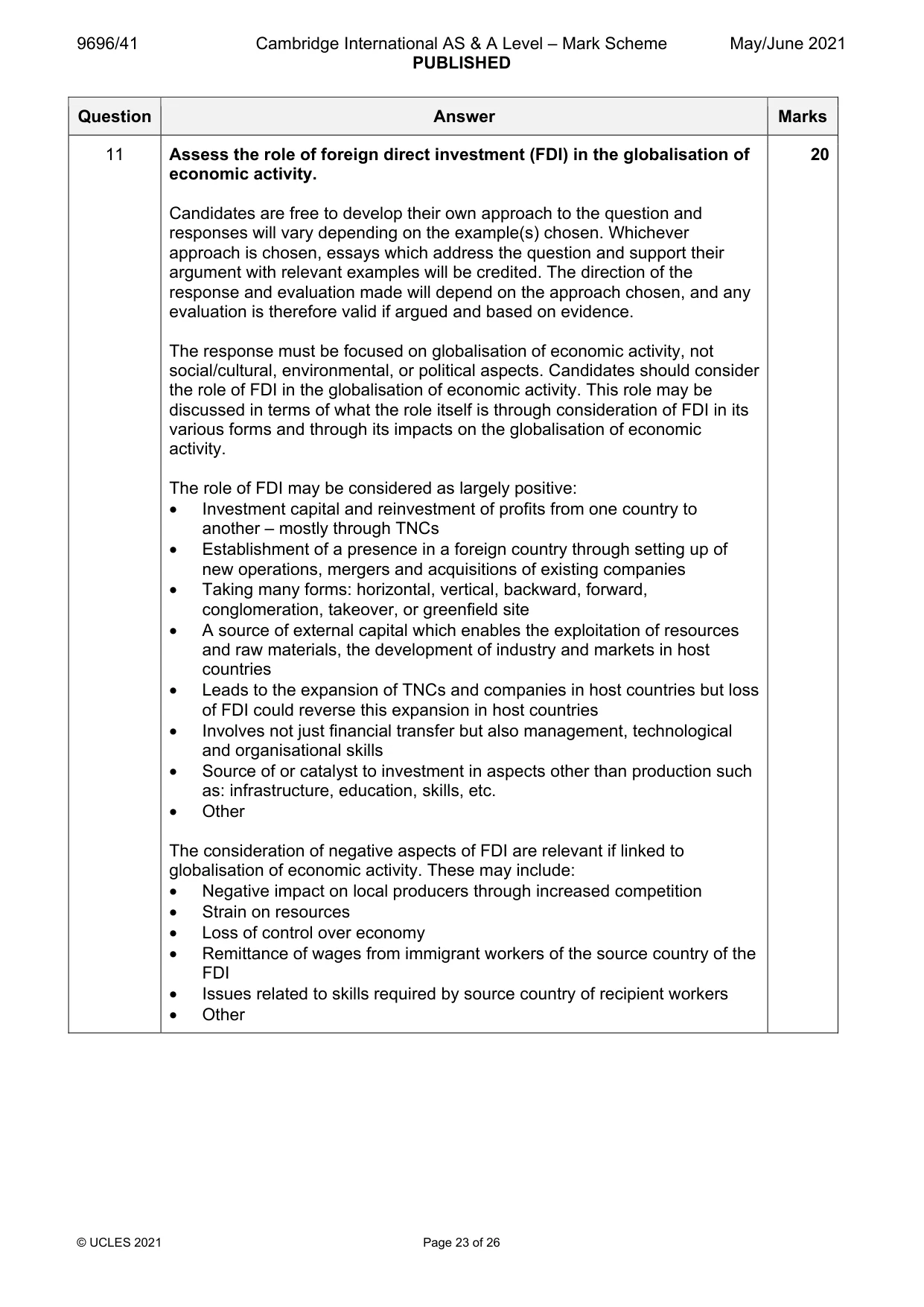
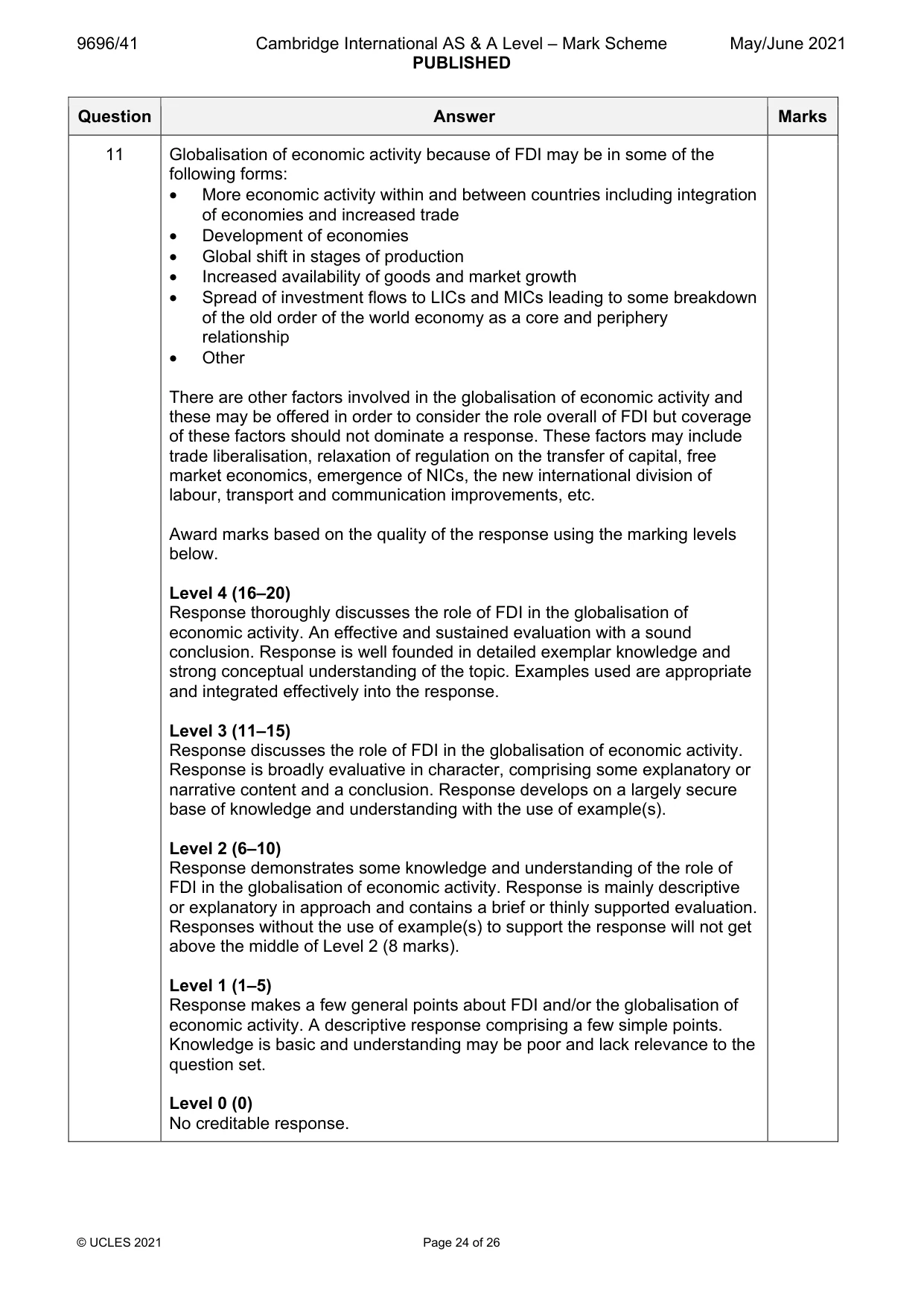
Mark scheme: 11 Assess the role of foreign direct investment (FDI) in the globalisation of 20 economic activity. Candidates are free to develop their own approach to the question and responses will vary depending on the example(s) chosen. Whichever approach is chosen, essays which address the question and support their argument with relevant examples will be credited. The direction of the response and evaluation made will depend on the approach chosen, and any evaluation is therefore valid if argued and based on evidence. The response must be focused on globalisation of economic activity, not social/cultural, environmental, or political aspects. Candidates should consider the role of FDI in the globalisation of economic activity. This role may be discussed in terms of what the role itself is through consideration of FDI in its various forms and through its impacts on the globalisation of economic activity. The role of FDI may be considered as largely positive: • Investment capital and reinvestment of profits from one country to another – mostly through TNCs • Establishment of a presence in a foreign country through setting up of new operations, mergers and acquisitions of existing companies • Taking many forms: horizontal, vertical, backward, forward, conglomeration, takeover, or greenfield site • A source of external capital which enables the exploitation of resources and raw materials, the development of industry and markets in host countries • Leads to the expansion of TNCs and companies in host countries but loss of FDI could reverse this expansion in host countries • Involves not just financial transfer but also management, technological and organisational skills • Source of or catalyst to investment in aspects other than production such as: infrastructure, education, skills, etc. • Other The consideration of negative aspects of FDI are relevant if linked to globalisation of economic activity. These may include: • Negative impact on local producers through increased competition • Strain on resources • Loss of control over economy • Remittance of wages from immigrant workers of the source country of the FDI • Issues related to skills required by source country of recipient workers • Other 11 Globalisation of economic activity because of FDI may be in some of the following forms: • More economic activity within and between countries including integration of economies and increased trade • Development of economies • Global shift in stages of production • Increased availability of goods and market growth • Spread of investment flows to LICs and MICs leading to some breakdown of the old order of the world economy as a core and periphery relationship • Other There are other factors involved in the globalisation of economic activity and these may be offered in order to consider the role overall of FDI but coverage of these factors should not dominate a response. These factors may include trade liberalisation, relaxation of regulation on the transfer of capital, free market economics, emergence of NICs, the new international division of labour, transport and communication improvements, etc. Award marks based on the quality of the response using the marking levels below. Level 4 (16–20) Response thoroughly discusses the role of FDI in the globalisation of economic activity. An effective and sustained evaluation with a sound conclusion. Response is well founded in detailed exemplar knowledge and strong conceptual understanding of the topic. Examples used are appropriate and integrated effectively into the response. Level 3 (11–15) Response discusses the role of FDI in the globalisation of economic activity. Response is broadly evaluative in character, comprising some explanatory or narrative content and a conclusion. Response develops on a largely secure base of knowledge and understanding with the use of example(s). Level 2 (6–10) Response demonstrates some knowledge and understanding of the role of FDI in the globalisation of economic activity. Response is mainly descriptive or explanatory in approach and contains a brief or thinly supported evaluation. Responses without the use of example(s) to support the response will not get above the middle of Level 2 (8 marks). Level 1 (1–5) Response makes a few general points about FDI and/or the globalisation of economic activity. A descriptive response comprising a few simple points. Knowledge is basic and understanding may be poor and lack relevance to the question set. Level 0 (0) No creditable response.
Q12 · With reference to one country, how far do you agree that the regional disparities can be…
12 With reference to one country, how far do you agree that the regional disparities can be explained by the concept of core–periphery? [20]
Mark scheme: 12 With reference to one country, how far do you agree that the regional 20 disparities can be explained by the concept of core–periphery? Candidates are free to develop their own approach to the question and responses will vary depending on the example(s) chosen. Whichever approach is chosen, essays which address the question and support their argument with relevant examples will be credited. The direction of the response and evaluation made will depend on the approach chosen, and any evaluation is therefore valid if argued and based on evidence. Candidates may view the concept of core‒periphery in terms of the core as the centre of economic activity and the periphery as less developed region(s) where primary activities dominate. In a simple model, the core is abundant in capital whilst the periphery is abundant in labour. Low value resources are transferred from the periphery to the core and high value goods produced in the core are transferred to the periphery (and consumed in the core). This increases the available capital in the core leading to increased growth of the core region, widening the disparity between core and periphery, with a smaller amount flowing to the periphery. Processes such as cumulative causation, spread and backwash may also be considered as part of the concept and used as explanation. The model considers other regions such as: upward transition, resource frontier and downward transition, whilst candidates may comment on the simplicity of a single core and single periphery within a country. Comment on the concept and formulation of other models used to explain regional disparity would be valid. The demand to consider one country only means that candidates must display knowledge of regional disparity within this country and apply this to the concept of core‒periphery. A discriminatory feature between Level 2 and Level 3 might be knowledge of regional disparities, with at least two regions considered. A characteristic of a high level response might be balance between knowledge and understanding of the regional disparities within the chosen country and assessment of how far the concept of core‒periphery and/or other factors explains these disparities. For a response on two or more countries, mark all and credit the best or better. Award marks based on the quality of the response using the marking levels below. Level 4 (16–20) Response thoroughly discusses for one country how far the candidate agrees that the regional disparities can be explained by the concept of core‒ periphery. An effective and sustained evaluation with a sound conclusion. Response is well founded in detailed exemplar knowledge and strong conceptual understanding of the topic. Examples used are appropriate and integrated effectively into the response. 12 Level 3 (11–15) Response discusses for one country how far the candidate agrees that the regional disparities (at least two regions) can be explained by the concept of core‒periphery. Response is broadly evaluative in character, comprising some explanatory or narrative content and a conclusion. Response develops on a largely secure base of knowledge and understanding with the use of example(s). Level 2 (6–10) Response demonstrates some knowledge and understanding of regional disparities in the chosen country and the concept of core‒periphery but argument is limited. Response is mainly descriptive or explanatory in approach and contains a brief or thinly supported evaluation. Responses without the use of example(s) to support the response will not get above the middle of Level 2 (8 marks). Level 1 (1–5) Response makes a few general points about regional disparities in one country or the concept of core‒periphery. A descriptive response comprising a few simple points. Knowledge is basic and understanding may be poor and lack relevance to the question set. Level 0 (0) No creditable response.
What was in this paper
The subtopics covered by these 12 questions, and how many questions each got. Open one in a new tab to see every Cambridge question on it.
2The management of agricultural change2Manufacturing and related service industry1National development1Regional development within countries1Sustainable energy supplies1The development of international tourism1The globalisation of economic activity1The management of energy supply1Trade flows and trading patterns1What you needed in this session
Cambridge’s own grade thresholds for 2021 May/June, Paper 4 · Variant 1. A higher threshold means an easier paper — the bar moves with how the cohort did.