Cambridge A Level Geography 9696 — 2022 May/June Paper 4 · Variant 1
9696/41/M/J/22 · 60 marks · ≈68 min
The question paper and its mark scheme, free to read here and free to download. This is Cambridge’s own paper, exactly as it was sat.
Question paper4 pages

Mark scheme25 pages
Answers below. Sit the paper first if you are practising.




Paper as text
Question paper, page 1
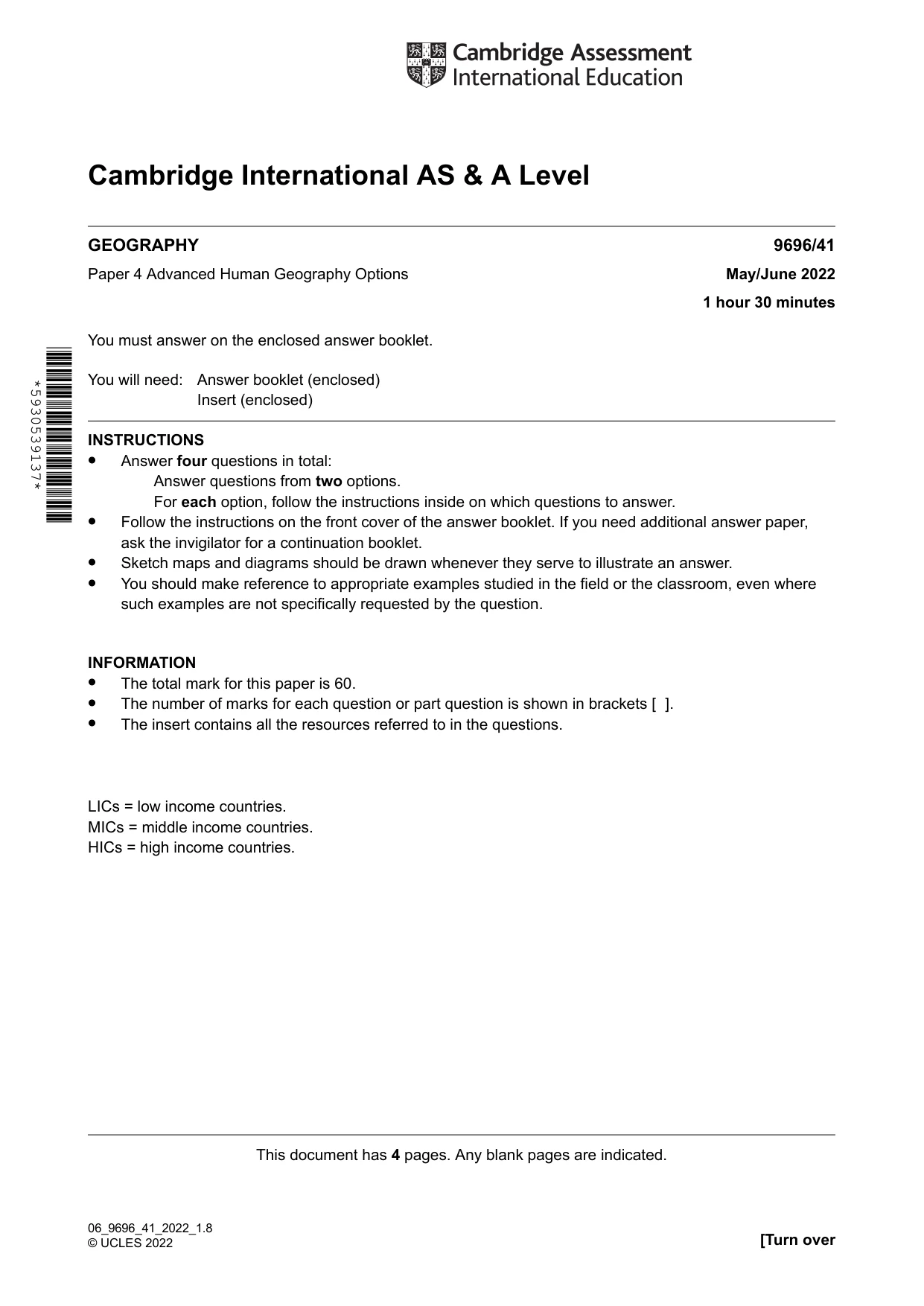
Cambridge International AS & A Level 9696/41 May/June 2022 1 hour 30 minutes GEOGRAPHY Paper 4 Advanced Human Geography Options You must answer on the enclosed answer booklet. You will need: Answer booklet (enclosed) Insert (enclosed) INSTRUCTIONS • Answer four questions in total: Answer questions from two options. For each option, follow the instructions inside on which questions to answer. • Follow the instructions on the front cover of the answer booklet. If you need additional answer paper, ask the invigilator for a continuation booklet. • Sketch maps and diagrams should be drawn whenever they serve to illustrate an answer. • You should make reference to appropriate examples studied in the field or the classroom, even where such examples are not specifically requested by the question. INFORMATION • The total mark for this paper is 60. • The number of marks for each question or part question is shown in brackets [ ]. • The insert contains all the resources referred to in the questions. LICs = low income countries. MICs = middle income countries. HICs = high income countries. This document has 4 pages. Any blank pages are indicated. [Turn over 06_9696_41_2022_1.8 © UCLES 2022 *5930539137*
Question paper, page 2
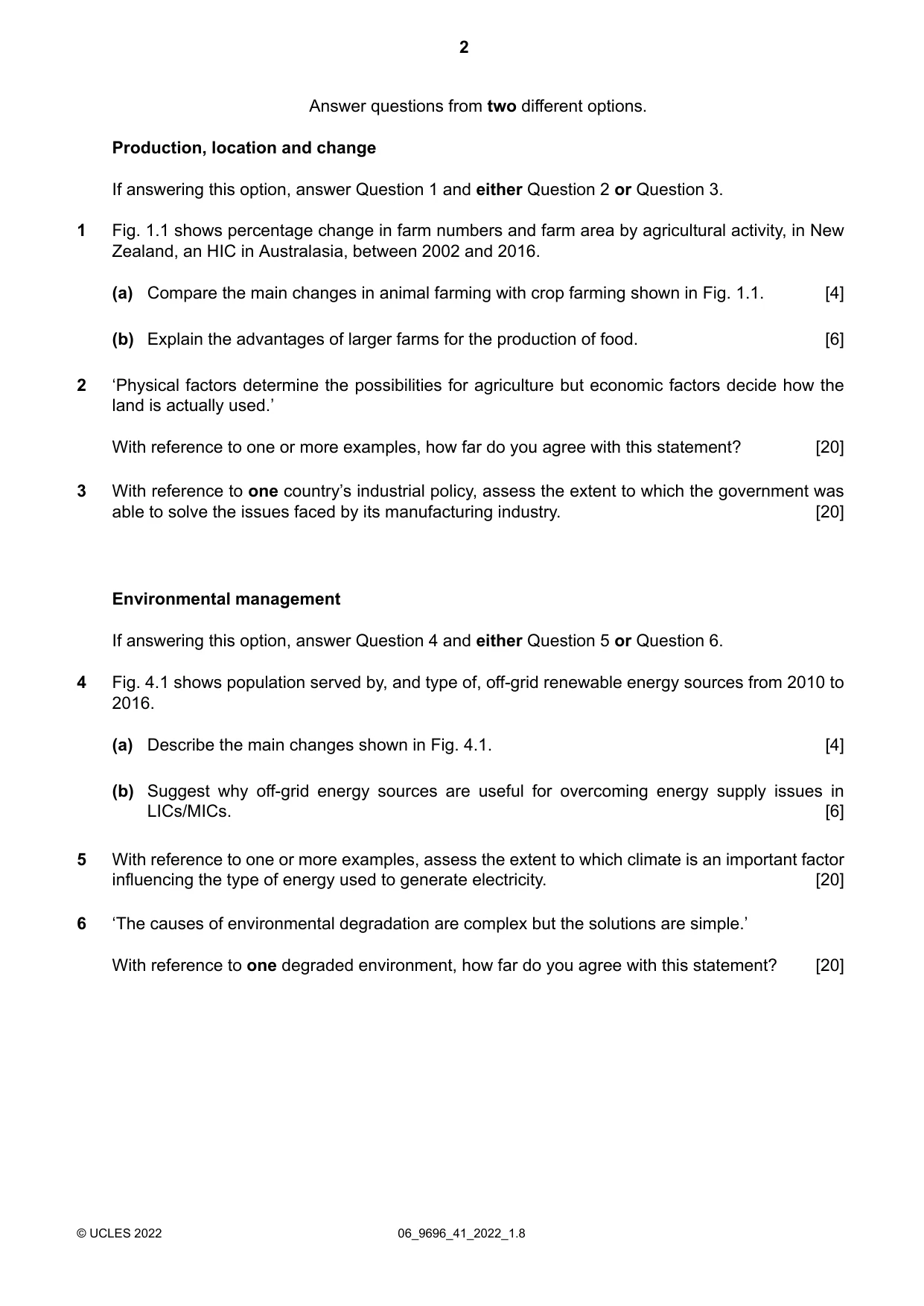
Answer questions from two different options. Production, location and change If answering this option, answer Question 1 and either Question 2 or Question 3. Fig. 1.1 shows percentage change in farm numbers and farm area by agricultural activity, in New Zealand, an HIC in Australasia, between 2002 and 2016. 1 Compare the main changes in animal farming with crop farming shown in Fig. 1.1. [4] (a) Explain the advantages of larger farms for the production of food. [6] (b) ‘Physical factors determine the possibilities for agriculture but economic factors decide how the land is actually used.’ With reference to one or more examples, how far do you agree with this statement? [20] 2 With reference to one country’s industrial policy, assess the extent to which the government was able to solve the issues faced by its manufacturing industry. [20] 3 Environmental management If answering this option, answer Question 4 and either Question 5 or Question 6. Fig. 4.1 shows population served by, and type of, off-grid renewable energy sources from 2010 to 2016. 4 Describe the main changes shown in Fig. 4.1. [4] (a) Suggest why off-grid energy sources are useful for overcoming energy supply issues in LICs/MICs. [6] (b) With reference to one or more examples, assess the extent to which climate is an important factor influencing the type of energy used to generate electricity. [20] 5 ‘The causes of environmental degradation are complex but the solutions are simple.’ With reference to one degraded environment, how far do you agree with this statement? [20] 6 06_9696_41_2022_1.8 © UCLES 2022 2
Question paper, page 3
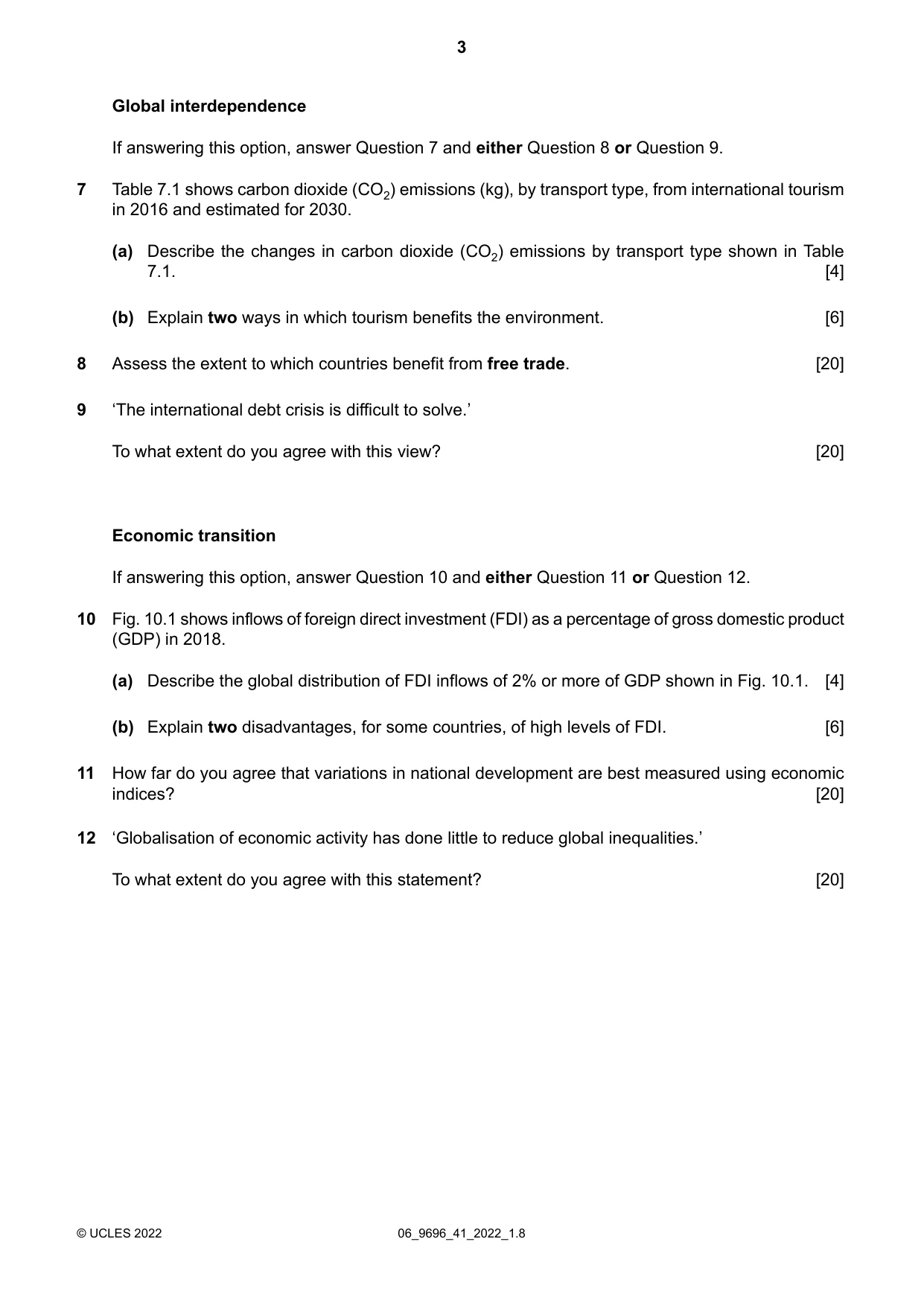
Global interdependence If answering this option, answer Question 7 and either Question 8 or Question 9. Table 7.1 shows carbon dioxide (CO2) emissions (kg), by transport type, from international tourism in 2016 and estimated for 2030. 7 Describe the changes in carbon dioxide (CO2) emissions by transport type shown in Table 7.1. [4] (a) Explain two ways in which tourism benefits the environment. [6] (b) Assess the extent to which countries benefit from free trade. [20] 8 ‘The international debt crisis is difficult to solve.’ To what extent do you agree with this view? [20] 9 Economic transition If answering this option, answer Question 10 and either Question 11 or Question 12. Fig. 10.1 shows inflows of foreign direct investment (FDI) as a percentage of gross domestic product (GDP) in 2018. 10 Describe the global distribution of FDI inflows of 2% or more of GDP shown in Fig. 10.1. [4] (a) Explain two disadvantages, for some countries, of high levels of FDI. [6] (b) How far do you agree that variations in national development are best measured using economic indices? [20] 11 ‘Globalisation of economic activity has done little to reduce global inequalities.’ To what extent do you agree with this statement? [20] 12 06_9696_41_2022_1.8 © UCLES 2022 3
Question paper, page 4
BLANK PAGE The boundaries and names shown, the designations used and the presentation of material on any maps contained in this question paper/insert do not imply official endorsement or acceptance by Cambridge Assessment International Education concerning the legal status of any country, territory, or area or any of its authorities, or of the delimitation of its frontiers or boundaries. Permission to reproduce items where third-party owned material protected by copyright is included has been sought and cleared where possible. Every reasonable effort has been made by the publisher (UCLES) to trace copyright holders, but if any items requiring clearance have unwittingly been included, the publisher will be pleased to make amends at the earliest possible opportunity. To avoid the issue of disclosure of answer-related information to candidates, all copyright acknowledgements are reproduced online in the Cambridge Assessment International Education Copyright Acknowledgements Booklet. This is produced for each series of examinations and is freely available to download at www.cambridgeinternational.org after the live examination series. Cambridge Assessment International Education is part of Cambridge Assessment. Cambridge Assessment is the brand name of the University of Cambridge Local Examinations Syndicate (UCLES), which is a department of the University of Cambridge. 06_9696_41_2022_1.8 © UCLES 2022 4
Mark scheme, page 1
This document consists of 25 printed pages. © UCLES 2022 [Turn over Cambridge International AS & A Level GEOGRAPHY 9696/41 Paper 4 Advanced Human Geography Options May/June 2022 MARK SCHEME Maximum Mark: 60 Published This mark scheme is published as an aid to teachers and candidates, to indicate the requirements of the examination. It shows the basis on which Examiners were instructed to award marks. It does not indicate the details of the discussions that took place at an Examiners’ meeting before marking began, which would have considered the acceptability of alternative answers. Mark schemes should be read in conjunction with the question paper and the Principal Examiner Report for teachers. Cambridge International will not enter into discussions about these mark schemes. Cambridge International is publishing the mark schemes for the May/June 2022 series for most Cambridge IGCSE, Cambridge International A and AS Level and Cambridge Pre-U components, and some Cambridge O Level components.
Mark scheme, page 2
9696/41 Cambridge International AS & A Level – Mark Scheme PUBLISHED May/June 2022 © UCLES 2022 Page 2 of 25 Generic Marking Principles These general marking principles must be applied by all examiners when marking candidate answers. They should be applied alongside the specific content of the mark scheme or generic level descriptors for a question. Each question paper and mark scheme will also comply with these marking principles. GENERIC MARKING PRINCIPLE 1: Marks must be awarded in line with: the specific content of the mark scheme or the generic level descriptors for the question the specific skills defined in the mark scheme or in the generic level descriptors for the question the standard of response required by a candidate as exemplified by the standardisation scripts. GENERIC MARKING PRINCIPLE 2: Marks awarded are always whole marks (not half marks, or other fractions). GENERIC MARKING PRINCIPLE 3: Marks must be awarded positively: marks are awarded for correct/valid answers, as defined in the mark scheme. However, credit is given for valid answers which go beyond the scope of the syllabus and mark scheme, referring to your Team Leader as appropriate marks are awarded when candidates clearly demonstrate what they know and can do marks are not deducted for errors marks are not deducted for omissions answers should only be judged on the quality of spelling, punctuation and grammar when these features are specifically assessed by the question as indicated by the mark scheme. The meaning, however, should be unambiguous. GENERIC MARKING PRINCIPLE 4: Rules must be applied consistently, e.g. in situations where candidates have not followed instructions or in the application of generic level descriptors. GENERIC MARKING PRINCIPLE 5: Marks should be awarded using the full range of marks defined in the mark scheme for the question (however; the use of the full mark range may be limited according to the quality of the candidate responses seen). GENERIC MARKING PRINCIPLE 6: Marks awarded are based solely on the requirements as defined in the mark scheme. Marks should not be awarded with grade thresholds or grade descriptors in mind.
Mark scheme, page 3
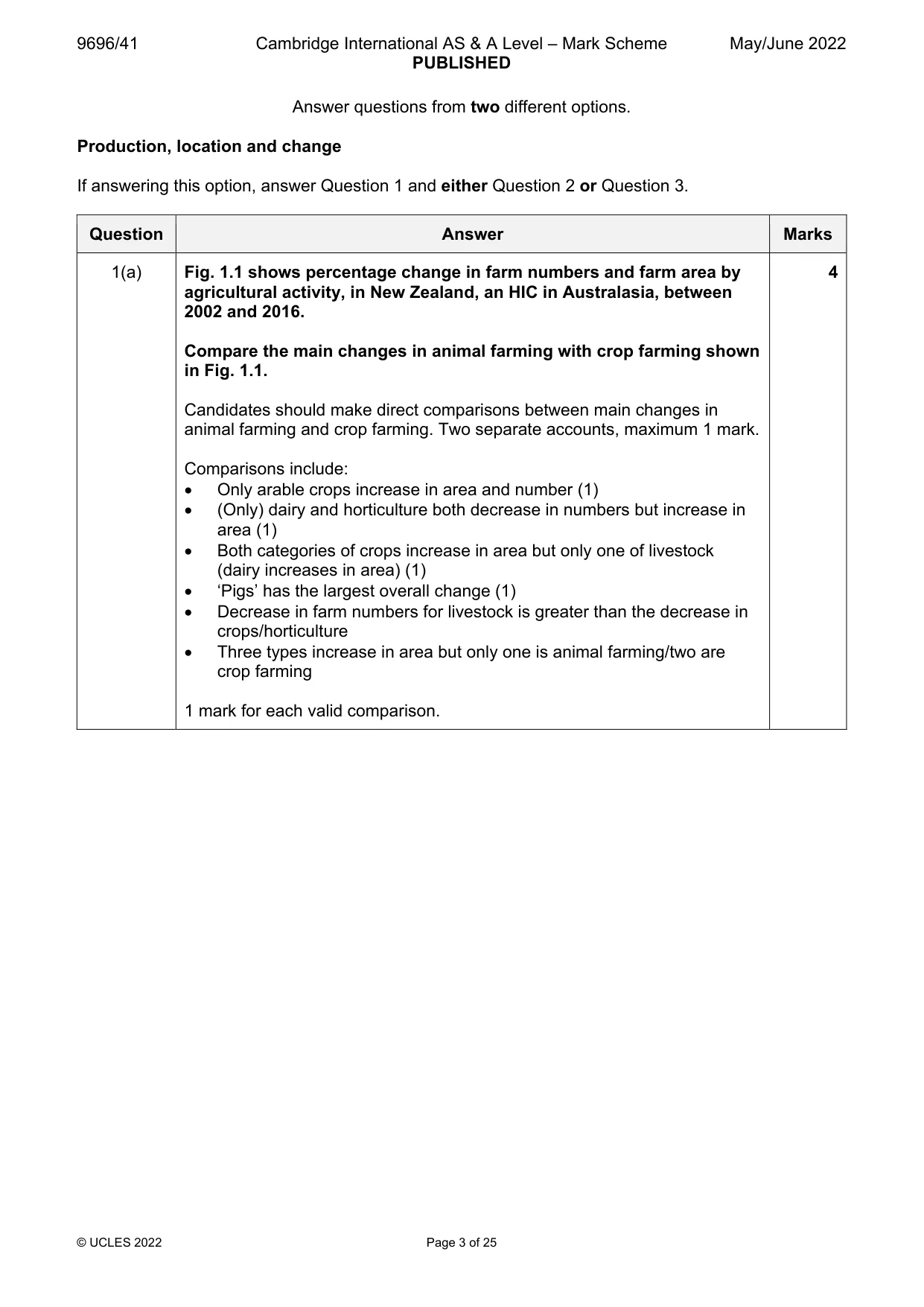
9696/41 Cambridge International AS & A Level – Mark Scheme PUBLISHED May/June 2022 © UCLES 2022 Page 3 of 25 Answer questions from two different options. Production, location and change If answering this option, answer Question 1 and either Question 2 or Question 3. Question Answer Marks 1(a) Fig. 1.1 shows percentage change in farm numbers and farm area by agricultural activity, in New Zealand, an HIC in Australasia, between 2002 and 2016. Compare the main changes in animal farming with crop farming shown in Fig. 1.1. Candidates should make direct comparisons between main changes in animal farming and crop farming. Two separate accounts, maximum 1 mark. Comparisons include: Only arable crops increase in area and number (1) (Only) dairy and horticulture both decrease in numbers but increase in area (1) Both categories of crops increase in area but only one of livestock (dairy increases in area) (1) ‘Pigs’ has the largest overall change (1) Decrease in farm numbers for livestock is greater than the decrease in crops/horticulture Three types increase in area but only one is animal farming/two are crop farming 1 mark for each valid comparison. 4
Mark scheme, page 4
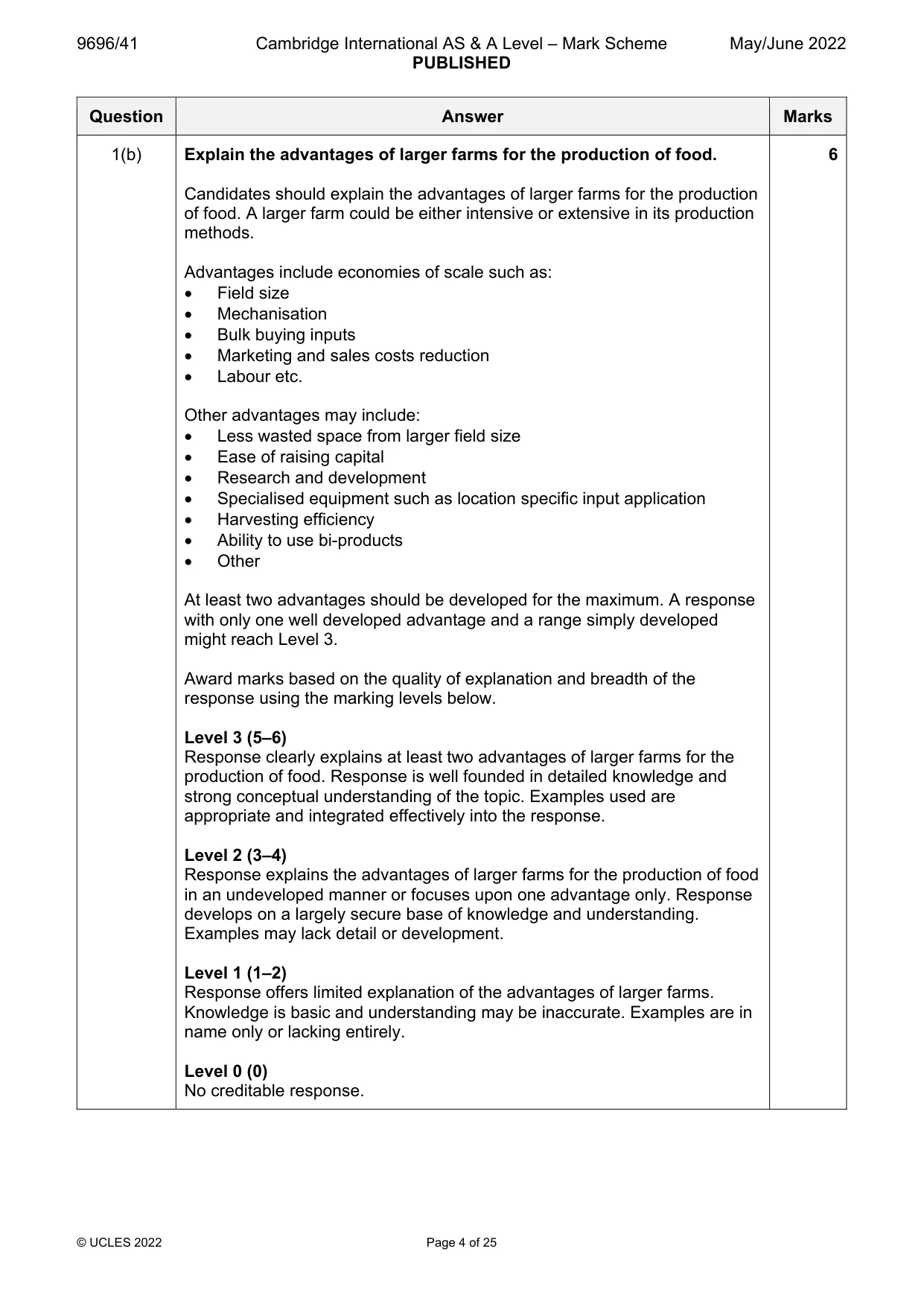
9696/41 Cambridge International AS & A Level – Mark Scheme PUBLISHED May/June 2022 © UCLES 2022 Page 4 of 25 Question Answer Marks 1(b) Explain the advantages of larger farms for the production of food. Candidates should explain the advantages of larger farms for the production of food. A larger farm could be either intensive or extensive in its production methods. Advantages include economies of scale such as: Field size Mechanisation Bulk buying inputs Marketing and sales costs reduction Labour etc. Other advantages may include: Less wasted space from larger field size Ease of raising capital Research and development Specialised equipment such as location specific input application Harvesting efficiency Ability to use bi-products Other At least two advantages should be developed for the maximum. A response with only one well developed advantage and a range simply developed might reach Level 3. Award marks based on the quality of explanation and breadth of the response using the marking levels below. Level 3 (5–6) Response clearly explains at least two advantages of larger farms for the production of food. Response is well founded in detailed knowledge and strong conceptual understanding of the topic. Examples used are appropriate and integrated effectively into the response. Level 2 (3–4) Response explains the advantages of larger farms for the production of food in an undeveloped manner or focuses upon one advantage only. Response develops on a largely secure base of knowledge and understanding. Examples may lack detail or development. Level 1 (1–2) Response offers limited explanation of the advantages of larger farms. Knowledge is basic and understanding may be inaccurate. Examples are in name only or lacking entirely. Level 0 (0) No creditable response. 6
Mark scheme, page 5
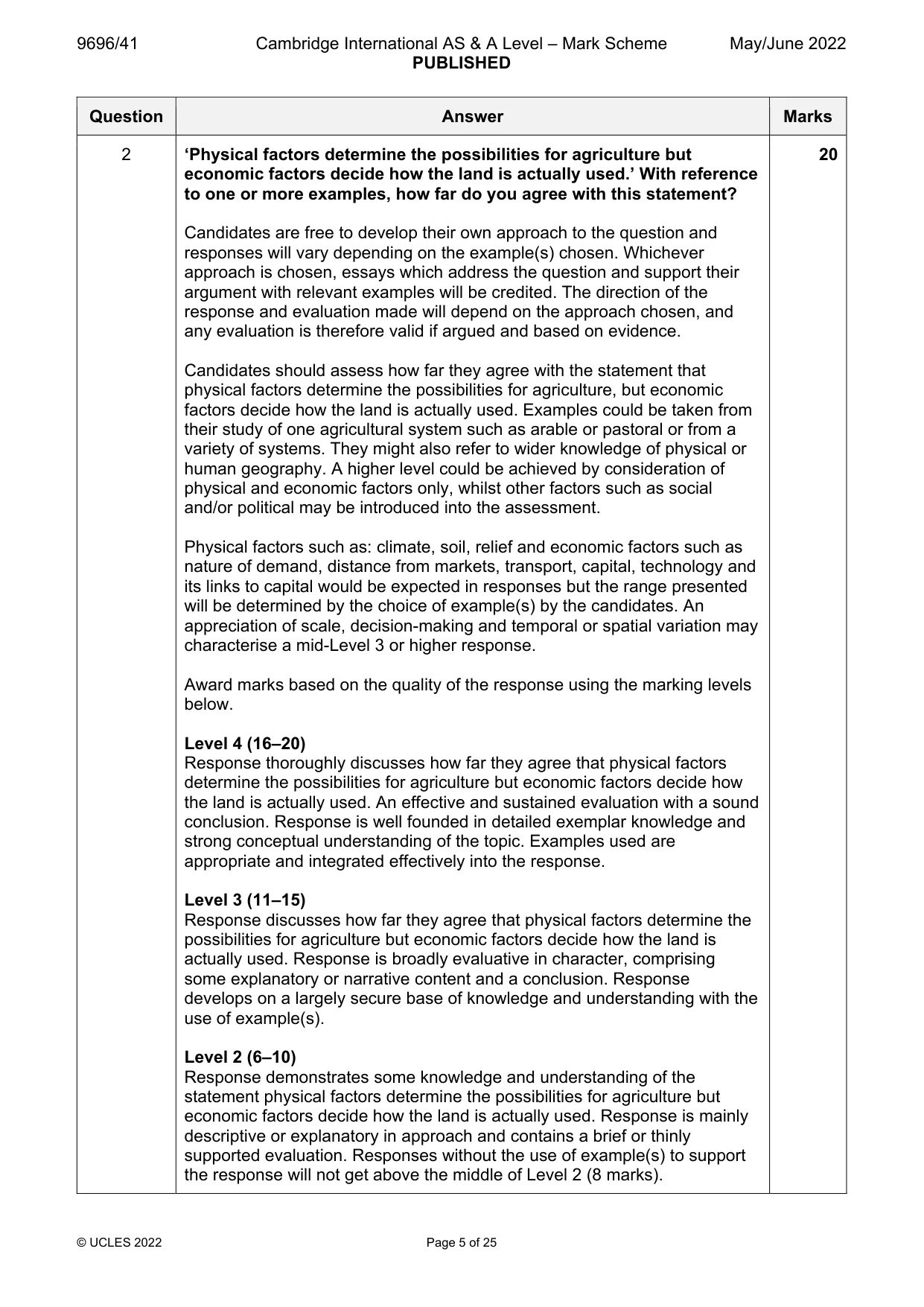
9696/41 Cambridge International AS & A Level – Mark Scheme PUBLISHED May/June 2022 © UCLES 2022 Page 5 of 25 Question Answer Marks 2 ‘Physical factors determine the possibilities for agriculture but economic factors decide how the land is actually used.’ With reference to one or more examples, how far do you agree with this statement? Candidates are free to develop their own approach to the question and responses will vary depending on the example(s) chosen. Whichever approach is chosen, essays which address the question and support their argument with relevant examples will be credited. The direction of the response and evaluation made will depend on the approach chosen, and any evaluation is therefore valid if argued and based on evidence. Candidates should assess how far they agree with the statement that physical factors determine the possibilities for agriculture, but economic factors decide how the land is actually used. Examples could be taken from their study of one agricultural system such as arable or pastoral or from a variety of systems. They might also refer to wider knowledge of physical or human geography. A higher level could be achieved by consideration of physical and economic factors only, whilst other factors such as social and/or political may be introduced into the assessment. Physical factors such as: climate, soil, relief and economic factors such as nature of demand, distance from markets, transport, capital, technology and its links to capital would be expected in responses but the range presented will be determined by the choice of example(s) by the candidates. An appreciation of scale, decision-making and temporal or spatial variation may characterise a mid-Level 3 or higher response. Award marks based on the quality of the response using the marking levels below. Level 4 (16–20) Response thoroughly discusses how far they agree that physical factors determine the possibilities for agriculture but economic factors decide how the land is actually used. An effective and sustained evaluation with a sound conclusion. Response is well founded in detailed exemplar knowledge and strong conceptual understanding of the topic. Examples used are appropriate and integrated effectively into the response. Level 3 (11–15) Response discusses how far they agree that physical factors determine the possibilities for agriculture but economic factors decide how the land is actually used. Response is broadly evaluative in character, comprising some explanatory or narrative content and a conclusion. Response develops on a largely secure base of knowledge and understanding with the use of example(s). Level 2 (6–10) Response demonstrates some knowledge and understanding of the statement physical factors determine the possibilities for agriculture but economic factors decide how the land is actually used. Response is mainly descriptive or explanatory in approach and contains a brief or thinly supported evaluation. Responses without the use of example(s) to support the response will not get above the middle of Level 2 (8 marks). 20
Mark scheme, page 6
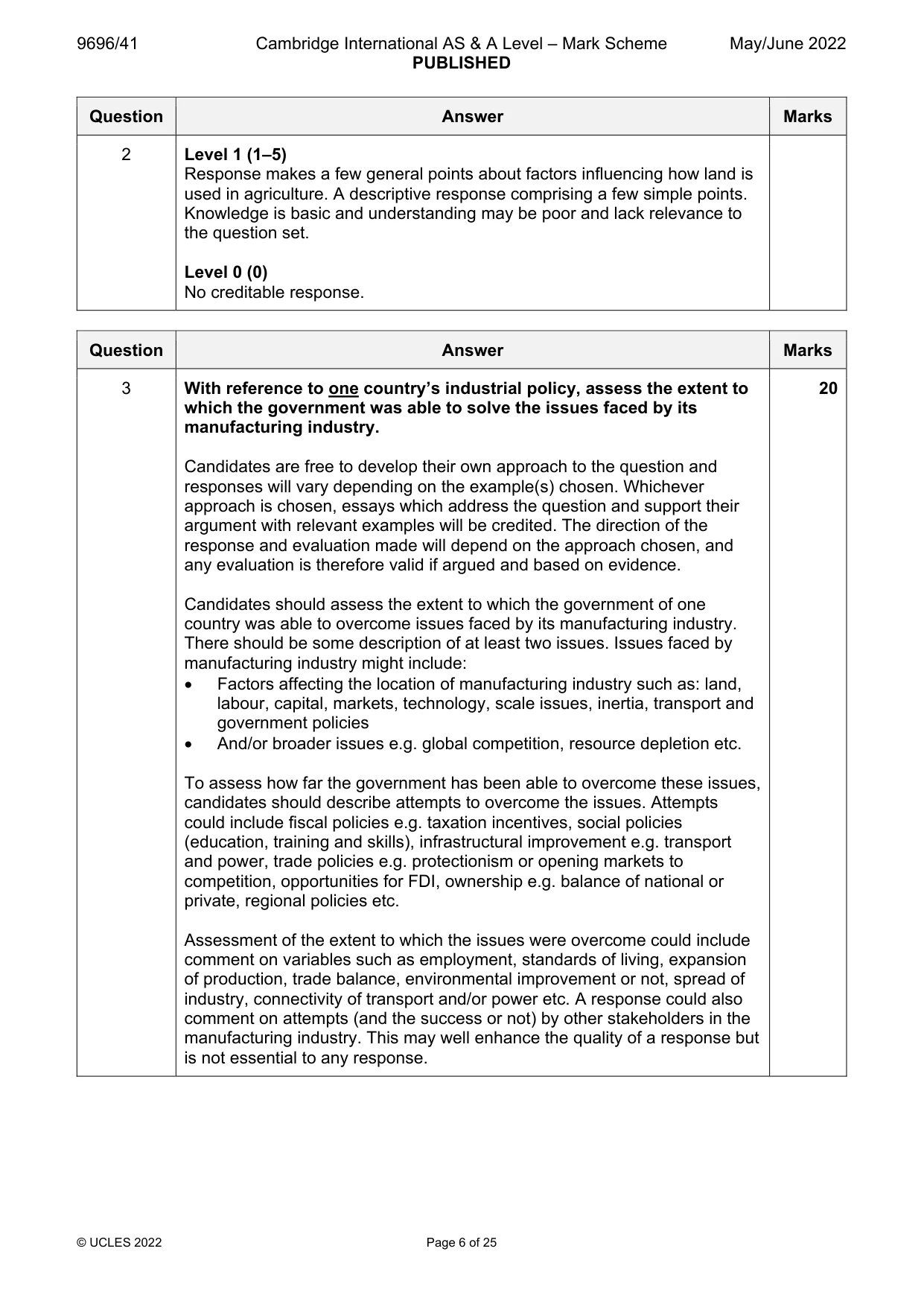
9696/41 Cambridge International AS & A Level – Mark Scheme PUBLISHED May/June 2022 © UCLES 2022 Page 6 of 25 Question Answer Marks 2 Level 1 (1–5) Response makes a few general points about factors influencing how land is used in agriculture. A descriptive response comprising a few simple points. Knowledge is basic and understanding may be poor and lack relevance to the question set. Level 0 (0) No creditable response. Question Answer Marks 3 With reference to one country’s industrial policy, assess the extent to which the government was able to solve the issues faced by its manufacturing industry. Candidates are free to develop their own approach to the question and responses will vary depending on the example(s) chosen. Whichever approach is chosen, essays which address the question and support their argument with relevant examples will be credited. The direction of the response and evaluation made will depend on the approach chosen, and any evaluation is therefore valid if argued and based on evidence. Candidates should assess the extent to which the government of one country was able to overcome issues faced by its manufacturing industry. There should be some description of at least two issues. Issues faced by manufacturing industry might include: Factors affecting the location of manufacturing industry such as: land, labour, capital, markets, technology, scale issues, inertia, transport and government policies And/or broader issues e.g. global competition, resource depletion etc. To assess how far the government has been able to overcome these issues, candidates should describe attempts to overcome the issues. Attempts could include fiscal policies e.g. taxation incentives, social policies (education, training and skills), infrastructural improvement e.g. transport and power, trade policies e.g. protectionism or opening markets to competition, opportunities for FDI, ownership e.g. balance of national or private, regional policies etc. Assessment of the extent to which the issues were overcome could include comment on variables such as employment, standards of living, expansion of production, trade balance, environmental improvement or not, spread of industry, connectivity of transport and/or power etc. A response could also comment on attempts (and the success or not) by other stakeholders in the manufacturing industry. This may well enhance the quality of a response but is not essential to any response. 20
Mark scheme, page 7
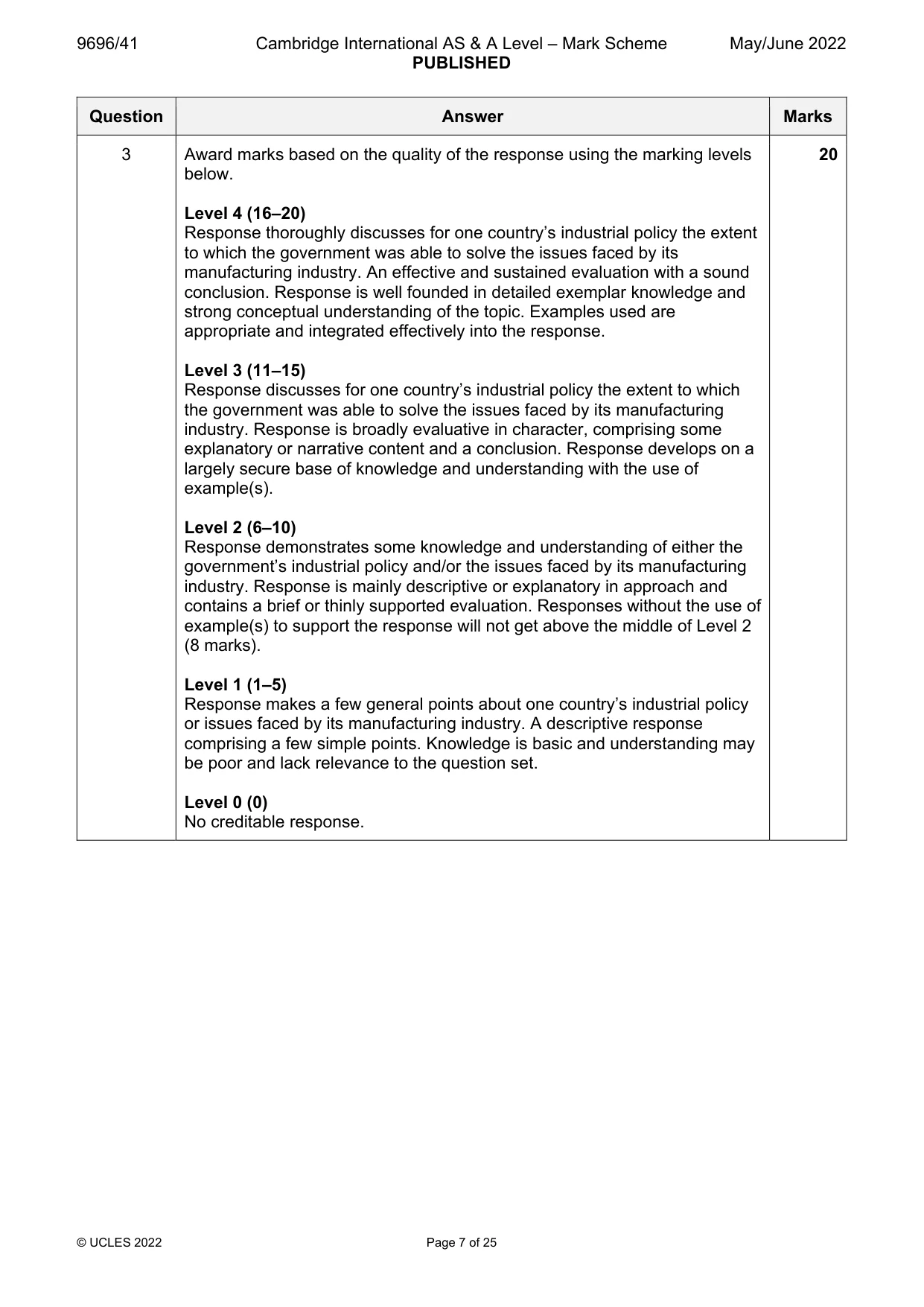
9696/41 Cambridge International AS & A Level – Mark Scheme PUBLISHED May/June 2022 © UCLES 2022 Page 7 of 25 Question Answer Marks 3 Award marks based on the quality of the response using the marking levels below. Level 4 (16–20) Response thoroughly discusses for one country’s industrial policy the extent to which the government was able to solve the issues faced by its manufacturing industry. An effective and sustained evaluation with a sound conclusion. Response is well founded in detailed exemplar knowledge and strong conceptual understanding of the topic. Examples used are appropriate and integrated effectively into the response. Level 3 (11–15) Response discusses for one country’s industrial policy the extent to which the government was able to solve the issues faced by its manufacturing industry. Response is broadly evaluative in character, comprising some explanatory or narrative content and a conclusion. Response develops on a largely secure base of knowledge and understanding with the use of example(s). Level 2 (6–10) Response demonstrates some knowledge and understanding of either the government’s industrial policy and/or the issues faced by its manufacturing industry. Response is mainly descriptive or explanatory in approach and contains a brief or thinly supported evaluation. Responses without the use of example(s) to support the response will not get above the middle of Level 2 (8 marks). Level 1 (1–5) Response makes a few general points about one country’s industrial policy or issues faced by its manufacturing industry. A descriptive response comprising a few simple points. Knowledge is basic and understanding may be poor and lack relevance to the question set. Level 0 (0) No creditable response. 20
Mark scheme, page 8
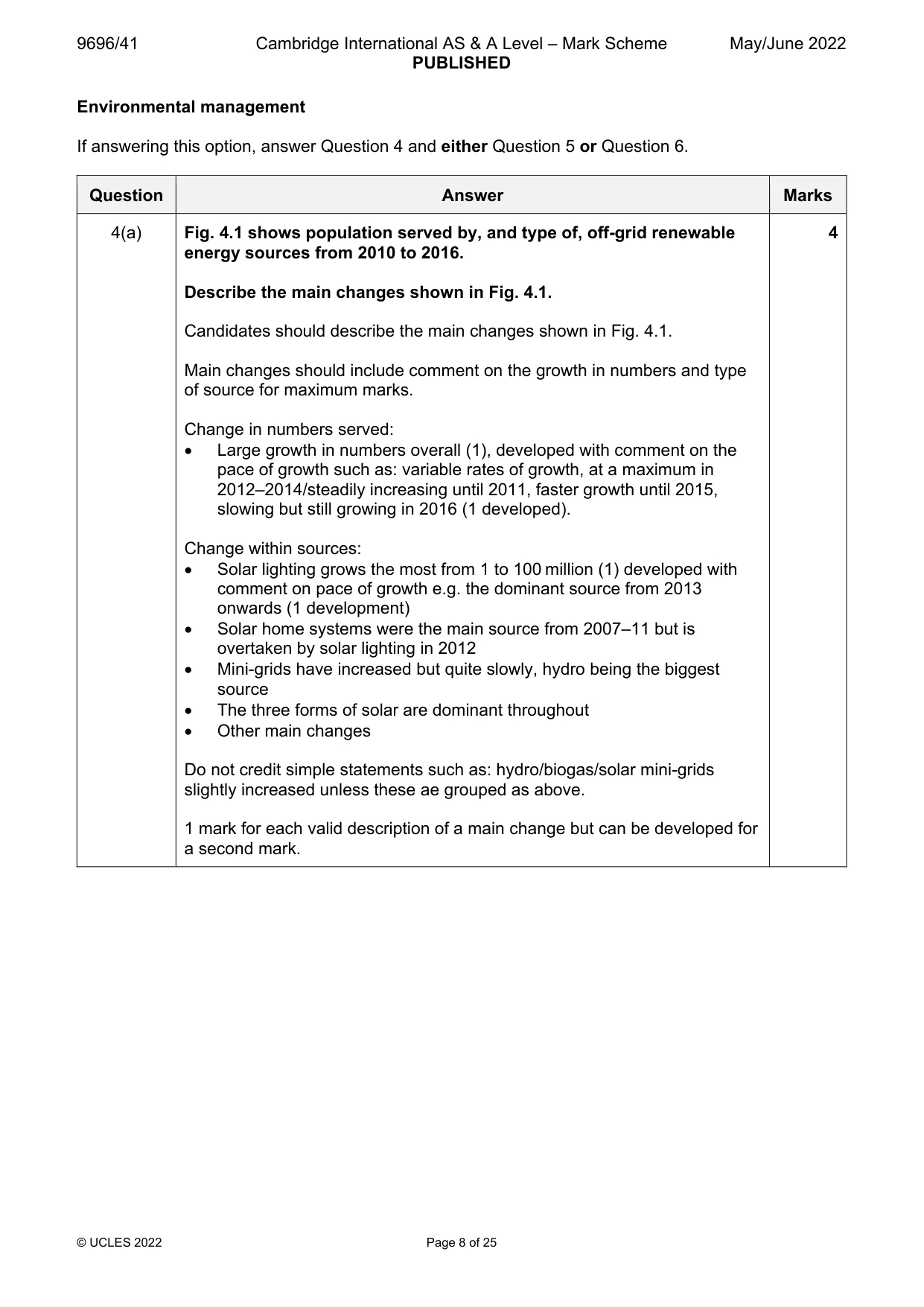
9696/41 Cambridge International AS & A Level – Mark Scheme PUBLISHED May/June 2022 © UCLES 2022 Page 8 of 25 Environmental management If answering this option, answer Question 4 and either Question 5 or Question 6. Question Answer Marks 4(a) Fig. 4.1 shows population served by, and type of, off-grid renewable energy sources from 2010 to 2016. Describe the main changes shown in Fig. 4.1. Candidates should describe the main changes shown in Fig. 4.1. Main changes should include comment on the growth in numbers and type of source for maximum marks. Change in numbers served: Large growth in numbers overall (1), developed with comment on the pace of growth such as: variable rates of growth, at a maximum in 2012–2014/steadily increasing until 2011, faster growth until 2015, slowing but still growing in 2016 (1 developed). Change within sources: Solar lighting grows the most from 1 to 100 million (1) developed with comment on pace of growth e.g. the dominant source from 2013 onwards (1 development) Solar home systems were the main source from 2007–11 but is overtaken by solar lighting in 2012 Mini-grids have increased but quite slowly, hydro being the biggest source The three forms of solar are dominant throughout Other main changes Do not credit simple statements such as: hydro/biogas/solar mini-grids slightly increased unless these ae grouped as above. 1 mark for each valid description of a main change but can be developed for a second mark. 4
Mark scheme, page 9
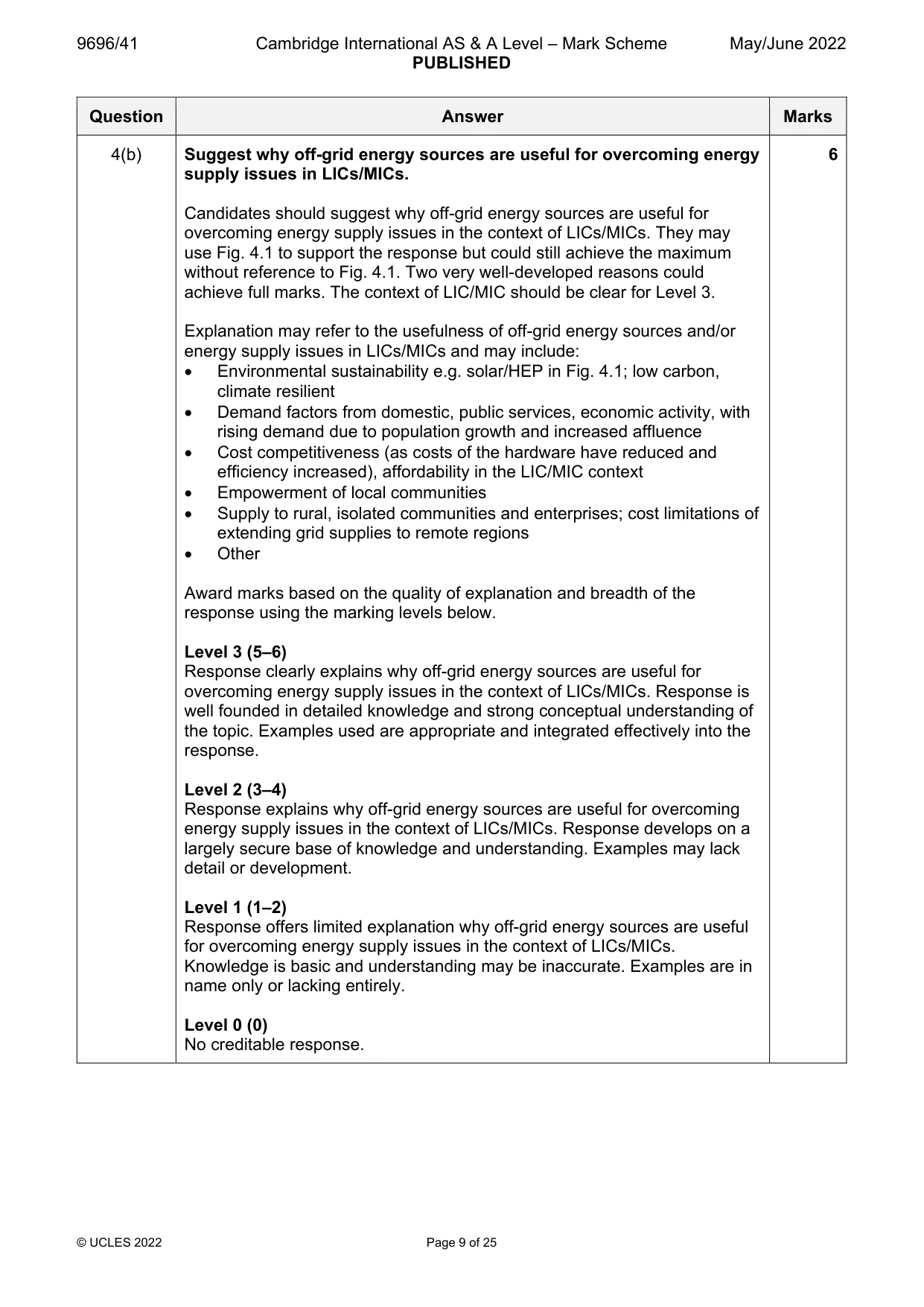
9696/41 Cambridge International AS & A Level – Mark Scheme PUBLISHED May/June 2022 © UCLES 2022 Page 9 of 25 Question Answer Marks 4(b) Suggest why off-grid energy sources are useful for overcoming energy supply issues in LICs/MICs. Candidates should suggest why off-grid energy sources are useful for overcoming energy supply issues in the context of LICs/MICs. They may use Fig. 4.1 to support the response but could still achieve the maximum without reference to Fig. 4.1. Two very well-developed reasons could achieve full marks. The context of LIC/MIC should be clear for Level 3. Explanation may refer to the usefulness of off-grid energy sources and/or energy supply issues in LICs/MICs and may include: Environmental sustainability e.g. solar/HEP in Fig. 4.1; low carbon, climate resilient Demand factors from domestic, public services, economic activity, with rising demand due to population growth and increased affluence Cost competitiveness (as costs of the hardware have reduced and efficiency increased), affordability in the LIC/MIC context Empowerment of local communities Supply to rural, isolated communities and enterprises; cost limitations of extending grid supplies to remote regions Other Award marks based on the quality of explanation and breadth of the response using the marking levels below. Level 3 (5–6) Response clearly explains why off-grid energy sources are useful for overcoming energy supply issues in the context of LICs/MICs. Response is well founded in detailed knowledge and strong conceptual understanding of the topic. Examples used are appropriate and integrated effectively into the response. Level 2 (3–4) Response explains why off-grid energy sources are useful for overcoming energy supply issues in the context of LICs/MICs. Response develops on a largely secure base of knowledge and understanding. Examples may lack detail or development. Level 1 (1–2) Response offers limited explanation why off-grid energy sources are useful for overcoming energy supply issues in the context of LICs/MICs. Knowledge is basic and understanding may be inaccurate. Examples are in name only or lacking entirely. Level 0 (0) No creditable response. 6
Mark scheme, page 10
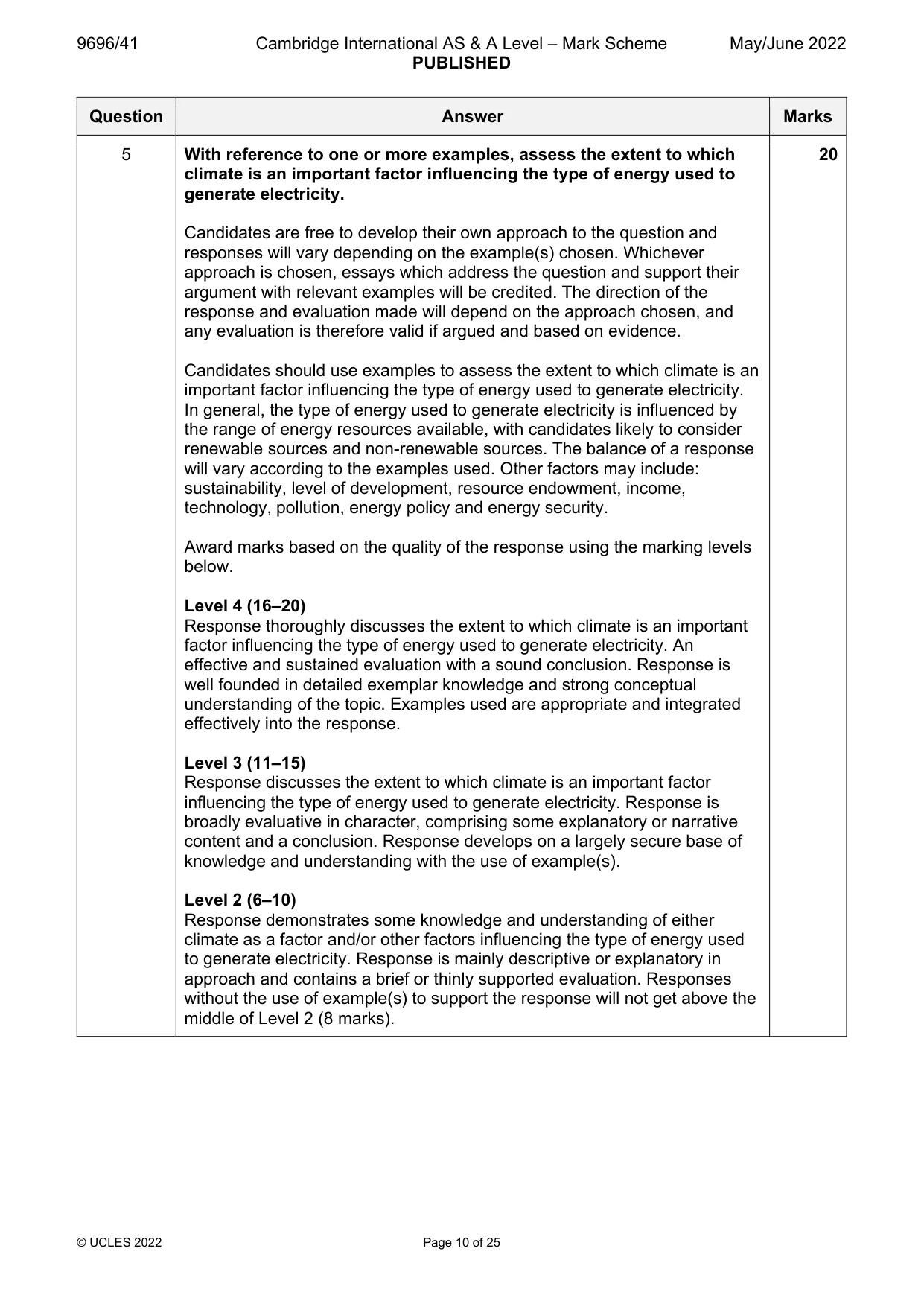
9696/41 Cambridge International AS & A Level – Mark Scheme PUBLISHED May/June 2022 © UCLES 2022 Page 10 of 25 Question Answer Marks 5 With reference to one or more examples, assess the extent to which climate is an important factor influencing the type of energy used to generate electricity. Candidates are free to develop their own approach to the question and responses will vary depending on the example(s) chosen. Whichever approach is chosen, essays which address the question and support their argument with relevant examples will be credited. The direction of the response and evaluation made will depend on the approach chosen, and any evaluation is therefore valid if argued and based on evidence. Candidates should use examples to assess the extent to which climate is an important factor influencing the type of energy used to generate electricity. In general, the type of energy used to generate electricity is influenced by the range of energy resources available, with candidates likely to consider renewable sources and non-renewable sources. The balance of a response will vary according to the examples used. Other factors may include: sustainability, level of development, resource endowment, income, technology, pollution, energy policy and energy security. Award marks based on the quality of the response using the marking levels below. Level 4 (16–20) Response thoroughly discusses the extent to which climate is an important factor influencing the type of energy used to generate electricity. An effective and sustained evaluation with a sound conclusion. Response is well founded in detailed exemplar knowledge and strong conceptual understanding of the topic. Examples used are appropriate and integrated effectively into the response. Level 3 (11–15) Response discusses the extent to which climate is an important factor influencing the type of energy used to generate electricity. Response is broadly evaluative in character, comprising some explanatory or narrative content and a conclusion. Response develops on a largely secure base of knowledge and understanding with the use of example(s). Level 2 (6–10) Response demonstrates some knowledge and understanding of either climate as a factor and/or other factors influencing the type of energy used to generate electricity. Response is mainly descriptive or explanatory in approach and contains a brief or thinly supported evaluation. Responses without the use of example(s) to support the response will not get above the middle of Level 2 (8 marks). 20
Mark scheme, page 11
9696/41 Cambridge International AS & A Level – Mark Scheme PUBLISHED May/June 2022 © UCLES 2022 Page 11 of 25 Question Answer Marks 5 Level 1 (1–5) Response makes a few general points about either climate as a factor or other factors influencing the type of energy used to generate electricity. A descriptive response comprising a few simple points. Knowledge is basic and understanding may be poor and lack relevance to the question set. Level 0 (0) No creditable response.
Mark scheme, page 12
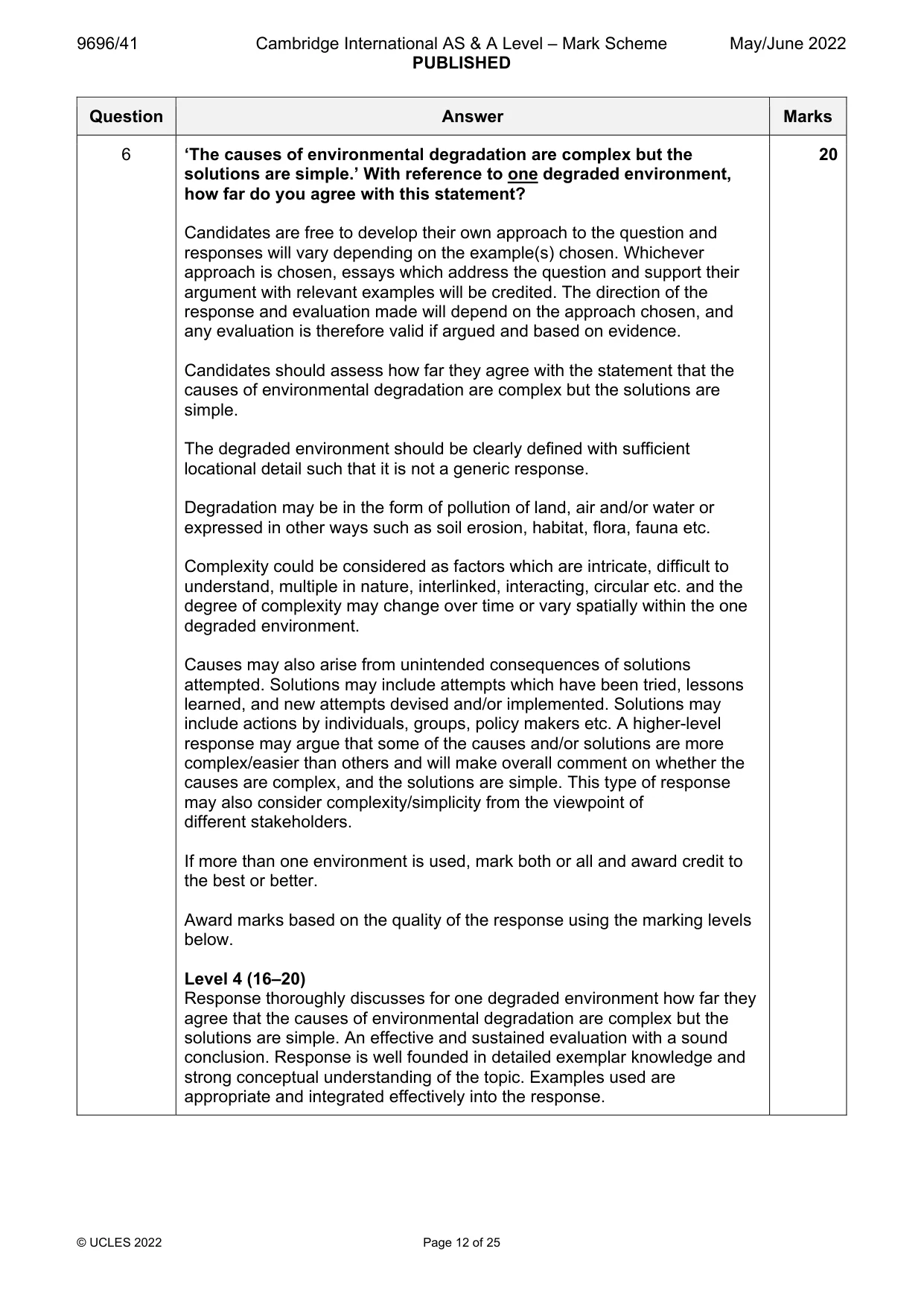
9696/41 Cambridge International AS & A Level – Mark Scheme PUBLISHED May/June 2022 © UCLES 2022 Page 12 of 25 Question Answer Marks 6 ‘The causes of environmental degradation are complex but the solutions are simple.’ With reference to one degraded environment, how far do you agree with this statement? Candidates are free to develop their own approach to the question and responses will vary depending on the example(s) chosen. Whichever approach is chosen, essays which address the question and support their argument with relevant examples will be credited. The direction of the response and evaluation made will depend on the approach chosen, and any evaluation is therefore valid if argued and based on evidence. Candidates should assess how far they agree with the statement that the causes of environmental degradation are complex but the solutions are simple. The degraded environment should be clearly defined with sufficient locational detail such that it is not a generic response. Degradation may be in the form of pollution of land, air and/or water or expressed in other ways such as soil erosion, habitat, flora, fauna etc. Complexity could be considered as factors which are intricate, difficult to understand, multiple in nature, interlinked, interacting, circular etc. and the degree of complexity may change over time or vary spatially within the one degraded environment. Causes may also arise from unintended consequences of solutions attempted. Solutions may include attempts which have been tried, lessons learned, and new attempts devised and/or implemented. Solutions may include actions by individuals, groups, policy makers etc. A higher-level response may argue that some of the causes and/or solutions are more complex/easier than others and will make overall comment on whether the causes are complex, and the solutions are simple. This type of response may also consider complexity/simplicity from the viewpoint of different stakeholders. If more than one environment is used, mark both or all and award credit to the best or better. Award marks based on the quality of the response using the marking levels below. Level 4 (16–20) Response thoroughly discusses for one degraded environment how far they agree that the causes of environmental degradation are complex but the solutions are simple. An effective and sustained evaluation with a sound conclusion. Response is well founded in detailed exemplar knowledge and strong conceptual understanding of the topic. Examples used are appropriate and integrated effectively into the response. 20
Mark scheme, page 13
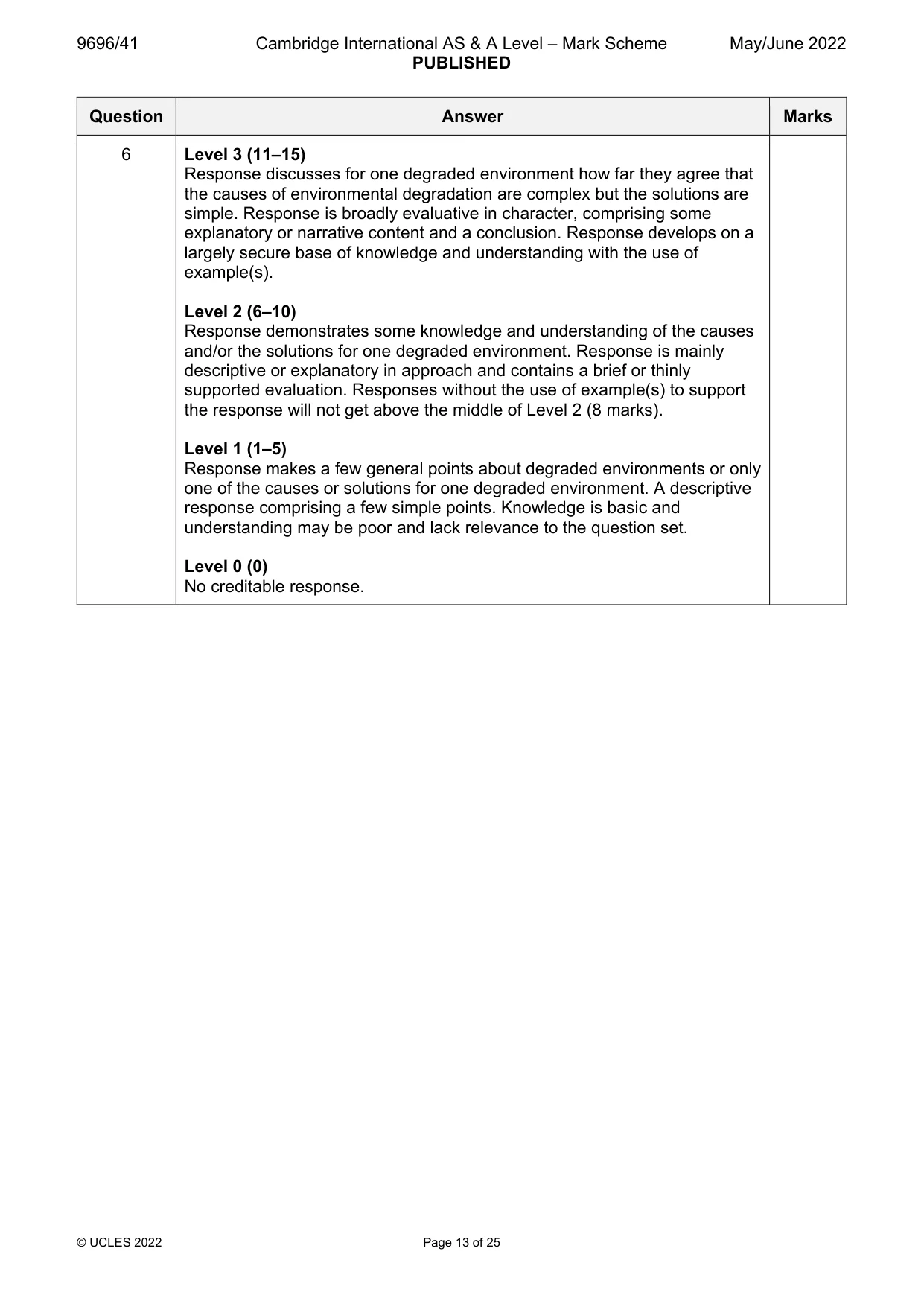
9696/41 Cambridge International AS & A Level – Mark Scheme PUBLISHED May/June 2022 © UCLES 2022 Page 13 of 25 Question Answer Marks 6 Level 3 (11–15) Response discusses for one degraded environment how far they agree that the causes of environmental degradation are complex but the solutions are simple. Response is broadly evaluative in character, comprising some explanatory or narrative content and a conclusion. Response develops on a largely secure base of knowledge and understanding with the use of example(s). Level 2 (6–10) Response demonstrates some knowledge and understanding of the causes and/or the solutions for one degraded environment. Response is mainly descriptive or explanatory in approach and contains a brief or thinly supported evaluation. Responses without the use of example(s) to support the response will not get above the middle of Level 2 (8 marks). Level 1 (1–5) Response makes a few general points about degraded environments or only one of the causes or solutions for one degraded environment. A descriptive response comprising a few simple points. Knowledge is basic and understanding may be poor and lack relevance to the question set. Level 0 (0) No creditable response.
Mark scheme, page 14
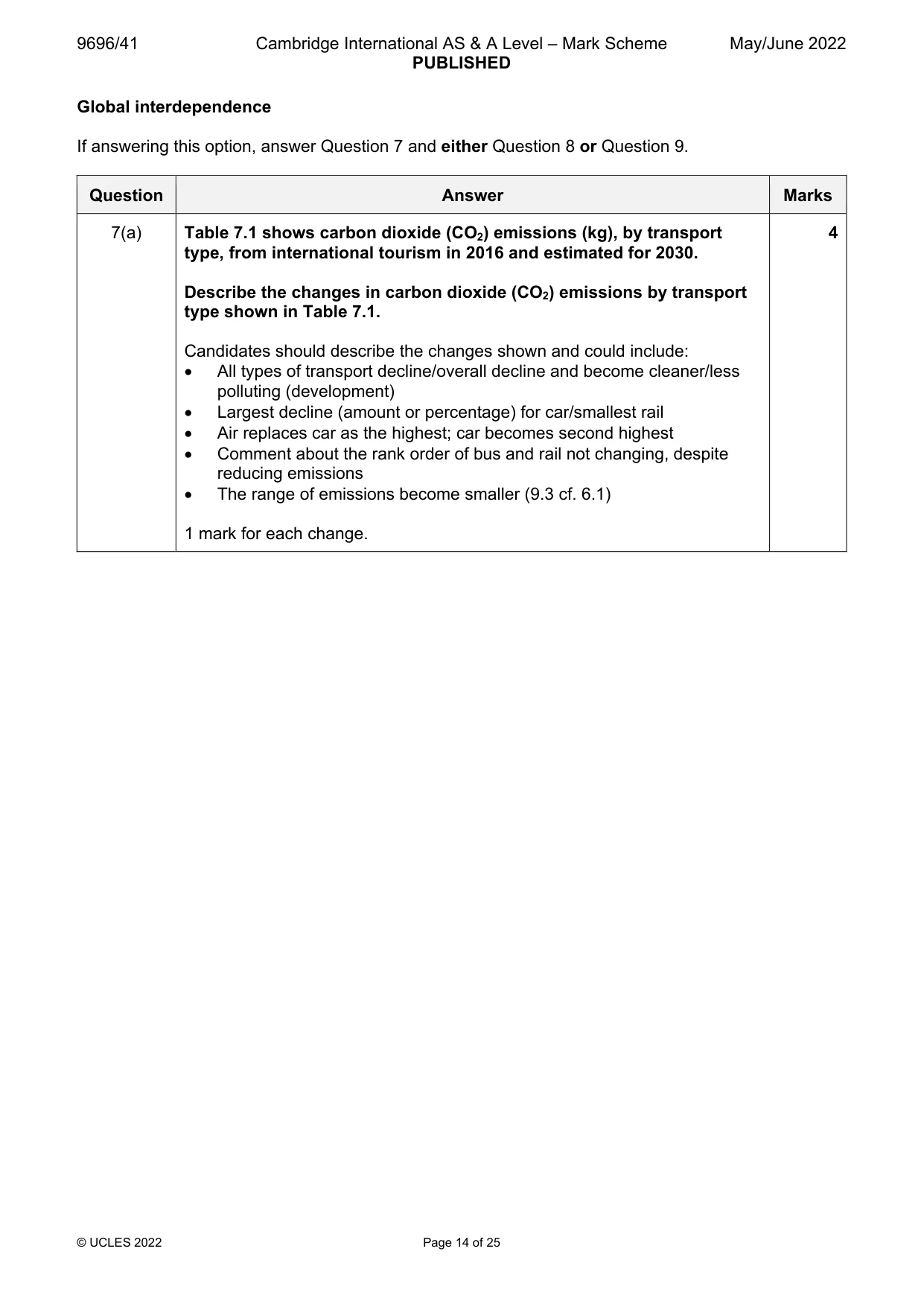
9696/41 Cambridge International AS & A Level – Mark Scheme PUBLISHED May/June 2022 © UCLES 2022 Page 14 of 25 Global interdependence If answering this option, answer Question 7 and either Question 8 or Question 9. Question Answer Marks 7(a) Table 7.1 shows carbon dioxide (CO2) emissions (kg), by transport type, from international tourism in 2016 and estimated for 2030. Describe the changes in carbon dioxide (CO2) emissions by transport type shown in Table 7.1. Candidates should describe the changes shown and could include: All types of transport decline/overall decline and become cleaner/less polluting (development) Largest decline (amount or percentage) for car/smallest rail Air replaces car as the highest; car becomes second highest Comment about the rank order of bus and rail not changing, despite reducing emissions The range of emissions become smaller (9.3 cf. 6.1) 1 mark for each change. 4
Mark scheme, page 15
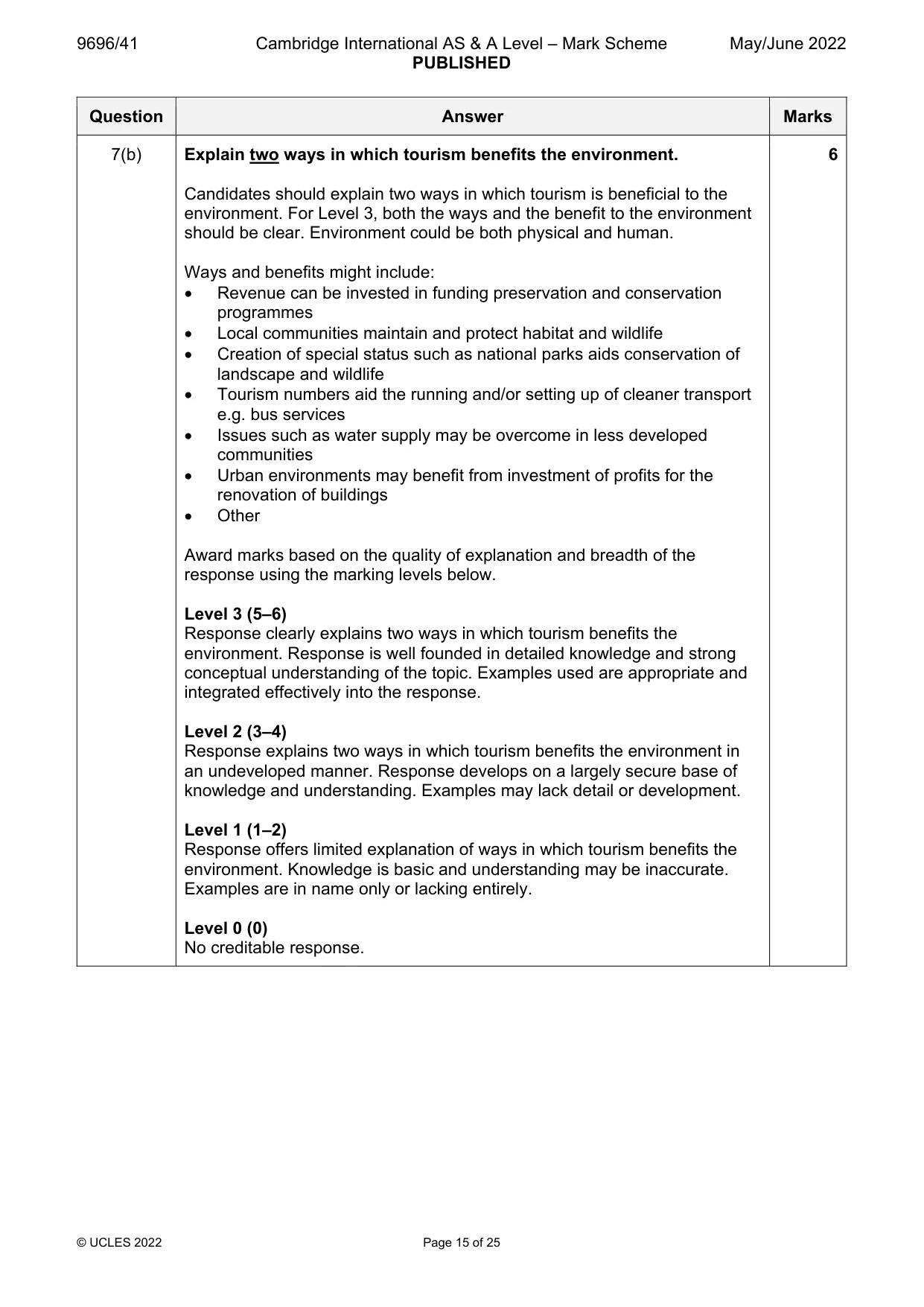
9696/41 Cambridge International AS & A Level – Mark Scheme PUBLISHED May/June 2022 © UCLES 2022 Page 15 of 25 Question Answer Marks 7(b) Explain two ways in which tourism benefits the environment. Candidates should explain two ways in which tourism is beneficial to the environment. For Level 3, both the ways and the benefit to the environment should be clear. Environment could be both physical and human. Ways and benefits might include: Revenue can be invested in funding preservation and conservation programmes Local communities maintain and protect habitat and wildlife Creation of special status such as national parks aids conservation of landscape and wildlife Tourism numbers aid the running and/or setting up of cleaner transport e.g. bus services Issues such as water supply may be overcome in less developed communities Urban environments may benefit from investment of profits for the renovation of buildings Other Award marks based on the quality of explanation and breadth of the response using the marking levels below. Level 3 (5–6) Response clearly explains two ways in which tourism benefits the environment. Response is well founded in detailed knowledge and strong conceptual understanding of the topic. Examples used are appropriate and integrated effectively into the response. Level 2 (3–4) Response explains two ways in which tourism benefits the environment in an undeveloped manner. Response develops on a largely secure base of knowledge and understanding. Examples may lack detail or development. Level 1 (1–2) Response offers limited explanation of ways in which tourism benefits the environment. Knowledge is basic and understanding may be inaccurate. Examples are in name only or lacking entirely. Level 0 (0) No creditable response. 6
Mark scheme, page 16
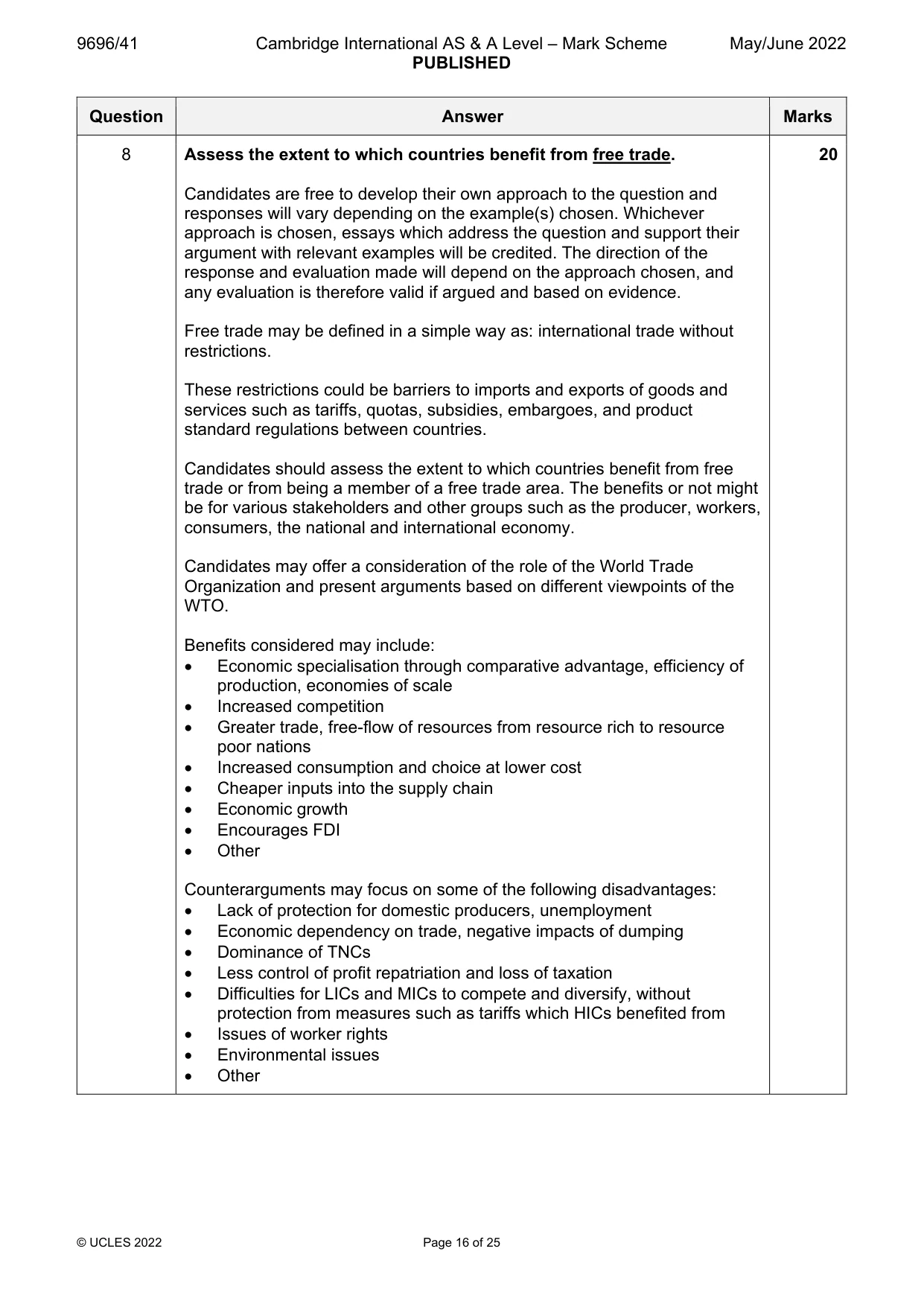
9696/41 Cambridge International AS & A Level – Mark Scheme PUBLISHED May/June 2022 © UCLES 2022 Page 16 of 25 Question Answer Marks 8 Assess the extent to which countries benefit from free trade. Candidates are free to develop their own approach to the question and responses will vary depending on the example(s) chosen. Whichever approach is chosen, essays which address the question and support their argument with relevant examples will be credited. The direction of the response and evaluation made will depend on the approach chosen, and any evaluation is therefore valid if argued and based on evidence. Free trade may be defined in a simple way as: international trade without restrictions. These restrictions could be barriers to imports and exports of goods and services such as tariffs, quotas, subsidies, embargoes, and product standard regulations between countries. Candidates should assess the extent to which countries benefit from free trade or from being a member of a free trade area. The benefits or not might be for various stakeholders and other groups such as the producer, workers, consumers, the national and international economy. Candidates may offer a consideration of the role of the World Trade Organization and present arguments based on different viewpoints of the WTO. Benefits considered may include: Economic specialisation through comparative advantage, efficiency of production, economies of scale Increased competition Greater trade, free-flow of resources from resource rich to resource poor nations Increased consumption and choice at lower cost Cheaper inputs into the supply chain Economic growth Encourages FDI Other Counterarguments may focus on some of the following disadvantages: Lack of protection for domestic producers, unemployment Economic dependency on trade, negative impacts of dumping Dominance of TNCs Less control of profit repatriation and loss of taxation Difficulties for LICs and MICs to compete and diversify, without protection from measures such as tariffs which HICs benefited from Issues of worker rights Environmental issues Other 20
Mark scheme, page 17
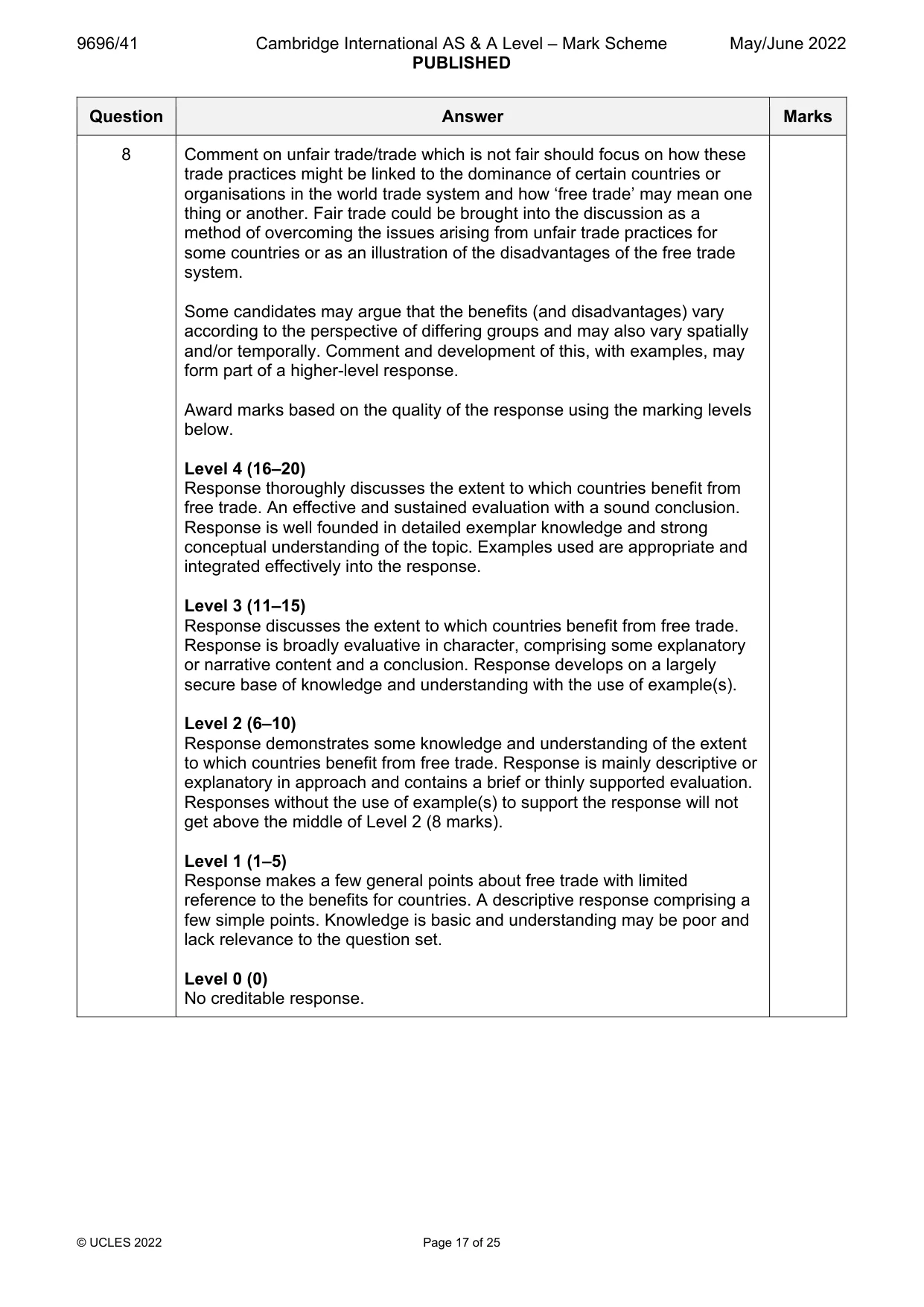
9696/41 Cambridge International AS & A Level – Mark Scheme PUBLISHED May/June 2022 © UCLES 2022 Page 17 of 25 Question Answer Marks 8 Comment on unfair trade/trade which is not fair should focus on how these trade practices might be linked to the dominance of certain countries or organisations in the world trade system and how ‘free trade’ may mean one thing or another. Fair trade could be brought into the discussion as a method of overcoming the issues arising from unfair trade practices for some countries or as an illustration of the disadvantages of the free trade system. Some candidates may argue that the benefits (and disadvantages) vary according to the perspective of differing groups and may also vary spatially and/or temporally. Comment and development of this, with examples, may form part of a higher-level response. Award marks based on the quality of the response using the marking levels below. Level 4 (16–20) Response thoroughly discusses the extent to which countries benefit from free trade. An effective and sustained evaluation with a sound conclusion. Response is well founded in detailed exemplar knowledge and strong conceptual understanding of the topic. Examples used are appropriate and integrated effectively into the response. Level 3 (11–15) Response discusses the extent to which countries benefit from free trade. Response is broadly evaluative in character, comprising some explanatory or narrative content and a conclusion. Response develops on a largely secure base of knowledge and understanding with the use of example(s). Level 2 (6–10) Response demonstrates some knowledge and understanding of the extent to which countries benefit from free trade. Response is mainly descriptive or explanatory in approach and contains a brief or thinly supported evaluation. Responses without the use of example(s) to support the response will not get above the middle of Level 2 (8 marks). Level 1 (1–5) Response makes a few general points about free trade with limited reference to the benefits for countries. A descriptive response comprising a few simple points. Knowledge is basic and understanding may be poor and lack relevance to the question set. Level 0 (0) No creditable response.
Mark scheme, page 18
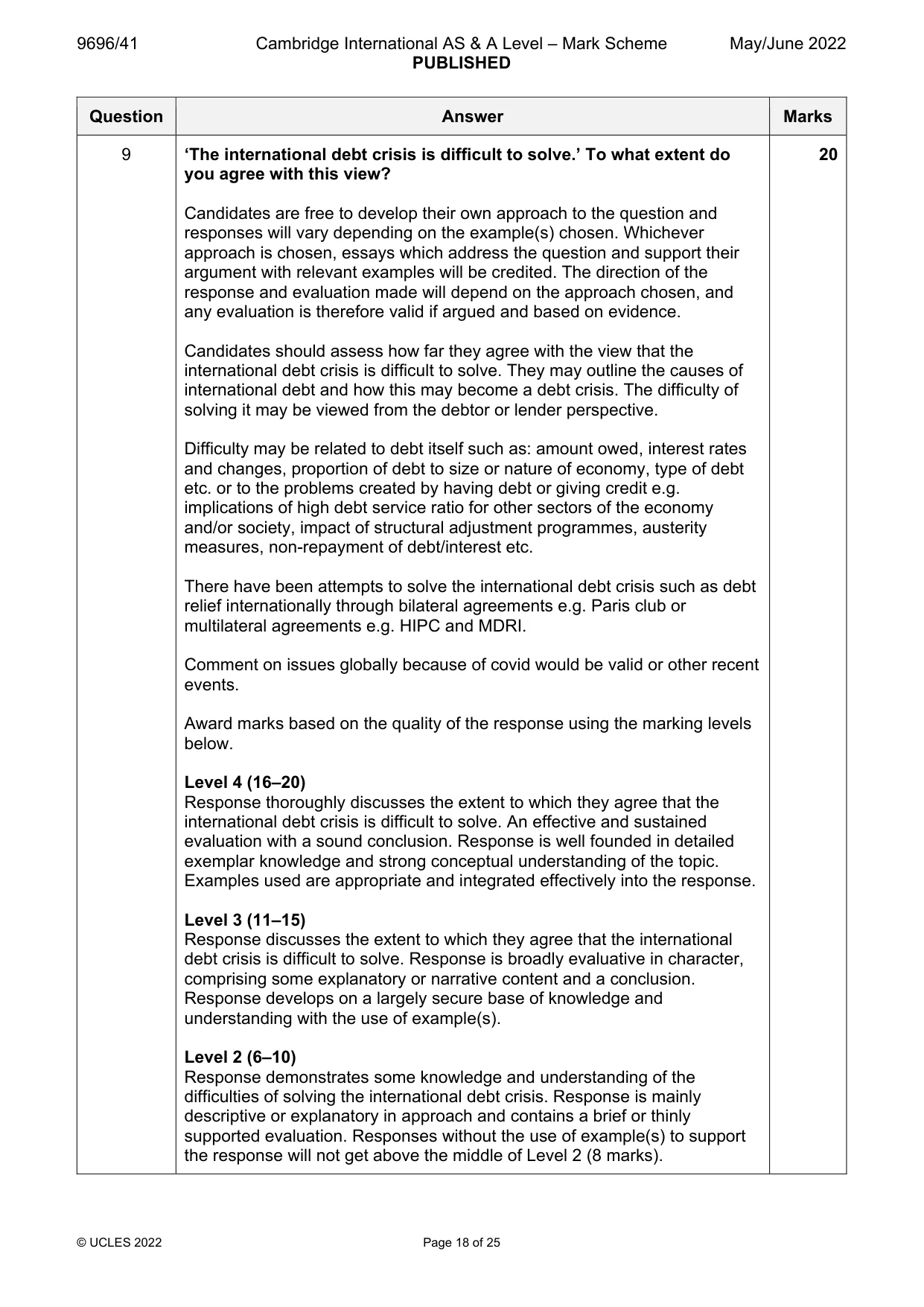
9696/41 Cambridge International AS & A Level – Mark Scheme PUBLISHED May/June 2022 © UCLES 2022 Page 18 of 25 Question Answer Marks 9 ‘The international debt crisis is difficult to solve.’ To what extent do you agree with this view? Candidates are free to develop their own approach to the question and responses will vary depending on the example(s) chosen. Whichever approach is chosen, essays which address the question and support their argument with relevant examples will be credited. The direction of the response and evaluation made will depend on the approach chosen, and any evaluation is therefore valid if argued and based on evidence. Candidates should assess how far they agree with the view that the international debt crisis is difficult to solve. They may outline the causes of international debt and how this may become a debt crisis. The difficulty of solving it may be viewed from the debtor or lender perspective. Difficulty may be related to debt itself such as: amount owed, interest rates and changes, proportion of debt to size or nature of economy, type of debt etc. or to the problems created by having debt or giving credit e.g. implications of high debt service ratio for other sectors of the economy and/or society, impact of structural adjustment programmes, austerity measures, non-repayment of debt/interest etc. There have been attempts to solve the international debt crisis such as debt relief internationally through bilateral agreements e.g. Paris club or multilateral agreements e.g. HIPC and MDRI. Comment on issues globally because of covid would be valid or other recent events. Award marks based on the quality of the response using the marking levels below. Level 4 (16–20) Response thoroughly discusses the extent to which they agree that the international debt crisis is difficult to solve. An effective and sustained evaluation with a sound conclusion. Response is well founded in detailed exemplar knowledge and strong conceptual understanding of the topic. Examples used are appropriate and integrated effectively into the response. Level 3 (11–15) Response discusses the extent to which they agree that the international debt crisis is difficult to solve. Response is broadly evaluative in character, comprising some explanatory or narrative content and a conclusion. Response develops on a largely secure base of knowledge and understanding with the use of example(s). Level 2 (6–10) Response demonstrates some knowledge and understanding of the difficulties of solving the international debt crisis. Response is mainly descriptive or explanatory in approach and contains a brief or thinly supported evaluation. Responses without the use of example(s) to support the response will not get above the middle of Level 2 (8 marks). 20
Mark scheme, page 19
9696/41 Cambridge International AS & A Level – Mark Scheme PUBLISHED May/June 2022 © UCLES 2022 Page 19 of 25 Question Answer Marks 9 Level 1 (1–5) Response makes a few general points about the international debt crisis. A descriptive response comprising a few simple points. Knowledge is basic and understanding may be poor and lack relevance to the question set. Level 0 (0) No creditable response.
Mark scheme, page 20
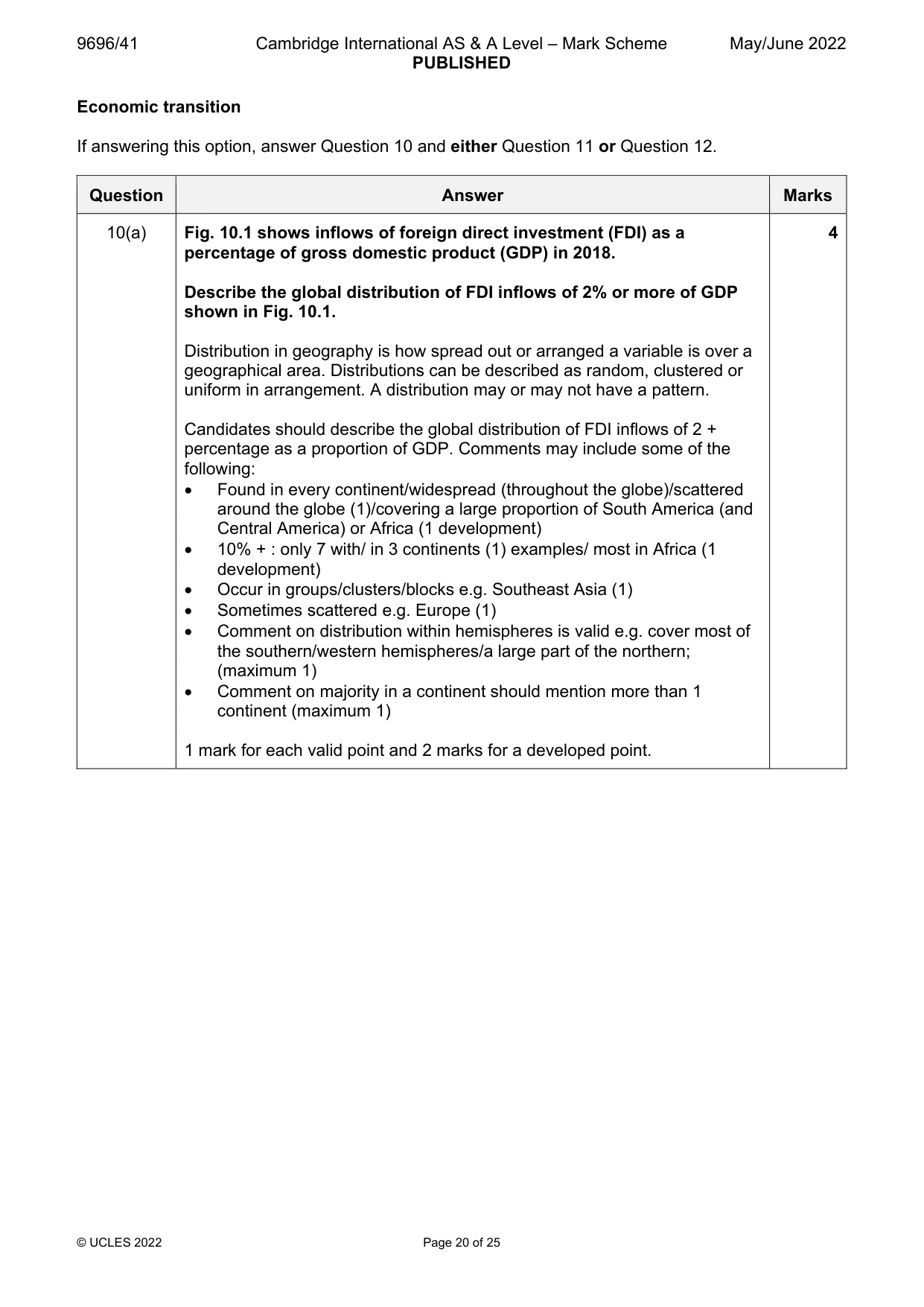
9696/41 Cambridge International AS & A Level – Mark Scheme PUBLISHED May/June 2022 © UCLES 2022 Page 20 of 25 Economic transition If answering this option, answer Question 10 and either Question 11 or Question 12. Question Answer Marks 10(a) Fig. 10.1 shows inflows of foreign direct investment (FDI) as a percentage of gross domestic product (GDP) in 2018. Describe the global distribution of FDI inflows of 2% or more of GDP shown in Fig. 10.1. Distribution in geography is how spread out or arranged a variable is over a geographical area. Distributions can be described as random, clustered or uniform in arrangement. A distribution may or may not have a pattern. Candidates should describe the global distribution of FDI inflows of 2 + percentage as a proportion of GDP. Comments may include some of the following: Found in every continent/widespread (throughout the globe)/scattered around the globe (1)/covering a large proportion of South America (and Central America) or Africa (1 development) 10% + : only 7 with/ in 3 continents (1) examples/ most in Africa (1 development) Occur in groups/clusters/blocks e.g. Southeast Asia (1) Sometimes scattered e.g. Europe (1) Comment on distribution within hemispheres is valid e.g. cover most of the southern/western hemispheres/a large part of the northern; (maximum 1) Comment on majority in a continent should mention more than 1 continent (maximum 1) 1 mark for each valid point and 2 marks for a developed point. 4
Mark scheme, page 21
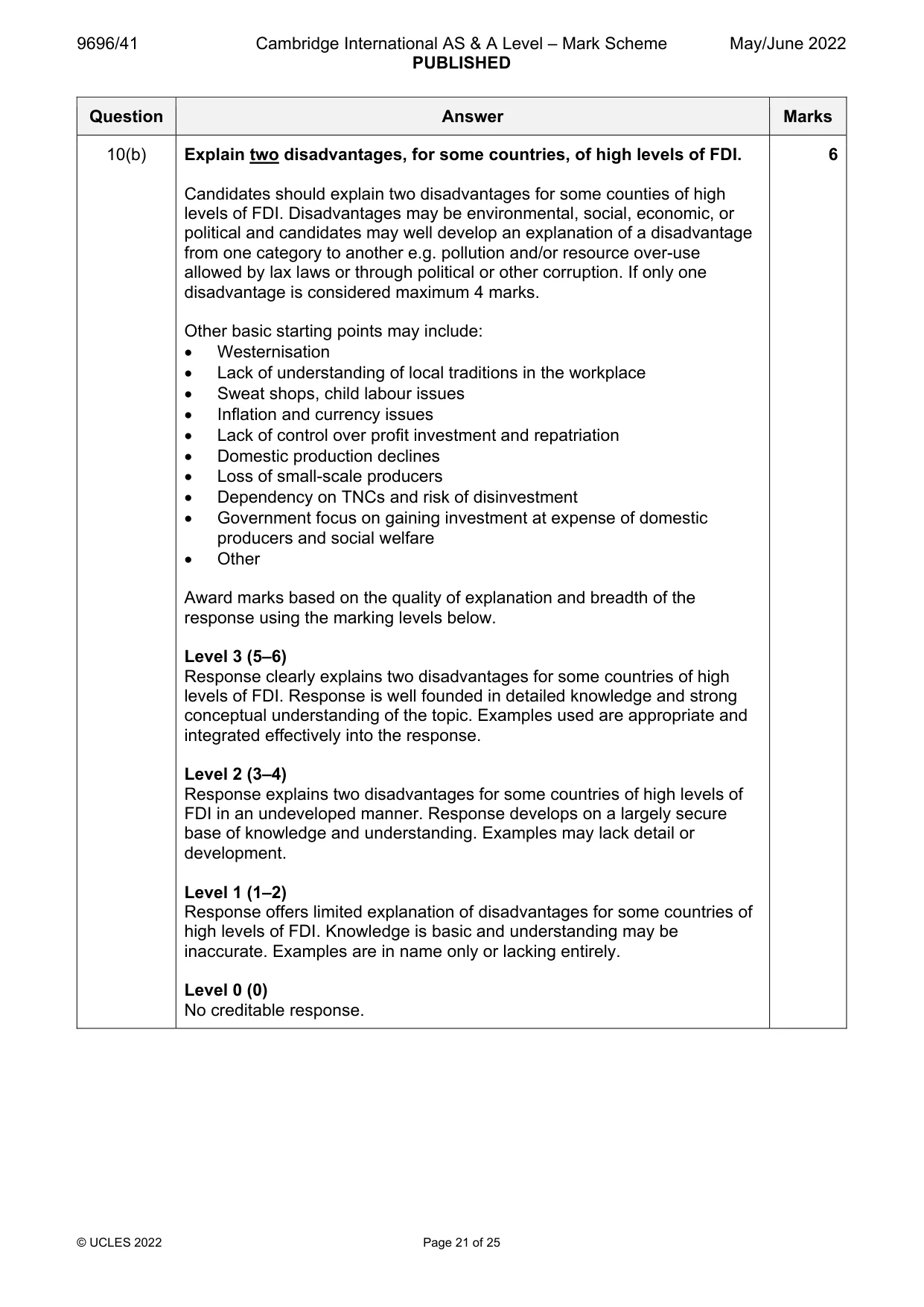
9696/41 Cambridge International AS & A Level – Mark Scheme PUBLISHED May/June 2022 © UCLES 2022 Page 21 of 25 Question Answer Marks 10(b) Explain two disadvantages, for some countries, of high levels of FDI. Candidates should explain two disadvantages for some counties of high levels of FDI. Disadvantages may be environmental, social, economic, or political and candidates may well develop an explanation of a disadvantage from one category to another e.g. pollution and/or resource over-use allowed by lax laws or through political or other corruption. If only one disadvantage is considered maximum 4 marks. Other basic starting points may include: Westernisation Lack of understanding of local traditions in the workplace Sweat shops, child labour issues Inflation and currency issues Lack of control over profit investment and repatriation Domestic production declines Loss of small-scale producers Dependency on TNCs and risk of disinvestment Government focus on gaining investment at expense of domestic producers and social welfare Other Award marks based on the quality of explanation and breadth of the response using the marking levels below. Level 3 (5–6) Response clearly explains two disadvantages for some countries of high levels of FDI. Response is well founded in detailed knowledge and strong conceptual understanding of the topic. Examples used are appropriate and integrated effectively into the response. Level 2 (3–4) Response explains two disadvantages for some countries of high levels of FDI in an undeveloped manner. Response develops on a largely secure base of knowledge and understanding. Examples may lack detail or development. Level 1 (1–2) Response offers limited explanation of disadvantages for some countries of high levels of FDI. Knowledge is basic and understanding may be inaccurate. Examples are in name only or lacking entirely. Level 0 (0) No creditable response. 6
Mark scheme, page 22
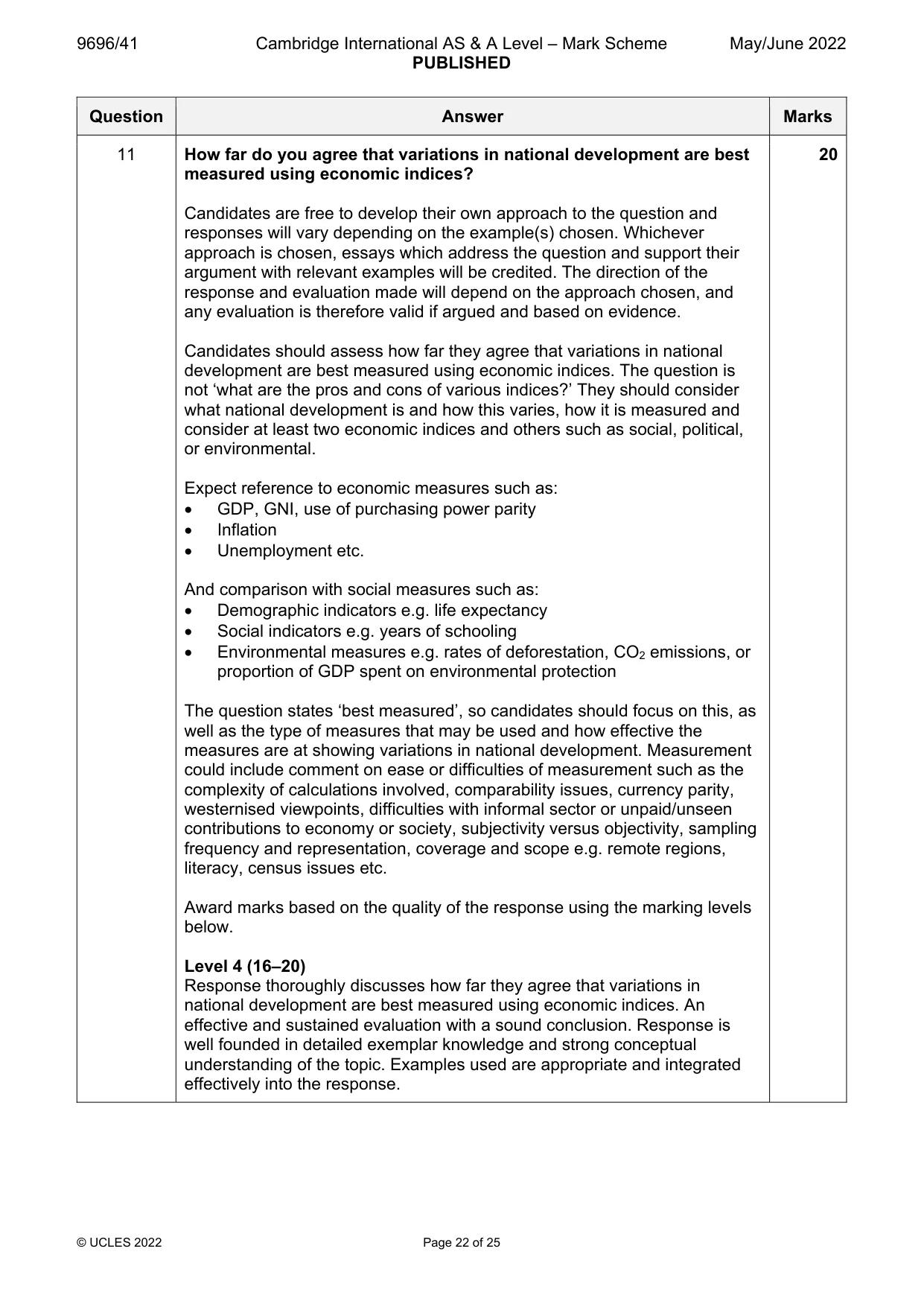
9696/41 Cambridge International AS & A Level – Mark Scheme PUBLISHED May/June 2022 © UCLES 2022 Page 22 of 25 Question Answer Marks 11 How far do you agree that variations in national development are best measured using economic indices? Candidates are free to develop their own approach to the question and responses will vary depending on the example(s) chosen. Whichever approach is chosen, essays which address the question and support their argument with relevant examples will be credited. The direction of the response and evaluation made will depend on the approach chosen, and any evaluation is therefore valid if argued and based on evidence. Candidates should assess how far they agree that variations in national development are best measured using economic indices. The question is not ‘what are the pros and cons of various indices?’ They should consider what national development is and how this varies, how it is measured and consider at least two economic indices and others such as social, political, or environmental. Expect reference to economic measures such as: GDP, GNI, use of purchasing power parity Inflation Unemployment etc. And comparison with social measures such as: Demographic indicators e.g. life expectancy Social indicators e.g. years of schooling Environmental measures e.g. rates of deforestation, CO2 emissions, or proportion of GDP spent on environmental protection The question states ‘best measured’, so candidates should focus on this, as well as the type of measures that may be used and how effective the measures are at showing variations in national development. Measurement could include comment on ease or difficulties of measurement such as the complexity of calculations involved, comparability issues, currency parity, westernised viewpoints, difficulties with informal sector or unpaid/unseen contributions to economy or society, subjectivity versus objectivity, sampling frequency and representation, coverage and scope e.g. remote regions, literacy, census issues etc. Award marks based on the quality of the response using the marking levels below. Level 4 (16–20) Response thoroughly discusses how far they agree that variations in national development are best measured using economic indices. An effective and sustained evaluation with a sound conclusion. Response is well founded in detailed exemplar knowledge and strong conceptual understanding of the topic. Examples used are appropriate and integrated effectively into the response. 20
Mark scheme, page 23
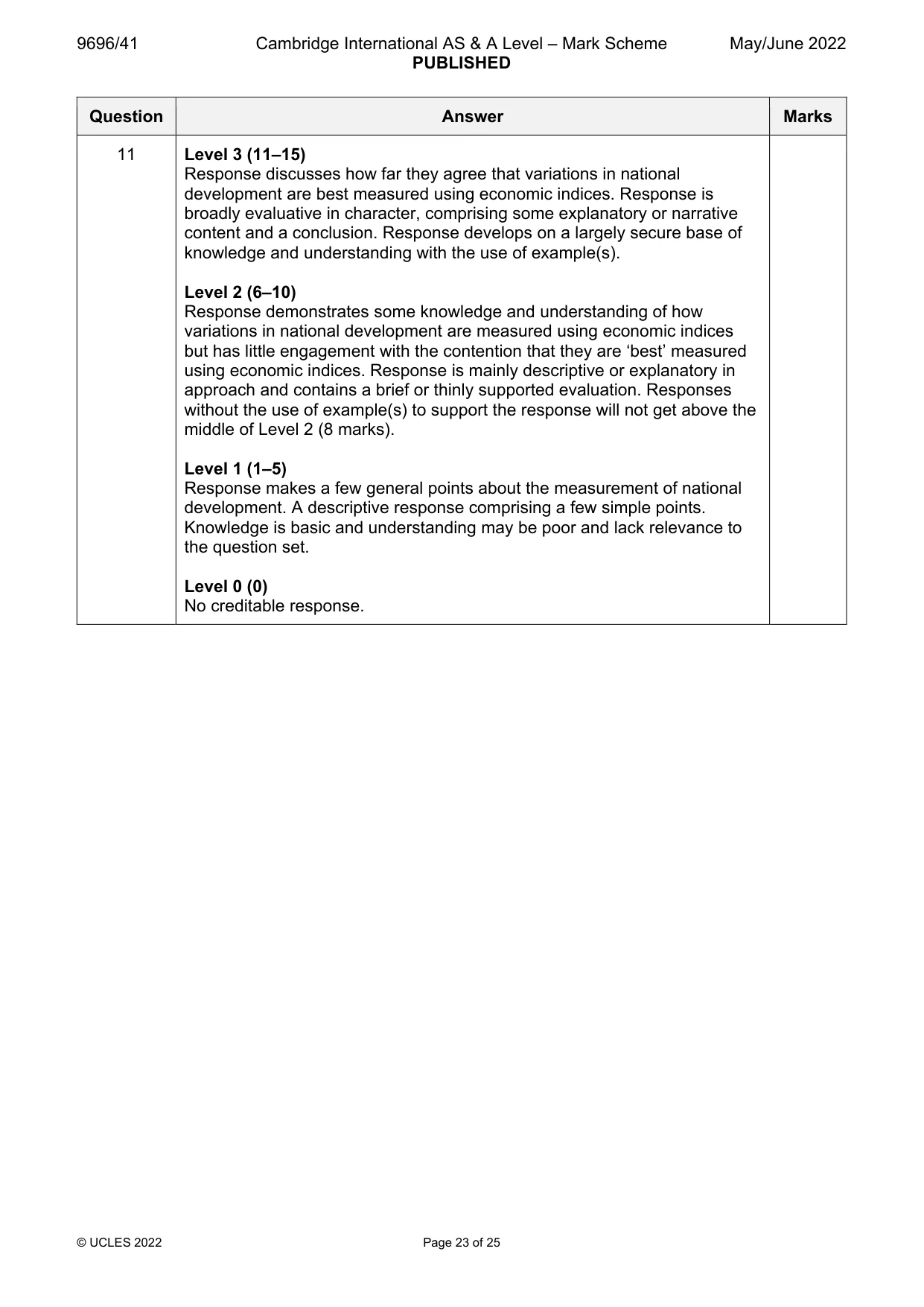
9696/41 Cambridge International AS & A Level – Mark Scheme PUBLISHED May/June 2022 © UCLES 2022 Page 23 of 25 Question Answer Marks 11 Level 3 (11–15) Response discusses how far they agree that variations in national development are best measured using economic indices. Response is broadly evaluative in character, comprising some explanatory or narrative content and a conclusion. Response develops on a largely secure base of knowledge and understanding with the use of example(s). Level 2 (6–10) Response demonstrates some knowledge and understanding of how variations in national development are measured using economic indices but has little engagement with the contention that they are ‘best’ measured using economic indices. Response is mainly descriptive or explanatory in approach and contains a brief or thinly supported evaluation. Responses without the use of example(s) to support the response will not get above the middle of Level 2 (8 marks). Level 1 (1–5) Response makes a few general points about the measurement of national development. A descriptive response comprising a few simple points. Knowledge is basic and understanding may be poor and lack relevance to the question set. Level 0 (0) No creditable response.
Mark scheme, page 24
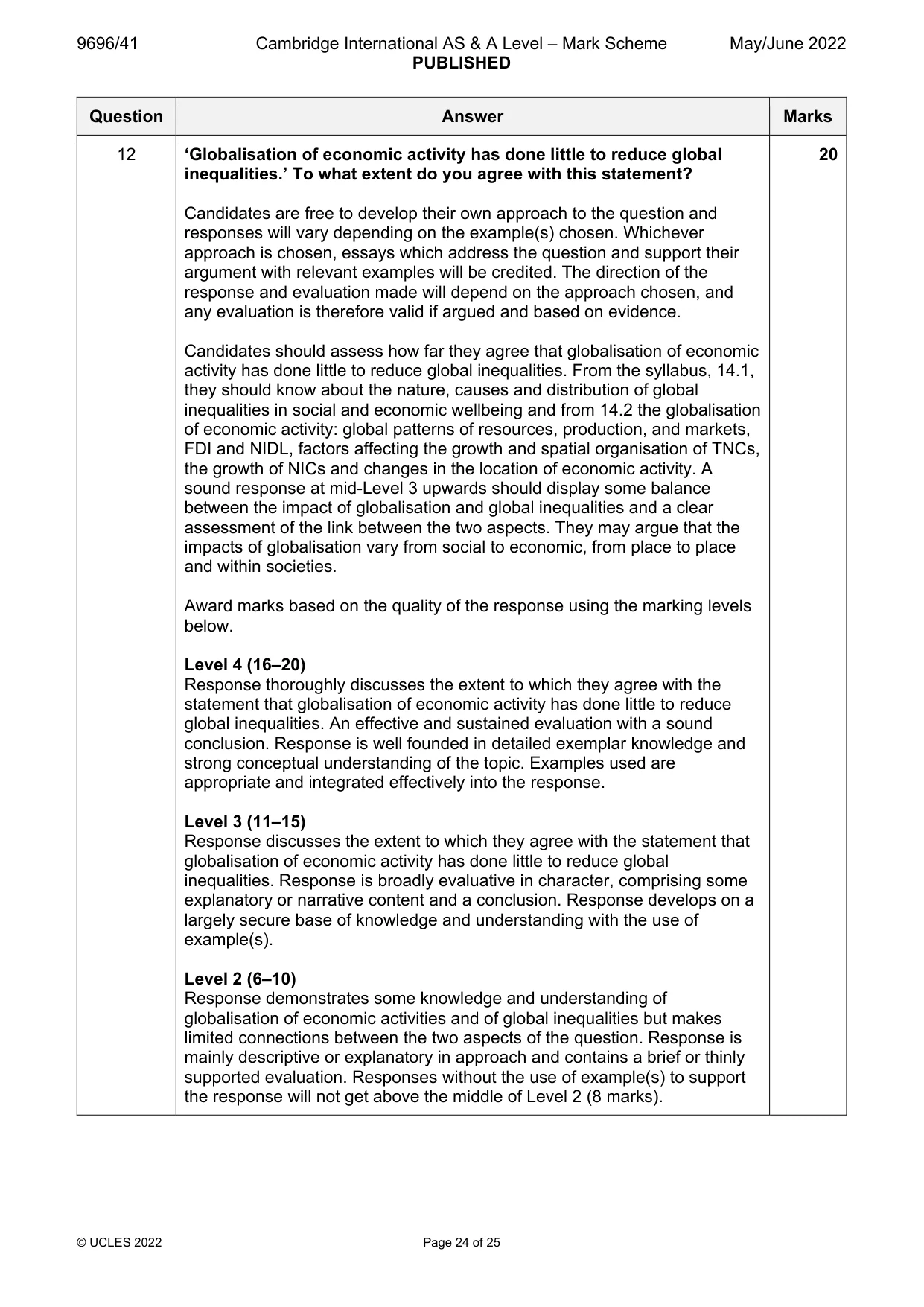
9696/41 Cambridge International AS & A Level – Mark Scheme PUBLISHED May/June 2022 © UCLES 2022 Page 24 of 25 Question Answer Marks 12 ‘Globalisation of economic activity has done little to reduce global inequalities.’ To what extent do you agree with this statement? Candidates are free to develop their own approach to the question and responses will vary depending on the example(s) chosen. Whichever approach is chosen, essays which address the question and support their argument with relevant examples will be credited. The direction of the response and evaluation made will depend on the approach chosen, and any evaluation is therefore valid if argued and based on evidence. Candidates should assess how far they agree that globalisation of economic activity has done little to reduce global inequalities. From the syllabus, 14.1, they should know about the nature, causes and distribution of global inequalities in social and economic wellbeing and from 14.2 the globalisation of economic activity: global patterns of resources, production, and markets, FDI and NIDL, factors affecting the growth and spatial organisation of TNCs, the growth of NICs and changes in the location of economic activity. A sound response at mid-Level 3 upwards should display some balance between the impact of globalisation and global inequalities and a clear assessment of the link between the two aspects. They may argue that the impacts of globalisation vary from social to economic, from place to place and within societies. Award marks based on the quality of the response using the marking levels below. Level 4 (16–20) Response thoroughly discusses the extent to which they agree with the statement that globalisation of economic activity has done little to reduce global inequalities. An effective and sustained evaluation with a sound conclusion. Response is well founded in detailed exemplar knowledge and strong conceptual understanding of the topic. Examples used are appropriate and integrated effectively into the response. Level 3 (11–15) Response discusses the extent to which they agree with the statement that globalisation of economic activity has done little to reduce global inequalities. Response is broadly evaluative in character, comprising some explanatory or narrative content and a conclusion. Response develops on a largely secure base of knowledge and understanding with the use of example(s). Level 2 (6–10) Response demonstrates some knowledge and understanding of globalisation of economic activities and of global inequalities but makes limited connections between the two aspects of the question. Response is mainly descriptive or explanatory in approach and contains a brief or thinly supported evaluation. Responses without the use of example(s) to support the response will not get above the middle of Level 2 (8 marks). 20
Mark scheme, page 25
9696/41 Cambridge International AS & A Level – Mark Scheme PUBLISHED May/June 2022 © UCLES 2022 Page 25 of 25 Question Answer Marks 12 Level 1 (1–5) Response makes a few general points about either globalisation of economic activities or of global inequalities. A descriptive response comprising a few simple points. Knowledge is basic and understanding may be poor and lack relevance to the question set. Level 0 (0) No creditable response.
What you needed in this session
Cambridge’s own grade thresholds for 2022 May/June, Paper 4 · Variant 1. A higher threshold means an easier paper — the bar moves with how the cohort did.