Cambridge A Level Geography 9696 — 2023 Oct/Nov Paper 4 · Variant 1
9696/41/O/N/23 · 12 questions · 60 marks · ≈68 min
The question paper and its mark scheme, free to read here and free to download. This is Cambridge’s own paper, exactly as it was sat.
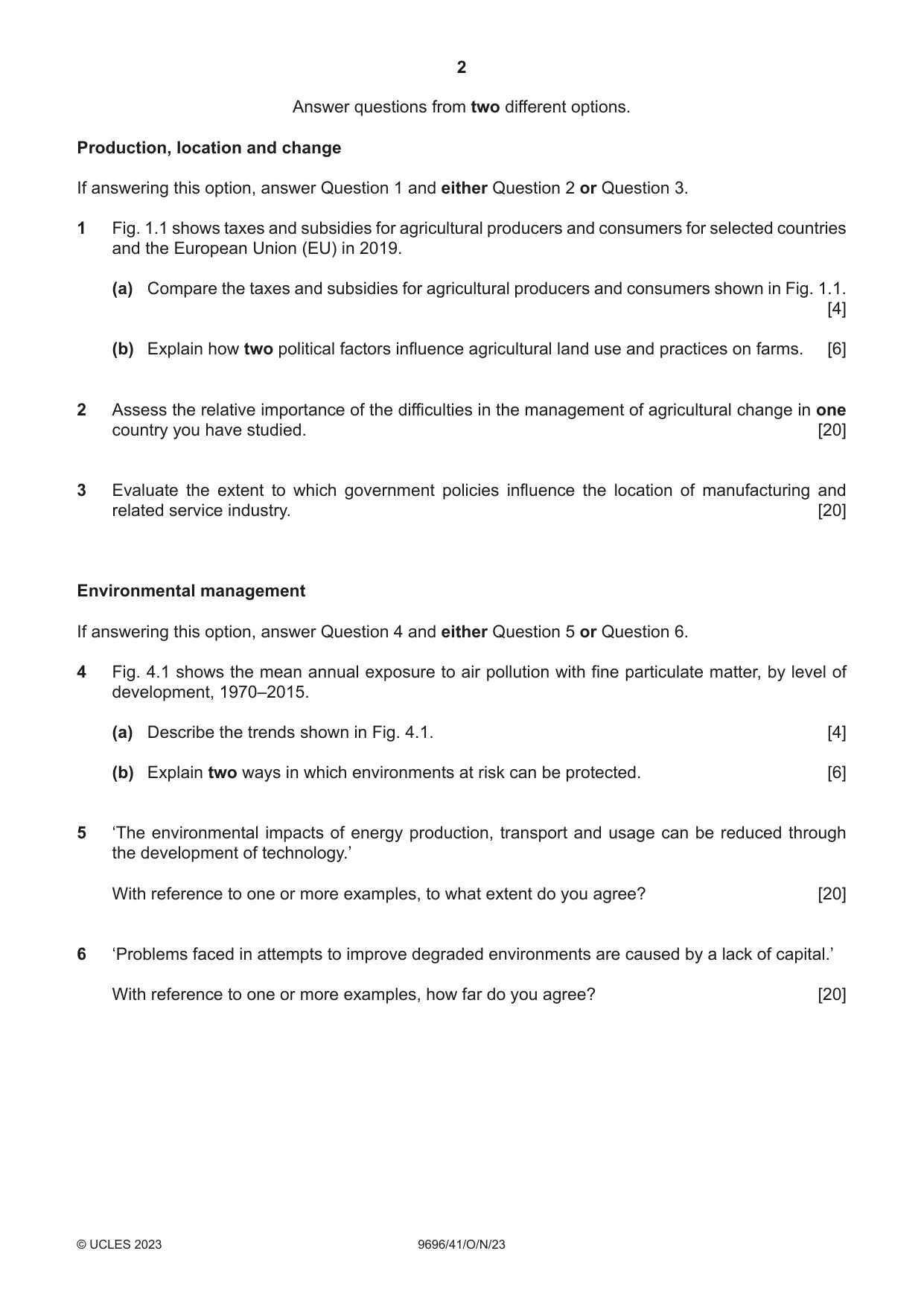
Question paper4 pages


Mark scheme24 pages
Answers below. Sit the paper first if you are practising.

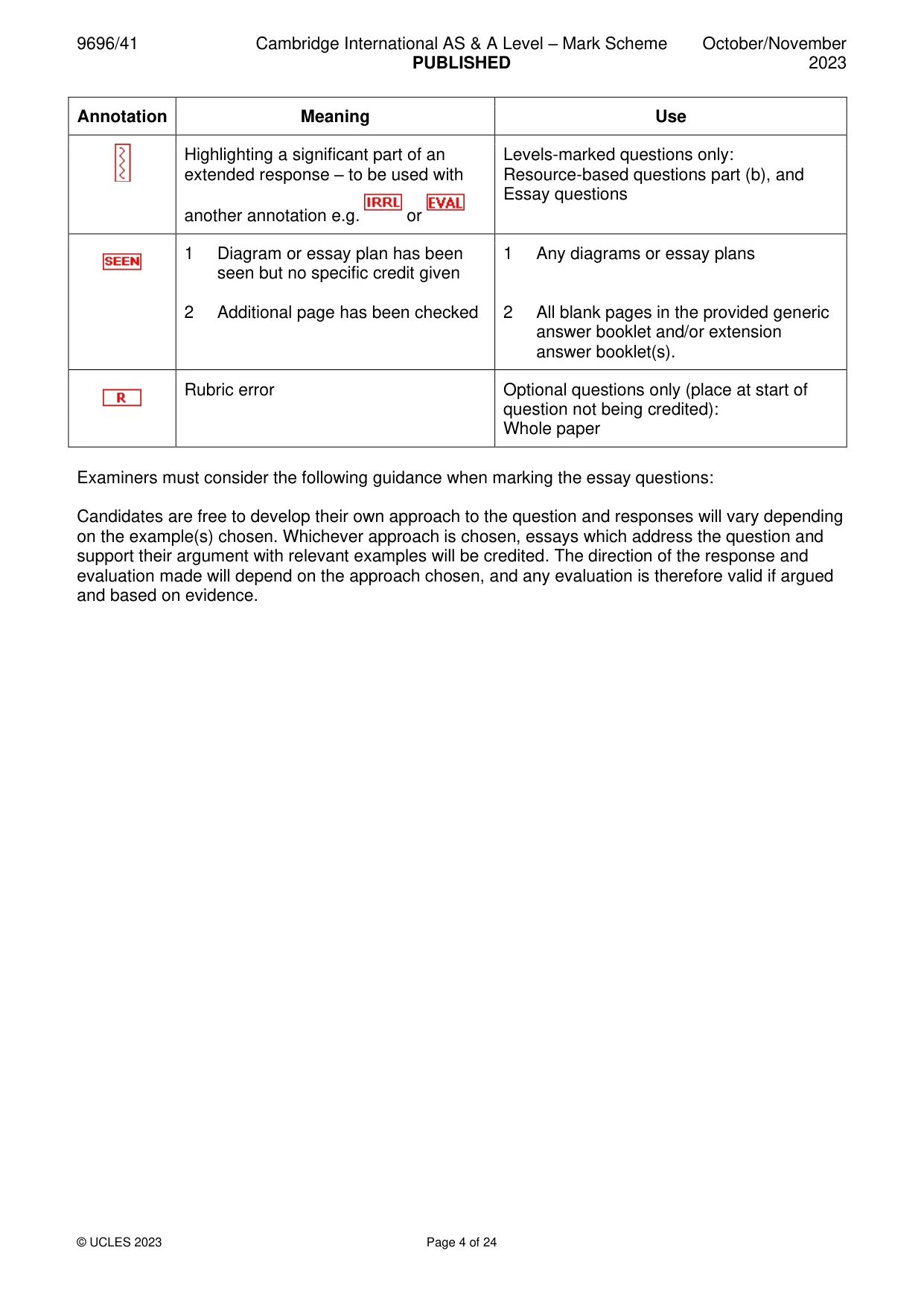



Questions as text
Q1 · Taxes and subsidies for agricultural producers and consumers for selected countries and…
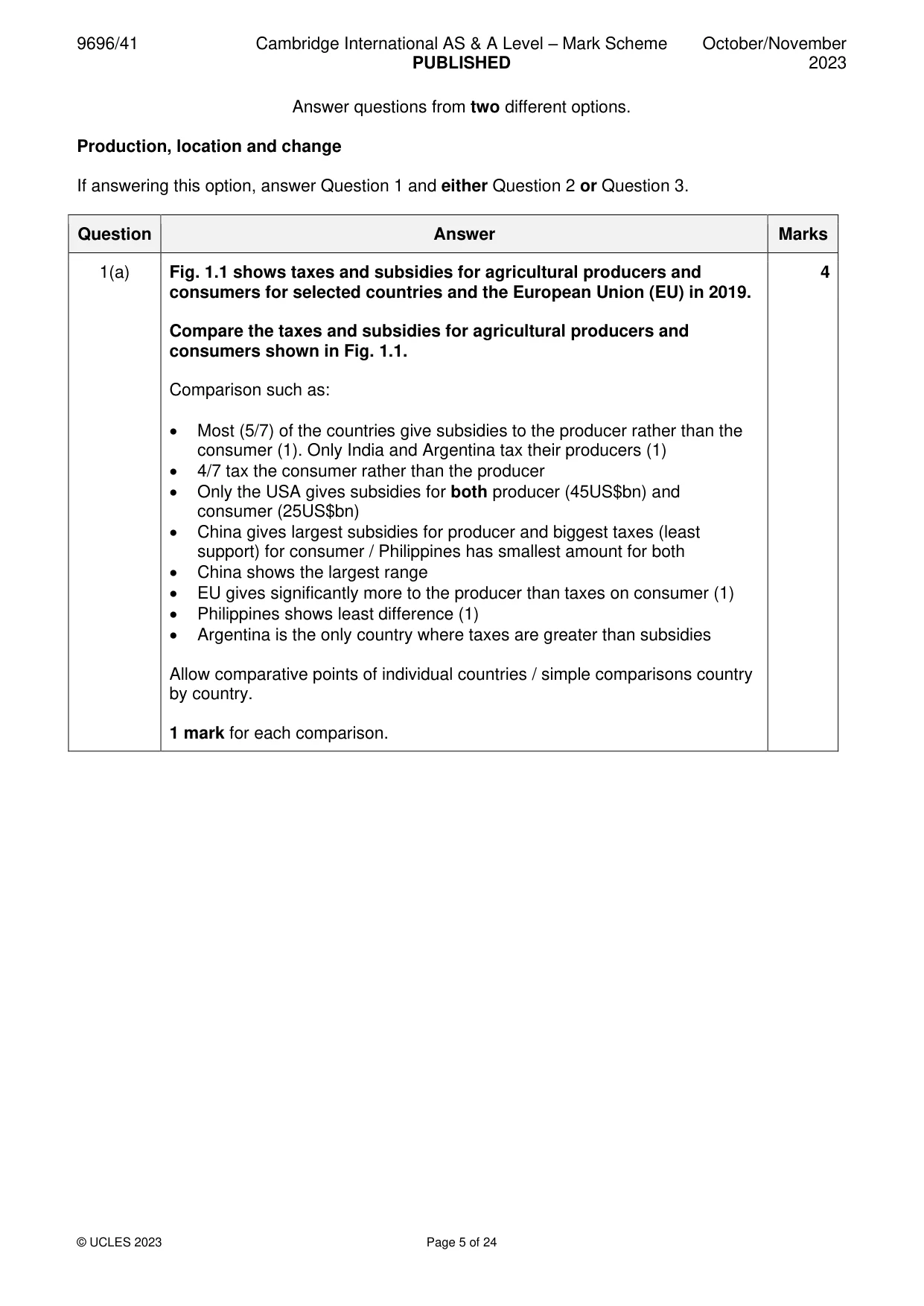
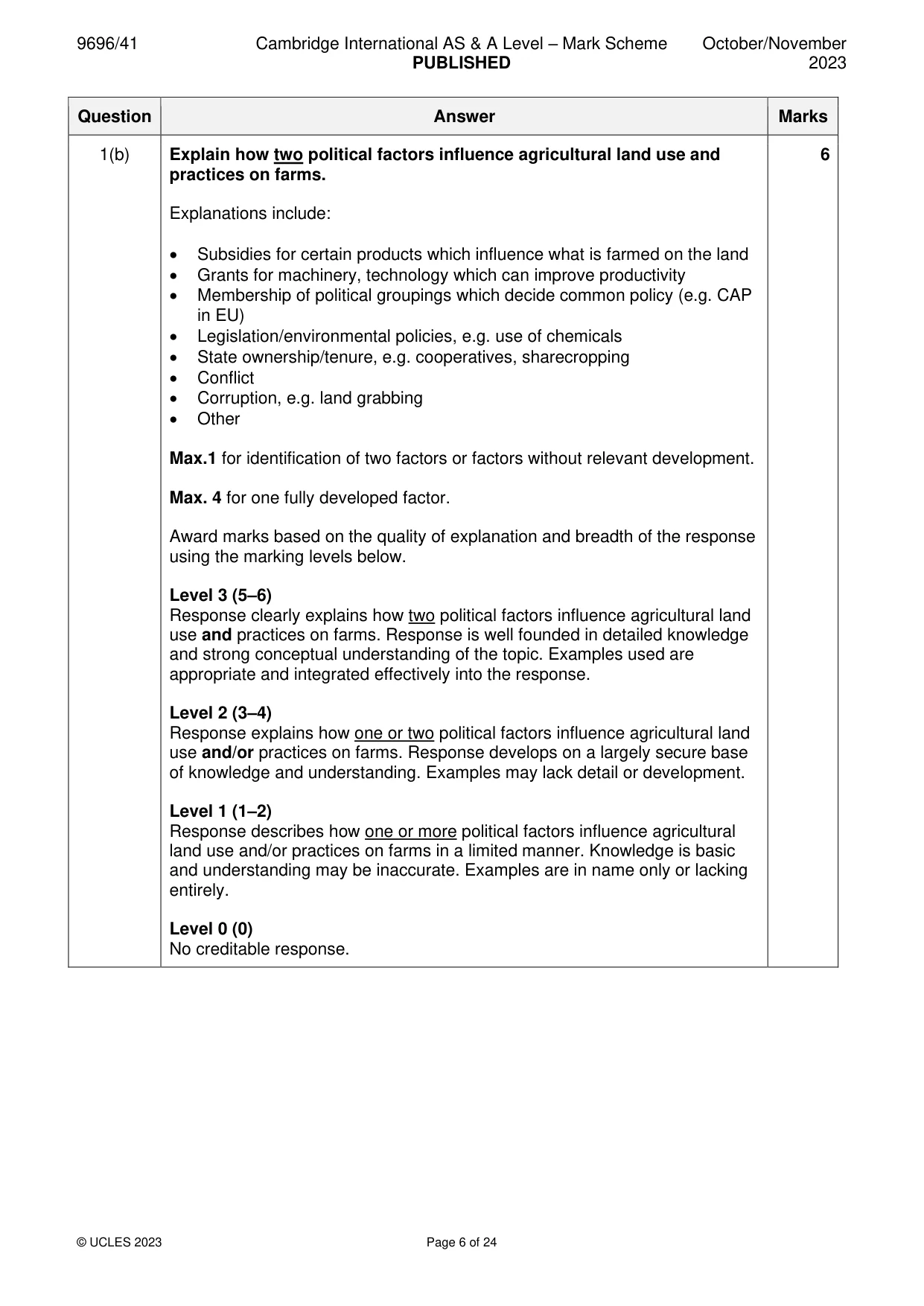
1 Fig. 1.1 shows taxes and subsidies for agricultural producers and consumers for selected countries and the European Union (EU) in 2019. (a) Compare the taxes and subsidies for agricultural producers and consumers shown in Fig. 1.1. [4] (b) Explain how two political factors influence agricultural land use and practices on farms. [6]
Mark scheme: Question Answer Marks 1(a) Fig. 1.1 shows taxes and subsidies for agricultural producers and 4 consumers for selected countries and the European Union (EU) in 2019. Compare the taxes and subsidies for agricultural producers and consumers shown in Fig. 1.1. Comparison such as: • Most (5/7) of the countries give subsidies to the producer rather than the consumer (1). Only India and Argentina tax their producers (1) • 4/7 tax the consumer rather than the producer • Only the USA gives subsidies for both producer (45US$bn) and consumer (25US$bn) • China gives largest subsidies for producer and biggest taxes (least support) for consumer / Philippines has smallest amount for both • China shows the largest range • EU gives significantly more to the producer than taxes on consumer (1) • Philippines shows least difference (1) • Argentina is the only country where taxes are greater than subsidies Allow comparative points of individual countries / simple comparisons country by country. 1 mark for each comparison. 1(b) Explain how two political factors influence agricultural land use and 6 practices on farms. Explanations include: • Subsidies for certain products which influence what is farmed on the land • Grants for machinery, technology which can improve productivity • Membership of political groupings which decide common policy (e.g. CAP in EU) • Legislation/environmental policies, e.g. use of chemicals • State ownership/tenure, e.g. cooperatives, sharecropping • Conflict • Corruption, e.g. land grabbing • Other Max.1 for identification of two factors or factors without relevant development. Max. 4 for one fully developed factor. Award marks based on the quality of explanation and breadth of the response using the marking levels below. Level 3 (5–6) Response clearly explains how two political factors influence agricultural land use and practices on farms. Response is well founded in detailed knowledge and strong conceptual understanding of the topic. Examples used are appropriate and integrated effectively into the response. Level 2 (3–4) Response explains how one or two political factors influence agricultural land use and/or practices on farms. Response develops on a largely secure base of knowledge and understanding. Examples may lack detail or development. Level 1 (1–2) Response describes how one or more political factors influence agricultural land use and/or practices on farms in a limited manner. Knowledge is basic and understanding may be inaccurate. Examples are in name only or lacking entirely. Level 0 (0) No creditable response.
Q2 · Assess the relative importance of the difficulties in the management of agricultural…
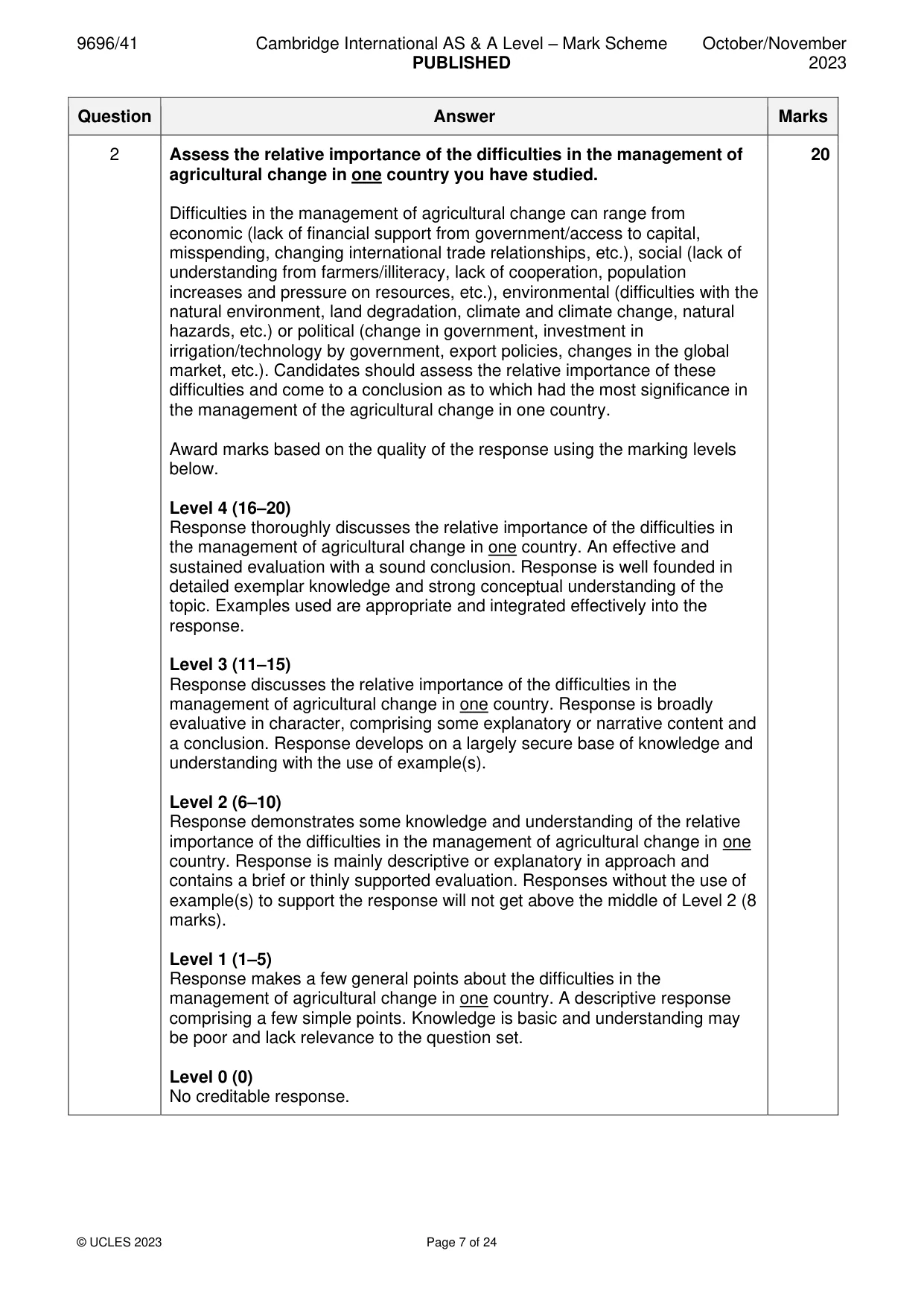
2 Assess the relative importance of the difficulties in the management of agricultural change in one country you have studied. [20]
Mark scheme: 2 Assess the relative importance of the difficulties in the management of 20 agricultural change in one country you have studied. Difficulties in the management of agricultural change can range from economic (lack of financial support from government/access to capital, misspending, changing international trade relationships, etc.), social (lack of understanding from farmers/illiteracy, lack of cooperation, population increases and pressure on resources, etc.), environmental (difficulties with the natural environment, land degradation, climate and climate change, natural hazards, etc.) or political (change in government, investment in irrigation/technology by government, export policies, changes in the global market, etc.). Candidates should assess the relative importance of these difficulties and come to a conclusion as to which had the most significance in the management of the agricultural change in one country. Award marks based on the quality of the response using the marking levels below. Level 4 (16–20) Response thoroughly discusses the relative importance of the difficulties in the management of agricultural change in one country. An effective and sustained evaluation with a sound conclusion. Response is well founded in detailed exemplar knowledge and strong conceptual understanding of the topic. Examples used are appropriate and integrated effectively into the response. Level 3 (11–15) Response discusses the relative importance of the difficulties in the management of agricultural change in one country. Response is broadly evaluative in character, comprising some explanatory or narrative content and a conclusion. Response develops on a largely secure base of knowledge and understanding with the use of example(s). Level 2 (6–10) Response demonstrates some knowledge and understanding of the relative importance of the difficulties in the management of agricultural change in one country. Response is mainly descriptive or explanatory in approach and contains a brief or thinly supported evaluation. Responses without the use of example(s) to support the response will not get above the middle of Level 2 (8 marks). Level 1 (1–5) Response makes a few general points about the difficulties in the management of agricultural change in one country. A descriptive response comprising a few simple points. Knowledge is basic and understanding may be poor and lack relevance to the question set. Level 0 (0) No creditable response.
Q3 · Evaluate the extent to which government policies influence the location of manufacturing…
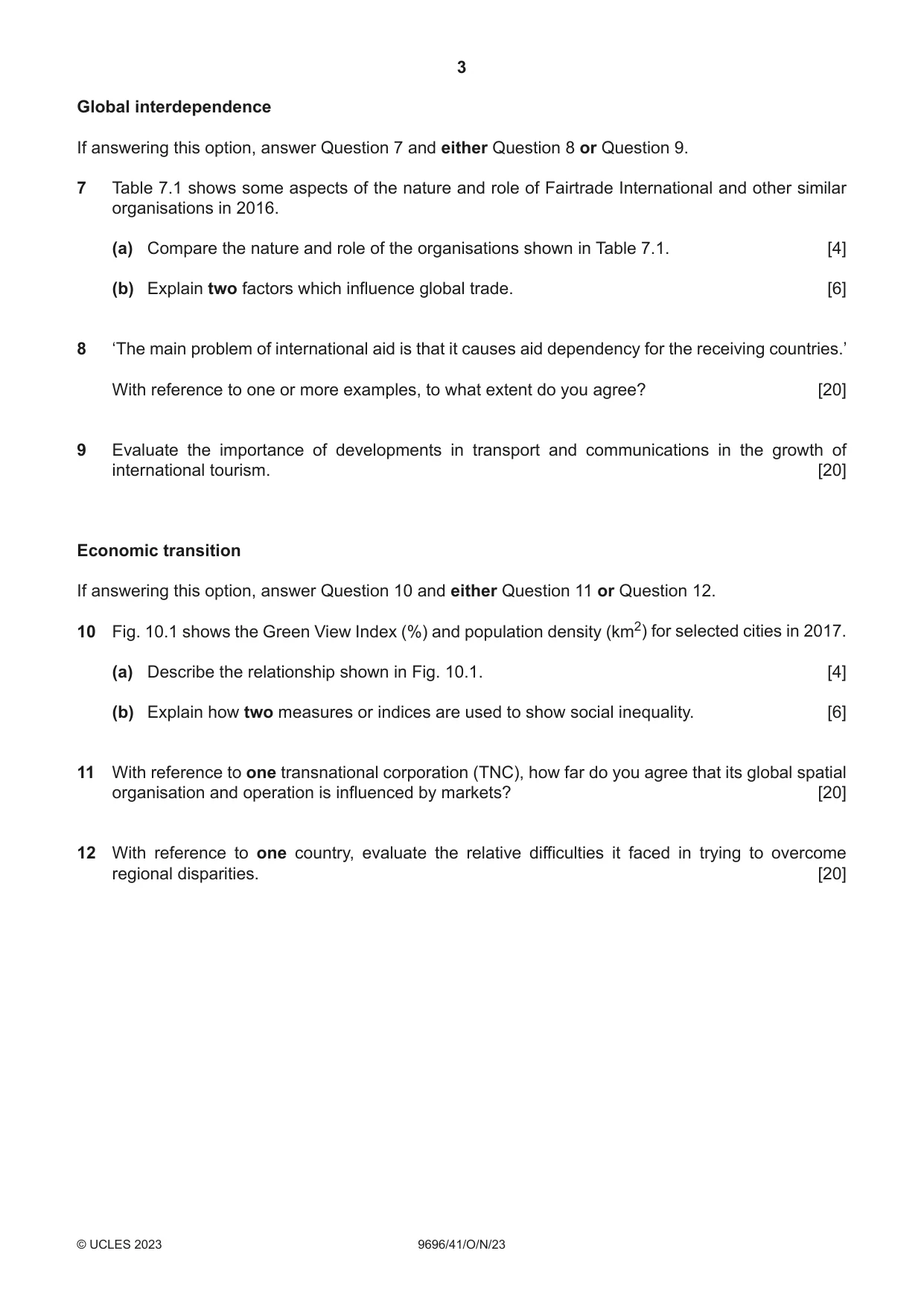
3 Evaluate the extent to which government policies influence the location of manufacturing and related service industry. [20] Environmental management If answering this option, answer Question 4 and either Question 5 or Question 6.
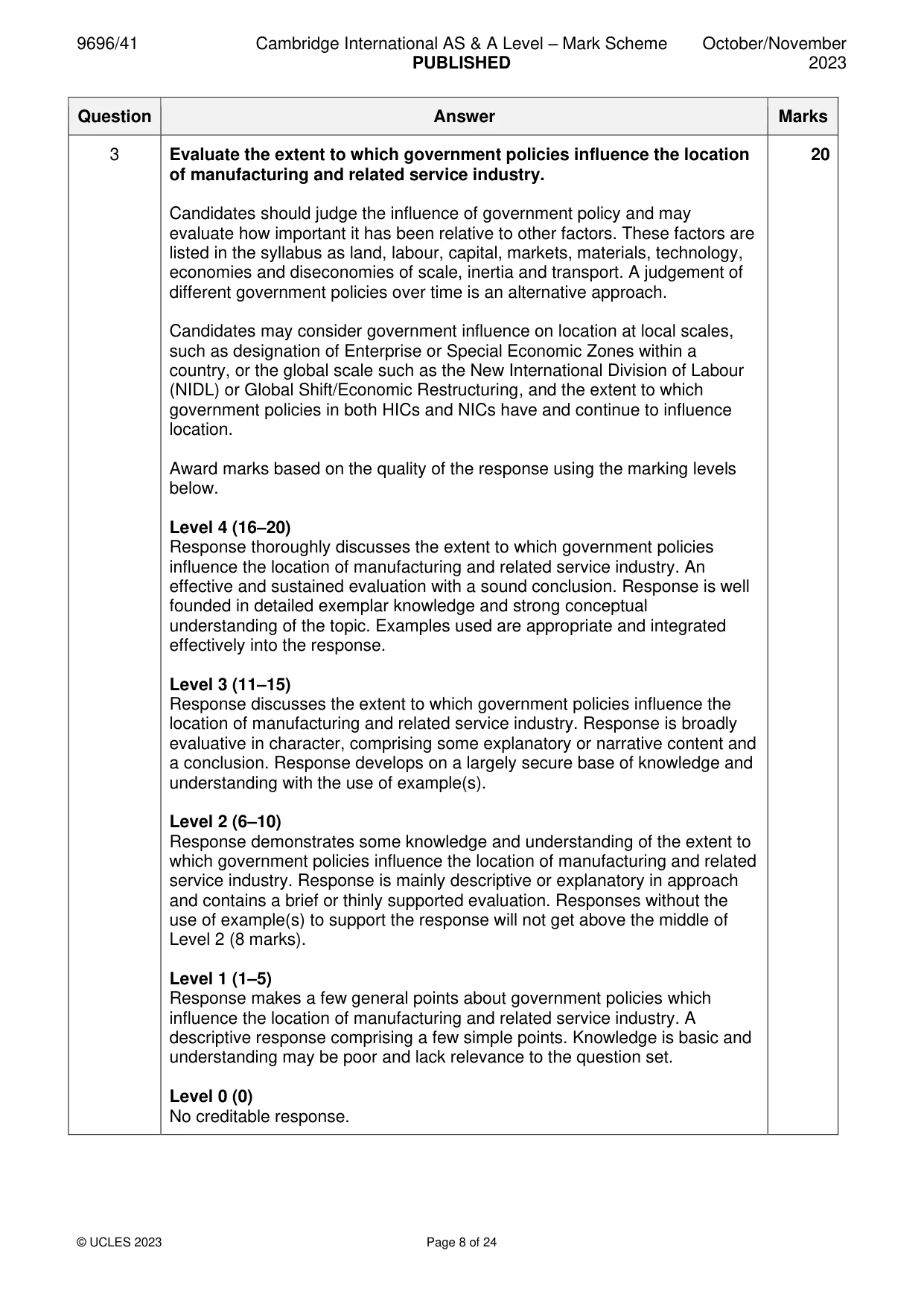
Mark scheme: 3 Evaluate the extent to which government policies influence the location 20 of manufacturing and related service industry. Candidates should judge the influence of government policy and may evaluate how important it has been relative to other factors. These factors are listed in the syllabus as land, labour, capital, markets, materials, technology, economies and diseconomies of scale, inertia and transport. A judgement of different government policies over time is an alternative approach. Candidates may consider government influence on location at local scales, such as designation of Enterprise or Special Economic Zones within a country, or the global scale such as the New International Division of Labour (NIDL) or Global Shift/Economic Restructuring, and the extent to which government policies in both HICs and NICs have and continue to influence location. Award marks based on the quality of the response using the marking levels below. Level 4 (16–20) Response thoroughly discusses the extent to which government policies influence the location of manufacturing and related service industry. An effective and sustained evaluation with a sound conclusion. Response is well founded in detailed exemplar knowledge and strong conceptual understanding of the topic. Examples used are appropriate and integrated effectively into the response. Level 3 (11–15) Response discusses the extent to which government policies influence the location of manufacturing and related service industry. Response is broadly evaluative in character, comprising some explanatory or narrative content and a conclusion. Response develops on a largely secure base of knowledge and understanding with the use of example(s). Level 2 (6–10) Response demonstrates some knowledge and understanding of the extent to which government policies influence the location of manufacturing and related service industry. Response is mainly descriptive or explanatory in approach and contains a brief or thinly supported evaluation. Responses without the use of example(s) to support the response will not get above the middle of Level 2 (8 marks). Level 1 (1–5) Response makes a few general points about government policies which influence the location of manufacturing and related service industry. A descriptive response comprising a few simple points. Knowledge is basic and understanding may be poor and lack relevance to the question set. Level 0 (0) No creditable response. Environmental management If answering this option, answer Question 4 and either Question 5 or Question 6.
Q4 · The mean annual exposure to air pollution with fine particulate matter, by level of…
4 Fig. 4.1 shows the mean annual exposure to air pollution with fine particulate matter, by level of development, 1970–2015. (a) Describe the trends shown in Fig. 4.1. [4] (b) Explain two ways in which environments at risk can be protected. [6]
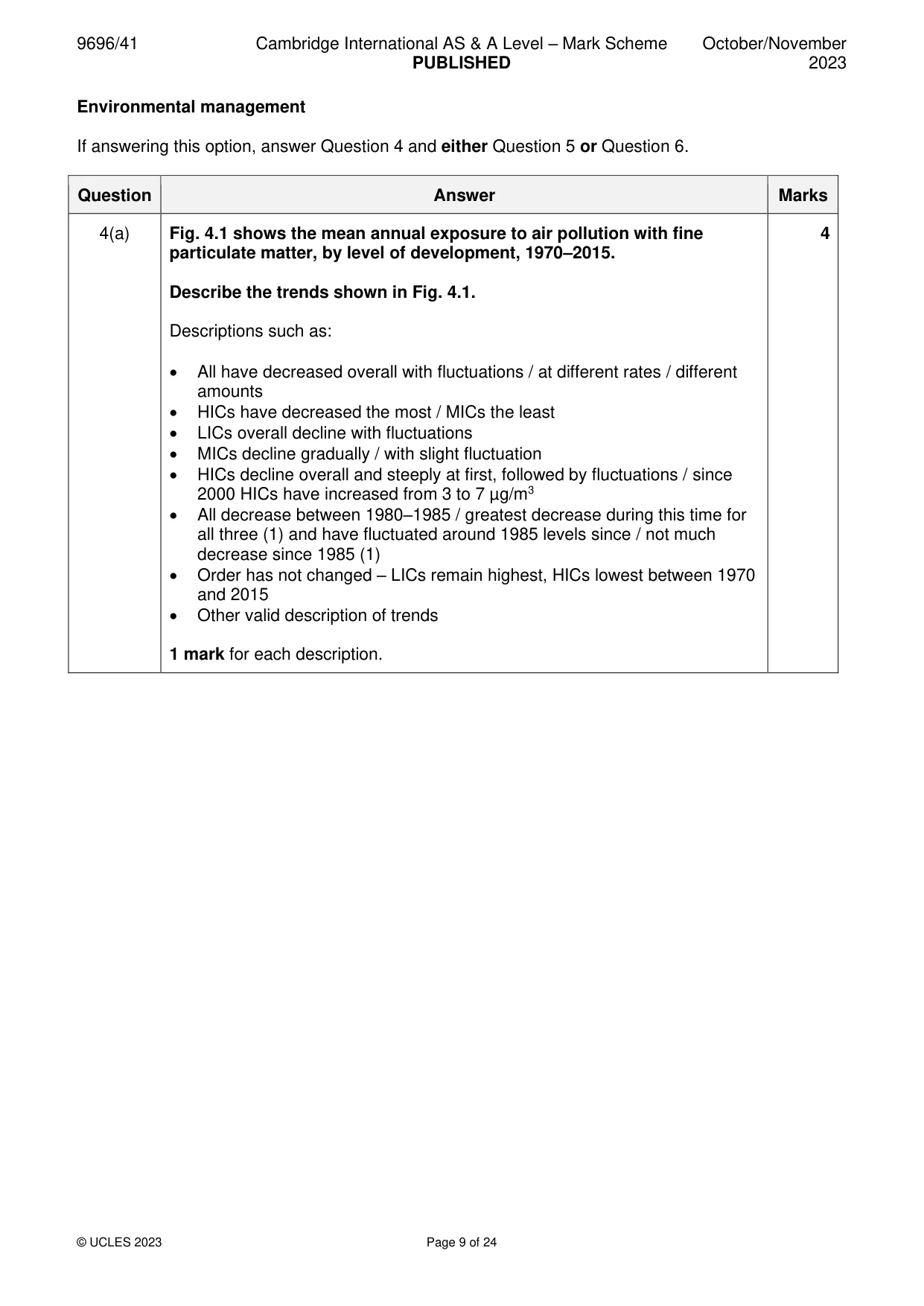
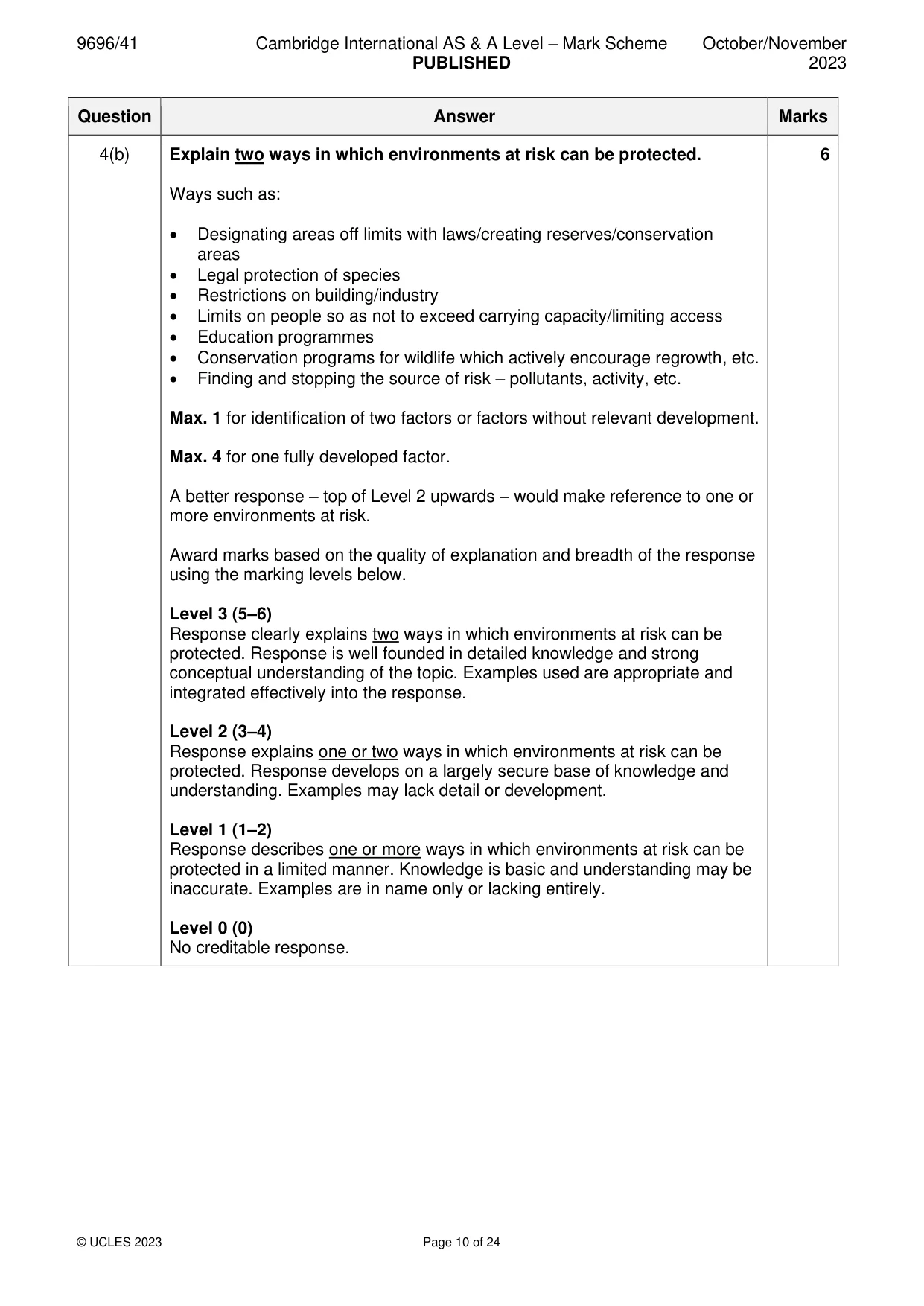
Mark scheme: 4(a) Fig. 4.1 shows the mean annual exposure to air pollution with fine 4 particulate matter, by level of development, 1970–2015. Describe the trends shown in Fig. 4.1. Descriptions such as: • All have decreased overall with fluctuations / at different rates / different amounts • HICs have decreased the most / MICs the least • LICs overall decline with fluctuations • MICs decline gradually / with slight fluctuation • HICs decline overall and steeply at first, followed by fluctuations / since 2000 HICs have increased from 3 to 7 µg/m3 • All decrease between 1980–1985 / greatest decrease during this time for all three (1) and have fluctuated around 1985 levels since / not much decrease since 1985 (1) • Order has not changed – LICs remain highest, HICs lowest between 1970 and 2015 • Other valid description of trends 1 mark for each description. 4(b) Explain two ways in which environments at risk can be protected. 6 Ways such as: • Designating areas off limits with laws/creating reserves/conservation areas • Legal protection of species • Restrictions on building/industry • Limits on people so as not to exceed carrying capacity/limiting access • Education programmes • Conservation programs for wildlife which actively encourage regrowth, etc. • Finding and stopping the source of risk – pollutants, activity, etc. Max. 1 for identification of two factors or factors without relevant development. Max. 4 for one fully developed factor. A better response – top of Level 2 upwards – would make reference to one or more environments at risk. Award marks based on the quality of explanation and breadth of the response using the marking levels below. Level 3 (5–6) Response clearly explains two ways in which environments at risk can be protected. Response is well founded in detailed knowledge and strong conceptual understanding of the topic. Examples used are appropriate and integrated effectively into the response. Level 2 (3–4) Response explains one or two ways in which environments at risk can be protected. Response develops on a largely secure base of knowledge and understanding. Examples may lack detail or development. Level 1 (1–2) Response describes one or more ways in which environments at risk can be protected in a limited manner. Knowledge is basic and understanding may be inaccurate. Examples are in name only or lacking entirely. Level 0 (0) No creditable response.
Q5 · ‘The environmental impacts of energy production, transport and usage can be reduced…
5 ‘The environmental impacts of energy production, transport and usage can be reduced through the development of technology.’ With reference to one or more examples, to what extent do you agree? [20]
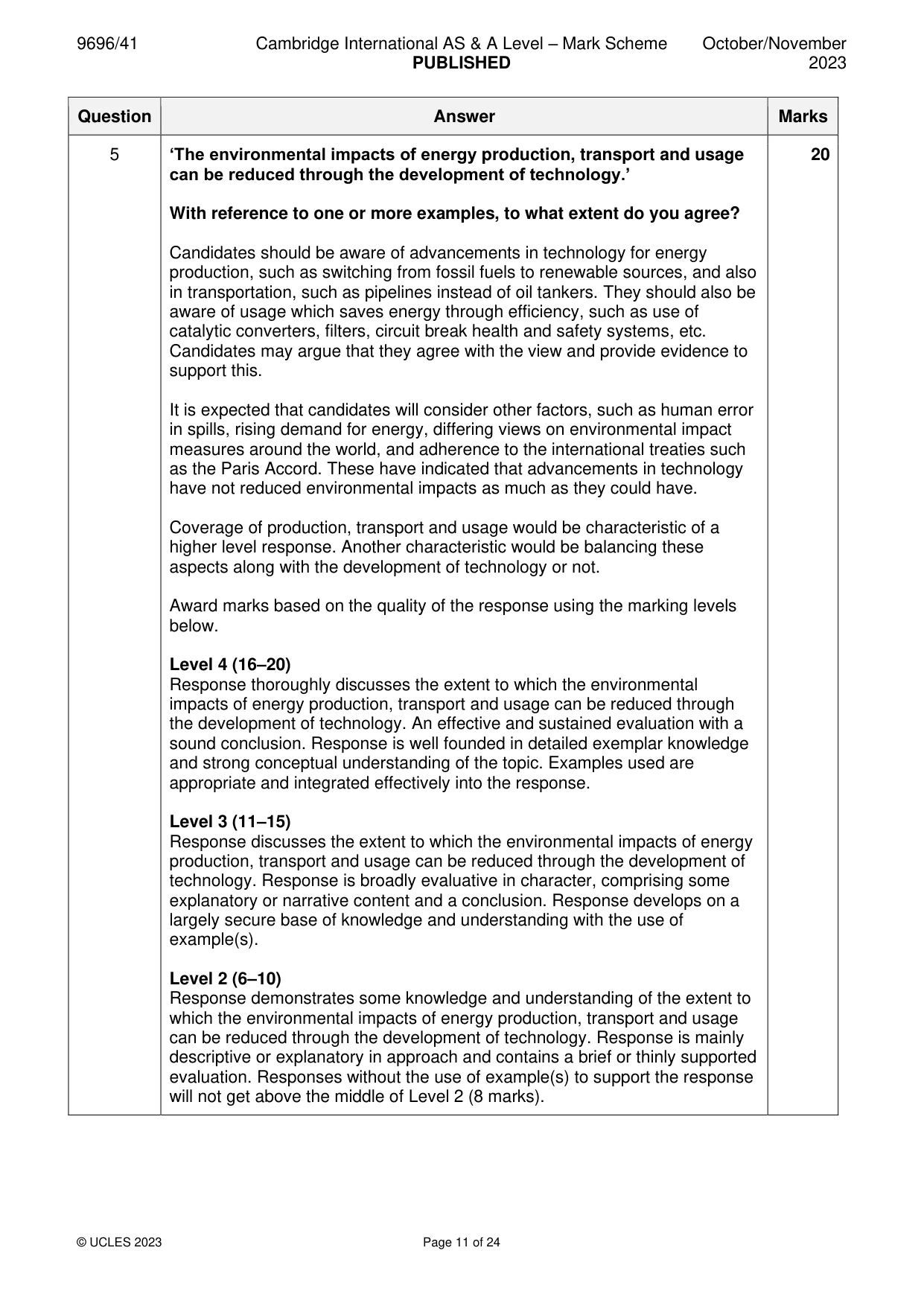
Mark scheme: 5 ‘The environmental impacts of energy production, transport and usage 20 can be reduced through the development of technology.’ With reference to one or more examples, to what extent do you agree? Candidates should be aware of advancements in technology for energy production, such as switching from fossil fuels to renewable sources, and also in transportation, such as pipelines instead of oil tankers. They should also be aware of usage which saves energy through efficiency, such as use of catalytic converters, filters, circuit break health and safety systems, etc. Candidates may argue that they agree with the view and provide evidence to support this. It is expected that candidates will consider other factors, such as human error in spills, rising demand for energy, differing views on environmental impact measures around the world, and adherence to the international treaties such as the Paris Accord. These have indicated that advancements in technology have not reduced environmental impacts as much as they could have. Coverage of production, transport and usage would be characteristic of a higher level response. Another characteristic would be balancing these aspects along with the development of technology or not. Award marks based on the quality of the response using the marking levels below. Level 4 (16–20) Response thoroughly discusses the extent to which the environmental impacts of energy production, transport and usage can be reduced through the development of technology. An effective and sustained evaluation with a sound conclusion. Response is well founded in detailed exemplar knowledge and strong conceptual understanding of the topic. Examples used are appropriate and integrated effectively into the response. Level 3 (11–15) Response discusses the extent to which the environmental impacts of energy production, transport and usage can be reduced through the development of technology. Response is broadly evaluative in character, comprising some explanatory or narrative content and a conclusion. Response develops on a largely secure base of knowledge and understanding with the use of example(s). Level 2 (6–10) Response demonstrates some knowledge and understanding of the extent to which the environmental impacts of energy production, transport and usage can be reduced through the development of technology. Response is mainly descriptive or explanatory in approach and contains a brief or thinly supported evaluation. Responses without the use of example(s) to support the response will not get above the middle of Level 2 (8 marks). 5 Level 1 (1–5) Response makes a few general points about the environmental impacts of energy production, transport and usage and/or the development of technology. A descriptive response comprising a few simple points. Knowledge is basic and understanding may be poor and lack relevance to the question set. Level 0 (0) No creditable response.
Q6 · ‘Problems faced in attempts to improve degraded environments are caused by a lack of…
6 ‘Problems faced in attempts to improve degraded environments are caused by a lack of capital.’ With reference to one or more examples, how far do you agree? [20] Global interdependence If answering this option, answer Question 7 and either Question 8 or Question 9.
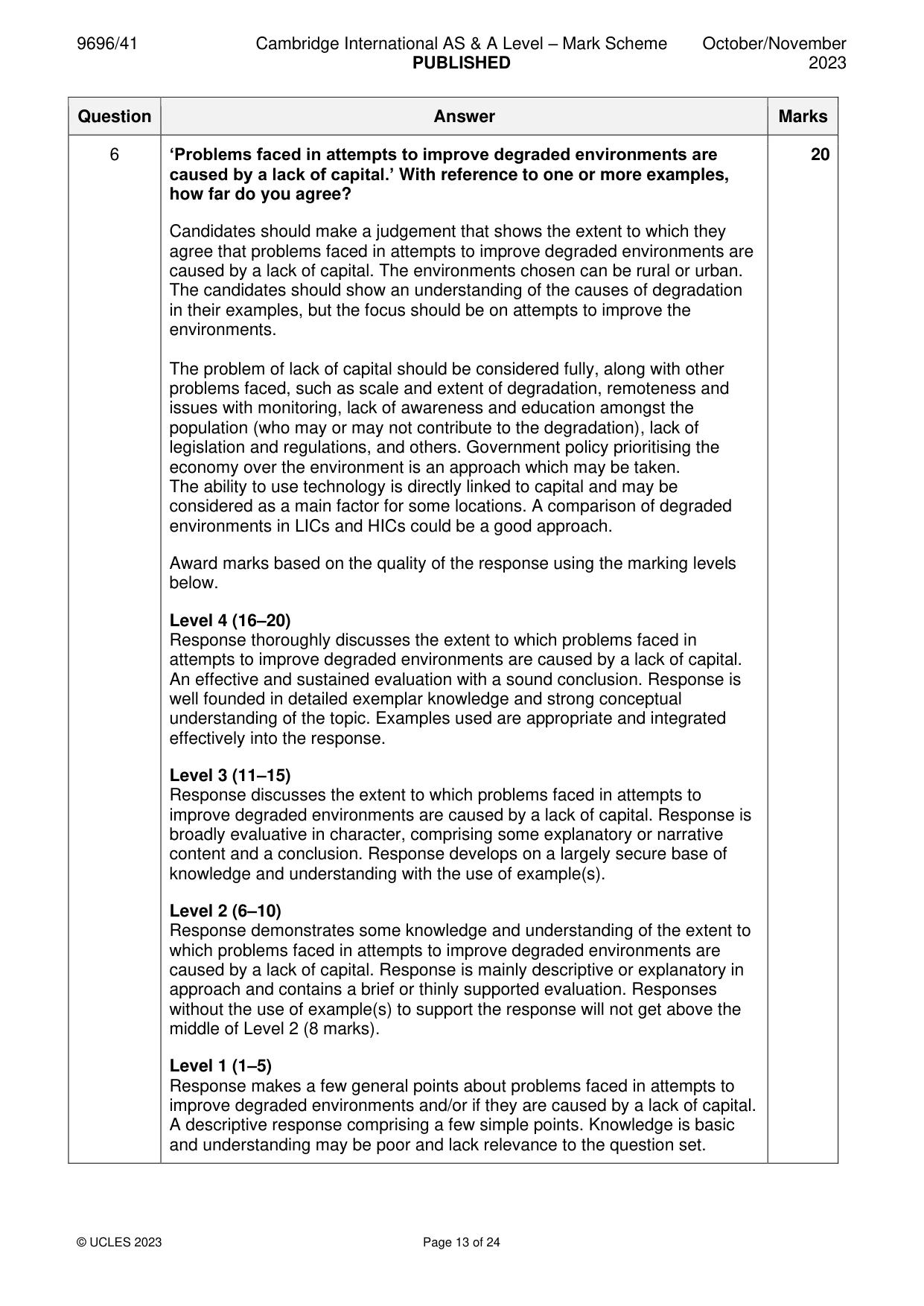
Mark scheme: 6 ‘Problems faced in attempts to improve degraded environments are 20 caused by a lack of capital.’ With reference to one or more examples, how far do you agree? Candidates should make a judgement that shows the extent to which they agree that problems faced in attempts to improve degraded environments are caused by a lack of capital. The environments chosen can be rural or urban. The candidates should show an understanding of the causes of degradation in their examples, but the focus should be on attempts to improve the environments. The problem of lack of capital should be considered fully, along with other problems faced, such as scale and extent of degradation, remoteness and issues with monitoring, lack of awareness and education amongst the population (who may or may not contribute to the degradation), lack of legislation and regulations, and others. Government policy prioritising the economy over the environment is an approach which may be taken. The ability to use technology is directly linked to capital and may be considered as a main factor for some locations. A comparison of degraded environments in LICs and HICs could be a good approach. Award marks based on the quality of the response using the marking levels below. Level 4 (16–20) Response thoroughly discusses the extent to which problems faced in attempts to improve degraded environments are caused by a lack of capital. An effective and sustained evaluation with a sound conclusion. Response is well founded in detailed exemplar knowledge and strong conceptual understanding of the topic. Examples used are appropriate and integrated effectively into the response. Level 3 (11–15) Response discusses the extent to which problems faced in attempts to improve degraded environments are caused by a lack of capital. Response is broadly evaluative in character, comprising some explanatory or narrative content and a conclusion. Response develops on a largely secure base of knowledge and understanding with the use of example(s). Level 2 (6–10) Response demonstrates some knowledge and understanding of the extent to which problems faced in attempts to improve degraded environments are caused by a lack of capital. Response is mainly descriptive or explanatory in approach and contains a brief or thinly supported evaluation. Responses without the use of example(s) to support the response will not get above the middle of Level 2 (8 marks). Level 1 (1–5) Response makes a few general points about problems faced in attempts to improve degraded environments and/or if they are caused by a lack of capital. A descriptive response comprising a few simple points. Knowledge is basic and understanding may be poor and lack relevance to the question set. 6 Level 0 (0) No creditable response. Global interdependence If answering this option, answer Question 7 and either Question 8 or Question 9.
Q7 · Some aspects of the nature and role of Fairtrade International and other similar…
7 Table 7.1 shows some aspects of the nature and role of Fairtrade International and other similar organisations in 2016. (a) Compare the nature and role of the organisations shown in Table 7.1. [4] (b) Explain two factors which influence global trade. [6]
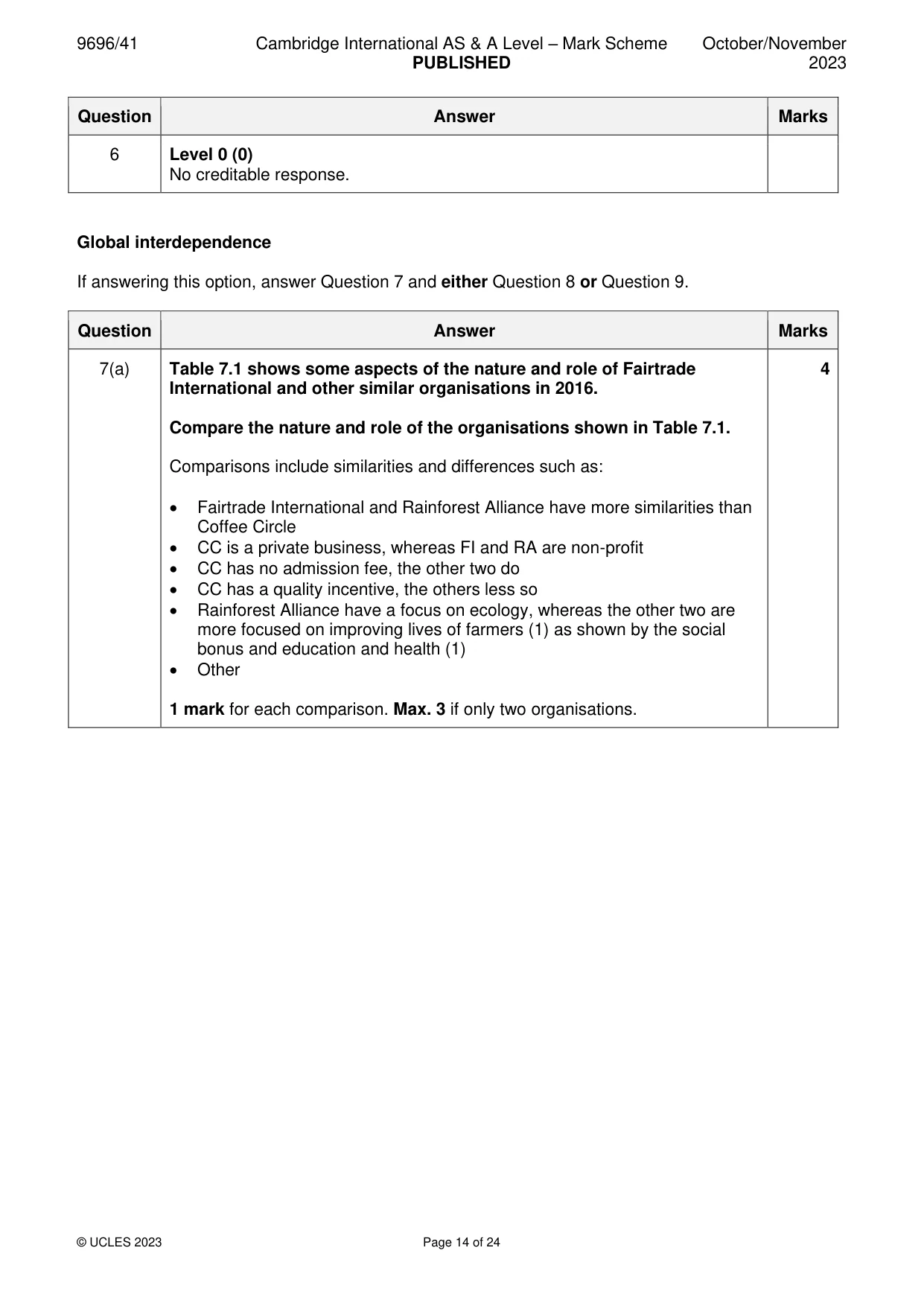
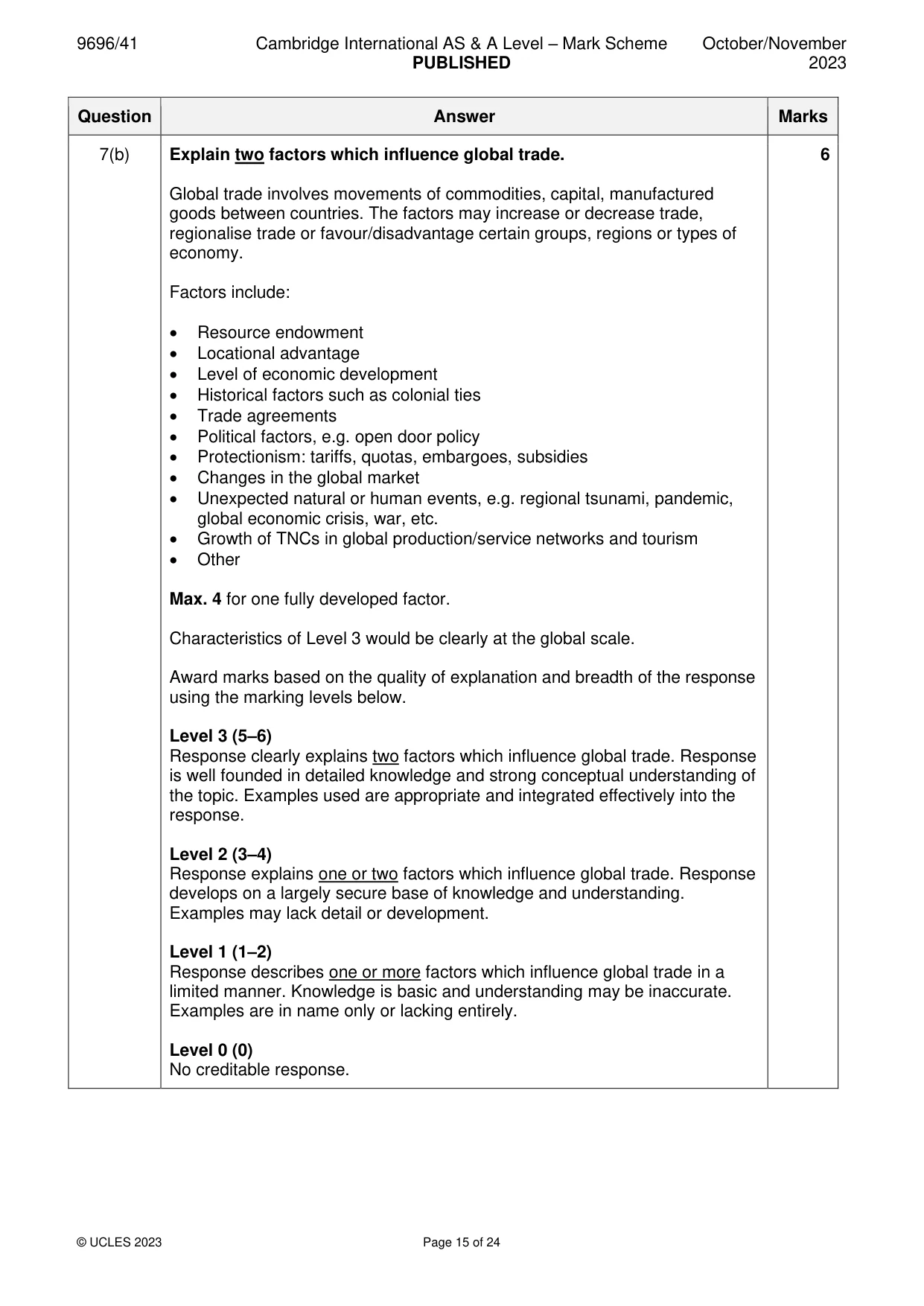
Mark scheme: 7(a) Table 7.1 shows some aspects of the nature and role of Fairtrade 4 International and other similar organisations in 2016. Compare the nature and role of the organisations shown in Table 7.1. Comparisons include similarities and differences such as: • Fairtrade International and Rainforest Alliance have more similarities than Coffee Circle • CC is a private business, whereas FI and RA are non-profit • CC has no admission fee, the other two do • CC has a quality incentive, the others less so • Rainforest Alliance have a focus on ecology, whereas the other two are more focused on improving lives of farmers (1) as shown by the social bonus and education and health (1) • Other 1 mark for each comparison. Max. 3 if only two organisations. 7(b) Explain two factors which influence global trade. 6 Global trade involves movements of commodities, capital, manufactured goods between countries. The factors may increase or decrease trade, regionalise trade or favour/disadvantage certain groups, regions or types of economy. Factors include: • Resource endowment • Locational advantage • Level of economic development • Historical factors such as colonial ties • Trade agreements • Political factors, e.g. open door policy • Protectionism: tariffs, quotas, embargoes, subsidies • Changes in the global market • Unexpected natural or human events, e.g. regional tsunami, pandemic, global economic crisis, war, etc. • Growth of TNCs in global production/service networks and tourism • Other Max. 4 for one fully developed factor. Characteristics of Level 3 would be clearly at the global scale. Award marks based on the quality of explanation and breadth of the response using the marking levels below. Level 3 (5–6) Response clearly explains two factors which influence global trade. Response is well founded in detailed knowledge and strong conceptual understanding of the topic. Examples used are appropriate and integrated effectively into the response. Level 2 (3–4) Response explains one or two factors which influence global trade. Response develops on a largely secure base of knowledge and understanding. Examples may lack detail or development. Level 1 (1–2) Response describes one or more factors which influence global trade in a limited manner. Knowledge is basic and understanding may be inaccurate. Examples are in name only or lacking entirely. Level 0 (0) No creditable response.
Q8 · ‘The main problem of international aid is that it causes aid dependency for the receiving…
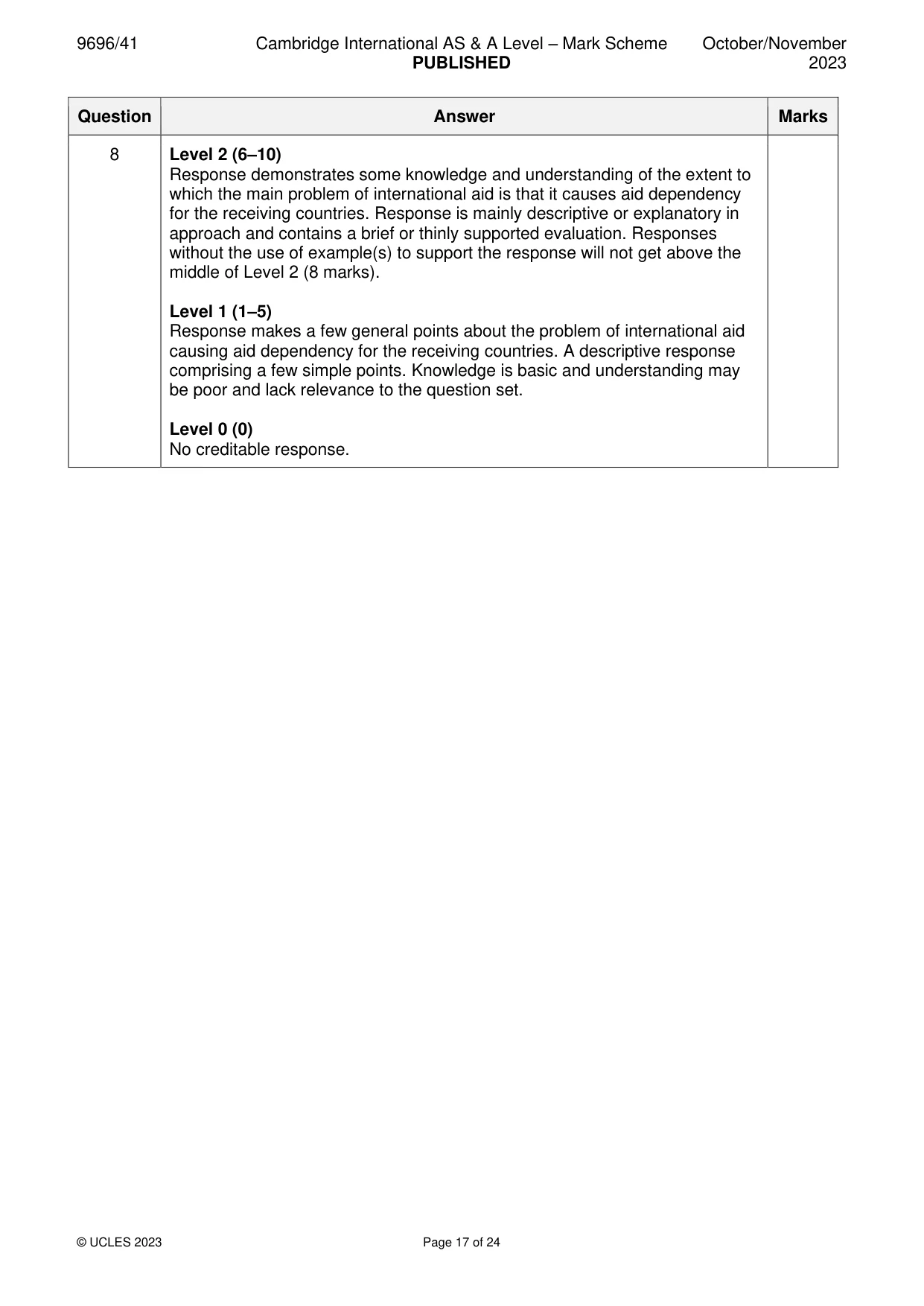
8 ‘The main problem of international aid is that it causes aid dependency for the receiving countries.’ With reference to one or more examples, to what extent do you agree? [20]
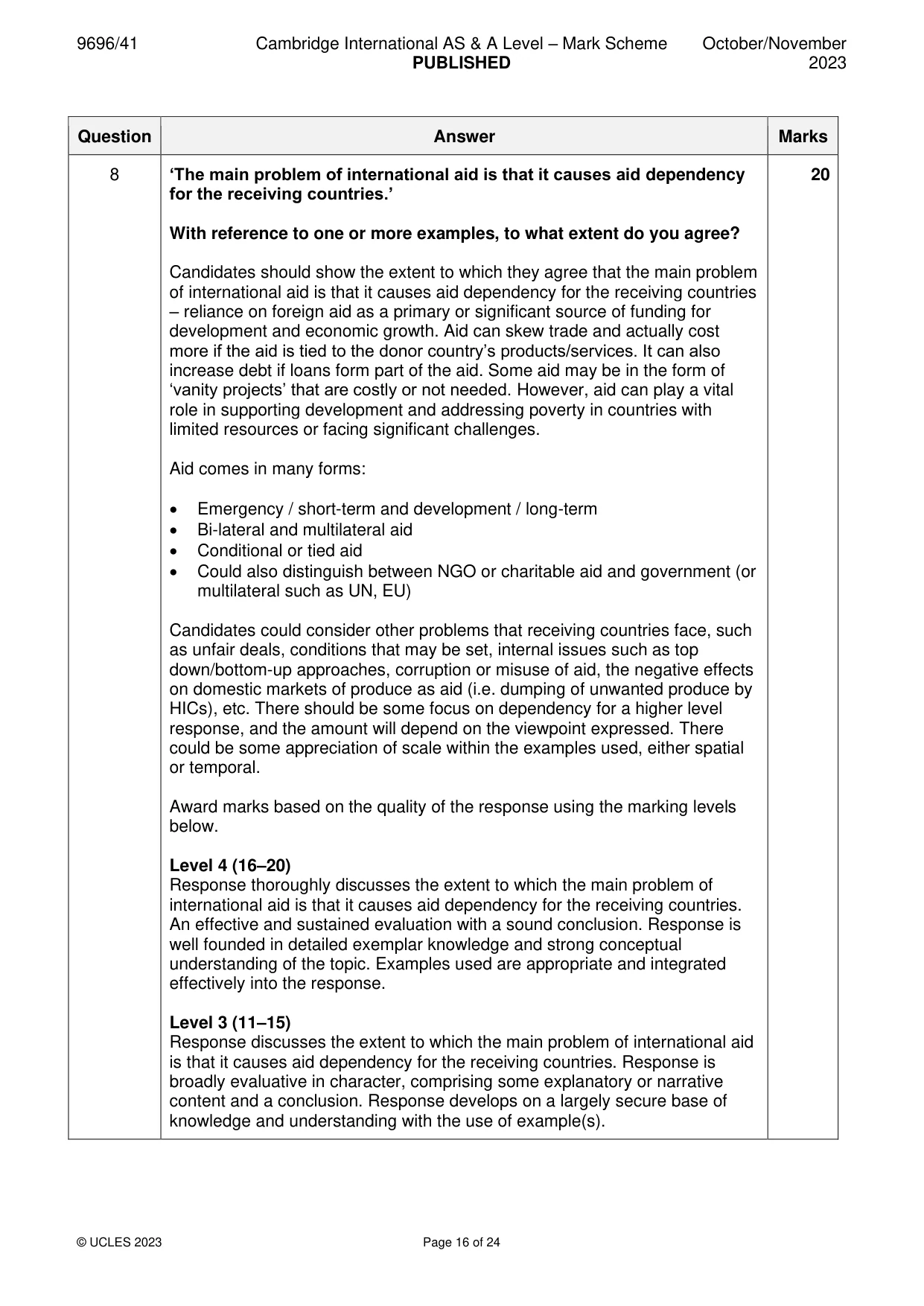
Mark scheme: 8 ‘The main problem of international aid is that it causes aid dependency 20 for the receiving countries.’ With reference to one or more examples, to what extent do you agree? Candidates should show the extent to which they agree that the main problem of international aid is that it causes aid dependency for the receiving countries – reliance on foreign aid as a primary or significant source of funding for development and economic growth. Aid can skew trade and actually cost more if the aid is tied to the donor country’s products/services. It can also increase debt if loans form part of the aid. Some aid may be in the form of ‘vanity projects’ that are costly or not needed. However, aid can play a vital role in supporting development and addressing poverty in countries with limited resources or facing significant challenges. Aid comes in many forms: • Emergency / short-term and development / long-term • Bi-lateral and multilateral aid • Conditional or tied aid • Could also distinguish between NGO or charitable aid and government (or multilateral such as UN, EU) Candidates could consider other problems that receiving countries face, such as unfair deals, conditions that may be set, internal issues such as top down/bottom-up approaches, corruption or misuse of aid, the negative effects on domestic markets of produce as aid (i.e. dumping of unwanted produce by HICs), etc. There should be some focus on dependency for a higher level response, and the amount will depend on the viewpoint expressed. There could be some appreciation of scale within the examples used, either spatial or temporal. Award marks based on the quality of the response using the marking levels below. Level 4 (16–20) Response thoroughly discusses the extent to which the main problem of international aid is that it causes aid dependency for the receiving countries. An effective and sustained evaluation with a sound conclusion. Response is well founded in detailed exemplar knowledge and strong conceptual understanding of the topic. Examples used are appropriate and integrated effectively into the response. Level 3 (11–15) Response discusses the extent to which the main problem of international aid is that it causes aid dependency for the receiving countries. Response is broadly evaluative in character, comprising some explanatory or narrative content and a conclusion. Response develops on a largely secure base of knowledge and understanding with the use of example(s). 8 Level 2 (6–10) Response demonstrates some knowledge and understanding of the extent to which the main problem of international aid is that it causes aid dependency for the receiving countries. Response is mainly descriptive or explanatory in approach and contains a brief or thinly supported evaluation. Responses without the use of example(s) to support the response will not get above the middle of Level 2 (8 marks). Level 1 (1–5) Response makes a few general points about the problem of international aid causing aid dependency for the receiving countries. A descriptive response comprising a few simple points. Knowledge is basic and understanding may be poor and lack relevance to the question set. Level 0 (0) No creditable response.
Q9 · Evaluate the importance of developments in transport and communications in the growth of…
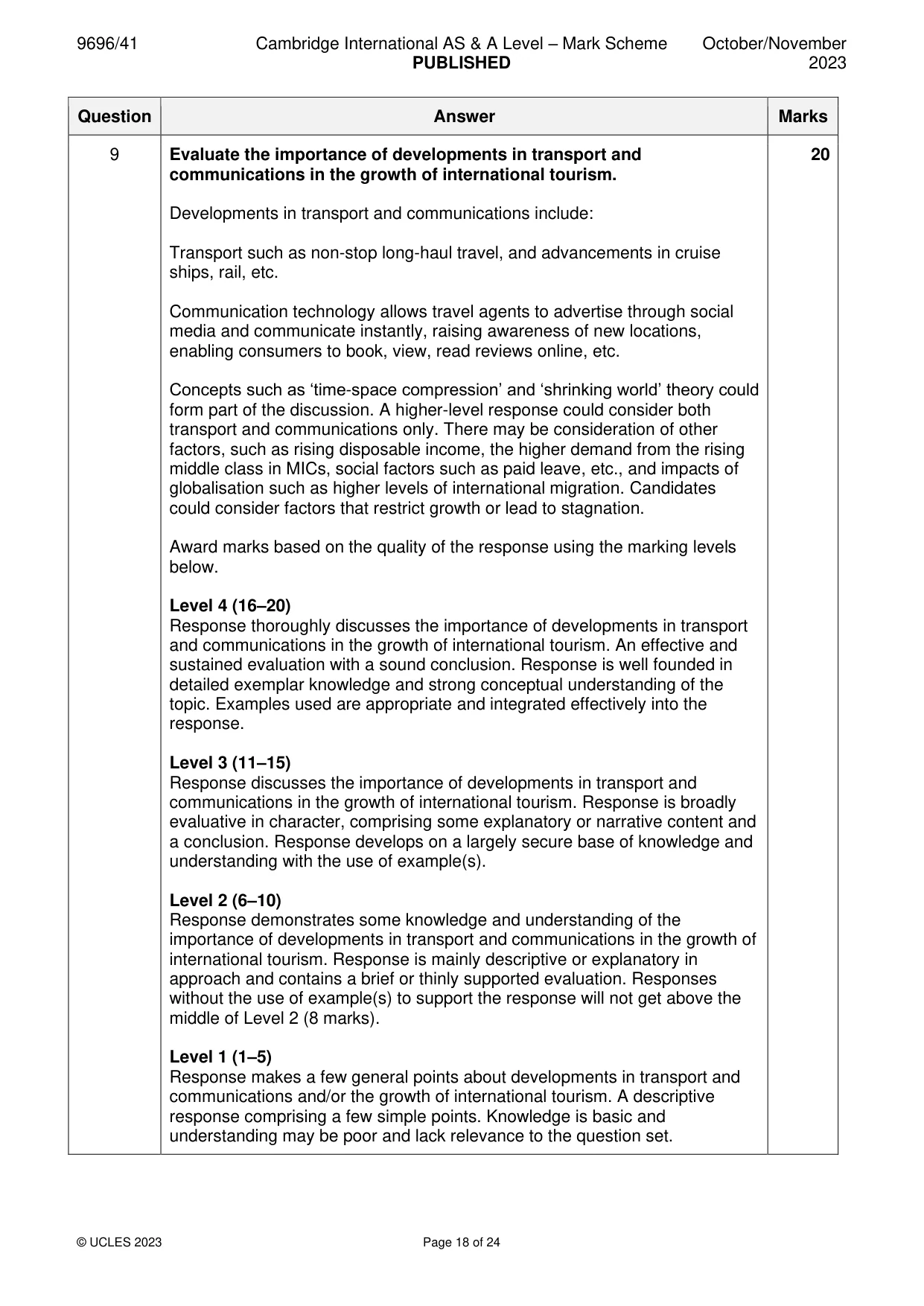
9 Evaluate the importance of developments in transport and communications in the growth of international tourism. [20] Economic transition If answering this option, answer Question 10 and either Question 11 or Question 12.
Mark scheme: 9 Evaluate the importance of developments in transport and 20 communications in the growth of international tourism. Developments in transport and communications include: Transport such as non-stop long-haul travel, and advancements in cruise ships, rail, etc. Communication technology allows travel agents to advertise through social media and communicate instantly, raising awareness of new locations, enabling consumers to book, view, read reviews online, etc. Concepts such as ‘time-space compression’ and ‘shrinking world’ theory could form part of the discussion. A higher-level response could consider both transport and communications only. There may be consideration of other factors, such as rising disposable income, the higher demand from the rising middle class in MICs, social factors such as paid leave, etc., and impacts of globalisation such as higher levels of international migration. Candidates could consider factors that restrict growth or lead to stagnation. Award marks based on the quality of the response using the marking levels below. Level 4 (16–20) Response thoroughly discusses the importance of developments in transport and communications in the growth of international tourism. An effective and sustained evaluation with a sound conclusion. Response is well founded in detailed exemplar knowledge and strong conceptual understanding of the topic. Examples used are appropriate and integrated effectively into the response. Level 3 (11–15) Response discusses the importance of developments in transport and communications in the growth of international tourism. Response is broadly evaluative in character, comprising some explanatory or narrative content and a conclusion. Response develops on a largely secure base of knowledge and understanding with the use of example(s). Level 2 (6–10) Response demonstrates some knowledge and understanding of the importance of developments in transport and communications in the growth of international tourism. Response is mainly descriptive or explanatory in approach and contains a brief or thinly supported evaluation. Responses without the use of example(s) to support the response will not get above the middle of Level 2 (8 marks). Level 1 (1–5) Response makes a few general points about developments in transport and communications and/or the growth of international tourism. A descriptive response comprising a few simple points. Knowledge is basic and understanding may be poor and lack relevance to the question set. 9 Level 0 (0) No creditable response. Economic transition If answering this option, answer Question 10 and either Question 11 or Question 12.
Q10 · The Green View Index (%) and population density (km2) for selected cities in 2017
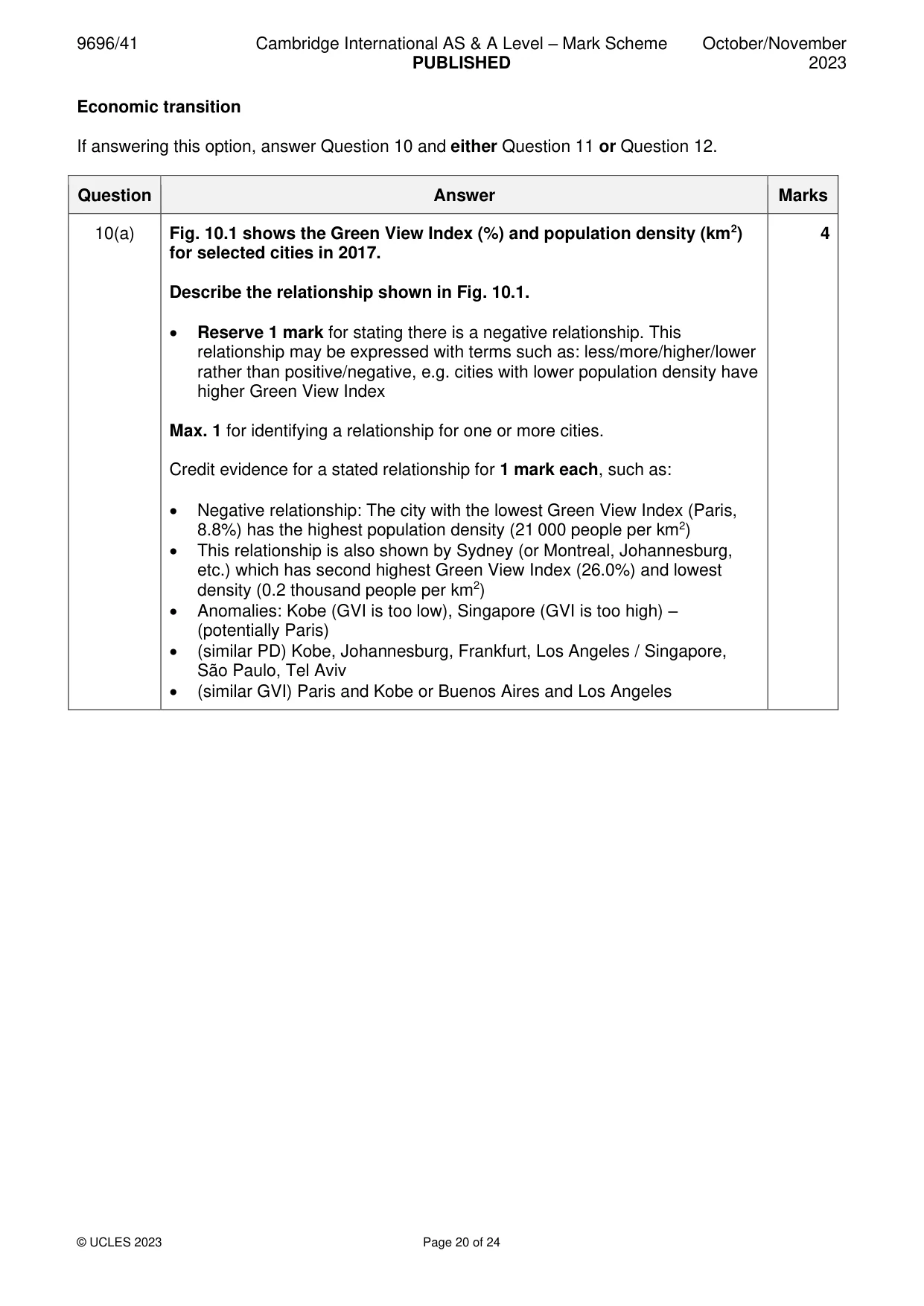
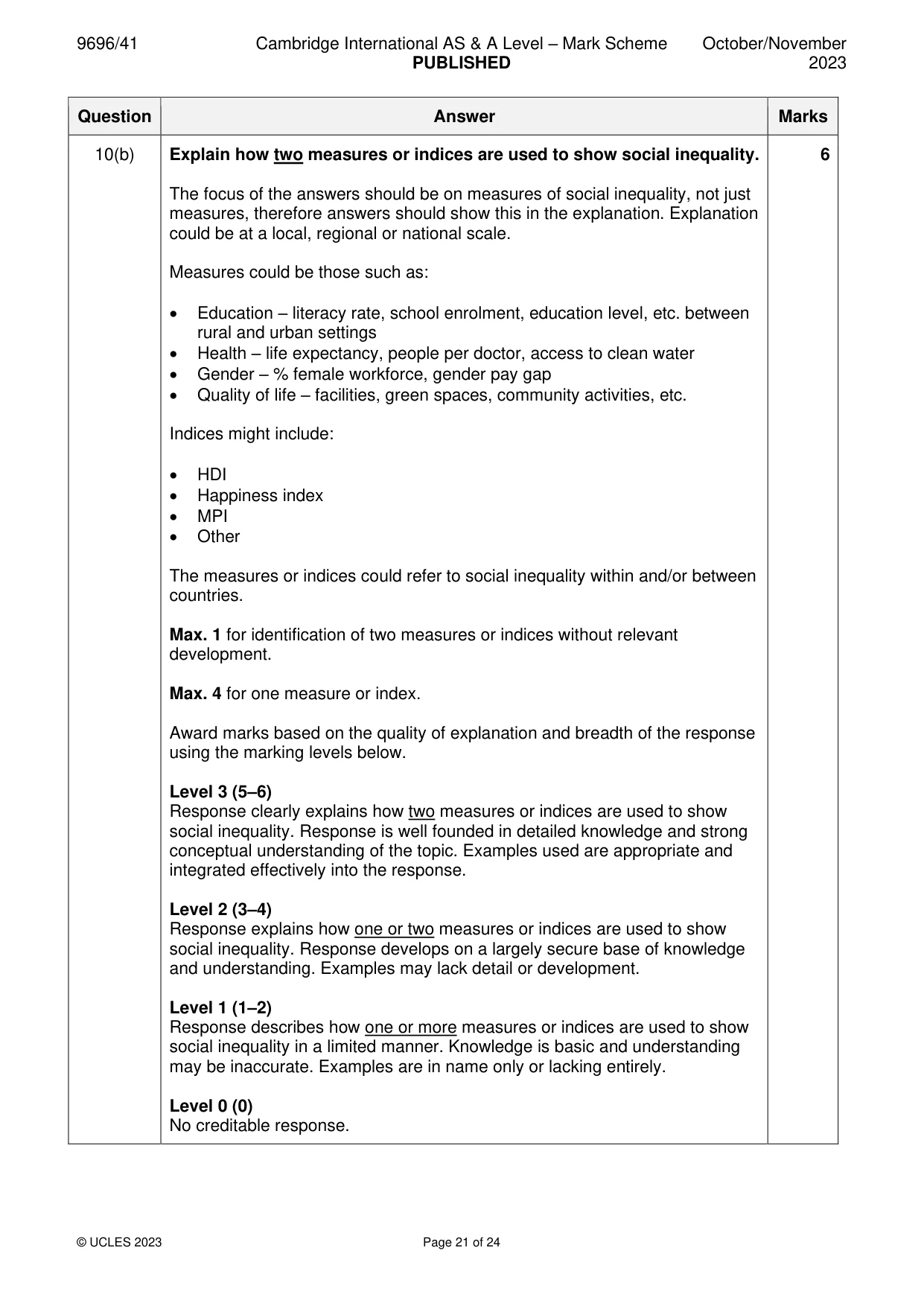
10 Fig. 10.1 shows the Green View Index (%) and population density (km2) for selected cities in 2017. (a) Describe the relationship shown in Fig. 10.1. [4] (b) Explain how two measures or indices are used to show social inequality. [6]
Mark scheme: 10(a) Fig. 10.1 shows the Green View Index (%) and population density (km2) 4 for selected cities in 2017. Describe the relationship shown in Fig. 10.1. • Reserve 1 mark for stating there is a negative relationship. This relationship may be expressed with terms such as: less/more/higher/lower rather than positive/negative, e.g. cities with lower population density have higher Green View Index Max. 1 for identifying a relationship for one or more cities. Credit evidence for a stated relationship for 1 mark each, such as: • Negative relationship: The city with the lowest Green View Index (Paris, 8.8%) has the highest population density (21 000 people per km2) • This relationship is also shown by Sydney (or Montreal, Johannesburg, etc.) which has second highest Green View Index (26.0%) and lowest density (0.2 thousand people per km2) • Anomalies: Kobe (GVI is too low), Singapore (GVI is too high) – (potentially Paris) • (similar PD) Kobe, Johannesburg, Frankfurt, Los Angeles / Singapore, São Paulo, Tel Aviv • (similar GVI) Paris and Kobe or Buenos Aires and Los Angeles 10(b) Explain how two measures or indices are used to show social inequality. 6 The focus of the answers should be on measures of social inequality, not just measures, therefore answers should show this in the explanation. Explanation could be at a local, regional or national scale. Measures could be those such as: • Education – literacy rate, school enrolment, education level, etc. between rural and urban settings • Health – life expectancy, people per doctor, access to clean water • Gender – % female workforce, gender pay gap • Quality of life – facilities, green spaces, community activities, etc. Indices might include: • HDI • Happiness index • MPI • Other The measures or indices could refer to social inequality within and/or between countries. Max. 1 for identification of two measures or indices without relevant development. Max. 4 for one measure or index. Award marks based on the quality of explanation and breadth of the response using the marking levels below. Level 3 (5–6) Response clearly explains how two measures or indices are used to show social inequality. Response is well founded in detailed knowledge and strong conceptual understanding of the topic. Examples used are appropriate and integrated effectively into the response. Level 2 (3–4) Response explains how one or two measures or indices are used to show social inequality. Response develops on a largely secure base of knowledge and understanding. Examples may lack detail or development. Level 1 (1–2) Response describes how one or more measures or indices are used to show social inequality in a limited manner. Knowledge is basic and understanding may be inaccurate. Examples are in name only or lacking entirely. Level 0 (0) No creditable response.
Q11 · With reference to one transnational corporation (TNC), how far do you agree that its…
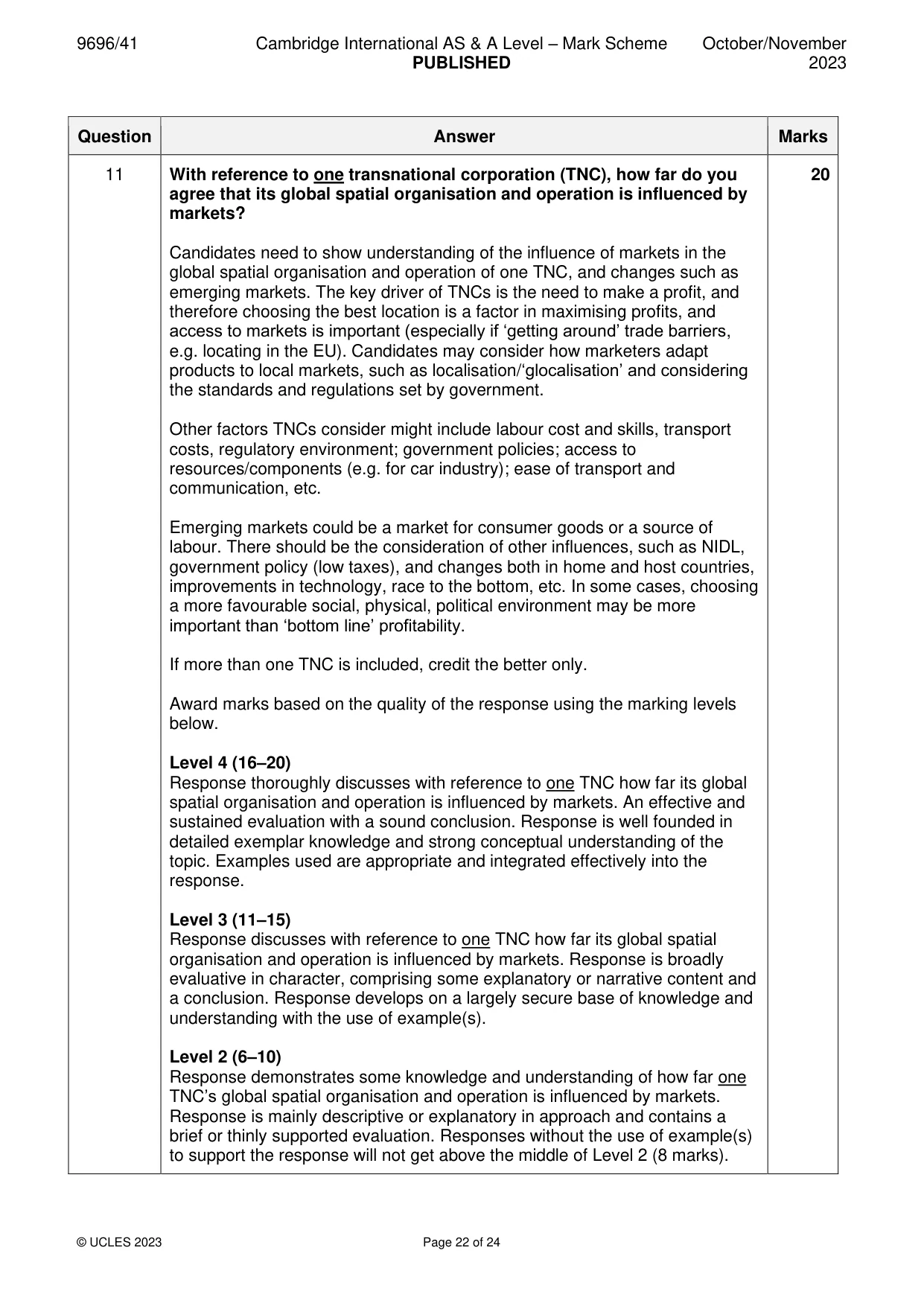
11 With reference to one transnational corporation (TNC), how far do you agree that its global spatial organisation and operation is influenced by markets? [20]
Mark scheme: 11 With reference to one transnational corporation (TNC), how far do you 20 agree that its global spatial organisation and operation is influenced by markets? Candidates need to show understanding of the influence of markets in the global spatial organisation and operation of one TNC, and changes such as emerging markets. The key driver of TNCs is the need to make a profit, and therefore choosing the best location is a factor in maximising profits, and access to markets is important (especially if ‘getting around’ trade barriers, e.g. locating in the EU). Candidates may consider how marketers adapt products to local markets, such as localisation/‘glocalisation’ and considering the standards and regulations set by government. Other factors TNCs consider might include labour cost and skills, transport costs, regulatory environment; government policies; access to resources/components (e.g. for car industry); ease of transport and communication, etc. Emerging markets could be a market for consumer goods or a source of labour. There should be the consideration of other influences, such as NIDL, government policy (low taxes), and changes both in home and host countries, improvements in technology, race to the bottom, etc. In some cases, choosing a more favourable social, physical, political environment may be more important than ‘bottom line’ profitability. If more than one TNC is included, credit the better only. Award marks based on the quality of the response using the marking levels below. Level 4 (16–20) Response thoroughly discusses with reference to one TNC how far its global spatial organisation and operation is influenced by markets. An effective and sustained evaluation with a sound conclusion. Response is well founded in detailed exemplar knowledge and strong conceptual understanding of the topic. Examples used are appropriate and integrated effectively into the response. Level 3 (11–15) Response discusses with reference to one TNC how far its global spatial organisation and operation is influenced by markets. Response is broadly evaluative in character, comprising some explanatory or narrative content and a conclusion. Response develops on a largely secure base of knowledge and understanding with the use of example(s). Level 2 (6–10) Response demonstrates some knowledge and understanding of how far one TNC’s global spatial organisation and operation is influenced by markets. Response is mainly descriptive or explanatory in approach and contains a brief or thinly supported evaluation. Responses without the use of example(s) to support the response will not get above the middle of Level 2 (8 marks). 11 Level 1 (1–5) Response makes a few general points about one TNC’s global spatial organisation and operation and/or the influence of markets. A descriptive response comprising a few simple points. Knowledge is basic and understanding may be poor and lack relevance to the question set. Level 0 (0) No creditable response.
Q12 · With reference to one country, evaluate the relative difficulties it faced in trying to…
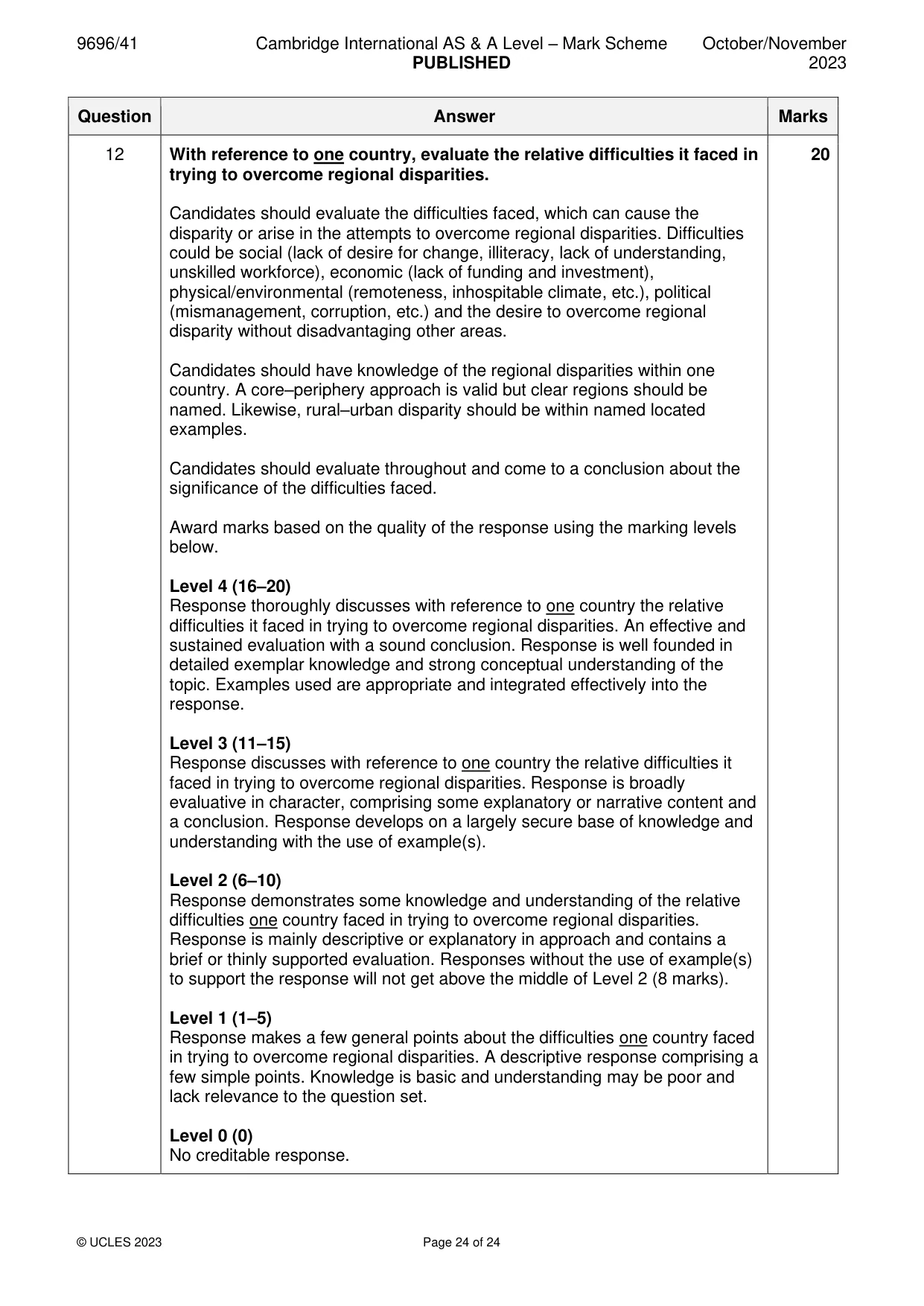
12 With reference to one country, evaluate the relative difficulties it faced in trying to overcome regional disparities. [20]
Mark scheme: 12 With reference to one country, evaluate the relative difficulties it faced in 20 trying to overcome regional disparities. Candidates should evaluate the difficulties faced, which can cause the disparity or arise in the attempts to overcome regional disparities. Difficulties could be social (lack of desire for change, illiteracy, lack of understanding, unskilled workforce), economic (lack of funding and investment), physical/environmental (remoteness, inhospitable climate, etc.), political (mismanagement, corruption, etc.) and the desire to overcome regional disparity without disadvantaging other areas. Candidates should have knowledge of the regional disparities within one country. A core–periphery approach is valid but clear regions should be named. Likewise, rural–urban disparity should be within named located examples. Candidates should evaluate throughout and come to a conclusion about the significance of the difficulties faced. Award marks based on the quality of the response using the marking levels below. Level 4 (16–20) Response thoroughly discusses with reference to one country the relative difficulties it faced in trying to overcome regional disparities. An effective and sustained evaluation with a sound conclusion. Response is well founded in detailed exemplar knowledge and strong conceptual understanding of the topic. Examples used are appropriate and integrated effectively into the response. Level 3 (11–15) Response discusses with reference to one country the relative difficulties it faced in trying to overcome regional disparities. Response is broadly evaluative in character, comprising some explanatory or narrative content and a conclusion. Response develops on a largely secure base of knowledge and understanding with the use of example(s). Level 2 (6–10) Response demonstrates some knowledge and understanding of the relative difficulties one country faced in trying to overcome regional disparities. Response is mainly descriptive or explanatory in approach and contains a brief or thinly supported evaluation. Responses without the use of example(s) to support the response will not get above the middle of Level 2 (8 marks). Level 1 (1–5) Response makes a few general points about the difficulties one country faced in trying to overcome regional disparities. A descriptive response comprising a few simple points. Knowledge is basic and understanding may be poor and lack relevance to the question set. Level 0 (0) No creditable response.
What was in this paper
The subtopics covered by these 12 questions, and how many questions each got. Open one in a new tab to see every Cambridge question on it.
2The management of agricultural change2International debt and international aid1Manufacturing and related service industry1National development1The development of international tourism1The globalisation of economic activity1The management of energy supply1The management of regional development1Trade flows and trading patterns1What you needed in this session
Cambridge’s own grade thresholds for 2023 Oct/Nov, Paper 4 · Variant 1. A higher threshold means an easier paper — the bar moves with how the cohort did.