Cambridge A Level Geography 9696 — 2024 May/June Paper 4 · Variant 1
9696/41/M/J/24 · 12 questions · 60 marks · ≈68 min
The question paper and its mark scheme, free to read here and free to download. This is Cambridge’s own paper, exactly as it was sat.
Question paper4 pages



Mark scheme24 pages
Answers below. Sit the paper first if you are practising.
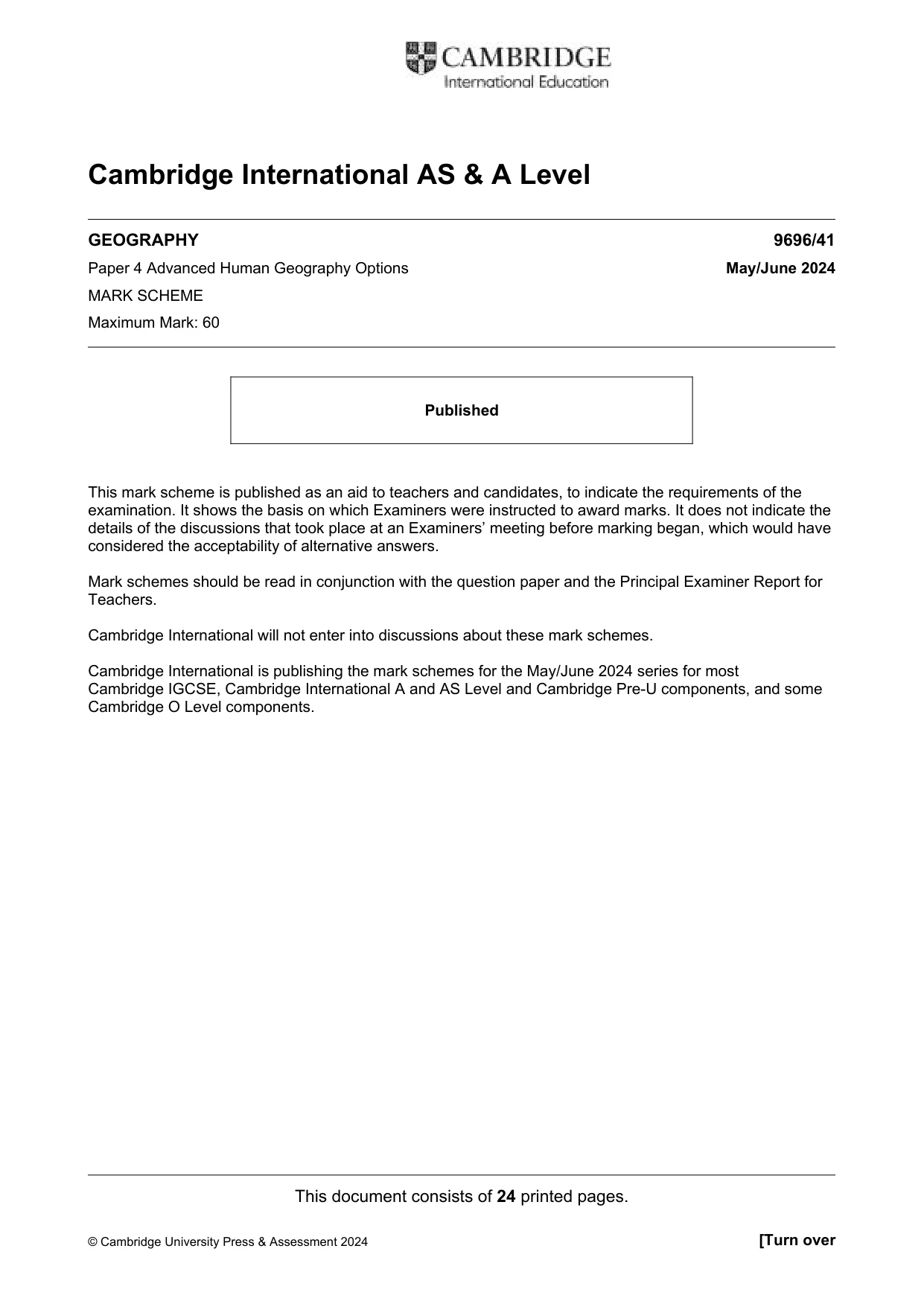





Questions as text
Q1 · The changes in land use and practices on a farm in a tropical environment
1 Fig. 1.1 shows the changes in land use and practices on a farm in a tropical environment. (a) Describe the main changes in land use and practices shown in Fig. 1.1. [4] (b) Suggest the environmental impacts of the changes shown in Fig. 1.1. [6]
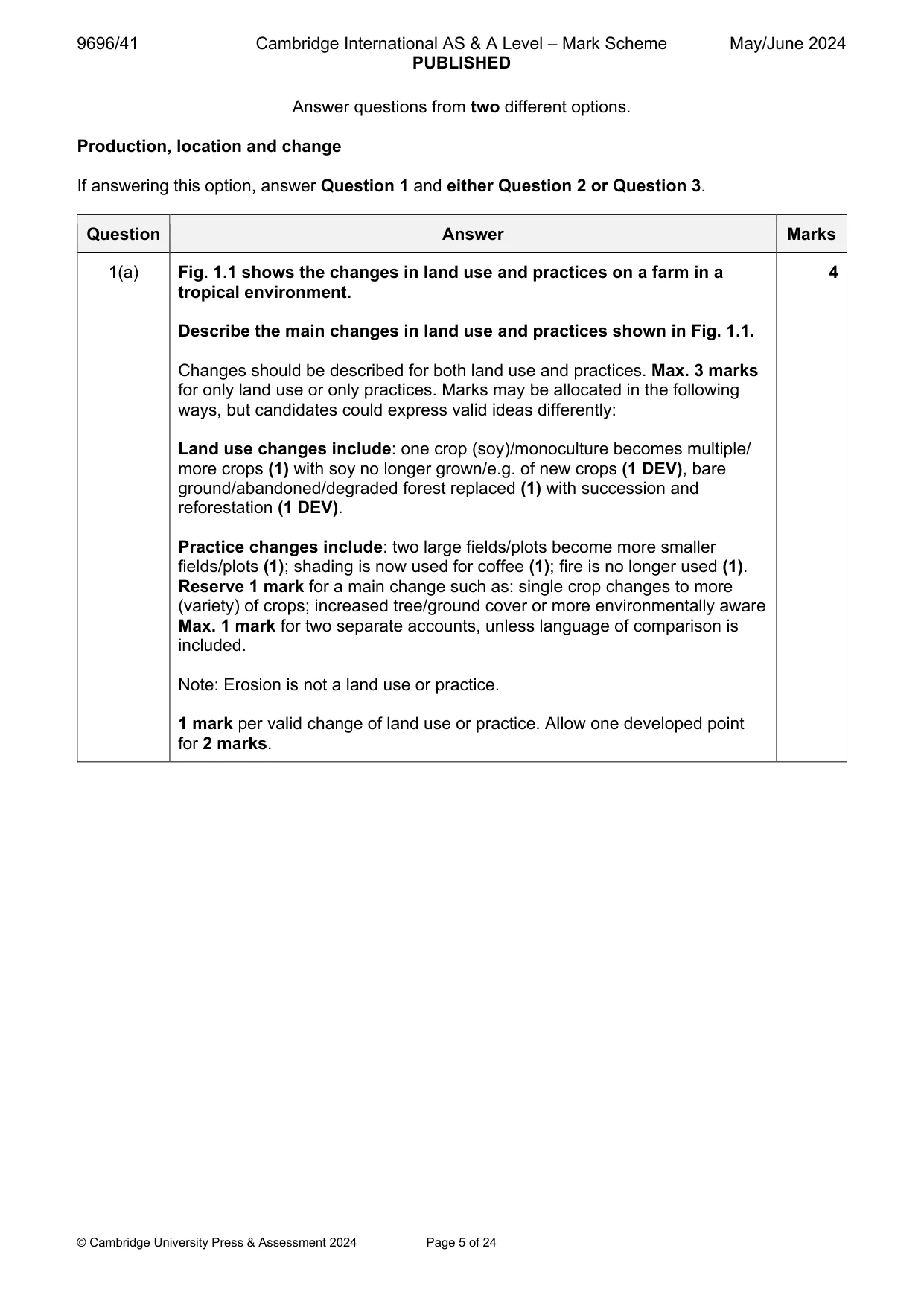
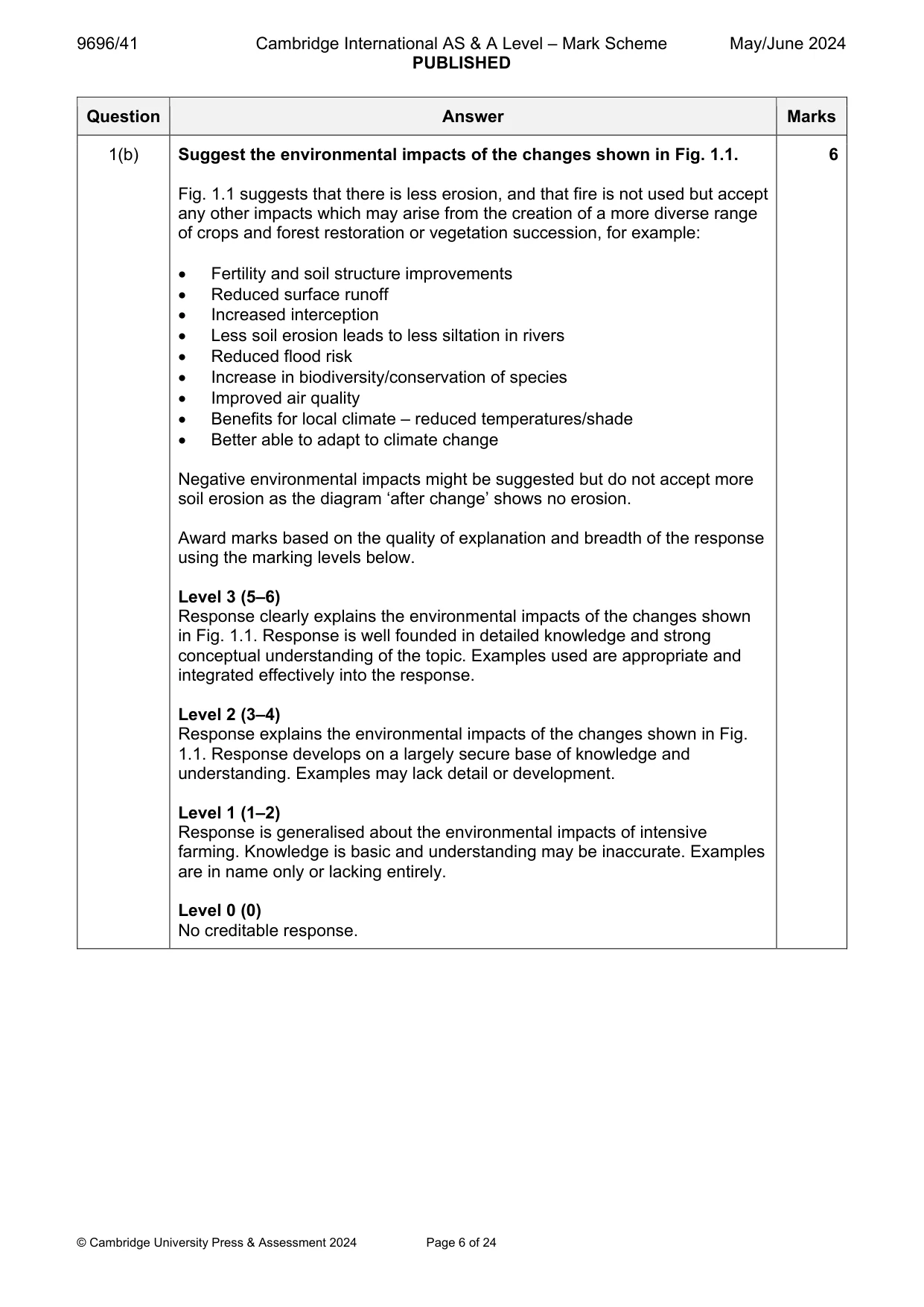
Mark scheme: Question Answer Marks 1(a) Fig. 1.1 shows the changes in land use and practices on a farm in a 4 tropical environment. Describe the main changes in land use and practices shown in Fig. 1.1. Changes should be described for both land use and practices. Max. 3 marks for only land use or only practices. Marks may be allocated in the following ways, but candidates could express valid ideas differently: Land use changes include: one crop (soy)/monoculture becomes multiple/ more crops (1) with soy no longer grown/e.g. of new crops (1 DEV), bare ground/abandoned/degraded forest replaced (1) with succession and reforestation (1 DEV). Practice changes include: two large fields/plots become more smaller fields/plots (1); shading is now used for coffee (1); fire is no longer used (1). Reserve 1 mark for a main change such as: single crop changes to more (variety) of crops; increased tree/ground cover or more environmentally aware Max. 1 mark for two separate accounts, unless language of comparison is included. Note: Erosion is not a land use or practice. 1 mark per valid change of land use or practice. Allow one developed point for 2 marks. 1(b) Suggest the environmental impacts of the changes shown in Fig. 1.1. 6 Fig. 1.1 suggests that there is less erosion, and that fire is not used but accept any other impacts which may arise from the creation of a more diverse range of crops and forest restoration or vegetation succession, for example: Fertility and soil structure improvements Reduced surface runoff Increased interception Less soil erosion leads to less siltation in rivers Reduced flood risk Increase in biodiversity/conservation of species Improved air quality Benefits for local climate – reduced temperatures/shade Better able to adapt to climate change Negative environmental impacts might be suggested but do not accept more soil erosion as the diagram ‘after change’ shows no erosion. Award marks based on the quality of explanation and breadth of the response using the marking levels below. Level 3 (5–6) Response clearly explains the environmental impacts of the changes shown in Fig. 1.1. Response is well founded in detailed knowledge and strong conceptual understanding of the topic. Examples used are appropriate and integrated effectively into the response. Level 2 (3–4) Response explains the environmental impacts of the changes shown in Fig. 1.1. Response develops on a largely secure base of knowledge and understanding. Examples may lack detail or development. Level 1 (1–2) Response is generalised about the environmental impacts of intensive farming. Knowledge is basic and understanding may be inaccurate. Examples are in name only or lacking entirely. Level 0 (0) No creditable response.
Q2 · With reference to one country, explain why there was a need for agricultural change and…
2 With reference to one country, explain why there was a need for agricultural change and assess the extent to which the difficulties have been overcome. [20]
Mark scheme: 2 With reference to one country, explain why there was a need for 20 agricultural change and assess the extent to which the difficulties have been overcome. Candidates should outline at least two difficulties faced and discuss the success or not of management of the difficulties and/or whether management can overcome the difficulties. The need for agricultural change could be at any scale: local scale (the farm, holding or producer) and/or at the national scale. These needs might be a result of environmental, social, economic or political factors. Assessment of the extent to which the difficulties have been overcome could consider whether it has been removed, ameliorated, or cannot be overcome, and might explore circumstances or places within the country where difficulties have been overcome. For a response which uses more than one country, mark both or all and credit the better or best. Award marks based on the quality of the response using the marking levels below. Level 4 (16–20) Response thoroughly discusses with reference to one country why there was a need for agricultural change and the extent to which the difficulties have been overcome. An effective and sustained evaluation with a sound conclusion. Response is well founded in detailed exemplar knowledge and strong conceptual understanding of the topic. Examples used are appropriate and integrated effectively into the response. Level 3 (11–15) Response discusses with reference to one country why there was a need for agricultural change and the extent to which the difficulties have been overcome. Response is broadly evaluative in character, comprising some explanatory or narrative content and a conclusion. Response develops on a largely secure base of knowledge and understanding with the use of example(s). Level 2 (6–10) Response demonstrates some knowledge and understanding of the need for agricultural change for one country but assessment of the extent to which difficulties have been overcome is basic. Response is mainly descriptive or explanatory in approach and contains a brief or thinly supported evaluation. Responses without the use of example(s) to support the response will not get above the middle of Level 2 (8 marks). Level 1 (1–5) Response makes a few general points about agriculture in one country. A descriptive response comprising a few simple points. Knowledge is basic and understanding may be poor and lack relevance to the question set. Level 0 (0) No creditable response.
Q3 · ‘Materials are more important as a locational factor in some manufacturing industries…
3 ‘Materials are more important as a locational factor in some manufacturing industries than in other manufacturing industries.’ With reference to one or more examples, how far do you agree with this statement? [20] Environmental management If answering this option, answer Question 4 and either Question 5 or Question 6.
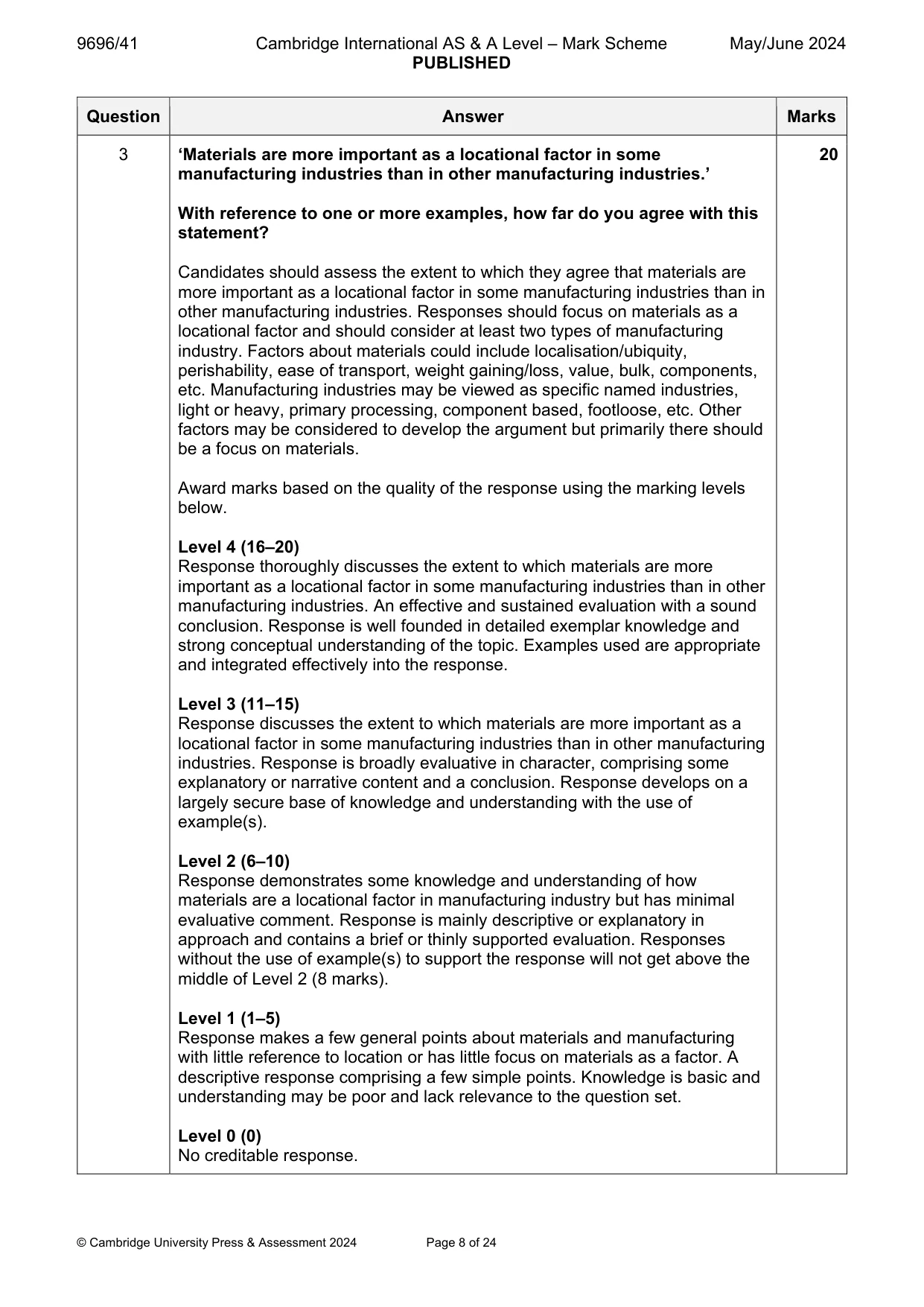
Mark scheme: 3 ‘Materials are more important as a locational factor in some 20 manufacturing industries than in other manufacturing industries.’ With reference to one or more examples, how far do you agree with this statement? Candidates should assess the extent to which they agree that materials are more important as a locational factor in some manufacturing industries than in other manufacturing industries. Responses should focus on materials as a locational factor and should consider at least two types of manufacturing industry. Factors about materials could include localisation/ubiquity, perishability, ease of transport, weight gaining/loss, value, bulk, components, etc. Manufacturing industries may be viewed as specific named industries, light or heavy, primary processing, component based, footloose, etc. Other factors may be considered to develop the argument but primarily there should be a focus on materials. Award marks based on the quality of the response using the marking levels below. Level 4 (16–20) Response thoroughly discusses the extent to which materials are more important as a locational factor in some manufacturing industries than in other manufacturing industries. An effective and sustained evaluation with a sound conclusion. Response is well founded in detailed exemplar knowledge and strong conceptual understanding of the topic. Examples used are appropriate and integrated effectively into the response. Level 3 (11–15) Response discusses the extent to which materials are more important as a locational factor in some manufacturing industries than in other manufacturing industries. Response is broadly evaluative in character, comprising some explanatory or narrative content and a conclusion. Response develops on a largely secure base of knowledge and understanding with the use of example(s). Level 2 (6–10) Response demonstrates some knowledge and understanding of how materials are a locational factor in manufacturing industry but has minimal evaluative comment. Response is mainly descriptive or explanatory in approach and contains a brief or thinly supported evaluation. Responses without the use of example(s) to support the response will not get above the middle of Level 2 (8 marks). Level 1 (1–5) Response makes a few general points about materials and manufacturing with little reference to location or has little focus on materials as a factor. A descriptive response comprising a few simple points. Knowledge is basic and understanding may be poor and lack relevance to the question set. Level 0 (0) No creditable response. Environmental management If answering this option, answer Question 4 and either Question 5 or Question 6.
Q4 · Access to different levels of water quality for the world’s population in 2000 and 2020
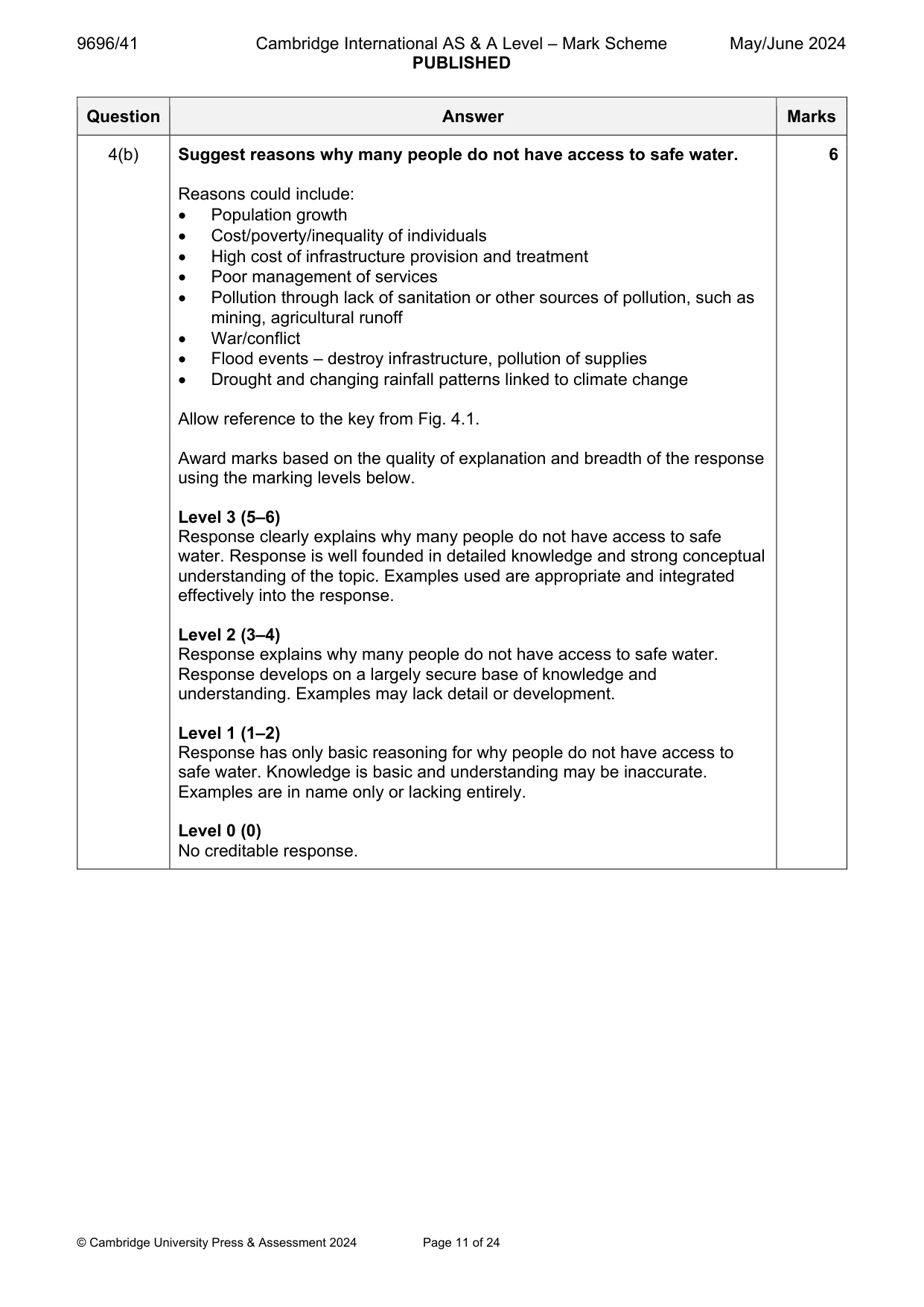
4 Fig. 4.1 shows access to different levels of water quality for the world’s population in 2000 and 2020. (a) Describe the main changes in access to different levels of water quality shown in Fig. 4.1. [4] (b) Suggest reasons why many people do not have access to safe water. [6]
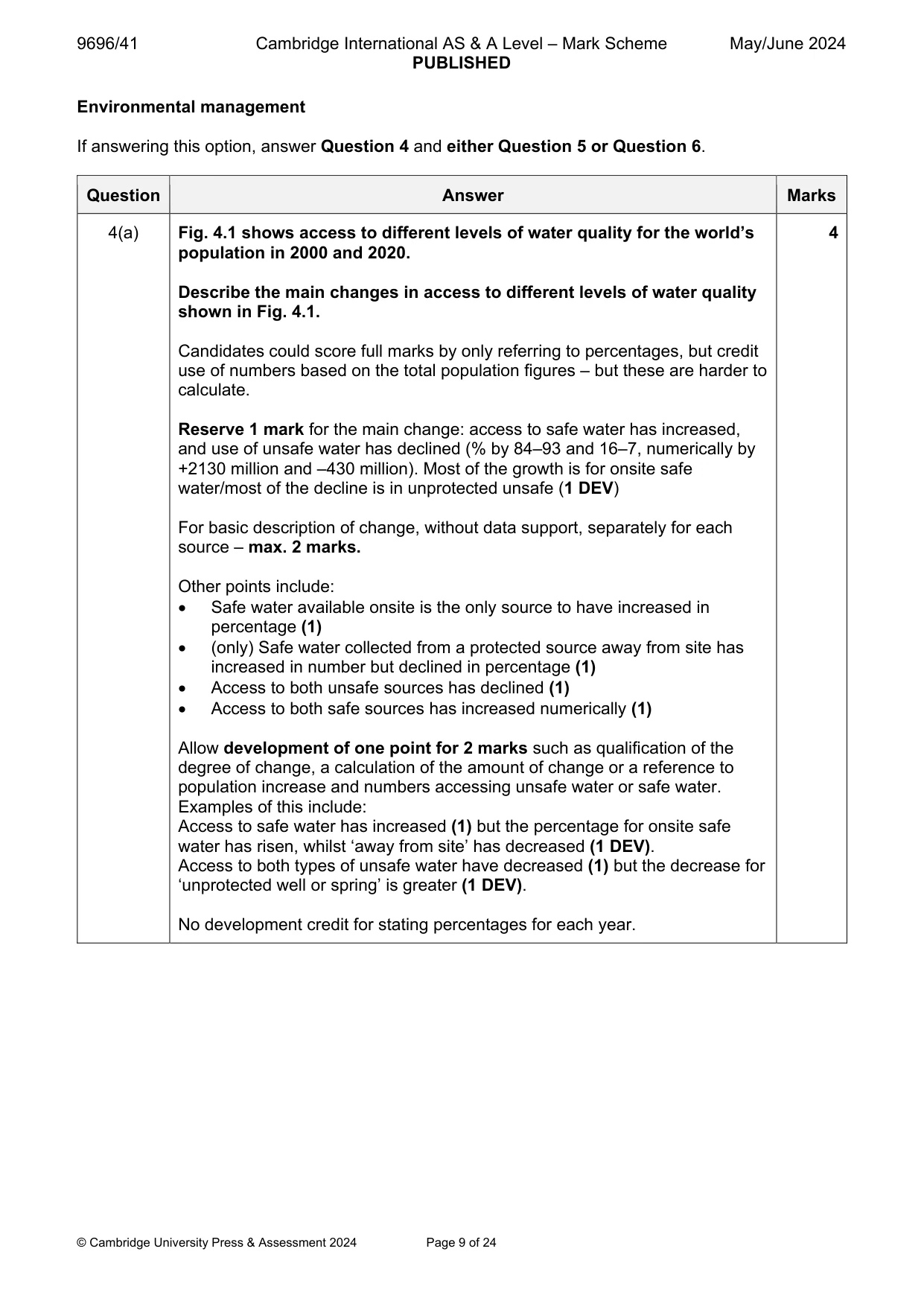
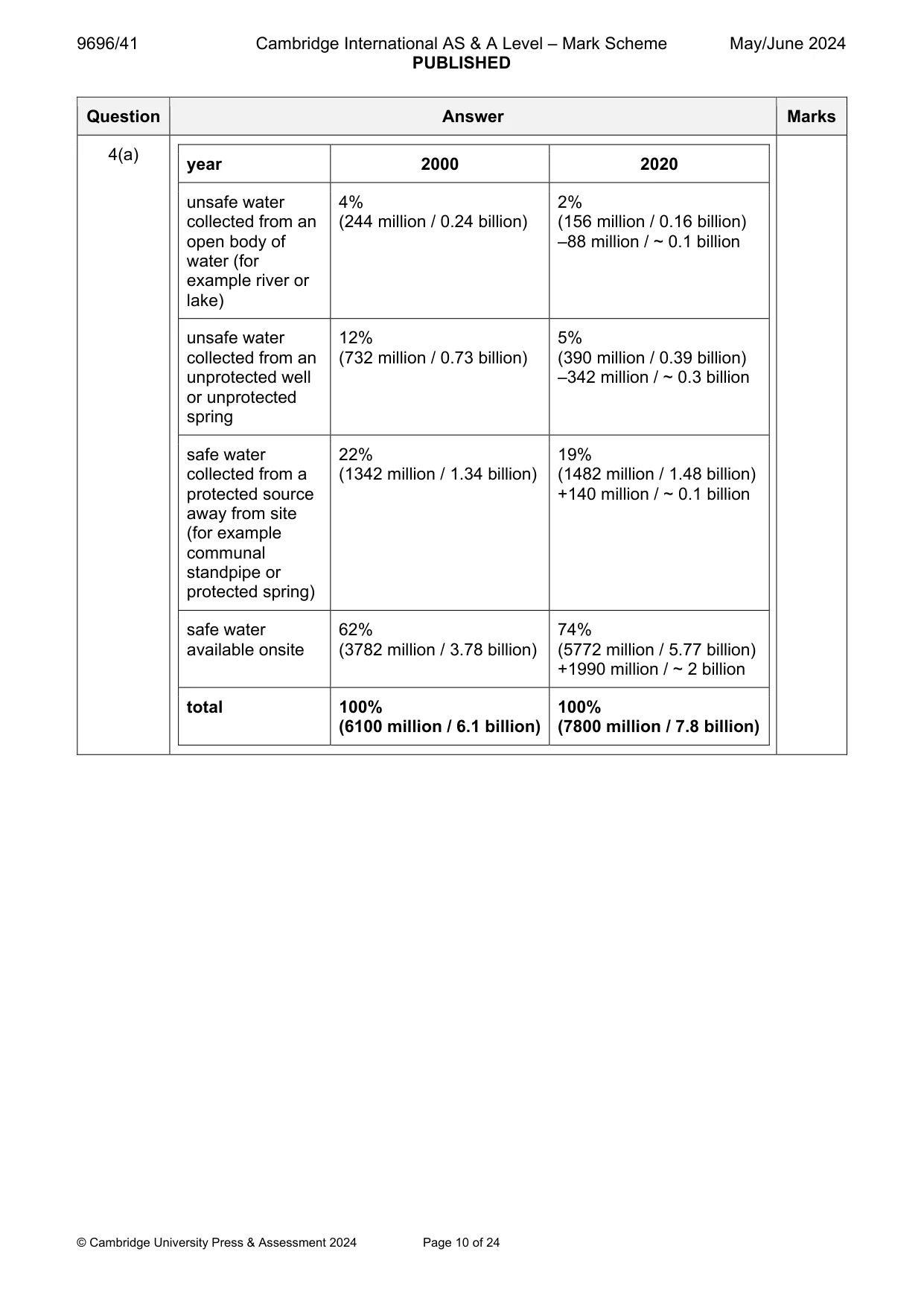
Mark scheme: 4(a) Fig. 4.1 shows access to different levels of water quality for the world’s 4 population in 2000 and 2020. Describe the main changes in access to different levels of water quality shown in Fig. 4.1. Candidates could score full marks by only referring to percentages, but credit use of numbers based on the total population figures – but these are harder to calculate. Reserve 1 mark for the main change: access to safe water has increased, and use of unsafe water has declined (% by 84–93 and 16–7, numerically by +2130 million and –430 million). Most of the growth is for onsite safe water/most of the decline is in unprotected unsafe (1 DEV) For basic description of change, without data support, separately for each source – max. 2 marks. Other points include: Safe water available onsite is the only source to have increased in percentage (1) (only) Safe water collected from a protected source away from site has increased in number but declined in percentage (1) Access to both unsafe sources has declined (1) Access to both safe sources has increased numerically (1) Allow development of one point for 2 marks such as qualification of the degree of change, a calculation of the amount of change or a reference to population increase and numbers accessing unsafe water or safe water. Examples of this include: Access to safe water has increased (1) but the percentage for onsite safe water has risen, whilst ‘away from site’ has decreased (1 DEV). Access to both types of unsafe water have decreased (1) but the decrease for ‘unprotected well or spring’ is greater (1 DEV). No development credit for stating percentages for each year. 4(a) year 2000 2020 unsafe water 4% 2% collected from an (244 million / 0.24 billion) (156 million / 0.16 billion) open body of –88 million / ~ 0.1 billion water (for example river or lake) unsafe water 12% 5% collected from an (732 million / 0.73 billion) (390 million / 0.39 billion) unprotected well –342 million / ~ 0.3 billion or unprotected spring safe water 22% 19% collected from a (1342 million / 1.34 billion) (1482 million / 1.48 billion) protected source +140 million / ~ 0.1 billion away from site (for example communal standpipe or protected spring) safe water 62% 74% available onsite (3782 million / 3.78 billion) (5772 million / 5.77 billion) +1990 million / ~ 2 billion total 100% 100% (6100 million / 6.1 billion) (7800 million / 7.8 billion) 4(b) Suggest reasons why many people do not have access to safe water. 6 Reasons could include: Population growth Cost/poverty/inequality of individuals High cost of infrastructure provision and treatment Poor management of services Pollution through lack of sanitation or other sources of pollution, such as mining, agricultural runoff War/conflict Flood events – destroy infrastructure, pollution of supplies Drought and changing rainfall patterns linked to climate change Allow reference to the key from Fig. 4.1. Award marks based on the quality of explanation and breadth of the response using the marking levels below. Level 3 (5–6) Response clearly explains why many people do not have access to safe water. Response is well founded in detailed knowledge and strong conceptual understanding of the topic. Examples used are appropriate and integrated effectively into the response. Level 2 (3–4) Response explains why many people do not have access to safe water. Response develops on a largely secure base of knowledge and understanding. Examples may lack detail or development. Level 1 (1–2) Response has only basic reasoning for why people do not have access to safe water. Knowledge is basic and understanding may be inaccurate. Examples are in name only or lacking entirely. Level 0 (0) No creditable response.
Q5 · With reference to one named located scheme to produce electricity, assess the extent to…
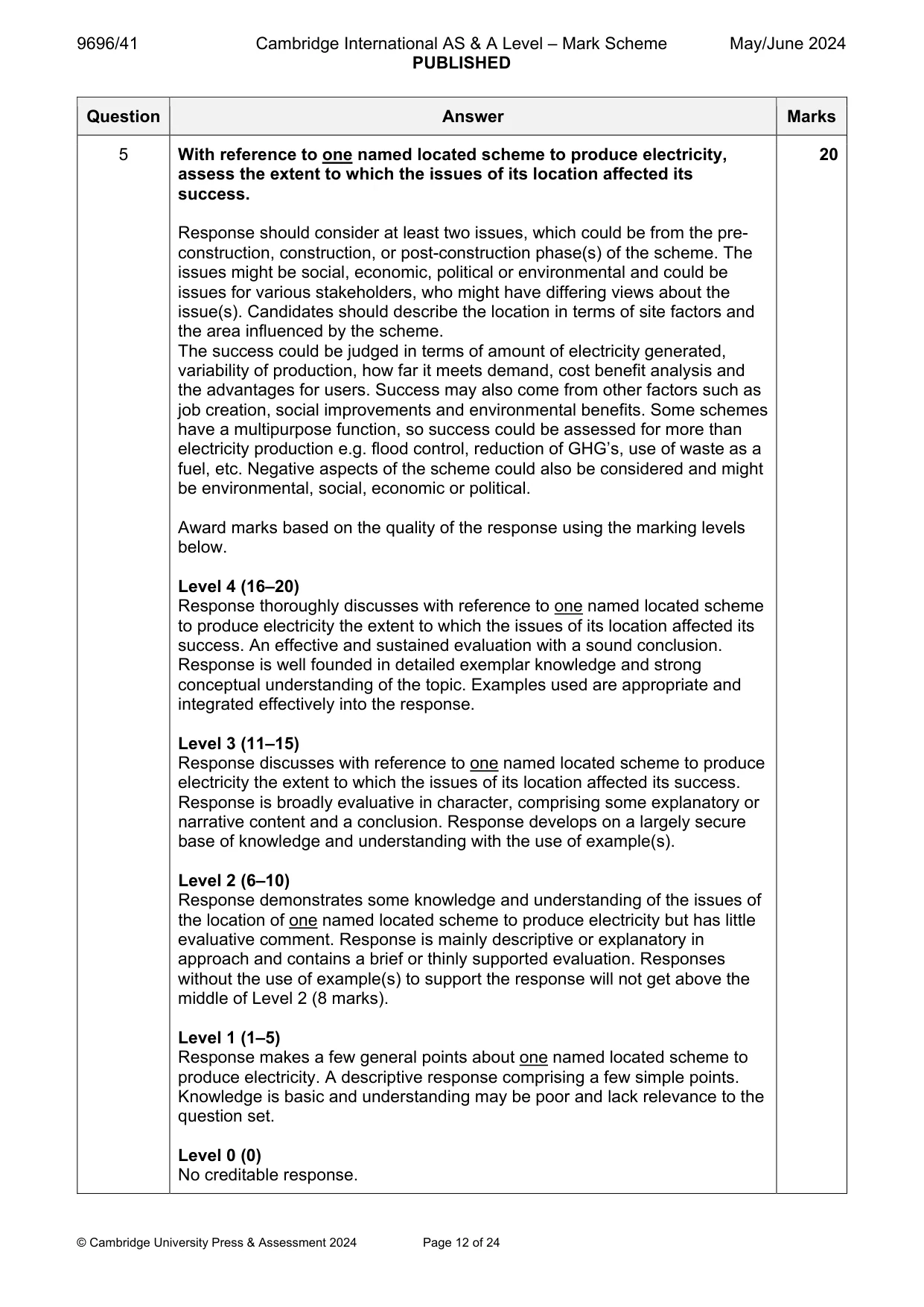
5 With reference to one named located scheme to produce electricity, assess the extent to which the issues of its location affected its success. [20]
Mark scheme: 5 With reference to one named located scheme to produce electricity, 20 assess the extent to which the issues of its location affected its success. Response should consider at least two issues, which could be from the pre- construction, construction, or post-construction phase(s) of the scheme. The issues might be social, economic, political or environmental and could be issues for various stakeholders, who might have differing views about the issue(s). Candidates should describe the location in terms of site factors and the area influenced by the scheme. The success could be judged in terms of amount of electricity generated, variability of production, how far it meets demand, cost benefit analysis and the advantages for users. Success may also come from other factors such as job creation, social improvements and environmental benefits. Some schemes have a multipurpose function, so success could be assessed for more than electricity production e.g. flood control, reduction of GHG’s, use of waste as a fuel, etc. Negative aspects of the scheme could also be considered and might be environmental, social, economic or political. Award marks based on the quality of the response using the marking levels below. Level 4 (16–20) Response thoroughly discusses with reference to one named located scheme to produce electricity the extent to which the issues of its location affected its success. An effective and sustained evaluation with a sound conclusion. Response is well founded in detailed exemplar knowledge and strong conceptual understanding of the topic. Examples used are appropriate and integrated effectively into the response. Level 3 (11–15) Response discusses with reference to one named located scheme to produce electricity the extent to which the issues of its location affected its success. Response is broadly evaluative in character, comprising some explanatory or narrative content and a conclusion. Response develops on a largely secure base of knowledge and understanding with the use of example(s). Level 2 (6–10) Response demonstrates some knowledge and understanding of the issues of the location of one named located scheme to produce electricity but has little evaluative comment. Response is mainly descriptive or explanatory in approach and contains a brief or thinly supported evaluation. Responses without the use of example(s) to support the response will not get above the middle of Level 2 (8 marks). Level 1 (1–5) Response makes a few general points about one named located scheme to produce electricity. A descriptive response comprising a few simple points. Knowledge is basic and understanding may be poor and lack relevance to the question set. Level 0 (0) No creditable response.
Q6 · ‘Education is the most important factor in the successful protection of environments at…
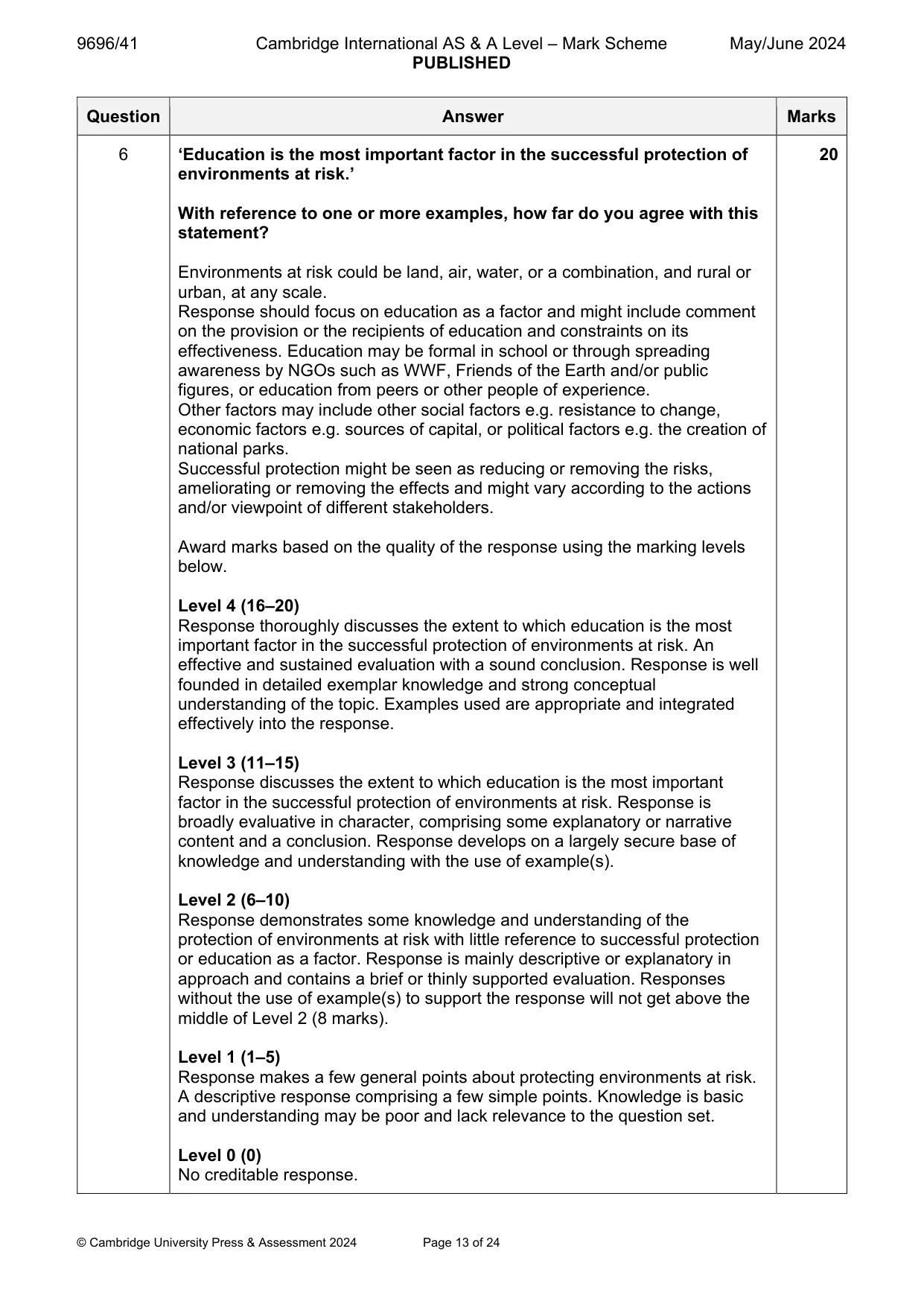
6 ‘Education is the most important factor in the successful protection of environments at risk.’ With reference to one or more examples, how far do you agree with this statement? [20] Global interdependence If answering this option, answer Question 7 and either Question 8 or Question 9.
Mark scheme: 6 ‘Education is the most important factor in the successful protection of 20 environments at risk.’ With reference to one or more examples, how far do you agree with this statement? Environments at risk could be land, air, water, or a combination, and rural or urban, at any scale. Response should focus on education as a factor and might include comment on the provision or the recipients of education and constraints on its effectiveness. Education may be formal in school or through spreading awareness by NGOs such as WWF, Friends of the Earth and/or public figures, or education from peers or other people of experience. Other factors may include other social factors e.g. resistance to change, economic factors e.g. sources of capital, or political factors e.g. the creation of national parks. Successful protection might be seen as reducing or removing the risks, ameliorating or removing the effects and might vary according to the actions and/or viewpoint of different stakeholders. Award marks based on the quality of the response using the marking levels below. Level 4 (16–20) Response thoroughly discusses the extent to which education is the most important factor in the successful protection of environments at risk. An effective and sustained evaluation with a sound conclusion. Response is well founded in detailed exemplar knowledge and strong conceptual understanding of the topic. Examples used are appropriate and integrated effectively into the response. Level 3 (11–15) Response discusses the extent to which education is the most important factor in the successful protection of environments at risk. Response is broadly evaluative in character, comprising some explanatory or narrative content and a conclusion. Response develops on a largely secure base of knowledge and understanding with the use of example(s). Level 2 (6–10) Response demonstrates some knowledge and understanding of the protection of environments at risk with little reference to successful protection or education as a factor. Response is mainly descriptive or explanatory in approach and contains a brief or thinly supported evaluation. Responses without the use of example(s) to support the response will not get above the middle of Level 2 (8 marks). Level 1 (1–5) Response makes a few general points about protecting environments at risk. A descriptive response comprising a few simple points. Knowledge is basic and understanding may be poor and lack relevance to the question set. Level 0 (0) No creditable response. Global interdependence If answering this option, answer Question 7 and either Question 8 or Question 9.
Q7 · Government external debt payments as a percentage of government revenue in 2021
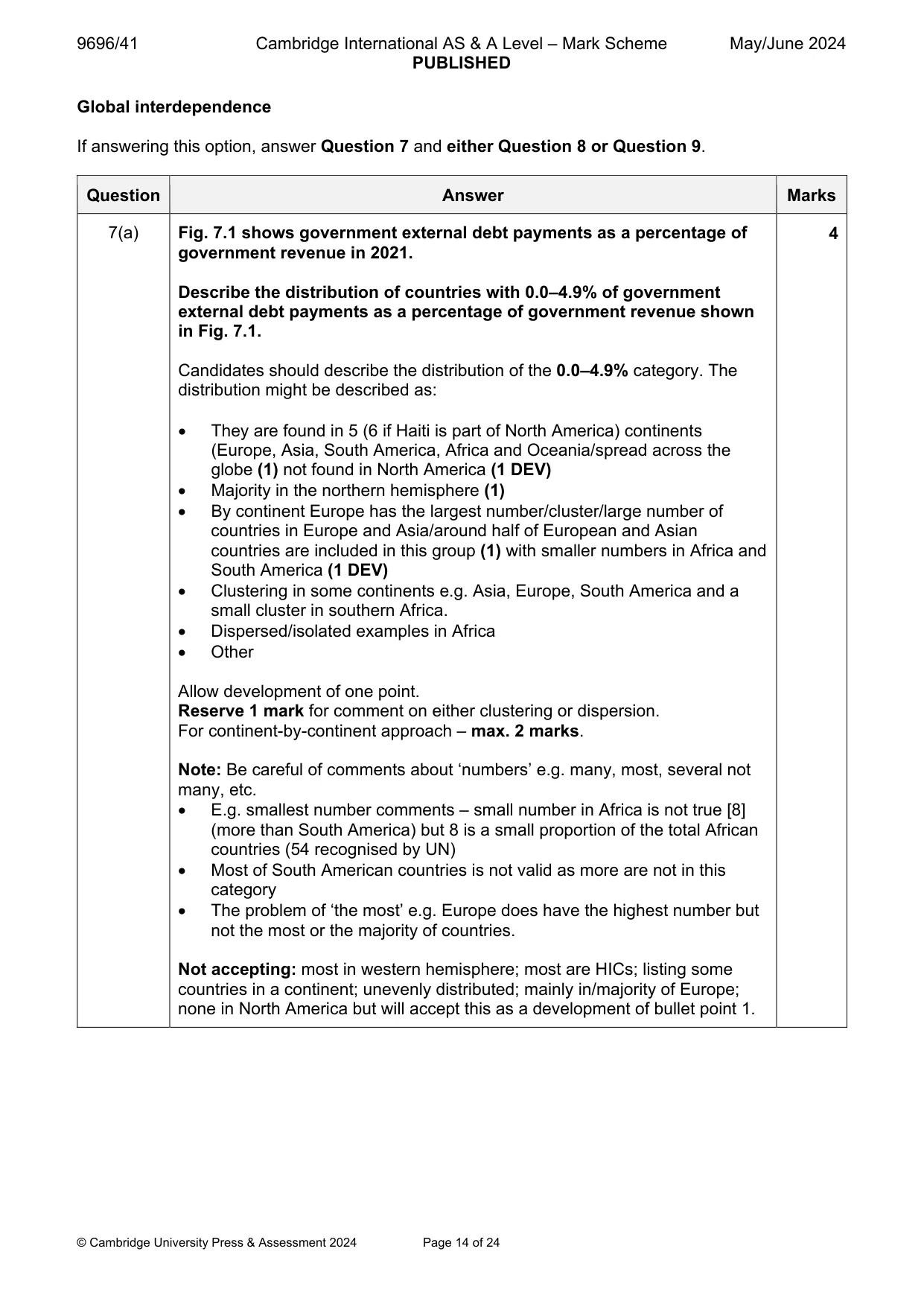
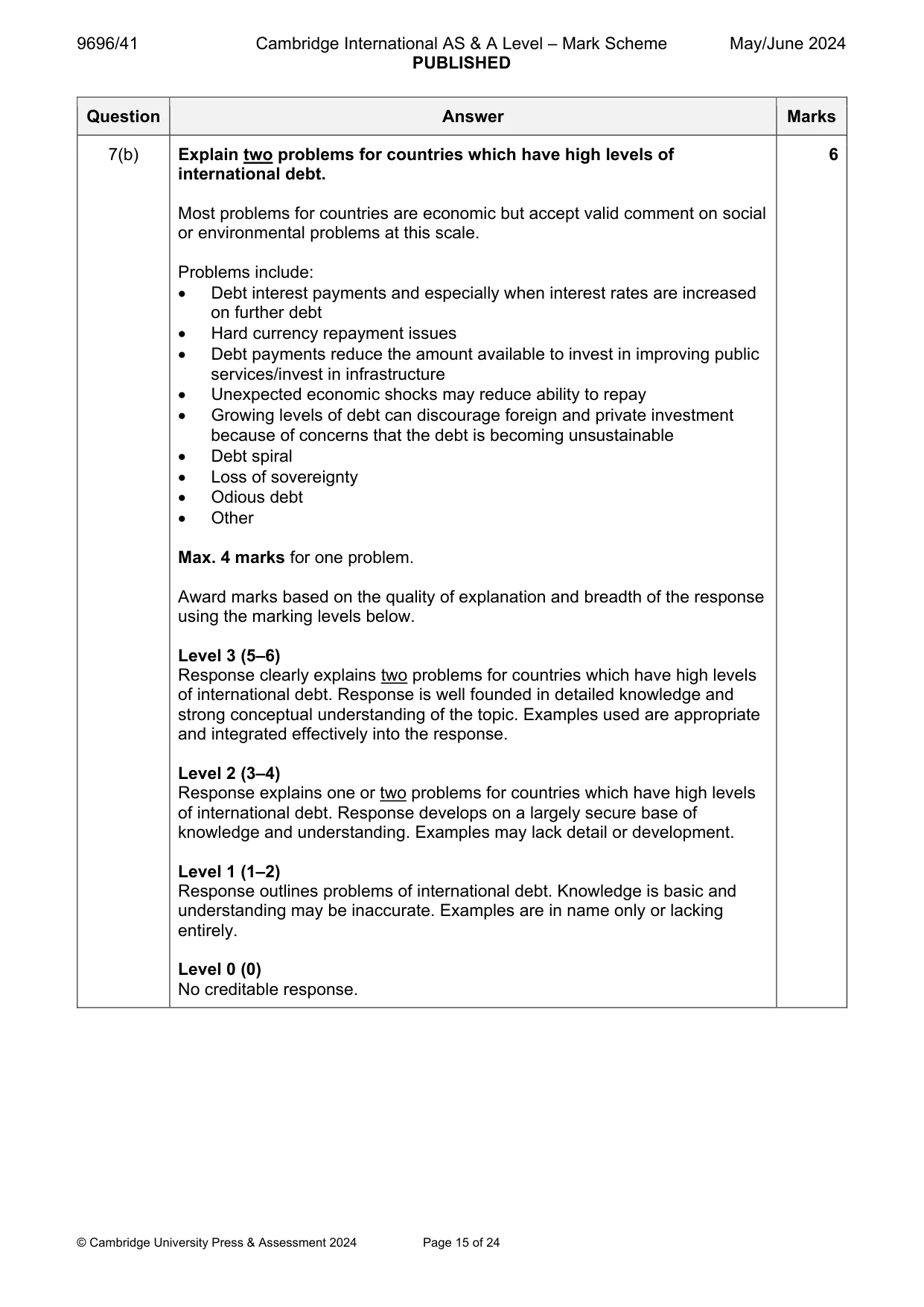
7 Fig. 7.1 shows government external debt payments as a percentage of government revenue in 2021. (a) Describe the distribution of countries with 0.0 – 4.9% of government external debt payments as a percentage of government revenue shown in Fig. 7.1. [4] (b) Explain two problems for countries which have high levels of international debt. [6]
Mark scheme: 7(a) Fig. 7.1 shows government external debt payments as a percentage of 4 government revenue in 2021. Describe the distribution of countries with 0.0–4.9% of government external debt payments as a percentage of government revenue shown in Fig. 7.1. Candidates should describe the distribution of the 0.0–4.9% category. The distribution might be described as: They are found in 5 (6 if Haiti is part of North America) continents (Europe, Asia, South America, Africa and Oceania/spread across the globe (1) not found in North America (1 DEV) Majority in the northern hemisphere (1) By continent Europe has the largest number/cluster/large number of countries in Europe and Asia/around half of European and Asian countries are included in this group (1) with smaller numbers in Africa and South America (1 DEV) Clustering in some continents e.g. Asia, Europe, South America and a small cluster in southern Africa. Dispersed/isolated examples in Africa Other Allow development of one point. Reserve 1 mark for comment on either clustering or dispersion. For continent-by-continent approach – max. 2 marks. Note: Be careful of comments about ‘numbers’ e.g. many, most, several not many, etc. E.g. smallest number comments – small number in Africa is not true [8] (more than South America) but 8 is a small proportion of the total African countries (54 recognised by UN) Most of South American countries is not valid as more are not in this category The problem of ‘the most’ e.g. Europe does have the highest number but not the most or the majority of countries. Not accepting: most in western hemisphere; most are HICs; listing some countries in a continent; unevenly distributed; mainly in/majority of Europe; none in North America but will accept this as a development of bullet point 1. 7(b) Explain two problems for countries which have high levels of 6 international debt. Most problems for countries are economic but accept valid comment on social or environmental problems at this scale. Problems include: Debt interest payments and especially when interest rates are increased on further debt Hard currency repayment issues Debt payments reduce the amount available to invest in improving public services/invest in infrastructure Unexpected economic shocks may reduce ability to repay Growing levels of debt can discourage foreign and private investment because of concerns that the debt is becoming unsustainable Debt spiral Loss of sovereignty Odious debt Other Max. 4 marks for one problem. Award marks based on the quality of explanation and breadth of the response using the marking levels below. Level 3 (5–6) Response clearly explains two problems for countries which have high levels of international debt. Response is well founded in detailed knowledge and strong conceptual understanding of the topic. Examples used are appropriate and integrated effectively into the response. Level 2 (3–4) Response explains one or two problems for countries which have high levels of international debt. Response develops on a largely secure base of knowledge and understanding. Examples may lack detail or development. Level 1 (1–2) Response outlines problems of international debt. Knowledge is basic and understanding may be inaccurate. Examples are in name only or lacking entirely. Level 0 (0) No creditable response.
Q8 · Assess the extent to which global patterns of trade are influenced by resource endowment
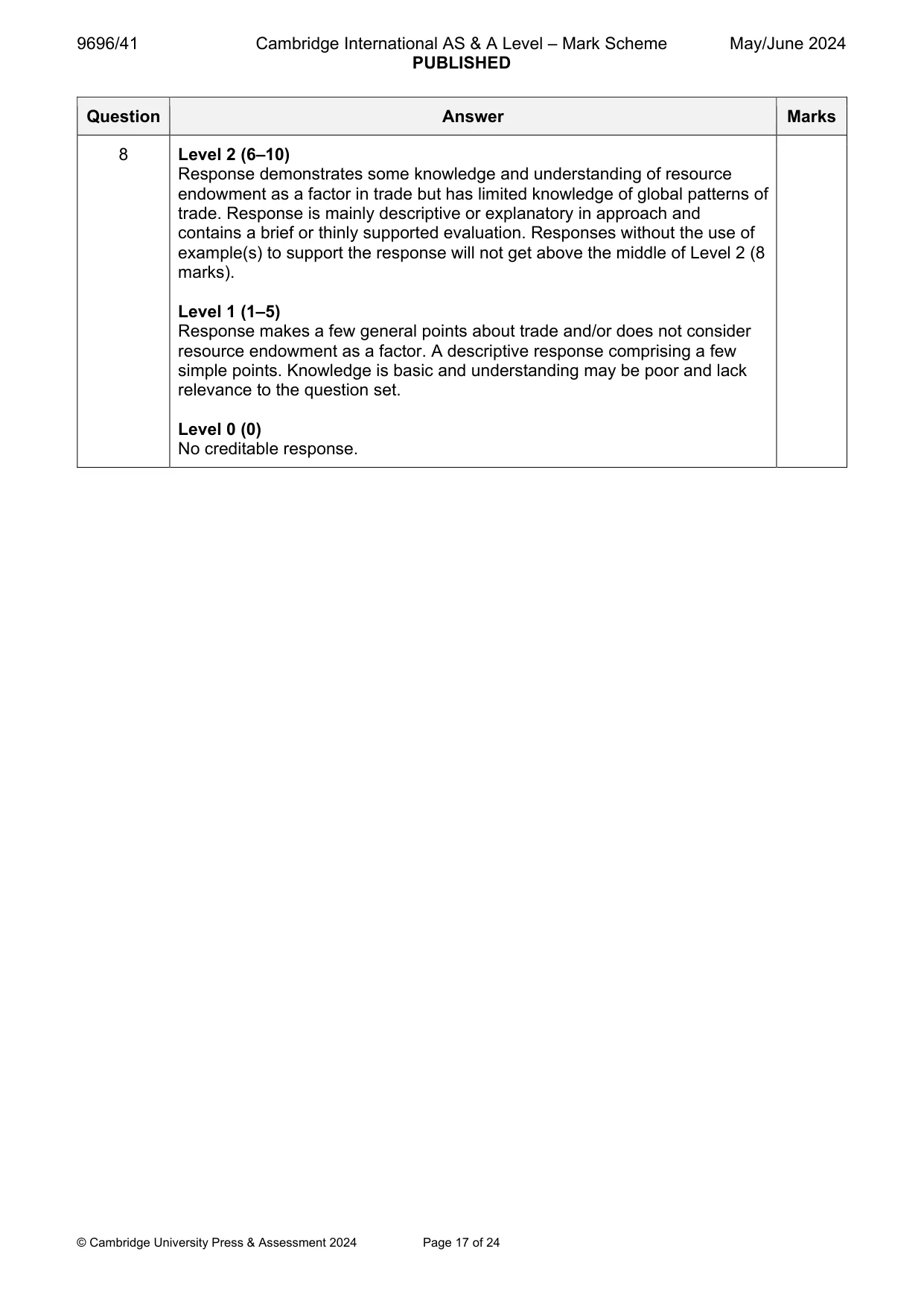
8 Assess the extent to which global patterns of trade are influenced by resource endowment. [20]
Mark scheme: 8 Assess the extent to which global patterns of trade are influenced by 20 resource endowment. Global patterns of trade may include goods traded, spatial variations and/or temporal changes. Patterns include: Dominance of HICs with majority of trade by HICs with other HICs LICs have issues such as primary product dependency Exports of HICs consist of more high-tech and mid-tech/high value products than LICs which are dominated by low-tech products/low value Trade is becoming more regionalised/within trade blocs Other Comment on resource endowment may include reference to export through comparative advantage in an abundant resource and how resource scarce locations need to import a resource. Resources could be naturally occurring resources with an economic value or products such as food, timber, fish, oil, etc. For some resources certain countries or groups of countries may have dominance over a scarce or widely used resource whilst in other cases the resource could be subject to volatility of production or changing markets and prices, hence recognition of this would enhance a response. Some candidates may argue that resource endowment includes other aspects such as capital and entrepreneurship. A permissive approach should be taken to this – these are part of factor endowment which includes (natural) resource endowment. Factors which influence global patterns of trade are complex and inter-related and recognition of this could be an indicator of a higher-level response. There should be clear patterns of trade for Level 3 upwards. The assessment should have a reasonable focus on resource endowment but would be enhanced by consideration of at least one other factor. Other factors include locational advantage, historical influences, trade agreements, changes in the global market, free trade, the work of the World Trade Organization (WTO), trade agreements/blocs, protectionism, FDI in newly emerging markets. Award marks based on the quality of the response using the marking levels below. Level 4 (16–20) Response thoroughly discusses the extent to which global patterns of trade are influenced by resource endowment. An effective and sustained evaluation with a sound conclusion. Response is well founded in detailed exemplar knowledge and strong conceptual understanding of the topic. Examples used are appropriate and integrated effectively into the response. Level 3 (11–15) Response discusses the extent to which global patterns of trade are influenced by resource endowment. Response is broadly evaluative in character, comprising some explanatory or narrative content and a conclusion. Response develops on a largely secure base of knowledge and understanding with the use of example(s). 8 Level 2 (6–10) Response demonstrates some knowledge and understanding of resource endowment as a factor in trade but has limited knowledge of global patterns of trade. Response is mainly descriptive or explanatory in approach and contains a brief or thinly supported evaluation. Responses without the use of example(s) to support the response will not get above the middle of Level 2 (8 marks). Level 1 (1–5) Response makes a few general points about trade and/or does not consider resource endowment as a factor. A descriptive response comprising a few simple points. Knowledge is basic and understanding may be poor and lack relevance to the question set. Level 0 (0) No creditable response.
Q9 · With reference to one or more examples, how far do you agree that the issues of…
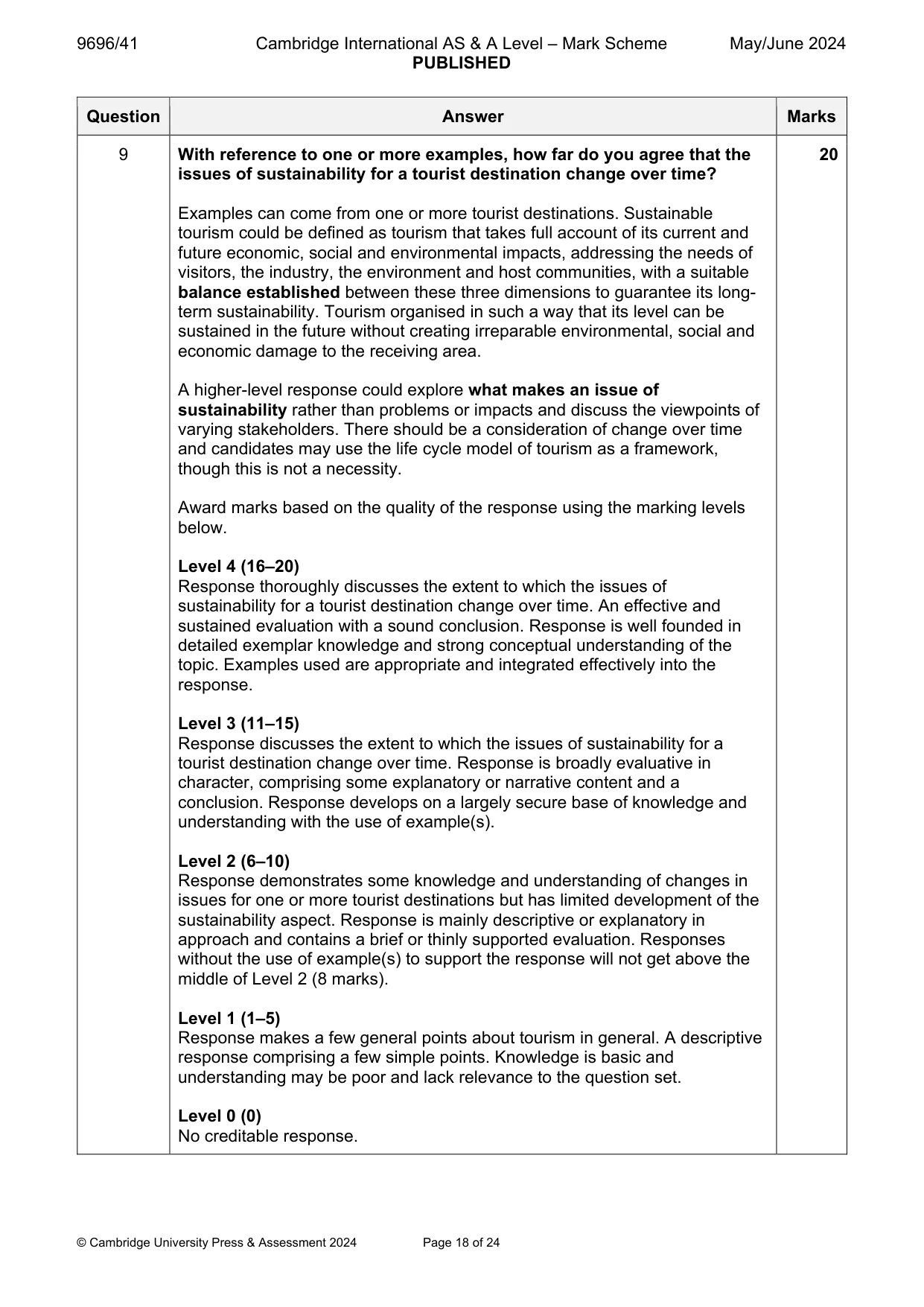
9 With reference to one or more examples, how far do you agree that the issues of sustainability for a tourist destination change over time? [20] Economic transition If answering this option, answer Question 10 and either Question 11 or Question 12.
Mark scheme: 9 With reference to one or more examples, how far do you agree that the 20 issues of sustainability for a tourist destination change over time? Examples can come from one or more tourist destinations. Sustainable tourism could be defined as tourism that takes full account of its current and future economic, social and environmental impacts, addressing the needs of visitors, the industry, the environment and host communities, with a suitable balance established between these three dimensions to guarantee its long- term sustainability. Tourism organised in such a way that its level can be sustained in the future without creating irreparable environmental, social and economic damage to the receiving area. A higher-level response could explore what makes an issue of sustainability rather than problems or impacts and discuss the viewpoints of varying stakeholders. There should be a consideration of change over time and candidates may use the life cycle model of tourism as a framework, though this is not a necessity. Award marks based on the quality of the response using the marking levels below. Level 4 (16–20) Response thoroughly discusses the extent to which the issues of sustainability for a tourist destination change over time. An effective and sustained evaluation with a sound conclusion. Response is well founded in detailed exemplar knowledge and strong conceptual understanding of the topic. Examples used are appropriate and integrated effectively into the response. Level 3 (11–15) Response discusses the extent to which the issues of sustainability for a tourist destination change over time. Response is broadly evaluative in character, comprising some explanatory or narrative content and a conclusion. Response develops on a largely secure base of knowledge and understanding with the use of example(s). Level 2 (6–10) Response demonstrates some knowledge and understanding of changes in issues for one or more tourist destinations but has limited development of the sustainability aspect. Response is mainly descriptive or explanatory in approach and contains a brief or thinly supported evaluation. Responses without the use of example(s) to support the response will not get above the middle of Level 2 (8 marks). Level 1 (1–5) Response makes a few general points about tourism in general. A descriptive response comprising a few simple points. Knowledge is basic and understanding may be poor and lack relevance to the question set. Level 0 (0) No creditable response. Economic transition If answering this option, answer Question 10 and either Question 11 or Question 12.
Q10 · Selected measures of well-being in New Zealand (NZ) and the UK, relative to other OECD…
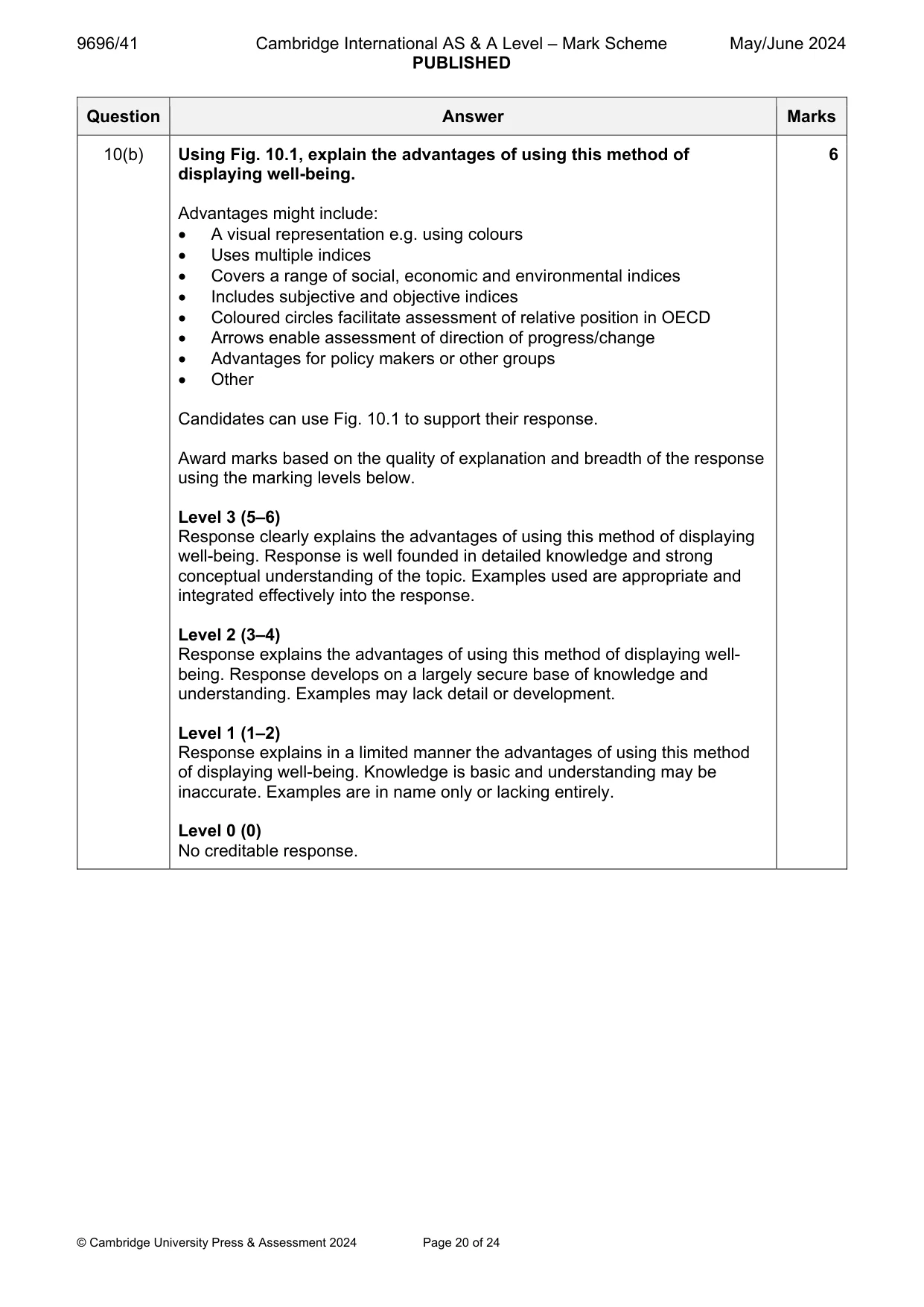
10 Fig. 10.1 shows selected measures of well-being in New Zealand (NZ) and the UK, relative to other OECD countries, 2019. (a) Compare well-being in New Zealand (NZ) with the UK as shown in Fig. 10.1. [4] (b) Using Fig. 10.1, explain the advantages of using this method of displaying well-being. [6]
Mark scheme: 10(a) Fig. 10.1 shows selected measures of well-being in New Zealand (NZ) 4 and the UK, relative to other OECD countries, 2019. Compare well-being in New Zealand (NZ) with the UK as shown in Fig. 10.1. Full marks could be achieved by only considering the tiers. Single measure comparisons – max.1 mark. Award 1 mark max. per column (unless a developed point) including evidence from the data. Comparative points might include: Reserve 1 mark for a comment on the overall situation e.g. New Zealand is overall better than the UK. With New Zealand having more in top tier/hard to tell because of varying performance across categories/columns; missing data for New Zealand. For comparisons without data support – max. 2 marks. Comparisons include: NZ has more in the top-performing OECD tier (4 cf. 2) UK performs better than NZ for environment category (2 tier 1’s cf. none) NZ performs better than UK for social relationships category (3 tier 1’s cf. none) NZ performs better/little difference in human category (1 tier 1 for NZ, 3 x tier 2 for UK) Both countries have same number in bottom-performing OECD tier (3) UK has more in consistent deterioration (4 cf. 2) UK has more in consistent improvement (6 cf. 5) Award 2 marks for development of one point such as: There are significant differences in 1 type of well-being (1) better environment for UK and better social relationships for NZ (1) 10(b) Using Fig. 10.1, explain the advantages of using this method of 6 displaying well-being. Advantages might include: A visual representation e.g. using colours Uses multiple indices Covers a range of social, economic and environmental indices Includes subjective and objective indices Coloured circles facilitate assessment of relative position in OECD Arrows enable assessment of direction of progress/change Advantages for policy makers or other groups Other Candidates can use Fig. 10.1 to support their response. Award marks based on the quality of explanation and breadth of the response using the marking levels below. Level 3 (5–6) Response clearly explains the advantages of using this method of displaying well-being. Response is well founded in detailed knowledge and strong conceptual understanding of the topic. Examples used are appropriate and integrated effectively into the response. Level 2 (3–4) Response explains the advantages of using this method of displaying well- being. Response develops on a largely secure base of knowledge and understanding. Examples may lack detail or development. Level 1 (1–2) Response explains in a limited manner the advantages of using this method of displaying well-being. Knowledge is basic and understanding may be inaccurate. Examples are in name only or lacking entirely. Level 0 (0) No creditable response.
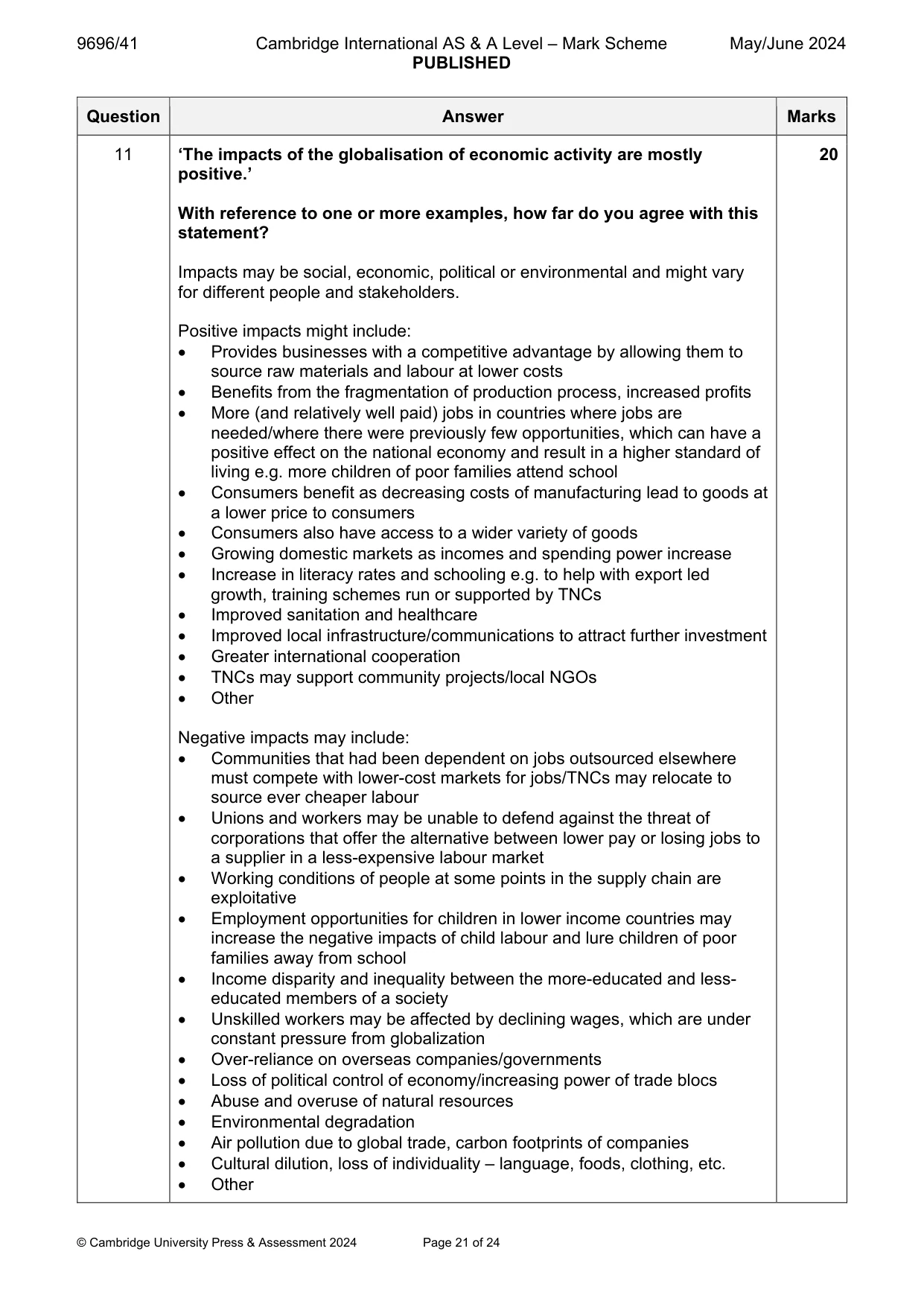
Q11 · ‘The impacts of the globalisation of economic activity are mostly positive.’ With…
11 ‘The impacts of the globalisation of economic activity are mostly positive.’ With reference to one or more examples, how far do you agree with this statement? [20]
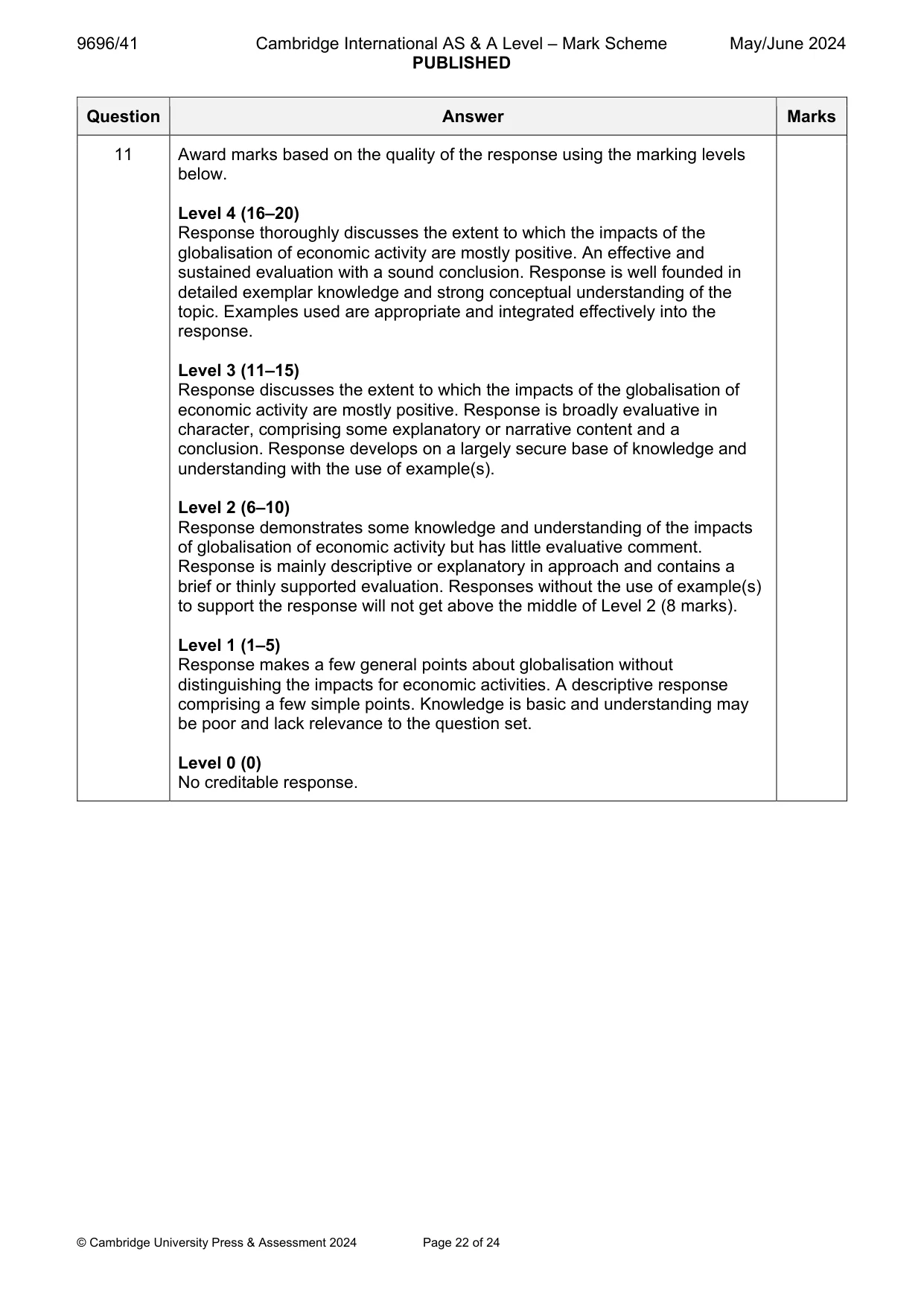
Mark scheme: 11 ‘The impacts of the globalisation of economic activity are mostly 20 positive.’ With reference to one or more examples, how far do you agree with this statement? Impacts may be social, economic, political or environmental and might vary for different people and stakeholders. Positive impacts might include: Provides businesses with a competitive advantage by allowing them to source raw materials and labour at lower costs Benefits from the fragmentation of production process, increased profits More (and relatively well paid) jobs in countries where jobs are needed/where there were previously few opportunities, which can have a positive effect on the national economy and result in a higher standard of living e.g. more children of poor families attend school Consumers benefit as decreasing costs of manufacturing lead to goods at a lower price to consumers Consumers also have access to a wider variety of goods Growing domestic markets as incomes and spending power increase Increase in literacy rates and schooling e.g. to help with export led growth, training schemes run or supported by TNCs Improved sanitation and healthcare Improved local infrastructure/communications to attract further investment Greater international cooperation TNCs may support community projects/local NGOs Other Negative impacts may include: Communities that had been dependent on jobs outsourced elsewhere must compete with lower-cost markets for jobs/TNCs may relocate to source ever cheaper labour Unions and workers may be unable to defend against the threat of corporations that offer the alternative between lower pay or losing jobs to a supplier in a less-expensive labour market Working conditions of people at some points in the supply chain are exploitative Employment opportunities for children in lower income countries may increase the negative impacts of child labour and lure children of poor families away from school Income disparity and inequality between the more-educated and less- educated members of a society Unskilled workers may be affected by declining wages, which are under constant pressure from globalization Over-reliance on overseas companies/governments Loss of political control of economy/increasing power of trade blocs Abuse and overuse of natural resources Environmental degradation Air pollution due to global trade, carbon footprints of companies Cultural dilution, loss of individuality – language, foods, clothing, etc. Other 11 Award marks based on the quality of the response using the marking levels below. Level 4 (16–20) Response thoroughly discusses the extent to which the impacts of the globalisation of economic activity are mostly positive. An effective and sustained evaluation with a sound conclusion. Response is well founded in detailed exemplar knowledge and strong conceptual understanding of the topic. Examples used are appropriate and integrated effectively into the response. Level 3 (11–15) Response discusses the extent to which the impacts of the globalisation of economic activity are mostly positive. Response is broadly evaluative in character, comprising some explanatory or narrative content and a conclusion. Response develops on a largely secure base of knowledge and understanding with the use of example(s). Level 2 (6–10) Response demonstrates some knowledge and understanding of the impacts of globalisation of economic activity but has little evaluative comment. Response is mainly descriptive or explanatory in approach and contains a brief or thinly supported evaluation. Responses without the use of example(s) to support the response will not get above the middle of Level 2 (8 marks). Level 1 (1–5) Response makes a few general points about globalisation without distinguishing the impacts for economic activities. A descriptive response comprising a few simple points. Knowledge is basic and understanding may be poor and lack relevance to the question set. Level 0 (0) No creditable response.
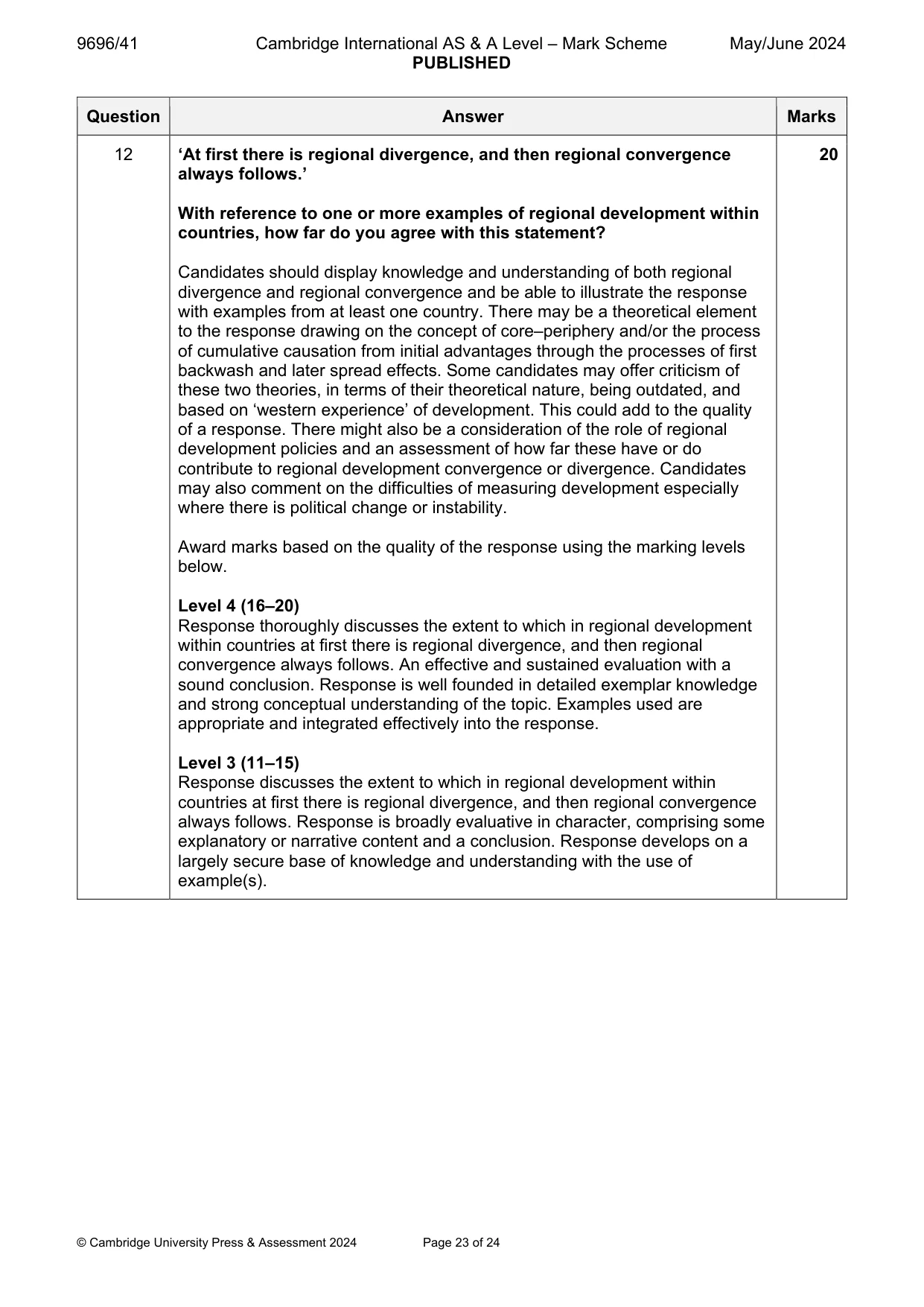
Q12 · ‘At first there is regional divergence, and then regional convergence always follows.’…
12 ‘At first there is regional divergence, and then regional convergence always follows.’ With reference to one or more examples of regional development within countries, how far do you agree with this statement? [20]
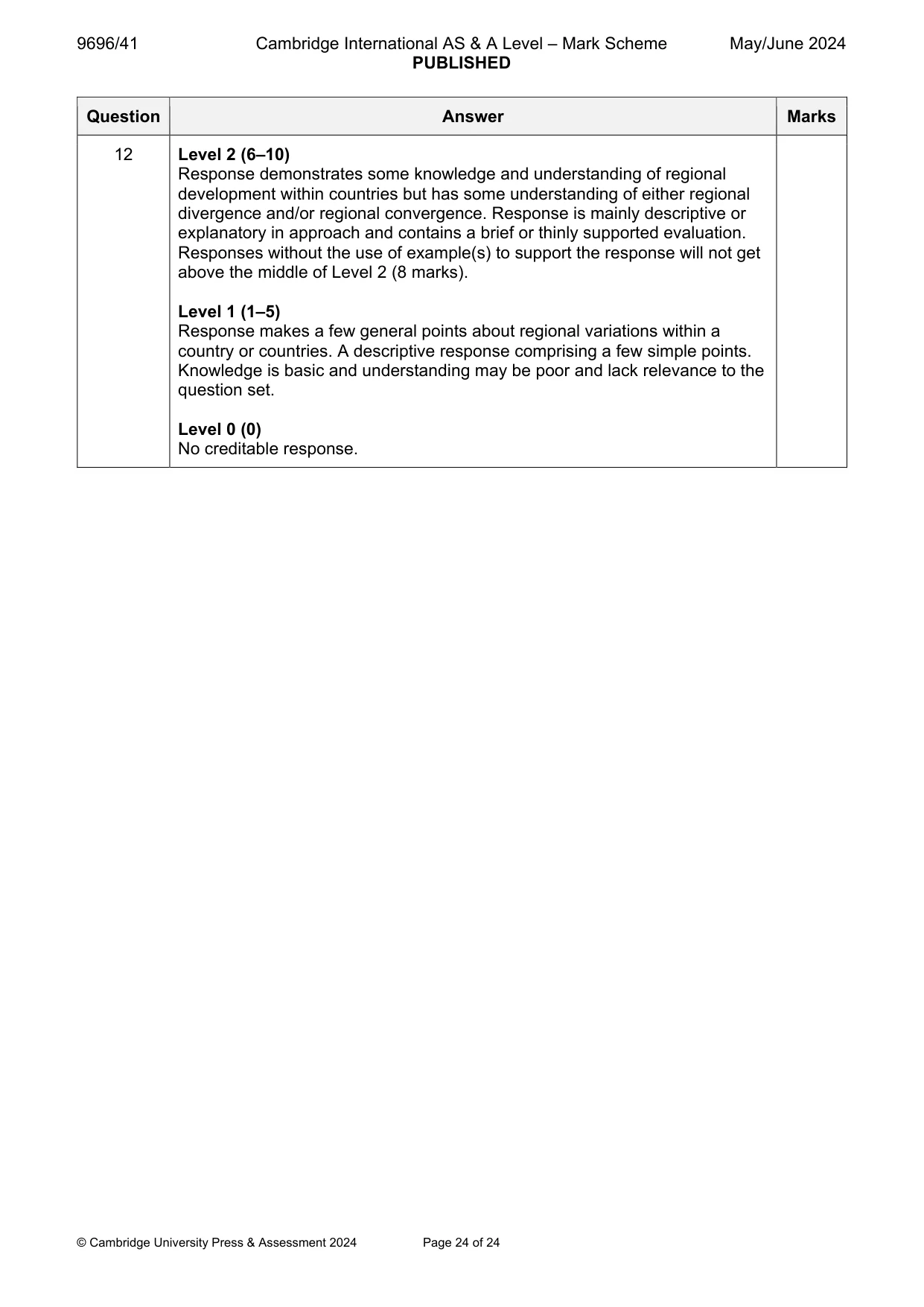
Mark scheme: 12 ‘At first there is regional divergence, and then regional convergence 20 always follows.’ With reference to one or more examples of regional development within countries, how far do you agree with this statement? Candidates should display knowledge and understanding of both regional divergence and regional convergence and be able to illustrate the response with examples from at least one country. There may be a theoretical element to the response drawing on the concept of core–periphery and/or the process of cumulative causation from initial advantages through the processes of first backwash and later spread effects. Some candidates may offer criticism of these two theories, in terms of their theoretical nature, being outdated, and based on ‘western experience’ of development. This could add to the quality of a response. There might also be a consideration of the role of regional development policies and an assessment of how far these have or do contribute to regional development convergence or divergence. Candidates may also comment on the difficulties of measuring development especially where there is political change or instability. Award marks based on the quality of the response using the marking levels below. Level 4 (16–20) Response thoroughly discusses the extent to which in regional development within countries at first there is regional divergence, and then regional convergence always follows. An effective and sustained evaluation with a sound conclusion. Response is well founded in detailed exemplar knowledge and strong conceptual understanding of the topic. Examples used are appropriate and integrated effectively into the response. Level 3 (11–15) Response discusses the extent to which in regional development within countries at first there is regional divergence, and then regional convergence always follows. Response is broadly evaluative in character, comprising some explanatory or narrative content and a conclusion. Response develops on a largely secure base of knowledge and understanding with the use of example(s). 12 Level 2 (6–10) Response demonstrates some knowledge and understanding of regional development within countries but has some understanding of either regional divergence and/or regional convergence. Response is mainly descriptive or explanatory in approach and contains a brief or thinly supported evaluation. Responses without the use of example(s) to support the response will not get above the middle of Level 2 (8 marks). Level 1 (1–5) Response makes a few general points about regional variations within a country or countries. A descriptive response comprising a few simple points. Knowledge is basic and understanding may be poor and lack relevance to the question set. Level 0 (0) No creditable response.
What was in this paper
The subtopics covered by these 12 questions, and how many questions each got. Open one in a new tab to see every Cambridge question on it.
1International debt and international aid1Manufacturing and related service industry1National development1Regional development within countries1The globalisation of economic activity1The human impact1The management of a degraded environment1The management of a tourist destination1The management of agricultural change1The management of energy supply1Trade flows and trading patterns1What you needed in this session
Cambridge’s own grade thresholds for 2024 May/June, Paper 4 · Variant 1. A higher threshold means an easier paper — the bar moves with how the cohort did.