Cambridge A Level Geography 9696 — 2020 May/June Paper 4 · Variant 1
9696/41/M/J/20 · 12 questions · 200 marks · ≈225 min
The question paper and its mark scheme, free to read here and free to download. This is Cambridge’s own paper, exactly as it was sat.
Question paper4 pages


Mark scheme26 pages
Answers below. Sit the paper first if you are practising.


Questions as text
Q1 · The number of undernourished people in the world, 2000–15 and projected for 2016
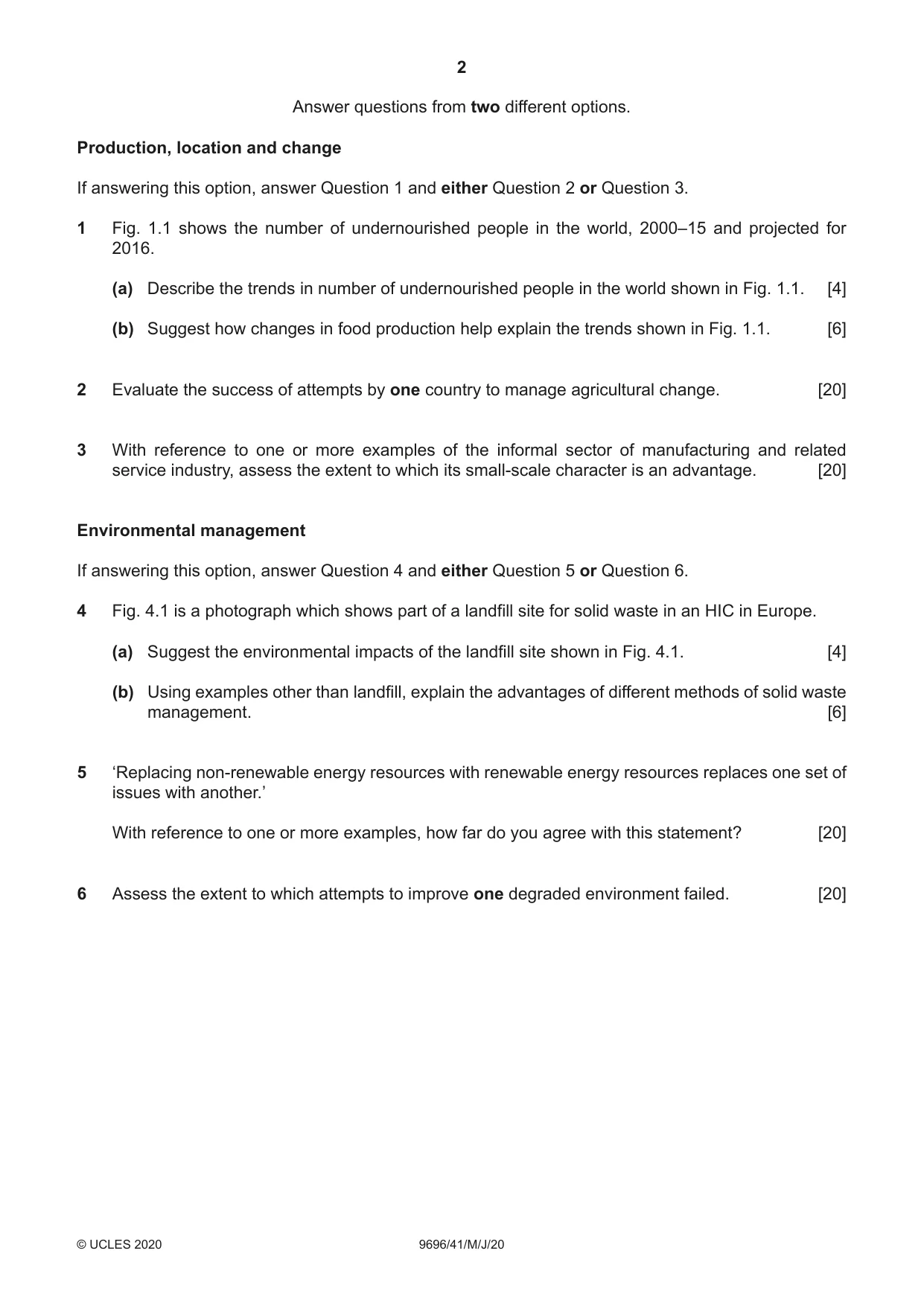
1 Fig. 1.1 shows the number of undernourished people in the world, 2000–15 and projected for 2016. (a) Describe the trends in number of undernourished people in the world shown in Fig. 1.1. [4] (b) Suggest how changes in food production help explain the trends shown in Fig. 1.1. [6]
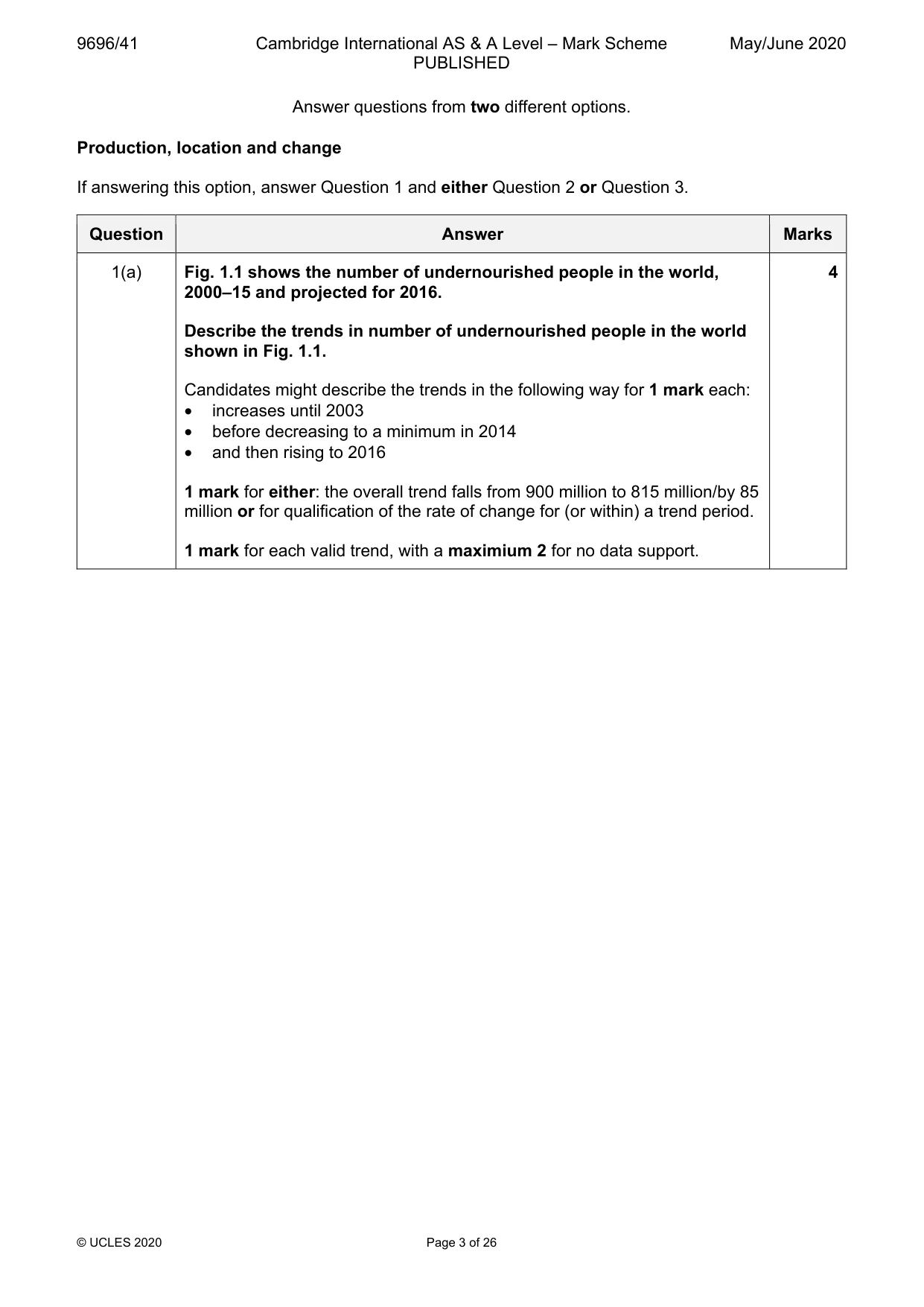
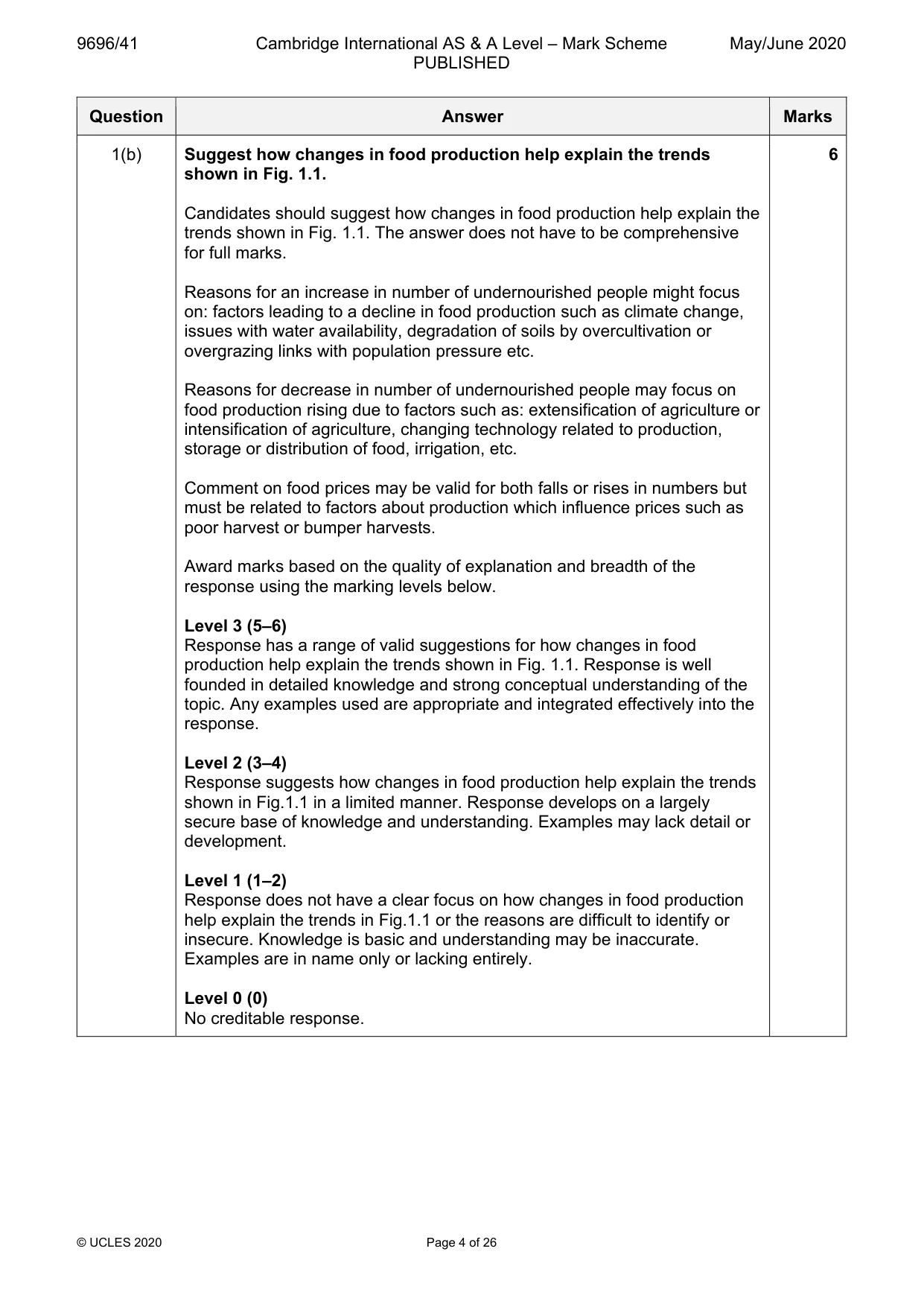
Mark scheme: Question Answer Marks 1(a) Fig. 1.1 shows the number of undernourished people in the world, 4 2000–15 and projected for 2016. Describe the trends in number of undernourished people in the world shown in Fig. 1.1. Candidates might describe the trends in the following way for 1 mark each: • increases until 2003 • before decreasing to a minimum in 2014 • and then rising to 2016 1 mark for either: the overall trend falls from 900 million to 815 million/by 85 million or for qualification of the rate of change for (or within) a trend period. 1 mark for each valid trend, with a maximium 2 for no data support. 1(b) Suggest how changes in food production help explain the trends 6 shown in Fig. 1.1. Candidates should suggest how changes in food production help explain the trends shown in Fig. 1.1. The answer does not have to be comprehensive for full marks. Reasons for an increase in number of undernourished people might focus on: factors leading to a decline in food production such as climate change, issues with water availability, degradation of soils by overcultivation or overgrazing links with population pressure etc. Reasons for decrease in number of undernourished people may focus on food production rising due to factors such as: extensification of agriculture or intensification of agriculture, changing technology related to production, storage or distribution of food, irrigation, etc. Comment on food prices may be valid for both falls or rises in numbers but must be related to factors about production which influence prices such as poor harvest or bumper harvests. Award marks based on the quality of explanation and breadth of the response using the marking levels below. Level 3 (5–6) Response has a range of valid suggestions for how changes in food production help explain the trends shown in Fig. 1.1. Response is well founded in detailed knowledge and strong conceptual understanding of the topic. Any examples used are appropriate and integrated effectively into the response. Level 2 (3–4) Response suggests how changes in food production help explain the trends shown in Fig.1.1 in a limited manner. Response develops on a largely secure base of knowledge and understanding. Examples may lack detail or development. Level 1 (1–2) Response does not have a clear focus on how changes in food production help explain the trends in Fig.1.1 or the reasons are difficult to identify or insecure. Knowledge is basic and understanding may be inaccurate. Examples are in name only or lacking entirely. Level 0 (0) No creditable response.
Q2 · Evaluate the success of attempts by one country to manage agricultural change
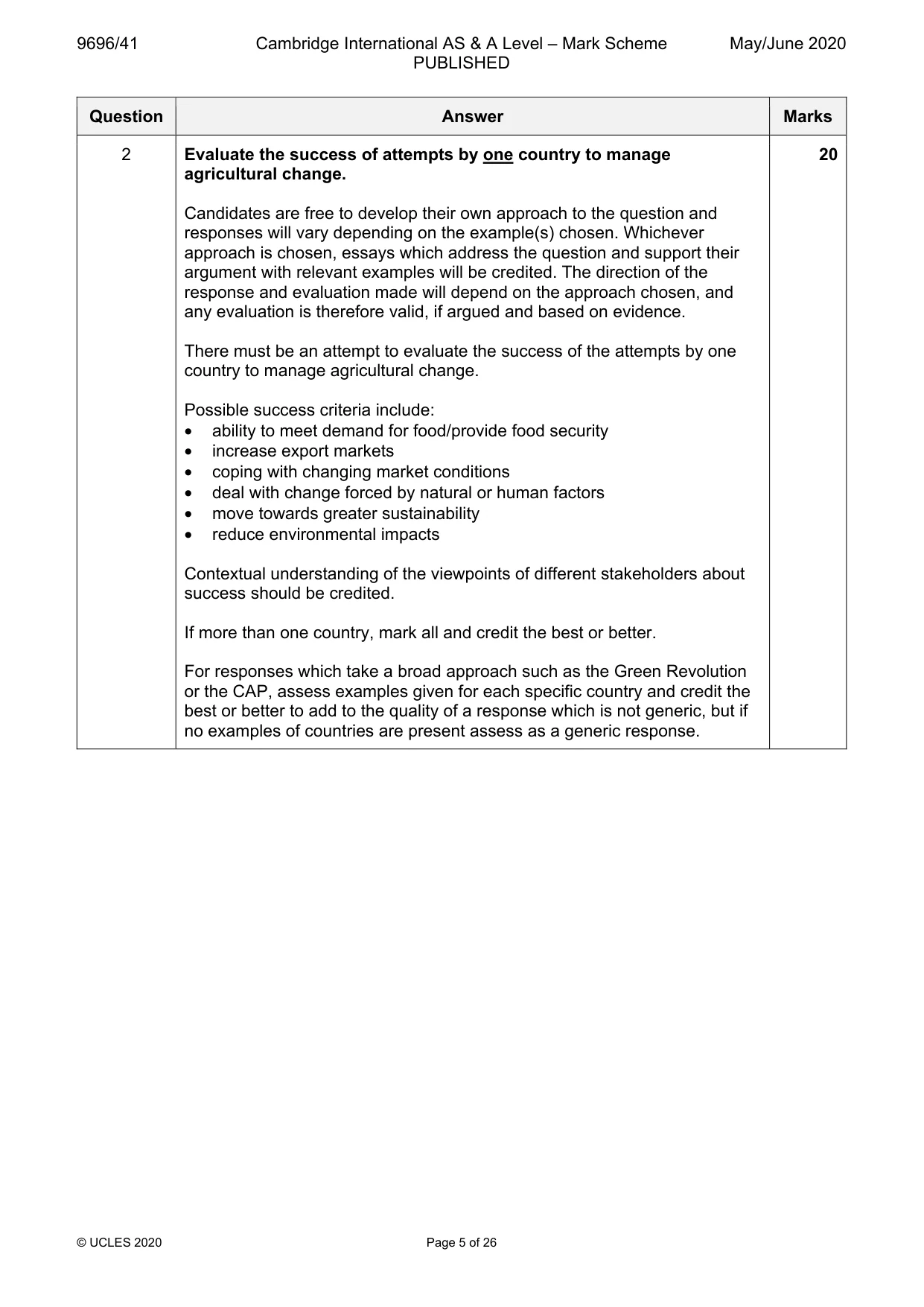
2 Evaluate the success of attempts by one country to manage agricultural change. [20]
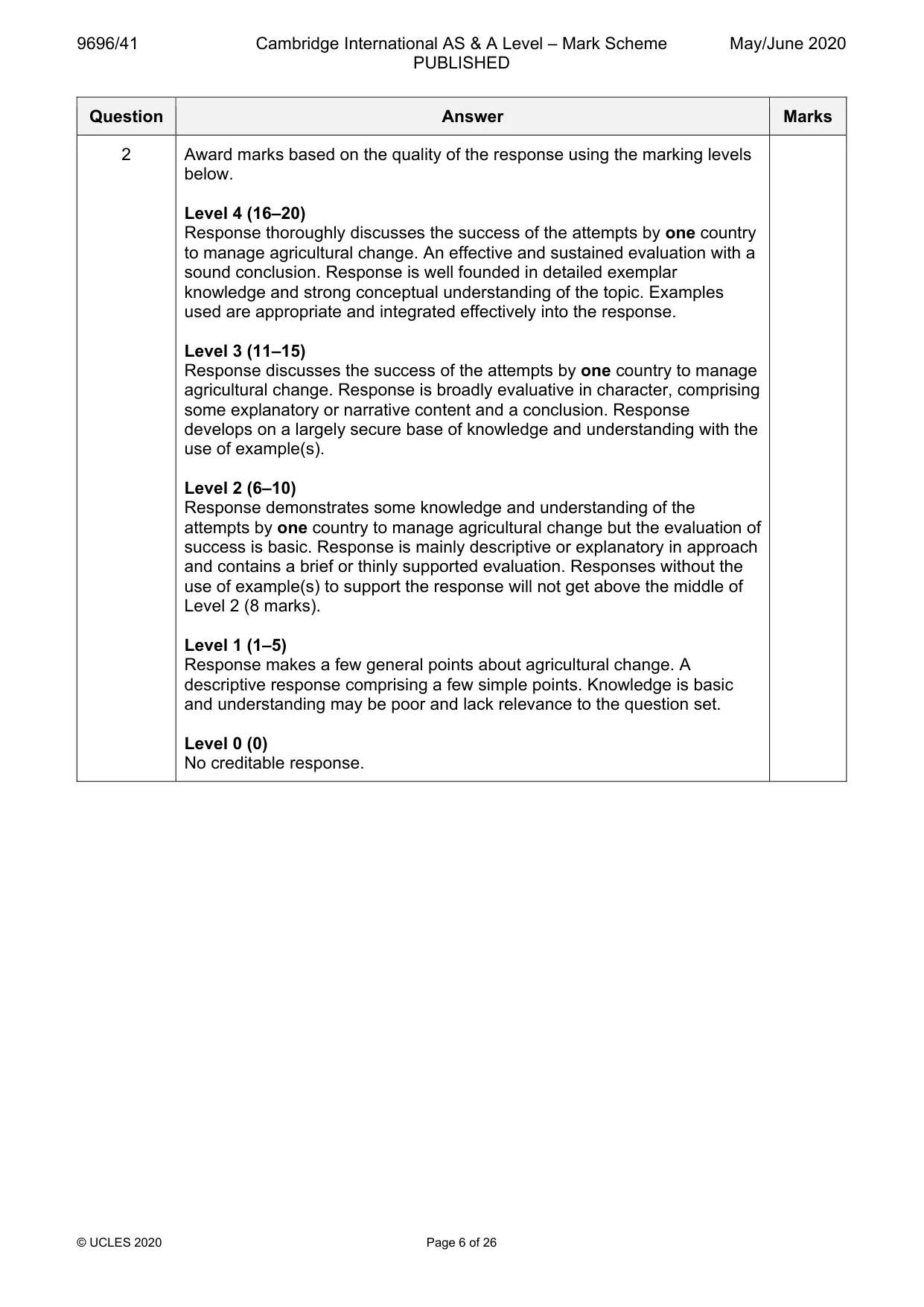
Mark scheme: 2 Evaluate the success of attempts by one country to manage 20 agricultural change. Candidates are free to develop their own approach to the question and responses will vary depending on the example(s) chosen. Whichever approach is chosen, essays which address the question and support their argument with relevant examples will be credited. The direction of the response and evaluation made will depend on the approach chosen, and any evaluation is therefore valid, if argued and based on evidence. There must be an attempt to evaluate the success of the attempts by one country to manage agricultural change. Possible success criteria include: • ability to meet demand for food/provide food security • increase export markets • coping with changing market conditions • deal with change forced by natural or human factors • move towards greater sustainability • reduce environmental impacts Contextual understanding of the viewpoints of different stakeholders about success should be credited. If more than one country, mark all and credit the best or better. For responses which take a broad approach such as the Green Revolution or the CAP, assess examples given for each specific country and credit the best or better to add to the quality of a response which is not generic, but if no examples of countries are present assess as a generic response. 2 Award marks based on the quality of the response using the marking levels below. Level 4 (16–20) Response thoroughly discusses the success of the attempts by one country to manage agricultural change. An effective and sustained evaluation with a sound conclusion. Response is well founded in detailed exemplar knowledge and strong conceptual understanding of the topic. Examples used are appropriate and integrated effectively into the response. Level 3 (11–15) Response discusses the success of the attempts by one country to manage agricultural change. Response is broadly evaluative in character, comprising some explanatory or narrative content and a conclusion. Response develops on a largely secure base of knowledge and understanding with the use of example(s). Level 2 (6–10) Response demonstrates some knowledge and understanding of the attempts by one country to manage agricultural change but the evaluation of success is basic. Response is mainly descriptive or explanatory in approach and contains a brief or thinly supported evaluation. Responses without the use of example(s) to support the response will not get above the middle of Level 2 (8 marks). Level 1 (1–5) Response makes a few general points about agricultural change. A descriptive response comprising a few simple points. Knowledge is basic and understanding may be poor and lack relevance to the question set. Level 0 (0) No creditable response.
Q3 · With reference to one or more examples of the informal sector of manufacturing and…
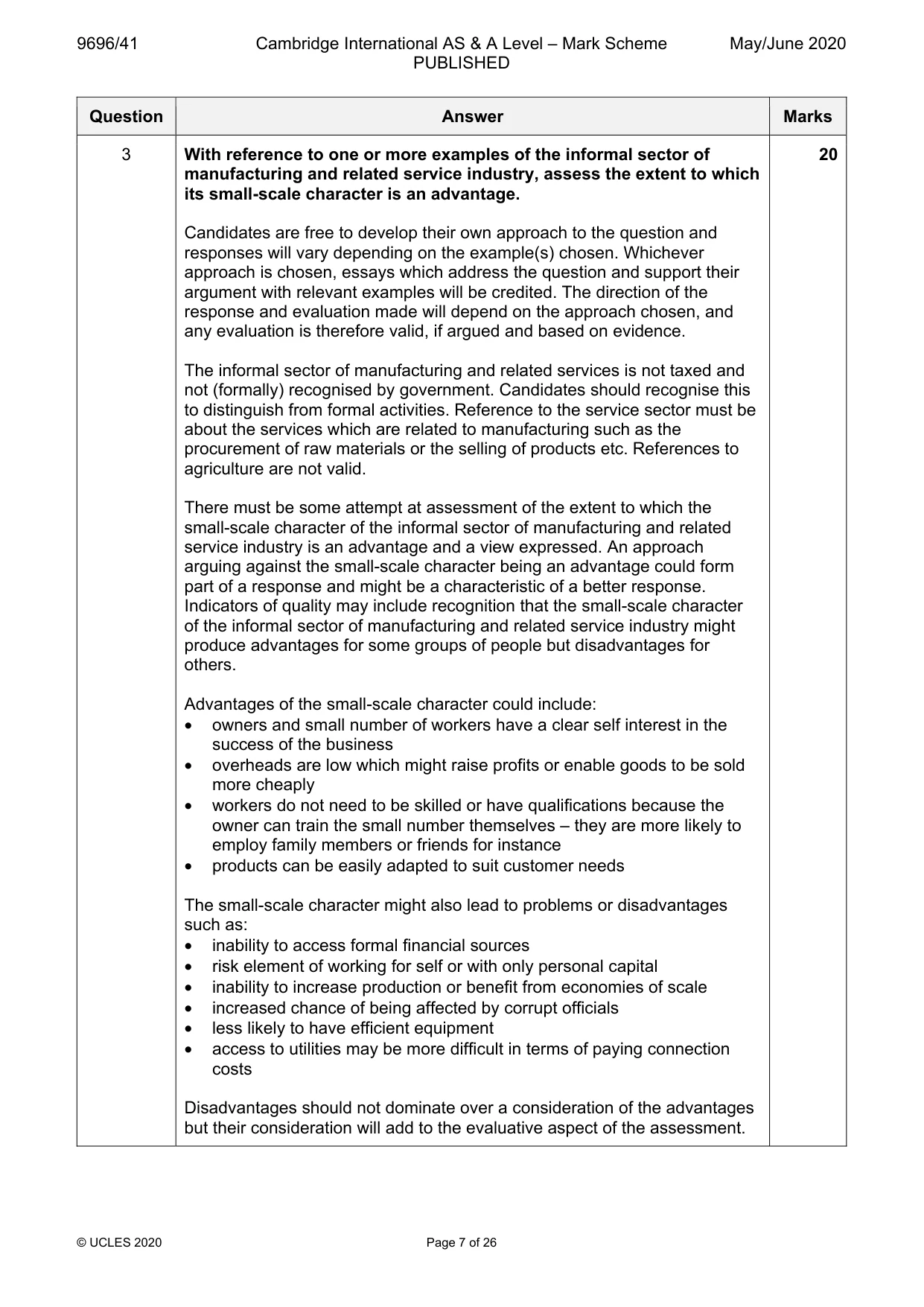
3 With reference to one or more examples of the informal sector of manufacturing and related service industry, assess the extent to which its small-scale character is an advantage. [20] Environmental management If answering this option, answer Question 4 and either Question 5 or Question 6.
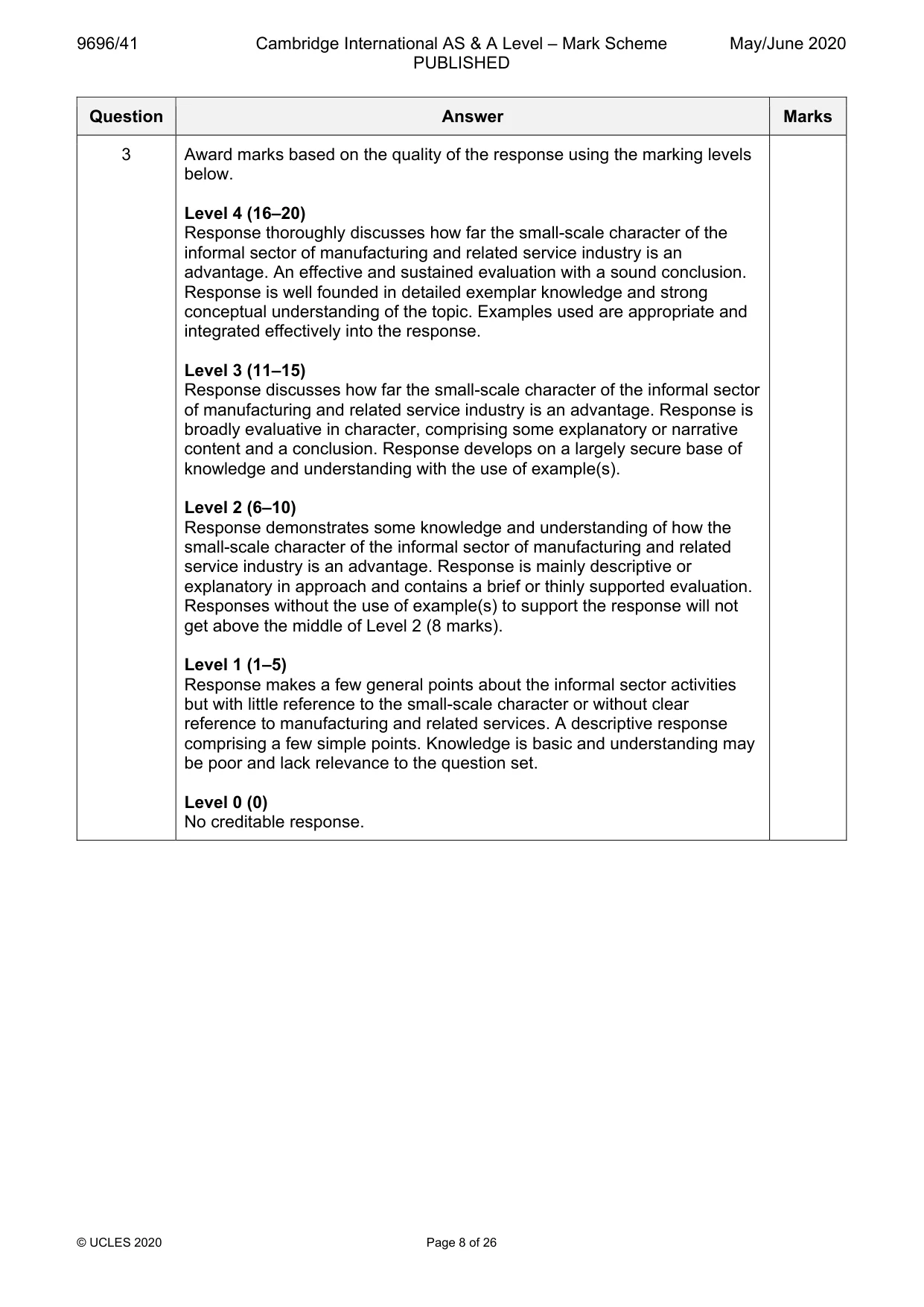
Mark scheme: 3 With reference to one or more examples of the informal sector of 20 manufacturing and related service industry, assess the extent to which its small-scale character is an advantage. Candidates are free to develop their own approach to the question and responses will vary depending on the example(s) chosen. Whichever approach is chosen, essays which address the question and support their argument with relevant examples will be credited. The direction of the response and evaluation made will depend on the approach chosen, and any evaluation is therefore valid, if argued and based on evidence. The informal sector of manufacturing and related services is not taxed and not (formally) recognised by government. Candidates should recognise this to distinguish from formal activities. Reference to the service sector must be about the services which are related to manufacturing such as the procurement of raw materials or the selling of products etc. References to agriculture are not valid. There must be some attempt at assessment of the extent to which the small-scale character of the informal sector of manufacturing and related service industry is an advantage and a view expressed. An approach arguing against the small-scale character being an advantage could form part of a response and might be a characteristic of a better response. Indicators of quality may include recognition that the small-scale character of the informal sector of manufacturing and related service industry might produce advantages for some groups of people but disadvantages for others. Advantages of the small-scale character could include: • owners and small number of workers have a clear self interest in the success of the business • overheads are low which might raise profits or enable goods to be sold more cheaply • workers do not need to be skilled or have qualifications because the owner can train the small number themselves – they are more likely to employ family members or friends for instance • products can be easily adapted to suit customer needs The small-scale character might also lead to problems or disadvantages such as: • inability to access formal financial sources • risk element of working for self or with only personal capital • inability to increase production or benefit from economies of scale • increased chance of being affected by corrupt officials • less likely to have efficient equipment • access to utilities may be more difficult in terms of paying connection costs Disadvantages should not dominate over a consideration of the advantages but their consideration will add to the evaluative aspect of the assessment. 3 Award marks based on the quality of the response using the marking levels below. Level 4 (16–20) Response thoroughly discusses how far the small-scale character of the informal sector of manufacturing and related service industry is an advantage. An effective and sustained evaluation with a sound conclusion. Response is well founded in detailed exemplar knowledge and strong conceptual understanding of the topic. Examples used are appropriate and integrated effectively into the response. Level 3 (11–15) Response discusses how far the small-scale character of the informal sector of manufacturing and related service industry is an advantage. Response is broadly evaluative in character, comprising some explanatory or narrative content and a conclusion. Response develops on a largely secure base of knowledge and understanding with the use of example(s). Level 2 (6–10) Response demonstrates some knowledge and understanding of how the small-scale character of the informal sector of manufacturing and related service industry is an advantage. Response is mainly descriptive or explanatory in approach and contains a brief or thinly supported evaluation. Responses without the use of example(s) to support the response will not get above the middle of Level 2 (8 marks). Level 1 (1–5) Response makes a few general points about the informal sector activities but with little reference to the small-scale character or without clear reference to manufacturing and related services. A descriptive response comprising a few simple points. Knowledge is basic and understanding may be poor and lack relevance to the question set. Level 0 (0) No creditable response. Environmental management If answering this option, answer Question 4 and either Question 5 or Question 6.
Q4 · A photograph which shows part of a landfill site for solid waste in an HIC in Europe
4 Fig. 4.1 is a photograph which shows part of a landfill site for solid waste in an HIC in Europe. (a) Suggest the environmental impacts of the landfill site shown in Fig. 4.1. [4] (b) Using examples other than landfill, explain the advantages of different methods of solid waste management. [6]
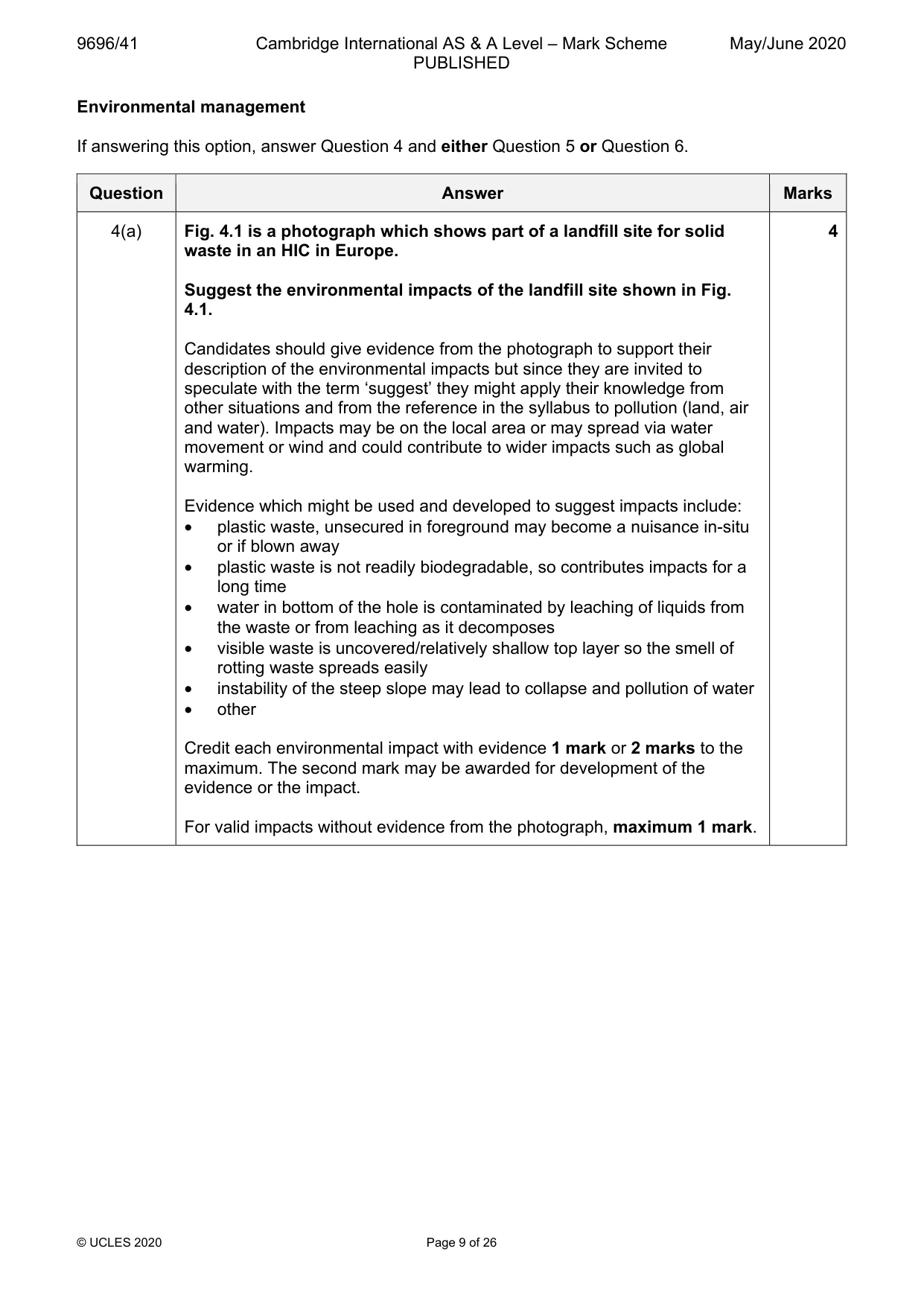
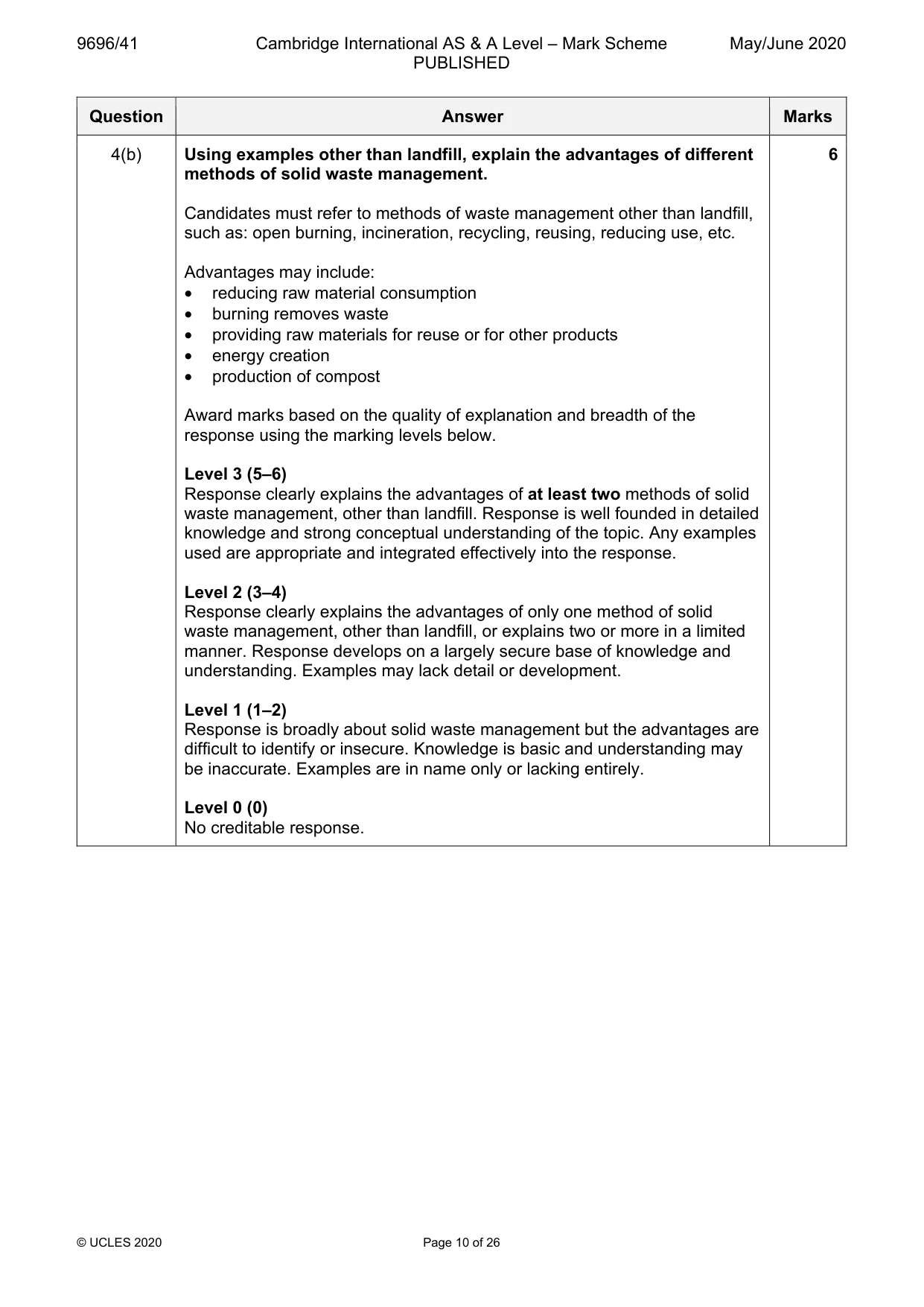
Mark scheme: 4(a) Fig. 4.1 is a photograph which shows part of a landfill site for solid 4 waste in an HIC in Europe. Suggest the environmental impacts of the landfill site shown in Fig. 4.1. Candidates should give evidence from the photograph to support their description of the environmental impacts but since they are invited to speculate with the term ‘suggest’ they might apply their knowledge from other situations and from the reference in the syllabus to pollution (land, air and water). Impacts may be on the local area or may spread via water movement or wind and could contribute to wider impacts such as global warming. Evidence which might be used and developed to suggest impacts include: • plastic waste, unsecured in foreground may become a nuisance in-situ or if blown away • plastic waste is not readily biodegradable, so contributes impacts for a long time • water in bottom of the hole is contaminated by leaching of liquids from the waste or from leaching as it decomposes • visible waste is uncovered/relatively shallow top layer so the smell of rotting waste spreads easily • instability of the steep slope may lead to collapse and pollution of water • other Credit each environmental impact with evidence 1 mark or 2 marks to the maximum. The second mark may be awarded for development of the evidence or the impact. For valid impacts without evidence from the photograph, maximum 1 mark. 4(b) Using examples other than landfill, explain the advantages of different 6 methods of solid waste management. Candidates must refer to methods of waste management other than landfill, such as: open burning, incineration, recycling, reusing, reducing use, etc. Advantages may include: • reducing raw material consumption • burning removes waste • providing raw materials for reuse or for other products • energy creation • production of compost Award marks based on the quality of explanation and breadth of the response using the marking levels below. Level 3 (5–6) Response clearly explains the advantages of at least two methods of solid waste management, other than landfill. Response is well founded in detailed knowledge and strong conceptual understanding of the topic. Any examples used are appropriate and integrated effectively into the response. Level 2 (3–4) Response clearly explains the advantages of only one method of solid waste management, other than landfill, or explains two or more in a limited manner. Response develops on a largely secure base of knowledge and understanding. Examples may lack detail or development. Level 1 (1–2) Response is broadly about solid waste management but the advantages are difficult to identify or insecure. Knowledge is basic and understanding may be inaccurate. Examples are in name only or lacking entirely. Level 0 (0) No creditable response.
Q5 · ‘Replacing non-renewable energy resources with renewable energy resources replaces one…
5 ‘Replacing non-renewable energy resources with renewable energy resources replaces one set of issues with another.’ With reference to one or more examples, how far do you agree with this statement? [20]
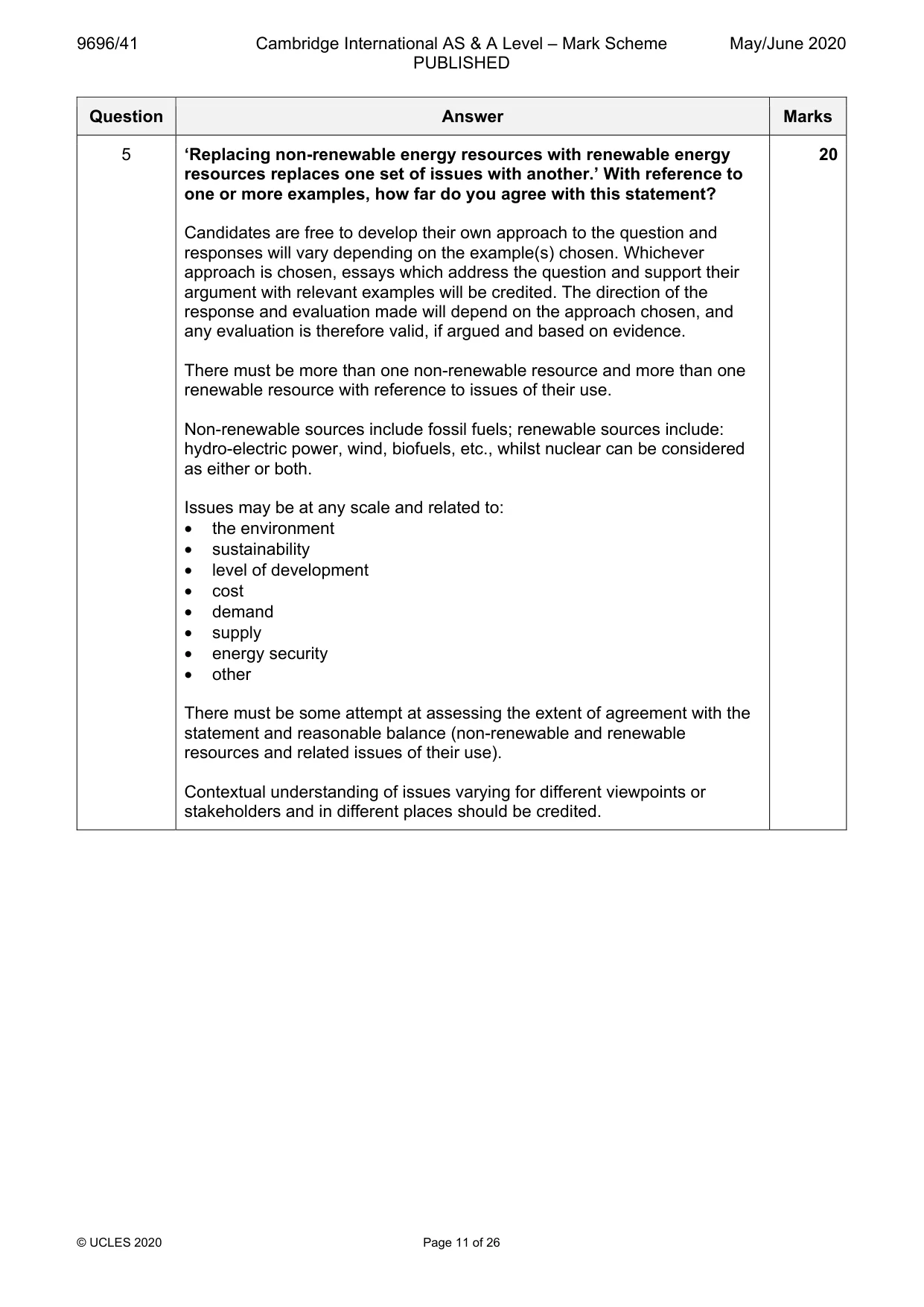
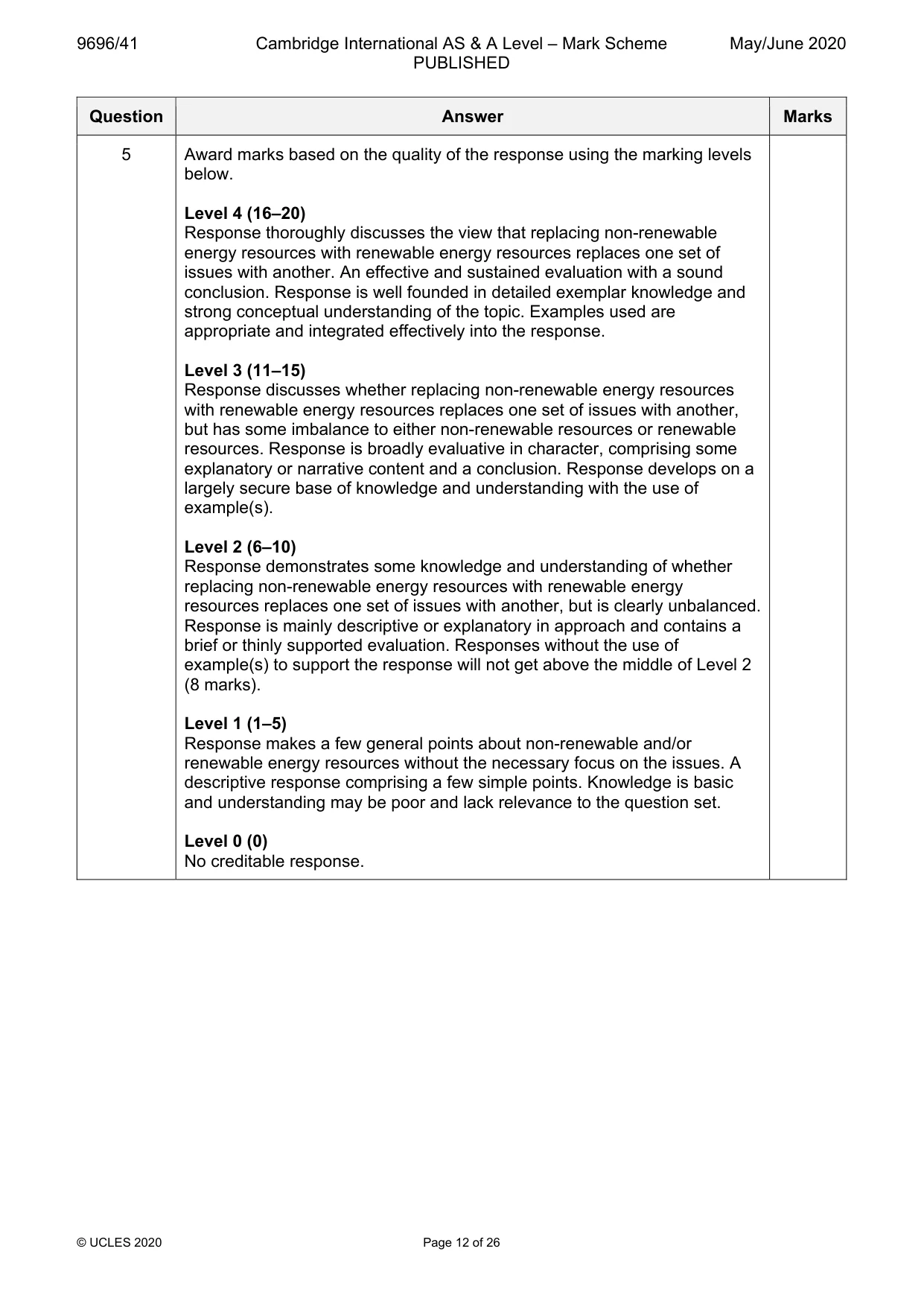
Mark scheme: 5 ‘Replacing non-renewable energy resources with renewable energy 20 resources replaces one set of issues with another.’ With reference to one or more examples, how far do you agree with this statement? Candidates are free to develop their own approach to the question and responses will vary depending on the example(s) chosen. Whichever approach is chosen, essays which address the question and support their argument with relevant examples will be credited. The direction of the response and evaluation made will depend on the approach chosen, and any evaluation is therefore valid, if argued and based on evidence. There must be more than one non-renewable resource and more than one renewable resource with reference to issues of their use. Non-renewable sources include fossil fuels; renewable sources include: hydro-electric power, wind, biofuels, etc., whilst nuclear can be considered as either or both. Issues may be at any scale and related to: • the environment • sustainability • level of development • cost • demand • supply • energy security • other There must be some attempt at assessing the extent of agreement with the statement and reasonable balance (non-renewable and renewable resources and related issues of their use). Contextual understanding of issues varying for different viewpoints or stakeholders and in different places should be credited. 5 Award marks based on the quality of the response using the marking levels below. Level 4 (16–20) Response thoroughly discusses the view that replacing non-renewable energy resources with renewable energy resources replaces one set of issues with another. An effective and sustained evaluation with a sound conclusion. Response is well founded in detailed exemplar knowledge and strong conceptual understanding of the topic. Examples used are appropriate and integrated effectively into the response. Level 3 (11–15) Response discusses whether replacing non-renewable energy resources with renewable energy resources replaces one set of issues with another, but has some imbalance to either non-renewable resources or renewable resources. Response is broadly evaluative in character, comprising some explanatory or narrative content and a conclusion. Response develops on a largely secure base of knowledge and understanding with the use of example(s). Level 2 (6–10) Response demonstrates some knowledge and understanding of whether replacing non-renewable energy resources with renewable energy resources replaces one set of issues with another, but is clearly unbalanced. Response is mainly descriptive or explanatory in approach and contains a brief or thinly supported evaluation. Responses without the use of example(s) to support the response will not get above the middle of Level 2 (8 marks). Level 1 (1–5) Response makes a few general points about non-renewable and/or renewable energy resources without the necessary focus on the issues. A descriptive response comprising a few simple points. Knowledge is basic and understanding may be poor and lack relevance to the question set. Level 0 (0) No creditable response.
Q6 · Global interdependence If answering this option, answer Question 7 and either Question 8…
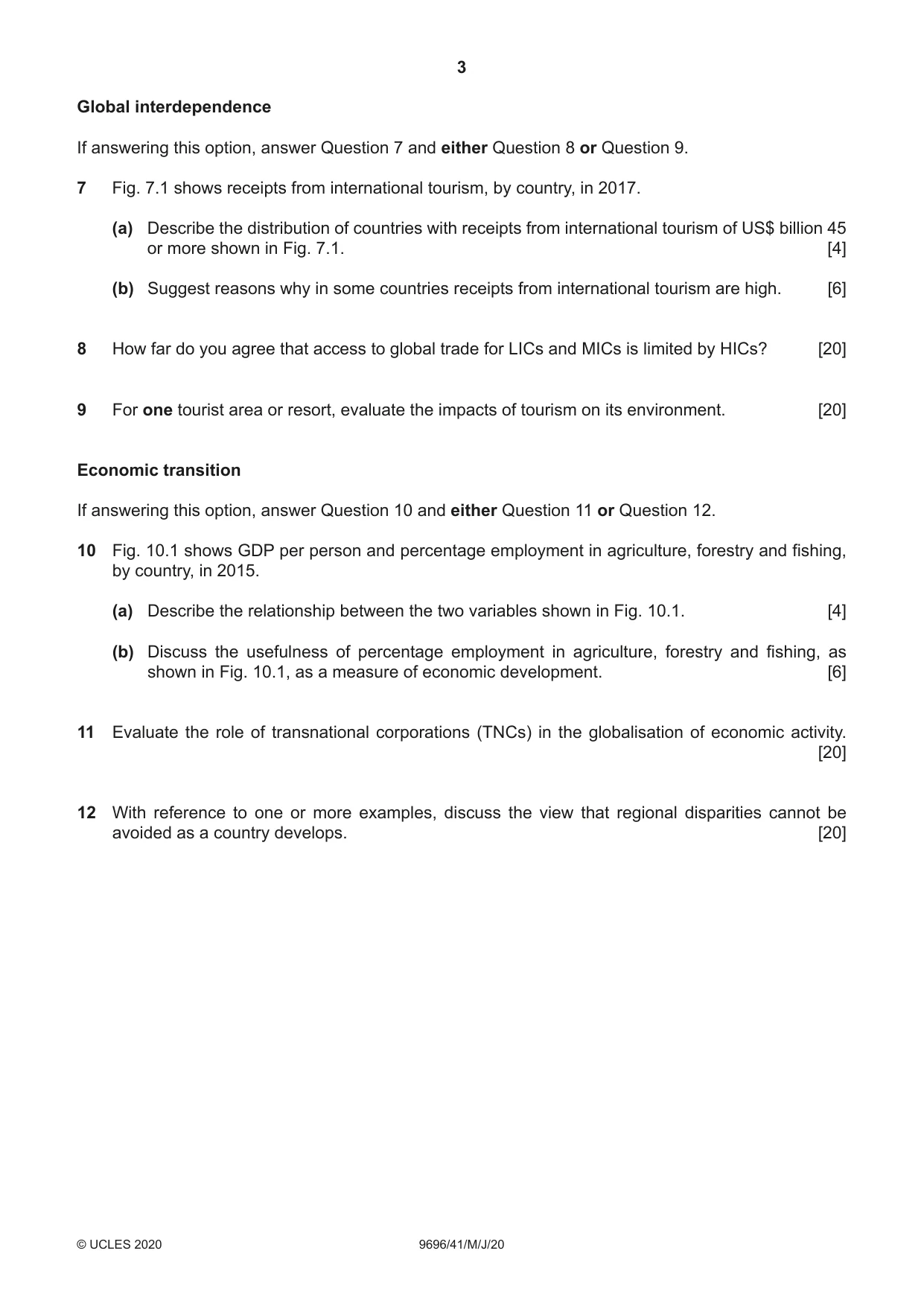
Global interdependence If answering this option, answer Question 7 and either Question 8 or Question 9.
Mark scheme: 6 Assess the extent to which attempts to improve one degraded 20 environment failed. Candidates are free to develop their own approach to the question and responses will vary depending on the example(s) chosen. Whichever approach is chosen, essays which address the question and support their argument with relevant examples will be credited. The direction of the response and evaluation made will depend on the approach chosen, and any evaluation is therefore valid, if argued and based on evidence. There may be detailed consideration of one aspect of degradation – land, air or water – or a broadly conceived response drawing on several examples of degradation from the same environment. The scale may vary from a small scale, localised example to a broad scale at national or even global scale. The focus of the response should be on ‘attempts to improve’ and how far the attempts failed (or succeeded). The candidates should describe at least two attempts (policies or practices) to improve the degraded environment. Better responses may use specific criteria of failure and offer evidence in terms of data or examples to support the assessment. Failure may be considered in terms of continued or worsening in terms of environmental degradation, quality of life of people, threatened species, decreased productivity, unsustainability of the attempts, not overcoming the causes – natural and/or human and the environment itself or any other specific criteria for measuring the extent of failure. Contextual understanding of failure (or success) from the viewpoint of different stakeholders should be credited. Success of specific attempts may be used as part of the assessment of the extent to which the attempts failed. If more than one degraded environment, mark all and credit the best or better. 6 Award marks based on the quality of the response using the marking levels below. Level 4 (16–20) Response thoroughly discusses the extent to which attempts to improve one degraded environment have failed. An effective and sustained evaluation with a sound conclusion. Response is well founded in detailed exemplar knowledge and strong conceptual understanding of the topic. Examples used are appropriate and integrated effectively into the response. Level 3 (11–15) Response discusses the extent to which attempts to improve one degraded environment have failed. Response is broadly evaluative in character, comprising some explanatory or narrative content and a conclusion. Response develops on a largely secure base of knowledge and understanding with the use of example(s). Level 2 (6–10) Response demonstrates some knowledge and understanding of attempts to improve one degraded environment in which failure may not be the clear focus. Response is mainly descriptive or explanatory in approach and contains a brief or thinly supported evaluation. Responses without the use of example(s) to support the response will not get above the middle of Level 2 (8 marks). Level 1 (1–5) Response makes a few general points about one degraded environment without the necessary focus on attempts to improve the environment and/or assessment of failure. A descriptive response comprising a few simple points. Knowledge is basic and understanding may be poor and lack relevance to the question set. Level 0 (0) No creditable response. Global interdependence If answering this option, answer Question 7 and either Question 8 or Question 9.
Q7 · Receipts from international tourism, by country, in 2017
7 Fig. 7.1 shows receipts from international tourism, by country, in 2017. (a) Describe the distribution of countries with receipts from international tourism of US$ billion 45 or more shown in Fig. 7.1. [4] (b) Suggest reasons why in some countries receipts from international tourism are high. [6]
Mark scheme: 7(a) Fig. 7.1 shows receipts from international tourism, by country, in 2017. 4 Describe the distribution of countries with receipts from international tourism of US$ billion 45 or more shown in Fig. 7.1. Candidates should describe the distribution of countries with receipts from international tourism (red) of US$45 billion or more shown in Fig. 7.1. This involves skills in map reading and some locational support (by continent, perhaps using country names). Description of distribution may include: • all in the northern hemisphere • scattered across the world • in three continents (North America, Europe and Asia) • in a mixture of HICs and MICs/mainly in HICs • western Europe being the main focus • none in Africa, South America or Oceania • not many countries Credit other valid descriptions. Candidates should demonstrate clear expression of the distribution with an element of locational support. 1 mark for each valid description. Reserve 1 mark for overall world description or global overview such as: all in northern hemisphere. Maximum 1 mark for a list of named countries. 7(b) Suggest reasons why in some countries receipts from international 6 tourism are high. Candidates should suggest reasons why in some countries receipts from international tourism are high. They may use the countries shown in Fig. 7.1 as examples with specific reasons for any of them or may take a more general approach with specific support examples from other countries. Reference to countries within the top two categories shown on the map would be valid, as ‘high’ is a qualitative view and not a specific category in the key. ‘High’ may also be taken as representing a large proportion of national income. Accept any valid reasons but they should be relevant for international tourism. Reasons may include: • infrastructure of international significance, e.g. regional hub airports • attractions of a physical or human nature attracting large numbers/and or high spending international tourists • proximity to wealthy countries • climate factors • size of country and variety of physical or human attractions • presence of global tourist brands • aspects of currency rates enticing volume of visitors or high-end spending • niche tourism such as medical tourism • promotion, fashion, media, social media etc. • other valid reasons for high level of receipts from international tourism, including relevant demand factors Award marks based on the quality of explanation and breadth of the response using the marking levels below. Level 3 (5–6) Response suggests at least two reasons why receipts from international tourism are high in some countries. Response is well founded in detailed knowledge and strong conceptual understanding of the topic. Any examples used are appropriate and integrated effectively into the response. Level 2 (3–4) Response offers one or more reasons why receipts from international tourism are high in some countries, but explanation and development may be unbalanced or limited. Reasons suggested are not specific to international tourism. Response develops on a largely secure base of knowledge and understanding. Examples may lack detail or development. Level 1 (1–2) Response is broadly about receipts from tourism but the reasons or the disadvantages are difficult to identify or insecure. Knowledge is basic and understanding may be inaccurate. Examples are in name only or lacking entirely. Level 0 (0) No creditable response.
Q8 · How far do you agree that access to global trade for LICs and MICs is limited by HICs?
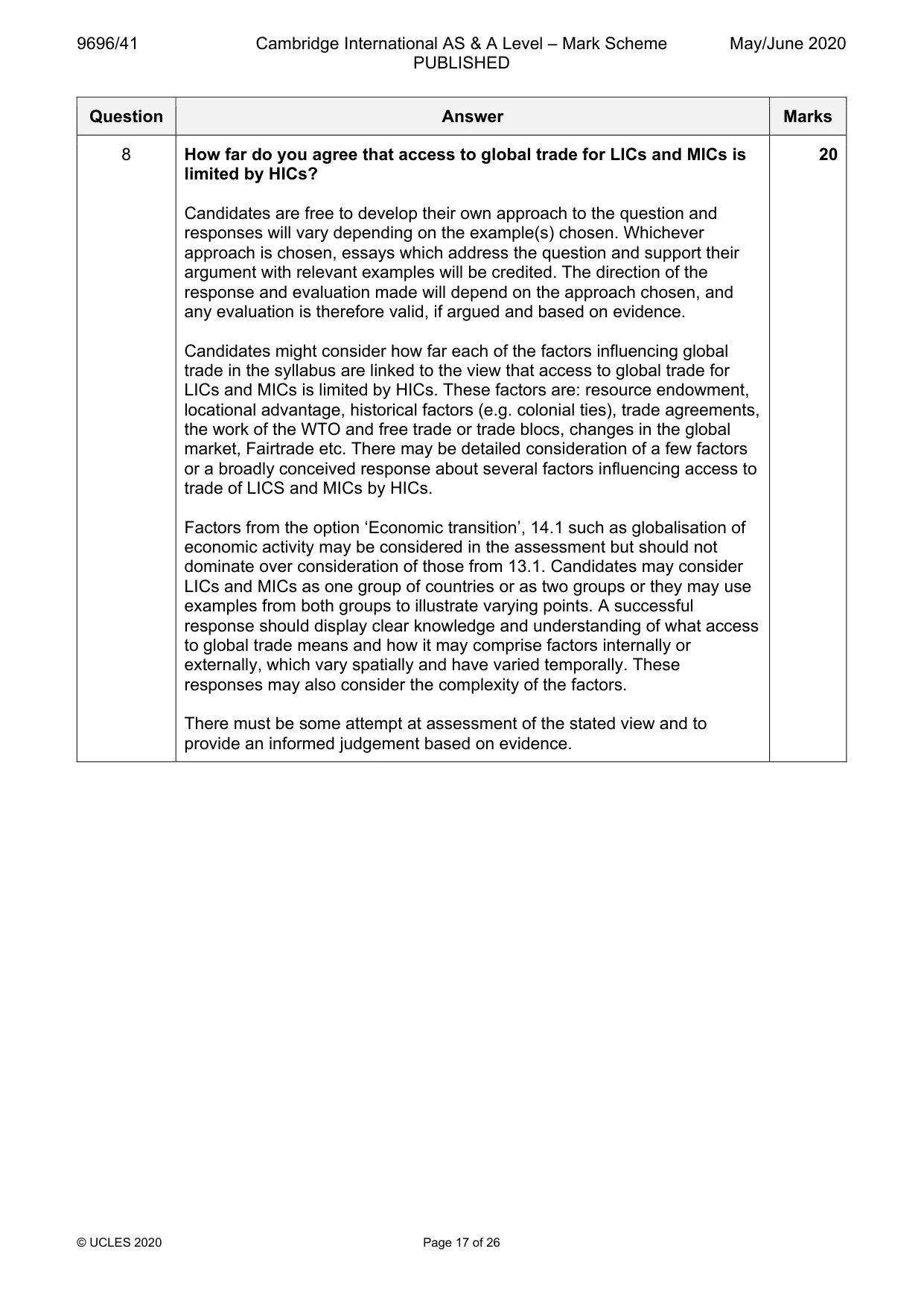
8 How far do you agree that access to global trade for LICs and MICs is limited by HICs? [20]
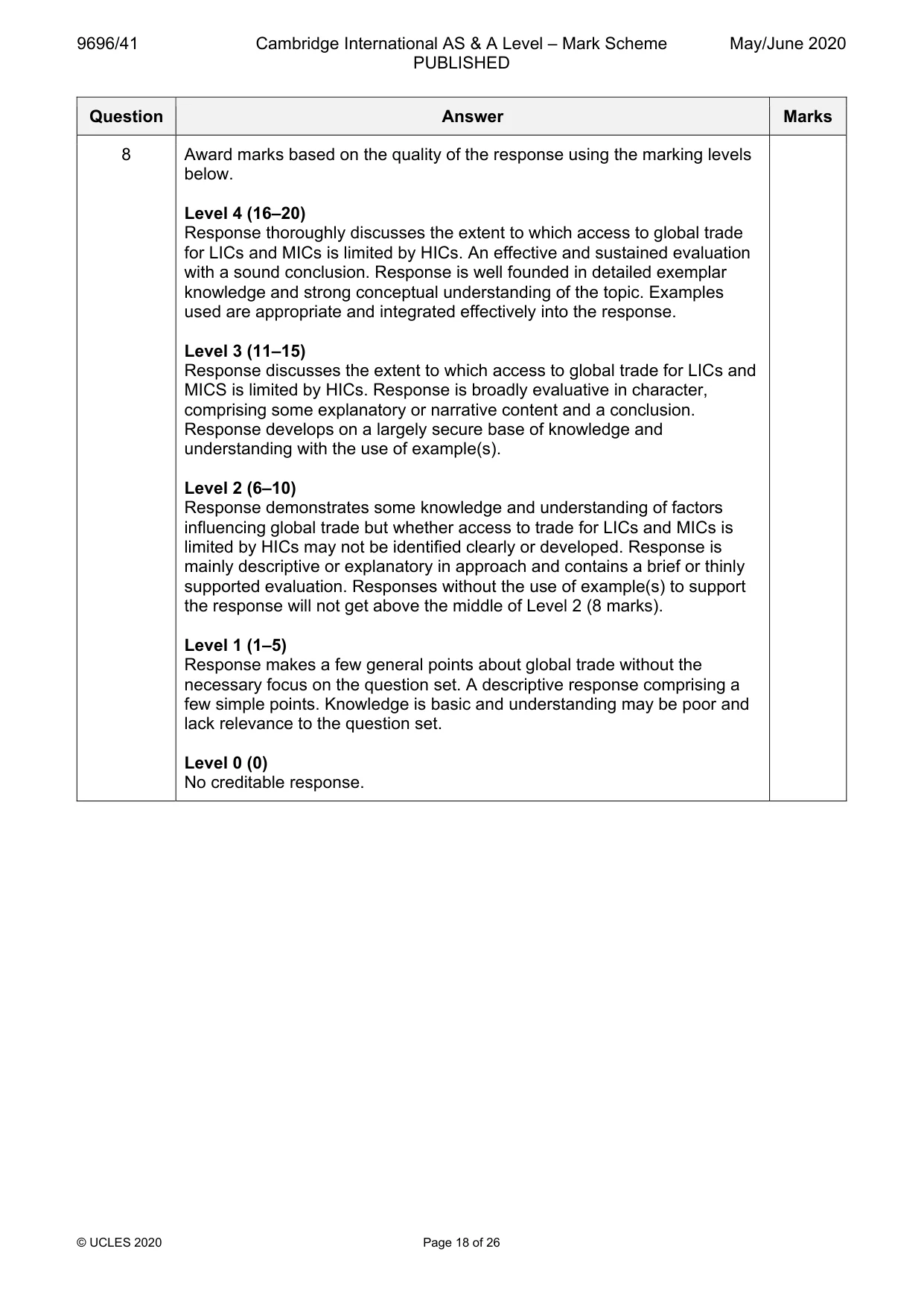
Mark scheme: 8 How far do you agree that access to global trade for LICs and MICs is 20 limited by HICs? Candidates are free to develop their own approach to the question and responses will vary depending on the example(s) chosen. Whichever approach is chosen, essays which address the question and support their argument with relevant examples will be credited. The direction of the response and evaluation made will depend on the approach chosen, and any evaluation is therefore valid, if argued and based on evidence. Candidates might consider how far each of the factors influencing global trade in the syllabus are linked to the view that access to global trade for LICs and MICs is limited by HICs. These factors are: resource endowment, locational advantage, historical factors (e.g. colonial ties), trade agreements, the work of the WTO and free trade or trade blocs, changes in the global market, Fairtrade etc. There may be detailed consideration of a few factors or a broadly conceived response about several factors influencing access to trade of LICS and MICs by HICs. Factors from the option ‘Economic transition’, 14.1 such as globalisation of economic activity may be considered in the assessment but should not dominate over consideration of those from 13.1. Candidates may consider LICs and MICs as one group of countries or as two groups or they may use examples from both groups to illustrate varying points. A successful response should display clear knowledge and understanding of what access to global trade means and how it may comprise factors internally or externally, which vary spatially and have varied temporally. These responses may also consider the complexity of the factors. There must be some attempt at assessment of the stated view and to provide an informed judgement based on evidence. 8 Award marks based on the quality of the response using the marking levels below. Level 4 (16–20) Response thoroughly discusses the extent to which access to global trade for LICs and MICs is limited by HICs. An effective and sustained evaluation with a sound conclusion. Response is well founded in detailed exemplar knowledge and strong conceptual understanding of the topic. Examples used are appropriate and integrated effectively into the response. Level 3 (11–15) Response discusses the extent to which access to global trade for LICs and MICS is limited by HICs. Response is broadly evaluative in character, comprising some explanatory or narrative content and a conclusion. Response develops on a largely secure base of knowledge and understanding with the use of example(s). Level 2 (6–10) Response demonstrates some knowledge and understanding of factors influencing global trade but whether access to trade for LICs and MICs is limited by HICs may not be identified clearly or developed. Response is mainly descriptive or explanatory in approach and contains a brief or thinly supported evaluation. Responses without the use of example(s) to support the response will not get above the middle of Level 2 (8 marks). Level 1 (1–5) Response makes a few general points about global trade without the necessary focus on the question set. A descriptive response comprising a few simple points. Knowledge is basic and understanding may be poor and lack relevance to the question set. Level 0 (0) No creditable response.
Q9 · For one tourist area or resort, evaluate the impacts of tourism on its environment
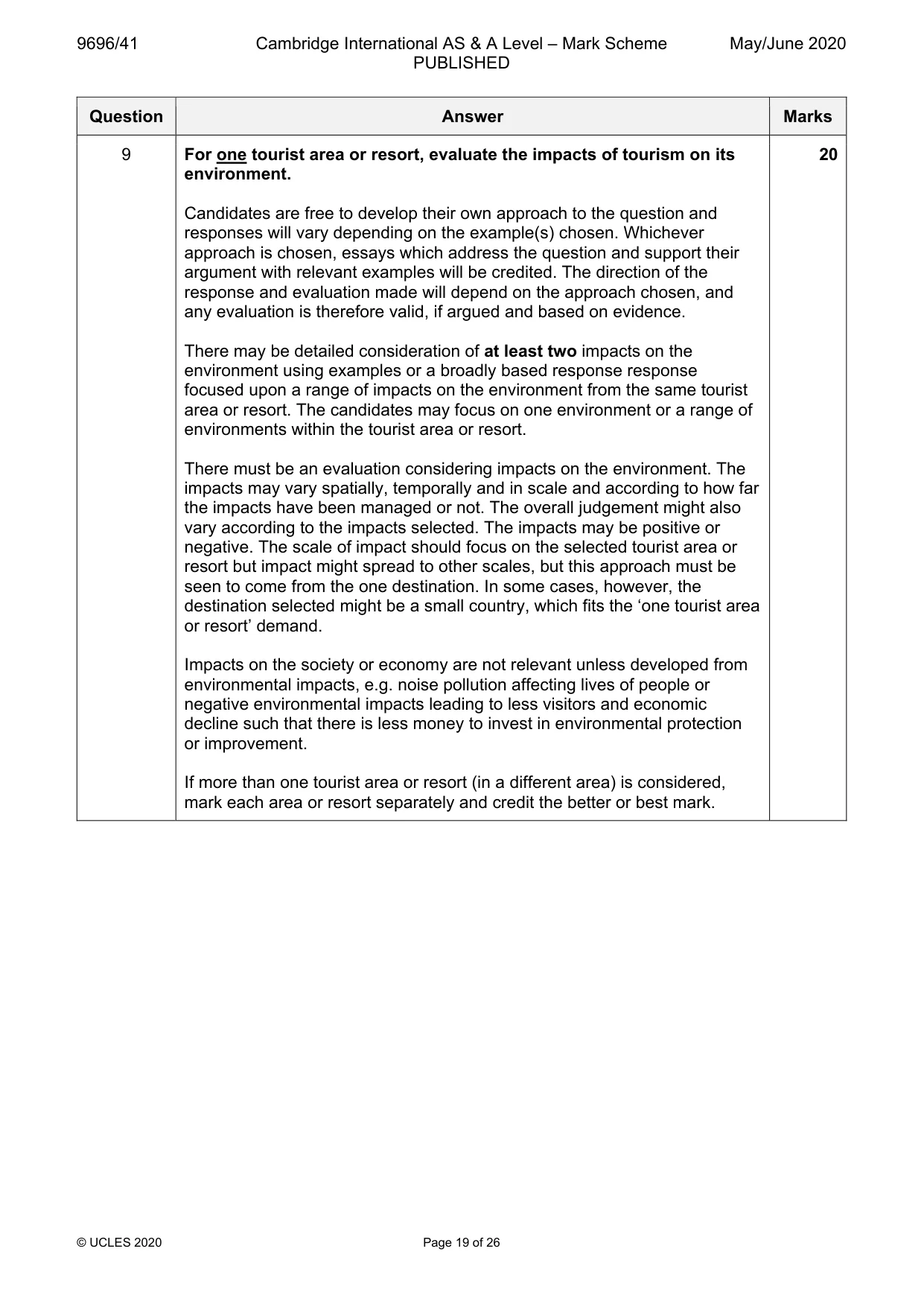
9 For one tourist area or resort, evaluate the impacts of tourism on its environment. [20] Economic transition If answering this option, answer Question 10 and either Question 11 or Question 12.
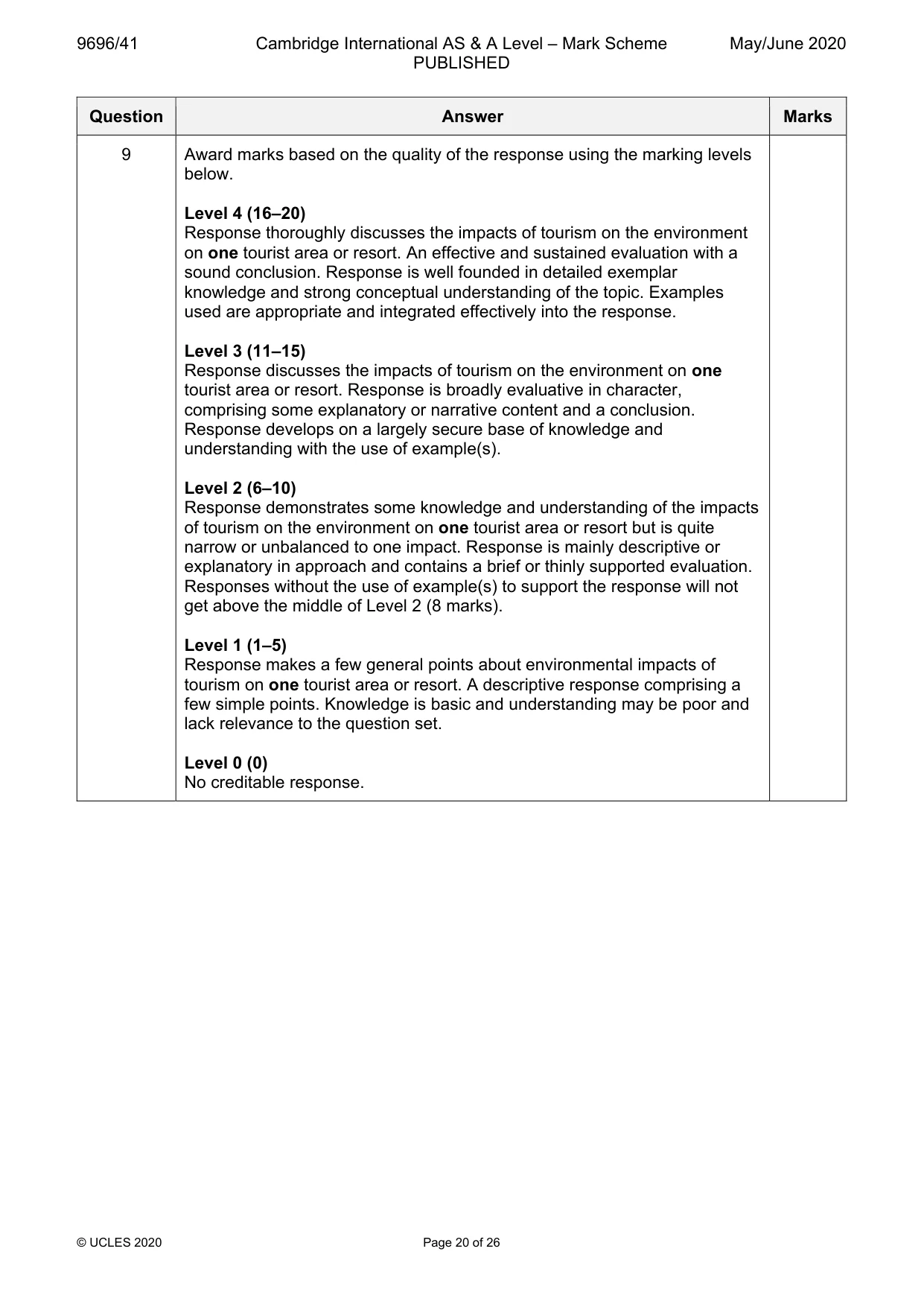
Mark scheme: 9 For one tourist area or resort, evaluate the impacts of tourism on its 20 environment. Candidates are free to develop their own approach to the question and responses will vary depending on the example(s) chosen. Whichever approach is chosen, essays which address the question and support their argument with relevant examples will be credited. The direction of the response and evaluation made will depend on the approach chosen, and any evaluation is therefore valid, if argued and based on evidence. There may be detailed consideration of at least two impacts on the environment using examples or a broadly based response response focused upon a range of impacts on the environment from the same tourist area or resort. The candidates may focus on one environment or a range of environments within the tourist area or resort. There must be an evaluation considering impacts on the environment. The impacts may vary spatially, temporally and in scale and according to how far the impacts have been managed or not. The overall judgement might also vary according to the impacts selected. The impacts may be positive or negative. The scale of impact should focus on the selected tourist area or resort but impact might spread to other scales, but this approach must be seen to come from the one destination. In some cases, however, the destination selected might be a small country, which fits the ‘one tourist area or resort’ demand. Impacts on the society or economy are not relevant unless developed from environmental impacts, e.g. noise pollution affecting lives of people or negative environmental impacts leading to less visitors and economic decline such that there is less money to invest in environmental protection or improvement. If more than one tourist area or resort (in a different area) is considered, mark each area or resort separately and credit the better or best mark. 9 Award marks based on the quality of the response using the marking levels below. Level 4 (16–20) Response thoroughly discusses the impacts of tourism on the environment on one tourist area or resort. An effective and sustained evaluation with a sound conclusion. Response is well founded in detailed exemplar knowledge and strong conceptual understanding of the topic. Examples used are appropriate and integrated effectively into the response. Level 3 (11–15) Response discusses the impacts of tourism on the environment on one tourist area or resort. Response is broadly evaluative in character, comprising some explanatory or narrative content and a conclusion. Response develops on a largely secure base of knowledge and understanding with the use of example(s). Level 2 (6–10) Response demonstrates some knowledge and understanding of the impacts of tourism on the environment on one tourist area or resort but is quite narrow or unbalanced to one impact. Response is mainly descriptive or explanatory in approach and contains a brief or thinly supported evaluation. Responses without the use of example(s) to support the response will not get above the middle of Level 2 (8 marks). Level 1 (1–5) Response makes a few general points about environmental impacts of tourism on one tourist area or resort. A descriptive response comprising a few simple points. Knowledge is basic and understanding may be poor and lack relevance to the question set. Level 0 (0) No creditable response. Economic transition If answering this option, answer Question 10 and either Question 11 or Question 12.
Q10 · GDP per person and percentage employment in agriculture, forestry and fishing, by…
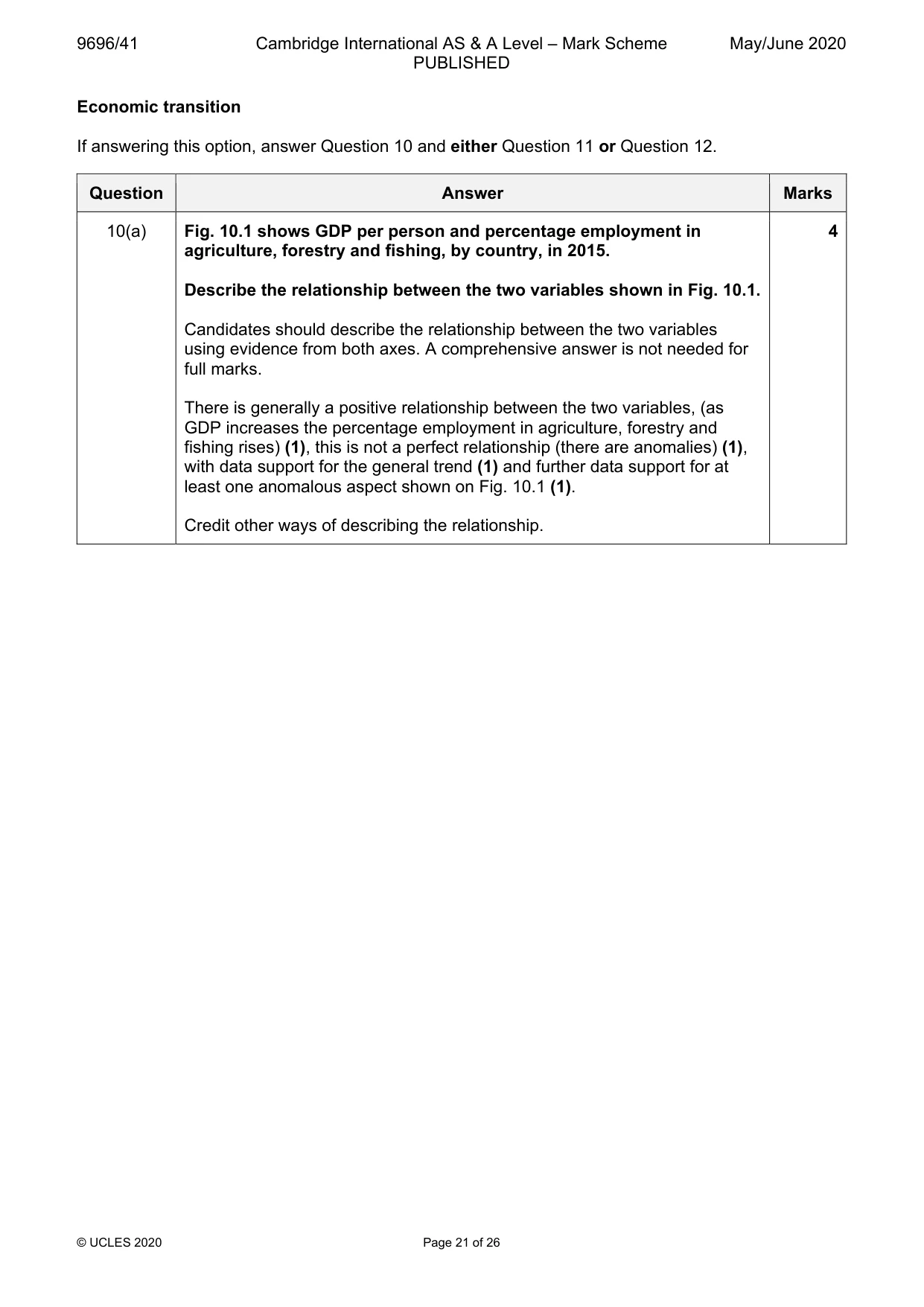
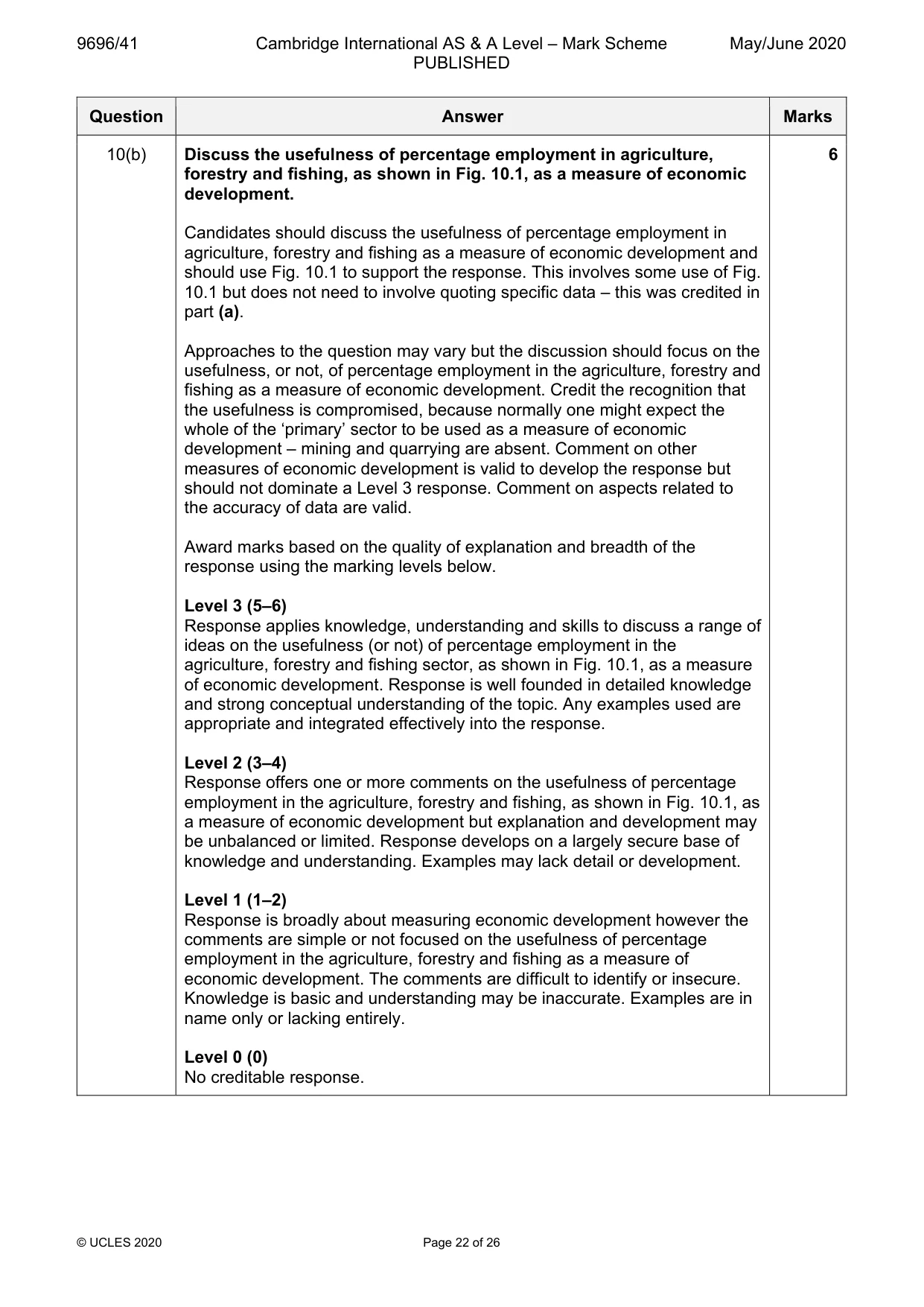
10 Fig. 10.1 shows GDP per person and percentage employment in agriculture, forestry and fishing, by country, in 2015. (a) Describe the relationship between the two variables shown in Fig. 10.1. [4] (b) Discuss the usefulness of percentage employment in agriculture, forestry and fishing, as shown in Fig. 10.1, as a measure of economic development. [6]
Mark scheme: 10(a) Fig. 10.1 shows GDP per person and percentage employment in 4 agriculture, forestry and fishing, by country, in 2015. Describe the relationship between the two variables shown in Fig. 10.1. Candidates should describe the relationship between the two variables using evidence from both axes. A comprehensive answer is not needed for full marks. There is generally a positive relationship between the two variables, (as GDP increases the percentage employment in agriculture, forestry and fishing rises) (1), this is not a perfect relationship (there are anomalies) (1), with data support for the general trend (1) and further data support for at least one anomalous aspect shown on Fig. 10.1 (1). Credit other ways of describing the relationship. 10(b) Discuss the usefulness of percentage employment in agriculture, 6 forestry and fishing, as shown in Fig. 10.1, as a measure of economic development. Candidates should discuss the usefulness of percentage employment in agriculture, forestry and fishing as a measure of economic development and should use Fig. 10.1 to support the response. This involves some use of Fig. 10.1 but does not need to involve quoting specific data – this was credited in part (a). Approaches to the question may vary but the discussion should focus on the usefulness, or not, of percentage employment in the agriculture, forestry and fishing as a measure of economic development. Credit the recognition that the usefulness is compromised, because normally one might expect the whole of the ‘primary’ sector to be used as a measure of economic development – mining and quarrying are absent. Comment on other measures of economic development is valid to develop the response but should not dominate a Level 3 response. Comment on aspects related to the accuracy of data are valid. Award marks based on the quality of explanation and breadth of the response using the marking levels below. Level 3 (5–6) Response applies knowledge, understanding and skills to discuss a range of ideas on the usefulness (or not) of percentage employment in the agriculture, forestry and fishing sector, as shown in Fig. 10.1, as a measure of economic development. Response is well founded in detailed knowledge and strong conceptual understanding of the topic. Any examples used are appropriate and integrated effectively into the response. Level 2 (3–4) Response offers one or more comments on the usefulness of percentage employment in the agriculture, forestry and fishing, as shown in Fig. 10.1, as a measure of economic development but explanation and development may be unbalanced or limited. Response develops on a largely secure base of knowledge and understanding. Examples may lack detail or development. Level 1 (1–2) Response is broadly about measuring economic development however the comments are simple or not focused on the usefulness of percentage employment in the agriculture, forestry and fishing as a measure of economic development. The comments are difficult to identify or insecure. Knowledge is basic and understanding may be inaccurate. Examples are in name only or lacking entirely. Level 0 (0) No creditable response.
Q11 · Evaluate the role of transnational corporations (TNCs) in the globalisation of economic…
11 Evaluate the role of transnational corporations (TNCs) in the globalisation of economic activity. [20]
Mark scheme: 11 Evaluate the role of transnational corporations (TNCs) in the 20 globalisation of economic activity. Candidates are free to develop their own approach to the question and responses will vary depending on the example(s) chosen. Whichever approach is chosen, essays which address the question and support their argument with relevant examples will be credited. The direction of the response and evaluation made will depend on the approach chosen, and any evaluation is therefore valid, if argued and based on evidence. There may be detailed consideration based on a case study with some additional reference to TNCs more broadly or a broadly conceived response, drawing on several examples to show the relationship between the two aspects of the question. There must be a clear attempt to evaluate the role of TNCs in the globalisation of economic activity and to provide an informed judgement based on evidence. The evaluation may consider the positive and negative aspects of the role of TNCs as direction for their response or they may consider the relative roles of TNCs and other factors in the globalisation of economic activity. Consideration of other factors should not dominate a successful response. Any other valid approach should be given equal consideration. The focus of the question is on globalisation of economic activity, so the inclusion of broader aspects of globalisation is best dealt with as supporting evidence for an evaluation of positive or negative aspects of the role of TNCs. For TNCs there might be consideration of their role in aspects such as: foreign direct investment, outsourcing of manufacturing and offshoring of services – spreading economic activity, their high share of global trade both within their own organisation or with third parties, reinvestment of profits stimulating economic growth and spread of activity, advertising and driving of consumer markets, positive and negative aspects of competition, cheap labour, environmental impacts etc. 11 Award marks based on the quality of the response using the marking levels below. Level 4 (16–20) Response thoroughly discusses the role of transnational corporations (TNCs) in the globalisation of economic activity. An effective and sustained evaluation with a sound conclusion. Response is well founded in detailed exemplar knowledge and strong conceptual understanding of the topic. Examples used are appropriate and integrated effectively into the response. Level 3 (11–15) Response discusses the role of transnational corporations (TNCs) in the globalisation of economic activity. Response is broadly evaluative in character, comprising some explanatory or narrative content and a conclusion. Response develops on a largely secure base of knowledge and understanding with the use of example(s). Level 2 (6–10) Response demonstrates some knowledge and understanding of the role of transnational corporations (TNCs) in the globalisation of economic activity. Response is mainly descriptive or explanatory in approach and contains a brief or thinly supported evaluation. Responses without the use of example(s) to support the response will not get above the middle of Level 2 (8 marks). Level 1 (1–5) Response makes a few general points about TNCs and globalisation but the link between both aspects is loose or weakly expressed. A descriptive response comprising a few simple points. Knowledge is basic and understanding may be poor and lack relevance to the question set. Level 0 (0) No creditable response.
Q12 · With reference to one or more examples, discuss the view that regional disparities cannot…
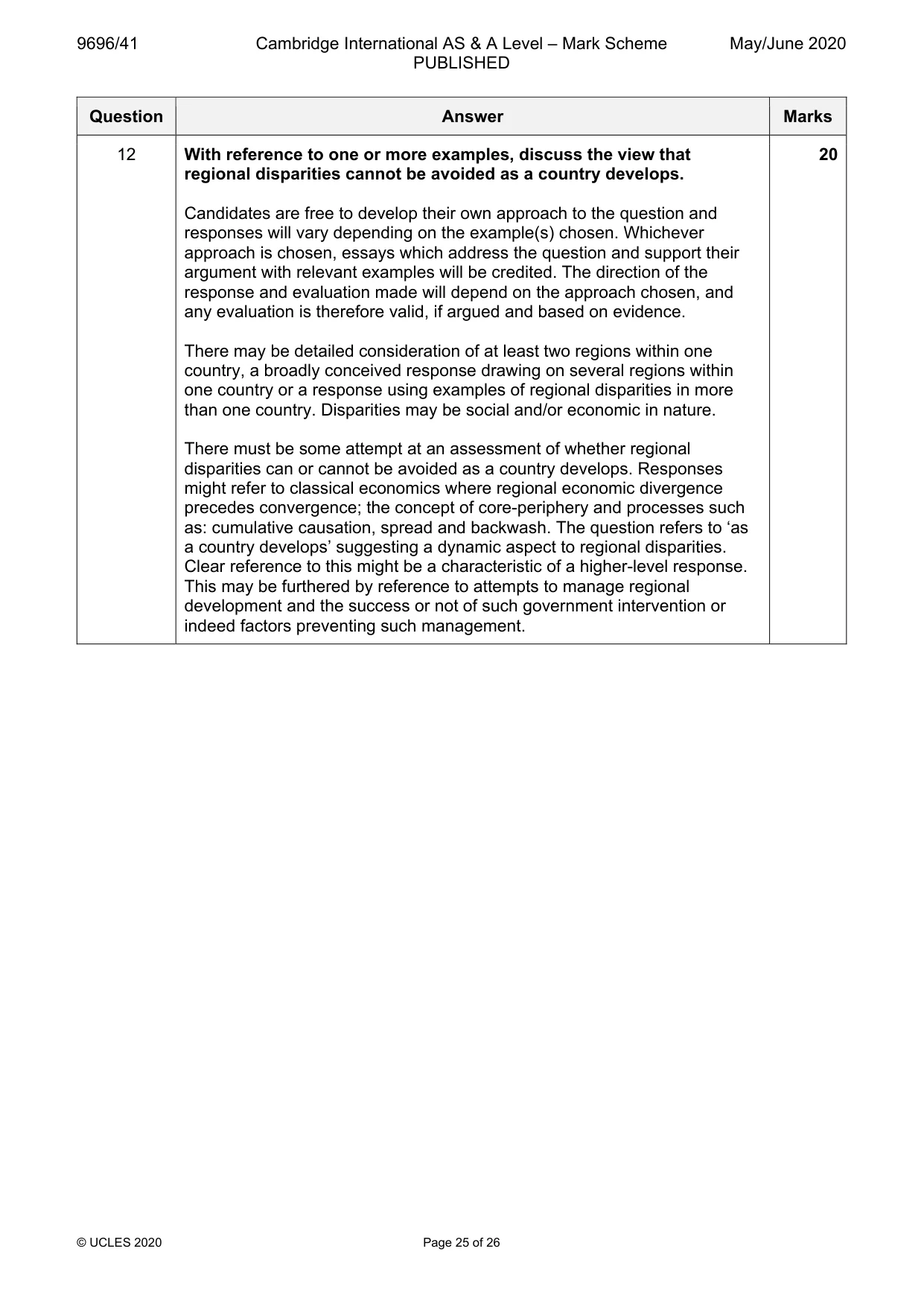
12 With reference to one or more examples, discuss the view that regional disparities cannot be avoided as a country develops. [20]
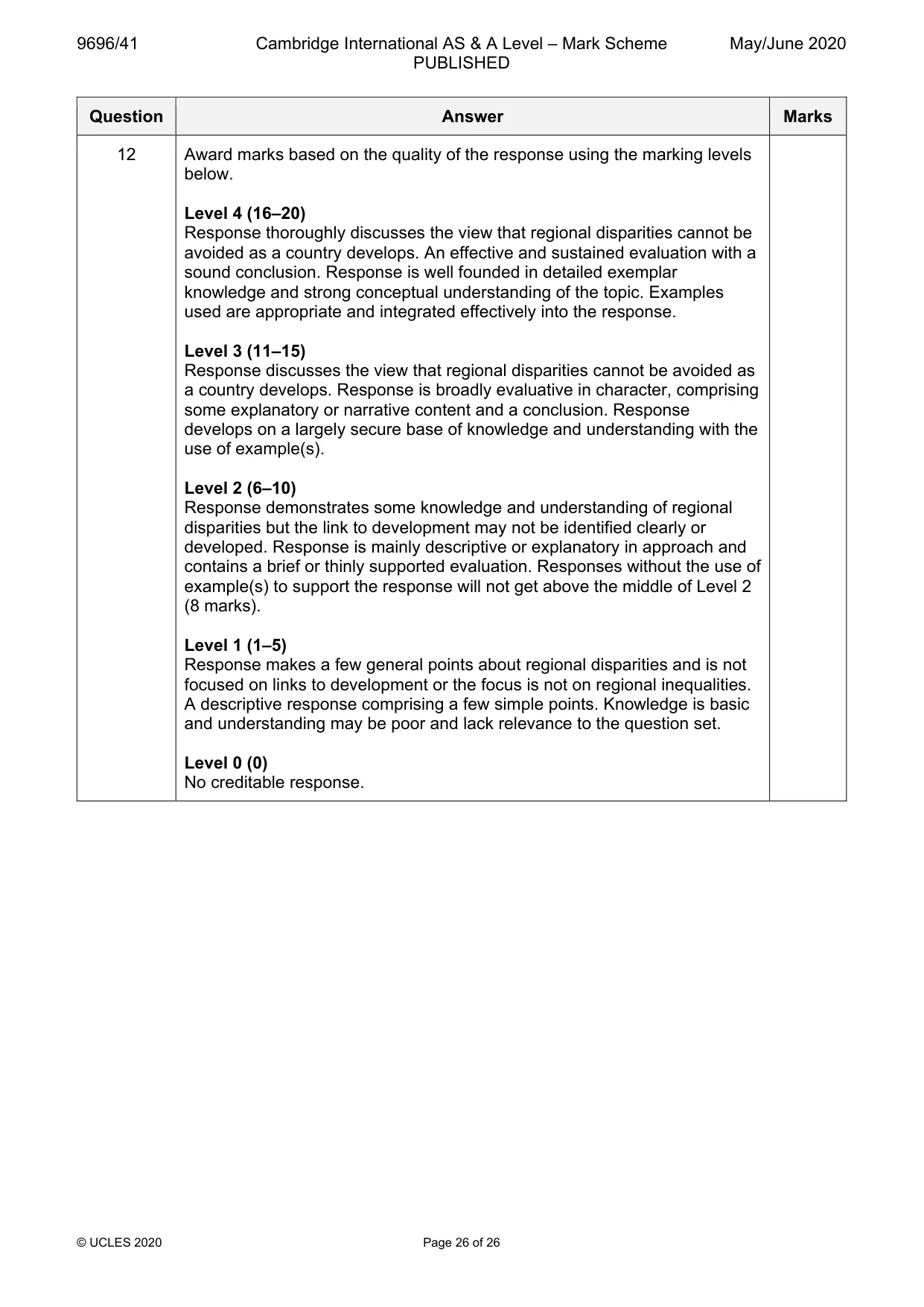
Mark scheme: 12 With reference to one or more examples, discuss the view that 20 regional disparities cannot be avoided as a country develops. Candidates are free to develop their own approach to the question and responses will vary depending on the example(s) chosen. Whichever approach is chosen, essays which address the question and support their argument with relevant examples will be credited. The direction of the response and evaluation made will depend on the approach chosen, and any evaluation is therefore valid, if argued and based on evidence. There may be detailed consideration of at least two regions within one country, a broadly conceived response drawing on several regions within one country or a response using examples of regional disparities in more than one country. Disparities may be social and/or economic in nature. There must be some attempt at an assessment of whether regional disparities can or cannot be avoided as a country develops. Responses might refer to classical economics where regional economic divergence precedes convergence; the concept of core-periphery and processes such as: cumulative causation, spread and backwash. The question refers to ‘as a country develops’ suggesting a dynamic aspect to regional disparities. Clear reference to this might be a characteristic of a higher-level response. This may be furthered by reference to attempts to manage regional development and the success or not of such government intervention or indeed factors preventing such management. 12 Award marks based on the quality of the response using the marking levels below. Level 4 (16–20) Response thoroughly discusses the view that regional disparities cannot be avoided as a country develops. An effective and sustained evaluation with a sound conclusion. Response is well founded in detailed exemplar knowledge and strong conceptual understanding of the topic. Examples used are appropriate and integrated effectively into the response. Level 3 (11–15) Response discusses the view that regional disparities cannot be avoided as a country develops. Response is broadly evaluative in character, comprising some explanatory or narrative content and a conclusion. Response develops on a largely secure base of knowledge and understanding with the use of example(s). Level 2 (6–10) Response demonstrates some knowledge and understanding of regional disparities but the link to development may not be identified clearly or developed. Response is mainly descriptive or explanatory in approach and contains a brief or thinly supported evaluation. Responses without the use of example(s) to support the response will not get above the middle of Level 2 (8 marks). Level 1 (1–5) Response makes a few general points about regional disparities and is not focused on links to development or the focus is not on regional inequalities. A descriptive response comprising a few simple points. Knowledge is basic and understanding may be poor and lack relevance to the question set. Level 0 (0) No creditable response.
What was in this paper
The subtopics covered by these 12 questions, and how many questions each got. Open one in a new tab to see every Cambridge question on it.
2Agricultural systems and food production1Manufacturing and related service industry1National development1Regional development within countries1Sustainable energy supplies1The development of international tourism1The globalisation of economic activity1The management of a degraded environment1The management of a tourist destination1The management of agricultural change1