Cambridge A Level Geography 9696 — 2019 Oct/Nov Paper 3 · Variant 2
9696/32/O/N/19 · 12 questions · 60 marks · ≈68 min
The question paper and its mark scheme, free to read here and free to download. This is Cambridge’s own paper, exactly as it was sat.
Question paper4 pages

Mark scheme19 pages
Answers below. Sit the paper first if you are practising.


Questions as text
Q1 · Some characteristics of humid tropical and seasonally humid tropical climates
1 Table 1.1 shows some characteristics of humid tropical and seasonally humid tropical climates. (a) Compare the characteristics of the humid tropical and seasonally humid tropical climates shown in Table 1.1. [4] (b) Explain the characteristics of the seasonally humid tropical climate shown in Table 1.1. [6]
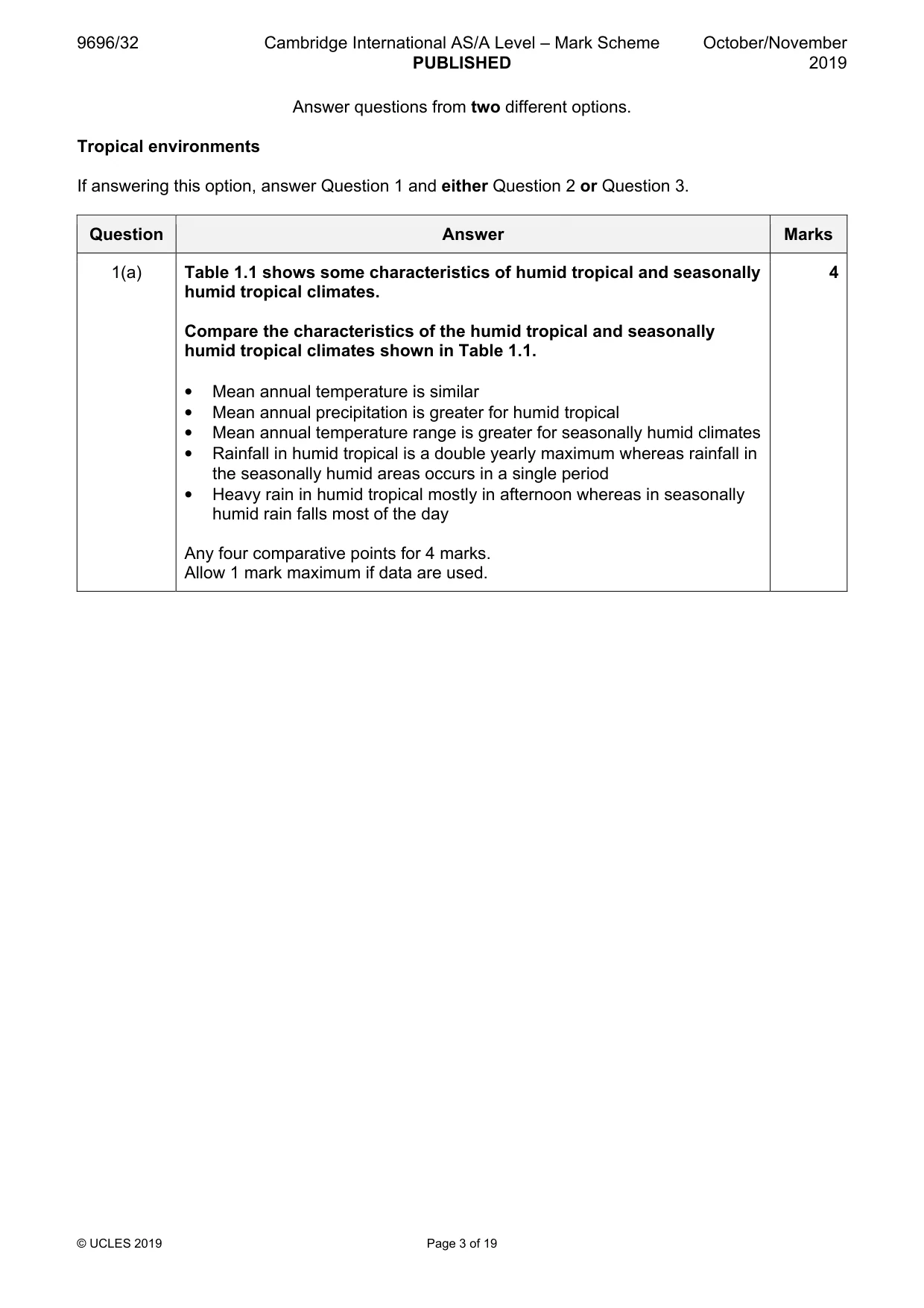
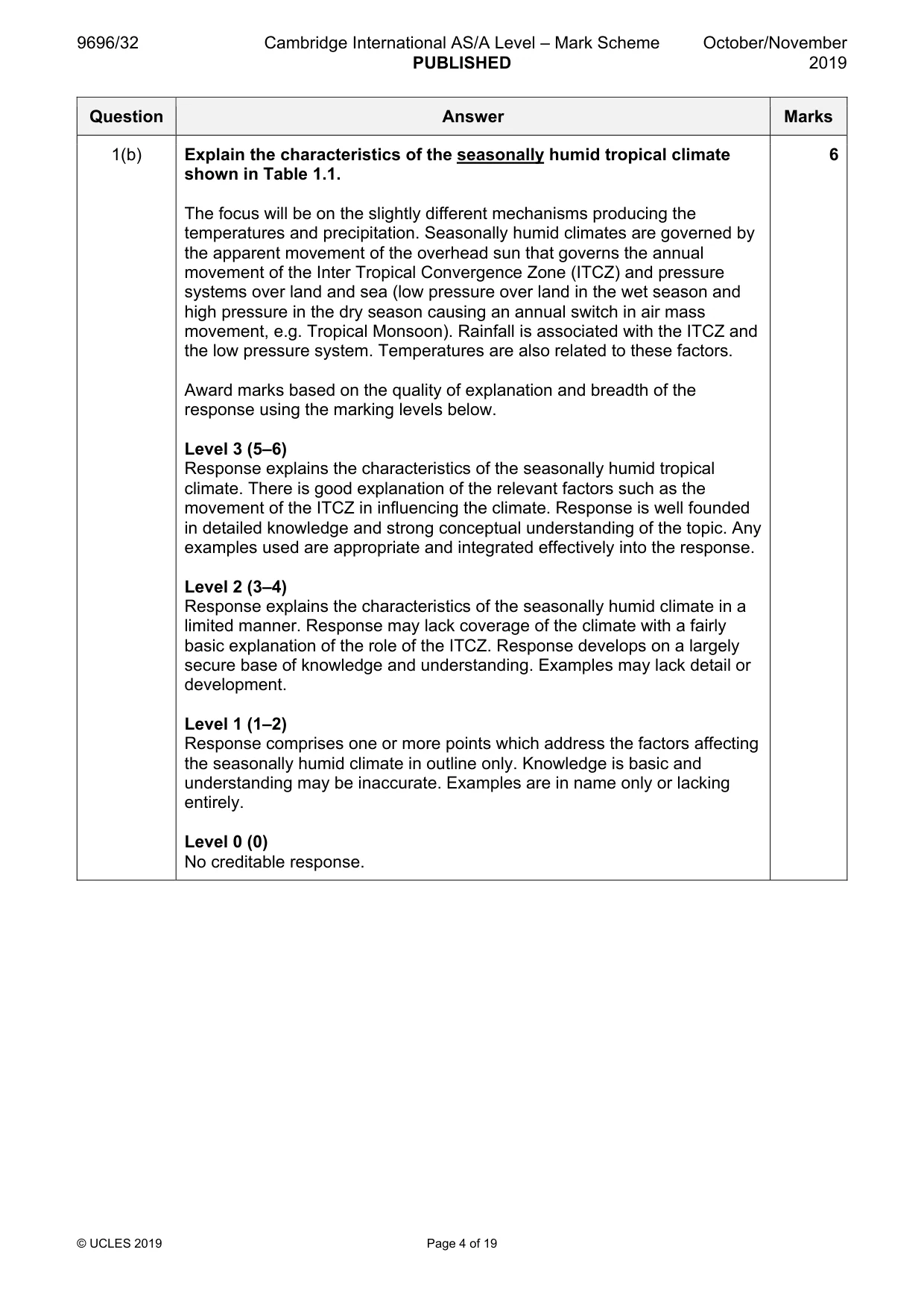
Mark scheme: Question Answer Marks 1(a) Table 1.1 shows some characteristics of humid tropical and seasonally 4 humid tropical climates. Compare the characteristics of the humid tropical and seasonally humid tropical climates shown in Table 1.1. • Mean annual temperature is similar • Mean annual precipitation is greater for humid tropical • Mean annual temperature range is greater for seasonally humid climates • Rainfall in humid tropical is a double yearly maximum whereas rainfall in the seasonally humid areas occurs in a single period • Heavy rain in humid tropical mostly in afternoon whereas in seasonally humid rain falls most of the day Any four comparative points for 4 marks. Allow 1 mark maximum if data are used. 1(b) Explain the characteristics of the seasonally humid tropical climate 6 shown in Table 1.1. The focus will be on the slightly different mechanisms producing the temperatures and precipitation. Seasonally humid climates are governed by the apparent movement of the overhead sun that governs the annual movement of the Inter Tropical Convergence Zone (ITCZ) and pressure systems over land and sea (low pressure over land in the wet season and high pressure in the dry season causing an annual switch in air mass movement, e.g. Tropical Monsoon). Rainfall is associated with the ITCZ and the low pressure system. Temperatures are also related to these factors. Award marks based on the quality of explanation and breadth of the response using the marking levels below. Level 3 (5–6) Response explains the characteristics of the seasonally humid tropical climate. There is good explanation of the relevant factors such as the movement of the ITCZ in influencing the climate. Response is well founded in detailed knowledge and strong conceptual understanding of the topic. Any examples used are appropriate and integrated effectively into the response. Level 2 (3–4) Response explains the characteristics of the seasonally humid climate in a limited manner. Response may lack coverage of the climate with a fairly basic explanation of the role of the ITCZ. Response develops on a largely secure base of knowledge and understanding. Examples may lack detail or development. Level 1 (1–2) Response comprises one or more points which address the factors affecting the seasonally humid climate in outline only. Knowledge is basic and understanding may be inaccurate. Examples are in name only or lacking entirely. Level 0 (0) No creditable response.
Q2 · Assess the roles of weathering and other factors in the formation of tropical karst…
2 Assess the roles of weathering and other factors in the formation of tropical karst landforms. [20]
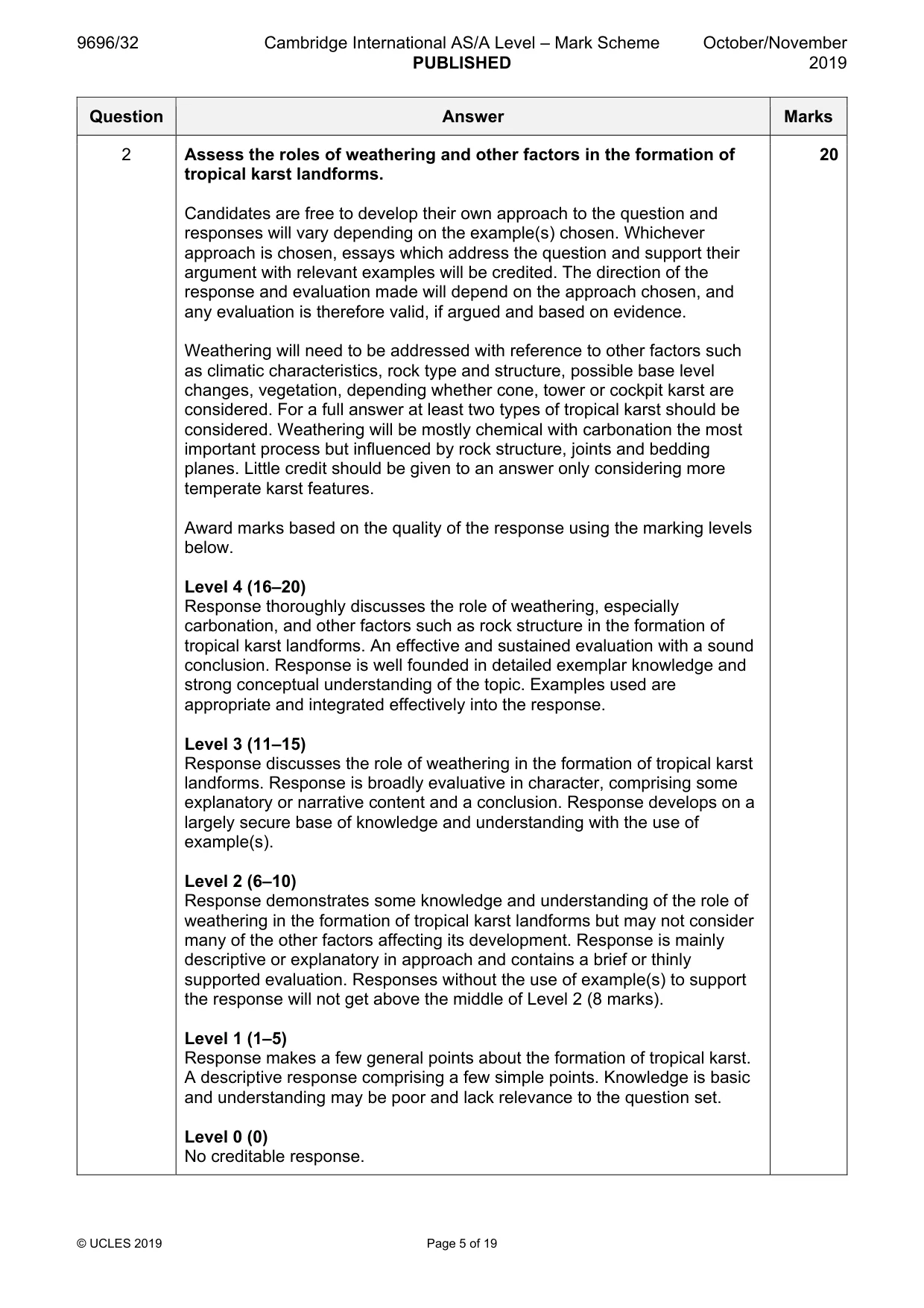
Mark scheme: 2 Assess the roles of weathering and other factors in the formation of 20 tropical karst landforms. Candidates are free to develop their own approach to the question and responses will vary depending on the example(s) chosen. Whichever approach is chosen, essays which address the question and support their argument with relevant examples will be credited. The direction of the response and evaluation made will depend on the approach chosen, and any evaluation is therefore valid, if argued and based on evidence. Weathering will need to be addressed with reference to other factors such as climatic characteristics, rock type and structure, possible base level changes, vegetation, depending whether cone, tower or cockpit karst are considered. For a full answer at least two types of tropical karst should be considered. Weathering will be mostly chemical with carbonation the most important process but influenced by rock structure, joints and bedding planes. Little credit should be given to an answer only considering more temperate karst features. Award marks based on the quality of the response using the marking levels below. Level 4 (16–20) Response thoroughly discusses the role of weathering, especially carbonation, and other factors such as rock structure in the formation of tropical karst landforms. An effective and sustained evaluation with a sound conclusion. Response is well founded in detailed exemplar knowledge and strong conceptual understanding of the topic. Examples used are appropriate and integrated effectively into the response. Level 3 (11–15) Response discusses the role of weathering in the formation of tropical karst landforms. Response is broadly evaluative in character, comprising some explanatory or narrative content and a conclusion. Response develops on a largely secure base of knowledge and understanding with the use of example(s). Level 2 (6–10) Response demonstrates some knowledge and understanding of the role of weathering in the formation of tropical karst landforms but may not consider many of the other factors affecting its development. Response is mainly descriptive or explanatory in approach and contains a brief or thinly supported evaluation. Responses without the use of example(s) to support the response will not get above the middle of Level 2 (8 marks). Level 1 (1–5) Response makes a few general points about the formation of tropical karst. A descriptive response comprising a few simple points. Knowledge is basic and understanding may be poor and lack relevance to the question set. Level 0 (0) No creditable response.
Q3 · Describe the vegetation characteristics of the savanna ecosystem
3 Describe the vegetation characteristics of the savanna ecosystem. Assess the role of climate and other physical factors in the development of its characteristics. [20] Coastal environments If answering this option, answer Question 4 and either Question 5 or Question 6.
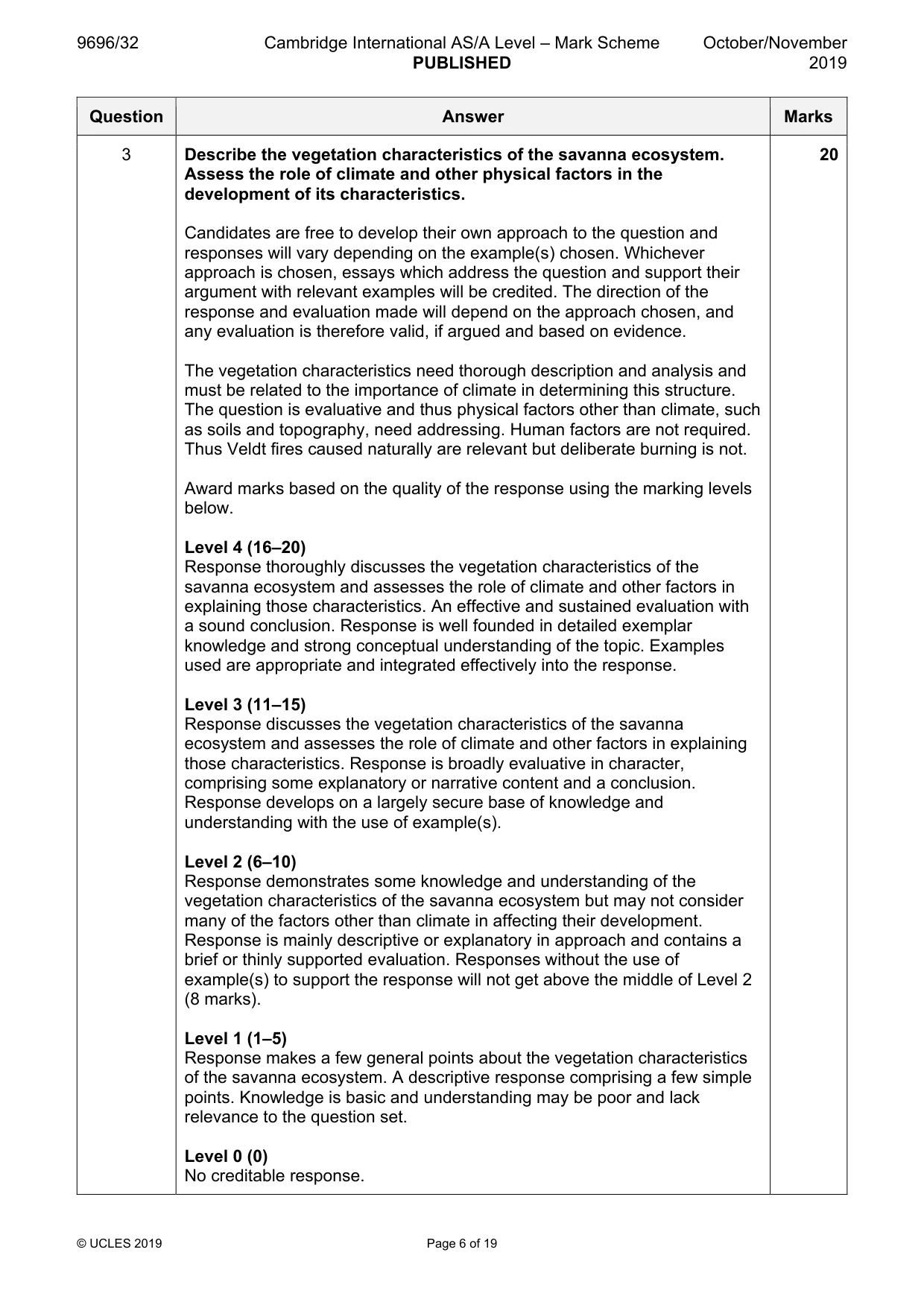
Mark scheme: 3 Describe the vegetation characteristics of the savanna ecosystem. 20 Assess the role of climate and other physical factors in the development of its characteristics. Candidates are free to develop their own approach to the question and responses will vary depending on the example(s) chosen. Whichever approach is chosen, essays which address the question and support their argument with relevant examples will be credited. The direction of the response and evaluation made will depend on the approach chosen, and any evaluation is therefore valid, if argued and based on evidence. The vegetation characteristics need thorough description and analysis and must be related to the importance of climate in determining this structure. The question is evaluative and thus physical factors other than climate, such as soils and topography, need addressing. Human factors are not required. Thus Veldt fires caused naturally are relevant but deliberate burning is not. Award marks based on the quality of the response using the marking levels below. Level 4 (16–20) Response thoroughly discusses the vegetation characteristics of the savanna ecosystem and assesses the role of climate and other factors in explaining those characteristics. An effective and sustained evaluation with a sound conclusion. Response is well founded in detailed exemplar knowledge and strong conceptual understanding of the topic. Examples used are appropriate and integrated effectively into the response. Level 3 (11–15) Response discusses the vegetation characteristics of the savanna ecosystem and assesses the role of climate and other factors in explaining those characteristics. Response is broadly evaluative in character, comprising some explanatory or narrative content and a conclusion. Response develops on a largely secure base of knowledge and understanding with the use of example(s). Level 2 (6–10) Response demonstrates some knowledge and understanding of the vegetation characteristics of the savanna ecosystem but may not consider many of the factors other than climate in affecting their development. Response is mainly descriptive or explanatory in approach and contains a brief or thinly supported evaluation. Responses without the use of example(s) to support the response will not get above the middle of Level 2 (8 marks). Level 1 (1–5) Response makes a few general points about the vegetation characteristics of the savanna ecosystem. A descriptive response comprising a few simple points. Knowledge is basic and understanding may be poor and lack relevance to the question set. Level 0 (0) No creditable response. Coastal environments If answering this option, answer Question 4 and either Question 5 or Question 6.
Q4 · A simplified distribution of coastal wave energy
4 Fig. 4.1 shows a simplified distribution of coastal wave energy. (a) Describe the distribution of wave energy shown in Fig. 4.1. [4] (b) Explain how differences in wave energy affect the cross section (profile) of beaches. [6]
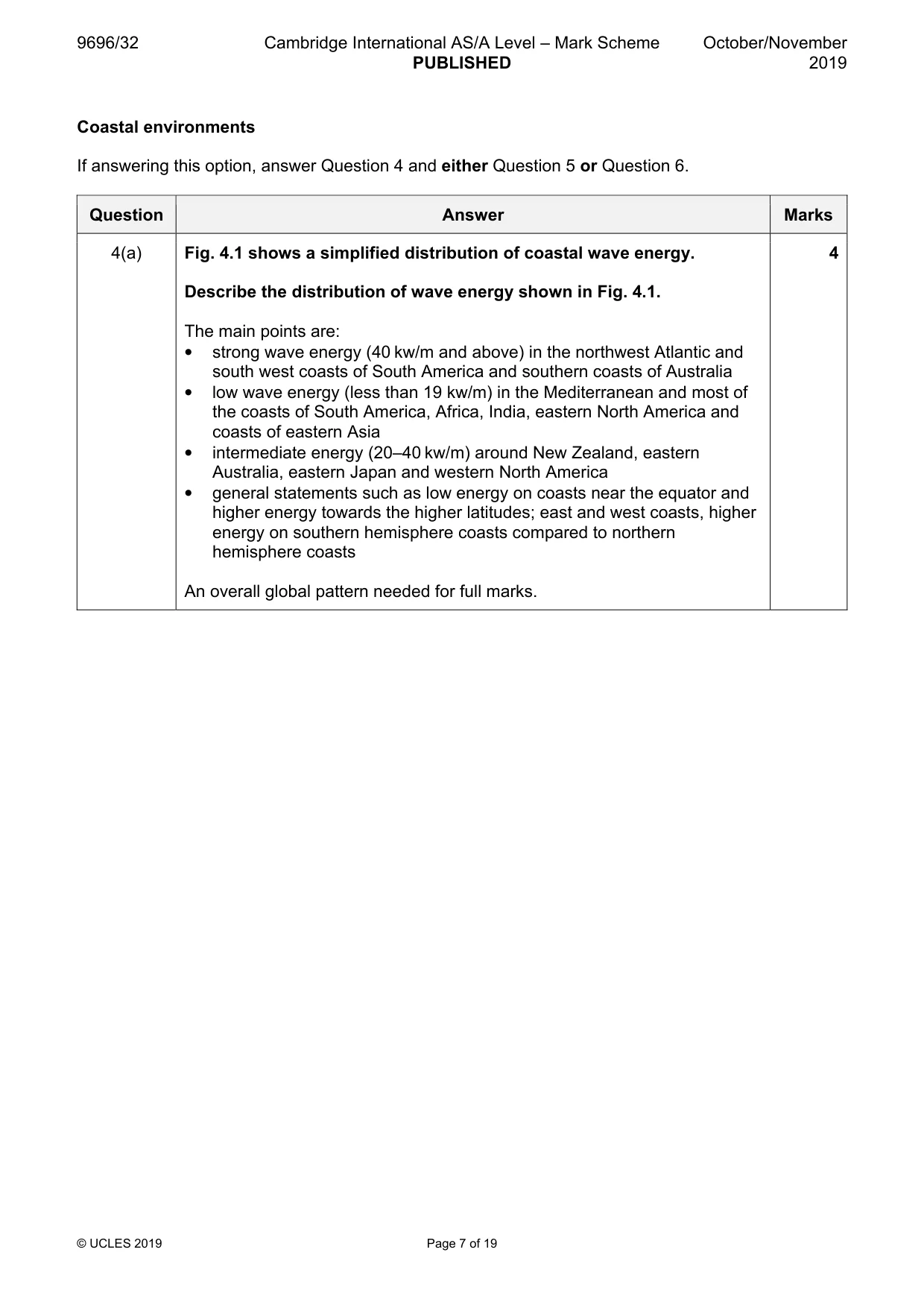
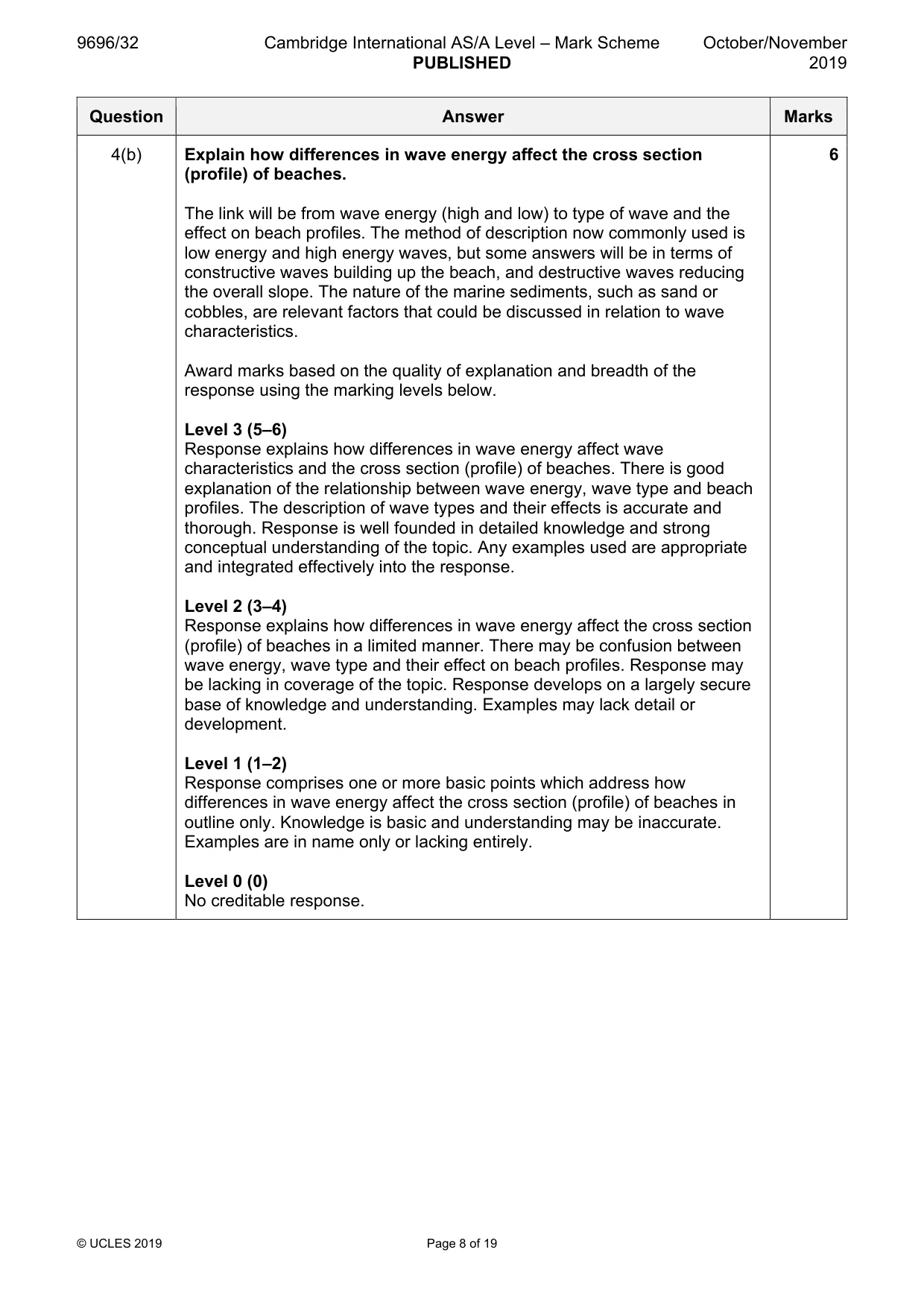
Mark scheme: 4(a) Fig. 4.1 shows a simplified distribution of coastal wave energy. 4 Describe the distribution of wave energy shown in Fig. 4.1. The main points are: • strong wave energy (40 kw/m and above) in the northwest Atlantic and south west coasts of South America and southern coasts of Australia • low wave energy (less than 19 kw/m) in the Mediterranean and most of the coasts of South America, Africa, India, eastern North America and coasts of eastern Asia • intermediate energy (20–40 kw/m) around New Zealand, eastern Australia, eastern Japan and western North America • general statements such as low energy on coasts near the equator and higher energy towards the higher latitudes; east and west coasts, higher energy on southern hemisphere coasts compared to northern hemisphere coasts An overall global pattern needed for full marks. 4(b) Explain how differences in wave energy affect the cross section 6 (profile) of beaches. The link will be from wave energy (high and low) to type of wave and the effect on beach profiles. The method of description now commonly used is low energy and high energy waves, but some answers will be in terms of constructive waves building up the beach, and destructive waves reducing the overall slope. The nature of the marine sediments, such as sand or cobbles, are relevant factors that could be discussed in relation to wave characteristics. Award marks based on the quality of explanation and breadth of the response using the marking levels below. Level 3 (5–6) Response explains how differences in wave energy affect wave characteristics and the cross section (profile) of beaches. There is good explanation of the relationship between wave energy, wave type and beach profiles. The description of wave types and their effects is accurate and thorough. Response is well founded in detailed knowledge and strong conceptual understanding of the topic. Any examples used are appropriate and integrated effectively into the response. Level 2 (3–4) Response explains how differences in wave energy affect the cross section (profile) of beaches in a limited manner. There may be confusion between wave energy, wave type and their effect on beach profiles. Response may be lacking in coverage of the topic. Response develops on a largely secure base of knowledge and understanding. Examples may lack detail or development. Level 1 (1–2) Response comprises one or more basic points which address how differences in wave energy affect the cross section (profile) of beaches in outline only. Knowledge is basic and understanding may be inaccurate. Examples are in name only or lacking entirely. Level 0 (0) No creditable response.
Q5 · Assess the influence of sea-level change in the formation of coastal landforms
5 Assess the influence of sea-level change in the formation of coastal landforms. [20]
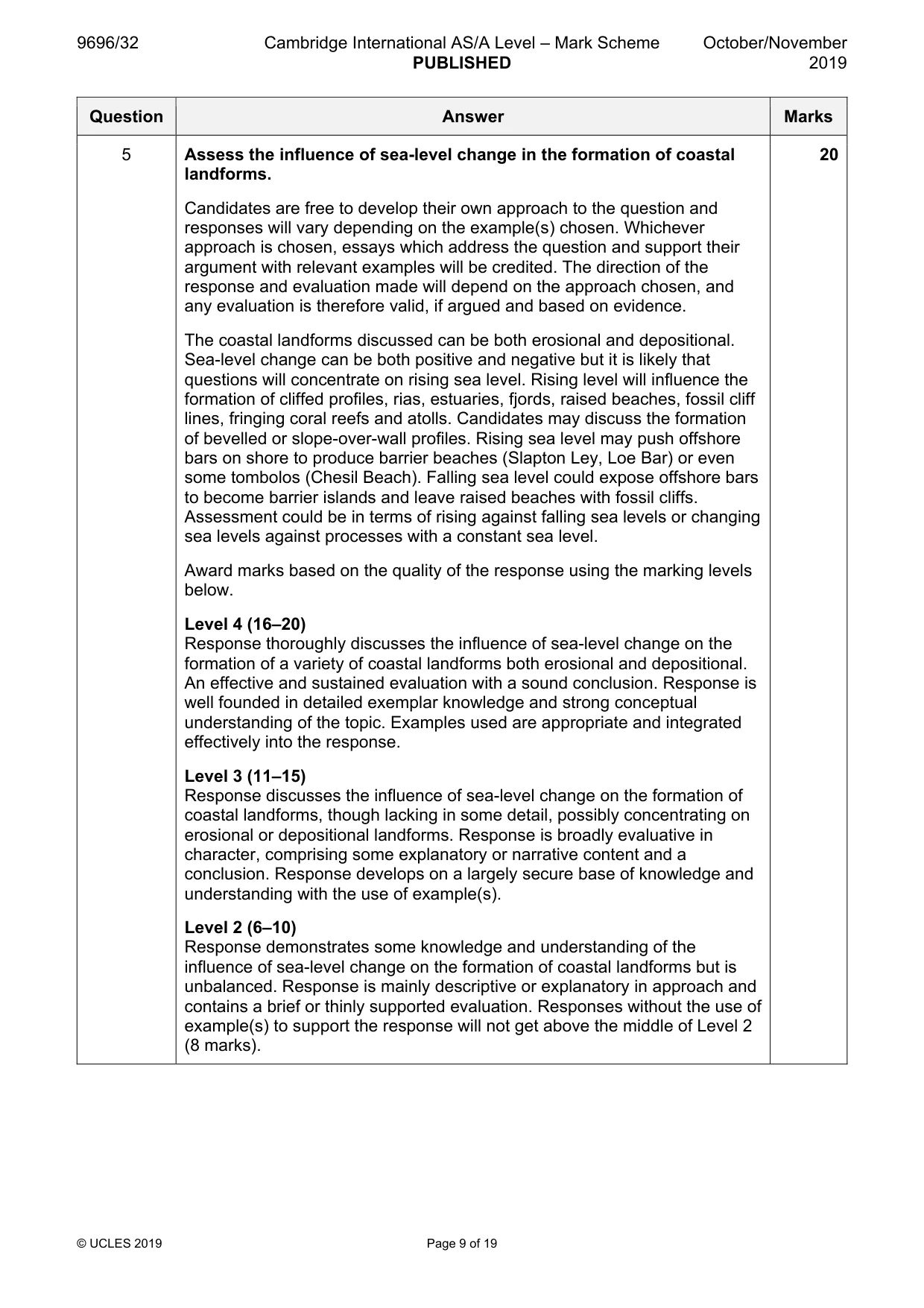
Mark scheme: 5 Assess the influence of sea-level change in the formation of coastal 20 landforms. Candidates are free to develop their own approach to the question and responses will vary depending on the example(s) chosen. Whichever approach is chosen, essays which address the question and support their argument with relevant examples will be credited. The direction of the response and evaluation made will depend on the approach chosen, and any evaluation is therefore valid, if argued and based on evidence. The coastal landforms discussed can be both erosional and depositional. Sea-level change can be both positive and negative but it is likely that questions will concentrate on rising sea level. Rising level will influence the formation of cliffed profiles, rias, estuaries, fjords, raised beaches, fossil cliff lines, fringing coral reefs and atolls. Candidates may discuss the formation of bevelled or slope-over-wall profiles. Rising sea level may push offshore bars on shore to produce barrier beaches (Slapton Ley, Loe Bar) or even some tombolos (Chesil Beach). Falling sea level could expose offshore bars to become barrier islands and leave raised beaches with fossil cliffs. Assessment could be in terms of rising against falling sea levels or changing sea levels against processes with a constant sea level. Award marks based on the quality of the response using the marking levels below. Level 4 (16–20) Response thoroughly discusses the influence of sea-level change on the formation of a variety of coastal landforms both erosional and depositional. An effective and sustained evaluation with a sound conclusion. Response is well founded in detailed exemplar knowledge and strong conceptual understanding of the topic. Examples used are appropriate and integrated effectively into the response. Level 3 (11–15) Response discusses the influence of sea-level change on the formation of coastal landforms, though lacking in some detail, possibly concentrating on erosional or depositional landforms. Response is broadly evaluative in character, comprising some explanatory or narrative content and a conclusion. Response develops on a largely secure base of knowledge and understanding with the use of example(s). Level 2 (6–10) Response demonstrates some knowledge and understanding of the influence of sea-level change on the formation of coastal landforms but is unbalanced. Response is mainly descriptive or explanatory in approach and contains a brief or thinly supported evaluation. Responses without the use of example(s) to support the response will not get above the middle of Level 2 (8 marks). 5 Level 1 (1–5) Response makes a few general points about the role of sea-level change in the formation of coastal landforms. A descriptive response comprising a few simple points. Knowledge is basic and understanding may be poor and lack relevance to the question set. Level 0 (0) No creditable response.
Q6 · Describe the characteristics of coastal dunes
6 Describe the characteristics of coastal dunes. Assess the factors involved in the formation of coastal dunes. [20] Hazardous environments If answering this option, answer Question 7 and either Question 8 or Question 9.
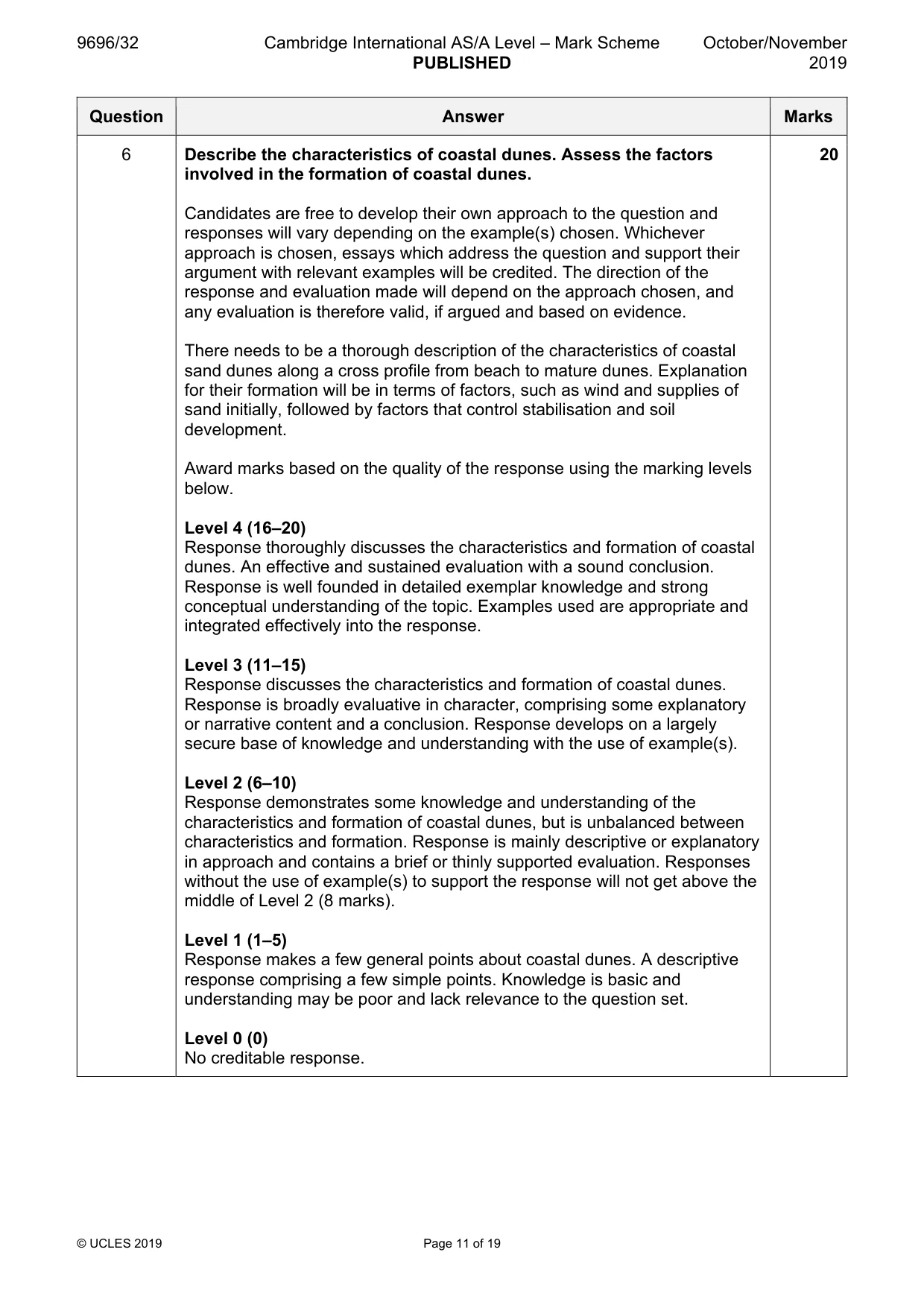
Mark scheme: 6 Describe the characteristics of coastal dunes. Assess the factors 20 involved in the formation of coastal dunes. Candidates are free to develop their own approach to the question and responses will vary depending on the example(s) chosen. Whichever approach is chosen, essays which address the question and support their argument with relevant examples will be credited. The direction of the response and evaluation made will depend on the approach chosen, and any evaluation is therefore valid, if argued and based on evidence. There needs to be a thorough description of the characteristics of coastal sand dunes along a cross profile from beach to mature dunes. Explanation for their formation will be in terms of factors, such as wind and supplies of sand initially, followed by factors that control stabilisation and soil development. Award marks based on the quality of the response using the marking levels below. Level 4 (16–20) Response thoroughly discusses the characteristics and formation of coastal dunes. An effective and sustained evaluation with a sound conclusion. Response is well founded in detailed exemplar knowledge and strong conceptual understanding of the topic. Examples used are appropriate and integrated effectively into the response. Level 3 (11–15) Response discusses the characteristics and formation of coastal dunes. Response is broadly evaluative in character, comprising some explanatory or narrative content and a conclusion. Response develops on a largely secure base of knowledge and understanding with the use of example(s). Level 2 (6–10) Response demonstrates some knowledge and understanding of the characteristics and formation of coastal dunes, but is unbalanced between characteristics and formation. Response is mainly descriptive or explanatory in approach and contains a brief or thinly supported evaluation. Responses without the use of example(s) to support the response will not get above the middle of Level 2 (8 marks). Level 1 (1–5) Response makes a few general points about coastal dunes. A descriptive response comprising a few simple points. Knowledge is basic and understanding may be poor and lack relevance to the question set. Level 0 (0) No creditable response. Hazardous environments If answering this option, answer Question 7 and either Question 8 or Question 9.
Q7 · Some types of mass movement
7 Fig. 7.1 shows some types of mass movement. (a) Describe the characteristics of the debris flows and the mudflow shown in Fig. 7.1. [4] (b) Explain why the hazardous nature of the types of mass movements shown in Fig. 7.1 varies. [6]
Mark scheme: 7(a) Fig. 7.1 shows some types of mass movement. 4 Describe the characteristics of the debris flows and the mudflow shown in Fig. 7.1. The main points are: For the debris flow: • large complex head scarp (source area) with multiple subsidiary scarps and several main flow elements. For the mudflow: • narrow incised channel with a long, fluid runout to the beach. Discussion of slides is only relevant if related to debris flows. Maximum 3 marks if purely generic. 7(b) Explain why the hazardous nature of the types of mass movements 6 shown in Fig. 7.1 varies. Detail will depend on which of the mass movements are chosen to discuss in detail but the main differentiator will be slides and flows with slightly different mechanisms. At least two types should be covered but there is no need for the account to be equally balanced. There is no need to refer to the figure and answers can be purely generic once the mass movement types have been identified. But reference to the figure might help in the analysis. Mudflows will cover a longer distance and therefore the hazardous zone may be greater. Debris flows are sudden, often large scale movements usually associated with steeper slopes. They are more fluid than slides and therefore the water content is an added hazard. Slides tend to be sudden and involve large quantities of rock and sediment. They are generally less easy to predict. Mudflows tend to be repetitive along the same channel. Award marks based on the quality of explanation and breadth of the response using the marking levels below. Level 3 (5–6) Response addresses the hazardous nature of the chosen types of mass movements. There is good description of at least two types of mass movement. Response is well founded in detailed knowledge and strong conceptual understanding of the topic. Any examples used are appropriate and integrated effectively into the response. Level 2 (3–4) Response addresses the hazardous nature of the types of mass movements chosen but in an unbalanced way. Response may be lacking in detailed coverage of the types chosen for discussion. Response develops on a largely secure base of knowledge and understanding. Examples may lack detail or development. Level 1 (1–2) Response comprises a few descriptive points which address the question in outline only. Knowledge is basic and understanding may be inaccurate. Examples are in name only or lacking entirely. Level 0 (0) No creditable response.
Q8 · Explain the formation of tsunami
8 Explain the formation of tsunami. Evaluate the extent to which the hazardous impacts of tsunami may be reduced. [20]
Mark scheme: 8 Explain the formation of tsunami. Evaluate the extent to which the 20 hazardous impacts of tsunami may be reduced. Candidates are free to develop their own approach to the question and responses will vary depending on the example(s) chosen. Whichever approach is chosen, essays which address the question and support their argument with relevant examples will be credited. The direction of the response and evaluation made will depend on the approach chosen, and any evaluation is therefore valid, if argued and based on evidence. There are two parts to the question and both need to be addressed fully. Explanation of tsunami will be in terms of tectonic activity under the sea, earthquakes and volcanoes. Large underwater landslides are another possibility such as past landslide events on the continental slope off Norway with tsunami reaching northern Scotland. The hazards need describing with an evaluation of procedures to minimise their effects such as prediction and preparedness (reinforcing of sea walls and coastal defences, hazard analysis, land use zoning). Award marks based on the quality of the response using the marking levels below. Level 4 (16–20) Response thoroughly discusses the formation of tsunami and the extent to which the hazardous impacts of tsunami may be reduced. An effective and sustained evaluation with a sound conclusion. Response is well founded in detailed exemplar knowledge and strong conceptual understanding of the topic. Examples used are appropriate and integrated effectively into the response. Level 3 (11–15) Response discusses the formation of tsunami and the extent to which the hazardous impacts of tsunami may be reduced. Response is broadly evaluative in character, comprising some explanatory or narrative content and a conclusion. Response develops on a largely secure base of knowledge and understanding with the use of example(s). Level 2 (6–10) Response demonstrates some knowledge and understanding of the formation of tsunami and the extent to which the hazardous impacts of tsunami may be reduced but is unbalanced. Response is mainly descriptive or explanatory in approach and contains a brief or thinly supported evaluation. Responses without the use of example(s) to support the response will not get above the middle of Level 2 (8 marks). Level 1 (1–5) Response makes a few general points about tsunami. A descriptive response comprising a few simple points. Knowledge is basic and understanding may be poor and lack relevance to the question set. Level 0 (0) No creditable response.
Q9 · With the aid of a case study of a hazardous environment, assess how prediction and…
9 With the aid of a case study of a hazardous environment, assess how prediction and preparedness can reduce the impacts of the hazard(s) on lives and property. [20] Hot arid and semi-arid environments If answering this option, answer Question 10 and either Question 11 or Question 12.
Mark scheme: 9 With the aid of a case study of a hazardous environment, assess how 20 prediction and preparedness can reduce the impacts of the hazard(s) on lives and property. Candidates are free to develop their own approach to the question and responses will vary depending on the example(s) chosen. Whichever approach is chosen, essays which address the question and support their argument with relevant examples will be credited. The direction of the response and evaluation made will depend on the approach chosen, and any evaluation is therefore valid, if argued and based on evidence. The detail will depend on the chosen case study (hazards can be related to tectonic activity, mass movement and areas prone to meteorological hazards such as tornadoes, cyclones). However, whichever case study is chosen, there needs to be a detailed description of the hazards. This should be followed by the assessment as to how prediction of those hazards and preparedness can reduce their impacts. If more than one case study is used, credit the best response only. Award marks based on the quality of the response using the marking levels below. Level 4 (16–20) Response thoroughly discusses the hazards associated with the chosen case study. An effective and sustained evaluation with a sound conclusion. Response is well founded in detailed exemplar knowledge and strong conceptual understanding of the topic. Examples used are appropriate and integrated effectively into the response. Level 3 (11–15) Response discusses the hazards associated with the chosen case study. Response is broadly evaluative in character, comprising some explanatory or narrative content and a conclusion. Response develops on a largely secure base of knowledge and understanding with the use of example(s). Level 2 (6–10) Response demonstrates some knowledge and understanding of the nature of the chosen case study of a hazardous environment but is a fairly basic analysis. Response is mainly descriptive or explanatory in approach and contains a brief or thinly supported evaluation. Responses without the use of example(s) to support the response will not get above the middle of Level 2 (8 marks). Level 1 (1–5) Response makes a few general points about the chosen case study. A descriptive response comprising a few simple points. Knowledge is basic and understanding may be poor and lack relevance to the question set. Level 0 (0) No creditable response. Hot arid and semi-arid environments If answering this option, answer Question 10 and either Question 11 or Question 12.
Q10 · The level of soil degradation in hot arid and semi-arid areas of Mexico
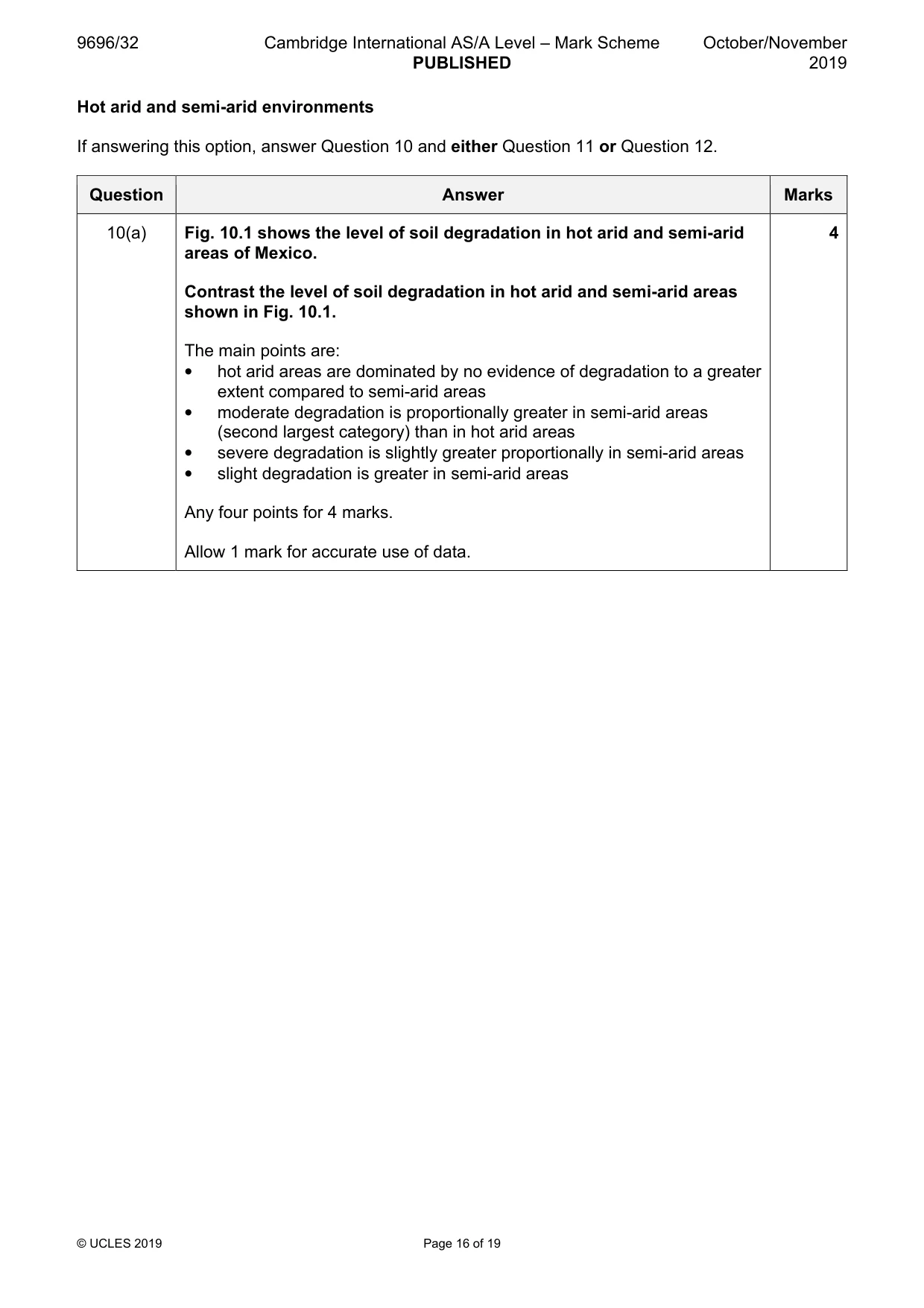
10 Fig. 10.1 shows the level of soil degradation in hot arid and semi-arid areas of Mexico. (a) Contrast the level of soil degradation in hot arid and semi-arid areas shown in Fig. 10.1. [4] (b) Suggest two reasons why the level of soil degradation is greater in semi-arid areas than in hot arid areas. [6]
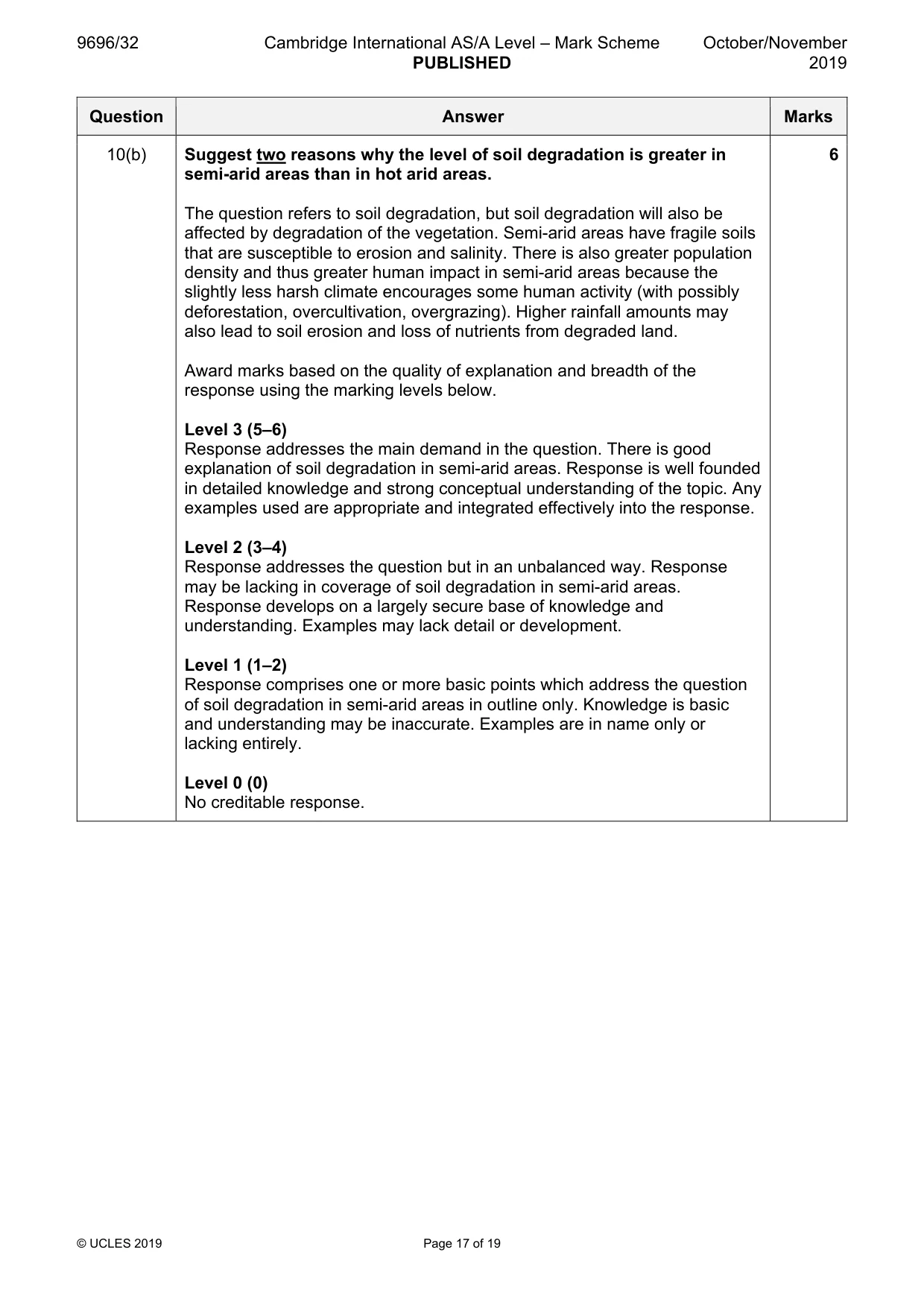
Mark scheme: 10(a) Fig. 10.1 shows the level of soil degradation in hot arid and semi-arid 4 areas of Mexico. Contrast the level of soil degradation in hot arid and semi-arid areas shown in Fig. 10.1. The main points are: • hot arid areas are dominated by no evidence of degradation to a greater extent compared to semi-arid areas • moderate degradation is proportionally greater in semi-arid areas (second largest category) than in hot arid areas • severe degradation is slightly greater proportionally in semi-arid areas • slight degradation is greater in semi-arid areas Any four points for 4 marks. Allow 1 mark for accurate use of data. 10(b) Suggest two reasons why the level of soil degradation is greater in 6 semi-arid areas than in hot arid areas. The question refers to soil degradation, but soil degradation will also be affected by degradation of the vegetation. Semi-arid areas have fragile soils that are susceptible to erosion and salinity. There is also greater population density and thus greater human impact in semi-arid areas because the slightly less harsh climate encourages some human activity (with possibly deforestation, overcultivation, overgrazing). Higher rainfall amounts may also lead to soil erosion and loss of nutrients from degraded land. Award marks based on the quality of explanation and breadth of the response using the marking levels below. Level 3 (5–6) Response addresses the main demand in the question. There is good explanation of soil degradation in semi-arid areas. Response is well founded in detailed knowledge and strong conceptual understanding of the topic. Any examples used are appropriate and integrated effectively into the response. Level 2 (3–4) Response addresses the question but in an unbalanced way. Response may be lacking in coverage of soil degradation in semi-arid areas. Response develops on a largely secure base of knowledge and understanding. Examples may lack detail or development. Level 1 (1–2) Response comprises one or more basic points which address the question of soil degradation in semi-arid areas in outline only. Knowledge is basic and understanding may be inaccurate. Examples are in name only or lacking entirely. Level 0 (0) No creditable response.
Q11 · ‘Wind is the most important factor in the shaping of landforms in hot arid and semi-arid…
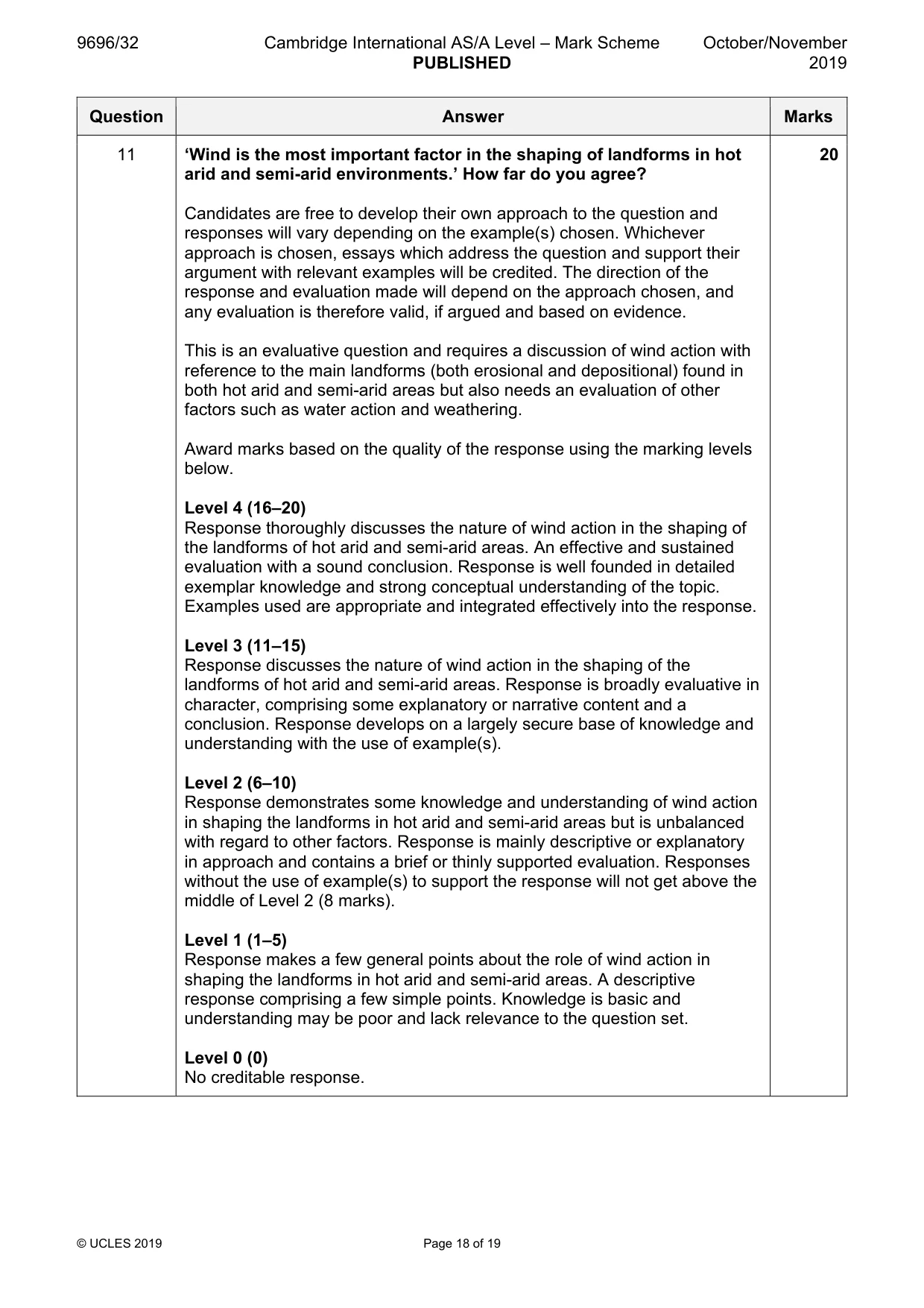
11 ‘Wind is the most important factor in the shaping of landforms in hot arid and semi-arid environments.’ How far do you agree? [20]
Mark scheme: 11 ‘Wind is the most important factor in the shaping of landforms in hot 20 arid and semi-arid environments.’ How far do you agree? Candidates are free to develop their own approach to the question and responses will vary depending on the example(s) chosen. Whichever approach is chosen, essays which address the question and support their argument with relevant examples will be credited. The direction of the response and evaluation made will depend on the approach chosen, and any evaluation is therefore valid, if argued and based on evidence. This is an evaluative question and requires a discussion of wind action with reference to the main landforms (both erosional and depositional) found in both hot arid and semi-arid areas but also needs an evaluation of other factors such as water action and weathering. Award marks based on the quality of the response using the marking levels below. Level 4 (16–20) Response thoroughly discusses the nature of wind action in the shaping of the landforms of hot arid and semi-arid areas. An effective and sustained evaluation with a sound conclusion. Response is well founded in detailed exemplar knowledge and strong conceptual understanding of the topic. Examples used are appropriate and integrated effectively into the response. Level 3 (11–15) Response discusses the nature of wind action in the shaping of the landforms of hot arid and semi-arid areas. Response is broadly evaluative in character, comprising some explanatory or narrative content and a conclusion. Response develops on a largely secure base of knowledge and understanding with the use of example(s). Level 2 (6–10) Response demonstrates some knowledge and understanding of wind action in shaping the landforms in hot arid and semi-arid areas but is unbalanced with regard to other factors. Response is mainly descriptive or explanatory in approach and contains a brief or thinly supported evaluation. Responses without the use of example(s) to support the response will not get above the middle of Level 2 (8 marks). Level 1 (1–5) Response makes a few general points about the role of wind action in shaping the landforms in hot arid and semi-arid areas. A descriptive response comprising a few simple points. Knowledge is basic and understanding may be poor and lack relevance to the question set. Level 0 (0) No creditable response.
Q12 · With the aid of a case study from either a hot arid or a semi-arid environment, assess…
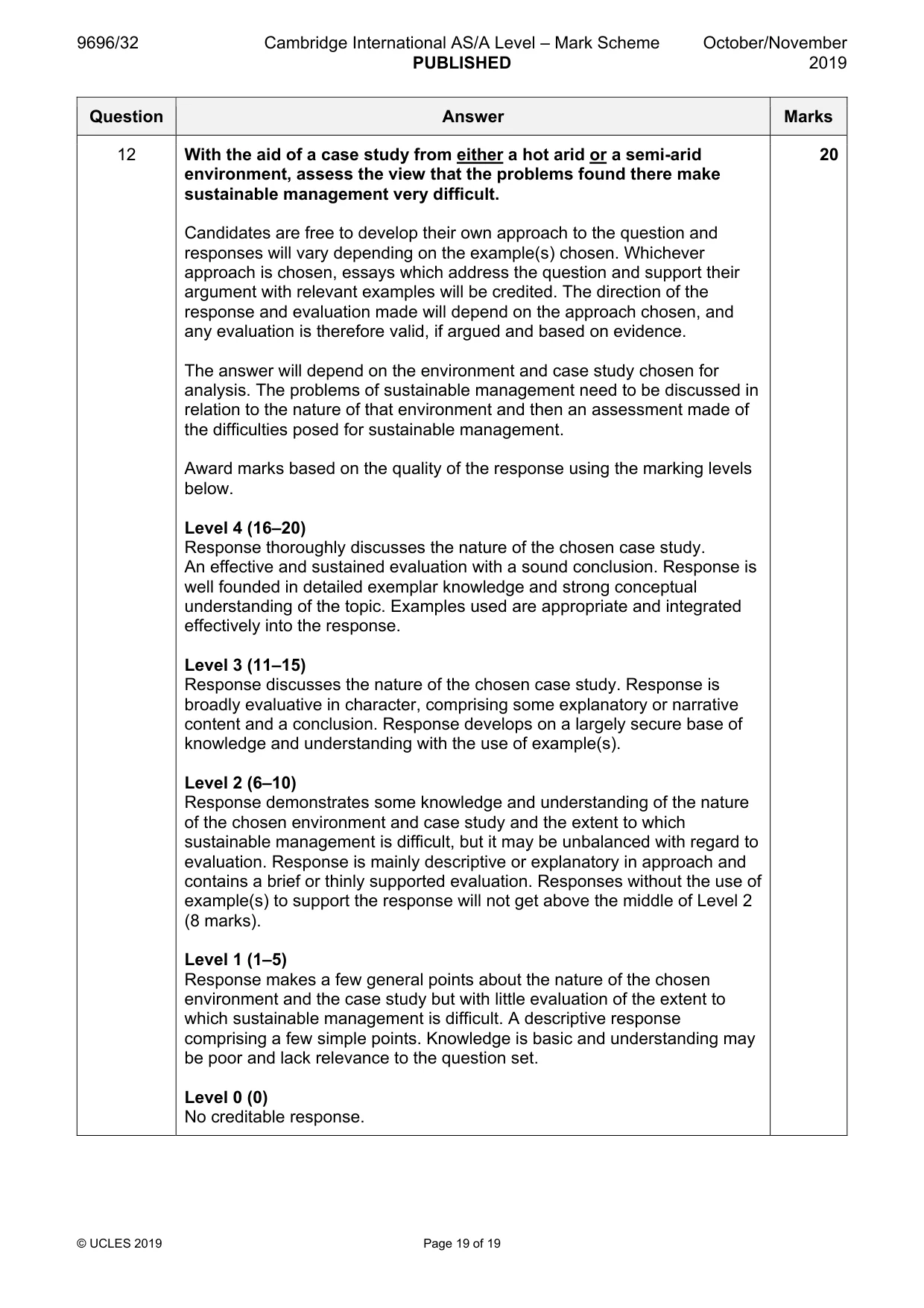
12 With the aid of a case study from either a hot arid or a semi-arid environment, assess the view that the problems found there make sustainable management very difficult. [20]
Mark scheme: 12 With the aid of a case study from either a hot arid or a semi-arid 20 environment, assess the view that the problems found there make sustainable management very difficult. Candidates are free to develop their own approach to the question and responses will vary depending on the example(s) chosen. Whichever approach is chosen, essays which address the question and support their argument with relevant examples will be credited. The direction of the response and evaluation made will depend on the approach chosen, and any evaluation is therefore valid, if argued and based on evidence. The answer will depend on the environment and case study chosen for analysis. The problems of sustainable management need to be discussed in relation to the nature of that environment and then an assessment made of the difficulties posed for sustainable management. Award marks based on the quality of the response using the marking levels below. Level 4 (16–20) Response thoroughly discusses the nature of the chosen case study. An effective and sustained evaluation with a sound conclusion. Response is well founded in detailed exemplar knowledge and strong conceptual understanding of the topic. Examples used are appropriate and integrated effectively into the response. Level 3 (11–15) Response discusses the nature of the chosen case study. Response is broadly evaluative in character, comprising some explanatory or narrative content and a conclusion. Response develops on a largely secure base of knowledge and understanding with the use of example(s). Level 2 (6–10) Response demonstrates some knowledge and understanding of the nature of the chosen environment and case study and the extent to which sustainable management is difficult, but it may be unbalanced with regard to evaluation. Response is mainly descriptive or explanatory in approach and contains a brief or thinly supported evaluation. Responses without the use of example(s) to support the response will not get above the middle of Level 2 (8 marks). Level 1 (1–5) Response makes a few general points about the nature of the chosen environment and the case study but with little evaluation of the extent to which sustainable management is difficult. A descriptive response comprising a few simple points. Knowledge is basic and understanding may be poor and lack relevance to the question set. Level 0 (0) No creditable response.
What was in this paper
The subtopics covered by these 12 questions, and how many questions each got. Open one in a new tab to see every Cambridge question on it.
3Sustainable management of hot arid and semi-arid environments2Hazards resulting from mass movements1Hazards resulting from tectonic processes1Humid tropical (rainforest) ecosystems and seasonally humid tropical (savanna) ecosystems1Landforms of hot arid and semi-arid environments1Landforms of tropical environments1Sustainable management in hazardous environments1Tropical climates1What you needed in this session
Cambridge’s own grade thresholds for 2019 Oct/Nov, Paper 3 · Variant 2. A higher threshold means an easier paper — the bar moves with how the cohort did.