Cambridge A Level Geography 9696 — 2019 May/June Paper 4 · Variant 1
9696/41/M/J/19 · 11 questions · 60 marks · ≈68 min
The question paper and its mark scheme, free to read here and free to download. This is Cambridge’s own paper, exactly as it was sat.
Question paper4 pages


Mark scheme26 pages
Answers below. Sit the paper first if you are practising.






Questions as text
Q1 · Employment in agriculture and informal employment, by state, in Mexico, an MIC in North…
1 Fig. 1.1 shows employment in agriculture and informal employment, by state, in Mexico, an MIC in North America, in 2013. (a) Describe the relationship between the two variables shown in Fig. 1.1. [4] (b) Suggest reasons why employment in the informal sector is high in some countries. [6]
Mark scheme: Question Answer Marks 1(a) Fig. 1.1 shows employment in agriculture and informal employment, by 4 state, in Mexico, an MIC in North America, in 2013. Describe the relationship between the two variables shown in Fig. 1.1. The question asks candidates to describe the relationship between the two variables and they may do this quoting figures but this is not a requirement. The relationship may be described with simple comments such as: a positive or direct relationship/correlation, weak/imperfect etc. having anomalies such as: Chiapas (up to 2 marks). The other two marks come from either more developed statements and/or figures to support the simple statements e.g. a variable relationship with the same rate of informal employment having varying levels of percentage employment in agriculture; Chiapas is an anomaly because with its level of informal employment it should have a much lower employment in agriculture etc. 1(b) Suggest reasons why employment in the informal sector is high in 6 some countries. Candidates should suggest reasons for employment in the informal sector being high in any country. Ideas might originate from the resource, with reference to the nature of labour and types of work offered in the agricultural industry or from other types of industry, including manufacturing and related services. Award marks based on the quality of explanation and breadth of the response using the marking levels below. Level 3 (5–6) Response has a range of valid suggestions for why employment in the informal sector might be high in some countries. Response is well founded in detailed knowledge and strong conceptual understanding of the topic. Examples used are appropriate and integrated effectively into the response. Level 2 (3–4) Response offers one or more suggestions for why employment in the informal sector might be high in some countries. Response develops on a largely secure base of knowledge and understanding. Examples may lack detail or development. Level 1 (1–2) Response does not have a clear focus on why employment in the informal sector might be high in some countries. Knowledge is basic and understanding may be inaccurate. Examples are in name only or lacking entirely. Level 0 (0) No creditable response.
Q2 · ‘Agricultural change does not benefit many people.’ With reference to one or more…
2 ‘Agricultural change does not benefit many people.’ With reference to one or more examples, how far do you agree? [20]
Mark scheme: 2 ‘Agricultural change does not benefit many people.’ 20 With reference to one or more examples, how far do you agree? Candidates are free to develop their own approach to the question and responses will vary depending on the example(s) chosen. Whichever approach is chosen, essays which argue and support their response with relevant examples will be credited. There may be detailed consideration of one or more examples, or a broadly conceived response, drawing on several examples to show the factors involved. There must be an attempt to assess the extent to which the candidate agrees or disagrees with the stated view. The arguments might arise from a consideration of factors (physical, social, economic, political) affecting agricultural land use and practices on farms such as: irrigation, land tenure, changes in markets and technology or those arising from intensification and extension of cultivation but must be related to agricultural change. Agricultural change could be described at any scale or time frame. Indicators of quality may include recognition that there are issues related to the benefits agricultural change might produce such as: provision of subsidies to increase production leads to crop surpluses but stability of income for farmers. Such responses might also demonstrate a clear link between agricultural change and the benefits, or otherwise, for various stakeholders. Award marks based on the quality of the response using the marking levels below. Level 4 (16–20) Response thoroughly discusses the proposition that agricultural change does not benefit many people. An effective and sustained evaluation with a sound conclusion. Response is well founded in detailed exemplar knowledge and strong conceptual understanding of the topic. Examples used are appropriate and integrated effectively into the response. Level 3 (11–15) Response discusses both number and nature of the benefits from agricultural change, perhaps developing one more than the other. Response is broadly evaluative in character, comprising some explanatory or narrative content and a conclusion. Response develops on a largely secure base of knowledge and understanding with the use of example(s). Level 2 (6–10) Response demonstrates some knowledge and understanding of a limited range of benefits, with some links to agricultural change, but the argument is quite narrow. Response is mainly descriptive or explanatory in approach and contains a brief or thinly supported evaluation. Responses without the use of example(s) to support the response will not get above the middle of Level 2 (8 marks). 2 Level 1 (1–5) Response makes a few general points about benefits loosely related to agricultural change. A descriptive response comprising a few simple points. Knowledge is basic and understanding may be poor and lack relevance to the question set. Level 0 (0) No creditable response.
Q3 · With reference to one country, assess the extent to which its industrial policy has been…
3 With reference to one country, assess the extent to which its industrial policy has been able to solve the issues faced by its manufacturing industry. [20] Environmental management If answering this option, answer Question 4 and either Question 5 or Question 6.
Mark scheme: 3 With reference to one country, assess the extent to which its industrial 20 policy has been able to solve the issues faced by its manufacturing industry. Candidates are free to develop their own approach to the question and responses will vary depending on the example(s) chosen. Whichever approach is chosen, essays which assess the extent to which the industrial policy has been able to solve the issues faced by its manufacturing industry will be credited. There may be detailed consideration of one or more issues, or a broadly conceived response, drawing on several issues from one country and an assessment of how far the industrial policy has been able to solve the issues faced by manufacturing industry. Issues faced will vary according to the example chosen but may include some of the following: • competition • skills and training • raw material or power source changes • infrastructure • emissions and air quality • technological change • safety • regulation and legislative change • other Indicators of quality may include a clear link between each of the issues selected and a specific aspect of the industrial policy with an assessment of the extent to which the issue has been solved or not. If more than one country, mark both and credit the better or best mark. Award marks based on the quality of the response using the marking levels below. Level 4 (16–20) Response thoroughly discusses the extent to which the industrial policy for the country has been able to solve the issues faced by its manufacturing industry. An effective and sustained evaluation with a sound conclusion. Response is well founded in detailed exemplar knowledge and strong conceptual understanding of the topic. Examples used are appropriate and integrated effectively into the response. Level 3 (11–15) Response discusses the extent to which the industrial policy of the country has been able to solve the issues faced by its manufacturing industry. Response is broadly evaluative in character, comprising some explanatory or narrative content and a conclusion. Response develops on a largely secure base of knowledge and understanding with the use of example(s). 3 Level 2 (6–10) Response demonstrates some knowledge and understanding of issues and aspects of industrial policy but the links between the two are not clear. Response is mainly descriptive or explanatory in approach and contains a brief or thinly supported evaluation. Responses without the use of example(s) to support the response will not get above the middle of Level 2 (8 marks). Level 1 (1–5) Response makes a few general points about either issues or industrial policy. A descriptive response comprising a few simple points. Knowledge is basic and understanding may be poor and lack relevance to the question set. Level 0 (0) No creditable response. Environmental management If answering this option, answer Question 4 and either Question 5 or Question 6.
Q4 · A photograph which shows a section of the Trans-Alaska crude oil pipeline, USA, an HIC in…
4 Fig. 4.1 is a photograph which shows a section of the Trans-Alaska crude oil pipeline, USA, an HIC in North America, in 2017. (a) Describe how the pipeline may impact the local environment, giving evidence from Fig. 4.1. [4] (b) Outline the factors which might have influenced an HIC’s decision to exploit its oil resources. [6]
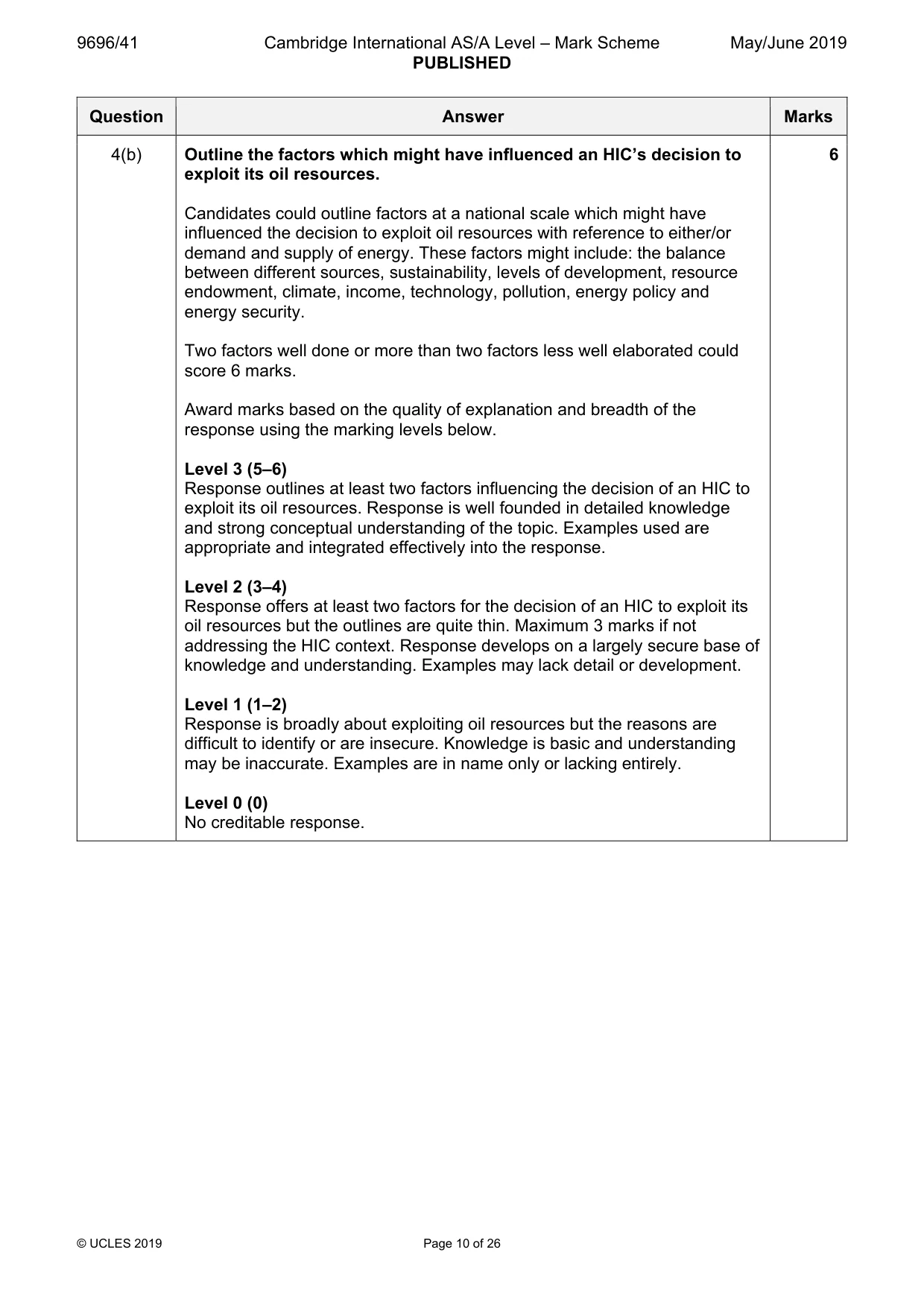
Mark scheme: 4(a) Fig. 4.1 is a photograph which shows a section of the Trans-Alaska 4 crude oil pipeline, USA, an HIC in North America, in 2017. Describe how the pipeline may impact the local environment, giving evidence from Fig. 4.1. Candidates should give evidence from Fig. 4.1 to support their description of the likely impacts but since they are invited to speculate with the term ‘may’, they might apply their knowledge from other situations and from the reference in the syllabus to ‘environmental impacts of energy transport at local scale’. Evidence which might be used and developed to describe likely impacts include: • melting beneath the supports • animal tracks • clearance of vegetation – sparsely spaced (birch) trees for the path of the pipeline • vehicle tracks evident on track beside pipeline and in the background • snow and frozen ground/water indicative of a cold environment • barrier across the landscape Impacts might include vegetation clearance and loss of habitat; slow recovery in a cold environment; increased chance of snow accumulation; interference with energy budget/localised melting of snow cover and possible thinning of permafrost; soil erosion and further impacts. Credit each impact on the local environment with 1 mark or 2 marks if there is clear evidence from the photograph or the impact is developed. Maximum 2 marks for two or more simply stated impacts. 4(b) Outline the factors which might have influenced an HIC’s decision to 6 exploit its oil resources. Candidates could outline factors at a national scale which might have influenced the decision to exploit oil resources with reference to either/or demand and supply of energy. These factors might include: the balance between different sources, sustainability, levels of development, resource endowment, climate, income, technology, pollution, energy policy and energy security. Two factors well done or more than two factors less well elaborated could score 6 marks. Award marks based on the quality of explanation and breadth of the response using the marking levels below. Level 3 (5–6) Response outlines at least two factors influencing the decision of an HIC to exploit its oil resources. Response is well founded in detailed knowledge and strong conceptual understanding of the topic. Examples used are appropriate and integrated effectively into the response. Level 2 (3–4) Response offers at least two factors for the decision of an HIC to exploit its oil resources but the outlines are quite thin. Maximum 3 marks if not addressing the HIC context. Response develops on a largely secure base of knowledge and understanding. Examples may lack detail or development. Level 1 (1–2) Response is broadly about exploiting oil resources but the reasons are difficult to identify or are insecure. Knowledge is basic and understanding may be inaccurate. Examples are in name only or lacking entirely. Level 0 (0) No creditable response.
Q5 · With reference to one country, assess the extent to which recent change(s) in the…
5 With reference to one country, assess the extent to which recent change(s) in the management of energy supply led to locational changes in power production. [20]
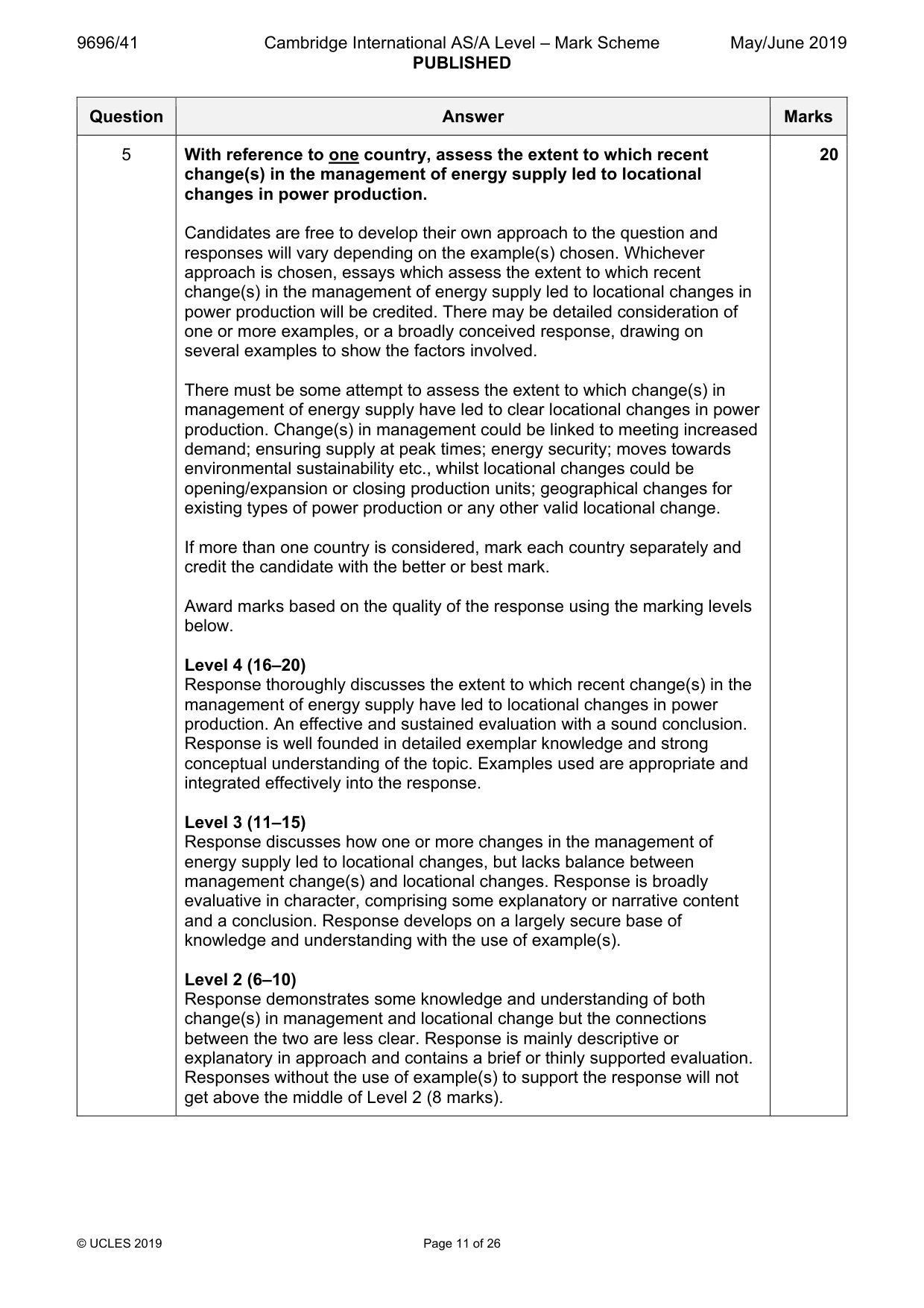
Mark scheme: 5 With reference to one country, assess the extent to which recent 20 change(s) in the management of energy supply led to locational changes in power production. Candidates are free to develop their own approach to the question and responses will vary depending on the example(s) chosen. Whichever approach is chosen, essays which assess the extent to which recent change(s) in the management of energy supply led to locational changes in power production will be credited. There may be detailed consideration of one or more examples, or a broadly conceived response, drawing on several examples to show the factors involved. There must be some attempt to assess the extent to which change(s) in management of energy supply have led to clear locational changes in power production. Change(s) in management could be linked to meeting increased demand; ensuring supply at peak times; energy security; moves towards environmental sustainability etc., whilst locational changes could be opening/expansion or closing production units; geographical changes for existing types of power production or any other valid locational change. If more than one country is considered, mark each country separately and credit the candidate with the better or best mark. Award marks based on the quality of the response using the marking levels below. Level 4 (16–20) Response thoroughly discusses the extent to which recent change(s) in the management of energy supply have led to locational changes in power production. An effective and sustained evaluation with a sound conclusion. Response is well founded in detailed exemplar knowledge and strong conceptual understanding of the topic. Examples used are appropriate and integrated effectively into the response. Level 3 (11–15) Response discusses how one or more changes in the management of energy supply led to locational changes, but lacks balance between management change(s) and locational changes. Response is broadly evaluative in character, comprising some explanatory or narrative content and a conclusion. Response develops on a largely secure base of knowledge and understanding with the use of example(s). Level 2 (6–10) Response demonstrates some knowledge and understanding of both change(s) in management and locational change but the connections between the two are less clear. Response is mainly descriptive or explanatory in approach and contains a brief or thinly supported evaluation. Responses without the use of example(s) to support the response will not get above the middle of Level 2 (8 marks). 5 Level 1 (1–5) Response makes a few general points about energy in the chosen country without the necessary focus on management change(s) or locational change. A descriptive response comprising a few simple points. Knowledge is basic and understanding may be poor and lack relevance to the question set. Level 0 (0) No creditable response.
Q6 · ‘Population pressure is the main cause of environmental degradation.’ With reference to…
6 ‘Population pressure is the main cause of environmental degradation.’ With reference to one or more rural or urban environments, how far do you agree? [20] Global interdependence If answering this option, answer Question 7 and either Question 8 or Question 9.
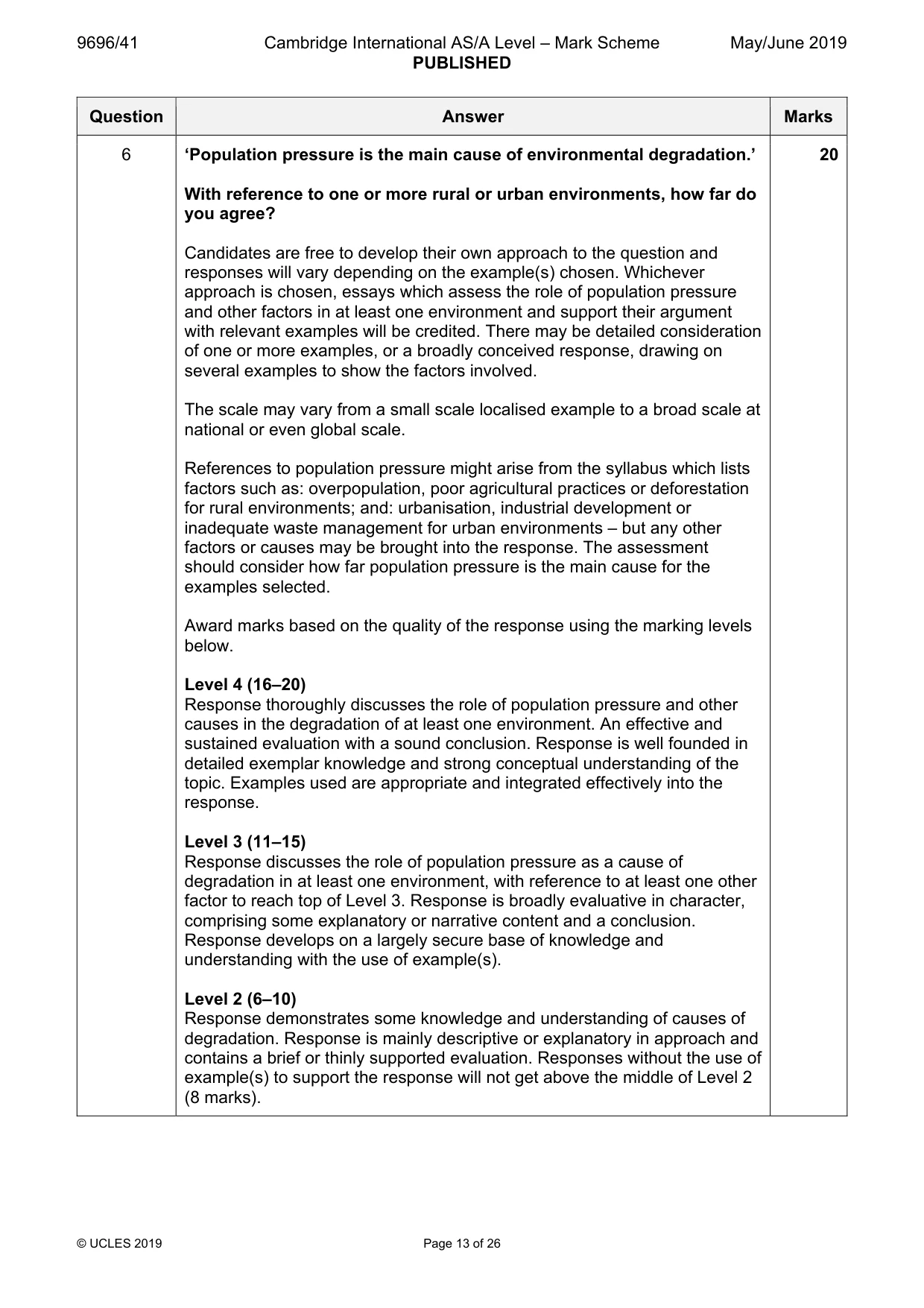
Mark scheme: 6 ‘Population pressure is the main cause of environmental degradation.’ 20 With reference to one or more rural or urban environments, how far do you agree? Candidates are free to develop their own approach to the question and responses will vary depending on the example(s) chosen. Whichever approach is chosen, essays which assess the role of population pressure and other factors in at least one environment and support their argument with relevant examples will be credited. There may be detailed consideration of one or more examples, or a broadly conceived response, drawing on several examples to show the factors involved. The scale may vary from a small scale localised example to a broad scale at national or even global scale. References to population pressure might arise from the syllabus which lists factors such as: overpopulation, poor agricultural practices or deforestation for rural environments; and: urbanisation, industrial development or inadequate waste management for urban environments – but any other factors or causes may be brought into the response. The assessment should consider how far population pressure is the main cause for the examples selected. Award marks based on the quality of the response using the marking levels below. Level 4 (16–20) Response thoroughly discusses the role of population pressure and other causes in the degradation of at least one environment. An effective and sustained evaluation with a sound conclusion. Response is well founded in detailed exemplar knowledge and strong conceptual understanding of the topic. Examples used are appropriate and integrated effectively into the response. Level 3 (11–15) Response discusses the role of population pressure as a cause of degradation in at least one environment, with reference to at least one other factor to reach top of Level 3. Response is broadly evaluative in character, comprising some explanatory or narrative content and a conclusion. Response develops on a largely secure base of knowledge and understanding with the use of example(s). Level 2 (6–10) Response demonstrates some knowledge and understanding of causes of degradation. Response is mainly descriptive or explanatory in approach and contains a brief or thinly supported evaluation. Responses without the use of example(s) to support the response will not get above the middle of Level 2 (8 marks). 6 Level 1 (1–5) Response makes a few general points about a degraded environment(s) without considering the role of population pressure or another cause. A descriptive response comprising a few simple points. Knowledge is basic and understanding may be poor and lack relevance to the question set. Level 0 (0) No creditable response. Global interdependence If answering this option, answer Question 7 and either Question 8 or Question 9.
Q7 · The contribution of tourism to world GDP, by type of spending, in 2016
7 Table 7.1 shows the contribution of tourism to world GDP, by type of spending, in 2016. (a) Describe the relative importance of direct spending by tourists shown in Table 7.1. [3] (b) Explain why dependence on tourism for economic development has disadvantages for a country. [7]
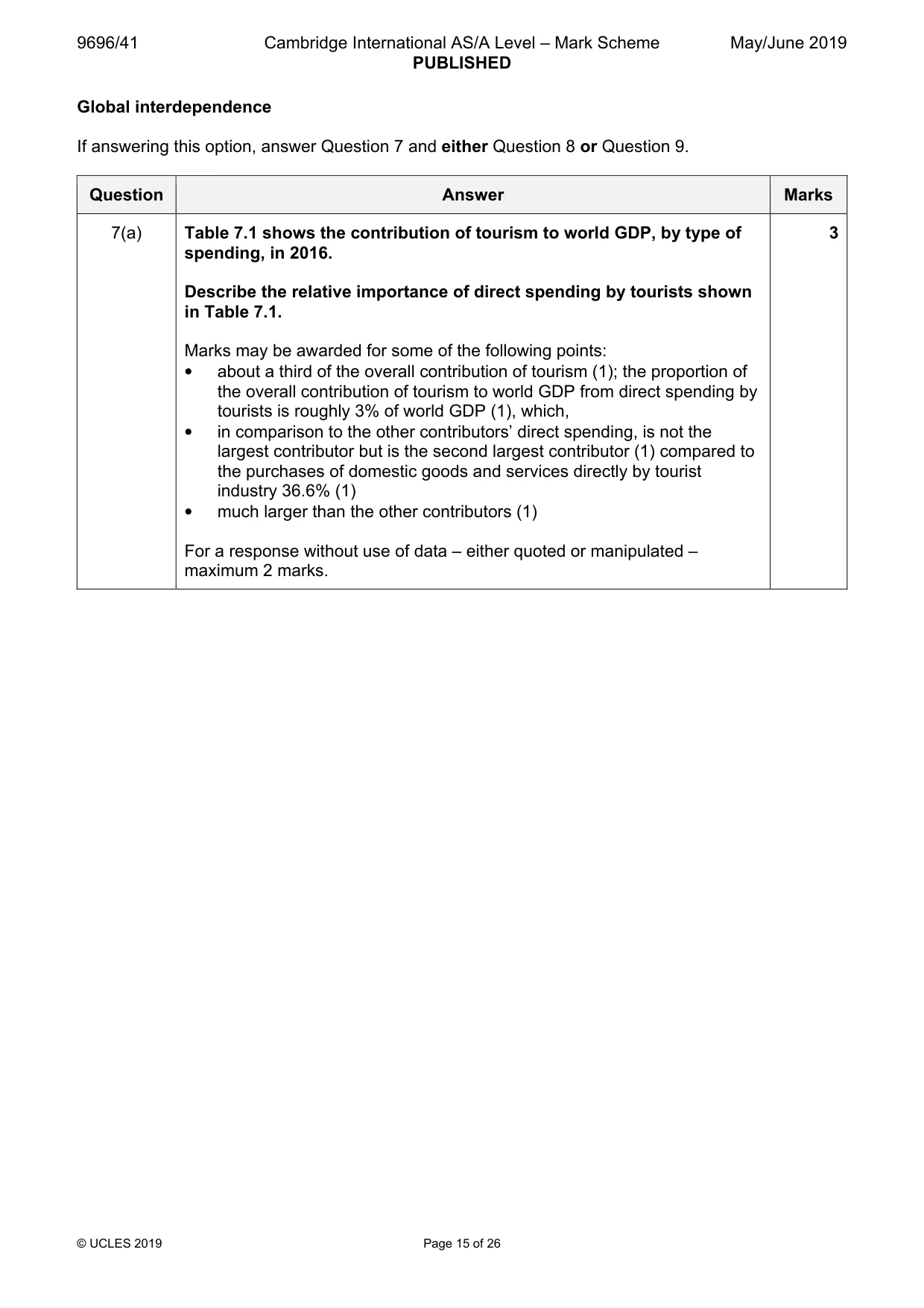
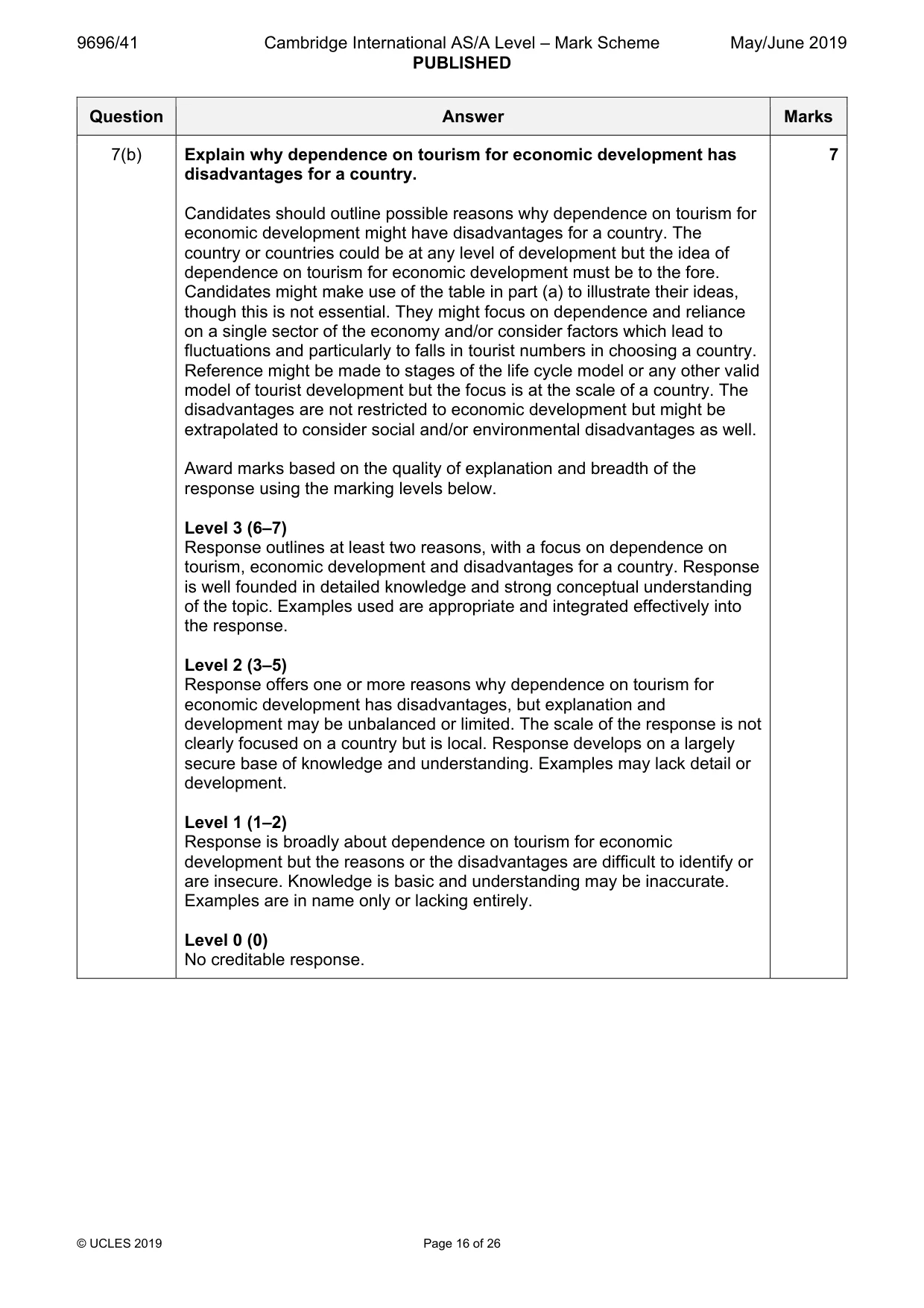
Mark scheme: 7(a) Table 7.1 shows the contribution of tourism to world GDP, by type of 3 spending, in 2016. Describe the relative importance of direct spending by tourists shown in Table 7.1. Marks may be awarded for some of the following points: • about a third of the overall contribution of tourism (1); the proportion of the overall contribution of tourism to world GDP from direct spending by tourists is roughly 3% of world GDP (1), which, • in comparison to the other contributors’ direct spending, is not the largest contributor but is the second largest contributor (1) compared to the purchases of domestic goods and services directly by tourist industry 36.6% (1) • much larger than the other contributors (1) For a response without use of data – either quoted or manipulated – maximum 2 marks. 7(b) Explain why dependence on tourism for economic development has 7 disadvantages for a country. Candidates should outline possible reasons why dependence on tourism for economic development might have disadvantages for a country. The country or countries could be at any level of development but the idea of dependence on tourism for economic development must be to the fore. Candidates might make use of the table in part (a) to illustrate their ideas, though this is not essential. They might focus on dependence and reliance on a single sector of the economy and/or consider factors which lead to fluctuations and particularly to falls in tourist numbers in choosing a country. Reference might be made to stages of the life cycle model or any other valid model of tourist development but the focus is at the scale of a country. The disadvantages are not restricted to economic development but might be extrapolated to consider social and/or environmental disadvantages as well. Award marks based on the quality of explanation and breadth of the response using the marking levels below. Level 3 (6–7) Response outlines at least two reasons, with a focus on dependence on tourism, economic development and disadvantages for a country. Response is well founded in detailed knowledge and strong conceptual understanding of the topic. Examples used are appropriate and integrated effectively into the response. Level 2 (3–5) Response offers one or more reasons why dependence on tourism for economic development has disadvantages, but explanation and development may be unbalanced or limited. The scale of the response is not clearly focused on a country but is local. Response develops on a largely secure base of knowledge and understanding. Examples may lack detail or development. Level 1 (1–2) Response is broadly about dependence on tourism for economic development but the reasons or the disadvantages are difficult to identify or are insecure. Knowledge is basic and understanding may be inaccurate. Examples are in name only or lacking entirely. Level 0 (0) No creditable response.
Q8 · Assess the extent to which global patterns of trade are influenced by historical factors
8 Assess the extent to which global patterns of trade are influenced by historical factors. [20]
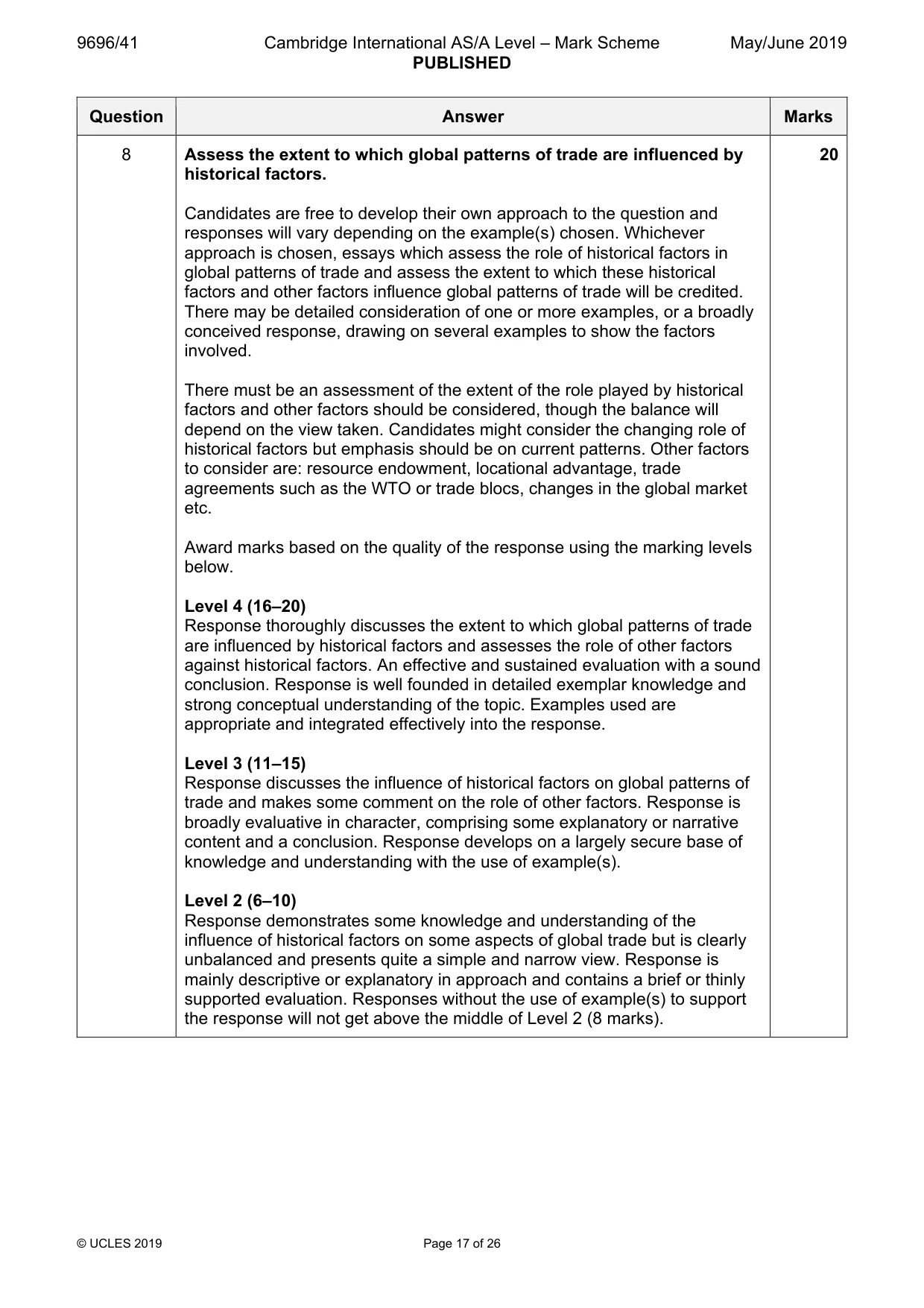
Mark scheme: 8 Assess the extent to which global patterns of trade are influenced by 20 historical factors. Candidates are free to develop their own approach to the question and responses will vary depending on the example(s) chosen. Whichever approach is chosen, essays which assess the role of historical factors in global patterns of trade and assess the extent to which these historical factors and other factors influence global patterns of trade will be credited. There may be detailed consideration of one or more examples, or a broadly conceived response, drawing on several examples to show the factors involved. There must be an assessment of the extent of the role played by historical factors and other factors should be considered, though the balance will depend on the view taken. Candidates might consider the changing role of historical factors but emphasis should be on current patterns. Other factors to consider are: resource endowment, locational advantage, trade agreements such as the WTO or trade blocs, changes in the global market etc. Award marks based on the quality of the response using the marking levels below. Level 4 (16–20) Response thoroughly discusses the extent to which global patterns of trade are influenced by historical factors and assesses the role of other factors against historical factors. An effective and sustained evaluation with a sound conclusion. Response is well founded in detailed exemplar knowledge and strong conceptual understanding of the topic. Examples used are appropriate and integrated effectively into the response. Level 3 (11–15) Response discusses the influence of historical factors on global patterns of trade and makes some comment on the role of other factors. Response is broadly evaluative in character, comprising some explanatory or narrative content and a conclusion. Response develops on a largely secure base of knowledge and understanding with the use of example(s). Level 2 (6–10) Response demonstrates some knowledge and understanding of the influence of historical factors on some aspects of global trade but is clearly unbalanced and presents quite a simple and narrow view. Response is mainly descriptive or explanatory in approach and contains a brief or thinly supported evaluation. Responses without the use of example(s) to support the response will not get above the middle of Level 2 (8 marks). 8 Level 1 (1–5) Response makes a few general points about historical factors and/or global patterns of trade but the influence and connection between the two is weakly expressed. A descriptive response comprising a few simple points. Knowledge is basic and understanding may be poor and lack relevance to the question set. Level 0 (0) No creditable response.
Q9 · With reference to one tourist area or resort, assess how far the impacts of tourism…
9 With reference to one tourist area or resort, assess how far the impacts of tourism changed as the destination developed. [20] Economic transition If answering this option, answer Question 10 and either Question 11 or Question 12.
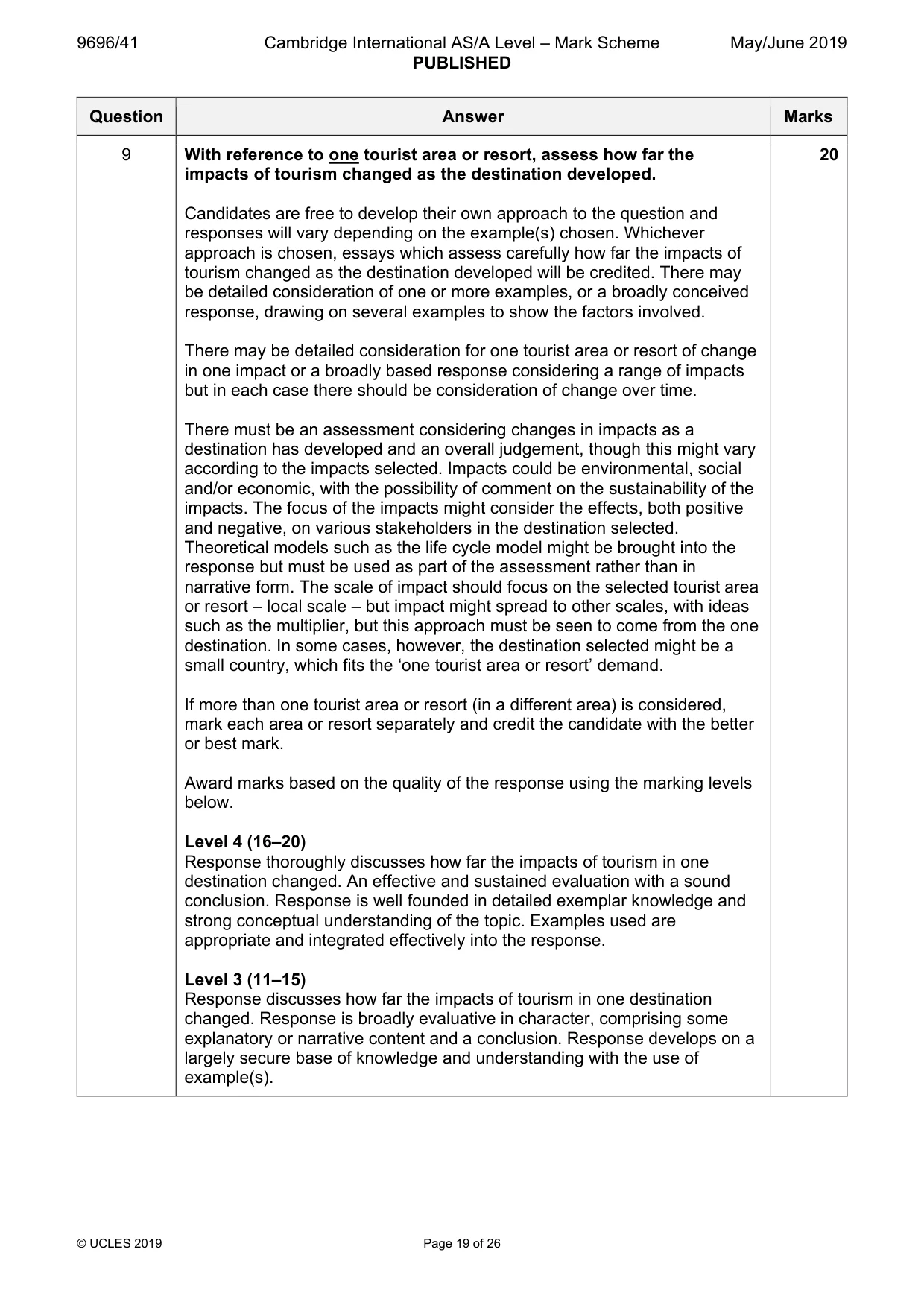
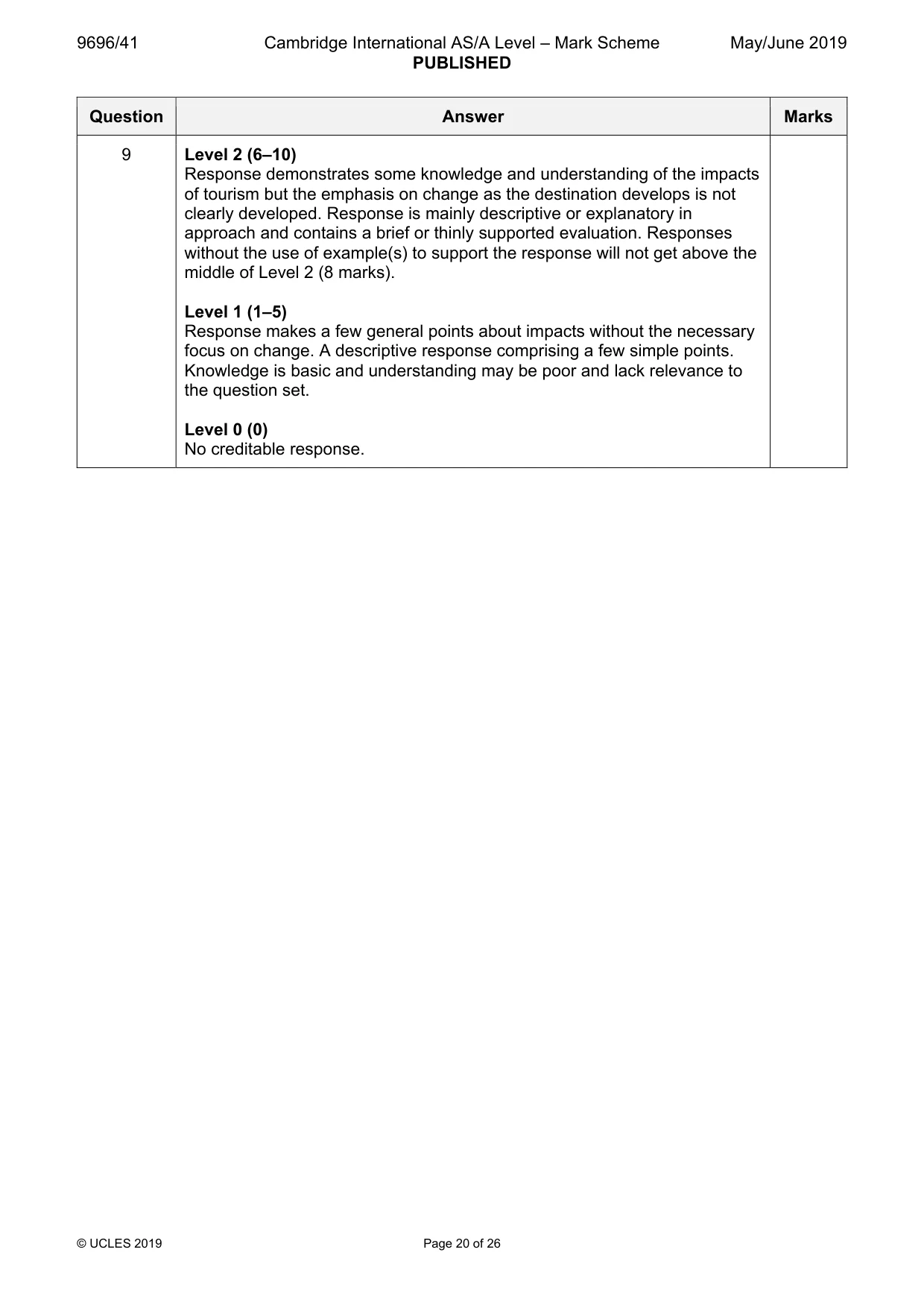
Mark scheme: 9 With reference to one tourist area or resort, assess how far the 20 impacts of tourism changed as the destination developed. Candidates are free to develop their own approach to the question and responses will vary depending on the example(s) chosen. Whichever approach is chosen, essays which assess carefully how far the impacts of tourism changed as the destination developed will be credited. There may be detailed consideration of one or more examples, or a broadly conceived response, drawing on several examples to show the factors involved. There may be detailed consideration for one tourist area or resort of change in one impact or a broadly based response considering a range of impacts but in each case there should be consideration of change over time. There must be an assessment considering changes in impacts as a destination has developed and an overall judgement, though this might vary according to the impacts selected. Impacts could be environmental, social and/or economic, with the possibility of comment on the sustainability of the impacts. The focus of the impacts might consider the effects, both positive and negative, on various stakeholders in the destination selected. Theoretical models such as the life cycle model might be brought into the response but must be used as part of the assessment rather than in narrative form. The scale of impact should focus on the selected tourist area or resort – local scale – but impact might spread to other scales, with ideas such as the multiplier, but this approach must be seen to come from the one destination. In some cases, however, the destination selected might be a small country, which fits the ‘one tourist area or resort’ demand. If more than one tourist area or resort (in a different area) is considered, mark each area or resort separately and credit the candidate with the better or best mark. Award marks based on the quality of the response using the marking levels below. Level 4 (16–20) Response thoroughly discusses how far the impacts of tourism in one destination changed. An effective and sustained evaluation with a sound conclusion. Response is well founded in detailed exemplar knowledge and strong conceptual understanding of the topic. Examples used are appropriate and integrated effectively into the response. Level 3 (11–15) Response discusses how far the impacts of tourism in one destination changed. Response is broadly evaluative in character, comprising some explanatory or narrative content and a conclusion. Response develops on a largely secure base of knowledge and understanding with the use of example(s). 9 Level 2 (6–10) Response demonstrates some knowledge and understanding of the impacts of tourism but the emphasis on change as the destination develops is not clearly developed. Response is mainly descriptive or explanatory in approach and contains a brief or thinly supported evaluation. Responses without the use of example(s) to support the response will not get above the middle of Level 2 (8 marks). Level 1 (1–5) Response makes a few general points about impacts without the necessary focus on change. A descriptive response comprising a few simple points. Knowledge is basic and understanding may be poor and lack relevance to the question set. Level 0 (0) No creditable response. Economic transition If answering this option, answer Question 10 and either Question 11 or Question 12.
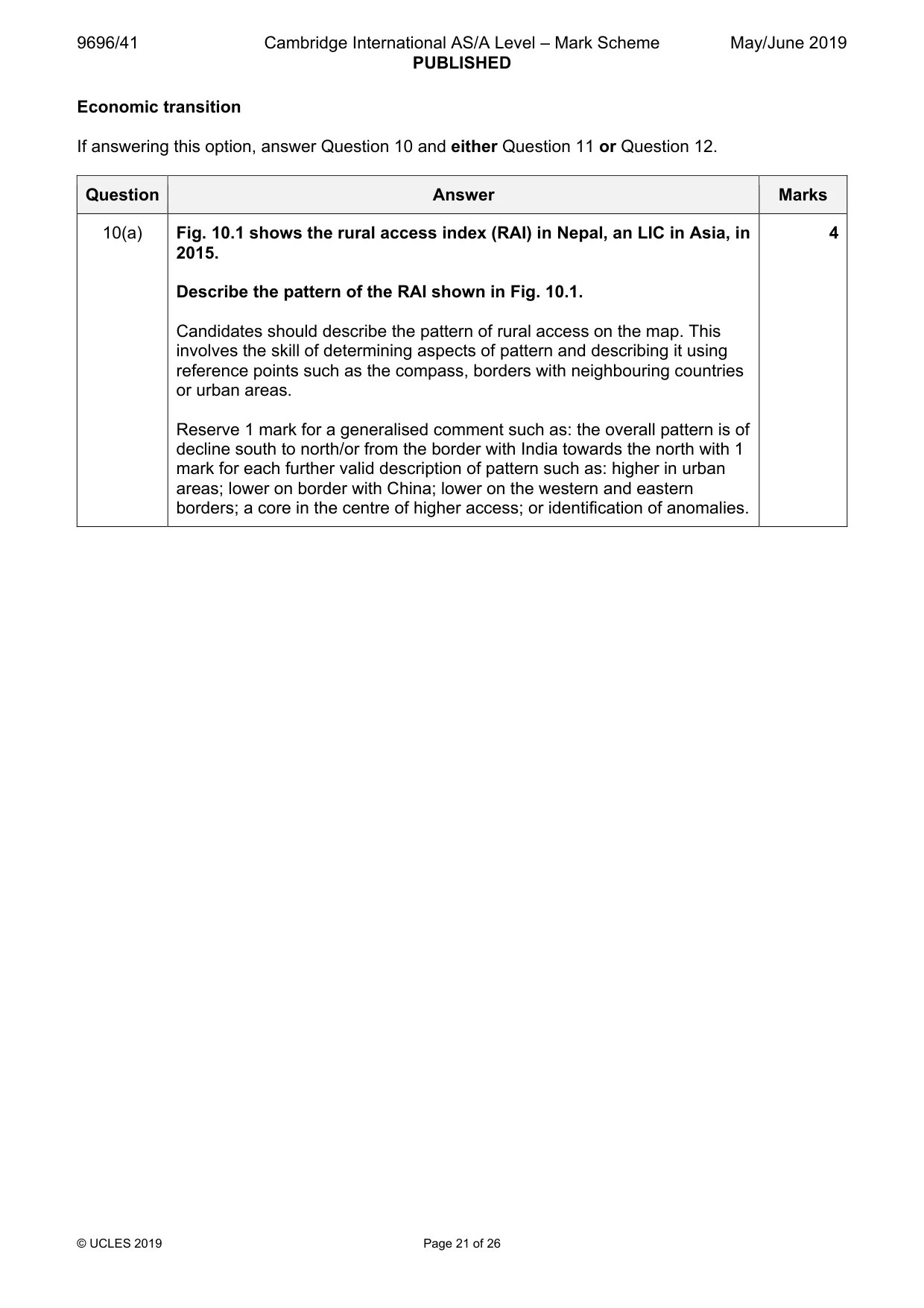
Q10 · The rural access index (RAI) in Nepal, an LIC in Asia, in 2015
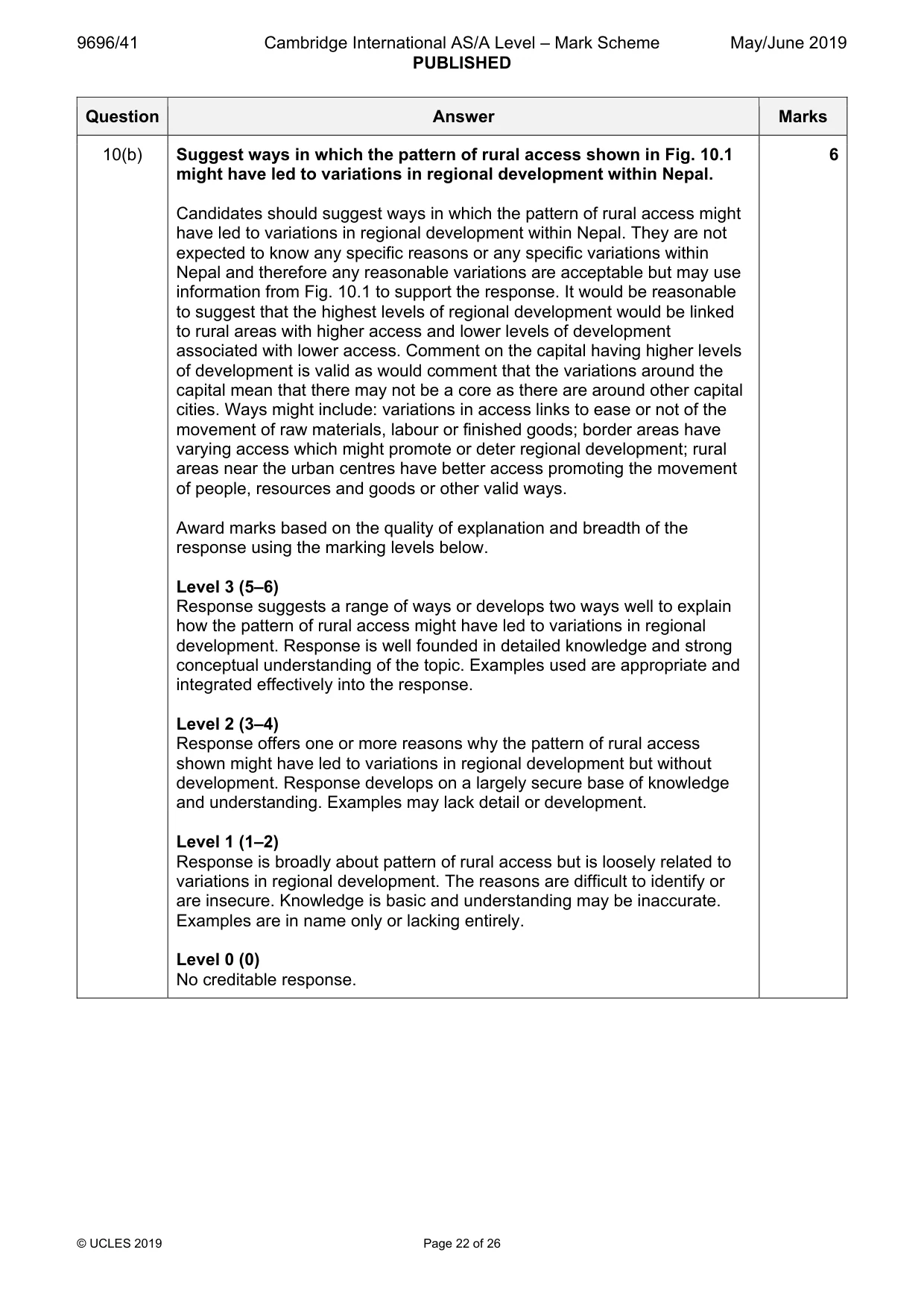
10 Fig. 10.1 shows the rural access index (RAI) in Nepal, an LIC in Asia, in 2015. (a) Describe the pattern of the RAI shown in Fig. 10.1. [4] (b) Suggest ways in which the pattern of rural access shown in Fig. 10.1 might have led to variations in regional development within Nepal. [6]
Mark scheme: 10(a) Fig. 10.1 shows the rural access index (RAI) in Nepal, an LIC in Asia, in 4 2015. Describe the pattern of the RAI shown in Fig. 10.1. Candidates should describe the pattern of rural access on the map. This involves the skill of determining aspects of pattern and describing it using reference points such as the compass, borders with neighbouring countries or urban areas. Reserve 1 mark for a generalised comment such as: the overall pattern is of decline south to north/or from the border with India towards the north with 1 mark for each further valid description of pattern such as: higher in urban areas; lower on border with China; lower on the western and eastern borders; a core in the centre of higher access; or identification of anomalies. 10(b) Suggest ways in which the pattern of rural access shown in Fig. 10.1 6 might have led to variations in regional development within Nepal. Candidates should suggest ways in which the pattern of rural access might have led to variations in regional development within Nepal. They are not expected to know any specific reasons or any specific variations within Nepal and therefore any reasonable variations are acceptable but may use information from Fig. 10.1 to support the response. It would be reasonable to suggest that the highest levels of regional development would be linked to rural areas with higher access and lower levels of development associated with lower access. Comment on the capital having higher levels of development is valid as would comment that the variations around the capital mean that there may not be a core as there are around other capital cities. Ways might include: variations in access links to ease or not of the movement of raw materials, labour or finished goods; border areas have varying access which might promote or deter regional development; rural areas near the urban centres have better access promoting the movement of people, resources and goods or other valid ways. Award marks based on the quality of explanation and breadth of the response using the marking levels below. Level 3 (5–6) Response suggests a range of ways or develops two ways well to explain how the pattern of rural access might have led to variations in regional development. Response is well founded in detailed knowledge and strong conceptual understanding of the topic. Examples used are appropriate and integrated effectively into the response. Level 2 (3–4) Response offers one or more reasons why the pattern of rural access shown might have led to variations in regional development but without development. Response develops on a largely secure base of knowledge and understanding. Examples may lack detail or development. Level 1 (1–2) Response is broadly about pattern of rural access but is loosely related to variations in regional development. The reasons are difficult to identify or are insecure. Knowledge is basic and understanding may be inaccurate. Examples are in name only or lacking entirely. Level 0 (0) No creditable response.
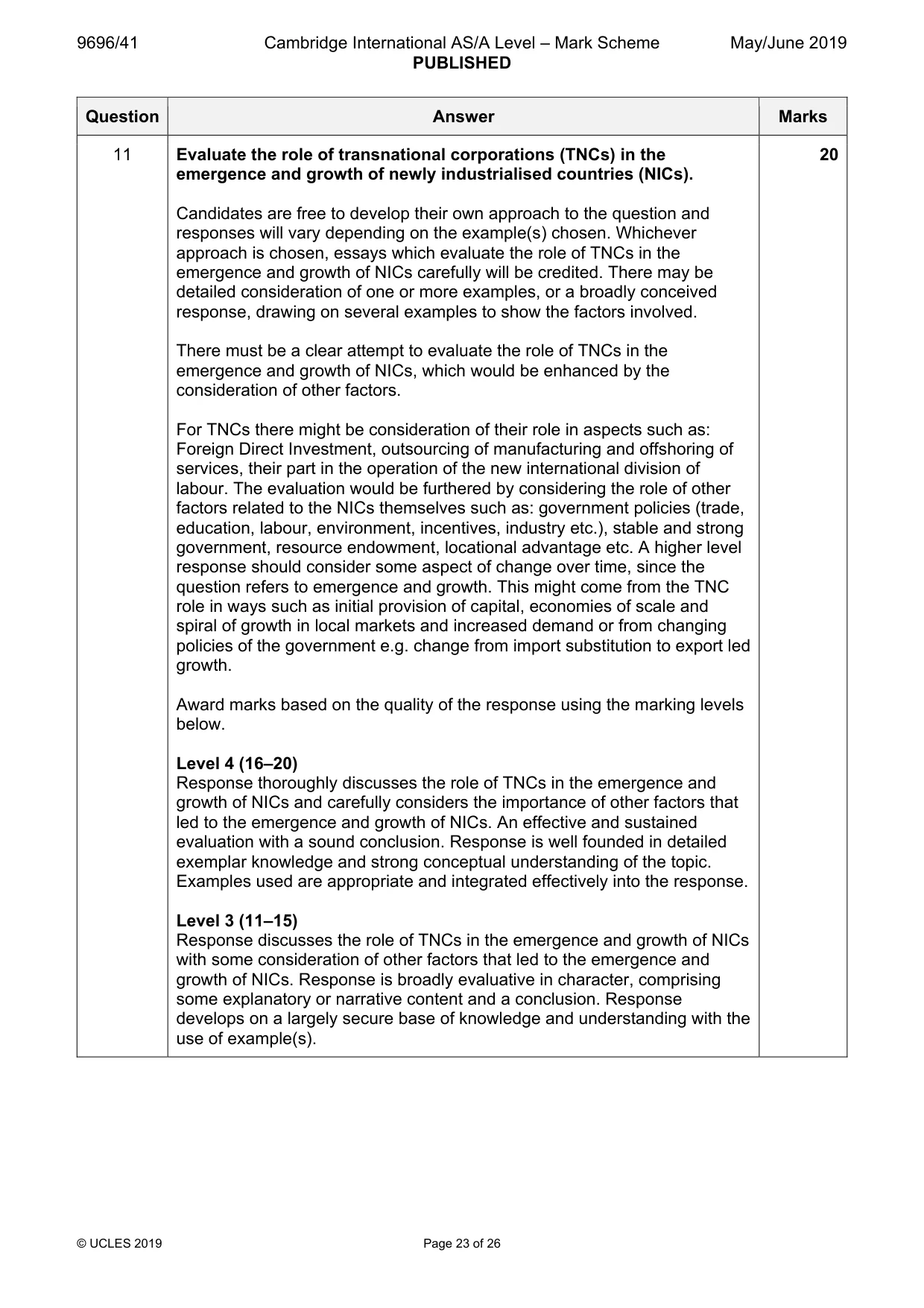
Q11 · Evaluate the role of transnational corporations (TNCs) in the emergence and growth of…
11 Evaluate the role of transnational corporations (TNCs) in the emergence and growth of newly industrialised countries (NICs). [20]
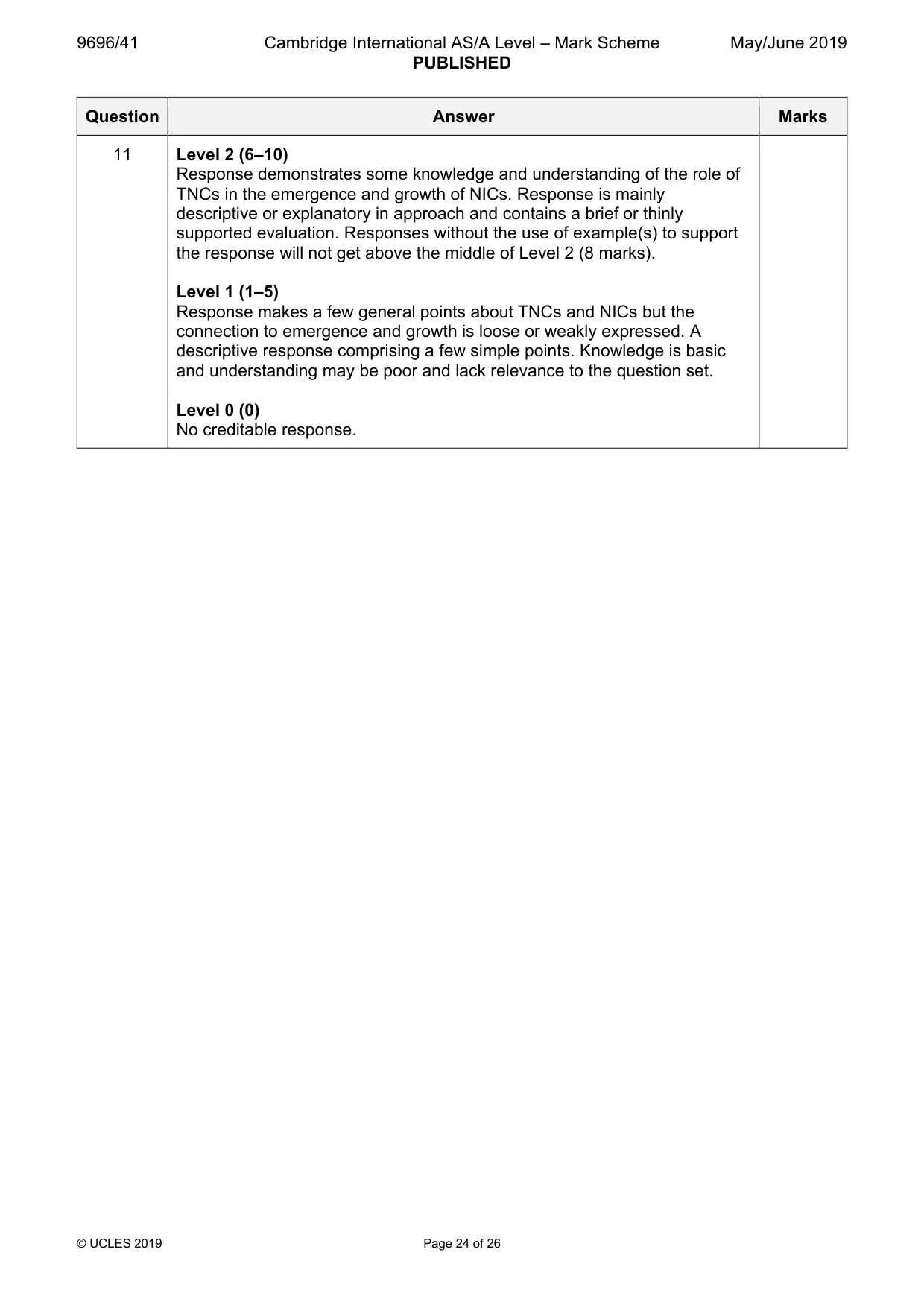
Mark scheme: 11 Evaluate the role of transnational corporations (TNCs) in the 20 emergence and growth of newly industrialised countries (NICs). Candidates are free to develop their own approach to the question and responses will vary depending on the example(s) chosen. Whichever approach is chosen, essays which evaluate the role of TNCs in the emergence and growth of NICs carefully will be credited. There may be detailed consideration of one or more examples, or a broadly conceived response, drawing on several examples to show the factors involved. There must be a clear attempt to evaluate the role of TNCs in the emergence and growth of NICs, which would be enhanced by the consideration of other factors. For TNCs there might be consideration of their role in aspects such as: Foreign Direct Investment, outsourcing of manufacturing and offshoring of services, their part in the operation of the new international division of labour. The evaluation would be furthered by considering the role of other factors related to the NICs themselves such as: government policies (trade, education, labour, environment, incentives, industry etc.), stable and strong government, resource endowment, locational advantage etc. A higher level response should consider some aspect of change over time, since the question refers to emergence and growth. This might come from the TNC role in ways such as initial provision of capital, economies of scale and spiral of growth in local markets and increased demand or from changing policies of the government e.g. change from import substitution to export led growth. Award marks based on the quality of the response using the marking levels below. Level 4 (16–20) Response thoroughly discusses the role of TNCs in the emergence and growth of NICs and carefully considers the importance of other factors that led to the emergence and growth of NICs. An effective and sustained evaluation with a sound conclusion. Response is well founded in detailed exemplar knowledge and strong conceptual understanding of the topic. Examples used are appropriate and integrated effectively into the response. Level 3 (11–15) Response discusses the role of TNCs in the emergence and growth of NICs with some consideration of other factors that led to the emergence and growth of NICs. Response is broadly evaluative in character, comprising some explanatory or narrative content and a conclusion. Response develops on a largely secure base of knowledge and understanding with the use of example(s). 11 Level 2 (6–10) Response demonstrates some knowledge and understanding of the role of TNCs in the emergence and growth of NICs. Response is mainly descriptive or explanatory in approach and contains a brief or thinly supported evaluation. Responses without the use of example(s) to support the response will not get above the middle of Level 2 (8 marks). Level 1 (1–5) Response makes a few general points about TNCs and NICs but the connection to emergence and growth is loose or weakly expressed. A descriptive response comprising a few simple points. Knowledge is basic and understanding may be poor and lack relevance to the question set. Level 0 (0) No creditable response.
What was in this paper
The subtopics covered by these 11 questions, and how many questions each got. Open one in a new tab to see every Cambridge question on it.
2The management of energy supply2Environmental degradation1Regional development within countries1The development of international tourism1The management of a tourist destination1The management of agricultural change1The management of change in manufacturing industry1Trade flows and trading patterns1What you needed in this session
Cambridge’s own grade thresholds for 2019 May/June, Paper 4 · Variant 1. A higher threshold means an easier paper — the bar moves with how the cohort did.