Cambridge A Level Geography 9696 — 2019 May/June Paper 4 · Variant 3
9696/43/M/J/19 · 60 marks · ≈68 min
The question paper and its mark scheme, free to read here and free to download. This is Cambridge’s own paper, exactly as it was sat.
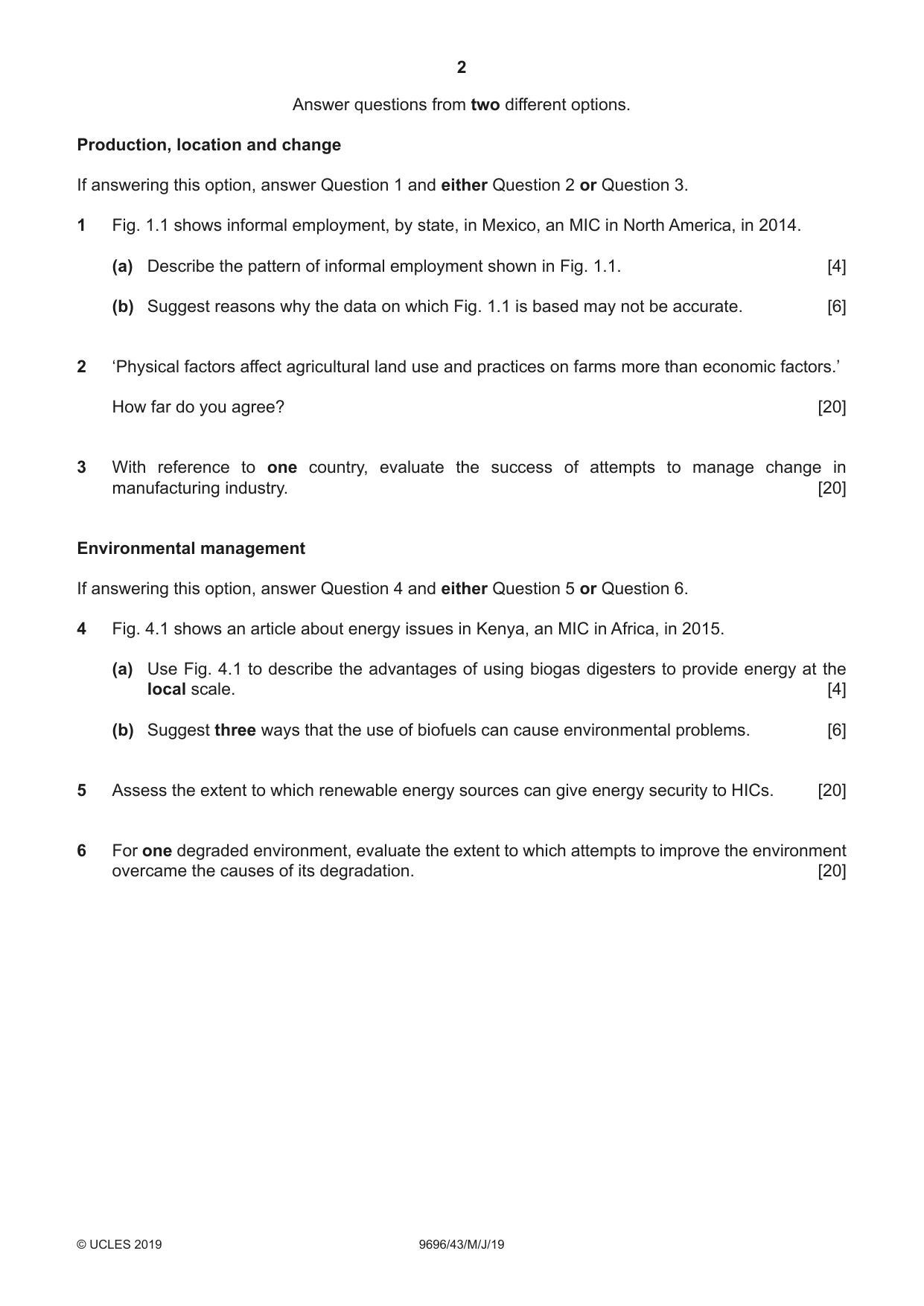
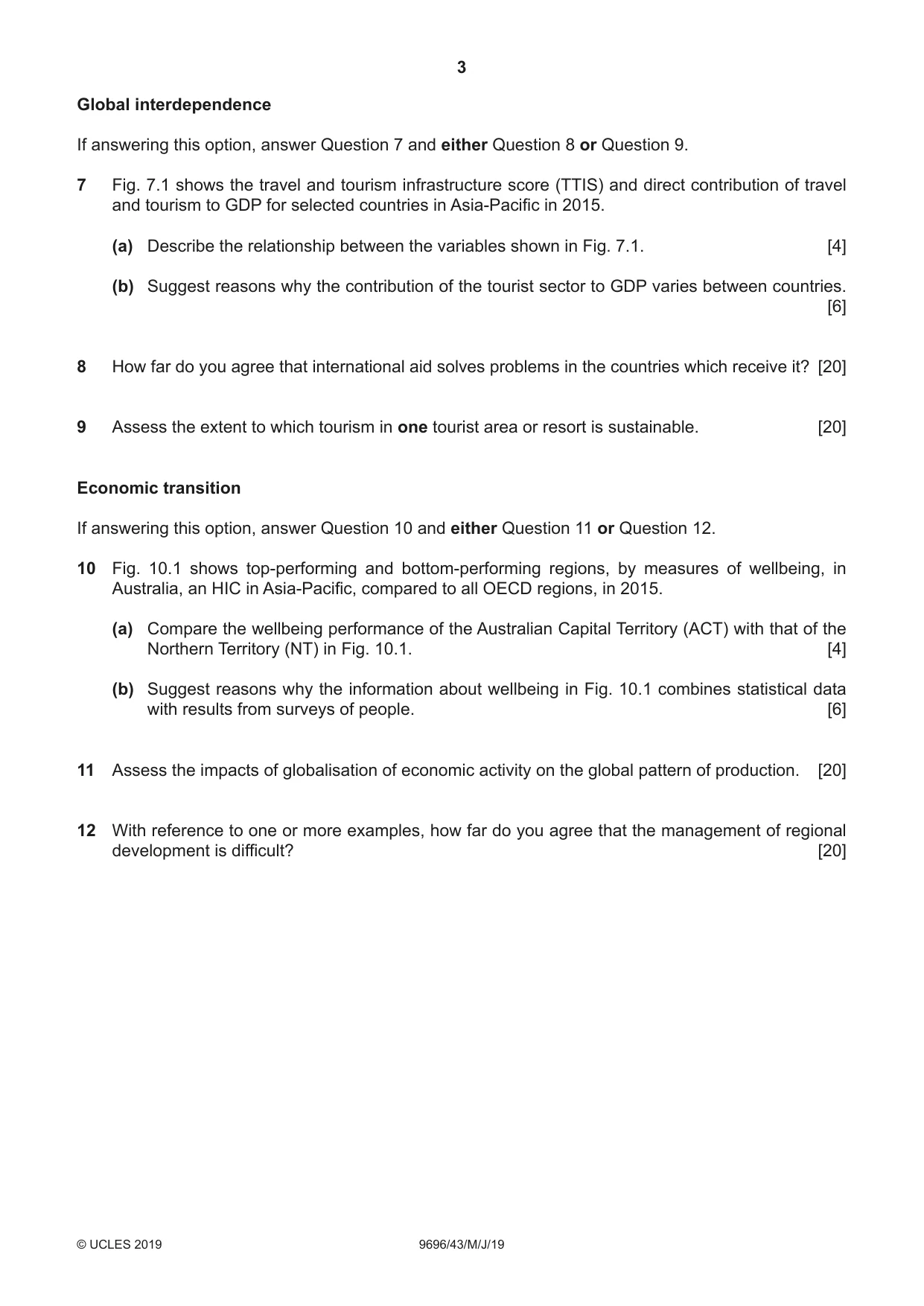
Question paper4 pages


Mark scheme24 pages
Answers below. Sit the paper first if you are practising.






Paper as text
Question paper, page 1
This document consists of 3 printed pages, 1 blank page and 2 Inserts. DC (RW) 183455 © UCLES 2019 [Turn over * 4 6 1 8 0 9 0 9 5 7 * GEOGRAPHY 9696/43 Paper 4 Advanced Human Geography Options May/June 2019 1 hour 30 minutes No Additional Materials are required. READ THESE INSTRUCTIONS FIRST An answer booklet is provided inside this question paper. You should follow the instructions on the front cover of the answer booklet. If you need additional answer paper ask the invigilator for a continuation booklet. In this paper there are four Human Geography options. Production, location and change Environmental management Global interdependence Economic transition Answer questions from two different options. Sketch maps and diagrams should be drawn whenever they serve to illustrate an answer. You should make reference to appropriate examples studied in the field or the classroom, even where such examples are not specifically requested by the question. All the resources referred to in the questions are contained in the Insert. LICs = low income countries. MICs = middle income countries. HICs = high income countries. The number of marks is given in brackets [ ] at the end of each question or part question. The total number of marks for this paper is 60. Cambridge Assessment International Education Cambridge International Advanced Subsidiary and Advanced Level
Question paper, page 2
2 9696/43/M/J/19 © UCLES 2019 Answer questions from two different options. Production, location and change If answering this option, answer Question 1 and either Question 2 or Question 3. 1 Fig. 1.1 shows informal employment, by state, in Mexico, an MIC in North America, in 2014. (a) Describe the pattern of informal employment shown in Fig. 1.1. [4] (b) Suggest reasons why the data on which Fig. 1.1 is based may not be accurate. [6] 2 ‘Physical factors affect agricultural land use and practices on farms more than economic factors.’ How far do you agree? [20] 3 With reference to one country, evaluate the success of attempts to manage change in manufacturing industry. [20] Environmental management If answering this option, answer Question 4 and either Question 5 or Question 6. 4 Fig. 4.1 shows an article about energy issues in Kenya, an MIC in Africa, in 2015. (a) Use Fig. 4.1 to describe the advantages of using biogas digesters to provide energy at the local scale. [4] (b) Suggest three ways that the use of biofuels can cause environmental problems. [6] 5 Assess the extent to which renewable energy sources can give energy security to HICs. [20] 6 For one degraded environment, evaluate the extent to which attempts to improve the environment overcame the causes of its degradation. [20]
Question paper, page 3
3 9696/43/M/J/19 © UCLES 2019 Global interdependence If answering this option, answer Question 7 and either Question 8 or Question 9. 7 Fig. 7.1 shows the travel and tourism infrastructure score (TTIS) and direct contribution of travel and tourism to GDP for selected countries in Asia-Pacific in 2015. (a) Describe the relationship between the variables shown in Fig. 7.1. [4] (b) Suggest reasons why the contribution of the tourist sector to GDP varies between countries. [6] 8 How far do you agree that international aid solves problems in the countries which receive it? [20] 9 Assess the extent to which tourism in one tourist area or resort is sustainable. [20] Economic transition If answering this option, answer Question 10 and either Question 11 or Question 12. 10 Fig. 10.1 shows top-performing and bottom-performing regions, by measures of wellbeing, in Australia, an HIC in Asia-Pacific, compared to all OECD regions, in 2015. (a) Compare the wellbeing performance of the Australian Capital Territory (ACT) with that of the Northern Territory (NT) in Fig. 10.1. [4] (b) Suggest reasons why the information about wellbeing in Fig. 10.1 combines statistical data with results from surveys of people. [6] 11 Assess the impacts of globalisation of economic activity on the global pattern of production. [20] 12 With reference to one or more examples, how far do you agree that the management of regional development is difficult? [20]
Question paper, page 4
4 9696/43/M/J/19 © UCLES 2019 BLANK PAGE Permission to reproduce items where third-party owned material protected by copyright is included has been sought and cleared where possible. Every reasonable effort has been made by the publisher (UCLES) to trace copyright holders, but if any items requiring clearance have unwittingly been included, the publisher will be pleased to make amends at the earliest possible opportunity. To avoid the issue of disclosure of answer-related information to candidates, all copyright acknowledgements are reproduced online in the Cambridge Assessment International Education Copyright Acknowledgements Booklet. This is produced for each series of examinations and is freely available to download at www.cambridgeinternational.org after the live examination series. Cambridge Assessment International Education is part of the Cambridge Assessment Group. Cambridge Assessment is the brand name of the University of Cambridge Local Examinations Syndicate (UCLES), which itself is a department of the University of Cambridge.
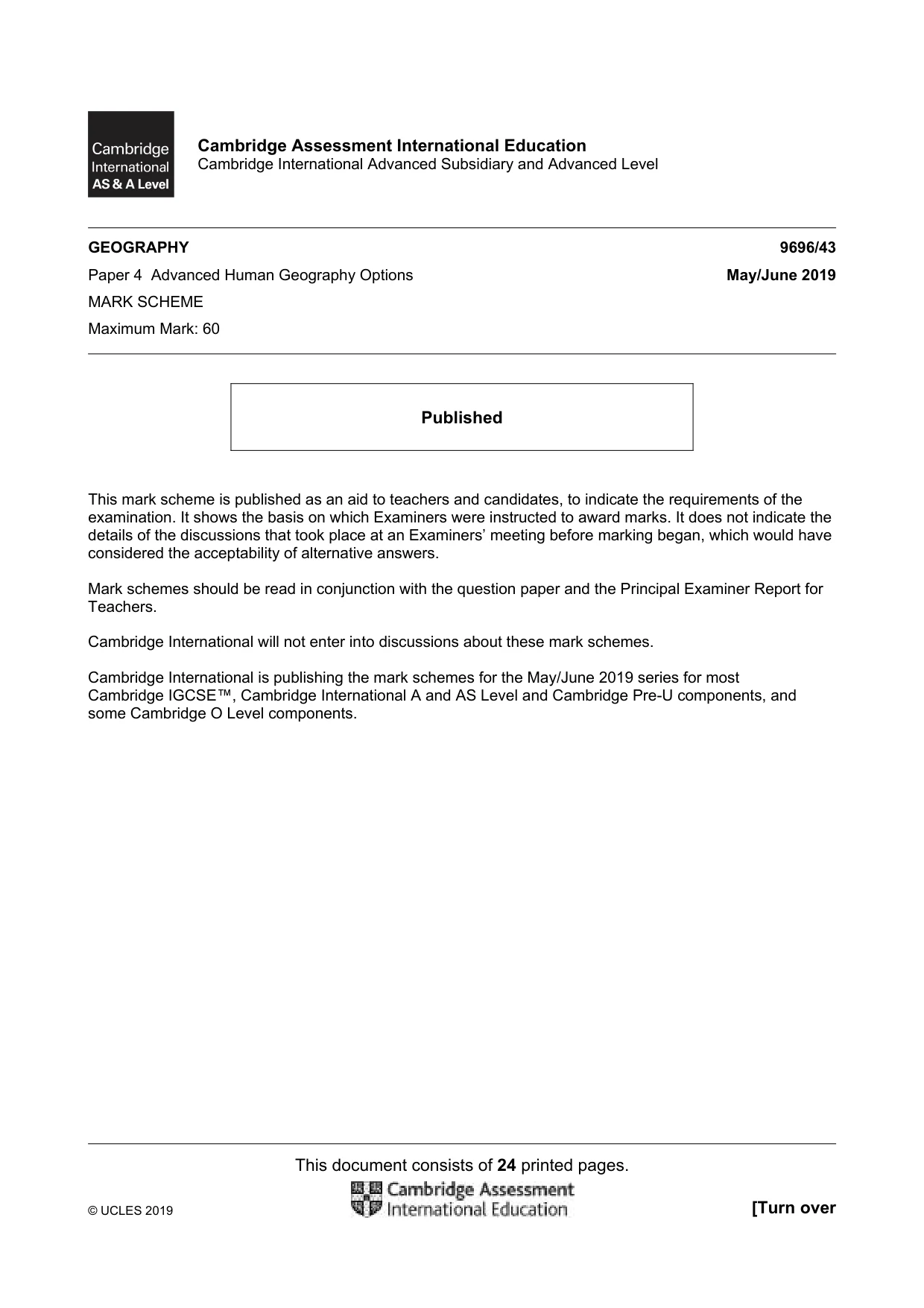
Mark scheme, page 1
This document consists of 24 printed pages. © UCLES 2019 [Turn over Cambridge Assessment International Education Cambridge International Advanced Subsidiary and Advanced Level GEOGRAPHY 9696/43 Paper 4 Advanced Human Geography Options May/June 2019 MARK SCHEME Maximum Mark: 60 Published This mark scheme is published as an aid to teachers and candidates, to indicate the requirements of the examination. It shows the basis on which Examiners were instructed to award marks. It does not indicate the details of the discussions that took place at an Examiners’ meeting before marking began, which would have considered the acceptability of alternative answers. Mark schemes should be read in conjunction with the question paper and the Principal Examiner Report for Teachers. Cambridge International will not enter into discussions about these mark schemes. Cambridge International is publishing the mark schemes for the May/June 2019 series for most Cambridge IGCSE™, Cambridge International A and AS Level and Cambridge Pre-U components, and some Cambridge O Level components.
Mark scheme, page 2
9696/43 Cambridge International AS/A Level – Mark Scheme PUBLISHED May/June 2019 © UCLES 2019 Page 2 of 24 Generic Marking Principles These general marking principles must be applied by all examiners when marking candidate answers. They should be applied alongside the specific content of the mark scheme or generic level descriptors for a question. Each question paper and mark scheme will also comply with these marking principles. GENERIC MARKING PRINCIPLE 1: Marks must be awarded in line with: • the specific content of the mark scheme or the generic level descriptors for the question • the specific skills defined in the mark scheme or in the generic level descriptors for the question • the standard of response required by a candidate as exemplified by the standardisation scripts. GENERIC MARKING PRINCIPLE 2: Marks awarded are always whole marks (not half marks, or other fractions). GENERIC MARKING PRINCIPLE 3: Marks must be awarded positively: • marks are awarded for correct/valid answers, as defined in the mark scheme. However, credit is given for valid answers which go beyond the scope of the syllabus and mark scheme, referring to your Team Leader as appropriate • marks are awarded when candidates clearly demonstrate what they know and can do • marks are not deducted for errors • marks are not deducted for omissions • answers should only be judged on the quality of spelling, punctuation and grammar when these features are specifically assessed by the question as indicated by the mark scheme. The meaning, however, should be unambiguous. GENERIC MARKING PRINCIPLE 4: Rules must be applied consistently e.g. in situations where candidates have not followed instructions or in the application of generic level descriptors. GENERIC MARKING PRINCIPLE 5: Marks should be awarded using the full range of marks defined in the mark scheme for the question (however; the use of the full mark range may be limited according to the quality of the candidate responses seen). GENERIC MARKING PRINCIPLE 6: Marks awarded are based solely on the requirements as defined in the mark scheme. Marks should not be awarded with grade thresholds or grade descriptors in mind.
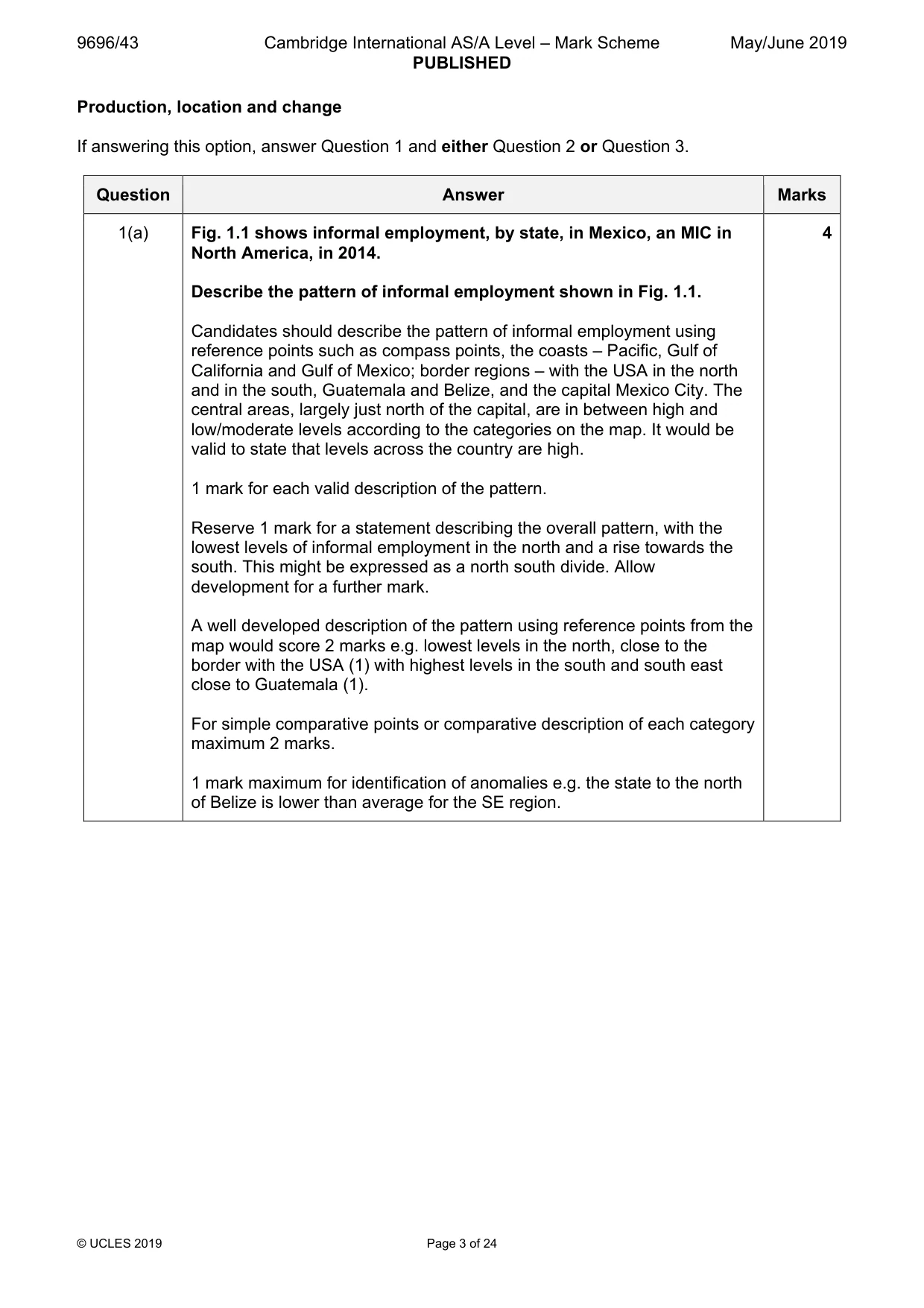
Mark scheme, page 3
9696/43 Cambridge International AS/A Level – Mark Scheme PUBLISHED May/June 2019 © UCLES 2019 Page 3 of 24 Production, location and change If answering this option, answer Question 1 and either Question 2 or Question 3. Question Answer Marks 1(a) Fig. 1.1 shows informal employment, by state, in Mexico, an MIC in North America, in 2014. Describe the pattern of informal employment shown in Fig. 1.1. Candidates should describe the pattern of informal employment using reference points such as compass points, the coasts – Pacific, Gulf of California and Gulf of Mexico; border regions – with the USA in the north and in the south, Guatemala and Belize, and the capital Mexico City. The central areas, largely just north of the capital, are in between high and low/moderate levels according to the categories on the map. It would be valid to state that levels across the country are high. 1 mark for each valid description of the pattern. Reserve 1 mark for a statement describing the overall pattern, with the lowest levels of informal employment in the north and a rise towards the south. This might be expressed as a north south divide. Allow development for a further mark. A well developed description of the pattern using reference points from the map would score 2 marks e.g. lowest levels in the north, close to the border with the USA (1) with highest levels in the south and south east close to Guatemala (1). For simple comparative points or comparative description of each category maximum 2 marks. 1 mark maximum for identification of anomalies e.g. the state to the north of Belize is lower than average for the SE region. 4
Mark scheme, page 4
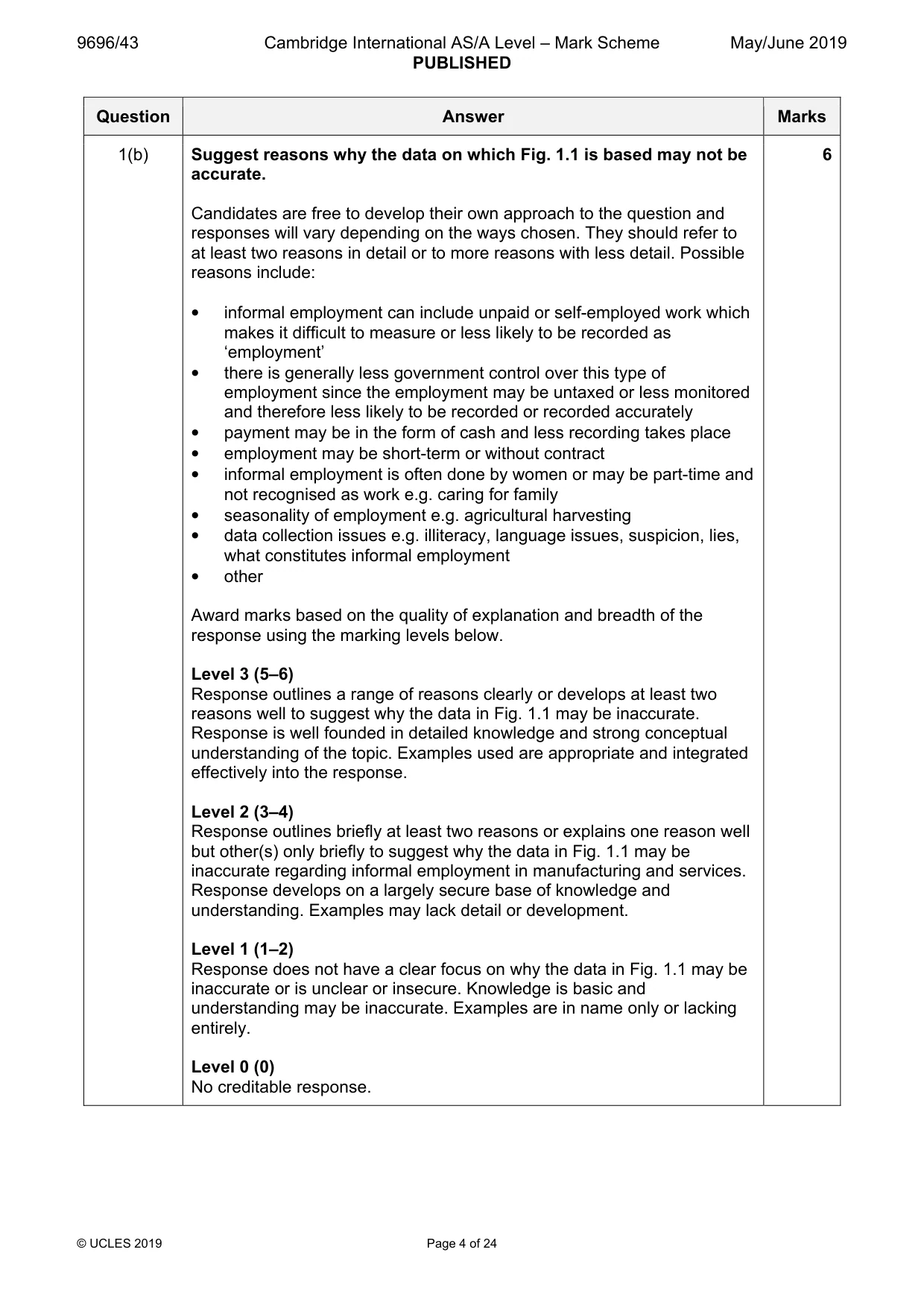
9696/43 Cambridge International AS/A Level – Mark Scheme PUBLISHED May/June 2019 © UCLES 2019 Page 4 of 24 Question Answer Marks 1(b) Suggest reasons why the data on which Fig. 1.1 is based may not be accurate. Candidates are free to develop their own approach to the question and responses will vary depending on the ways chosen. They should refer to at least two reasons in detail or to more reasons with less detail. Possible reasons include: • informal employment can include unpaid or self-employed work which makes it difficult to measure or less likely to be recorded as ‘employment’ • there is generally less government control over this type of employment since the employment may be untaxed or less monitored and therefore less likely to be recorded or recorded accurately • payment may be in the form of cash and less recording takes place • employment may be short-term or without contract • informal employment is often done by women or may be part-time and not recognised as work e.g. caring for family • seasonality of employment e.g. agricultural harvesting • data collection issues e.g. illiteracy, language issues, suspicion, lies, what constitutes informal employment • other Award marks based on the quality of explanation and breadth of the response using the marking levels below. Level 3 (5–6) Response outlines a range of reasons clearly or develops at least two reasons well to suggest why the data in Fig. 1.1 may be inaccurate. Response is well founded in detailed knowledge and strong conceptual understanding of the topic. Examples used are appropriate and integrated effectively into the response. Level 2 (3–4) Response outlines briefly at least two reasons or explains one reason well but other(s) only briefly to suggest why the data in Fig. 1.1 may be inaccurate regarding informal employment in manufacturing and services. Response develops on a largely secure base of knowledge and understanding. Examples may lack detail or development. Level 1 (1–2) Response does not have a clear focus on why the data in Fig. 1.1 may be inaccurate or is unclear or insecure. Knowledge is basic and understanding may be inaccurate. Examples are in name only or lacking entirely. Level 0 (0) No creditable response. 6
Mark scheme, page 5
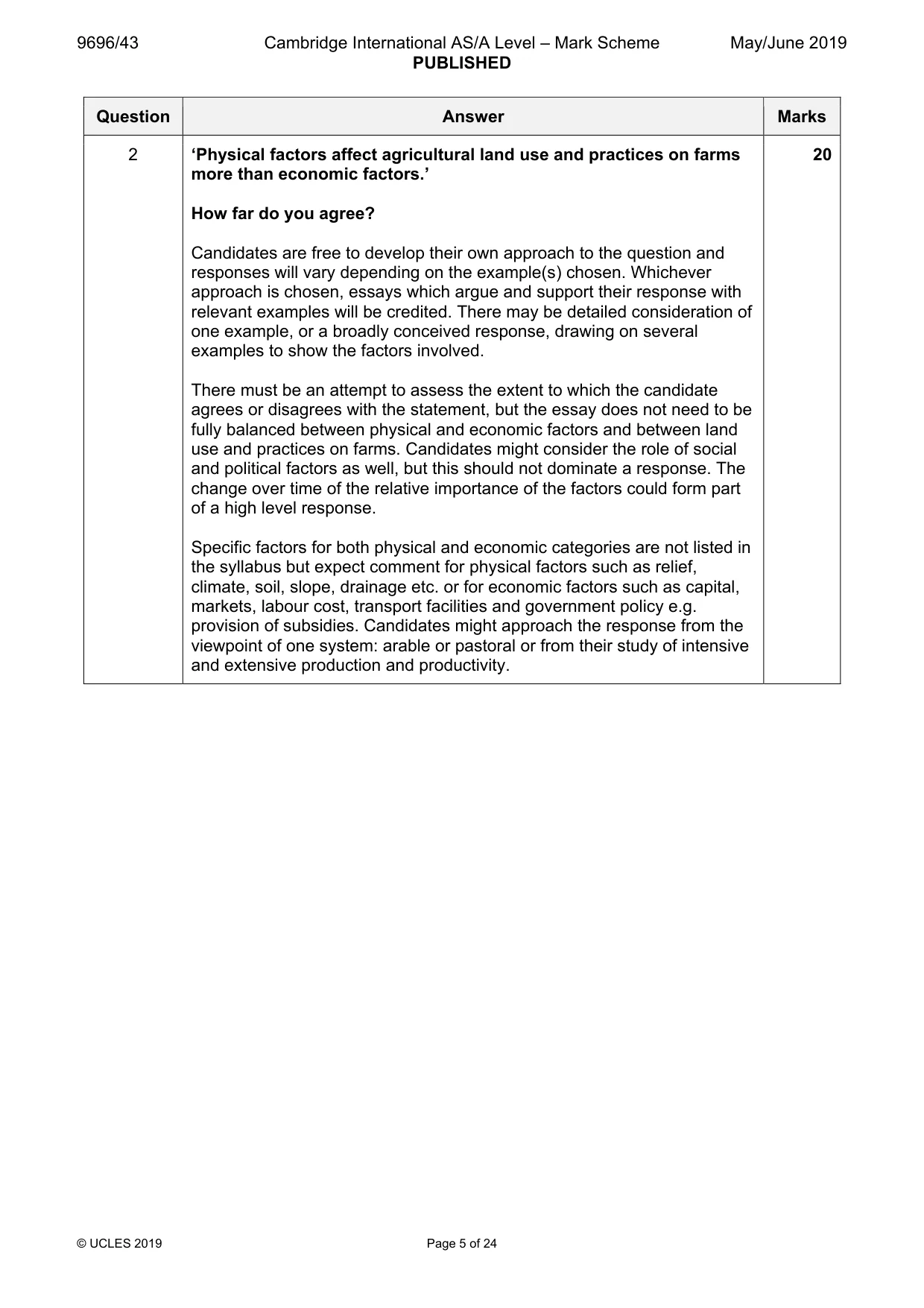
9696/43 Cambridge International AS/A Level – Mark Scheme PUBLISHED May/June 2019 © UCLES 2019 Page 5 of 24 Question Answer Marks 2 ‘Physical factors affect agricultural land use and practices on farms more than economic factors.’ How far do you agree? Candidates are free to develop their own approach to the question and responses will vary depending on the example(s) chosen. Whichever approach is chosen, essays which argue and support their response with relevant examples will be credited. There may be detailed consideration of one example, or a broadly conceived response, drawing on several examples to show the factors involved. There must be an attempt to assess the extent to which the candidate agrees or disagrees with the statement, but the essay does not need to be fully balanced between physical and economic factors and between land use and practices on farms. Candidates might consider the role of social and political factors as well, but this should not dominate a response. The change over time of the relative importance of the factors could form part of a high level response. Specific factors for both physical and economic categories are not listed in the syllabus but expect comment for physical factors such as relief, climate, soil, slope, drainage etc. or for economic factors such as capital, markets, labour cost, transport facilities and government policy e.g. provision of subsidies. Candidates might approach the response from the viewpoint of one system: arable or pastoral or from their study of intensive and extensive production and productivity. 20
Mark scheme, page 6
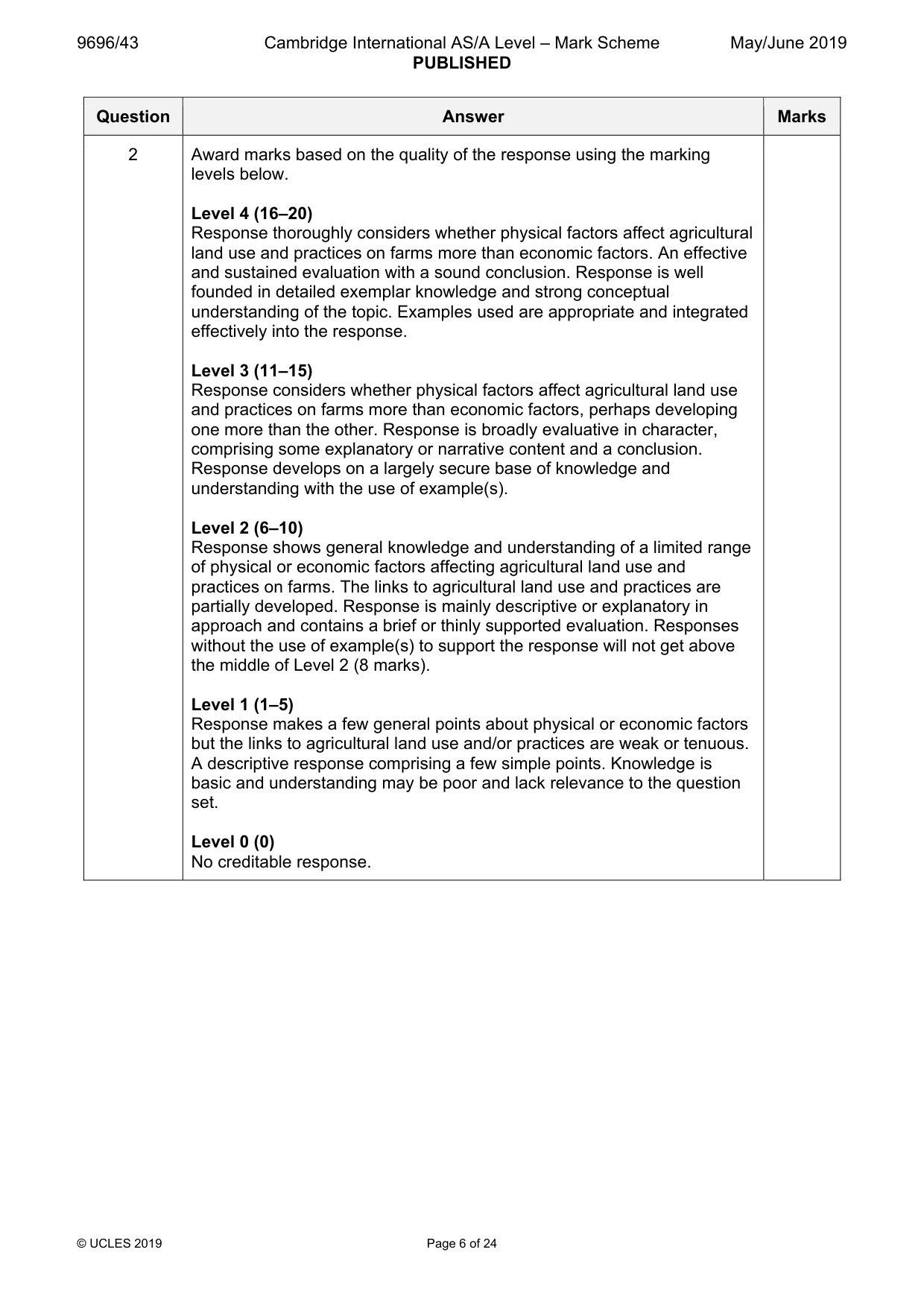
9696/43 Cambridge International AS/A Level – Mark Scheme PUBLISHED May/June 2019 © UCLES 2019 Page 6 of 24 Question Answer Marks 2 Award marks based on the quality of the response using the marking levels below. Level 4 (16–20) Response thoroughly considers whether physical factors affect agricultural land use and practices on farms more than economic factors. An effective and sustained evaluation with a sound conclusion. Response is well founded in detailed exemplar knowledge and strong conceptual understanding of the topic. Examples used are appropriate and integrated effectively into the response. Level 3 (11–15) Response considers whether physical factors affect agricultural land use and practices on farms more than economic factors, perhaps developing one more than the other. Response is broadly evaluative in character, comprising some explanatory or narrative content and a conclusion. Response develops on a largely secure base of knowledge and understanding with the use of example(s). Level 2 (6–10) Response shows general knowledge and understanding of a limited range of physical or economic factors affecting agricultural land use and practices on farms. The links to agricultural land use and practices are partially developed. Response is mainly descriptive or explanatory in approach and contains a brief or thinly supported evaluation. Responses without the use of example(s) to support the response will not get above the middle of Level 2 (8 marks). Level 1 (1–5) Response makes a few general points about physical or economic factors but the links to agricultural land use and/or practices are weak or tenuous. A descriptive response comprising a few simple points. Knowledge is basic and understanding may be poor and lack relevance to the question set. Level 0 (0) No creditable response.
Mark scheme, page 7
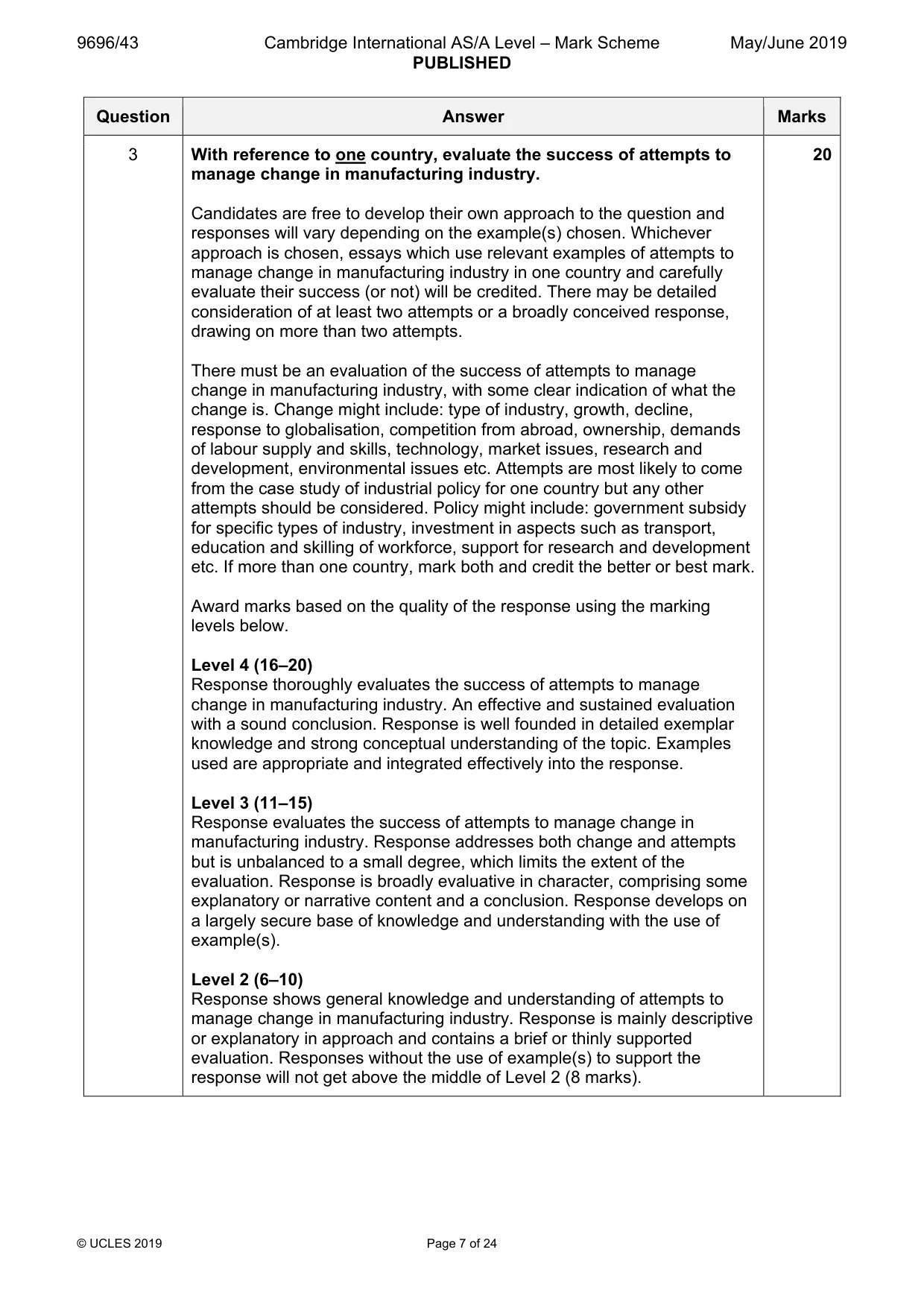
9696/43 Cambridge International AS/A Level – Mark Scheme PUBLISHED May/June 2019 © UCLES 2019 Page 7 of 24 Question Answer Marks 3 With reference to one country, evaluate the success of attempts to manage change in manufacturing industry. Candidates are free to develop their own approach to the question and responses will vary depending on the example(s) chosen. Whichever approach is chosen, essays which use relevant examples of attempts to manage change in manufacturing industry in one country and carefully evaluate their success (or not) will be credited. There may be detailed consideration of at least two attempts or a broadly conceived response, drawing on more than two attempts. There must be an evaluation of the success of attempts to manage change in manufacturing industry, with some clear indication of what the change is. Change might include: type of industry, growth, decline, response to globalisation, competition from abroad, ownership, demands of labour supply and skills, technology, market issues, research and development, environmental issues etc. Attempts are most likely to come from the case study of industrial policy for one country but any other attempts should be considered. Policy might include: government subsidy for specific types of industry, investment in aspects such as transport, education and skilling of workforce, support for research and development etc. If more than one country, mark both and credit the better or best mark. Award marks based on the quality of the response using the marking levels below. Level 4 (16–20) Response thoroughly evaluates the success of attempts to manage change in manufacturing industry. An effective and sustained evaluation with a sound conclusion. Response is well founded in detailed exemplar knowledge and strong conceptual understanding of the topic. Examples used are appropriate and integrated effectively into the response. Level 3 (11–15) Response evaluates the success of attempts to manage change in manufacturing industry. Response addresses both change and attempts but is unbalanced to a small degree, which limits the extent of the evaluation. Response is broadly evaluative in character, comprising some explanatory or narrative content and a conclusion. Response develops on a largely secure base of knowledge and understanding with the use of example(s). Level 2 (6–10) Response shows general knowledge and understanding of attempts to manage change in manufacturing industry. Response is mainly descriptive or explanatory in approach and contains a brief or thinly supported evaluation. Responses without the use of example(s) to support the response will not get above the middle of Level 2 (8 marks). 20
Mark scheme, page 8
9696/43 Cambridge International AS/A Level – Mark Scheme PUBLISHED May/June 2019 © UCLES 2019 Page 8 of 24 Question Answer Marks 3 Level 1 (1–5) Response makes a few general points about either attempts to manage change and/or changes in manufacturing industry or does not make the necessary connection between the two. A descriptive response comprising a few simple points. Knowledge is basic and understanding may be poor and lack relevance to the question set. Level 0 (0) No creditable response.
Mark scheme, page 9
9696/43 Cambridge International AS/A Level – Mark Scheme PUBLISHED May/June 2019 © UCLES 2019 Page 9 of 24 Environmental management If answering this option, answer Question 4 and either Question 5 or Question 6. Question Answer Marks 4(a) Fig. 4.1 shows an article about energy issues in Kenya, an MIC in Africa, in 2015. Use Fig. 4.1 to describe the advantages of using biogas digesters to provide energy at the local scale. Candidates should describe the advantages of the biogas digester for providing energy at the local scale. They may refer to both the photograph and text but a response based solely on either the text or the photograph can achieve full marks. Quoting from the text is acceptable but lifting only is a low-level skill, so some comment or adaptation of the text is necessary to score a mark. Candidates might refer to advantages such as: scale, level of technology, cost, raw materials, efficiency, longevity, use of residue, reduction in deforestation, health benefits in comparison to burning wood or charcoal, reduced need to fetch and carry firewood etc. Reserve 1 mark for comment relevant to ‘local scale’. 1 mark for each valid advantage or 2 marks if there is clear evidence from Fig. 4.1 or further development of the advantage. 4
Mark scheme, page 10
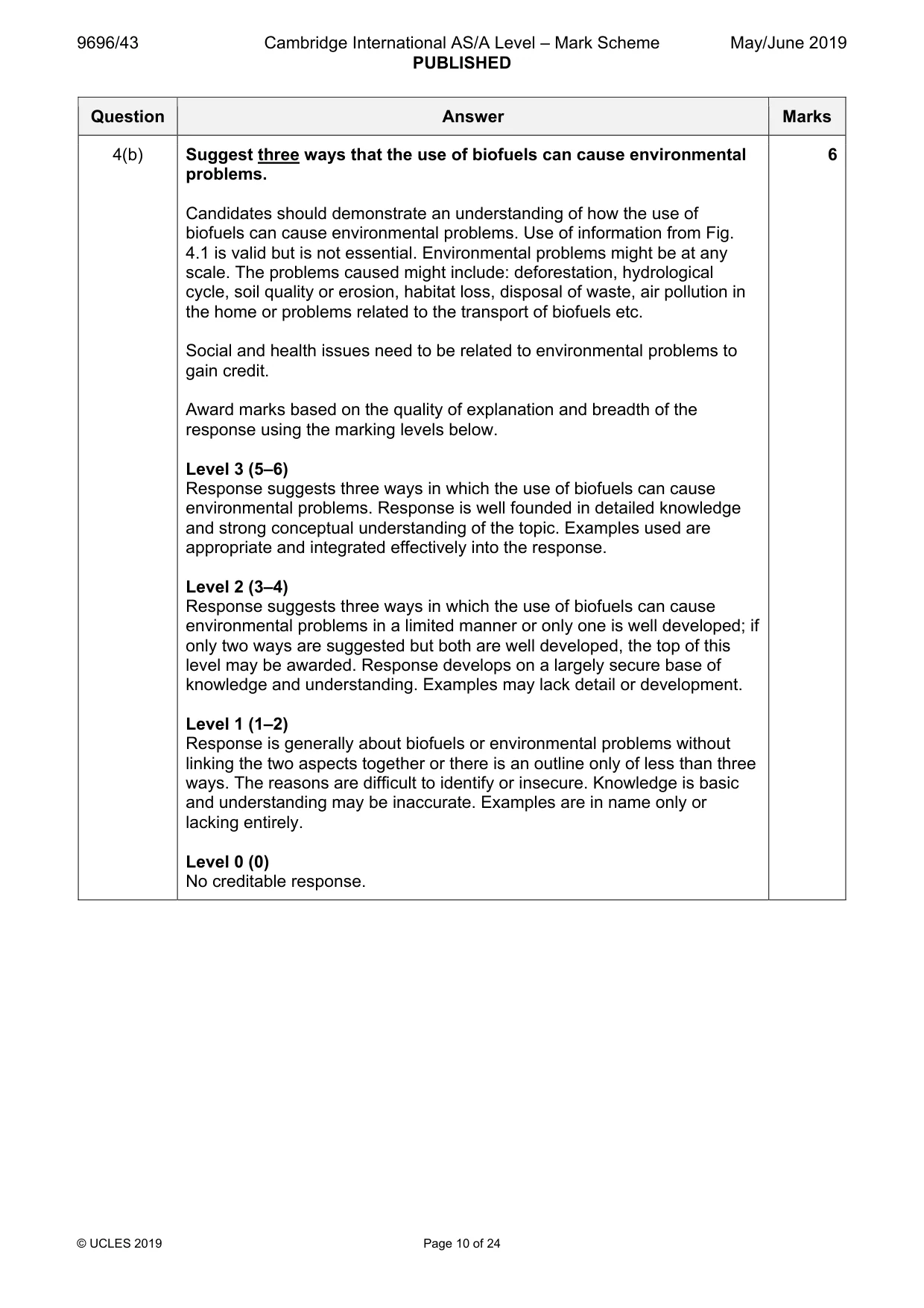
9696/43 Cambridge International AS/A Level – Mark Scheme PUBLISHED May/June 2019 © UCLES 2019 Page 10 of 24 Question Answer Marks 4(b) Suggest three ways that the use of biofuels can cause environmental problems. Candidates should demonstrate an understanding of how the use of biofuels can cause environmental problems. Use of information from Fig. 4.1 is valid but is not essential. Environmental problems might be at any scale. The problems caused might include: deforestation, hydrological cycle, soil quality or erosion, habitat loss, disposal of waste, air pollution in the home or problems related to the transport of biofuels etc. Social and health issues need to be related to environmental problems to gain credit. Award marks based on the quality of explanation and breadth of the response using the marking levels below. Level 3 (5–6) Response suggests three ways in which the use of biofuels can cause environmental problems. Response is well founded in detailed knowledge and strong conceptual understanding of the topic. Examples used are appropriate and integrated effectively into the response. Level 2 (3–4) Response suggests three ways in which the use of biofuels can cause environmental problems in a limited manner or only one is well developed; if only two ways are suggested but both are well developed, the top of this level may be awarded. Response develops on a largely secure base of knowledge and understanding. Examples may lack detail or development. Level 1 (1–2) Response is generally about biofuels or environmental problems without linking the two aspects together or there is an outline only of less than three ways. The reasons are difficult to identify or insecure. Knowledge is basic and understanding may be inaccurate. Examples are in name only or lacking entirely. Level 0 (0) No creditable response. 6
Mark scheme, page 11
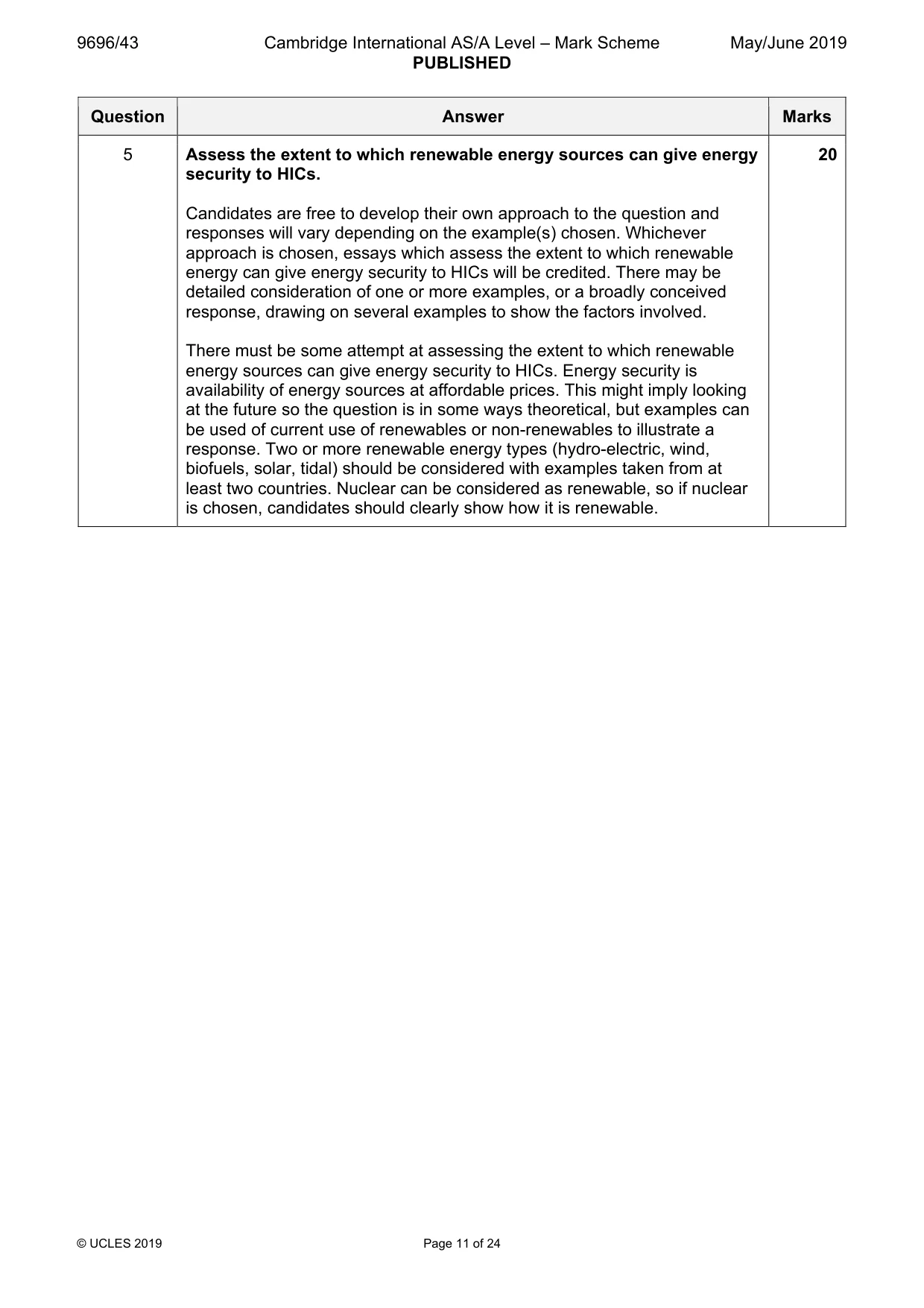
9696/43 Cambridge International AS/A Level – Mark Scheme PUBLISHED May/June 2019 © UCLES 2019 Page 11 of 24 Question Answer Marks 5 Assess the extent to which renewable energy sources can give energy security to HICs. Candidates are free to develop their own approach to the question and responses will vary depending on the example(s) chosen. Whichever approach is chosen, essays which assess the extent to which renewable energy can give energy security to HICs will be credited. There may be detailed consideration of one or more examples, or a broadly conceived response, drawing on several examples to show the factors involved. There must be some attempt at assessing the extent to which renewable energy sources can give energy security to HICs. Energy security is availability of energy sources at affordable prices. This might imply looking at the future so the question is in some ways theoretical, but examples can be used of current use of renewables or non-renewables to illustrate a response. Two or more renewable energy types (hydro-electric, wind, biofuels, solar, tidal) should be considered with examples taken from at least two countries. Nuclear can be considered as renewable, so if nuclear is chosen, candidates should clearly show how it is renewable. 20
Mark scheme, page 12
9696/43 Cambridge International AS/A Level – Mark Scheme PUBLISHED May/June 2019 © UCLES 2019 Page 12 of 24 Question Answer Marks 5 Award marks based on the quality of the response using the marking levels below. Level 4 (16–20) Response thoroughly considers the extent to which renewable energy sources can give energy security to HICs, with examples of at least two types of renewable energy and two countries. An effective and sustained evaluation with a sound conclusion. Response is well founded in detailed exemplar knowledge and strong conceptual understanding of the topic. Examples used are appropriate and integrated effectively into the response. Level 3 (11–15) Response considers the extent to which renewable energy sources can give energy security to HICs, with examples of at least two types of renewable energy and two countries. The response is clearly set in the context of HICs. Response is broadly evaluative in character, comprising some explanatory or narrative content and a conclusion. Response develops on a largely secure base of knowledge and understanding with the use of example(s). Level 2 (6–10) Response demonstrates some knowledge and understanding of renewable energy sources and energy security but is less successful at applying this to the HIC context. Response is mainly descriptive or explanatory in approach and contains a brief or thinly supported evaluation. Responses without the use of example(s) to support the response will not get above the middle of Level 2 (8 marks). Level 1 (1–5) Response makes a few general points about renewable energy or energy security without the necessary focus on the HIC context. A descriptive response comprising a few simple points. Knowledge is basic and understanding may be poor and lack relevance to the question set. Level 0 (0) No creditable response.
Mark scheme, page 13
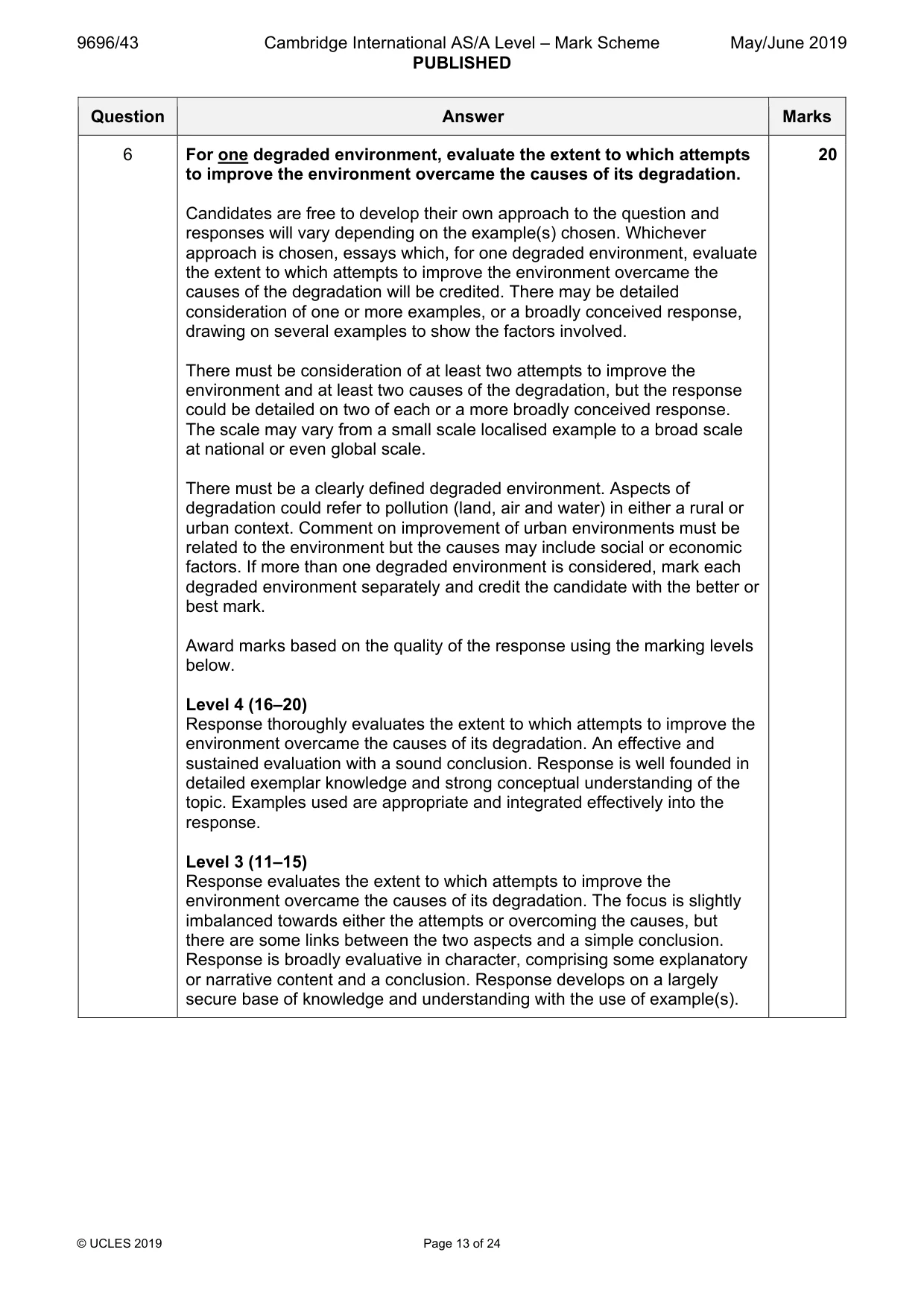
9696/43 Cambridge International AS/A Level – Mark Scheme PUBLISHED May/June 2019 © UCLES 2019 Page 13 of 24 Question Answer Marks 6 For one degraded environment, evaluate the extent to which attempts to improve the environment overcame the causes of its degradation. Candidates are free to develop their own approach to the question and responses will vary depending on the example(s) chosen. Whichever approach is chosen, essays which, for one degraded environment, evaluate the extent to which attempts to improve the environment overcame the causes of the degradation will be credited. There may be detailed consideration of one or more examples, or a broadly conceived response, drawing on several examples to show the factors involved. There must be consideration of at least two attempts to improve the environment and at least two causes of the degradation, but the response could be detailed on two of each or a more broadly conceived response. The scale may vary from a small scale localised example to a broad scale at national or even global scale. There must be a clearly defined degraded environment. Aspects of degradation could refer to pollution (land, air and water) in either a rural or urban context. Comment on improvement of urban environments must be related to the environment but the causes may include social or economic factors. If more than one degraded environment is considered, mark each degraded environment separately and credit the candidate with the better or best mark. Award marks based on the quality of the response using the marking levels below. Level 4 (16–20) Response thoroughly evaluates the extent to which attempts to improve the environment overcame the causes of its degradation. An effective and sustained evaluation with a sound conclusion. Response is well founded in detailed exemplar knowledge and strong conceptual understanding of the topic. Examples used are appropriate and integrated effectively into the response. Level 3 (11–15) Response evaluates the extent to which attempts to improve the environment overcame the causes of its degradation. The focus is slightly imbalanced towards either the attempts or overcoming the causes, but there are some links between the two aspects and a simple conclusion. Response is broadly evaluative in character, comprising some explanatory or narrative content and a conclusion. Response develops on a largely secure base of knowledge and understanding with the use of example(s). 20
Mark scheme, page 14
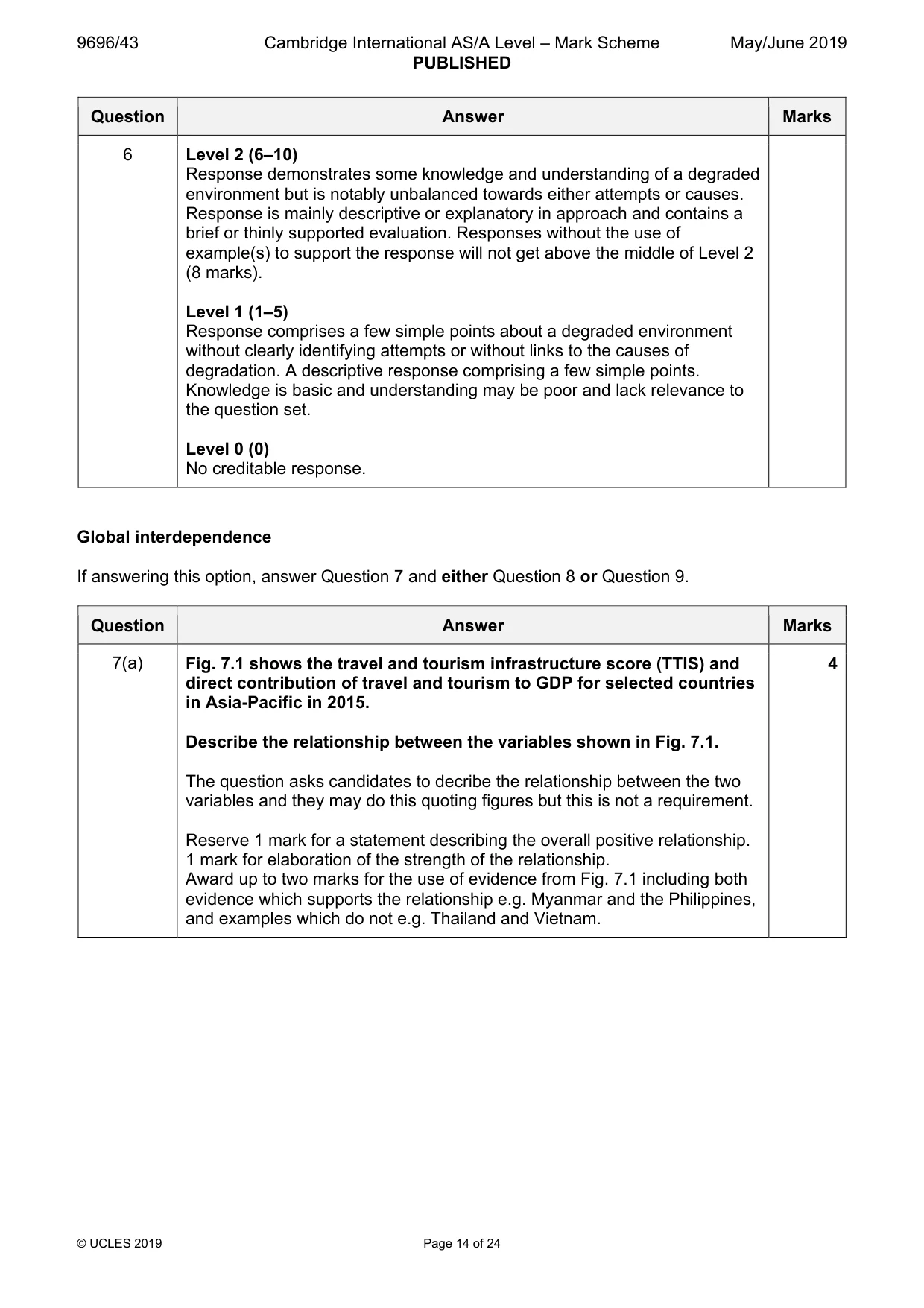
9696/43 Cambridge International AS/A Level – Mark Scheme PUBLISHED May/June 2019 © UCLES 2019 Page 14 of 24 Question Answer Marks 6 Level 2 (6–10) Response demonstrates some knowledge and understanding of a degraded environment but is notably unbalanced towards either attempts or causes. Response is mainly descriptive or explanatory in approach and contains a brief or thinly supported evaluation. Responses without the use of example(s) to support the response will not get above the middle of Level 2 (8 marks). Level 1 (1–5) Response comprises a few simple points about a degraded environment without clearly identifying attempts or without links to the causes of degradation. A descriptive response comprising a few simple points. Knowledge is basic and understanding may be poor and lack relevance to the question set. Level 0 (0) No creditable response. Global interdependence If answering this option, answer Question 7 and either Question 8 or Question 9. Question Answer Marks 7(a) Fig. 7.1 shows the travel and tourism infrastructure score (TTIS) and direct contribution of travel and tourism to GDP for selected countries in Asia-Pacific in 2015. Describe the relationship between the variables shown in Fig. 7.1. The question asks candidates to decribe the relationship between the two variables and they may do this quoting figures but this is not a requirement. Reserve 1 mark for a statement describing the overall positive relationship. 1 mark for elaboration of the strength of the relationship. Award up to two marks for the use of evidence from Fig. 7.1 including both evidence which supports the relationship e.g. Myanmar and the Philippines, and examples which do not e.g. Thailand and Vietnam. 4
Mark scheme, page 15
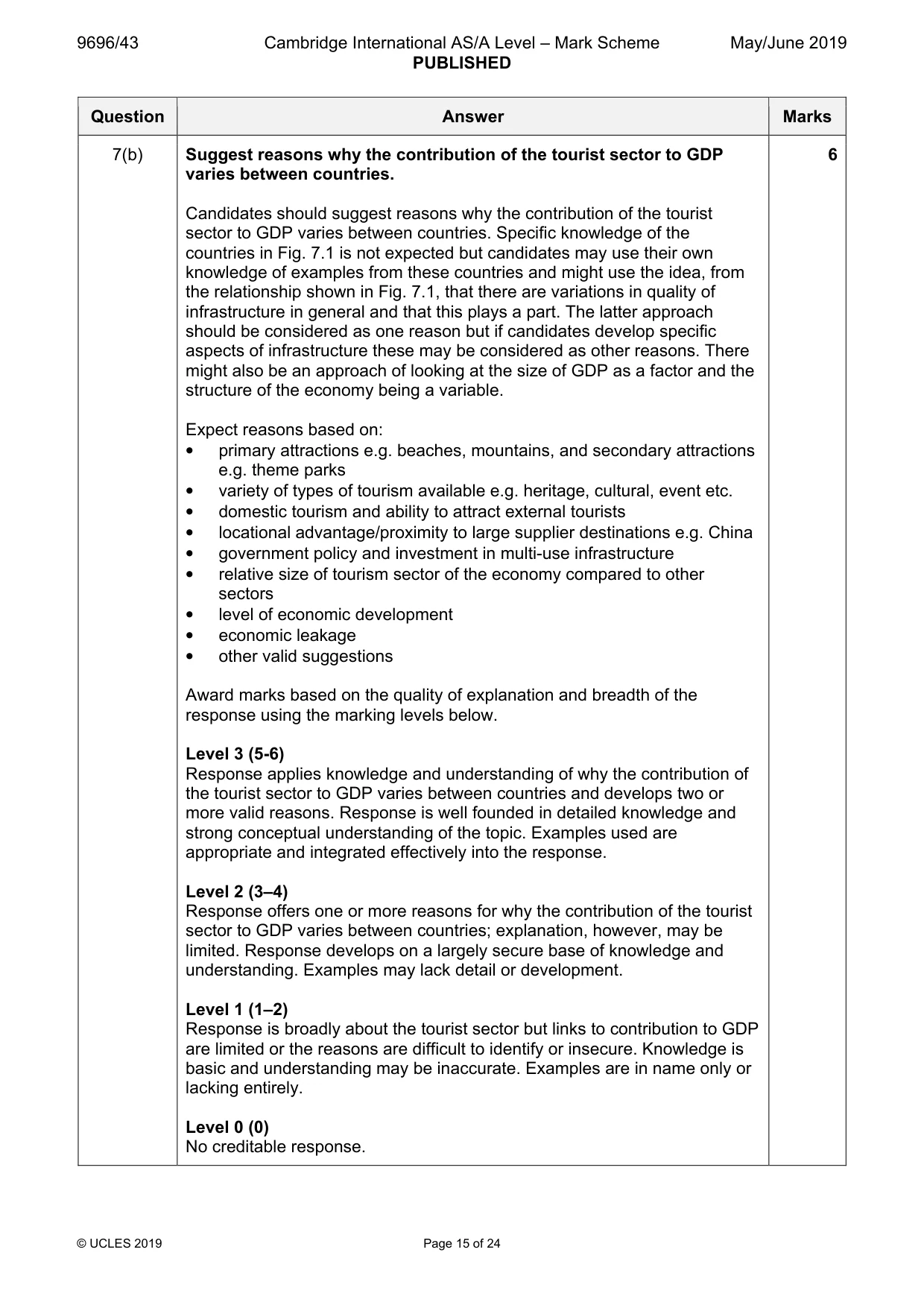
9696/43 Cambridge International AS/A Level – Mark Scheme PUBLISHED May/June 2019 © UCLES 2019 Page 15 of 24 Question Answer Marks 7(b) Suggest reasons why the contribution of the tourist sector to GDP varies between countries. Candidates should suggest reasons why the contribution of the tourist sector to GDP varies between countries. Specific knowledge of the countries in Fig. 7.1 is not expected but candidates may use their own knowledge of examples from these countries and might use the idea, from the relationship shown in Fig. 7.1, that there are variations in quality of infrastructure in general and that this plays a part. The latter approach should be considered as one reason but if candidates develop specific aspects of infrastructure these may be considered as other reasons. There might also be an approach of looking at the size of GDP as a factor and the structure of the economy being a variable. Expect reasons based on: • primary attractions e.g. beaches, mountains, and secondary attractions e.g. theme parks • variety of types of tourism available e.g. heritage, cultural, event etc. • domestic tourism and ability to attract external tourists • locational advantage/proximity to large supplier destinations e.g. China • government policy and investment in multi-use infrastructure • relative size of tourism sector of the economy compared to other sectors • level of economic development • economic leakage • other valid suggestions Award marks based on the quality of explanation and breadth of the response using the marking levels below. Level 3 (5-6) Response applies knowledge and understanding of why the contribution of the tourist sector to GDP varies between countries and develops two or more valid reasons. Response is well founded in detailed knowledge and strong conceptual understanding of the topic. Examples used are appropriate and integrated effectively into the response. Level 2 (3–4) Response offers one or more reasons for why the contribution of the tourist sector to GDP varies between countries; explanation, however, may be limited. Response develops on a largely secure base of knowledge and understanding. Examples may lack detail or development. Level 1 (1–2) Response is broadly about the tourist sector but links to contribution to GDP are limited or the reasons are difficult to identify or insecure. Knowledge is basic and understanding may be inaccurate. Examples are in name only or lacking entirely. Level 0 (0) No creditable response. 6
Mark scheme, page 16
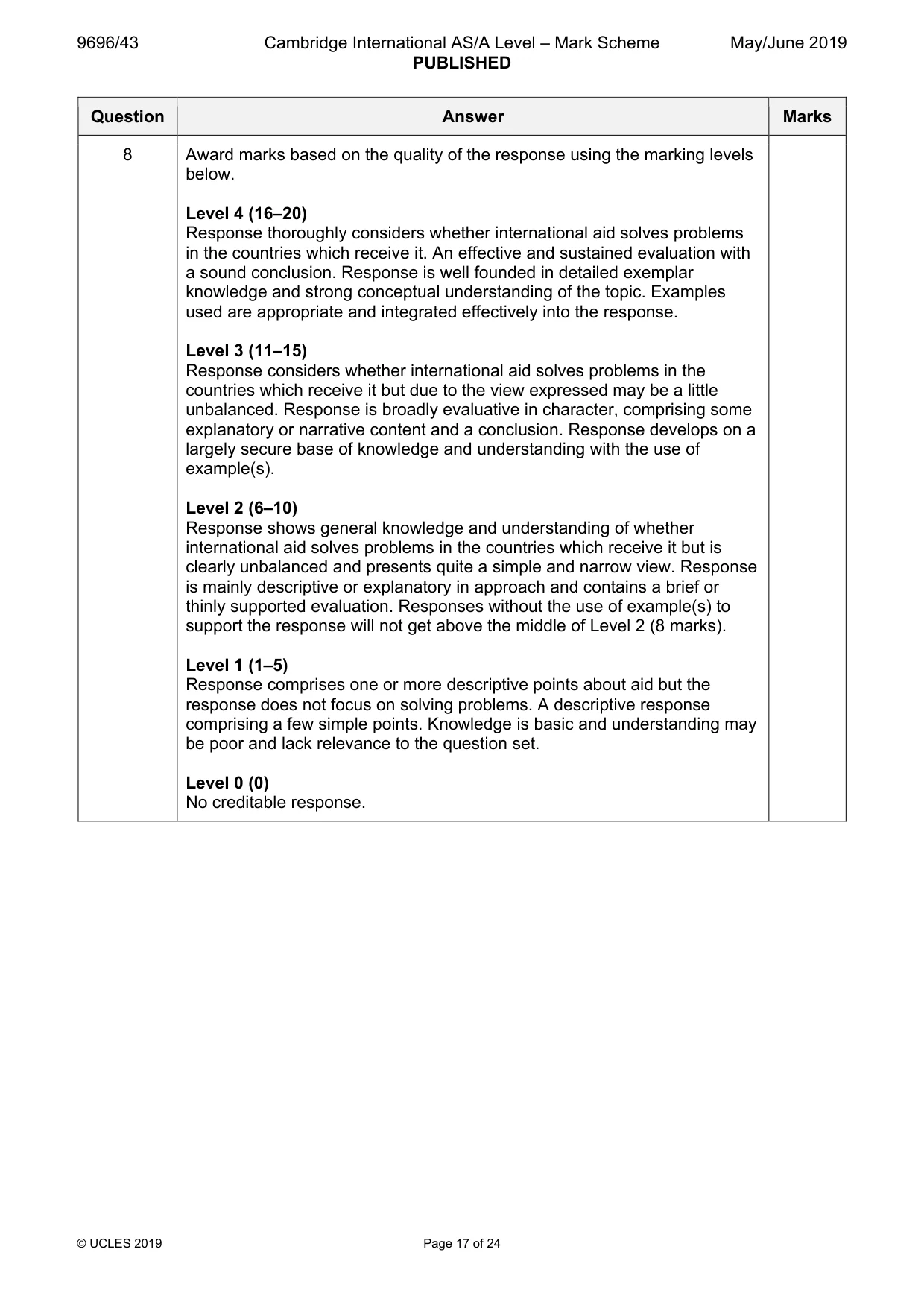
9696/43 Cambridge International AS/A Level – Mark Scheme PUBLISHED May/June 2019 © UCLES 2019 Page 16 of 24 Question Answer Marks 8 How far do you agree that international aid solves problems in the countries which receive it? Candidates are free to develop their own approach to the question and responses will vary depending on the example(s) chosen. Whichever approach is chosen, essays which address the contention and carefully assess how far international aid solves problems in the countries which receive it will be credited. There may be detailed consideration of one or more examples, or a broadly conceived response, drawing on several examples to show the factors involved. There may be detailed consideration of at least two problems for at least two countries or a broadly conceived response, drawing on several problems and countries. Exploration of the counter argument that receiving aid might create problems is valid. Scale might include the national scale or other scales within a country. There must be an assessment and views expressed about how receiving international aid solves problems in the countries which receive it or does not solve problems. For countries receiving aid, problems solved might include: • overcoming shortages of capital leading to general economic development or development of a specific sector of the economy • providing relief for debt • infrastructure improvements overcoming problems of transport within a country and enabling easier access for export and import trade, or improving access to raw materials and power sources • disaster relief • small scale improvements to overcome problems in health, water and sanitation or education • overcoming issues of traditional methods and low level of technology in sectors such as agriculture • any other valid problems which are solved by receiving aid Problems created by receiving international aid might include issues such as: dependency, increased debt, widening divisions within society, corruption and misuse of funds or inappropriate development policies or projects, influx of imports and control by donor countries on where aid money is spent etc. 20
Mark scheme, page 17
9696/43 Cambridge International AS/A Level – Mark Scheme PUBLISHED May/June 2019 © UCLES 2019 Page 17 of 24 Question Answer Marks 8 Award marks based on the quality of the response using the marking levels below. Level 4 (16–20) Response thoroughly considers whether international aid solves problems in the countries which receive it. An effective and sustained evaluation with a sound conclusion. Response is well founded in detailed exemplar knowledge and strong conceptual understanding of the topic. Examples used are appropriate and integrated effectively into the response. Level 3 (11–15) Response considers whether international aid solves problems in the countries which receive it but due to the view expressed may be a little unbalanced. Response is broadly evaluative in character, comprising some explanatory or narrative content and a conclusion. Response develops on a largely secure base of knowledge and understanding with the use of example(s). Level 2 (6–10) Response shows general knowledge and understanding of whether international aid solves problems in the countries which receive it but is clearly unbalanced and presents quite a simple and narrow view. Response is mainly descriptive or explanatory in approach and contains a brief or thinly supported evaluation. Responses without the use of example(s) to support the response will not get above the middle of Level 2 (8 marks). Level 1 (1–5) Response comprises one or more descriptive points about aid but the response does not focus on solving problems. A descriptive response comprising a few simple points. Knowledge is basic and understanding may be poor and lack relevance to the question set. Level 0 (0) No creditable response.
Mark scheme, page 18
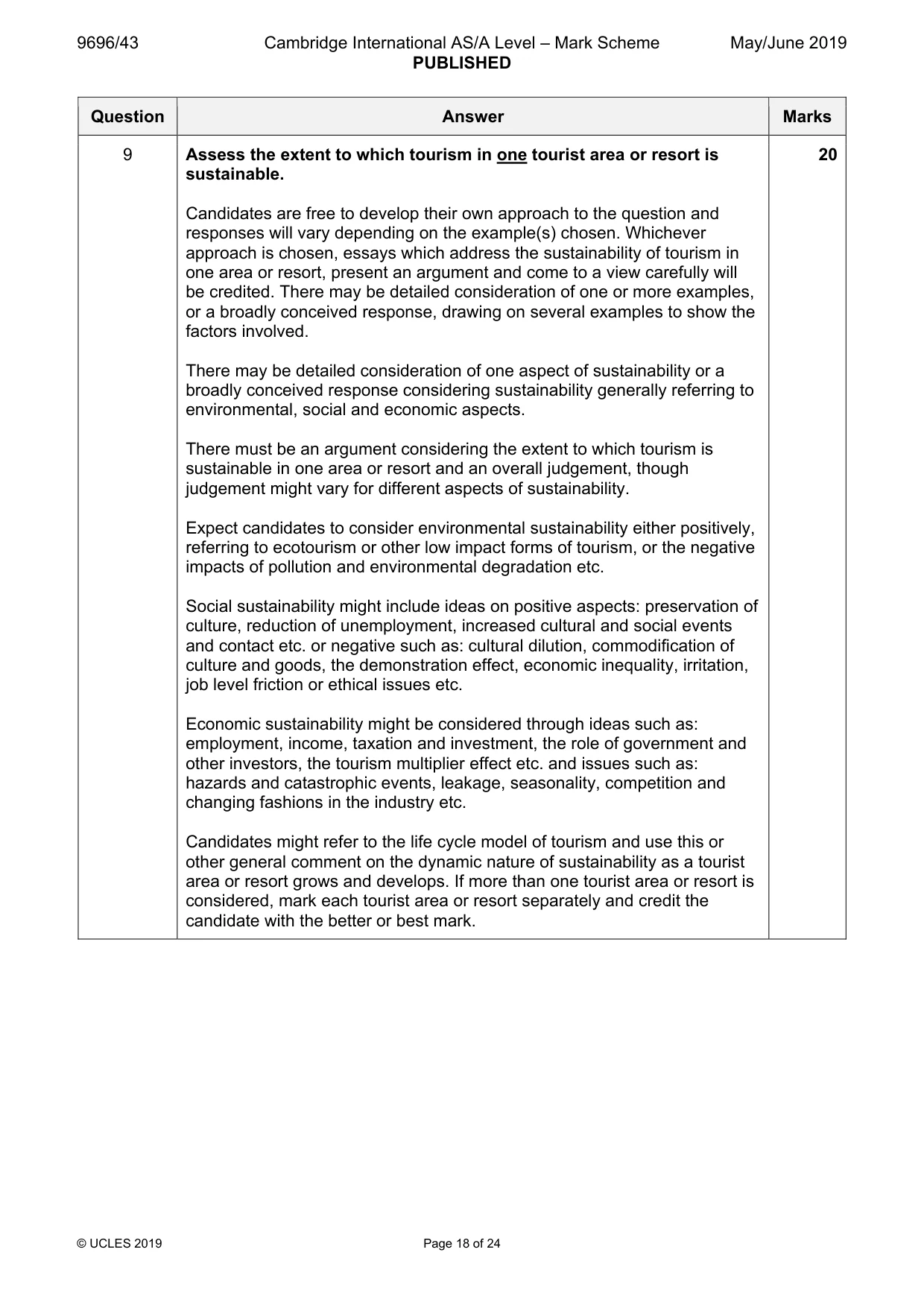
9696/43 Cambridge International AS/A Level – Mark Scheme PUBLISHED May/June 2019 © UCLES 2019 Page 18 of 24 Question Answer Marks 9 Assess the extent to which tourism in one tourist area or resort is sustainable. Candidates are free to develop their own approach to the question and responses will vary depending on the example(s) chosen. Whichever approach is chosen, essays which address the sustainability of tourism in one area or resort, present an argument and come to a view carefully will be credited. There may be detailed consideration of one or more examples, or a broadly conceived response, drawing on several examples to show the factors involved. There may be detailed consideration of one aspect of sustainability or a broadly conceived response considering sustainability generally referring to environmental, social and economic aspects. There must be an argument considering the extent to which tourism is sustainable in one area or resort and an overall judgement, though judgement might vary for different aspects of sustainability. Expect candidates to consider environmental sustainability either positively, referring to ecotourism or other low impact forms of tourism, or the negative impacts of pollution and environmental degradation etc. Social sustainability might include ideas on positive aspects: preservation of culture, reduction of unemployment, increased cultural and social events and contact etc. or negative such as: cultural dilution, commodification of culture and goods, the demonstration effect, economic inequality, irritation, job level friction or ethical issues etc. Economic sustainability might be considered through ideas such as: employment, income, taxation and investment, the role of government and other investors, the tourism multiplier effect etc. and issues such as: hazards and catastrophic events, leakage, seasonality, competition and changing fashions in the industry etc. Candidates might refer to the life cycle model of tourism and use this or other general comment on the dynamic nature of sustainability as a tourist area or resort grows and develops. If more than one tourist area or resort is considered, mark each tourist area or resort separately and credit the candidate with the better or best mark. 20
Mark scheme, page 19
9696/43 Cambridge International AS/A Level – Mark Scheme PUBLISHED May/June 2019 © UCLES 2019 Page 19 of 24 Question Answer Marks 9 Award marks based on the quality of the response using the marking levels below. Level 4 (16–20) Response thoroughly considers the extent to which tourism in one tourist area or resort is sustainable. An effective and sustained evaluation with a sound conclusion. Response is well founded in detailed exemplar knowledge and strong conceptual understanding of the topic. Examples used are appropriate and integrated effectively into the response. Level 3 (11–15) Response considers the extent to which tourism in one tourist area or resort is sustainable but due to the view expressed may be a little unbalanced. Response is broadly evaluative in character, comprising some explanatory or narrative content and a conclusion. Response develops on a largely secure base of knowledge and understanding with the use of example(s). Level 2 (6–10) Response shows general knowledge and understanding of the extent to which tourism in one tourist area or resort is sustainable but is clearly unbalanced and presents quite a simple and narrow view. Response is mainly descriptive or explanatory in approach and contains a brief or thinly supported evaluation. Responses without the use of example(s) to support the response will not get above the middle of Level 2 (8 marks). Level 1 (1–5) Response comprises one or more descriptive points about tourism in one area or resort without the necessary focus on sustainability. A descriptive response comprising a few simple points. Knowledge is basic and understanding may be poor and lack relevance to the question set. Level 0 (0) No creditable response.
Mark scheme, page 20
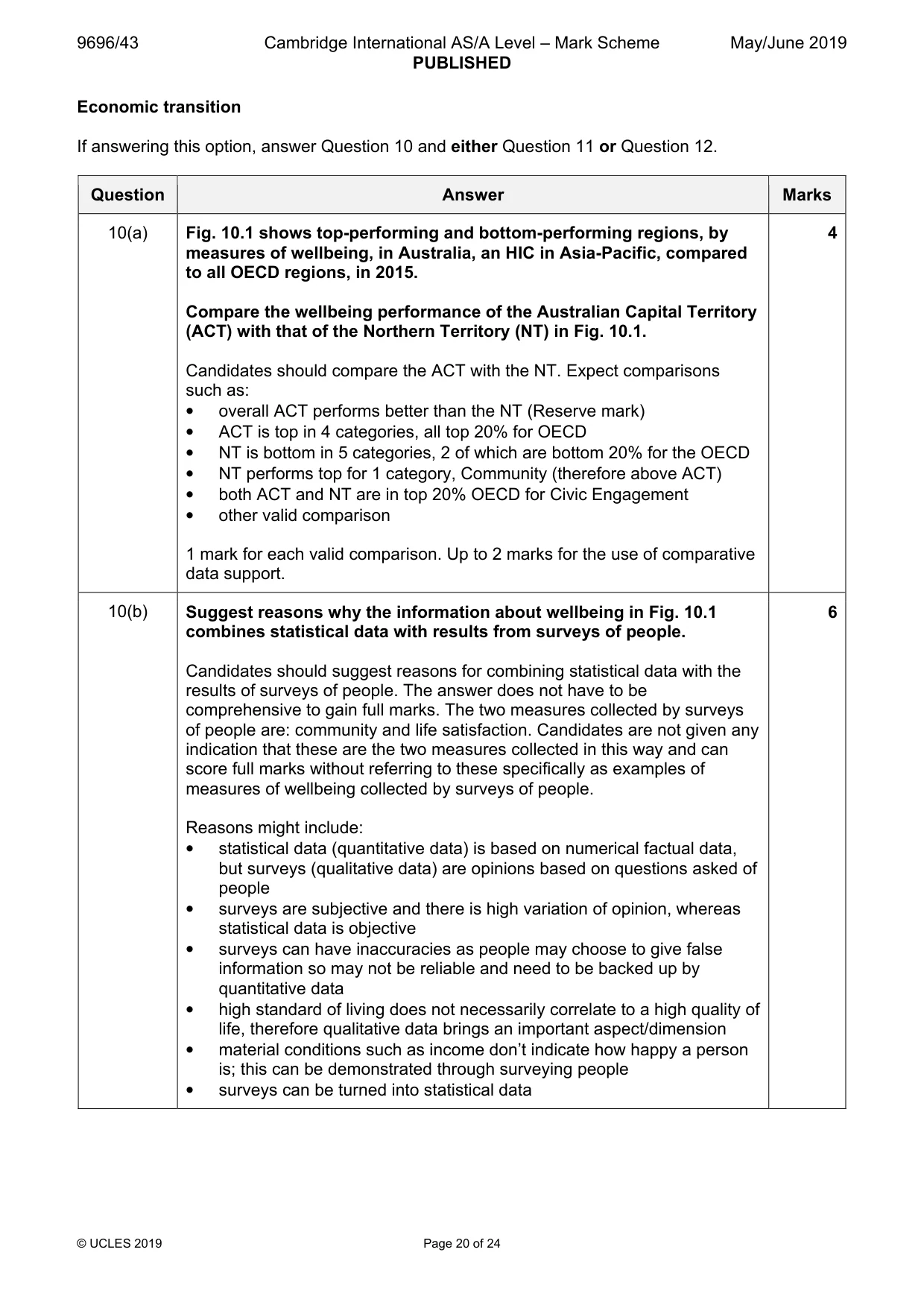
9696/43 Cambridge International AS/A Level – Mark Scheme PUBLISHED May/June 2019 © UCLES 2019 Page 20 of 24 Economic transition If answering this option, answer Question 10 and either Question 11 or Question 12. Question Answer Marks 10(a) Fig. 10.1 shows top-performing and bottom-performing regions, by measures of wellbeing, in Australia, an HIC in Asia-Pacific, compared to all OECD regions, in 2015. Compare the wellbeing performance of the Australian Capital Territory (ACT) with that of the Northern Territory (NT) in Fig. 10.1. Candidates should compare the ACT with the NT. Expect comparisons such as: • overall ACT performs better than the NT (Reserve mark) • ACT is top in 4 categories, all top 20% for OECD • NT is bottom in 5 categories, 2 of which are bottom 20% for the OECD • NT performs top for 1 category, Community (therefore above ACT) • both ACT and NT are in top 20% OECD for Civic Engagement • other valid comparison 1 mark for each valid comparison. Up to 2 marks for the use of comparative data support. 4 10(b) Suggest reasons why the information about wellbeing in Fig. 10.1 combines statistical data with results from surveys of people. Candidates should suggest reasons for combining statistical data with the results of surveys of people. The answer does not have to be comprehensive to gain full marks. The two measures collected by surveys of people are: community and life satisfaction. Candidates are not given any indication that these are the two measures collected in this way and can score full marks without referring to these specifically as examples of measures of wellbeing collected by surveys of people. Reasons might include: • statistical data (quantitative data) is based on numerical factual data, but surveys (qualitative data) are opinions based on questions asked of people • surveys are subjective and there is high variation of opinion, whereas statistical data is objective • surveys can have inaccuracies as people may choose to give false information so may not be reliable and need to be backed up by quantitative data • high standard of living does not necessarily correlate to a high quality of life, therefore qualitative data brings an important aspect/dimension • material conditions such as income don’t indicate how happy a person is; this can be demonstrated through surveying people • surveys can be turned into statistical data 6
Mark scheme, page 21
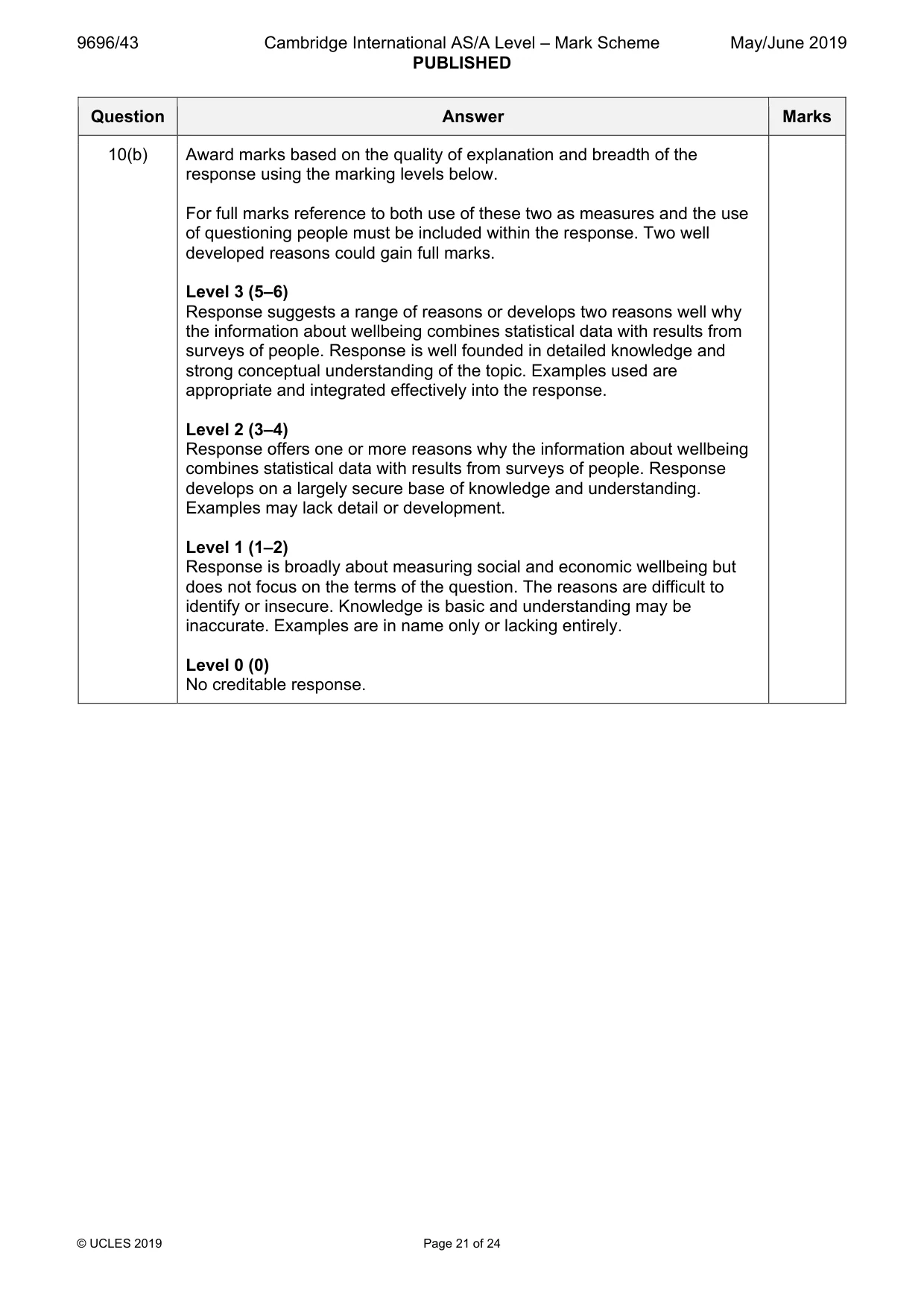
9696/43 Cambridge International AS/A Level – Mark Scheme PUBLISHED May/June 2019 © UCLES 2019 Page 21 of 24 Question Answer Marks 10(b) Award marks based on the quality of explanation and breadth of the response using the marking levels below. For full marks reference to both use of these two as measures and the use of questioning people must be included within the response. Two well developed reasons could gain full marks. Level 3 (5–6) Response suggests a range of reasons or develops two reasons well why the information about wellbeing combines statistical data with results from surveys of people. Response is well founded in detailed knowledge and strong conceptual understanding of the topic. Examples used are appropriate and integrated effectively into the response. Level 2 (3–4) Response offers one or more reasons why the information about wellbeing combines statistical data with results from surveys of people. Response develops on a largely secure base of knowledge and understanding. Examples may lack detail or development. Level 1 (1–2) Response is broadly about measuring social and economic wellbeing but does not focus on the terms of the question. The reasons are difficult to identify or insecure. Knowledge is basic and understanding may be inaccurate. Examples are in name only or lacking entirely. Level 0 (0) No creditable response.
Mark scheme, page 22
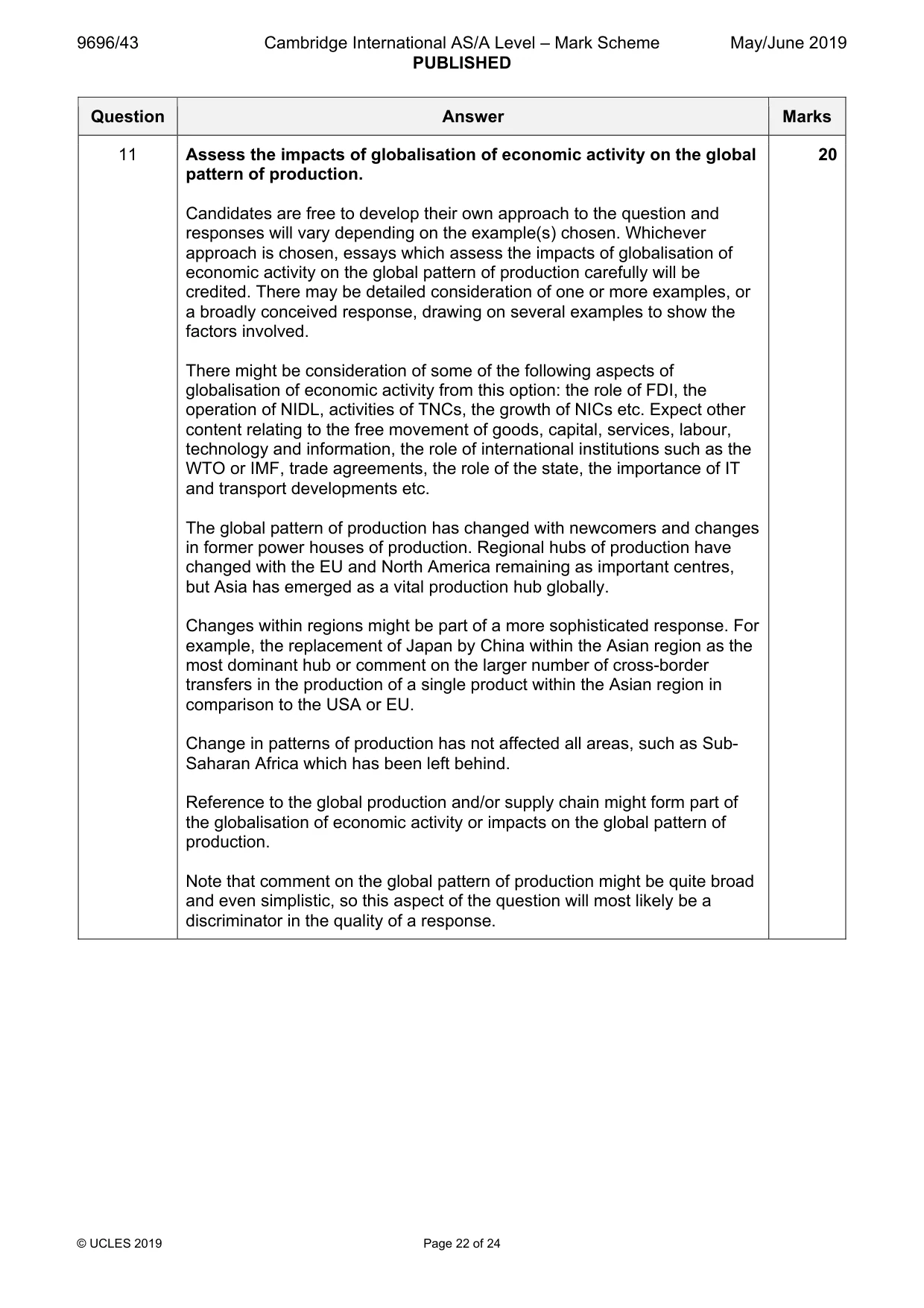
9696/43 Cambridge International AS/A Level – Mark Scheme PUBLISHED May/June 2019 © UCLES 2019 Page 22 of 24 Question Answer Marks 11 Assess the impacts of globalisation of economic activity on the global pattern of production. Candidates are free to develop their own approach to the question and responses will vary depending on the example(s) chosen. Whichever approach is chosen, essays which assess the impacts of globalisation of economic activity on the global pattern of production carefully will be credited. There may be detailed consideration of one or more examples, or a broadly conceived response, drawing on several examples to show the factors involved. There might be consideration of some of the following aspects of globalisation of economic activity from this option: the role of FDI, the operation of NIDL, activities of TNCs, the growth of NICs etc. Expect other content relating to the free movement of goods, capital, services, labour, technology and information, the role of international institutions such as the WTO or IMF, trade agreements, the role of the state, the importance of IT and transport developments etc. The global pattern of production has changed with newcomers and changes in former power houses of production. Regional hubs of production have changed with the EU and North America remaining as important centres, but Asia has emerged as a vital production hub globally. Changes within regions might be part of a more sophisticated response. For example, the replacement of Japan by China within the Asian region as the most dominant hub or comment on the larger number of cross-border transfers in the production of a single product within the Asian region in comparison to the USA or EU. Change in patterns of production has not affected all areas, such as Sub- Saharan Africa which has been left behind. Reference to the global production and/or supply chain might form part of the globalisation of economic activity or impacts on the global pattern of production. Note that comment on the global pattern of production might be quite broad and even simplistic, so this aspect of the question will most likely be a discriminator in the quality of a response. 20
Mark scheme, page 23
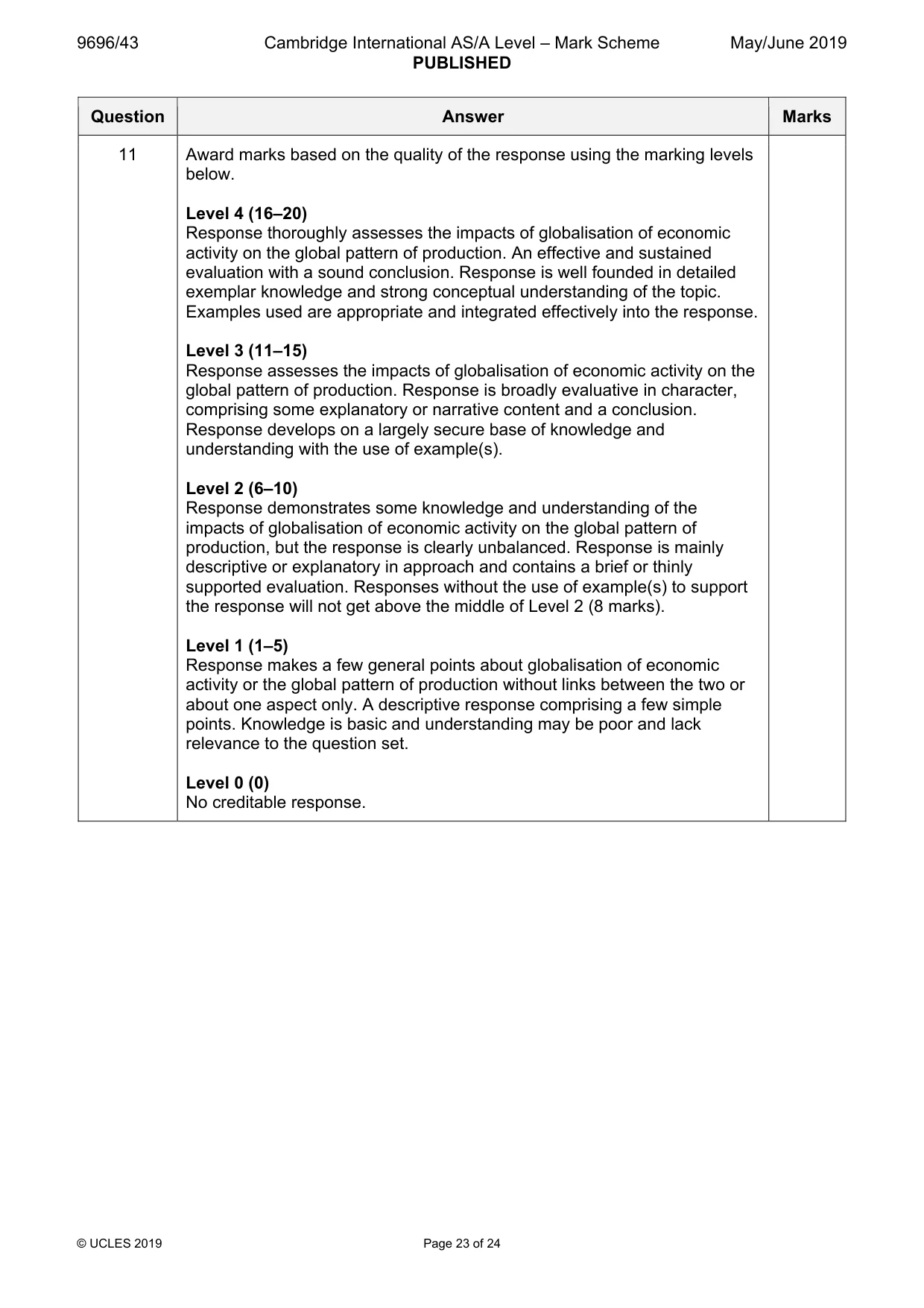
9696/43 Cambridge International AS/A Level – Mark Scheme PUBLISHED May/June 2019 © UCLES 2019 Page 23 of 24 Question Answer Marks 11 Award marks based on the quality of the response using the marking levels below. Level 4 (16–20) Response thoroughly assesses the impacts of globalisation of economic activity on the global pattern of production. An effective and sustained evaluation with a sound conclusion. Response is well founded in detailed exemplar knowledge and strong conceptual understanding of the topic. Examples used are appropriate and integrated effectively into the response. Level 3 (11–15) Response assesses the impacts of globalisation of economic activity on the global pattern of production. Response is broadly evaluative in character, comprising some explanatory or narrative content and a conclusion. Response develops on a largely secure base of knowledge and understanding with the use of example(s). Level 2 (6–10) Response demonstrates some knowledge and understanding of the impacts of globalisation of economic activity on the global pattern of production, but the response is clearly unbalanced. Response is mainly descriptive or explanatory in approach and contains a brief or thinly supported evaluation. Responses without the use of example(s) to support the response will not get above the middle of Level 2 (8 marks). Level 1 (1–5) Response makes a few general points about globalisation of economic activity or the global pattern of production without links between the two or about one aspect only. A descriptive response comprising a few simple points. Knowledge is basic and understanding may be poor and lack relevance to the question set. Level 0 (0) No creditable response.
Mark scheme, page 24
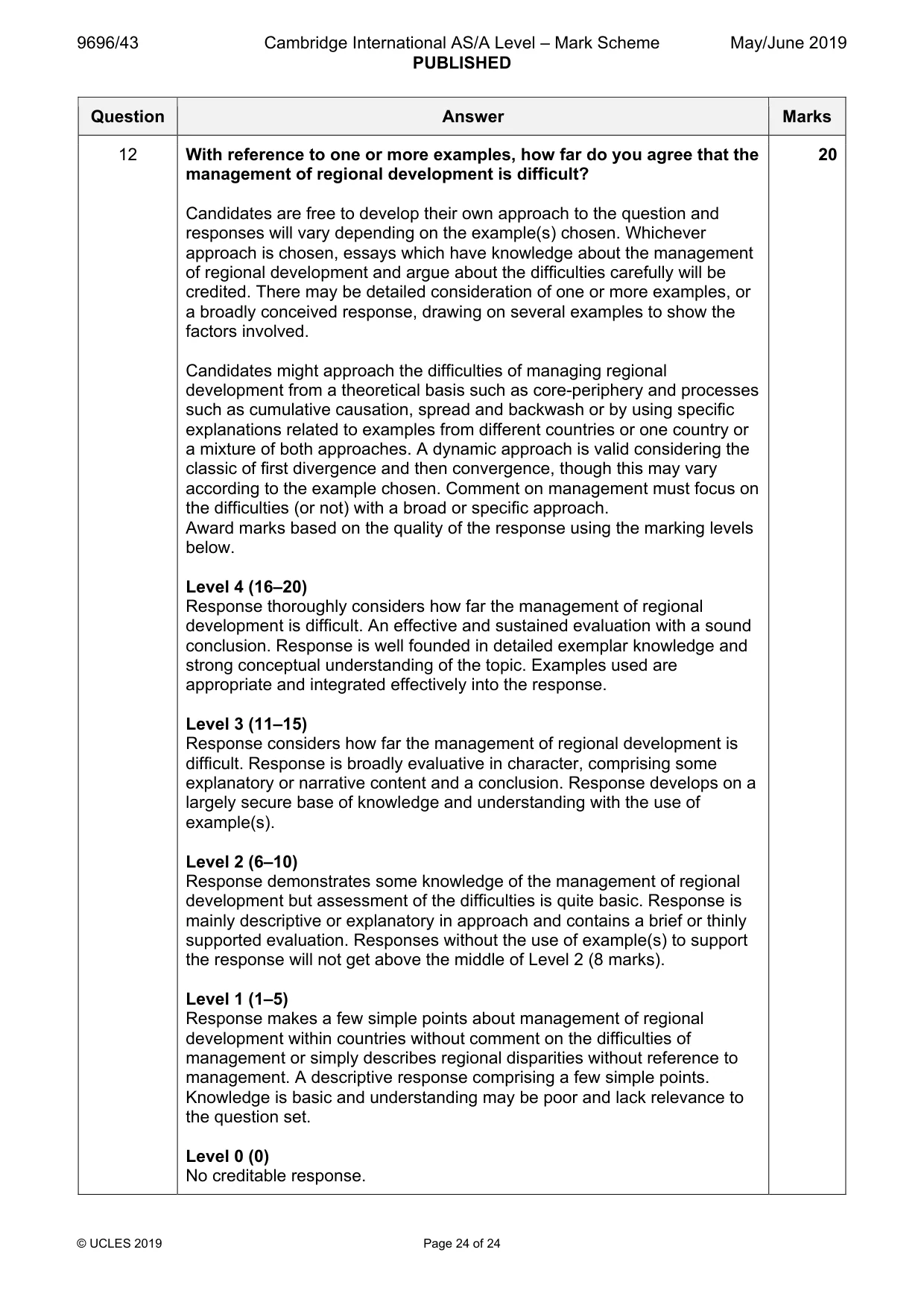
9696/43 Cambridge International AS/A Level – Mark Scheme PUBLISHED May/June 2019 © UCLES 2019 Page 24 of 24 Question Answer Marks 12 With reference to one or more examples, how far do you agree that the management of regional development is difficult? Candidates are free to develop their own approach to the question and responses will vary depending on the example(s) chosen. Whichever approach is chosen, essays which have knowledge about the management of regional development and argue about the difficulties carefully will be credited. There may be detailed consideration of one or more examples, or a broadly conceived response, drawing on several examples to show the factors involved. Candidates might approach the difficulties of managing regional development from a theoretical basis such as core-periphery and processes such as cumulative causation, spread and backwash or by using specific explanations related to examples from different countries or one country or a mixture of both approaches. A dynamic approach is valid considering the classic of first divergence and then convergence, though this may vary according to the example chosen. Comment on management must focus on the difficulties (or not) with a broad or specific approach. Award marks based on the quality of the response using the marking levels below. Level 4 (16–20) Response thoroughly considers how far the management of regional development is difficult. An effective and sustained evaluation with a sound conclusion. Response is well founded in detailed exemplar knowledge and strong conceptual understanding of the topic. Examples used are appropriate and integrated effectively into the response. Level 3 (11–15) Response considers how far the management of regional development is difficult. Response is broadly evaluative in character, comprising some explanatory or narrative content and a conclusion. Response develops on a largely secure base of knowledge and understanding with the use of example(s). Level 2 (6–10) Response demonstrates some knowledge of the management of regional development but assessment of the difficulties is quite basic. Response is mainly descriptive or explanatory in approach and contains a brief or thinly supported evaluation. Responses without the use of example(s) to support the response will not get above the middle of Level 2 (8 marks). Level 1 (1–5) Response makes a few simple points about management of regional development within countries without comment on the difficulties of management or simply describes regional disparities without reference to management. A descriptive response comprising a few simple points. Knowledge is basic and understanding may be poor and lack relevance to the question set. Level 0 (0) No creditable response. 20
What you needed in this session
Cambridge’s own grade thresholds for 2019 May/June, Paper 4 · Variant 3. A higher threshold means an easier paper — the bar moves with how the cohort did.