Cambridge A Level Geography 9696 — 2016 May/June Paper 3 · Variant 2
9696/32/M/J/16 · 50 marks · ≈56 min
The question paper and its mark scheme, free to read here and free to download. This is Cambridge’s own paper, exactly as it was sat.
Question paper4 pages

Mark scheme16 pages
Answers below. Sit the paper first if you are practising.
Paper as text
Question paper, page 1
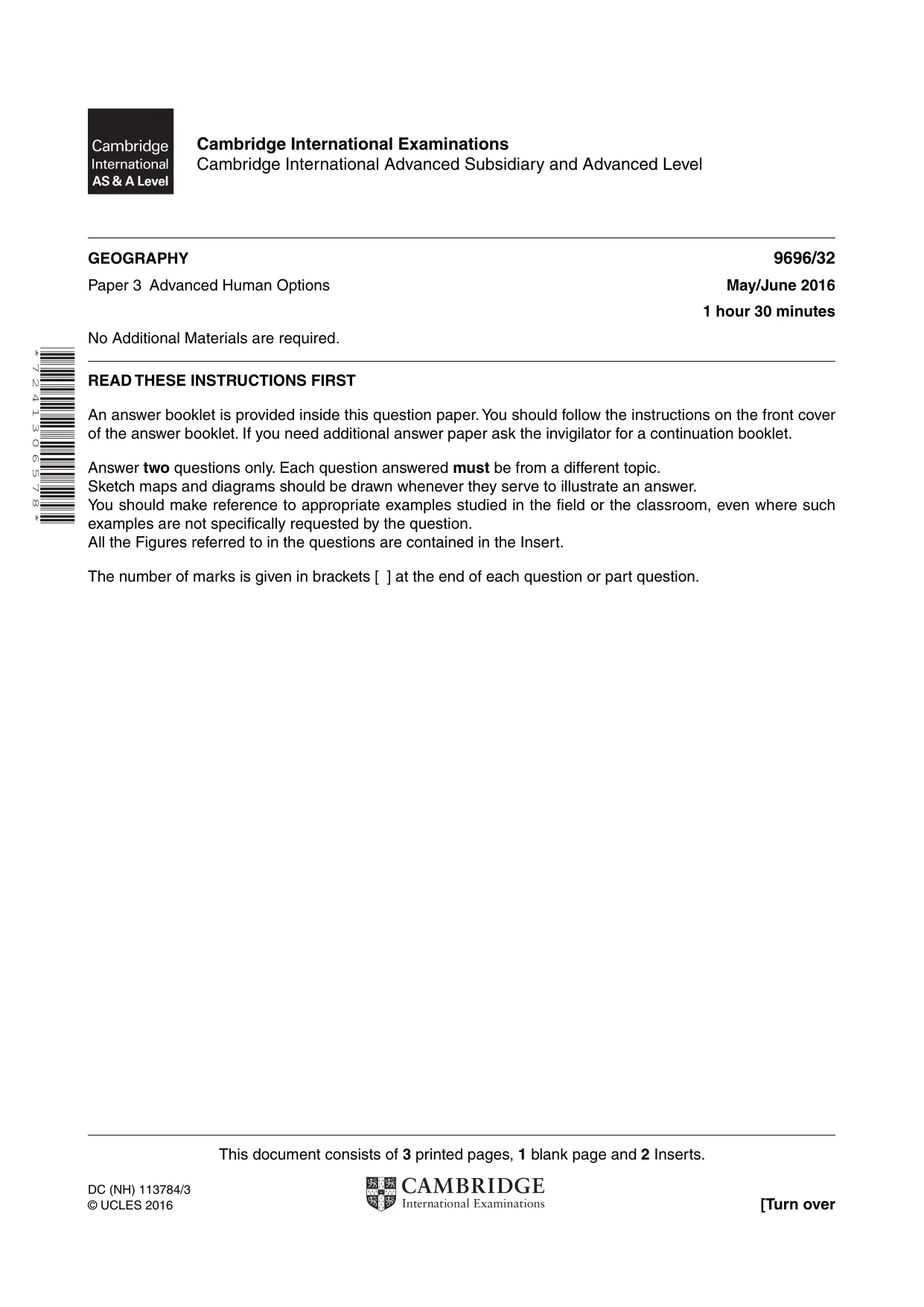
This document consists of 3 printed pages, 1 blank page and 2 Inserts. DC (NH) 113784/3 © UCLES 2016 [Turn over * 7 2 4 1 3 0 6 5 7 8 * GEOGRAPHY 9696/32 Paper 3 Advanced Human Options May/June 2016 1 hour 30 minutes No Additional Materials are required. READ THESE INSTRUCTIONS FIRST An answer booklet is provided inside this question paper. You should follow the instructions on the front cover of the answer booklet. If you need additional answer paper ask the invigilator for a continuation booklet. Answer two questions only. Each question answered must be from a different topic. Sketch maps and diagrams should be drawn whenever they serve to illustrate an answer. You should make reference to appropriate examples studied in the field or the classroom, even where such examples are not specifically requested by the question. All the Figures referred to in the questions are contained in the Insert. The number of marks is given in brackets [ ] at the end of each question or part question. Cambridge International Examinations Cambridge International Advanced Subsidiary and Advanced Level
Question paper, page 2
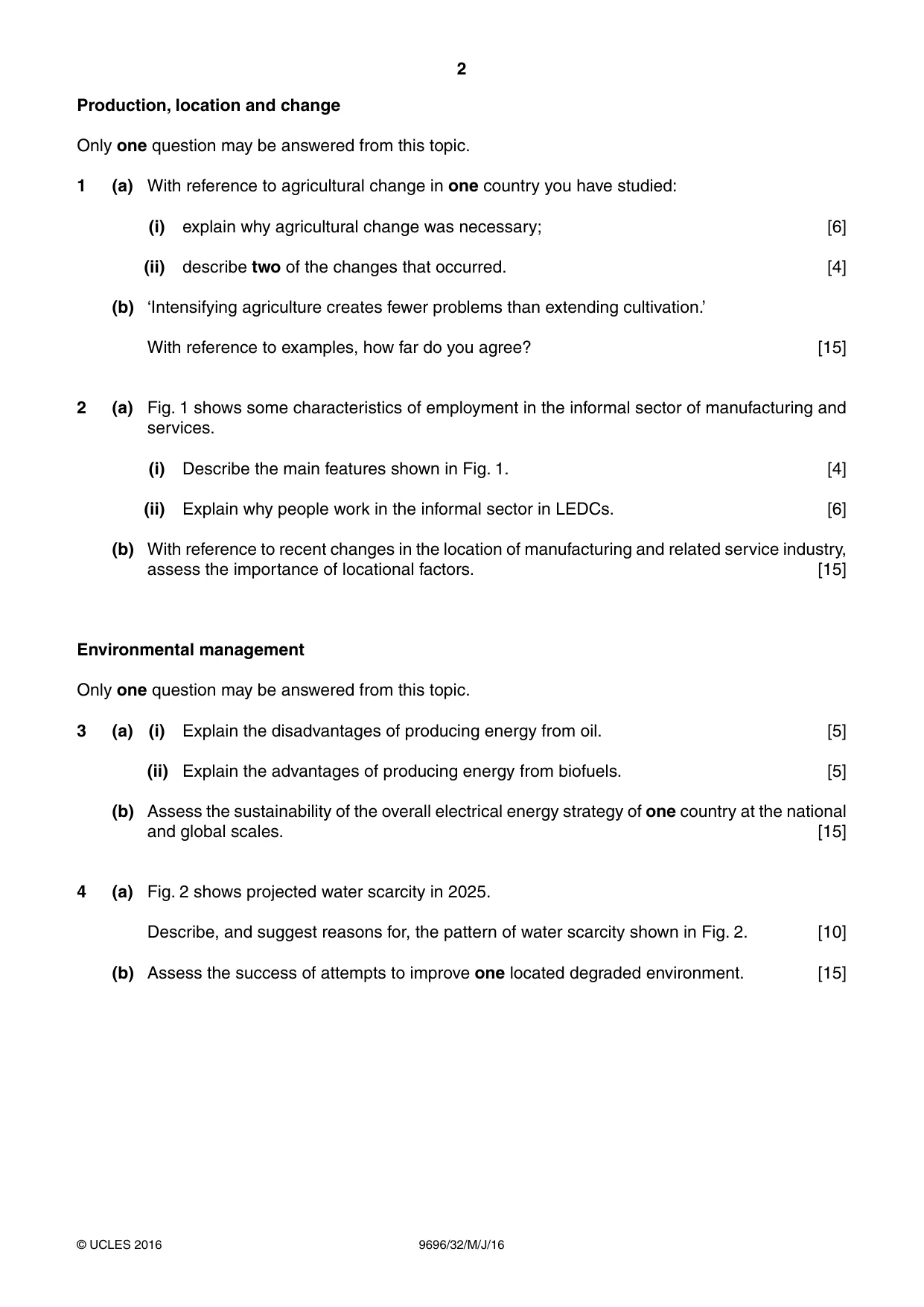
2 9696/32/M/J/16 © UCLES 2016 Production, location and change Only one question may be answered from this topic. 1 (a) With reference to agricultural change in one country you have studied: (i) explain why agricultural change was necessary; [6] (ii) describe two of the changes that occurred. [4] (b) ‘Intensifying agriculture creates fewer problems than extending cultivation.’ With reference to examples, how far do you agree? [15] 2 (a) Fig. 1 shows some characteristics of employment in the informal sector of manufacturing and services. (i) Describe the main features shown in Fig. 1. [4] (ii) Explain why people work in the informal sector in LEDCs. [6] (b) With reference to recent changes in the location of manufacturing and related service industry, assess the importance of locational factors. [15] Environmental management Only one question may be answered from this topic. 3 (a) (i) Explain the disadvantages of producing energy from oil. [5] (ii) Explain the advantages of producing energy from biofuels. [5] (b) Assess the sustainability of the overall electrical energy strategy of one country at the national and global scales. [15] 4 (a) Fig. 2 shows projected water scarcity in 2025. Describe, and suggest reasons for, the pattern of water scarcity shown in Fig. 2. [10] (b) Assess the success of attempts to improve one located degraded environment. [15]
Question paper, page 3
3 9696/32/M/J/16 © UCLES 2016 Global interdependence Only one question may be answered from this topic. 5 (a) Fig. 3 shows a poster promoting Fair Trade products in a small town in an MEDC. Describe how Fair Trade works and explain how Fair Trade improves the lives of producers in LEDCs. [10] (b) ‘Responsibility for causing LEDCs’ debt is shared by countries that lend money and countries that borrow money.’ With reference to examples, how far do you agree with this statement? [15] 6 (a) (i) Define the term carrying capacity as it applies to tourism. [3] (ii) Using examples, explain how carrying capacity can be linked to the life cycle model of tourism. [7] (b) With reference to one tourist area or resort, evaluate the impacts of tourism on the local environment and society. [15] Economic transition Only one question may be answered from this topic. 7 (a) Outline the nature and role in economic development of: (i) the primary sector; [5] (ii) the quaternary sector. [5] (b) ‘Deindustrialisation is a consequence of globalisation.’ Using examples, how far do you agree with this statement? [15] 8 (a) Fig. 4 shows the core-periphery model of regional development. Describe and explain the relationships between the different regions in the model. [10] (b) ‘Global inequalities in social and economic wellbeing are caused by human factors rather than by physical factors.’ How far do you agree with this statement? [15]
Question paper, page 4
4 9696/32/M/J/16 © UCLES 2016 BLANK PAGE Permission to reproduce items where third-party owned material protected by copyright is included has been sought and cleared where possible. Every reasonable effort has been made by the publisher (UCLES) to trace copyright holders, but if any items requiring clearance have unwittingly been included, the publisher will be pleased to make amends at the earliest possible opportunity. To avoid the issue of disclosure of answer-related information to candidates, all copyright acknowledgements are reproduced online in the Cambridge International Examinations Copyright Acknowledgements Booklet. This is produced for each series of examinations and is freely available to download at www.cie.org.uk after the live examination series. Cambridge International Examinations is part of the Cambridge Assessment Group. Cambridge Assessment is the brand name of University of Cambridge Local Examinations Syndicate (UCLES), which is itself a department of the University of Cambridge.
Mark scheme, page 1
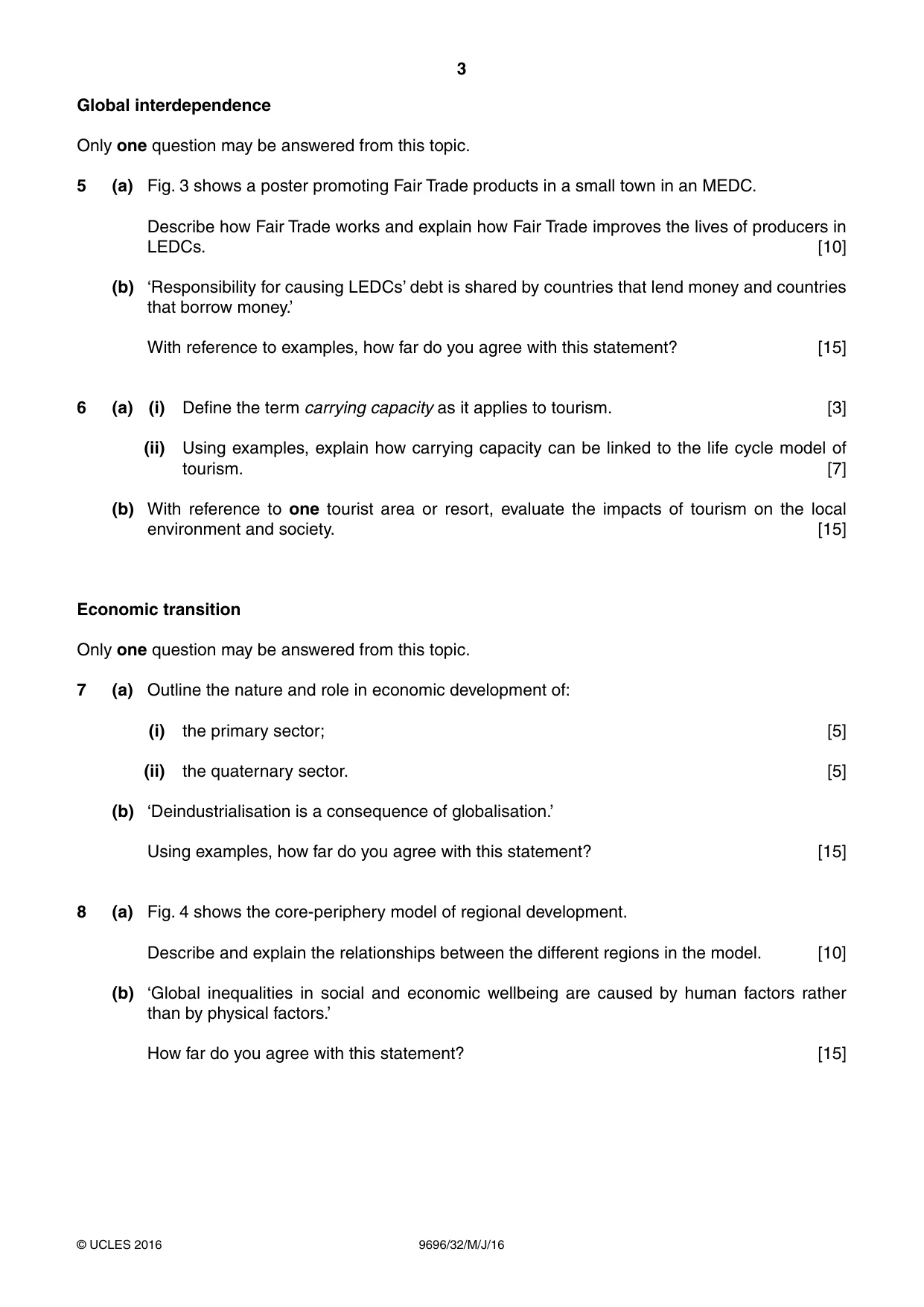
® IGCSE is the registered trademark of Cambridge International Examinations. This document consists of 16 printed pages. © UCLES 2016 [Turn over Cambridge International Examinations Cambridge International Advanced Subsidiary and Advanced Level GEOGRAPHY 9696/32 Paper 3 Advanced Human Options May/June 2016 MARK SCHEME Maximum Mark: 50 Published This mark scheme is published as an aid to teachers and candidates, to indicate the requirements of the examination. It shows the basis on which Examiners were instructed to award marks. It does not indicate the details of the discussions that took place at an Examiners’ meeting before marking began, which would have considered the acceptability of alternative answers. Mark schemes should be read in conjunction with the question paper and the Principal Examiner Report for Teachers. Cambridge will not enter into discussions about these mark schemes. Cambridge is publishing the mark schemes for the May/June 2016 series for most Cambridge IGCSE®, Cambridge International A and AS Level components and some Cambridge O Level components.
Mark scheme, page 2
Page 2 Mark Scheme Syllabus Paper Cambridge International AS/A Level – May/June 2016 9696 32 © Cambridge International Examinations 2016 Production, location and change Only one question may be answered from this topic. 1 (a) With reference to agricultural change in one country you have studied: (i) explain why agricultural change was necessary; [6] Both parts of the question refer to 1.2 in the syllabus. Change could be at the producer and/or national scale. Explanation might refer to internal or external factors such as the need for land reform, inefficient practices, response to changes in trading conditions, the need to increase food production, population growth etc. Mark on overall quality of reasoning, with reference to the three mark bands: 1–2, 3–4 and 5–6. A response which is not clearly based on a country could achieve max. 3. (ii) describe two of the changes that occurred. [4] Mark on quality on a 2+2 basis. If no country max. 1.
Mark scheme, page 3
Page 3 Mark Scheme Syllabus Paper Cambridge International AS/A Level – May/June 2016 9696 32 © Cambridge International Examinations 2016 (b) ‘Intensifying agriculture creates fewer problems than extending cultivation.’ With reference to examples, how far do you agree? [15] The question is based on paragraph 1.1 in the syllabus. Here content might refer to agricultural technology: irrigation, mechanisation, increased inputs such as the use of chemicals or to a broader approach about problems related to capital inputs. Candidates should clearly distinguish between intensification and extending cultivation. Material from paragraph 2.3, Environmental degradation, could be included, where there is reference to poor agricultural practices and deforestation. Problems might be at the scale of producer or nation and may be physical, social, economic or political in nature. Any view of the ease of both intensification and extension of cultivation is valid, if well-argued and supported with examples. Candidates will probably: Level 3 Show a thorough understanding of problems arising from both intensification and extension of cultivation, with detailed support. Provide an effective, well-structured assessment of the ease or otherwise of both aspects. [12–15] Level 2 Provide a reasonable assessment, which addresses both aspects of the question. Satisfactory as far as it goes, but is partial or limited in one or more of exemplar detail, understanding of either intensification or extension of cultivation and structure. [7–11] Level 1 Offer an account of basic quality which may describe but offer little or no effective assessment. Exemplar material may be weak or general. Notes and fragments remain at this level. [1-6] For no response, or no creditable response, 0.
Mark scheme, page 4
Page 4 Mark Scheme Syllabus Paper Cambridge International AS/A Level – May/June 2016 9696 32 © Cambridge International Examinations 2016 2 (a) Fig. 1 shows some characteristics of employment in the informal sector of manufacturing and services. (i) Describe the main features shown in Fig. 1. [4] As numbers increase, wages fall or vice-versa. Women earn less than men. Self-employed or employers earning the most, again mostly male. Employees earn less but the least is for earnings from home or outwork. The fourth mark could be reserved for a comment on linking all three variables. (ii) Explain why people work in the informal sector in LEDCs. [6] Both parts of (a) come from paragraph 1.3 in the syllabus. A variety of reasons could be offered related to the sector itself or individual choice (or lack of). Top band responses should clearly refer to LEDCs. Mark on overall quality, with reference to the three mark bands 1–2, 3–4 and 5–6. (b) With reference to recent changes in the location of manufacturing and related service industry, assess the importance of locational factors. [15] Reference to ‘recent’ changes has been included to focus candidates’ attention on the time scale referred to in the syllabus. Material from paragraphs 1.3 and 1.4 could be included. Reference can be made to both manufacturing and related service industry, although more comment is expected on manufacturing. Comment on the service sector must be that related to manufacturing. Focus on the locational element of both recent changes and factors could characterise a high level response. An argument including some factors that have not changed in importance is perfectly acceptable and could contribute to the character of a higher level response. Focus is on location only. Candidates will probably: Level 3 Show detailed knowledge and understanding of locational factors and recent changes in location. Use sound evidence to structure an impressive assessment of change in the importance of a range of factors. May consider factors which have not changed and/or assesses the relative importance of factors. [12–15] Level 2 Have a reasonable knowledge of locational changes with some specific examples. May consider a narrow range of factors and/or include limited development of an assessment. At the lower end, may have little on the importance of factors, take a more descriptive approach or be unbalanced towards either the changes or factors. [7-11] Level 1 Take an approach which is basic, and may be generalised or refers to examples in name only and offers little or no assessment. Much of the response is dated. Respond with notes or fragments. [1-6] For no response, or no creditable response, 0.
Mark scheme, page 5
Page 5 Mark Scheme Syllabus Paper Cambridge International AS/A Level – May/June 2016 9696 32 © Cambridge International Examinations 2016 Environmental management Only one question may be answered from this topic. 3 (a) (i) Explain the disadvantages of producing energy from oil. [5] Both parts of (a) are based on paragraph 2.1 of the syllabus. Disadvantages could be related to the extraction of oil, the actual production of energy from oil-such as the polluting effects of burning in power stations or at a more local scale or they could be related to transport. The use of examples would enhance a response. Mark on overall quality, bearing in mind three mark bands: 1–2, 3–4 and 5. One disadvantage only, max.3. (ii) Explain the advantages of producing energy from biofuels. [5] Expect comment along the lines of: plant-based fuels come from renewable sources, can be grown anywhere and have lower carbon emissions compared to fossil fuels; biofuels help economies by providing jobs in agriculture and manufacturing and also reduce dependency on imports; biofuels are adaptable to current engine designs and perform very well in most conditions; they are easy to source and renewable – made from many different sources such as manure, waste from crops and plants grown specifically for the fuel. The use of examples would enhance a response. Mark on overall quality, bearing in mind three mark bands: 1–2, 3–4 and 5. One advantage only, max.3.
Mark scheme, page 6
Page 6 Mark Scheme Syllabus Paper Cambridge International AS/A Level – May/June 2016 9696 32 © Cambridge International Examinations 2016 (b) Assess the sustainability of the electrical energy strategy of one country at the national and global scales. [15] Taken from paragraph 2.2 of the syllabus. Energy strategy includes more than power generation. It could include measures to reduce use, conservation of heat or political factors. Sustainability could refer to the balance between domestic production and imports, energy security, pollution issues or longevity of sources. Specific reference to one country’s strategy and exemplification of sustainability is expected for a higher level response. The invitation to consider the global scale allows consideration of issues such as global warming and climate change but there should be some balance of the two scales. If more than one country’s strategy is attempted, mark each separately and credit the better or best response. Candidates will probably: Level 3 Provide a high quality assessment of the energy strategy’s sustainability at both national and global scales. Impress by perspective, supportive detail and breadth of understanding including the overall aspect. [12–15] Level 2 Give a reasonable coverage of both aspects of strategy and sustainability with some imbalance between the two. Attempts to consider both scales. Satisfactory as far as it goes, with limitations of assessment and support detail. [7–11] Level 1 Show limited background to the topic and make a largely descriptive account of energy production rather than strategy. Does not consider sustainability. Focus on one scheme alone. Offer little or no assessment. Notes and fragments remain in this level. [1-6] For no response, or no creditable response, 0.
Mark scheme, page 7
Page 7 Mark Scheme Syllabus Paper Cambridge International AS/A Level – May/June 2016 9696 32 © Cambridge International Examinations 2016 4 (a) Fig. 2 shows projected water scarcity in 2025. Describe, and suggest reasons for, the pattern of water scarcity shown in Fig. 2. [10] Syllabus paragraph 2.3 refers to water demand and supply. The two categories have different patterns and the simple definitions are given to assist candidates to understand the difference in scarcity types. Detailed responses are not required for either pattern or suggested reasons. Comparative points are valid. Pattern for physical water scarcity is generally at higher latitudes and mostly in the northern hemisphere than economic scarcity (closer to the equator). Physical is more spread out (every continent shown), whilst economic is more continuous, especially in Africa. NE Brazil is anomalous in the physical pattern. Reasons should be valid to the type being considered. There are examples of climates both with and without large amounts of precipitation for both categories. Human factors can and should be considered: physical scarcity is related to over-use, so any factor linked to this is valid; economic is related to availability of capital. Top band responses might note that the map refers to a projection. Mark holistically, bearing in mind the mark bands 1–4, 5–7, 8–10. Max. 5 for a descriptive only response. For no response, or no creditable response, 0.
Mark scheme, page 8
Page 8 Mark Scheme Syllabus Paper Cambridge International AS/A Level – May/June 2016 9696 32 © Cambridge International Examinations 2016 (b) Assess the success of attempts to improve one located degraded environment. [15] Based on paragraph 2.4 of the syllabus, the case study of environmental degradation. Causes of degradation and the problems arising are not specifically asked for but reference to both of these might allow assessment of the success of the attempts to be more robust. Candidates may select one environment from a broad scale to a more localised example. Attempts may be policies and/or practices. Effectiveness may cover successes and failures or reference to early stages of implementation and maybe related to the environment or people’s lives. If more than one degraded environment is attempted, mark each separately and credit the better or best response. Candidates will probably: Level 3 Produce a detailed, well-structured response, with sound exemplar support. Assessment of the success is clear with detail of the degree of success achieved so far. Constraints or restricting factors are incorporated into the assessment to explain why success is limited. A clear environment and specific attempts are present. [12–15] Level 2 Develop a response, which is good in parts, but remains limited in one or more of case detail, conceptual grasp or assessment. Satisfactory as far as it goes. At the lower end the detail on attempts is less convincing. Max. 10 for only one attempt. [7-11] Level 1 Make a response which is more of a description than an assessment. Lack specific knowledge about attempts. The environment is not clearly described. Fragmentary and note-form responses remain in this level. [1–6] For no response, or no creditable response, 0.
Mark scheme, page 9
Page 9 Mark Scheme Syllabus Paper Cambridge International AS/A Level – May/June 2016 9696 32 © Cambridge International Examinations 2016 Global interdependence Only one question may be answered from this topic. 5 (a) Fig. 3 shows a poster promoting Fair Trade products in a small town in an MEDC. Describe how Fair Trade works and explain how Fair Trade improves the lives of producers in LEDCs. [10] The question refers to paragraph 3.1 of the syllabus. There are two aspects: how Fair Trade works and improving the lives of producers. Improving lives is more than increased income. The use of examples of places, companies or specific products would enhance a response, if additional to those on Fig. 3. For description or for explanation only, Max. 5. Mark holistically, bearing in mind the mark bands 1–4, 5–7, 8–10.
Mark scheme, page 10
Page 10 Mark Scheme Syllabus Paper Cambridge International AS/A Level – May/June 2016 9696 32 © Cambridge International Examinations 2016 (b) ‘Responsibility for causing LEDCs’ debt is shared by countries that lend money and countries that borrow money.’ With reference to examples, how far do you agree with this statement? [15] The question is based on paragraph 3.2 of the syllabus. The term responsibility is used to engender a debate so engagement with this aspect could be a characteristic of a higher level response. Reference to debt in MEDCs is not valid. Borrowers should be interpreted at the National scale and equate to government. Arguments might focus on issues such as: inappropriate development policies, corruption, mismanagement, political instability, lack of ability or unwise decisions. Many of these arguments are criticised as being too simplistic, so support from examples would help. The role of the lenders is much less common in the literature available, so understanding of this aspect will enhance a response. Alternative causes such as global recession, unfair trade, dependency, repayment in hard currencies, refinancing, etc. might be considered and would further enhance the argument. Reference to the oil crisis of the 1970s, the formation of OPEC and facilitating of lending by MEDCs, global economic recession and high interest rates in the early 1980s are also valid. Candidates will probably: Level 3 Show a thorough understanding of causes of debt with detailed support. Provide an effective, well-structured argument and assessment addressing the responsibility of lenders and borrowers. Impress by perspective on a difficult issue. [12–15] Level 2 Provide a reasonable assessment, which addresses both aspects of the question. Satisfactory as far as it goes but is partial or limited in one or more of exemplar detail, understanding of lender or receiver responsibility and structure. [7-11] Level 1 Offer an account of basic quality which may describe some causes but refers to only one aspect of lenders or borrowers with no other factors introduced. Offers little or no effective assessment. Exemplar material may be weak or general. Notes and fragments remain at this level. [1-6] For no response, or no creditable response, 0.
Mark scheme, page 11
Page 11 Mark Scheme Syllabus Paper Cambridge International AS/A Level – May/June 2016 9696 32 © Cambridge International Examinations 2016 6 (a) (i) Define the term carrying capacity as it applies to tourism. [3] Tourism Carrying Capacity is defined by the World Tourism Organization as “The maximum number of people that may visit a tourist destination at the same time, without causing destruction of the physical, economic, socio-cultural environment and an unacceptable decrease in the quality of visitor satisfaction”. Carrying capacity is the point at which a destination or attraction starts experiencing adverse effects as a result of the number of visitors. The approach taken might focus on either the numbers aspect or the point in time. The definition is not prescriptive of the detail required or way in which the answer has to be stated. Reserve 1 mark for reference to the maximum number of tourists or visitors. (ii) Using examples, explain how carrying capacity can be linked to the life cycle model of tourism. [7] Both parts of (a) refer to paragraph 3.3 of the syllabus. Carrying capacity is fundamental to the model. Maximum capacity without deterioration is reached in the stage of stagnation. After this point the resort or area has decisions to make regarding future development or decline in the growth of numbers visiting. In earlier stages the area or resort is able to expand facilities and area to cope with rising numbers such that the visitor experience is not affected. Some candidates understand less well the rise and fall in the numbers aspect of the model, ignoring the fact that in stagnation there are still large numbers of tourists. Without examples, max. 4 and for one example only, max. 5. Examples could be either places or stages of the model. Mark on overall quality, with reference to the three mark bands 1–2, 3–5 and 6–7.
Mark scheme, page 12
Page 12 Mark Scheme Syllabus Paper Cambridge International AS/A Level – May/June 2016 9696 32 © Cambridge International Examinations 2016 (b) With reference to one tourist area or resort, evaluate the impacts of tourism on the local environment and society. [15] The question refers to paragraph 3.4 of the syllabus. There are four clear aspects to focus on: the question asks for one tourist area or resort, the scale is local and the impacts are on environment and society. Evaluation as a command could be viewed as an invitation to outline the advantages and disadvantages. This is acceptable but may be self-limiting. Candidates who develop the evaluation to consider the extent, importance or relative merits/demerits would have an enhanced response. Comments on economic impacts are not valid unless clearly linked to environment or society. If more than one tourist area or resort is attempted, mark each separately and credit the better or best response. Candidates will probably: Level 3 Develop a high quality response, offering an evaluation with detailed support. Considers both environment and society in a perceptive fashion structuring the response well. [12–15] Level 2 Provide a response of sound to good quality, which is satisfactory as far as it goes, but which remains underdeveloped in detail, scope or in the evaluation made. Max. 10 for a response on one of local environment or society. [7-11] Level 1 Make a response which is more of a description than an evaluation and which may lack content and focus. Write broadly or generally about tourism. Offer fragments or notes. [1-6] For no response, or no creditable response, 0.
Mark scheme, page 13
Page 13 Mark Scheme Syllabus Paper Cambridge International AS/A Level – May/June 2016 9696 32 © Cambridge International Examinations 2016 Economic transition Only one question may be answered from this topic. 7 (a) Outline the nature and role in economic development of: (i) the primary sector; [5] The primary sector produces or collects raw materials from natural resources by agriculture, forestry, fishing and extractive industries. It also includes preparing for packaging for shipping, sale. The role is to provide raw materials for other sectors of the economy, especially manufacturing. In economic development it provides a capital source for the development of other sectors. The primary sector varies in size and importance as economic development progresses being larger and more important in early stages. A response would be enhanced by examples for LEDCs or MEDCs and/or the special case of major oil exporters. Mark on overall quality, bearing in mind three mark bands: 1–2, 3–4 and 5. For only nature or role, max. 3. (ii) the quaternary sector. [5] The quaternary sector is based on knowledge, usually involving the provision of services, including: information gathering, distribution and technology; research and development; vocational education; business consulting; and strategic financial services. More simply it involves research and investment in the knowledge-based part of the economy. The role of the quaternary sector is to ensure further expansion and to generate higher returns. Research is directed into cutting costs, tapping into markets, producing innovative ideas, new production methods and methods of manufacture. Mark on overall quality, bearing in mind three mark bands: 1–2, 3–4 and 5. For only nature or role, max. 3.
Mark scheme, page 14
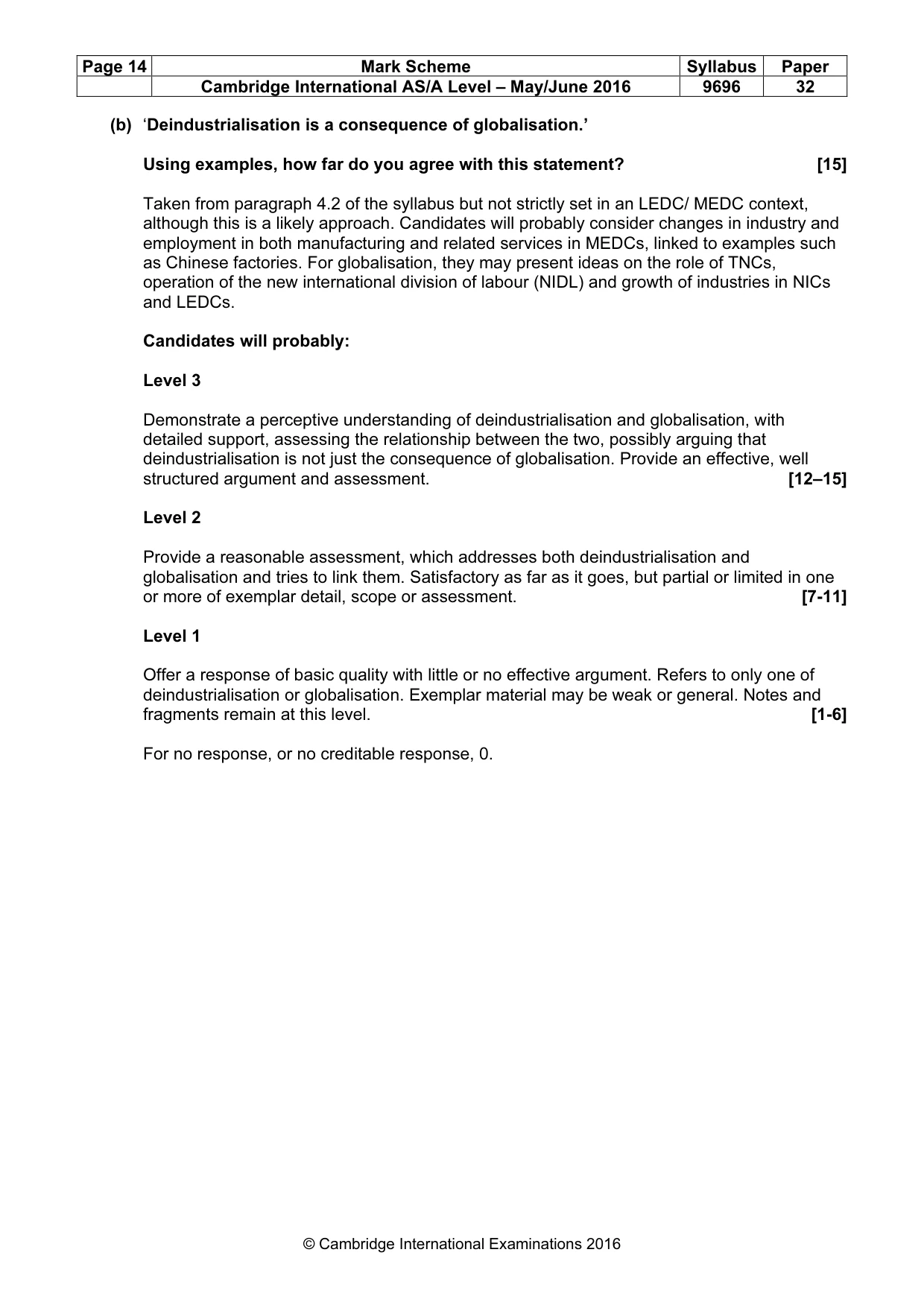
Page 14 Mark Scheme Syllabus Paper Cambridge International AS/A Level – May/June 2016 9696 32 © Cambridge International Examinations 2016 (b) ‘Deindustrialisation is a consequence of globalisation.’ Using examples, how far do you agree with this statement? [15] Taken from paragraph 4.2 of the syllabus but not strictly set in an LEDC/ MEDC context, although this is a likely approach. Candidates will probably consider changes in industry and employment in both manufacturing and related services in MEDCs, linked to examples such as Chinese factories. For globalisation, they may present ideas on the role of TNCs, operation of the new international division of labour (NIDL) and growth of industries in NICs and LEDCs. Candidates will probably: Level 3 Demonstrate a perceptive understanding of deindustrialisation and globalisation, with detailed support, assessing the relationship between the two, possibly arguing that deindustrialisation is not just the consequence of globalisation. Provide an effective, well structured argument and assessment. [12–15] Level 2 Provide a reasonable assessment, which addresses both deindustrialisation and globalisation and tries to link them. Satisfactory as far as it goes, but partial or limited in one or more of exemplar detail, scope or assessment. [7-11] Level 1 Offer a response of basic quality with little or no effective argument. Refers to only one of deindustrialisation or globalisation. Exemplar material may be weak or general. Notes and fragments remain at this level. [1-6] For no response, or no creditable response, 0.
Mark scheme, page 15
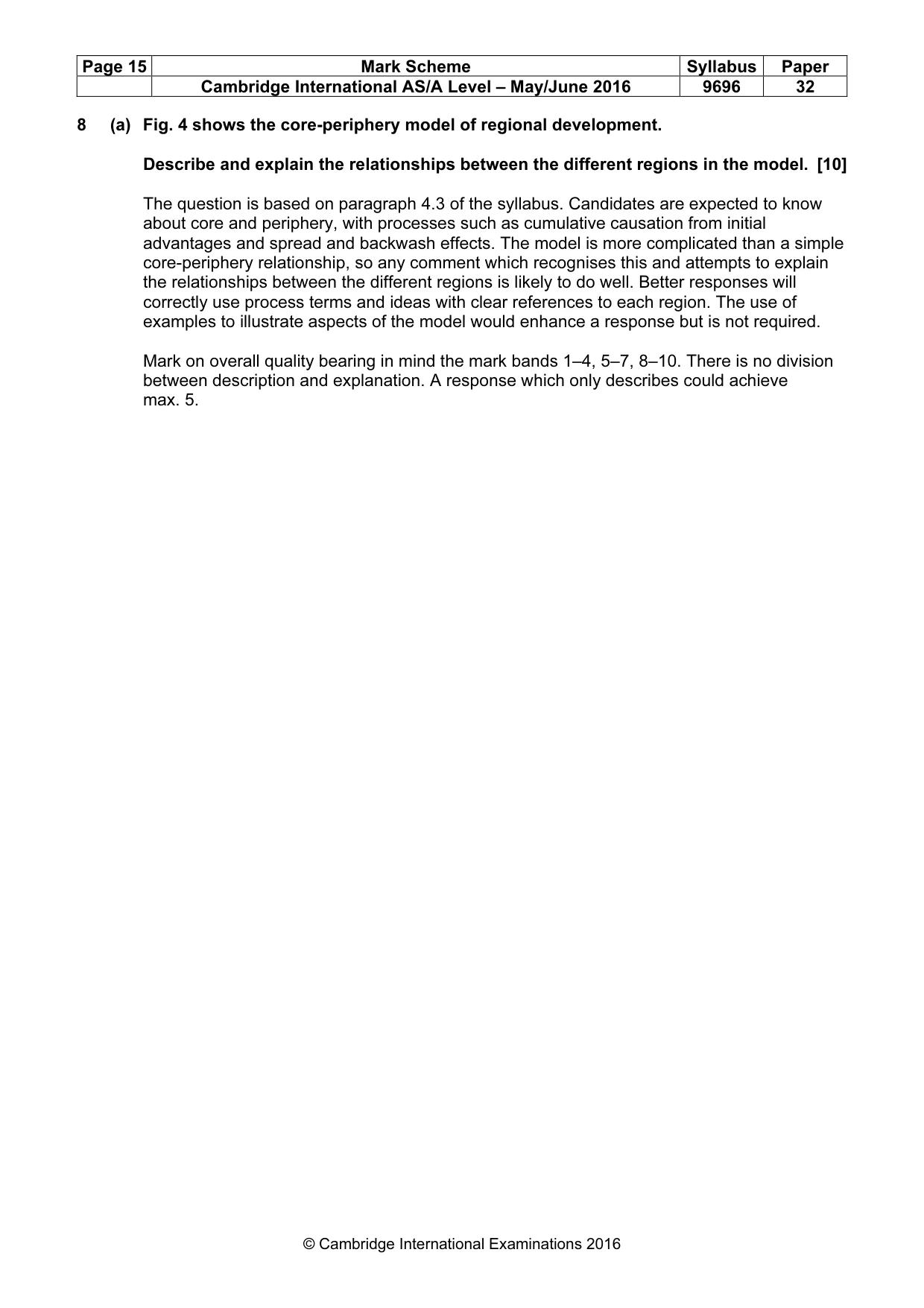
Page 15 Mark Scheme Syllabus Paper Cambridge International AS/A Level – May/June 2016 9696 32 © Cambridge International Examinations 2016 8 (a) Fig. 4 shows the core-periphery model of regional development. Describe and explain the relationships between the different regions in the model. [10] The question is based on paragraph 4.3 of the syllabus. Candidates are expected to know about core and periphery, with processes such as cumulative causation from initial advantages and spread and backwash effects. The model is more complicated than a simple core-periphery relationship, so any comment which recognises this and attempts to explain the relationships between the different regions is likely to do well. Better responses will correctly use process terms and ideas with clear references to each region. The use of examples to illustrate aspects of the model would enhance a response but is not required. Mark on overall quality bearing in mind the mark bands 1–4, 5–7, 8–10. There is no division between description and explanation. A response which only describes could achieve max. 5.
Mark scheme, page 16
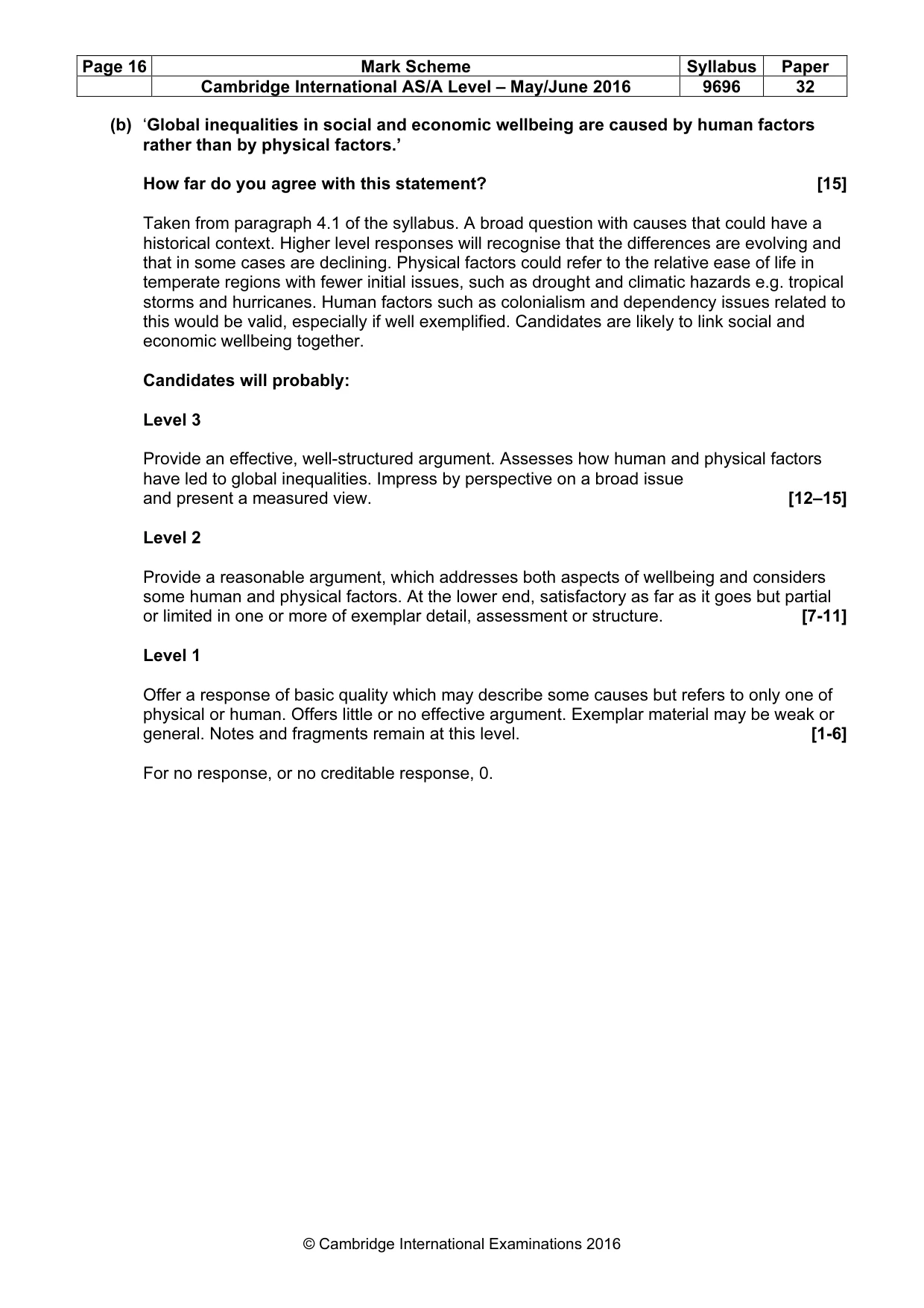
Page 16 Mark Scheme Syllabus Paper Cambridge International AS/A Level – May/June 2016 9696 32 © Cambridge International Examinations 2016 (b) ‘Global inequalities in social and economic wellbeing are caused by human factors rather than by physical factors.’ How far do you agree with this statement? [15] Taken from paragraph 4.1 of the syllabus. A broad question with causes that could have a historical context. Higher level responses will recognise that the differences are evolving and that in some cases are declining. Physical factors could refer to the relative ease of life in temperate regions with fewer initial issues, such as drought and climatic hazards e.g. tropical storms and hurricanes. Human factors such as colonialism and dependency issues related to this would be valid, especially if well exemplified. Candidates are likely to link social and economic wellbeing together. Candidates will probably: Level 3 Provide an effective, well-structured argument. Assesses how human and physical factors have led to global inequalities. Impress by perspective on a broad issue and present a measured view. [12–15] Level 2 Provide a reasonable argument, which addresses both aspects of wellbeing and considers some human and physical factors. At the lower end, satisfactory as far as it goes but partial or limited in one or more of exemplar detail, assessment or structure. [7-11] Level 1 Offer a response of basic quality which may describe some causes but refers to only one of physical or human. Offers little or no effective argument. Exemplar material may be weak or general. Notes and fragments remain at this level. [1-6] For no response, or no creditable response, 0.
What you needed in this session
Cambridge’s own grade thresholds for 2016 May/June, Paper 3 · Variant 2. A higher threshold means an easier paper — the bar moves with how the cohort did.