Cambridge A Level General Paper (AS Level only) 8004 — 2016 Oct/Nov Paper 1 · Variant 2
8004/12/O/N/16 · 100 marks · ≈113 min
The question paper and its mark scheme, free to read here and free to download. This is Cambridge’s own paper, exactly as it was sat.
Question paper4 pages

Mark scheme9 pages
Answers below. Sit the paper first if you are practising.
Paper as text
Question paper, page 1
This document consists of 2 printed pages, 2 blank pages and 1 insert. DC (KN) 118313/3 © UCLES 2016 [Turn over Cambridge International Examinations Cambridge International Advanced Subsidiary Level * 6 1 4 6 9 2 6 0 6 3 * GENERAL PAPER 8004/12 October/November 2016 2 hours No Additional Materials are required. READ THESE INSTRUCTIONS FIRST An answer booklet is provided inside this question paper. You should follow the instructions on the front cover of the answer booklet. If you need additional answer paper ask the invigilator for a continuation booklet. Answer two questions. Each question must be taken from a different section. Use examples to support your arguments. Each answer should be about 500–600 words in length. Short answers may score lower marks. All questions in this paper carry equal marks.
Question paper, page 2
2 8004/12/O/N/16 © UCLES 2016 BLANK PAGE
Question paper, page 3
3 8004/12/O/N/16 © UCLES 2016 Each essay should be 500–600 words long. Use examples to support your arguments. Section 1 1 To what extent might a country’s tourist industry harm the local people? 2 In the world today, how difficult is it to feel optimistic, rather than pessimistic, about the future? 3 Examine why some democratic countries find it difficult to hold ‘safe and fair’ elections. 4 ‘Noise pollution is a real threat to quality of life.’ To what extent is this true in your country? Section 2 5 There are many opinions regarding the environment and how we should treat it. Explain what would be the most effective environmental initiative that could be taken. 6 To what extent does climate determine the types of buildings in a country? Justify your answer. 7 Should everyone have access to free medical care? 8 ‘Our understanding of modern technology is enhanced by knowledge of mathematics.’ Discuss. Section 3 9 Consider the value of films and/or books which contain material intended to provoke or disturb. 10 ‘The photograph rarely tells the whole truth.’ Discuss. 11 Assess whether traditional stories with which you are familiar have any relevance to the modern world. 12 Assess the cultural and social importance of dance in your community.
Question paper, page 4
4 8004/12/O/N/16 © UCLES 2016 Permission to reproduce items where third-party owned material protected by copyright is included has been sought and cleared where possible. Every reasonable effort has been made by the publisher (UCLES) to trace copyright holders, but if any items requiring clearance have unwittingly been included, the publisher will be pleased to make amends at the earliest possible opportunity. To avoid the issue of disclosure of answer-related information to candidates, all copyright acknowledgements are reproduced online in the Cambridge International Examinations Copyright Acknowledgements Booklet. This is produced for each series of examinations and is freely available to download at www.cie.org.uk after the live examination series. Cambridge International Examinations is part of the Cambridge Assessment Group. Cambridge Assessment is the brand name of University of Cambridge Local Examinations Syndicate (UCLES), which is itself a department of the University of Cambridge. BLANK PAGE
Mark scheme, page 1
® IGCSE is the registered trademark of Cambridge International Examinations. This document consists of 9 printed pages. © UCLES 2016 [Turn over Cambridge International Examinations Cambridge International Advanced Subsidiary Level GENERAL PAPER 8004/12 Paper 1 October/November 2016 MARK SCHEME Maximum Mark: 100 Published This mark scheme is published as an aid to teachers and candidates, to indicate the requirements of the examination. It shows the basis on which Examiners were instructed to award marks. It does not indicate the details of the discussions that took place at an Examiners’ meeting before marking began, which would have considered the acceptability of alternative answers. Mark schemes should be read in conjunction with the question paper and the Principal Examiner Report for Teachers. Cambridge will not enter into discussions about these mark schemes. Cambridge is publishing the mark schemes for the October/November 2016 series for most Cambridge IGCSE®, Cambridge International A and AS Level components and some Cambridge O Level components.
Mark scheme, page 2
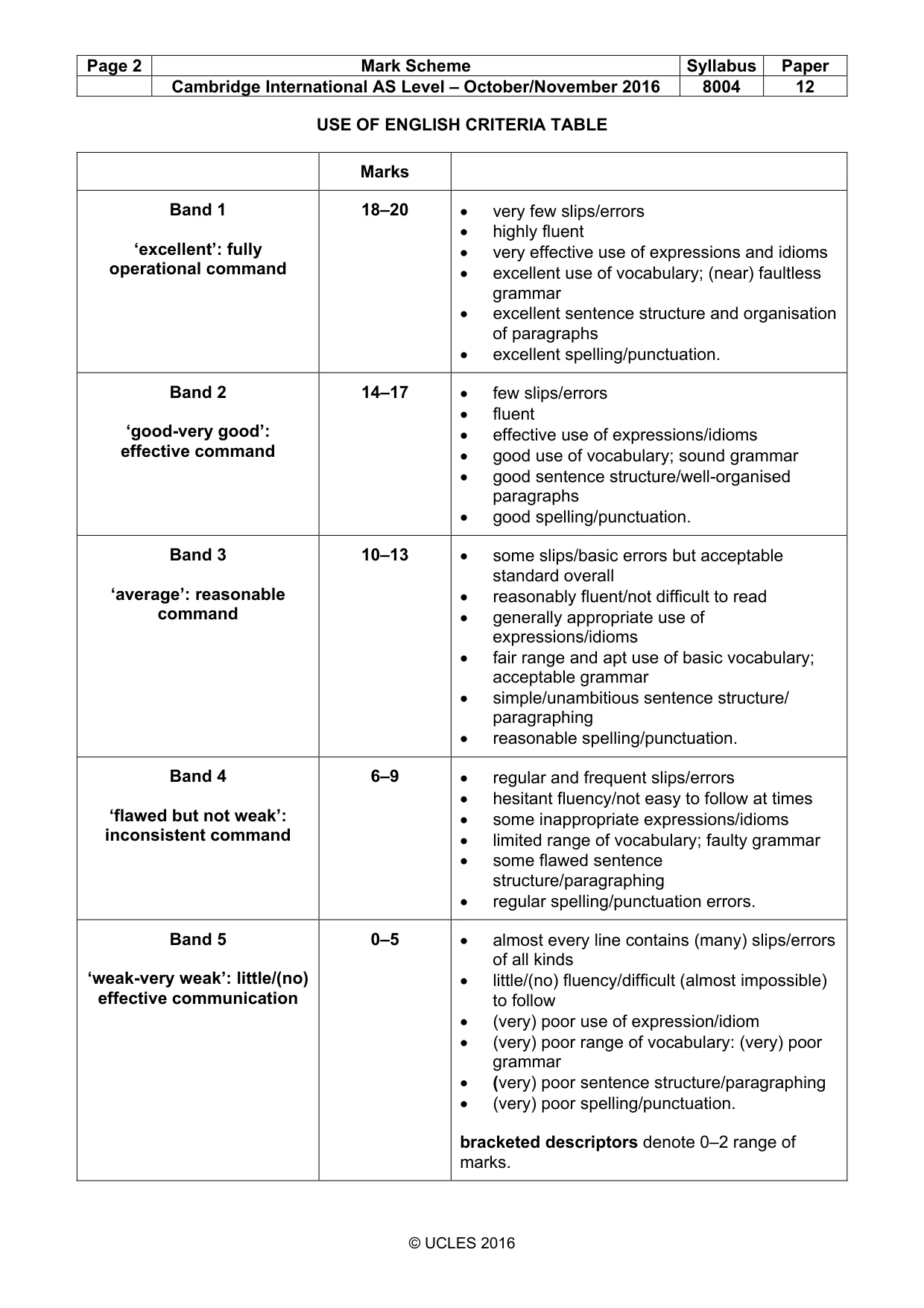
Page 2 Mark Scheme Syllabus Paper Cambridge International AS Level – October/November 2016 8004 12 © UCLES 2016 USE OF ENGLISH CRITERIA TABLE Marks Band 1 ‘excellent’: fully operational command 18–20 • very few slips/errors • highly fluent • very effective use of expressions and idioms • excellent use of vocabulary; (near) faultless grammar • excellent sentence structure and organisation of paragraphs • excellent spelling/punctuation. Band 2 ‘good-very good’: effective command 14–17 • few slips/errors • fluent • effective use of expressions/idioms • good use of vocabulary; sound grammar • good sentence structure/well-organised paragraphs • good spelling/punctuation. Band 3 ‘average’: reasonable command 10–13 • some slips/basic errors but acceptable standard overall • reasonably fluent/not difficult to read • generally appropriate use of expressions/idioms • fair range and apt use of basic vocabulary; acceptable grammar • simple/unambitious sentence structure/ paragraphing • reasonable spelling/punctuation. Band 4 ‘flawed but not weak’: inconsistent command 6–9 • regular and frequent slips/errors • hesitant fluency/not easy to follow at times • some inappropriate expressions/idioms • limited range of vocabulary; faulty grammar • some flawed sentence structure/paragraphing • regular spelling/punctuation errors. Band 5 ‘weak-very weak’: little/(no) effective communication 0–5 • almost every line contains (many) slips/errors of all kinds • little/(no) fluency/difficult (almost impossible) to follow • (very) poor use of expression/idiom • (very) poor range of vocabulary: (very) poor grammar • (very) poor sentence structure/paragraphing • (very) poor spelling/punctuation. bracketed descriptors denote 0–2 range of marks.
Mark scheme, page 3
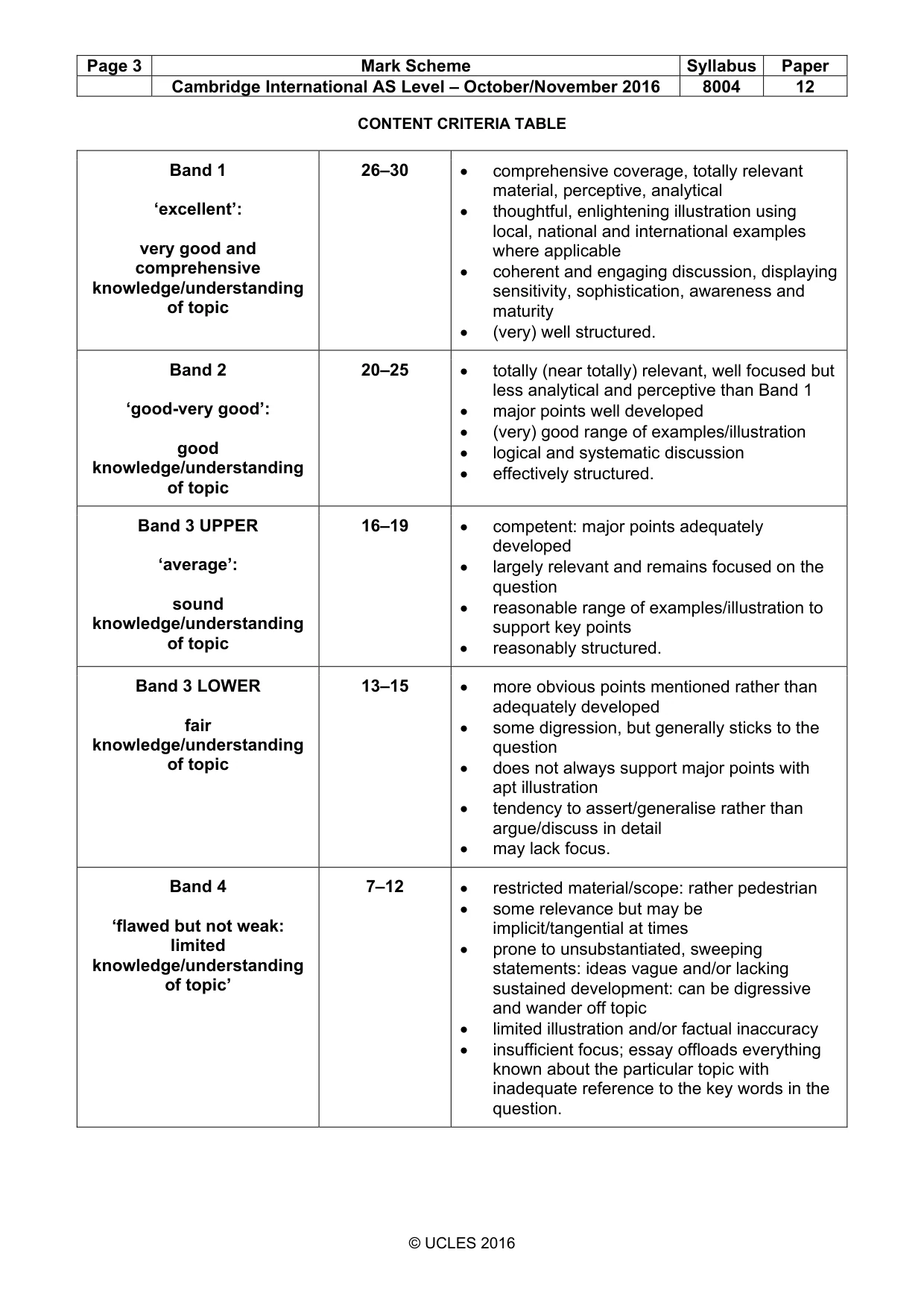
Page 3 Mark Scheme Syllabus Paper Cambridge International AS Level – October/November 2016 8004 12 © UCLES 2016 CONTENT CRITERIA TABLE Band 1 ‘excellent’: very good and comprehensive knowledge/understanding of topic 26–30 • comprehensive coverage, totally relevant material, perceptive, analytical • thoughtful, enlightening illustration using local, national and international examples where applicable • coherent and engaging discussion, displaying sensitivity, sophistication, awareness and maturity • (very) well structured. Band 2 ‘good-very good’: good knowledge/understanding of topic 20–25 • totally (near totally) relevant, well focused but less analytical and perceptive than Band 1 • major points well developed • (very) good range of examples/illustration • logical and systematic discussion • effectively structured. Band 3 UPPER ‘average’: sound knowledge/understanding of topic 16–19 • competent: major points adequately developed • largely relevant and remains focused on the question • reasonable range of examples/illustration to support key points • reasonably structured. Band 3 LOWER fair knowledge/understanding of topic 13–15 • more obvious points mentioned rather than adequately developed • some digression, but generally sticks to the question • does not always support major points with apt illustration • tendency to assert/generalise rather than argue/discuss in detail • may lack focus. Band 4 ‘flawed but not weak: limited knowledge/understanding of topic’ 7–12 • restricted material/scope: rather pedestrian • some relevance but may be implicit/tangential at times • prone to unsubstantiated, sweeping statements: ideas vague and/or lacking sustained development: can be digressive and wander off topic • limited illustration and/or factual inaccuracy • insufficient focus; essay offloads everything known about the particular topic with inadequate reference to the key words in the question.
Mark scheme, page 4
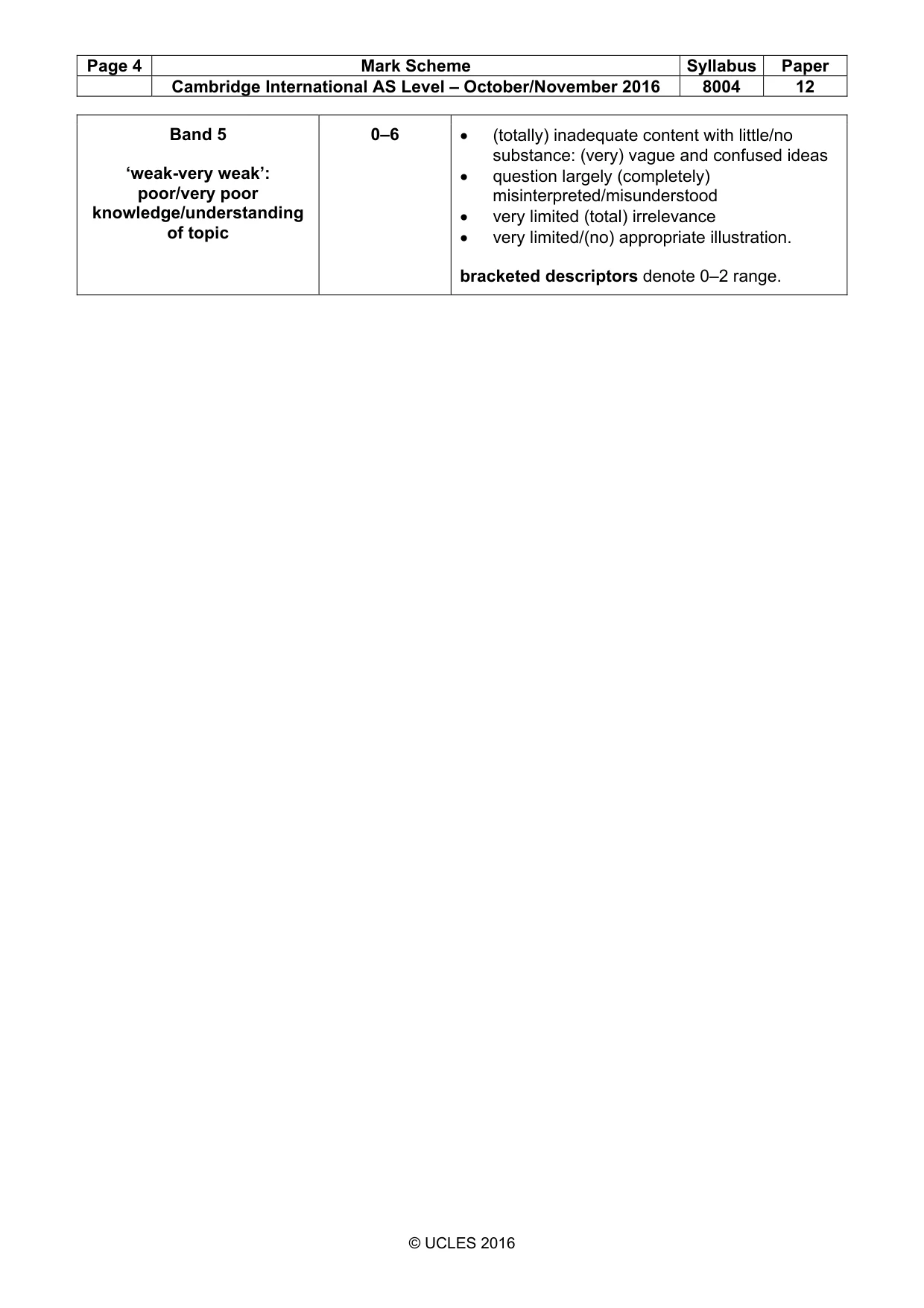
Page 4 Mark Scheme Syllabus Paper Cambridge International AS Level – October/November 2016 8004 12 © UCLES 2016 Band 5 ‘weak-very weak’: poor/very poor knowledge/understanding of topic 0–6 • (totally) inadequate content with little/no substance: (very) vague and confused ideas • question largely (completely) misinterpreted/misunderstood • very limited (total) irrelevance • very limited/(no) appropriate illustration. bracketed descriptors denote 0–2 range.
Mark scheme, page 5
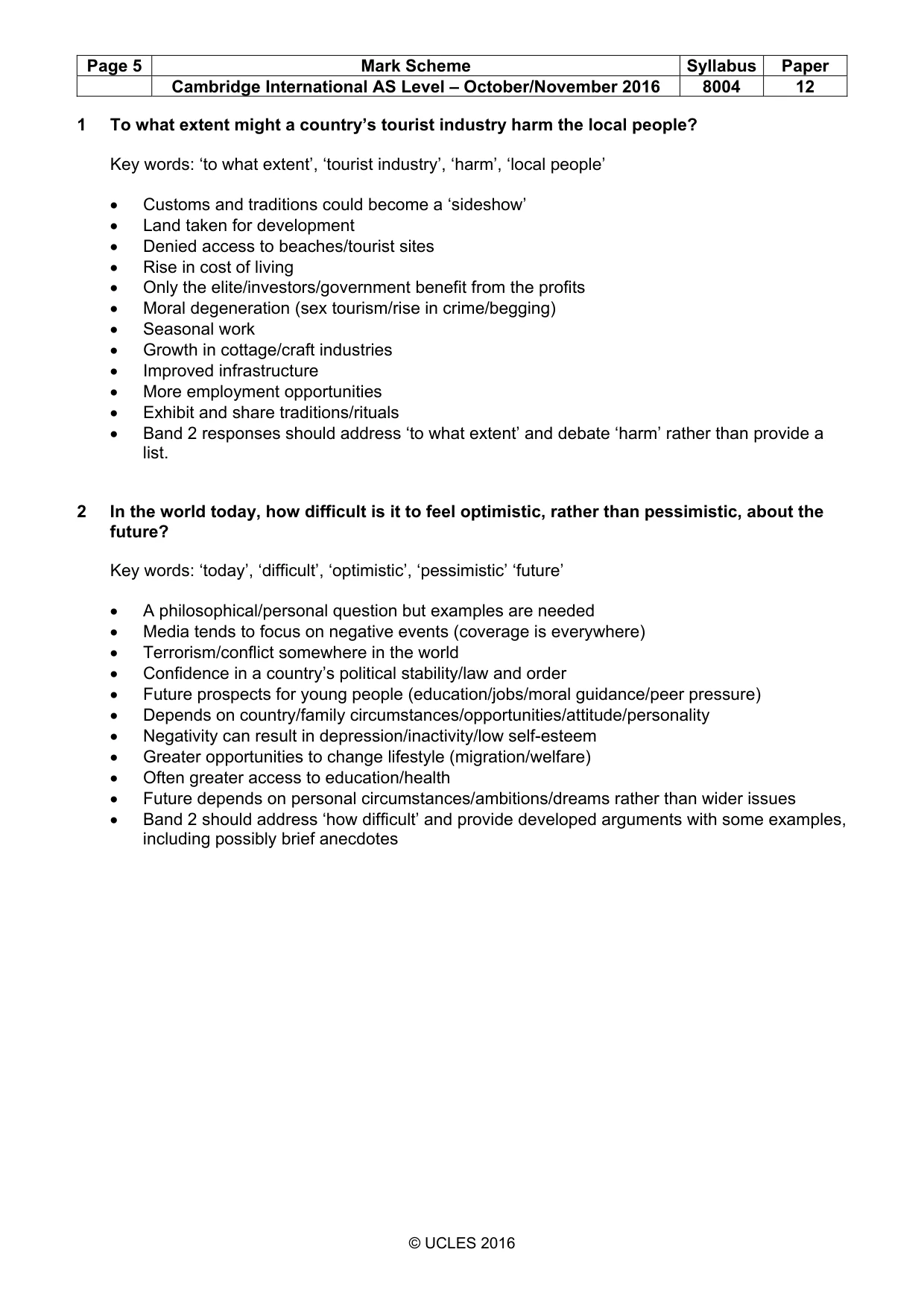
Page 5 Mark Scheme Syllabus Paper Cambridge International AS Level – October/November 2016 8004 12 © UCLES 2016 1 To what extent might a country’s tourist industry harm the local people? Key words: ‘to what extent’, ‘tourist industry’, ‘harm’, ‘local people’ • Customs and traditions could become a ‘sideshow’ • Land taken for development • Denied access to beaches/tourist sites • Rise in cost of living • Only the elite/investors/government benefit from the profits • Moral degeneration (sex tourism/rise in crime/begging) • Seasonal work • Growth in cottage/craft industries • Improved infrastructure • More employment opportunities • Exhibit and share traditions/rituals • Band 2 responses should address ‘to what extent’ and debate ‘harm’ rather than provide a list. 2 In the world today, how difficult is it to feel optimistic, rather than pessimistic, about the future? Key words: ‘today’, ‘difficult’, ‘optimistic’, ‘pessimistic’ ‘future’ • A philosophical/personal question but examples are needed • Media tends to focus on negative events (coverage is everywhere) • Terrorism/conflict somewhere in the world • Confidence in a country’s political stability/law and order • Future prospects for young people (education/jobs/moral guidance/peer pressure) • Depends on country/family circumstances/opportunities/attitude/personality • Negativity can result in depression/inactivity/low self-esteem • Greater opportunities to change lifestyle (migration/welfare) • Often greater access to education/health • Future depends on personal circumstances/ambitions/dreams rather than wider issues • Band 2 should address ‘how difficult’ and provide developed arguments with some examples, including possibly brief anecdotes
Mark scheme, page 6
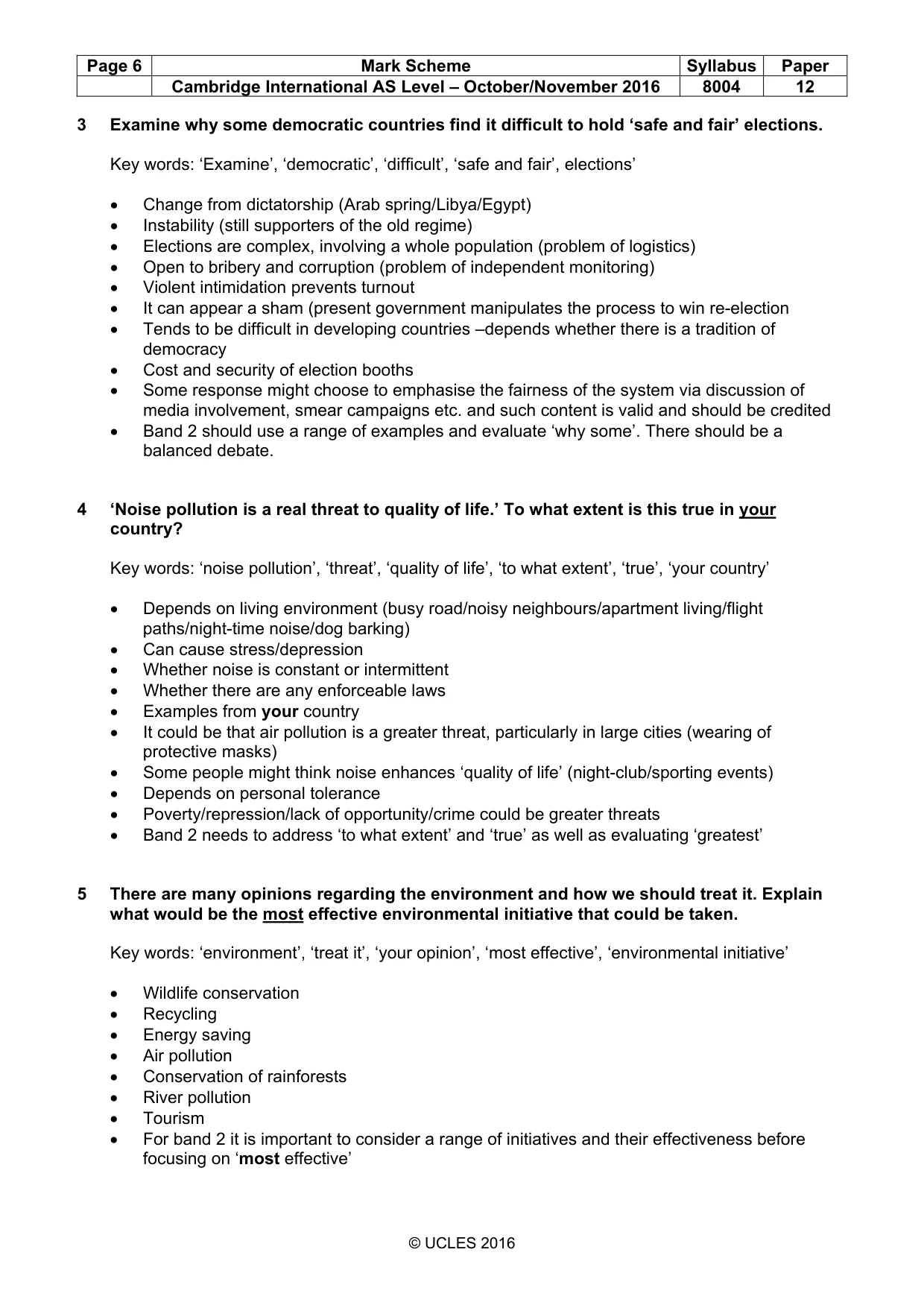
Page 6 Mark Scheme Syllabus Paper Cambridge International AS Level – October/November 2016 8004 12 © UCLES 2016 3 Examine why some democratic countries find it difficult to hold ‘safe and fair’ elections. Key words: ‘Examine’, ‘democratic’, ‘difficult’, ‘safe and fair’, elections’ • Change from dictatorship (Arab spring/Libya/Egypt) • Instability (still supporters of the old regime) • Elections are complex, involving a whole population (problem of logistics) • Open to bribery and corruption (problem of independent monitoring) • Violent intimidation prevents turnout • It can appear a sham (present government manipulates the process to win re-election • Tends to be difficult in developing countries –depends whether there is a tradition of democracy • Cost and security of election booths • Some response might choose to emphasise the fairness of the system via discussion of media involvement, smear campaigns etc. and such content is valid and should be credited • Band 2 should use a range of examples and evaluate ‘why some’. There should be a balanced debate. 4 ‘Noise pollution is a real threat to quality of life.’ To what extent is this true in your country? Key words: ‘noise pollution’, ‘threat’, ‘quality of life’, ‘to what extent’, ‘true’, ‘your country’ • Depends on living environment (busy road/noisy neighbours/apartment living/flight paths/night-time noise/dog barking) • Can cause stress/depression • Whether noise is constant or intermittent • Whether there are any enforceable laws • Examples from your country • It could be that air pollution is a greater threat, particularly in large cities (wearing of protective masks) • Some people might think noise enhances ‘quality of life’ (night-club/sporting events) • Depends on personal tolerance • Poverty/repression/lack of opportunity/crime could be greater threats • Band 2 needs to address ‘to what extent’ and ‘true’ as well as evaluating ‘greatest’ 5 There are many opinions regarding the environment and how we should treat it. Explain what would be the most effective environmental initiative that could be taken. Key words: ‘environment’, ‘treat it’, ‘your opinion’, ‘most effective’, ‘environmental initiative’ • Wildlife conservation • Recycling • Energy saving • Air pollution • Conservation of rainforests • River pollution • Tourism • For band 2 it is important to consider a range of initiatives and their effectiveness before focusing on ‘most effective’
Mark scheme, page 7
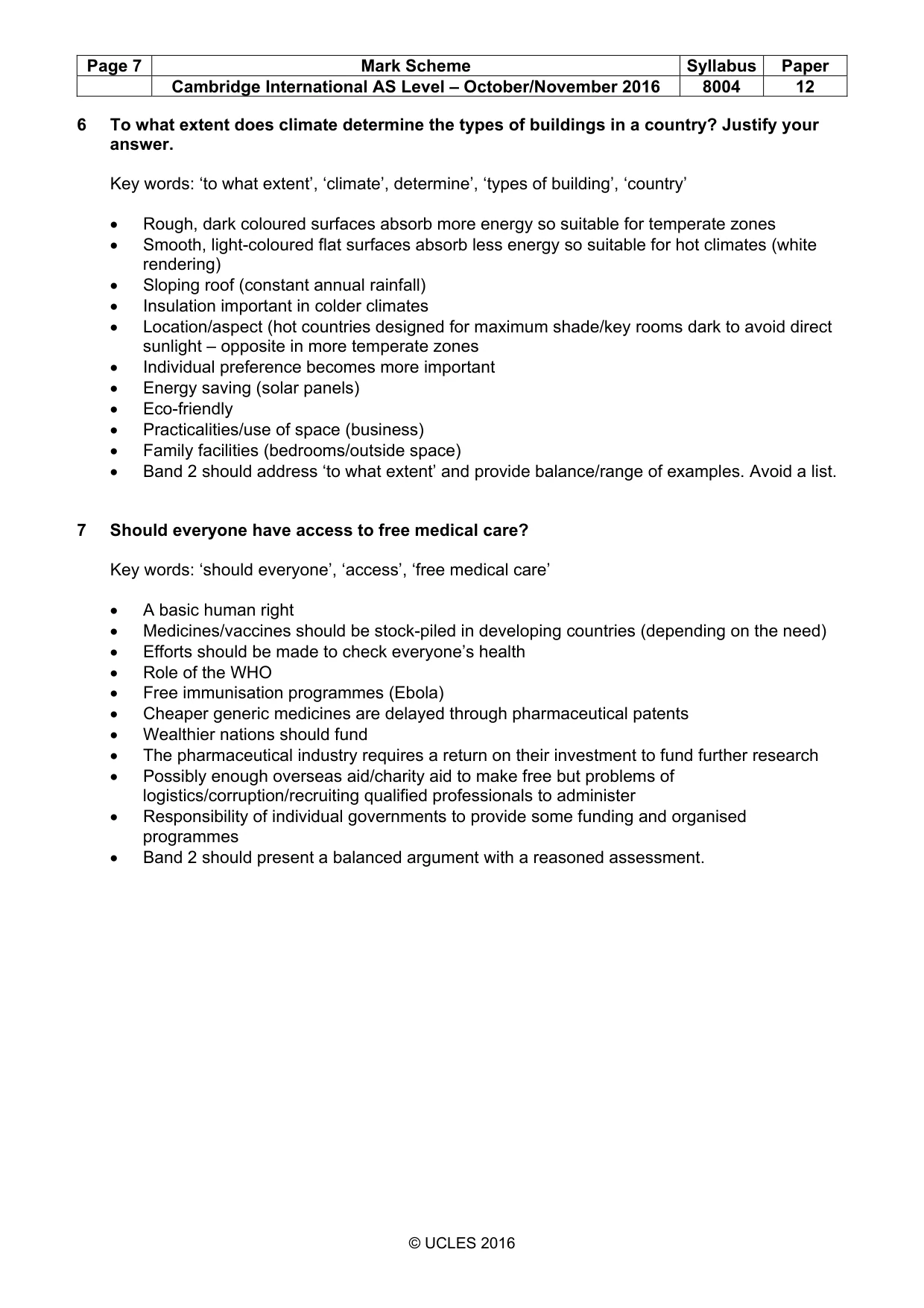
Page 7 Mark Scheme Syllabus Paper Cambridge International AS Level – October/November 2016 8004 12 © UCLES 2016 6 To what extent does climate determine the types of buildings in a country? Justify your answer. Key words: ‘to what extent’, ‘climate’, determine’, ‘types of building’, ‘country’ • Rough, dark coloured surfaces absorb more energy so suitable for temperate zones • Smooth, light-coloured flat surfaces absorb less energy so suitable for hot climates (white rendering) • Sloping roof (constant annual rainfall) • Insulation important in colder climates • Location/aspect (hot countries designed for maximum shade/key rooms dark to avoid direct sunlight – opposite in more temperate zones • Individual preference becomes more important • Energy saving (solar panels) • Eco-friendly • Practicalities/use of space (business) • Family facilities (bedrooms/outside space) • Band 2 should address ‘to what extent’ and provide balance/range of examples. Avoid a list. 7 Should everyone have access to free medical care? Key words: ‘should everyone’, ‘access’, ‘free medical care’ • A basic human right • Medicines/vaccines should be stock-piled in developing countries (depending on the need) • Efforts should be made to check everyone’s health • Role of the WHO • Free immunisation programmes (Ebola) • Cheaper generic medicines are delayed through pharmaceutical patents • Wealthier nations should fund • The pharmaceutical industry requires a return on their investment to fund further research • Possibly enough overseas aid/charity aid to make free but problems of logistics/corruption/recruiting qualified professionals to administer • Responsibility of individual governments to provide some funding and organised programmes • Band 2 should present a balanced argument with a reasoned assessment.
Mark scheme, page 8
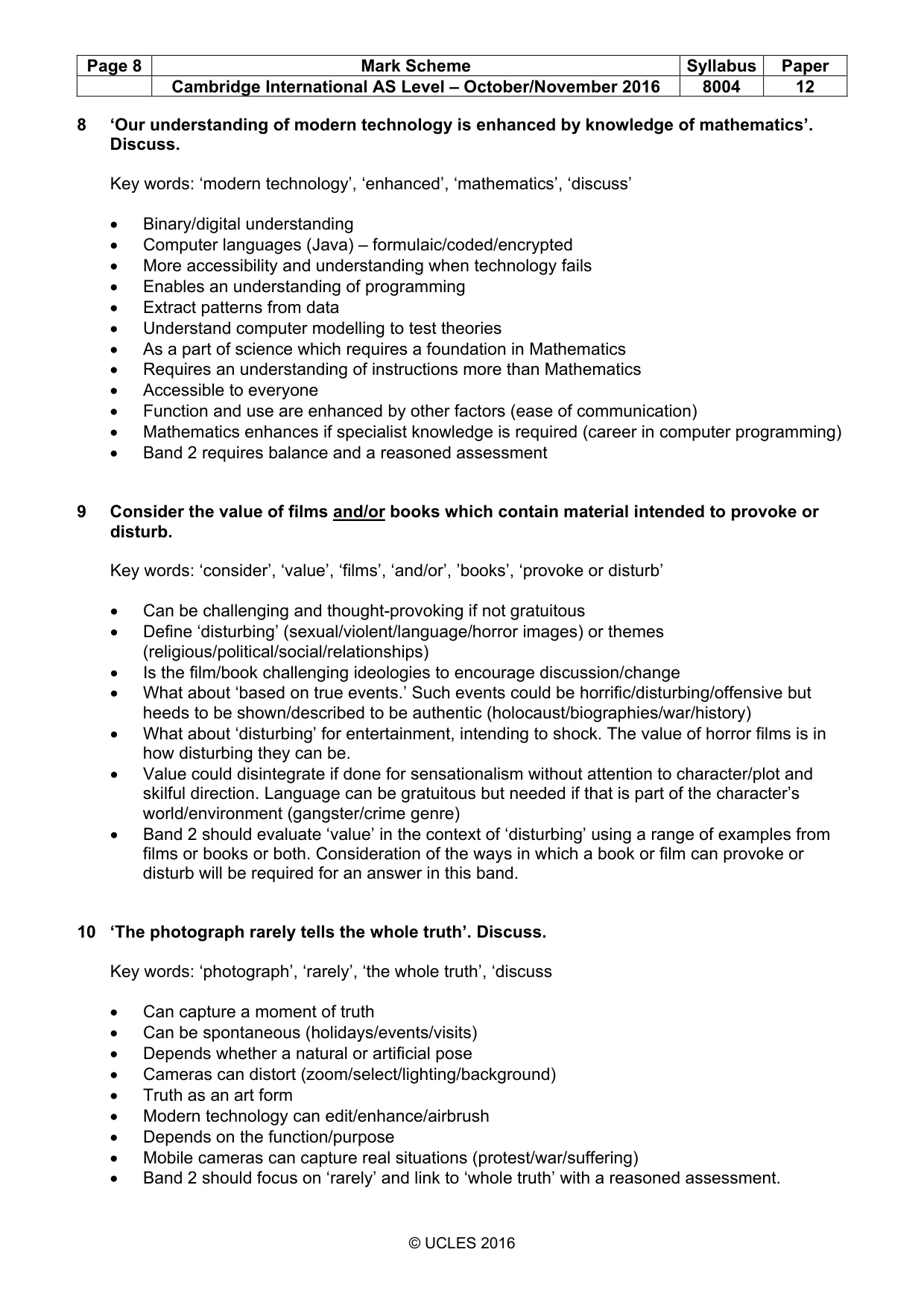
Page 8 Mark Scheme Syllabus Paper Cambridge International AS Level – October/November 2016 8004 12 © UCLES 2016 8 ‘Our understanding of modern technology is enhanced by knowledge of mathematics’. Discuss. Key words: ‘modern technology’, ‘enhanced’, ‘mathematics’, ‘discuss’ • Binary/digital understanding • Computer languages (Java) – formulaic/coded/encrypted • More accessibility and understanding when technology fails • Enables an understanding of programming • Extract patterns from data • Understand computer modelling to test theories • As a part of science which requires a foundation in Mathematics • Requires an understanding of instructions more than Mathematics • Accessible to everyone • Function and use are enhanced by other factors (ease of communication) • Mathematics enhances if specialist knowledge is required (career in computer programming) • Band 2 requires balance and a reasoned assessment 9 Consider the value of films and/or books which contain material intended to provoke or disturb. Key words: ‘consider’, ‘value’, ‘films’, ‘and/or’, ’books’, ‘provoke or disturb’ • Can be challenging and thought-provoking if not gratuitous • Define ‘disturbing’ (sexual/violent/language/horror images) or themes (religious/political/social/relationships) • Is the film/book challenging ideologies to encourage discussion/change • What about ‘based on true events.’ Such events could be horrific/disturbing/offensive but heeds to be shown/described to be authentic (holocaust/biographies/war/history) • What about ‘disturbing’ for entertainment, intending to shock. The value of horror films is in how disturbing they can be. • Value could disintegrate if done for sensationalism without attention to character/plot and skilful direction. Language can be gratuitous but needed if that is part of the character’s world/environment (gangster/crime genre) • Band 2 should evaluate ‘value’ in the context of ‘disturbing’ using a range of examples from films or books or both. Consideration of the ways in which a book or film can provoke or disturb will be required for an answer in this band. 10 ‘The photograph rarely tells the whole truth’. Discuss. Key words: ‘photograph’, ‘rarely’, ‘the whole truth’, ‘discuss • Can capture a moment of truth • Can be spontaneous (holidays/events/visits) • Depends whether a natural or artificial pose • Cameras can distort (zoom/select/lighting/background) • Truth as an art form • Modern technology can edit/enhance/airbrush • Depends on the function/purpose • Mobile cameras can capture real situations (protest/war/suffering) • Band 2 should focus on ‘rarely’ and link to ‘whole truth’ with a reasoned assessment.
Mark scheme, page 9
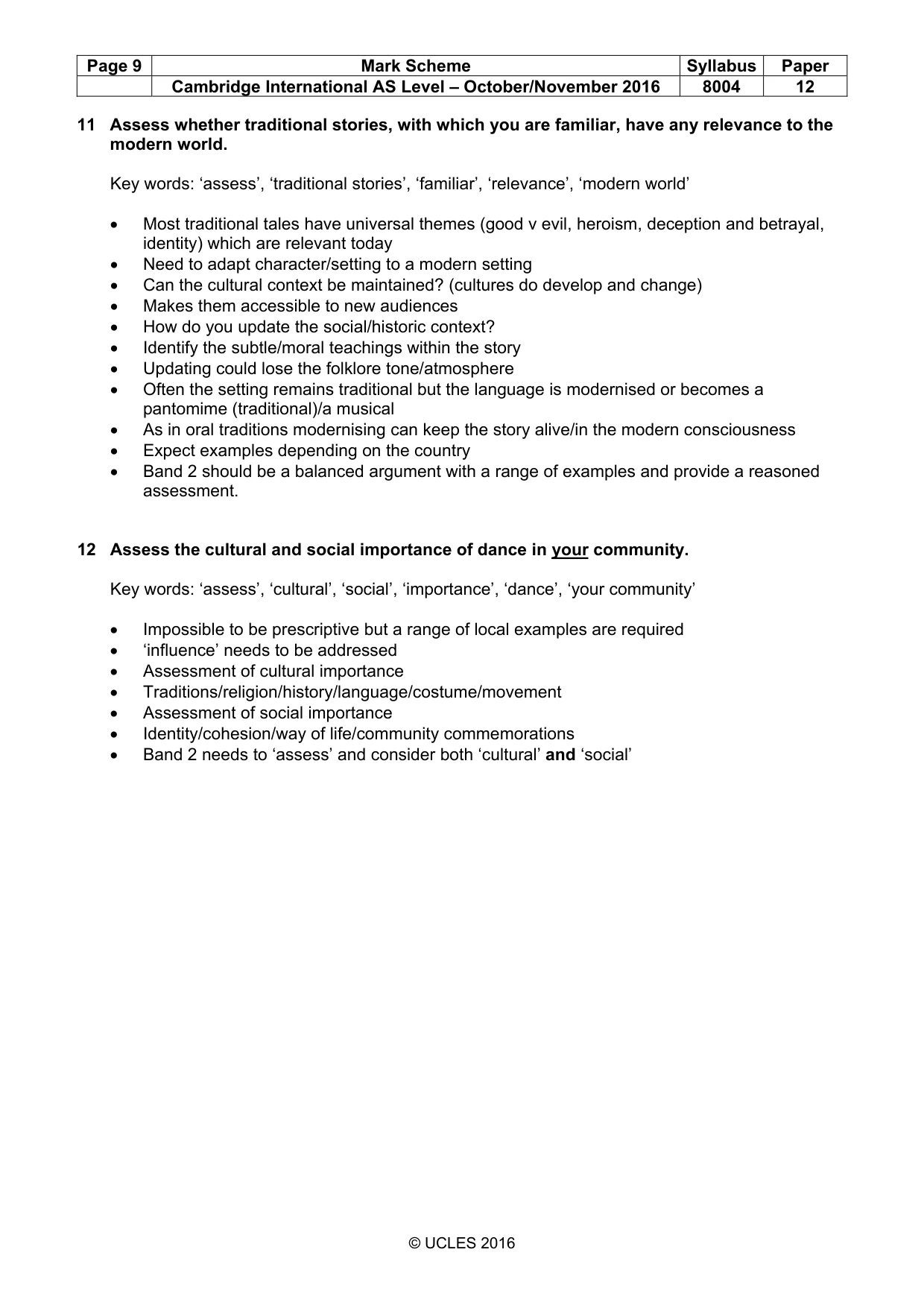
Page 9 Mark Scheme Syllabus Paper Cambridge International AS Level – October/November 2016 8004 12 © UCLES 2016 11 Assess whether traditional stories, with which you are familiar, have any relevance to the modern world. Key words: ‘assess’, ‘traditional stories’, ‘familiar’, ‘relevance’, ‘modern world’ • Most traditional tales have universal themes (good v evil, heroism, deception and betrayal, identity) which are relevant today • Need to adapt character/setting to a modern setting • Can the cultural context be maintained? (cultures do develop and change) • Makes them accessible to new audiences • How do you update the social/historic context? • Identify the subtle/moral teachings within the story • Updating could lose the folklore tone/atmosphere • Often the setting remains traditional but the language is modernised or becomes a pantomime (traditional)/a musical • As in oral traditions modernising can keep the story alive/in the modern consciousness • Expect examples depending on the country • Band 2 should be a balanced argument with a range of examples and provide a reasoned assessment. 12 Assess the cultural and social importance of dance in your community. Key words: ‘assess’, ‘cultural’, ‘social’, ‘importance’, ‘dance’, ‘your community’ • Impossible to be prescriptive but a range of local examples are required • ‘influence’ needs to be addressed • Assessment of cultural importance • Traditions/religion/history/language/costume/movement • Assessment of social importance • Identity/cohesion/way of life/community commemorations • Band 2 needs to ‘assess’ and consider both ‘cultural’ and ‘social’
What you needed in this session
Cambridge’s own grade thresholds for 2016 Oct/Nov, Paper 1 · Variant 2. A higher threshold means an easier paper — the bar moves with how the cohort did.