Cambridge A Level General Paper (AS Level only) 8004 — 2018 Oct/Nov Paper 1 · Variant 1
8004/11/O/N/18
The question paper and its mark scheme, free to read here and free to download. This is Cambridge’s own paper, exactly as it was sat.
Question paper4 pages

Mark scheme9 pages
Answers below. Sit the paper first if you are practising.
Paper as text
Question paper, page 1
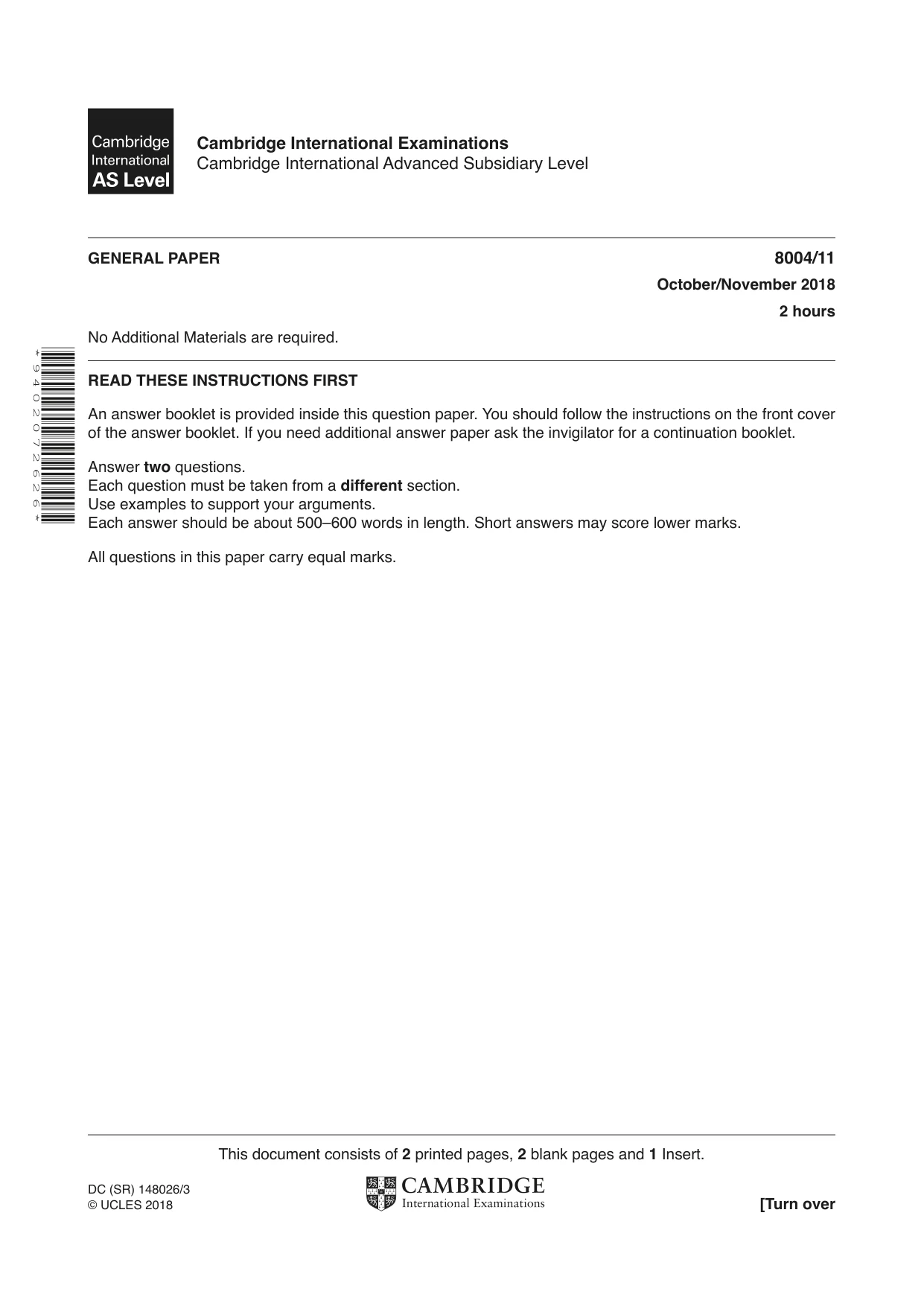
* 9 4 0 2 0 7 2 6 2 6 * This document consists of 2 printed pages, 2 blank pages and 1 Insert. DC (SR) 148026/3 © UCLES 2018 [Turn over Cambridge International Examinations Cambridge International Advanced Subsidiary Level GENERAL PAPER 8004/11 October/November 2018 2 hours No Additional Materials are required. READ THESE INSTRUCTIONS FIRST An answer booklet is provided inside this question paper. You should follow the instructions on the front cover of the answer booklet. If you need additional answer paper ask the invigilator for a continuation booklet. Answer two questions. Each question must be taken from a different section. Use examples to support your arguments. Each answer should be about 500–600 words in length. Short answers may score lower marks. All questions in this paper carry equal marks.
Question paper, page 2
2 8004/11/O/N/18 © UCLES 2018 BLANK PAGE
Question paper, page 3
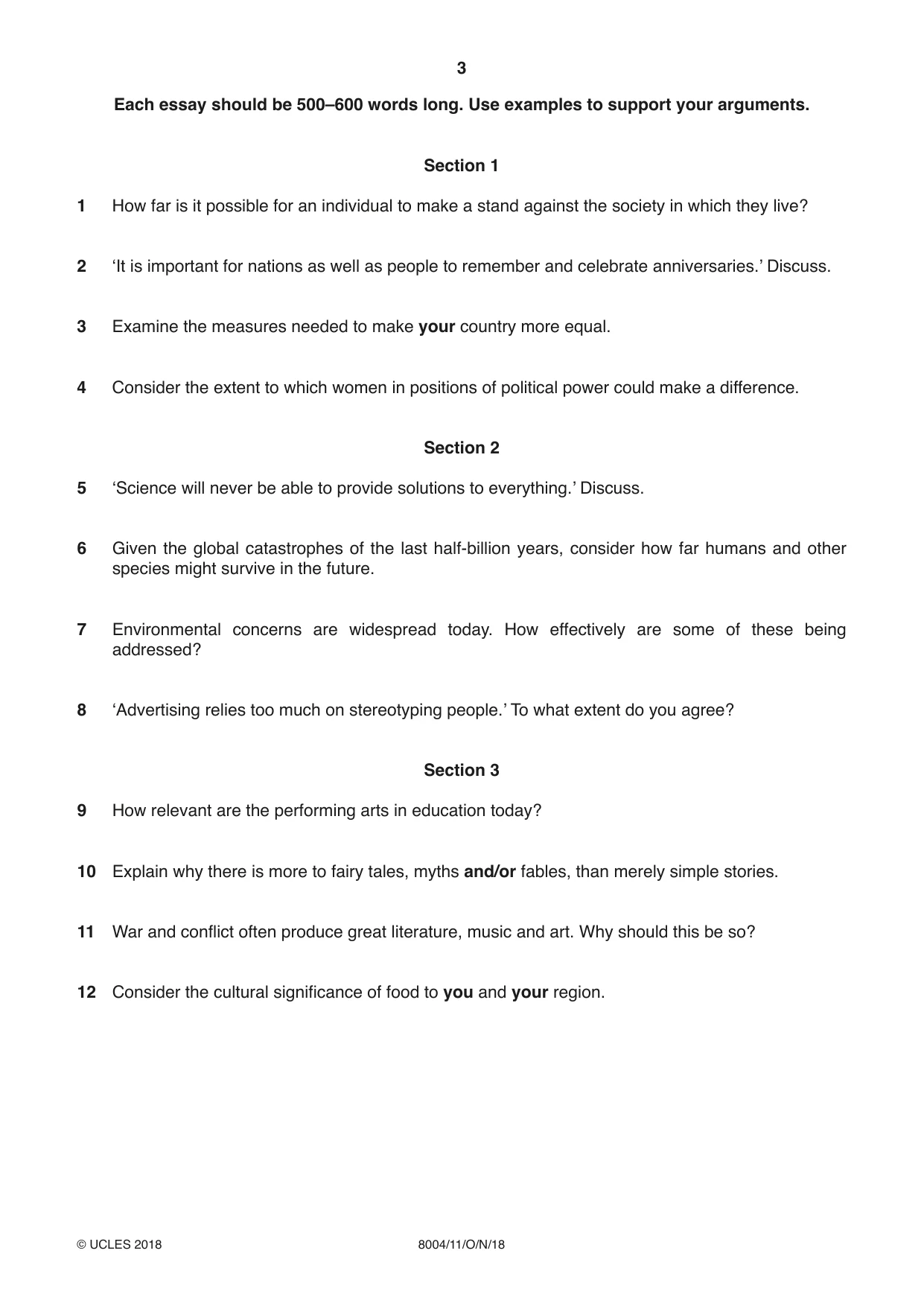
3 8004/11/O/N/18 © UCLES 2018 Each essay should be 500–600 words long. Use examples to support your arguments. Section 1 1 How far is it possible for an individual to make a stand against the society in which they live? 2 ‘It is important for nations as well as people to remember and celebrate anniversaries.’ Discuss. 3 Examine the measures needed to make your country more equal. 4 Consider the extent to which women in positions of political power could make a difference. Section 2 5 ‘Science will never be able to provide solutions to everything.’ Discuss. 6 Given the global catastrophes of the last half-billion years, consider how far humans and other species might survive in the future. 7 Environmental concerns are widespread today. How effectively are some of these being addressed? 8 ‘Advertising relies too much on stereotyping people.’ To what extent do you agree? Section 3 9 How relevant are the performing arts in education today? 10 Explain why there is more to fairy tales, myths and/or fables, than merely simple stories. 11 War and conflict often produce great literature, music and art. Why should this be so? 12 Consider the cultural significance of food to you and your region.
Question paper, page 4
4 8004/11/O/N/18 © UCLES 2018 BLANK PAGE Permission to reproduce items where third-party owned material protected by copyright is included has been sought and cleared where possible. Every reasonable effort has been made by the publisher (UCLES) to trace copyright holders, but if any items requiring clearance have unwittingly been included, the publisher will be pleased to make amends at the earliest possible opportunity. To avoid the issue of disclosure of answer-related information to candidates, all copyright acknowledgements are reproduced online in the Cambridge International Examinations Copyright Acknowledgements Booklet. This is produced for each series of examinations and is freely available to download at www.cie.org.uk after the live examination series. Cambridge International Examinations is part of the Cambridge Assessment Group. Cambridge Assessment is the brand name of University of Cambridge Local Examinations Syndicate (UCLES), which is itself a department of the University of Cambridge.
Mark scheme, page 1
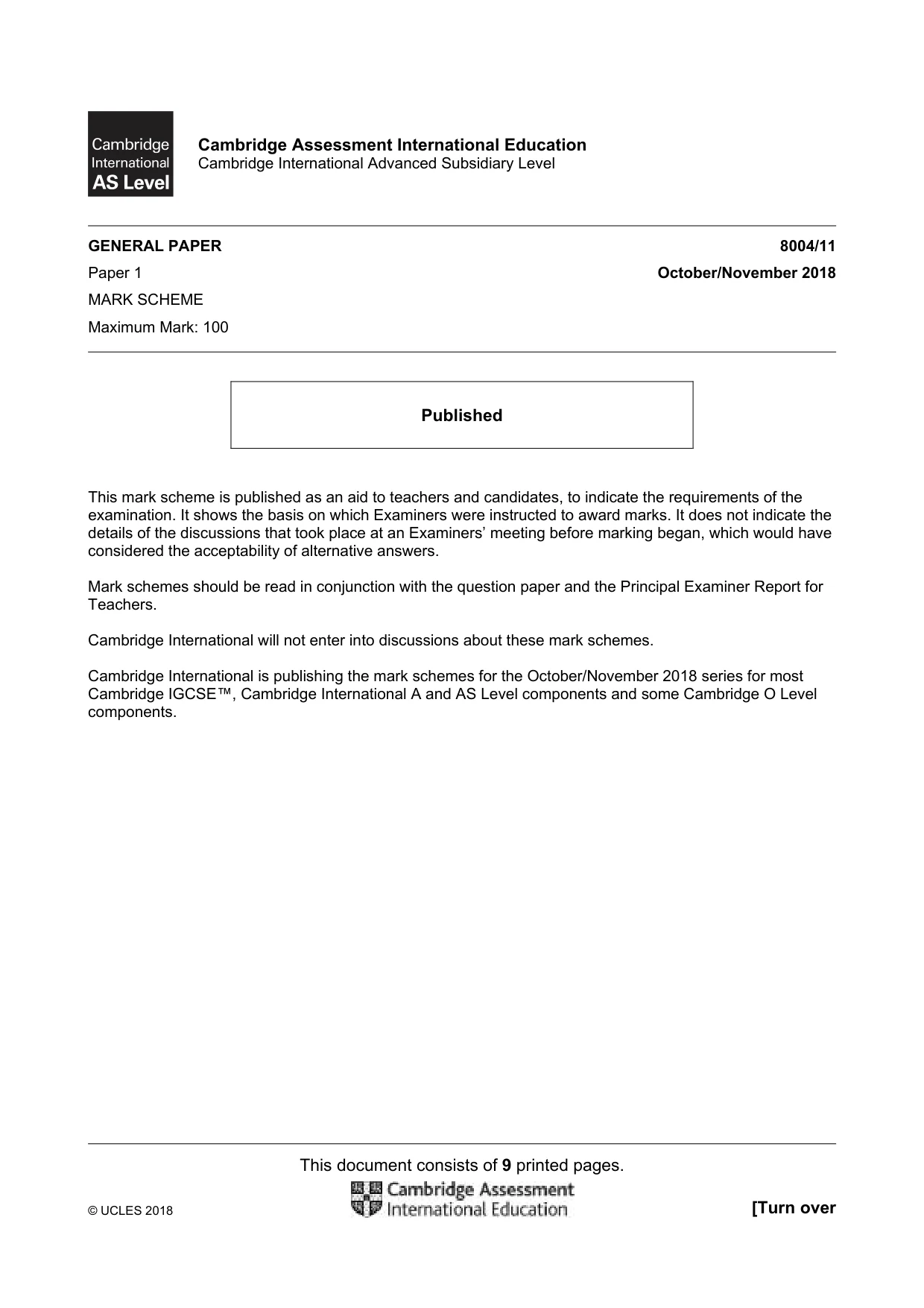
This document consists of 9 printed pages. © UCLES 2018 [Turn over Cambridge Assessment International Education Cambridge International Advanced Subsidiary Level GENERAL PAPER 8004/11 Paper 1 October/November 2018 MARK SCHEME Maximum Mark: 100 Published This mark scheme is published as an aid to teachers and candidates, to indicate the requirements of the examination. It shows the basis on which Examiners were instructed to award marks. It does not indicate the details of the discussions that took place at an Examiners’ meeting before marking began, which would have considered the acceptability of alternative answers. Mark schemes should be read in conjunction with the question paper and the Principal Examiner Report for Teachers. Cambridge International will not enter into discussions about these mark schemes. Cambridge International is publishing the mark schemes for the October/November 2018 series for most Cambridge IGCSE™, Cambridge International A and AS Level components and some Cambridge O Level components.
Mark scheme, page 2
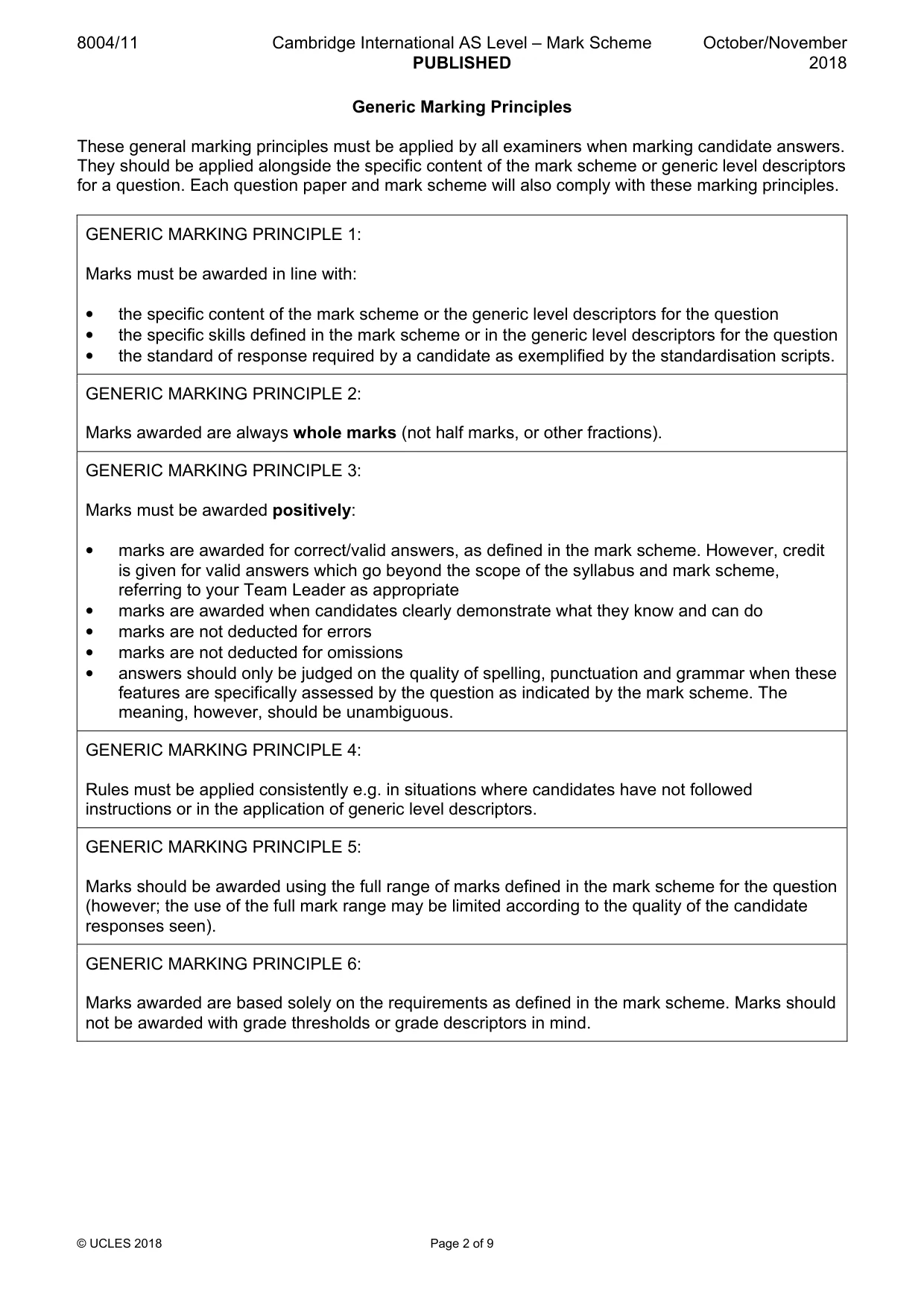
8004/11 Cambridge International AS Level – Mark Scheme PUBLISHED October/November 2018 © UCLES 2018 Page 2 of 9 Generic Marking Principles These general marking principles must be applied by all examiners when marking candidate answers. They should be applied alongside the specific content of the mark scheme or generic level descriptors for a question. Each question paper and mark scheme will also comply with these marking principles. GENERIC MARKING PRINCIPLE 1: Marks must be awarded in line with: • the specific content of the mark scheme or the generic level descriptors for the question • the specific skills defined in the mark scheme or in the generic level descriptors for the question • the standard of response required by a candidate as exemplified by the standardisation scripts. GENERIC MARKING PRINCIPLE 2: Marks awarded are always whole marks (not half marks, or other fractions). GENERIC MARKING PRINCIPLE 3: Marks must be awarded positively: • marks are awarded for correct/valid answers, as defined in the mark scheme. However, credit is given for valid answers which go beyond the scope of the syllabus and mark scheme, referring to your Team Leader as appropriate • marks are awarded when candidates clearly demonstrate what they know and can do • marks are not deducted for errors • marks are not deducted for omissions • answers should only be judged on the quality of spelling, punctuation and grammar when these features are specifically assessed by the question as indicated by the mark scheme. The meaning, however, should be unambiguous. GENERIC MARKING PRINCIPLE 4: Rules must be applied consistently e.g. in situations where candidates have not followed instructions or in the application of generic level descriptors. GENERIC MARKING PRINCIPLE 5: Marks should be awarded using the full range of marks defined in the mark scheme for the question (however; the use of the full mark range may be limited according to the quality of the candidate responses seen). GENERIC MARKING PRINCIPLE 6: Marks awarded are based solely on the requirements as defined in the mark scheme. Marks should not be awarded with grade thresholds or grade descriptors in mind.
Mark scheme, page 3
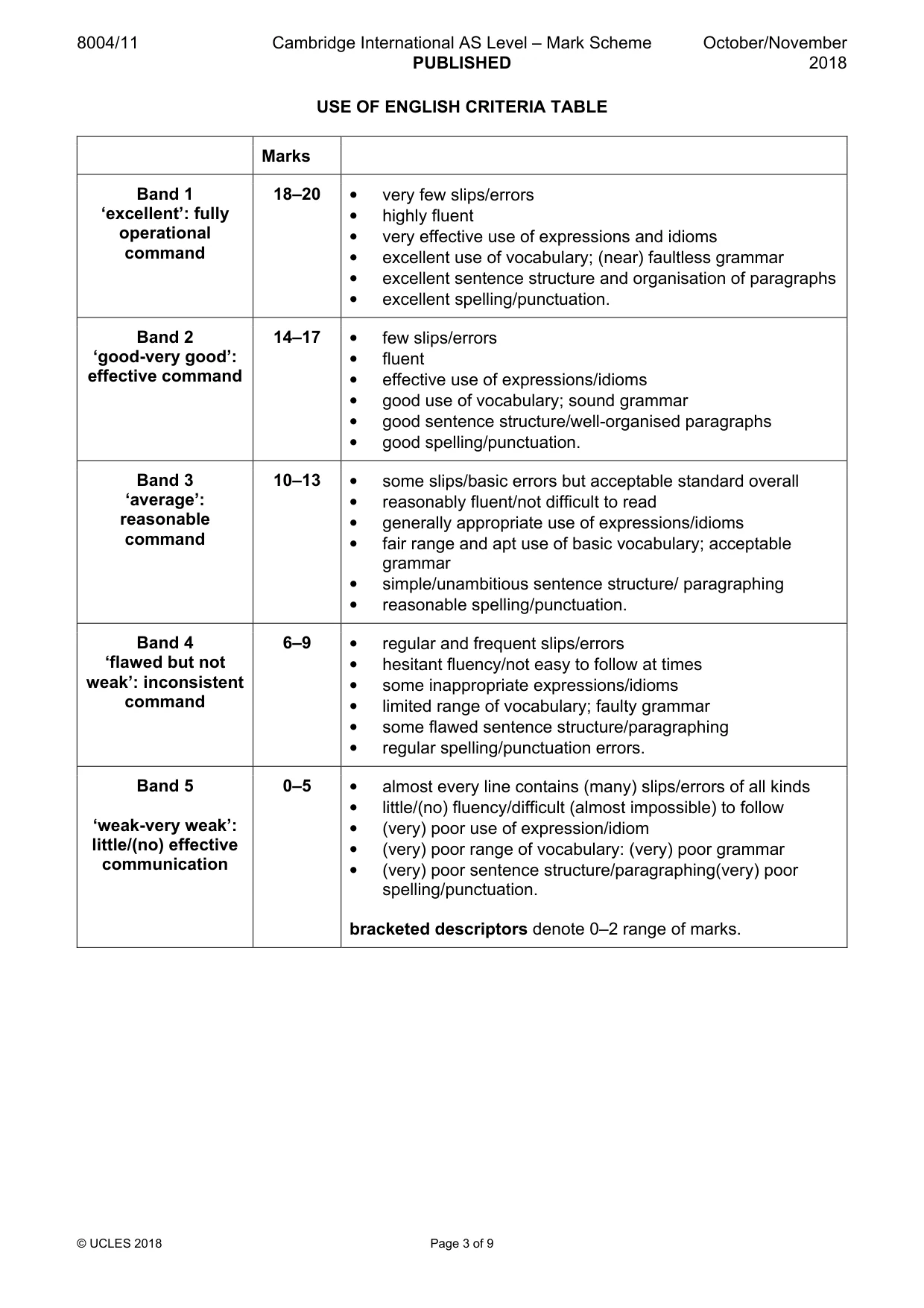
8004/11 Cambridge International AS Level – Mark Scheme PUBLISHED October/November 2018 © UCLES 2018 Page 3 of 9 USE OF ENGLISH CRITERIA TABLE Marks Band 1 ‘excellent’: fully operational command 18–20 • very few slips/errors • highly fluent • very effective use of expressions and idioms • excellent use of vocabulary; (near) faultless grammar • excellent sentence structure and organisation of paragraphs • excellent spelling/punctuation. Band 2 ‘good-very good’: effective command 14–17 • few slips/errors • fluent • effective use of expressions/idioms • good use of vocabulary; sound grammar • good sentence structure/well-organised paragraphs • good spelling/punctuation. Band 3 ‘average’: reasonable command 10–13 • some slips/basic errors but acceptable standard overall • reasonably fluent/not difficult to read • generally appropriate use of expressions/idioms • fair range and apt use of basic vocabulary; acceptable grammar • simple/unambitious sentence structure/ paragraphing • reasonable spelling/punctuation. Band 4 ‘flawed but not weak’: inconsistent command 6–9 • regular and frequent slips/errors • hesitant fluency/not easy to follow at times • some inappropriate expressions/idioms • limited range of vocabulary; faulty grammar • some flawed sentence structure/paragraphing • regular spelling/punctuation errors. Band 5 ‘weak-very weak’: little/(no) effective communication 0–5 • almost every line contains (many) slips/errors of all kinds • little/(no) fluency/difficult (almost impossible) to follow • (very) poor use of expression/idiom • (very) poor range of vocabulary: (very) poor grammar • (very) poor sentence structure/paragraphing(very) poor spelling/punctuation. bracketed descriptors denote 0–2 range of marks.
Mark scheme, page 4
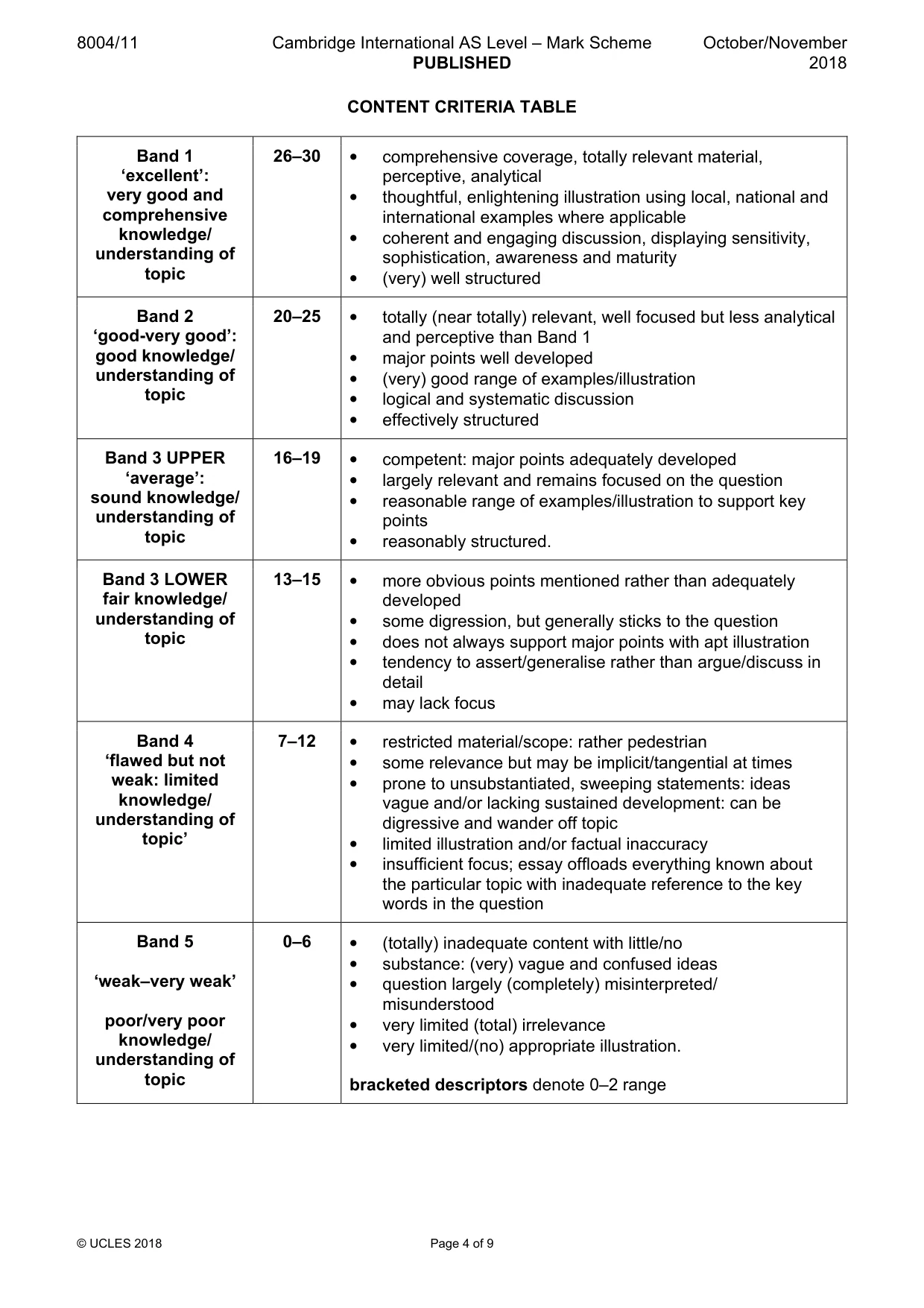
8004/11 Cambridge International AS Level – Mark Scheme PUBLISHED October/November 2018 © UCLES 2018 Page 4 of 9 CONTENT CRITERIA TABLE Band 1 ‘excellent’: very good and comprehensive knowledge/ understanding of topic 26–30 • comprehensive coverage, totally relevant material, perceptive, analytical • thoughtful, enlightening illustration using local, national and international examples where applicable • coherent and engaging discussion, displaying sensitivity, sophistication, awareness and maturity • (very) well structured Band 2 ‘good-very good’: good knowledge/ understanding of topic 20–25 • totally (near totally) relevant, well focused but less analytical and perceptive than Band 1 • major points well developed • (very) good range of examples/illustration • logical and systematic discussion • effectively structured Band 3 UPPER ‘average’: sound knowledge/ understanding of topic 16–19 • competent: major points adequately developed • largely relevant and remains focused on the question • reasonable range of examples/illustration to support key points • reasonably structured. Band 3 LOWER fair knowledge/ understanding of topic 13–15 • more obvious points mentioned rather than adequately developed • some digression, but generally sticks to the question • does not always support major points with apt illustration • tendency to assert/generalise rather than argue/discuss in detail • may lack focus Band 4 ‘flawed but not weak: limited knowledge/ understanding of topic’ 7–12 • restricted material/scope: rather pedestrian • some relevance but may be implicit/tangential at times • prone to unsubstantiated, sweeping statements: ideas vague and/or lacking sustained development: can be digressive and wander off topic • limited illustration and/or factual inaccuracy • insufficient focus; essay offloads everything known about the particular topic with inadequate reference to the key words in the question Band 5 ‘weak–very weak’ poor/very poor knowledge/ understanding of topic 0–6 • (totally) inadequate content with little/no • substance: (very) vague and confused ideas • question largely (completely) misinterpreted/ misunderstood • very limited (total) irrelevance • very limited/(no) appropriate illustration. bracketed descriptors denote 0–2 range
Mark scheme, page 5
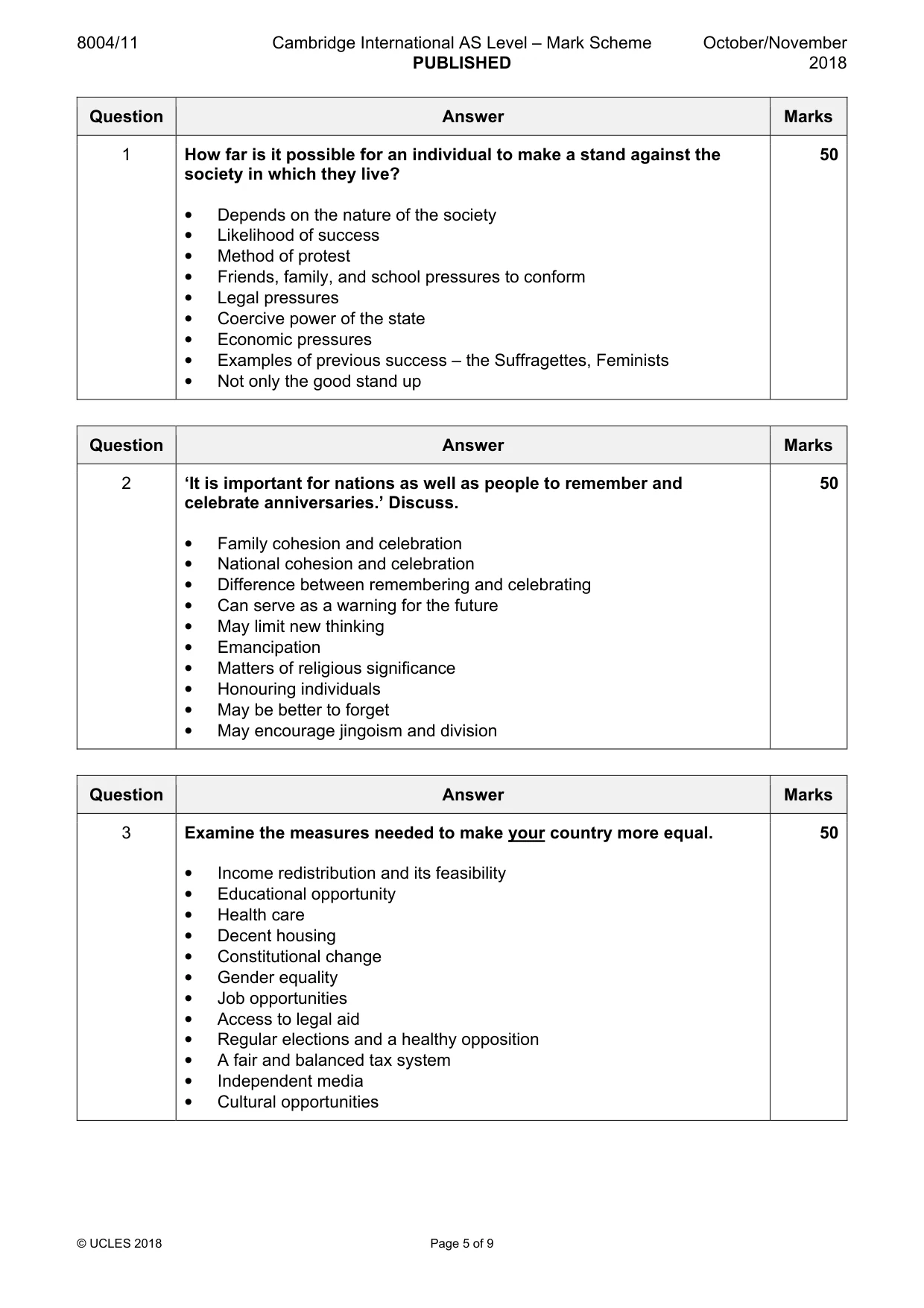
8004/11 Cambridge International AS Level – Mark Scheme PUBLISHED October/November 2018 © UCLES 2018 Page 5 of 9 Question Answer Marks 1 How far is it possible for an individual to make a stand against the society in which they live? • Depends on the nature of the society • Likelihood of success • Method of protest • Friends, family, and school pressures to conform • Legal pressures • Coercive power of the state • Economic pressures • Examples of previous success – the Suffragettes, Feminists • Not only the good stand up 50 Question Answer Marks 2 ‘It is important for nations as well as people to remember and celebrate anniversaries.’ Discuss. • Family cohesion and celebration • National cohesion and celebration • Difference between remembering and celebrating • Can serve as a warning for the future • May limit new thinking • Emancipation • Matters of religious significance • Honouring individuals • May be better to forget • May encourage jingoism and division 50 Question Answer Marks 3 Examine the measures needed to make your country more equal. • Income redistribution and its feasibility • Educational opportunity • Health care • Decent housing • Constitutional change • Gender equality • Job opportunities • Access to legal aid • Regular elections and a healthy opposition • A fair and balanced tax system • Independent media • Cultural opportunities 50
Mark scheme, page 6
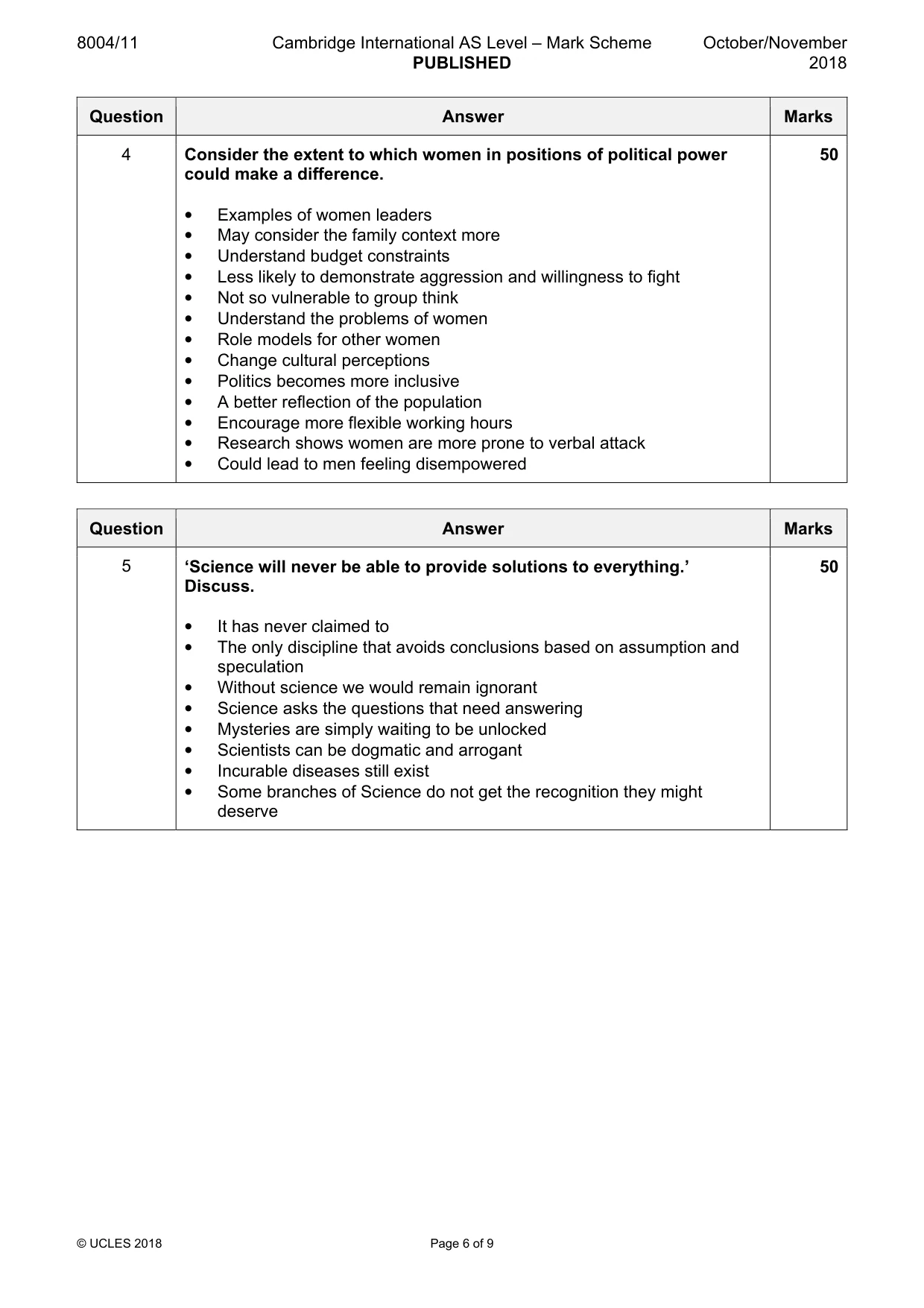
8004/11 Cambridge International AS Level – Mark Scheme PUBLISHED October/November 2018 © UCLES 2018 Page 6 of 9 Question Answer Marks 4 Consider the extent to which women in positions of political power could make a difference. • Examples of women leaders • May consider the family context more • Understand budget constraints • Less likely to demonstrate aggression and willingness to fight • Not so vulnerable to group think • Understand the problems of women • Role models for other women • Change cultural perceptions • Politics becomes more inclusive • A better reflection of the population • Encourage more flexible working hours • Research shows women are more prone to verbal attack • Could lead to men feeling disempowered 50 Question Answer Marks 5 ‘Science will never be able to provide solutions to everything.’ Discuss. • It has never claimed to • The only discipline that avoids conclusions based on assumption and speculation • Without science we would remain ignorant • Science asks the questions that need answering • Mysteries are simply waiting to be unlocked • Scientists can be dogmatic and arrogant • Incurable diseases still exist • Some branches of Science do not get the recognition they might deserve 50
Mark scheme, page 7
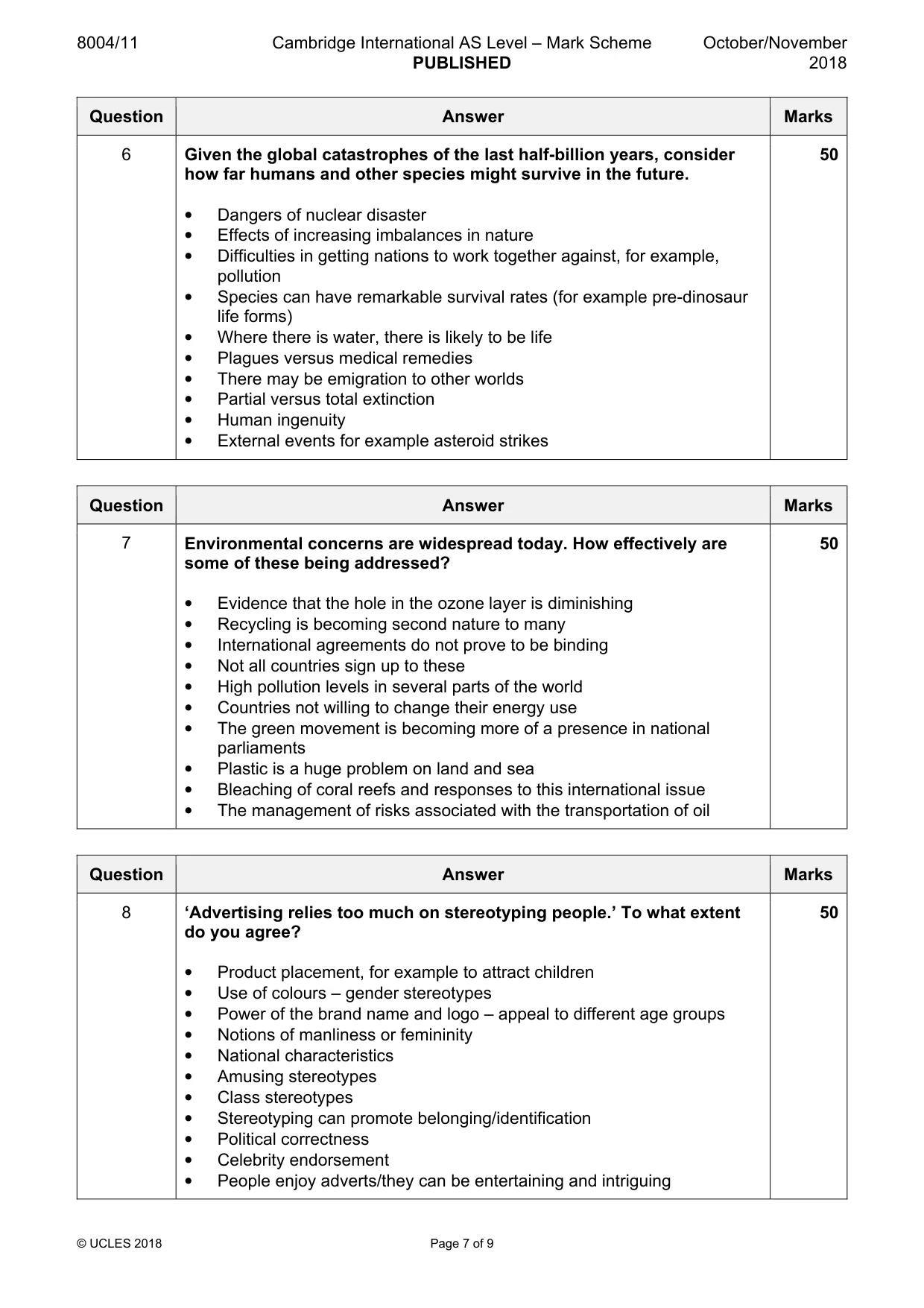
8004/11 Cambridge International AS Level – Mark Scheme PUBLISHED October/November 2018 © UCLES 2018 Page 7 of 9 Question Answer Marks 6 Given the global catastrophes of the last half-billion years, consider how far humans and other species might survive in the future. • Dangers of nuclear disaster • Effects of increasing imbalances in nature • Difficulties in getting nations to work together against, for example, pollution • Species can have remarkable survival rates (for example pre-dinosaur life forms) • Where there is water, there is likely to be life • Plagues versus medical remedies • There may be emigration to other worlds • Partial versus total extinction • Human ingenuity • External events for example asteroid strikes 50 Question Answer Marks 7 Environmental concerns are widespread today. How effectively are some of these being addressed? • Evidence that the hole in the ozone layer is diminishing • Recycling is becoming second nature to many • International agreements do not prove to be binding • Not all countries sign up to these • High pollution levels in several parts of the world • Countries not willing to change their energy use • The green movement is becoming more of a presence in national parliaments • Plastic is a huge problem on land and sea • Bleaching of coral reefs and responses to this international issue • The management of risks associated with the transportation of oil 50 Question Answer Marks 8 ‘Advertising relies too much on stereotyping people.’ To what extent do you agree? • Product placement, for example to attract children • Use of colours – gender stereotypes • Power of the brand name and logo – appeal to different age groups • Notions of manliness or femininity • National characteristics • Amusing stereotypes • Class stereotypes • Stereotyping can promote belonging/identification • Political correctness • Celebrity endorsement • People enjoy adverts/they can be entertaining and intriguing 50
Mark scheme, page 8
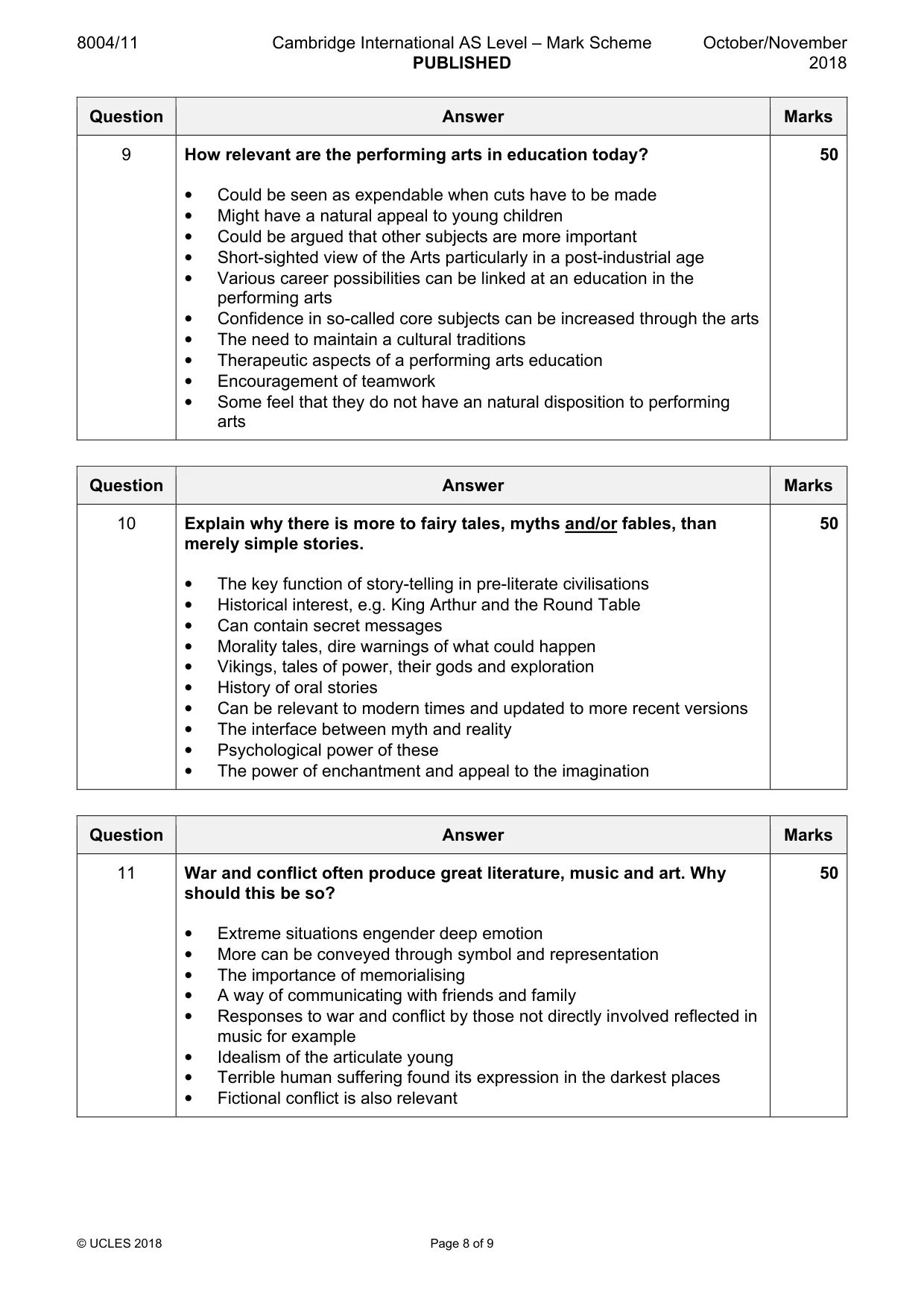
8004/11 Cambridge International AS Level – Mark Scheme PUBLISHED October/November 2018 © UCLES 2018 Page 8 of 9 Question Answer Marks 9 How relevant are the performing arts in education today? • Could be seen as expendable when cuts have to be made • Might have a natural appeal to young children • Could be argued that other subjects are more important • Short-sighted view of the Arts particularly in a post-industrial age • Various career possibilities can be linked at an education in the performing arts • Confidence in so-called core subjects can be increased through the arts • The need to maintain a cultural traditions • Therapeutic aspects of a performing arts education • Encouragement of teamwork • Some feel that they do not have an natural disposition to performing arts 50 Question Answer Marks 10 Explain why there is more to fairy tales, myths and/or fables, than merely simple stories. • The key function of story-telling in pre-literate civilisations • Historical interest, e.g. King Arthur and the Round Table • Can contain secret messages • Morality tales, dire warnings of what could happen • Vikings, tales of power, their gods and exploration • History of oral stories • Can be relevant to modern times and updated to more recent versions • The interface between myth and reality • Psychological power of these • The power of enchantment and appeal to the imagination 50 Question Answer Marks 11 War and conflict often produce great literature, music and art. Why should this be so? • Extreme situations engender deep emotion • More can be conveyed through symbol and representation • The importance of memorialising • A way of communicating with friends and family • Responses to war and conflict by those not directly involved reflected in music for example • Idealism of the articulate young • Terrible human suffering found its expression in the darkest places • Fictional conflict is also relevant 50
Mark scheme, page 9
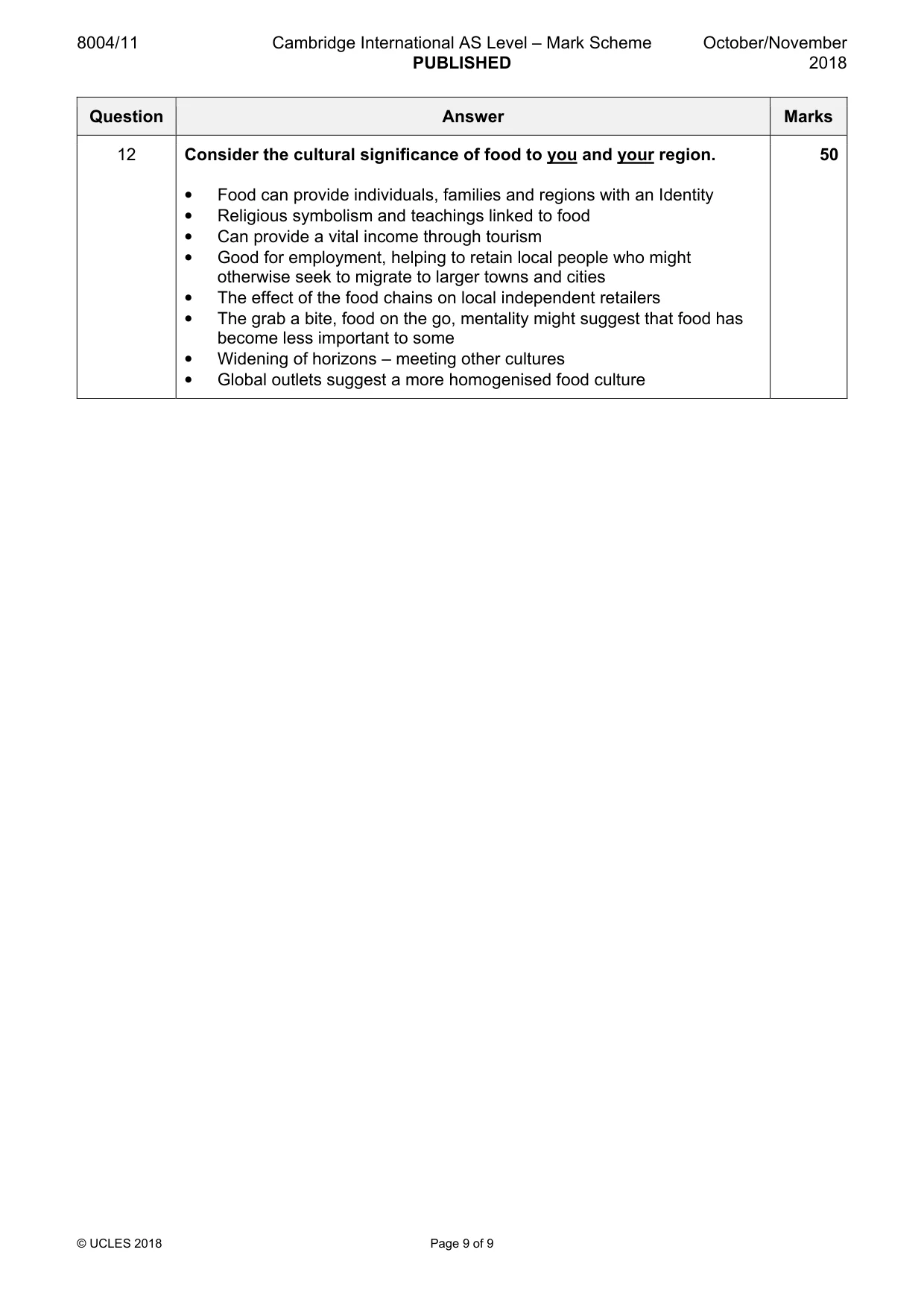
8004/11 Cambridge International AS Level – Mark Scheme PUBLISHED October/November 2018 © UCLES 2018 Page 9 of 9 Question Answer Marks 12 Consider the cultural significance of food to you and your region. • Food can provide individuals, families and regions with an Identity • Religious symbolism and teachings linked to food • Can provide a vital income through tourism • Good for employment, helping to retain local people who might otherwise seek to migrate to larger towns and cities • The effect of the food chains on local independent retailers • The grab a bite, food on the go, mentality might suggest that food has become less important to some • Widening of horizons – meeting other cultures • Global outlets suggest a more homogenised food culture 50