Cambridge A Level General Paper (AS Level only) 8004 — 2012 May/June Paper 1 · Variant 3
8004/13/M/J/12 · 100 marks · ≈113 min
The question paper and its mark scheme, free to read here and free to download. This is Cambridge’s own paper, exactly as it was sat.
Question paper2 pages
Mark scheme14 pages
Answers below. Sit the paper first if you are practising.
Paper as text
Question paper, page 1
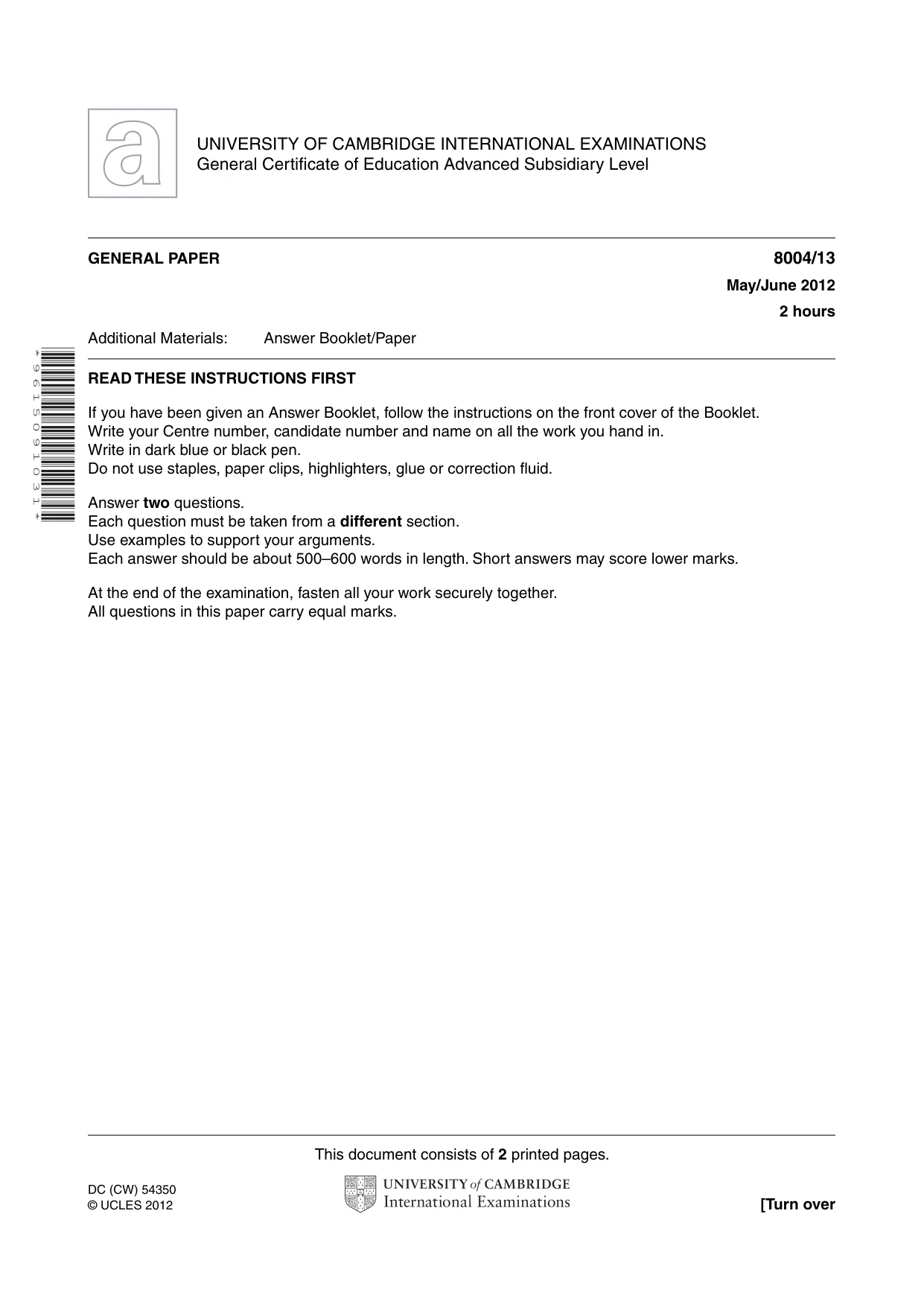
This document consists of 2 printed pages. DC (CW) 54350 © UCLES 2012 [Turn over UNIVERSITY OF CAMBRIDGE INTERNATIONAL EXAMINATIONS General Certificate of Education Advanced Subsidiary Level READ THESE INSTRUCTIONS FIRST If you have been given an Answer Booklet, follow the instructions on the front cover of the Booklet. Write your Centre number, candidate number and name on all the work you hand in. Write in dark blue or black pen. Do not use staples, paper clips, highlighters, glue or correction fluid. Answer two questions. Each question must be taken from a different section. Use examples to support your arguments. Each answer should be about 500–600 words in length. Short answers may score lower marks. At the end of the examination, fasten all your work securely together. All questions in this paper carry equal marks. * 9 6 1 5 0 9 1 0 3 1 * GENERAL PAPER 8004/13 May/June 2012 2 hours Additional Materials: Answer Booklet/Paper
Question paper, page 2
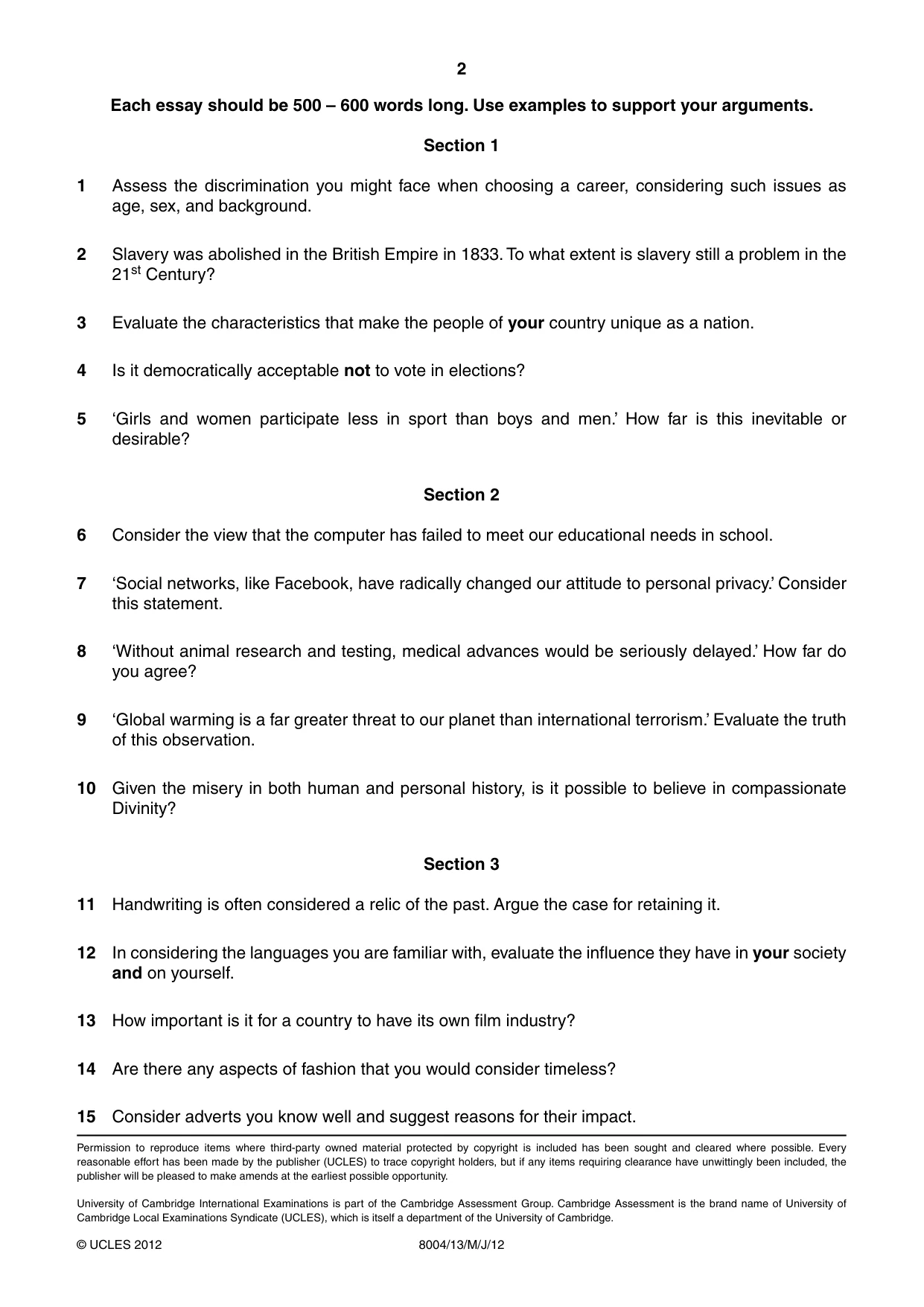
2 8004/13/M/J/12 © UCLES 2012 Each essay should be 500 – 600 words long. Use examples to support your arguments. Section 1 1 Assess the discrimination you might face when choosing a career, considering such issues as age, sex, and background. 2 Slavery was abolished in the British Empire in 1833. To what extent is slavery still a problem in the 21st Century? 3 Evaluate the characteristics that make the people of your country unique as a nation. 4 Is it democratically acceptable not to vote in elections? 5 ‘Girls and women participate less in sport than boys and men.’ How far is this inevitable or desirable? Section 2 6 Consider the view that the computer has failed to meet our educational needs in school. 7 ‘Social networks, like Facebook, have radically changed our attitude to personal privacy.’ Consider this statement. 8 ‘Without animal research and testing, medical advances would be seriously delayed.’ How far do you agree? 9 ‘Global warming is a far greater threat to our planet than international terrorism.’ Evaluate the truth of this observation. 10 Given the misery in both human and personal history, is it possible to believe in compassionate Divinity? Section 3 11 Handwriting is often considered a relic of the past. Argue the case for retaining it. 12 In considering the languages you are familiar with, evaluate the influence they have in your society and on yourself. 13 How important is it for a country to have its own film industry? 14 Are there any aspects of fashion that you would consider timeless? 15 Consider adverts you know well and suggest reasons for their impact. Permission to reproduce items where third-party owned material protected by copyright is included has been sought and cleared where possible. Every reasonable effort has been made by the publisher (UCLES) to trace copyright holders, but if any items requiring clearance have unwittingly been included, the publisher will be pleased to make amends at the earliest possible opportunity. University of Cambridge International Examinations is part of the Cambridge Assessment Group. Cambridge Assessment is the brand name of University of Cambridge Local Examinations Syndicate (UCLES), which is itself a department of the University of Cambridge.
Mark scheme, page 1
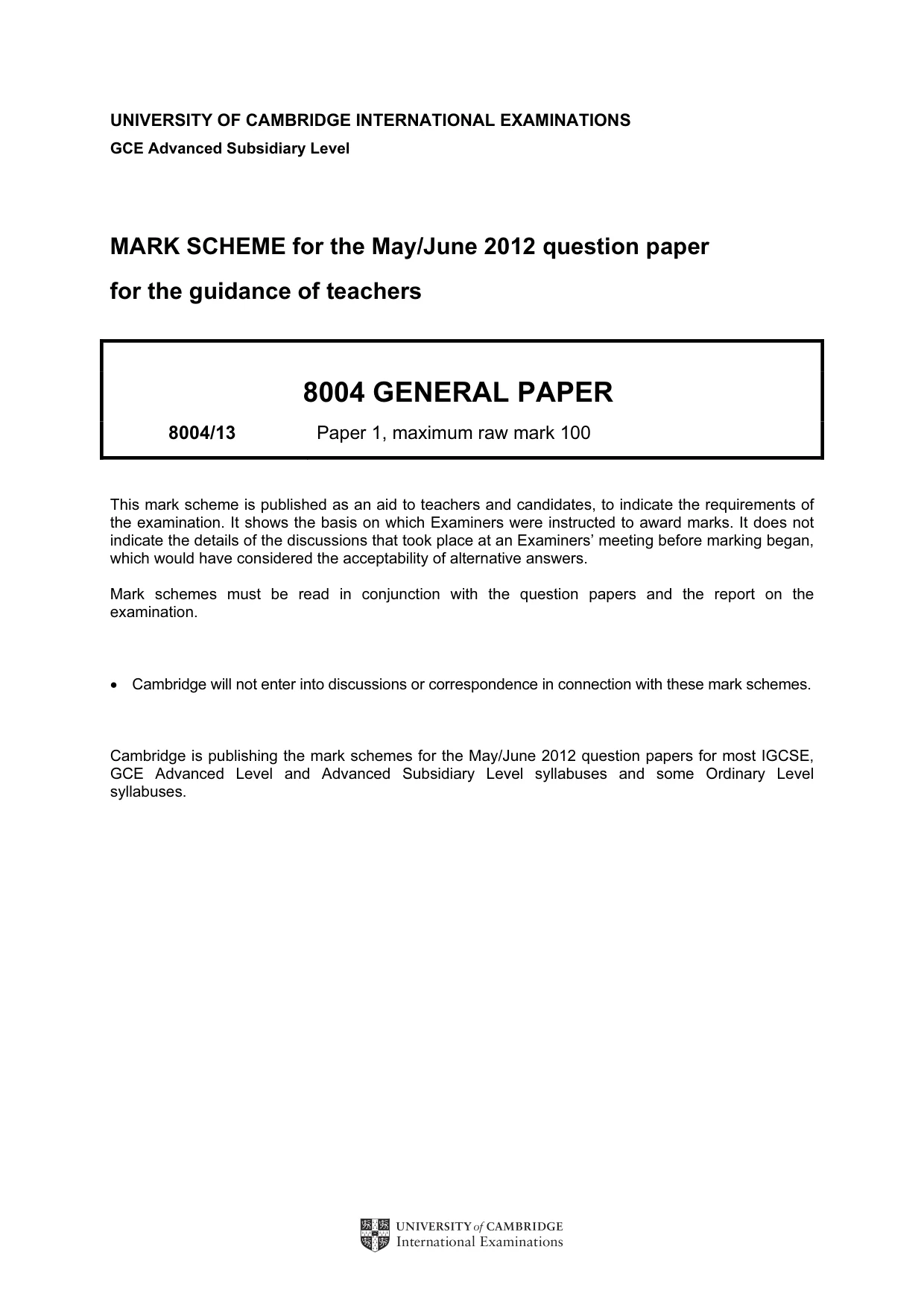
UNIVERSITY OF CAMBRIDGE INTERNATIONAL EXAMINATIONS GCE Advanced Subsidiary Level MARK SCHEME for the May/June 2012 question paper for the guidance of teachers 8004 GENERAL PAPER 8004/13 Paper 1, maximum raw mark 100 This mark scheme is published as an aid to teachers and candidates, to indicate the requirements of the examination. It shows the basis on which Examiners were instructed to award marks. It does not indicate the details of the discussions that took place at an Examiners’ meeting before marking began, which would have considered the acceptability of alternative answers. Mark schemes must be read in conjunction with the question papers and the report on the examination. • Cambridge will not enter into discussions or correspondence in connection with these mark schemes. Cambridge is publishing the mark schemes for the May/June 2012 question papers for most IGCSE, GCE Advanced Level and Advanced Subsidiary Level syllabuses and some Ordinary Level syllabuses.
Mark scheme, page 2
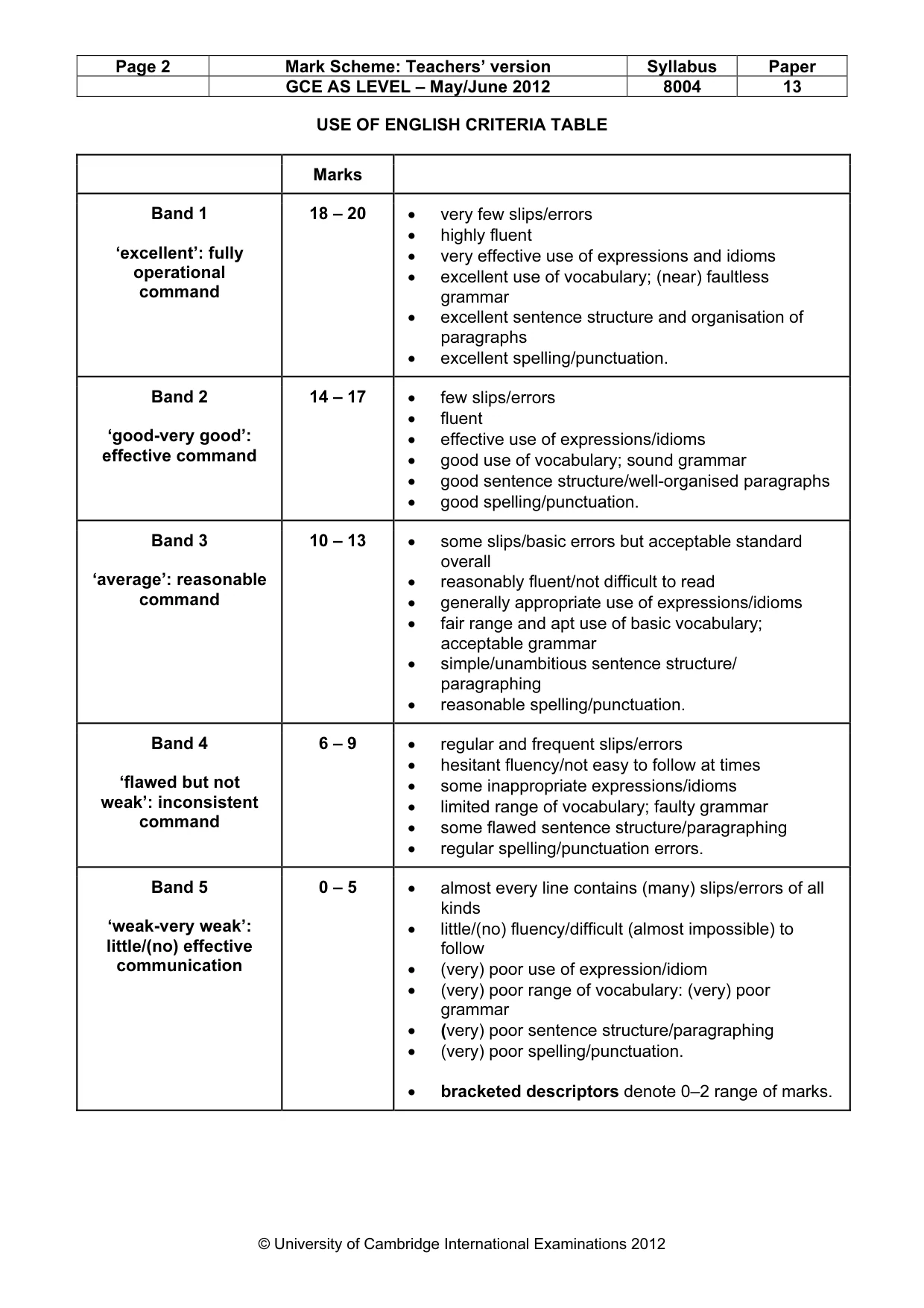
Page 2 Mark Scheme: Teachers’ version Syllabus Paper GCE AS LEVEL – May/June 2012 8004 13 © University of Cambridge International Examinations 2012 USE OF ENGLISH CRITERIA TABLE Marks Band 1 ‘excellent’: fully operational command 18 – 20 • very few slips/errors • highly fluent • very effective use of expressions and idioms • excellent use of vocabulary; (near) faultless grammar • excellent sentence structure and organisation of paragraphs • excellent spelling/punctuation. Band 2 ‘good-very good’: effective command 14 – 17 • few slips/errors • fluent • effective use of expressions/idioms • good use of vocabulary; sound grammar • good sentence structure/well-organised paragraphs • good spelling/punctuation. Band 3 ‘average’: reasonable command 10 – 13 • some slips/basic errors but acceptable standard overall • reasonably fluent/not difficult to read • generally appropriate use of expressions/idioms • fair range and apt use of basic vocabulary; acceptable grammar • simple/unambitious sentence structure/ paragraphing • reasonable spelling/punctuation. Band 4 ‘flawed but not weak’: inconsistent command 6 – 9 • regular and frequent slips/errors • hesitant fluency/not easy to follow at times • some inappropriate expressions/idioms • limited range of vocabulary; faulty grammar • some flawed sentence structure/paragraphing • regular spelling/punctuation errors. Band 5 ‘weak-very weak’: little/(no) effective communication 0 – 5 • almost every line contains (many) slips/errors of all kinds • little/(no) fluency/difficult (almost impossible) to follow • (very) poor use of expression/idiom • (very) poor range of vocabulary: (very) poor grammar • (very) poor sentence structure/paragraphing • (very) poor spelling/punctuation. • bracketed descriptors denote 0–2 range of marks.
Mark scheme, page 3
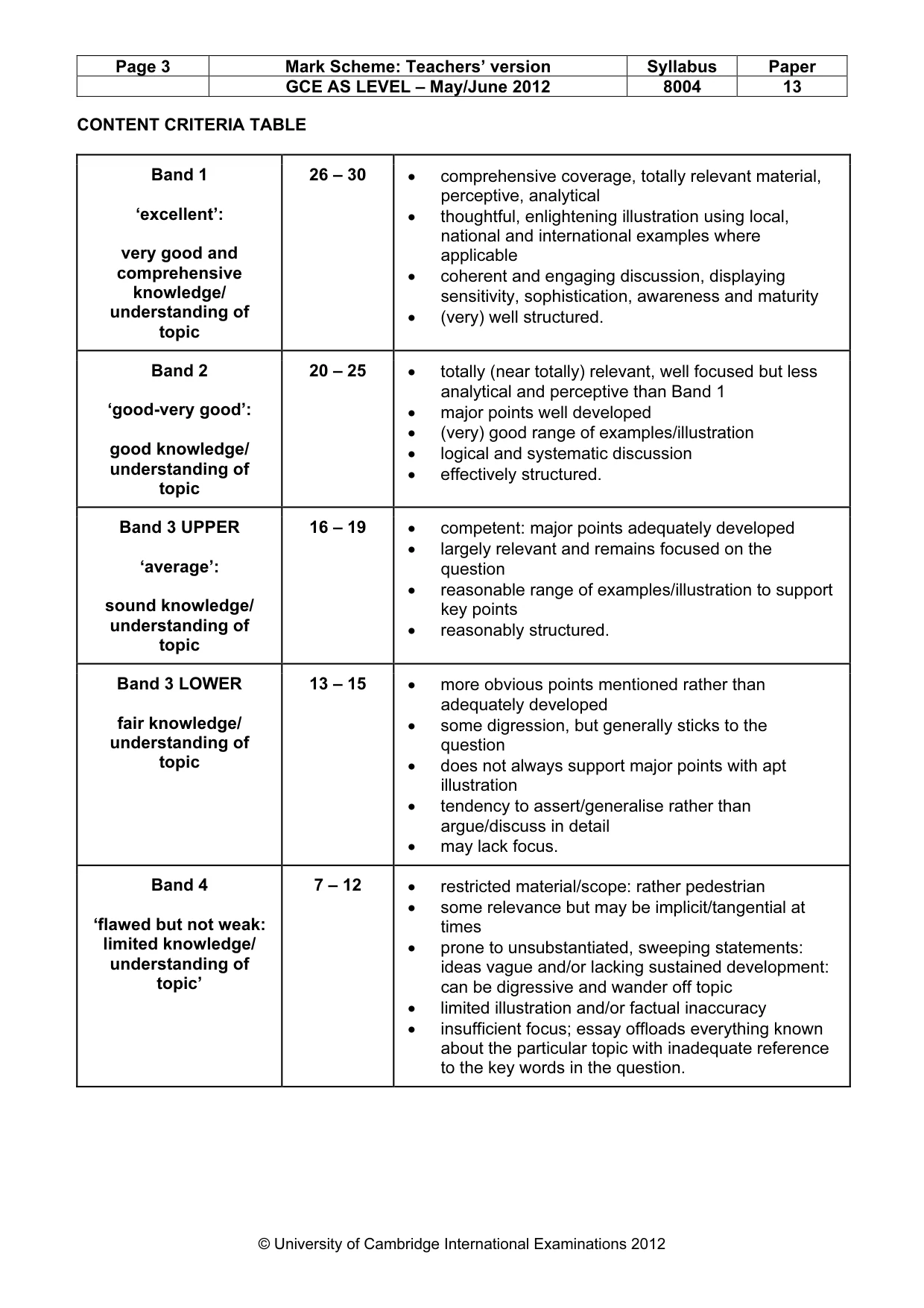
Page 3 Mark Scheme: Teachers’ version Syllabus Paper GCE AS LEVEL – May/June 2012 8004 13 © University of Cambridge International Examinations 2012 CONTENT CRITERIA TABLE Band 1 ‘excellent’: very good and comprehensive knowledge/ understanding of topic 26 – 30 • comprehensive coverage, totally relevant material, perceptive, analytical • thoughtful, enlightening illustration using local, national and international examples where applicable • coherent and engaging discussion, displaying sensitivity, sophistication, awareness and maturity • (very) well structured. Band 2 ‘good-very good’: good knowledge/ understanding of topic 20 – 25 • totally (near totally) relevant, well focused but less analytical and perceptive than Band 1 • major points well developed • (very) good range of examples/illustration • logical and systematic discussion • effectively structured. Band 3 UPPER ‘average’: sound knowledge/ understanding of topic 16 – 19 • competent: major points adequately developed • largely relevant and remains focused on the question • reasonable range of examples/illustration to support key points • reasonably structured. Band 3 LOWER fair knowledge/ understanding of topic 13 – 15 • more obvious points mentioned rather than adequately developed • some digression, but generally sticks to the question • does not always support major points with apt illustration • tendency to assert/generalise rather than argue/discuss in detail • may lack focus. Band 4 ‘flawed but not weak: limited knowledge/ understanding of topic’ 7 – 12 • restricted material/scope: rather pedestrian • some relevance but may be implicit/tangential at times • prone to unsubstantiated, sweeping statements: ideas vague and/or lacking sustained development: can be digressive and wander off topic • limited illustration and/or factual inaccuracy • insufficient focus; essay offloads everything known about the particular topic with inadequate reference to the key words in the question.
Mark scheme, page 4
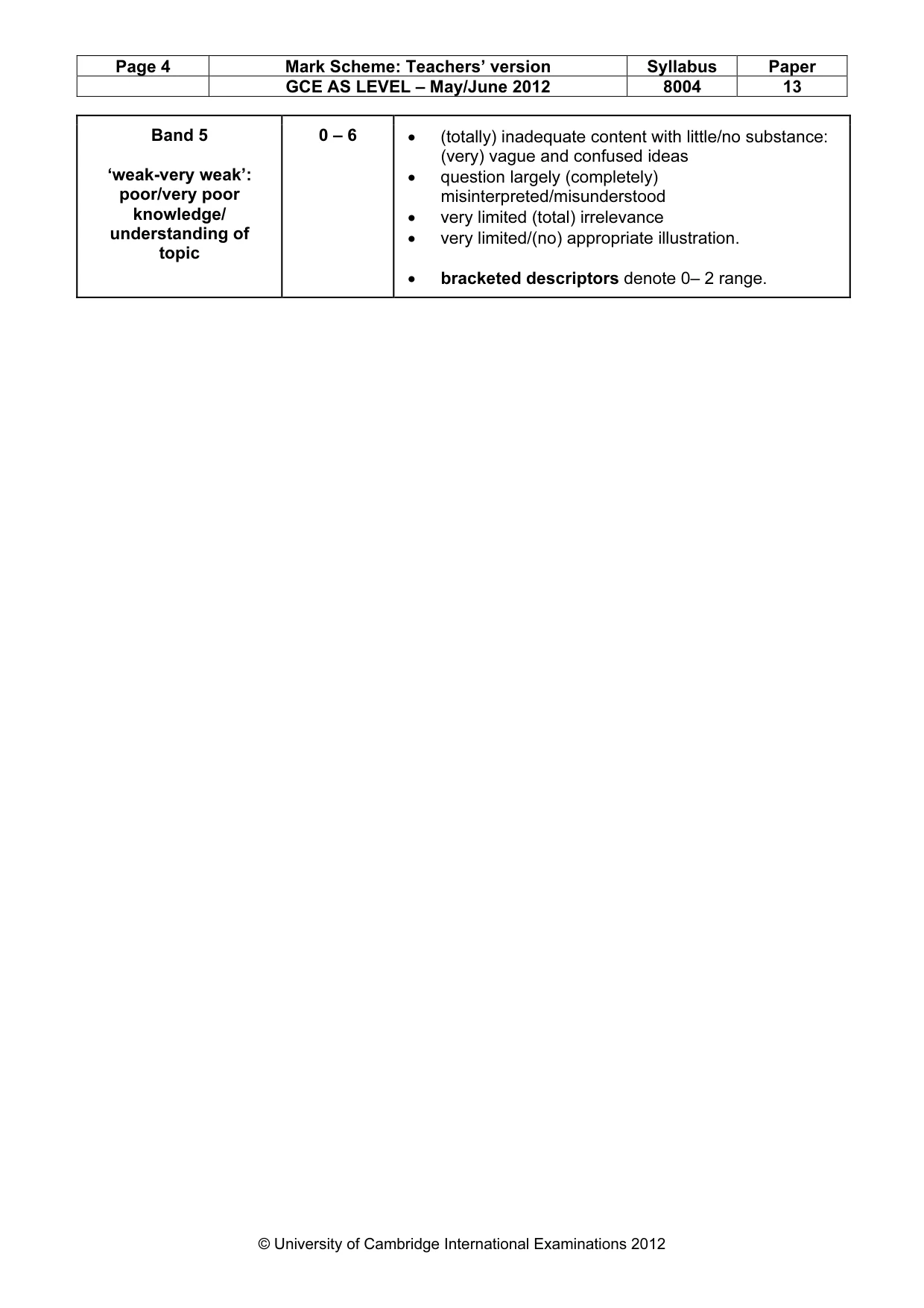
Page 4 Mark Scheme: Teachers’ version Syllabus Paper GCE AS LEVEL – May/June 2012 8004 13 © University of Cambridge International Examinations 2012 Band 5 ‘weak-very weak’: poor/very poor knowledge/ understanding of topic 0 – 6 • (totally) inadequate content with little/no substance: (very) vague and confused ideas • question largely (completely) misinterpreted/misunderstood • very limited (total) irrelevance • very limited/(no) appropriate illustration. • bracketed descriptors denote 0– 2 range.
Mark scheme, page 5
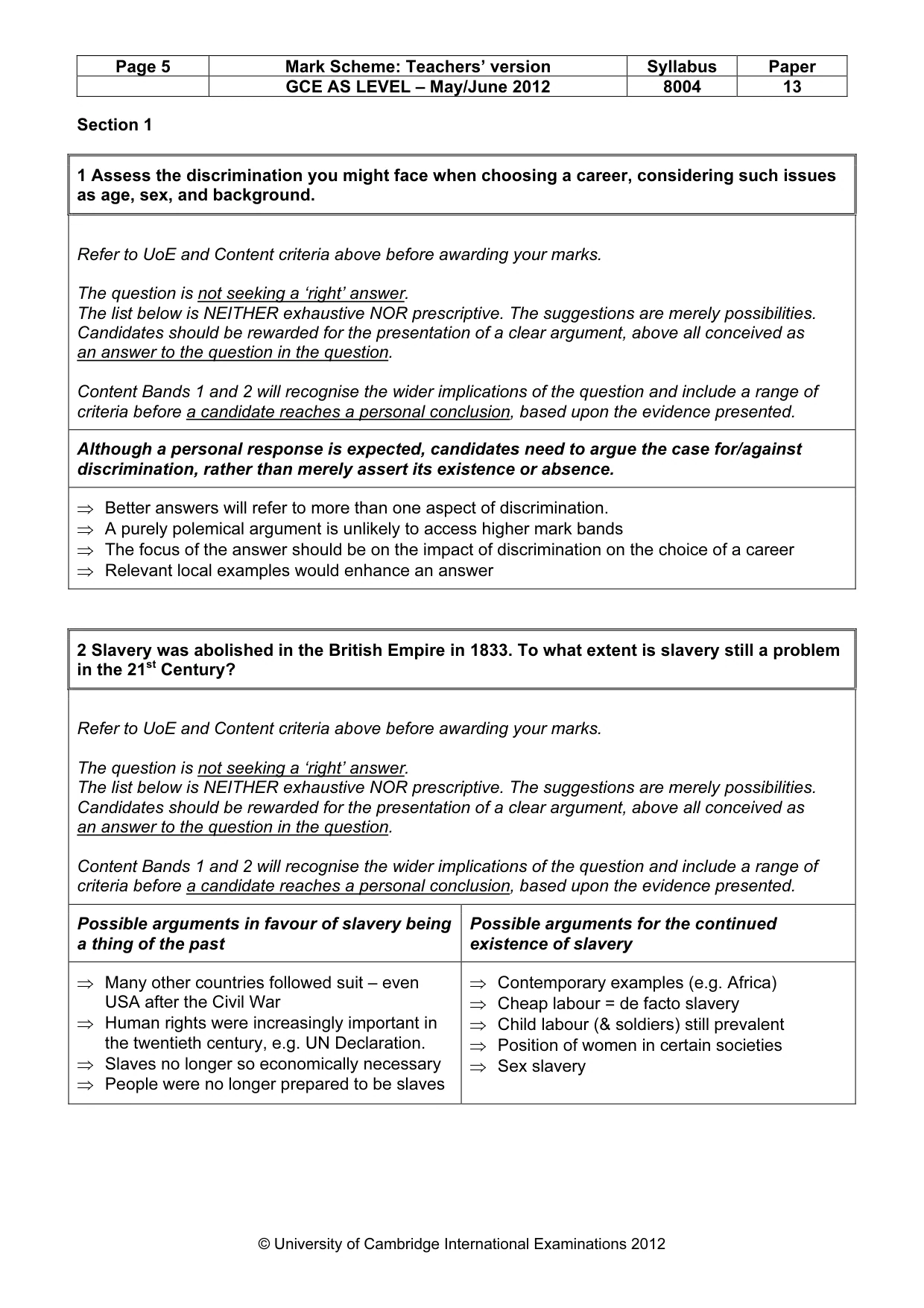
Page 5 Mark Scheme: Teachers’ version Syllabus Paper GCE AS LEVEL – May/June 2012 8004 13 © University of Cambridge International Examinations 2012 Section 1 1 Assess the discrimination you might face when choosing a career, considering such issues as age, sex, and background. Refer to UoE and Content criteria above before awarding your marks. The question is not seeking a ‘right’ answer. The list below is NEITHER exhaustive NOR prescriptive. The suggestions are merely possibilities. Candidates should be rewarded for the presentation of a clear argument, above all conceived as an answer to the question in the question. Content Bands 1 and 2 will recognise the wider implications of the question and include a range of criteria before a candidate reaches a personal conclusion, based upon the evidence presented. Although a personal response is expected, candidates need to argue the case for/against discrimination, rather than merely assert its existence or absence. ⇒ Better answers will refer to more than one aspect of discrimination. ⇒ A purely polemical argument is unlikely to access higher mark bands ⇒ The focus of the answer should be on the impact of discrimination on the choice of a career ⇒ Relevant local examples would enhance an answer 2 Slavery was abolished in the British Empire in 1833. To what extent is slavery still a problem in the 21st Century? Refer to UoE and Content criteria above before awarding your marks. The question is not seeking a ‘right’ answer. The list below is NEITHER exhaustive NOR prescriptive. The suggestions are merely possibilities. Candidates should be rewarded for the presentation of a clear argument, above all conceived as an answer to the question in the question. Content Bands 1 and 2 will recognise the wider implications of the question and include a range of criteria before a candidate reaches a personal conclusion, based upon the evidence presented. Possible arguments in favour of slavery being a thing of the past Possible arguments for the continued existence of slavery ⇒ Many other countries followed suit – even USA after the Civil War ⇒ Human rights were increasingly important in the twentieth century, e.g. UN Declaration. ⇒ Slaves no longer so economically necessary ⇒ People were no longer prepared to be slaves ⇒ Contemporary examples (e.g. Africa) ⇒ Cheap labour = de facto slavery ⇒ Child labour (& soldiers) still prevalent ⇒ Position of women in certain societies ⇒ Sex slavery
Mark scheme, page 6
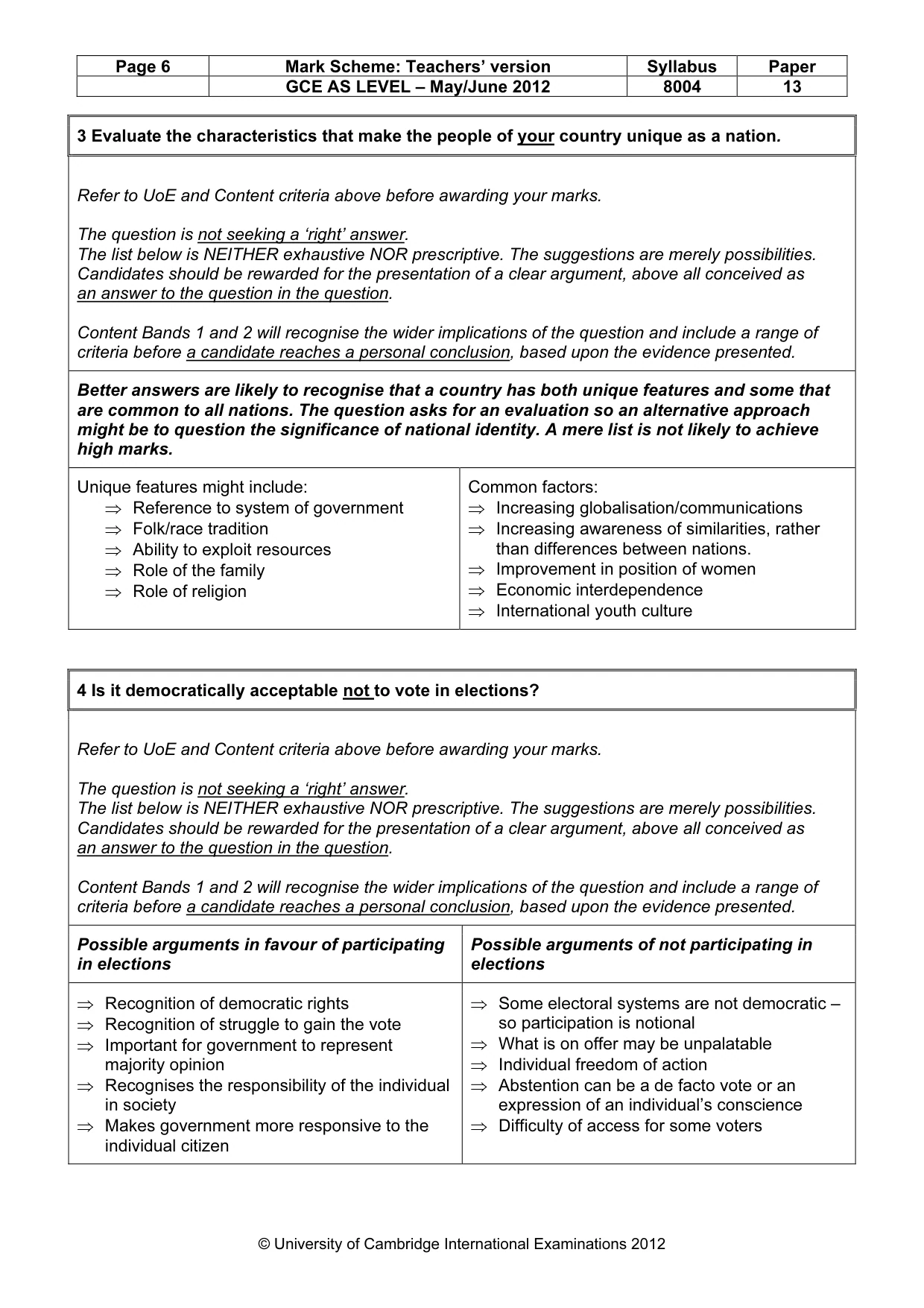
Page 6 Mark Scheme: Teachers’ version Syllabus Paper GCE AS LEVEL – May/June 2012 8004 13 © University of Cambridge International Examinations 2012 3 Evaluate the characteristics that make the people of your country unique as a nation. Refer to UoE and Content criteria above before awarding your marks. The question is not seeking a ‘right’ answer. The list below is NEITHER exhaustive NOR prescriptive. The suggestions are merely possibilities. Candidates should be rewarded for the presentation of a clear argument, above all conceived as an answer to the question in the question. Content Bands 1 and 2 will recognise the wider implications of the question and include a range of criteria before a candidate reaches a personal conclusion, based upon the evidence presented. Better answers are likely to recognise that a country has both unique features and some that are common to all nations. The question asks for an evaluation so an alternative approach might be to question the significance of national identity. A mere list is not likely to achieve high marks. Unique features might include: ⇒ Reference to system of government ⇒ Folk/race tradition ⇒ Ability to exploit resources ⇒ Role of the family ⇒ Role of religion Common factors: ⇒ Increasing globalisation/communications ⇒ Increasing awareness of similarities, rather than differences between nations. ⇒ Improvement in position of women ⇒ Economic interdependence ⇒ International youth culture 4 Is it democratically acceptable not to vote in elections? Refer to UoE and Content criteria above before awarding your marks. The question is not seeking a ‘right’ answer. The list below is NEITHER exhaustive NOR prescriptive. The suggestions are merely possibilities. Candidates should be rewarded for the presentation of a clear argument, above all conceived as an answer to the question in the question. Content Bands 1 and 2 will recognise the wider implications of the question and include a range of criteria before a candidate reaches a personal conclusion, based upon the evidence presented. Possible arguments in favour of participating in elections Possible arguments of not participating in elections ⇒ Recognition of democratic rights ⇒ Recognition of struggle to gain the vote ⇒ Important for government to represent majority opinion ⇒ Recognises the responsibility of the individual in society ⇒ Makes government more responsive to the individual citizen ⇒ Some electoral systems are not democratic – so participation is notional ⇒ What is on offer may be unpalatable ⇒ Individual freedom of action ⇒ Abstention can be a de facto vote or an expression of an individual’s conscience ⇒ Difficulty of access for some voters
Mark scheme, page 7
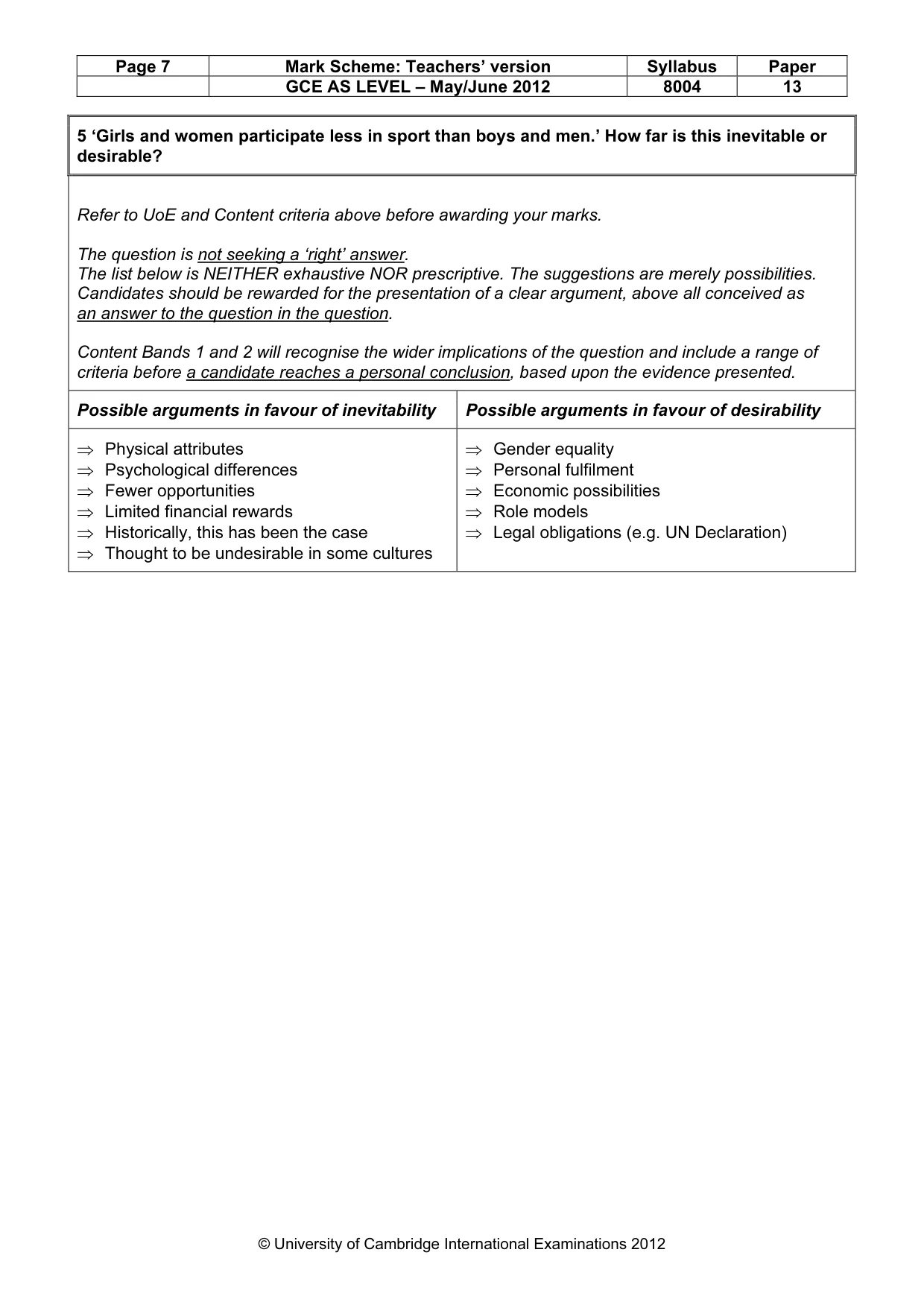
Page 7 Mark Scheme: Teachers’ version Syllabus Paper GCE AS LEVEL – May/June 2012 8004 13 © University of Cambridge International Examinations 2012 5 ‘Girls and women participate less in sport than boys and men.’ How far is this inevitable or desirable? Refer to UoE and Content criteria above before awarding your marks. The question is not seeking a ‘right’ answer. The list below is NEITHER exhaustive NOR prescriptive. The suggestions are merely possibilities. Candidates should be rewarded for the presentation of a clear argument, above all conceived as an answer to the question in the question. Content Bands 1 and 2 will recognise the wider implications of the question and include a range of criteria before a candidate reaches a personal conclusion, based upon the evidence presented. Possible arguments in favour of inevitability Possible arguments in favour of desirability ⇒ Physical attributes ⇒ Psychological differences ⇒ Fewer opportunities ⇒ Limited financial rewards ⇒ Historically, this has been the case ⇒ Thought to be undesirable in some cultures ⇒ Gender equality ⇒ Personal fulfilment ⇒ Economic possibilities ⇒ Role models ⇒ Legal obligations (e.g. UN Declaration)
Mark scheme, page 8
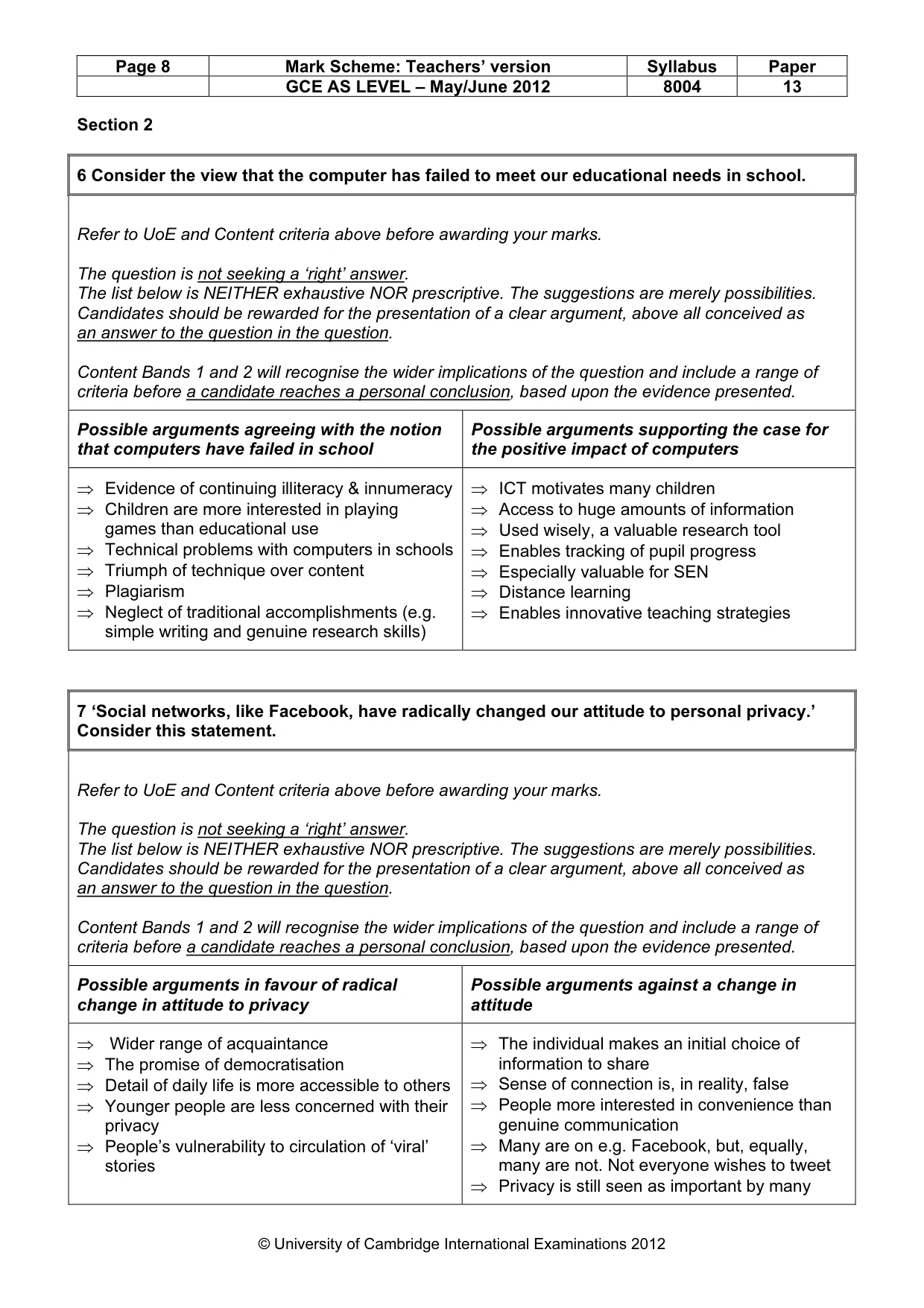
Page 8 Mark Scheme: Teachers’ version Syllabus Paper GCE AS LEVEL – May/June 2012 8004 13 © University of Cambridge International Examinations 2012 Section 2 6 Consider the view that the computer has failed to meet our educational needs in school. Refer to UoE and Content criteria above before awarding your marks. The question is not seeking a ‘right’ answer. The list below is NEITHER exhaustive NOR prescriptive. The suggestions are merely possibilities. Candidates should be rewarded for the presentation of a clear argument, above all conceived as an answer to the question in the question. Content Bands 1 and 2 will recognise the wider implications of the question and include a range of criteria before a candidate reaches a personal conclusion, based upon the evidence presented. Possible arguments agreeing with the notion that computers have failed in school Possible arguments supporting the case for the positive impact of computers ⇒ Evidence of continuing illiteracy & innumeracy ⇒ Children are more interested in playing games than educational use ⇒ Technical problems with computers in schools ⇒ Triumph of technique over content ⇒ Plagiarism ⇒ Neglect of traditional accomplishments (e.g. simple writing and genuine research skills) ⇒ ICT motivates many children ⇒ Access to huge amounts of information ⇒ Used wisely, a valuable research tool ⇒ Enables tracking of pupil progress ⇒ Especially valuable for SEN ⇒ Distance learning ⇒ Enables innovative teaching strategies 7 ‘Social networks, like Facebook, have radically changed our attitude to personal privacy.’ Consider this statement. Refer to UoE and Content criteria above before awarding your marks. The question is not seeking a ‘right’ answer. The list below is NEITHER exhaustive NOR prescriptive. The suggestions are merely possibilities. Candidates should be rewarded for the presentation of a clear argument, above all conceived as an answer to the question in the question. Content Bands 1 and 2 will recognise the wider implications of the question and include a range of criteria before a candidate reaches a personal conclusion, based upon the evidence presented. Possible arguments in favour of radical change in attitude to privacy Possible arguments against a change in attitude ⇒ Wider range of acquaintance ⇒ The promise of democratisation ⇒ Detail of daily life is more accessible to others ⇒ Younger people are less concerned with their privacy ⇒ People’s vulnerability to circulation of ‘viral’ stories ⇒ The individual makes an initial choice of information to share ⇒ Sense of connection is, in reality, false ⇒ People more interested in convenience than genuine communication ⇒ Many are on e.g. Facebook, but, equally, many are not. Not everyone wishes to tweet ⇒ Privacy is still seen as important by many
Mark scheme, page 9
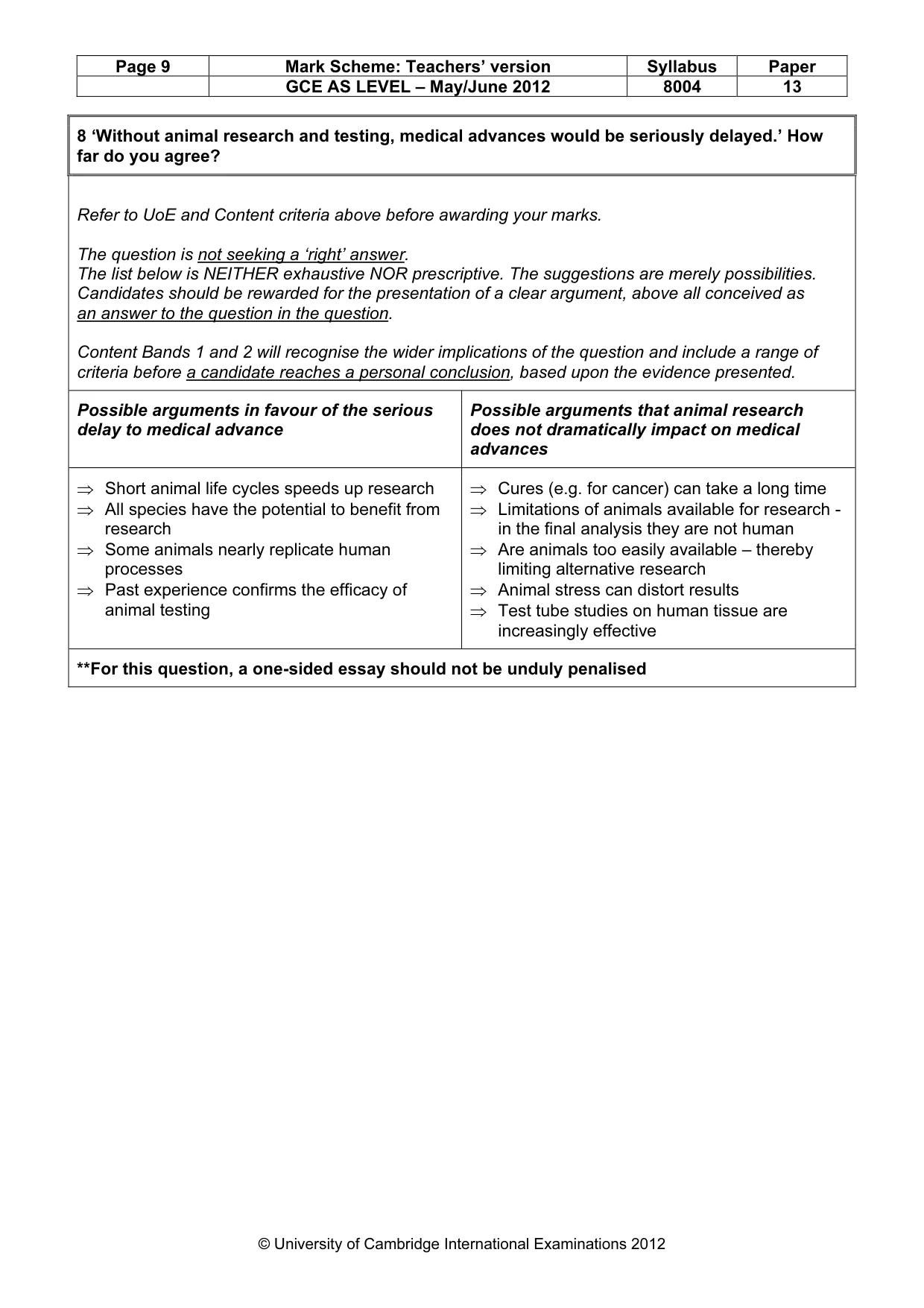
Page 9 Mark Scheme: Teachers’ version Syllabus Paper GCE AS LEVEL – May/June 2012 8004 13 © University of Cambridge International Examinations 2012 8 ‘Without animal research and testing, medical advances would be seriously delayed.’ How far do you agree? Refer to UoE and Content criteria above before awarding your marks. The question is not seeking a ‘right’ answer. The list below is NEITHER exhaustive NOR prescriptive. The suggestions are merely possibilities. Candidates should be rewarded for the presentation of a clear argument, above all conceived as an answer to the question in the question. Content Bands 1 and 2 will recognise the wider implications of the question and include a range of criteria before a candidate reaches a personal conclusion, based upon the evidence presented. Possible arguments in favour of the serious delay to medical advance Possible arguments that animal research does not dramatically impact on medical advances ⇒ Short animal life cycles speeds up research ⇒ All species have the potential to benefit from research ⇒ Some animals nearly replicate human processes ⇒ Past experience confirms the efficacy of animal testing ⇒ Cures (e.g. for cancer) can take a long time ⇒ Limitations of animals available for research - in the final analysis they are not human ⇒ Are animals too easily available – thereby limiting alternative research ⇒ Animal stress can distort results ⇒ Test tube studies on human tissue are increasingly effective **For this question, a one-sided essay should not be unduly penalised
Mark scheme, page 10
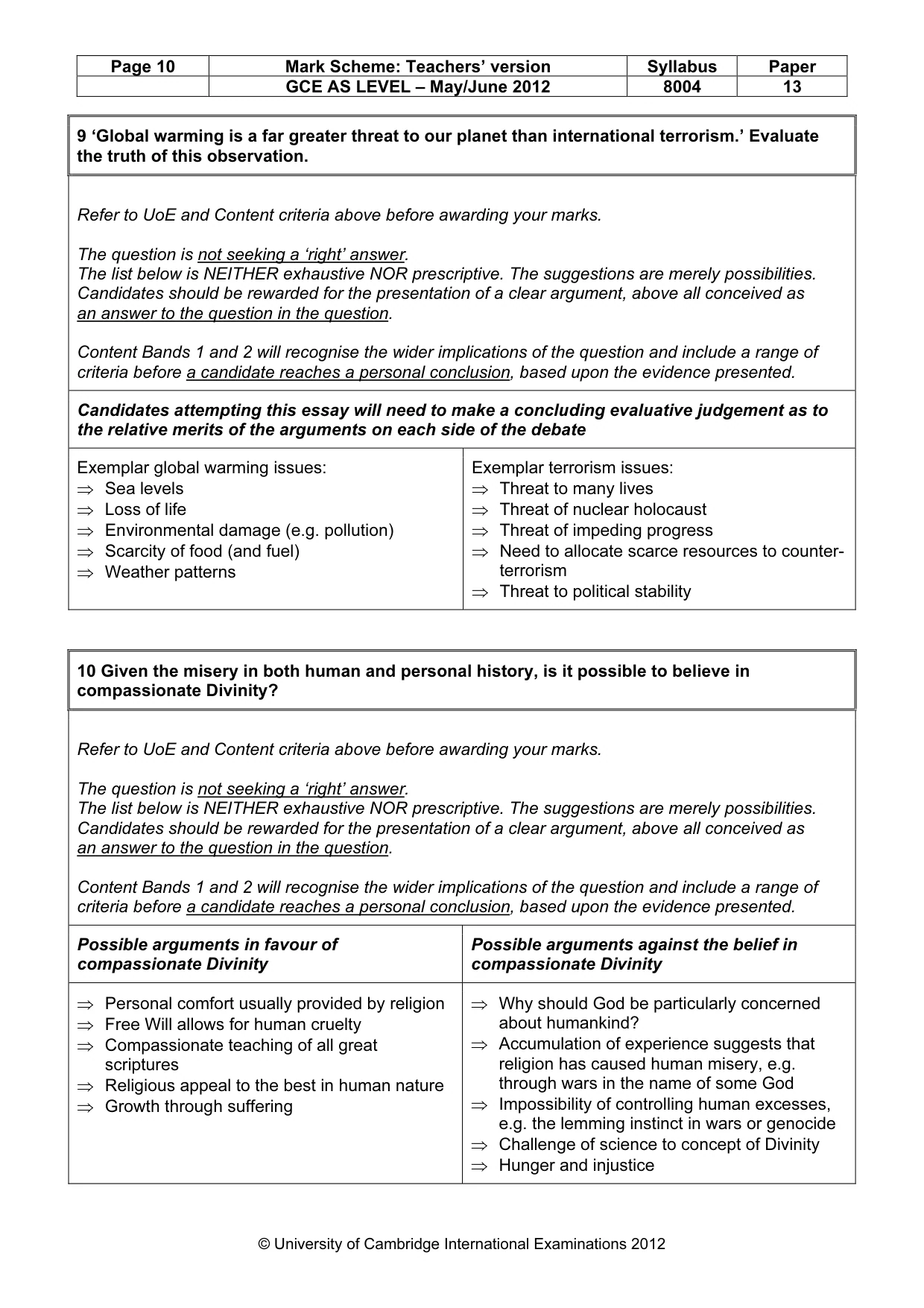
Page 10 Mark Scheme: Teachers’ version Syllabus Paper GCE AS LEVEL – May/June 2012 8004 13 © University of Cambridge International Examinations 2012 9 ‘Global warming is a far greater threat to our planet than international terrorism.’ Evaluate the truth of this observation. Refer to UoE and Content criteria above before awarding your marks. The question is not seeking a ‘right’ answer. The list below is NEITHER exhaustive NOR prescriptive. The suggestions are merely possibilities. Candidates should be rewarded for the presentation of a clear argument, above all conceived as an answer to the question in the question. Content Bands 1 and 2 will recognise the wider implications of the question and include a range of criteria before a candidate reaches a personal conclusion, based upon the evidence presented. Candidates attempting this essay will need to make a concluding evaluative judgement as to the relative merits of the arguments on each side of the debate Exemplar global warming issues: ⇒ Sea levels ⇒ Loss of life ⇒ Environmental damage (e.g. pollution) ⇒ Scarcity of food (and fuel) ⇒ Weather patterns Exemplar terrorism issues: ⇒ Threat to many lives ⇒ Threat of nuclear holocaust ⇒ Threat of impeding progress ⇒ Need to allocate scarce resources to counter- terrorism ⇒ Threat to political stability 10 Given the misery in both human and personal history, is it possible to believe in compassionate Divinity? Refer to UoE and Content criteria above before awarding your marks. The question is not seeking a ‘right’ answer. The list below is NEITHER exhaustive NOR prescriptive. The suggestions are merely possibilities. Candidates should be rewarded for the presentation of a clear argument, above all conceived as an answer to the question in the question. Content Bands 1 and 2 will recognise the wider implications of the question and include a range of criteria before a candidate reaches a personal conclusion, based upon the evidence presented. Possible arguments in favour of compassionate Divinity Possible arguments against the belief in compassionate Divinity ⇒ Personal comfort usually provided by religion ⇒ Free Will allows for human cruelty ⇒ Compassionate teaching of all great scriptures ⇒ Religious appeal to the best in human nature ⇒ Growth through suffering ⇒ Why should God be particularly concerned about humankind? ⇒ Accumulation of experience suggests that religion has caused human misery, e.g. through wars in the name of some God ⇒ Impossibility of controlling human excesses, e.g. the lemming instinct in wars or genocide ⇒ Challenge of science to concept of Divinity ⇒ Hunger and injustice
Mark scheme, page 11
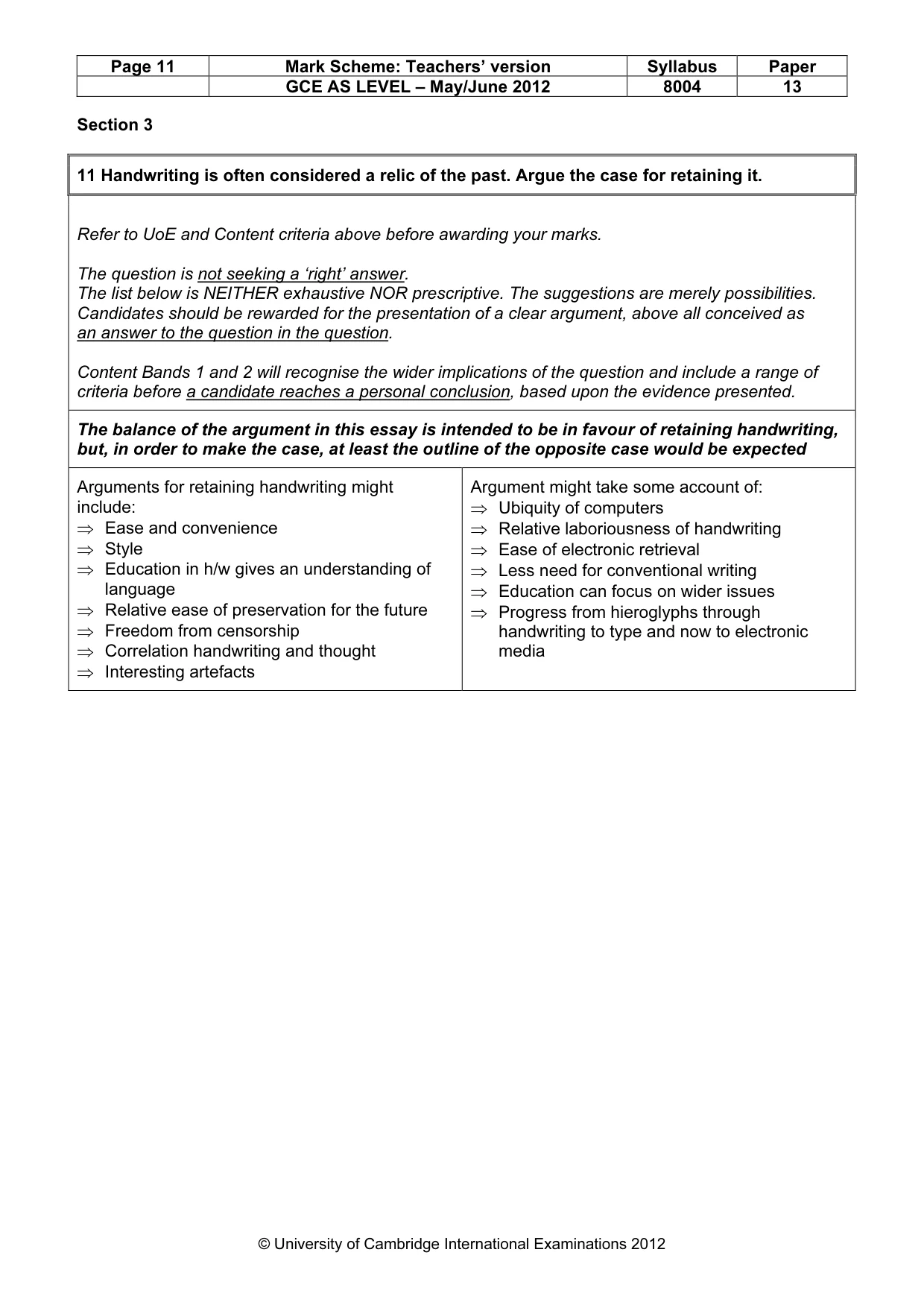
Page 11 Mark Scheme: Teachers’ version Syllabus Paper GCE AS LEVEL – May/June 2012 8004 13 © University of Cambridge International Examinations 2012 Section 3 11 Handwriting is often considered a relic of the past. Argue the case for retaining it. Refer to UoE and Content criteria above before awarding your marks. The question is not seeking a ‘right’ answer. The list below is NEITHER exhaustive NOR prescriptive. The suggestions are merely possibilities. Candidates should be rewarded for the presentation of a clear argument, above all conceived as an answer to the question in the question. Content Bands 1 and 2 will recognise the wider implications of the question and include a range of criteria before a candidate reaches a personal conclusion, based upon the evidence presented. The balance of the argument in this essay is intended to be in favour of retaining handwriting, but, in order to make the case, at least the outline of the opposite case would be expected Arguments for retaining handwriting might include: ⇒ Ease and convenience ⇒ Style ⇒ Education in h/w gives an understanding of language ⇒ Relative ease of preservation for the future ⇒ Freedom from censorship ⇒ Correlation handwriting and thought ⇒ Interesting artefacts Argument might take some account of: ⇒ Ubiquity of computers ⇒ Relative laboriousness of handwriting ⇒ Ease of electronic retrieval ⇒ Less need for conventional writing ⇒ Education can focus on wider issues ⇒ Progress from hieroglyphs through handwriting to type and now to electronic media
Mark scheme, page 12
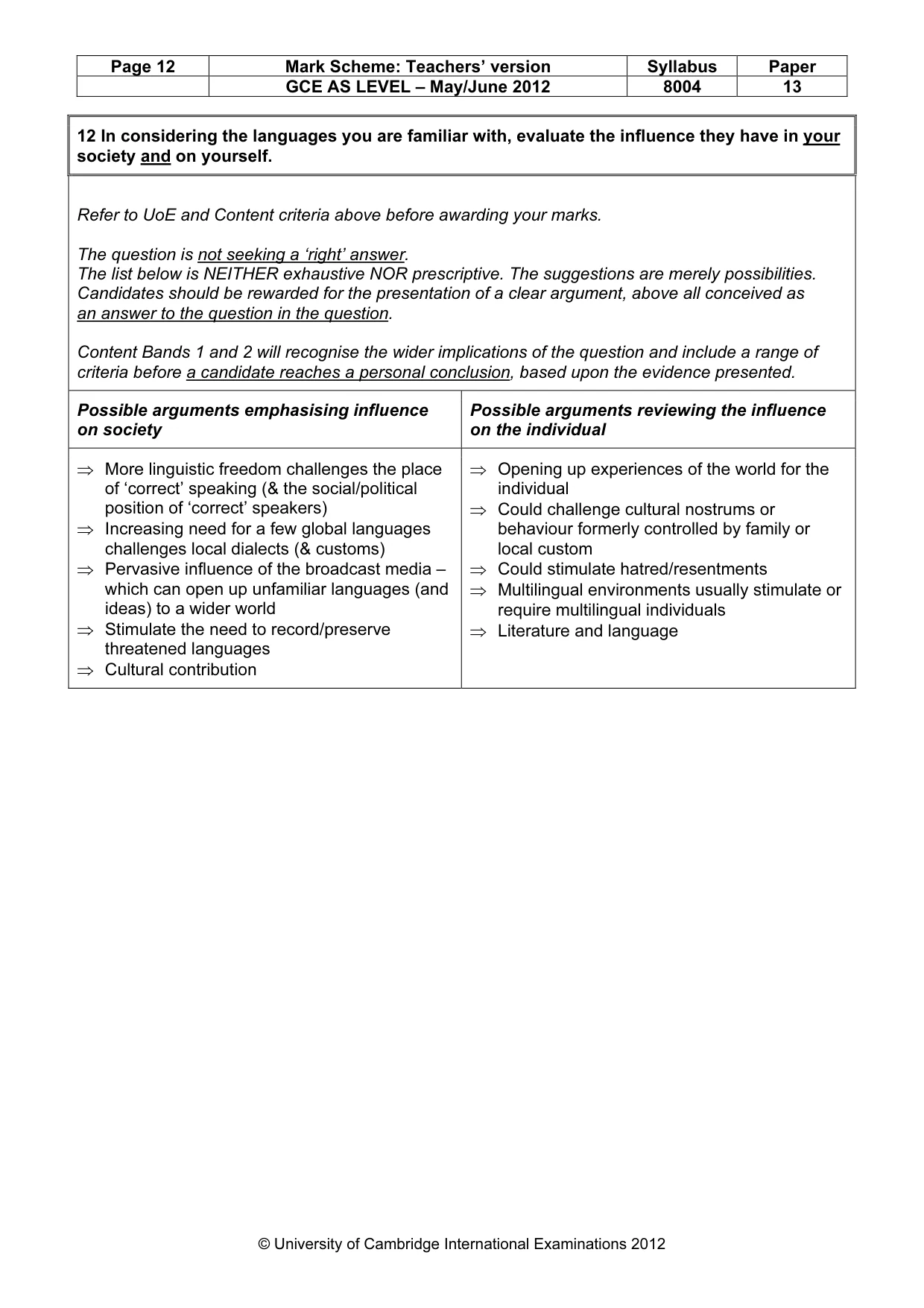
Page 12 Mark Scheme: Teachers’ version Syllabus Paper GCE AS LEVEL – May/June 2012 8004 13 © University of Cambridge International Examinations 2012 12 In considering the languages you are familiar with, evaluate the influence they have in your society and on yourself. Refer to UoE and Content criteria above before awarding your marks. The question is not seeking a ‘right’ answer. The list below is NEITHER exhaustive NOR prescriptive. The suggestions are merely possibilities. Candidates should be rewarded for the presentation of a clear argument, above all conceived as an answer to the question in the question. Content Bands 1 and 2 will recognise the wider implications of the question and include a range of criteria before a candidate reaches a personal conclusion, based upon the evidence presented. Possible arguments emphasising influence on society Possible arguments reviewing the influence on the individual ⇒ More linguistic freedom challenges the place of ‘correct’ speaking (& the social/political position of ‘correct’ speakers) ⇒ Increasing need for a few global languages challenges local dialects (& customs) ⇒ Pervasive influence of the broadcast media – which can open up unfamiliar languages (and ideas) to a wider world ⇒ Stimulate the need to record/preserve threatened languages ⇒ Cultural contribution ⇒ Opening up experiences of the world for the individual ⇒ Could challenge cultural nostrums or behaviour formerly controlled by family or local custom ⇒ Could stimulate hatred/resentments ⇒ Multilingual environments usually stimulate or require multilingual individuals ⇒ Literature and language
Mark scheme, page 13
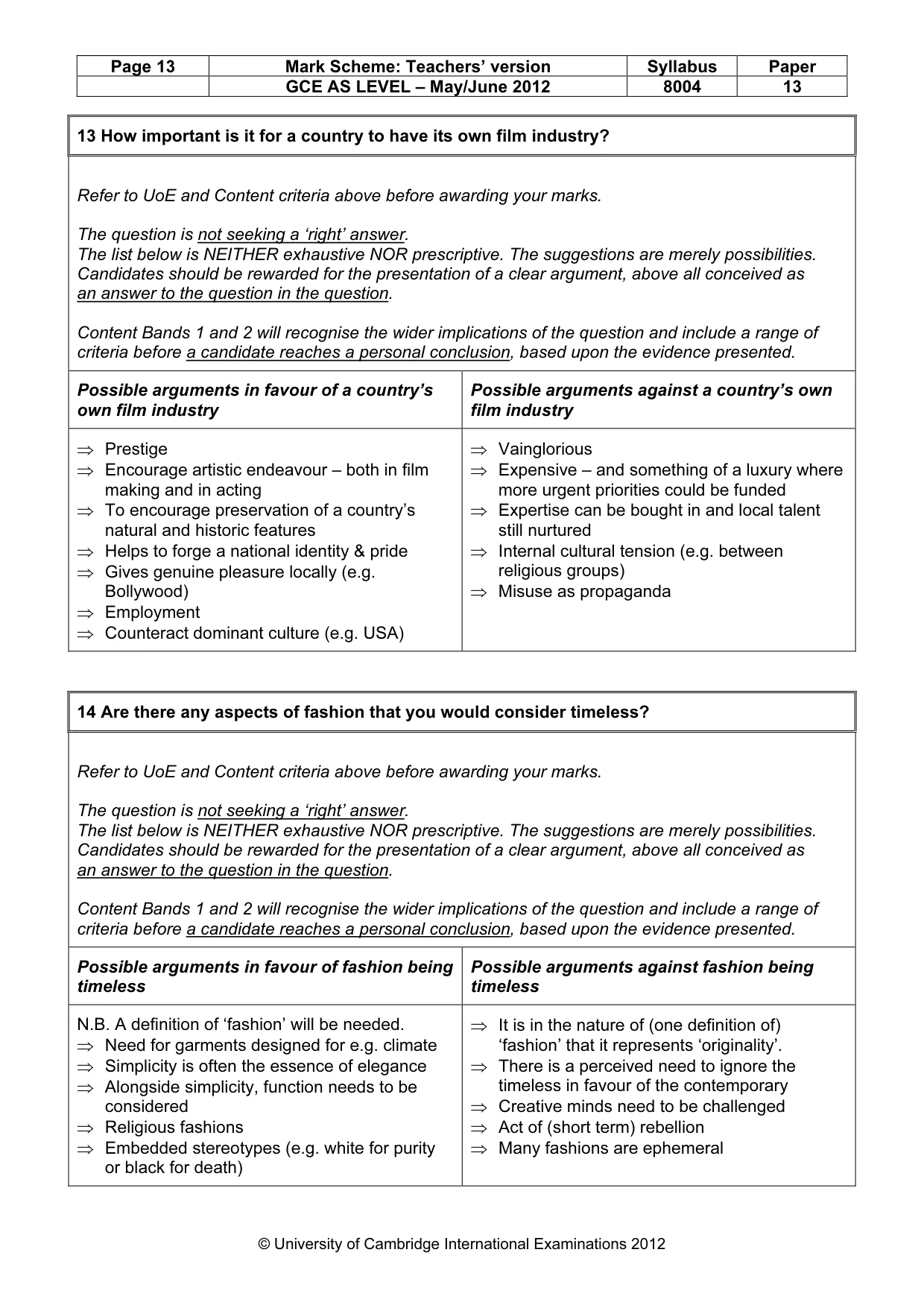
Page 13 Mark Scheme: Teachers’ version Syllabus Paper GCE AS LEVEL – May/June 2012 8004 13 © University of Cambridge International Examinations 2012 13 How important is it for a country to have its own film industry? Refer to UoE and Content criteria above before awarding your marks. The question is not seeking a ‘right’ answer. The list below is NEITHER exhaustive NOR prescriptive. The suggestions are merely possibilities. Candidates should be rewarded for the presentation of a clear argument, above all conceived as an answer to the question in the question. Content Bands 1 and 2 will recognise the wider implications of the question and include a range of criteria before a candidate reaches a personal conclusion, based upon the evidence presented. Possible arguments in favour of a country’s own film industry Possible arguments against a country’s own film industry ⇒ Prestige ⇒ Encourage artistic endeavour – both in film making and in acting ⇒ To encourage preservation of a country’s natural and historic features ⇒ Helps to forge a national identity & pride ⇒ Gives genuine pleasure locally (e.g. Bollywood) ⇒ Employment ⇒ Counteract dominant culture (e.g. USA) ⇒ Vainglorious ⇒ Expensive – and something of a luxury where more urgent priorities could be funded ⇒ Expertise can be bought in and local talent still nurtured ⇒ Internal cultural tension (e.g. between religious groups) ⇒ Misuse as propaganda 14 Are there any aspects of fashion that you would consider timeless? Refer to UoE and Content criteria above before awarding your marks. The question is not seeking a ‘right’ answer. The list below is NEITHER exhaustive NOR prescriptive. The suggestions are merely possibilities. Candidates should be rewarded for the presentation of a clear argument, above all conceived as an answer to the question in the question. Content Bands 1 and 2 will recognise the wider implications of the question and include a range of criteria before a candidate reaches a personal conclusion, based upon the evidence presented. Possible arguments in favour of fashion being timeless Possible arguments against fashion being timeless N.B. A definition of ‘fashion’ will be needed. ⇒ Need for garments designed for e.g. climate ⇒ Simplicity is often the essence of elegance ⇒ Alongside simplicity, function needs to be considered ⇒ Religious fashions ⇒ Embedded stereotypes (e.g. white for purity or black for death) ⇒ It is in the nature of (one definition of) ‘fashion’ that it represents ‘originality’. ⇒ There is a perceived need to ignore the timeless in favour of the contemporary ⇒ Creative minds need to be challenged ⇒ Act of (short term) rebellion ⇒ Many fashions are ephemeral
Mark scheme, page 14
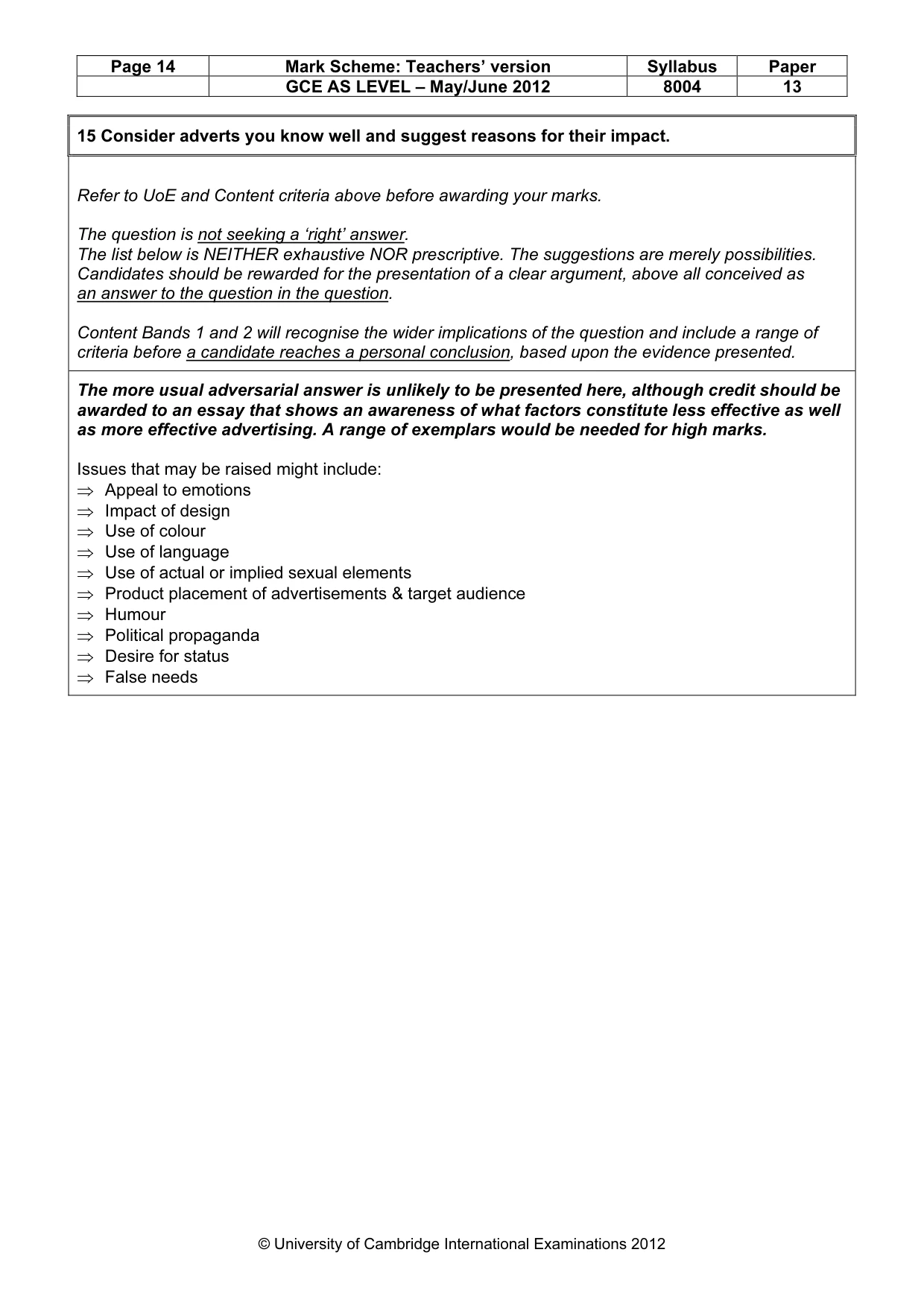
Page 14 Mark Scheme: Teachers’ version Syllabus Paper GCE AS LEVEL – May/June 2012 8004 13 © University of Cambridge International Examinations 2012 15 Consider adverts you know well and suggest reasons for their impact. Refer to UoE and Content criteria above before awarding your marks. The question is not seeking a ‘right’ answer. The list below is NEITHER exhaustive NOR prescriptive. The suggestions are merely possibilities. Candidates should be rewarded for the presentation of a clear argument, above all conceived as an answer to the question in the question. Content Bands 1 and 2 will recognise the wider implications of the question and include a range of criteria before a candidate reaches a personal conclusion, based upon the evidence presented. The more usual adversarial answer is unlikely to be presented here, although credit should be awarded to an essay that shows an awareness of what factors constitute less effective as well as more effective advertising. A range of exemplars would be needed for high marks. Issues that may be raised might include: ⇒ Appeal to emotions ⇒ Impact of design ⇒ Use of colour ⇒ Use of language ⇒ Use of actual or implied sexual elements ⇒ Product placement of advertisements & target audience ⇒ Humour ⇒ Political propaganda ⇒ Desire for status ⇒ False needs
What you needed in this session
Cambridge’s own grade thresholds for 2012 May/June, Paper 1 · Variant 3. A higher threshold means an easier paper — the bar moves with how the cohort did.