Cambridge A Level General Paper (AS Level only) 8004 — 2012 May/June Paper 1 · Variant 2
8004/12/M/J/12 · 100 marks · ≈113 min
The question paper and its mark scheme, free to read here and free to download. This is Cambridge’s own paper, exactly as it was sat.
Question paper2 pages
Mark scheme14 pages
Answers below. Sit the paper first if you are practising.

Paper as text
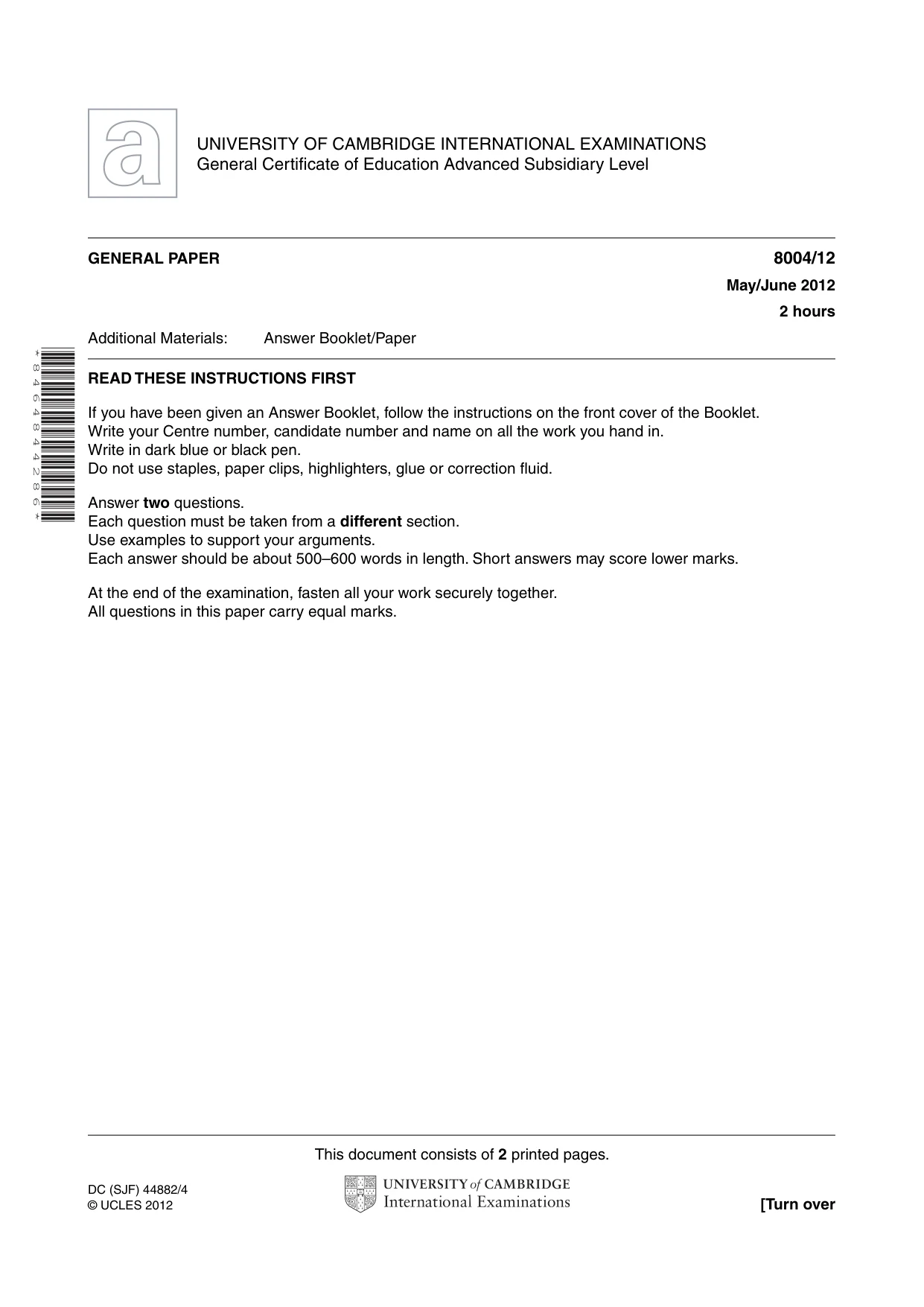
Question paper, page 1
This document consists of 2 printed pages. DC (SJF) 44882/4 © UCLES 2012 [Turn over UNIVERSITY OF CAMBRIDGE INTERNATIONAL EXAMINATIONS General Certificate of Education Advanced Subsidiary Level READ THESE INSTRUCTIONS FIRST If you have been given an Answer Booklet, follow the instructions on the front cover of the Booklet. Write your Centre number, candidate number and name on all the work you hand in. Write in dark blue or black pen. Do not use staples, paper clips, highlighters, glue or correction fluid. Answer two questions. Each question must be taken from a different section. Use examples to support your arguments. Each answer should be about 500–600 words in length. Short answers may score lower marks. At the end of the examination, fasten all your work securely together. All questions in this paper carry equal marks. * 8 4 6 4 8 4 4 2 8 6 * GENERAL PAPER 8004/12 May/June 2012 2 hours Additional Materials: Answer Booklet/Paper
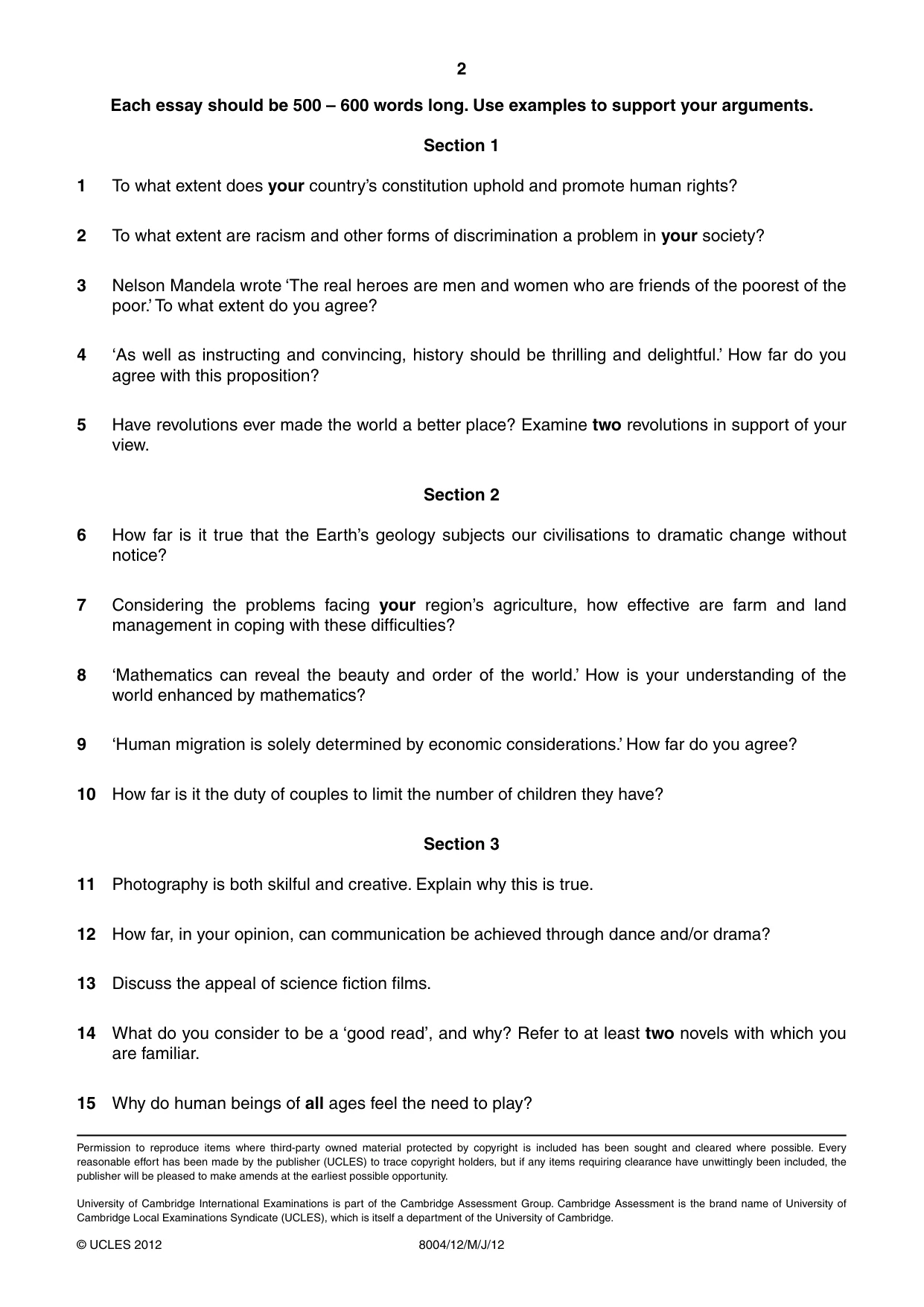
Question paper, page 2
2 8004/12/M/J/12 © UCLES 2012 Each essay should be 500 – 600 words long. Use examples to support your arguments. Section 1 1 To what extent does your country’s constitution uphold and promote human rights? 2 To what extent are racism and other forms of discrimination a problem in your society? 3 Nelson Mandela wrote ‘The real heroes are men and women who are friends of the poorest of the poor.’ To what extent do you agree? 4 ‘As well as instructing and convincing, history should be thrilling and delightful.’ How far do you agree with this proposition? 5 Have revolutions ever made the world a better place? Examine two revolutions in support of your view. Section 2 6 How far is it true that the Earth’s geology subjects our civilisations to dramatic change without notice? 7 Considering the problems facing your region’s agriculture, how effective are farm and land management in coping with these difficulties? 8 ‘Mathematics can reveal the beauty and order of the world.’ How is your understanding of the world enhanced by mathematics? 9 ‘Human migration is solely determined by economic considerations.’ How far do you agree? 10 How far is it the duty of couples to limit the number of children they have? Section 3 11 Photography is both skilful and creative. Explain why this is true. 12 How far, in your opinion, can communication be achieved through dance and/or drama? 13 Discuss the appeal of science fiction films. 14 What do you consider to be a ‘good read’, and why? Refer to at least two novels with which you are familiar. 15 Why do human beings of all ages feel the need to play? Permission to reproduce items where third-party owned material protected by copyright is included has been sought and cleared where possible. Every reasonable effort has been made by the publisher (UCLES) to trace copyright holders, but if any items requiring clearance have unwittingly been included, the publisher will be pleased to make amends at the earliest possible opportunity. University of Cambridge International Examinations is part of the Cambridge Assessment Group. Cambridge Assessment is the brand name of University of Cambridge Local Examinations Syndicate (UCLES), which is itself a department of the University of Cambridge.
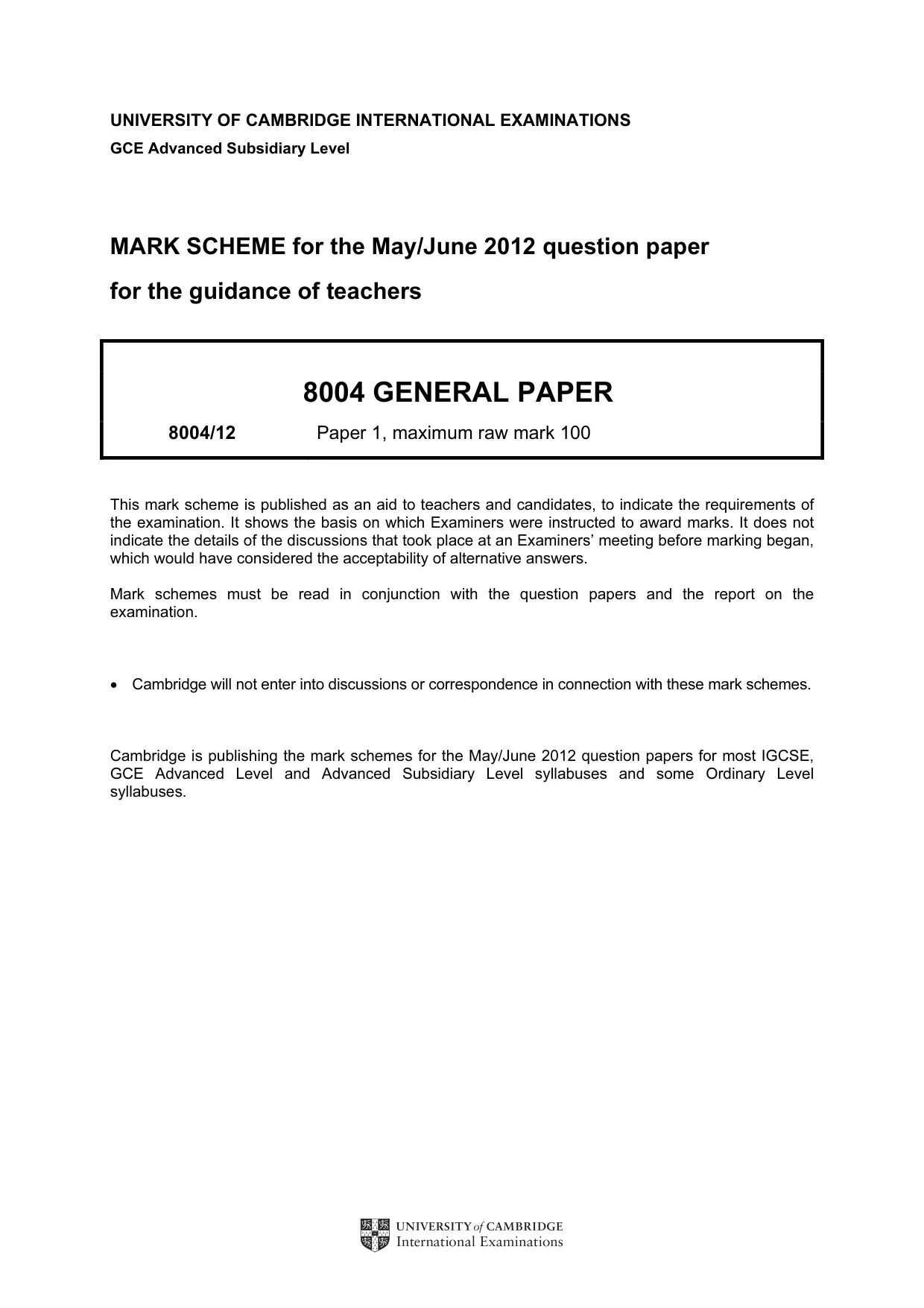
Mark scheme, page 1
UNIVERSITY OF CAMBRIDGE INTERNATIONAL EXAMINATIONS GCE Advanced Subsidiary Level MARK SCHEME for the May/June 2012 question paper for the guidance of teachers 8004 GENERAL PAPER 8004/12 Paper 1, maximum raw mark 100 This mark scheme is published as an aid to teachers and candidates, to indicate the requirements of the examination. It shows the basis on which Examiners were instructed to award marks. It does not indicate the details of the discussions that took place at an Examiners’ meeting before marking began, which would have considered the acceptability of alternative answers. Mark schemes must be read in conjunction with the question papers and the report on the examination. • Cambridge will not enter into discussions or correspondence in connection with these mark schemes. Cambridge is publishing the mark schemes for the May/June 2012 question papers for most IGCSE, GCE Advanced Level and Advanced Subsidiary Level syllabuses and some Ordinary Level syllabuses.
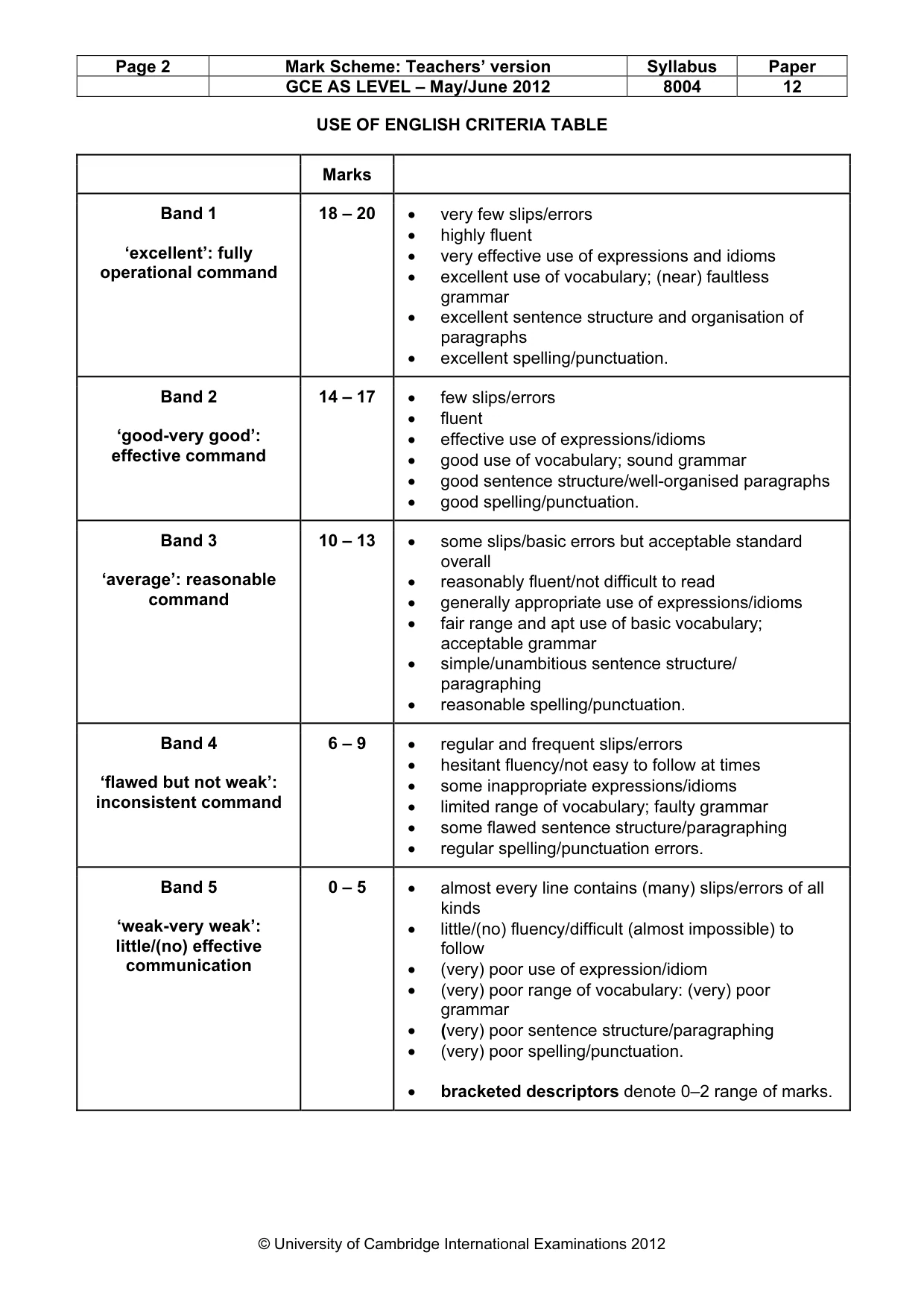
Mark scheme, page 2
Page 2 Mark Scheme: Teachers’ version Syllabus Paper GCE AS LEVEL – May/June 2012 8004 12 © University of Cambridge International Examinations 2012 USE OF ENGLISH CRITERIA TABLE Marks Band 1 ‘excellent’: fully operational command 18 – 20 • very few slips/errors • highly fluent • very effective use of expressions and idioms • excellent use of vocabulary; (near) faultless grammar • excellent sentence structure and organisation of paragraphs • excellent spelling/punctuation. Band 2 ‘good-very good’: effective command 14 – 17 • few slips/errors • fluent • effective use of expressions/idioms • good use of vocabulary; sound grammar • good sentence structure/well-organised paragraphs • good spelling/punctuation. Band 3 ‘average’: reasonable command 10 – 13 • some slips/basic errors but acceptable standard overall • reasonably fluent/not difficult to read • generally appropriate use of expressions/idioms • fair range and apt use of basic vocabulary; acceptable grammar • simple/unambitious sentence structure/ paragraphing • reasonable spelling/punctuation. Band 4 ‘flawed but not weak’: inconsistent command 6 – 9 • regular and frequent slips/errors • hesitant fluency/not easy to follow at times • some inappropriate expressions/idioms • limited range of vocabulary; faulty grammar • some flawed sentence structure/paragraphing • regular spelling/punctuation errors. Band 5 ‘weak-very weak’: little/(no) effective communication 0 – 5 • almost every line contains (many) slips/errors of all kinds • little/(no) fluency/difficult (almost impossible) to follow • (very) poor use of expression/idiom • (very) poor range of vocabulary: (very) poor grammar • (very) poor sentence structure/paragraphing • (very) poor spelling/punctuation. • bracketed descriptors denote 0–2 range of marks.
Mark scheme, page 3
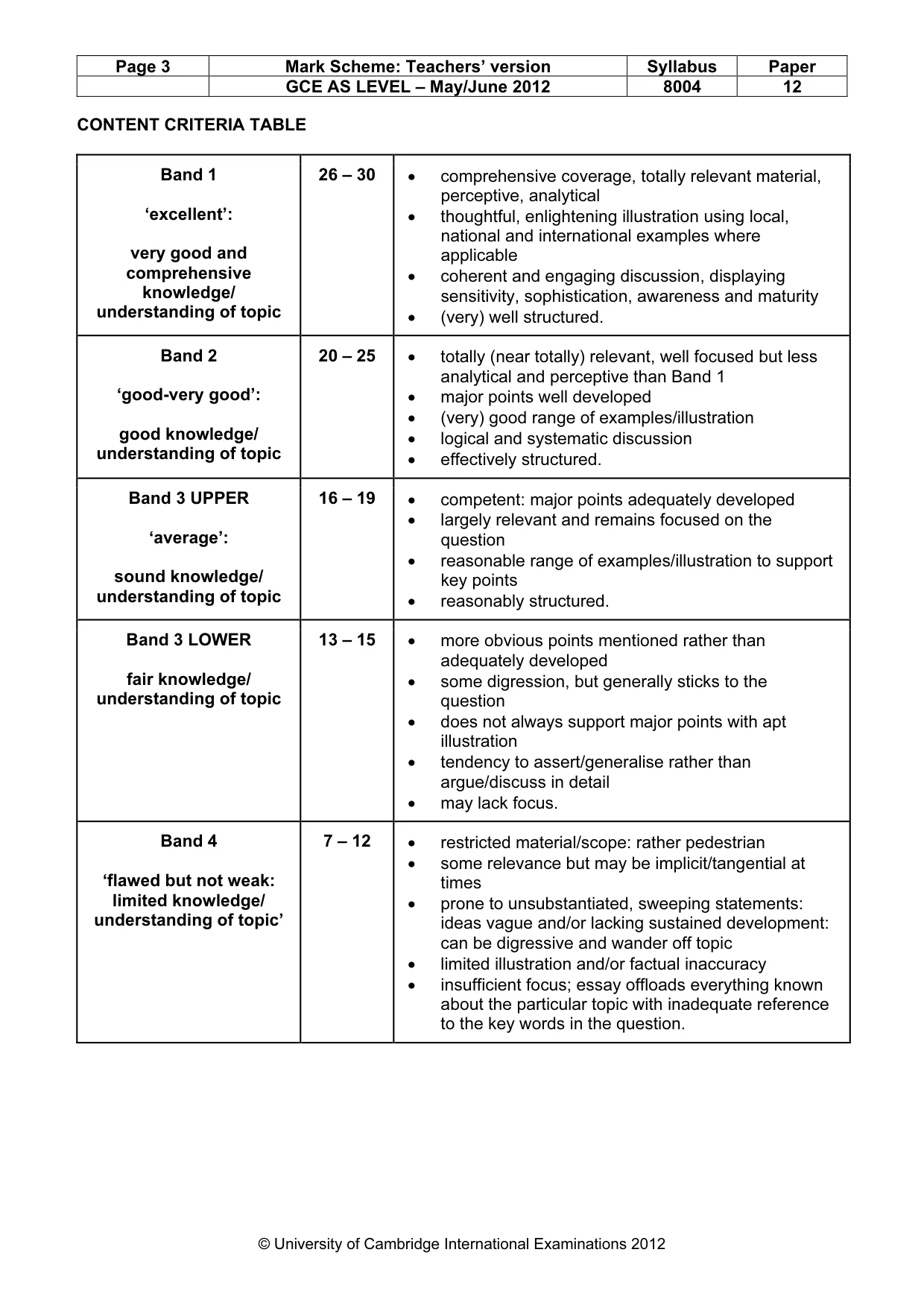
Page 3 Mark Scheme: Teachers’ version Syllabus Paper GCE AS LEVEL – May/June 2012 8004 12 © University of Cambridge International Examinations 2012 CONTENT CRITERIA TABLE Band 1 ‘excellent’: very good and comprehensive knowledge/ understanding of topic 26 – 30 • comprehensive coverage, totally relevant material, perceptive, analytical • thoughtful, enlightening illustration using local, national and international examples where applicable • coherent and engaging discussion, displaying sensitivity, sophistication, awareness and maturity • (very) well structured. Band 2 ‘good-very good’: good knowledge/ understanding of topic 20 – 25 • totally (near totally) relevant, well focused but less analytical and perceptive than Band 1 • major points well developed • (very) good range of examples/illustration • logical and systematic discussion • effectively structured. Band 3 UPPER ‘average’: sound knowledge/ understanding of topic 16 – 19 • competent: major points adequately developed • largely relevant and remains focused on the question • reasonable range of examples/illustration to support key points • reasonably structured. Band 3 LOWER fair knowledge/ understanding of topic 13 – 15 • more obvious points mentioned rather than adequately developed • some digression, but generally sticks to the question • does not always support major points with apt illustration • tendency to assert/generalise rather than argue/discuss in detail • may lack focus. Band 4 ‘flawed but not weak: limited knowledge/ understanding of topic’ 7 – 12 • restricted material/scope: rather pedestrian • some relevance but may be implicit/tangential at times • prone to unsubstantiated, sweeping statements: ideas vague and/or lacking sustained development: can be digressive and wander off topic • limited illustration and/or factual inaccuracy • insufficient focus; essay offloads everything known about the particular topic with inadequate reference to the key words in the question.
Mark scheme, page 4
Page 4 Mark Scheme: Teachers’ version Syllabus Paper GCE AS LEVEL – May/June 2012 8004 12 © University of Cambridge International Examinations 2012 Band 5 ‘weak-very weak’: poor/very poor knowledge/ understanding of topic 0 – 6 • (totally) inadequate content with little/no substance: (very) vague and confused ideas • question largely (completely) misinterpreted/misunderstood • very limited (total) irrelevance • very limited/(no) appropriate illustration. • bracketed descriptors denote 0– 2 range.
Mark scheme, page 5
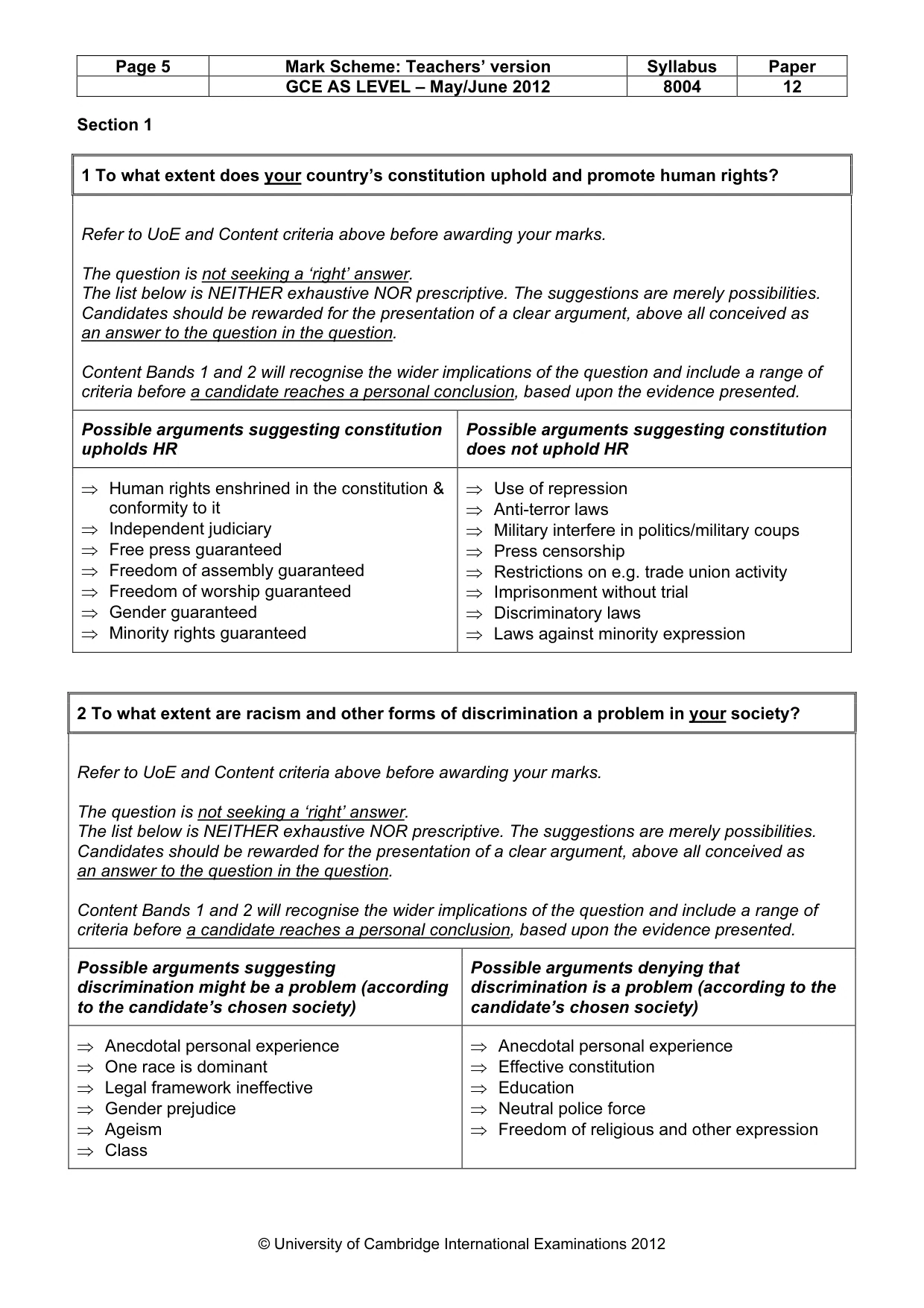
Page 5 Mark Scheme: Teachers’ version Syllabus Paper GCE AS LEVEL – May/June 2012 8004 12 © University of Cambridge International Examinations 2012 Section 1 1 To what extent does your country’s constitution uphold and promote human rights? Refer to UoE and Content criteria above before awarding your marks. The question is not seeking a ‘right’ answer. The list below is NEITHER exhaustive NOR prescriptive. The suggestions are merely possibilities. Candidates should be rewarded for the presentation of a clear argument, above all conceived as an answer to the question in the question. Content Bands 1 and 2 will recognise the wider implications of the question and include a range of criteria before a candidate reaches a personal conclusion, based upon the evidence presented. Possible arguments suggesting constitution upholds HR Possible arguments suggesting constitution does not uphold HR ⇒ Human rights enshrined in the constitution & conformity to it ⇒ Independent judiciary ⇒ Free press guaranteed ⇒ Freedom of assembly guaranteed ⇒ Freedom of worship guaranteed ⇒ Gender guaranteed ⇒ Minority rights guaranteed ⇒ Use of repression ⇒ Anti-terror laws ⇒ Military interfere in politics/military coups ⇒ Press censorship ⇒ Restrictions on e.g. trade union activity ⇒ Imprisonment without trial ⇒ Discriminatory laws ⇒ Laws against minority expression 2 To what extent are racism and other forms of discrimination a problem in your society? Refer to UoE and Content criteria above before awarding your marks. The question is not seeking a ‘right’ answer. The list below is NEITHER exhaustive NOR prescriptive. The suggestions are merely possibilities. Candidates should be rewarded for the presentation of a clear argument, above all conceived as an answer to the question in the question. Content Bands 1 and 2 will recognise the wider implications of the question and include a range of criteria before a candidate reaches a personal conclusion, based upon the evidence presented. Possible arguments suggesting discrimination might be a problem (according to the candidate’s chosen society) Possible arguments denying that discrimination is a problem (according to the candidate’s chosen society) ⇒ Anecdotal personal experience ⇒ One race is dominant ⇒ Legal framework ineffective ⇒ Gender prejudice ⇒ Ageism ⇒ Class ⇒ Anecdotal personal experience ⇒ Effective constitution ⇒ Education ⇒ Neutral police force ⇒ Freedom of religious and other expression
Mark scheme, page 6
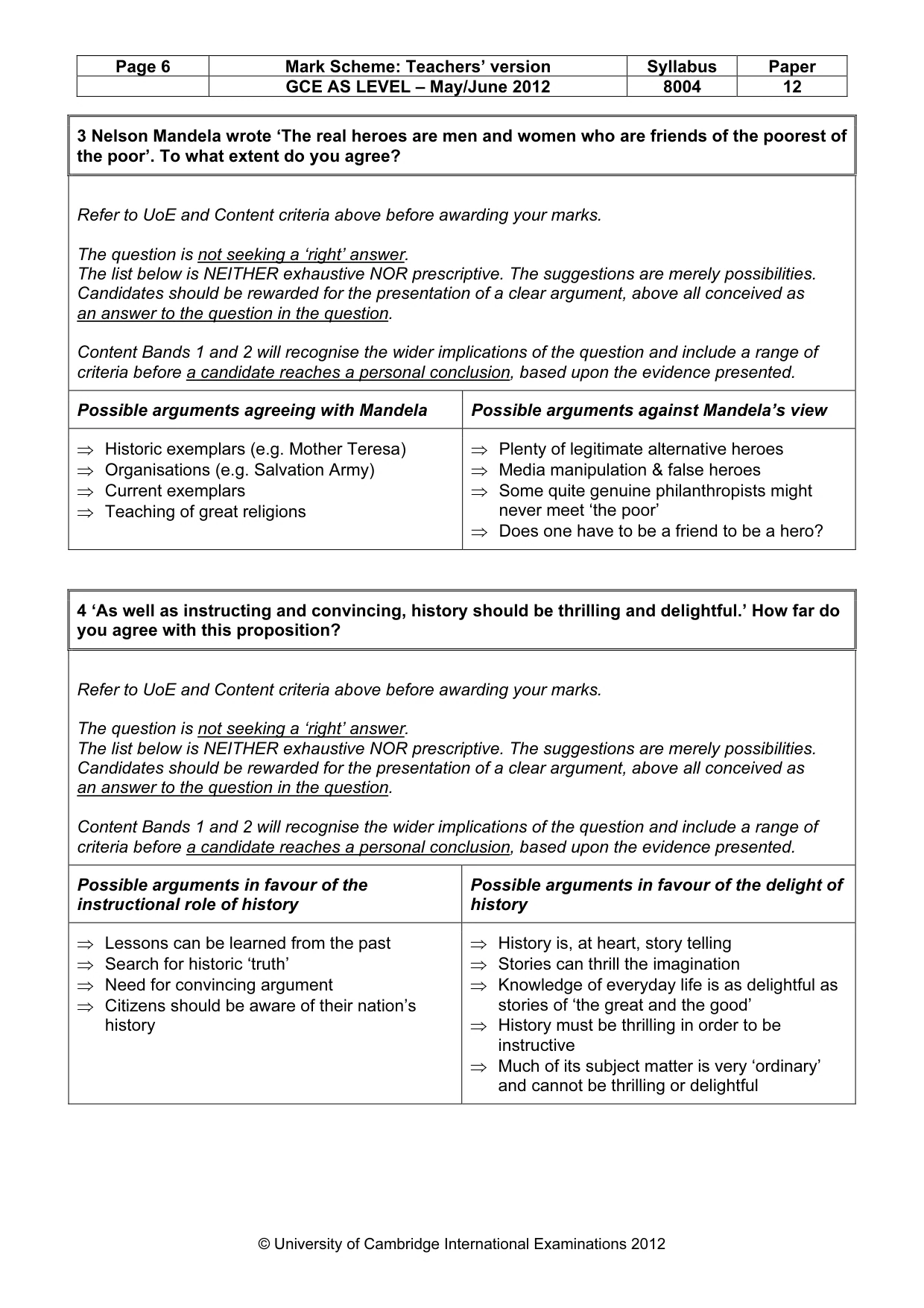
Page 6 Mark Scheme: Teachers’ version Syllabus Paper GCE AS LEVEL – May/June 2012 8004 12 © University of Cambridge International Examinations 2012 3 Nelson Mandela wrote ‘The real heroes are men and women who are friends of the poorest of the poor’. To what extent do you agree? Refer to UoE and Content criteria above before awarding your marks. The question is not seeking a ‘right’ answer. The list below is NEITHER exhaustive NOR prescriptive. The suggestions are merely possibilities. Candidates should be rewarded for the presentation of a clear argument, above all conceived as an answer to the question in the question. Content Bands 1 and 2 will recognise the wider implications of the question and include a range of criteria before a candidate reaches a personal conclusion, based upon the evidence presented. Possible arguments agreeing with Mandela Possible arguments against Mandela’s view ⇒ Historic exemplars (e.g. Mother Teresa) ⇒ Organisations (e.g. Salvation Army) ⇒ Current exemplars ⇒ Teaching of great religions ⇒ Plenty of legitimate alternative heroes ⇒ Media manipulation & false heroes ⇒ Some quite genuine philanthropists might never meet ‘the poor’ ⇒ Does one have to be a friend to be a hero? 4 ‘As well as instructing and convincing, history should be thrilling and delightful.’ How far do you agree with this proposition? Refer to UoE and Content criteria above before awarding your marks. The question is not seeking a ‘right’ answer. The list below is NEITHER exhaustive NOR prescriptive. The suggestions are merely possibilities. Candidates should be rewarded for the presentation of a clear argument, above all conceived as an answer to the question in the question. Content Bands 1 and 2 will recognise the wider implications of the question and include a range of criteria before a candidate reaches a personal conclusion, based upon the evidence presented. Possible arguments in favour of the instructional role of history Possible arguments in favour of the delight of history ⇒ Lessons can be learned from the past ⇒ Search for historic ‘truth’ ⇒ Need for convincing argument ⇒ Citizens should be aware of their nation’s history ⇒ History is, at heart, story telling ⇒ Stories can thrill the imagination ⇒ Knowledge of everyday life is as delightful as stories of ‘the great and the good’ ⇒ History must be thrilling in order to be instructive ⇒ Much of its subject matter is very ‘ordinary’ and cannot be thrilling or delightful
Mark scheme, page 7
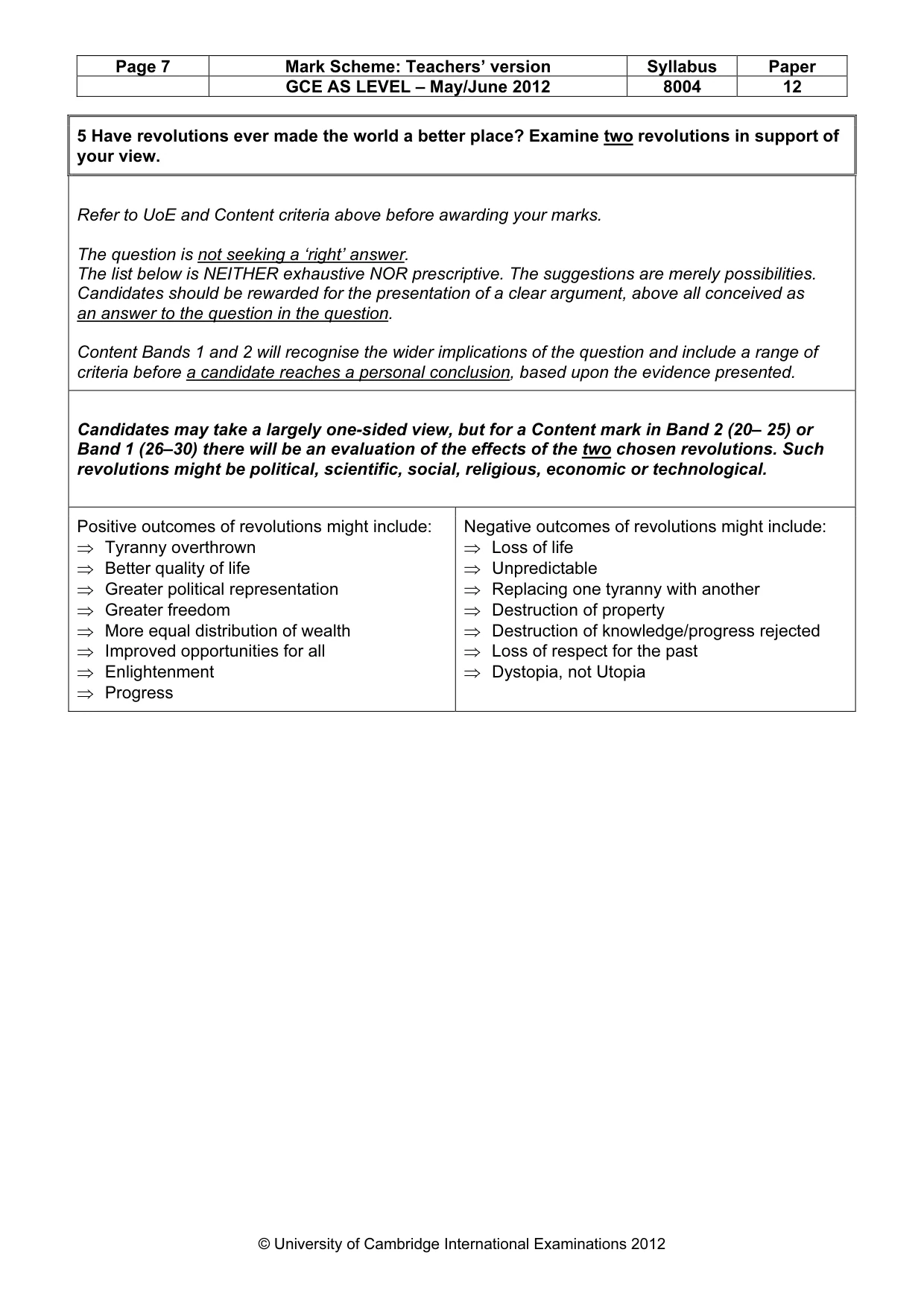
Page 7 Mark Scheme: Teachers’ version Syllabus Paper GCE AS LEVEL – May/June 2012 8004 12 © University of Cambridge International Examinations 2012 5 Have revolutions ever made the world a better place? Examine two revolutions in support of your view. Refer to UoE and Content criteria above before awarding your marks. The question is not seeking a ‘right’ answer. The list below is NEITHER exhaustive NOR prescriptive. The suggestions are merely possibilities. Candidates should be rewarded for the presentation of a clear argument, above all conceived as an answer to the question in the question. Content Bands 1 and 2 will recognise the wider implications of the question and include a range of criteria before a candidate reaches a personal conclusion, based upon the evidence presented. Candidates may take a largely one-sided view, but for a Content mark in Band 2 (20– 25) or Band 1 (26–30) there will be an evaluation of the effects of the two chosen revolutions. Such revolutions might be political, scientific, social, religious, economic or technological. Positive outcomes of revolutions might include: ⇒ Tyranny overthrown ⇒ Better quality of life ⇒ Greater political representation ⇒ Greater freedom ⇒ More equal distribution of wealth ⇒ Improved opportunities for all ⇒ Enlightenment ⇒ Progress Negative outcomes of revolutions might include: ⇒ Loss of life ⇒ Unpredictable ⇒ Replacing one tyranny with another ⇒ Destruction of property ⇒ Destruction of knowledge/progress rejected ⇒ Loss of respect for the past ⇒ Dystopia, not Utopia
Mark scheme, page 8
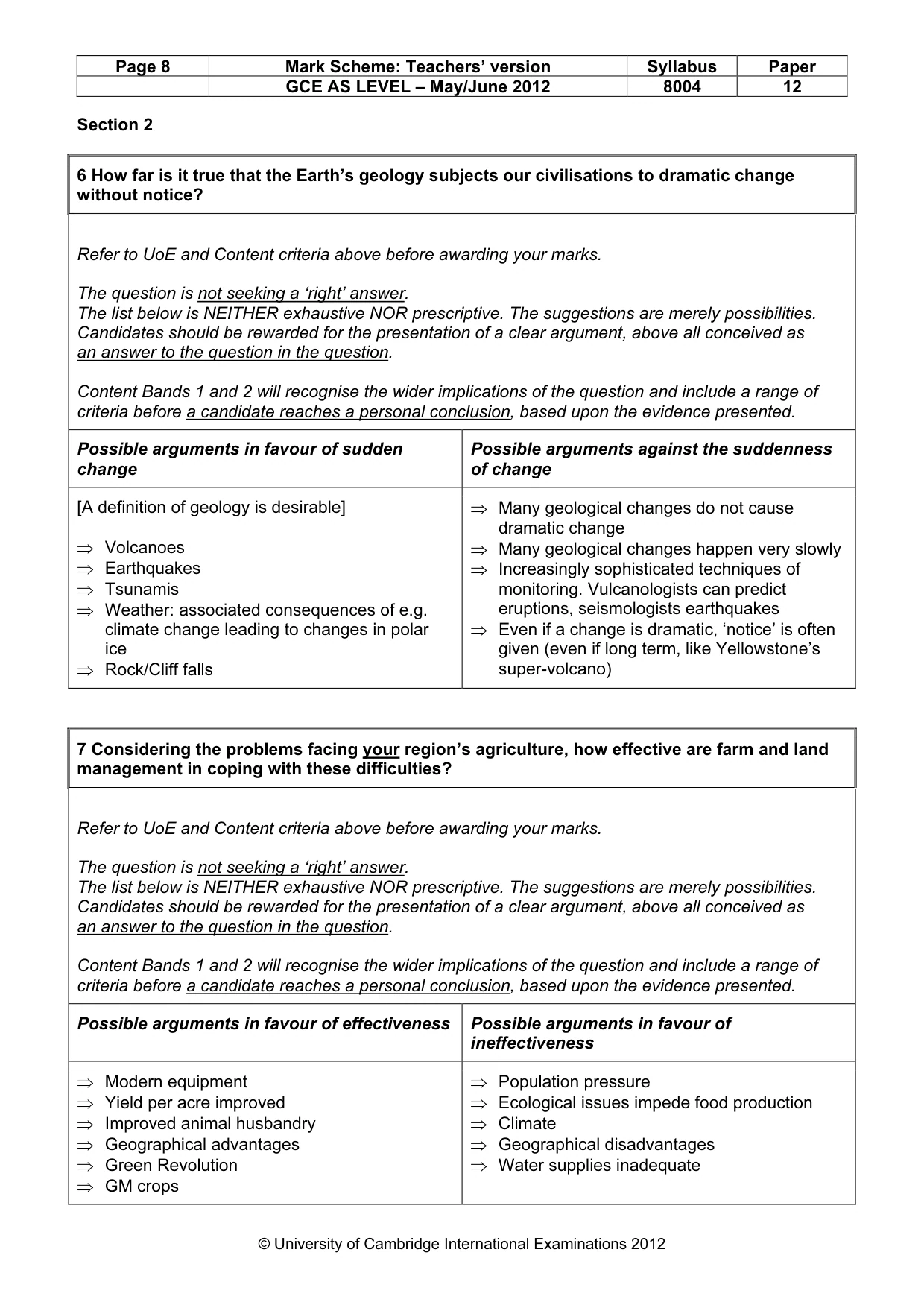
Page 8 Mark Scheme: Teachers’ version Syllabus Paper GCE AS LEVEL – May/June 2012 8004 12 © University of Cambridge International Examinations 2012 Section 2 6 How far is it true that the Earth’s geology subjects our civilisations to dramatic change without notice? Refer to UoE and Content criteria above before awarding your marks. The question is not seeking a ‘right’ answer. The list below is NEITHER exhaustive NOR prescriptive. The suggestions are merely possibilities. Candidates should be rewarded for the presentation of a clear argument, above all conceived as an answer to the question in the question. Content Bands 1 and 2 will recognise the wider implications of the question and include a range of criteria before a candidate reaches a personal conclusion, based upon the evidence presented. Possible arguments in favour of sudden change Possible arguments against the suddenness of change [A definition of geology is desirable] ⇒ Volcanoes ⇒ Earthquakes ⇒ Tsunamis ⇒ Weather: associated consequences of e.g. climate change leading to changes in polar ice ⇒ Rock/Cliff falls ⇒ Many geological changes do not cause dramatic change ⇒ Many geological changes happen very slowly ⇒ Increasingly sophisticated techniques of monitoring. Vulcanologists can predict eruptions, seismologists earthquakes ⇒ Even if a change is dramatic, ‘notice’ is often given (even if long term, like Yellowstone’s super-volcano) 7 Considering the problems facing your region’s agriculture, how effective are farm and land management in coping with these difficulties? Refer to UoE and Content criteria above before awarding your marks. The question is not seeking a ‘right’ answer. The list below is NEITHER exhaustive NOR prescriptive. The suggestions are merely possibilities. Candidates should be rewarded for the presentation of a clear argument, above all conceived as an answer to the question in the question. Content Bands 1 and 2 will recognise the wider implications of the question and include a range of criteria before a candidate reaches a personal conclusion, based upon the evidence presented. Possible arguments in favour of effectiveness Possible arguments in favour of ineffectiveness ⇒ Modern equipment ⇒ Yield per acre improved ⇒ Improved animal husbandry ⇒ Geographical advantages ⇒ Green Revolution ⇒ GM crops ⇒ Population pressure ⇒ Ecological issues impede food production ⇒ Climate ⇒ Geographical disadvantages ⇒ Water supplies inadequate
Mark scheme, page 9
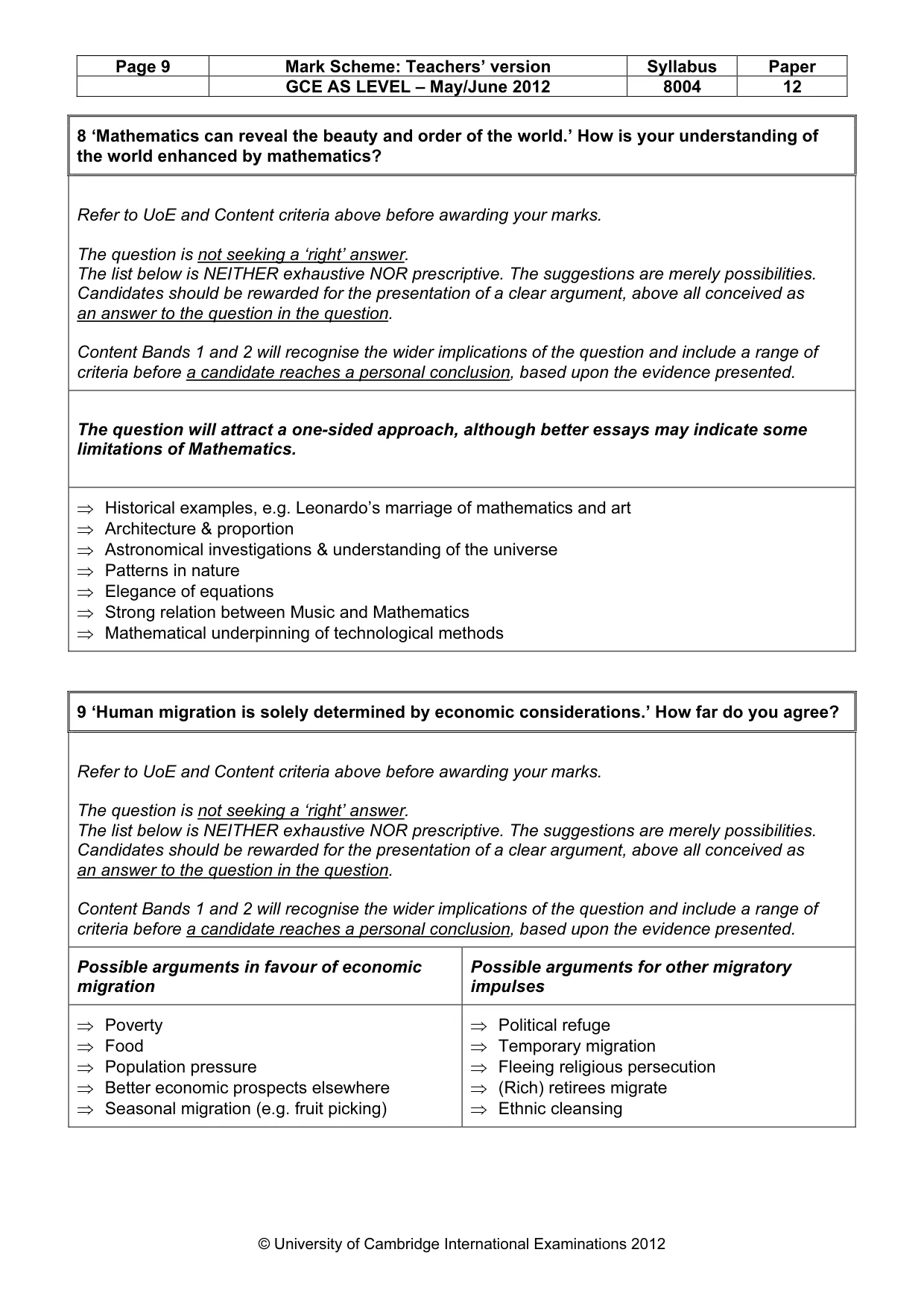
Page 9 Mark Scheme: Teachers’ version Syllabus Paper GCE AS LEVEL – May/June 2012 8004 12 © University of Cambridge International Examinations 2012 8 ‘Mathematics can reveal the beauty and order of the world.’ How is your understanding of the world enhanced by mathematics? Refer to UoE and Content criteria above before awarding your marks. The question is not seeking a ‘right’ answer. The list below is NEITHER exhaustive NOR prescriptive. The suggestions are merely possibilities. Candidates should be rewarded for the presentation of a clear argument, above all conceived as an answer to the question in the question. Content Bands 1 and 2 will recognise the wider implications of the question and include a range of criteria before a candidate reaches a personal conclusion, based upon the evidence presented. The question will attract a one-sided approach, although better essays may indicate some limitations of Mathematics. ⇒ Historical examples, e.g. Leonardo’s marriage of mathematics and art ⇒ Architecture & proportion ⇒ Astronomical investigations & understanding of the universe ⇒ Patterns in nature ⇒ Elegance of equations ⇒ Strong relation between Music and Mathematics ⇒ Mathematical underpinning of technological methods 9 ‘Human migration is solely determined by economic considerations.’ How far do you agree? Refer to UoE and Content criteria above before awarding your marks. The question is not seeking a ‘right’ answer. The list below is NEITHER exhaustive NOR prescriptive. The suggestions are merely possibilities. Candidates should be rewarded for the presentation of a clear argument, above all conceived as an answer to the question in the question. Content Bands 1 and 2 will recognise the wider implications of the question and include a range of criteria before a candidate reaches a personal conclusion, based upon the evidence presented. Possible arguments in favour of economic migration Possible arguments for other migratory impulses ⇒ Poverty ⇒ Food ⇒ Population pressure ⇒ Better economic prospects elsewhere ⇒ Seasonal migration (e.g. fruit picking) ⇒ Political refuge ⇒ Temporary migration ⇒ Fleeing religious persecution ⇒ (Rich) retirees migrate ⇒ Ethnic cleansing
Mark scheme, page 10
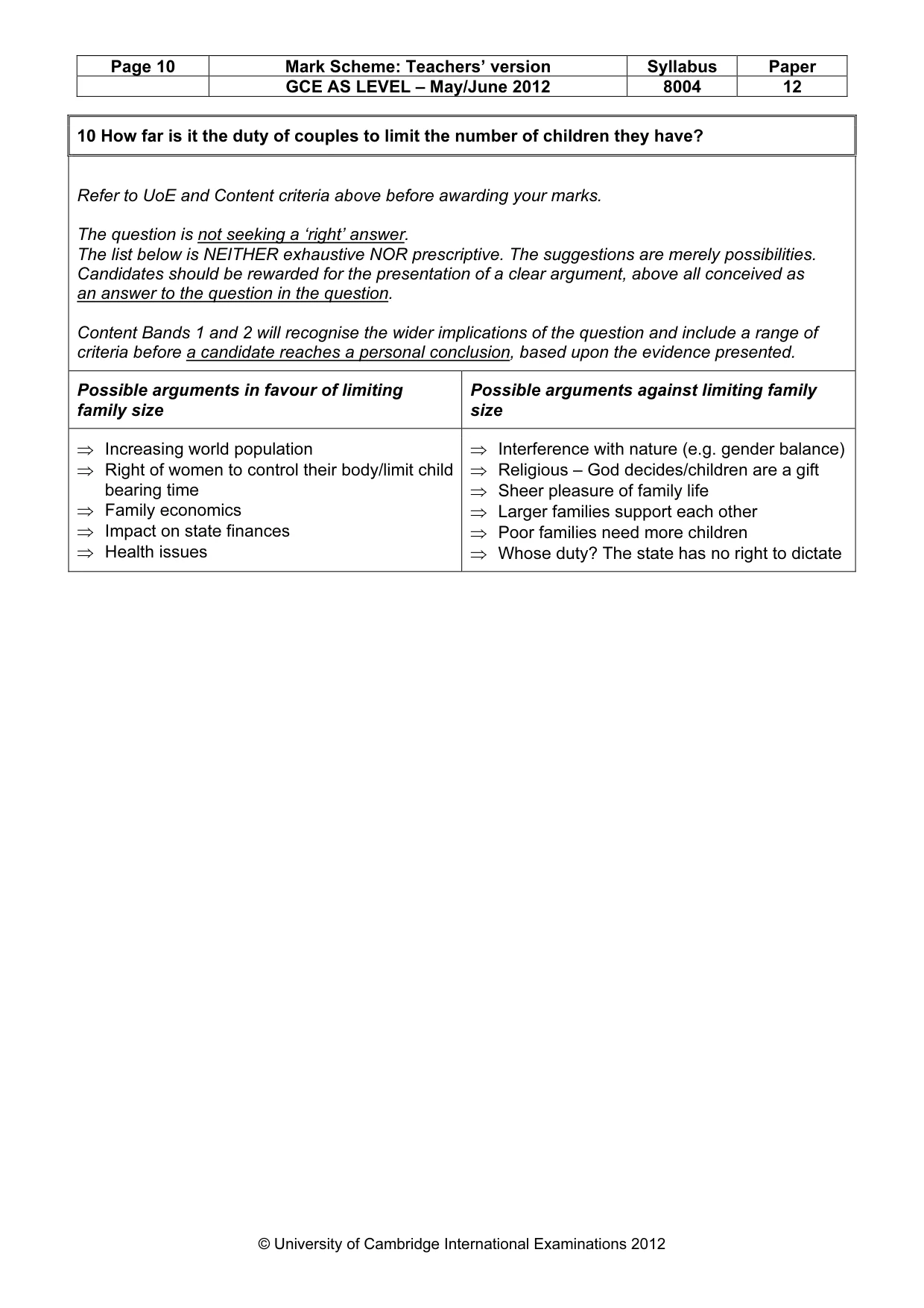
Page 10 Mark Scheme: Teachers’ version Syllabus Paper GCE AS LEVEL – May/June 2012 8004 12 © University of Cambridge International Examinations 2012 10 How far is it the duty of couples to limit the number of children they have? Refer to UoE and Content criteria above before awarding your marks. The question is not seeking a ‘right’ answer. The list below is NEITHER exhaustive NOR prescriptive. The suggestions are merely possibilities. Candidates should be rewarded for the presentation of a clear argument, above all conceived as an answer to the question in the question. Content Bands 1 and 2 will recognise the wider implications of the question and include a range of criteria before a candidate reaches a personal conclusion, based upon the evidence presented. Possible arguments in favour of limiting family size Possible arguments against limiting family size ⇒ Increasing world population ⇒ Right of women to control their body/limit child bearing time ⇒ Family economics ⇒ Impact on state finances ⇒ Health issues ⇒ Interference with nature (e.g. gender balance) ⇒ Religious – God decides/children are a gift ⇒ Sheer pleasure of family life ⇒ Larger families support each other ⇒ Poor families need more children ⇒ Whose duty? The state has no right to dictate
Mark scheme, page 11
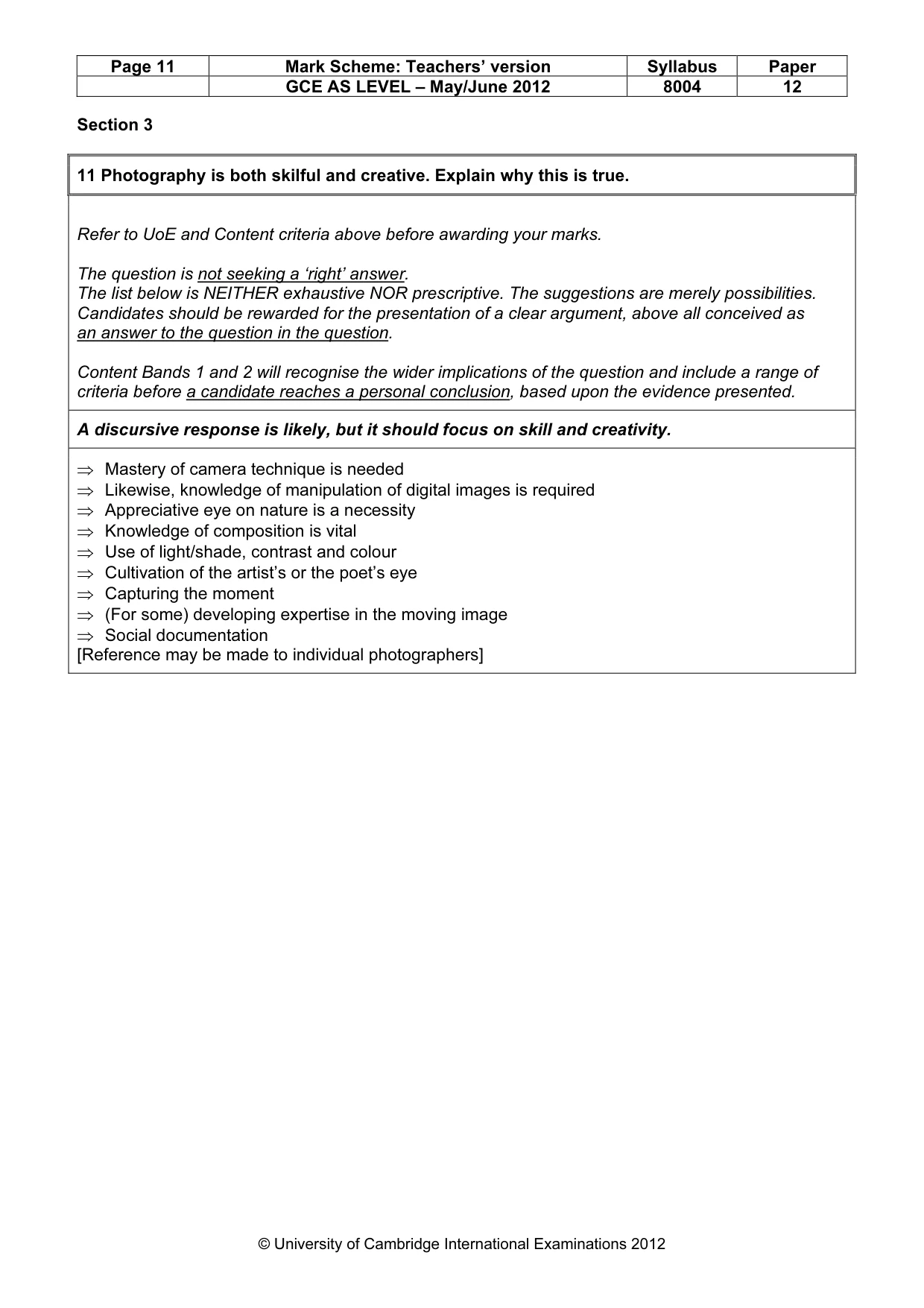
Page 11 Mark Scheme: Teachers’ version Syllabus Paper GCE AS LEVEL – May/June 2012 8004 12 © University of Cambridge International Examinations 2012 Section 3 11 Photography is both skilful and creative. Explain why this is true. Refer to UoE and Content criteria above before awarding your marks. The question is not seeking a ‘right’ answer. The list below is NEITHER exhaustive NOR prescriptive. The suggestions are merely possibilities. Candidates should be rewarded for the presentation of a clear argument, above all conceived as an answer to the question in the question. Content Bands 1 and 2 will recognise the wider implications of the question and include a range of criteria before a candidate reaches a personal conclusion, based upon the evidence presented. A discursive response is likely, but it should focus on skill and creativity. ⇒ Mastery of camera technique is needed ⇒ Likewise, knowledge of manipulation of digital images is required ⇒ Appreciative eye on nature is a necessity ⇒ Knowledge of composition is vital ⇒ Use of light/shade, contrast and colour ⇒ Cultivation of the artist’s or the poet’s eye ⇒ Capturing the moment ⇒ (For some) developing expertise in the moving image ⇒ Social documentation [Reference may be made to individual photographers]
Mark scheme, page 12
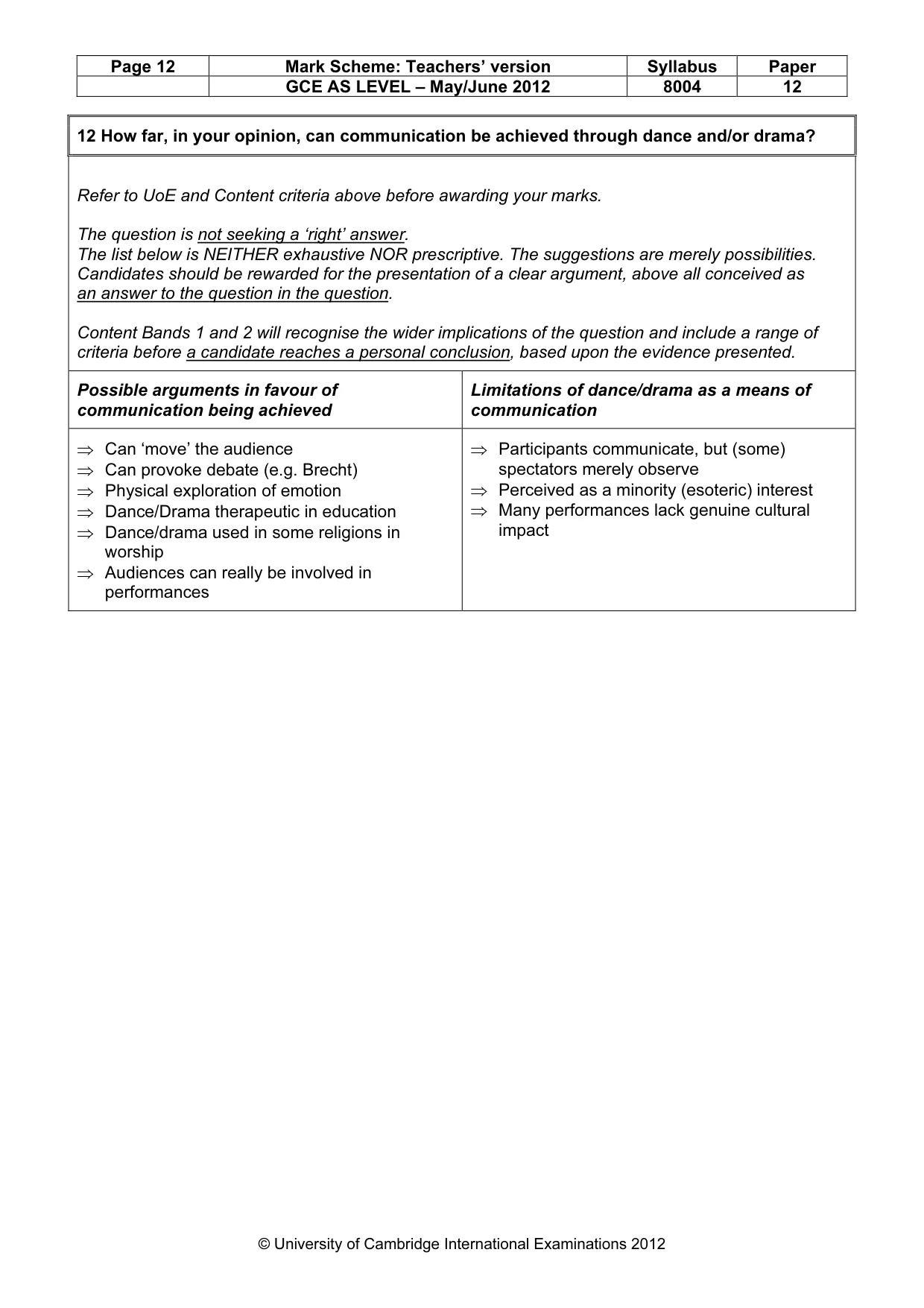
Page 12 Mark Scheme: Teachers’ version Syllabus Paper GCE AS LEVEL – May/June 2012 8004 12 © University of Cambridge International Examinations 2012 12 How far, in your opinion, can communication be achieved through dance and/or drama? Refer to UoE and Content criteria above before awarding your marks. The question is not seeking a ‘right’ answer. The list below is NEITHER exhaustive NOR prescriptive. The suggestions are merely possibilities. Candidates should be rewarded for the presentation of a clear argument, above all conceived as an answer to the question in the question. Content Bands 1 and 2 will recognise the wider implications of the question and include a range of criteria before a candidate reaches a personal conclusion, based upon the evidence presented. Possible arguments in favour of communication being achieved Limitations of dance/drama as a means of communication ⇒ Can ‘move’ the audience ⇒ Can provoke debate (e.g. Brecht) ⇒ Physical exploration of emotion ⇒ Dance/Drama therapeutic in education ⇒ Dance/drama used in some religions in worship ⇒ Audiences can really be involved in performances ⇒ Participants communicate, but (some) spectators merely observe ⇒ Perceived as a minority (esoteric) interest ⇒ Many performances lack genuine cultural impact
Mark scheme, page 13
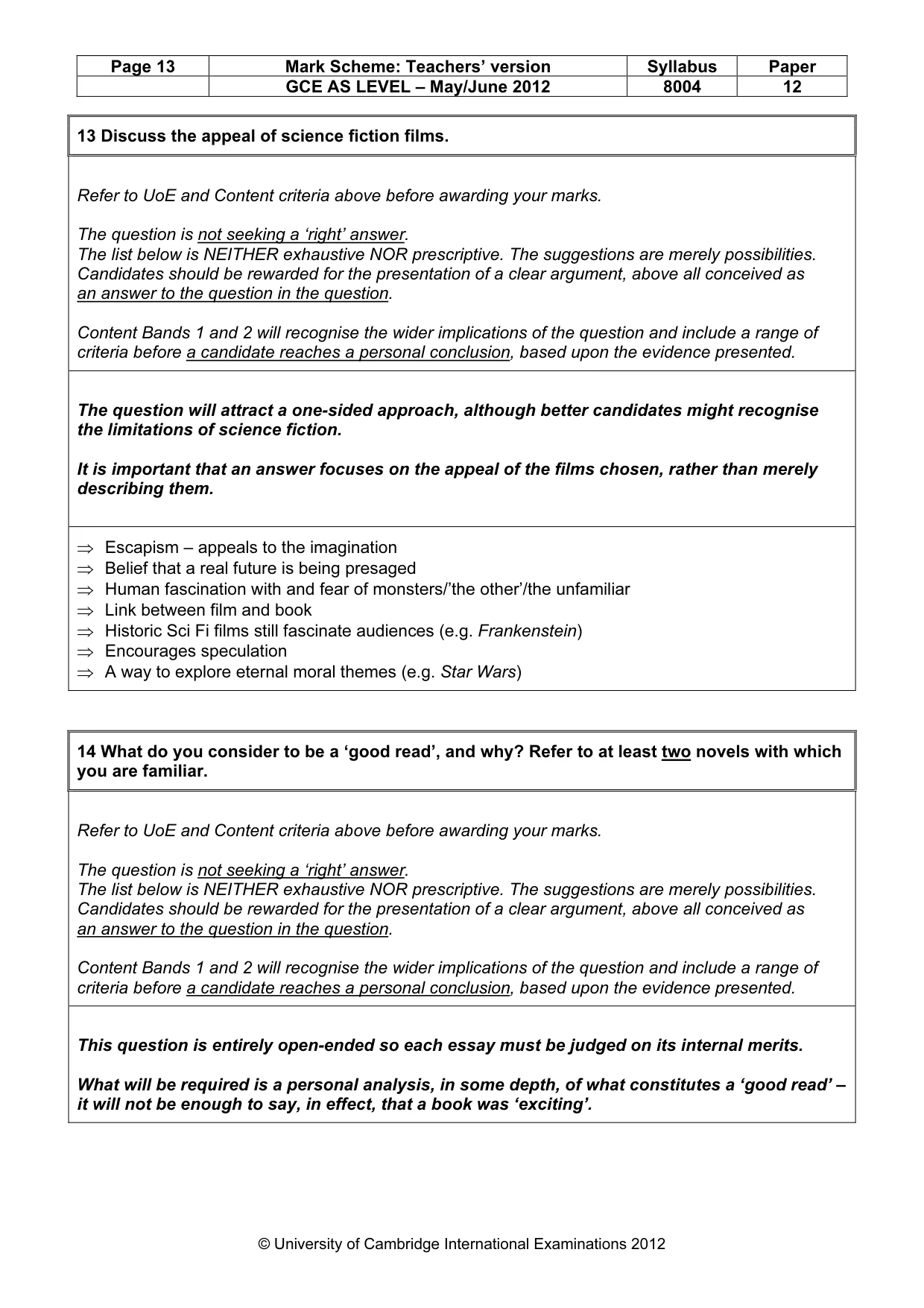
Page 13 Mark Scheme: Teachers’ version Syllabus Paper GCE AS LEVEL – May/June 2012 8004 12 © University of Cambridge International Examinations 2012 13 Discuss the appeal of science fiction films. Refer to UoE and Content criteria above before awarding your marks. The question is not seeking a ‘right’ answer. The list below is NEITHER exhaustive NOR prescriptive. The suggestions are merely possibilities. Candidates should be rewarded for the presentation of a clear argument, above all conceived as an answer to the question in the question. Content Bands 1 and 2 will recognise the wider implications of the question and include a range of criteria before a candidate reaches a personal conclusion, based upon the evidence presented. The question will attract a one-sided approach, although better candidates might recognise the limitations of science fiction. It is important that an answer focuses on the appeal of the films chosen, rather than merely describing them. ⇒ Escapism – appeals to the imagination ⇒ Belief that a real future is being presaged ⇒ Human fascination with and fear of monsters/’the other’/the unfamiliar ⇒ Link between film and book ⇒ Historic Sci Fi films still fascinate audiences (e.g. Frankenstein) ⇒ Encourages speculation ⇒ A way to explore eternal moral themes (e.g. Star Wars) 14 What do you consider to be a ‘good read’, and why? Refer to at least two novels with which you are familiar. Refer to UoE and Content criteria above before awarding your marks. The question is not seeking a ‘right’ answer. The list below is NEITHER exhaustive NOR prescriptive. The suggestions are merely possibilities. Candidates should be rewarded for the presentation of a clear argument, above all conceived as an answer to the question in the question. Content Bands 1 and 2 will recognise the wider implications of the question and include a range of criteria before a candidate reaches a personal conclusion, based upon the evidence presented. This question is entirely open-ended so each essay must be judged on its internal merits. What will be required is a personal analysis, in some depth, of what constitutes a ‘good read’ – it will not be enough to say, in effect, that a book was ‘exciting’.
Mark scheme, page 14
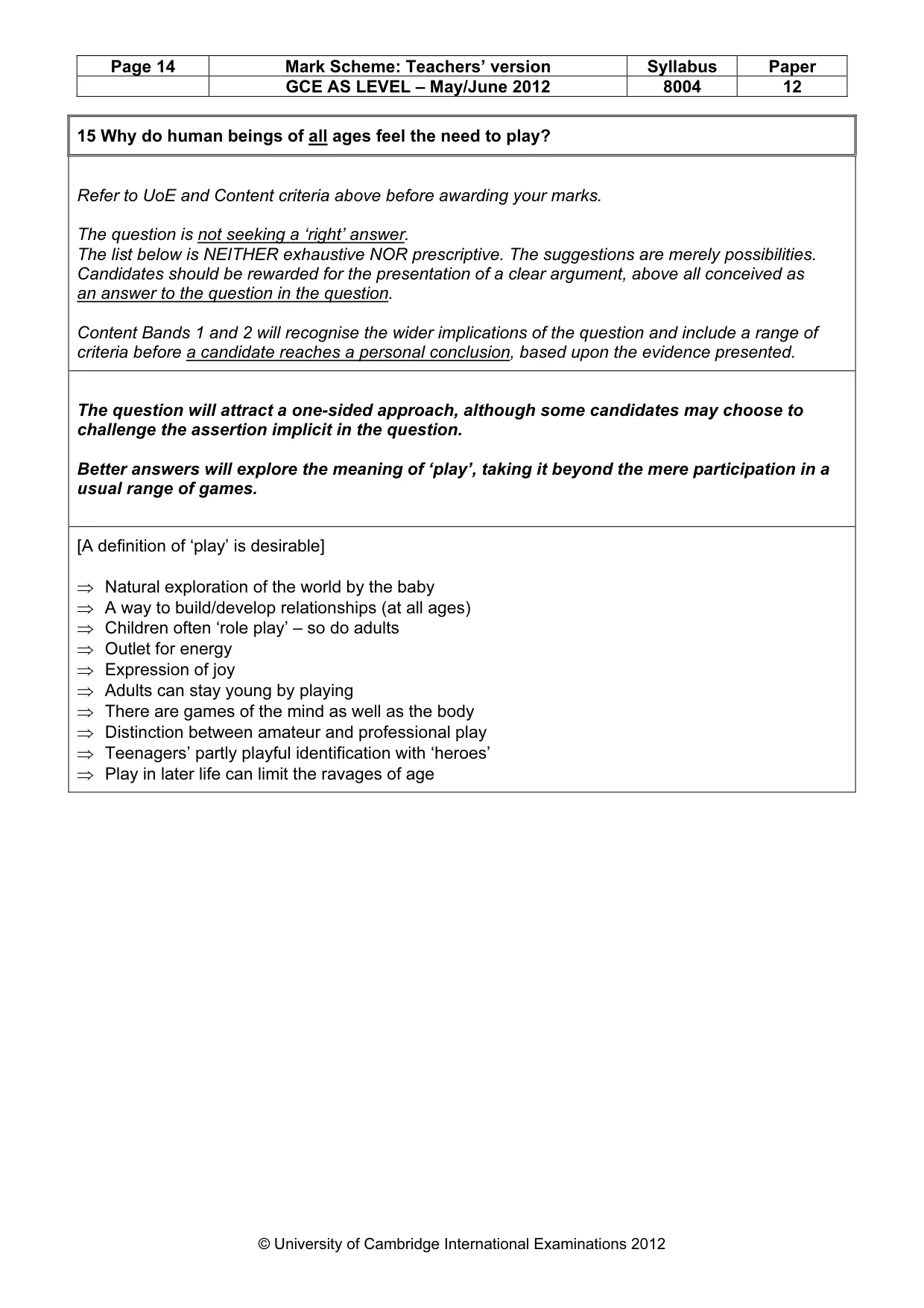
Page 14 Mark Scheme: Teachers’ version Syllabus Paper GCE AS LEVEL – May/June 2012 8004 12 © University of Cambridge International Examinations 2012 15 Why do human beings of all ages feel the need to play? Refer to UoE and Content criteria above before awarding your marks. The question is not seeking a ‘right’ answer. The list below is NEITHER exhaustive NOR prescriptive. The suggestions are merely possibilities. Candidates should be rewarded for the presentation of a clear argument, above all conceived as an answer to the question in the question. Content Bands 1 and 2 will recognise the wider implications of the question and include a range of criteria before a candidate reaches a personal conclusion, based upon the evidence presented. The question will attract a one-sided approach, although some candidates may choose to challenge the assertion implicit in the question. Better answers will explore the meaning of ‘play’, taking it beyond the mere participation in a usual range of games. [A definition of ‘play’ is desirable] ⇒ Natural exploration of the world by the baby ⇒ A way to build/develop relationships (at all ages) ⇒ Children often ‘role play’ – so do adults ⇒ Outlet for energy ⇒ Expression of joy ⇒ Adults can stay young by playing ⇒ There are games of the mind as well as the body ⇒ Distinction between amateur and professional play ⇒ Teenagers’ partly playful identification with ‘heroes’ ⇒ Play in later life can limit the ravages of age
What you needed in this session
Cambridge’s own grade thresholds for 2012 May/June, Paper 1 · Variant 2. A higher threshold means an easier paper — the bar moves with how the cohort did.