Cambridge A Level General Paper (AS Level only) 8004 — 2010 Oct/Nov Paper 1 · Variant 3
8004/13/O/N/10 · 100 marks · ≈113 min
The question paper and its mark scheme, free to read here and free to download. This is Cambridge’s own paper, exactly as it was sat.
Question paper2 pages
Mark scheme8 pages
Answers below. Sit the paper first if you are practising.

Paper as text
Question paper, page 1
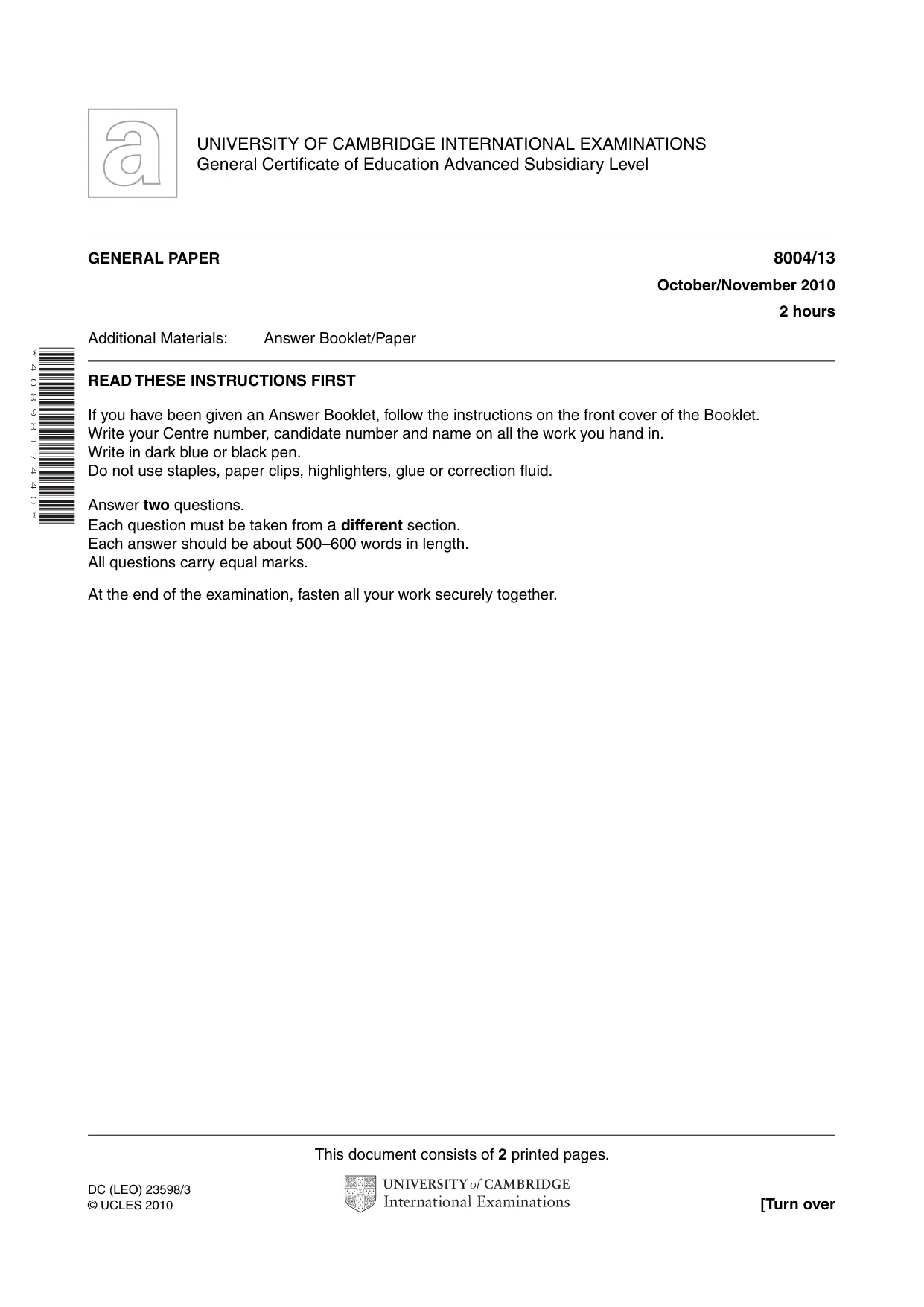
This document consists of 2 printed pages. DC (LEO) 23598/3 © UCLES 2010 [Turn over UNIVERSITY OF CAMBRIDGE INTERNATIONAL EXAMINATIONS General Certificate of Education Advanced Subsidiary Level READ THESE INSTRUCTIONS FIRST If you have been given an Answer Booklet, follow the instructions on the front cover of the Booklet. Write your Centre number, candidate number and name on all the work you hand in. Write in dark blue or black pen. Do not use staples, paper clips, highlighters, glue or correction fluid. Answer two questions. Each question must be taken from a different section. Each answer should be about 500–600 words in length. All questions carry equal marks. At the end of the examination, fasten all your work securely together. * 4 0 8 9 8 1 7 4 4 0 * GENERAL PAPER 8004/13 October/November 2010 2 hours Additional Materials: Answer Booklet/Paper
Question paper, page 2
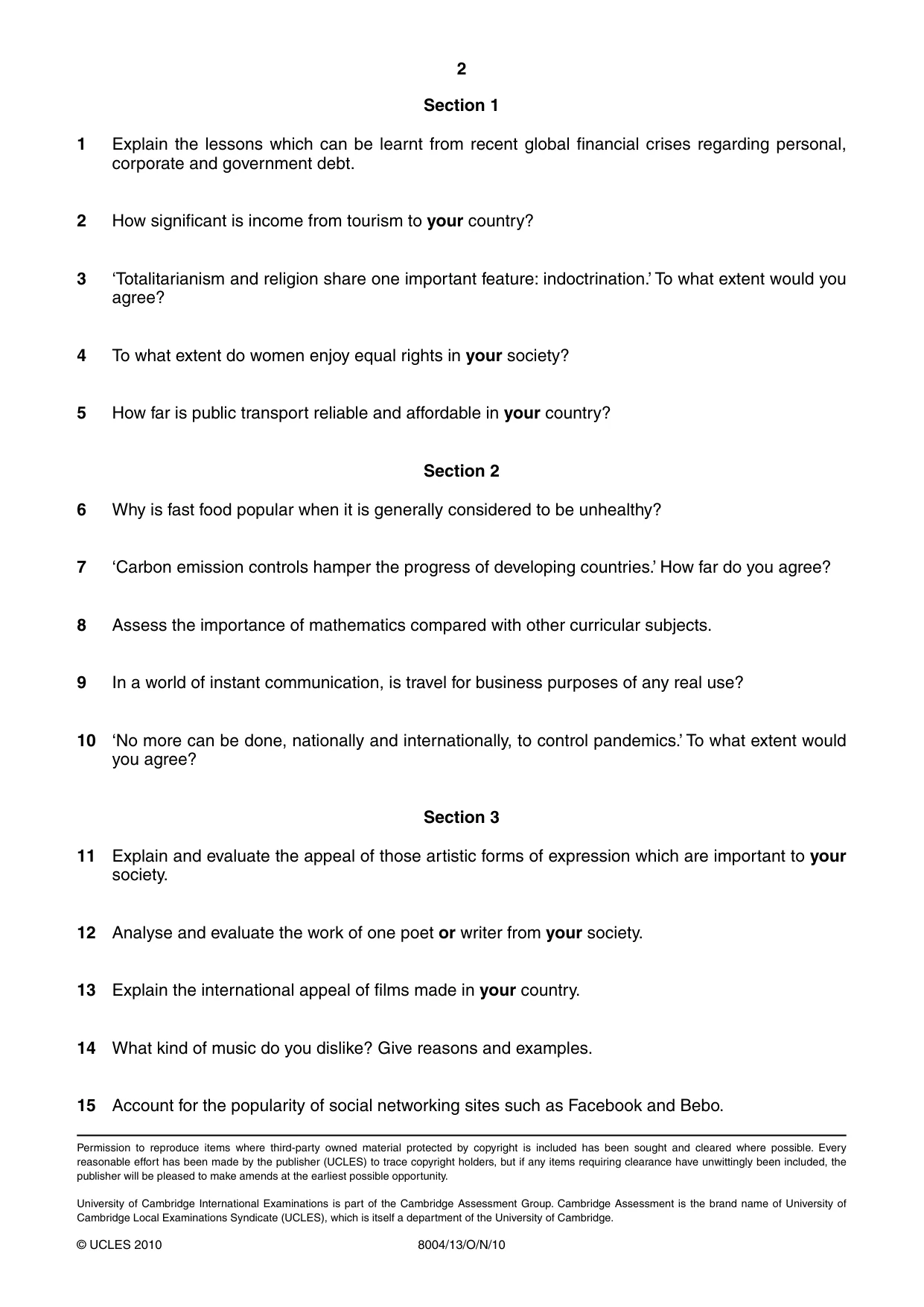
2 8004/13/O/N/10 © UCLES 2010 Section 1 1 Explain the lessons which can be learnt from recent global financial crises regarding personal, corporate and government debt. 2 How significant is income from tourism to your country? 3 ‘Totalitarianism and religion share one important feature: indoctrination.’ To what extent would you agree? 4 To what extent do women enjoy equal rights in your society? 5 How far is public transport reliable and affordable in your country? Section 2 6 Why is fast food popular when it is generally considered to be unhealthy? 7 ‘Carbon emission controls hamper the progress of developing countries.’ How far do you agree? 8 Assess the importance of mathematics compared with other curricular subjects. 9 In a world of instant communication, is travel for business purposes of any real use? 10 ‘No more can be done, nationally and internationally, to control pandemics.’ To what extent would you agree? Section 3 11 Explain and evaluate the appeal of those artistic forms of expression which are important to your society. 12 Analyse and evaluate the work of one poet or writer from your society. 13 Explain the international appeal of films made in your country. 14 What kind of music do you dislike? Give reasons and examples. 15 Account for the popularity of social networking sites such as Facebook and Bebo. Permission to reproduce items where third-party owned material protected by copyright is included has been sought and cleared where possible. Every reasonable effort has been made by the publisher (UCLES) to trace copyright holders, but if any items requiring clearance have unwittingly been included, the publisher will be pleased to make amends at the earliest possible opportunity. University of Cambridge International Examinations is part of the Cambridge Assessment Group. Cambridge Assessment is the brand name of University of Cambridge Local Examinations Syndicate (UCLES), which is itself a department of the University of Cambridge.
Mark scheme, page 1
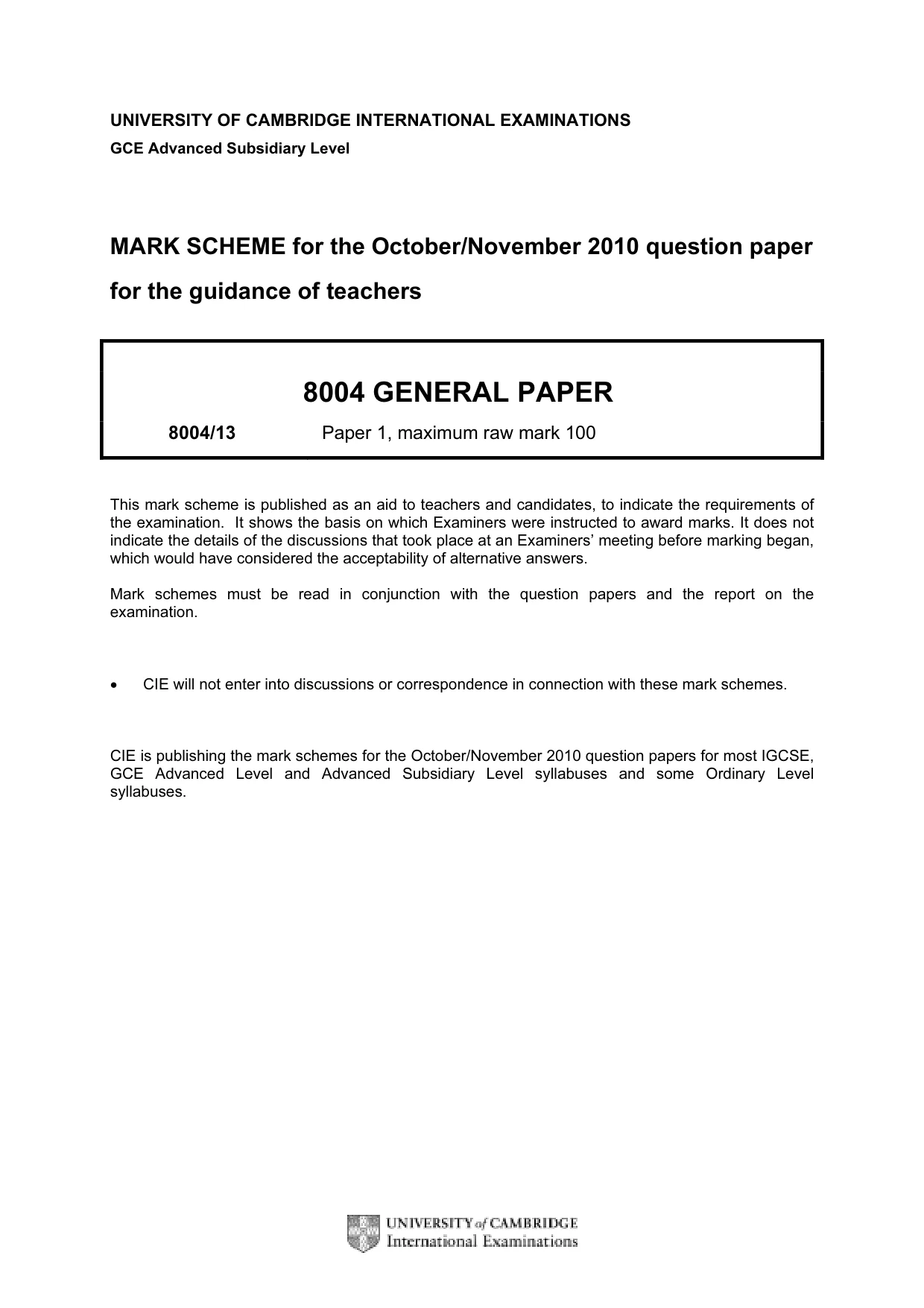
UNIVERSITY OF CAMBRIDGE INTERNATIONAL EXAMINATIONS GCE Advanced Subsidiary Level MARK SCHEME for the October/November 2010 question paper for the guidance of teachers 8004 GENERAL PAPER 8004/13 Paper 1, maximum raw mark 100 This mark scheme is published as an aid to teachers and candidates, to indicate the requirements of the examination. It shows the basis on which Examiners were instructed to award marks. It does not indicate the details of the discussions that took place at an Examiners’ meeting before marking began, which would have considered the acceptability of alternative answers. Mark schemes must be read in conjunction with the question papers and the report on the examination. • CIE will not enter into discussions or correspondence in connection with these mark schemes. CIE is publishing the mark schemes for the October/November 2010 question papers for most IGCSE, GCE Advanced Level and Advanced Subsidiary Level syllabuses and some Ordinary Level syllabuses.
Mark scheme, page 2
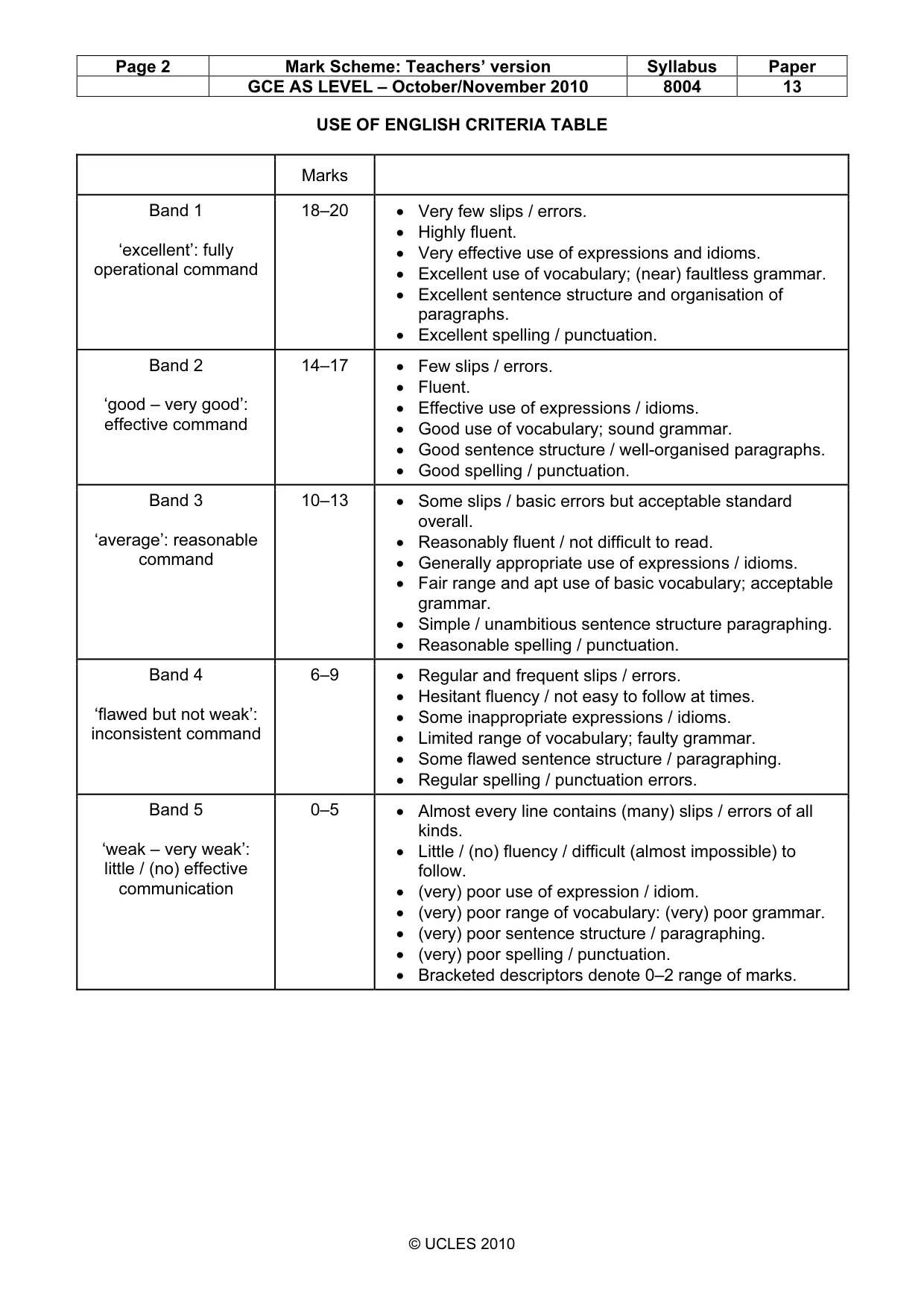
Page 2 Mark Scheme: Teachers’ version Syllabus Paper GCE AS LEVEL – October/November 2010 8004 13 © UCLES 2010 USE OF ENGLISH CRITERIA TABLE Marks Band 1 ‘excellent’: fully operational command 18–20 • Very few slips / errors. • Highly fluent. • Very effective use of expressions and idioms. • Excellent use of vocabulary; (near) faultless grammar. • Excellent sentence structure and organisation of paragraphs. • Excellent spelling / punctuation. Band 2 ‘good – very good’: effective command 14–17 • Few slips / errors. • Fluent. • Effective use of expressions / idioms. • Good use of vocabulary; sound grammar. • Good sentence structure / well-organised paragraphs. • Good spelling / punctuation. Band 3 ‘average’: reasonable command 10–13 • Some slips / basic errors but acceptable standard overall. • Reasonably fluent / not difficult to read. • Generally appropriate use of expressions / idioms. • Fair range and apt use of basic vocabulary; acceptable grammar. • Simple / unambitious sentence structure paragraphing. • Reasonable spelling / punctuation. Band 4 ‘flawed but not weak’: inconsistent command 6–9 • Regular and frequent slips / errors. • Hesitant fluency / not easy to follow at times. • Some inappropriate expressions / idioms. • Limited range of vocabulary; faulty grammar. • Some flawed sentence structure / paragraphing. • Regular spelling / punctuation errors. Band 5 ‘weak – very weak’: little / (no) effective communication 0–5 • Almost every line contains (many) slips / errors of all kinds. • Little / (no) fluency / difficult (almost impossible) to follow. • (very) poor use of expression / idiom. • (very) poor range of vocabulary: (very) poor grammar. • (very) poor sentence structure / paragraphing. • (very) poor spelling / punctuation. • Bracketed descriptors denote 0–2 range of marks.
Mark scheme, page 3
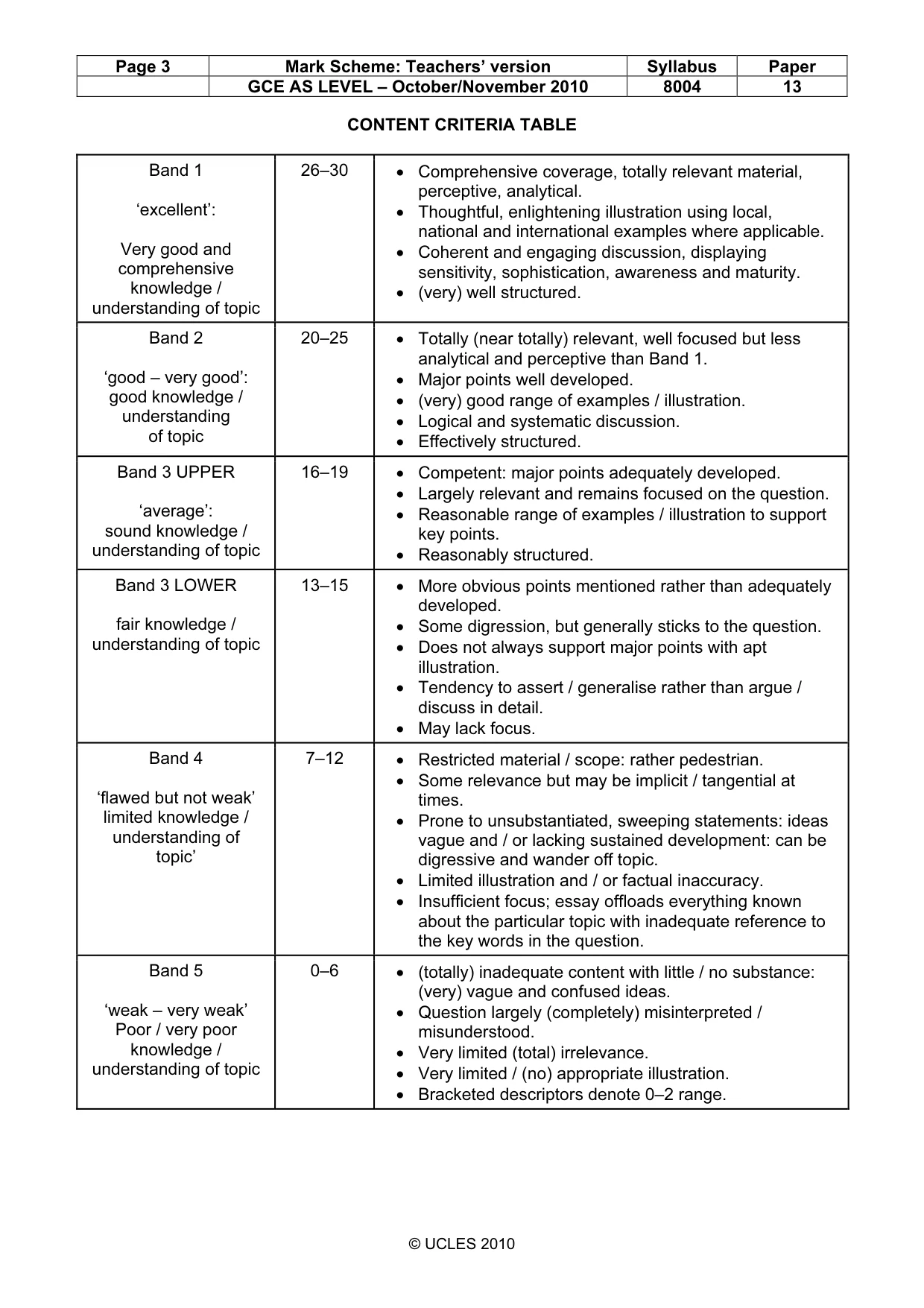
Page 3 Mark Scheme: Teachers’ version Syllabus Paper GCE AS LEVEL – October/November 2010 8004 13 © UCLES 2010 CONTENT CRITERIA TABLE Band 1 ‘excellent’: Very good and comprehensive knowledge / understanding of topic 26–30 • Comprehensive coverage, totally relevant material, perceptive, analytical. • Thoughtful, enlightening illustration using local, national and international examples where applicable. • Coherent and engaging discussion, displaying sensitivity, sophistication, awareness and maturity. • (very) well structured. Band 2 ‘good – very good’: good knowledge / understanding of topic 20–25 • Totally (near totally) relevant, well focused but less analytical and perceptive than Band 1. • Major points well developed. • (very) good range of examples / illustration. • Logical and systematic discussion. • Effectively structured. Band 3 UPPER ‘average’: sound knowledge / understanding of topic 16–19 • Competent: major points adequately developed. • Largely relevant and remains focused on the question. • Reasonable range of examples / illustration to support key points. • Reasonably structured. Band 3 LOWER fair knowledge / understanding of topic 13–15 • More obvious points mentioned rather than adequately developed. • Some digression, but generally sticks to the question. • Does not always support major points with apt illustration. • Tendency to assert / generalise rather than argue / discuss in detail. • May lack focus. Band 4 ‘flawed but not weak’ limited knowledge / understanding of topic’ 7–12 • Restricted material / scope: rather pedestrian. • Some relevance but may be implicit / tangential at times. • Prone to unsubstantiated, sweeping statements: ideas vague and / or lacking sustained development: can be digressive and wander off topic. • Limited illustration and / or factual inaccuracy. • Insufficient focus; essay offloads everything known about the particular topic with inadequate reference to the key words in the question. Band 5 ‘weak – very weak’ Poor / very poor knowledge / understanding of topic 0–6 • (totally) inadequate content with little / no substance: (very) vague and confused ideas. • Question largely (completely) misinterpreted / misunderstood. • Very limited (total) irrelevance. • Very limited / (no) appropriate illustration. • Bracketed descriptors denote 0–2 range.
Mark scheme, page 4
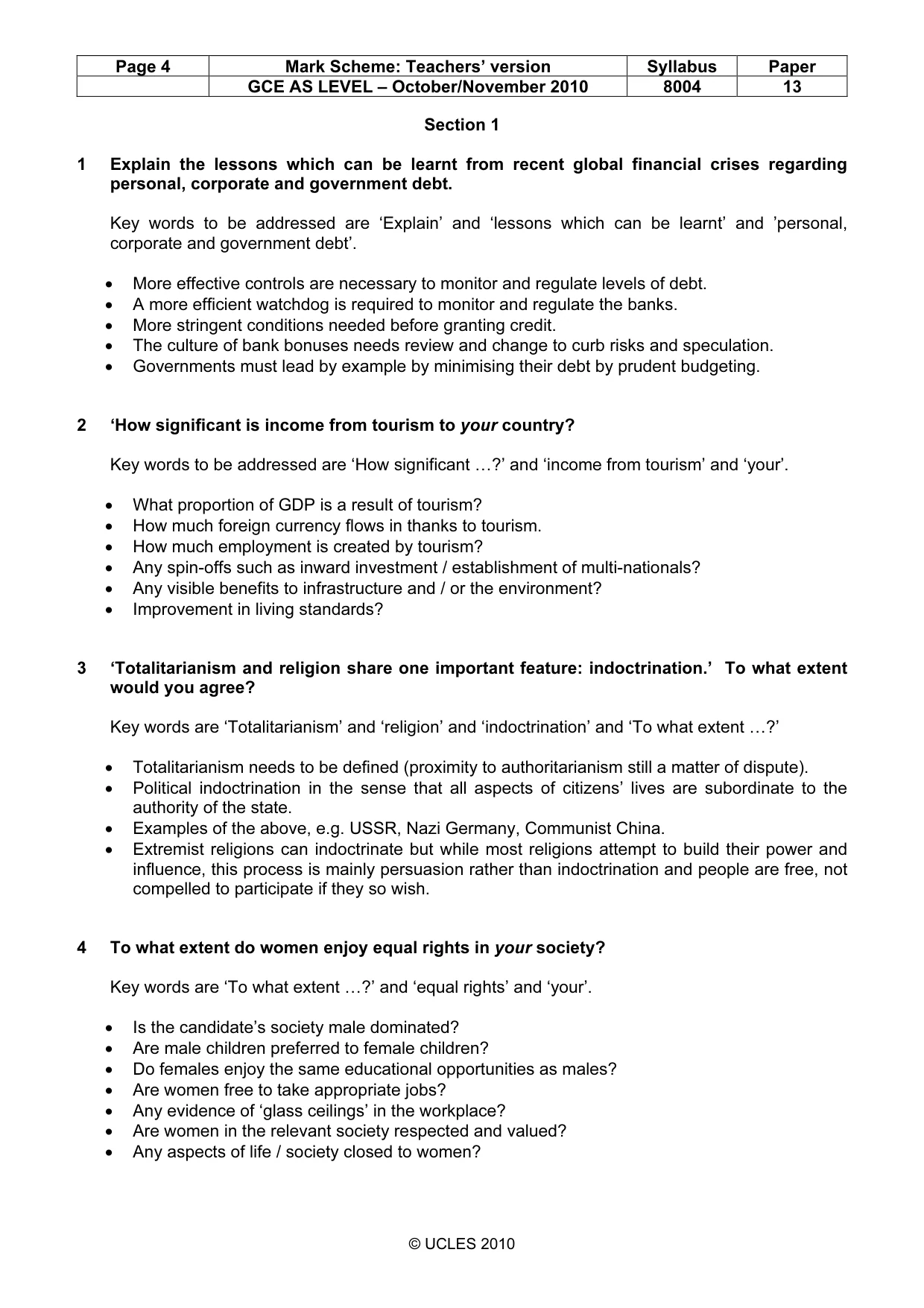
Page 4 Mark Scheme: Teachers’ version Syllabus Paper GCE AS LEVEL – October/November 2010 8004 13 © UCLES 2010 Section 1 1 Explain the lessons which can be learnt from recent global financial crises regarding personal, corporate and government debt. Key words to be addressed are ‘Explain’ and ‘lessons which can be learnt’ and ’personal, corporate and government debt’. • More effective controls are necessary to monitor and regulate levels of debt. • A more efficient watchdog is required to monitor and regulate the banks. • More stringent conditions needed before granting credit. • The culture of bank bonuses needs review and change to curb risks and speculation. • Governments must lead by example by minimising their debt by prudent budgeting. 2 ‘How significant is income from tourism to your country? Key words to be addressed are ‘How significant …?’ and ‘income from tourism’ and ‘your’. • What proportion of GDP is a result of tourism? • How much foreign currency flows in thanks to tourism. • How much employment is created by tourism? • Any spin-offs such as inward investment / establishment of multi-nationals? • Any visible benefits to infrastructure and / or the environment? • Improvement in living standards? 3 ‘Totalitarianism and religion share one important feature: indoctrination.’ To what extent would you agree? Key words are ‘Totalitarianism’ and ‘religion’ and ‘indoctrination’ and ‘To what extent …?’ • Totalitarianism needs to be defined (proximity to authoritarianism still a matter of dispute). • Political indoctrination in the sense that all aspects of citizens’ lives are subordinate to the authority of the state. • Examples of the above, e.g. USSR, Nazi Germany, Communist China. • Extremist religions can indoctrinate but while most religions attempt to build their power and influence, this process is mainly persuasion rather than indoctrination and people are free, not compelled to participate if they so wish. 4 To what extent do women enjoy equal rights in your society? Key words are ‘To what extent …?’ and ‘equal rights’ and ‘your’. • Is the candidate’s society male dominated? • Are male children preferred to female children? • Do females enjoy the same educational opportunities as males? • Are women free to take appropriate jobs? • Any evidence of ‘glass ceilings’ in the workplace? • Are women in the relevant society respected and valued? • Any aspects of life / society closed to women?
Mark scheme, page 5
Page 5 Mark Scheme: Teachers’ version Syllabus Paper GCE AS LEVEL – October/November 2010 8004 13 © UCLES 2010 5 How far is public transport reliable and affordable in your country? Key words are ‘How far …?’ and ‘public transport’ and ‘reliable’ and ‘affordable’ and ‘your’. • Road and rail links. Is the infrastructure good and conducive to swift and safe journeys across country and in urban areas? • Who is the provider of public transport? • Are the costs bearable for the average citizen? • What kind of vehicles are used? Standards of cleanliness and safety? • Is there a timetable and is it adhered to? • What, if any, are the shortcomings and what improvements are feasible?
Mark scheme, page 6
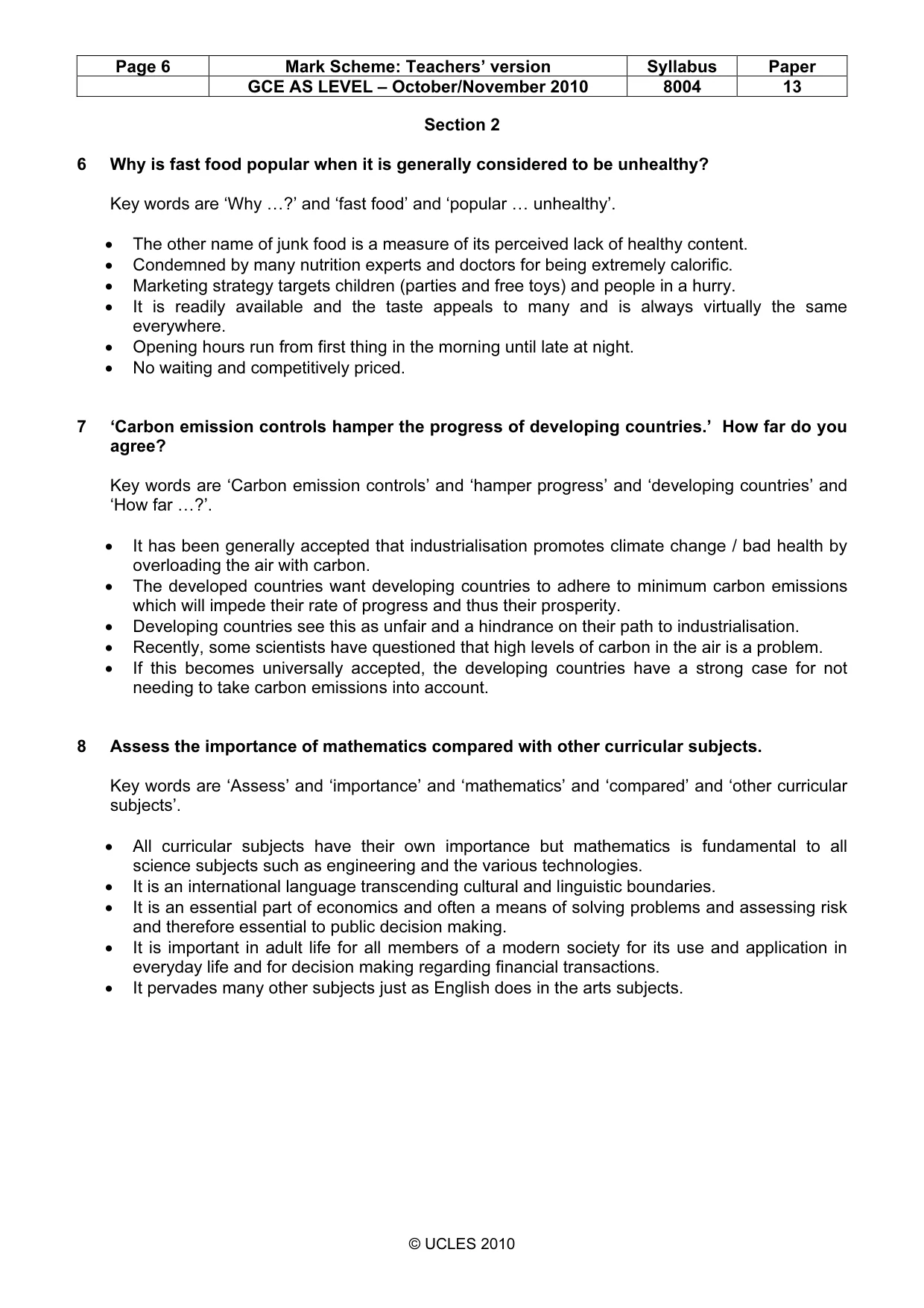
Page 6 Mark Scheme: Teachers’ version Syllabus Paper GCE AS LEVEL – October/November 2010 8004 13 © UCLES 2010 Section 2 6 Why is fast food popular when it is generally considered to be unhealthy? Key words are ‘Why …?’ and ‘fast food’ and ‘popular … unhealthy’. • The other name of junk food is a measure of its perceived lack of healthy content. • Condemned by many nutrition experts and doctors for being extremely calorific. • Marketing strategy targets children (parties and free toys) and people in a hurry. • It is readily available and the taste appeals to many and is always virtually the same everywhere. • Opening hours run from first thing in the morning until late at night. • No waiting and competitively priced. 7 ‘Carbon emission controls hamper the progress of developing countries.’ How far do you agree? Key words are ‘Carbon emission controls’ and ‘hamper progress’ and ‘developing countries’ and ‘How far …?’. • It has been generally accepted that industrialisation promotes climate change / bad health by overloading the air with carbon. • The developed countries want developing countries to adhere to minimum carbon emissions which will impede their rate of progress and thus their prosperity. • Developing countries see this as unfair and a hindrance on their path to industrialisation. • Recently, some scientists have questioned that high levels of carbon in the air is a problem. • If this becomes universally accepted, the developing countries have a strong case for not needing to take carbon emissions into account. 8 Assess the importance of mathematics compared with other curricular subjects. Key words are ‘Assess’ and ‘importance’ and ‘mathematics’ and ‘compared’ and ‘other curricular subjects’. • All curricular subjects have their own importance but mathematics is fundamental to all science subjects such as engineering and the various technologies. • It is an international language transcending cultural and linguistic boundaries. • It is an essential part of economics and often a means of solving problems and assessing risk and therefore essential to public decision making. • It is important in adult life for all members of a modern society for its use and application in everyday life and for decision making regarding financial transactions. • It pervades many other subjects just as English does in the arts subjects.
Mark scheme, page 7
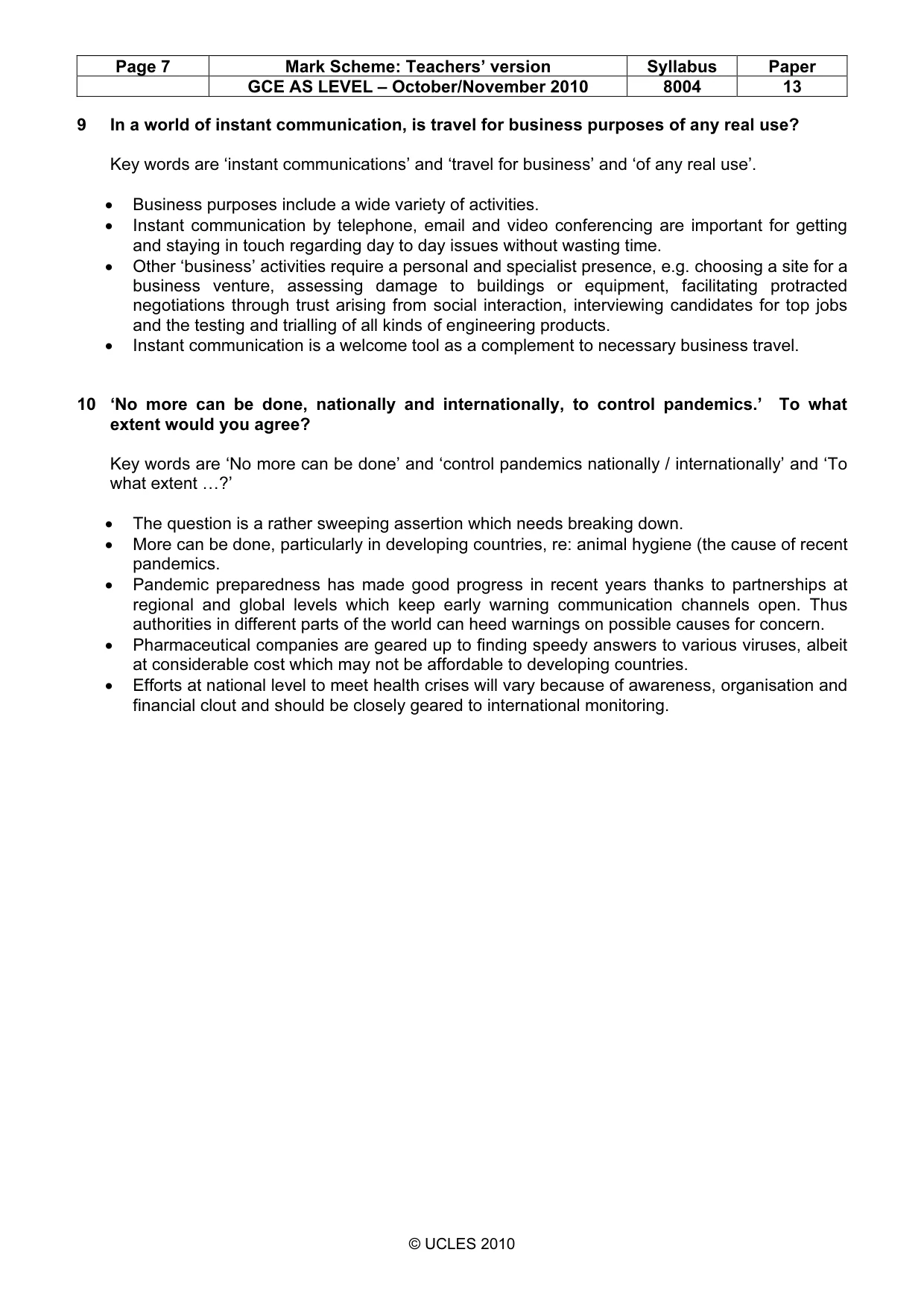
Page 7 Mark Scheme: Teachers’ version Syllabus Paper GCE AS LEVEL – October/November 2010 8004 13 © UCLES 2010 9 In a world of instant communication, is travel for business purposes of any real use? Key words are ‘instant communications’ and ‘travel for business’ and ‘of any real use’. • Business purposes include a wide variety of activities. • Instant communication by telephone, email and video conferencing are important for getting and staying in touch regarding day to day issues without wasting time. • Other ‘business’ activities require a personal and specialist presence, e.g. choosing a site for a business venture, assessing damage to buildings or equipment, facilitating protracted negotiations through trust arising from social interaction, interviewing candidates for top jobs and the testing and trialling of all kinds of engineering products. • Instant communication is a welcome tool as a complement to necessary business travel. 10 ‘No more can be done, nationally and internationally, to control pandemics.’ To what extent would you agree? Key words are ‘No more can be done’ and ‘control pandemics nationally / internationally’ and ‘To what extent …?’ • The question is a rather sweeping assertion which needs breaking down. • More can be done, particularly in developing countries, re: animal hygiene (the cause of recent pandemics. • Pandemic preparedness has made good progress in recent years thanks to partnerships at regional and global levels which keep early warning communication channels open. Thus authorities in different parts of the world can heed warnings on possible causes for concern. • Pharmaceutical companies are geared up to finding speedy answers to various viruses, albeit at considerable cost which may not be affordable to developing countries. • Efforts at national level to meet health crises will vary because of awareness, organisation and financial clout and should be closely geared to international monitoring.
Mark scheme, page 8
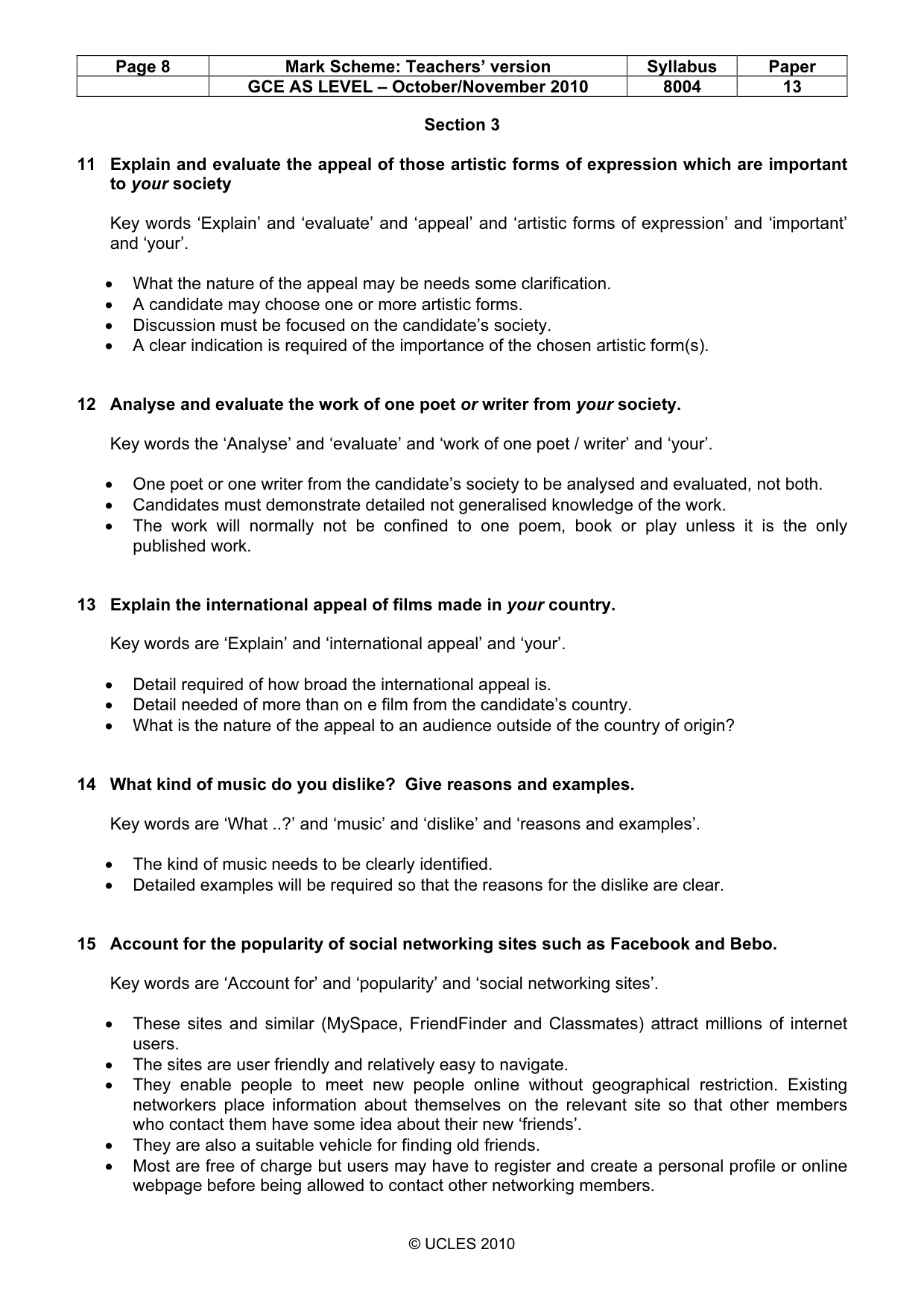
Page 8 Mark Scheme: Teachers’ version Syllabus Paper GCE AS LEVEL – October/November 2010 8004 13 © UCLES 2010 Section 3 11 Explain and evaluate the appeal of those artistic forms of expression which are important to your society Key words ‘Explain’ and ‘evaluate’ and ‘appeal’ and ‘artistic forms of expression’ and ‘important’ and ‘your’. • What the nature of the appeal may be needs some clarification. • A candidate may choose one or more artistic forms. • Discussion must be focused on the candidate’s society. • A clear indication is required of the importance of the chosen artistic form(s). 12 Analyse and evaluate the work of one poet or writer from your society. Key words the ‘Analyse’ and ‘evaluate’ and ‘work of one poet / writer’ and ‘your’. • One poet or one writer from the candidate’s society to be analysed and evaluated, not both. • Candidates must demonstrate detailed not generalised knowledge of the work. • The work will normally not be confined to one poem, book or play unless it is the only published work. 13 Explain the international appeal of films made in your country. Key words are ‘Explain’ and ‘international appeal’ and ‘your’. • Detail required of how broad the international appeal is. • Detail needed of more than on e film from the candidate’s country. • What is the nature of the appeal to an audience outside of the country of origin? 14 What kind of music do you dislike? Give reasons and examples. Key words are ‘What ..?’ and ‘music’ and ‘dislike’ and ‘reasons and examples’. • The kind of music needs to be clearly identified. • Detailed examples will be required so that the reasons for the dislike are clear. 15 Account for the popularity of social networking sites such as Facebook and Bebo. Key words are ‘Account for’ and ‘popularity’ and ‘social networking sites’. • These sites and similar (MySpace, FriendFinder and Classmates) attract millions of internet users. • The sites are user friendly and relatively easy to navigate. • They enable people to meet new people online without geographical restriction. Existing networkers place information about themselves on the relevant site so that other members who contact them have some idea about their new ‘friends’. • They are also a suitable vehicle for finding old friends. • Most are free of charge but users may have to register and create a personal profile or online webpage before being allowed to contact other networking members.
What you needed in this session
Cambridge’s own grade thresholds for 2010 Oct/Nov, Paper 1 · Variant 3. A higher threshold means an easier paper — the bar moves with how the cohort did.