Cambridge A Level General Paper (AS Level only) 8004 — 2010 Oct/Nov Paper 1 · Variant 1
8004/11/O/N/10 · 100 marks · ≈113 min
The question paper and its mark scheme, free to read here and free to download. This is Cambridge’s own paper, exactly as it was sat.
Question paper2 pages
Mark scheme9 pages
Answers below. Sit the paper first if you are practising.
Paper as text
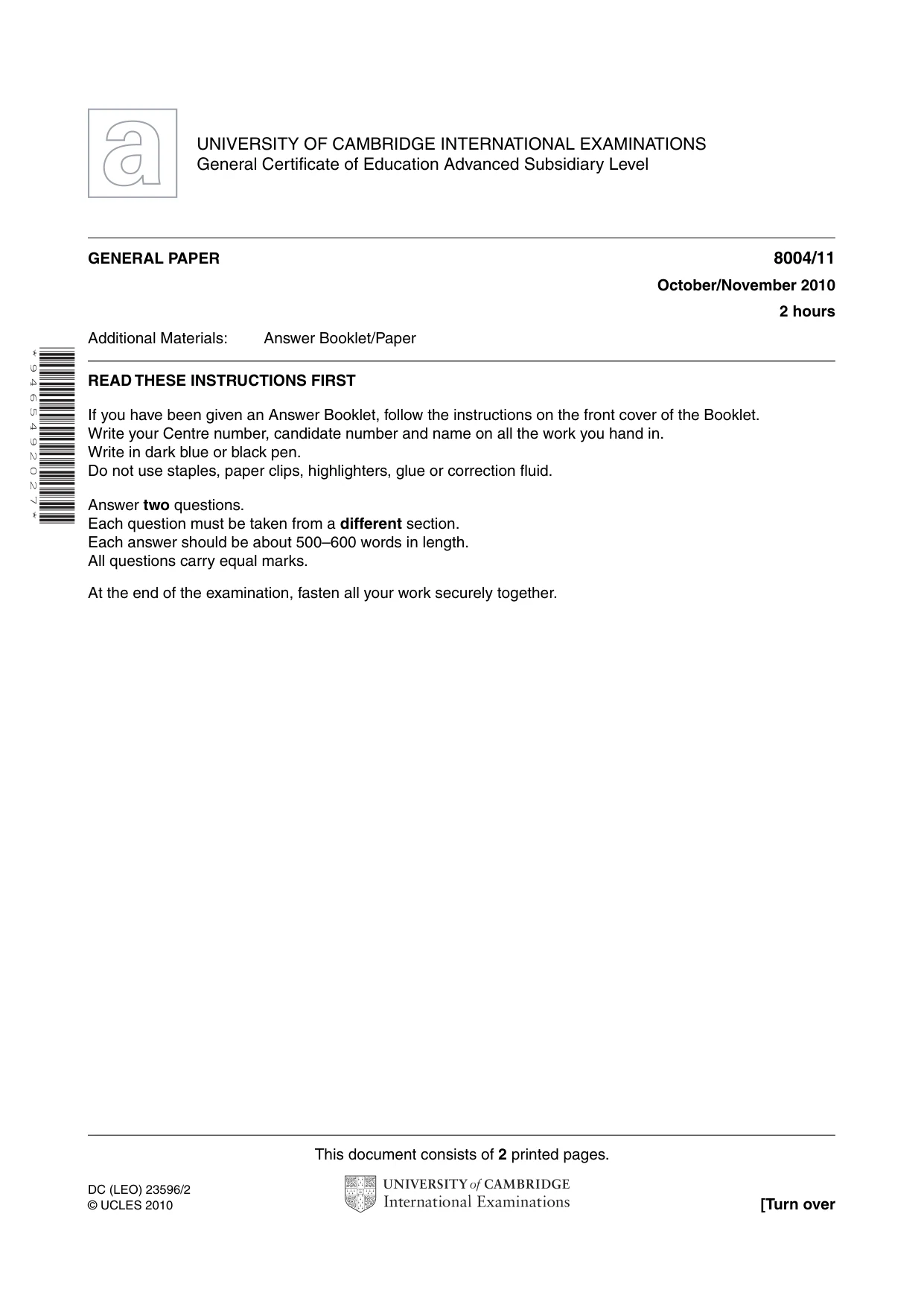
Question paper, page 1
This document consists of 2 printed pages. DC (LEO) 23596/2 © UCLES 2010 [Turn over UNIVERSITY OF CAMBRIDGE INTERNATIONAL EXAMINATIONS General Certificate of Education Advanced Subsidiary Level READ THESE INSTRUCTIONS FIRST If you have been given an Answer Booklet, follow the instructions on the front cover of the Booklet. Write your Centre number, candidate number and name on all the work you hand in. Write in dark blue or black pen. Do not use staples, paper clips, highlighters, glue or correction fluid. Answer two questions. Each question must be taken from a different section. Each answer should be about 500–600 words in length. All questions carry equal marks. At the end of the examination, fasten all your work securely together. * 9 4 6 5 4 9 2 0 2 7 * GENERAL PAPER 8004/11 October/November 2010 2 hours Additional Materials: Answer Booklet/Paper
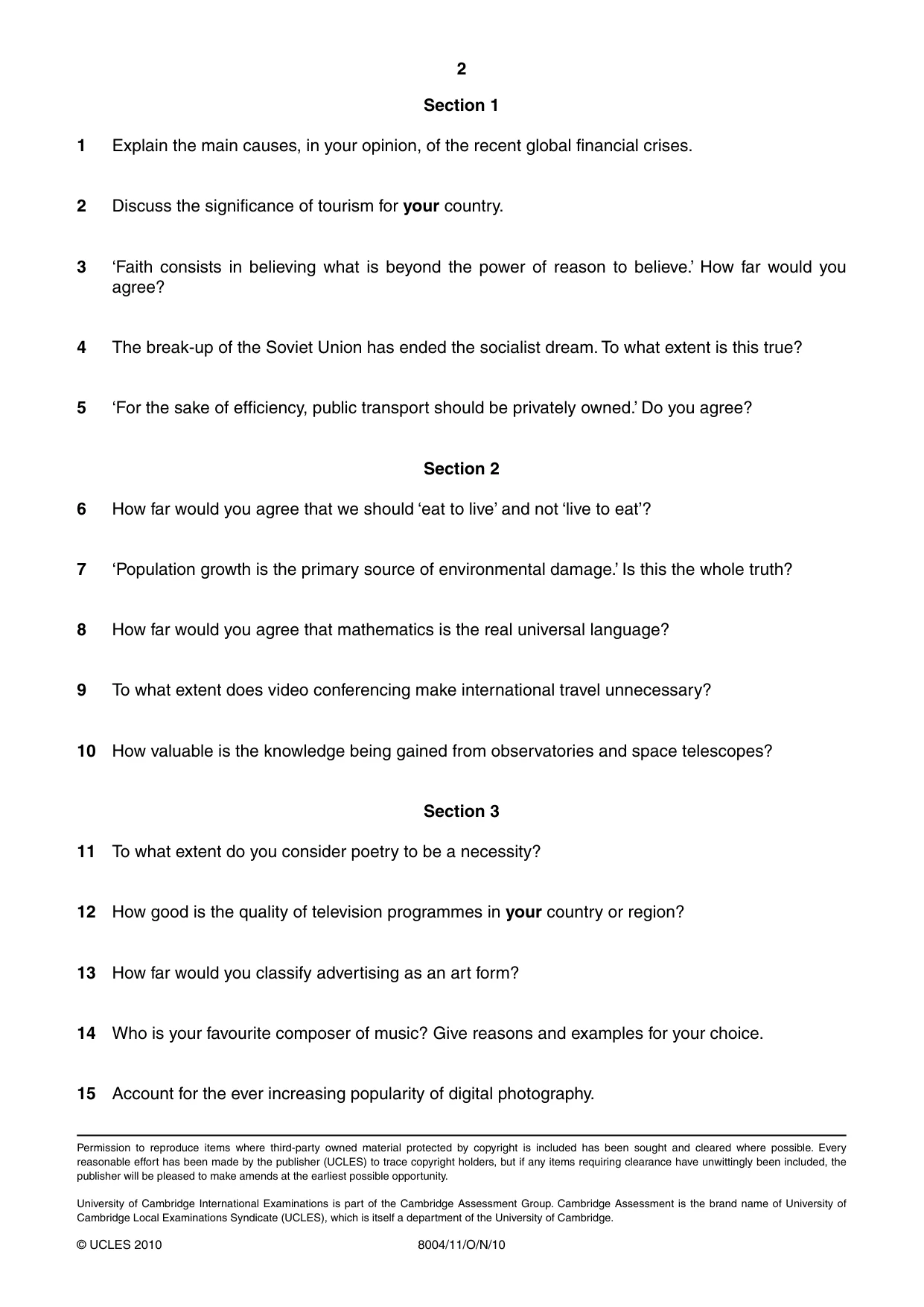
Question paper, page 2
2 8004/11/O/N/10 © UCLES 2010 Section 1 1 Explain the main causes, in your opinion, of the recent global financial crises. 2 Discuss the significance of tourism for your country. 3 ‘Faith consists in believing what is beyond the power of reason to believe.’ How far would you agree? 4 The break-up of the Soviet Union has ended the socialist dream. To what extent is this true? 5 ‘For the sake of efficiency, public transport should be privately owned.’ Do you agree? Section 2 6 How far would you agree that we should ‘eat to live’ and not ‘live to eat’? 7 ‘Population growth is the primary source of environmental damage.’ Is this the whole truth? 8 How far would you agree that mathematics is the real universal language? 9 To what extent does video conferencing make international travel unnecessary? 10 How valuable is the knowledge being gained from observatories and space telescopes? Section 3 11 To what extent do you consider poetry to be a necessity? 12 How good is the quality of television programmes in your country or region? 13 How far would you classify advertising as an art form? 14 Who is your favourite composer of music? Give reasons and examples for your choice. 15 Account for the ever increasing popularity of digital photography. Permission to reproduce items where third-party owned material protected by copyright is included has been sought and cleared where possible. Every reasonable effort has been made by the publisher (UCLES) to trace copyright holders, but if any items requiring clearance have unwittingly been included, the publisher will be pleased to make amends at the earliest possible opportunity. University of Cambridge International Examinations is part of the Cambridge Assessment Group. Cambridge Assessment is the brand name of University of Cambridge Local Examinations Syndicate (UCLES), which is itself a department of the University of Cambridge.
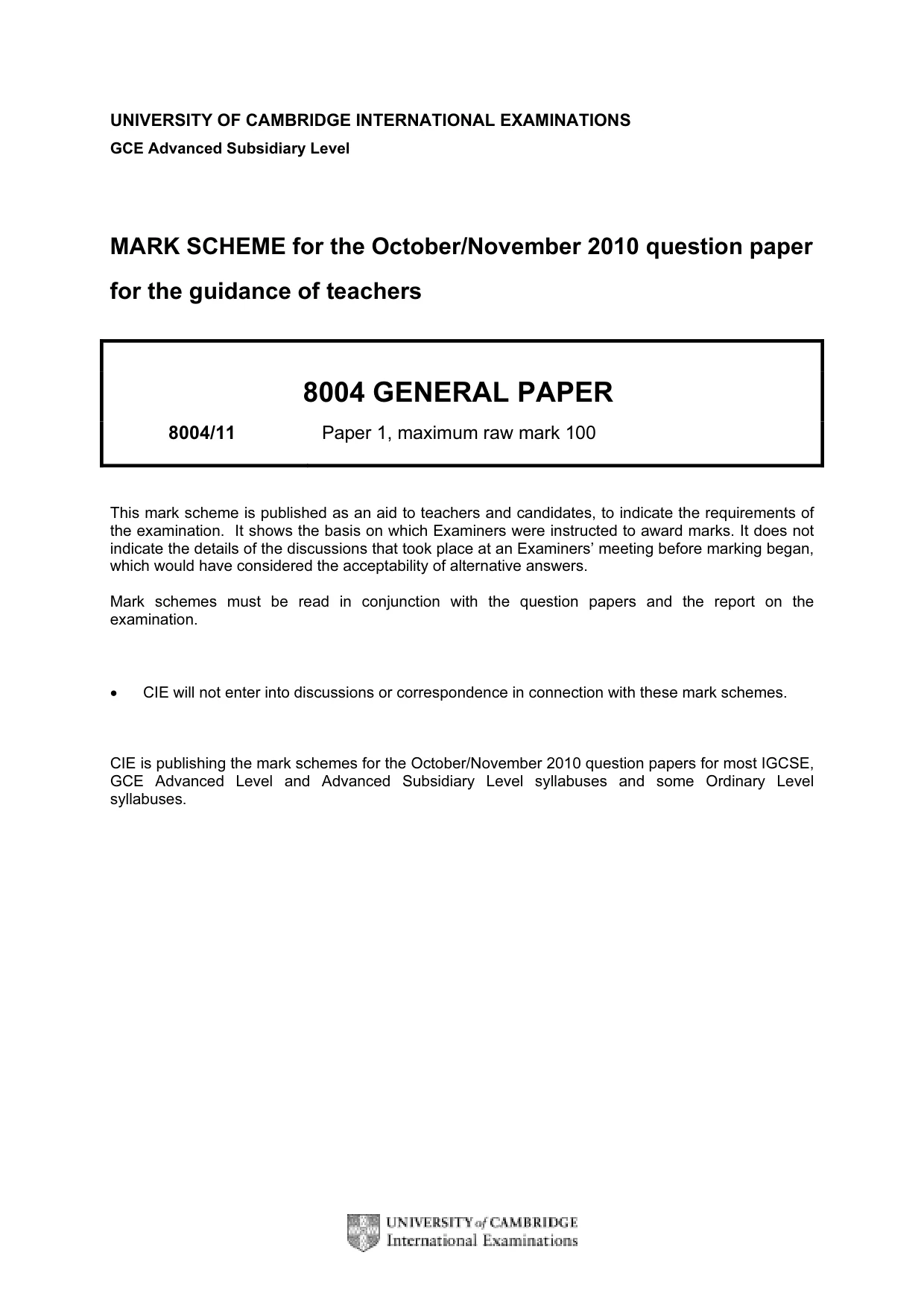
Mark scheme, page 1
UNIVERSITY OF CAMBRIDGE INTERNATIONAL EXAMINATIONS GCE Advanced Subsidiary Level MARK SCHEME for the October/November 2010 question paper for the guidance of teachers 8004 GENERAL PAPER 8004/11 Paper 1, maximum raw mark 100 This mark scheme is published as an aid to teachers and candidates, to indicate the requirements of the examination. It shows the basis on which Examiners were instructed to award marks. It does not indicate the details of the discussions that took place at an Examiners’ meeting before marking began, which would have considered the acceptability of alternative answers. Mark schemes must be read in conjunction with the question papers and the report on the examination. • CIE will not enter into discussions or correspondence in connection with these mark schemes. CIE is publishing the mark schemes for the October/November 2010 question papers for most IGCSE, GCE Advanced Level and Advanced Subsidiary Level syllabuses and some Ordinary Level syllabuses.
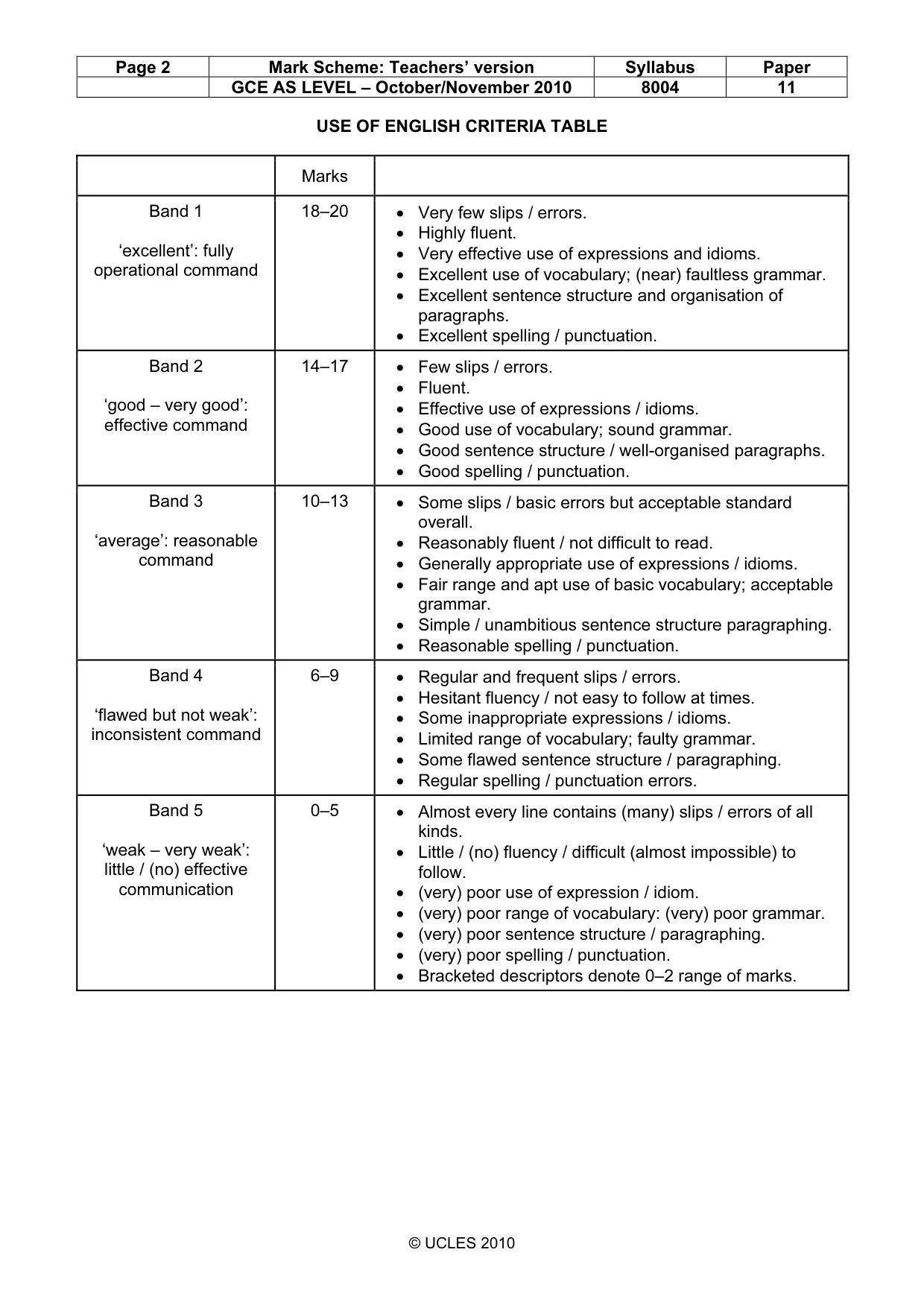
Mark scheme, page 2
Page 2 Mark Scheme: Teachers’ version Syllabus Paper GCE AS LEVEL – October/November 2010 8004 11 © UCLES 2010 USE OF ENGLISH CRITERIA TABLE Marks Band 1 ‘excellent’: fully operational command 18–20 • Very few slips / errors. • Highly fluent. • Very effective use of expressions and idioms. • Excellent use of vocabulary; (near) faultless grammar. • Excellent sentence structure and organisation of paragraphs. • Excellent spelling / punctuation. Band 2 ‘good – very good’: effective command 14–17 • Few slips / errors. • Fluent. • Effective use of expressions / idioms. • Good use of vocabulary; sound grammar. • Good sentence structure / well-organised paragraphs. • Good spelling / punctuation. Band 3 ‘average’: reasonable command 10–13 • Some slips / basic errors but acceptable standard overall. • Reasonably fluent / not difficult to read. • Generally appropriate use of expressions / idioms. • Fair range and apt use of basic vocabulary; acceptable grammar. • Simple / unambitious sentence structure paragraphing. • Reasonable spelling / punctuation. Band 4 ‘flawed but not weak’: inconsistent command 6–9 • Regular and frequent slips / errors. • Hesitant fluency / not easy to follow at times. • Some inappropriate expressions / idioms. • Limited range of vocabulary; faulty grammar. • Some flawed sentence structure / paragraphing. • Regular spelling / punctuation errors. Band 5 ‘weak – very weak’: little / (no) effective communication 0–5 • Almost every line contains (many) slips / errors of all kinds. • Little / (no) fluency / difficult (almost impossible) to follow. • (very) poor use of expression / idiom. • (very) poor range of vocabulary: (very) poor grammar. • (very) poor sentence structure / paragraphing. • (very) poor spelling / punctuation. • Bracketed descriptors denote 0–2 range of marks.
Mark scheme, page 3
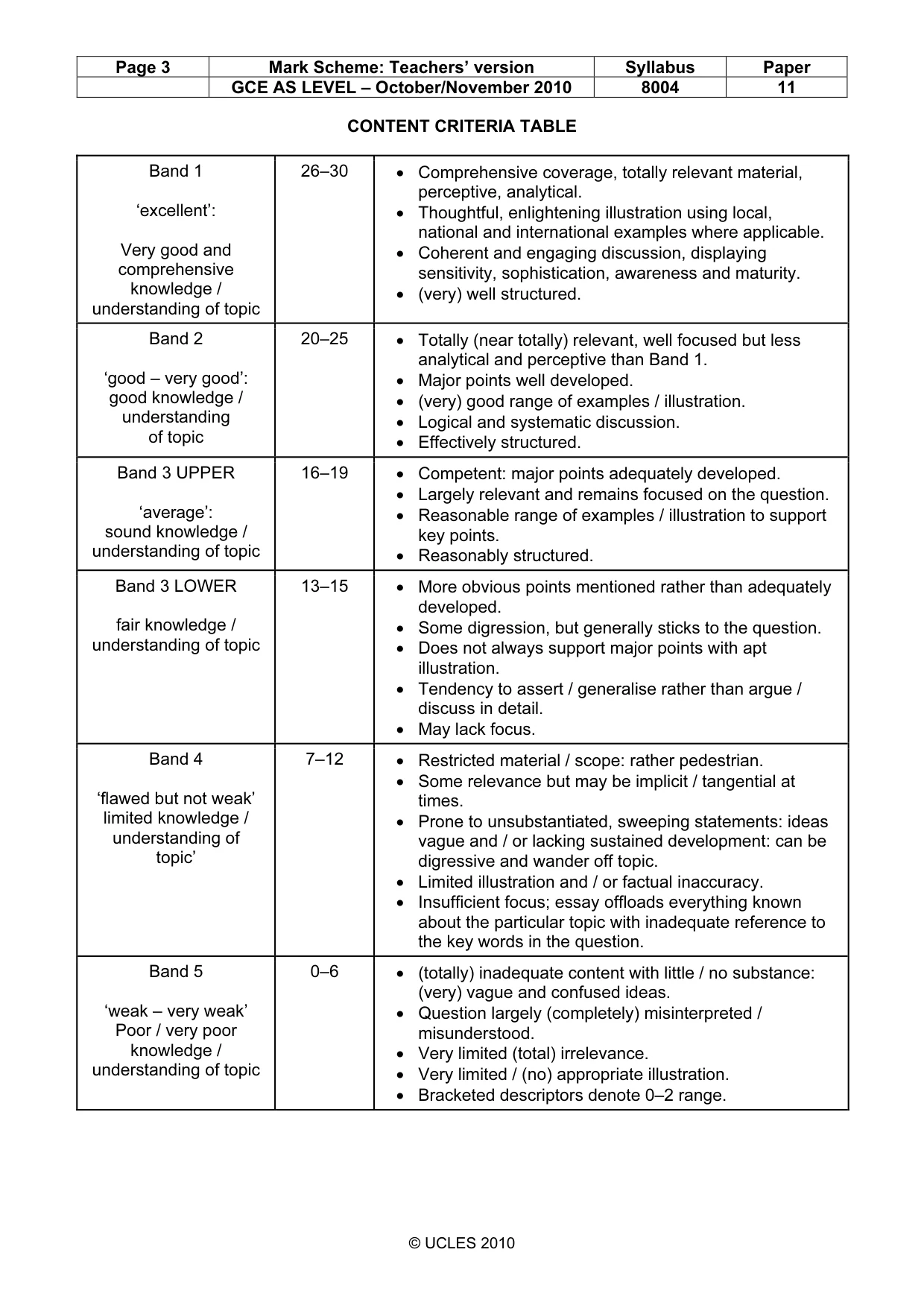
Page 3 Mark Scheme: Teachers’ version Syllabus Paper GCE AS LEVEL – October/November 2010 8004 11 © UCLES 2010 CONTENT CRITERIA TABLE Band 1 ‘excellent’: Very good and comprehensive knowledge / understanding of topic 26–30 • Comprehensive coverage, totally relevant material, perceptive, analytical. • Thoughtful, enlightening illustration using local, national and international examples where applicable. • Coherent and engaging discussion, displaying sensitivity, sophistication, awareness and maturity. • (very) well structured. Band 2 ‘good – very good’: good knowledge / understanding of topic 20–25 • Totally (near totally) relevant, well focused but less analytical and perceptive than Band 1. • Major points well developed. • (very) good range of examples / illustration. • Logical and systematic discussion. • Effectively structured. Band 3 UPPER ‘average’: sound knowledge / understanding of topic 16–19 • Competent: major points adequately developed. • Largely relevant and remains focused on the question. • Reasonable range of examples / illustration to support key points. • Reasonably structured. Band 3 LOWER fair knowledge / understanding of topic 13–15 • More obvious points mentioned rather than adequately developed. • Some digression, but generally sticks to the question. • Does not always support major points with apt illustration. • Tendency to assert / generalise rather than argue / discuss in detail. • May lack focus. Band 4 ‘flawed but not weak’ limited knowledge / understanding of topic’ 7–12 • Restricted material / scope: rather pedestrian. • Some relevance but may be implicit / tangential at times. • Prone to unsubstantiated, sweeping statements: ideas vague and / or lacking sustained development: can be digressive and wander off topic. • Limited illustration and / or factual inaccuracy. • Insufficient focus; essay offloads everything known about the particular topic with inadequate reference to the key words in the question. Band 5 ‘weak – very weak’ Poor / very poor knowledge / understanding of topic 0–6 • (totally) inadequate content with little / no substance: (very) vague and confused ideas. • Question largely (completely) misinterpreted / misunderstood. • Very limited (total) irrelevance. • Very limited / (no) appropriate illustration. • Bracketed descriptors denote 0–2 range.
Mark scheme, page 4
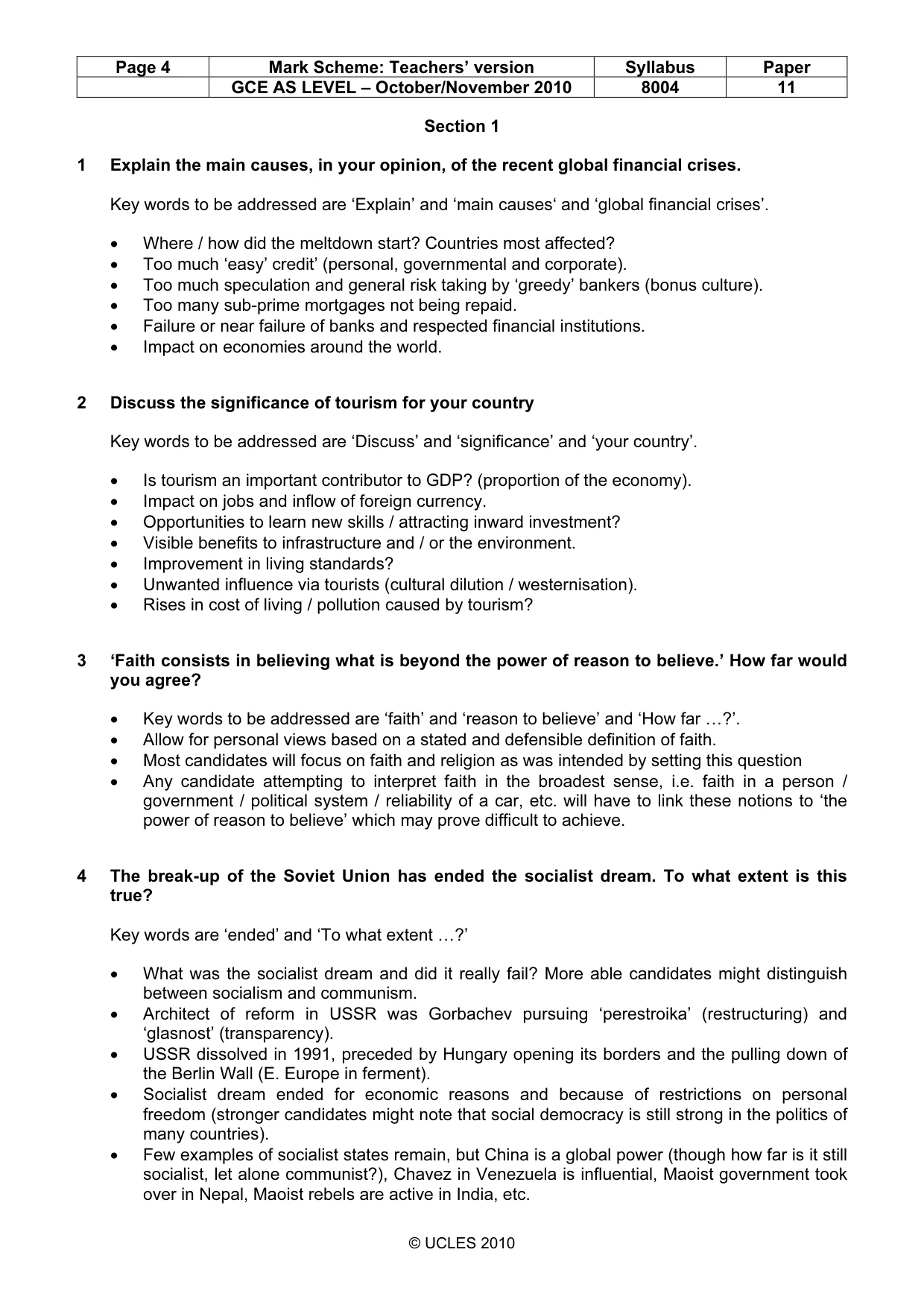
Page 4 Mark Scheme: Teachers’ version Syllabus Paper GCE AS LEVEL – October/November 2010 8004 11 © UCLES 2010 Section 1 1 Explain the main causes, in your opinion, of the recent global financial crises. Key words to be addressed are ‘Explain’ and ‘main causes‘ and ‘global financial crises’. • Where / how did the meltdown start? Countries most affected? • Too much ‘easy’ credit’ (personal, governmental and corporate). • Too much speculation and general risk taking by ‘greedy’ bankers (bonus culture). • Too many sub-prime mortgages not being repaid. • Failure or near failure of banks and respected financial institutions. • Impact on economies around the world. 2 Discuss the significance of tourism for your country Key words to be addressed are ‘Discuss’ and ‘significance’ and ‘your country’. • Is tourism an important contributor to GDP? (proportion of the economy). • Impact on jobs and inflow of foreign currency. • Opportunities to learn new skills / attracting inward investment? • Visible benefits to infrastructure and / or the environment. • Improvement in living standards? • Unwanted influence via tourists (cultural dilution / westernisation). • Rises in cost of living / pollution caused by tourism? 3 ‘Faith consists in believing what is beyond the power of reason to believe.’ How far would you agree? • Key words to be addressed are ‘faith’ and ‘reason to believe’ and ‘How far …?’. • Allow for personal views based on a stated and defensible definition of faith. • Most candidates will focus on faith and religion as was intended by setting this question • Any candidate attempting to interpret faith in the broadest sense, i.e. faith in a person / government / political system / reliability of a car, etc. will have to link these notions to ‘the power of reason to believe’ which may prove difficult to achieve. 4 The break-up of the Soviet Union has ended the socialist dream. To what extent is this true? Key words are ‘ended’ and ‘To what extent …?’ • What was the socialist dream and did it really fail? More able candidates might distinguish between socialism and communism. • Architect of reform in USSR was Gorbachev pursuing ‘perestroika’ (restructuring) and ‘glasnost’ (transparency). • USSR dissolved in 1991, preceded by Hungary opening its borders and the pulling down of the Berlin Wall (E. Europe in ferment). • Socialist dream ended for economic reasons and because of restrictions on personal freedom (stronger candidates might note that social democracy is still strong in the politics of many countries). • Few examples of socialist states remain, but China is a global power (though how far is it still socialist, let alone communist?), Chavez in Venezuela is influential, Maoist government took over in Nepal, Maoist rebels are active in India, etc.
Mark scheme, page 5
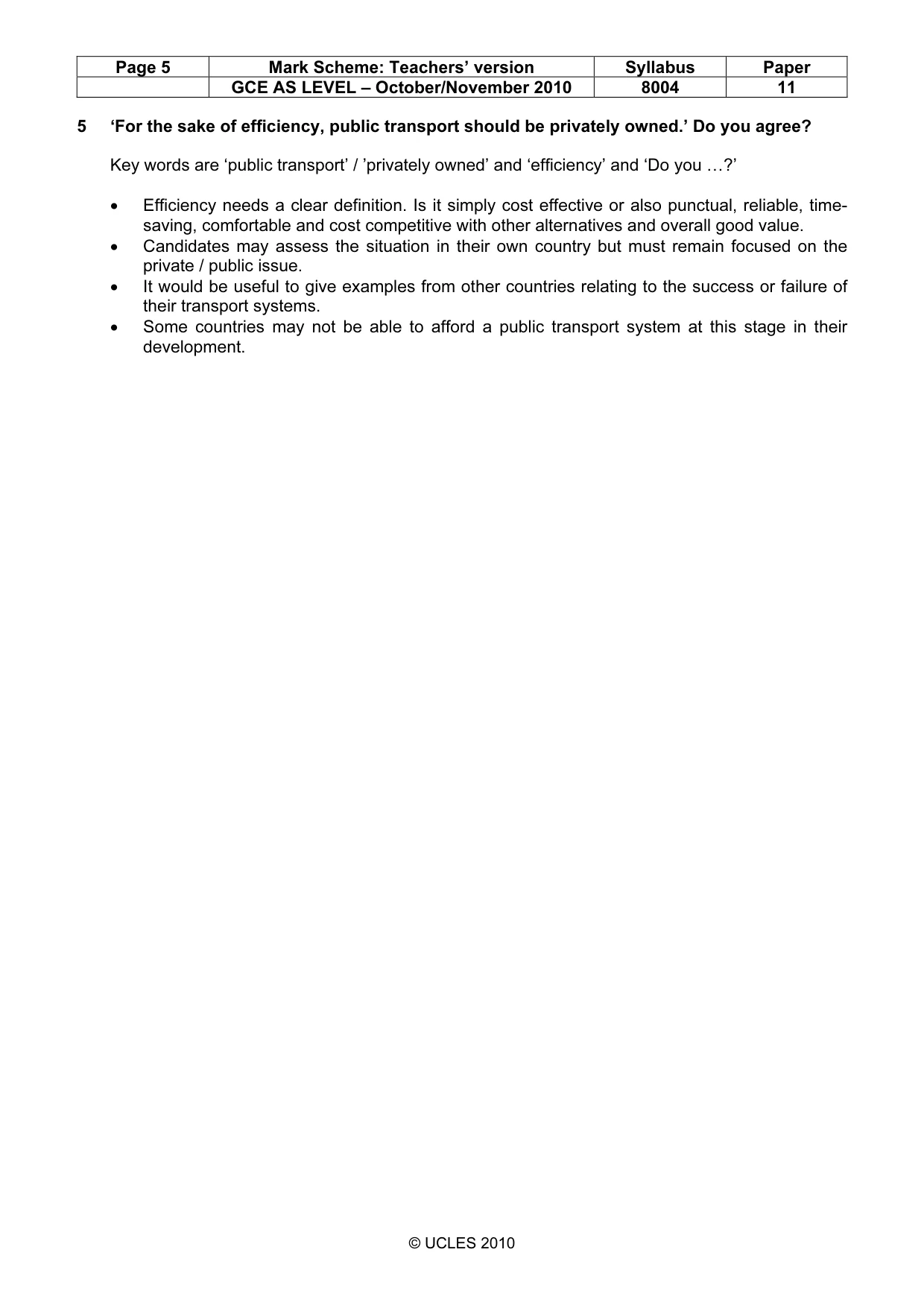
Page 5 Mark Scheme: Teachers’ version Syllabus Paper GCE AS LEVEL – October/November 2010 8004 11 © UCLES 2010 5 ‘For the sake of efficiency, public transport should be privately owned.’ Do you agree? Key words are ‘public transport’ / ’privately owned’ and ‘efficiency’ and ‘Do you …?’ • Efficiency needs a clear definition. Is it simply cost effective or also punctual, reliable, time- saving, comfortable and cost competitive with other alternatives and overall good value. • Candidates may assess the situation in their own country but must remain focused on the private / public issue. • It would be useful to give examples from other countries relating to the success or failure of their transport systems. • Some countries may not be able to afford a public transport system at this stage in their development.
Mark scheme, page 6
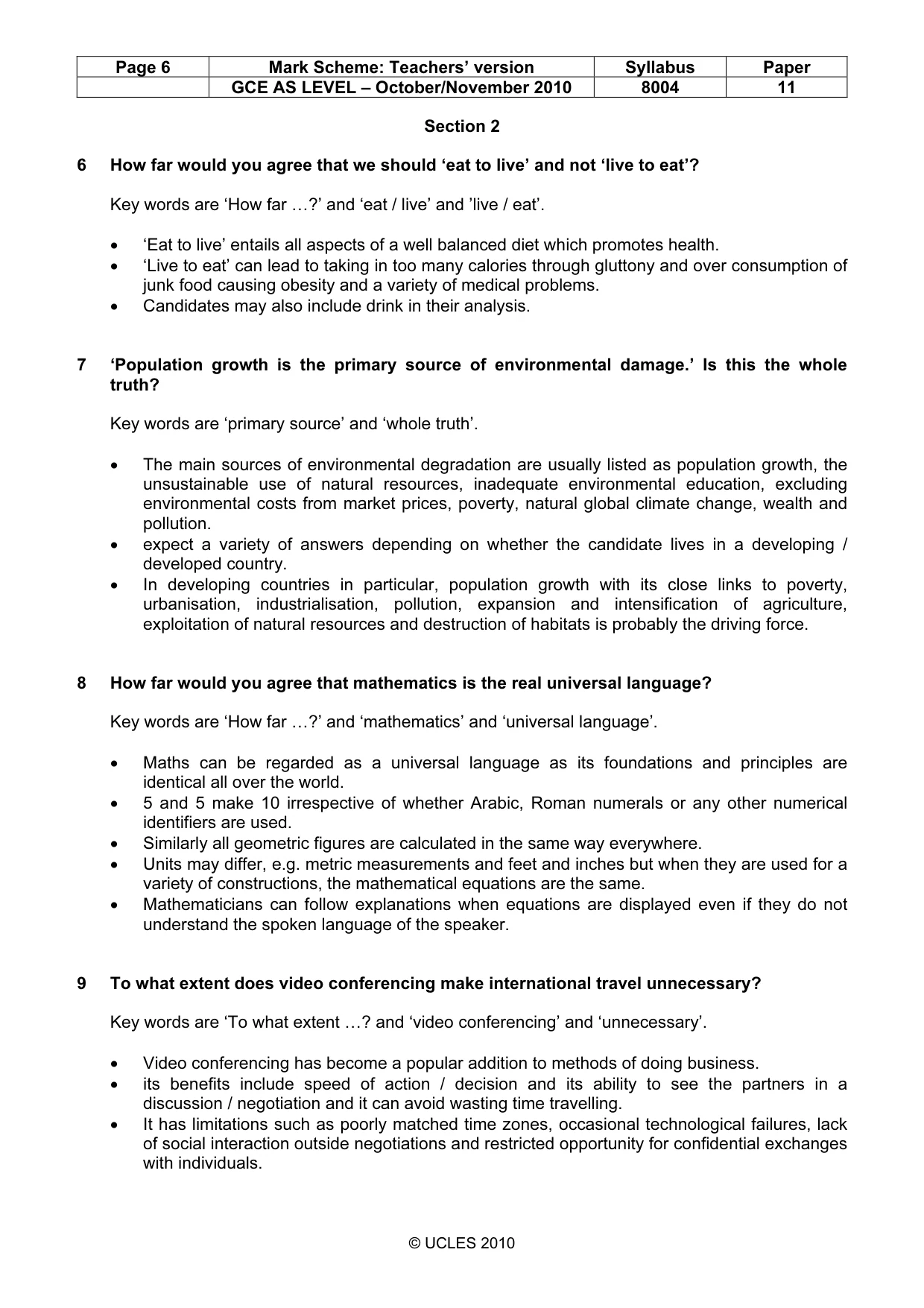
Page 6 Mark Scheme: Teachers’ version Syllabus Paper GCE AS LEVEL – October/November 2010 8004 11 © UCLES 2010 Section 2 6 How far would you agree that we should ‘eat to live’ and not ‘live to eat’? Key words are ‘How far …?’ and ‘eat / live’ and ’live / eat’. • ‘Eat to live’ entails all aspects of a well balanced diet which promotes health. • ‘Live to eat’ can lead to taking in too many calories through gluttony and over consumption of junk food causing obesity and a variety of medical problems. • Candidates may also include drink in their analysis. 7 ‘Population growth is the primary source of environmental damage.’ Is this the whole truth? Key words are ‘primary source’ and ‘whole truth’. • The main sources of environmental degradation are usually listed as population growth, the unsustainable use of natural resources, inadequate environmental education, excluding environmental costs from market prices, poverty, natural global climate change, wealth and pollution. • expect a variety of answers depending on whether the candidate lives in a developing / developed country. • In developing countries in particular, population growth with its close links to poverty, urbanisation, industrialisation, pollution, expansion and intensification of agriculture, exploitation of natural resources and destruction of habitats is probably the driving force. 8 How far would you agree that mathematics is the real universal language? Key words are ‘How far …?’ and ‘mathematics’ and ‘universal language’. • Maths can be regarded as a universal language as its foundations and principles are identical all over the world. • 5 and 5 make 10 irrespective of whether Arabic, Roman numerals or any other numerical identifiers are used. • Similarly all geometric figures are calculated in the same way everywhere. • Units may differ, e.g. metric measurements and feet and inches but when they are used for a variety of constructions, the mathematical equations are the same. • Mathematicians can follow explanations when equations are displayed even if they do not understand the spoken language of the speaker. 9 To what extent does video conferencing make international travel unnecessary? Key words are ‘To what extent …? and ‘video conferencing’ and ‘unnecessary’. • Video conferencing has become a popular addition to methods of doing business. • its benefits include speed of action / decision and its ability to see the partners in a discussion / negotiation and it can avoid wasting time travelling. • It has limitations such as poorly matched time zones, occasional technological failures, lack of social interaction outside negotiations and restricted opportunity for confidential exchanges with individuals.
Mark scheme, page 7
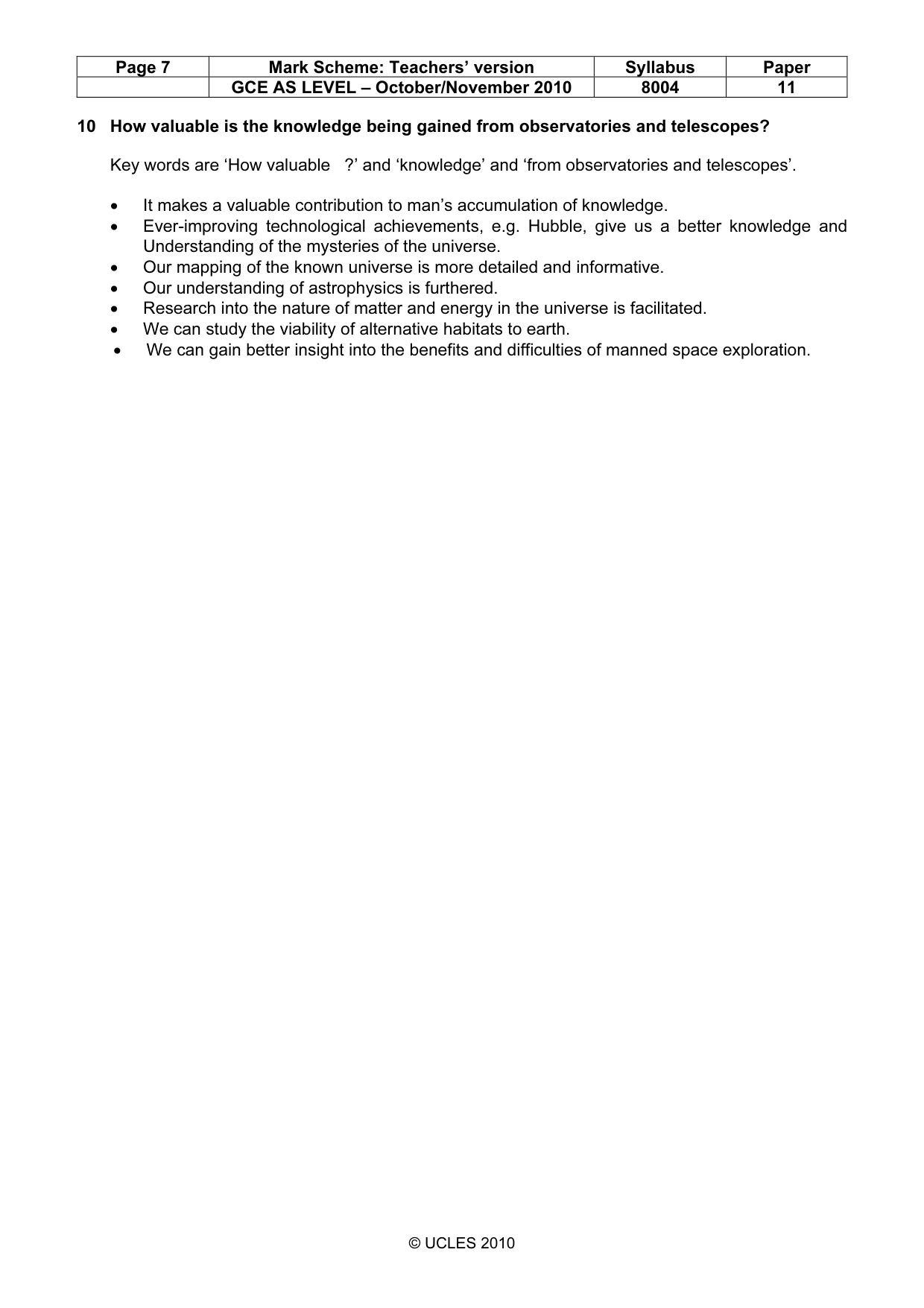
Page 7 Mark Scheme: Teachers’ version Syllabus Paper GCE AS LEVEL – October/November 2010 8004 11 © UCLES 2010 10 How valuable is the knowledge being gained from observatories and telescopes? Key words are ‘How valuable ?’ and ‘knowledge’ and ‘from observatories and telescopes’. • It makes a valuable contribution to man’s accumulation of knowledge. • Ever-improving technological achievements, e.g. Hubble, give us a better knowledge and Understanding of the mysteries of the universe. • Our mapping of the known universe is more detailed and informative. • Our understanding of astrophysics is furthered. • Research into the nature of matter and energy in the universe is facilitated. • We can study the viability of alternative habitats to earth. • We can gain better insight into the benefits and difficulties of manned space exploration.
Mark scheme, page 8
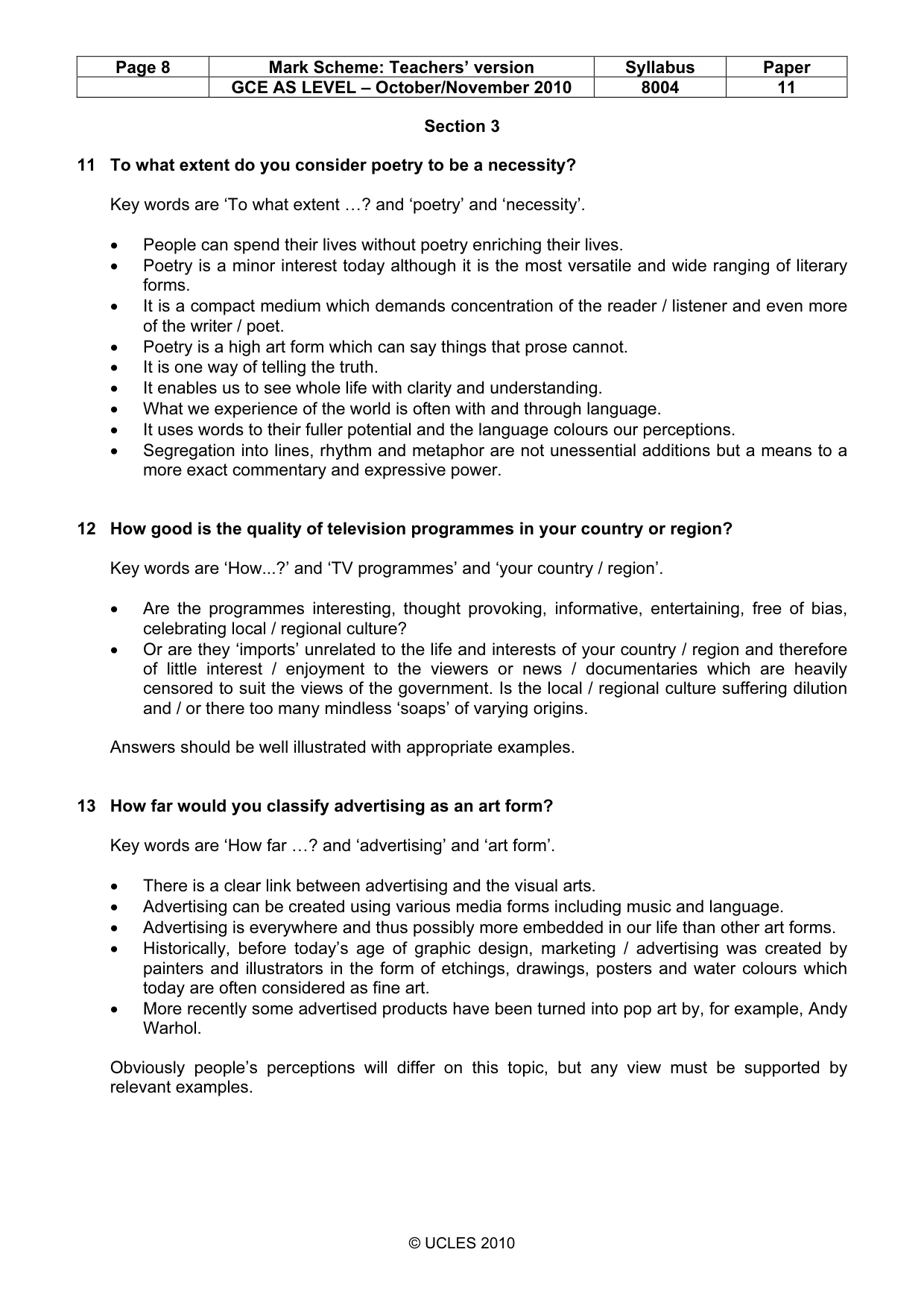
Page 8 Mark Scheme: Teachers’ version Syllabus Paper GCE AS LEVEL – October/November 2010 8004 11 © UCLES 2010 Section 3 11 To what extent do you consider poetry to be a necessity? Key words are ‘To what extent …? and ‘poetry’ and ‘necessity’. • People can spend their lives without poetry enriching their lives. • Poetry is a minor interest today although it is the most versatile and wide ranging of literary forms. • It is a compact medium which demands concentration of the reader / listener and even more of the writer / poet. • Poetry is a high art form which can say things that prose cannot. • It is one way of telling the truth. • It enables us to see whole life with clarity and understanding. • What we experience of the world is often with and through language. • It uses words to their fuller potential and the language colours our perceptions. • Segregation into lines, rhythm and metaphor are not unessential additions but a means to a more exact commentary and expressive power. 12 How good is the quality of television programmes in your country or region? Key words are ‘How...?’ and ‘TV programmes’ and ‘your country / region’. • Are the programmes interesting, thought provoking, informative, entertaining, free of bias, celebrating local / regional culture? • Or are they ‘imports’ unrelated to the life and interests of your country / region and therefore of little interest / enjoyment to the viewers or news / documentaries which are heavily censored to suit the views of the government. Is the local / regional culture suffering dilution and / or there too many mindless ‘soaps’ of varying origins. Answers should be well illustrated with appropriate examples. 13 How far would you classify advertising as an art form? Key words are ‘How far …? and ‘advertising’ and ‘art form’. • There is a clear link between advertising and the visual arts. • Advertising can be created using various media forms including music and language. • Advertising is everywhere and thus possibly more embedded in our life than other art forms. • Historically, before today’s age of graphic design, marketing / advertising was created by painters and illustrators in the form of etchings, drawings, posters and water colours which today are often considered as fine art. • More recently some advertised products have been turned into pop art by, for example, Andy Warhol. Obviously people’s perceptions will differ on this topic, but any view must be supported by relevant examples.
Mark scheme, page 9
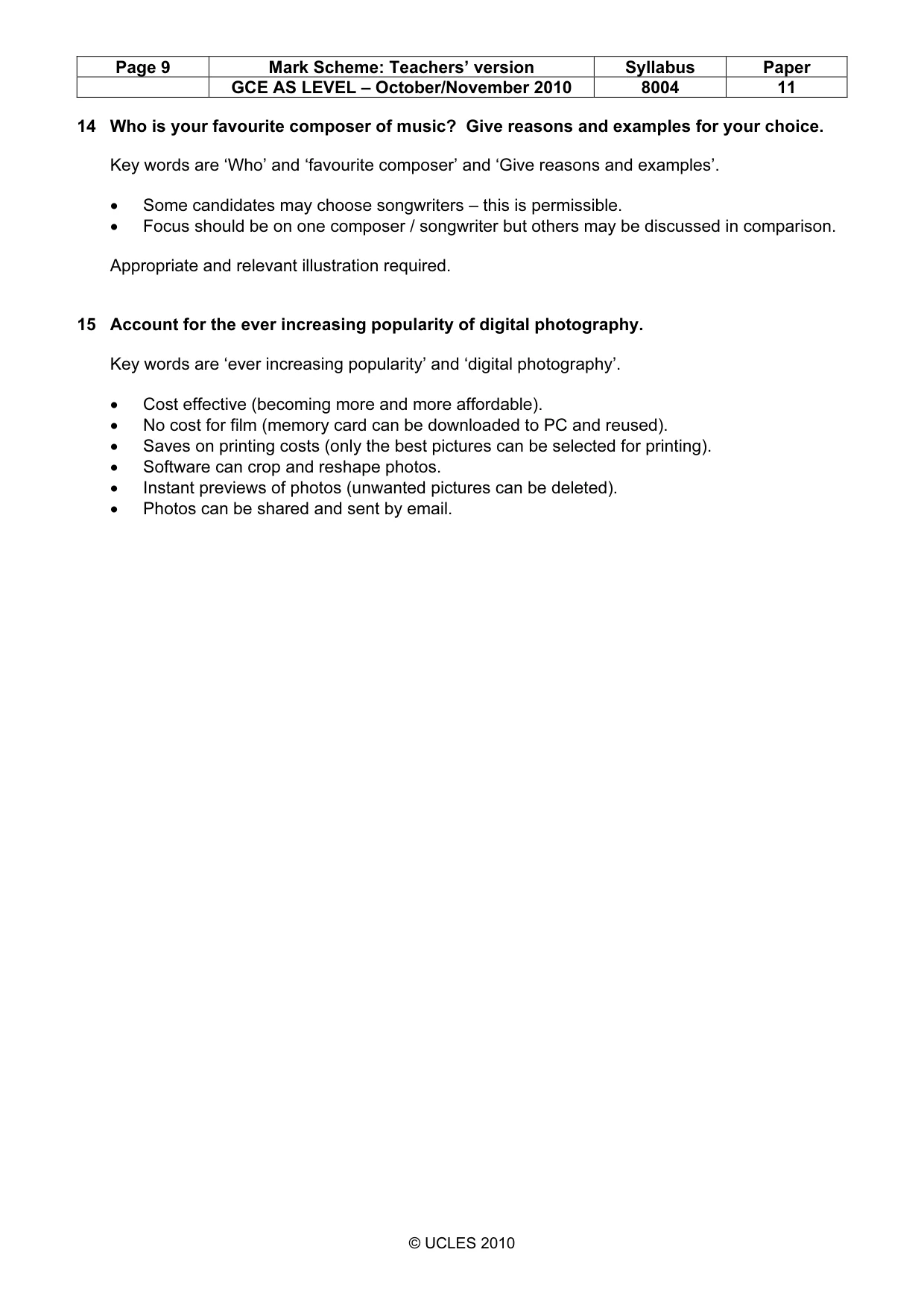
Page 9 Mark Scheme: Teachers’ version Syllabus Paper GCE AS LEVEL – October/November 2010 8004 11 © UCLES 2010 14 Who is your favourite composer of music? Give reasons and examples for your choice. Key words are ‘Who’ and ‘favourite composer’ and ‘Give reasons and examples’. • Some candidates may choose songwriters – this is permissible. • Focus should be on one composer / songwriter but others may be discussed in comparison. Appropriate and relevant illustration required. 15 Account for the ever increasing popularity of digital photography. Key words are ‘ever increasing popularity’ and ‘digital photography’. • Cost effective (becoming more and more affordable). • No cost for film (memory card can be downloaded to PC and reused). • Saves on printing costs (only the best pictures can be selected for printing). • Software can crop and reshape photos. • Instant previews of photos (unwanted pictures can be deleted). • Photos can be shared and sent by email.
What you needed in this session
Cambridge’s own grade thresholds for 2010 Oct/Nov, Paper 1 · Variant 1. A higher threshold means an easier paper — the bar moves with how the cohort did.