Cambridge A Level English - Language AS and A Level (from 2014) 9093 — 2025 Oct/Nov Paper 3 · Variant 1
9093/31/O/N/25 · 50 marks · 135 min
The question paper and its mark scheme, free to read here and free to download. This is Cambridge’s own paper, exactly as it was sat.
Question paper8 pages
Mark scheme14 pages
Answers below. Sit the paper first if you are practising.
Paper as text
Question paper, page 1
This document has 8 pages. Any blank pages are indicated. [Turn over Cambridge International AS & A Level * 0 6 1 3 3 3 1 9 2 3 * ENGLISH LANGUAGE 9093/31 Paper 3 Language Analysis October/November 2025 2 hours 15 minutes You must answer on the enclosed answer booklet. You will need: Answer booklet (enclosed) INSTRUCTIONS ● Answer all questions. ● Follow the instructions on the front cover of the answer booklet. If you need additional answer paper, ask the invigilator for a continuation booklet. ● Dictionaries are not allowed. INFORMATION ● The total mark for this paper is 50. ● The number of marks for each question or part question is shown in brackets [ ]. DC (WW) 362389 © UCLES 2025
Question paper, page 2
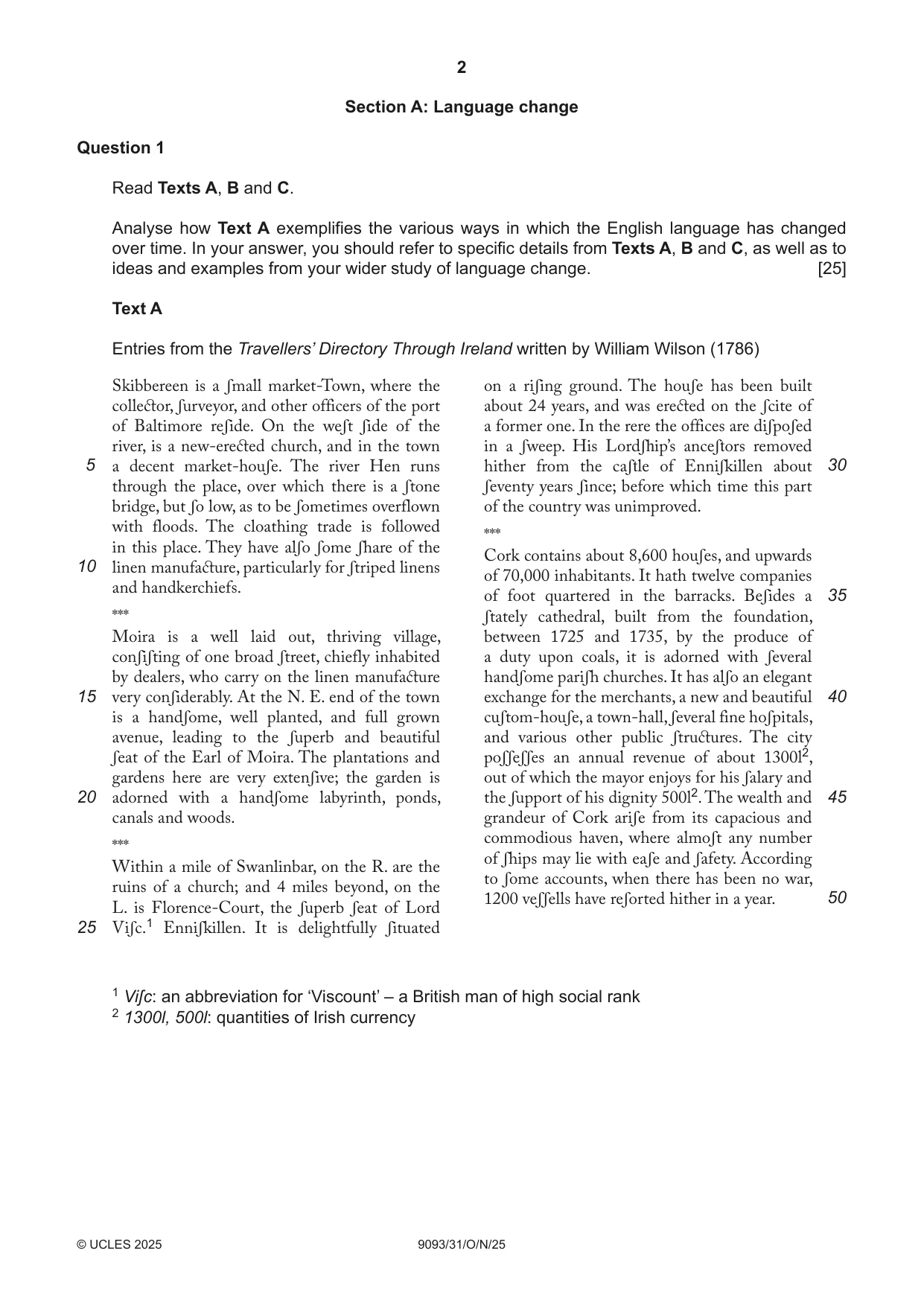
2 9093/31/O/N/25 © UCLES 2025 Section A: Language change Question 1 Read Texts A, B and C. Analyse how Text A exemplifies the various ways in which the English language has changed over time. In your answer, you should refer to specific details from Texts A, B and C, as well as to ideas and examples from your wider study of language change. [25] Text A Entries from the Travellers’ Directory Through Ireland written by William Wilson (1786) Skibbereen is a Skibbereen is a ʃmall market-Town, where the mall market-Town, where the colle collectctor, or, ʃurveyor, and other officers of the port urveyor, and other officers of the port of Baltimore re of Baltimore reʃide. On the we ide. On the weʃt t ʃide of the ide of the river, is a new-ere river, is a new-erectcted church, and in the town ed church, and in the town a decent market-hou a decent market-houʃe. The river Hen runs e. The river Hen runs through the place, over which there is a through the place, over which there is a ʃtone tone bridge, but bridge, but ʃo low, as to be o low, as to be ʃometimes overflown ometimes overflown with floods. The cloathing trade is followed with floods. The cloathing trade is followed in this place. They have al in this place. They have alʃo o ʃome ome ʃhare of the hare of the linen manufa linen manufactcture, particularly for ure, particularly for ʃtriped linens triped linens and handkerchiefs. and handkerchiefs. *** *** Moira is a well laid out, thriving village, Moira is a well laid out, thriving village, con conʃiʃting of one broad ting of one broad ʃtreet, chiefly inhabited treet, chiefly inhabited by dealers, who carry on the linen manufa by dealers, who carry on the linen manufactcture ure very con very conʃiderably. At the N. E. end of the town iderably. At the N. E. end of the town is a hand is a handʃome, well planted, and full grown ome, well planted, and full grown avenue, leading to the avenue, leading to the ʃuperb and beautiful uperb and beautiful ʃeat of the Earl of Moira. The plantations and eat of the Earl of Moira. The plantations and gardens here are very exten gardens here are very extenʃive; the garden is ive; the garden is adorned with a hand adorned with a handʃome labyrinth, ponds, ome labyrinth, ponds, canals and woods. canals and woods. *** *** Within a mile of Swanlinbar, on the R. are the Within a mile of Swanlinbar, on the R. are the ruins of a church; and 4 miles beyond, on the ruins of a church; and 4 miles beyond, on the L. is Florence-Court, the L. is Florence-Court, the ʃuperb uperb ʃeat of Lord eat of Lord Vi Viʃc.c.1 Enni Enniʃkillen. It is delightfully killen. It is delightfully ʃituated ituated on a ri on a riʃing ground. The hou ing ground. The houʃe has been built e has been built about 24 years, and was ere about 24 years, and was erectcted on the ed on the ʃcite of cite of a former one. In the rere the offices are di a former one. In the rere the offices are diʃpo poʃed ed in a in a ʃweep. His Lord weep. His Lordʃh ʃhip’s ance ip’s anceʃtʃtors removed ors removed hither from the ca hither from the caʃtʃtle of Enni le of Enniʃkillen about killen about ʃeventy years eventy years ʃince; before which time this part ince; before which time this part of the country was unimproved. of the country was unimproved. *** *** Cork contains about 8,600 hou Cork contains about 8,600 houʃes, and upwards es, and upwards of 70,000 inhabitants. It hath twelve companies of 70,000 inhabitants. It hath twelve companies of foot quartered in the barracks. Be of foot quartered in the barracks. Beʃides a ides a ʃtately cathedral, built from the foundation, tately cathedral, built from the foundation, between 1725 and 1735, by the produce of between 1725 and 1735, by the produce of a duty upon coals, it is adorned with a duty upon coals, it is adorned with ʃeveral everal hand handʃome pari ome pariʃh churches. It has al h churches. It has alʃo an elegant o an elegant exchange for the merchants, a new and beautiful exchange for the merchants, a new and beautiful cu cuʃtom-hou tom-houʃe, a town-hall, e, a town-hall, ʃeveral fine ho everal fine hoʃpitals, pitals, and various other public and various other public ʃtrtructctures. The city ures. The city po poʃʃʃʃeʃʃʃʃes an annual revenue of about 1300l es an annual revenue of about 1300l2, , out of which the mayor enjoys for his out of which the mayor enjoys for his ʃalary and alary and the the ʃupport of his dignity 500l upport of his dignity 500l2. The wealth and . The wealth and grandeur of Cork ari grandeur of Cork ariʃe from its capacious and e from its capacious and commodious haven, where almo commodious haven, where almoʃt any number t any number of of ʃhips may lie with ea hips may lie with eaʃe and e and ʃafety. According afety. According to to ʃome accounts, when there has been no war, ome accounts, when there has been no war, 1200 ve 1200 veʃʃʃʃells have re ells have reʃorted hither in a year. orted hither in a year. 1 Viʃc: an abbreviation for ‘Viscount’ – a British man of high social rank 2 1300l, 500l: quantities of Irish currency 5 10 15 20 25 30 35 40 45 50
Question paper, page 3
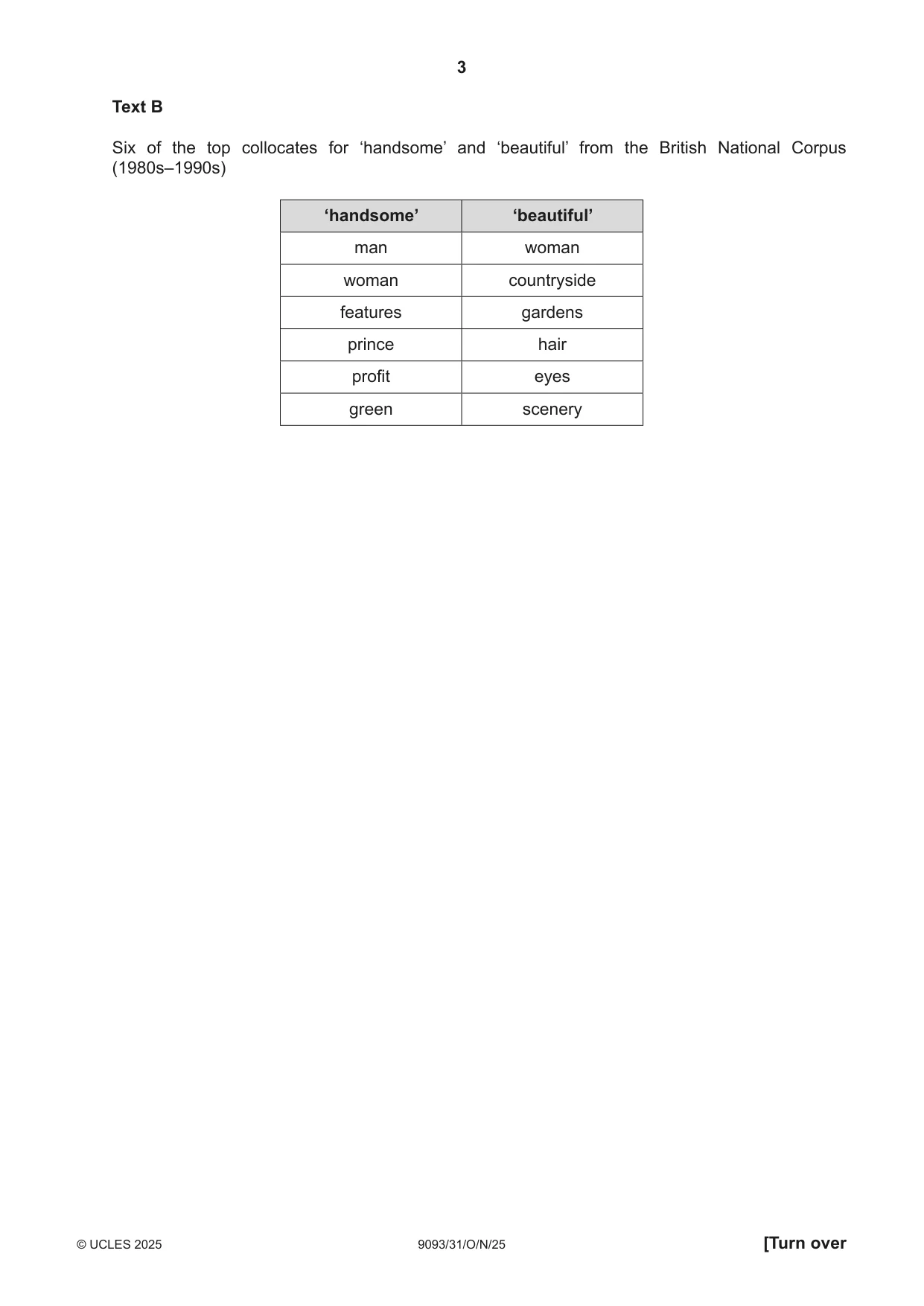
3 9093/31/O/N/25 © UCLES 2025 [Turn over Text B Six of the top collocates for ‘handsome’ and ‘beautiful’ from the British National Corpus (1980s–1990s) ‘handsome’ ‘beautiful’ man woman woman countryside features gardens prince hair profit eyes green scenery
Question paper, page 4
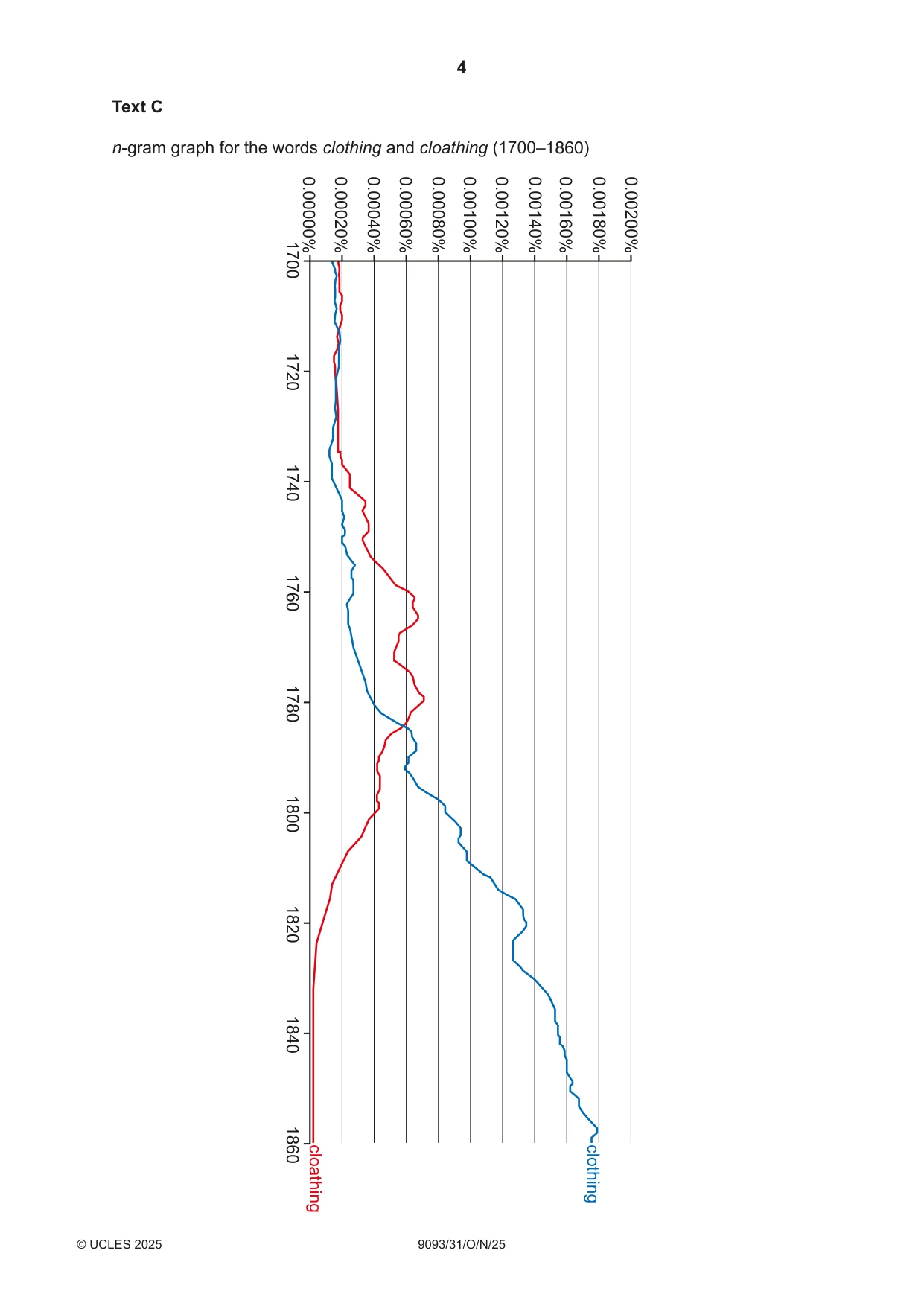
4 9093/31/O/N/25 © UCLES 2025 Text C n-gram graph for the words clothing and cloathing (1700–1860) cloathing clothing 1700 0.00000% 0.00060% 0.00080% 0.00020% 0.00040% 0.00100% 0.00120% 0.00140% 0.00160% 0.00180% 0.00200% 1720 1740 1760 1800 1820 1780 1840 1860
Question paper, page 5
5 9093/31/O/N/25 © UCLES 2025 [Turn over BLANK PAGE
Question paper, page 6
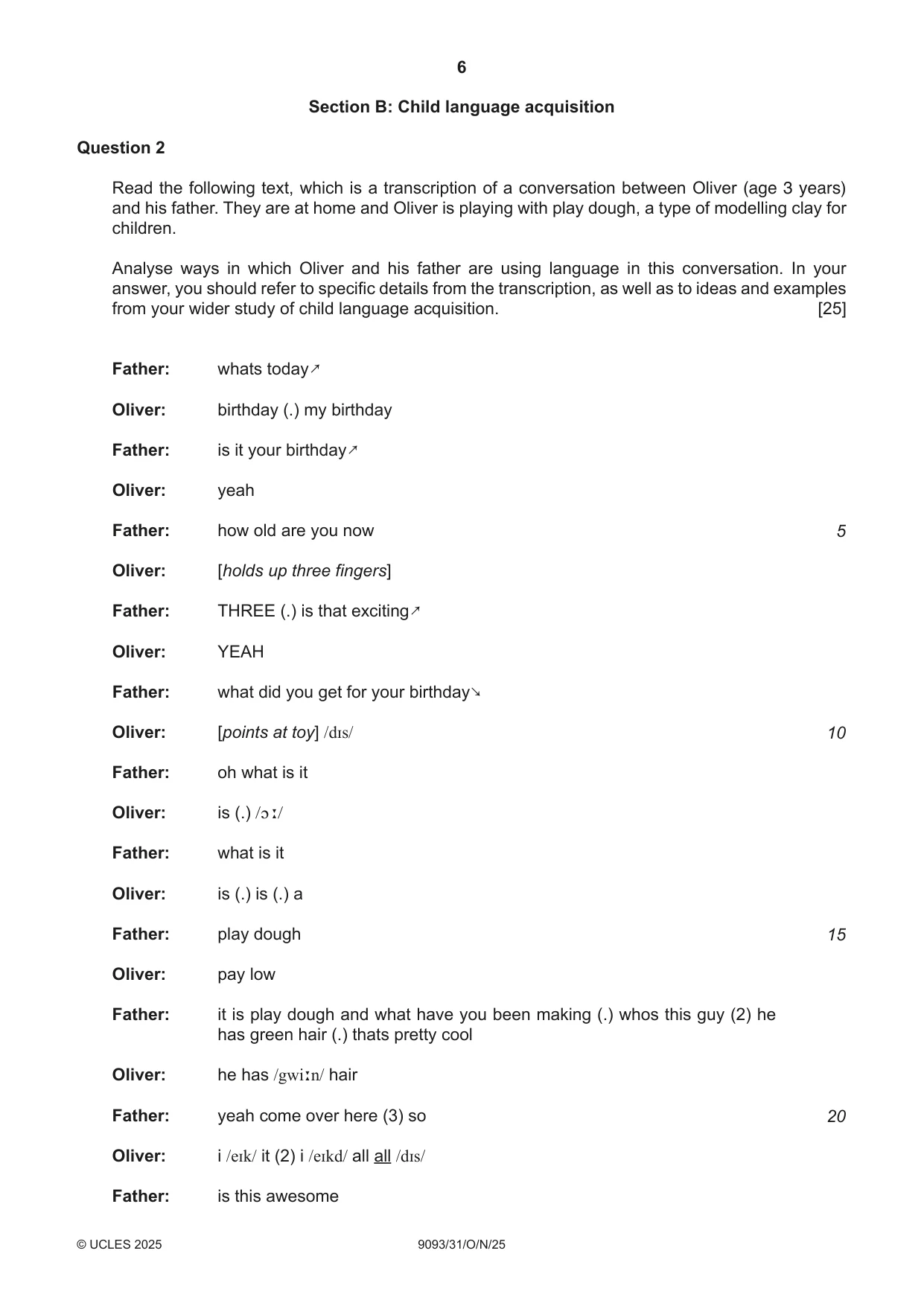
6 9093/31/O/N/25 © UCLES 2025 Section B: Child language acquisition Question 2 Read the following text, which is a transcription of a conversation between Oliver (age 3 years) and his father. They are at home and Oliver is playing with play dough, a type of modelling clay for children. Analyse ways in which Oliver and his father are using language in this conversation. In your answer, you should refer to specific details from the transcription, as well as to ideas and examples from your wider study of child language acquisition. [25] Father: whats today↗ Oliver: birthday (.) my birthday Father: is it your birthday↗ Oliver: yeah Father: how old are you now Oliver: [holds up three fingers] Father: THREE (.) is that exciting↗ Oliver: YEAH Father: what did you get for your birthday ↗ Oliver: [points at toy] /dɪs/ Father: oh what is it Oliver: is (.) /ɔː/ Father: what is it Oliver: is (.) is (.) a Father: play dough Oliver: pay low Father: it is play dough and what have you been making (.) whos this guy (2) he has green hair (.) thats pretty cool Oliver: he has /gwiːn/ hair Father: yeah come over here (3) so Oliver: i /eɪk/ it (2) i /eɪkd/ all all /dɪs/ Father: is this awesome 5 10 15 20
Question paper, page 7
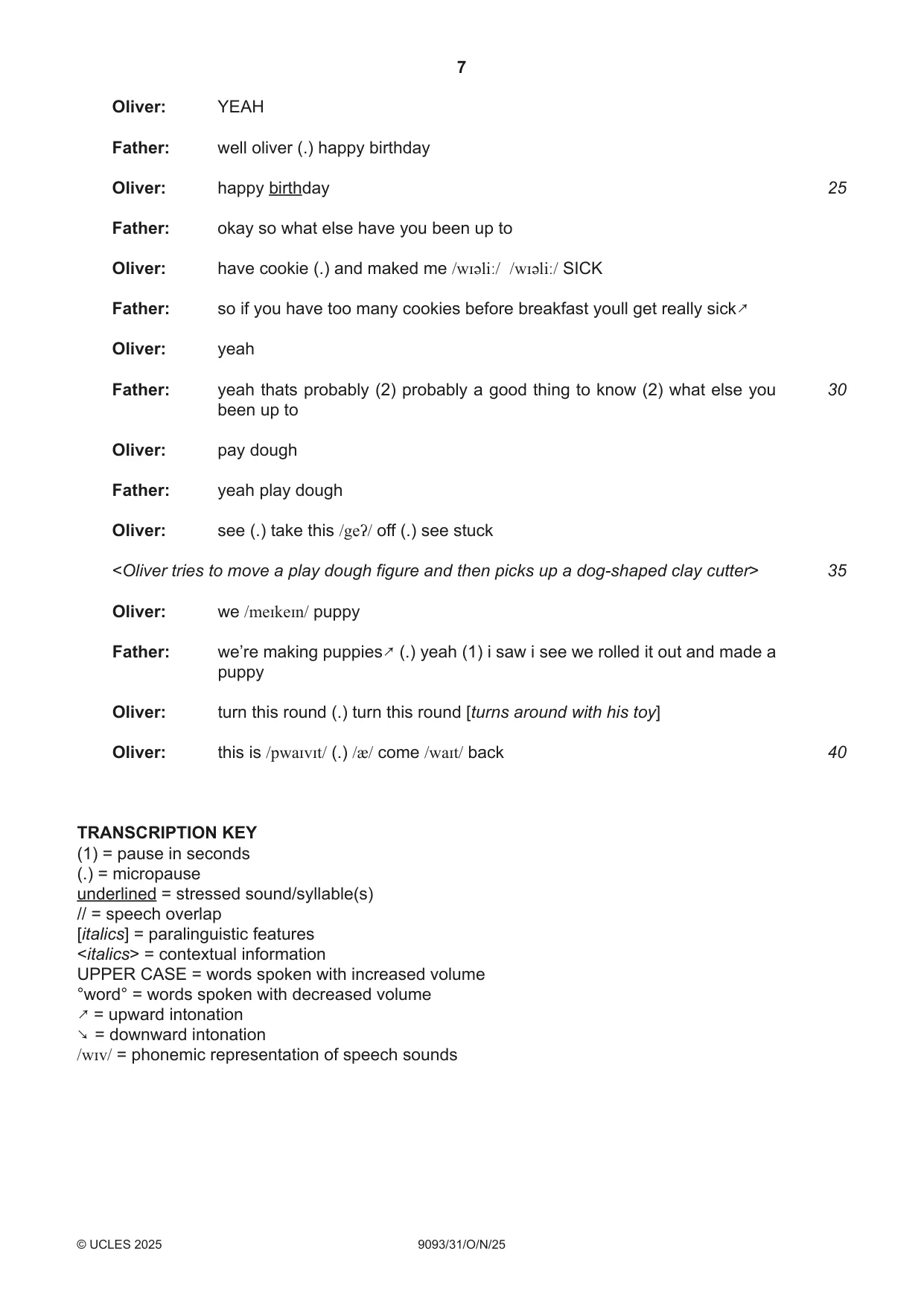
7 9093/31/O/N/25 © UCLES 2025 Oliver: YEAH Father: well oliver (.) happy birthday Oliver: happy birthday Father: okay so what else have you been up to Oliver: have cookie (.) and maked me /wɪəliː/ /wɪəliː/ SICK Father: so if you have too many cookies before breakfast youll get really sick↗ Oliver: yeah Father: yeah thats probably (2) probably a good thing to know (2) what else you been up to Oliver: pay dough Father: yeah play dough Oliver: see (.) take this /geʔ/ off (.) see stuck <Oliver tries to move a play dough figure and then picks up a dog-shaped clay cutter> Oliver: we /meɪkeɪn/ puppy Father: we’re making puppies↗ (.) yeah (1) i saw i see we rolled it out and made a puppy Oliver: turn this round (.) turn this round [turns around with his toy] Oliver: this is /pwaɪvɪt/ (.) /æ/ come /waɪt/ back TRANSCRIPTION KEY (1) = pause in seconds (.) = micropause underlined = stressed sound/syllable(s) // = speech overlap [italics] = paralinguistic features <italics> = contextual information UPPER CASE = words spoken with increased volume °word° = words spoken with decreased volume ↗ = upward intonation ↗ = downward intonation /wɪv/ = phonemic representation of speech sounds 25 30 35 40
Question paper, page 8
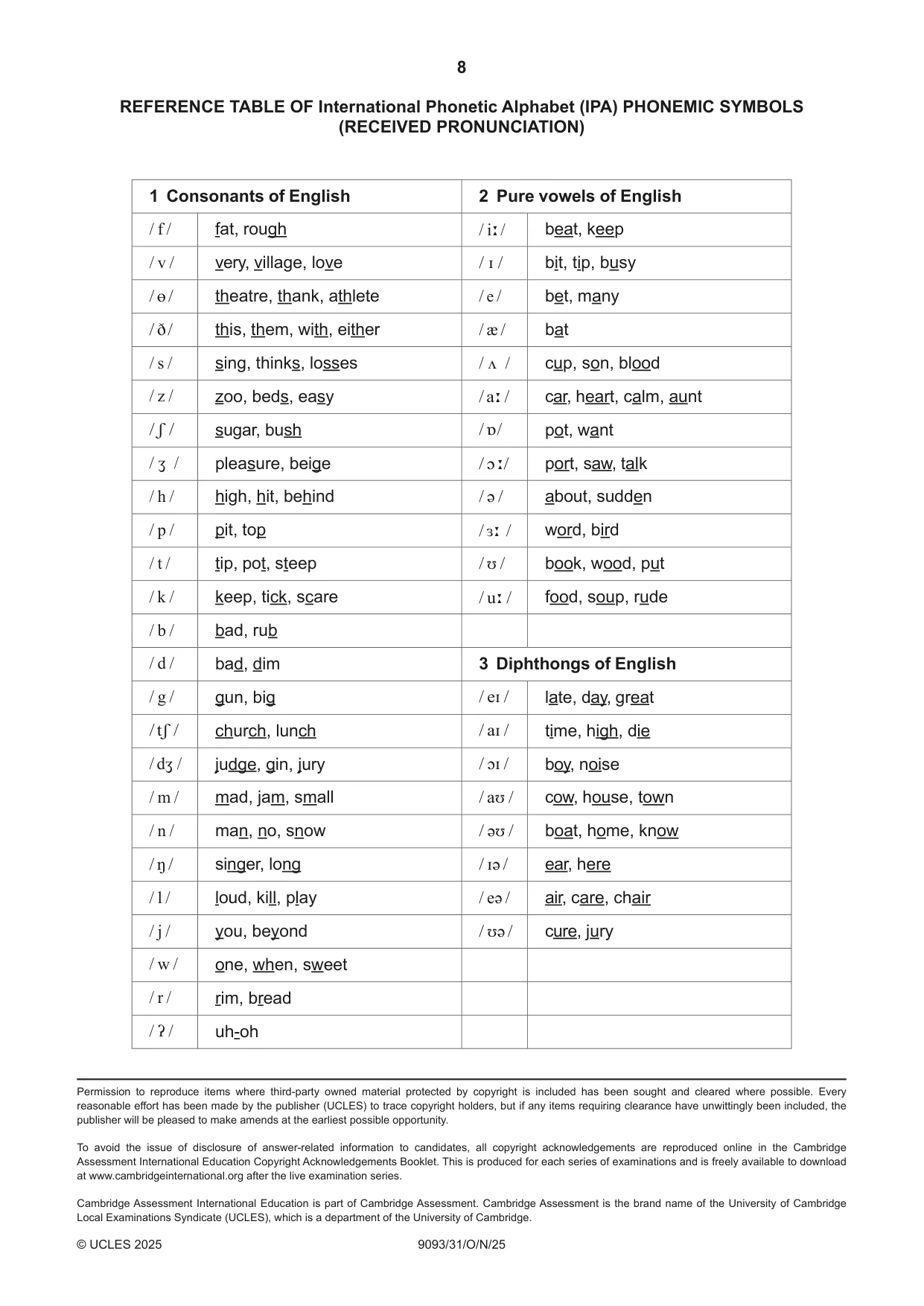
8 9093/31/O/N/25 © UCLES 2025 Permission to reproduce items where third-party owned material protected by copyright is included has been sought and cleared where possible. Every reasonable effort has been made by the publisher (UCLES) to trace copyright holders, but if any items requiring clearance have unwittingly been included, the publisher will be pleased to make amends at the earliest possible opportunity. To avoid the issue of disclosure of answer-related information to candidates, all copyright acknowledgements are reproduced online in the Cambridge Assessment International Education Copyright Acknowledgements Booklet. This is produced for each series of examinations and is freely available to download at www.cambridgeinternational.org after the live examination series. Cambridge Assessment International Education is part of Cambridge Assessment. Cambridge Assessment is the brand name of the University of Cambridge Local Examinations Syndicate (UCLES), which is a department of the University of Cambridge. REFERENCE TABLE OF International Phonetic Alphabet (IPA) PHONEMIC SYMBOLS (RECEIVED PRONUNCIATION) 1 Consonants of English 2 Pure vowels of English / f / fat, rough / iː / beat, keep / v / very, village, love / ɪ / bit, tip, busy / ɵ / theatre, thank, athlete / e / bet, many / ð/ this, them, with, either / æ / bat / s / sing, thinks, losses / ʌ / cup, son, blood / z / zoo, beds, easy / aː / car, heart, calm, aunt / ʃ / sugar, bush / ɒ / pot, want / ʒ / pleasure, beige / ɔː/ port, saw, talk / h / high, hit, behind / ə / about, sudden / p / pit, top / ɜː / word, bird / t / tip, pot, steep / ʊ / book, wood, put / k / keep, tick, scare / uː / food, soup, rude / b / bad, rub / d / bad, dim 3 Diphthongs of English / g / gun, big / eɪ / late, day, great / tʃ / church, lunch / aɪ / time, high, die / dʒ / judge, gin, jury / ɔɪ / boy, noise / m / mad, jam, small / aʊ / cow, house, town / n / man, no, snow / əʊ / boat, home, know / ŋ / singer, long / ɪə / ear, here / l / loud, kill, play / eə / air, care, chair / j / you, beyond / ʊə / cure, jury / w / one, when, sweet / r / rim, bread / ʔ / uh-oh
Mark scheme, page 1
This document consists of 14 printed pages. © Cambridge University Press & Assessment 2025 [Turn over Cambridge International A Level ENGLISH LANGUAGE 9093/31 Paper 3 Language Analysis October/November 2025 MARK SCHEME Maximum Mark: 50 Published This mark scheme is published as an aid to teachers and candidates, to indicate the requirements of the examination. It shows the basis on which Examiners were instructed to award marks. It does not indicate the details of the discussions that took place at an Examiners’ meeting before marking began, which would have considered the acceptability of alternative answers. Mark schemes should be read in conjunction with the question paper and the Principal Examiner Report for Teachers. Cambridge International will not enter into discussions about these mark schemes. Cambridge International is publishing the mark schemes for the October/November 2025 series for most Cambridge IGCSE, Cambridge International A and AS Level components, and some Cambridge O Level components.
Mark scheme, page 2
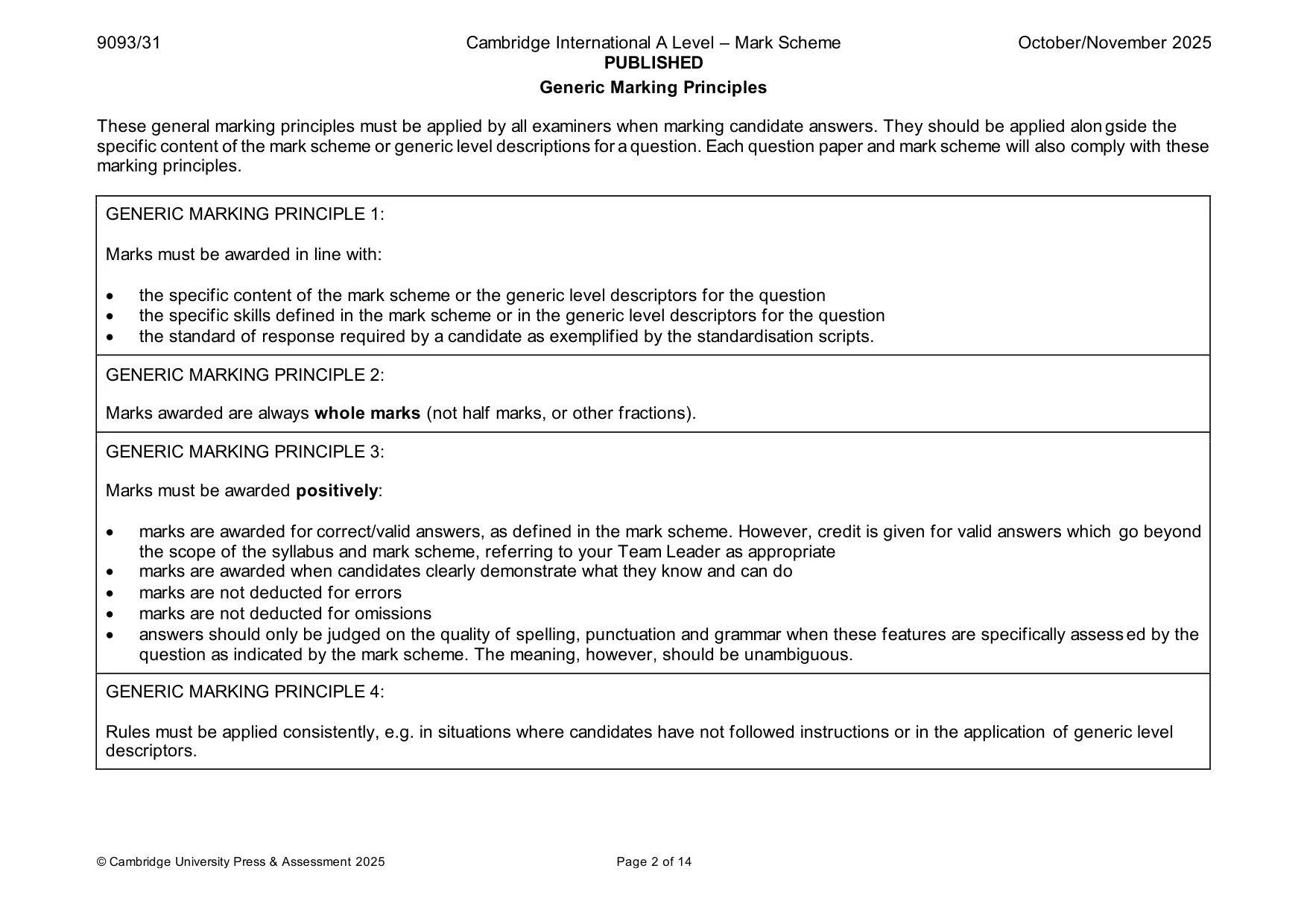
9093/31 Cambridge International A Level – Mark Scheme PUBLISHED October/November 2025 © Cambridge University Press & Assessment 2025 Page 2 of 14 Generic Marking Principles These general marking principles must be applied by all examiners when marking candidate answers. They should be applied alon gside the specific content of the mark scheme or generic level descriptions for a question. Each question paper and mark scheme will also comply with these marking principles. GENERIC MARKING PRINCIPLE 1: Marks must be awarded in line with: • the specific content of the mark scheme or the generic level descriptors for the question • the specific skills defined in the mark scheme or in the generic level descriptors for the question • the standard of response required by a candidate as exemplified by the standardisation scripts. GENERIC MARKING PRINCIPLE 2: Marks awarded are always whole marks (not half marks, or other fractions). GENERIC MARKING PRINCIPLE 3: Marks must be awarded positively: • marks are awarded for correct/valid answers, as defined in the mark scheme. However, credit is given for valid answers which go beyond the scope of the syllabus and mark scheme, referring to your Team Leader as appropriate • marks are awarded when candidates clearly demonstrate what they know and can do • marks are not deducted for errors • marks are not deducted for omissions • answers should only be judged on the quality of spelling, punctuation and grammar when these features are specifically assessed by the question as indicated by the mark scheme. The meaning, however, should be unambiguous. GENERIC MARKING PRINCIPLE 4: Rules must be applied consistently, e.g. in situations where candidates have not followed instructions or in the application of generic level descriptors.
Mark scheme, page 3
9093/31 Cambridge International A Level – Mark Scheme PUBLISHED October/November 2025 © Cambridge University Press & Assessment 2025 Page 3 of 14 GENERIC MARKING PRINCIPLE 5: Marks should be awarded using the full range of marks defined in the mark scheme for the question (however; the use of the full mark range may be limited according to the quality of the candidate responses seen). GENERIC MARKING PRINCIPLE 6: Marks awarded are based solely on the requirements as defined in the mark scheme. Marks should not be awarded with grade thre sholds or grade descriptors in mind.
Mark scheme, page 4
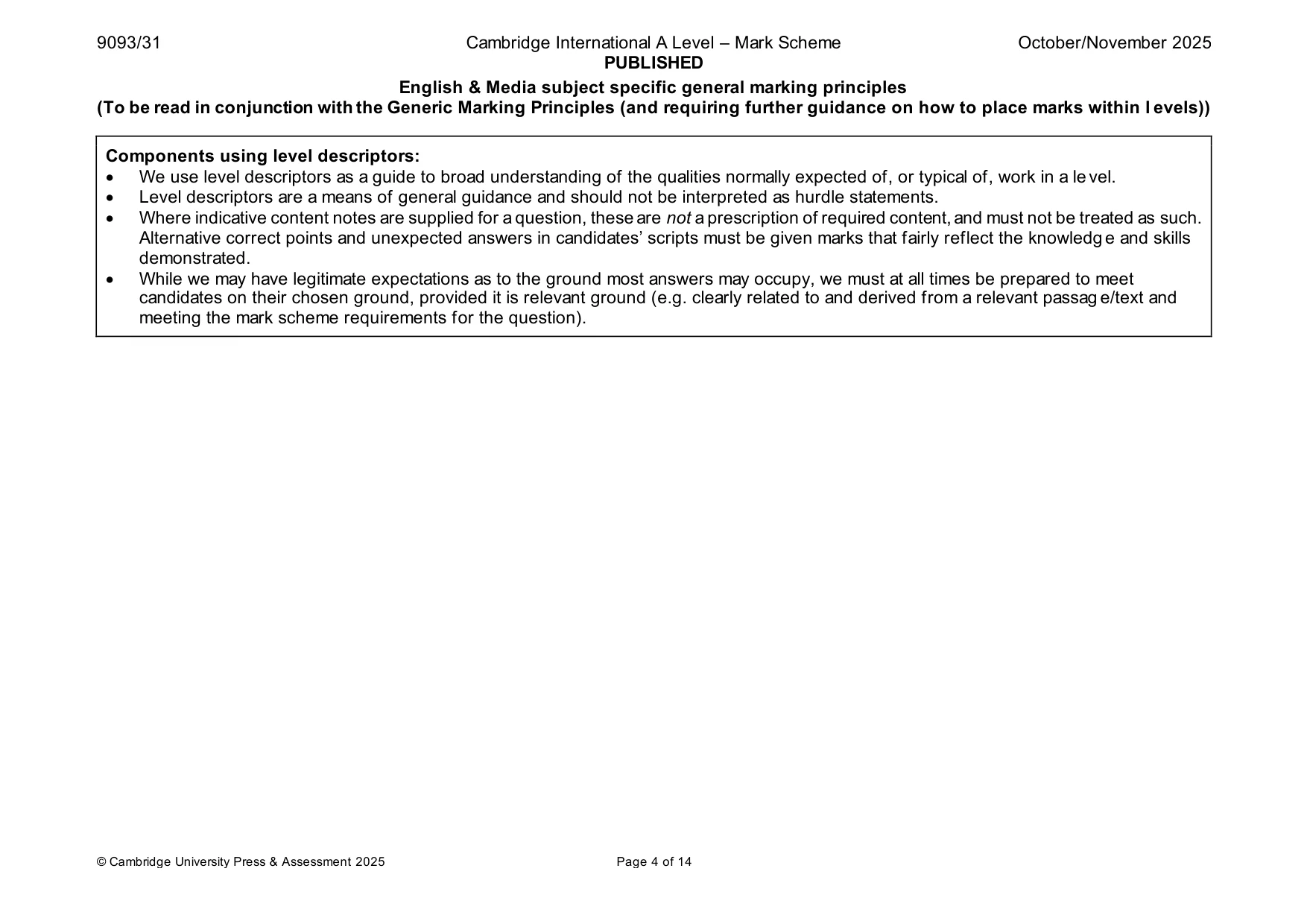
9093/31 Cambridge International A Level – Mark Scheme PUBLISHED October/November 2025 © Cambridge University Press & Assessment 2025 Page 4 of 14 English & Media subject specific general marking principles (To be read in conjunction with the Generic Marking Principles (and requiring further guidance on how to place marks within l evels)) Components using level descriptors: • We use level descriptors as a guide to broad understanding of the qualities normally expected of, or typical of, work in a le vel. • Level descriptors are a means of general guidance and should not be interpreted as hurdle statements. • Where indicative content notes are supplied for a question, these are not a prescription of required content, and must not be treated as such. Alternative correct points and unexpected answers in candidates’ scripts must be given marks that fairly reflect the knowledg e and skills demonstrated. • While we may have legitimate expectations as to the ground most answers may occupy, we must at all times be prepared to meet candidates on their chosen ground, provided it is relevant ground (e.g. clearly related to and derived from a relevant passag e/text and meeting the mark scheme requirements for the question).
Mark scheme, page 5
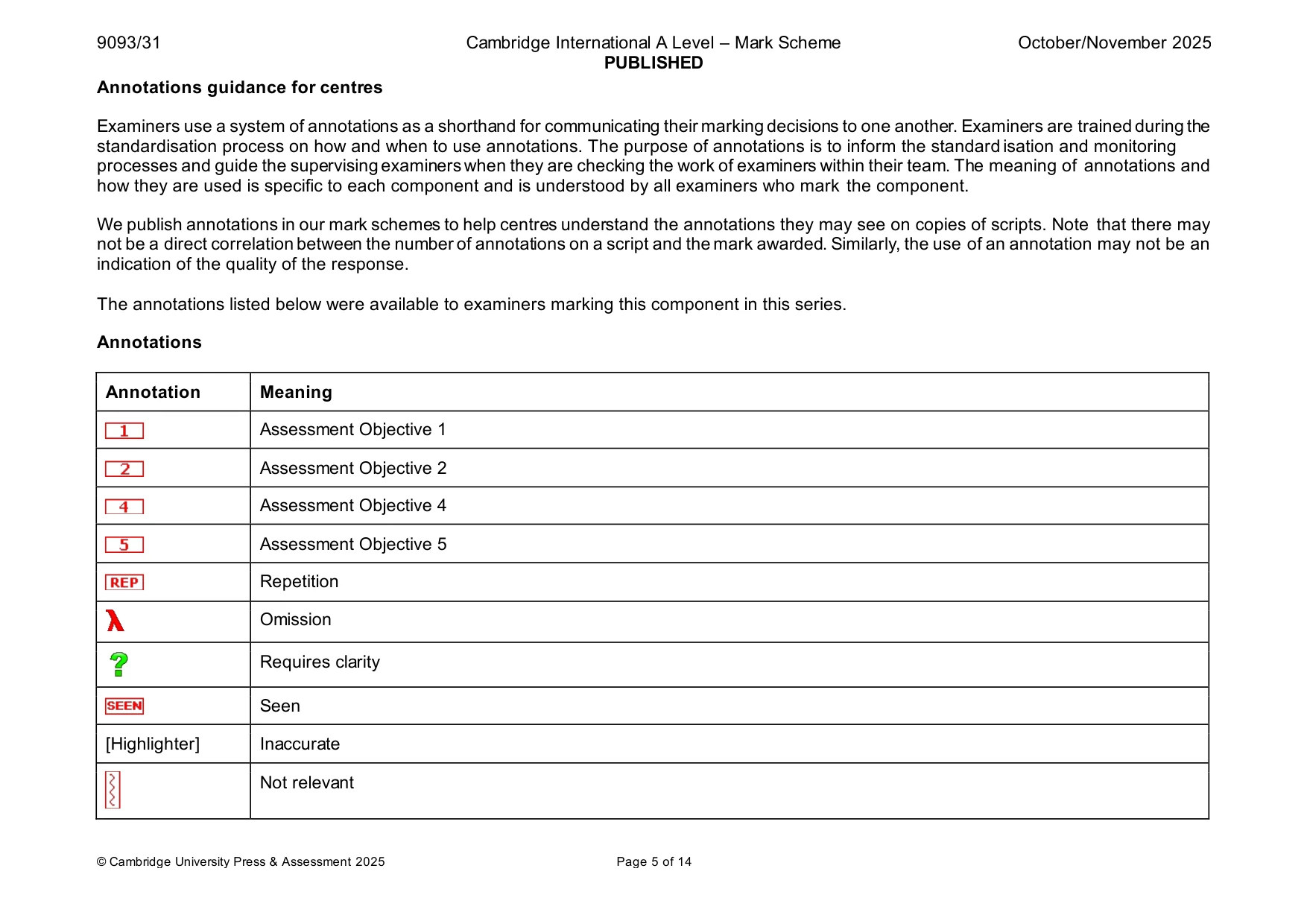
9093/31 Cambridge International A Level – Mark Scheme PUBLISHED October/November 2025 © Cambridge University Press & Assessment 2025 Page 5 of 14 Annotations guidance for centres Examiners use a system of annotations as a shorthand for communicating their marking decisions to one another. Examiners are trained during the standardisation process on how and when to use annotations. The purpose of annotations is to inform the standard isation and monitoring processes and guide the supervising examiners when they are checking the work of examiners within their team. The meaning of annotations and how they are used is specific to each component and is understood by all examiners who mark the component. We publish annotations in our mark schemes to help centres understand the annotations they may see on copies of scripts. Note that there may not be a direct correlation between the number of annotations on a script and the mark awarded. Similarly, the use of an annotation may not be an indication of the quality of the response. The annotations listed below were available to examiners marking this component in this series. Annotations Annotation Meaning Assessment Objective 1 Assessment Objective 2 Assessment Objective 4 Assessment Objective 5 Repetition Omission Requires clarity Seen [Highlighter] Inaccurate Not relevant
Mark scheme, page 6
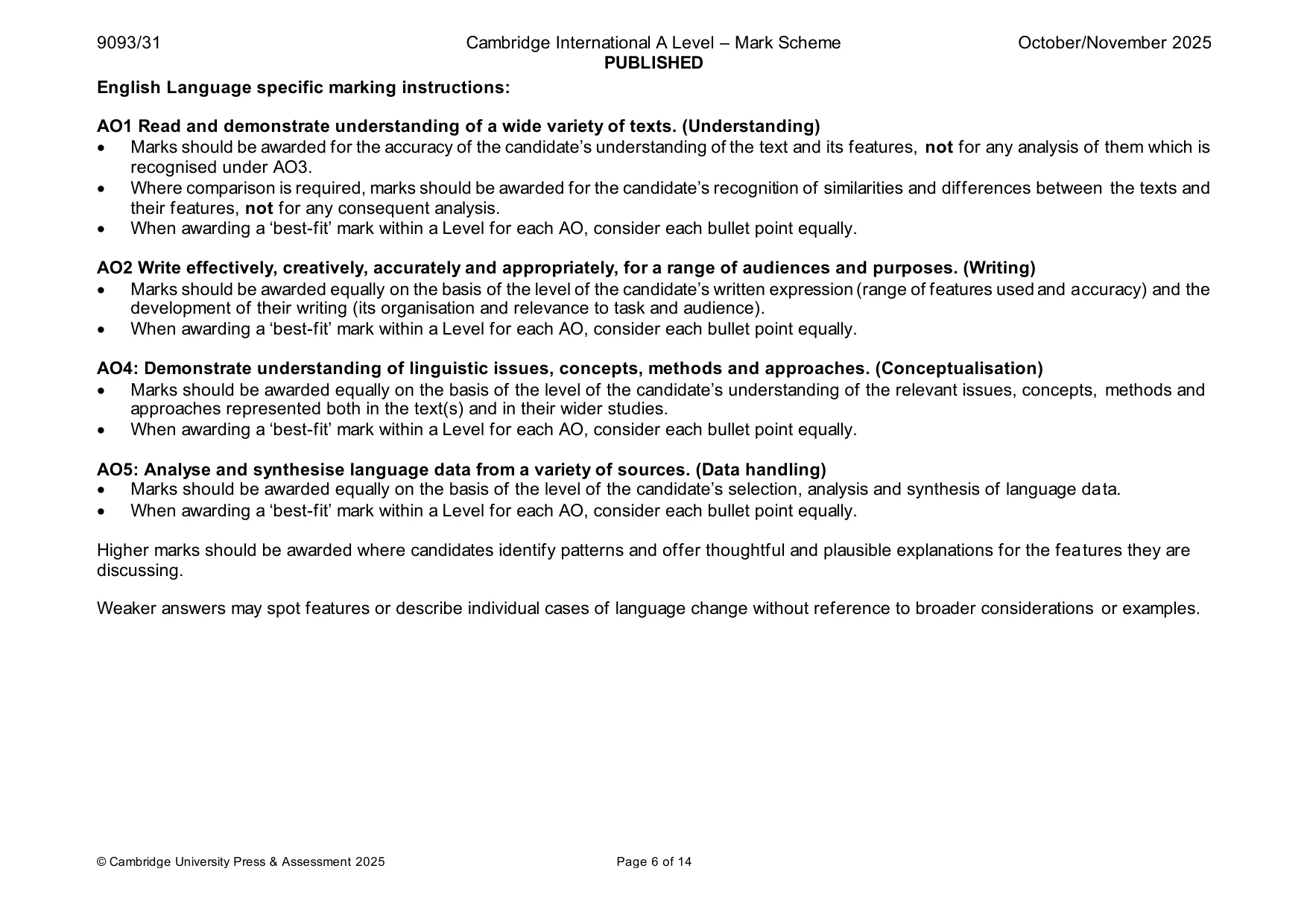
9093/31 Cambridge International A Level – Mark Scheme PUBLISHED October/November 2025 © Cambridge University Press & Assessment 2025 Page 6 of 14 English Language specific marking instructions: AO1 Read and demonstrate understanding of a wide variety of texts. (Understanding) • Marks should be awarded for the accuracy of the candidate’s understanding of the text and its features, not for any analysis of them which is recognised under AO3. • Where comparison is required, marks should be awarded for the candidate’s recognition of similarities and differences between the texts and their features, not for any consequent analysis. • When awarding a ‘best-fit’ mark within a Level for each AO, consider each bullet point equally. AO2 Write effectively, creatively, accurately and appropriately, for a range of audiences and purposes. (Writing) • Marks should be awarded equally on the basis of the level of the candidate’s written expression (range of features used and accuracy) and the development of their writing (its organisation and relevance to task and audience). • When awarding a ‘best-fit’ mark within a Level for each AO, consider each bullet point equally. AO4: Demonstrate understanding of linguistic issues, concepts, methods and approaches. (Conceptualisation) • Marks should be awarded equally on the basis of the level of the candidate’s understanding of the relevant issues, concepts, methods and approaches represented both in the text(s) and in their wider studies. • When awarding a ‘best-fit’ mark within a Level for each AO, consider each bullet point equally. AO5: Analyse and synthesise language data from a variety of sources. (Data handling) • Marks should be awarded equally on the basis of the level of the candidate’s selection, analysis and synthesis of language data. • When awarding a ‘best-fit’ mark within a Level for each AO, consider each bullet point equally. Higher marks should be awarded where candidates identify patterns and offer thoughtful and plausible explanations for the features they are discussing. Weaker answers may spot features or describe individual cases of language change without reference to broader considerations or examples.
Mark scheme, page 7
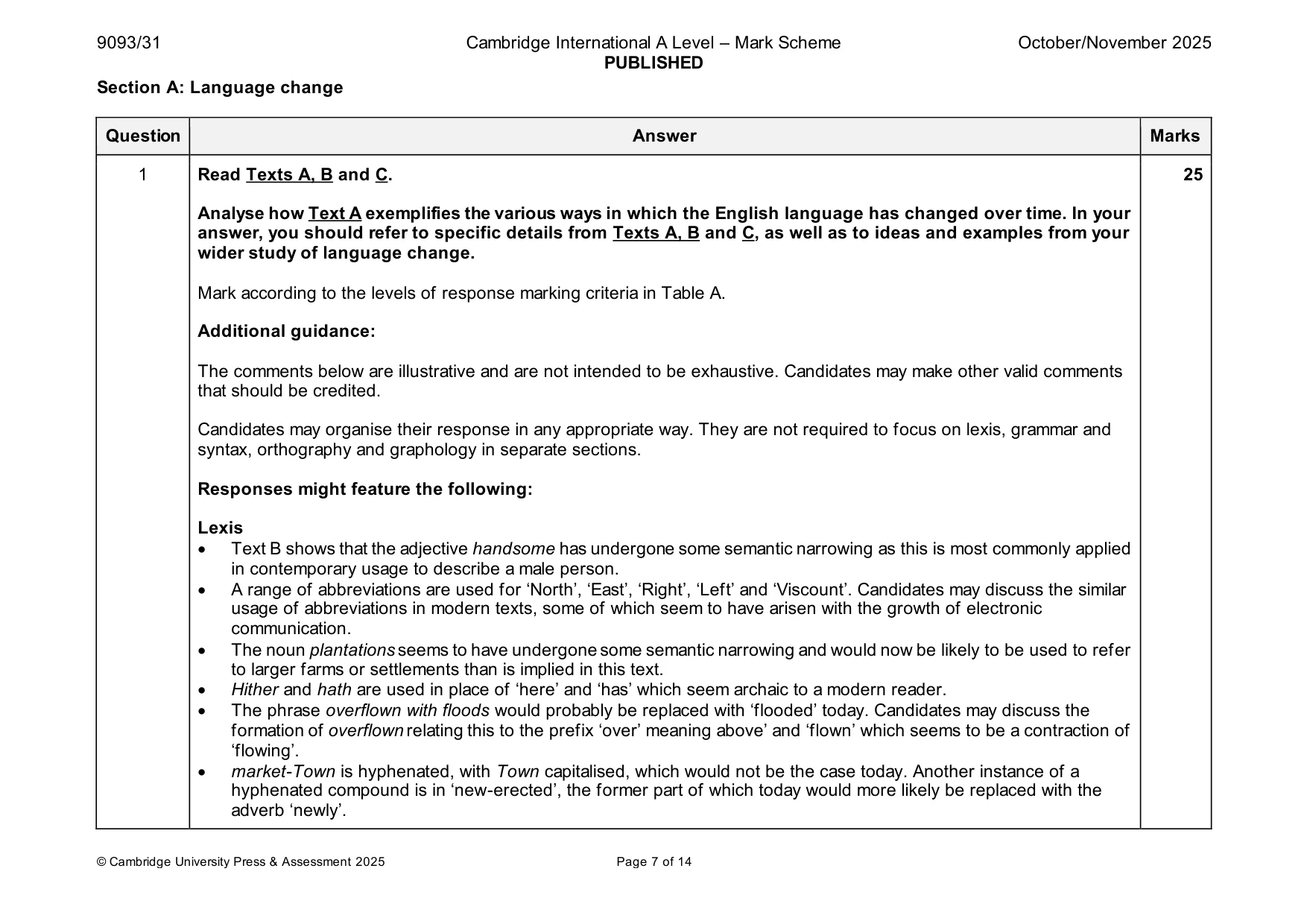
9093/31 Cambridge International A Level – Mark Scheme PUBLISHED October/November 2025 © Cambridge University Press & Assessment 2025 Page 7 of 14 Section A: Language change Question Answer Marks 1 Read Texts A, B and C. Analyse how Text A exemplifies the various ways in which the English language has changed over time. In your answer, you should refer to specific details from Texts A, B and C, as well as to ideas and examples from your wider study of language change. Mark according to the levels of response marking criteria in Table A. Additional guidance: The comments below are illustrative and are not intended to be exhaustive. Candidates may make other valid comments that should be credited. Candidates may organise their response in any appropriate way. They are not required to focus on lexis, grammar and syntax, orthography and graphology in separate sections. Responses might feature the following: Lexis • Text B shows that the adjective handsome has undergone some semantic narrowing as this is most commonly applied in contemporary usage to describe a male person. • A range of abbreviations are used for ‘North’, ‘East’, ‘Right’, ‘Left’ and ‘Viscount’. Candidates may discuss the similar usage of abbreviations in modern texts, some of which seem to have arisen with the growth of electronic communication. • The noun plantations seems to have undergone some semantic narrowing and would now be likely to be used to refer to larger farms or settlements than is implied in this text. • Hither and hath are used in place of ‘here’ and ‘has’ which seem archaic to a modern reader. • The phrase overflown with floods would probably be replaced with ‘flooded’ today. Candidates may discuss the formation of overflown relating this to the prefix ‘over’ meaning above’ and ‘flown’ which seems to be a contraction of ‘flowing’. • market-Town is hyphenated, with Town capitalised, which would not be the case today. Another instance of a hyphenated compound is in ‘new-erected’, the former part of which today would more likely be replaced with the adverb ‘newly’. 25
Mark scheme, page 8
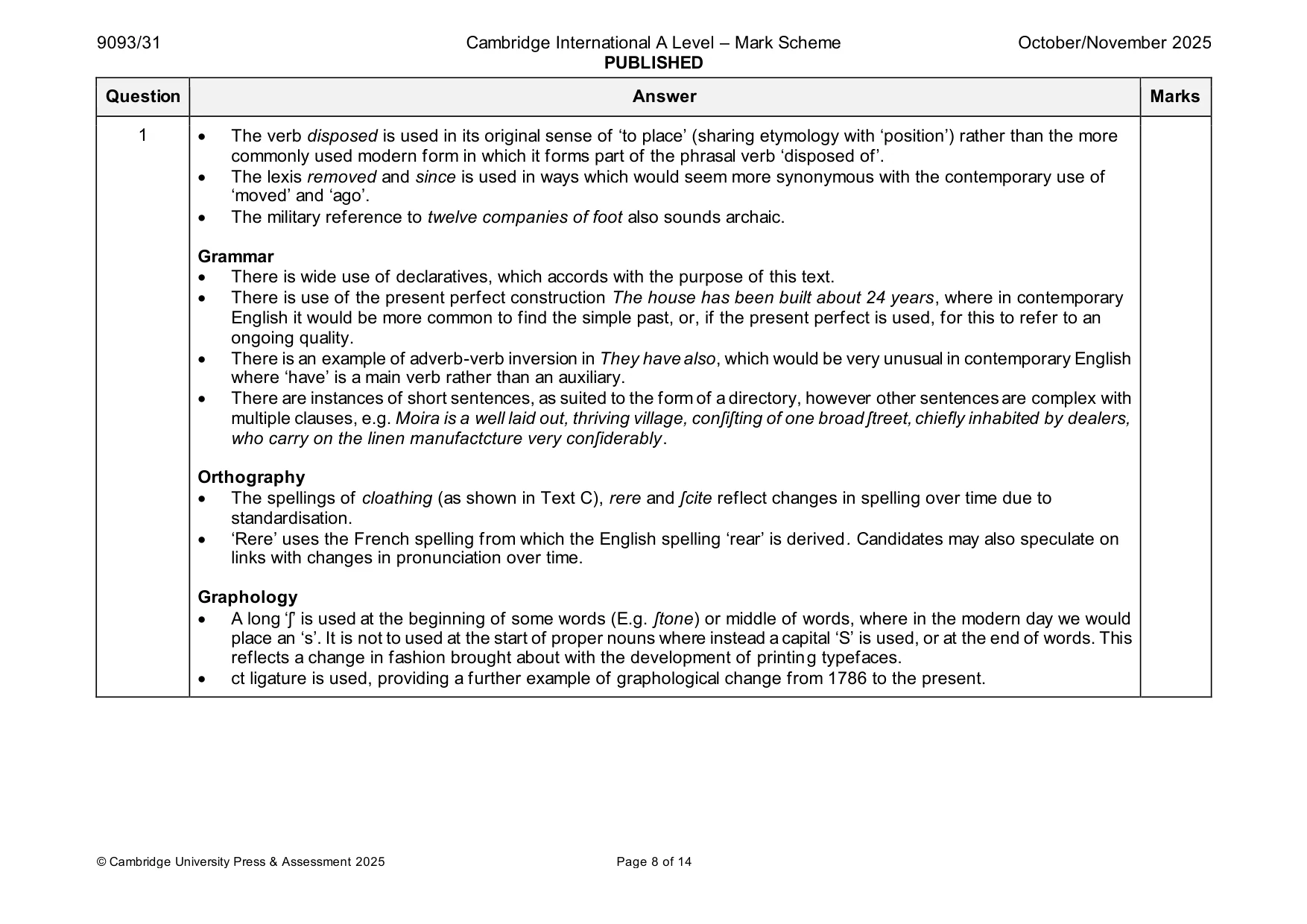
9093/31 Cambridge International A Level – Mark Scheme PUBLISHED October/November 2025 © Cambridge University Press & Assessment 2025 Page 8 of 14 Question Answer Marks 1 • The verb disposed is used in its original sense of ‘to place’ (sharing etymology with ‘position’) rather than the more commonly used modern form in which it forms part of the phrasal verb ‘disposed of’. • The lexis removed and since is used in ways which would seem more synonymous with the contemporary use of ‘moved’ and ‘ago’. • The military reference to twelve companies of foot also sounds archaic. Grammar • There is wide use of declaratives, which accords with the purpose of this text. • There is use of the present perfect construction The house has been built about 24 years, where in contemporary English it would be more common to find the simple past, or, if the present perfect is used, for this to refer to an ongoing quality. • There is an example of adverb-verb inversion in They have also, which would be very unusual in contemporary English where ‘have’ is a main verb rather than an auxiliary. • There are instances of short sentences, as suited to the form of a directory, however other sentences are complex with multiple clauses, e.g. Moira is a well laid out, thriving village, conʃiʃting of one broad ʃtreet, chiefly inhabited by dealers, who carry on the linen manufactcture very conʃiderably. Orthography • The spellings of cloathing (as shown in Text C), rere and ʃcite reflect changes in spelling over time due to standardisation. • ‘Rere’ uses the French spelling from which the English spelling ‘rear’ is derived. Candidates may also speculate on links with changes in pronunciation over time. Graphology • A long ‘ʃ’ is used at the beginning of some words (E.g. ʃtone) or middle of words, where in the modern day we would place an ‘s’. It is not to used at the start of proper nouns where instead a capital ‘S’ is used, or at the end of words. This reflects a change in fashion brought about with the development of printing typefaces. • ct ligature is used, providing a further example of graphological change from 1786 to the present.
Mark scheme, page 9
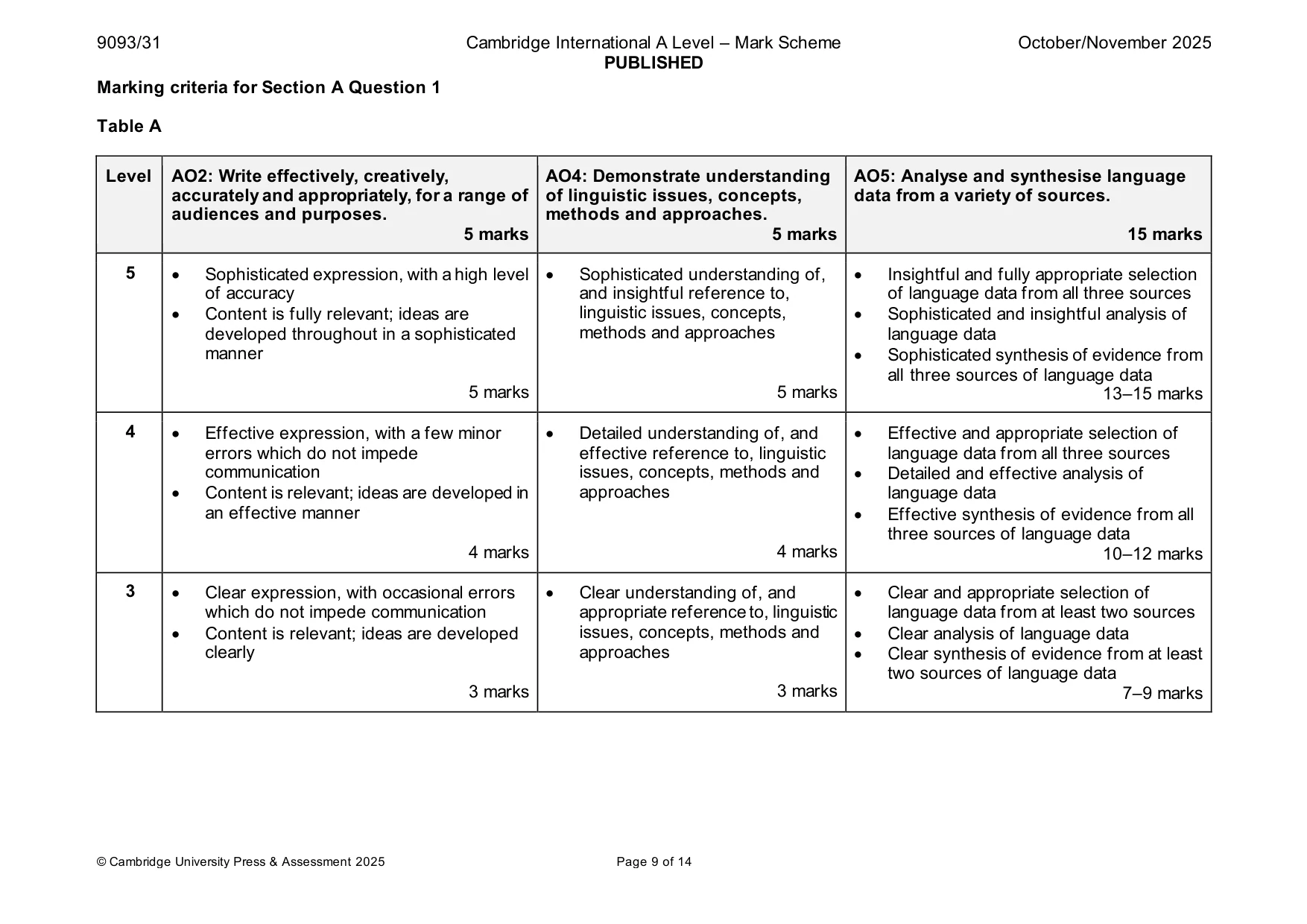
9093/31 Cambridge International A Level – Mark Scheme PUBLISHED October/November 2025 © Cambridge University Press & Assessment 2025 Page 9 of 14 Marking criteria for Section A Question 1 Table A Level AO2: Write effectively, creatively, accurately and appropriately, for a range of audiences and purposes. 5 marks AO4: Demonstrate understanding of linguistic issues, concepts, methods and approaches. 5 marks AO5: Analyse and synthesise language data from a variety of sources. 15 marks 5 • Sophisticated expression, with a high level of accuracy • Content is fully relevant; ideas are developed throughout in a sophisticated manner 5 marks • Sophisticated understanding of, and insightful reference to, linguistic issues, concepts, methods and approaches 5 marks • Insightful and fully appropriate selection of language data from all three sources • Sophisticated and insightful analysis of language data • Sophisticated synthesis of evidence from all three sources of language data 13–15 marks 4 • Effective expression, with a few minor errors which do not impede communication • Content is relevant; ideas are developed in an effective manner 4 marks • Detailed understanding of, and effective reference to, linguistic issues, concepts, methods and approaches 4 marks • Effective and appropriate selection of language data from all three sources • Detailed and effective analysis of language data • Effective synthesis of evidence from all three sources of language data 10–12 marks 3 • Clear expression, with occasional errors which do not impede communication • Content is relevant; ideas are developed clearly 3 marks • Clear understanding of, and appropriate reference to, linguistic issues, concepts, methods and approaches 3 marks • Clear and appropriate selection of language data from at least two sources • Clear analysis of language data • Clear synthesis of evidence from at least two sources of language data 7–9 marks
Mark scheme, page 10
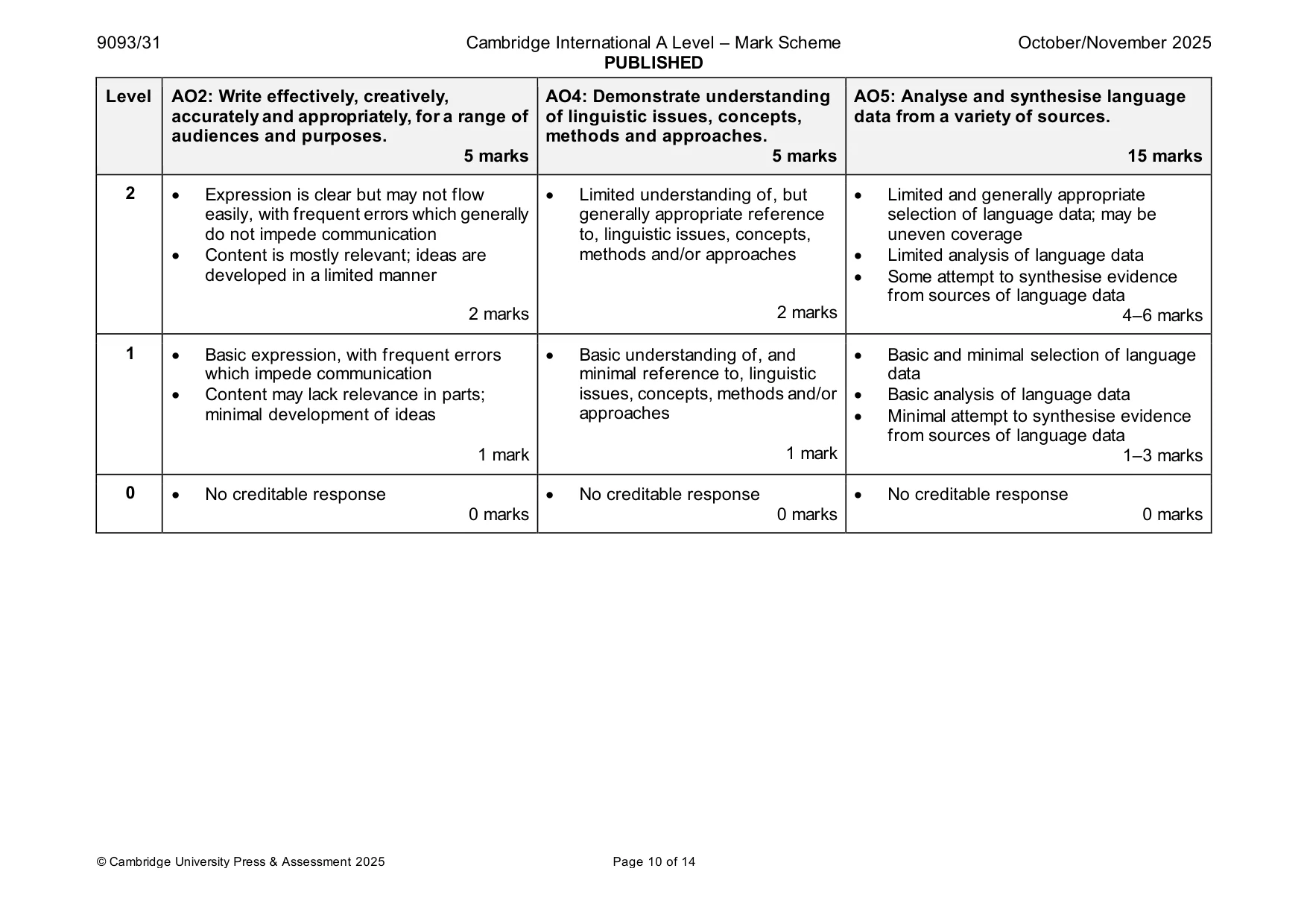
9093/31 Cambridge International A Level – Mark Scheme PUBLISHED October/November 2025 © Cambridge University Press & Assessment 2025 Page 10 of 14 Level AO2: Write effectively, creatively, accurately and appropriately, for a range of audiences and purposes. 5 marks AO4: Demonstrate understanding of linguistic issues, concepts, methods and approaches. 5 marks AO5: Analyse and synthesise language data from a variety of sources. 15 marks 2 • Expression is clear but may not flow easily, with frequent errors which generally do not impede communication • Content is mostly relevant; ideas are developed in a limited manner 2 marks • Limited understanding of, but generally appropriate reference to, linguistic issues, concepts, methods and/or approaches 2 marks • Limited and generally appropriate selection of language data; may be uneven coverage • Limited analysis of language data • Some attempt to synthesise evidence from sources of language data 4–6 marks 1 • Basic expression, with frequent errors which impede communication • Content may lack relevance in parts; minimal development of ideas 1 mark • Basic understanding of, and minimal reference to, linguistic issues, concepts, methods and/or approaches 1 mark • Basic and minimal selection of language data • Basic analysis of language data • Minimal attempt to synthesise evidence from sources of language data 1–3 marks 0 • No creditable response 0 marks • No creditable response 0 marks • No creditable response 0 marks
Mark scheme, page 11
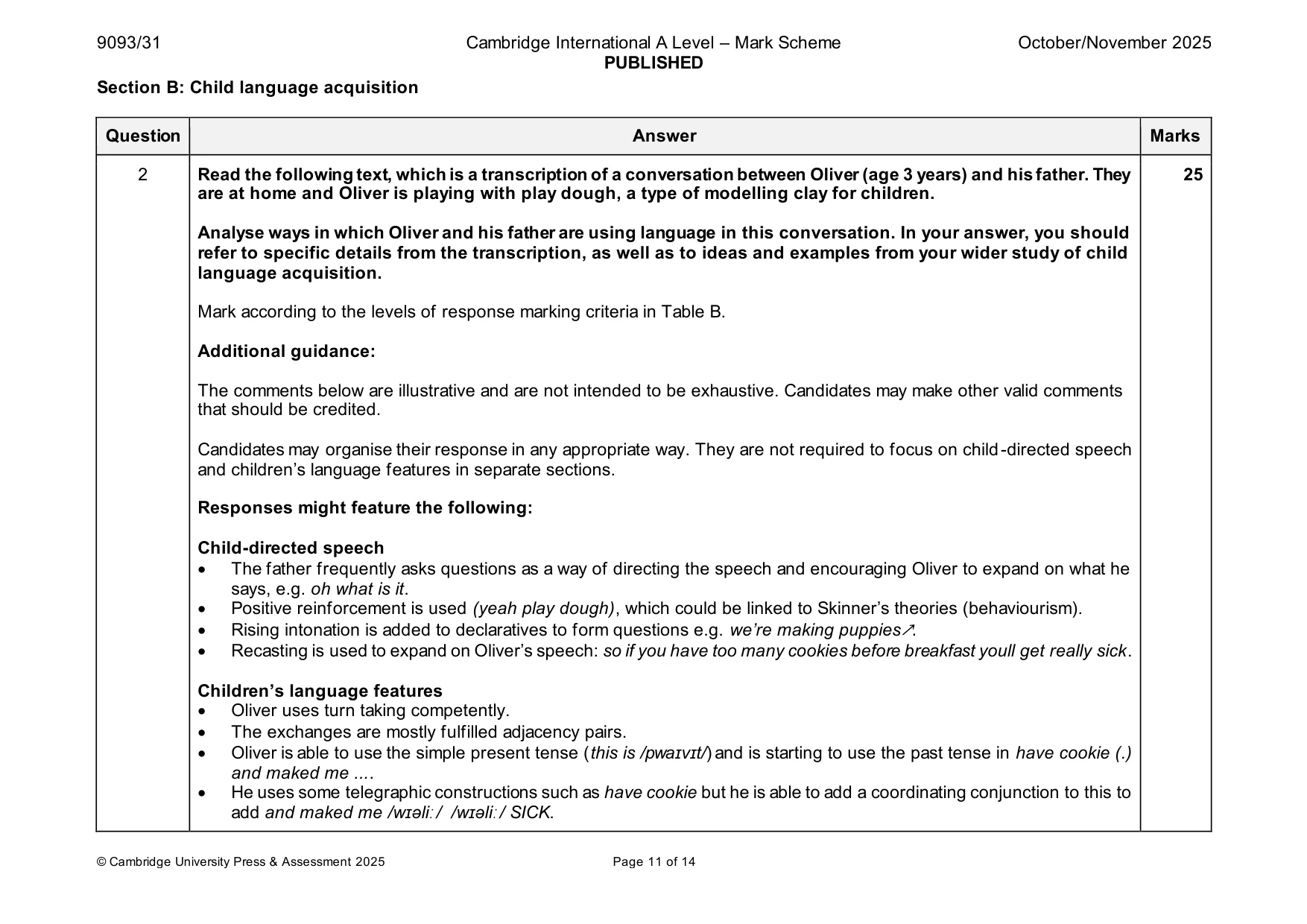
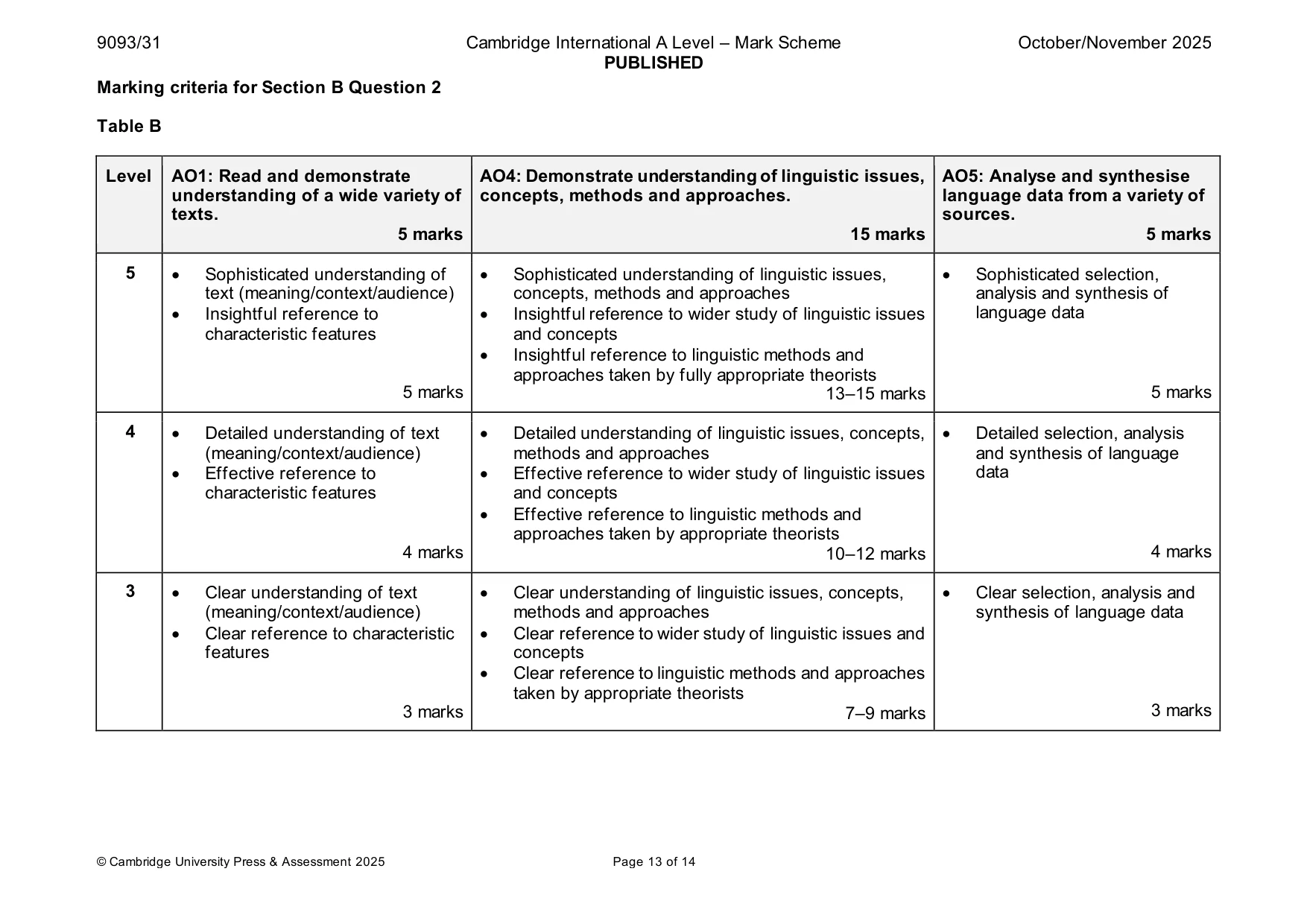
9093/31 Cambridge International A Level – Mark Scheme PUBLISHED October/November 2025 © Cambridge University Press & Assessment 2025 Page 11 of 14 Section B: Child language acquisition Question Answer Marks 2 Read the following text, which is a transcription of a conversation between Oliver (age 3 years) and his father. They are at home and Oliver is playing with play dough, a type of modelling clay for children. Analyse ways in which Oliver and his father are using language in this conversation. In your answer, you should refer to specific details from the transcription, as well as to ideas and examples from your wider study of child language acquisition. Mark according to the levels of response marking criteria in Table B. Additional guidance: The comments below are illustrative and are not intended to be exhaustive. Candidates may make other valid comments that should be credited. Candidates may organise their response in any appropriate way. They are not required to focus on child-directed speech and children’s language features in separate sections. Responses might feature the following: Child-directed speech • The father frequently asks questions as a way of directing the speech and encouraging Oliver to expand on what he says, e.g. oh what is it. • Positive reinforcement is used (yeah play dough), which could be linked to Skinner’s theories (behaviourism). • Rising intonation is added to declaratives to form questions e.g. we’re making puppies↗. • Recasting is used to expand on Oliver’s speech: so if you have too many cookies before breakfast youll get really sick. Children’s language features • Oliver uses turn taking competently. • The exchanges are mostly fulfilled adjacency pairs. • Oliver is able to use the simple present tense (this is /pwaɪvɪt/) and is starting to use the past tense in have cookie (.) and maked me … • He uses some telegraphic constructions such as have cookie but he is able to add a coordinating conjunction to this to add and maked me /wɪəliː / /wɪəliː / SICK. 25
Mark scheme, page 12
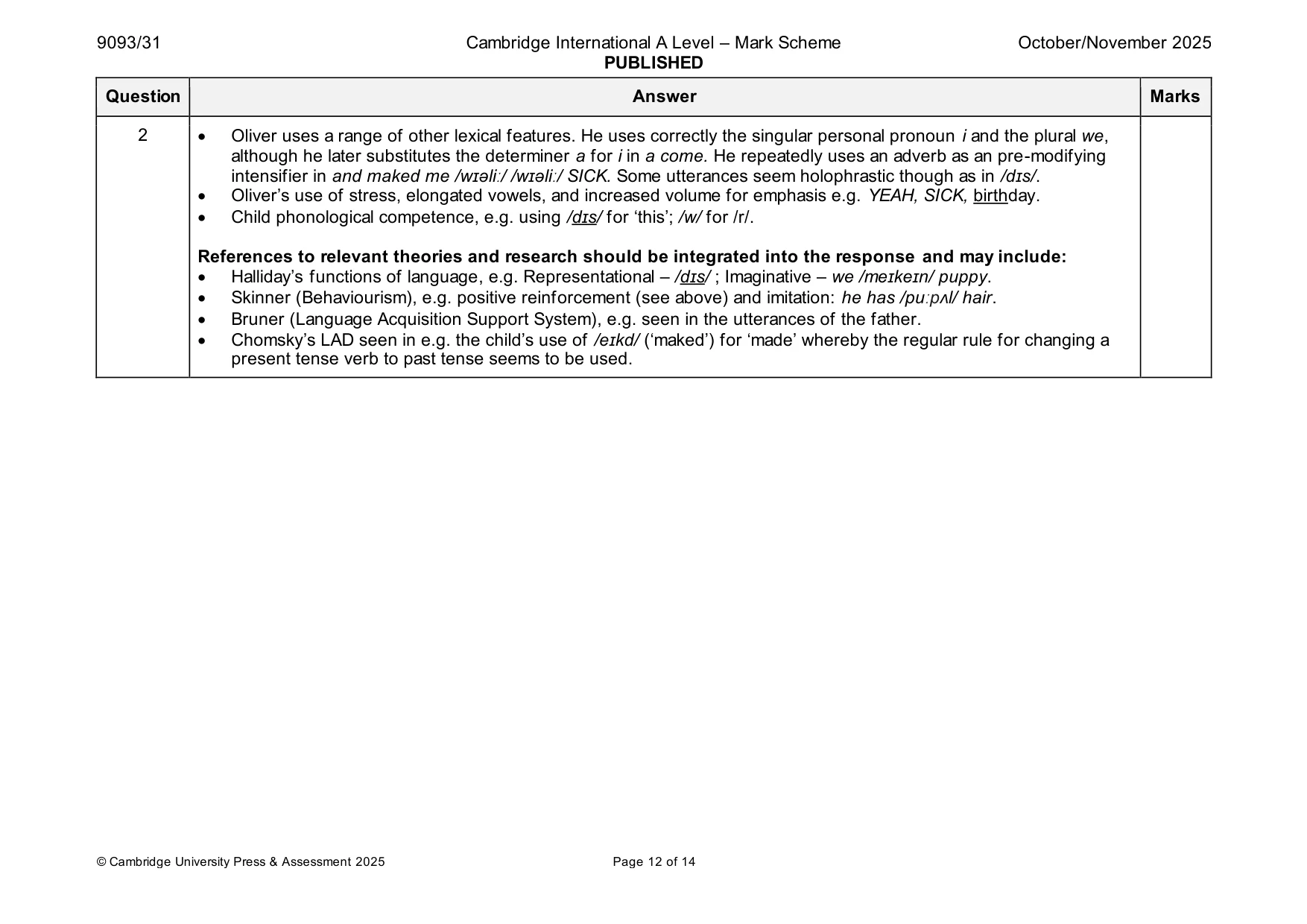
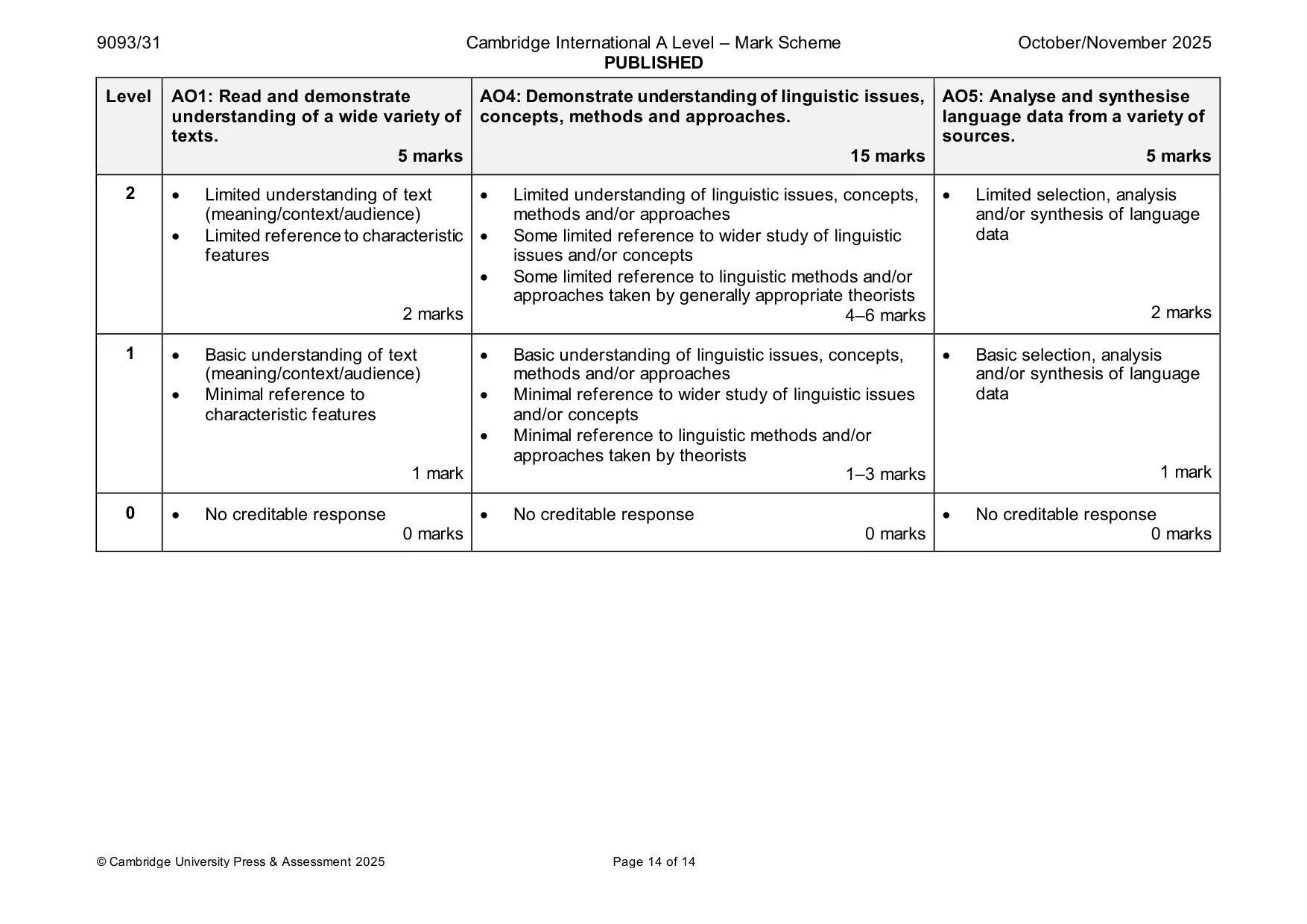
9093/31 Cambridge International A Level – Mark Scheme PUBLISHED October/November 2025 © Cambridge University Press & Assessment 2025 Page 12 of 14 Question Answer Marks 2 • Oliver uses a range of other lexical features. He uses correctly the singular personal pronoun i and the plural we, although he later substitutes the determiner a for i in a come. He repeatedly uses an adverb as an pre-modifying intensifier in and maked me /wɪəliː/ /wɪəliː/ SICK. Some utterances seem holophrastic though as in /dɪs/. • Oliver’s use of stress, elongated vowels, and increased volume for emphasis e.g. YEAH, SICK, birthday. • Child phonological competence, e.g. using /dɪs/ for ‘this’; /w/ for /r/. References to relevant theories and research should be integrated into the response and may include: • Halliday’s functions of language, e.g. Representational – /dɪs/ ; Imaginative – we /meɪkeɪn/ puppy. • Skinner (Behaviourism), e.g. positive reinforcement (see above) and imitation: he has /puːpʌl/ hair. • Bruner (Language Acquisition Support System), e.g. seen in the utterances of the father. • Chomsky’s LAD seen in e.g. the child’s use of /eɪkd/ (‘maked’) for ‘made’ whereby the regular rule for changing a present tense verb to past tense seems to be used.
Mark scheme, page 13
9093/31 Cambridge International A Level – Mark Scheme PUBLISHED October/November 2025 © Cambridge University Press & Assessment 2025 Page 13 of 14 Marking criteria for Section B Question 2 Table B Level AO1: Read and demonstrate understanding of a wide variety of texts. 5 marks AO4: Demonstrate understanding of linguistic issues, concepts, methods and approaches. 15 marks AO5: Analyse and synthesise language data from a variety of sources. 5 marks 5 • Sophisticated understanding of text (meaning/context/audience) • Insightful reference to characteristic features 5 marks • Sophisticated understanding of linguistic issues, concepts, methods and approaches • Insightful reference to wider study of linguistic issues and concepts • Insightful reference to linguistic methods and approaches taken by fully appropriate theorists 13–15 marks • Sophisticated selection, analysis and synthesis of language data 5 marks 4 • Detailed understanding of text (meaning/context/audience) • Effective reference to characteristic features 4 marks • Detailed understanding of linguistic issues, concepts, methods and approaches • Effective reference to wider study of linguistic issues and concepts • Effective reference to linguistic methods and approaches taken by appropriate theorists 10–12 marks • Detailed selection, analysis and synthesis of language data 4 marks 3 • Clear understanding of text (meaning/context/audience) • Clear reference to characteristic features 3 marks • Clear understanding of linguistic issues, concepts, methods and approaches • Clear reference to wider study of linguistic issues and concepts • Clear reference to linguistic methods and approaches taken by appropriate theorists 7–9 marks • Clear selection, analysis and synthesis of language data 3 marks
Mark scheme, page 14
9093/31 Cambridge International A Level – Mark Scheme PUBLISHED October/November 2025 © Cambridge University Press & Assessment 2025 Page 14 of 14 Level AO1: Read and demonstrate understanding of a wide variety of texts. 5 marks AO4: Demonstrate understanding of linguistic issues, concepts, methods and approaches. 15 marks AO5: Analyse and synthesise language data from a variety of sources. 5 marks 2 • Limited understanding of text (meaning/context/audience) • Limited reference to characteristic features 2 marks • Limited understanding of linguistic issues, concepts, methods and/or approaches • Some limited reference to wider study of linguistic issues and/or concepts • Some limited reference to linguistic methods and/or approaches taken by generally appropriate theorists 4–6 marks • Limited selection, analysis and/or synthesis of language data 2 marks 1 • Basic understanding of text (meaning/context/audience) • Minimal reference to characteristic features 1 mark • Basic understanding of linguistic issues, concepts, methods and/or approaches • Minimal reference to wider study of linguistic issues and/or concepts • Minimal reference to linguistic methods and/or approaches taken by theorists 1–3 marks • Basic selection, analysis and/or synthesis of language data 1 mark 0 • No creditable response 0 marks • No creditable response 0 marks • No creditable response 0 marks
What you needed in this session
Cambridge’s own grade thresholds for 2025 Oct/Nov, Paper 3 · Variant 1. A higher threshold means an easier paper — the bar moves with how the cohort did.