Cambridge A Level English - Language AS and A Level (from 2014) 9093 — 2025 Oct/Nov Paper 1 · Variant 3
9093/13/O/N/25 · 50 marks · 135 min
The question paper and its mark scheme, free to read here and free to download. This is Cambridge’s own paper, exactly as it was sat.
Question paper8 pages
Mark scheme16 pages
Answers below. Sit the paper first if you are practising.
Paper as text
Question paper, page 1
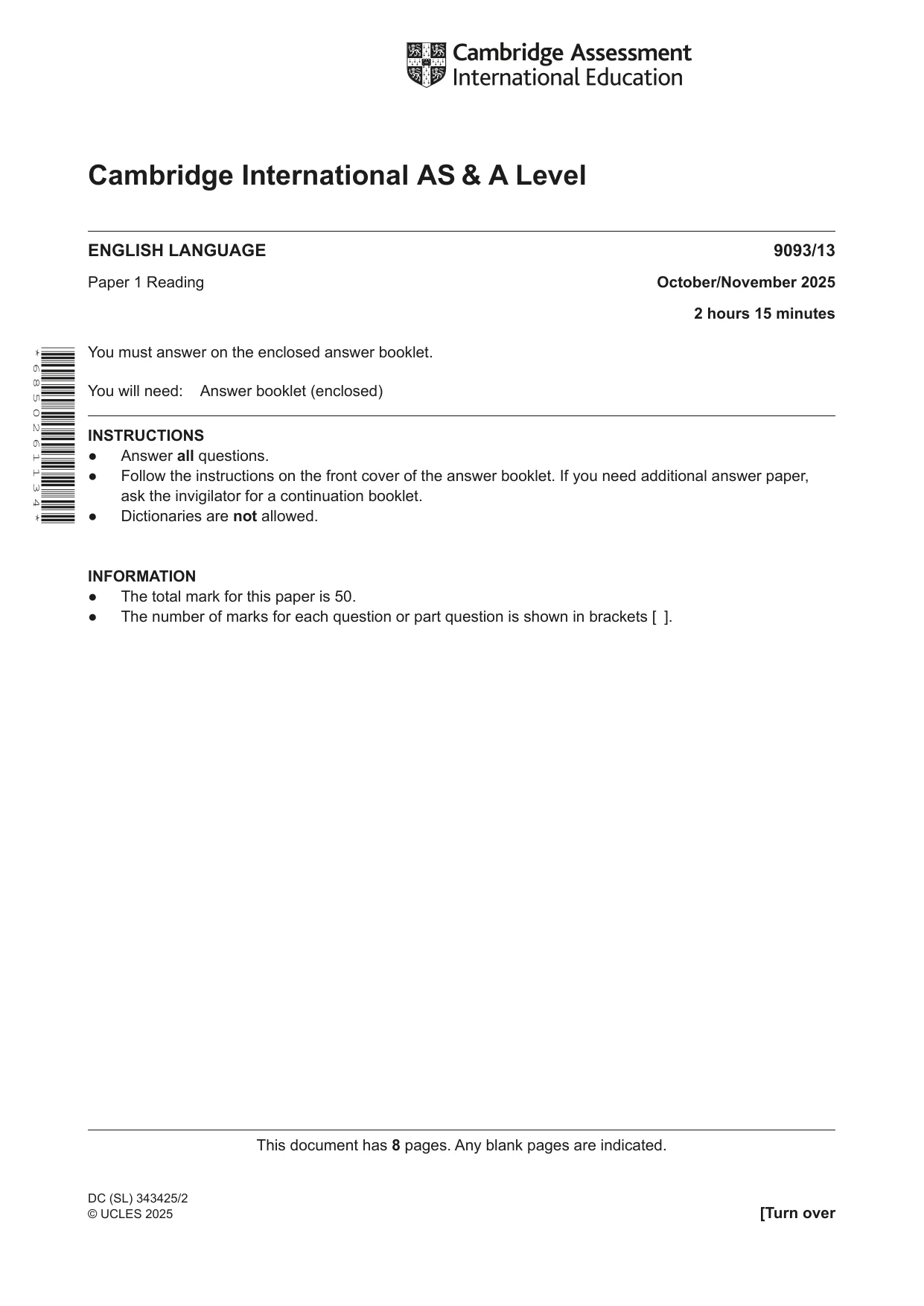
This document has 8 pages. Any blank pages are indicated. [Turn over Cambridge International AS & A Level ENGLISH LANGUAGE 9093/13 Paper 1 Reading October/November 2025 2 hours 15 minutes You must answer on the enclosed answer booklet. You will need: Answer booklet (enclosed) INSTRUCTIONS ● Answer all questions. ● Follow the instructions on the front cover of the answer booklet. If you need additional answer paper, ask the invigilator for a continuation booklet. ● Dictionaries are not allowed. INFORMATION ● The total mark for this paper is 50. ● The number of marks for each question or part question is shown in brackets [ ]. * 6 8 5 0 2 6 1 1 3 4 * DC (SL) 343425/2 © UCLES 2025
Question paper, page 2
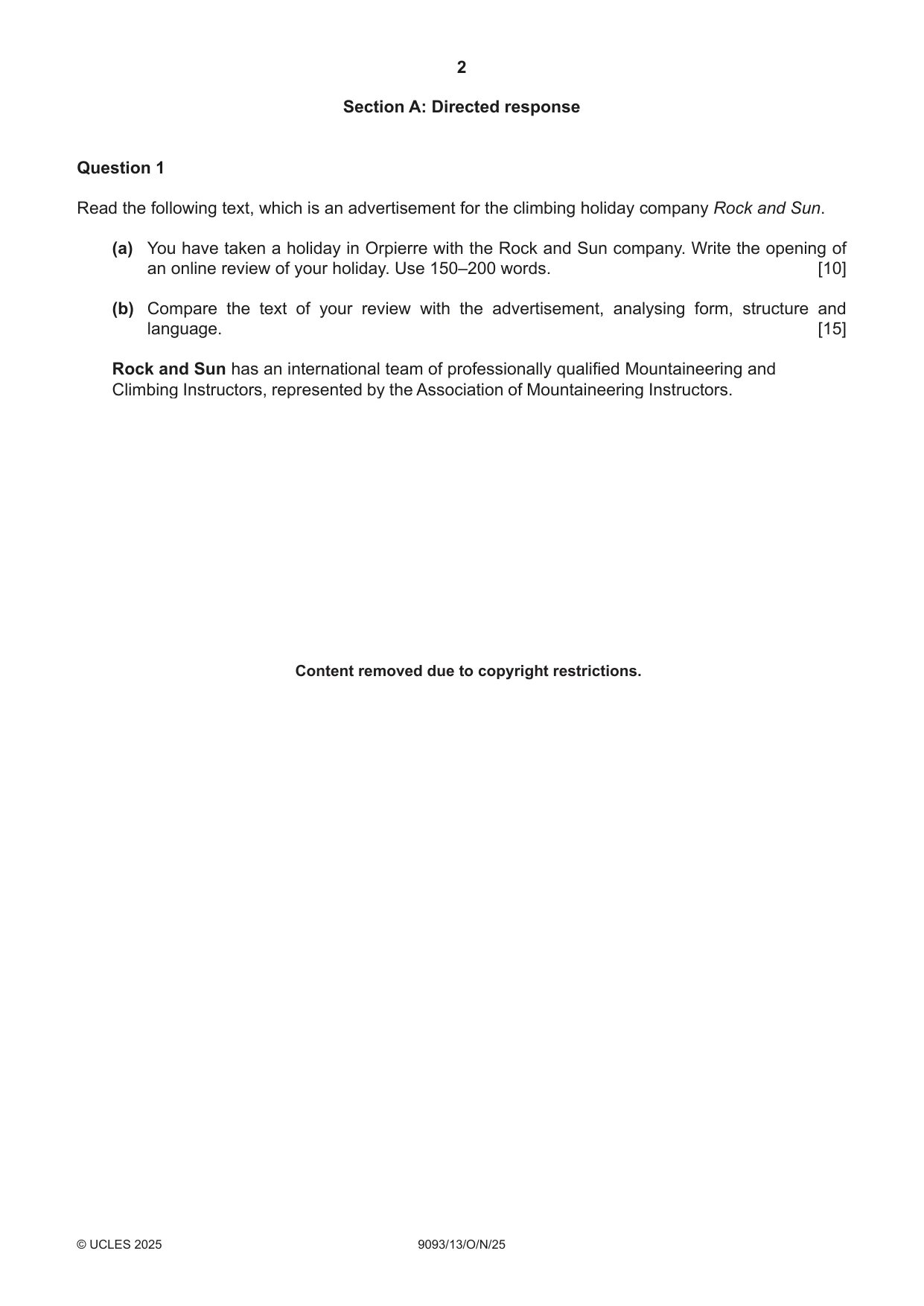
2 9093/13/O/N/25 © UCLES 2025 Section A: Directed response Question 1 Read the following text, which is an advertisement for the climbing holiday company Rock and Sun. (a) You have taken a holiday in Orpierre with the Rock and Sun company. Write the opening of an online review of your holiday. Use 150–200 words. [10] (b) Compare the text of your review with the advertisement, analysing form, structure and language. [15] Rock and Sun has an international team of professionally qualified Mountaineering and Climbing Instructors, represented by the Association of Mountaineering Instructors. Content removed due to copyright restrictions.
Question paper, page 3
3 9093/13/O/N/25 © UCLES 2025 [Turn over Climbing Shoes Content removed due to copyright restrictions.
Question paper, page 4
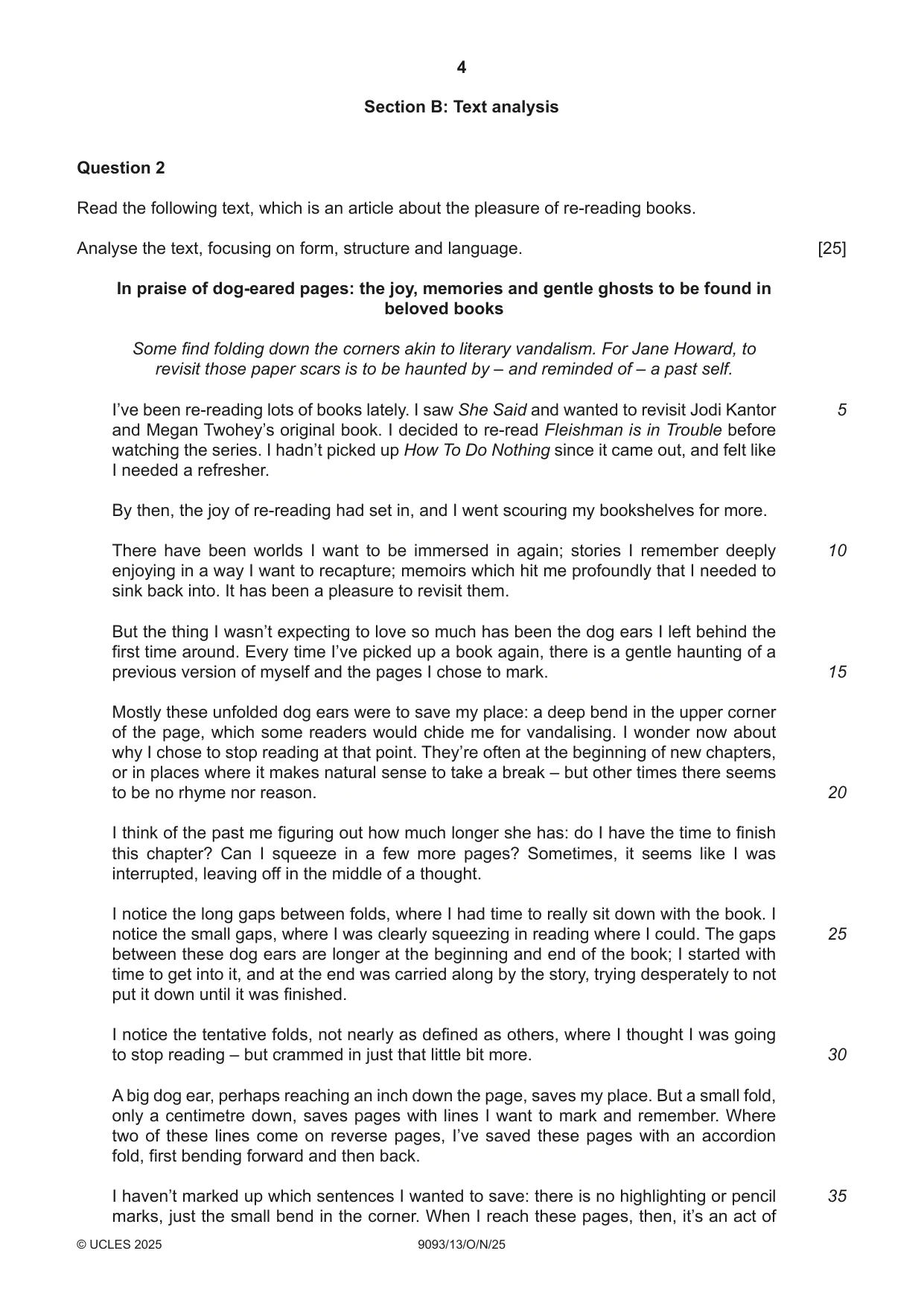
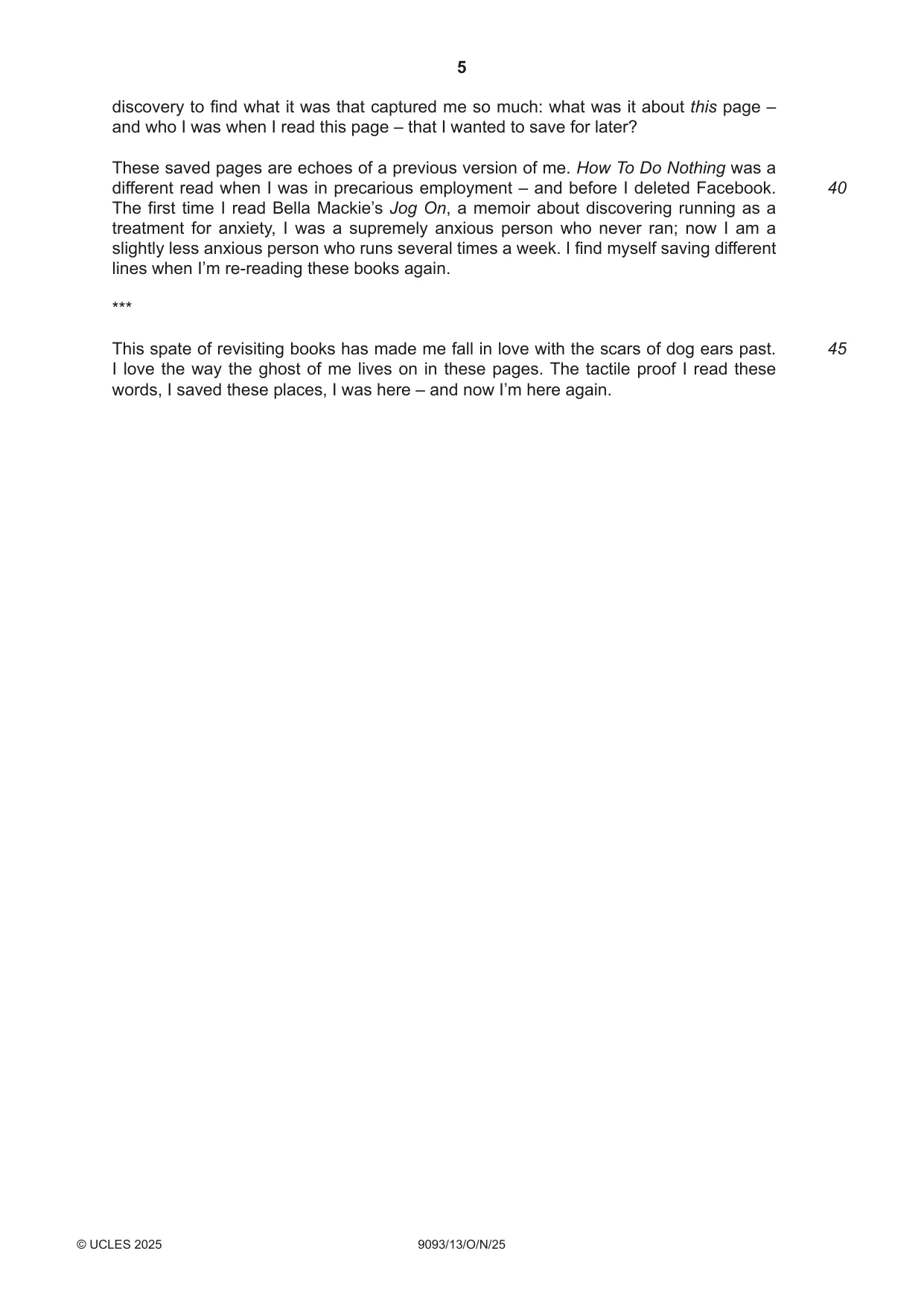
4 9093/13/O/N/25 © UCLES 2025 Section B: Text analysis Question 2 Read the following text, which is an article about the pleasure of re-reading books. Analyse the text, focusing on form, structure and language. [25] In praise of dog-eared pages: the joy, memories and gentle ghosts to be found in beloved books Some find folding down the corners akin to literary vandalism. For Jane Howard, to revisit those paper scars is to be haunted by – and reminded of – a past self. I’ve been re-reading lots of books lately. I saw She Said and wanted to revisit Jodi Kantor and Megan Twohey’s original book. I decided to re-read Fleishman is in Trouble before watching the series. I hadn’t picked up How To Do Nothing since it came out, and felt like I needed a refresher. By then, the joy of re-reading had set in, and I went scouring my bookshelves for more. There have been worlds I want to be immersed in again; stories I remember deeply enjoying in a way I want to recapture; memoirs which hit me profoundly that I needed to sink back into. It has been a pleasure to revisit them. But the thing I wasn’t expecting to love so much has been the dog ears I left behind the first time around. Every time I’ve picked up a book again, there is a gentle haunting of a previous version of myself and the pages I chose to mark. Mostly these unfolded dog ears were to save my place: a deep bend in the upper corner of the page, which some readers would chide me for vandalising. I wonder now about why I chose to stop reading at that point. They’re often at the beginning of new chapters, or in places where it makes natural sense to take a break – but other times there seems to be no rhyme nor reason. I think of the past me figuring out how much longer she has: do I have the time to finish this chapter? Can I squeeze in a few more pages? Sometimes, it seems like I was interrupted, leaving off in the middle of a thought. I notice the long gaps between folds, where I had time to really sit down with the book. I notice the small gaps, where I was clearly squeezing in reading where I could. The gaps between these dog ears are longer at the beginning and end of the book; I started with time to get into it, and at the end was carried along by the story, trying desperately to not put it down until it was finished. I notice the tentative folds, not nearly as defined as others, where I thought I was going to stop reading – but crammed in just that little bit more. A big dog ear, perhaps reaching an inch down the page, saves my place. But a small fold, only a centimetre down, saves pages with lines I want to mark and remember. Where two of these lines come on reverse pages, I’ve saved these pages with an accordion fold, first bending forward and then back. I haven’t marked up which sentences I wanted to save: there is no highlighting or pencil marks, just the small bend in the corner. When I reach these pages, then, it’s an act of 5 10 15 20 25 30 35
Question paper, page 5
5 9093/13/O/N/25 © UCLES 2025 discovery to find what it was that captured me so much: what was it about this page – and who I was when I read this page – that I wanted to save for later? These saved pages are echoes of a previous version of me. How To Do Nothing was a different read when I was in precarious employment – and before I deleted Facebook. The first time I read Bella Mackie’s Jog On, a memoir about discovering running as a treatment for anxiety, I was a supremely anxious person who never ran; now I am a slightly less anxious person who runs several times a week. I find myself saving different lines when I’m re-reading these books again. *** This spate of revisiting books has made me fall in love with the scars of dog ears past. I love the way the ghost of me lives on in these pages. The tactile proof I read these words, I saved these places, I was here – and now I’m here again. 40 45
Question paper, page 6
6 9093/13/O/N/25 © UCLES 2025 BLANK PAGE
Question paper, page 7
7 9093/13/O/N/25 © UCLES 2025 BLANK PAGE
Question paper, page 8
8 9093/13/O/N/25 © UCLES 2025 Permission to reproduce items where third-party owned material protected by copyright is included has been sought and cleared where possible. Every reasonable effort has been made by the publisher (UCLES) to trace copyright holders, but if any items requiring clearance have unwittingly been included, the publisher will be pleased to make amends at the earliest possible opportunity. To avoid the issue of disclosure of answer-related information to candidates, all copyright acknowledgements are reproduced online in the Cambridge Assessment International Education Copyright Acknowledgements Booklet. This is produced for each series of examinations and is freely available to download at www.cambridgeinternational.org after the live examination series. Cambridge Assessment International Education is part of Cambridge Assessment. Cambridge Assessment is the brand name of the University of Cambridge Local Examinations Syndicate (UCLES), which is a department of the University of Cambridge. BLANK PAGE
Mark scheme, page 1
This document consists of 16 printed pages. © Cambridge University Press & Assessment 2025 [Turn over Cambridge International AS & A Level ENGLISH LANGUAGE 9093/13 Paper 1 Reading October/November 2025 MARK SCHEME Maximum Mark: 50 Published This mark scheme is published as an aid to teachers and candidates, to indicate the requirements of the examination. It shows the basis on which Examiners were instructed to award marks. It does not indicate the details of the discussions that took place at an Examiners’ meeting before marking began, which would have considered the acceptability of alternative answers. Mark schemes should be read in conjunction with the question paper and the Principal Examiner Report for Teachers. Cambridge International will not enter into discussions about these mark schemes. Cambridge International is publishing the mark schemes for the October/November 2025 series for most Cambridge IGCSE, Cambridge International A and AS Level components, and some Cambridge O Level components.
Mark scheme, page 2
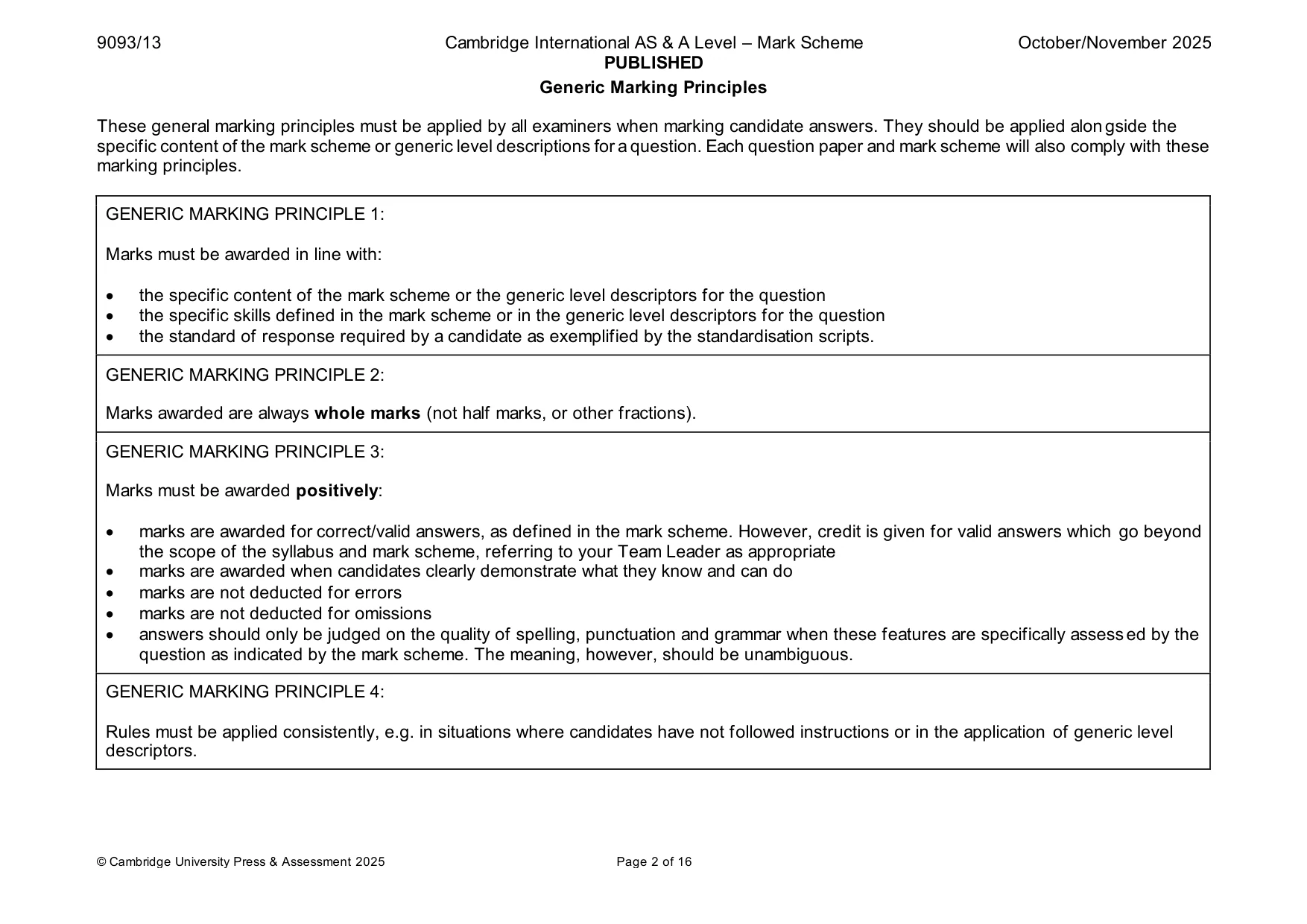
9093/13 Cambridge International AS & A Level – Mark Scheme PUBLISHED October/November 2025 © Cambridge University Press & Assessment 2025 Page 2 of 16 Generic Marking Principles These general marking principles must be applied by all examiners when marking candidate answers. They should be applied alon gside the specific content of the mark scheme or generic level descriptions for a question. Each question paper and mark scheme will also comply with these marking principles. GENERIC MARKING PRINCIPLE 1: Marks must be awarded in line with: • the specific content of the mark scheme or the generic level descriptors for the question • the specific skills defined in the mark scheme or in the generic level descriptors for the question • the standard of response required by a candidate as exemplified by the standardisation scripts. GENERIC MARKING PRINCIPLE 2: Marks awarded are always whole marks (not half marks, or other fractions). GENERIC MARKING PRINCIPLE 3: Marks must be awarded positively: • marks are awarded for correct/valid answers, as defined in the mark scheme. However, credit is given for valid answers which go beyond the scope of the syllabus and mark scheme, referring to your Team Leader as appropriate • marks are awarded when candidates clearly demonstrate what they know and can do • marks are not deducted for errors • marks are not deducted for omissions • answers should only be judged on the quality of spelling, punctuation and grammar when these features are specifically assessed by the question as indicated by the mark scheme. The meaning, however, should be unambiguous. GENERIC MARKING PRINCIPLE 4: Rules must be applied consistently, e.g. in situations where candidates have not followed instructions or in the application of generic level descriptors.
Mark scheme, page 3
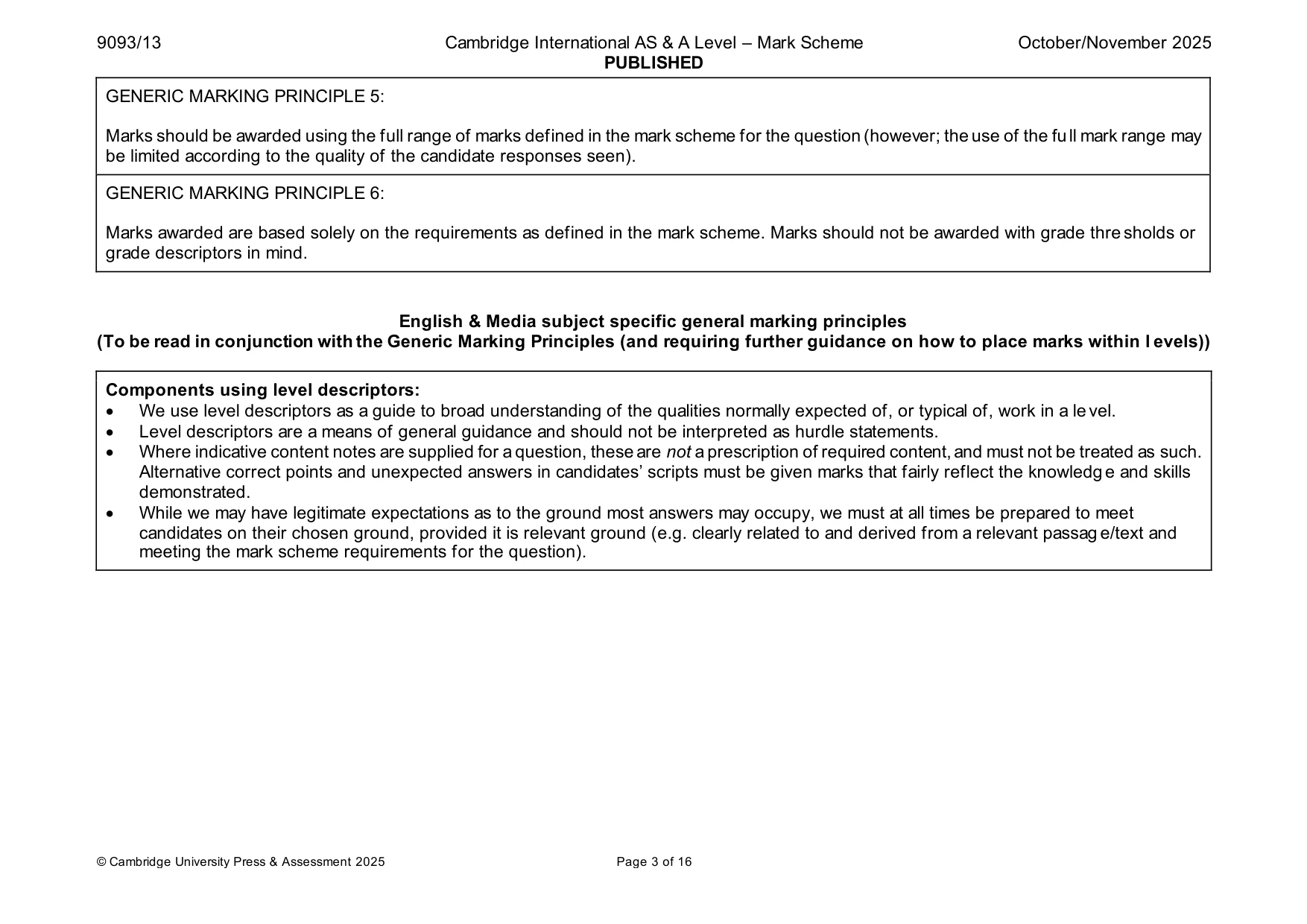
9093/13 Cambridge International AS & A Level – Mark Scheme PUBLISHED October/November 2025 © Cambridge University Press & Assessment 2025 Page 3 of 16 GENERIC MARKING PRINCIPLE 5: Marks should be awarded using the full range of marks defined in the mark scheme for the question (however; the use of the full mark range may be limited according to the quality of the candidate responses seen). GENERIC MARKING PRINCIPLE 6: Marks awarded are based solely on the requirements as defined in the mark scheme. Marks should not be awarded with grade thre sholds or grade descriptors in mind. English & Media subject specific general marking principles (To be read in conjunction with the Generic Marking Principles (and requiring further guidance on how to place marks within l evels)) Components using level descriptors: • We use level descriptors as a guide to broad understanding of the qualities normally expected of, or typical of, work in a le vel. • Level descriptors are a means of general guidance and should not be interpreted as hurdle statements. • Where indicative content notes are supplied for a question, these are not a prescription of required content, and must not be treated as such. Alternative correct points and unexpected answers in candidates’ scripts must be given marks that fairly reflect the knowledg e and skills demonstrated. • While we may have legitimate expectations as to the ground most answers may occupy, we must at all times be prepared to meet candidates on their chosen ground, provided it is relevant ground (e.g. clearly related to and derived from a relevant passag e/text and meeting the mark scheme requirements for the question).
Mark scheme, page 4
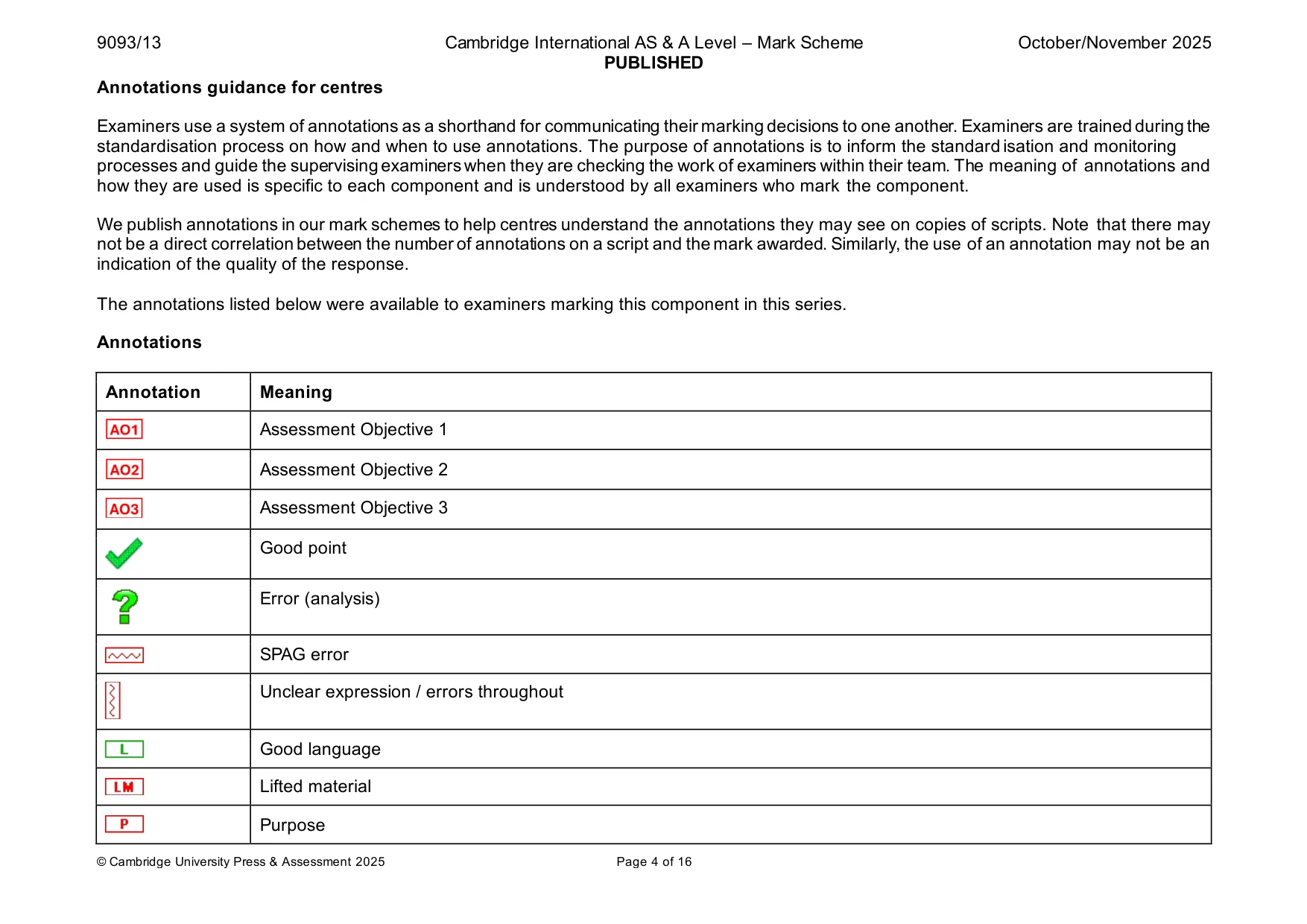
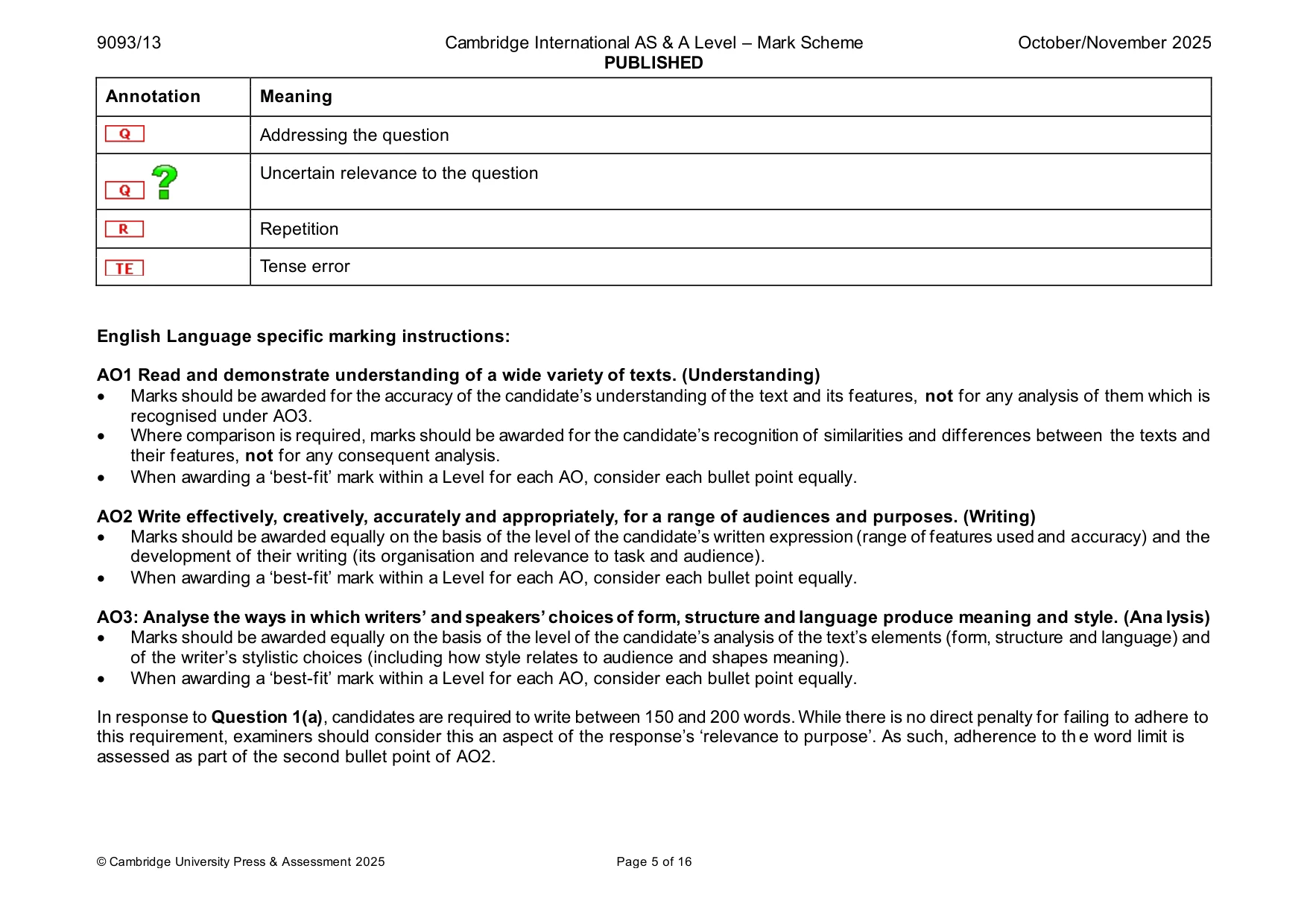
9093/13 Cambridge International AS & A Level – Mark Scheme PUBLISHED October/November 2025 © Cambridge University Press & Assessment 2025 Page 4 of 16 Annotations guidance for centres Examiners use a system of annotations as a shorthand for communicating their marking decisions to one another. Examiners are trained during the standardisation process on how and when to use annotations. The purpose of annotations is to inform the standard isation and monitoring processes and guide the supervising examiners when they are checking the work of examiners within their team. The meaning of annotations and how they are used is specific to each component and is understood by all examiners who mark the component. We publish annotations in our mark schemes to help centres understand the annotations they may see on copies of scripts. Note that there may not be a direct correlation between the number of annotations on a script and the mark awarded. Similarly, the use of an annotation may not be an indication of the quality of the response. The annotations listed below were available to examiners marking this component in this series. Annotations Annotation Meaning Assessment Objective 1 Assessment Objective 2 Assessment Objective 3 Good point Error (analysis) SPAG error Unclear expression / errors throughout Good language Lifted material Purpose
Mark scheme, page 5
9093/13 Cambridge International AS & A Level – Mark Scheme PUBLISHED October/November 2025 © Cambridge University Press & Assessment 2025 Page 5 of 16 Annotation Meaning Addressing the question Uncertain relevance to the question Repetition Tense error English Language specific marking instructions: AO1 Read and demonstrate understanding of a wide variety of texts. (Understanding) • Marks should be awarded for the accuracy of the candidate’s understanding of the text and its features, not for any analysis of them which is recognised under AO3. • Where comparison is required, marks should be awarded for the candidate’s recognition of similarities and differences between the texts and their features, not for any consequent analysis. • When awarding a ‘best-fit’ mark within a Level for each AO, consider each bullet point equally. AO2 Write effectively, creatively, accurately and appropriately, for a range of audiences and purposes. (Writing) • Marks should be awarded equally on the basis of the level of the candidate’s written expression (range of features used and accuracy) and the development of their writing (its organisation and relevance to task and audience). • When awarding a ‘best-fit’ mark within a Level for each AO, consider each bullet point equally. AO3: Analyse the ways in which writers’ and speakers’ choices of form, structure and language produce meaning and style. (Ana lysis) • Marks should be awarded equally on the basis of the level of the candidate’s analysis of the text’s elements (form, structure and language) and of the writer’s stylistic choices (including how style relates to audience and shapes meaning). • When awarding a ‘best-fit’ mark within a Level for each AO, consider each bullet point equally. In response to Question 1(a), candidates are required to write between 150 and 200 words. While there is no direct penalty for failing to adhere to this requirement, examiners should consider this an aspect of the response’s ‘relevance to purpose’. As such, adherence to th e word limit is assessed as part of the second bullet point of AO2.
Mark scheme, page 6
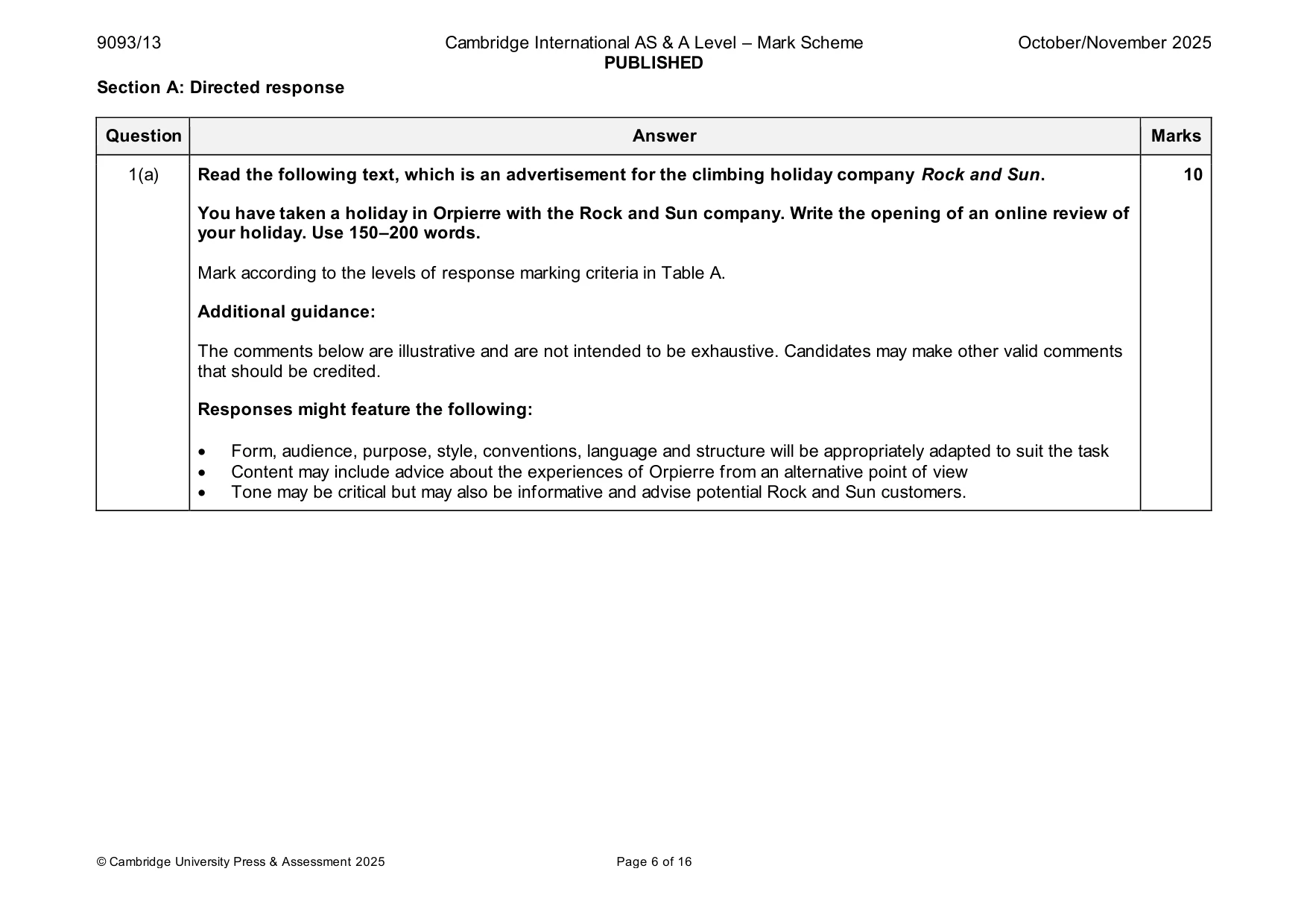
9093/13 Cambridge International AS & A Level – Mark Scheme PUBLISHED October/November 2025 © Cambridge University Press & Assessment 2025 Page 6 of 16 Section A: Directed response Question Answer Marks 1(a) Read the following text, which is an advertisement for the climbing holiday company Rock and Sun. You have taken a holiday in Orpierre with the Rock and Sun company. Write the opening of an online review of your holiday. Use 150–200 words. Mark according to the levels of response marking criteria in Table A. Additional guidance: The comments below are illustrative and are not intended to be exhaustive. Candidates may make other valid comments that should be credited. Responses might feature the following: • Form, audience, purpose, style, conventions, language and structure will be appropriately adapted to suit the task • Content may include advice about the experiences of Orpierre from an alternative point of view • Tone may be critical but may also be informative and advise potential Rock and Sun customers. 10
Mark scheme, page 7
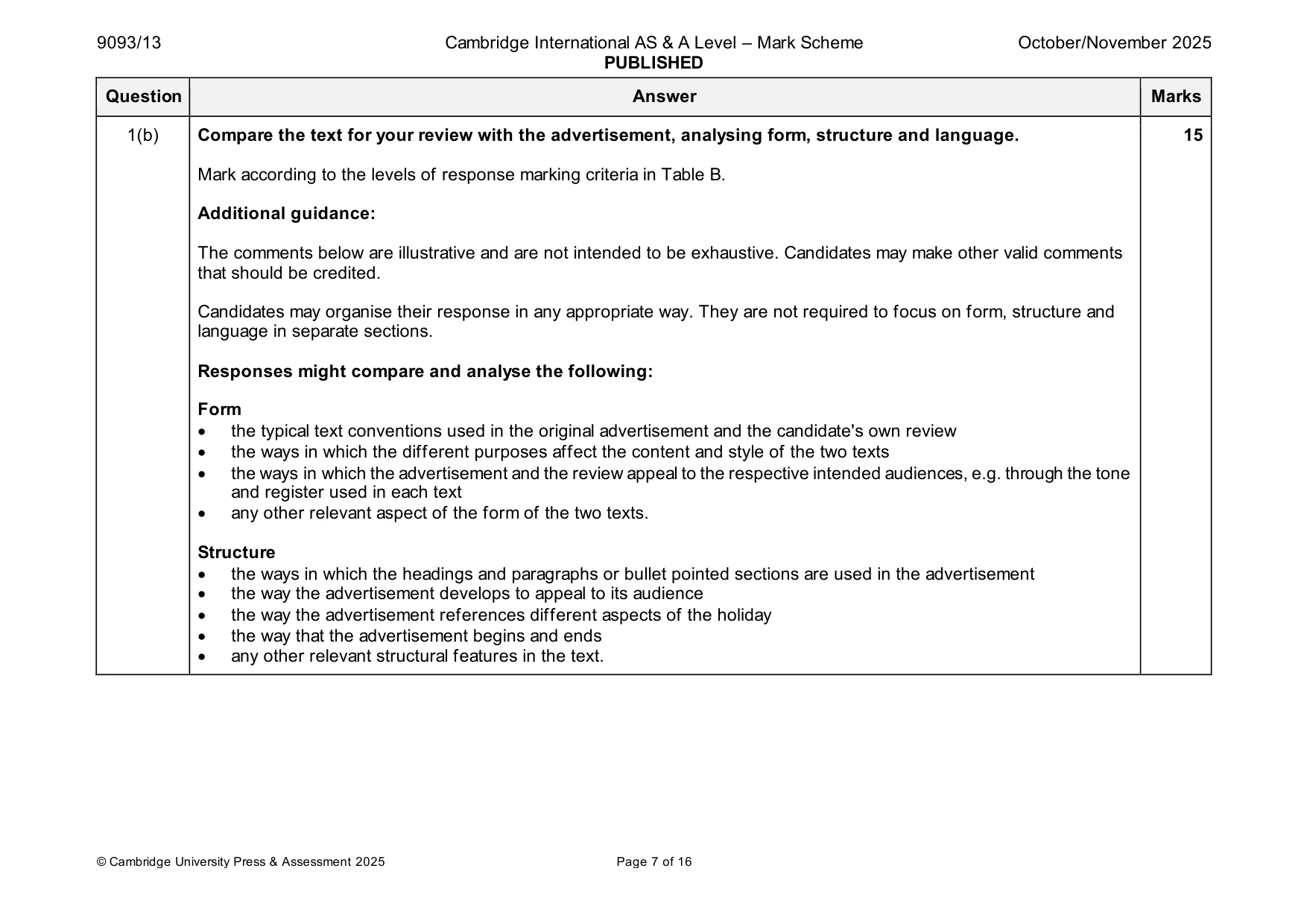
9093/13 Cambridge International AS & A Level – Mark Scheme PUBLISHED October/November 2025 © Cambridge University Press & Assessment 2025 Page 7 of 16 Question Answer Marks 1(b) Compare the text for your review with the advertisement, analysing form, structure and language. Mark according to the levels of response marking criteria in Table B. Additional guidance: The comments below are illustrative and are not intended to be exhaustive. Candidates may make other valid comments that should be credited. Candidates may organise their response in any appropriate way. They are not required to focus on form, structure and language in separate sections. Responses might compare and analyse the following: Form • the typical text conventions used in the original advertisement and the candidate's own review • the ways in which the different purposes affect the content and style of the two texts • the ways in which the advertisement and the review appeal to the respective intended audiences, e.g. through the tone and register used in each text • any other relevant aspect of the form of the two texts. Structure • the ways in which the headings and paragraphs or bullet pointed sections are used in the advertisement • the way the advertisement develops to appeal to its audience • the way the advertisement references different aspects of the holiday • the way that the advertisement begins and ends • any other relevant structural features in the text. 15
Mark scheme, page 8
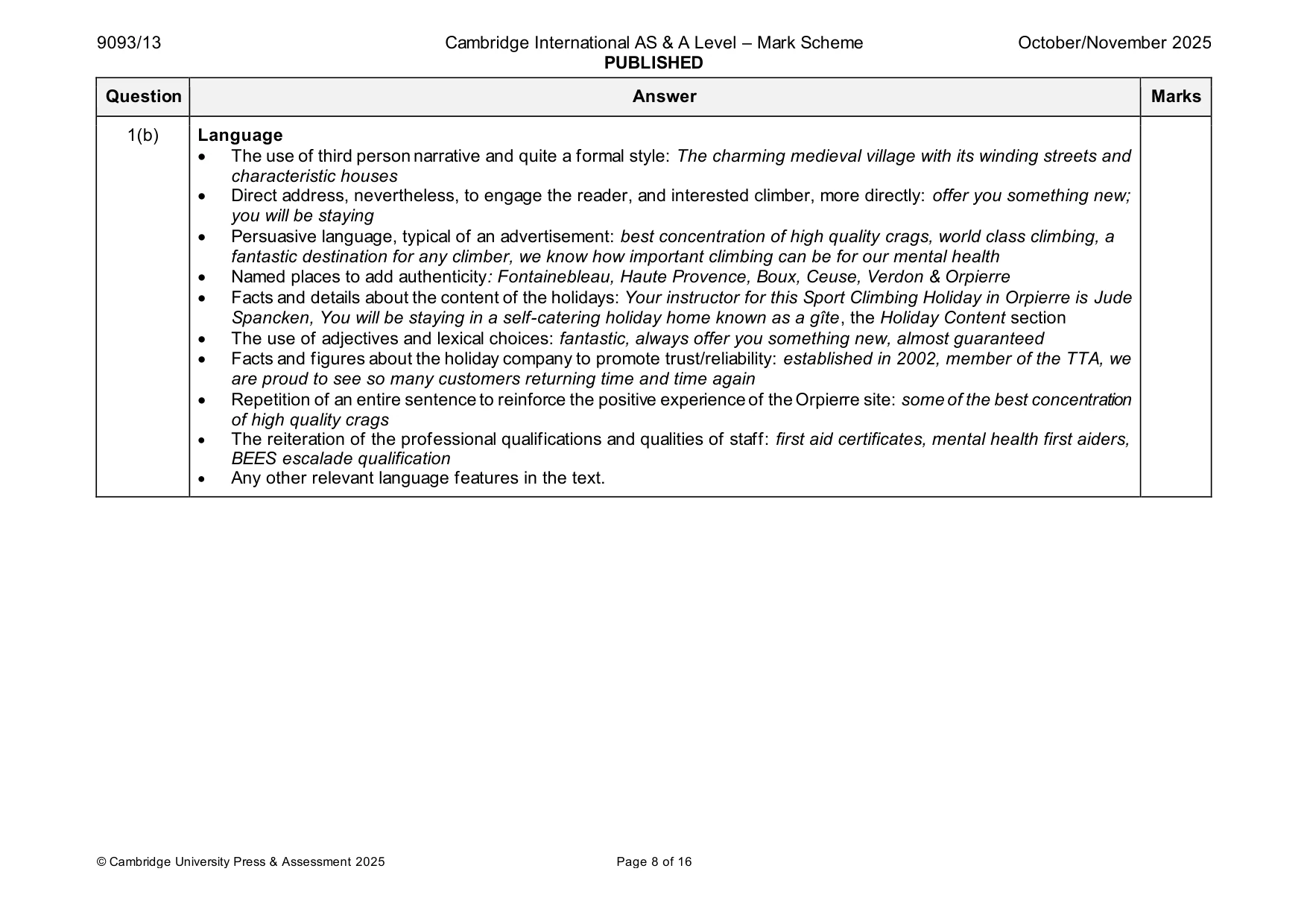
9093/13 Cambridge International AS & A Level – Mark Scheme PUBLISHED October/November 2025 © Cambridge University Press & Assessment 2025 Page 8 of 16 Question Answer Marks 1(b) Language • The use of third person narrative and quite a formal style: The charming medieval village with its winding streets and characteristic houses • Direct address, nevertheless, to engage the reader, and interested climber, more directly: offer you something new; you will be staying • Persuasive language, typical of an advertisement: best concentration of high quality crags, world class climbing, a fantastic destination for any climber, we know how important climbing can be for our mental health • Named places to add authenticity: Fontainebleau, Haute Provence, Boux, Ceuse, Verdon & Orpierre • Facts and details about the content of the holidays: Your instructor for this Sport Climbing Holiday in Orpierre is Jude Spancken, You will be staying in a self-catering holiday home known as a gîte, the Holiday Content section • The use of adjectives and lexical choices: fantastic, always offer you something new, almost guaranteed • Facts and figures about the holiday company to promote trust/reliability: established in 2002, member of the TTA, we are proud to see so many customers returning time and time again • Repetition of an entire sentence to reinforce the positive experience of the Orpierre site: some of the best concentration of high quality crags • The reiteration of the professional qualifications and qualities of staff: first aid certificates, mental health first aiders, BEES escalade qualification • Any other relevant language features in the text.
Mark scheme, page 9
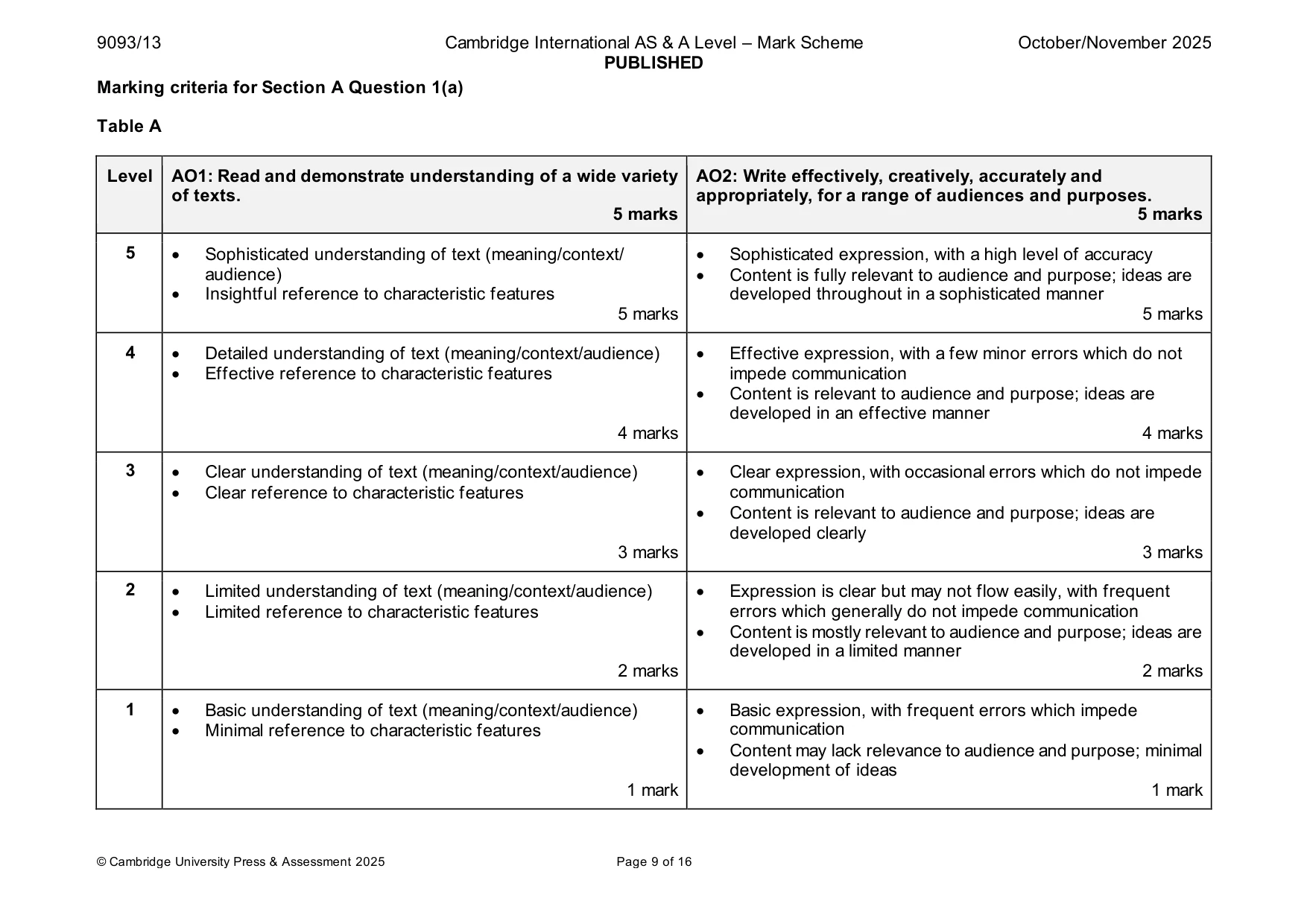
9093/13 Cambridge International AS & A Level – Mark Scheme PUBLISHED October/November 2025 © Cambridge University Press & Assessment 2025 Page 9 of 16 Marking criteria for Section A Question 1(a) Table A Level AO1: Read and demonstrate understanding of a wide variety of texts. 5 marks AO2: Write effectively, creatively, accurately and appropriately, for a range of audiences and purposes. 5 marks 5 • Sophisticated understanding of text (meaning/context/ audience) • Insightful reference to characteristic features 5 marks • Sophisticated expression, with a high level of accuracy • Content is fully relevant to audience and purpose; ideas are developed throughout in a sophisticated manner 5 marks 4 • Detailed understanding of text (meaning/context/audience) • Effective reference to characteristic features 4 marks • Effective expression, with a few minor errors which do not impede communication • Content is relevant to audience and purpose; ideas are developed in an effective manner 4 marks 3 • Clear understanding of text (meaning/context/audience) • Clear reference to characteristic features 3 marks • Clear expression, with occasional errors which do not impede communication • Content is relevant to audience and purpose; ideas are developed clearly 3 marks 2 • Limited understanding of text (meaning/context/audience) • Limited reference to characteristic features 2 marks • Expression is clear but may not flow easily, with frequent errors which generally do not impede communication • Content is mostly relevant to audience and purpose; ideas are developed in a limited manner 2 marks 1 • Basic understanding of text (meaning/context/audience) • Minimal reference to characteristic features 1 mark • Basic expression, with frequent errors which impede communication • Content may lack relevance to audience and purpose; minimal development of ideas 1 mark
Mark scheme, page 10
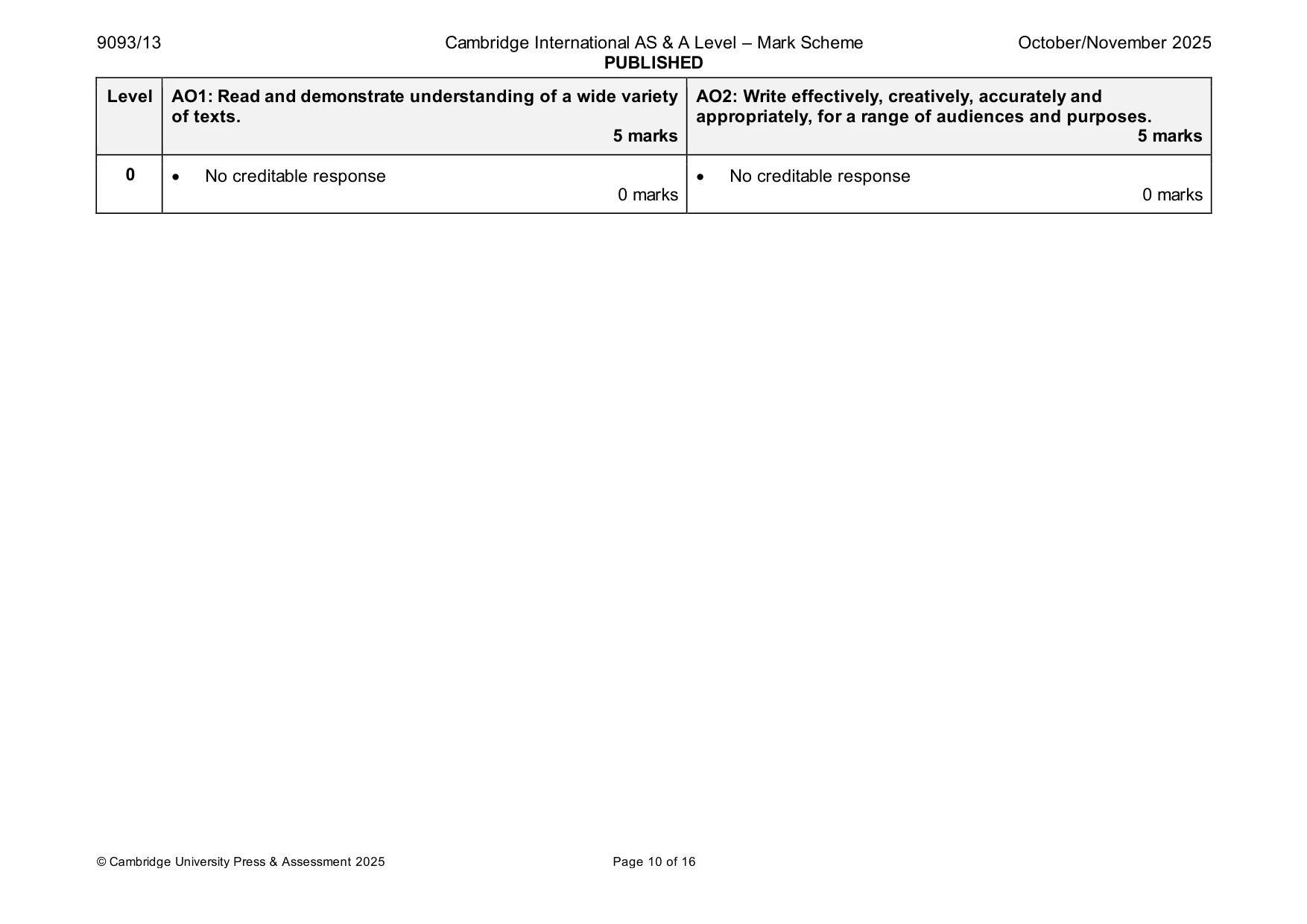
9093/13 Cambridge International AS & A Level – Mark Scheme PUBLISHED October/November 2025 © Cambridge University Press & Assessment 2025 Page 10 of 16 Level AO1: Read and demonstrate understanding of a wide variety of texts. 5 marks AO2: Write effectively, creatively, accurately and appropriately, for a range of audiences and purposes. 5 marks 0 • No creditable response 0 marks • No creditable response 0 marks
Mark scheme, page 11
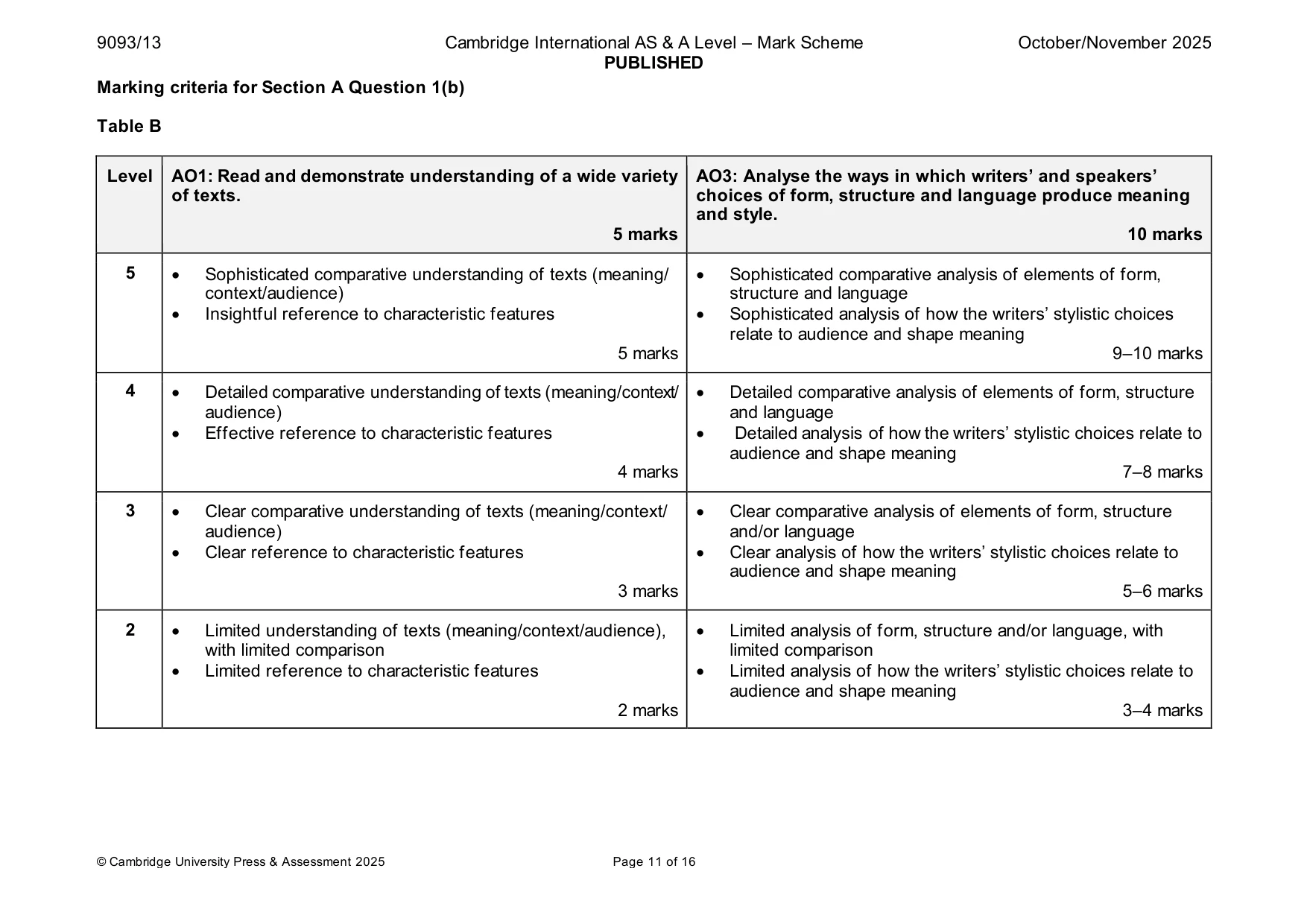
9093/13 Cambridge International AS & A Level – Mark Scheme PUBLISHED October/November 2025 © Cambridge University Press & Assessment 2025 Page 11 of 16 Marking criteria for Section A Question 1(b) Table B Level AO1: Read and demonstrate understanding of a wide variety of texts. 5 marks AO3: Analyse the ways in which writers’ and speakers’ choices of form, structure and language produce meaning and style. 10 marks 5 • Sophisticated comparative understanding of texts (meaning/ context/audience) • Insightful reference to characteristic features 5 marks • Sophisticated comparative analysis of elements of form, structure and language • Sophisticated analysis of how the writers’ stylistic choices relate to audience and shape meaning 9–10 marks 4 • Detailed comparative understanding of texts (meaning/context/ audience) • Effective reference to characteristic features 4 marks • Detailed comparative analysis of elements of form, structure and language • Detailed analysis of how the writers’ stylistic choices relate to audience and shape meaning 7–8 marks 3 • Clear comparative understanding of texts (meaning/context/ audience) • Clear reference to characteristic features 3 marks • Clear comparative analysis of elements of form, structure and/or language • Clear analysis of how the writers’ stylistic choices relate to audience and shape meaning 5–6 marks 2 • Limited understanding of texts (meaning/context/audience), with limited comparison • Limited reference to characteristic features 2 marks • Limited analysis of form, structure and/or language, with limited comparison • Limited analysis of how the writers’ stylistic choices relate to audience and shape meaning 3–4 marks
Mark scheme, page 12
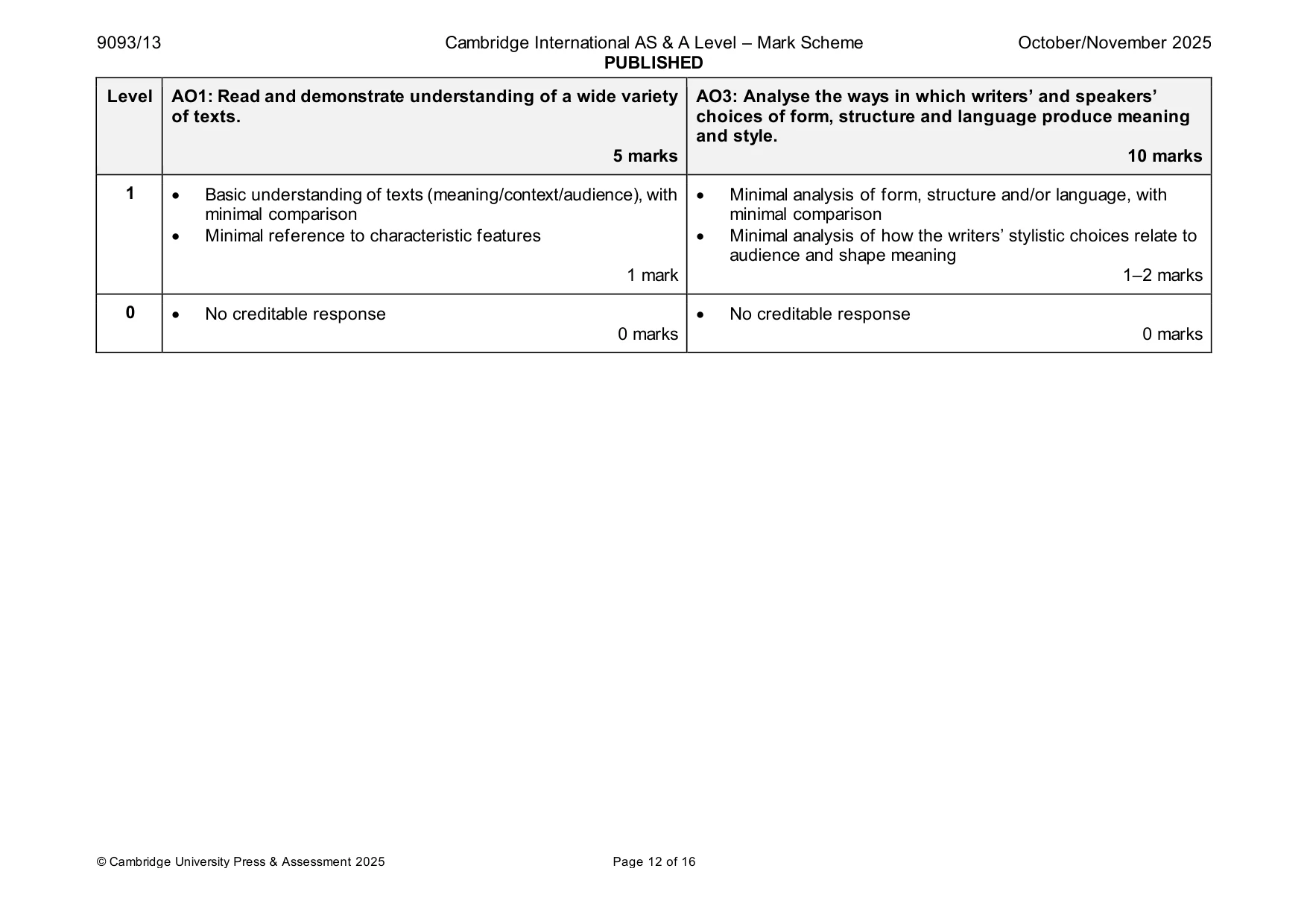
9093/13 Cambridge International AS & A Level – Mark Scheme PUBLISHED October/November 2025 © Cambridge University Press & Assessment 2025 Page 12 of 16 Level AO1: Read and demonstrate understanding of a wide variety of texts. 5 marks AO3: Analyse the ways in which writers’ and speakers’ choices of form, structure and language produce meaning and style. 10 marks 1 • Basic understanding of texts (meaning/context/audience), with minimal comparison • Minimal reference to characteristic features 1 mark • Minimal analysis of form, structure and/or language, with minimal comparison • Minimal analysis of how the writers’ stylistic choices relate to audience and shape meaning 1–2 marks 0 • No creditable response 0 marks • No creditable response 0 marks
Mark scheme, page 13
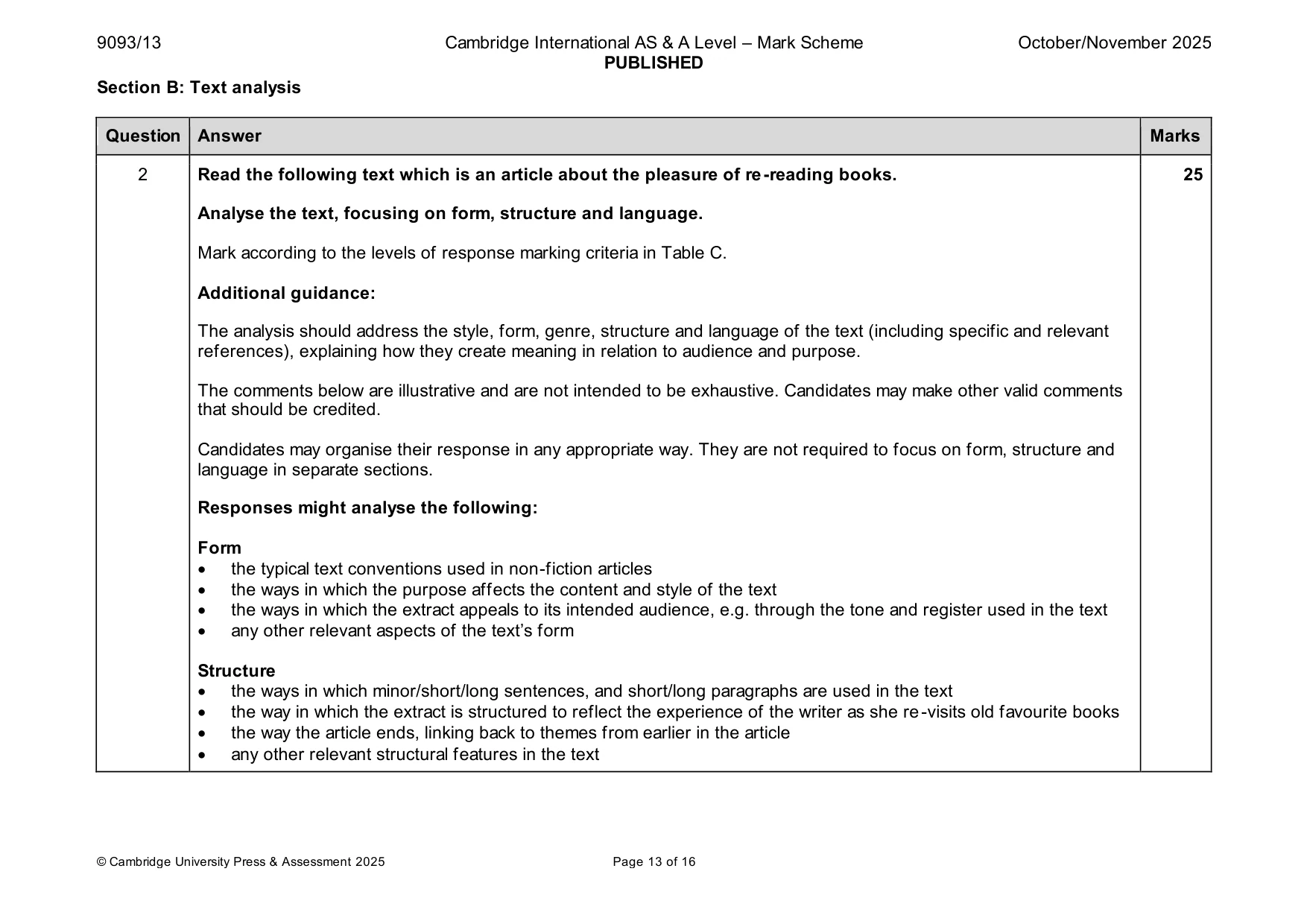
9093/13 Cambridge International AS & A Level – Mark Scheme PUBLISHED October/November 2025 © Cambridge University Press & Assessment 2025 Page 13 of 16 Section B: Text analysis Question Answer Marks 2 Read the following text which is an article about the pleasure of re-reading books. Analyse the text, focusing on form, structure and language. Mark according to the levels of response marking criteria in Table C. Additional guidance: The analysis should address the style, form, genre, structure and language of the text (including specific and relevant references), explaining how they create meaning in relation to audience and purpose. The comments below are illustrative and are not intended to be exhaustive. Candidates may make other valid comments that should be credited. Candidates may organise their response in any appropriate way. They are not required to focus on form, structure and language in separate sections. Responses might analyse the following: Form • the typical text conventions used in non-fiction articles • the ways in which the purpose affects the content and style of the text • the ways in which the extract appeals to its intended audience, e.g. through the tone and register used in the text • any other relevant aspects of the text’s form Structure • the ways in which minor/short/long sentences, and short/long paragraphs are used in the text • the way in which the extract is structured to reflect the experience of the writer as she re-visits old favourite books • the way the article ends, linking back to themes from earlier in the article • any other relevant structural features in the text 25
Mark scheme, page 14
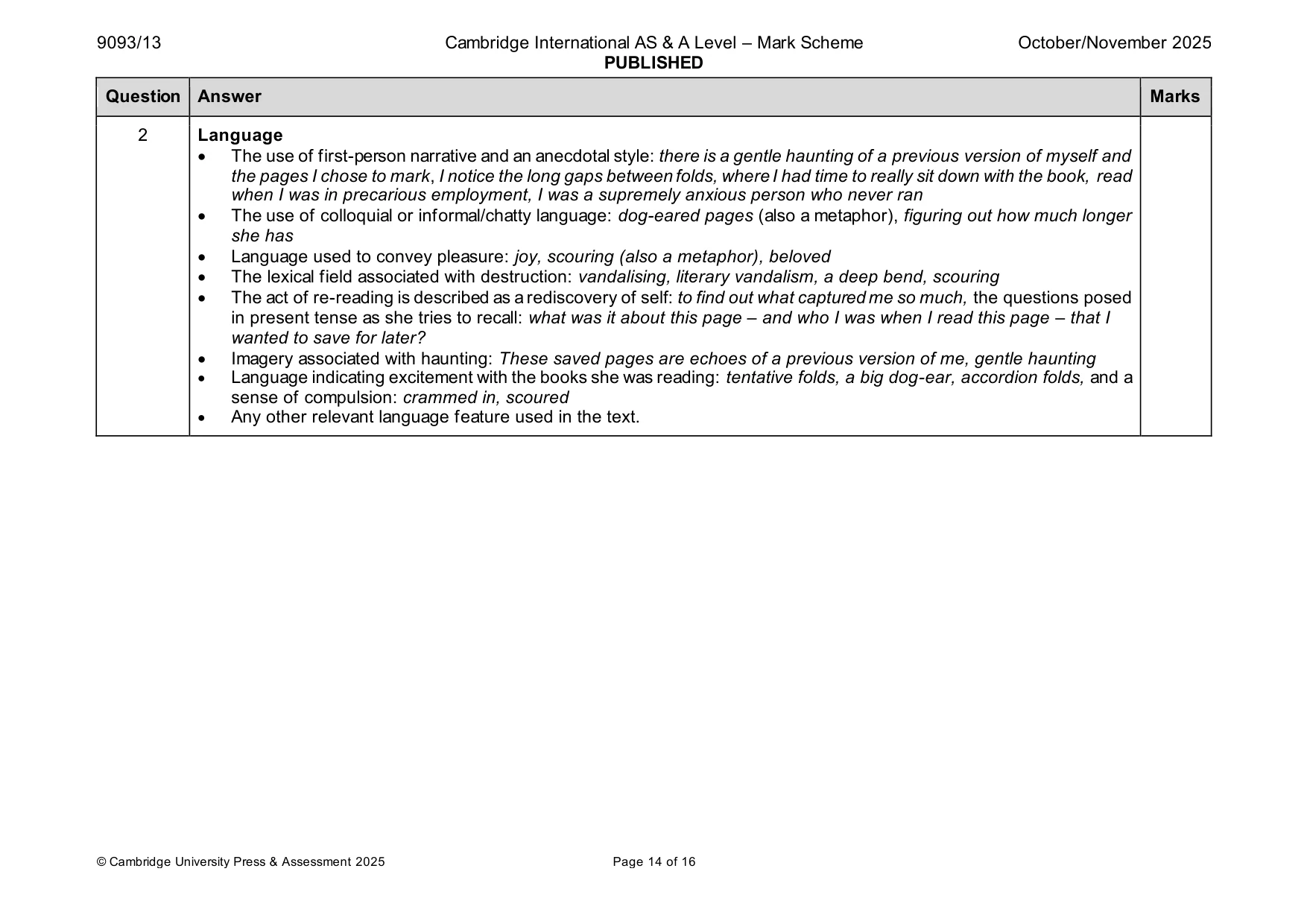
9093/13 Cambridge International AS & A Level – Mark Scheme PUBLISHED October/November 2025 © Cambridge University Press & Assessment 2025 Page 14 of 16 Question Answer Marks 2 Language • The use of first-person narrative and an anecdotal style: there is a gentle haunting of a previous version of myself and the pages I chose to mark, I notice the long gaps between folds, where I had time to really sit down with the book, read when I was in precarious employment, I was a supremely anxious person who never ran • The use of colloquial or informal/chatty language: dog-eared pages (also a metaphor), figuring out how much longer she has • Language used to convey pleasure: joy, scouring (also a metaphor), beloved • The lexical field associated with destruction: vandalising, literary vandalism, a deep bend, scouring • The act of re-reading is described as a rediscovery of self: to find out what captured me so much, the questions posed in present tense as she tries to recall: what was it about this page – and who I was when I read this page – that I wanted to save for later? • Imagery associated with haunting: These saved pages are echoes of a previous version of me, gentle haunting • Language indicating excitement with the books she was reading: tentative folds, a big dog-ear, accordion folds, and a sense of compulsion: crammed in, scoured • Any other relevant language feature used in the text.
Mark scheme, page 15
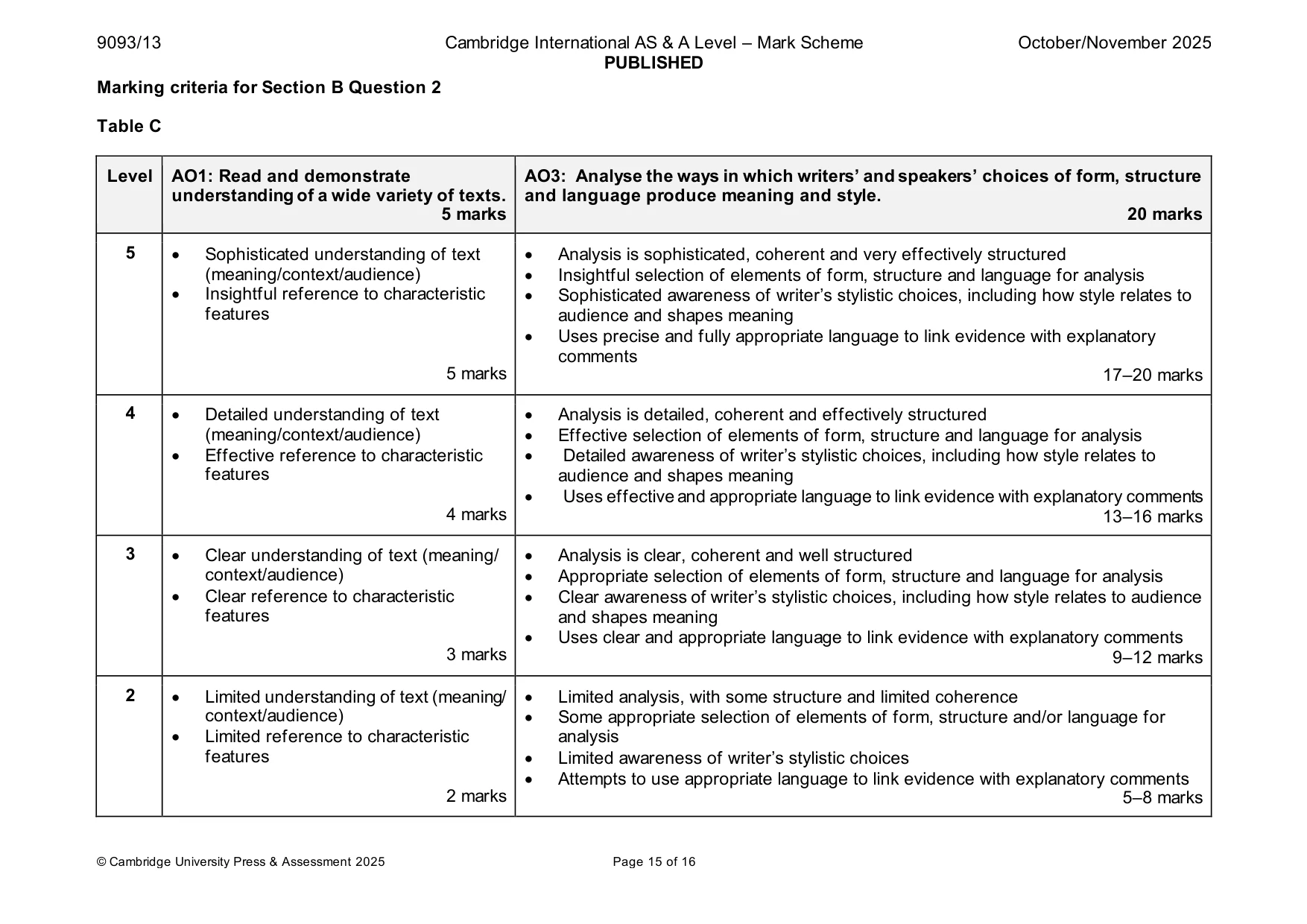
9093/13 Cambridge International AS & A Level – Mark Scheme PUBLISHED October/November 2025 © Cambridge University Press & Assessment 2025 Page 15 of 16 Marking criteria for Section B Question 2 Table C Level AO1: Read and demonstrate understanding of a wide variety of texts. 5 marks AO3: Analyse the ways in which writers’ and speakers’ choices of form, structure and language produce meaning and style. 20 marks 5 • Sophisticated understanding of text (meaning/context/audience) • Insightful reference to characteristic features 5 marks • Analysis is sophisticated, coherent and very effectively structured • Insightful selection of elements of form, structure and language for analysis • Sophisticated awareness of writer’s stylistic choices, including how style relates to audience and shapes meaning • Uses precise and fully appropriate language to link evidence with explanatory comments 17–20 marks 4 • Detailed understanding of text (meaning/context/audience) • Effective reference to characteristic features 4 marks • Analysis is detailed, coherent and effectively structured • Effective selection of elements of form, structure and language for analysis • Detailed awareness of writer’s stylistic choices, including how style relates to audience and shapes meaning • Uses effective and appropriate language to link evidence with explanatory comments 13–16 marks 3 • Clear understanding of text (meaning/ context/audience) • Clear reference to characteristic features 3 marks • Analysis is clear, coherent and well structured • Appropriate selection of elements of form, structure and language for analysis • Clear awareness of writer’s stylistic choices, including how style relates to audience and shapes meaning • Uses clear and appropriate language to link evidence with explanatory comments 9–12 marks 2 • Limited understanding of text (meaning/ context/audience) • Limited reference to characteristic features 2 marks • Limited analysis, with some structure and limited coherence • Some appropriate selection of elements of form, structure and/or language for analysis • Limited awareness of writer’s stylistic choices • Attempts to use appropriate language to link evidence with explanatory comments 5–8 marks
Mark scheme, page 16
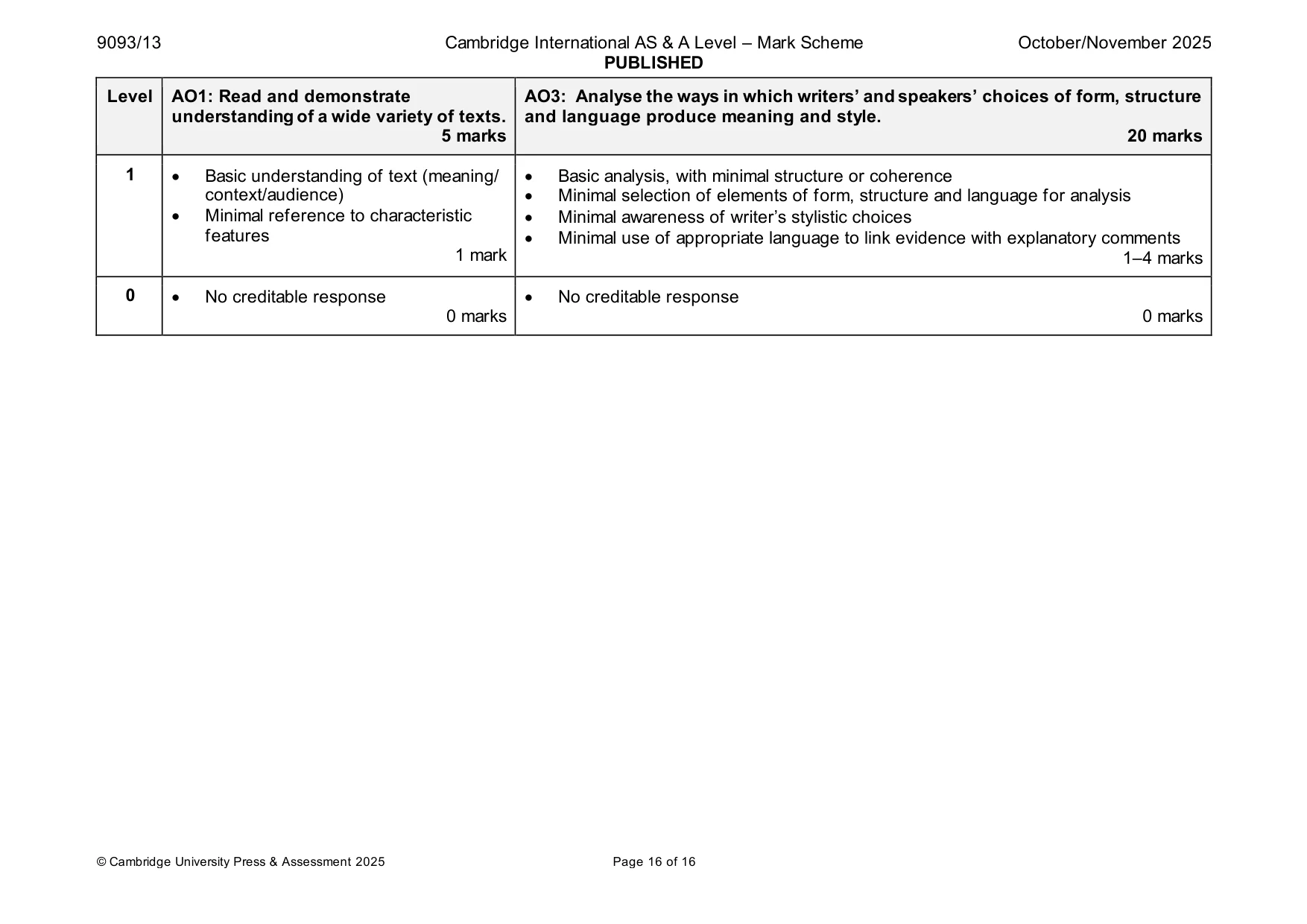
9093/13 Cambridge International AS & A Level – Mark Scheme PUBLISHED October/November 2025 © Cambridge University Press & Assessment 2025 Page 16 of 16 Level AO1: Read and demonstrate understanding of a wide variety of texts. 5 marks AO3: Analyse the ways in which writers’ and speakers’ choices of form, structure and language produce meaning and style. 20 marks 1 • Basic understanding of text (meaning/ context/audience) • Minimal reference to characteristic features 1 mark • Basic analysis, with minimal structure or coherence • Minimal selection of elements of form, structure and language for analysis • Minimal awareness of writer’s stylistic choices • Minimal use of appropriate language to link evidence with explanatory comments 1–4 marks 0 • No creditable response 0 marks • No creditable response 0 marks
What you needed in this session
Cambridge’s own grade thresholds for 2025 Oct/Nov, Paper 1 · Variant 3. A higher threshold means an easier paper — the bar moves with how the cohort did.