Cambridge A Level English - Language AS and A Level (from 2014) 9093 — 2024 Oct/Nov Paper 1 · Variant 3
9093/13/O/N/24 · 50 marks · 135 min
The question paper and its mark scheme, free to read here and free to download. This is Cambridge’s own paper, exactly as it was sat.
Question paper8 pages
Mark scheme16 pages
Answers below. Sit the paper first if you are practising.
Paper as text
Question paper, page 1
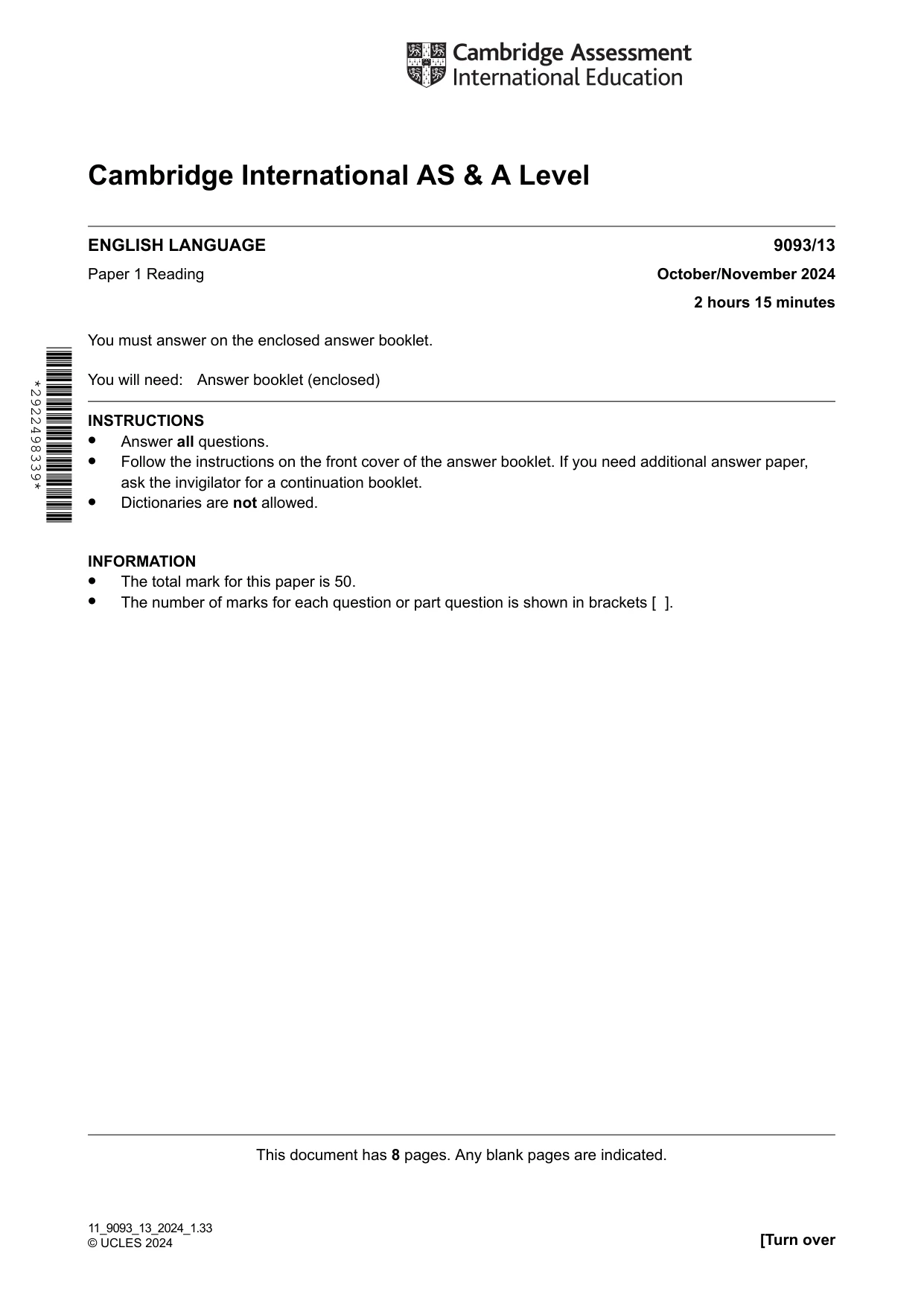
Cambridge International AS & A Level 9093/13 October/November 2024 2 hours 15 minutes ENGLISH LANGUAGE Paper 1 Reading You must answer on the enclosed answer booklet. You will need: Answer booklet (enclosed) INSTRUCTIONS • Answer all questions. • Follow the instructions on the front cover of the answer booklet. If you need additional answer paper, ask the invigilator for a continuation booklet. • Dictionaries are not allowed. INFORMATION • The total mark for this paper is 50. • The number of marks for each question or part question is shown in brackets [ ]. This document has 8 pages. Any blank pages are indicated. [Turn over 11_9093_13_2024_1.33 © UCLES 2024 *2922498339*
Question paper, page 2
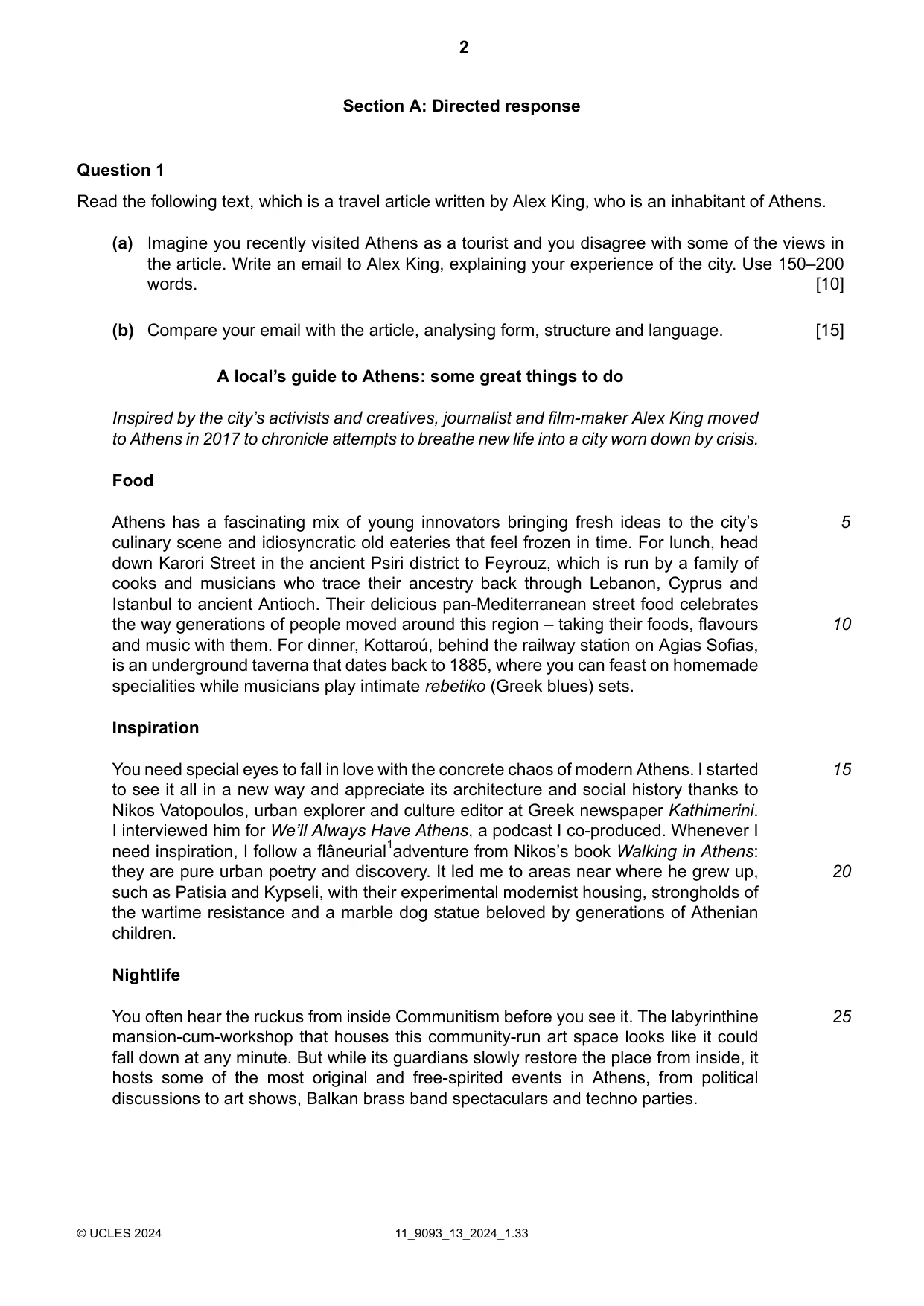
25 20 15 10 5 Section A: Directed response Question 1 Read the following text, which is a travel article written by Alex King, who is an inhabitant of Athens. Imagine you recently visited Athens as a tourist and you disagree with some of the views in the article. Write an email to Alex King, explaining your experience of the city. Use 150–200 words. [10] (a) Compare your email with the article, analysing form, structure and language. [15] (b) A local’s guide to Athens: some great things to do Inspired by the city’s activists and creatives, journalist and film-maker Alex King moved to Athens in 2017 to chronicle attempts to breathe new life into a city worn down by crisis. Food Athens has a fascinating mix of young innovators bringing fresh ideas to the city’s culinary scene and idiosyncratic old eateries that feel frozen in time. For lunch, head down Karori Street in the ancient Psiri district to Feyrouz, which is run by a family of cooks and musicians who trace their ancestry back through Lebanon, Cyprus and Istanbul to ancient Antioch. Their delicious pan-Mediterranean street food celebrates the way generations of people moved around this region – taking their foods, flavours and music with them. For dinner, Kottaroú, behind the railway station on Agias Sofias, is an underground taverna that dates back to 1885, where you can feast on homemade specialities while musicians play intimate rebetiko (Greek blues) sets. Inspiration You need special eyes to fall in love with the concrete chaos of modern Athens. I started to see it all in a new way and appreciate its architecture and social history thanks to Nikos Vatopoulos, urban explorer and culture editor at Greek newspaper Kathimerini. I interviewed him for We’ll Always Have Athens, a podcast I co-produced. Whenever I need inspiration, I follow a flâneurial1adventure from Nikos’s book Walking in Athens: they are pure urban poetry and discovery. It led me to areas near where he grew up, such as Patisia and Kypseli, with their experimental modernist housing, strongholds of the wartime resistance and a marble dog statue beloved by generations of Athenian children. Nightlife You often hear the ruckus from inside Communitism before you see it. The labyrinthine mansion-cum-workshop that houses this community-run art space looks like it could fall down at any minute. But while its guardians slowly restore the place from inside, it hosts some of the most original and free-spirited events in Athens, from political discussions to art shows, Balkan brass band spectaculars and techno parties. 11_9093_13_2024_1.33 © UCLES 2024 2
Question paper, page 3
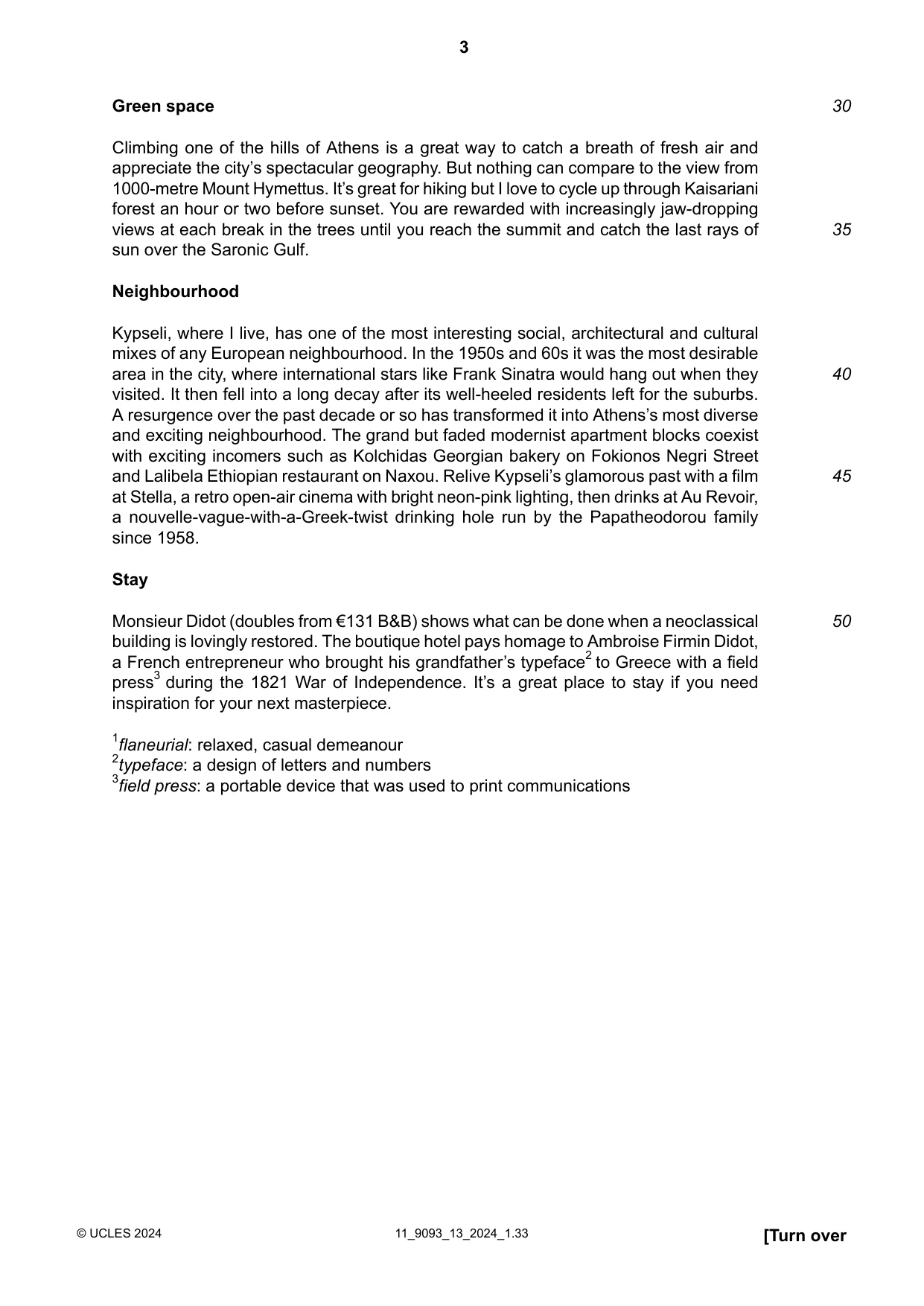
50 45 40 35 30 Green space Climbing one of the hills of Athens is a great way to catch a breath of fresh air and appreciate the city’s spectacular geography. But nothing can compare to the view from 1000-metre Mount Hymettus. It’s great for hiking but I love to cycle up through Kaisariani forest an hour or two before sunset. You are rewarded with increasingly jaw-dropping views at each break in the trees until you reach the summit and catch the last rays of sun over the Saronic Gulf. Neighbourhood Kypseli, where I live, has one of the most interesting social, architectural and cultural mixes of any European neighbourhood. In the 1950s and 60s it was the most desirable area in the city, where international stars like Frank Sinatra would hang out when they visited. It then fell into a long decay after its well-heeled residents left for the suburbs. A resurgence over the past decade or so has transformed it into Athens’s most diverse and exciting neighbourhood. The grand but faded modernist apartment blocks coexist with exciting incomers such as Kolchidas Georgian bakery on Fokionos Negri Street and Lalibela Ethiopian restaurant on Naxou. Relive Kypseli’s glamorous past with a film at Stella, a retro open-air cinema with bright neon-pink lighting, then drinks at Au Revoir, a nouvelle-vague-with-a-Greek-twist drinking hole run by the Papatheodorou family since 1958. Stay Monsieur Didot (doubles from €131 B&B) shows what can be done when a neoclassical building is lovingly restored. The boutique hotel pays homage to Ambroise Firmin Didot, a French entrepreneur who brought his grandfather’s typeface2 to Greece with a field press3 during the 1821 War of Independence. It’s a great place to stay if you need inspiration for your next masterpiece. 1flaneurial: relaxed, casual demeanour 2typeface: a design of letters and numbers 3field press: a portable device that was used to print communications [Turn over 11_9093_13_2024_1.33 © UCLES 2024 3
Question paper, page 4
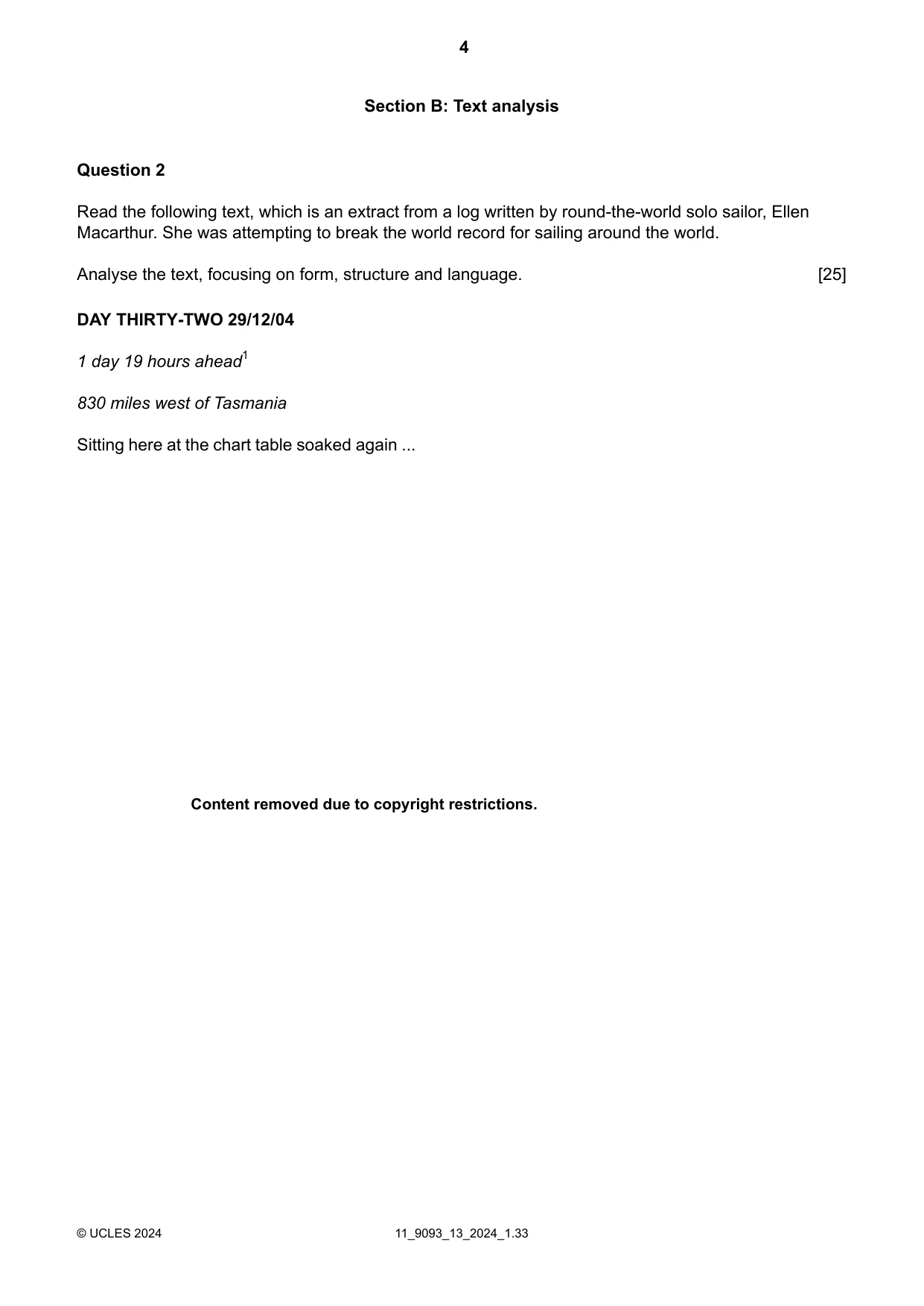
Section B: Text analysis Question 2 Read the following text, which is an extract from a log written by round-the-world solo sailor, Ellen Macarthur. She was attempting to break the world record for sailing around the world. Analyse the text, focusing on form, structure and language. [25] DAY THIRTY-TWO 29/12/04 1 day 19 hours ahead1 830 miles west of Tasmania Sitting here at the chart table soaked again ... 11_9093_13_2024_1.33 © UCLES 2024 4 Content removed due to copyright restrictions.
Question paper, page 5
I’m really exhausted, but drying out the boat and creating that list of jobs for after makes me feel a bit better ... Later on, then. 11_9093_13_2024_1.33 © UCLES 2024 5 Content removed due to copyright restrictions.
Question paper, page 6
BLANK PAGE 11_9093_13_2024_1.33 © UCLES 2024 6
Question paper, page 7
BLANK PAGE 11_9093_13_2024_1.33 © UCLES 2024 7
Question paper, page 8
BLANK PAGE Permission to reproduce items where third-party owned material protected by copyright is included has been sought and cleared where possible. Every reasonable effort has been made by the publisher (UCLES) to trace copyright holders, but if any items requiring clearance have unwittingly been included, the publisher will be pleased to make amends at the earliest possible opportunity. To avoid the issue of disclosure of answer-related information to candidates, all copyright acknowledgements are reproduced online in the Cambridge Assessment International Education Copyright Acknowledgements Booklet. This is produced for each series of examinations and is freely available to download at www.cambridgeinternational.org after the live examination series. Cambridge Assessment International Education is part of Cambridge Assessment. Cambridge Assessment is the brand name of the University of Cambridge Local Examinations Syndicate (UCLES), which is a department of the University of Cambridge. 11_9093_13_2024_1.33 © UCLES 2024 8
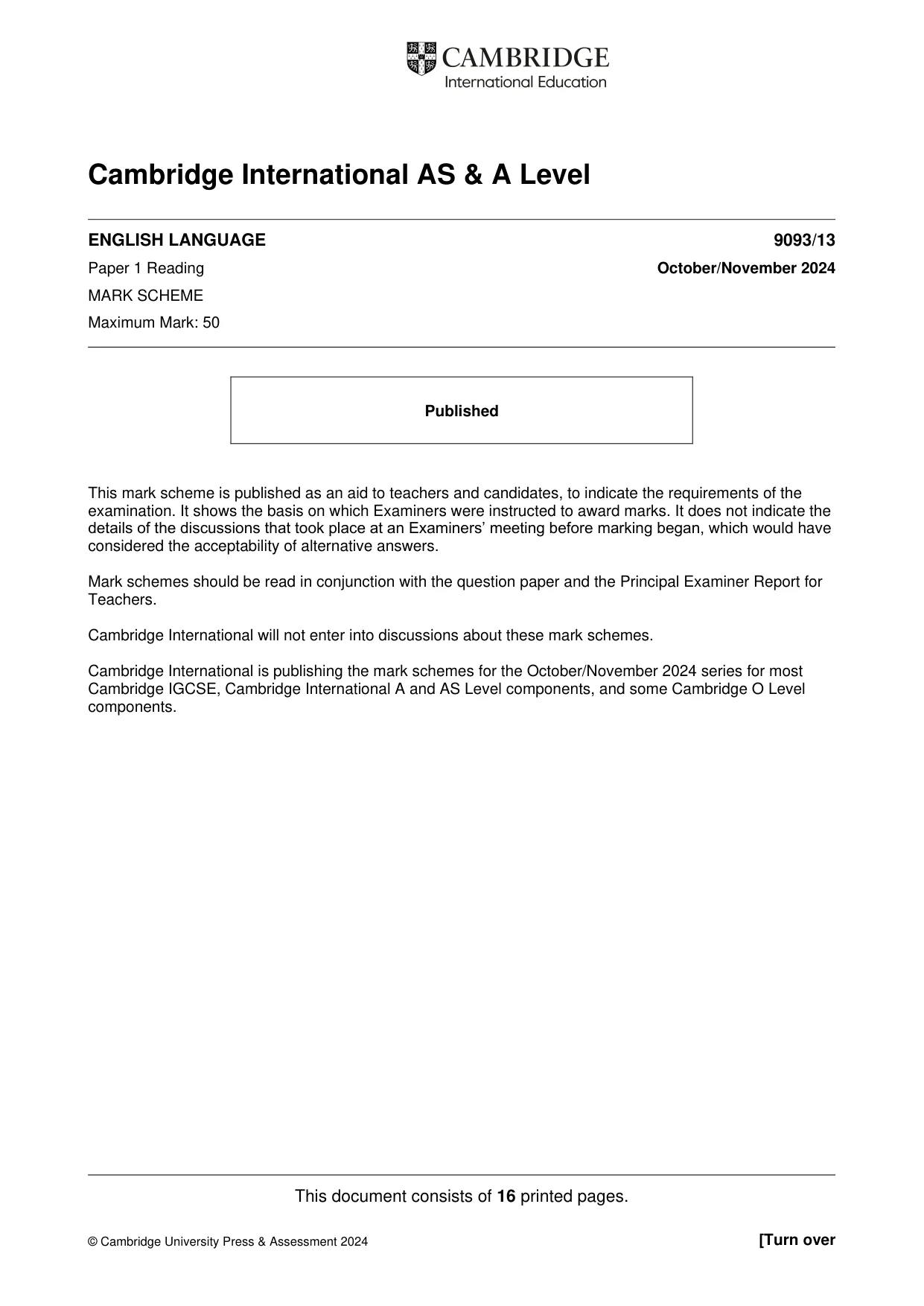
Mark scheme, page 1
This document consists of 16 printed pages. © Cambridge University Press & Assessment 2024 [Turn over Cambridge International AS & A Level ENGLISH LANGUAGE 9093/13 Paper 1 Reading October/November 2024 MARK SCHEME Maximum Mark: 50 Published This mark scheme is published as an aid to teachers and candidates, to indicate the requirements of the examination. It shows the basis on which Examiners were instructed to award marks. It does not indicate the details of the discussions that took place at an Examiners’ meeting before marking began, which would have considered the acceptability of alternative answers. Mark schemes should be read in conjunction with the question paper and the Principal Examiner Report for Teachers. Cambridge International will not enter into discussions about these mark schemes. Cambridge International is publishing the mark schemes for the October/November 2024 series for most Cambridge IGCSE, Cambridge International A and AS Level components, and some Cambridge O Level components.
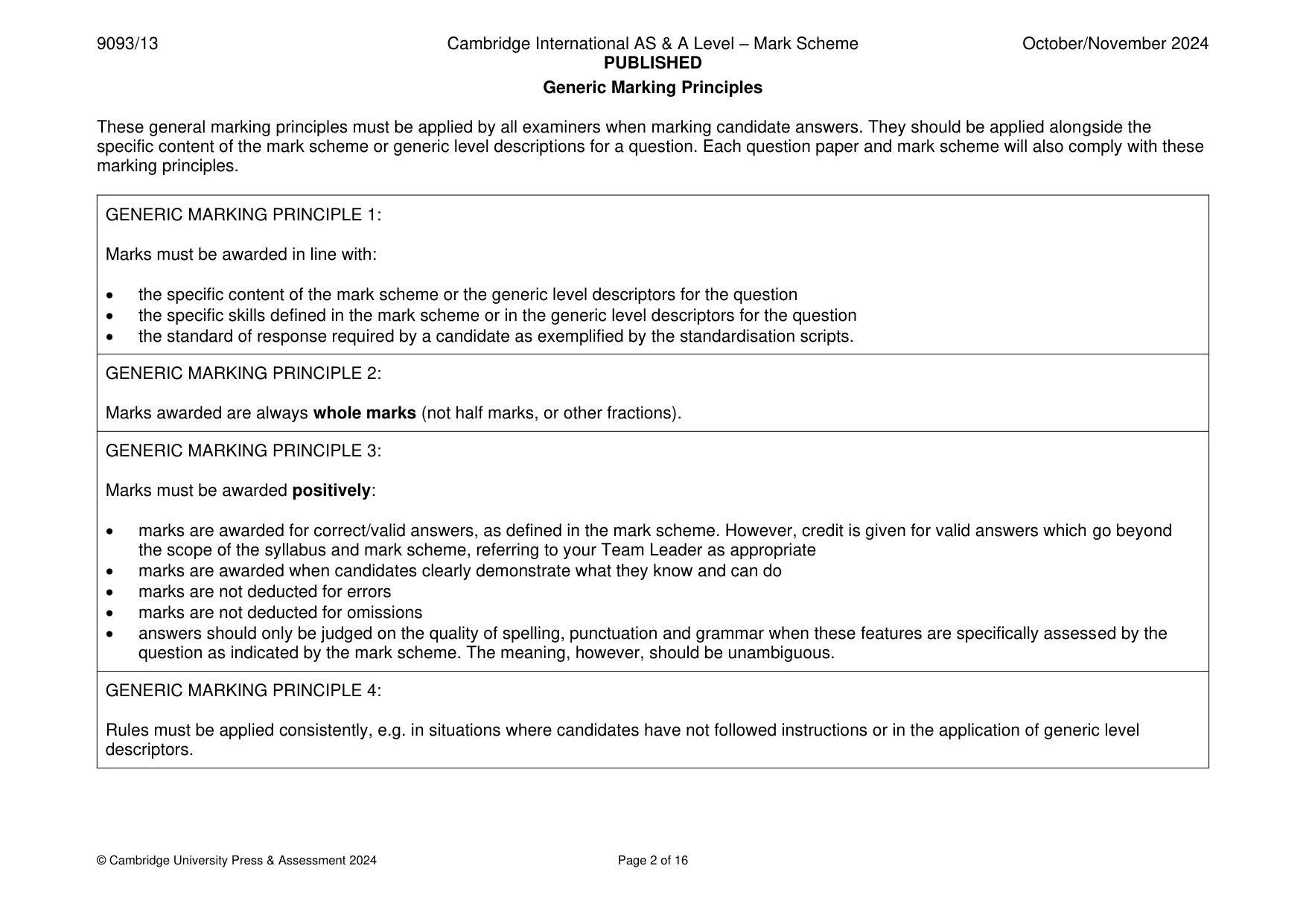
Mark scheme, page 2
9093/13 Cambridge International AS & A Level – Mark Scheme PUBLISHED October/November 2024 © Cambridge University Press & Assessment 2024 Page 2 of 16 Generic Marking Principles These general marking principles must be applied by all examiners when marking candidate answers. They should be applied alongside the specific content of the mark scheme or generic level descriptions for a question. Each question paper and mark scheme will also comply with these marking principles. GENERIC MARKING PRINCIPLE 1: Marks must be awarded in line with: • the specific content of the mark scheme or the generic level descriptors for the question • the specific skills defined in the mark scheme or in the generic level descriptors for the question • the standard of response required by a candidate as exemplified by the standardisation scripts. GENERIC MARKING PRINCIPLE 2: Marks awarded are always whole marks (not half marks, or other fractions). GENERIC MARKING PRINCIPLE 3: Marks must be awarded positively: • marks are awarded for correct/valid answers, as defined in the mark scheme. However, credit is given for valid answers which go beyond the scope of the syllabus and mark scheme, referring to your Team Leader as appropriate • marks are awarded when candidates clearly demonstrate what they know and can do • marks are not deducted for errors • marks are not deducted for omissions • answers should only be judged on the quality of spelling, punctuation and grammar when these features are specifically assessed by the question as indicated by the mark scheme. The meaning, however, should be unambiguous. GENERIC MARKING PRINCIPLE 4: Rules must be applied consistently, e.g. in situations where candidates have not followed instructions or in the application of generic level descriptors.
Mark scheme, page 3
9093/13 Cambridge International AS & A Level – Mark Scheme PUBLISHED October/November 2024 © Cambridge University Press & Assessment 2024 Page 3 of 16 GENERIC MARKING PRINCIPLE 5: Marks should be awarded using the full range of marks defined in the mark scheme for the question (however; the use of the full mark range may be limited according to the quality of the candidate responses seen). GENERIC MARKING PRINCIPLE 6: Marks awarded are based solely on the requirements as defined in the mark scheme. Marks should not be awarded with grade thresholds or grade descriptors in mind.
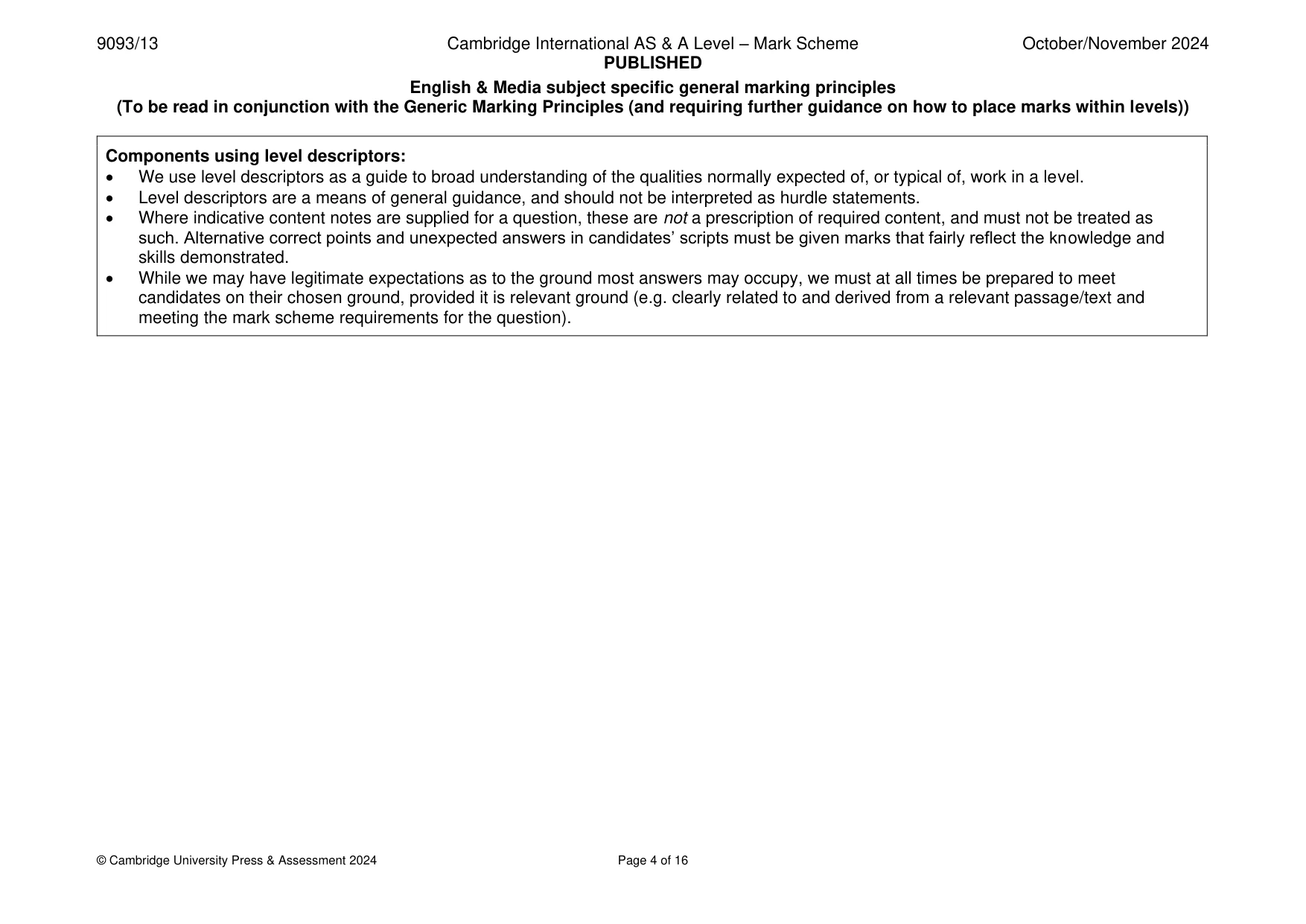
Mark scheme, page 4
9093/13 Cambridge International AS & A Level – Mark Scheme PUBLISHED October/November 2024 © Cambridge University Press & Assessment 2024 Page 4 of 16 English & Media subject specific general marking principles (To be read in conjunction with the Generic Marking Principles (and requiring further guidance on how to place marks within levels)) Components using level descriptors: • We use level descriptors as a guide to broad understanding of the qualities normally expected of, or typical of, work in a level. • Level descriptors are a means of general guidance, and should not be interpreted as hurdle statements. • Where indicative content notes are supplied for a question, these are not a prescription of required content, and must not be treated as such. Alternative correct points and unexpected answers in candidates’ scripts must be given marks that fairly reflect the knowledge and skills demonstrated. • While we may have legitimate expectations as to the ground most answers may occupy, we must at all times be prepared to meet candidates on their chosen ground, provided it is relevant ground (e.g. clearly related to and derived from a relevant passage/text and meeting the mark scheme requirements for the question).
Mark scheme, page 5
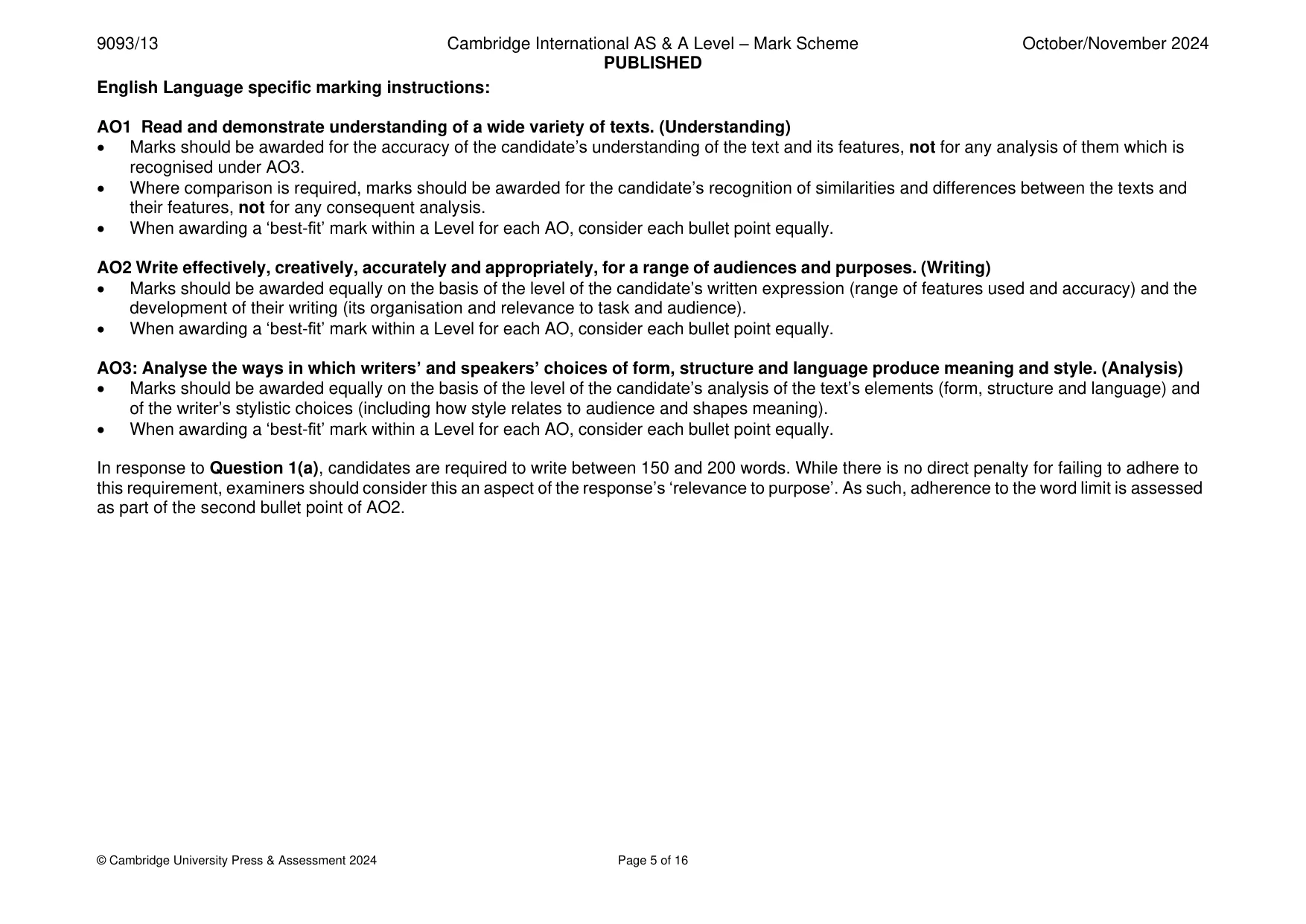
9093/13 Cambridge International AS & A Level – Mark Scheme PUBLISHED October/November 2024 © Cambridge University Press & Assessment 2024 Page 5 of 16 English Language specific marking instructions: AO1 Read and demonstrate understanding of a wide variety of texts. (Understanding) • Marks should be awarded for the accuracy of the candidate’s understanding of the text and its features, not for any analysis of them which is recognised under AO3. • Where comparison is required, marks should be awarded for the candidate’s recognition of similarities and differences between the texts and their features, not for any consequent analysis. • When awarding a ‘best-fit’ mark within a Level for each AO, consider each bullet point equally. AO2 Write effectively, creatively, accurately and appropriately, for a range of audiences and purposes. (Writing) • Marks should be awarded equally on the basis of the level of the candidate’s written expression (range of features used and accuracy) and the development of their writing (its organisation and relevance to task and audience). • When awarding a ‘best-fit’ mark within a Level for each AO, consider each bullet point equally. AO3: Analyse the ways in which writers’ and speakers’ choices of form, structure and language produce meaning and style. (Analysis) • Marks should be awarded equally on the basis of the level of the candidate’s analysis of the text’s elements (form, structure and language) and of the writer’s stylistic choices (including how style relates to audience and shapes meaning). • When awarding a ‘best-fit’ mark within a Level for each AO, consider each bullet point equally. In response to Question 1(a), candidates are required to write between 150 and 200 words. While there is no direct penalty for failing to adhere to this requirement, examiners should consider this an aspect of the response’s ‘relevance to purpose’. As such, adherence to the word limit is assessed as part of the second bullet point of AO2.
Mark scheme, page 6
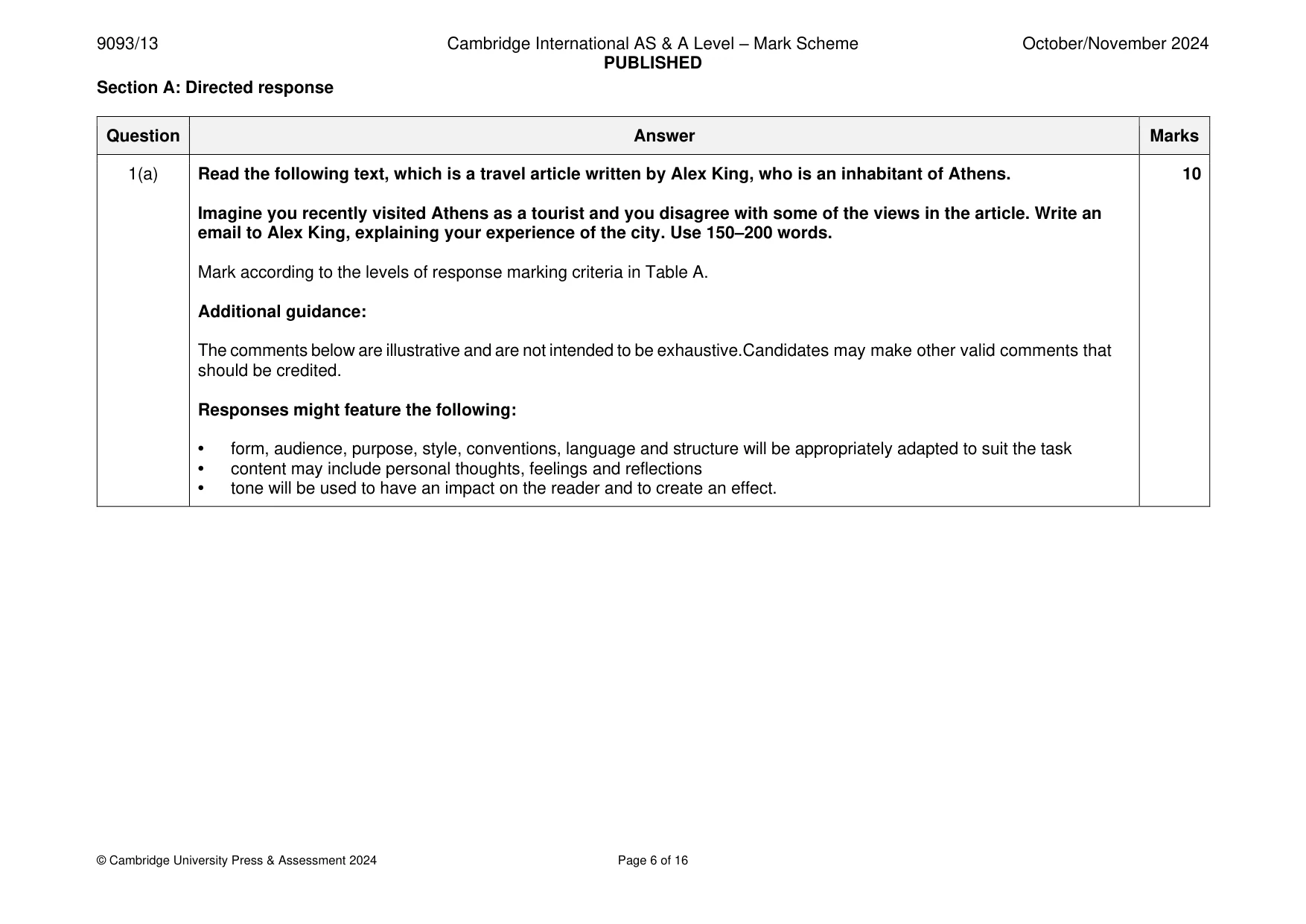
9093/13 Cambridge International AS & A Level – Mark Scheme PUBLISHED October/November 2024 © Cambridge University Press & Assessment 2024 Page 6 of 16 Section A: Directed response Question Answer Marks 1(a) Read the following text, which is a travel article written by Alex King, who is an inhabitant of Athens. Imagine you recently visited Athens as a tourist and you disagree with some of the views in the article. Write an email to Alex King, explaining your experience of the city. Use 150–200 words. Mark according to the levels of response marking criteria in Table A. Additional guidance: The comments below are illustrative and are not intended to be exhaustive. Candidates may make other valid comments that should be credited. Responses might feature the following: • form, audience, purpose, style, conventions, language and structure will be appropriately adapted to suit the task • content may include personal thoughts, feelings and reflections • tone will be used to have an impact on the reader and to create an effect. 10
Mark scheme, page 7
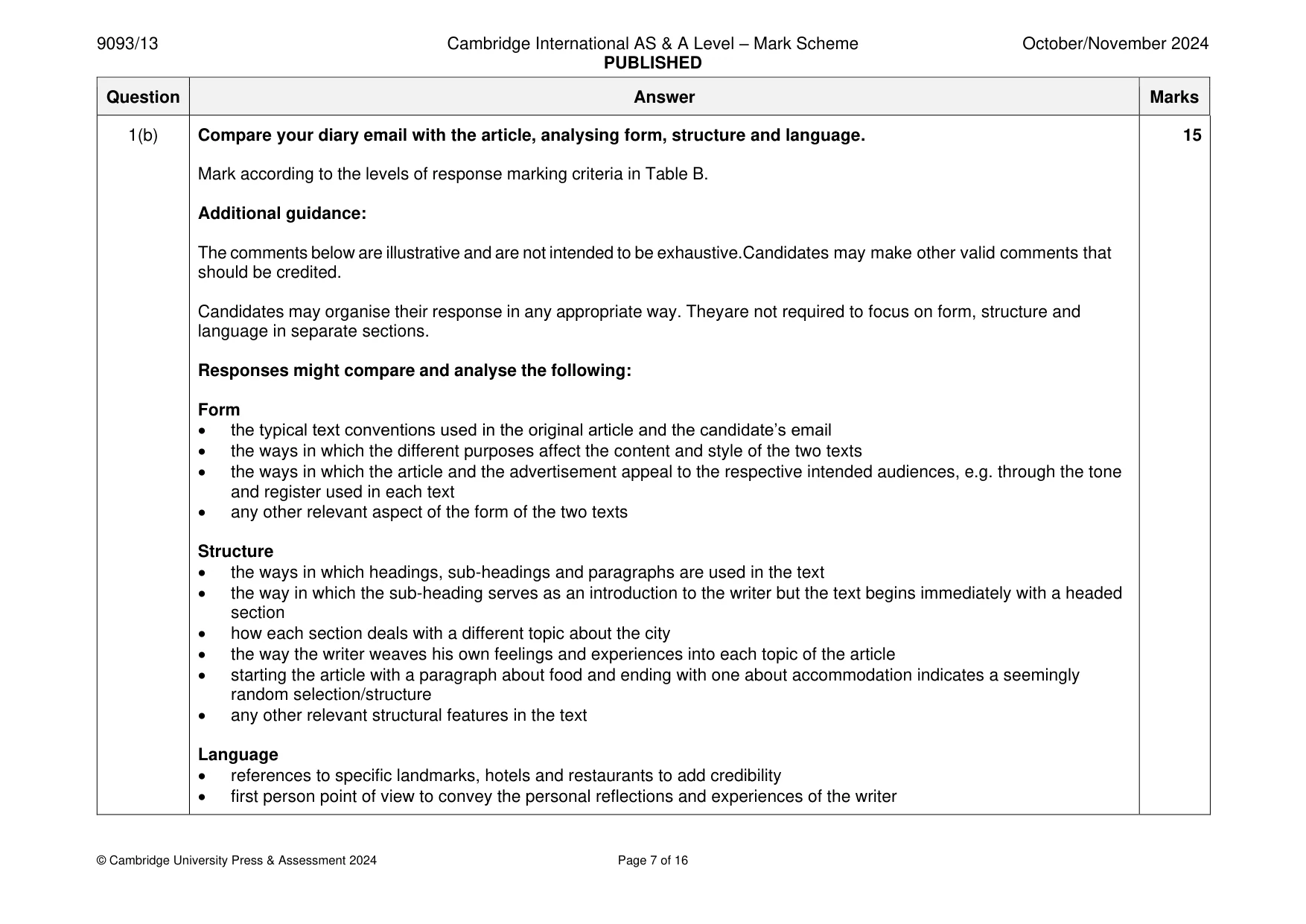
9093/13 Cambridge International AS & A Level – Mark Scheme PUBLISHED October/November 2024 © Cambridge University Press & Assessment 2024 Page 7 of 16 Question Answer Marks 1(b) Compare your diary email with the article, analysing form, structure and language. Mark according to the levels of response marking criteria in Table B. Additional guidance: The comments below are illustrative and are not intended to be exhaustive. Candidates may make other valid comments that should be credited. Candidates may organise their response in any appropriate way. They are not required to focus on form, structure and language in separate sections. Responses might compare and analyse the following: Form • the typical text conventions used in the original article and the candidate’s email • the ways in which the different purposes affect the content and style of the two texts • the ways in which the article and the advertisement appeal to the respective intended audiences, e.g. through the tone and register used in each text • any other relevant aspect of the form of the two texts Structure • the ways in which headings, sub-headings and paragraphs are used in the text • the way in which the sub-heading serves as an introduction to the writer but the text begins immediately with a headed section • how each section deals with a different topic about the city • the way the writer weaves his own feelings and experiences into each topic of the article • starting the article with a paragraph about food and ending with one about accommodation indicates a seemingly random selection/structure • any other relevant structural features in the text Language • references to specific landmarks, hotels and restaurants to add credibility • first person point of view to convey the personal reflections and experiences of the writer 15
Mark scheme, page 8
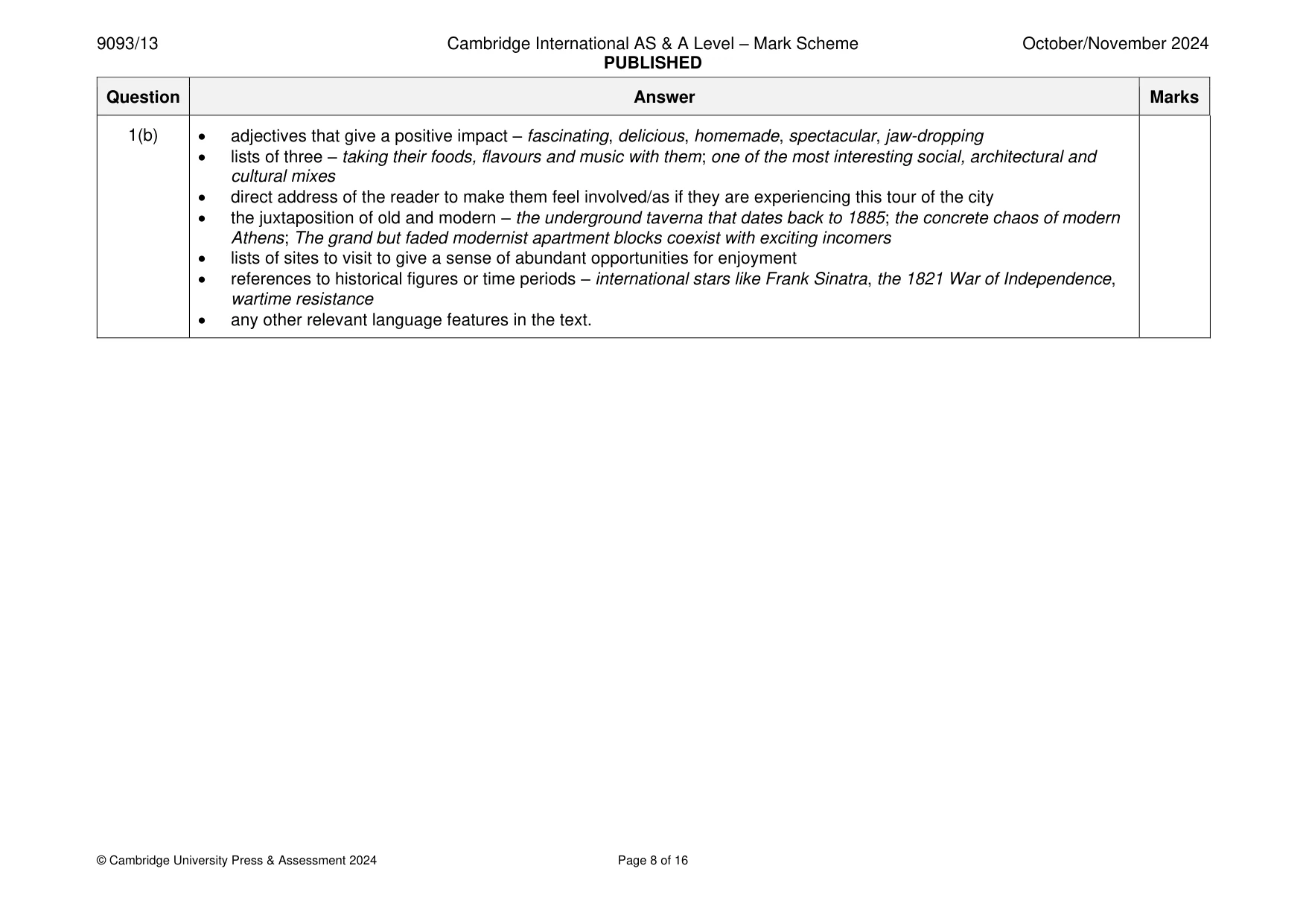
9093/13 Cambridge International AS & A Level – Mark Scheme PUBLISHED October/November 2024 © Cambridge University Press & Assessment 2024 Page 8 of 16 Question Answer Marks 1(b) • adjectives that give a positive impact – fascinating, delicious, homemade, spectacular, jaw-dropping • lists of three – taking their foods, flavours and music with them; one of the most interesting social, architectural and cultural mixes • direct address of the reader to make them feel involved/as if they are experiencing this tour of the city • the juxtaposition of old and modern – the underground taverna that dates back to 1885; the concrete chaos of modern Athens; The grand but faded modernist apartment blocks coexist with exciting incomers • lists of sites to visit to give a sense of abundant opportunities for enjoyment • references to historical figures or time periods – international stars like Frank Sinatra, the 1821 War of Independence, wartime resistance • any other relevant language features in the text.
Mark scheme, page 9
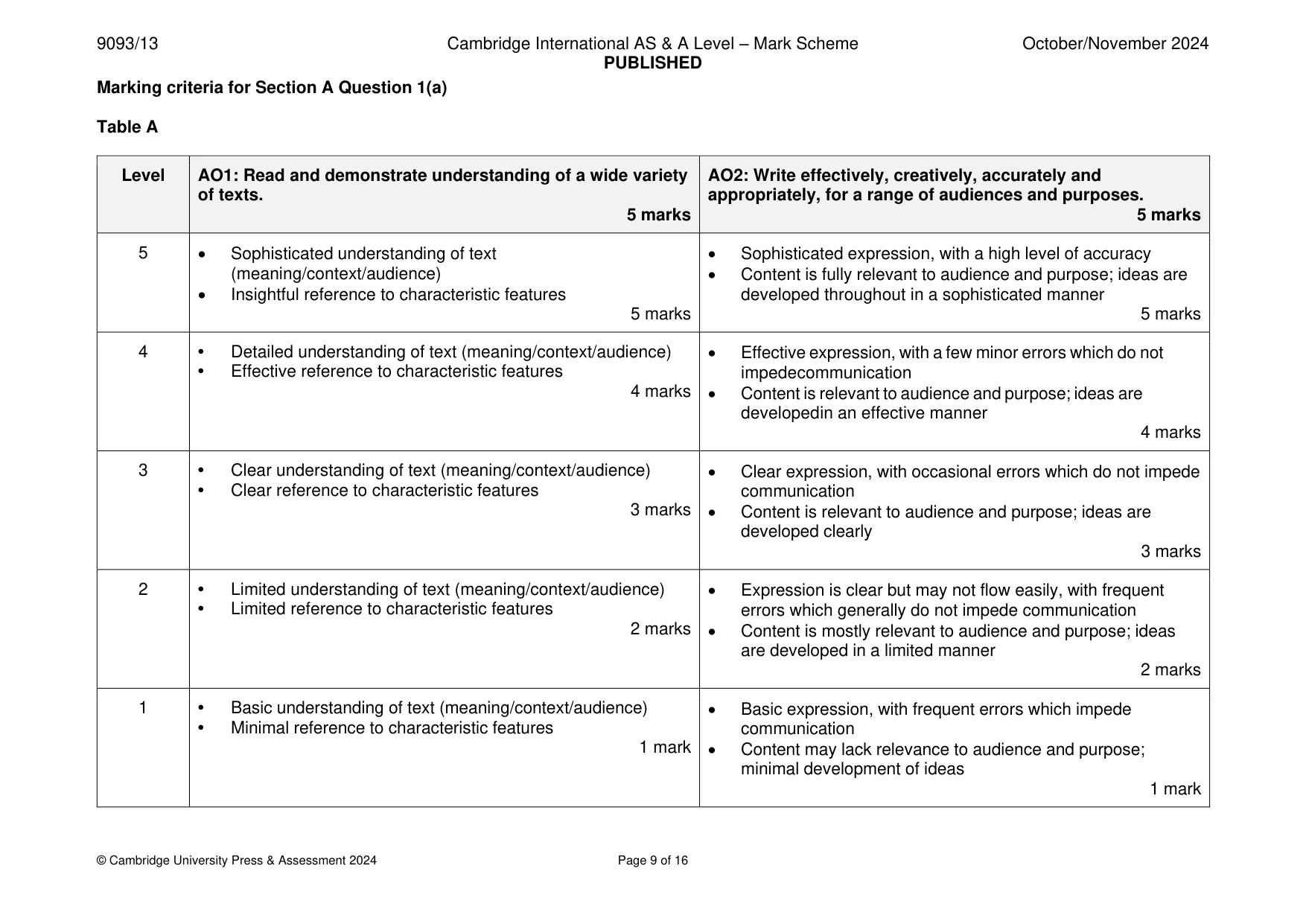
9093/13 Cambridge International AS & A Level – Mark Scheme PUBLISHED October/November 2024 © Cambridge University Press & Assessment 2024 Page 9 of 16 Marking criteria for Section A Question 1(a) Table A Level AO1: Read and demonstrate understanding of a wide variety of texts. 5 marks AO2: Write effectively, creatively, accurately and appropriately, for a range of audiences and purposes. 5 marks 5 • Sophisticated understanding of text (meaning/context/audience) • Insightful reference to characteristic features 5 marks • Sophisticated expression, with a high level of accuracy • Content is fully relevant to audience and purpose; ideas are developed throughout in a sophisticated manner 5 marks 4 • Detailed understanding of text (meaning/context/audience) • Effective reference to characteristic features 4 marks • Effective expression, with a few minor errors which do not impede communication • Content is relevant to audience and purpose; ideas are developed in an effective manner 4 marks 3 • Clear understanding of text (meaning/context/audience) • Clear reference to characteristic features 3 marks • Clear expression, with occasional errors which do not impede communication • Content is relevant to audience and purpose; ideas are developed clearly 3 marks 2 • Limited understanding of text (meaning/context/audience) • Limited reference to characteristic features 2 marks • Expression is clear but may not flow easily, with frequent errors which generally do not impede communication • Content is mostly relevant to audience and purpose; ideas are developed in a limited manner 2 marks 1 • Basic understanding of text (meaning/context/audience) • Minimal reference to characteristic features 1 mark • Basic expression, with frequent errors which impede communication • Content may lack relevance to audience and purpose; minimal development of ideas 1 mark
Mark scheme, page 10
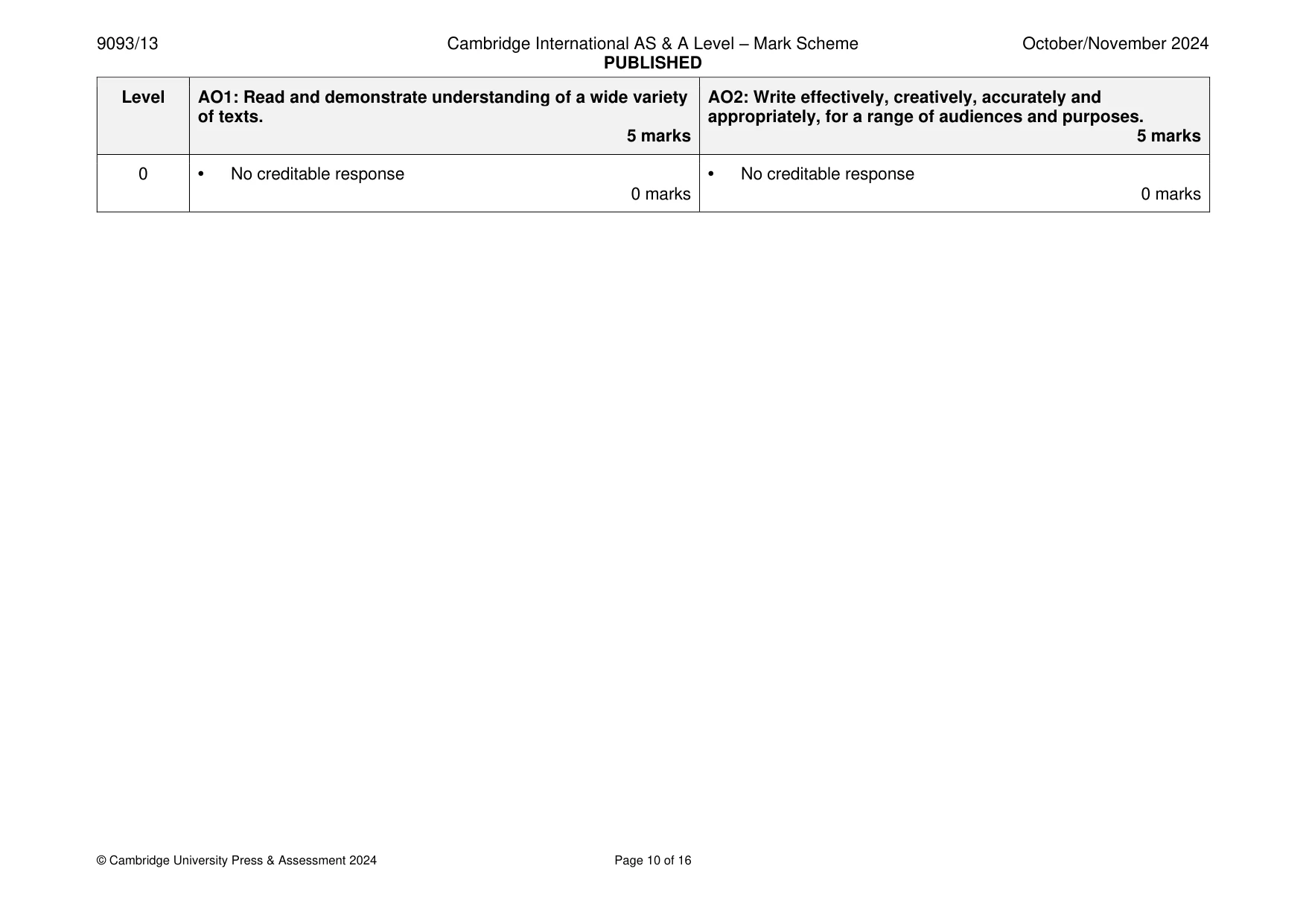
9093/13 Cambridge International AS & A Level – Mark Scheme PUBLISHED October/November 2024 © Cambridge University Press & Assessment 2024 Page 10 of 16 Level AO1: Read and demonstrate understanding of a wide variety of texts. 5 marks AO2: Write effectively, creatively, accurately and appropriately, for a range of audiences and purposes. 5 marks 0 • No creditable response 0 marks • No creditable response 0 marks
Mark scheme, page 11
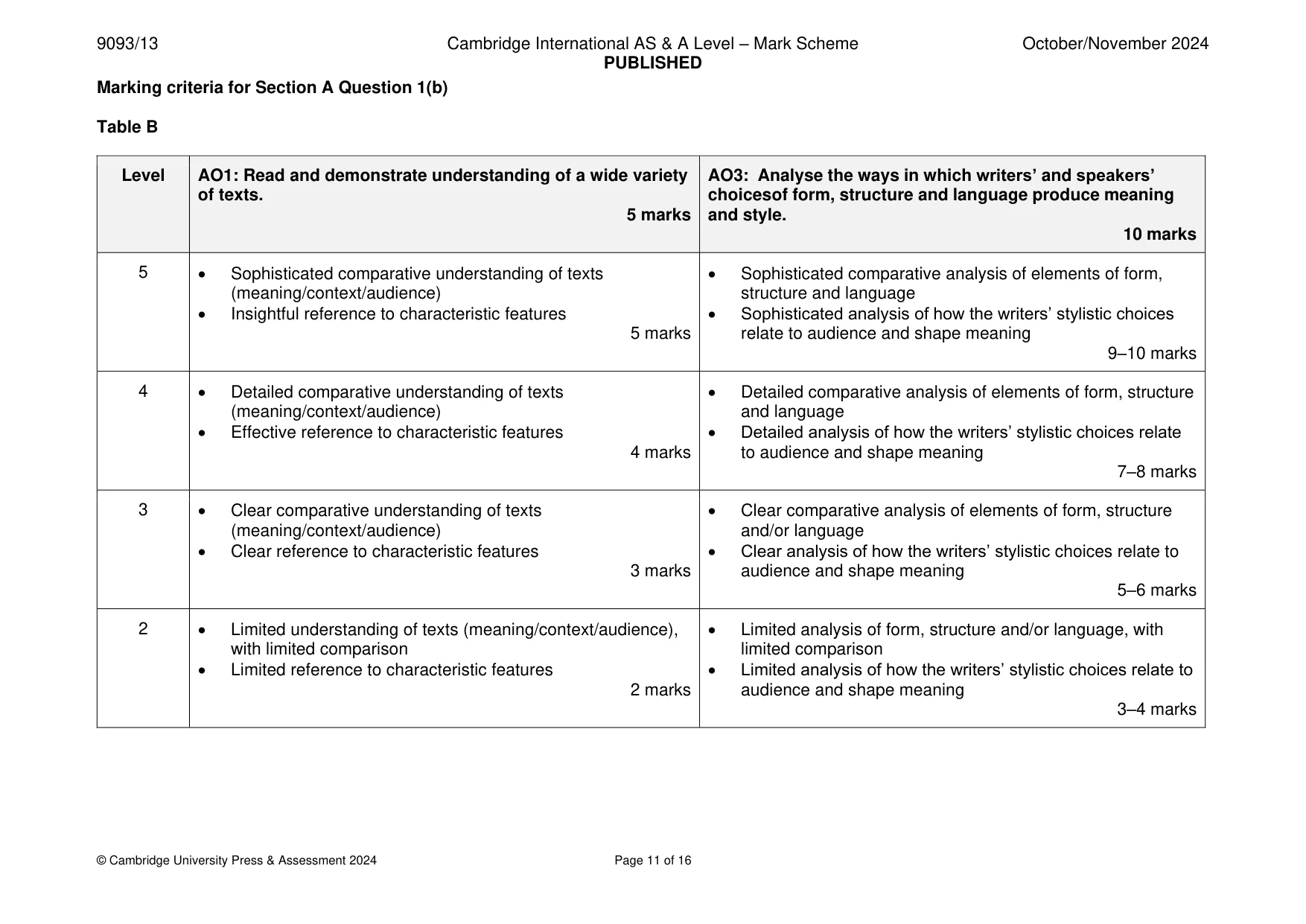
9093/13 Cambridge International AS & A Level – Mark Scheme PUBLISHED October/November 2024 © Cambridge University Press & Assessment 2024 Page 11 of 16 Marking criteria for Section A Question 1(b) Table B Level AO1: Read and demonstrate understanding of a wide variety of texts. 5 marks AO3: Analyse the ways in which writers’ and speakers’ choices of form, structure and language produce meaning and style. 10 marks 5 • Sophisticated comparative understanding of texts (meaning/context/audience) • Insightful reference to characteristic features 5 marks • Sophisticated comparative analysis of elements of form, structure and language • Sophisticated analysis of how the writers’ stylistic choices relate to audience and shape meaning 9–10 marks 4 • Detailed comparative understanding of texts (meaning/context/audience) • Effective reference to characteristic features 4 marks • Detailed comparative analysis of elements of form, structure and language • Detailed analysis of how the writers’ stylistic choices relate to audience and shape meaning 7–8 marks 3 • Clear comparative understanding of texts (meaning/context/audience) • Clear reference to characteristic features 3 marks • Clear comparative analysis of elements of form, structure and/or language • Clear analysis of how the writers’ stylistic choices relate to audience and shape meaning 5–6 marks 2 • Limited understanding of texts (meaning/context/audience), with limited comparison • Limited reference to characteristic features 2 marks • Limited analysis of form, structure and/or language, with limited comparison • Limited analysis of how the writers’ stylistic choices relate to audience and shape meaning 3–4 marks
Mark scheme, page 12
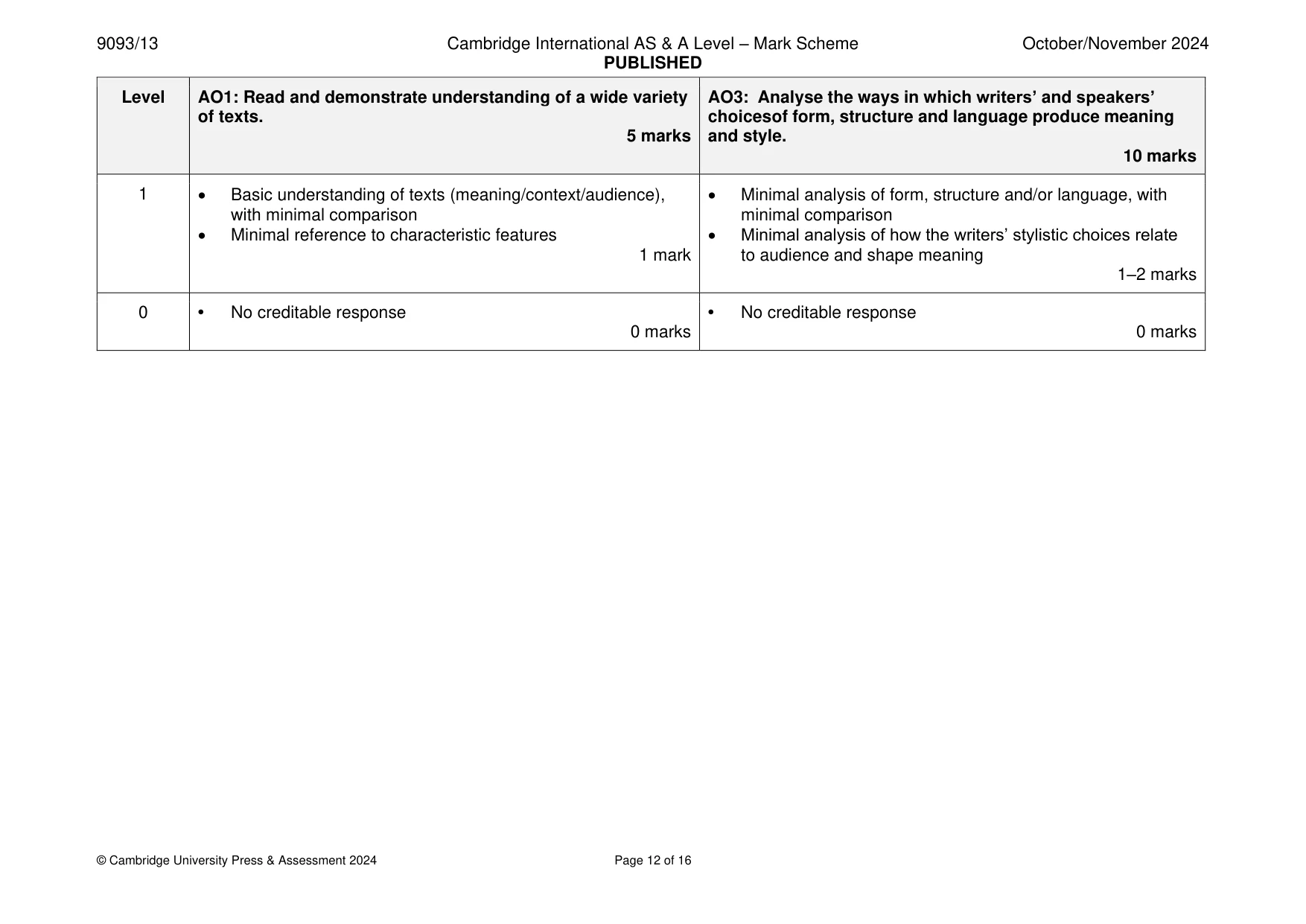
9093/13 Cambridge International AS & A Level – Mark Scheme PUBLISHED October/November 2024 © Cambridge University Press & Assessment 2024 Page 12 of 16 Level AO1: Read and demonstrate understanding of a wide variety of texts. 5 marks AO3: Analyse the ways in which writers’ and speakers’ choices of form, structure and language produce meaning and style. 10 marks 1 • Basic understanding of texts (meaning/context/audience), with minimal comparison • Minimal reference to characteristic features 1 mark • Minimal analysis of form, structure and/or language, with minimal comparison • Minimal analysis of how the writers’ stylistic choices relate to audience and shape meaning 1–2 marks 0 • No creditable response 0 marks • No creditable response 0 marks
Mark scheme, page 13
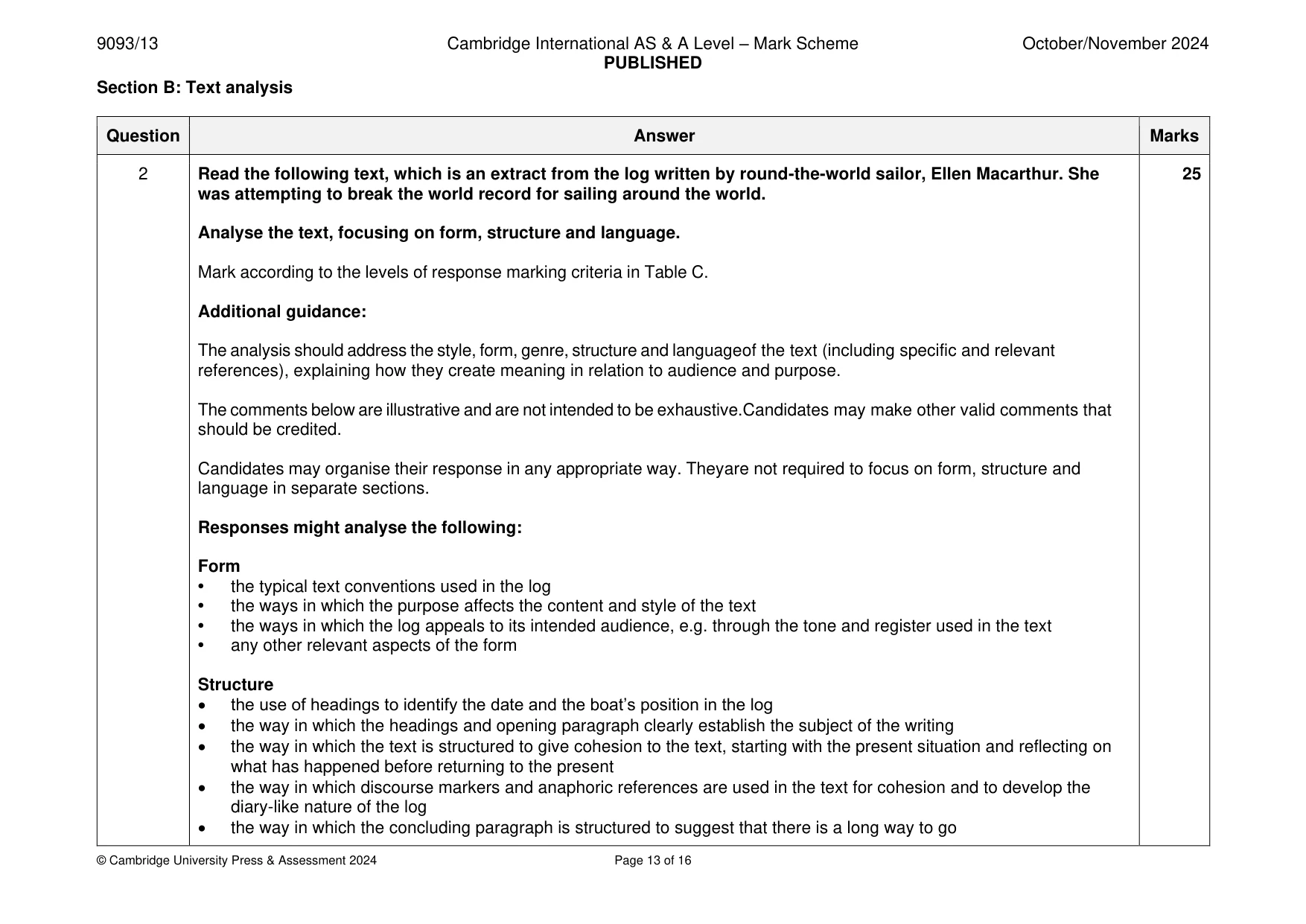
9093/13 Cambridge International AS & A Level – Mark Scheme PUBLISHED October/November 2024 © Cambridge University Press & Assessment 2024 Page 13 of 16 Section B: Text analysis Question Answer Marks 2 Read the following text, which is an extract from the log written by round-the-world sailor, Ellen Macarthur. She was attempting to break the world record for sailing around the world. Analyse the text, focusing on form, structure and language. Mark according to the levels of response marking criteria in Table C. Additional guidance: The analysis should address the style, form, genre, structure and language of the text (including specific and relevant references), explaining how they create meaning in relation to audience and purpose. The comments below are illustrative and are not intended to be exhaustive. Candidates may make other valid comments that should be credited. Candidates may organise their response in any appropriate way. They are not required to focus on form, structure and language in separate sections. Responses might analyse the following: Form • the typical text conventions used in the log • the ways in which the purpose affects the content and style of the text • the ways in which the log appeals to its intended audience, e.g. through the tone and register used in the text • any other relevant aspects of the form Structure • the use of headings to identify the date and the boat’s position in the log • the way in which the headings and opening paragraph clearly establish the subject of the writing • the way in which the text is structured to give cohesion to the text, starting with the present situation and reflecting on what has happened before returning to the present • the way in which discourse markers and anaphoric references are used in the text for cohesion and to develop the diary-like nature of the log • the way in which the concluding paragraph is structured to suggest that there is a long way to go 25
Mark scheme, page 14
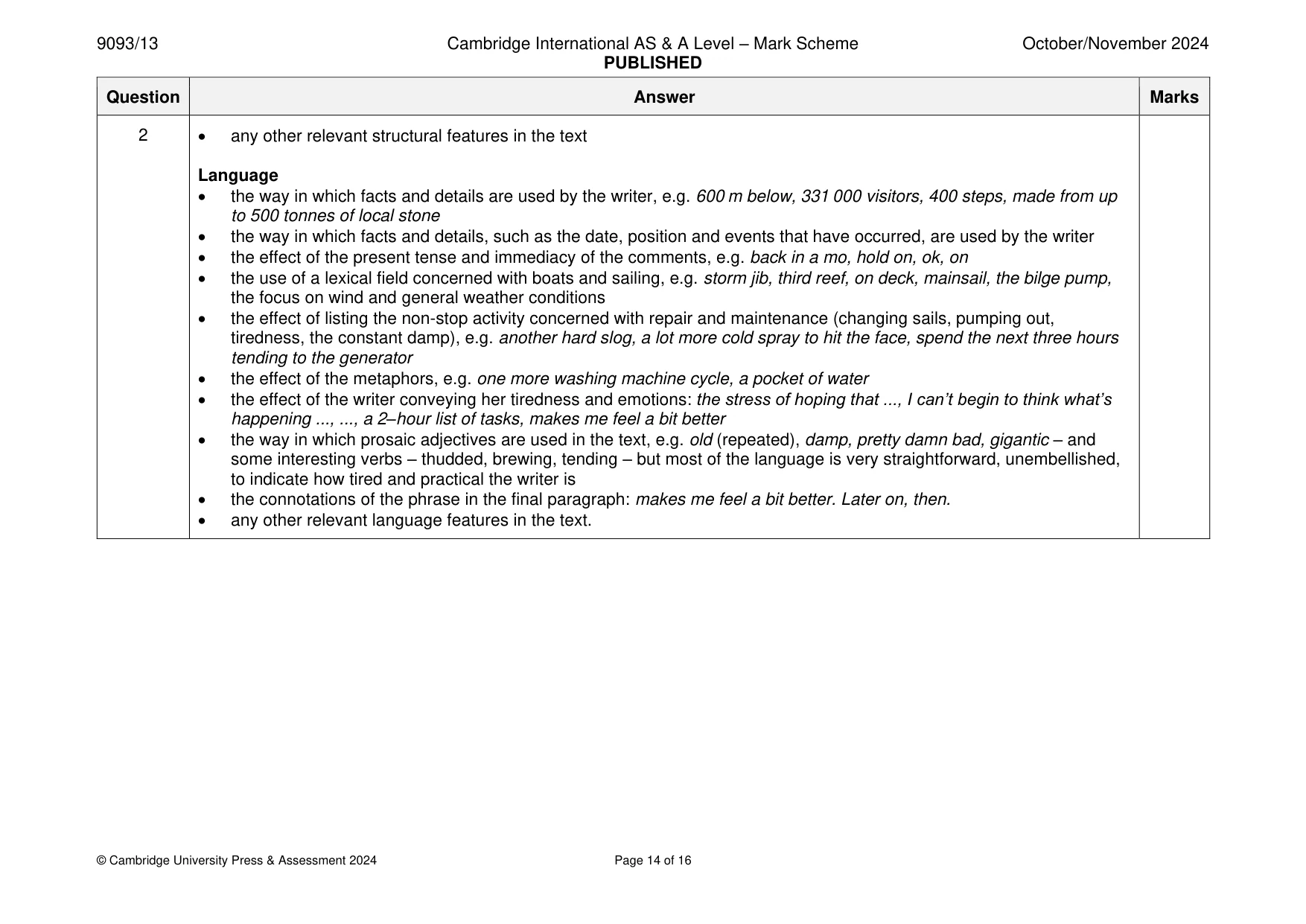
9093/13 Cambridge International AS & A Level – Mark Scheme PUBLISHED October/November 2024 © Cambridge University Press & Assessment 2024 Page 14 of 16 Question Answer Marks 2 • any other relevant structural features in the text Language • the way in which facts and details are used by the writer, e.g. 600 m below, 331 000 visitors, 400 steps, made from up to 500 tonnes of local stone • the way in which facts and details, such as the date, position and events that have occurred, are used by the writer • the effect of the present tense and immediacy of the comments, e.g. back in a mo, hold on, ok, on • the use of a lexical field concerned with boats and sailing, e.g. storm jib, third reef, on deck, mainsail, the bilge pump, the focus on wind and general weather conditions • the effect of listing the non-stop activity concerned with repair and maintenance (changing sails, pumping out, tiredness, the constant damp), e.g. another hard slog, a lot more cold spray to hit the face, spend the next three hours tending to the generator • the effect of the metaphors, e.g. one more washing machine cycle, a pocket of water • the effect of the writer conveying her tiredness and emotions: the stress of hoping that ..., I can’t begin to think what’s happening ..., ..., a 2–hour list of tasks, makes me feel a bit better • the way in which prosaic adjectives are used in the text, e.g. old (repeated), damp, pretty damn bad, gigantic – and some interesting verbs – thudded, brewing, tending – but most of the language is very straightforward, unembellished, to indicate how tired and practical the writer is • the connotations of the phrase in the final paragraph: makes me feel a bit better. Later on, then. • any other relevant language features in the text.
Mark scheme, page 15
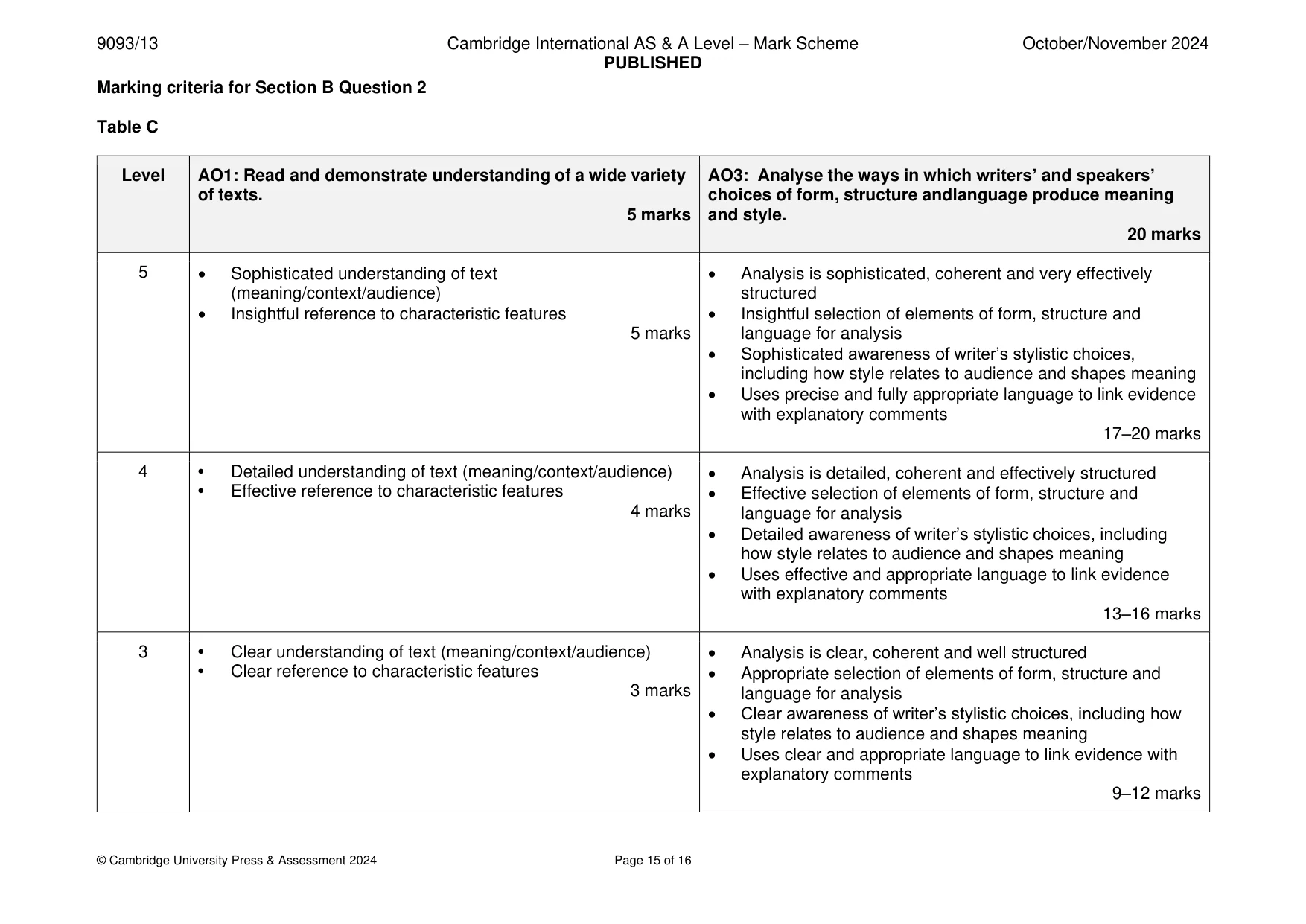
9093/13 Cambridge International AS & A Level – Mark Scheme PUBLISHED October/November 2024 © Cambridge University Press & Assessment 2024 Page 15 of 16 Marking criteria for Section B Question 2 Table C Level AO1: Read and demonstrate understanding of a wide variety of texts. 5 marks AO3: Analyse the ways in which writers’ and speakers’ choices of form, structure and language produce meaning and style. 20 marks 5 • Sophisticated understanding of text (meaning/context/audience) • Insightful reference to characteristic features 5 marks • Analysis is sophisticated, coherent and very effectively structured • Insightful selection of elements of form, structure and language for analysis • Sophisticated awareness of writer’s stylistic choices, including how style relates to audience and shapes meaning • Uses precise and fully appropriate language to link evidence with explanatory comments 17–20 marks 4 • Detailed understanding of text (meaning/context/audience) • Effective reference to characteristic features 4 marks • Analysis is detailed, coherent and effectively structured • Effective selection of elements of form, structure and language for analysis • Detailed awareness of writer’s stylistic choices, including how style relates to audience and shapes meaning • Uses effective and appropriate language to link evidence with explanatory comments 13–16 marks 3 • Clear understanding of text (meaning/context/audience) • Clear reference to characteristic features 3 marks • Analysis is clear, coherent and well structured • Appropriate selection of elements of form, structure and language for analysis • Clear awareness of writer’s stylistic choices, including how style relates to audience and shapes meaning • Uses clear and appropriate language to link evidence with explanatory comments 9–12 marks
Mark scheme, page 16
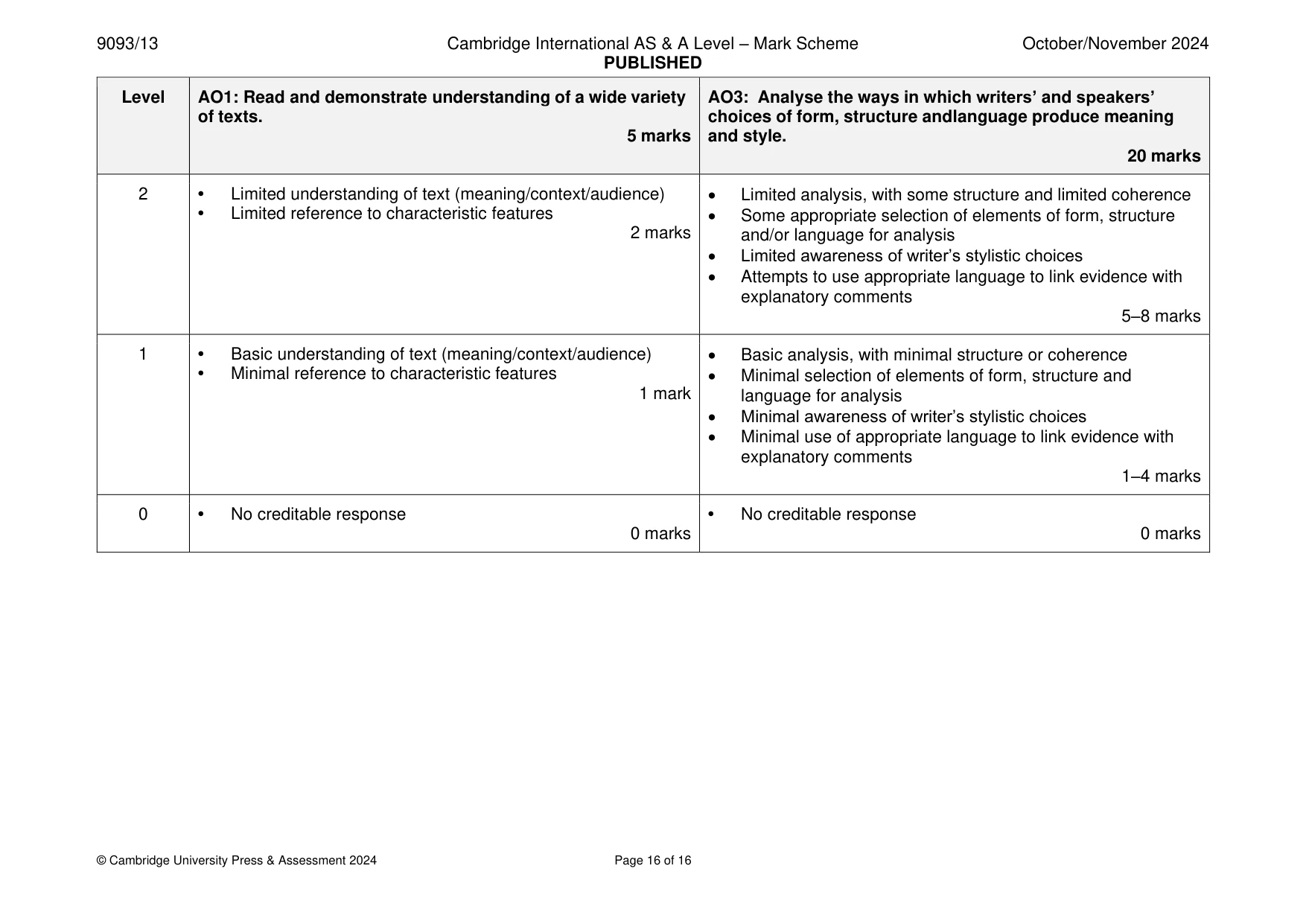
9093/13 Cambridge International AS & A Level – Mark Scheme PUBLISHED October/November 2024 © Cambridge University Press & Assessment 2024 Page 16 of 16 Level AO1: Read and demonstrate understanding of a wide variety of texts. 5 marks AO3: Analyse the ways in which writers’ and speakers’ choices of form, structure and language produce meaning and style. 20 marks 2 • Limited understanding of text (meaning/context/audience) • Limited reference to characteristic features 2 marks • Limited analysis, with some structure and limited coherence • Some appropriate selection of elements of form, structure and/or language for analysis • Limited awareness of writer’s stylistic choices • Attempts to use appropriate language to link evidence with explanatory comments 5–8 marks 1 • Basic understanding of text (meaning/context/audience) • Minimal reference to characteristic features 1 mark • Basic analysis, with minimal structure or coherence • Minimal selection of elements of form, structure and language for analysis • Minimal awareness of writer’s stylistic choices • Minimal use of appropriate language to link evidence with explanatory comments 1–4 marks 0 • No creditable response 0 marks • No creditable response 0 marks
What you needed in this session
Cambridge’s own grade thresholds for 2024 Oct/Nov, Paper 1 · Variant 3. A higher threshold means an easier paper — the bar moves with how the cohort did.