Cambridge A Level English - Language AS and A Level (from 2014) 9093 — 2025 Oct/Nov Paper 1 · Variant 2
9093/12/O/N/25 · 50 marks · 135 min
The question paper and its mark scheme, free to read here and free to download. This is Cambridge’s own paper, exactly as it was sat.
Question paper8 pages
Mark scheme16 pages
Answers below. Sit the paper first if you are practising.
Paper as text
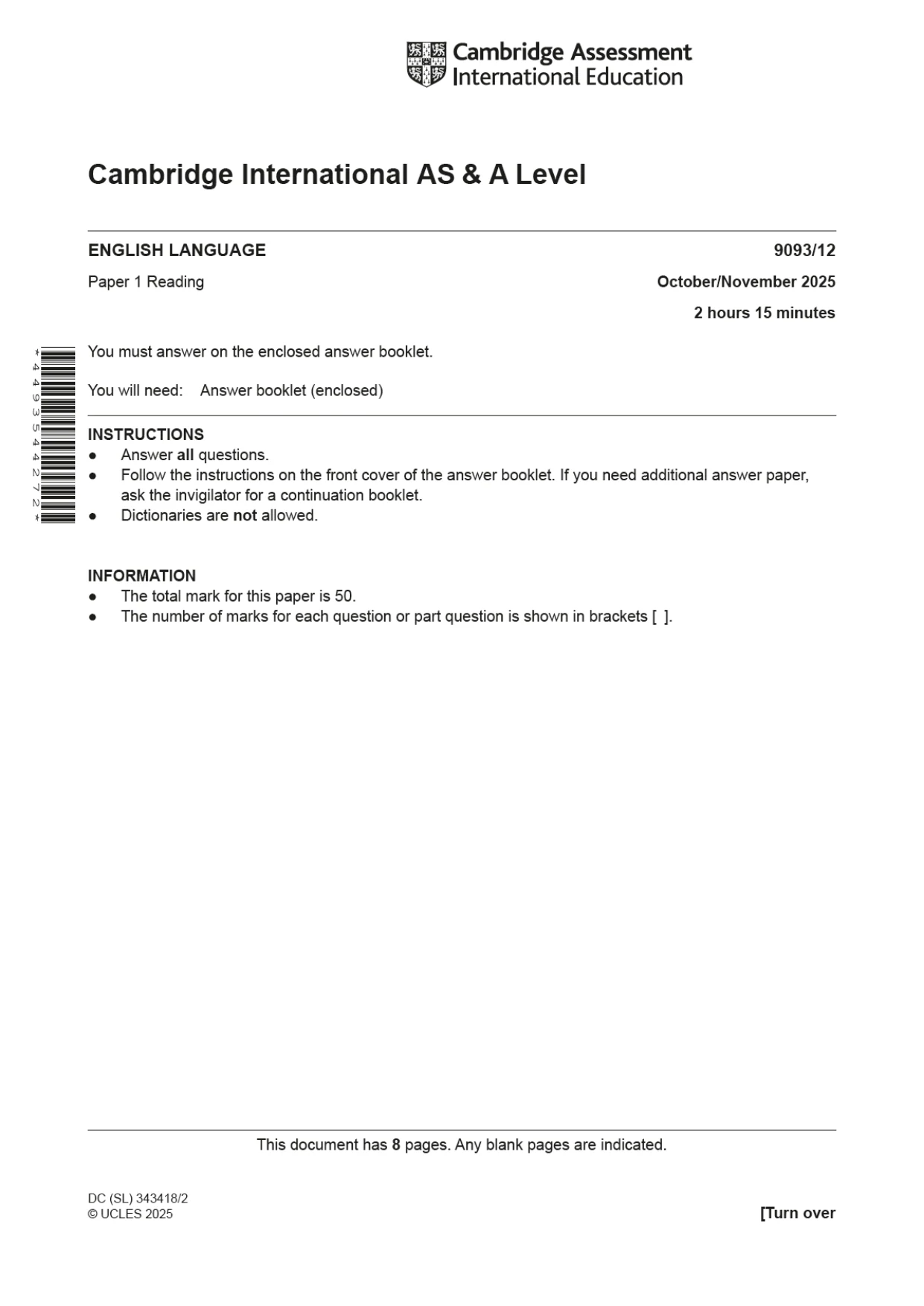
Question paper, page 1
Cambridge Assessment International Education Cambridge International AS & A Level ENGLISH LANGUAGE 9093/12 Paper 1 Reading October/November 2025 2 hours 15 minutes You must answer on the enclosed answer booklet. You will need: Answer booklet (enclosed) INSTRUCTIONS e Answer all questions. e Follow the instructions on the front cover of the answer booklet. If you need additional answer paper, ask the invigilator for a continuation booklet. e Dictionaries are not allowed. INFORMATION e The total mark for this paper is 50. e The number of marks for each question or part question is shown in brackets [ ]. This document has 8 pages. Any blank pages are indicated. DC (SL) 343418/2 © UCLES 2025 [Turn over
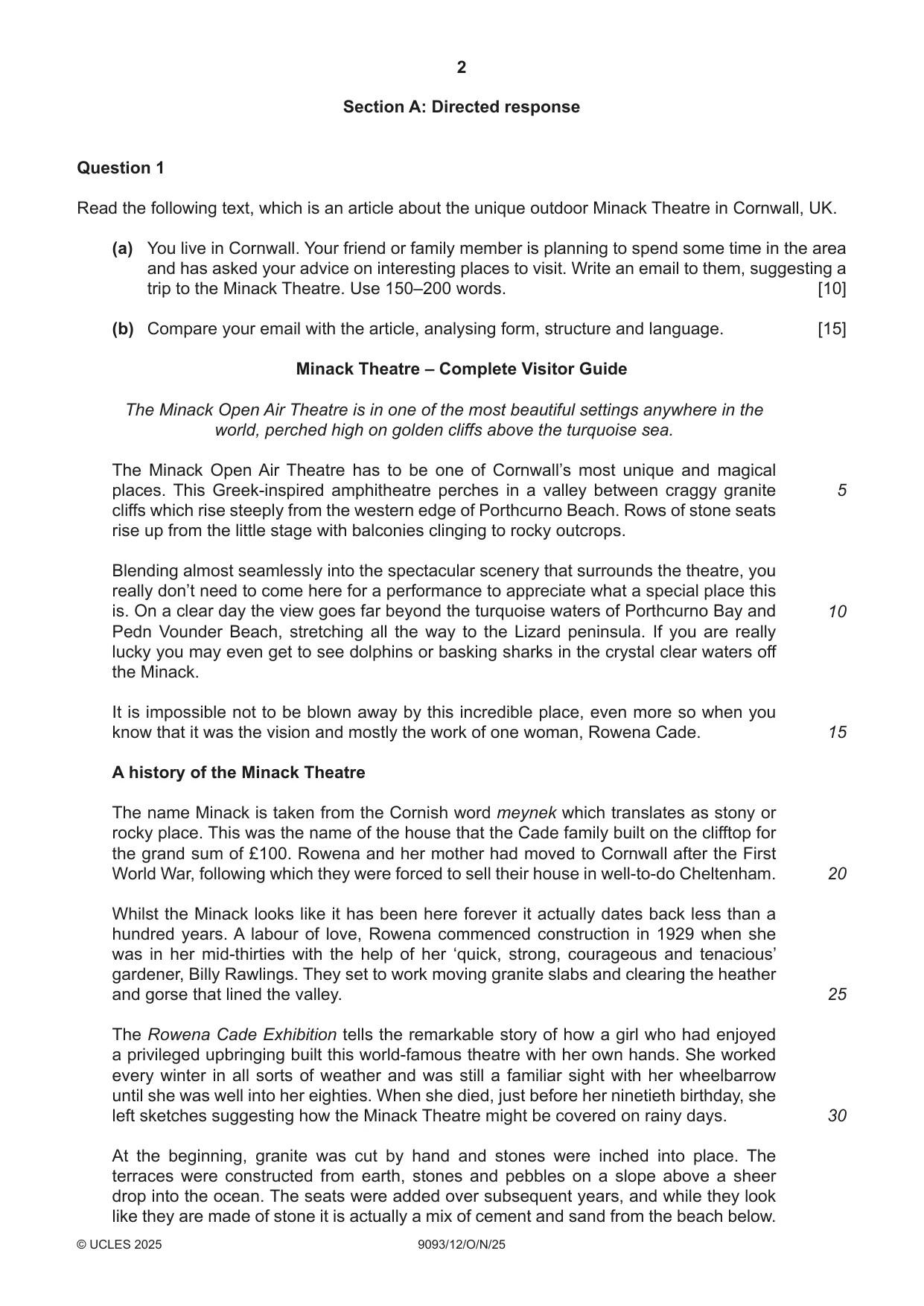
Question paper, page 2
2 9093/12/O/N/25 © UCLES 2025 Section A: Directed response Question 1 Read the following text, which is an article about the unique outdoor Minack Theatre in Cornwall, UK. (a) You live in Cornwall. Your friend or family member is planning to spend some time in the area and has asked your advice on interesting places to visit. Write an email to them, suggesting a trip to the Minack Theatre. Use 150–200 words. [10] (b) Compare your email with the article, analysing form, structure and language. [15] Minack Theatre – Complete Visitor Guide The Minack Open Air Theatre is in one of the most beautiful settings anywhere in the world, perched high on golden cliffs above the turquoise sea. The Minack Open Air Theatre has to be one of Cornwall’s most unique and magical places. This Greek-inspired amphitheatre perches in a valley between craggy granite cliffs which rise steeply from the western edge of Porthcurno Beach. Rows of stone seats rise up from the little stage with balconies clinging to rocky outcrops. Blending almost seamlessly into the spectacular scenery that surrounds the theatre, you really don’t need to come here for a performance to appreciate what a special place this is. On a clear day the view goes far beyond the turquoise waters of Porthcurno Bay and Pedn Vounder Beach, stretching all the way to the Lizard peninsula. If you are really lucky you may even get to see dolphins or basking sharks in the crystal clear waters off the Minack. It is impossible not to be blown away by this incredible place, even more so when you know that it was the vision and mostly the work of one woman, Rowena Cade. A history of the Minack Theatre The name Minack is taken from the Cornish word meynek which translates as stony or rocky place. This was the name of the house that the Cade family built on the clifftop for the grand sum of £100. Rowena and her mother had moved to Cornwall after the First World War, following which they were forced to sell their house in well-to-do Cheltenham. Whilst the Minack looks like it has been here forever it actually dates back less than a hundred years. A labour of love, Rowena commenced construction in 1929 when she was in her mid-thirties with the help of her ‘quick, strong, courageous and tenacious’ gardener, Billy Rawlings. They set to work moving granite slabs and clearing the heather and gorse that lined the valley. The Rowena Cade Exhibition tells the remarkable story of how a girl who had enjoyed a privileged upbringing built this world-famous theatre with her own hands. She worked every winter in all sorts of weather and was still a familiar sight with her wheelbarrow until she was well into her eighties. When she died, just before her ninetieth birthday, she left sketches suggesting how the Minack Theatre might be covered on rainy days. At the beginning, granite was cut by hand and stones were inched into place. The terraces were constructed from earth, stones and pebbles on a slope above a sheer drop into the ocean. The seats were added over subsequent years, and while they look like they are made of stone it is actually a mix of cement and sand from the beach below. 5 10 15 20 25 30
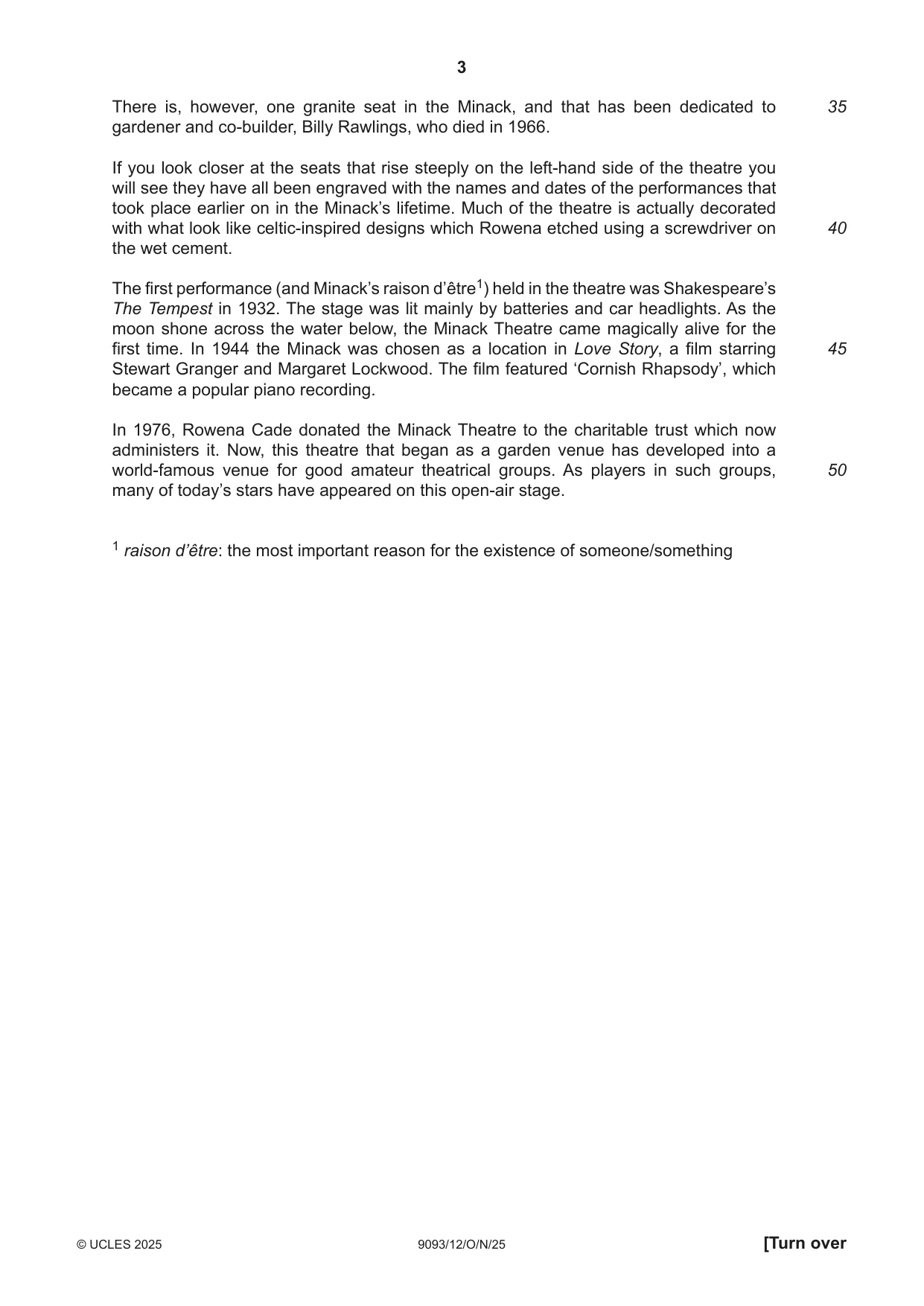
Question paper, page 3
3 9093/12/O/N/25 © UCLES 2025 [Turn over There is, however, one granite seat in the Minack, and that has been dedicated to gardener and co-builder, Billy Rawlings, who died in 1966. If you look closer at the seats that rise steeply on the left-hand side of the theatre you will see they have all been engraved with the names and dates of the performances that took place earlier on in the Minack’s lifetime. Much of the theatre is actually decorated with what look like celtic-inspired designs which Rowena etched using a screwdriver on the wet cement. The first performance (and Minack’s raison d’être1) held in the theatre was Shakespeare’s The Tempest in 1932. The stage was lit mainly by batteries and car headlights. As the moon shone across the water below, the Minack Theatre came magically alive for the first time. In 1944 the Minack was chosen as a location in Love Story, a film starring Stewart Granger and Margaret Lockwood. The film featured ‘Cornish Rhapsody’, which became a popular piano recording. In 1976, Rowena Cade donated the Minack Theatre to the charitable trust which now administers it. Now, this theatre that began as a garden venue has developed into a world-famous venue for good amateur theatrical groups. As players in such groups, many of today’s stars have appeared on this open-air stage. 1 raison d’être: the most important reason for the existence of someone/something 35 40 45 50
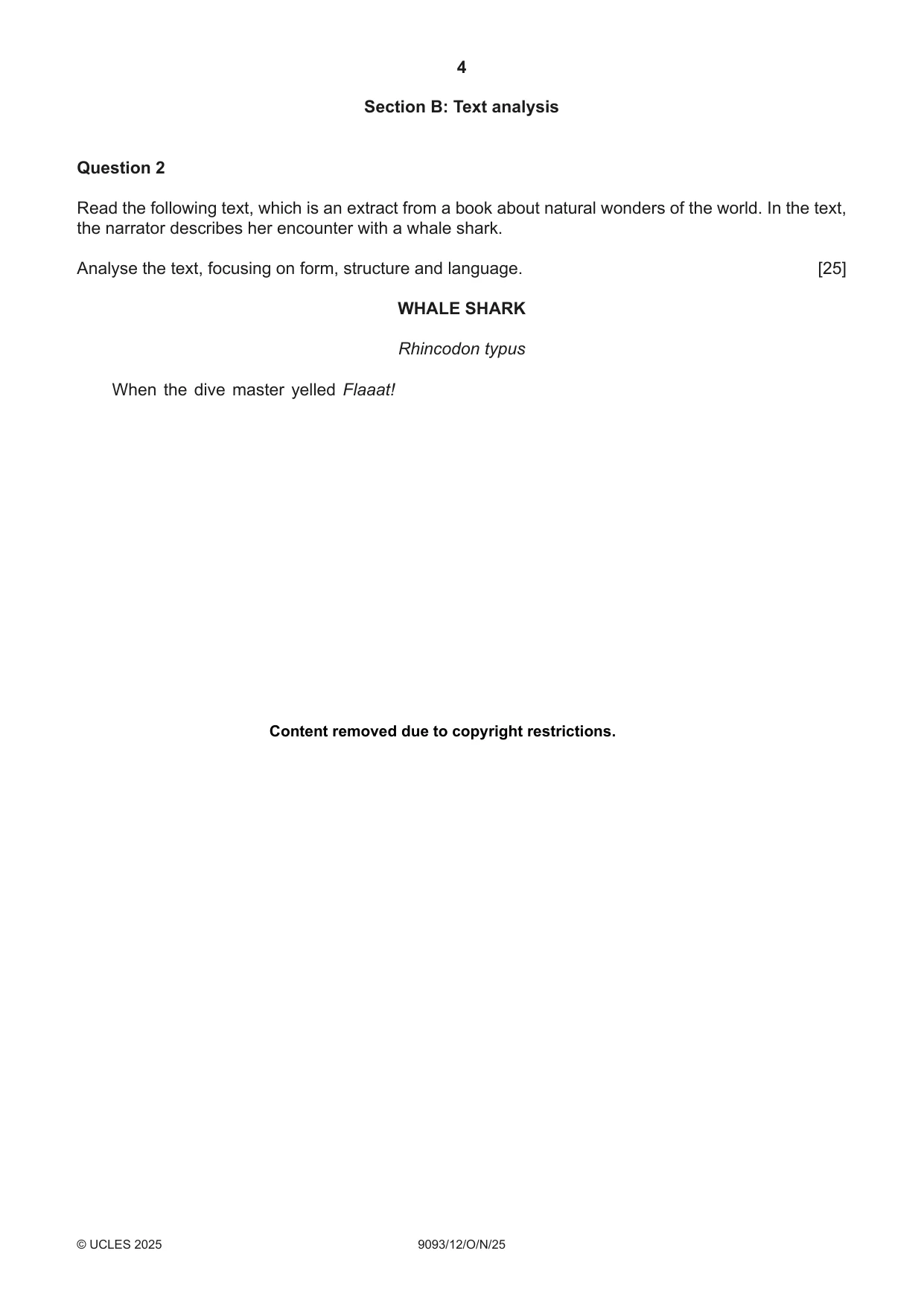
Question paper, page 4
4 9093/12/O/N/25 © UCLES 2025 Section B: Text analysis Question 2 Read the following text, which is an extract from a book about natural wonders of the world. In the text, the narrator describes her encounter with a whale shark. Analyse the text, focusing on form, structure and language. [25] WHALE SHARK Rhincodon typus When the dive master yelled Flaaat! Content removed due to copyright restrictions.
Question paper, page 5
5 9093/12/O/N/25 © UCLES 2025 I knew that whale sharks belong in the wild, where they can do more than trace a slow curve around the same planted coral and faux sea-cliff. Content removed due to copyright restrictions.
Question paper, page 6
6 9093/12/O/N/25 © UCLES 2025 BLANK PAGE
Question paper, page 7
7 9093/12/O/N/25 © UCLES 2025 BLANK PAGE
Question paper, page 8
8 9093/12/O/N/25 © UCLES 2025 Permission to reproduce items where third-party owned material protected by copyright is included has been sought and cleared where possible. Every reasonable effort has been made by the publisher (UCLES) to trace copyright holders, but if any items requiring clearance have unwittingly been included, the publisher will be pleased to make amends at the earliest possible opportunity. To avoid the issue of disclosure of answer-related information to candidates, all copyright acknowledgements are reproduced online in the Cambridge Assessment International Education Copyright Acknowledgements Booklet. This is produced for each series of examinations and is freely available to download at www.cambridgeinternational.org after the live examination series. Cambridge Assessment International Education is part of Cambridge Assessment. Cambridge Assessment is the brand name of the University of Cambridge Local Examinations Syndicate (UCLES), which is a department of the University of Cambridge. BLANK PAGE
Mark scheme, page 1
This document consists of 16 printed pages. © Cambridge University Press & Assessment 2025 [Turn over Cambridge International AS & A Level ENGLISH LANGUAGE 9093/12 Paper 1 Reading October/November 2025 MARK SCHEME Maximum Mark: 50 Published This mark scheme is published as an aid to teachers and candidates, to indicate the requirements of the examination. It shows the basis on which Examiners were instructed to award marks. It does not indicate the details of the discussions that took place at an Examiners’ meeting before marking began, which would have considered the acceptability of alternative answers. Mark schemes should be read in conjunction with the question paper and the Principal Examiner Report for Teachers. Cambridge International will not enter into discussions about these mark schemes. Cambridge International is publishing the mark schemes for the October/November 2025 series for most Cambridge IGCSE, Cambridge International A and AS Level components, and some Cambridge O Level components.
Mark scheme, page 2
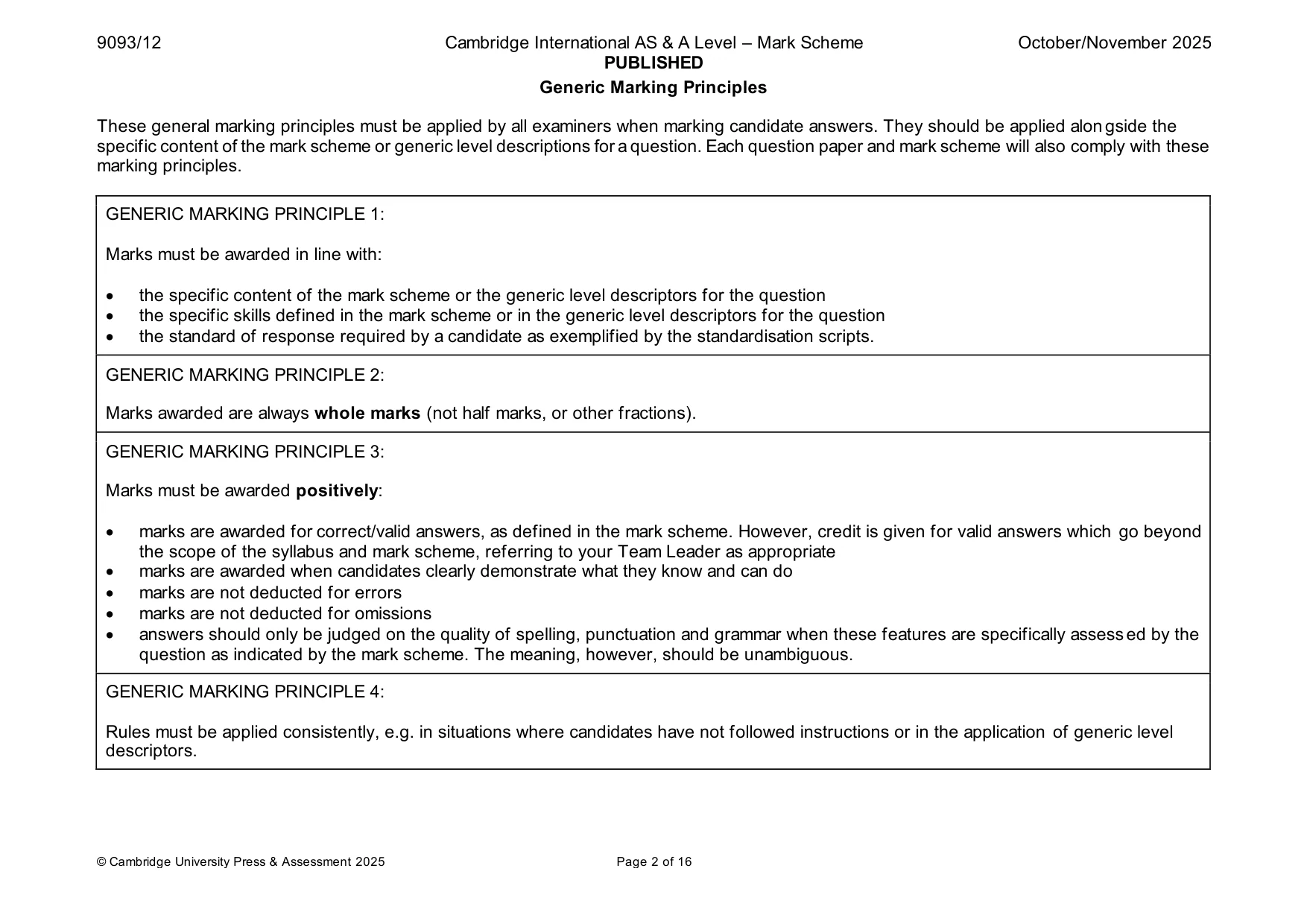
9093/12 Cambridge International AS & A Level – Mark Scheme PUBLISHED October/November 2025 © Cambridge University Press & Assessment 2025 Page 2 of 16 Generic Marking Principles These general marking principles must be applied by all examiners when marking candidate answers. They should be applied alon gside the specific content of the mark scheme or generic level descriptions for a question. Each question paper and mark scheme will also comply with these marking principles. GENERIC MARKING PRINCIPLE 1: Marks must be awarded in line with: • the specific content of the mark scheme or the generic level descriptors for the question • the specific skills defined in the mark scheme or in the generic level descriptors for the question • the standard of response required by a candidate as exemplified by the standardisation scripts. GENERIC MARKING PRINCIPLE 2: Marks awarded are always whole marks (not half marks, or other fractions). GENERIC MARKING PRINCIPLE 3: Marks must be awarded positively: • marks are awarded for correct/valid answers, as defined in the mark scheme. However, credit is given for valid answers which go beyond the scope of the syllabus and mark scheme, referring to your Team Leader as appropriate • marks are awarded when candidates clearly demonstrate what they know and can do • marks are not deducted for errors • marks are not deducted for omissions • answers should only be judged on the quality of spelling, punctuation and grammar when these features are specifically assessed by the question as indicated by the mark scheme. The meaning, however, should be unambiguous. GENERIC MARKING PRINCIPLE 4: Rules must be applied consistently, e.g. in situations where candidates have not followed instructions or in the application of generic level descriptors.
Mark scheme, page 3
9093/12 Cambridge International AS & A Level – Mark Scheme PUBLISHED October/November 2025 © Cambridge University Press & Assessment 2025 Page 3 of 16 GENERIC MARKING PRINCIPLE 5: Marks should be awarded using the full range of marks defined in the mark scheme for the question (however; the use of the full mark range may be limited according to the quality of the candidate responses seen). GENERIC MARKING PRINCIPLE 6: Marks awarded are based solely on the requirements as defined in the mark scheme. Marks should not be awarded with grade thre sholds or grade descriptors in mind. English & Media subject specific general marking principles (To be read in conjunction with the Generic Marking Principles (and requiring further guidance on how to place marks within l evels)) Components using level descriptors: • We use level descriptors as a guide to broad understanding of the qualities normally expected of, or typical of, work in a le vel. • Level descriptors are a means of general guidance and should not be interpreted as hurdle statements. • Where indicative content notes are supplied for a question, these are not a prescription of required content, and must not be treated as such. Alternative correct points and unexpected answers in candidates’ scripts must be given marks that fairly reflect the knowledg e and skills demonstrated. • While we may have legitimate expectations as to the ground most answers may occupy, we must at all times be prepared to meet candidates on their chosen ground, provided it is relevant ground (e.g. clearly related to and derived from a relevant passag e/text and meeting the mark scheme requirements for the question).
Mark scheme, page 4
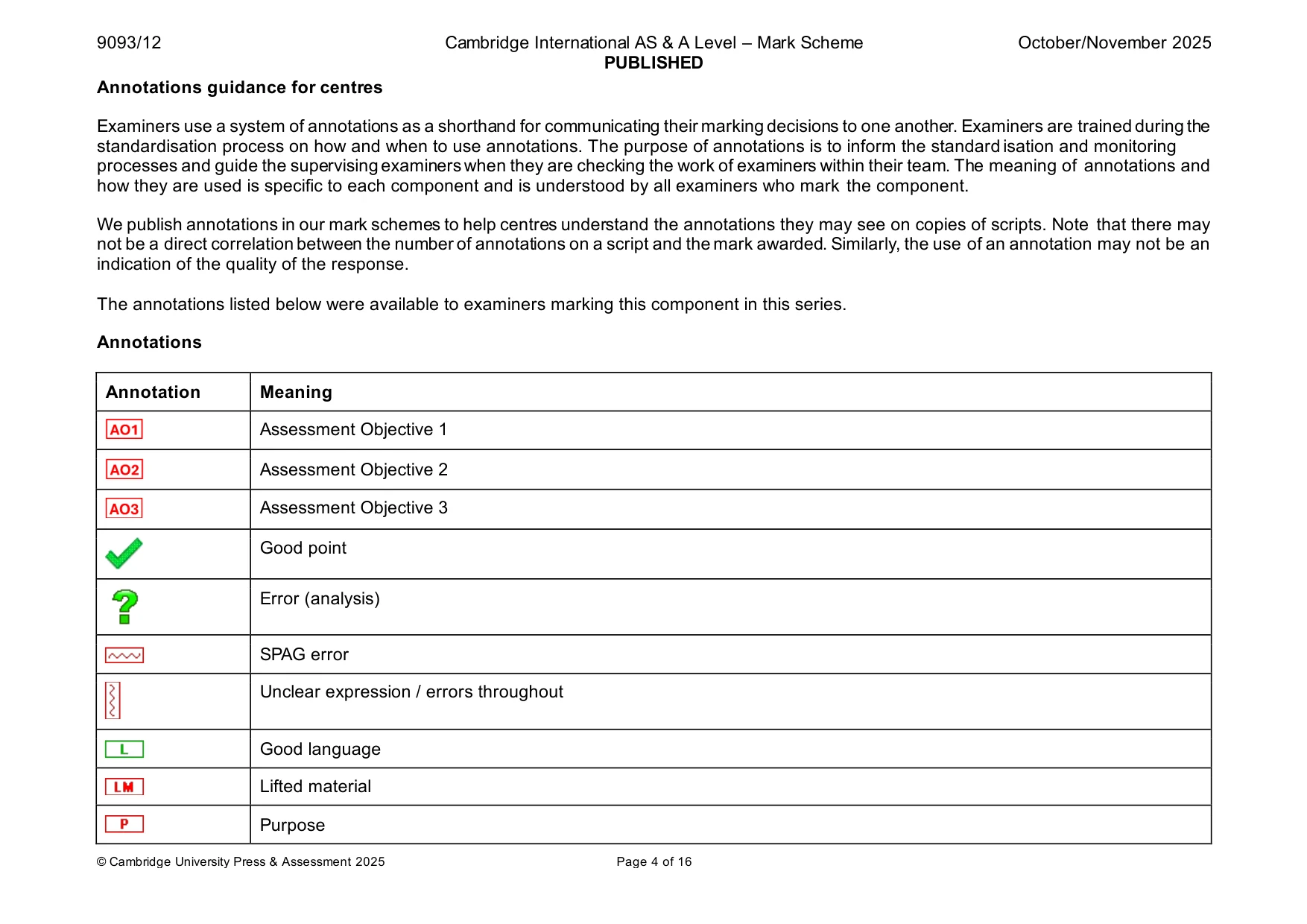
9093/12 Cambridge International AS & A Level – Mark Scheme PUBLISHED October/November 2025 © Cambridge University Press & Assessment 2025 Page 4 of 16 Annotations guidance for centres Examiners use a system of annotations as a shorthand for communicating their marking decisions to one another. Examiners are trained during the standardisation process on how and when to use annotations. The purpose of annotations is to inform the standard isation and monitoring processes and guide the supervising examiners when they are checking the work of examiners within their team. The meaning of annotations and how they are used is specific to each component and is understood by all examiners who mark the component. We publish annotations in our mark schemes to help centres understand the annotations they may see on copies of scripts. Note that there may not be a direct correlation between the number of annotations on a script and the mark awarded. Similarly, the use of an annotation may not be an indication of the quality of the response. The annotations listed below were available to examiners marking this component in this series. Annotations Annotation Meaning Assessment Objective 1 Assessment Objective 2 Assessment Objective 3 Good point Error (analysis) SPAG error Unclear expression / errors throughout Good language Lifted material Purpose
Mark scheme, page 5
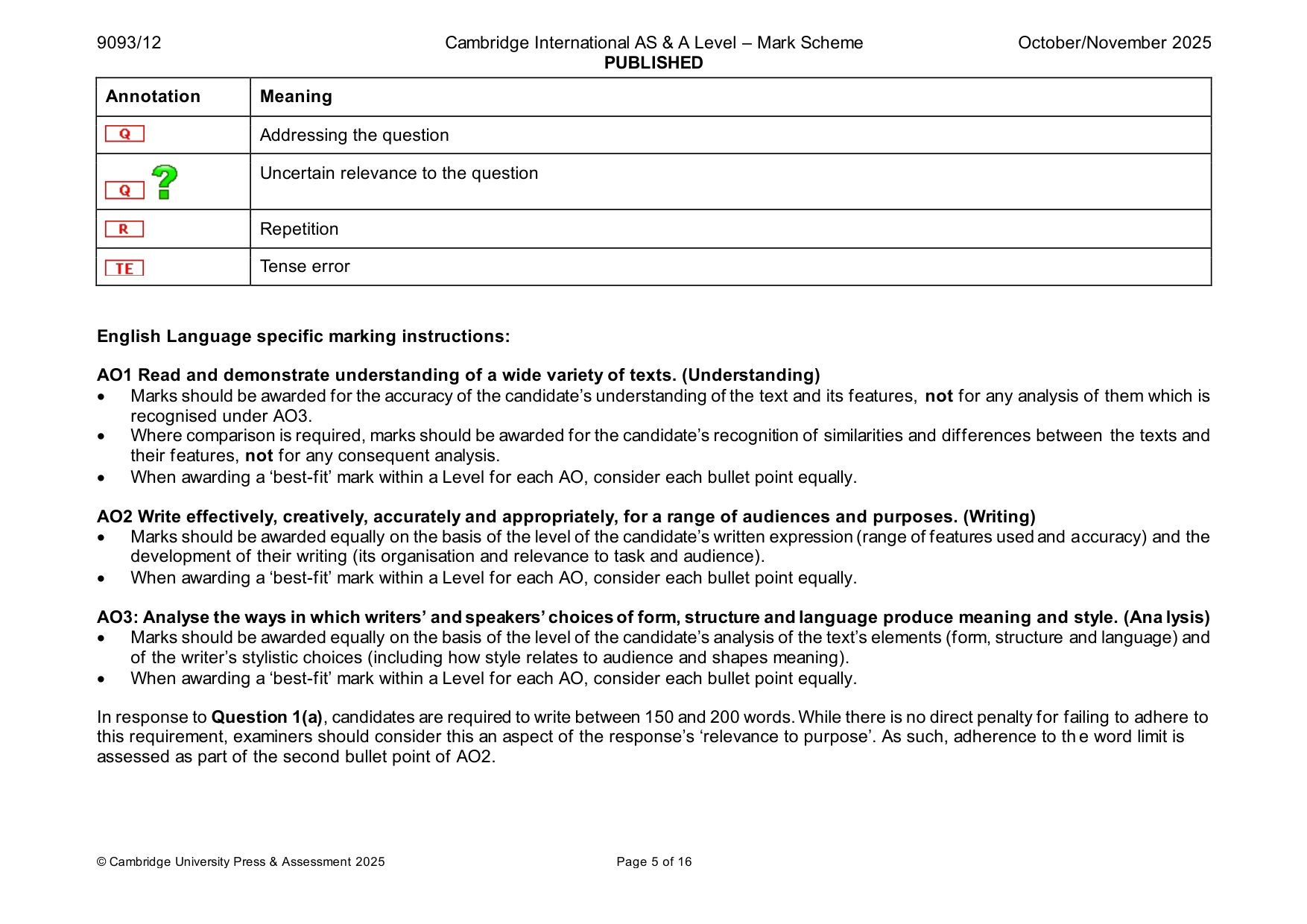
9093/12 Cambridge International AS & A Level – Mark Scheme PUBLISHED October/November 2025 © Cambridge University Press & Assessment 2025 Page 5 of 16 Annotation Meaning Addressing the question Uncertain relevance to the question Repetition Tense error English Language specific marking instructions: AO1 Read and demonstrate understanding of a wide variety of texts. (Understanding) • Marks should be awarded for the accuracy of the candidate’s understanding of the text and its features, not for any analysis of them which is recognised under AO3. • Where comparison is required, marks should be awarded for the candidate’s recognition of similarities and differences between the texts and their features, not for any consequent analysis. • When awarding a ‘best-fit’ mark within a Level for each AO, consider each bullet point equally. AO2 Write effectively, creatively, accurately and appropriately, for a range of audiences and purposes. (Writing) • Marks should be awarded equally on the basis of the level of the candidate’s written expression (range of features used and accuracy) and the development of their writing (its organisation and relevance to task and audience). • When awarding a ‘best-fit’ mark within a Level for each AO, consider each bullet point equally. AO3: Analyse the ways in which writers’ and speakers’ choices of form, structure and language produce meaning and style. (Ana lysis) • Marks should be awarded equally on the basis of the level of the candidate’s analysis of the text’s elements (form, structure and language) and of the writer’s stylistic choices (including how style relates to audience and shapes meaning). • When awarding a ‘best-fit’ mark within a Level for each AO, consider each bullet point equally. In response to Question 1(a), candidates are required to write between 150 and 200 words. While there is no direct penalty for failing to adhere to this requirement, examiners should consider this an aspect of the response’s ‘relevance to purpose’. As such, adherence to th e word limit is assessed as part of the second bullet point of AO2.
Mark scheme, page 6
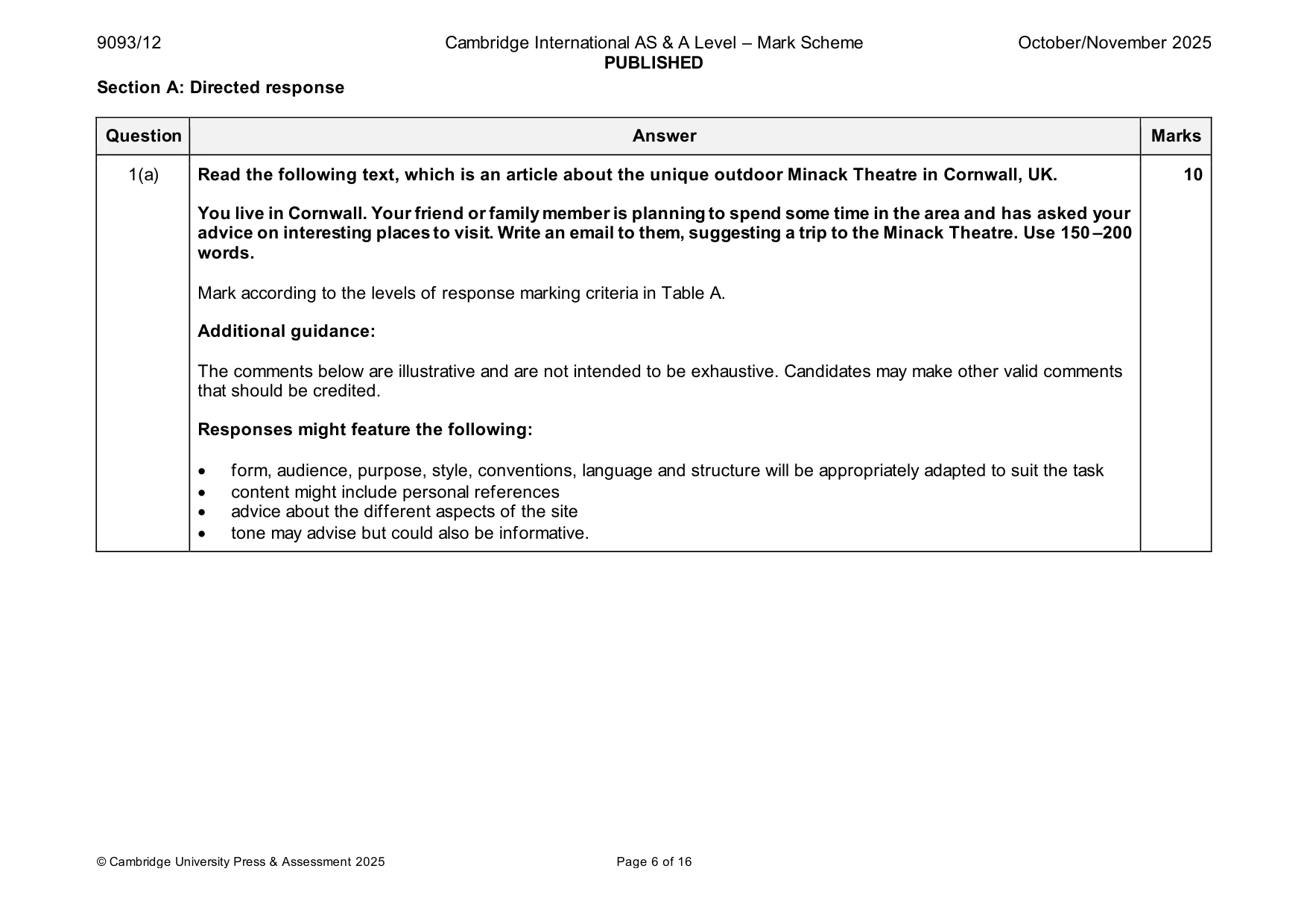
9093/12 Cambridge International AS & A Level – Mark Scheme PUBLISHED October/November 2025 © Cambridge University Press & Assessment 2025 Page 6 of 16 Section A: Directed response Question Answer Marks 1(a) Read the following text, which is an article about the unique outdoor Minack Theatre in Cornwall, UK. You live in Cornwall. Your friend or family member is planning to spend some time in the area and has asked your advice on interesting places to visit. Write an email to them, suggesting a trip to the Minack Theatre. Use 150 –200 words. Mark according to the levels of response marking criteria in Table A. Additional guidance: The comments below are illustrative and are not intended to be exhaustive. Candidates may make other valid comments that should be credited. Responses might feature the following: • form, audience, purpose, style, conventions, language and structure will be appropriately adapted to suit the task • content might include personal references • advice about the different aspects of the site • tone may advise but could also be informative. 10
Mark scheme, page 7
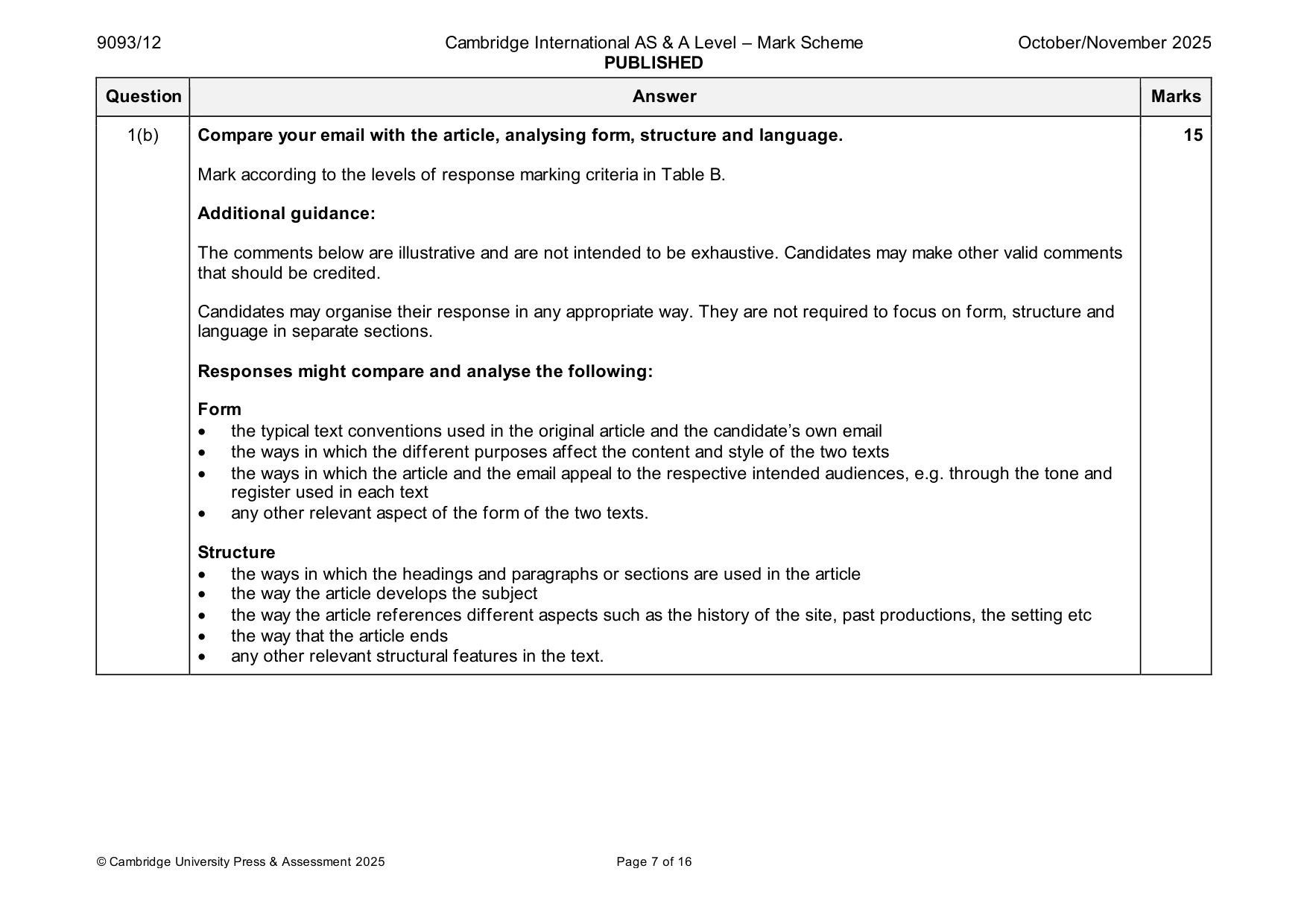
9093/12 Cambridge International AS & A Level – Mark Scheme PUBLISHED October/November 2025 © Cambridge University Press & Assessment 2025 Page 7 of 16 Question Answer Marks 1(b) Compare your email with the article, analysing form, structure and language. Mark according to the levels of response marking criteria in Table B. Additional guidance: The comments below are illustrative and are not intended to be exhaustive. Candidates may make other valid comments that should be credited. Candidates may organise their response in any appropriate way. They are not required to focus on form, structure and language in separate sections. Responses might compare and analyse the following: Form • the typical text conventions used in the original article and the candidate’s own email • the ways in which the different purposes affect the content and style of the two texts • the ways in which the article and the email appeal to the respective intended audiences, e.g. through the tone and register used in each text • any other relevant aspect of the form of the two texts. Structure • the ways in which the headings and paragraphs or sections are used in the article • the way the article develops the subject • the way the article references different aspects such as the history of the site, past productions, the setting etc • the way that the article ends • any other relevant structural features in the text. 15
Mark scheme, page 8
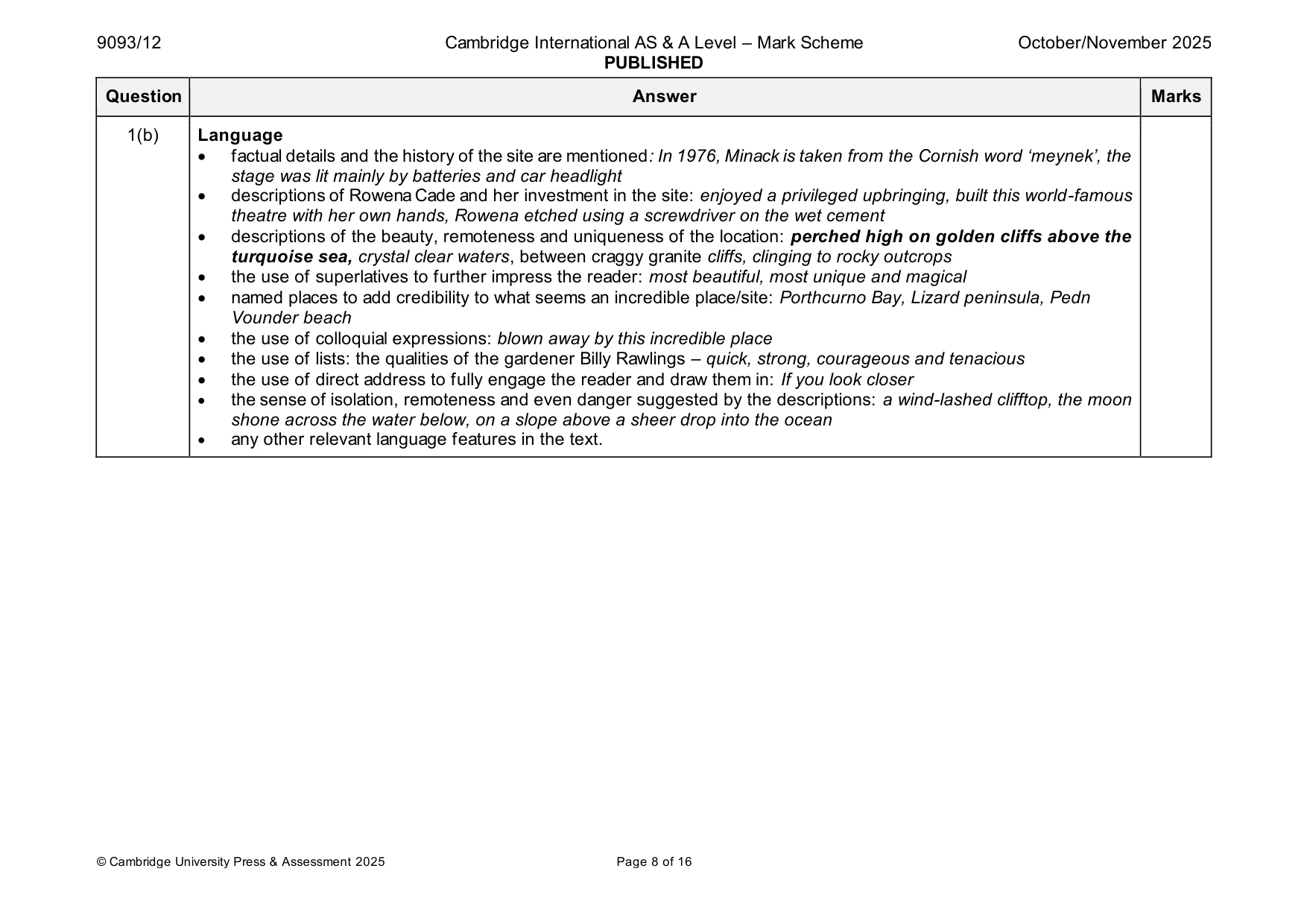
9093/12 Cambridge International AS & A Level – Mark Scheme PUBLISHED October/November 2025 © Cambridge University Press & Assessment 2025 Page 8 of 16 Question Answer Marks 1(b) Language • factual details and the history of the site are mentioned: In 1976, Minack is taken from the Cornish word ‘meynek’, the stage was lit mainly by batteries and car headlight • descriptions of Rowena Cade and her investment in the site: enjoyed a privileged upbringing, built this world-famous theatre with her own hands, Rowena etched using a screwdriver on the wet cement • descriptions of the beauty, remoteness and uniqueness of the location: perched high on golden cliffs above the turquoise sea, crystal clear waters, between craggy granite cliffs, clinging to rocky outcrops • the use of superlatives to further impress the reader: most beautiful, most unique and magical • named places to add credibility to what seems an incredible place/site: Porthcurno Bay, Lizard peninsula, Pedn Vounder beach • the use of colloquial expressions: blown away by this incredible place • the use of lists: the qualities of the gardener Billy Rawlings – quick, strong, courageous and tenacious • the use of direct address to fully engage the reader and draw them in: If you look closer • the sense of isolation, remoteness and even danger suggested by the descriptions: a wind-lashed clifftop, the moon shone across the water below, on a slope above a sheer drop into the ocean • any other relevant language features in the text.
Mark scheme, page 9
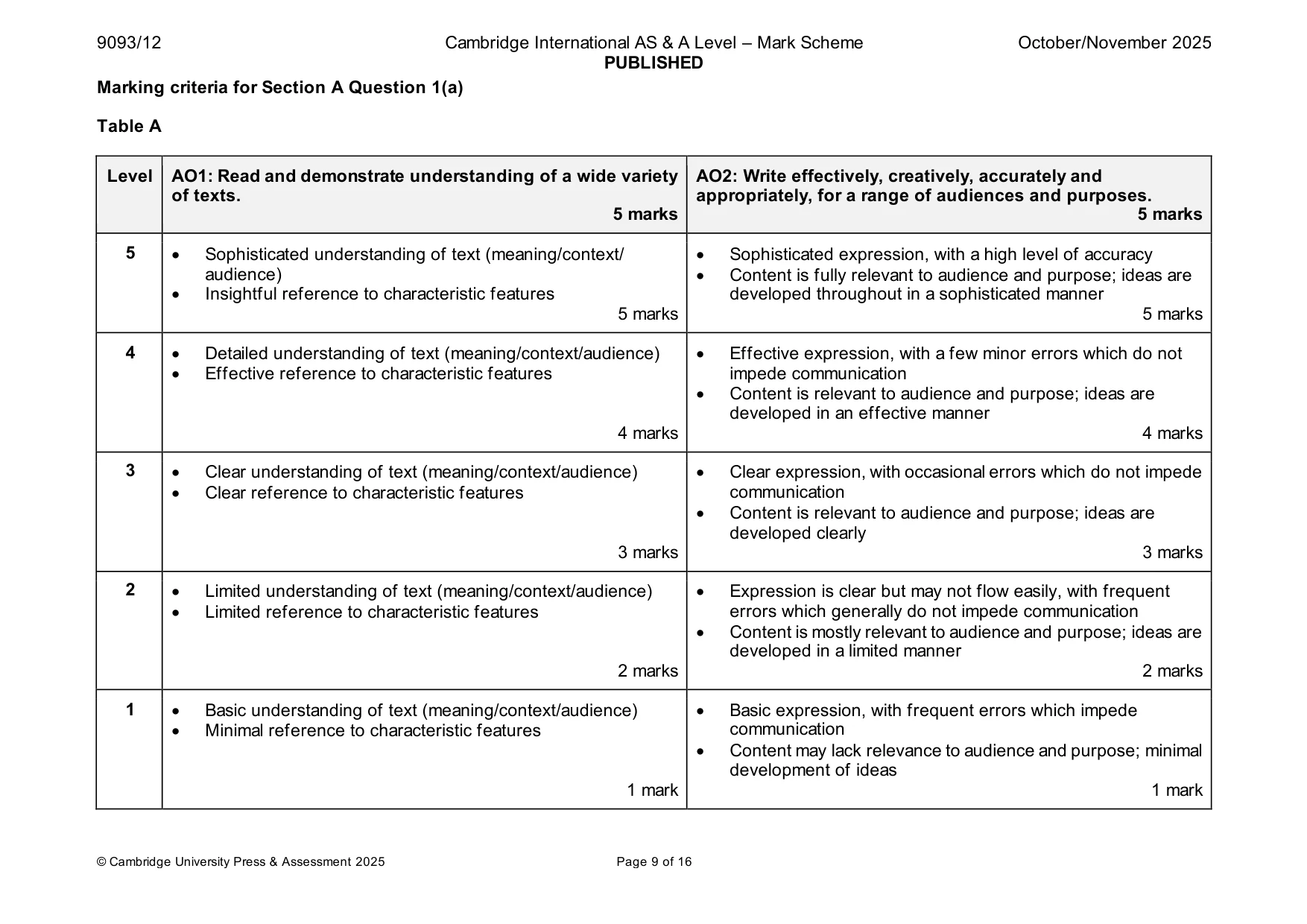
9093/12 Cambridge International AS & A Level – Mark Scheme PUBLISHED October/November 2025 © Cambridge University Press & Assessment 2025 Page 9 of 16 Marking criteria for Section A Question 1(a) Table A Level AO1: Read and demonstrate understanding of a wide variety of texts. 5 marks AO2: Write effectively, creatively, accurately and appropriately, for a range of audiences and purposes. 5 marks 5 • Sophisticated understanding of text (meaning/context/ audience) • Insightful reference to characteristic features 5 marks • Sophisticated expression, with a high level of accuracy • Content is fully relevant to audience and purpose; ideas are developed throughout in a sophisticated manner 5 marks 4 • Detailed understanding of text (meaning/context/audience) • Effective reference to characteristic features 4 marks • Effective expression, with a few minor errors which do not impede communication • Content is relevant to audience and purpose; ideas are developed in an effective manner 4 marks 3 • Clear understanding of text (meaning/context/audience) • Clear reference to characteristic features 3 marks • Clear expression, with occasional errors which do not impede communication • Content is relevant to audience and purpose; ideas are developed clearly 3 marks 2 • Limited understanding of text (meaning/context/audience) • Limited reference to characteristic features 2 marks • Expression is clear but may not flow easily, with frequent errors which generally do not impede communication • Content is mostly relevant to audience and purpose; ideas are developed in a limited manner 2 marks 1 • Basic understanding of text (meaning/context/audience) • Minimal reference to characteristic features 1 mark • Basic expression, with frequent errors which impede communication • Content may lack relevance to audience and purpose; minimal development of ideas 1 mark
Mark scheme, page 10
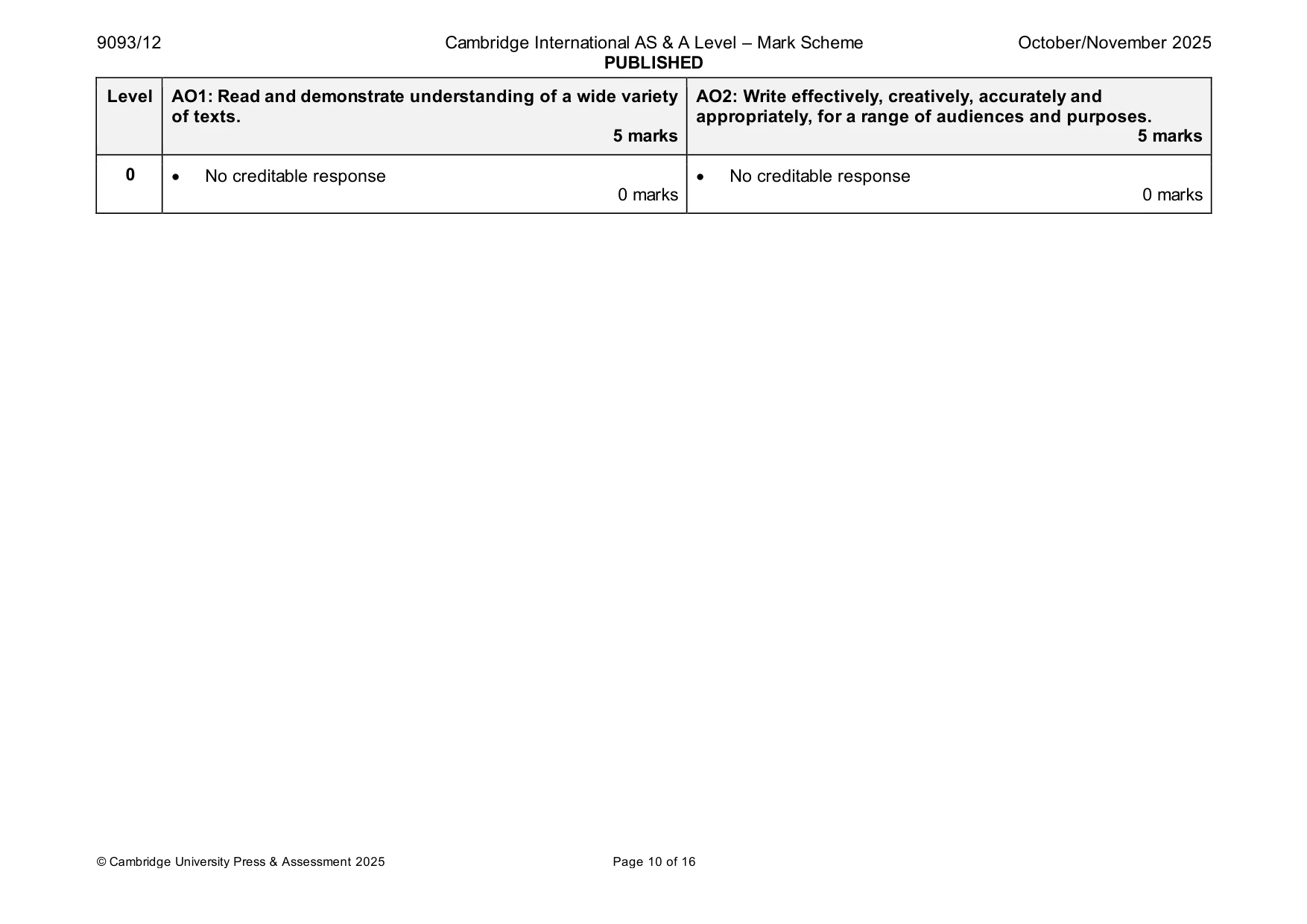
9093/12 Cambridge International AS & A Level – Mark Scheme PUBLISHED October/November 2025 © Cambridge University Press & Assessment 2025 Page 10 of 16 Level AO1: Read and demonstrate understanding of a wide variety of texts. 5 marks AO2: Write effectively, creatively, accurately and appropriately, for a range of audiences and purposes. 5 marks 0 • No creditable response 0 marks • No creditable response 0 marks
Mark scheme, page 11
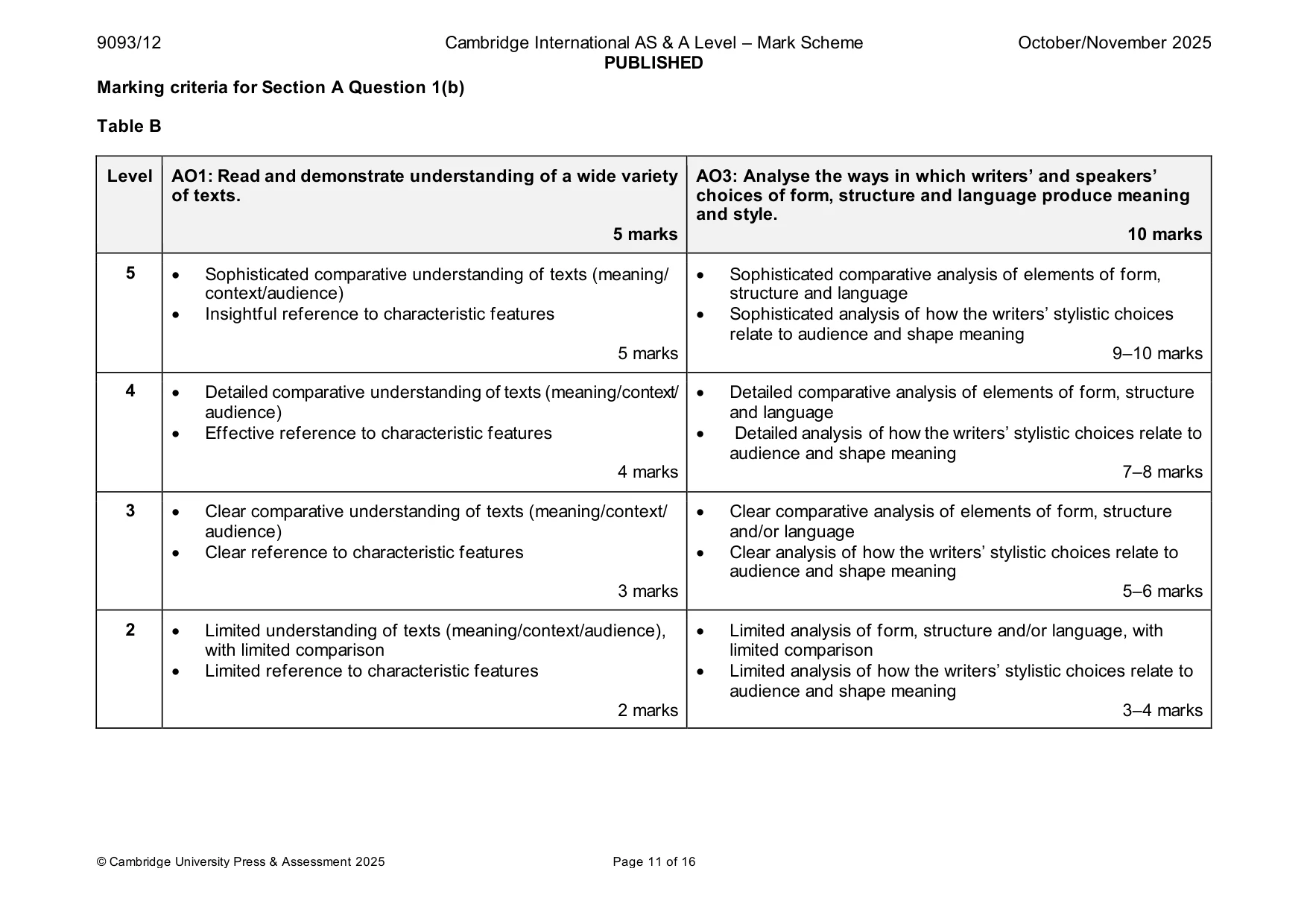
9093/12 Cambridge International AS & A Level – Mark Scheme PUBLISHED October/November 2025 © Cambridge University Press & Assessment 2025 Page 11 of 16 Marking criteria for Section A Question 1(b) Table B Level AO1: Read and demonstrate understanding of a wide variety of texts. 5 marks AO3: Analyse the ways in which writers’ and speakers’ choices of form, structure and language produce meaning and style. 10 marks 5 • Sophisticated comparative understanding of texts (meaning/ context/audience) • Insightful reference to characteristic features 5 marks • Sophisticated comparative analysis of elements of form, structure and language • Sophisticated analysis of how the writers’ stylistic choices relate to audience and shape meaning 9–10 marks 4 • Detailed comparative understanding of texts (meaning/context/ audience) • Effective reference to characteristic features 4 marks • Detailed comparative analysis of elements of form, structure and language • Detailed analysis of how the writers’ stylistic choices relate to audience and shape meaning 7–8 marks 3 • Clear comparative understanding of texts (meaning/context/ audience) • Clear reference to characteristic features 3 marks • Clear comparative analysis of elements of form, structure and/or language • Clear analysis of how the writers’ stylistic choices relate to audience and shape meaning 5–6 marks 2 • Limited understanding of texts (meaning/context/audience), with limited comparison • Limited reference to characteristic features 2 marks • Limited analysis of form, structure and/or language, with limited comparison • Limited analysis of how the writers’ stylistic choices relate to audience and shape meaning 3–4 marks
Mark scheme, page 12
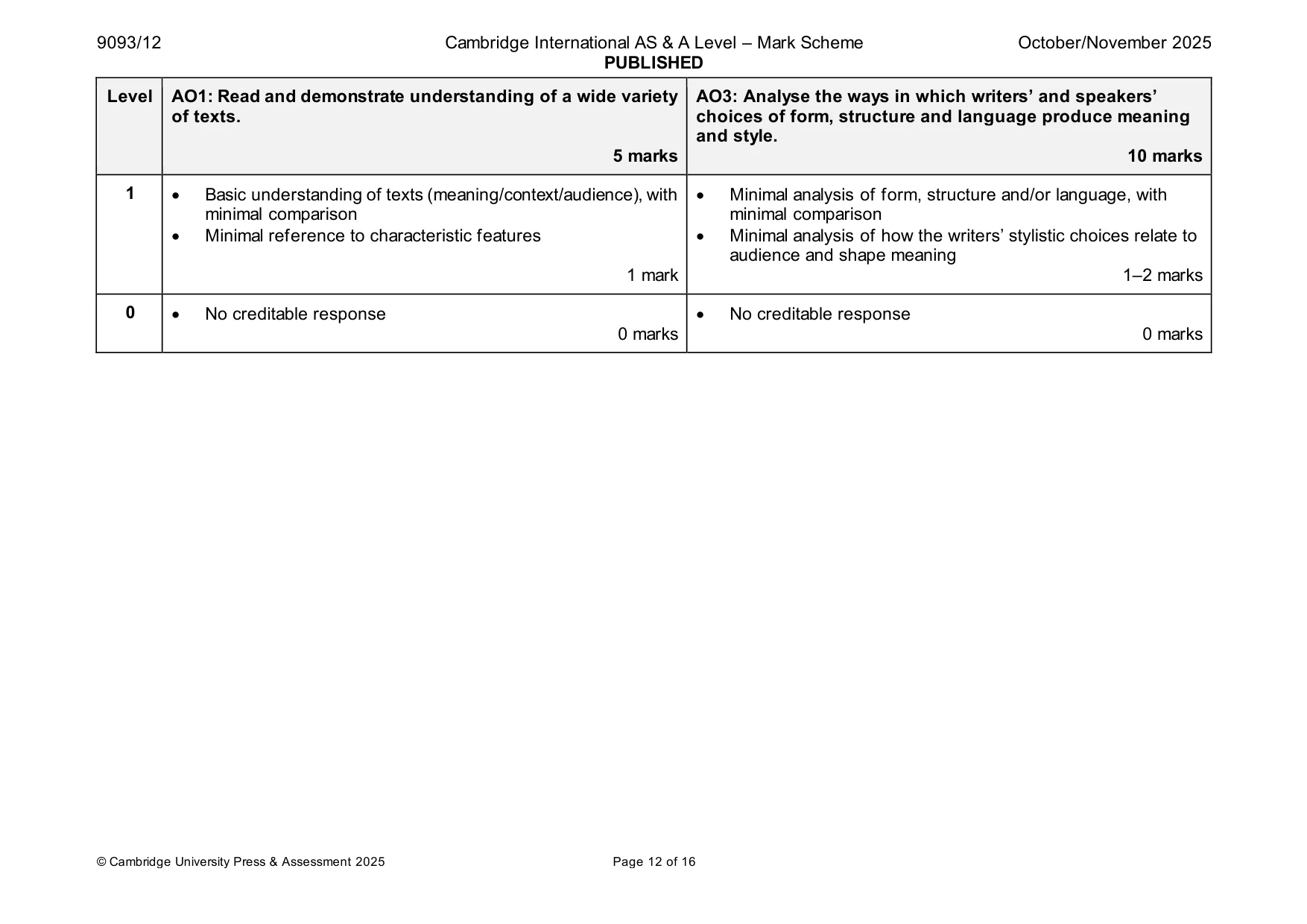
9093/12 Cambridge International AS & A Level – Mark Scheme PUBLISHED October/November 2025 © Cambridge University Press & Assessment 2025 Page 12 of 16 Level AO1: Read and demonstrate understanding of a wide variety of texts. 5 marks AO3: Analyse the ways in which writers’ and speakers’ choices of form, structure and language produce meaning and style. 10 marks 1 • Basic understanding of texts (meaning/context/audience), with minimal comparison • Minimal reference to characteristic features 1 mark • Minimal analysis of form, structure and/or language, with minimal comparison • Minimal analysis of how the writers’ stylistic choices relate to audience and shape meaning 1–2 marks 0 • No creditable response 0 marks • No creditable response 0 marks
Mark scheme, page 13
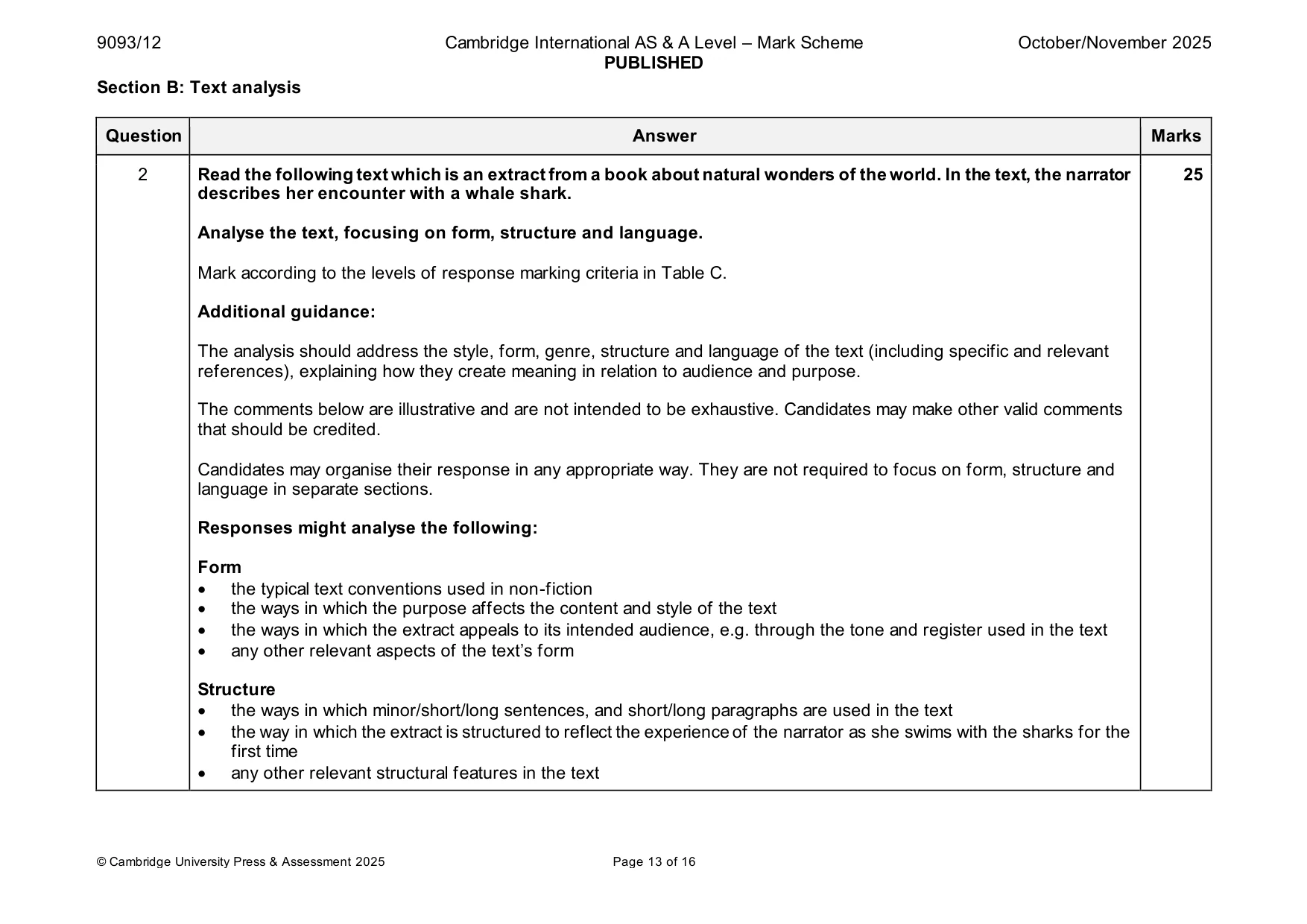
9093/12 Cambridge International AS & A Level – Mark Scheme PUBLISHED October/November 2025 © Cambridge University Press & Assessment 2025 Page 13 of 16 Section B: Text analysis Question Answer Marks 2 Read the following text which is an extract from a book about natural wonders of the world. In the text, the narrator describes her encounter with a whale shark. Analyse the text, focusing on form, structure and language. Mark according to the levels of response marking criteria in Table C. Additional guidance: The analysis should address the style, form, genre, structure and language of the text (including specific and relevant references), explaining how they create meaning in relation to audience and purpose. The comments below are illustrative and are not intended to be exhaustive. Candidates may make other valid comments that should be credited. Candidates may organise their response in any appropriate way. They are not required to focus on form, structure and language in separate sections. Responses might analyse the following: Form • the typical text conventions used in non-fiction • the ways in which the purpose affects the content and style of the text • the ways in which the extract appeals to its intended audience, e.g. through the tone and register used in the text • any other relevant aspects of the text’s form Structure • the ways in which minor/short/long sentences, and short/long paragraphs are used in the text • the way in which the extract is structured to reflect the experience of the narrator as she swims with the sharks for the first time • any other relevant structural features in the text 25
Mark scheme, page 14
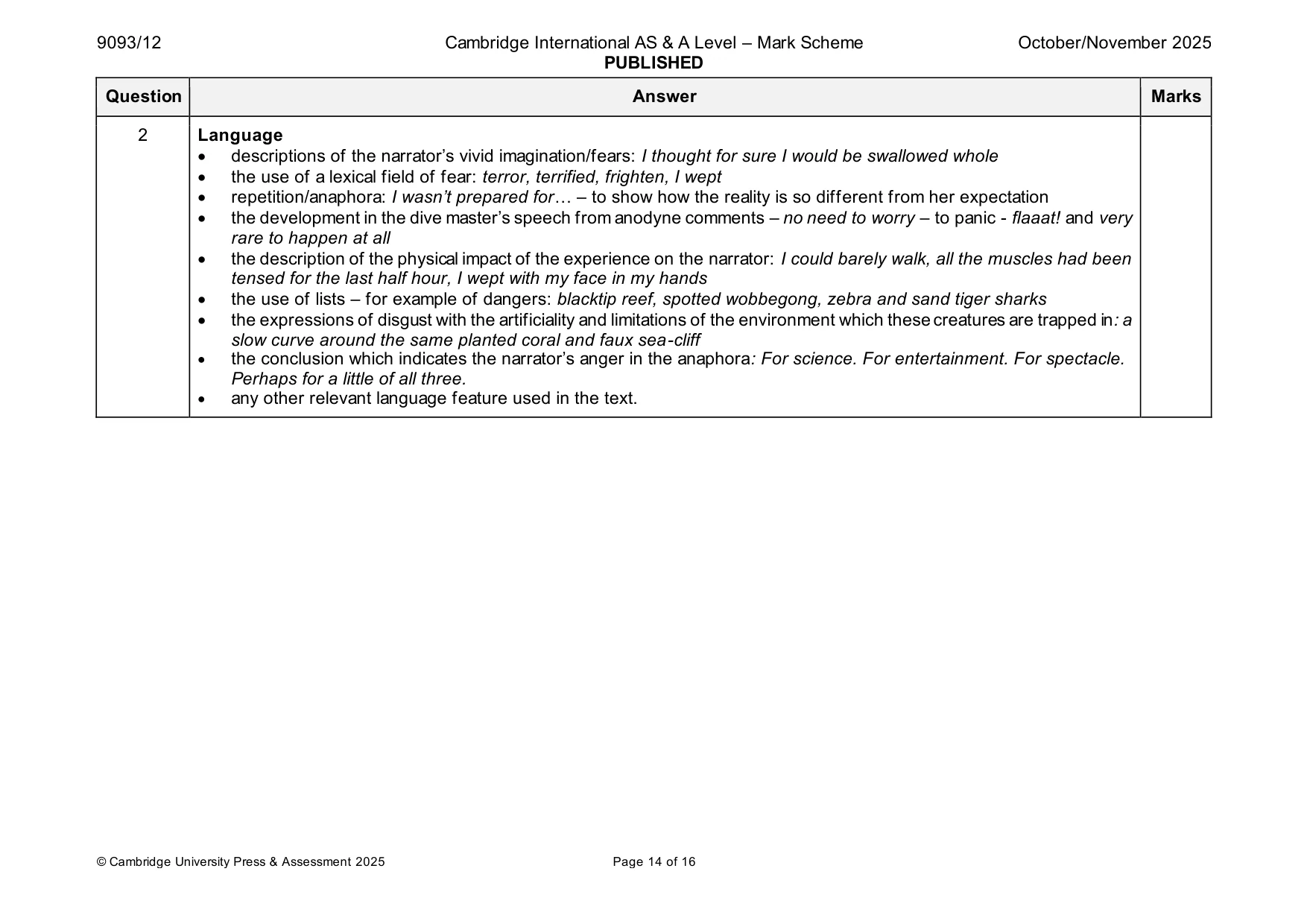
9093/12 Cambridge International AS & A Level – Mark Scheme PUBLISHED October/November 2025 © Cambridge University Press & Assessment 2025 Page 14 of 16 Question Answer Marks 2 Language • descriptions of the narrator’s vivid imagination/fears: I thought for sure I would be swallowed whole • the use of a lexical field of fear: terror, terrified, frighten, I wept • repetition/anaphora: I wasn’t prepared for… – to show how the reality is so different from her expectation • the development in the dive master’s speech from anodyne comments – no need to worry – to panic - flaaat! and very rare to happen at all • the description of the physical impact of the experience on the narrator: I could barely walk, all the muscles had been tensed for the last half hour, I wept with my face in my hands • the use of lists – for example of dangers: blacktip reef, spotted wobbegong, zebra and sand tiger sharks • the expressions of disgust with the artificiality and limitations of the environment which these creatures are trapped in: a slow curve around the same planted coral and faux sea-cliff • the conclusion which indicates the narrator’s anger in the anaphora: For science. For entertainment. For spectacle. Perhaps for a little of all three. • any other relevant language feature used in the text.
Mark scheme, page 15
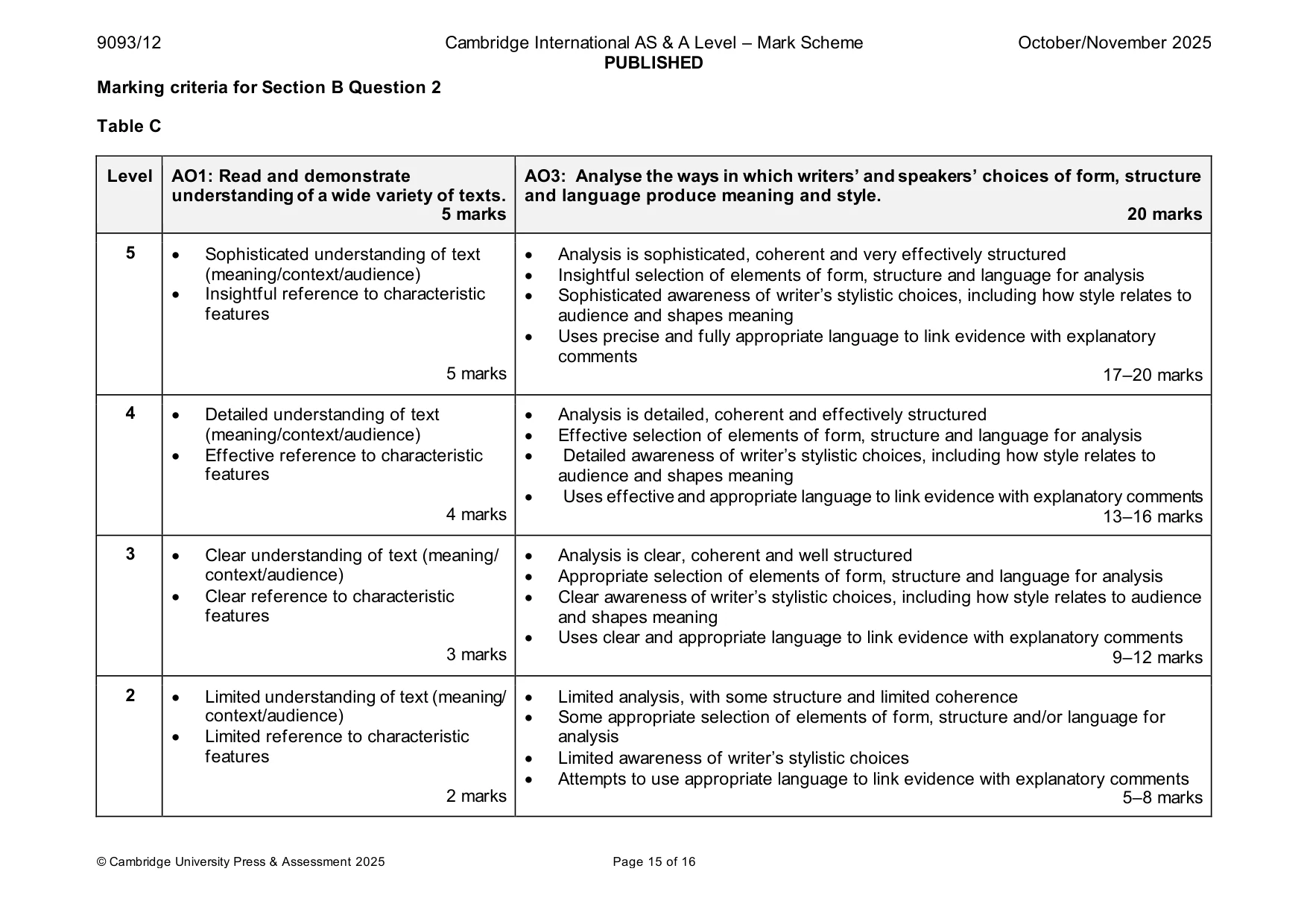
9093/12 Cambridge International AS & A Level – Mark Scheme PUBLISHED October/November 2025 © Cambridge University Press & Assessment 2025 Page 15 of 16 Marking criteria for Section B Question 2 Table C Level AO1: Read and demonstrate understanding of a wide variety of texts. 5 marks AO3: Analyse the ways in which writers’ and speakers’ choices of form, structure and language produce meaning and style. 20 marks 5 • Sophisticated understanding of text (meaning/context/audience) • Insightful reference to characteristic features 5 marks • Analysis is sophisticated, coherent and very effectively structured • Insightful selection of elements of form, structure and language for analysis • Sophisticated awareness of writer’s stylistic choices, including how style relates to audience and shapes meaning • Uses precise and fully appropriate language to link evidence with explanatory comments 17–20 marks 4 • Detailed understanding of text (meaning/context/audience) • Effective reference to characteristic features 4 marks • Analysis is detailed, coherent and effectively structured • Effective selection of elements of form, structure and language for analysis • Detailed awareness of writer’s stylistic choices, including how style relates to audience and shapes meaning • Uses effective and appropriate language to link evidence with explanatory comments 13–16 marks 3 • Clear understanding of text (meaning/ context/audience) • Clear reference to characteristic features 3 marks • Analysis is clear, coherent and well structured • Appropriate selection of elements of form, structure and language for analysis • Clear awareness of writer’s stylistic choices, including how style relates to audience and shapes meaning • Uses clear and appropriate language to link evidence with explanatory comments 9–12 marks 2 • Limited understanding of text (meaning/ context/audience) • Limited reference to characteristic features 2 marks • Limited analysis, with some structure and limited coherence • Some appropriate selection of elements of form, structure and/or language for analysis • Limited awareness of writer’s stylistic choices • Attempts to use appropriate language to link evidence with explanatory comments 5–8 marks
Mark scheme, page 16
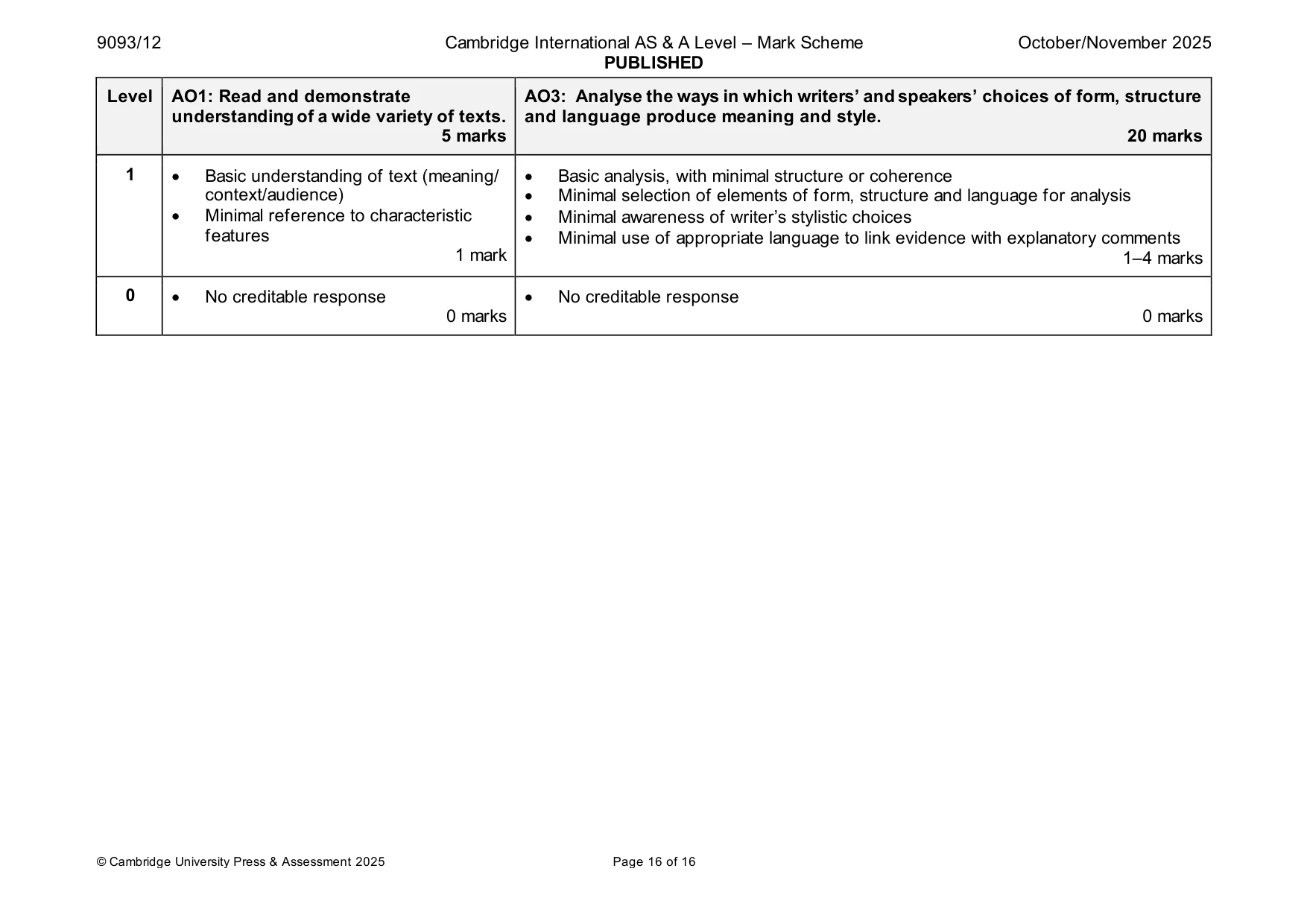
9093/12 Cambridge International AS & A Level – Mark Scheme PUBLISHED October/November 2025 © Cambridge University Press & Assessment 2025 Page 16 of 16 Level AO1: Read and demonstrate understanding of a wide variety of texts. 5 marks AO3: Analyse the ways in which writers’ and speakers’ choices of form, structure and language produce meaning and style. 20 marks 1 • Basic understanding of text (meaning/ context/audience) • Minimal reference to characteristic features 1 mark • Basic analysis, with minimal structure or coherence • Minimal selection of elements of form, structure and language for analysis • Minimal awareness of writer’s stylistic choices • Minimal use of appropriate language to link evidence with explanatory comments 1–4 marks 0 • No creditable response 0 marks • No creditable response 0 marks
What you needed in this session
Cambridge’s own grade thresholds for 2025 Oct/Nov, Paper 1 · Variant 2. A higher threshold means an easier paper — the bar moves with how the cohort did.