Cambridge A Level English - Language AS and A Level (from 2014) 9093 — 2024 May/June Paper 1 · Variant 3
9093/13/M/J/24 · 50 marks · 135 min
The question paper and its mark scheme, free to read here and free to download. This is Cambridge’s own paper, exactly as it was sat.
Question paper8 pages
Mark scheme16 pages
Answers below. Sit the paper first if you are practising.
Paper as text
Question paper, page 1
Cambridge International AS & A Level 9093/13 May/June 2024 2 hours 15 minutes ENGLISH LANGUAGE Paper 1 Reading You must answer on the enclosed answer booklet. You will need: Answer booklet (enclosed) INSTRUCTIONS • Answer all questions. • Follow the instructions on the front cover of the answer booklet. If you need additional answer paper, ask the invigilator for a continuation booklet. • Dictionaries are not allowed. INFORMATION • The total mark for this paper is 50. • The number of marks for each question is shown in brackets [ ]. This document has 8 pages. Any blank pages are indicated. [Turn over 06_9093_13_2024_1.13 © UCLES 2024 *9003746434*
Question paper, page 2
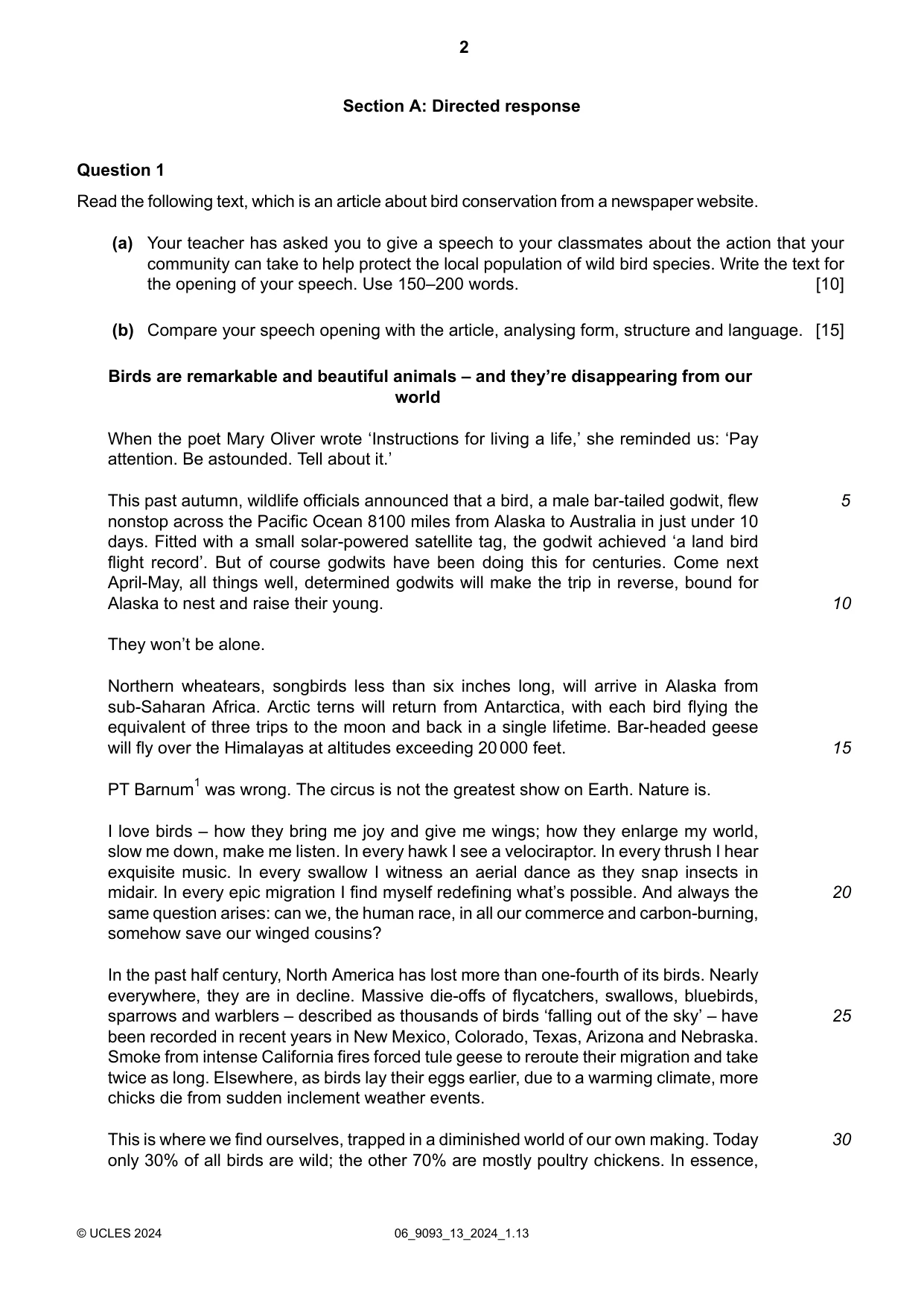
30 25 20 15 10 5 Section A: Directed response Question 1 Read the following text, which is an article about bird conservation from a newspaper website. Your teacher has asked you to give a speech to your classmates about the action that your community can take to help protect the local population of wild bird species. Write the text for the opening of your speech. Use 150–200 words. [10] (a) Compare your speech opening with the article, analysing form, structure and language. [15] (b) Birds are remarkable and beautiful animals – and they’re disappearing from our world When the poet Mary Oliver wrote ‘Instructions for living a life,’ she reminded us: ‘Pay attention. Be astounded. Tell about it.’ This past autumn, wildlife officials announced that a bird, a male bar-tailed godwit, flew nonstop across the Pacific Ocean 8100 miles from Alaska to Australia in just under 10 days. Fitted with a small solar-powered satellite tag, the godwit achieved ‘a land bird flight record’. But of course godwits have been doing this for centuries. Come next April-May, all things well, determined godwits will make the trip in reverse, bound for Alaska to nest and raise their young. They won’t be alone. Northern wheatears, songbirds less than six inches long, will arrive in Alaska from sub-Saharan Africa. Arctic terns will return from Antarctica, with each bird flying the equivalent of three trips to the moon and back in a single lifetime. Bar-headed geese will fly over the Himalayas at altitudes exceeding 20000 feet. PT Barnum1 was wrong. The circus is not the greatest show on Earth. Nature is. I love birds – how they bring me joy and give me wings; how they enlarge my world, slow me down, make me listen. In every hawk I see a velociraptor. In every thrush I hear exquisite music. In every swallow I witness an aerial dance as they snap insects in midair. In every epic migration I find myself redefining what’s possible. And always the same question arises: can we, the human race, in all our commerce and carbon-burning, somehow save our winged cousins? In the past half century, North America has lost more than one-fourth of its birds. Nearly everywhere, they are in decline. Massive die-offs of flycatchers, swallows, bluebirds, sparrows and warblers – described as thousands of birds ‘falling out of the sky’ – have been recorded in recent years in New Mexico, Colorado, Texas, Arizona and Nebraska. Smoke from intense California fires forced tule geese to reroute their migration and take twice as long. Elsewhere, as birds lay their eggs earlier, due to a warming climate, more chicks die from sudden inclement weather events. This is where we find ourselves, trapped in a diminished world of our own making. Today only 30% of all birds are wild; the other 70% are mostly poultry chickens. In essence, 06_9093_13_2024_1.13 © UCLES 2024 2
Question paper, page 3
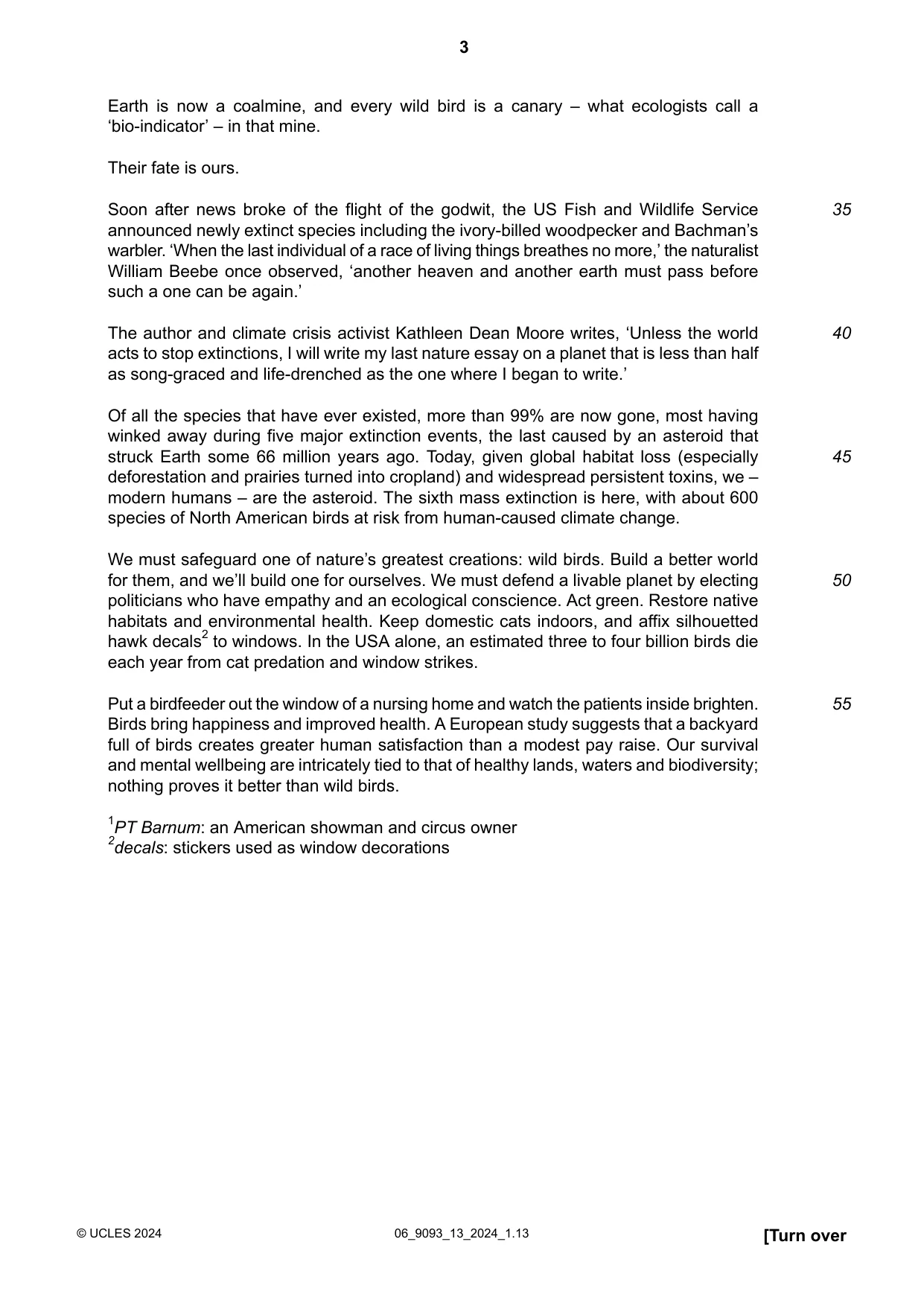
55 50 45 40 35 Earth is now a coalmine, and every wild bird is a canary – what ecologists call a ‘bio-indicator’ – in that mine. Their fate is ours. Soon after news broke of the flight of the godwit, the US Fish and Wildlife Service announced newly extinct species including the ivory-billed woodpecker and Bachman’s warbler. ‘When the last individual of a race of living things breathes no more,’ the naturalist William Beebe once observed, ‘another heaven and another earth must pass before such a one can be again.’ The author and climate crisis activist Kathleen Dean Moore writes, ‘Unless the world acts to stop extinctions, I will write my last nature essay on a planet that is less than half as song-graced and life-drenched as the one where I began to write.’ Of all the species that have ever existed, more than 99% are now gone, most having winked away during five major extinction events, the last caused by an asteroid that struck Earth some 66 million years ago. Today, given global habitat loss (especially deforestation and prairies turned into cropland) and widespread persistent toxins, we – modern humans – are the asteroid. The sixth mass extinction is here, with about 600 species of North American birds at risk from human-caused climate change. We must safeguard one of nature’s greatest creations: wild birds. Build a better world for them, and we’ll build one for ourselves. We must defend a livable planet by electing politicians who have empathy and an ecological conscience. Act green. Restore native habitats and environmental health. Keep domestic cats indoors, and affix silhouetted hawk decals2 to windows. In the USA alone, an estimated three to four billion birds die each year from cat predation and window strikes. Put a birdfeeder out the window of a nursing home and watch the patients inside brighten. Birds bring happiness and improved health. A European study suggests that a backyard full of birds creates greater human satisfaction than a modest pay raise. Our survival and mental wellbeing are intricately tied to that of healthy lands, waters and biodiversity; nothing proves it better than wild birds. 1PT Barnum: an American showman and circus owner 2decals: stickers used as window decorations [Turn over 06_9093_13_2024_1.13 © UCLES 2024 3
Question paper, page 4
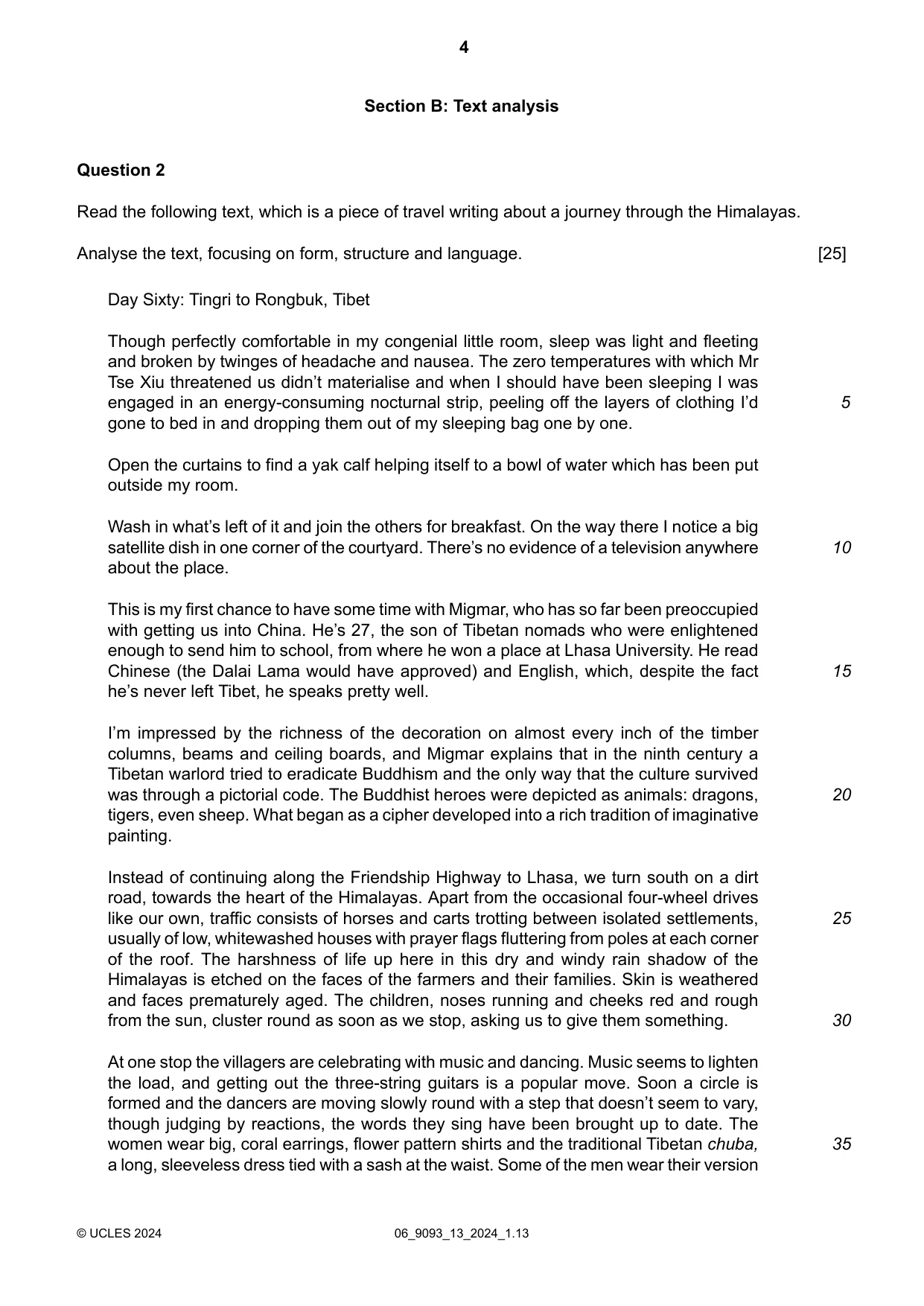
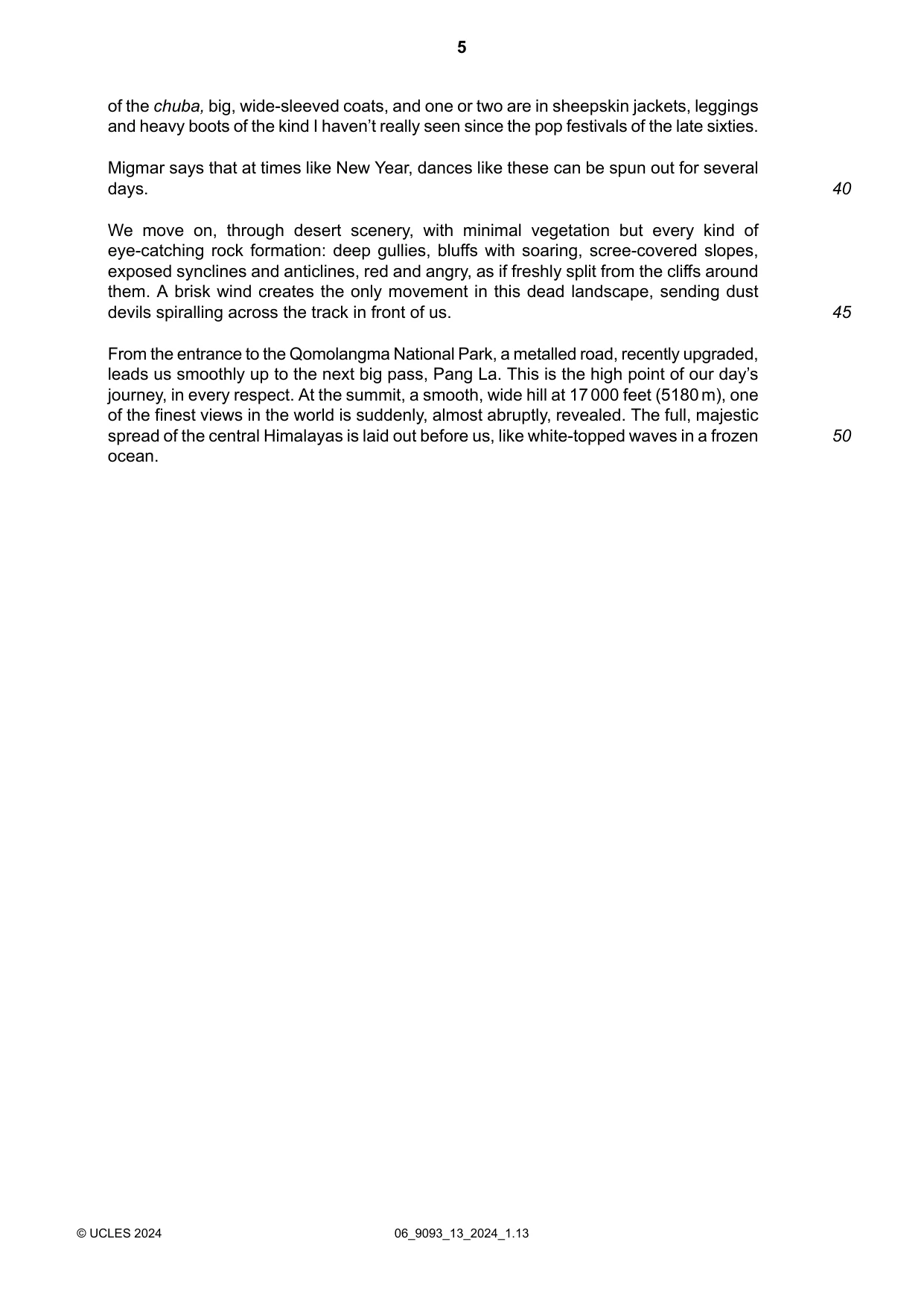
35 30 25 20 15 10 5 Section B: Text analysis Question 2 Read the following text, which is a piece of travel writing about a journey through the Himalayas. Analyse the text, focusing on form, structure and language. [25] Day Sixty: Tingri to Rongbuk, Tibet Though perfectly comfortable in my congenial little room, sleep was light and fleeting and broken by twinges of headache and nausea. The zero temperatures with which Mr Tse Xiu threatened us didn’t materialise and when I should have been sleeping I was engaged in an energy-consuming nocturnal strip, peeling off the layers of clothing I’d gone to bed in and dropping them out of my sleeping bag one by one. Open the curtains to find a yak calf helping itself to a bowl of water which has been put outside my room. Wash in what’s left of it and join the others for breakfast. On the way there I notice a big satellite dish in one corner of the courtyard. There’s no evidence of a television anywhere about the place. This is my first chance to have some time with Migmar, who has so far been preoccupied with getting us into China. He’s 27, the son of Tibetan nomads who were enlightened enough to send him to school, from where he won a place at Lhasa University. He read Chinese (the Dalai Lama would have approved) and English, which, despite the fact he’s never left Tibet, he speaks pretty well. I’m impressed by the richness of the decoration on almost every inch of the timber columns, beams and ceiling boards, and Migmar explains that in the ninth century a Tibetan warlord tried to eradicate Buddhism and the only way that the culture survived was through a pictorial code. The Buddhist heroes were depicted as animals: dragons, tigers, even sheep. What began as a cipher developed into a rich tradition of imaginative painting. Instead of continuing along the Friendship Highway to Lhasa, we turn south on a dirt road, towards the heart of the Himalayas. Apart from the occasional four-wheel drives like our own, traffic consists of horses and carts trotting between isolated settlements, usually of low, whitewashed houses with prayer flags fluttering from poles at each corner of the roof. The harshness of life up here in this dry and windy rain shadow of the Himalayas is etched on the faces of the farmers and their families. Skin is weathered and faces prematurely aged. The children, noses running and cheeks red and rough from the sun, cluster round as soon as we stop, asking us to give them something. At one stop the villagers are celebrating with music and dancing. Music seems to lighten the load, and getting out the three-string guitars is a popular move. Soon a circle is formed and the dancers are moving slowly round with a step that doesn’t seem to vary, though judging by reactions, the words they sing have been brought up to date. The women wear big, coral earrings, flower pattern shirts and the traditional Tibetan chuba, a long, sleeveless dress tied with a sash at the waist. Some of the men wear their version 06_9093_13_2024_1.13 © UCLES 2024 4
Question paper, page 5
50 45 40 of the chuba, big, wide-sleeved coats, and one or two are in sheepskin jackets, leggings and heavy boots of the kind I haven’t really seen since the pop festivals of the late sixties. Migmar says that at times like New Year, dances like these can be spun out for several days. We move on, through desert scenery, with minimal vegetation but every kind of eye-catching rock formation: deep gullies, bluffs with soaring, scree-covered slopes, exposed synclines and anticlines, red and angry, as if freshly split from the cliffs around them. A brisk wind creates the only movement in this dead landscape, sending dust devils spiralling across the track in front of us. From the entrance to the Qomolangma National Park, a metalled road, recently upgraded, leads us smoothly up to the next big pass, Pang La. This is the high point of our day’s journey, in every respect. At the summit, a smooth, wide hill at 17000 feet (5180m), one of the finest views in the world is suddenly, almost abruptly, revealed. The full, majestic spread of the central Himalayas is laid out before us, like white-topped waves in a frozen ocean. 06_9093_13_2024_1.13 © UCLES 2024 5
Question paper, page 6
BLANK PAGE 06_9093_13_2024_1.13 © UCLES 2024 6
Question paper, page 7
BLANK PAGE 06_9093_13_2024_1.13 © UCLES 2024 7
Question paper, page 8
BLANK PAGE Permission to reproduce items where third-party owned material protected by copyright is included has been sought and cleared where possible. Every reasonable effort has been made by the publisher (UCLES) to trace copyright holders, but if any items requiring clearance have unwittingly been included, the publisher will be pleased to make amends at the earliest possible opportunity. To avoid the issue of disclosure of answer-related information to candidates, all copyright acknowledgements are reproduced online in the Cambridge Assessment International Education Copyright Acknowledgements Booklet. This is produced for each series of examinations and is freely available to download at www.cambridgeinternational.org after the live examination series. Cambridge Assessment International Education is part of Cambridge Assessment. Cambridge Assessment is the brand name of the University of Cambridge Local Examinations Syndicate (UCLES), which is a department of the University of Cambridge. 06_9093_13_2024_1.13 © UCLES 2024 8
Mark scheme, page 1
This document consists of 16 printed pages. © Cambridge University Press & Assessment 2024 [Turn over Cambridge International AS & A Level ENGLISH LANGUAGE 9093/13 Paper 1 Reading May/June 2024 MARK SCHEME Maximum Mark: 50 Published This mark scheme is published as an aid to teachers and candidates, to indicate the requirements of the examination. It shows the basis on which Examiners were instructed to award marks. It does not indicate the details of the discussions that took place at an Examiners’ meeting before marking began, which would have considered the acceptability of alternative answers. Mark schemes should be read in conjunction with the question paper and the Principal Examiner Report for Teachers. Cambridge International will not enter into discussions about these mark schemes. Cambridge International is publishing the mark schemes for the May/June 2024 series for most Cambridge IGCSE, Cambridge International A and AS Level and Cambridge Pre-U components, and some Cambridge O Level components.
Mark scheme, page 2
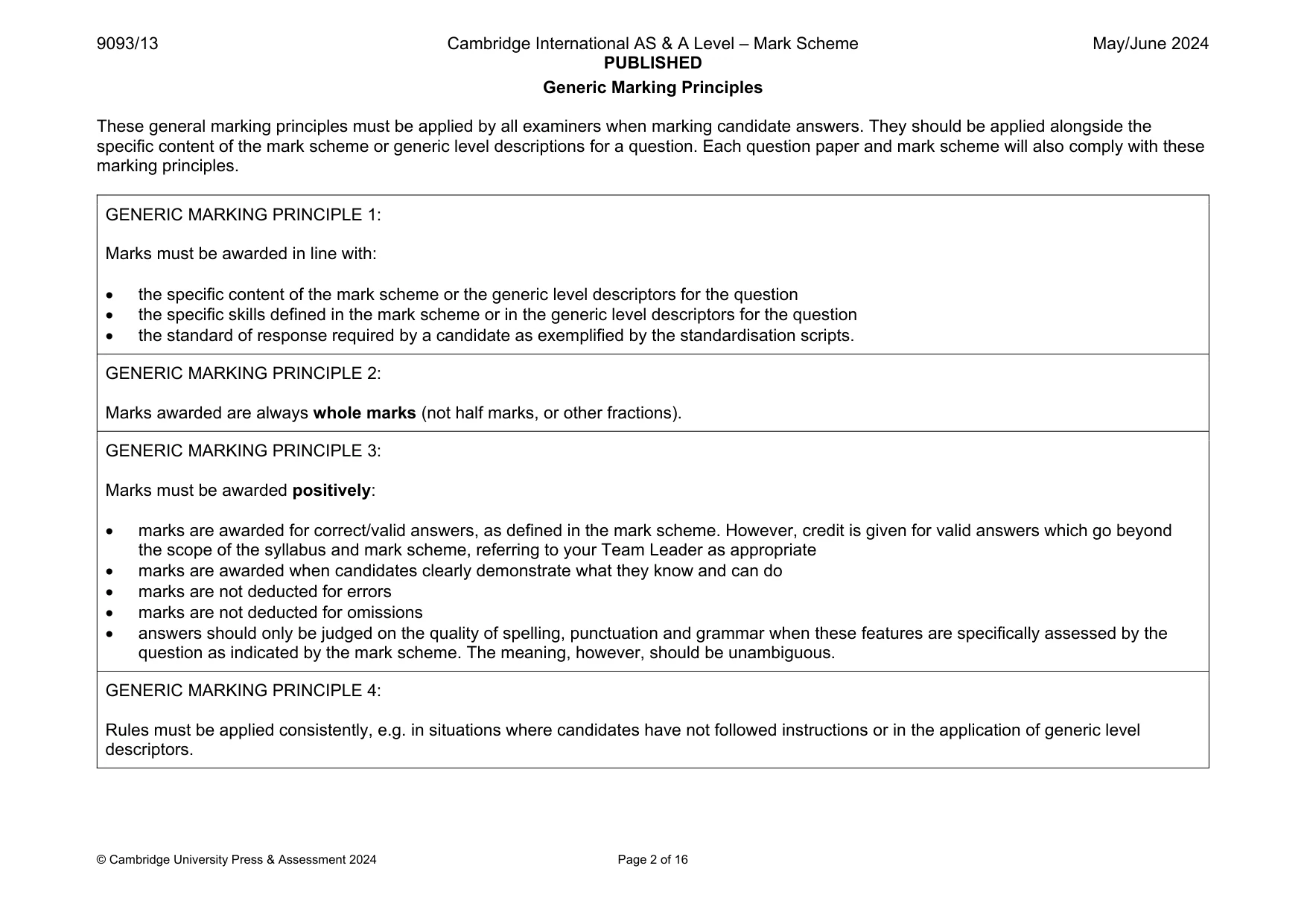
9093/13 Cambridge International AS & A Level – Mark Scheme PUBLISHED May/June 2024 © Cambridge University Press & Assessment 2024 Page 2 of 16 Generic Marking Principles These general marking principles must be applied by all examiners when marking candidate answers. They should be applied alongside the specific content of the mark scheme or generic level descriptions for a question. Each question paper and mark scheme will also comply with these marking principles. GENERIC MARKING PRINCIPLE 1: Marks must be awarded in line with: the specific content of the mark scheme or the generic level descriptors for the question the specific skills defined in the mark scheme or in the generic level descriptors for the question the standard of response required by a candidate as exemplified by the standardisation scripts. GENERIC MARKING PRINCIPLE 2: Marks awarded are always whole marks (not half marks, or other fractions). GENERIC MARKING PRINCIPLE 3: Marks must be awarded positively: marks are awarded for correct/valid answers, as defined in the mark scheme. However, credit is given for valid answers which go beyond the scope of the syllabus and mark scheme, referring to your Team Leader as appropriate marks are awarded when candidates clearly demonstrate what they know and can do marks are not deducted for errors marks are not deducted for omissions answers should only be judged on the quality of spelling, punctuation and grammar when these features are specifically assessed by the question as indicated by the mark scheme. The meaning, however, should be unambiguous. GENERIC MARKING PRINCIPLE 4: Rules must be applied consistently, e.g. in situations where candidates have not followed instructions or in the application of generic level descriptors.
Mark scheme, page 3
9093/13 Cambridge International AS & A Level – Mark Scheme PUBLISHED May/June 2024 © Cambridge University Press & Assessment 2024 Page 3 of 16 GENERIC MARKING PRINCIPLE 5: Marks should be awarded using the full range of marks defined in the mark scheme for the question (however; the use of the full mark range may be limited according to the quality of the candidate responses seen). GENERIC MARKING PRINCIPLE 6: Marks awarded are based solely on the requirements as defined in the mark scheme. Marks should not be awarded with grade thresholds or grade descriptors in mind.
Mark scheme, page 4
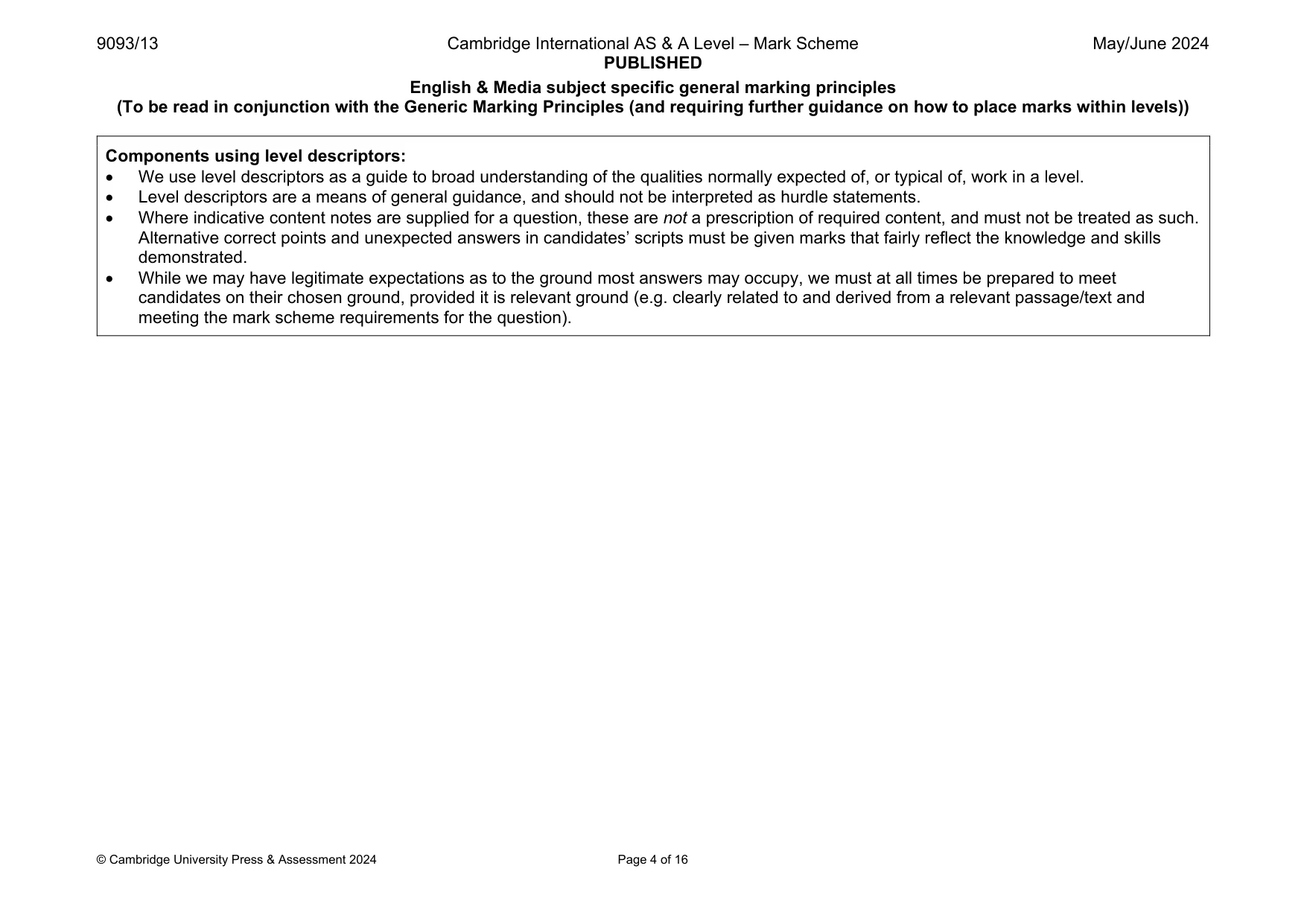
9093/13 Cambridge International AS & A Level – Mark Scheme PUBLISHED May/June 2024 © Cambridge University Press & Assessment 2024 Page 4 of 16 English & Media subject specific general marking principles (To be read in conjunction with the Generic Marking Principles (and requiring further guidance on how to place marks within levels)) Components using level descriptors: We use level descriptors as a guide to broad understanding of the qualities normally expected of, or typical of, work in a level. Level descriptors are a means of general guidance, and should not be interpreted as hurdle statements. Where indicative content notes are supplied for a question, these are not a prescription of required content, and must not be treated as such. Alternative correct points and unexpected answers in candidates’ scripts must be given marks that fairly reflect the knowledge and skills demonstrated. While we may have legitimate expectations as to the ground most answers may occupy, we must at all times be prepared to meet candidates on their chosen ground, provided it is relevant ground (e.g. clearly related to and derived from a relevant passage/text and meeting the mark scheme requirements for the question).
Mark scheme, page 5
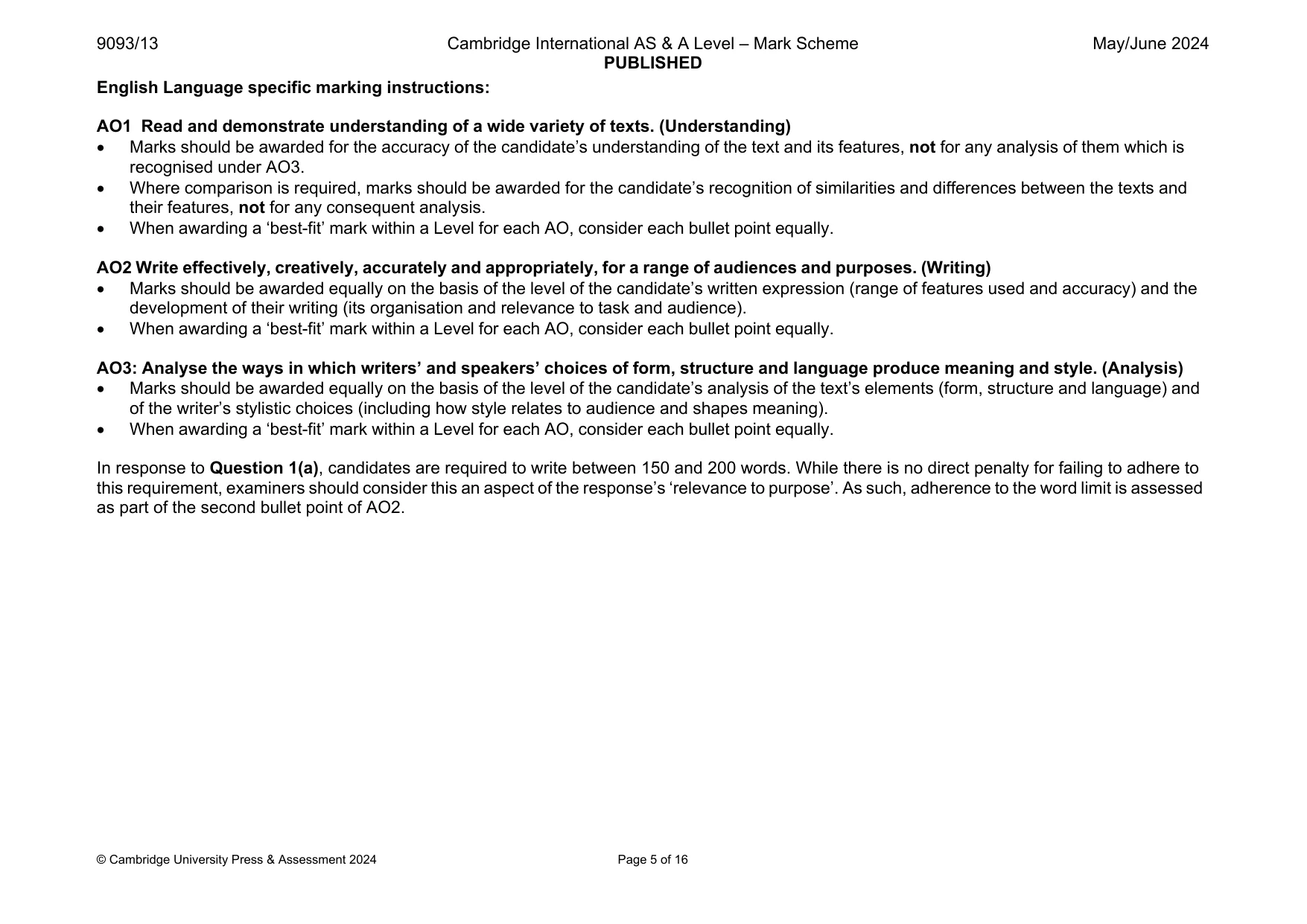
9093/13 Cambridge International AS & A Level – Mark Scheme PUBLISHED May/June 2024 © Cambridge University Press & Assessment 2024 Page 5 of 16 English Language specific marking instructions: AO1 Read and demonstrate understanding of a wide variety of texts. (Understanding) Marks should be awarded for the accuracy of the candidate’s understanding of the text and its features, not for any analysis of them which is recognised under AO3. Where comparison is required, marks should be awarded for the candidate’s recognition of similarities and differences between the texts and their features, not for any consequent analysis. When awarding a ‘best-fit’ mark within a Level for each AO, consider each bullet point equally. AO2 Write effectively, creatively, accurately and appropriately, for a range of audiences and purposes. (Writing) Marks should be awarded equally on the basis of the level of the candidate’s written expression (range of features used and accuracy) and the development of their writing (its organisation and relevance to task and audience). When awarding a ‘best-fit’ mark within a Level for each AO, consider each bullet point equally. AO3: Analyse the ways in which writers’ and speakers’ choices of form, structure and language produce meaning and style. (Analysis) Marks should be awarded equally on the basis of the level of the candidate’s analysis of the text’s elements (form, structure and language) and of the writer’s stylistic choices (including how style relates to audience and shapes meaning). When awarding a ‘best-fit’ mark within a Level for each AO, consider each bullet point equally. In response to Question 1(a), candidates are required to write between 150 and 200 words. While there is no direct penalty for failing to adhere to this requirement, examiners should consider this an aspect of the response’s ‘relevance to purpose’. As such, adherence to the word limit is assessed as part of the second bullet point of AO2.
Mark scheme, page 6
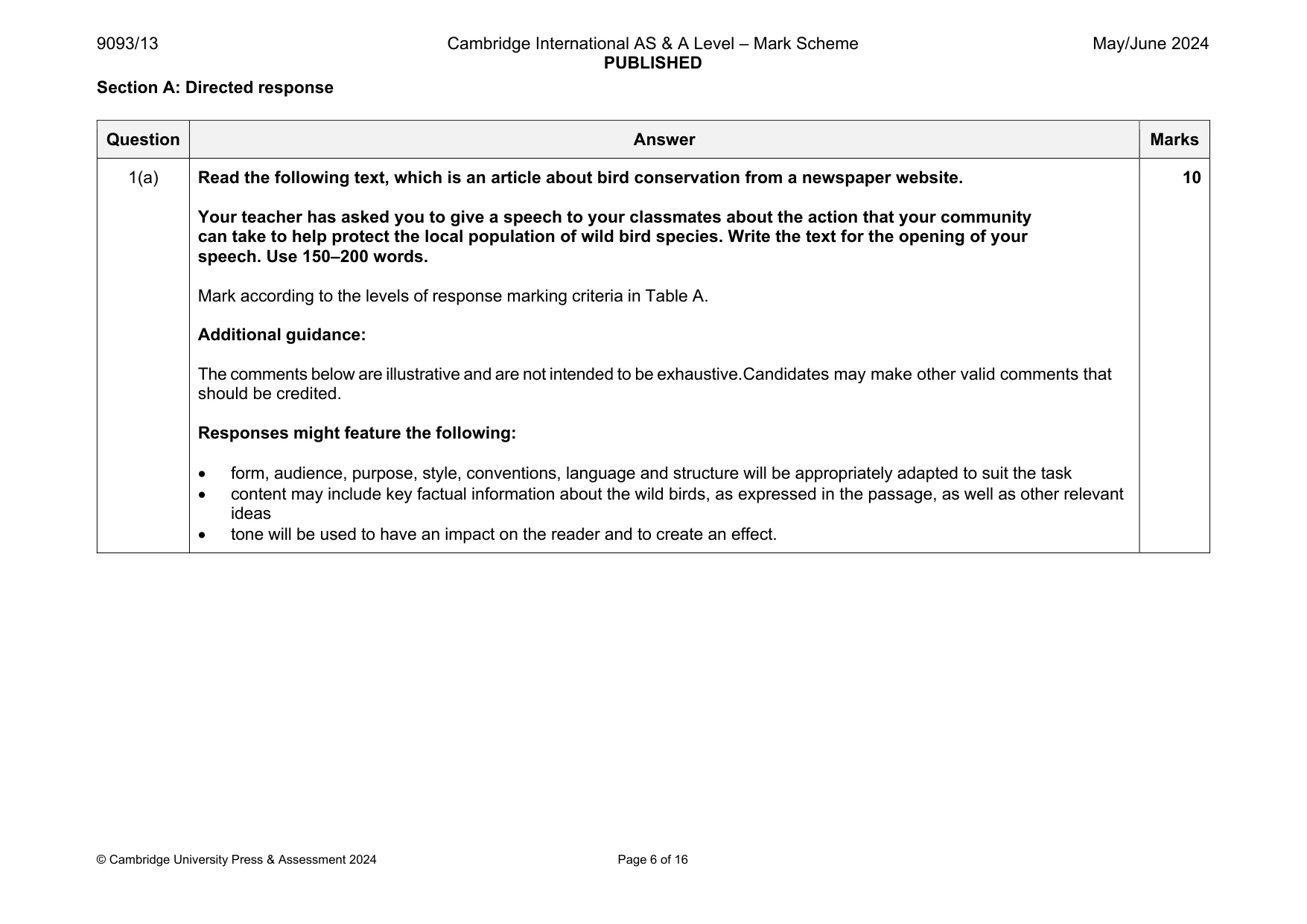
9093/13 Cambridge International AS & A Level – Mark Scheme PUBLISHED May/June 2024 © Cambridge University Press & Assessment 2024 Page 6 of 16 Section A: Directed response Question Answer Marks 1(a) Read the following text, which is an article about bird conservation from a newspaper website. Your teacher has asked you to give a speech to your classmates about the action that your community can take to help protect the local population of wild bird species. Write the text for the opening of your speech. Use 150–200 words. Mark according to the levels of response marking criteria in Table A. Additional guidance: The comments below are illustrative and are not intended to be exhaustive. Candidates may make other valid comments that should be credited. Responses might feature the following: form, audience, purpose, style, conventions, language and structure will be appropriately adapted to suit the task content may include key factual information about the wild birds, as expressed in the passage, as well as other relevant ideas tone will be used to have an impact on the reader and to create an effect. 10
Mark scheme, page 7
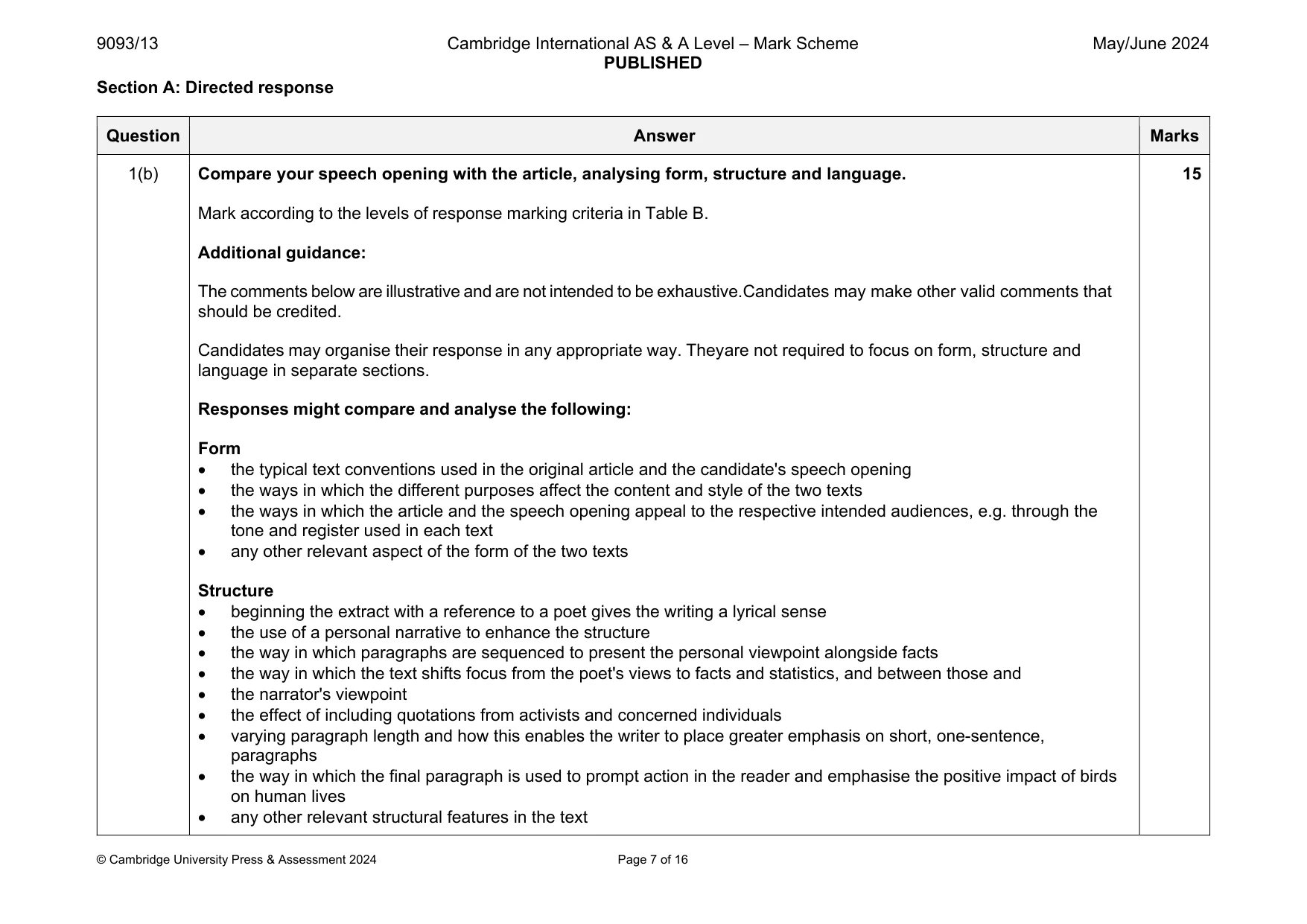
9093/13 Cambridge International AS & A Level – Mark Scheme PUBLISHED May/June 2024 © Cambridge University Press & Assessment 2024 Page 7 of 16 Section A: Directed response Question Answer Marks 1(b) Compare your speech opening with the article, analysing form, structure and language. Mark according to the levels of response marking criteria in Table B. Additional guidance: The comments below are illustrative and are not intended to be exhaustive. Candidates may make other valid comments that should be credited. Candidates may organise their response in any appropriate way. They are not required to focus on form, structure and language in separate sections. Responses might compare and analyse the following: Form the typical text conventions used in the original article and the candidate's speech opening the ways in which the different purposes affect the content and style of the two texts the ways in which the article and the speech opening appeal to the respective intended audiences, e.g. through the tone and register used in each text any other relevant aspect of the form of the two texts Structure beginning the extract with a reference to a poet gives the writing a lyrical sense the use of a personal narrative to enhance the structure the way in which paragraphs are sequenced to present the personal viewpoint alongside facts the way in which the text shifts focus from the poet's views to facts and statistics, and between those and the narrator's viewpoint the effect of including quotations from activists and concerned individuals varying paragraph length and how this enables the writer to place greater emphasis on short, one-sentence, paragraphs the way in which the final paragraph is used to prompt action in the reader and emphasise the positive impact of birds on human lives any other relevant structural features in the text 15
Mark scheme, page 8
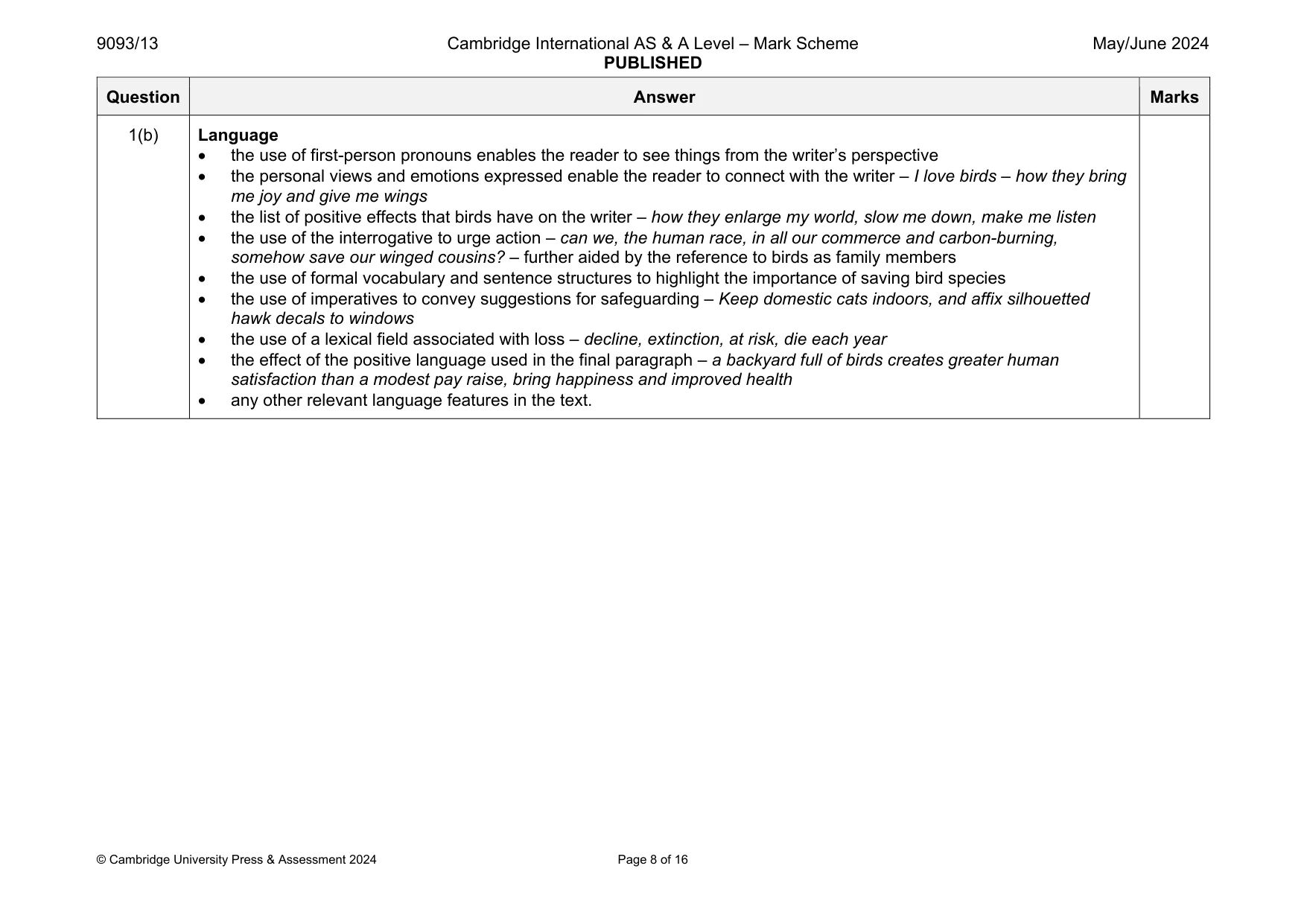
9093/13 Cambridge International AS & A Level – Mark Scheme PUBLISHED May/June 2024 © Cambridge University Press & Assessment 2024 Page 8 of 16 Question Answer Marks 1(b) Language the use of first-person pronouns enables the reader to see things from the writer’s perspective the personal views and emotions expressed enable the reader to connect with the writer – I love birds – how they bring me joy and give me wings the list of positive effects that birds have on the writer – how they enlarge my world, slow me down, make me listen the use of the interrogative to urge action – can we, the human race, in all our commerce and carbon-burning, somehow save our winged cousins? – further aided by the reference to birds as family members the use of formal vocabulary and sentence structures to highlight the importance of saving bird species the use of imperatives to convey suggestions for safeguarding – Keep domestic cats indoors, and affix silhouetted hawk decals to windows the use of a lexical field associated with loss – decline, extinction, at risk, die each year the effect of the positive language used in the final paragraph – a backyard full of birds creates greater human satisfaction than a modest pay raise, bring happiness and improved health any other relevant language features in the text.
Mark scheme, page 9
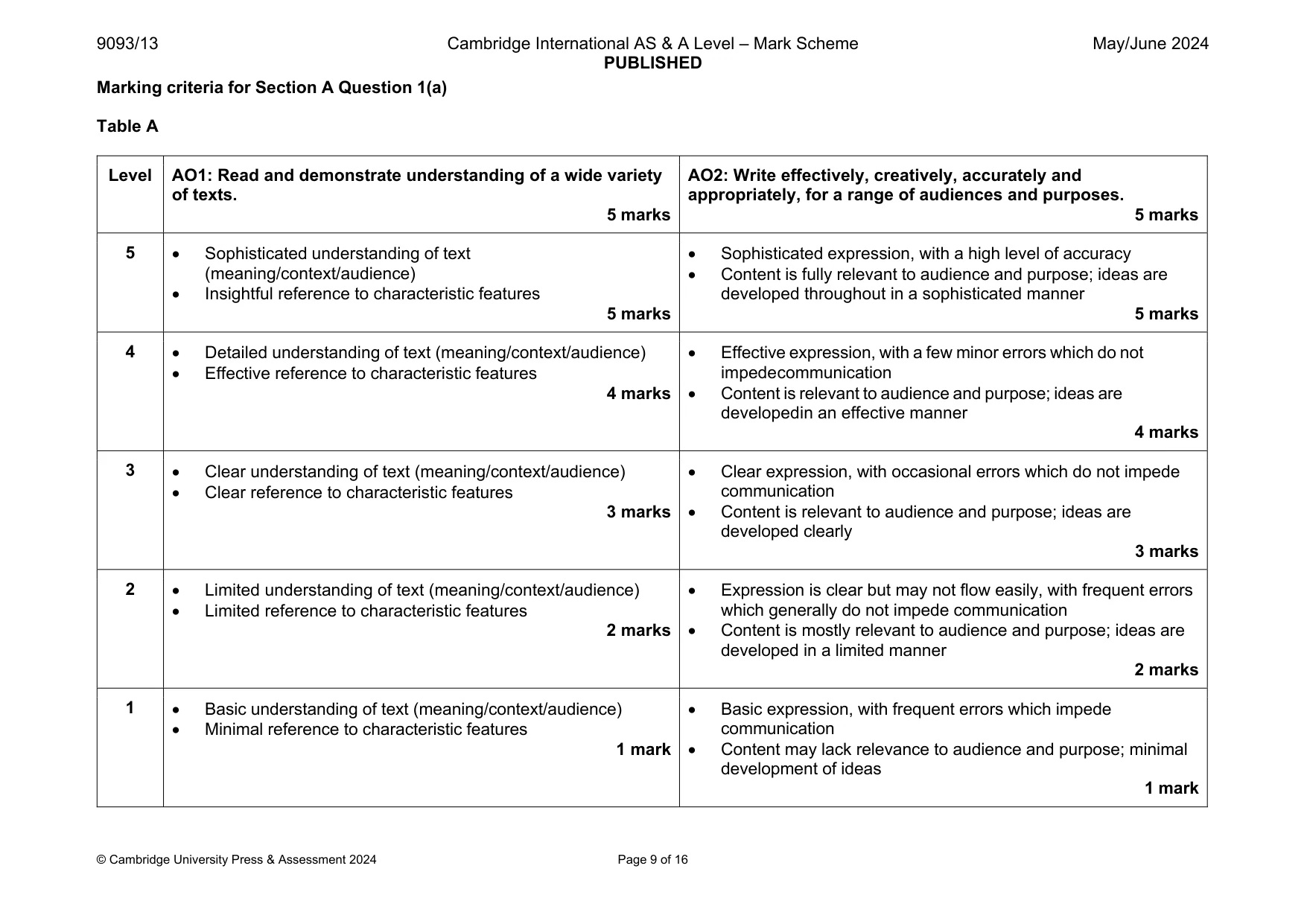
9093/13 Cambridge International AS & A Level – Mark Scheme PUBLISHED May/June 2024 © Cambridge University Press & Assessment 2024 Page 9 of 16 Marking criteria for Section A Question 1(a) Table A Level AO1: Read and demonstrate understanding of a wide variety of texts. 5 marks AO2: Write effectively, creatively, accurately and appropriately, for a range of audiences and purposes. 5 marks 5 Sophisticated understanding of text (meaning/context/audience) Insightful reference to characteristic features 5 marks Sophisticated expression, with a high level of accuracy Content is fully relevant to audience and purpose; ideas are developed throughout in a sophisticated manner 5 marks 4 Detailed understanding of text (meaning/context/audience) Effective reference to characteristic features 4 marks Effective expression, with a few minor errors which do not impede communication Content is relevant to audience and purpose; ideas are developed in an effective manner 4 marks 3 Clear understanding of text (meaning/context/audience) Clear reference to characteristic features 3 marks Clear expression, with occasional errors which do not impede communication Content is relevant to audience and purpose; ideas are developed clearly 3 marks 2 Limited understanding of text (meaning/context/audience) Limited reference to characteristic features 2 marks Expression is clear but may not flow easily, with frequent errors which generally do not impede communication Content is mostly relevant to audience and purpose; ideas are developed in a limited manner 2 marks 1 Basic understanding of text (meaning/context/audience) Minimal reference to characteristic features 1 mark Basic expression, with frequent errors which impede communication Content may lack relevance to audience and purpose; minimal development of ideas 1 mark
Mark scheme, page 10
9093/13 Cambridge International AS & A Level – Mark Scheme PUBLISHED May/June 2024 © Cambridge University Press & Assessment 2024 Page 10 of 16 0 No creditable response 0 marks No creditable response 0 marks
Mark scheme, page 11
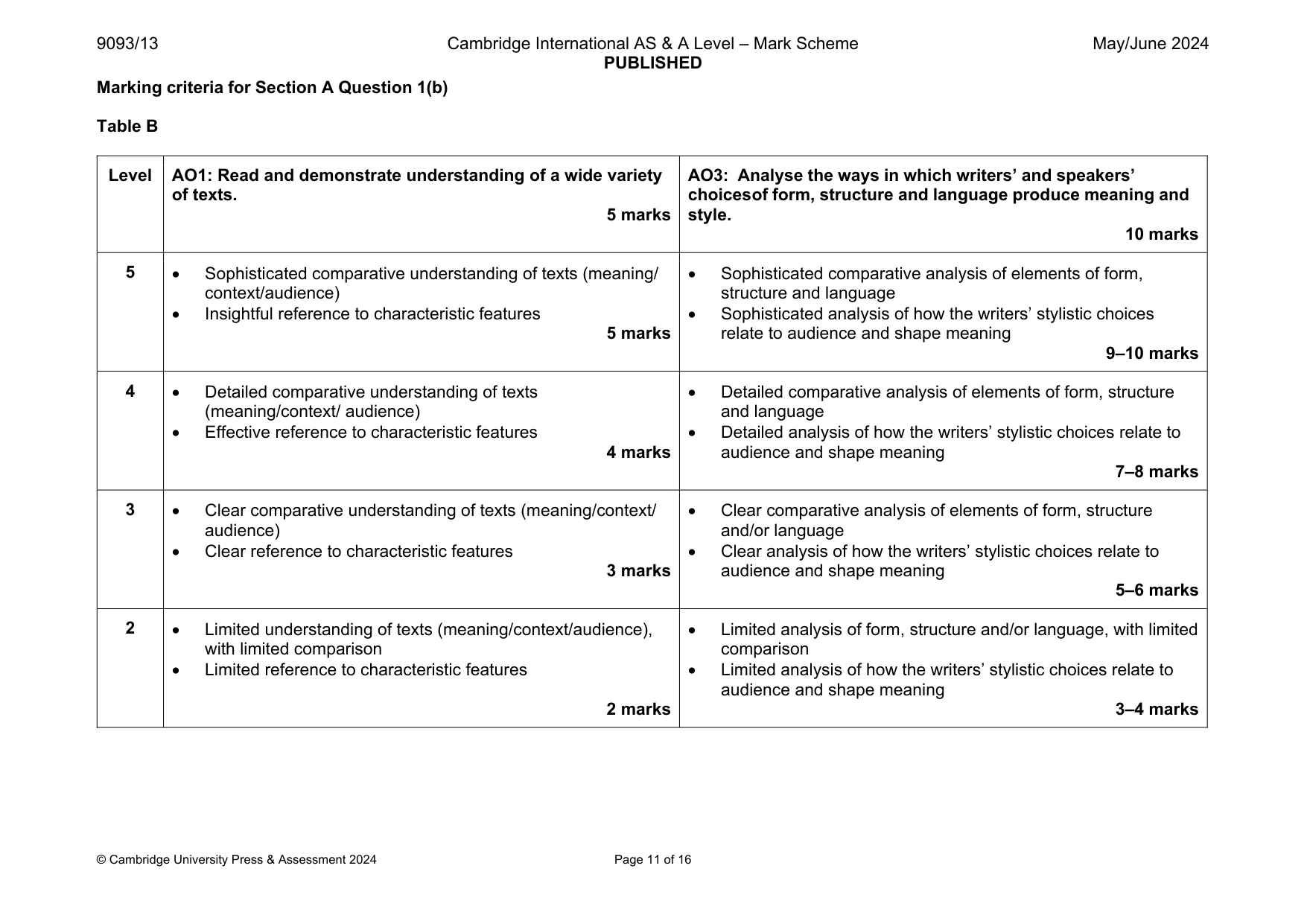
9093/13 Cambridge International AS & A Level – Mark Scheme PUBLISHED May/June 2024 © Cambridge University Press & Assessment 2024 Page 11 of 16 Marking criteria for Section A Question 1(b) Table B Level AO1: Read and demonstrate understanding of a wide variety of texts. 5 marks AO3: Analyse the ways in which writers’ and speakers’ choices of form, structure and language produce meaning and style. 10 marks 5 Sophisticated comparative understanding of texts (meaning/ context/audience) Insightful reference to characteristic features 5 marks Sophisticated comparative analysis of elements of form, structure and language Sophisticated analysis of how the writers’ stylistic choices relate to audience and shape meaning 9–10 marks 4 Detailed comparative understanding of texts (meaning/context/ audience) Effective reference to characteristic features 4 marks Detailed comparative analysis of elements of form, structure and language Detailed analysis of how the writers’ stylistic choices relate to audience and shape meaning 7–8 marks 3 Clear comparative understanding of texts (meaning/context/ audience) Clear reference to characteristic features 3 marks Clear comparative analysis of elements of form, structure and/or language Clear analysis of how the writers’ stylistic choices relate to audience and shape meaning 5–6 marks 2 Limited understanding of texts (meaning/context/audience), with limited comparison Limited reference to characteristic features 2 marks Limited analysis of form, structure and/or language, with limited comparison Limited analysis of how the writers’ stylistic choices relate to audience and shape meaning 3–4 marks
Mark scheme, page 12
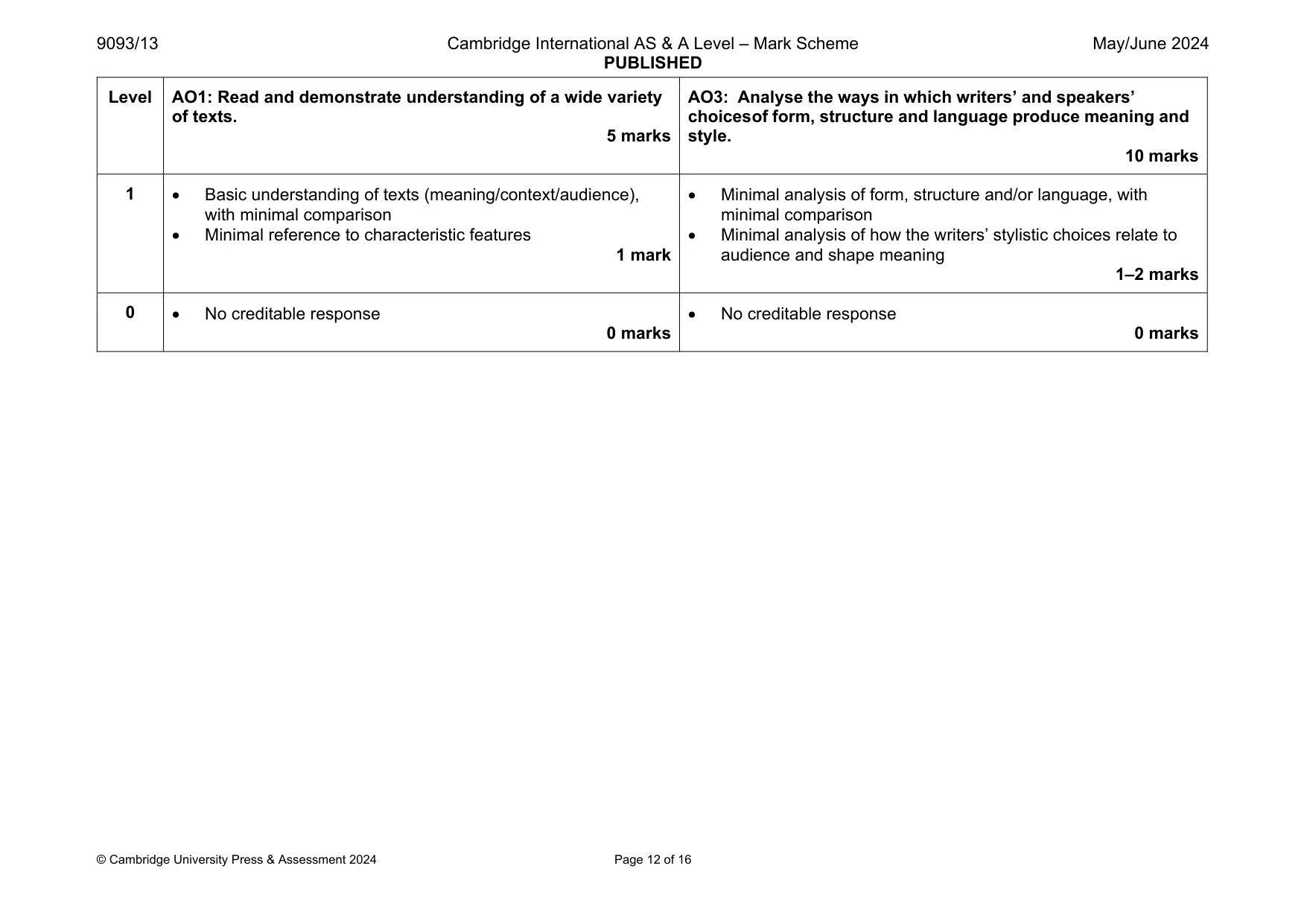
9093/13 Cambridge International AS & A Level – Mark Scheme PUBLISHED May/June 2024 © Cambridge University Press & Assessment 2024 Page 12 of 16 Level AO1: Read and demonstrate understanding of a wide variety of texts. 5 marks AO3: Analyse the ways in which writers’ and speakers’ choices of form, structure and language produce meaning and style. 10 marks 1 Basic understanding of texts (meaning/context/audience), with minimal comparison Minimal reference to characteristic features 1 mark Minimal analysis of form, structure and/or language, with minimal comparison Minimal analysis of how the writers’ stylistic choices relate to audience and shape meaning 1–2 marks 0 No creditable response 0 marks No creditable response 0 marks
Mark scheme, page 13
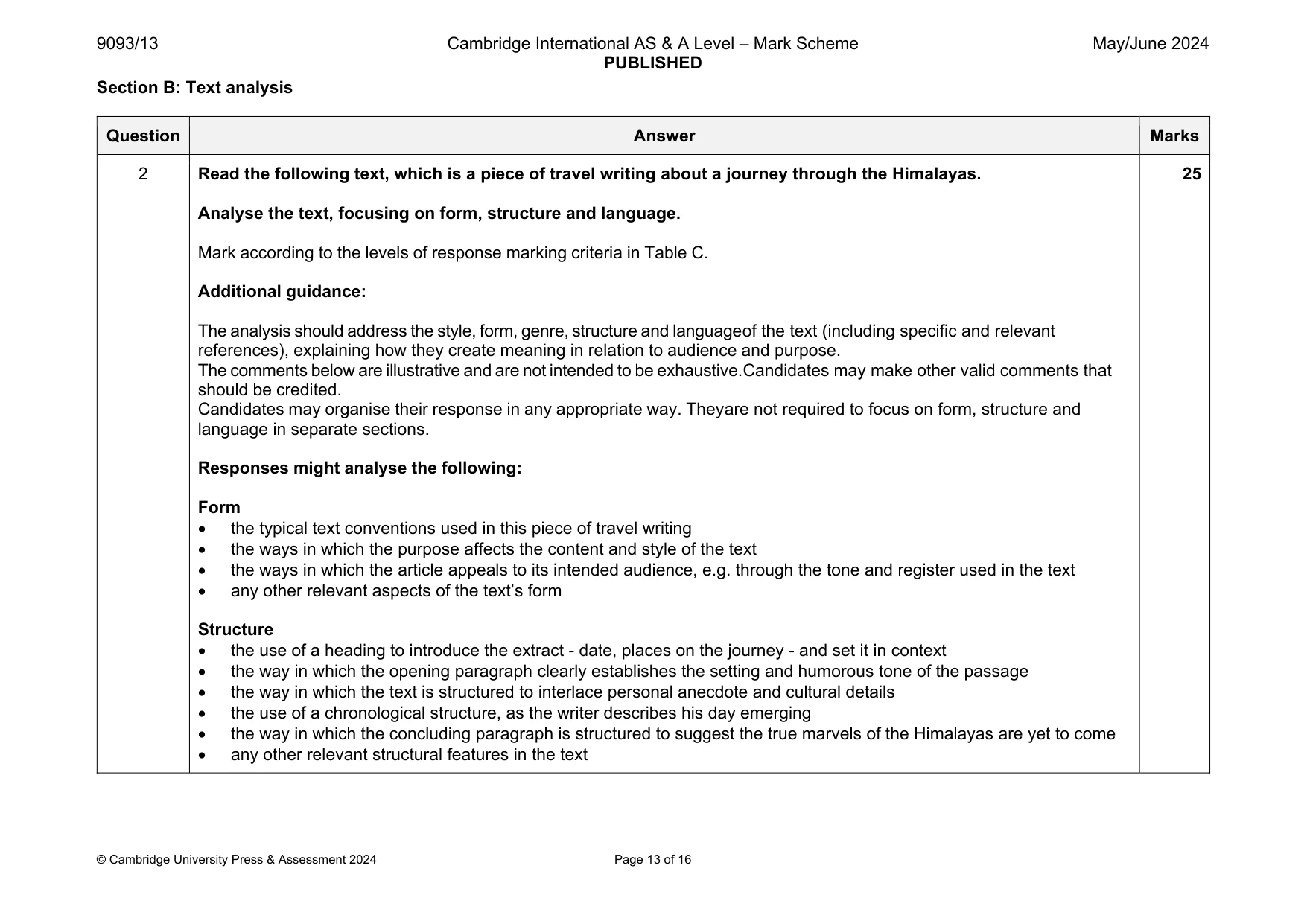
9093/13 Cambridge International AS & A Level – Mark Scheme PUBLISHED May/June 2024 © Cambridge University Press & Assessment 2024 Page 13 of 16 Section B: Text analysis Question Answer Marks 2 Read the following text, which is a piece of travel writing about a journey through the Himalayas. Analyse the text, focusing on form, structure and language. Mark according to the levels of response marking criteria in Table C. Additional guidance: The analysis should address the style, form, genre, structure and language of the text (including specific and relevant references), explaining how they create meaning in relation to audience and purpose. The comments below are illustrative and are not intended to be exhaustive. Candidates may make other valid comments that should be credited. Candidates may organise their response in any appropriate way. They are not required to focus on form, structure and language in separate sections. Responses might analyse the following: Form the typical text conventions used in this piece of travel writing the ways in which the purpose affects the content and style of the text the ways in which the article appeals to its intended audience, e.g. through the tone and register used in the text any other relevant aspects of the text’s form Structure the use of a heading to introduce the extract - date, places on the journey - and set it in context the way in which the opening paragraph clearly establishes the setting and humorous tone of the passage the way in which the text is structured to interlace personal anecdote and cultural details the use of a chronological structure, as the writer describes his day emerging the way in which the concluding paragraph is structured to suggest the true marvels of the Himalayas are yet to come any other relevant structural features in the text 25
Mark scheme, page 14
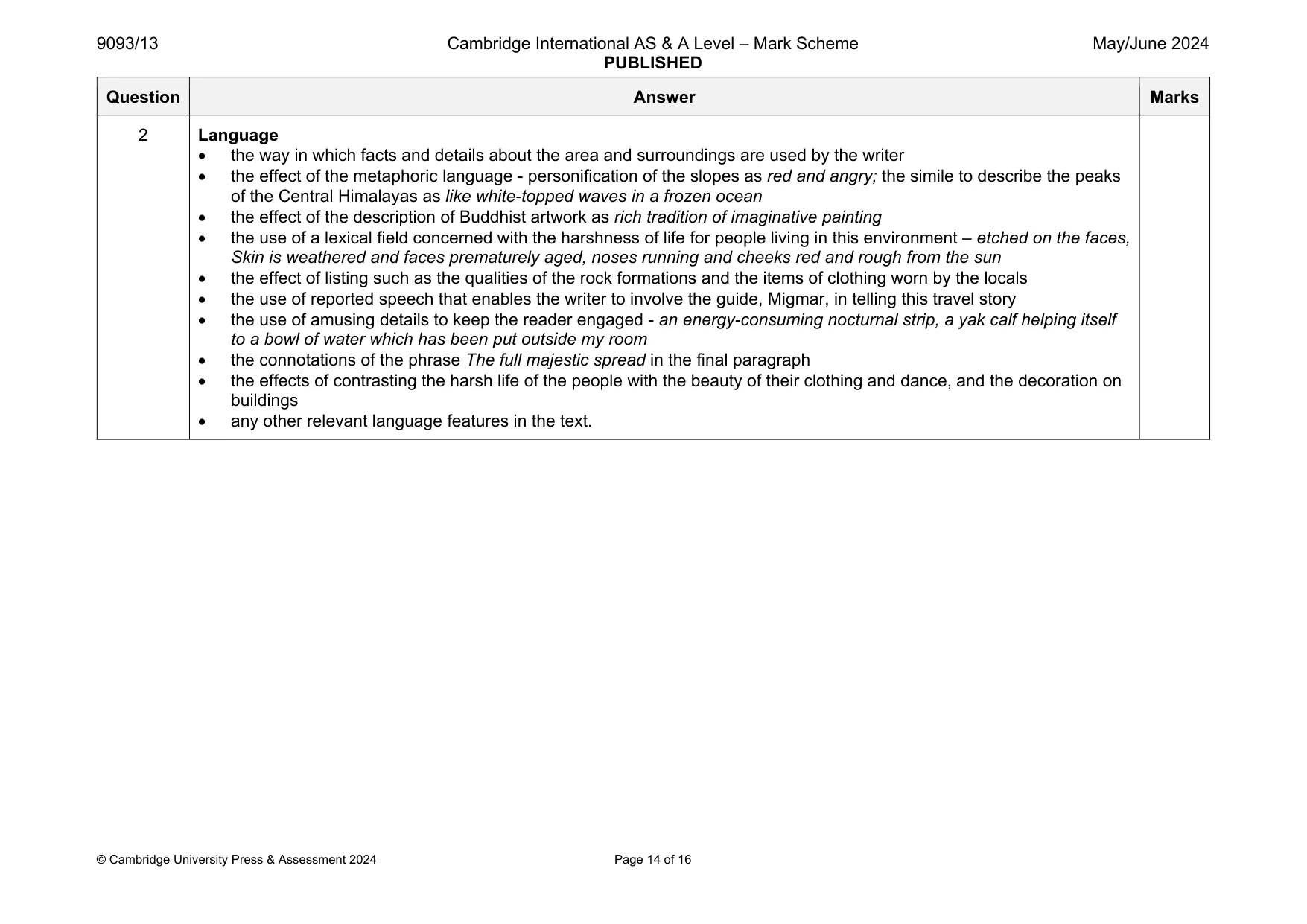
9093/13 Cambridge International AS & A Level – Mark Scheme PUBLISHED May/June 2024 © Cambridge University Press & Assessment 2024 Page 14 of 16 Question Answer Marks 2 Language the way in which facts and details about the area and surroundings are used by the writer the effect of the metaphoric language - personification of the slopes as red and angry; the simile to describe the peaks of the Central Himalayas as like white-topped waves in a frozen ocean the effect of the description of Buddhist artwork as rich tradition of imaginative painting the use of a lexical field concerned with the harshness of life for people living in this environment – etched on the faces, Skin is weathered and faces prematurely aged, noses running and cheeks red and rough from the sun the effect of listing such as the qualities of the rock formations and the items of clothing worn by the locals the use of reported speech that enables the writer to involve the guide, Migmar, in telling this travel story the use of amusing details to keep the reader engaged - an energy-consuming nocturnal strip, a yak calf helping itself to a bowl of water which has been put outside my room the connotations of the phrase The full majestic spread in the final paragraph the effects of contrasting the harsh life of the people with the beauty of their clothing and dance, and the decoration on buildings any other relevant language features in the text.
Mark scheme, page 15
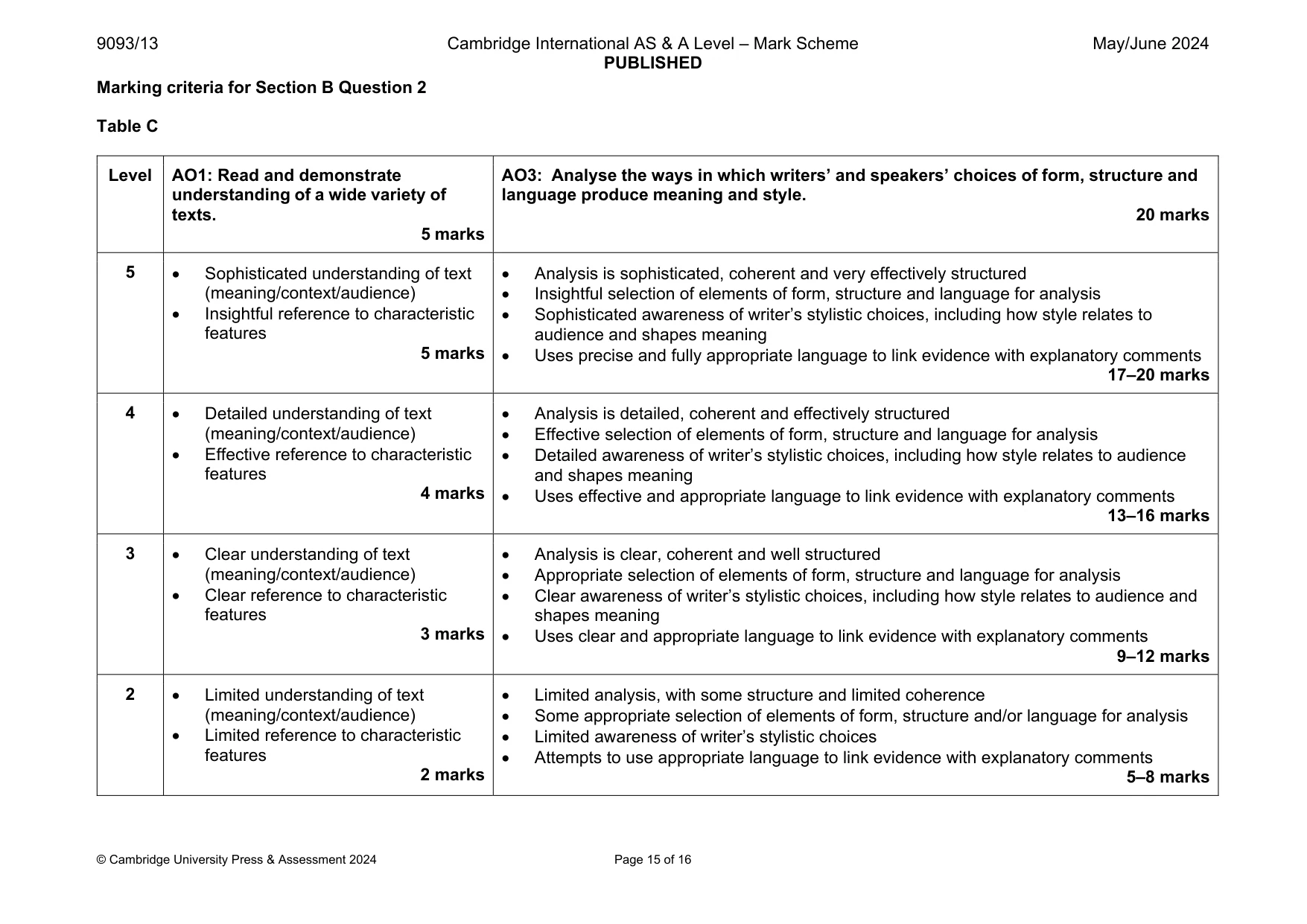
9093/13 Cambridge International AS & A Level – Mark Scheme PUBLISHED May/June 2024 © Cambridge University Press & Assessment 2024 Page 15 of 16 Marking criteria for Section B Question 2 Table C Level AO1: Read and demonstrate understanding of a wide variety of texts. 5 marks AO3: Analyse the ways in which writers’ and speakers’ choices of form, structure and language produce meaning and style. 20 marks 5 Sophisticated understanding of text (meaning/context/audience) Insightful reference to characteristic features 5 marks Analysis is sophisticated, coherent and very effectively structured Insightful selection of elements of form, structure and language for analysis Sophisticated awareness of writer’s stylistic choices, including how style relates to audience and shapes meaning Uses precise and fully appropriate language to link evidence with explanatory comments 17–20 marks 4 Detailed understanding of text (meaning/context/audience) Effective reference to characteristic features 4 marks Analysis is detailed, coherent and effectively structured Effective selection of elements of form, structure and language for analysis Detailed awareness of writer’s stylistic choices, including how style relates to audience and shapes meaning Uses effective and appropriate language to link evidence with explanatory comments 13–16 marks 3 Clear understanding of text (meaning/context/audience) Clear reference to characteristic features 3 marks Analysis is clear, coherent and well structured Appropriate selection of elements of form, structure and language for analysis Clear awareness of writer’s stylistic choices, including how style relates to audience and shapes meaning Uses clear and appropriate language to link evidence with explanatory comments 9–12 marks 2 Limited understanding of text (meaning/context/audience) Limited reference to characteristic features 2 marks Limited analysis, with some structure and limited coherence Some appropriate selection of elements of form, structure and/or language for analysis Limited awareness of writer’s stylistic choices Attempts to use appropriate language to link evidence with explanatory comments 5–8 marks
Mark scheme, page 16
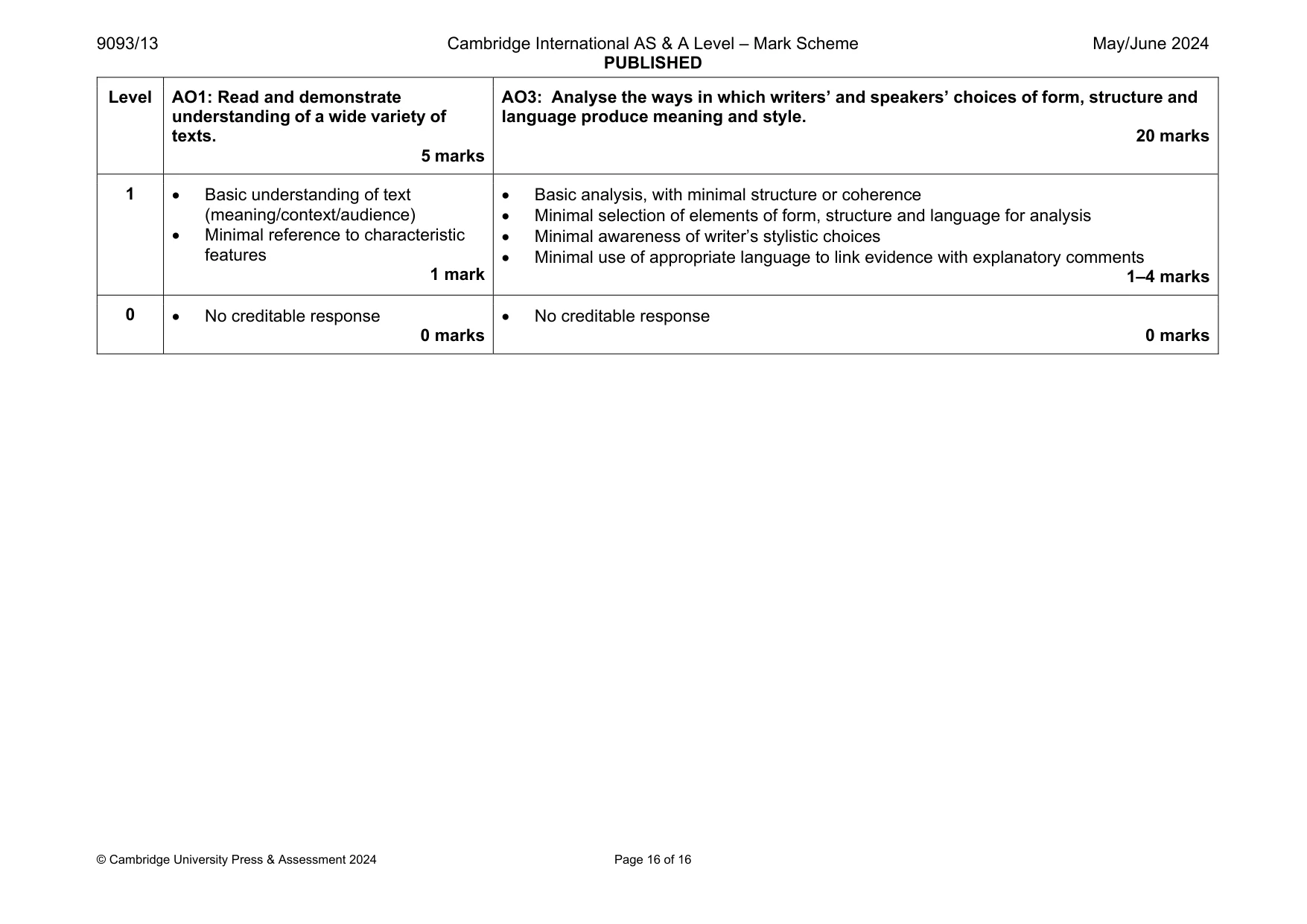
9093/13 Cambridge International AS & A Level – Mark Scheme PUBLISHED May/June 2024 © Cambridge University Press & Assessment 2024 Page 16 of 16 Level AO1: Read and demonstrate understanding of a wide variety of texts. 5 marks AO3: Analyse the ways in which writers’ and speakers’ choices of form, structure and language produce meaning and style. 20 marks 1 Basic understanding of text (meaning/context/audience) Minimal reference to characteristic features 1 mark Basic analysis, with minimal structure or coherence Minimal selection of elements of form, structure and language for analysis Minimal awareness of writer’s stylistic choices Minimal use of appropriate language to link evidence with explanatory comments 1–4 marks 0 No creditable response 0 marks No creditable response 0 marks
What you needed in this session
Cambridge’s own grade thresholds for 2024 May/June, Paper 1 · Variant 3. A higher threshold means an easier paper — the bar moves with how the cohort did.