Cambridge A Level English - Language AS and A Level (from 2014) 9093 — 2022 May/June Paper 1 · Variant 3
9093/13/M/J/22 · 50 marks · ≈56 min
The question paper and its mark scheme, free to read here and free to download. This is Cambridge’s own paper, exactly as it was sat.
Question paper8 pages
Mark scheme16 pages
Answers below. Sit the paper first if you are practising.
Paper as text
Question paper, page 1
Cambridge International AS & A Level 9093/13 May/June 2022 2 hours 15 minutes ENGLISH LANGUAGE Paper 1 Reading You must answer on the enclosed answer booklet. You will need: Answer booklet (enclosed) INSTRUCTIONS • Answer all questions. • Follow the instructions on the front cover of the answer booklet. If you need additional answer paper, ask the invigilator for a continuation booklet. • Dictionaries are not allowed. INFORMATION • The total mark for this paper is 50. • The number of marks for each question or part question is shown in brackets [ ]. This document has 8 pages. Any blank pages are indicated. [Turn over 06_9093_13_2022_1.6 © UCLES 2022 *2678930797*
Question paper, page 2
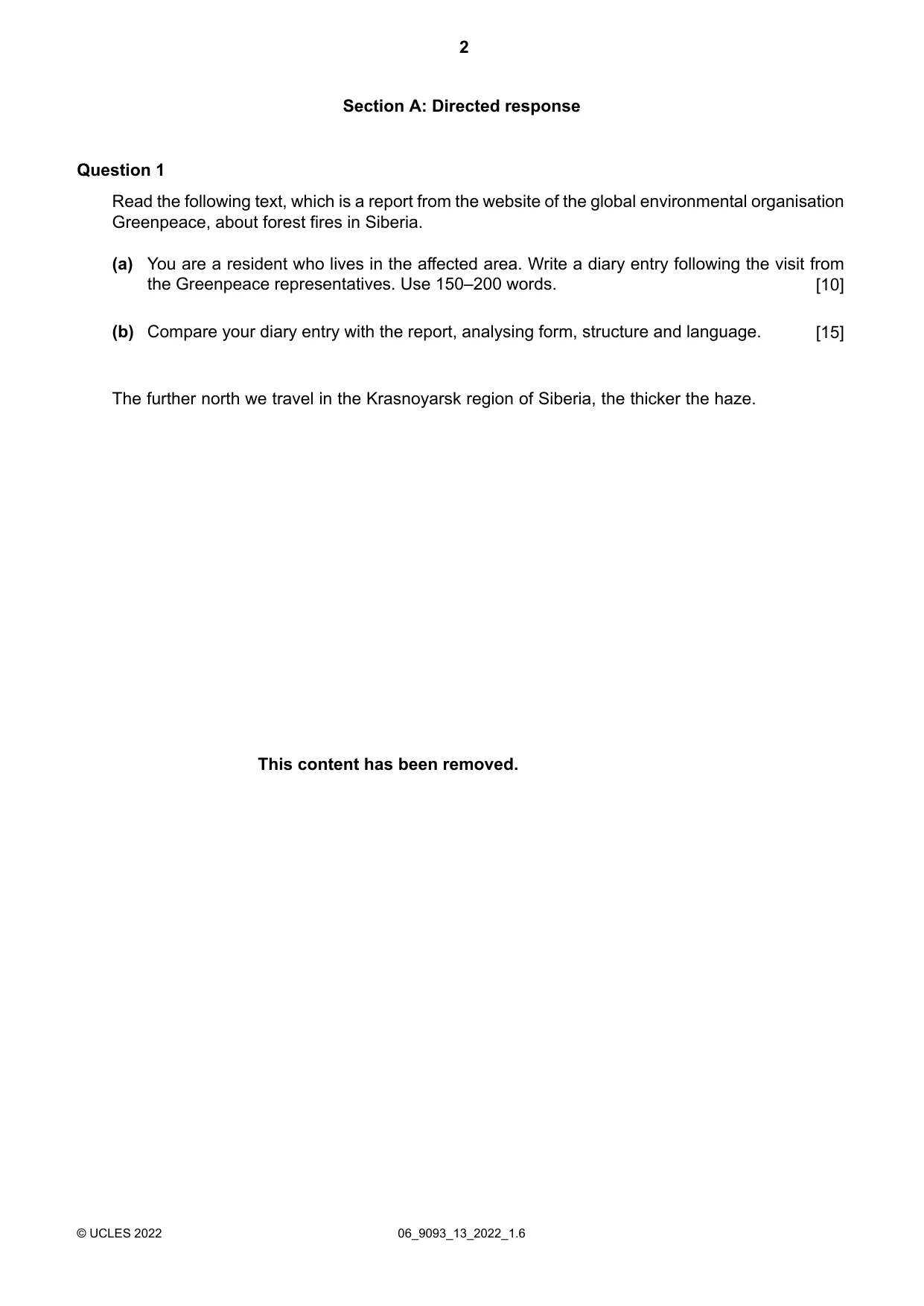
Section A: Directed response Question 1 Read the following text, which is a report from the website of the global environmental organisation Greenpeace, about forest fires in Siberia. You are a resident who lives in the affected area. Write a diary entry following the visit from the Greenpeace representatives. Use 150–200 words. [10] (a) Compare your diary entry with the report, analysing form, structure and language. [15] (b) The further north we travel in the Krasnoyarsk region of Siberia, the thicker the haze. 06_9093_13_2022_1.6 © UCLES 2022 2 This content has been removed.
Question paper, page 3
This means that we will stop a new climate crisis from happening – save millions of hectares of valuable taiga forests and prevent the release of hundreds of megatons of carbon dioxide into the atmosphere. [Turn over 06_9093_13_2022_1.6 © UCLES 2022 3 This content has been removed.
Question paper, page 4
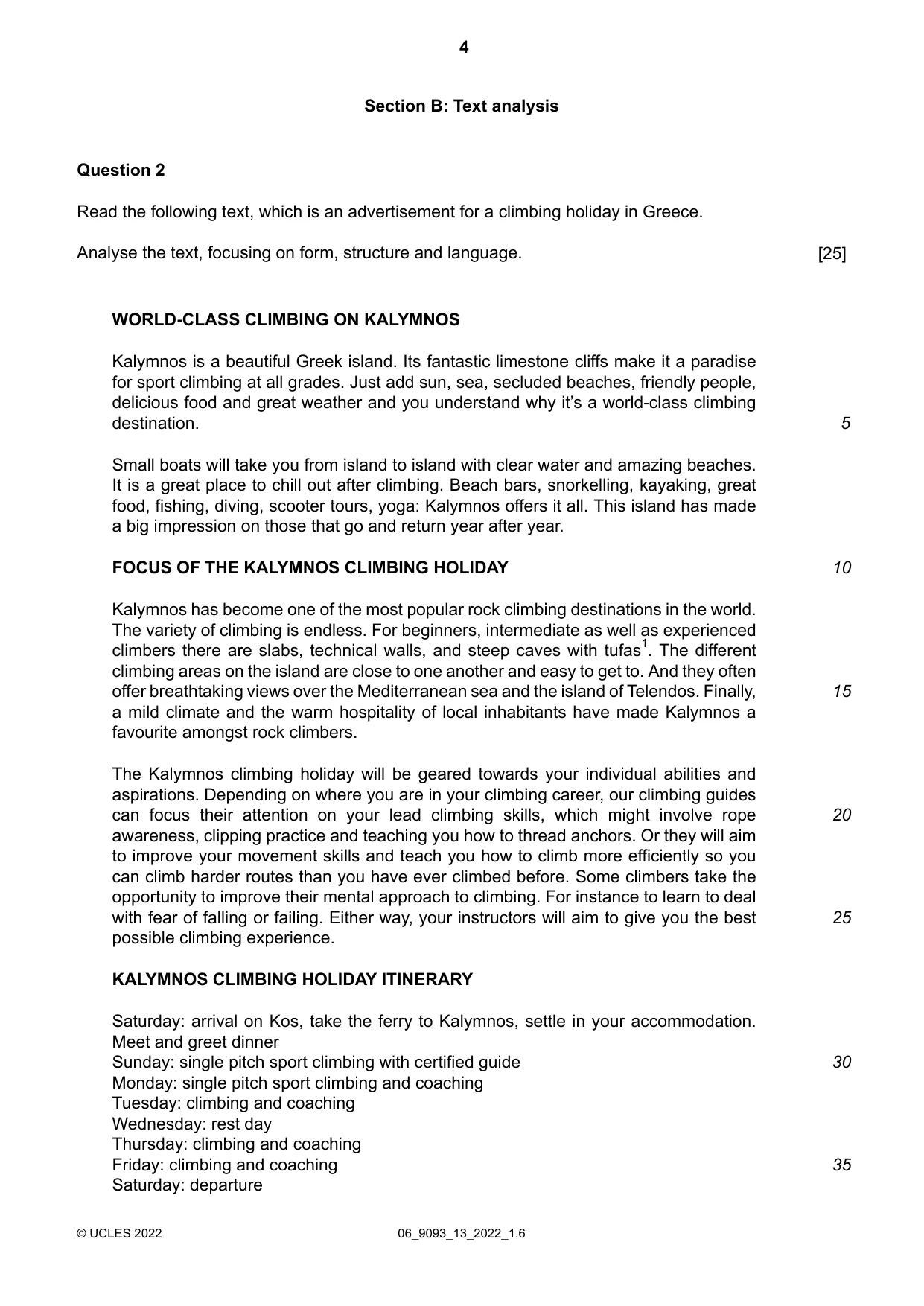
35 30 25 20 15 10 5 Section B: Text analysis Question 2 Read the following text, which is an advertisement for a climbing holiday in Greece. Analyse the text, focusing on form, structure and language. [25] WORLD-CLASS CLIMBING ON KALYMNOS Kalymnos is a beautiful Greek island. Its fantastic limestone cliffs make it a paradise for sport climbing at all grades. Just add sun, sea, secluded beaches, friendly people, delicious food and great weather and you understand why it’s a world-class climbing destination. Small boats will take you from island to island with clear water and amazing beaches. It is a great place to chill out after climbing. Beach bars, snorkelling, kayaking, great food, fishing, diving, scooter tours, yoga: Kalymnos offers it all. This island has made a big impression on those that go and return year after year. FOCUS OF THE KALYMNOS CLIMBING HOLIDAY Kalymnos has become one of the most popular rock climbing destinations in the world. The variety of climbing is endless. For beginners, intermediate as well as experienced climbers there are slabs, technical walls, and steep caves with tufas1. The different climbing areas on the island are close to one another and easy to get to. And they often offer breathtaking views over the Mediterranean sea and the island of Telendos. Finally, a mild climate and the warm hospitality of local inhabitants have made Kalymnos a favourite amongst rock climbers. The Kalymnos climbing holiday will be geared towards your individual abilities and aspirations. Depending on where you are in your climbing career, our climbing guides can focus their attention on your lead climbing skills, which might involve rope awareness, clipping practice and teaching you how to thread anchors. Or they will aim to improve your movement skills and teach you how to climb more efficiently so you can climb harder routes than you have ever climbed before. Some climbers take the opportunity to improve their mental approach to climbing. For instance to learn to deal with fear of falling or failing. Either way, your instructors will aim to give you the best possible climbing experience. KALYMNOS CLIMBING HOLIDAY ITINERARY Saturday: arrival on Kos, take the ferry to Kalymnos, settle in your accommodation. Meet and greet dinner Sunday: single pitch sport climbing with certified guide Monday: single pitch sport climbing and coaching Tuesday: climbing and coaching Wednesday: rest day Thursday: climbing and coaching Friday: climbing and coaching Saturday: departure 06_9093_13_2022_1.6 © UCLES 2022 4
Question paper, page 5
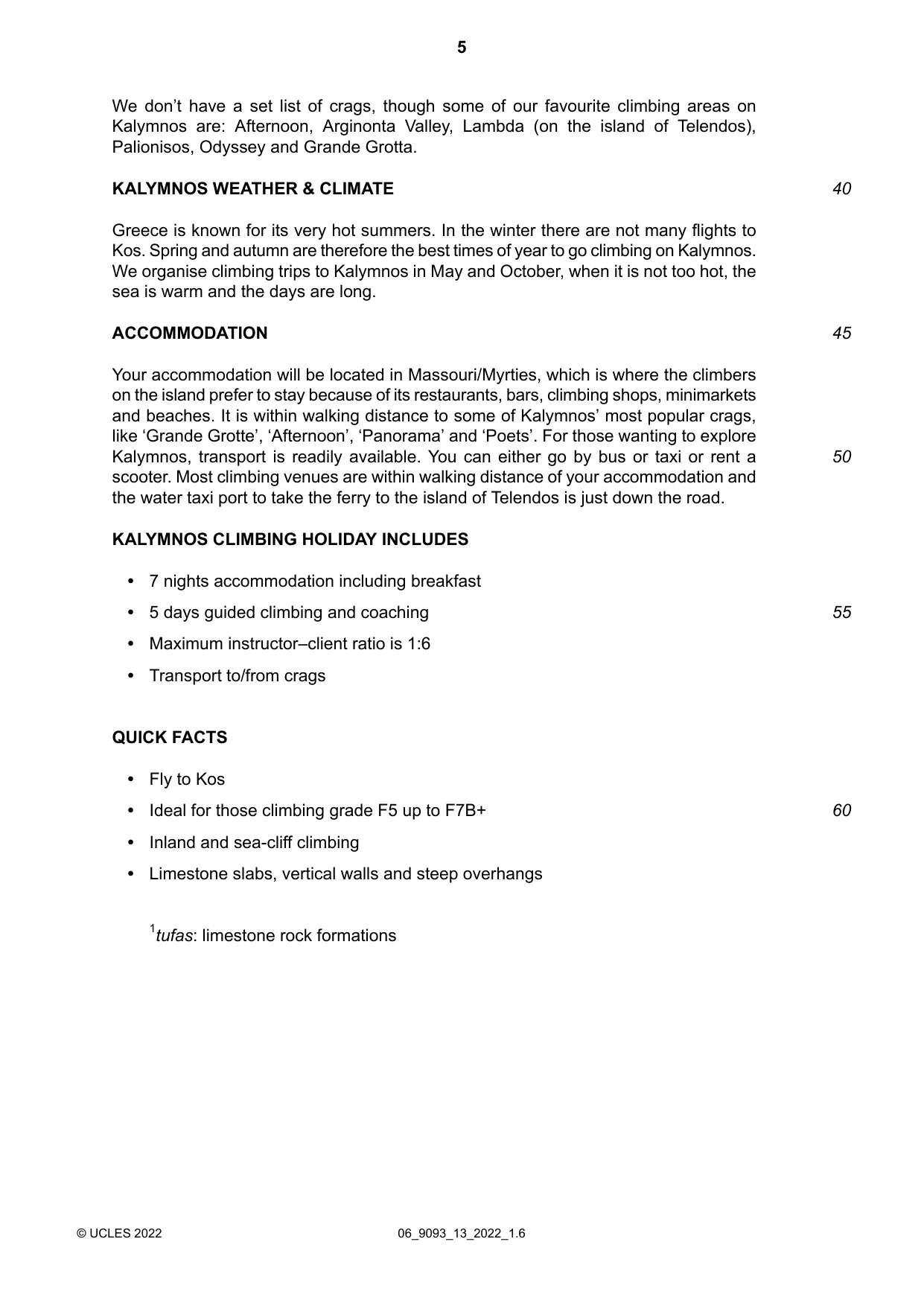
60 55 50 45 40 We don’t have a set list of crags, though some of our favourite climbing areas on Kalymnos are: Afternoon, Arginonta Valley, Lambda (on the island of Telendos), Palionisos, Odyssey and Grande Grotta. KALYMNOS WEATHER & CLIMATE Greece is known for its very hot summers. In the winter there are not many flights to Kos. Spring and autumn are therefore the best times of year to go climbing on Kalymnos. We organise climbing trips to Kalymnos in May and October, when it is not too hot, the sea is warm and the days are long. ACCOMMODATION Your accommodation will be located in Massouri/Myrties, which is where the climbers on the island prefer to stay because of its restaurants, bars, climbing shops, minimarkets and beaches. It is within walking distance to some of Kalymnos’ most popular crags, like ‘Grande Grotte’, ‘Afternoon’, ‘Panorama’ and ‘Poets’. For those wanting to explore Kalymnos, transport is readily available. You can either go by bus or taxi or rent a scooter. Most climbing venues are within walking distance of your accommodation and the water taxi port to take the ferry to the island of Telendos is just down the road. KALYMNOS CLIMBING HOLIDAY INCLUDES • 7 nights accommodation including breakfast • 5 days guided climbing and coaching • Maximum instructor–client ratio is 1:6 • Transport to/from crags QUICK FACTS • Fly to Kos • Ideal for those climbing grade F5 up to F7B+ • Inland and sea-cliff climbing • Limestone slabs, vertical walls and steep overhangs 1tufas: limestone rock formations 06_9093_13_2022_1.6 © UCLES 2022 5
Question paper, page 6
BLANK PAGE 06_9093_13_2022_1.6 © UCLES 2022 6
Question paper, page 7
BLANK PAGE 06_9093_13_2022_1.6 © UCLES 2022 7
Question paper, page 8
BLANK PAGE Permission to reproduce items where third-party owned material protected by copyright is included has been sought and cleared where possible. Every reasonable effort has been made by the publisher (UCLES) to trace copyright holders, but if any items requiring clearance have unwittingly been included, the publisher will be pleased to make amends at the earliest possible opportunity. To avoid the issue of disclosure of answer-related information to candidates, all copyright acknowledgements are reproduced online in the Cambridge Assessment International Education Copyright Acknowledgements Booklet. This is produced for each series of examinations and is freely available to download at www.cambridgeinternational.org after the live examination series. Cambridge Assessment International Education is part of Cambridge Assessment. Cambridge Assessment is the brand name of the University of Cambridge Local Examinations Syndicate (UCLES), which is a department of the University of Cambridge. 06_9093_13_2022_1.6 © UCLES 2022 8
Mark scheme, page 1
This document consists of 16 printed pages. © UCLES 2022 [Turn over Cambridge International AS & A Level ENGLISH LANGUAGE 9093/13 Paper 1 Reading May/June 2022 MARK SCHEME Maximum Mark: 50 Published This mark scheme is published as an aid to teachers and candidates, to indicate the requirements of the examination. It shows the basis on which Examiners were instructed to award marks. It does not indicate the details of the discussions that took place at an Examiners’ meeting before marking began, which would have considered the acceptability of alternative answers. Mark schemes should be read in conjunction with the question paper and the Principal Examiner Report for Teachers. Cambridge International will not enter into discussions about these mark schemes. Cambridge International is publishing the mark schemes for the May/June 2022 series for most Cambridge IGCSE, Cambridge International A and AS Level and Cambridge Pre-U components, and some Cambridge O Level components.
Mark scheme, page 2
9093/13 Cambridge International AS & A Level – Mark Scheme PUBLISHED May/June 2022 © UCLES 2022 Page 2 of 16 Generic Marking Principles These general marking principles must be applied by all examiners when marking candidate answers. They should be applied alongside the specific content of the mark scheme or generic level descriptors for a question. Each question paper and mark scheme will also comply with these marking principles. GENERIC MARKING PRINCIPLE 1: Marks must be awarded in line with: the specific content of the mark scheme or the generic level descriptors for the question the specific skills defined in the mark scheme or in the generic level descriptors for the question the standard of response required by a candidate as exemplified by the standardisation scripts. GENERIC MARKING PRINCIPLE 2: Marks awarded are always whole marks (not half marks, or other fractions). GENERIC MARKING PRINCIPLE 3: Marks must be awarded positively: marks are awarded for correct/valid answers, as defined in the mark scheme. However, credit is given for valid answers which go beyond the scope of the syllabus and mark scheme, referring to your Team Leader as appropriate marks are awarded when candidates clearly demonstrate what they know and can do marks are not deducted for errors marks are not deducted for omissions answers should only be judged on the quality of spelling, punctuation and grammar when these features are specifically assessed by the question as indicated by the mark scheme. The meaning, however, should be unambiguous. GENERIC MARKING PRINCIPLE 4: Rules must be applied consistently, e.g. in situations where candidates have not followed instructions or in the application of generic level descriptors.
Mark scheme, page 3
9093/13 Cambridge International AS & A Level – Mark Scheme PUBLISHED May/June 2022 © UCLES 2022 Page 3 of 16 GENERIC MARKING PRINCIPLE 5: Marks should be awarded using the full range of marks defined in the mark scheme for the question (however; the use of the full mark range may be limited according to the quality of the candidate responses seen). GENERIC MARKING PRINCIPLE 6: Marks awarded are based solely on the requirements as defined in the mark scheme. Marks should not be awarded with grade thresholds or grade descriptors in mind.
Mark scheme, page 4
9093/13 Cambridge International AS & A Level – Mark Scheme PUBLISHED May/June 2022 © UCLES 2022 Page 4 of 16 English & Media subject specific general marking principles (To be read in conjunction with the Generic Marking Principles (and requiring further guidance on how to place marks within levels)) Components using level descriptors: We use level descriptors as a guide to broad understanding of the qualities normally expected of, or typical of, work in a level. Level descriptors are a means of general guidance, and should not be interpreted as hurdle statements. Where indicative content notes are supplied for a question, these are not a prescription of required content, and must not be treated as such. Alternative correct points and unexpected answers in candidates’ scripts must be given marks that fairly reflect the knowledge and skills demonstrated. While we may have legitimate expectations as to the ground most answers may occupy, we must at all times be prepared to meet candidates on their chosen ground, provided it is relevant ground (e.g. clearly related to and derived from a relevant passage/text and meeting the mark scheme requirements for the question).
Mark scheme, page 5
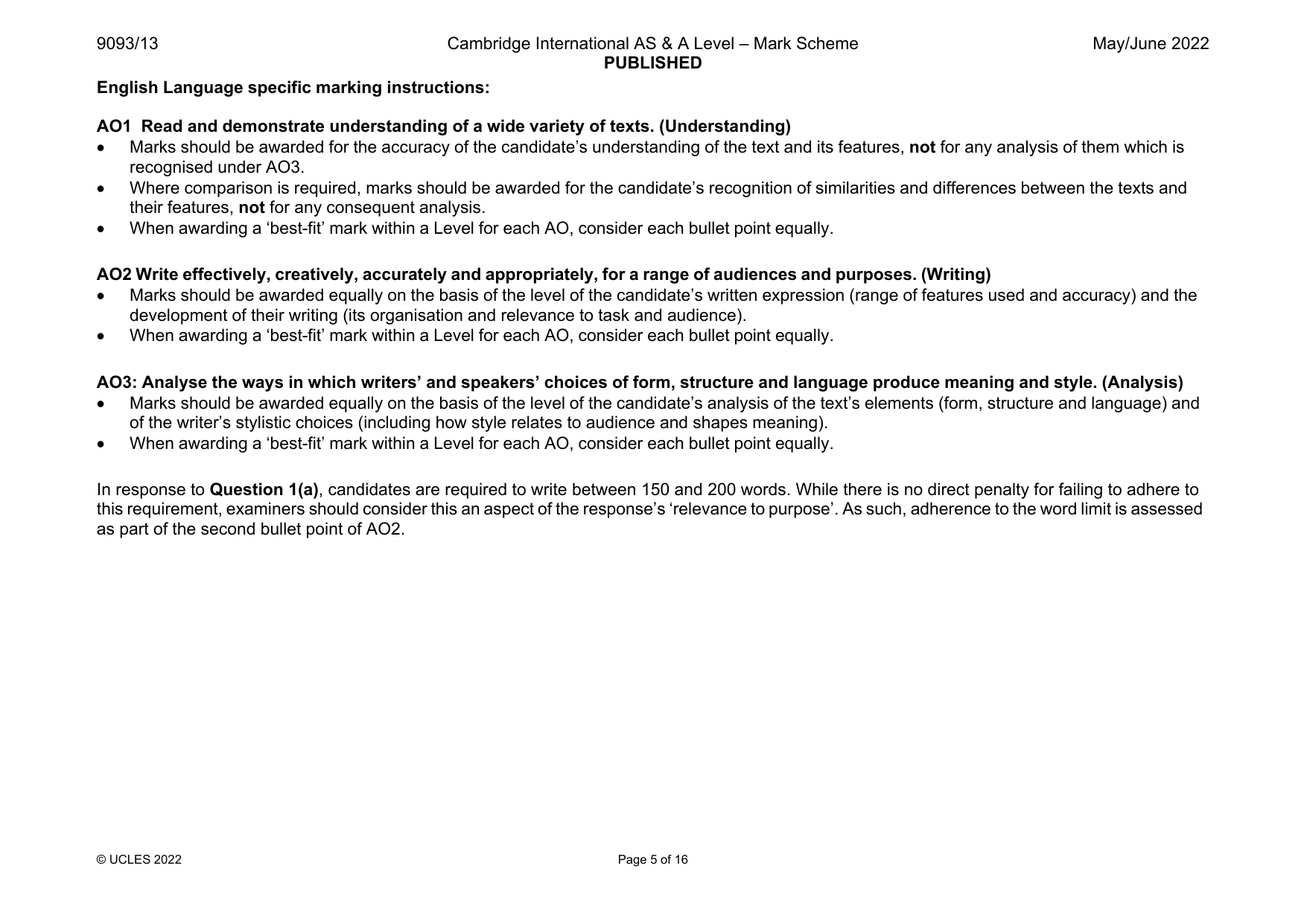
9093/13 Cambridge International AS & A Level – Mark Scheme PUBLISHED May/June 2022 © UCLES 2022 Page 5 of 16 English Language specific marking instructions: AO1 Read and demonstrate understanding of a wide variety of texts. (Understanding) Marks should be awarded for the accuracy of the candidate’s understanding of the text and its features, not for any analysis of them which is recognised under AO3. Where comparison is required, marks should be awarded for the candidate’s recognition of similarities and differences between the texts and their features, not for any consequent analysis. When awarding a ‘best-fit’ mark within a Level for each AO, consider each bullet point equally. AO2 Write effectively, creatively, accurately and appropriately, for a range of audiences and purposes. (Writing) Marks should be awarded equally on the basis of the level of the candidate’s written expression (range of features used and accuracy) and the development of their writing (its organisation and relevance to task and audience). When awarding a ‘best-fit’ mark within a Level for each AO, consider each bullet point equally. AO3: Analyse the ways in which writers’ and speakers’ choices of form, structure and language produce meaning and style. (Analysis) Marks should be awarded equally on the basis of the level of the candidate’s analysis of the text’s elements (form, structure and language) and of the writer’s stylistic choices (including how style relates to audience and shapes meaning). When awarding a ‘best-fit’ mark within a Level for each AO, consider each bullet point equally. In response to Question 1(a), candidates are required to write between 150 and 200 words. While there is no direct penalty for failing to adhere to this requirement, examiners should consider this an aspect of the response’s ‘relevance to purpose’. As such, adherence to the word limit is assessed as part of the second bullet point of AO2.
Mark scheme, page 6
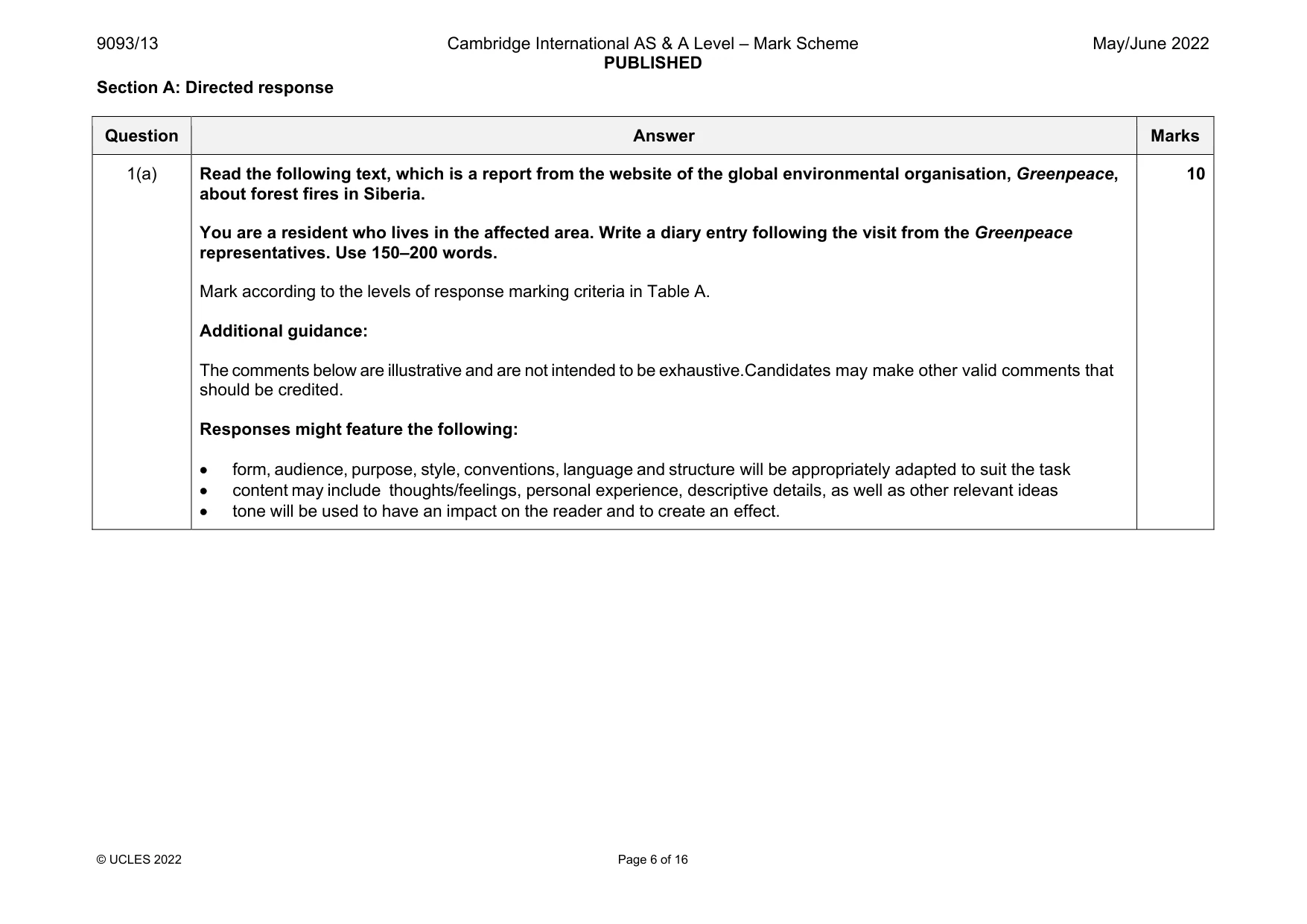
9093/13 Cambridge International AS & A Level – Mark Scheme PUBLISHED May/June 2022 © UCLES 2022 Page 6 of 16 Section A: Directed response Question Answer Marks 1(a) Read the following text, which is a report from the website of the global environmental organisation, Greenpeace, about forest fires in Siberia. You are a resident who lives in the affected area. Write a diary entry following the visit from the Greenpeace representatives. Use 150–200 words. Mark according to the levels of response marking criteria in Table A. Additional guidance: The comments below are illustrative and are not intended to be exhaustive. Candidates may make other valid comments that should be credited. Responses might feature the following: form, audience, purpose, style, conventions, language and structure will be appropriately adapted to suit the task content may include thoughts/feelings, personal experience, descriptive details, as well as other relevant ideas tone will be used to have an impact on the reader and to create an effect. 10
Mark scheme, page 7
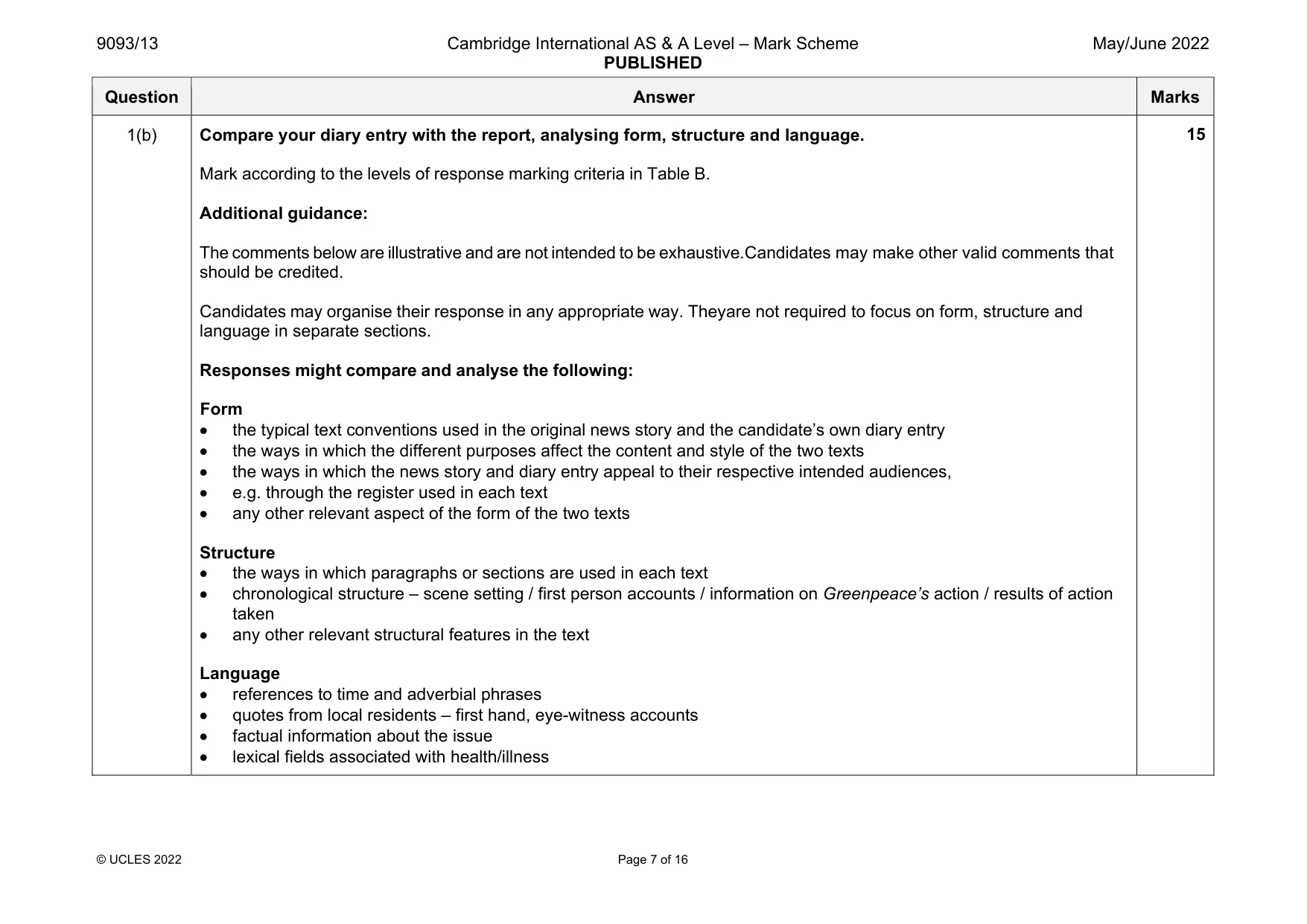
9093/13 Cambridge International AS & A Level – Mark Scheme PUBLISHED May/June 2022 © UCLES 2022 Page 7 of 16 Question Answer Marks 1(b) Compare your diary entry with the report, analysing form, structure and language. Mark according to the levels of response marking criteria in Table B. Additional guidance: The comments below are illustrative and are not intended to be exhaustive. Candidates may make other valid comments that should be credited. Candidates may organise their response in any appropriate way. They are not required to focus on form, structure and language in separate sections. Responses might compare and analyse the following: Form the typical text conventions used in the original news story and the candidate’s own diary entry the ways in which the different purposes affect the content and style of the two texts the ways in which the news story and diary entry appeal to their respective intended audiences, e.g. through the register used in each text any other relevant aspect of the form of the two texts Structure the ways in which paragraphs or sections are used in each text chronological structure – scene setting / first person accounts / information on Greenpeace’s action / results of action taken any other relevant structural features in the text Language references to time and adverbial phrases quotes from local residents – first hand, eye-witness accounts factual information about the issue lexical fields associated with health/illness 15
Mark scheme, page 8
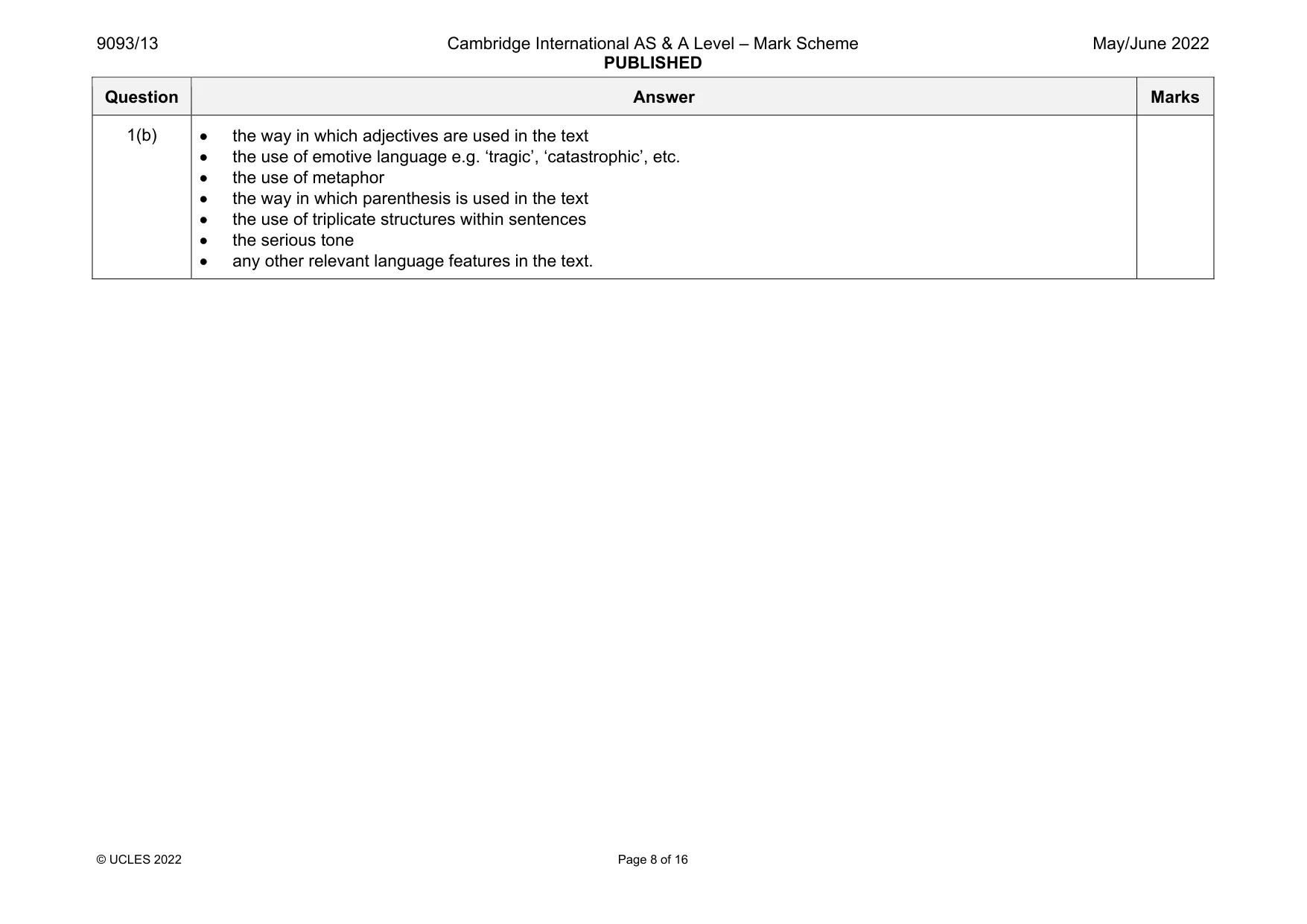
9093/13 Cambridge International AS & A Level – Mark Scheme PUBLISHED May/June 2022 © UCLES 2022 Page 8 of 16 Question Answer Marks 1(b) the way in which adjectives are used in the text the use of emotive language e.g. ‘tragic’, ‘catastrophic’, etc. the use of metaphor the way in which parenthesis is used in the text the use of triplicate structures within sentences the serious tone any other relevant language features in the text.
Mark scheme, page 9
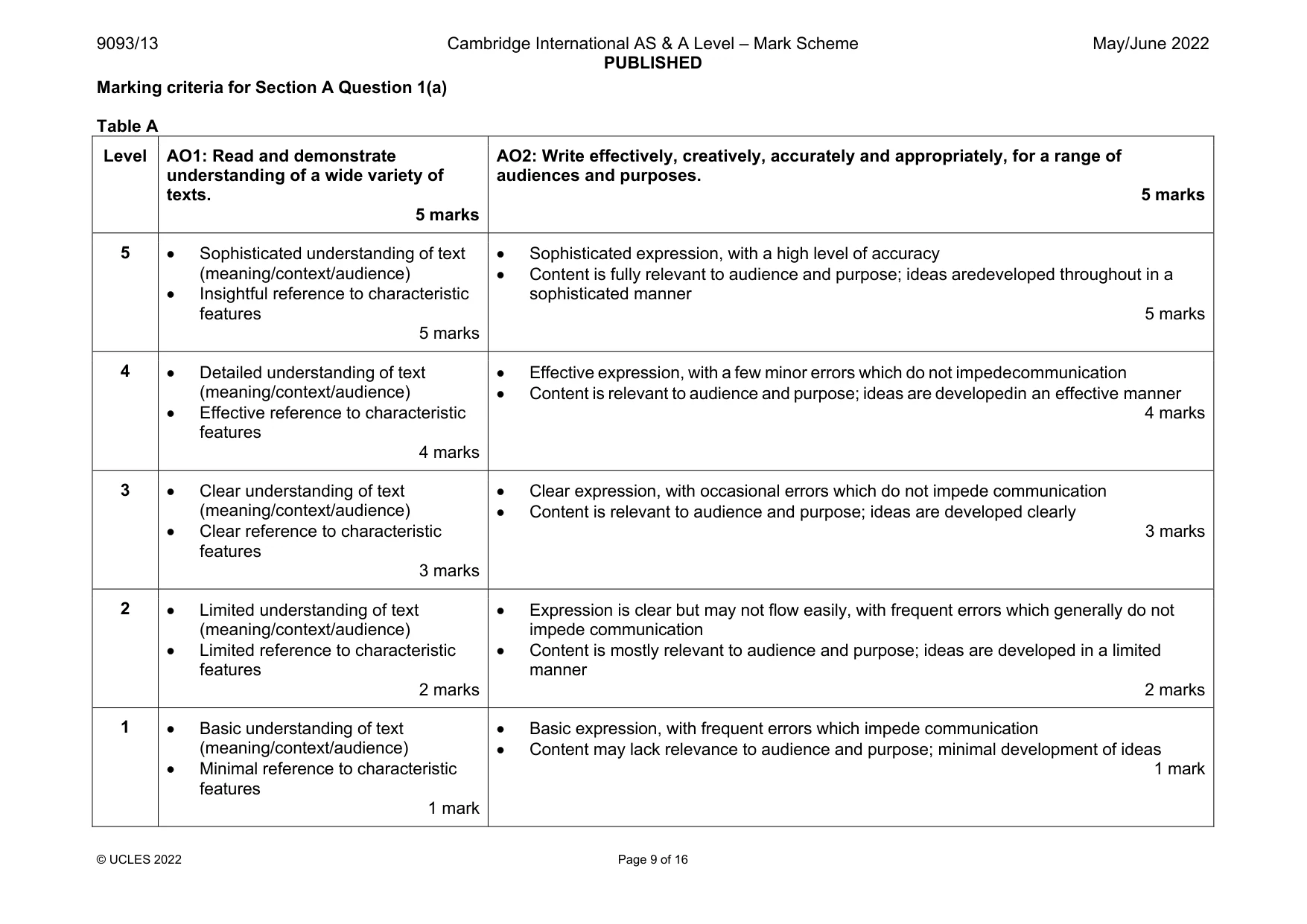
9093/13 Cambridge International AS & A Level – Mark Scheme PUBLISHED May/June 2022 © UCLES 2022 Page 9 of 16 Marking criteria for Section A Question 1(a) Table A Level AO1: Read and demonstrate understanding of a wide variety of texts. 5 marks AO2: Write effectively, creatively, accurately and appropriately, for a range of audiences and purposes. 5 marks 5 Sophisticated understanding of text (meaning/context/audience) Insightful reference to characteristic features 5 marks Sophisticated expression, with a high level of accuracy Content is fully relevant to audience and purpose; ideas are developed throughout in a sophisticated manner 5 marks 4 Detailed understanding of text (meaning/context/audience) Effective reference to characteristic features 4 marks Effective expression, with a few minor errors which do not impede communication Content is relevant to audience and purpose; ideas are developed in an effective manner 4 marks 3 Clear understanding of text (meaning/context/audience) Clear reference to characteristic features 3 marks Clear expression, with occasional errors which do not impede communication Content is relevant to audience and purpose; ideas are developed clearly 3 marks 2 Limited understanding of text (meaning/context/audience) Limited reference to characteristic features 2 marks Expression is clear but may not flow easily, with frequent errors which generally do not impede communication Content is mostly relevant to audience and purpose; ideas are developed in a limited manner 2 marks 1 Basic understanding of text (meaning/context/audience) Minimal reference to characteristic features 1 mark Basic expression, with frequent errors which impede communication Content may lack relevance to audience and purpose; minimal development of ideas 1 mark
Mark scheme, page 10
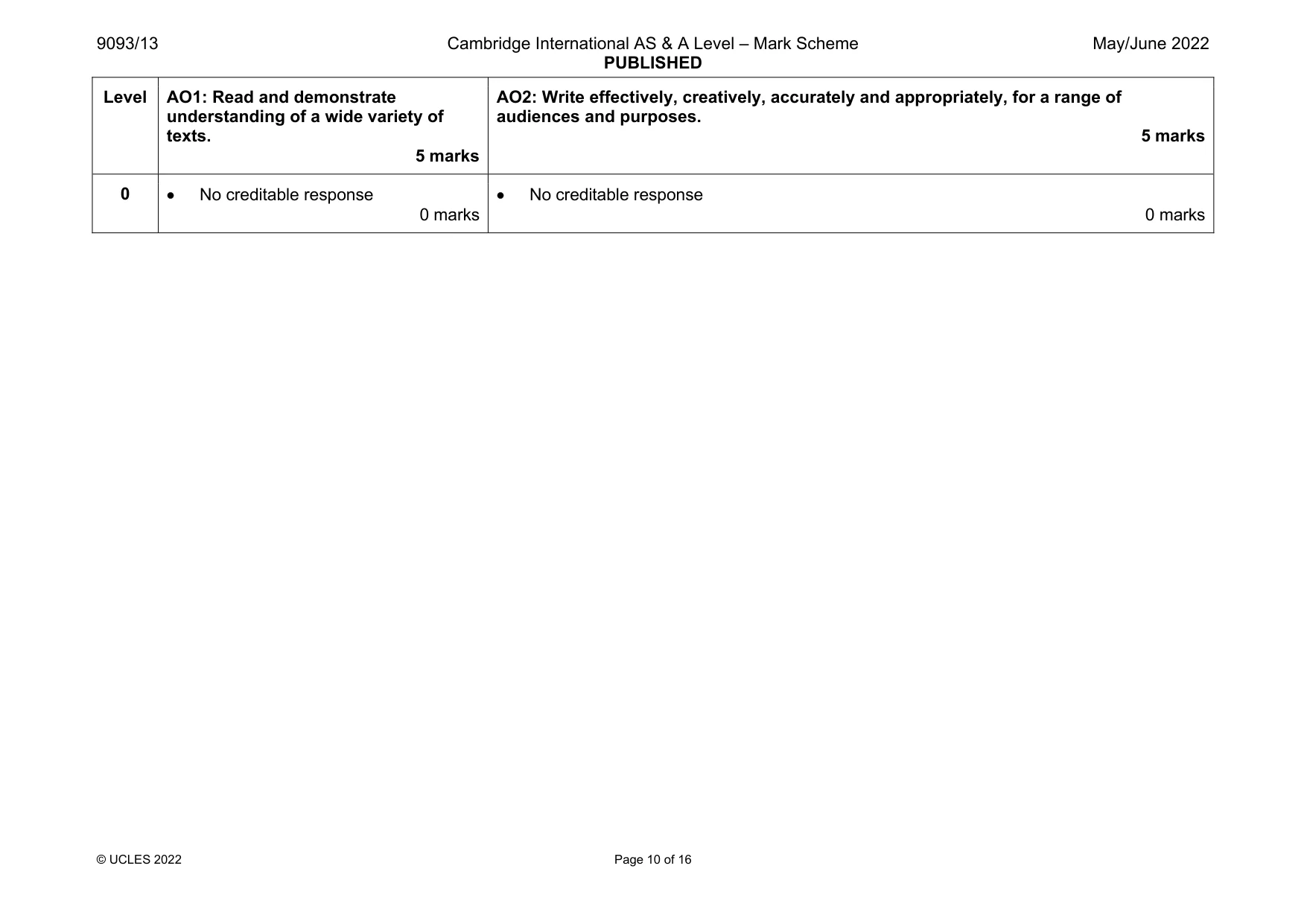
9093/13 Cambridge International AS & A Level – Mark Scheme PUBLISHED May/June 2022 © UCLES 2022 Page 10 of 16 Level AO1: Read and demonstrate understanding of a wide variety of texts. 5 marks AO2: Write effectively, creatively, accurately and appropriately, for a range of audiences and purposes. 5 marks 0 No creditable response 0 marks No creditable response 0 marks
Mark scheme, page 11
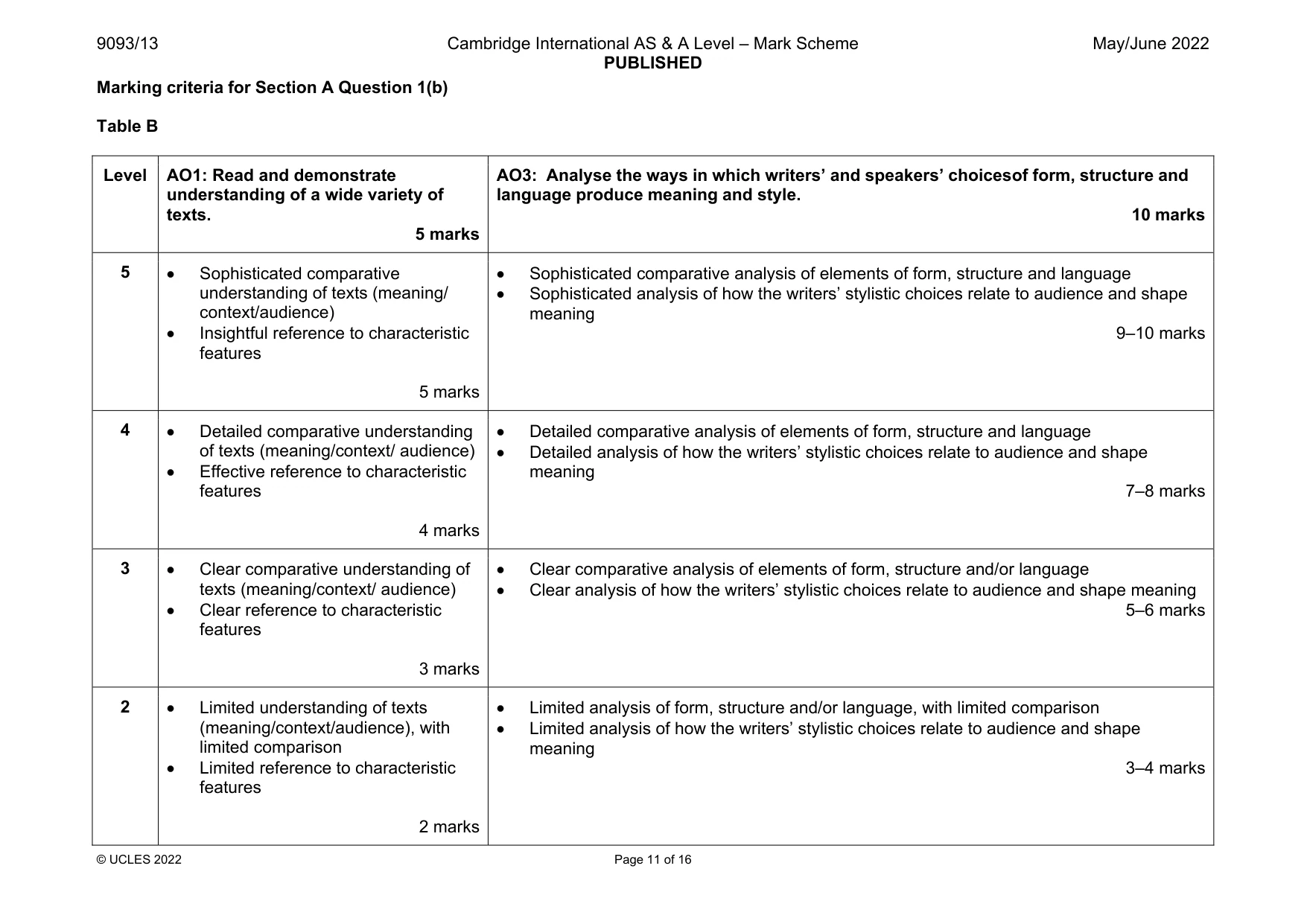
9093/13 Cambridge International AS & A Level – Mark Scheme PUBLISHED May/June 2022 © UCLES 2022 Page 11 of 16 Marking criteria for Section A Question 1(b) Table B Level AO1: Read and demonstrate understanding of a wide variety of texts. 5 marks AO3: Analyse the ways in which writers’ and speakers’ choices of form, structure and language produce meaning and style. 10 marks 5 Sophisticated comparative understanding of texts (meaning/ context/audience) Insightful reference to characteristic features 5 marks Sophisticated comparative analysis of elements of form, structure and language Sophisticated analysis of how the writers’ stylistic choices relate to audience and shape meaning 9–10 marks 4 Detailed comparative understanding of texts (meaning/context/ audience) Effective reference to characteristic features 4 marks Detailed comparative analysis of elements of form, structure and language Detailed analysis of how the writers’ stylistic choices relate to audience and shape meaning 7–8 marks 3 Clear comparative understanding of texts (meaning/context/ audience) Clear reference to characteristic features 3 marks Clear comparative analysis of elements of form, structure and/or language Clear analysis of how the writers’ stylistic choices relate to audience and shape meaning 5–6 marks 2 Limited understanding of texts (meaning/context/audience), with limited comparison Limited reference to characteristic features 2 marks Limited analysis of form, structure and/or language, with limited comparison Limited analysis of how the writers’ stylistic choices relate to audience and shape meaning 3–4 marks
Mark scheme, page 12
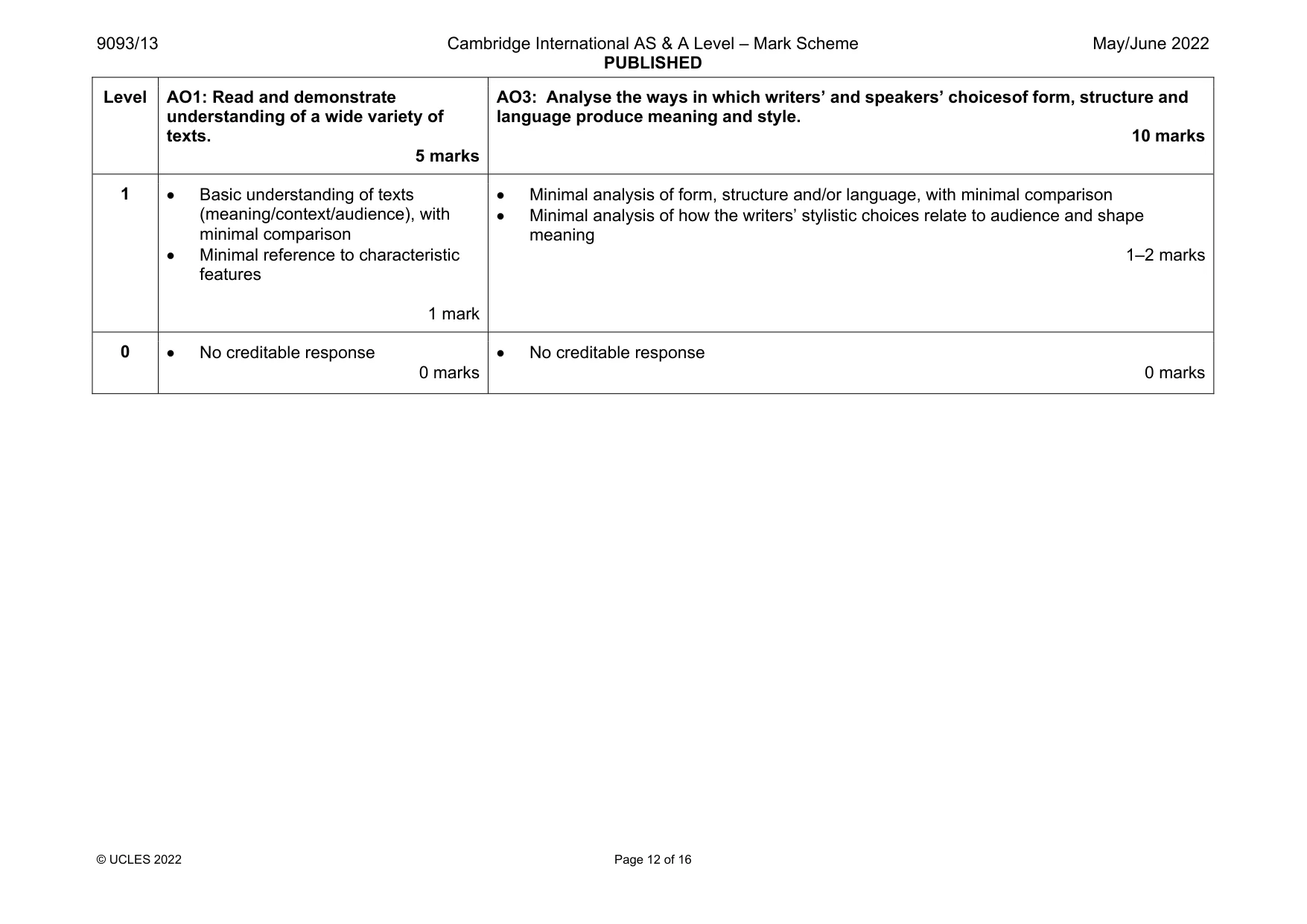
9093/13 Cambridge International AS & A Level – Mark Scheme PUBLISHED May/June 2022 © UCLES 2022 Page 12 of 16 Level AO1: Read and demonstrate understanding of a wide variety of texts. 5 marks AO3: Analyse the ways in which writers’ and speakers’ choices of form, structure and language produce meaning and style. 10 marks 1 Basic understanding of texts (meaning/context/audience), with minimal comparison Minimal reference to characteristic features 1 mark Minimal analysis of form, structure and/or language, with minimal comparison Minimal analysis of how the writers’ stylistic choices relate to audience and shape meaning 1–2 marks 0 No creditable response 0 marks No creditable response 0 marks
Mark scheme, page 13
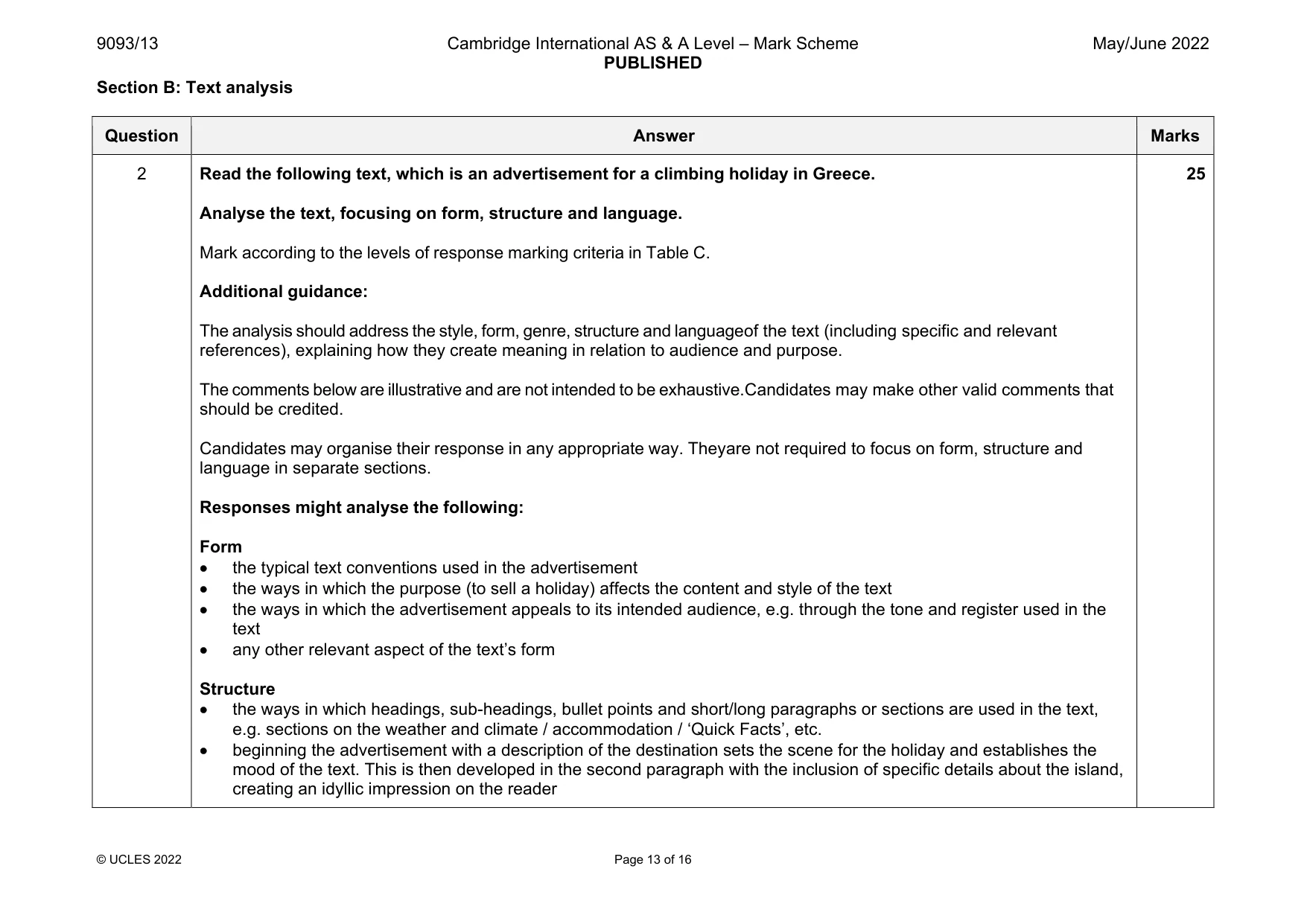
9093/13 Cambridge International AS & A Level – Mark Scheme PUBLISHED May/June 2022 © UCLES 2022 Page 13 of 16 Section B: Text analysis Question Answer Marks 2 Read the following text, which is an advertisement for a climbing holiday in Greece. Analyse the text, focusing on form, structure and language. Mark according to the levels of response marking criteria in Table C. Additional guidance: The analysis should address the style, form, genre, structure and language of the text (including specific and relevant references), explaining how they create meaning in relation to audience and purpose. The comments below are illustrative and are not intended to be exhaustive. Candidates may make other valid comments that should be credited. Candidates may organise their response in any appropriate way. They are not required to focus on form, structure and language in separate sections. Responses might analyse the following: Form the typical text conventions used in the advertisement the ways in which the purpose (to sell a holiday) affects the content and style of the text the ways in which the advertisement appeals to its intended audience, e.g. through the tone and register used in the text any other relevant aspect of the text’s form Structure the ways in which headings, sub-headings, bullet points and short/long paragraphs or sections are used in the text, e.g. sections on the weather and climate / accommodation / ‘Quick Facts’, etc. beginning the advertisement with a description of the destination sets the scene for the holiday and establishes the mood of the text. This is then developed in the second paragraph with the inclusion of specific details about the island, creating an idyllic impression on the reader 25
Mark scheme, page 14
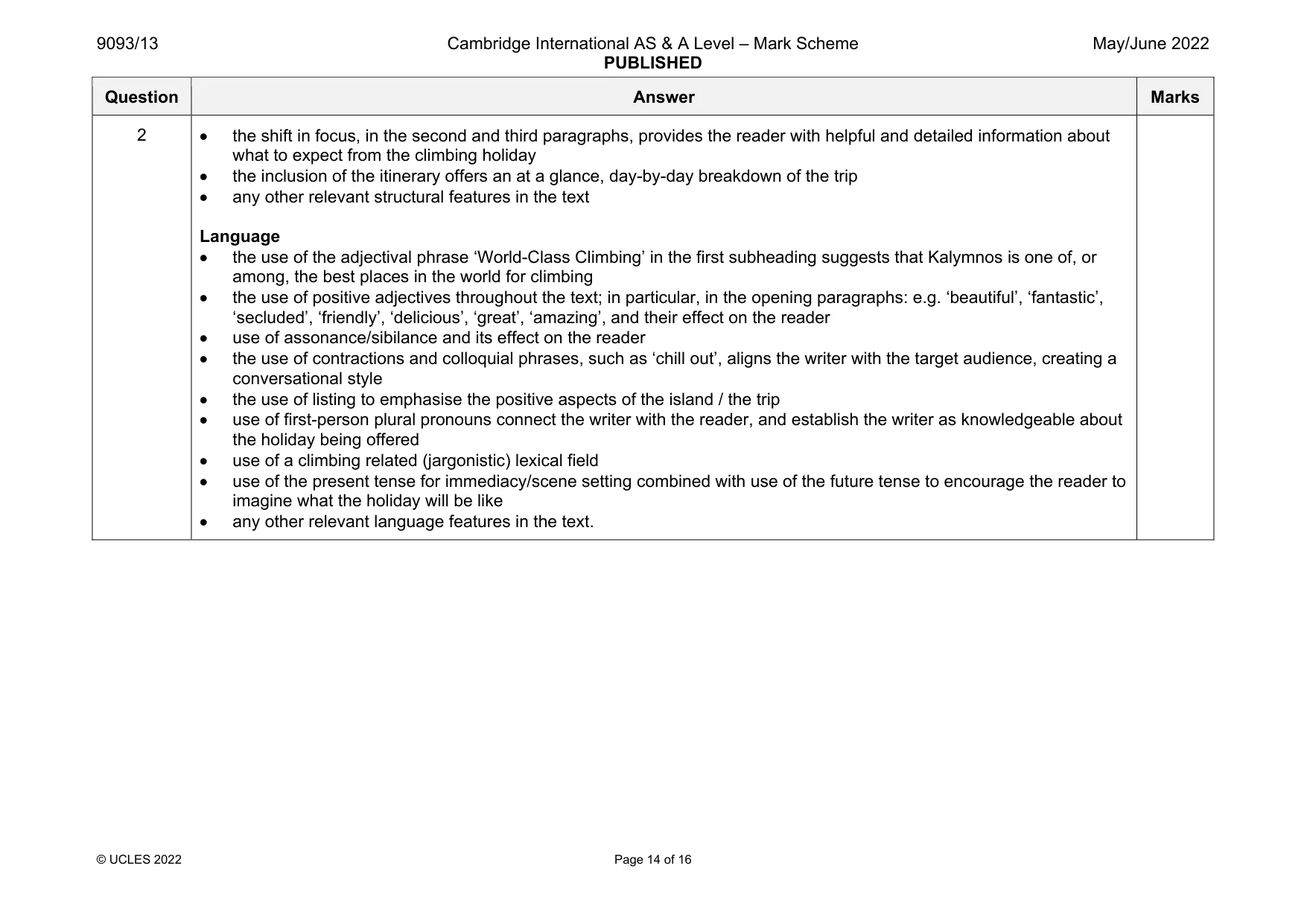
9093/13 Cambridge International AS & A Level – Mark Scheme PUBLISHED May/June 2022 © UCLES 2022 Page 14 of 16 Question Answer Marks 2 the shift in focus, in the second and third paragraphs, provides the reader with helpful and detailed information about what to expect from the climbing holiday the inclusion of the itinerary offers an at a glance, day-by-day breakdown of the trip any other relevant structural features in the text Language the use of the adjectival phrase ‘World-Class Climbing’ in the first subheading suggests that Kalymnos is one of, or among, the best places in the world for climbing the use of positive adjectives throughout the text; in particular, in the opening paragraphs: e.g. ‘beautiful’, ‘fantastic’, ‘secluded’, ‘friendly’, ‘delicious’, ‘great’, ‘amazing’, and their effect on the reader use of assonance/sibilance and its effect on the reader the use of contractions and colloquial phrases, such as ‘chill out’, aligns the writer with the target audience, creating a conversational style the use of listing to emphasise the positive aspects of the island / the trip use of first-person plural pronouns connect the writer with the reader, and establish the writer as knowledgeable about the holiday being offered use of a climbing related (jargonistic) lexical field use of the present tense for immediacy/scene setting combined with use of the future tense to encourage the reader to imagine what the holiday will be like any other relevant language features in the text.
Mark scheme, page 15
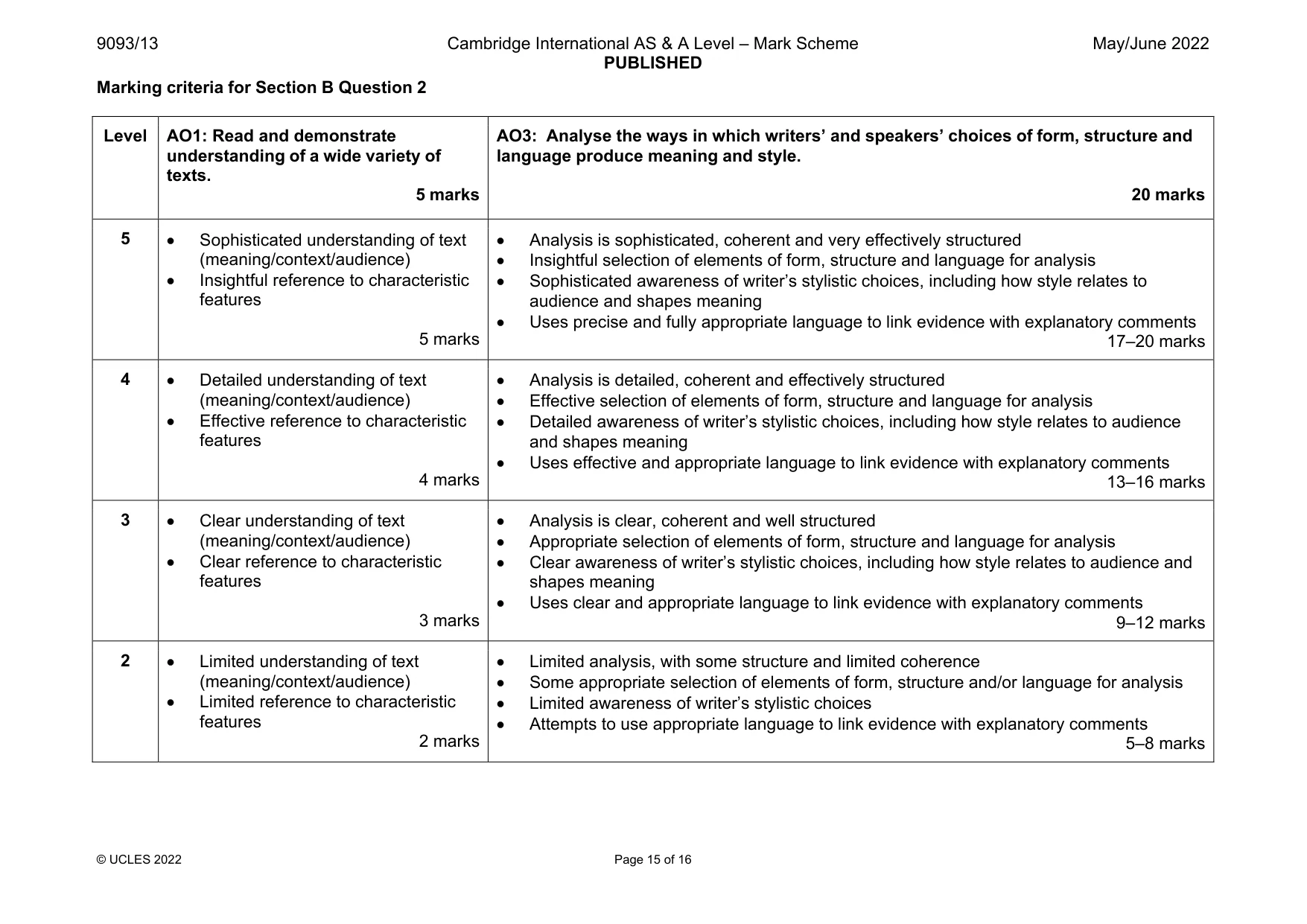
9093/13 Cambridge International AS & A Level – Mark Scheme PUBLISHED May/June 2022 © UCLES 2022 Page 15 of 16 Marking criteria for Section B Question 2 Level AO1: Read and demonstrate understanding of a wide variety of texts. 5 marks AO3: Analyse the ways in which writers’ and speakers’ choices of form, structure and language produce meaning and style. 20 marks 5 Sophisticated understanding of text (meaning/context/audience) Insightful reference to characteristic features 5 marks Analysis is sophisticated, coherent and very effectively structured Insightful selection of elements of form, structure and language for analysis Sophisticated awareness of writer’s stylistic choices, including how style relates to audience and shapes meaning Uses precise and fully appropriate language to link evidence with explanatory comments 17–20 marks 4 Detailed understanding of text (meaning/context/audience) Effective reference to characteristic features 4 marks Analysis is detailed, coherent and effectively structured Effective selection of elements of form, structure and language for analysis Detailed awareness of writer’s stylistic choices, including how style relates to audience and shapes meaning Uses effective and appropriate language to link evidence with explanatory comments 13–16 marks 3 Clear understanding of text (meaning/context/audience) Clear reference to characteristic features 3 marks Analysis is clear, coherent and well structured Appropriate selection of elements of form, structure and language for analysis Clear awareness of writer’s stylistic choices, including how style relates to audience and shapes meaning Uses clear and appropriate language to link evidence with explanatory comments 9–12 marks 2 Limited understanding of text (meaning/context/audience) Limited reference to characteristic features 2 marks Limited analysis, with some structure and limited coherence Some appropriate selection of elements of form, structure and/or language for analysis Limited awareness of writer’s stylistic choices Attempts to use appropriate language to link evidence with explanatory comments 5–8 marks
Mark scheme, page 16
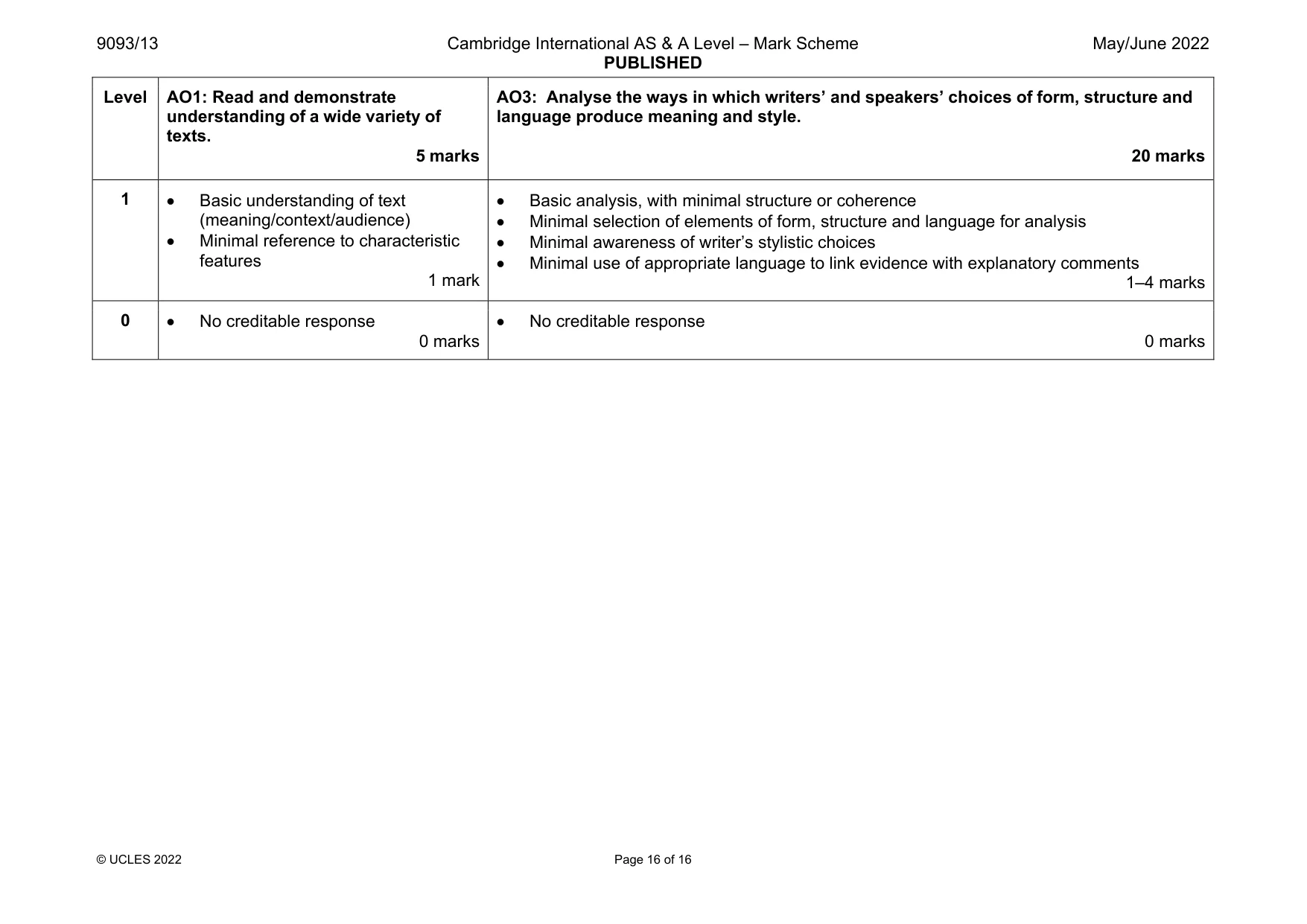
9093/13 Cambridge International AS & A Level – Mark Scheme PUBLISHED May/June 2022 © UCLES 2022 Page 16 of 16 Level AO1: Read and demonstrate understanding of a wide variety of texts. 5 marks AO3: Analyse the ways in which writers’ and speakers’ choices of form, structure and language produce meaning and style. 20 marks 1 Basic understanding of text (meaning/context/audience) Minimal reference to characteristic features 1 mark Basic analysis, with minimal structure or coherence Minimal selection of elements of form, structure and language for analysis Minimal awareness of writer’s stylistic choices Minimal use of appropriate language to link evidence with explanatory comments 1–4 marks 0 No creditable response 0 marks No creditable response 0 marks
What you needed in this session
Cambridge’s own grade thresholds for 2022 May/June, Paper 1 · Variant 3. A higher threshold means an easier paper — the bar moves with how the cohort did.