Cambridge A Level English - Language AS and A Level (from 2014) 9093 — 2025 Oct/Nov Paper 1 · Variant 1
9093/11/O/N/25 · 50 marks · 135 min
The question paper and its mark scheme, free to read here and free to download. This is Cambridge’s own paper, exactly as it was sat.
Question paper8 pages

Mark scheme16 pages
Answers below. Sit the paper first if you are practising.
Paper as text
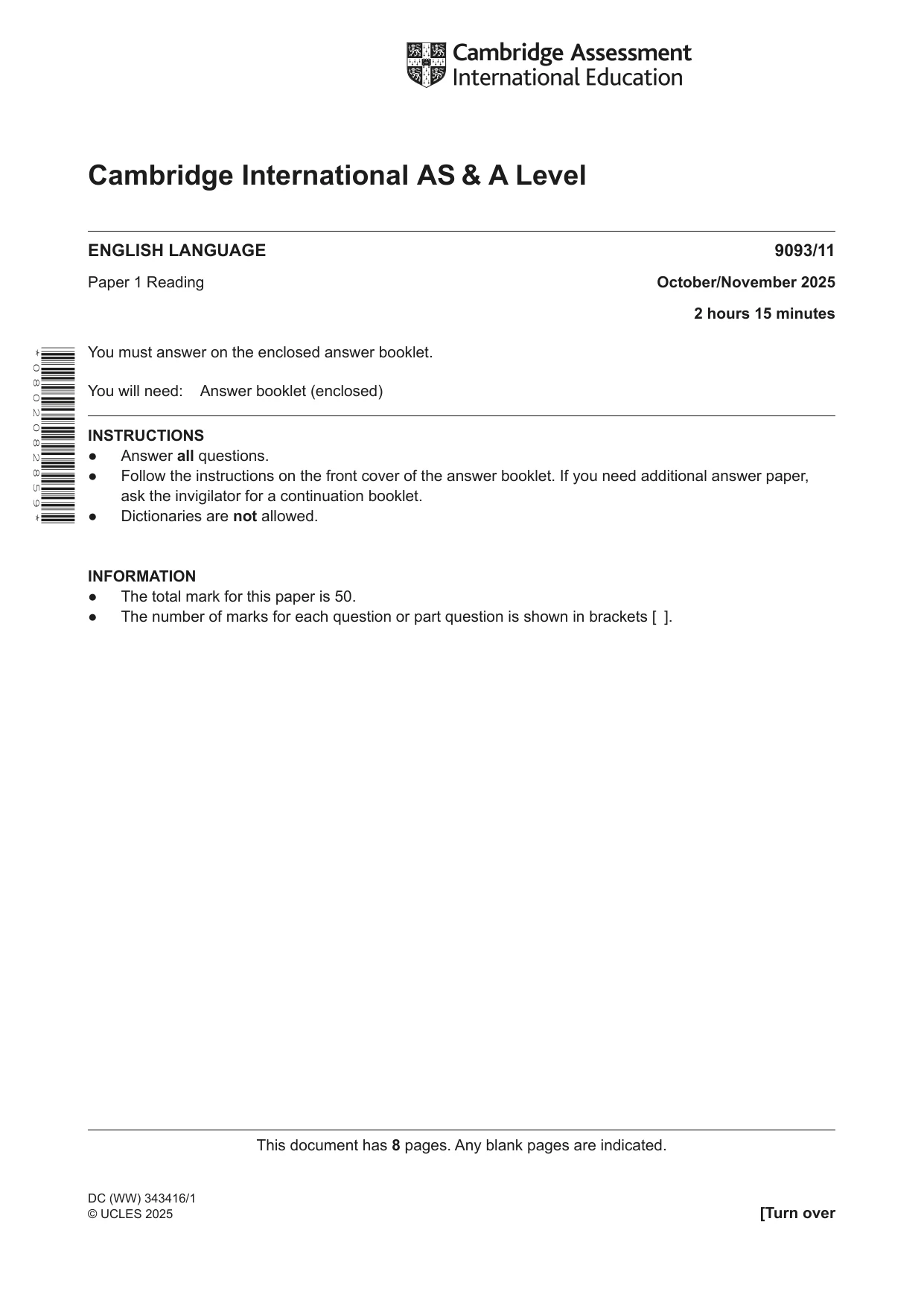
Question paper, page 1
[Turn over Cambridge International AS & A Level This document has 8 pages. Any blank pages are indicated. DC (WW) 343416/1 © UCLES 2025 * 0 8 0 2 0 8 2 8 5 9 * ENGLISH LANGUAGE 9093/11 Paper 1 Reading October/November 2025 2 hours 15 minutes You must answer on the enclosed answer booklet. You will need: Answer booklet (enclosed) INSTRUCTIONS ● Answer all questions. ● Follow the instructions on the front cover of the answer booklet. If you need additional answer paper, ask the invigilator for a continuation booklet. ● Dictionaries are not allowed. INFORMATION ● The total mark for this paper is 50. ● The number of marks for each question or part question is shown in brackets [ ].
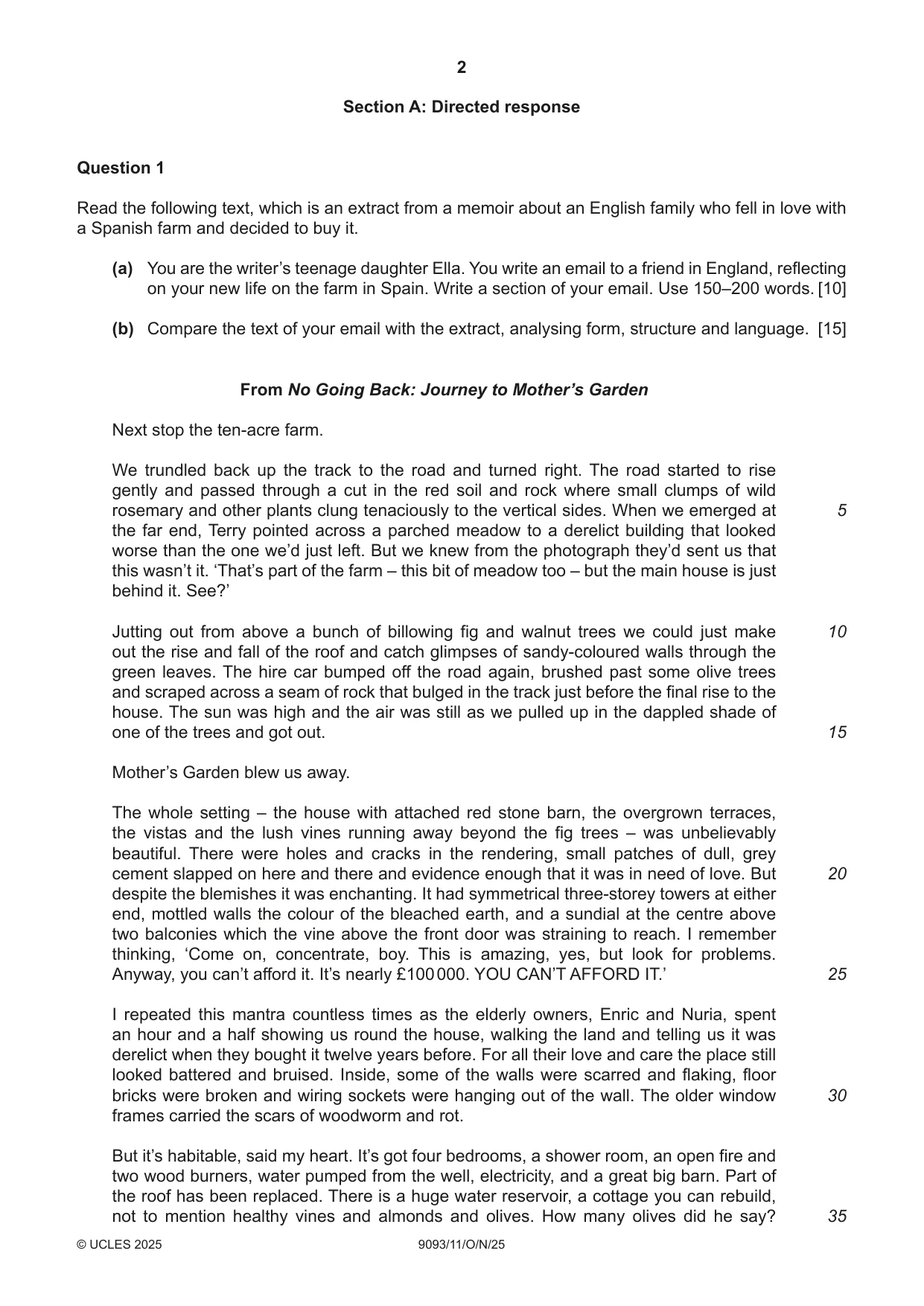
Question paper, page 2
2 9093/11/O/N/25 © UCLES 2025 Section A: Directed response Question 1 Read the following text, which is an extract from a memoir about an English family who fell in love with a Spanish farm and decided to buy it. (a) You are the writer’s teenage daughter Ella. You write an email to a friend in England, reflecting on your new life on the farm in Spain. Write a section of your email. Use 150–200 words. [10] (b) Compare the text of your email with the extract, analysing form, structure and language. [15] From No Going Back: Journey to Mother’s Garden Next stop the ten‑acre farm. We trundled back up the track to the road and turned right. The road started to rise gently and passed through a cut in the red soil and rock where small clumps of wild rosemary and other plants clung tenaciously to the vertical sides. When we emerged at the far end, Terry pointed across a parched meadow to a derelict building that looked worse than the one we’d just left. But we knew from the photograph they’d sent us that this wasn’t it. ‘That’s part of the farm – this bit of meadow too – but the main house is just behind it. See?’ Jutting out from above a bunch of billowing fig and walnut trees we could just make out the rise and fall of the roof and catch glimpses of sandy‑coloured walls through the green leaves. The hire car bumped off the road again, brushed past some olive trees and scraped across a seam of rock that bulged in the track just before the final rise to the house. The sun was high and the air was still as we pulled up in the dappled shade of one of the trees and got out. Mother’s Garden blew us away. The whole setting – the house with attached red stone barn, the overgrown terraces, the vistas and the lush vines running away beyond the fig trees – was unbelievably beautiful. There were holes and cracks in the rendering, small patches of dull, grey cement slapped on here and there and evidence enough that it was in need of love. But despite the blemishes it was enchanting. It had symmetrical three‑storey towers at either end, mottled walls the colour of the bleached earth, and a sundial at the centre above two balconies which the vine above the front door was straining to reach. I remember thinking, ‘Come on, concentrate, boy. This is amazing, yes, but look for problems. Anyway, you can’t afford it. It’s nearly £100 000. YOU CAN’T AFFORD IT.’ I repeated this mantra countless times as the elderly owners, Enric and Nuria, spent an hour and a half showing us round the house, walking the land and telling us it was derelict when they bought it twelve years before. For all their love and care the place still looked battered and bruised. Inside, some of the walls were scarred and flaking, floor bricks were broken and wiring sockets were hanging out of the wall. The older window frames carried the scars of woodworm and rot. But it’s habitable, said my heart. It’s got four bedrooms, a shower room, an open fire and two wood burners, water pumped from the well, electricity, and a great big barn. Part of the roof has been replaced. There is a huge water reservoir, a cottage you can rebuild, not to mention healthy vines and almonds and olives. How many olives did he say? 5 10 15 20 25 30 35
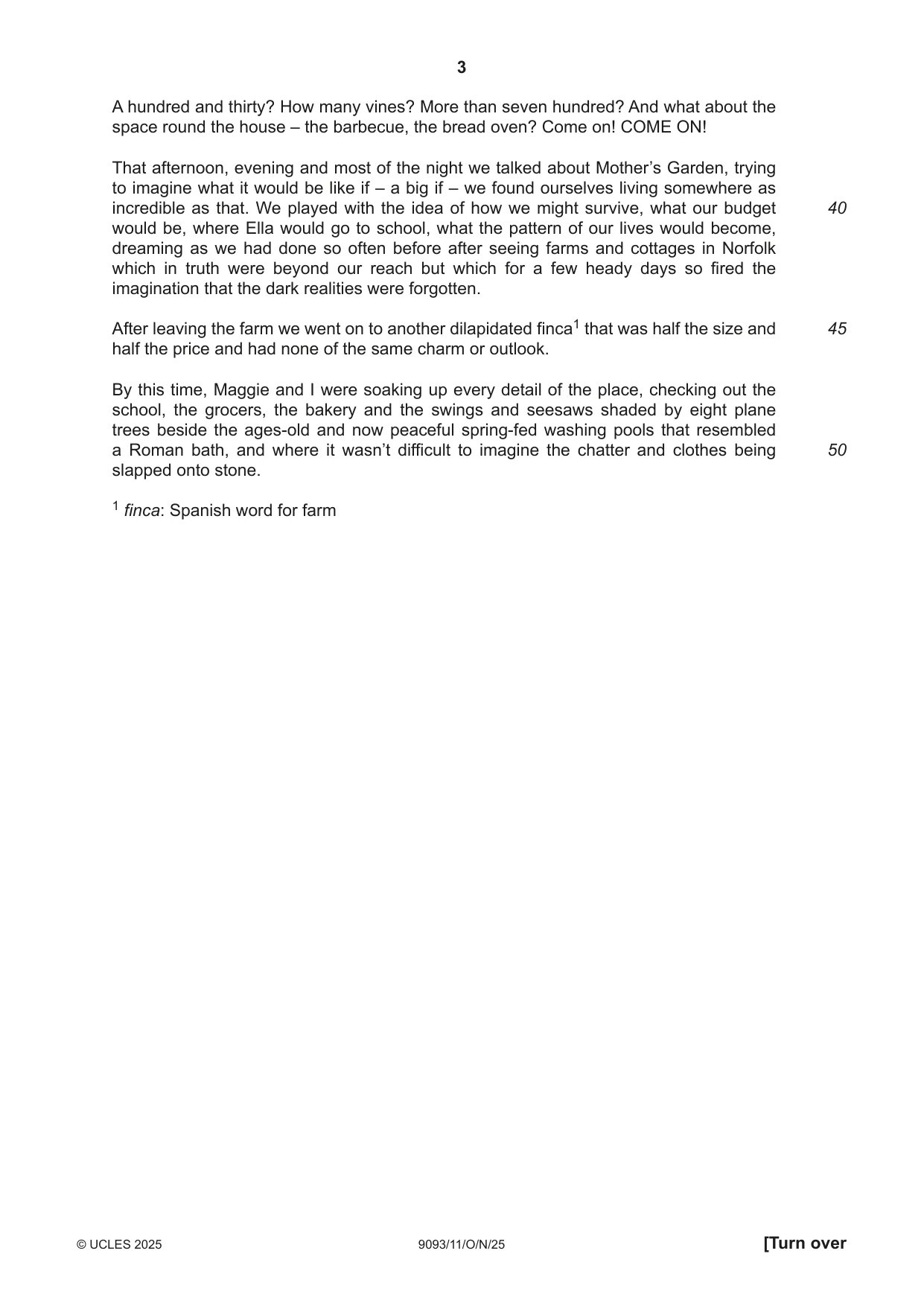
Question paper, page 3
3 9093/11/O/N/25 © UCLES 2025 [Turn over A hundred and thirty? How many vines? More than seven hundred? And what about the space round the house – the barbecue, the bread oven? Come on! COME ON! That afternoon, evening and most of the night we talked about Mother’s Garden, trying to imagine what it would be like if – a big if – we found ourselves living somewhere as incredible as that. We played with the idea of how we might survive, what our budget would be, where Ella would go to school, what the pattern of our lives would become, dreaming as we had done so often before after seeing farms and cottages in Norfolk which in truth were beyond our reach but which for a few heady days so fired the imagination that the dark realities were forgotten. After leaving the farm we went on to another dilapidated finca1 that was half the size and half the price and had none of the same charm or outlook. By this time, Maggie and I were soaking up every detail of the place, checking out the school, the grocers, the bakery and the swings and seesaws shaded by eight plane trees beside the ages‑old and now peaceful spring‑fed washing pools that resembled a Roman bath, and where it wasn’t difficult to imagine the chatter and clothes being slapped onto stone. 1 finca: Spanish word for farm 40 45 50
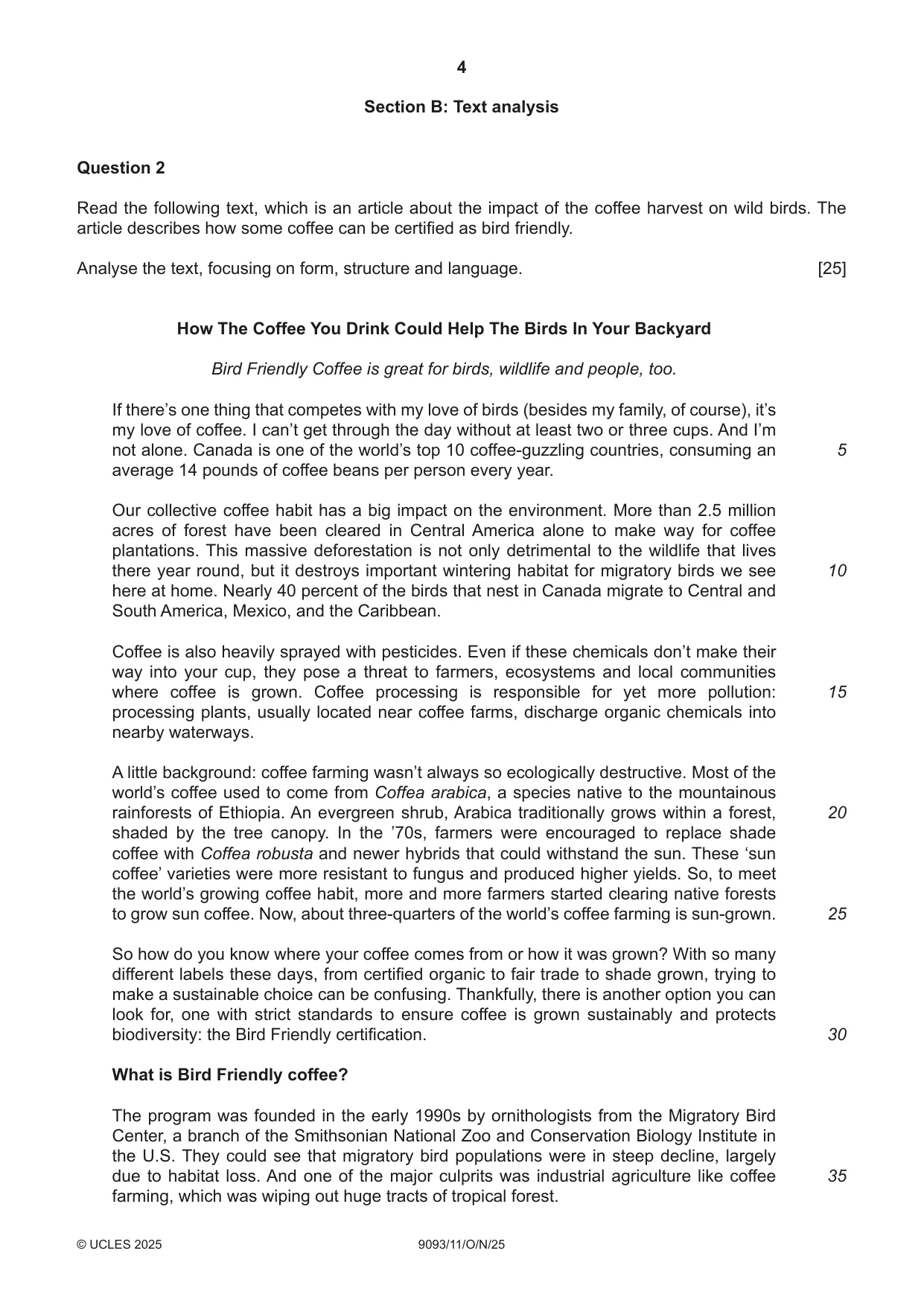
Question paper, page 4
4 9093/11/O/N/25 © UCLES 2025 Section B: Text analysis Question 2 Read the following text, which is an article about the impact of the coffee harvest on wild birds. The article describes how some coffee can be certified as bird friendly. Analyse the text, focusing on form, structure and language. [25] How The Coffee You Drink Could Help The Birds In Your Backyard Bird Friendly Coffee is great for birds, wildlife and people, too. If there’s one thing that competes with my love of birds (besides my family, of course), it’s my love of coffee. I can’t get through the day without at least two or three cups. And I’m not alone. Canada is one of the world’s top 10 coffee‑guzzling countries, consuming an average 14 pounds of coffee beans per person every year. Our collective coffee habit has a big impact on the environment. More than 2.5 million acres of forest have been cleared in Central America alone to make way for coffee plantations. This massive deforestation is not only detrimental to the wildlife that lives there year round, but it destroys important wintering habitat for migratory birds we see here at home. Nearly 40 percent of the birds that nest in Canada migrate to Central and South America, Mexico, and the Caribbean. Coffee is also heavily sprayed with pesticides. Even if these chemicals don’t make their way into your cup, they pose a threat to farmers, ecosystems and local communities where coffee is grown. Coffee processing is responsible for yet more pollution: processing plants, usually located near coffee farms, discharge organic chemicals into nearby waterways. A little background: coffee farming wasn’t always so ecologically destructive. Most of the world’s coffee used to come from Coffea arabica, a species native to the mountainous rainforests of Ethiopia. An evergreen shrub, Arabica traditionally grows within a forest, shaded by the tree canopy. In the ’70s, farmers were encouraged to replace shade coffee with Coffea robusta and newer hybrids that could withstand the sun. These ‘sun coffee’ varieties were more resistant to fungus and produced higher yields. So, to meet the world’s growing coffee habit, more and more farmers started clearing native forests to grow sun coffee. Now, about three‑quarters of the world’s coffee farming is sun‑grown. So how do you know where your coffee comes from or how it was grown? With so many different labels these days, from certified organic to fair trade to shade grown, trying to make a sustainable choice can be confusing. Thankfully, there is another option you can look for, one with strict standards to ensure coffee is grown sustainably and protects biodiversity: the Bird Friendly certification. What is Bird Friendly coffee? The program was founded in the early 1990s by ornithologists from the Migratory Bird Center, a branch of the Smithsonian National Zoo and Conservation Biology Institute in the U.S. They could see that migratory bird populations were in steep decline, largely due to habitat loss. And one of the major culprits was industrial agriculture like coffee farming, which was wiping out huge tracts of tropical forest. 5 10 15 20 25 30 35
Question paper, page 5
5 9093/11/O/N/25 © UCLES 2025 Although coffee was a threat, it was also an opportunity. Unlike many other crops, coffee can be grown in the shade, keeping the forest intact. So the Smithsonian, in an effort to prevent shade coffee farms from being converted to monocultures, developed a certification for coffee farms that were shade grown and organic. The program now has more than 5400 participants around the world, including Mexico, Central and South America, Ethiopia, India and Thailand. More than 60 studies over the last 25 years have shown that traditional shade‑grown coffee habitat is on par with natural forest. In fact, one study of cerulean warblers – which spend their summers in Ontario and American states around the Great Lakes – found three to 14 times more birds in shade coffee plantations than primary forest. ‘Bird Friendly coffee comes from farms that provide really high‑quality habitat for birds and other wildlife,’ says Kirstin Hill, Bird Friendly Program Manager with the Smithsonian. Just think, the birds you love spotting in your backyard or on hikes – species like wood thrush, scarlet tanager and magnolia warbler – could be wintering in the very forest where your coffee was harvested. 40 45 50
Question paper, page 6
6 9093/11/O/N/25 © UCLES 2025 BLANK PAGE
Question paper, page 7
7 9093/11/O/N/25 © UCLES 2025 BLANK PAGE
Question paper, page 8
8 9093/11/O/N/25 © UCLES 2025 Permission to reproduce items where third‑party owned material protected by copyright is included has been sought and cleared where possible. Every reasonable effort has been made by the publisher (UCLES) to trace copyright holders, but if any items requiring clearance have unwittingly been included, the publisher will be pleased to make amends at the earliest possible opportunity. To avoid the issue of disclosure of answer‑related information to candidates, all copyright acknowledgements are reproduced online in the Cambridge Assessment International Education Copyright Acknowledgements Booklet. This is produced for each series of examinations and is freely available to download at www.cambridgeinternational.org after the live examination series. Cambridge Assessment International Education is part of Cambridge Assessment. Cambridge Assessment is the brand name of the University of Cambridge Local Examinations Syndicate (UCLES), which is a department of the University of Cambridge. BLANK PAGE
Mark scheme, page 1
This document consists of 16 printed pages. © Cambridge University Press & Assessment 2025 [Turn over Cambridge International AS & A Level ENGLISH LANGUAGE 9093/11 Paper 1 Reading October/November 2025 MARK SCHEME Maximum Mark: 50 Published This mark scheme is published as an aid to teachers and candidates, to indicate the requirements of the examination. It shows the basis on which Examiners were instructed to award marks. It does not indicate the details of the discussions that took place at an Examiners’ meeting before marking began, which would have considered the acceptability of alternative answers. Mark schemes should be read in conjunction with the question paper and the Principal Examiner Report for Teachers. Cambridge International will not enter into discussions about these mark schemes. Cambridge International is publishing the mark schemes for the October/November 2025 series for most Cambridge IGCSE, Cambridge International A and AS Level components, and some Cambridge O Level components.
Mark scheme, page 2
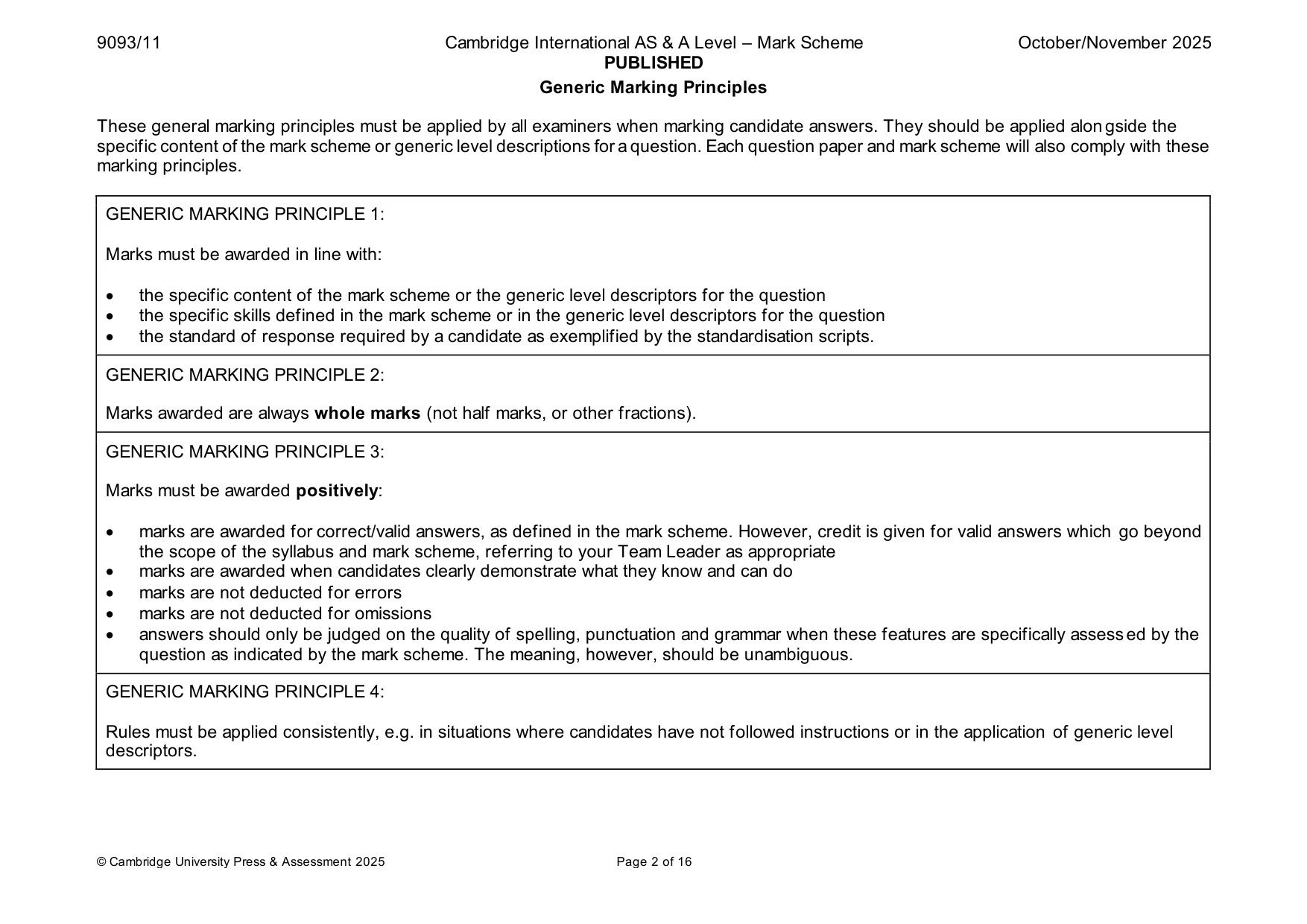
9093/11 Cambridge International AS & A Level – Mark Scheme PUBLISHED October/November 2025 © Cambridge University Press & Assessment 2025 Page 2 of 16 Generic Marking Principles These general marking principles must be applied by all examiners when marking candidate answers. They should be applied alon gside the specific content of the mark scheme or generic level descriptions for a question. Each question paper and mark scheme will also comply with these marking principles. GENERIC MARKING PRINCIPLE 1: Marks must be awarded in line with: • the specific content of the mark scheme or the generic level descriptors for the question • the specific skills defined in the mark scheme or in the generic level descriptors for the question • the standard of response required by a candidate as exemplified by the standardisation scripts. GENERIC MARKING PRINCIPLE 2: Marks awarded are always whole marks (not half marks, or other fractions). GENERIC MARKING PRINCIPLE 3: Marks must be awarded positively: • marks are awarded for correct/valid answers, as defined in the mark scheme. However, credit is given for valid answers which go beyond the scope of the syllabus and mark scheme, referring to your Team Leader as appropriate • marks are awarded when candidates clearly demonstrate what they know and can do • marks are not deducted for errors • marks are not deducted for omissions • answers should only be judged on the quality of spelling, punctuation and grammar when these features are specifically assessed by the question as indicated by the mark scheme. The meaning, however, should be unambiguous. GENERIC MARKING PRINCIPLE 4: Rules must be applied consistently, e.g. in situations where candidates have not followed instructions or in the application of generic level descriptors.
Mark scheme, page 3
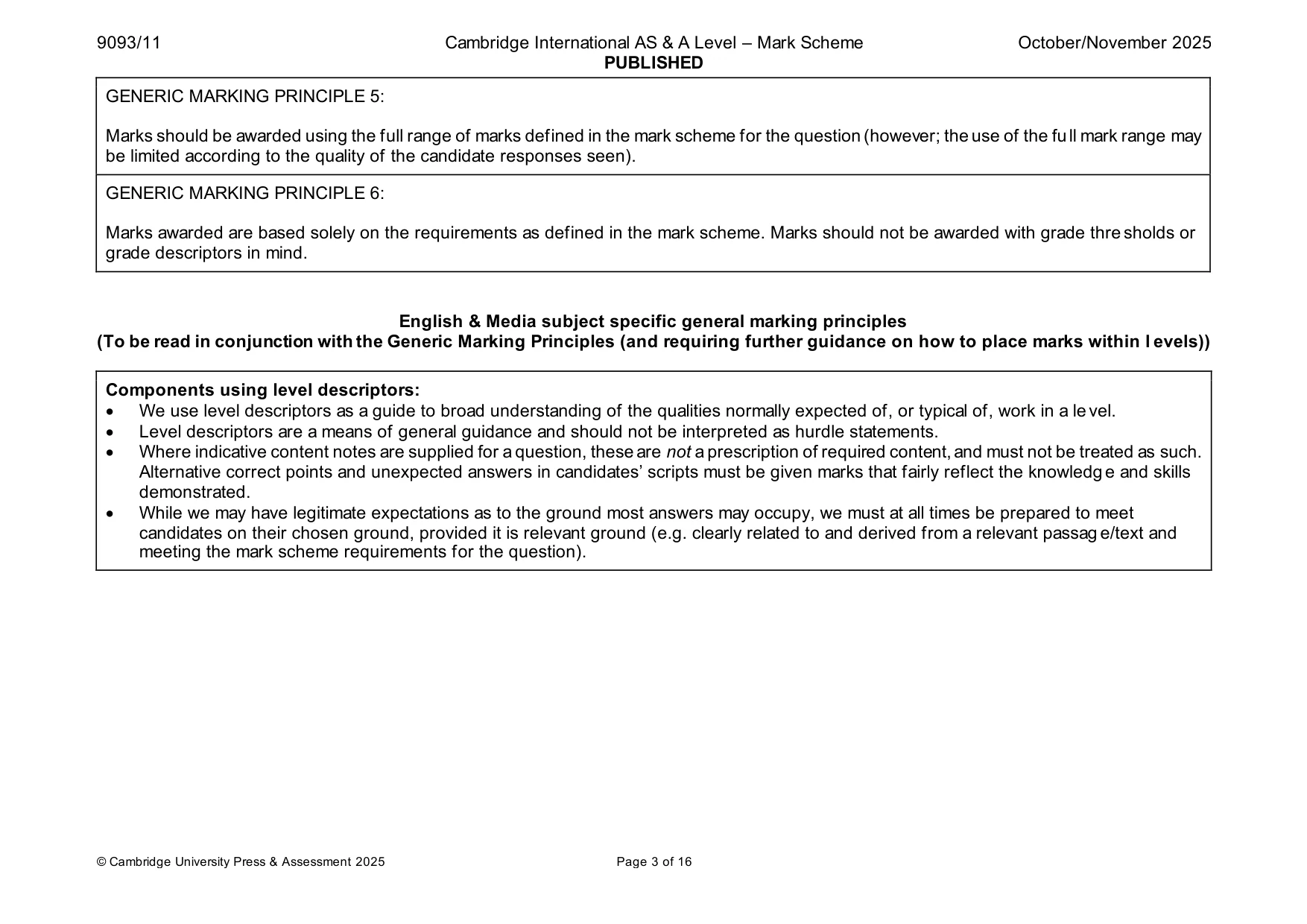
9093/11 Cambridge International AS & A Level – Mark Scheme PUBLISHED October/November 2025 © Cambridge University Press & Assessment 2025 Page 3 of 16 GENERIC MARKING PRINCIPLE 5: Marks should be awarded using the full range of marks defined in the mark scheme for the question (however; the use of the full mark range may be limited according to the quality of the candidate responses seen). GENERIC MARKING PRINCIPLE 6: Marks awarded are based solely on the requirements as defined in the mark scheme. Marks should not be awarded with grade thre sholds or grade descriptors in mind. English & Media subject specific general marking principles (To be read in conjunction with the Generic Marking Principles (and requiring further guidance on how to place marks within l evels)) Components using level descriptors: • We use level descriptors as a guide to broad understanding of the qualities normally expected of, or typical of, work in a le vel. • Level descriptors are a means of general guidance and should not be interpreted as hurdle statements. • Where indicative content notes are supplied for a question, these are not a prescription of required content, and must not be treated as such. Alternative correct points and unexpected answers in candidates’ scripts must be given marks that fairly reflect the knowledg e and skills demonstrated. • While we may have legitimate expectations as to the ground most answers may occupy, we must at all times be prepared to meet candidates on their chosen ground, provided it is relevant ground (e.g. clearly related to and derived from a relevant passag e/text and meeting the mark scheme requirements for the question).
Mark scheme, page 4
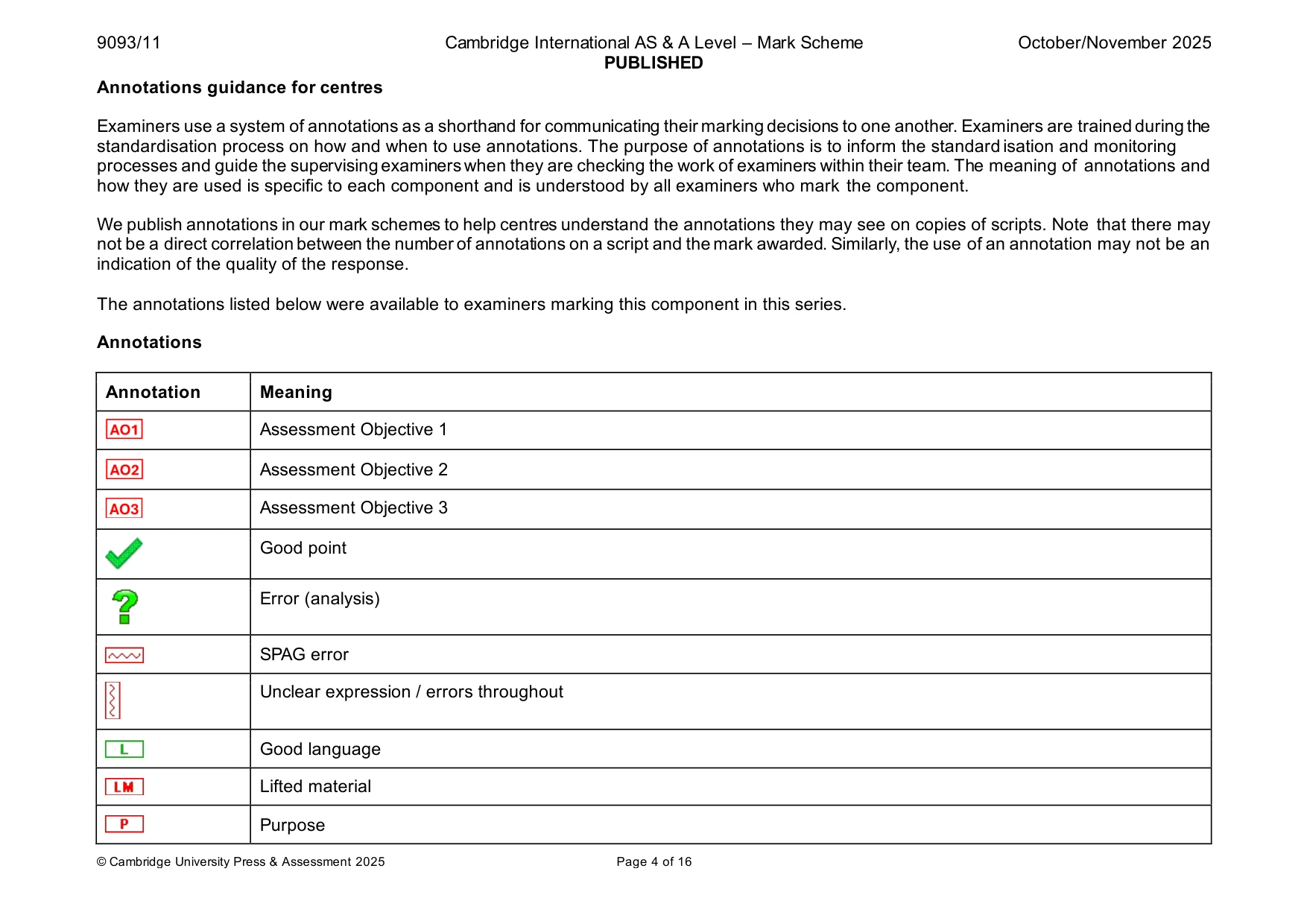
9093/11 Cambridge International AS & A Level – Mark Scheme PUBLISHED October/November 2025 © Cambridge University Press & Assessment 2025 Page 4 of 16 Annotations guidance for centres Examiners use a system of annotations as a shorthand for communicating their marking decisions to one another. Examiners are trained during the standardisation process on how and when to use annotations. The purpose of annotations is to inform the standard isation and monitoring processes and guide the supervising examiners when they are checking the work of examiners within their team. The meaning of annotations and how they are used is specific to each component and is understood by all examiners who mark the component. We publish annotations in our mark schemes to help centres understand the annotations they may see on copies of scripts. Note that there may not be a direct correlation between the number of annotations on a script and the mark awarded. Similarly, the use of an annotation may not be an indication of the quality of the response. The annotations listed below were available to examiners marking this component in this series. Annotations Annotation Meaning Assessment Objective 1 Assessment Objective 2 Assessment Objective 3 Good point Error (analysis) SPAG error Unclear expression / errors throughout Good language Lifted material Purpose
Mark scheme, page 5
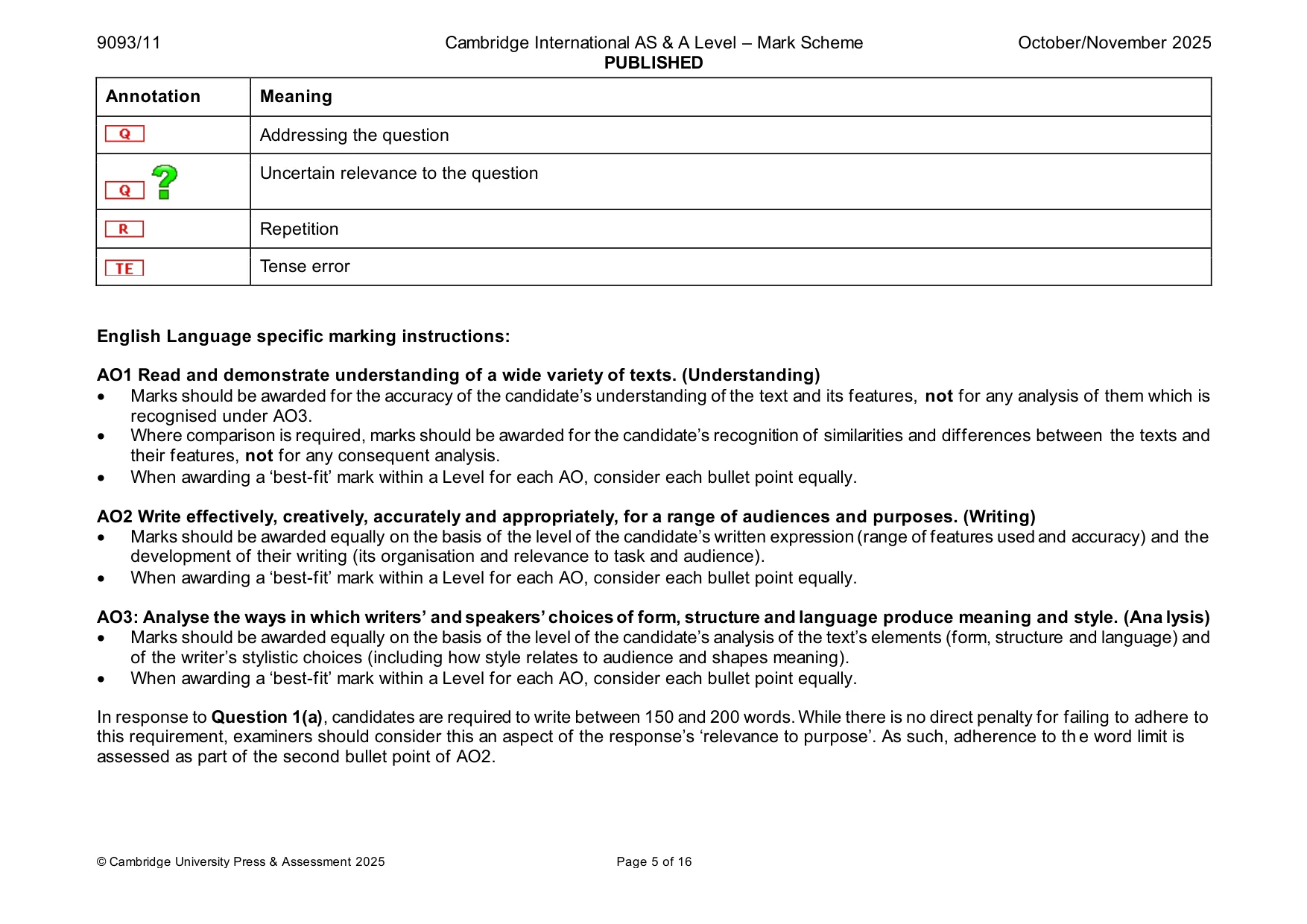
9093/11 Cambridge International AS & A Level – Mark Scheme PUBLISHED October/November 2025 © Cambridge University Press & Assessment 2025 Page 5 of 16 Annotation Meaning Addressing the question Uncertain relevance to the question Repetition Tense error English Language specific marking instructions: AO1 Read and demonstrate understanding of a wide variety of texts. (Understanding) • Marks should be awarded for the accuracy of the candidate’s understanding of the text and its features, not for any analysis of them which is recognised under AO3. • Where comparison is required, marks should be awarded for the candidate’s recognition of similarities and differences between the texts and their features, not for any consequent analysis. • When awarding a ‘best-fit’ mark within a Level for each AO, consider each bullet point equally. AO2 Write effectively, creatively, accurately and appropriately, for a range of audiences and purposes. (Writing) • Marks should be awarded equally on the basis of the level of the candidate’s written expression (range of features used and accuracy) and the development of their writing (its organisation and relevance to task and audience). • When awarding a ‘best-fit’ mark within a Level for each AO, consider each bullet point equally. AO3: Analyse the ways in which writers’ and speakers’ choices of form, structure and language produce meaning and style. (Ana lysis) • Marks should be awarded equally on the basis of the level of the candidate’s analysis of the text’s elements (form, structure and language) and of the writer’s stylistic choices (including how style relates to audience and shapes meaning). • When awarding a ‘best-fit’ mark within a Level for each AO, consider each bullet point equally. In response to Question 1(a), candidates are required to write between 150 and 200 words. While there is no direct penalty for failing to adhere to this requirement, examiners should consider this an aspect of the response’s ‘relevance to purpose’. As such, adherence to th e word limit is assessed as part of the second bullet point of AO2.
Mark scheme, page 6
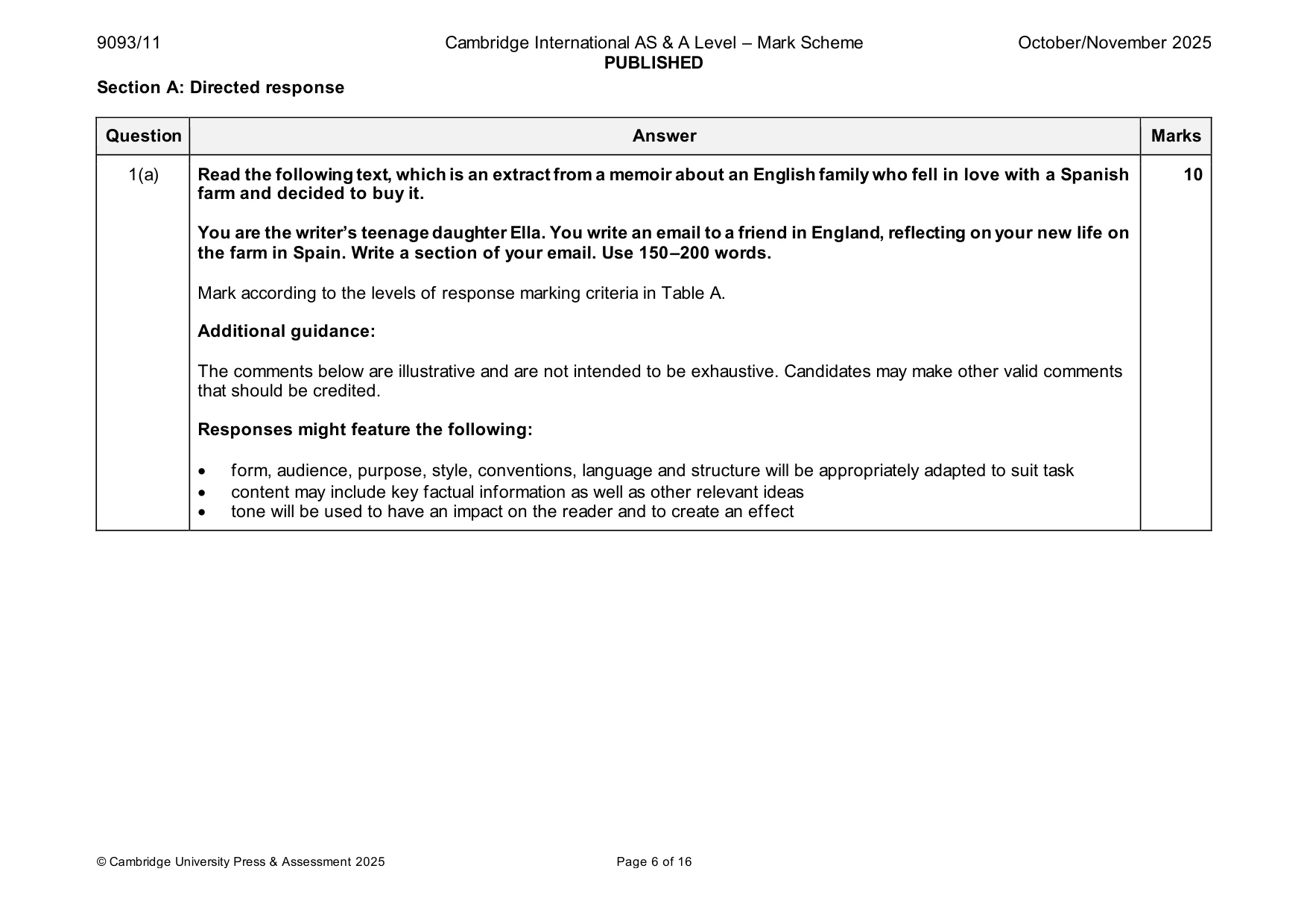
9093/11 Cambridge International AS & A Level – Mark Scheme PUBLISHED October/November 2025 © Cambridge University Press & Assessment 2025 Page 6 of 16 Section A: Directed response Question Answer Marks 1(a) Read the following text, which is an extract from a memoir about an English family who fell in love with a Spanish farm and decided to buy it. You are the writer’s teenage daughter Ella. You write an email to a friend in England, reflecting on your new life on the farm in Spain. Write a section of your email. Use 150–200 words. Mark according to the levels of response marking criteria in Table A. Additional guidance: The comments below are illustrative and are not intended to be exhaustive. Candidates may make other valid comments that should be credited. Responses might feature the following: • form, audience, purpose, style, conventions, language and structure will be appropriately adapted to suit task • content may include key factual information as well as other relevant ideas • tone will be used to have an impact on the reader and to create an effect 10
Mark scheme, page 7
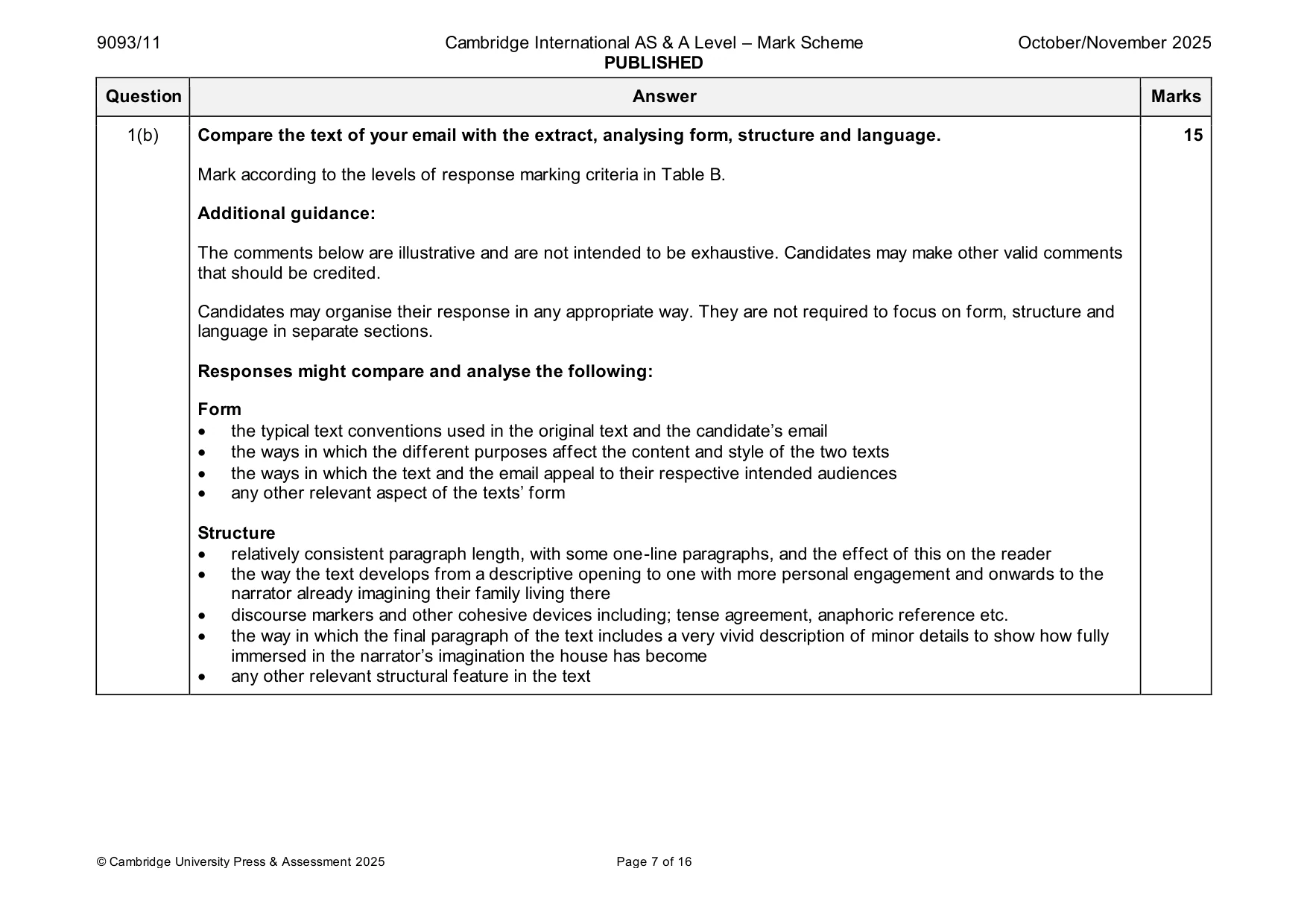
9093/11 Cambridge International AS & A Level – Mark Scheme PUBLISHED October/November 2025 © Cambridge University Press & Assessment 2025 Page 7 of 16 Question Answer Marks 1(b) Compare the text of your email with the extract, analysing form, structure and language. Mark according to the levels of response marking criteria in Table B. Additional guidance: The comments below are illustrative and are not intended to be exhaustive. Candidates may make other valid comments that should be credited. Candidates may organise their response in any appropriate way. They are not required to focus on form, structure and language in separate sections. Responses might compare and analyse the following: Form • the typical text conventions used in the original text and the candidate’s email • the ways in which the different purposes affect the content and style of the two texts • the ways in which the text and the email appeal to their respective intended audiences • any other relevant aspect of the texts’ form Structure • relatively consistent paragraph length, with some one-line paragraphs, and the effect of this on the reader • the way the text develops from a descriptive opening to one with more personal engagement and onwards to the narrator already imagining their family living there • discourse markers and other cohesive devices including; tense agreement, anaphoric reference etc. • the way in which the final paragraph of the text includes a very vivid description of minor details to show how fully immersed in the narrator’s imagination the house has become • any other relevant structural feature in the text 15
Mark scheme, page 8
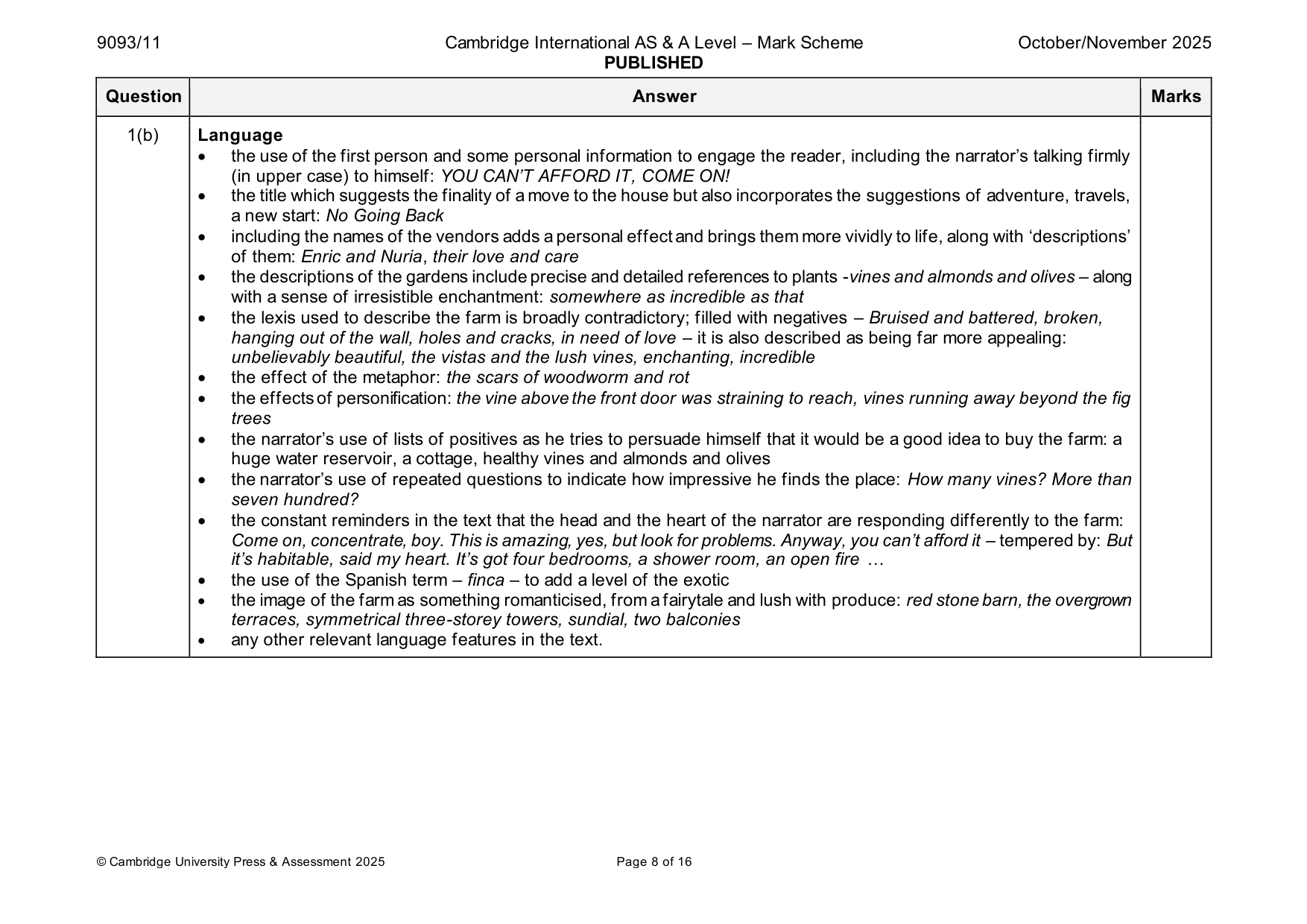
9093/11 Cambridge International AS & A Level – Mark Scheme PUBLISHED October/November 2025 © Cambridge University Press & Assessment 2025 Page 8 of 16 Question Answer Marks 1(b) Language • the use of the first person and some personal information to engage the reader, including the narrator’s talking firmly (in upper case) to himself: YOU CAN’T AFFORD IT, COME ON! • the title which suggests the finality of a move to the house but also incorporates the suggestions of adventure, travels, a new start: No Going Back • including the names of the vendors adds a personal effect and brings them more vividly to life, along with ‘descriptions’ of them: Enric and Nuria, their love and care • the descriptions of the gardens include precise and detailed references to plants -vines and almonds and olives – along with a sense of irresistible enchantment: somewhere as incredible as that • the lexis used to describe the farm is broadly contradictory; filled with negatives – Bruised and battered, broken, hanging out of the wall, holes and cracks, in need of love – it is also described as being far more appealing: unbelievably beautiful, the vistas and the lush vines, enchanting, incredible • the effect of the metaphor: the scars of woodworm and rot • the effects of personification: the vine above the front door was straining to reach, vines running away beyond the fig trees • the narrator’s use of lists of positives as he tries to persuade himself that it would be a good idea to buy the farm: a huge water reservoir, a cottage, healthy vines and almonds and olives • the narrator’s use of repeated questions to indicate how impressive he finds the place: How many vines? More than seven hundred? • the constant reminders in the text that the head and the heart of the narrator are responding differently to the farm: Come on, concentrate, boy. This is amazing, yes, but look for problems. Anyway, you can’t afford it – tempered by: But it’s habitable, said my heart. It’s got four bedrooms, a shower room, an open fire … • the use of the Spanish term – finca – to add a level of the exotic • the image of the farm as something romanticised, from a fairytale and lush with produce: red stone barn, the overgrown terraces, symmetrical three-storey towers, sundial, two balconies • any other relevant language features in the text.
Mark scheme, page 9
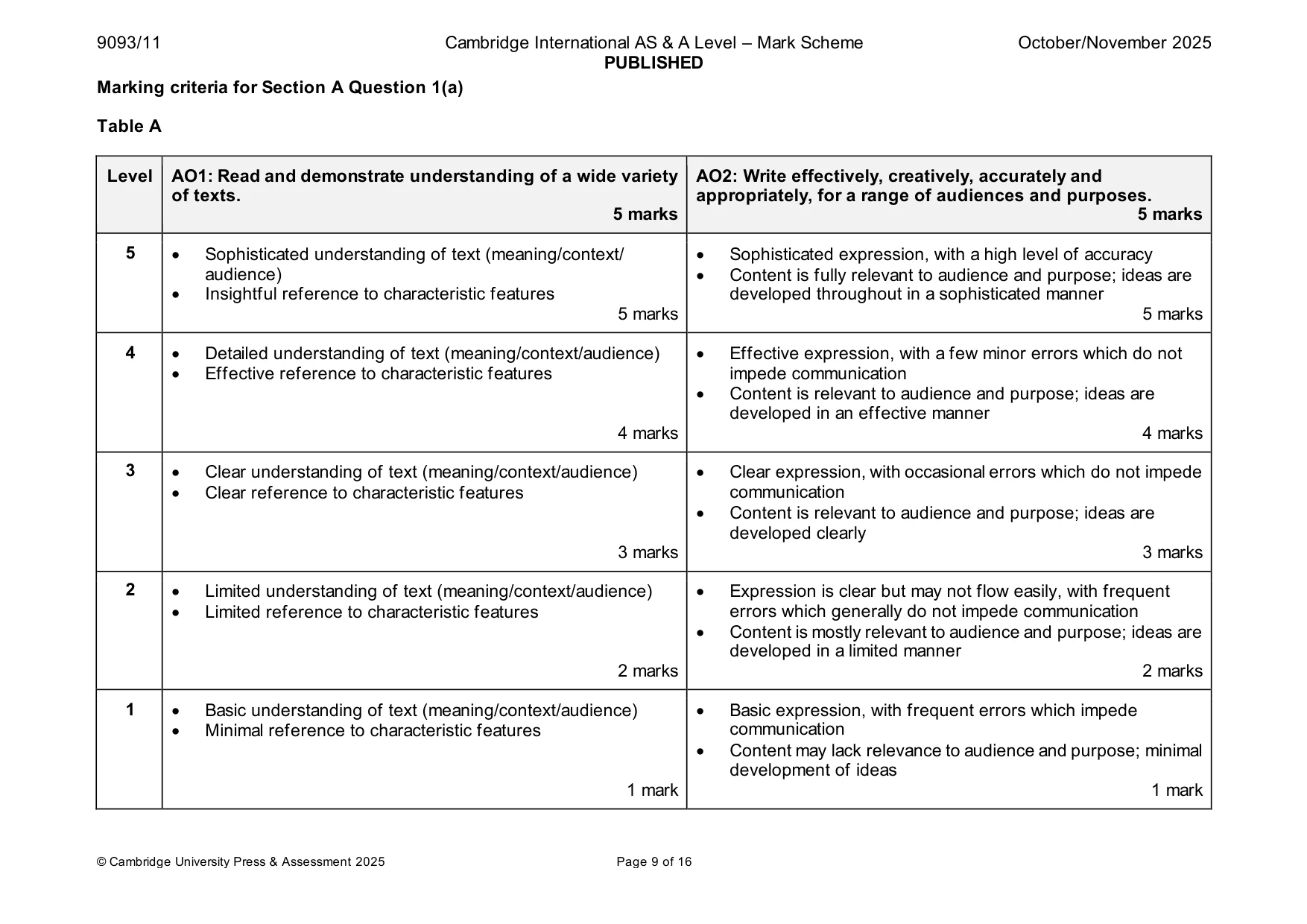
9093/11 Cambridge International AS & A Level – Mark Scheme PUBLISHED October/November 2025 © Cambridge University Press & Assessment 2025 Page 9 of 16 Marking criteria for Section A Question 1(a) Table A Level AO1: Read and demonstrate understanding of a wide variety of texts. 5 marks AO2: Write effectively, creatively, accurately and appropriately, for a range of audiences and purposes. 5 marks 5 • Sophisticated understanding of text (meaning/context/ audience) • Insightful reference to characteristic features 5 marks • Sophisticated expression, with a high level of accuracy • Content is fully relevant to audience and purpose; ideas are developed throughout in a sophisticated manner 5 marks 4 • Detailed understanding of text (meaning/context/audience) • Effective reference to characteristic features 4 marks • Effective expression, with a few minor errors which do not impede communication • Content is relevant to audience and purpose; ideas are developed in an effective manner 4 marks 3 • Clear understanding of text (meaning/context/audience) • Clear reference to characteristic features 3 marks • Clear expression, with occasional errors which do not impede communication • Content is relevant to audience and purpose; ideas are developed clearly 3 marks 2 • Limited understanding of text (meaning/context/audience) • Limited reference to characteristic features 2 marks • Expression is clear but may not flow easily, with frequent errors which generally do not impede communication • Content is mostly relevant to audience and purpose; ideas are developed in a limited manner 2 marks 1 • Basic understanding of text (meaning/context/audience) • Minimal reference to characteristic features 1 mark • Basic expression, with frequent errors which impede communication • Content may lack relevance to audience and purpose; minimal development of ideas 1 mark
Mark scheme, page 10
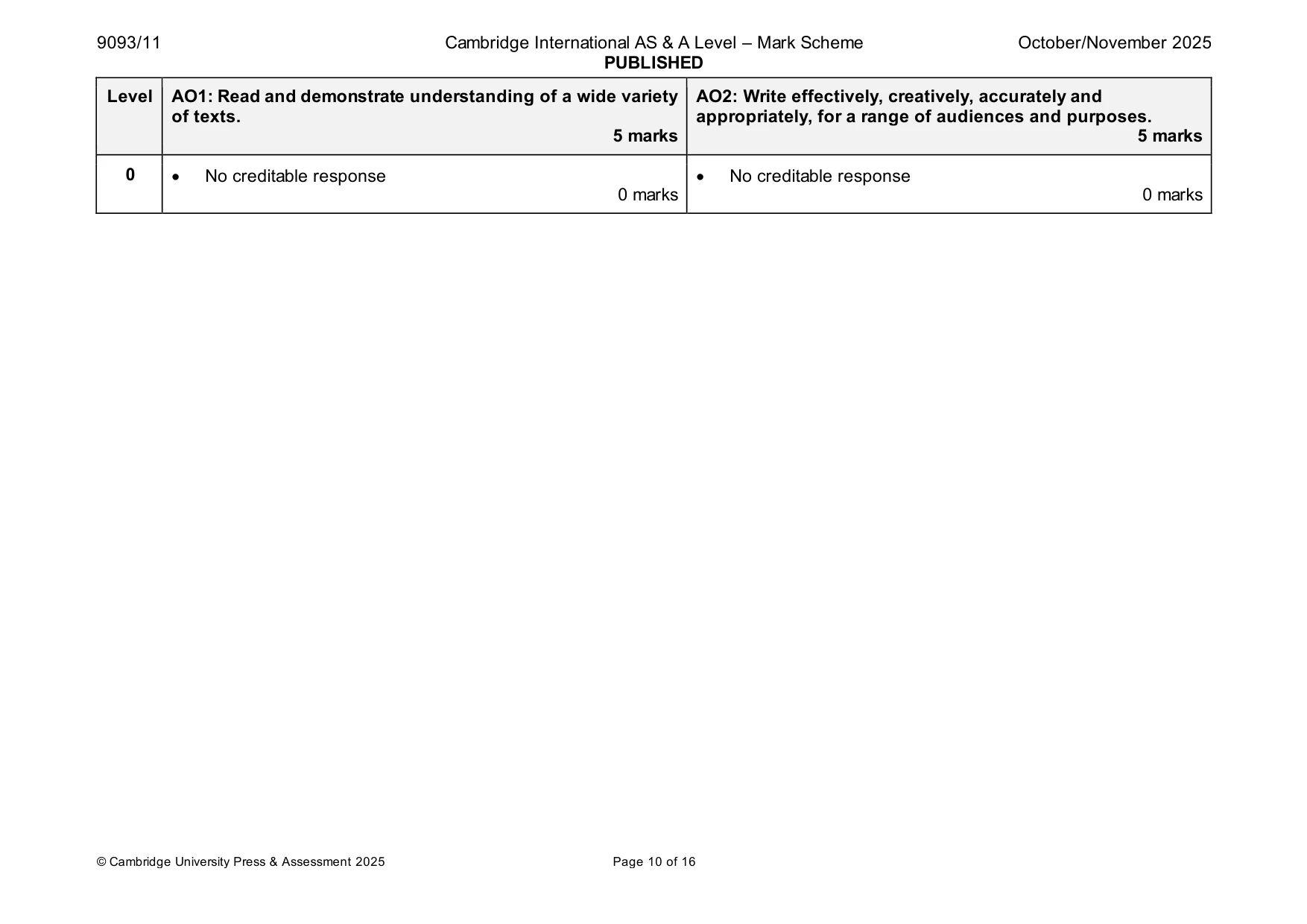
9093/11 Cambridge International AS & A Level – Mark Scheme PUBLISHED October/November 2025 © Cambridge University Press & Assessment 2025 Page 10 of 16 Level AO1: Read and demonstrate understanding of a wide variety of texts. 5 marks AO2: Write effectively, creatively, accurately and appropriately, for a range of audiences and purposes. 5 marks 0 • No creditable response 0 marks • No creditable response 0 marks
Mark scheme, page 11
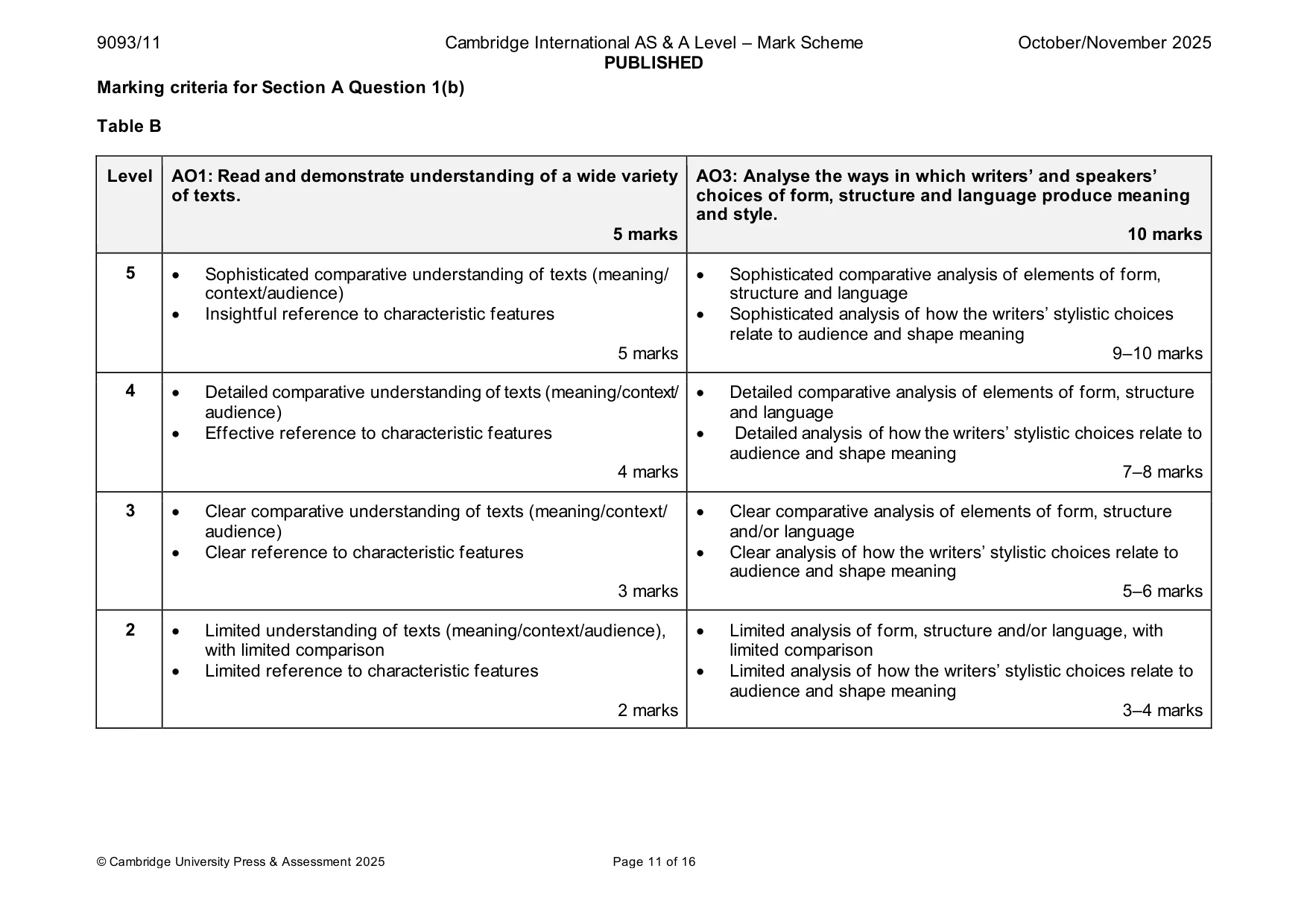
9093/11 Cambridge International AS & A Level – Mark Scheme PUBLISHED October/November 2025 © Cambridge University Press & Assessment 2025 Page 11 of 16 Marking criteria for Section A Question 1(b) Table B Level AO1: Read and demonstrate understanding of a wide variety of texts. 5 marks AO3: Analyse the ways in which writers’ and speakers’ choices of form, structure and language produce meaning and style. 10 marks 5 • Sophisticated comparative understanding of texts (meaning/ context/audience) • Insightful reference to characteristic features 5 marks • Sophisticated comparative analysis of elements of form, structure and language • Sophisticated analysis of how the writers’ stylistic choices relate to audience and shape meaning 9–10 marks 4 • Detailed comparative understanding of texts (meaning/context/ audience) • Effective reference to characteristic features 4 marks • Detailed comparative analysis of elements of form, structure and language • Detailed analysis of how the writers’ stylistic choices relate to audience and shape meaning 7–8 marks 3 • Clear comparative understanding of texts (meaning/context/ audience) • Clear reference to characteristic features 3 marks • Clear comparative analysis of elements of form, structure and/or language • Clear analysis of how the writers’ stylistic choices relate to audience and shape meaning 5–6 marks 2 • Limited understanding of texts (meaning/context/audience), with limited comparison • Limited reference to characteristic features 2 marks • Limited analysis of form, structure and/or language, with limited comparison • Limited analysis of how the writers’ stylistic choices relate to audience and shape meaning 3–4 marks
Mark scheme, page 12
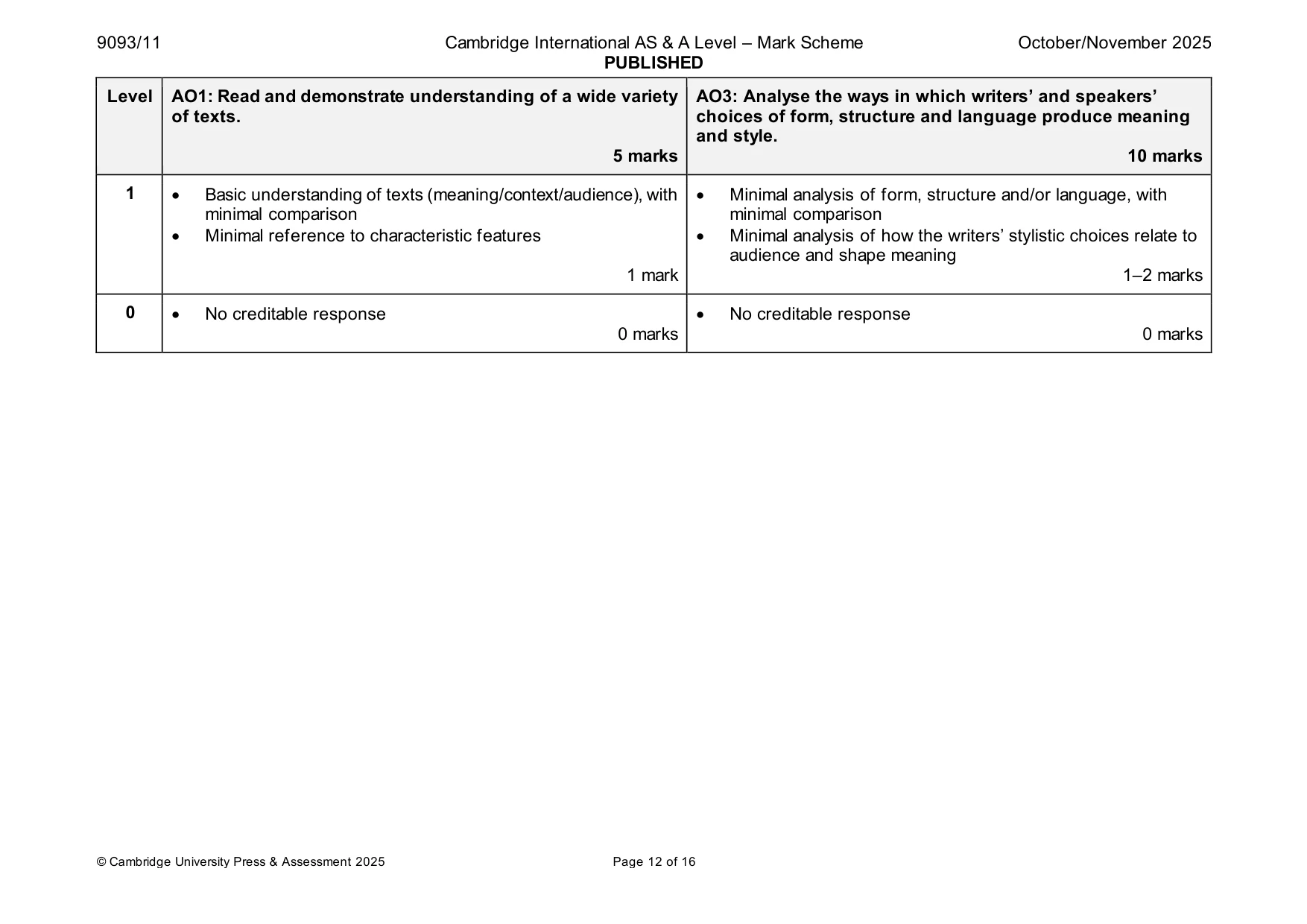
9093/11 Cambridge International AS & A Level – Mark Scheme PUBLISHED October/November 2025 © Cambridge University Press & Assessment 2025 Page 12 of 16 Level AO1: Read and demonstrate understanding of a wide variety of texts. 5 marks AO3: Analyse the ways in which writers’ and speakers’ choices of form, structure and language produce meaning and style. 10 marks 1 • Basic understanding of texts (meaning/context/audience), with minimal comparison • Minimal reference to characteristic features 1 mark • Minimal analysis of form, structure and/or language, with minimal comparison • Minimal analysis of how the writers’ stylistic choices relate to audience and shape meaning 1–2 marks 0 • No creditable response 0 marks • No creditable response 0 marks
Mark scheme, page 13
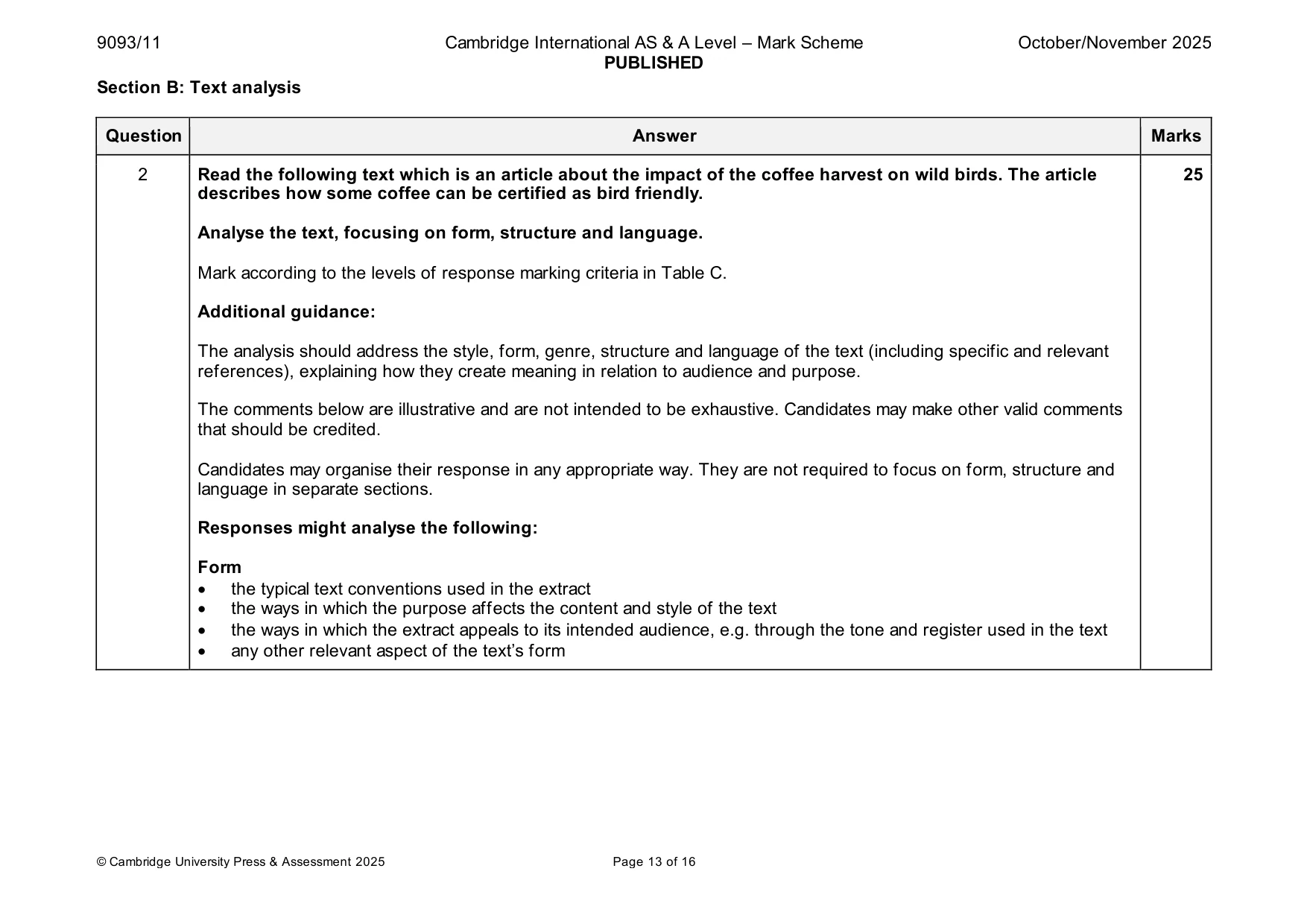
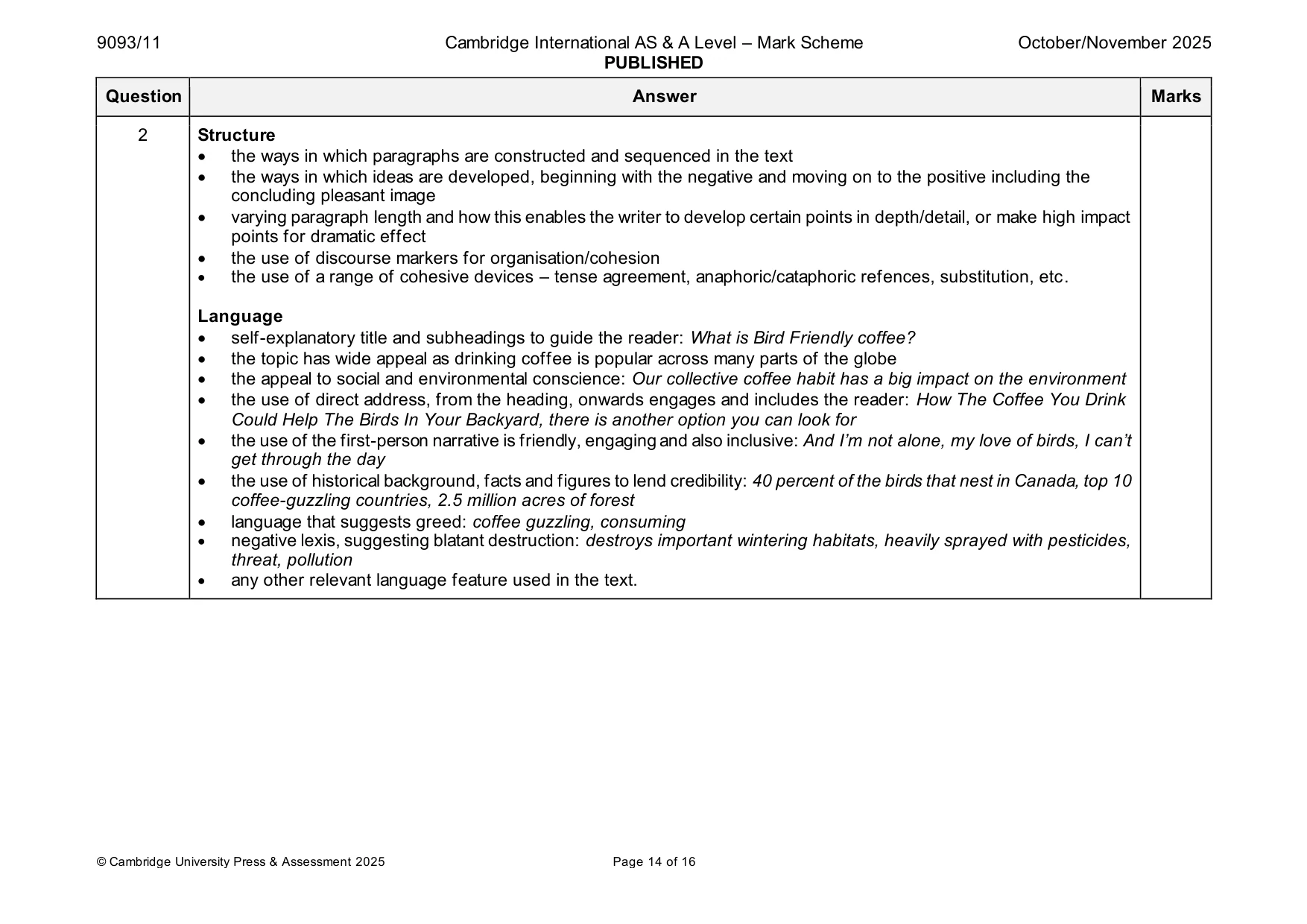
9093/11 Cambridge International AS & A Level – Mark Scheme PUBLISHED October/November 2025 © Cambridge University Press & Assessment 2025 Page 13 of 16 Section B: Text analysis Question Answer Marks 2 Read the following text which is an article about the impact of the coffee harvest on wild birds. The article describes how some coffee can be certified as bird friendly. Analyse the text, focusing on form, structure and language. Mark according to the levels of response marking criteria in Table C. Additional guidance: The analysis should address the style, form, genre, structure and language of the text (including specific and relevant references), explaining how they create meaning in relation to audience and purpose. The comments below are illustrative and are not intended to be exhaustive. Candidates may make other valid comments that should be credited. Candidates may organise their response in any appropriate way. They are not required to focus on form, structure and language in separate sections. Responses might analyse the following: Form • the typical text conventions used in the extract • the ways in which the purpose affects the content and style of the text • the ways in which the extract appeals to its intended audience, e.g. through the tone and register used in the text • any other relevant aspect of the text’s form 25
Mark scheme, page 14
9093/11 Cambridge International AS & A Level – Mark Scheme PUBLISHED October/November 2025 © Cambridge University Press & Assessment 2025 Page 14 of 16 Question Answer Marks 2 Structure • the ways in which paragraphs are constructed and sequenced in the text • the ways in which ideas are developed, beginning with the negative and moving on to the positive including the concluding pleasant image • varying paragraph length and how this enables the writer to develop certain points in depth/detail, or make high impact points for dramatic effect • the use of discourse markers for organisation/cohesion • the use of a range of cohesive devices – tense agreement, anaphoric/cataphoric refences, substitution, etc. Language • self-explanatory title and subheadings to guide the reader: What is Bird Friendly coffee? • the topic has wide appeal as drinking coffee is popular across many parts of the globe • the appeal to social and environmental conscience: Our collective coffee habit has a big impact on the environment • the use of direct address, from the heading, onwards engages and includes the reader: How The Coffee You Drink Could Help The Birds In Your Backyard, there is another option you can look for • the use of the first-person narrative is friendly, engaging and also inclusive: And I’m not alone, my love of birds, I can’t get through the day • the use of historical background, facts and figures to lend credibility: 40 percent of the birds that nest in Canada, top 10 coffee-guzzling countries, 2.5 million acres of forest • language that suggests greed: coffee guzzling, consuming • negative lexis, suggesting blatant destruction: destroys important wintering habitats, heavily sprayed with pesticides, threat, pollution • any other relevant language feature used in the text.
Mark scheme, page 15
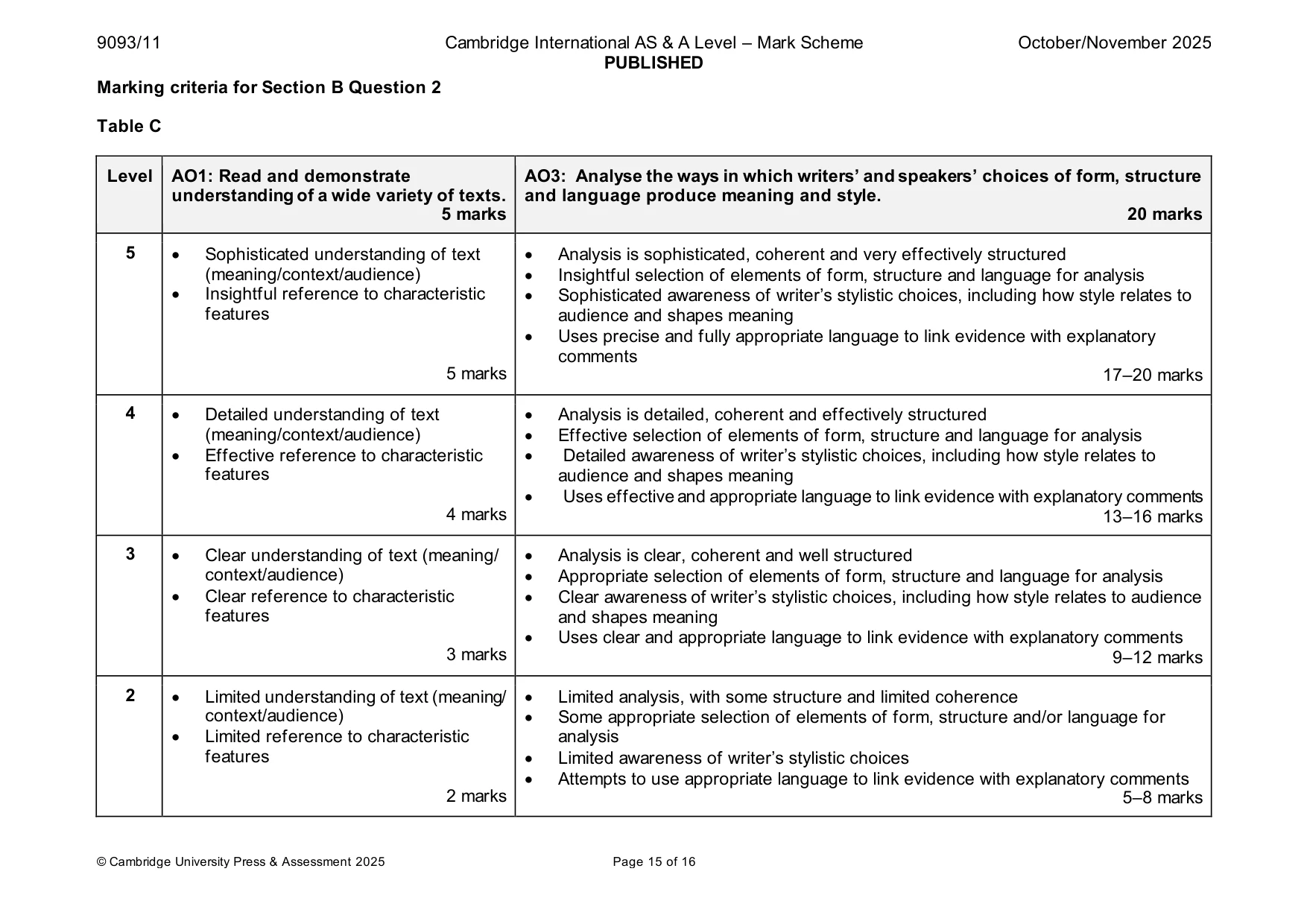
9093/11 Cambridge International AS & A Level – Mark Scheme PUBLISHED October/November 2025 © Cambridge University Press & Assessment 2025 Page 15 of 16 Marking criteria for Section B Question 2 Table C Level AO1: Read and demonstrate understanding of a wide variety of texts. 5 marks AO3: Analyse the ways in which writers’ and speakers’ choices of form, structure and language produce meaning and style. 20 marks 5 • Sophisticated understanding of text (meaning/context/audience) • Insightful reference to characteristic features 5 marks • Analysis is sophisticated, coherent and very effectively structured • Insightful selection of elements of form, structure and language for analysis • Sophisticated awareness of writer’s stylistic choices, including how style relates to audience and shapes meaning • Uses precise and fully appropriate language to link evidence with explanatory comments 17–20 marks 4 • Detailed understanding of text (meaning/context/audience) • Effective reference to characteristic features 4 marks • Analysis is detailed, coherent and effectively structured • Effective selection of elements of form, structure and language for analysis • Detailed awareness of writer’s stylistic choices, including how style relates to audience and shapes meaning • Uses effective and appropriate language to link evidence with explanatory comments 13–16 marks 3 • Clear understanding of text (meaning/ context/audience) • Clear reference to characteristic features 3 marks • Analysis is clear, coherent and well structured • Appropriate selection of elements of form, structure and language for analysis • Clear awareness of writer’s stylistic choices, including how style relates to audience and shapes meaning • Uses clear and appropriate language to link evidence with explanatory comments 9–12 marks 2 • Limited understanding of text (meaning/ context/audience) • Limited reference to characteristic features 2 marks • Limited analysis, with some structure and limited coherence • Some appropriate selection of elements of form, structure and/or language for analysis • Limited awareness of writer’s stylistic choices • Attempts to use appropriate language to link evidence with explanatory comments 5–8 marks
Mark scheme, page 16
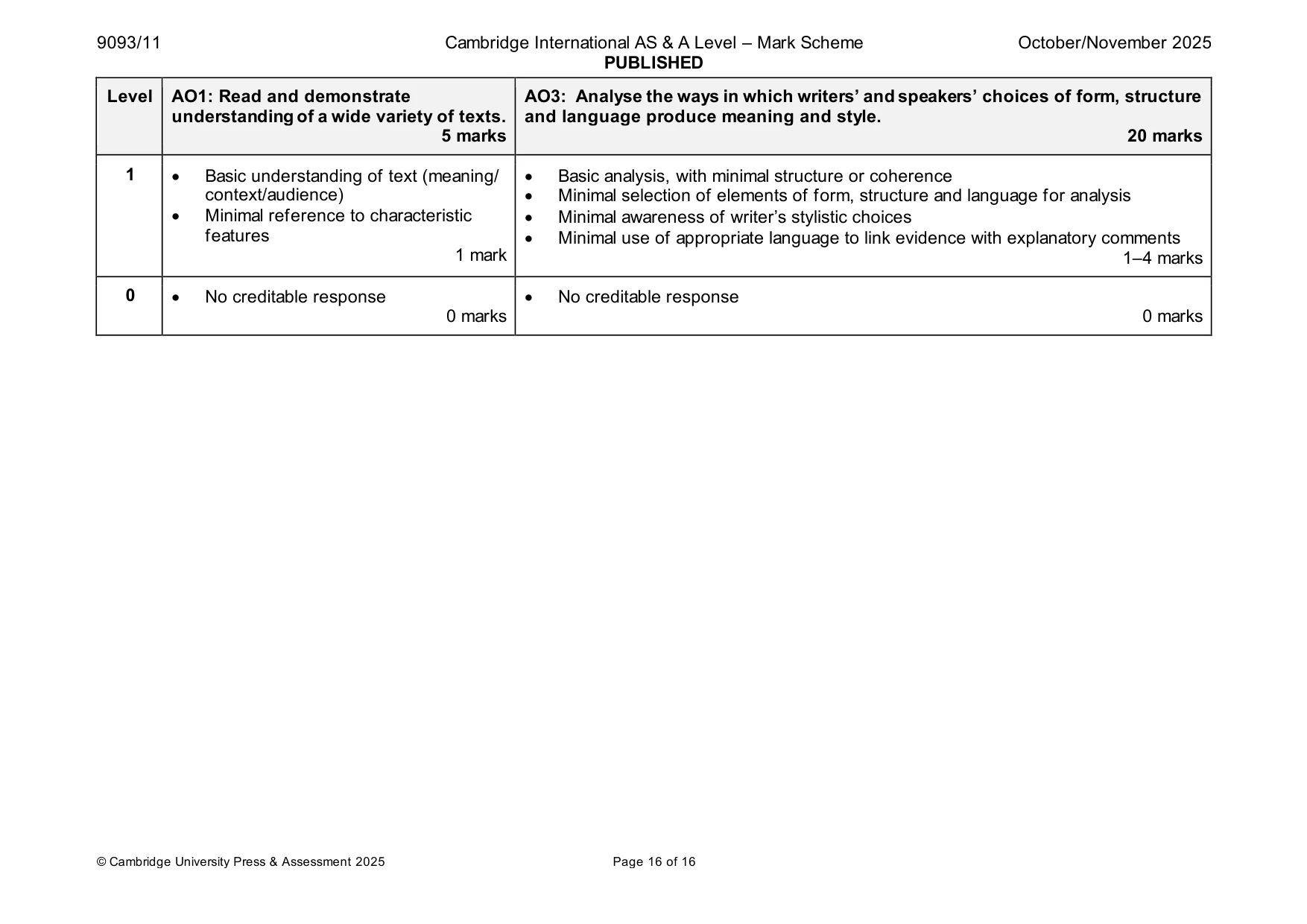
9093/11 Cambridge International AS & A Level – Mark Scheme PUBLISHED October/November 2025 © Cambridge University Press & Assessment 2025 Page 16 of 16 Level AO1: Read and demonstrate understanding of a wide variety of texts. 5 marks AO3: Analyse the ways in which writers’ and speakers’ choices of form, structure and language produce meaning and style. 20 marks 1 • Basic understanding of text (meaning/ context/audience) • Minimal reference to characteristic features 1 mark • Basic analysis, with minimal structure or coherence • Minimal selection of elements of form, structure and language for analysis • Minimal awareness of writer’s stylistic choices • Minimal use of appropriate language to link evidence with explanatory comments 1–4 marks 0 • No creditable response 0 marks • No creditable response 0 marks
What you needed in this session
Cambridge’s own grade thresholds for 2025 Oct/Nov, Paper 1 · Variant 1. A higher threshold means an easier paper — the bar moves with how the cohort did.