Cambridge A Level English - Language AS and A Level (from 2014) 9093 — 2023 May/June Paper 1 · Variant 3
9093/13/M/J/23 · 50 marks · ≈56 min
The question paper and its mark scheme, free to read here and free to download. This is Cambridge’s own paper, exactly as it was sat.
Question paper8 pages



Mark scheme15 pages
Answers below. Sit the paper first if you are practising.
Paper as text
Question paper, page 1
Cambridge International AS & A Level 9093/13 May/June 2023 2 hours 15 minutes ENGLISH LANGUAGE Paper 1 Reading You must answer on the enclosed answer booklet. You will need: Answer booklet (enclosed) INSTRUCTIONS • Answer all questions. • Follow the instructions on the front cover of the answer booklet. If you need additional answer paper, ask the invigilator for a continuation booklet. • Dictionaries are not allowed. INFORMATION • The total mark for this paper is 50. • The number of marks for each question or part question is shown in brackets [ ]. This document has 8 pages. Any blank pages are indicated. [Turn over 06_9093_13_2023_1.21 © UCLES 2023 *6849191652*
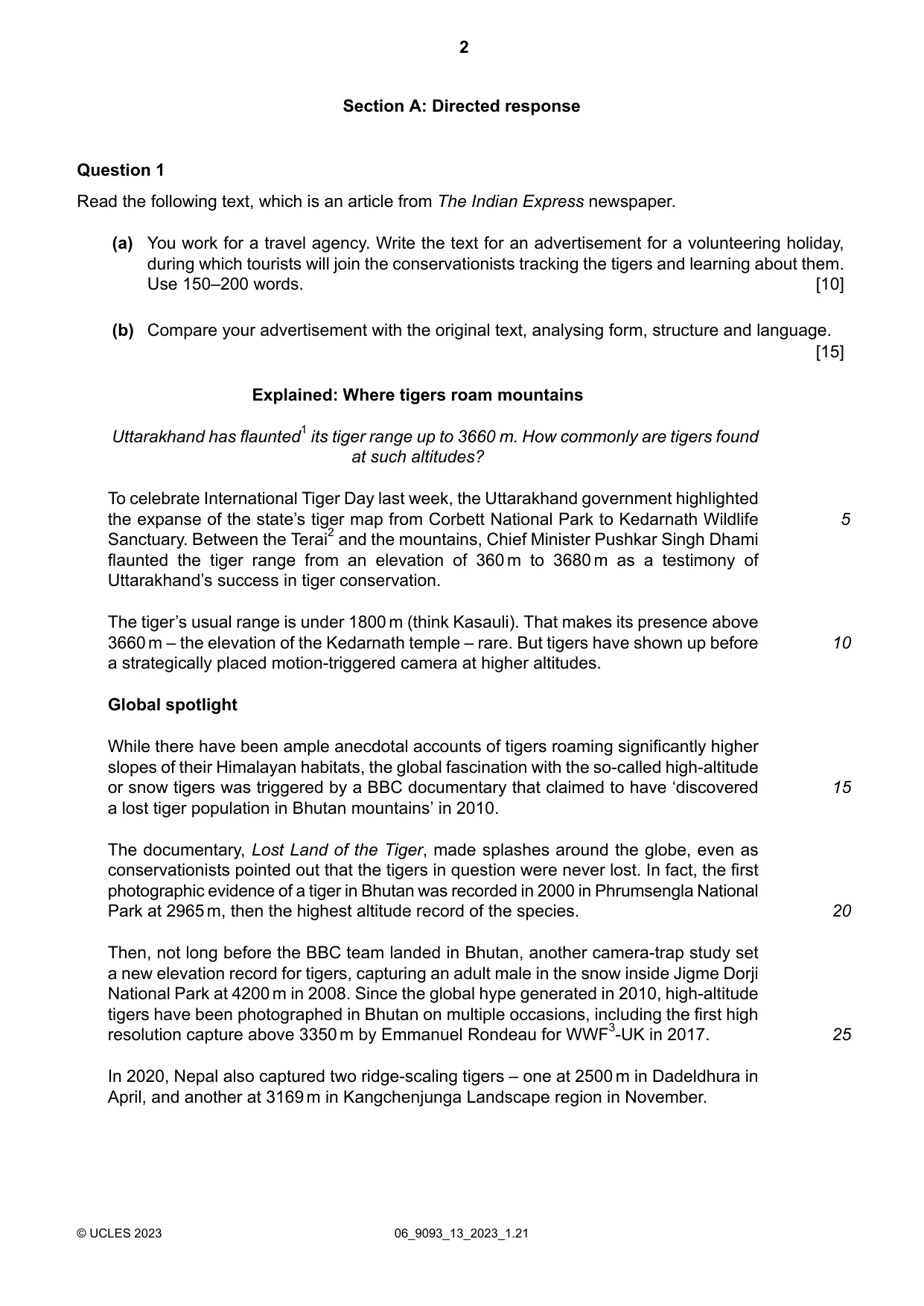
Question paper, page 2
25 20 15 10 5 Section A: Directed response Question 1 Read the following text, which is an article from The Indian Express newspaper. You work for a travel agency. Write the text for an advertisement for a volunteering holiday, during which tourists will join the conservationists tracking the tigers and learning about them. Use 150–200 words. [10] (a) Compare your advertisement with the original text, analysing form, structure and language. [15] (b) Explained: Where tigers roam mountains Uttarakhand has flaunted1 its tiger range up to 3660 m. How commonly are tigers found at such altitudes? To celebrate International Tiger Day last week, the Uttarakhand government highlighted the expanse of the state’s tiger map from Corbett National Park to Kedarnath Wildlife Sanctuary. Between the Terai2 and the mountains, Chief Minister Pushkar Singh Dhami flaunted the tiger range from an elevation of 360m to 3680m as a testimony of Uttarakhand’s success in tiger conservation. The tiger’s usual range is under 1800m (think Kasauli). That makes its presence above 3660m – the elevation of the Kedarnath temple – rare. But tigers have shown up before a strategically placed motion-triggered camera at higher altitudes. Global spotlight While there have been ample anecdotal accounts of tigers roaming significantly higher slopes of their Himalayan habitats, the global fascination with the so-called high-altitude or snow tigers was triggered by a BBC documentary that claimed to have ‘discovered a lost tiger population in Bhutan mountains’ in 2010. The documentary, Lost Land of the Tiger, made splashes around the globe, even as conservationists pointed out that the tigers in question were never lost. In fact, the first photographic evidence of a tiger in Bhutan was recorded in 2000 in Phrumsengla National Park at 2965m, then the highest altitude record of the species. Then, not long before the BBC team landed in Bhutan, another camera-trap study set a new elevation record for tigers, capturing an adult male in the snow inside Jigme Dorji National Park at 4200m in 2008. Since the global hype generated in 2010, high-altitude tigers have been photographed in Bhutan on multiple occasions, including the first high resolution capture above 3350m by Emmanuel Rondeau for WWF3-UK in 2017. In 2020, Nepal also captured two ridge-scaling tigers – one at 2500m in Dadeldhura in April, and another at 3169m in Kangchenjunga Landscape region in November. 06_9093_13_2023_1.21 © UCLES 2023 2
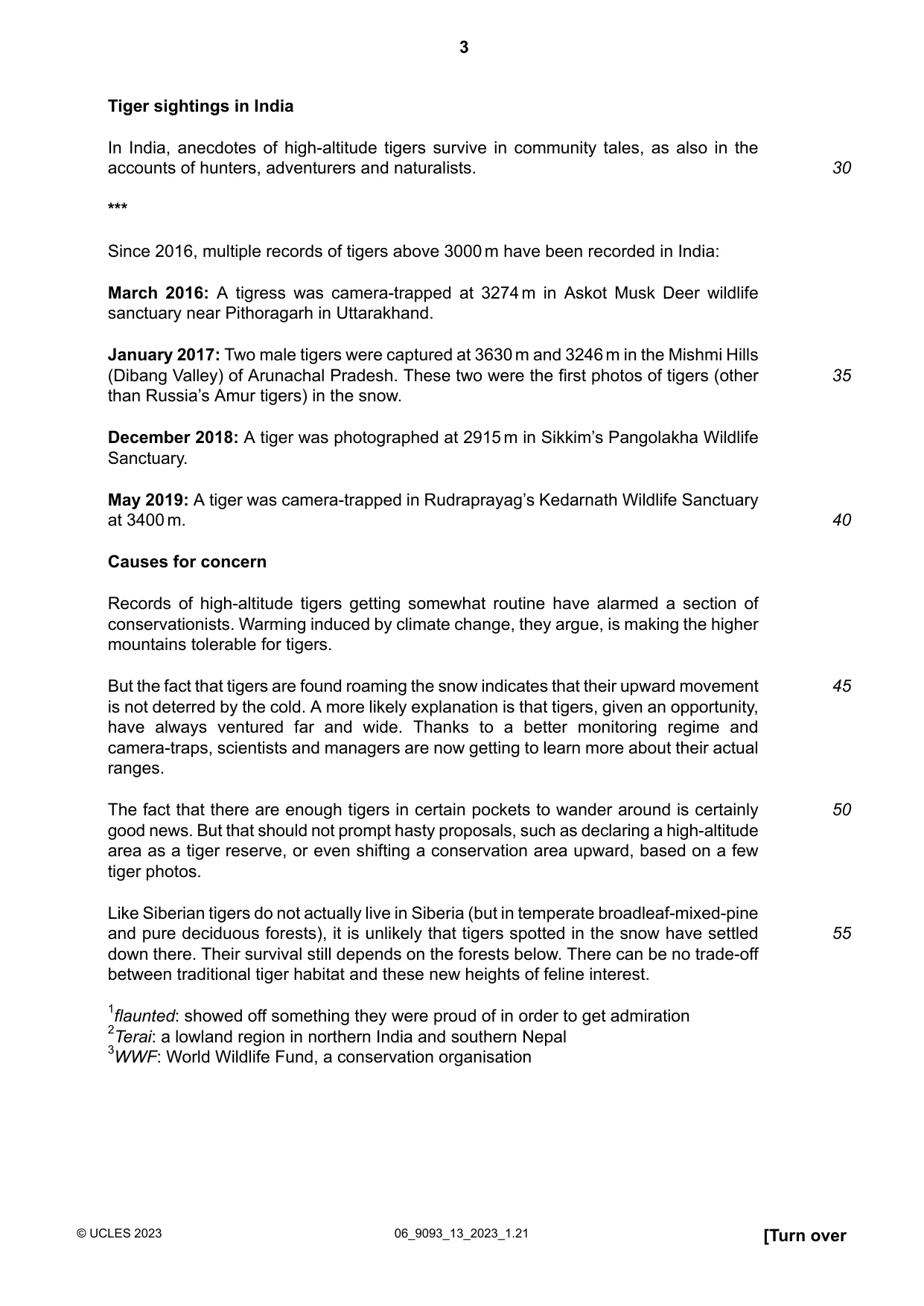
Question paper, page 3
55 50 45 40 35 30 Tiger sightings in India In India, anecdotes of high-altitude tigers survive in community tales, as also in the accounts of hunters, adventurers and naturalists. *** Since 2016, multiple records of tigers above 3000m have been recorded in India: March 2016: A tigress was camera-trapped at 3274m in Askot Musk Deer wildlife sanctuary near Pithoragarh in Uttarakhand. January 2017: Two male tigers were captured at 3630m and 3246m in the Mishmi Hills (Dibang Valley) of Arunachal Pradesh. These two were the first photos of tigers (other than Russia’s Amur tigers) in the snow. December 2018: A tiger was photographed at 2915m in Sikkim’s Pangolakha Wildlife Sanctuary. May 2019: A tiger was camera-trapped in Rudraprayag’s Kedarnath Wildlife Sanctuary at 3400m. Causes for concern Records of high-altitude tigers getting somewhat routine have alarmed a section of conservationists. Warming induced by climate change, they argue, is making the higher mountains tolerable for tigers. But the fact that tigers are found roaming the snow indicates that their upward movement is not deterred by the cold. A more likely explanation is that tigers, given an opportunity, have always ventured far and wide. Thanks to a better monitoring regime and camera-traps, scientists and managers are now getting to learn more about their actual ranges. The fact that there are enough tigers in certain pockets to wander around is certainly good news. But that should not prompt hasty proposals, such as declaring a high-altitude area as a tiger reserve, or even shifting a conservation area upward, based on a few tiger photos. Like Siberian tigers do not actually live in Siberia (but in temperate broadleaf-mixed-pine and pure deciduous forests), it is unlikely that tigers spotted in the snow have settled down there. Their survival still depends on the forests below. There can be no trade-off between traditional tiger habitat and these new heights of feline interest. 1flaunted: showed off something they were proud of in order to get admiration 2Terai: a lowland region in northern India and southern Nepal 3WWF: World Wildlife Fund, a conservation organisation [Turn over 06_9093_13_2023_1.21 © UCLES 2023 3
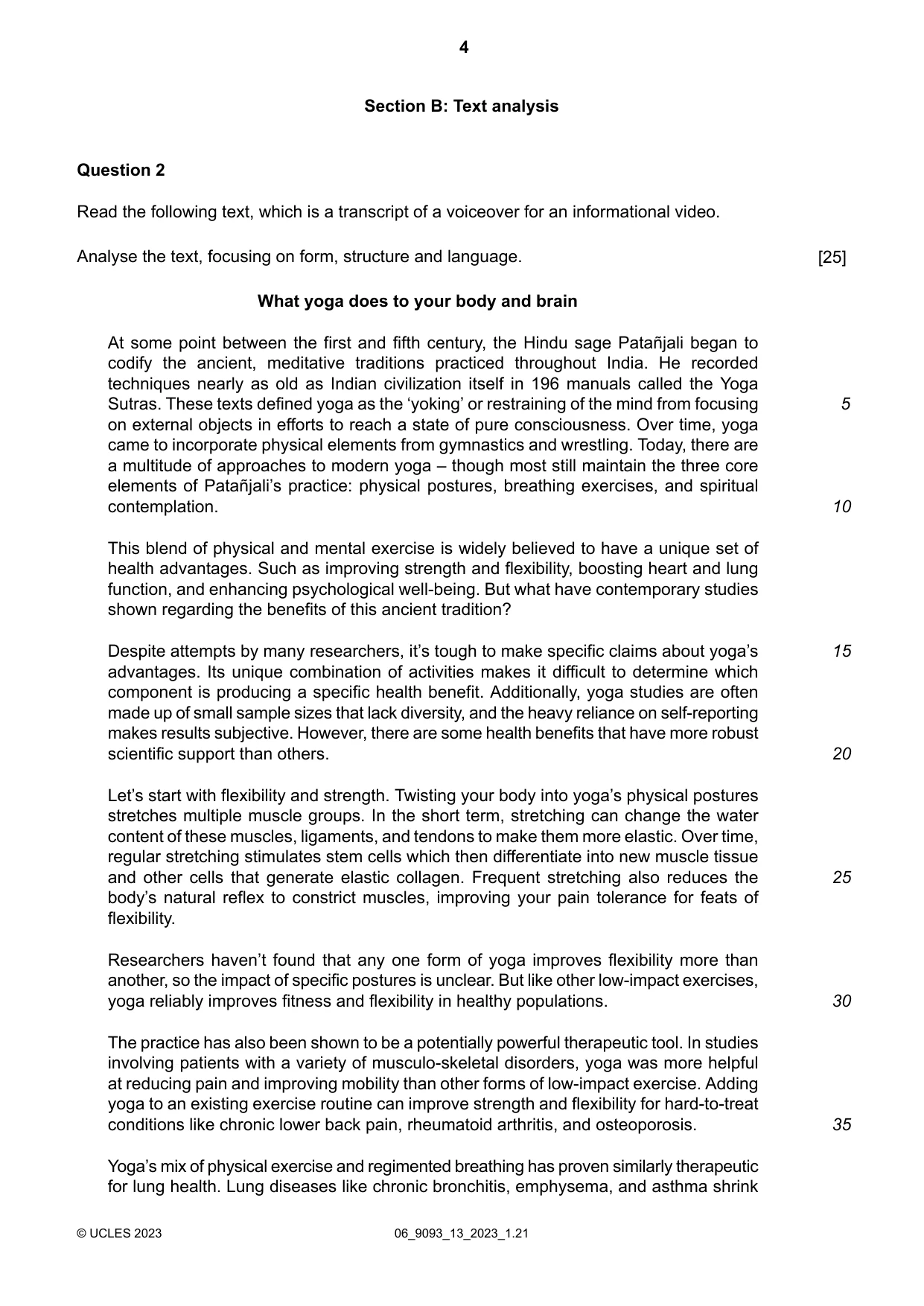
Question paper, page 4
35 30 25 20 15 10 5 Section B: Text analysis Question 2 Read the following text, which is a transcript of a voiceover for an informational video. Analyse the text, focusing on form, structure and language. [25] What yoga does to your body and brain At some point between the first and fifth century, the Hindu sage Patañjali began to codify the ancient, meditative traditions practiced throughout India. He recorded techniques nearly as old as Indian civilization itself in 196 manuals called the Yoga Sutras. These texts defined yoga as the ‘yoking’ or restraining of the mind from focusing on external objects in efforts to reach a state of pure consciousness. Over time, yoga came to incorporate physical elements from gymnastics and wrestling. Today, there are a multitude of approaches to modern yoga – though most still maintain the three core elements of Patañjali’s practice: physical postures, breathing exercises, and spiritual contemplation. This blend of physical and mental exercise is widely believed to have a unique set of health advantages. Such as improving strength and flexibility, boosting heart and lung function, and enhancing psychological well-being. But what have contemporary studies shown regarding the benefits of this ancient tradition? Despite attempts by many researchers, it’s tough to make specific claims about yoga’s advantages. Its unique combination of activities makes it difficult to determine which component is producing a specific health benefit. Additionally, yoga studies are often made up of small sample sizes that lack diversity, and the heavy reliance on self-reporting makes results subjective. However, there are some health benefits that have more robust scientific support than others. Let’s start with flexibility and strength. Twisting your body into yoga’s physical postures stretches multiple muscle groups. In the short term, stretching can change the water content of these muscles, ligaments, and tendons to make them more elastic. Over time, regular stretching stimulates stem cells which then differentiate into new muscle tissue and other cells that generate elastic collagen. Frequent stretching also reduces the body’s natural reflex to constrict muscles, improving your pain tolerance for feats of flexibility. Researchers haven’t found that any one form of yoga improves flexibility more than another, so the impact of specific postures is unclear. But like other low-impact exercises, yoga reliably improves fitness and flexibility in healthy populations. The practice has also been shown to be a potentially powerful therapeutic tool. In studies involving patients with a variety of musculo-skeletal disorders, yoga was more helpful at reducing pain and improving mobility than other forms of low-impact exercise. Adding yoga to an existing exercise routine can improve strength and flexibility for hard-to-treat conditions like chronic lower back pain, rheumatoid arthritis, and osteoporosis. Yoga’s mix of physical exercise and regimented breathing has proven similarly therapeutic for lung health. Lung diseases like chronic bronchitis, emphysema, and asthma shrink 06_9093_13_2023_1.21 © UCLES 2023 4
Question paper, page 5
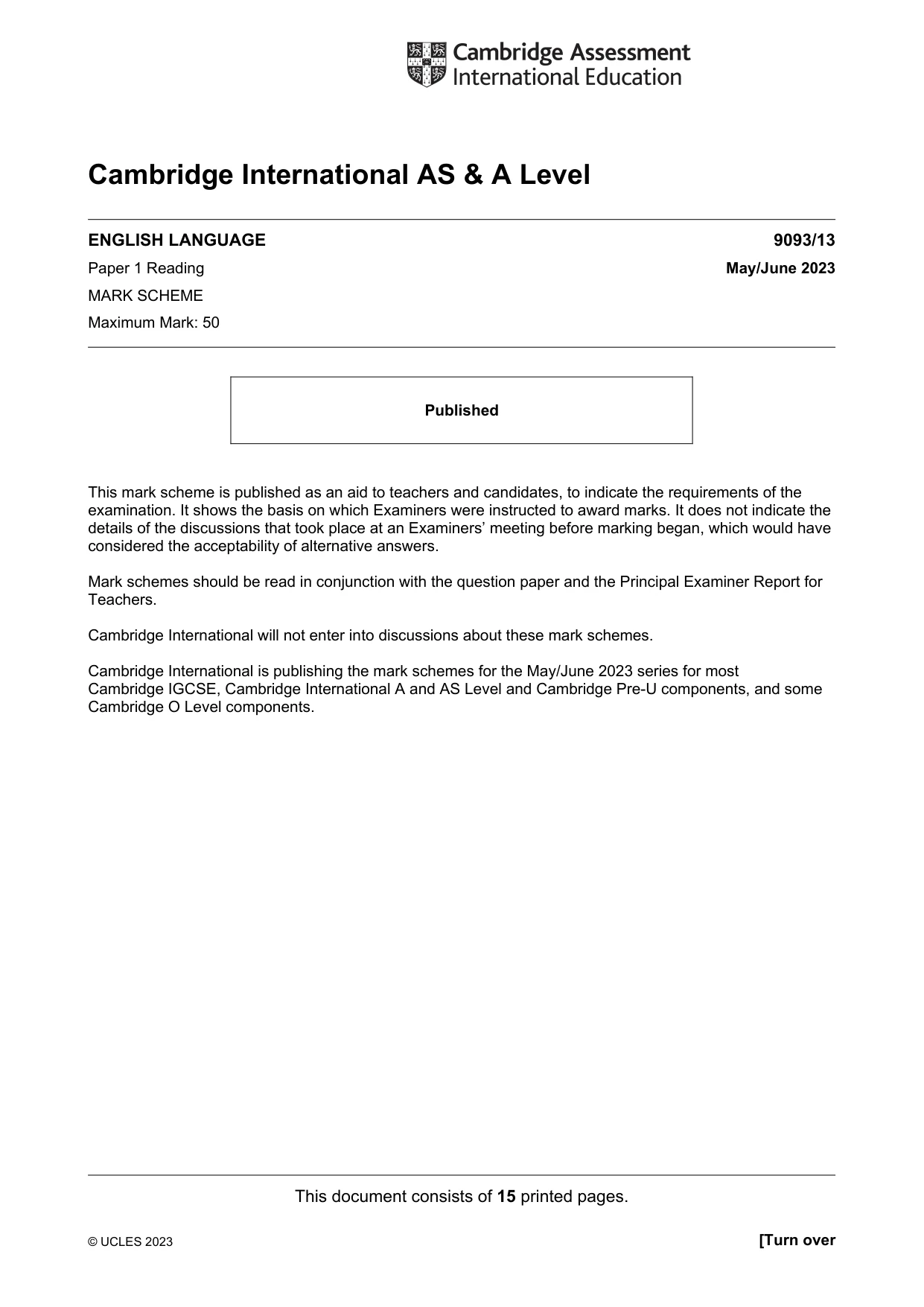
50 45 40 the passageways that carry oxygen, while weakening the membrane that brings oxygen into the blood. But breathing exercises like those found in yoga relax the muscles constricting those passageways and improve oxygen diffusion. Increasing the blood’s oxygen content is especially helpful for those with weak heart muscles who have difficulty pumping enough oxygen throughout the body. And for those with healthy hearts, this practice can lower blood pressure and reduce risk factors for cardiovascular disease. Yoga’s most widely celebrated benefit may be the most difficult to prove: its psychological effects. Despite the longstanding association between yoga and psychological well-being, there’s little conclusive evidence on how the practice affects mental health. One of the biggest claims is that yoga improves symptoms of depression and anxiety disorders. Since diagnosis of these conditions varies widely, as do their origin and severity, it’s difficult to quantify yoga’s impact. However, there is evidence to suggest that yoga can help reduce the symptoms of stress, as well as meditation or relaxation. Research on the effects of yoga is still evolving. In the future, we’ll need larger studies, incorporating diverse participants, which can measure yoga’s impact on heart attacks, cancer rates, cognitive function and more. But for now, yoga can continue its ancient tradition as a way to exercise, reflect, and relax. 06_9093_13_2023_1.21 © UCLES 2023 5
Question paper, page 6
BLANK PAGE 06_9093_13_2023_1.21 © UCLES 2023 6
Question paper, page 7
BLANK PAGE 06_9093_13_2023_1.21 © UCLES 2023 7
Question paper, page 8
BLANK PAGE Permission to reproduce items where third-party owned material protected by copyright is included has been sought and cleared where possible. Every reasonable effort has been made by the publisher (UCLES) to trace copyright holders, but if any items requiring clearance have unwittingly been included, the publisher will be pleased to make amends at the earliest possible opportunity. To avoid the issue of disclosure of answer-related information to candidates, all copyright acknowledgements are reproduced online in the Cambridge Assessment International Education Copyright Acknowledgements Booklet. This is produced for each series of examinations and is freely available to download at www.cambridgeinternational.org after the live examination series. Cambridge Assessment International Education is part of Cambridge Assessment. Cambridge Assessment is the brand name of the University of Cambridge Local Examinations Syndicate (UCLES), which is a department of the University of Cambridge. 06_9093_13_2023_1.21 © UCLES 2023 8
Mark scheme, page 1
This document consists of 15 printed pages. © UCLES 2023 [Turn over Cambridge International AS & A Level ENGLISH LANGUAGE 9093/13 Paper 1 Reading May/June 2023 MARK SCHEME Maximum Mark: 50 Published This mark scheme is published as an aid to teachers and candidates, to indicate the requirements of the examination. It shows the basis on which Examiners were instructed to award marks. It does not indicate the details of the discussions that took place at an Examiners’ meeting before marking began, which would have considered the acceptability of alternative answers. Mark schemes should be read in conjunction with the question paper and the Principal Examiner Report for Teachers. Cambridge International will not enter into discussions about these mark schemes. Cambridge International is publishing the mark schemes for the May/June 2023 series for most Cambridge IGCSE, Cambridge International A and AS Level and Cambridge Pre-U components, and some Cambridge O Level components.
Mark scheme, page 2
9093/13 Cambridge International AS & A Level – Mark Scheme PUBLISHED May/June 2023 © UCLES 2023 Page 2 of 15 Generic Marking Principles These general marking principles must be applied by all examiners when marking candidate answers. They should be applied alongside the specific content of the mark scheme or generic level descriptors for a question. Each question paper and mark scheme will also comply with these marking principles. GENERIC MARKING PRINCIPLE 1: Marks must be awarded in line with: the specific content of the mark scheme or the generic level descriptors for the question the specific skills defined in the mark scheme or in the generic level descriptors for the question the standard of response required by a candidate as exemplified by the standardisation scripts. GENERIC MARKING PRINCIPLE 2: Marks awarded are always whole marks (not half marks, or other fractions). GENERIC MARKING PRINCIPLE 3: Marks must be awarded positively: marks are awarded for correct/valid answers, as defined in the mark scheme. However, credit is given for valid answers which go beyond the scope of the syllabus and mark scheme, referring to your Team Leader as appropriate marks are awarded when candidates clearly demonstrate what they know and can do marks are not deducted for errors marks are not deducted for omissions answers should only be judged on the quality of spelling, punctuation and grammar when these features are specifically assessed by the question as indicated by the mark scheme. The meaning, however, should be unambiguous. GENERIC MARKING PRINCIPLE 4: Rules must be applied consistently, e.g. in situations where candidates have not followed instructions or in the application of generic level descriptors.
Mark scheme, page 3
9093/13 Cambridge International AS & A Level – Mark Scheme PUBLISHED May/June 2023 © UCLES 2023 Page 3 of 15 GENERIC MARKING PRINCIPLE 5: Marks should be awarded using the full range of marks defined in the mark scheme for the question (however; the use of the full mark range may be limited according to the quality of the candidate responses seen). GENERIC MARKING PRINCIPLE 6: Marks awarded are based solely on the requirements as defined in the mark scheme. Marks should not be awarded with grade thresholds or grade descriptors in mind.
Mark scheme, page 4
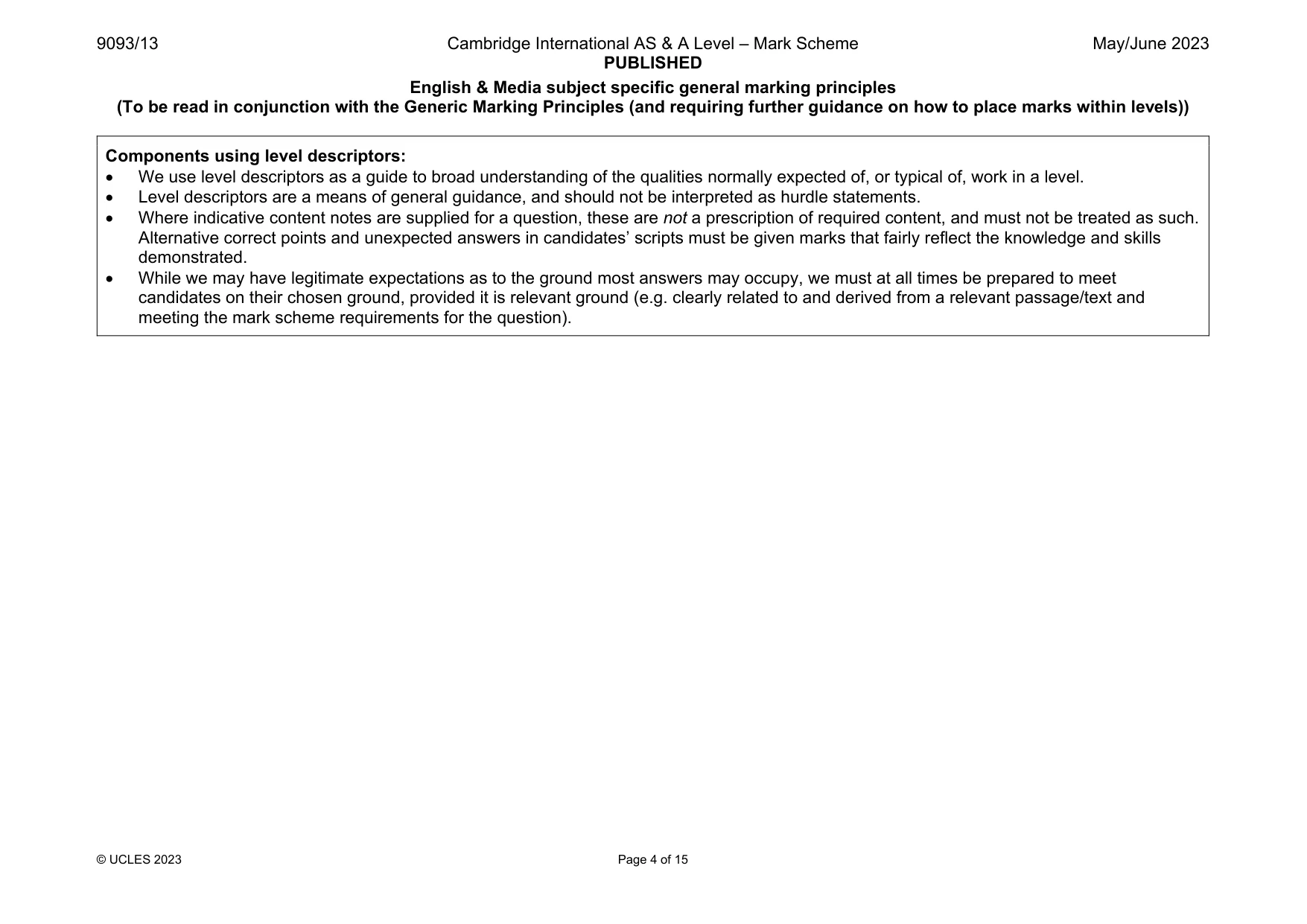
9093/13 Cambridge International AS & A Level – Mark Scheme PUBLISHED May/June 2023 © UCLES 2023 Page 4 of 15 English & Media subject specific general marking principles (To be read in conjunction with the Generic Marking Principles (and requiring further guidance on how to place marks within levels)) Components using level descriptors: We use level descriptors as a guide to broad understanding of the qualities normally expected of, or typical of, work in a level. Level descriptors are a means of general guidance, and should not be interpreted as hurdle statements. Where indicative content notes are supplied for a question, these are not a prescription of required content, and must not be treated as such. Alternative correct points and unexpected answers in candidates’ scripts must be given marks that fairly reflect the knowledge and skills demonstrated. While we may have legitimate expectations as to the ground most answers may occupy, we must at all times be prepared to meet candidates on their chosen ground, provided it is relevant ground (e.g. clearly related to and derived from a relevant passage/text and meeting the mark scheme requirements for the question).
Mark scheme, page 5
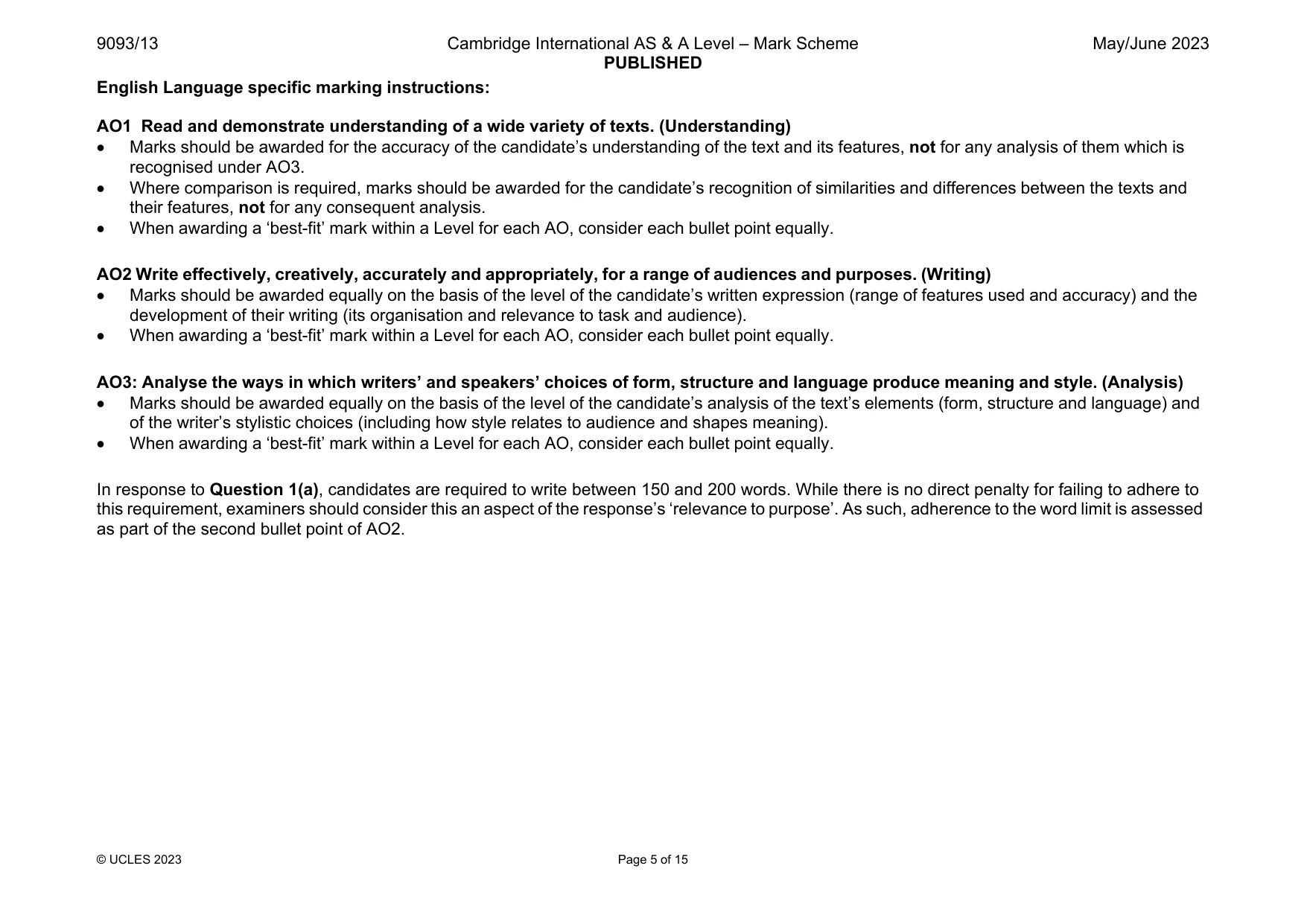
9093/13 Cambridge International AS & A Level – Mark Scheme PUBLISHED May/June 2023 © UCLES 2023 Page 5 of 15 English Language specific marking instructions: AO1 Read and demonstrate understanding of a wide variety of texts. (Understanding) Marks should be awarded for the accuracy of the candidate’s understanding of the text and its features, not for any analysis of them which is recognised under AO3. Where comparison is required, marks should be awarded for the candidate’s recognition of similarities and differences between the texts and their features, not for any consequent analysis. When awarding a ‘best-fit’ mark within a Level for each AO, consider each bullet point equally. AO2 Write effectively, creatively, accurately and appropriately, for a range of audiences and purposes. (Writing) Marks should be awarded equally on the basis of the level of the candidate’s written expression (range of features used and accuracy) and the development of their writing (its organisation and relevance to task and audience). When awarding a ‘best-fit’ mark within a Level for each AO, consider each bullet point equally. AO3: Analyse the ways in which writers’ and speakers’ choices of form, structure and language produce meaning and style. (Analysis) Marks should be awarded equally on the basis of the level of the candidate’s analysis of the text’s elements (form, structure and language) and of the writer’s stylistic choices (including how style relates to audience and shapes meaning). When awarding a ‘best-fit’ mark within a Level for each AO, consider each bullet point equally. In response to Question 1(a), candidates are required to write between 150 and 200 words. While there is no direct penalty for failing to adhere to this requirement, examiners should consider this an aspect of the response’s ‘relevance to purpose’. As such, adherence to the word limit is assessed as part of the second bullet point of AO2.
Mark scheme, page 6
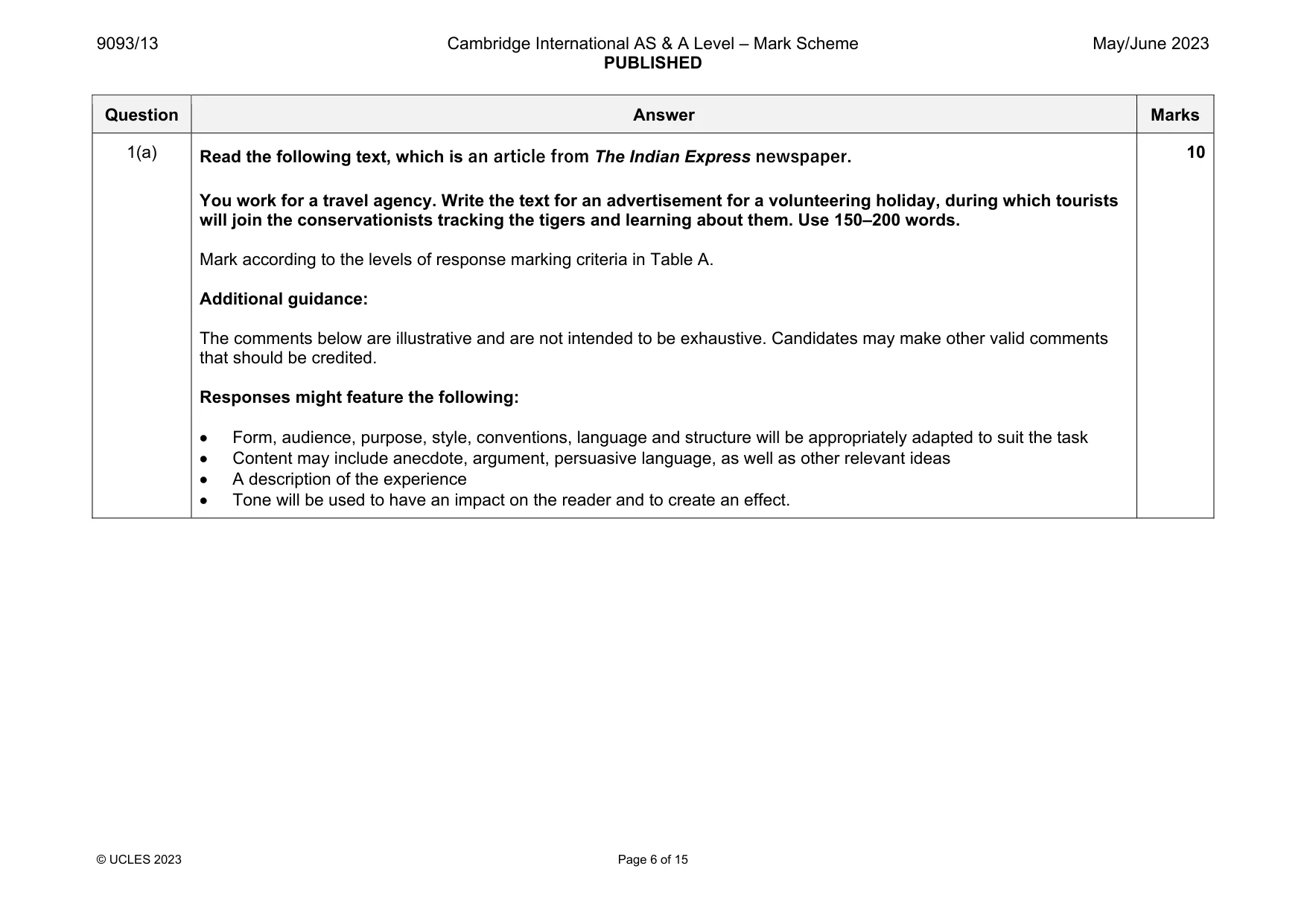
9093/13 Cambridge International AS & A Level – Mark Scheme PUBLISHED May/June 2023 © UCLES 2023 Page 6 of 15 Question Answer Marks 1(a) Read the following text, which is an article from The Indian Express newspaper. You work for a travel agency. Write the text for an advertisement for a volunteering holiday, during which tourists will join the conservationists tracking the tigers and learning about them. Use 150–200 words. Mark according to the levels of response marking criteria in Table A. Additional guidance: The comments below are illustrative and are not intended to be exhaustive. Candidates may make other valid comments that should be credited. Responses might feature the following: Form, audience, purpose, style, conventions, language and structure will be appropriately adapted to suit the task Content may include anecdote, argument, persuasive language, as well as other relevant ideas A description of the experience Tone will be used to have an impact on the reader and to create an effect. 10
Mark scheme, page 7
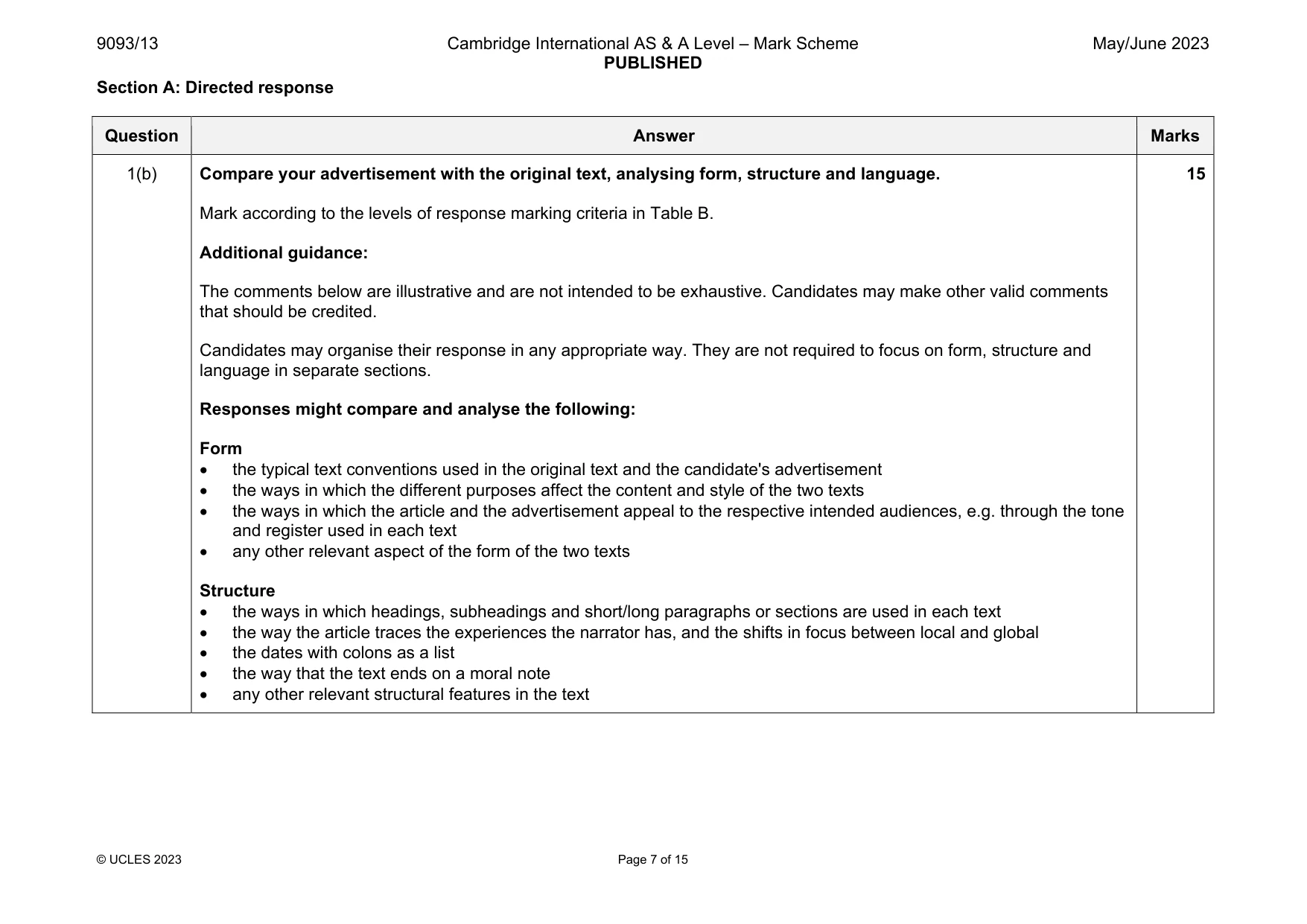
9093/13 Cambridge International AS & A Level – Mark Scheme PUBLISHED May/June 2023 © UCLES 2023 Page 7 of 15 Section A: Directed response Question Answer Marks 1(b) Compare your advertisement with the original text, analysing form, structure and language. Mark according to the levels of response marking criteria in Table B. Additional guidance: The comments below are illustrative and are not intended to be exhaustive. Candidates may make other valid comments that should be credited. Candidates may organise their response in any appropriate way. They are not required to focus on form, structure and language in separate sections. Responses might compare and analyse the following: Form the typical text conventions used in the original text and the candidate's advertisement the ways in which the different purposes affect the content and style of the two texts the ways in which the article and the advertisement appeal to the respective intended audiences, e.g. through the tone and register used in each text any other relevant aspect of the form of the two texts Structure the ways in which headings, subheadings and short/long paragraphs or sections are used in each text the way the article traces the experiences the narrator has, and the shifts in focus between local and global the dates with colons as a list the way that the text ends on a moral note any other relevant structural features in the text 15
Mark scheme, page 8
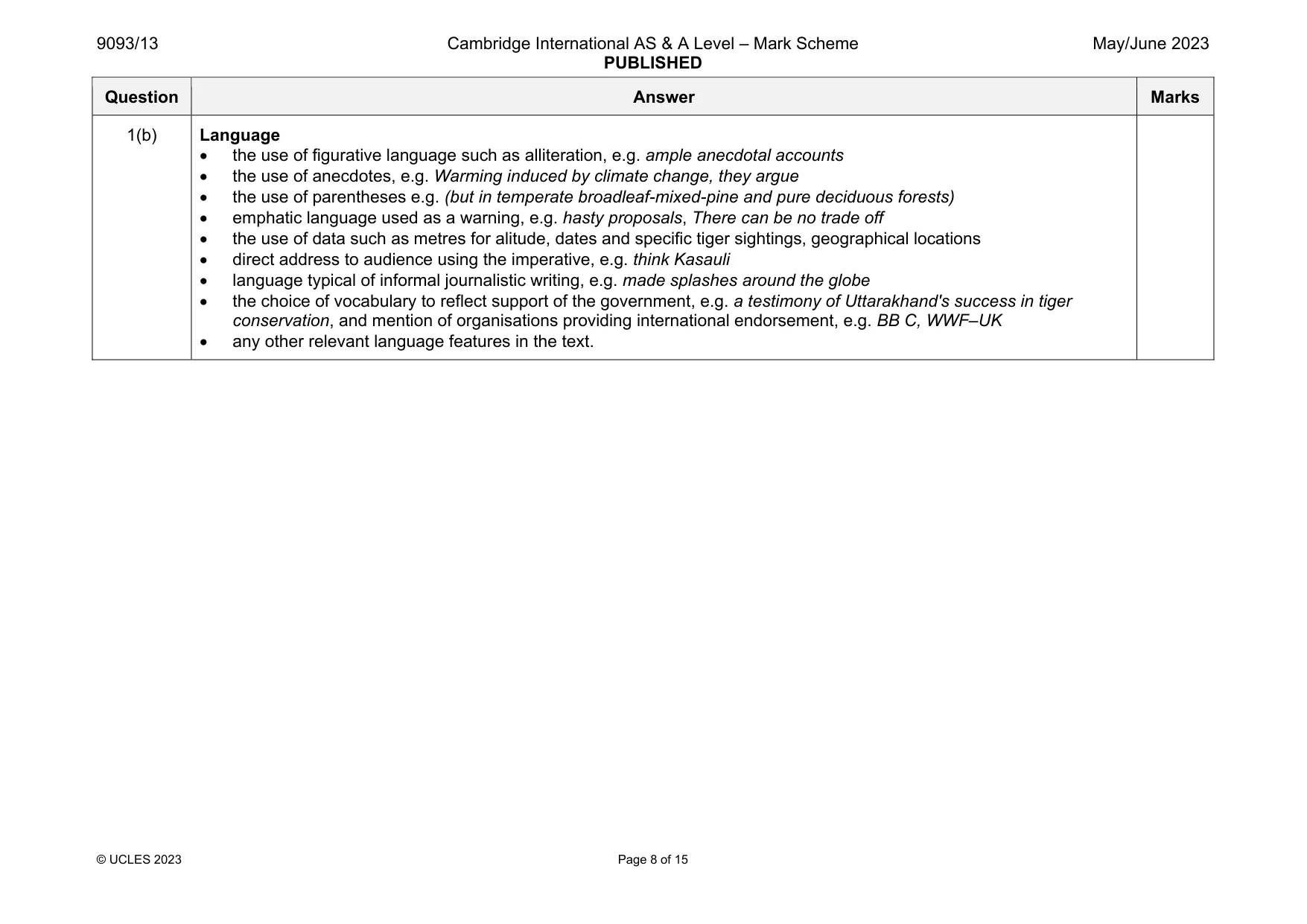
9093/13 Cambridge International AS & A Level – Mark Scheme PUBLISHED May/June 2023 © UCLES 2023 Page 8 of 15 Question Answer Marks 1(b) Language the use of figurative language such as alliteration, e.g. ample anecdotal accounts the use of anecdotes, e.g. Warming induced by climate change, they argue the use of parentheses e.g. (but in temperate broadleaf-mixed-pine and pure deciduous forests) emphatic language used as a warning, e.g. hasty proposals, There can be no trade off the use of data such as metres for alitude, dates and specific tiger sightings, geographical locations direct address to audience using the imperative, e.g. think Kasauli language typical of informal journalistic writing, e.g. made splashes around the globe the choice of vocabulary to reflect support of the government, e.g. a testimony of Uttarakhand's success in tiger conservation, and mention of organisations providing international endorsement, e.g. BB C, WWF–UK any other relevant language features in the text.
Mark scheme, page 9
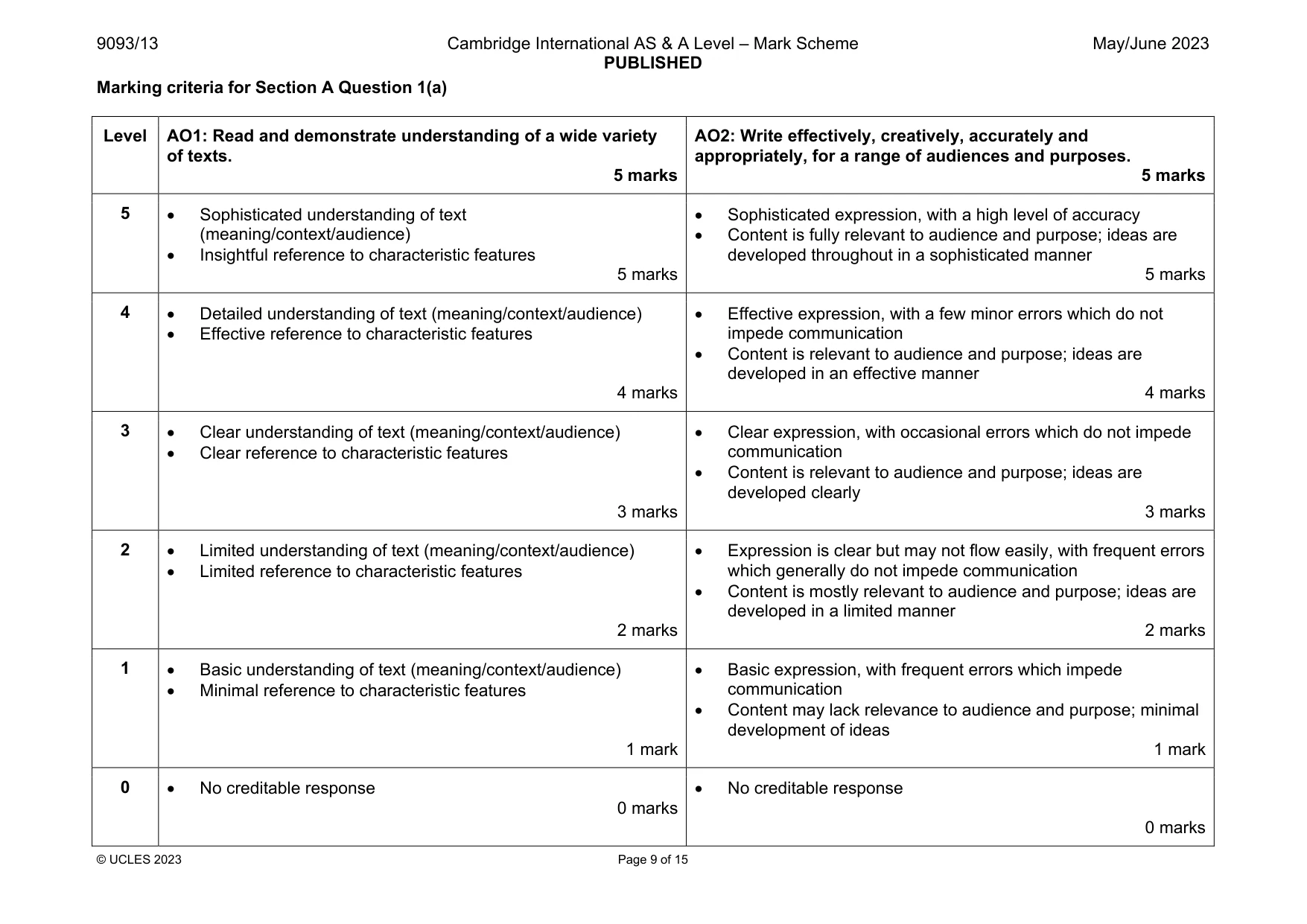
9093/13 Cambridge International AS & A Level – Mark Scheme PUBLISHED May/June 2023 © UCLES 2023 Page 9 of 15 Marking criteria for Section A Question 1(a) Level AO1: Read and demonstrate understanding of a wide variety of texts. 5 marks AO2: Write effectively, creatively, accurately and appropriately, for a range of audiences and purposes. 5 marks 5 Sophisticated understanding of text (meaning/context/audience) Insightful reference to characteristic features 5 marks Sophisticated expression, with a high level of accuracy Content is fully relevant to audience and purpose; ideas are developed throughout in a sophisticated manner 5 marks 4 Detailed understanding of text (meaning/context/audience) Effective reference to characteristic features 4 marks Effective expression, with a few minor errors which do not impede communication Content is relevant to audience and purpose; ideas are developed in an effective manner 4 marks 3 Clear understanding of text (meaning/context/audience) Clear reference to characteristic features 3 marks Clear expression, with occasional errors which do not impede communication Content is relevant to audience and purpose; ideas are developed clearly 3 marks 2 Limited understanding of text (meaning/context/audience) Limited reference to characteristic features 2 marks Expression is clear but may not flow easily, with frequent errors which generally do not impede communication Content is mostly relevant to audience and purpose; ideas are developed in a limited manner 2 marks 1 Basic understanding of text (meaning/context/audience) Minimal reference to characteristic features 1 mark Basic expression, with frequent errors which impede communication Content may lack relevance to audience and purpose; minimal development of ideas 1 mark 0 No creditable response 0 marks No creditable response 0 marks
Mark scheme, page 10
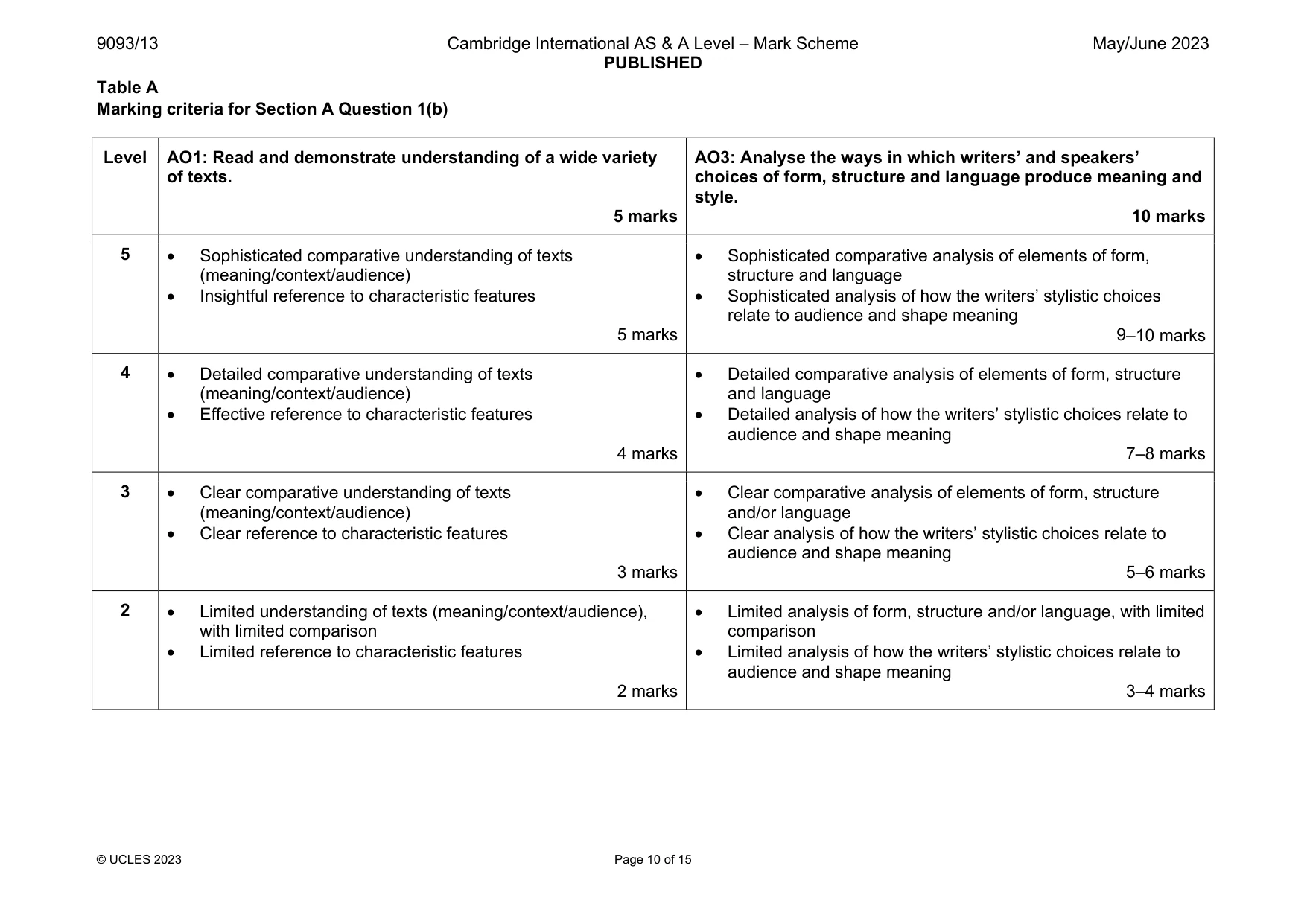
9093/13 Cambridge International AS & A Level – Mark Scheme PUBLISHED May/June 2023 © UCLES 2023 Page 10 of 15 Table A Marking criteria for Section A Question 1(b) Level AO1: Read and demonstrate understanding of a wide variety of texts. 5 marks AO3: Analyse the ways in which writers’ and speakers’ choices of form, structure and language produce meaning and style. 10 marks 5 Sophisticated comparative understanding of texts (meaning/context/audience) Insightful reference to characteristic features 5 marks Sophisticated comparative analysis of elements of form, structure and language Sophisticated analysis of how the writers’ stylistic choices relate to audience and shape meaning 9–10 marks 4 Detailed comparative understanding of texts (meaning/context/audience) Effective reference to characteristic features 4 marks Detailed comparative analysis of elements of form, structure and language Detailed analysis of how the writers’ stylistic choices relate to audience and shape meaning 7–8 marks 3 Clear comparative understanding of texts (meaning/context/audience) Clear reference to characteristic features 3 marks Clear comparative analysis of elements of form, structure and/or language Clear analysis of how the writers’ stylistic choices relate to audience and shape meaning 5–6 marks 2 Limited understanding of texts (meaning/context/audience), with limited comparison Limited reference to characteristic features 2 marks Limited analysis of form, structure and/or language, with limited comparison Limited analysis of how the writers’ stylistic choices relate to audience and shape meaning 3–4 marks
Mark scheme, page 11
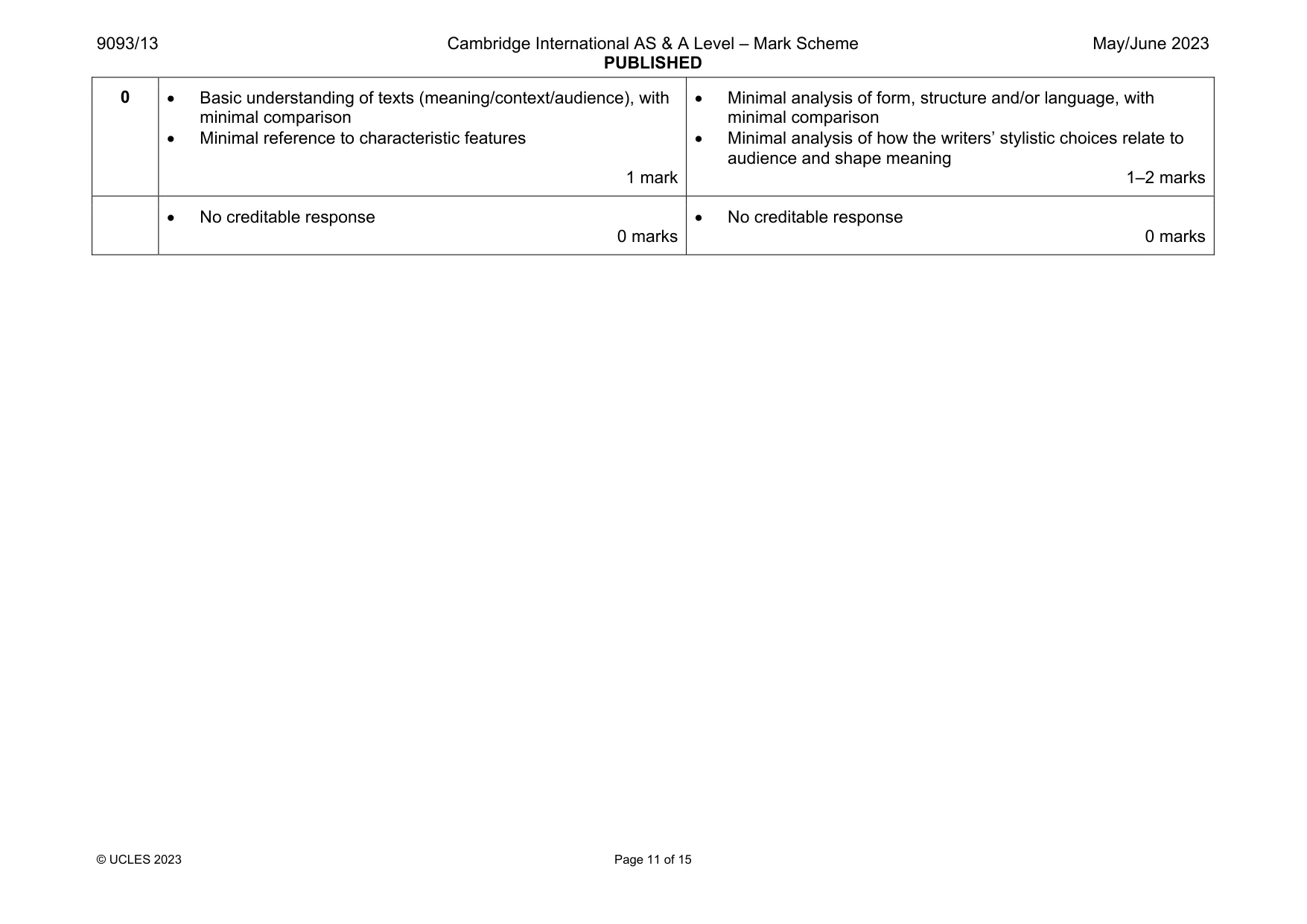
9093/13 Cambridge International AS & A Level – Mark Scheme PUBLISHED May/June 2023 © UCLES 2023 Page 11 of 15 0 Basic understanding of texts (meaning/context/audience), with minimal comparison Minimal reference to characteristic features 1 mark Minimal analysis of form, structure and/or language, with minimal comparison Minimal analysis of how the writers’ stylistic choices relate to audience and shape meaning 1–2 marks No creditable response 0 marks No creditable response 0 marks
Mark scheme, page 12
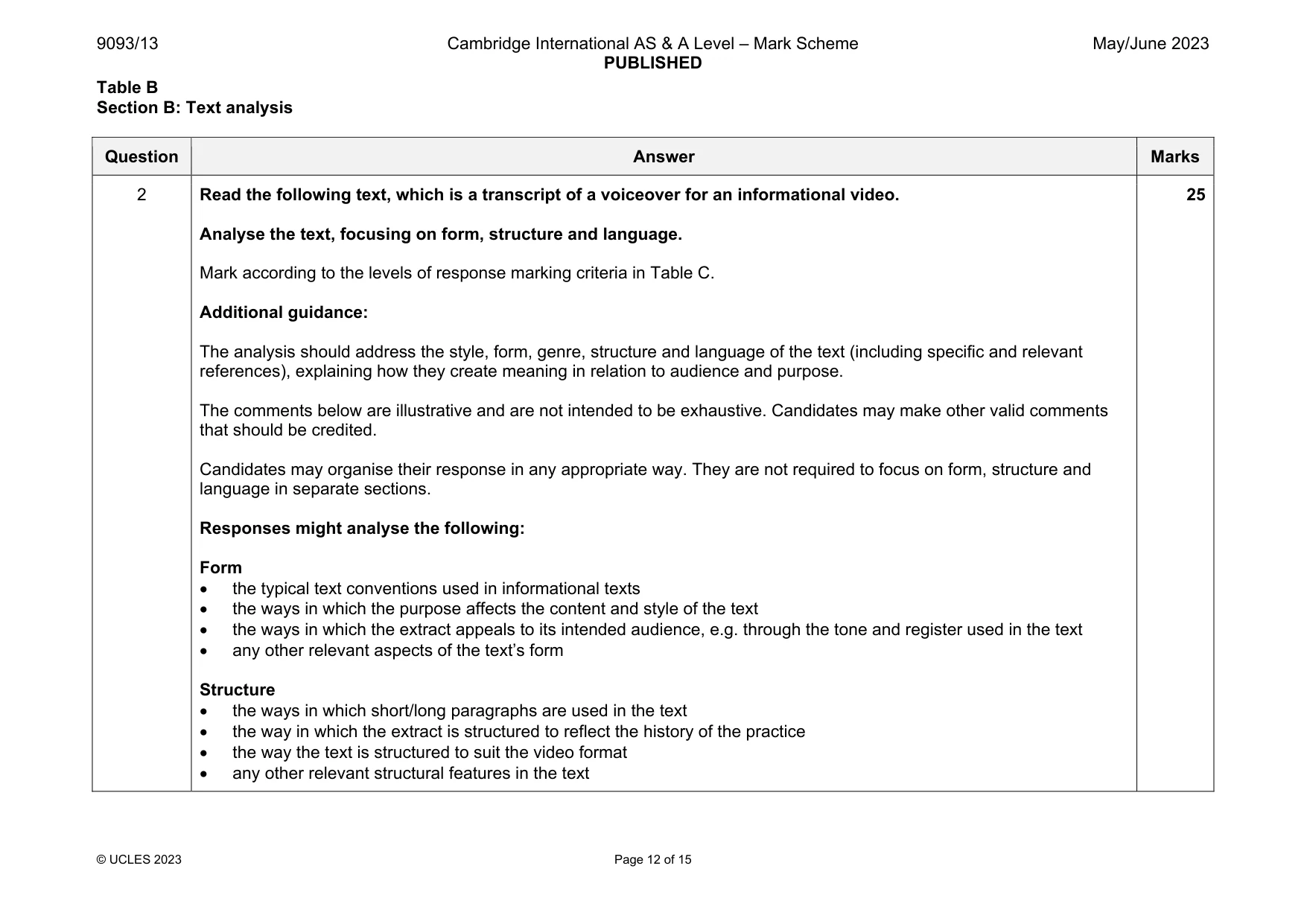
9093/13 Cambridge International AS & A Level – Mark Scheme PUBLISHED May/June 2023 © UCLES 2023 Page 12 of 15 Table B Section B: Text analysis Question Answer Marks 2 Read the following text, which is a transcript of a voiceover for an informational video. Analyse the text, focusing on form, structure and language. Mark according to the levels of response marking criteria in Table C. Additional guidance: The analysis should address the style, form, genre, structure and language of the text (including specific and relevant references), explaining how they create meaning in relation to audience and purpose. The comments below are illustrative and are not intended to be exhaustive. Candidates may make other valid comments that should be credited. Candidates may organise their response in any appropriate way. They are not required to focus on form, structure and language in separate sections. Responses might analyse the following: Form the typical text conventions used in informational texts the ways in which the purpose affects the content and style of the text the ways in which the extract appeals to its intended audience, e.g. through the tone and register used in the text any other relevant aspects of the text’s form Structure the ways in which short/long paragraphs are used in the text the way in which the extract is structured to reflect the history of the practice the way the text is structured to suit the video format any other relevant structural features in the text 25
Mark scheme, page 13
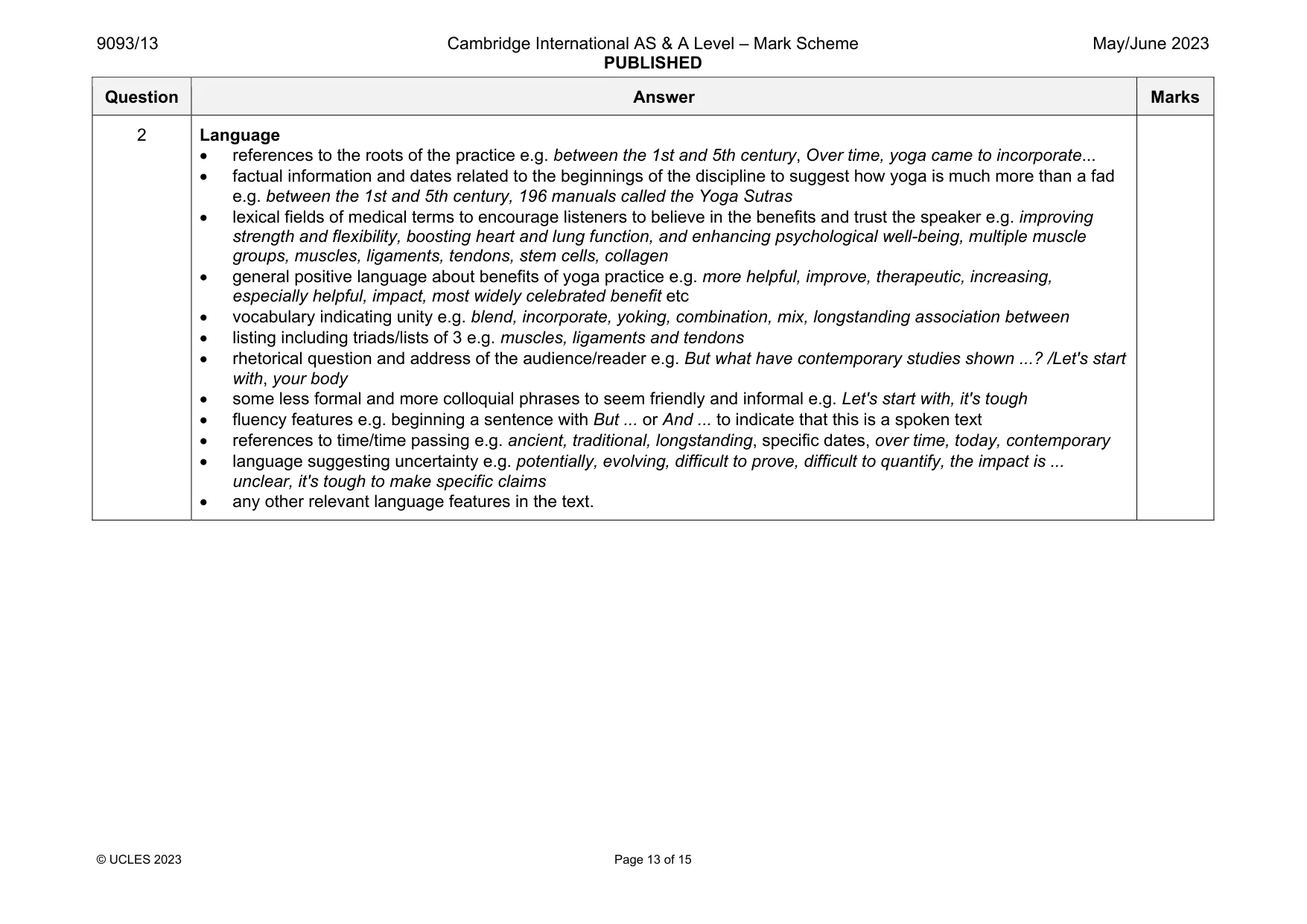
9093/13 Cambridge International AS & A Level – Mark Scheme PUBLISHED May/June 2023 © UCLES 2023 Page 13 of 15 Question Answer Marks 2 Language references to the roots of the practice e.g. between the 1st and 5th century, Over time, yoga came to incorporate... factual information and dates related to the beginnings of the discipline to suggest how yoga is much more than a fad e.g. between the 1st and 5th century, 196 manuals called the Yoga Sutras lexical fields of medical terms to encourage listeners to believe in the benefits and trust the speaker e.g. improving strength and flexibility, boosting heart and lung function, and enhancing psychological well-being, multiple muscle groups, muscles, ligaments, tendons, stem cells, collagen general positive language about benefits of yoga practice e.g. more helpful, improve, therapeutic, increasing, especially helpful, impact, most widely celebrated benefit etc vocabulary indicating unity e.g. blend, incorporate, yoking, combination, mix, longstanding association between listing including triads/lists of 3 e.g. muscles, ligaments and tendons rhetorical question and address of the audience/reader e.g. But what have contemporary studies shown ...? /Let's start with, your body some less formal and more colloquial phrases to seem friendly and informal e.g. Let's start with, it's tough fluency features e.g. beginning a sentence with But ... or And ... to indicate that this is a spoken text references to time/time passing e.g. ancient, traditional, longstanding, specific dates, over time, today, contemporary language suggesting uncertainty e.g. potentially, evolving, difficult to prove, difficult to quantify, the impact is ... unclear, it's tough to make specific claims any other relevant language features in the text.
Mark scheme, page 14
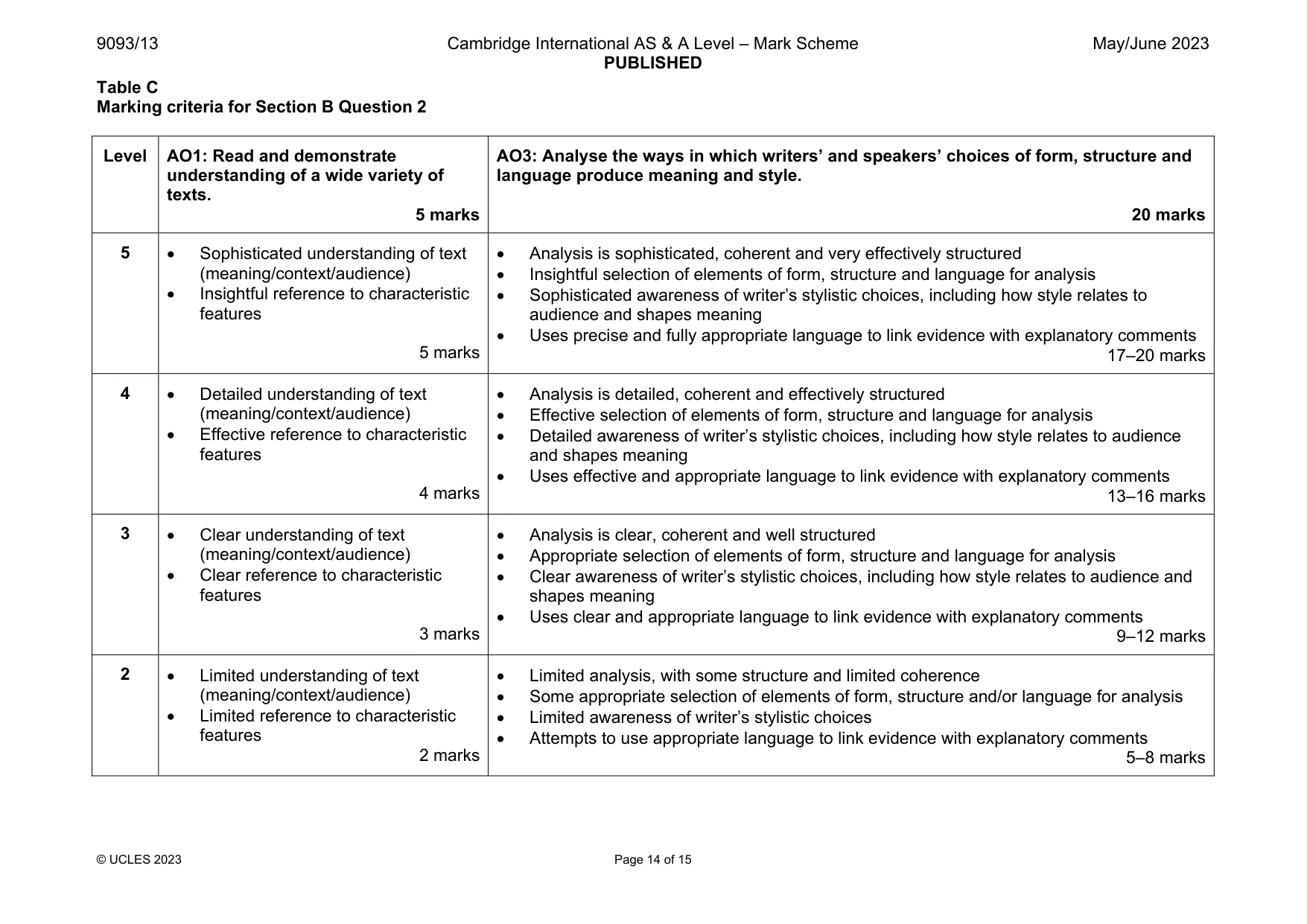
9093/13 Cambridge International AS & A Level – Mark Scheme PUBLISHED May/June 2023 © UCLES 2023 Page 14 of 15 Table C Marking criteria for Section B Question 2 Level AO1: Read and demonstrate understanding of a wide variety of texts. 5 marks AO3: Analyse the ways in which writers’ and speakers’ choices of form, structure and language produce meaning and style. 20 marks 5 Sophisticated understanding of text (meaning/context/audience) Insightful reference to characteristic features 5 marks Analysis is sophisticated, coherent and very effectively structured Insightful selection of elements of form, structure and language for analysis Sophisticated awareness of writer’s stylistic choices, including how style relates to audience and shapes meaning Uses precise and fully appropriate language to link evidence with explanatory comments 17–20 marks 4 Detailed understanding of text (meaning/context/audience) Effective reference to characteristic features 4 marks Analysis is detailed, coherent and effectively structured Effective selection of elements of form, structure and language for analysis Detailed awareness of writer’s stylistic choices, including how style relates to audience and shapes meaning Uses effective and appropriate language to link evidence with explanatory comments 13–16 marks 3 Clear understanding of text (meaning/context/audience) Clear reference to characteristic features 3 marks Analysis is clear, coherent and well structured Appropriate selection of elements of form, structure and language for analysis Clear awareness of writer’s stylistic choices, including how style relates to audience and shapes meaning Uses clear and appropriate language to link evidence with explanatory comments 9–12 marks 2 Limited understanding of text (meaning/context/audience) Limited reference to characteristic features 2 marks Limited analysis, with some structure and limited coherence Some appropriate selection of elements of form, structure and/or language for analysis Limited awareness of writer’s stylistic choices Attempts to use appropriate language to link evidence with explanatory comments 5–8 marks
Mark scheme, page 15
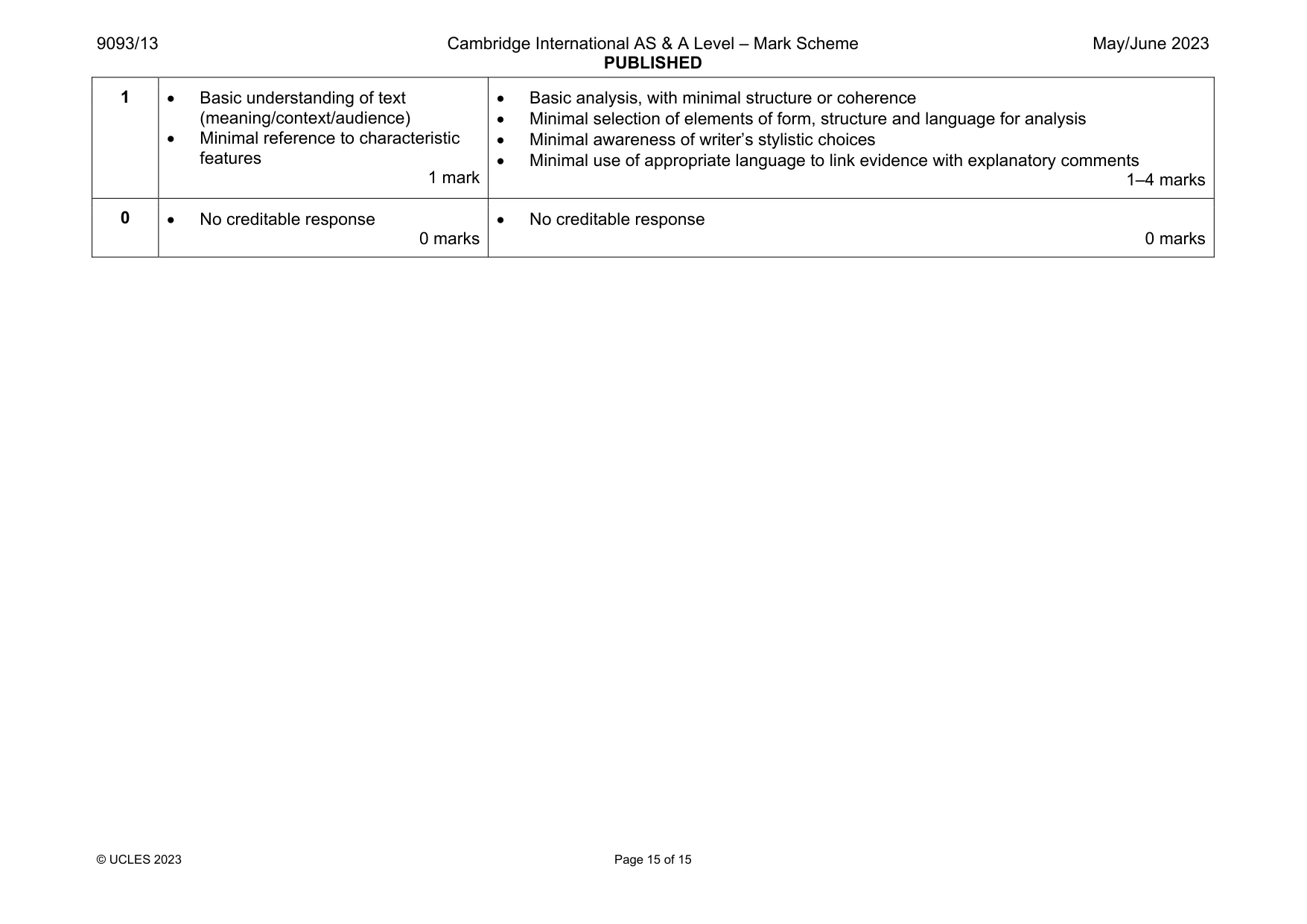
9093/13 Cambridge International AS & A Level – Mark Scheme PUBLISHED May/June 2023 © UCLES 2023 Page 15 of 15 1 Basic understanding of text (meaning/context/audience) Minimal reference to characteristic features 1 mark Basic analysis, with minimal structure or coherence Minimal selection of elements of form, structure and language for analysis Minimal awareness of writer’s stylistic choices Minimal use of appropriate language to link evidence with explanatory comments 1–4 marks 0 No creditable response 0 marks No creditable response 0 marks
What you needed in this session
Cambridge’s own grade thresholds for 2023 May/June, Paper 1 · Variant 3. A higher threshold means an easier paper — the bar moves with how the cohort did.