Cambridge A Level English - Language AS and A Level (from 2014) 9093 — 2025 Feb/March Paper 1 · Variant 2
9093/12/F/M/25 · 50 marks · 135 min
The question paper and its mark scheme, free to read here and free to download. This is Cambridge’s own paper, exactly as it was sat.
Question paper8 pages


Mark scheme17 pages
Answers below. Sit the paper first if you are practising.
Paper as text
Question paper, page 1
This document has 8 pages. Any blank pages are indicated. [Turn over DC (JP) 343410/2 © UCLES 2025 * 0 3 0 5 3 0 3 1 8 4 * Cambridge International AS & A Level ENGLISH LANGUAGE 9093/12 Paper 1 Reading February/March 2025 2 hours 15 minutes You must answer on the enclosed answer booklet. You will need: Answer booklet (enclosed) INSTRUCTIONS ● Answer all questions. ● Follow the instructions on the front cover of the answer booklet. If you need additional answer paper, ask the invigilator for a continuation booklet. ● Dictionaries are not allowed. INFORMATION ● The total mark for this paper is 50. ● The number of marks for each question or part question is shown in brackets [ ].
Question paper, page 2
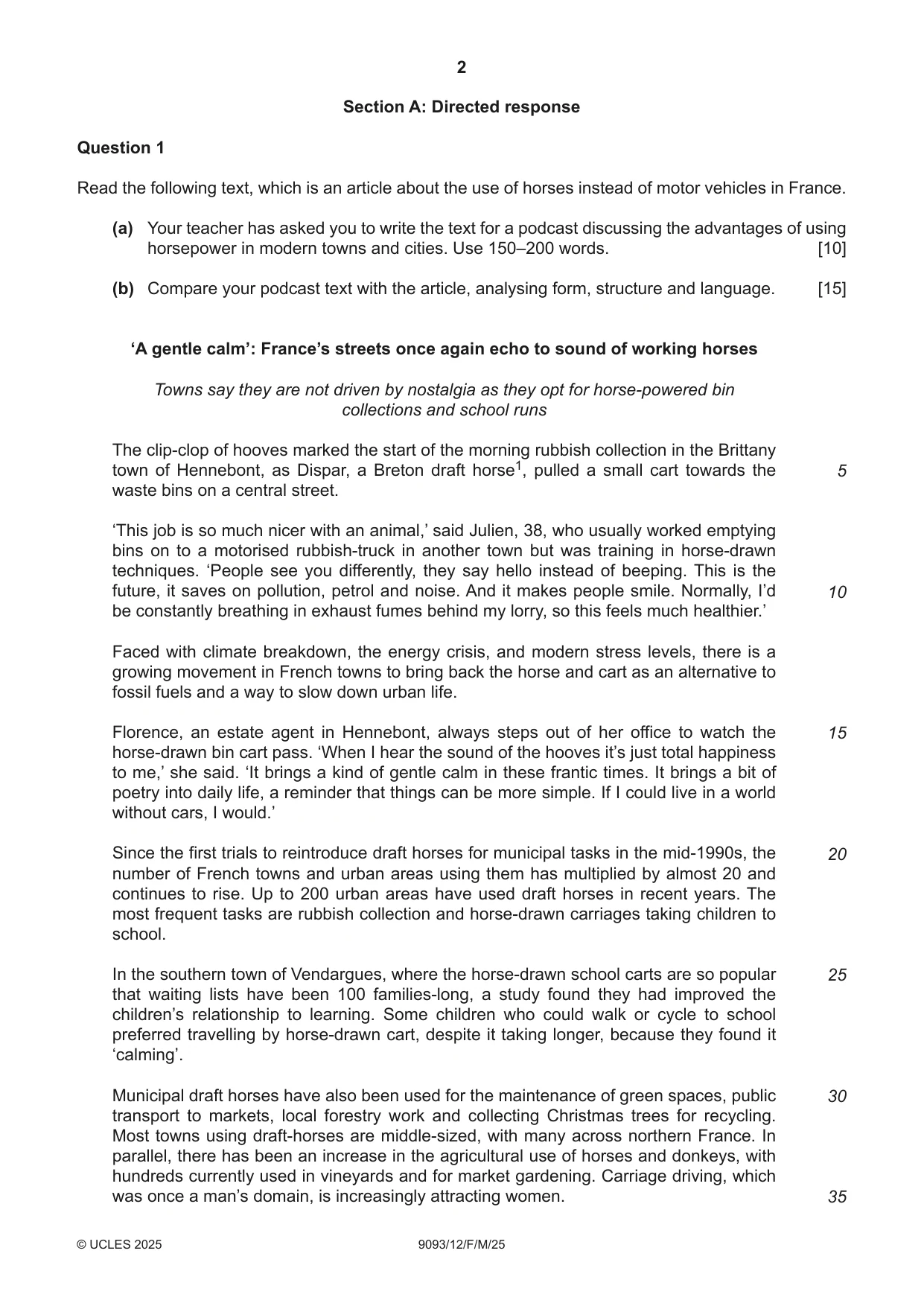
2 9093/12/F/M/25 © UCLES 2025 Section A: Directed response Question 1 Read the following text, which is an article about the use of horses instead of motor vehicles in France. (a) Your teacher has asked you to write the text for a podcast discussing the advantages of using horsepower in modern towns and cities. Use 150–200 words. [10] (b) Compare your podcast text with the article, analysing form, structure and language. [15] ‘A gentle calm’: France’s streets once again echo to sound of working horses Towns say they are not driven by nostalgia as they opt for horse-powered bin collections and school runs The clip-clop of hooves marked the start of the morning rubbish collection in the Brittany town of Hennebont, as Dispar, a Breton draft horse1, pulled a small cart towards the waste bins on a central street. ‘This job is so much nicer with an animal,’ said Julien, 38, who usually worked emptying bins on to a motorised rubbish-truck in another town but was training in horse-drawn techniques. ‘People see you differently, they say hello instead of beeping. This is the future, it saves on pollution, petrol and noise. And it makes people smile. Normally, I’d be constantly breathing in exhaust fumes behind my lorry, so this feels much healthier.’ Faced with climate breakdown, the energy crisis, and modern stress levels, there is a growing movement in French towns to bring back the horse and cart as an alternative to fossil fuels and a way to slow down urban life. Florence, an estate agent in Hennebont, always steps out of her office to watch the horse-drawn bin cart pass. ‘When I hear the sound of the hooves it’s just total happiness to me,’ she said. ‘It brings a kind of gentle calm in these frantic times. It brings a bit of poetry into daily life, a reminder that things can be more simple. If I could live in a world without cars, I would.’ Since the first trials to reintroduce draft horses for municipal tasks in the mid-1990s, the number of French towns and urban areas using them has multiplied by almost 20 and continues to rise. Up to 200 urban areas have used draft horses in recent years. The most frequent tasks are rubbish collection and horse-drawn carriages taking children to school. In the southern town of Vendargues, where the horse-drawn school carts are so popular that waiting lists have been 100 families-long, a study found they had improved the children’s relationship to learning. Some children who could walk or cycle to school preferred travelling by horse-drawn cart, despite it taking longer, because they found it ‘calming’. Municipal draft horses have also been used for the maintenance of green spaces, public transport to markets, local forestry work and collecting Christmas trees for recycling. Most towns using draft-horses are middle-sized, with many across northern France. In parallel, there has been an increase in the agricultural use of horses and donkeys, with hundreds currently used in vineyards and for market gardening. Carriage driving, which was once a man’s domain, is increasingly attracting women. 5 10 15 20 25 30 35
Question paper, page 3
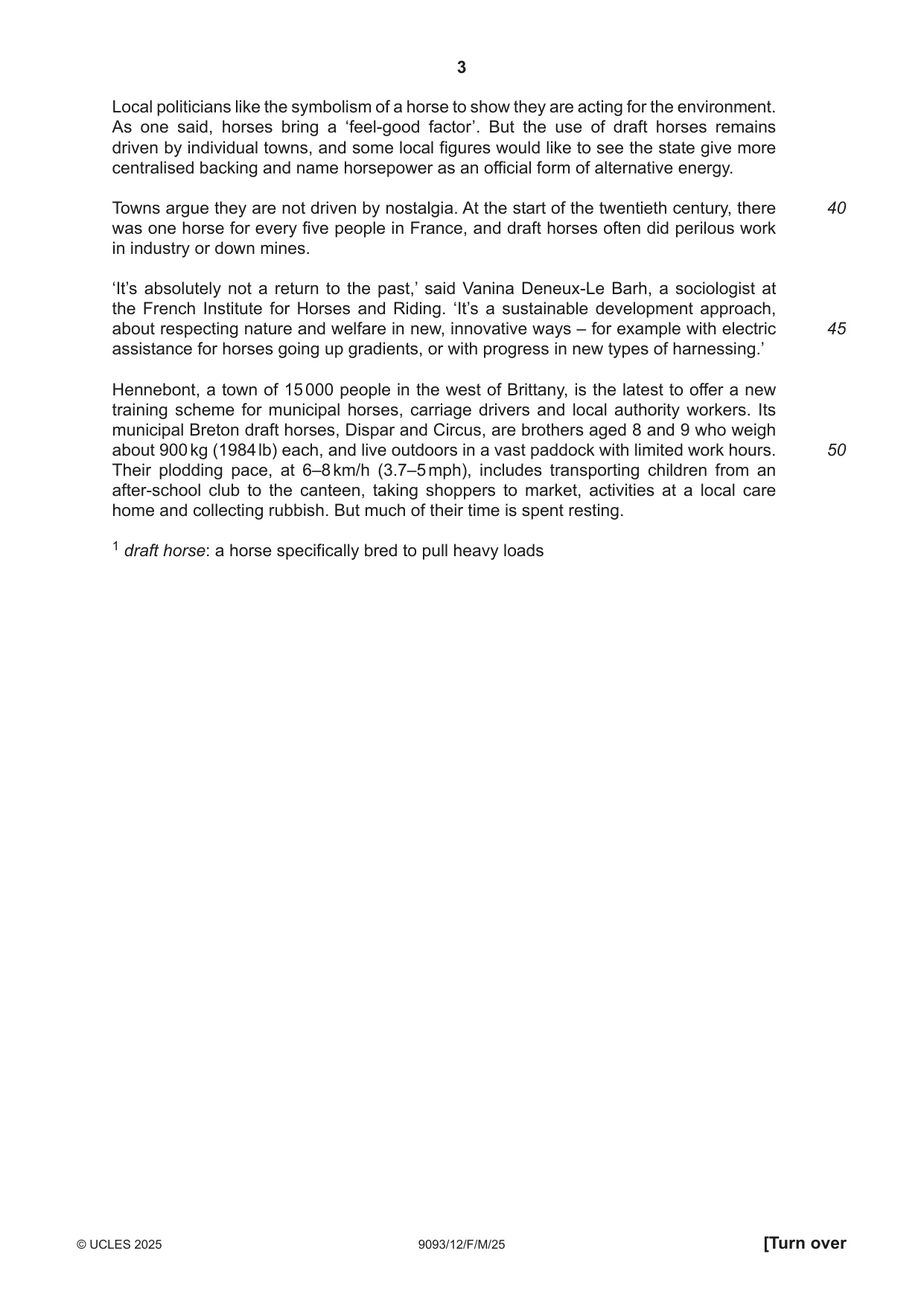
3 9093/12/F/M/25 © UCLES 2025 [Turn over Local politicians like the symbolism of a horse to show they are acting for the environment. As one said, horses bring a ‘feel-good factor’. But the use of draft horses remains driven by individual towns, and some local figures would like to see the state give more centralised backing and name horsepower as an official form of alternative energy. Towns argue they are not driven by nostalgia. At the start of the twentieth century, there was one horse for every five people in France, and draft horses often did perilous work in industry or down mines. ‘It’s absolutely not a return to the past,’ said Vanina Deneux-Le Barh, a sociologist at the French Institute for Horses and Riding. ‘It’s a sustainable development approach, about respecting nature and welfare in new, innovative ways – for example with electric assistance for horses going up gradients, or with progress in new types of harnessing.’ Hennebont, a town of 15 000 people in the west of Brittany, is the latest to offer a new training scheme for municipal horses, carriage drivers and local authority workers. Its municipal Breton draft horses, Dispar and Circus, are brothers aged 8 and 9 who weigh about 900 kg (1984 lb) each, and live outdoors in a vast paddock with limited work hours. Their plodding pace, at 6–8 km/h (3.7–5 mph), includes transporting children from an after-school club to the canteen, taking shoppers to market, activities at a local care home and collecting rubbish. But much of their time is spent resting. 1 draft horse: a horse specifically bred to pull heavy loads 40 45 50
Question paper, page 4
4 9093/12/F/M/25 © UCLES 2025 Section B: Text analysis Question 2 Read the following text, which is an online sports article about a cricketer who has adopted a vegan diet. Analyse the text, focusing on form, structure and language. [25] World Vegan Day: Kane Richardson on veganism & cricket There’s an old stereotype of the typical Australian fast bowler: big, scary, intimidating, and a win-at-all-costs mentality. Content removed due to copyright restrictions.
Question paper, page 5
5 9093/12/F/M/25 © UCLES 2025 ‘Any small change is going to help the animals, the environment – basically everyone in a world that’s going to be more sustainable.’ Content removed due to copyright restrictions.
Question paper, page 6
6 9093/12/F/M/25 © UCLES 2025 BLANK PAGE
Question paper, page 7
7 9093/12/F/M/25 © UCLES 2025 BLANK PAGE
Question paper, page 8
8 9093/12/F/M/25 © UCLES 2025 Permission to reproduce items where third-party owned material protected by copyright is included has been sought and cleared where possible. Every reasonable effort has been made by the publisher (UCLES) to trace copyright holders, but if any items requiring clearance have unwittingly been included, the publisher will be pleased to make amends at the earliest possible opportunity. To avoid the issue of disclosure of answer-related information to candidates, all copyright acknowledgements are reproduced online in the Cambridge Assessment International Education Copyright Acknowledgements Booklet. This is produced for each series of examinations and is freely available to download at www.cambridgeinternational.org after the live examination series. Cambridge Assessment International Education is part of Cambridge Assessment. Cambridge Assessment is the brand name of the University of Cambridge Local Examinations Syndicate (UCLES), which is a department of the University of Cambridge. BLANK PAGE
Mark scheme, page 1
This document consists of 17 printed pages. © Cambridge University Press & Assessment 2025 [Turn over Cambridge International AS & A Level ENGLISH LANGUAGE 9093/12 Paper 1 Reading February/March 2025 MARK SCHEME Maximum Mark: 50 Published This mark scheme is published as an aid to teachers and candidates, to indicate the requirements of the examination. It shows the basis on which Examiners were instructed to award marks. It does not indicate the details of the discussions that took place at an Examiners’ meeting before marking began, which would have considered the acceptability of alternative answers. Mark schemes should be read in conjunction with the question paper and the Principal Examiner Report for Teachers. Cambridge International will not enter into discussions about these mark schemes. Cambridge International is publishing the mark schemes for the February/March 2025 series for most Cambridge IGCSE, Cambridge International A and AS Level components, and some Cambridge O Level components.
Mark scheme, page 2
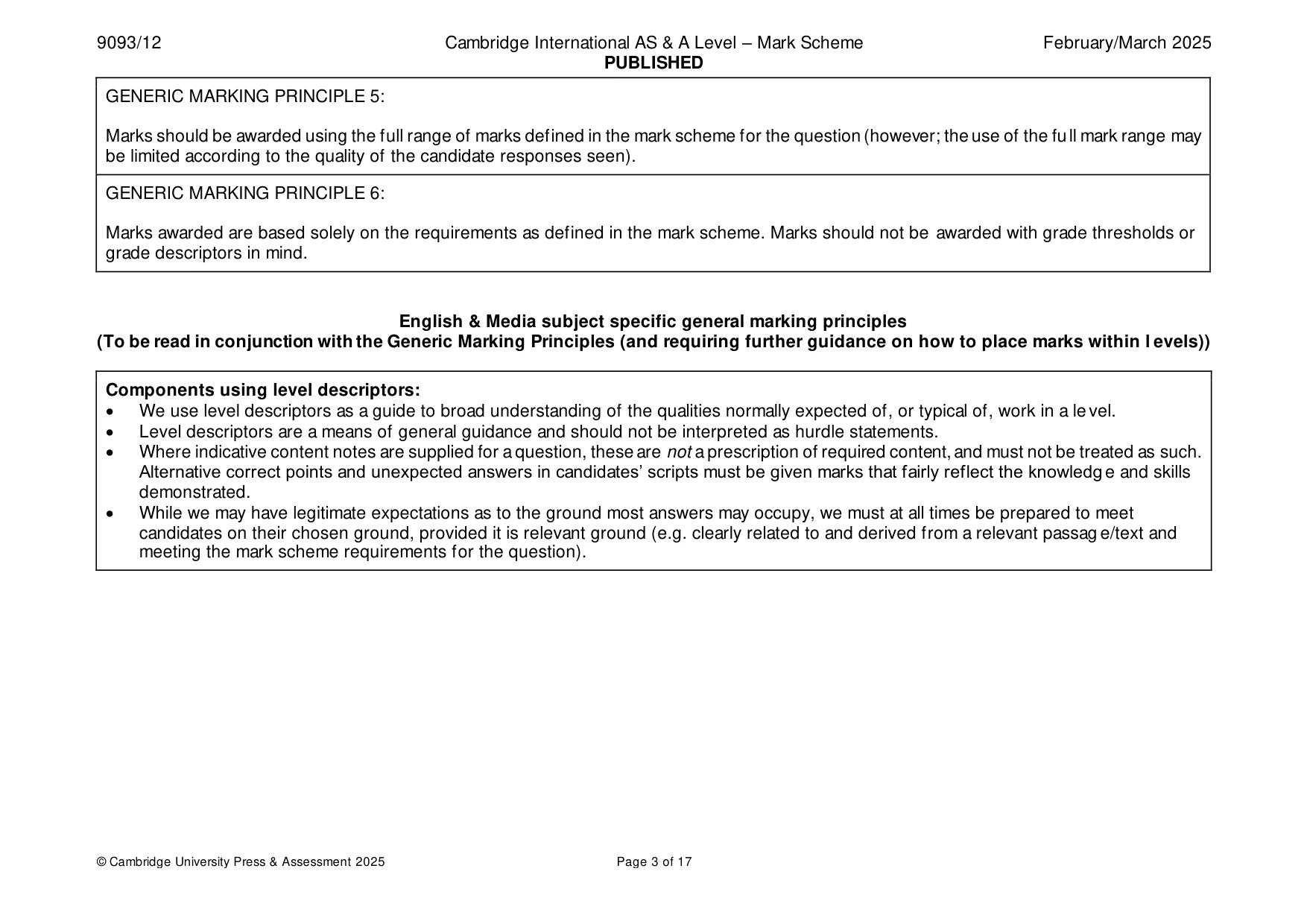
9093/12 Cambridge International AS & A Level – Mark Scheme PUBLISHED February/March 2025 © Cambridge University Press & Assessment 2025 Page 2 of 17 Generic Marking Principles These general marking principles must be applied by all examiners when marking candidate answers. They should be applied alon gside the specific content of the mark scheme or generic level descriptions for a question. Each question paper and mark scheme will also comply with these marking principles. GENERIC MARKING PRINCIPLE 1: Marks must be awarded in line with: • the specific content of the mark scheme or the generic level descriptors for the question • the specific skills defined in the mark scheme or in the generic level descriptors for the question • the standard of response required by a candidate as exemplified by the standardisation scripts. GENERIC MARKING PRINCIPLE 2: Marks awarded are always whole marks (not half marks, or other fractions). GENERIC MARKING PRINCIPLE 3: Marks must be awarded positively: • marks are awarded for correct/valid answers, as defined in the mark scheme. However, credit is given for valid answers which go beyond the scope of the syllabus and mark scheme, referring to your Team Leader as appropriate • marks are awarded when candidates clearly demonstrate what they know and can do • marks are not deducted for errors • marks are not deducted for omissions • answers should only be judged on the quality of spelling, punctuation and grammar when these features are specifically assessed by the question as indicated by the mark scheme. The meaning, however, should be unambiguous. GENERIC MARKING PRINCIPLE 4: Rules must be applied consistently, e.g. in situations where candidates have not followed instructions or in the application of generic level descriptors.
Mark scheme, page 3
9093/12 Cambridge International AS & A Level – Mark Scheme PUBLISHED February/March 2025 © Cambridge University Press & Assessment 2025 Page 3 of 17 GENERIC MARKING PRINCIPLE 5: Marks should be awarded using the full range of marks defined in the mark scheme for the question (however; the use of the full mark range may be limited according to the quality of the candidate responses seen). GENERIC MARKING PRINCIPLE 6: Marks awarded are based solely on the requirements as defined in the mark scheme. Marks should not be awarded with grade thresholds or grade descriptors in mind. English & Media subject specific general marking principles (To be read in conjunction with the Generic Marking Principles (and requiring further guidance on how to place marks within l evels)) Components using level descriptors: • We use level descriptors as a guide to broad understanding of the qualities normally expected of, or typical of, work in a le vel. • Level descriptors are a means of general guidance and should not be interpreted as hurdle statements. • Where indicative content notes are supplied for a question, these are not a prescription of required content, and must not be treated as such. Alternative correct points and unexpected answers in candidates’ scripts must be given marks that fairly reflect the knowledg e and skills demonstrated. • While we may have legitimate expectations as to the ground most answers may occupy, we must at all times be prepared to meet candidates on their chosen ground, provided it is relevant ground (e.g. clearly related to and derived from a relevant passag e/text and meeting the mark scheme requirements for the question).
Mark scheme, page 4
9093/12 Cambridge International AS & A Level – Mark Scheme PUBLISHED February/March 2025 © Cambridge University Press & Assessment 2025 Page 4 of 17 Annotations guidance for centres Examiners use a system of annotations as a shorthand for communicating their marking decisions to one another. Examiners are trained during the standardisation process on how and when to use annotations. The purpose of annotations is to inform the standard isation and monitoring processes and guide the supervising examiners when they are checking the work of examiners within their team. The meaning of annotations and how they are used is specific to each component and is understood by all examiners who mark the component. We publish annotations in our mark schemes to help centres understand the annotations they may see on copies of scripts. Note that there may not be a direct correlation between the number of annotations on a script and the mark awarded. Similarly, the use of an annotation may not be an indication of the quality of the response. The annotations listed below were available to examiners marking this component in this series.
Mark scheme, page 5
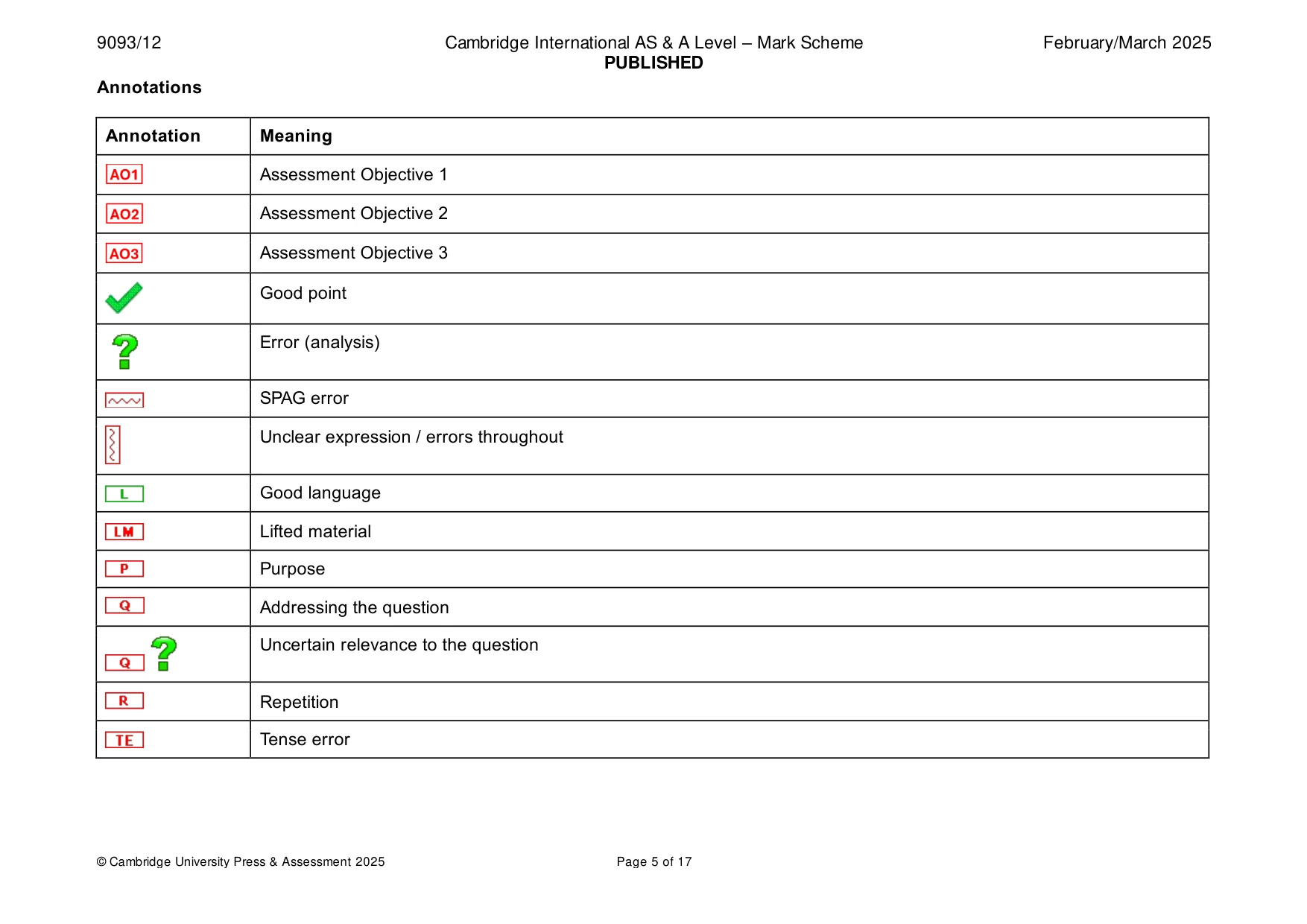
9093/12 Cambridge International AS & A Level – Mark Scheme PUBLISHED February/March 2025 © Cambridge University Press & Assessment 2025 Page 5 of 17 Annotations Annotation Meaning Assessment Objective 1 Assessment Objective 2 Assessment Objective 3 Good point Error (analysis) SPAG error Unclear expression / errors throughout Good language Lifted material Purpose Addressing the question Uncertain relevance to the question Repetition Tense error
Mark scheme, page 6
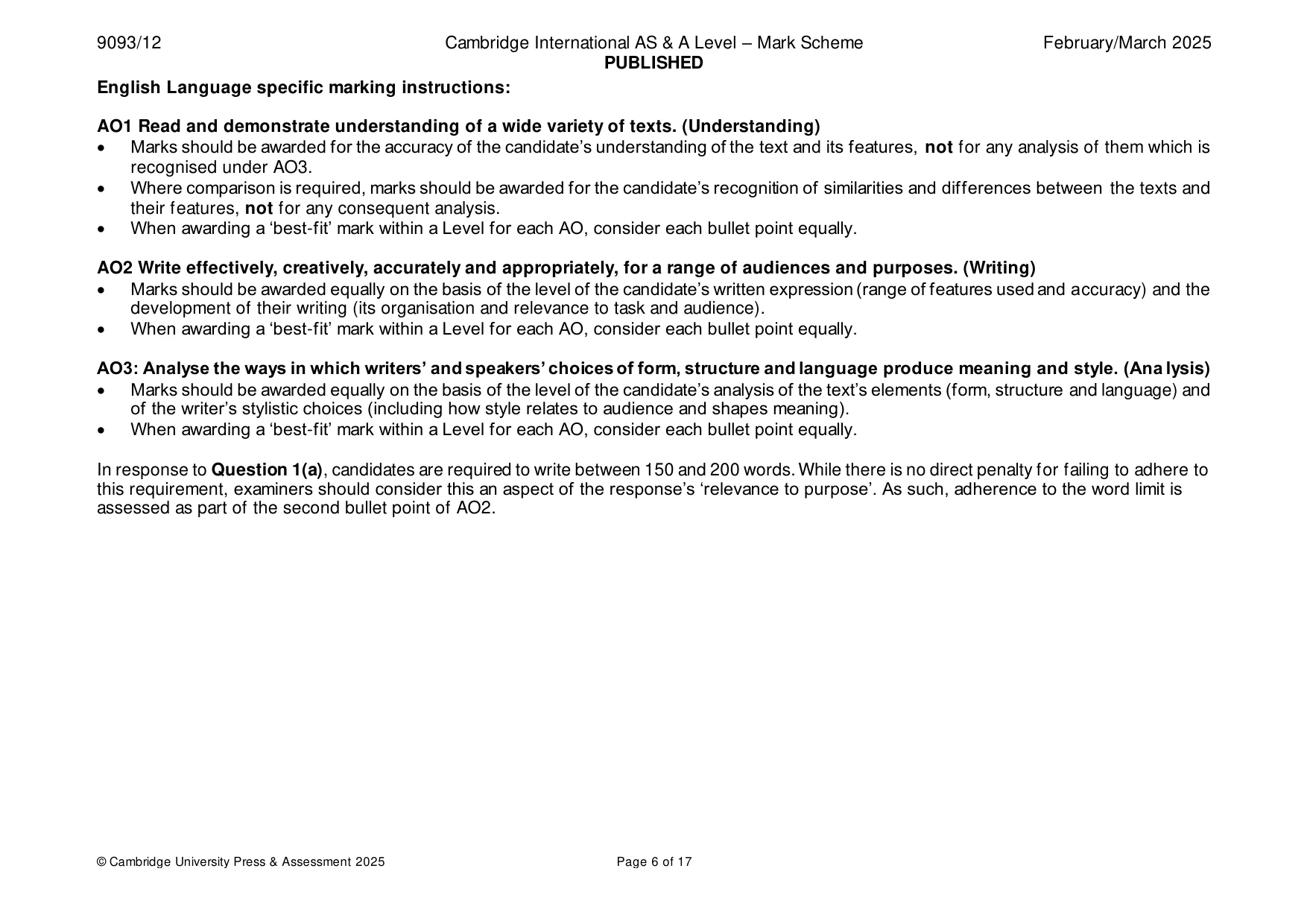
9093/12 Cambridge International AS & A Level – Mark Scheme PUBLISHED February/March 2025 © Cambridge University Press & Assessment 2025 Page 6 of 17 English Language specific marking instructions: AO1 Read and demonstrate understanding of a wide variety of texts. (Understanding) • Marks should be awarded for the accuracy of the candidate’s understanding of the text and its features, not for any analysis of them which is recognised under AO3. • Where comparison is required, marks should be awarded for the candidate’s recognition of similarities and differences between the texts and their features, not for any consequent analysis. • When awarding a ‘best-fit’ mark within a Level for each AO, consider each bullet point equally. AO2 Write effectively, creatively, accurately and appropriately, for a range of audiences and purposes. (Writing) • Marks should be awarded equally on the basis of the level of the candidate’s written expression (range of features used and accuracy) and the development of their writing (its organisation and relevance to task and audience). • When awarding a ‘best-fit’ mark within a Level for each AO, consider each bullet point equally. AO3: Analyse the ways in which writers’ and speakers’ choices of form, structure and language produce meaning and style. (Ana lysis) • Marks should be awarded equally on the basis of the level of the candidate’s analysis of the text’s elements (form, structure and language) and of the writer’s stylistic choices (including how style relates to audience and shapes meaning). • When awarding a ‘best-fit’ mark within a Level for each AO, consider each bullet point equally. In response to Question 1(a), candidates are required to write between 150 and 200 words. While there is no direct penalty for failing to adhere to this requirement, examiners should consider this an aspect of the response’s ‘relevance to purpose’. As such, adherence to the word limit is assessed as part of the second bullet point of AO2.
Mark scheme, page 7
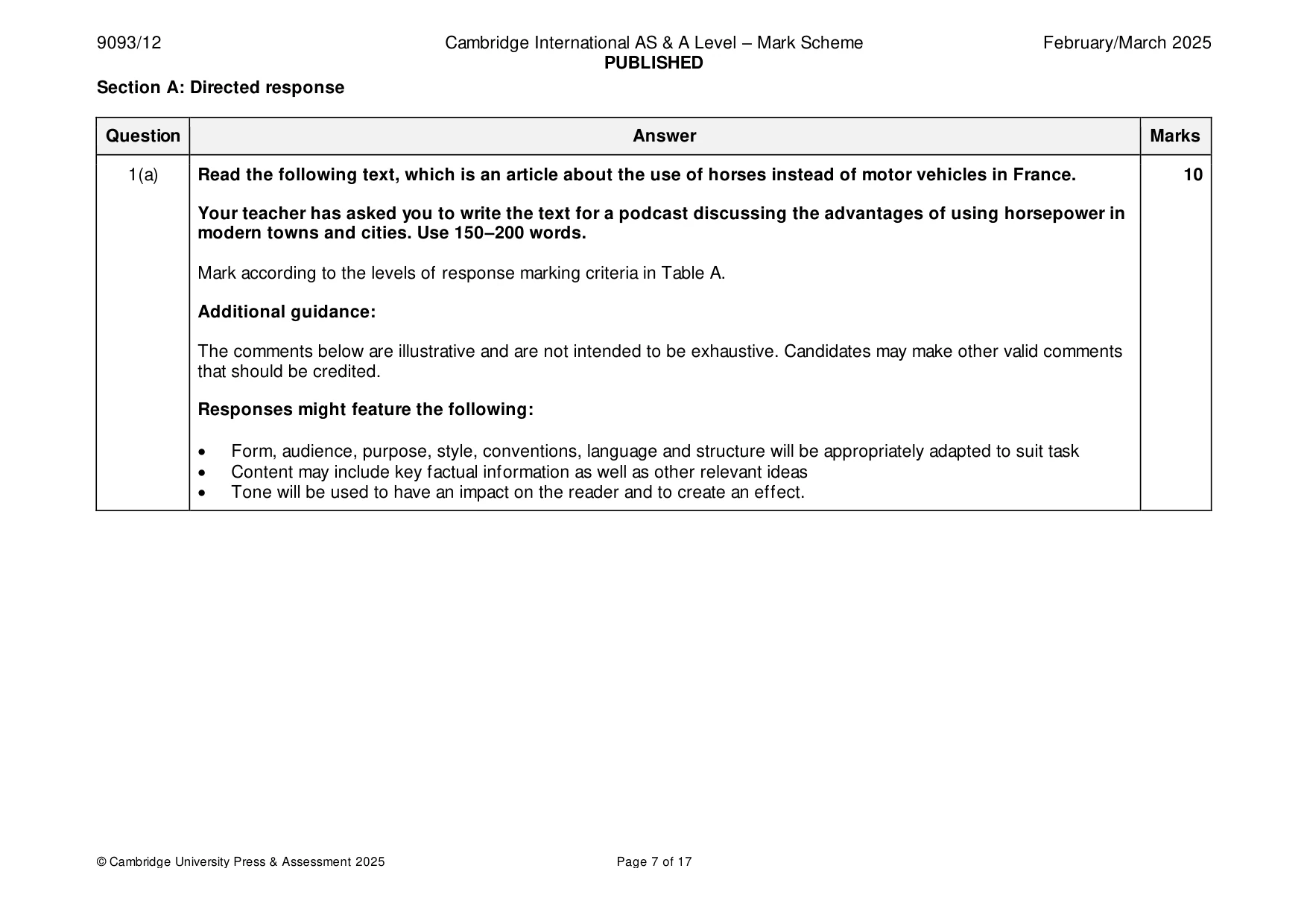
9093/12 Cambridge International AS & A Level – Mark Scheme PUBLISHED February/March 2025 © Cambridge University Press & Assessment 2025 Page 7 of 17 Section A: Directed response Question Answer Marks 1(a) Read the following text, which is an article about the use of horses instead of motor vehicles in France. Your teacher has asked you to write the text for a podcast discussing the advantages of using horsepower in modern towns and cities. Use 150–200 words. Mark according to the levels of response marking criteria in Table A. Additional guidance: The comments below are illustrative and are not intended to be exhaustive. Candidates may make other valid comments that should be credited. Responses might feature the following: • Form, audience, purpose, style, conventions, language and structure will be appropriately adapted to suit task • Content may include key factual information as well as other relevant ideas • Tone will be used to have an impact on the reader and to create an effect. 10
Mark scheme, page 8
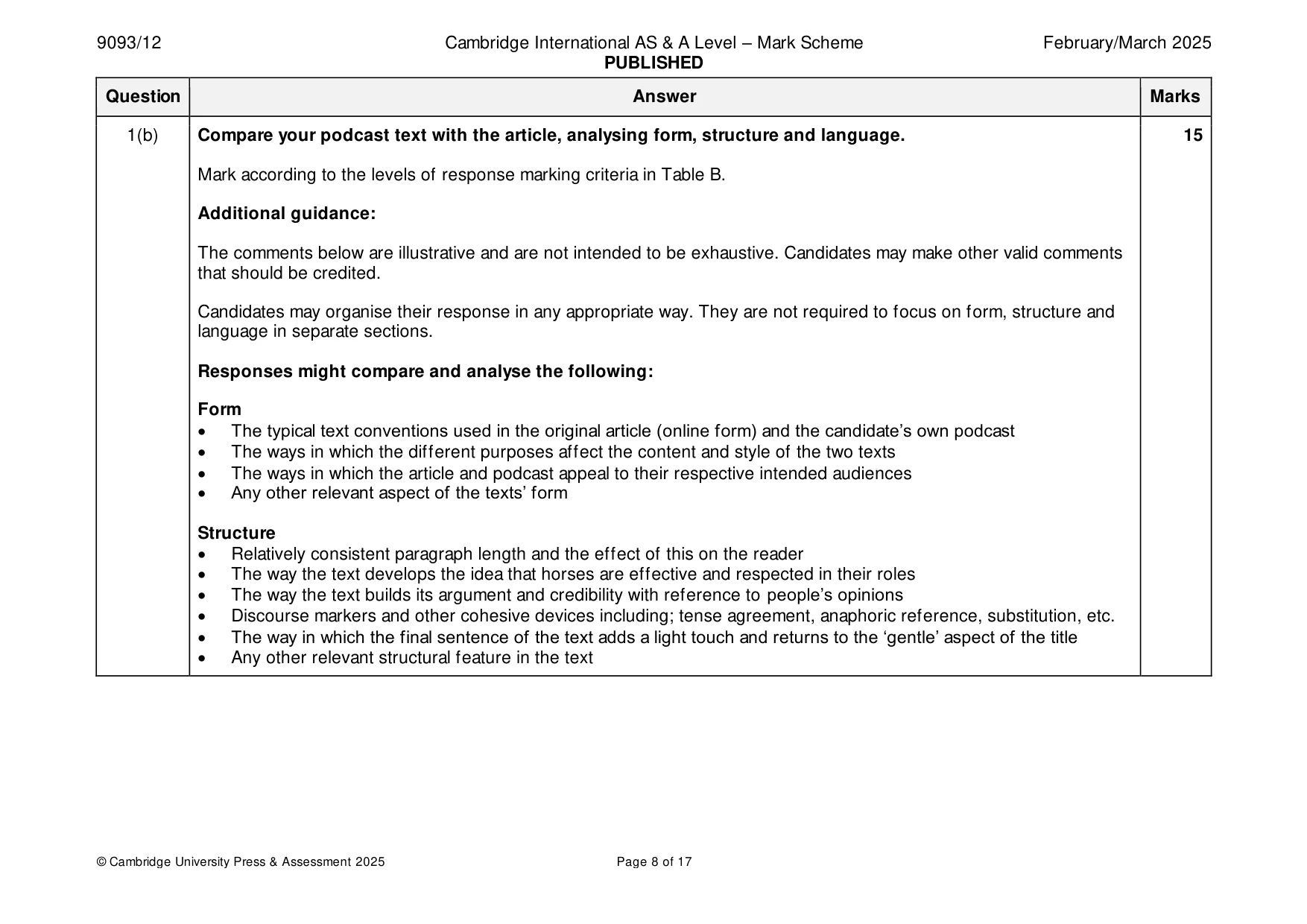
9093/12 Cambridge International AS & A Level – Mark Scheme PUBLISHED February/March 2025 © Cambridge University Press & Assessment 2025 Page 8 of 17 Question Answer Marks 1(b) Compare your podcast text with the article, analysing form, structure and language. Mark according to the levels of response marking criteria in Table B. Additional guidance: The comments below are illustrative and are not intended to be exhaustive. Candidates may make other valid comments that should be credited. Candidates may organise their response in any appropriate way. They are not required to focus on form, structure and language in separate sections. Responses might compare and analyse the following: Form • The typical text conventions used in the original article (online form) and the candidate’s own podcast • The ways in which the different purposes affect the content and style of the two texts • The ways in which the article and podcast appeal to their respective intended audiences • Any other relevant aspect of the texts’ form Structure • Relatively consistent paragraph length and the effect of this on the reader • The way the text develops the idea that horses are effective and respected in their roles • The way the text builds its argument and credibility with reference to people’s opinions • Discourse markers and other cohesive devices including; tense agreement, anaphoric reference, substitution, etc. • The way in which the final sentence of the text adds a light touch and returns to the ‘gentle’ aspect of the title • Any other relevant structural feature in the text 15
Mark scheme, page 9
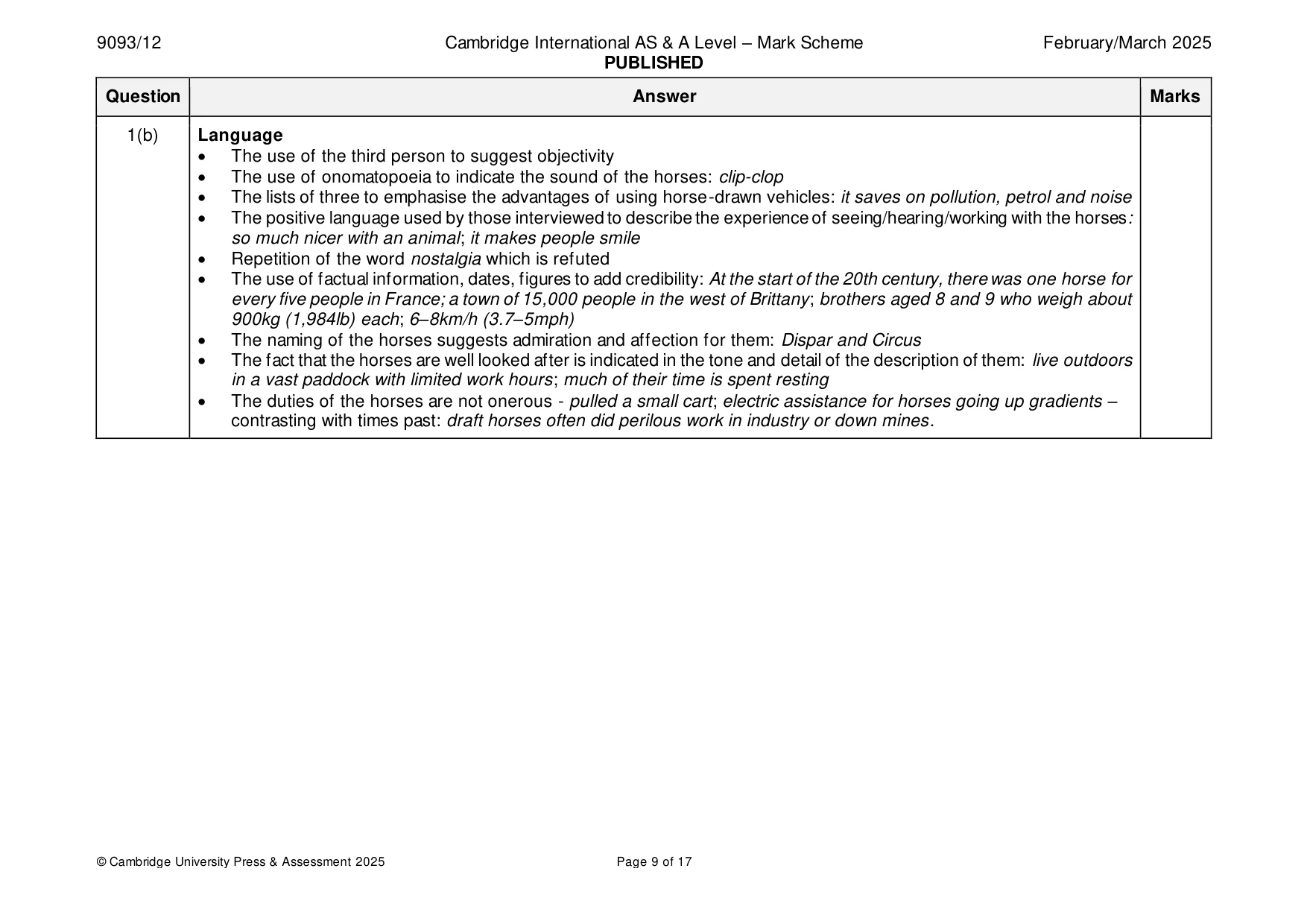
9093/12 Cambridge International AS & A Level – Mark Scheme PUBLISHED February/March 2025 © Cambridge University Press & Assessment 2025 Page 9 of 17 Question Answer Marks 1(b) Language • The use of the third person to suggest objectivity • The use of onomatopoeia to indicate the sound of the horses: clip-clop • The lists of three to emphasise the advantages of using horse-drawn vehicles: it saves on pollution, petrol and noise • The positive language used by those interviewed to describe the experience of seeing/hearing/working with the horses: so much nicer with an animal; it makes people smile • Repetition of the word nostalgia which is refuted • The use of factual information, dates, figures to add credibility: At the start of the 20th century, there was one horse for every five people in France; a town of 15,000 people in the west of Brittany; brothers aged 8 and 9 who weigh about 900kg (1,984lb) each; 6–8km/h (3.7–5mph) • The naming of the horses suggests admiration and affection for them: Dispar and Circus • The fact that the horses are well looked after is indicated in the tone and detail of the description of them: live outdoors in a vast paddock with limited work hours; much of their time is spent resting • The duties of the horses are not onerous - pulled a small cart; electric assistance for horses going up gradients – contrasting with times past: draft horses often did perilous work in industry or down mines.
Mark scheme, page 10
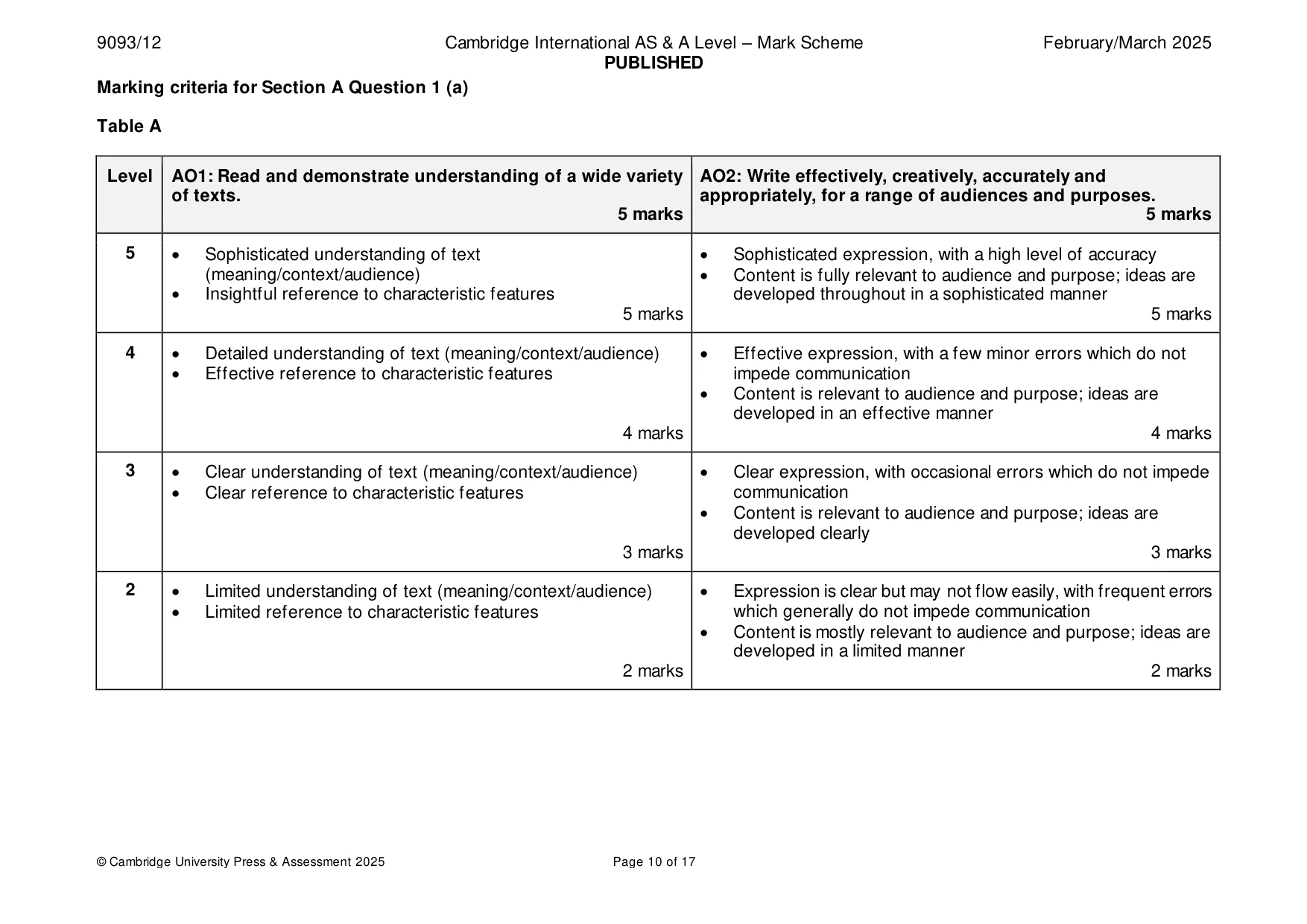
9093/12 Cambridge International AS & A Level – Mark Scheme PUBLISHED February/March 2025 © Cambridge University Press & Assessment 2025 Page 10 of 17 Marking criteria for Section A Question 1 (a) Table A Level AO1: Read and demonstrate understanding of a wide variety of texts. 5 marks AO2: Write effectively, creatively, accurately and appropriately, for a range of audiences and purposes. 5 marks 5 • Sophisticated understanding of text (meaning/context/audience) • Insightful reference to characteristic features 5 marks • Sophisticated expression, with a high level of accuracy • Content is fully relevant to audience and purpose; ideas are developed throughout in a sophisticated manner 5 marks 4 • Detailed understanding of text (meaning/context/audience) • Effective reference to characteristic features 4 marks • Effective expression, with a few minor errors which do not impede communication • Content is relevant to audience and purpose; ideas are developed in an effective manner 4 marks 3 • Clear understanding of text (meaning/context/audience) • Clear reference to characteristic features 3 marks • Clear expression, with occasional errors which do not impede communication • Content is relevant to audience and purpose; ideas are developed clearly 3 marks 2 • Limited understanding of text (meaning/context/audience) • Limited reference to characteristic features 2 marks • Expression is clear but may not flow easily, with frequent errors which generally do not impede communication • Content is mostly relevant to audience and purpose; ideas are developed in a limited manner 2 marks
Mark scheme, page 11
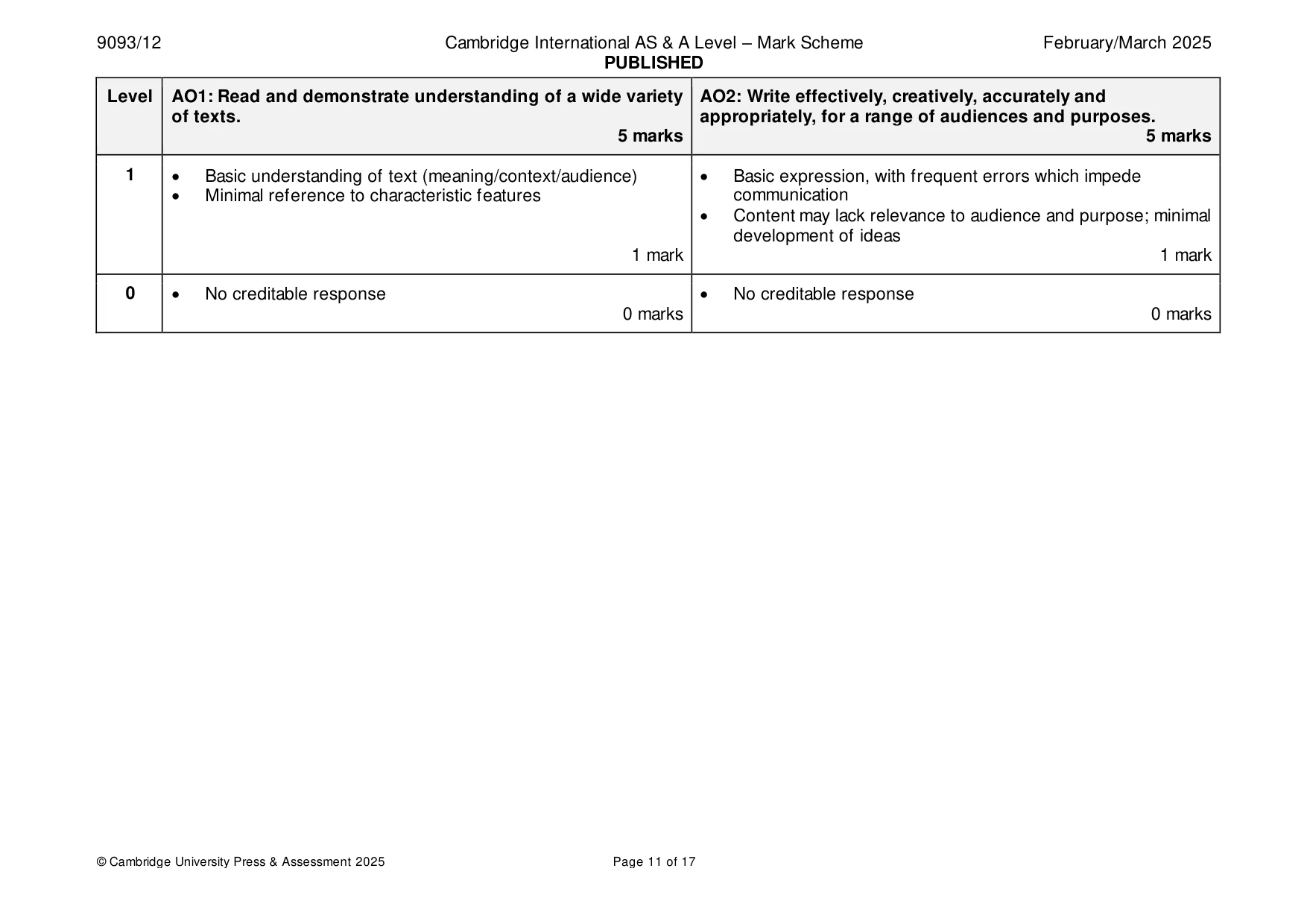
9093/12 Cambridge International AS & A Level – Mark Scheme PUBLISHED February/March 2025 © Cambridge University Press & Assessment 2025 Page 11 of 17 Level AO1: Read and demonstrate understanding of a wide variety of texts. 5 marks AO2: Write effectively, creatively, accurately and appropriately, for a range of audiences and purposes. 5 marks 1 • Basic understanding of text (meaning/context/audience) • Minimal reference to characteristic features 1 mark • Basic expression, with frequent errors which impede communication • Content may lack relevance to audience and purpose; minimal development of ideas 1 mark 0 • No creditable response 0 marks • No creditable response 0 marks
Mark scheme, page 12
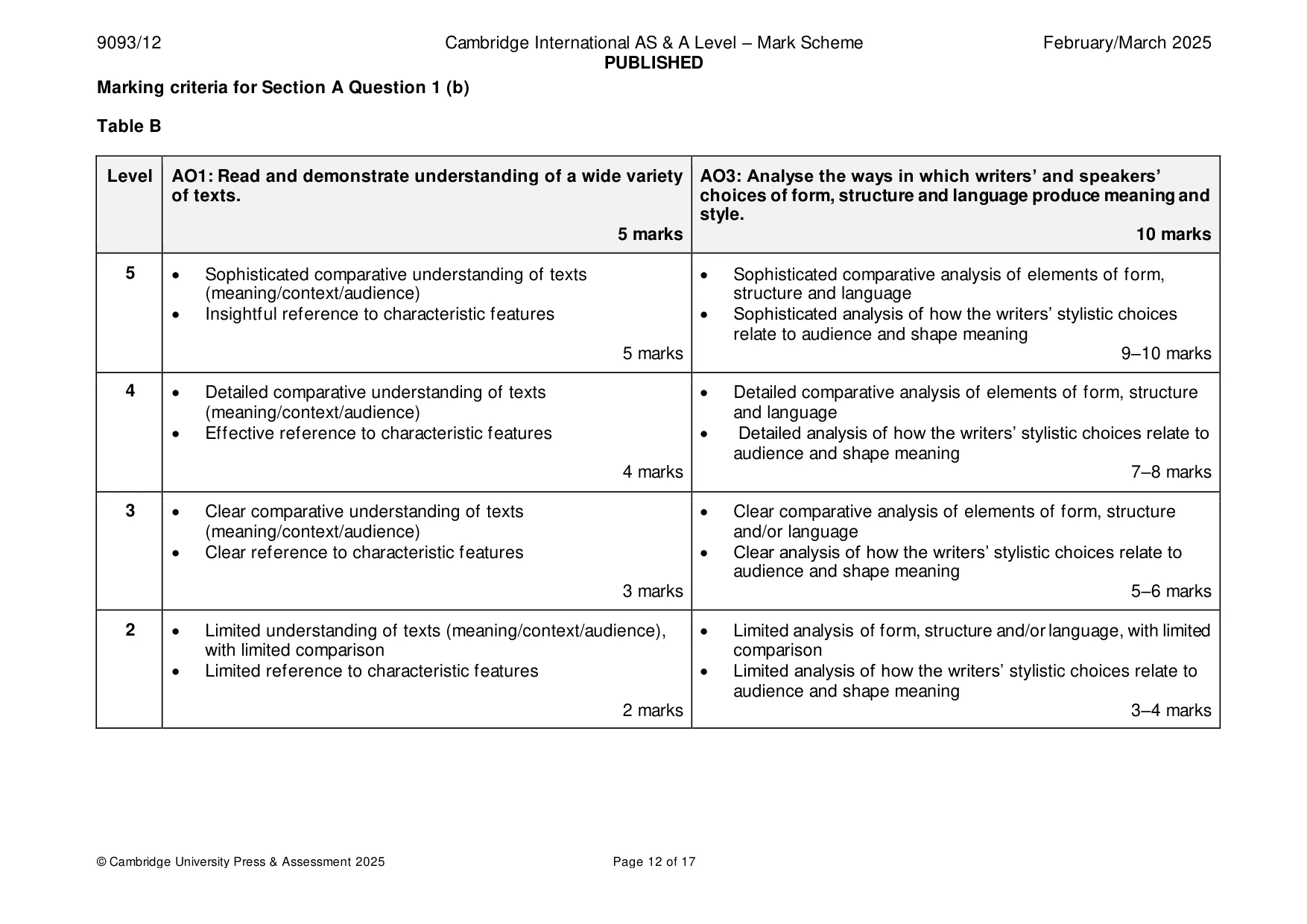
9093/12 Cambridge International AS & A Level – Mark Scheme PUBLISHED February/March 2025 © Cambridge University Press & Assessment 2025 Page 12 of 17 Marking criteria for Section A Question 1 (b) Table B Level AO1: Read and demonstrate understanding of a wide variety of texts. 5 marks AO3: Analyse the ways in which writers’ and speakers’ choices of form, structure and language produce meaning and style. 10 marks 5 • Sophisticated comparative understanding of texts (meaning/context/audience) • Insightful reference to characteristic features 5 marks • Sophisticated comparative analysis of elements of form, structure and language • Sophisticated analysis of how the writers’ stylistic choices relate to audience and shape meaning 9–10 marks 4 • Detailed comparative understanding of texts (meaning/context/audience) • Effective reference to characteristic features 4 marks • Detailed comparative analysis of elements of form, structure and language • Detailed analysis of how the writers’ stylistic choices relate to audience and shape meaning 7–8 marks 3 • Clear comparative understanding of texts (meaning/context/audience) • Clear reference to characteristic features 3 marks • Clear comparative analysis of elements of form, structure and/or language • Clear analysis of how the writers’ stylistic choices relate to audience and shape meaning 5–6 marks 2 • Limited understanding of texts (meaning/context/audience), with limited comparison • Limited reference to characteristic features 2 marks • Limited analysis of form, structure and/or language, with limited comparison • Limited analysis of how the writers’ stylistic choices relate to audience and shape meaning 3–4 marks
Mark scheme, page 13
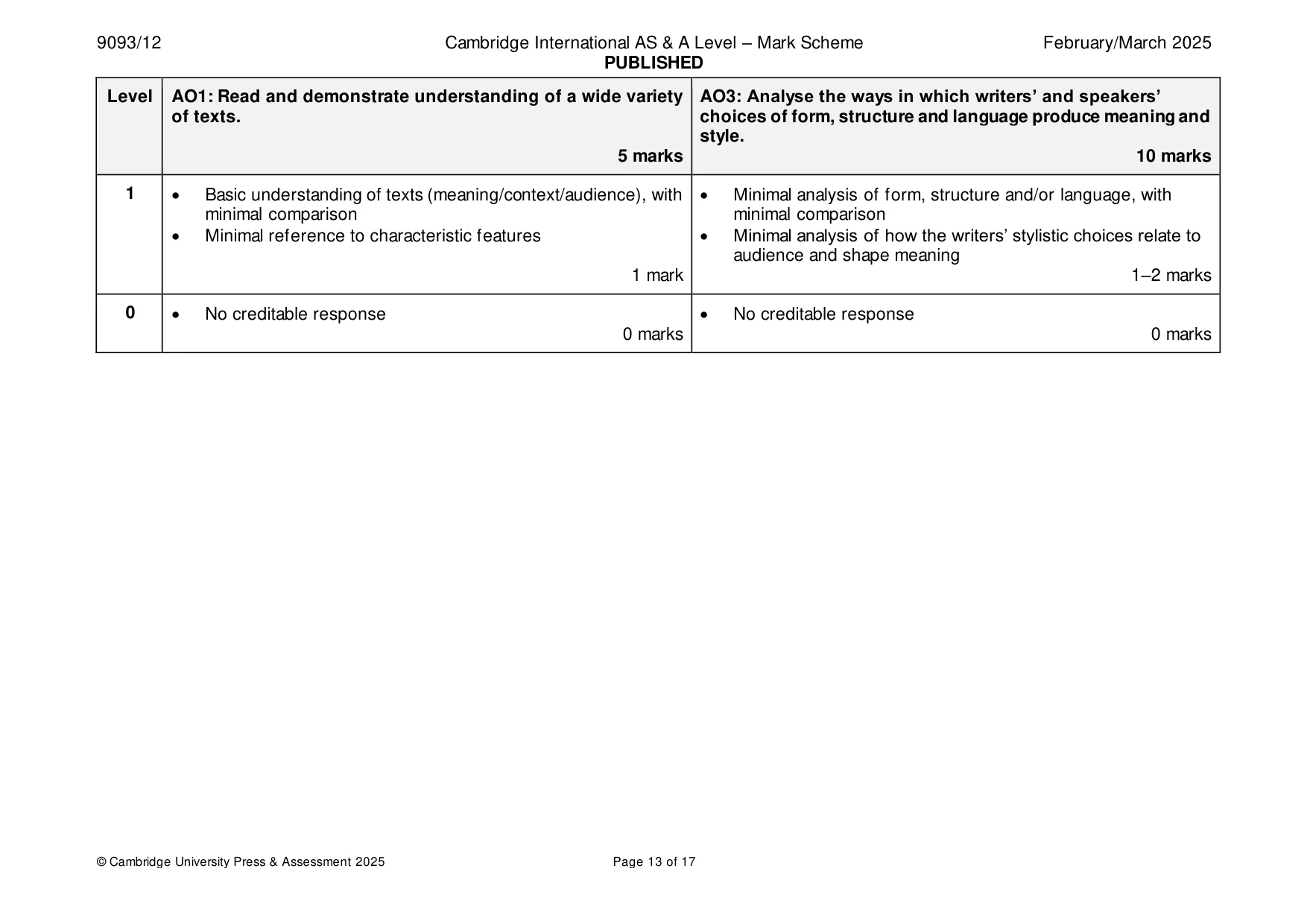
9093/12 Cambridge International AS & A Level – Mark Scheme PUBLISHED February/March 2025 © Cambridge University Press & Assessment 2025 Page 13 of 17 Level AO1: Read and demonstrate understanding of a wide variety of texts. 5 marks AO3: Analyse the ways in which writers’ and speakers’ choices of form, structure and language produce meaning and style. 10 marks 1 • Basic understanding of texts (meaning/context/audience), with minimal comparison • Minimal reference to characteristic features 1 mark • Minimal analysis of form, structure and/or language, with minimal comparison • Minimal analysis of how the writers’ stylistic choices relate to audience and shape meaning 1–2 marks 0 • No creditable response 0 marks • No creditable response 0 marks
Mark scheme, page 14
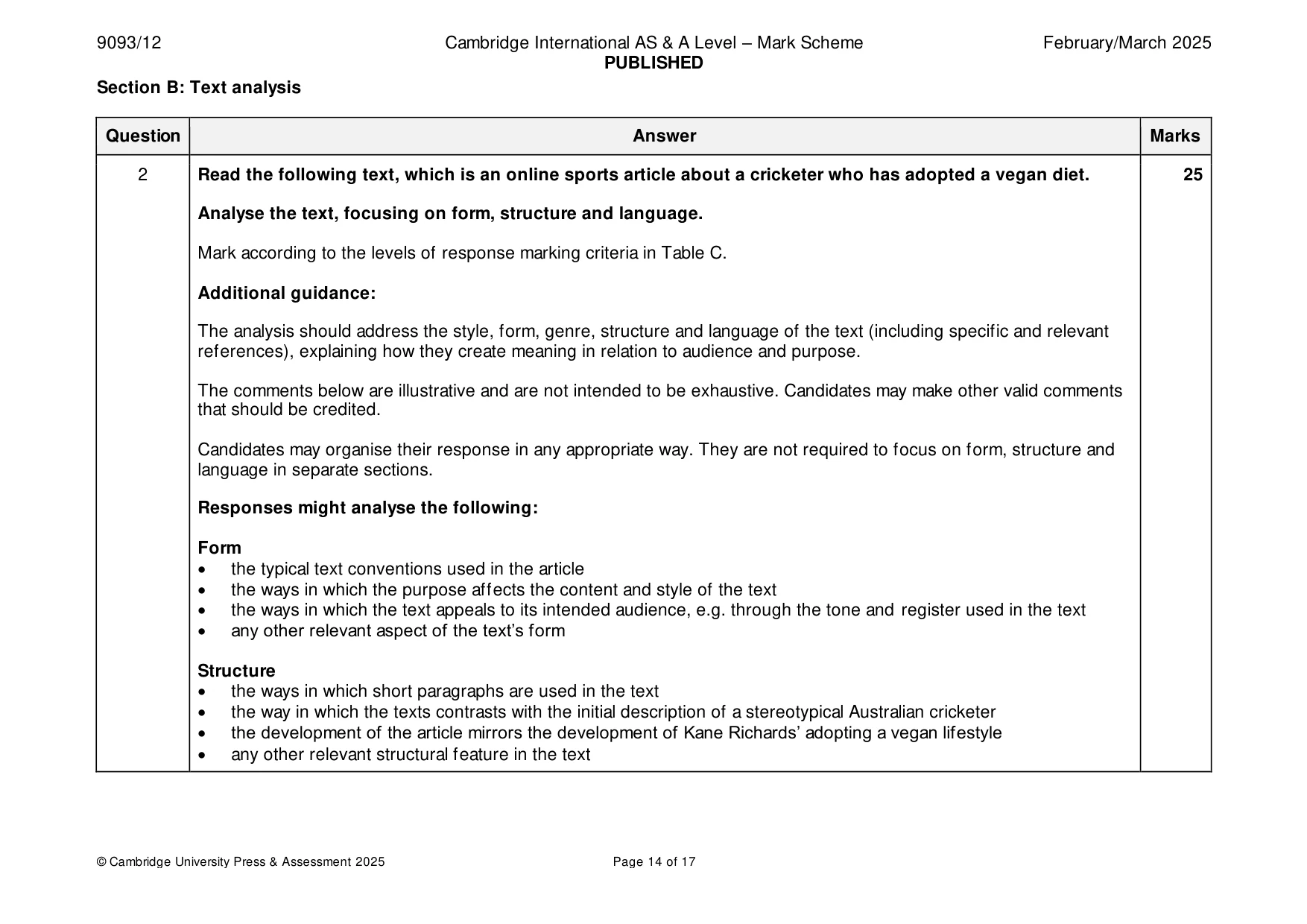
9093/12 Cambridge International AS & A Level – Mark Scheme PUBLISHED February/March 2025 © Cambridge University Press & Assessment 2025 Page 14 of 17 Section B: Text analysis Question Answer Marks 2 Read the following text, which is an online sports article about a cricketer who has adopted a vegan diet. Analyse the text, focusing on form, structure and language. Mark according to the levels of response marking criteria in Table C. Additional guidance: The analysis should address the style, form, genre, structure and language of the text (including specific and relevant references), explaining how they create meaning in relation to audience and purpose. The comments below are illustrative and are not intended to be exhaustive. Candidates may make other valid comments that should be credited. Candidates may organise their response in any appropriate way. They are not required to focus on form, structure and language in separate sections. Responses might analyse the following: Form • the typical text conventions used in the article • the ways in which the purpose affects the content and style of the text • the ways in which the text appeals to its intended audience, e.g. through the tone and register used in the text • any other relevant aspect of the text’s form Structure • the ways in which short paragraphs are used in the text • the way in which the texts contrasts with the initial description of a stereotypical Australian cricketer • the development of the article mirrors the development of Kane Richards’ adopting a vegan lifestyle • any other relevant structural feature in the text 25
Mark scheme, page 15
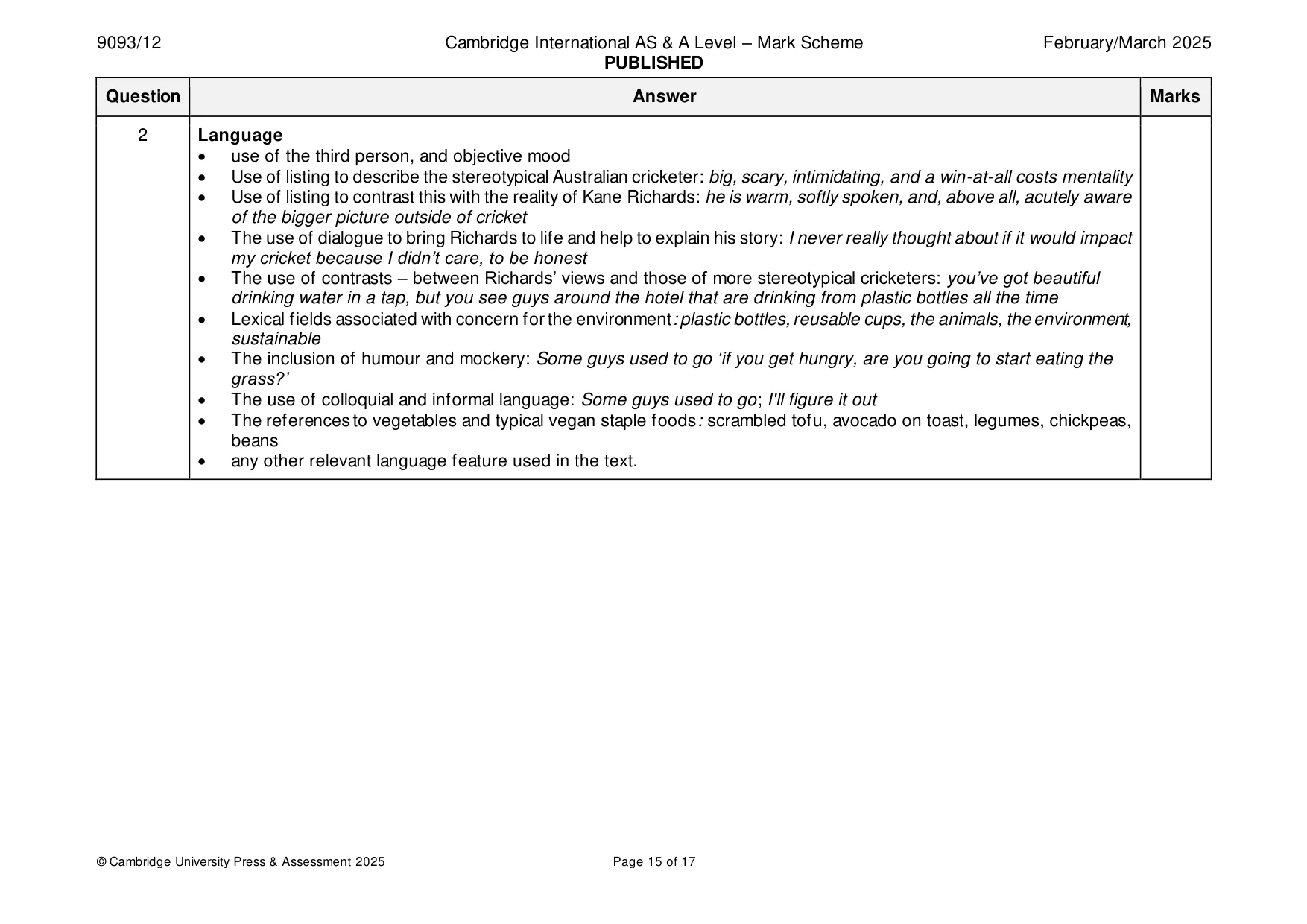
9093/12 Cambridge International AS & A Level – Mark Scheme PUBLISHED February/March 2025 © Cambridge University Press & Assessment 2025 Page 15 of 17 Question Answer Marks 2 Language • use of the third person, and objective mood • Use of listing to describe the stereotypical Australian cricketer: big, scary, intimidating, and a win-at-all costs mentality • Use of listing to contrast this with the reality of Kane Richards: he is warm, softly spoken, and, above all, acutely aware of the bigger picture outside of cricket • The use of dialogue to bring Richards to life and help to explain his story: I never really thought about if it would impact my cricket because I didn’t care, to be honest • The use of contrasts – between Richards’ views and those of more stereotypical cricketers: you’ve got beautiful drinking water in a tap, but you see guys around the hotel that are drinking from plastic bottles all the time • Lexical fields associated with concern for the environment: plastic bottles, reusable cups, the animals, the environment, sustainable • The inclusion of humour and mockery: Some guys used to go ‘if you get hungry, are you going to start eating the grass?’ • The use of colloquial and informal language: Some guys used to go; I'll figure it out • The references to vegetables and typical vegan staple foods: scrambled tofu, avocado on toast, legumes, chickpeas, beans • any other relevant language feature used in the text.
Mark scheme, page 16
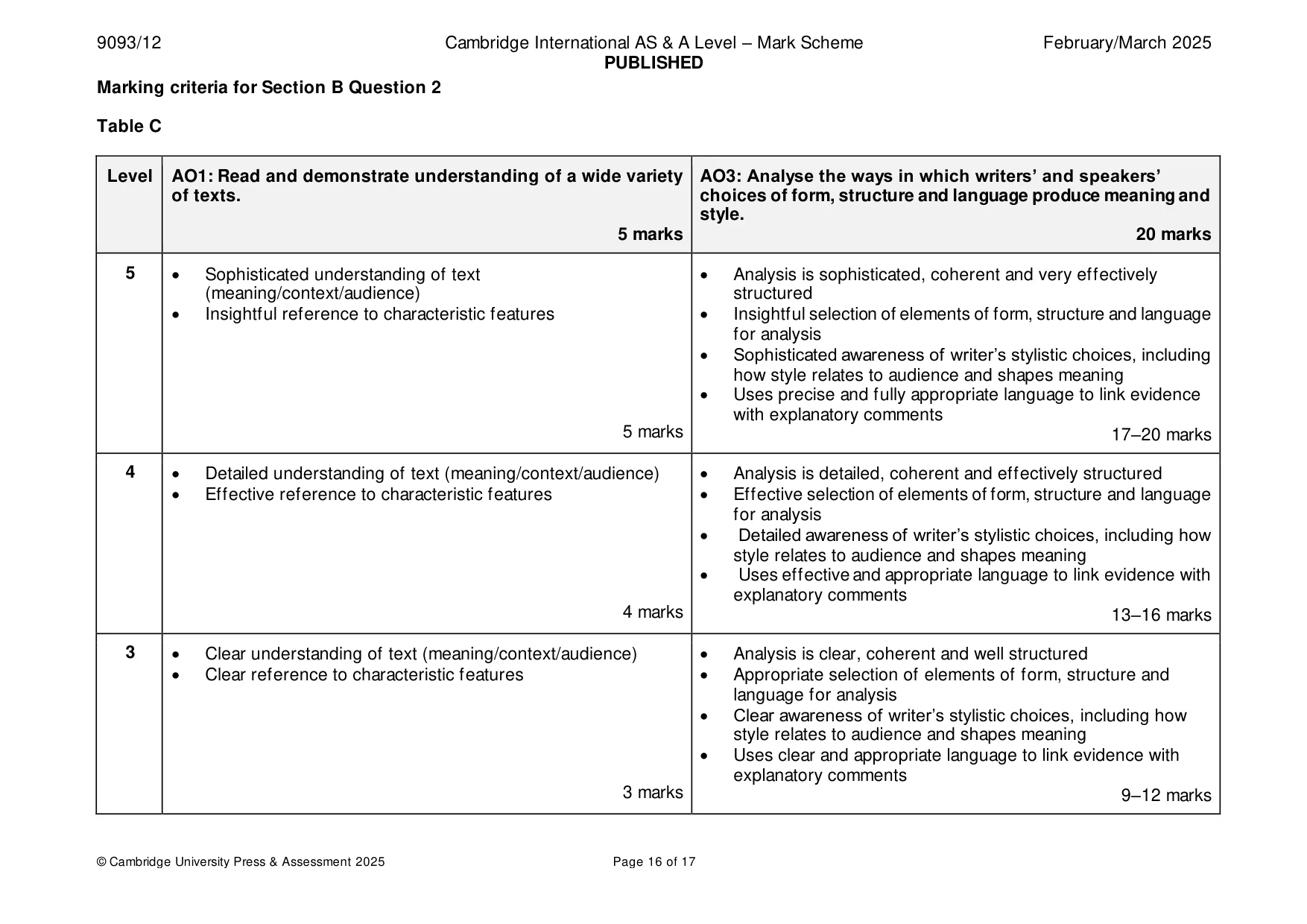
9093/12 Cambridge International AS & A Level – Mark Scheme PUBLISHED February/March 2025 © Cambridge University Press & Assessment 2025 Page 16 of 17 Marking criteria for Section B Question 2 Table C Level AO1: Read and demonstrate understanding of a wide variety of texts. 5 marks AO3: Analyse the ways in which writers’ and speakers’ choices of form, structure and language produce meaning and style. 20 marks 5 • Sophisticated understanding of text (meaning/context/audience) • Insightful reference to characteristic features 5 marks • Analysis is sophisticated, coherent and very effectively structured • Insightful selection of elements of form, structure and language for analysis • Sophisticated awareness of writer’s stylistic choices, including how style relates to audience and shapes meaning • Uses precise and fully appropriate language to link evidence with explanatory comments 17–20 marks 4 • Detailed understanding of text (meaning/context/audience) • Effective reference to characteristic features 4 marks • Analysis is detailed, coherent and effectively structured • Effective selection of elements of form, structure and language for analysis • Detailed awareness of writer’s stylistic choices, including how style relates to audience and shapes meaning • Uses effective and appropriate language to link evidence with explanatory comments 13–16 marks 3 • Clear understanding of text (meaning/context/audience) • Clear reference to characteristic features 3 marks • Analysis is clear, coherent and well structured • Appropriate selection of elements of form, structure and language for analysis • Clear awareness of writer’s stylistic choices, including how style relates to audience and shapes meaning • Uses clear and appropriate language to link evidence with explanatory comments 9–12 marks
Mark scheme, page 17
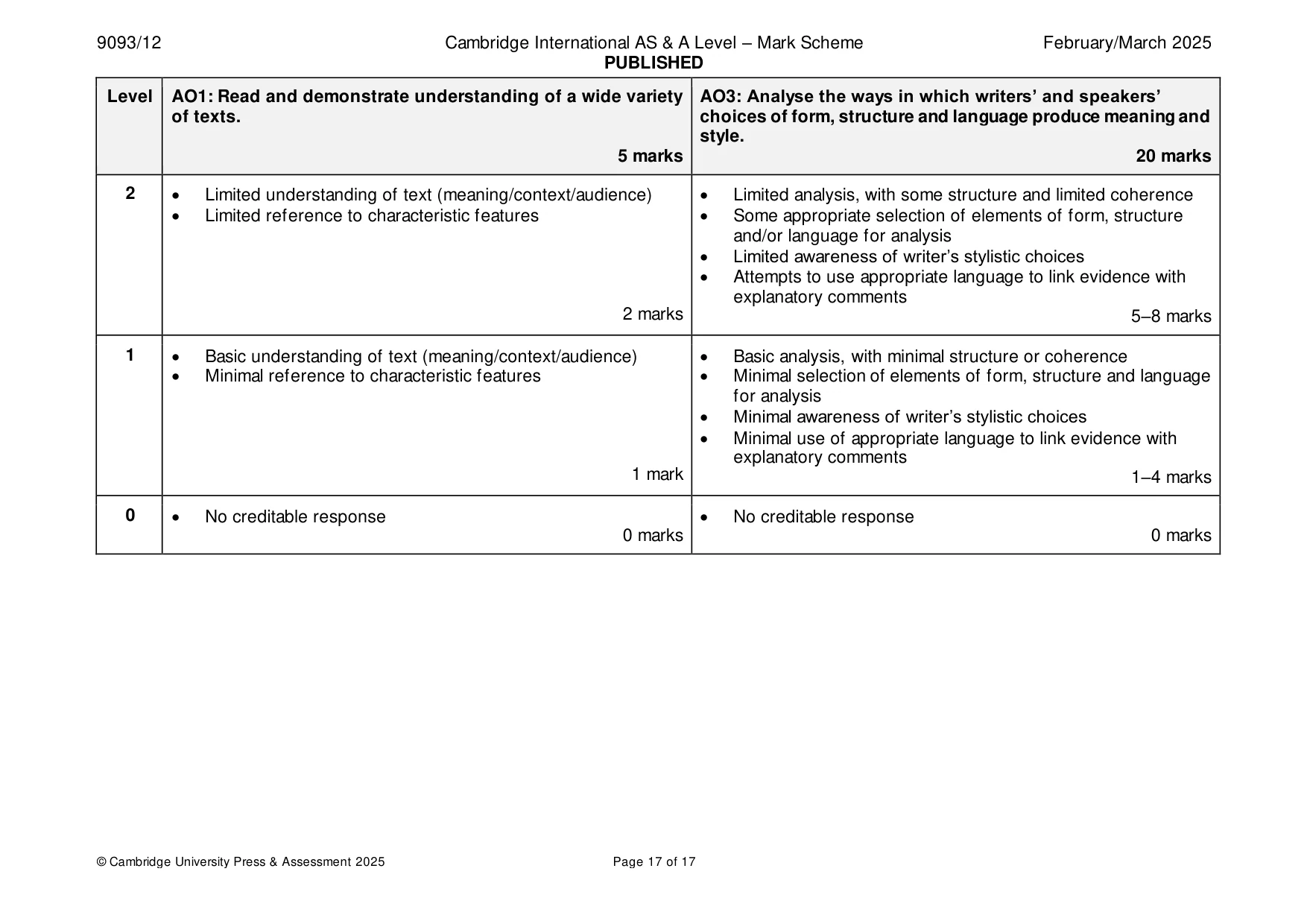
9093/12 Cambridge International AS & A Level – Mark Scheme PUBLISHED February/March 2025 © Cambridge University Press & Assessment 2025 Page 17 of 17 Level AO1: Read and demonstrate understanding of a wide variety of texts. 5 marks AO3: Analyse the ways in which writers’ and speakers’ choices of form, structure and language produce meaning and style. 20 marks 2 • Limited understanding of text (meaning/context/audience) • Limited reference to characteristic features 2 marks • Limited analysis, with some structure and limited coherence • Some appropriate selection of elements of form, structure and/or language for analysis • Limited awareness of writer’s stylistic choices • Attempts to use appropriate language to link evidence with explanatory comments 5–8 marks 1 • Basic understanding of text (meaning/context/audience) • Minimal reference to characteristic features 1 mark • Basic analysis, with minimal structure or coherence • Minimal selection of elements of form, structure and language for analysis • Minimal awareness of writer’s stylistic choices • Minimal use of appropriate language to link evidence with explanatory comments 1–4 marks 0 • No creditable response 0 marks • No creditable response 0 marks
What you needed in this session
Cambridge’s own grade thresholds for 2025 Feb/March, Paper 1 · Variant 2. A higher threshold means an easier paper — the bar moves with how the cohort did.